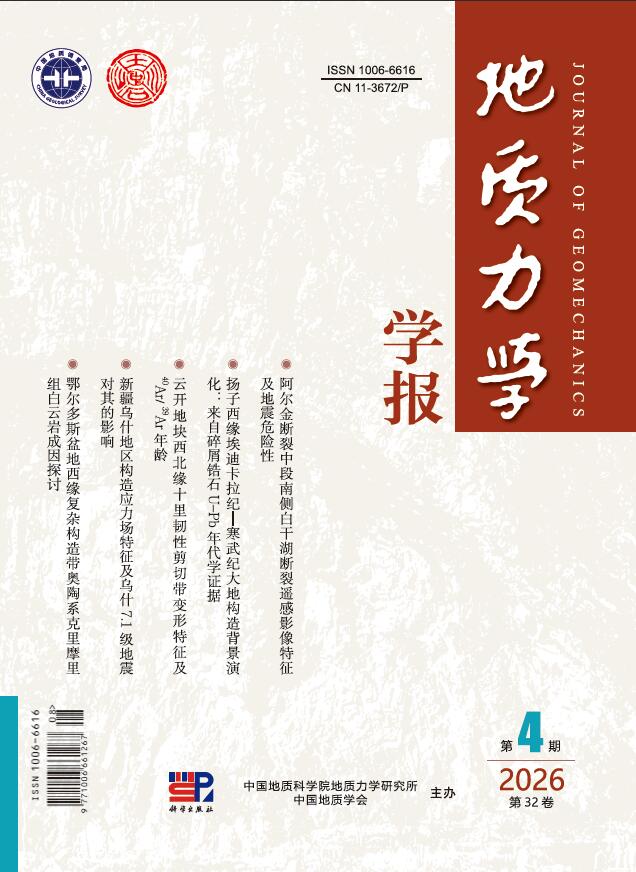




The Journal of Geomechanics primarily publishes articles on geomechanical theories and methods, and their applications in addressing major resource and environmental issues such as mineralization, hydrocarbon accumulation, and disasters during the evolution of the Earth.The key topics for 2026 are as follows:
Tectonic Systems and Structural Geology
l Neocathaysian tectonic system and basin-and-range tectonics in Eastern China
l Tethyan evolution and resource–environmental effects
l Tectonic evolution and resource–environmental effects of major Chinese terranes
l Evolution and tectonic analysis of orogenic belts
l Deep structure of representative basins and orogenic belts
l Tectonic evolution and dynamics of marginal sea basins (e.g., the spreading–subduction transition mechanism of marginal sea basins in the South China Sea, the formation sequence and dynamic model of marginal sea basins in the Western Pacific Ocean)
l Theory and application of microplate tectonics
l Tectonic evolution of marine areas and its significance for resources and the environment
--------------------------------
Crustal Stress and Tectonic Stress Field
l Crustal stress measurement and monitoring technology
l Characteristics and coupling mechanisms of deep and shallow crustal stress fields
l Active faults and current tectonic stress fields
l Present-day crustal stress characteristics, disaster mechanisms, and prevention–control research in areas of high tectonic activity
l Research on tectonic stress fields and the formation mineralizations and hydrocarbon reservoirs
l Crustal stress measurement and research in deep energy storage engineering
l Strong earthquakes and deep stress
l Three-dimensional modeling and intelligent characterization technologies for tectonic stress fields
l Stress field driving mechanisms of geological disasters
l Theory of deep crustal stress and multi-field coupling (>4000 m stratification)
--------------------------------
Energy Resources Geology
l Tectonic control of basins and oil production
l Tectonic modification and oil and gas preservation
l Mechanisms of ultra-deep hydrocarbon generation, reservoir formation, and accumulation
l Geological evaluation and drilling technology for deep and ultra-deep oil and gas
l Geothermal, hydrogen, and helium resources (theoretical assessment) and their exploration and development (new technologies)
l Mechanisms of unconventional and deep oil and gas enrichment and accumulation, and integrated geological and technical approaches
l Oil, gas, and energy storage engineering
l Intelligent prospecting practices and achievements in large basins and new areas
l Geological environmental effects and regulation of energy development (e.g., geomechanical mechanisms of energy-induced geological hazards, geomechanical safety technologies for carbon sequestration).
--------------------------------
Ore Field Structure and Mineralization
l Theory, methods, and practical application of geomechanics to ore deposits and fields
l Multi-scale structural control of mineral fields and exploration prediction
l Tectonic control of rock properties, mineralization, and ore body location
l Formation mechanisms and exploration techniques for strategic minerals
l Coupling of tectonics, magmatism, and mineralization
l Regional mineralization patterns and exploration prediction
l Simulation analysis of tectonics and mineralization
l Tectonic physical chemistry and exploration applications
l Comprehensive studies on tectonics and mineralization in representative mineral fields
--------------------------------
Geo-hazards and Engineering Geology
l Geological safety and risk prevention for major engineering projects on the Qinghai–Tibet Plateau
l Quaternary surface processes and disaster chains in global change
l Risk prevention of geological hazards under strong seismic conditions
l Coupling of tectonics, stratigraphy, and morphology and disaster effects
l Instability patterns and early detection of high-elevation geological hazards
l Risk assessment and prevention of complex geological hazard chains
l Geological safety of major engineering projects and urban areasMarine engineering geology and disaster prevention (e.g., activity of continental margin faults in the Northern South China Sea and seafloor stability, engineering geomechanics of sea-crossing bridge projects)
--------------------------------
Quaternary Geology and Environment
l Geological issues related to Quaternary geology, geomorphology, and ecological protection in the Yellow River basin
l Detailed analysis of abrupt climate changes in the Quaternary
l Regional differences and driving factors in the development of the monsoon system in the Quaternary
l Environmental archaeology, lake evolution, and paleoclimate since the last interglacial
l Application of environmental magnetism in reconstructing paleoenvironmental and paleoclimatic changes
l Coupling between tectonic, climatic, and surface processes
l Interactions between oceans, atmosphere, ice sheets, and biosphere during critical climate transitions
l High-precision Quaternary dating techniques and improvement of the time scale
--------------------------------
Active Tectonics and Earthquakes
l Active tectonic systems and regional crustal stability
l Neotectonic deformation and the geomorphological evolution of the Tibetan Plateau
l Fault structures and characteristics of significant seismic events
l Active faults in key tectonic zones and severe earthquake risk mitigation
l Fault activities and characteristics in key urban or engineering areas
l Active faults, paleoseismicity, and severe earthquake hazard
l Mechanisms and modeling of active tectonic deformation
l Paleoseismic event reconstruction and long-term seismic hazard assessment
l New technologies for high-precision detection of active tectonics
l Detailed assessment of earthquake hazard risk
--------------------------------
Fundamental Geology and Regional Geology
l New achievements in regional geological surveys and mapping methods
l Lithospheric evolution and reconstruction of paleoclimate and paleoenvironment
l Stratigraphic chronology and regional correlation of representative areas
l Deep earth processes and shallow-surface responses
l Genesis of basic and ultrabasic rocks and metallogenic mechanisms of Cr, Co, Ni, and other ores
l Multi-layer interactions and evolutionary mechanisms in continental systems
l Coupling of environmental changes and biological evolution during critical geological periods
l Regional tectonic evolution and continental dynamics
l High-precision 3D geological mapping and intelligent characterization techniques
--------------------------------
Others
l Tectonic modeling techniques and their applications
l Big data, artificial intelligence, and their applications
--------------------------------
Introduction to the Journal of Geomechanics
The Journal of Geomechanics is a bimonthly journal published in Chinese and edited by Academician Deng Jun. Jointly sponsored by the Institute of Geomechanics, Chinese Academy of Geological Sciences, and the Geological Society of China. Currently listed as a Peking University Chinese Core Journal, a Chinese Science and Technology Core Journal, and a WJCI Source Journal. It is included in domestic and foreign data platforms such as Scopus, DOAJ, ICI World of Journals, Ulrichsweb, CAS, Georef, PA, EuroPub, Research4Life, MIAR, JST, EBSCO, Chinese Science Citation Database (CSCD) Core Collection, CNKI, CSTPCD, National Science and Technology Academic Journal Open Platform, China Core Journal (Selection) Database, VIP Chinese Science and Technology Journal Database, and Superstar Journal Domain Publishing Database. 2025 impact factors: 3.5 (Scopus), 4.136 (CNKI), 1.8286 (CSCD), 2.35 (Wanfang Data), 2.621 (VIP Information).
 Guidelines for the Key Research Topics in 2026.pdf