


Formation and modification of the Minle Basin in the Hexi Corridor: Insights into Cretaceous tectonic characteristics of the northeastern Tibetan Plateau
-
摘要: 青藏高原东北缘在早白垩世发育一系列沉积盆地,这些盆地的构造特征记录了高原东北缘前新生代构造演化历史,是认识青藏高原新生代生长机制的基础。但目前关于这些早白垩世盆地的性质仍存在诸多分歧,直接影响了对该地区中生代晚期构造特征的认识。以河西走廊中段民乐盆地为研究对象,开展了系统的野外构造地质调查和古应力场恢复;通过构造解析,重新厘定了民乐盆地的形成和改造过程。研究结果发现,民乐盆地下白垩统发育大量同沉积正断层,其初始走向为近南北向,指示民乐盆地在早白垩世为受控于近东西向伸展作用的断陷盆地。民乐盆地下白垩统呈现出北东—南西向和北西—南东向2组轴向的褶皱,结合地层中发育的缩短构造,揭示该盆地在晚白垩世遭受了北东—南西向和北西—南东向双向水平缩短作用。民乐盆地早白垩世的伸展作用,与东亚地区早白垩世广泛发育的伸展变形及伸展应力方向具有一致性,是古太平洋板块回撤以及由此引发的地幔物质流动的产物。晚白垩世遭受的双向缩短,则是欧亚板块南缘特提斯构造域和东缘太平洋构造域同时期挤压事件远程效应叠加的结果。上述变形特征表明,古太平洋构造域的影响范围至少可向西扩展至河西走廊及青藏高原北部地区。Abstract:
Objective A series of Early Cretaceous sedimentary basins developed in the Hexi Corridor along the northeastern margin of the Tibetan Plateau. These basins preserve critical records of the regional pre-Cenozoic tectonic evolution, forming the basis for understanding the Cenozoic growth mechanism of the Tibetan Plateau. However, the nature of these Early Cretaceous basins remains controversial, impeding a clear understanding of the late Mesozoic tectonics in this critical area. Methods Focusing on the Minle Basin in the central Hexi Corridor, this study carried out systematic field structural investigations and paleo-stress reconstructions. Through detailed structural analysis, the formation and post-depositional modification processes of the Minle Basin were re-evaluated. Results Our investigation reveals that the Lower Cretaceous strata in the Minle Basin are characterized by abundant syn-sedimentary normal faults with initial nearly N-S strikes, indicating that the basin was an extensional fault basin controlled by E-W-directed extension during the Early Cretaceous. Subsequent deformation is represented by two sets of folds with NE-SW and NW-SE axial trends, together with shortening structures in Lower Cretaceous rocks, revealing that the basin underwent bidirectional (NE-SW and NW-SE) horizontal shortening during the Late Cretaceous. Conclusions The Early Cretaceous extension in the Minle Basin was consistent with the widespread extensional deformation and extensional stress direction across East Asia during this period, resulting from the slab rollback of the Paleo-Pacific Plate and associated mantle flow. The bidirectional Late Cretaceous shortening resulted from the superimposition of the remote effects of simultaneous compression events in the Tethys and Pacific tectonic domains, respectively, along the southern and eastern margins of the Eurasian Plate. [ Significance ] The deformation characteristics demonstrate that the influence of the subduction of the Paleo-Pacific Plate extended westward to at least the Hexi Corridor and the northern margin of the Tibetan Plateau. -
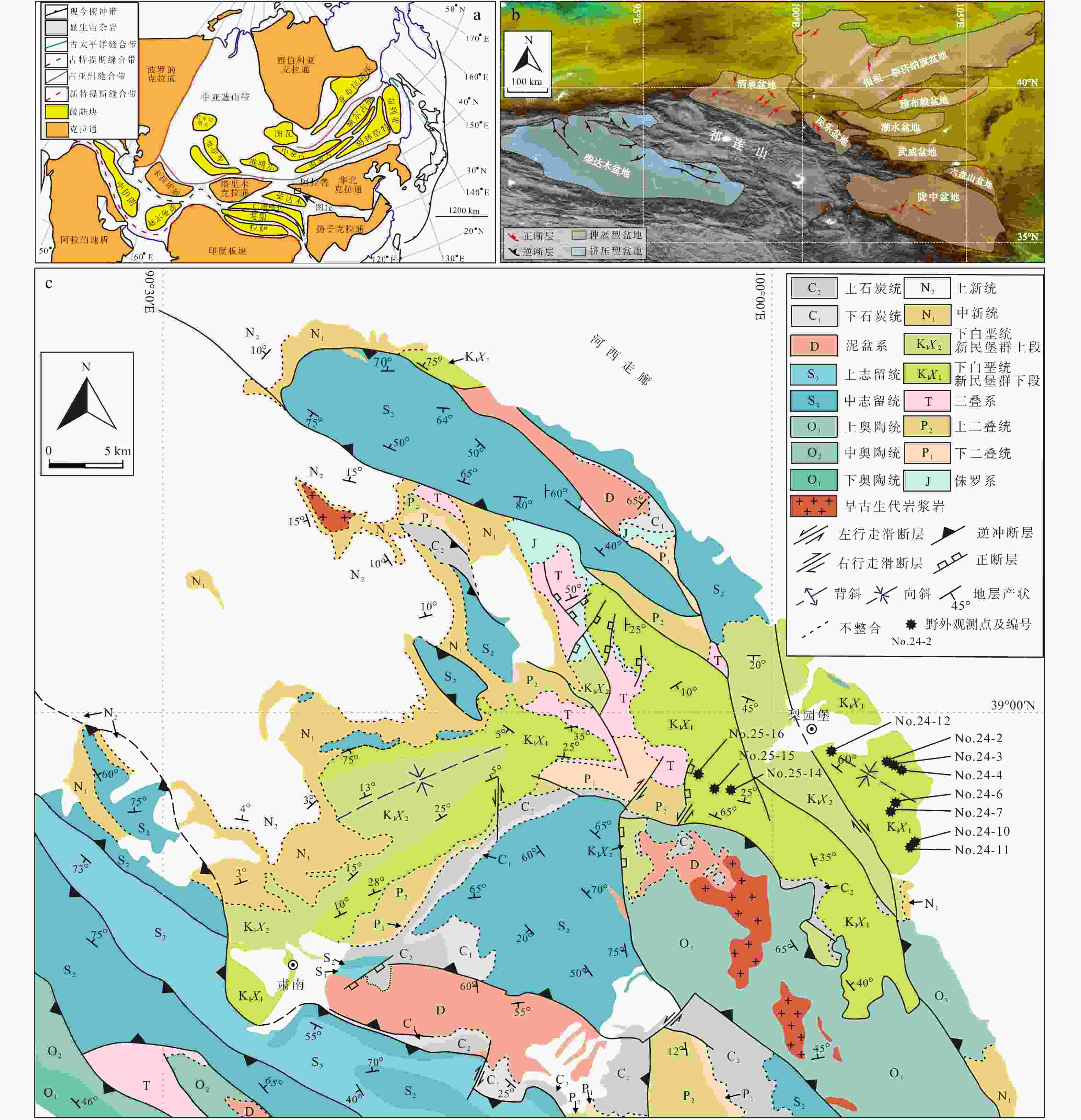
图 1 亚洲大地构造简图、青藏高原东北缘早白垩世盆地类型与分布以及民乐盆地区域地质图
a—亚洲大地构造简图;b—青藏高原东北缘早白垩世盆地类型及分布;c—民乐盆地区域地质图
Figure 1. Tectonic sketch map of Asia, along with the styles and distribution of Early Cretaceous basins in the northeastern Tibetan Plateau and the regional geological map of the Minle Basin
(a) Tectonic sketch map of Asia; (b) styles and distribution of Early Cretaceous basins in the northeastern Tibetan Plateau; (c) Regional geologic map of the Minle Basin
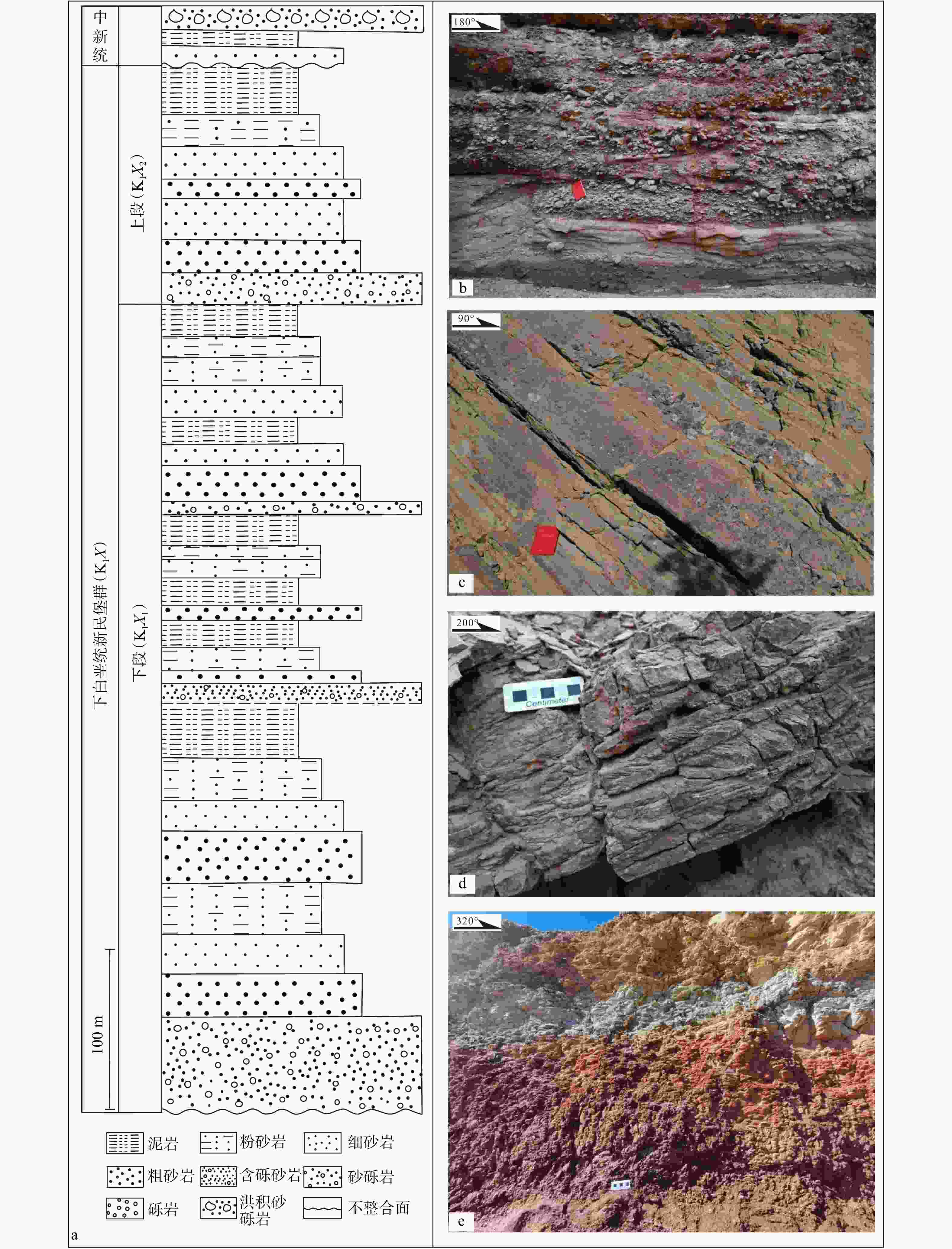
图 2 民乐盆地下白垩统新民堡群地层柱状图及主要岩性野外露头特征
a—民乐盆地下白垩统地层柱状图;b—厚层砾岩;c—厚层粗砂岩;d—中薄层粉砂岩;e—杂色泥岩
Figure 2. Stratigraphic column and field photos of key lithologies of the Lower Cretaceous Xinminpu Group in the Minle Basin
(a) Stratigraphic column of the Lower Cretaceous Xinminpu Group in the Minle Basin; (b) Thick-bedded conglomerate; (c) Thick-bedded coarse sandstones; (d) Medium- to thin-bedded siltstone; (e) Variegated mudstone
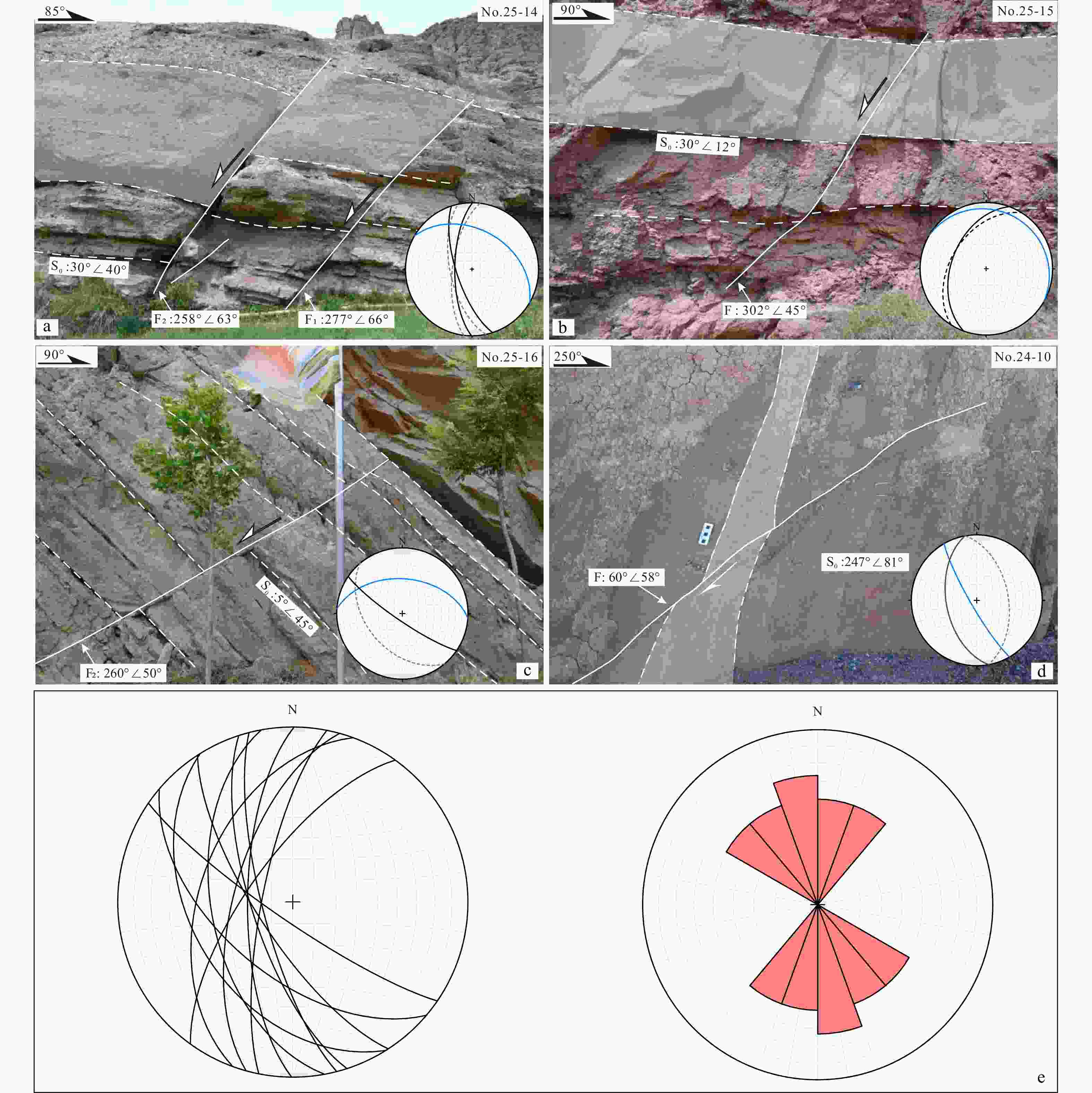
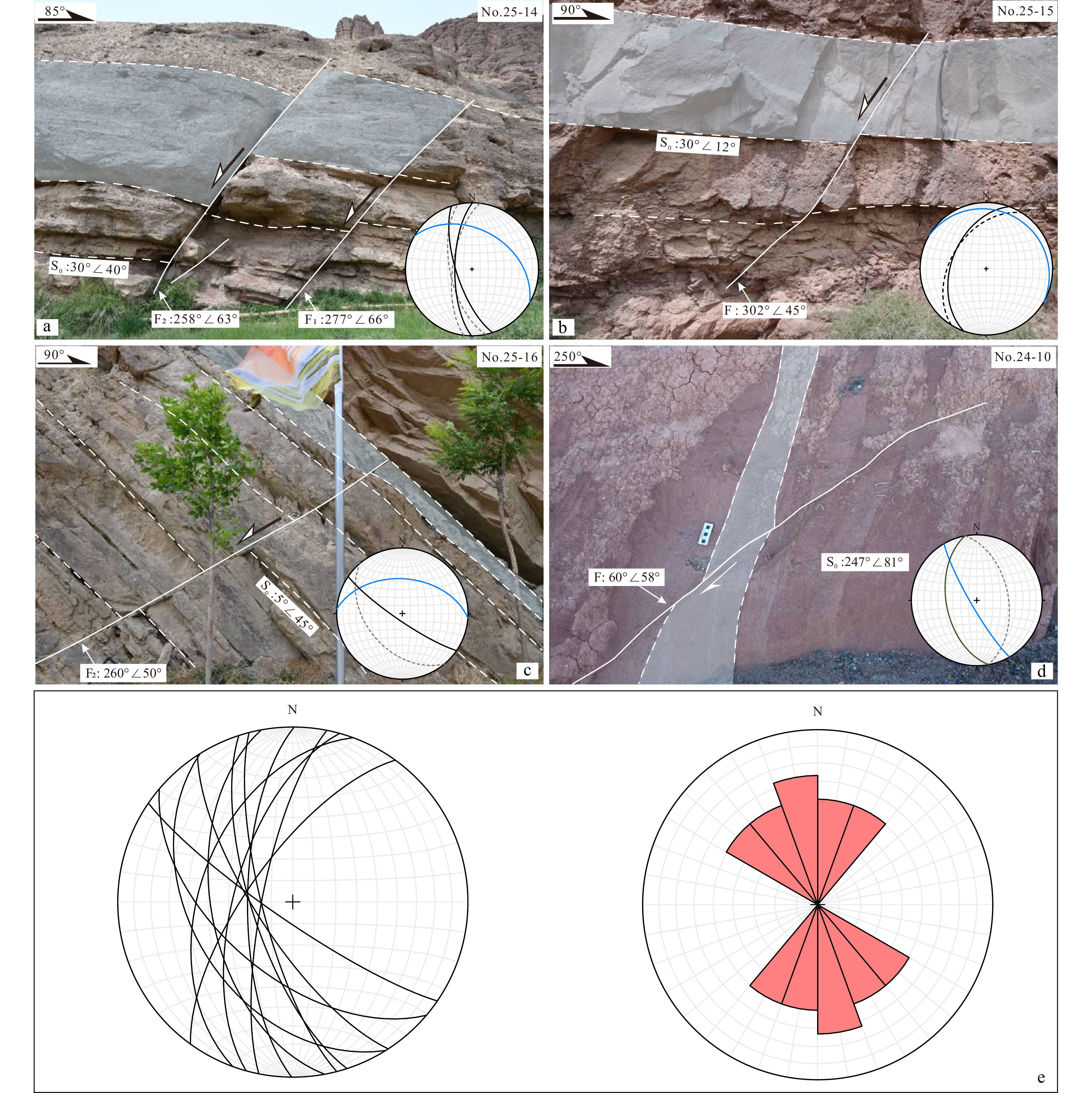
图 3 民乐盆地下白垩统中生长断层构造特征(野外观测点位置见图1c)
图中所有赤平投影为下半球投影;蓝色实线代表地层产状,灰色虚线代表实测生长断层产状,黑色实线表示旋转至初始状态的生长断层产状a—生长断层两盘同沉积砾岩厚度发生变化;b—生长断层两盘同沉积粗砂岩厚度发生变化;c—生长断层两盘同沉积页岩厚度发生变化,顶部被厚层砂岩覆盖;d—倒转地层中发育的生长断层现今表现为逆断层性质;e—赤平投影和玫瑰花图展示生长断层初始产状特征
Figure 3. Structural characteristics of growth faults in the Lower Cretaceous strata of the Minle Basin (see Fig. 1c for field observation locations)
(a) Syn-rift conglomerate shows thickness variations across growth faults; (b) Syn-rift coarse sandstone shows thickness variations across a growth faults; (c) Syn-rift black shale shows thickness variations across a growth fault and is covered by thick-bedded sandstone; (d) Growth faults developed in overturned strata now express as reverse faults; (e) Stereo-projection and rose diagram of the initial attitude of the growth faults All stereoplots are lower hemisphere equal-area projections; blue solid lines represent bedding attitudes; gray dashed lines and black solid lines represent measured and initial growth-fault attitudes, respectively)
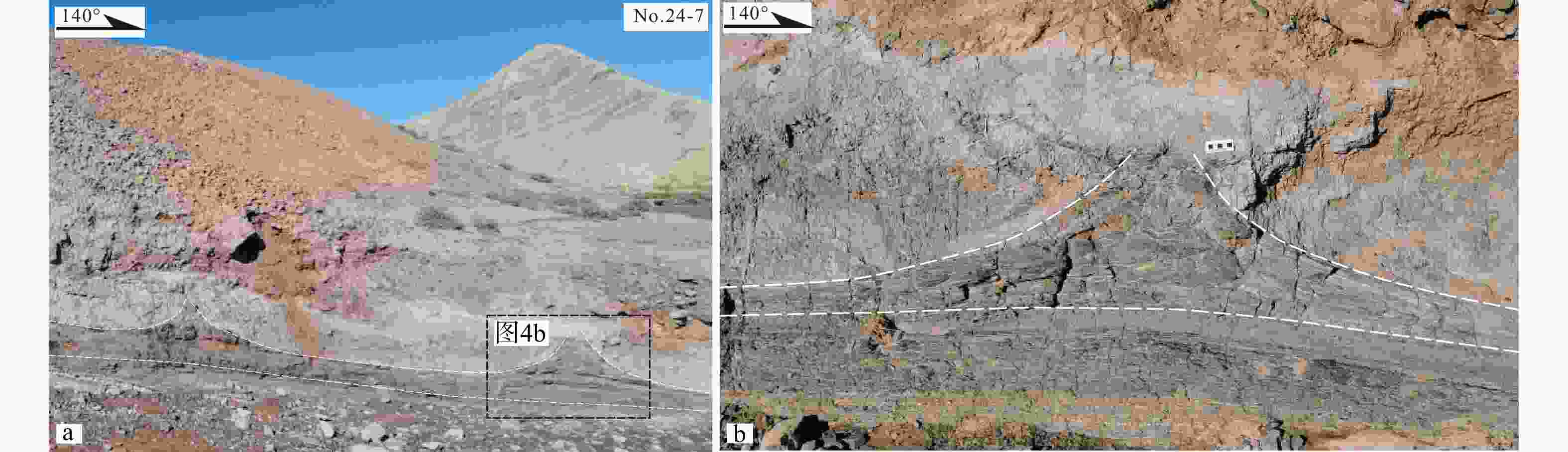
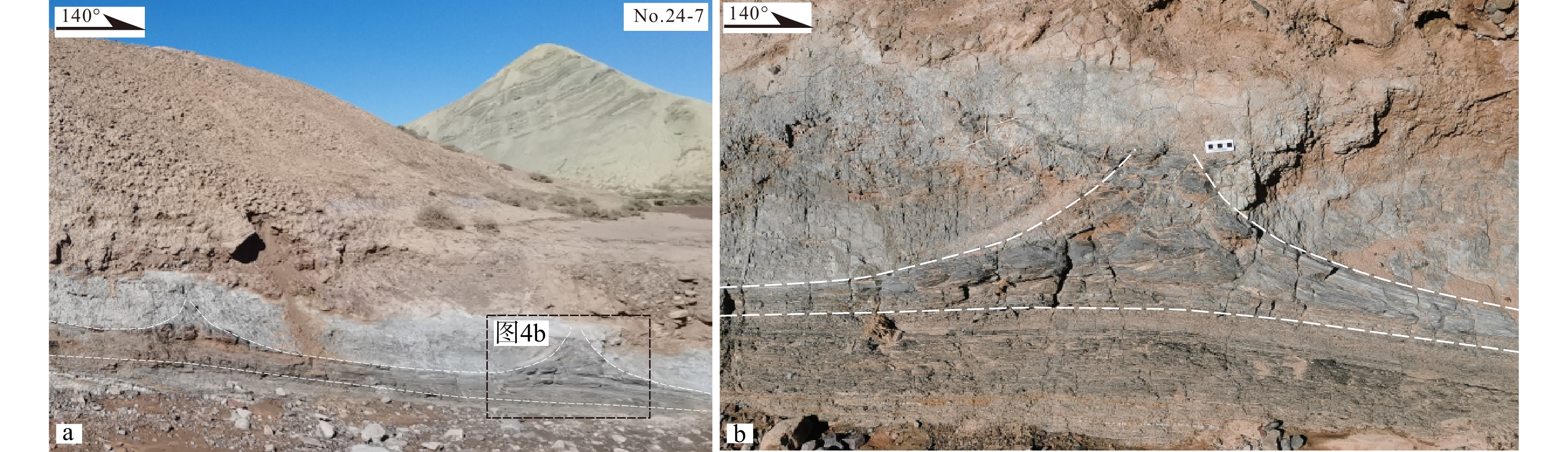
图 4 民乐盆地下白垩统软沉积变形(观测点位置见图1c)
a—民乐盆地下白垩统软沉积变形发育层位;b—灰黑色粉砂质泥岩中发育的“帐篷”构造
Figure 4. Soft-sediment deformation structures developed in the Lower Cretaceous Strata of the Minle Basin (see Fig. 1c for the field observation location)
(a) Stratigraphic position of soft-sediment deformation in the Lower Cretaceous; (b) Tepee-like structures developed in grayish-black sandy mudstone
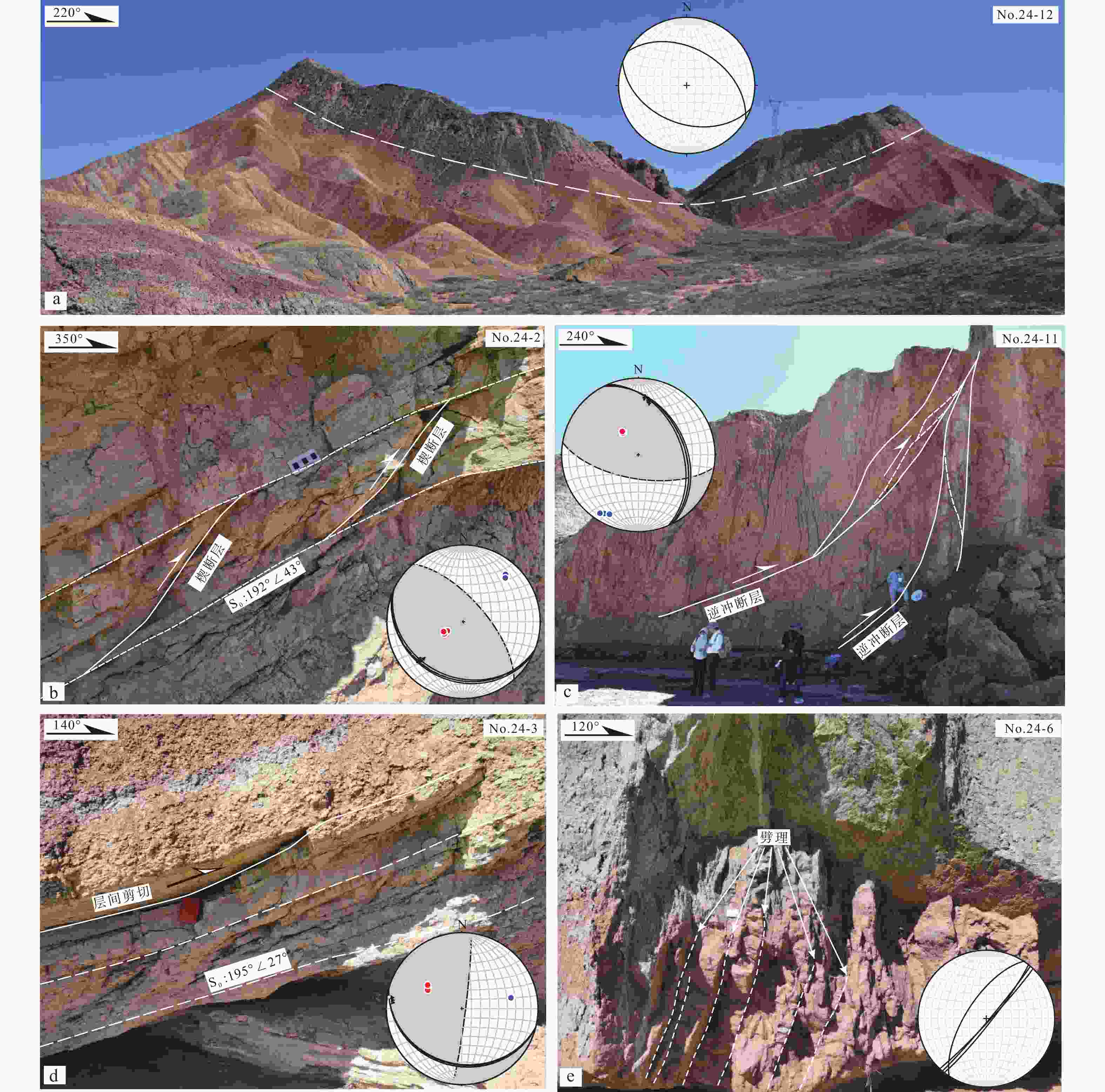
图 5 民乐盆地下白垩统中的缩短变形(观测点位置见图1c)
图中所有断层机制解中黑色实线代表断层面,蓝点代表P轴,红点代表T轴a—梨园堡地区北西走向向斜转折端;b—楔断层;c—褶皱核部逆冲断层;d—细砂岩层之间发育的层间剪切;e—泥质粉砂岩中发育的北东—南西走向密集劈理
Figure 5. Shortening deformation in the Lower Cretaceous strata of the Minle Basin (see Fig. 1c for field observation locations)
(a) Hinge zone of a NW-trending syncline in the Liyuanpu Area; (b) Wedge fault; (c) Thrust fault developed in a fold core zone; (d) Interlayer shear developed between fine sandstone beds; (e) Dense NE-SW-striking cleavage developed in argillaceous siltstonesIn all fault plane solutions, black solid lines represent fault planes, blue dots represent P-axes, and red dots represent T-axes.
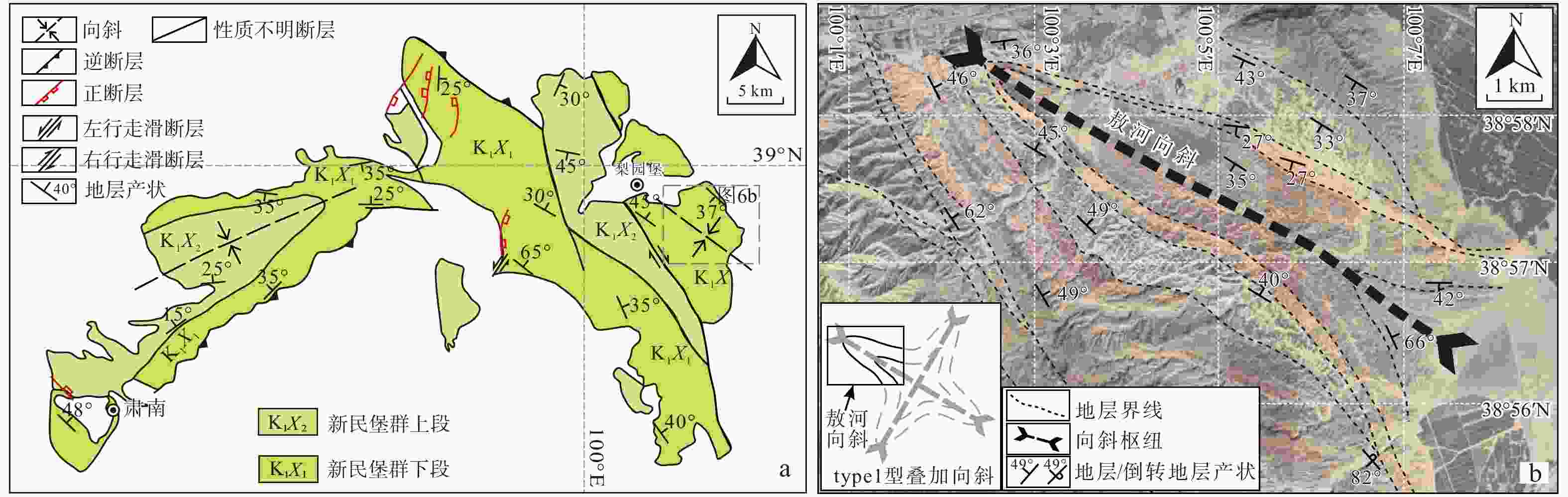
图 6 民乐盆地下白垩统褶皱变形特征
a—下白垩统形成轴向北西—南东和北东—南西近直交的2组褶皱;b—梨园堡地区叠加向斜
Figure 6. Fold deformation characteristics of the Lower Cretaceous in the Minle Basin
(a) Two sets of nearly orthogonal folds with NW-SE and NE-SW axial trends in Lower Cretaceous strata; (b) Superimposed syncline in the Liyuanpu area
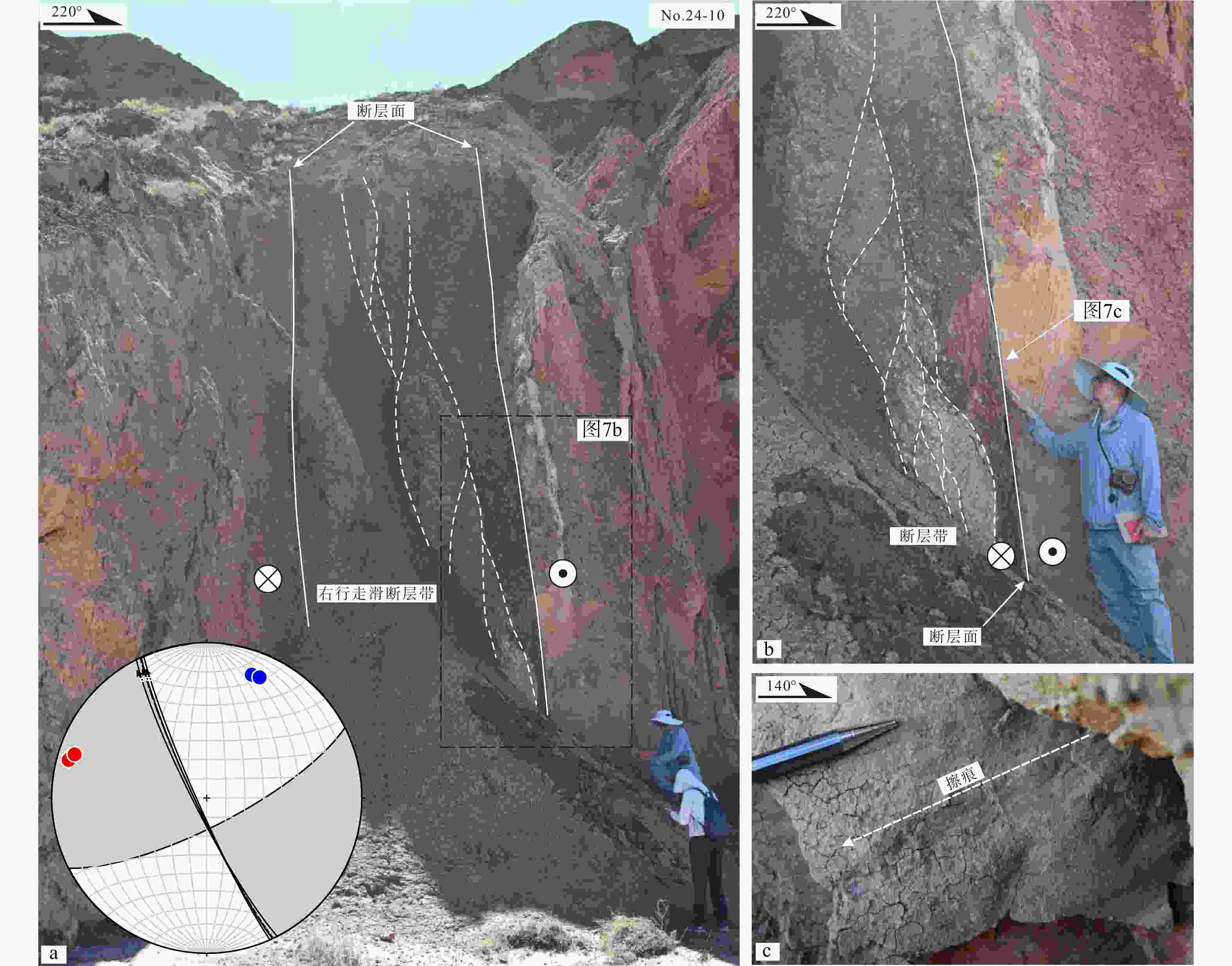
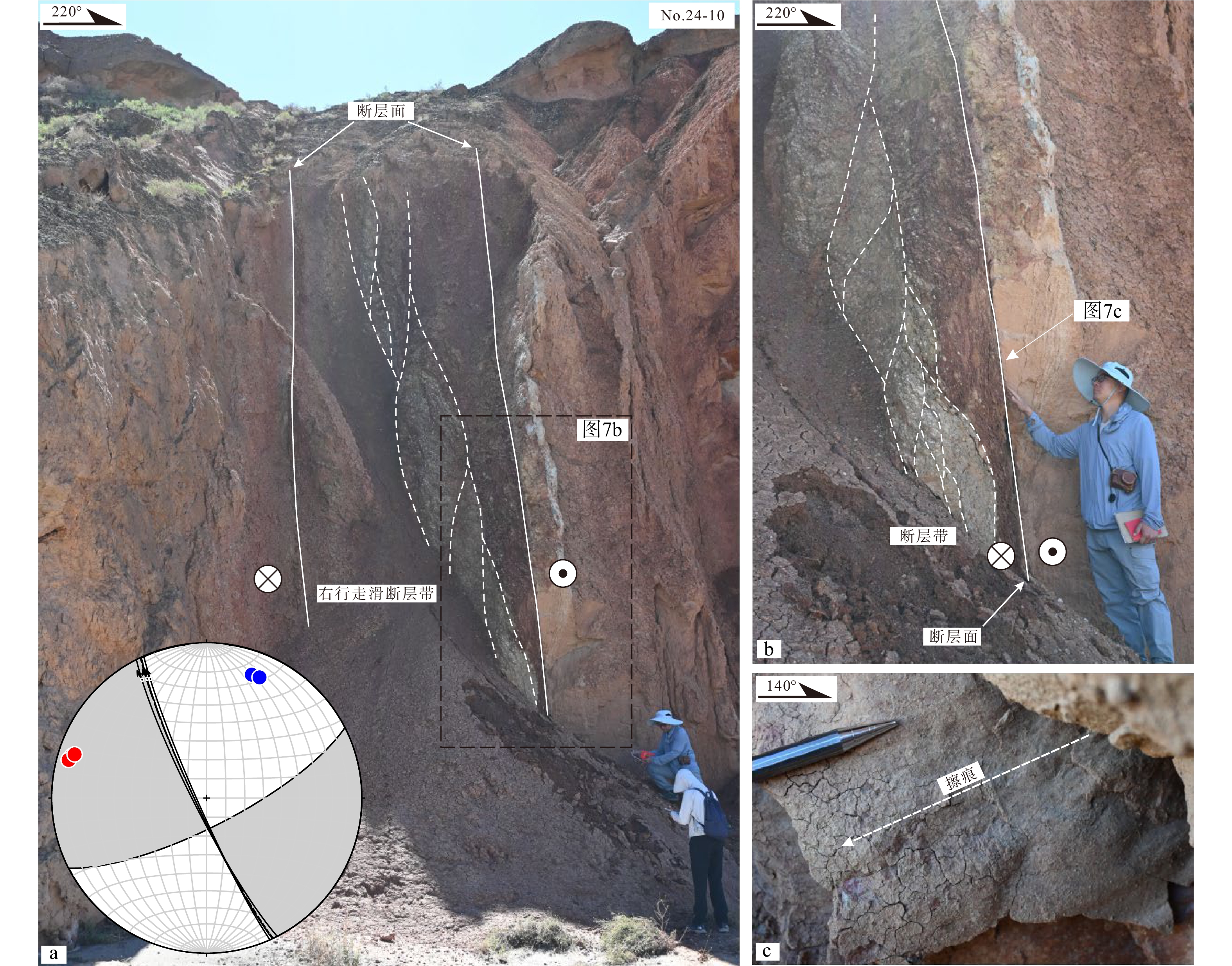
图 7 民乐盆地下白垩统中北西走向右行走滑断层(观测点位置见图1c)
a—断层带及断层机制解(断层机制解中黑色实线代表断层面,蓝点代表P轴,红点代表T轴);b—断层带内劈理发育;c—断层面擦痕指示右行走滑
Figure 7. NW-trending dextral strike-slip fault developed in the Lower Cretaceous strata of the Minle Basin (see Fig. 1c for field observation location)
(a) Fault zone and fault plane solution (Black solid lines represent fault planes, blue dots represent P-axes, and red dots represent T-axes); (b) Cleavage developed within the fault zone; (c) Slickenlines on fault plane indicating dextral strike-slip
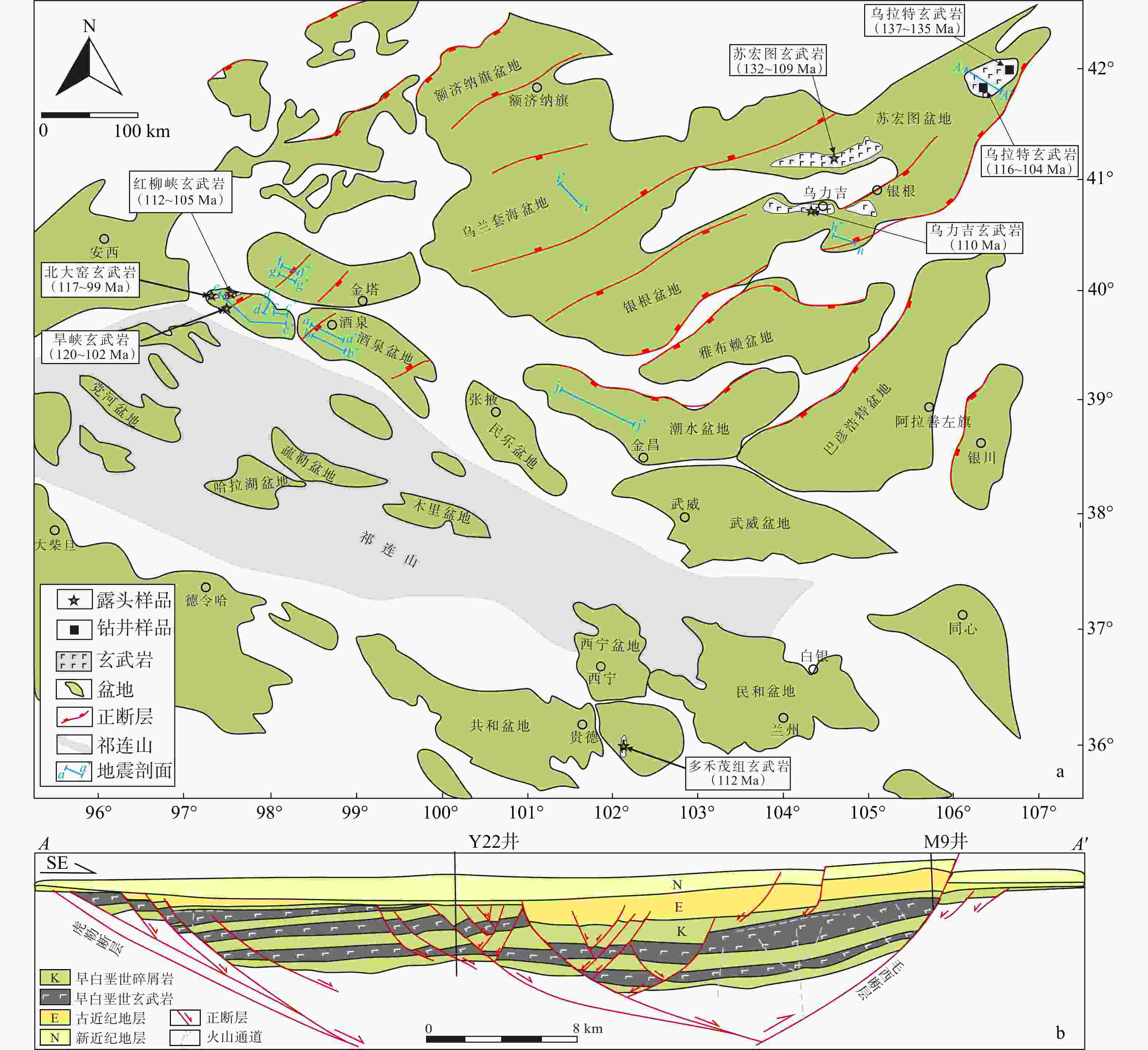
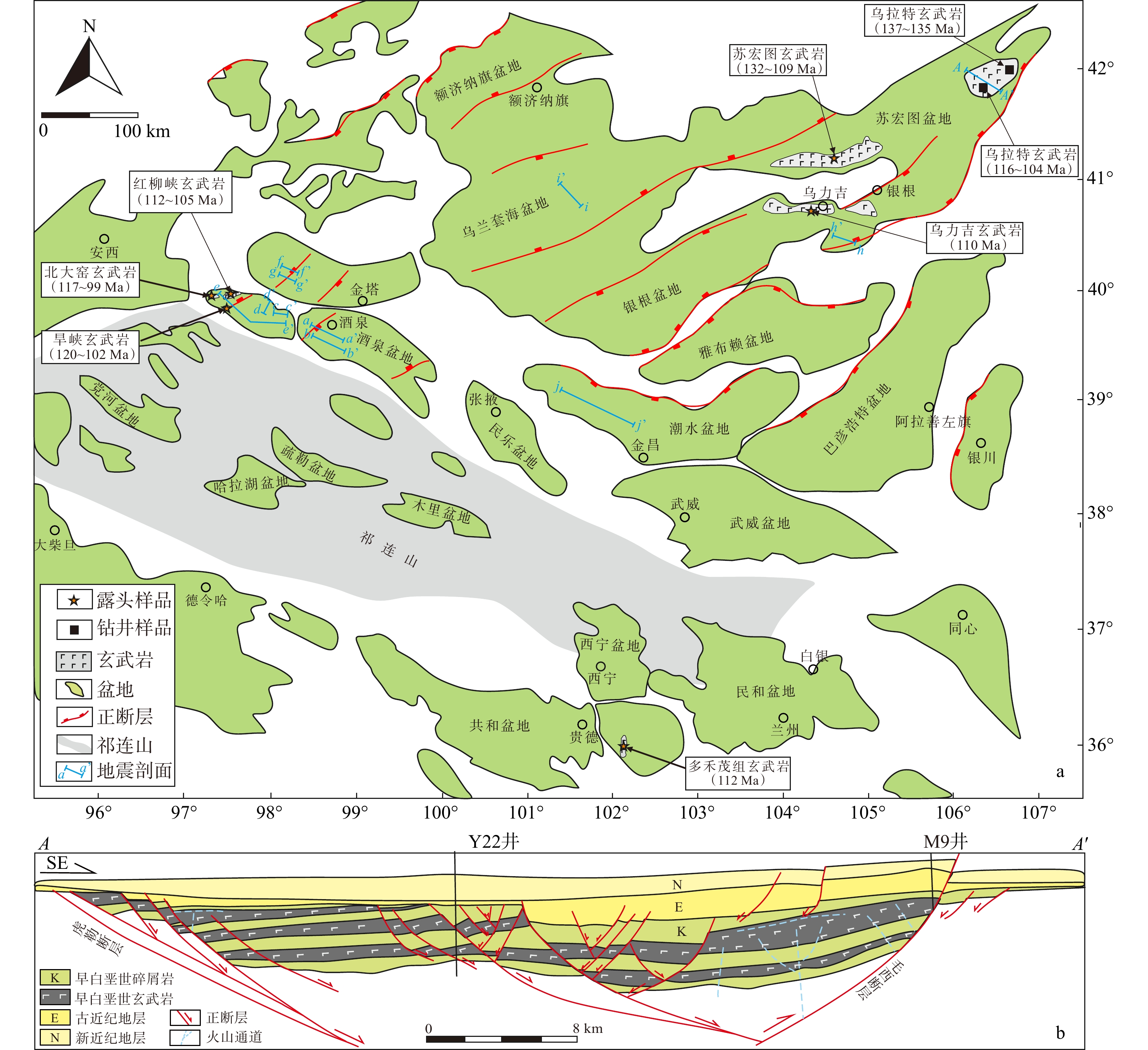
图 8 青藏高原东北缘早白垩世盆地及火山岩分布特征
玄武岩年龄数据引自Yang et al.,2001;李海兵和杨经绥,2004;卫平生等,2005;范立勇等,2007;Hu et al.,2018;钟福平等,2011;汤文豪等,2012;王训练等,2018;陈志鹏等,2019;Hui et al.,2021a—青藏高原东北缘早白垩世盆地和玄武岩发育情况(据Hui et al.,2021 修改);b—地震剖面揭示苏宏图盆地早白垩世碎屑岩与玄武岩互层(剖面位置见图8a;据傅锚等,2025修改)
Figure 8. Distribution of Early Cretaceous basins and associated volcanic rocks in the northeastern Tibetan Plateau
(a) Distribution of Early Cretaceous basins and basalts in the northeastern Tibetan Plateau (modified from Hui et al., 2021); (b) Seismic profile revealing interbedded Early Cretaceous clastic rocks and basalts in the Suhongtu Basin (modified from Fu et al., 2025) Basalt age data are compiled from Yang et al. (2001), Li and Yang (2004), Wei et al. (2005), Fan et al. (2007), Hu et al. (2018), Zhong et al. (2011), Tang et al. (2012), Wang et al. (2018), Chen et al. (2019), and Hui et al. (2021).
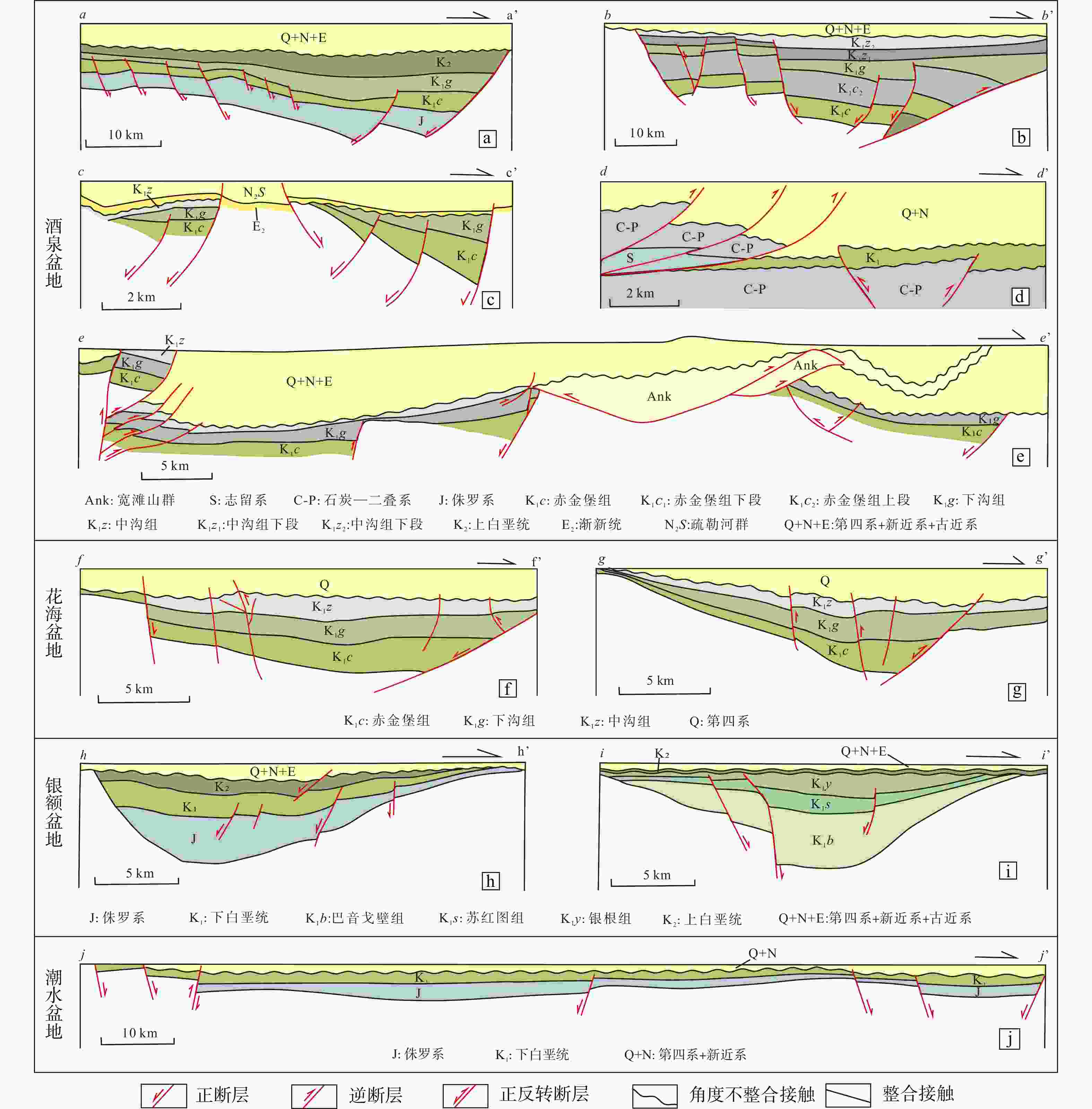
图 9 二维地震反射剖面解释所揭示的河西走廊及周边地区早白垩世盆地伸展变形(剖面位置见图8a)
地震剖面数据引自王同和,1987;霍永录,1989;李明杰,2006;冉波等,2011a、b、c、d、e—酒泉盆地生长正断层;f、g—花海盆地生长正断层;h、i—银额盆地生长正断层;j—潮水盆地生长正断层
Figure 9. Extensional deformation of Early Cretaceous basins in the Hexi Corridor and adjacent areas revealed by 2D seismic reflection profile interpretions (see Fig. 8a for profile locations)
(a–e) Growth normal faults in the Jiuquan Basin; (f–g) Growth normal faults in the Huahai Basin; (h–i) Growth normal faults in the Yin’e Basin; (j) Growth normal faults in the Chaoshui Basin Seismic profile data are compiled from Wang (1987), Huo (1989), Li (2006), and Ran et al. (2011).
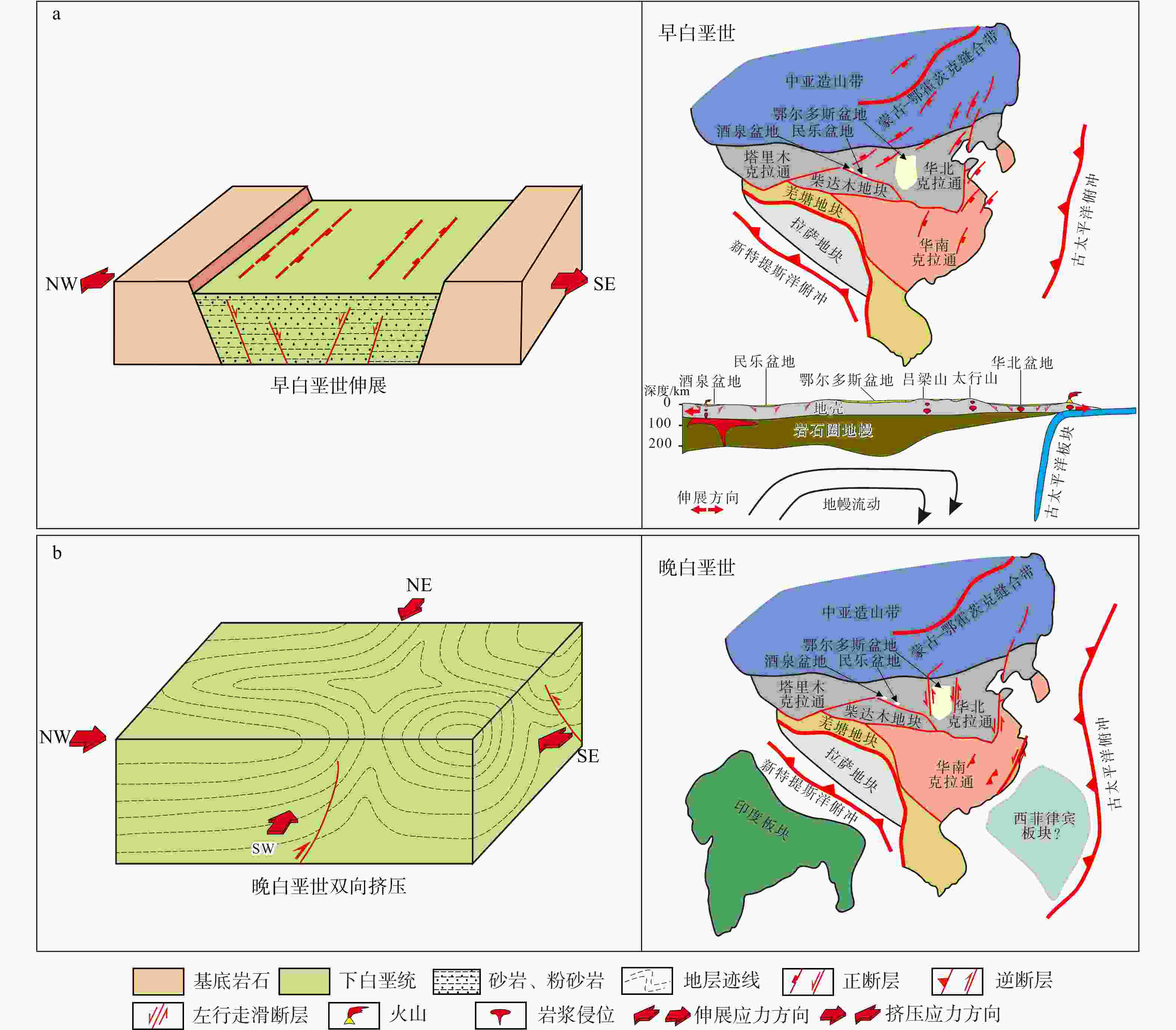
图 10 民乐盆地白垩纪构造演化模式及构造背景
a—早白垩世民乐伸展断陷盆地模式图及构造背景;b—民乐盆地晚白垩世双向挤压及构造背景
Figure 10. Cretaceous tectonic evolution models and geodynamic settings of the Minle Basin
(a) Early Cretaceous structural model and tectonic setting of the extensional fault basins in the Minle Basin; (b) Late Cretaceous bidirectional compression model and tectonic setting of the Minle Basin
-
[1] ALLMENDINGER R W, CARDOZO N, FISHER D M, 2012. Structural geology algorithms: vectors and tensors[M]. Cambridge: Cambridge University Press. [2] AN K X, LIN X B, WU L, et al., 2018. Reorganization of sediment dispersal in the Jiuxi Basin at~17 Ma and its implications for uplift of the NE Tibetan Plateau[J]. Palaeogeography, Palaeoclimatology, Palaeoecology, 511: 558-576. doi: 10.1016/j.palaeo.2018.09.022 [3] AN K X, LIN X B, HUANG J L, et al., 2025. Early Cenozoic reactivation of a pre‐existing crustal boundary along the Kuantan Shan-Hei Shan area North of the Jiuxi Basin, northeastern Tibetan Plateau[J]. Tectonics, 44(5): e2024TC008615. doi: 10.1029/2024TC008615 [4] CHEN X H, YIN A, GEHRELS G E, et al., 2003. Two phases of Mesozoic north-south extension in the eastern Altyn Tagh range, northern Tibetan Plateau[J]. Tectonics, 22(5): 1053. doi: 10.1029/2001tc001336 [5] CHEN X H, SHAO Z G, XIONG X S, et al., 2019a. Fault system, deep structure and tectonic evolution of the Qilian Orogenic Belt, Northwest China[J]. Geology in China, 46(5): 995-1020 (in Chinese with English abstract). [6] CHEN X H, SHAO Z G, XIONG X S, et al., 2019b. Early cretaceous overthrusting of Yumu Mountain and hydrocarbon prospect on the northern margin of the Qilian Orogenic Belt[J]. Acta Geoscientica Sinica, 40(3): 377-392 (in Chinese with English abstract). [7] CHEN Z P, REN Z L, QI K, et al., 2019. Zircon U-Pb chronology and geochemistry of volcanic rocks of early Cretaceous Bayingebi Formation in Suhongtu depression of the Ying'e basin, and their tectonic implications[J]. Acta Geologica Sinica, 93(2): 353-367 (in Chinese with English abstract). [8] CHENG F, GARZIONE C, JOLIVET M, et al., 2019. Provenance analysis of the Yumen Basin and northern Qilian Shan: implications for the pre-collisional paleogeography in the NE Tibetan plateau and eastern termination of Altyn Tagh fault[J]. Gondwana Research, 65: 156-171. doi: 10.1016/j.gr.2018.08.009 [9] CHU Y, LIU T J, LIN W, et al., 2024. Lithospheric reworking and thinning by cyclical continental extension: a synthesis of Cretaceous extensional domes in the South China Block[J]. Comptes Rendus-Géoscience, 356(S2): 137-162. doi: 10.5802/crgeos.245 [10] CUNNINGHAM D, ZHANG J, LI Y F, 2016. Late Cenozoic transpressional mountain building directly north of the Altyn Tagh Fault in the Sanweishan and Nanjieshan, North Tibetan Foreland, China[J]. Tectonophysics, 687: 111-128 doi: 10.1016/j.tecto.2016.09.010 [11] CUNNINGHAM D, ZHANG J, 2020. China | Mongolia: Mesozoic-Cenozoic[M]//ALDERTON D, ELIAS S A. Encyclopedia of geology. London: Elsevier: 509-525. [12] DARBY B J, RITTS B D, 2002. Mesozoic contractional deformation in the middle of the Asian tectonic collage: the intraplate Western Ordos fold–thrust belt, China[J]. Earth and Planetary Science Letters, 205(1-2): 13-24. doi: 10.1016/S0012-821X(02)01026-9 [13] DARBY B J, RITTS B D, 2007. Mesozoic structural architecture of the Lang Shan, North-Central China: intraplate contraction, extension, and synorogenic sedimentation[J]. Journal of Structural Geology, 29(12): 2006-2016. doi: 10.1016/j.jsg.2007.06.011 [14] DAVIS G A, DARBY B J, 2010. Early Cretaceous overprinting of the Mesozoic Daqing Shan fold-and-thrust belt by the Hohhot metamorphic core complex, Inner Mongolia, China[J]. Geoscience Frontiers, 1(1): 1-20. doi: 10.1016/j.gsf.2010.08.001 [15] DEWEY J F, SHACKLETON R M, CHANG C F, et al. 1988. The tectonic evolution of the Tibetan Plateau[J]. Proceedings of the Royal Society A: Mathematical, Physical and Engineering Sciences, 327(1594): 379-413. [16] DING L, KAPP P, CAI F L, et al., 2022. Timing and mechanisms of Tibetan Plateau uplift[J]. Nature Reviews Earth & Environment, 3(10): 652-667. doi: 10.1038/s43017-022-00318-4 [17] DONG S W, ZHANG Y Q, LI H L, et al., 2018. The Yanshan orogeny and late Mesozoic multi−plate convergence in East Asia—Commemorating 90th years of the “Yanshan Orogeny”[J]. Science China Earth Sciences, 61(12): 1888-1909. doi: 10.1007/s11430-017-9297-y [18] DUAN H L, 2004. Analysis on structural style in the Jiuxi Depression[J]. Geotectonica et Metallogenia, 28(3): 353-354 (in Chinese). [19] FAN L Y, WANG Y J, LI X Y, et al., 2007. Geochemical characteristics of Late Mesozoic mafic volcanic rocks from western Qinling and their tectonic implications[J]. Geotectonica et Metallogenia, 31(4): 471-481 (in Chinese with English abstract). [20] FENG Z Q, PEI Y, LIU Y J, et al., 2026. A study of orogenic processes: the tectonic evolution of the eastern Central Asian Orogenic Belt[J]. Tectonics, 45(2): e2025TC009101. doi: 10.1029/2025TC009101 [21] FU M, SHAN S Q, WANG D B, et al., 2025. Relationship between Early Cretaceous faulting and volcanism in the Chagan Sag, Yin’e Basin[J]. Chinese Journal of Geology, 60(6): 1823-1836 (in Chinese with English abstract). [22] Geological Survey of Gansu Province, 2021. Regional geology of China, Gansu province[M]. Beijing: The Geological Publishing House: 1-1985 (in Chinese). [23] GRAHAM S A, HENDRIX M S, JOHNSON C L, et al., 2001. Sedimentary record and tectonic implications of Mesozoic rifting in southeast Mongolia[J]. Geological Society of America Bulletin, 113(12): 1560-1579. doi: 10.1130/0016-7606(2001)113<1560:sratio>2.0.co;2 [24] GUO Z X, SHI Y P, YANG Y T, et al., 2018. Inversion of the Erlian Basin (NE China) in the early Late Cretaceous: implications for the collision of the Okhotomorsk Block with East Asia[J]. Journal of Asian Earth Sciences, 154: 49-66. doi: 10.1016/j.jseaes.2017.12.007 [25] HAN L L, CHEN X H, SHAO Z G, et al., 2024. Structural characteristics and time constraint of Late Mesozoic intracontinental deformation in Xishan meiyao area, south of Beishan[J]. Geological Bulletin of China, 43(11): 1950-1969 (in Chinese with English abstract). [26] HE G Y, YANG S F, CHEN H L, et al., 2004. New ideas about the Early Cretaceous basins in western Gansu Corridor and nearby regions[J]. Acta Petrolei Sinica, 25(6): 18-22 (in Chinese with English abstract). [27] HENDRIX M S, GRAHAM S A, AMORY J Y, et al., 1996. Noyon Uul syncline, southern Mongolia: lower Mesozoic sedimentary record of the tectonic amalgamation of central Asia[J]. GSA Bulletin, 108(10): 1256-1274. [28] HU W L, Zhang C L, Santosh M, et al. , 2018. Early Cretaceous magmatism in the Qilian orogen, northeastern Tibetan Plateau: Constraints on tectonic evolution[J]. Lithos[J]. 302-303: 1-15. [29] HU X M, MA A L, XUE W W, et al., 2022. Exploring a lost ocean in the Tibetan Plateau: birth, growth, and demise of the Bangong-Nujiang Ocean[J]. Earth-Science Reviews, 229: 104031. doi: 10.1016/j.earscirev.2022.104031 [30] HUI J, CHENG H Y, ZHANG J, et al., 2021. Early Cretaceous continent basalts in the Alxa Block, NW China: geochronology, geochemistry, and tectonic implications[J]. International Geology Review, 63(7): 882-899. doi: 10.1080/00206814.2020.1734974 [31] HUO Y L, 1989. Petroleum geology of China, vol. 13, Yumen oilfield[M]. Beijing: Petroleum Industry Press: 1-441 (in Chinese). [32] JOLIVET M, 2017. Mesozoic tectonic and topographic evolution of Central Asia and Tibet: a preliminary synthesis[J]. Geological Society, London, Special Publications, 427(1): 19-55. doi: 10.1144/SP427.2 [33] KAPP P, YIN A, HARRISON T M, et al., 2005. Cretaceous‒Tertiary shortening, basin development, and volcanism in central Tibet[J]. Geological Society of America Bulletin, 117(7-8): 865-878. doi: 10.1130/b25595.1 [34] KONG X, YIN A, HARRISON T M, 1997. Evaluating the role of preexisting weaknesses and topographic distributions in the Indo-Asian collision by use of a thin-shell numerical model[J]. Geology, 25(6): 527-530. doi: 10.1130/0091-7613(1997)025<0527:etropw>2.3.co;2 [35] LI F Q, 2003. New evidences for the presence of the NS-trending extensional structures in northwestern China: an example from the Early Cretaceous half-graben fault depressions in Jiuquan, Gansu[J]. Sedimentary Geology and Tethyan Geology, 23(2): 35-42 (in Chinese with English abstract). [36] LI H B, YANG J S, 2004. Evidence for Cretaceous uplift of the northern Qinghai-Tibetan Plateau[J]. Earth Science Frontiers, 11(4): 346-359 (in Chinese with English abstract). [37] LI J H, CAWOOD P A, RATSCHBACHER L, et al., 2020. Building Southeast China in the late Mesozoic: insights from alternating episodes of shortening and extension along the Lianhuashan fault zone[J]. Earth-Science Reviews, 201: 103056. doi: 10.1016/j.earscirev.2019.103056 [38] LI L, JEPSON G, 2025. Mesozoic-Cenozoic exhumation and tectonic evolution of central Tibet[J]. GSA Bulletin, doi: 10.1130/B38466.1. [39] LI M J, 2006. Structure character and petroleum exploration of Jiuquan Basin[D]. Beijing: China University of Geosciences (Beijing) (in Chinese with English abstract). [40] LI Y L, BI W J, HE H Y, et al., 2025. Cretaceous to Oligocene deformation and exhumation history of the southern Qiangtang terrane and implications for the topographic evolution of Central Tibet[J]. GSA Bulletin, 137(7-8): 3181-3198. doi: 10.1130/B37927.1 [41] LI Z J, LI Y L, TAN X D, et al., 2026. New early cretaceous paleomagnetic results from the Northern Lhasa Terrane and their tectonic implications[J]. Earth and Planetary Science Letters, 679: 119859. doi: 10.1016/j.epsl.2026.119859 [42] LI Z T, LIU B R, LIU Y J, et al., 2024. Mesozoic to Cenozoic tectonic evolution in the central Bohai Bay Basin, East China[J]. Geological Society of America Bulletin, 136(11-12): 4965-4984. doi: 10.1130/B37427.1 [43] LIN W, WEI W, 2020. Late Mesozoic extensional tectonics in the North China Craton and its adjacent regions: a review and synthesis[J]. International Geology Review, 62(7-8): 811-839. doi: 10.1080/00206814.2018.1477073 [44] LIN X, JOLIVET M, LIU-ZENG J, et al., 2021. Mesozoic-Cenozoic cooling history of the Eastern Qinghai Nan Shan (NW China): apatite low-temperature thermochronology constraints[J]. Palaeogeography, Palaeoclimatology, Palaeoecology, 572: 110416. doi: 10.1016/j.palaeo.2021.110416 [45] LIU H, GONG H J, LUO F H, et al., 2026. Early Cretaceous–Late Miocene Basin–Mountains pattern in the northeastern margin of the Tibetan Plateau, NW China: evidence from detrital zircon chronology in the Lanzhou Basin[J]. Geological Journal, 61(1): 127-145. doi: 10.1002/gj.5219 [46] LIU J L, JI M, NI J L, et al., 2021. Inhomogeneous thinning of a cratonic lithospheric keel by tectonic extension: the Early Cretaceous Jiaodong Peninsula–Liaodong Peninsula extensional provinces, eastern North China craton[J]. GSA Bulletin, 133(1-2): 159-176. doi: 10.1130/B35470.1 [47] LIU K, CHEN X H, WANG D R, et al., 2024. The Early Cretaceous extensional deformation in the southeastern Beishan Range, central Asia: constrains from 2D seismic reflection profile interpretation and apatite fission track thermochronology[J]. Journal of Geomechanics, 30(3): 377-393 (in Chinese with English abstract). [48] MENG Q R, HU J M, JIN J Q, et al., 2003. Tectonics of the late Mesozoic wide extensional basin system in the China-Mongolia border region[J]. Basin Research, 15(3): 397-415. doi: 10.1046/j.1365-2117.2003.00209.x [49] MOLNAR P, TAPPONNIER P, 1975. Cenozoic tectonics of Asia: effects of a continental collision: features of recent continental tectonics in Asia can be interpreted as results of the India-Eurasia collision[J]. Science, 189(4201): 419-426. doi: 10.1126/science.189.4201.419 [50] MOLNAR P, ENGLAND P, MARTINOD J, 1993. Mantle dynamics, uplift of the Tibetan Plateau, and the Indian monsoon[J]. Reviews of Geophysics, 31(4): 357-396. doi: 10.1029/93RG02030 [51] RAMSAY J G, HUBER M I, 1987. The techniques of modern structural geology, vol. 2, Folds and Fractures[M]. London: Academic Press: 309-700. [52] RAN B, WANG C S, ZHU L D, et al., 2011. Exploring to rifting mechanism of the Yinger depression during the Early Cretaceous in the Jiudong Basin[J]. Chinese Journal of Geology, 46(3): 826-837 (in Chinese with English abstract). [53] RITTS B D, BIFFI U, 2000. Magnitude of post-Middle Jurassic (Bajocian) displacement on the central Altyn Tagh fault system, northwest China. Geological Society of America Bulletin, 112(1): 61-74. [54] SHAO H H, CHEN X H, ZHANG D, et al., 2019. The Early Cretaceous tectonic deformation stages and detrital zircon U-Pb ages of Pingshanhu Basin in Hexi Corridor[J]. Geology in China, 46(5): 1079-1093 (in Chinese with English abstract). [55] SONG D F, GLORIE S, XIAO W J, et al., 2018. Tectono-thermal evolution of the southwestern Alxa Tectonic Belt, NW China: constrained by apatite U-Pb and fission track thermochronology[J]. Tectonophysics, 722: 577-594. doi: 10.1016/j.tecto.2017.11.029 [56] SONG S G, NIU Y L, SU L, et al., 2013. Tectonics of the North Qilian orogen, NW China[J]. Gondwana Research, 23(4): 1378-1401. doi: 10.1016/j.gr.2012.02.004 [57] SUO Y H, LI S Z, CAO X Z, et al., 2020. Mesozoic-Cenozoic basin inversion and geodynamics in East China: a review[J]. Earth-Science Reviews, 210: 103357. doi: 10.1016/j.earscirev.2020.103357 [58] TANG W H, ZHANG Z C, LI J F, et al., 2012. Geochemical characteristics and tectonic significance of the Cretaceous volcanic rocks in the Eastern Terminal of the Altyn Tagh fault zones[J]. Earth Science Frontiers, 19(4): 51-62 (in Chinese with English abstract). [59] TAPPONNIER P, XU Z Q, ROGER F, et al., 2001. Oblique stepwise rise and growth of the Tibet Plateau[J]. Science, 294(5547): 1671-1677. doi: 10.1126/science.105978 [60] TIAN Y T, KOHN B P, PHILLIPS D, et al., 2016. Late Cretaceous-earliest Paleogene deformation in the Longmen Shan fold-and-thrust belt, eastern Tibetan Plateau margin: pre-Cenozoic thickened crust[J]. Tectonics, 35(10): 2293-2312. doi: 10.1002/2016TC004182 [61] VINCENT S J, ALLEN M B, 1999. Evolution of the Minle and Chaoshui Basins, China: implications for Mesozoic strike−slip basin formation in Central Asia[J]. GSA Bulletin, 111(5): 725-742. [62] WAN J L, ZHENG W J, ZHENG D W, et al., 2010. Low closure temperature thermochronometry study on the Late Cenozoic tectonic active of northern Qilianshan and its implication for dynamics of Tibetan Plateau growth[J]. Geochimica, 39(5): 439-446 (in Chinese with English abstract). [63] WANG C X, MA G F, ZHOU Z H, 2005. Structure evolution and sedimentary filling of Jiuquan Basin in Mesozoic-Cenozoic period, NW China[J]. Petroleum Exploration and Development, 32(1): 33-36 (in Chinese with English abstract). [64] WANG Q M, COWARD M P, 1993. The Jiuxi Basin, Hexi Corridor, NW China: foreland structural features and hydrocarbon potential[J]. Journal of Petroleum Geology, 16(2): 169-182. doi: 10.1111/j.1747-5457.1993.tb00104.x [65] WANG T, ZHENG Y D, ZHANG J J, et al., 2011. Pattern and kinematic polarity of late Mesozoic extension in continental NE Asia: perspectives from metamorphic core complexes[J]. Tectonics, 30(6): TC6007. doi: 10.1029/2011tc002896 [66] WANG T H, 1987. Tectonic evolution and oil distribution of pull-apart basins in Hexi Corridor region[J]. Oil & Gas Geology, 8(3): 271-280 (in Chinese with English abstract). [67] WANG W T, ZHANG P Z, PANG J Z, et al., 2016. The Cenozoic growth of the Qilian Shan in the northeastern Tibetan Plateau: a sedimentary archive from the Jiuxi Basin[J]. Journal of Geophysical Research: Solid Earth, 121(4): 2235-2257. doi: 10.1002/2015JB012689 [68] WANG W T, ZHENG D W, LI C P, et al., 2020. Cenozoic exhumation of the Qilian Shan in the Northeastern Tibetan Plateau: evidence from low-temperature thermochronology[J]. Tectonics, 39(4): e2019TC005705. doi: 10.1029/2019TC005705 [69] WANG W T, ZHANG P Z, GARZIONE C N, et al., 2022a. Pulsed rise and growth of the Tibetan Plateau to its northern margin since ca. 30 Ma[J]. Proceedings of the National Academy of Sciences of the United States of America, 119(8): e2120364119. doi: 10.1073/pnas.2120364119 [70] WANG X F, ZHANG Z C, GUO Z J, et al., 2008. Sedimentary characteristics of the Lower Cretaceous and reconstruction of the prototype basin in the Jiuxi Basin[J]. Oil & Gas Geology, 29(3): 303-311 (in Chinese with English abstract). [71] WANG X L, ZHOU H R, WANG Z T, et al., 2018. Late Early Cretaceous magmatic event in Hongliuxia in eastern sector of the Altyn Tagh Fault, and its regional tectonic implications[J]. Geoscience, 32(1): 1-15 (in Chinese with English abstract). [72] WANG Y, CHEN X H, ZHANG Y Y, et al., 2022b. Superposition of Cretaceous and Cenozoic deformation in northern Tibet: a far-field response to the tectonic evolution of the Tethyan orogenic system[J]. GSA Bulletin, 134(1-2): 501-525. doi: 10.1130/B35944.1 [73] WANG Y N, CHEN L, ZHANG J, et al., 2024. Spatial and temporal exhumation of the northeastern China: insights from low temperature thermochronology[J]. Island Arc, 33(1): e12541. doi: 10.1111/iar.12541 [74] WANG Y Z, ZHENG D W, PANG J Z, et al., 2018. Using slope-area and apatite fission track analysis to decipher the rock uplift pattern of the Yumu Shan: New insights into the growth of the NE Tibetan Plateau[J]. Geomorphology, 308: 118-128. doi: 10.1016/j.geomorph.2018.02.006 [75] WEI P S, YAO Q Z, WU S G, 2005. Study on Cretaceous stratum, palaeobiota and palaeoclimate of Yin'gen-Ejinaqi Basin[J]. Journal of Xi’an Shiyou University (Natural Science Edition), 20(2): 17-21 (in Chinese with English abstract). [76] WEIL A B, YONKEE A, 2023. The Laramide orogeny: current understanding of the structural style, timing, and spatial distribution of the classic foreland thick-skinned tectonic system[M]//WHITMEYER S J, WILLIAMS M L, KELLETT D A, et al. Laurentia: turning points in the evolution of a continent. Boulder: Geological Society of America: 707-771. [77] WU C, CHEN X H, DING L, 2023. Tectonic evolution and Cenozoic deformation history of the Qilian orogen[J]. Earth Science Frontiers, 30(3): 262-281 (in Chinese with English abstract). [78] WU X C, WANG W T, LI Z G, et al., 2025. Syn-tectonic deposits uncover uplift and expansion of the Qilian Shan along the northeastern Tibetan Plateau since the middle Miocene[J]. Tectonics, 44(8): e2025TC008881. doi: 10.1029/2025TC008881 [79] XIONG Z Y, LIU X H, DING L, et al., 2022. The rise and demise of the Paleogene Central Tibetan Valley[J]. Science Advances, 8(6): eabj0944. doi: 10.1126/sciadv.abj0944 [80] XU J W, CUI K R, LIU Q, et al., 1985. Mesozoic sinistral transcurrent faulting along the continent margin in East Asia[J]. Marine Geology & Quaternary Geology, 5(2): 51-64 (in Chinese with English abstract). [81] XU X B, WANG R R, LIN Z H, et al., 2025. Cretaceous to Paleogene polyphase extension and geodynamics of the Hong’an–Dabie orogenic belts, central China[J]. Geological Society of America Bulletin, 137(11-12): 5403-5423. doi: 10.1130/B37795.1 [82] YANG H B, MA X, ZHENG Y, et al., 2025. K-Ar illite dating reveals 122 Ma sinistral inversion of the Nanjieshan Fault: implications for cretaceous transtensional basin development in Northern Tibet[J]. Tectonophysics, 916: 230947. doi: 10.1016/j.tecto.2025.230947 [83] YANG J S, MENG F C, ZHANG J X, et al., 2001. The shoshonitic volcanic rocks at Hongliuxia: pulses of the Altyn Tagh fault in Cretaceous?[J]. Science in China Series D: Earth Sciences, 44(S1): 94-102. doi: 10.1007/BF02911976 [84] YIN A, HARRISON T M, 2000. Geologic evolution of the Himalayan-Tibetan Orogen[J]. Annual Review of Earth and Planetary Sciences, 28(1): 211-280. doi: 10.1146/annurev.earth.28.1.211 [85] YIN A, 2006. Cenozoic tectonic evolution of the Himalayan orogen as constrained by along-strike variation of structural geometry, exhumation history, and foreland sedimentation[J]. Earth-Science Reviews, 76(1-2): 1-131. doi: 10.1016/j.earscirev.2005.05.004 [86] YIN A, DANG Y Q, WANG L C, et al., 2008. Cenozoic tectonic evolution of Qaidam basin and its surrounding regions (Part 1): the southern Qilian Shan-Nan Shan thrust belt and northern Qaidam basin[J]. Geological Society of America Bulletin, 120(7-8): 813-846. doi: 10.1130/B26180.1 [87] YUAN W M, CARTER A, DONG J Q, et al., 2006. Mesozoic−Tertiary exhumation history of the Altai Mountains, northern Xinjiang, China: new constraints from apatite fission track data[J]. Tectonophysics, 412(3-4): 183-193. doi: 10.1016/j.tecto.2005.09.007 [88] ZHANG B H, ZHANG J, WANG Y N, et al., 2017a. Late Mesozoic-Cenozoic exhumation of the Northern Hexi Corridor: constrained by apatite fission track ages of the Longshoushan[J]. Acta Geologica Sinica - English Edition, 91(5): 1624-1643. doi: 10.1111/1755-6724.13402 [89] ZHANG B H, ZHANG J, QU J F, et al., 2021. Intracontinental deformation, paleo-stress field and tectonic setting in northeastern Alxa block since Late Mesozoic[J]. Geological Bulletin of China, 40(1): 110-124 (in Chinese with English abstract). [90] ZHANG B H, ZHANG J, ZHAO H, et al., 2025. Intracontinental deformation and paleo-stress fields of the Lower Yangtze Region during the late Mesozoic: implications for the tectonic evolution of South China[J]. Journal of Structural Geology, 200: 105532. doi: 10.1016/j.jsg.2025.105532 [91] ZHANG C C, MUIRHEAD J D, WANG H, et al., 2018. Lacustrine fan delta deposition alongside intrabasinal structural highs in rift basins: an example from the Early Cretaceous Jiuquan Basin, Northwestern China[J]. International Journal of Earth Sciences, 107(5): 1835-1858. doi: 10.1007/s00531-017-1575-5 [92] ZHANG C Y, 2020. Late Mesozoic tectonic–sedimentary evolution of the northern Qaidam Basin and its dynamic meaning[D]. Hangzhou: Zhejiang University (in Chinese with English abstract). [93] ZHANG F Q, DILEK Y, CHEN H L, et al., 2017b. Structural architecture and stratigraphic record of Late Mesozoic sedimentary basins in NE China: tectonic archives of the Late Cretaceous continental margin evolution in East Asia[J]. Earth-Science Reviews, 171: 598-620. doi: 10.1016/j.earscirev.2017.05.015 [94] ZHANG J, QU J F, ZHANG B H, et al., 2020. Mesozoic intraplate deformation of the central North China Craton: mechanism and tectonic setting[J]. Journal of Asian Earth Sciences, 192: 104269. doi: 10.1016/j.jseaes.2020.104269 [95] ZHANG J, WANG Y N, ZHANG B H, et al., 2021a. Tectonothermal events in the central North China Craton since the Mesozoic and their tectonic implications: constraints from low-temperature thermochronology[J]. Tectonophysics, 804: 228769. doi: 10.1016/j.tecto.2021.228769 [96] ZHANG J, WANG Y N, QU J F, et al., 2021b. Mesozoic intracontinental deformation of the Alxa Block in the middle part of Central Asian Orogenic Belt: a review[J]. International Geology Review, 63(12): 1490-1520. doi: 10.1080/00206814.2020.1783583 [97] ZHANG J, CUNNINGHAM D, QU J F, et al., 2022. Poly-phase structural evolution of the northeastern Alxa Block, China: constraining the Paleozoic-Recent history of the southern central Asian Orogenic belt[J]. Gondwana Research, 105: 25-50. doi: 10.1016/j.gr.2021.12.007 [98] ZHANG J, ZHANG B H, ZHAO H, et al., 2023. Late Cenozoic deformation characteristics and mechanism of the Beishan-Alxa region[J]. Earth Science Frontiers, 30(5): 334-357 (in Chinese with English abstract). [99] ZHANG J, ZHANG B H, ZHAO H, et al., 2025. Characteristics of paleo-stress field of eastern-central Chinese continent and their tectonic implication[J]. Acta Geologica Sinica, 30(5): 334-357 (in Chinese with English abstract). [100] ZHANG J, 2026. Development of a large supradetachment basin and its tectonic implication: the Early Cretaceous Hetao Basin, NW China[J]. Cretaceous Research, 181: 106275. doi: 10.1016/j.cretres.2025.106275 [101] ZHANG J J, GUO P Y, SUN P, et al. , 2021c. Petrogenesis of the early Cretaceous intra-plate basalts from the Western North China Craton: Implications for the origin of the metasomatized cratonic lithospheric mantle[J]. Lithos, 380-381: 105887. [102] ZHANG K J, 2012. Destruction of the North China Craton: lithosphere folding-induced removal of lithospheric mantle?[J]. Journal of Geodynamics, 53: 8-17. doi: 10.1016/j.jog.2011.07.005 [103] ZHANG L M, WANG C S, CAO K, et al., 2016. High elevation of Jiaolai Basin during the Late Cretaceous: implication for the coastal mountains along the East Asian margin[J]. Earth and Planetary Science Letters, 456: 112-123. doi: 10.1016/j.epsl.2016.09.034 [104] ZHANG Y Q, DONG S W, 2019. East Asia multi-plate convergence in Late Mesozoic and the development of continental tectonic system[J]. Journal of Geomechanics, 25(5): 613-641 (in Chinese with English abstract). [105] ZHAO H, ZHANG J, ZHANG B H, et al., 2025. Intracontinental deformation and reactivation of the southern Central Asian Orogenic Belt: styles, causes and mechanisms[J]. Tectonics, 44(4): e2022TC007740. doi: 10.1029/2022TC007740 [106] ZHENG D W, CLARK M K, ZHANG P Z, et al., 2010. Erosion, fault initiation and topographic growth of the North Qilian Shan (northern Tibetan Plateau)[J]. Geosphere, 6(6): 937-941. doi: 10.1130/GES00523.1 [107] ZHONG F P, ZHONG J H, YOU W F, 2011. Characteristics of the Early Cretaceous mantle-derived volcanic rocks in the Suhongtu Depression of Inggen-Ejin Qi Basin[J]. Acta Geologica Sinica, 85(12): 2003-2013 (in Chinese with English abstract). [108] ZHOU Y Z, HAN B F, ZHANG B, et al. , 2012. The Yingba shear zone on the Sino- Mongolian border: southwestern extension of the Zuunbayan Fault from Mongolia to China and implications for Late Mesozoic intracontinental extension in Eastern Asia[J]. Tectonophysics, 574-575: 118-132. [109] ZHU R X, ZHANG H F, ZHU G, et al., 2017. Craton destruction and related resources[J]. International Journal of Earth Sciences, 106(7): 2233-2257. doi: 10.1007/s00531-016-1441-x [110] ZHU R X, PAN Y X, HE H Y, et al., 2018. Palaeomagnetism and 40Ar/39Ar age from a Cretaceous volcanic sequence, Inner Mongolia, China: implications for the field variation during the Cretaceous normal superchron[J]. Physics of the Earth and Planetary Interiors, 169(1-4): 59-75. doi: 10.1016/j.pepi.2008.07.025 [111] ZHU R X, XU Y G, 2019. The subduction of the west Pacific plate and the destruction of the North China Craton[J]. Science China Earth Sciences, 62(9): 1340-1350. doi: 10.1007/s11430-018-9356-y [112] 陈宣华, 邵兆刚, 熊小松, 等, 2019a. 祁连造山带断裂构造体系、深部结构与构造演化[J]. 中国地质, 46(5): 995-1020. doi: 10.12029/gc20190504 [113] 陈宣华, 邵兆刚, 熊小松, 等, 2019b. 祁连山北缘早白垩世榆木山逆冲推覆构造与油气远景[J]. 地球学报, 40(3): 377-392. doi: 10.3975/cagsb.2019.050901 [114] 陈志鹏, 任战利, 祁凯, 等, 2019. 银额盆地苏红图坳陷早白垩世巴音戈壁组火山岩锆石U-Pb年代学、地球化学特征及构造意义[J]. 地质学报, 93(2): 353-367. doi: 10.3969/j.issn.0001-5717.2019.02.006 [115] 董树文, 张岳桥, 李海龙, 等, 2019. “燕山运动” 与东亚大陆晚中生代多板块汇聚构造: 纪念“燕山运动”90周年[J]. 中国科学: 地球科学, 49(6): 913-938. [116] 段宏亮, 2004. 酒西坳陷构造样式分析[J]. 大地构造与成矿学, 28(3): 353-354. doi: 10.3969/j.issn.1001-1552.2004.03.017 [117] 范立勇, 王岳军, 李晓勇, 等, 2007. 西秦岭地区晚中生代基性火山岩地球化学特征及构造意义[J]. 大地构造与成矿学, 31(4): 471-481. doi: 10.3969/j.issn.1001-1552.2007.04.012 [118] 傅锚, 单帅强, 王德波, 等, 2025. 银额盆地查干凹陷早白垩世断层活动与火山作用关系[J]. 地质科学, 60(6): 1823-1836. doi: 10.12017/dzkx.2025.121 [119] 甘肃省地质调查院, 2021. 中国区域地质志: 甘肃志[M]. 北京: 地质出版社: 1-1985. [120] 韩乐乐, 陈宣华, 邵兆刚, 等, 2024. 北山南部西山煤窑地区晚中生代陆内构造变形特征与时限约束[J]. 地质通报, 43(11): 1950-1969. doi: 10.12097/gbc.2024.03.014 [121] 何光玉, 杨树锋, 陈汉林, 等, 2004. 河西走廊西段及邻区早白垩世盆地的重新厘定[J]. 石油学报, 25(6): 18-22. doi: 10.3321/j.issn:0253-2697.2004.06.004 [122] 霍永录, 1989. 中国石油地质志(卷十三)玉门油田[M]. 北京: 石油工业出版社: 1-441. [123] 李奋其, 2003. 中国西北部南北向伸展构造存在的新证据: 酒泉早白垩世半地堑断陷成因初探[J]. 沉积与特提斯地质, 23(2): 35-42. doi: 10.3969/j.issn.1009-3850.2003.02.007 [124] 李海兵, 杨经绥, 2004. 青藏高原北部白垩纪隆升的证据[J]. 地学前缘, 11(4): 346-359. doi: 10.3321/j.issn:1005-2321.2004.04.002 [125] 李明杰, 2006. 酒泉盆地构造特征与油气勘探[D]. 北京: 中国地质大学(北京). [126] 刘奎, 陈宣华, 王德润, 等, 2024. 北山东南部早白垩世伸展构造变形: 二维反射地震剖面解释与磷灰石裂变径迹测年的制约[J]. 地质力学学报, 30(3): 377-393. doi: 10.12090/j.issn.1006-6616.2023151 [127] 冉波, 王成善, 朱利东, 等, 2011. 酒东盆地营尔凹陷早白垩世断陷形成机制探讨[J]. 地质科学, 46(3): 826-837. doi: 10.3969/j.issn.0563-5020.2011.03.017 [128] 邵浩浩, 陈宣华, 张达, 等, 2019. 河西走廊平山湖盆地早白垩世构造变形期次及其碎屑锆石U−Pb年龄约束[J]. 中国地质, 46(5): 1079-1093. doi: 10.12029/gc20190509 [129] 汤文豪, 张志诚, 李建锋, 等, 2012. 阿尔金断裂东端白垩纪火山岩地球化学特征及其地质意义[J]. 地学前缘, 19(4): 51-62. [130] 万景林, 郑文俊, 郑德文, 等, 2010. 祁连山北缘晚新生代构造活动的低温热年代学证据[J]. 地球化学, 39(5): 439-446. doi: 10.19700/j.0379-1726.2010.05.004 [131] 王崇孝, 马国福, 周在华, 2005. 酒泉盆地中、新生代构造演化及沉积充填特征[J]. 石油勘探与开发, 32(1): 33-36. [132] 王同和, 1987. 河西走廊拉分盆地的构造演化与油藏分布[J]. 石油与天然气地质, 8(3): 271-280. [133] 王晓丰, 张志诚, 郭召杰, 等, 2008. 酒西盆地早白垩世沉积特征及原型盆地恢复[J]. 石油与天然气地质, 29(3): 303-311. doi: 10.3321/j.issn:0253-9985.2008.03.004 [134] 王训练, 周洪瑞, 王振涛, 等, 2018. 阿尔金断裂东段红柳峡早白垩世晚期岩浆事件及其区域构造意义[J]. 现代地质, 32(1): 1-15. doi: 10.19657/j.geoscience.1000-8527.2018.01.01 [135] 卫平生, 姚清洲, 吴时国, 2005. 银根 - 额济纳旗盆地白垩纪地层、古生物群和古环境研究[J]. 西安石油大学学报(自然科学版), 20(2): 17-21. [136] 吴晨, 陈宣华, 丁林, 2023. 祁连造山带构造演化与新生代变形历史[J]. 地学前缘, 30(3): 262-281. doi: 10.13745/j.esf.sf.2022.12.20 [137] 徐嘉炜, 崔可锐, 刘庆, 等, 1985. 东亚大陆边缘中生代的左行平移断裂作用[J]. 海洋地质与第四纪地质, 5(2): 51-64. doi: 10.16562/j.cnki.0256-1492.1985.02.006 [138] 张北航, 张进, 曲军峰, 等, 2021. 阿拉善东北缘晚中生代以来陆内变形、古应力特征及构造背景[J]. 地质通报, 40(1): 110-124. [139] 张晨雨, 2020. 柴达木盆地北缘晚中生代沉积−构造演化及其大地构造意义[D]. 杭州: 浙江大学. [140] 张进, 张北航, 赵衡, 等, 2023. 北山-阿拉善晚新生代变形的特征与机制[J]. 地学前缘, 30(5): 334-357. doi: 10.13745/j.esf.sf.2023.8.16 [141] 张进, 张北航, 赵衡, 等, 2025. 中国中东部中生代古构造应力场特征与背景[J]. 地质学报, 99(1): 78-103. doi: 10.19762/j.cnki.dizhixuebao.2024429 [142] 张岳桥, 董树文, 2019. 晚中生代东亚多板块汇聚与大陆构造体系的发展[J]. 地质力学学报, 25(5): 613-641. doi: 10.12090/j.issn.1006-6616.2019.25.05.059 [143] 钟福平, 钟建华, 由伟丰, 2011. 银根 - 额济纳旗盆地苏红图坳陷早白垩世火山岩幔源特征[J]. 地质学报, 85(12): 2003-2013. [144] 朱日祥, 徐义刚, 2019. 西太平洋板块俯冲与华北克拉通破坏[J]. 中国科学: 地球科学, 49(9): 1346-1356. -

 下载:
下载:





计量
- 文章访问数: 311
- HTML全文浏览量: 87
- PDF下载量: 125
- 被引次数: 0
