


Crustal anatexis and ductile superimposition in the Culai Mountain region, western Shandong Province: Constraints on the Neoarchean tectonic framework of the eastern North China Craton
-
摘要: 鲁西位于华北克拉通东部,是太古宙基底典型分布区域之一,且整体呈北西—南东向带状展布。该地区不仅保留了新太古代不同阶段、不同类型的岩浆作用记录,同时保存了丰富的深熔−流变构造及韧性变形叠加记录,对深入了解华北克拉通该时期构造演化历史具有重要意义。徂徕山地区位于鲁西构造带中部(B带),深熔作用和韧性变形均十分发育,是深入认识鲁西地壳深熔作用及叠加变形的最佳场所。因此,选择该地区黄石崖村典型露头的混合岩作为研究对象,通过系统的野外构造解析、室内岩相学及LA-ICP-MS锆石U-Pb年代学分析,进而限定新太古代晚期深熔作用和韧性变形的时空耦合关系及其构造演化。野外观察显示该地区构造线整体呈北西—南东向展布,斜长角闪岩中发育大量长英质熔体,主要沿其面理呈条带状展布,少数呈网脉状或浸染状,揉流褶皱发育。岩相学观察可见石英颗粒沿着受到侵蚀的钾长石和斜长石的不规则边界分布,含有小熔体囊、串珠状石英和熔体膜。二者综合指示该区发生强烈深熔作用,且新生的熔体降低了整体的岩石强度,令其更容易受到后期韧性变形的叠加。同时,北东—南西向水平挤压应力又进一步促进了区域北西—南东向伸展,与斜长角闪岩形成一致的近直立面理和近水平矿物拉伸线理,显示出区域水平向近压扁型应变为主导的变形特征。为限定区域变形时代,文章选取该区域典型的残留体−熔体−脉体开展了LA-ICP-MS锆石U-Pb年龄测试。结果显示,残留相斜长角闪岩的熔体结晶年龄为~2503 Ma,代表了区域深熔作用的时代。同构造二长花岗岩获得了~2497 Ma的结晶年龄,代表了区域同构造岩浆事件的时代,而未变形的伟晶岩脉体形成于~2465 Ma,进而限定了区域韧性变形时代为2497~2465 Ma。综上所述,鲁西在新太古代晚期经历了强烈的深熔作用,并快速叠加了北东—南西水平向挤压应力场下以近压扁型应变为主的变形,深熔作用又促进了北西—南东向伸展韧性变形的发育。二者时空上密切协同作用,最终造就了鲁西地区新太古代地壳构造变形样式。Abstract:
Objective Western Shandong is located in the core area of the eastern North China Craton and represents a typical Archean basement exposure. It extends as an overall NW–SE trending linear belt. This area preserves not only multiple phases of magmatic records spanning the early to late Neoarchean but also abundant anatectic–rheological structures overprinted by ductile deformation fabrics. These features are of great significance for understanding the Neoarchean tectonic evolution of the North China Craton. The Culai Mountain region is one of the most promising areas for such geological studies. Situated in the core of the tectonic belt (Belt B) of western Shandong, it is characterized by well-developed anatexis and ductile deformation. This makes it an ideal location for investigating the spatial and temporal relationships between crustal anatexis and ductile deformation. Methods In this study, we selected a representative migmatite outcrop at the Huangshiya Village and conducted systematic field structural analyses, petrographic observations, and LA–ICP–MS zircon U–Pb geochronology. Results Field observations show that the structural lineaments in this region exhibit an overall NW–SE orientation. Numerous felsic melts developed within the amphibolites, mainly as bands along the foliation, with a few occurring in a network-like or disseminated pattern. Flow folds are well-developed. Petrographic observations demonstrate that quartz grains are distributed along the irregular, corroded boundaries of K-feldspar and plagioclase, containing small melt pockets, bead-like quartzs, and melt films. These features collectively indicate intense anatexis in the region. The newly generated melts reduced the overall rock strength, making it more susceptible to subsequent ductile deformation. Concurrently, NE–SW-oriented horizontal compressive stress further promoted NW–SE regional extension, consistent with the nearly vertical foliation and sub-horizontal mineral stretching lineations observed in the amphibolite. This suggests a deformation regime dominated by near-oblate strain. To constrain the timing of the regional deformation, we conducted LA-ICP-MS zircon U-Pb dating on representative pre-, syn-, and post-tectonic samples of the area. The results indicate that the residual amphibolite records a melt crystallization age of ~2503 Ma, representing the timing of the regional anatexis event. The syn-tectonic monzogranite yields a crystallization age of ~2497 Ma, reflecting a syn-tectonic magmatic event, while the undeformed pegmatite veins formed at ~2465 Ma, bracketing the regional ductile deformation at 2497-2465 Ma. Conclusion In summary, the western Shandong region experienced intense anatexis in the late Neoarchean, which was rapidly overprinted by near-oblate strain-dominated shortening deformation under NE–SW-oriented horizontal compressive stress. The anatexis further facilitated the development of NW–SE-directed ductile deformation. The superimposition of these two events ultimately shaped the structural pattern of the Neoarchean crust of the western Shandong region. [ Significance ] This study provides new constraints that improve the understanding of the Neoarchean tectonic framework and structural patterns of the western Shandong region. -
Key words:
- North China Craton /
- western Shandong /
- Culai Mountain /
- Late Neoarchean /
- anatexis /
- ductile deformation
-
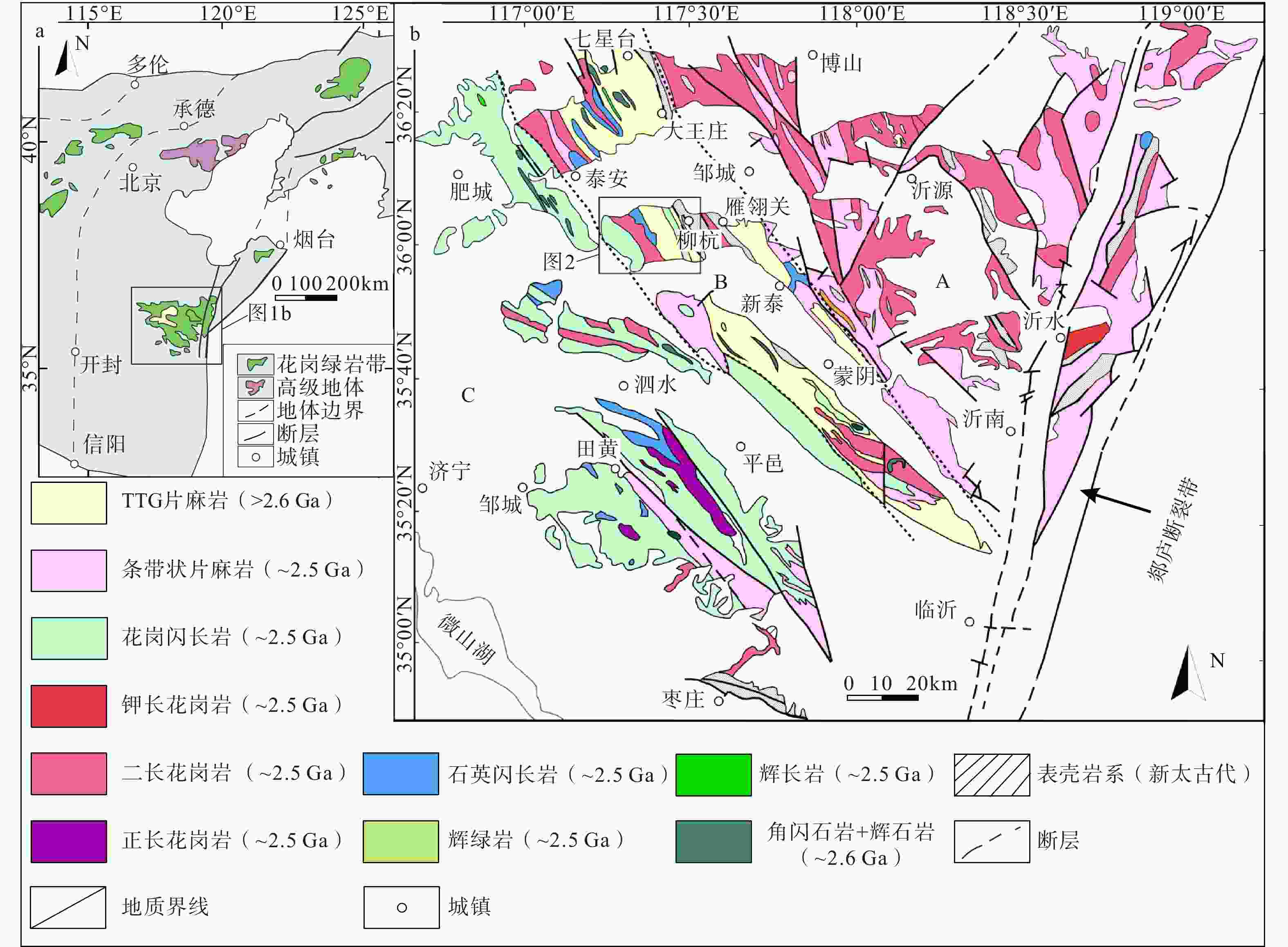
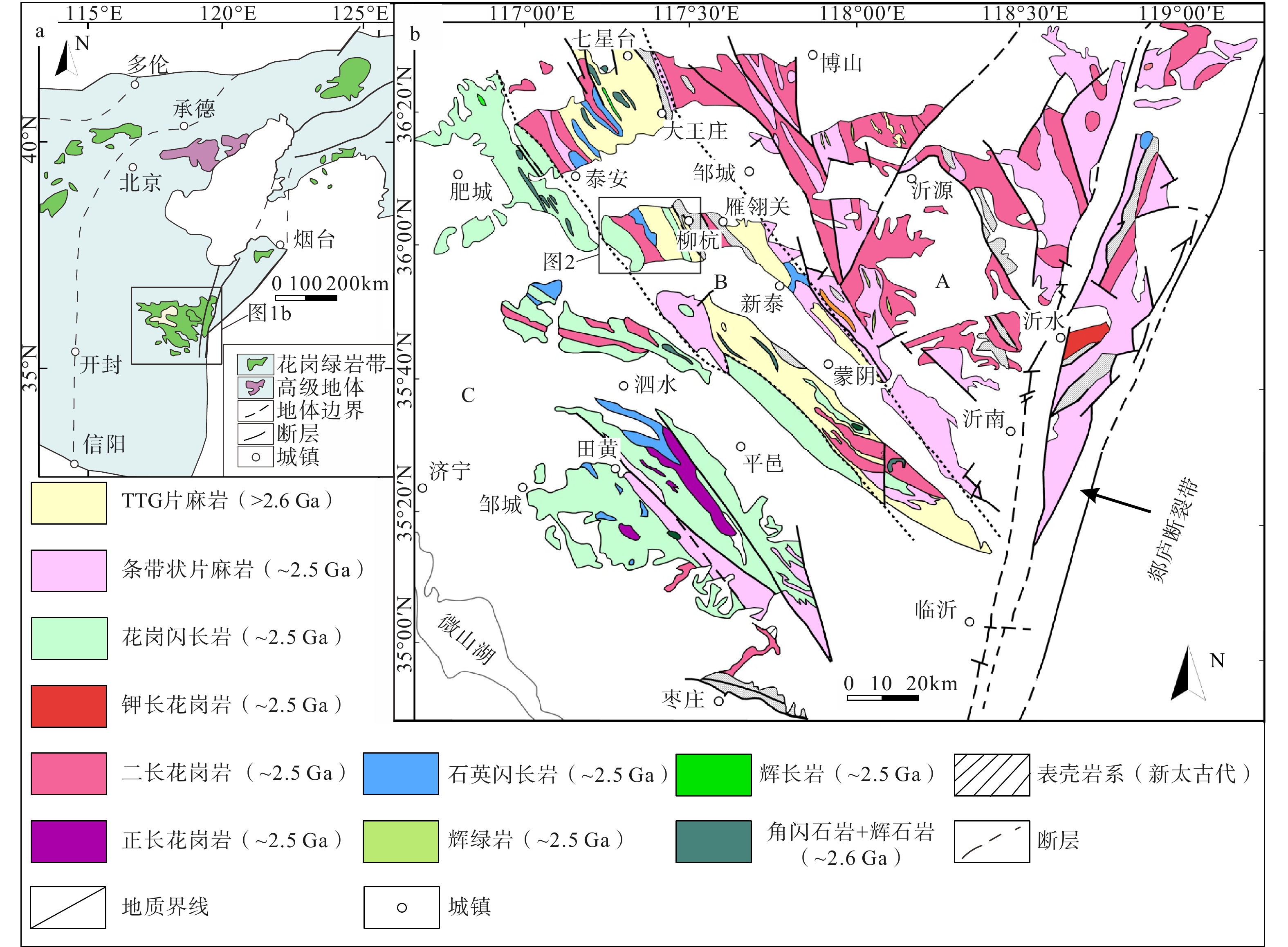
图 1 华北克拉通东部陆块和鲁西地区地质图
图1b中黑色虚线为 Wan et al.(2010,2015)划分A、B、C三带的分界线;A带为新太古代晚期壳源花岗岩(2525~2490 Ma),B带为新太古代早期岩石(2750~2600 Ma),C带为新太古代晚期新生岩浆岩(2550~2500 Ma)a—华北克拉通东部陆块太古宙基底分布图(据Wang et al.,2013修改);b—鲁西地区花岗−绿岩带地质图(据Wan et al.,2010,2015修改)
Figure 1. Geological maps of the Eastern Block of the North China Craton and western Shandong
(a) Distribution map of the Archean basement in the Eastern Block of North China Craton (modified after Wang et al., 2013); (b) Geological map of the granite-greenstone belts in western Shandong (modified after Wan et al., 2010, 2015) In Fig.1b, the black dashed lines divide the basement into three zones as defined by(Wan et al., 2010, 2015) : A–late Neoarchean crust-derived granite (2525~2490 Ma); B–early Neoarchean rocks (2750~2600 Ma); C–late Neoarchean juvenile magmatism (2550~2500 Ma).
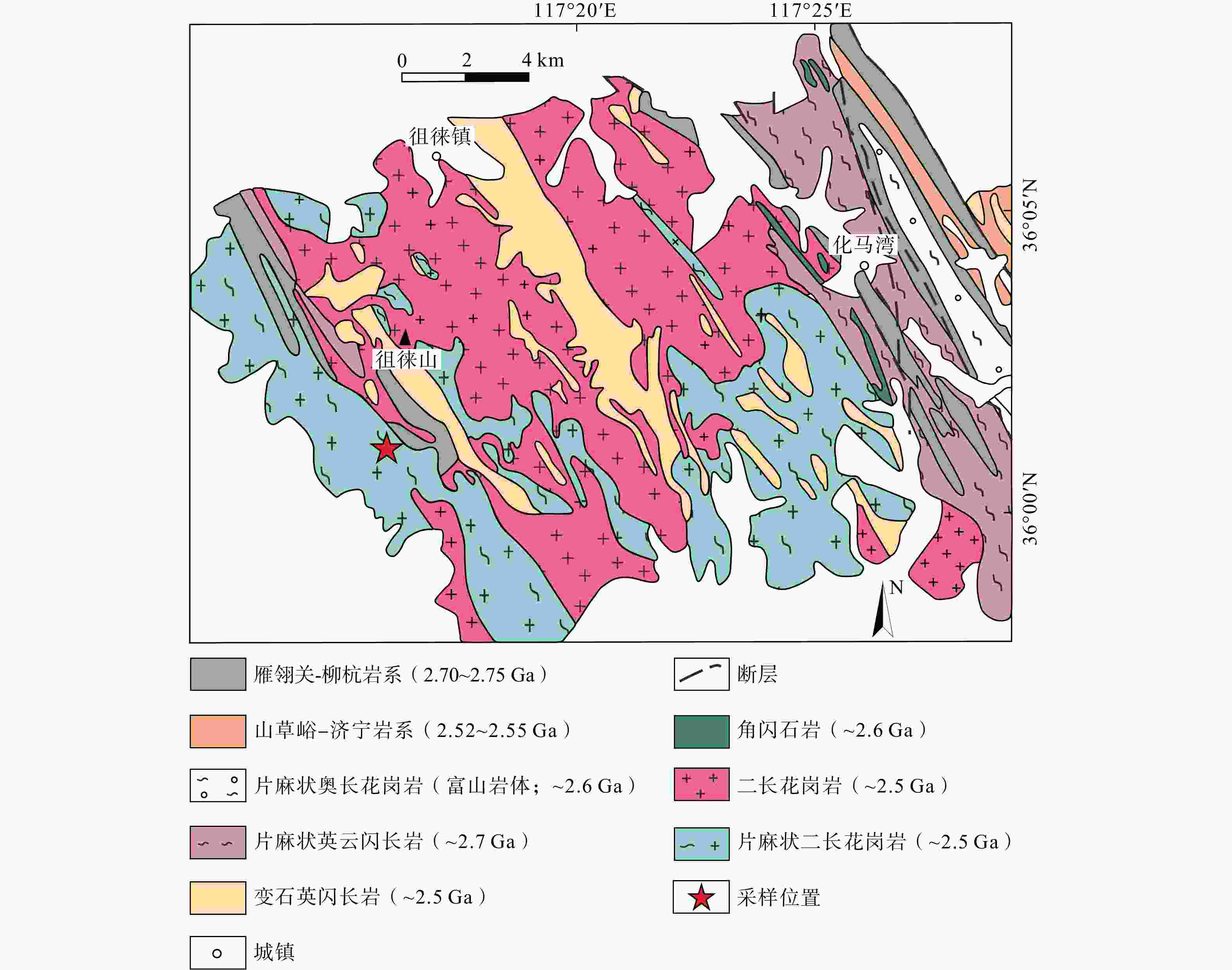
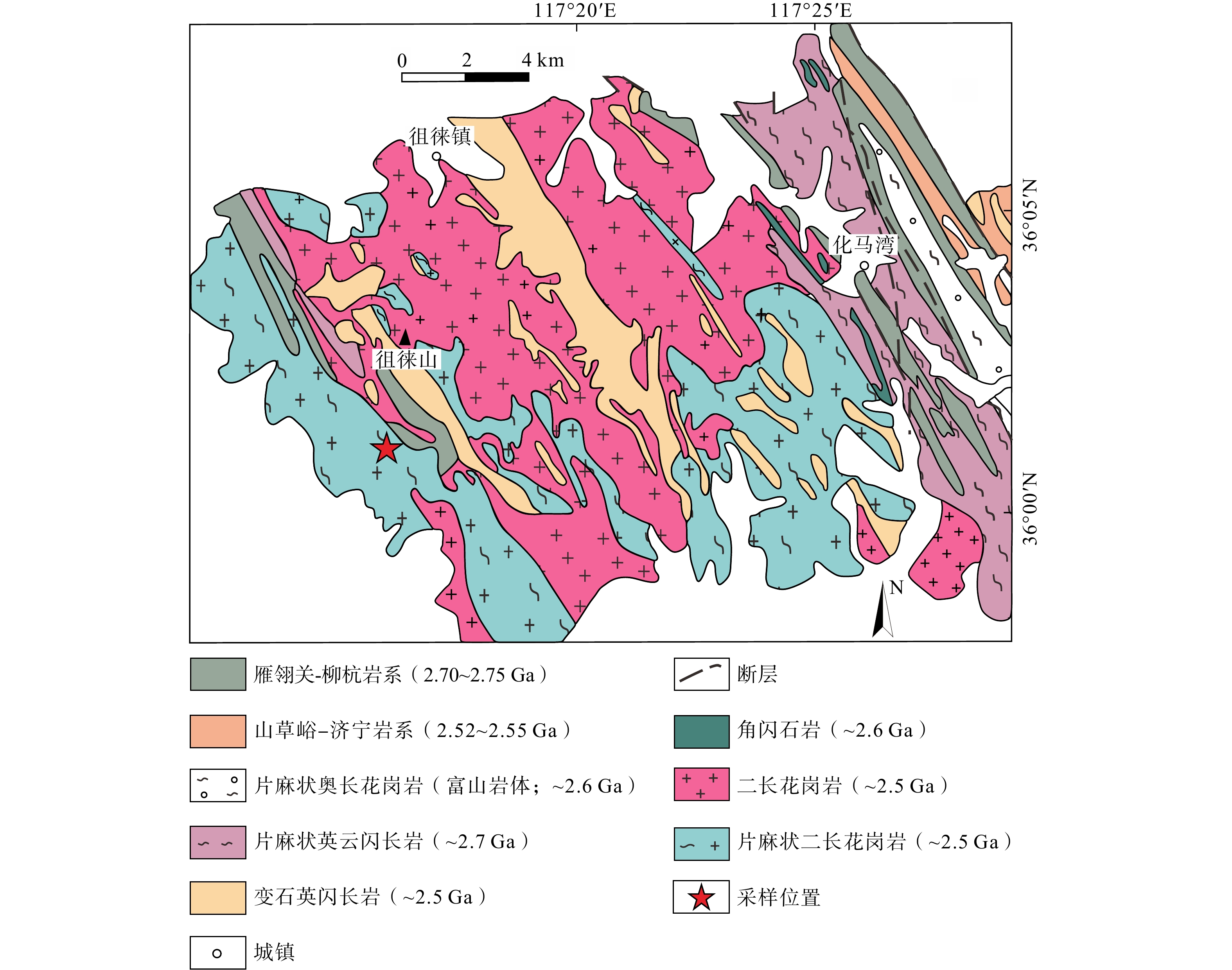
图 2 鲁西徂徕山地区地质图(据万渝生等,2015修改)
Figure 2. Geological map of the Culai Mountain region, western Shandong (modified after Wan et al.,2015)
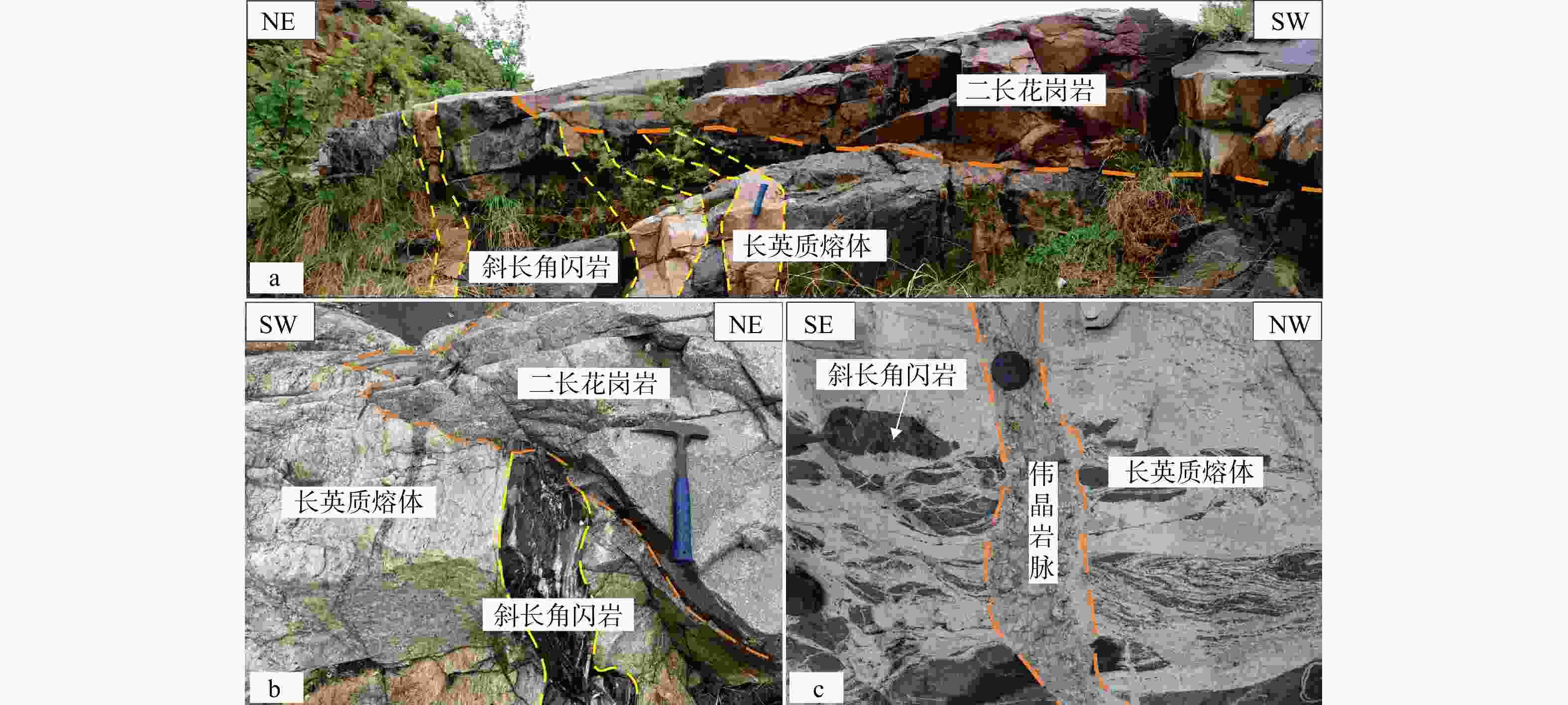
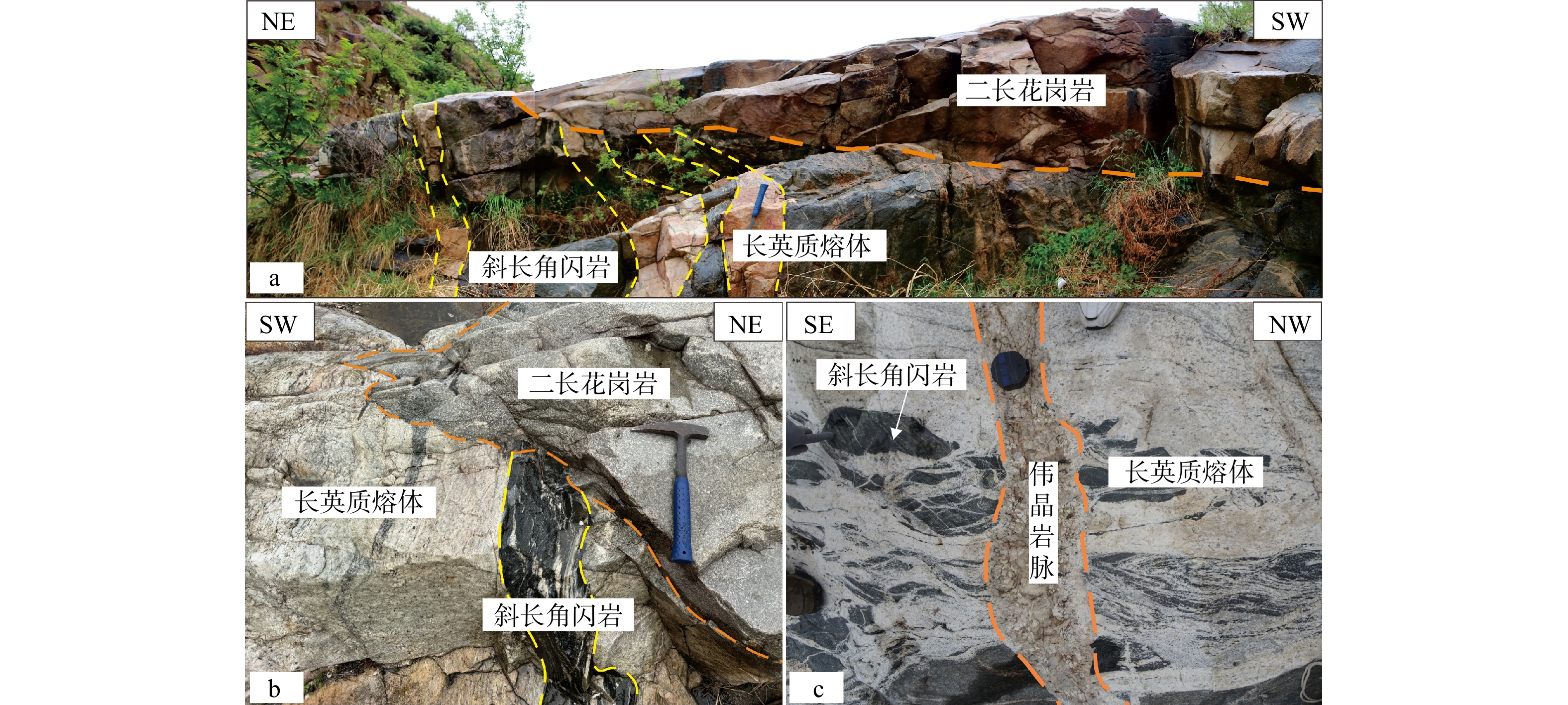
图 3 徂徕山黄石崖村沟底构造接触关系图
黄色与橙色虚线代表岩性分界线a—多期岩浆事件截切关系剖面图;b—块状二长花岗岩截切斜长角闪岩和长英质熔体;c—未变形伟晶岩脉截穿斜长角闪岩和长英质熔体的主体面理
Figure 3. Geological contact relationship at the bottom of a gully in the Huangshiya village, Culai Mountain region
(a) Cross-sections showing the truncation relationships of different generations of magmatism; (b) Massive monzongranite truncating amphibolite and felsic melts; (c) Undeformed pegmatite vein crosscutting the main foliation of amphibolite and felsic meltsYellow and orange dashed lines represent lithological boundaries
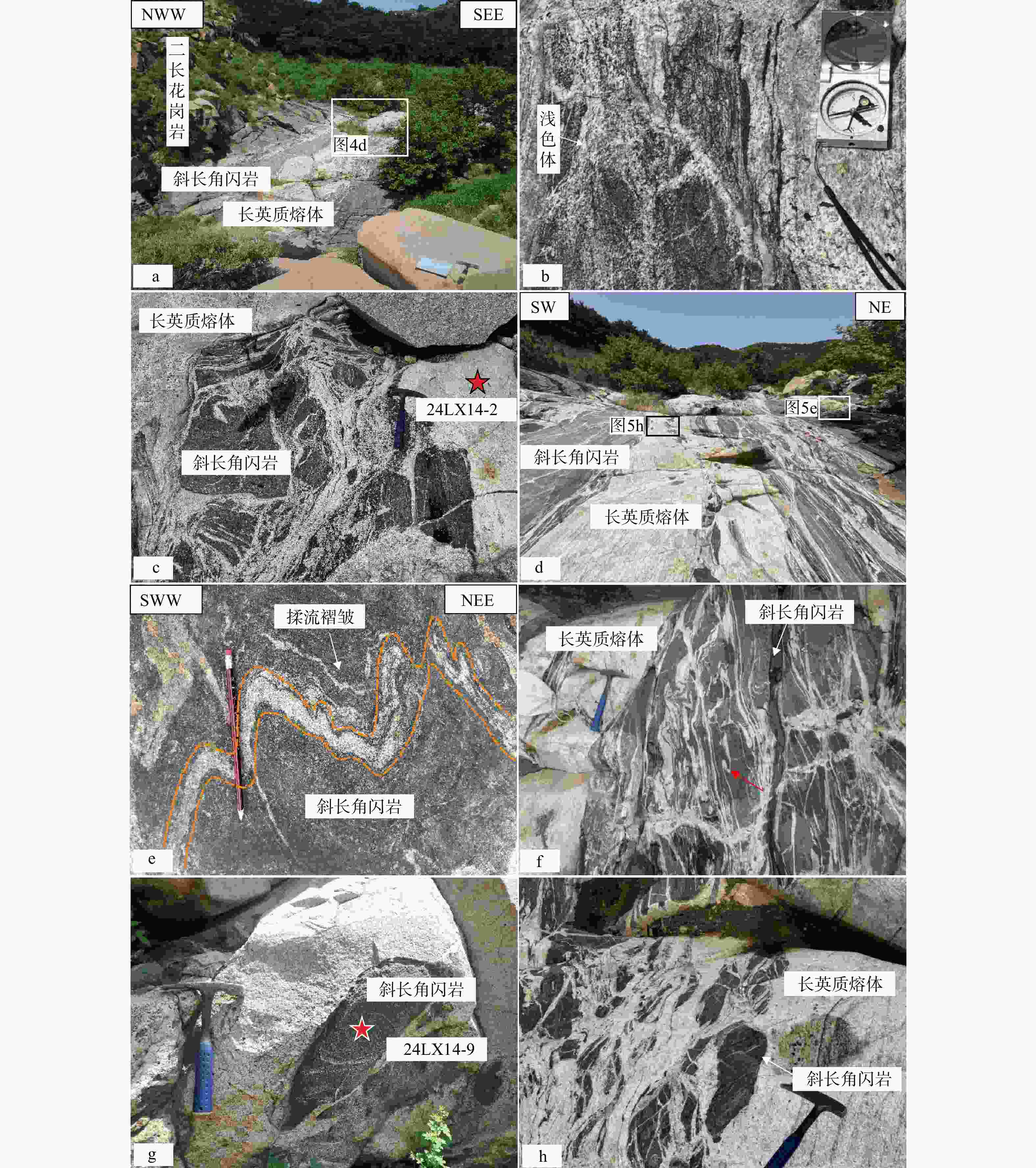
图 4 鲁西徂徕山地区深熔野外照片
红色五角星为样品24LX14-2和24LX14-9的采样位置;橙色虚线代表揉流褶皱的轮廓线a—黄石崖村沟底露头俯瞰图;b—浅色体呈浸染状产于斜长角闪岩中(俯视);c—浅色体呈相互贯穿的网状构造(俯视);d—浅色体呈条带状产于斜长角闪岩中;e—长英质脉体发育揉流褶皱(俯视);f—脉体褶皱转折端增厚,见红色箭头处(俯视);g—斜长角闪岩包体单个产出;h—斜长角闪岩包体成群产出(俯视)
Figure 4. Field photos of anatexis in the Culai Mountain region, western Shandong
(a) Aerial view of the outcrop at the gully bottom in Huangshiya Village; (b) Disseminated leucosome melts within amphibolite (top view); (c) Leucosomes with interconnected network structure (top view); (d) Banded leucosomes in amphibolite; (e) Ptygmatic folds developed in felsic veins (top view); (f) Thickened fold hinge of veins, as indicated by the red arrows (top view); (g) Isolated amphibolite enclave within felsic melt; (h) Clustered amphibolite enclaves within felsic melt (top view) The red pentagram marks the origin of samples 24LX14-2 and 24LX14-9; Orange dashed lines outline ptygmatic folds.
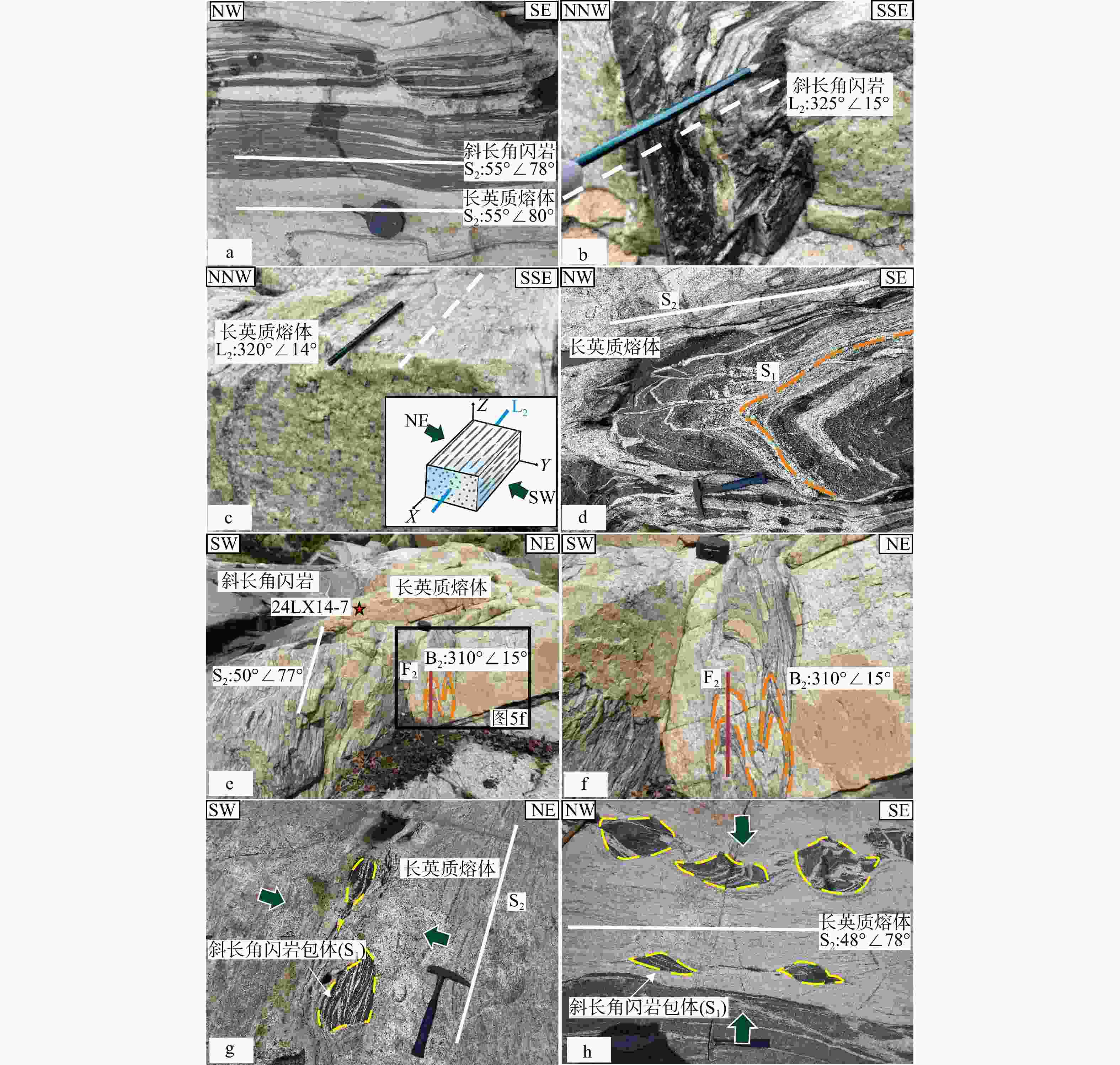
图 5 鲁西徂徕山地区韧性变形野外照片
S1—早期面理; S2—晚期面理;L2—晚期线理; F2—区域第2期变形事件形成的褶皱;B2—区域第2期变形事件的褶皱枢纽白色实线代表晚期S2面理;白色虚线代表晚期L2线理;橙色虚线代表早期S1面理;红色五角星为样品24LX14-7的采样位置;红色实线代表轴迹;黄色虚线代表包体轮廓;绿色箭头代表挤压应力方向a—强烈变形发育近直立面理的斜长角闪岩和长英质熔体;b—斜长角闪岩中发育的近水平线理;c—L型构造岩及示意图,发育近水平线理;d—S1在强烈的F2褶皱作用下被置换成近直立的S2;e—熔体发育A型褶皱和S2面理;f—A型褶皱;g—呈布丁状构造的斜长角闪岩包体,可见残留S1面理;h—斜长角闪岩包体发育布丁构造,其内部可见残留S1面理
Figure 5. Field photos of ductile deformation in the Culai Mountain region
(a) Intensely deformed amphibolite and felsic melts exhibit subvertical foliation; (b) Sub-horizontal mineral lineation in amphibolite; (c) L-tectonite (see schematic diagram) with sub-horizontal mineral lineations; (d) S1 foliation replaced by nearly vertical S2 foliation under intense F2 folding; (e) Melts exhibiting Type A folds and S₂ foliation; (f) Type A folds; (g) Boudinaged amphibolite enclaves with relict S₁ foliation; (h) Amphibolite enclaves exhibiting boudinage structures with relict S1 foliation Solid white lines represent late-stage S2 foliation; Dashed white lines represent late-stage L2 lineation; Dashed orange lines represent early-stage S1 foliation; The red pentagram marks the origin of sample 24LX14-7; Solid red lines represent fold axial traces; Dashed yellow lines represent enclave boundaries; Green arrows represent the orientation of compressional stress. S1–early foliation; S2–late foliation; L2–late lineation; F2–folds formed during the regional second-phase deformation event; B2–fold hinges of the second regional deformation event
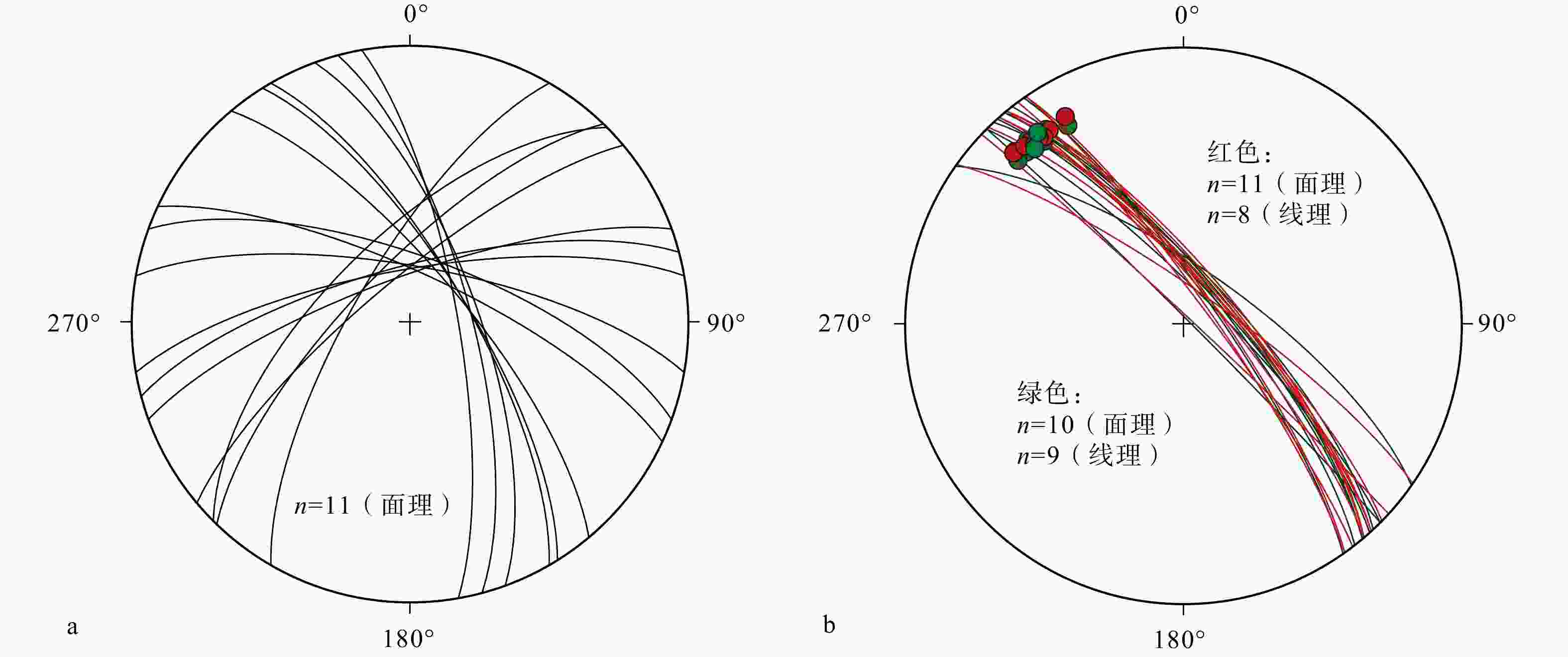
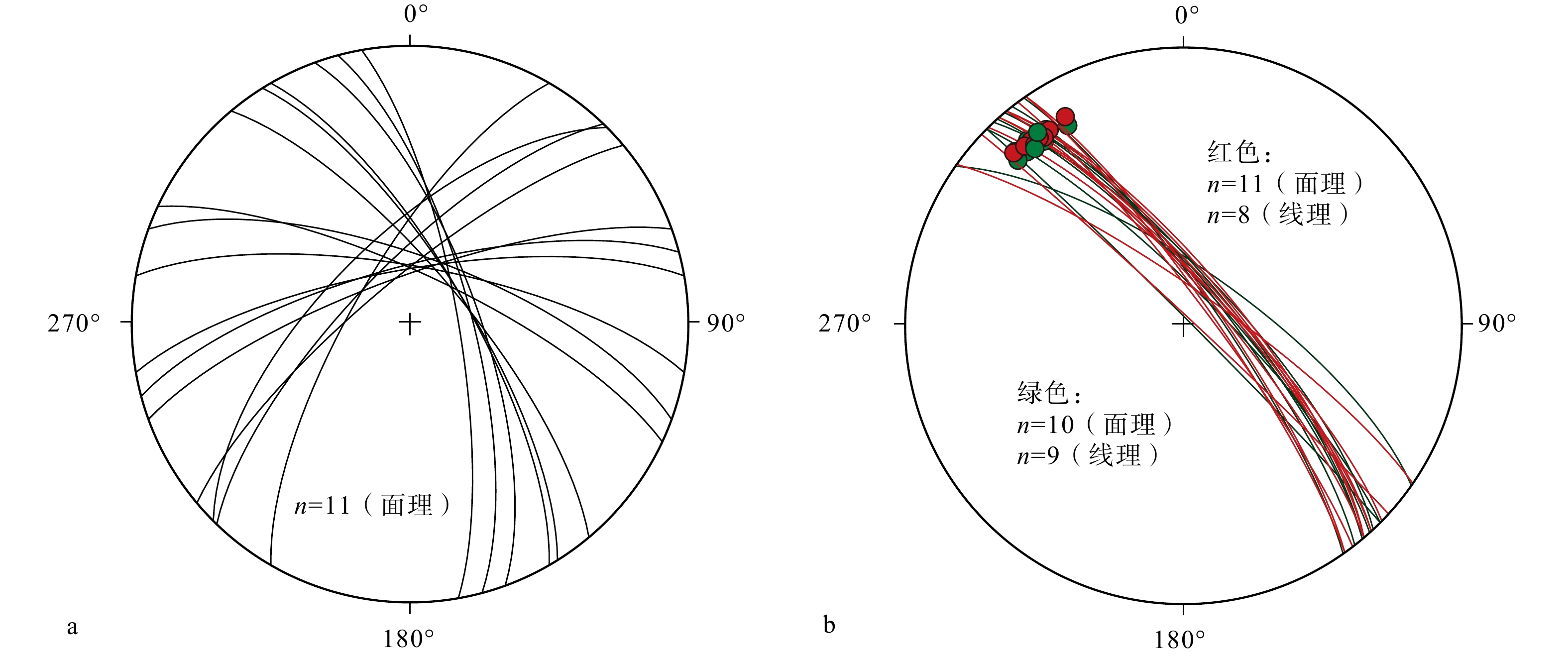
图 6 徂徕山韧性变形极射赤平投影
a—早期面理S1投影图;b—受到韧性变形叠加的长英质熔体(红色)和斜长角闪岩(绿色)的面理(S2)和拉伸线理(L2)投影图(图为等角度下半球投影;大圆弧线为面理投影,圆点为线理投影)
Figure 6. Stereographic projection of ductile deformation in the Culai Mountain region
(a) Stereogram of early-stage foliation S₁; (b) Stereogram showing foliation (S₂) and stretching lineation (L₂) in felsic melts (red) and amphibolite (green) overprinted by ductile deformation (lower-hemisphere, equal-angle projection; great circles represent foliation, circles denote lineation)
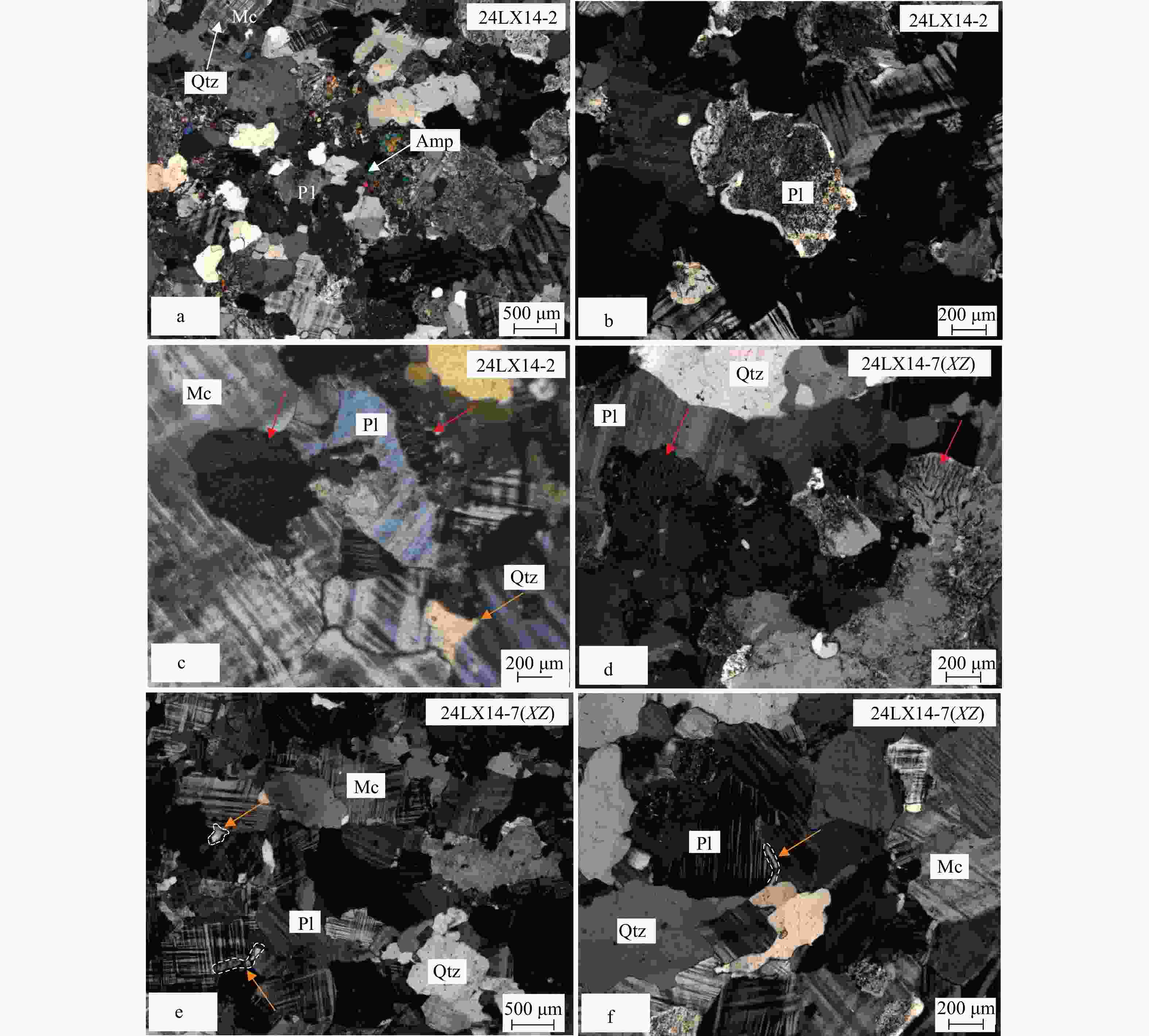
图 7 深熔现象及流变学显微特征(样品24LX14-2和24LX14-7)
Amp—角闪石;Qtz—石英;Pl—斜长石;Mc—微斜长石;XZ代表最大与最小主应变轴所确定的应变面a—角闪石边界溶蚀,石英呈他形嵌于微斜长石颗粒中;b—斜长石增生净边结构;c—浅色体中发育的蠕英结构(红色箭头处),粒间发育熔体囊(橙色箭头处);d—浅色体中发育的蠕英结构(红色箭头处);e—钾长石边界发育有熔体囊、串珠状石英(橙色箭头处);f—浅色体中矿物边界发育熔体膜(橙色箭头处)
Figure 7. Anatectic phenomena and rheological microscopic characteristics (sample 24LX14-2 and 24LX14-7)
(a) Amphibole boundary dissolution, anhedral quartz embedded within microcline grains; (b) Plagioclase overgrown by a clear rim; (c) Myrmekite texture in leucosome (red arrows), with intergranular melt pockets developed (orange arrow); (d) Myrmekite texture in leucosome (red arrows); (e) Melt pockets and bead-like quartzs along K-feldspar boundaries (orange arrows); (f) Melt film along mineral boundaries in leucosome (orange arrow) Amp–amphibole; Qtz–quartz; Pl–plagioclase; Mc–microcline; XZ represents the strain plane determined by the maximum X and minimum Z principal strain
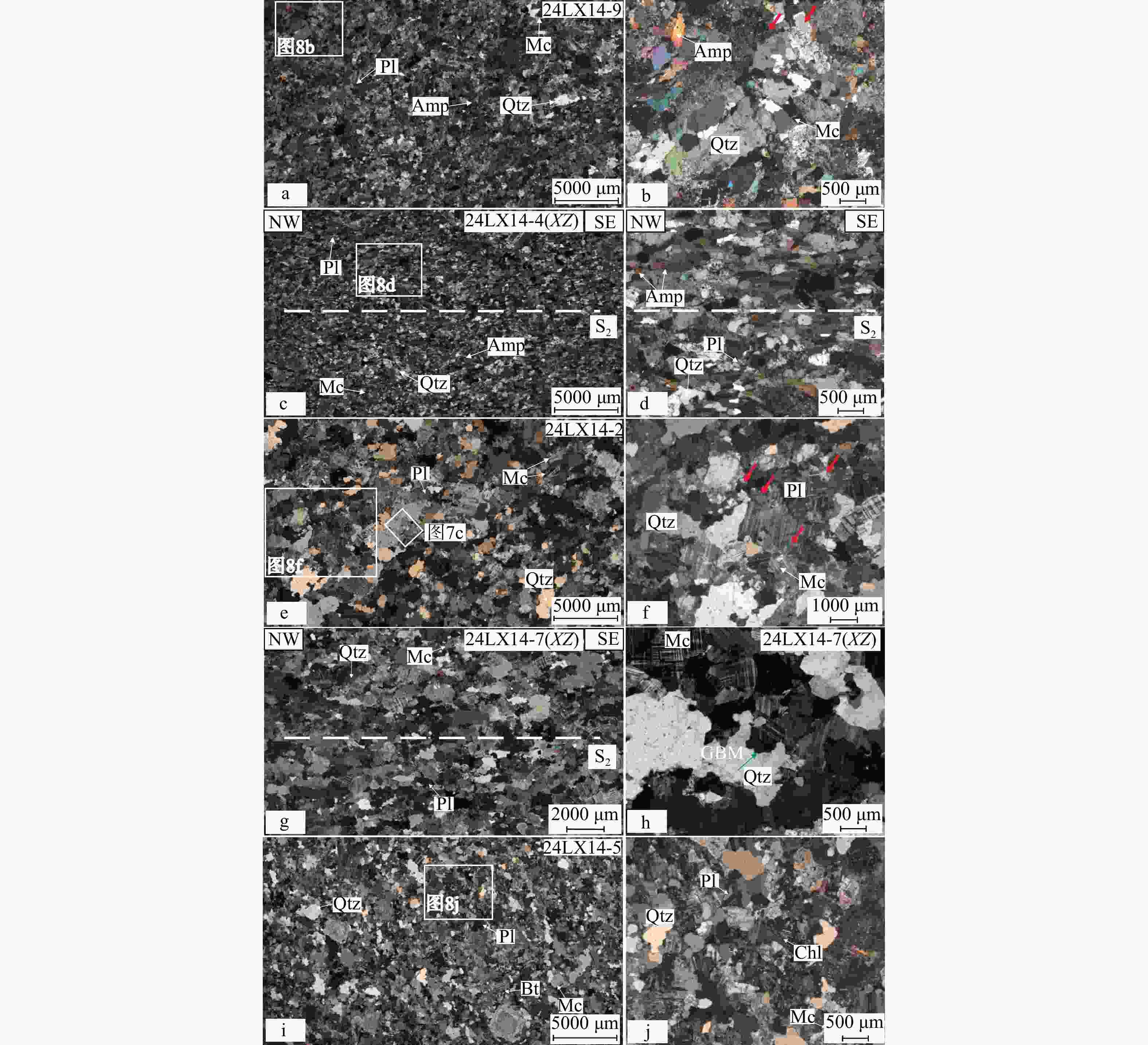
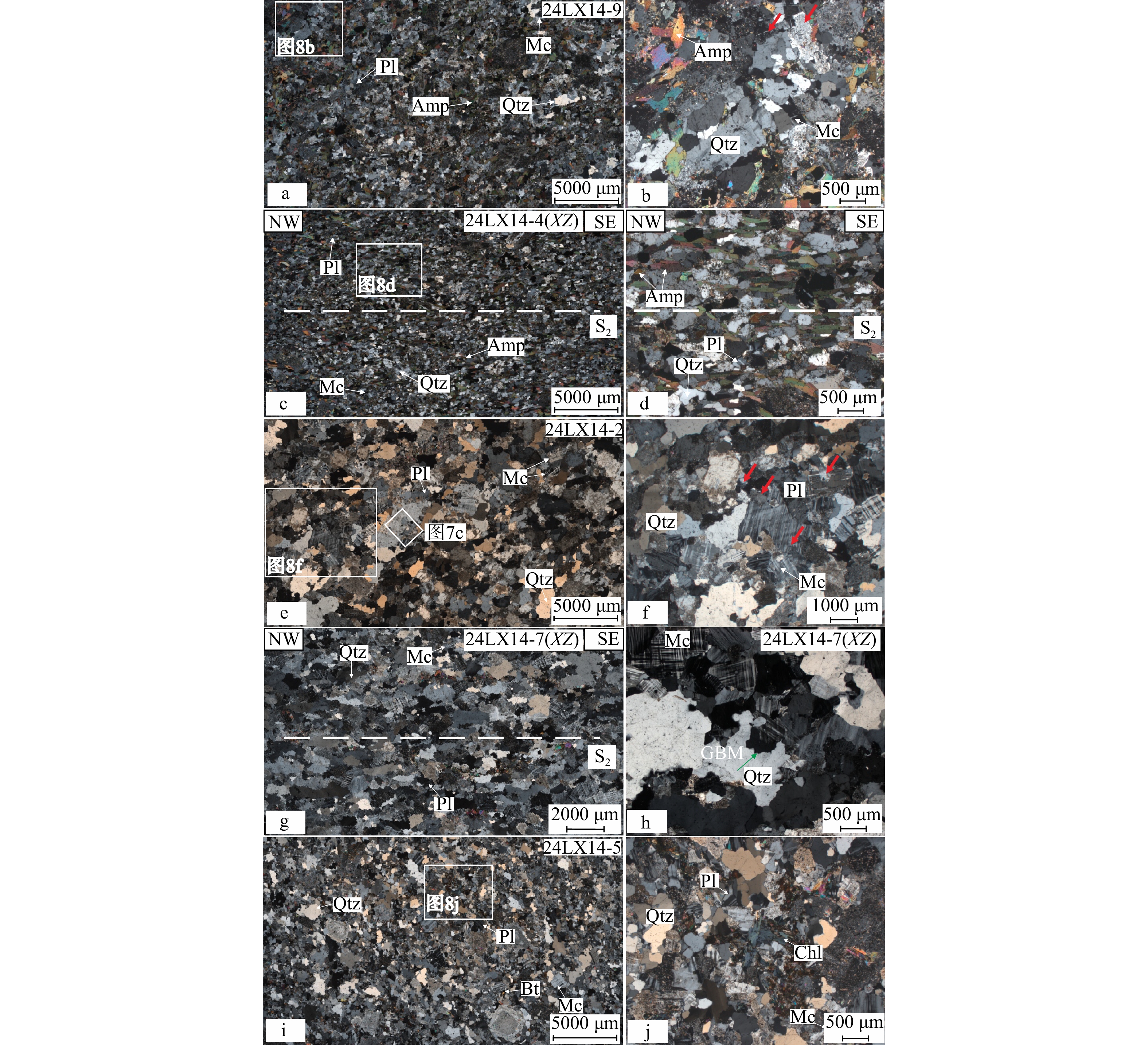
图 8 韧性变形显微构造特征
Amp—角闪石;Bt—黑云母;Qtz—石英;Pl—斜长石;Mc—微斜长石;Chl—绿泥石a—弱应变域中块状斜长角闪岩(样品24LX14-9)全薄片照片,矿物无规律随机分布;b—蠕英结构(红色箭头处);c—强应变域斜长角闪岩(样品24LX14-4)全薄片照片,角闪石沿北西—南东定向分布(白色虚线代表矿物面理方向);d—局部放大照片,角闪石沿北西—南东定向分布(白色虚线代表矿物面理方向);e—弱应变域中长英质熔体(样品24LX14-2)全薄片照片,矿物不定向分布;f—蠕英结构(红色箭头处);g—强应变域长英质熔体(样品24LX14-7)全薄片照片,石英、长石多呈北西—南东定向展布,表现出波状消光的特征(白色虚线代表矿物面理方向);h—长英质熔体(样品24LX14-7)中可见石英动态重结晶(绿色箭头处);i—二长花岗岩(样品24LX14-5)全薄片照片,矿物定向明显;j—黑云母绿泥石化
Figure 8. Microstructural characteristics of ductile deformation
(a) Whole thin-section image of a massive amphibolite (sample 24LX14-9) from a weakly-strained domain, showing randomly distributed minerals; (b) Myrmekite texture (red arrows); (c) Whole thin-section image of an amphibolite (sample 24LX14-4) from a highly-strained domain, with NW–SE oriented amphiboles (white dashed lines indicate mineral foliation); (d) Close-up view showing hornblende aligned along NW–SE orientation (white dashed lines indicate mineral foliation direction); (e) Whole thin-section image of felsic melt (sample 24LX14-2) from a weakly-strained domain with random mineral orientation; (f) Myrmekite texture (red arrows); (g) Whole thin-section image of felsic melt (sample 24LX14-7) from a highly-strained domain, exhibiting NW–SE aligned quartz and feldspar with undulatory extinction (white dashed lines mark foliation direction); (h) Dynamic quartz recrystallization in felsic melts (sample 24LX14-7) (green arrow); (i) Whole thin-section image of monzogranite (sample 24LX14-5), showing well aligned minerals; (j) Biotite chloritization Amp–amphibole; Bt–biotite; Qtz–quartz; Pl–plagioclase; Mc–microcline; Chl–chlorite
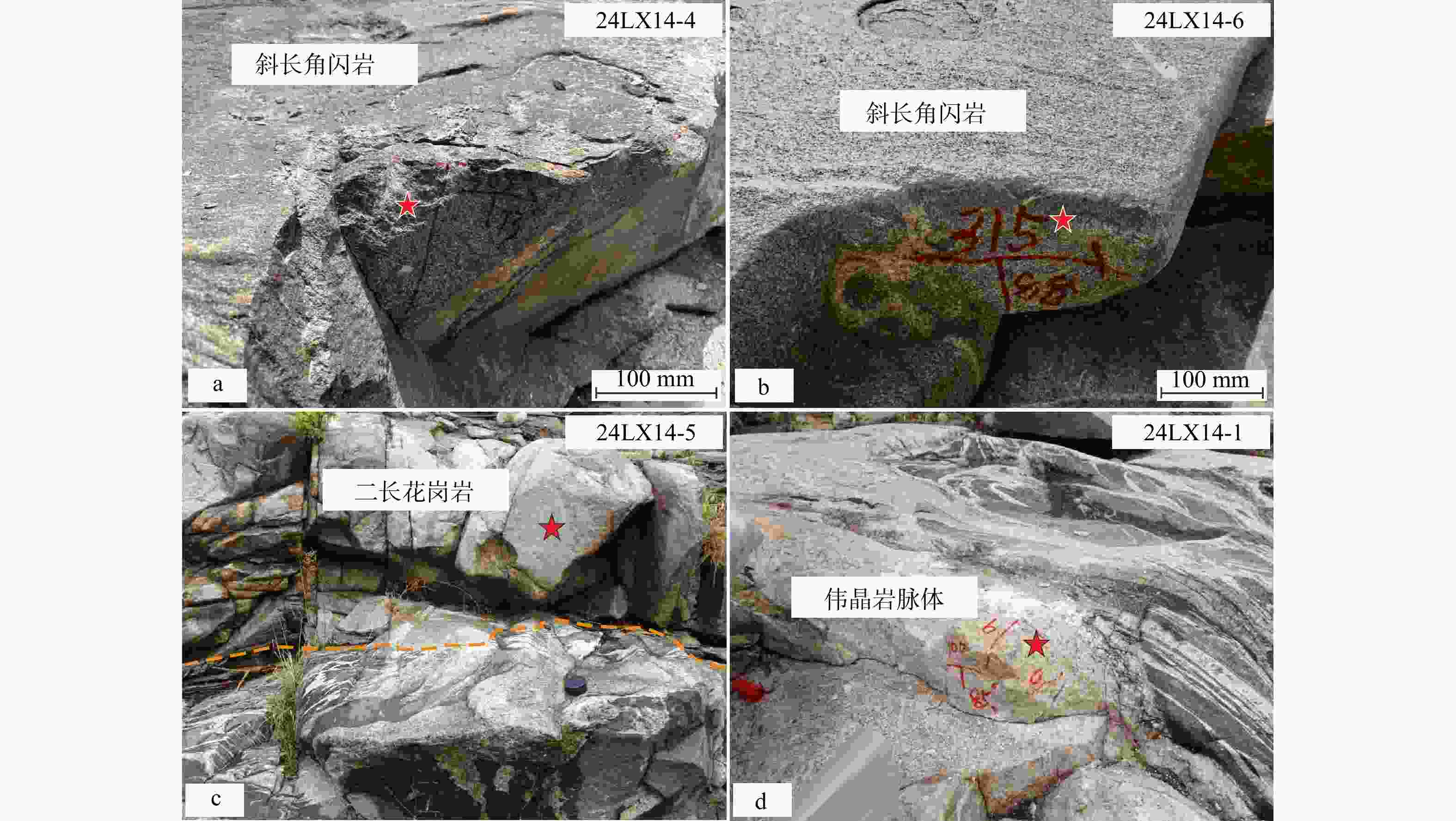
图 9 鲁西徂徕山地区定年样品野外照片
红色五角星代表样品采样位置;橙色虚线代表岩性分界线a—斜长角闪岩(样品24LX14-4);b—斜长角闪岩(样品24LX14-6);c—同构造中粗粒二长花岗岩(样品24LX14-5); d—未变形伟晶岩脉体(样品24LX14-1)
Figure 9. Field photos of dating samples from the Culai Mountain region
(a) Amphibolite (sample 24LX14-4); (b) Amphibolite (sample 24LX14-6); (c) Syn-tectonic medium-to-coarse-grained monzogranite (sample 24LX14-5); (d) Undeformed pegmatite vein (sample 24LX14-1) Red pentagrams represent sample collection locations; Orange dashed lines represent lithological boundaries
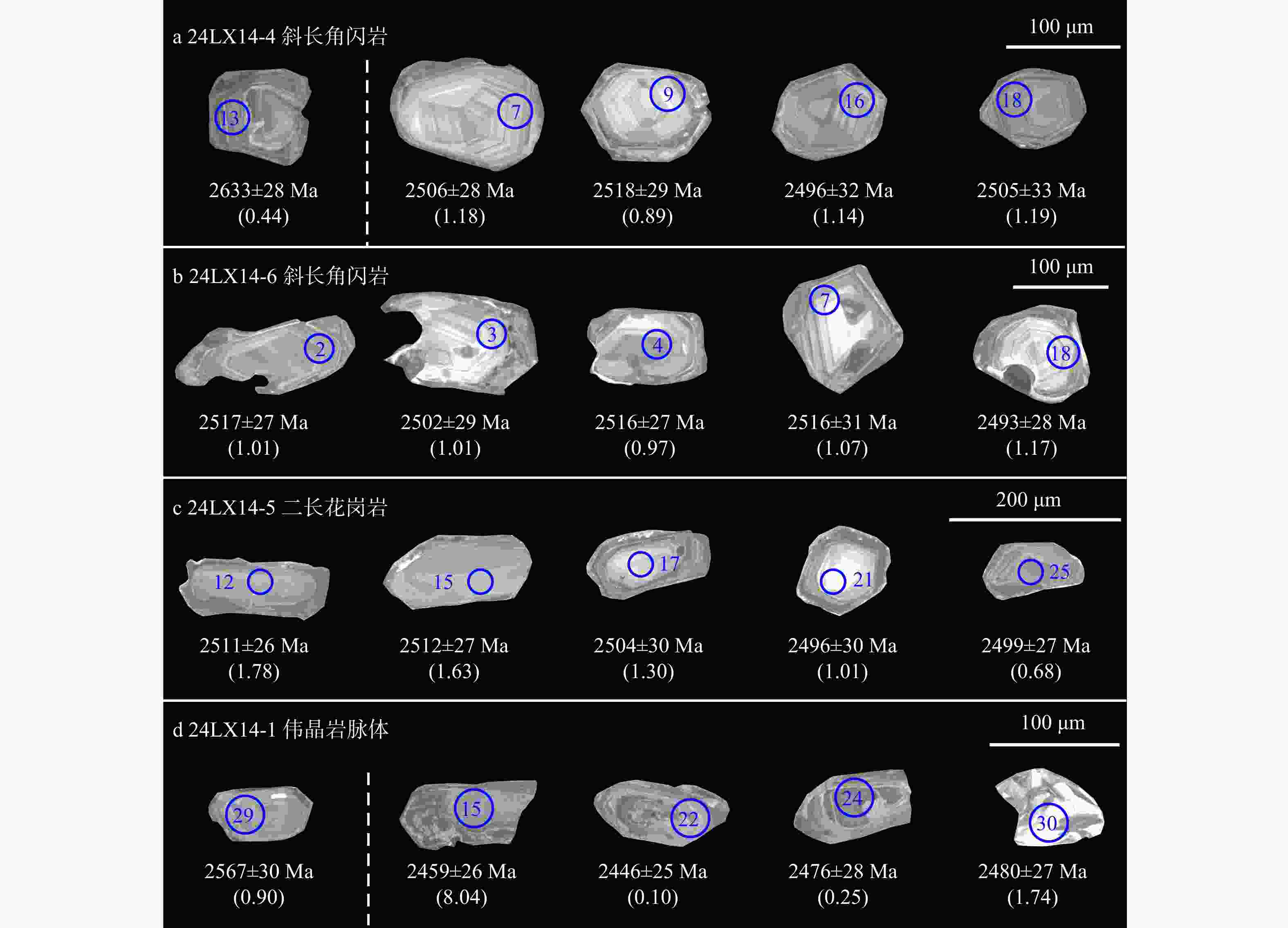
图 10 鲁西徂徕山地区锆石阴极发光图像
蓝圈代表U-Pb年龄测试点位;括号内数字代表Th/Ua—斜长角闪岩(样品24LX14-4);b—斜长角闪岩(样品24LX14-6);c—同构造中粗粒二长花岗岩(样品24LX14-5); d—未变形伟晶岩脉体(样品24LX14-1)
Figure 10. Cathodoluminescence images of zircons from the Culai Mountain region, western Shandong
(a) Amphibolite (sample 24LX14-4); (b) Amphibolite (sample 24LX14-6); (c) Syn-tectonic medium-to- coarse-grained monzogranite (sample 24LX14-5); (d) Undeformed pegmatite vein (sample 24LX14-1) Blue circles represent U–Pb dating spots; Numbers in parentheses represent Th/U ratios.

图 11 鲁西徂徕山地区锆石U-Pb年龄谐和图、加权平均年龄图和球粒陨石稀土元素配分图
红点为继承锆石测点;蓝点为位于谐和线或附近的锆石测点;黑点为其他锆石测点a—斜长角闪岩(样品24LX14-4)的锆石U-Pb年龄谐和图和加权平均年龄图;b—斜长角闪岩(样品24LX14-4)的球粒陨石稀土元素配分图;c—斜长角闪岩(样品24LX14-6)的锆石U-Pb年龄谐和图和加权平均年龄图;d—斜长角闪岩(样品24LX14-6)的球粒陨石稀土元素配分图;e—同构造中粗粒二长花岗岩(样品24LX14-5)的锆石U-Pb年龄谐和图和加权平均年龄图; f—同构造中粗粒二长花岗岩(样品24LX14-5)的球粒陨石稀土元素配分图;g—未变形伟晶岩脉体(样品24LX14-1)的锆石U-Pb年龄谐和图;h—未变形伟晶岩脉体(样品24LX14-1)的球粒陨石稀土元素配分图
Figure 11. Zircon U–Pb concordia diagrams, weighted mean age plot and chondrite-normalized REE patterns from the Culai Mountain region, western Shandong
(a) Zircon U–Pb concordia diagram and weighted mean age plot of amphibolite (sample 24LX14-4); (b) Chondrite-normalized REE pattern of amphibolite (sample 24LX14-4); (c) Zircon U–Pb concordia diagram and weighted mean age plot of amphibolite (sample 24LX14-6); (d) Chondrite-normalized REE pattern of amphibolite (sample 24LX14-6); (e) Zircon U–Pb concordia diagram and weighted mean age plot of syn-tectonic coarse-grained monzogranite (sample 24LX14-5); (f) Chondrite-normalized REE pattern of syn-tectonic coarse-grained monzogranite (sample 24LX14-5); (g) Zircon U–Pb concordia diagram of undeformed pegmatite vein (sample 24LX14-1); (h) Chondrite-normalized REE pattern of undeformed pegmatite vein (sample 24LX14-1) Red circles represent inherited zircon analysis spots; Blue circles represent zircon analysis spots located on or near the Concordia curve; Black circles represent other zircon analysis spots.
-
[1] BUROV E B, 2011. Rheology and strength of the lithosphere[J]. Marine and Petroleum Geology, 28(8): 1402-1443. doi: 10.1016/j.marpetgeo.2011.05.008 [2] CAO G Q, 1996. Early Precambrian geology of western Shandong[M]. Beijing: Geology Press: 1-210. (in Chinese) [3] CAVALCANTE G C G, VIEGAS G, ARCHANJO C J, et al., 2016. The influence of partial melting and melt migration on the rheology of the continental crust[J]. Journal of Geodynamics, 101: 186-199. doi: 10.1016/j.jog.2016.06.002 [4] CHEN Z, 2017. Numerical simulations of crustal melting and rheology and theirs geological constraints[D]. Changchun: Jilin University. (in Chinese with English abstract) [5] CHENG Y Q, 1987. On migmatites and migmatization: half a century's recollection of certain related problems[J]. Bulletin of the Chinese Academy of Geological Sciences(2): 5-19. (in Chinese) [6] DONG C Y, XIE H Q, KRÖNER A, et al., 2017. The complexities of zircon crystllazition and overprinting during metamorphism and anatexis: an example from the late Archean TTG terrane of western Shandong Province, China[J]. Precambrian Research, 300: 181-200. doi: 10.1016/j.precamres.2017.07.034 [7] DONG Y L, CAO S Y, ZHAN L F, et al., 2022. Tectono-magmatism evolution in the Gaoligong orogen belt during Neoproterozoic to Paleozoic: significance for assembly of east Gondwana[J]. Precambrian Research, 378: 106776. doi: 10.1016/j.precamres.2022.106776 [8] GAO L, LIU S W, ZHANG B, et al., 2019. A Ca. 2.8‐Ga plume‐induced intraoceanic arc system in the eastern North China Craton[J]. Tectonics, 38(5): 1694-1717. doi: 10.1029/2018TC005432 [9] GORCZYK W, VOGT K, 2015. Tectonics and melting in intra-continental settings[J]. Gondwana Research, 27(1): 196-208. doi: 10.1016/j.gr.2013.09.021 [10] GU D X, ZHANG J J, LIN C, et al. , 2022. Anatexis and resultant magmatism of the Ama Drime Massif: implications for Himalayan mid-Miocene tectonic regime transition[J]. Lithos, 424-425: 106773. [11] HU Z P, ZHANG Y S, HU R, et al., 2016. Amphibole-bearing migmatite in North Dabie, eastern China: water-fluxed melting of the orogenic crust[J]. Journal of Asian Earth Sciences, 125: 100-116. doi: 10.1016/j.jseaes.2016.05.018 [12] KUSKY T M, POLAT A, WINDLEY B F, et al., 2016. Insights into the tectonic evolution of the North China Craton through comparative tectonic analysis: a record of outward growth of Precambrian continents[J]. Earth-Science Reviews, 162: 387-432. doi: 10.1016/j.earscirev.2016.09.002 [13] LI J, LIU Y J, JIN W, et al., 2017. Neoarchean tectonics: insight from the Baijiafen ductile shear zone, eastern Anshan, Liaoning Province, NE China[J]. Journal of Asian Earth Sciences, 139: 165-182. doi: 10.1016/j.jseaes.2017.01.019 [14] LI J Y, CAO S Y, NEUBAUER F, et al. , 2021. Structure and spatial-temporal relationships of Eocene-Oligocene potassic magmatism linked to the Ailao Shan-Red River shear zone and post-collisional extension[J]. Lithos, 396-397: 106203. [15] LI W Y, CAO S Y, DONG Y L, et al., 2023. Crustal anatexis and initiation of the continental-scale Chongshan strike-slip shear zone on the southeastern Tibetan Plateau[J]. Tectonics, 42(4): e2023TC007864. doi: 10.1029/2023TC007864 [16] LI X H, TANG G Q, GONG B, et al., 2013. Qinghu zircon: a working reference for microbeam analysis of U-Pb age and Hf and O isotopes[J]. Chinese Science Bulletin, 58(36): 4647-4654. doi: 10.1007/s11434-013-5932-x [17] LI Y, REN P, XIE H Q, et al., 2020. Anatomy of a Neoarchean geological section in the Lihang area, western Shandong: field observation and SHRIMP U-Pb zircon dating[J]. Earth Science, 45(9): 3341-3352. (in Chinese with English abstract) [18] LI Y, XIE H Q, DONG C Y, et al., 2022. Zircon evolution from migmatite to crustally-derived granite: a case study of late Neoarchean migmatite in the Yishan area, western Shandong, North China Craton[J]. Gondwana Research, 112: 82-104. doi: 10.1016/j.gr.2022.09.008 [19] LIU S W, BAO H, GAO L, et al., 2021. Late Neoarchean metavolcanics and geodynamics regime in central and eastern North China Craton[J]. Acta Petrologica Sinica, 37(1): 113-128. (in Chinese with English abstract) doi: 10.18654/1000-0569/2021.01.08 [20] LUDWIG K R, 2012. User's manual for isoplot version 3.75-4.15: a Geochronological toolkit for Microsoft Excel[M]. Berkley: Berkeley Geochronological Centre Special Publication. [21] PEARCE N J G, PERKINS W T, WESTGATE J A, et al., 1997. A compilation of new and published major and trace element data for NIST SRM 610 and NIST SRM 612 glass reference materials[J]. Geostandards Newsletter, 21(1): 115-144. doi: 10.1111/j.1751-908X.1997.tb00538.x [22] REN P, XIE H Q, WANG S J, et al., 2015. 2.5 ~2.7 Ga tectono-thermal events in western Shandong geology and zircon SHRIMP dating of TTG rocks in Huangqian Reservoir, Taishan Mountain[J]. Geological Review, 61(5): 1068-1078. (in Chinese with English abstract) [23] REN P, 2016. ~2.6 Ga tectono-thermal event in western Shandong Province: geology, SHRIMP zircon dating and geochemistry[D]. Beijing: Chinese Academy of Geological Sciences. (in Chinese with English abstract) [24] REN P, XIE H Q, WANG S J, et al., 2016. A ca. 2.60 Ga tectono-thermal event in Western Shandong Province, North China Craton from zircon U–Pb–O isotopic evidence: plume or convergent plate boundary process[J]. Precambrian Research, 281: 236-252. doi: 10.1016/j.precamres.2016.05.016 [25] REN P, XIE H Q, WANG S J, et al., 2017. ~2.6 Ga anatexis in western Shandong: geology and geochemistry of leucosomes in the Taishan area[J]. Chinese Journal of Geology, 52(4): 1097-1119. (in Chinese with English abstract) [26] ROSENBERG C L, HANDY M R, 2005. Experimental deformation of partially melted granite revisited: implications for the continental crust[J]. Journal of Metamorphic Geology, 23(1): 19-28. doi: 10.1111/j.1525-1314.2005.00555.x [27] SAWYER E W, 2008. Atlas of migmatites[M]. Ottawa: NRC Research Press. [28] SAWYER E W, 2010. Migmatites formed by water-fluxed partial melting of a leucogranodiorite protolith: microstructures in the residual rocks and source of the fluid[J]. Lithos, 116(3-4): 273-286. doi: 10.1016/j.lithos.2009.07.003 [29] SAWYER E W, CESARE B, BROWN M, 2011. When the continental crust melts[J]. Elements, 7(4): 229-234. doi: 10.2113/gselements.7.4.229 [30] SLÁMA J, KOŠLER J, CONDON D J, et al., 2008. Plešovice zircon: A new natural reference material for U-Pb and Hf isotopic microanalysis[J]. Chemical Geology, 249(1-2): 1-35. doi: 10.1016/j.chemgeo.2007.11.005 [31] WAN Y S, LIU D Y, WANG S J, et al., 2010. Juvenile magmatism and crustal recycling at the end of the Neoarchean in western Shandong Province, North China Craton: evidence from SHRIMP zircon dating[J]. American Journal of Science, 310(10): 1503-1552. doi: 10.2475/10.2010.11 [32] WAN Y S, LIU D Y, WANG S J, et al., 2011. ~2.7 Ga juvenile crust formation in the North China Craton (Taishan-Xintai area, western Shandong Province): further evidence of an understated event from U–Pb dating and Hf isotopic composition of zircon[J]. Precambrian Research, 186(1-4): 169-180. doi: 10.1016/j.precamres.2011.01.015 [33] WAN Y S, DONG C Y, LIU D Y, et al. , 2012a. Zircon ages and geochemistry of late Neoarchean syenogranites in the North China Craton: a review[J]. Precambrian Research, 222-223: 265-289. [34] WAN Y S, DONG C Y, XIE H Q, et al., 2012a. Formation ages of Early Precambrian BIFs in the North China Craton: SHRIMP zircon U-Pb dating[J]. Acta Geologica Sinica, 86(9): 1447-1478. (in Chinese with English abstract) [35] WAN Y S, WANG S J, LIU D Y, et al., 2012b. Redefinition of depositional ages of Neoarchean supracrustal rocks in western Shandong Province, China: SHRIMP U–Pb zircon dating[J]. Gondwana Research, 21(4): 768-784. doi: 10.1016/j.gr.2011.05.017 [36] WAN Y S, LIU D Y, WANG S J, et al., 2012b. Redefinition of Early Precambrian supracrustal rocks and formation age of BIF in western Shandong, North China Craton[J]. Acta Petrologica Sinica, 28(11): 3457-3475. (in Chinese with English abstract) [37] WAN Y S, DONG C Y, WANG S J, et al., 2014a. Middle Neoarchean magmatism in western Shandong, North China Craton: SHRIMP zircon dating and LA-ICP-MS Hf isotope analysis[J]. Precambrian Research, 255: 865-884. doi: 10.1016/j.precamres.2014.07.016 [38] WAN Y S, XIE S W, YANG C H, et al., 2014b. Early Neoarchean (~2.7 Ga) tectono-thermal events in the North China Craton: a synthesis[J]. Precambrian Research, 247: 45-63. doi: 10.1016/j.precamres.2014.03.019 [39] WAN Y S, LIU D Y, DONG C Y, et al. , 2015. Formation and evolution of Archean continental crust of the North China Craton[M]//ZHAI M G. Precambrian geology of China. Berlin: Springer: 59-136. [40] WAN Y S, WANG S J, REN P, et al., 2015. Neoarchean magmatism in the Culaishan Area, western Shandong: evidence from SHRIMP Zircon U-Pb dating[J]. Acta Geoscientica Sinica, 36(5): 634-646. (in Chinese with English abstract) [41] WAN Y S, DONG C Y, REN P, et al., 2017. Spatial and temporal distribution, compositional characteristics and formation and evolution of Archean TTG rocks in the North China Craton: a synthesis[J]. Acta Petrologica Sinica, 33(5): 1405-1419. (in Chinese with English abstract) [42] WAN Y S, XIE H Q, DONG C Y, et al., 2020. Timing of tectonothermal events in Archean basement of the North China Craton[J]. Earth Science, 45(9): 3119-3160. (in Chinese with English abstract) [43] WAN Y S, DONG C Y, XIE H Q, et al., 2022. Huge growth of the late Mesoarchean-Early Neoarchean (2.6~3.0 Ga) continental crust in the North China Craton: a review[J]. Journal of Geomechanics, 28(5): 866-906. (in Chinese with English abstract) [44] WANG D M, HU J M, ZHAO Y F, et al., 2024. Kinematics and geochronology of the ductile shear zones in the western Shandong granite-greenstone belt: implications for the Neoarchean plate tectonics of the North China Craton[J]. Precambrian Research, 411: 107509. doi: 10.1016/j.precamres.2024.107509 [45] WANG H B, CAO S Y, LI J Y, et al., 2022. High-pressure granulite-facies metamorphism and anatexis of deep continental crust: new insights from the Cenozoic Ailao Shan–Red River shear zone, Southeast Asia[J]. Gondwana Research, 103: 314-334. doi: 10.1016/j.gr.2021.10.010 [46] WANG W, 2015. Geochemistry of the meta-basalts from the Taishan Group in the western Shandong Province and its geological significance[J]. Acta Petrologica Sinica, 31(10): 2959-2973. (in Chinese with English abstract) [47] WANG W, YANG E X, ZHAI M G, et al., 2013. Geochemistry of ~2.7 Ga basalts from Taishan area: Constraints on the evolution of Early Neoarchean granite-greenstone belt in western Shandong Province, China[J]. Precambrian Research, 224: 94-109. [48] WANG W, ZHAI M G, WANG S J, et al., 2016. Neoarchean crustal evolution in western Shandong Province of the North China Craton: the role of 2.7-2.6 Ga magmatism[J]. Precambrian Research, 285: 170-185. doi: 10.1016/j.precamres.2016.09.010 [49] WANG X S, ZHUANG Y X, XU H F, et al., 1999. The implication of terminal Archean ductile shearing in continental crustal evolution of the Taishan Mountain region[J]. Regional Geology of China, 18(2): 57-63. (in Chinese with English abstract) [50] WANG X S, ZHANG S K, ZHANG F Z, et al., 2005. Kinematic vorticities and shear types of the Qingyi ductile shear zone in Western Shandong[J]. Acta Geoscientica Sinica, 26(5): 423-428. (in Chinese with English abstract) [51] WATTS A B, BUROV E B, 2003. Lithospheric strength and its relationship to the elastic and seismogenic layer thickness[J]. Earth and Planetary Science Letters, 213(1-2): 113-131. doi: 10.1016/S0012-821X(03)00289-9 [52] XU H J, ZHANG J F, 2017. Anatexis witnessed post-collisional evolution of the Dabie orogen, China[J]. Journal of Asian Earth Sciences, 145: 278-296. doi: 10.1016/j.jseaes.2017.04.001 [53] XU J, XIA X P, YIN C Q, et al., 2022. Geochronology and geochemistry of the granitoids in the Diancangshan-Ailaoshan fold belt: implications on the Neoproterozoic subduction and crustal melting along the southwestern Yangtze Block, South China[J]. Precambrian Research, 383: 106907. doi: 10.1016/j.precamres.2022.106907 [54] YU P, WANG D M, ZHANG Z G, et al., 2025. Dynamic characteristics in Late Neoproterozoic period of granite-greenstone belt in Luxi Area: evidence from deformation of structures in ductile shear belt[J]. Shandong Land and Resources, 41(1): 1-12. (in Chinese with English abstract) [55] YU S Y, LI S Z, ZHANG J X, et al., 2019. Multistage anatexis during tectonic evolution from oceanic subduction to continental collision: a review of the North Qaidam UHP Belt, NW China[J]. Earth-Science Reviews, 191: 190-211. doi: 10.1016/j.earscirev.2019.02.016 [56] ZHAI M G, BIAN A G, ZHAO T P, 2000. The amalgamation of the supercontinent of North China Craton at the end of Neo-Archaean and its breakup during late Palaeoproterozoic and Meso-Proterozoic[J]. Science in China Series D: Earth Sciences, 43(S1): 219-232. doi: 10.1007/BF02911947 [57] ZHAI M G, SANTOSH M, 2011. The early Precambrian odyssey of the North China Craton: a synoptic overview[J]. Gondwana Research, 20(1): 6-25. doi: 10.1016/j.gr.2011.02.005 [58] ZHAI M G, SANTOSH M, 2013. Metallogeny of the North China Craton: link with secular changes in the evolving earth[J]. Gondwana Research, 24(1): 275-297. doi: 10.1016/j.gr.2013.02.007 [59] ZHAI M G, 2019. Tectonic evolution of the North China Craton[J]. Journal of Geomechanics, 25(5): 722-745. (in Chinese with English abstract) [60] ZHANG H, HOU G T, ZHANG B, et al., 2022. Kinematics, temperature and geochronology of the Qingyi ductile shear zone: tectonic implications for late Neoarchean microblock amalgamation in the Western Shandong Province, North China craton[J]. Journal of Structural Geology, 161: 104645. doi: 10.1016/j.jsg.2022.104645 [61] ZHANG S H, ZHANG J, ZHAO C, et al., 2025. Deformational characteristics of the Qixingtai ductile shear zone, western Shandong: implications for the Neoarchean tectonic evolution of the eastern North China Craton[J]. Acta Petrologica Sinica, 41(1): 237-259. (in Chinese with English abstract) doi: 10.18654/1000-0569/2025.01.13 [62] ZHAO G C, SUN M, WILDE S A, et al., 2005. Late Archean to Paleoproterozoic evolution of the North China Craton: key issues revisited[J]. Precambrian Research, 136(2): 177-202. doi: 10.1016/j.precamres.2004.10.002 [63] ZHAO G C, 2009. Metamorphic evolution of major tectonic units in the basement of the North China Craton: key issues and discussion[J]. Acta Petrologica Sinica, 25(8): 1772-1792. (in Chinese with English abstract) [64] ZHAO G C, ZHAI M G, 2013. Lithotectonic elements of Precambrian basement in the North China Craton: review and tectonic implications[J]. Gondwana Research, 23(4): 1207-1240. doi: 10.1016/j.gr.2012.08.016 [65] ZHOU K, CHEN Y X, ZHENG Y F, et al., 2019. Migmatites record multiple episodes of crustal anatexis and geochemical differentiation in the Sulu ultrahigh‐pressure metamorphic zone, eastern China[J]. Journal of Metamorphic Geology, 37(8): 1099-1127. doi: 10.1111/jmg.12503 [66] 曹国权, 1996. 鲁西早前寒武纪地质[M]. 北京: 地质出版社: 1-210. [67] 陈震, 2017. 陆壳熔融与流变的数值模拟及其地质约束研究[D]. 长春: 吉林大学. [68] 程裕淇, 1987. 有关混合岩和混合岩化作用的一些问题: 对半个世纪以来某些基本认识的回顾[J]. 中国地质科学院院报(2): 5-19. [69] 李源, 任鹏, 颉颃强, 等. 2020. 鲁西栗杭地区新太古代地质剖面的解剖: 野外研究和SHRIMP U-Pb锆石定年[J]. 地球科学, 45(9): 3341-3352. [70] 刘树文, 包涵, 高磊, 等, 2021. 华北克拉通中东部新太古代晚期变质火山岩及动力学体制[J]. 岩石学报, 37(1): 113-128. doi: 10.18654/1000-0569/2021.01.08 [71] 任鹏, 颉颃强, 王世进, 等, 2015. 鲁西2.5~2.7Ga构造岩浆热事件: 泰山黄前水库TTG侵入岩的野外地质和锆石SHRIMP定年[J]. 地质论评, 61(5): 1068-1078. [72] 任鹏, 2016. 鲁西~2.6 Ga构造热事件: 地质、SHRIMP年代学及地球化学研究[D]. 北京: 中国地质科学院. [73] 任鹏, 颉颃强, 王世进, 等, 2017. 鲁西~2.6 Ga深熔作用: 泰山地区浅色脉体的野外地质和地球化学研究[J]. 地质科学, 52(4): 1097-1119. [74] 万渝生, 董春艳, 颉颃强, 等, 2012a. 华北克拉通早前寒武纪条带状铁建造形成时代: SHRIMP锆石U-Pb定年[J]. 地质学报, 86(9): 1447-1478. [75] 万渝生, 刘敦一, 王世进, 等, 2012b. 华北克拉通鲁西地区早前寒武纪表壳岩系重新划分和BIF形成时代[J]. 岩石学报, 28(11): 3457-3475. [76] 万渝生, 王世进, 任鹏, 等, 2015. 鲁西徂徕山地区新太古代岩浆作用: 锆石SHRIMP U-Pb定年证据[J]. 地球学报, 36(5): 634-646. [77] 万渝生, 董春艳, 任鹏, 等, 2017. 华北克拉通太古宙TTG岩石的时空分布、组成特征及形成演化: 综述[J]. 岩石学报, 33(5): 1405-1419. [78] 万渝生, 颉颃强, 董春艳, 等, 2020. 华北克拉通太古宙构造热事件时代及演化[J]. 地球科学, 45(9): 3119-3160. [79] 万渝生, 董春艳, 颉颃强, 等, 2022. 华北克拉通新太古代早期—中太古代晚期(2.6~3.0 Ga)巨量陆壳增生: 综述[J]. 地质力学学报, 28(5): 866-906. [80] 王伟, 2015. 鲁西泰山岩群变质玄武岩地球化学特征及地质意义[J]. 岩石学报, 31(10): 2959-2973. [81] 王新社, 庄育勋, 徐惠芬, 等, 1999. 泰山地区太古宙末韧性剪切作用在陆壳演化中的意义[J]. 中国区域地质, 18(2): 57-63. [82] 王新社, 张尚坤, 张富中, 等, 2005. 鲁西青邑韧性剪切带运动学涡度及剪切作用类型[J]. 地球学报, 26(5): 423-428. [83] 于萍, 王东明, 张志刚, 等, 2025. 鲁西花岗-绿岩带新太古代晚期动力学特征: 来自韧性剪切带构造变形的证据[J]. 山东国土资源, 41(1): 1-12. [84] 翟明国, 2019. 华北克拉通构造演化[J]. 地质力学学报, 25(5): 722-745. [85] 张书慧, 张健, 赵辰, 等, 2025. 鲁西七星台地区韧性剪切带变形特征及样式: 对华北克拉通东部新太古代演化的构造约束[J]. 岩石学报, 41(1): 237-259. [86] 赵国春, 2009. 华北克拉通基底主要构造单元变质作用演化及其若干问题讨论[J]. 岩石学报, 25(8): 1772-1792. -

 下载:
下载:





计量
- 文章访问数: 1179
- HTML全文浏览量: 369
- PDF下载量: 79
- 被引次数: 0
