


Study on the source characteristics and seismogenic structure of the 2021 Yangbi MS 6.4 earthquake sequence
-
摘要: 为明确2021年云南漾濞MS 6.4地震序列的发震构造与破裂特征,解决已有研究在孕震断层认识上的争议,文章采用相对质心定位法和震源时频特征法,选取已知机制解的小震作为参考事件,对序列中10次MS ≥ 4.0地震开展了破裂方向性参数测定;同时基于近震台站记录,估算了MS ≥ 3.0地震能量的辐射效率。结果表明:漾濞地震序列的破裂方向呈现显著的空间分段特征,北西段5次地震的发震断层均为北西向,南东段4次地震兼有北西向和北东向。MS 5.6最大前震与MS 5.2最大余震的破裂方向均指向北东向,且发生在共轭断层上;而MS 6.4主震破裂方向为北西向,与北西段主断层一致,表明南东段共轭断层活动是序列的重要组成部分。MS 4.4前震具有频率依赖的双侧破裂特征,其中相对质心法测得结果为北西向,时频法测得结果为南东向。辐射效率同样存在分段差异,结合区域地质背景,推测该差异由北西段与南东段的断层摩擦性质不同所致。研究结果深化了对该区构造背景和地震孕育过程的认识,可为未来地震危险性评估提供地震学参考。
-
关键词:
- 漾濞MS 6.4地震 /
- 地震序列 /
- 震源机制 /
- 发震构造 /
- 破裂方向性
Abstract:Objective On 21 May 2021, an MS 6.4 earthquake struck Yangbi County, Dali Prefecture, Yunnan Province — the largest event near the Weishan Basin segment of the Weixi–Qiaohou fault since 1976. The mainshock produced no surface rupture and did not occur on any known active fault. Despite numerous previous studies, the precise seismogenic structure and causative faults of this typical foreshock–mainshock–aftershock sequence (including seven MS ≥ 4.0 foreshocks and 22 MS ≥ 4.0 aftershocks) remain controversial; some results are poorly constrained or even mutually contradictory. Furthermore, the occurrence of moderate-to-strong earthquakes surrounding the source area has increased significantly in recent years. This study thus aims to elucidate the rupture behaviour and seismogenic environment of the entire earthquake sequence. Methods Using pre-existing focal mechanism solutions of minor earthquakes as reference events, we adopted the relative centroid relocation method and time–frequency source characterisation method to calculate rupture directivity parameters for ten MS ≥ 4.0 events. In addition, we calculated the radiation efficiency for all MS ≥ 3.0 earthquakes based on waveform recording from local seismic station. Results Our results demonstrate distinct along-strike segmentation of rupture directivity across the Yangbi sequence. On the northwestern segment of the sequence, five earthquakes feature NW-striking fault planes. On the southeastern segment, four earthquakes exhibit faults either NW or NE. The largest foreshock (MS 5.6) and the largest aftershock (MS 5.2) both rupture toward the NE, indicating that they did not occur on the same fault as the MS 6.4 mainshock. Combined with previous relocation and geodetic results, we interpret that these two events occurred on conjugate faults. The MS 6.4 mainshock ruptured toward the NW, consistent with the dominant rupture azimuth of the NW segment, suggesting that the mainshock primarily ruptured the NW-trending master fault, whereas conjugate faulting in the SE segment constitutes an important component of the entire sequence. For the MS 4.4 foreshock, the relative centroid method yields a rupture direction toward the NW, while the time–frequency source method gives a direction toward the SE. This event is therefore interpreted as a frequency-dependent bilateral rupture. We further calculated and corrected the radiation efficiency values for all MS≥ 3.0 events. The efficiency results show a similar along-strike segmentation: the radiation efficiency differs systematically between the NW and SE segments. Integrating rupture directivity patterns, radiation efficiency measurements and regional geological constraints, we infer that the segmentation in rupture directivity is primarily caused by differences in fault frictional properties between the NW and SE segments. Conclusions The Yangbi earthquake sequence exhibits distinct segmentation in rupture directivity, with the NW segment dominated by NW-striking master fault rupture and the SE segment characterized by conjugate faulting. The MS 4.4 foreshock corresponds to a frequency-dependent bilateral rupture event. The segmentation in radiation efficiency further supports the interpretation of different fault frictional regimes along the fault strike. [Significance] These findings deliver new constraints on the source characteristics and seismogenic structure of the Yangbi earthquake sequence. They improve our knowledge of the regional tectonic setting and earthquake nucleation cycle, and offer valuable seismological evidence for future seismic hazard assessment across the study area. -
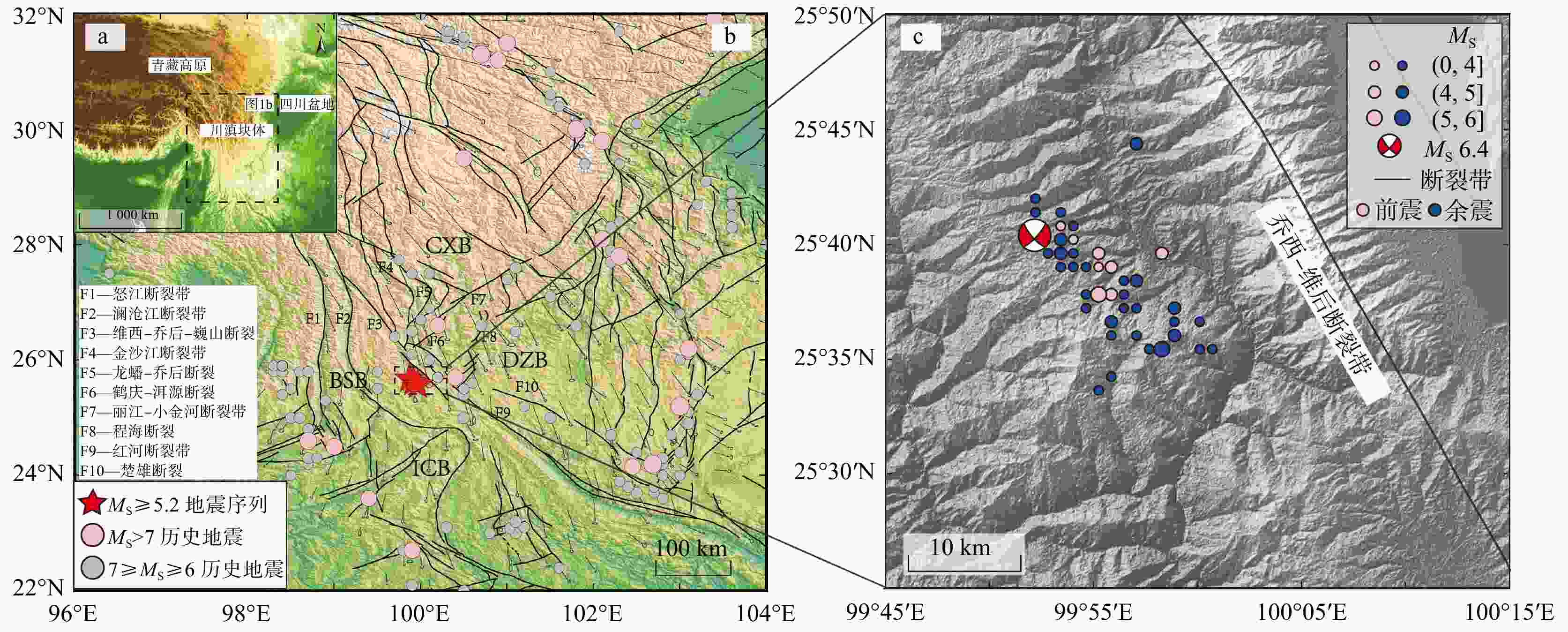
图 1 研究区周缘主要断裂带及地震分布图
CXB—川西北次级块体;DZB—滇中次级块体;BSB—保山次级块体;ICB—印支块体;地震数据引自地震科学国际数据中心(地震科学国际数据中心,2021),断裂数据引自中国活动构造图(邓起东,2007)a—青藏高原及邻区大地构造位置;b—川滇块体主要断裂带及历史地震分布图(1900年以来);c—2021年5月21日漾濞MS 6.4地震序列中MS ≥3.0事件空间分布图(2021年5月18日—2021年5月28日)
Figure 1. Distribution of major fault zones and earthquakes in the study area and its periphery
(a) Tectonic setting of the Tibetan Plateau and adjacent regions; (b) Distribution of major fault zones and historical earthquakes since 1900 within the Sichuan–Yunnan block; (c) Spatial distribution of MS≥ 3.0 events (18–28 May, 2021) within the 21 May, 2021 Yangbi MS 6.4 earthquake sequence CXB—northwestern Sichuan sub-block; DZB—central Yunnan sub-block; BSB—Baoshan sub-block; ICB—Indochina block; earthquake data from the National Earthquake Science Data Center(International Earthquake Science Data Center, 2021), and fault data from Active Tectonic Map of China (Deng, 2007)
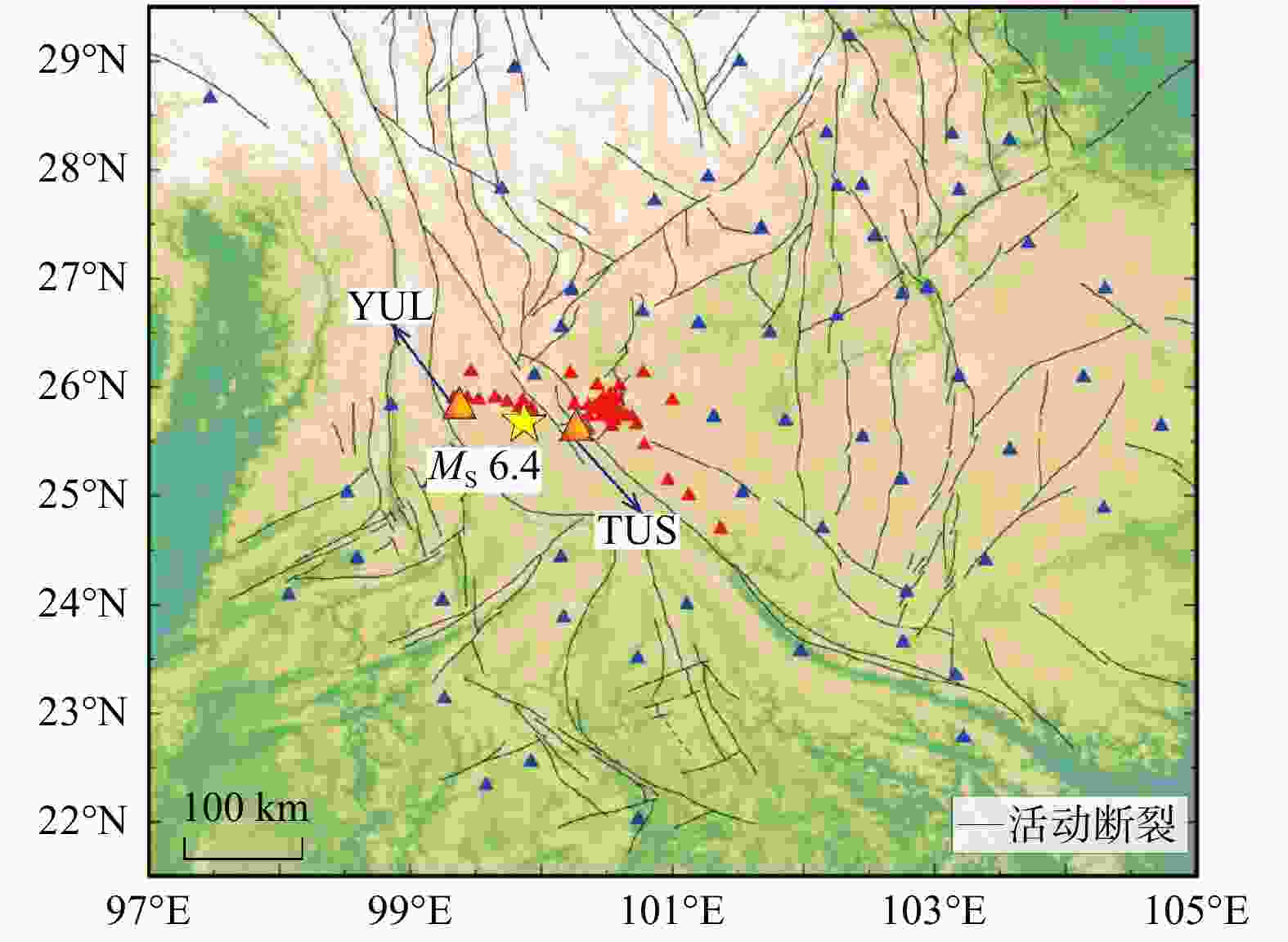
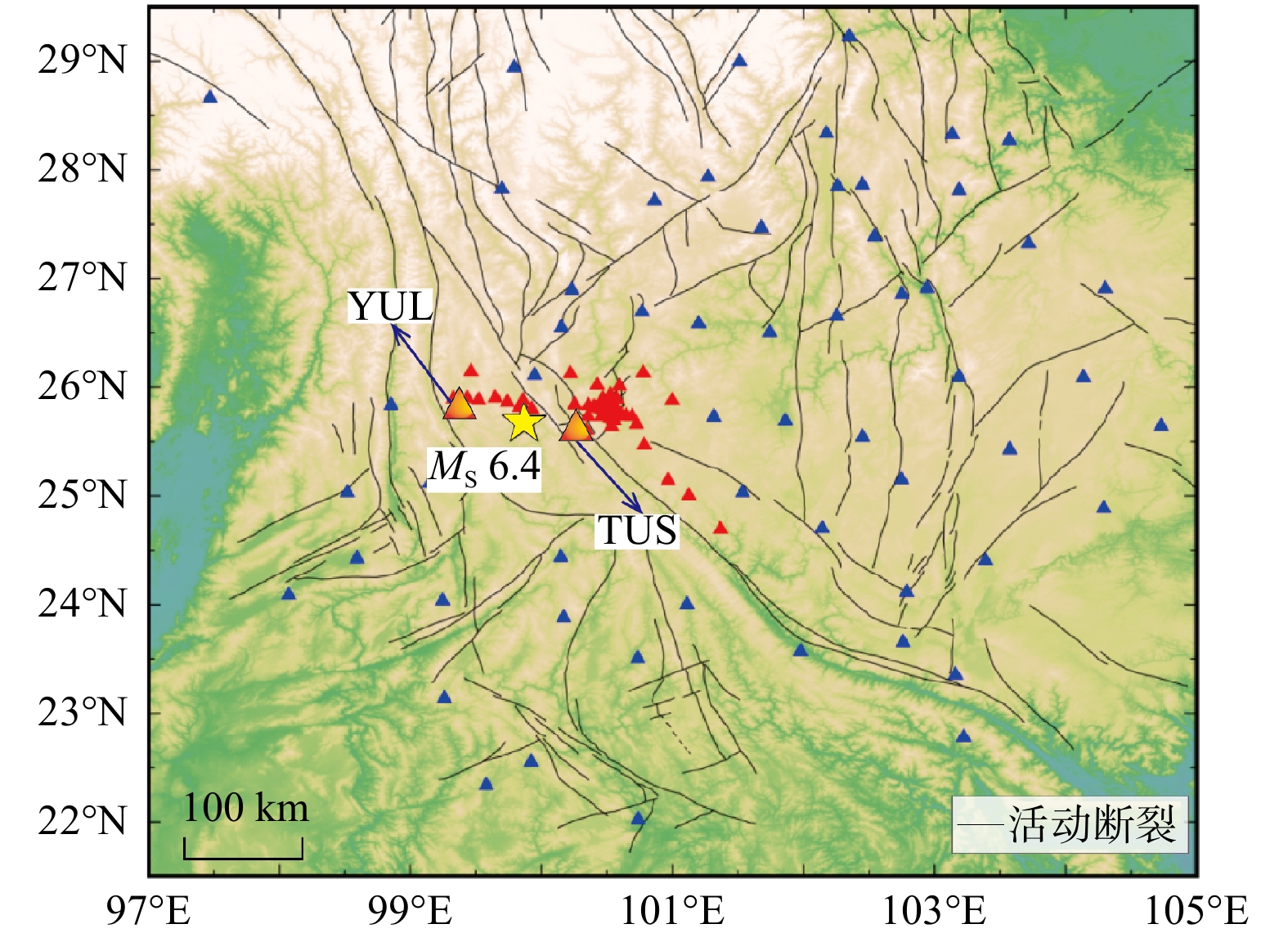
图 2 漾濞地震区域台站分布图
蓝色三角形为国家地震科学数据中心长周期宽频带数字记录台站;红色三角形为中国地震局地球物理研究所主动源团队短周期数字记录台阵;黄色五角星为MS 6.4主震;橙红色三角形分别为YUL台站和TUS台站
Figure 2. Distribution of seismic stations around the Yangbi earthquake region
Blue triangles represent long-period broadband digital recording stations from the National Center for Seismic Data Backup of the China National Seismic Network; Red triangles represent the short-period digital recording array of the Active Source Team, Institute of Geophysics, China Earthquake Administration; The yellow five-pointed star marks the MS 6.4 mainshock; Orange-red triangles indicate the YUL station and the TUS station, respectively.
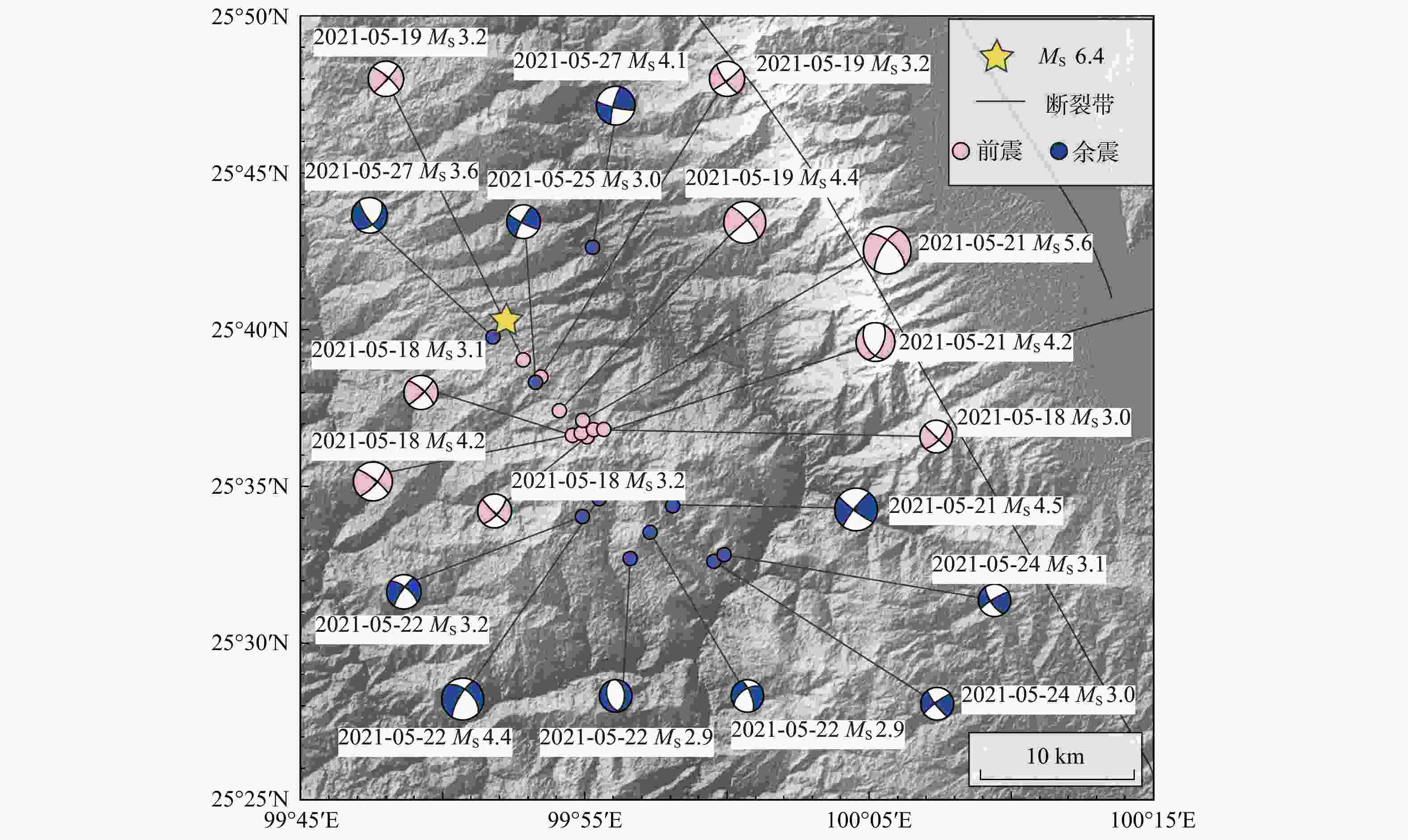
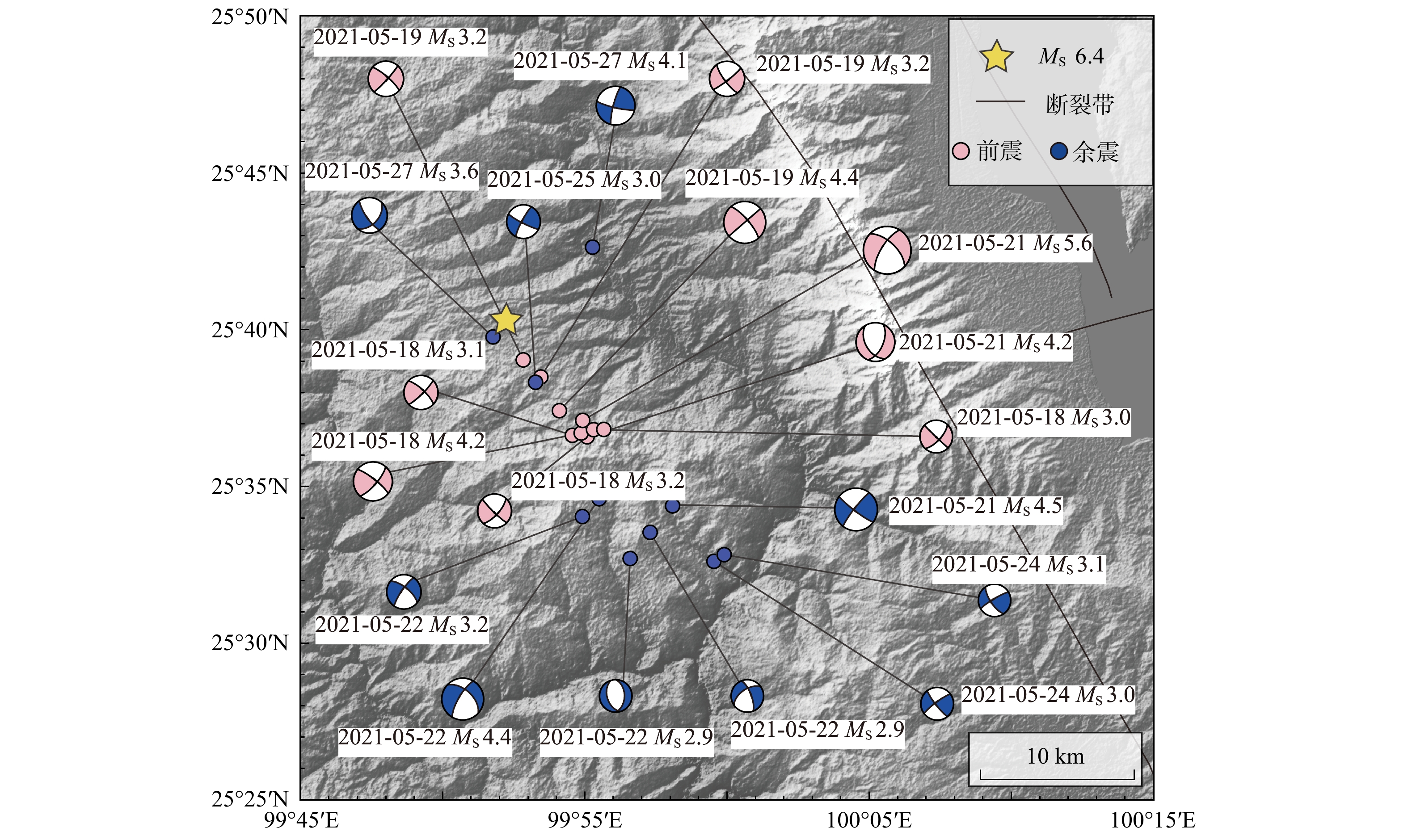
图 3 重定位后的主事件与参考事件的空间分布图及震源机制解对比图
Figure 3. Spatial distribution and comparison of focal mechanism solutions for the relocated main event and reference events
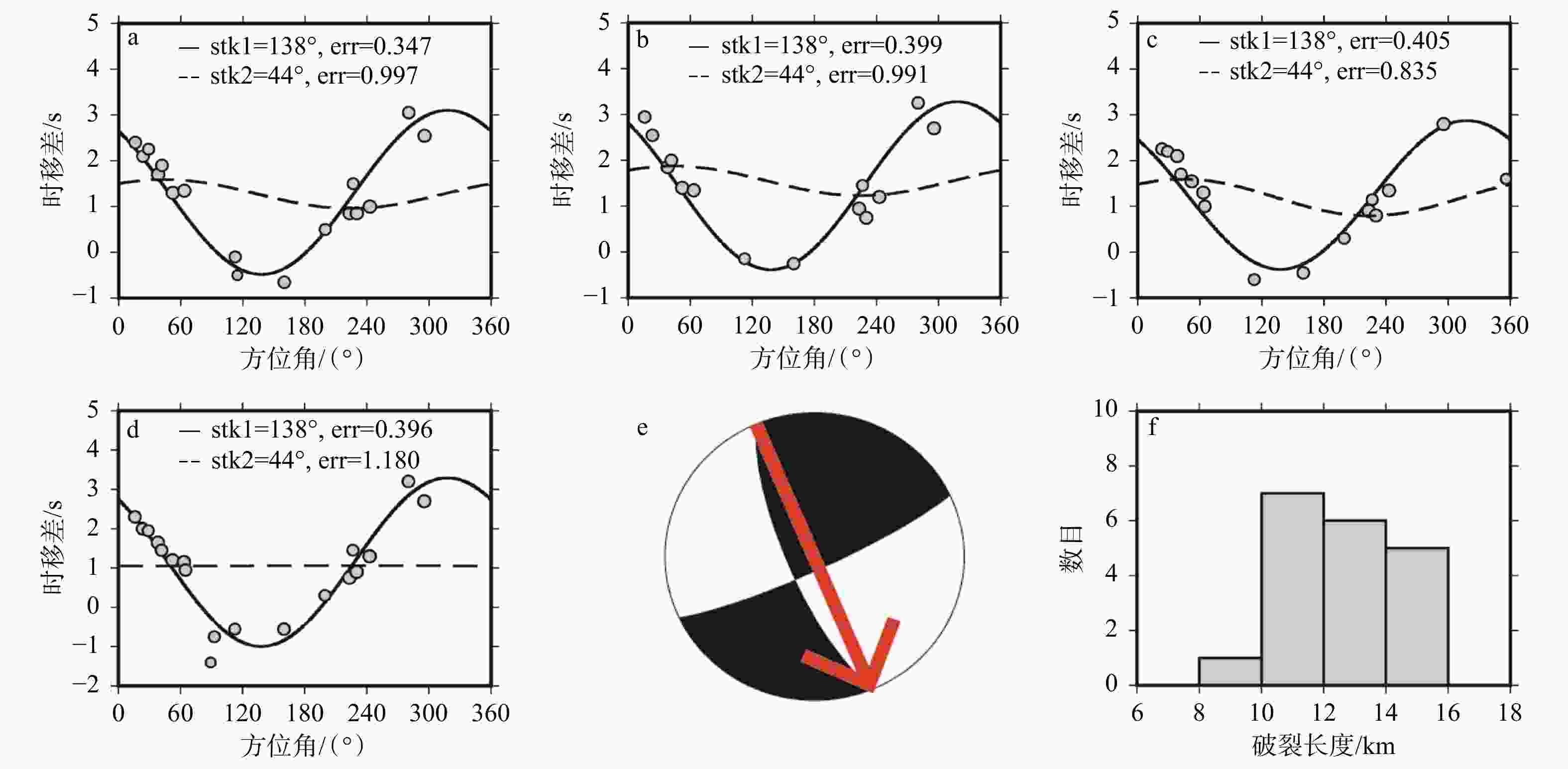
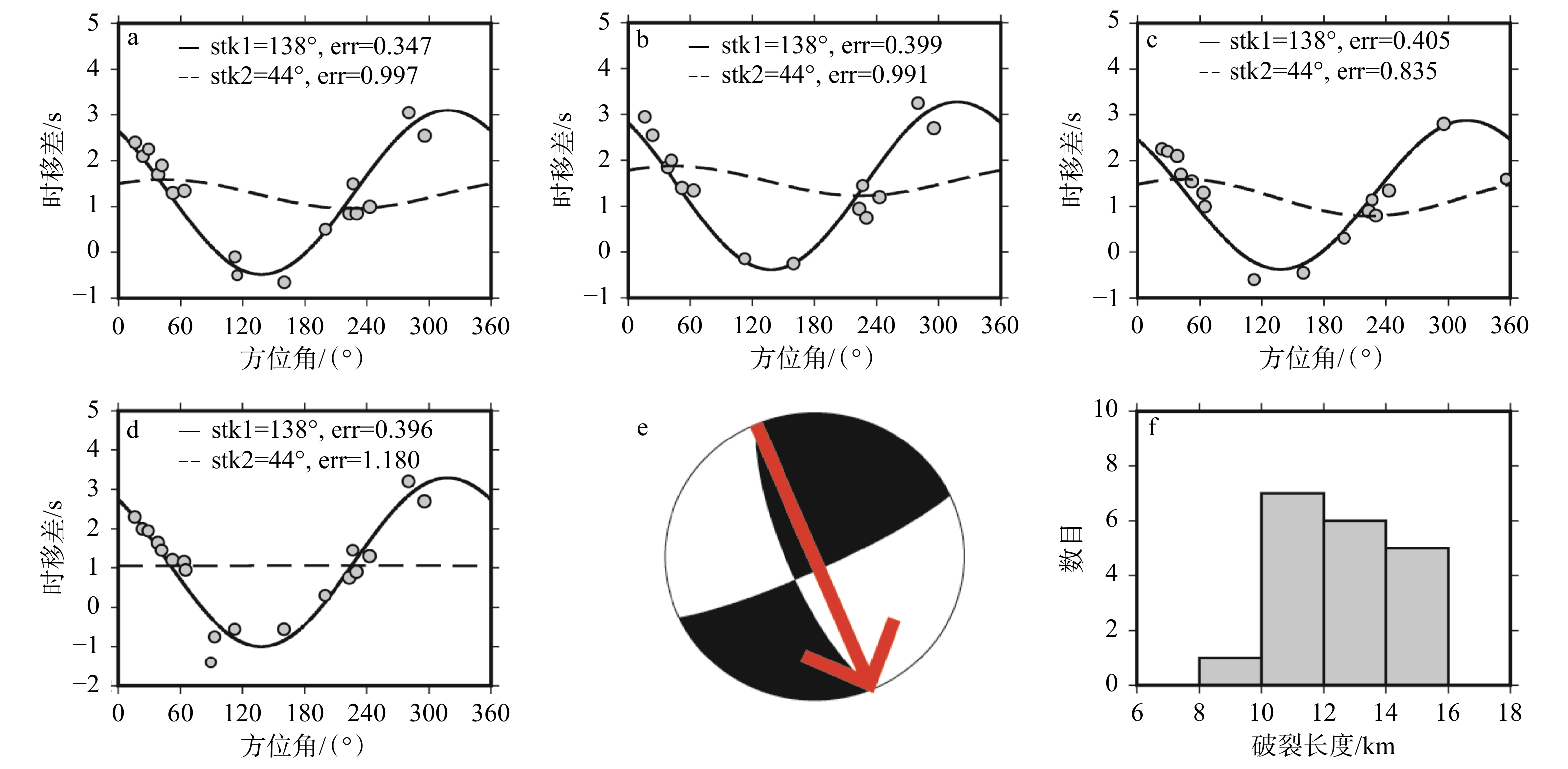
图 4 漾濞MS 6.4主震破裂方向性反演结果
stk1—漾濞MS 6.4主震节面1走向;stk2—漾濞MS 6.4主震节面2走向;err—拟合误差;图a—d中的余弦曲线分别为震源机制解的2个可能节面的理论走向拟合曲线;灰色圆点为不同展台观测波形与理论波形之间的时移差a—以2021-05-18 MS 3.2作为参考事件所得的破裂方向性拟合结果;b—以2021-05-18 MS 3.0作为参考事件所得的破裂方向性拟合结果;c—以2021-05-18 MS 4.2作为参考事件所得的破裂方向性拟合结果;d—以2021-05-18 MS 3.1作为参考事件所得的破裂方向性拟合结果;e—漾濞MS 6.4主震破裂方向示意图;f—漾濞MS 6.4主震破裂尺度
Figure 4. Rupture directivity inversion results of the Yangbi MS 6.4 mainshock
(a) Rupture directivity fitting results using event 2021-05-18 MS 3.2 as the reference; (b) Rupture directivity fitting results using event 2021-05-18 MS 3.0 as the reference; (c) Rupture directivity fitting results using event 2021-05-18 MS 4.2 as the reference; (d) Rupture directivity fitting results using event 2021-05-18 MS 3.1 as the reference; (e) Schematic diagram of the rupture directivity of the Yangbi MS 6.4 mainshock; (f) Rupture scale of the Yangbi MS 6.4 mainshockstk1—strike of nodal plane 1 of the Yangbi MS 6.4 mainshock; stk2—strike of nodal plane 2 of the Yangbi MS 6.4 mainshock; err—fitting error; In panels a to d, the cosine curves are the theoretical strike fitting curves for the two possible nodal planes of the focal mechanism solution, respectively; The gray dots represent the time shift differences between the observed waveforms and the synthetic waveforms at different stations.
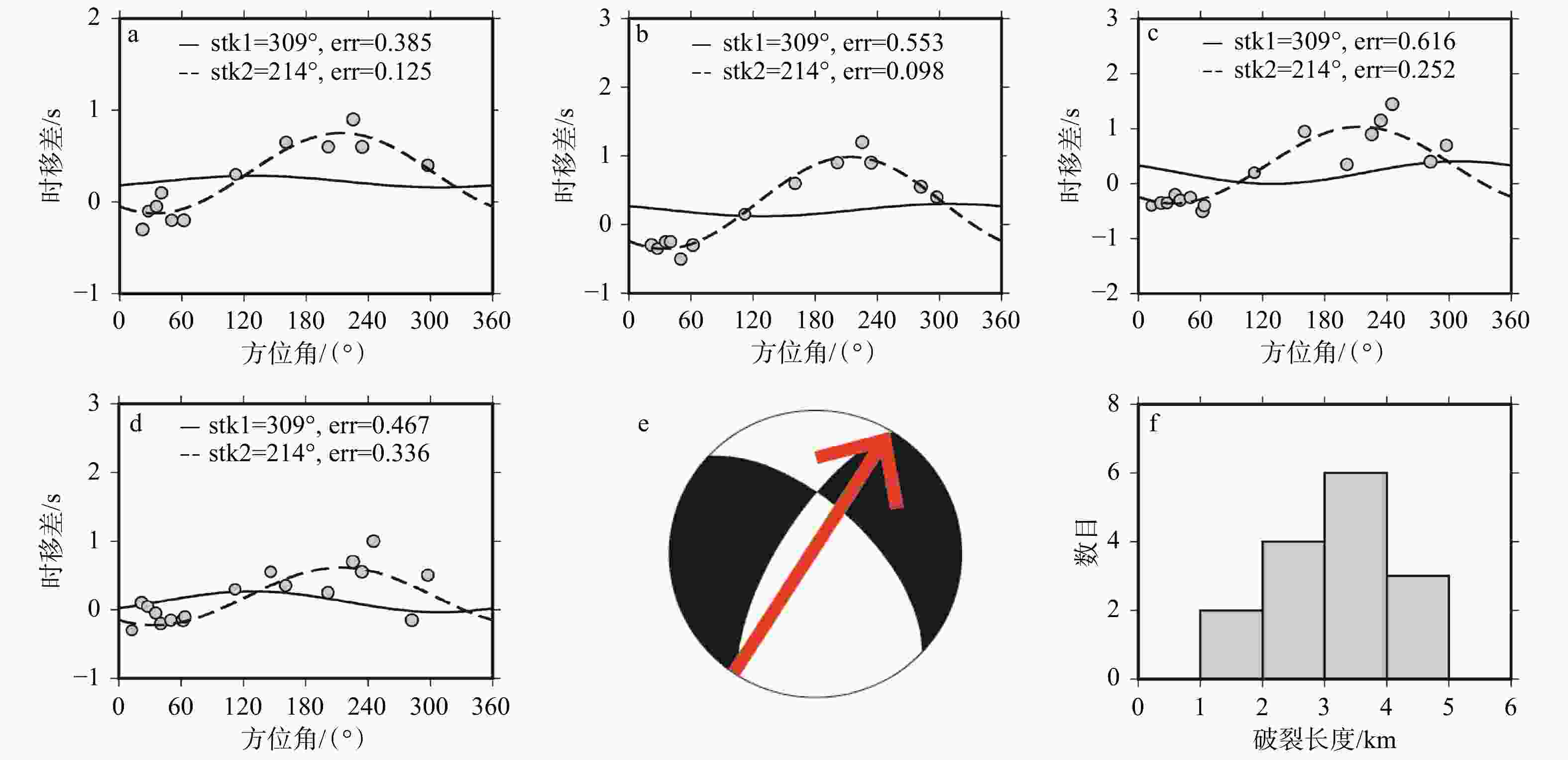
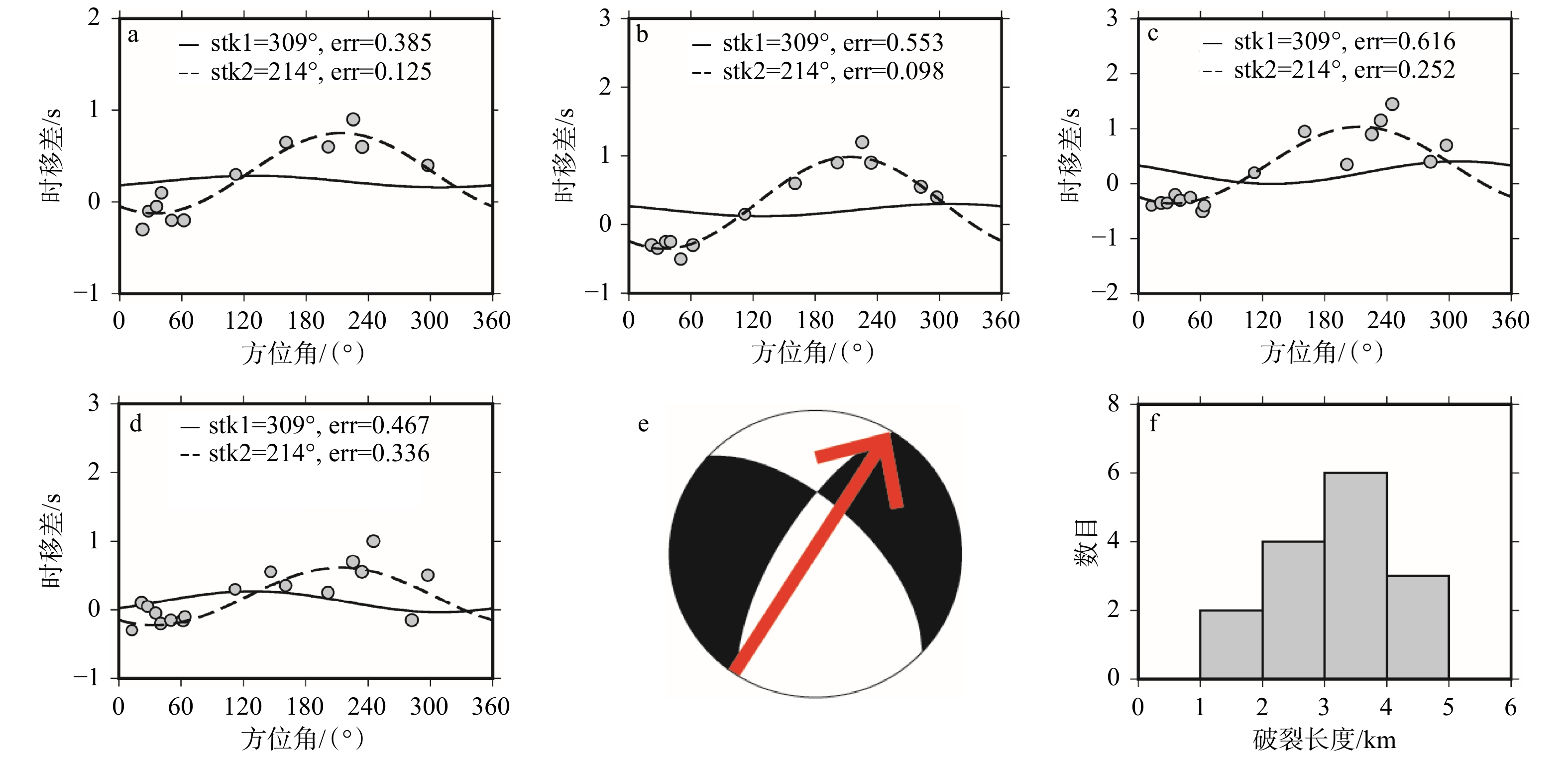
图 5 漾濞2021-05-21 MS 5.6前震破裂方向性反演结果
stk1—2021-05-21 MS 5.6前震节面1走向;stk2—2021-05-21 MS 5.6前震节面2走向;err—拟合误差;图a—d中的余弦曲线分别为震源机制解的2个可能节面的理论走向拟合曲线;灰色圆点为不同展台观测波形与理论波形之间的时移差a—以2021-05-18 MS 3.2作为参考事件所得的破裂方向性拟合结果;b—以2021-05-18 MS 3.0作为参考事件所得的破裂方向性拟合结果;c—以2021-05-18 MS 3.1作为参考事件所得的破裂方向性拟合结果;d—以2021-05-18 MS 3.6作为参考事件所得的破裂方向性拟合结果;e—漾濞2021-05-21 MS 5.6前震破裂方向示意;f—漾濞2021-05-21 MS 5.6前震破裂尺度
Figure 5. Rupture directivity inversion results of the Yangbi 2021-05-21MS 5.6 foreshock
(a) Rupture directivity fitting results using event 2021-05-18 MS 3.2 as the reference; (b) Rupture directivity fitting results using event 2021-05-18 MS 3.0 as the reference; (c) Rupture directivity fitting results using event 2021-05-18 MS 3.1 as the reference; (d) Rupture directivity fitting results using event 2021-05-18 MS 3.6 as the reference; (e) Schematic diagram of rupture direction for the Yangbi 2021-05-21MS 5.6 foreshock; (f) Rupture scale of the Yangbi 2021-05-21MS 5.6 foreshockstk1—strike of nodal plane 1 of the 2021-05-21 MS 5.6 foreshock; stk2—strike of nodal plane 2 of the 2021-05-21 MS 5.6 foreshock; err—fitting error; In panels a to d, the cosine curves are the theoretical strike fitting curves for the two possible nodal planes of the focal mechanism solution, respectively; the gray dots represent the time shift differences between the observed waveforms and the synthetic waveforms at different stations.
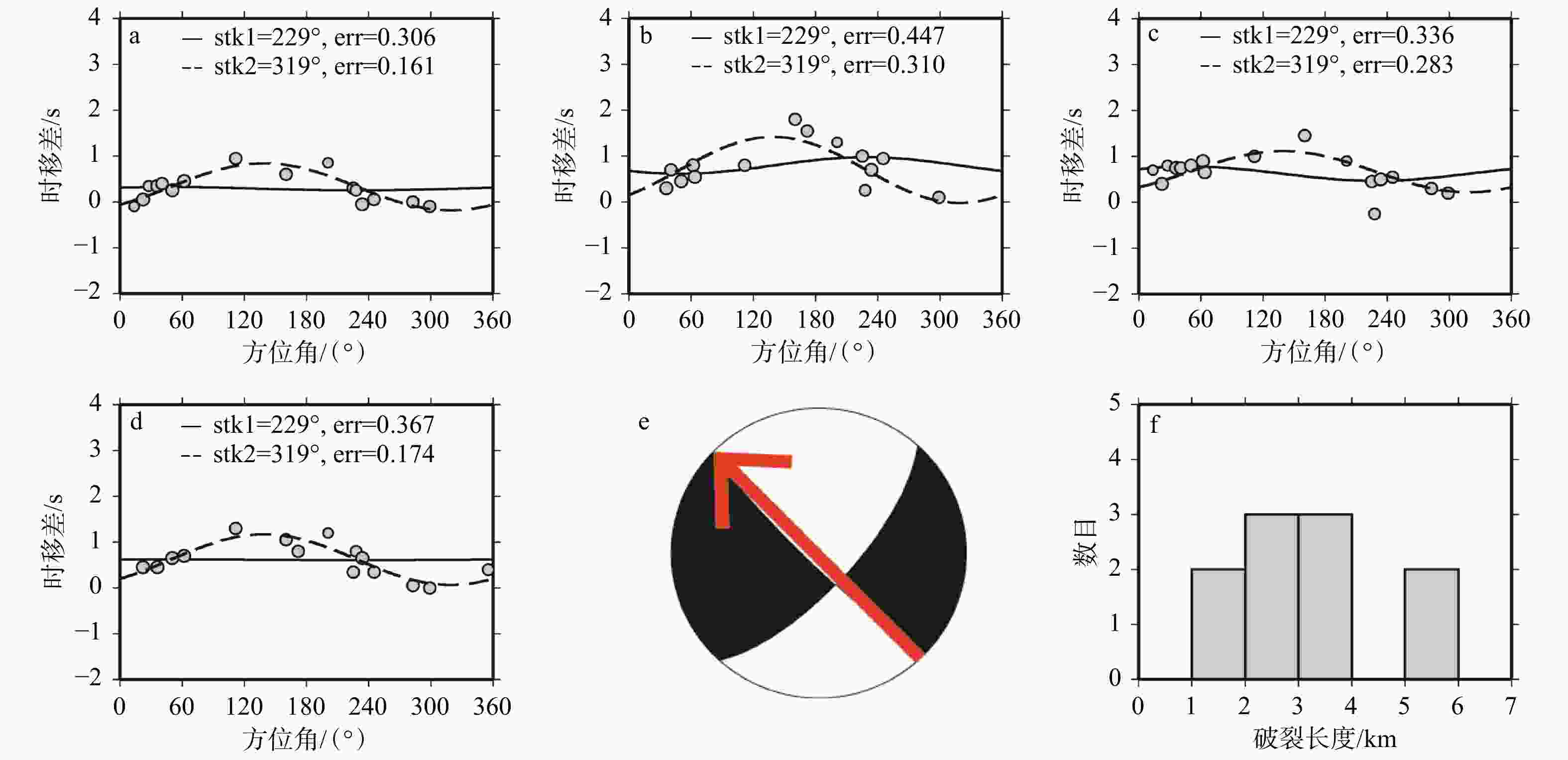
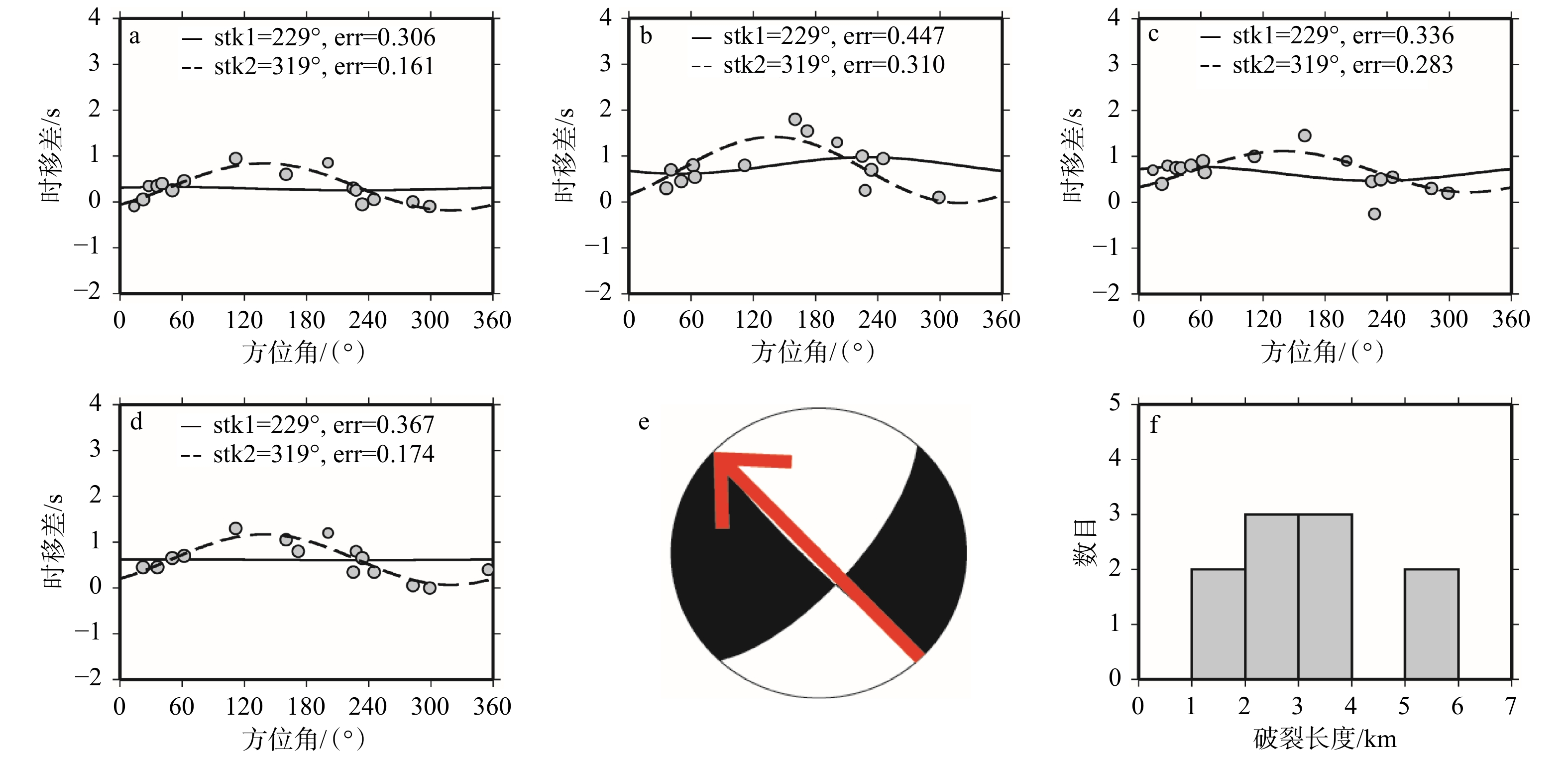
图 6 漾濞2021-05-19 MS 4.4前震破裂方向性反演结果
stk1—2021-05-19 MS 4.4前震节面1走向;stk2—2021-05-19 MS 4.4前震节面2走向;err—拟合误差;图a—d中的余弦曲线分别为震源机制解的2个可能节面的理论走向拟合曲线;灰色圆点为不同台站观测波形与理论波形之间的时移差a—以2021-05-18 MS 3.2作为参考事件所得的破裂方向性拟合结果;b—以2021-05-22 MS 2.9作为参考事件所得的破裂方向性拟合结果;c—以2021-05-21 MS 3.2作为参考事件所得的破裂方向性拟合结果;d—以2021-05-24 MS 3.0作为参考事件所得的破裂方向性拟合结果;e—漾濞2021-05-19 MS 4.4前震破裂方向示意;f—漾濞2021-05-19 MS 4.4前震破裂尺度
Figure 6. Rupture directivity inversion results of the Yangbi 2021-05-19 MS 4.4 foreshock
(a) Rupture directivity fitting results using event 2021-05-18 MS 3.2 as the reference; (b) Rupture directivity fitting results using event 2021-05-22 MS 2.9 as the reference; (c) Rupture directivity fitting results using event 2021-05-21 MS 3.2 as the reference; (d) Rupture directivity fitting results using event 2021-05-24 MS 3.0 as the reference; (e) Schematic diagram of rupture direction for the Yangbi 2021-05-19 MS 4.4 foreshock; (f) Rupture scale of the Yangbi 2021-05-19 MS 4.4 foreshockstk1—strike of nodal plane 1 of the 2021-05-19 MS 4.4 foreshock; stk2—strike of nodal plane 2 of the 2021-05-19 MS 4.4 foreshock; err—fitting error; In panels a to d, the cosine curves are the theoretical strike fitting curves for the two possible nodal planes of the focal mechanism solution, respectively; the gray dots represent the time shift differences between the observed waveforms and the synthetic waveforms at different stations.
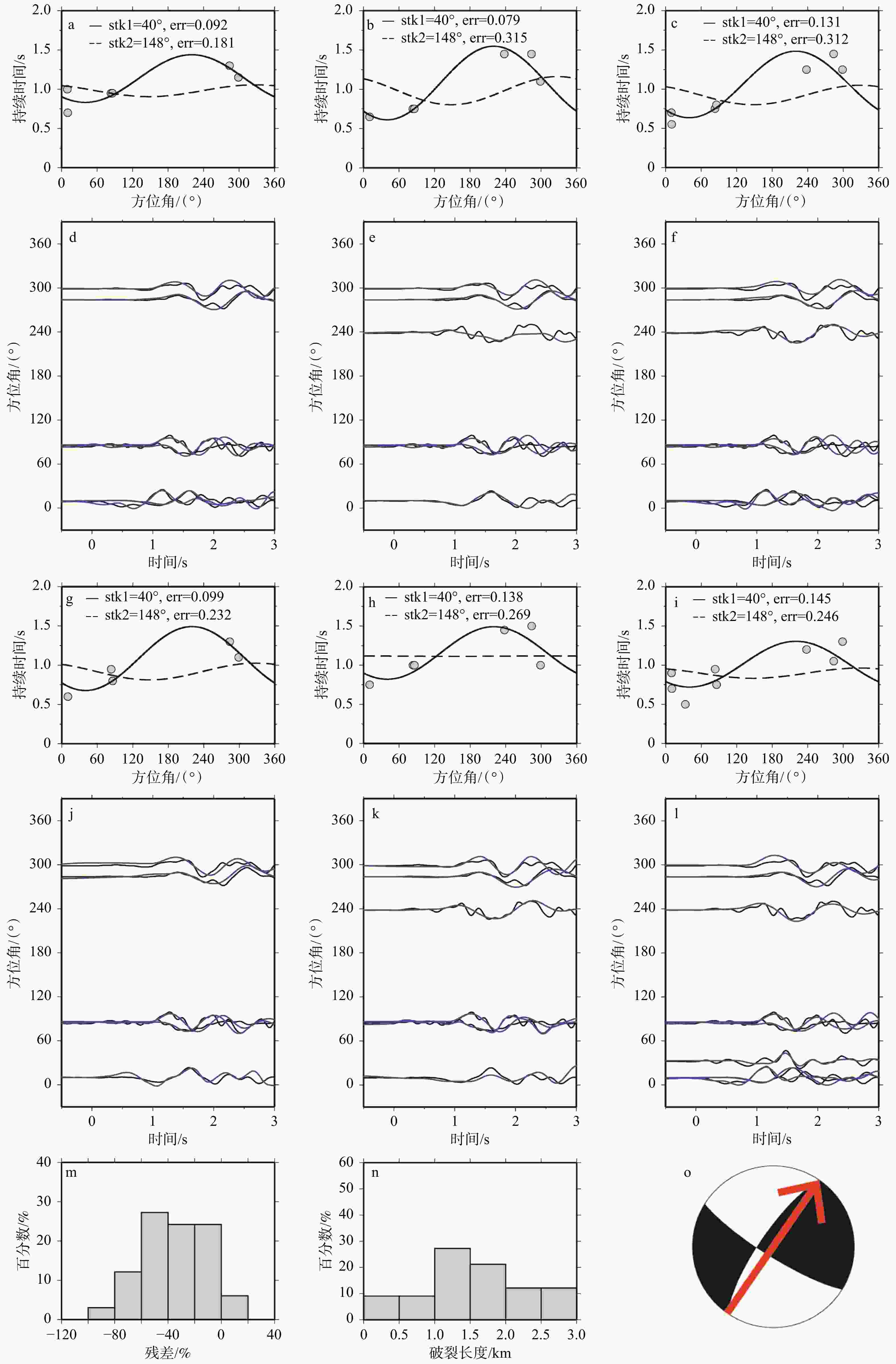
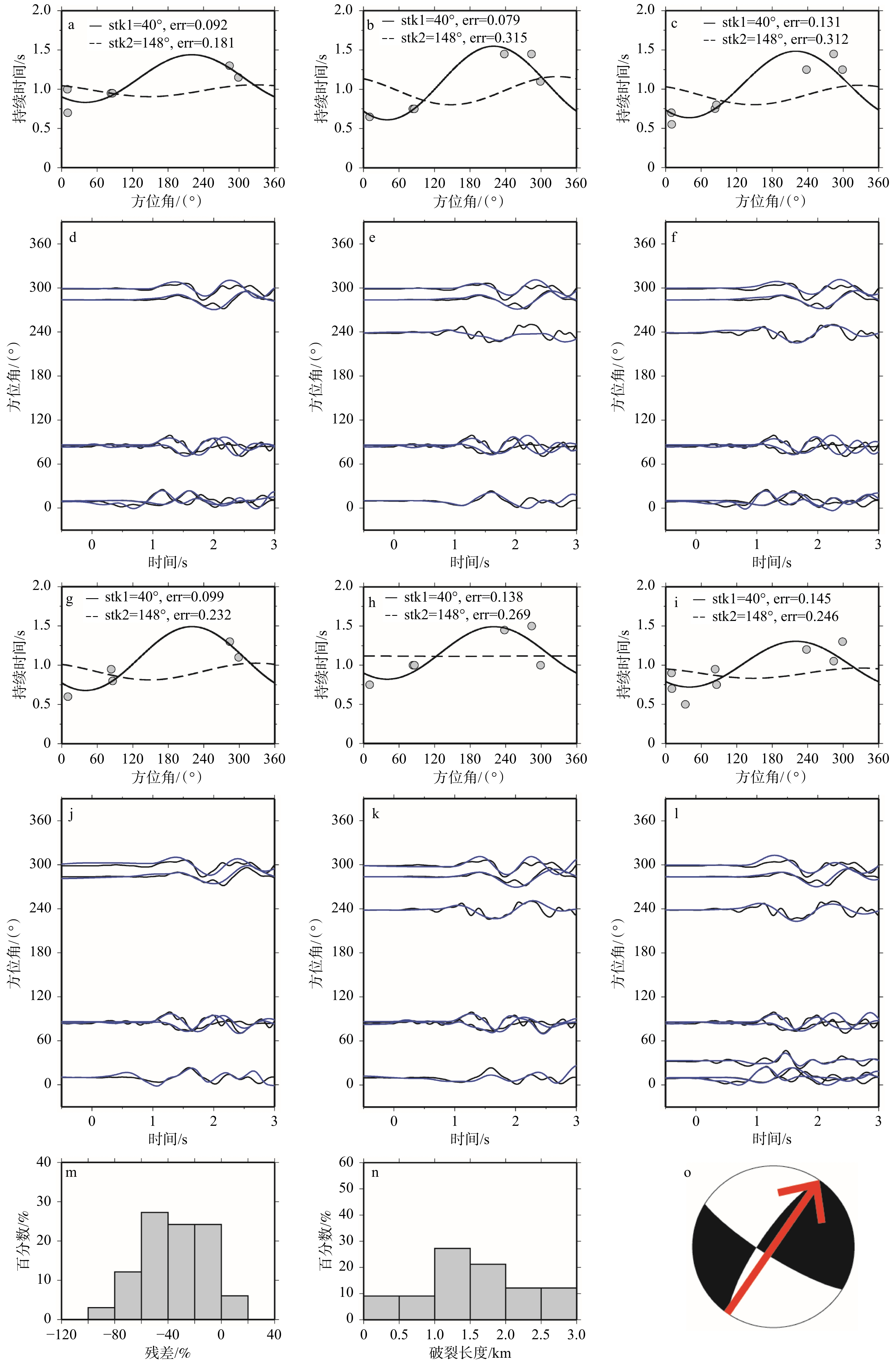
图 7 漾濞2021-05-21 MS 5.2余震破裂方向性反演结果
stk1—2021-05-21 MS 5.2余震节面1走向;stk2—2021-05-21 MS 5.2余震节面2走向;err—拟合误差;图a、b、c、g、h、i中的余弦曲线分别为震源机制解的2个可能节面的理论走向拟合曲线;灰色圆点代表各个台站的方位角所对应的最佳震源持续时间,震源持续时间最小的点所对应的方位角即为地震破裂方向a—以2021-05-18 MS 3.2作为参考事件所得的震源持续时间随方位角的变化;b—以2021-05-19 MS 2.9作为参考事件所得的震源持续时间随方位角的变化;c—以2021-05-21 MS 4.0作为参考事件所得的震源持续时间随方位角的变化;d—以2021-05-18 MS 3.2作为参考事件所得的波形拟合结果;e—以2021-05-18 MS 2.9作为参考事件所得的波形拟合结果;f—以2021-05-21 MS 4.0作为参考事件所得的波形拟合结果;g—以2021-05-21 MS 3.2作为参考事件所得的震源持续时间随方位角的变化;h—以2021-05-22 MS 2.9作为参考事件所得的震源持续时间随方位角的变化;i—以2021-05-27 MS 3.6作为参考事件所得的震源持续时间随方位角的变化;j—以2021-05-21 MS 3.2作为参考事件所得的波形拟合结果;k—以2021-05-22 MS 2.9作为参考事件所得的波形拟合结果;l—以2021-05-27 MS3.6作为参考事件所得的波形拟合结果;m—节面1与节面2拟合残差统计直方图;n—破裂长度统计;o—2021-05-21 MS 5.2余震破裂方向示意
Figure 7. Inversion results of the rupture directivity of the Yangbi MS 5.2 aftershock
(a) Variation of source duration with azimuth obtained using event 2021-05-18 MS 3.2 as the reference; (b) Variation of source duration with azimuth obtained using event 2021-05-19 MS 2.9 as the reference; (c) Variation of source duration with azimuth obtained using event 2021-05-21 MS 4.0 as the reference; (d) Waveform fitting obtained using event 2021-05-18 MS 3.2 as the reference; (e) Waveform fitting obtained using event 2021-05-18 MS 2.9 as the reference; (f) Waveform fitting obtained using event 2021-05-21 MS 4.0 as the reference; (g) Variation of source duration with azimuth obtained using event 2021-05-21 MS 3.2 as the reference; (h) Variation of source duration with azimuth obtained using event 2021-05-22 MS 2.9 as the reference; (i) Variation of source duration with azimuth obtained using event 2021-05-27 MS 3.6 as the reference; (k) Waveform fitting obtained using event 2021-05-22 MS 2.9 as the reference; (l) Waveform fitting obtained using event 2021-05-27 MS 3.6 as the reference; (m) Histogram of residuals between nodal plane 1 and nodal plane 2; (n) Statistics of rupture lengths; (o) Schematic diagram of rupture direction of the 2021-05-19 MS 4.4 foreshock stk1—strike of nodal plane 1 of the 2021-05-21 MS 5.2 aftershock; stk2—strike of nodal plane 2 of the 2021-05-21 MS 5.2 aftershock; err—fitting error; In panels a, b, c, g, h, and i, the cosine curves represent the fitting results corresponding to the two nodal planes of the focal mechanism solution, respectively; and the gray circles represent the optimal source duration at the azimuths of individual stations, the azimuth corresponding to the minimum source duration indicates the earthquake rupture direction.
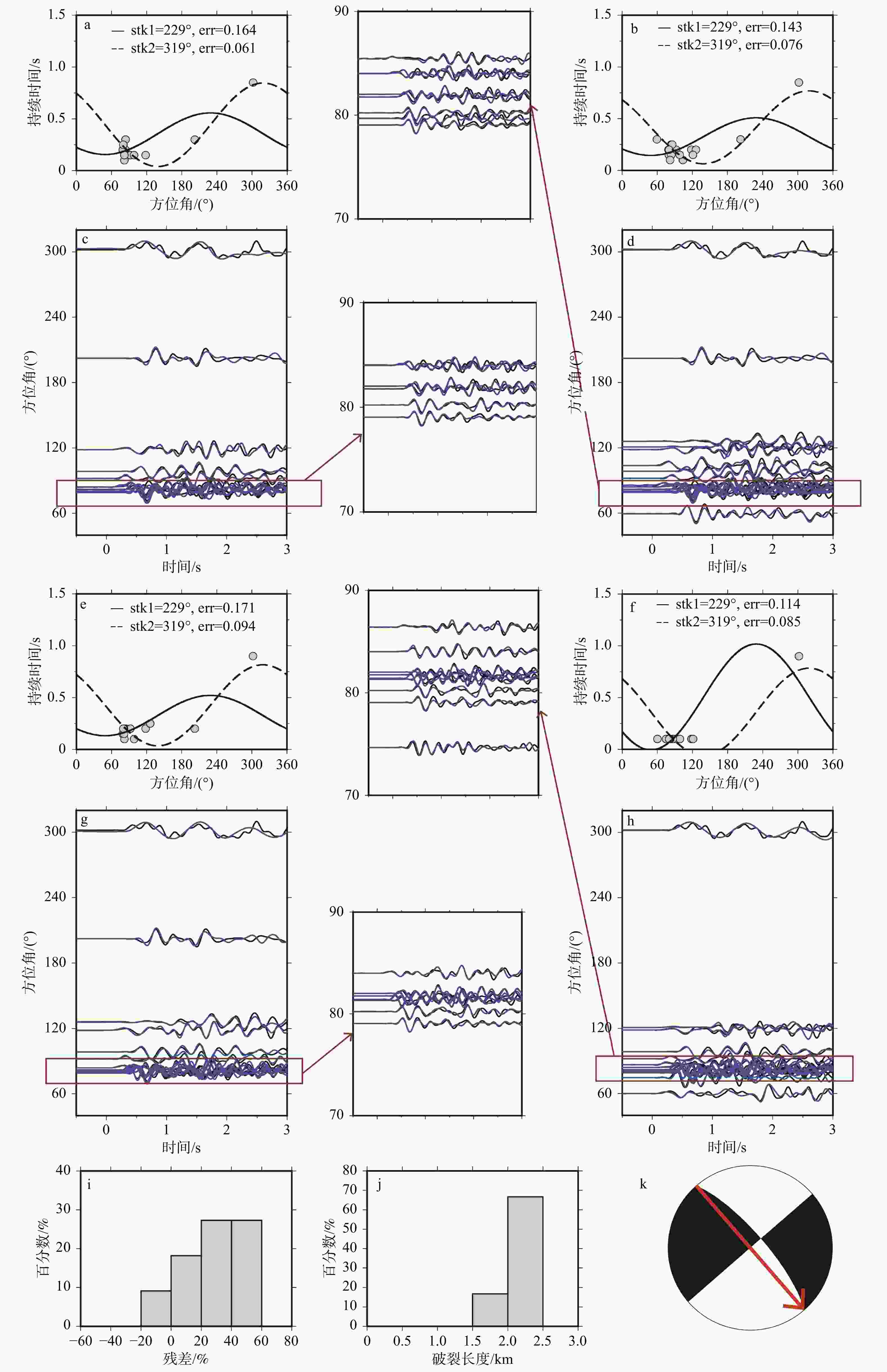
图 8 漾濞2021-05-19 MS 4.4前震破裂方向性反演结果
stk1—2021-05-19 MS 4.4前震节面1走向;stk2—2021-05-19 MS 4.4前震节面2走向;err—拟合误差;图a、b、e、f中的余弦曲线分别代表震源机制解的两个节面对应的拟合结果;灰色圆点代表各个台站的方位角所对应的最佳震源持续时间,震源持续时间最小的点所对应的方位角即为地震破裂方向a—以2021-05-18 MS 2.8作为参考事件所得的震源持续时间随方位角的变化;b—以2021-05-18 MS 3.2作为参考事件所得的震源持续时间随方位角的变化;c—以2021-05-18 MS 2.8作为参考事件所得的波形拟合结果;d—以2021-05-18 MS 3.2作为参考事件所得的波形拟合结果;e—以2021-05-18 MS 2.5作为参考事件所得的震源持续时间随方位角的变化;f—以2021-05-19 MS 3.2作为参考事件所得的震源持续时间随方位角的变化;g—以2021-05-18 MS 2.5作为参考事件所得的波形拟合结果;h—以2021-05-19 MS 3.2作为参考事件所得的波形拟合结果;i—节面1与节面2拟合残差统计直方图;j—破裂长度统计;k—2021-05-19 MS 4.4前震破裂方向示意
Figure 8. Inversion results of the rupture directivity of the Yangbi MS 4.4 foreshock
(a) Variation of source duration with azimuth obtained using event 2021-05-18 MS 2.8 as the reference; (b) Variation of source duration with azimuth obtained using event 2021-05-18 MS 3.2 as the reference; (c) Waveform fitting obtained using event 2021-05-18 MS 2.8 as the reference; (d) Waveform fitting obtained using event 2021-05-18 MS 3.2 as the reference; (e) Variation of source duration with azimuth obtained using event 2021-05-18 MS 2.5 as the reference; (f) Variation of source duration with azimuth obtained using event 2021-05-19 MS 3.2 as the reference; (g) Waveform fitting obtained using event 2021-05-18 MS 2.5 as the reference; (h) Waveform fitting obtained using event 2021-05-19 MS 3.2 as the reference; (i) Histogram of residuals between nodal plane 1 and nodal plane 2; (j) Statistics of rupture lengths; (k) Schematic diagram of rupture direction of the 2021-05-19 MS 4.4 foreshockstk1—strike of nodal plane 1 of the 2021-05-19 MS 4.4 foreshock; stk2—strike of nodal plane 2 of the 2021-05-19 MS 4.4 foreshock; err—fitting error; In panels a, b, e, and f, the cosine curves represent the fitting results corresponding to the two nodal planes of the focal mechanism solution, respectively; and the gray circles represent the optimal source duration at the azimuths of individual stations, the azimuth corresponding to the minimum source duration indicates the earthquake rupture direction.
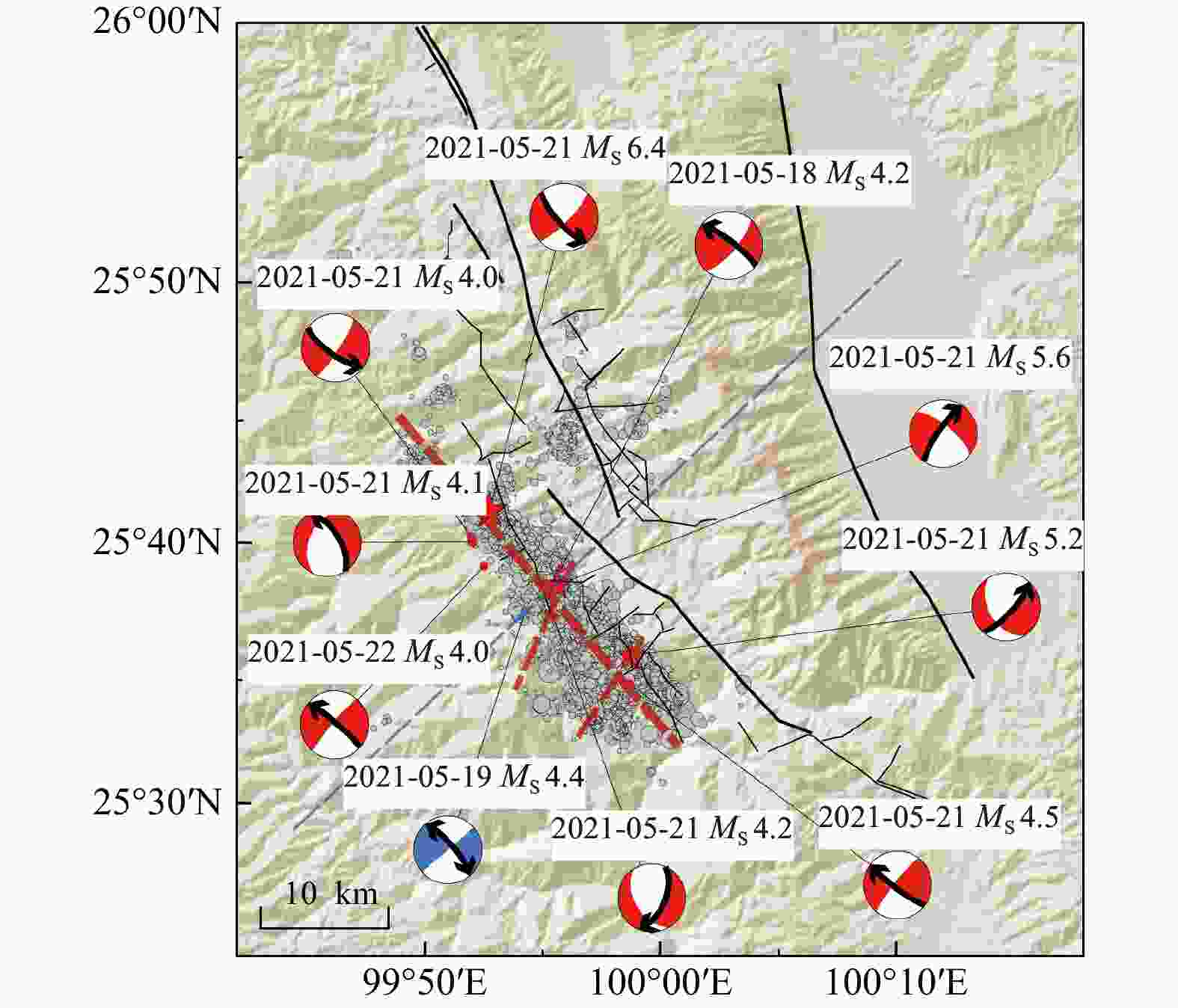
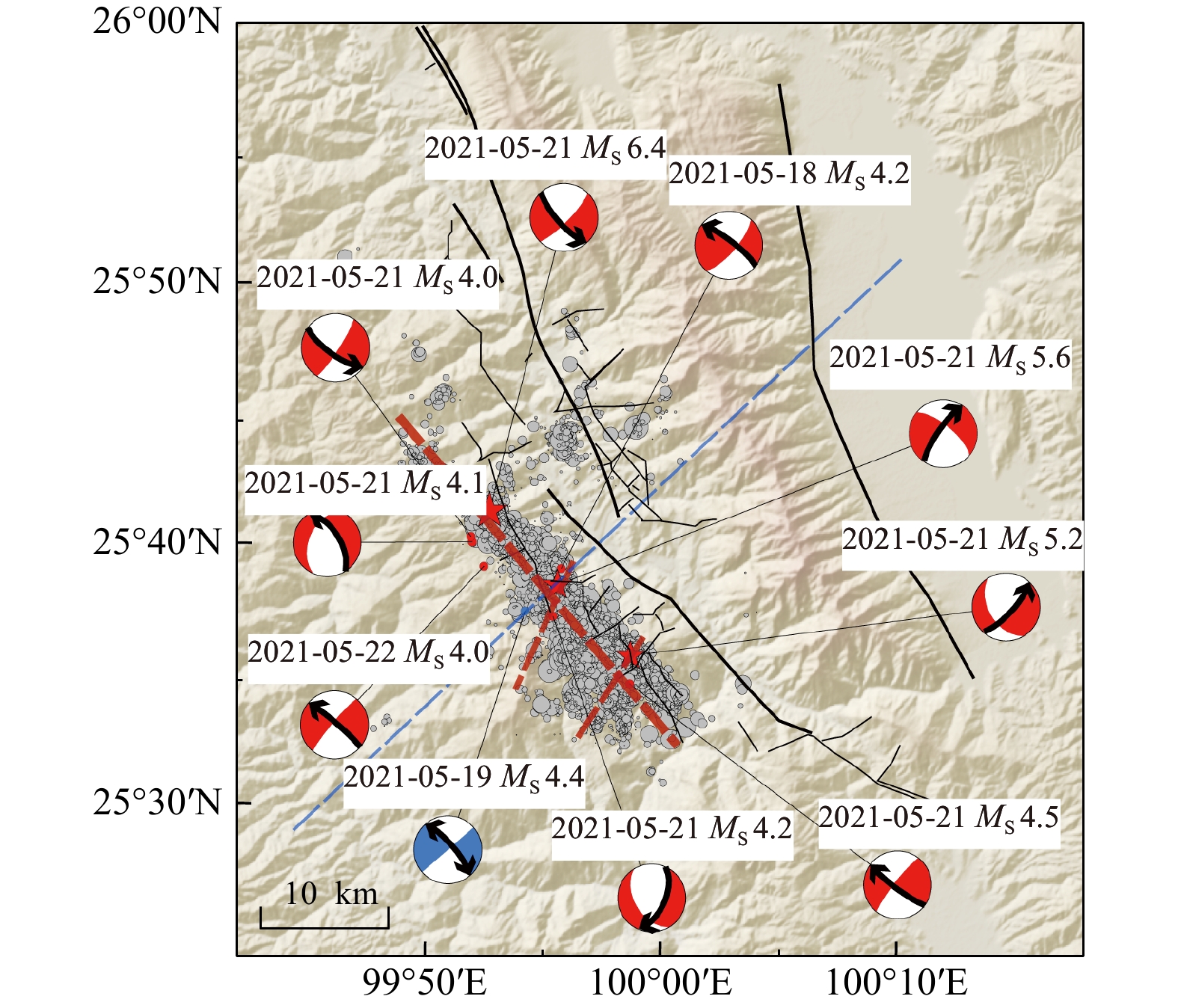
图 9 漾濞MS 6.4地震破裂方向性示意图
蓝色震源球代表具有双侧破裂的特殊地震事件,红色震源球代表其余求得准确破裂方向性参数的地震事件,均已标记出文中研究所得断层破裂方向;红色虚线代表根据文中破裂方向性测定结果结合已有研究成果推测的发震断层;灰色圆点代表地震序列重定位分布(Tian et al.,2023);蓝色虚线代表破裂分段示意线,用于直观划分北西与南东方向的破裂分段特征;红色五角星代表漾濞地震序列MS >5.2的地震;黑色实线代表震源区断层分布(引自李传友等,2021;龙锋等,2021)
Figure 9. Schematic diagram of the rupture directivity of the Yangbi earthquake
Blue beach balls represent special seismic events with bilateral rupture; red beach balls represent the remaining events for which accurate rupture directivity parameters were obtained; the fault rupture direction determined in this study is marked for all of them. The red dashed line indicates the inferred seismogenic fault based on the rupture directivity results from this study combined with previous research; gray dots show the relocated distribution of the earthquake sequence (Tian et al., 2023); the blue dashed line is a schematic line for rupture segmentation, used to visually delineate the segmentation characteristics in the NW and SE directions; red five-pointed stars represent earthquakes with MS > 5.2 in the Yangbi sequence; black solid lines show the fault distribution in the source area (from the regional seismotectonic map of the Yangbi swarm – overlay mapping, Li et al., 2021; Long et al., 2021).
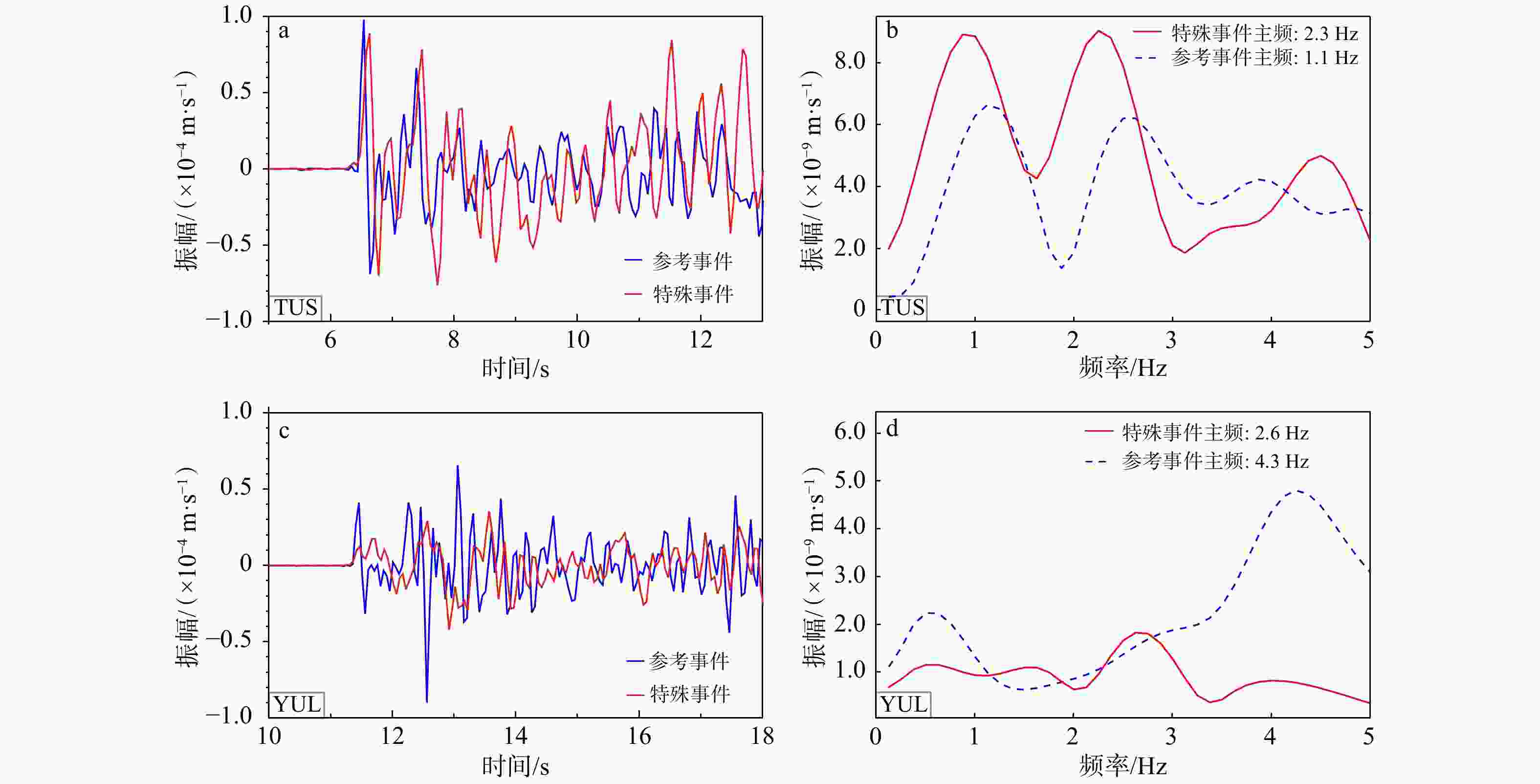
图 10 2个台站记录的特殊事件与参考事件的波形及振幅谱对比
a—TUS台站记录的特殊事件及参考事件的波形对比;b—TUS台站记录的特殊事件与参考事件的P波振幅谱对比;c—YUL台站所记录的特殊事件与参考事件的波形对比;d—YUL台站记录的特殊事件与参考事件的P波振幅谱对比
Figure 10. Comparison of waveforms and amplitude spectra of the special event and reference earthquake recorded at two stations
(a) Waveforms of the special event and the reference earthquake recorded at station TUS; (b) Comparison of P-wave amplitude spectra of the special event and the reference earthquake at station TUS; (c) Waveforms of the special event and the reference earthquake recorded at station YUL; (d) Comparison of P-wave amplitude spectra of the special event and the reference earthquake at station YUL
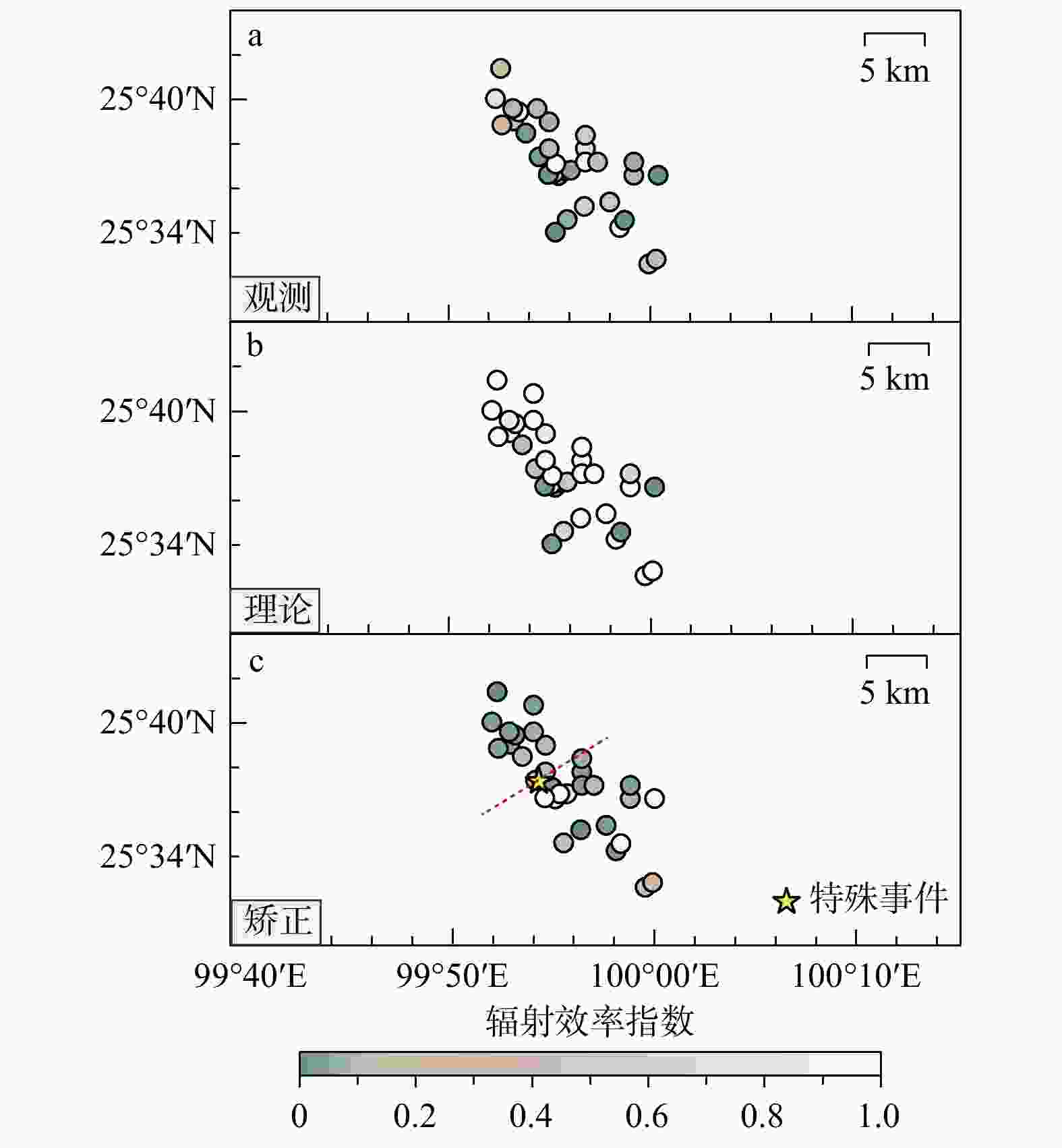
图 11 能量辐射效率图
黄色五角星为地震序列特殊事件2021-05-19 MS 4.4;红色虚线为破裂分段示意线,用于直观划分北西与南东方向的破裂分段特征a—观测地震波形能量辐射效率;b—理论地震波形能量辐射效率;c—校正后地震波形能量辐射效率
Figure 11. Energy radiation efficiency diagram
(a) Observed seismic waveform radiated energy efficiency; (b) Synthetic seismic waveform radiated energy efficiency; (c) Corrected seismic waveform radiated energy efficiencyThe yellow five-pointed star represents the special event 2021-05-19 MS 4.4 in the earthquake sequence; the red dashed line is a schematic line for rupture segmentation, used to visually delineate the rupture segmentation characteristics in the northwest and southeast directions
表 1 相对质心定位测定破裂方向性结果(震源机制解引自王月等,2021)
Table 1. Results of rupture directivity determined by relative centroid location (Focal mechanism solution from Wang et al., 2021)
地震名 节面1
(走向/倾角/滑动角)节面2
(走向/倾角/滑动角)破裂方向 破裂长度 参考事件数 支持同一破裂方向的参考事件数 2021-05-19 MS 4.4前震 229°/90°/−14° 319°/76°/−180° NW 3.0 km 10 10 2021-05-21 MS 5.6前震 214°/77°/−20° 309°/70°/−167° NE 3.0 km 15 15 2021-05-21 MS 6.4主震 44°/78°/16° 138°/74°/168° SE 12.8 km 19 19  下载: 导出CSV
表 2 震源时频特征法测定破裂方向性统计表(震源机制解引自王月等,2021)
Table 2. Statistical table of rupture directivity determined by the source time-frequency characteristic method
地震名 节面1(走向/倾角/滑动角) 节面2(走向/倾角/滑动角) 破裂
方向破裂
长度参考事件数 支持同一破裂方向参考事件数 2021-05-18 MS 4.2前震 41°/75°/11° 308°/79°/164° NW 1.0 km 24 17 2021-05-19 MS 4.4前震 229°/90°/−14° 319°/76°/−180° SE 2.2 km 13 12 2021-05-21 MS 4.2前震 23°/57°/−52° 149°/48°/−133° SW 1.5 km 27 20 2021-05-21 MS 4.5前震 218°/83°/8° 127°/82°/172° NW 1.0 km 18 13 2021-05-21 MS 4.1余震 203°/45°/−44° 328°/60°/−126° NW 1.8 km 35 31 2021-05-21 MS 4.0余震 210°/73°/10° 117°/80°/162° NW 1.5 km 24 18 2021-05-21 MS 5.2余震 40°/71°/−46° 148°/47°/−153° NE 1.8 km 34 30 2021-05-22 MS 4.0余震 34°/80°/−17° 127°/73°/−170° NW 1.5 km 35 30
下载: 导出CSV
-
[1] BOATWRIGHT J, 2007. The persistence of directivity in small earthquakes[J]. Bulletin of the Seismological Society of America, 97(6): 1850-1861. doi: 10.1785/0120050228 [2] CALDERONI G, ROVELLI A, BEN-ZION Y, et al., 2015. Along-strike rupture directivity of earthquakes of the 2009 L’Aquila, central Italy, seismic sequence[J]. Geophysical Journal International, 203(1): 399-415. doi: 10.1093/gji/ggv275 [3] CHANG Z F, CHANG H, ZANG Y, et al., 2016. Recent active features of Weixi-Qiaohou fault and its relationship with the Honghe fault[J]. Journal of Geomechanics, 22(3): 517-530. (in Chinese with English abstract) [4] CHEN J L, HAO J L, WANG Z, et al., 2022. The 21 May 2021 MW 6.1 Yangbi earthquake: a unilateral rupture event with conjugately distributed aftershocks[J]. Seismological Research Letters, 93(3): 1382-1399. doi: 10.1785/0220210241 [5] DENG Q D, 2007. Map of active tectonics in China[M]. Beijing: Seismological Press. (in Chinese with English abstract) [6] DUAN M Q, ZHAO C P, ZHOU L Q, et al., 2021. Seismogenic structure of the 21 May 2021 MS6.4 Yunnan Yangbi earthquake sequence[J]. Chinese Journal of Geophysics, 64(9): 3111-3125. (in Chinese with English abstract) [7] FAN W J, CUI X F, ZHAO X Y, 2022. Current state of tectonic stress in northwestern Yunnan and its relationship with earthquakes[J]. Acta Seismologica Sinica, 44(4): 632-643. (in Chinese with English abstract) [8] FAN W J, 2023. Evolutionary characteristics of the focal mechanism consistency parameter before the Yangbi MS6.4 earthquake[J]. Journal of Geodesy and Geodynamics, 43(1): 82-88. (in Chinese with English abstract) [9] GAO J Y, LI Y H, WANG Z S, et al., 2022. Crustal velocity structure of the southeastern Tibetan Plateau and its geological implications for the Yunnan Yangbi MS6.4 earthquake[J]. Chinese Journal of Geophysics, 65(2): 604-619. (in Chinese with English abstract) [10] GOEBEL T H W, BRODSKY E E, DRESEN G, 2023. Fault roughness promotes earthquake-like aftershock clustering in the lab[J]. Geophysical Research Letters, 50(8): e2022GL101241. doi: 10.1029/2022GL101241 [11] GONG W Z, YE L L, QIU Y X, et al., 2022. Rupture directivity of the 2021 MW 6.0 Yangbi, Yunnan earthquake[J]. Journal of Geophysical Research: Solid Earth, 127(9): e2022JB024321. doi: 10.1029/2022JB024321 [12] HE X H, NI S D, LIU J, 2015. Rupture directivity of the August 3rd, 2014 Ludian earthquake (Yunan, China)[J]. Science China Earth Sciences, 58(5): 795-804. doi: 10.1007/s11430-015-5053-2 [13] HE X H, ZHAN Z W, ZHANG P Z, et al., 2018. Rupture directivity of the 18 April 2008 Mt. Carmel, Illinois, earthquake from modeling of local seismic waveforms[J]. Bulletin of the Seismological Society of America, 108(6): 3278-3288. doi: 10.1785/0120180156 [14] HU J, ZHAO T, BAI C Y, et al., 2021. Three-dimensional P and S wave velocity structure and earthquake relocation of the May 21, 2021 Yangbi MS6.4 source region[J]. Chinese Journal of Geophysics, 64(12): 4488-4509. (in Chinese with English abstract) [15] International Earthquake Science Data Center. Broadband Seismic Station Data of the 2021 Yangbi MS 6.4 Earthquake Sequence[DS]. Beijing: International Data Center for Earthquake Science, 2021. DOI:10.11998/IESDC [16] JI Z W, CHEN X L, ZHANG B, 2022. Preliminary finite difference simulation of long-period strong ground motions for the Yangbi MS6.4 earthquake[J]. Reviews of Geophysics and Planetary Physics, 53(1): 85-91. (in Chinese with English abstract) [17] KANAMORI H, MORI J, HAUKSSON E, et al., 1993. Determination of earthquake energy release and ML using TERRAscope[J]. Bulletin of the Seismological Society of America, 83(2): 330-346. [18] KANEKO Y, SHEARER P M, 2014. Seismic source spectra and estimated stress drop derived from cohesive-zone models of circular subshear rupture[J]. Geophysical Journal International, 197(2): 1002-1015. doi: 10.1093/gji/ggu030 [19] KANEKO Y, SHEARER P M, 2015. Variability of seismic source spectra, estimated stress drop, and radiated energy, derived from cohesive-zone models of symmetrical and asymmetrical circular and elliptical ruptures[J]. Journal of Geophysical Research: Solid Earth, 120(2): 1053-1079. doi: 10.1002/2014JB011642 [20] LEI X L, WANG Z W, MA S L, et al., 2021. A preliminary study on the characteristics and mechanism of the May 2021 MS6.4 Yangbi earthquake sequence, Yunnan, China[J]. Acta Seismologica Sinica, 43(3): 261-286. (in Chinese with English abstract) [21] LI C Y, ZHANG J Y, WANG W, et al. The seismogenic fault of the 2021 Yunnan Yangbi MS 6.4 earthquake [J]. Seismology and Geology, 43(3): 706-721.(in Chinese with English abstract) [22] LI D H, DING Z F, WU P P, et al., 2021. The characteristics of crustal structure and seismogenic background of Yangbi MS6.4 earthquake on May 21, 2021 in Yunnan Province, China[J]. Chinese Journal of Geophysics, 64(9): 3083-3100. (in Chinese with English abstract) [23] LI X Y, LI S Y, GAO Y, et al., 2024. Advancements in deep tectonics and dynamic mechanisms beneath the eastern Tibetan Plateau: inspirations from the 9th and 10th WTGTP workshops[J]. Reviews of Geophysics and Planetary Physics, 55(2): 205-216. (in Chinese with English abstract) [24] LIU M, LI H Y, LI L, et al., 2022. Multistage nucleation of the 2021 Yangbi MS 6.4 earthquake, Yunnan, China and its foreshocks[J]. Journal of Geophysical Research: Solid Earth, 127(5): e2022JB024091. doi: 10.1029/2022JB024091 [25] LIU M, TAN Y J, GUO H, et al., 2025. Fluids and fault structures underlying the complex foreshock sequence of the 2021 Mw 6.1 Yangbi earthquake[J]. Earth and Planetary Science Letters, 651: 119173. doi: 10.1016/j.epsl.2024.119173 [26] LIU W, YAO H J, WEI S J, 2021. Frequency-dependent rupture characteristics of the 30 October 2016 Mw 6.5 Norcia, Italy earthquake inferred from joint multi-scale slip inversion[J]. Journal of Geophysical Research: Solid Earth, 126(5): e2020JB020706. doi: 10.1029/2020JB020706 [27] LONG F, QI Y P, YI G X, et al., 2021. Relocation of the MS6.4 Yangbi earthquake sequence on May 21, 2021 in Yunnan Province and its seismogenic structure analysis[J]. Chinese Journal of Geophysics, 64(8): 2631-2646. (in Chinese with English abstract) [28] QIN L B, CHEN W W, NI S D, et al., 2014. A method of resolving earthquake rupture directivity with relative centroid location and it's application to the 2008 Yingjiang MS6.0 earthquake[J]. Chinese Journal of Geophysics, 57(10): 3259-3269. (in Chinese with English abstract) [29] SUN Q S, ZHANG W H, GUO X Y, et al., 2023. Preliminary study of seismogenic structure and rupture process of the Yangbi MS 6.4 earthquake sequence from May 2021[J]. ActaGeologicaSinica, 97(2): 349-363. (in Chinese with English abstract) [30] TIAN J H, GAO Y, LUO Y, 2023. Deep seismogenic tectonics of Yangbi MS6.4 on 21 may 2021 in the SE margin of the Tibetan Plateau from earthquake sequence relocation, stress field and seismic anisotropy[J]. Tectonophysics, 851: 229768. doi: 10.1016/j.tecto.2023.229768 [31] WANG G M, WU Z H, PENG G L, et al., 2021. Seismogenic fault and it’s rupture characteristics of the 21 May, 2021 Yangbi MS6.4 earthquake: analysis results from the relocation of the earthquake sequence[J]. Journal of Geomechanics, 27(4): 662-678. (in Chinese with English abstract) [32] WANG Y, HU S Q, HE X H, et al., 2021. Relocation and focal mechanism solutions of the 21 May 2021 MS6.4 Yunnan Yangbi earthquake sequence[J]. Chinese Journal of Geophysics, 64(12): 4510-4525. (in Chinese with English abstract) [33] XU X W, ZHANG P Z, WEN X Z, et al., 2005. Features of active tectonics and recurrence behaviors of strong earthquakes in the western Sichuan Province and its adjacent regions[J]. Seismology and Geology, 27(3): 446-461. (in Chinese with English abstract) [34] YAN K, WANG W J, PENG F, et al., 2022. The seismogenic structures and migration characteristics of the 2021 Yangbi M6.4 earthquake sequence in Yunnan, China[J]. Science China Earth Sciences, 65(8): 1522-1537. doi: 10.1007/s11430-021-9933-1 [35] YANG J Y, WEN Y M, XU C J, 2021. The 21 May 2021 MS6.4 Yangbi (Yunnan) earthquake: a shallow strike-slip event rupturing in a blind fault[J]. Chinese Journal of Geophysics, 64(9): 3101-3110. (in Chinese with English abstract) [36] YANG M, WANG H W, WEN R Z, et al., 2023. Study on the rupture directivity of the 2021 Yangbi earthquake sequence[J]. Acta Seismologica Sinica, 45(5): 836-848. (in Chinese with English abstract) [37] YAO H J, GERSTOFT P, SHEARER P M, et al., 2011. Compressive sensing of the Tohoku-Oki Mw 9.0 earthquake: Frequency-dependent rupture modes[J]. Geophysical Research Letters, 38(20): L20310. doi: 10.1029/2011gl049223 [38] YIN J X, YAO H J, YANG H F, et al., 2017. Frequency-dependent rupture process, stress change, and seismogenic mechanism of the 25 April 2015 Nepal Gorkha MW7.8 earthquake[J]. Science China Earth Sciences, 60(4): 796-808. doi: 10.1007/s11430-016-9006-0 [39] ZHA X, FU R S, DAI Z Y, et al., 2009. Applying InSAR technique to accurately relocate the epicentre for the 1999 MS = 5.6 Kuqa earthquake in Xinjiang Province, China[J]. Geophysical Journal International, 176(1): 107-112. doi: 10.1111/j.1365-246X.2008.03994.x [40] ZHANG K L, GAN W J, LIANG S M, et al., 2021. Coseismic displacement and slip distribution of the 2021 May 21, MS6.4, Yangbi Earthquake derived from GNSS observations[J]. Chinese Journal of Geophysics, 64(7): 2253-2266. (in Chinese with English abstract) doi: 10.3389/fenvs.2022.857739 [41] ZHANG P Z, DENG Q D, ZHANG G M, et al., 2003. Active tectonic blocks and strong earthquakes in the continent of China[J]. Science in China Series D: Earth Sciences, 46(2): 13-24. doi: 10.1360/03dz0002 [42] ZHAO B, GAO Y, MA Y L, 2022. Relocations, focal mechanisms and stress inversion of the May 21th 2021 Yangbi MS6.4 earthquake sequence in Yunnan, China[J]. Chinese Journal of Geophysics, 65(3): 1006-1020. (in Chinese with English abstract) [43] ZHAO L, LUO Y, LIU T Y, et al., 2013. Earthquake focal mechanisms in Yunnan and their inference on the regional stress field[J]. Bulletin of the Seismological Society of America, 103(4): 2498-2507. doi: 10.1785/0120120309 [44] ZHOU Y J, REN C M, GHOSH A, et al., 2022. Seismological characterization of the 2021 Yangbi foreshock-mainshock sequence, Yunnan, China: more than a triggered cascade[J]. Journal of Geophysical Research: Solid Earth, 127(8): e2022JB024534. doi: 10.1029/2022JB024534 [45] 地震科学国际数据中心. 2021年漾濞MS 6.4地震序列宽频地震台站数据[DS/OL]. 北京: 地震科学国际数据中心, 2021.International Data Center for Earthquake Science. Broadband Seismic Station Data of the 2021 Yangbi MS 6.4 Earthquake Sequence[DS]. Beijing: International Data Center for Earthquake Science, 2021. [46] 李传友, 张金玉, 王伟, 等, 2021. 2021年云南漾濞6.4级地震发震构造分析[J]. 地震地质. 43(3): 706.LI C Y, ZHANG J Y, WANG W, et al. The seismogenic fault of the 2021 Yunnan Yangbi MS 6.4 earthquake [J]. Seismology and Geology, 43(3): 706— 721. [47] 常祖峰, 常昊, 臧阳, 等, 2016. 维西-乔后断裂新活动特征及其与红河断裂的关系[J]. 地质力学学报, 22(3): 517-530.International Data Center for Earthquake Science. Broadband Seismic Station Data of the 2021 Yangbi MS 6.4 Earthquake Sequence[DS]. Beijing: International Data Center for Earthquake Science, 2021. [48] 邓起东, 2007. 中国活动构造图(1: 400万)[M]. 北京: 地震出版社. [49] 段梦乔, 赵翠萍, 周连庆, 等, 2021. 2021年5月21日云南漾濞MS6.4地震序列发震构造[J]. 地球物理学报, 64(9): 3111-3125. doi: 10.11939/jass.20210036 [50] 樊文杰, 崔效锋, 赵小艳, 2022. 滇西北地区现今构造应力状态及其与地震的关系[J]. 地震学报, 44(4): 632-643. doi: 10.14075/j.jgg.2023.01.015 [51] 樊文杰, 2023. 漾濞MS6.4地震前震源机制一致性参数演化特征[J]. 大地测量与地球动力学, 43(1): 82-88. doi: 10.6038/cjg2022P0354 [52] 高家乙, 李永华, 王志铄, 等, 2022. 青藏高原东南缘地壳速度结构及云南漾濞MS6.4地震深部孕震环境[J]. 地球物理学报, 65(2): 604-619. [53] 胡景, 赵韬, 白超英, 等, 2021. 2021年5月21日漾濞MS6.4地震震源区三维P和S波速度结构与地震重定位研究[J]. 地球物理学报, 64(12): 4488-4509. [54] 纪志伟, 陈学良, 张波, 2022. 漾濞MS6.4地震长周期强地震动的有限差分初步模拟[J]. 地球与行星物理论评, 53(1): 85-91. doi: 10.11939/jass.20210100 [55] 雷兴林, 王志伟, 马胜利, 等, 2021. 关于2021年5月滇西漾濞MS6.4地震序列特征及成因的初步研究[J]. 地震学报, 43(3): 261-286.LI C Y, ZHANG J Y, WANG W, et al. The seismogenic fault of the 2021 Yunnan Yangbi MS 6.4 earthquake [J]. Seismology and Geology, 43(3): 706— 721. [56] 李大虎, 丁志峰, 吴萍萍, 等, 2021. 2021年5月21日云南漾濞MS6.4地震震区地壳结构特征与孕震背景[J]. 地球物理学报, 64(9): 3083-3100. [57] 李心怡, 李抒予, 高原, 等, 2024. 青藏高原东部深部构造与动力学机制研究进展: 来自第9届与第10届WTGTP研讨会的启示[J]. 地球与行星物理论评, 55(2): 205-216. [58] 龙锋, 祁玉萍, 易桂喜, 等, 2021. 2021年5月21日云南漾濞MS6.4地震序列重新定位与发震构造分析[J]. 地球物理学报, 64(8): 2631-2646. [59] 秦刘冰, 陈伟文, 倪四道, 等, 2014. 基于相对质心震中的地震破裂方向性测定方法研究: 以2008年云南盈江MS6.0地震为例[J]. 地球物理学报, 57(10): 3259-3269. doi: 10.6038/cjg20141014 [60] 孙庆山, 张伟恒, 郭忻怡, 等, 2023. 2021年5月云南漾濞MS6.4地震序列发震构造及破裂过程初探[J]. 地质学报, 97(2): 349-363. doi: 10.3969/j.issn.0001-5717.2023.02.004 [61] 王光明, 吴中海, 彭关灵, 等, 2021. 2021年5月21日漾濞MS6.4地震的发震断层及其破裂特征: 地震序列的重定位分析结果[J]. 地质力学学报, 27(4): 662-678. doi: 10.12090/j.issn.1006-6616.2021.27.04.055 [62] 王月, 胡少乾, 何骁慧, 等, 2021. 2021年5月21日云南漾濞6.4级地震序列重定位及震源机制研究[J]. 地球物理学报, 64(12): 4510-4525. doi: 10.6038/cjg2021P0401 [63] 徐锡伟, 张培震, 闻学泽, 等, 2005. 川西及其邻近地区活动构造基本特征与强震复发模型[J]. 地震地质, 27(3): 446. doi: 10.3969/j.issn.0253-4967.2005.03.010 [64] 杨九元, 温扬茂, 许才军, 2021. 2021年5月21日云南漾濞MS6.4地震: 一次破裂在隐伏断层上的浅源走滑事件[J]. 地球物理学报, 64(9): 3101-3110. doi: 10.6038/cjg2021P0408 [65] 杨苗, 王宏伟, 温瑞智, 等, 2023. 2021年漾濞地震序列破裂方向性研究[J]. 地震学报, 45(5): 836-848. [66] 张克亮, 甘卫军, 梁诗明, 等, 2021. 2021年5月21日MS6.4漾濞地震GNSS同震变形场及其约束反演的破裂滑动分布[J]. 地球物理学报, 64(7): 2253-2266. doi: 10.6038/cjg2021O0524 [67] 张培震, 邓起东, 张国民, 等, 2003. 中国大陆的强震活动与活动地块[J]. 中国科学(D辑), 33(S1): 12-20. doi: 10.3969/j.issn.1674-7240.2003.z1.002 [68] 赵博, 高原, 马延路, 2022. 2021年5月21日云南漾濞MS6.4地震序列重新定位、震源机制及应力场反演[J]. 地球物理学报, 65(3): 1006-1020. doi: 10.6038/cjg2022P0497 -
 2025183资源附件docx.docx

-

 下载:
下载:



计量
- 文章访问数: 449
- HTML全文浏览量: 117
- PDF下载量: 80
- 被引次数: 0
