


Genesis of organic-rich shales in the Fengcheng Formation, southern Mahu Sag: Evidence from organic petrology, biomarkers, and isotopes
-
摘要: 准噶尔盆地玛湖凹陷是区内重要的富烃凹陷,其二叠系风城组作为主力烃源岩层系,被广泛认为是页岩油勘探的关键“甜点”目标。相较于研究程度较高的玛湖凹陷中心及其北部斜坡区,西南部斜坡区(玛南)地区处于湖盆边缘相带,其烃源岩品质、有机质赋存状态及古环境演化特征具有特殊性,但目前相关成因机理认识尚不清晰。基于此,以玛南地区12口井33个泥页岩样品为研究对象,综合利用有机岩石学、有机地球化学与碳同位素分析等方法开展了系统测试,包括总有机碳(TOC)含量与总硫(TS)含量测定、岩石热解实验、镜质体反射率(Ro)测定、氯仿沥青“A”抽提、饱和烃与芳香烃气相色谱−质谱(GC-MS)分析以及全岩抽提物与族组分碳同位素组成测定,系统评价了其地球化学特征与成烃潜力。研究结果发现,玛南地区风城组烃源岩有机质丰度总体达到好—极好级别,但受陆源碎屑稀释及搬运影响,有机质类型以Ⅱ—Ⅲ型混合为主,与玛湖凹陷北部地区典型的Ⅰ—Ⅱ型有机质存在显著差异;样品整体处于成熟生油高峰阶段(Ro>0.8%),在详细探讨并剔除高成熟度对生烃母质参数(如姥植比、β-胡萝卜烷、扩展三环萜烷比值等)改造作用的基础上,多指标综合判识证实有机质主要来源于藻类、细菌等低等水生生物,陆源高等植物输入较为有限;沉积环境方面,该区主要形成于咸化湖盆边缘斜坡环境,受内源化学沉淀与外源陆源碎屑注入的双重控制,水体呈现弱还原、高盐度特征。研究明确了玛南地区风城组烃源岩作为湖盆边缘相咸化混积岩页岩油富集区的物质基础,揭示了其与凹陷中心及北部沉积环境的差异性,为拓展准噶尔盆地页岩油勘探空间提供了理论依据。Abstract:
Objective The Mahu Sag, a pivotal, hydrocarbon-rich depression within the Junggar Basin, hosts the Permian Fengcheng Formation, a primary source rock interval widely regarded as a key “sweet spot” target for shale oil exploration. Unlike the well-studied depocenter and northern slope of the Mahu Sag, the Southern Mahu Sag represents a marginal lacustrine facies. Although possessing distinct source rock quality, organic matter (OM) occurrence, and paleo-environmental evolution, the underlying genetic mechanisms remain poorly constrained. Methods To address this, this study integrates organic petrology, molecular geochemistry, and stable carbon isotope analyses on 33 mudstone and shale samples from 12 wells in the Southern Mahu Sag. Systematic tests were conducted to comprehensively evaluate the geochemical characteristics and hydrocarbon generation potential. These included determination of the total organic carbon (TOC) and total sulfur (TS) content, Rock-Eval pyrolysis, measurement of vitrinite reflectance (Ro), chloroform bitumen “A” extraction, gas chromatography–mass spectrometry (GC–MS) of saturated and aromatic hydrocarbons, and analysis of the carbon isotope compositions of extracts and fractions. Results The results indicate that the OM abundance of the Fengcheng Formation source rocks in the Southern Mahu area generally reaches “good” to “excellent” levels. However, affected by the dilution of terrigenous detritus and transport effects, the OM is predominantly mixed Type II–III kerogen, contrasting significantly with the Type I–II OM typically found in the Northern Mahu area. The samples are generally within the peak oil-generation window (Ro>0.8%). Conclusions After rigorously assessing and calibrating the thermal maturity effects on source-related parameters (e.g., Pr/Ph, β-carotane, and ETR), multi-proxy analysis confirms that the OM mainly originates from lower aquatic organisms, such as algae and bacteria, with limited input from higher terrestrial plants. Regarding the depositional environment, the study area primarily evolved in a saline lacustrine slope setting, characterized by dual control of endogenous chemical precipitation and exogenous terrigenous detrital input. The water column exhibited weak reducing and high-salinity conditions. Significance This study (i) elucidates the material basis of the Fengcheng Formation source rocks as a “saline mixed sedimentary” shale oil enrichment zone in a marginal facies, (ii) reveals the depositional heterogeneity compared to the sag center and northern slope, and (iii) provides a theoretical foundation for expanding shale oil exploration in the Junggar Basin. -
Key words:
- Junggar Basin /
- Southern Mahu Sag /
- Fengcheng Formation /
- source rock evaluation /
- biomarker
-

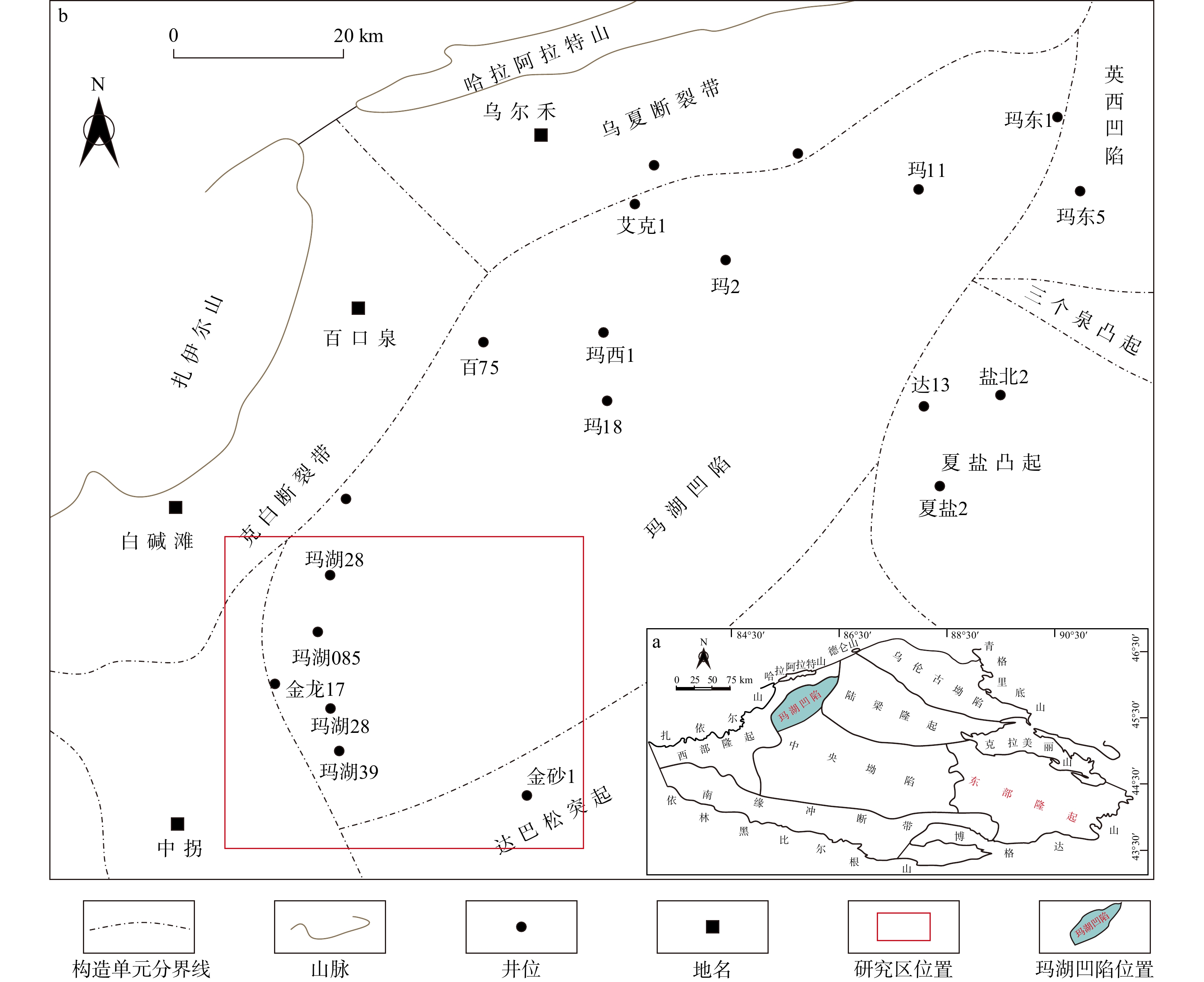
图 1 准噶尔盆地玛湖凹陷区域位置及构造单元与主要井位
a—准噶尔盆地玛湖凹陷区域位置图(曲彦胜等,2025);b—玛湖凹陷构造单元及主要井位(底图据Dang et al.,2024修改)
Figure 1. Regional location, structural units, and major well locations of the Mahu Sag in the Junggar Basin
(a) Regional location map of the Mahu Sag, Junggar Basin (Qu et al., 2025); (b) Structural units and major well locations in the Mahu Sag (base map modified from Dang et al., 2024)
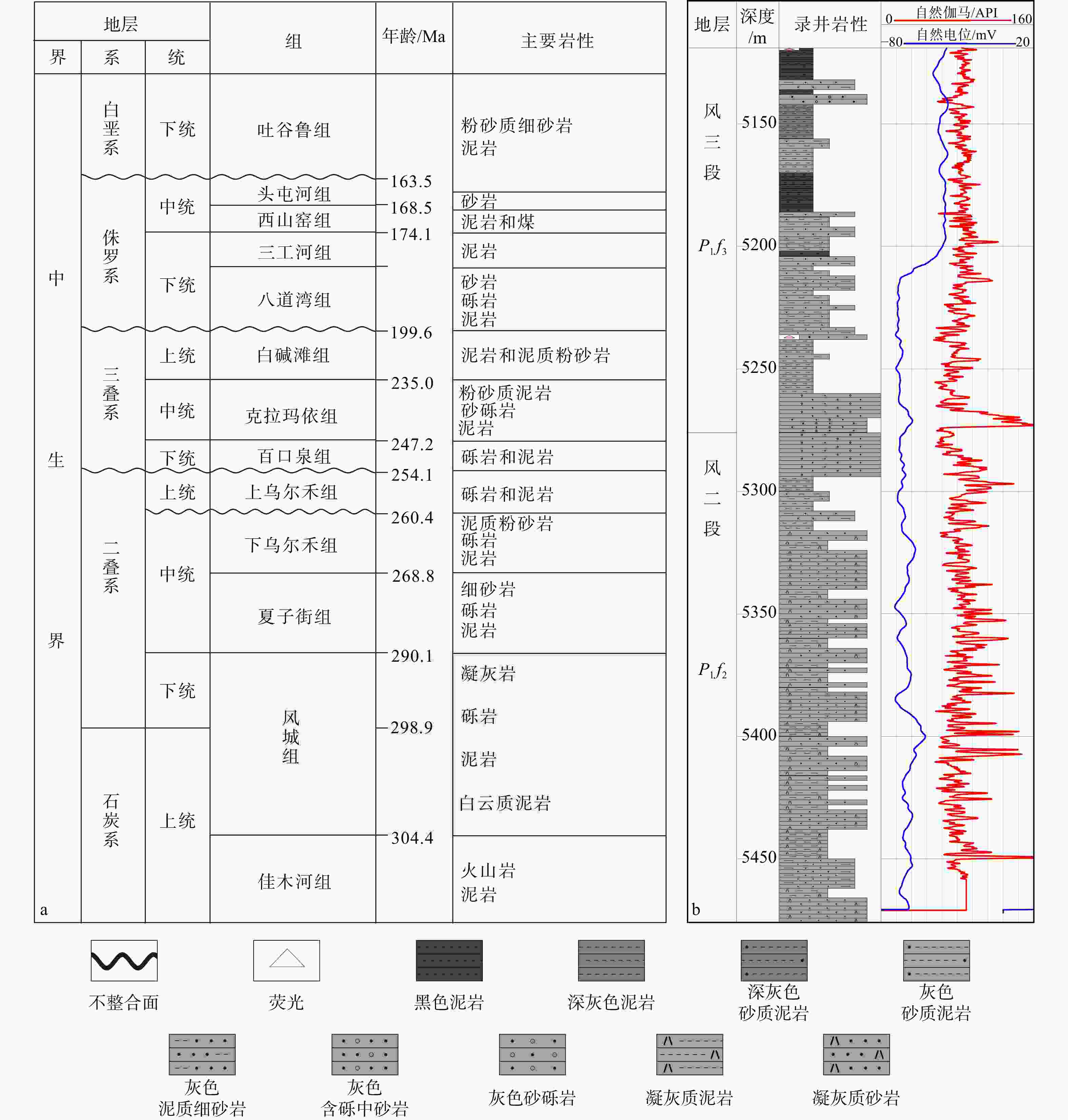
图 2 准噶尔盆地玛湖凹陷及MH6井地层柱状图
a—准噶尔盆地玛湖凹陷综合地层柱状图(Dang et al.,2024);b—MH6井地层柱状图
Figure 2. Composite stratigraphic column of the Mahu Sag and Well MH6 in the Junggar Basin
(a) Generalized stratigraphic column of the Mahu Sag, Junggar Basin (Dang et al., 2024); (b) Detailed stratigraphic column of Well MH 6
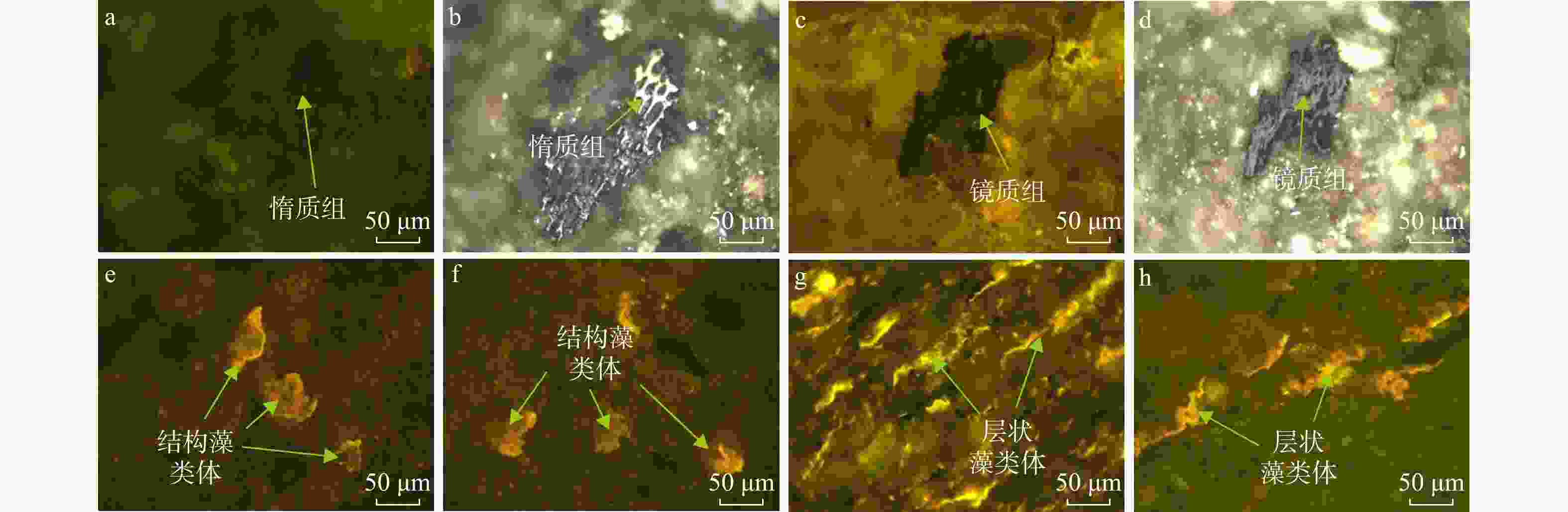
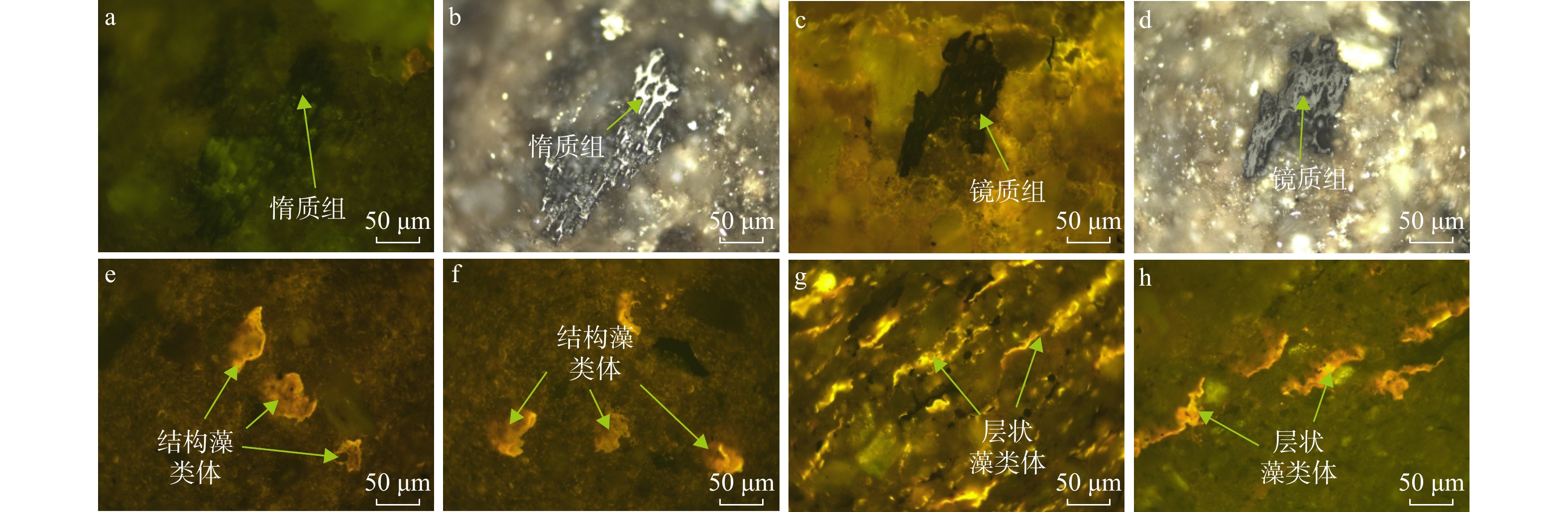
图 3 准噶尔盆地玛南地区泥页岩显微组分特征
a—荧光下的惰质组; b—反射光下的惰质组(显示细胞结构,与图a同视域); c—荧光下的镜质组; d—反射光下的镜质组(与图c同视域);e—荧光下的结构藻类体(黄色荧光);f—荧光下的结构藻类体;g—荧光下的层状藻类体;h—荧光下的层状藻类体
Figure 3. Characteristics of maceral compositions in mud shales from the shouthern Mahu Sag, Junggar Basin
(a) Inertinite under fluorescence; (b) Inertinite under reflected light (showing cellular structure, same field of view as Fig. 1a); (c) Vitrinite under fluorescence; (d) Vitrinite under reflected light (same field of view as Fig. 1c); (e) Telalginite under fluorescence (yellow fluorescence); (f) Telalginite under fluorescence; (g) Lamalginite under fluorescence; (h) Lamalginite under fluorescence
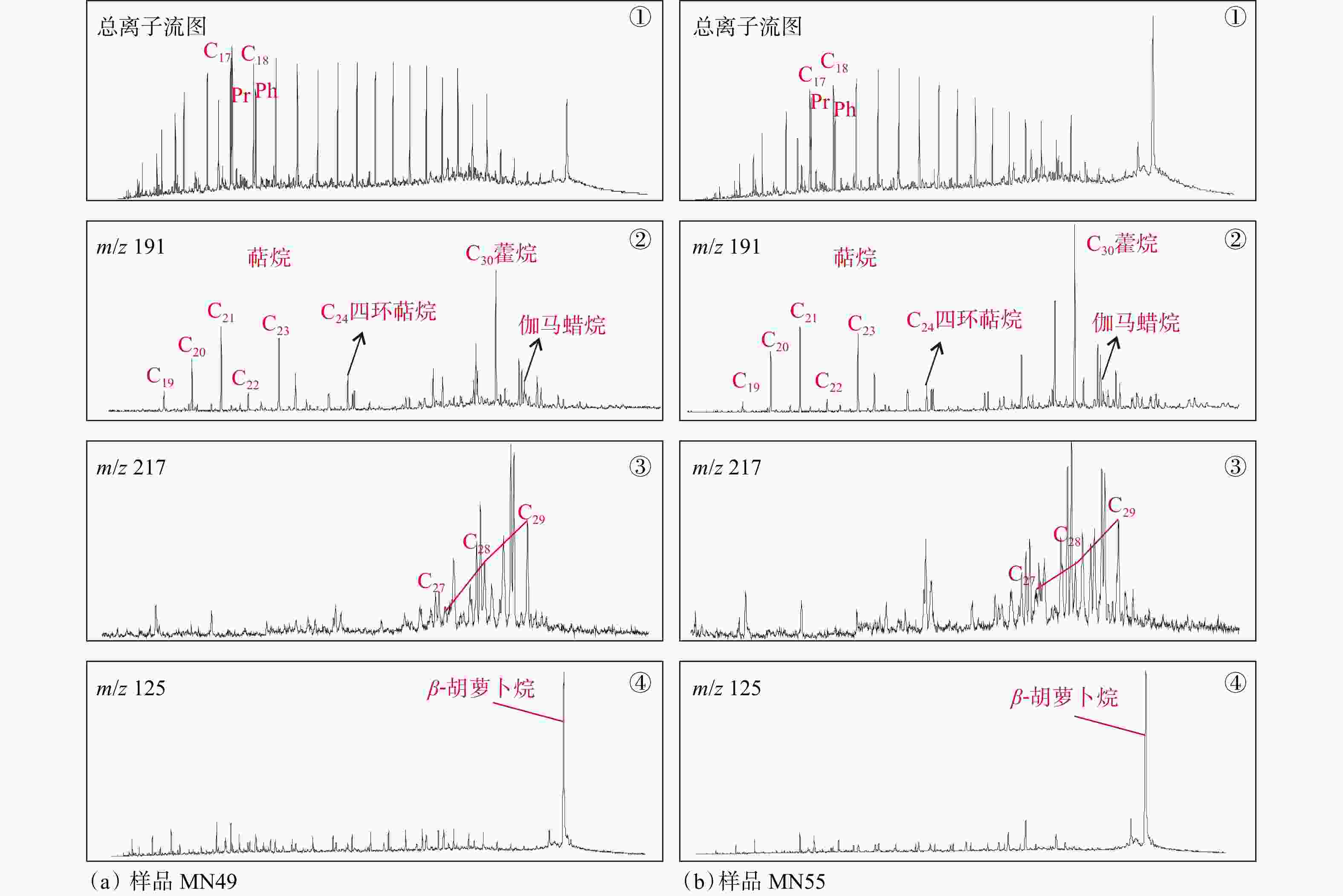
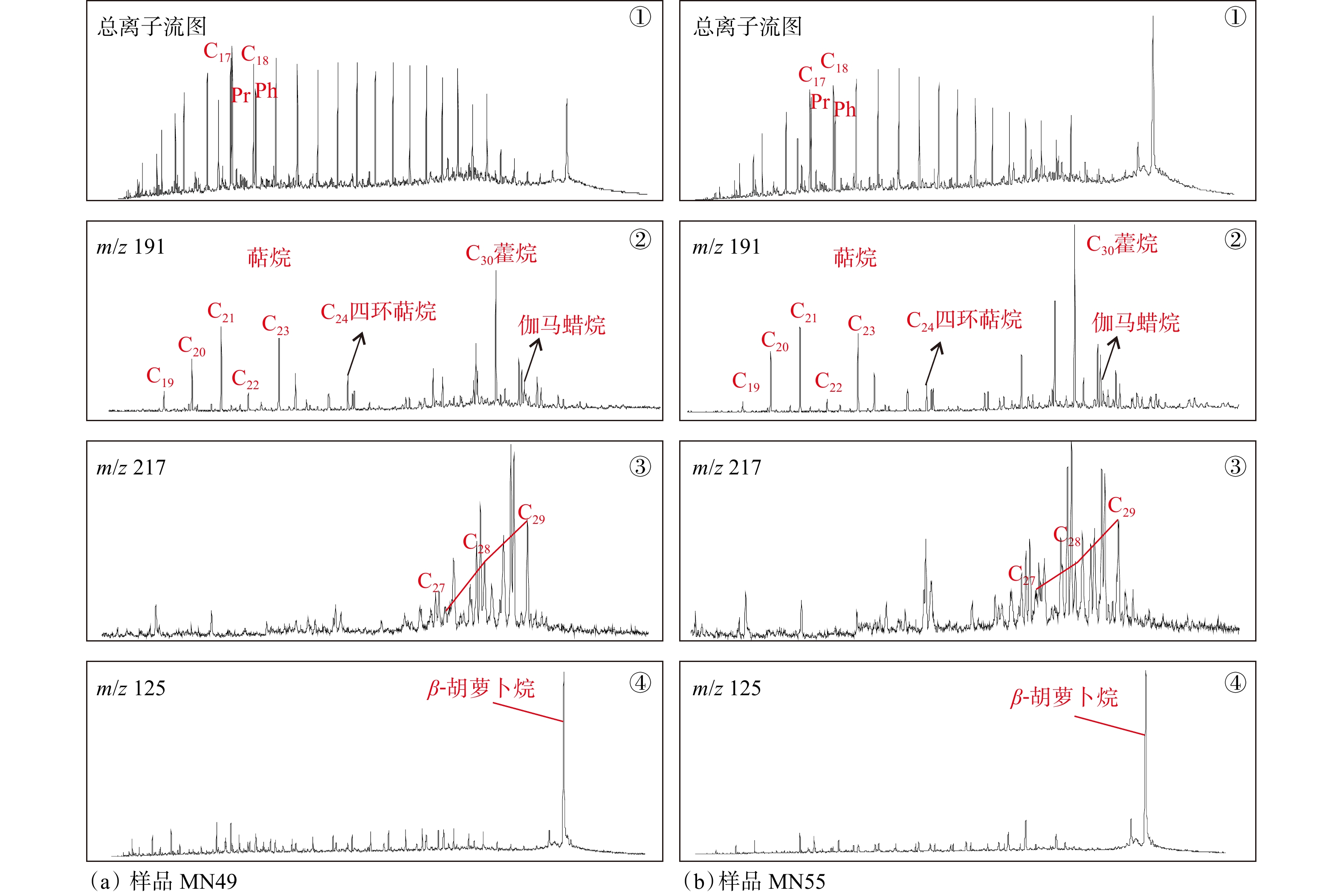
图 4 代表性样品饱和烃组分部分质量色谱图分布特征
Figure 4. Distribution of partial mass chromatograms of the aliphatic fraction in representative samples
(a) Sample MN49; (b) Sample MN55
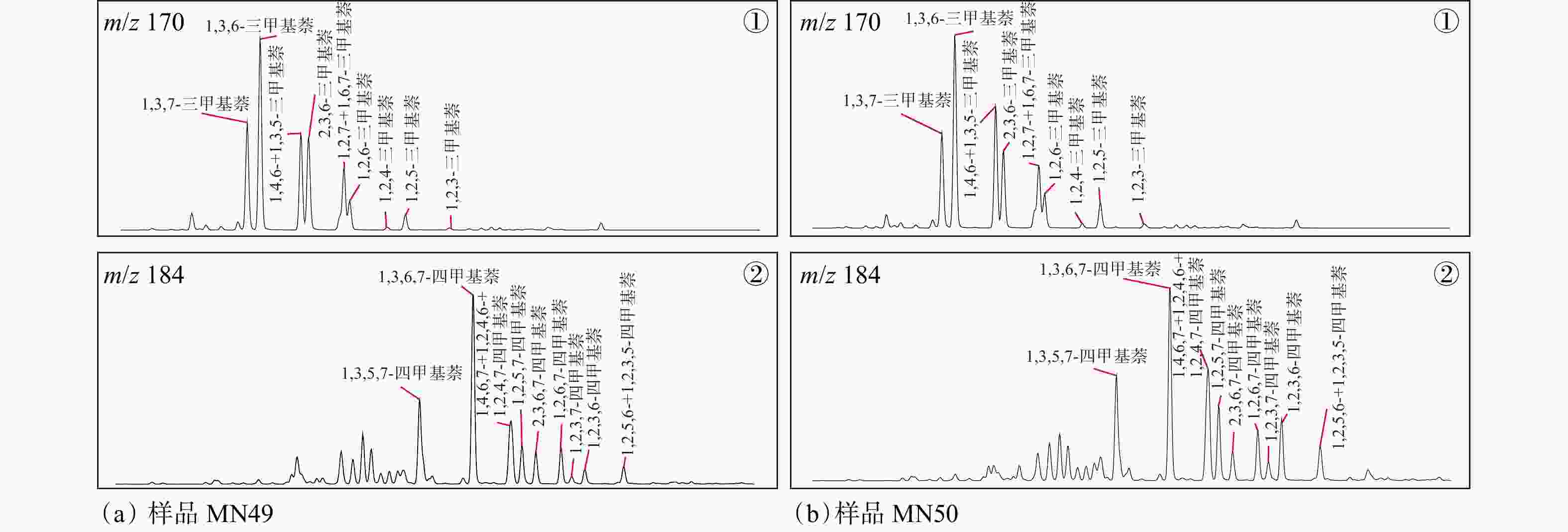
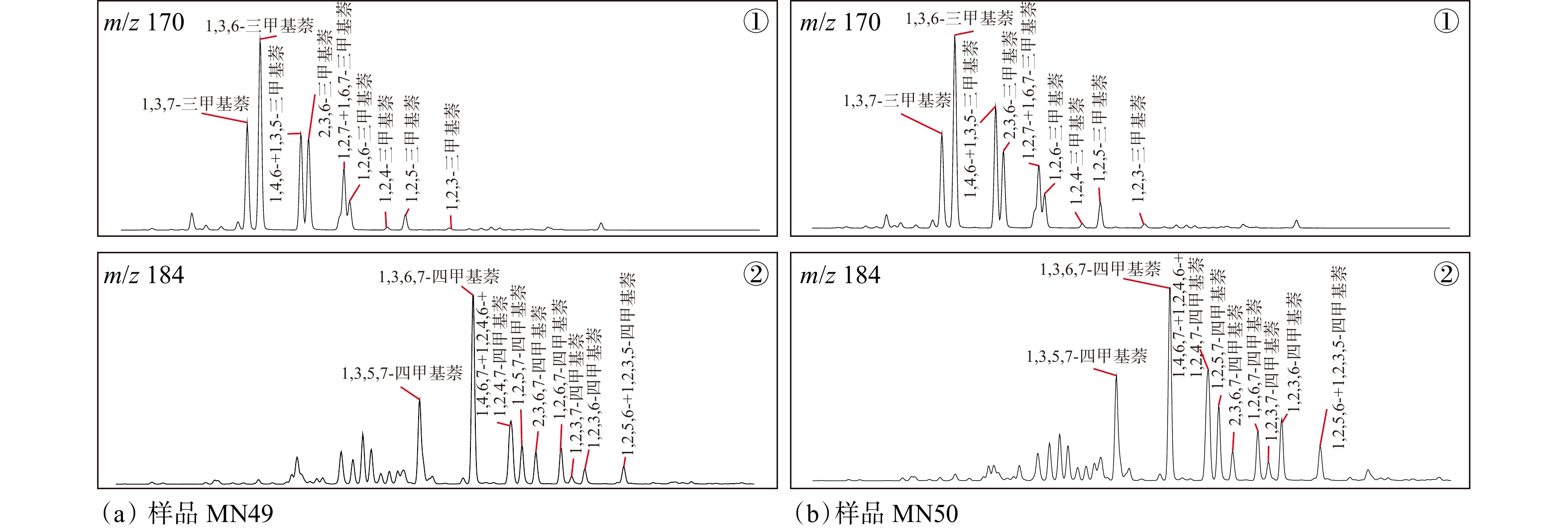
图 5 代表性样品芳香烃组分部分质量色谱图分布特征
Figure 5. Distribution of partial mass chromatograms of the aromatic hydrocarbon fraction in representative samples
(a) Sample MN49; (b) Sample MN50

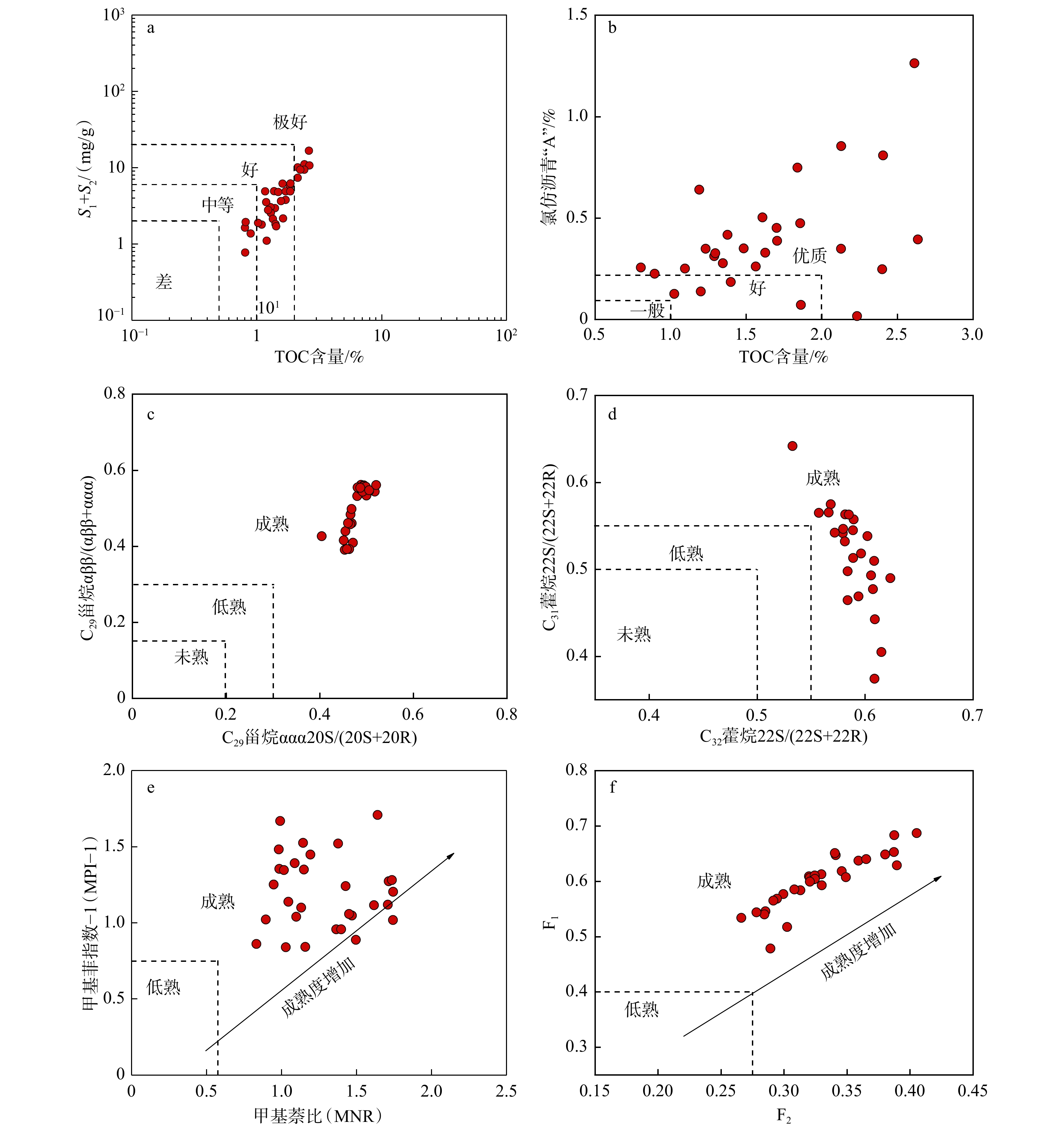
图 6 准噶尔盆地玛南地区泥页岩有机质丰度与成熟度综合判识图版
a—TOC含量和S1+S2交汇图;b—TOC含量和氯仿沥青“A”交汇图;c—αααC29甾烷20S/(20S + 20R)和C29甾烷αββ/(αββ + ααα)交汇图;d—C32藿烷22S/(22S+22R)和C31藿烷22S/(22S+22R)交汇图;e—MPI-1与MNR交汇图(修改自Wang et al.,2021a);f—F1和F2交汇图[F1=(3-甲基菲+2-甲基菲)/(2-甲基菲+3-甲基菲+1-甲基菲+9-甲基菲);F2=2-甲基菲/(2-甲基菲+3-甲基菲+1-甲基菲+9-甲基菲);Qiao et al.,2024]
Figure 6. Comprehensive identification chart for assessing organic abundance and maturity of mud shales from the southern Mahu Sag, Junggar Basin
(a) Cross plot of TOC content vs. S1+S2; (b) Cross plot of TOC content vs. chloroform bitumen 'A'; (c) Cross plot of ααα C29 20S/(20S + 20R) vs. C29 ββ/(ββ + αα) steranes; (d) Cross plot of C32 22S/(22S+22R) vs. C31 22S/(22S+22R) hopane; (e) Cross plot of MPI-1 vs. MNR (modified after Wang et al., 2021a); (f) Cross plot of F1 vs. F2 [F1= (3-MP + 2-MP) / (2-MP + 3-MP + 1-MP + 9-MP); F2= 2-MP / (2-MP + 3-MP + 1-MP + 9-MP); MP = Methylphenanthrene; Qiao et al., 2024]
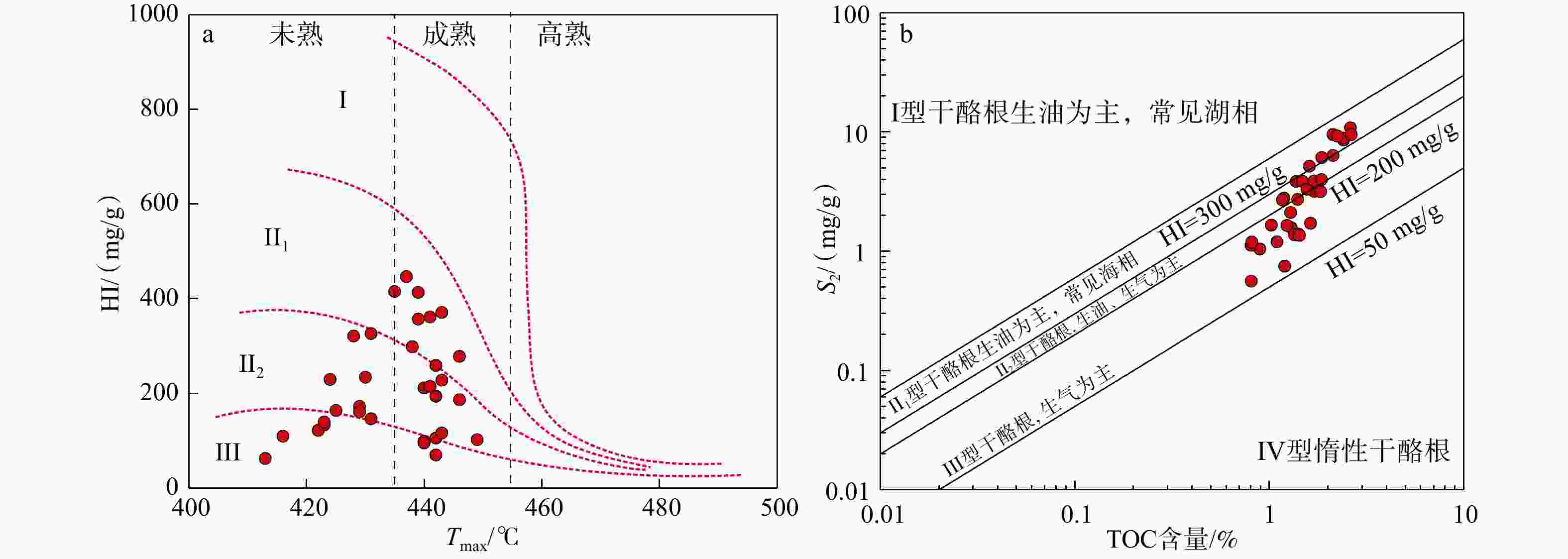
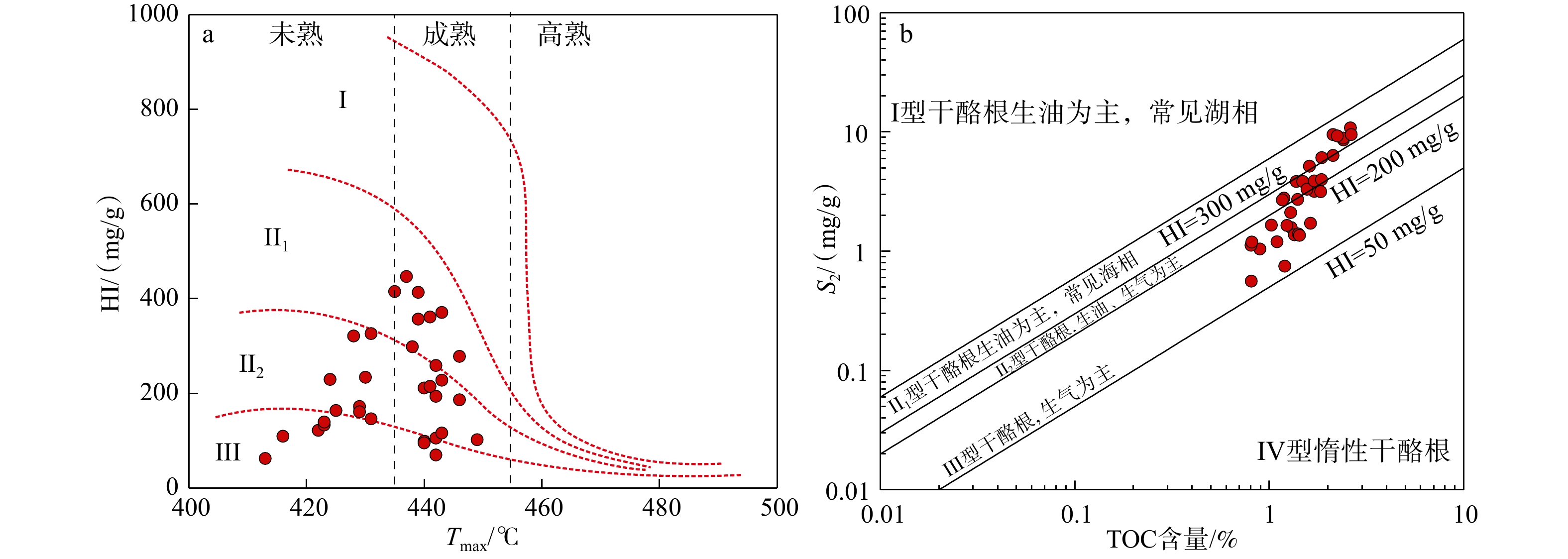
图 7 准噶尔盆地玛南地区风城组泥页岩有机质特征判识图版
a—Tmax与HI交汇图;b—TOC含量与S2交汇图
Figure 7. Identification diagram for organic matter characteristics of mud shales from the Fengcheng Formation, southern Mahu Sag, Junggar Basin
(a) Cross plot of Tmax vs. hydrogen index; (b) Cross plot of TOC vs. S2
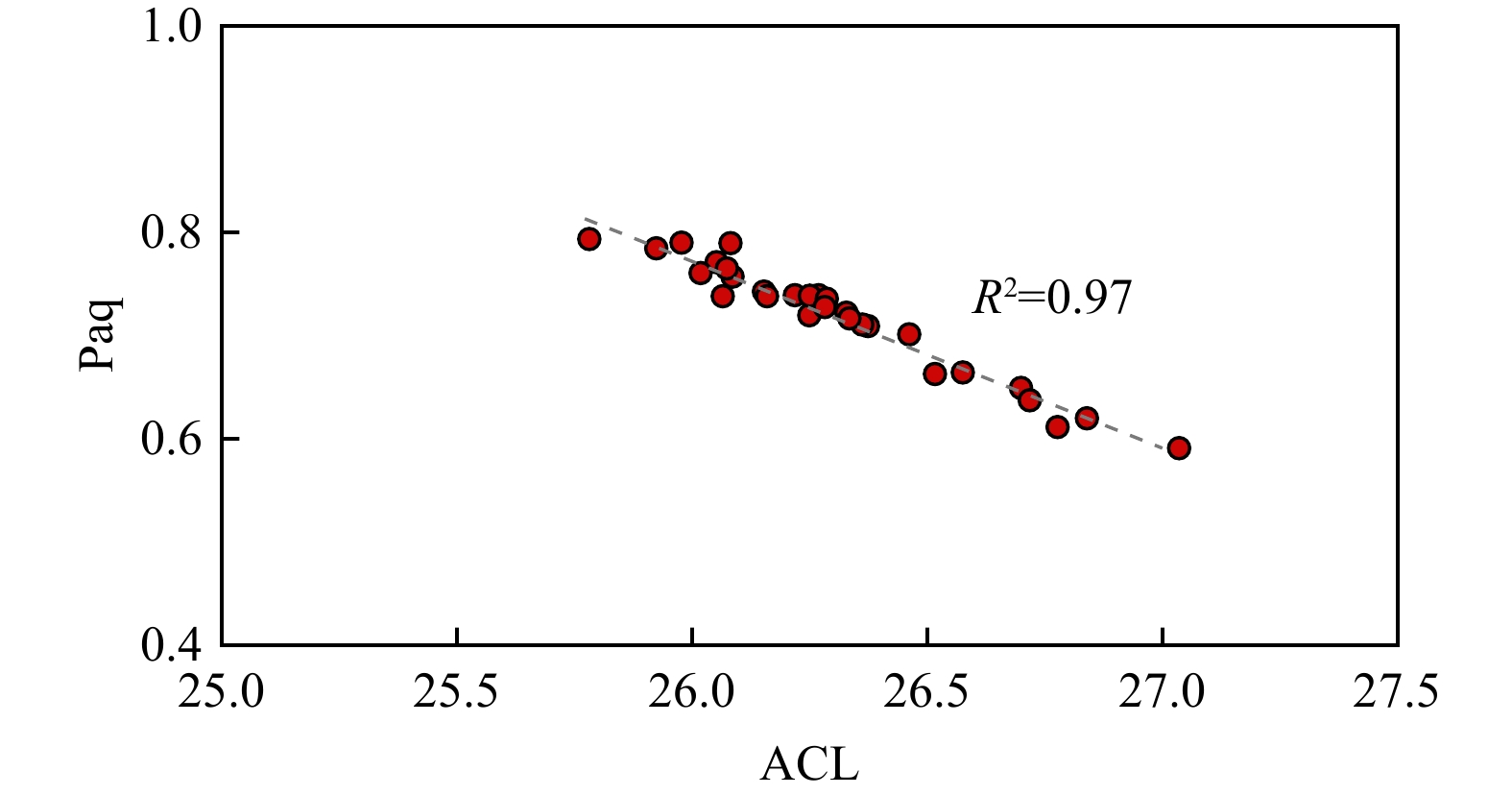
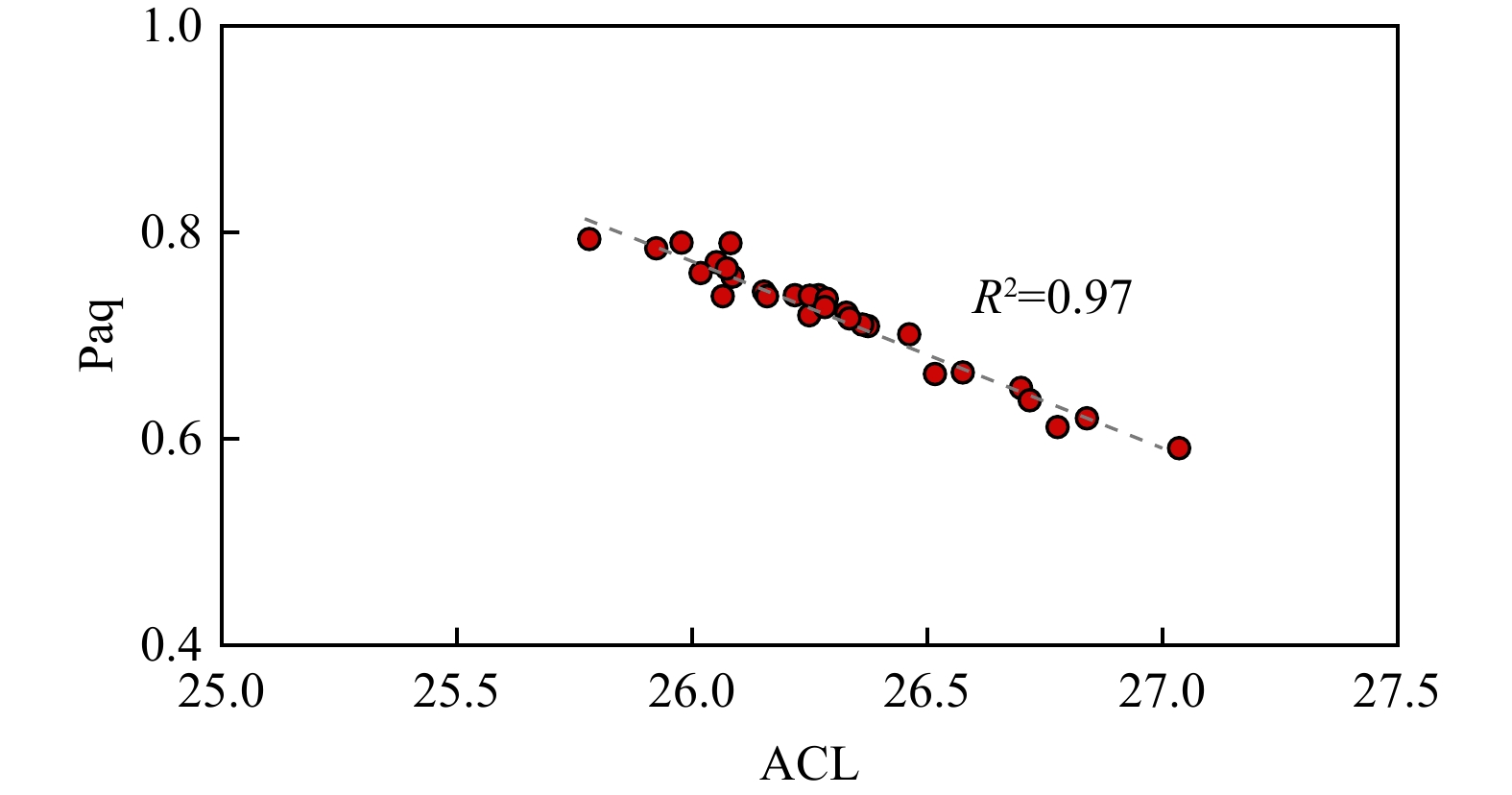
图 8 准噶尔盆地玛南地区风城组泥页岩ACL与Paq交汇图
Figure 8. Cross plot of ACL vs. Paq for mud shales from the Fengcheng Formation, southern Mahu Sag, Junggar Basin, China
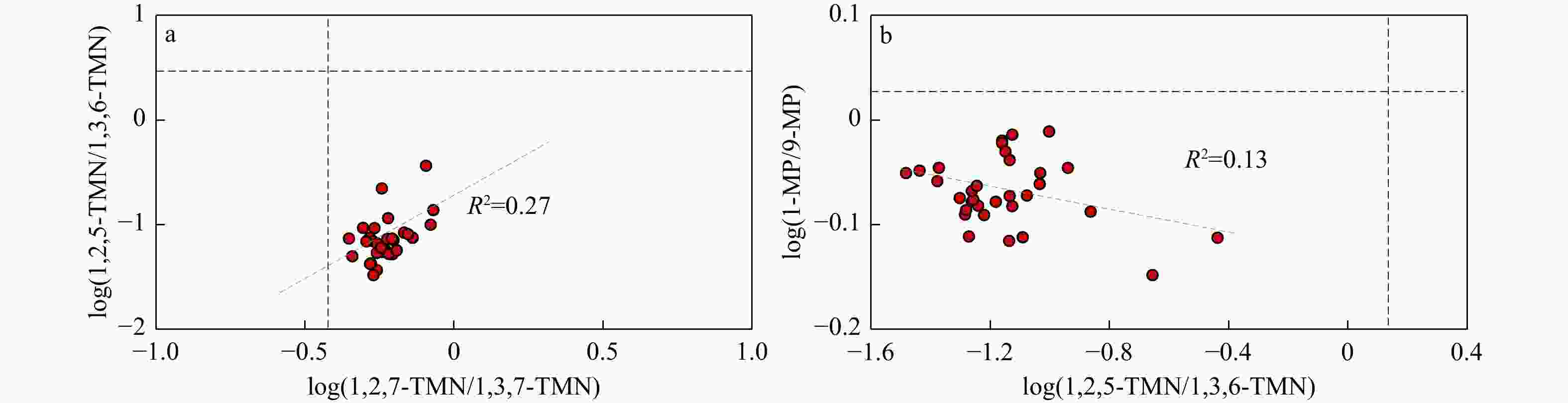
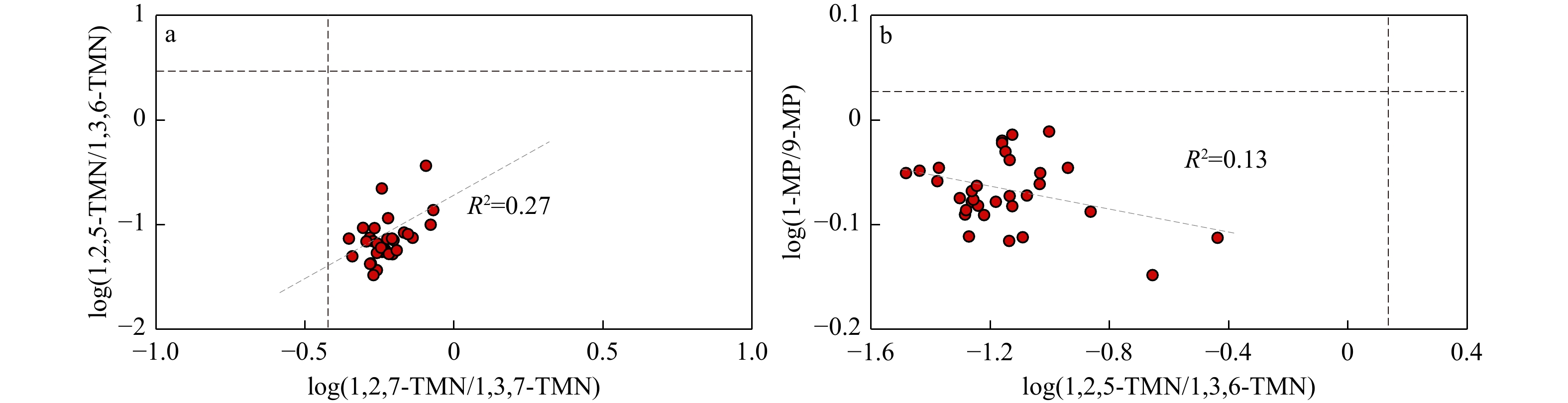
图 9 准噶尔盆地玛南地区风城组泥页岩三甲基萘交汇图
a—log(1,2,5-TMN/1,3,6-TMN)与Log(1,2,7-TMN/1,3,7-TMN)交汇图;b—log(1,2,5-TMN/1,3,6-TMN)与log(1-MP/9-MP)交汇图(Budzinski et al.,1995)
Figure 9. Cross-plots of trimethylnaphthalene ratios for mud shales from the Fengcheng Formation, southen Mahu Sag, Junggar Basin
(a) Cross plot of log (1,2,7-TMN/1,3,7-TMN) vs. log (1,2,5-TMN/1,3,6-TMN); (b) Cross plot of log (1,2,5-TMN/1,3,6-TMN) vs. log (1-MP/9-MP) (Budzinski et al., 1995)
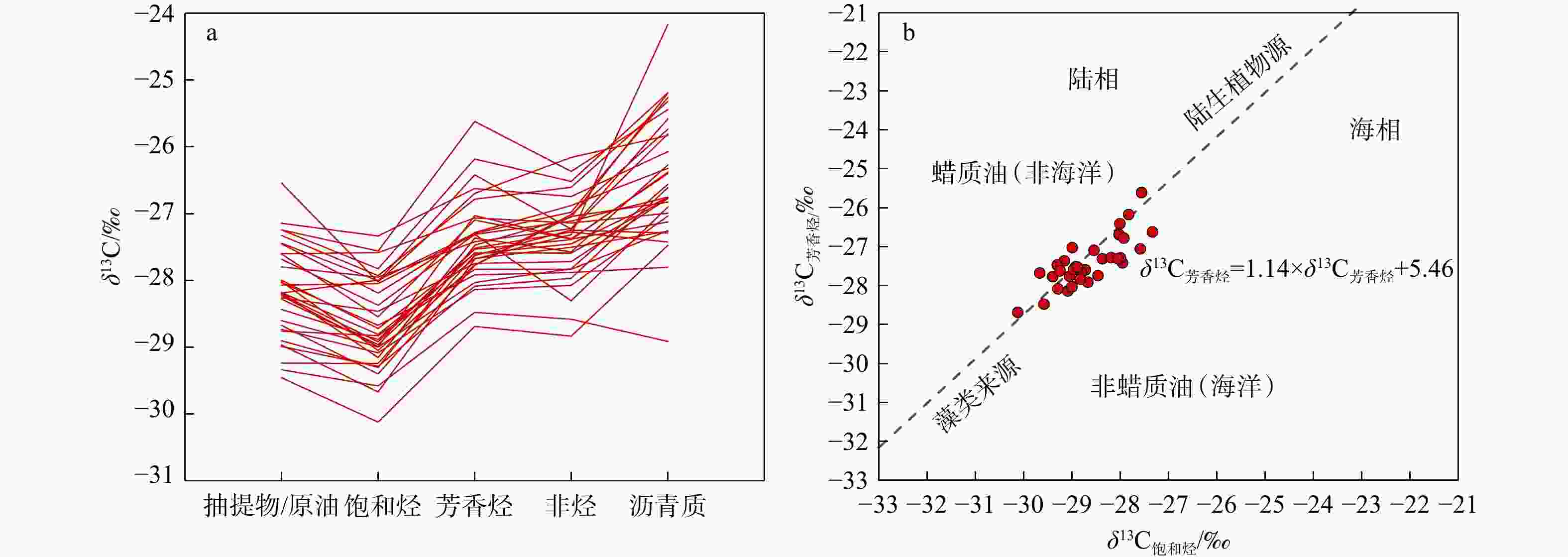
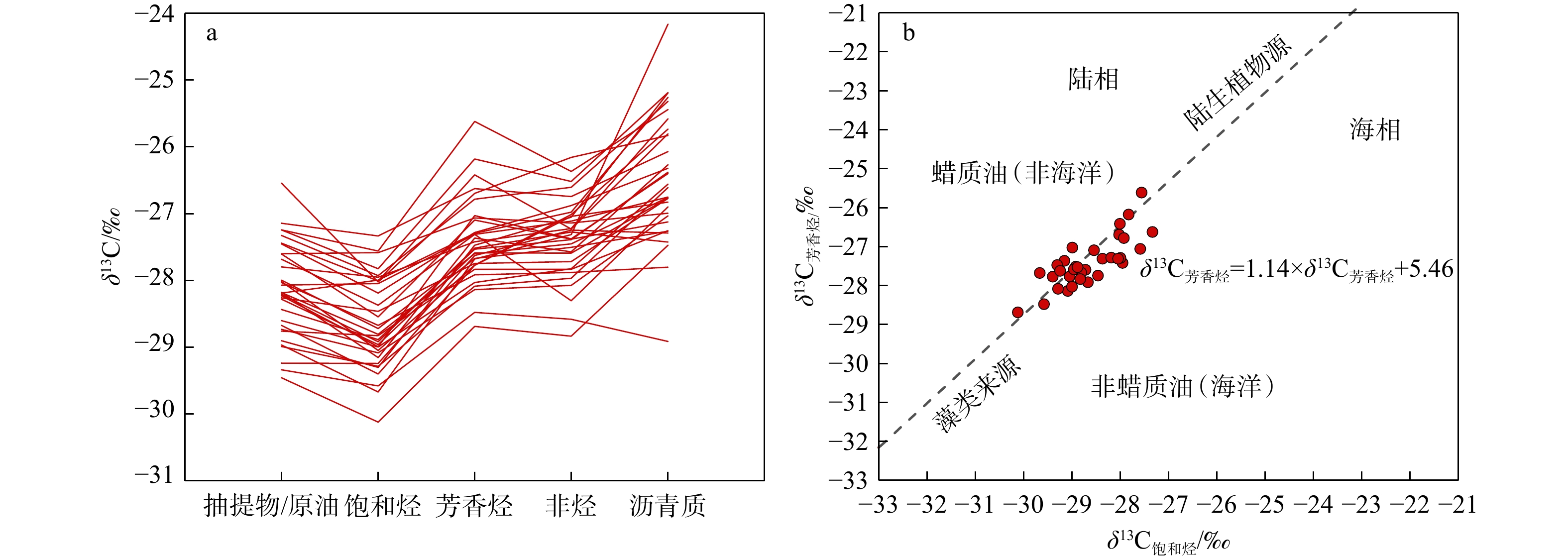
图 10 准噶尔盆地玛南地区风城组原油/抽提物族组分碳同位素组成判识图
a—烃源岩抽提物与组分碳同位素折线图;b—δ13C饱和烃和δ13C芳香烃交汇图
Figure 10. Identification diagram based on carbon isotopic composition of hydrocarbon fractions for crude oils/extracts from the Fengcheng Formation, southen Mahu Sag, Junggar Basin
(a) Line chart showing δ13C values of extracts and their fractions; (b) Cross plot of δ13C saturates vs. δ13C aromatics
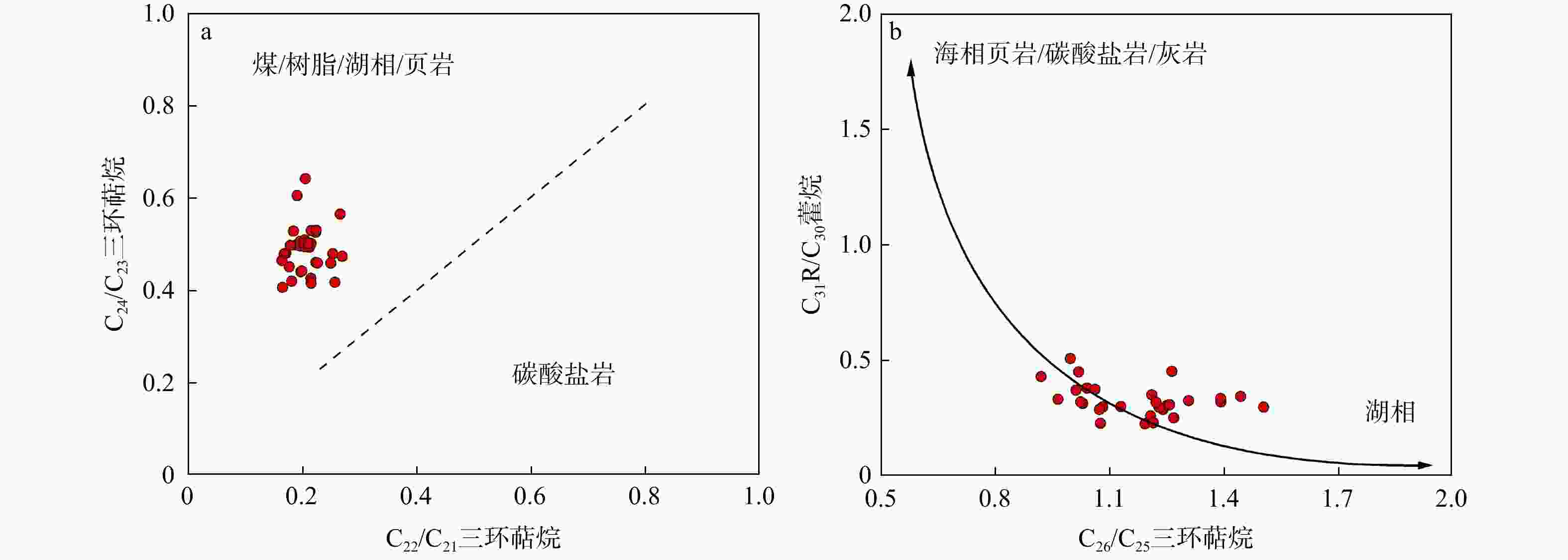
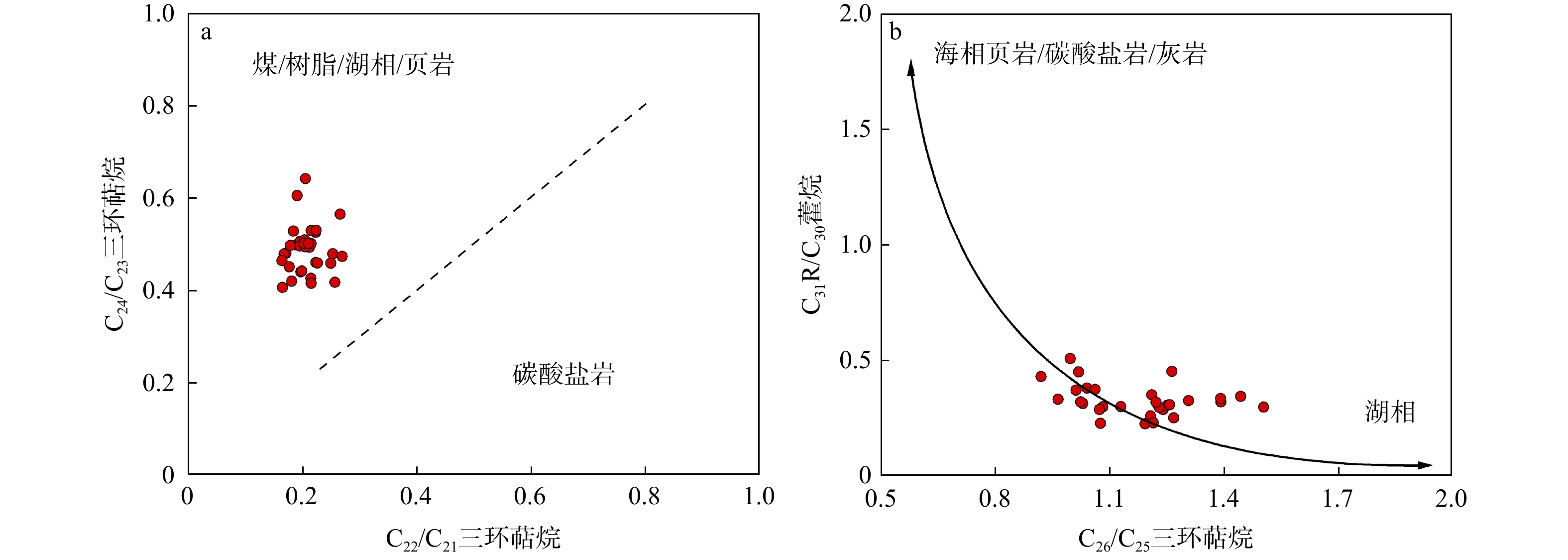
图 11 准噶尔盆地玛南地区风城组泥页岩与不同沉积环境三环萜烷指纹对比图
a—C22/C21三环萜烷 与 C24/C23三环萜烷交汇图;b—C26/C25三环萜烷与 C31R/C30藿烷交汇图(据Peters et al.,2007修改)
Figure 11. Correlation of tricyclic terpane fingerprints between mud shales from the Fengcheng Formation, southern Mahu Sag, Junggar Basin, and those from different depositional environments
(a) Cross plot of C22/C21 vs. C24/C23 tricyclic terpane; (b) Cross plot of C26/C25 tricyclic terpane vs. C31R/C30 hopane (modified after Peters et al., 2007)
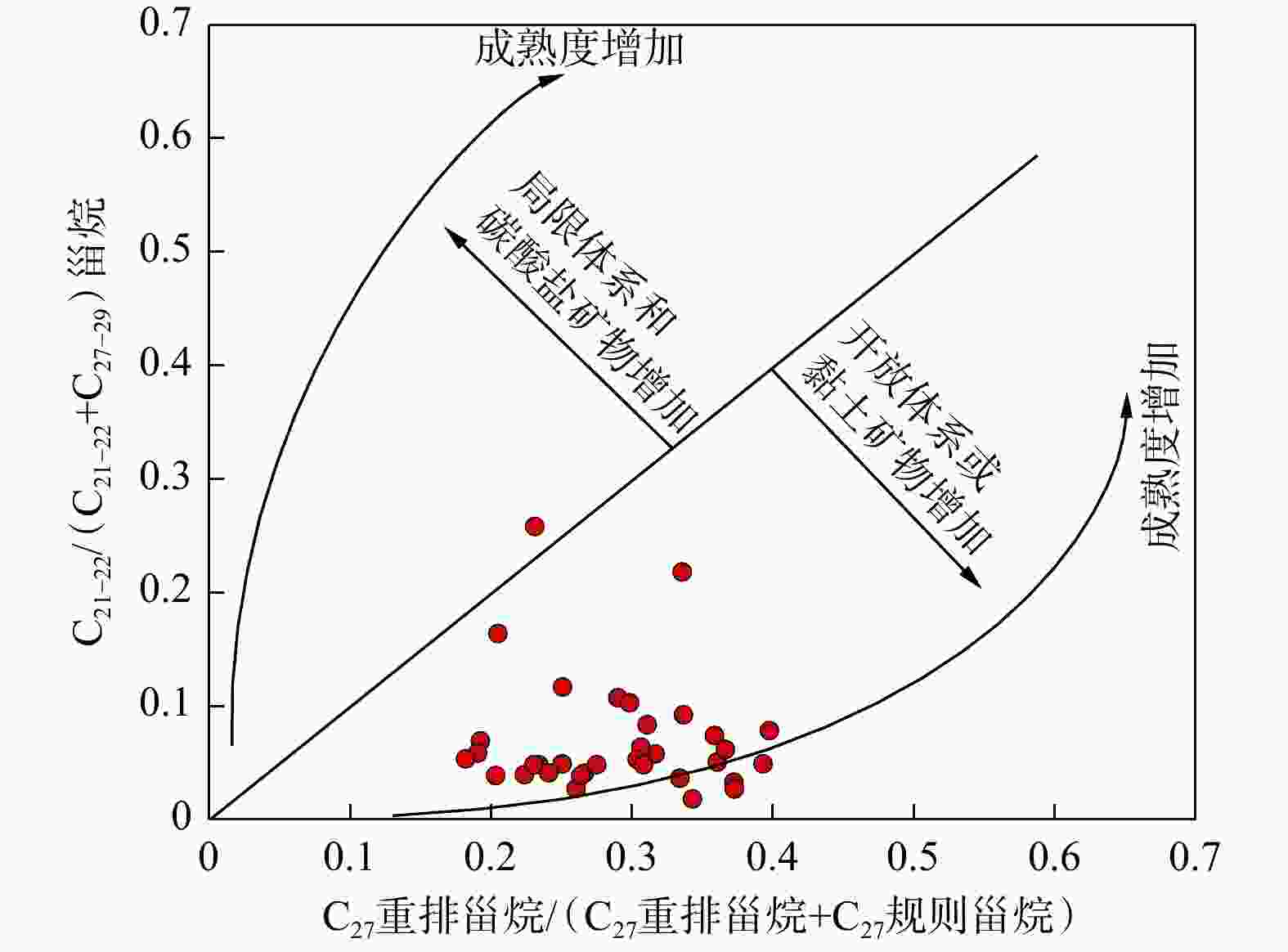
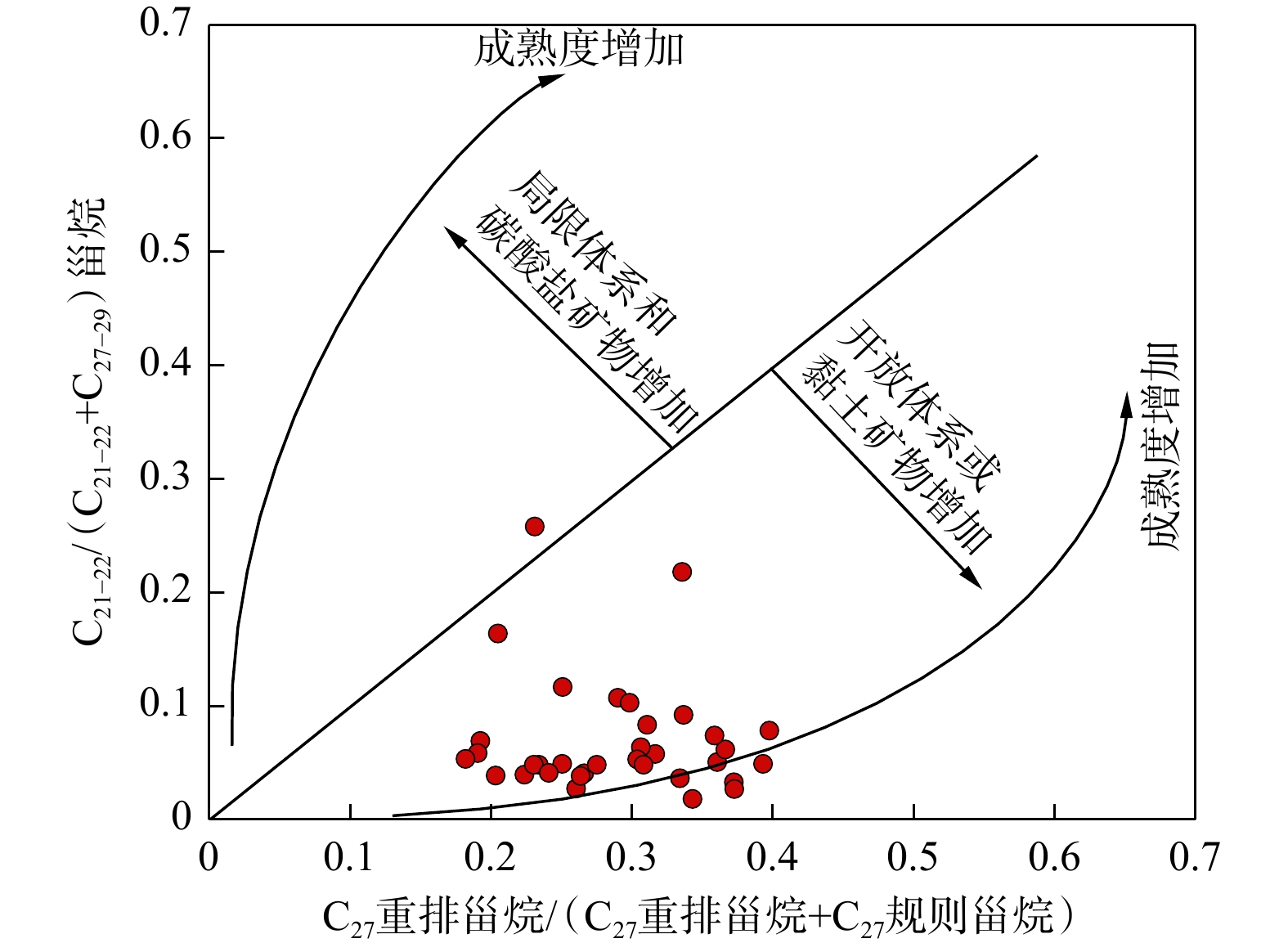
图 12 准噶尔盆地玛南地区风城组C27重排甾烷/(C27重排甾烷+C27规则甾烷)与C21-22/ (C21-22+C27-29)甾烷交汇图
Figure 12. Cross plot of C27 diasteranes / (diasteranes + regular steranes) vs. C21–22/(C21-22+C27-29) steranes of mud shales, southern Mahu Sag, Junggar Basin, China
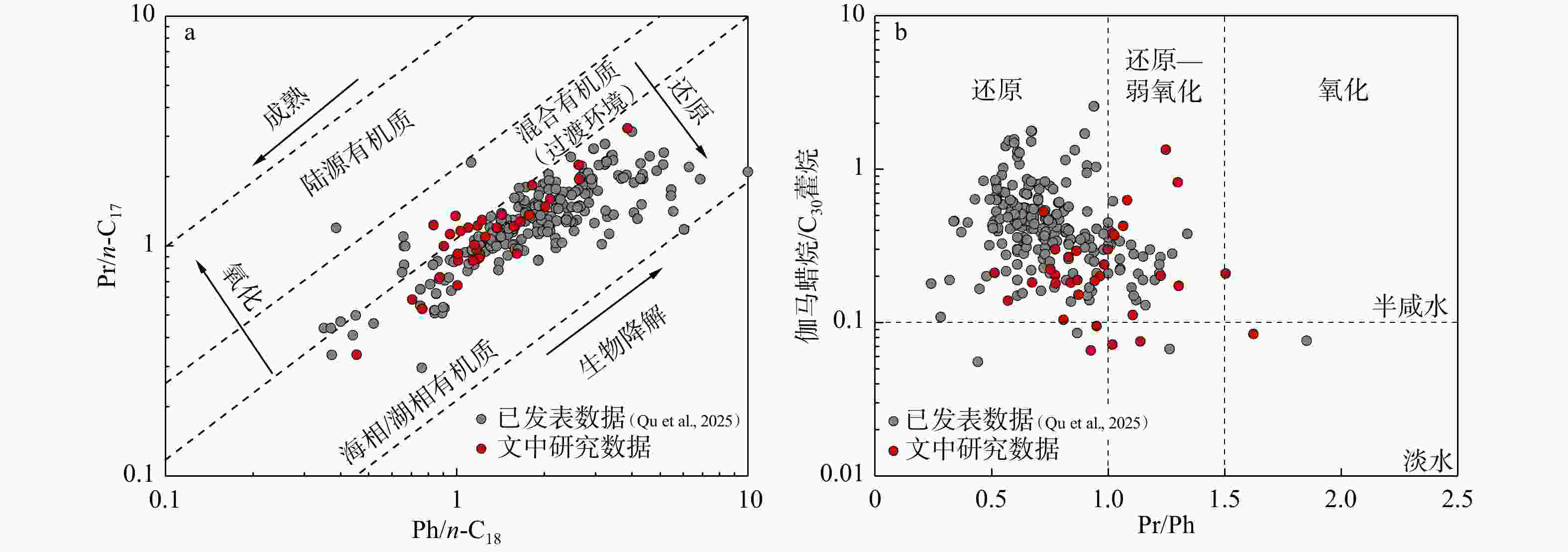
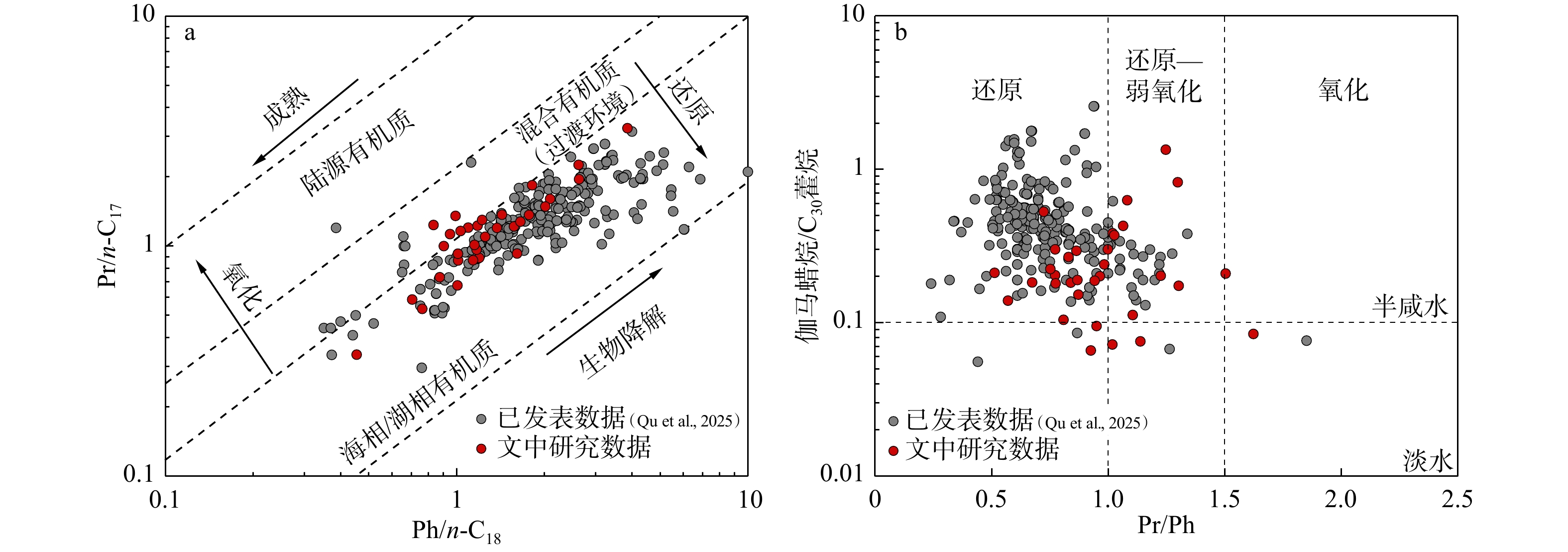
图 13 准噶尔盆地玛南地区风城组泥页岩沉积环境与氧化还原条件判识图
a—准噶尔盆地风城组Ph/n-C18与Pr/n-C17交汇图;b—伽马蜡烷指数与Pr/ Ph交汇图
Figure 13. Identification of the depositional environment and redox conditions of mud shales from the Fengcheng Formation, southern Mahu Sag, Junggar Basin
(a) Cross plot of Ph/n-C18 vs. Pr/n-C17; (b) Cross plot of gammacerane / C30 hopane vs. Pr/Ph
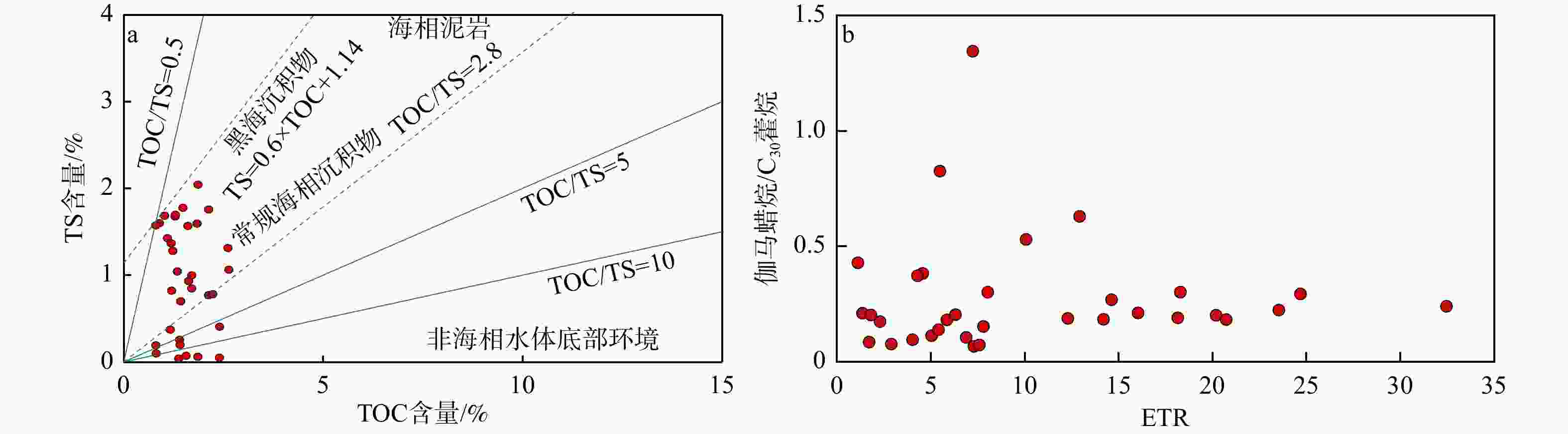
图 14 准噶尔盆地玛南地区风城组泥页岩沉积环境判识图
a—TOC含量与TS含量交汇图;b—ETR与伽马蜡烷/C30藿烷交汇图
Figure 14. Identification of the depositional environment of mud shales from the Fengcheng Formation, southern Mahu Sag, Junggar Basin
(a) Cross plot of TOC content vs. TS; (b) Cross plot of ETR vs. gammacerane / C30 hopane
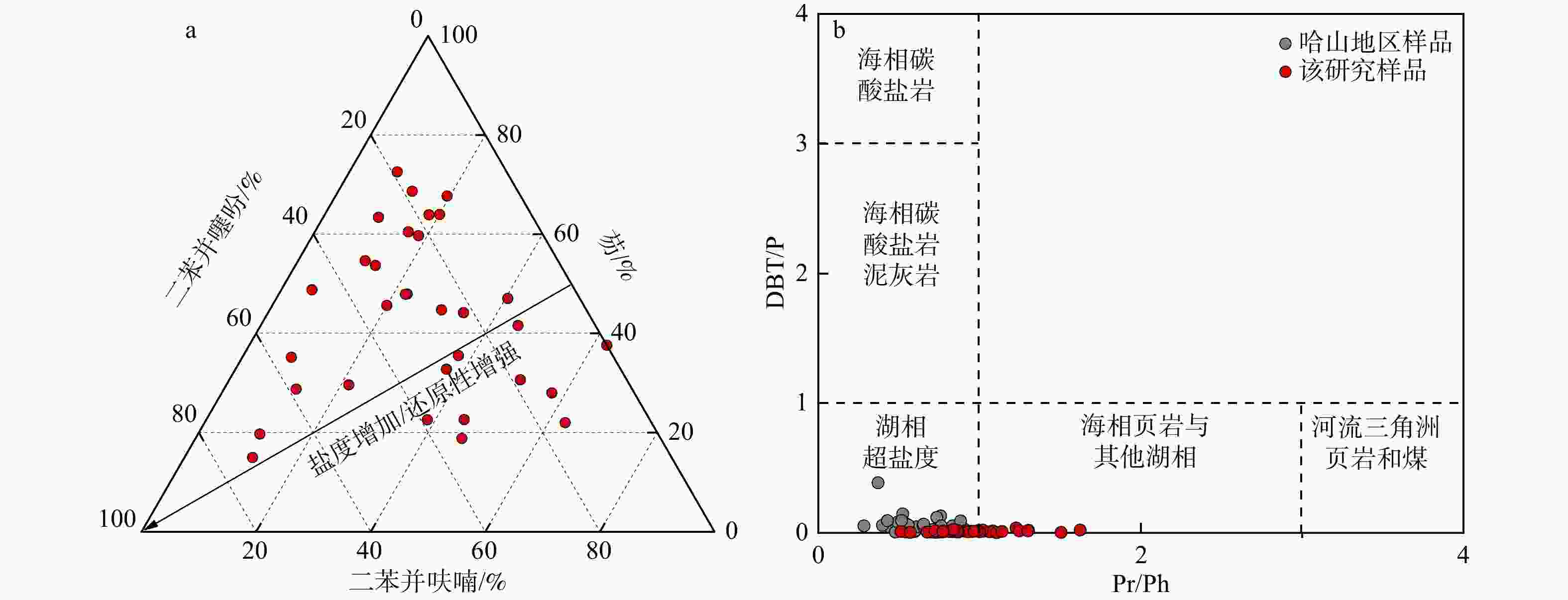
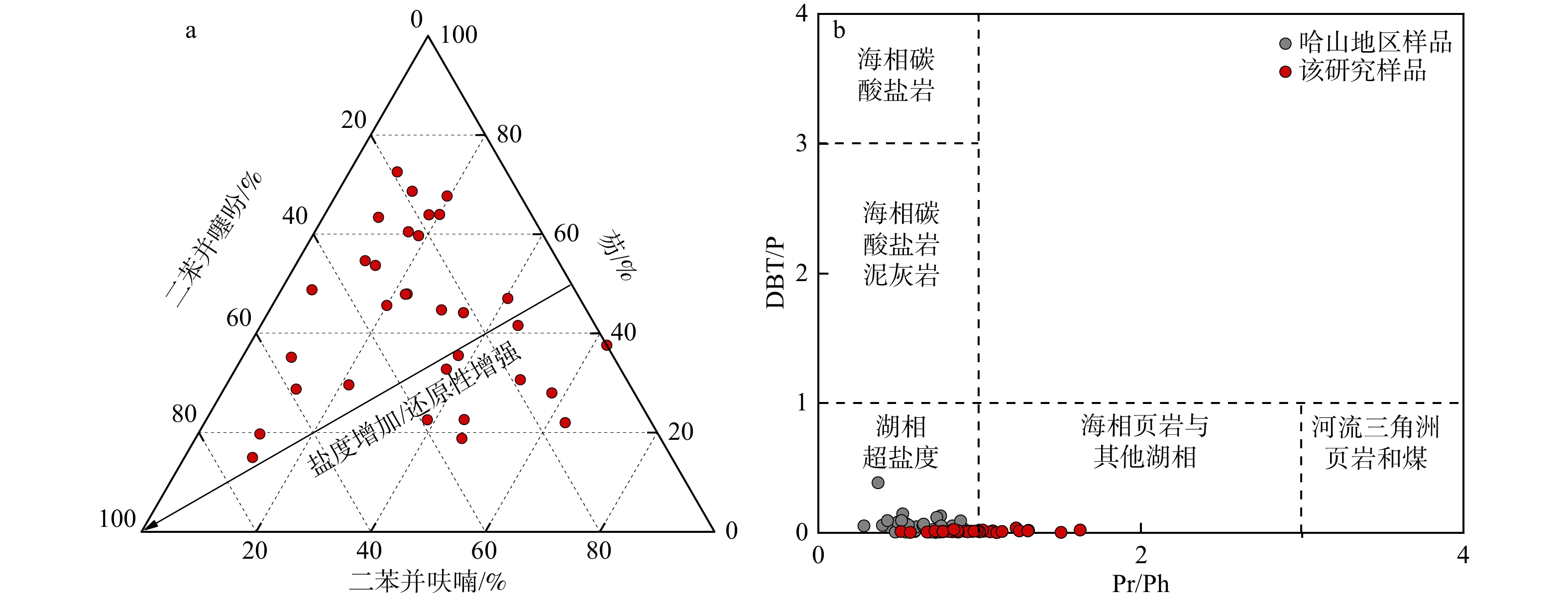
图 15 准噶尔盆地玛南地区风城组泥页岩沉积古盐度判识图
a—芴(FL)、二苯并呋喃(DBF)和二苯并噻吩(DBT)相对含量三角图;b—二苯并噻吩/菲比值(DBT/P)与姥植比(Pr/Ph)交汇图(Hughes et al.,1995)
Figure 15. Identification of the paleosalinity of mud shales from the Fengcheng Formation, southern Mahu Sag, Junggar Basin
(a) Relative concentrations of fluorene (FL), dibenzofuran (DBF), and dibenzothiophene (DBT); (b) Cross plot of dibenzothiophene / phenanthrene vs. Pr/Ph (Hughes et al., 1995)
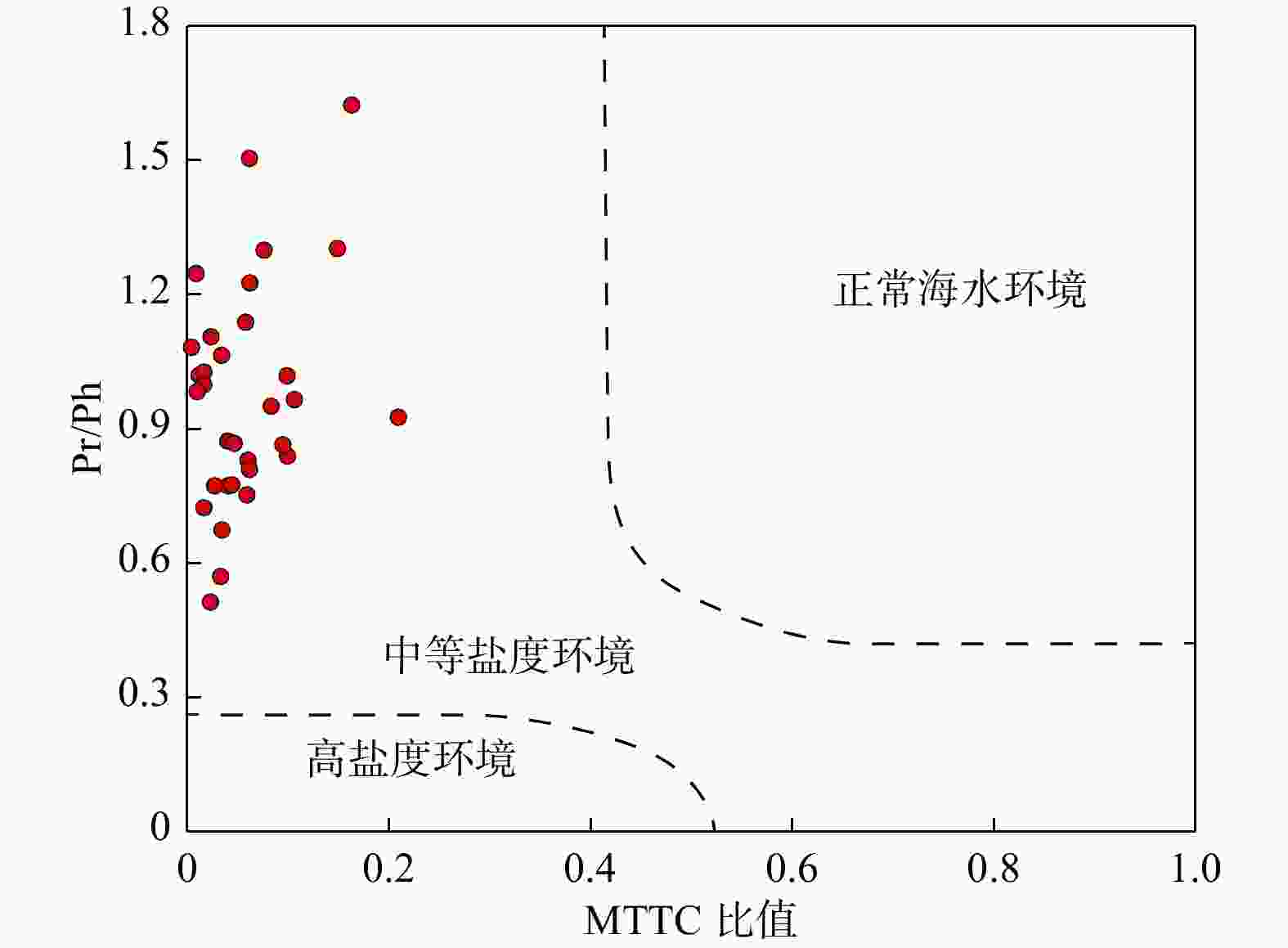
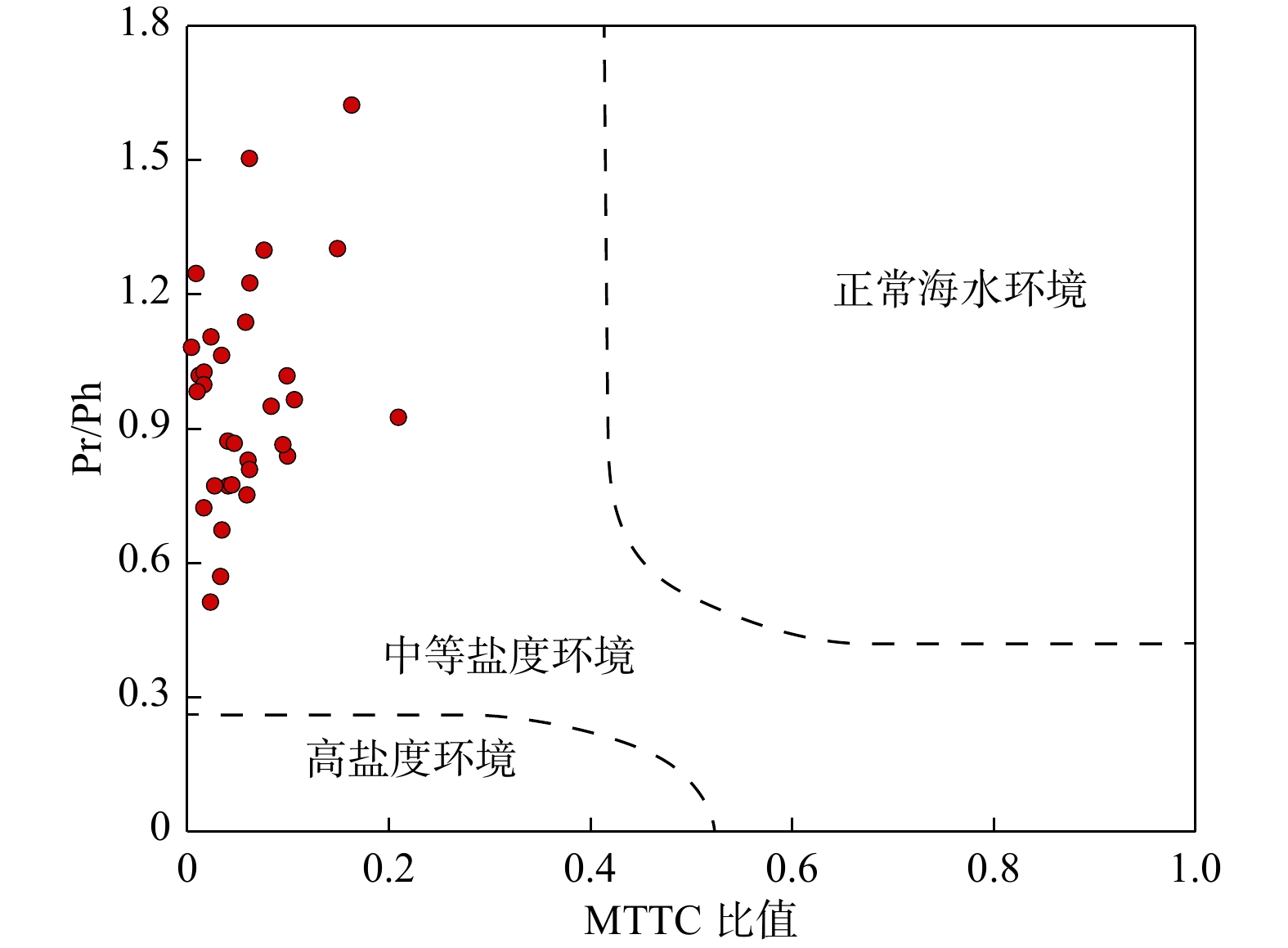
图 16 准噶尔盆地玛南地区风城组泥页岩Pr/Ph与MTTC比值交汇关系
Figure 16. Cross plot of Pr/Ph vs. the MTTC ratio of mud shales from the Fengcheng Formation, southern Mahu Sag, Junggar Basin
表 1 玛南地区泥页岩总有机碳(TOC)含量、总硫(TS)含量及岩石热解测试结果
Table 1. Measured results of total organic carbon (TOC) content, total sulfur (TS) content, and Rock–Eval pyrolysis for mud shales from the Southern Mahu Sag
样品编号 井号 深度/m TOC/% TS /% Ro /% Tmax/℃ S1 /(mg/g) S2/ (mg/g) S3/ (mg /g) HI/ (mg/g) OI/ (mg/g) (S1+S2)/TOC S2/S3 MN49 MH2 5135.3 1.41 0.20 1.08 440 0.43 1.39 1.24 98 88 1.29 1.12 MN50 MH2 5138.3 1.43 0.70 1.11 440 0.34 1.36 1.33 95 93 1.19 1.02 MN84 MH6 5262.5 0.81 0.19 1.12 442 0.21 0.56 0.73 69 90 0.95 0.77 MN90 MH7 4628.3 0.81 0.10 0.98 431 0.75 1.19 0.71 146 87 2.38 1.68 MN92 MH7 4625.7 1.17 0.37 0.96 424 2.21 2.68 0.9 229 77 4.19 2.98 MN8 MH9 4495.6 2.13 1.76 0.95 437 0.58 9.51 0.68 447 32 4.74 13.99 MN9 MH9 4500.1 2.61 1.31 0.97 439 5.82 10.79 0.75 413 29 6.36 14.39 MN12 MH9 4531.8 2.41 0.41 1.02 439 2.47 8.58 0.68 357 28 4.59 12.62 MN13 MH9 4538.9 1.40 0.25 1.03 442 0.24 2.71 0.68 194 49 2.11 3.99 MN14 MH9 4543.8 1.38 0.04 1.04 446 1.09 3.83 1.11 278 81 3.57 3.45 MN131 MH9 4570.0 2.13 0.77 1.08 438 1.02 6.34 1.08 298 51 3.46 5.87 MN19 MH9 4578.7 1.48 1.78 1.04 442 0.95 3.84 1.37 259 92 3.23 2.80 MN25 MH12 5043.0 1.63 0.93 0.87 442 0.45 1.71 1.11 105 68 1.33 1.54 MN26 MH12 5044.0 1.70 0.85 0.87 446 0.61 3.17 1.17 186 69 2.22 2.71 MN29 MH15 4853.5 1.84 1.59 0.86 429 2.65 3.16 1.41 172 77 3.16 2.24 MN32 MH15 4863.7 1.29 1.68 0.80 425 0.92 2.11 1.74 164 135 2.35 1.21 MN35 MH15 4880.4 1.30 1.70 0.86 422 0.97 1.58 1.34 122 103 1.97 1.18 MN37 MH15 4947.7 1.35 1.04 0.96 449 0.76 1.37 1.19 102 88 1.58 1.15 MN42 MH16 4305.5 1.56 0.07 0.88 440 0.33 3.30 1.42 211 91 2.32 2.32 MN53 MH20 5306.1 1.20 0.82 1.15 413 0.35 0.75 2.98 62 248 0.92 0.25 MN54 MH23 5007.5 0.90 1.60 1.04 443 0.33 1.04 1.34 116 150 1.53 0.78 MN55 MH23 5008.5 1.71 1.00 1.04 443 1.01 3.88 0.93 228 55 2.87 4.17 MN63 MH24 4858.3 1.23 1.28 1.13 423 1.14 1.64 1.91 133 155 2.26 0.86 MN64 MH26 4245.3 2.40 0.05 0.80 443 0.50 8.89 0.97 370 40 3.91 9.16 MN68 MH26 4266.0 2.23 0.78 1.00 435 0.12 9.26 1.04 415 47 4.20 8.90 MN70 MH26 4269.3 1.86 0.06 0.97 441 0.91 3.98 1.29 214 69 2.63 3.09 MN71 MH26 4319.7 2.64 1.06 0.90 441 1.17 9.52 1.17 361 44 4.06 8.14 MN72 MH26 4323.5 1.61 1.57 1.01 428 1.00 5.16 0.73 321 45 3.83 7.07 MN85 MH27 4838.3 0.80 1.57 0.87 423 0.51 1.12 1.09 139 136 2.03 1.03 MN88 MH27 4933.3 1.19 1.37 0.93 430 0.75 2.78 0.68 234 57 2.97 4.09 MN89 MH27 4937.0 1.86 2.04 0.96 431 0.13 6.07 0.59 326 32 3.33 10.29 MN95 MH29 4847.9 1.10 1.43 1.01 416 0.59 1.2 1.26 109 115 1.63 0.95 MN97 MH29 4852.8 1.03 1.68 1.01 429 0.24 1.65 1.21 161 118 1.84 1.36 Ro—镜质体反射率;Tmax—S2峰顶对应的温度,干酪根在加热过程中最大裂解生成烃类时的温度;S1—游离烃含量;S2—热解烃含量;S3—有机二氧化碳含量;HI—氢指数,反应有机质H/C原子比;OI—氧指数,反应有机质O/C原子比  下载: 导出CSV
表 2 玛南地区泥页岩正构烷烃生物标志物参数
Table 2. Biomarker parameters of alkane hydrocarbon for mud shales from the Fengcheng Formation, southern Mahu Sag, Junggar Basin, China
样品编号 井号 深度/m Pr/Ph Pr/n-C17 Ph/n-C18 CPI12-20 CPI24-34 n-C17/(n-C23+n-C25+n-C27) TAR Paq β-胡萝卜烷/n-Cmax ACL MN49 MH2 5135.3 1.25 1.18 1.23 1.08 0.99 0.64 0.33 0.71 1.95 26.36 MN50 MH2 5138.3 1.30 1.10 1.20 1.10 1.02 0.57 0.34 0.72 1.32 26.34 MN84 MH6 5262.5 0.77 1.01 0.93 1.06 1.05 0.74 0.24 0.76 0.05 26.07 MN90 MH7 4628.3 0.97 1.43 1.37 1.08 1.03 0.25 0.67 0.79 1.78 26.08 MN92 MH7 4625.7 0.84 1.22 1.30 1.07 1.09 0.20 0.91 0.73 2.06 26.28 MN8 MH9 4495.6 0.95 1.57 1.22 1.10 1.13 0.55 0.38 0.74 5.10 26.07 MN9 MH9 4500.1 0.83 2.63 1.95 1.16 1.25 0.33 0.60 0.71 8.95 26.38 MN12 MH9 4531.8 0.87 2.09 1.60 1.13 1.15 0.36 0.75 0.65 6.81 26.70 MN13 MH9 4538.9 0.93 0.87 0.73 1.07 1.13 0.32 0.92 0.59 9.66 27.04 MN14 MH9 4543.8 0.81 0.70 0.59 1.07 1.13 0.32 0.92 0.59 5.36 27.04 MN131 MH9 4570.0 0.77 1.19 0.89 1.07 1.13 0.32 0.92 0.59 3.20 27.04 MN19 MH9 4578.7 0.67 1.01 0.68 1.14 0.92 0.45 0.35 0.77 2.71 26.05 MN25 MH12 5043.0 1.02 1.17 0.97 1.14 0.92 0.45 0.35 0.77 2.38 26.05 MN26 MH12 5044.0 1.03 1.15 1.01 1.08 1.16 0.70 0.33 0.66 5.34 26.58 MN29 MH15 4853.5 0.51 1.61 0.93 1.08 1.16 0.70 0.33 0.66 5.33 26.58 MN32 MH15 4863.7 0.87 1.01 0.87 1.02 1.05 0.39 0.48 0.76 2.18 26.02 MN35 MH15 4880.4 0.75 1.14 0.87 1.04 1.05 0.38 0.53 0.74 1.79 26.15 MN37 MH15 4947.7 1.50 0.99 1.35 1.08 1.12 0.35 0.81 0.61 0.92 26.78 MN42 MH16 4305.5 1.62 0.83 1.23 1.07 1.14 0.51 0.37 0.74 0.82 26.16 MN53 MH20 5306.1 1.08 1.38 1.20 1.08 0.96 0.94 0.16 0.78 0.50 25.92 MN54 MH23 5007.5 1.06 2.62 2.26 1.07 1.13 0.48 0.60 0.64 0.53 26.72 MN55 MH23 5008.5 1.11 0.90 1.00 1.02 1.08 0.38 0.54 0.72 1.99 26.25 MN63 MH24 4858.3 0.72 2.01 1.49 1.05 1.05 0.38 0.55 0.74 1.47 26.27 MN64 MH26 4245.3 1.30 1.03 1.16 1.08 1.09 0.32 0.61 0.74 0.10 26.22 MN68 MH26 4266.0 0.94 1.66 1.28 1.11 1.20 0.89 0.36 0.62 4.09 26.84 MN70 MH26 4269.3 1.23 3.86 3.25 1.23 1.26 0.65 0.31 0.76 0.82 26.09 MN71 MH26 4319.7 1.14 0.95 1.13 1.01 1.08 0.31 0.47 0.79 0.88 25.78 MN72 MH26 4323.5 1.02 1.82 1.84 1.06 1.17 0.38 0.65 0.66 11.14 26.52 MN85 MH27 4838.3 0.77 1.01 0.93 1.05 1.08 0.75 0.22 0.79 1.79 25.98 MN88 MH27 4933.3 0.57 0.45 0.34 1.00 1.01 0.25 0.70 0.74 0.69 26.25 MN89 MH27 4937.0 1.00 0.76 0.53 1.09 1.10 2.36 0.09 0.74 0.09 26.29 MN95 MH29 4847.9 0.86 1.77 1.37 1.07 1.09 0.42 0.53 0.70 2.89 26.46 MN97 MH29 4852.8 0.98 1.25 1.10 1.04 1.02 0.47 0.43 0.72 2.67 26.33 CPI12-20—短链正构烷烃的碳优势指数;CPI21-34—中长链正构烷烃的碳优势指数;TAR—陆源高等植物/水生藻类或浮游生物比值;Paq—沉水/浮叶大型植物含量比;ACL—正构烷烃平均链长
下载: 导出CSV
表 3 玛南地区泥页岩萜烷、藿烷和甾烷生物标志物参数
Table 3. Biomarker parameters of terpanes, hopanes, and steranes for mud shales from the Fengcheng Formation, southern Mahu Sag, Junggar Basin, China
样品编号 井号 深度/m C19TT/
(C19TT+
C23TT)C22TT/
C21TTC24TT/
C23TTC26TT/
C25TTC24Tet/
C23TTC24Tet/
C26TTETR 伽马蜡烷/
C30藿烷C31藿烷
S/(S+R)C21-22/
(C21-22+C27-29)
甾烷C27重排
甾烷/规
则甾烷C29甾烷αββ/
(αββ+ααα)αααC29
甾烷20S/
(20S+20R)C27/% C28/% C29/% MN49 MH2 5135.3 0.19 0.18 0.50 1.33 0.15 0.28 7.24 1.34 0.66 0.09 0.34 0.54 0.49 13 42 46 MN50 MH2 5138.3 0.40 0.22 0.53 1.21 0.08 0.15 5.50 0.82 0.20 0.08 0.40 0.55 0.51 11 42 47 MN84 MH6 5262.5 0.33 0.20 0.49 1.26 0.18 0.40 6.32 0.20 0.41 0.16 0.21 0.56 0.52 13 49 38 MN90 MH7 4628.3 0.12 0.20 0.50 1.22 0.33 0.63 20.19 0.20 0.50 0.04 0.26 0.55 0.48 9 41 50 MN92 MH7 4625.7 0.09 0.21 0.50 1.13 0.27 0.54 20.74 0.18 0.51 0.05 0.28 0.55 0.49 10 42 48 MN8 MH9 4495.6 0.17 0.17 0.48 1.21 0.46 0.85 4.04 0.10 0.57 0.07 0.19 0.42 0.45 13 37 50 MN9 MH9 4500.1 0.16 0.22 0.46 1.24 0.61 0.98 14.63 0.27 0.56 0.05 0.23 0.41 0.47 22 34 44 MN12 MH9 4531.8 0.11 0.19 0.50 1.50 0.36 0.57 7.81 0.15 0.54 0.04 0.27 0.46 0.47 9 39 52 MN13 MH9 4538.9 0.14 0.17 0.48 1.44 0.47 0.67 7.29 0.07 0.54 0.06 0.19 0.44 0.46 17 37 46 MN14 MH9 4543.8 0.14 0.20 0.51 1.39 0.46 0.72 6.89 0.10 0.54 0.04 0.22 0.48 0.47 12 39 48 MN131 MH9 4570.0 0.15 0.25 0.46 1.03 0.47 0.94 5.85 0.18 0.55 0.05 0.25 0.50 0.47 8 40 52 MN19 MH9 4578.7 0.13 0.26 0.42 1.01 0.23 0.50 14.20 0.18 0.47 0.06 0.32 0.55 0.50 10 43 47 MN25 MH12 5043.0 0.13 0.19 0.60 1.25 0.17 0.28 4.58 0.38 0.48 0.11 0.29 0.55 0.49 17 34 49 MN26 MH12 5044.0 0.09 0.20 0.64 1.31 0.17 0.28 4.29 0.37 0.46 0.10 0.30 0.54 0.52 17 34 49 MN29 MH15 4853.5 0.12 0.25 0.48 1.04 0.35 0.62 16.04 0.21 0.50 0.05 0.23 0.54 0.49 11 43 46 MN32 MH15 4863.7 0.10 0.20 0.44 0.96 0.26 0.62 18.16 0.19 0.51 0.05 0.36 0.55 0.48 12 41 47 MN35 MH15 4880.4 0.10 0.21 0.43 1.06 0.26 0.59 23.54 0.22 0.49 0.04 0.20 0.56 0.49 12 42 47 MN37 MH15 4947.7 0.22 0.21 0.41 1.08 0.47 1.10 1.37 0.21 0.54 0.05 0.39 0.54 0.51 13 34 53 MN42 MH16 4305.5 0.10 0.16 0.46 1.19 0.38 0.76 1.72 0.08 0.56 0.05 0.18 0.43 0.40 12 36 52 MN53 MH20 5306.1 0.39 0.22 0.53 1.27 0.09 0.18 12.93 0.63 0.14 0.12 0.25 0.55 0.50 10 43 47 MN54 MH23 5007.5 0.33 0.22 0.46 1.27 2.18 3.65 1.12 0.43 0.56 0.02 0.34 0.54 0.48 7 35 58 MN55 MH23 5008.5 0.14 0.21 0.49 1.39 0.34 0.57 5.05 0.11 0.52 0.06 0.37 0.53 0.48 18 37 44 MN63 MH24 4858.3 0.16 0.20 0.51 1.11 0.17 0.35 10.07 0.53 0.26 0.07 0.36 0.56 0.49 9 40 51 MN64 MH26 4245.3 0.25 0.20 0.44 1.21 1.11 2.45 2.30 0.17 0.57 0.03 0.37 0.39 0.45 5 39 56 MN68 MH26 4266.0 0.15 0.18 0.45 1.23 0.33 0.75 12.30 0.19 0.53 0.06 0.31 0.39 0.46 9 40 51 MN70 MH26 4269.3 0.31 0.27 0.47 1.07 1.35 3.13 0.64 0.20 0.57 0.03 0.37 0.46 0.47 5 33 61 MN71 MH26 4319.7 0.10 0.18 0.42 1.07 0.32 0.66 0.74 0.08 0.56 0.03 0.26 0.46 0.46 6 33 61 MN72 MH26 4323.5 0.11 0.21 0.50 1.26 0.31 0.57 0.88 0.07 0.56 0.04 0.33 0.39 0.46 11 47 42 MN85 MH27 4838.3 0.17 0.21 0.53 1.21 0.32 0.59 0.95 0.30 0.51 0.05 0.30 0.55 0.49 9 40 51 MN88 MH27 4933.3 0.09 0.26 0.56 1.02 0.25 0.46 0.84 0.14 0.49 0.04 0.24 0.55 0.49 16 39 45 MN89 MH27 4937.0 0.26 0.16 0.41 0.92 0.17 0.57 0.89 0.30 0.44 0.22 0.34 0.53 0.50 10 45 44 MN95 MH29 4847.9 0.11 0.19 0.50 1.02 0.18 0.39 0.96 0.29 0.40 0.05 0.31 0.56 0.49 9 42 49 MN97 MH29 4852.8 0.14 0.18 0.53 0.99 0.12 0.25 0.97 0.24 0.37 0.08 0.31 0.56 0.50 9 43 48 TT—三环萜烷;Tet—四环萜烷;ETR—扩展三环萜烷比值
下载: 导出CSV
表 4 玛南地区泥页岩芳香烃生物标志物参数与碳同位素测试结果
Table 4. Biomarker parameters of aromatics and δ13C values of mud shales from the Fengcheng Formation, southern Mahu Sag, Junggar Basin, China
样品编号 井号 深度/m HPI HPP log(1,2,7-三甲
基萘/1,3,7-三甲
基萘)log(1,2,5-三甲
基萘/1,3,6-三
甲基萘)log
(1-甲基菲/
9-甲基菲)log
(惹烯/
9-甲基菲)DBT/
PHE1,3,6,7四甲
基萘/1,3,5,7
四甲基萘VRMPI-1 抽提物
δ13C/‰饱和烃
δ13C /‰芳烃
δ13C /‰非烃
δ13C /‰沥青质
δ13C /‰MN49 MH2 5135.3 0.10 0.45 −0.21 −1.28 −0.09 −1.81 0.01 2.18 1.32 −27.2 −27.8 −26.2 −26.5 −25.2 MN50 MH2 5138.3 0.13 0.22 −0.22 −1.28 −0.09 −2.00 0.01 2.10 1.31 −27.2 −27.6 −25.6 −26.4 −25.4 MN84 MH6 5262.5 0.57 0.17 −0.21 −1.13 −0.04 −1.89 0.01 2.01 1.27 −29.0 −29.7 −27.7 −27.3 −24.2 MN90 MH7 4628.3 0.07 0.50 −0.28 −1.38 −0.06 −1.68 0.01 1.99 1.21 −28.9 −29.3 −27.5 −27.1 −25.2 MN92 MH7 4625.7 0.09 0.65 −0.19 −1.25 −0.06 −1.58 0.03 2.12 1.21 −29.2 −29.2 −27.6 −27.2 −27.3 MN8 MH9 4495.6 0.05 0.58 −0.28 −1.13 −0.01 −1.51 0.01 1.69 1.21 −26.5 −28.0 −26.7 −26.2 −25.8 MN9 MH9 4500.1 0.07 0.52 −0.27 −1.16 −0.02 −1.52 0.01 1.59 1.16 −28.7 −29.4 −27.8 −27.0 −26.8 MN12 MH9 4531.8 0.03 0.26 −0.29 −1.16 −0.02 −2.02 0.01 1.53 1.17 −28.0 −28.7 −27.6 −27.5 −26.8 MN13 MH9 4538.9 0.06 0.35 −0.35 −1.13 −0.07 −2.01 0.01 1.62 1.01 −27.7 −28.4 −27.3 −27.1 −26.8 MN14 MH9 4543.8 0.08 0.66 −0.27 −1.03 −0.06 −1.55 0.01 1.60 0.97 −27.4 −28.0 −26.4 −27.2 −25.8 MN131 MH9 4570.0 0.10 0.65 −0.26 −1.18 −0.08 −1.53 0.01 1.64 1.07 −28.2 −28.9 −27.5 −27.3 −27.4 MN19 MH9 4578.7 0.10 0.54 −0.24 −1.26 −0.08 −1.71 0.00 1.79 1.03 −28.7 −29.1 −28.1 −28.1 −27.0 MN25 MH12 5043.0 0.09 0.53 −0.26 −1.44 −0.05 −1.62 0.01 1.95 1.23 −28.0 −29.1 −27.8 −27.0 −25.7 MN26 MH12 5044.0 0.04 0.39 −0.27 −1.48 −0.05 −2.08 0.01 1.95 1.26 −28.2 −28.8 −27.7 −27.5 −27.3 MN29 MH15 4853.5 0.09 0.31 −0.23 −1.24 −0.08 −1.98 0.01 1.81 1.14 −29.3 −29.6 −28.5 −28.6 −28.9 MN32 MH15 4863.7 0.08 0.26 −0.23 −1.26 −0.08 −2.23 0.01 1.85 1.06 −29.0 −29.3 −28.1 −28.0 −26.6 MN35 MH15 4880.4 0.10 0.19 −0.23 −1.26 −0.07 −2.20 0.00 1.83 1.08 −29.5 −30.1 −28.7 −28.8 −27.5 MN37 MH15 4947.7 0.08 0.22 −0.17 −1.08 −0.07 −2.25 0.00 1.85 1.02 −28.6 −29.0 −28.0 −27.8 −26.6 MN42 MH16 4305.5 0.37 0.21 −0.07 −0.86 −0.09 −1.44 0.02 1.61 0.93 −28.0 −28.7 −27.9 −27.9 −27.8 MN53 MH20 5306.1 0.14 0.23 −0.08 −1.00 −0.01 −2.11 0.01 1.79 1.40 −27.6 −27.6 −27.1 −27.1 −27.0 MN54 MH23 5007.5 1.95 0.02 −0.20 −1.15 −0.03 −2.04 0.01 1.71 1.07 −28.2 −29.0 −27.0 −27.4 −26.4 MN55 MH23 5008.5 0.06 0.28 −0.14 −1.13 −0.08 −2.13 0.00 1.83 1.01 −27.1 −27.3 −26.6 −26.7 −26.1 MN63 MH24 4858.3 0.08 0.25 −0.15 −1.09 −0.11 −2.21 0.01 2.02 1.24 −28.3 −28.5 −27.7 −27.7 −26.8 MN64 MH26 4245.3 1.28 0.02 −0.24 −0.66 −0.15 −2.06 0.02 1.63 0.91 −28.2 −29.2 −27.4 −27.6 −26.3 MN68 MH26 4266.0 — — — — — — — — — −27.5 −28.2 −27.3 −26.9 −26.3 MN70 MH26 4269.3 0.07 0.09 −0.09 −0.44 −0.11 −2.50 0.04 1.62 0.92 −27.6 −28.5 −27.1 −27.4 −27.1 MN71 MH26 4319.7 0.10 0.32 −0.22 −0.94 −0.05 −1.92 0.01 1.46 0.90 −27.3 −27.9 −26.8 −26.6 −25.3 MN72 MH26 4323.5 0.08 0.29 −0.30 −1.03 −0.05 −1.89 0.02 1.47 1.03 −27.8 −28.0 −27.4 −27.2 −25.6 MN85 MH27 4838.3 0.66 0.02 −0.28 −1.37 −0.05 −2.15 0.01 2.12 1.43 −28.2 −28.0 −27.3 −27.0 −25.3 MN88 MH27 4933.3 0.08 0.38 −0.22 −1.14 −0.12 −2.08 0.00 1.86 0.97 −28.8 −28.8 −27.8 −27.8 −27.3 MN89 MH27 4937.0 0.16 0.11 −0.34 −1.30 −0.07 −2.40 0.01 1.91 1.12 −28.3 −29.0 −27.6 −27.6 −26.8 MN95 MH29 4847.9 0.19 0.05 −0.26 −1.27 −0.11 −2.35 0.01 1.93 1.15 −28.4 −28.9 −27.5 −27.4 −26.4 MN97 MH29 4852.8 0.07 0.27 −0.24 −1.22 −0.09 −2.25 0.01 2.06 1.29 −28.1 −28.0 −27.3 −28.3 −26.9 HPI—高等植物指数;HPP—高等植物参数;DBT/PHE—二苯并噻吩/菲;VRMPI-1—甲基菲指数-1等效镜质体反射率
下载: 导出CSV
-
[1] ASIF M, ALEXANDER R, FAZEELAT T, et al., 2010. Sedimentary processes for the geosynthesis of heterocyclic aromatic hydrocarbons and fluorenes by surface reactions[J]. Organic Geochemistry, 41(5): 522-530. doi: 10.1016/j.orggeochem.2009.12.002 [2] BECHTEL A, MOVSUMOVA U, STROBL S A I, et al., 2013. Organofacies and paleoenvironment of the Oligocene Maikop series of Angeharan (eastern Azerbaijan)[J]. Organic Geochemistry, 56: 51-67. doi: 10.1016/j.orggeochem.2012.12.005 [3] BERNER R A, RAISWELL R, 1984. C/S method for distinguishing freshwater from marine sedimentary rocks[J]. Geology, 12(6): 365-368. doi: 10.1130/0091-7613(1984)12<365:cmfdff>2.0.co;2 [4] BUDZINSKI H, GARRIGUES P, CONNAN J, et al., 1995. Alkylated phenanthrene distributions as maturity and origin indicators in crude oils and rock extracts[J]. Geochimica et Cosmochimica Acta, 59(10): 2043-2056. doi: 10.1016/0016-7037(95)00125-5 [5] CAO J, XIA L W, WANG T T, et al., 2020. An alkaline lake in the Late Paleozoic Ice Age (LPIA): a review and new insights into paleoenvironment and petroleum geology[J]. Earth-Science Reviews, 202: 103091. doi: 10.1016/j.earscirev.2020.103091 [6] COLLISTER J W, WAVREK D A, 1996. δ13C compositions of saturate and aromatic fractions of lacustrine oils and bitumens: evidence for water column stratification[J]. Organic Geochemistry, 24(8-9): 913-920. doi: 10.1016/S0146-6380(96)00066-6 [7] DANG W L, GAO G, YOU X C, et al., 2024. Geochemical identification of a source rock affected by migrated hydrocarbons and its geological significance: Fengcheng Formation, southern Mahu Sag, Junggar Basin, NW China[J]. Petroleum Science, 21(1): 100-114. doi: 10.1016/j.petsci.2023.10.022 [8] FENG T R, 2017. Permian tectono-stratigraphic sequence and basin evolution in Junggar Basin[D]. Beijing: China University of Geosciences. (in Chinese with English abstract) [9] FICKEN K J, LI B, SWAIN D L, et al., 2000. An n-alkane proxy for the sedimentary input of submerged/floating freshwater aquatic macrophytes[J]. Organic Geochemistry, 31(7-8): 745-749. doi: 10.1016/S0146-6380(00)00081-4 [10] GAO G, YANG S R, REN J L, et al., 2018. Geochemistry and depositional conditions of the carbonate-bearing lacustrine source rocks: A case study from the Early Permian Fengcheng Formation of Well FN7 in the northwestern Junggar Basin[J].Journal of Petroleum Science and Engineering, 162:407-418 [11] HE D, LADD S N, SAUNDERS C J, et al., 2020. Distribution of n-alkanes and their δ2H and δ13C values in typical plants along a terrestrial-coastal-oceanic gradient[J]. Geochimica et Cosmochimica Acta, 281: 31-52. doi: 10.1016/j.gca.2020.05.003 [12] HE W J, GAO G, YANG S, et al. , 2025 A new understanding of the hydrocarbon evolution characteristics of telalginite-rich source rock in Fengcheng Formation of Mahu Sag, Junngar Basin[J]. Natural Gas Geoscience, 2025, 36(6): 1028-1036. (in Chinese with English abstract) [13] HE W J, WANG G Z, CHEN F W, et al., 2025. Pore-throat structures and lower limits of fluid-movable pore-throat radii in conventional and unconventional reservoirs of Fengcheng Formation in Mahu sag, Junggar Basin[J]. Acta Petrolei Sinica, 46(7): 1327-1341. (in Chinese with English abstract) [14] HOU M G, ZHA M, LIU H, et al., 2024. The coupling control of biological precursors and environmental factors on β-carotane enrichment in alkaline lacustrine source rocks: a case study from the Fengcheng formation in the western Junggar Basin, NW China[J]. Petroleum Science, 21(2): 836-854. doi: 10.1016/j.petsci.2023.12.019 [15] HUANG P, REN J L, LI E T, et al., 2016. Biomarker and carbon isotopic compositions of source rock extracts and crude oils from Mahu Sag, Junggar Basin[J]. Geochimica, 45(3): 303-314. (in Chinese with English abstract) [16] HUGHES W B, HOLBA A G, DZOU L I P, 1995. The ratios of dibenzothiophene to phenanthrene and pristane to phytane as indicators of depositional environment and lithology of petroleum source rocks[J]. Geochimica et Cosmochimica Acta, 59(17): 3581-3598. doi: 10.1016/0016-7037(95)00225-O [17] JIN Z J, ZHANG Q, ZHU R K, et al., 2023. Classification of lacustrine shale oil reservoirs in China and its significance[J]. Oil & Gas Geology, 44(4): 801-819. (in Chinese with English abstract) [18] KUMAR D, GHOSH S, TIWARI B, et al., 2021. Palaeocene-Eocene organic sedimentary archives of Bikaner-Nagaur Basin, Rajasthan, India: an integrated revelation from biogeochemical and elemental proxies[J]. International Journal of Coal Geology, 247: 103848. doi: 10.1016/j.coal.2021.103848 [19] LI E T, MI J L, ZHANG Y, et al., 2024. Geochemical characteristics and genesis of crude oil in Ma’nan area, Junggar Basin[J]. Natural Gas Geoscience, 35(10): 1862-1875. (in Chinese with English abstract) [20] LI P, LI Y Q, JING J B, et al., 2020. Unconformities formed during the P-T transition in the northwestern Junggar Basin: nature, evolution and implications[J]. Journal of Palaeogeography, 22(4): 697-714. (in Chinese with English abstract) [21] LIANG C, CHEN A, CAO Y C, et al., 2026. Lacustrine organic carbon burial in deep time: perspectives from major geologic events and tectonic-climatic-ecological coupling[J]. Earth-Science Reviews, 272: 105312. doi: 10.1016/j.earscirev.2025.105312 [22] LIU D D, XU M Y, CAO Q, et al., 2025. Astronomical forcing of lake-level and environmental changes in saline-alkaline lakes during the Late Paleozoic Ice Age[J]. Marine and Petroleum Geology, 177: 107383. doi: 10.1016/j.marpetgeo.2025.107383 [23] LIU D G, ZHOU L, LI S H, et al., 2020. Characteristics of source rocks and hydrocarbon generation models of Fengcheng Formation in Mahu Depression[J]. Acta Sedimentologica Sinica, 38(5): 946-955. (in Chinese with English abstract) [24] LIU J, WANG J, TAN J Q, et al., 2023. Sedimentary paleo-environment and organic matter enrichment in the Lucaogou Formation of the Jimsar Sag[J]. Journal of Geomechanics, 29(5): 631-647. (in Chinese with English abstract) [25] LIU S J, GAO G, GANG W Z, et al., 2023. Comparison of formation conditions of source rocks of Fengcheng and Lucaogou Formations in the Junggar Basin, NW China: implications for organic matter enrichment and hydrocarbon potential[J]. Journal of Earth Science, 34(4): 1026-1040. doi: 10.1007/s12583-021-1566-0 [26] National energy administration, 2012. Method of determining microscopically the reflectance of vitrinite in sedimentary rocks: SY/T 5124-2012[S]. Beijing:Petroleum Industry Press. (in Chinese with English abstract) [27] National energy administration, 2019. Geochemical method for source rock evaluation: SY/T 5735-2019[S]. Beijing: Petroleum industry Press. (in Chinese with English abstract) [28] OTTO A, WILDE V, 2001. Sesqui-, di-, and triterpenoids as chemosystematic markers in extant conifers: a review[J]. The Botanical Review, 67(2): 141-238. doi: 10.1007/BF02858076 [29] PEARSON A, EGLINTON T I, 2000. The origin of n-alkanes in Santa Monica Basin surface sediment: a model based on compound-specific Δ14C and δ13C data[J]. Organic Geochemistry, 31(11): 1103-1116. doi: 10.1016/S0146-6380(00)00121-2 [30] PEPPER A S, CORVI P J, 1995. Simple kinetic models of petroleum formation. Part I: oil and gas generation from kerogen[J]. Marine and Petroleum Geology, 12(3): 291-319. doi: 10.1016/0264-8172(95)98381-E [31] PETERS K E, WALTERS C C, MOLDOWAN J M, 2007. The biomarker guide: Volume 2, biomarkers and isotopes in petroleum systems and earth history[M]. 2nd ed. Cambridge: Cambridge University Press. [32] QIAO J Q, BANIASAD A, ZIEGER L, et al., 2021a. Paleo-depositional environment, origin and characteristics of organic matter of the Triassic Chang 7 Member of the Yanchang Formation throughout the mid-western part of the Ordos Basin, China[J]. International Journal of Coal Geology, 237: 103636. doi: 10.1016/j.coal.2020.103636 [33] QIAO J Q, GROHMANN S, BANIASAD A, et al., 2021b. High microbial gas potential of Pleistocene lacustrine deposits in the central Qaidam Basin, China: an organic geochemical and petrographic assessment[J]. International Journal of Coal Geology, 245: 103818. doi: 10.1016/j.coal.2021.103818 [34] QIAO J Q, LUO Q Y, GUO S X, et al., 2024. Organic petrology and geochemistry of the late Neogene Shizigou Formation in the Qaidam Basin, China: Characteristics of a prospective microbial gas source rock[J]. International Journal of Coal Geology, 296: 104658 doi: 10.1016/j.coal.2024.104658 [35] QU Y S, QIAO J Q, ZHONG N N, et al. , 2025. Geochemistry and Origin of Deep and Ultradeep Crude Oils from the Jurassic Qigu Formation, Yongjin Area, Central Junggar Basin, NW China[J]. ACS Omega, 10, 3, 2735-2761 [36] QU Y S, LU H L, QIAO J Q, et al., 2025. Differences in depositional environments and formation conditions of the ultra-deep Middle and Upper Permian saline lacustrine shales/mudstones of the Dongdaohaizi depression in the Junggar Basin[J]. Bulletin of Mineralogy, Petrology and Geochemistry, 44(3): 598-612. (in Chinese with English abstract) doi: 10.3724/j.issn.1007-2802.20240147 [37] SAJJAD A, LI M J, LAI H F et al., 2025. Geochemistry of organic-rich black shales from the Ediacaran Salt Range Formation (Sub-Himalayas, Pakistan): Implications for paleoecology and paleoenvironment[J]. Palaeogeography, Palaeoclimatology, Palaeoecology, 675(1): 113104 doi: 10.1016/j.palaeo.2025.113104 [38] SAMAD S K, MISHRA D K, MATHEWS R P, et al., 2020. Geochemical attributes for source rock and palaeoclimatic reconstruction of the Auranga Basin, India[J]. Journal of Petroleum Science and Engineering, 185: 106665. doi: 10.1016/j.petrol.2019.106665 [39] SCHWARK L, VLIEX M, SCHAEFFER P, 1998. Geochemical characterization of Malm Zeta laminated carbonates from the Franconian Alb, SW-Germany (II)[J]. Organic Geochemistry, 29(8): 1921-1952. doi: 10.1016/S0146-6380(98)00192-2 [40] SIMONEIT B R T, GRIMALT J O, WANG T G, et al., 1986. Cyclic terpenoids of contemporary resinous plant detritus and of fossil woods, ambers and coals[J]. Organic Geochemistry, 10(4-6): 877-889. doi: 10.1016/S0146-6380(86)80025-0 [41] SINNINGHE DAMSTÉ J S, KENIG F, KOOPMANS M P, et al., 1995. Evidence for gammacerane as an indicator of water column stratification[J]. Geochimica et Cosmochimica Acta, 59(9): 1895-1900. doi: 10.1016/0016-7037(95)00073-9 [42] SOFER Z, 1984. Stable carbon isotope compositions of crude oils: application to source depositional environments and petroleum alteration[J]. AAPG Bulletin, 68(1): 31-49. doi: 10.1306/ad460963-16f7-11d7-8645000102c1865d [43] TEN HAVEN H L, DE LEEUW J W, RULLKÖTTER J, et al., 1987. Restricted utility of the pristane/phytane ratio as a palaeoenvironmental indicator[J]. Nature, 330(6149): 641-643. doi: 10.1016/0198-0254(88)92554-x [44] VAN AARSSEN B G K, ALEXANDER R, KAGI R I, 2000. Higher plant biomarkers reflect palaeovegetation changes during Jurassic times[J]. Geochimica et Cosmochimica Acta, 64(8): 1417-1424. doi: 10.1016/S0016-7037(99)00432-9 [45] VOLKMAN J K, ZHANG Z R, XIE X M, et al., 2015. Biomarker evidence for Botryococcus and a methane cycle in the Eocene Huadian oil shale, NE China[J]. Organic Geochemistry, 78: 121-134. doi: 10.1016/j.orggeochem.2014.11.002 [46] WANG M S, ZHANG Z J, ZHOU C M, et al., 2018. Lithological characteristics and origin of alkaline lacustrine of the Lower Permian Fengcheng Formation in Mahu Sag, Junggar Basin[J]. Journal of Palaeogeography (Chinese Edition), 20(1): 147-162. (in Chinese with English abstract) [47] WANG Q R, HUANG H P, ZHENG L J, 2021a. Thermal maturity parameters derived from tetra-, penta-substituted naphthalenes and organosulfur compounds in highly mature sediments[J]. Fuel, 288: 119626. doi: 10.1016/j.fuel.2020.119626 [48] WANG T T, CAO J, JIN J, et al., 2021b. Spatiotemporal evolution of a Late Paleozoic alkaline lake in the Junggar Basin, China[J]. Marine and Petroleum Geology, 124: 104799. doi: 10.1016/j.marpetgeo.2020.104799 [49] WEN Z, RUIYONG W, RADKE M, et al., 2000. Retene in pyrolysates of algal and bacterial organic matter[J]. Organic Geochemistry, 31(7-8): 757-762. doi: 10.1016/S0146-6380(00)00064-4 [50] WU Z R, GROHMANN S, LITTKE R, et al., 2022. Organic petrologic and geochemical characterization of petroleum source rocks in the Middle Jurassic Dameigou Formation, Qaidam Basin, northwestern China: insights into paleo-depositional environment and organic matter accumulation[J]. International Journal of Coal Geology, 259: 104038. doi: 10.1016/j.coal.2022.104038 [51] YANG W W, WANG Z L, SU J, et al., 2025. Occurrence space and mobility of shale oil in Fengcheng Formation, Mahu Sag, Junggar Basin[J]. Xinjiang Petroleum Geology, 46(2): 192-200. (in Chinese with English abstract) [52] YOU X C, GAO G, WU J, et al., 2021. Differences of effectivity and geochemical characteristics of the Fengcheng Formation source rock in Ma’nan area of the Junggar Basin[J]. Natural Gas Geoscience, 32(11): 1697-1708. (in Chinese with English abstract) [53] ZHANG Z J, YUAN X J, WANG M S, et al., 2018. Alkaline-lacustrine deposition and paleoenvironmental evolution in Permian Fengcheng Formation at the Mahu Sag, Junggar Basin, NW China[J]. Petroleum Exploration and Development, 45(6): 972-984. (in Chinese with English abstract) doi: 10.1016/s1876-3804(18)30107-1 [54] ZHAO W Z, ZHU R K, ZHANG J Y, et al., 2023. Classification, exploration and development status and development trend of continental shale oil in China[J]. China Petroleum Exploration, 28(4): 1-13. (in Chinese with English abstract) [55] ZHENG T Y, ZIEGER L, BANIASAD A, et al., 2022. The Shahejie Formation in the Dongpu Depression, Bohai Bay Basin, China: geochemical investigation of the origin, deposition and preservation of organic matter in a saline lacustrine environment during the Middle Eocene[J]. International Journal of Coal Geology, 253: 103967. [56] ZHI D M, CAO J, XIANG B L, et al., 2016. Fengcheng alkaline lacustrine source rocks of Lower Permian in Mahu Sag in Junggar Basin: hydrocarbon generation mechanism and petroleum resources reestimation[J]. Xinjiang Petroleum Geology, 37(5): 499-506. (in Chinese with English abstract) [57] ZHI D M, TANG Y, HE W J, et al., 2021. Orderly coexistence and accumulation models of conventional and unconventional hydrocarbons in Lower Permian Fengcheng Formation, Mahu Sag, Junggar Basin[J]. Petroleum Exploration and Development, 48(1): 38-51. (in Chinese with English abstract) [58] ZHI D M, XIE A, YANG F, et al., 2024. Exploration prospects of the whole oil and gas system in the Permian hydrocarbon depressions in the Eastern Junggar Basin[J]. Journal of Geomechanics, 30(5): 781-794. (in Chinese with English abstract) [59] 冯陶然, 2017. 准噶尔盆地二叠系构造—地层层序与盆地演化[D]. 北京: 中国地质大学(北京). [60] 国家能源局, 2012. 沉积岩中镜质体反射率测定方法: 2012. SY/T 5124—2012[S]. 北京: 石油工业出版社. [61] 国家能源局, 2019. 烃源岩地球化学评价方法: SY/T 5735—2019[S]. 北京: 石油工业出版社. [62] 何文军, 高岗, 杨森, 等, 2025. 准噶尔盆地玛湖凹陷风城组富结构藻源岩成烃演化特征新认识[J]. 天然气地球科学, 36(06): 1028-1036 [63] 何文军, 王国臻, 陈方文, 等, 2025. 准噶尔盆地玛湖凹陷风城组常规与非常规储层的孔喉结构和流体可动孔喉下限[J]. 石油学报, 46(7): 1327-1341. [64] 黄攀, 任江玲, 李二庭, 等, 2016. 准噶尔盆地玛湖凹陷烃源岩和原油生物标志物与碳同位素组成及其意义[J]. 地球化学, 45(3): 303-314. [65] 金之钧, 张谦, 朱如凯, 等, 2023. 中国陆相页岩油分类及其意义[J]. 石油与天然气地质, 44(4): 801-819. [66] 李二庭, 米巨磊, 张宇, 等, 2024. 准噶尔盆地玛南地区原油地球化学特征及成因[J]. 天然气地球科学, 35(10): 1862-1875. [67] 李攀, 李永强, 经俭波, 等, 2020. 准噶尔盆地西北部P-T转换期不整合的发育演化特征及意义[J]. 古地理学报, 22(4): 697-714. [68] 刘得光, 周路, 李世宏, 等, 2020. 玛湖凹陷风城组烃源岩特征与生烃模式[J]. 沉积学报, 38(5): 946-955. [69] 刘金, 王剑, 谭静强, 等, 2023. 吉木萨尔凹陷芦草沟组沉积古环境与有机质富集[J]. 地质力学学报, 29(5): 631-647. [70] 曲彦胜, 路慧龙, 乔锦琪, 等, 2025. 准噶尔盆地东道海子凹陷中、上二叠统超深层咸湖相泥页岩沉积环境及形成条件差异[J]. 矿物岩石地球化学通报, 44(3): 598-612. [71] 汪梦诗, 张志杰, 周川闽, 等, 2018. 准噶尔盆地玛湖凹陷下二叠统风城组碱湖岩石特征与成因[J]. 古地理学报, 20(1): 147-162. [72] 杨旺旺, 王振林, 苏静, 等, 2025. 玛湖凹陷风城组页岩油赋存空间特征及可动性影响因素[J]. 新疆石油地质, 46(2): 192-200. [73] 尤新才, 高岗, 吴俊, 等, 2021. 准噶尔盆地玛南地区风城组烃源岩地球化学特征及有效性差异[J]. 天然气地球科学, 32(11): 1697-1708. [74] 张志杰, 袁选俊, 汪梦诗, 等, 2018. 准噶尔盆地玛湖凹陷二叠系风城组碱湖沉积特征与古环境演化[J]. 石油勘探与开发, 45(6): 972-984. [75] 赵文智, 朱如凯, 张婧雅, 等, 2023. 中国陆相页岩油类型、勘探开发现状与发展趋势[J]. 中国石油勘探, 28(4): 1-13. [76] 支东明, 曹剑, 向宝力, 等, 2016. 玛湖凹陷风城组碱湖烃源岩生烃机理及资源量新认识[J]. 新疆石油地质, 37(5): 499-506. [77] 支东明, 唐勇, 何文军, 等, 2021. 准噶尔盆地玛湖凹陷风城组常规-非常规油气有序共生与全油气系统成藏模式[J]. 石油勘探与开发, 48(1): 38-51. [78] 支东明, 谢安, 杨帆, 等, 2024. 准噶尔盆地东部二叠系富烃凹陷全油气系统勘探前景[J]. 地质力学学报, 30(5): 781-794. -

 下载:
下载:



计量
- 文章访问数: 1399
- HTML全文浏览量: 159
- PDF下载量: 178
- 被引次数: 0
