


Mechanisms of stress evolution and infill-well fracture disturbance in shale gas reservoirs with natural weak planes
-
摘要: 中—深层页岩储层具有裂缝−基质复合结构特征,其内部弱面(天然裂缝、断层等)对地应力演化与裂缝扩展具有干扰、调控作用。目前鲜有研究将天然裂缝等弱结构面同时考虑为渗流−力学弱面,也缺乏其在生产过程中引起的四维应力演化及加密井裂缝扩展影响的系统量化分析。通过室内试验获取弱面刚度与渗流参数,构建能够表征弱面力学−渗流双重弱化效应的中—深层页岩气四维应力演化模型,并揭示弱面在不同生产阶段对应力分布与加密井裂缝形态的扰动机制。研究结果表明,低刚度弱面易发生形变,内部应力降低,裂缝尖端出现应力集中,且最大水平主应力受弱面扰动的程度随弱面与主应力方向夹角的增大而逐渐增强;对于最小水平主应力则表现为先减弱后增强的特征。随生产时间推移,考虑力学弱面的情况下最大水平主应力方向偏转更显著,相应的加密井裂缝在未接触裂缝带时长轴延伸更长;接触裂缝带时横向扩展增强,长轴缩短、短轴增加,且上述差异随生产时间变化不大,体现弱面对地应力扰动初期主导、后期稳定的特征。文章研究揭示了天然弱面对中—深层页岩四维应力演化的扰动机制,为中—深层页岩气多井压裂与二次开发过程中地应力调控与压裂参数优化提供了理论依据和工程参考。Abstract:
Objective Mid-to-deep shale gas reservoirs exhibit a composite fracture–matrix structure, in which internal weak planes play an essential role in stress evolution and fracture propagation. Few studies have treated natural fractures as both hydraulic and mechanical weak planes simultaneously, nor has there been systematic and quantitative analysis of the impact of these fractures on four-dimensional stress evolution and fracture propagation in infill-wells during production. Methods To address these knowledge gaps, this study conducts laboratory tests to obtain the normal stiffness and hydraulic properties of weak planes, and develops a four-dimensional stress evolution model for mid-to-deep shale gas reservoirs that captures the coupled hydraulic–mechanical weakening behavior of natural fractures. The model is then used to analyze how weak planes perturb the in-situ stress field and the morphology of hydraulic fractures in infill-wells at different stages of production. Results Low-stiffness weak planes are prone to deformation, with reduced internal stress and stress concentration at fracture tips. Moreover, the disturbance of the maximum horizontal principal stress increases progressively with the growing angle between the weak plane and the principal stress direction, while the minimum horizontal principal stress exhibits a non-monotonic response: first decreasing, then increasing. During production, the deviation of stress orientation is more pronounced when mechanical weak planes are considered. Correspondingly, infill well fractures extend farther along the original maximum horizontal stress direction when not in contact with fracture zones, while the lateral expansion is enhanced and the propagation along the original maximum horizontal stress is shortened. These differences remain relatively unchanged over time, reflecting the fact that weak planes primarily influence stress disturbance in the early stages, becoming stable later on. Conclusions This study reveals how weak planes disturb the four-dimensional stress evolution. It provides theoretical guidance and practical reference for stress management and fracture optimization in hydraulic fracturing and infill development of mid-to-deep shale gas reservoirs. -
Key words:
- shale gas /
- natural fracture /
- weak plane characterization /
- evolution of in situ stress /
- infill well
-
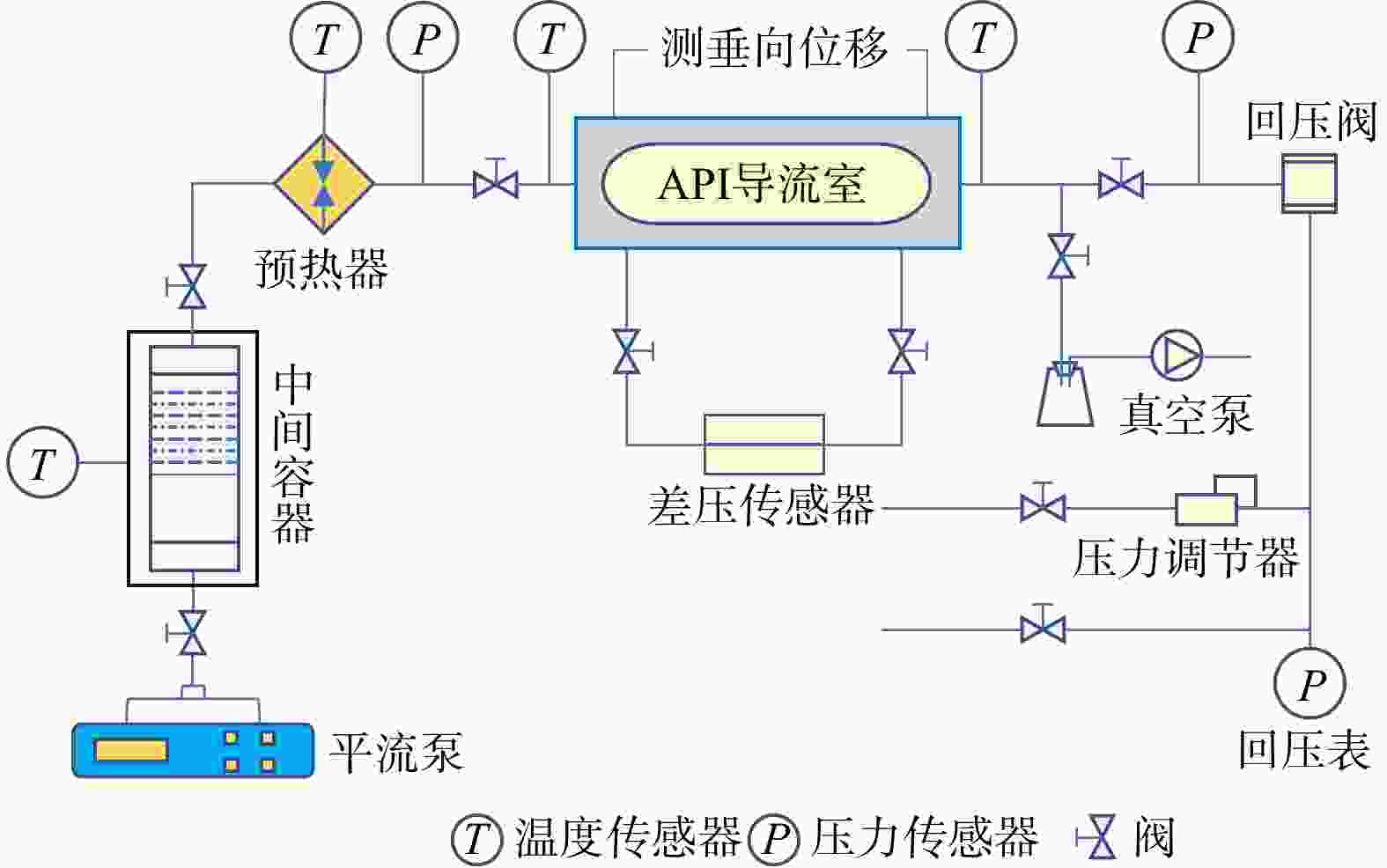
图 1 改进的API导流仪实验装置示意图
Figure 1. Schematic diagram of the improved API conductivity experiment setup
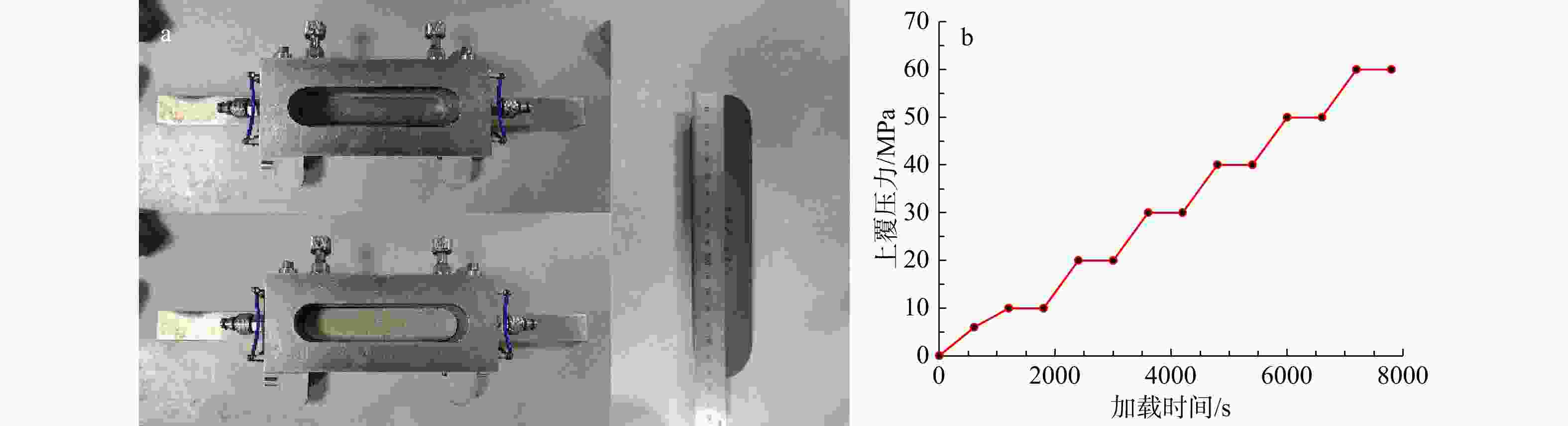
图 2 API 标准导流能力测试装置及应力加载路径示意图
a—API导流室、标准岩板尺寸示意图;b—应力加载路径
Figure 2. API standard flow capacity test device and stress loading path
(a) API conductivity cell and standard rock plate dimensions; (b) Stress loading path
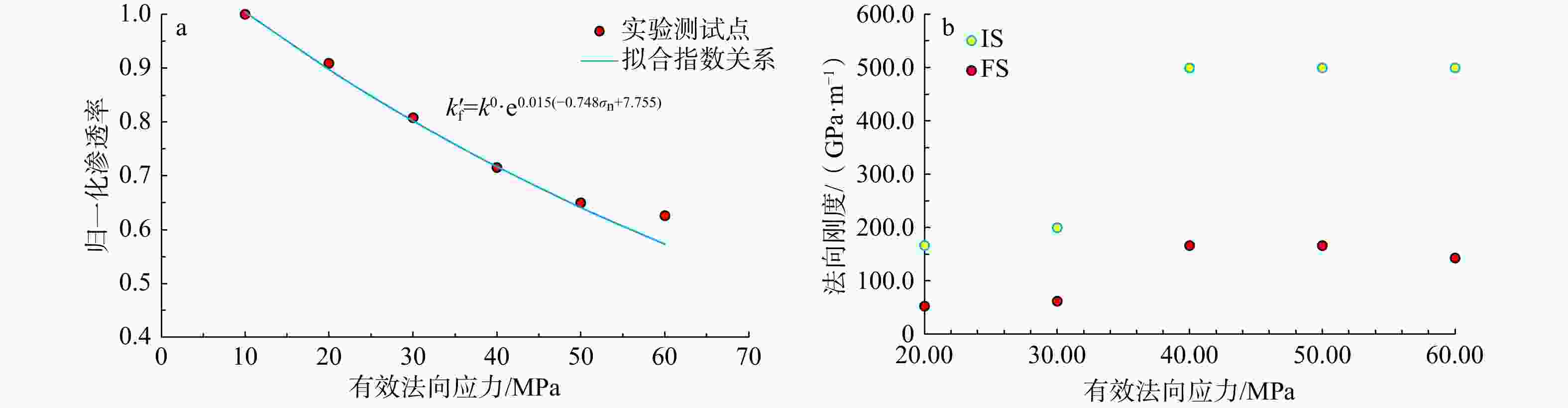
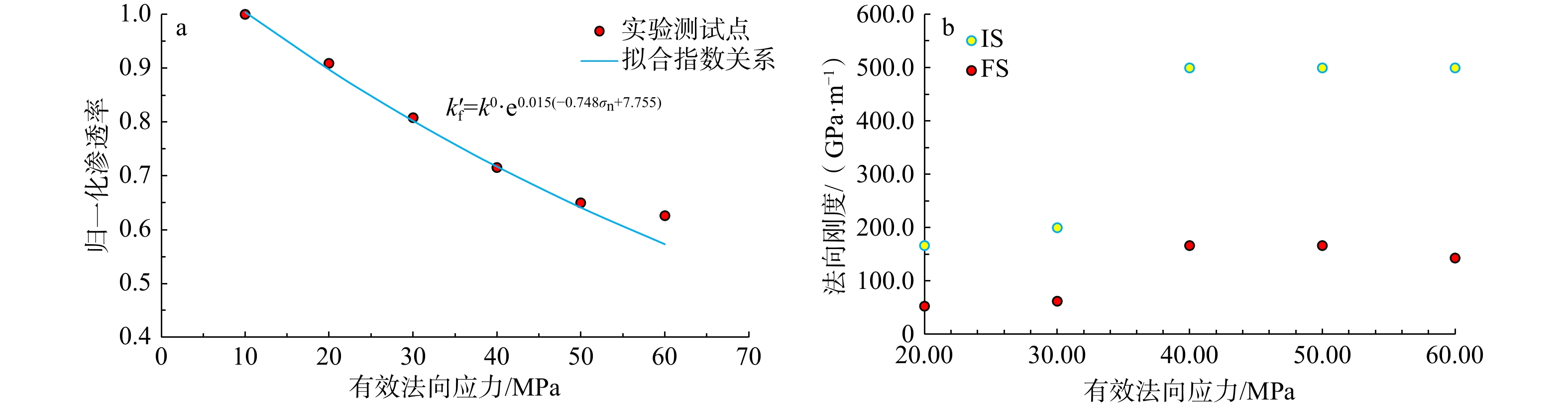
图 3 有效法向应力作用下样品渗流与力学特性变化关系
$ k_{\text{f}}^{0} $—初始归一化渗透率;$ k_{\text{f}}{\text{'}} $—加载应力后归一化裂缝弱面渗透率;$ {\sigma }_{{\mathrm{n}}} $—有效法向应力a—归一化渗透率与有效法向应力关系;b—样品法向刚度与有效法向应力关系
Figure 3. Variation of hydraulic and mechanical properties of the sample under effective normal stress
(a) Relationship between normalized permeability and effective normal stress; (b) Relationship between rock plate normal stiffness and effective normal stress$ k_{\text{f}}^{0} $—initial normalized permeability;$ k_{\text{f}}{\text{'}} $— normalized fracture weak-plane permeability after stress loading; $ {\sigma }_{{\mathrm{n}}} $—effective normal stress
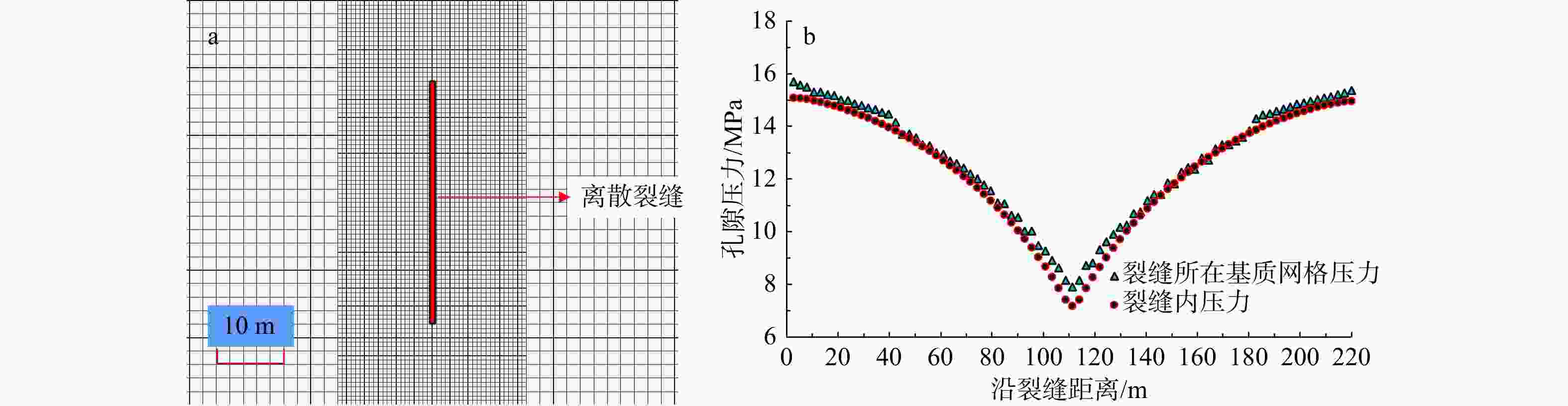
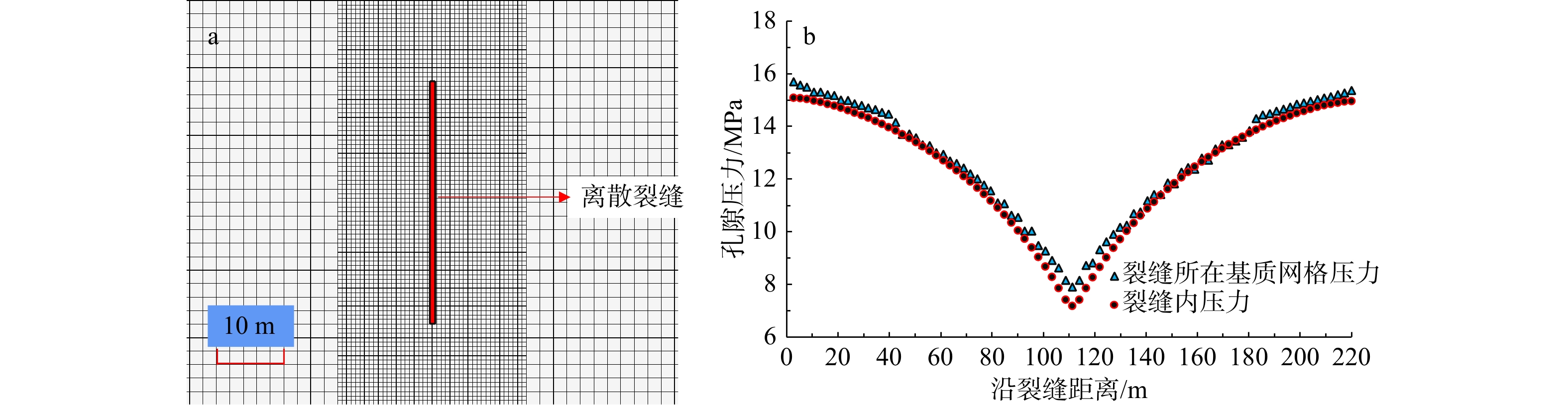
图 4 裂缝附近网格加密处理及裂缝−基质压力等效性验证
a—对裂缝附近网格加密结果;b—裂缝内压力与所在基质网格压力对比
Figure 4. Grid refinement near fractures and validation of fracture–matrix pressure equivalence
(a) Grid refinement near the fracture; (b) Comparison of the pressure inside the fracture with the pressure of the matrix grid where it is located
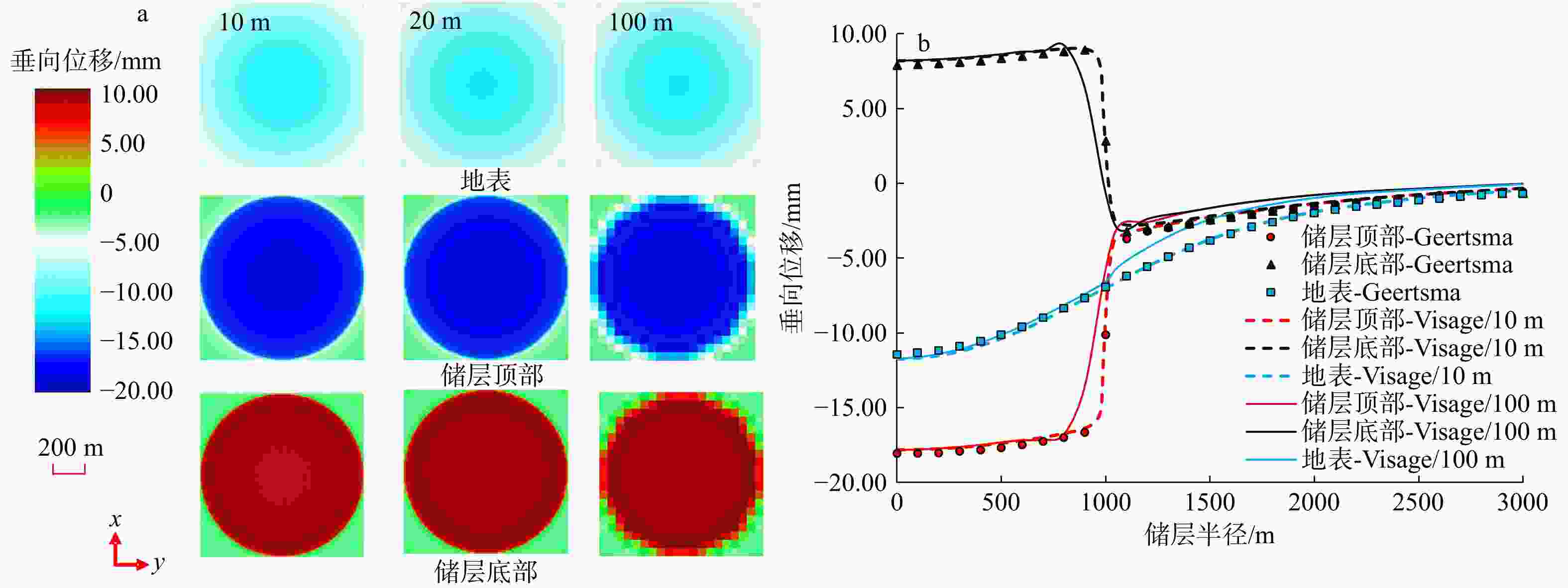
图 5 VISAGE数值结果的验证
a—地表和储层顶/底网格点的垂直位移;b—VISAGE求解与Geertsma分析结果的比较
Figure 5. Validation of VISAGE numerical results (a) Vertical displacements of grid points at surface and reservoir top/bottom; (b) Comparison between VISAGE solutions and Geertsma's analytical results
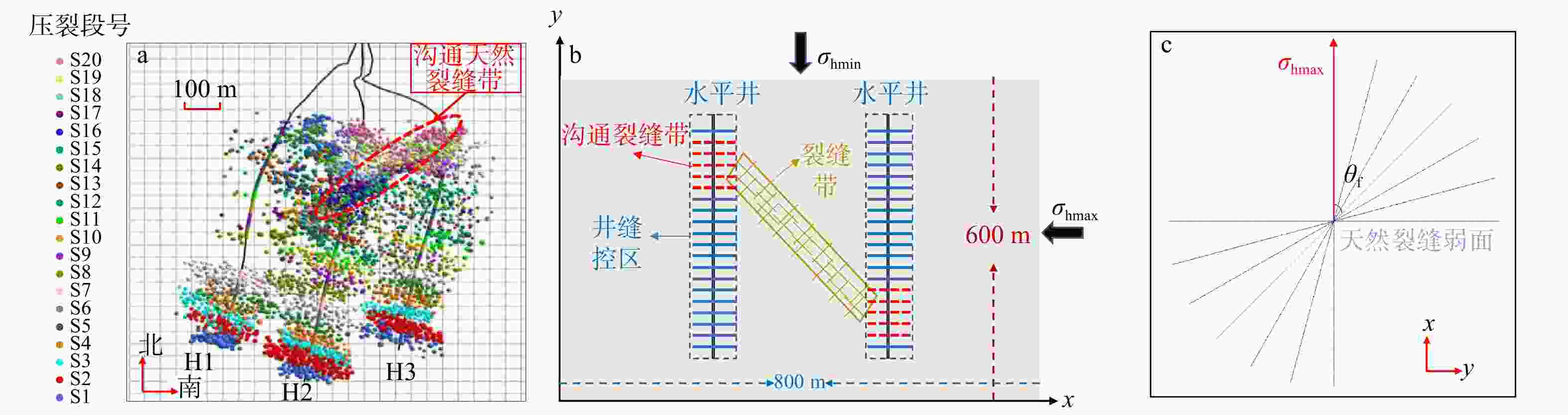
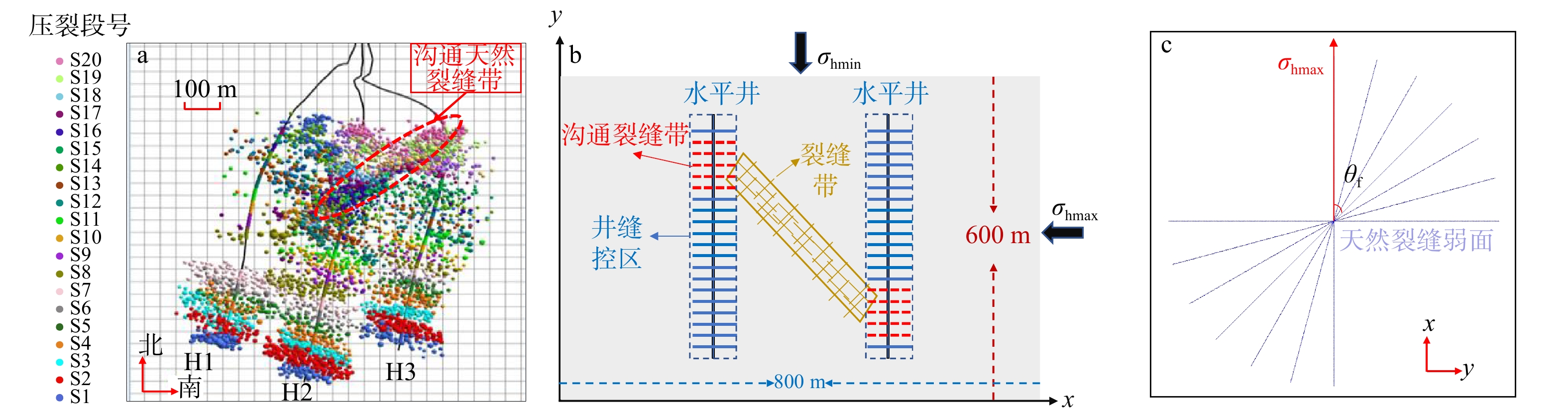
图 6 H 井组压裂微地震响应及水平井组机理模型示意图
σhmax—最大水平主应力 ;σhmin—最小水平主应力 ;θf—天然裂缝弱面方向,定义为天然裂缝弱面与最大水平主应力夹角a—H井组水平井压裂后微地震监测结果(不同颜色小球表示监测到的不同压裂段的微地震事件);b—基于H井组特征构建的机理模型示意图;c—天然裂缝弱面方向分布示意图
Figure 6. Microseismic response of hydraulic fracturing and schematic of the horizontal well group–based mechanistic model in Well Group H
(a) Results of microseismic monitoring after hydraulic fracturing of Well Group H (Different colored balls represent the microseismic events monitored from different fracturing stages); (b) Schematic mechanistic model based on the characteristics of Well Group H; (c) Schematic illustration of the distribution of the weak plane orientations of natural fracturesσhmax—maximum horizontal principal stress; σhmin—minimum horizontal principal stress; θf—direction of the weak surface of the natural fracture, defined as the angle between the weak planes of the natural fracture and the maximum horizontal principal stress
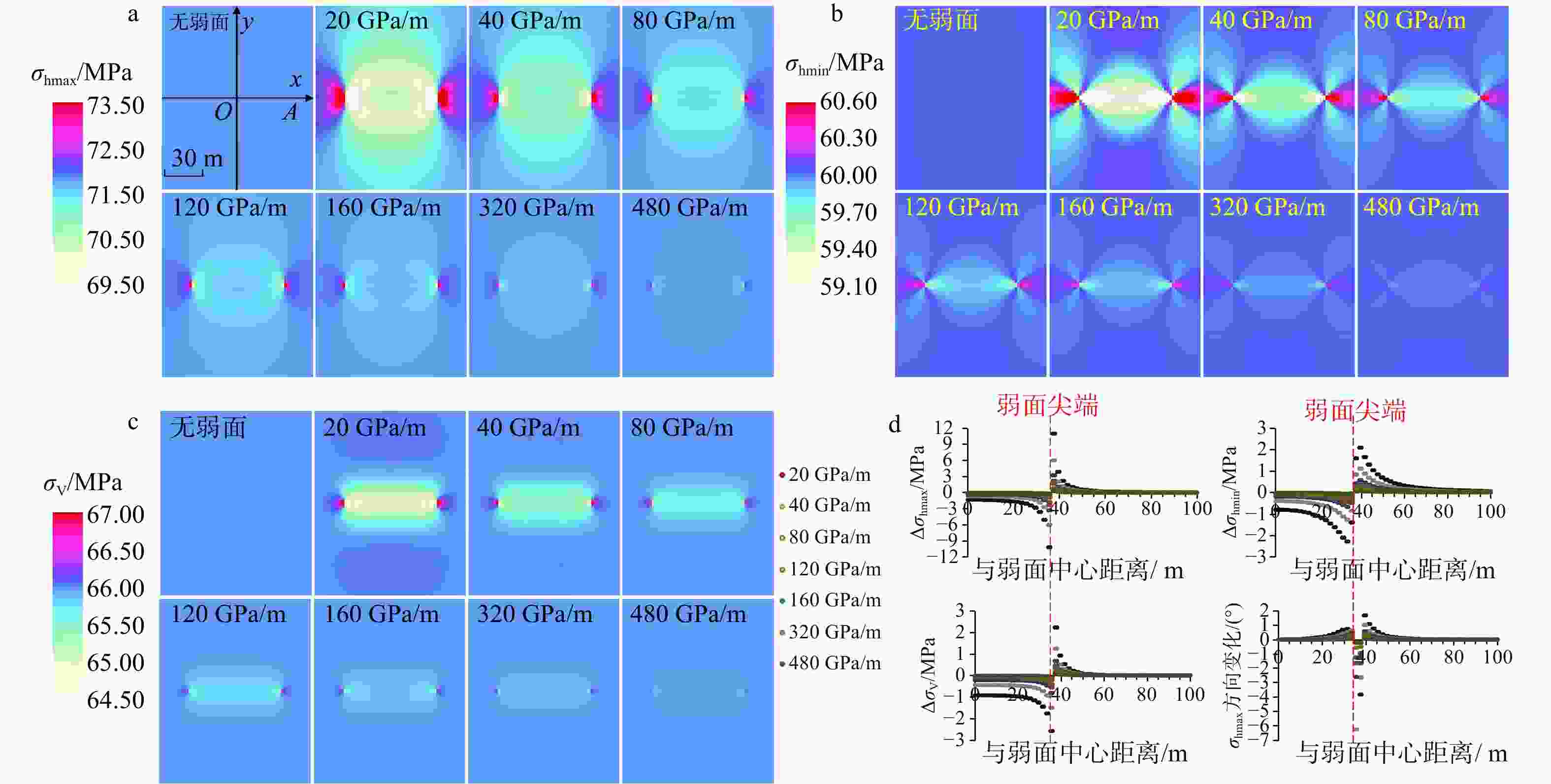
图 7 天然裂缝弱面刚度变化对三向主应力的影响
a—不同刚度天然裂缝弱面下的最大水平主应力分布;b—不同刚度天然裂缝弱面下的最小水平主应力分布;c—不同刚度天然裂缝弱面下的垂向主应力分布;d—不同刚度弱面对三向主应力大小以及最大水平主应力方向的扰动(沿着图7a中OA方向)
Figure 7. Influence of variations in natural fracture stiffness on three-dimensional principal stress
(a) Distribution of the maximum horizontal principal stress at the weak surface of a natural fracture with different stiffness; (b) Distribution of the minimum horizontal principal stress at the weak surface of a natural fracture with different stiffness; (c) Distribution of the vertical principal stress at the weak surface of a natural fracture with different stiffness; (d) Perturbation of the magnitudes of the three-dimensional principal stress and the orientation of the maximum horizontal principal stress along OA in Fig.7a
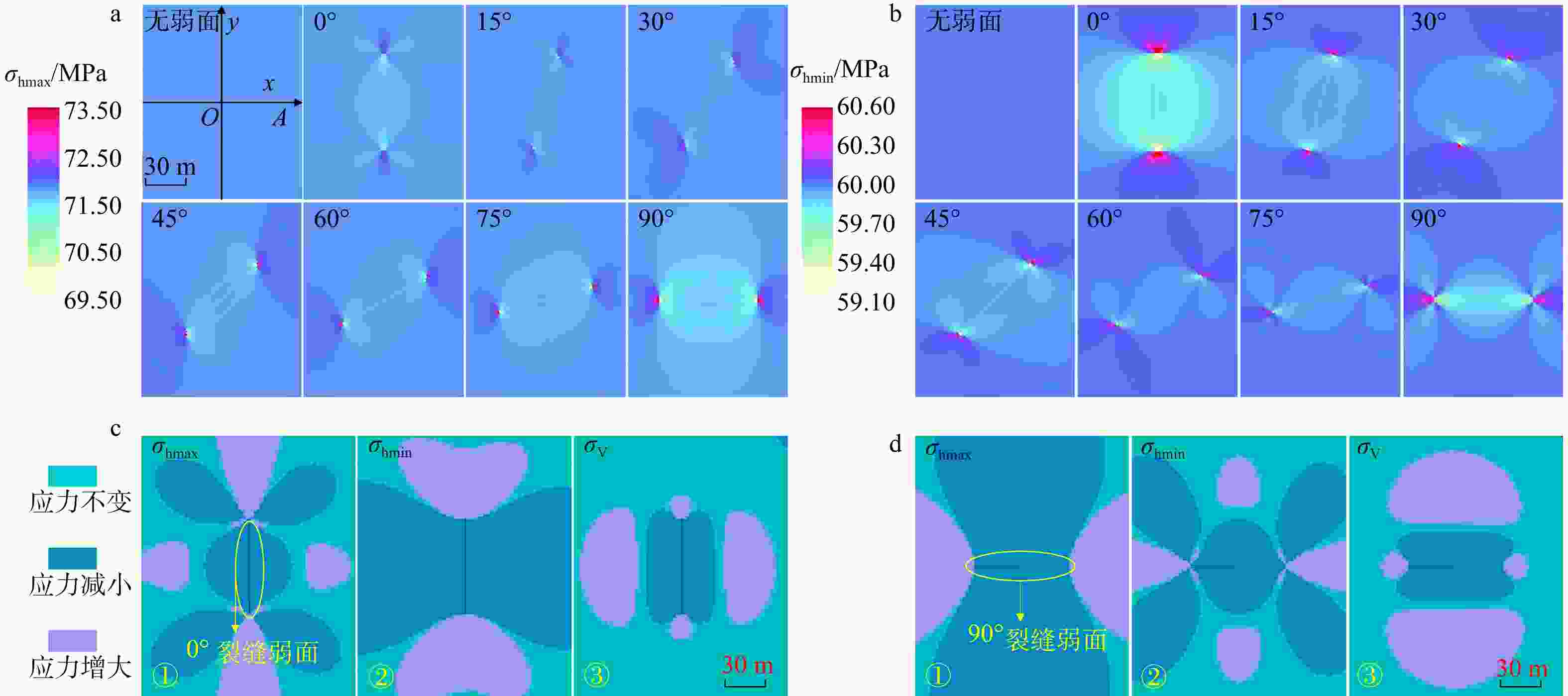
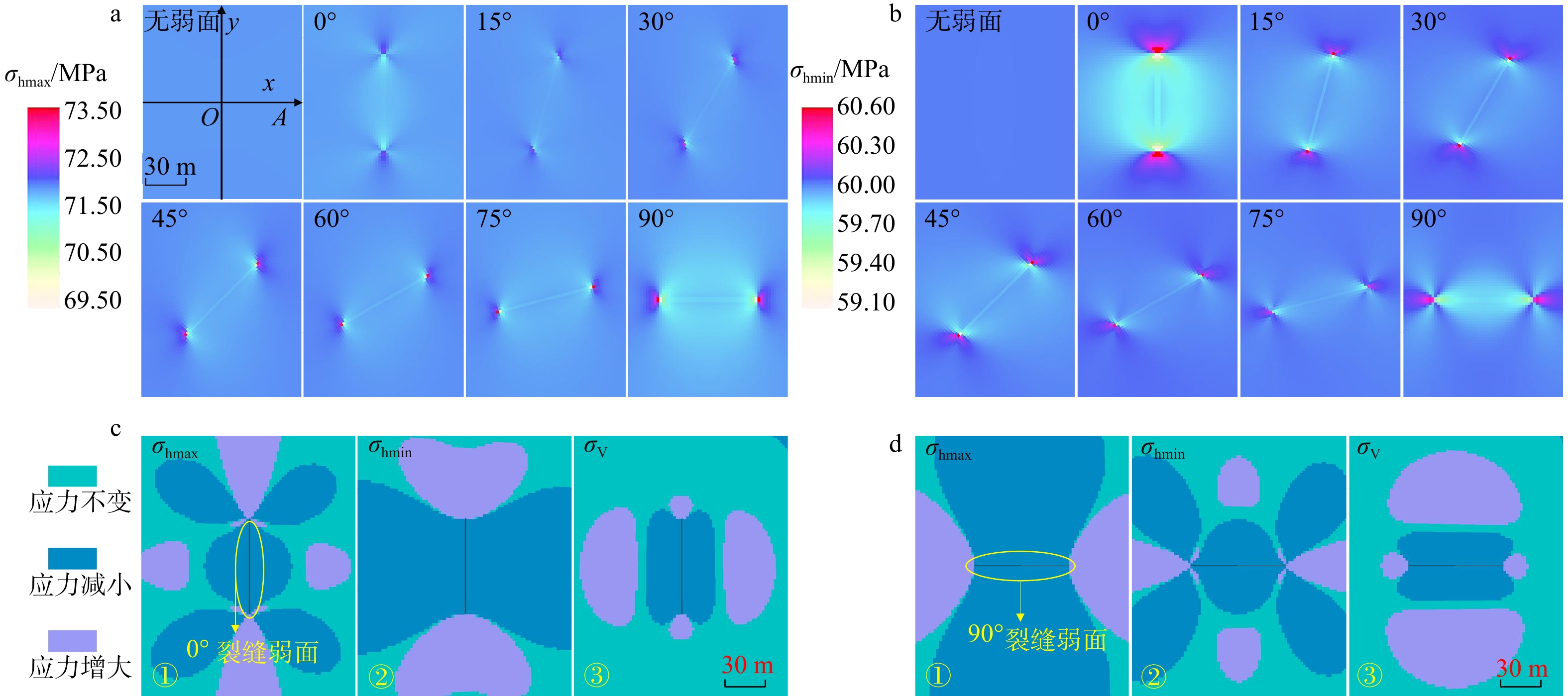
图 8 不同走向天然裂缝弱面对水平主应力分布及局部应力场扰动特征的影响
a—不同走向天然裂缝下的最大水平主应力分布;b—不同走向天然裂缝下的最小水平主应力分布;c—0°天然裂缝弱面对局部应力场的扰动特征;d—90°天然裂缝弱面对局部应力场的扰动特征
Figure 8. Influence of natural fracture orientation on horizontal principal stress distributions and local stress field perturbations
(a) Distribution of the maximum horizontal principal stress under natural fractures of varying orientations; (b) Distribution of the minimum horizontal principal stress under natural fractures of varying orientations; (c) Perturbation of local stress fields induced by natural fracture weaknesses (illustrated by the horizontal stress under 0° fracture orientation); (d) Perturbation of local stress fields induced by natural fracture weaknesses (illustrated by the horizontal stress under 90° fracture orientation)
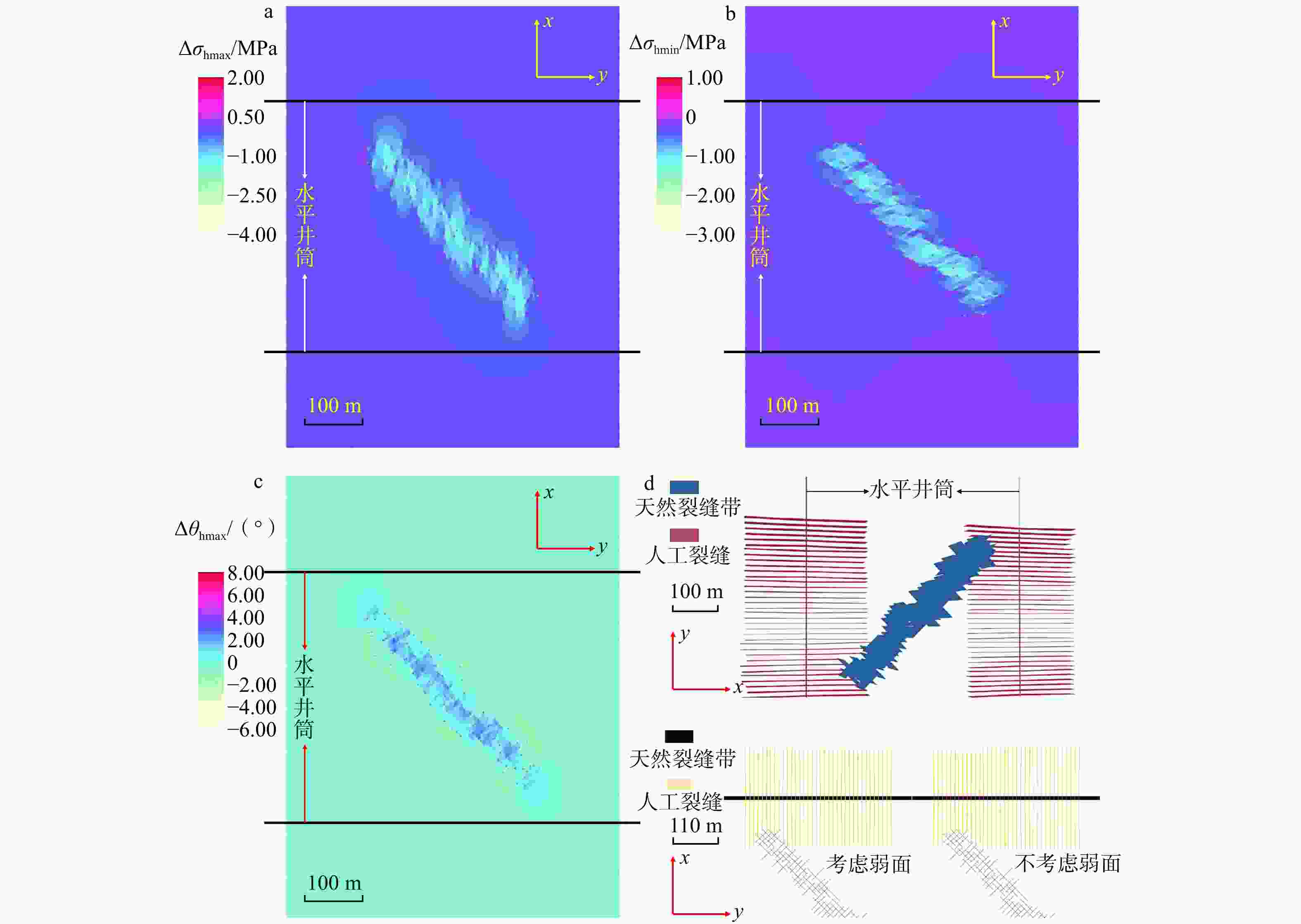
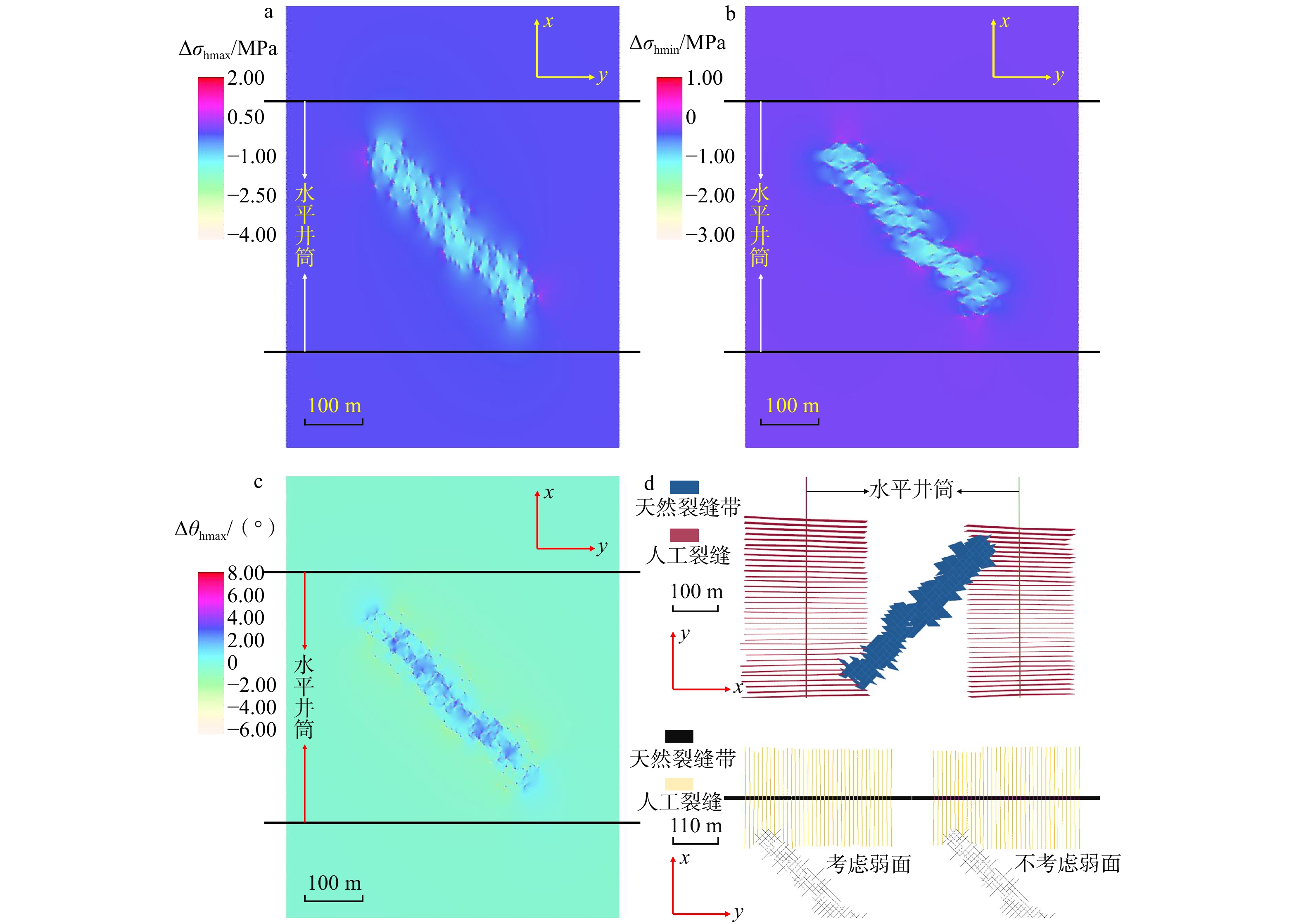
图 9 天然裂缝带对应力场的扰动
a—天然裂缝带对最大水平主应力的扰动;b—天然裂缝带对最小水平主应力的扰动;c—天然裂缝带对最大水平主应力方向的扰动;d—嵌入式离散裂缝模型(包含人工裂缝与水力裂缝)
Figure 9. Perturbation of the stress field by a natural fracture zone
(a) Perturbation of the maximum horizontal principal stresses induced by a natural fracture zone; (b) Disturbance of the minimum horizontal principal stresses induced by a natural fracture zone; (c) Disturbance of the orientation of the maximum horizontal stress induced by a natural fracture zone; (d) Embedded discrete fracture model (including natural and hydraulic fractures)
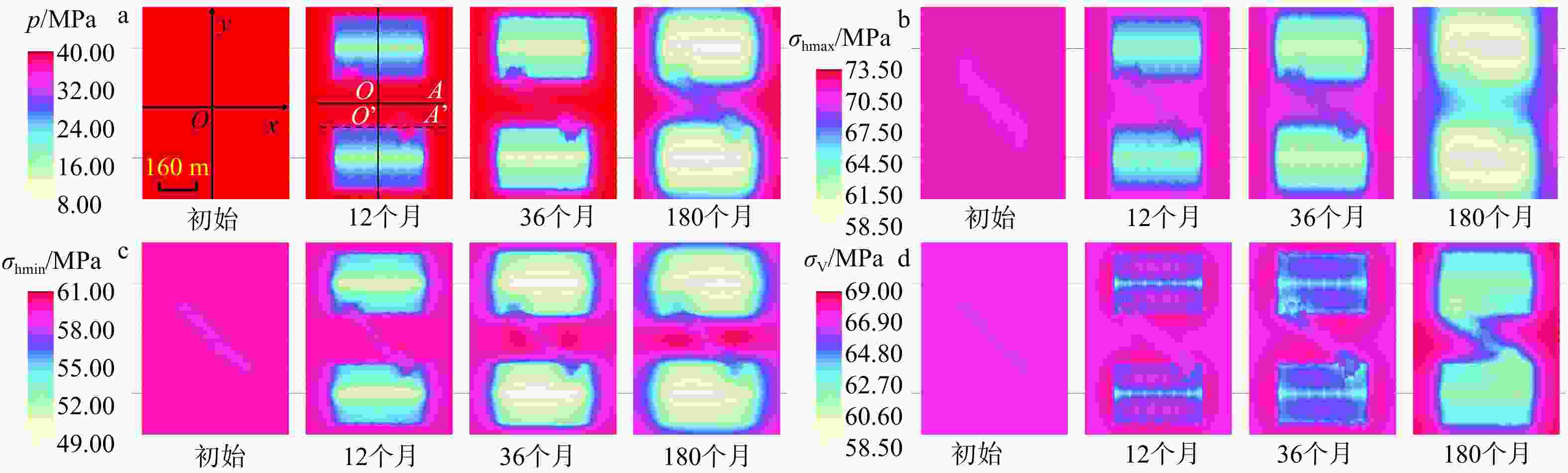
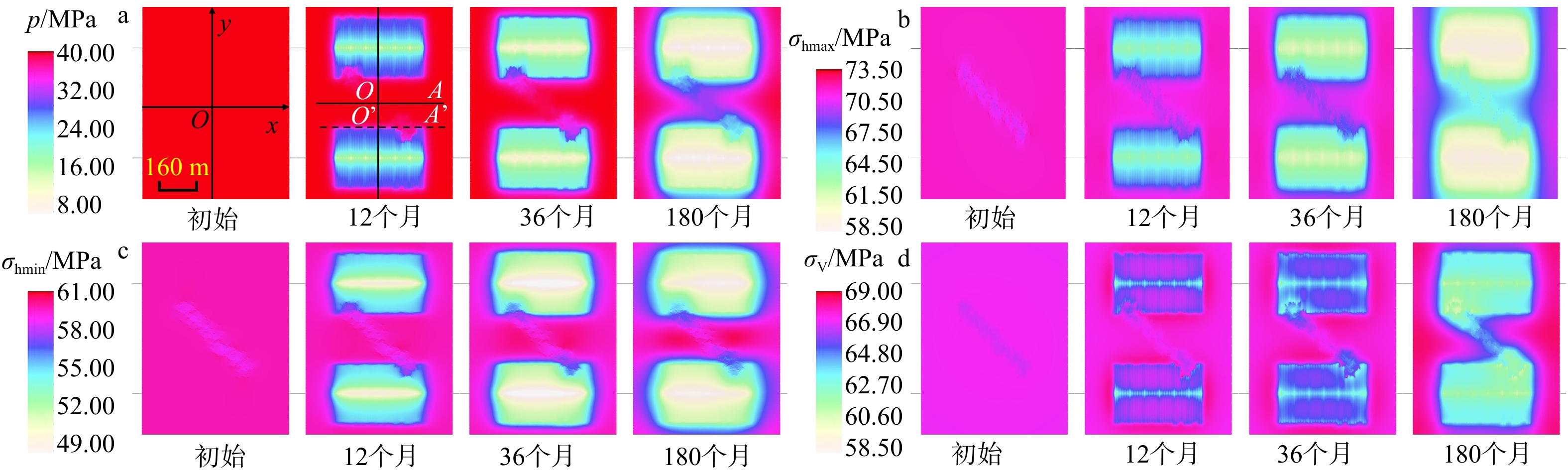
图 10 生产过程中孔隙压力与地应力场属性的演化
a—孔隙压力变化特征(OA表示2口母井中间的1条平行线,OA'表示在1口母井裂缝尖端位置的1条平行线);b—最大水平主应力变化特征;c—最小水平主应力变化特征;d—垂向应力变化特征
Figure 10. Temporal evolution of pore pressure and stress field (initial and after 12, 36, and 180 months)
(a) Pore pressure variation (OA—line midway between two parent wells; OA'—line at fracture tip of one parent well); (b) Maximum horizontal principal stress variation; (c) Minimum horizontal principal stress variation; (d) Vertical stress variation
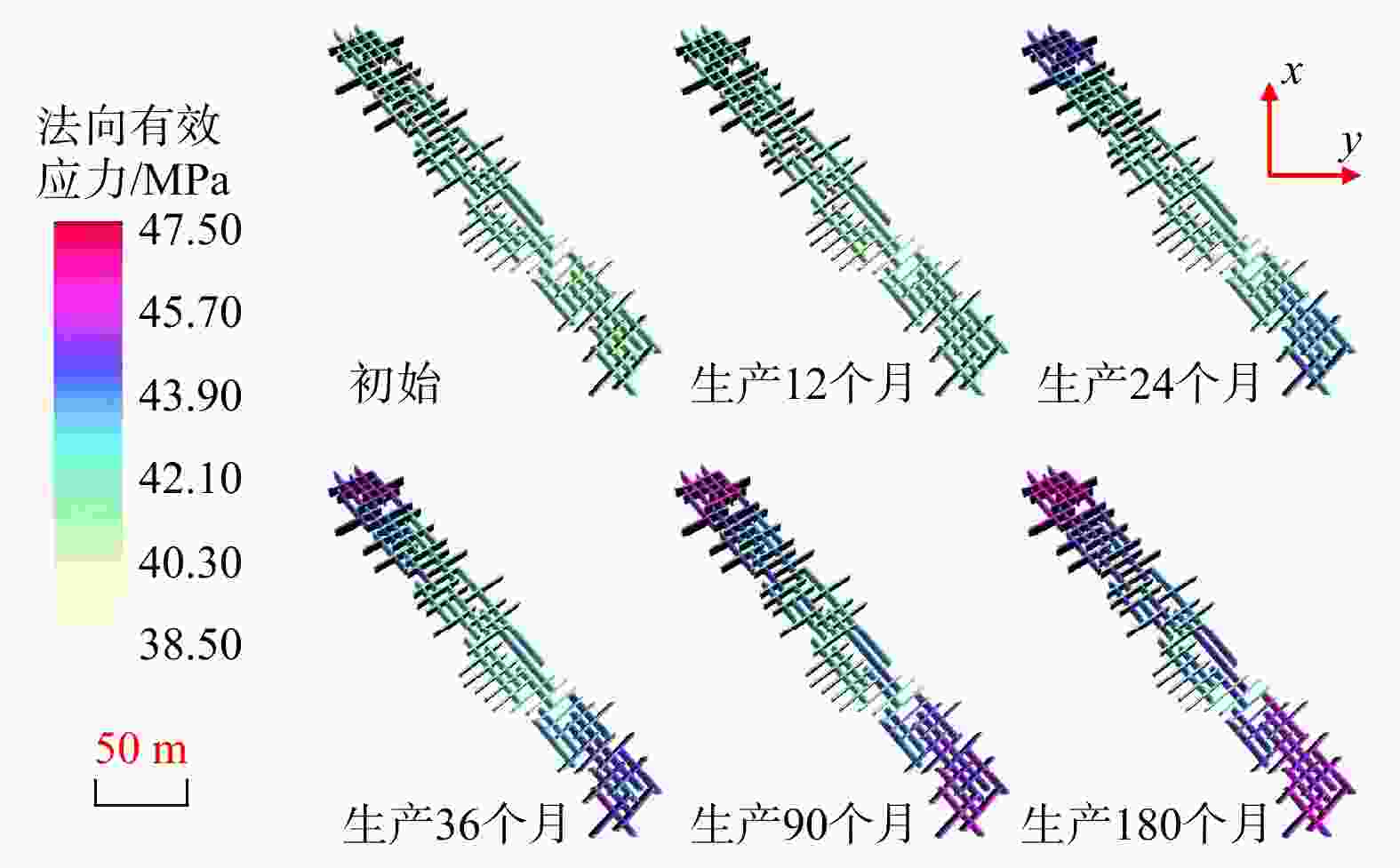
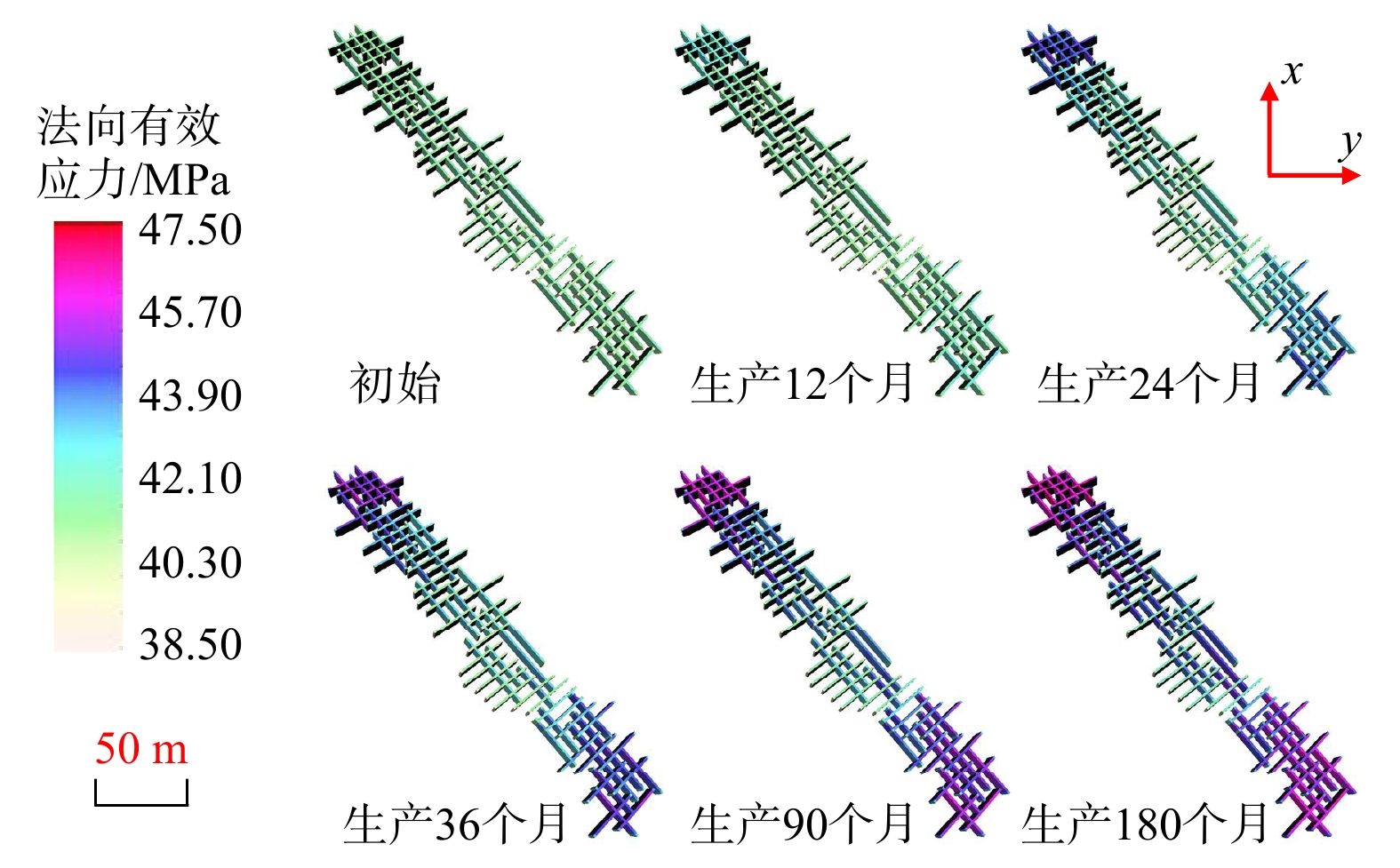
图 11 生产过程中天然裂缝弱面上法向有效应力属性的演化
Figure 11. Temporal evolution of the effective normal stress on the weak planes of natural fractures during production (initial and after 12, 24, 36, 90, and 180 months)
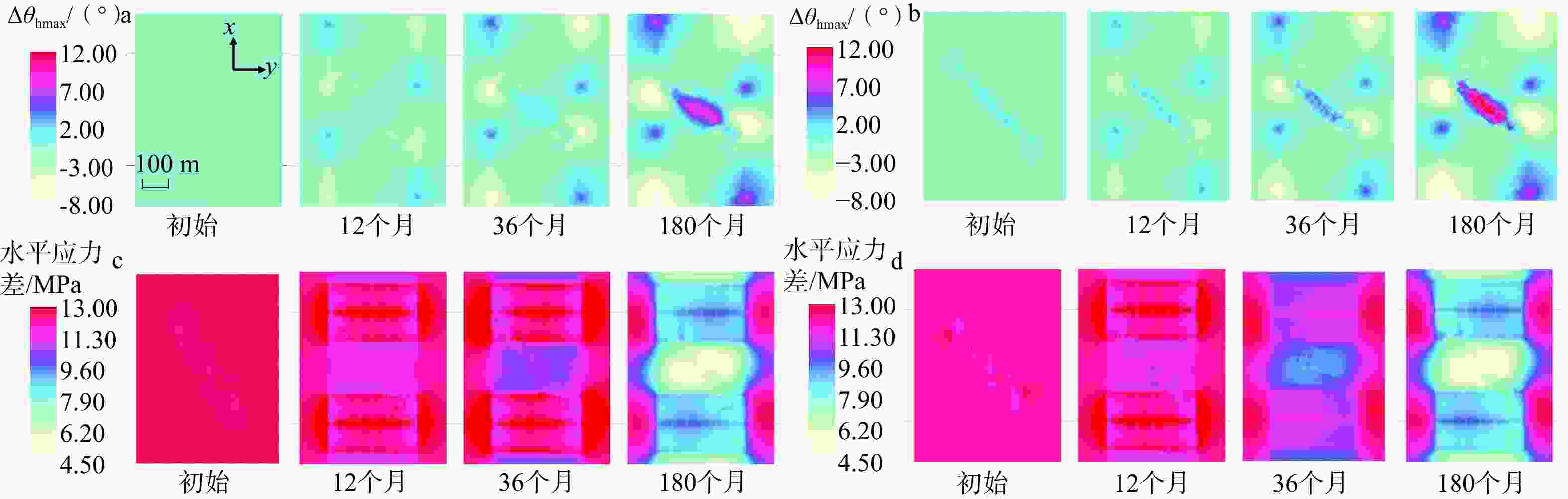
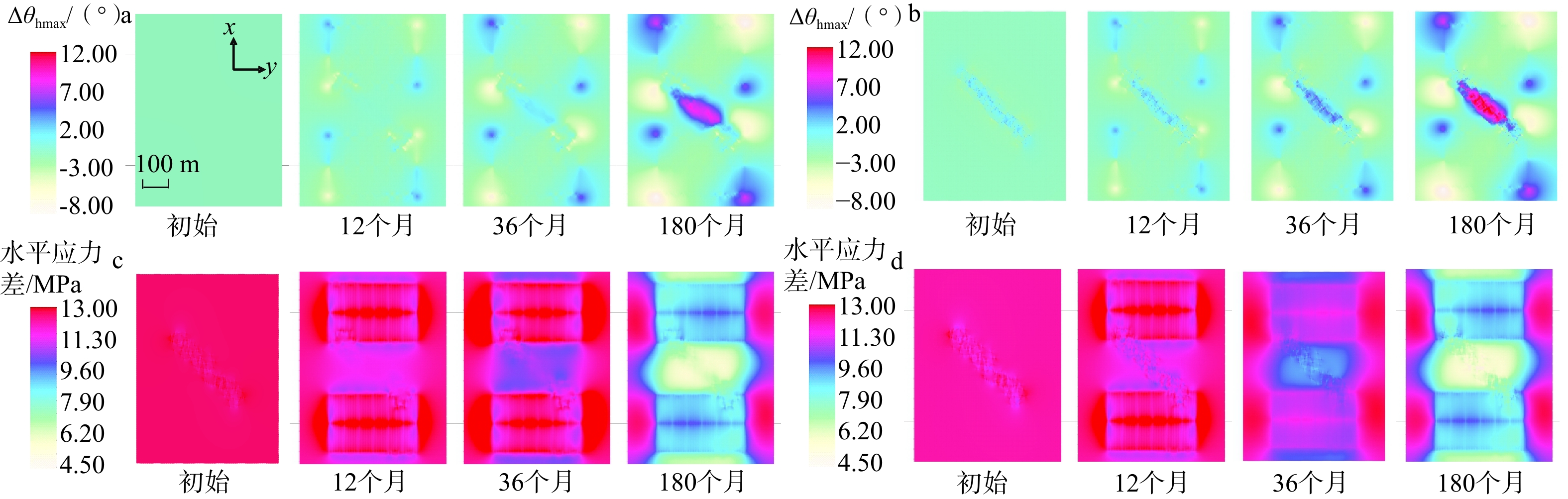
图 12 生产过程中最大水平主应力方向偏转与水平应力差分布
a—不考虑弱面扰动条件下最大水平主应力方向偏转分布;b—考虑弱面扰动条件下最大水平主应力方向偏转分布;c—不考虑弱面扰动条件下水平主应力差分布;d—考虑弱面扰动条件下水平主应力差分布
Figure 12. Deflection of the maximum horizontal principal stress orientation and the distribution of horizontal stress difference during production
(a) Deflection of the maximum horizontal principal stress orientation without weak-plane perturbation; (b) Horizontal principal stress difference without weak-plane perturbation; (c)Deflection of the maximum horizontal principal stress orientation with weak-plane perturbation; (d) Horizontal principal stress difference with weak-plane perturbation
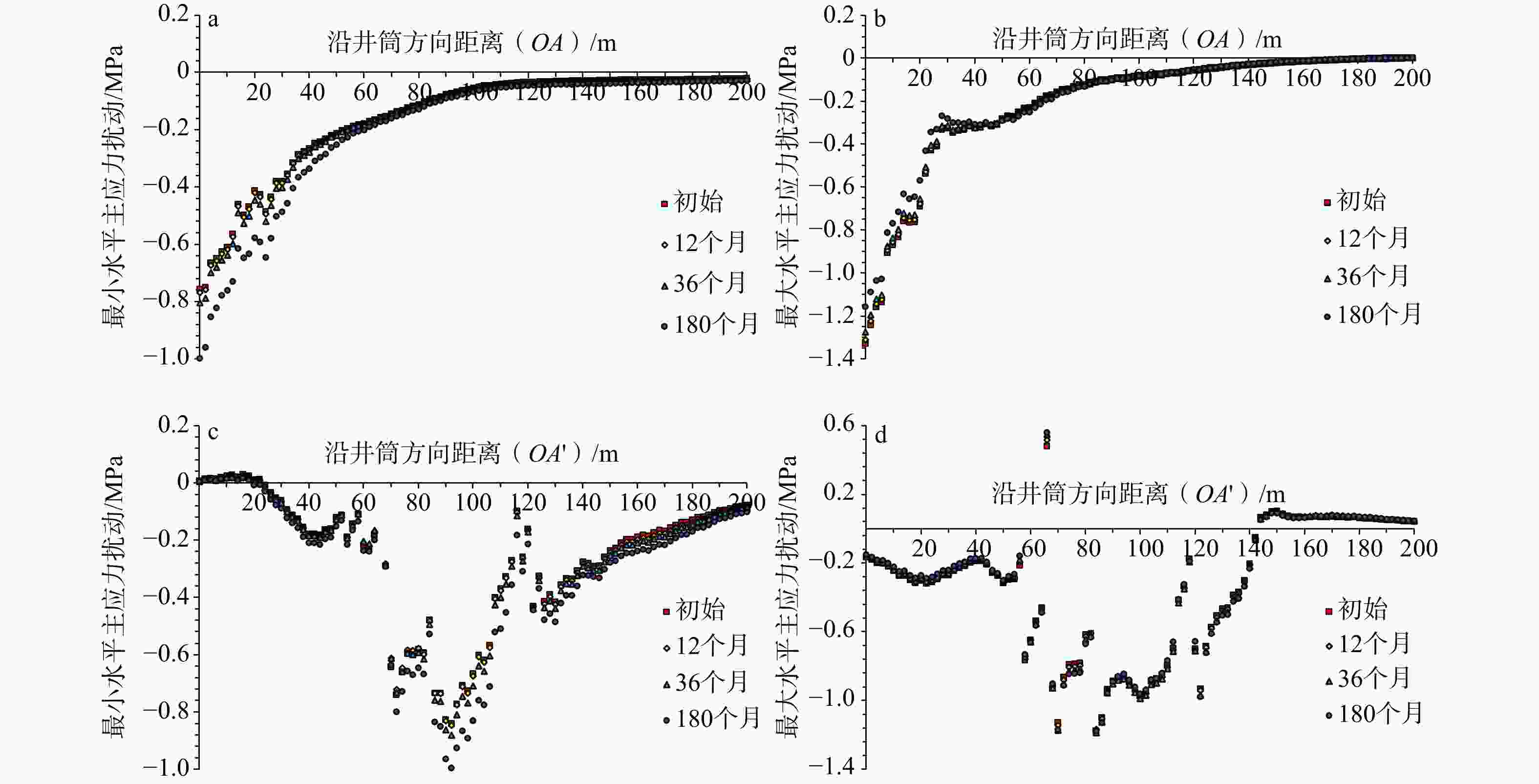
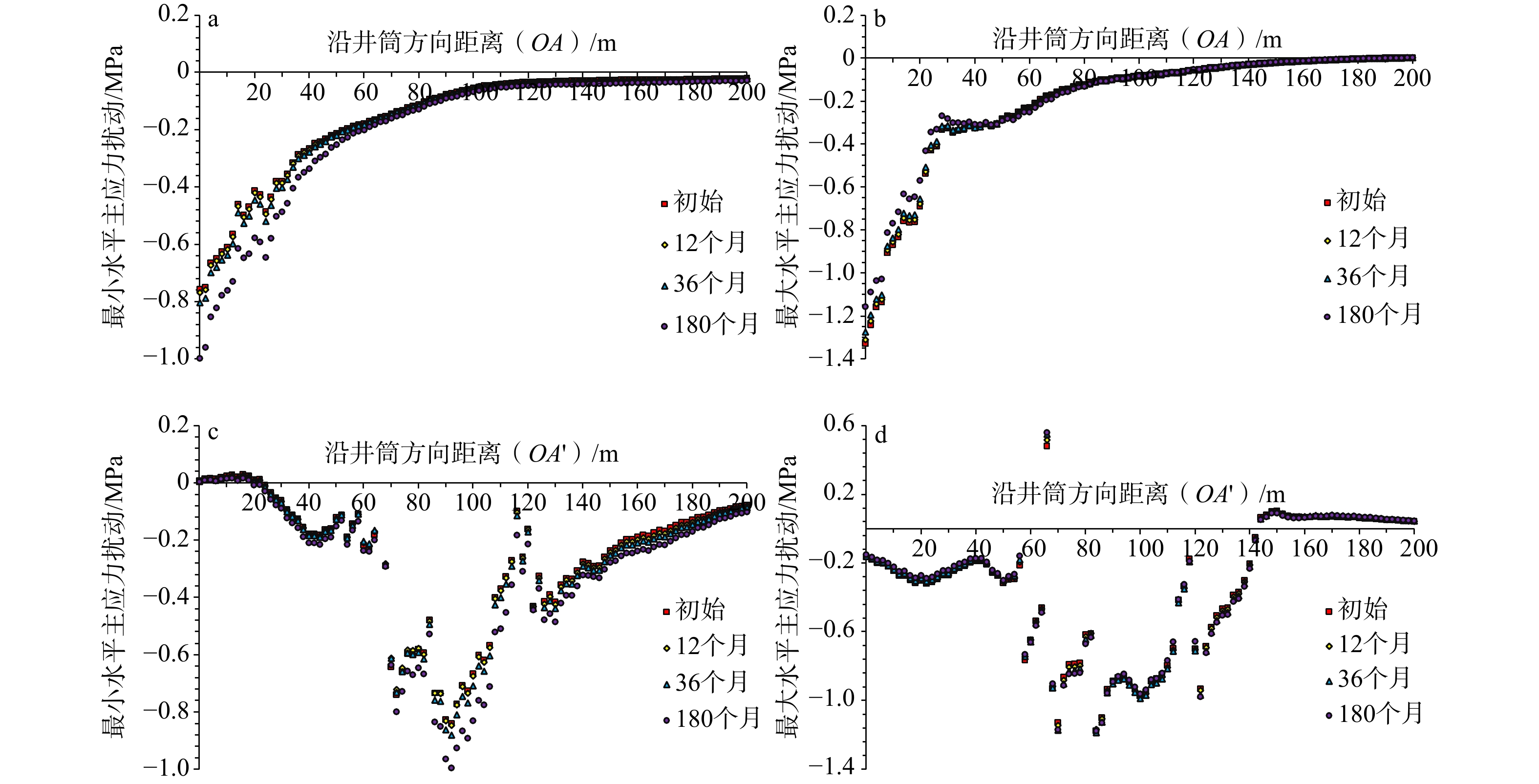
图 13 生产过程中力学弱面对水平主应力分布的扰动
a—沿OA横截面的最小水平主应力扰动 ; b—沿OA横截面的最大水平主应力扰动;c—沿OA'横截面的最小水平主应力扰动;d—沿OA'横截面的最大水平主应力扰动
Figure 13. Disturbance of the horizontal stress distribution induced by a mechanically weak plane during production
(a) Perturbation of the minimum horizontal principal stress along the OA cross-section; (b) Perturbation of the maximum horizontal principal stress along the OA cross-section; (c) Perturbation of the minimum horizontal principal stress along the OA' cross-section; (d) Perturbation of the maximum horizontal principal stress along the OA' cross-section
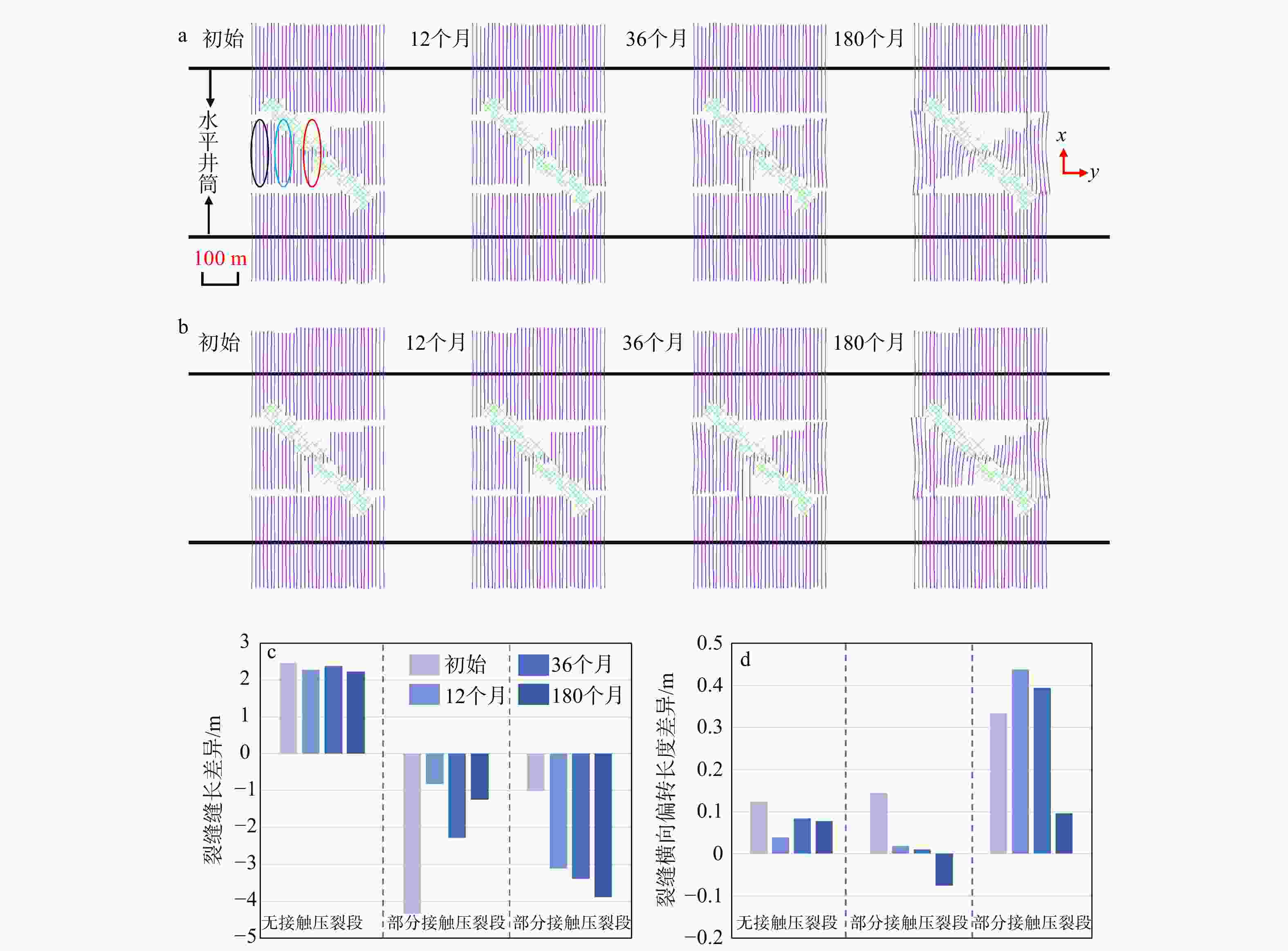
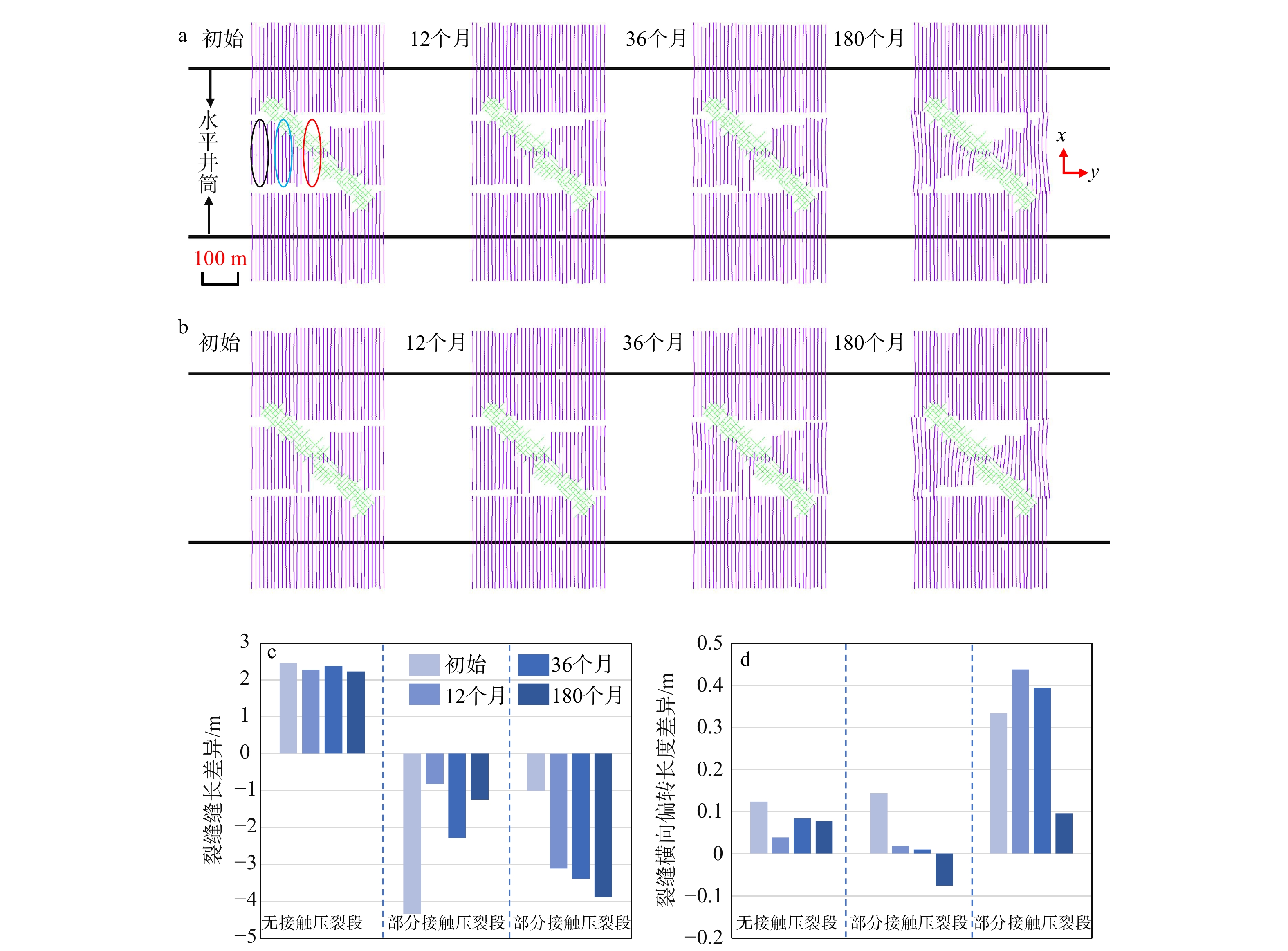
图 14 力学弱面扰动对加密井压裂裂缝形态与几何特征的影响
a—考虑力学弱面扰动条件下的加密井压裂裂缝形态(黑色、蓝色和红色圈分别表示压裂段各簇与裂缝带无接触、部分接触和完全接触的情形);b—不考虑力学弱面扰动条件下的加密井压裂裂缝形态;c—考虑力学弱面扰动时,相对于不考虑弱面条件的裂缝长轴长度差异统计;d—考虑力学弱面扰动时,相对于不考虑弱面条件的裂缝短轴长度差异统计
Figure 14. Influence of the perturbation by a mechanically weak plane on fracture morphology and geometric characteristics of infill-well hydraulic fracturing
(a) Fracture morphology of infill-well hydraulic fracturing considering perturbation by a mechanically weak plane; (b) Fracture morphology of infill-well hydraulic fracturing without considering perturbation by a mechanically weak plane; (c) Statistical comparison of major-axis lengths of fractures between cases with and without perturbation by a mechanically weak plane; (d) Statistical comparison of the minor-axis lengths of fractures between cases with and without perturbation by a mechanically weak plane In panel (a), black, blue, and red circles indicate fracture clusters with no contact, partial contact, and full contact with the fracture zone, respectively.
表 1 实验数据计算结果
Table 1. Experimental data analysis
空导流室 空导流室+完整岩板(IS) 空导流室+含弱面岩板(FS) 有效法向应力/MPa 形变/mm 有效法向应力/MPa 形变/mm 有效法向应力/MPa 形变/mm 10 0.04 10 0.10 10 0.10 20 0.11 20 0.23 20 0.42 30 0.15 30 0.32 30 0.67 40 0.20 40 0.39 40 0.80 50 0.25 50 0.46 50 0.93 60 0.28 60 0.51 60 1.05  下载: 导出CSV
表 2 用于验证的模型参数表
Table 2. Reservoir parameters used for verification
属性 符号 数值 属性 符号 数值 骨架体积模量 Ms 35000 MPa 储层厚度 H 10 m 岩石体积模量 Mv 2000 MPa 储层顶部深度 Dt 1000 m 岩石剪切模量 Mt 1200 MPa 储层半径 R 1000 m 岩石泊松比 PR 0.25 初始孔隙压力 p0 30 MPa 岩石压缩性 Ct 3×10⁻³ MPa−1 孔隙压力变化量 pt −10 MPa
下载: 导出CSV
表 3 模型参数
Table 3. Model parameters
属性 符号 取值 属性 符号 取值 基质渗透率 km 10−7 μm2 初始孔隙压力 p0 40.0 MPa 基质密度 ρm 2500 kg/m3 Biot系数 $\alpha $ 0.6 最大水平主应力 σhmax 72.0 MPa 含气饱和度 Sg 0.6 最小水平主应力 σhmin 60.0 MPa 含水饱和度 Sw 0.4 垂向应力 σV 66.0 MPa 最大水平主应力方向 θhmax 0° 杨氏模量 E 35 GPa 基质孔隙度 ϕ 0.05 泊松比 PR 0.22 井距 L 450 m Langmuir体积 VL 0.8 m3/t Langmuir压力 pL 7 MPa 天然裂缝方向 θf 0°/15°/30°/45°/60°/75°/90° 天然裂缝法向刚度 Gn 120 GPa/m 水力裂缝渗透率、天然裂缝渗透率 kf、knf 0.50 μm2 、0.010 μm2 天然裂缝切向刚度 Gs 60 GPa/m
下载: 导出CSV
表 4 裂缝模拟结果统计表
Table 4. Statistics of fracture simulation results
是否考虑力学弱面 压裂段类型 与裂缝带接触段 与裂缝带无接触段 压裂段号 1 2 3 4 5 6 不考虑 裂缝长轴长度/m 201.35 193.83 234.73 234.73 234.73 234.73 裂缝短轴长度/m 0.80 0.75 0.81 0.81 0.81 0.81 考虑 裂缝长轴长度/m 216.45 217.20 232.81 232.00 231.37 232.44 裂缝短轴长度/m 1.10 1.05 0.83 0.77 0.77 0.76
下载: 导出CSV
-
[1] BANDIS S C, LUMSDEN A C, BARTON N R, 1983. Fundamentals of rock joint deformation[J]. International Journal of Rock Mechanics and Mining Sciences & Geomechanics Abstracts, 20(6): 249-268. doi: 10.1016/0148-9062(83)90595-8 [2] BLANTON T L, 1982. An experimental study of interaction between hydraulically induced and pre-existing fractures[C]//Proceedings of SPE unconventional gas recovery symposium. Pittsburgh: SPE: 559-571. [3] DENG N E, XU H, DENG H C, et al., 2025. Characteristics of fracture system disturbance on present-day geostress: an example of deep shale gas in the North Luzhou district, Sichuan Basin[J]. Geology in China, 52(1): 95-110. (in Chinese with English abstract) [4] DUAN G F, MOU J Y, YAN X L, et al., 2024. Key controlling factors and inducement mechanism of fracture-driven interactions (FDIs) between deep shale gas horizontal wells in southern Sichuan Basin[J]. China Petroleum Exploration, 29(3): 146-158. (in Chinese with English abstract) [5] FAULKNER D R, MITCHELL T M, HEALY D, et al., 2006. Slip on ‘weak’ faults by the rotation of regional stress in the fracture damage zone[J]. Nature, 444(7121): 922-925. doi: 10.1038/nature05353 [6] GEERTSMA J, 1973. Land subsidence above compacting oil and gas reservoirs[J]. Journal of Petroleum Technology, 25(6): 734-744. doi: 10.2118/3730-pa [7] HE X X, YU P L, EIJSINK A, et al., 2025. Co-evolution of specific stiffness and permeability of rock fractures offset in shear[J]. Journal of Geophysical Research: Solid Earth, 130(5): e2024JB030633. doi: 10.1029/2024JB030633 [8] HOU Z K, YANG C H, WANG L, et al., 2016. Hydraulic fracture propagation of shale horizontal well by large-scale true triaxial physical simulation test[J]. Rock and Soil Mechanics, 37(2): 407-414. (in Chinese with English abstract) [9] JEANNE P, GUGLIELMI Y, RUTQVIST J, et al., 2017. Field characterization of elastic properties across a fault zone reactivated by fluid injection[J]. Journal of Geophysical Research: Solid Earth, 122(8): 6583-6598. doi: 10.1002/2017JB014384 [10] JIANG C B, YANG Y H, LIU H H, et al., 2023. Study on influence of natural fractures on initiaition and propagation of hydraulic fracturing coal[J]. Coal Science and Technology, 52(5): 92-101. (in Chinese with English abstract) [11] JING L, STEPHANSSON O, 2007. Fundamentals of discrete element methods for rock engineering: theory and applications[M]. Amsterdam: Elsevier. [12] LEE H P, OLSON J E, HOLDER J, et al., 2015. The interaction of propagating opening mode fractures with preexisting discontinuities in shale[J]. Journal of Geophysical Research: Solid Earth, 120(1): 169-181. doi: 10.1002/2014JB011358 [13] LIU C Z, HUANG B L, LUO S S, et al., 2025. Research Status of Hydraulic Fracture Diversion Capacity in Shale Reservoirs[J]. Engineering Construction Technology, 3(3): 102-105. [14] LU C, GUO J C, WANG W Y, et al., 2008. Experimental research on proppant embedment and its damage to fractures conductivity[J]. Natural Gas Industry, 28(2): 99-101. [15] LI S B, ZHANG D X, 2023. Three-dimensional thermoporoelastic modeling of hydrofracturing and fluid circulation in hot dry rock[J]. Journal of Geophysical Research: Solid Earth, 128(2): e2022JB025673. doi: 10.1029/2022JB025673 [16] MITCHELL T M, FAULKNER D R, 2012. Towards quantifying the matrix permeability of fault damage zones in low porosity rocks[J]. Earth and Planetary Science Letters, 339-340: 24-31. [17] NGUYEN T K, ROHMER J, VO T T, 2022. Effect of damage zones around fault core on failure development during fluid injection into porous reservoirs[J]. Geomechanics for Energy and the Environment, 32: 100327. doi: 10.1016/j.gete.2022.100327 [18] OLSON J E, 2004. Predicting fracture swarms—The influence of subcritical crack growth and the crack-tip process zone on joint spacing in rock[J]. Geological Society, London, Special Publications, 231(1): 73-87. [19] OLSON J E, DAHI-TALEGHANI A, 2009. Modeling simultaneous growth of multiple hydraulic fractures and their interaction with natural fractures[C]//SPE hydraulic fracturing technology conference. The Woodlands: SPE. [20] REN Q, XU W Y, 2008. Homogenization-based method for predicting effective elastic properties of joninted rock[J]. Engineering Mechanics, 25(4): 75-80. (in Chinese with English abstract) [21] RENSHAW C E, POLLARD D D, 1995. An experimentally verified criterion for propagation across unbounded frictional interfaces in brittle, linear elastic materials[J]. International Journal of Rock Mechanics and Mining Sciences & Geomechanics Abstracts, 32(3): 237-249. doi: 10.1016/0148-9062(94)00037-4 [22] REZAEI A, DINDORUK B, SOLIMAN M Y, 2019. On parameters affecting the propagation of hydraulic fractures from infill wells[J]. Journal of Petroleum Science and Engineering, 182: 106255. doi: 10.1016/j.petrol.2019.106255 [23] RUAN Q, PENG H H, YANG L, et al. , 2023. Integrated investigations on the refracturing process in tight oil reservoirs[C]//The 57th U. S. rock mechanics/geomechanics symposium. Atlanta: ARMA. [24] WU Y, XIA D Q, GUO X J, 2025. Fracture Development Characteristics and Main Controlling Factors in the Chang 8 Tight Sandstone Reservoir at the Southern Margin of the Ordos Basin[J]. Geoscience, 39 (5) : 1282-1292. (in Chinese with English abstract) [25] SONG Y J, LIU H J, MIN Z S, et al., 2025. Mechanism of fault slippage in the underground gas storage and preliminary application in the Shuang 6 UGS in China[J]. Geoenergy Science and Engineering, 251: 213881. doi: 10.1016/j.geoen.2025.213881 [26] SONG Z Y, WANG H, LI J, et al., 2019. Research on the influence of the coupling effect of seepage and stress on reservoir fractures[J]. Journal of Geomechanics, 25(4): 483-491. (in Chinese with English abstract) [27] TALEGHANI A D, OLSON J E, 2014. How natural fractures could affect hydraulic-fracture geometry[J]. SPE Journal, 19(1): 161-171. doi: 10.2118/167608-PA [28] TONG H M, ZHANG P, ZHANG H X, et al., 2021. Geomechanical mechanisms and prevention countermeasures of casing deformation in shale gas horizontal wells[J]. Natural Gas Industry, 41(1): 189-197. (in Chinese with English abstract) [29] WANG G F, LI F X, WANG H B, et al., 2023. Difficulties and countermeasures for fracturing of various shale gas reservoirs in the Sichuan Basin[J]. Oil & Gas Geology, 44(6): 1378-1392. (in Chinese with English abstract) [30] WENG J Q, ZENG L B, LV W Y, et al., 2020. Width of stress disturbed zone near fault and its influencing factors[J]. Journal of Geomechanics, 26(1): 39-47. (in Chinese with English abstract) [31] WENG X W, 2015. Modeling of complex hydraulic fractures in naturally fractured formation[J]. Journal of Unconventional Oil and Gas Resources, 9: 114-135. doi: 10.1016/j.juogr.2014.07.001 [32] WU J W, ZHANG J, LV Y M, et al., 2025. Characterization of natural fractures and in-situ stress in high-steep coal-bearing strata in the Midong area in Xinjiang and influence on engineering[J]. Coal Science and Technology, 53(3): 226-237. (in Chinese with English abstract) [33] WU K, OlSON J E, 2015. Simultaneous multifracture treatments: fully coupled fluid flow and fracture mechanics for horizontal wells[J]. SPE Journal, 20(2): 337-346. doi: 10.2118/167626-PA [34] WU Y, DAI J S, GU Y C, et al., 2014. Numerical simulation of present geo-stress field and its effect on hydraulic fracturing of Fuyu reservoir in Gaotaizi oilfield[J]. Journal of Geomechanics, 20(4): 363-371. (in Chinese with English abstract) [35] WU Y, XIA D Q, GUO X J, 2025. Fracture Development Characteristics and Main Controlling Factors in the Chang 8 Tight Sandstone Reservoir at the Southern Margin of the Ordos Basin[J]. Geoscience, 39(5): 1282-1292. (in Chinesewith English abstract) [36] XU K, DAI J, SHANG L, et al., 2019. Characteristics and influencing factors of in-situ stress of Nanpu sag, Bohai Bay basin, China[J]. Journal of China University of Mining and Technology, 48(3): 570-583. (in Chinese with English abstract) [37] ZHANG G Q, CHEN M, 2005. Non-planar propagation of hydraulic fracture near horizontal wellbore[J]. Acta Petrolei Sinica, 26(3): 95-97, 101. (in Chinese with English abstract) [38] ZHANG J Q, FAN Y X, LIU W C, et al., 2023. In situ stress evolution and fault-slip tendency assessment of an underground gas storage reservoir in the Turpan basin (China): in situ stress measurements and coupled simulations[J]. Rock Mechanics and Rock Engineering, 56(11): 8019-8039. doi: 10.1007/s00603-023-03477-y [39] ZHANG Y, LI Q, TAN Y S, et al., 2024. Decomposing significant factors of Coulomb stress and its components in injection-induced seismicity[J]. Journal of Rock Mechanics and Geotechnical Engineering, 16(12): 4895-4908. doi: 10.1016/j.jrmge.2023.12.009 [40] ZHAO Q, ZHOU T Q, WANG H Y, et al., 2023. A novel method for determining adsorption parameters in shale gas resources/reserves calculation: A case study of the Wufeng Formation-Longmaxi Formation in the Sichuan Basin[J]. Natural Gas Industry, 43(1): 47-54. (in Chinese with English abstract) [41] ZHU H Y, SONG Y J, XU Y, et al., 2021a. Four-dimensional in-situ stress evolution of shale gas reservoirs and its impact on infill well complex fractures propagation[J]. Acta Petrolei Sinica, 42(9): 1224-1236. (in Chinese with English abstract) [42] ZHU H Y, SONG Y J, TANG X H, et al., 2021b. Optimization of fracturing timing of infill wells in shale gas reservoirs: a case study on Well Group X1 of Fuling Shale Gas Field in the Sichuan Basin[J]. Natural Gas Industry, 41(1): 154-168. (in Chinese with English abstract) [43] 邓乃尔, 徐浩, 邓虎成, 等, 2025. 断裂系统对现今地应力扰动特征研究: 以四川盆地泸州北区深层页岩气为例[J]. 中国地质, 52(1): 95-110. doi: 10.12029/gc20231205001 [44] 段贵府, 牟建业, 闫骁伦, 等, 2024. 川南深层页岩气水平井压裂窜扰主控因素及诱导机制[J]. 中国石油勘探, 29(3): 146-158. [45] 侯振坤, 杨春和, 王磊, 等, 2016. 大尺寸真三轴页岩水平井水力压裂物理模拟试验与裂缝延伸规律分析[J]. 岩土力学, 37(2): 407-414. doi: 10.16285/j.rsm.2016.02.013 [46] 刘程州, 黄柏铃, 罗诗淑, 等, 2025. 页岩储层水力裂缝导流能力研究现状[J]. 工程施工技术, 3(3): 102-105. [47] 卢聪, 郭建春, 王文耀, 等, 2008. 支撑剂嵌入及对裂缝导流能力损害的实验[J]. 天然气工业, 28(2): 99-101. doi: 10.3787/j.issn.1000-0976.2008.02.028 [48] 蒋长宝, 杨毅毫, 刘辉辉, 等, 2023. 天然裂缝对水力压裂煤的起裂及扩展试验研究[J]. 煤炭科学技术, 52(5): 92-101. doi: 10.12438/cst.2023-0813 [49] 任强, 徐卫亚, 2008. 基于均匀化方法的节理岩体等效弹性性能预测[J]. 工程力学, 25(4): 75-79, 92. [50] 宋子怡, 王昊, 李静, 等, 2019. 渗流-应力耦合作用对储层裂缝发育的影响研究[J]. 地质力学学报, 25(4): 483-491. doi: 10.12090/j.issn.1006-6616.2019.25.04.046 [51] 童亨茂, 张平, 张宏祥, 等, 2021. 页岩气水平井开发套管变形的地质力学机理及其防治对策[J]. 天然气工业, 41(1): 189-197. doi: 10.3787/j.issn.1000-0976.2021.01.017 [52] 王光付, 李凤霞, 王海波, 等, 2023. 四川盆地不同类型页岩气压裂难点和对策[J]. 石油与天然气地质, 44(6): 1378-1392. [53] 翁剑桥, 曾联波, 吕文雅, 等, 2020. 断层附近地应力扰动带宽度及其影响因素[J]. 地质力学学报, 26(1): 39-47. doi: 10.12090/j.issn.1006-6616.2020.26.01.004 [54] 吴嘉伟, 张健, 吕玉民, 等, 2025. 新疆米东高陡煤系天然裂缝与地应力特征及工程影响[J]. 煤炭科学技术, 53(3): 226-237. doi: 10.12438/cst.2024-1796 [55] 伍亚, 戴俊生, 顾玉超, 等, 2014. 高台子油田扶余油层现今地应力数值模拟及对水力压裂的影响[J]. 地质力学学报, 20(4): 363-371. doi: 10.3969/j.issn.1006-6616.2014.04.004 [56] 伍岳, 夏东领, 郭秀娟, 2025. 鄂尔多斯盆地南缘长8致密砂岩储层裂缝发育特征及主控因素 [J]. 现代地质, 39(5): 1282-1292. doi: 10.3969/j.issn.1006-6616.2010.03.008 [57] 徐珂, 戴俊生, 商琳, 等, 2019. 南堡凹陷现今地应力特征及影响因素[J]. 中国矿业大学学报, 48(3): 570-583. doi: 10.13247/j.cnki.jcumt.000937 [58] 张广清, 陈勉, 2005. 水平井水力裂缝非平面扩展研究[J]. 石油学报, 26(3): 95-97, 101. doi: 10.3321/j.issn:0253-2697.2005.03.021 [59] 赵群, 周天琪, 王红岩, 等, 2023. 页岩气资源/储量计算中吸附参数确定的新方法: 以四川盆地五峰组—龙马溪组页岩为例[J]. 天然气工业, 43(1): 47-54. doi: 10.3787/j.issn.1000-0976.2023.01.005 [60] 朱海燕, 宋宇家, 唐煊赫, 等, 2021a. 页岩气藏加密井压裂时机优化: 以四川盆地涪陵页岩气田X1井组为例[J]. 天然气工业, 41(1): 154-168. [61] 朱海燕, 宋宇家, 胥云, 等, 2021b. 页岩气储层四维地应力演化及加密井复杂裂缝扩展规律[J]. 石油学报, 42(9): 1224-1236. doi: 10.7623/syxb202109009 -

 下载:
下载:





计量
- 文章访问数: 2094
- HTML全文浏览量: 172
- PDF下载量: 181
- 被引次数: 0
