


Experimental study on the elastic–plastic deformation and failure behavior of deep shale with well-developed inclined bedding
-
摘要: 深层页岩储层具有高温高压及发育层理结构等特征。水力压裂过程中,其岩石力学性质随温压条件动态变化,层理结构的差异进一步导致其岩石力学性质表现出明显的各向异性。该研究利用高温三轴岩石力学实验系统,结合CT扫描、超声波测试、扫描电镜(SEM)、X射线衍射(XRD)及核磁共振等多种测试手段,对高温高压环境下层理性页岩的弹塑性变形行为与破坏特征及各向异性特征开展了系统性研究。结果表明,热应力促使层理结构发生膨胀,诱发热损伤裂隙发育,从而降低深层页岩力学强度。基于Mohr−Coulomb、Hoek−Brown及Drucker−Prager准则的综合分析表明,高温高压条件下深层页岩内聚力降低、内摩擦角增加,表现出更为显著的弹塑性特征。通过分形维数分析、能量耗散与损伤因子计算评估发现,高温作用加剧了深层页岩的损伤程度,增强了人工缝网的复杂结构。各向异性指数分析进一步表明,热应力强化了岩石的各向异性,而围压在一定程度上抑制了抗压强度和弹性模量的各向异性差异。综上,高温高压作用强化了深层页岩的弹塑性变形与破坏模式,并显著改变了不同层理倾角所引发的各向异性特征。研究成果可为深层页岩储层高效开发及水力压裂工程优化提供重要的力学依据和理论支持。Abstract:
Objective Deep shale reservoirs are characterized by high temperature, high pressure, and well-developed bedding structures, which jointly govern the mechanical response of rocks during hydraulic fracturing. Previous studies have primarily focused on the effects of single temperature conditions or the mechanical behavior of bedding under conventional environments. However, systematic understanding of the elastoplastic deformation behavior and anisotropic failure mechanisms of bedded shale under coupled high-temperature and high-confining-pressure conditions remains insufficient, particularly in terms of the quantitative characterization of strength parameter evolution, damage features, and fracture complexity. Methods Therefore, this study employs a high-temperature and high-pressure triaxial rock mechanics testing system to conduct triaxial compression experiments on shale specimens with different bedding orientations. In combination with CT scanning, ultrasonic testing, scanning electron microscopy (SEM), X-ray diffraction (XRD), and nuclear magnetic resonance (NMR) techniques, the internal structural evolution, fracture development, and pore structure variations of the rocks are comprehensively characterized. Meanwhile, the evolution laws of strength parameters are analyzed based on the Mohr–Coulomb, Hoek–Brown, and Drucker–Prager criteria, and the fracture complexity and thermal damage characteristics are quantitatively evaluated using fractal dimension, energy dissipation theory, and damage factor calculations. Results The results indicate that increasing temperature promotes the expansion of bedding structures and induces thermally damaged microcracks. Fracture complexity increases with temperature, accompanied by a pronounced attenuation of wave velocity, while the peak strength and elastic modulus of shale exhibit decreasing trends, demonstrating that thermal stress significantly degrades its mechanical properties. Comprehensive analysis based on the three yield criteria shows that, under high-temperature and high-confining-pressure conditions, shale cohesion gradually decreases whereas the internal friction angle increases, and the failure mode transitions from brittle-dominated behavior to elastoplastic deformation. The coupled effects of temperature and pressure enhance the accumulation of plastic strain prior to failure. Energy analysis and damage factor results further reveal that elevated temperature markedly increases the proportion of dissipated energy and intensifies rock damage, reflecting enhanced microcrack propagation and irreversible deformation processes. Fractal dimension analysis demonstrates that the fracture network becomes progressively more complex with increasing temperature, facilitating the formation and connectivity of multiscale fracture systems. Anisotropy index analysis shows that thermal stress amplifies the anisotropic differences in compressive strength and elastic modulus among shales with different bedding orientations, whereas confining pressure suppresses such directional disparities to some extent by restricting crack opening and bedding-controlled deformation. Together, these factors determine the overall anisotropic mechanical response of deep shale. Conclusions In summary, the combined effects of high temperature and high pressure intensify the elastoplastic deformation and damage evolution of bedded shale. Under such conditions, the failure mode shifts from brittle behavior to plastic-dominated deformation, accompanied by enhanced energy dissipation and damage development. This process promotes the increasing complexity of fracture networks and alters the anisotropic failure patterns governed by bedding structures. [Significance] This study systematically elucidates the mechanisms of elastoplastic deformation and anisotropic failure of bedded shale under high-temperature and high-pressure conditions, providing essential mechanical insights for the stability evaluation of deep shale reservoirs and the optimization of hydraulic fracturing parameters. The findings hold significant scientific relevance and engineering value for the efficient development of deep unconventional oil and gas resources. -
Key words:
- deep shale /
- elastic−plastic behavior /
- energy dissipation /
- damage factor /
- anisotropic characteristics
-
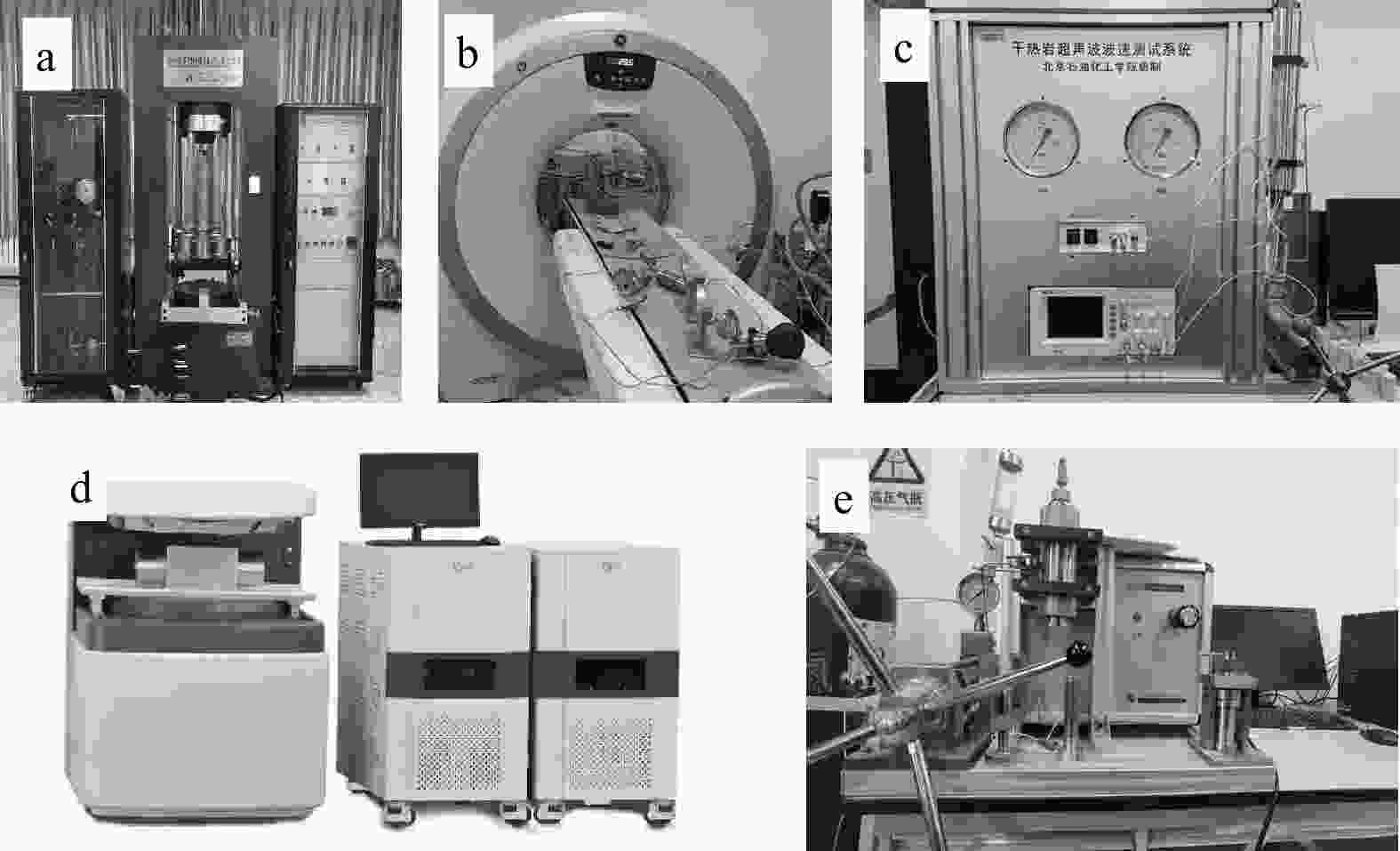
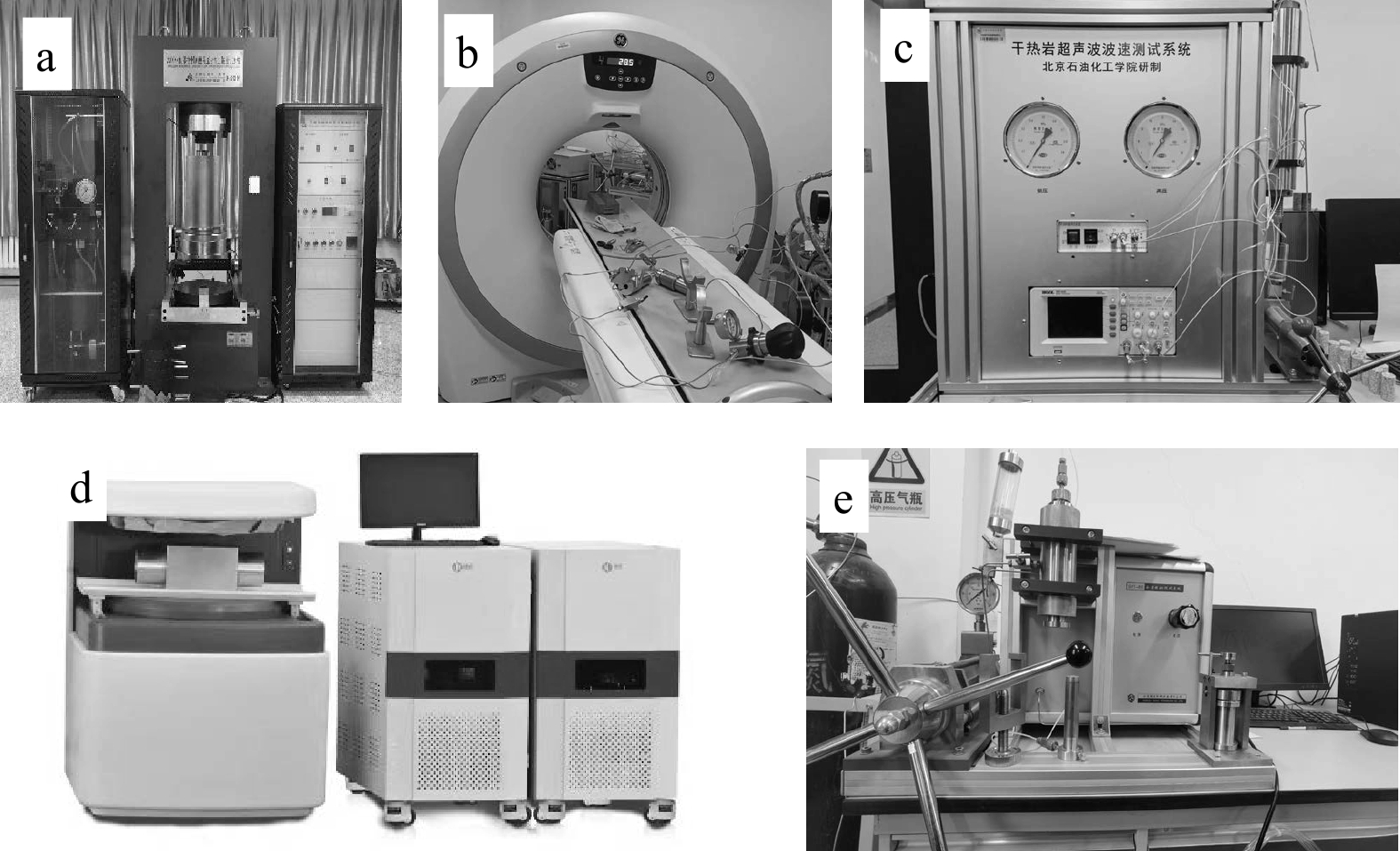
图 1 实验装置
a—2000 kN伺服控制高温高压岩石三轴测试系统;b—CT扫描测试仪;c—超声波波速测试仪;d—核磁共振测试仪;e—孔渗联测仪
Figure 1. Experimental setup
(a) Servo-controlled high-temperature and high-pressure rock triaxial testing system (2000 kN); (b) CT scanner; (c) Ultrasonic wave velocity measurement system; (d) Nuclear magnetic resonance (NMR) tester; (e) Porosity–permeability simultaneous tester
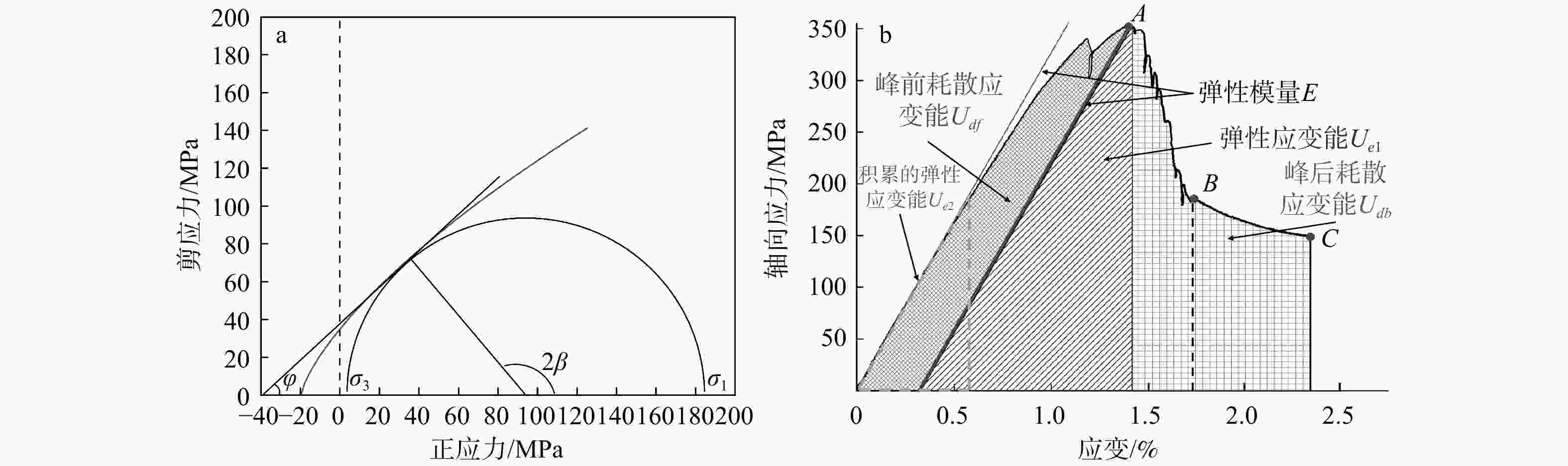
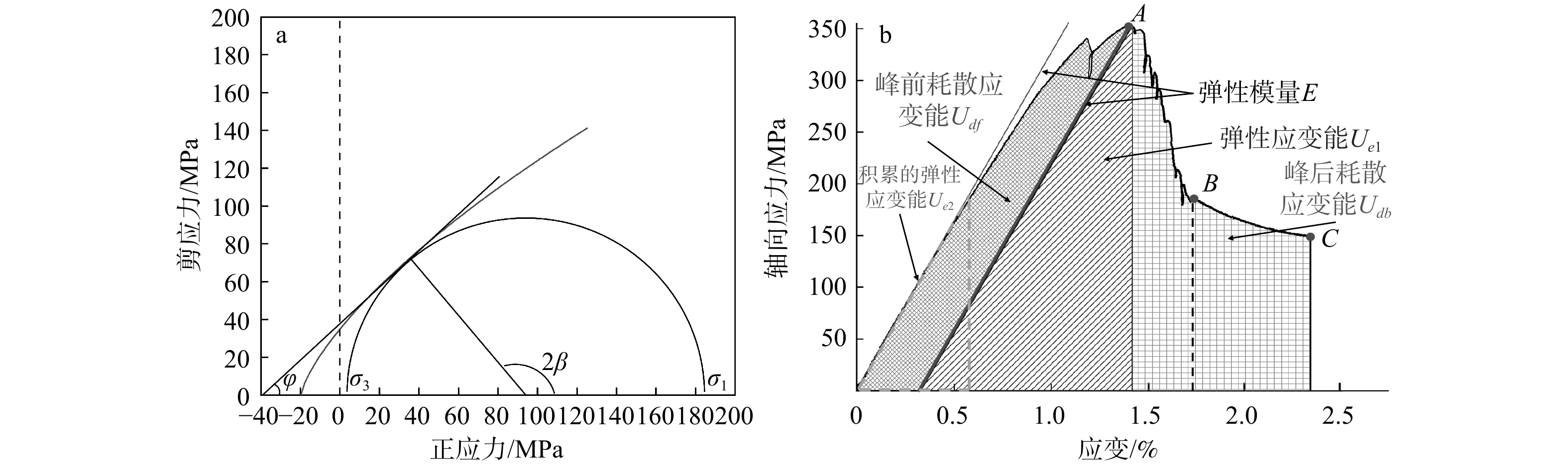
图 2 Hoek–Brown准则与能量耗散原理示意图
a—Hoek–Brown准则τ−σ空间示意图; b—能量耗散原理示意图
Figure 2. Diagrams of the Hoek–Brown criterion and energy dissipation principle
(a) τ–σ space diagram of the Hoek–Brown criterion; (b) Diagram of the energy dissipation principle

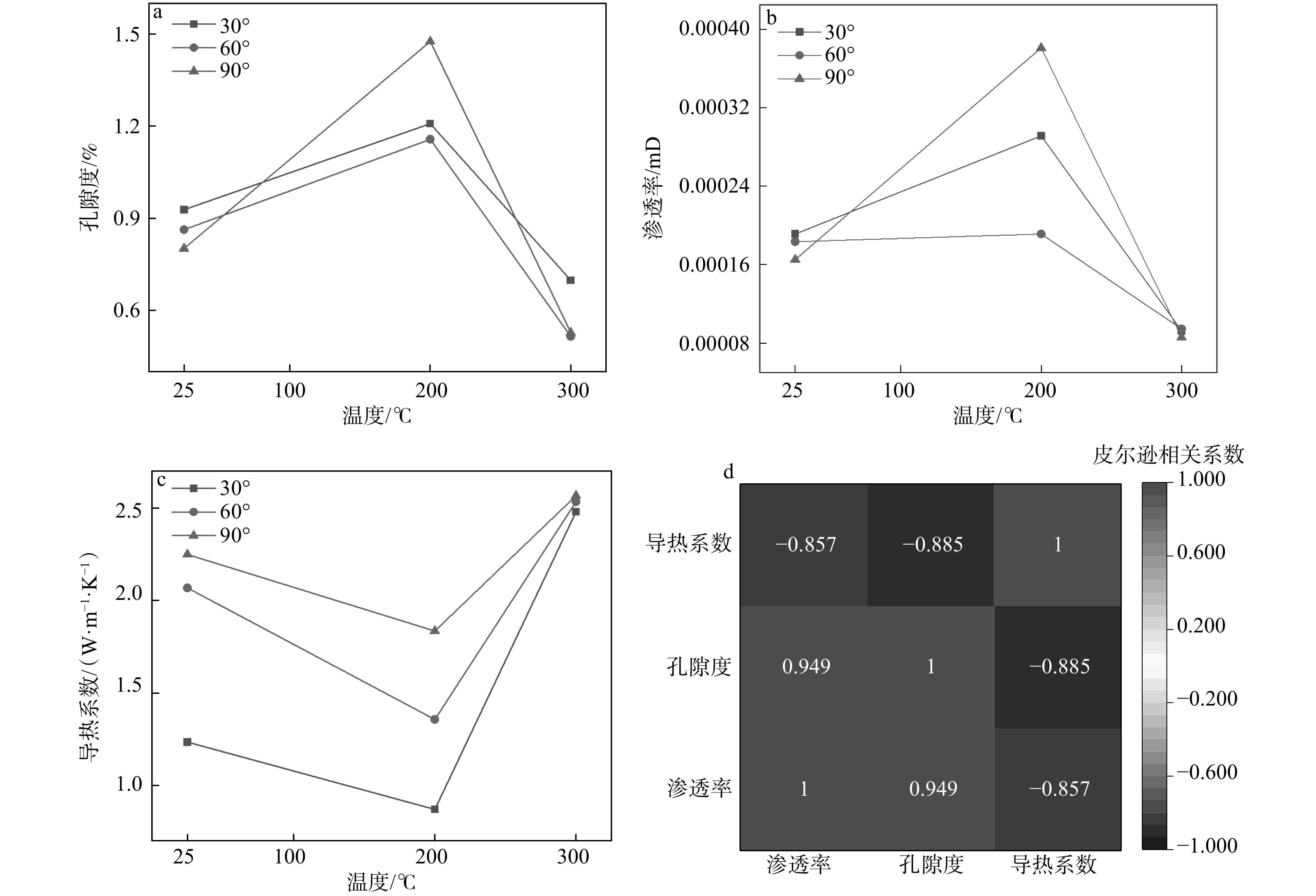
图 3 基础物性实验结果
a—孔隙度;b—渗透率;c—导热系数;d—皮尔逊相关系数
Figure 3. Experimental results of basic physical properties
(a) Porosity; (b) Permeability; (c) Thermal conductivity; (d) Pearson correlation coefficient

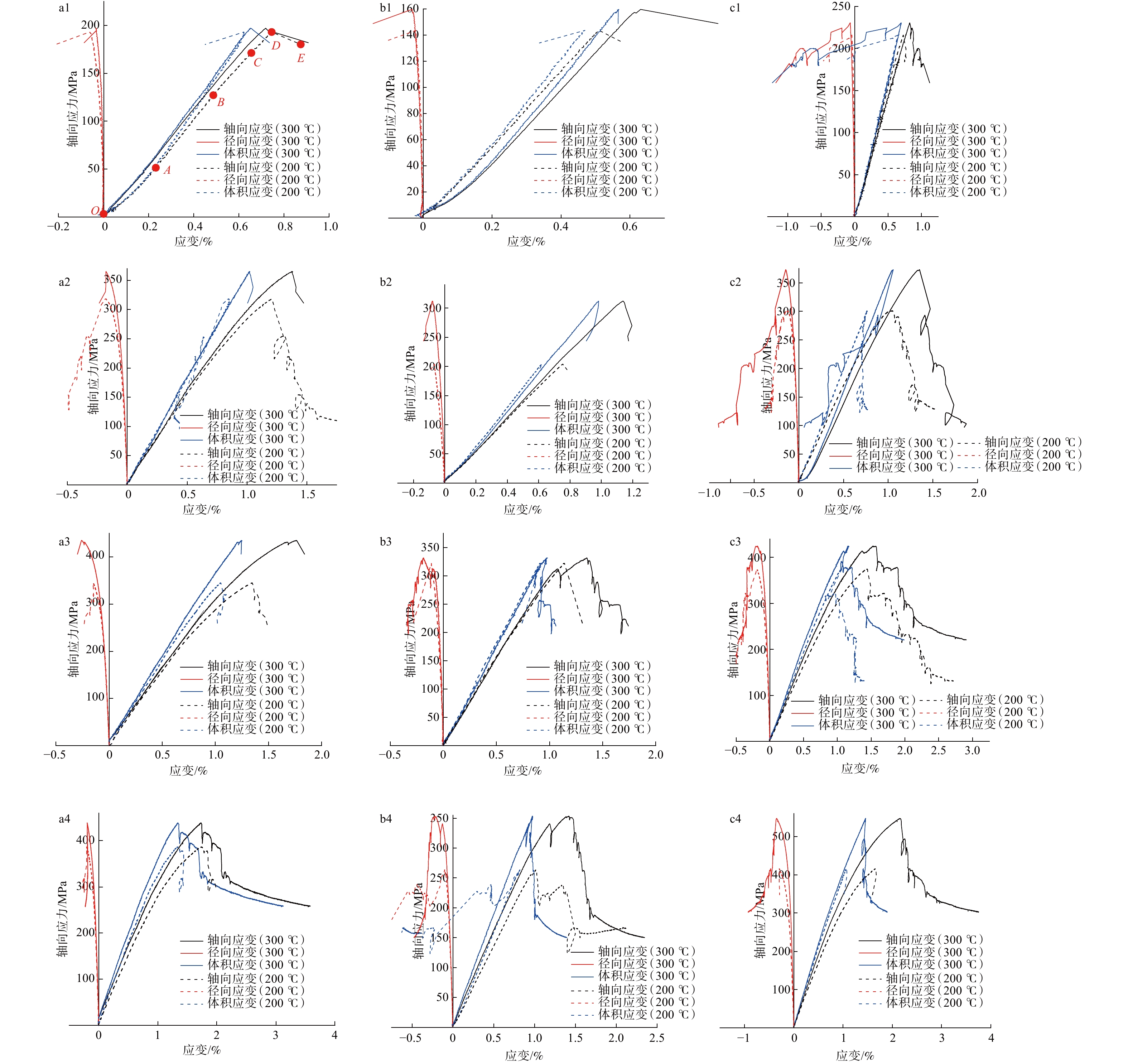
图 4 不同层理倾角和围压条件下深层页岩的应力−应变曲线
a1—30°层理倾角,围压0 MPa;a2—30°层理倾角,围压20 MPa;a3—30°层理倾角,围压40 MPa;a4—30°层理倾角,围压60 MPa;b1—60°层理倾角,围压0 MPa;b2—60°层理倾角,围压20 MPa;b3—60°层理倾角,围压40 MPa;b4—60°层理倾角,围压60 MPa;c1—90°层理倾角,围压0 MPa;c2—90°层理倾角,围压20 MPa;c3—90°层理倾角,围压40 MPa;c4—90°层理倾角,围压60 MPa
Figure 4. Stress–strain curves of deep shale under different bedding dip angles and confining pressures
(a1) 30° bedding dip angle, confining pressure 0 MPa; (a2) 30° bedding dip angle, confining pressure 20 MPa; (a3) 30° bedding dip angle, confining pressure 40 MPa; (a4) 30° bedding dip angle, confining pressure 60 MPa; (b1) 60° bedding dip angle, confining pressure 0 MPa; (b2) 60° bedding dip angle, confining pressure 20 MPa; (b3) 60° bedding dip angle, confining pressure 40 MPa; (b4) 60° bedding dip angle, confining pressure 60 MPa; (c1) 90° bedding dip angle, confining pressure 0 MPa; (c2) 90° bedding dip angle, confining pressure 20 MPa; (c3) 90° bedding dip angle, confining pressure 40 MPa; (c4) 90° bedding dip angle, confining pressure 60 MPa
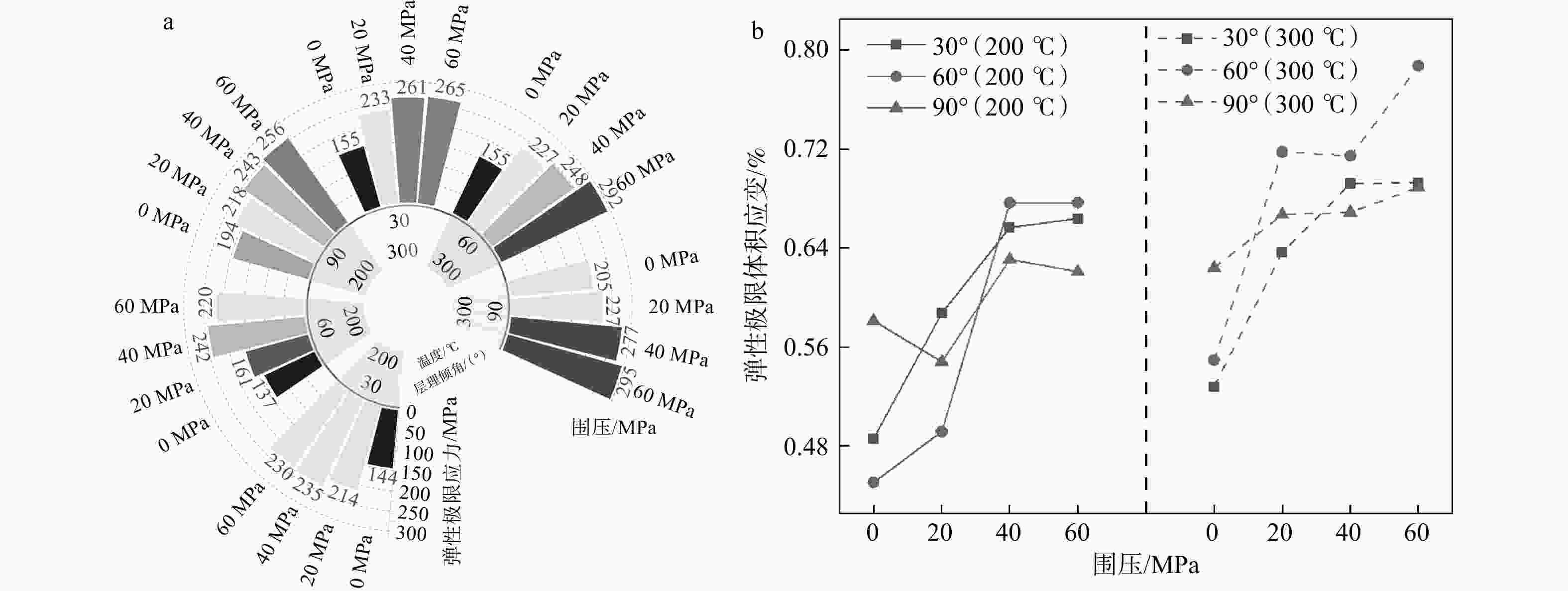
图 5 弹性极限应力和极限体积应变值
a—弹性极限应力;b—弹性极限体积应变
Figure 5. Elastic limit stress and limit volumetric strain values
(a) Elastic limit stress; (b) Elastic limit volumetric strain
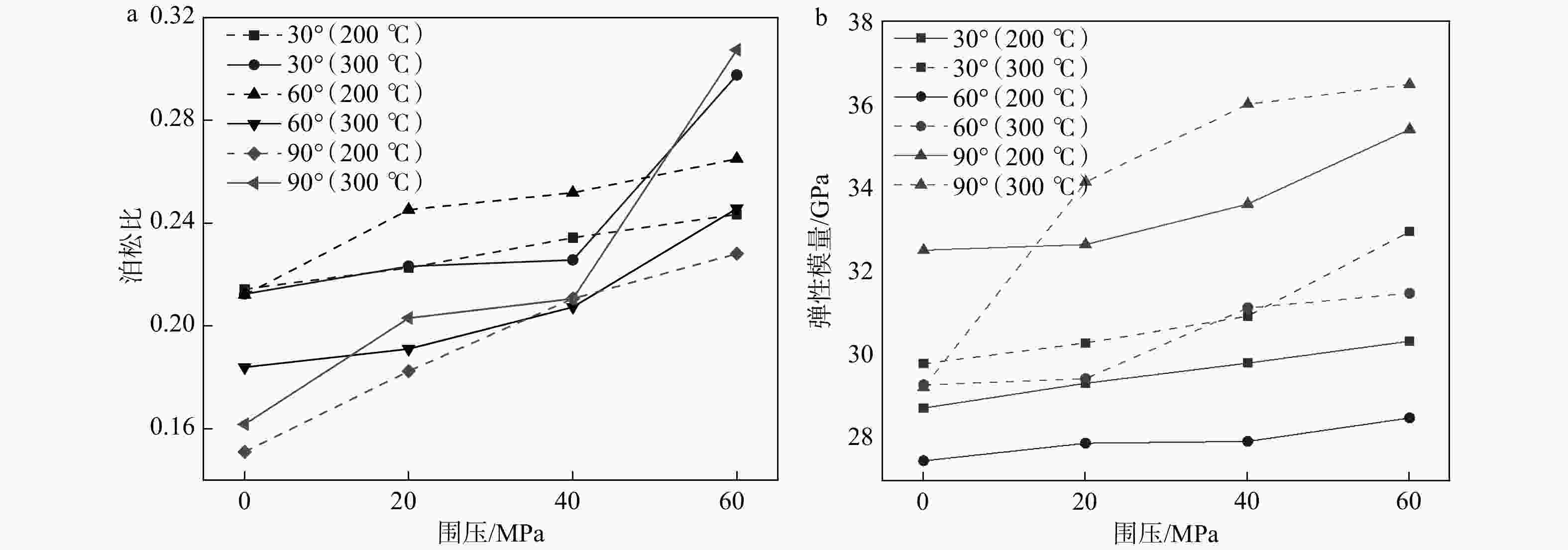
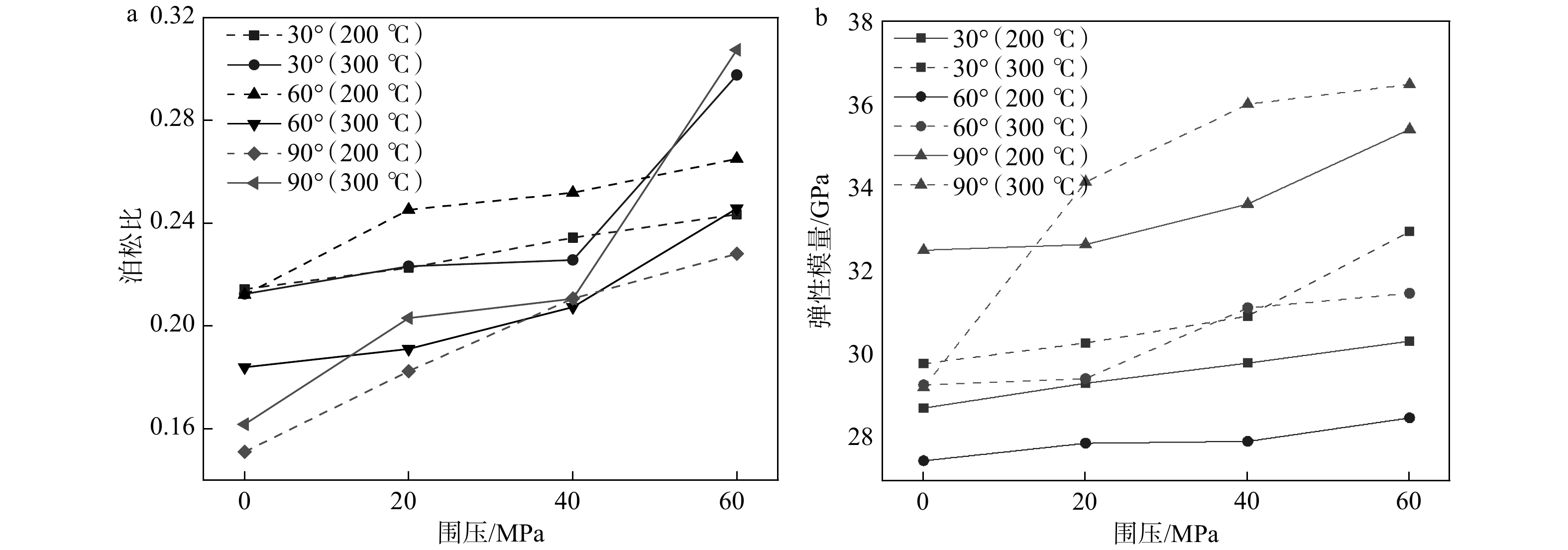
图 6 力学参数
a—泊松比;b—弹性模量
Figure 6. Mechanical parameters
(a) Poisson’s ratio; (b) Elastic modulus

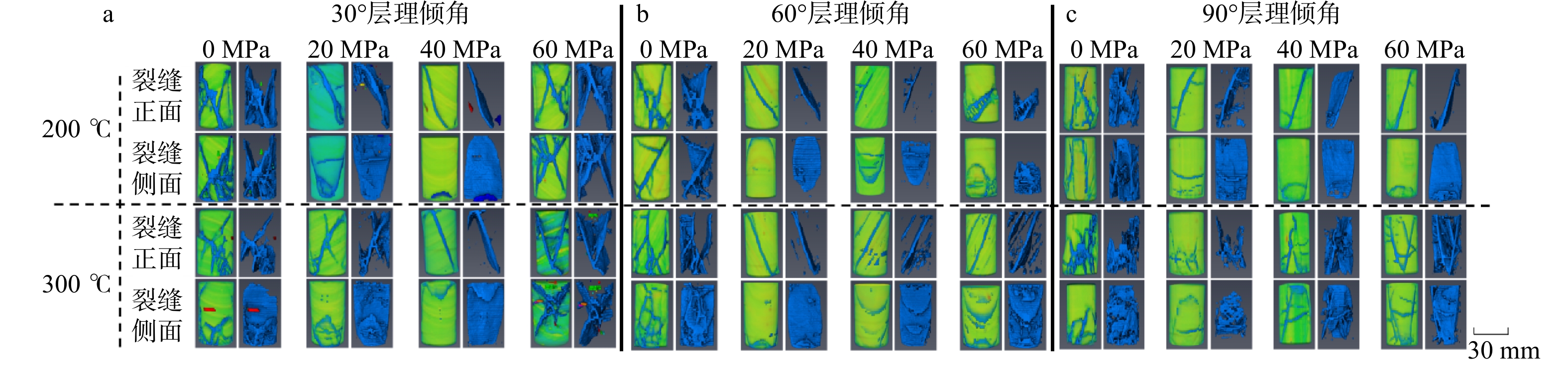
图 7 不同温度、围压下的层理性深层页岩破坏后CT图像
图中绿色代表岩石基质,蓝色代表裂缝a—30°层理倾角深层页岩的破坏后CT图像;b—60°层理倾角深层页岩的破坏后CT图像;c—90°层理倾角深层页岩的破坏后CT图像
Figure 7. Post-failure CT images of bedded deep shale under different temperatures and confining pressures
(a) Post-failure CT images of deep shale with a bedding dip angle of 30° ; (b) Post-failure CT images of deep shale with a bedding dip angle of 60°; (c) Post-failure CT images of deep shale with a bedding dip angle of 90° Green–rock matrix; Blue–fractures
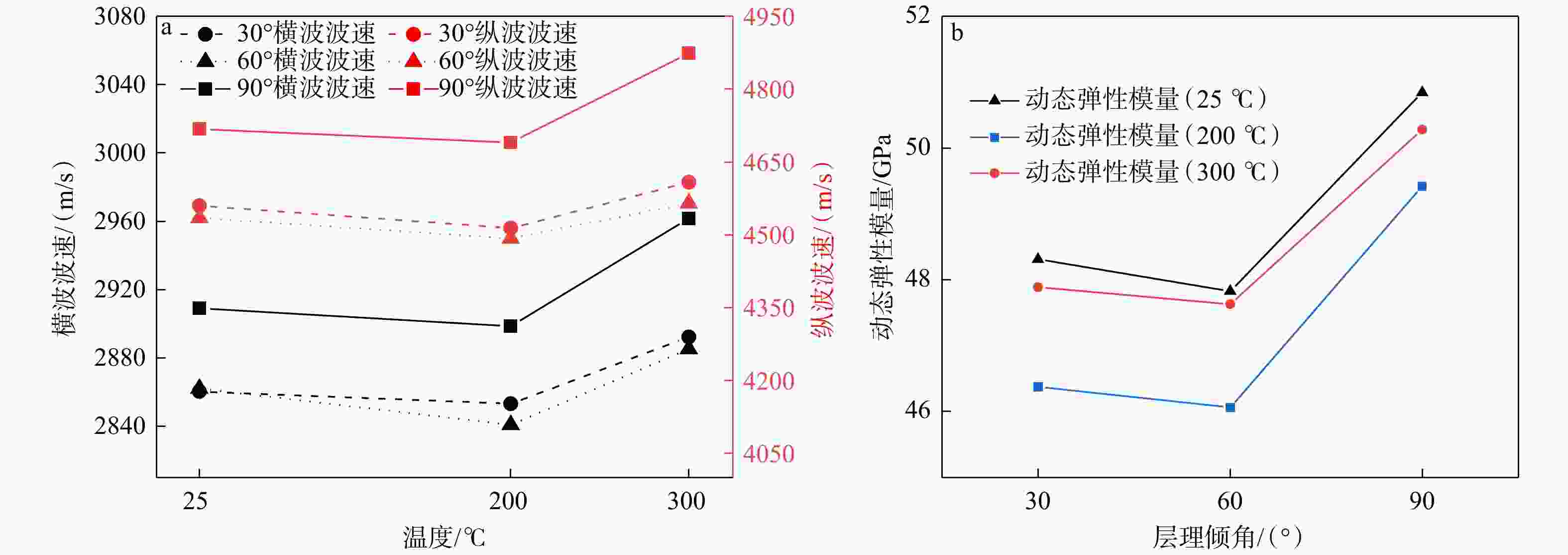
图 8 纵、横波速度的验证与分析
a—横、纵波波速;b—动态弹性模量;c—动态泊松比;d—动态剪切模量和动态体积模量
Figure 8. Validation and analysis of longitudinal and shear wave velocities
(a) Longitudinal and shear wave velocities; (b) Dynamic elastic modulus; (c) Dynamic Poisson’s ratio; (d) Dynamic shear modulus and dynamic bulk modulus

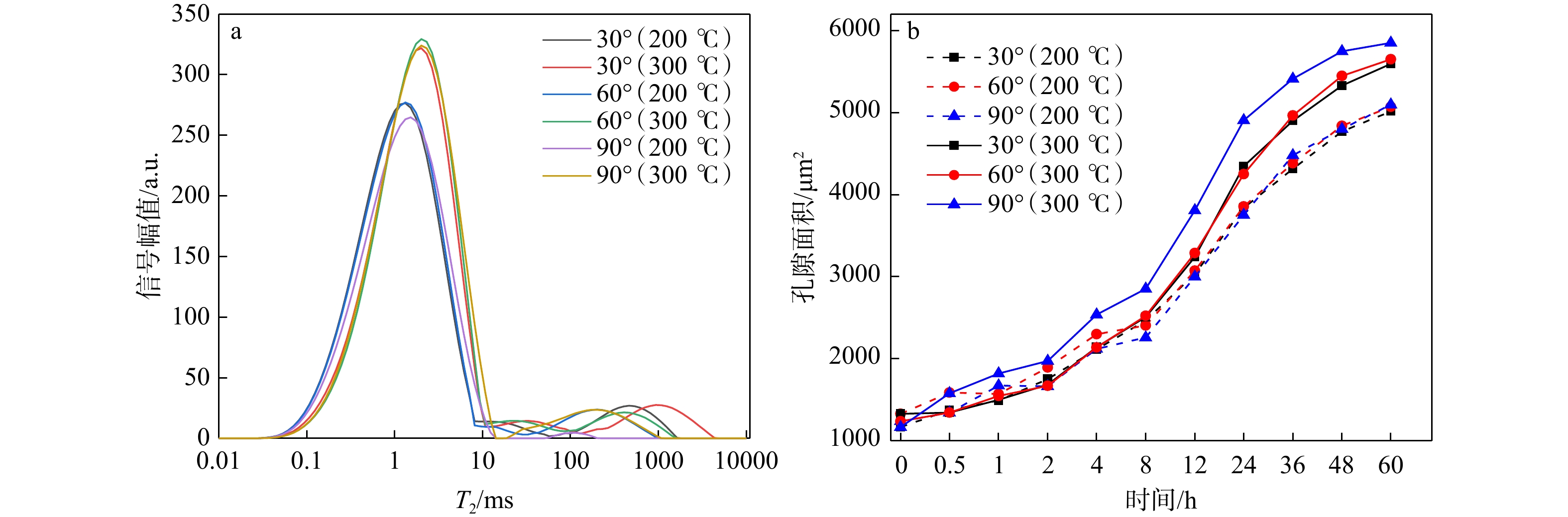
图 9 饱和条件下深层页岩的T2图谱和孔隙面积曲线
a—饱和条件下深层页岩的T2图谱;b—孔隙面积曲线
Figure 9. T2 spectrum and pore area curves of deep shale under saturation condition
(a) T2 spectrum of deep shale under saturation condition; (b) Pore area curves

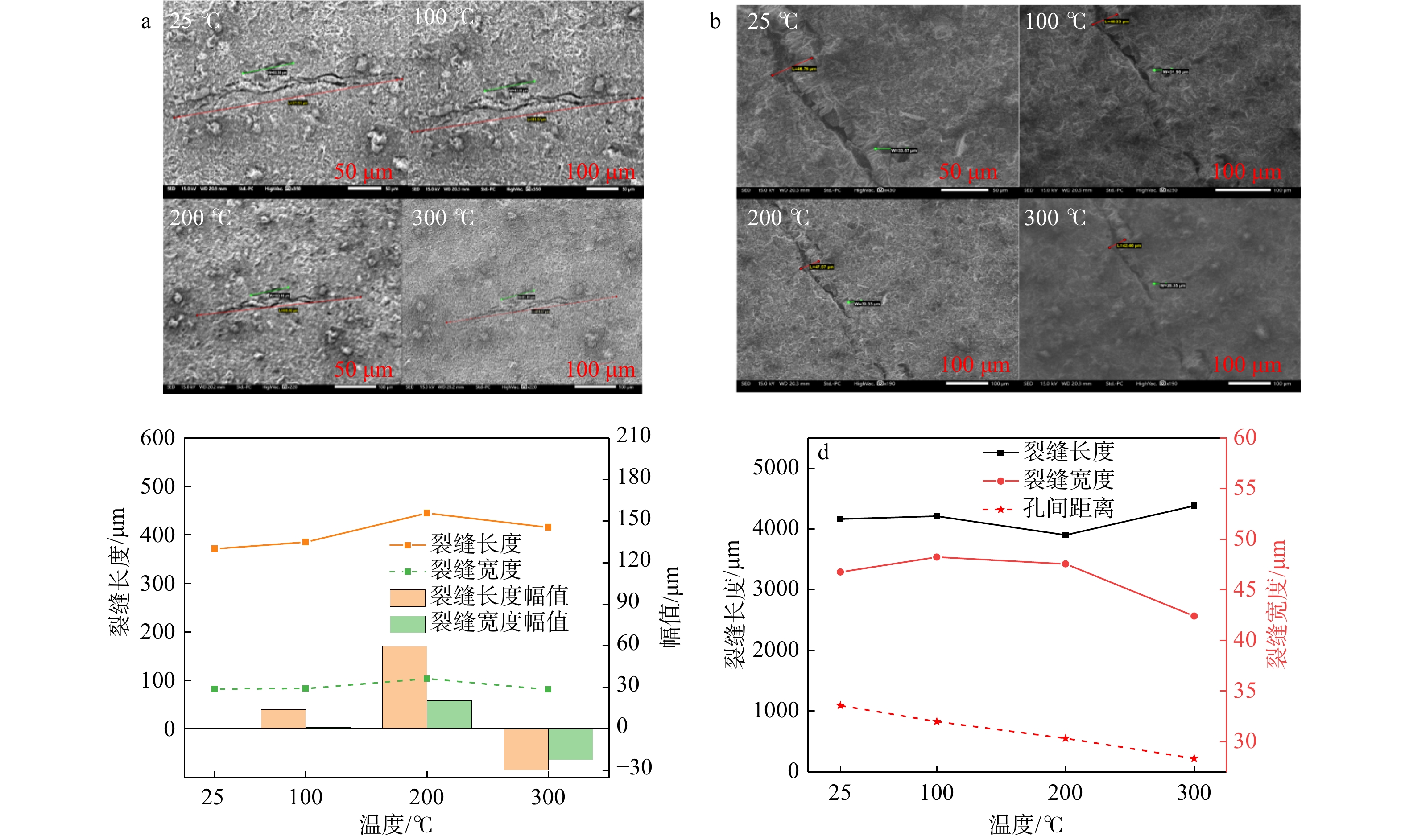
图 10 扫描电镜结果
a—垂直层理电镜扫描结果;b—倾斜层理电镜扫描结果;c—垂直层理几何参数;d—倾斜层理几何参数
Figure 10. SEM Results
(a) SEM image of vertical bedding; (b) SEM image of inclined bedding; (c) Geometric parameters of vertical bedding; (d) Geometric parameters of inclined bedding
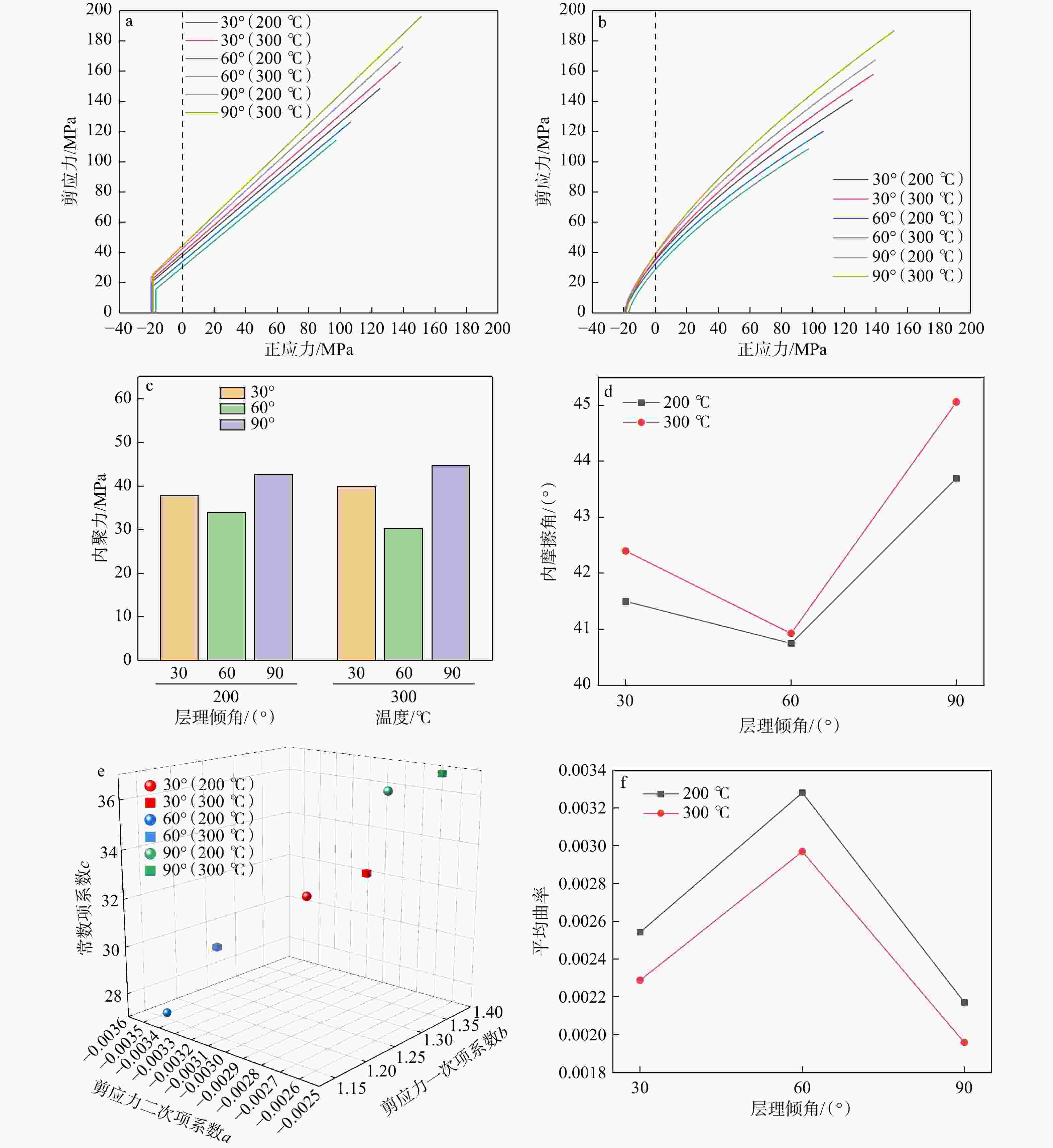
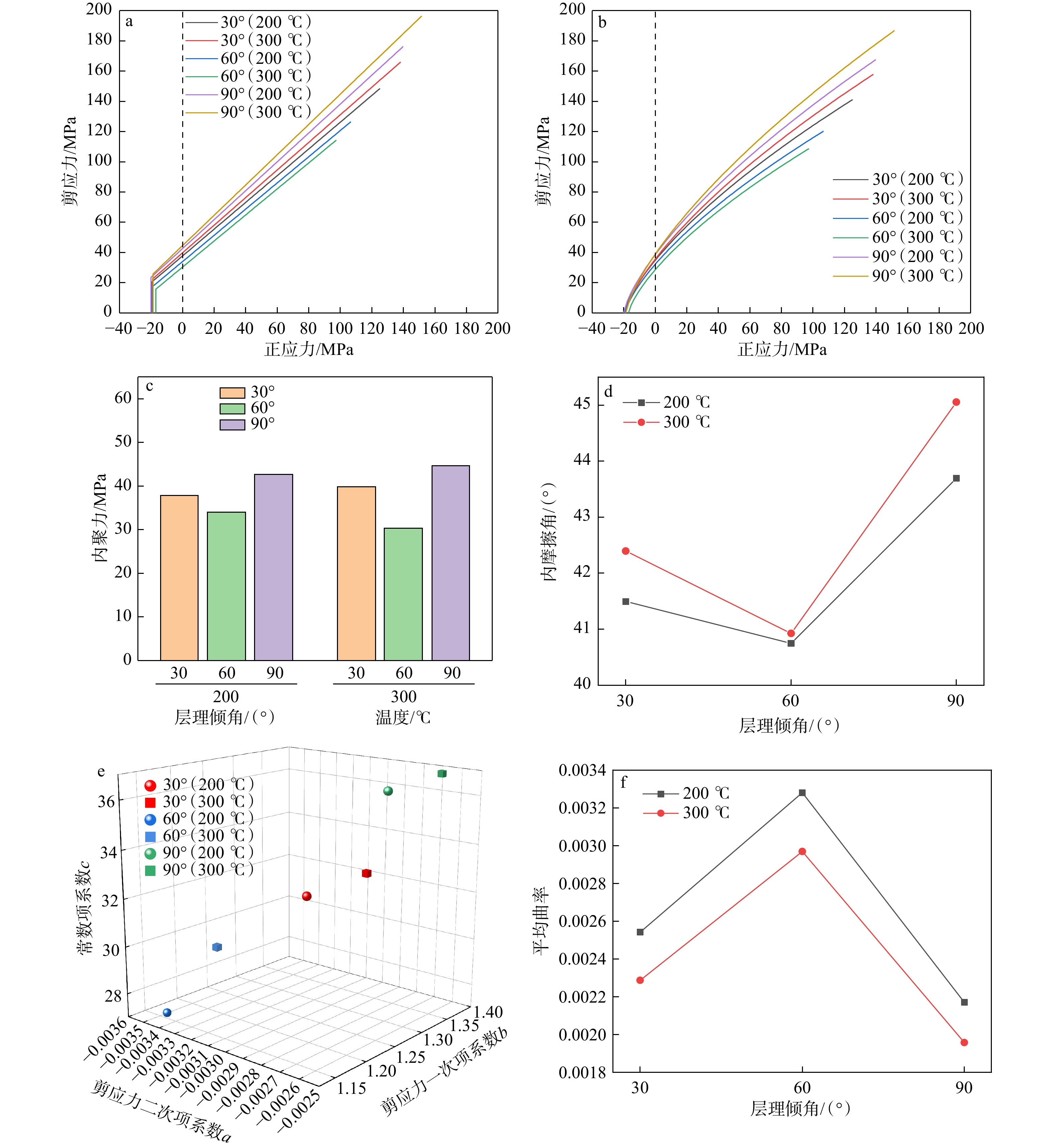
图 11 剪切应力−正应力空间下强度准则拟合效果
a—Mohr-Coulomb准则;b—Hoek-Brown准则;c—内聚力;d—内摩擦角;e—Hoek-Brown准则剪应力系数;f—平均曲率
Figure 11. Fitting effect of strength criteria in shear–normal stress space
(a) Mohr-Coulomb criterion; (b) Hoek-Brown criterion; (c) Cohesion; (d) angle of internal friction; (e) Hoek-Brown shear stress coefficient; (f) average curvature
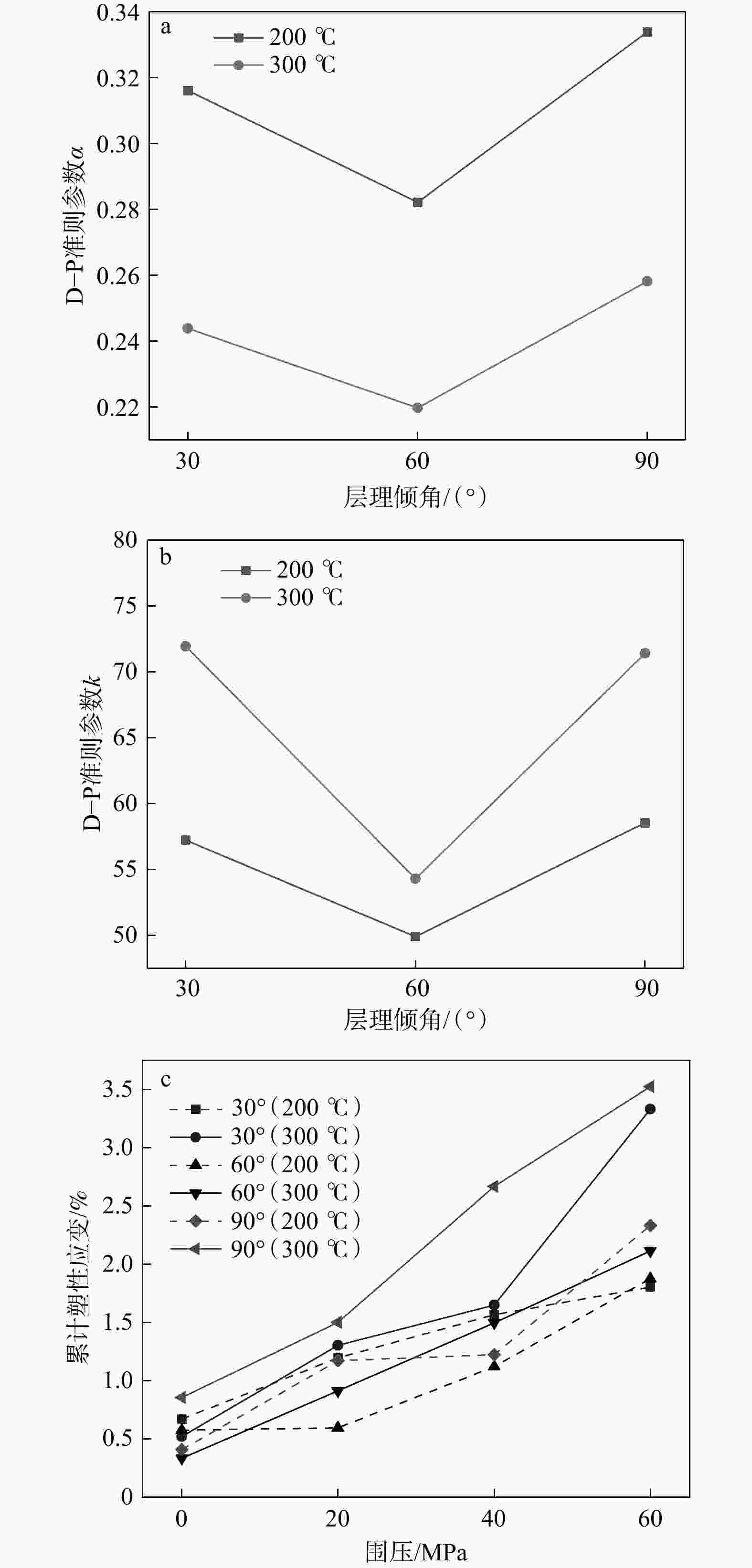
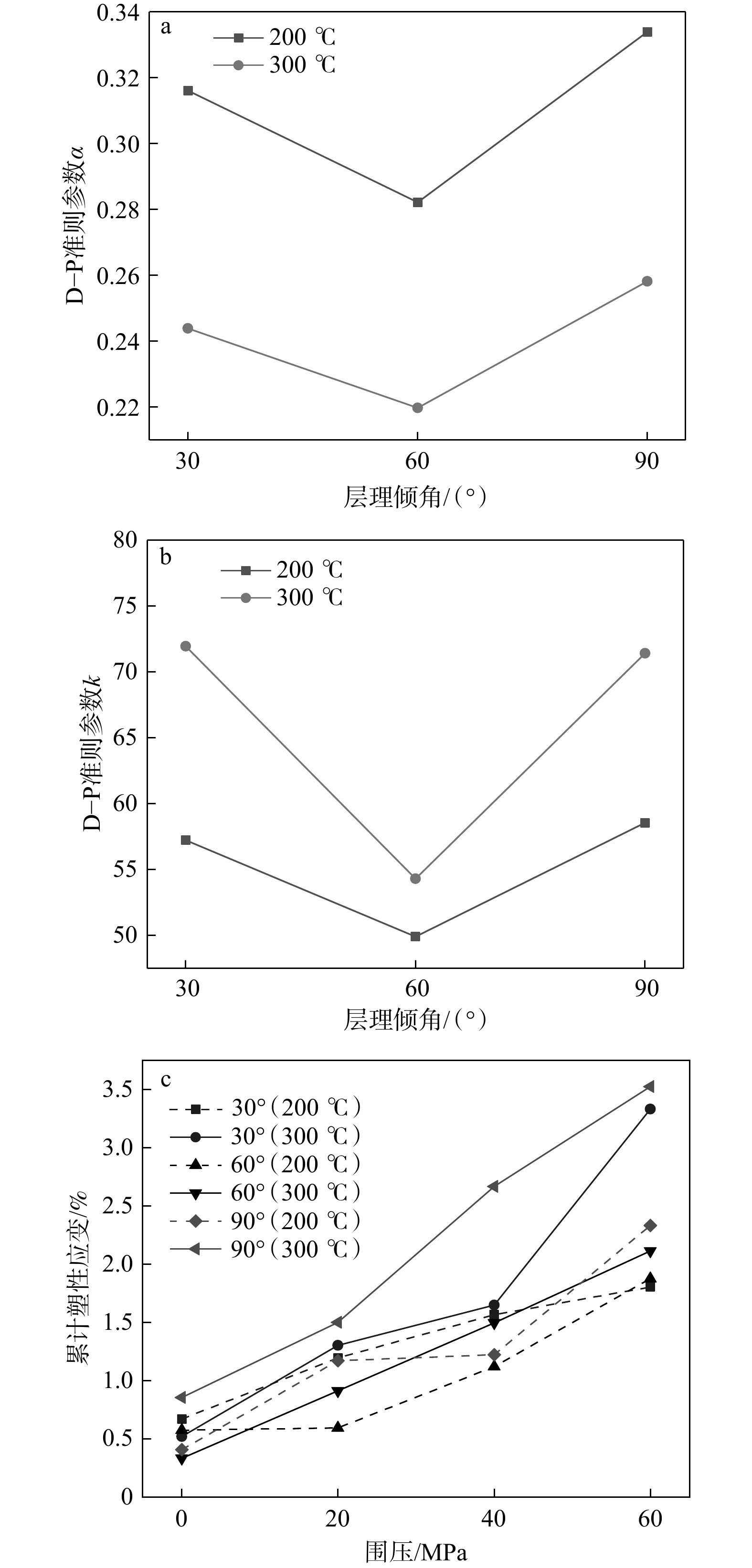
图 12 Drucker-Prager屈服准则的相关参数
a—模型参数α;b—模型参数k;c—累积塑性应变
Figure 12. Results of the Drucker-Prager yield criterion
(a) Model parameter α; (b) Model parameter k; (c) Cumulative plastic strain
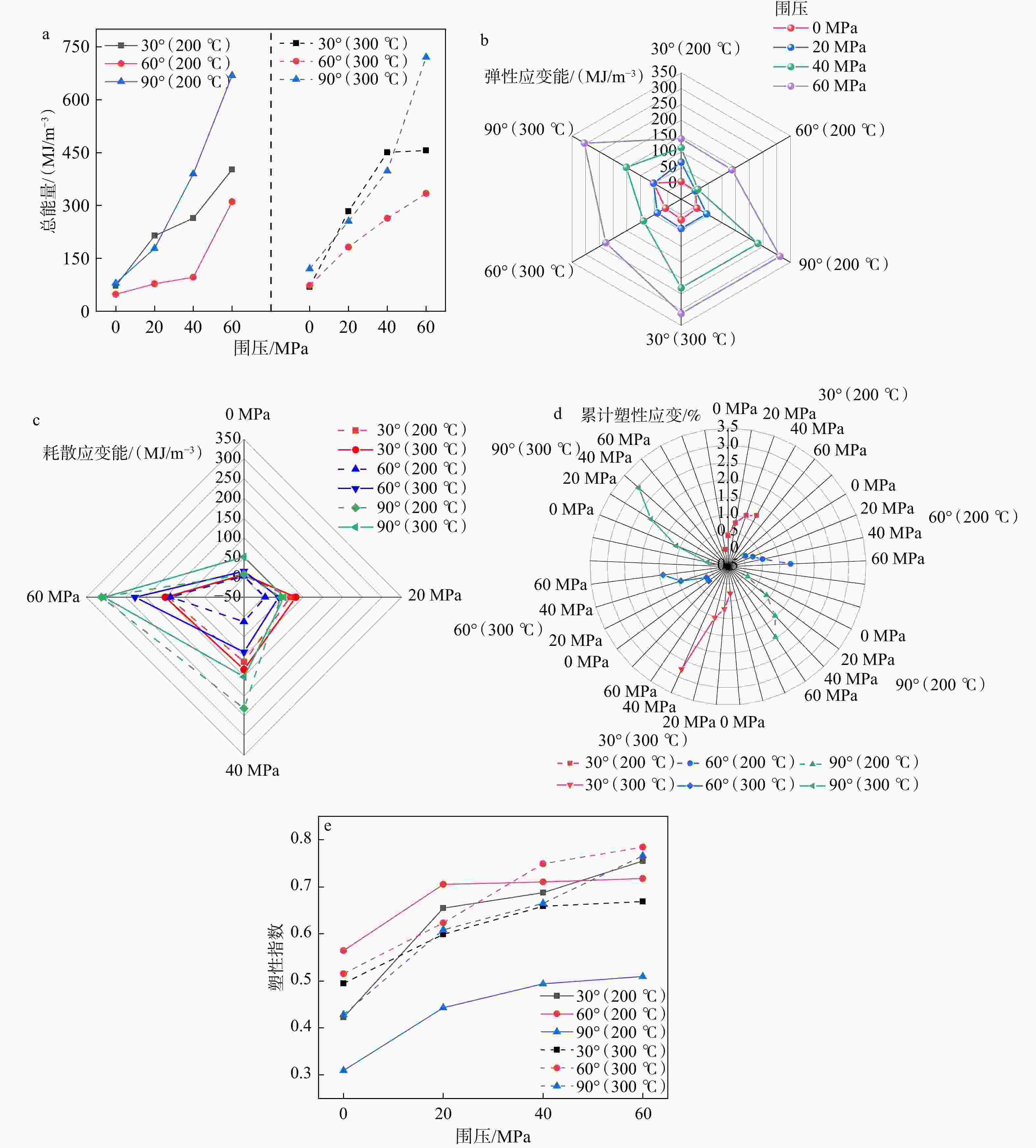
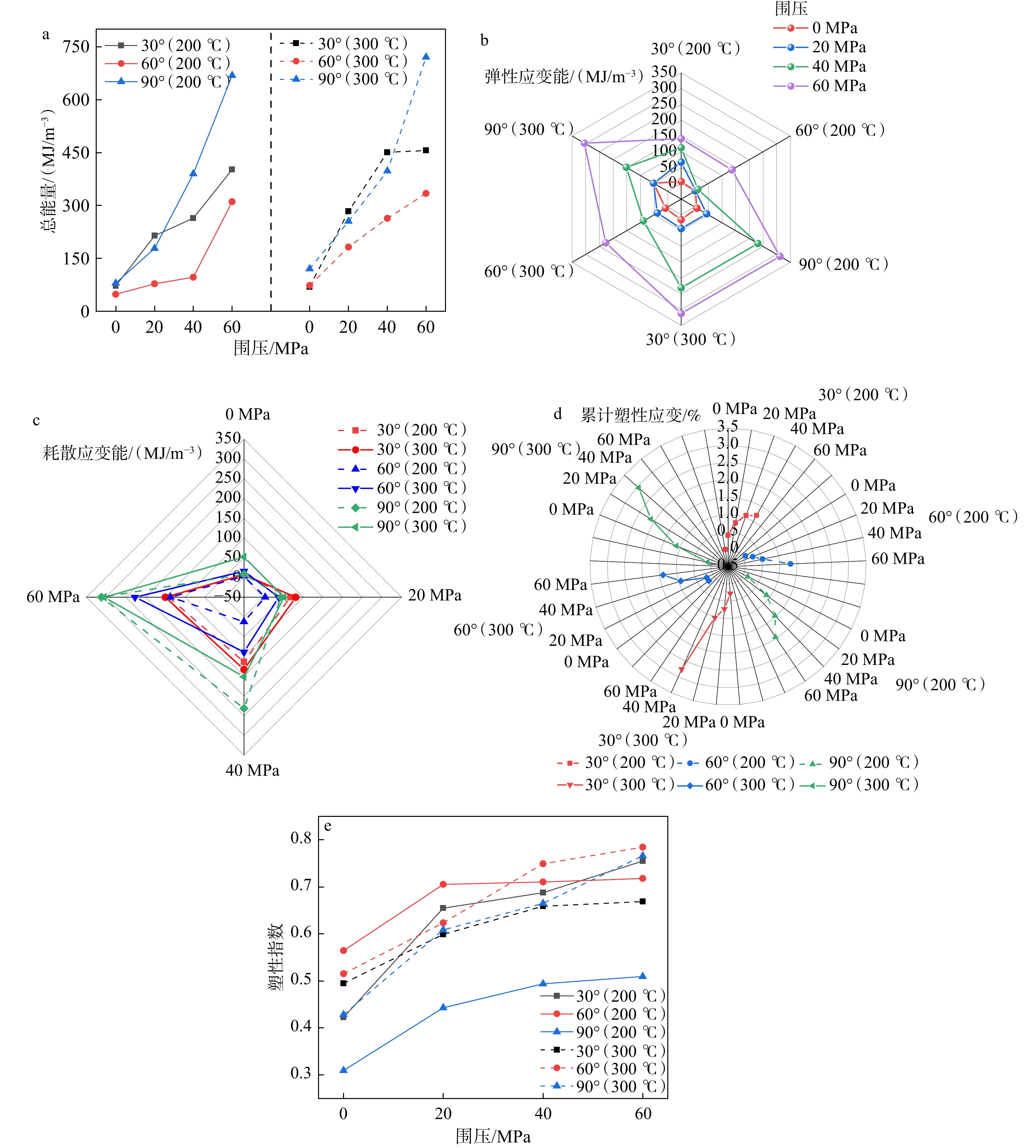
图 13 不同处理方式下的能量变化
a—总能量;b—弹性应变能;c—耗散应变能;d—累积塑性应变;e—塑性指数
Figure 13. Energy changes under different treatments
(a) Total energy; (b) Elastic strain energy; (c) Dissipative strain energy; (d) Cumulative plastic strain; (e) Plasticity index
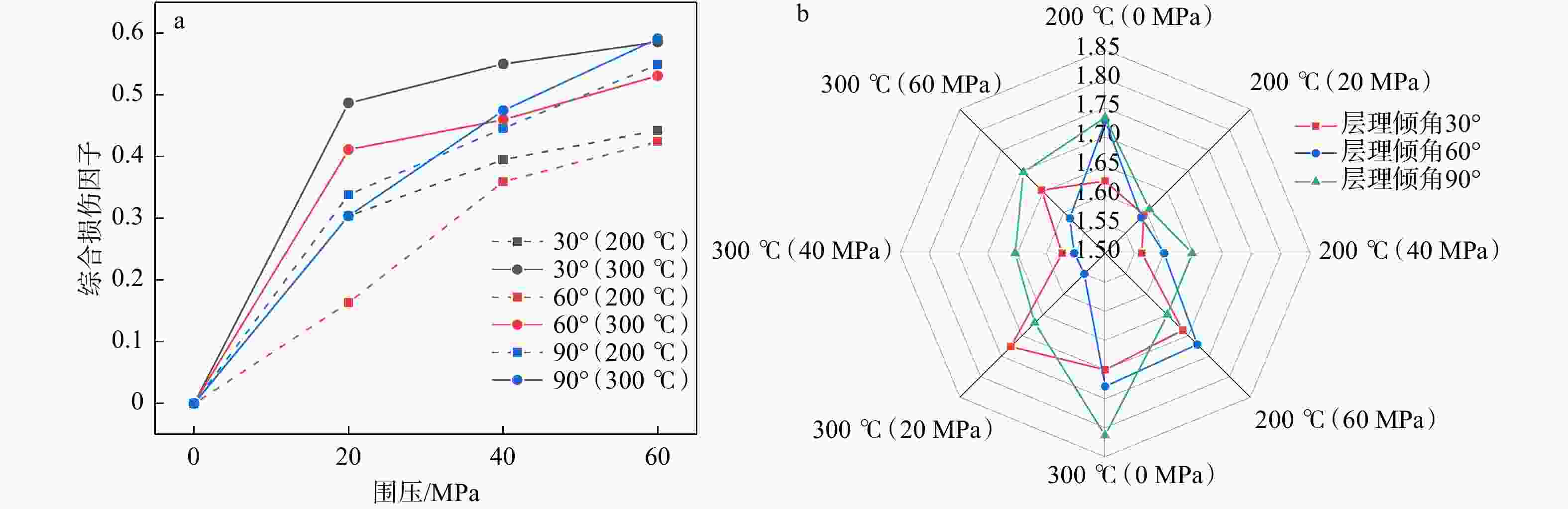
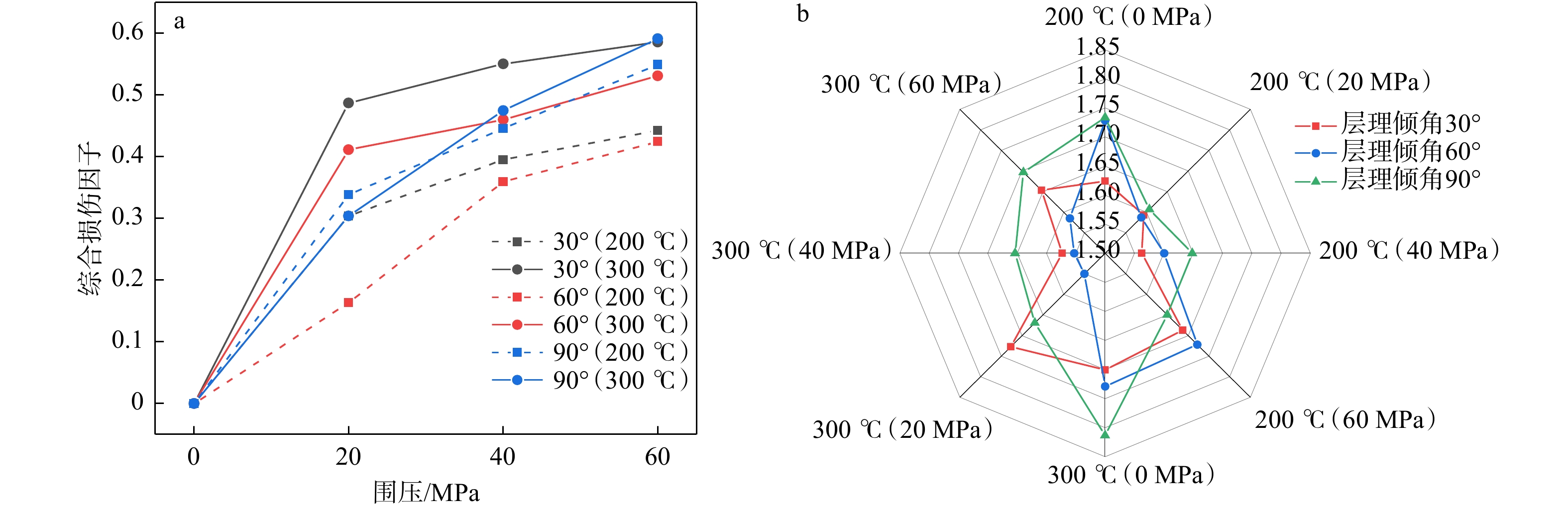
图 14 损伤与破坏定量表征
a—综合损伤因子;b—分形维数原理与结果
Figure 14. Quantitative characterization of damage and failure
(a) Comprehensive damage factor; (b) Principle and results of fractal dimension
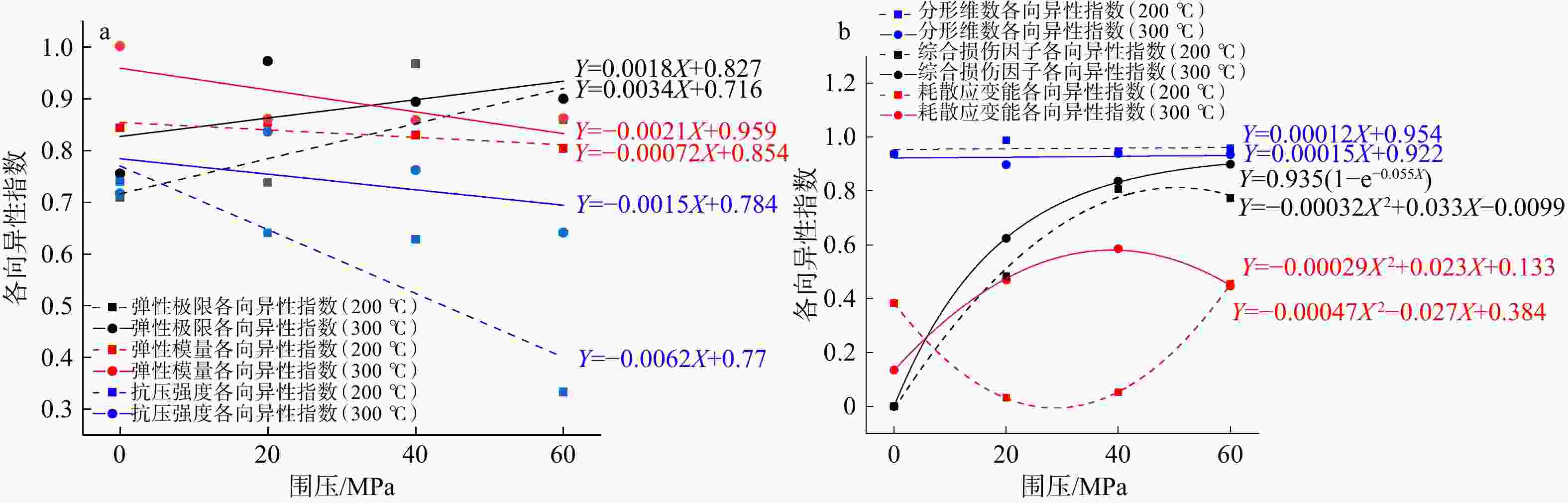
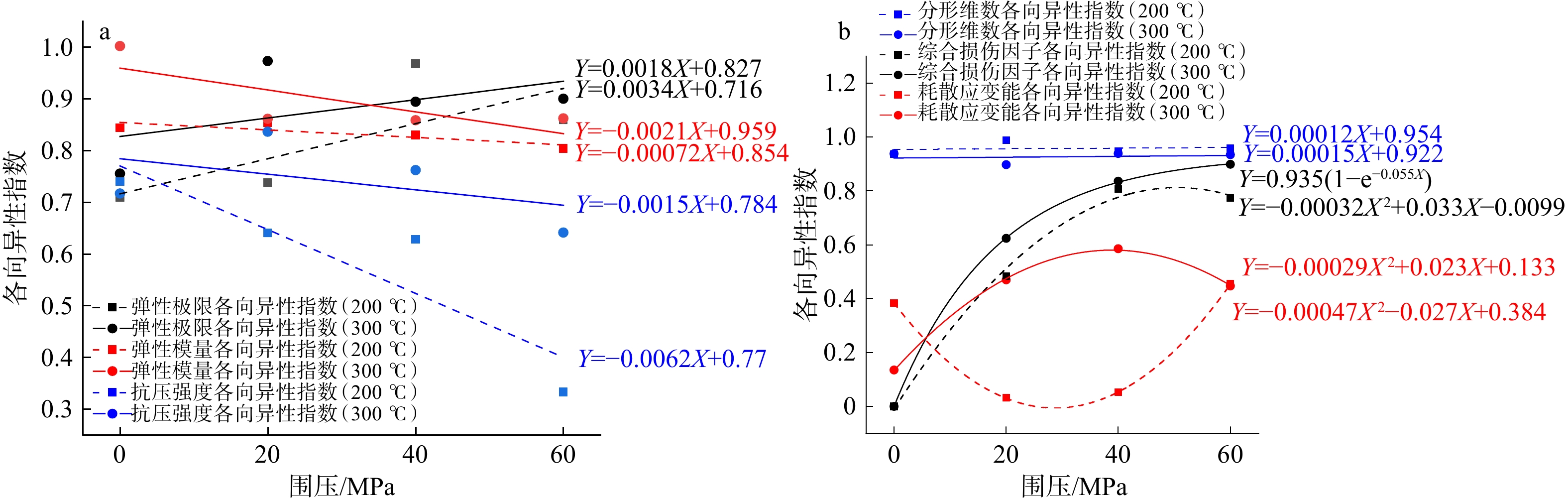
图 15 各向异性指数
a—变形特征的各向异性指数;b— 损伤破坏特征的各向异性指数
Figure 15. Anisotropy index
(a) Anisotropy index of deformation characteristics; (b) Anisotropy index of damage and failure characteristics
表 1 实验方案
Table 1. Experimental scheme
实验类型 层理倾角/(°) 温度/℃ 围压/MPa 三轴压缩力学实验 30 200/300 0/20/40/60 60 200/300 0/20/40/60 90 200/300 0/20/40/60 核磁共振实验 30 200/300 − 60 200/300 − 90 200/300 −  下载: 导出CSV
表 2 核磁共振二维灰度云图
Table 2. Two-dimensional grayscale nuclear magnetic resonance image
倾角
温度30°
200℃60°
200℃90°
200℃30°
300℃60°
300℃90°
300℃12 h 


24 h 


36 h 


48 h 


60 h 


 下载: 导出CSV
表 3 全岩矿物XRD测试结果
Table 3. XRD test results of whole-rock minerals
编号 层理倾角/(°) 温度/℃ 矿 物 含 量/% 石 英 钾长石 斜长石 方解石 白云石 黄铁矿 黏土矿物 1 90 25 30.1 0.1 0.6 19.5 42.0 1.3 6.4 2 90 100 35.0 0.3 0.6 17.0 38.0 1.1 8.0 3 90 200 44.3 0.6 1.1 16.8 23.9 0.5 12.8 4 90 300 38.6 0.4 0.3 18.7 29.7 1.1 11.2 5 60 300 37.7 0.3 0.3 17.6 33.1 0.9 10.1
下载: 导出CSV
表 4 黏土矿物XRD测试结果
Table 4. XRD test results of clay minerals
编号 层理倾角/(°) 温度/℃ 黏土矿物相对含量/% S I/S It Kao C C/S 1 90 25 ℃ / / 100 / / / 2 90 100 ℃ / / 100 / / / 3 90 200 ℃ / / 100 / / / 4 90 300 ℃ / / 96 / 4 / 5 60 300 ℃ / / 88 8 4 / 注:S—蒙皂石类; I/S—伊蒙混层; It—伊利石; Kao—高岭石; C—绿泥石;C/S—绿蒙混层
下载: 导出CSV
表 5 各种损伤因子计算方法
Table 5. Calculation methods of damage factors
定义方式 损伤因子 公式 符号注释 弹性模量 DE $ {D}_{{E}}=1-\dfrac{{{E}}_{1}}{{{E}}_{0}} $ E0、E1分别是温度或围压处理前后的弹性模量 泊松比 Dv $ {D}_{{v}}=1-\dfrac{{v}_{1}}{{v}_{0}} $ v0、v1分别是温度或围压处理前后的泊松比 抗压强度 Dσc $ {D}_{\sigma {\mathrm{c}}}=1-\dfrac{{\sigma }_{\mathrm{c}1}}{{\sigma }_{\mathrm{c}0}} $ σc0是单轴的抗压强度,σc1是其他处理下的抗压强度 总能量 DU $ {D}_{{U}}=1-\dfrac{{U}_{1}}{{U}_{0}} $ U0、U1分别是温度或围压处理前后的总能量 耗散应变能 DUd $ {D}_{{U{\mathrm{d}}}}=1-\dfrac{{U}_{\mathrm{d}}}{{U}_{\mathrm{c}}} $ Ud是耗散应变能,Uc是强度劣化所对应的临界耗能 弹性极限应力 Dσe $ {D}_{\sigma \mathrm{e}}=1-\dfrac{{\sigma }_{\mathrm{e}1}}{{\sigma }_{\mathrm{e}0}} $ σe0、σe1分别是温度或围压处理前后的弹性极限应力
下载: 导出CSV
表 6 不同损伤因子的权重
Table 6. Weights of different damage factors
权重 ω(DE) ω(Dv) ω(Dσc) ω(DU) ω(DUd) ω(Dσe) 倾角 温度 弹性模量 泊松比 抗压强度 总能量 耗散应变能 弹性极限应力 30° 200 ℃ 0.1981 0.1995 0.1963 0.1950 0.0451 0.1659 300 ℃ 0.1562 0.1361 0.1761 0.1752 0.1784 0.1777 60° 200 ℃ 0.1607 0.1723 0.1678 0.1697 0.1669 0.1624 300 ℃ 0.1591 0.1728 0.1728 0.1680 0.1538 0.1732 90° 200 ℃ 0.1697 0.1712 0.1594 0.1691 0.1596 0.1707 300 ℃ 0.1665 0.1562 0.1701 0.1727 0.1671 0.1673 平均值 0.1684 0.1681 0.1737 0.1749 0.1451 0.1695
下载: 导出CSV
-
[1] BAHADUR J, CHANDRA D, DAS A, et al., 2023. Pore anisotropy in shale and its dependence on thermal maturity and organic carbon content: a scanning SAXS study[J]. International Journal of Coal Geology, 273: 104268. doi: 10.1016/j.coal.2023.104268 [2] CAO W K, LIU W, LIU H L, et al., 2022. Effect of formation strength anisotropy on wellbore shear failure in bedding shale[J]. Journal of Petroleum Science and Engineering, 208: 109183. doi: 10.1016/j.petrol.2021.109183 [3] CHEN R, REN Z W, MENG Z H, et al., 2020. Oblique-incidence reflectivity difference method combined with deep learning for predicting anisotropy of invisible-bedding shale[J]. Energy Reports, 6: 795-801. doi: 10.1016/j.egyr.2020.04.004 [4] DENG H C, YANG B G, GAO Y N, et al., 2023. Mechanical weakening behavior and energy evolution characteristics of shale with different bedding angles after microwave irradiation[J]. Gas Science and Engineering, 119: 205141. doi: 10.1016/j.jgsce.2023.205141 [5] DICK M J, VESELINOVIC D, GREEN D, 2022. Review of recent developments in NMR core analysis[J]. Petrophysics, 63(3): 454-484. [6] DING X, ZHANG G Q, 2017. Coefficient of equivalent plastic strain based on the associated flow of the Drucker-Prager criterion[J]. International Journal of Non-Linear Mechanics, 93: 15-20. [7] DU M, YANG Z M, JIANG E Y, et al., 2024. Using digital cores and nuclear magnetic resonance to study pore-fracture structure and fluid mobility in tight volcanic rock reservoirs[J]. Journal of Asian Earth Sciences, 259: 105890. doi: 10.1016/j.jseaes.2023.105890 [8] FAN Z D, XIE H P, REN L, et al., 2022. Anisotropy in shear-sliding fracture behavior of layered shale under different normal stress conditions[J]. Journal of Central South University, 29(11): 3678-3694. doi: 10.1007/s11771-022-5156-9 [9] GAO Y, WANG B, HU Y D, et al., 2024a. Development of China's natural gas: review 2023 and outlook 2024[J]. Natural Gas Industry, 44(2): 166-177. (in Chinese with English abstract) [10] GAO H, XIE H P, ZHANG Z T, et al., 2024b. True triaxial energy evolution characteristics and failure mechanism of deep rock subjected to mining-induced stress[J]. International Journal of Rock Mechanics and Mining Sciences, 176: 105724. [11] GRIFFITHS D V, 1990. Failure criteria interpretation based on Mohr-Coulomb friction[J]. Journal of geotechnical engineering, 116(6): 986-999. [12] GUO X S, HU Z Q, LI S J, et al., 2023. Progress and prospect of natural gas exploration and research in deep and ultra-deep strata[J]. Petroleum Science Bulletin, 8(4): 461-474. (in Chinese with English abstract) [13] HAN B, YANG H W, 2019. Study on distribution characteristics of shale triaxial compression acoustic emission energy under different confining pressures[J]. Coal Science and Technology, 47(4): 90-95. (in Chinese with English abstract) [14] HE S, LI M, SHI S L, et al., 2024. Experimental study on the influence of rock pore structure on pressure stimulated voltage variations based on nuclear magnetic resonance[J]. Engineering Geology, 341: 107736. doi: 10.1016/j.enggeo.2024.107736 [15] HE X, CHEN G S, WU J F, et al., 2023. Deep shale gas exploration and development in the southern Sichuan Basin: new progress and challenges[J]. Natural Gas Industry B, 10(1): 32-43. doi: 10.1016/j.ngib.2023.01.007 [16] HOEK E, 1965. Rock fracture under static stress conditions [M]. Council for Scientific and Industrial Research Report MEG 383, 5751509. [17] HOEK E, MARTIN C D, 2014. Fracture initiation and propagation in intact rock–a review[J]. Journal of Rock Mechanics and Geotechnical Engineering, 6(4): 287-300. [18] HOU B, ZHANG R X, ZENG Y J, et al., 2018. Analysis of hydraulic fracture initiation and propagation in deep shale formation with high horizontal stress difference[J]. Journal of Petroleum Science and Engineering, 170: 231-243. doi: 10.1016/j.petrol.2018.06.060 [19] HOU L L, LIU X J, ZENG W, et al., 2024. Investigation of the effect of bedding and confining pressure on the energy evolution of shale during the unloading process[J]. Natural Gas Industry B, 11(4): 385-393. doi: 10.1016/j.ngib.2024.08.003 [20] HU C E, TAN J Q, LYU Q, et al., 2024. Evolution of organic pores in Permian low maturity shales from the Dalong Formation in the Sichuan Basin: Insights from a thermal simulation experiment[J]. Gas Science and Engineering, 121: 205166. [21] HU S Q, WU Y, YAN Y Q, et al., 2024. Parameter optimization study of three-dimensional well network-fracture network coupled fracturing in jimsar shale oil[J]. Unconventional Resources, 4: 100102. doi: 10.1016/j.uncres.2024.100102 [22] HUANG G T, BA J, GEI D, et al., 2023. Amplitude variation with angle and azimuth inversion to estimate fracture properties in shale-gas reservoirs[J]. Gas Science and Engineering, 111: 204919. doi: 10.1016/j.jgsce.2023.204919 [23] HUO T W, WANG D B, ZHU H Y, et al., 2025. Experimental study on the elastic-plastic deformation and damage failure mechanism of hot dry rock after alternating temperature loading (unconfined pressure condition) pretreatment[J]. SPE Journal, 30(5): 2686-2706. doi: 10.2118/225436-PA [24] IQBAL O, PADMANABHAN E, MANDAL A, et al., 2021. Characterization of geochemical properties and factors controlling the pore structure development of shale gas reservoirs[J]. Journal of Petroleum Science and Engineering, 206: 109001. doi: 10.1016/j.petrol.2021.109001 [25] JACOBS T, 2018. In the battle against frac hits, shale producers go to new extremes[J]. Journal of Petroleum Technology, 70(8): 35-38. doi: 10.2118/0818-0035-jpt [26] JIANG C B, XU L, CHEN Y F, et al., 2024. Thermal behavior of minerals in shale and its influence on evolution of gas-flow channels under thermal shock[J]. Gas Science and Engineering, 121: 205183. doi: 10.1016/j.jgsce.2023.205183 [27] JIN J D, WANG L J, YAN Z L, et al., 2024. Effects of strain rate and bedding on shale fracture mechanisms[J]. International Journal of Mechanical Sciences, 277: 109398. doi: 10.1016/j.ijmecsci.2024.109398 [28] JOHNSTON D H, 1987. Physical properties of shale at temperature and pressure[J]. Geophysics, 52(10): 1391-1401. doi: 10.1190/1.1892844 [29] JU Y W, HOU X G, HAN K, et al., 2024. Experimental deformation of shales at elevated temperature and pressure: Pore-crack system evolution and its effects on shale gas reservoirs[J]. Petroleum Science, 21(6): 3754-3773. doi: 10.1016/j.petsci.2024.07.003 [30] KIVI I R, AMERI M, MOLLADAVOODI H, 2018. An experimental investigation on deformation and failure behavior of carbonaceous Garau shale in Lurestan Basin, west Iran: application in shale gas development[J]. Journal of Natural Gas Science and Engineering, 55: 135-153. doi: 10.1016/j.jngse.2018.04.028 [31] KLAVER J, DESBOIS G, LITTKE R, et al., 2015. BIB-SEM characterization of pore space morphology and distribution in postmature to overmature samples from the Haynesville and Bossier Shales[J]. Marine and petroleum Geology, 59: 451-466. doi: 10.1016/j.marpetgeo.2014.09.020 [32] LEI B, ZUO J P, LIU H Y, et al., 2021. Experimental and numerical investigation on shale fracture behavior with different bedding properties[J]. Engineering Fracture Mechanics, 247: 107639. doi: 10.1016/j.engfracmech.2021.107639 [33] LI J B, XIE M C, WANG S L, et al., 2024. Study on the influence of thermo-pressure coupling environment on the fracture properties of shale in deep reservoirs[J]. Theoretical and Applied Fracture Mechanics, 131: 104440. doi: 10.1016/j.tafmec.2024.104440 [34] LI Y, CHENG Y F, YAN C L, et al., 2023. Triaxial creep tests and the visco-elastic-plastic constitutive model of hydrate formations[J]. Gas Science and Engineering, 115: 205006. doi: 10.1016/j.jgsce.2023.205006 [35] LI Z Y, WU G, HUANG T Z, et al. , 2018. Variation of energy and criteria for strength failure of shale under traixial cyclic loading[J]. Chinese Journal of Rock Mechanics and Engineering, 37(3), 662-670. [36] LIANG X, WU J, QI W C, et al., 2024. Study on the dynamic characteristics and microscopic damage features of shale under high temperature[J]. Conservation and Utilization of Mineral Resources, 44(4): 48-57. (in Chinese with English abstract) [37] LIU Q, SUN M D, SUN X D, et al., 2023. Pore network characterization of shale reservoirs through state-of-the-art X-ray computed tomography: a review[J]. Gas Science and Engineering, 113: 204967. doi: 10.1016/j.jgsce.2023.204967 [38] LUO S, GONG F Q, LI L L, et al., 2023. Linear energy storage and dissipation laws and damage evolution characteristics of rock under triaxial cyclic compression with different confining pressures[J]. Transactions of Nonferrous Metals Society of China, 33(7): 2168-2182. [39] LIU W J, QIAN X D, LI T, et al., 2019. Investigation of the tool-rock interaction using Drucker-Prager failure criterion[J]. Journal of Petroleum Science and Engineering, 173: 269-278. [40] LIU Y, FANG Y, SU Y, et al., 2023. A quantitative analysis procedure for solving safety factor of tunnel preliminary support considering the equivalence between Hoek–Brown and Mohr–Coulomb criteria[J]. Soils and Foundations, 63(4): 101356. [41] MA C, ZHU C J, ZHOU J X, et al., 2022. Dynamic response and failure characteristics of combined rocks under confining pressure[J]. Scientific Reports, 12(1): 12187. doi: 10.1038/s41598-022-16299-9 [42] MA X H, WANG H Y, ZHOU S W, et al., 2021. Deep shale gas in China: geological characteristics and development strategies[J]. Energy Reports, 7: 1903-1914. doi: 10.1016/j.egyr.2021.03.043 [43] MEMON K R, ALI M, AWAN F U R, et al., 2021. Influence of cryogenic liquid nitrogen cooling and thermal shocks on petro-physical and morphological characteristics of Eagle Ford shale[J]. Journal of natural gas science and engineering, 96: 104313. doi: 10.1016/j.jngse.2021.104313 [44] MENG S W, LI D X, LIU X H, et al., 2023. Study on dynamic fracture growth mechanism of continental shale under compression failure[J]. Gas Science and Engineering, 114: 204983. doi: 10.1016/j.jgsce.2023.204983 [45] MENG X R, WU Z H, 2024. Experimental and numerical simulations of the mechanical properties of shale under high temperature[J]. Soil Engineering and Foundation, 38(1): 157-162. (in Chinese with English abstract) [46] NIE Y X, WU B S, ZHANG G Q, et al., 2024. Influence of the CO2–brine–rock interaction on the plastic zone of sandstone[J]. Gas Science and Engineering, 128: 205379. doi: 10.1016/j.jgsce.2024.205379 [47] NILANKAR K, SINGH D, SINGH H K, et al., 2024. Characterization and behavior of Raniganj shale under heated environment[J]. Fuel, 366: 131377. doi: 10.1016/j.fuel.2024.131377 [48] PAN H Y, SHUAI J B, LI J H, et al., 2025. Analysis of deformation behavior characteristics of double-prevention boreholes based on pearson correlation coefficient[J]. Rock Mechanics and Rock Engineering, 58(6): 6893-6915. doi: 10.1007/s00603-025-04500-0 [49] REN J F, LIU X J, XIONG J, et al., 2023. Experimental study on the acoustic wave propagation characteristics of bedding shales under changes in temperature and pressure[J]. Natural Gas Industry B, 10(5): 407-418. doi: 10.1016/j.ngib.2023.09.002 [50] SINGER P M, CHEN Z L, HIRASAKI G J, 2016. Fluid typing and pore size in organic shale using 2D NMR in saturated kerogen isolates[J]. Petrophysics, 57(6): 604-619. [51] SOHAIL G M, YASIN Q, RADWAN A E, et al., 2023. Estimating hardness and Young's modulus of shale using drill cuttings: implications for hydraulic fracturing in shale gas reservoir development[J]. Gas Science and Engineering, 118: 205116. doi: 10.1016/j.jgsce.2023.205116 [52] SUN C X, NIE H K, SU H K, et al., 2023. Porosity, permeability and rock mechanics of Lower Silurian Longmaxi Formation deep shale under temperature-pressure coupling in the Sichuan Basin, SW China[J]. Petroleum Exploration and Development, 50(1): 77-88. (in Chinese with English abstract) doi: 10.1016/s1876-3804(22)60371-9 [53] SUN H, ZHAO L S, WEI L C, et al., 2024. Numerical study of the influence of multiple parameters on hang-ups: insight from a structural and mechanical characteristics analysis[J]. Rock Mechanics and Rock Engineering, 57(5): 4073-4087. doi: 10.1007/s00603-024-03783-z [54] SUO Y, ZHAO Y J, FU X F, et al., 2023. Acoustic and mechanical tests of sandstone-shale composites in Songliao Basin and prediction of uniaxial compressive strength[J]. Geoenergy Science and Engineering, 228: 212034. doi: 10.1016/j.geoen.2023.212034 [55] TAO L, LI Z J, SHI K, et al. , 2021. Experimental study on expansion law of micro-fractures induced by shale hydration[C]//Proceedings of the unconventional resources technology conference. 117-127. [56] TIAN D, ZHENG H, 2023. The generalized Mohr-Coulomb failure criterion[J]. Applied Sciences, 13(9): 5405. [57] VACHAPARAMPIL A, GHASSEMI A, 2017. Failure characteristics of three shales under true-triaxial compression[J]. International Journal of Rock Mechanics and Mining Sciences, 100: 151-159. [58] VISHAL V, RIZWAN M, MAHANTA B, et al., 2022. Temperature effect on the mechanical behavior of shale: implication for shale gas production[J]. Geosystems and Geoenvironment, 1(4): 100078. doi: 10.1016/j.geogeo.2022.100078 [59] WANG D B, QU Z, LIU C, et al., 2024a. A numerical investigation into the propagation of acid-etched wormholes in geothermal wells[J]. Unconventional Resources, 4: 100083. doi: 10.1016/j.uncres.2024.100083 [60] WANG D B, DONG Y C, WEI C L, et al., 2025a. Expansion-induced fracture propagation in deep geothermal reservoirs under alternate-temperature loading[J]. Advances in Geo-Energy Research, 15(3): 261-272. doi: 10.46690/ager.2025.03.08 [61] WANG L N, TAO C Q, YIN X M, et al., 2022. Evolution of deformation field and energy of organic-rich oil shale under uniaxial compression[J]. Rock and Soil Mechanics, 43(6): 1557-1570. (in Chinese with English abstract) [62] WANG Q Y, WANG D B, YU B, et al., 2024b. Evolution of elastic-plastic characteristics of rocks within middle-deep geothermal reservoirs under high temperature[J]. Natural Resources Research, 33(4): 1573-1596. doi: 10.1007/s11053-024-10342-4 [63] WANG Q Y, WANG D B, FU W, et al., 2024c. Effects of saturated fluids on petrophysical properties of hot dry rock at high temperatures: an experimental study[J]. Geothermics, 121: 103048. doi: 10.1016/j.geothermics.2024.103048 [64] WANG Q Y, WANG D B, LI X H, et al., 2025b. Experimental investigation on the elastic-plastic failure evolution mechanism of high-temperature hot dry rocks using combined monitoring of acoustic emission and digital image correlation[J]. Geothermics, 131: 103359. doi: 10.1016/j.geothermics.2025.103359 [65] WANG Q Y, WANG D B, ZHU H Y, et al., 2025c. Experimental investigation on fracture propagation in heat-treated granite samples during true triaxial temporary plugging and diversion fracturing[J]. Journal of Energy Resources Technology, Part B: Subsurface Energy and Carbon Capture, 1(4): 041005. doi: 10.1115/1.4068535 [66] WANG X J, LIANG L X, ZHAO L, et al., 2019. Rock mechanics and fracability evaluation of the Lucaogou Formation oil shales in Jimusaer sag, Junggar Basin[J]. Oil & Gas Geology, 40(3): 661-668. (in Chinese with English abstract) [67] WANG Y, FENG W K, ZHAO Z H, et al., 2019. Anisotropic energy and ultrasonic characteristics of black shale under triaxial deformation revealed utilizing real-time ultrasonic detection and post-test CT imaging[J]. Geophysical Journal International, 219(1): 260-270. doi: 10.1093/gji/ggz282 [68] WANG Y, LIU D Q, ZHAO Z H, et al., 2020. Investigation on the effect of confining pressure on the geomechanical and ultrasonic properties of black shale using ultrasonic transmission and post-test CT visualization[J]. Journal of Petroleum Science and Engineering, 185: 106630. doi: 10.1016/j.petrol.2019.106630 [69] WEI J G, LI J T, ZHANG A, et al., 2023. Influence of shale bedding on development of microscale pores and fractures[J]. Energy, 282: 128844. doi: 10.1016/j.energy.2023.128844 [70] XI Y, XING J H, WANG H J, et al., 2024. Evaluation of pore characteristics evolution and damage mechanism of granite under thermal-cooling cycle based on nuclear magnetic resonance technology[J]. Geoenergy Science and Engineering, 241: 213101. doi: 10.1016/j.geoen.2024.213101 [71] YANG G L, LIU J, LI X G, et al., 2020. Effect of temperature on shale strength under dynamic impact loading[J]. Arabian Journal of Geosciences, 13(12): 432. doi: 10.1007/s12517-020-05435-2 [72] YANG L, SHENG X C, ZHANG B, et al., 2023. Propagation behavior of hydraulic fractures in shale under triaxial compression considering the influence of sandstone layers[J]. Gas Science and Engineering, 110: 204895. doi: 10.1016/j.jgsce.2023.204895 [73] YANG S Q, ZHANG Q L, YANG D, et al., 2024. Research on the evolution law of mechanics and fracture characteristics of oil shale under real-time high temperature conditions[J]. Chinese Journal of Rock Mechanics and Engineering, 43(11): 2700-2711. (in Chinese with English abstract) [74] YE P P, LI B B, REN C H, et al., 2024. Investigation on damage-permeability model of dual-porosity coal under thermal-mechanical coupling effect[J]. Gas Science and Engineering, 123: 205229. doi: 10.1016/j.jgsce.2024.205229 [75] YUAN S B, WANG H, LI L H, et al., 2024. Study on the formation mechanism of shale thermal cracks based on particle flow numerical simulation[J]. International Communications in Heat and Mass Transfer, 150: 107166. doi: 10.1016/j.icheatmasstransfer.2023.107166 [76] YUAN Y J, REZAEE R, ZHOU M F, et al., 2023. A comprehensive review on shale studies with emphasis on nuclear magnetic resonance (NMR) technique[J]. Gas Science and Engineering, 120: 205163. doi: 10.1016/j.jgsce.2023.205163 [77] YUAN Y S, LIU J X, ZHOU Y, 2018. Brittle-ductile transition zone of shale and its implications in shale gas exploration[J]. Oil & Gas Geology, 39(5): 899-906. (in Chinese with English abstract) [78] ZANGQA S, SAFFOU E, GHOLAMI R, et al., 2024. Hydraulic fracturing potential of tight gas reservoirs: a case study from a gas field in the Bredasdorp Basin, South Africa[J]. Gas Science and Engineering, 128: 205364. doi: 10.1016/j.jgsce.2024.205364 [79] ZHANG N, GUO S H, WANG S D, et al., 2024a. Fractal and multifractal characteristics on pore structure of coal-based sedimentary rocks using nuclear magnetic resonance[J]. SPE Journal, 29(5): 2624-2637. doi: 10.2118/219457-PA [80] ZHANG P Y, ZHANG D X, ZHAO J L, 2024b. Control of fracture toughness of kerogen on artificially-matured shale samples: an energy-based nanoindentation analysis[J]. Gas Science and Engineering, 124: 205266. doi: 10.1016/j.jgsce.2024.205266 [81] ZHANG Q, HUANG X, ZHU H, et al. 2015. Analysis on Geological Condition of Rock Mass with Hoek-Brown Strength Criterion[C]. ISRM VietRock International Workshop. ISRM: ISRM-VIETROCK-2015-006. [82] ZHANG X P, YANG X M, XIE W Q, et al., 2023a. Comparison and selection of index for macro-indentation test of brittle rock[J]. Rock Mechanics and Rock Engineering, 56(9): 6375-6394. doi: 10.1007/s00603-023-03373-5 [83] ZHANG Y, SONG Y Q, LUO S H, et al., 2024c. Core analysis using nuclear magnetic resonance[J]. Petrophysics, 65(2): 173-193. [84] ZHANG Y, GAO Y N, YU L Y, 2024d. Multi-stage evolution of pore structure of microwave-treated sandstone: insights from nuclear magnetic resonance[J]. International Journal of Rock Mechanics and Mining Sciences, 183: 105952. doi: 10.1016/j.ijrmms.2024.105952 [85] ZHANG Y K, CHEN S B, ZHAI X H, et al., 2023b. Brazilian splitting experiment and finite element simulation analysis of the influence of bedding loading angle on shale fracture mode[J]. Natural Gas Industry B, 10(6): 602-612. doi: 10.1016/j.ngib.2023.11.007 [86] ZHAO G J, CHEN C, YAN H, et al., 2021. Study on the damage characteristics and damage model of organic rock oil shale under the temperature effect[J]. Arabian Journal of Geosciences, 14(8): 722. doi: 10.1007/s12517-021-07046-x [87] ZHAO P F, FAN X Y, WANG X Z, et al., 2024. Geomechanical properties of laminated shale and bedding shale after water absorption: A case study of the Chang 7 shale in Ordos basin, China[J]. International Journal of Rock Mechanics and Mining Sciences, 180: 105798. [88] ZHAO X, SUN M D, UKAOMAH C F, et al., 2023. Pore connectivity and microfracture characteristics of Longmaxi shale in the Fuling gas field: insights from mercury intrusion capillary pressure analysis[J]. Gas Science and Engineering, 119: 205134. doi: 10.1016/j.jgsce.2023.205134 [89] ZHENG Y N, JIA C J, ZHANG S, et al., 2023. Experimental and constitutive modeling of the anisotropic mechanical properties of shale subjected to thermal treatment[J]. Geomechanics for Energy and the Environment, 35: 100485. doi: 10.1016/j.gete.2023.100485 [90] ZHOU P L, XIE H P, WANG J, et al., 2025. Thermal effects on mechanical and failure behaviors of anisotropic shale subjected to direct shear[J]. Journal of Rock Mechanics and Geotechnical Engineering, 17(4): 2307-2327. doi: 10.1016/j.jrmge.2024.05.032 [91] 高芸, 王蓓, 胡迤丹, 等, 2024. 2023年中国天然气发展述评及2024年展望[J]. 天然气工业, 44(2): 166-177. doi: 10.3787/j.issn.1000-0976.2024.02.016 [92] 郭旭升, 胡宗全, 李双建, 等, 2023. 深层—超深层天然气勘探研究进展与展望[J]. 石油科学通报, 8(4): 461-474. doi: 10.3969/j.issn.2096-1693.2023.04.035 [93] 韩兵, 杨宏伟, 2019. 不同围压下页岩三轴压缩声发射能量分布特性研究[J]. 煤炭科学技术, 47(4): 90-95. [94] 梁潇, 吴俊, 齐文超, 等, 2024. 高温作用下页岩动态力学特性及微观损伤特征研究[J]. 矿产保护与利用, 44(4): 48-57. doi: 10.13779/j.cnki.issn1001-0076.2024.04.006 [95] 李子运, 吴光, 黄天柱, 等, 2018. 三轴循环荷载作用下页岩能量演化规律及强度失效判据研究[J]. 岩石力学与工程学报, 37(3): 662-670. doi: 10.13722/j.cnki.jrme.2017.0927 [96] 孟祥瑞, 邬忠虎, 2024. 高温条件下页岩力学特性试验及数值模拟研究[J]. 土工基础, 38(1): 157-162. [97] 孙川翔, 聂海宽, 苏海琨, 等, 2023. 温压耦合作用下四川盆地深层龙马溪组页岩孔渗和岩石力学特征[J]. 石油勘探与开发, 50(1): 77-88. [98] 王鲁男, 陶传奇, 尹晓萌, 等, 2022. 单轴压缩下富有机质油页岩变形场与能量演化特征研究[J]. 岩土力学, 43(6): 1557-1570. doi: 10.16285/j.rsm.2021.1608 [99] 王小军, 梁利喜, 赵龙, 等, 2019. 准噶尔盆地吉木萨尔凹陷芦草沟组含油页岩岩石力学特性及可压裂性评价[J]. 石油与天然气地质, 40(3): 661-668. doi: 10.11743/ogg20190321 [100] 杨少强, 张庆伦, 杨栋, 等, 2024. 实时高温作用下油页岩力学及破裂特性演变规律研究[J]. 岩石力学与工程学报, 43(11): 2700-2711. [101] 袁玉松, 刘俊新, 周雁, 2018. 泥页岩脆-延转化带及其在页岩气勘探中的意义[J]. 石油与天然气地质, 39(5): 899-906. doi: 10.11743/ogg20180505 -

 下载:
下载:



计量
- 文章访问数: 1775
- HTML全文浏览量: 204
- PDF下载量: 198
- 被引次数: 0
