


Geochemical characteristics and geological implications of dark shale in the second submember of the first member of the Qiongzhusi Formation, Ziyang–Weiyuan area, China
-
摘要: 四川盆地资阳−威远裂陷槽内下寒武统筇竹寺组作为深层—超深层页岩气勘探的重点层系,展现出巨大的资源潜力。为精确阐明其核心优质层段(筇一段2亚段⑤小层深色页岩)的古沉积环境、生产力演化及有机质富集主控因素,以Z201井的黑色页岩样品为研究对象,系统开展了岩石学分析,并结合总有机碳(TOC)、主微量元素及稀土元素等地球化学指标进行综合表征。结果表明,筇一段2亚段⑤小层页岩的地球化学组成在垂向上具有显著的阶段性差异。TOC含量呈“低—高—低”变化趋势,⑤-2亚小层为峰值,平均含量3.72%;主量元素中Al2O3和TiO2在⑤-2亚小层呈现低值谷,指示陆源输入最低;氧化还原敏感元素(U、Mo、V、Ni等)在⑤-2和⑤-3亚小层富集,U、Mo富集因子及协变模式指示了强还原滞留环境;古生产力指标P/Ti与过量硅(Siexc)变化一致,均在⑤-2亚小层达到最高,而生物成因钡(Babio)因受硫酸盐还原菌对重晶石的分解作用而信号失真;化学蚀变指数(CIA)、Sr/Cu及Rb/K等指标则指示了总体稳定的气候与半咸水的沉积环境。综合分析认为,⑤-2亚小层由于较高的初级生产力、强缺氧的底层水体与最低的陆源稀释作用的耦合,导致了该层段有机质的富集,形成了优质烃源岩;而其他亚小层则由于更高的陆源稀释作用和/或水体复氧导致的有机质保存条件恶化,抑制了有机质的富集。Abstract:
Objective The Lower Cambrian Qiongzhusi Formation, situated within the Ziyang–Weiyuan rift of the Sichuan Basin, represents a key target for deep to ultra-deep shale gas exploration and exhibits considerable resource potential. However, the high-resolution paleo-environmental evolution and the specific controlling mechanisms of organic matter (OM) enrichment within the core high-quality interval (dark shale of Bed 5, Submember 2, Member 1 of the Qiongzhusi Formation) remain insufficiently understood. This study aims to precisely reconstruct the paleo-depositional conditions—including climate, salinity, redox, water restriction, terrigenous input, and productivity—and to clarify the main factors controlling OM accumulation. Methods To precisely elucidate the paleo-depositional environment, productivity evolution, and controlling mechanisms of organic matter enrichment within this interval, a systematic geochemical investigation, including analyses of total organic carbon (TOC), major, trace, and rare earth elements, was conducted on black shale samples from Well Z201. Results The geochemical composition of the shales in Bed 5 exhibits significant vertical phasic heterogeneity. TOC abundance displays a ‘low–high–low’ trend, peaking in Bed 5-2 with an average of 3.72 %. Amongst major elements, Al2O3 and TiO2 show a distinct trough in Bed 5-2, indicating minimum terrigenous input. Redox-sensitive trace elements (e.g., U, Mo, V, Ni) are enriched in Beds 5-2 and 5-3, with U and Mo enrichment factors (EFs) and covariation patterns indicating a strongly reducing and restricted environment. Conclusion Based on the integrated analysis of these geochemical proxies, this study reconstructs the paleo-environmental evolution and elucidates the mechanism of organic matter enrichment. The shale deposition occurred under a stable warm–humid to semi-humid climate within a brackish and hydrographically restricted basin. The bottom water redox conditions fluctuated significantly, evolving from dysoxic in Bed 5-1 to strongly anoxic and euxinic in Beds 5-2 and 5-3, before reoxygenating to dysoxic conditions in Beds 5-4 and 5-5. Concurrently, terrigenous detrital input dropped to a minimum in Bed 5-2 but intensified significantly from Bed 5-3 upwards, while primary productivity peaked specifically in Bed 5-2. Consequently, the formation of the core high-quality source rock in Bed 5-2 resulted from the optimal convergence of high primary productivity, strong anoxic preservation, and weak terrigenous dilution. In contrast, organic matter accumulation in other intervals was suppressed by intensified terrigenous dilution and/or the deterioration of preservation conditions. [ Significance ] These findings clarify the complex coupling mechanism driving organic matter accumulation in deep shelf environments, highlighting that preservation conditions and sedimentation dilution are as critical as primary productivity. -
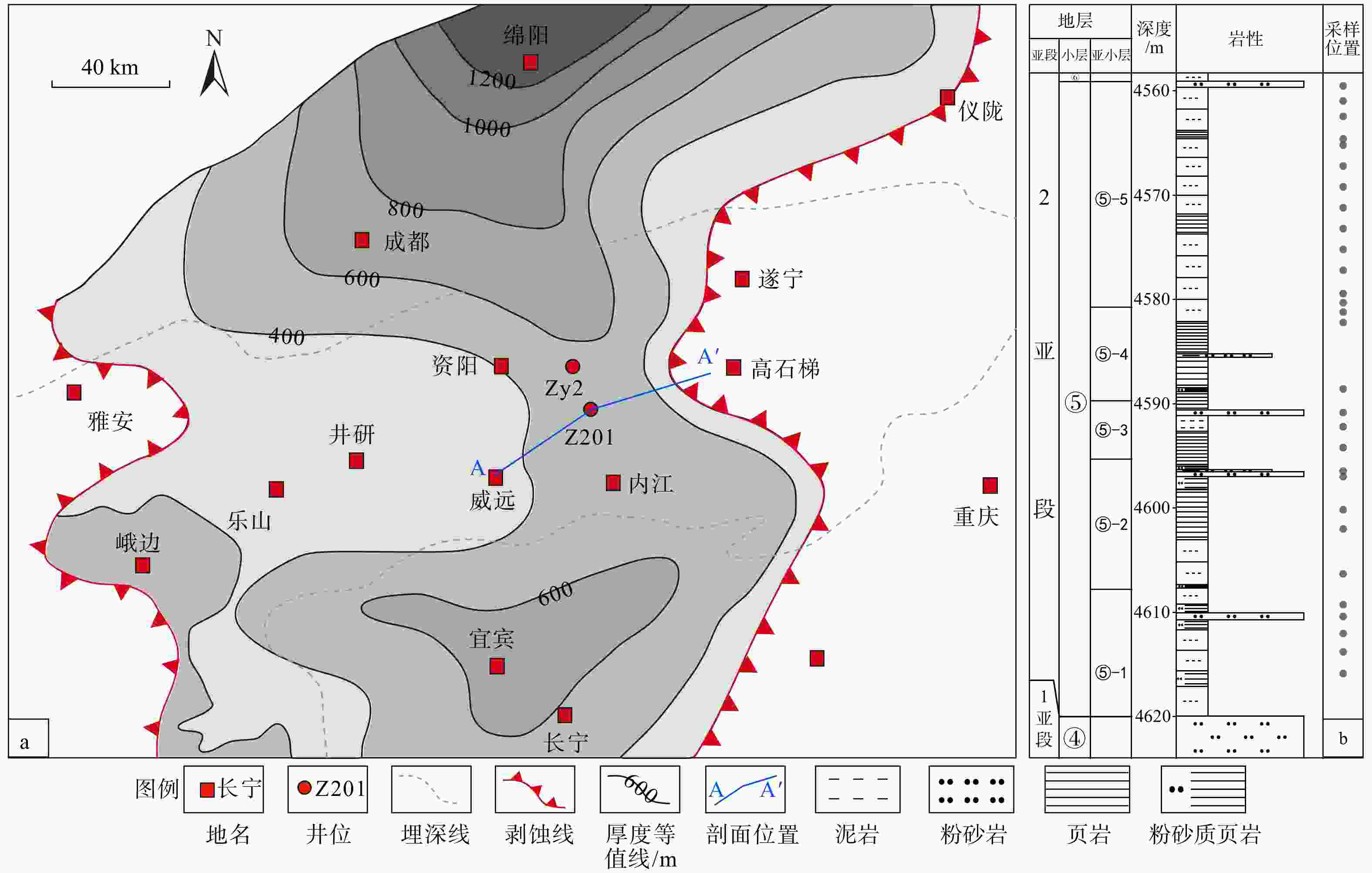
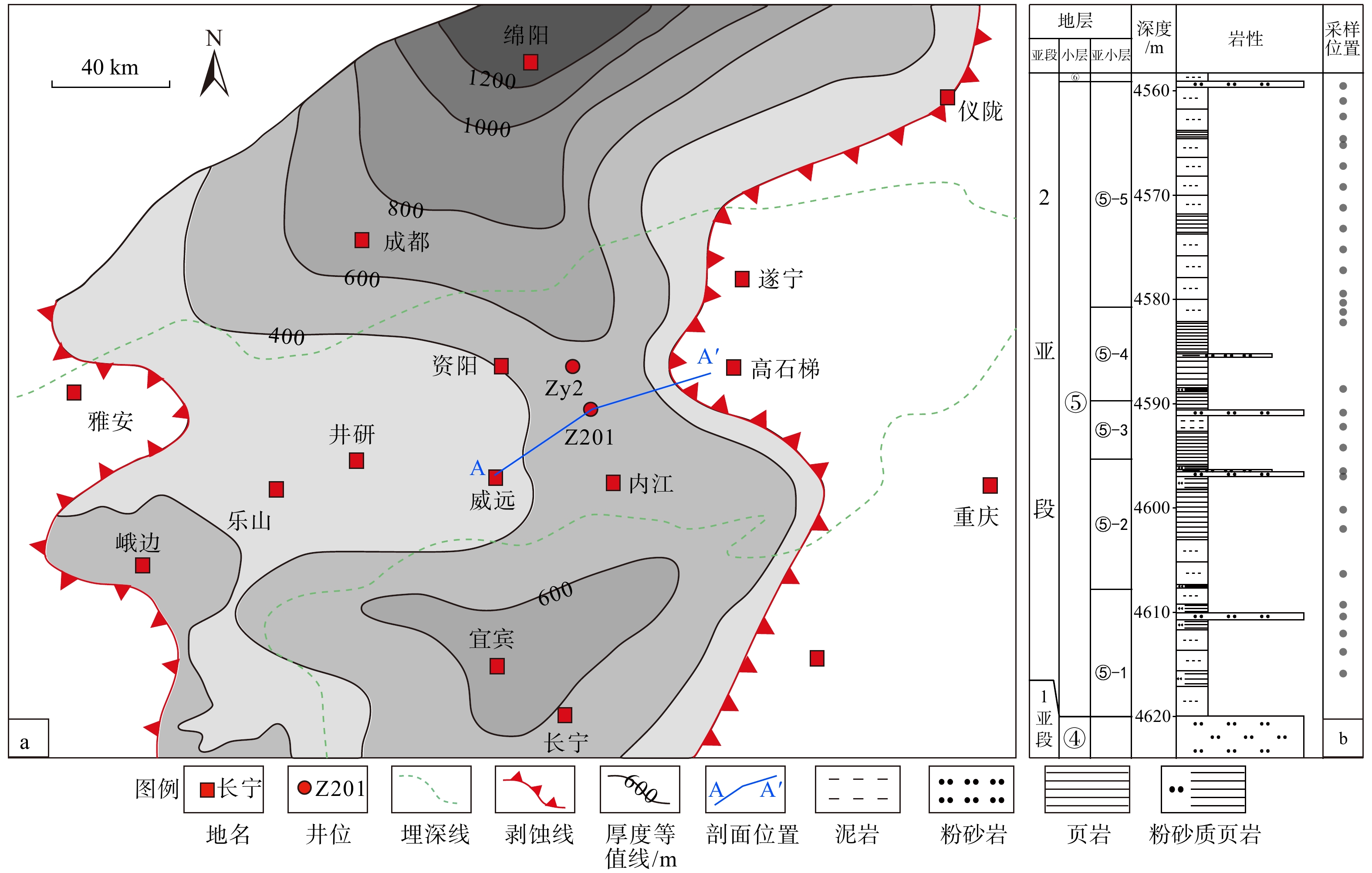
图 1 研究区位置及地层综合柱状图
a—研究区位置;b—地层综合柱状图
Figure 1. Location and comprehensive stratigraphic column of the study area
(a) Location of the study area; (b) Comprehensive stratigraphic column
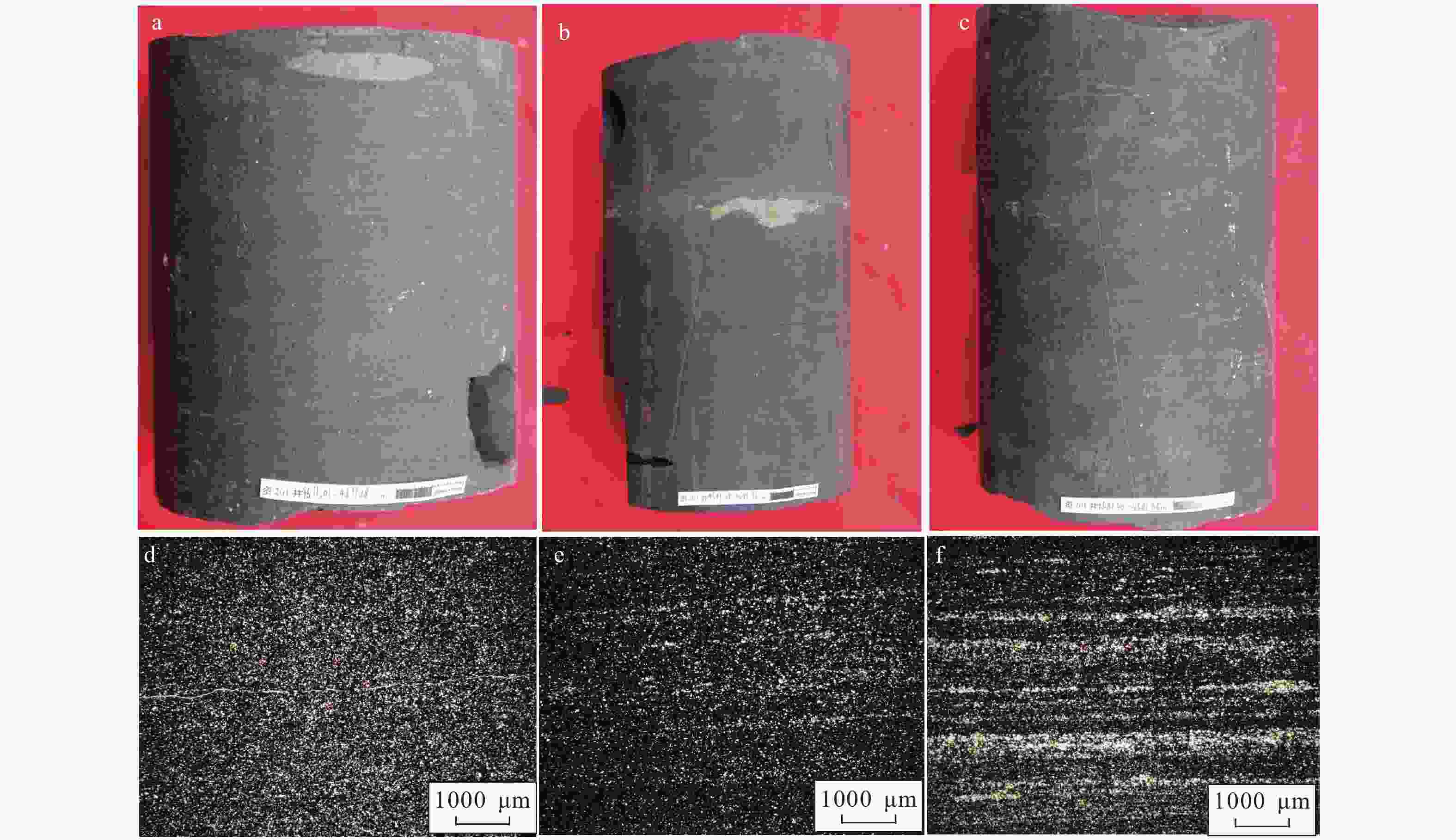
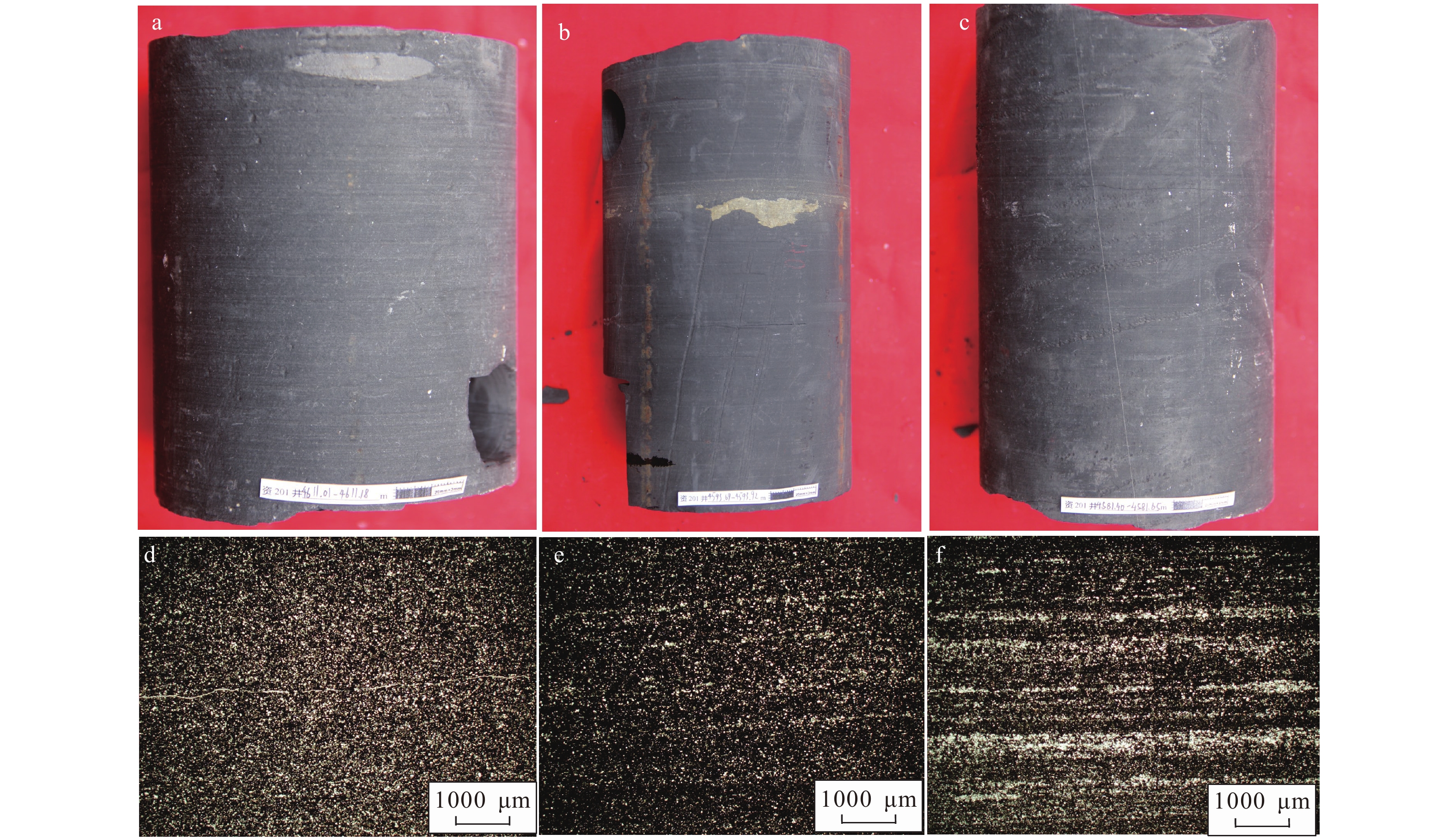
图 2 筇一段2亚段⑤小层页岩岩石学典型特征
a—灰黑色页岩,夹粉砂质条带,发育粉砂岩透镜体,⑤-2亚小层,4611.01~4611.18 m;b—灰黑色页岩,夹粉砂质条带,发育黄铁矿结核,⑤-3亚小层,4593.69~4593.92 m;c—灰黑色页岩,可见高角度裂缝,⑤-4亚小层,4581.40~4581.65 m;d—灰黑色粉砂质页岩,均质构造,⑤-2亚小层,4589.4 m,单偏光;e—深灰色含粉砂质页岩,纹层发育,⑤-3亚小层,4594.45 m,单偏光;f—灰黑色粉砂质页岩,可见硅质纹层,⑤-4亚小层,4583.55 m,单偏光
Figure 2. Typical petrological characteristics of shale in Bed 5, Submember 2, Member 1 of Qiongzhusi Formation
(a) Grayish-black shale interbedded with silty bands, containing silts tone lenses, Bed 5-2, 4611.01–4611.18 m (b) Grayish-black shale interbedded with silty bands, showing pyrite nodules, Bed 5-3, 4593.69–4593.92 m; (c) Grayish-black shale with high-angle fractures, Bed 5-4, 4581.40–4581.65 m; (d) Grayish-black silty shale showing homogeneous texture, Bed 5-2, 4589.4 m, plane-polarized light; (e) Dark-gray silty shale with well-developed laminae, Bed 5-3, 4594.45 m, plane-polarized light; (f) Grayish-black silty shale with siliceous laminae, Bed 5-4, 4583.55 m, plane-polarized light

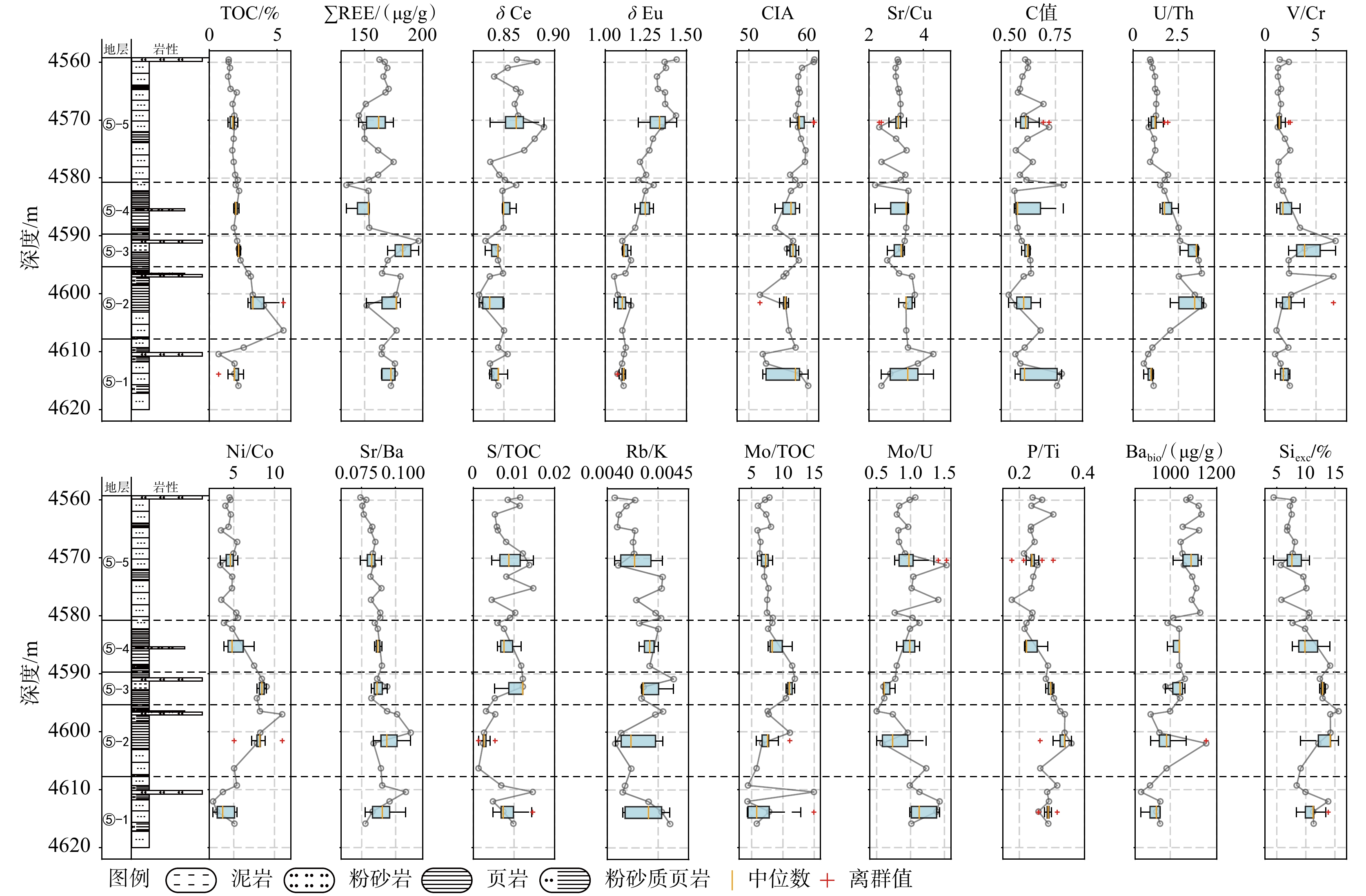
图 3 Z201井筇一段2亚段⑤小层各地化指标垂向变化
Figure 3. Vertical variations of geochemical proxies in Bed 5, Submember 2, Member 1 of Qiongzhusi Formation, Well Z201

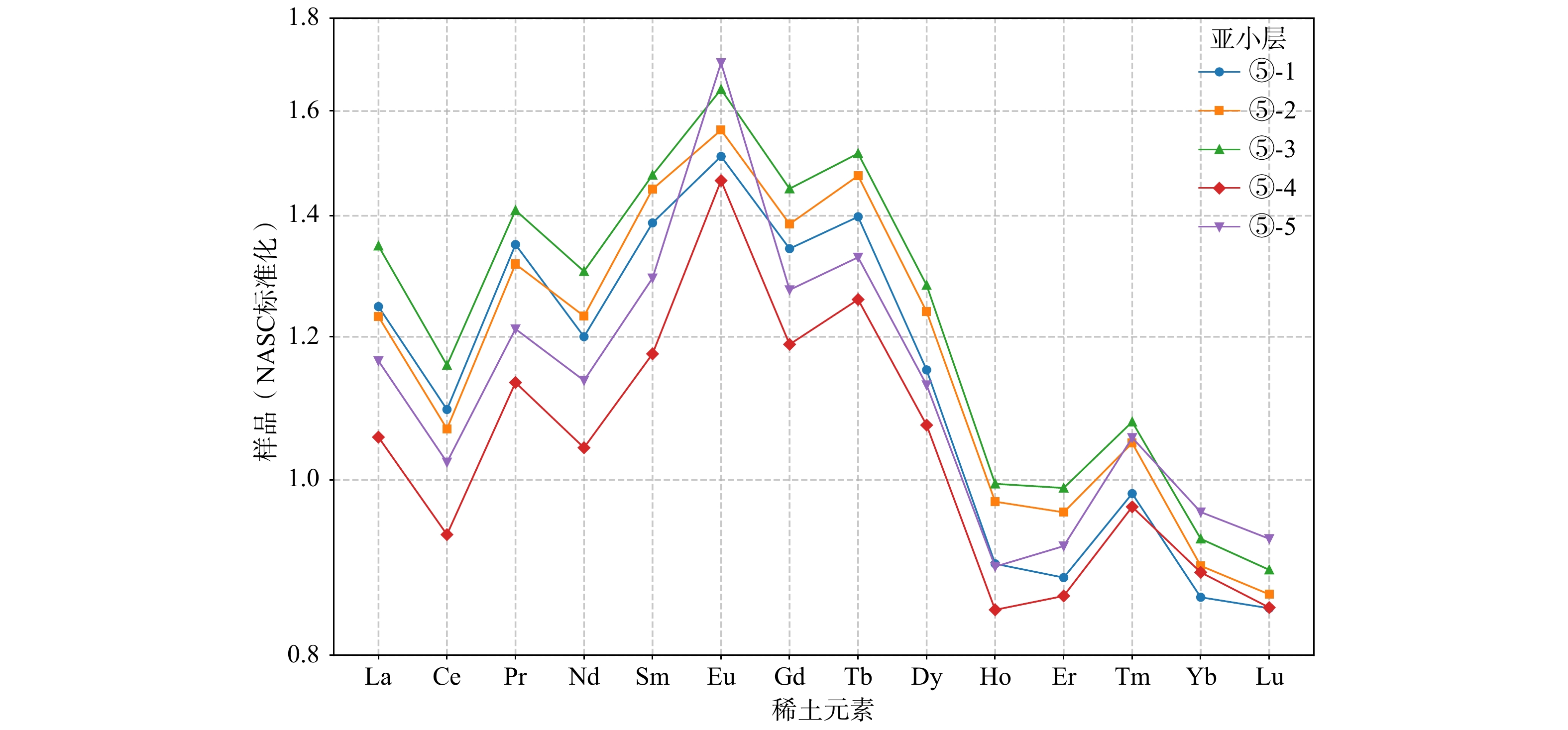
图 4 Z201井筇一段2亚段⑤小层稀土元素配分图
Figure 4. Rare earth element distribution pattern of Bed 5, Submember 2, Member 1 of Qiongzhusi Formation, Well Z201
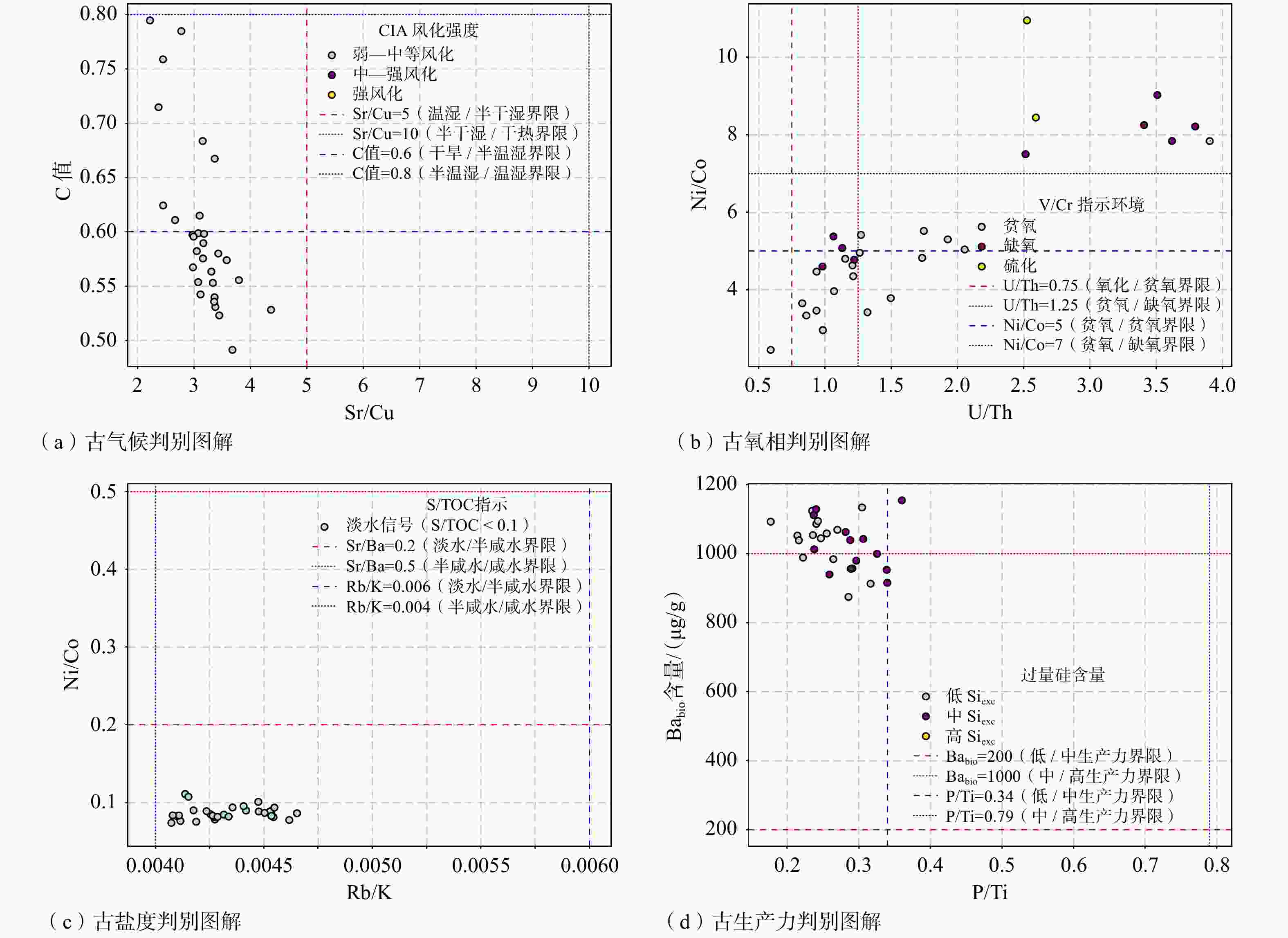
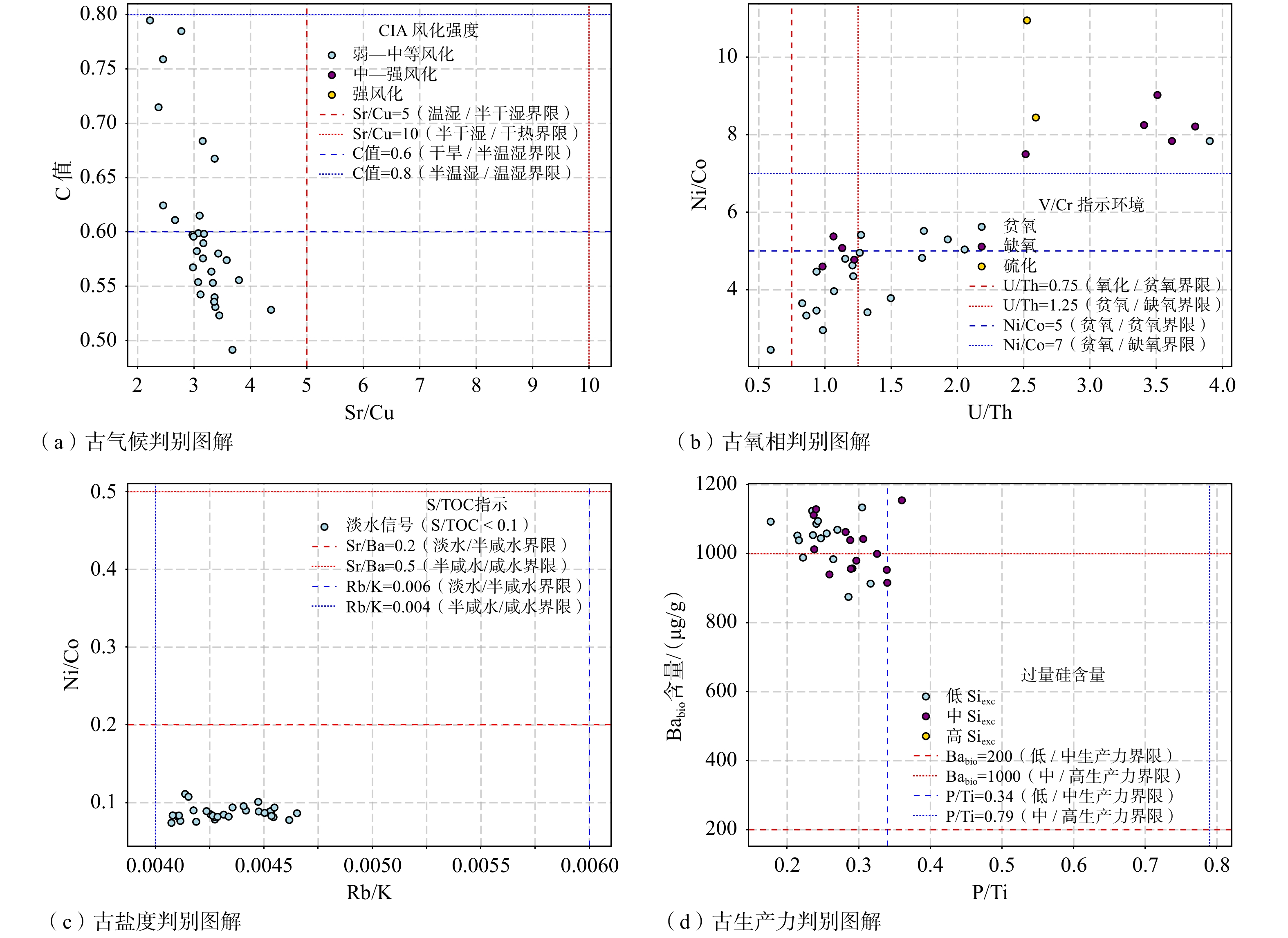
图 5 Z201井筇一段2亚段⑤小层古气候、古氧相、古盐度和古生产力判别图解
Figure 5. Cross-plot discrimination diagrams of palaeoclimate, palaeoredox conditions, palaeosalinity, and palaeoproductivity for Bed 5, Submember 2, Member 1 of Qiongzhusi Formation, Well Z201
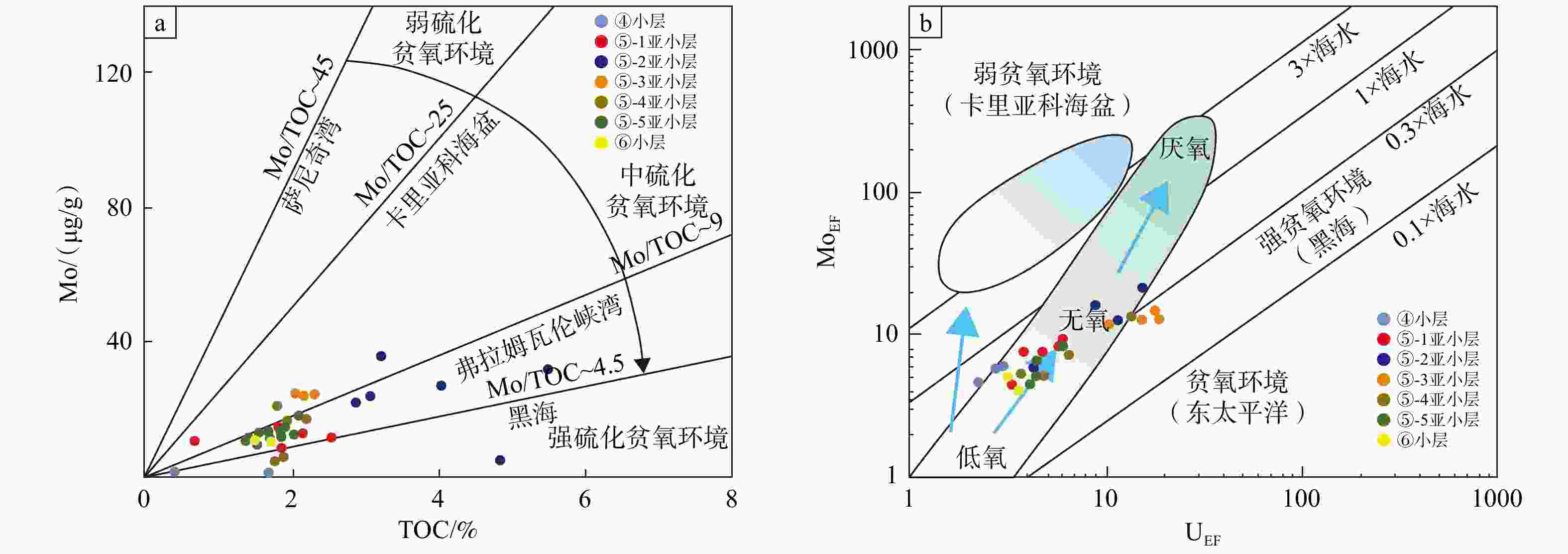
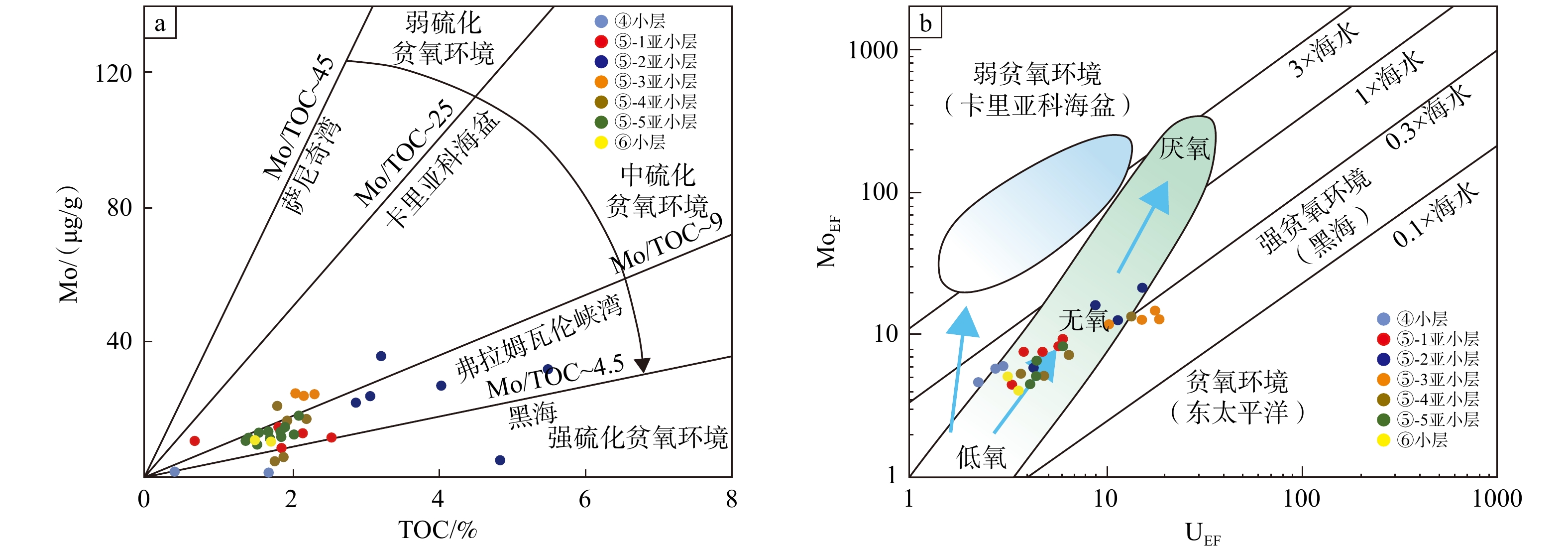
图 6 Z201井筇一段2亚段⑤小层页岩水体滞留程度判别图版
a—Mo/TOC关系;b—U–Mo协变模式图 (Algeo and Tribovillard,2009)
Figure 6. Discrimination diagrams of water mass restriction for Bed 5, Submember 2, Member 1 of Qiongzhusi Formation, Well Z201
(a) Cross-plot of Mo versus TOC; (b) U–Mo covariation patterns (Algeo and Tribovillard, 2009)

图 7 Z201井筇一段2亚段⑤小层沉积演化模式(剖面位置见图1)
Figure 7. Depositional evolution model for Bed 5, Submember 2, Member 1 of Qiongzhusi Formation, Well Z201 (The profile location is indicated by the blue polyline in Fig. 1)
表 1 Z201井筇一2亚段⑤小层地球化学综合指标统计表
Table 1. Statistics of comprehensive geochemical indicators of Bed 5, Submember 2, Member 1 of Qiongzhusi Formation, Well Z201
指标 ⑤-1亚小层 ⑤-2亚小层 ⑤-3亚小层 ⑤-4亚小层 ⑤-5亚小层 ⑤小层 TOC/% 0.68~2.53/1.81 2.86~5.46/3.72 2.05~2.30/2.17 1.80~2.19/1.98 1.38~2.10/1.71 0.68~5.46/2.13 主量元素/% SiO2 64.53~68.35/66.12 63.10~69.28/66.68 67.53~67.79/67.70 62.10~69.15/65.64 60.84~65.96/63.69 60.84~69.28/65.19 Al2O3 11.00~13.21/12.12 10.17~12.39/10.99 11.11~11.71/11.39 11.02~12.95/12.21 12.27~14.90/13.36 10.17~14.90/12.45 Fe2O3 5.16~6.82/5.95 4.45~6.33/4.95 4.87~4.99/4.95 4.73~7.52/5.76 5.19~7.35/5.89 4.45~7.52/5.64 CaO 0.95~2.67/1.75 1.41~2.45/1.71 1.25~1.62/1.49 1.64~2.00/1.87 1.59~2.34/2.01 0.95~2.67/1.85 K2O 2.64~3.30/2.92 2.30~3.14/2.63 2.56~2.77/2.66 2.58~3.05/2.88 2.83~3.44/3.14 2.30~3.44/2.94 P2O5 0.16~0.22/0.19 0.21~0.25/0.23 0.22~0.23/0.22 0.17~0.20/0.18 0.15~0.25/0.20 0.15~0.25/0.20 TiO2 0.41~0.51/0.48 0.49~0.57/0.52 0.54~0.57/0.55 0.51~0.57/0.55 0.54~0.66/0.59 0.41~0.66/0.55 微量元素/(μg/g) V 89.52~210.35/132.23 118.74~551.13/236.27 155.68~548.25/341.97 123.30~245.13/170.25 127.36~168.05/145.19 89.52~551.13/180.39 Cr 59.15~109.49/76.30 54.18~106.13/84.75 67.59~82.73/76.49 71.64~105.55/85.86 59.68~117.45/98.70 54.18~117.45/89.14 Ni 35.59~97.78/66.29 87.87~151.05/120.00 126.00~128.88/127.72 57.92~103.03/76.92 52.19~89.33/70.31 35.59~151.05/84.33 Co 14.52~18.18/16.58 13.72~17.44/15.15 14.21~16.44/15.19 13.74~15.30/14.50 14.37~16.66/15.65 13.72~18.18/15.56 U 5.62~12.30/9.71 25.66~45.71/36.70 31.49~39.57/36.82 14.23~25.94/19.01 8.49~18.48/12.58 5.62~45.71/19.19 Th 9.54~10.89/10.49 10.86~12.62/11.82 10.89~12.15/11.44 9.51~10.32/9.85 9.59~11.12/10.35 9.51~12.62/10.68 Mo 8.04~14.35/11.24 21.62~35.55/27.82 23.72~24.41/24.09 16.13~20.67/17.84 9.12~17.64/12.24 8.04~35.55/16.42 Ba 1366.67~1437.41/1409.30 1340.74~1604.54/1437.87 1420.76~1527.75/1480.65 1476.99~1540.72/1506.84 1499.74~1677.91/1615.07 1340.74~1677.91/1526.98 Sr 111.51~147.03/127.73 131.55~151.70/136.94 122.67~133.37/129.35 127.22~133.82/131.29 124.27~144.07/132.63 111.51~151.70/132.07 Cu 33.69~45.52/38.88 37.88~42.46/40.14 39.93~46.06/42.67 38.83~57.34/45.22 40.78~56.67/44.33 33.69~57.34/42.65 稀土元素
(NASC标准化)La 1.15~1.34/1.25 1.06~1.32/1.23 1.26~1.46/1.35 0.95~1.12/1.06 1.02~1.32/1.16 0.95~1.46/1.20 Ce 1.03~1.15/1.09 0.92~1.14/1.07 1.08~1.24/1.16 0.85~0.98/0.93 0.93~1.13/1.02 0.85~1.24/1.05 Pr 1.28~1.40/1.35 1.17~1.40/1.32 1.29~1.52/1.41 1.02~1.19/1.13 1.09~1.38/1.21 1.02~1.52/1.26 Nd 1.16~1.24/1.20 1.13~1.30/1.23 1.20~1.41/1.30 0.94~1.11/1.04 1.00~1.23/1.14 0.94~1.41/1.17 Sm 1.31~1.53/1.39 1.39~1.55/1.45 1.37~1.56/1.47 1.08~1.27/1.17 1.16~1.53/1.29 1.08~1.56/1.34 Eu 1.39~1.66/1.51 1.49~1.63/1.56 1.58~1.70/1.64 1.42~1.51/1.46 1.47~1.97/1.70 1.39~1.97/1.62 Gd 1.24~1.48/1.34 1.31~1.49/1.39 1.35~1.51/1.45 1.11~1.28/1.19 1.11~1.45/1.27 1.11~1.51/1.31 Tb 1.25~1.58/1.40 1.36~1.60/1.47 1.41~1.57/1.52 1.18~1.36/1.26 1.22~1.51/1.33 1.18~1.60/1.38 Dy 1.03~1.30/1.15 1.14~1.34/1.24 1.20~1.33/1.28 1.00~1.18/1.07 1.05~1.32/1.13 1.00~1.34/1.16 Ho 0.83~1.01/0.90 0.90~1.08/0.97 0.91~1.04/1.00 0.79~0.93/0.85 0.84~1.02/0.90 0.79~1.08/0.91 Er 0.81~0.99/0.88 0.90~1.06/0.96 0.91~1.06/0.99 0.82~0.91/0.86 0.86~1.02/0.92 0.81~1.06/0.92 Tm 0.91~1.09/0.98 0.98~1.18/1.05 0.97~1.17/1.08 0.92~1.01/0.97 0.97~1.17/1.06 0.91~1.18/1.04 Yb 0.81~0.94/0.86 0.82~0.97/0.90 0.84~0.98/0.93 0.85~0.94/0.89 0.90~1.02/0.96 0.81~1.02/0.92 Lu 0.75~0.95/0.85 0.77~0.97/0.86 0.80~0.96/0.89 0.83~0.89/0.85 0.86~1.00/0.93 0.75~1.00/0.89 ΣREE/(μg/g) 164.61~176.16/170.88 151.73~180.93/170.46 169.78~196.54/183.03 134.33~153.96/147.21 145.04~174.96/160.87 134.33~196.54/164.98 地球化学指标 δCe 0.84~0.85/0.84 0.83~0.85/0.84 0.83~0.84/0.84 0.85~0.86/0.85 0.84~0.89/0.86 0.83~0.89/0.85 δEu 1.07~1.13/1.11 1.05~1.16/1.10 1.10~1.16/1.13 1.18~1.30/1.24 1.20~1.44/1.33 1.05~1.44/1.22 UEF 2.88~5.7/4.48 11.66~23.90/19.02 15.13~20.04/18.23 6.18~13.24/8.97 3.46~8.46/5.36 2.88~23.90/9.14 MoEF 10.09~16.58/12.79 29.35~47.33/34.98 28.78~29.49/29.22 17.20~25.88/20.45 9.33~19.85/12.75 9.33~47.33/18.88 CIA 52.38~60.20/56.45 51.89~56.87/55.49 56.53~58.59/57.57 54.50~58.76/56.83 57.10~61.27/58.98 51.89~61.27/57.62 Sr/Cu 2.45~4.36/3.36 3.10~3.68/3.42 2.66~3.31/3.05 2.22~3.45/3.01 2.37~3.38/3.02 2.22~4.36/3.14 C值 0.52~0.78/0.64 0.49~0.66/0.57 0.56~0.61/0.59 0.52~0.79/0.61 0.52~0.71/0.59 0.49~0.79/0.60 U/Th 0.59~1.13/0.92 2.05~3.90/3.14 2.59~3.62/3.24 1.50~2.51/1.91 0.86~1.93/1.22 0.59~3.90/1.76 V/Cr 0.98~2.42/1.79 1.12~6.71/2.89 2.30~6.93/4.37 1.17~3.42/2.12 1.24~2.47/1.55 0.98~6.93/2.15 Ni/Co 2.45~5.38/3.90 5.04~10.95/8.06 7.84~9.03/8.44 3.79~7.50/5.37 3.34~5.52/4.50 2.45~10.95/5.47 Sr/Ba 0.0777~0.1076/0.0908 0.0837~0.1111/0.0958 0.0821~0.0939/0.0875 0.0847~0.0899/0.0871 0.0741~0.0896/0.0822 0.0741~0.1111/0.0869 S/TOC 0.0048~0.0146/0.0087 0.0013~0.0054/0.0030 0.0053~0.0122/0.0099 0.0059~0.0118/0.0084 0.0045~0.0147/0.0092 0.0013~0.0147/0.0081 Rb/K 0.0042~0.0046/0.0044 0.0041~0.0045/0.0043 0.0043~0.0047/0.0044 0.0043~0.0045/0.0044 0.0041~0.0045/0.0043 0.0041~0.0047/0.0043 Mo/TOC /(μg·g−1·%−1) 4.33~14.95/7.46 5.79~11.11/7.77 10.50~11.91/11.15 7.64~11.48/9.14 5.94~8.39/7.16 4.33~14.95/7.91 Mo/U 0.99~1.43/1.19 0.50~1.23/0.80 0.60~0.78/0.66 0.80~1.13/0.97 0.77~1.53/1.00 0.50~1.53/0.96 P/Ti 0.26~0.32/0.29 0.26~0.36/0.33 0.28~0.31/0.29 0.22~0.29/0.24 0.18~0.30/0.24 0.18~0.36/0.27 Babio/(μg/g) 874.76~957.28/928.24 915.69~1154.70/1001.46 979.82~1062.86/1028.46 988.73~1039.34/1022.25 1012.60~1133.99/1084.76 874.76~1154.70/1032.91 注:表中数据格式为“范围/均值”;样品总数为30块  下载: 导出CSV
-
[1] ALGEO T J, INGALL E, 2007. Sedimentary Corg: P ratios, paleocean ventilation, and Phanerozoic atmospheric pO2[J]. Palaeogeography, Palaeoclimatology, Palaeoecology, 256(3-4): 130-155. doi: 10.1016/j.palaeo.2007.02.029 [2] ALGEO T J, LYONS T W, BLAKEY R C, et al., 2007. Hydrographic conditions of the Devono–Carboniferous North American Seaway inferred from sedimentary Mo–TOC relationships[J]. Palaeogeography, Palaeoclimatology, Palaeoecology, 256(3-4): 204-230. doi: 10.1016/j.palaeo.2007.02.035 [3] ALGEO T J, TRIBOVILLARD N, 2009. Environmental analysis of paleoceanographic systems based on molybdenum–uranium covariation[J]. Chemical Geology, 268(3-4): 211-225. doi: 10.1016/j.chemgeo.2009.09.001 [4] ALGEO T J, HONG H L, WANG C W, 2025. The chemical index of alteration (CIA) and interpretation of ACNK diagrams[J]. Chemical Geology, 671: 122474. doi: 10.1016/j.chemgeo.2024.122474 [5] ARTHUR M A, SAGEMAN B B, 2005. Sea-level control on source-rock development: perspectives from the Holocene Black Sea, the mid-Cretaceous Western Interior Basin of North America, and the Late Devonian Appalachian Basin[M]//HARRIS N B. The deposition of organic-carbon-rich sediments: models, mechanisms, and consequences. Tulsa: SEPM Society for Sedimentary Geology: 35-59. [6] BERNER R A, RAISWELL R, 1984. C/S method for distinguishing freshwater from marine sedimentary rocks[J]. Geology, 12(6): 365-368. doi: 10.1130/0091-7613(1984)12<365:cmfdff>2.0.co;2 [7] BOHACS K M, CARROLL A R, NEAL J E, et al. , 2000. Lake-basin type, source potential, and hydrocarbon character: an integrated sequence-stratigraphic–geochemical framework[M]//GIERLOWSKI-KORDESCH E H, KELTS K R. Lake basins through space and time. Tulsa: American Association of Petroleum Geologists: 3-37. [8] CALVERT S E, PEDERSEN T F, 2007. Chapter fourteen elemental proxies for palaeoclimatic and palaeoceanographic variability in marine sediments: interpretation and application[J]. Developments in Marine Geology, 1: 567-644. doi: 10.1016/s1572-5480(07)01019-6 [9] CANFIELD D E, 2004. The evolution of the Earth surface sulfur reservoir[J]. American Journal of Science, 304(10): 839-861. [10] CHEN X, XIAO L, WANG M Y, et al., 2023. Reconstruction of provenance and paleo-sedimentary environment of the chang 8 oil layer in the southwestern margin of the Ordos Basin: evidence from petrogeochemistry[J]. Geoscience, 37(5): 1264-1281. (in Chinese with English abstract) [11] DEL ROSARIO LANZ M, AZMY K, CESARETTI N N, et al., 2021. Diagenesis of the Vaca Muerta Formation, Neuquén Basin: evidence from petrography, microthermometry and geochemistry[J]. Marine and Petroleum Geology, 124: 104769. doi: 10.1016/j.marpetgeo.2020.104769 [12] DEMAISON G J, MOORE G T, 1980. Anoxic environments and oil source bed genesis[J]. Organic Geochemistry, 2(1): 9-31. doi: 10.1016/0146-6380(80)90017-0 [13] DENG H W, QIAN K, 1993. Sedimentary geochemistry and environment analysis[M]. Lanzhou: Gansu Science and Technology Press. (in Chinese) [14] DING J H, ZHANG J C, SHI G, et al., 2021. Sedimentary environment and organic matter enrichment mechanisms of the Upper Permian Dalong Formation shale, southern Anhui Province, China[J]. Oil & Gas Geology, 42(1): 158-172. (in Chinese with English abstract) [15] DING X J, LIU G D, LU X J, et al., 2014. The impact on organic matter preservation by the degree of oxidation and reduction and sedimentation rates of Erlian Basin[J]. Natural Gas Geoscience, 25(6): 810-817. (in Chinese with English abstract) [16] DYMOND J, SUESS E, LYLE M, 1992. Barium in deep-sea sediment: a geochemical proxy for paleoproductivity[J]. Paleoceanography, 7(2): 163-181. doi: 10.1029/92PA00181 [17] FEDO C M, YOUNG G M, NESBITT H W, 1997. Paleoclimatic control on the composition of the Paleoproterozoic Serpent Formation, Huronian Supergroup, Canada: a greenhouse to icehouse transition[J]. Precambrian Research, 86(3-4): 201-223. doi: 10.1016/S0301-9268(97)00049-1 [18] FENG D H, LIU C L, YANG H B, et al., 2024. Experimental investigation of hydrocarbon generation, retention, and expulsion of saline lacustrine shale: insights from improved semi-open pyrolysis experiments of Lucaogou Shale, eastern Junggar Basin, China[J]. Journal of Analytical and Applied Pyrolysis, 181: 106640. doi: 10.1016/j.jaap.2024.106640 [19] GODDÉRIS Y, DONNADIEU Y, LE HIR G, et al., 2014. The role of palaeogeography in the Phanerozoic history of atmospheric CO2 and climate[J]. Earth-Science Reviews, 128: 122-138. doi: 10.1016/j.earscirev.2013.11.004 [20] GRIFFITH E M, PAYTAN A, 2012. Barite in the ocean–occurrence, geochemistry and palaeoceanographic applications[J]. Sedimentology, 59(6): 1817-1835. [21] GUO X S, WANG R Y, SHEN B J, et al., 2025. Geological characteristics, resource potential, and development direction of shale gas in China[J]. Petroleum Exploration and Development, 52(1): 15-28. (in Chinese with English abstract) [22] HE X, ZHENG M J, LIU Y, et al., 2024. Characteristics and differential origin of Qiongzhusi Formation shale reservoirs under the “aulacogen-uplift” tectonic setting, Sichuan Basin[J]. Oil & Gas Geology, 45(2): 420-439. (in Chinese with English abstract) [23] JONES B, MANNING D A C, 1994. Comparison of geochemical indices used for the interpretation of palaeoredox conditions in ancient mudstones[J]. Chemical Geology, 111(1-4): 111-129. doi: 10.1016/0009-2541(94)90085-X [24] HE S, LI H, QIN Q R, et al., 2021. Influence of mineral compositions on shale pore development of Longmaxi Formation in the Dingshan Area, southeastern Sichuan Basin, China[J]. Energy & Fuels, 35(13): 10551-10561. doi: 10.1021/acs.energyfuels.1c01026 [25] HU R, TAN J, DICK J, et al., 2023. Depositional conditions of siliceous microfossil-rich shale during the Ordovician–Silurian transition of south China: Implication for organic matter enrichment[J]. Marine and Petroleum Geology, 154: 106307 [26] HUANG H, HE D, LI D, et al., 2020. Geochemical characteristics of organic-rich shale, Upper Yangtze Basin: Implications for the Late Ordovician–Early Silurian orogeny in South China[J]. Palaeogeography, Palaeoclimatology, Palaeoecology, 554: 109822. [27] KAH L C, LYONS T W, FRANK T D, 2004. Low marine sulphate andpro-tracted oxygenation of the Proterozoic biosphere[J]. Nature, 431(7010): 834-838 [28] KENDALL B, GORDON G W, POULTON S W, et al., 2011. Molybdenum isotope constraints on the extent of late Paleoproterozoic ocean euxinia[J]. Earth and Planetary Science Letters, 307(3-4): 450-460. doi: 10.1016/j.jpgl.2011.05.019 [29] KHAN M Z, FENG Q, ZHANG K, et al., 2019. Biogenic silica and organic carbon fluxes provide evidence of enhanced marine productivity in the Upper Ordovician-Lower Silurian of South China[J]. Palaeogeography, Palaeoclimatology, Palaeoecology, 534: 109278 [30] LI C L, LI X S, WANG Z X, et al., 2020. Deformation characteristics of Early Paleozoic marine shale and their influence on the shale gas preservation in the eastern Sichuan-Wulingshan tectonic belt[J]. Journal of Geomechanics, 26(6): 819-829. (in Chinese with English abstract) [31] LI C Q, CUI Y X, NING M, et al., 2022. Can Eu anomaly indicate a hydrothermal fluid Si source? A case study of chert nodules from the Permian Maokou and Wujiaping Formations, South China[J]. Frontiers in Earth Science, 10: 932263. doi: 10.3389/feart.2022.932263 [32] LI H, TANG H M, QIN Q R, et al., 2019. Characteristics, formation periods and genetic mechanisms of tectonic fractures in the tight gas sandstones reservoir: a case study of Xujiahe Formation in YB area, Sichuan Basin, China[J]. Journal of Petroleum Science and Engineering, 178: 723-735. doi: 10.1016/j.petrol.2019.04.007 [33] LI H, 2022. Research progress on evaluation methods and factors influencing shale brittleness: a review[J]. Energy Reports, 8: 4344-4358. doi: 10.1016/j.egyr.2022.03.120 [34] LI Y F, SHAO D Y, LYU H G, et al., 2015. A relationship between elemental geochemical characteristics and organic matter enrichment in marine shale of Wufeng Formation—Longmaxi Formation, Sichuan Basin[J]. Acta Petrolei Sinica, 36(12): 1470-1483. (in Chinese with English abstract) [35] LIANG X, ZHANG T S, YANG Y, et al., 2014. Microscopic pore structure and its controlling factors of overmature shale in the Lower Cambrian Qiongzhusi Fm, northern Yunnan and Guizhou provinces of China[J]. Natural Gas Industry, 34(2): 18-26. (in Chinese with English abstract) [36] LOYD S J, MARENCO P J, HAGADORN J W, et al. , 2012. Sustained low marine sulfate concentrations from the Neoproterozoic to the Cambrian: insights from carbonates of northwestern Mexico and eastern California[J]. Earth and Planetary Science Letters, 339-340: 79-94. [37] LYONS T W, REINHARD C T, PLANAVSKY N J, 2014. The rise of oxygen in Earth’s early ocean and atmosphere[J]. Nature, 506(7488): 307-315. doi: 10.1038/nature13068 [38] MCLENNAN S M, 1989. Rare earth elements in sedimentary rocks: influence of provenance and sedimentary processes[M]//LIPIN B R, MCKAY G A. Geochemistry and mineralogy of rare earth elements. Boston: De Gruyter: 169-200. [39] MCLENNAN S M, 1993. Weathering and global denudation[J]. The Journal of Geology, 101(2): 295-303. doi: 10.1086/648222 [40] MEYER K M, KUMP L R, 2008. Oceanic euxinia in Earth history: causes and consequences[J]. Annual Review of Earth and Planetary Sciences, 36: 251-288. doi: 10.1146/annurev.earth.36.031207.124256 [41] National Technical Committee for Standardization of Petroleum and Natural Gas, 2003. Determination of Total Organic Carbon in Sedimentary Rock: GB/T 19145—2003 [S]. Beijing: Standards Press of China. (in Chinese) [42] National Technical Committee for Standardization of Land and Resources, 2010. Methods for Chemical Analysis of Silicate Rocks — Part 28: Determination of 16 Major and Minor Components: GB/T 14506.28—2010[S]. Beijing: Standards Press of China. (in Chinese) [43] National Technical Committee for Standardization of Land and Resources, 2010. Methods for Chemical Analysis of Silicate Rocks — Part 30: Determination of 44 Elements: GB/T 14506.30—2010[S]. Beijing: Standards Press of China. (in Chinese) [44] NESBITT H W, YOUNG G M, 1982. Early Proterozoic climates and plate motions inferred from major element chemistry of lutites[J]. Nature, 299(5885): 715-717. doi: 10.1038/299715a0 [45] NKONGHO A E, BETRANT B S, FRALICK P, et al., 2022. Petrography and geochemistry of sandstones in the Kribi-Campo sub-basin (South Cameroon): implications for diagenetic evolution and provenance[J]. Arabian Journal of Geosciences, 15(3): 295. doi: 10.1007/s12517-022-09437-0 [46] PARRISH J T, 1998. Interpreting pre-Quaternary climate from the geologic record[M]. New York: Columbia University Press. [47] PAYTAN A, GRIFFITH E M, 2007. Marine barite: recorder of variations in ocean export productivity[J]. Deep Sea Research Part II: Topical Studies in Oceanography, 54(5-7): 687-705. doi: 10.1016/j.dsr2.2007.01.007 [48] PEDERSEN T F, CALVERT S E, 1990. Anoxia vs. productivity: what controls the formation of organic-carbon-rich sediments and sedimentary rocks?[J]. AAPG Bulletin, 74(4): 454-466. doi: 10.1306/0c9b2821-1710-11d7-8645000102c1865d [49] QI L, WANG H Y, SHI Z S, et al., 2023. Mineralogical and geochemical characteristics of the deeply buried Wufeng–Longmaxi shale in the Southern Sichuan Basin, China: implications for provenance and tectonic setting[J]. Minerals, 13(12): 1502. doi: 10.3390/min13121502 [50] RIMMER S M, 2004. Geochemical paleoredox indicators in Devonian–Mississippian black shales, central Appalachian Basin (USA)[J]. Chemical Geology, 206(3-4): 373-391. doi: 10.1016/j.chemgeo.2003.12.029 [51] SCHENAU S J, PRINS M A, DE LANGE G J, et al., 2001. Barium accumulation in the Arabian Sea: controls on barite preservation in marine sediments[J]. Geochimica et Cosmochimica Acta, 65(10): 1545-1556. doi: 10.1016/S0016-7037(01)00547-6 [52] SHI S Y, YANG W, ZHOU G, et al., 2024. Impact of Tethyan domain evolution on the formation of petroleum systems in the Sichuan super basin, SW China[J]. Petroleum Exploration and Development, 51(5): 1024-1039. (in Chinese with English abstract) doi: 10.1016/s1876-3804(25)60534-9 [53] TAYLOR S R, MCLENNAN S M, 1985. The continental crust: its composition and evolution: an examination of the geochemical record preserved in sedimentary rocks[M]. Oxford: Blackwell Scientific Publications: 1-328. [54] TRIBOVILLARD N, ALGEO T J, LYONS T, et al., 2006. Trace metals as paleoredox and paleoproductivity proxies: an update[J]. Chemical Geology, 232(1-2): 12-32. doi: 10.1016/j.chemgeo.2006.02.012 [55] TYSON R V, 1995. Sedimentary organic matter: organic facies and palynofacies[M]. Dordrecht: Springer. [56] VAN BEEK P, REYSS J L, BONTE P, et al., 2003. Sr/Ba in barite: a proxy of barite preservation in marine sediments?[J]. Marine Geology, 199(3-4): 205-220. doi: 10.1016/S0025-3227(03)00220-2 [57] WANG F, LIU X C, DENG X Q, et al., 2017. Geochemical characteristics and environmental implications of trace elements of Zhifang Formation in Ordos Basin[J]. Acta Sedimentologica Sinica, 35(6): 1265-1273. (in Chinese with English abstract) [58] WANG Z C, JIANG H, CHEN Z Y, et al., 2020. Tectonic paleogeography of Late Sinian and its significances for petroleum exploration in the middle-upper Yangtze region, South China[J]. Petroleum Exploration and Development, 47(5): 884-897. (in Chinese with English abstract) doi: 10.1016/s1876-3804(20)60108-2 [59] WEI W, ALGEO T J, 2020. Elemental proxies for paleosalinity analysis of ancient shales and mudrocks[J]. Geochimica et Cosmochimica Acta, 287: 341-366. doi: 10.1016/j.gca.2019.06.034 [60] WEN L, LUO B, ZHONG Y, et al. , 2021. Sedimentary characteristics and genetic model of trough-platform system during the Dengying period in Sichuan Basin, China[J]. Journal of Chengdu University of Technology (Science & Technology Edition), 48(5): 513-524, 590. (in Chinese with English abstract) [61] WRIGHT J, SCHRADER H, HOLSER W T, 1987. Paleoredox variations in ancient oceans recorded by rare earth elements in fossil apatite[J]. Geochimica et Cosmochimica Acta, 51(3): 631-644. doi: 10.1016/0016-7037(87)90075-5 [62] XIAO W, ZHANG B, YAO Y J, et al., 2022. Lithofacies and sedimentary environment of shale of Permian Longtan Formation in eastern Sichuan Basin[J]. Lithologic Reservoirs, 34(2): 152-162. (in Chinese with English abstract) [63] XU G Z, SHEN J, ALGEO T J, et al., 2023. Limited change in silicate chemical weathering intensity during the Permian–Triassic transition indicates ineffective climate regulation by weathering feedbacks[J]. Earth and Planetary Science Letters, 616: 118235. doi: 10.1016/j.jpgl.2023.118235 [64] YANG X, SHI X W, ZHU Y Q, et al., 2022. Sedimentary evolution and organic matter enrichment of Katian–Aeronian deep-water shale in Luzhou area, southern Sichuan Basin[J]. Acta Petrolei Sinica, 43(4): 469-482. (in Chinese with English abstract) [65] YANG X F, ZHANG C L, ZHAO S X, et al., 2025. Characteristics of shale gas reservoir and enlightenment of exploration in Qiongzhusi Formation in southern Sichuan Basin[J]. Natural Gas Geoscience, 36(1): 13-24. (in Chinese with English abstract) [66] YANG Y M, SHI X W, LIU W P, et al., 2024. Sedimentary evolution model and favorable facies belt selection of the Qiongzhusi Formation in the middle section of the Deyang-Anyue rift in the Sichuan Basin[J]. Natural Gas Geoscience, 35(12): 2106-2120. (in Chinese with English abstract) [67] YONG R, SHI X W, LUO C, et al., 2024. Aulacogen-uplift enrichment pattern and exploration prospect of Cambrian Qiongzhusi Formation shale gas in Sichuan Basin, SW China[J]. Petroleum Exploration and Development, 51(6): 1211-1226. (in Chinese with English abstract) doi: 10.1016/s1876-3804(25)60549-0 [68] ZHAI G Y, WANG Y F, LIU G H, et al., 2020. Accumulation model of the Sinian–Cambrian shale gas in Western Hubei Province, China[J]. Journal of Geomechanics, 26(5): 696-713. (in Chinese with English abstract) [69] ZHANG Y, WU X S, KANG J L, et al., 2024. Mechanism of organic matter enrichment in the Permian Lucaogou Formation, Ji’nan Sag, eastern Junggar Basin[J]. Natural Gas Geoscience, 35(9): 1574-1589. (in Chinese with English abstract) [70] 陈曦, 肖玲, 王明瑜, 等, 2023. 鄂尔多斯盆地西南缘长8油层组物源与古沉积环境恢复: 来自岩石地球化学的证据[J]. 现代地质, 37(5): 1264-1281. doi: 10.19657/j.geoscience.1000-8527.2023.037 [71] 邓宏文, 钱凯, 1993. 沉积地球化学与环境分析[M]. 兰州: 甘肃科学技术出版社. [72] 丁江辉, 张金川, 石刚, 等, 2021. 皖南地区上二叠统大隆组页岩沉积环境与有机质富集机理[J]. 石油与天然气地质, 42(1): 158-172. doi: 10.11743/ogg20210114 [73] 丁修建, 柳广弟, 卢学军, 等, 2014. 二连盆地氧化—还原程度和沉积速率对有机质保存的影响[J]. 天然气地球科学, 25(6): 810-817. doi: 10.11764/j.issn.1672-1926.2014.06.0810 [74] 郭旭升, 王濡岳, 申宝剑, 等, 2025. 中国页岩气地质特征、资源潜力与发展方向[J]. 石油勘探与开发, 52(1): 15-28. [75] 何骁, 郑马嘉, 刘勇, 等, 2024. 四川盆地“槽-隆”控制下的寒武系筇竹寺组页岩储层特征及其差异性成因[J]. 石油与天然气地质, 45(2): 420-439. doi: 10.11743/ogg20240209 [76] 李春麟, 李小诗, 王宗秀, 等, 2020. 川东-武陵构造带下古生界海相页岩构造变形特征及对页岩气保存的影响[J]. 地质力学学报, 26(6): 819-829. doi: 10.12090/j.issn.1006-6616.2020.26.06.064 [77] 李艳芳, 邵德勇, 吕海刚, 等, 2015. 四川盆地五峰组—龙马溪组海相页岩元素地球化学特征与有机质富集的关系[J]. 石油学报, 36(12): 1470-1483. doi: 10.7623/syxb201512002 [78] 梁兴, 张廷山, 杨洋, 等, 2014. 滇黔北地区筇竹寺组高演化页岩气储层微观孔隙特征及其控制因素[J]. 天然气工业, 34(2): 18-26. doi: 10.3787/j.issn.1000-0976.2014.02.003 [79] 全国石油天然气标准化技术委员会, 2003. 沉积岩中总有机碳的测定: GB/T 19145-2003[S]. 北京: 中国标准出版社. [80] 全国国土资源标准化技术委员会, 2010. 硅酸盐岩石化学分析方法 第28部分: 16个主次成分量测定: GB/T 14506.28—2010[S]. 北京: 中国标准出版社. [81] 全国国土资源标准化技术委员会, 2010. 硅酸盐岩石化学分析方法 第30部分: 44个元素量测定: GB/T 14506.30—2010[S]. 北京: 中国标准出版社. [82] 王峰, 刘玄春, 邓秀芹, 等, 2017. 鄂尔多斯盆地纸坊组微量元素地球化学特征及沉积环境指示意义[J]. 沉积学报, 35(6): 1265-1273. doi: 10.14027/j.cnki.cjxb.2017.06.017 [83] 汪泽成, 姜华, 陈志勇, 等, 2020. 中上扬子地区晚震旦世构造古地理及油气地质意义[J]. 石油勘探与开发, 47(5): 884-897. doi: 10.11698/PED.2020.05.04 [84] 石书缘, 杨威, 周刚, 等, 2024. 特提斯域演化对四川超级盆地油气系统形成的影响[J]. 石油勘探与开发, 51(5): 1024-1039. [85] 文龙, 罗冰, 钟原, 等, 2021. 四川盆地灯影期沉积特征及槽-台体系成因模式[J]. 成都理工大学学报(自然科学版), 48(5): 513-524, 590. doi: 10.3969/j.issn.1671-9727.2021.05.01 [86] 肖威, 张兵, 姚永君, 等, 2022. 川东二叠系龙潭组页岩岩相特征与沉积环境[J]. 岩性油气藏, 34(2): 152-162. [87] 杨雪, 石学文, 朱逸青, 等, 2022. 四川盆地南部泸州地区凯迪阶—埃隆阶深水页岩沉积演化与有机质富集[J]. 石油学报, 43(4): 469-482. [88] 杨学锋, 张成林, 赵圣贤, 等, 2025. 川南地区筇竹寺组页岩气藏特征及勘探启示[J]. 天然气地球科学, 36(1): 13-24. doi: 10.11764/j.issn.1672-1926.2024.06.007 [89] 杨一茗, 石学文, 刘文平, 等, 2024. 四川盆地德阳—安岳裂陷槽中段筇竹寺组沉积演化模式与有利相带优选[J]. 天然气地球科学, 35(12): 2106-2120. doi: 10.11764/j.issn.1672-1926.2004.05.002 [90] 雍锐, 石学文, 罗超, 等, 2024. 四川盆地寒武系筇竹寺组页岩气“槽-隆”富集规律及勘探前景[J]. 石油勘探与开发, 51(6): 1211-1226. doi: 10.11698/PED.20230616 [91] 翟刚毅, 王玉芳, 刘国恒, 等, 2020. 鄂西地区震旦系—寒武系页岩气成藏模式[J]. 地质力学学报, 26(5): 696-713. doi: 10.12090/j.issn.1006-6616.2020.26.05.058 [92] 张妍, 吴欣松, 康积伦, 等, 2024. 准东吉南凹陷二叠系芦草沟组烃源岩有机质富集机制[J]. 天然气地球科学, 35(9): 1574-1589. doi: 10.11764/j.issn.1672-1926.2024.01.001 -

 下载:
下载:


计量
- 文章访问数: 1612
- HTML全文浏览量: 210
- PDF下载量: 206
- 被引次数: 0
