


Refined characteristics and evaluation of shale reservoirs in the Wulalike Formation, central-western margin of the Ordos Basin
-
摘要: 近年来鄂尔多斯盆地西缘奥陶纪乌拉力克组页岩气勘探取得突破,开拓了华北板块海相页岩气勘探的新领域。系统刻画“低总有机碳(TOC)含量”海相页岩气储层的微观孔隙结构特征并阐明孔隙发育的主控因素对于乌拉力克组页岩气预测与评价至关重要。选取盆地西缘中部典型取芯井为研究对象,开展了X射线衍射全岩矿物分析、氩离子抛光扫描电镜观察、低温气体吸附实验,揭示了乌拉力克组页岩储集空间及储集能力。研究结果表明:乌拉力克组黑色页岩整体属于低孔−低渗储层,其中上段以黏土质页岩为主,下段以硅质页岩为主,中段黏土质页岩与混合质页岩互层发育;页岩储层孔隙体积为4.021×10⁻³ ~8.307×10⁻³ cm3/g,平均为6.031×10−3 cm3/g,孔体积主要由中孔和宏孔贡献;孔隙比表面积为1.131~6.605 m2/g,平均为2.986 m2/g,以微孔贡献为主,中孔次之,宏孔最少;上段页岩孔隙度最高,中段页岩次之,下段页岩最低;孔隙类型以无机孔和微裂缝为主,有机孔不发育;页岩气主要赋存在0~10 nm的孔隙中,占比达86.7%;微米级微裂缝与纳米级孔隙连通形成的复杂孔隙−裂缝网络,是页岩气渗流和扩散的主要通道。储层的孔隙结构与物性主要受黏土矿物控制,上段和中段页岩的孔体积与比表面积优于下段,其中伊利石可作为天然气赋存载体。储层综合评价显示,上段黏土质页岩孔隙结构及物性最优,但TOC含量低,难以形成页岩气有效富集层;下段硅质页岩TOC含量较高,生烃能力强,虽孔隙结构及物性稍差,但高硅质含量使其脆性强、微裂缝发育;中段黏土质页岩与混合质页岩互层发育,兼具封盖作用与一定生储能力,有利于页岩气富集成藏。综合分析认为,乌拉力克组下段硅质页岩和中段黏土质页岩与混合质页岩互层段为有利勘探层段。Abstract:
Objective In recent years, exploratory breakthroughs in the Wulalike Formation on the western margin of the Ordos Basin have opened up a new field of marine shale gas in the North China Plate. Systematically characterizing the microscopic pore structure of low-TOC marine shale gas reservoirs and clarifying the main factors that control pore development is crucial for the prediction and evaluation of shale gas in the Wulalike Formation. Methods Well R16 was selected as the key research object, and a series of experimental tests such as X-ray diffraction whole-rock mineral analysis, argon ion polishing– scanning electron microscopy, and low-temperature gas adsorption were carried out. The storage space and capacity of the shale gas in the Wulalike Formation were characterized in detail. Results (1) The reservoir as a whole has low porosity and low permeability. The upper section is mainly composed of clay shale, the middle section of interbedded gley shale and mixed shale, but the lower section of siliceous shale. Porosity is highest in the upper section, intermediate in the middle section, and lowest in the lower section. Overall, organic pores are not developed, and inorganic pores and micro-cracks predominate. (2) The pore volume of shale ranges from 4.021×10⁻³ to 8.307×10⁻³ cm3/g, with an average of 6.031×10⁻³cm3/g. The main contributors are mesopores and macropores. The specific surface area ranges from 1.131 to 6.605 m2/g, with an average of 2.986 m2/g. Micropores are the main contributors, followed by mesopores; macropores are the least relevant. Shale gas primarily occurs in pores ranging from 0 to 10 nm, accounting for an average proportion of 86.7%. A large number of microfractures connected with nanoscale pores form a complex pore–fracture network system, which is the main channel for the seepage and diffusion of shale oil and gas. (3) The pore structure, physical properties, and gas-bearing capacity of the reservoir are mainly influenced by clay minerals, which results in more developed pore volumes and specific surface areas in the upper and middle sections compared to the lower section. The intergranular pores of illite, as the main mineral, provide a certain storage space for the reservoir and constitute the main carrier for natural gas. Conclusions Comprehensive analysis indicates that the siliceous shale in the lower member of the Wulalike Formation and the interval of interbedded argillaceous-mixed shale in the middle member are favorable exploration intervals. [Significance] This study provides an in-depth analysis of the gas storage characteristics and influencing factors of low-TOC shale reservoirs in the research area, which will contribute to advancing the exploration of marine "low-TOC" shale gas in northern China. -
Key words:
- Ordos Basin /
- Wulalike Formation /
- shale gas /
- pore structure /
- influencing factors
-
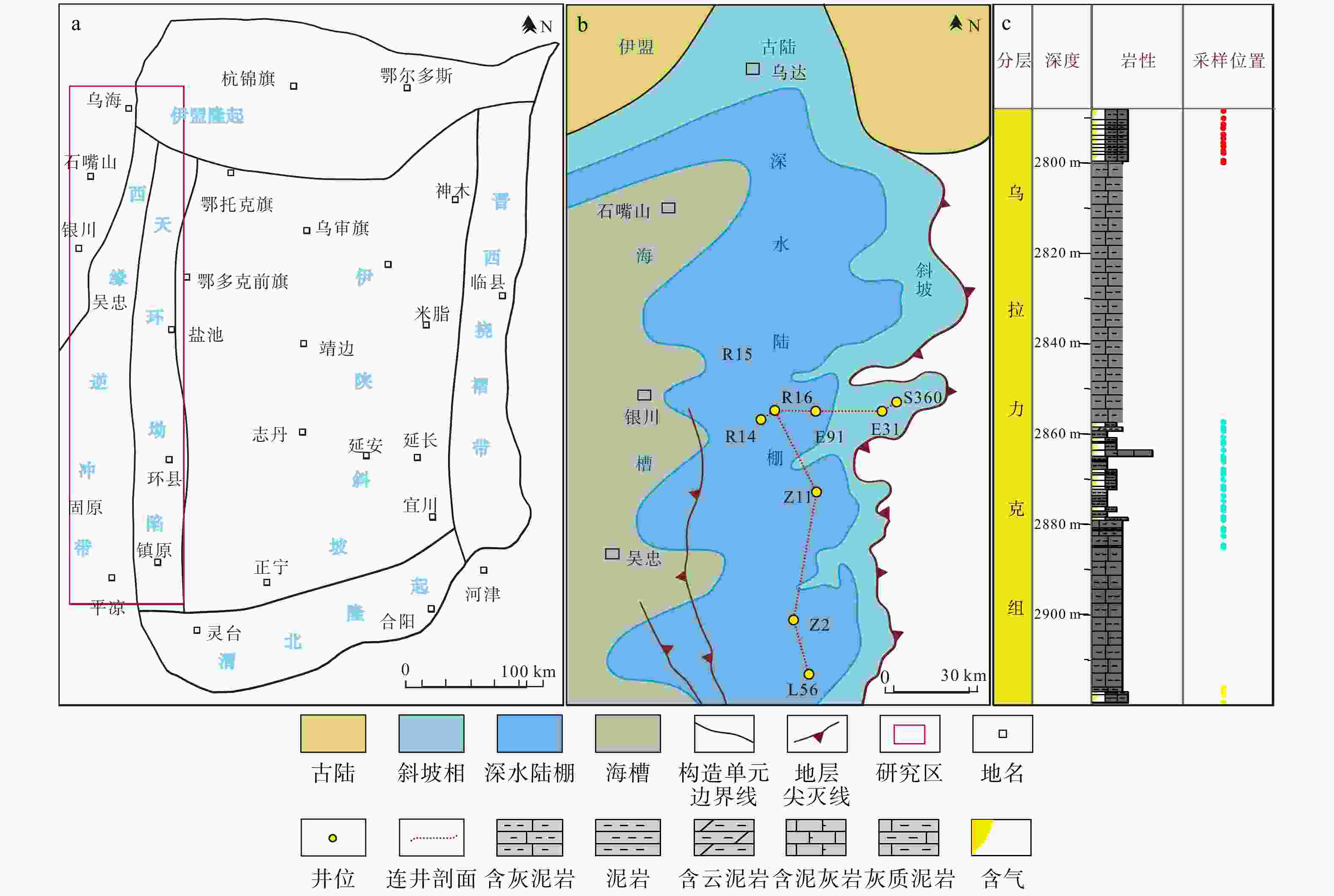
图 1 研究区区域位置与样品取芯柱状图
a—研究区区域位置图(据谢梦雨等,2023修改);b—研究区沉积相分布图(据于洲等,2021修改);c—R16井样品取芯柱状图
Figure 1. Regional location and sample core log column of the study area
(a) Regional location map of the study area (modified from Xie et al., 2023); (b) Sedimentary facies distribution map of the study area (modified from Yu et al., 2021); (c) Columnar diagram of sampling cores from Well R16
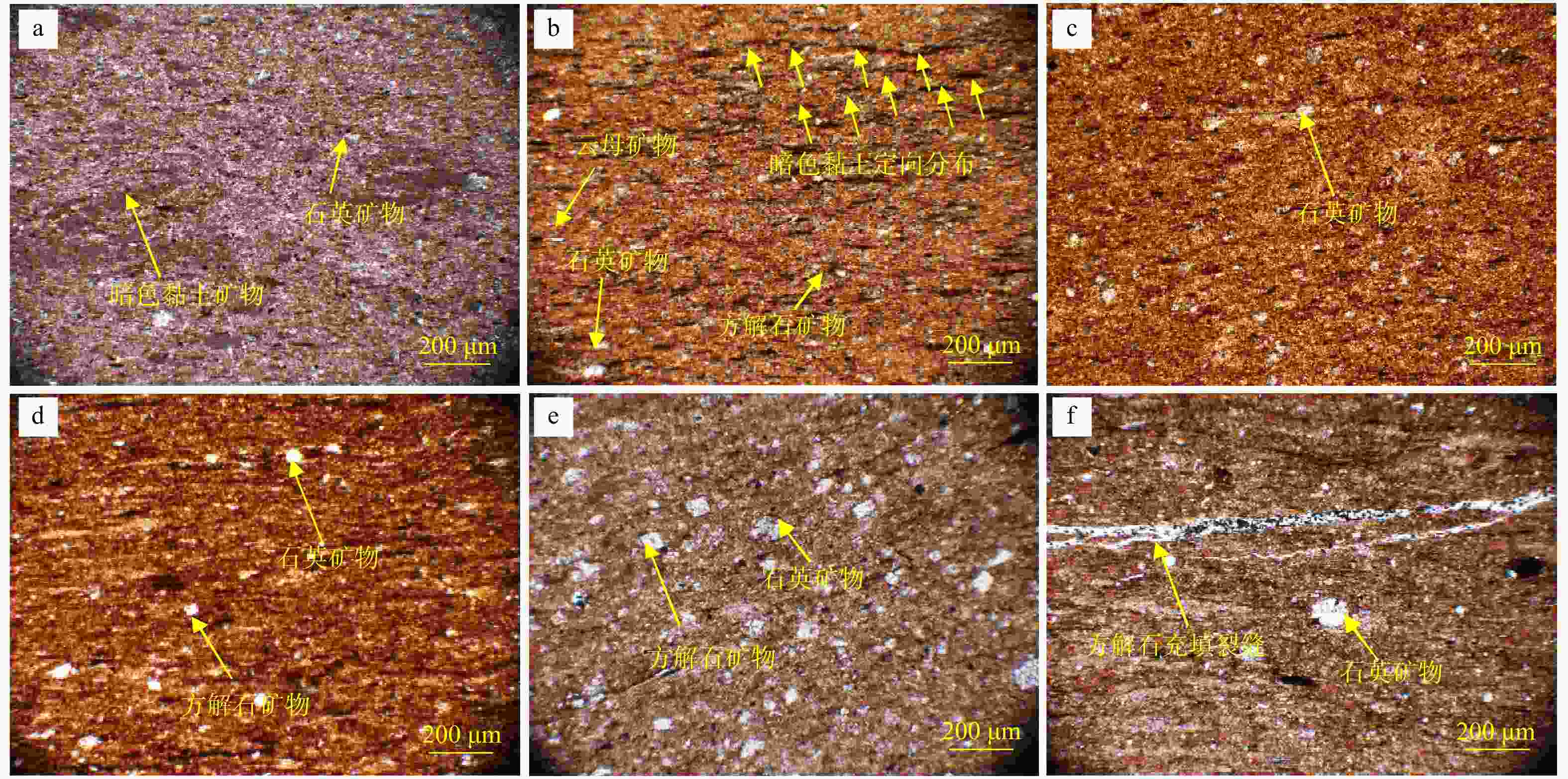
图 2 R16井乌拉力克组页岩镜下特征
a—R-9样品含硅黏土质页岩;b—R-17样品含硅黏土质页岩;c—R-23样品含硅黏土质页岩;d—R-26样品含硅黏土质页岩;e—R-42样品含黏土硅质页岩;f—R-44样品含黏土硅质页岩
Figure 2. Microscopic characteristics of the Wulalike Formation shale in Well R16
(a) Siliceous clay shale from sample R-9; (b) Siliceous clay shale from sample R-17; (c) Siliceous clay shale from sample R-23; (d) Siliceous clay shale from sample R-26; (e) Clayey siliceous shale from sample R-42; (f) Clayey siliceous shale from sample R-44
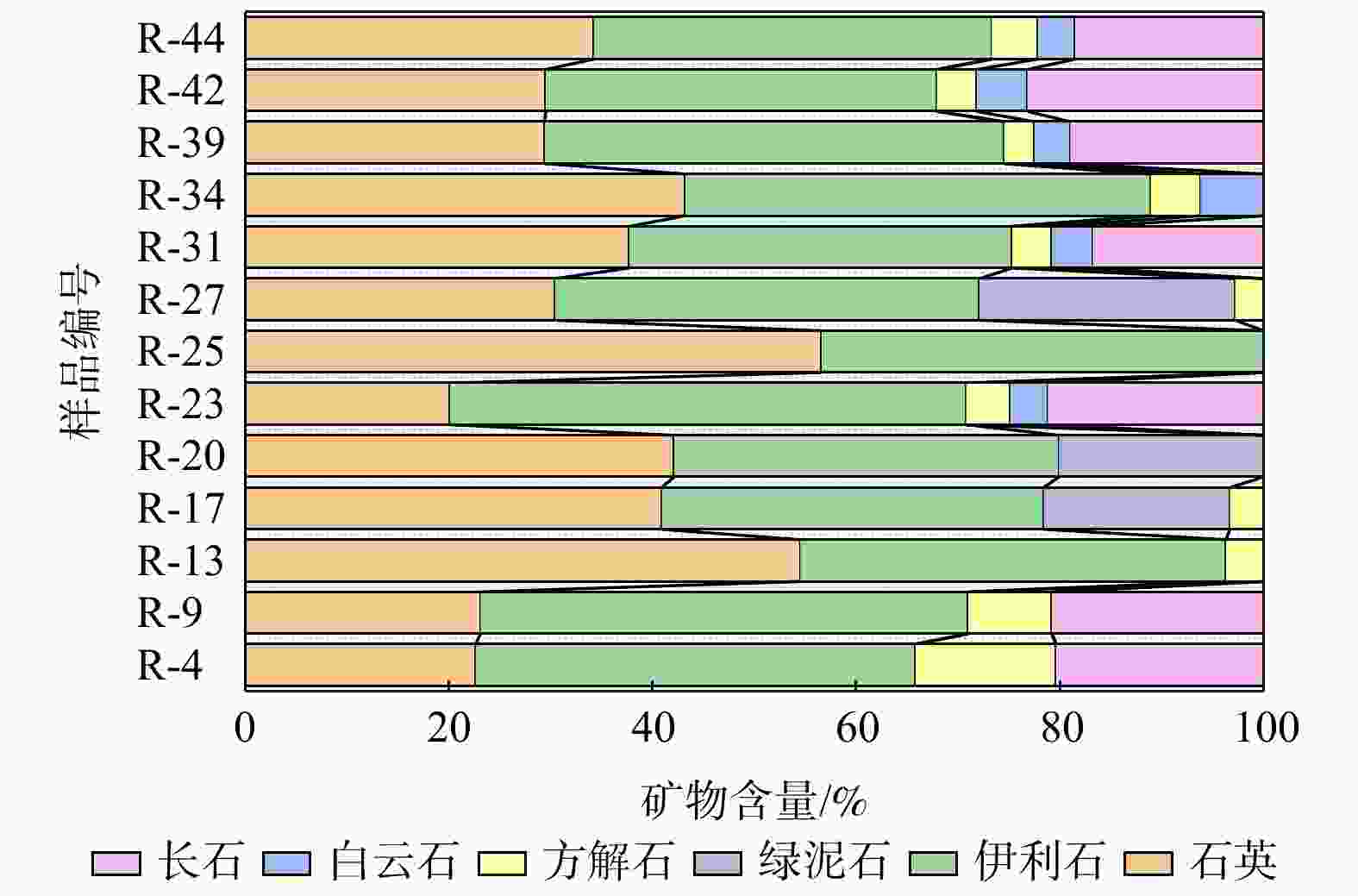
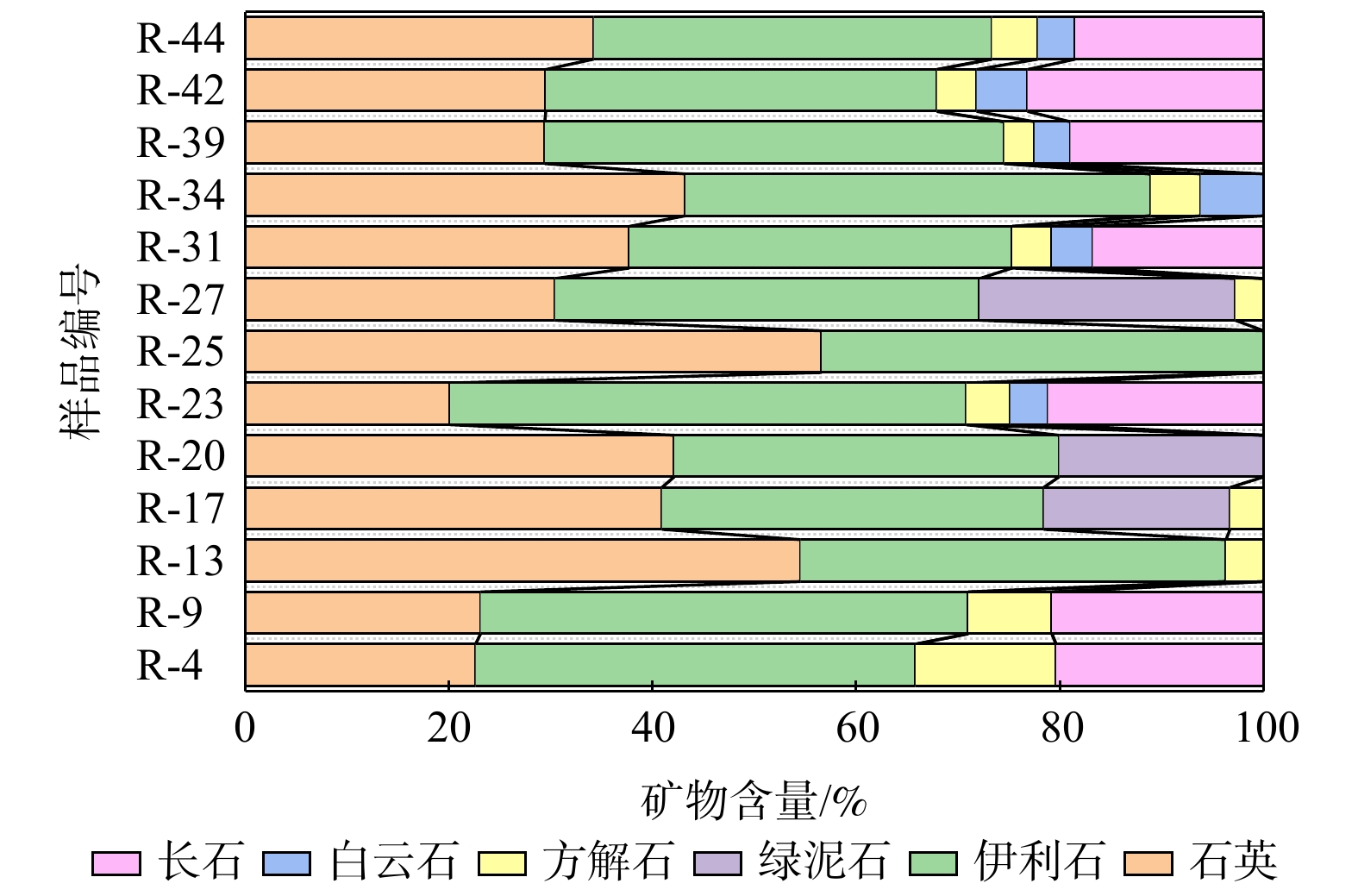
图 3 R16井乌拉力克组页岩矿物组分图
Figure 3. Mineral compositions of shales from the Wulalike Formation in Well R16
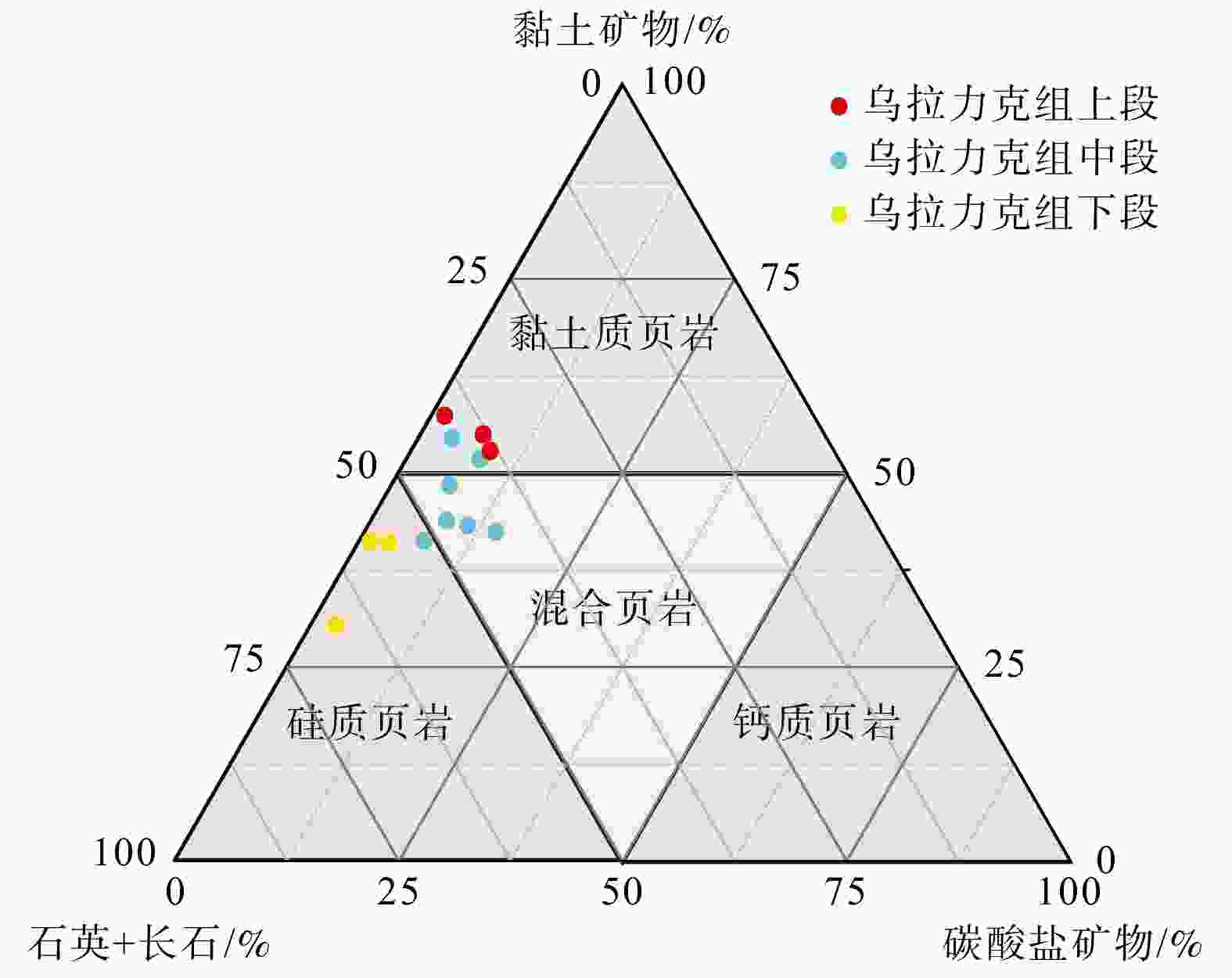
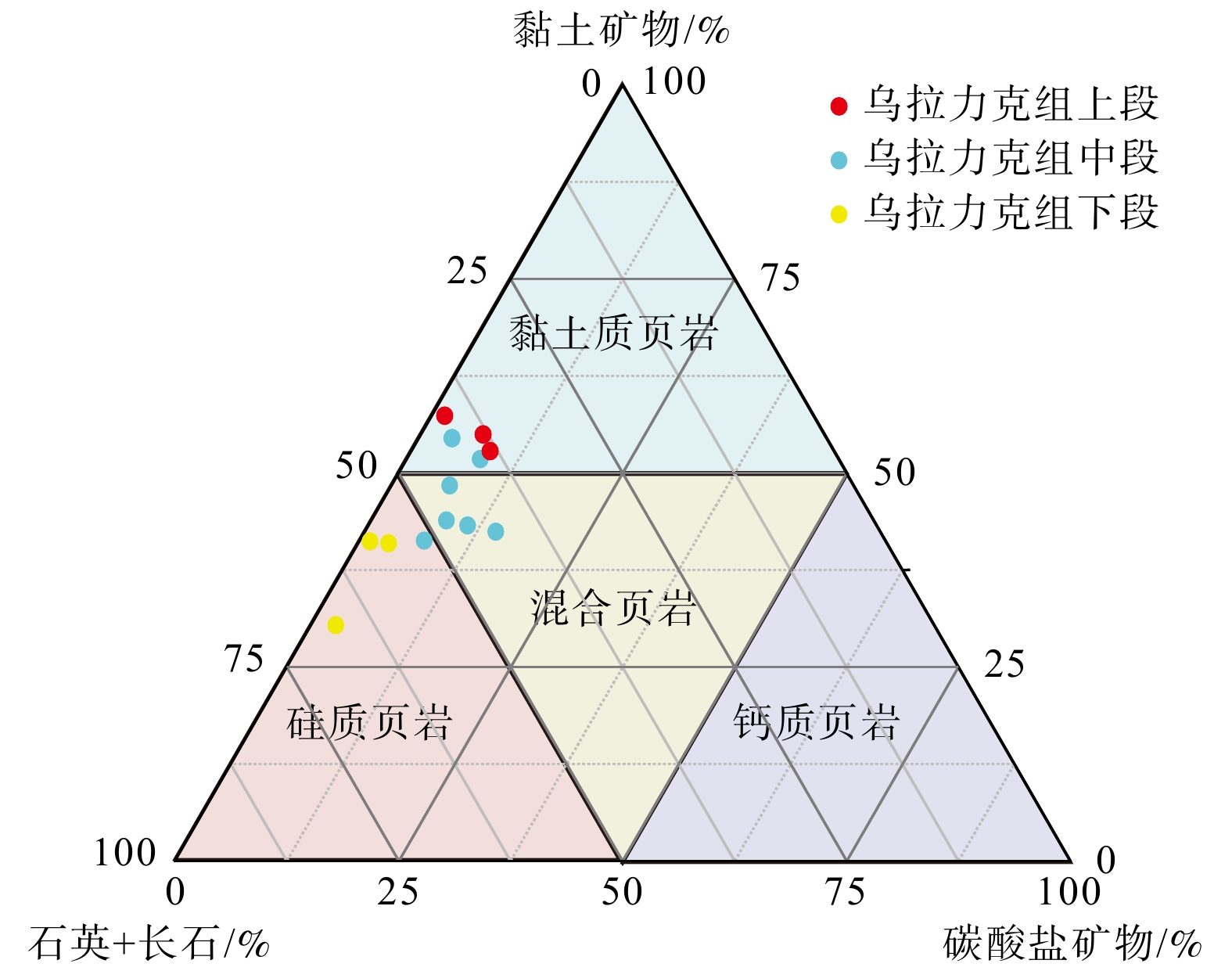
图 4 R16井乌拉力克组页岩矿物组分特征及三元分类图
Figure 4. Mineralogical characteristics and ternary classification diagram of shale samples from the Wulalike Formation in Well R16
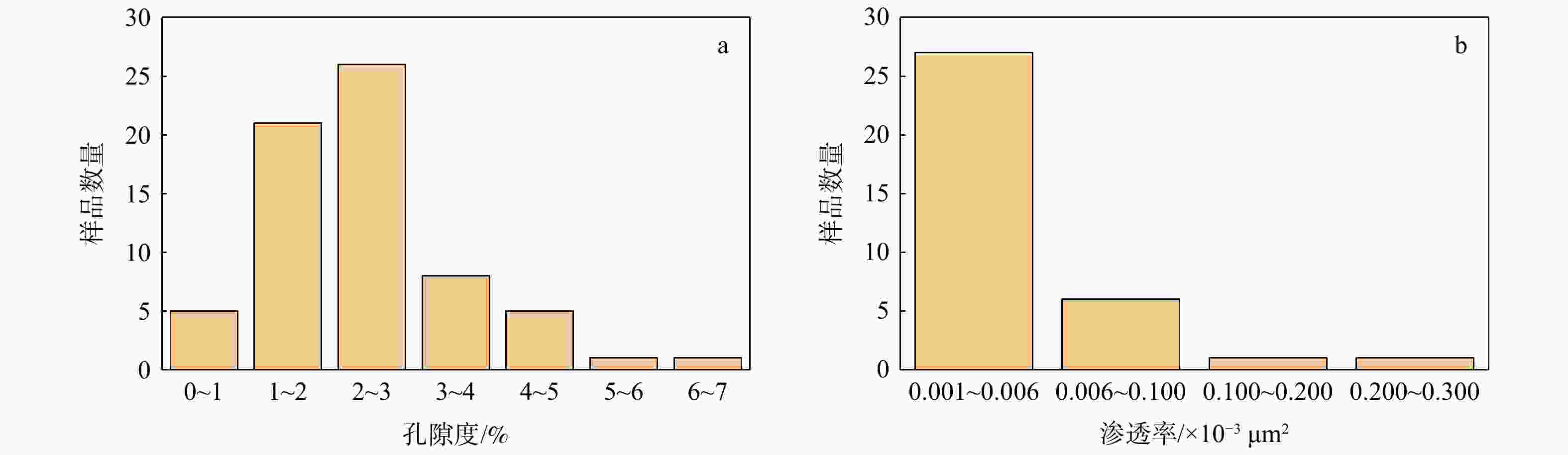
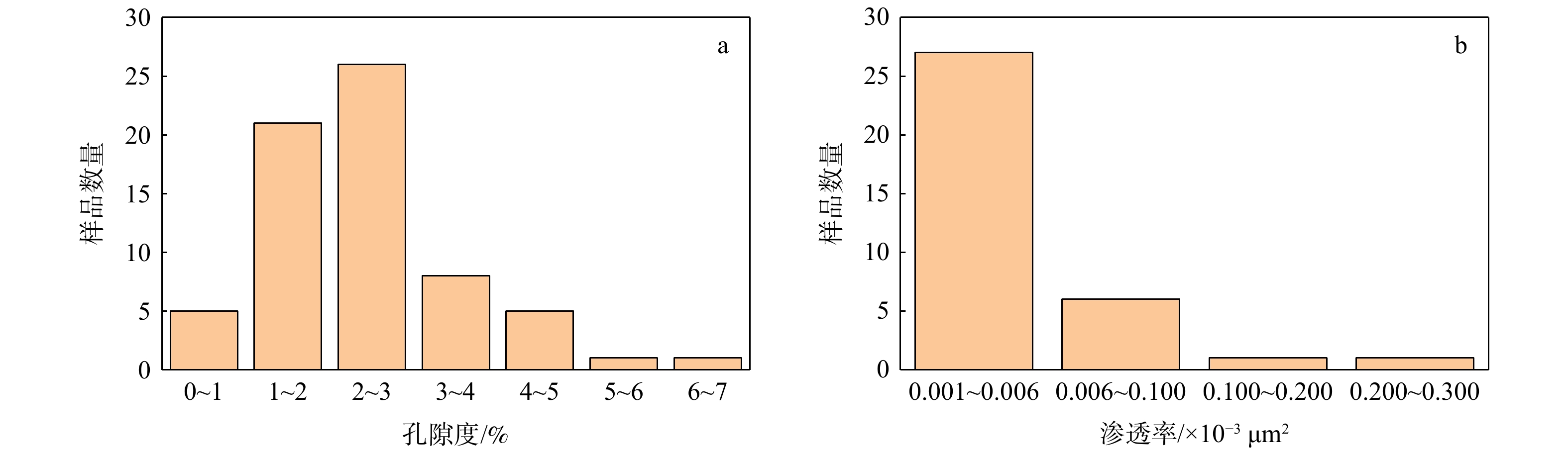
图 5 研究区乌拉力克组页岩样品孔隙度渗透率分布柱状图
a—孔隙度分布柱状图;b—渗透率分布柱状图
Figure 5. Histograms of the porosity and permeability distribution of shale samples from the Wulalike Formation in the study area
(a) Histogram of porosity distribution; (b) Histogram of permeability distribution
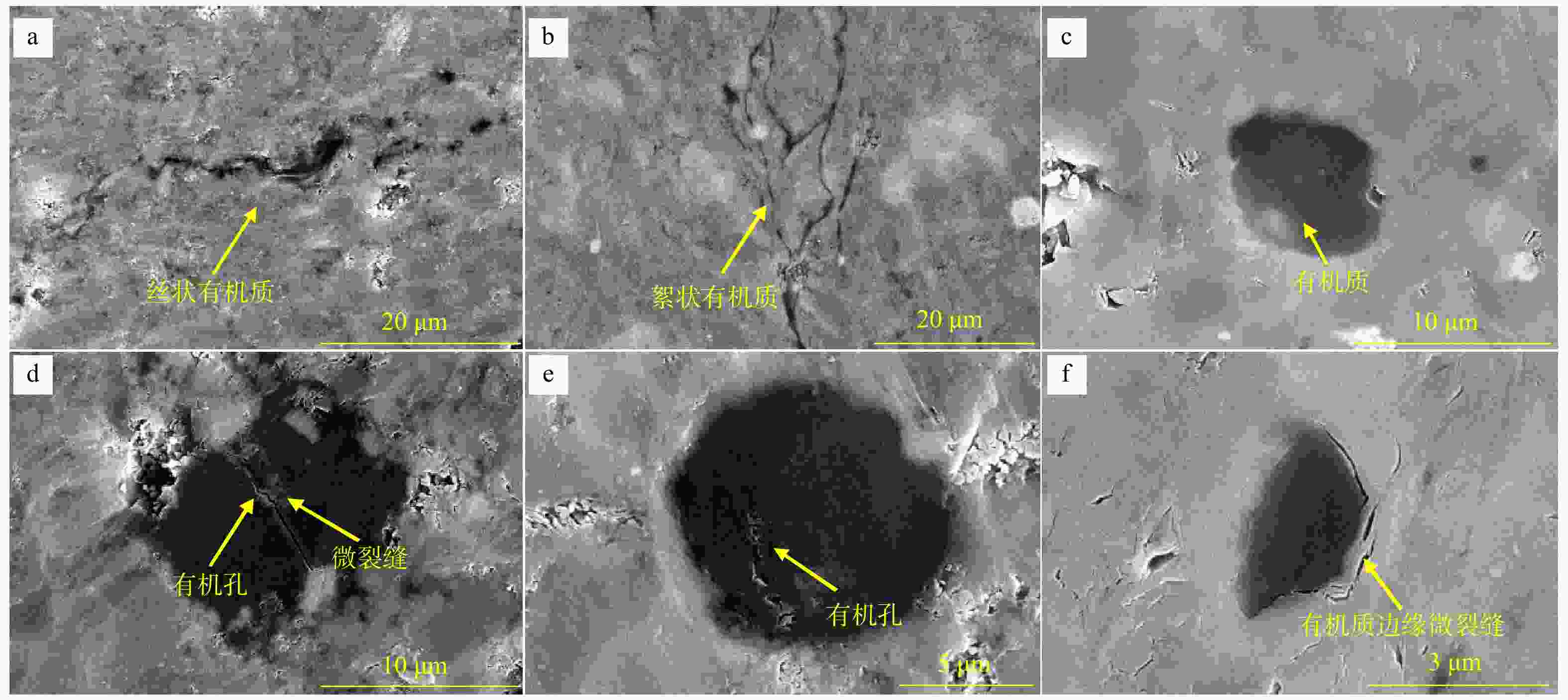
图 6 R16井乌拉力克组页岩中有机质及有机孔扫描电镜特征
a—R-13样品中的丝状有机质;b—R-39样品中的絮状有机质;c—R-4样品中的椭圆状有机质;d—R-26样品中的有机孔及微裂缝;e—R-44样品中的有机孔;f—R-39样品中的椭圆状有机质及边缘微裂缝
Figure 6. The scanning electron microscope characteristics of organic matter and organic pores in shale samples from the Wulalike Formation in Well R16
(a) Filamentous organic matter in sample R-13; (b) Flocculent organic matter in sample R-39; (c) Elliptical organic matter in sample R-4; (d) Organic pores and microfractures in sample R-26; (e) Organic pores in sample R-44; (f) Elliptic organic matter and marginal microfractures in sample R-39
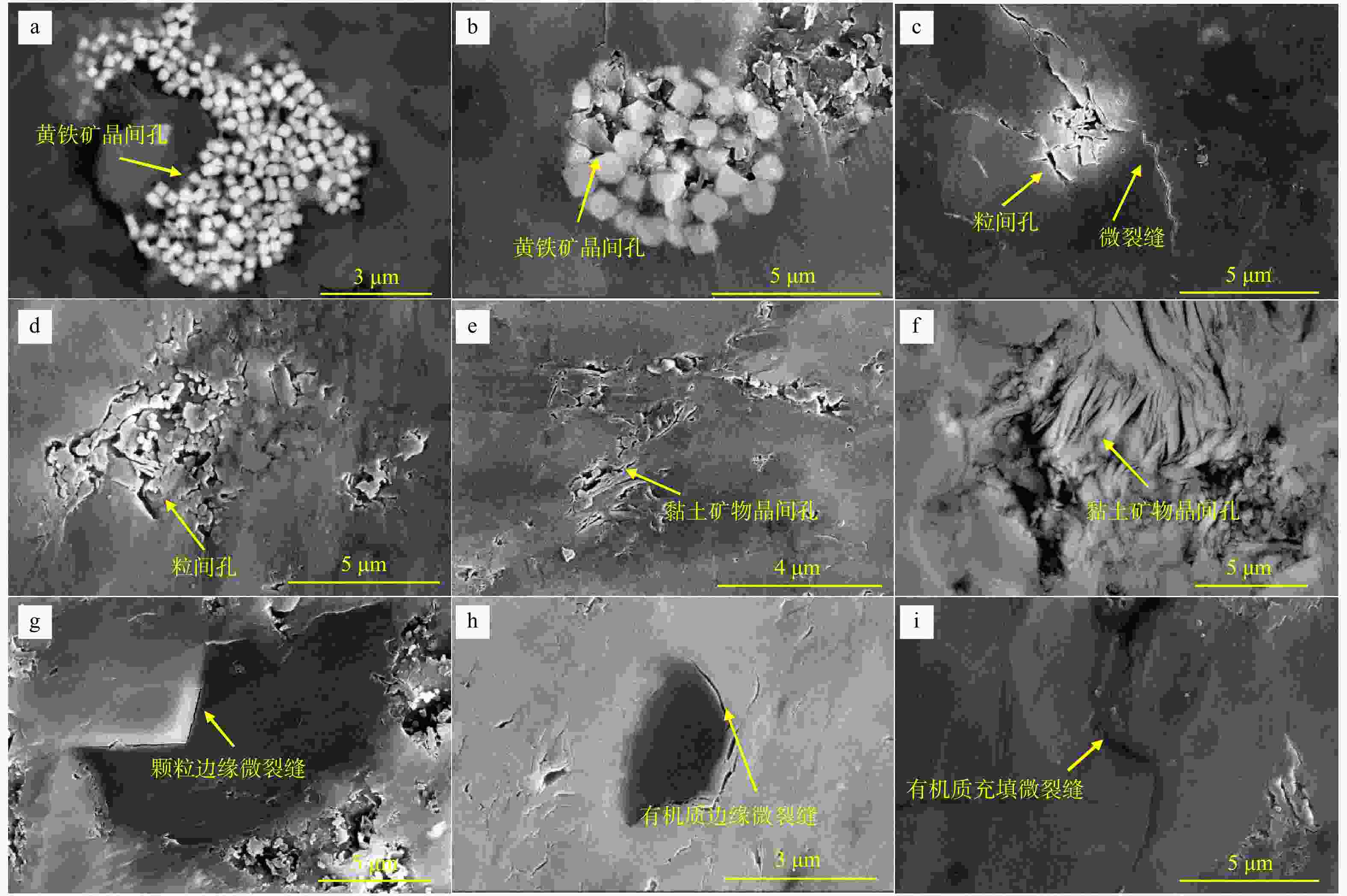
图 7 R16井乌拉力克组页岩无机孔及微裂缝扫描电镜特征
a—R-13样品中的黄铁矿晶间孔;b —R-34样品中的黄铁矿晶间孔;c—R-13样品中的矿物晶间孔;d—R-26样品中的矿物晶间孔;e—R-13样品中的黏土矿物晶间孔;f—R-39样品中的黏土矿物晶间孔;g—R-26样品中矿物颗粒边缘的微裂缝;h—R-34样品中有机质边缘的微裂缝;i—R-44样品中的有机质充填的微裂缝
Figure 7. Electron microscope images of inorganic pores and microfractures in the shales of the Wulalike Formation in Well R16
(a) Intergranular pores of pyrite in sample R-13; (b) Intergranular pores of pyrite in sample R-34; (c) Intergranular pores of minerals in sample R-13; (d) Intergranular pores of minerals in sample R-26; (e) Intergranular pores of clay minerals in sample R-13; (f) Intergranular pores of clay minerals in sample R-39; (g) Microfractures at the edges of minerals in sample R-26; (h) Microfractures at the edges of organic matter in sample R-34; (i) Microfractures filled with organic matter in sample R-44

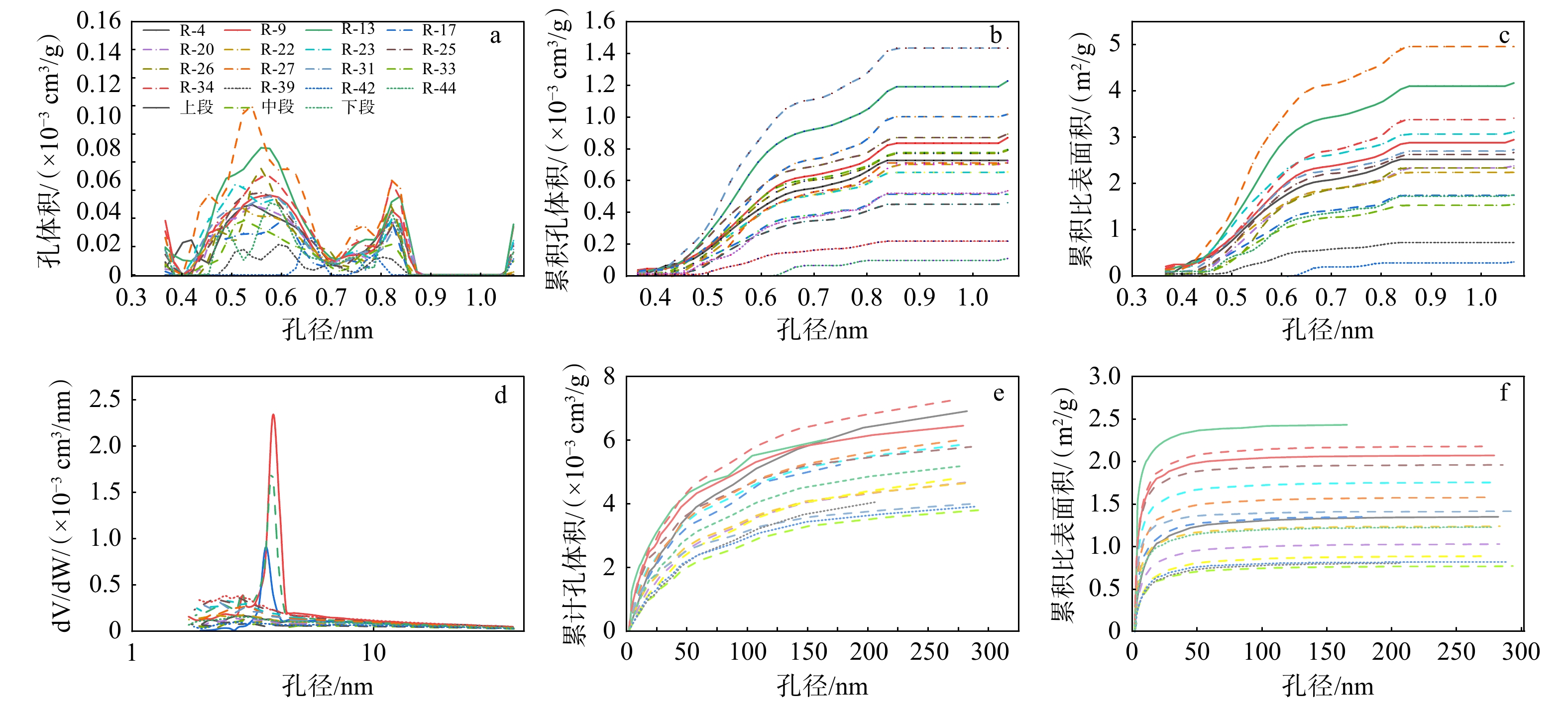
图 8 CO2吸附及N2吸附实验表征孔隙结构特征
a—CO2吸附孔径分布曲线;b—CO2吸附下页岩累积孔体积;c—CO2吸附下页岩累积比表面积;d—N2吸附表征的页岩孔径分布图;e—N2吸附表征的页岩累积孔体积;f—N2吸附表征的页岩累积比表面积
Figure 8. Pore structure characteristics characterized by CO2 and N2 adsorption experiments
(a) Pore size distribution curve from CO2 adsorption; (b) Cumulative pore volume of shale characterized by CO2 adsorption; (c) Cumulative specific surface area of shale characterized by CO2 adsorption; (d) Pore size distribution of shale characterized by N2 adsorption; (e) Cumulative pore volume of shale characterized by N2 adsorption; (f) Cumulative specific surface area of shale characterized by N2 adsorption
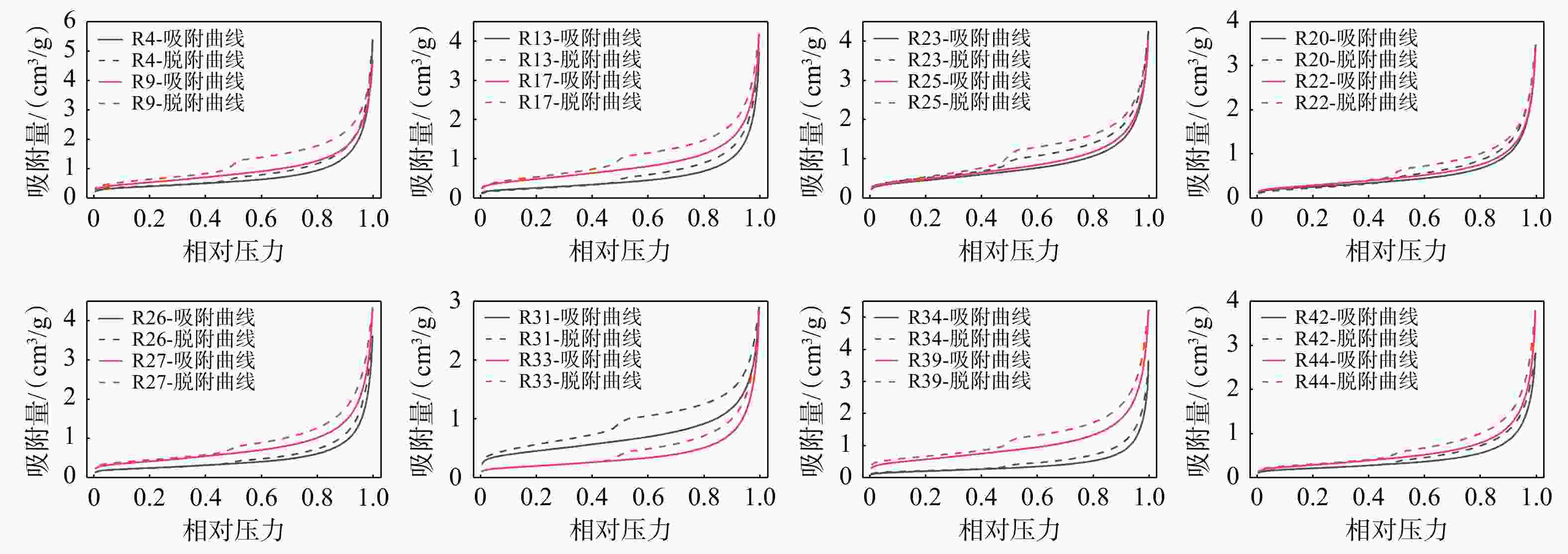
图 9 R16井乌拉力克组样品低温N2吸附−解吸等温线
Figure 9. Low-temperature N2 adsorption–desorption isotherms of samples from the Wulalike Formation shale in Well R16
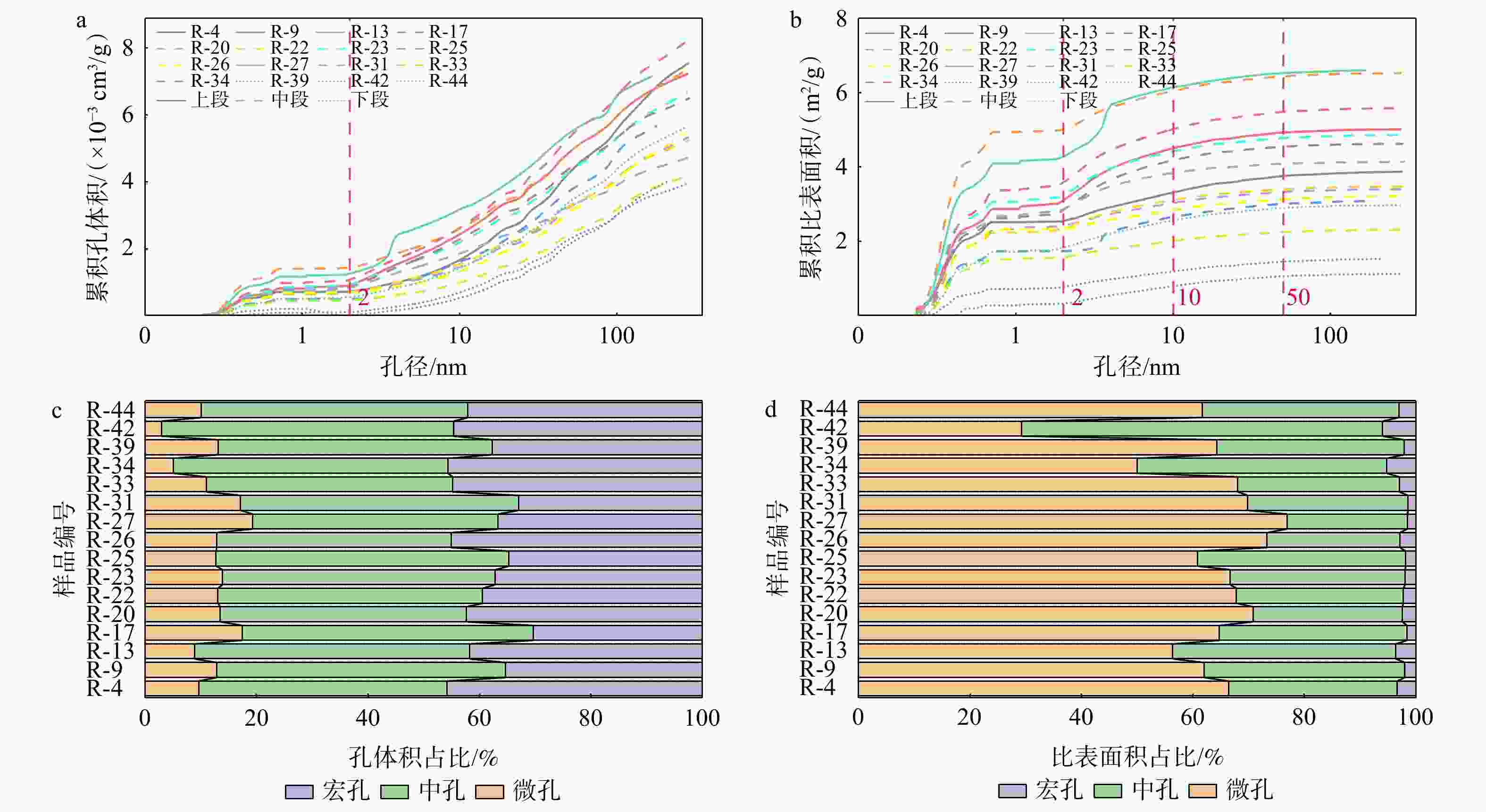
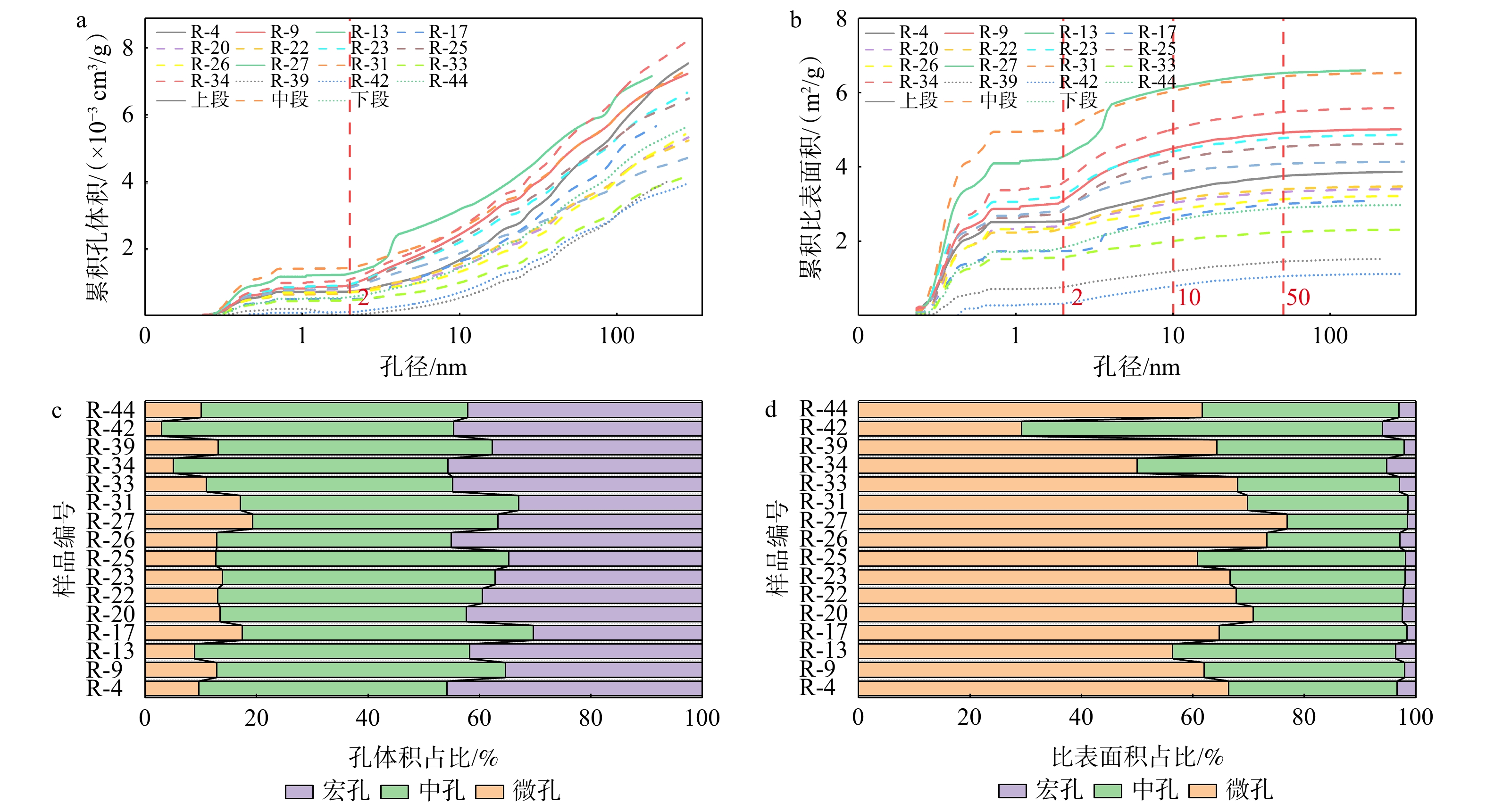
图 10 乌拉力克组页岩孔隙综合表征
a—页岩累积孔体积;b—页岩累积比表面积;c—不同孔隙孔体积占比;d—不同孔隙比表面积占比
Figure 10. Comprehensive characterization of pores in the shale samples from the Wulalike Formation
(a) Cumulative pore volume of shale; (b) Cumulative specific surface area of shale; (c) Proportions of different pore volumes; (d) Proportions of specific surface area of different pores

图 11 R16井乌拉力克组页岩样品裂缝发育特征
a—顺层微裂缝发育,高角度裂缝,2915.31~2916.17 m;b—顺层微裂缝发育,高角度裂缝,2917.76~2918.65 m;c—顺层裂缝发育,部分被方解石充填,2917.76 m;d—顺层微裂缝发育,高角度裂缝,2918.35 m;e—R-41,硅质页岩薄片,发育顺层裂缝,部分被方解石充填,2926.16 m,单偏光;f—R-44,硅质页岩薄片,发育顺层裂缝,部分被方解石充填,2919.35 m,单偏光
Figure 11. Fracture development characteristics of shale samples from the Wulalike Formation in Well R16
(a) Well-developed bedding microfractures and high-angle fractures, 2915.31 to 2916.17 m; (b) Well-developed bedding microfractures and high-angle fractures, 2917.76 to 2918.65 m; (c) Well-developed bedding fractures, partially filled with calcite, 2917.76 m; (d) Well-developed bedding microfractures and high-angle fractures, 2918.35 m; (e) R-41, thin section of siliceous shale, with partially calcite-filled bedding fractures, 2926.16 m; (f) R-44, thin section of siliceous shale, with partially calcite-filled bedding fractures, 2919.35 m
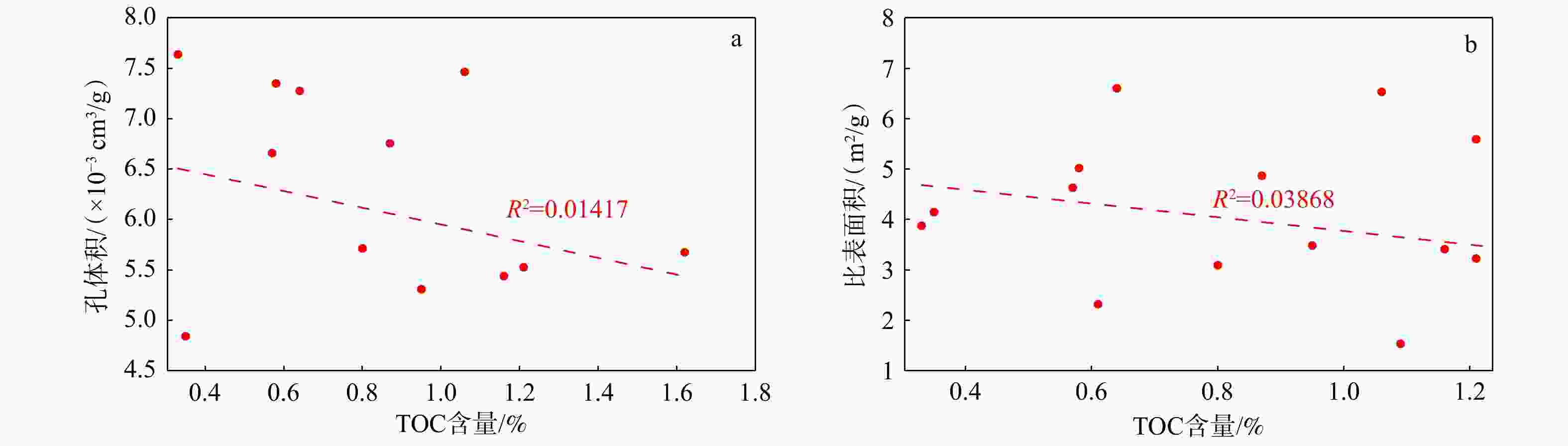
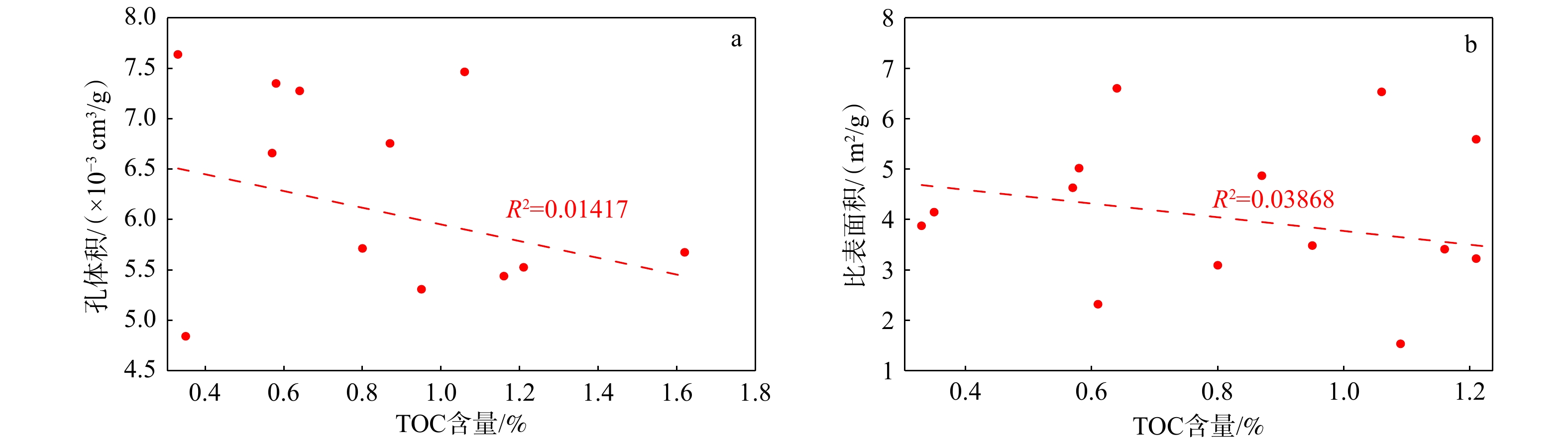
图 12 研究区R16井乌拉力克组页岩的孔体积、孔比表面积与TOC含量关系图
a—孔体积与TOC含量关系图;b—孔比表面积与TOC含量关系图
Figure 12. Relationship between pore volume, pore–specific surface area, and TOC content of shale samples from the Wulalike Formation in Well R16
(a) Relationship between pore volume and TOC content; (b) Relationship between pore–specific surface area and TOC content
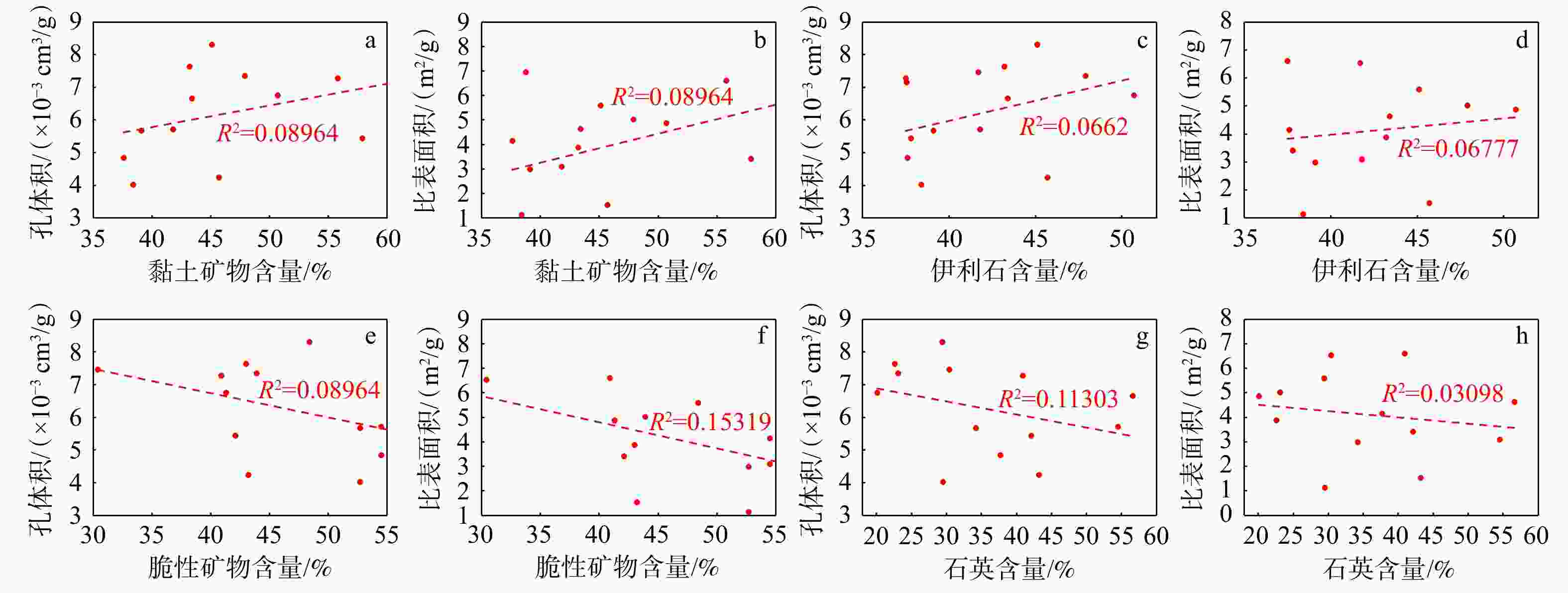
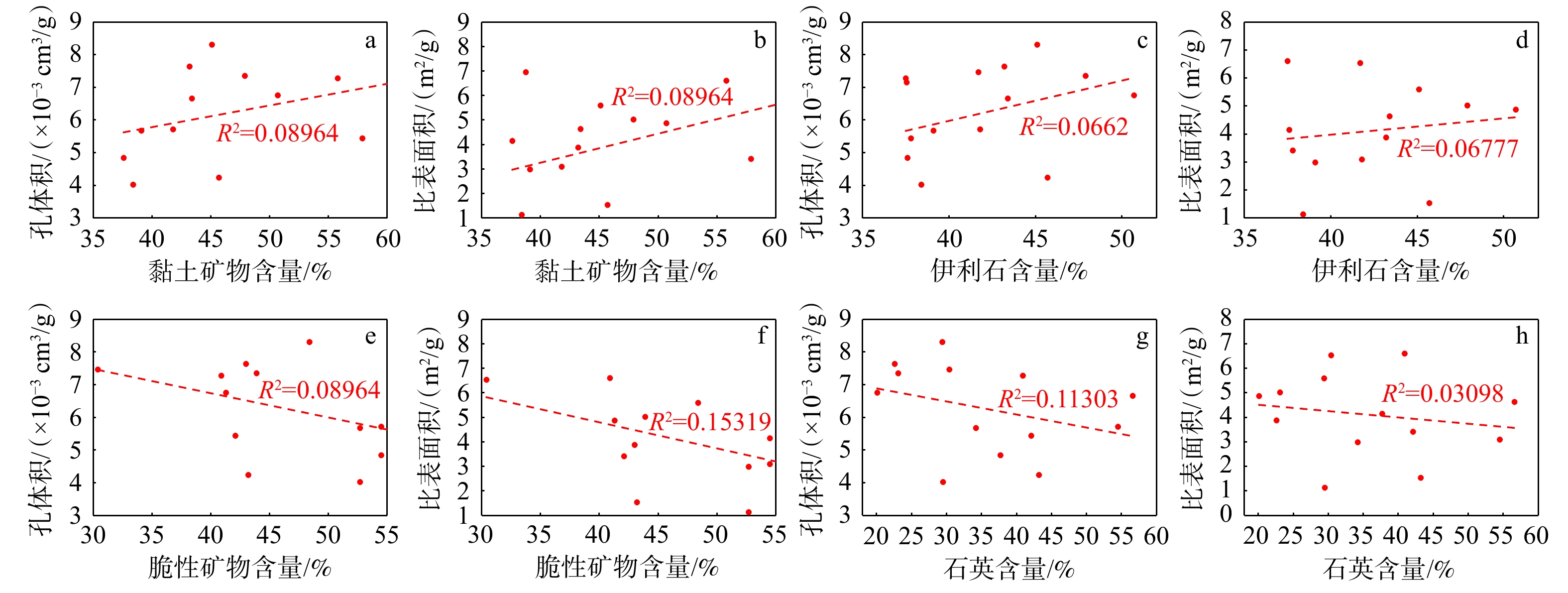
图 13 乌拉力克组页岩矿物组分与孔体积、孔比表面积的拟合关系
a—黏土矿物与孔体积的拟合关系;b—黏土矿物与比表面积的拟合关系;c—伊利石含量与孔体积的拟合关系;d—伊利石含量与孔比表面积的拟合关系;e—脆性矿物与孔体积的拟合关系;f—脆性矿物与比表面积的拟合关系;g—石英含量与孔体积的拟合关系;h—石英含量与孔比表面积的拟合关系
Figure 13. Fitting relationship between mineral components and pore volume as well as pore specific surface area of shale samples from the Wulalike Formation
(a) Fitting relationship between clay mineral content and pore volume; (b) Fitting relationship between clay mineral content and pore specific surface area; (c) Fitting relationship between illite content and pore volume; (d) Fitting relationship between illite content and pore specific surface area; (e) Fitting relationship between brittle minerals and pore volume; (f) Fitting relationship between brittle minerals and pore specific surface area; (g) Fitting relationship between quartz content and pore volume; (h) Fitting relationship between quartz content and pore specific surface area

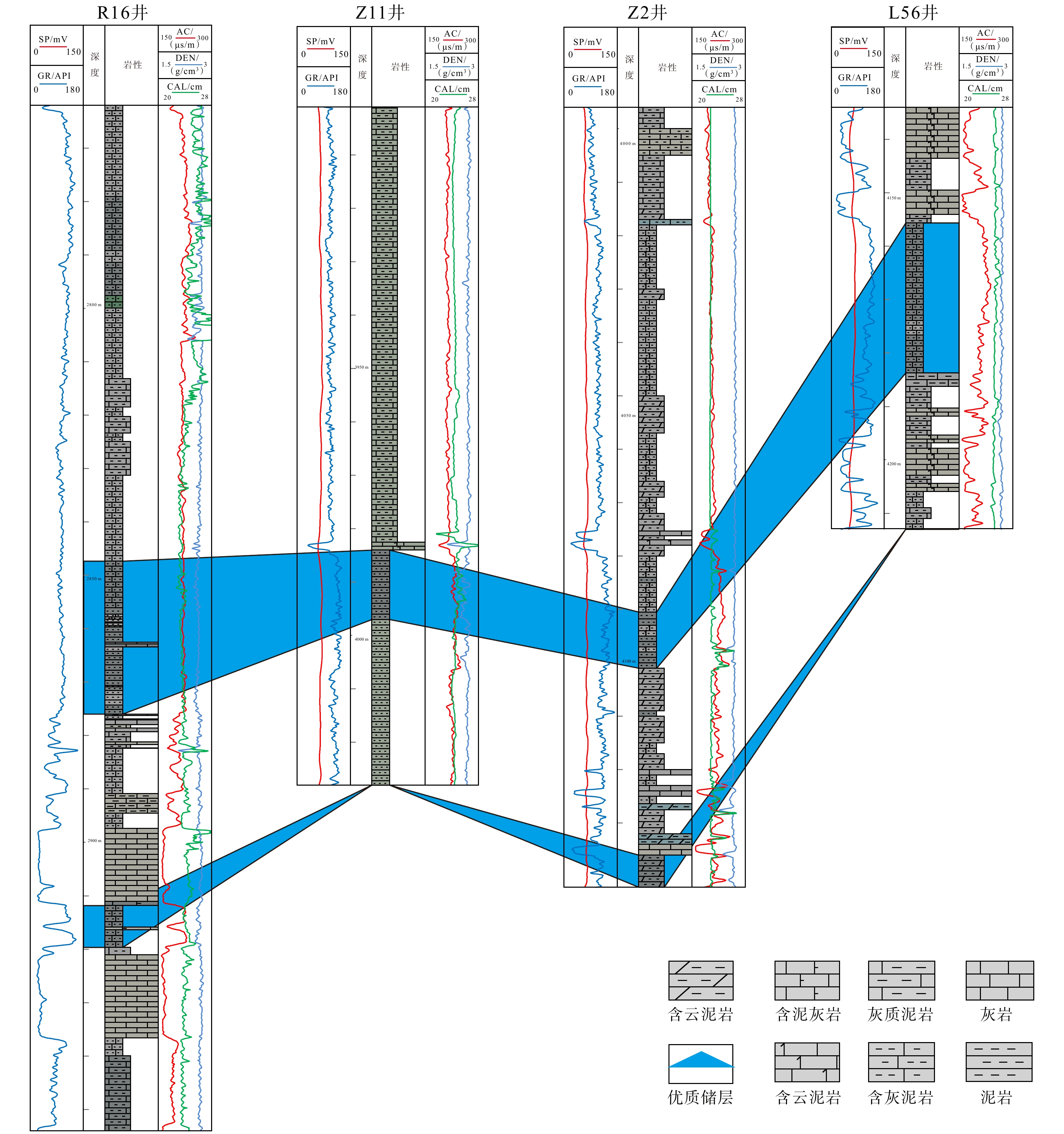
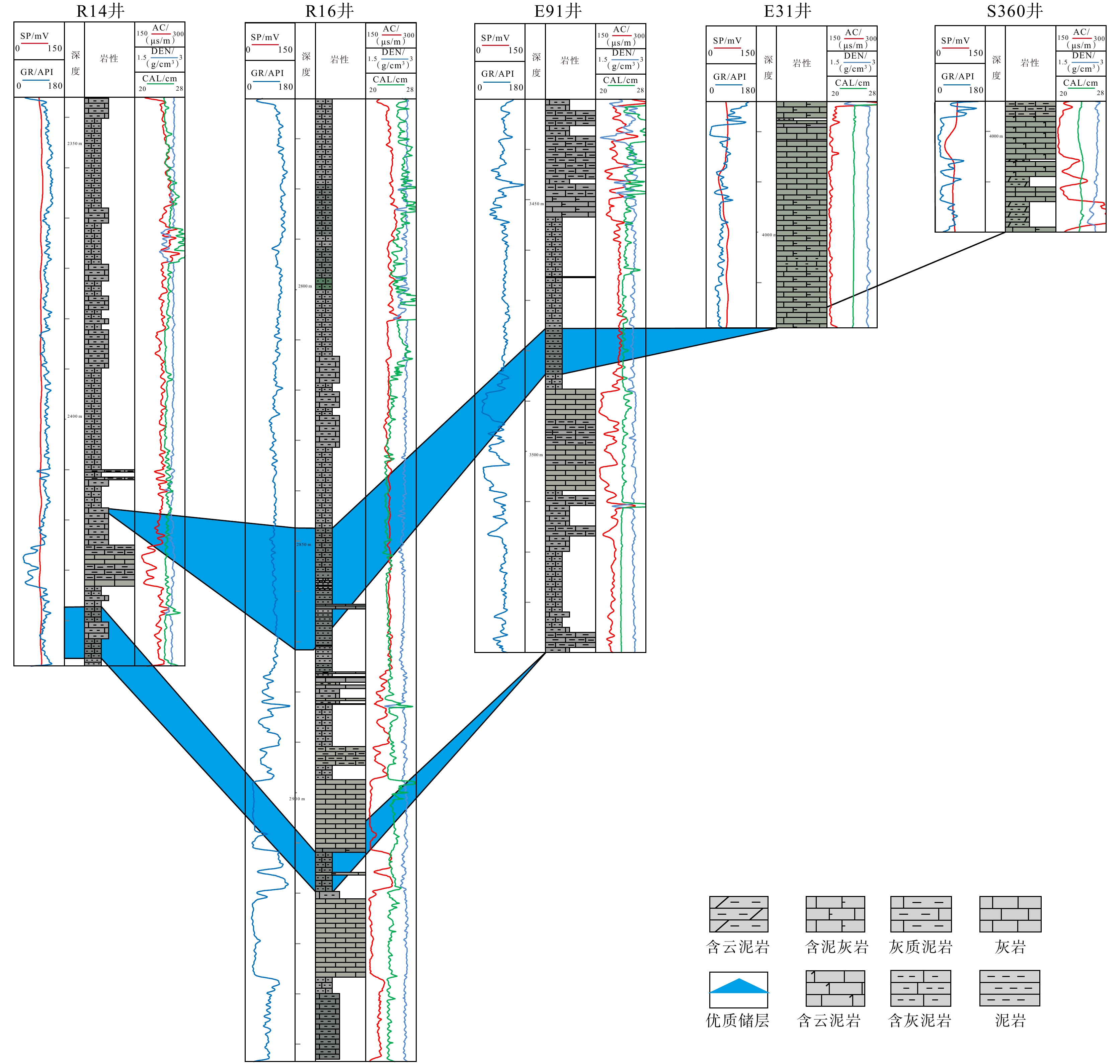
图 14 研究区乌拉力克组页岩优质储层纵向连井分布特征(剖面位置见图1)
SP—自然电位测井曲线;GR—自然伽马测井曲线;AC—声波时差测井曲线;DEN—密度测井曲线;CAL—井径测井曲线
Figure 14. Vertical distribution characteristics of high-quality shale reservoirs in the Wulalike Formation across wells within the study area (for profile location, see Fig. 1)
SP—Spontaneous potential log; GR—Gamma ray log; AC—Acoustic log; DEN—Density log; CAL—Caliper log
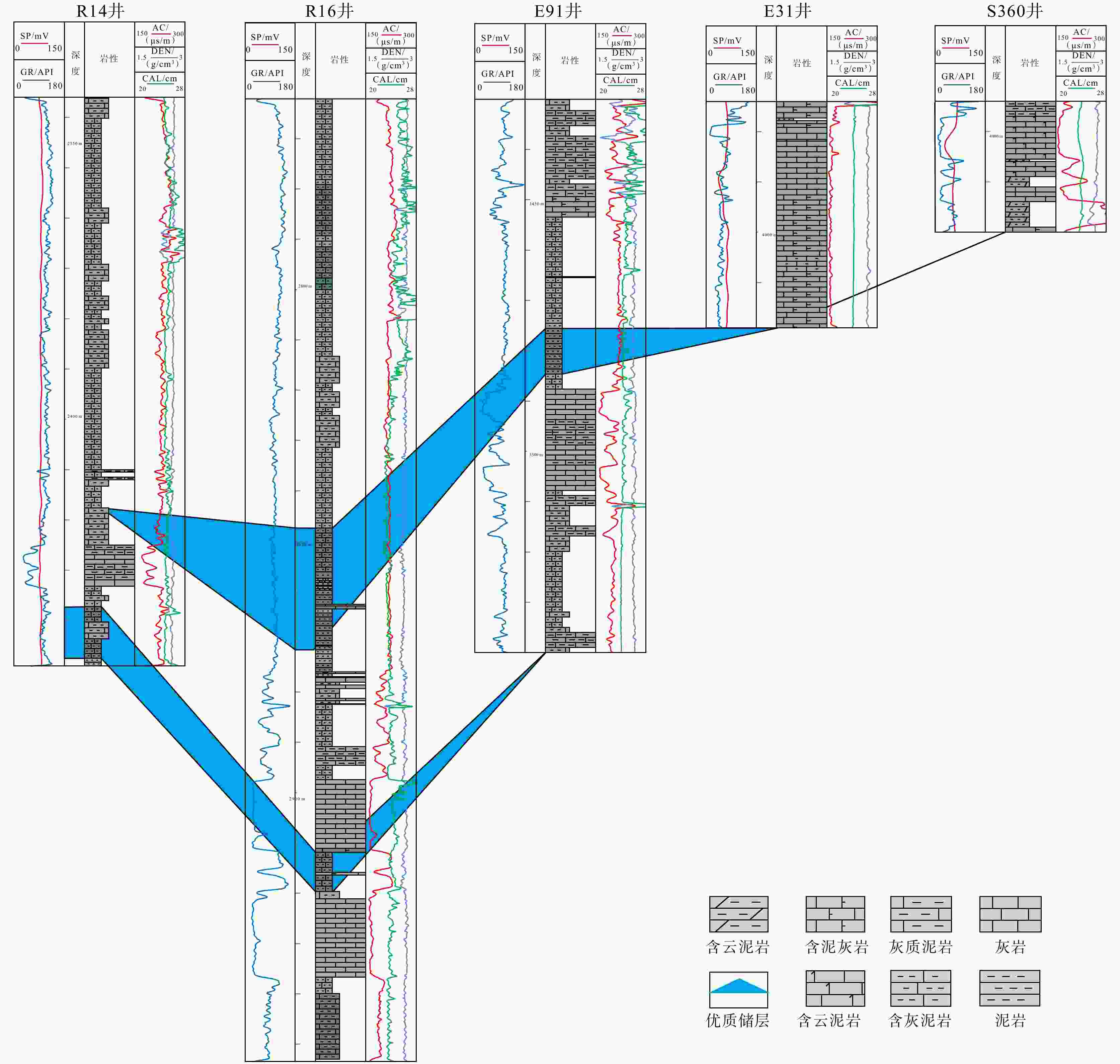
图 15 研究区乌拉力克组页岩优质储层横向连井分布特征(剖面位置见图1)
SP—自然电位测井曲线;GR—自然伽马测井曲线;AC—声波时差测井曲线;DEN—密度测井曲线;CAL—井径测井曲线
Figure 15. Lateral distribution characteristics of high-quality shale reservoirs in the Wulalike Formation across wells within the study area (for profile location, see Fig. 1)
SP—Spontaneous potential log; GR—Gamma ray log; AC—Acoustic log; DEN—Density log; CAL—Caliper log
表 1 鄂尔多斯盆地西缘R16井乌拉力克组页岩孔隙类型特征
Table 1. Pore type characteristics of the Wulalike Formation shale in Well R16 at the western margin of the Ordos Basin
孔隙类型 孔径大小 发育特征 发育程度 有机质孔 30.0~850.0 nm 呈片麻状、椭圆形发育于有机质内部 不发育 粒间孔 0.2~8.0 μm 主要为黏土矿物粒间孔和基质粒间孔,以及软硬颗粒接触处 发育 微裂缝 0.8~43.5 μm 主要发育于矿物颗粒边缘以及有机质边缘 发育  下载: 导出CSV
表 2 页岩气储层分段评价表(张金川等,2011;涂乙等,2014)
Table 2. Stratigraphic evaluation of the shale gas reservoir (Zhang et al., 2011; Tu et al., 2014)
评价指标 基本标准 指标特征分类 Ⅰ Ⅱ Ⅲ Ⅳ TOC含量/% >0.3 >2.0 2.0~1.0 1.0~0.5 0.5~0.3 Ro/% ≥0.4 >2.0 2.0~1.2 1.2~0.6 <0.6 有效厚度/m >9 >80 80~55 55~30 35~10 孔隙度/% 1 >8 8~4 4~1 <1 含气量/(m3/t) 0.5 >10 10~5 5~1 <1 埋藏深度/m <4500 >3500 3500~1500 1500~500 <500 黏土矿物含量/% >30 >40 40~30 30~15 <15 脆性矿物含量/% >45 >40 40~30 >30 / 渗透率/μm2 1×10⁻⁶ / / / /
下载: 导出CSV
表 3 R16井乌拉力克组页岩气储层分段特征
Table 3. Sectional characteristics of shale gas reservoirs in the Wulalike Formation of Well R16
评价指标 全井 上段 中段 下段 TOC含量/% 0.65 0.30 0.70 1.39 Ro/% 1.04 1.01 1.04 1.10 地层厚度/m 187 15 35 5 孔体积/(×10-3cm³/g) 6.260 7.494 6.300 4.848 比表面积/(m²/g) 4.110 4.448 4.491 2.058 孔隙度/% 2.32 2.90 2.26 2.11 含气量/(m3/t) 1.619 2.155 1.549 1.597 埋藏深度/m 2763~2950 2785~2800 2850~2885 2915~2920 黏土矿物/% 47.18 45.55 49.42 38.75 脆性矿物/% 46.18 43.45 45.77 57.20
下载: 导出CSV
-
[1] AN Y Y, YANG ZQ, CHEN H G, et al., 2024. Shale Gas Reservoir Characteristics of the Wufeng-Xintan Formation in Well Banzhu-1 in Northern Guizhou[J]. Guizhou Geological Survey, 41(03): 249-255. (in Chinese with English abstract) [2] BAI Y, MA Z R, HUANG Z L, et al., 2025. Lithofacies and sedimentary model of migmatites in the ordovician Wulalike Formation, western edge of the Ordos Basin[J]. Acta Sedimentologica Sinica, 43(4): 1213-1232, doi: 10.14027/j.issn.1000-0550.2024.120 [3] BAO S J, ZHAI G Y, TANG X C, et al. , 2016. Shale mineralogy and petrology[M]. Shanghai: East China University of Science and Technology Press. (in Chinese) [4] CHEN R B, WANG Y M, HUANG Z L, et al., 2024. Fracture pore characteristics and gas accumulation model of marine shales in the northwestern Ordos Basin: a case study of the Ordovician Wulalike Formation[J]. Earth Science Frontiers, 31(5): 46-60. (in Chinese with English abstract) [5] CHEN X L, GUO T X, SHI D S, et al., 2019. Pore structure characteristics and adsorption capacity of Niutitang Formation shale in southern Shaanxi[J]. Lithologic Reservoirs, 31(5): 52-60. (in Chinese with English abstract) [6] DONG D Z, WANG Y M, HUANG X N, et al., 2016. Discussion about geological characteristics, resource evaluation methods and its key parameters of shale gas in China[J]. Natural Gas Geoscience, 27(9): 1583-1601. (in Chinese with English abstract) [7] FENG X L, AO W H, TANG X, 2018. Characteristics of pore development and its main controlling factors of continental shale gas reservoirs: a case study of Chang 7 member in Ordos Basin[J]. Journal of Jilin University (Earth Science Edition), 48(3): 678-692. (in Chinese with English abstract) [8] FENG Y Q, 2020. Reservoir characteristics and accumulation model of mud shale of Wulalik Formation in Northwestern Margin of Ordos Basin[D]. Chengdu: Chengdu University of Technology. (in Chinese with English abstract) [9] FU S T, FU J H, XI S L, et al., 2021. Geological characteristics of Ordovician marine shale gas in the Ordos Basin and its prospects[J]. China Petroleum Exploration, 26(2): 33-44. (in Chinese with English abstract) [10] GAO Y N, ZHANG S H, YU M, et al., 2025. Reservoir characteristics and diagenetic processes of the Benxi Formation in the East Yanchuan Block, Ordos Basin[J]. Journal of Geomechanics, 31(4): 704-719. (in Chinese with English abstract) [11] GUO W, DONG D Z, LI M, et al., 2021. Quartz genesis in organic-rich shale and its indicative significance to reservoir quality: a case study on the first submember of the first Member of Lower Silurian Longmaxi Formation in the southeastern Sichuan Basin and its periphery[J]. Natural Gas Industry, 41(2): 65-74. (in Chinese with English abstract) [12] GUO X S, LI Y P, LIU R B, et al., 2014. Characteristics and controlling factors of micro-pore structures of Longmaxi Shale Play in the Jiaoshiba area, Sichuan Basin[J]. Natural Gas Industry, 34(6): 9-16. (in Chinese with English abstract) doi: 10.1016/j.ngib.2014.11.007 [13] GUO X S, HU D F, DUAN J B , et al. , 2020. Marine petroleum exploration in South China[J]. Petroleum Geology & Experiment, 42(5): 675-686. (in Chinese with English abstract) [14] GUO X S, ZHAO Y Q, SHEN B J, et al., 2022. Marine shale gas exploration theory in southern China: review and prospects[J]. Acta Geologica Sinica, 96(1): 172-182. (in Chinese with English abstract) [15] HUANG Z L, CAO B F, LIU Y, et al., 2025. Microscopic reservoir characteristics of laminated shales: a case study of the Wulalike Formation at the western margin of the Ordos Basin[J]. Acta Sedimentologica Sinica, 43(4): 1251-1263, doi: 10.14027/j.issn.1000-0550.2024.085 [16] JIA C Z, 2020. Development challenges and future scientific and technological researches in China's petroleum industry upstream[J]. Acta Petrolei Sinica, 41(12): 1445-1464. (in Chinese with English abstract) [17] LI C H, ZHAO L, LIU B, et al., 2020. Research status, significance and development trend of microfractures[J]. Natural Gas Geoscience, 31(3): 402-416. (in Chinese with English abstract) [18] LIU G, HUANG H X, WU Y, et al., 2025. Factors influencing pore space in Wulalike Formation shale, Ordos Basin: Geological significance for shale gas[J]. Acta Sedimentologica Sinica, 43(4): 1233-1250. (in Chinese with English abstract) [19] LOUCKS R G, REED R M, RUPPEL S C, et al., 2009. Morphology, genesis, and distribution of nanometer-scale pores in siliceous mudstones of the Mississippian Barnett Shale[J]. Journal of Sedimentary Research, 79(12): 848-861. doi: 10.2110/jsr.2009.092 [20] NIE H K, BIAN R K, ZHANG P X, et al., 2014. Micro-types and characteristics of shale reservoir of the Lower Paleozoic in Southeast Sichuan Basin, and their effects on the gas content[J]. Earth Science Frontiers, 21(4): 331-343. (in Chinese with English abstract) [21] SING K S W, 1985. Reporting physisorption data for gas/solid systems with special reference to the determination of surface area and porosity (Recommendations 1984)[J]. Pure and Applied Chemistry, 57(4): 603-619. [22] THOMMES M, KANEKO K, NEIMARK A V, et al., 2015. Physisorption of gases, with special reference to the evaluation of surface area and pore size distribution (IUPAC Technical Report)[J]. Pure and Applied Chemistry, 87(9-10): 1051-1069. doi: 10.1515/pac-2014-1117 [23] TU Y, ZOU H Y, MENG H P, et al., 2014. Evaluation criteria and classification of shale gas reservoirs[J]. Oil & Gas Geology, 35(1): 153-158. (in Chinese with English abstract) doi: 10.2118/119899-ms [24] WANG Y M, HUANG Z L, MA Z R, et al., 2025. Geological conditions and accumulation mode of shale gas in the Ordovician Wulalike Formation in the northwestern margin of Ordos Basin[J]. China Petroleum Exploration, 30(1): 125-143. (in Chinese with English abstract) [25] WU S T, ZHU R K, CUI J G, et al., 2015. Characteristics of lacustrine shale porosity evolution, Triassic Chang 7 Member, Ordos Basin, NW China[J]. Petroleum Exploration and Development, 42(2): 167-176. (in Chinese with English abstract) [26] XI S L, MO W L, LIU X S, et al., 2021. Shale gas exploration potential of Ordovician Wulalike Formation in the western margin of Ordos Basin: case study of Well Zhongping 1[J]. Natural Gas Geoscience, 32(8): 1235-1246. (in Chinese with English abstract) [27] XI S L, LIU X S, HUANG Z L, et al., 2023. Enrichment characteristics and exploration direction of shale oil and gas in Wulalike Formation of Middle Ordovician in the Ordos Basin[J]. Natural Gas Industry, 43(3): 12-22. (in Chinese with English abstract) [28] XIE M Y, ZHANG D D, LUO H Y, et al., 2023. Characterization of pore structure of Upper Paleozoic dense reservoir in Ordos Basin: cases study of the Shanxi Formation and the Xiashihezi Formation in Yanchi area[J]. Natural Gas Geoscience, 34(7): 1173-1186. (in Chinese with English abstract) [29] YAN W, LIU Y, GUO W, et al., 2025. Lithofacies paleogeography of the Ordovician Wulalike Formation, western margin of the Ordos Basin[J]. Acta Sedimentologica Sinica, 43(4): 1199-1212, doi: 10.14027/j.issn.1000-0550.2024.096 [30] YU Z, ZHOU J G, LI C S, et al., 2021. Tectonic-lithofacies paleogeographic characteristics of Ordovician Kelimoli and Wulalike stages in the western edge of Ordos Basin[J]. Natural Gas Geoscience, 32(6): 816-825. (in Chinese with English abstract) [31] ZHANG F Q, LI Y N, LUO J L, et al., 2022. Microscopic pore structure characteristics of shale of Ordovician Wulalike Formation in western Ordos Basin[J]. Lithologic Reservoirs, 34(5): 50-62. (in Chinese with English abstract) [32] ZHANG J C, JIANG S L, TANG X, et al., 2009. Enrichment types and resource characteristics of shale gas in China[J]. Natural Gas Industry, 29(12): 109-114+151-152. (in Chinese with English abstract) [33] ZHANG J C, BIAN R K, JING T Y, , et al. , 2011. Fundamental significance of gas shale theoretical research. Geological Bulletin of China, 30(2/3): 318-323. (in Chinese with English abstract) [34] ZHANG X Y, ZHAN R R, DUAN L, et al., 2024. 3D digital modelling and detailed anatomy of tight sandstone reservoir outcrop with oil-bearing heterogeneity: a case study of Angou outcrop of Triassic Yanchang Formation in Ordos Basin[J]. Journal of Geomechanics, 30(4): 609-621. (in Chinese with English abstract) [35] ZHANG Y N, LI R X, XI S L, et al., 2022. Sedimentary environments and organic matter enrichment mechanism of Ordovician Wulalike Formation shale, western Ordos Basin[J]. Journal of Central South University (Science and Technology), 53(9): 3401-3417. (in Chinese with English abstract) [36] ZHANG J K, HE S, YAN X L, et al., 2017. Structural characteristics and thermal evolution of nanoporosity in shales[J]. Journal of China University of Petroleum (Edition of Natural Science), 41(1): 11-24. (in Chinese with English abstract) [37] ZHAO D F, GUO Y H, XIE D L, et al., 2014. Fractal characteristics of shale reservoir pores based on nitrogen adsorption[J]. Journal of Northeast Petroleum University, 38(6): 100-108. (in Chinese with English abstract) [38] ZHAO D F, 2020. Quantitative characterization of pore structure of shale reservoirs in the Lower Paleozoic Wufeng-Longmaxi formation of the East Sichuan area[D]. Xuzhou: China University of Mining and Technology, doi: 10.27623/d.cnki.gzkyu.2020.000508. (in Chinese with English abstract) [39] ZHAO H G, LIU C Y, WANG F, et al, 2006. Structural zoning and its characteristics of the western margin of the Ordos Basin[J]. Oil & Gas Geology, (2): 173-179. (in Chinese with English abstract) [40] ZOU C N, DONG D Z, ZHANG Q, et al., 2025. Formation, potential, and challenges of marine-continental transitional shale gas in China[J]. Earth Science, 50(11): 4261-4283. (in Chinese with English abstract) [41] 安亚运, 杨忠琴, 陈厚国, 等, 2024. 黔北地区班竹1井五峰组—新滩组页岩气储层特征[J]. 贵州地质, 41(03): 249-255. doi: 10.3969/j.issn.1000-5943.2024.03.004 [42] 白莹, 马占荣, 黄正良, 等, 2025. 鄂尔多斯盆地西缘奥陶系乌拉力克组混积岩岩相类型及沉积模式[J]. 沉积学报, 43(4): 1213-1232, doi: 10.14027/j.issn.1000-0550.2024.120. [43] 包书景, 翟刚毅, 唐显春, 等, 2016. 页岩矿物岩石学[M]. 上海: 华东理工大学出版社. [44] 陈如彪, 王玉满, 黄正良, 等, 2024. 鄂尔多斯盆地西北缘海相页岩裂缝孔隙发育特征与页岩气富集模式: 以奥陶系乌拉力克组为例[J]. 地学前缘, 31(5): 46-60. doi: 10.13745/j.esf.sf.2023.6.14 [45] 陈相霖, 郭天旭, 石砥石, 等, 2019. 陕南地区牛蹄塘组页岩孔隙结构特征及吸附能力[J]. 岩性油气藏, 31(5): 52-60. doi: 10.12108/yxyqc.20190506 [46] 董大忠, 王玉满, 黄旭楠, 等, 2016. 中国页岩气地质特征、资源评价方法及关键参数[J]. 天然气地球科学, 27(09): 1583-1601. doi: 10.11764/j.issn.1672-1926.2016.09.1583 [47] 冯小龙, 敖卫华, 唐玄, 2018. 陆相页岩气储层孔隙发育特征及其主控因素分析: 以鄂尔多斯盆地长7段为例[J]. 吉林大学学报(地球科学版), 48(3): 678-692. doi: 10.13278/j.cnki.jjuese.20160332 [48] 冯弋秦, 2020. 鄂尔多斯盆地西北缘乌拉力克组泥页岩储层特征及成藏模式研究[D]. 成都: 成都理工大学. [49] 付锁堂, 付金华, 席胜利, 等, 2021. 鄂尔多斯盆地奥陶系海相页岩气地质特征及勘探前景[J]. 中国石油勘探, 26(2): 33-44. doi: 10.3969/j.issn.1672-7703.2021.02.004 [50] 高雅宁, 张少华, 于淼, 等, 2025. 鄂尔多斯盆地延川东地区本溪组储层特征与成岩过程[J]. 地质力学学报, 31(4): 704-719. doi: 10.12090/j.issn.1006-6616.2025054 [51] 郭雯, 董大忠, 李明, 等, 2021. 富有机质页岩中石英的成因及对储层品质的指示意义: 以四川盆地东南部及周缘龙马溪组龙一1亚段为例[J]. 天然气工业, 41(2): 65-74. doi: 10.3787/j.issn.1000-0976.2021.02.008 [52] 郭旭升, 李宇平, 刘若冰, 等, 2014. 四川盆地焦石坝地区龙马溪组页岩微观孔隙结构特征及其控制因素[J]. 天然气工业, 34(6): 9-16. doi: 10.3787/j.issn.1000-0976.2014.06.002 [53] 郭旭升, 胡东风, 段金宝, 2020. 中国南方海相油气勘探展望[J]. 石油实验地质, 42(5): 675-686. doi: 10.11781/sysydz202005675 [54] 郭旭升, 赵永强, 申宝剑, 等, 2022. 中国南方海相页岩气勘探理论: 回顾与展望[J]. 地质学报, 96(1): 172-182. doi: 10.3969/j.issn.0001-5717.2022.01.014 [55] 黄正良, 曹斌风, 刘洋, 等, 2025. 纹层状页岩微观储层特征研究: 以鄂尔多斯盆地西缘乌拉力克组为例[J]. 沉积学报, 43(4): 1251-1263, doi: 10.14027/j.issn.1000-0550.2024.085. [56] 贾承造, 2020. 中国石油工业上游发展面临的挑战与未来科技攻关方向[J]. 石油学报, 41(12): 1445-1464. [57] 李长海, 赵伦, 刘波, 等, 2020. 微裂缝研究进展、意义及发展趋势[J]. 天然气地球科学, 31(3): 402-416. doi: 10.11764/j.issn.1672-1926.2019.12.011 [58] 刘刚, 黄何鑫, 吴越, 等, 2025. 鄂尔多斯盆地乌拉力克组页岩孔隙空间影响因素及其页岩气地质意义[J]. 沉积学报, 43(4): 1233-1250. doi: 10.14027/j.issn.1000-0550.2024.079 [59] 聂海宽, 边瑞康, 张培先, 等, 2014. 川东南地区下古生界页岩储层微观类型与特征及其对含气量的影响[J]. 地学前缘, 21(4): 331-343. doi: 10.13745/j.esf.2014.04.033 [60] 涂乙, 邹海燕, 孟海平, 等, 2014. 页岩气评价标准与储层分类[J]. 石油与天然气地质, 35(1): 153-158. doi: 10.11743/ogg20140120 [61] 王玉满, 黄正良, 马占荣, 等, 2025. 鄂尔多斯盆地西北缘奥陶系乌拉力克组页岩气赋存条件与聚集模式[J]. 中国石油勘探, 30(1): 125-143. [62] 吴松涛, 朱如凯, 崔京钢, 等, 2015. 鄂尔多斯盆地长7湖相泥页岩孔隙演化特征[J]. 石油勘探与开发, 42(2): 167-176. doi: 10.11698/PED.2015.02.05 [63] 席胜利, 莫午零, 刘新社, 等, 2021. 鄂尔多斯盆地西缘奥陶系乌拉力克组页岩气勘探潜力: 以忠平1井为例[J]. 天然气地球科学, 32(8): 1235-1246. doi: 10.11764/j.issn.1672-1926.2020.03.016 [64] 席胜利, 刘新社, 黄正良, 等, 2023. 鄂尔多斯盆地中奥陶统乌拉力克组页岩油气富集条件及勘探方向[J]. 天然气工业, 43(3): 12-22. doi: 10.3787/j.issn.1000-0976.2023.03.002 [65] 谢梦雨, 张东东, 罗厚勇, 等, 2023. 鄂尔多斯盆地上古生界致密储层孔隙结构特征: 以盐池地区山西组和下石盒子组为例[J]. 天然气地球科学, 34(7): 1173-1186. doi: 10.11764/j.issn.1672-1926.2023.02.010 [66] 闫伟, 刘洋, 郭玮, 等, 2025. 鄂尔多斯盆地西部奥陶纪乌拉力克期岩相古地理特征[J]. 沉积学报, 43(4): 1199-1212, doi: 10.14027/j.issn.1000-0550.2024.096. [67] 于洲, 周进高, 李程善, 等, 2021. 鄂尔多斯盆地西缘奥陶纪克里摩里期—乌拉力克期构造—岩相古地理特征[J]. 天然气地球科学, 32(6): 816-825. [68] 张凤奇, 李宜浓, 罗菊兰, 等, 2022. 鄂尔多斯盆地西部奥陶系乌拉力克组页岩微观孔隙结构特征[J]. 岩性油气藏, 34(5): 50-62. doi: 10.12108/yxyqc.20220504 [69] 张金川, 姜生玲, 唐玄, 等, 2009. 我国页岩气富集类型及资源特点[J]. 天然气工业, 29(12): 109-114+151-152. doi: 10.3787/j.issn.1000-0976.2009.12.033 [70] 张金川, 边瑞康, 荆铁亚, 等, 2011. 页岩气理论研究的基础意义[J]. 地质通报, 30(Z1): 318-323. doi: 10.3969/j.issn.1671-2552.2011.02.017 [71] 张小银, 詹容若, 段亮, 等, 2024. 致密砂岩含油非均质性储层的野外实例三维数字模型和精细解剖: 以鄂尔多斯盆地三叠系延长组安沟油砂露头为例[J]. 地质力学学报, 30(4): 609-621. doi: 10.12090/j.issn.1006-6616.2024028 [72] 张艳妮, 李荣西, 席胜利, 等, 2022. 鄂尔多斯盆地西缘奥陶系乌拉力克组页岩沉积环境及有机质富集机制[J]. 中南大学学报(自然科学版), 53(9): 3401-3417. doi: 10.11817/j.issn.1672-7207.2022.09.010 [73] 张建坤, 何生, 颜新林, 等, 2017. 页岩纳米级孔隙结构特征及热成熟演化[J]. 中国石油大学学报(自然科学版), 41(01): 11-24. doi: 10.3969/j.issn.1673-5005.2017.01.002 [74] 赵迪斐, 郭英海, 解徳录, 等, 2014. 基于低温氮吸附实验的页岩储层孔隙分形特征[J]. 东北石油大学学报, 38(6): 100-108. [75] 赵迪斐, 2020. 川东下古生界五峰组-龙马溪组页岩储层孔隙结构精细表征[D]. 徐州: 中国矿业大学, doi: 10.27623/d.cnki.gzkyu.2020.000508. [76] 赵红格, 刘池洋, 王峰, 等, 2006. 鄂尔多斯盆地西缘构造分区及其特征[J]. 石油与天然气地质, (2): 173-179. doi: 10.3321/j.issn:0253-9985.2006.02.006 [77] 邹才能, 董大忠, 张琴, 等, 2025. 中国海陆过渡相页岩气形成、潜力与挑战[J]. 地球科学, 50(11): 4261-4283. doi: 10.3799/dqkx.2025.192 -

 下载:
下载:







计量
- 文章访问数: 1717
- HTML全文浏览量: 144
- PDF下载量: 114
- 被引次数: 0
