


An intelligent lithofacies identification method for well logging of deep carbonate rocks incorporating sequence stratigraphic prior information
-
摘要: 岩相识别是储层表征的核心环节,对油气勘探开发具有重要意义。传统岩相识别主要依赖专家经验和人工解释,存在主观性强、效率低、一致性差等问题。文章针对碳酸盐岩生物礁、生屑滩等复杂岩相识别工作量大、精度低的难题,提出了一种层序地层先验约束下的深层碳酸盐岩测井岩相智能识别方法。该方法创新性地将层序地层学理论与深度学习技术深度融合,通过双分支神经网络架构分别提取测井响应特征和层序地层约束信息,并在特征空间实现有机融合,使模型在学习测井曲线数值模式的同时,遵循层序格架内岩相空间配置规律和垂向演化序列,有效解决了纯数据驱动方法易产生地质不合理预测的问题。方法采用自然伽马、声波时差、密度、电阻率等常规测井曲线及层序划分方案作为输入,利用卷积神经网络提取多尺度特征,通过长短时记忆模块(LSTM)实现岩相纵向演化的时序依赖关系建模。针对碳酸盐岩礁滩体发育规模,优选40 m样本长度以完整覆盖礁基−礁核−礁盖垂向序列或海平面旋回控制的沉积组合,并采用滑动时窗加权平均预测策略提升结果稳定性。元坝气田长兴组测井岩相识别应用表明,相比常规LSTM方法,新方法识别结果符合礁体演化规律,单井预测时间仅需5~10秒,效率较人工解释提升2~3个数量级,实现了岩相识别的自动化、智能化和地质合理化。Abstract:
Objective Lithofacies identification constitutes a core component of reservoir characterization and is of great significance for oil and gas exploration and development. Traditional lithofacies identification relies primarily on expert experience and manual interpretation, suffering from high subjectivity, low efficiency, and poor consistency. Moreover, identifying carbonate lithofacies such as bioreefs and bioclastic shoals solely through geological and geophysical data combined with limited core samples and thin-section analysis is labor-intensive and cannot meet the requirements of refined oil and gas field development. This study aims to address the major challenges in intelligent lithofacies identification, namely the insufficient modeling of spatial dependencies in the depth direction, the lack of technical prior knowledge, and the inadequate integration of geological understanding with data-driven approaches. Methods We propose an intelligent well-logging lithofacies identification method for deep carbonate rocks that integrates sequence stratigraphic prior information. The method applies a deep neural network, termed Sequence-Constrained Long Short-Term Memory Network (SC-LSTM), as its core framework. This network embeds sequence stratigraphic units as geological constraints into the input feature space of the model, achieving an organic integration of geological understanding with logging response characteristics. The network architecture comprises two parallel feature extraction modules: a curve feature extraction module that utilizes convolutional layers to extract local patterns and depth-directional variation characteristics from logging responses, and a sequence feature extraction module that performs convolutional encoding on sequence division schemes to convert discrete sequence and system tract information into continuous feature representations. The method uses conventional well logs, including natural gamma ray, acoustic transit time, density, neutron, and resistivity as input data. A sliding time-window sampling strategy expands the training dataset to address the problem of limited labeled samples, while a weighted averaging prediction method enhances the stability and reliability of the identification results. Results The application to the Changxing Formation carbonate reservoir in the Yuanba gas field demonstrates that an optimal sample length of 40 meters can (i) completely cover the vertical evolution sequence from reef base to reef core to reef cap, or (ii) encompass a complete reef-shoal depositional combination controlled by sea-level cycles. This, enables the model to fully learn the orderly stacking patterns and facies transition characteristics within sequence units. The model achieved 92% identification accuracy on the test set. Comparative experiments between conventional LSTM and SC-LSTM networks reveal that the proposed method effectively avoids geologically unreasonable predictions that may arise from relying solely on logging response characteristics. For example, it avoids erroneously predicting reef cap facies during the early highstand system tract or misidentifying reef cap facies as reef/shoal interfacies at reef tops. Conclusions These findings confirm that the integration of sequence stratigraphic prior information can effectively constrain model predictions and avoid geologically unreasonable results. The conventional LSTM model learns lithofacies characteristics only from numerical patterns of logging curves and easily confuses lithofacies types with similar logging responses under different sequence backgrounds. In contrast, the SC-LSTM model enables the network to understand the geological rules and the combined characteristics of lithofacies development within different sequence units and system tracts by fusing sequence stratigraphic information. This improves the geological rationality and prediction accuracy of lithofacies identification. [Significance] The significance of this study lies not only in its practical applications—enabling rapid establishment of regional lithofacies distribution patterns to guide well deployment and providing timely support for reservoir fine characterization and the exploitation of remaining oil and gas potential through the real-time updating of lithofacies interpretation schemes as new well data accumulate—but also in its theoretical contributions. It particularly advances the integration of domain knowledge with artificial intelligence technology by linking sequence stratigraphy theory, depositional environment evolution, and deep learning algorithms in a unified framework for intelligent lithofacies identification. This opens new avenues for automated and intelligent reservoir characterization in complex carbonate formations. -

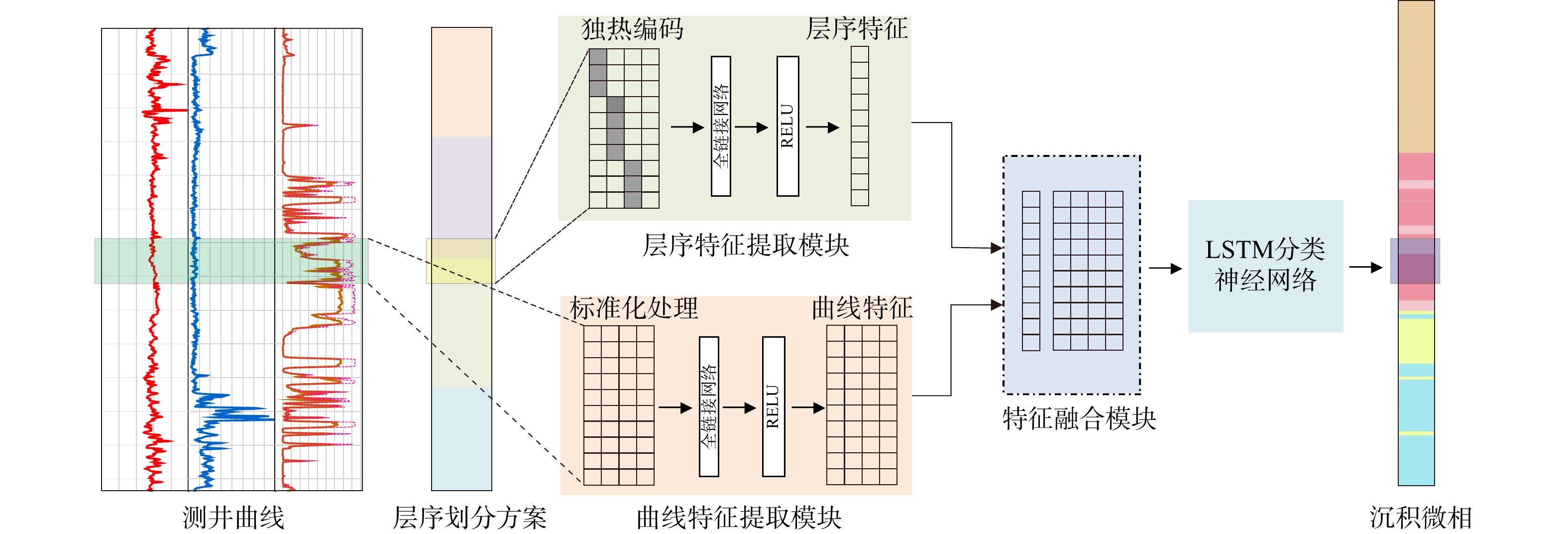
图 1 融合层序地层先验信息的沉积微相智能识别网络结构
Figure 1. Network structure for intelligent sedimentary microfacies identification integrating sequence stratigraphic prior information
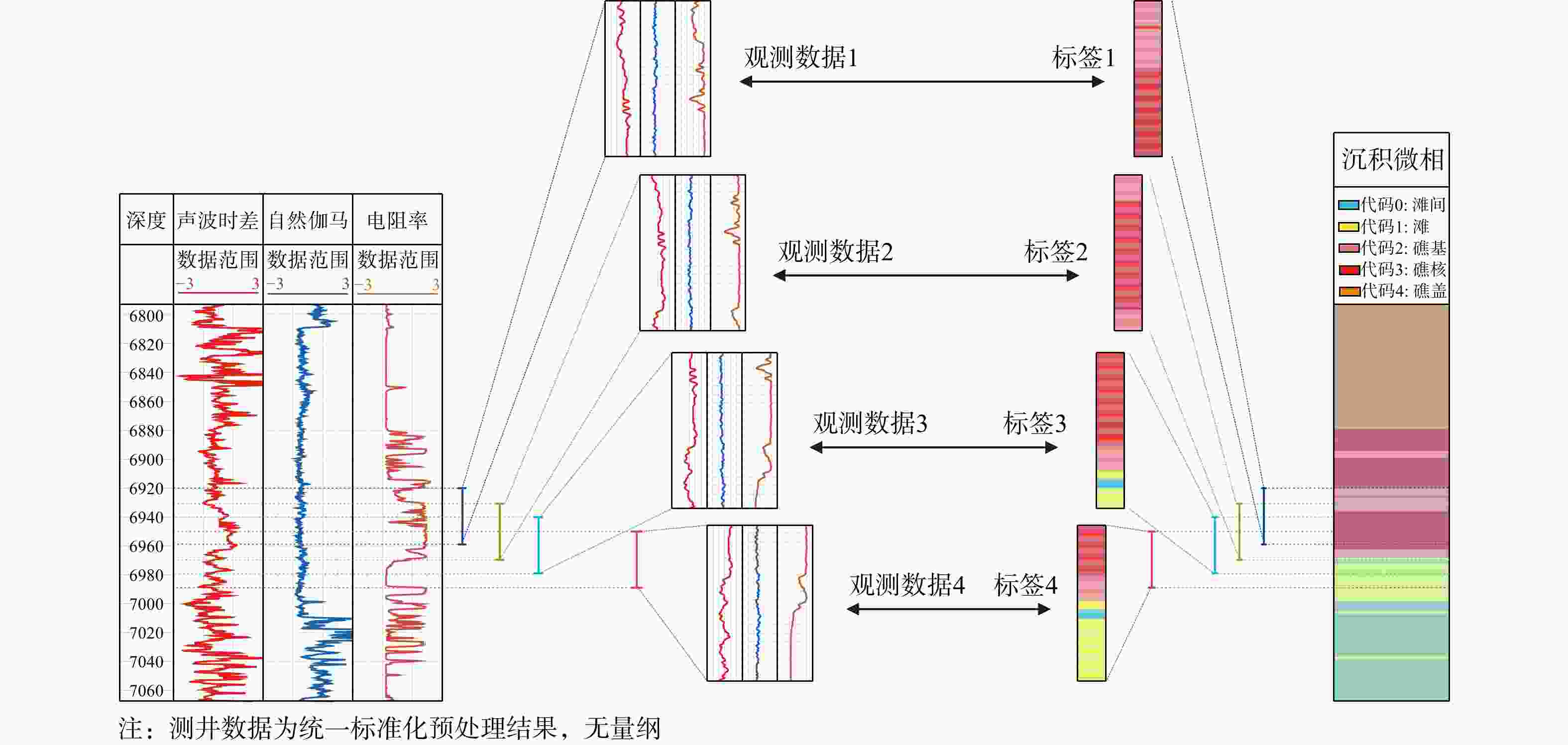
图 2 基于滑动时窗的样本制作方法原理
Figure 2. Principle of the sample preparation method based on sliding time window

图 3 加权平均法岩相预测原理
Figure 3. Principle of lithofacies prediction using the weighted average method

图 4 元坝气田长兴组二段礁滩相平面发育特征
Figure 4. Planar development characteristics of the reef–shoal facies in Member 2 of the Changxing Formation in the Yuanba gas field

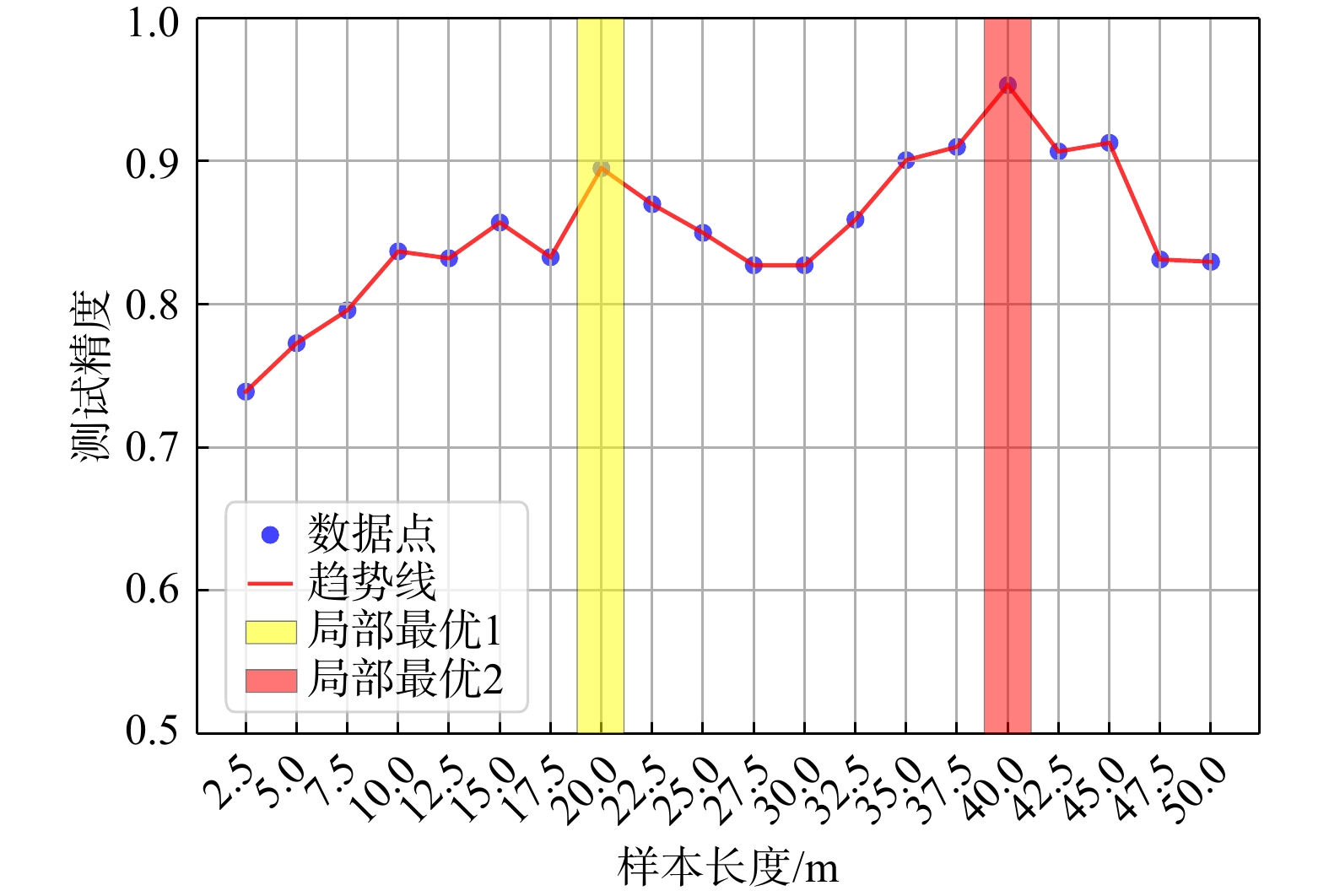
图 5 测试集预测精度随样本长度变化规律
Figure 5. Variation of the test set prediction accuracy with sample length
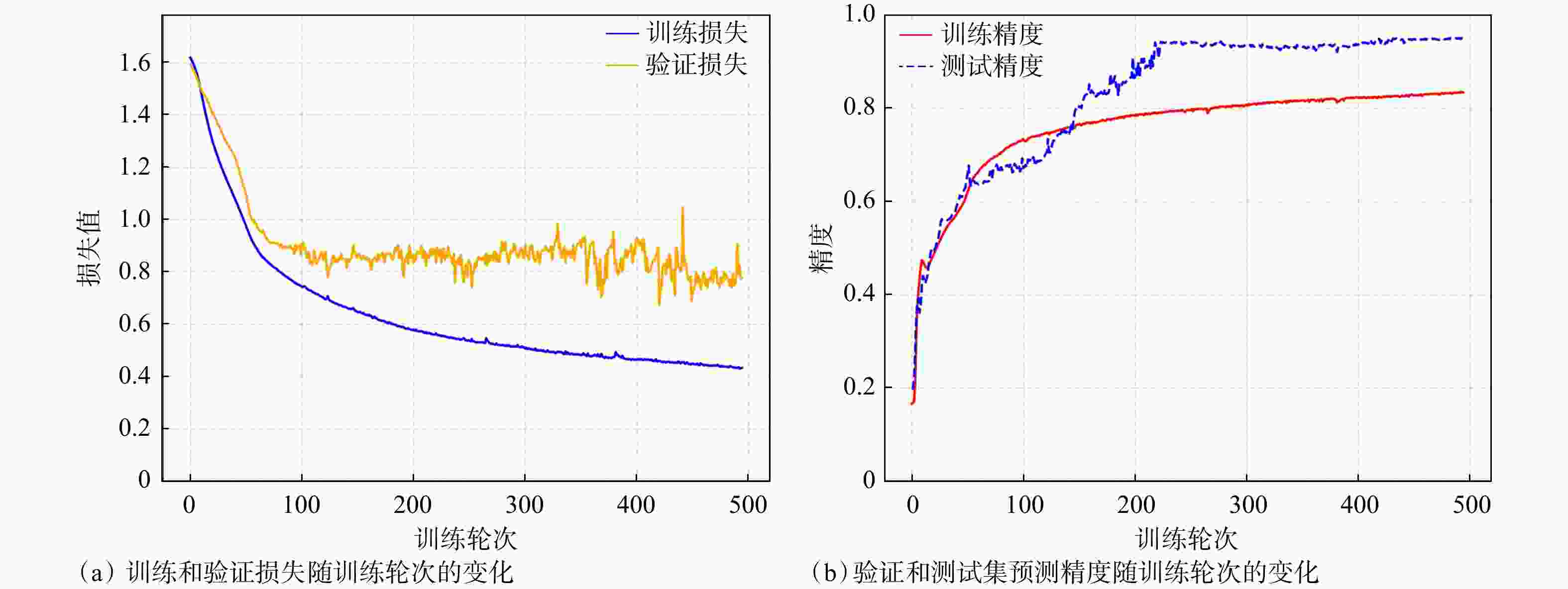
图 6 合理超参数组合下的训练过程
Figure 6. Training process under reasonable hyperparameter combination
(a) Changes in training and validation loss across training epochs; (b) Changes in prediction accuracy of validation and test sets across training epochs

图 7 常规LSTM与SC-LSTM网络直井岩相识别推理结果对比
Figure 7. Comparison of lithofacies identification results between conventional LSTM and SC-LSTM networks for vertical wells
(a) Results of lithofacies detection by the conventional LSTM network (vertical wells); (b) Results of lithofacies detection by the SC-LSTM network (vertical wells)
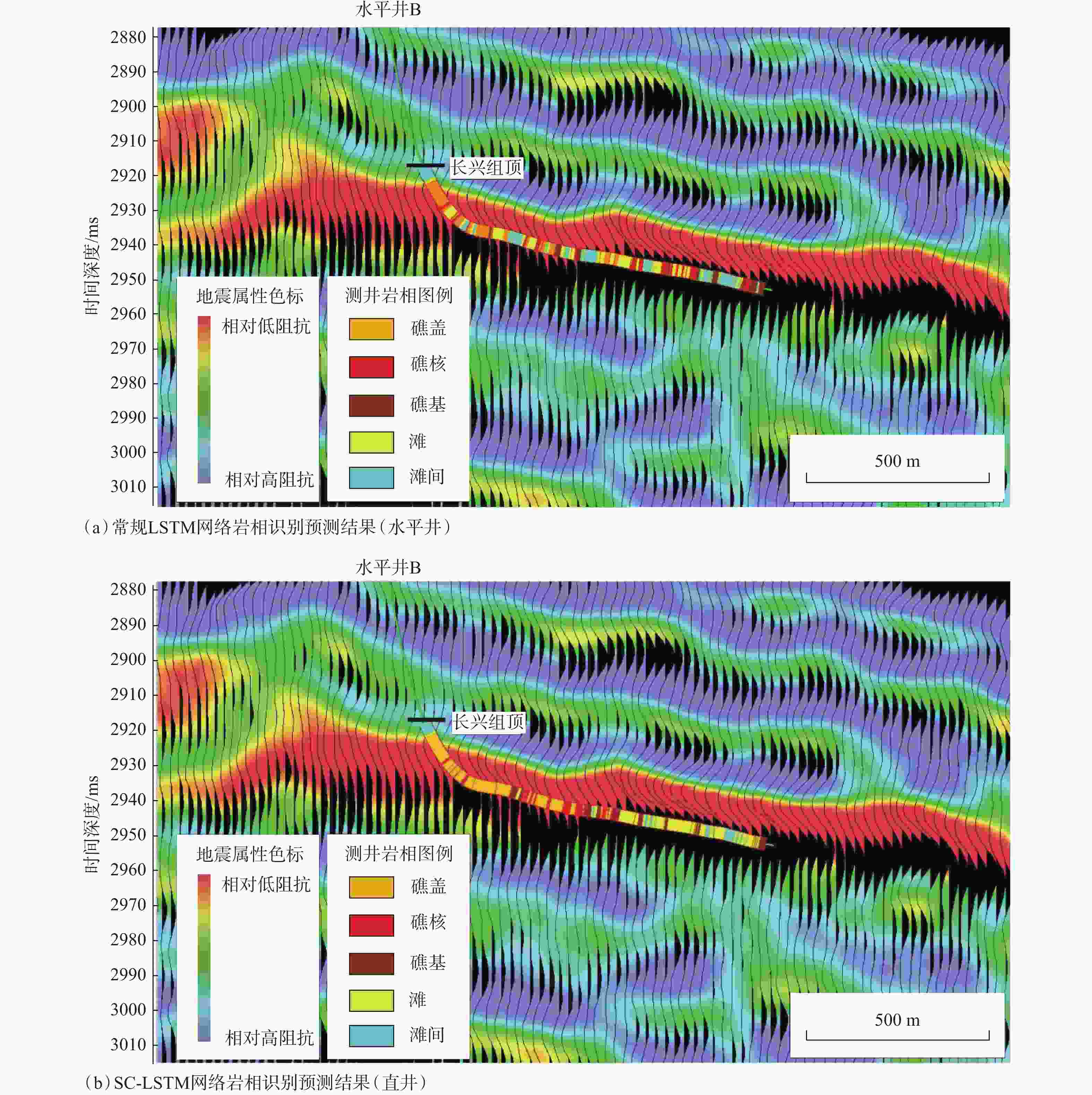
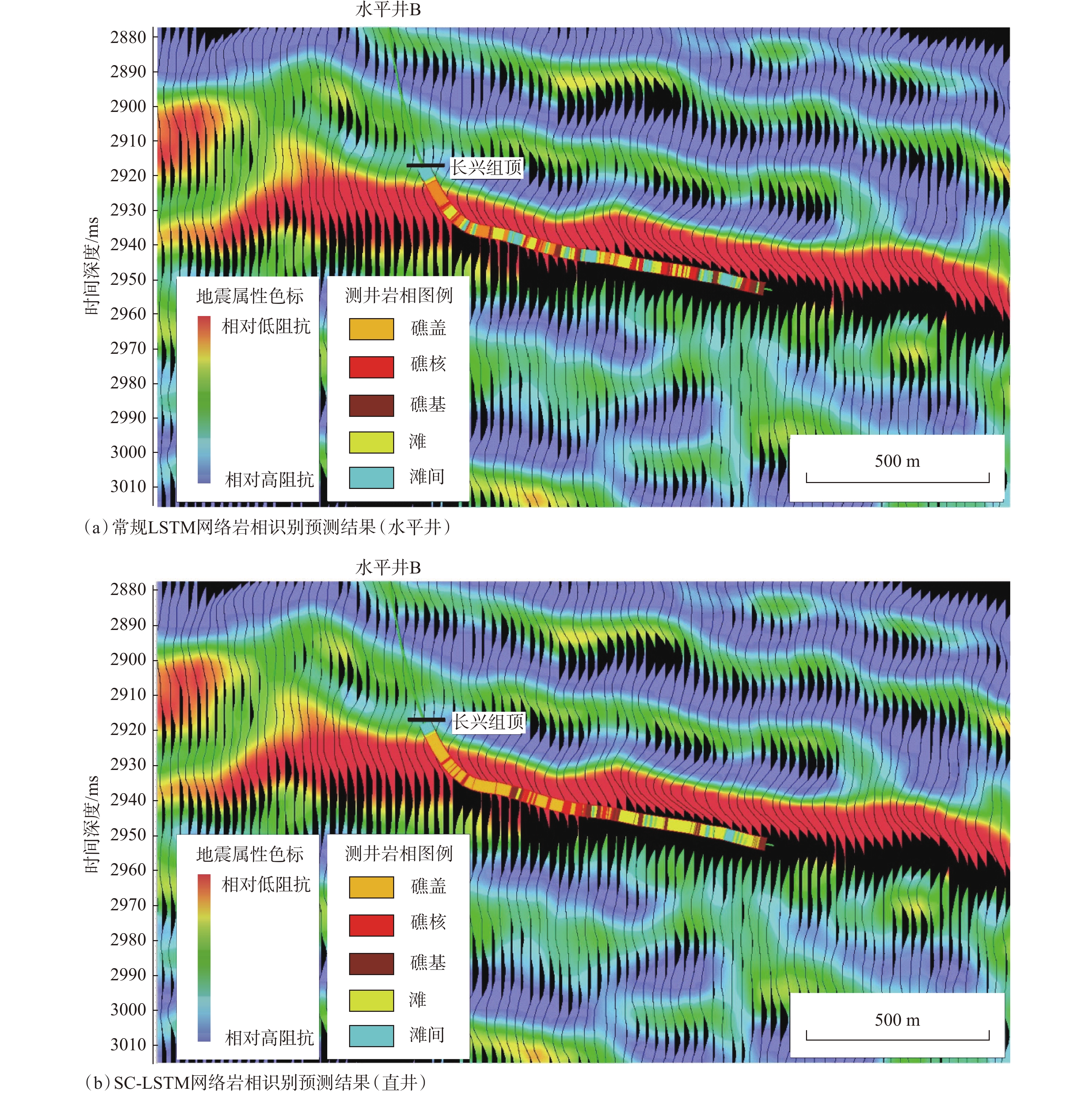
图 8 常规LSTM与SC-LSTM网络直井岩相识别推理结果对比
Figure 8. Comparison of lithofacies identification results between conventional LSTM and SC-LSTM networks for horizontal wells
(a) Results of lithofacies detection by the conventional LSTM network (horizontal wells); (b) Results of lithofacies detection by the SC-LSTM network (horizontal wells)
表 1 SC-LSTM模型超参数配置
Table 1. SC-LSTM model hyperparameter configuration
参数类别 参数名称 参数值 说明 样本特征参数 样本长度 40 m 对应320个采样点(0.125 m间隔) 滑动步长 5 m 训练集采样步长 输入测井曲线数 5条 声波、自然电位、深/浅侧向、层序信息 网络结构参数 卷积核大小(曲线分支) 3×1 捕捉局部测井响应模式 卷积核数量(曲线分支) 64个 第一卷积层 卷积核大小(层序分支) 5×1 编码层序界面突变特征 卷积核数量(层序分支) 32个 第一卷积层 LSTM隐藏层单元数 128个 记忆单元数量 LSTM层数 2层 堆叠LSTM层数 Dropout比率 0.3 防止过拟合 全连接层神经元数 64个 分类前的特征整合 输出类别数 5种 礁核、礁盖、礁基、生屑滩、礁/滩间 训练超参数 批次大小(Batch Size) 32个 每次训练样本数 学习率(Learning Rate) 0.001 Adam优化器初始学习率 学习率衰减策略 ReduceLROnPlateau 验证损失不下降时衰减 衰减因子 0.5 学习率衰减倍数 耐心值(Patience) 10 触发衰减前的等待轮次 训练轮次(Epochs) 200次 最大训练轮次 早停策略 启用 验证损失20轮不降则停止 损失函数 交叉熵损失 多分类任务 优化器 Adam 自适应学习率优化  下载: 导出CSV
-
[1] ABUZEID A M, BAGHDADY A R, KASSEM A A, 2025. Automated lithofacies classification: a comprehensive machine learning approach in Shushan Basin reservoirs, Western Desert, Egypt[J]. Journal of African Earth Sciences, 223: 105487. doi: 10.1016/j.jafrearsci.2024.105487 [2] AL-MUDHAFAR W J, 2020. Integrating machine learning and data analytics for geostatistical characterization of clastic reservoirs[J]. Journal of Petroleum Science and Engineering, 195: 107837. doi: 10.1016/j.petrol.2020.107837 [3] ANTARIKSA G, MUAMMAR R, LEE J, 2022. Performance evaluation of machine learning-based classification with rock-physics analysis of geological lithofacies in Tarakan Basin, Indonesia[J]. Journal of Petroleum Science and Engineering, 208: 109250. doi: 10.1016/j.petrol.2021.109250 [4] BHATTACHARYA S, MISHRA S, 2018. Applications of machine learning for facies and fracture prediction using Bayesian Network Theory and Random Forest: case studies from the Appalachian basin, USA[J]. Journal of Petroleum Science and Engineering, 170: 1005-1017. doi: 10.1016/j.petrol.2018.06.075 [5] CAO J X, CHEN S Y, XIAO B Y, et al., 2025. Machine learning based diagenetic facies logging identification: a case of Shaximiao Formation in central Sichuan Basin[J]. Science Technology and Engineering, 25(21): 8858-8870. (in Chinese with English abstract) [6] CHEN C, WANG L, ZHAO W Y, et al., 2024. Seismic facies and sedimentary distribution characteristics of the Upper Carboniferous in the Ounan Depression, eastern Qaidam Basin[J]. Journal of Geomechanics, 30(3): 408-418. (in Chinese with English abstract) [7] CHEN K, WANG Y L, LU Y X, et al., 2025. Sedimentary characteristics of the Lower Cambrian Shuijingtuo Formation in the E’Xi trough and its petroleum geological significance[J]. Journal of Geomechanics, 31(4): 604-616. (in Chinese with English abstract) [8] CHEN X J, FENG Z T, ZENG F R, et al., 2024. Development status of logging-based lithology identification technology for shale formations[J]. Xinjiang Petroleum Geology, 45(6): 742-752. (in Chinese with English abstract) [9] DATTA D, SINGH G, SINGH S K, et al., 2023. Application of multivariate change detection in automated lithofacies classification from well-log data in a nonstationary subsurface[J]. Journal of Applied Geophysics, 215: 105094. doi: 10.1016/j.jappgeo.2023.105094 [10] DONG S Q, ZENG L B, JI C Q, et al., 2024. A deep kernel method for fracture identification in ultra-deep tight sandstones using well logs[J]. Earth Science Frontiers, 31(5): 166-176. (in Chinese with English abstract) [11] GAO F, QU Z P, WEI Z, et al., 2024. Study on well-log lithofacies classification based on machine learning methods[J]. Progress in Geophysics, 39(3): 1173-1192. (in Chinese with English abstract) [12] GAO Y N, TIAN M, GRANA D, et al., 2025. Attention mechanism‐assisted recurrent neural network for well log lithology classification[J]. Geophysical Prospecting, 73(2): 628-649. doi: 10.1111/1365-2478.13618 [13] HAN W L, WANG Y B, GAO X D, et al., 2016. Identification of sedimentary microfacies based on BP neural network[J]. Coal Technology, 35(12): 114-116. (in Chinese with English abstract) [14] HE X H, LI K S, XU J C, et al., 2023. Application of log lithofacies classification model based on clustering-support vector classification method[J]. Well Logging Technology, 47(2): 129-137. (in Chinese with English abstract) [15] HOU X M, LIAN P Q, ZHAO J Y, et al., 2024. Identification of carbonate sedimentary facies from well logs with machine learning[J]. Petroleum Research, 9(2): 165-175. doi: 10.1016/j.ptlrs.2024.01.007 [16] HUANG Q L, ZHAO J L, BAI Q, et al., 2024. Automatic recognition of sedimentary microfacies based on Adaboost algorithm: taking the Shanxi Formation in Q zone of Longdong gas field as an example[J]. Geological Bulletin of China, 43(4): 658-666. [17] IPPOLITO M, FERGUSON J, JENSON F, 2021. Improving facies prediction by combining supervised and unsupervised learning methods[J]. Journal of Petroleum Science and Engineering, 200: 108300. doi: 10.1016/j.petrol.2020.108300 [18] LAI J, SONG X Y, YANG X, et al., 2025. Research progresses of comprehensive well logging evaluation methods of tight gas sandstone reservoirs[J]. Acta Petrolei Sinica, 46(1): 220-235. (in Chinese with English abstract) [19] LI C, JIA J, SHEN A J, et al., 2020. New method for quantitative identification of carbonate lithofacies based on conventional logging curves and its application[J]. Progress in Geophysics, 35(5): 1792-1802. (in Chinese with English abstract) [20] LI C, SHEN A J, CHANG S Y, et al., 2021. Application and contrast of machine learning in carbonate lithofacies log identification: a case study of Longwangmiao Formation of MX area in Sichuan Basin[J]. Petroleum Reservoir Evaluation and Development, 11(4): 586-596. (in Chinese with English abstract) [21] LI N, NING B S, WU H L, et al., 2021. Application status and prospects of artificial intelligence in well logging and formation evaluation[J]. Acta Petrolei Sinica, 42(4): 508-522. (in Chinese with English abstract) [22] LIU Y J, LAI F Q, XU H, et al., 2025. Intelligent identification methods for shale lithology based on the coupling deeply of logging curves[J]. Bulletin of Geological Science and Technology, 44(1): 308-320. (in Chinese with English abstract) [23] LU J, LIU M, WANG X C, 2024. Log identification method of sedimentary microfacies in deep carbonate rocks by decision tree[J]. Well Logging Technology, 48(2): 179-189. (in Chinese with English abstract) [24] MENG Y, JAI G H, LI C H, et al., 2025. Logging identification and application of diagenetic facies of clastic reservoir by unsupervised learning technology: a case study of the Santai Formation in Zhanhua sag, Bohai Bay Basin[J]. Journal of Palaeogeography (Chinese Edition), 27(3): 746-762. (in Chinese with English abstract) [25] QI C S, DING L, JIAO X Y, et al., 2023. Automatic identification method of sedimentary microfacies based on bi-directional long short-term recurrent neural network: taking Dongfang B gas field in Yinggehai Basin as an example[J]. Science Technology and Industry, 23(5): 217-221. (in Chinese with English abstract) [26] RATHORE P W S, HUSSAIN M, MALIK M B, et al., 2023. Well log analysis and comparison of supervised machine learning algorithms for lithofacies identification in Pab Formation, Lower Indus Basin[J]. Journal of Applied Geophysics, 219: 105199. doi: 10.1016/j.jappgeo.2023.105199 [27] SHEN L, WANG C Z, NING C Q, et al., 2023. Well-log lithofacies classification based on machine learning for Chang-7 member in Longdong area of Ordos Basin[J]. Petroleum Reservoir Evaluation and Development, 13(4): 525-536. (in Chinese with English abstract) [28] TIAN M, LI B T, XU H M, et al., 2021a. Deep learning assisted well log inversion for fracture identification[J]. Geophysical Prospecting, 69(2): 419-433. doi: 10.1111/1365-2478.13054 [29] TIAN M, OMRE H, XU H M, 2021b. Inversion of well logs into lithology classes accounting for spatial dependencies by using hidden Markov models and recurrent neural networks[J]. Journal of Petroleum Science and Engineering, 196: 107598. doi: 10.1016/j.petrol.2020.107598 [30] WANG L Y, LIU H Q, CHENG C, et al., 2025. Research progress on intelligent identification methods for well logging lithofacies based on deep learning[J]. Progress in Geophysics, 40(4): 1773-1787. (in Chinese with English abstract) [31] WANG M, YANG J L, WANG X, et al., 2023. Identification of shale lithofacies by well logs based on random forest algorithm[J]. Earth Science, 48(1): 130-142. (in Chinese with English abstract) [32] YAN J F, LI S L, WEI Z D, et al., 2025. Shale lithofacies prediction method with well-logging data based on XGBoost algorithm[J]. Journal of Palaeogeography (Chinese Edition), 27(3): 763-776. (in Chinese with English abstract) [33] ZHANG G Y, LIN C Y, WANG Z Y, et al., 2024. Hybrid knowledge-driven and data-driven intelligent reservoir characterization and its research progress[J]. Progress in Geophysics, 39(1): 119-140. (in Chinese with English abstract) [34] ZHANG H Y, XIE B, YUAN Q, et al., 2020. Logging-based sedimentary microfacies identification of Changxing Formation, Damaoping structure, Sichuan Basin[J]. Natural Gas Exploration and Development, 43(2): 38-44. (in Chinese with English abstract) [35] ZHANG T, LI Y P, LI Z K, et al, 2025. Fractures identification of deep tight reservoir with well logging based on improved long short-term memory neural network[J]. Earth Science Frontiers, 32(5): 456-465. (in Chinese with English abstract) [36] ZHANG Y J, LI Q, CAI Y D, et al., 2025. Evaluation of coal macrolithotypes based on machine learning logging inversion: a case study of the No. 8 coal seam in the Benxi Formation, Jiaxian Block, Ordos Basin[J]. Geoscience, 39(5): 1427-1436. (in Chinese with English abstract) [37] ZHAO C J, JIANG Y L, WANG L J, 2022. Data-driven diagenetic facies classification and well-logging identification based on machine learning methods: a case study on Xujiahe tight sandstone in Sichuan Basin[J]. Journal of Petroleum Science and Engineering, 217: 110798. doi: 10.1016/j.petrol.2022.110798 [38] ZHAO T P, 2025. Logging lithofacies identification of tight sandstone reservoir based on ensemble learning algorithm[J]. Offshore Oil, 45(2): 55-61. (in Chinese with English abstract) [39] ZHAO Z J, LIU Y, WANG F Q, et al., 2016. Classification of borehole braided river sedimentary microfacies based on support vector machine[J]. Well Logging Technology, 40(5): 637-642. (in Chinese with English abstract) [40] ZHENG D Y, HOU M C, CHEN A Q, et al., 2022. Application of machine learning in the identification of fluvial-lacustrine lithofacies from well logs: a case study from Sichuan Basin, China[J]. Journal of Petroleum Science and Engineering, 215: 110610. doi: 10.1016/j.petrol.2022.110610 [41] 曹脊翔, 陈思源, 肖柏夷, 等, 2025. 基于机器学习的致密砂岩储层成岩相测井识别: 以川中地区沙溪庙组一段为例[J]. 科学技术与工程, 25(21): 8858-8870. doi: 10.12404/j.issn.1671-1815.2406016 [42] 陈程, 王利, 赵为永, 等, 2024. 柴东地区欧南凹陷上石炭统地震相及沉积展布特征[J]. 地质力学学报, 30(3): 408-418. doi: 10.12090/j.issn.1006-6616.2023077 [43] 陈科, 王昱荦, 卢妍欣, 等, 2025. 鄂西海槽下寒武统水井沱组沉积特征及其油气地质意义[J]. 地质力学学报, 31(4): 604-616. [44] 陈秀娟, 冯镇涛, 曾芙蓉, 等, 2024. 页岩地层测井岩性识别技术发展现状[J]. 新疆石油地质, 45(6): 742-752. doi: 10.7657/XJPG20240614 [45] 董少群, 曾联波, 冀春秋, 等, 2024. 超深层致密砂岩裂缝测井识别深度核方法[J]. 地学前缘, 31(5): 166-176. [46] 高飞, 曲志鹏, 魏震, 等, 2024. 基于机器学习方法的测井岩相分类研究[J]. 地球物理学进展, 39(3): 1173-1192. doi: 10.6038/pg2024HH0065 [47] 韩文龙, 王延斌, 高向东, 等, 2016. 基于BP神经网络的沉积微相识别[J]. 煤炭技术, 35(12): 114-116. doi: 10.13301/j.cnki.ct.2016.12.043 [48] 何贤宏, 李可赛, 许家铖, 等, 2023. 基于聚类-支持向量机算法的碳酸盐岩测井岩相识别模型与应用[J]. 测井技术, 47(2): 129-137. doi: 10.16489/j.issn.1004-1338.2023.02.002 [49] 黄千玲, 赵军龙, 白倩, 等, 2024. 基于Adaboost算法的沉积微相自动识别: 以陇东气田Q区山西组为例[J]. 地质通报, 43(4): 658-666. doi: 10.12097/gbc.2023.04.030 [50] 赖锦, 宋翔羽, 杨薰, 等, 2025. 致密砂岩气储层测井综合评价技术研究进展[J]. 石油学报, 46(1): 220-235. doi: 10.7623/syxb202501015 [51] 李昌, 贾俊, 沈安江, 等, 2020. 基于常规测井识别微生物碳酸盐岩岩相新方法及应用[J]. 地球物理学进展, 35(5): 1792-1802. doi: 10.6038/pg2020DD0284 [52] 李昌, 沈安江, 常少英, 等, 2021. 机器学习法在碳酸盐岩岩相测井识别中应用及对比: 以四川盆地MX地区龙王庙组地层为例[J]. 油气藏评价与开发, 11(4): 586-596. doi: 10.13809/j.cnki.cn32-1825/te.2021.04.015 [53] 李宁, 徐彬森, 武宏亮, 等, 2021. 人工智能在测井地层评价中的应用现状及前景[J]. 石油学报, 42(4): 508-522. doi: 10.7623/syxb202104008 [54] 刘粤蛟, 赖富强, 徐浩, 等, 2025. 基于测井曲线深程度耦合的页岩岩相智能识别方法[J]. 地质科技通报, 44(1): 308-320. [55] 路菁, 刘秘, 王晓畅, 2024. 深层碳酸盐岩沉积微相决策树测井识别方法[J]. 测井技术, 48(2): 179-189. [56] 孟圆, 贾光华, 李传华, 等, 2025. 基于无监督学习技术的碎屑岩储集层成岩相测井识别与应用: 以沾化凹陷三台组为例[J]. 古地理学报, 27(3): 746-762. doi: 10.7605/gdlxb.2025.046 [57] 齐春生, 丁磊, 焦祥燕, 等, 2023. 基于双向长短时循环神经网络的沉积微相自动识别方法: 以莺歌海盆地东方B气田为例[J]. 科技和产业, 23(5): 217-221. [58] 谌丽, 王才志, 宁从前, 等, 2023. 基于机器学习的鄂尔多斯盆地陇东地区长7段岩相测井识别方法[J]. 油气藏评价与开发, 13(4): 525-536. doi: 10.13809/j.cnki.cn32-1825/te.2023.04.015 [59] 王丽媛, 刘红岐, 程超, 等, 2025. 基于深度学习的测井岩相智能识别方法研究进展[J]. 地球物理学进展, 40(4): 1773-1787. [60] 王民, 杨金路, 王鑫, 等, 2023. 基于随机森林算法的泥页岩岩相测井识别[J]. 地球科学, 48(1): 130-142. [61] 闫佳飞, 李胜利, 魏泽德, 等, 2025. 基于XGBoost算法的页岩岩相测井预测方法[J]. 古地理学报, 27(3): 763-776. doi: 10.7605/gdlxb.2025.00.026 [62] 张国印, 林承焰, 王志章, 等, 2024. 知识与数据融合驱动的油气藏智能表征及研究进展[J]. 地球物理学进展, 39(1): 119-140. doi: 10.6038/pg2024HH0132 [63] 张红英, 谢冰, 袁倩, 等, 2020. 四川盆地大猫坪构造长兴组测井沉积微相识别[J]. 天然气勘探与开发, 43(2): 38-44. doi: 10.12055/gaskk.issn.1673-3177.2020.02.006 [64] 张涛, 李艳萍, 李泽凯, 等, 2025. 基于改进长短记忆神经网络的深层致密储层裂缝测井识别[J]. 地学前缘, 32(5): 456-465. [65] 张云骥, 李倩, 蔡益栋, 等, 2025. 基于机器学习测井反演的宏观煤岩类型评价: 以鄂尔多斯盆地佳县区块本溪组8号煤为例[J]. 现代地质, 39(5): 1427-1436. [66] 赵天沛, 2025. 基于集成学习算法的致密砂岩储层测井岩相识别[J]. 海洋石油, 45(2): 55-61. doi: 10.3969/j.issn.1008-2336.2025.02.055 [67] 赵忠军, 刘烨, 王凤琴, 等, 2016. 基于支持向量机的辫状河测井沉积微相识别[J]. 测井技术, 40(5): 637-642. -

 下载:
下载:





计量
- 文章访问数: 1458
- HTML全文浏览量: 219
- PDF下载量: 214
- 被引次数: 0
