


Evaluation of post-fracturing production efficiency in shale oil horizontal wells based on behind-casing fiber-optic monitoring
-
摘要: 柴达木盆地英雄岭地区页岩油资源丰富,水平井体积压裂是实现其高效开发的关键技术。为了能够更加精准地评价页岩油水平井体积压裂施工中的簇开启率和压后生产中的产出效率,基于光纤传感内在机理,深入探究套外光纤监测技术在页岩油压裂作业及生产评价中的独特优势,并系统剖析该技术于柴达木盆地页岩油水平井体积压裂实践中的应用成效。套外光纤监测资料解释表明,相较于均匀射孔方式,采取坡度射孔方式可使压裂施工中簇开启率由62%提升至88%,增幅26%;压后产出效率由0.94 m3/段提升到3.20 m3/段,提升幅度为2.4倍。此外,将金属性可溶桥的压裂作业控制在入井后8小时内,使施工漏液量减少了7.43%。文章研究成果和认识,为柴达木盆地英雄岭页岩油水平井体积压裂的射孔方式优选及桥塞入井后施工时机的抉择提供了精准指引。Abstract:
Objective The efficient development of shale oil in the Yingxiongling area of the Qaidam Basin relies on horizontal well volumetric fracturing. Accurately evaluating cluster efficiency during stimulation and post-fracturing production performance remains a key challenge. This study aims to investigate the application and effectiveness of behind-casing fiber-optic sensing technology for this purpose. Methods Based on the principles of distributed fiber-optic sensing, this technology was deployed behind the casing to monitor fracturing operations and subsequent production in shale oil horizontal wells. The analysis focused on interpreting the monitoring data to assess fracture initiation and cluster contribution. Results The behind-casing fiber-optic monitoring provided clear diagnostic results. Compared to the conventional uniform perforation method, employing a tapered perforation design increased the cluster initiation rate during fracturing from 62% to 88%, representing a 26% improvement. Furthermore, the post-fracturing production efficiency per stage was enhanced from 0.94 m3 per stage to 3.20 m3 per stage, a 2.4-fold increase. An additional operational finding was that controlling the fracturing operation to within 8 hours after setting the metallic dissolvable bridge plug reduced fluid loss during the treatment by 7.43%. Conclusions The tapered perforation strategy significantly improves both cluster initiation and production contribution in the studied shale oil formation. Furthermore, optimizing the timing of fracturing operations after bridge plug setting can effectively mitigate fluid loss. [Significance] This study demonstrates the practical value of behind-casing fiber-optic monitoring for guiding key engineering decisions. The findings provide precise guidance for optimizing perforation design and operational timing in volumetric fracturing of shale oil horizontal wells in the Qaidam Basin, contributing to enhanced stimulation effectiveness and development efficiency. -
Key words:
- Qaidam basin /
- Yingxiongling area /
- shale oil /
- fiber optic /
- monitor /
- perforation /
- slope gradient /
- output efficiency
-
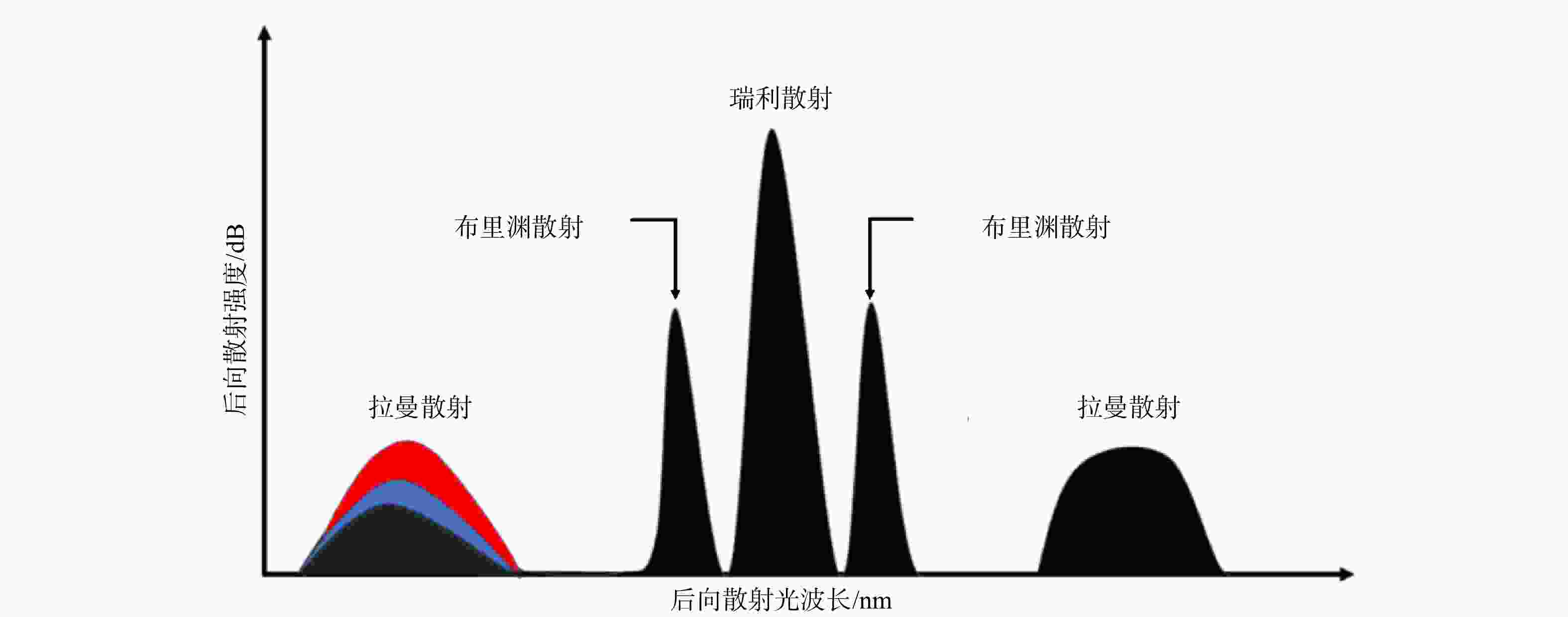
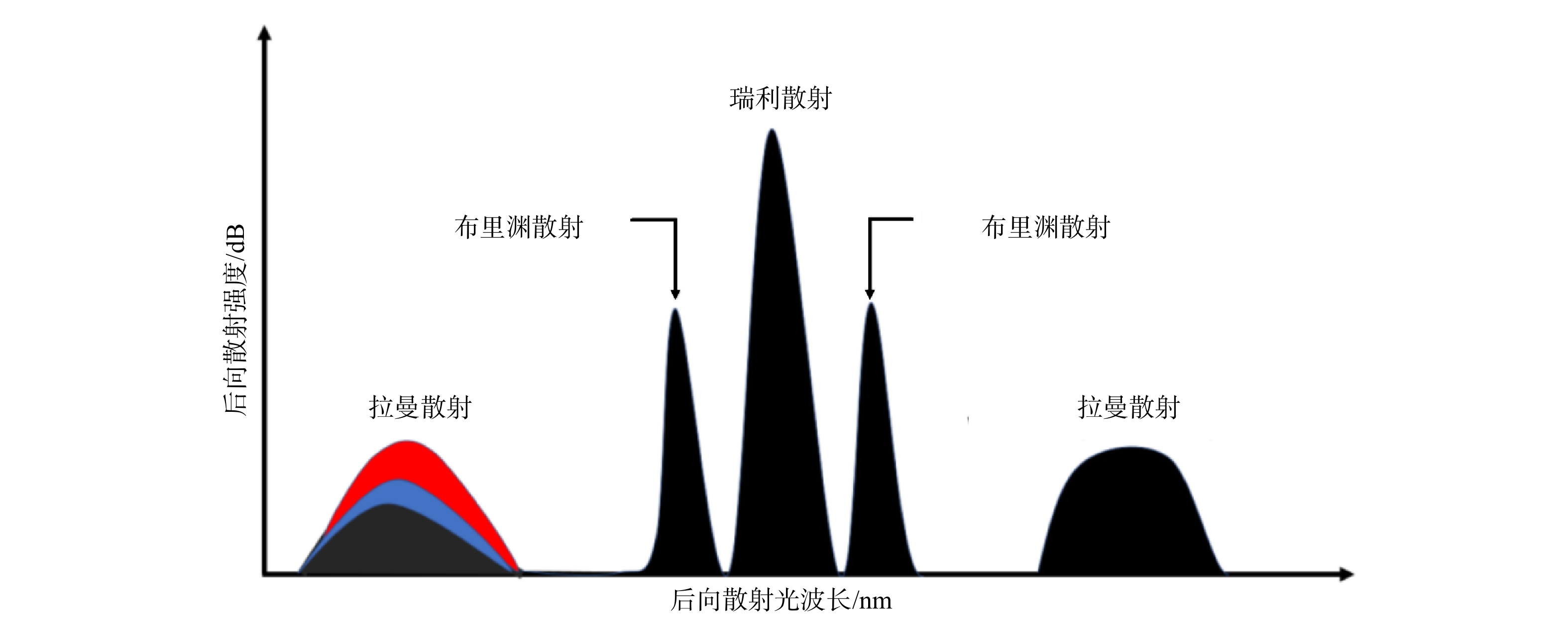
图 1 分布式光纤传感后向散射光谱示意图
拉曼峰呈现的不同颜色,代表不同温度条件下的拉曼散射强度
Figure 1. Schematic diagram of backscattering spectrum in distributed fiber-optic sensing
The different colors of the Raman peak represent the Raman scattering intensity under different temperature conditions.
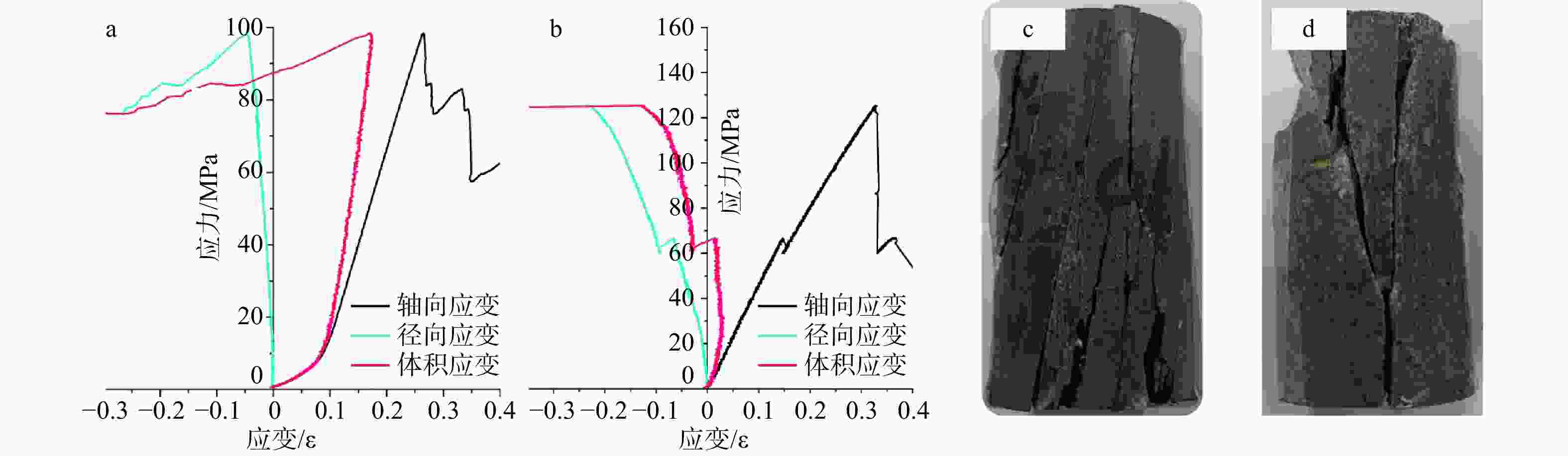
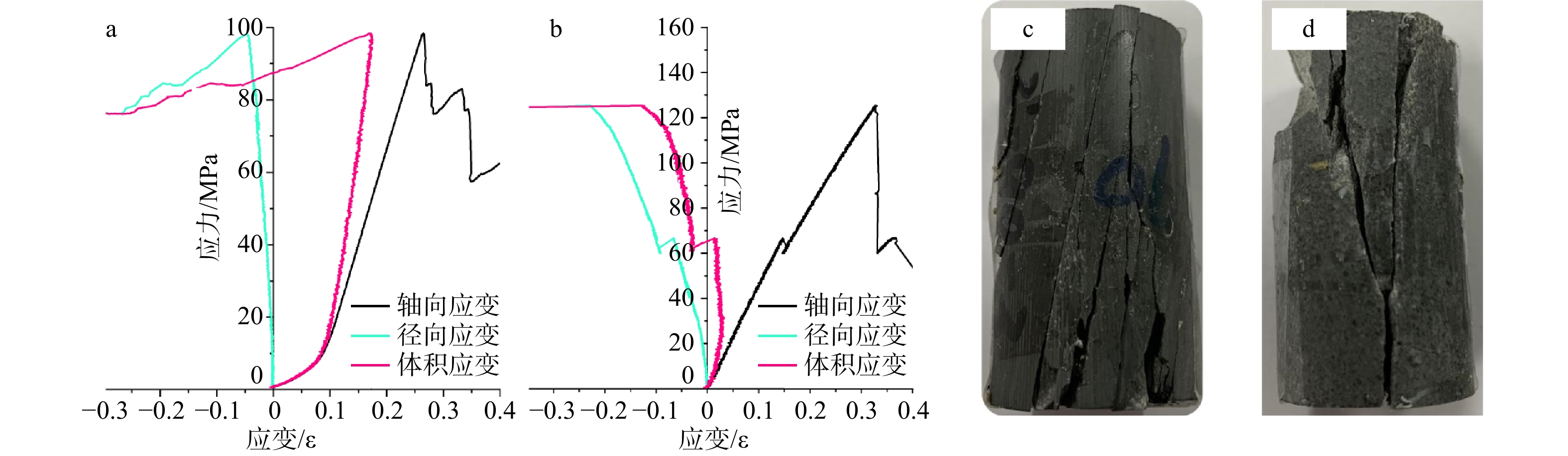
图 2 纹层状和薄层状页岩应力−应变曲线及单轴压缩后破裂形态图
a—纹层状页岩应力−应变曲线;b—薄层状页岩应力−应变曲线;c—纹层状岩芯破裂形态图;d—薄层状岩芯破裂形态图
Figure 2. Stress–strain curves and fracture morphologies after uniaxial compression of laminated and thin-bedded shale
(a) Stress–strain curves of laminated shale; (b) Stress–strain curves of thin-bedded shale; (c) Fracture morphology diagram of laminated core; (d) Fracture morphology diagram of thin-bedded core
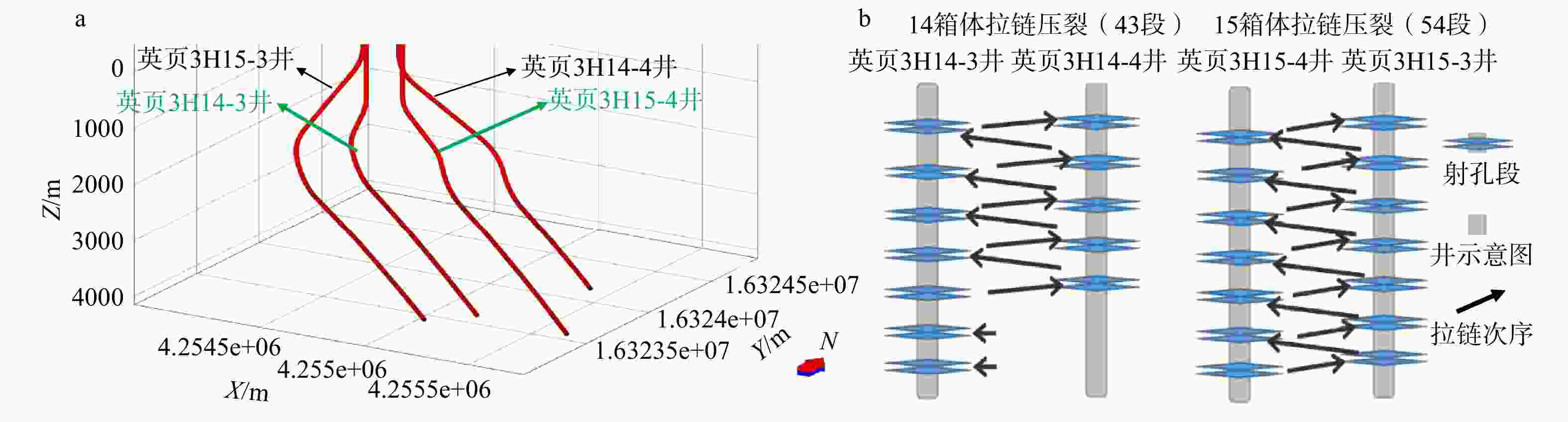
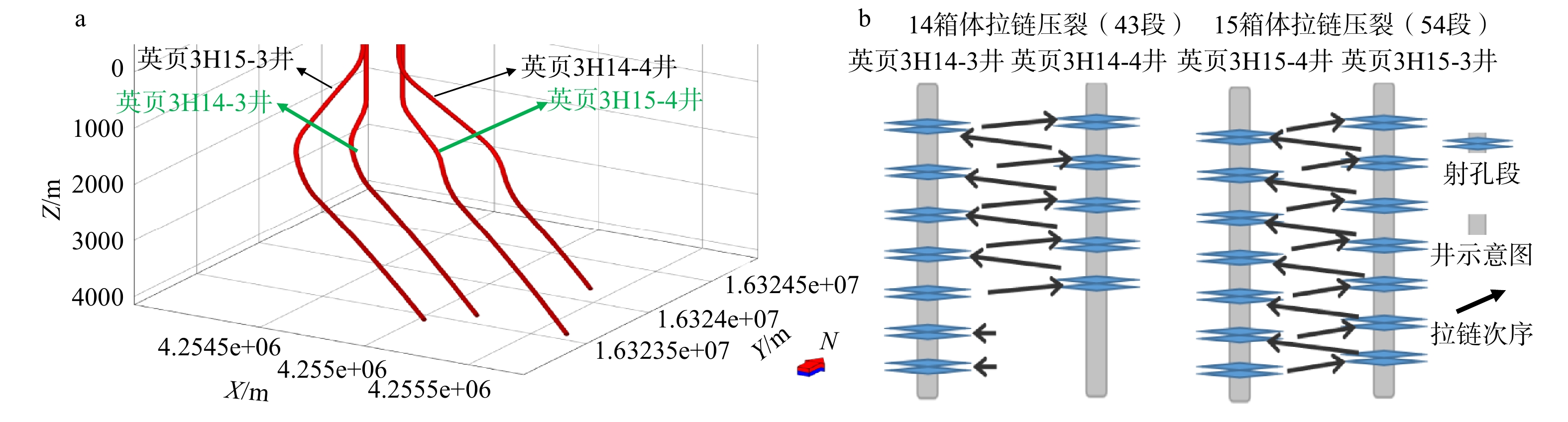
图 3 英页3H平台拉链式压裂部署井位(绿色箭头所指为光纤监测井)
a—英页3H平台4口井轨迹示意图;b—英页3H平台4口井拉链式压裂次序
Figure 3. Well placement for zipper fracturing on the Yingye 3H platform (the wells indicated by green arrows are equipped with fiber-optic monitoring)
(a) Schematic diagram of well trajectories for four wells in Yingye 3H Platform; (b) Zipper fracturing sequence of four wells in Yingye 3H Platform
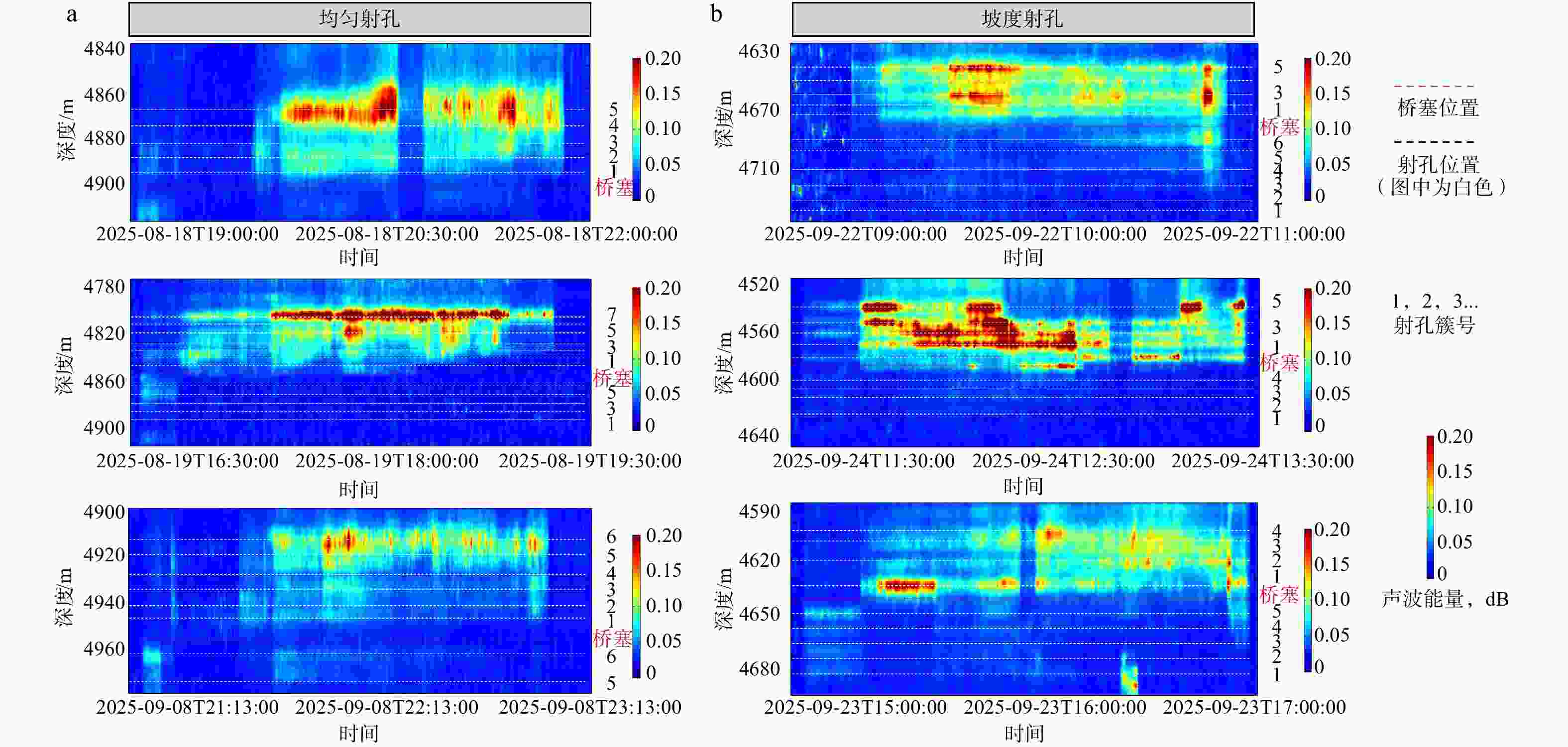
图 4 均匀射孔压裂与坡度射孔压裂光纤DAS信号对比
a—均匀射孔光纤DAS示意图;b—坡度射孔光纤DAS示意图
Figure 4. Comparison of fiber-optic DAS signals between uniform perforation fracturing and slanted perforation fracturing
(a) Schematic of fiber-optic DAS for uniform perforation; (b) Schematic of fiber-optic DAS for tapered perforation

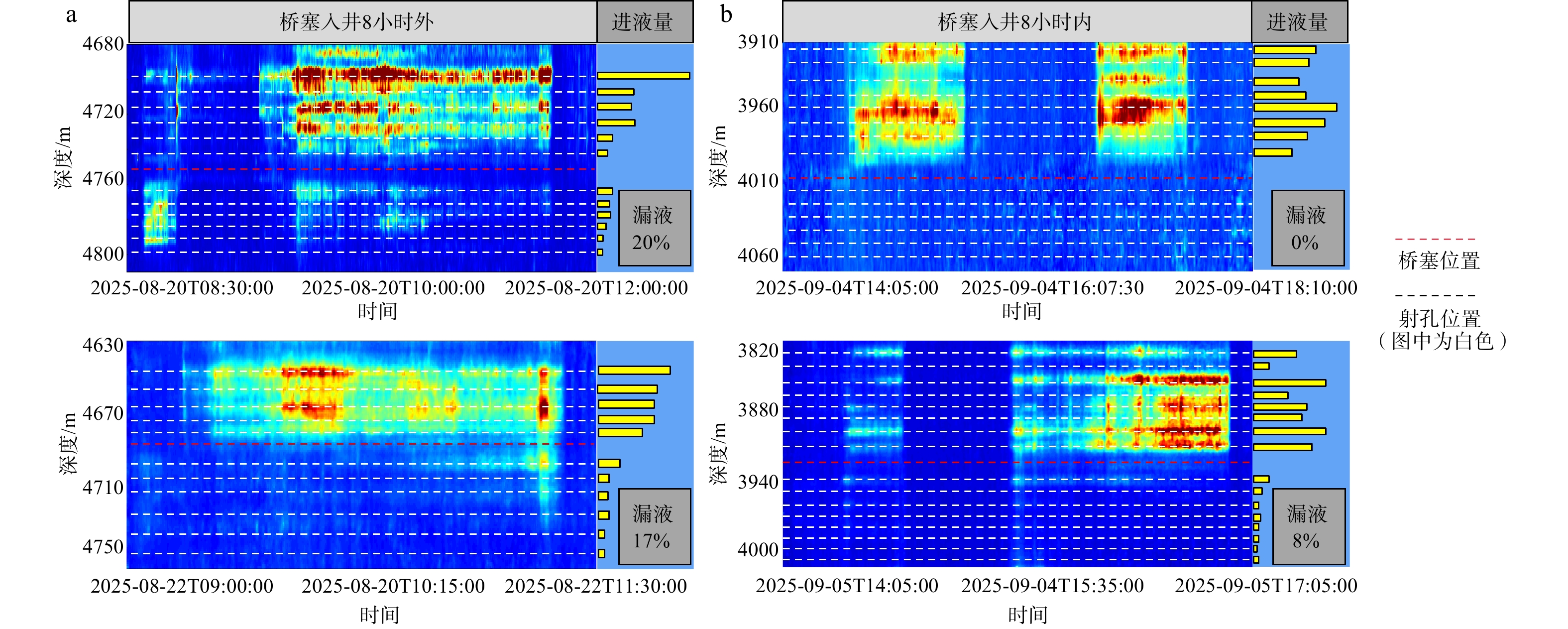
图 5 英页3H15-4井桥塞入井8小时前后压裂漏液现象对比
a—桥塞入井8小时外压裂光纤DAS示意图;b—桥塞入井8小时内压裂光纤DAS示意图
Figure 5. Comparison of fluid loss before and after eight hours of plug setting in Well Yingye 3H15-4 using hydraulic fracturing
(a) Schematic of fiber-optic DAS during fracturing beyond eight hours after bridge plug setting; (b) Schematic of fiber-optic DAS during fracturing within 8 hours after bridge plug setting
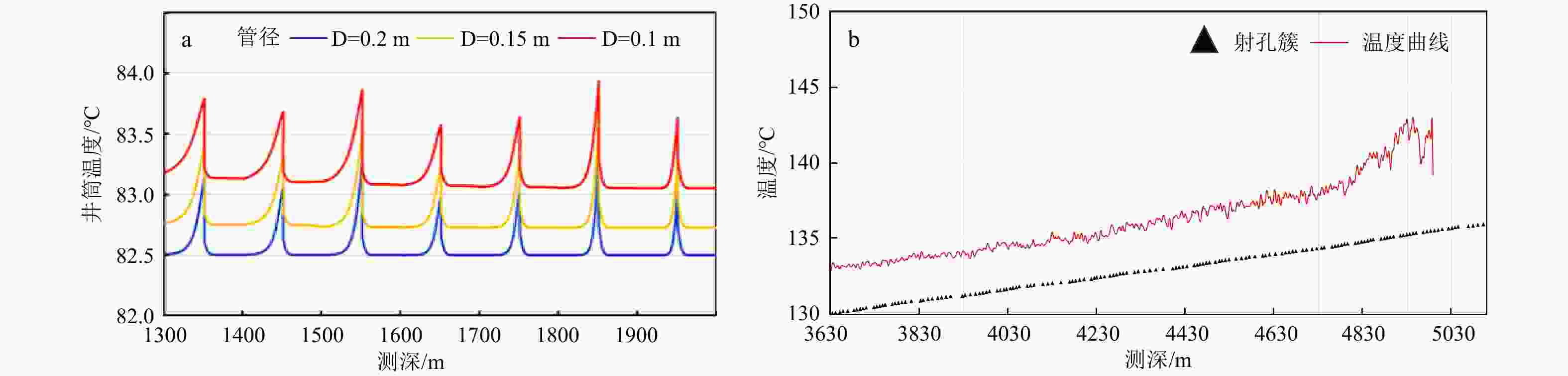
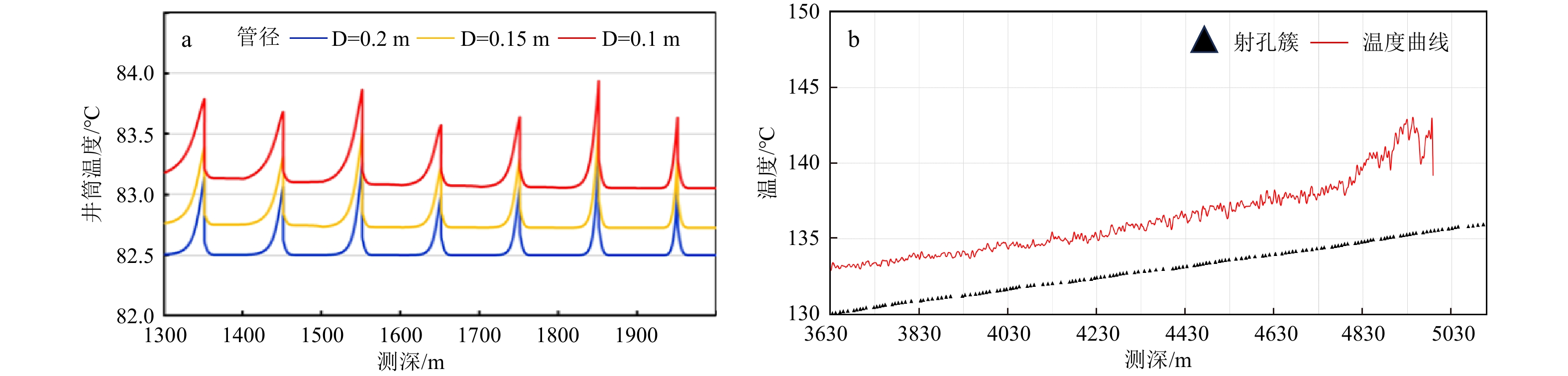
图 6 压裂水平井温度剖面特征数值模拟及英页3H15-4井实测温度曲线
a—压裂水平井温度剖面特征图;b—英页3H15-4井温度曲线图
Figure 6. Numerical simulation of temperature profile characteristics in fractured horizontal wells and measured temperature curves of Well Yingye 3H15-4
(a) Characteristic diagram of temperature profile for fractured horizontal wells; (b)Temperature curve of Well Yingye 3H15-4
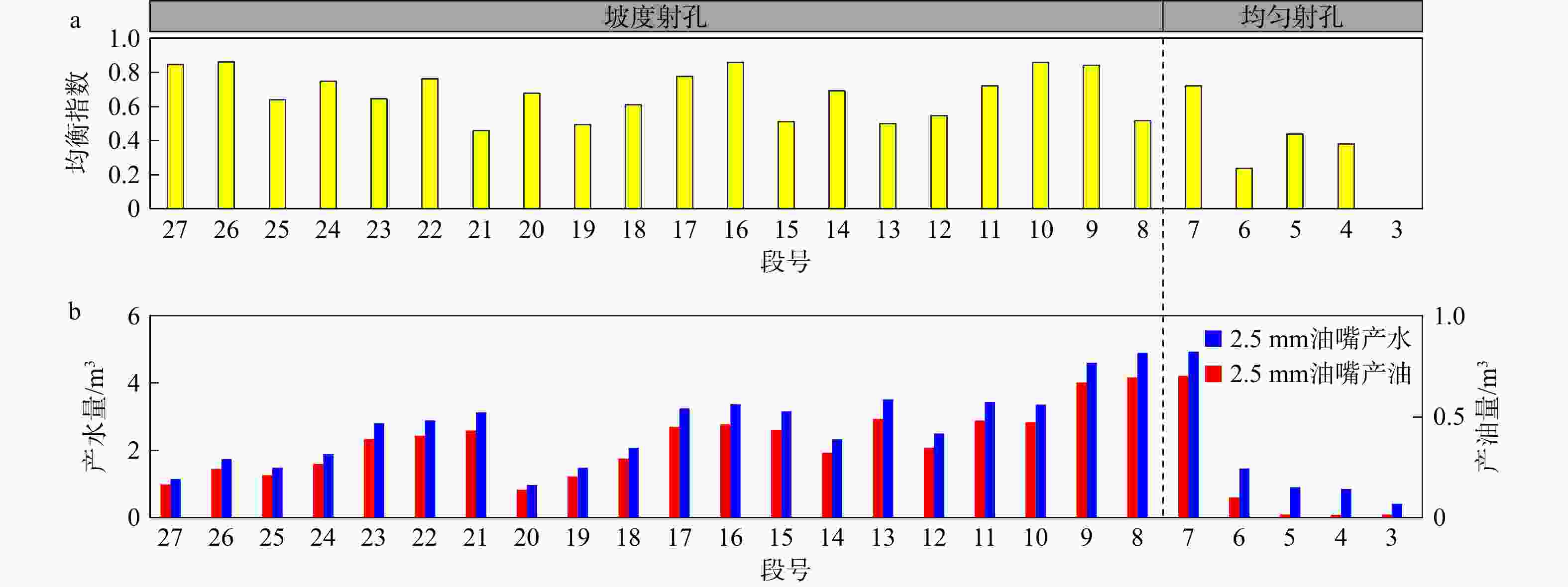
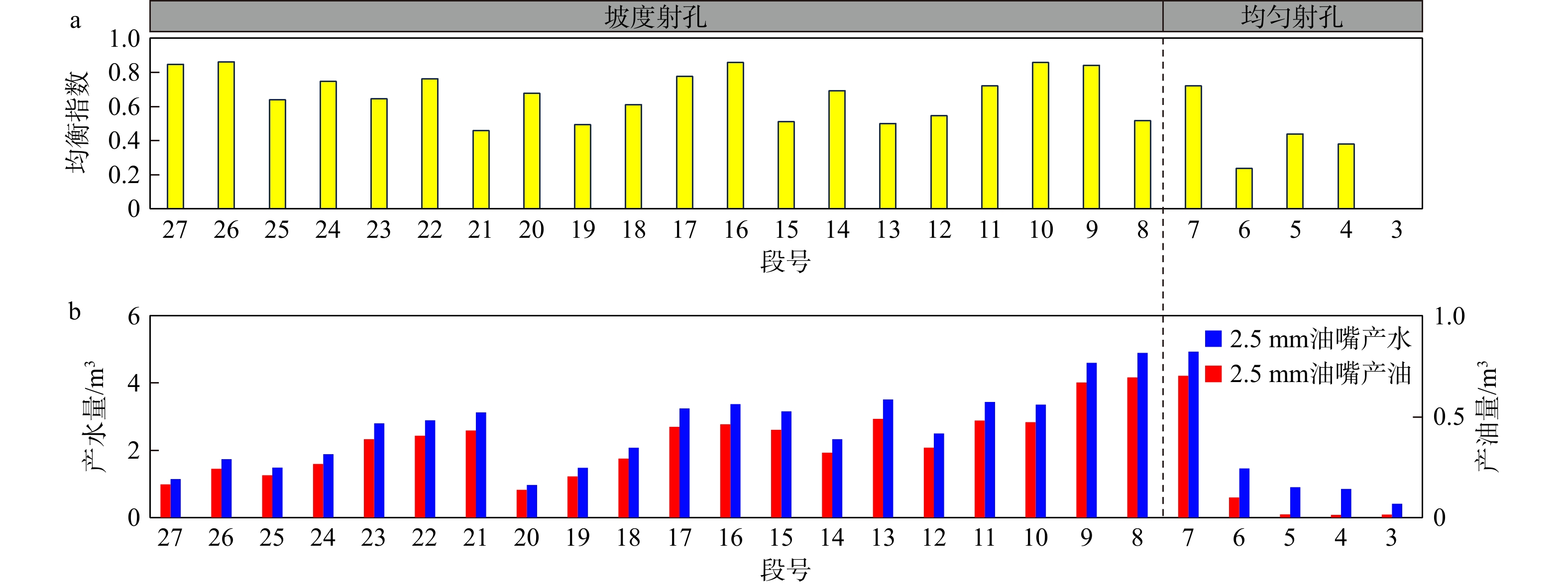
图 7 英页3H15-4井压后各段改造均匀性与产出效果
a—英页3H15-4井压裂后各段均匀指数柱状图;b—-英页3H15-4井压裂后各段产出效果柱状图
Figure 7. Production performance of each interval after fracturing in Well Yingye 3H15-4
(a) Histogram of uniformity index for each interval of Well Yingye 3H15-4 after fracturing; (b) Histogram of production performance for each interval of Well Yingye 3H15-4 after fracturing
表 1 英页3H15-4井簇开启率统计数据表
Table 1. Statistical data of cluster well initiation rate for Well Yingye 3H15-4
压裂段 液量/m3 砂量/m3 射孔方式 簇数/个 开启簇数/个 簇开启率/% 平均开启率/% 第3段 2218.13 103.82 均匀射孔 6 — — 62.26 第4段 2205.86 182.86 6 3 50.00 第5段 1868.74 106.04 5 3 60.00 第6段 2325.38 166.31 7 4 57.14 第7段 2069.63 146.29 6 5 83.33 第8段 2013.22 174.82 坡度射孔 6 6 100.00 87.92 第9段 1767.53 192.57 5 5 100.00 第10段 1629.85 142.28 4 4 100.00 第11段 2156.34 186.19 5 4 80.00 第12段 1822.38 15013.95 5 4 80.00 第13段 1834.38 164.07 6 4 66.70 第14段 1746.58 161.22 5 5 100.00 第15段 2006.93 217.33 6 6 100.00 第16段 1703.84 188.04 6 5 83.33 第17段 1381.59 140.82 5 5 100.00 第18段 1708.42 170.52 5 4 80.00 第19段 1585.60 181.43 4 3 75.00 第20段 1363.26 123.13 3 3 100.00 第21段 1704.71 164.46 8 7 87.50 第22段 2187.61 221.22 8 6 75.00 第23段 2127.99 223.97 8 6 75.00 第24段 1816.60 190.89 6 6 100.00 第25段 1586.50 145.88 5 4 80.00 第26段 1252.46 125.24 5 5 100.00 第27段 933.16 101.91 4 4 100.00  下载: 导出CSV
-
[1] BI Z H, WANG L, YANG H Z, et al., 2021. Development and verification of a physical simulation experiment system for initiation and propagation of multiple clusters of hydraulic fractures[J]. Chinese Journal of Rock Mechanics and Engineering, 40(11): 2273-2285. (in Chinese with English abstract) [2] CHEN J G, DENG Z W, WANG F, et al., 2024. Key seismic exploration techniques for identifying small faults and carbonate fracture-cavity bodies in Yingxiongling structural belt, Qaidam Basin[J]. Oil Geophysical Prospecting, 59(2): 290-298. (in Chinese with English abstract) [3] CHEN X H, 2017. Advances in the research on the occurrence state and resources assessment of shale oil[J]. Science Technology and Engineering, 17(3): 136-144. (in Chinese with English abstract) [4] CHEN Y, ZHANG Y S, XU Z H, et al., 2024. Breakthroughs in hydrocarbon exploration in the Ganchaigou area, Qaidam Basin and their implications[J]. Oil & Gas Geology, 45(4): 1018-1031. (in Chinese with English abstract) [5] CUI M Y, LIU Y Z, XIU N L, et al., 2014. Analysis of factors affecting the formation of Effective Stimulated Reservoir Volume (ESRV)[J]. Oil Drilling & Production Technology, 36(2): 82-87. (in Chinese with English abstract) [6] GOU L, ZHANG S H, YU G, et al., 2021. Optical sensing promotes intelligence, innovation and development of reservoir geophysical technology[J]. Petroleum Science and Technology Forum, 40(5): 55-64. (in Chinese with English abstract) [7] HE L, ZHU J H, LIANG X, et al., 2024. Evaluation of multi-cluster fracturing effects in horizontal shale gas wells based on optic fiber monitoring outside casing[J]. Petroleum Drilling Techniques, 52(4): 110-117. (in Chinese with English abstract) [8] HE Z Q, DING S D, LIAN Z H, et al., 2013. Setting process simulation on bridge plug research[J]. Journal of Southwest Petroleum University (Science & Technology Edition), 35(2): 164-169. (in Chinese with English abstract) [9] HU W R, ZHANG S T, XU S Y, et al., 2024. Practice, challenges and prospects of oil and gas field development in China[J]. China Petroleum Exploration, 29(5): 1-11. (in Chinese with English abstract) [10] JIA C Z, 2024. Prospects and five future theoretical and technical challenges of the upstream petroleum industry in China[J]. Acta Petrolei Sinica, 45(1): 1-14. (in Chinese with English abstract) [11] JIANG S, LI Y P, DU F S, et al., 2023. Recent advancement for improving gas production rate from perforated clusters in fractured shale gas reservoir[J]. Petroleum Reservoir Evaluation and Development, 13(1): 9-22. (in Chinese with English abstract) [12] LI X R, LIU X F, ZHANG Y, et al., 2022. Application and progress of oil and gas well monitoring techniques based on distributed optical fiber sensing[J]. Oil Drilling & Production Technology, 44(3): 309-320. (in Chinese with English abstract) [13] LIU G Y, WU S T, WU K Y, et al., 2024. Characteristics and hydrocarbon accumulation model of Paleogene whole petroleum system in western depression of Qaidam Basin, NW China[J]. Petroleum Exploration and Development, 51(5): 951-961. (in Chinese with English abstract) doi: 10.1016/s1876-3804(25)60528-3 [14] LIU H, MU L J, QI Y, et al., 2024. Evaluation and optimization suggestions of multi-cluster equilibrium of segmented fracturing based on optical fiber monitoring[J]. Drilling & Production Technology, 47(6): 1-7. (in Chinese with English abstract) [15] LIU L J, GUO X L, WANG X G, 2024. Integrated wellbore-reservoir-geomechanics modeling for enhanced interpretation of distributed fiber-optic strain sensing data in hydraulic-fracture analysis[J]. Journal of Rock Mechanics and Geotechnical Engineering, 16(8): 3136-3148. doi: 10.1016/j.jrmge.2023.09.027 [16] LU C, LI Q Y, GUO J C, 2024. Research progress of distributed optical fiber sensing technology in hydraulic fracturing[J]. Petroleum Reservoir Evaluation and Development, 14(4): 618-628. (in Chinese with English abstract) doi: 10.1360/sst-2020-0195 [17] LYU Z H, LYU B, LUO Y, et al., 2024. Optimization of in-stage multi-cluster temporary plugging scheme based on optical fiber monitoring[J]. Petroleum Drilling Techniques, 52(1): 114-121. (in Chinese with English abstract) [18] MA L J, CHAI H Q, FENG L Y, et al., 2024. Optimization of reasonable well spacing for continental interbedding shale oil horizontal wells using field parameter method[J]. Oil Drilling & Production Technology, 46(3): 317-325. (in Chinese with English abstract) [19] MENG W, TIAN T, SUN D S, et al., 2022. Research on stress state in deep shale reservoirs based on in-situ stress measurement and rheological model[J]. Journal of Geomechanics, 28(4): 537-549. (in Chinese with English abstract) [20] PAKHOTINA I, SAKAIDA S, ZHU D, et al., 2020. Diagnosing multistage fracture treatments with distributed fiber-optic sensors[J]. SPE Production & Operation, 35(4): 852-864. doi: 10.2118/199723-PA [21] SHEN L F, HUA T, WANG Z L, et al., 2025. Effect of parameter spatial variability on fracture propagation morphology of rock hydraulic fracturing[J]. Rock and Soil Mechanics, 46(4): 1294-1302. (in Chinese with English abstract) [22] SUI W B, WEN C Y, SUN W C, et al., 2023. Joint application of distributed optical fiber sensing technologies for hydraulic fracturing monitoring[J]. Natural Gas Industry, 43(2): 87-103. (in Chinese with English abstract) doi: 10.1360/sst-2020-0195 [23] SUN J X, ZENG B, LIU J C, et al., 2022. Modeling study on the hydraulic fracturing of deep shale reservoir in southern Sichuan[J]. Journal of Engineering Geology, 30(4): 1193-1202. (in Chinese with English abstract) [24] WAN Y Y, WANG X Q, LIN H, et al., 2025. Experimental study on sweet spot evaluation of Yingxiongling shale oil reservoir[J]. Science Technology and Engineering, 25(11): 4496-4504. (in Chinese with English abstract) [25] WANG G M, ZHU X Y, LIU H, et al., 2024. The application of sedimentary microfacies on the fracability of tight sandstone reservoir in Chang 7 member of Longdong area in the Ordos Basin[J]. Journal of Geomechanics, 30(6): 893-905. (in Chinese with English abstract) doi: 10.3390/pr13103246 [26] WANG L X, LU Z Y, YANG X C, et al., 2024. Research and Application of Distributed Optical Fiber Fracturing Monitoring Technology[J]. Fault-Block Oil & Gas Field, 31(6): 1039-1046. (in Chinese with English abstract) [27] WANG X, CAI B, LI S, et al., 2023. Development process and prospect of CNPC’s reservoir stimulation technologies[J]. Oil Drilling & Production Technology, 45(1): 67-75. (in Chinese with English abstract) [28] WANG Y, GAO R, LIU W, 2023. Design of concrete crack displacement sensor based on optical fiber bending loss[J]. Transducer and Microsystem Technologies, 42(3): 87-90. (in Chinese with English abstract) [29] XIAO J L, LI B L, YOU Y, et al., 2024. Analysis of fracturing fracture characteristics and production increase and stimulation strategy of continental shale in Fuxing Block[J]. Fault-Block Oil & Gas Field, 31(6): 1066-1075. (in Chinese with English abstract) [30] YANG M, LIU T, HE Y, et al., 2024. Development and application of all metal soluble bridge plug at high temperature[J]. Petrochemical Industry Technology, 31(1): 82-84. (in Chinese with English abstract) [31] ZHANG H, LÜ Q T, ZHANG Y, et al., 2023. Recent advances in geoscience using Fiber Bragg Grating(FBG) and Distrusted Acoustic Sensing(DAS) and the road ahead[J]. Progress in Geophysics, 38(3): 1416-1454. (in Chinese with English abstract) [32] ZHANG X P, ZHANG Y X, WANG L, et al., 2024. Current status and future of research and applications for distributed fiber optic sensing technology[J]. Acta Optica Sinica, 44(1): 0106001. (in Chinese with English abstract) doi: 10.3788/AOS231473 [33] ZHAO L Z, TANG F J, ZHOU Z, 2022. Experimental and numerical analysis of cracking monitoring based on distributed optical fiber[J]. China Measurement & Test, 48(12): 7-14. (in Chinese with English abstract) [34] 毕振辉, 王磊, 杨涵志, 等, 2021. 多簇水力裂缝起裂与扩展物理模拟试验系统研制及验证[J]. 岩石力学与工程学报, 40(11): 2273-2285. doi: 10.13722/j.cnki.jrme.2021.0058 [35] 陈敬国, 邓志文, 王飞, 等, 2024. 柴达木盆地英雄岭构造带小断层和碳酸盐岩缝洞体识别地震勘探关键技术[J]. 石油地球物理勘探, 59(2): 290-298. doi: 10.13810/j.cnki.issn.1000-7210.2024.02.011 [36] 陈小慧, 2017. 页岩油赋存状态与资源量评价方法研究进展[J]. 科学技术与工程, 17(3): 136-144. doi: 10.3969/j.issn.1671-1815.2017.03.020 [37] 陈琰, 张永庶, 徐兆辉, 等, 2024. 柴达木盆地干柴沟地区勘探突破及启示[J]. 石油与天然气地质, 45(4): 1018-1031. doi: 10.11743/ogg20240409 [38] 崔明月, 刘玉章, 修乃领, 等, 2014. 形成复杂缝网体积(ESRV)的影响因素分析[J]. 石油钻采工艺, 36(2): 82-87. [39] 苟量, 张少华, 余刚, 等, 2021. 光纤传感推动油藏地球物理技术智能创新发展[J]. 石油科技论坛, 40(5): 55-64. doi: 10.3969/j.issn.1002-302x.2021.05.008 [40] 何乐, 朱炬辉, 梁兴, 等, 2024. 基于管外光纤监测的页岩气水平井多簇压裂效果评价[J]. 石油钻探技术, 52(4): 110-117. doi: 10.11911/syztjs.2024075 [41] 何祖清, 丁士东, 练章华, 等, 2013. 桥塞坐封过程仿真模拟研究[J]. 西南石油大学学报(自然科学版), 35(2): 164-169. doi: 10.3863/j.issn.1674-5086.2013.02.025 [42] 胡文瑞, 张书通, 徐思源, 等, 2024. 中国油气田开发实践、挑战与展望[J]. 中国石油勘探, 29(5): 1-11. [43] 贾承造, 2024. 中国石油工业上游前景与未来理论技术五大挑战[J]. 石油学报, 45(1): 1-14. [44] 蒋恕, 李园平, 杜凤双, 等, 2023. 提高页岩气藏压裂井射孔簇产气率的技术进展[J]. 油气藏评价与开发, 13(1): 9-22. doi: 10.13809/j.cnki.cn32-1825/te.2023.01.002 [45] 李晓蓉, 刘旭丰, 张毅, 等, 2022. 基于分布式光纤声传感的油气井工程监测技术应用与进展[J]. 石油钻采工艺, 44(3): 309-320. doi: 10.13639/j.odpt.2022.03.007 [46] 刘国勇, 吴松涛, 伍坤宇, 等, 2024. 柴达木盆地西部坳陷古近系全油气系统特征与油气成藏模式[J]. 石油勘探与开发, 51(5): 951-961. doi: 10.11698/PED.20240250 [47] 刘合, 慕立俊, 齐银, 等, 2024. 基于光纤监测的分段压裂多簇均衡性评价与优化建议[J]. 钻采工艺, 47(6): 1-7. doi: 10.3969/J.ISSN.1006-768X.2024.06.01 [48] 卢聪, 李秋月, 郭建春, 2024. 分布式光纤传感技术在水力压裂中的研究进展[J]. 油气藏评价与开发, 14(4): 618-628. [49] 吕振虎, 吕蓓, 罗垚, 等, 2024. 基于光纤监测的段内多簇暂堵方案优化[J]. 石油钻探技术, 52(1): 114-121. doi: 10.11911/syztjs.2024014 [50] 马立军, 柴慧强, 冯立勇, 等, 2024. 矿场参数法优化陆相夹层型页岩油水平井合理井距[J]. 石油钻采工艺, 46(3): 317-325. doi: 10.13639/j.odpt.202404043 [51] 孟文, 田涛, 孙东生, 等, 2022. 基于原位地应力测试及流变模型的深部泥页岩储层地应力状态研究[J]. 地质力学学报, 28(4): 537-549. doi: 10.12090/j.issn.1006-6616.2022041 [52] 申林方, 华涛, 王志良, 等, 2025. 参数空间变异性对岩石水力压裂裂隙扩展形态的影响[J]. 岩土力学, 46(4): 1294-1302. doi: 10.16285/j.rsm.2024.0839 [53] 隋微波, 温长云, 孙文常, 等, 2023. 水力压裂分布式光纤传感联合监测技术研究进展[J]. 天然气工业, 43(2): 87-103. doi: 10.3787/j.issn.1000-0976.2023.02.009 [54] 孙景行, 曾波, 刘俊辰, 等, 2022. 川南深层页岩水力压裂缝网扩展规律数值模拟研究[J]. 工程地质学报, 30(4): 1193-1202. doi: 10.13544/j.cnki.jeg.2022-0245 [55] 万有余, 王小琼, 林海, 等, 2025. 英雄岭页岩油储层甜点评价的实验研究[J]. 科学技术与工程, 25(11): 4496-4504. doi: 10.12404/j.issn.1671-1815.2403338 [56] 王冠民, 祝新怡, 刘海, 等, 2024. 沉积微相在致密砂岩可压裂性分析中的应用: 以鄂尔多斯盆地陇东地区延长组7段为例[J]. 地质力学学报, 30(6): 893-905. doi: 10.12090/j.issn.1006-6616.2024004 [57] 王立歆, 路智勇, 杨心超, 等, 2024. 分布式光纤压裂监测技术研究及应用[J]. 断块油气田, 31(6): 1039-1046. doi: 10.6056/dkyqt202406013 [58] 王欣, 才博, 李帅, 等, 2023. 中国石油油气藏储层改造技术历程与展望[J]. 石油钻采工艺, 45(1): 67-75. doi: 10.13639/j.odpt.2023.01.009 [59] 王洋, 高瑞, 刘炜, 2023. 基于光纤弯曲损耗的混凝土裂缝位移传感器设计[J]. 传感器与微系统, 42(3): 87-90. doi: 10.13873/J.1000-9787(2023)03-0087-04 [60] 肖佳林, 李保林, 游园, 等, 2024. 复兴区块陆相页岩压裂成缝特征与增产改造策略分析[J]. 断块油气田, 31(6): 1066-1075. doi: 10.6056/dkyqt202406016 [61] 杨敏, 刘涛, 何宴, 等, 2024. 高温全金属可溶桥塞的研发与应用[J]. 石化技术, 31(1): 82-84. doi: 10.3969/j.issn.1006-0235.2024.01.028 [62] 张辉, 吕庆田, 张毅, 等, 2023. 光纤布拉格光栅(FBG)和分布式声波传感器(DAS)在地学中的应用进展及发展方向[J]. 地球物理学进展, 38(3): 1416-1454. doi: 10.6038/pg2023GG0365 [63] 张旭苹, 张益昕, 王亮, 等, 2024. 分布式光纤传感技术研究和应用的现状及未来[J]. 光学学报, 44(1): 0106001. [64] 赵丽芝, 唐福建, 周智, 2022. 分布式光纤裂缝监测实验与数值分析[J]. 中国测试, 48(12): 7-14. -

 下载:
下载:


计量
- 文章访问数: 1950
- HTML全文浏览量: 176
- PDF下载量: 161
- 被引次数: 0
