


Analysis of structural plane stability in the Panlong lead–zinc mine, Guangxi, China and its engineering implications
-
摘要: 广西盘龙铅锌矿是桂中地区重要的多金属矿产资源,其深部开采受岩体结构面和地应力场控制显著。为系统评估该矿深部结构面的稳定性,揭示高地应力与构造裂隙耦合作用下的滑动机制,保障深部矿山开采安全,综合采用超声波钻孔电视与水压致裂技术,获取SK1与SK2钻孔的结构面与地应力数据。结合Sheorey模型与应力张量变换方法,计算结构面上的剪应力与正应力,并基于摩擦滑动准则对2948组结构面进行稳定性评价。结果表明:矿区岩体结构面以陡倾角为主,优势倾向为北西—北北西向和北东—北东东向。在500~850 m深度范围内,三向主应力值分别为最大水平主应力SH=28.29~44.69 MPa、最小水平主应力Sh=19.46~27.09 MPa、垂向主应力Sv=14.50~22.68 MPa;SH方向为北西—北北西向,Sh方向为北东—北东东向。最大、最小水平侧压力系数平均值分别为kH = 2.07、kh = 1.28,表明三向主应力关系为SH>Sh>Sv,水平应力占主导地位,现今构造应力场以北西向挤压为主,与区域构造应力场方向一致。北西—北北西向结构面群在当前高应力环境下具有较高的剪切再活化风险,尤其是滑动潜势Ts>0.20且裂隙宽度>10 mm的结构面,应作为重点监测与加固对象。研究成果可为深部开采巷道布设优化、支护设计及灾害防控提供科学依据。Abstract:
Objective The Panlong lead–zinc mine, an important polymetallic mine in central Guangxi, faces increasing challenges related to high in-situ stress and structurally complex rock masses as mining progresses to greater depths. Instabilities along structural planes have become a major geotechnical hazard. However, current understanding of the interplay between fracture geometry and the stress field remains limited. This study aims to evaluate the stability of structural planes at depth and their implications for safe mine development. Methods High-resolution data on fracture orientation and spacing were obtained through ultrasonic borehole television imaging in boreholes SK1 and SK2. Hydraulic fracturing tests were used to determine the magnitude and orientation of in-situ stresses. Stress tensor transformation and the Coulomb friction criterion were applied to estimate shear and normal stresses on structural planes and to assess their slip tendency under current stress conditions. Results The rock mass in the Panlong mine contains steeply dipping structural planes predominantly oriented NW–NNW and NE–NEE. Cluster analysis revealed three dominant fracture sets, reflecting tectonic control from nearby faults. Furthermore, in-situ stress measurements between 500 and 850 m depth show SH = 28.29−44.69 MPa, Sh = 19.46−27.09 MPa, and Sv = 14.50−22.68 MPa. The average values of the maximum and minimum horizontal lateral pressure coefficients are kH=2.07 and kh=1.28, respectively, indicating a horizontal compressive regime with SH oriented NW–NNW. Analysis of borehole breakouts and drilling-induced fractures supports the NW–NNW orientation of maximum horizontal stress. Subsequently, a total of 2,948 structural planes were analyzed. Slip tendency evaluation based on slip tendency (Ts = 0.2−0.4) shows that fractures with Ts > 0.20 are primarily distributed at depths less than 550 m. Steeper fracture planes (40°−75°) exhibit a high slip potential, indicating a higher likelihood of shear slip. NW–NNW-oriented planes exhibit both high density and high slip potential, especially when fracture aperture exceeds 10 mm. Conclusions The structural planes in the Panlong mine are characterized by steep dips and strong orientation clustering, primarily NW–NNW and NE–NEE, reflecting significant tectonic control. The in-situ stress regime is governed by horizontal compression, which favors the activation of reverse faults. This aligns with observed fracture development and supports the role of tectonic faults in stress field evolution. NW–NNW-oriented fractures, particularly those with low slip tendency and wide apertures, pose the highest risk for shear reactivation under current conditions and require targeted monitoring and support. Furthermore, structural planes in shallow zones (<550 m) present a higher slip potential than those in deeper zones, emphasizing the need for depth-specific design strategies. [ Significance ] These findings provide a detailed understanding of structural plane behavior under deep mining conditions and offer scientific support for roadway layout optimization, support system design, and hazard mitigation. -
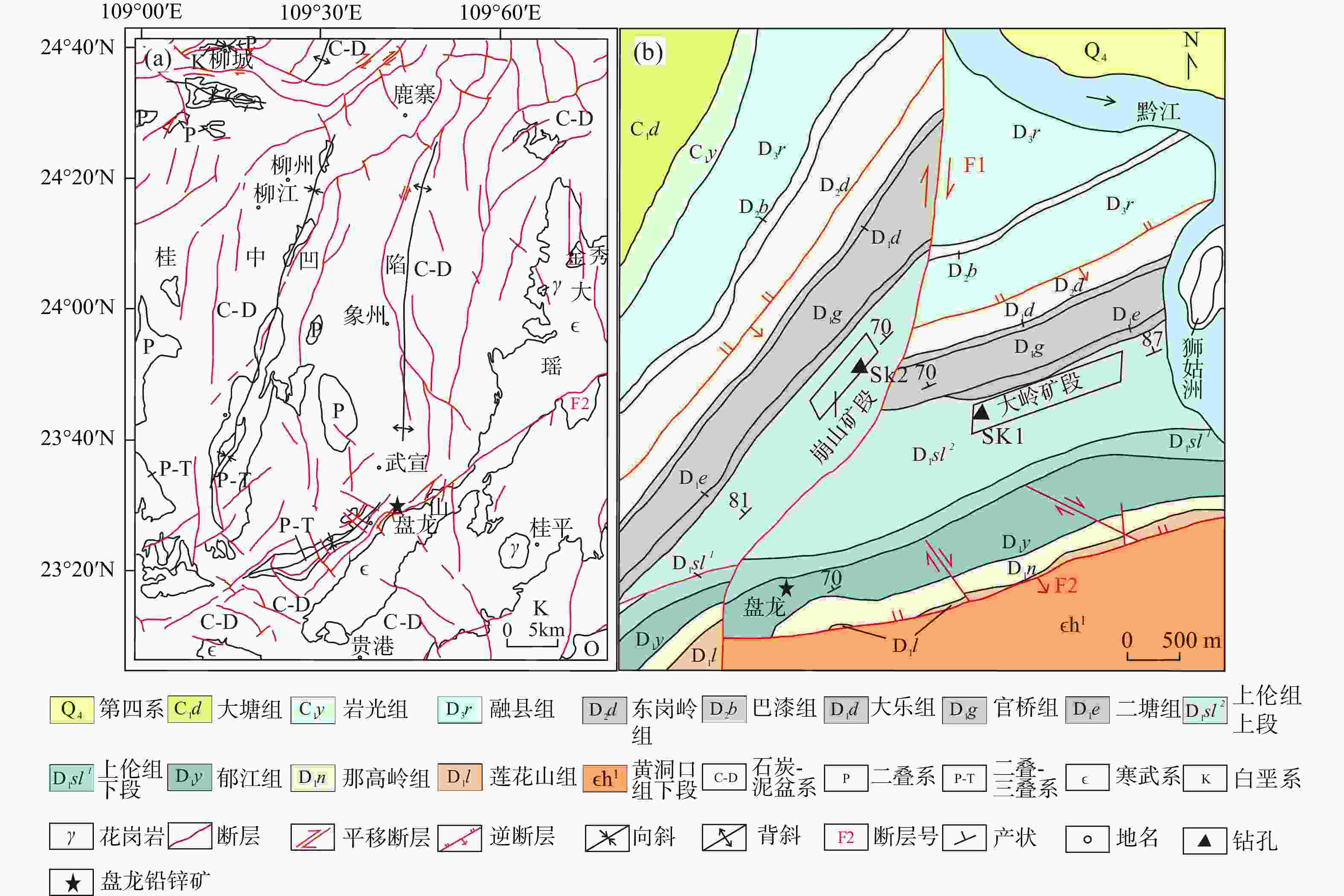
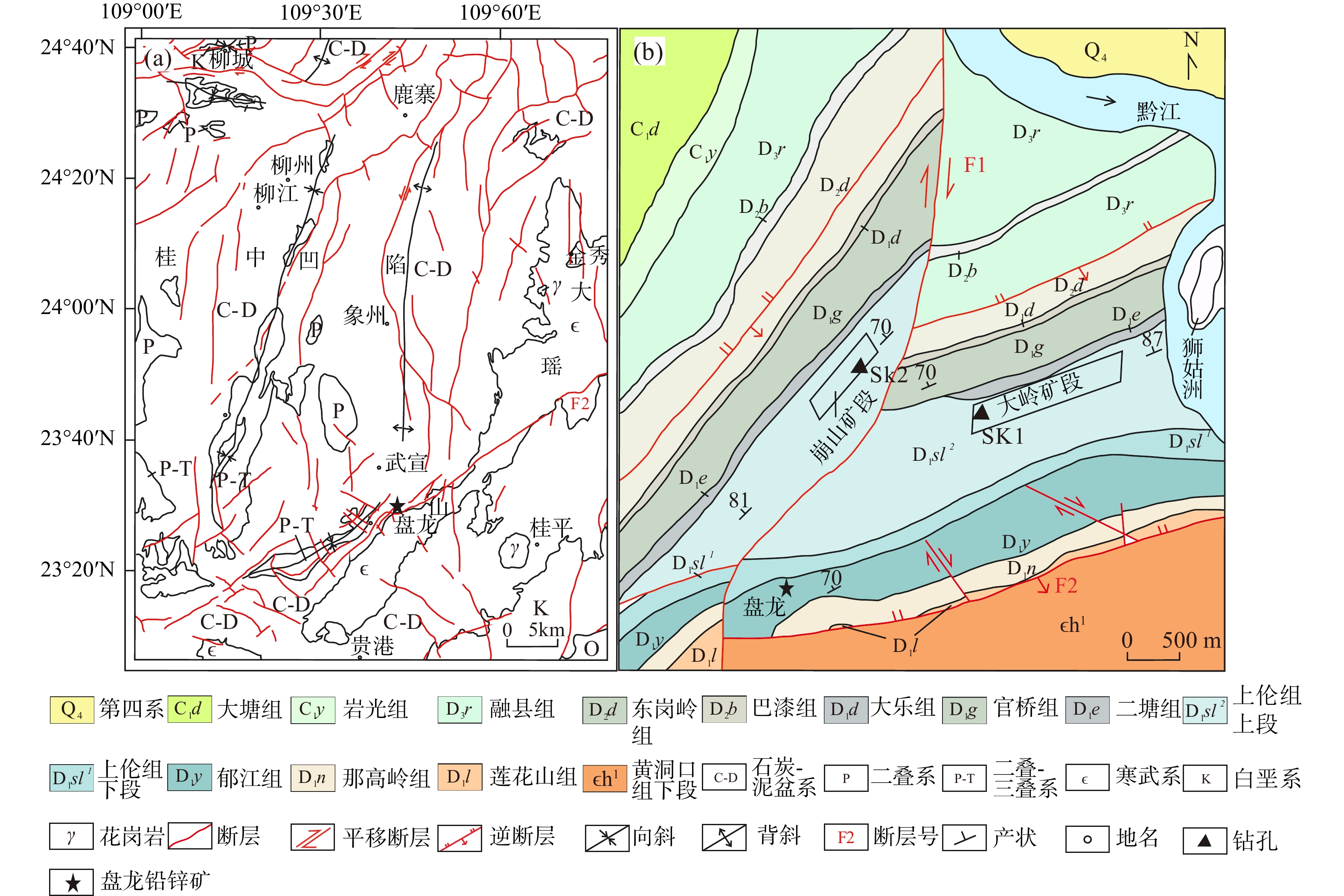
图 1 盘龙铅锌矿区周边构造纲要图及矿区地质图(据安鹏鑫,2019;覃佳肖,2023修改)
F1—东乡−永福断裂(平移断层);F2—凭祥−大黎断裂(区域性逆断层)a—构造纲要图;b—矿区地质图
Figure 1. Peripheral tectonic outline map and geological map of the Panlong lead-zinc mine area (modified after An, 2019; Qin, 2023)
(a) Peripheral tectonic outline map; (b) Geological mapF1—strike-slip fault (Dongxiang–Yongfu Fault); F2—regional thrust fault (Pingxiang–Dali Fault)
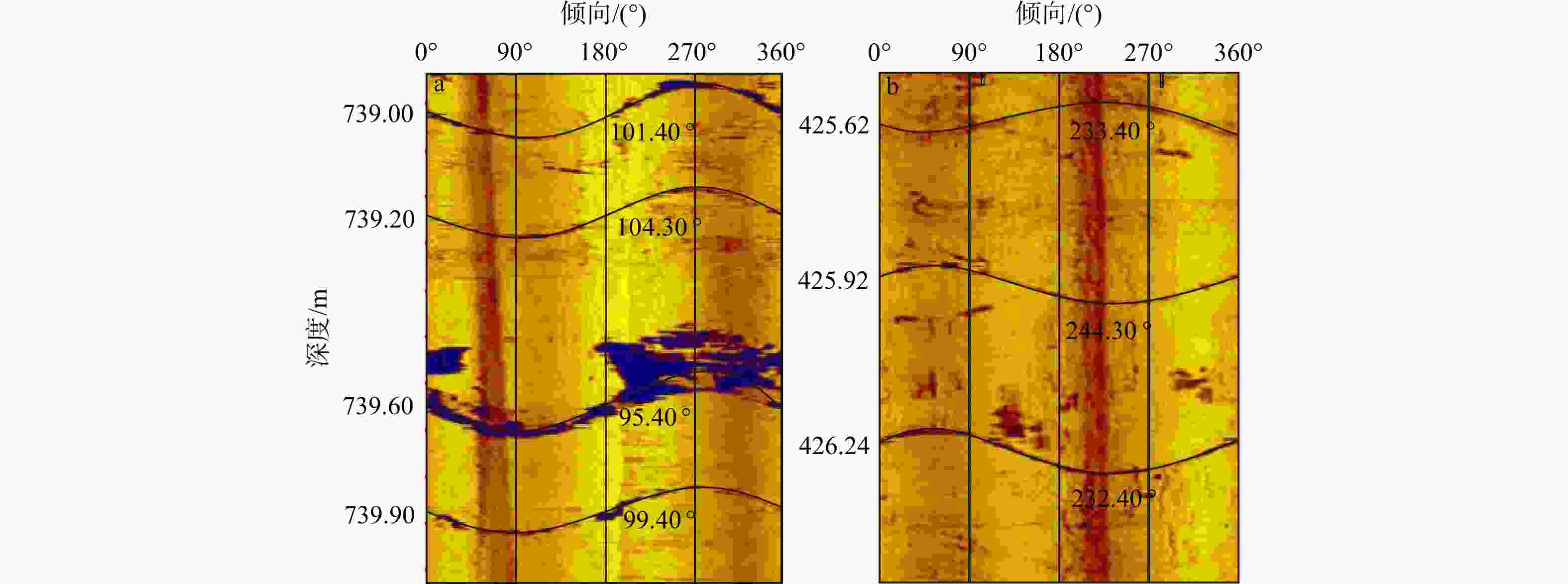
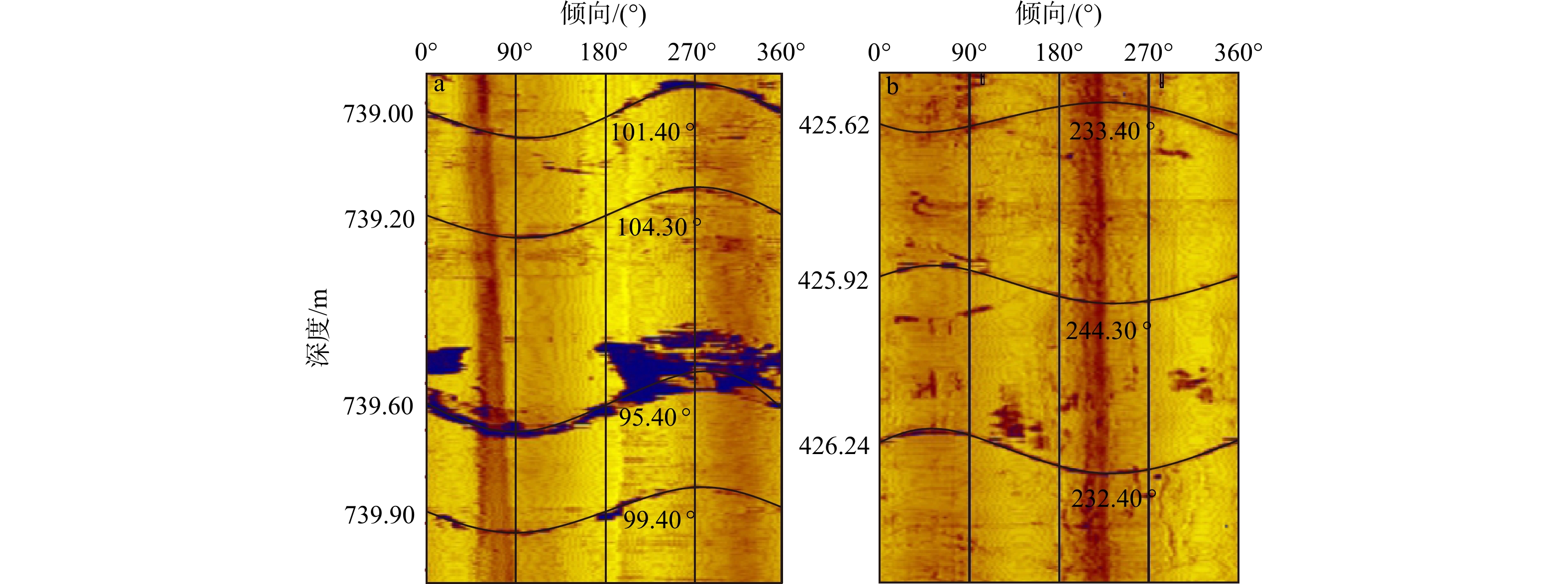
图 2 两个钻孔典型部位超声波钻孔图像
a—SK1钻孔典型部位;b—SK2钻孔典型部位
Figure 2. Typical acoustic borehole images from two boreholes
(a) Typical section in borehole SK1; (b) Typical section in borehole SK2
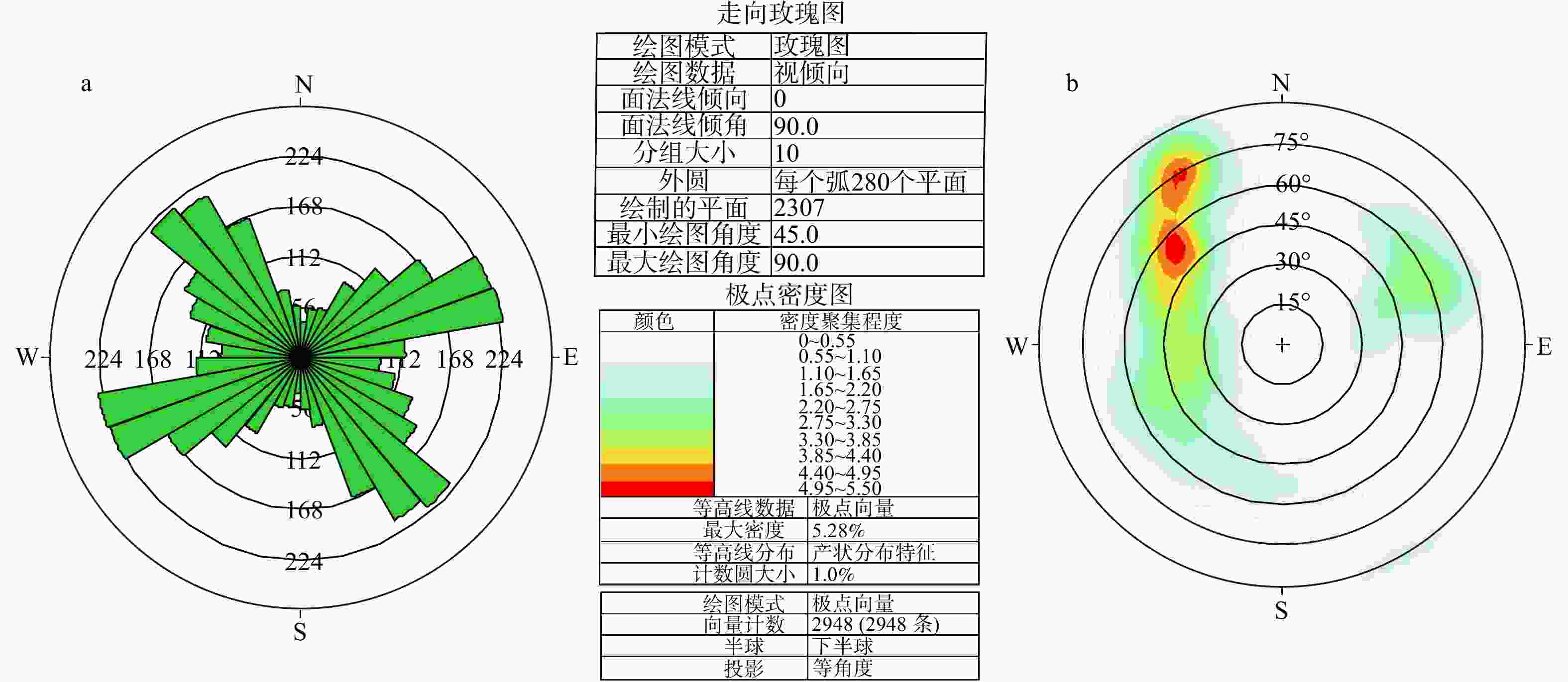
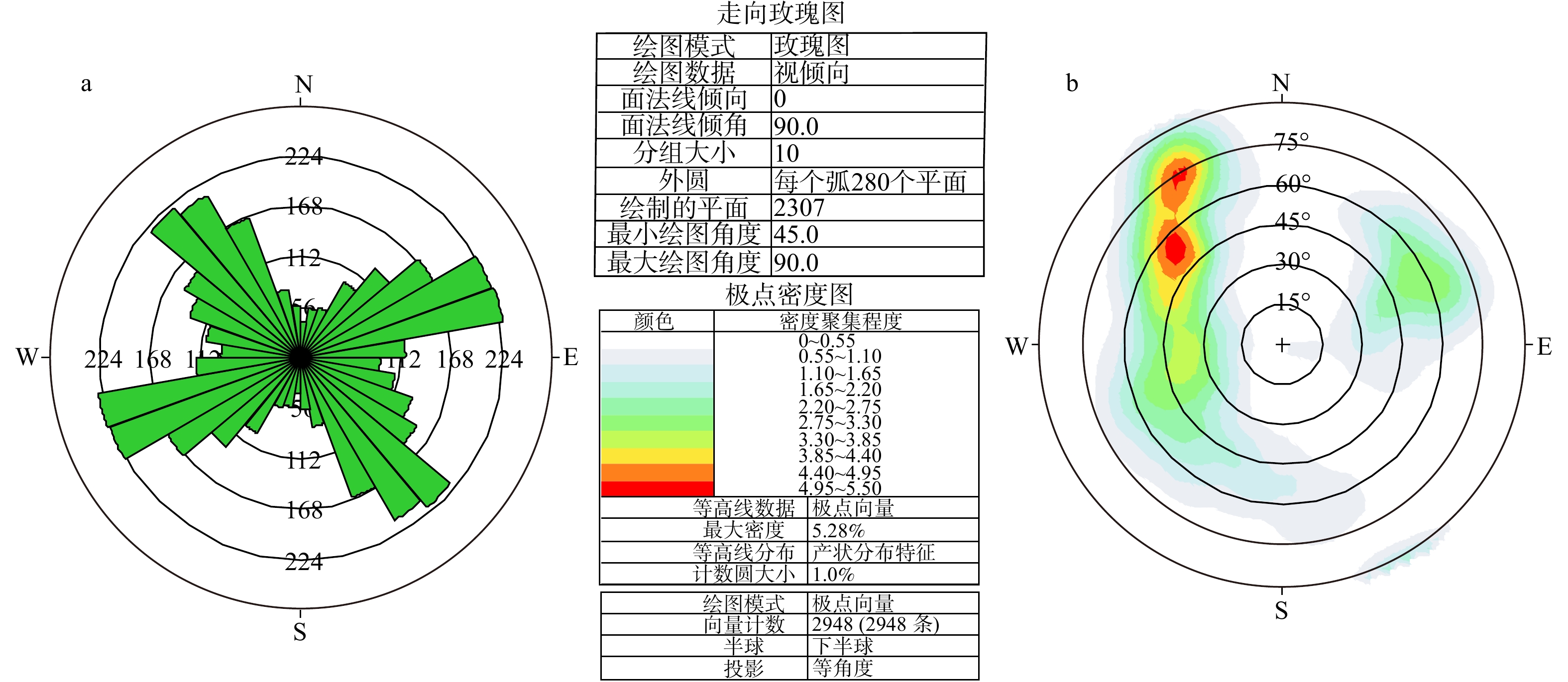
图 3 结构面走向玫瑰花图和极点密度图
a—走向玫瑰图;b—极点密度图
Figure 3. Strike rose diagram of structural plane and pole density plot
(a) Strike rose diagram; (b) Pole density plot
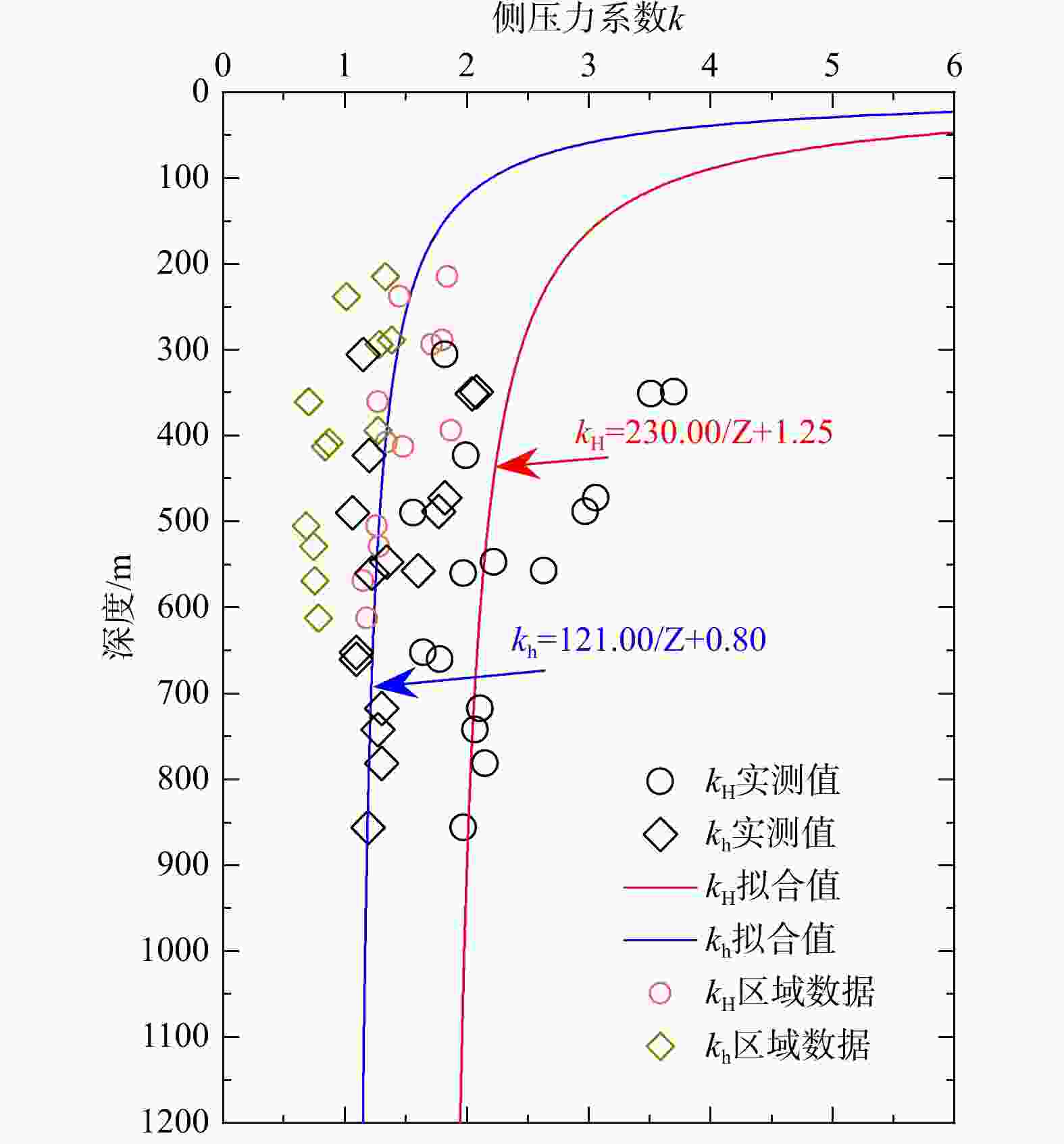
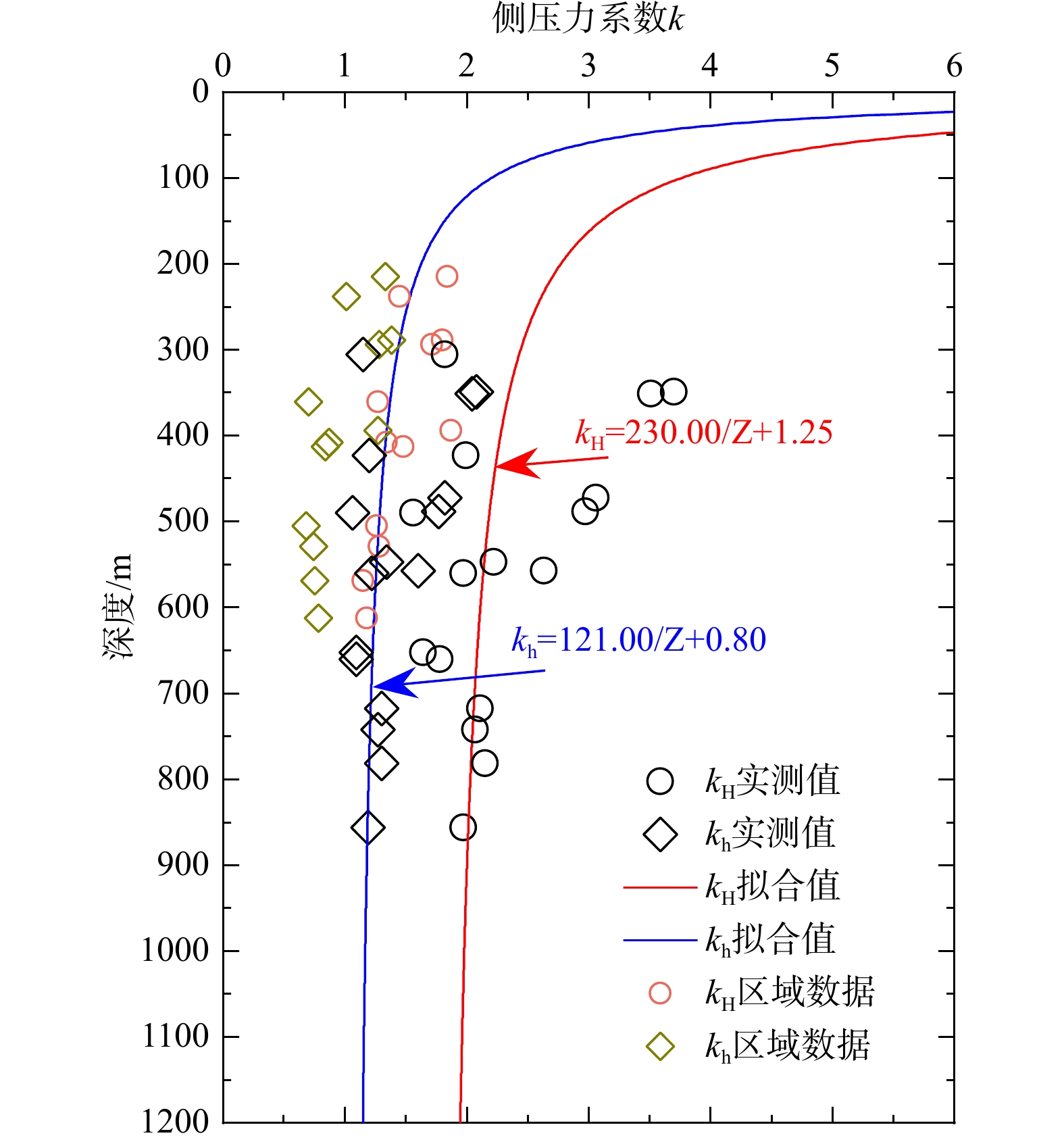
图 4 侧向应力系数拟合结果(区域数据引自李兵等,2017)
kH—最大水平侧压力系数;kh—最小水平侧压力系数
Figure 4. Fitting results of lateral stress coefficient (regional data from Li et al., 2017)
kH—maximum horizontal lateral pressure coefficient; kh—minimum horizontal lateral pressure coefficient
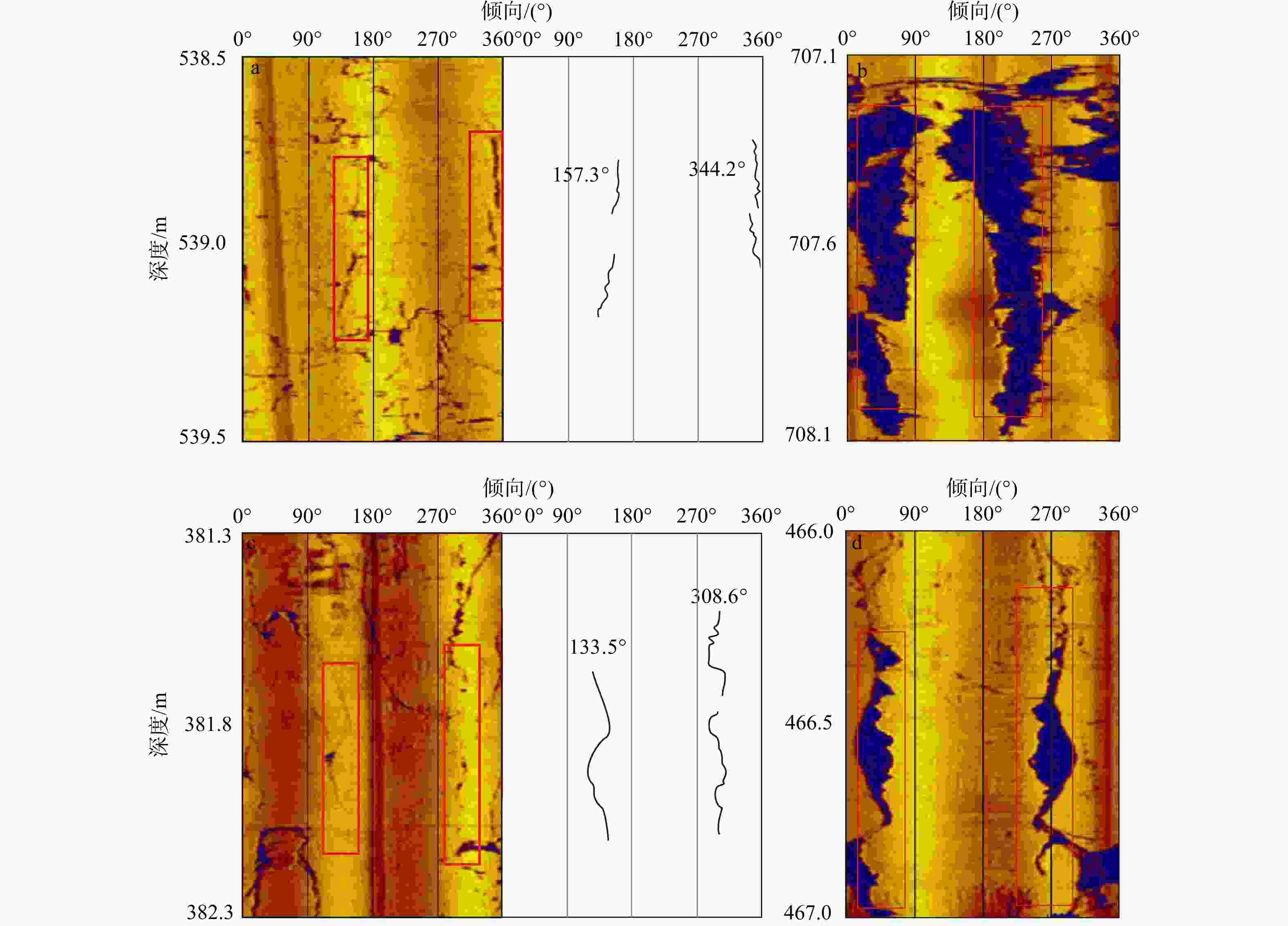
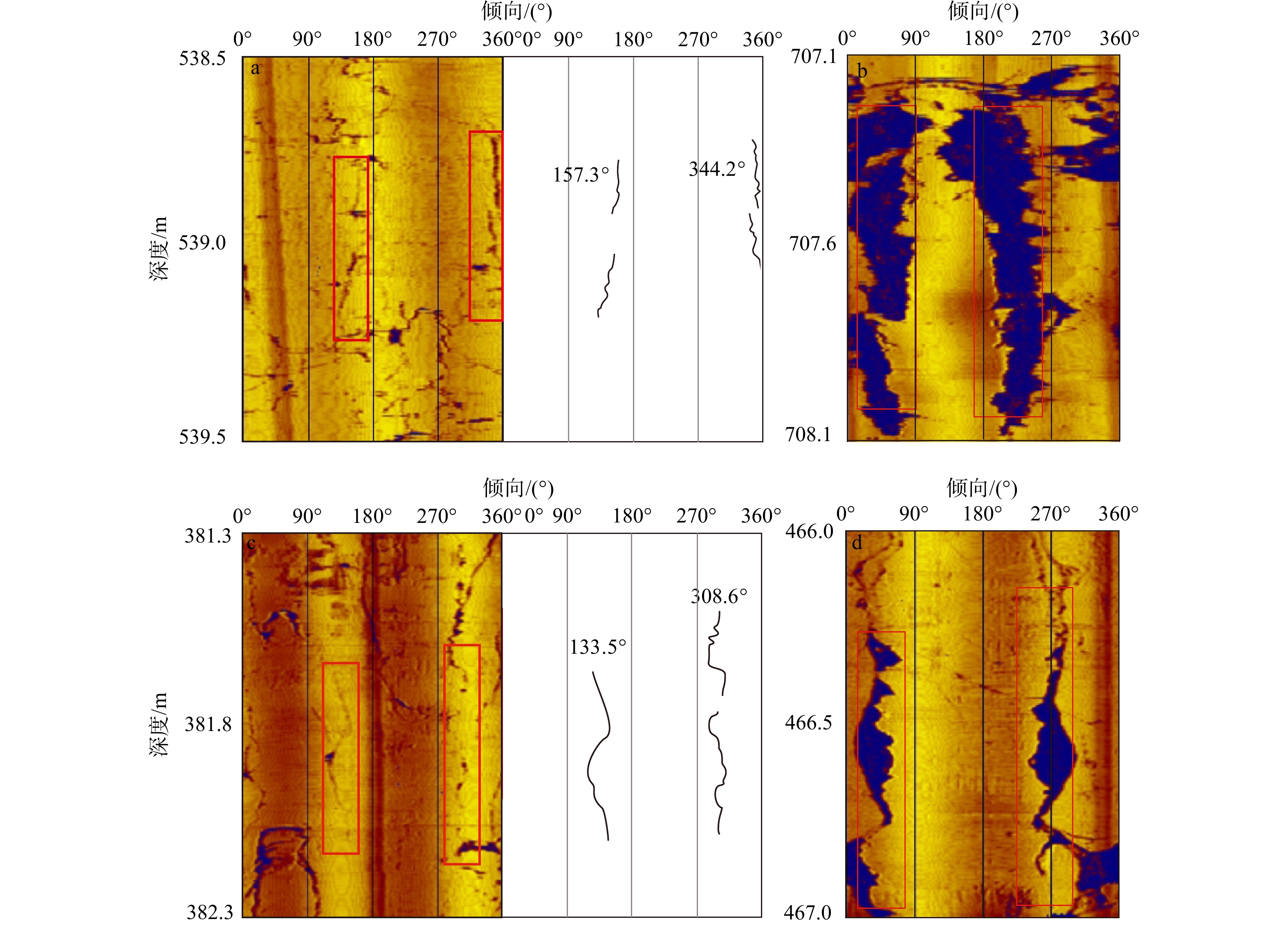
图 5 SK1、SK2钻孔典型诱发裂隙和钻孔崩落图
黄色区域代表岩体完整部分;蓝黑色区域代表钻孔的破碎状况;红色矩形框标明诱发裂隙与钻孔崩落的具体位置a—SK1钻孔诱发裂隙;b—SK1钻孔崩落;c—SK2钻孔诱发裂隙;d—SK2钻孔崩落
Figure 5. Typical images of drilling-induced tensile fractures and borehole breakouts in borehole SK1 and SK2
(a) Drilling-induced tensile fractures in borehole SK1; (b) Borehole breakouts in borehole SK1; (c) Drilling-induced tensile fractures in borehole SK2; (d) Borehole breakouts in borehole SK2Yellow areas: intact rock mass; Blue-black areas: fractured zone in the borehole; Red rectangular boxes: locations of drilling-induced tensile fractures and borehole breakouts
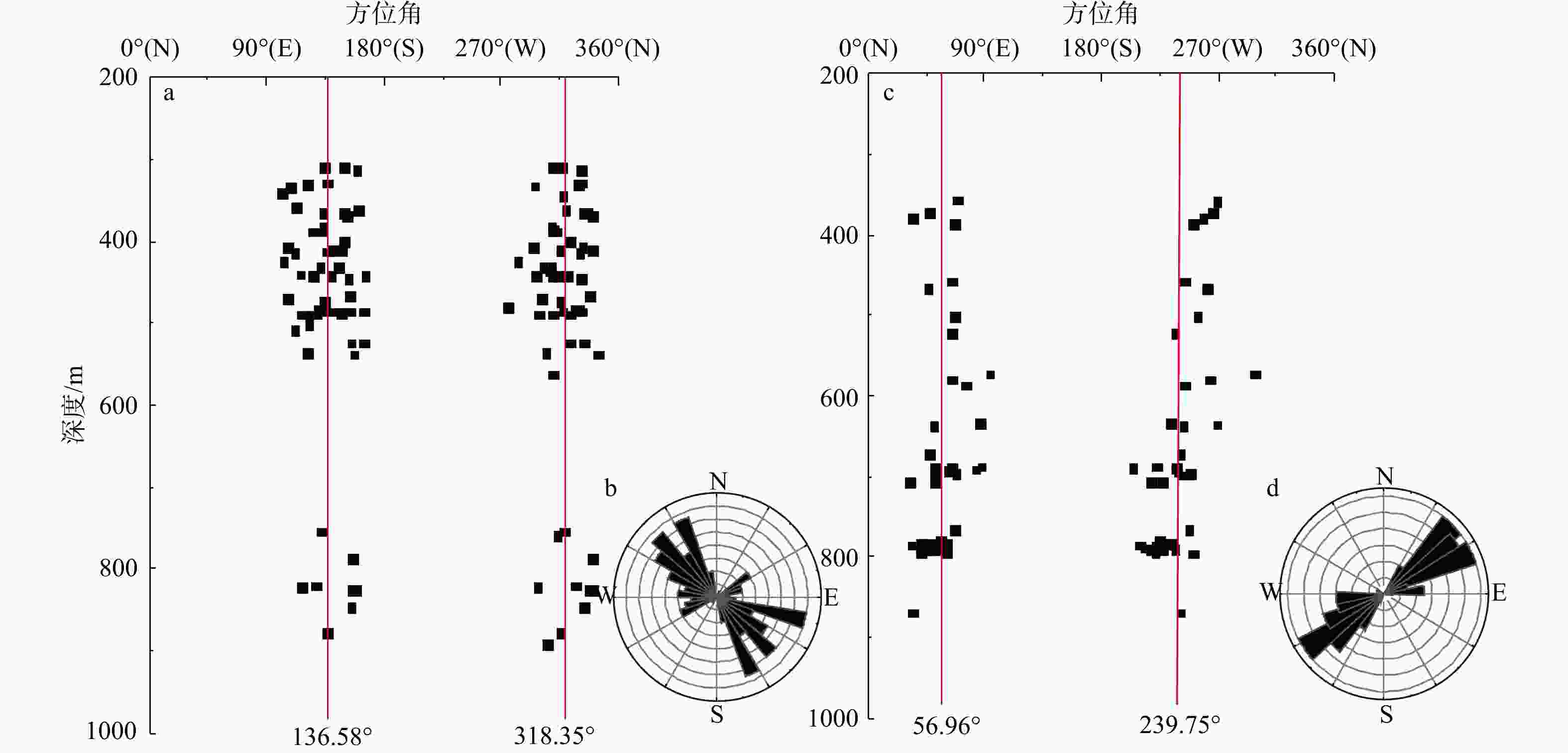
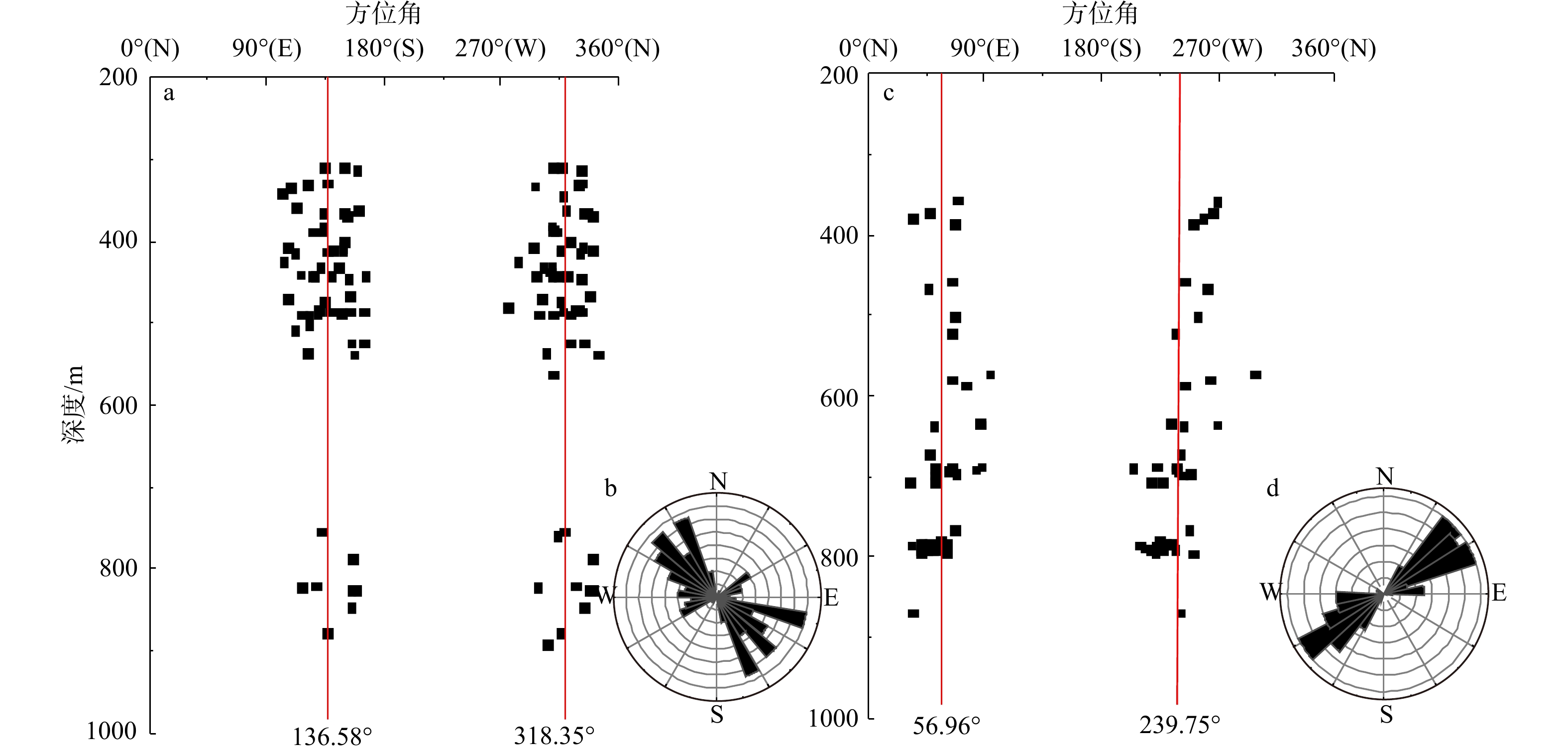
图 6 钻孔诱发裂隙及钻孔崩落分布散点、玫瑰图
散点代表各深度与方位上的裂隙及崩落位置;红色竖线代表诱发裂隙的平均方位角a—诱发裂隙分布散点图;b—诱发裂隙方位玫瑰图;c—钻孔崩落分布散点图;d—钻孔崩落方位玫瑰图
Figure 6. Scatter and rose diagram of the drilling-induced tensile fractures and borehole breakout azimuths
(a) Scatter of the drilling-induced tensile fractures; (b) Rose diagram of the drilling-induced tensile fractures; (c) Scatter of the borehole breakout azimuths; (d) Rose diagram of the borehole breakout azimuthsScatter points: locations of fractures and breakouts at various depths and orientations; Red vertical line: average azimuth of drilling-induced tensile fractures
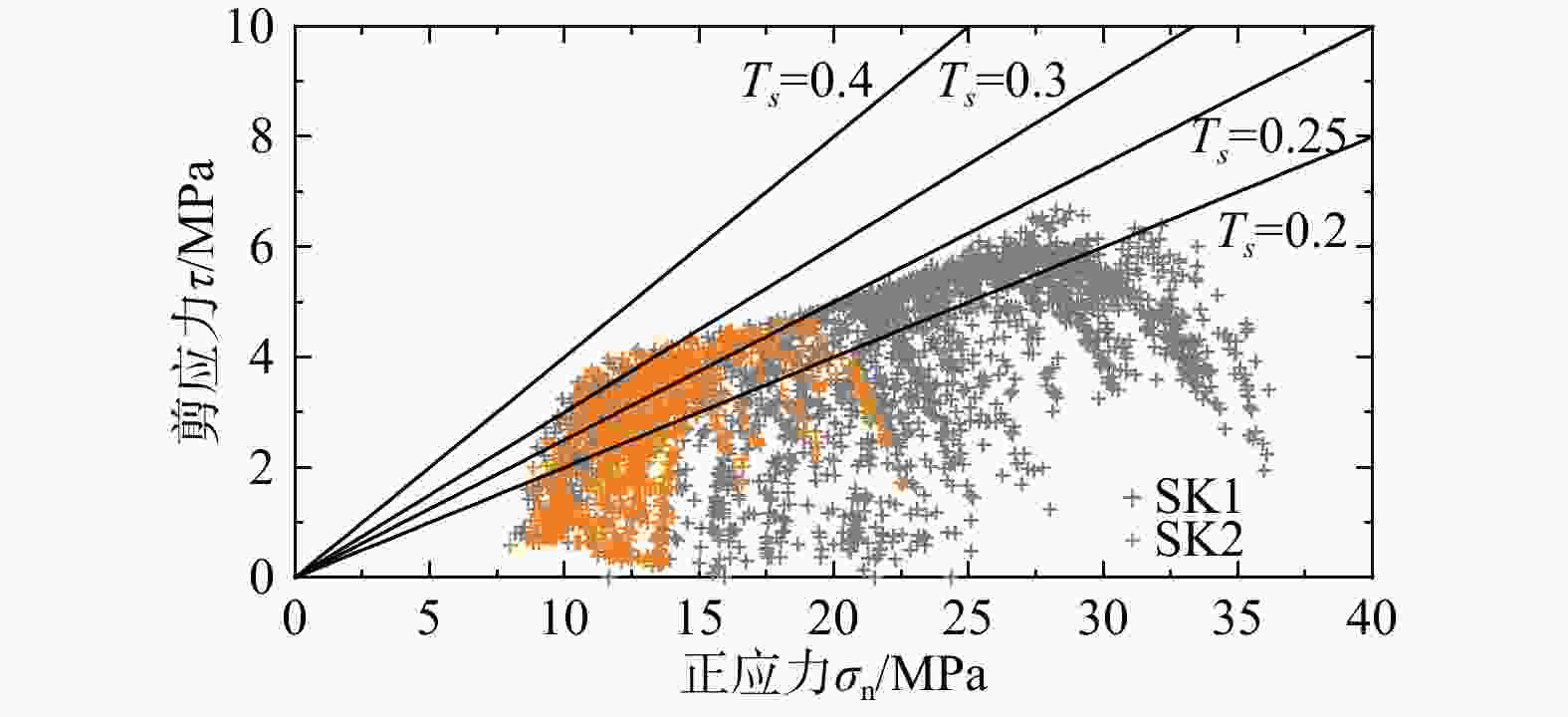
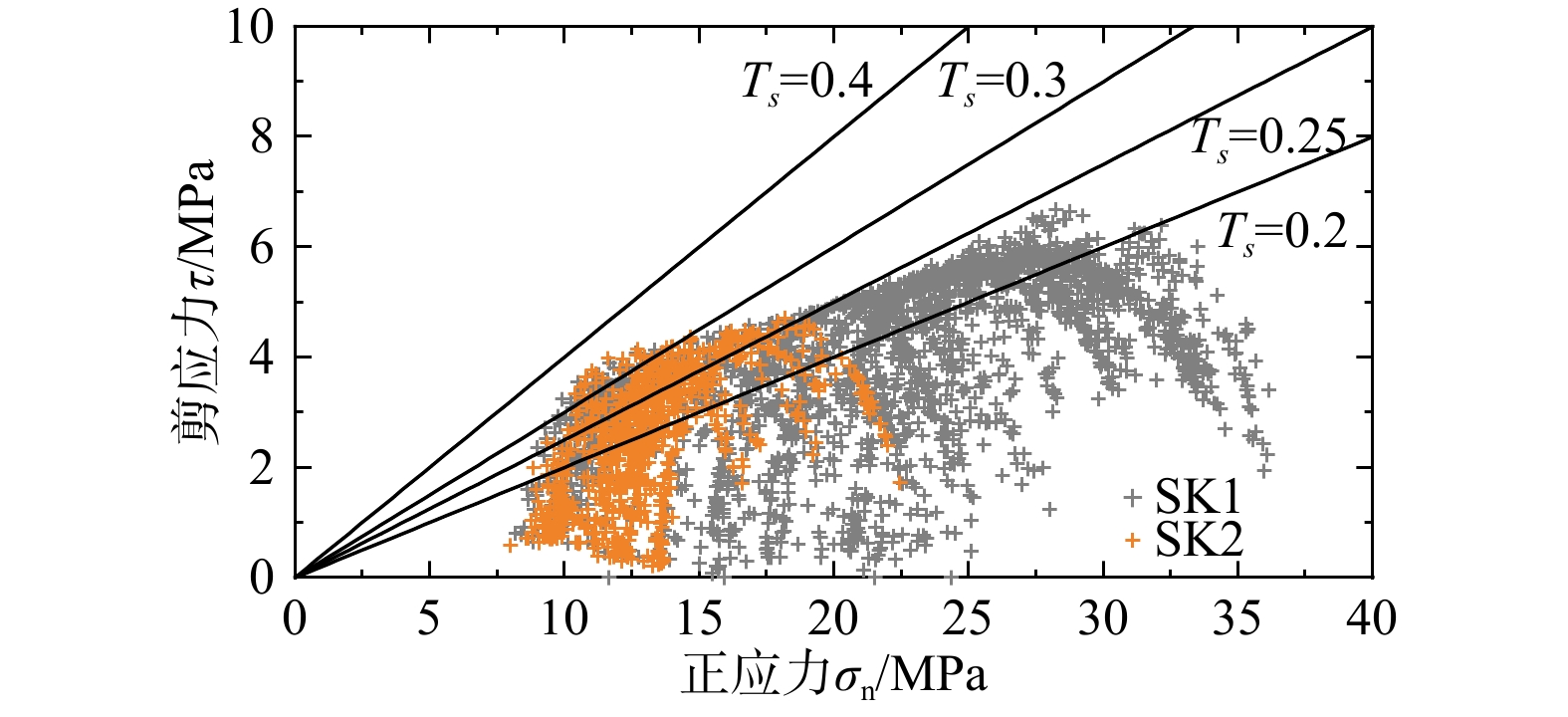
图 7 SK1、SK2钻孔结构面剪应力与正应力关系图
Ts—滑动潜势
Figure 7. Relationship between shear stress and normal stress of structural planes in boreholes SK1 and SK2
Ts—Slip tendency
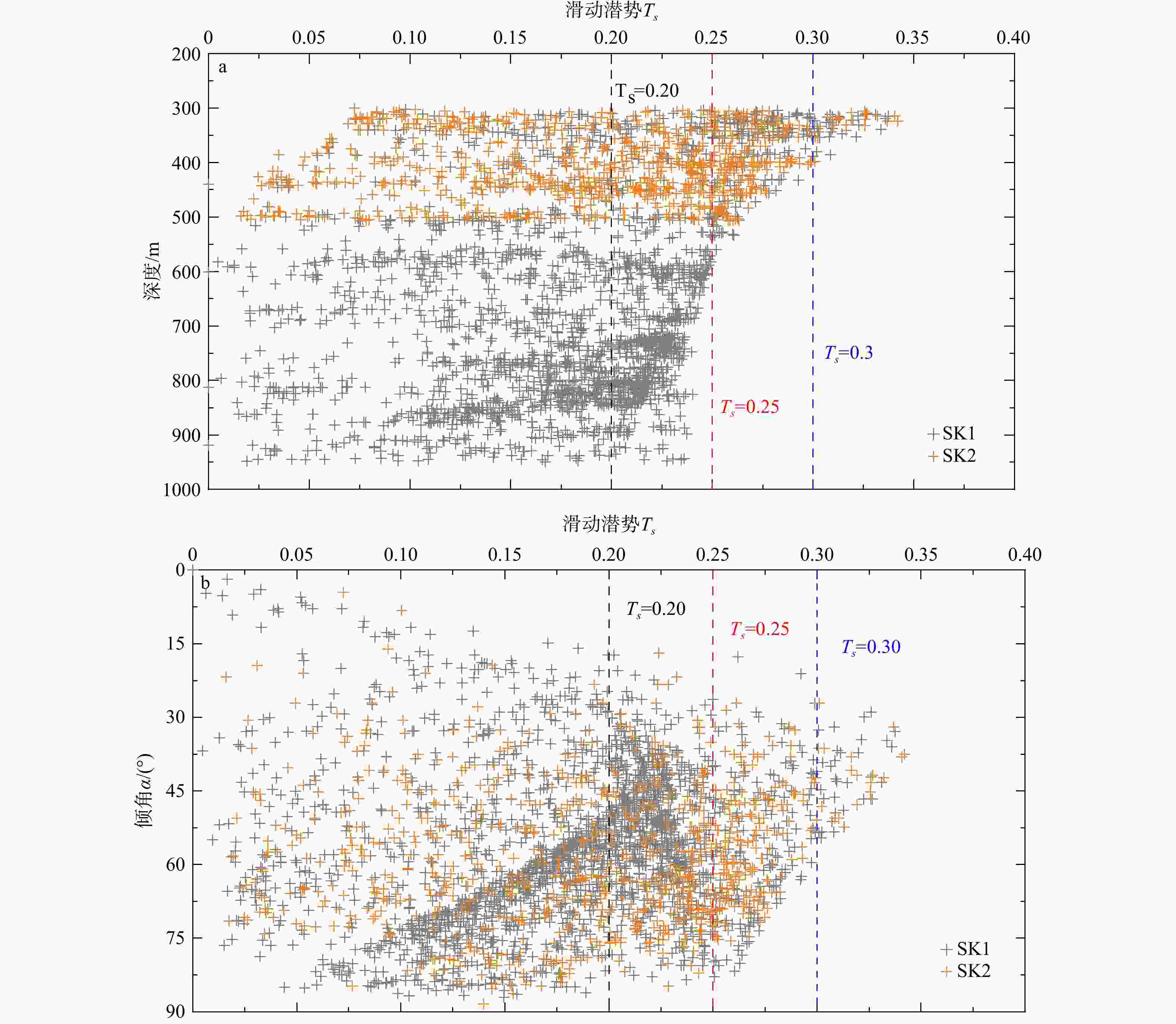
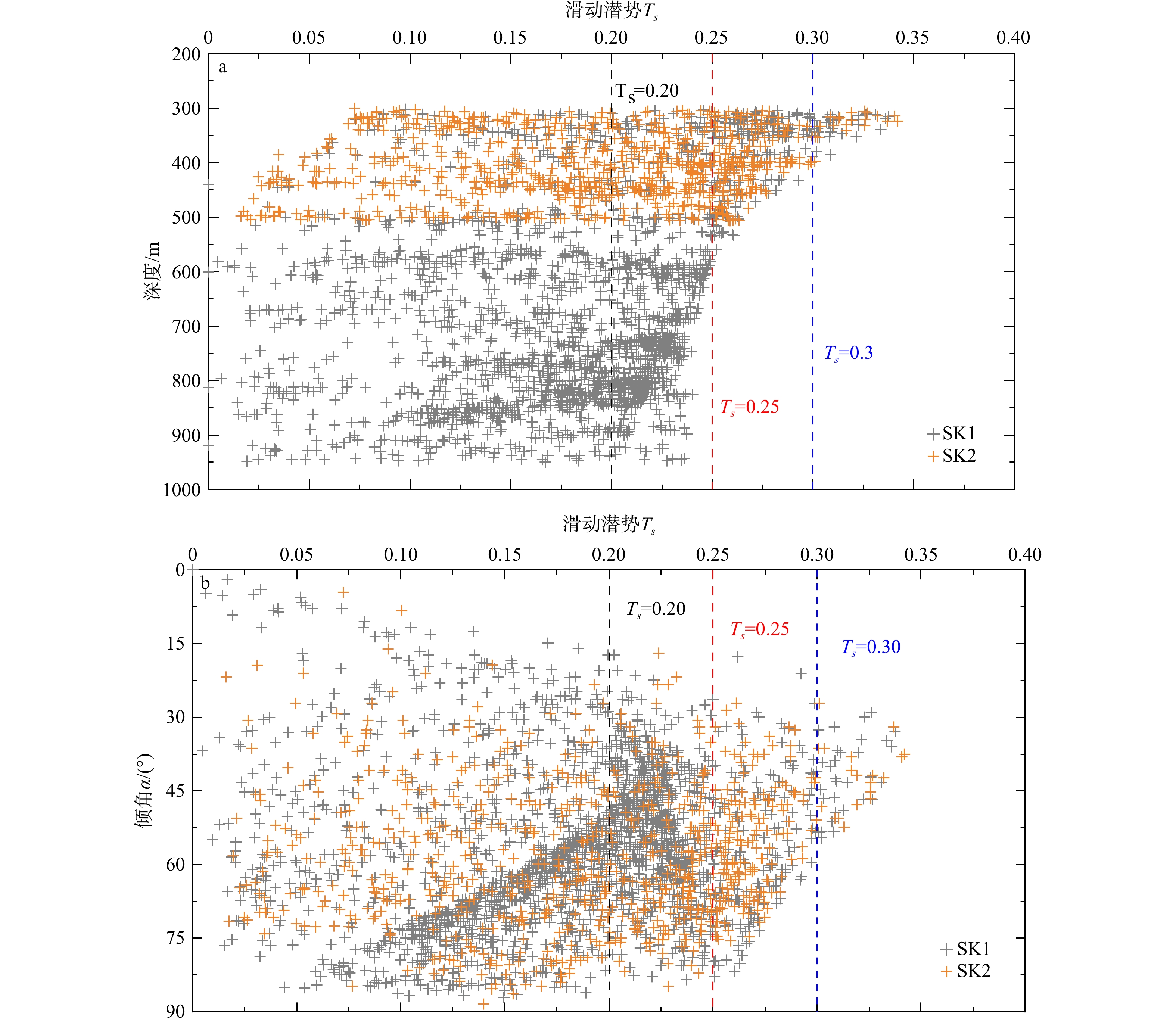
图 8 SK1、SK2结构面深度、倾角与滑动潜势Ts关系图
a—结构面滑动潜势Ts随深度变化;b—结构面滑动潜势与倾角关系
Figure 8. Relationship between depth, dip, and slip tendency Ts of structural planes in boreholes SK1 and SK2
(a) Slip tendency Ts vs. depth; (b) Slip tendency Ts vs. dip
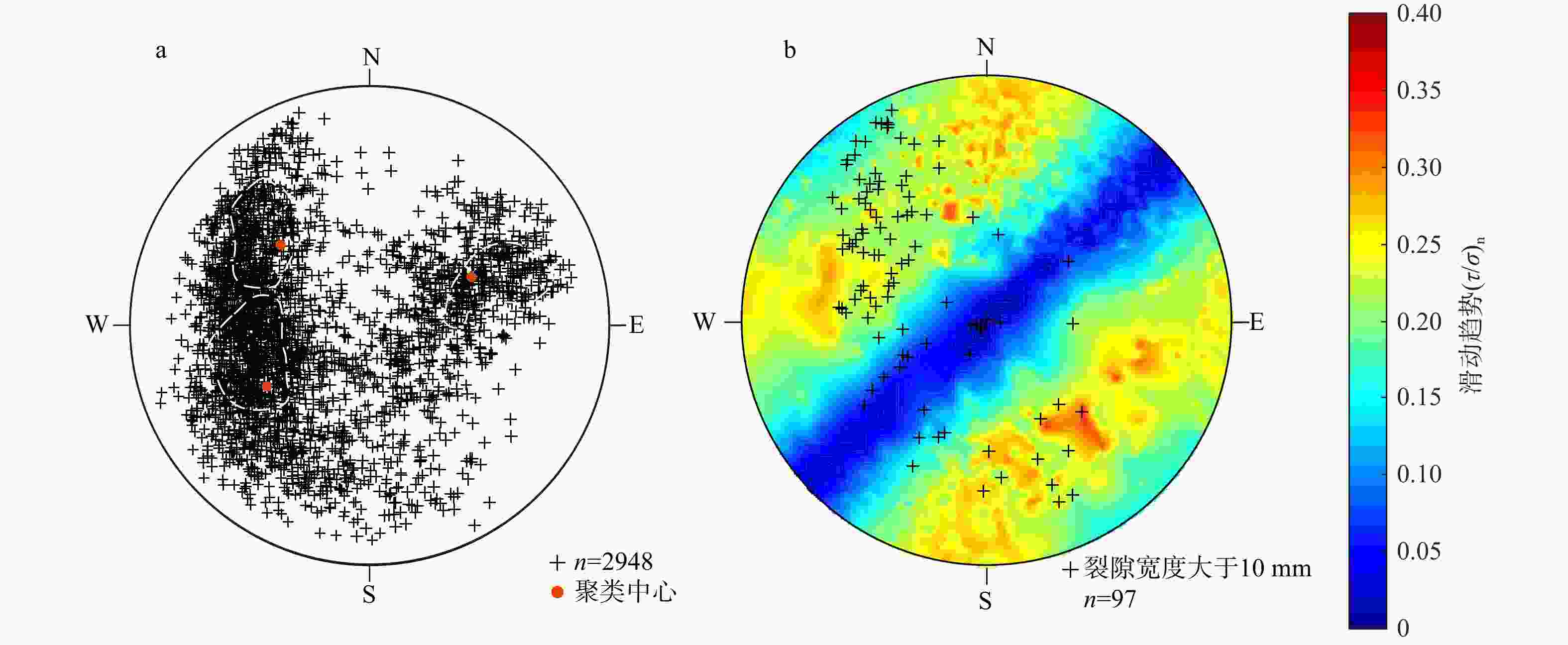
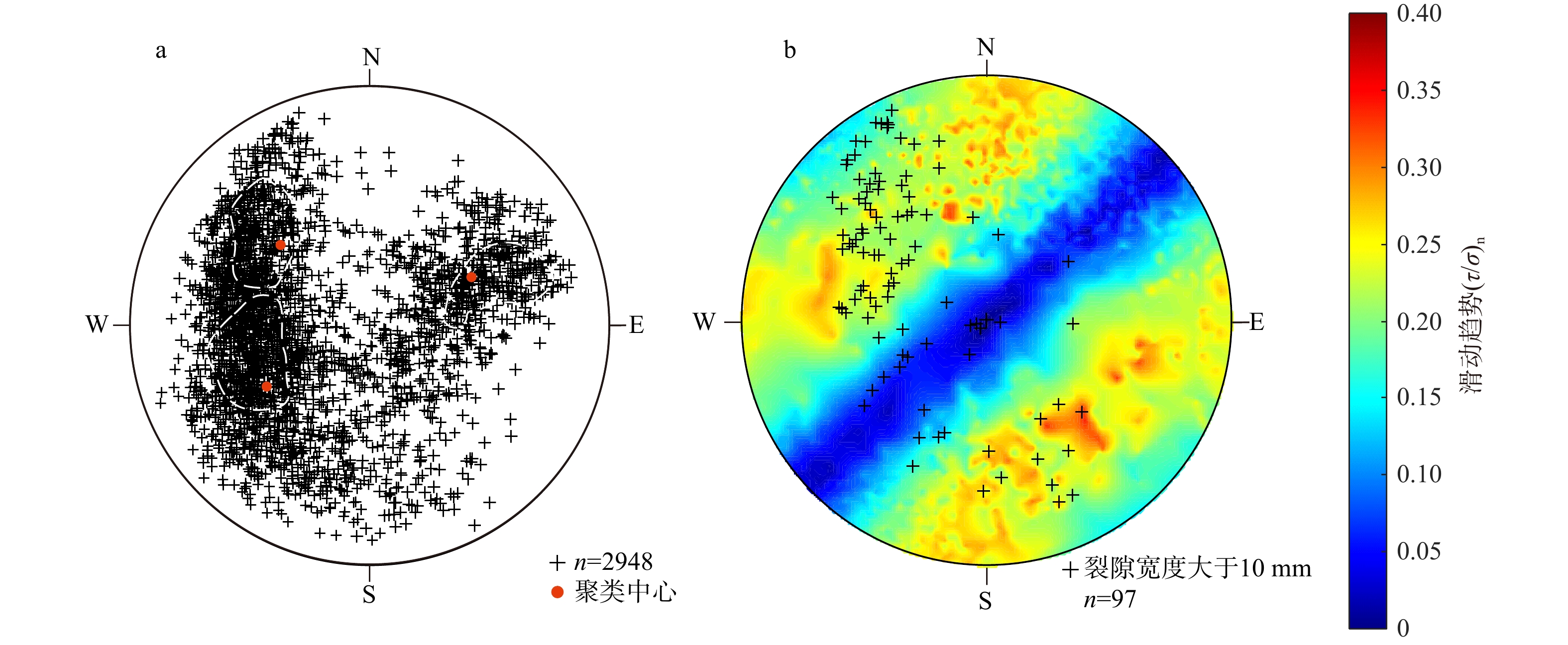
图 9 结构面Wulff网投影及部分结构面滑动趋势分析图
a—结构面聚类分析;b—裂隙宽度大于10 mm结构面滑动趋势分析
Figure 9. Wulff net projection and slip tendency analysis of selected structural planes
(a) Cluster analysis of structural planes; (b) Slip tendency analysis of structural planes with fracture width greater than 10 mm
表 1 水压致裂地应力测量结果
Table 1. Test results of hydraulic fracturing in-situ stress
钻孔编号 深度/m 压裂参数/MPa 主应力值/MPa kH kh SH方位/(°) Pb Pr Ps P0 SH Sh Sv SK1 305.10 14.59 10.13 9.27 2.99 14.69 9.27 8.09 1.82 1.15 N73°E 422.80 17.13 13.84 13.44 4.14 22.35 13.44 11.20 1.99 1.20 N45°W 488.00 — 25.41 22.88 4.78 38.45 22.28 12.93 2.97 1.77 N43°W 547.00 23.18 20.86 19.46 5.36 32.16 19.46 14.50 2.22 1.34 N16°W 660.00 25.33 19.67 19.12 6.47 31.22 19.12 17.49 1.78 1.09 — 717.50 29.19 26.83 24.63 7.03 40.03 24.63 19.01 2.11 1.30 N73°W 856.00 — 28.19 27.09 8.39 44.69 27.09 22.68 1.97 1.19 N26°W SK2 349.00 — 20.02 19.22 3.42 34.22 19.22 9.25 3.70 2.08 — 351.00 25.24 20.74 18.94 3.44 32.64 18.94 9.30 3.51 2.04 — 472.00 29.43 25.26 22.73 4.63 38.30 22.73 12.51 3.06 1.82 N58°W 490.00 — 16.30 13.80 4.80 20.30 13.80 12.99 1.56 1.06 N51°W 557.00 30.66 26.46 23.56 5.46 38.76 23.56 14.76 2.63 1.60 — 560.00 27.65 19.59 18.09 5.49 29.19 18.09 14.84 1.97 1.22 N30°W 652.00 25.39 21.69 18.79 6.39 28.29 18.79 17.28 1.64 1.09 N32°W 742.46 31.88 26.88 24.98 7.28 40.78 24.98 19.68 2.07 1.27 — 781.04 32.65 28.65 26.95 7.65 44.55 26.95 20.70 2.15 1.30 — 注:Pb—岩石原始破裂压力;Pr—破裂面重张压力;Ps—破裂面瞬时关闭压力;P0—孔隙压力;SH—最大水平主应力;Sh—最小水平主应力;Sv—垂向应力,按照等于上覆岩层重度计算,岩石平均密度取2.65g∙cm−3;kH—最大水平侧压力系数;kh—最小水平侧压力系数  下载: 导出CSV
-
[1] AN P X, 2019. Study of Panlong lead-zinc deposit organic mineralization in Guangxi[D]. Guilin: Guilin University of Technology. (in Chinese with English abstract) [2] BARTON N, 1973. Review of a new shear-strength criterion for rock joints[J]. Engineering Geology, 7(4): 287-332. doi: 10.1016/0013-7952(73)90013-6 [3] BARTON N, BANDIS S, Bakhtar K, 1985. Strength, deformation and conductivity coupling of rock joints[J]. International Journal of Rock Mechanics and Mining Sciences & Geomechanics Abstracts, 22(3): 121-140. doi: 10.1016/0148-9062(85)93227-9 [4] BROWN E T, HOEK E, 1980. Underground excavations in rock[M]. London: CRC Press. [5] FENG C J, CHEN Q C, WU M L, et al., 2012. Analysis of hydraulic fracturing stress measurement data—discussion of methods frequently used to determine instantaneous shut-in pressure[J]. Rock and Soil Mechanics, 33(7): 2149-2159. (in Chinese with English abstract) [6] FENG C J, CHEN Q C, LI G Q, et al., 2014. In-situ stress measurement in Lijiang-Jianchuan area and tentative discussion on the seismic hazards on the southeastern margin of the Tibetan Plateau[J]. Geological Bulletin of China, 33(4): 524-534. (in Chinese with English abstract) [7] FU J, CAI J, ZHOU H, et al., 2024. Characteristics of in-situ stress field and prediction of rock burst in deep area of Luodang in Lala copper mine[J]. Nonferrous Metals (Mining Section), 76(2): 53-59. (in Chinese with English abstract) [8] HAIMSON B C, CORNET F H, 2003. ISRM Suggested Methods for rock stress estimation: Part 3: hydraulic fracturing (HF) and/or hydraulic testing of pre-existing fractures (HTPF)[J]. International Journal of Rock Mechanics and Mining Sciences, 40(7-8): 1011-1020. doi: 10.1016/j.ijrmms.2003.08.002 [9] JAEGER J C, COOK N G, ZIMMERMAN R, 2009. Fundamentals of rock mechanics[M]. Newyork: John Wiley & Sons. [10] JIANG W Q, LIN J Z, ZHAO Y, et al., 1992. Focal mechanism of small earthquakes and characteristics of tectonic stress field in South China[J]. Earthquake Research in China, 8(1): 36-42. (in Chinese with English abstract) [11] JO Y, CHANG C D, JI S H, et al., 2019. In situ stress states at KURT, an underground research laboratory in South Korea for the study of high-level radioactive waste disposal[J]. Engineering Geology, 259: 105198. doi: 10.1016/j.enggeo.2019.105198 [12] LI B, LI B Y, ZHANG C, et al., 2017. Distribution characteristics of the crustal stress in the northeast of Guangxi Basin[J]. Chinese Journal of Rock Mechanics and Engineering, 36(S1): 3475-3484. (in Chinese with English abstract) [13] LI B, ZHANG W, WEN R, 2022. Study on the hydraulic fracturing in-situ stress measurement in super-long highway tunnels in southern Shaanxi: engineering geological significance[J]. Journal of Geomechanics, 28(2): 191-202. (in Chinese with English abstract) [14] LI P, GUO Q F, MIAO S J, et al., 2017. Comparisons of in-situ stress fields and stability of faults in shallow and deep engineering areas[J]. Journal of Harbin Institute of Technology, 49(9): 10-16. (in Chinese with English abstract) [15] LI X G, SHI S P, HUANG Y, et al., 2007. Current tectonic stress field in Guangxi and vicinity[J]. Journal of Seismological Research, 30(3): 235-240. (in Chinese with English abstract) [16] LIU J S, ZHONG X Y, ZENG G T, et al., 2024. Research on microseismic monitoring in deep mining of a tungsten mine in Jiangxi Province[J]. China Tungsten Industry, 39(2): 33-37. (in Chinese with English abstract) [17] QIAO E W, MA X M, GUO H L, et al., 2025. Characteristics of in-situ stresses and engineering stability analysis on the south section of the Bohai Strait Cross-Sea Corridor project[J]. Journal of Geomechanics, 31(2): 197-210. (in Chinese with English abstract) [18] QIN J X, HUANG Z L, JIANG Y P, et al., 2022. Permeability and water control of F2 Fault in Panlong lead-zinc mine area, Guangxi[J]. Safety and Environmental Engineering, 29(6): 54-61. (in Chinese with English abstract) [19] QIN J X, 2023. Study on the characteristics and water control effect of F2 fault in Panlong lead-zinc mining area in Guangxi[D]. Guilin: Guilin University of Technology. (in Chinese with English abstract) [20] QIN X H, ZHANG P, FENG C J, et al., 2014. In-situ stress measurements and slip stability of major faults in Beijing region, China[J]. Chinese Journal of Geophysics, 57(7): 2165-2180. (in Chinese with English abstract) doi: 10.1002/cjg2.20113 [21] SHEOREY P R, 1994. A theory for In Situ stresses in isotropic and transverseley isotropic rock[J]. International Journal of Rock Mechanics and Mining Sciences & Geomechanics Abstracts, 31(1): 23-34. doi: 10.1016/0148-9062(94)92312-4 [22] SUN Z Y, LI X F, WANG Y, et al., 2023. Correlation between structural surface parameters and strength of drilling holes based on DIP technology[J]. Journal of Mining and Strata Control Engineering, 5(2): 023028. (in Chinese with English abstract) [23] TOWNEND J, ZOBACK M D, 2000. How faulting keeps the crust strong[J]. Geology, 28(5): 399-402. doi: 10.1130/0091-7613(2000)28<399:HFKTCS>2.0.CO;2 [24] WAGNER H, 2019. Deep mining: a rock engineering challenge[J]. Rock Mechanics and Rock Engineering, 52(5): 1417-1446. doi: 10.1007/s00603-019-01799-4 [25] WANG C H, XING B R, CHEN Y Q, 2014. Prediction of stress field of super-long deep-buried tunnel area and case analysis[J]. Chinese Journal of Geotechnical Engineering, 36(5): 955-960. (in Chinese with English abstract) [26] XU H T, 2019. The genesis of dolomite and its relations to the deposits in Panlong Pb-Zn Mine Area, Guangxi Province[D]. Guilin: Guilin University of Technology. (in Chinese with English abstract) [27] ZHANG L, HE C R, 2013. Frictional properties of natural gouges from Longmenshan fault zone ruptured during the Wenchuan Mw7.9 earthquake[J]. Tectonophysics, 594: 149-164. doi: 10.1016/j.tecto.2013.03.030 [28] ZHANG S H, MA X D, ZOBACK M, 2023. Determination of the crustal friction and state of stress in deep boreholes using hydrologic indicators[J]. Rock Mechanics Bulletin, 2(1): 100024. doi: 10.1016/j.rockmb.2022.100024 [29] ZHENG L Y, WAN Y G, 2025. Tectonic stress field in Guangxi and surrounding areas[J]. Science Technology and Engineering, 25(6): 2227-2236. (in Chinese with English abstract) [30] ZOBACK M D, TOWNEND J, 2001. Implications of hydrostatic pore pressures and high crustal strength for the deformation of intraplate lithosphere[J]. Tectonophysics, 336(1-4): 19-30. doi: 10.1016/S0040-1951(01)00091-9 [31] ZOBACK M D, 2010. Reservoir geomechanics[M]. Cambridge: Cambridge University Press. [32] ZOU X J, WANG C Y, HAN Z Q, et al., 2017. Fully automatic identifying the structural planes with panoramic images of boreholes[J]. Chinese Journal of Rock Mechanics and Engineering, 36(8): 1910-1920. (in Chinese with English abstract) [33] 安鹏鑫, 2019. 广西盘龙铅锌矿床有机质成矿作用研究[D]. 桂林: 桂林理工大学. [34] 丰成君, 陈群策, 吴满路, 等, 2012. 水压致裂应力测量数据分析—对瞬时关闭压力 Ps 的常用判读方法讨论[J]. 岩土力学, 33(7): 2149-2159. [35] 丰成君, 陈群策, 李国歧, 等, 2014. 青藏高原东南缘丽江—剑川地区地应力测量与地震危险性[J]. 地质通报, 33(4): 524-534. doi: 10.3969/j.issn.1671-2552.2014.04.009 [36] 付俊, 蔡君, 周罕, 等, 2024. 拉拉铜矿落凼矿区深部地应力场特征及岩爆预测分析[J]. 有色金属(矿山部分), 76(2): 53-59. [37] 蒋维强, 林纪曾, 赵毅, 等, 1992. 华南地区的小震震源机制与构造应力场[J]. 中国地震, 8(1): 36-42. [38] 李彬, 张文, 文冉, 2022. 陕南特长公路隧道水压致裂法地应力测量结果及工程地质意义分析[J]. 地质力学学报, 28(2): 191-202. doi: 10.12090/j.issn.1006-6616.2021053 [39] 李兵, 李兵岩, 张策, 等, 2017. 广西盆地东北部的地应力分布特征[J]. 岩石力学与工程学报, 36(S1): 3475-3484. [40] 李鹏, 郭奇峰, 苗胜军, 等, 2017. 浅部和深部工程区地应力场及断裂稳定性比较[J]. 哈尔滨工业大学学报, 49(9): 10-16. [41] 李细光, 史水平, 黄洋, 等, 2007. 广西及其邻区现今构造应力场研究[J]. 地震研究, 30(3): 235-240. doi: 10.3969/j.issn.1000-0666.2007.03.006 [42] 刘家胜, 钟晓阳, 曾贵庭, 等, 2024. 江西某钨矿深部开采微震监测研究[J]. 中国钨业, 39(2): 33-37. doi: 10.3969/j.issn.1009-0622.2024.02.005 [43] 乔二伟, 马秀敏, 郭华林, 等, 2025. 渤海海峡跨海通道工程南段地应力特征与工程稳定性分析[J]. 地质力学学报, 31(2): 197-210. [44] 覃佳肖, 黄泽霖, 蒋亚萍, 等, 2022. 广西盘龙铅锌矿区F2断层透水性及控水作用分析[J]. 安全与环境工程, 29(6): 54-61. doi: 10.13578/j.cnki.issn.1671-1556.20211361 [45] 覃佳肖, 2023. 广西盘龙铅锌矿区F2断层特征及控水作用研究[D]. 桂林: 桂林理工大学. [46] 秦向辉, 张鹏, 丰成君, 等, 2014. 北京地区地应力测量与主要断裂稳定性分析[J]. 地球物理学报, 57(7): 2165-2180. [47] 孙志勇, 李小菲, 王洋, 等, 2023. 基于DIP技术钻孔结构面参数与强度相关性研究[J]. 采矿与岩层控制工程学报, 5(2): 023028. doi: 10.13532/j.jmsce.cn10-1638/td.20230222.001 [48] 王成虎, 邢博瑞, 陈永前, 2014. 长大深埋隧道工程区地应力状态预测与实例分析[J]. 岩土工程学报, 36(5): 955-960. [49] 许浩天, 2019. 广西盘龙铅锌矿区白云岩的成因机制及其与成矿关系研究[D]. 桂林: 桂林理工大学. [50] 郑礼洋, 万永革, 2025. 广西及邻区构造应力场分区研究[J]. 科学技术与工程, 25(6): 2227-2236. doi: 10.12404/j.issn.1671-1815.2308228 [51] 邹先坚, 王川婴, 韩增强, 等, 2017. 全景钻孔图像中结构面全自动识别方法研究[J]. 岩石力学与工程学报, 36(8): 1910-1920. doi: 10.13722/j.cnki.jrme.2017.0021 -

 下载:
下载:

计量
- 文章访问数: 889
- HTML全文浏览量: 259
- PDF下载量: 251
- 被引次数: 0
