


The stress changes of the 2025 Dingri M 6.8 earthquake on the surrounding areas
-
摘要: 文章通过定量计算地震产生的同震位移场、水平应变场及其在周围断层上产生的库伦破裂应力变化来探究2025年西藏定日6.8级地震对周围区域的影响。首先,将当地应力场投影到震源机制中心解确定该地震可能发生的2个节面上,发现节面Ⅰ(走向为184.37°、倾角为47.67°、滑动角为–78.10°)更容易破裂,结合断层走向判定其为发震断层面,登么错断裂为发震构造。然后基于地震破裂模型与均匀弹性半空间模型,计算得到地表同震位移场及水平应变场特征:水平位移自震中东西两侧向外移动、北侧部分区域向震中汇聚,水平位移量最大为76.65 cm;垂直位移为震中北侧沉降(最大量为83.97 cm)、东北侧隆升(最大量为33.25 cm),发震断层附近显示正断机制;体应变与面应变分布规律一致,均在震中南北两侧拉张(体应变量最大为1.768×10⁻⁶,面应变量最大为1.737×10⁻⁶)、震中周边及东西两侧压缩(体应变量最大为1.874×10⁻⁶,面应变量最大为1.987×10⁻⁶)。库伦破裂应力计算显示,申扎−定结断裂南段、拉孜−邛多江断裂东段库伦应力增加量超过触发阈值(0.01 MPa),需关注其地震活动性;登么错断裂应力卸载量最大,进一步印证其为发震构造。研究结果可为区域地震危险性评估提供重要参考。
-
关键词:
- 西藏定日6.8级地震 /
- 震源机制中心解 /
- 应力场 /
- 登么错断裂 /
- 库伦破裂应力
Abstract:Objective The Dingri area in Xizang is located within the Lhasa Block of the Qinghai–Xizang Plateau. It belongs to the core region of the Southern Tibetan Rift System and is a key zone with high seismic activity and earthquake potential. The M 6.8 earthquake that struck Dingri, Xizang (28.50°N, 87.45°E) on January 7, 2025, was the largest ever recorded in this area. Although previous studies have clarified the seismogenic structure and rupture distribution of this earthquake, few studies have addressed its impact on the surrounding areas. Therefore, this study calculates the co-seismic displacement and horizontal strain fields generated by the earthquake and the changes in Coulomb failure stress induced on surrounding faults. The study identifies high-risk fault segments and provides a scientific basis for regional seismic hazard assessment, monitoring, and early warning. Methods The local stress field was projected onto two potential nodal planes of the earthquake determined by the central focal mechanism solution; Nodal Plane I (strike 184.37°, dip 47.67°, rake –78.10°) was found to be more prone to rupture. This plane was identified as the seismogenic fault plane when combined with the strike of the local fault. Then, based on the seismic rupture model and the homogeneous elastic half-space model, the co-seismic surface displacement field and the horizontal strain field were calculated. Furthermore, according to the data on the geometry and slip properties of faults near the epicenter, the study systematically quantified the impact of the earthquake on the Coulomb stress of major surrounding faults. Results In terms of horizontal displacement, the materials on the east and west sides of the epicenter moved outward, while materials in some northern areas converged toward the epicenter, with a maximum horizontal displacement of 76.65 cm. In terms of vertical displacement, subsidence occurred on the north side of the epicenter (with a maximum of 83.97 cm) and uplift occurred on the northeast side (with a maximum of 33.25 cm), showing an obvious normal fault mechanism near the seismogenic fault. Volumetric strain and areal strain exhibited consistent distribution patterns; both exhibited tension on the north and south sides of the epicenter (with maxima of 1.768×10⁻⁶ and 1.737×10⁻⁶, respectively) and compression around the epicenter as well as on the east and west sides (with maxima of 1.874×10⁻⁶ and 1.987×10⁻⁶, respectively). Coulomb failure stress induced by this earthquake on the major surrounding faults at a depth of 10 km showed that the Dengmecuo Fault experienced significant stress unloading. This was the most intense stress release among all faults, effectively releasing regional tectonic stress and confirming that the Dengmecuo Fault is the seismogenic fault. The maximum Coulomb stress increment of the southern segment of the Shenza–Dingjie Fault was 0.0349 MPa, and that of the eastern segment of the Lazi–Qiongdoujiang Fault was 0.0191 MPa. Both exceeded the triggering threshold of 0.01 MPa, indicating high seismic hazard. Conclusions The study shows that this earthquake was a normal-faulting earthquake under the regional tectonic stress field and the Dengmecuo Fault was the seismogenic structure. Significant changes occurred in the co-seismic displacement field and the horizontal strain field around the epicenter. The Coulomb stress increments of the southern segment of the Shenza–Dingjie Fault and the eastern segment of the Lazi–Qiongdoujiang Fault exceeded the triggering threshold, indicating that moderate to strong earthquakes are possible in these segments in the future, which requires high attention. [Significance] By analyzing the impact of the January 7, 2025, M 6.8 Dingri earthquake in Xizang on the Coulomb stress of major faults in southern Xizang, this study identified the high-risk fault segments that need focused attention, providing a valuable reference for subsequent seismic monitoring and early warning. -
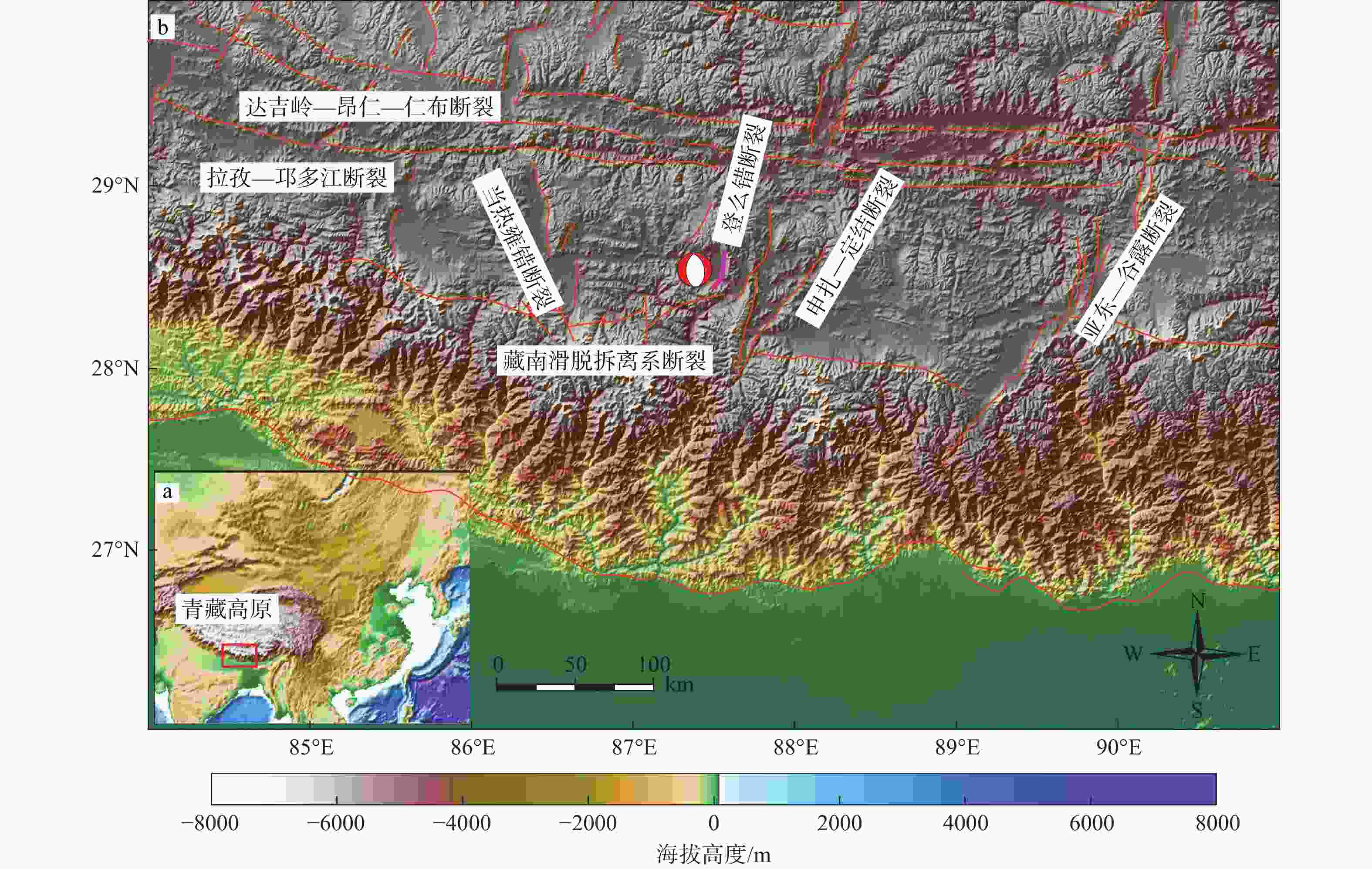
图 1 定日地区地质构造简图
红色线条代表断裂;紫红色线条代表此次发震断层;红色沙滩球是西藏定日6.8级地震位置a—地理位置示意图;b—断裂分布图
Figure 1. Simplified tectonic map of the Dingri area
(a) Geographic location map; (b) Fracture distribution map The red lines represent fractures; the magenta line represents the seismogenic fault of this earthquake; the red beach ball marks the location of the Dingri M 6.8 earthquake in Xizang.
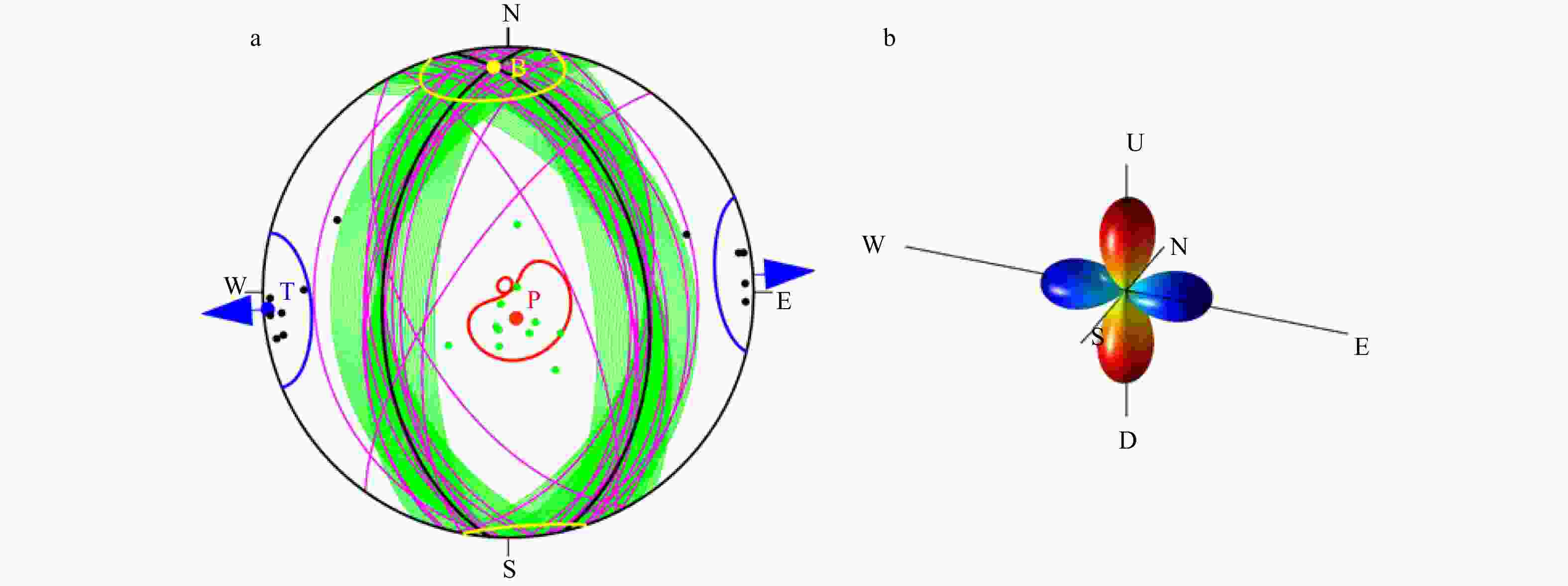
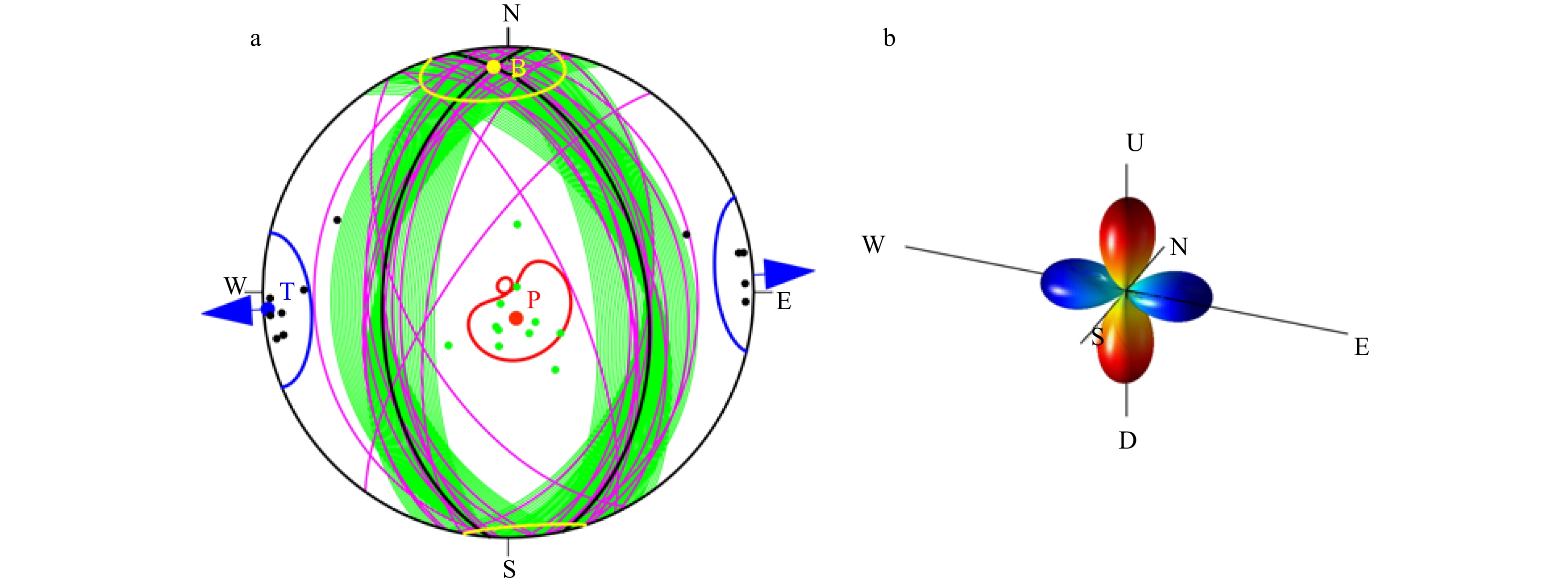
图 2 震源机制中心解的空间表示
a-震源机制中心解(N、S、W、E表示地理方位北南西东;蓝色箭头代表张轴方向;紫红色弧线为各研究机构给出的震源机制解节面;震源机制中心解的2个节面用黑色弧线表示,其不确定性范围用绿色区域表示; 红点、黄点、蓝点分别代表P轴、B轴、T轴,其外围红色闭合曲线、黄色弧线、蓝色弧线分别代表其不确定范围; 绿点、黑点分别表示各震源机制解在P轴、T轴的投影); b-三维辐射花样(U、D表示上、下;红色、蓝色分别表示膨胀区域和压缩区域)
Figure 2. Spatial representation of the central focal mechanism solution
(a) Central focal mechanism solution (N, S, W, E denote north, south, west and east, respectively; blue arrows indicate the tensional direction; magenta arcs represent nodal planes of focal mechanism solutions provided by various research institutions; the two nodal planes of the central focal mechanism solution and their uncertainties are indicated by black arcs and green areas, respectively; red, yellow, and blue dots denote the P-axis, B-axis, and T-axis respectively, with the surrounding red closed contour, yellow arcs, and blue arcs indicating their uncertainty ranges; green dots and black dots indicate the projections of each focal mechanism solution on the P-axis and T-axis.); (b) 3D radiation pattern (U, D denote up and down; red and blue represent dilation and compression areas, respectively.)
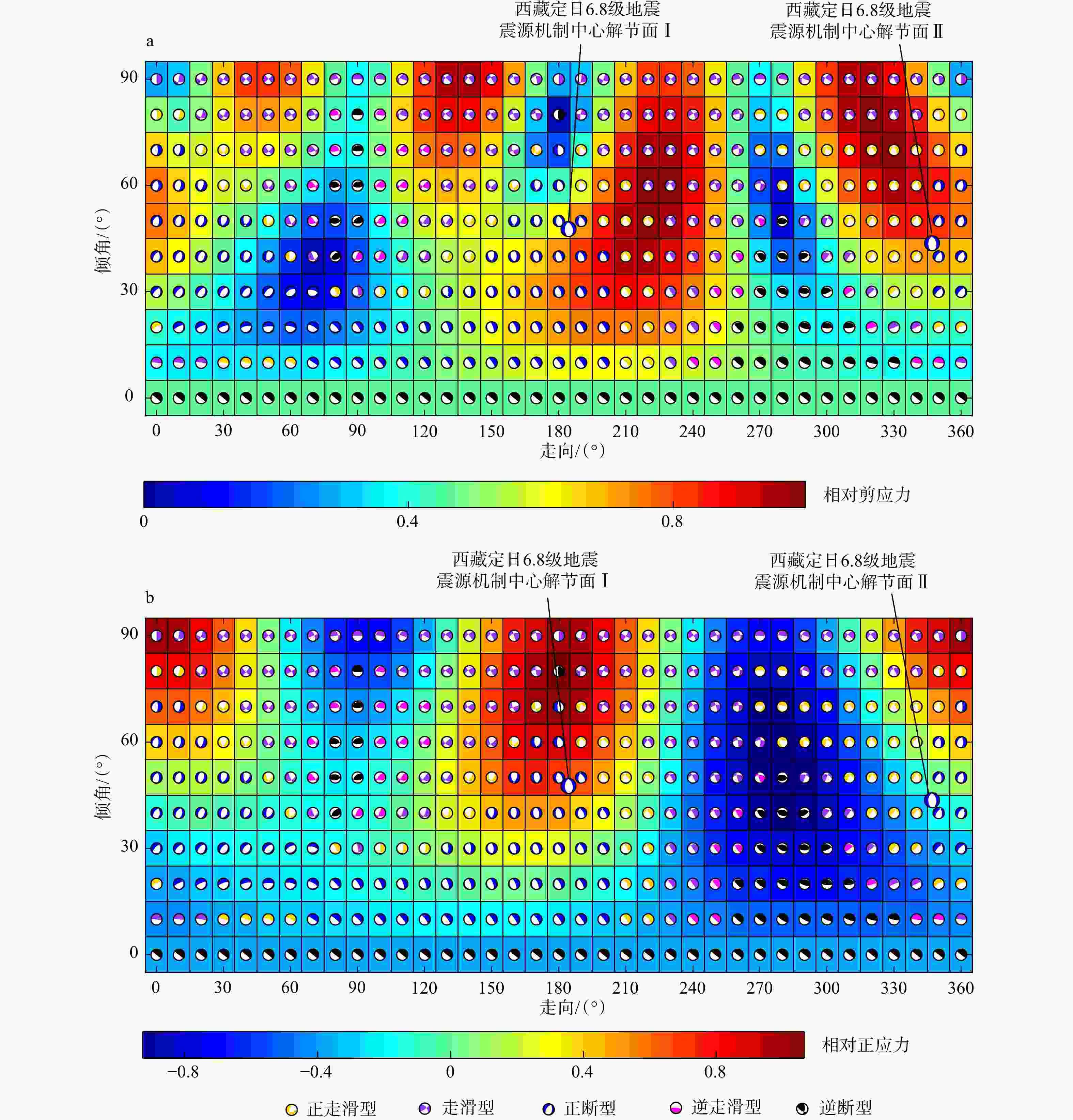
图 3 研究区应力场在各种节面上的相对应力
沙滩球为在相应应力场背景下的地震发生机制a-节面上的相对剪应力; b-节面上的相对正应力
Figure 3. Relative stress on each plane in the study area
(a) Relative shear stress on the nodal planes; (b) Relative normal stress on the nodal planes Beach balls represent the focal mechanisms under the corresponding stress field.
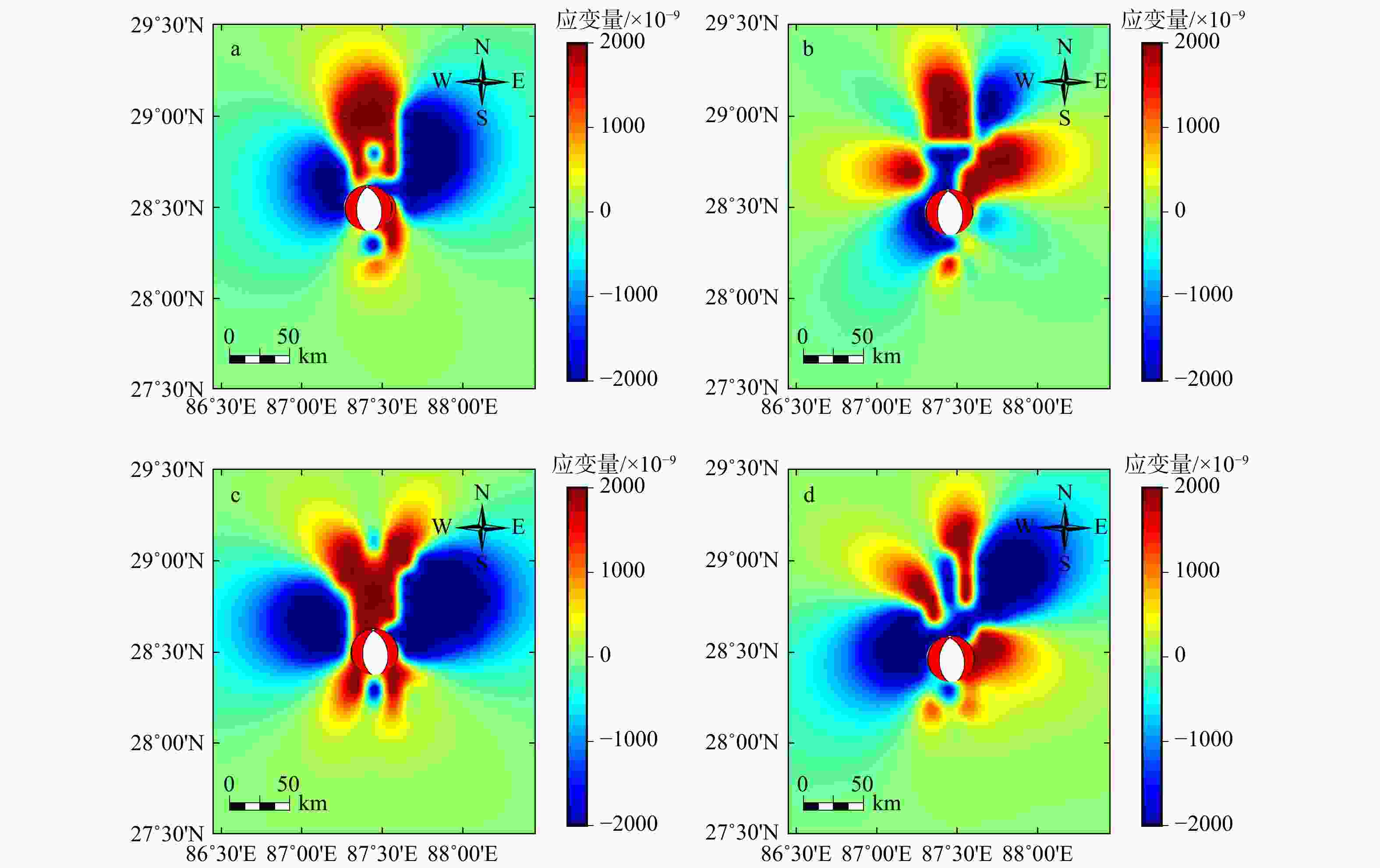
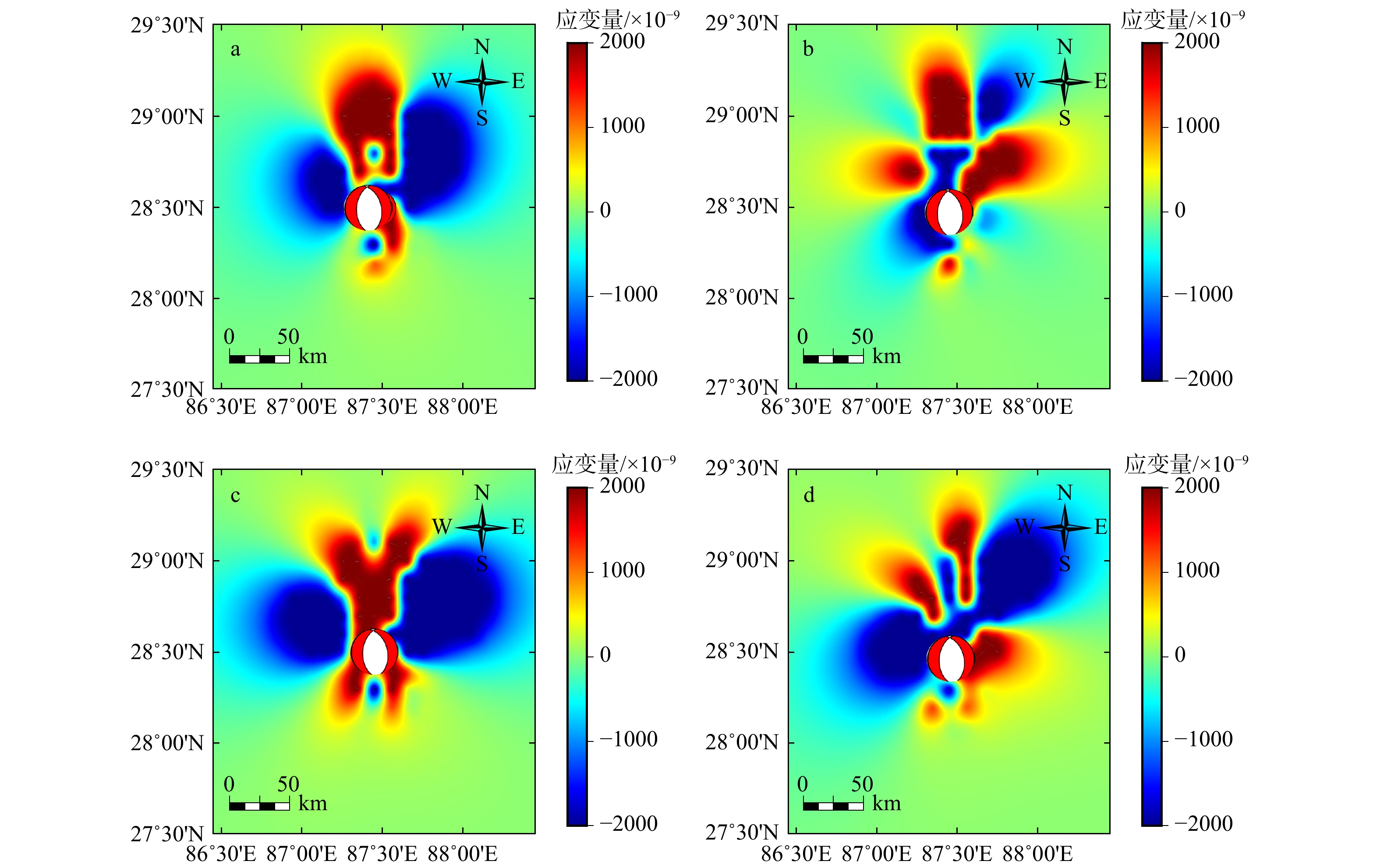
图 4 西藏定日6.8级地震产生的各分量应变
图中底色代表应变大小,拉张为正,单位为10–9;红色沙滩球处为震中位置a-体应变;b-北向应变;c-东向应变;d-北东向应变
Figure 4. The strain components generated by the Dingri M 6.8 earthquake in Xizang
(a) Volumetric strain; (b) Northward strain; (c) Eastward strain; (d) Northeastward strain The background color represents the strain magnitude, with positive values for tension (unit: 10−9); the epicenter is marked by the red beach ball.
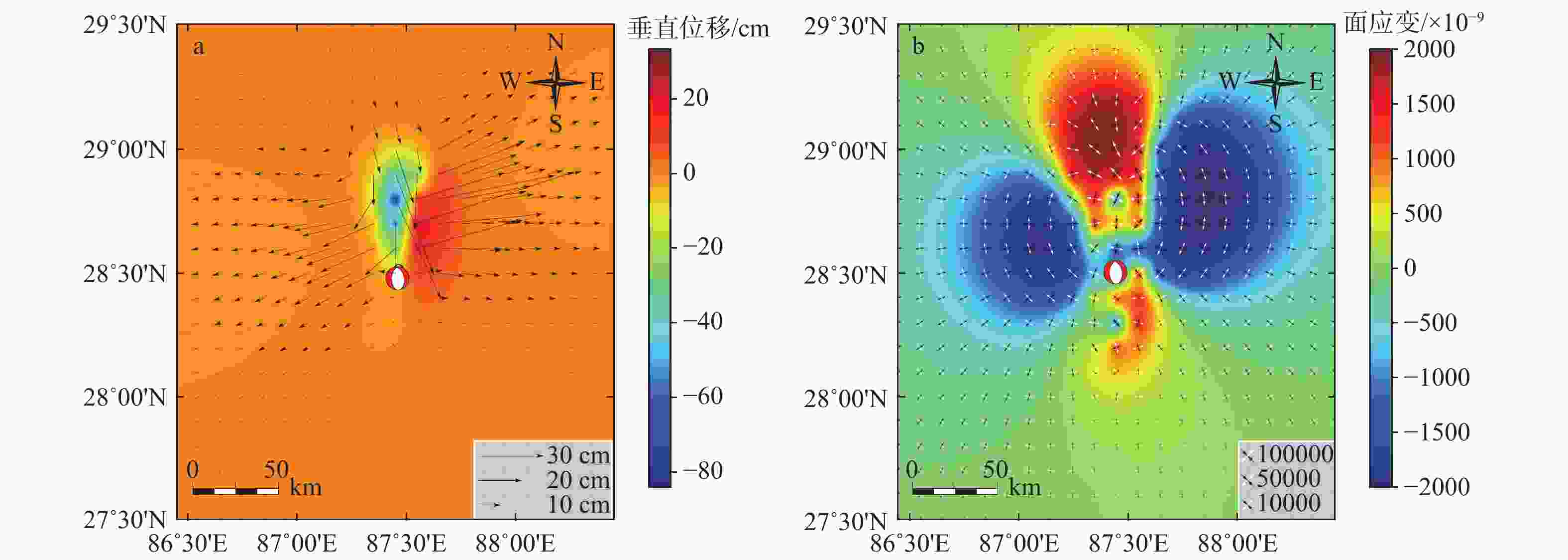
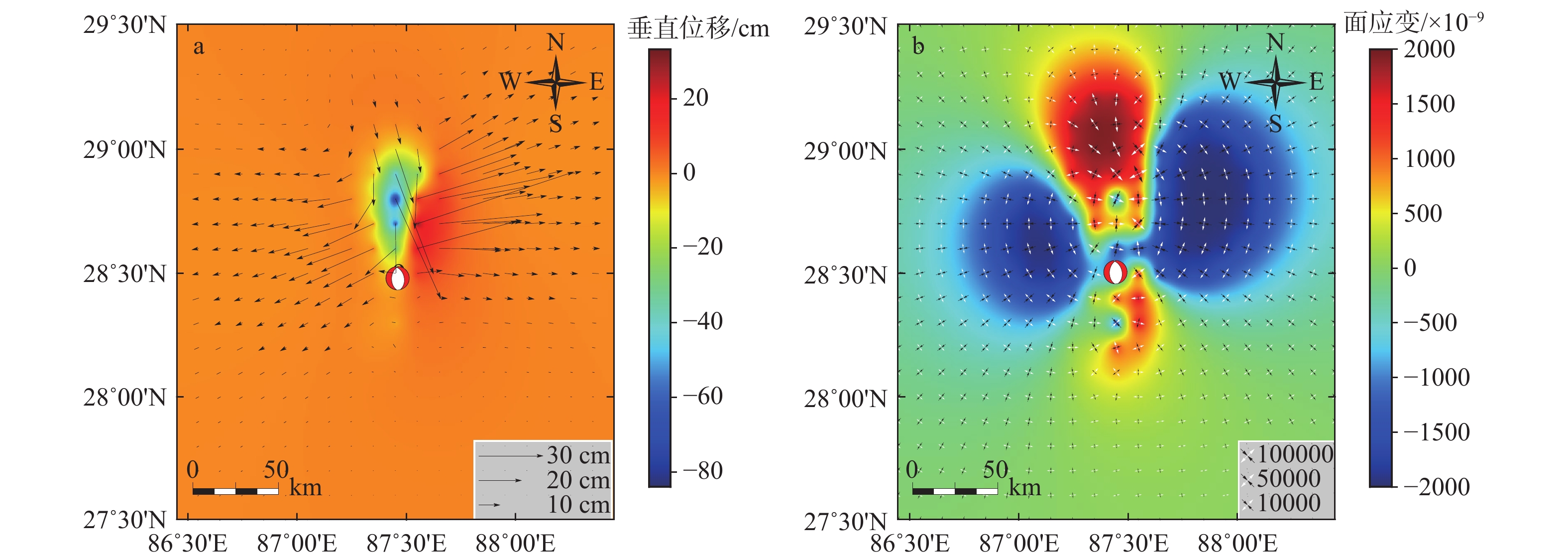
图 5 西藏定日6.8级地震的地表响应
a-同震位移场(底色代表垂直位移,上升为正;黑色箭头代表水平位移,单位为cm);b-水平主应变和面应变场(底色表示水平面应力,拉张为正,黑色箭头为水平主压应变,白色箭头为水平主张应变,单位均为10–9;红色沙滩球处为震中位置)
Figure 5. The surface response of the Dingri M 6.8 earthquake in Xizang
(a) Co-seismic displacement field (The background color represents vertical displacement, positive for uplift; black arrows denote horizontal displacement, unit: cm); (b) Horizontal principal strain and areal strain field (The background color indicates horizontal areal stress, positive for tension; black arrows stand for horizontal principal compressive strain, white arrows for horizontal principal tensile strain, both units: 10−9; the epicenter is marked by the red beach ball.)
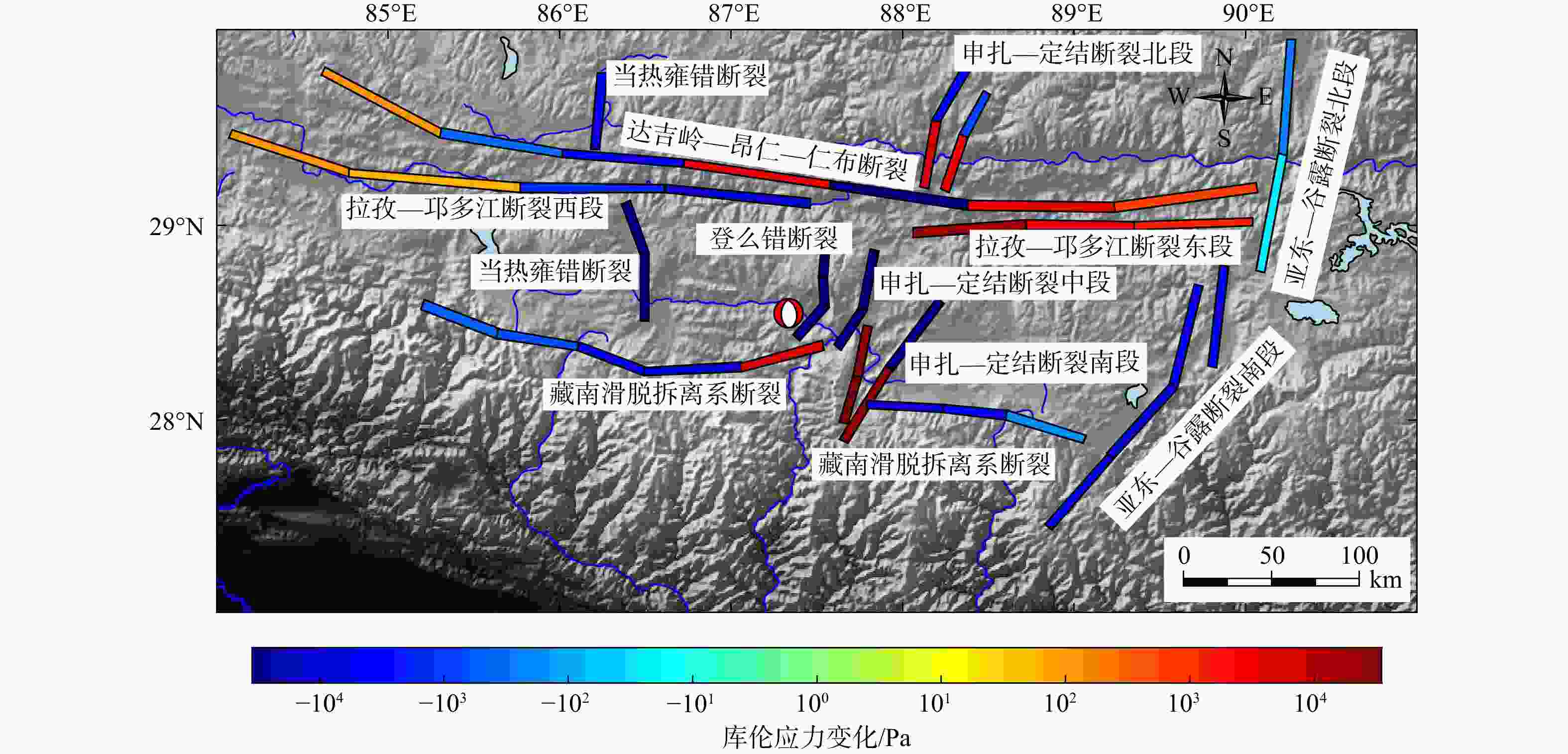
图 6 西藏定日6.8级地震10 km深度处对周围主要断裂产生的库伦破裂应力
断裂填充的颜色代表库伦破裂应力变化,红色表示增加,蓝色表示减少;蓝色细线条表示河流; 红色沙滩球是西藏定日6.8级地震
Figure 6. Coulomb failure stress induced by the Dingri M 6.8 earthquake in Xizang on the surrounding major faults at a depth of 10 km
Colors of the fractures represent Coulomb failure stress changes: Red indicates an increase and blue a decrease; blue thin lines represent rivers; red beach ball locates the Dingri M 6.8 earthquake in Xizang.
表 1 不同机构震源机制中心解的计算结果对比
Table 1. Calculated central focal mechanism solutions from different agencies
机构和作者 震源机制解走向/倾角/
滑动角/(°)作为初始解得到的中心
震源机制走向/倾角/滑动角/(°)作为初始解得到的标准差S/(°) 以德国地球科学研究中心的结果作为初始解的中心震源机制与其他震源机制的最小空间旋转角/(°) 中国地震台网中心( https://news.ceic.ac.cn/ )182/22/–64 184.35/47.67/–78.11 18.940905 30.26 中国地震局地球物理研究所郭祥云( https://www.cea-igp.ac.cn/ )182/51/–71 184.37 /47.67/–78.10 18.940896 9.43 中国地震局地震预测所罗钧、赵翠萍( https:www.ief.ac.cn/ )215.6/72.1/–73.7 184.27/47.68/–78.20 18.941090 37.91 中科院青藏高原研究所王卫民( https://itpcas.cas.cn/ )194.4/42.6/–72.8 184.37/47.67/–78.12 18.940901 8.91 中国地震局地球物理研究所张喆( https://mp.weixin.qq.com/s/YPMIVXcDLaIoS_UaJnZnIA )174/42/–85 184.38/47.67/–78.10 18.940895 9.25 中科院地质地球所赵旭( https://igg.cas.cn/ )183/41/–72 184.38/47.67/–78.10 18.940895 9.77 全球矩心矩张量( https://www.globalcmt.org/ )173/48/–92 184.36/47.67/–78.11 18.940900 10.49 欧洲−地中海地震中心( https://www.emsc-csem.org/Earthquake_information/ )191/64/–76 184.37/ 47.67/–78.13 18.940912 17.29 法属波利尼西亚探测与地球物理实验室( https://www.cppt.org/ )184/54/–77 184.29/47.67/–78.18 18.941026 6.47 巴黎地球物理研究所( https://www.ipgp.fr/ )196/44/–64 184.36/47.67/–78.12 18.940906 10.89 德国地球科学研究中心( https://www.gfz.de/ )151/56/–116 184.37/47.67/–78.10 18.940894 32.02 美国地质调查局国家地震信息中心( https://www.usgs.gov/programs/earthquake-hazards )187/49/–78 184.36/47.67/–78.12 18.940901 2.89  下载: 导出CSV
表 2 地质断裂参数及投影其上的库仑破裂应力变化
Table 2. Geological fault parameters and Coulomb failure stress changes projected onto the faults
断裂名称 分段数 性质 长度/km 倾角/(°) 倾向 滑动角/(°) 库伦应力变化区间/MPa 申扎−定结断裂北段 4 正断 139 45 SEE –110 –0.0017~0.0071 申扎−定结断裂中段 2 正断 61 42.5 NWW –105 –0.3855~–0.1310 申扎−定结断裂南段 4 正断 143 45 SEE –110 –0.0715~0.0349 登么错断裂 3 正断 56 55 W –78 –9.896~–0.1564 藏南滑脱拆离系断裂 8 正断 411 10 N –90 –0.0055~0.0062 亚东−谷露断裂南段 4 正断 203 52 W –115 –0.0026~–0.0036 亚东−谷露断裂北段 2 正断 132 40 W –115 –0.0001~–0.0008 拉孜−邛多江断裂东段 3 逆冲 218 75 N 30 0.0013~0.0191 拉孜−邛多江断裂西段 4 走滑 378 75 N 70 –0.0066~0.0001 达吉岭−昂仁−仁布断裂 7 走滑 608 75 N 70 –0.0207~0.0037 当热雍错断裂 3 正断 110 45 W –90 –0.0366~–0.0027
下载: 导出CSV
-
[1] FANG J L, ZHAO B, YU J S, 2022. Research on the seismic source model and static stress triggering of the 2015 Dingri MW5.7 earthquake[J]. Journal of Geodesy and Geodynamics, 42(9): 964-970. (in Chinese with English abstract) [2] GAO Y, WU Z H, HAN S, et al., 2025. Late Quaternary throw rate of the seismogenic fault (Dengmecuo Fault) of the 2025 MS6.8 Dingri earthquake in Shigatse[J]. Seismology and Geology, 47(3): 689-706. (in Chinese with English abstract) [3] GUAN Z X, WAN Y G, HUANG S H, 2024. The stress effect of the M5.5 earthquake on the surrounding area in Shandong Pingyuan in 2023[J]. Earthquake Research in China, 40(2): 378-388. (in Chinese with English abstract) [4] HARRIS R A, 1998. Introduction to special section: stress triggers, stress shadows, and implications for seismic hazard[J]. Journal of Geophysical Research: Solid Earth, 103(B10): 24347-24358. doi: 10.1029/98JB01576 [5] HOU L Y, SHAN X J, GONG W Y, et al., 2020. Characterizing seismogenic fault of 2016 Dingjie earthquake based on multitemporal DInSAR[J]. Chinese Journal of Geophysics, 63(4): 1357-1369. (in Chinese with English abstract) [6] HU G M, XU Y R, LIU H, et al., 2025. Estimation of the maximum magnitude of normal faults and seismic risk in the southern Tibetan rift zones[J]. Earth Science, 50(5): 1794-1812. (in Chinese with English abstract) [7] HUANG S H, WAN Y G, FENG G, et al., 2023. Trigger mechanism and dynamic causes of the Taiwan earthquake sequence on September 17, 2022[J]. Journal of Geomechanics, 29(5): 674-684. (in Chinese with English abstract) [8] JIN Z T, ZHOU M Y, HUANG J C, et al. , 2025. The Stress Triggering of the 2025 Dingri, Xizang, China MW 6.8 Earthquake by the 2015 Nepal MW 7.8 and MW 7.2 Earthquakes. Earth Science, 50(5): 1782-1793. (in Chinese with English abstract) [9] KING G C P, STEIN R S, LIN J, 1994. Static stress changes and the triggering of earthquakes[J]. Bulletin of the Seismological Society of America, 84(3): 935-953. doi: 10.1016/0148-9062(95)94484-2 [10] LEVENBERG K, 1944. A method for the solution of certain non-linear problems in least squares[J]. Quarterly of Applied Mathematics, 2(2): 164-168. doi: 10.1090/qam/10666 [11] LI T D, 1995. The uplifting process and mechanism of the Qinhai-Tibet Plateau[J]. Acta Geoscientia Sinica, 16(1): 1-9. (in Chinese with English abstract) [12] LIU F C, PAN J W, LI H B, et al., 2025. Co-seismic surface rupture of the 2025 MW7.1 Tingri earthquake and potential seismic risk in southern Tibetan Plateau[J]. Acta Geologica Sinica, 99(3): 685-703. (in Chinese with English abstract) [13] MARQUARDT D W, 1963. An algorithm for least-squares estimation of nonlinear parameters[J]. Journal of the Society for Industrial and Applied Mathematics, 11(2): 431-441. doi: 10.1137/0111030 [14] NI Y P, 2021. Study on the present-day tectonic activity of Jiagang-Dinggye rift in southern Tibet by using GPS & InSAR[D]. Wuhan: Institute of Seismology, China Earthquake Administration. (in Chinese with English abstract) [15] OKADA Y, 1992. Internal deformation due to shear and tensile faults in a half-space[J]. Bulletin of the Seismological Society of America, 82(2): 1018-1040. doi: 10.1785/BSSA0820021018 [16] SHENG S Z, WANG Q R, LI Z Y, et al., 2025. Investigation of the seismogenic structure of the 2025 Dingri MS6.8 earthquake in Xizang based on the tectonic stress field perspective[J]. Seismology and Geology, 47(1): 49-63. (in Chinese with English abstract) [17] SONG Z Y, WAN Y G, GUAN Z X, et al., 2024. Stress changes on surrounding faults and triggering of aftershocks induced by the MS7.1 earthquake in Wushi County, Aksu Prefecture, Xinjiang, on January 23, 2024[J]. China Earthquake Engineering Journal, 46(4): 982-991. (in Chinese with English abstract) [18] VAVRYČUK V, 2014. Iterative joint inversion for stress and fault orientations from focal mechanisms[J]. Geophysical Journal International, 199(1): 69-77. doi: 10.1093/gji/ggu224 [19] WAN Y G, SHEN Z K, SHENG S Z, et al., 2009. The influence of 2008 Wenchuan earthquake on surrounding faults[J]. Acta Seismologica Sinica, 31(2): 128-139. (in Chinese with English abstract) [20] WAN Y G, 2010. Contemporary tectonic stress field in China[J]. Earthquake Science, 23(4): 377-386. doi: 10.1007/s11589-010-0735-5 [21] WAN Y G, 2019. Determination of center of several focal mechanisms of the same earthquake[J]. Chinese Journal of Geophysics, 62(12): 4718-4728. (in Chinese with English abstract) [22] WAN Y G, 2020. Simulation on relationship between stress regimes and focal mechanisms of earthquakes[J]. Chinese Journal of Geophysics, 63(6): 2281-2296. (in Chinese with English abstract) [23] WAN Y G, 2024. Focal mechanism classification based on areal strain of horizontal strain rosette of focal mechanism and characteristic analysis of overall focal mechanism of earthquake sequence[J]. Earth Science, 49(7): 2675-2684. (in Chinese with English abstract) [24] WAN Y G, WANG R Y, JIN Z T, et al., 2025. Source characteristics of the 2025 Dingri earthquake and its implications for the activity of the Shenzha-Dingjie rift zone[J]. Seismology and Geology, 47(3): 806-819. (in Chinese with English abstract) [25] WANG R Y, WAN Y K, GUAN Z X, et al., 2025. Static stress triggering of Morocco M6.9 earthquake on 9 September 2023[J]. Journal of Geomechanics, 31(2): 223-234. (in Chinese with English abstract) [26] WU J J, CHEN W K, JIA Y J, et al., 2025. Rapid seismic intensity and disaster assessment based on dense seismic array: a case of the 2025 Rikaze MS6.8 earthquake in Xizang[J]. Earth Science, 50(5): 1770-1781. (in Chinese with English abstract) [27] WU Y L, LI H, ZHANG F, et al., 2025. Analysis of deep tectonic characteristics and seismogenic environment of the Ms6.8 earthquake in Dingri, Xizang, China[J]. Geomatics and Information Science of Wuhan University, 50(11): 2163-2175. (in Chinese with English abstract) [28] XU Z S, WEN X T, XI N, et al., 2025. Aftershock relocation and intensity distribution of the Dingri MS6.8 earthquake in 2025[J]. Earth Science, 50(5): 1759-1769. (in Chinese with English abstract) [29] YANG J W, JIN M P, YE B, et al., 2025. Source rupture mechanism and stress changes to the adjacent area of January 7, 2025, MS6.8 Dingri earthquake, Xizang, China[J]. Seismology and Geology, 47(1): 36-48. (in Chinese with English abstract) [30] YANG T, WANG S G, FANG L H, et al., 2025. Analysis of earthquake sequence and seismogenic structure of the 2025 MS6.8 Dingri earthquake in Tibetan Plateau[J]. Earth Science, 50(5): 1721-1732. (in Chinese with English abstract) [31] YANG Z G, XU T R, LIANG J H, et al. , 2025. Towards fast focal mechanism inversion of shallow crustal earthquakes in the Chinese mainland[EB/OL]. [2025-08-06]. https://data.earthquake.cn/datashare/report.shtml?PAGEID=earthquake_dzzyjz. (in Chinese) [32] YU P F, JIA Z G, XIONG W, et al., 2017. Study on the deformation characters of Yadong-Gulu rift by InSAR[J]. Journal of Geodesy and Geodynamics, 37(6): 594-598. (in Chinese with English abstract) [33] ZHANG J J, GUO L, DING L, 2002. Structural characteristics of middle and southern Xainza-Dinggye normal fault system and its relationship to southern Tibetan detachment system[J]. Chinese Science Bulletin, 47(13): 1063-1069. [34] ZHANG J W, Li H A, ZHANG H P, et al. , 2020. Research progress in Cenozoic N-S striking rifts in Tibetan Plateau. Advances in Earth Science, 35(8): 848-862. (in Chinese with English abstract) [35] ZHANG X, HONG S Y, DONG Y F, et al., 2025. Coseismic deformation and fault Slip distribution of the January 7, 2025, Dingri MW7.1 earthquake[J]. Earth Science, 50(5): 1709-1720. (in Chinese with English abstract) [36] ZHANG X T, JIANG X H, XUE Y, et al., 2020. Summary of the Dingri MS5.9 earthquake in Tibet on March 20, 2020[J]. Seismological and Geomagnetic Observation and Research, 41(4): 193-203. (in Chinese with English abstract) [37] ZHENG W J, SUN X, YUAN D Y, et al. , 2025. Active faults, seismic activity, and seismotectonic environments in the Tibetan Plateau and its adjacent regions[J]. Journal of Geomechanics, 31(5): 1006−1029. (in Chinese with English abstract) [38] ZHOU M Y, WAN Y G, GUAN Z X, et al. , 2024. Stress change on surrounding faults and triggering of aftershocks by the 2023 Jishishan MS6.2 earthquake in Gansu, China[J]. China Earthquake Engineering Journal, 46(4): 942-948, 964. (in Chinese with English abstract) [39] ZIV A, RUBIN A M, 2000. Static stress transfer and earthquake triggering: no lower threshold in sight?[J]. Journal of Geophysical Research: Solid Earth, 105(B6): 13631-13642. doi: 10.1029/2000JB900081 [40] 方金玲, 赵斌, 余建胜, 等, 2022. 2015年西藏定日MW5.7地震震源参数估计和静态应力触发研究[J]. 大地测量与地球动力学, 42(9): 964-970. doi: 10.14075/j.jgg.2022.09.015 [41] 高扬, 吴中海, 韩帅, 等, 2025. 2025年定日MS6.8地震发震断层(登么错断裂)晚第四纪垂直滑动速率[J]. 地震地质, 47(3): 689-706. [42] 关兆萱, 万永革, 黄少华, 2024. 2023年山东平原M5.5地震对周围区域的应力影响[J]. 中国地震, 40(2): 378-388. doi: 10.3969/j.issn.1001-4683.2024.02.009 [43] 侯丽燕, 单新建, 龚文瑜, 等, 2020. 基于多期DInSAR数据的2016年定结地震序列发震断层特征研究[J]. 地球物理学报, 63(4): 1357-1369. [44] 胡贵明, 徐岳仁, 刘晗, 等, 2025. 藏南裂谷系正断层带孕震潜力和地震危险性讨论[J]. 地球科学, 50(5): 1794-1812. doi: 10.3799/dqkx.2025.055 [45] 黄少华, 万永革, 冯淦, 等, 2023. 2022年9月17日中国台湾地震序列的触发机制及其动力学成因[J]. 地质力学学报, 29(5): 674-684. [46] 靳志同, 周明月, 黄骥超, 等, 2025. 2015年尼泊尔7.8级和7.2级地震对2025年中国西藏定日6.8级地震的应力触发[J]. 地球科学, 50(5): 1782-1793. doi: 10.3799/dqkx.2025.074 [47] 李廷栋, 1995. 青藏高原隆升的过程和机制[J]. 地球学报, 16(1): 1-9. [48] 刘富财, 潘家伟, 李海兵, 等, 2025. 2025年MW7.1西藏定日地震地表破裂与同震位移分布特征[J]. 地质学报, 99(3): 685-703. [49] 倪乙鹏, 2021. 利用GPS&InSAR研究藏南甲岗—定结裂谷现今构造活动特征[D]. 武汉: 中国地震局地震研究所. [50] 盛书中, 王倩茹, 李振月, 等, 2025. 基于构造应力场研究2025年西藏定日6.8级地震的发震构造[J]. 地震地质, 47(1): 49-63. [51] 宋泽尧, 万永革, 关兆萱, 等, 2024. 2024年1月23日新疆阿克苏地区乌什县MS7.1地震对周围断层的应力影响及对余震的触发作用[J]. 地震工程学报, 46(4): 982-991. [52] 万永革, 沈正康, 盛书中, 等, 2009. 2008年汶川大地震对周围断层的影响[J]. 地震学报, 31(2): 128-139. [53] 万永革, 2019. 同一地震多个震源机制中心解的确定[J]. 地球物理学报, 62(12): 4718-4728. doi: 10.6038/cjg2019M0553 [54] 万永革, 2020. 震源机制与应力体系关系模拟研究[J]. 地球物理学报, 63(6): 2281-2296. doi: 10.6038/cjg2020M0472 [55] 万永革, 2024. 震源机制水平应变花面应变的地震震源机制分类方法及序列震源机制总体特征分析[J]. 地球科学, 49(7): 2675-2684. doi: 10.3799/dqkx.2022.245 [56] 万永革, 王润妍, 靳志同, 等, 2025. 2025年1月7日定日地震震源特性及对申扎-定结裂谷活动的启示[J]. 地震地质, 47(3): 806-819. doi: 10.3969/j.issn.0253-4967.2025.03.20250029 [57] 王润妍, 万永魁, 关兆萱, 等, 2025. 2023年9月9日摩洛哥M6.9地震静态应力触发研究[J]. 地质力学学报, 31(2): 223-234. [58] 吴佳杰, 陈文凯, 贾艺娇, 等, 2025. 基于密集台阵的地震烈度及灾情快速评估: 以2025年西藏日喀则MS6.8地震为例[J]. 地球科学, 50(5): 1770-1781. doi: 10.3799/dqkx.2025.035 [59] 吴云龙, 李好, 张帆, 等, 2025. 西藏定日县MS6.8地震深部构造特征与孕震环境分析[J]. 武汉大学学报(信息科学版), 50(11): 2163-2175. doi: 10.13203/j.whugis20250052 [60] 徐志双, 文鑫涛, 席楠, 等, 2025. 2025年西藏定日MS6.8级地震余震序列精定位与地震烈度[J]. 地球科学, 50(5): 1759-1769. doi: 10.3799/dqkx.2025.044 [61] 杨建文, 金明培, 叶泵, 等, 2025. 2025年1月7日西藏定日6.8级地震震源破裂机理及邻区应力变化[J]. 地震地质, 47(1): 36-48. doi: 10.3969/j.issn.0253-4967.2025.01.003 [62] 杨婷, 王世广, 房立华, 等, 2025. 2025年1月7日西藏定日MS6.8地震余震序列特征与发震构造[J]. 地球科学, 50(5): 1721-1732. doi: 10.3799/dqkx.2025.033 [63] 杨志高, 徐泰然, 梁建宏, 等, 2025. 中国地震台网中心大震震源机制CMT产品[EB/OL]. [2025-08-06]. https://data.earthquake.cn/datashare/report.shtml?PAGEID=earthquake_dzzyjz. [64] 余鹏飞, 贾治革, 熊维, 等, 2017. 西藏亚东-谷露裂谷带运动特征的InSAR研究[J]. 大地测量与地球动力学, 37(6): 594-598. doi: 10.14075/j.jgg.2017.06.008 [65] 张进江, 郭磊, 丁林, 2002. 申扎—定结正断层体系中、南段构造特征及其与藏南拆离系的关系[J]. 科学通报, 47(10): 738-743. doi: 10.3321/j.issn:0023-074X.2002.10.003 [66] 张佳伟, 李汉敖, 张会平, 等, 2020. 青藏高原新生代南北走向裂谷研究进展[J]. 地球科学进展, 35(8): 848-862. [67] 张小涛, 姜祥华, 薛艳, 等, 2020. 2020年3月20日西藏定日MS5.9地震总结[J]. 地震地磁观测与研究, 41(4): 193-203. [68] 张旭, 洪顺英, 董彦芳, 等, 2025. 2025年1月7日定日MW7.1地震同震形变与断层滑动分布[J]. 地球科学, 50(5): 1709-1720. doi: 10.3799/dqkx.2025.072 [69] 郑文俊, 孙鑫, 袁道阳, 等, 2025. 青藏高原及邻区活动断裂、地震活动及地震构造环境[J]. 地质力学学报, 31(5): 1006-1029. doi: 10.12090/j.issn.1006-6616.2025124 [70] 周明月, 万永革, 关兆萱, 等, 2024. 2023年甘肃积石山MS6.2地震对周围断层的应力影响及对余震的触发作用[J]. 地震工程学报, 46(4): 942-948, 964. doi: 10.20000/j.1000-0844.20240101001 -

 下载:
下载:



计量
- 文章访问数: 692
- HTML全文浏览量: 220
- PDF下载量: 258
- 被引次数: 0
