


Refined characterization of the 3D fracture complexity index based on Well-Seismic Integration
-
摘要: 精准表征地层裂缝复杂程度对于评估井漏风险及压裂增产改造效果等油气钻采全生命周期各阶段作业状况具有重要意义。为解决现有裂缝特征参数无法全面表征裂缝复杂程度的问题,以中国渤海某油田为研究对象,综合考虑裂缝开度与裂缝密度对裂缝复杂程度的影响,采用层次分析法与熵权法主客观组合赋权方式,建立基于专家决策与测井资料的一维裂缝复杂指数模型,进一步利用地震反演获得的裂缝发育程度属性体作为克里金插值的约束条件,从而构建三维裂缝复杂指数属性体。利用融合裂缝开度与裂缝密度表征裂缝复杂程度的方法,求取已钻井一维裂缝复杂指数剖面,与成像测井图片对比,结果表明裂缝复杂指数越大,对应深度下的成像测井显示裂缝条数越多或裂缝开度越大,印证了该方法表征裂缝复杂程度的可行性;在三维裂缝复杂指数模型中提取已钻井所在属性体剖面,与地层岩性及双侧向电阻率剖面对比,结果表明裂缝复杂指数越大,其双侧向电阻率响应差异越大,同时该井段岩性对应为潜山花岗片麻岩裂缝发育段,进一步证实了该方法的可靠性。研究成果可为钻井工程漏失风险预测及可压性评估提供理论参考和工程指导。Abstract:
Objective The accurate characterization of formation fracture complexity is of great significance for evaluating lost circulation risks, hydraulic fracturing stimulation effectiveness, and various operational stages throughout the oil and gas drilling and production lifecycle. Addressing the limitation of the inability of existing fracture characteristic parameters to comprehensively represent fracture complexity, this study proposes a method for establishing a 3D fracture complexity index based on the concept of Well-Seismic Integration. Using an oilfield in the Bohai Sea, China, for a case study, this method refines the characterization of formation fracture complexity. Methods Considering the influence of both fracture aperture and fracture intensity on fracture complexity, we establish a 1D fracture complexity index model. This model is based on expert decision-making and well-logging data; it uses a combined subjective and objective weighting approach that integrates the Analytic Hierarchy Process and the Entropy Weight Method. Furthermore, the fracture development degree attribute volume derived from seismic inversion is used as a constraint condition for Kriging interpolation to construct the 3D fracture complexity index attribute volume. Results This method is used to derive the 1D fracture complexity index profiles of drilled wells. Comparing these profiles with borehole image logs shows that a higher fracture complexity index corresponds to a greater number of fractures or larger fracture apertures at the corresponding depth, confirming the feasibility of this method for characterizing fracture complexity. In the 3D fracture complexity index model, the attribute volume profile is extracted along the drilled well and compared with formation lithology and dual laterolog profiles. The results indicate that a higher fracture complexity index corresponds to a greater difference in dual laterolog responses. Furthermore, the lithology of this well interval is identified as granitic basement gneiss, further validating the reliability of this method. Conclusions A fracture complexity index was constructed using a combined weighting approach that integrates the subjective Analytic Hierarchy Process and the objective Entropy Weight Method. This index not only reflects the extent of fracture distribution but also captures the internal structural heterogeneity of fractures. It addresses the issue of low prediction accuracy in existing lost circulation risk prediction methods, which rely solely on fracture intensity as the fracture-characterizing parameter. Moreover, it compensates for the limitations of current methods for evaluating hydraulic fracturing stimulation, which assess compressibility based on a single factor, such as fracture intensity or fracture aperture. [ Significance ] The research provides a theoretical foundation and engineering guidance for predicting lost circulation risk and assessing compressibility. -

图 1 辽中凹陷西斜坡某油田P1井测井解释成果图
RD、RS分别为深侧向电阻率、浅侧向电阻率
Figure 1. Interpretation of logging for Well P1 in an oilfield at the western slope of the Liaozhong Sag
RD and RS denote the deep lateral resistivity and shallow lateral resistivity, respectively.
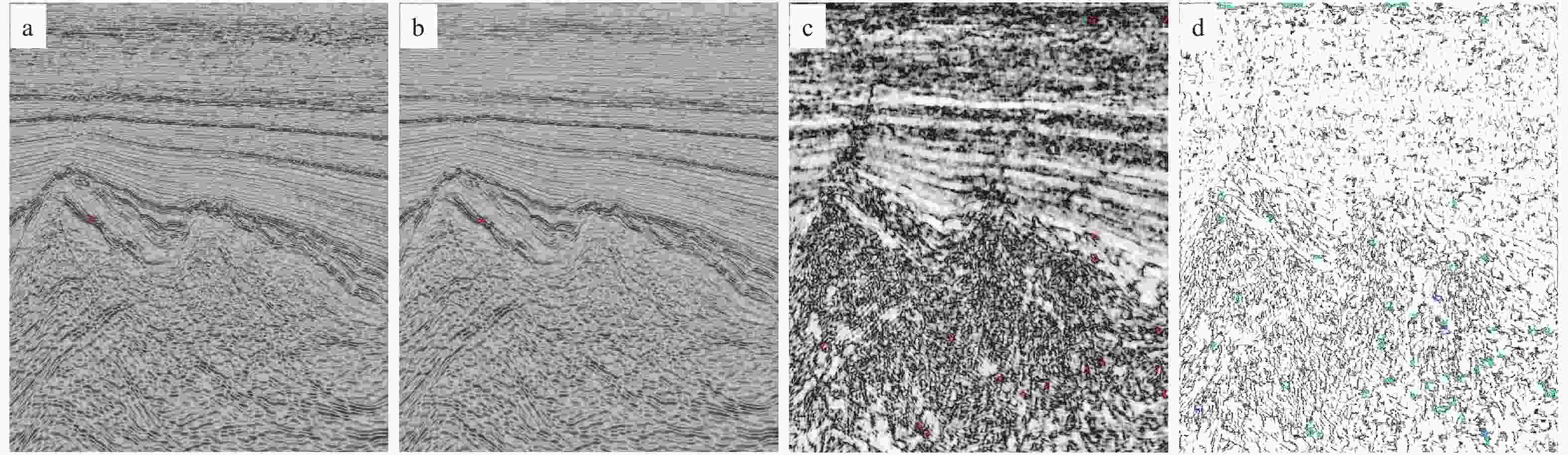
图 2 地震属性体切片(主测线 1054)
a—原始地震切片;b—经中值滤波算法进行去噪后的地震切片;c—经混沌体算法进行不连续性检测后的地震切片;d—经产状控制蚂蚁体算法识别后的裂缝分布
Figure 2. Seismic attribute volume slices (Inline 1054)
(a) Original seismic slice; (b) Seismic slice after denoising by the median filtering algorithm; (c) Seismic slice after discontinuity detection by the chaotic volume algorithm; (d) Fracture distribution identified by the occurrence-controlled ant tracking volume algorithm
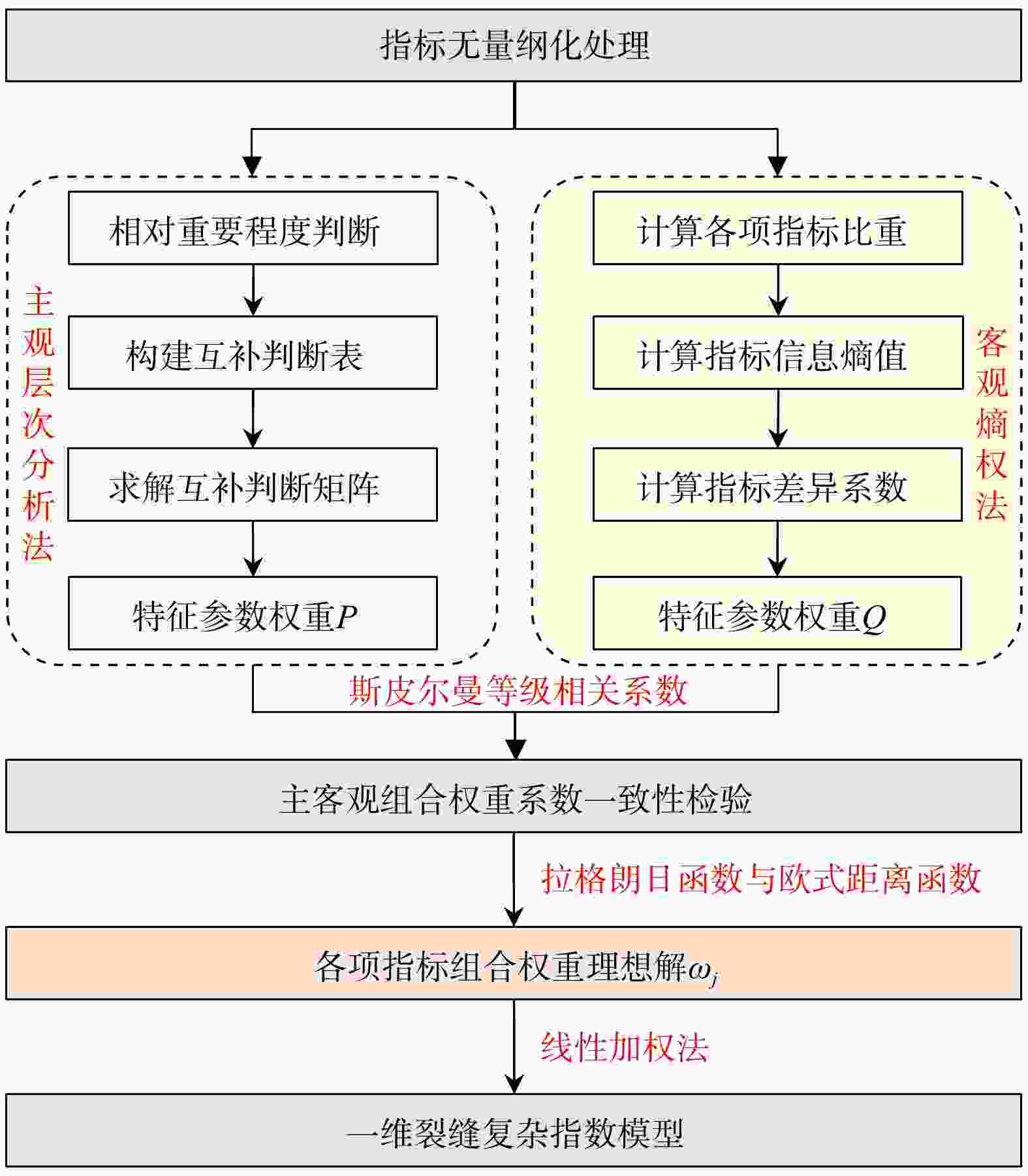
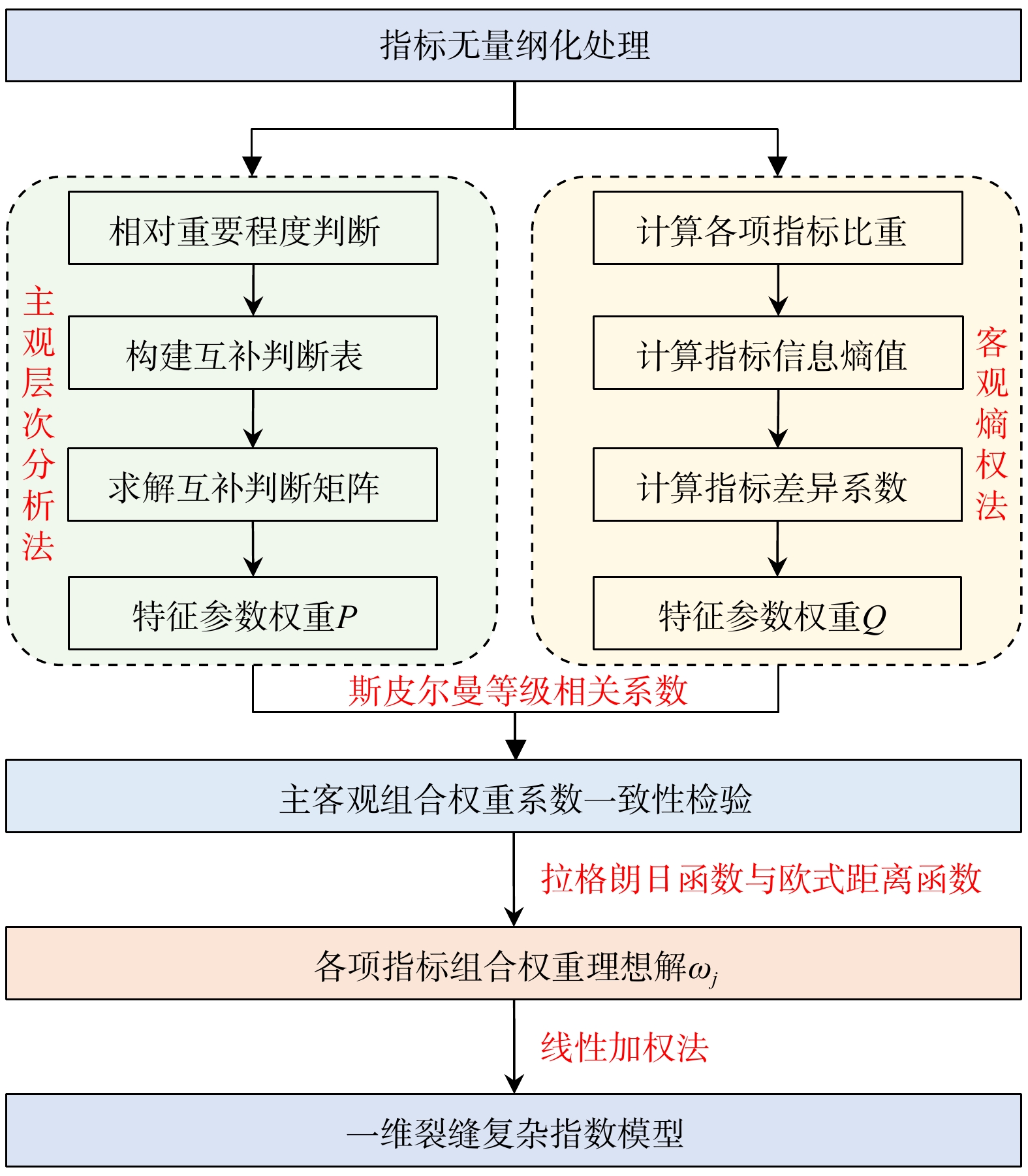
图 3 基于主客观组合赋权的裂缝复杂指数建立流程
Figure 3. Workflow for establishing the fracture complexity index based on a combined subjective−objective weighting method
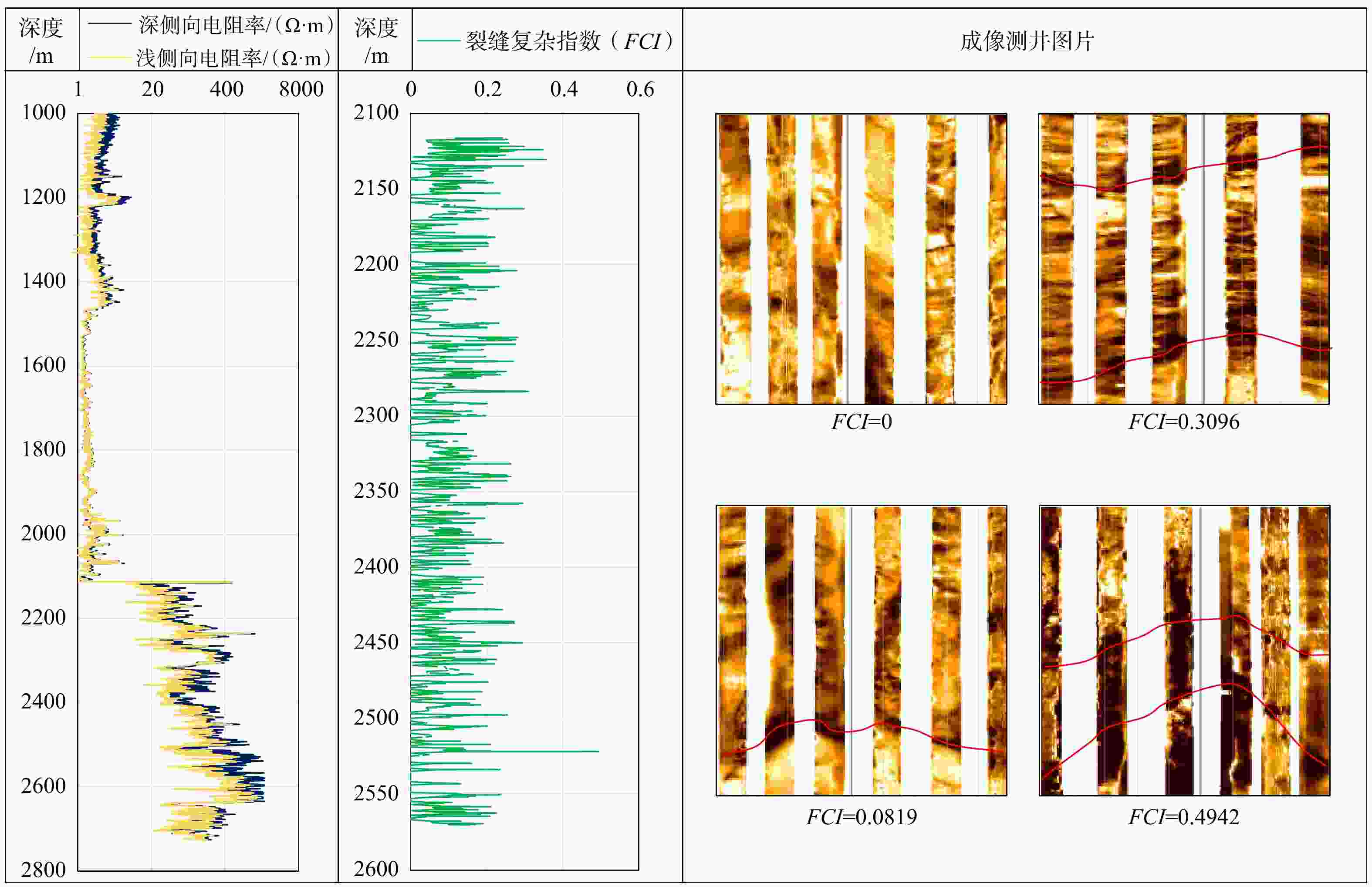
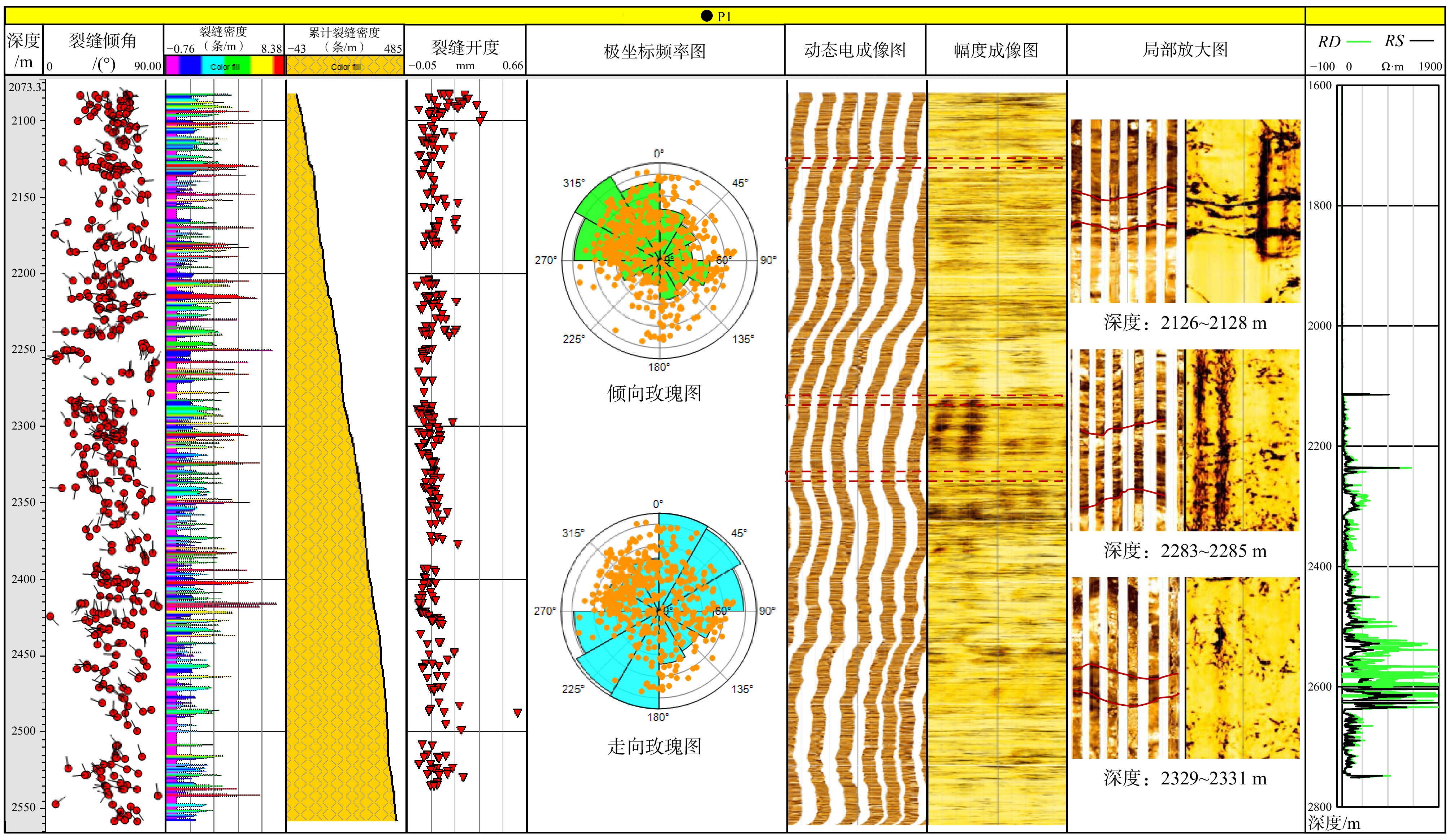
图 4 辽中凹陷西斜坡某油田P1井一维裂缝复杂指数剖面
成像测井图片中红色线表示成像测井识别的裂缝
Figure 4. 1D fracture complexity index profile of Well P1 in an oilfield at the western slope of the Liaozhong Sag
The red lines represent the fractures identified by imaging logging.
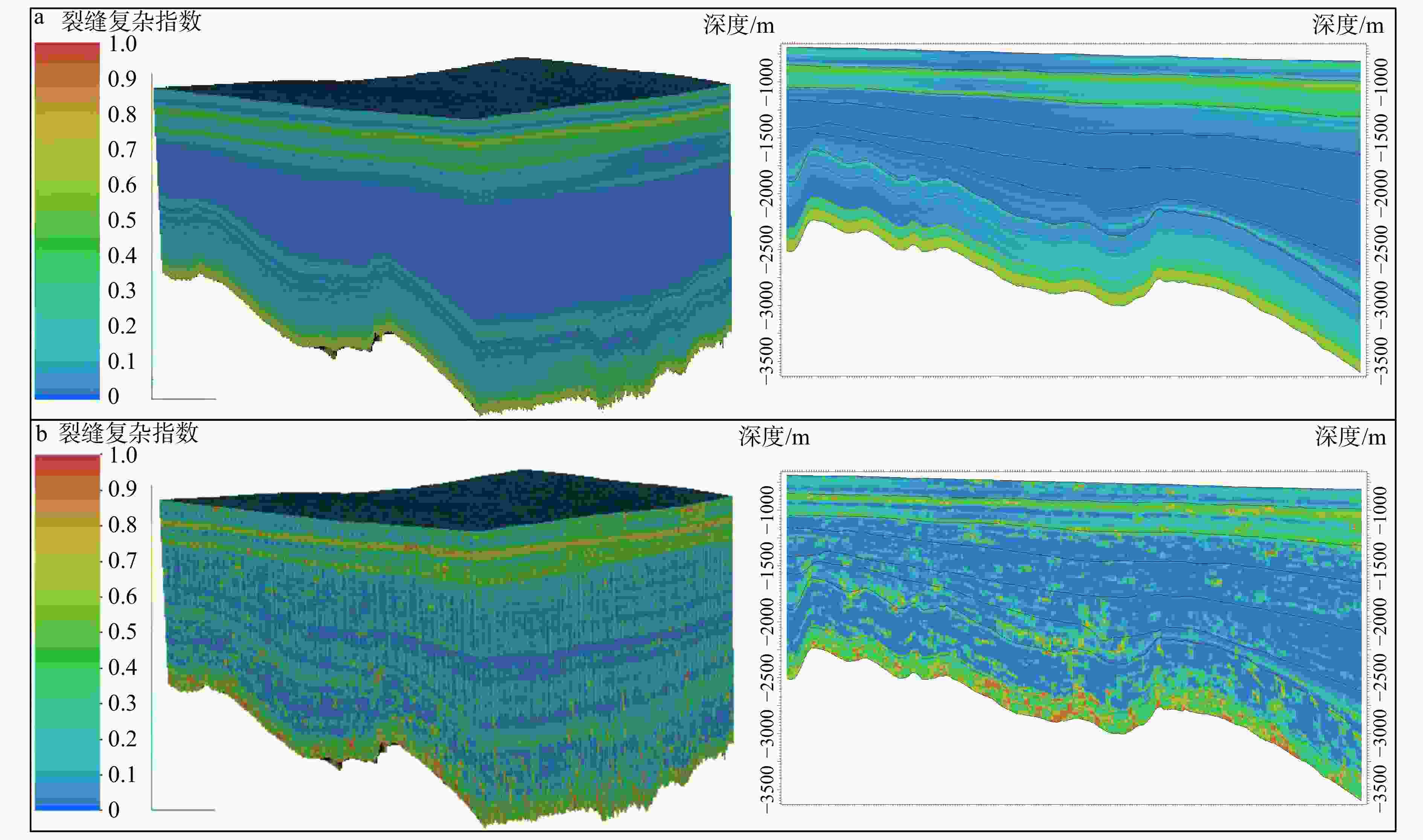
图 5 三维裂缝复杂指数属性体空间展布及连井剖面
a—未采用蚂蚁体约束的裂缝复杂指数;b—采用产状控制蚂蚁体约束的裂缝复杂指数
Figure 5. Spatial distribution of 3D fracture complexity index attribute volume and well-connecting profile
(a) Fracture complexity index without ant tracking volume constraint; (b) Fracture complexity index with ant tracking volume constraint

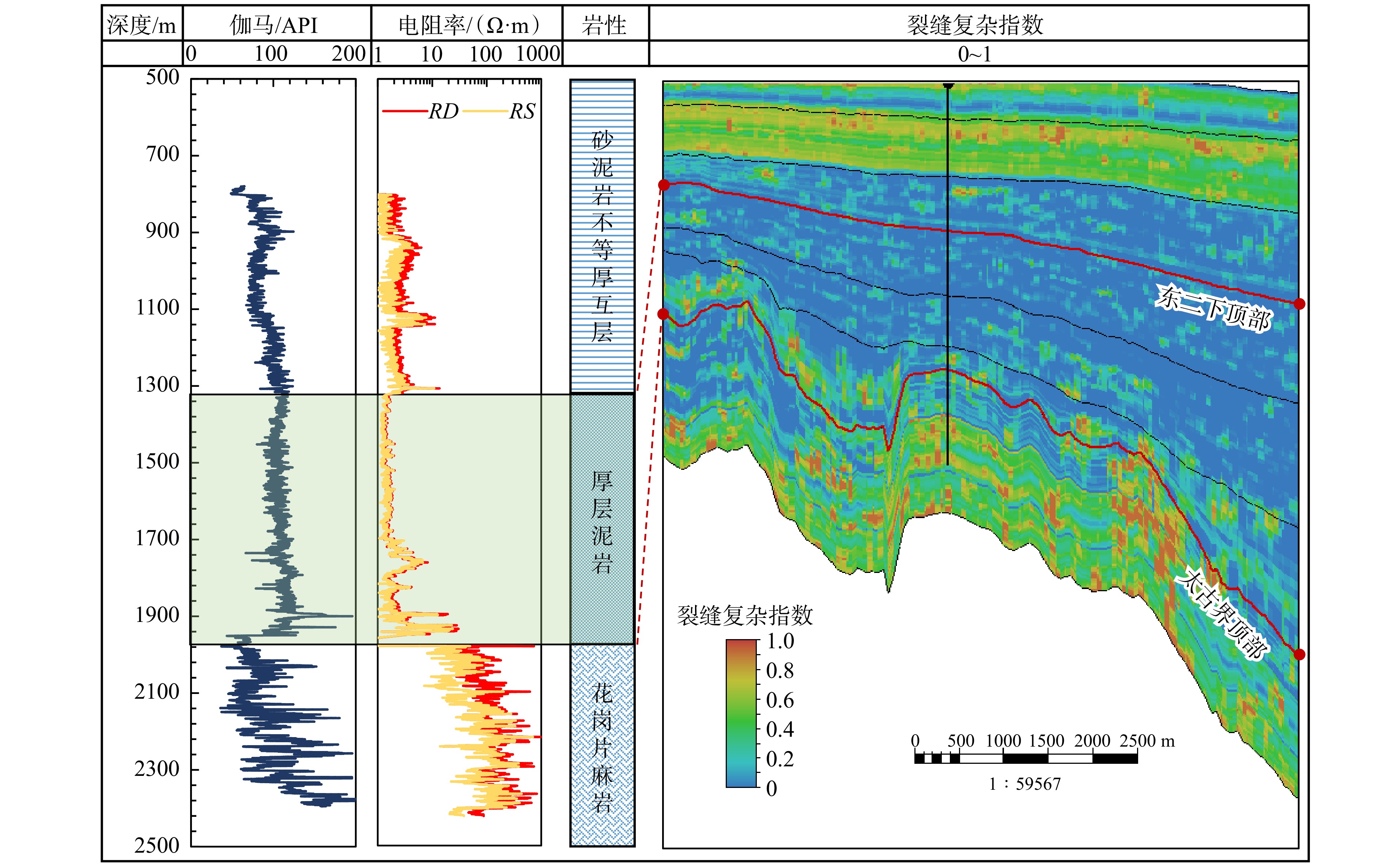
图 6 辽中凹陷西斜坡某油田P5井裂缝复杂指数质量控制
RD、RS分别为深侧向电阻率、浅侧向电阻率
Figure 6. Quality control of the fracture complexity index for Well P5 in an oilfield at the western slope of the Liaozhong Sag
RD and RS denote the deep lateral resistivity and shallow lateral resistivity, respectively.
表 1 蚂蚁追踪算法基本参数
Table 1. Basic parameters of the ant tracking algorithm
参数 含义 特点 取值范围 初始边界范围 定义单只蚂蚁的有效搜索范围 数值降低可增强微小断裂捕捉能力,但会降低整体搜索效率 3~7 路径偏离容差 蚁群路径允许偏离的最大角度 容差增大可增强复杂弯曲断裂识别能力,但可能引入假阳性结果 0~3 搜索基本步长 蚂蚁搜索单次移动的基准距离 步长增加可扩大搜索范围,但可能导致部分细节特征丢失 2~6 允许非法步长 允许超越基准步长的最大范围 容限提高可增强连续断裂追踪能力,但会增加计算复杂度 1~2 必须合法步长 有效路径必须包含的合法步数 步长降低可增强断裂网络连通性,但可能降低构造解释精度 1~3 搜索终止阈值 蚂蚁搜索中非法步数占比上限 阈值提高可增强复杂构造搜索能力,但可能过度平滑构造边界 5~10  下载: 导出CSV
表 2 熵权法获取裂缝开度与裂缝密度的客观权重系数
Table 2. Objective weight coefficients of fracture aperture and fracture intensity obtained by the Entropy Weight Method
指标 裂缝开度 裂缝密度 信息熵值 0.9708 0.9657 差异系数 0.0292 0.0343 权重系数 0.4597 0.5403
下载: 导出CSV
表 3 组合赋权法获取裂缝开度与裂缝密度的最优权重系数
Table 3. Optimal weight coefficients of fracture aperture and fracture intensity obtained by combined weighting method
指标 权重系数 熵权法 层次分析法 组合赋权法 裂缝开度 0.4597 0.3333 0.3852 裂缝密度 0.5403 0.6667 0.6148
下载: 导出CSV
-
[1] ALBATTAT R, HOTEIT H, 2021. A semi-analytical approach to model drilling fluid leakage into fractured formation[J]. Rheologica Acta, 60(6-7): 353-370. doi: 10.1007/s00397-021-01275-3 [2] CAI W J, DENG J G, FENG Y C, et al., 2022. Developing a geomechanics-modeling based method for lost circulation risk assessment: a case study in Bohai Bay, China[J]. Journal of Petroleum Science and Engineering, 210: 110045. doi: 10.1016/j.petrol.2021.110045 [3] DAI Y F, HOU B, 2023. Correlation analysis between acid-etched fracture surface roughness and fracture conductivity in carbonate reservoir[J]. Fault-Block Oil & Gas Field, 30(4): 672-677. (in Chinese with English abstract) [4] FU L J, WEN L, WEI J, et al., 2024. Research on fire risk assessment methods of new energy vehicles under highway tunnel scenario[J]. Journal of Chongqing University of Technology (Natural Science), 38(9): 164-173. (in Chinese with English abstract) [5] GUO T L, SONG Q G, GUO S W, et al., 2025. Application of CNN-GRU model in Kriging interpolation[J]. Oil Geophysical Prospecting, 60(1): 185-192. (in Chinese with English abstract) [6] HAO Z J, WEN Q, SHI L N, et al., 2025. Spatio-temporal evolution characteristics and optimization pathways for integrated development of urban and rural areas in the Chinese section of the Silk Road Economic Belt[J]. Journal of Arid Land Resources and Environment, 39(2): 117-130. (in Chinese with English abstract) [7] HU J, XU B, CHEN Z, et al., 2021. Hazard and risk assessment for hydraulic fracturing induced seismicity based on the Entropy-Fuzzy-AHP method in Southern Sichuan Basin, China[J]. Journal of Natural Gas Science and Engineering, 90: 103908. doi: 10.1016/j.jngse.2021.103908 [8] HU J, MA S, GENG T, et al., 2025. Prediction and visualization of channel characteristics for lost circulation of drilling fluid in fractured formations[J]. Geofluids, 2025(1): 2482349. [9] HUO S W, FENG X Q, WU J, et al., 2025. Study on the coupling between the hanging- and foot-wall beds and the gas content of deep coal seams in the Linxing area, eastern margin of the Ordos Basin[J]. Journal of Geomechanics, 31(2): 235-247. (in Chinese with English abstract) [10] JIN J B, OU B, ZHANG D J, et al., 2021. Research status and prospect of borehole stability technology in deep fractured carbonate reservoirs[J]. Journal of Yangtze University (Natural Science Edition), 18(6): 47-54. (in Chinese with English abstract) [11] JIANG X Y, SONG T, GAN L D, et al., 2023. Multi-scale modeling of granite buried-hill fractured reservoir and its application[J]. Oil Geophysical Prospecting, 58(2): 403-411. (in Chinese with English abstract) [12] JING T T, LI W H, DONG W, et al., 2025. Coupling relationship between the reservoir densification process and hydrocarbon charging process in the Ahe Formation in the Dibei Area of the Kuqa Depression[J]. Geoscience, 39(4): 1156-1168. (in Chinese with English abstract) [13] JU Y, WU G J, WANG Y L, et al., 2021. 3D Numerical model for hydraulic fracture propagation in tight ductile reservoirs, considering multiple influencing factors via the entropy weight method[J]. SPE Journal, 26(5): 2685-2702. doi: 10.2118/205385-PA [14] LI J, ZHANG C M, XIAO C W, et al. , 2008. Quantitative evaluation method of fracturing sandstone reservoir and its application in Kuqa Area, the Tarim Bsain[J]. Natural Gas Industry, 28(10): 25-27, 136. (in Chinese with English abstract) [15] LI J, LI J, MA F J, et al. , 2023. Hydraulic fracture propagation with complex natural fracture network in Lacustrine shale oil reservoirs[C]//SPE Caspian Technical Conference and Exhibition. Baku: SPE: SPE-217646-MS. [16] LI J D, YANG T H, LIU F Y, et al., 2024. Modeling spatial variability of mechanical parameters of layered rock masses and its application in slope optimization at the open-pit mine[J]. International Journal of Rock Mechanics and Mining Sciences, 181: 105859. doi: 10.1016/j.ijrmms.2024.105859 [17] LI J Z, YANG B, ZENG Z L, et al., 2024. Metallogenic prediction of ion-adsorption type middle and heavy rare earth deposits in southern Jiangxi based on fuzzy analytic hierarchy process[J]. Geology and Exploration, 60(5): 919-931. (in Chinese with English abstract) [18] LV B N, CHEN X H, WU H J, et al., 2024. A fine seismic prediction method for complex carbonate fractured-vuggy reservoirs[J]. Geophysical Prospecting for Petroleum, 63(2): 426-436. (in Chinese with English abstract) [19] LI Y, HE J H, DENG H C, et al., 2024. Analysis of connectivity characterization and mechanical effectiveness of natural fracture in deep shale reservoirs: A case study of the Wufeng-Longmaxi formations in the Dingshan-Dongxi area, southeastern margin of Sichuan Basin[J]. Natural Gas Geoscience, 35(2): 230-244. (in Chinese with English abstract) [20] NAJJARPOUR M, JALALIFAR H, NOROUZI-APOURVARI S, 2022. Fifty years of experience in rate of penetration management: managed pressure drilling technology, mechanical specific energy concept, bit management approach and expert systems-A review[J]. Journal of Petroleum Science and Engineering, 208: 109184. doi: 10.1016/j.petrol.2021.109184 [21] QI Z Z, SHEN J S, DANG W B, et al., 2025. Log-based fault-fracture reservoir identification and porosity evaluation in Binchang area[J]. Geophysical Prospecting for Petroleum, 64(5): 979-992. (in Chinese with English abstract) [22] QIAO H, ZHANG Y G, NIE H K, et al., 2024. Characterization and 3D modeling of multiscale natural fractures in shale gas reservoir: a case study in the Pingqiao Structural Belt, Sichuan Basin[J]. Earth Science Frontiers, 31(5): 89-102. (in Chinese with English abstract) [23] QIN J H, XIAN C G, ZHANG J, et al., 2025. Characteristics of hydraulic fracture network in the tight conglomerate reservoir based on a hydraulic fracturing test site[J]. Petroleum Exploration and Development, 52(1): 217-228. (in Chinese with English abstract) doi: 10.1016/s1876-3804(25)60018-8 [24] SABOORIAN-JOOYBARI H, DEJAM M, CHEN Z, et al. , 2015. Fracture identification and comprehensive evaluation of the parameters by Dual Laterolog data[C]//SPE Middle East Unconventional Resources Conference and Exhibition. Muscat: SPE: SPE-172947-MS. [25] SHANG X F, LONG S X, DUAN T Z, 2021. Current situation and development trend of fracture characterization and modeling techniques in shale gas reservoirs[J]. Natural Gas Geoscience, 32(2): 215-232. (in Chinese with English abstract) [26] SHEN Q H, LIU J, LI Z Y, et al., 2024. Experimental study on the effect of rock mechanical properties and fracture morphology features on lost circulation[J]. SPE Journal, 29(8): 3964-3981. doi: 10.2118/219765-PA [27] TAN Q G, KANG Y L, SONG F Q, et al., 2024. Numerical simulation on drilling fluid loss in fractured carbonate reservoirs based on generalized lattice Boltzmann model[J]. Journal of Changzhou University (Natural Science Edition), 36(4): 37-45. (in Chinese with English abstract) [28] WAN Y Y, WANG X Q, LEI F Y, et al., 2024a. Compressibility evaluation and application of E32 shale oil in Yingxiongling Area, Qaidam Basin[J]. Unconventional Oil & Gas, 11(3): 120-129. (in Chinese with English abstract) [29] WAN Y Y, LIN H, GUO D L, et al., 2024b. Developing a large-scale fracturing management system using AHP method to improve the fracturing effect of unconventional reservoirs[J]. Oil Drilling & Production Technology, 46(4): 479-491. (in Chinese with English abstract) [30] WANG G C, BHATTACHARYA S, 2023. Natural fracture mapping and discrete fracture network modeling of Wolfcamp formation in hydraulic fracturing test site phase 1 area, Midland Basin: fractures from 3D seismic data, image log, and core[J]. Marine and Petroleum Geology, 157: 106474. doi: 10.1016/j.marpetgeo.2023.106474 [31] WANG J P, ZENG L B, XU Z P, et al., 2024. The impact of diagenetic fluids on the structural fracture filling and dissolution alteration of ultra-deep tight sandstone reservoirs: a case study of the Kelasu oil and gas field in the Tarim Basin[J]. Earth Science Frontiers, 31(3): 312-323. (in Chinese with English abstract) [32] WEI S M, HAO Y L, SUI W B, et al., 2024. Research on the characteristics of fiber optic signals for neighboring wells with hydraulic fracture propagation at different inclination angles[J]. Petroleum Science Bulletin, 9(5): 764-776. (in Chinese with English abstract) [33] XIONG J N, SUN M Y, SUN M, 2019. Risk assessment on mountain torrents and debris flows along long-distance pipelines based on the GIS and coupling-coordination principle[J]. Natural Gas Industry, 39(3): 116-124. (in Chinese with English abstract) [34] XU C Y, XIE Z C, KANG Y L, et al., 2020. A novel material evaluation method for lost circulation control and formation damage prevention in deep fractured tight reservoir[J]. Energy, 210: 118574. doi: 10.1016/j.energy.2020.118574 [35] XU F Q, SONG X Z, LI S, et al., 2024. A multi-objective optimization and multi-attribute decision-making analysis for technical-thermodynamic-economic evaluation considering the rock damage on production performance of hot dry rock geothermal resources[J]. Applied Thermal Engineering, 241: 122350. doi: 10.1016/j.applthermaleng.2024.122350 [36] YANG R Y, CONG R C, GONG Y J, et al., 2023. Micromechanical contrast of Ordos Basin sandstone-mudstone interbedded layered rocks[J]. Journal of Geophysical Research: Solid Earth, 128(10): e2023JB027190. doi: 10.1029/2023JB027190 [37] YE T, NIU C M, WEI A J, 2020. Characteristics and genetic mechanism of large granitic buried-hill reservoir, a case study from PengLai oil field of Bohai Bay Basin, north China[J]. Journal of Petroleum Science and Engineering, 189: 106988. doi: 10.1016/j.petrol.2020.106988 [38] ZHANG J F, FENG Y C, HE B, et al., 2025. Wellbore strengthening for addressing lost circulation in fractured formations: a comprehensive review[J]. Rock Mechanics and Rock Engineering, 58(1): 1-32. doi: 10.1007/s00603-024-04240-7 [39] ZHANG X M, WANG R, SHI W Z, et al., 2023. Structure- and lithofacies-controlled natural fracture developments in shale: implications for shale gas accumulation in the Wufeng-Longmaxi Formations, Fuling Field, Sichuan Basin, China[J]. Geoenergy Science and Engineering, 223: 211572. doi: 10.1016/j.geoen.2023.211572 [40] ZHANG X Y, TAN Y, 2010. The automatic fittifng and implementation of the spherical model of variogram[J]. Geophysical & Geochemical Exploration, 34(2): 253-257. (in Chinese with English abstract) [41] ZHUO Q G, ZHANG F Q, ZHANG B, et al., 2024. Tectonic fracture prediction for lacustrine carbonate oil reservoirs in Paleogene formations of the western Yingxiongling area, Qaidam Basin, NW China based on numerical simulation[J]. Carbonates and Evaporites, 39(2): 38. doi: 10.1007/s13146-024-00940-x [42] 戴一凡, 侯冰, 2023. 碳酸盐岩酸蚀裂缝面粗糙度与导流能力相关性分析[J]. 断块油气田, 30(4): 672-677. doi: 10.6056/dkyqt202304020 [43] 付立家, 文龙, 卫佳, 等, 2024. 公路隧道场景下的新能源汽车火灾风险评价方法研究[J]. 重庆理工大学学报(自然科学), 38(9): 164-173. doi: 10.3969/j.issn.1674-8425(z).2024.09.021 [44] 郭天良, 宋强功, 郭淑文, 等, 2025. CNN-GRU模型在克里金插值中的应用[J]. 石油地球物理勘探, 60(1): 185-192. doi: 10.13810/j.cnki.issn.1000-7210.20240113 [45] 郝智娟, 文琦, 施琳娜, 等, 2025. 丝绸之路经济带中国段城乡融合发展的时空演变特征与优化路径[J]. 干旱区资源与环境, 39(2): 117-130. doi: 10.13448/j.cnki.jalre.2025.031 [46] 霍少伟, 冯兴强, 吴见, 等, 2025. 鄂东缘临兴地区深层煤层顶底板与含气性耦合关系研究[J]. 地质力学学报, 31(2): 235-247. [47] 姜晓宇, 宋涛, 甘利灯, 等, 2023. 花岗岩潜山裂缝型储层多尺度建模与应用[J]. 石油地球物理勘探, 58(2): 403-411. [48] 金军斌, 欧彪, 张杜杰, 等, 2021. 深部裂缝性碳酸盐岩储层井壁稳定技术研究现状及展望[J]. 长江大学学报(自然科学版), 18(6): 47-54. doi: 10.3969/j.issn.1673-1409.2021.06.007 [49] 景涛涛, 李文浩, 董卫, 等, 2025. 库车坳陷迪北地区阿合组储层致密过程与油气充注耦合关系[J]. 现代地质, 39(4): 1156-1168. doi: 10.19657/j.geoscience.1000-8527.2024.072 [50] 李军, 张超谟, 肖承文, 等, 2008. 库车地区砂岩裂缝测井定量评价方法及应用[J]. 天然气工业, 28(10): 25-27, 136. doi: 10.3787/j.issn.1000-0976.2008.10.007 [51] 李家桢, 杨斌, 曾载淋, 等, 2024. 基于模糊层次分析法的赣南离子吸附型中重稀土成矿预测[J]. 地质与勘探, 60(5): 919-931. [52] 李勇, 何建华, 邓虎成, 等, 2024. 深层页岩储层天然裂缝连通性表征及力学有效性分析: 以川东南盆缘丁山—东溪地区五峰组—龙马溪组为例[J]. 天然气地球科学, 35(2): 230-244. doi: 10.11764/j.issn.1672-1926.2023.09.019 [53] 吕丙南, 陈学华, 吴昊杰, 等, 2024. 复杂碳酸盐岩缝洞型储层的地震精细预测方法[J]. 石油物探, 63(2): 426-436. [54] 齐真真, 沈金松, 党文斌, 等, 2025. 彬长区块断缝体储层的测井识别与孔隙度评价[J]. 石油物探, 64(5): 979-992 [55] 覃建华, 鲜成钢, 张景, 等, 2025. 基于水力压裂现场实验室的致密砾岩人工缝网特征[J]. 石油勘探与开发, 52(1): 217-228. [56] 乔辉, 张永贵, 聂海宽, 等, 2024. 页岩储层多尺度天然裂缝表征与三维地质建模: 以四川盆地平桥构造带五峰组-龙马溪组页岩为例[J]. 地学前缘, 31(5): 89-102. doi: 10.13745/j.esf.sf.2023.6.13 [57] 商晓飞, 龙胜祥, 段太忠, 2021. 页岩气藏裂缝表征与建模技术应用现状及发展趋势[J]. 天然气地球科学, 32(2): 215-232. [58] 谭启贵, 康毅力, 宋付权, 等, 2024. 基于格子Boltzmann模型的裂缝性储层钻井液漏失数值模拟[J]. 常州大学学报(自然科学版), 36(4): 37-45. doi: 10.3969/j.issn.2095-0411.2024.04.005 [59] 万有余, 王小琼, 雷丰宇, 等, 2024a. 柴达木盆地英雄岭E32页岩油可压性评价及应用[J]. 非常规油气, 11(3): 120-129. doi: 10.19901/j.fcgyq.2024.03.15 [60] 万有余, 林海, 郭得龙, 等, 2024b. 层次分析法制定大型压裂管理制度提升非常规储层压裂效果[J]. 石油钻采工艺, 46(4): 479-491. doi: 10.13639/j.odpt.202412015 [61] 王俊鹏, 曾联波, 徐振平, 等, 2024. 成岩流体对超深致密砂岩储层构造裂缝充填及溶蚀改造的影响: 以塔里木盆地克拉苏油气田为例[J]. 地学前缘, 31(3): 312-323. doi: 10.13745/j.esf.sf.2024.1.51 [62] 韦世明, 郝亚龙, 隋微波, 等, 2024. 不同倾角水力裂缝扩展的邻井光纤监测信号特征研究[J]. 石油科学通报, 9(5): 764-776. doi: 10.3969/j.issn.2096-1693.2024.05.058 [63] 熊俊楠, 孙明远, 孙铭, 2019. 基于GIS及耦合协调原理的长输管道山洪泥石流风险性评价[J]. 天然气工业, 39(3): 116-124. doi: 10.3787/j.issn.1000-0976.2019.03.015 [64] 张小艳, 谭勇, 2010. 变差函数球状模型的自动拟合与实现[J]. 物探与化探, 34(2): 253-257. -

 下载:
下载:




计量
- 文章访问数: 558
- HTML全文浏览量: 244
- PDF下载量: 175
- 被引次数: 0
