


Characteristics of current in-situ stress field and engineering zoning evaluation in complex structural areas: A case study of the Longmaxi shale reservoir in the southeastern margin of the Sichuan Basin
-
摘要: 川东南盆缘丁山−东溪地区位于川东断褶带与黔北断褶带交界处,受多期构造运动影响,构造特征复杂。区内志留系龙马溪组页岩气资源丰富,成藏条件优越,勘探开发潜力大。但该区现今地应力场情况复杂且平面预测精细低,导致水平井之间压裂改造效果与产量差异显著。因此,明确其现今地应力状态及分布规律有助于提高页岩气开发效益。该研究综合实验测试、测井及微地震等多源数据,精细解释了研究区井剖面地应力方向;结合水力压裂、声发射实验与测井资料,明确了井剖面地应力大小分布特征;基于考虑构造变形及断裂特征的精细化地质建模及非均质岩石力学属性赋值,应用数值模拟软件揭示了研究区现今地应力分布特征。在此基础上,分析了现今地应力特征对压裂改造效果的影响,构建了地应力分区评价标准;结合模拟结果,对丁山−东溪地区进行地应力分区,并依据新井压裂效果与应力状态的匹配关系验证了分区效果。结果表明,丁山−东溪地区现今地应力方向多为近东西向,局部受断裂及构造变形影响发生偏转。最大水平主应力、最小水平主应力及垂向主应力分别为58.4~167.0 MPa、38.6~135.4 MPa和54.7~148.2 MPa,呈走滑应力状态;水平两向应力差主要介于5~30 MPa。地应力大小及水平两向应力差整体受控于埋深,在构造变形高部位,地应力及水平两向应力差均减小;在断层附近,地应力减小而水平两向应力差增大。依据最小水平主应力80 MPa和水平两向应力差20 MPa进行分区,建议选择丁山中部缓斜坡区构造高部位、东溪斜坡区以及东溪断背斜区北部的低应力差−低地应力区开展压裂改造。研究成果深化了对川东南盆缘龙马溪组现今地应力场的认识,对压裂改造优化具有重要的实践价值。Abstract:
Objective The Dingshan–Dongxi area, located on the basin margin in southeastern Sichuan, lies at the junction of the eastern Sichuan fault–fold zone and the northern Guizhou fault–fold zone on the east side of the Luzhou–Chishui tectonic superposition zone. Due to multiple tectonic movements, the geological structure in this area is complex. The Longmaxi Formation in the study area is rich in shale gas resources, characterized by superior geological and reservoir conditions, and holds great potential for exploration and development. Clarifying the current in-situ stress state and its distribution is conducive to improving shale gas development efficiency. However, the complex in-situ stress field in this area leads to less accurate planar predictions and significant differences in the fracturing stimulation effects and production among horizontal wells. Methods This study provided a detailed interpretation of the in-situ stress direction in the well profile of the study area by integrating multi-source data, including core tests, well logging, and microseismic monitoring. Furthermore, the distribution characteristics of in-situ stress magnitudes among the well profile were clarified through hydraulic fracturing, acoustic emission experiments, and well logging. Refined geological modeling was performed on the structural deformation and fracture characteristics of the study area, and heterogeneous rock mechanical properties were assigned. Numerical simulation software was then applied to simulate the current in-situ stress distribution characteristics of the study area. Finally, based on the analysis of the influence of in-situ stress characteristics on fracturing stimulation effects, an in-situ stress zoning evaluation standard was constructed. Using the simulated in-situ stress field results, in-situ stress zoning was carried out in the Dingshan–Dongxi area, and the zoning results were verified through a retrospective evaluation of the fracturing effects of new wells. Results The results show that the current in-situ stress direction in the study area is mostly near east –west, with local deflections caused by fractures and structural deformations. The maximum horizontal principle stress, minimum horizontal principle stress, and vertical principal stress range from 58.4 to 167.0 MPa, 38.6 to 135.4 MPa, and 54.7 to 148.2 MPa, respectively, indicating a strike-slip stress state. The stress difference (maximum minus minimum horizontal principal stress) mainly ranges from 5 to 30 MPa. The magnitude of in-situ stress and the stress difference are generally controlled by burial depth. In areas with high structural deformation, both in-situ stress and stress difference are lower. Near faults, in-situ stress is lower, but the stress difference is higher. Zoning was performed using a minimum horizontal principal stress of 80 MPa and a stress difference of 20 MPa as thresholds. [ Conclusions ] It is recommended that areas with low stress difference and low in-situ stress be selected for fracturing stimulation. These areas are mainly located in the high-structural parts of the gentle slope area in the middle of Dingshan, the slope area of Dongxi, and the northern part of the Dongxi fault and anticline area.[ Significance ] This study advances the understanding of the current in-situ stress field of the Longmaxi Formation on the southeastern margin of the Sichuan Basin and has significant practical value for optimizing fracturing stimulation. -
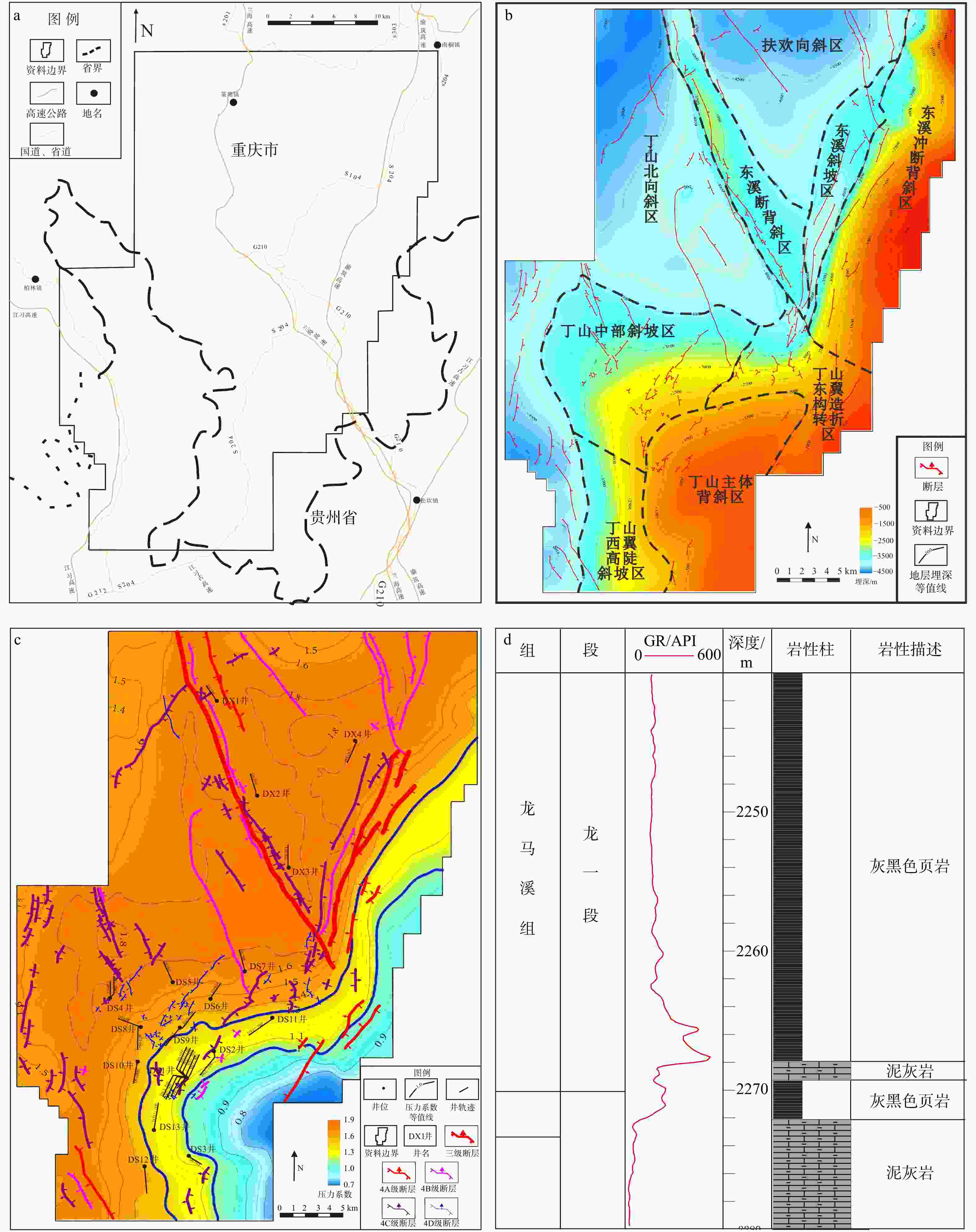
图 1 丁山−东溪地区构造单元、压力分布及地层综合特征图
a—地理位置;b—构造分区;c—断裂与压力系数分布;d—岩性地层综合柱状图
Figure 1. Structural units, pressure distribution, and stratigraphic characteristics of the Dingshan–Dongxi area
(a) Geographic location; (b) Structural division; (c) Fault and pressure coefficient distribution; (d) Comprehensive stratigraphic column of lithology
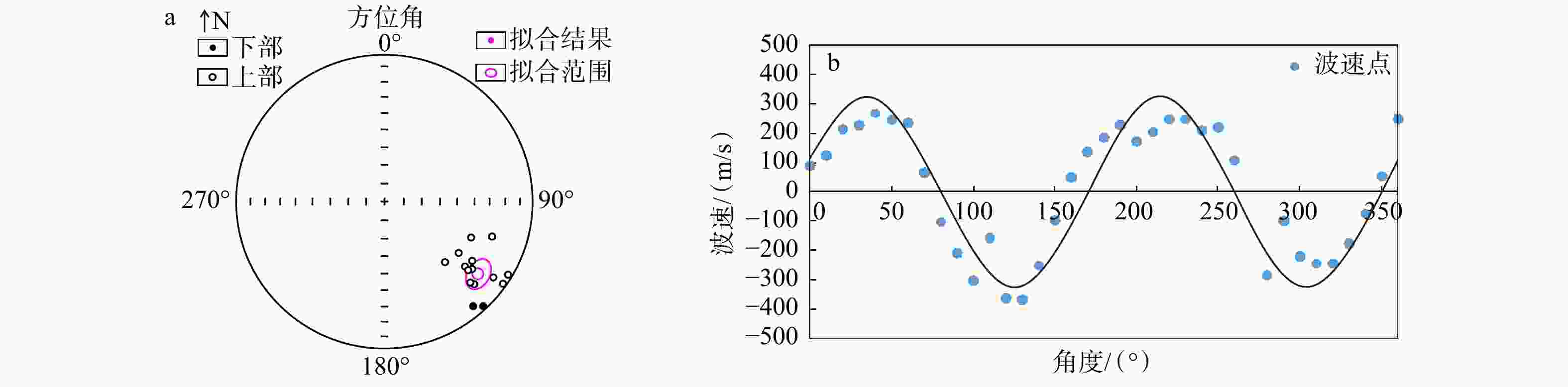
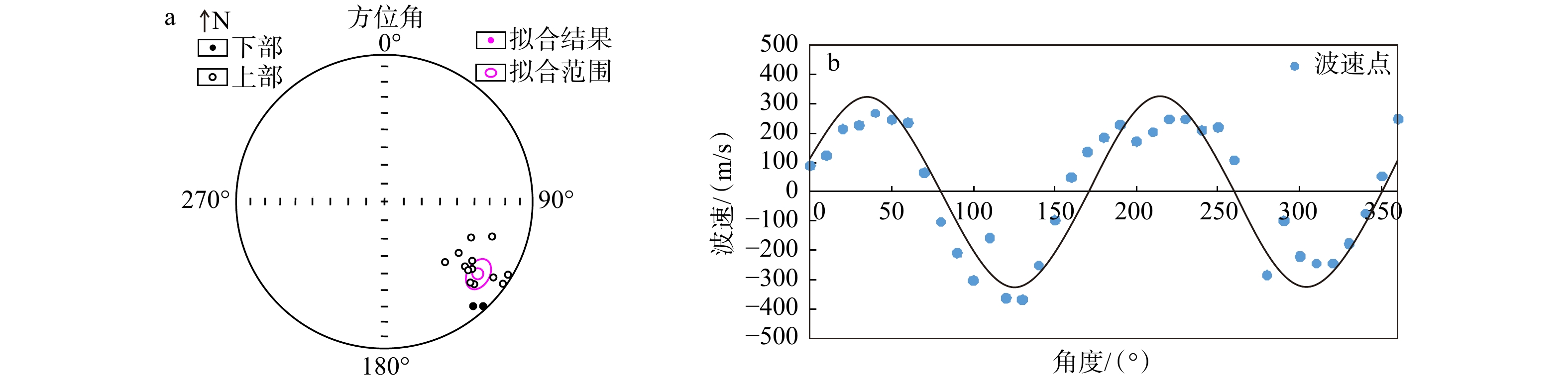
图 2 DS8井龙马溪组岩芯(3810.19 m)实验结果图
a—古地磁实验岩芯定向图;b—波速随角度变化关系图
Figure 2. Core test results of the Longmaxi Formation (3810.19 m) in well DS8
(a) Schematic diagram of paleomagnetic core orientation experiment; (b) Graph of wave velocity vs. angle
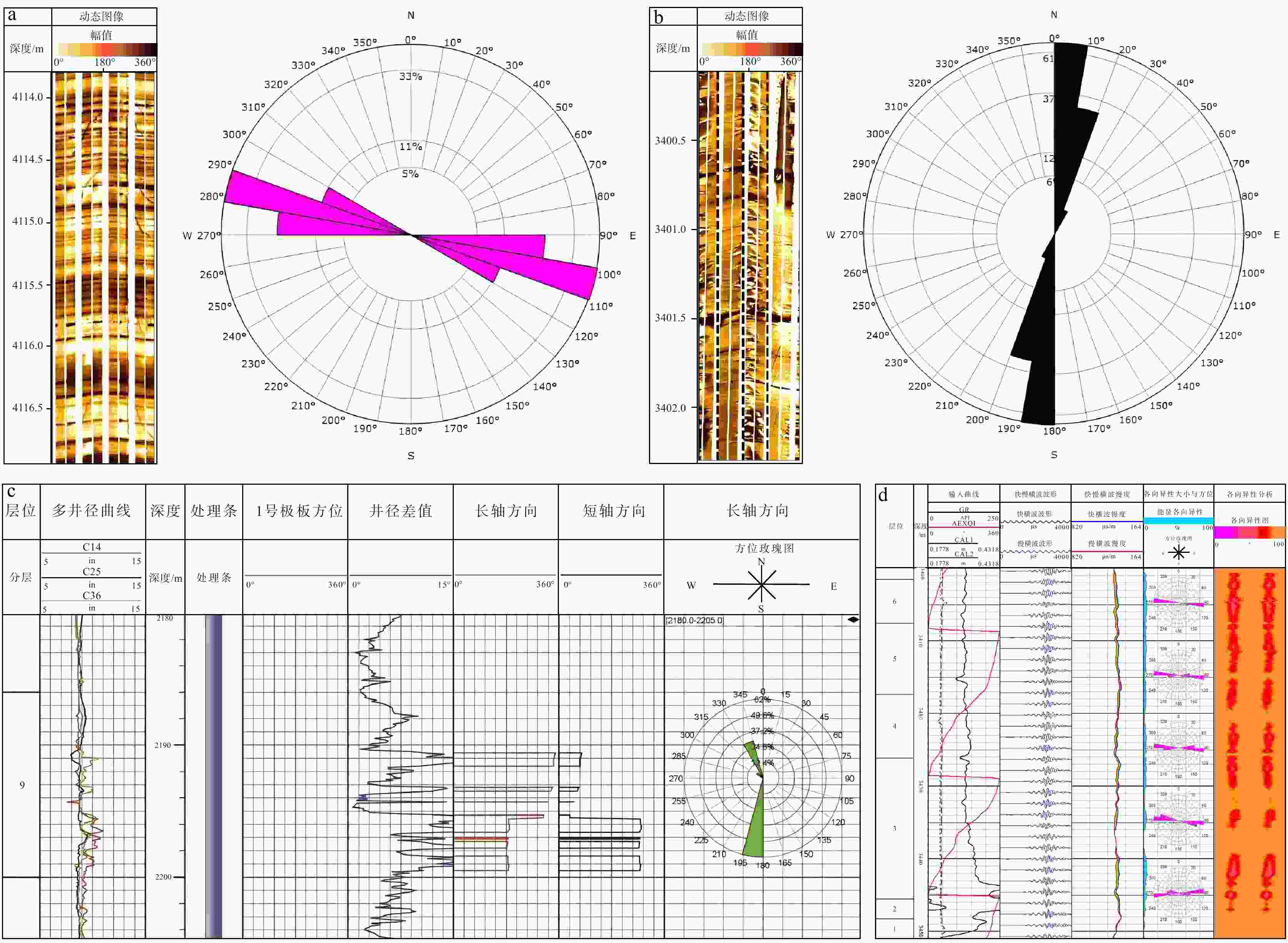
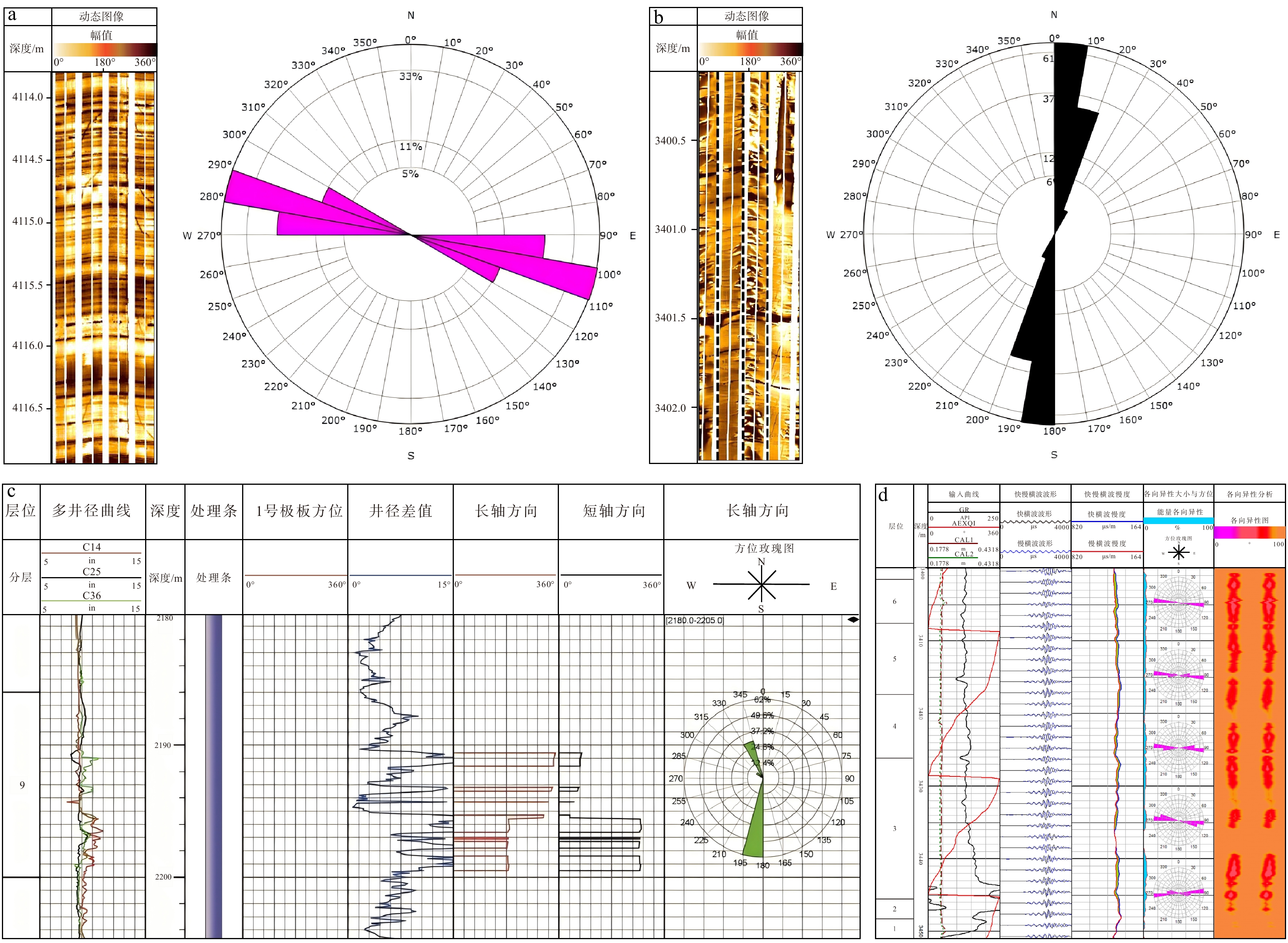
图 3 基于三种测井方法的现今地应力方向解释结果
a—DS7井龙马溪组(4113.8~4114.7 m)钻井诱导缝成像特征;b—DS9井龙马溪组(3400.0~3402.2 m)井壁崩落成像特征;c—DS1井龙马溪组(2180.0~2205.0 m)崩落椭圆拟合;d—DS9HF井龙马溪组(3400.0~3450.9 m)阵列声波各向异性
Figure 3. Current in-situ stress direction interpreted from three logging methods
(a) Drilling-induced fractures of the Longmaxi Formation (4113.8–4114.7 m) in well DS7; (b) Borehole breakout of the Longmaxi Formation (3400.5–3402.2 m) in well DS9; (c) Breakout ellipse fitting of the Longmaxi Formation (2180.0–2205.0 m) in well DS1; (d) Array acoustic logging anisotropy of the Longmaxi Formation (3400.0–3450.9 m) in well DS9HF
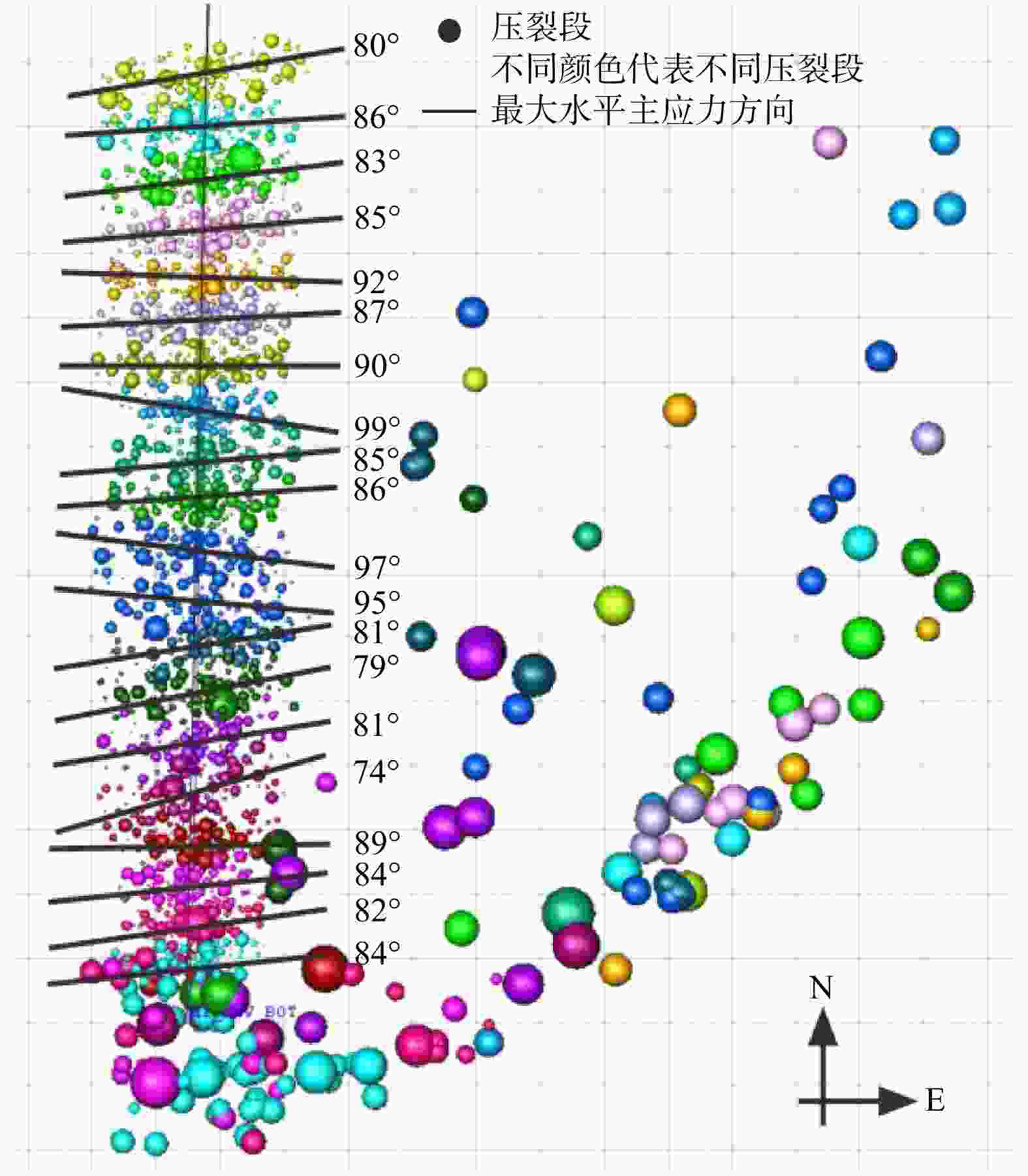
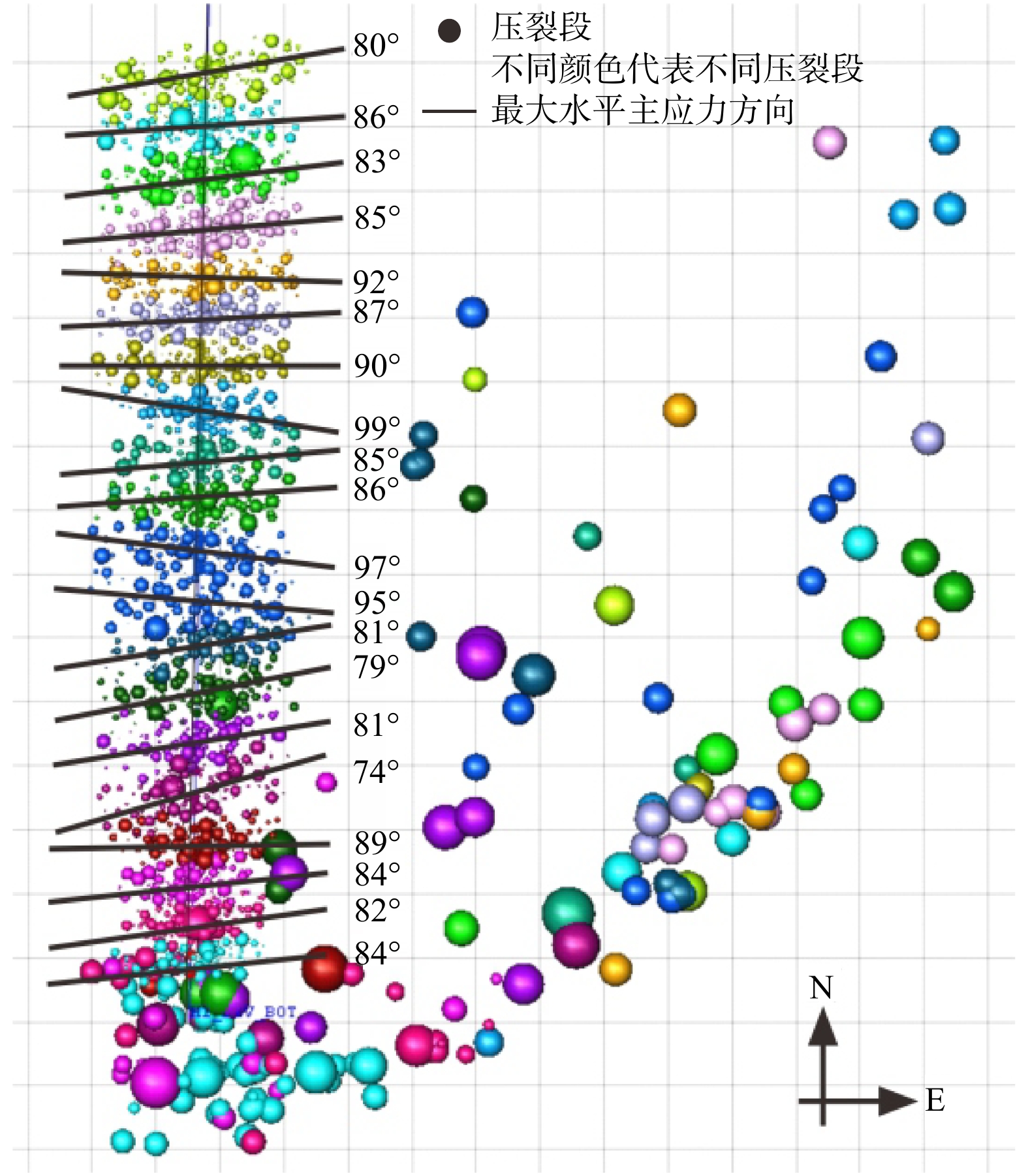
图 4 基于微地震监测的DS8HF井现今地应力方向解释结果
Figure 4. Interpreted in-situ stress direction from microseismic monitoring in well DS8HF
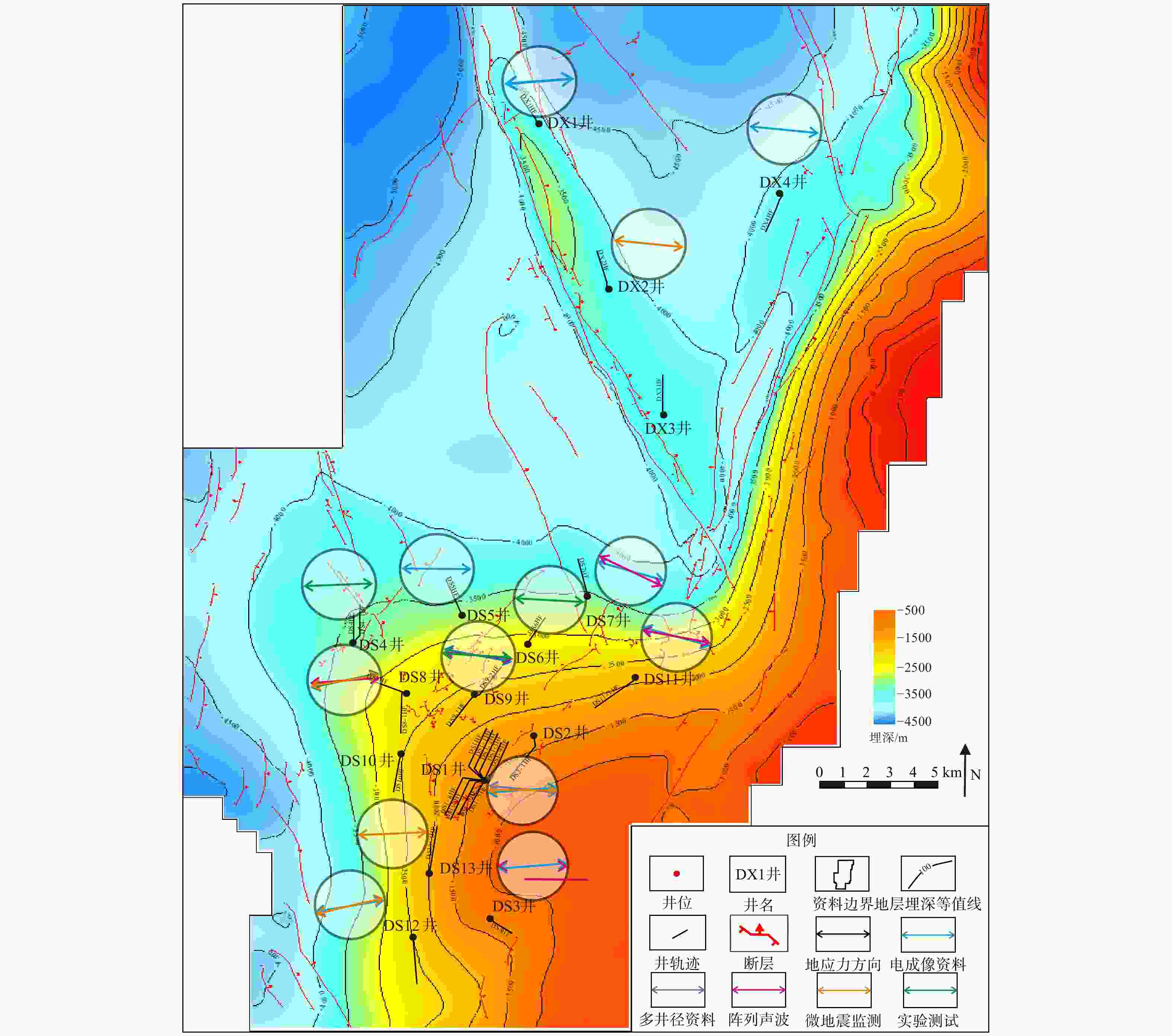
图 5 丁山−东溪地区龙一段1—4小层关键井的地应力方向分布特征
Figure 5. Distribution characteristics of in-situ stress direction in key wells of layers 1–4, first member of the Longmaxi Formation, Dingshan–Dongxi area
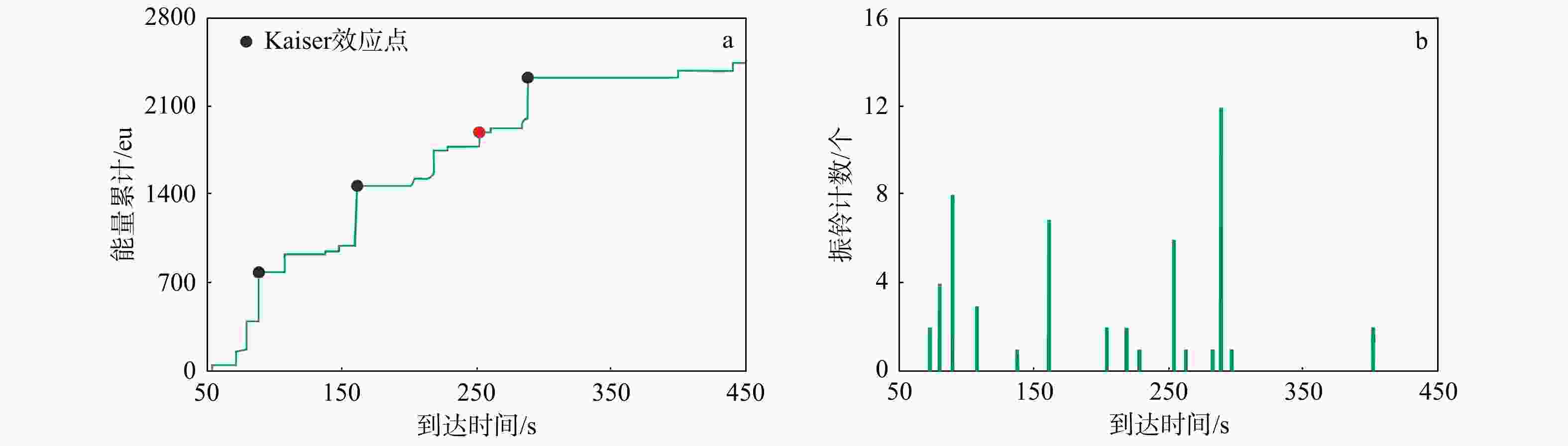
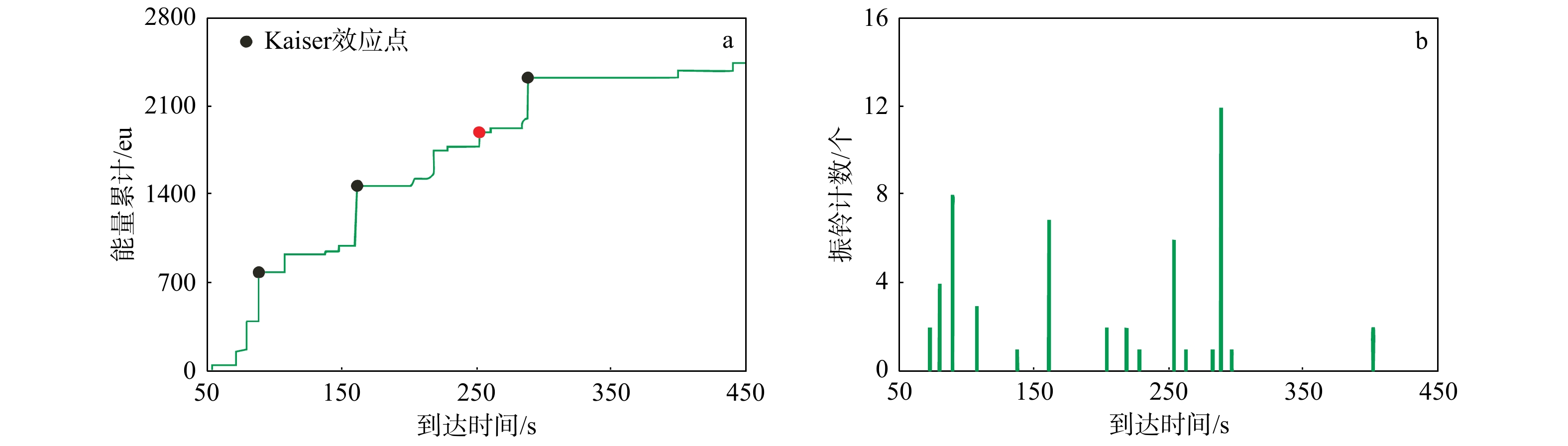
图 6 DS9井声发射实验曲线图
红色Kaiser效应点为反映现今地应力大小的有效点a—到达时间与能量累计关系;b—到达时间与振铃计数关系
Figure 6. Acoustic emission test curves of well DS9
(a) Relationship between arrival time and cumulative energy; (b) Relationship between arrival time and ring count The red Kaiser effect point are the effective point reflecting the current in-situ stress magnitude
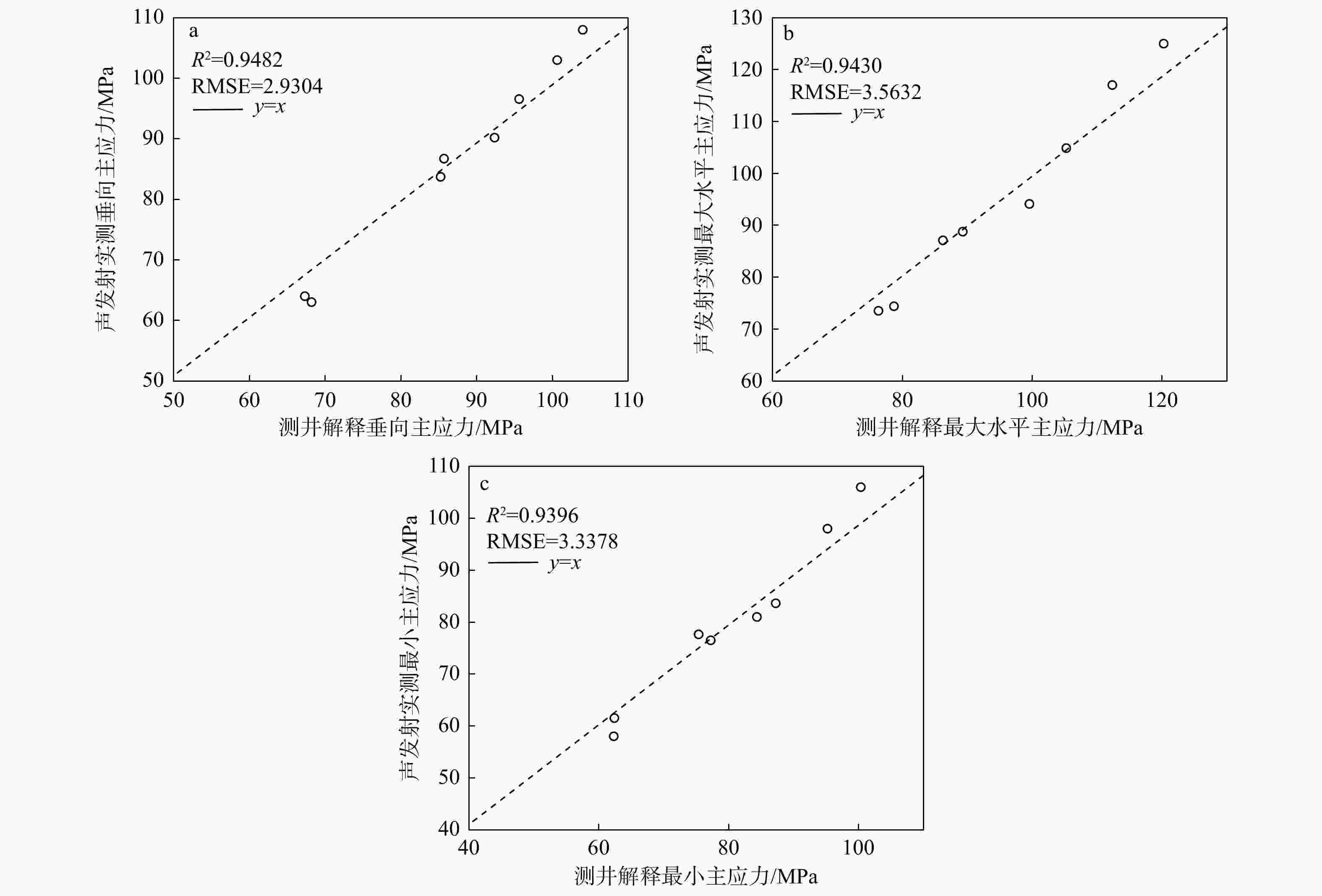
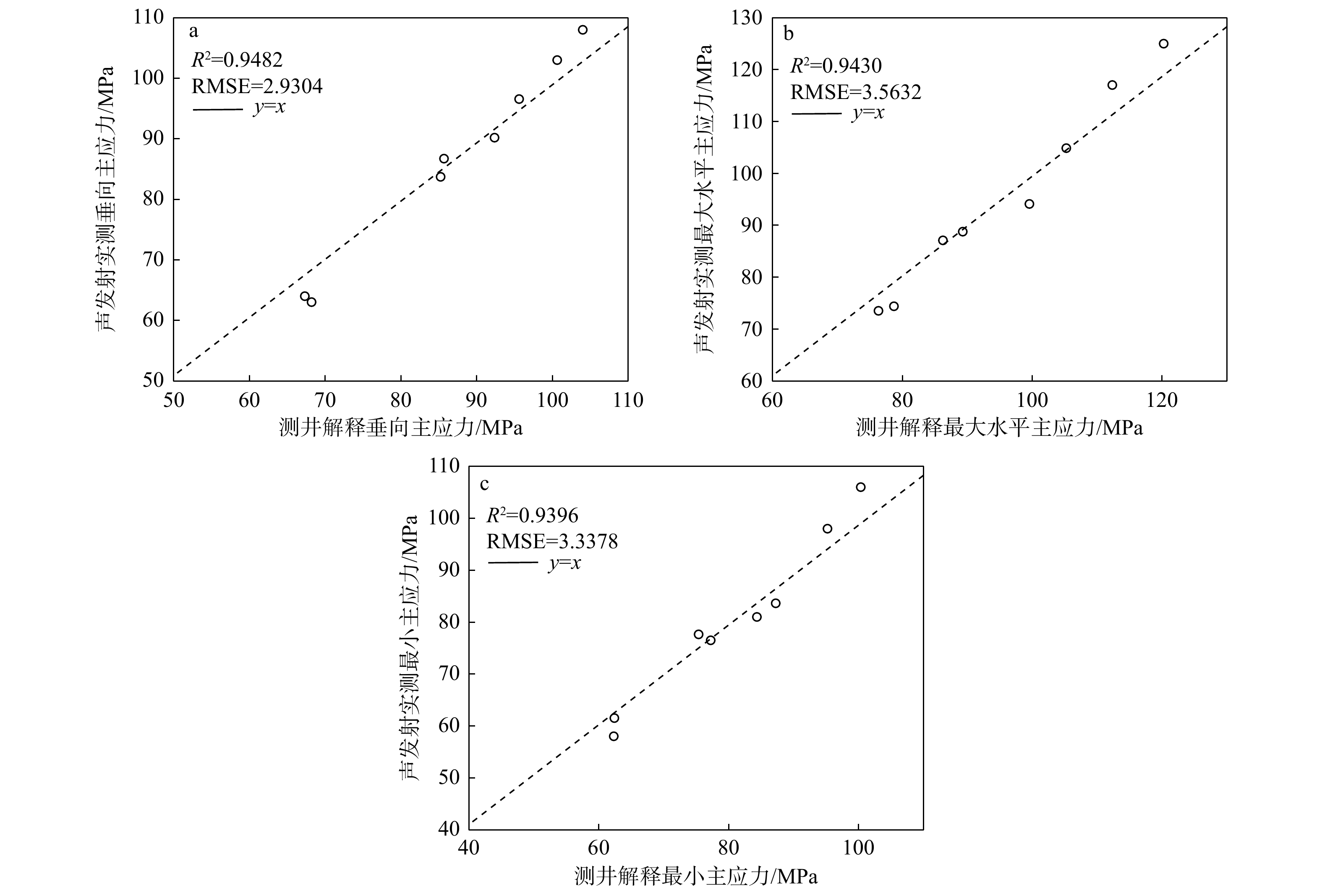
图 7 DS9井地应力大小测井解释与声发射测试结果交会图
a—垂向主应力;b—最大水平主应力;c—最小水平主应力
Figure 7. Cross-plot of logging interpretation and acoustic emission test results for in-situ stress magnitude in well DS9
(a) Vertical principal stress; (b) Maximum horizontal principal stress; (c) Minimum horizontal principal stress
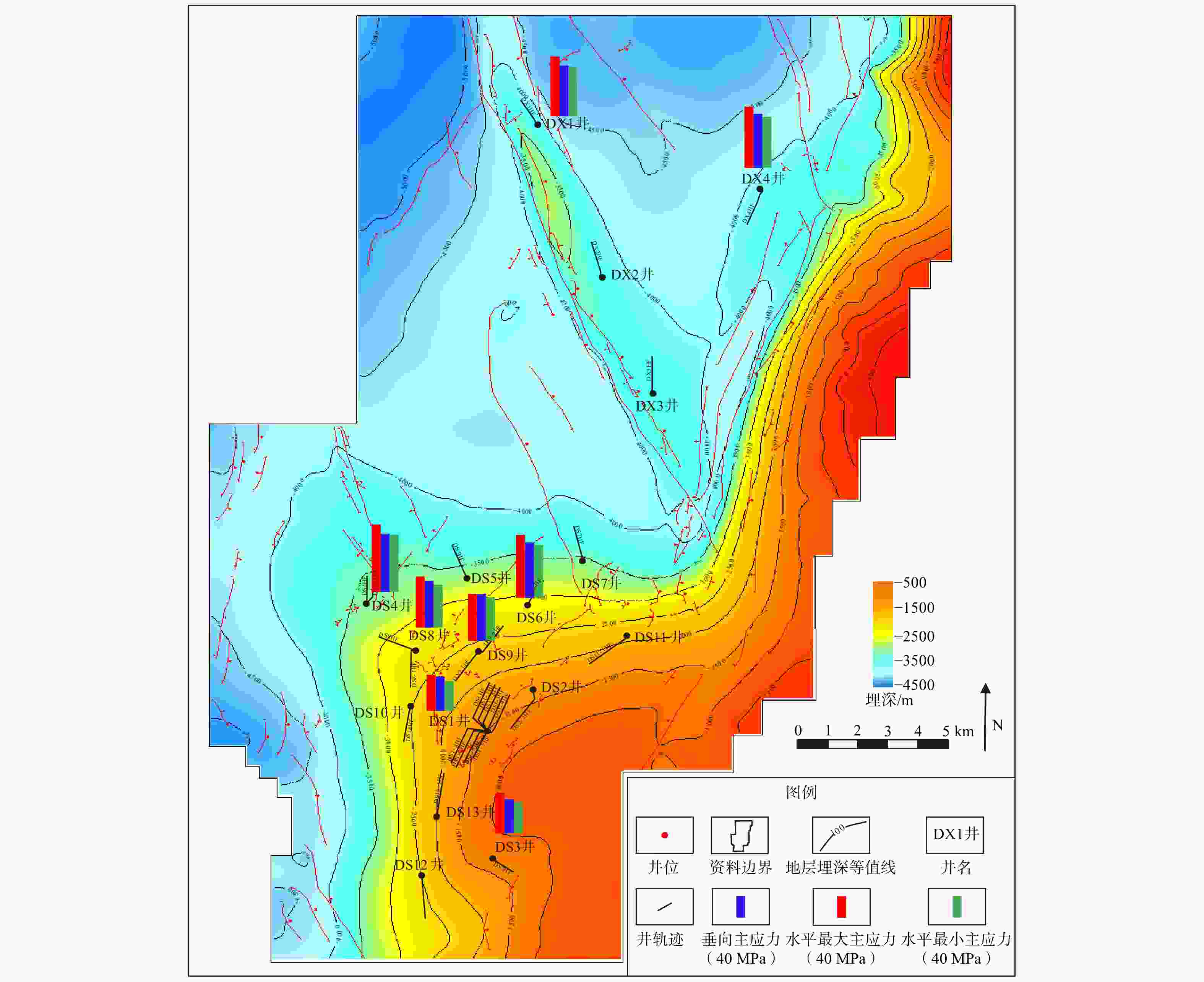
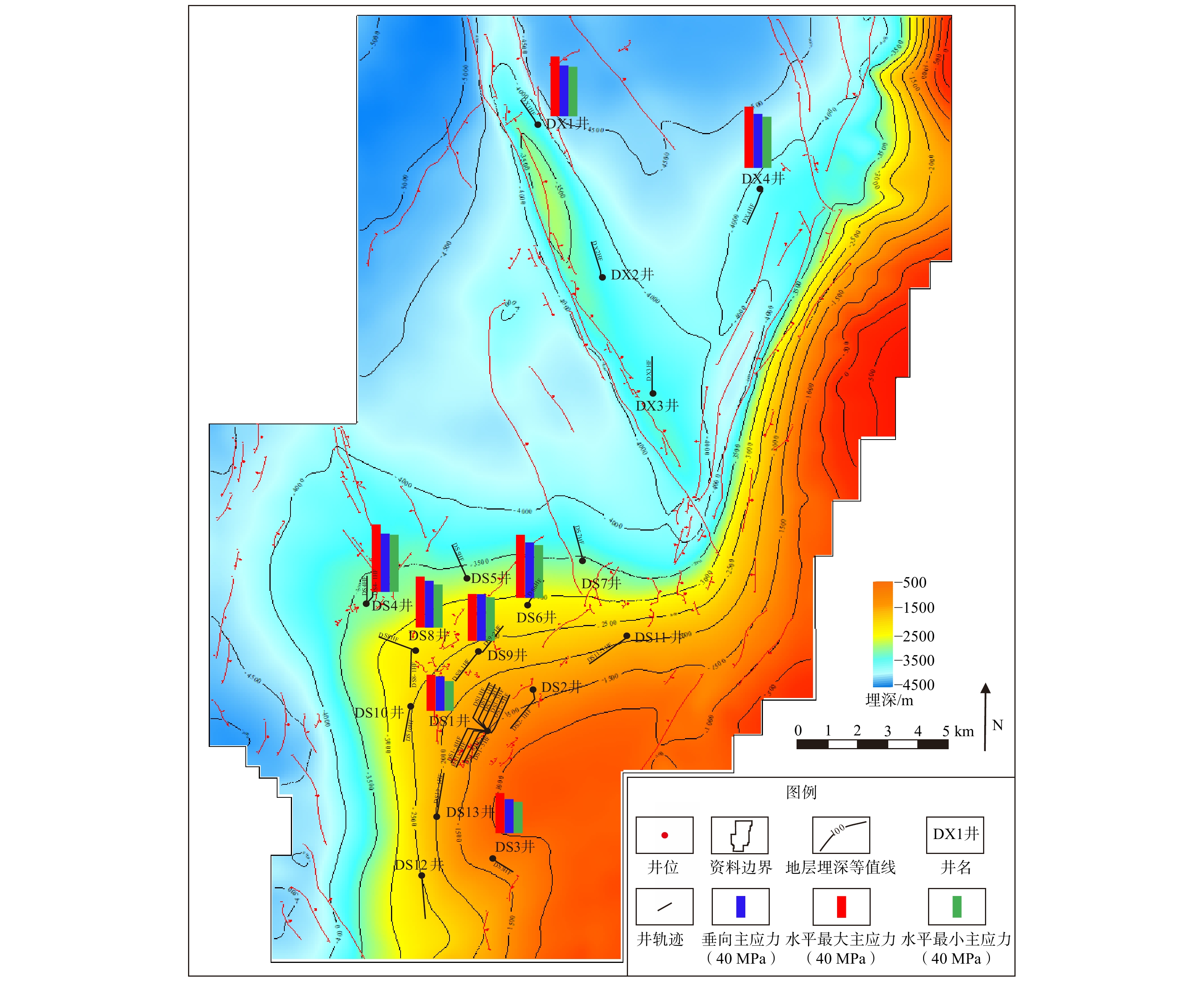
图 8 丁山−东溪地区龙一段关键井现今地应力大小分布特征
Figure 8. Distribution characteristics of current in-situ stress magnitude of key wells in the first member of the Longmaxi Formation, Dingshan–Dongxi area
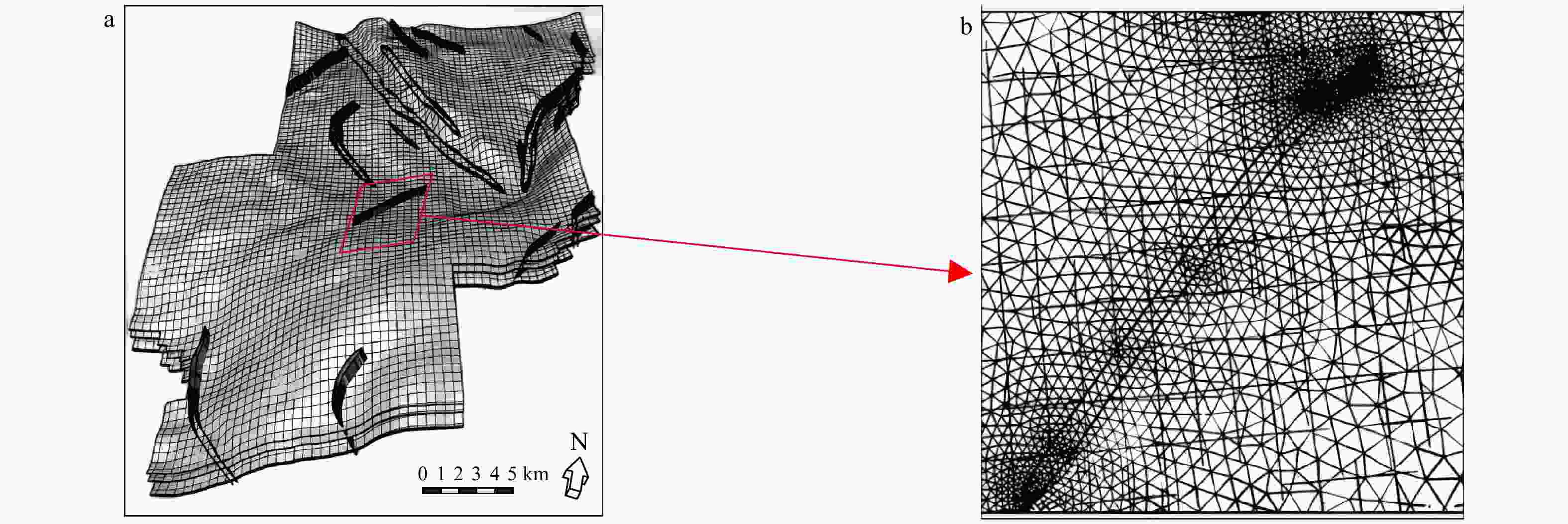
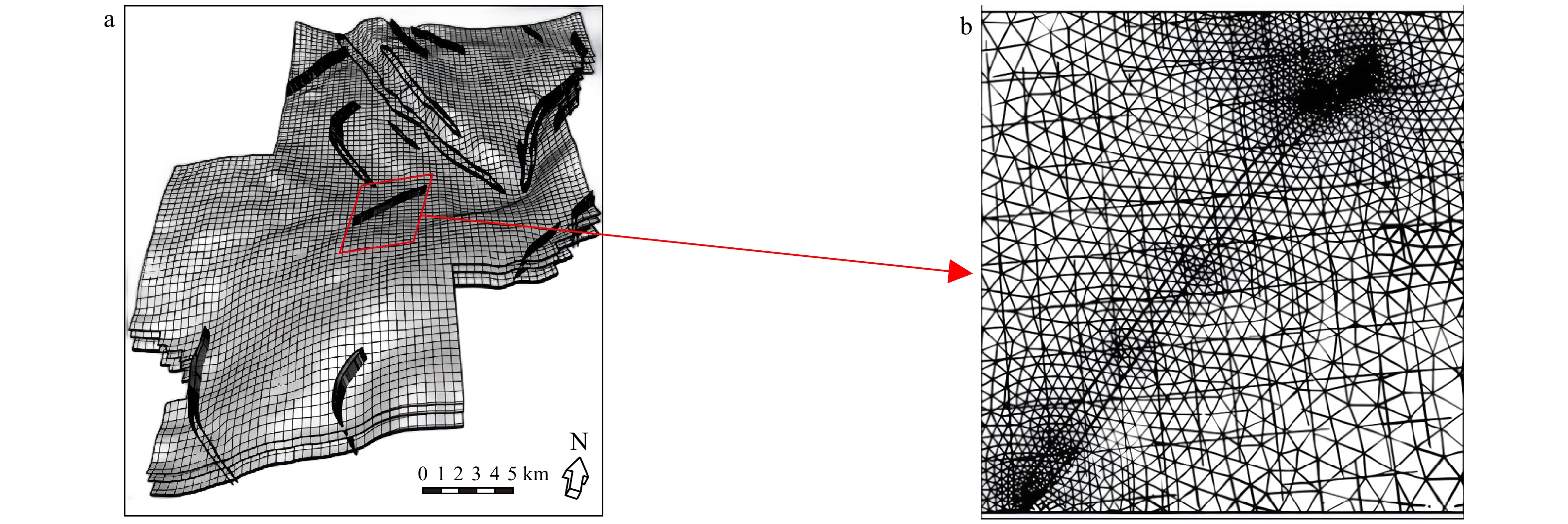
图 9 地应力场模拟网格模型
a—网格自适应加密技术示意图;b—加密网格对比图
Figure 9. Grid model for in-situ stress field simulation
(a) Schematic diagram of adaptive mesh refinement; (b) Comparison diagram of refined meshes
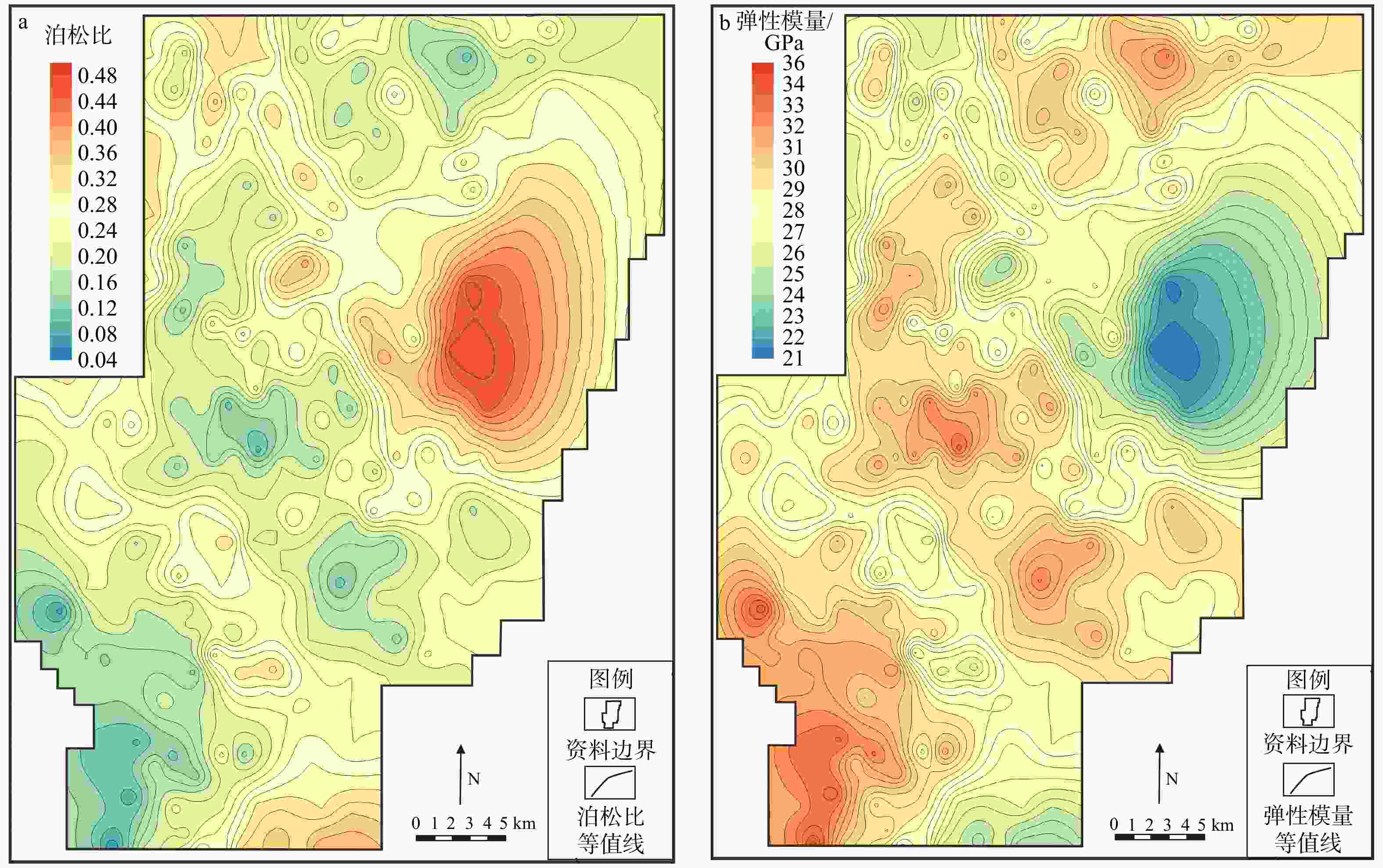
图 10 丁山-东溪地区龙一段1小层弹性参数分布图
a—泊松比;b—弹性模量
Figure 10. Distribution of elastic parameters in layer 1 of the first member of the Longmaxi Formation, Dingshan–Dongxi area
(a) Poisson's ratio; (b) Elastic modulus
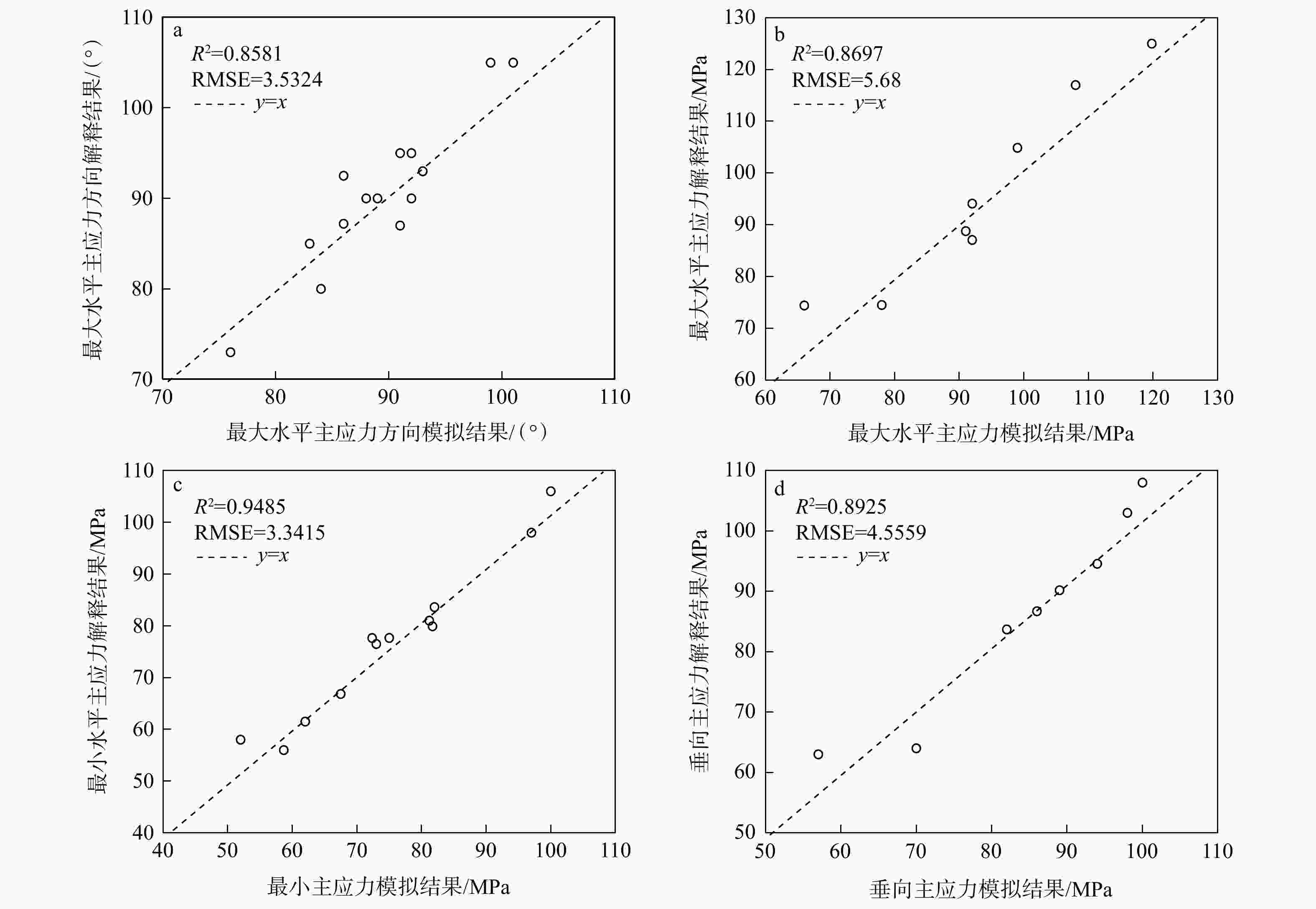
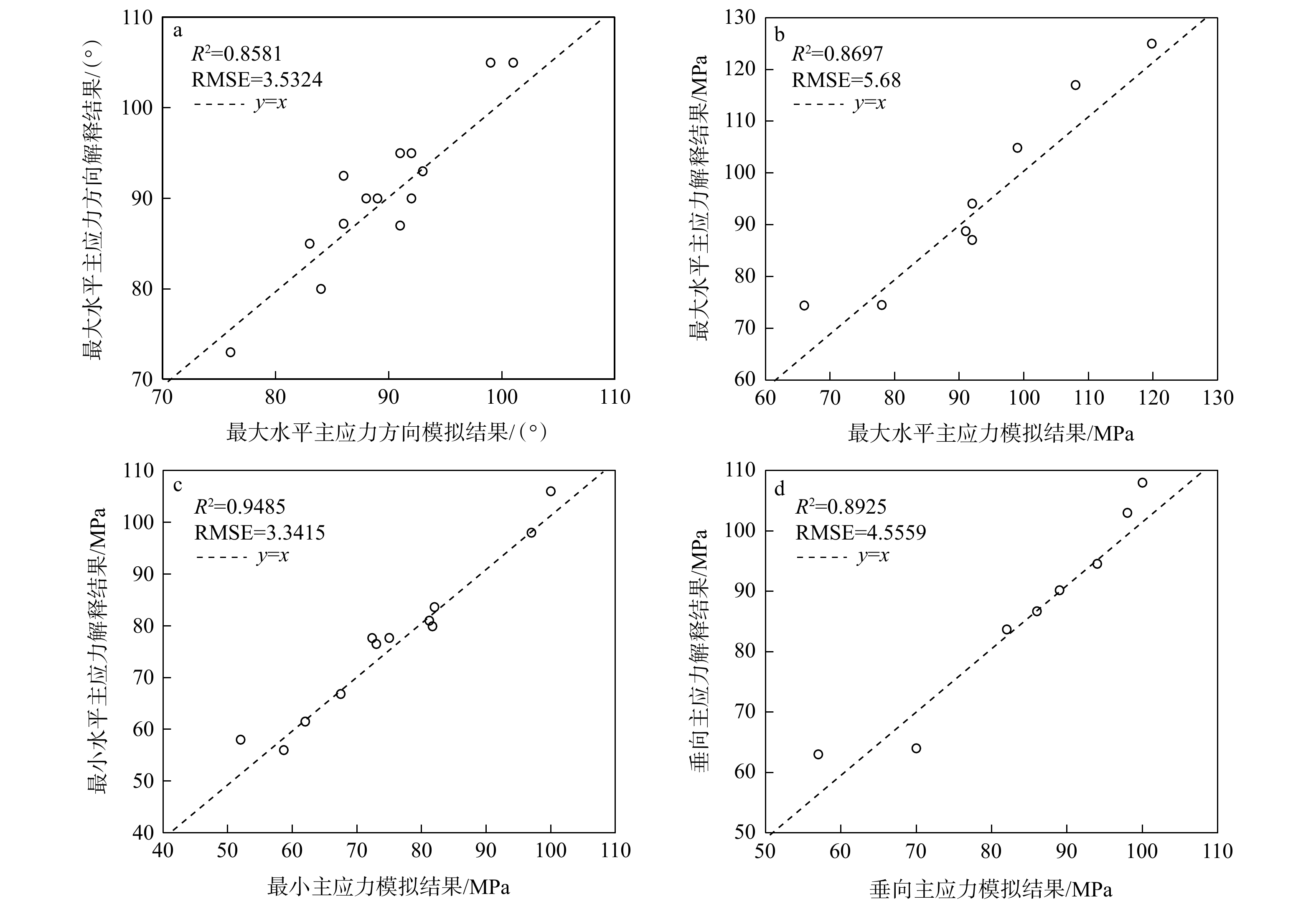
图 11 丁山−东溪地区现今地应力模拟结果与解释结果交会图
a—最大水平主应力方向;b—最大水平主应力大小;c—最小水平主应力大小;d—垂向主应力大小
Figure 11. Cross-plot of simulation and interpretation results for current in-situ stress in the Dingshan–Dongxi area
(a) Maximum horizontal principal stress direction; (b) Maximum horizontal principal stress magnitude; (c) Minimum horizontal principal stress magnitude; (d) Vertical principal stress
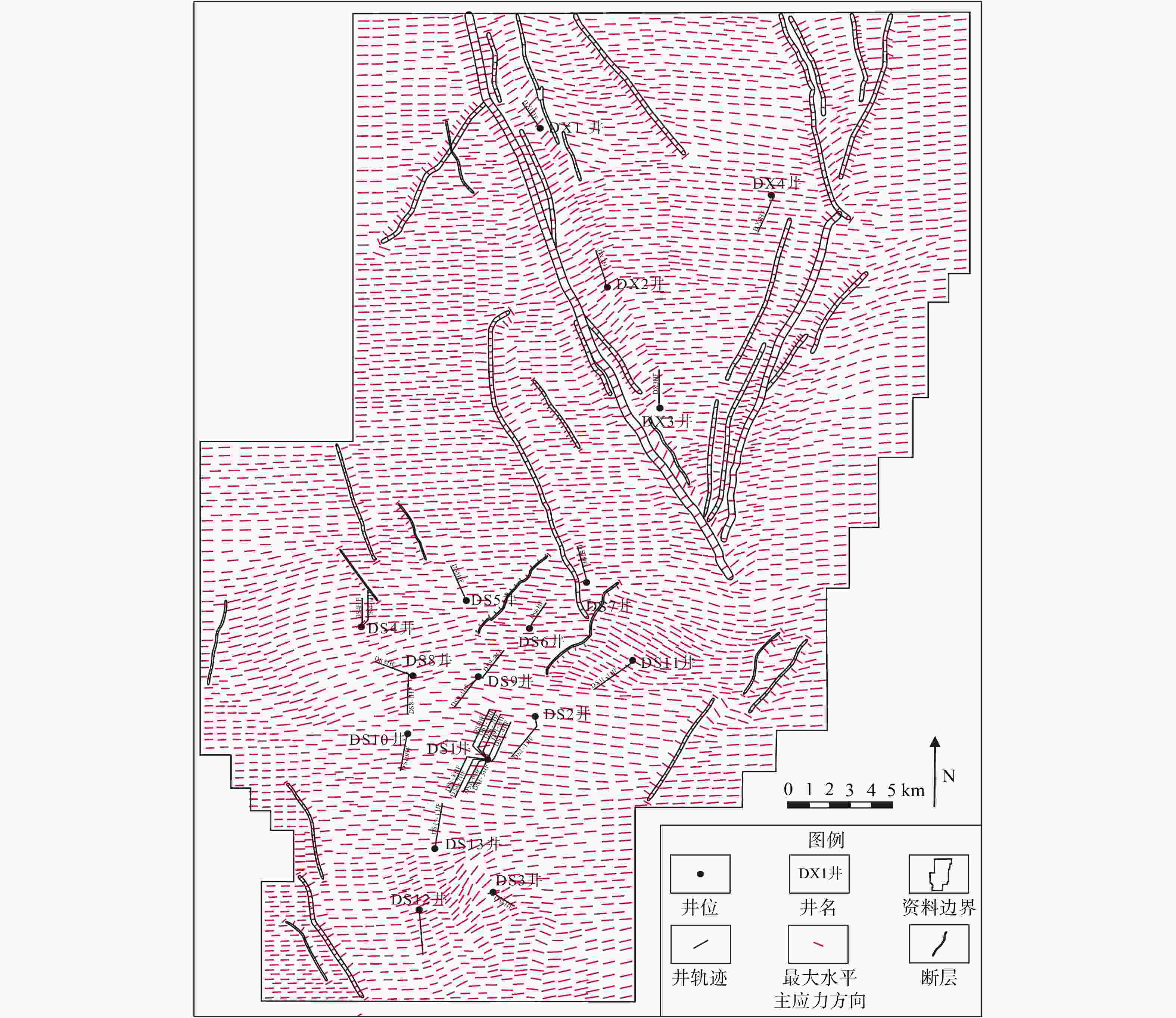
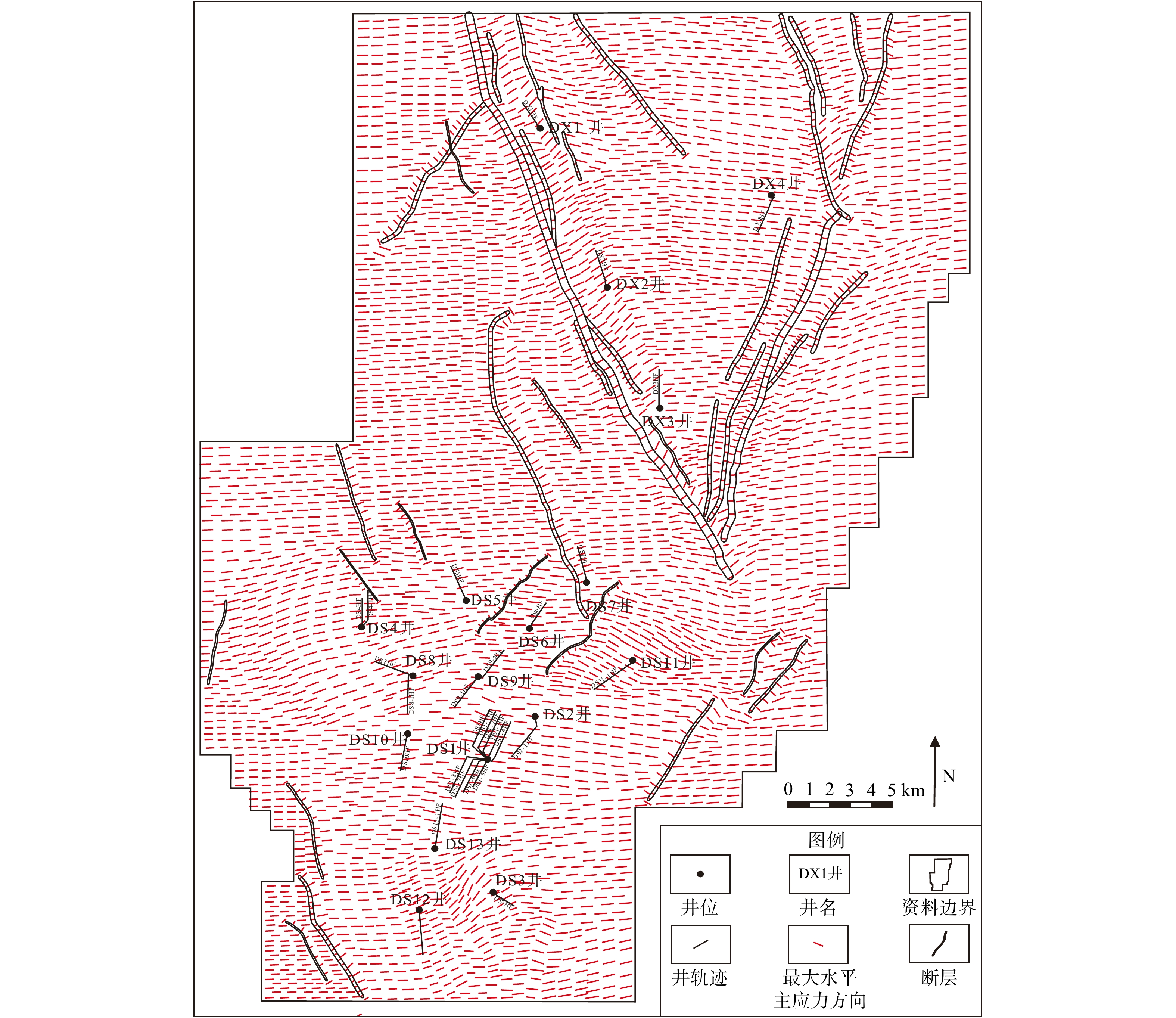
图 12 丁山-东溪地区龙一段3小层最大水平主应力分布图
Figure 12. Distribution map of maximum horizontal principal stress in layer 3 of the first member, Longmaxi Formation, Dingshan–Dongxi area
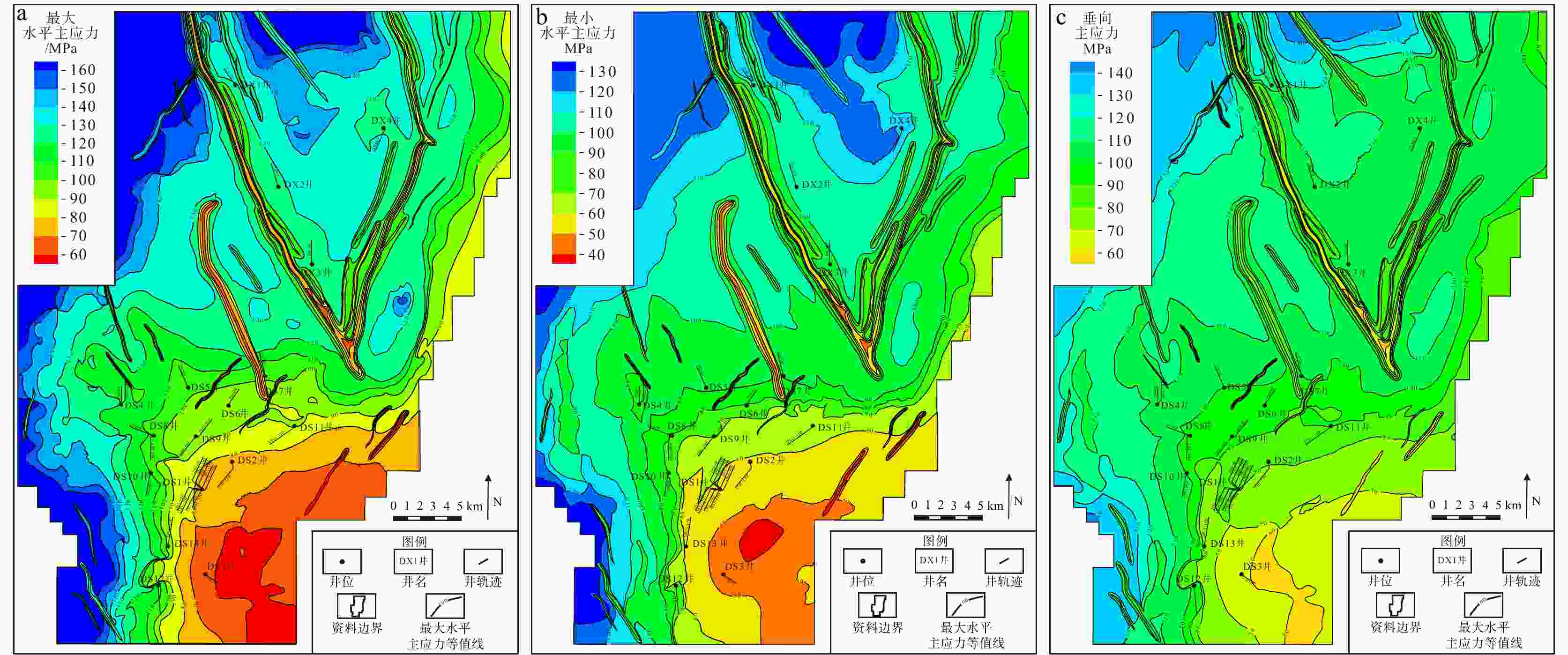
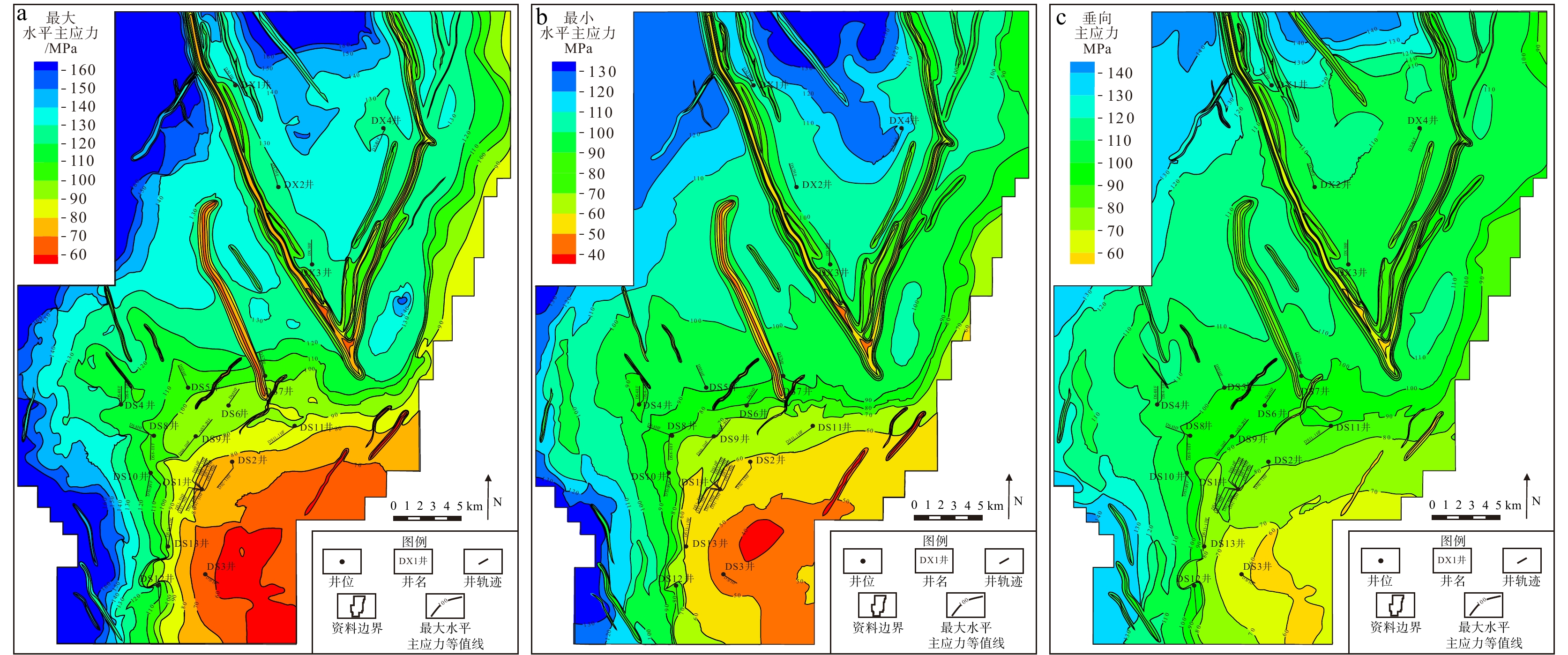
图 13 丁山−东溪地区龙一段3小层应力大小分布图
a—最大水平主应力;b—最小水平主应力;c—垂向主应力
Figure 13. Distribution map of in-situ stress magnitude in layer 3 of the first member, Longmaxi Formation, Dingshan–Dongxi area
(a) Maximum horizontal principal stress; (b) Minimum horizontal principal stress; (c) Vertical principal stress
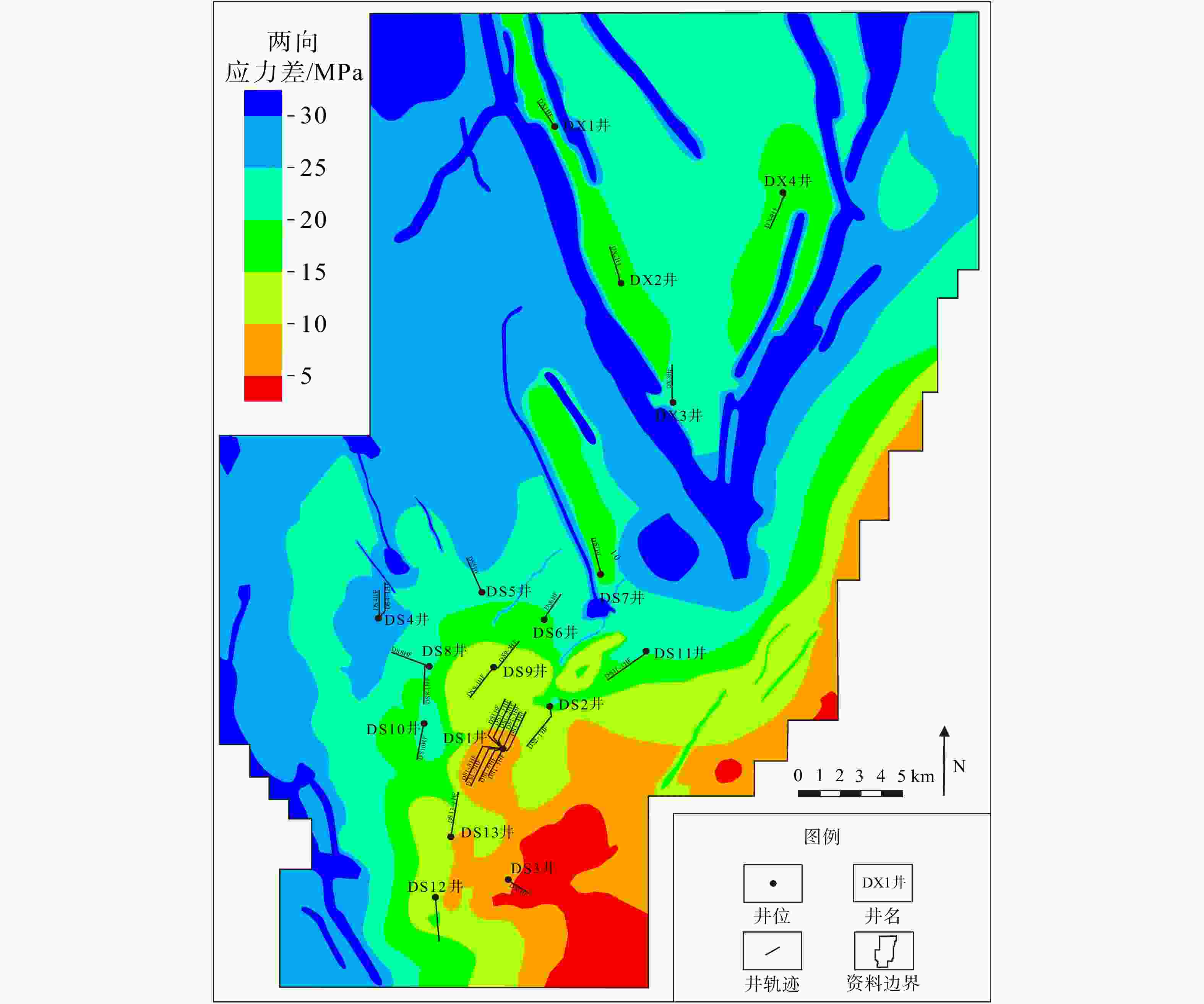
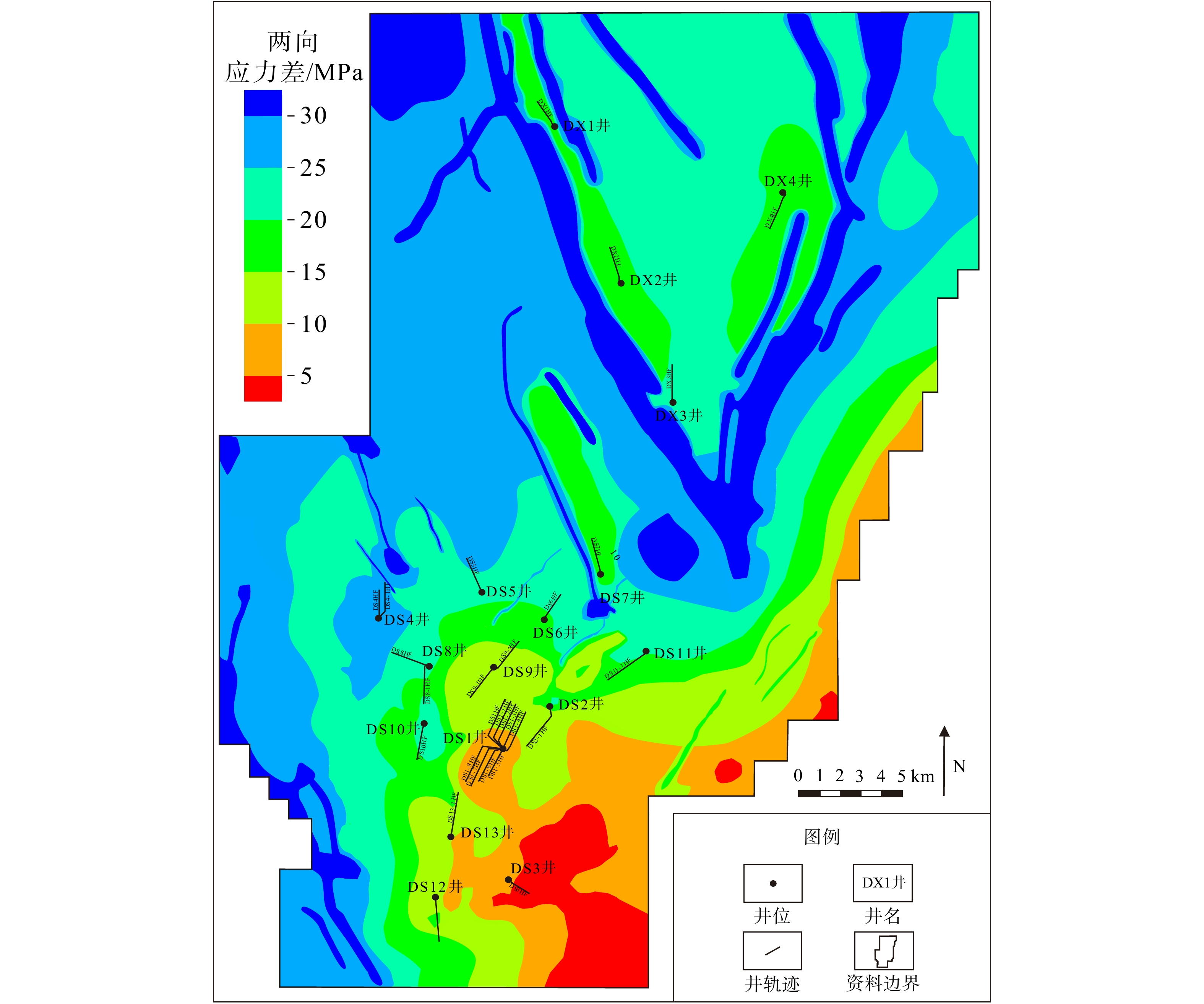
图 14 丁山-东溪地区龙一段3小层水平两向应力差分布图
Figure 14. Distribution of horizontal stress difference in layer 3 of the first member, Longmaxi Formation, Dingshan–Dongxi area
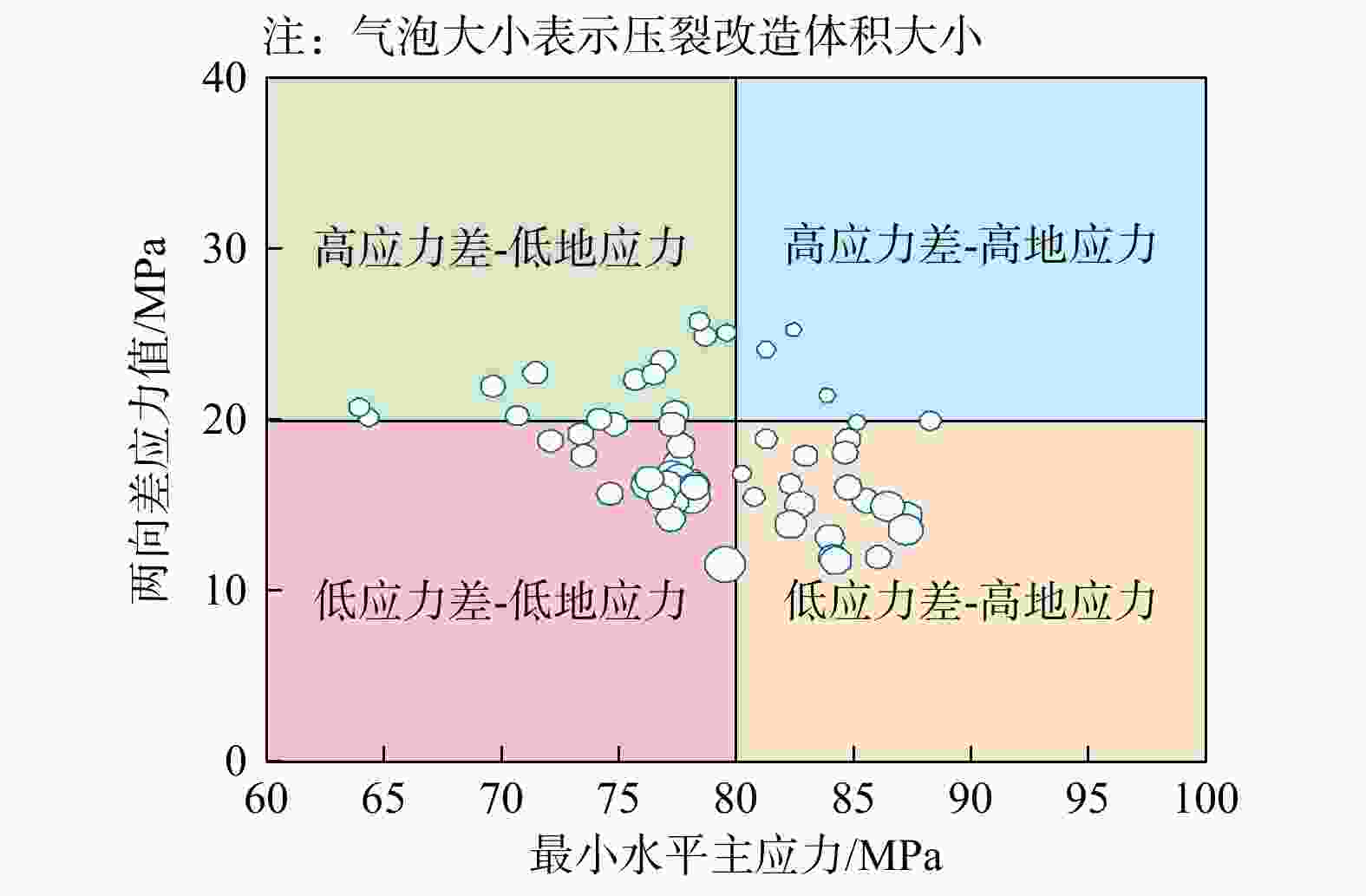
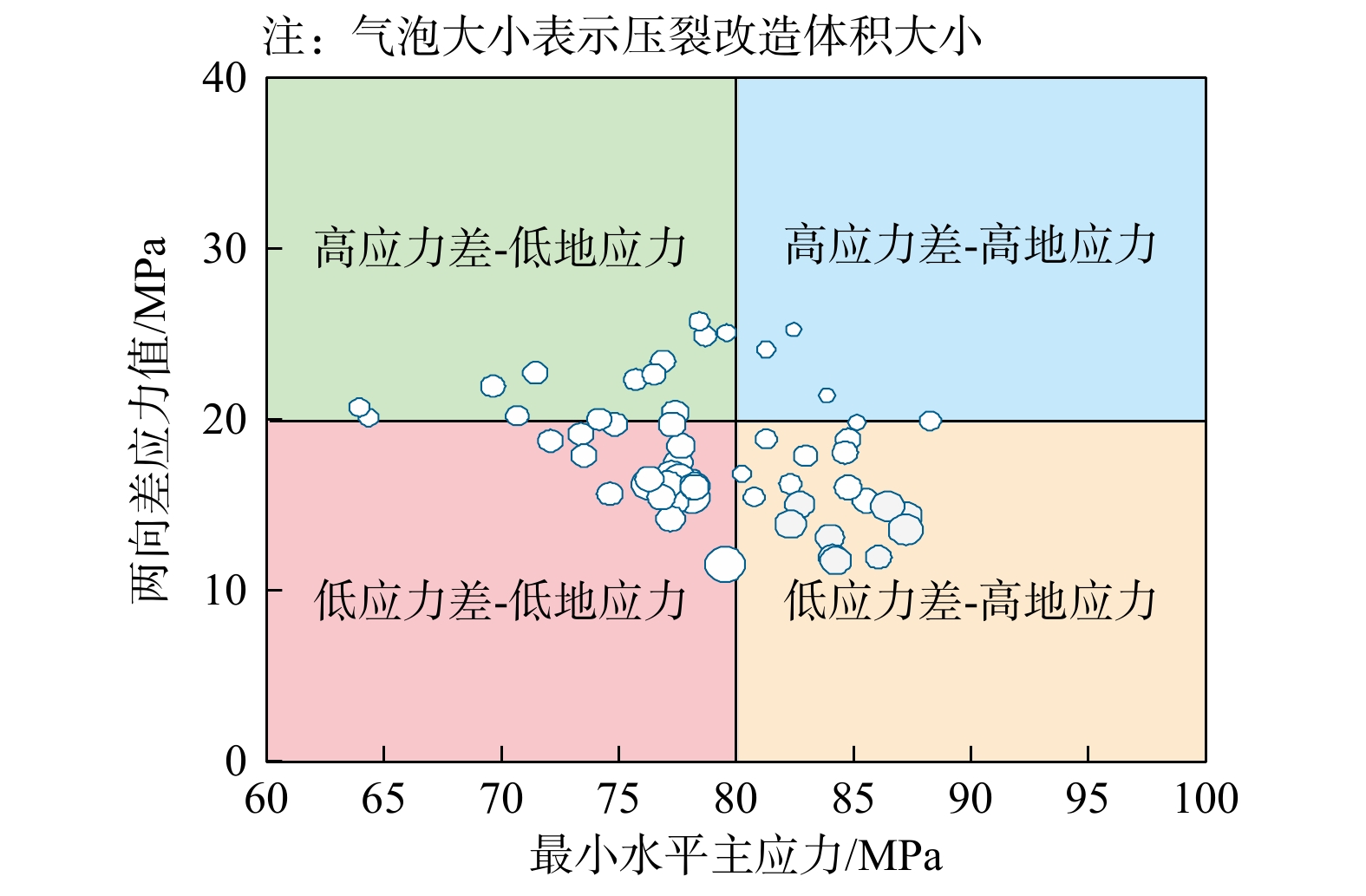
图 15 应力分区准则示意图
气泡大小表示压裂改造体积
Figure 15. Diagram of stress zoning criteria
The size of the bubbles indicates the simulated volume.
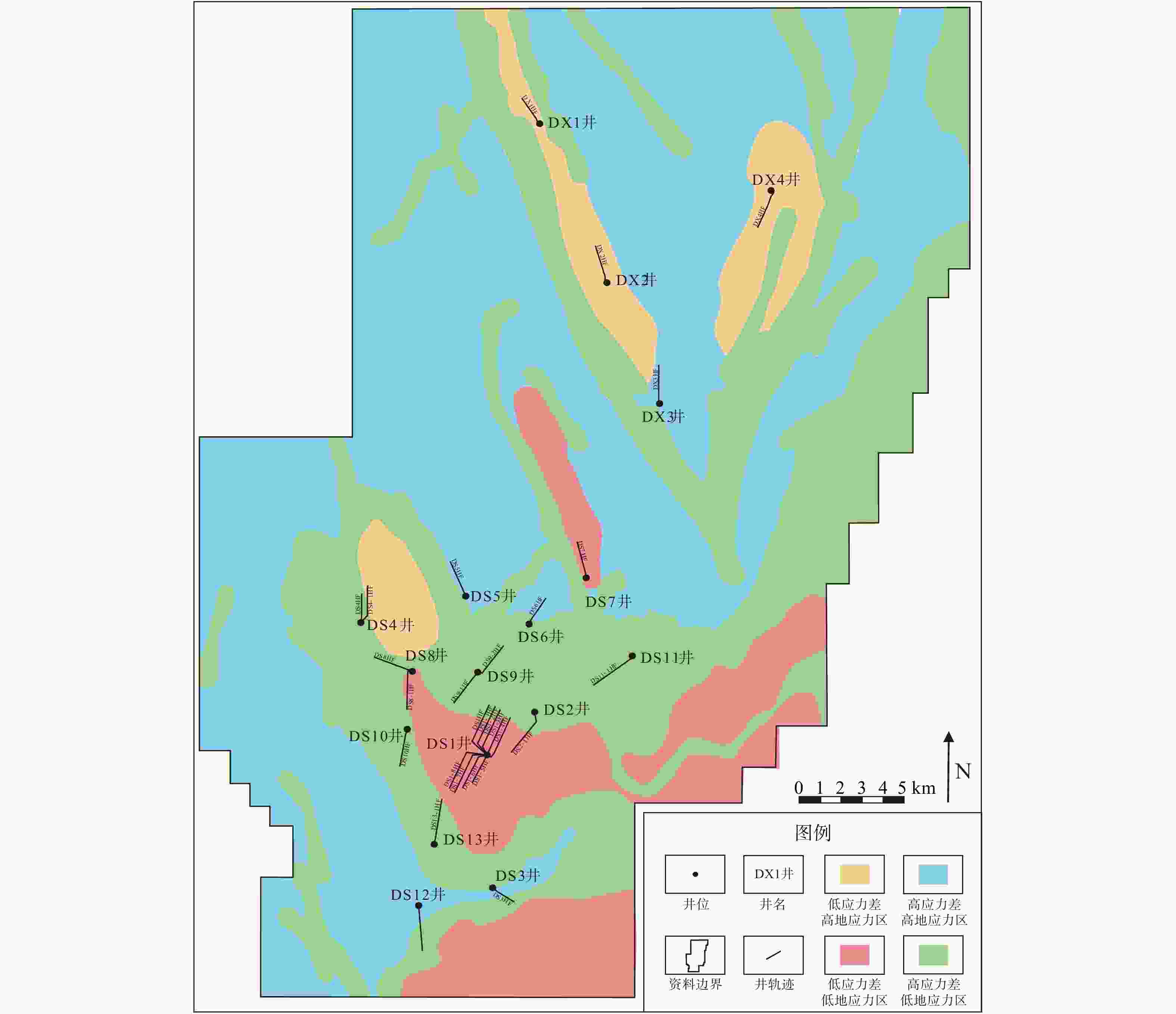
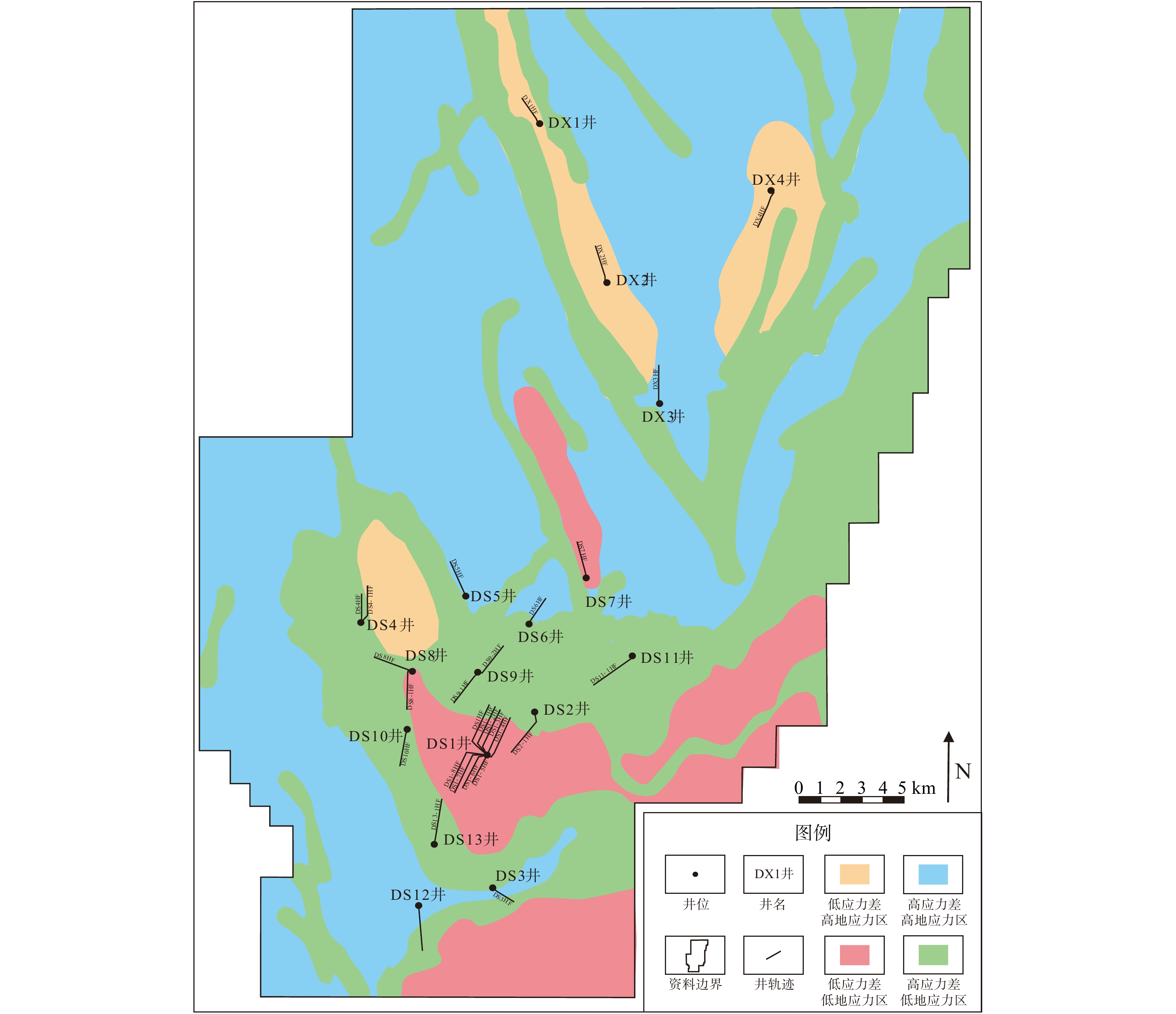
图 16 丁山−东溪地区龙一段3小层应力分区结果图
Figure 16. Stress zoning result in layer 3 of the first member, Longmaxi Formation, Dingshan–Dongxi area
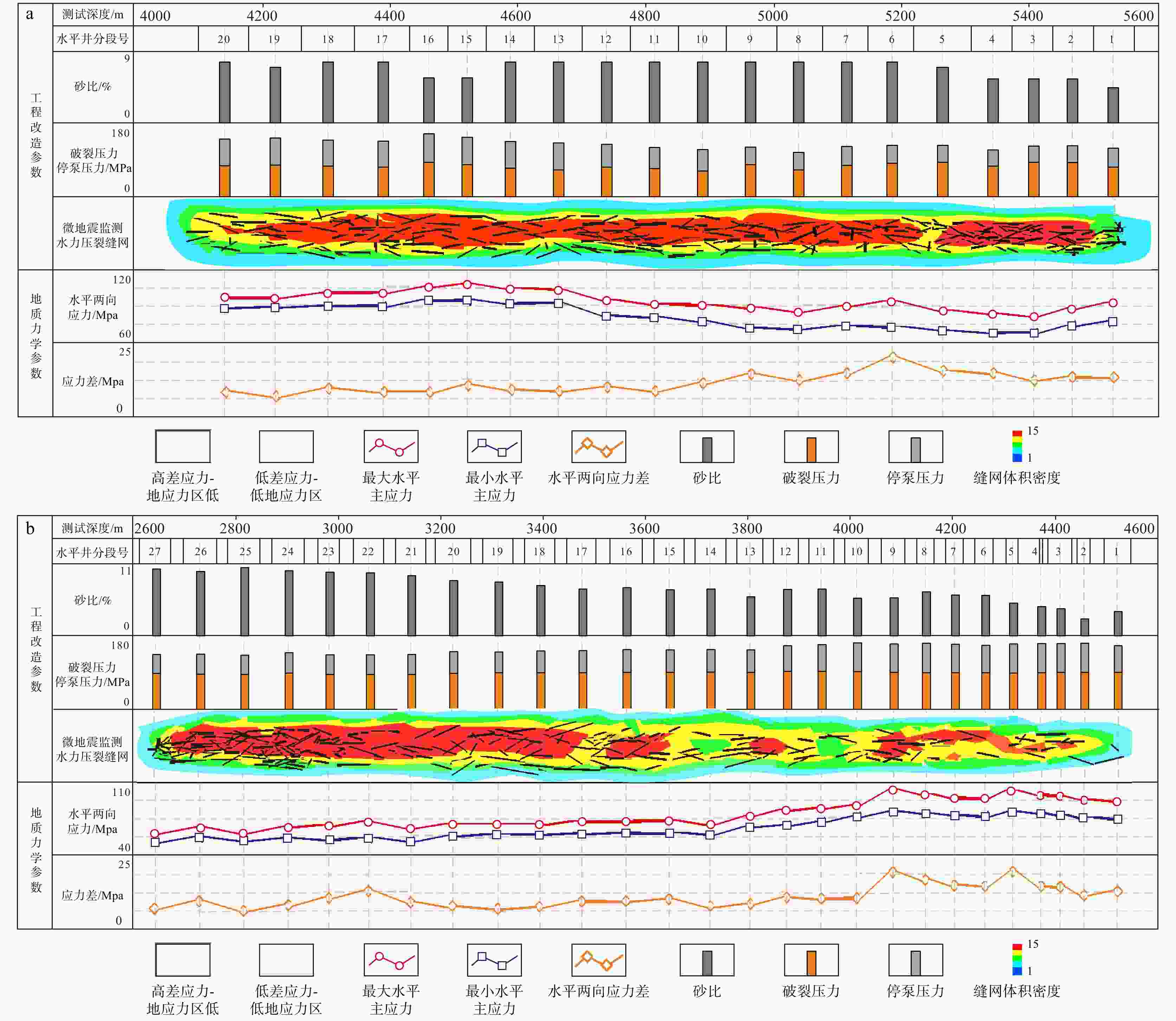
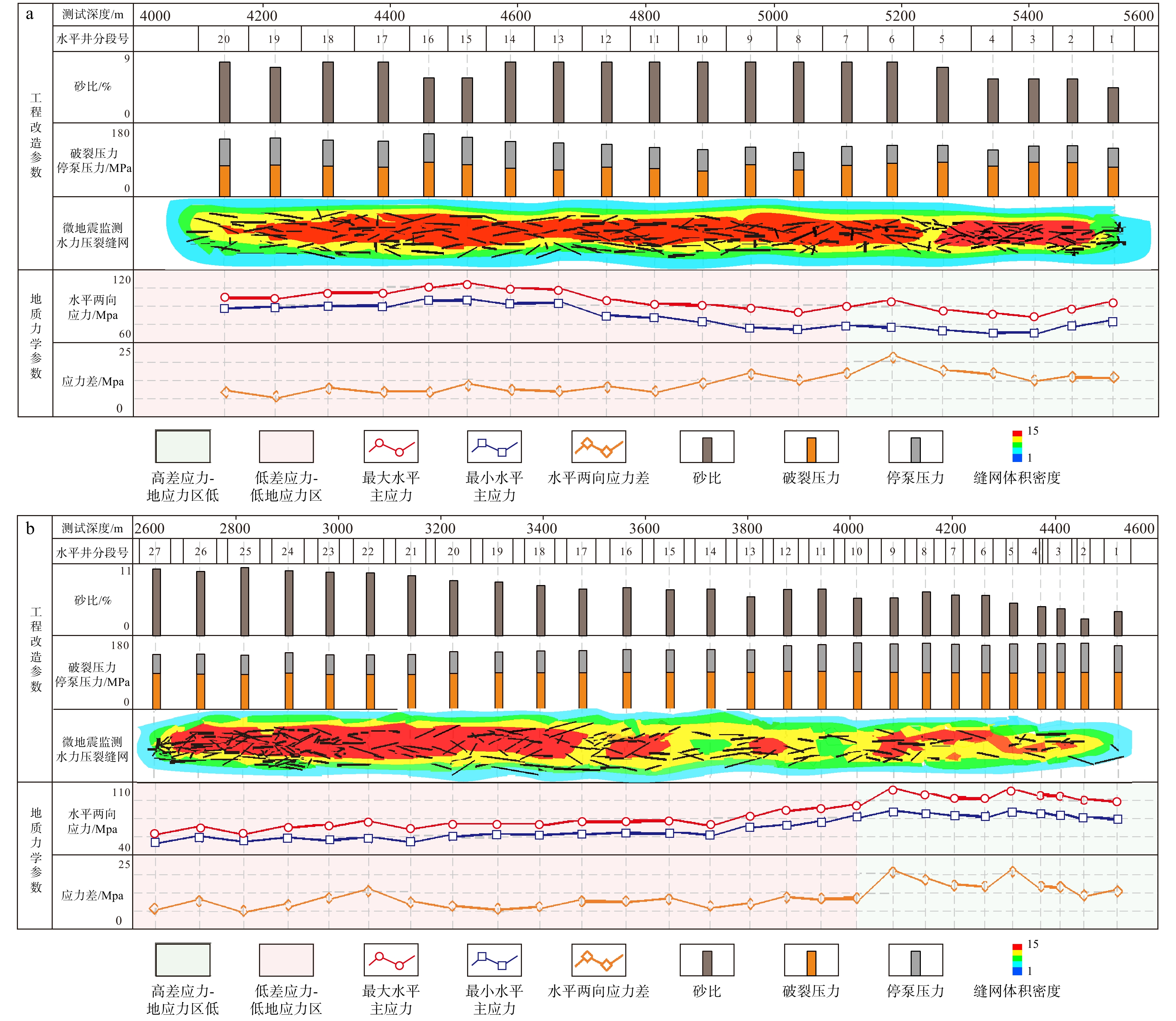
图 17 单井压裂改造效果与应力状态对应关系图
a—DS8-1HF井;b—DS1-2HF井
Figure 17. Correspondence diagram between single-well fracturing stimulation effect and stress state
(a) Well DS8-1HF; (b) Well DS1-2HF
表 1 岩芯实验测试确定的现今地应力方向
Table 1. Current in-situ stress direction interpreted from core experimental test data
井名 层位 深度/m 岩芯定向方位 最大水平主应力方向与标志线夹角 最大水平主应力方向 DS4井 3 4355.83 NE 147.2° 120° NE 87.2° DS4井 1 4366.02 NE 182.4° 70° NE 72.4° DS6井 3 3723.13 NE 172.5° 100° NE 92.5° DS8井 3 3810.19 NE 127.4° 130° NE 77.4° DS8井 1 3813.68 NE 190.2° 70° NE 80.2° DS9井 3 3441.24 NE 40.9° 50° NE 90.9° DS9井 3 3444.60 NE105.3° 170° NE 95.3°  下载: 导出CSV
表 2 基于水压致裂的丁山−东溪地区现今地应力大小解释结果
Table 2. In-situ stress magnitude determined by hydraulic fracturing method in the Dingshan–Dongxi area
井名 垂深/m 瞬时停泵压力/MPa 最小主应力/MPa DS1-6HF 2335.70 43.79 63.64 DS1-2HF 2609.33 42.19 64.37 DS8-1HF 3777.00 50.64 82.74 DS6-1HF 3399.68 38.36 67.26
下载: 导出CSV
表 3 基于声发射实验的丁山−东溪地区龙马溪组龙一段现今地应力大小
Table 3. Current in-situ stress magnitude of the first member of the Longmaxi Formation, Dingshan–Dongxi area determined by acoustic emission tests
井名 深度/m 层号 垂向主应力/MPa 最大水平
主应力/MPa最小水平
主应力/MPaDS9井 3441.24 3 83.69 88.77 76.49 DS9井 3444.60 3 86.70 87.07 81.00 DS9井 3449.02 1 90.18 94.09 83.62 DS9井 3451.34 1 94.56 104.87 77.66 DS4HF井 4395.00 3 108.00 125.00 106.00 DS6HF井 3966.00 3 103.00 117.00 98.00 DS3HF井 2180.00 3 63.00 74.40 58.00 DS1-3HF井 2413.50 3 64.00 73.50 61.50
下载: 导出CSV
表 4 丁山−东溪地区不同期次断裂内岩石力学参数赋值表
Table 4. Rock mechanical parameters for faults of different stages, Dingshan–Dongxi area
断裂分期 弹性模量/GPa 泊松比 内摩擦力/MPa 内摩擦角/(°) 抗拉强度/MPa 喜山期断裂或燕山晚期
形成且后期复活断裂6.586 0.34 5.02 15.52 2.69 燕山期形成且后期活动较弱断裂 11.235 0.30 9.35 24.89 5.98
下载: 导出CSV
表 5 丁山−东溪地区应力加载情况表
Table 5. Stress loading conditions in the Dingshan–Dongxi area
垂向主应力/
MPa垂向主应力梯度/
(MPa/100 m)最大水平主应力/
MPa最大主应力梯度/
(MPa/100 m)最小水平主应力/
MPa最小主应力梯度/
(MPa/100 m)最大主应力方向/
(°)86.64 2.61 92.41 2.90 77.50 2.42 85
下载: 导出CSV
-
[1] BAI X, ZHANG D M, WANG H, et al., 2018. A novel in situ stress measurement method based on acoustic emission Kaiser effect: a theoretical and experimental study[J]. Royal Society Open Science, 5(10): 181263. doi: 10.1098/rsos.181263 [2] BOUCHACHI Y, BOUDELLA A, BOUROUIS S, et al., 2022. In-situ stress analysis of Ahnet Basin, South western Algeria: a 1D geomechanical approach[J]. Journal of African Earth Sciences, 196: 104678. doi: 10.1016/j.jafrearsci.2022.104678 [3] CHEN S D, TANG D Z, TAO S, et al., 2021. Implications of the in situ stress distribution for coalbed methane zonation and hydraulic fracturing in multiple seams, western Guizhou, China[J]. Journal of Petroleum Science and Engineering, 204: 108755. doi: 10.1016/j.petrol.2021.108755 [4] CHEN S J, XIAO M, CHEN J T, et al., 2020. Disturbance law of faults to in-situ stress field directions and its inversion analysis method[J]. Chinese Journal of Rock Mechanics and Engineering, 39(7): 1434-1444. (in Chinese with English abstract) [5] CHEN X H, 2023. Evaluation and engineering application of current in-situ stress for shale reservoir of Longmaxi Formation in Dingshan-Dongxi area[D]. Chengdu: Chengdu University of Technology. (in Chinese with English abstract) [6] DENG J G, CHEN Z R, GENG Y N, et al., 2013. Prediction model for in-situ formation stress in shale reservoirs[J]. Journal of China University of Petroleum, 37(6): 59-64. (in Chinese with English abstract) [7] DENG N E, XU H, DENG H C, et al., 2025. Characteristics of fracture system disturbance on present-day geostress: an example of deep shale gas in the North Luzhou district, Sichuan Basin[J]. Geology in China, 52(1): 95-110. (in Chinese with English abstract) [8] HAN Y N, FENG Y C, LI X R, et al., 2020. Evaluation of in-situ stress orientation: a laboratory approach combining paleomagnetic test and acoustic anisotropy test[J]. Journal of Petroleum Science and Engineering, 195: 107870. doi: 10.1016/j.petrol.2020.107870 [9] HAN Z H, ZHOU J, ZHANG L Q, 2018. Influence of grain size heterogeneity and in-situ stress on the hydraulic fracturing process by PFC2D modeling[J]. Energies, 11(6): 1413. doi: 10.3390/en11061413 [10] HE J H, XIONG L, WANG R Y, et al., 2025. Disturbance factors of current geostress field of Longmaxi Formation shale in southeastern Sichuan Basin and their geological significance for gas exploitation[J]. Acta Petrolei Sinica, 46(4): 743-762. (in Chinese with English abstract) [11] HOU S X, TIAN G R, 1999. Palaeomagnetic orientation of cores and its applications for insitu stress measurements[J]. Journal of Geomechanics, 5(1): 90-96. (in Chinese with English abstract) [12] HU D F, WEI Z H, LIU R B, et al., 2023. Discovery of the Qijiang shale gas field in a structurally complex region on the southeastern margin of the Sichuan Basin and its implications[J]. Oil & Gas Geology, 44(6): 1418-1429. (in Chinese with English abstract) [13] KURITA K, FUJII N, 1979. Stress memory of crystalline rocks in acoustic emission[J]. Geophysical Research Letters, 6(1): 9-12. doi: 10.1029/GL006i001p00009 [14] LI F, 2012. Numerical simulation of 3D in-situ stress in Hailaer oil field[J]. Procedia Environmental Sciences, 12: 273-279. doi: 10.1016/j.proenv.2012.01.277 [15] LI X B, CHEN J Z, MA C D, et al., 2022. A novel in-situ stress measurement method incorporating non-oriented core ground re-orientation and acoustic emission: a case study of a deep borehole[J]. International Journal of Rock Mechanics and Mining Sciences, 152: 105079. doi: 10.1016/j.ijrmms.2022.105079 [16] LI Z, LI G, YU H, et al., 2022. Fracability evaluation based on the three-dimensional geological numerical simulation of in situ stress: case study of the Longmaxi Formation in the Weirong Shale Gas Field, southwestern China[J]. Mathematical Geosciences, 54(6): 1069-1096. doi: 10.1007/s11004-022-10001-5 [17] LIU J G, XU B, SUN L, et al., 2022. In situ stress field in the Athabasca oil sands deposits: field measurement, stress-field modeling, and engineering implications[J]. Journal of Petroleum Science and Engineering, 215: 110671. doi: 10.1016/j.petrol.2022.110671 [18] MENG Z P, WANG Y H, ZHANG K, et al., 2019. Analysis of hydraulic fracturing cracks for coal reservoirs and in-situ stress direction in Southern Qinshui Basin[J]. Coal Science and Technology, 47(10): 216-222. (in Chinese with English abstract) [19] QIU N S, FENG Q Q, BORJIGIN T, et al., 2020. Yanshanian-Himalayan differential tectono-thermal evolution and shale gas preservation in Dingshan area, southeastern Sichuan Basin[J]. Acta Petrolei Sinica, 41(12): 1610-1622. (in Chinese with English abstract) [20] REN P F, WANG Q, TANG D Z, et al., 2022. In situ stress–coal structure relationship and its influence on hydraulic fracturing: a case study in Zhengzhuang Area in Qinshui Basin, China[J]. Natural Resources Research, 31(3): 1621-1646. doi: 10.1007/s11053-022-10036-9 [21] SU H, LI R X, DENG H C, et al., 2024. Comprehensive evaluation of geological and engineering factors affecting fracturing effectiveness in tight sandstone reservoirs[J]. Petroleum Geology & Experiment, 46(6): 1349-1361. (in Chinese with English abstract) [22] TANG X M, CHUNDURU R K, 1999. Simultaneous inversion of formation shear-wave anisotropy parameters from cross-dipole acoustic-array waveform data[J]. Geophysics, 64(5): 1502-1511. doi: 10.1190/1.1444654 [23] TANG Y, ZHOU L F, CHEN K Q, et al., 2018. Analysis of tectonic stress field of southeastern Sichuan and formation mechanism of tectonic deformation[J]. Geological Review, 64(1): 15-28. (in Chinese with English abstract) [24] TIAN H, ZENG L B, XU X, et al., 2021. Factors influencing the in-situ stress orientations in shales: a case study of the Wufeng-Longmaxi formations in the Jiaoshiba area, southeastern Sichuan Basin, China[J]. Journal of Natural Gas Science and Engineering, 94: 104110. doi: 10.1016/j.jngse.2021.104110 [25] WANG H J, GONG W L, YUAN G X, et al., 2022. Effect of in-situ stress on hydraulic fracturing of tight sandstone based on discrete element method[J]. Energies, 15(15): 5620. doi: 10.3390/en15155620 [26] WANG K, HAN W, WANG G, et al., 2017. Effect of in-situ stress to hydraulic fracturing[J]. Coal Technology, 36(12): 130-132. (in Chinese with English abstract) [27] WANG Q Y, 2009. Study on 3-D stress field for Economical effective development low permeability oil and gas resources in Daqing oil field[D]. Beijing: China University of Geosciences (Beijing). (in Chinese with English abstract) [28] WANG Y Y, 2021. Evaluation and application of current in-situ stress field of shale reservoir in complex tectonic area: take Long 1st Member shale in YC area as an example[D]. Chengdu: Chengdu University of Technology. (in Chinese with English abstract) [29] WEI S M, JIN Y, KAO J W, et al. , 2022. Reservoir stress evolution and fracture optimization of infill wells during the drilling-fracturing-production process[J]. Acta Petrolei Sinica, 43(9): 1305-1314, 1324. (in Chinese with English abstract) [30] WENG J Q, ZENG L B, LYU W Y, et al., 2020. Width of stress disturbed zone near fault and its influencing factors[J]. Journal of Geomechanics, 26(1): 39-47. (in Chinese with English abstract) [31] XIONG L, YANG Z H, SHEN B J, et al., 2022. Micro reservoir space characteristics and significance of deep shale gas in Wufeng-Longmaxi formations in Weirong area, South Sichuan[J]. Natural Gas Geoscience, 33(6): 860-872. (in Chinese with English abstract) [32] XU K, TIAN J, YANG H J, et al., 2020. Prediction of current in-situ stress filed and its application of deeply buried tight sandstone reservoir: a case study of Keshen 10 gas reservoir in Kelasu structural belt, Tarim Basin[J]. Journal of China University of Mining & Technology, 49(4): 708-720. (in Chinese with English abstract) [33] YIN X Y, MA N, MA Z Q, et al., 2018. Review of in-situ stress prediction technology[J]. Geophysical Prospecting for Petroleum, 57(4): 488-504. (in Chinese with English abstract) [34] YONG R, WU J F, HUNG H Y, et al., 2022. Complex in situ stress states in a deep shale gas reservoir in the southern Sichuan Basin, China: from field stress measurements to in situ stress modeling[J]. Marine and Petroleum Geology, 141: 105702. doi: 10.1016/j.marpetgeo.2022.105702 [35] ZHANG H, JU W, XU K, et al., 2021. Present-day in situ stress prediction in Bozi 3 deep sandstone reservoir, Kuqa Depression: implications for gas development[J]. Arabian Journal of Geosciences, 14(15): 1434. doi: 10.1007/s12517-021-07847-0 [36] ZHAO J H, JIN Z J, JIN Z K, et al., 2016. Lithofacies types and sedimentary environment of shale in Wufeng-Longmaxi Formation, Sichuan Basin[J]. Acta Petrolei Sinica, 37(5): 572-586. (in Chinese with English abstract) [37] ZHOU W, 2006. The characteristics of in-situ earth stress and its application research in engineering geology of petroleum on compact reservoir in western Sichuan depression[D]. Chengdu: Chengdu University of Technology. (in Chinese with English abstract) [38] ZHU M Y, QIN Q R, LI H, et al., 2017. Development characteristics and controlling factors of shale fractures in the Longmaxi Formation in DS area, Southeast Sichuan[J]. Petroleum Geology and Recovery Efficiency, 24(6): 54-59. (in Chinese with English abstract) [39] ZIAIE M, FAZAELIZADEH M, TANHA A A, et al., 2023. Estimation of the horizontal in-situ stress magnitude and azimuth using previous drilling data[J]. Petroleum, 9(3): 352-363. doi: 10.1016/j.petlm.2023.02.006 [40] ZOU C N, YANG Z, HE D B, et al., 2018. Theory, technology and prospects of conventional and unconventional natural gas[J]. Petroleum Exploration and Development, 45(4): 575-587. (in Chinese with English abstract) [41] Li Y X, Dong P C, 2009. In-situ stress measurement of reservoir using Kaiser effect of rock[J]. Chinese Journal of Rock Mechanics and Engineering, 28: 2802-2807. (in Chinese with English abstract) [42] LI Z K, DA R, JIANG Y M, 2002. Improvement of the generation of the initial stress field by using FLAC 3D and application in a huge underground cavern group[J]. Chinese Journal of Rock Mechanics and Engineering, 21: 2387-2392. (in Chinese with English abstract) [43] WANG W F, 2016. Analysis on the technology and application tunneling passing through fault[J]. Shandong Coal Science and Technology. (in Chinese with English abstract) [44] 陈世杰, 肖明, 陈俊涛, 等, 2020. 断层对地应力场方向的扰动规律及反演分析方法[J]. 岩石力学与工程学报, 39(7): 1434-1444. doi: 10.13722/j.cnki.jrme.2019.1228 [45] 陈鑫豪, 2023. 丁山-东溪地区龙马溪组页岩储层现今地应力场评价与工程应用[D]. 成都: 成都理工大学. [46] 邓金根, 陈峥嵘, 耿亚楠, 等, 2013. 页岩储层地应力预测模型的建立和求解[J]. 中国石油大学学报(自然科学版), 37(6): 59-64. [47] 邓乃尔, 徐浩, 邓虎成, 等, 2025. 断裂系统对现今地应力扰动特征研究: 以四川盆地泸州北区深层页岩气为例[J]. 中国地质, 52(1): 95-110. doi: 10.12029/gc20231205001 [48] 何建华, 熊亮, 王濡岳, 等, 2025. 川东南地区龙马溪组页岩现今地应力场扰动因素及其开发地质意义[J]. 石油学报, 46(4): 743-762. doi: 10.7623/syxb202504006 [49] 侯守信, 田国荣, 1999. 古地磁岩心定向及其在地应力测量上的应用[J]. 地质力学学报, 5(1): 90-96. [50] 胡东风, 魏志红, 刘若冰, 等, 2023. 川东南盆缘复杂构造区綦江页岩气田的发现与启示[J]. 石油与天然气地质, 44(6): 1418-1429. doi: 10.11743/ogg20230607 [51] 李彦兴, 董平川, 2009. 利用岩石的Kaiser效应测定储层地应力[J]. 岩石力学与工程学报, 28(S1): 2802-2807. doi: 10.3321/j.issn:1000-6915.2009.z1.033 [52] 李仲奎, 戴荣, 姜逸明, 2002. FLAC 3D分析中的初始应力场生成及在大型地下洞室群计算中的应用[J]. 岩石力学与工程学报, 21(S2): 2387-2392. doi: 10.3321/j.issn:1000-6915.2002.z2.022 [53] 孟召平, 王宇恒, 张昆, 等, 2019. 沁水盆地南部煤层水力压裂裂缝及地应力方向分析[J]. 煤炭科学技术, 47(10): 216-222. doi: 10.13199/j.cnki.cst.2019.10.028 [54] 宿航, 李瑞雪, 邓虎成, 等, 2024. 致密砂岩储层压裂效果地质—工程影响因素评价[J]. 石油实验地质, 46(6): 1349-1361. doi: 10.11781/sysydz2024061349 [55] 唐永, 周立夫, 陈孔全, 等, 2018. 川东南构造应力场地质分析及构造变形成因机制讨论[J]. 地质论评, 64(1): 15-28. doi: 10.16509/j.georeview.2018.01.002 [56] 王珂, 韩伟, 王刚, 等, 2017. 地应力对水力压裂效果的影响[J]. 煤炭技术, 36(12): 130-132. doi: 10.13301/j.cnki.ct.2017.12.050 [57] 王群嶷, 2009. 大庆油田三维地应力研究与低渗油气资源经济开发[D]. 北京: 中国地质大学(北京). [58] 王伟峰, 2016. 浅析煤矿掘进过断层技术及应用[J]. 山东煤炭科技(11): 39-40, 44. [59] 王园园, 2021. 复杂构造区页岩储层现今地应力场评价及应用: 以YC地区龙一段页岩为例[D]. 成都: 成都理工大学. [60] 韦世明, 金衍, 考佳玮, 等, 2022. 钻井—压裂—生产全过程储层应力演化与加密井压裂优化[J]. 石油学报, 43(9): 1305-1314, 1324. doi: 10.7623/syxb202209009 [61] 翁剑桥, 曾联波, 吕文雅, 等, 2020. 断层附近地应力扰动带宽度及其影响因素[J]. 地质力学学报, 26(1): 39-47. doi: 10.12090/j.issn.1006-6616.2020.26.01.004 [62] 熊亮, 杨振恒, 申宝剑, 等, 2022. 川南威荣地区五峰组—龙马溪组深层页岩气微观储集空间发育特征及意义[J]. 天然气地球科学, 33(6): 860-872. doi: 10.11764/j.issn.1672-1926.2022.01.018 [63] 徐珂, 田军, 杨海军, 等, 2020. 深层致密砂岩储层现今地应力场预测及应用: 以塔里木盆地克拉苏构造带克深10气藏为例[J]. 中国矿业大学学报, 49(4): 708-720. doi: 10.13247/j.cnki.jcumt.001134 [64] 印兴耀, 马妮, 马正乾, 等, 2018. 地应力预测技术的研究现状与进展[J]. 石油物探, 57(4): 488-504. doi: 10.3969/j.issn.1000-1441.2018.04.001 [65] 赵建华, 金之钧, 金振奎, 等, 2016. 四川盆地五峰组—龙马溪组页岩岩相类型与沉积环境[J]. 石油学报, 37(5): 572-586. doi: 10.7623/syxb201605002 [66] 周文, 2006. 川西致密储层现今地应力场特征及石油工程地质应用研究[D]. 成都: 成都理工大学. [67] 朱梦月, 秦启荣, 李虎, 等, 2017. 川东南DS地区龙马溪组页岩裂缝发育特征及主控因素[J]. 油气地质与采收率, 24(6): 54-59. doi: 10.3969/j.issn.1009-9603.2017.06.008 [68] 邹才能, 杨智, 何东博, 等, 2018. 常规-非常规天然气理论、技术及前景[J]. 石油勘探与开发, 45(4): 575-587. doi: 10.11698/PED.2018.04.04 -

 下载:
下载:




计量
- 文章访问数: 707
- HTML全文浏览量: 173
- PDF下载量: 132
- 被引次数: 0
