


The marine environment and organic matter enrichment model of the intracontinental Upper Yangtze Craton during the Middle Triassic
-
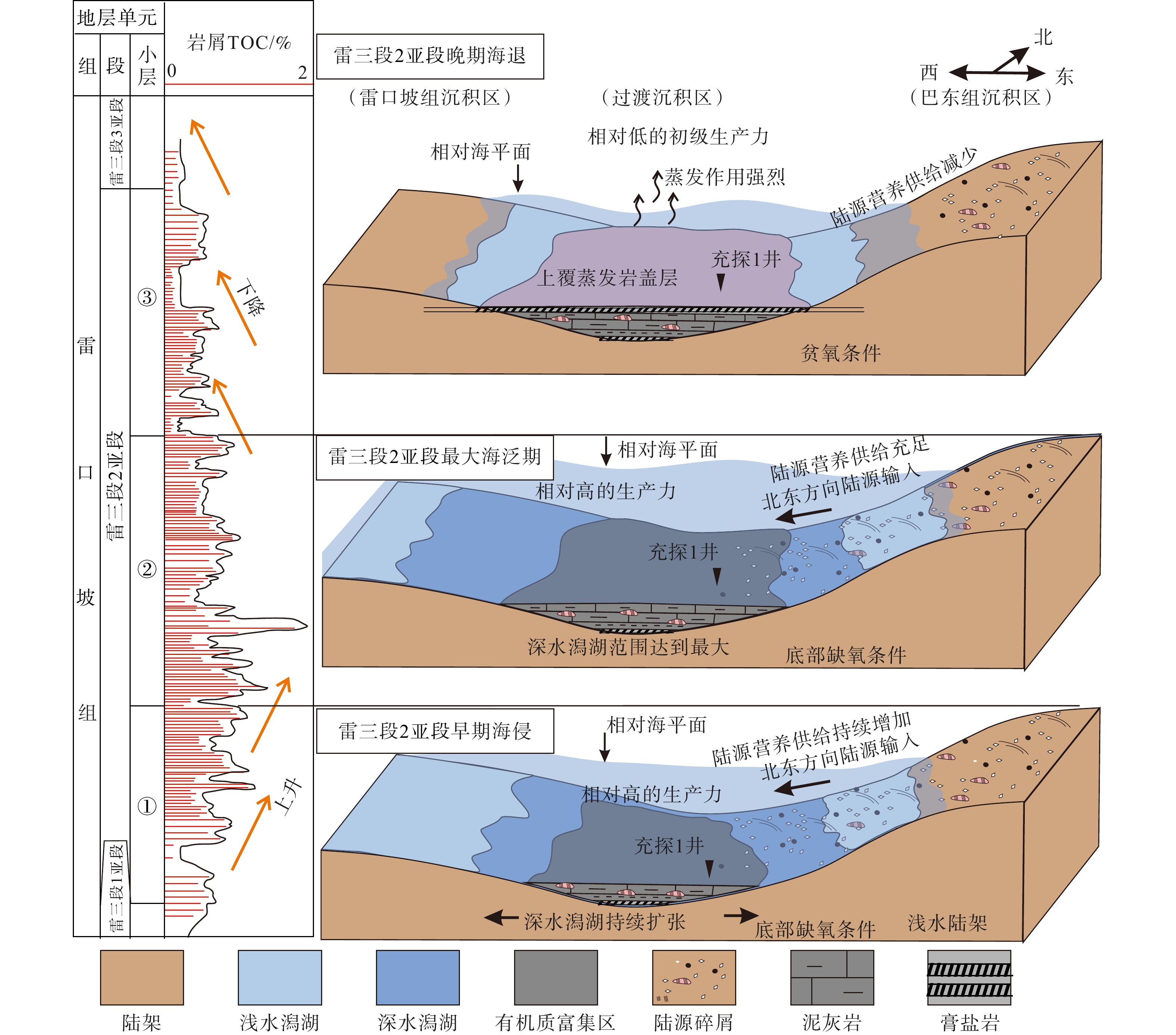
摘要: 泥灰岩的勘探潜力是当前油气领域拓展的前沿。近期,在四川盆地充探1井中三叠统雷口坡组三段发现泥灰岩海相非常规油气,昭示了雷口坡组新的勘探领域和前景。然而目前对该套盐下潟湖泥灰岩沉积的有机质富集机制和勘探潜力不明,制约了进一步的油气勘探。以川中地区充探1井为重点研究对象,通过岩矿特征和古海洋地球化学环境指标揭示了泥灰岩的有机质富集机制,再基于储层表征和沉积相分析明确了该非常规储层的性能与发育分布,以揭示其勘探潜力。结果表明,雷口坡组泥灰岩的沉积背景为台地潟湖缺氧环境,且具有高的古生产力条件,总有机碳含量(TOC)平均为1.16%,最高可达1.78%,为还原条件和生产力双控制的有机质富集;泥灰岩“甜点段”的储层CT和SEM实验结果揭示储集空间以纳米–微米级微孔、微裂缝为主,孔隙度在3%以上;其发育背景为陆表海碳酸盐台地内的泥灰质深水潟湖、含膏质浅水潟湖。台地内广阔的深水潟湖分布与雷三段2亚段沉积期处于最大海泛期有关,同时由于当时的季风气候大大促进了风化增强及营养元素输入,上覆海退成因的蒸发岩为有机质的长期高效保存提供了保障。综合分析认为上扬子克拉通内坳陷雷三段海泛期发育广泛分布的富有机质深水潟湖相泥灰岩,既是非常规油气的勘探目标,也能为雷口坡组常规储层提供烃源。Abstract:
Objective The exploration of marlstone reservoirs represents a current frontier for expanding oil and gas resources. The recent discovery of unconventional marine oil and gas in the Lei 3-2 sub-member of the Middle Triassic Leikoupo Formation in Well CT-1 reveals a new prospective area. However, the organic matter enrichment mechanisms and exploration potential of this sub-salt lagoon marlstone remain unclear, hindering further exploration. Methods This study, focusing on Well CT-1 in the central Sichuan Basin, investigates the organic matter enrichment mechanism through rock mineralogy and paleo-oceanographic geochemical proxies. This study also characterizes the reservoir properties and distribution via reservoir characterization and sedimentary facies analysis to evaluate its potential. Results The marlstone was deposited in an anoxic, deep-water lagoon of a carbonate platform with high paleo-productivity. The enrichment of organic matter, with an average total organic carbon (TOC) content of 1.16% (reaching up to 1.78%), was co-controlled by these reducing conditions and high productivity. Analyses (CT and SEM) of the high-quality "sweet spot" intervals show that the storage space is predominantly composed of nano- to micro-scale pores and microfractures, with porosity exceeding 3%. The reservoir developed in a deep-water, marlstone- and gypsum-rich lagoon within an epicontinental sea carbonate platform. Conclusion The widespread distribution of deep-water lagoons during the deposition of the Lei 3-2 sub-member is associated with a maximum flooding event. Concurrently, the prevailing monsoon climate significantly enhanced weathering and nutrient input, while the overlying regressive evaporites provided a seal for long-term and efficient organic matter preservation. [Significance] Comprehensive analysis suggests that the extensively distributed, organic-rich deep-water lagoon marlstone formed during this transgression in the intracontinental sag of the Upper Yangtze Craton is not only a viable unconventional exploration target but also likely acts as a hydrocarbon source for conventional reservoirs within the Leikoupo Formation. -
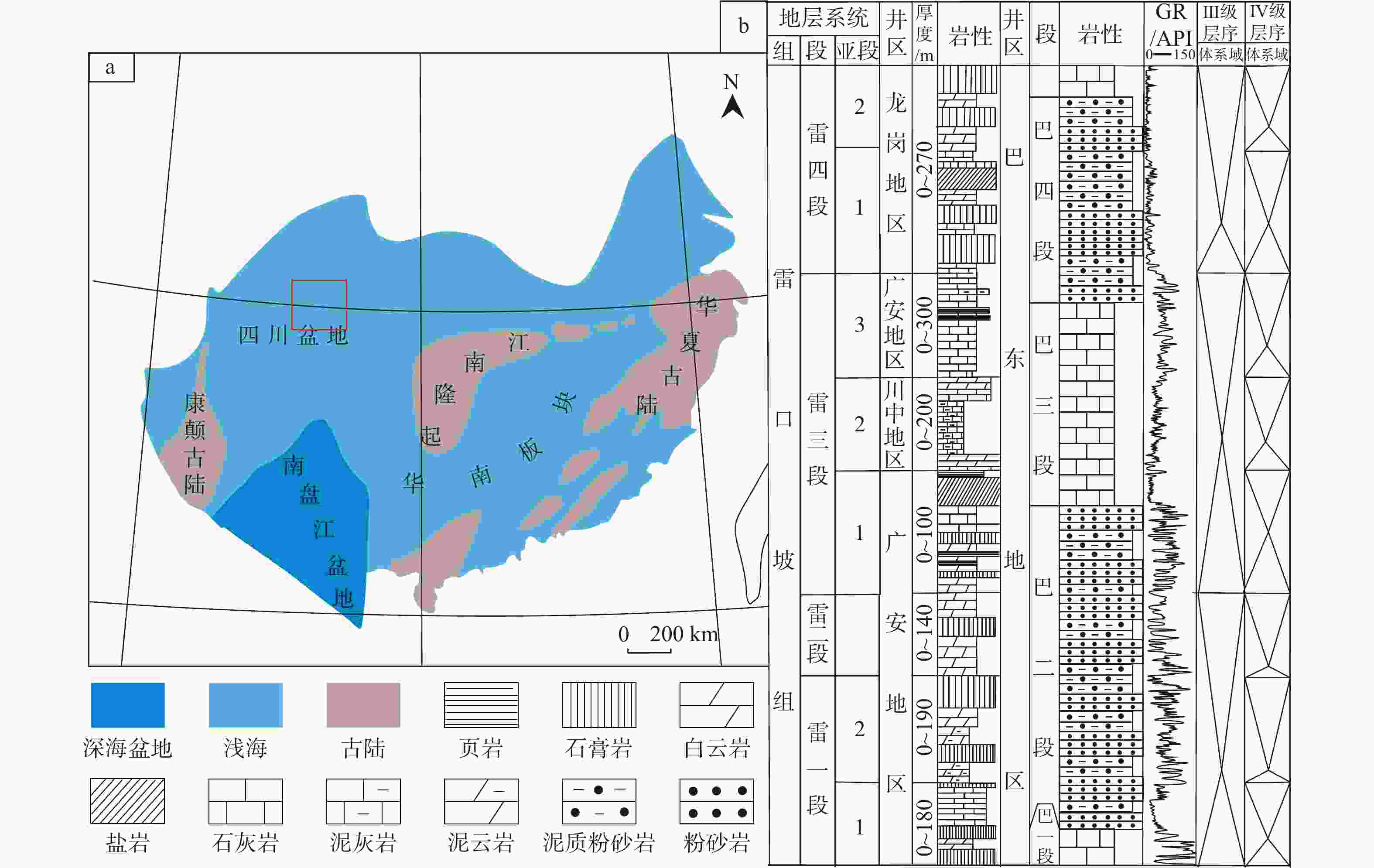
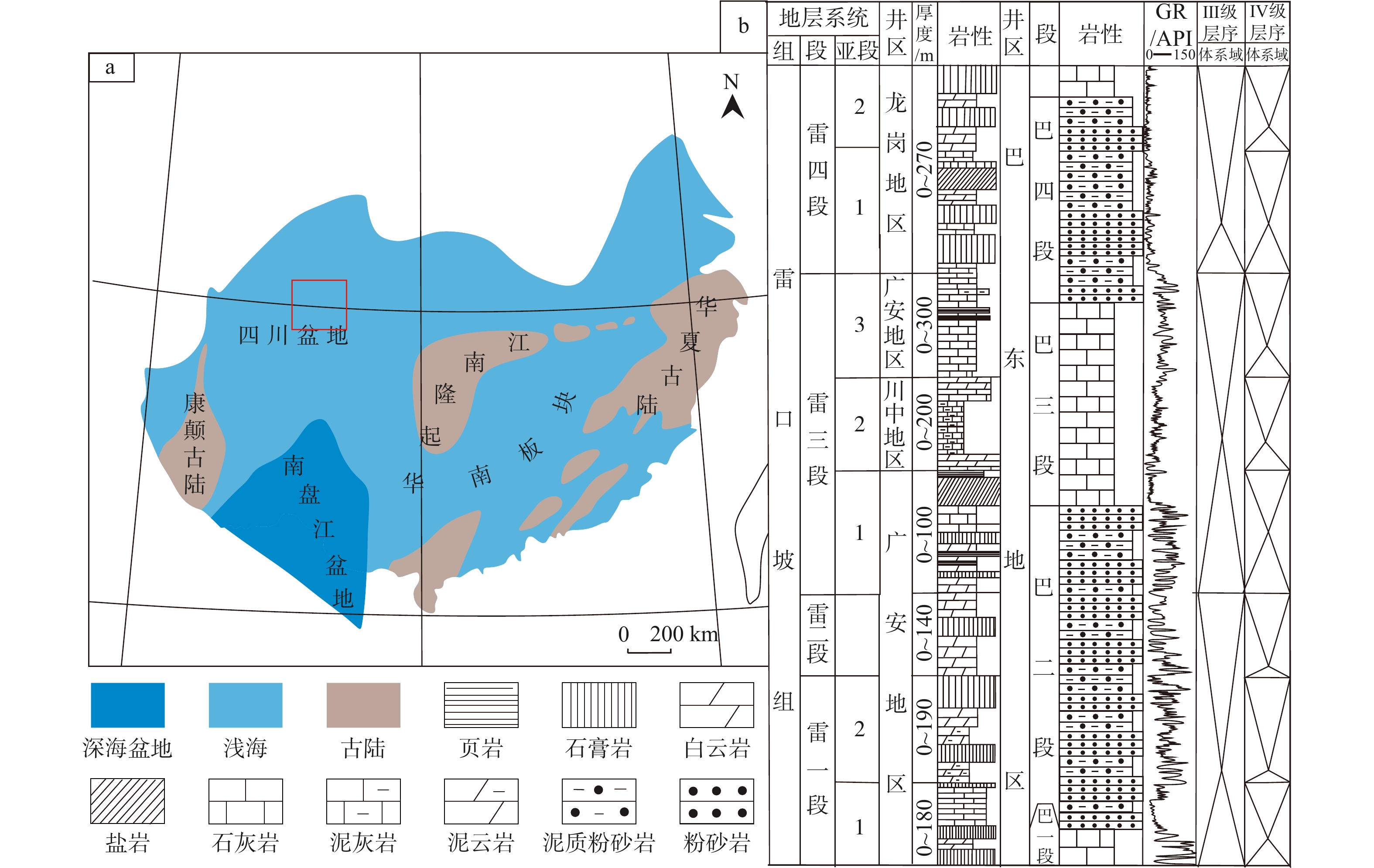
图 1 四川盆地及邻区中三叠世地质背景
a—华南板块古地理(图中红色方框为研究区位置);b—雷口坡组与巴东组地层柱状图(据李凌等,2012;Faure et al.,2016; Zhong et al.,2020修改)
Figure 1. Geological setting of the Sichuan Basin and adjacent areas during the Middle Triassic
(a) Paleogeography of the South China Block (the red rectangle indicates the study area); (b) Stratigraphic column of the Leikoupo and Badong formations (modified from Li et al., 2012; Faure et al., 2016; Zhong et al., 2020)
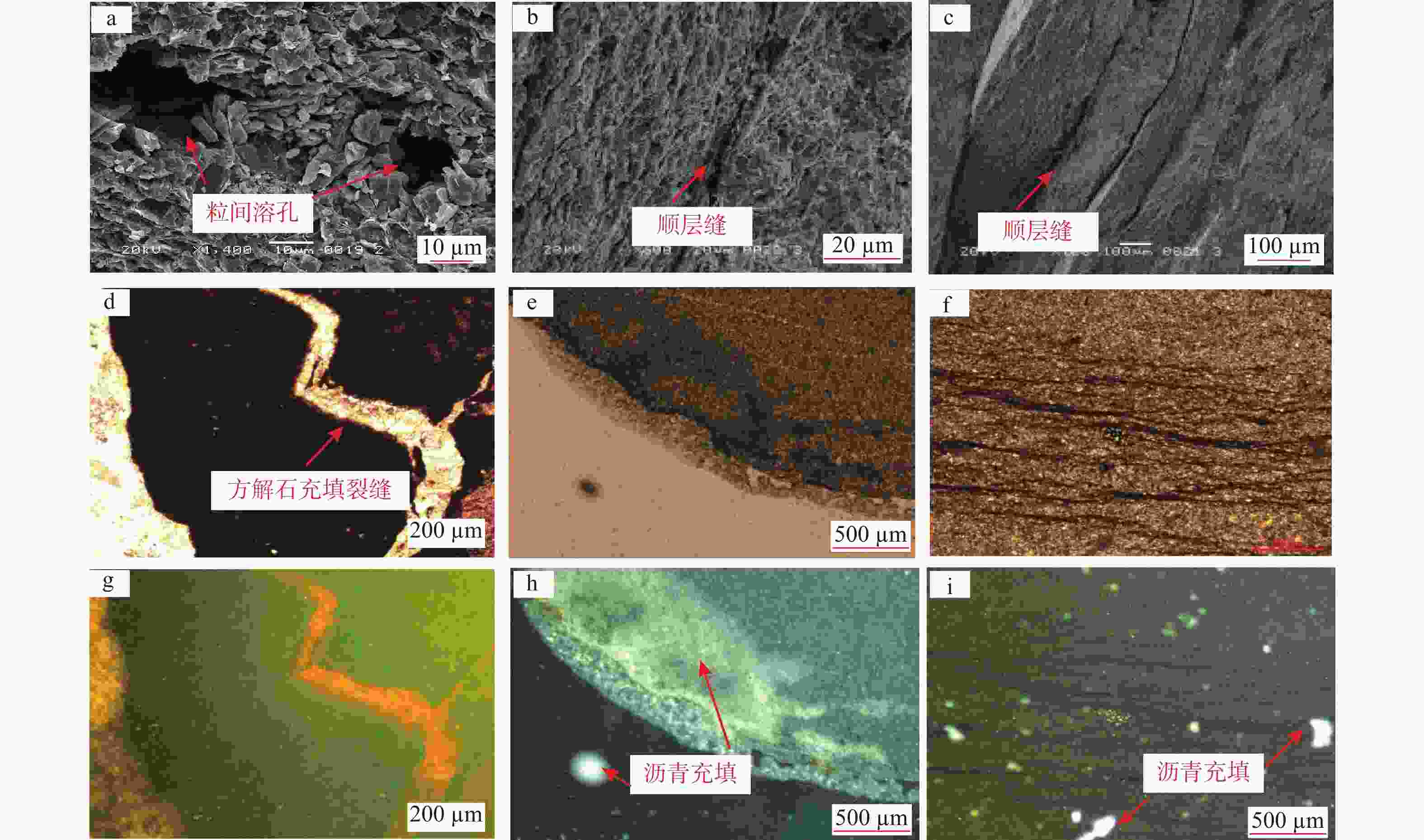
图 2 川中地区三叠系雷三段2亚段孔隙及裂缝特征
a—粒间溶孔(3531.5 m,合川125井);b—微裂缝(3600 m,充探1井);c—顺层缝(2286.5 m,合川125井);d—多期次微裂缝被石膏充填,可见纹层(3560.5 m,充探1井);e—裂缝(3567.92 m,充探1井);f—顺层微裂缝(3600.5 m,充探1井);g—荧光薄片,多期次微裂缝被石膏充填(3560.5 m,充探1井);h—荧光薄片,见沥青充填(3567.92 m,充探1井);i—荧光薄片,微裂缝,见沥青充填微孔隙(3567.92 m,充探1井)
Figure 2. Pore and fracture characteristics of the Lei 3-2 sub-member in the central Sichuan Basin
(a) Intergranular dissolution pore, 3531.5 m, Well HC-125; (b) Microfracture, 3600 m, Well CT-1; (c) Bedding-parallel fracture, 2286.5 m, Well HC-125; (d) Multistage microfractures filled with gypsum, showing laminae, 3560.5 m, Well CT-1; (e) Fracture, 3567.92 m, Well CT-1; (f) Bedding-parallel microfractures, 3600.5 m, Well CT-1; (g) Fluorescent thin section, multistage microfractures filled with gypsum, 3560.5 m, Well CT-1; (h) Fluorescent thin section, asphalt filling, 3567.92 m, Well CT-1; (I) Fluorescent thin section, microfractures with asphalt-filled micropores, 3567.92 m, Well CT-1
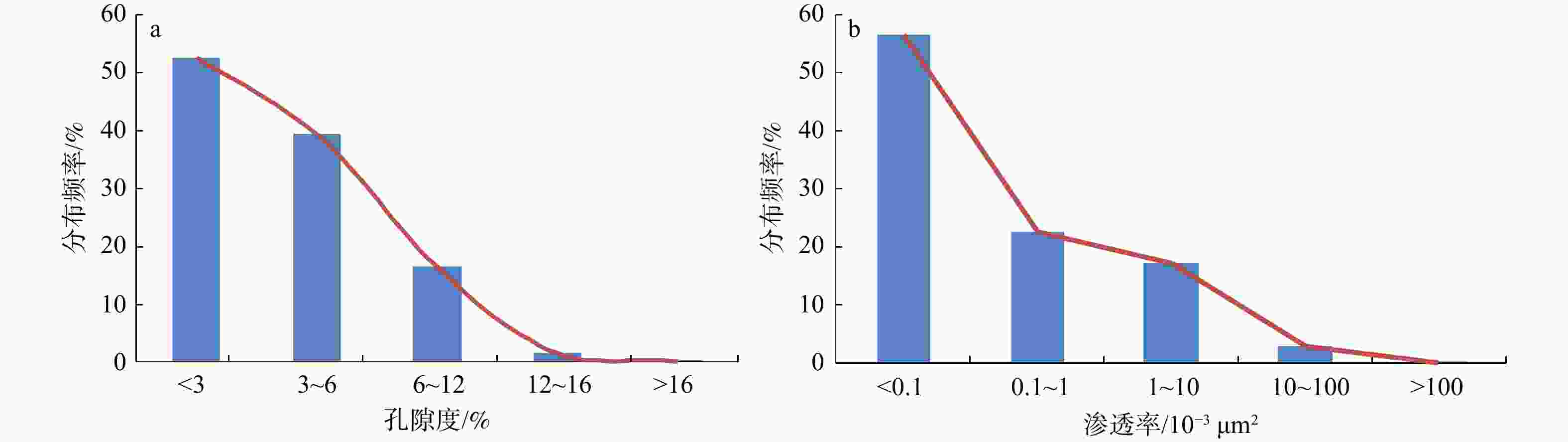
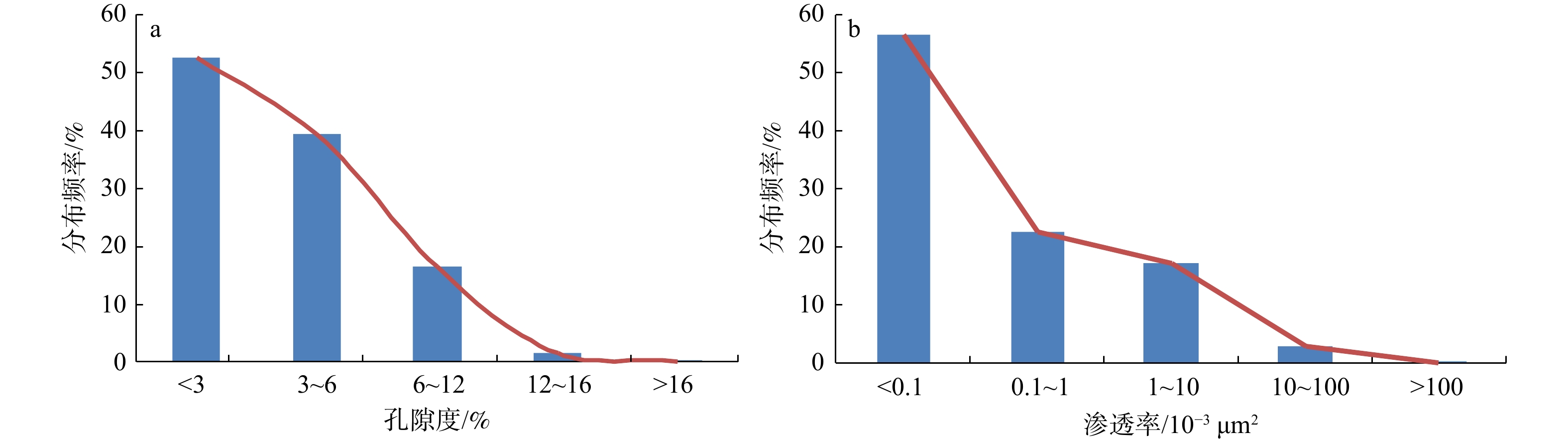
图 3 川中地区充探1井雷三段2亚段物性特征
a—孔隙度特征;b—渗透率特征
Figure 3. Physical properties of the Lei 3-2 sub-member in Well CT-1, central Sichuan Basin
(a) Porosity; (b) Permeability
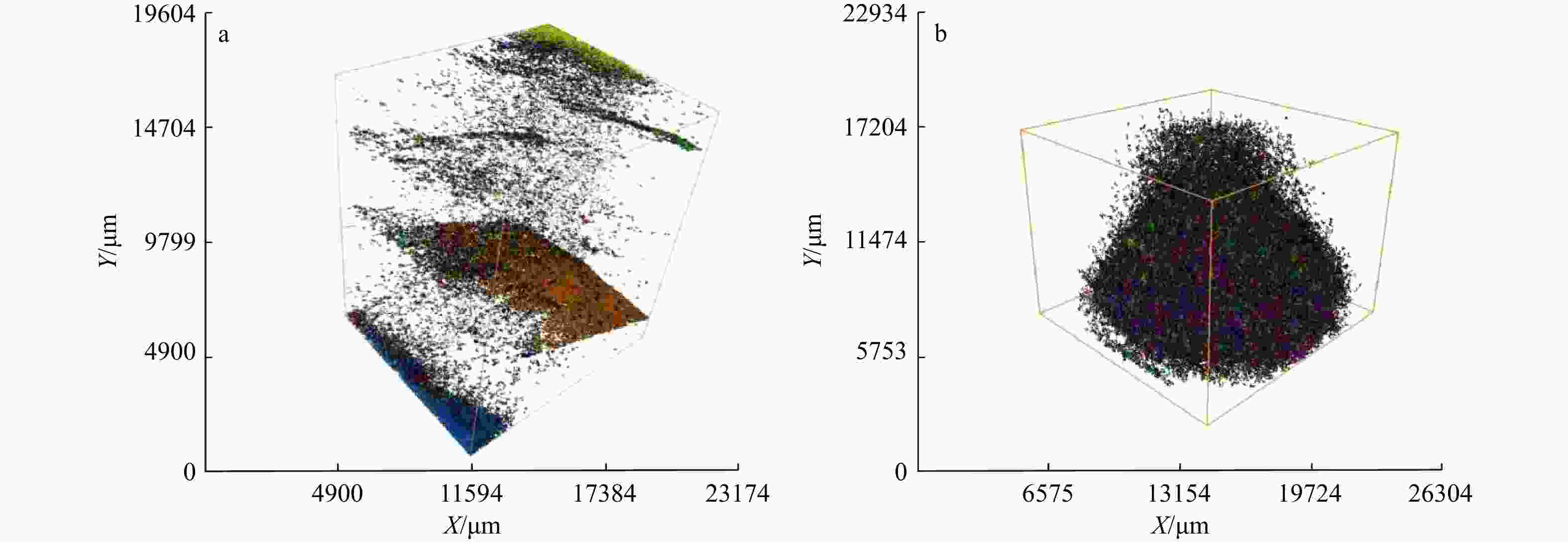
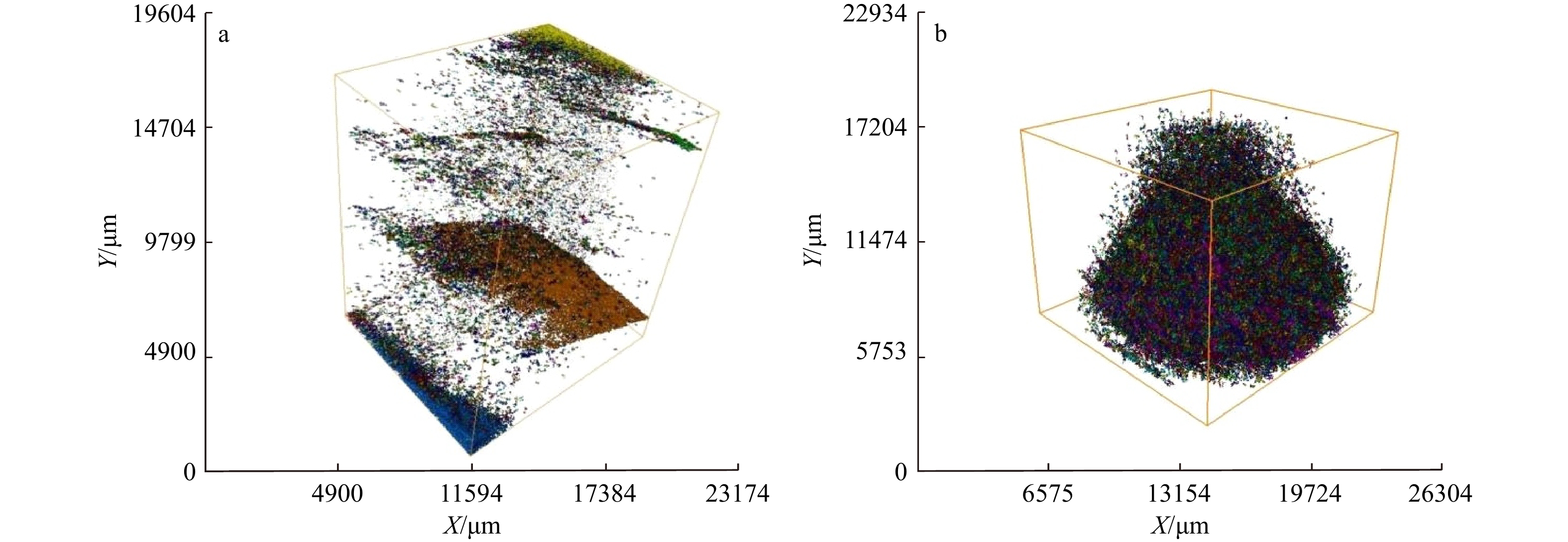
图 4 川中地区充探1井雷三段2亚段泥灰岩储层孔隙结构CT特征
a—3560 m灰质泥岩,发育顺层缝及缝内有机孔;b—3602 m泥质灰岩,发育有机孔
Figure 4. CT characteristics of pore structures in the marlstone reservoir of the Lei 3-2 sub-member in Well CT-1, central Sichuan Basin
(a) Calcareous mudstone at 3560 m, showing bedding-parallel fractures with organic pores; (b) Argillaceous limestone at 3602 m, showing densely developed organic pores
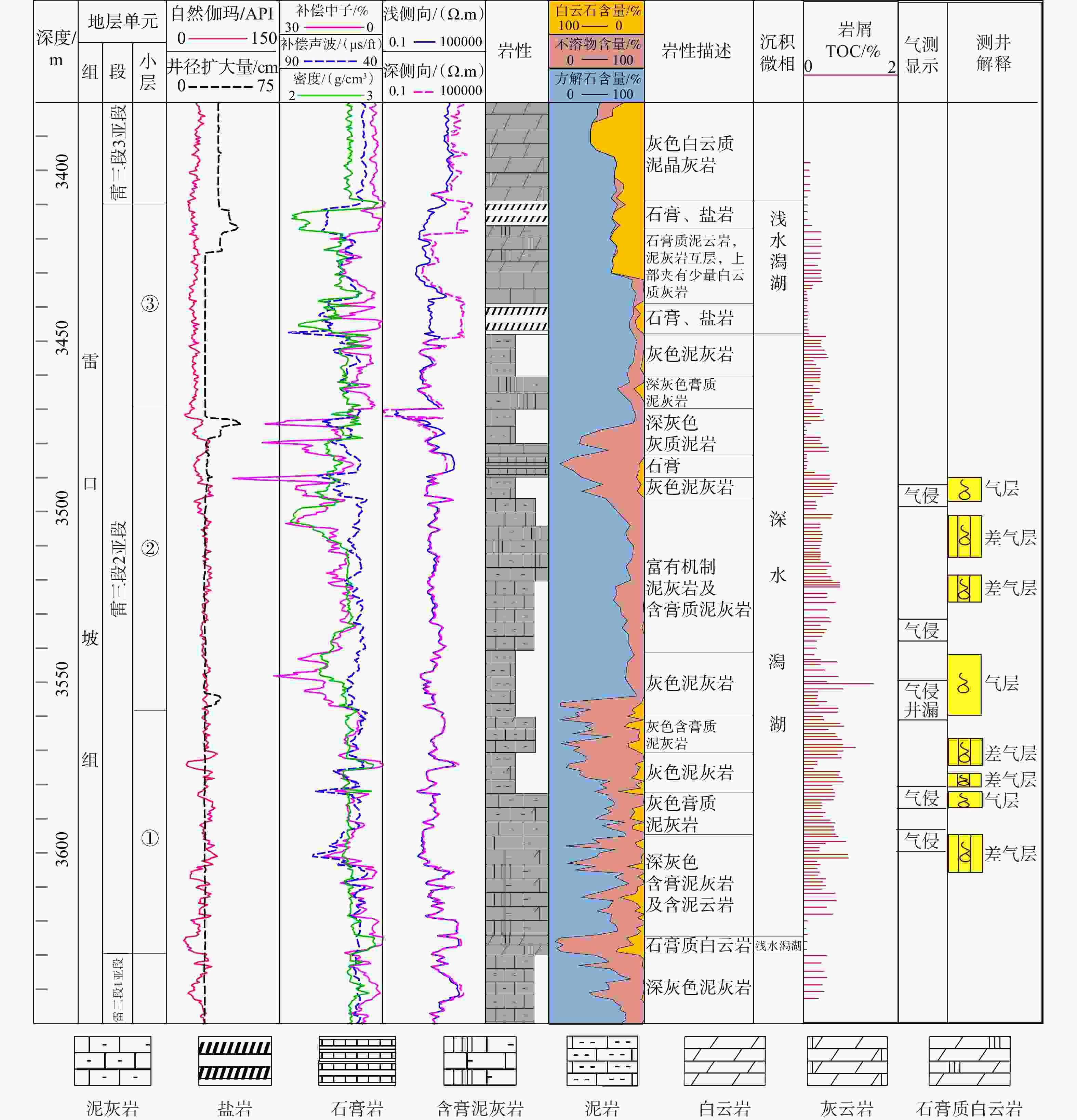
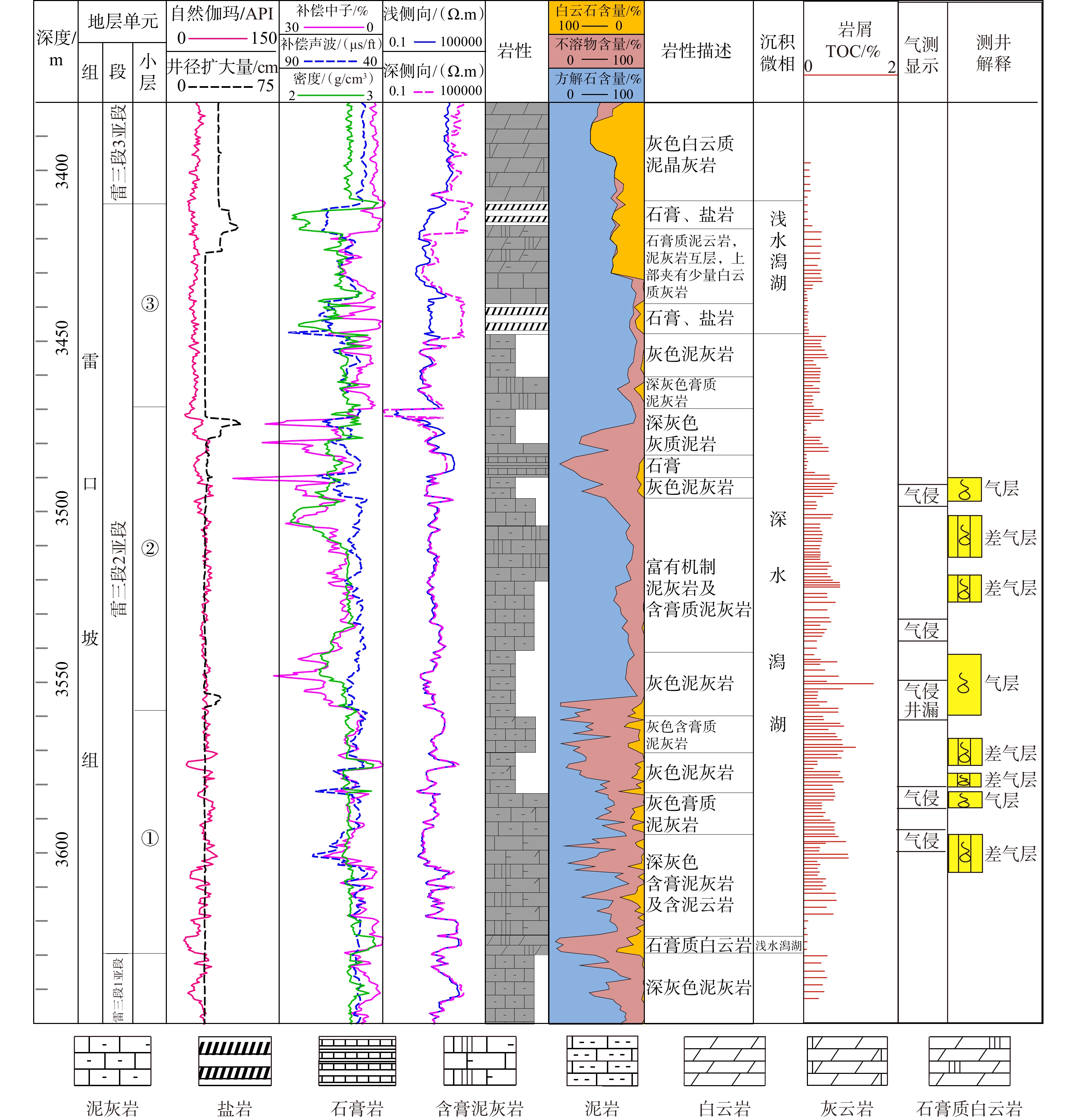
图 5 川中地区充探1井雷三段2亚段综合柱状图(TOC数据引用自汪泽成等,2023)
Figure 5. Comprehensive stratigraphic column of the Lei 3-2 sub-member from Well CT-1 in the central Sichuan Basin (TOC data from Wang et al., 2023)
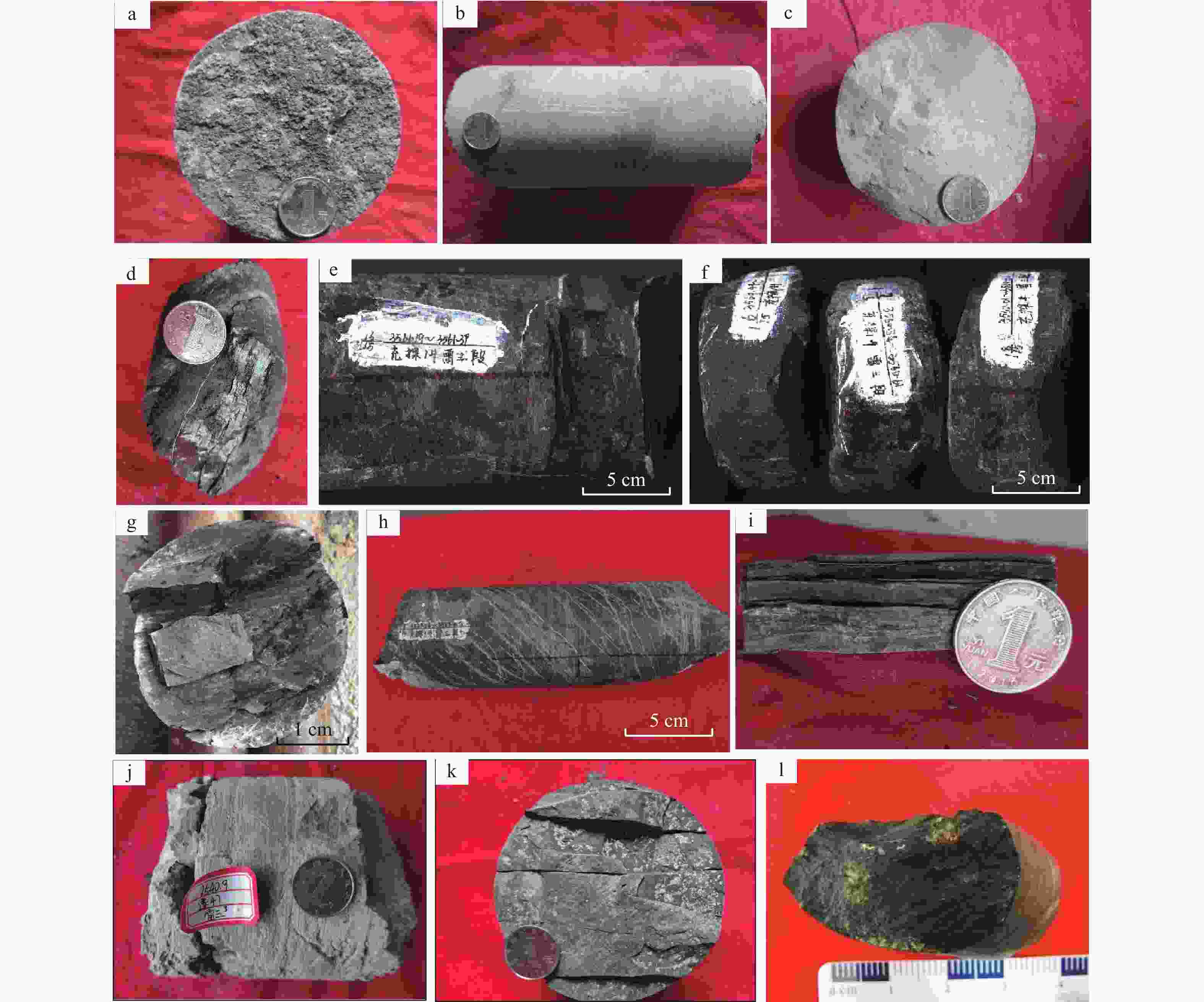
图 6 川中地区三叠系雷三段岩性特征
a—灰色粉晶灰岩(2328.4 m,雷三段3亚段,磨030-H16井);b—粉晶灰岩-裂缝充填方解石(2315.85~2316.07 m,雷三段3亚段,磨030-H16井);c—细粉晶白云岩(2292.79 m,雷三段3亚段,磨030-H16井);d—泥灰岩(2314.19-2314.26 m,雷三段2亚段,合川125井);e—深灰色灰泥岩(3561.3m,雷三段2亚段,充探1井);f—深灰色泥灰岩(3560.5m,雷三段2亚段,充探1井);g—泥灰岩横截面(3567.06,雷三段2亚段,充探1井);h—泥灰岩(3567.06 ~3567.47 m,雷三段2亚段,充探1井);i—泥灰岩(2291m,雷三段2亚段,合川125井);j—含膏灰质云岩(2540.90 m,雷三段3亚段,遂47井);k—粉晶云岩(2529.10 m,雷三段2亚段,遂47井);l—泥灰岩(3602 m,雷三段2亚段,充探1井)
Figure 6. Lithological characteristics of the Triassic Lei 3 Member in the central Sichuan Basin
(a) Gray micritic limestone, 2328.4 m, Lei 3-3 sub-member, Well Mo 030-H16; (b) Micritic limestone with fracture-filled calcite, 2315.85–2316.07 m, Lei 3-3 sub-member, Well Mo 030-H16; (c) Fine dolomicrite, 2292.79 m, Lei 3-3 sub-member, Well Mo 030-H16; (d) Marlstone, 2314.19–2314.26 m, Lei 3-2 sub-member, Well HC-125; (e) Dark gray argillaceous limestone, 3561.3 m, Lei 3-2 sub-member, Well CT-1; (f) Dark gray argillaceous limestone, 3560.5 m, Lei 3-2 sub-member, Well CT-1; (g) Cross-section of calcareous marlstone, 3567.06 m, Lei 3-2 sub-member, Well CT-1; (h) Calcareous marlstone, 3567.06–3567.47 m, Lei 3-2 sub-member, Well CT-1; (I) Calcareous mud shale, 2291 m, Lei 3-2 sub-member, Well HC-125; (j) Gypsum-bearing calcareous dolostone, 2540.90 m, Lei 3-3 sub-member, Well Sui-47; (k) Dolomicrite, 2529.10 m, Lei 3-2 sub-member, Well Sui-47; (l) Marlstone, 3602 m, Lei 3-2 sub-member, Well CT-1
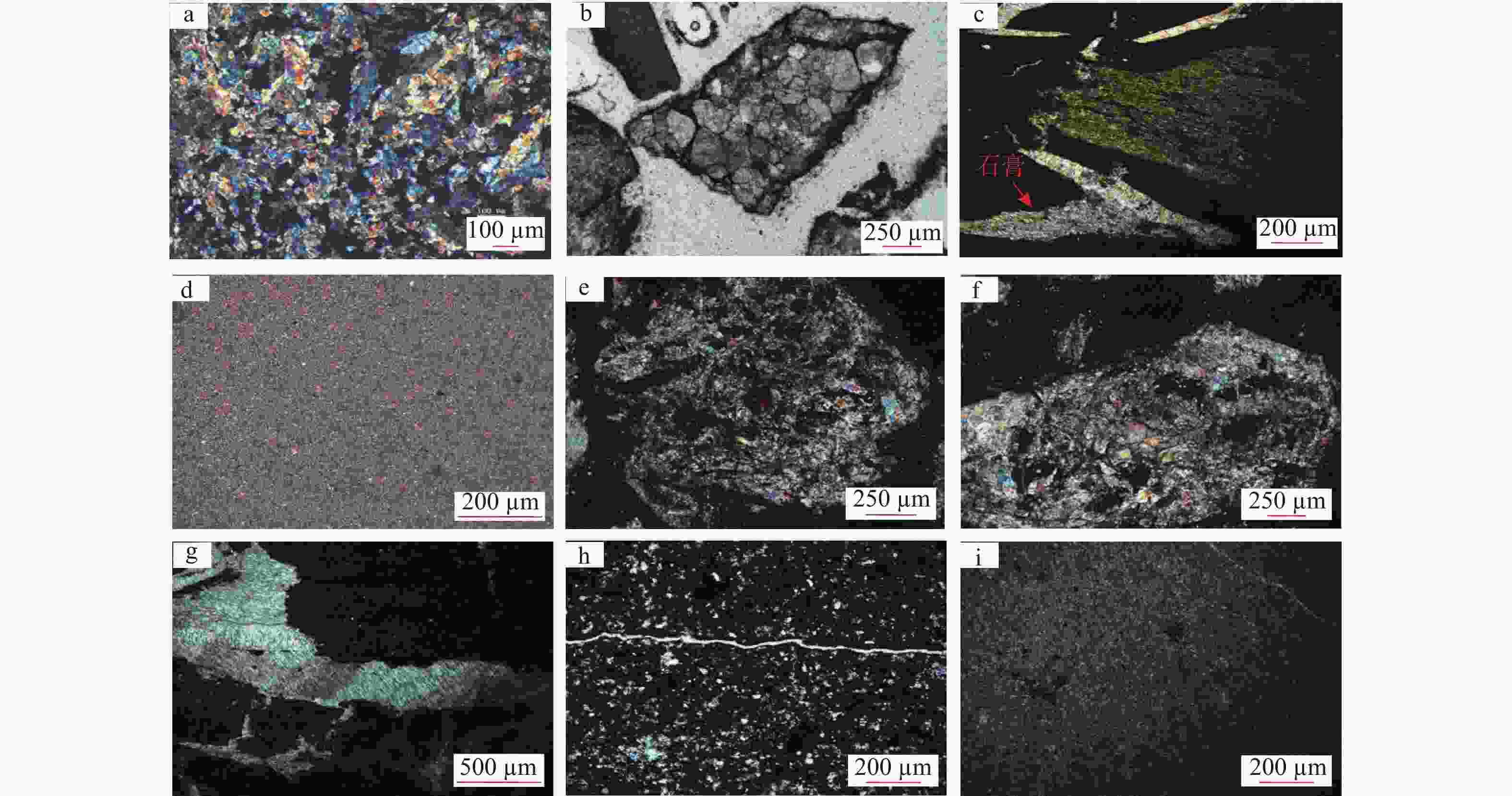
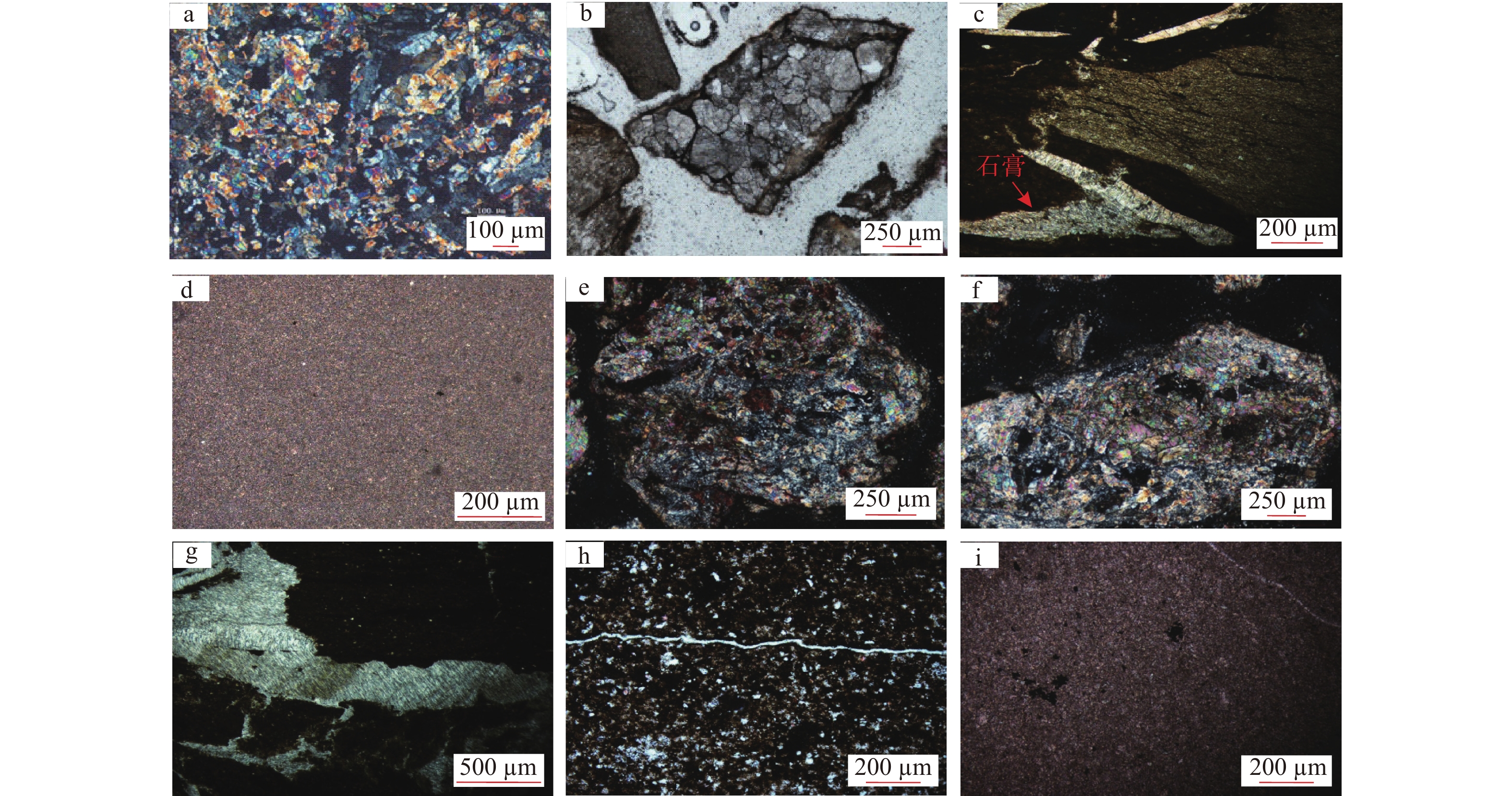
图 7 川中地区三叠系雷三段2亚段薄片微观特征
a—泥灰岩,裂缝可见石膏充填物(3560.5 m,充探1井);b—膏质白云岩(3236.5 m,充探1井);c—中晶含灰云岩,间溶孔+孔壁边缘见微量沥青质(3523 mm,充探1井);d—泥晶云岩(2350 m,合川125井);e—含灰质膏岩 (+)(3486 m, 充探1井);f—灰质膏岩(3490 m,充探1井);g—泥晶灰岩,可见石膏晶体(3567.3 m,充探1井);h—泥灰岩,见石膏,见微裂缝(3598 m,充探1井);i—泥晶灰岩(3600.5 m,充探1井)
Figure 7. Microscopic characteristics of thin sections of the Lei 3-2 sub-member in the central Sichuan Basin
(a) Marlstone with gypsum-filled fractures, 3560.5 m, Well CT-1; (b) Gypsum-bearing dolostone, 3236.5 m, Well CT-1; (c) Medium-crystalline calcareous dolostone with intercrystalline dissolution pores and minor bitumen on pore walls, 3523 m, Well CT-1; (d) Micritic dolostone, 2350 m, Well HC-125; (e) Calcareous gypsum rock (+), 3486 m, Well CT-1; (f) Gypsum-bearing limestone, 3490 m, Well CT-1; (g) Micritic limestone with gypsum crystals, 3567.3 m, Well CT-1; (h) Marlstone with gypsum and microfractures, 3598 m, Well CT-1; (I) Micritic limestone, 3600.5 m, Well CT-1
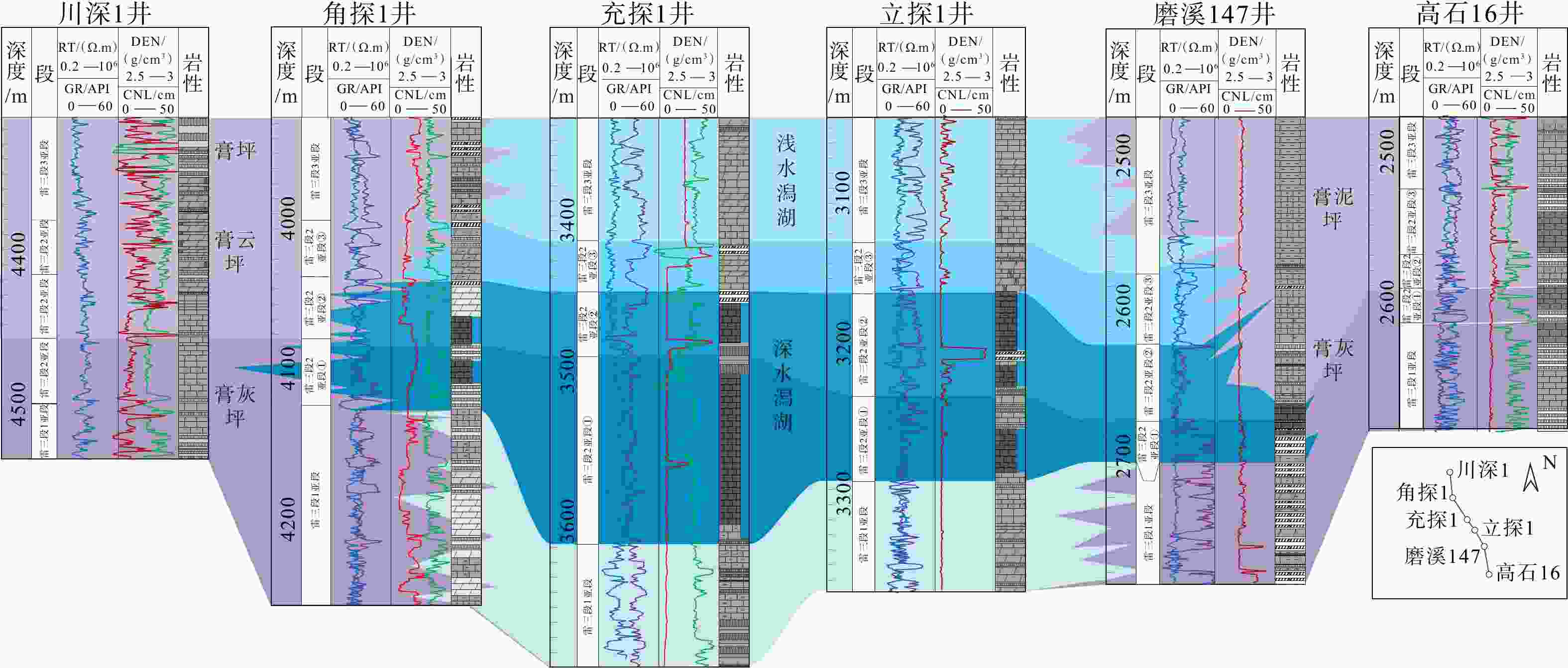
图 8 过充探1井沉积微相连井对比图
RT—电阻率;DEN—密度;GR—自然伽马;GNL—井径扩大量 岩性图例同图5;右下角图为连井位置导航图
Figure 8. Correlation profile of sedimentary microfacies across Well CT-1
Legend for lithology see Fig. 5, Inset: location map.The logging curves include resistivity (RT), density (DEN), natural gamma ray (GR), and caliper enlargement (CNL).
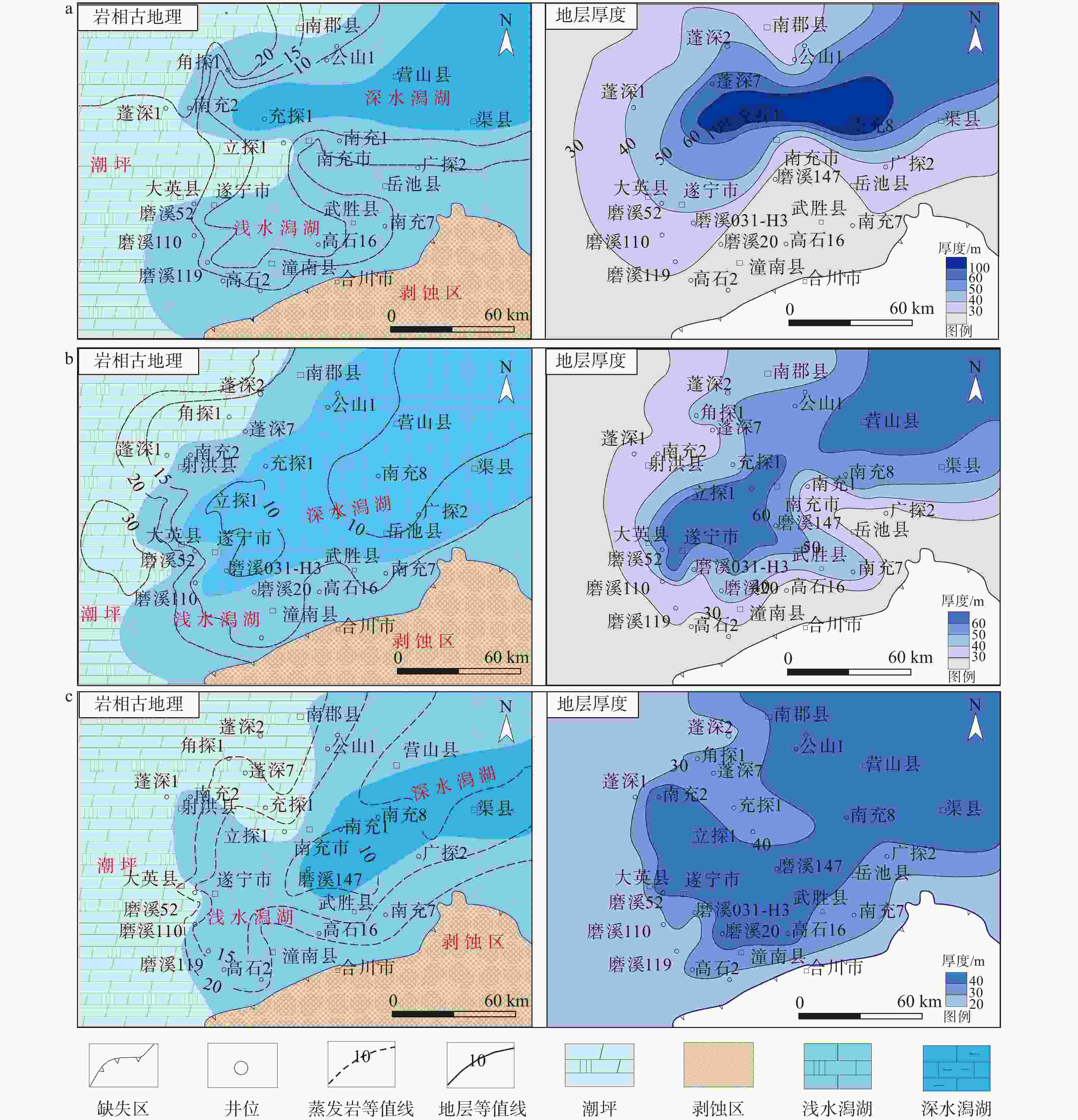
图 9 川中地区三叠系雷口坡组三段岩相古地理及地层厚度展布图
图中虚线为蒸发岩厚度等值线图a—雷三段2亚段①小层 ;b—雷三段2亚段②小层;c—雷三段2亚段③小层
Figure 9. Lithofacies paleogeography and stratigraphic thickness distribution of the Triassic Leikoupo Formation in the central Sichuan Basin
(a) Lei 3-2-1 sub-member; (b)Lei 3-2-2 sub-member; (c) Lei 3-2-3 sub-memberThe dashed lines in the figure are isopachs of evaporite thickness.
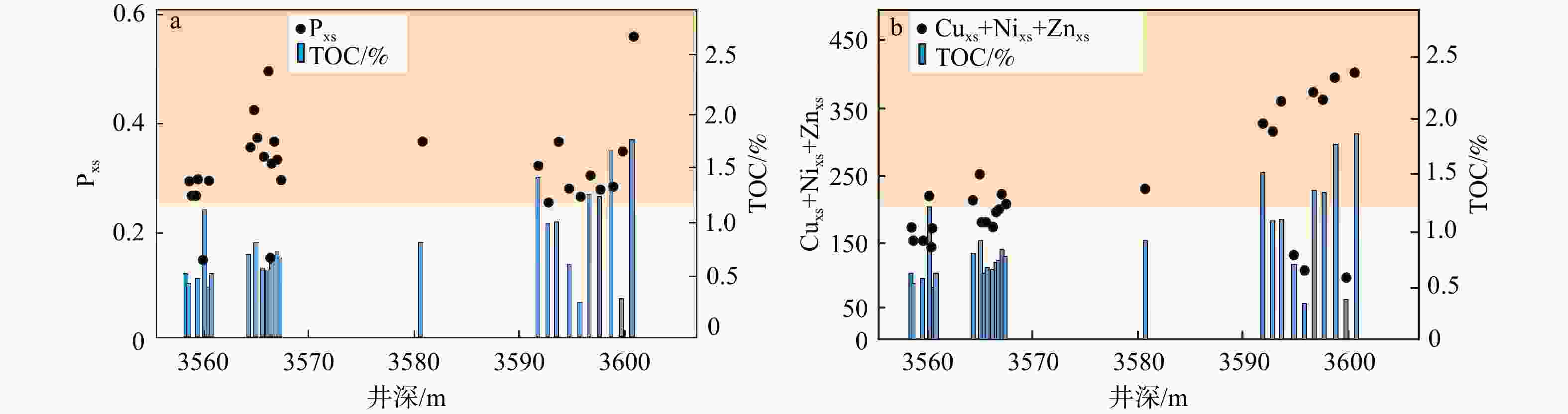
图 10 富有机质泥灰岩的古生产力指标散点图
a—雷三段2亚段PXS与TOC综合图;b—雷三段2亚段CuXS+NiXS+ZNXS与TOC综合图
Figure 10. Scatter plot of paleoproductivity indicators of organic-rich marlstone
(a) Integrated PXS and TOC profile of the Lei 3-2 sub-member; (b) Integrated profile of CuXS + NiXS + ZNXS and TOC of the Lei 3-2 sub-member
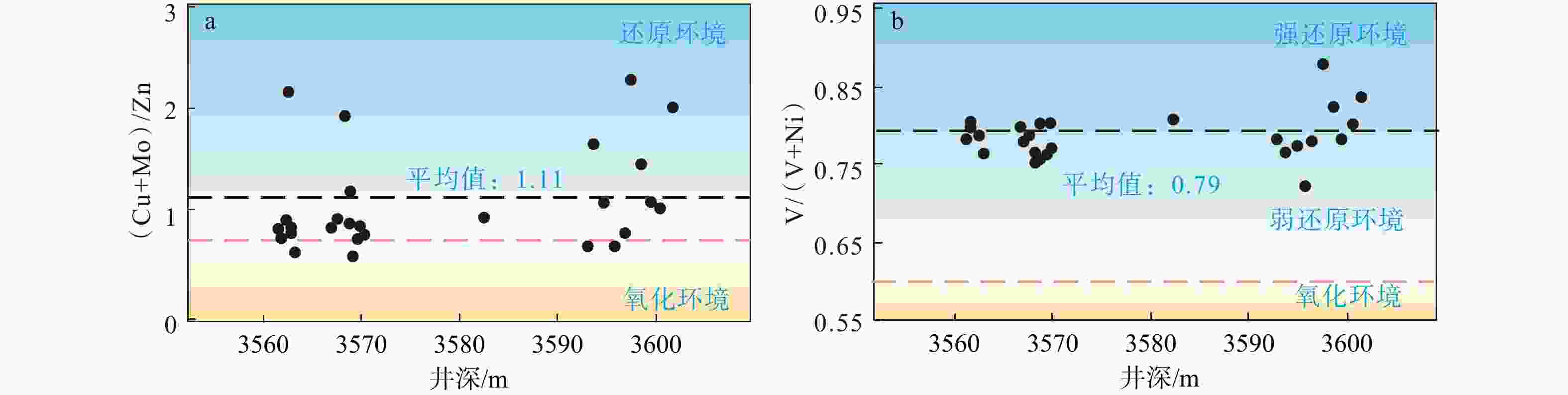
图 11 富有机质泥灰岩的氧化还原指标散点图
a—雷三段2亚段(Cu+Mo)/Zn散点图;b—雷三段2亚段V/(V+Ni)散点图
Figure 11. Scatter plot of redox indicators from organic-rich marlstone
(a) Scatter plot of (Cu + Mo)/Zn for the Lei 3-2 sub-member; (b) Scatter plot of V/(V + Ni) for the Lei 3-2 sub-member
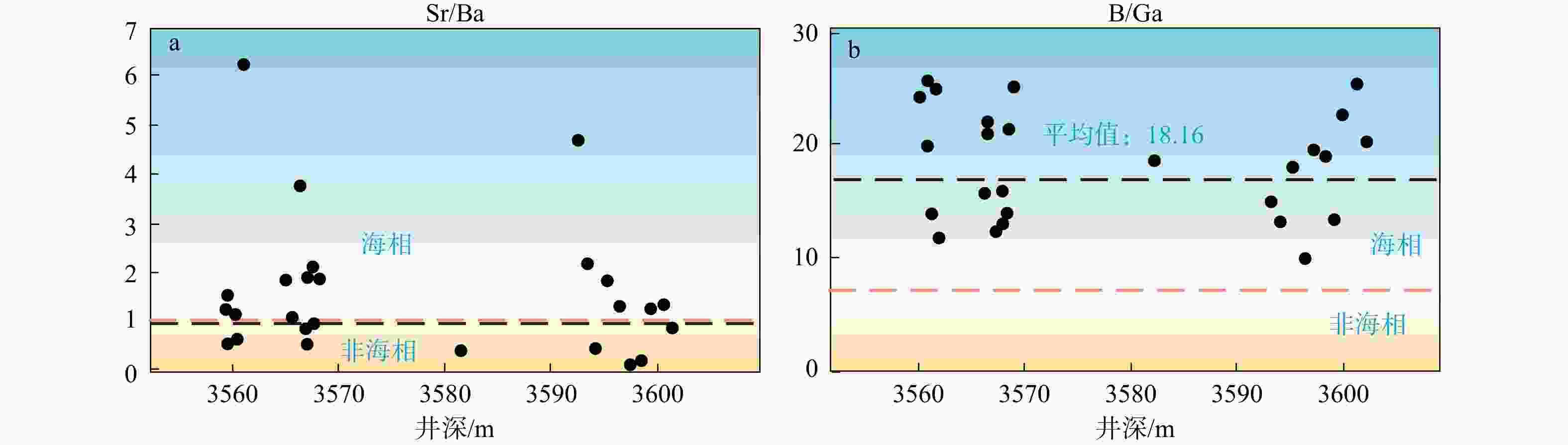
图 12 富有机质泥灰岩的古盐度指标散点图
a—雷三段2亚段Sr/Ba散点图;b—雷三段2亚段B/Ga散点图
Figure 12. Scatter plot of paleosalinity indicators from organic-rich marlstone
(a) Scatter plot of Sr/Ba for the Lei 3-2 sub-member; (b) Scatter plot of B/Ga for the Lei 3-2 sub-member
-
[1] BENTON M J, ZHANG Q Y, HU S X, et al., 2014. Reprint of “Exceptional vertebrate biotas from the Triassic of China, and the expansion of marine ecosystems after the Permo-Triassic mass extinction”[J]. Earth-Science Reviews, 137: 85-128. doi: 10.1016/j.earscirev.2014.08.004 [2] CAI Z Z, XU F, YANG G, et al., 2024. Sedimentary characteristics of the Lower Cambrian Yuertusi Formation and the organic matter enrichment model in the Tarim Basin[J]. Geoscience, 38(5): 1258-1269, doi: 10.19657/j.geoscience.1000-8527.2023.103 [3] CHEN A Q, YANG S, CHEN H D, et al., 2017. The sedimentary filling model of epeiric platform and new inspiration of innercratonic carbonate for oil & gas exploration[J]. Acta Petrologica Sinica, 33(4): 1243-1256. (in Chinese with English abstract) [4] DONG H M, SUN J M, LIN Z Z, et al., 2018. Quantitative characterization and characteristics analysis of microscopic pore structure in natural gas hydrate based on CT scanning[J]. Journal of China University of Petroleum (Edition of Natural Science), 42(6): 40-49. (in Chinese with English abstract) [5] FAURE M, LIN W, CHU Y, et al., 2016. Triassic tectonics of the southern margin of the South China Block[J]. Comptes Rendus Géoscience, 348(1): 5-14. doi: 10.1016/j.crte.2015.06.012 [6] GUO T L, 2016. Discovery and characteristics of the Fuling shale gas field and its enlightenment and thinking[J]. Earth Science Frontiers, 23(1): 29-43. (in Chinese with English abstract) doi: 10.1007/s11708-018-0581-z [7] FAN X, CHEN A Q, ZHENG D Y, et al. , 2025. Intelligent Identification for Carbonate Logging Sedimentary Facies based on Machine Learning: An Example from the Upper Permian Changxing Formation of Yuanba Area in northeastern Sichuan Basin[J/OL]. Acta Sedimentologica Sinica. DOI: 10.14027/j. issn. 1000-0550.2025. 058. (2025-11-04) [2025-11-11]. https://doi.org/10.14027/j.issn.1000-0550.2025.058. [8] HU T, PANG X Q, JIANG S, et al., 2018. Impact of paleosalinity, dilution, redox, and paleoproductivity on organic matter enrichment in a saline lacustrine rift basin: a case study of Paleogene organic-rich shale in Dongpu Depression, Bohai Bay Basin, eastern China[J]. Energy & Fuels, 32(4): 5045-5061. doi: 10.1021/acs.energyfuels.8b00643 [9] HUANG D, ZHANG J, YANG G, et al., 2011. The discussion of stratum division and stratum for the Leikoupo formation of middle Triassic in Sichuan Basin[J]. Journal of Southwest Petroleum University (Science & Technology Edition), 33(3): 89-95. (in Chinese with English abstract) [10] HUO F, WEN H G, LI L, et al., 2022. Influence of the depositional environment on the formation of organic-rich marine shale: a case study of the first discovery of Anisian shale in the Sichuan Basin[J]. Journal of Petroleum Science and Engineering, 214: 110577. doi: 10.1016/j.petrol.2022.110577 [11] JONES B, MANNING D A C, 1994. Comparison of geochemical indices used for the interpretation of palaeoredox conditions in ancient mudstones[J]. Chemical Geology, 111(1-4): 111-129. doi: 10.1016/0009-2541(94)90085-X [12] LI C F, XIAO J F, 1988. The application of trace element to the study on paleosalinities in Shahejie Formation of Dongying Basin, Shengli Oilfield[J]. Acta Sedimentologica Sinica, 6(4): 100-107. (in Chinese with English abstract) [13] LI L, TAN X C, ZHOU S Y, et al., 2012. Sequence Lithofacies paleography of Leikoupo Formation, Sichuan Basin[J]. Journal of Southwest Petroleum University (Science & Technology Edition), 34(4): 13-22. (in Chinese with English abstract) [14] LI W, CHEN A Q, ZHANG X H, et al., 2025. Permian paleogeographic differentiation evolution and platform margin model comparison in Sichuan basin[J]. Acta Geologica Sinica, 99(12): 4105-4119. (in Chinese with English abstract) [15] LI Z G, 1993. Surveying gas prospects of Leikoupo Formation in West Sichuan[J]. Natural Gas Industry, 13(2): 28-33, 2. (in Chinese with English abstract) [16] LIANG C, JIANG Z X, YANG Y T, et al., 2012. Shale lithofacies and reservoir space of the Wufeng–Longmaxi Formation, Sichuan Basin, China[J]. Petroleum Exploration and Development, 39(6): 736-743. doi: 10.1016/S1876-3804(12)60098-6 [17] LIANG D X, HU S Y, GU Z D, et al., 2015. Formation and evolution process of Kaijiang paleohigh in the Sichuan Basin and its controlling effects on gas pool formation[J]. Natural Gas Industry, 35(9): 35-41. (in Chinese with English abstract) [18] LIU Y H, QIANG W, DANG X, et al., 2025. Study on the pore structure characteristics of interbedded shale oil and formation mechanisms of high-quality shale oil reservoirs in the Chang 7 Member, Yanchang Formation, Ansai Oilfield[J]. Journal of Geomechanics, 31(3): 506-521. (in Chinese with English abstract) [19] LIU X B, TAO S Z, YANG D L, et al., 2025. Breakthrough in exploration of helium rich natural gas in Well Datan 1 of Sichuan Basin and main control factors for reservoir formation[J]. Earth Science Frontiers, 32(5): 258-277. (in Chinese with English abstract) [20] LIU S G, YANG Y, DENG B, et al., 2021. Tectonic evolution of the Sichuan Basin, Southwest China[J]. Earth-Science Reviews, 213: 103470. doi: 10.1016/j.earscirev.2020.103470 [21] MAO X P, CHEN X R, WANG Z J, et al., 2024. Relationship between organic matter enrichment degree of black shale and paleoclimate: Taking the shale of the Wufeng-Longmaxi Formation in the Middle and Upper Yangtze region as an example[J]. Chinese Journal of Geology, 59(5): 1151-1172. (in Chinese with English abstract) [22] MENG X W, CHEN A Q, LI W, et al., 2025. Platform margin tectono-sedimentary differentiation and reservoir control effects of the Permian Maokou Formation, southern margin of Sichuan Basin[J]. Journal of Chengdu U niversity of Technology (Science & Technology Edition), 52(1): 94-107. [23] PROCHNOW, S J, NORDT, L C, ATCHLEY, S C, et al., 2006. Multi-proxy paleosol evidence for middle and late Triassic climate trends in eastern Utah[J]. Palaeogeography, Palaeoclimatology, Palaeoecology, 232(1): 53-72. doi: 10.1016/j.palaeo.2005.08.011 [24] QI Y, CHEN A Q, WEN L, et al. , 2025. Lithofacies paleogeographic differentiation and the paleo-uplifts expansion during the salt-bearing Lower Triassic Jialingjiang Formation, Sichuan Basin[J/OL]. Journal of Chengdu University of Technology (Science & Technology Edition): 1-24. DOI: 10.12474/cdlgzrkx. 2025091902. (2025-12-27) [2026-01-04]. https://doi.org/10.12474/cdlgzrkx.2025091902. [25] QIU Z, LU B, CHEN Z H, et al., 2019. Discussion of the Relationship between Volcanic Ash Layers and Organic Enrichment of Black Shale: A case study of the Wufeng-Longmaxi gas shales in the Sichuan Basin[J]. Acta Sedimentologica Sinica, 37(6): 1296-1308. (in Chinese with English abstract) [26] SCHOEPFER S D, SHEN J, WEI H Y, et al., 2015. Total organic carbon, organic phosphorus, and biogenic barium fluxes as proxies for paleomarine productivity[J]. Earth-Science Reviews, 149: 23-52. doi: 10.1016/j.earscirev.2014.08.017 [27] WANG Y F, ZHAI G Y, SHI W Z, et al., 2025. Factors controlling enrichment and accumulation of Devonian–Carboniferous shale gas in the Yaziluo rift trough in the Yunnan–Guizhou–Guangxi region[J]. Journal of Geomechanics, 31(2): 248-266. (in Chinese with English abstract) [28] SHI H, LI Z X, YANG Y Y, et al., 2022. The factors influencing the enrichment of organic matters in the Carboniferous source rocks, Ounan depression, eastern Qaidam basin[J]. Journal of Geomechanics, 28(2): 203-216. (in Chinese with English abstract) [29] SHI Z S, XIE W R, MA S Y, et al., 2012. Transgression sedimentary records of the members 4-6 of upper Triassic Xujiahe Formation in Sichuan basin[J]. J Palaeogeogr, 5: 583-595. [30] ŚLIWIŃSKI, M G, WHALEN, M T, DAY, J, 2010. Trace element variations in the Middle Frasnian Punctata Zone (Late Devonian) in the western Canada sedimentary basin—Changes in oceanic bioproductivity and paleoredox spurred by a pulse of terrestrial afforestation?[J]. Geologica Belgica, 13(4): 459-482. [31] SONG X B, LIU S R, WANG Q X, et al., 2011. Main controlling factors of hydrocarbon accumulation of Middle-Lower Triassic in western margin of western Sichuan Depression[J]. Lithologic Reservoirs, 23(1): 67-73. (in Chinese with English abstract) [32] SUN H F, LUO B, WEN L, et al., 2021. The first discovery of organic-rich shale in Leikoupo Formation and new areas of sub salt exploration, Sichuan Basin[J]. Natural Gas Geoscience, 32(2): 233-247. (in Chinese with English abstract) [33] TAN J Q, HORSFIELD B, FINK R, et al., 2014. Shale gas potential of the major marine shale formations in the upper Yangtze platform, South China, Part III: mineralogical, lithofacial, petrophysical, and rock mechanical properties[J]. Energy & Fuels, 28(4): 2322-2342. doi: 10.1021/ef4022703 [34] TIAN H, TANG S, ZHANG J Y, et al., 2018. Characteristics and formation conditions of carbonate reservoir in Leikoupo Formation of western Sichuan Basin[J]. Natural Gas Geoscience, 29(11): 1585-1594. (in Chinese with English abstract) [35] WANG T D, ZHENG Y J, LI S J, et al., 1989. From geochemical characteristics of Oil and gas to discuss the gas source of Lei-3 reservoir Zhongba gas field, in north-west Sichuan[J]. Natural Gas Industry, 9(5): 20-26. (in Chinese with English abstract) [36] WANG Y J, FAN W M, ZHANG G W, et al., 2013. Phanerozoic tectonics of the South China Block: key observations and controversies[J]. Gondwana Research, 23(4): 1273-1305. doi: 10.1016/j.gr.2012.02.019 [37] WANG X F, LI S X, CHEN A Q, et al., 2026. A Middle Triassic oceanic anoxic event expanded to shallow carbonate intraplatform: Evidence from the organic-rich shale of Upper Yangtze Craton[J]. Palaeogeography, Palaeoclimatology, Palaeoecology, 683: 113450. doi: 10.1016/j.palaeo.2025.113450 [38] WANG Z C, XIN Y G, XIE W R, et al., 2023. Petroleum geology of marl in Triassic Leikoupo Formation and discovery significance of Well Chongtan1 in central Sichuan Basin, SW China[J]. Petroleum Exploration and Development, 50(5): 950-961. (in Chinese with English abstract) doi: 10.1016/s1876-3804(23)60451-3 [39] WEI W, ALGEO T J, 2020. Elemental proxies for paleosalinity analysis of ancient shales and mudrocks[J]. Geochimica et Cosmochimica Acta, 287: 341-366. doi: 10.1016/j.gca.2019.06.034 [40] WEN H G, ZHENG R C, TANG F, et al., 2008. Reconstruction and analysis of paleosalanity and paleoenvironment of the Chang 6 member in the Gengwan Region, Ordos Basin[J]. Journal of Mineralogy and Petrology, 28(1): 114-120. (in Chinese with English abstract) [41] WU S X, LI H T, LONG S X, et al. , 2011. A study on characteristics and diagenesis of carbonate reservoirs in the Middle Triassic Leikoupo Formation in western Sichuan Depression[J]. Oil & Gas Geology, 32(4): 542-550, 559. (in Chinese with English abstract) [42] WU X Q, CHEN Y B, ZHAI C B, et al., 2020. Gas source and exploration direction of the middle Triassic Leikoupo formation in the Sichuan basin, China[J]. Journal of Natural Gas Geoscience, 5(6): 317-326. doi: 10.1016/j.jnggs.2020.10.001 [43] YAN Y H, CHEN A Q, ZHANG B J, et al., 2024. Evolution of the Ordovician sedimentary system and paleogeographic reconstruction in the Sichuan Basin, China[J]. Sedimentary Geology and Tethyan Geology, 44(3): 600-612. (in Chinese with English abstract) [44] YANG H F, FANG Z, WANG F L, et al., 2025. Influence of deep hydrothermal fluid on organic matter enrichment and its activity mode in Shahejie Formation and Dongying Formation of Bohai Bay Basin[J]. Acta Petrolei Sinica, 2025, 46(6): 1089-1107. [45] YANG K M, 2016. Hydrocarbon potential of source rocks in the Middle Triassic Leikoupo Formation in the Western Sichuan Depression[J]. Petroleum Geology & Experiment, 38(3): 366-374. (in Chinese with English abstract) [46] YANG Y, XIE J R, ZHANG J Y, et al., 2022. Characteristics and exploration potential of unconventional Middle Triassic Lei32 reservoirs in the central Sichuan Basin[J]. Natural Gas Industry, 42(12): 12-22. (in Chinese with English abstract) [47] ZHAO G C, WANG Y J, HUANG B C, et al., 2018. Geological reconstructions of the East Asian blocks: from the breakup of Rodinia to the assembly of Pangea[J]. Earth-Science Reviews, 186: 262-286. doi: 10.1016/j.earscirev.2018.10.003 [48] ZHONG Y S, WANG L C, XU Y, et al., 2020. Microfacies and multi-isotope records of Anisian sequences from the Upper Yangtze Block: possible responses to tectonics and climate-driven relative sea-level change[J]. International Journal of Earth Sciences, 109(2): 489-509. doi: 10.1007/s00531-020-01817-9 [49] 蔡振忠, 徐帆, 杨果, 等, 2024. 塔里木盆地下寒武统玉尔吐斯组沉积特征及有机质富集模式[J]. 现代地质, 38(5): 1258-1269, [50] 陈安清, 杨帅, 陈洪德, 等, 2017. 陆表海台地沉积充填模式及内克拉通碳酸盐岩勘探新启示[J]. 岩石学报, 33(4): 1243-1256. [51] 董怀民, 孙建孟, 林振洲, 等, 2018. 基于CT扫描的天然气水合物储层微观孔隙结构定量表征及特征分析[J]. 中国石油大学学报(自然科学版), 42(6): 40-49. [52] 范萱, 陈安清, 郑栋宇, 等. 2025. 基于机器学习的碳酸盐岩测井沉积相智能识别: 以川东北元坝地区上二叠统长兴组为例[J/OL]. 沉积学报. DOI: 10.14027/j. issn. 1000-0550.2025. 058. (2025-11-04) [2025-11-11]. https://doi.org/10.14027/j.issn.1000-0550.2025.058. [53] 郭彤楼, 2016. 涪陵页岩气田发现的启示与思考[J]. 地学前缘, 23(1): 29-43. doi: 10.13745/j.esf.2016.01.003 [54] 黄东, 张健, 杨光, 等, 2011. 四川盆地中三叠统雷口坡组地层划分探讨[J]. 西南石油大学学报(自然科学版), 33(3): 89-95. [55] 李成凤, 肖继风, 1988. 用微量元素研究胜利油田东营盆地沙河街组的古盐度[J]. 沉积学报, 6(4): 100-107. [56] 李凌, 谭秀成, 周素彦, 等, 2012. 四川盆地雷口坡组层序岩相古地理[J]. 西南石油大学学报(自然科学版), 34(4): 13-22. doi: 10.3863/j.issn.1674-5086.2012.04.002 [57] 李雯, 陈安清, 张玺华, 等, 2025. 四川盆地二叠纪两类典型碳酸盐台地边缘及古地理分异格局[J]. 地质学报, 99(12): 4105-4119. [58] 李志高, 1993. 川西雷口坡组找油气前景[J]. 天然气工业, 13(2): 28-33, 2. [59] 梁东星, 胡素云, 谷志东, 等, 2015. 四川盆地开江古隆起形成演化及其对天然气成藏的控制作用[J]. 天然气工业, 35(9): 35-41. doi: 10.3787/j.issn.1000-0976.2015.09.005 [60] 刘祥柏, 陶士振, 杨岱林, 等, 2025. 四川盆地大探1井富氦天然气勘探突破及成藏主控因素[J]. 地学前缘, 32(5): 258-277. doi: 10.13745/j.esf.sf.2024.10.17 [61] 刘雨航, 强微, 党鑫, 等, 2025. 安塞油田延长组7段夹层型页岩油储层孔隙结构特征及优质储层成因机制研究[J]. 地质力学学报, 31(3): 506-521. doi: 10.12090/j.issn.1006-6616.2025011 [62] 毛小平, 陈修蓉, 王志京, 等. 黑色页岩有机质富集程度与古气候的关系: 以中上扬子五峰−龙马溪组页岩为例[J]. 地质科学, 2024, 59(5): 1151-1172. [63] 孟宪武, 陈安清, 李雯, 等. 四川盆地南缘二叠系茅口组构造-沉积分异及控储效应[J]. 成都理工大学学报(自然科学版): 2025, 52(1): 94-107. [64] 亓严, 陈安清, 文龙, 等. 2025. 四川盆地下三叠统嘉陵江组含盐层系岩相古地理分异与古隆起扩展演化[J/OL]. 成都理工大学学报(自然科学版): 1-24. DOI: 10.12474/cdlgzrkx. 2025091902. (2025-12-27) [2026-01-04]. https://doi.org/10.12474/cdlgzrkx.2025091902. [65] 邱振, 卢斌, 陈振宏, 等, 2019. 火山灰沉积与页岩有机质富集关系探讨: 以五峰组—龙马溪组含气页岩为例[J]. 沉积学报, 37(6): 1296-1308. [66] 宋晓波, 刘诗荣, 王琼仙, 等, 2011. 川西坳陷西缘中下三叠统油气成藏主控因素[J]. 岩性油气藏, 23(1): 67-73. doi: 10.3969/j.issn.1673-8926.2011.01.012 [67] 孙豪飞, 罗冰, 文龙, 等, 2021. 四川盆地雷口坡组富有机质页岩的发现及盐下勘探新领域[J]. 天然气地球科学, 32(2): 233-247. doi: 10.11764/j.issn.1672-1926.2020.11.011 [68] 田瀚, 唐松, 张建勇, 等, 2018. 川西地区中三叠统雷口坡组储层特征及其形成条件[J]. 天然气地球科学, 29(11): 1585-1594. doi: 10.11764/j.issn.1672-1926.2018.08.010 [69] 汪泽成, 辛勇光, 谢武仁, 等, 2023. 川中地区三叠系雷口坡组泥灰岩油气地质特征及充探1井发现意义[J]. 石油勘探与开发, 50(5): 950-961. doi: 10.11698/PED.20220715 [70] 王玉芳, 翟刚毅, 石万忠, 等, 2025. 滇黔桂地区垭紫罗裂陷海槽泥盆系—石炭系页岩气富集成藏主控因素[J]. 地质力学学报, 31(2): 248-266. [71] 王廷栋, 郑永坚, 李绍基, 等, 1989. 从油气地化特征探讨川西北中坝雷三气藏的气源[J]. 天然气工业, 9(5): 20-26. [72] 文华国, 郑荣才, 唐飞, 等, 2008. 鄂尔多斯盆地耿湾地区长6段古盐度恢复与古环境分析[J]. 矿物岩石, 28(1): 114-120. doi: 10.3969/j.issn.1001-6872.2008.01.016 [73] 吴世祥, 李宏涛, 龙胜祥, 等, 2011. 川西雷口坡组碳酸盐岩储层特征及成岩作用[J]. 石油与天然气地质, 32(4): 542-550, 559. [74] 颜宇豪, 陈安清, 张本健, 等, 2024. 四川盆地奥陶纪沉积体系演化与古地理格局重建[J]. 沉积与特提斯地质, 44(3): 600-612. doi: 10.19826/j.cnki.1009-3850.2023.12001 [75] 杨海风, 房舟, 王飞龙, 等, 2025. 渤海湾盆地沙河街组—东营组深部热液对有机质富集的影响及模式[J]. 石油学报, 46(6): 1089-1107. [76] 杨克明, 2016. 四川盆地西部中三叠统雷口坡组烃源岩生烃潜力分析[J]. 石油实验地质, 38(3): 366-374. doi: 10.11781/sysydz201603366 [77] 杨雨, 谢继容, 张建勇, 等, 2022. 四川盆地中部中三叠统雷三2亚段非常规储层特征及勘探潜力[J]. 天然气工业, 42(12): 12-22. -

 下载:
下载:





计量
- 文章访问数: 2345
- HTML全文浏览量: 158
- PDF下载量: 243
- 被引次数: 0
