


The evolution of the Sinian–Early Cambrian E’xi Trough in the Central Yangtze region and its geological significance for natural gas
-
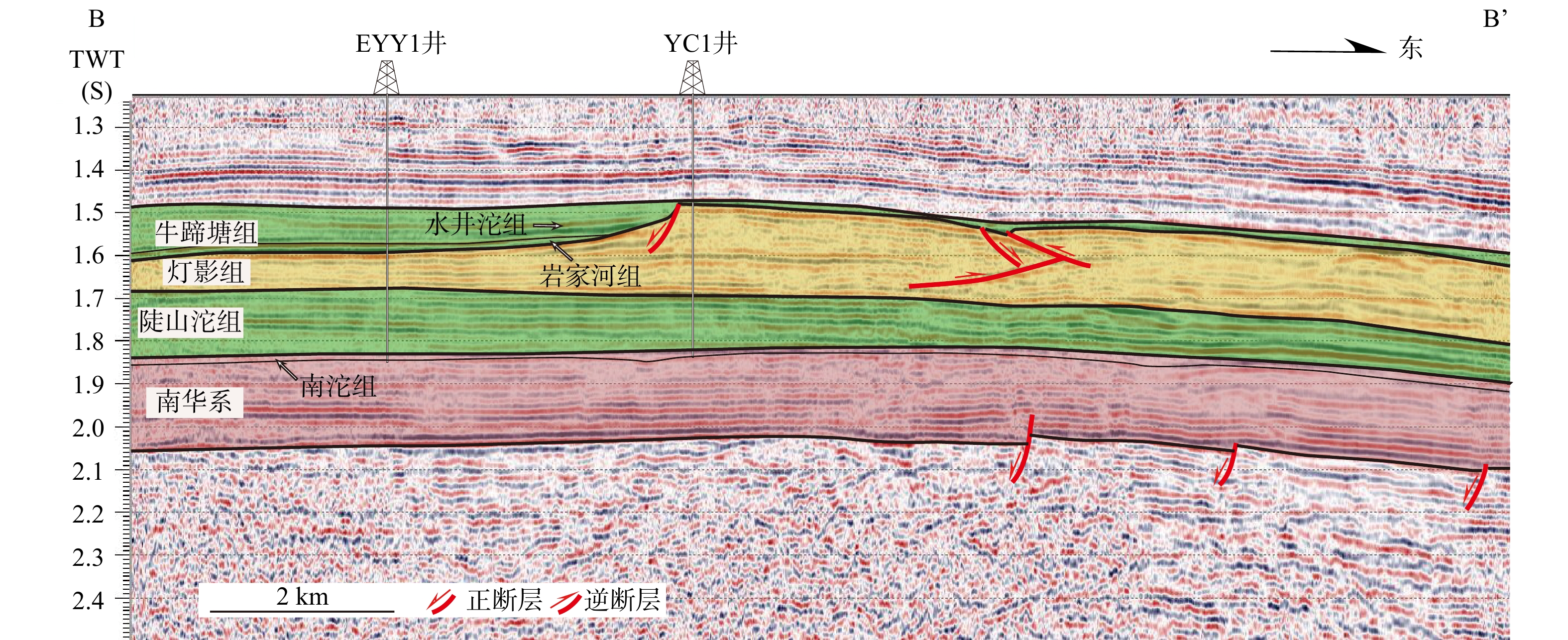
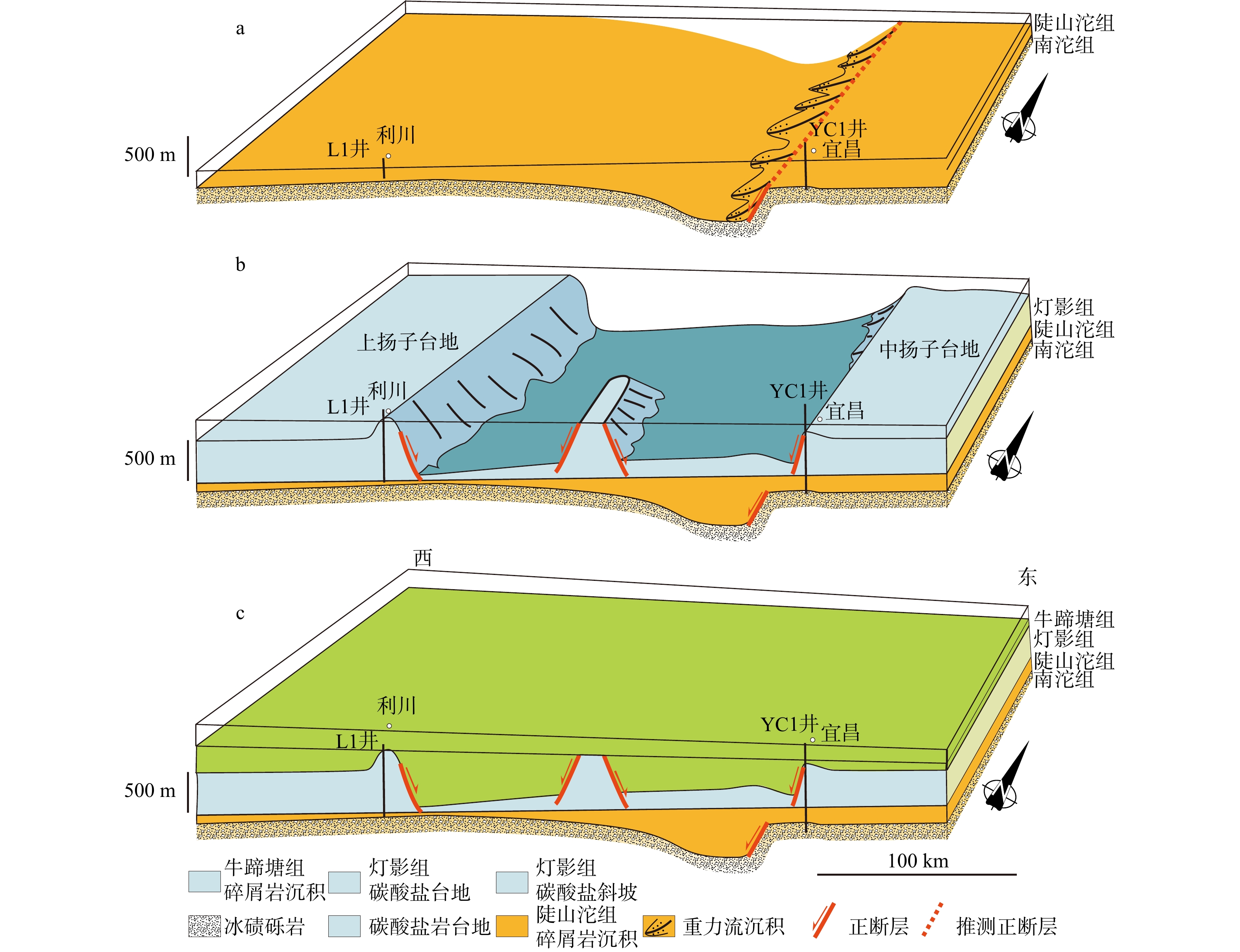
摘要: 新元古代震旦纪—早寒武世华南断陷盆地沉积了大量富有机质页岩和碳酸盐岩,优质烃源岩与储层发育,是油气勘探的重点领域。中扬子地区震旦纪—早寒武世发育鄂西海槽,但其形成与演化过程尚需进一步研究。基于钻井、野外露头和地震剖面等资料的综合分析,文章揭示出南北向鄂西海槽的形成与演化历史。研究结果表明,鄂西海槽经历了4个不同的阶段:南沱组沉积时期,鄂西地区初步形成沉降中心,但冰碛岩沉积厚度较小;陡山沱组沉积时期,雪球地球结束,气候转为温暖湿润,在鄂西海槽东侧形成了具有同沉积断裂的半地堑盆地;灯影组沉积时期,中—上扬子地区整体上形成2个台地和1个盆地的台−盆结构,鄂西地区发育完整的地堑盆地,呈现出碳酸盐岩台地的特征;牛蹄塘组沉积末期,鄂西海槽填充并消亡。其中陡山沱组二段和四段、牛蹄塘组二段发育富有机质页岩,是页岩气勘探的主要层系。同时鄂西海槽自下而上发育陡山沱组烃源岩、灯影组储层、牛蹄塘组烃源岩和盖层,具有“三明治”式的常规油气成藏模式。但多期次的构造活动导致部分油气封闭系统遭到破坏;此外,局部地区烃源岩埋藏深度大,致使有机质成熟度偏高。因此,寻找构造稳定区和成熟度适中地区是鄂西海槽页岩气勘探的关键,而优选有效成藏条件和良好保存地区则是常规天然气勘探的重点方向。Abstract:
Objective From the Neoproterozoic Sinian to the Early Cambrian periods, extensive basins in South China accumulated substantial volumes of organic-rich shale and carbonate rocks, providing high-quality source rocks and reservoirs. These basins constitute key targets for petroleum exploration. The Central Yangtze Region hosts the Sinian–Early Cambrian E’Xi trough, whose formation and evolutionary processes require further investigation. Methods Comprehensive analyses integrating drilling data, outcrop sections, and seismic profiles reveal the evolution history of this north-south-trending trough. Results Research indicates four distinct developmental stages: (1) During the deposition of the Nantuo Formation, an initial subsidence center emerged in western Hubei with limited tillite thickness; (2) The Doushantuo Formation developed in a half-graben basin system, coinciding with the post-Snowball Earth warming and humidification, which fostered syn-depositional faulting along the eastern trough margin; (3) The deposition of the Dengying Formation was characterized by carbonate platform with the establishment of a "two-platform, one-basin" architecture across the Central–Upper Yangtze region and the development of a complete graben basin in western Hubei; (4) The Niutitang Formation, dominated by clastic sediments, exhibits thickness complementarity with the underlying Dengying dolomites, marking trough filling and termination. Conclusions Members II and IV of Doushantuo Formation, together with Member II of the Niutitang Formation, host organic-rich shales, which constitute the primary targets for shale gas exploration. Conventional hydrocarbon systems display a "sandwich-style" accumulation model comprising Doushantuo source rocks, Dengying reservoirs, and Niutitang seal/source couples. Multiphase tectonic activities have disrupted some oil and gas closed systems, while excessive burial depths locally induced overmatured organic matter. Therefore, the key to shale gas exploration is identifying tectonically stable areas with moderate maturity levels, while the strategic focus for conventional natural gas exploration is prioritizing regions characterized by effective hydrocarbon accumulation and favorable preservation conditions. -
Key words:
- E’xi trough /
- Sinian–Early Cambrian /
- basin evolution /
- shale gas /
- natural gas exploration
-
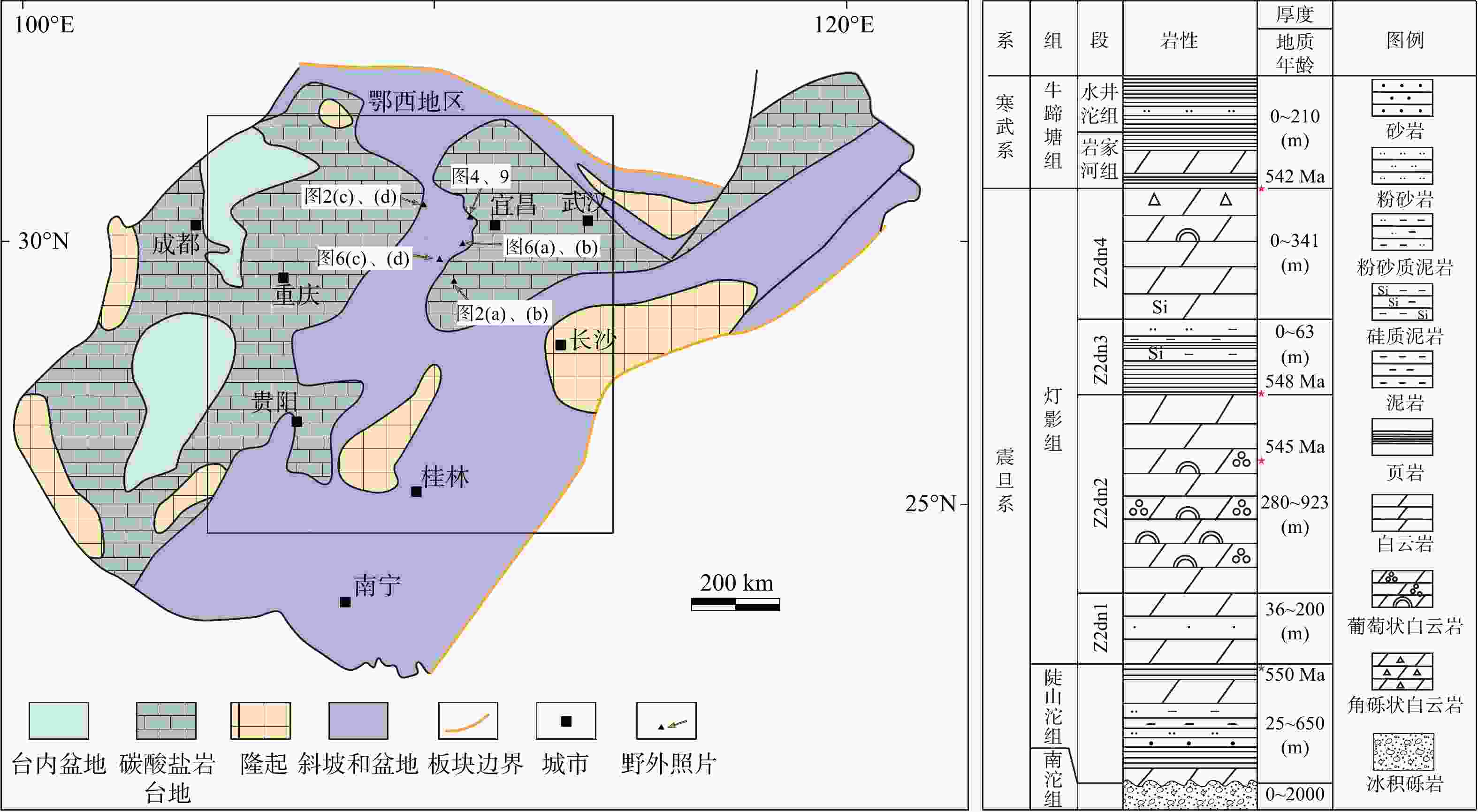
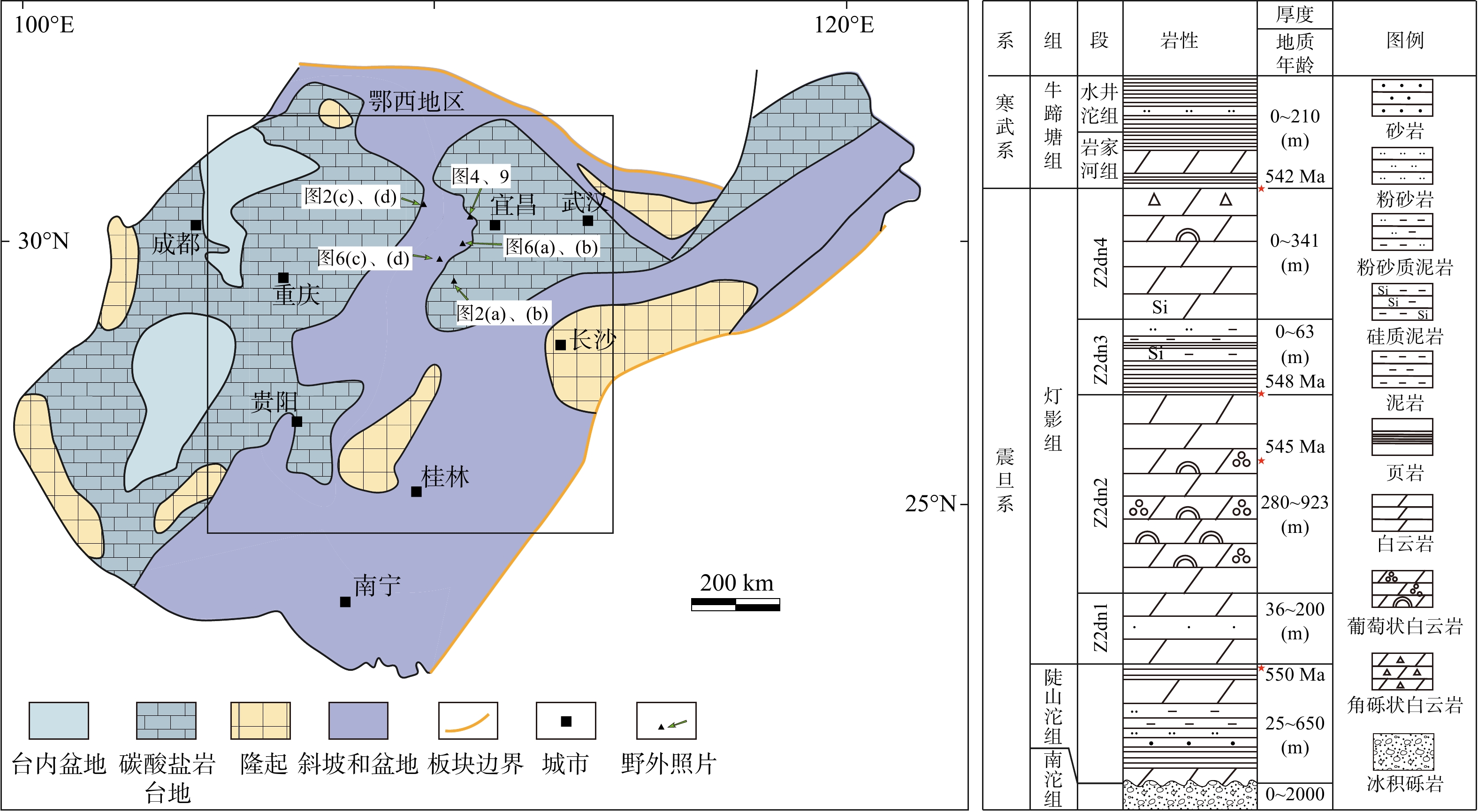
图 1 扬子地区震旦纪—早寒武世沉积古地理特征和鄂西地区地层综合特征(据王剑等,2024;丁一等,2025修改;地质年龄来源于Condon et al.,2005;Chen et al.,2015)
a—扬子地区震旦纪—早寒武世沉积古地理图;b—鄂西地区震旦系—下寒武统综合地层特征
Figure 1. Sinian–Early Cambrian paleogeographic map and comprehensive log in the Yangtze region (modified after Wang et al., 2024; Ding et al., 2025; geological ages from Condon et al., 2005; Chen et al., 2015)
(a) Sinian–Early Cambrian paleogeographic map in the Yangtze region; (b) Comprehensive log of the Sinian–Lower Cambrian in western Hubei
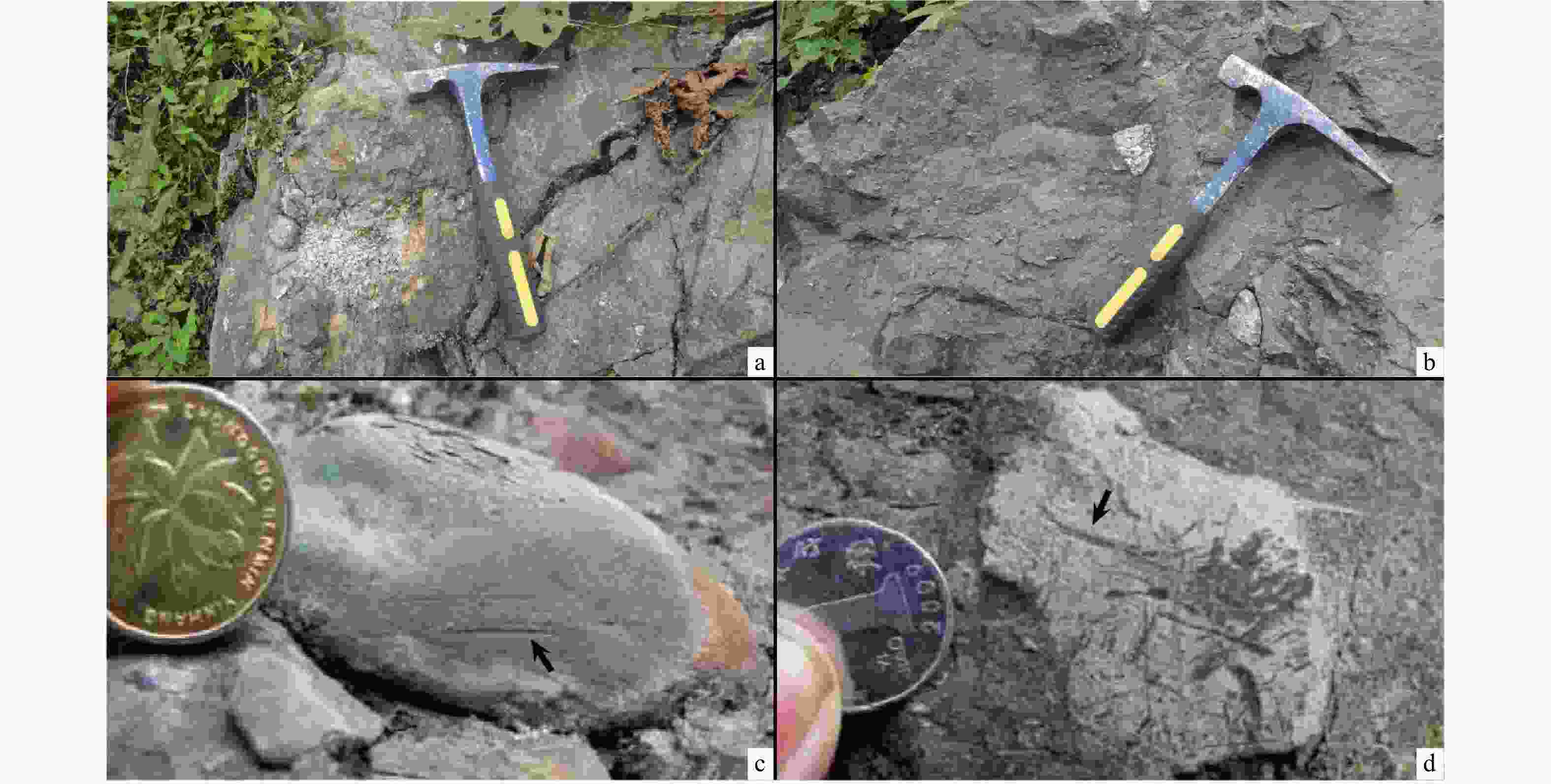
图 2 南沱组野外露头特征(据胡军等,2021;胡军,2021修改;具体位置见图1)
a—湘西北三叉乡冰碛岩;b—湘西北三叉乡含砾砂岩;c—鄂西神农架地区砾石擦痕;d—鄂西神农架地区碳酸盐岩砾石擦痕
Figure 2. Outcrop characteristics of the Nantuo Formation (modified after Hu et al., 2021; Hu, 2021; locations are shown in Figure 1)
(a) Glacial deposits in Sanchaxiang, northwest Hunan; (b) Conglomeratic sandstone in Sanchaxiang, northwest Hunan; (c) Striations on conglomerates in the Shennongjia area; (d) Striations on carbonate clasts in the Shennongjia area
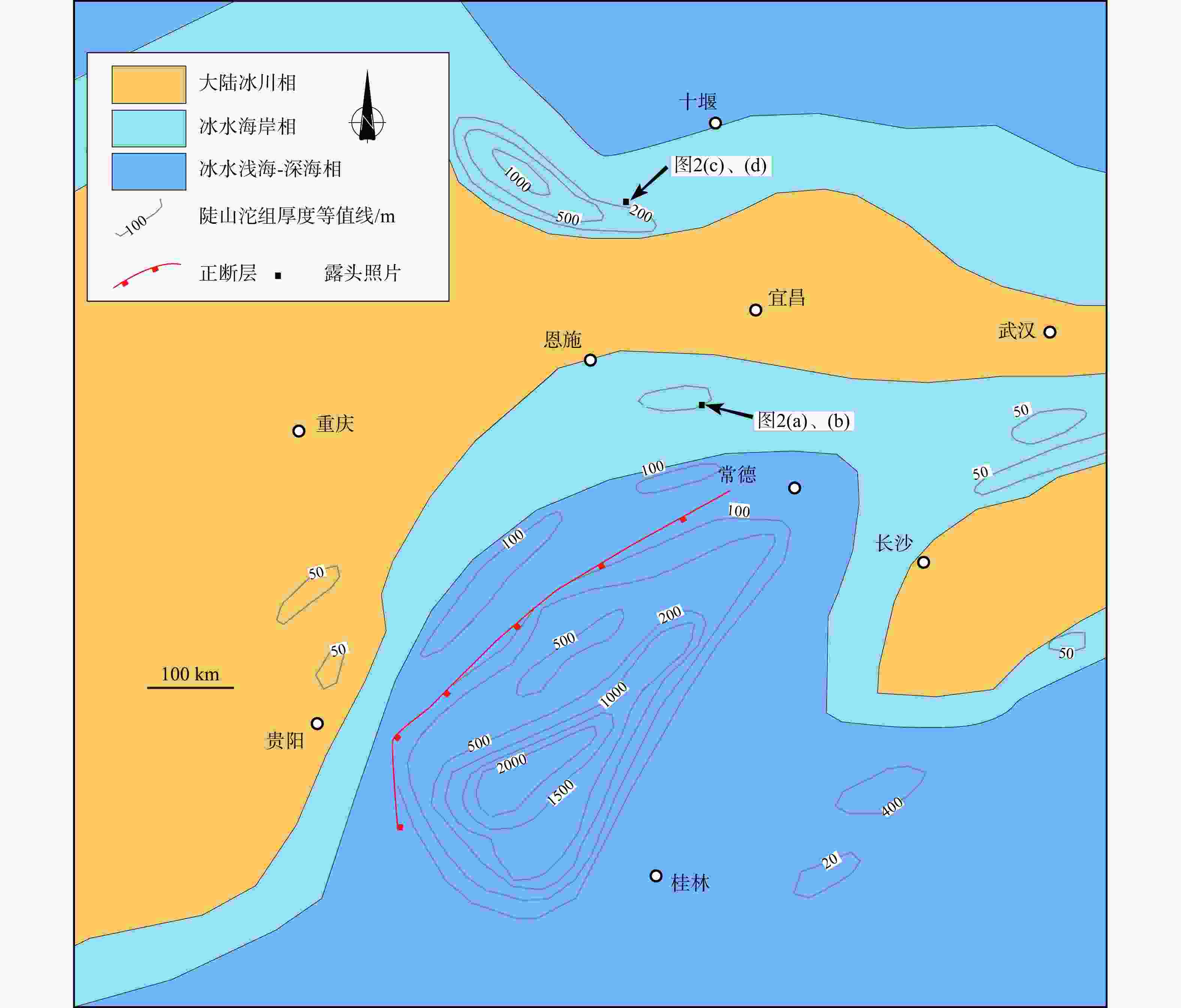
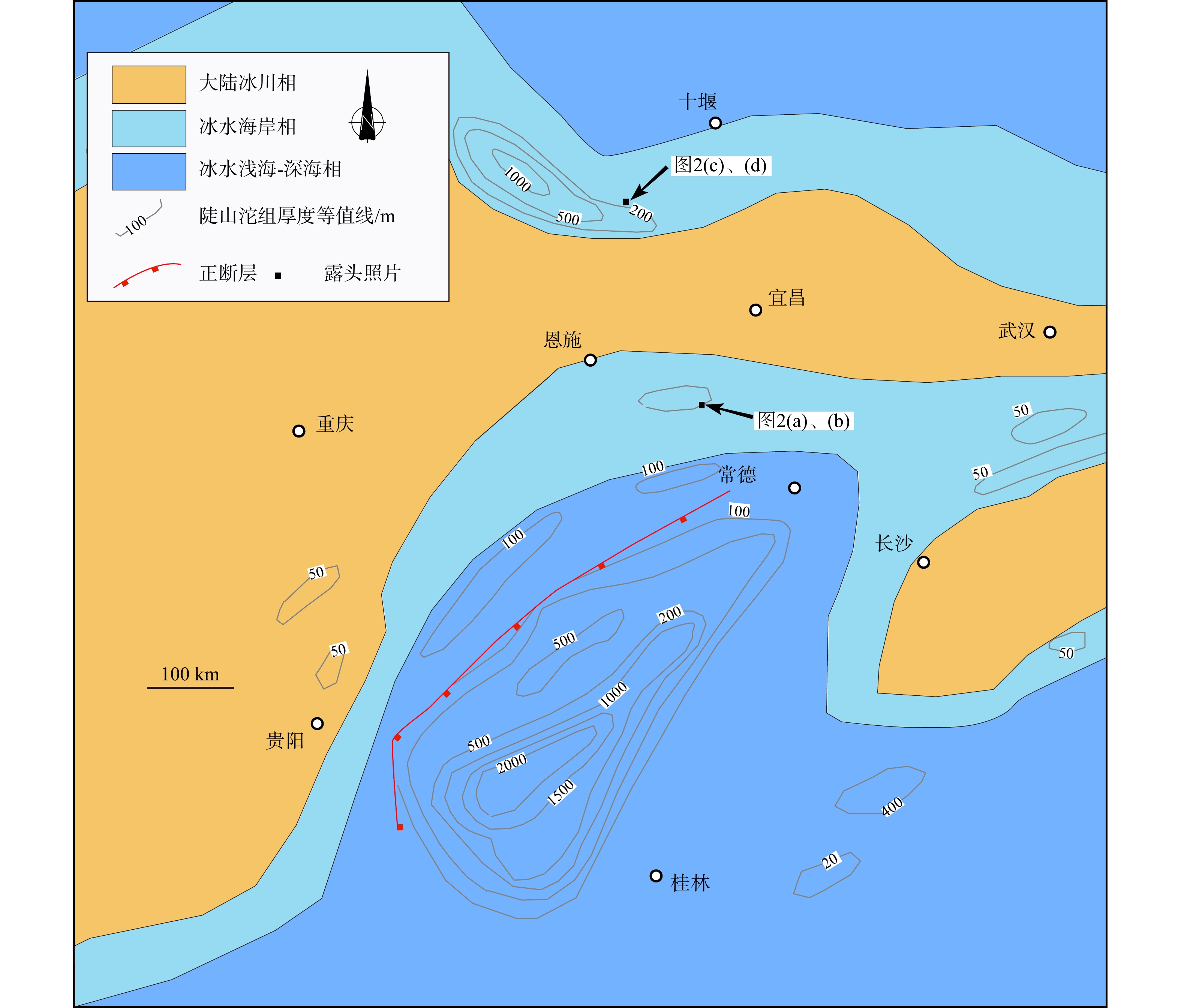
图 3 鄂西地区南沱组厚度等值线及沉积相特征(据王剑,2000修改)
Figure 3. Isopach and sedimentary facies map of the Nantuo Formation in western Hubei (modified after Wang, 2000)
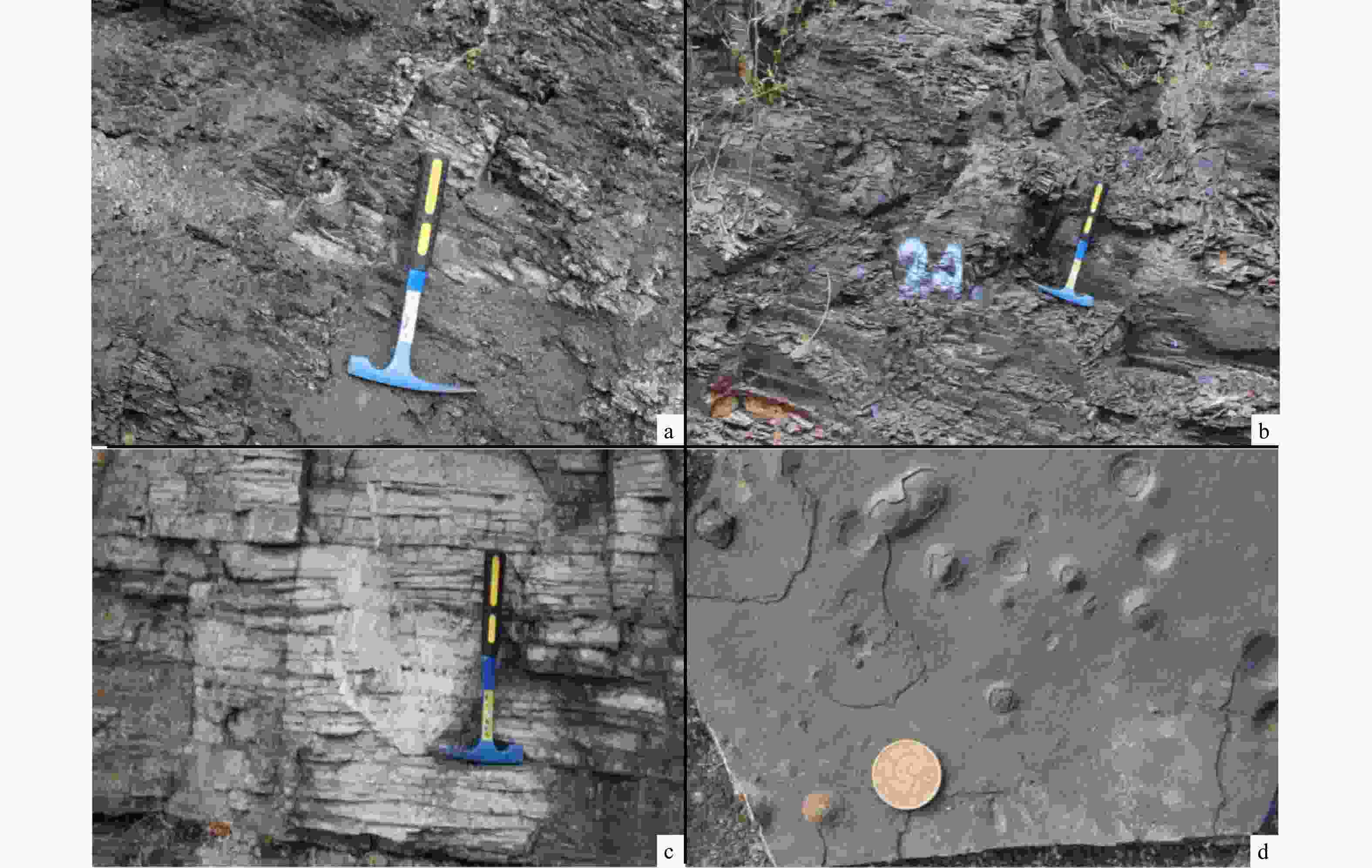
图 4 宜昌三斗坪地区陡山沱组沉积特征(具体位置见图1)
a—陡二段黑色页岩;b—陡四段黑色页岩;c—陡三段浅灰色含泥质条带灰岩;d—陡三段中白云质泥岩中燧石结核
Figure 4. Sedimentary characteristics of the Doushantuo Formation in the Sandouping area, Yichang (Location is shown in Fig. 1)
(a) Black shale from the second member of the Doushantuo Formation; (b) Black shale from the fourth member of the Doushantuo Formation; (c) Light gray, argillaceous ribbon limestone from the third member of the Doushantuo Formation; (d) Chert nodules within dolomitic mudstones from the third member of the Doushantuo Formation
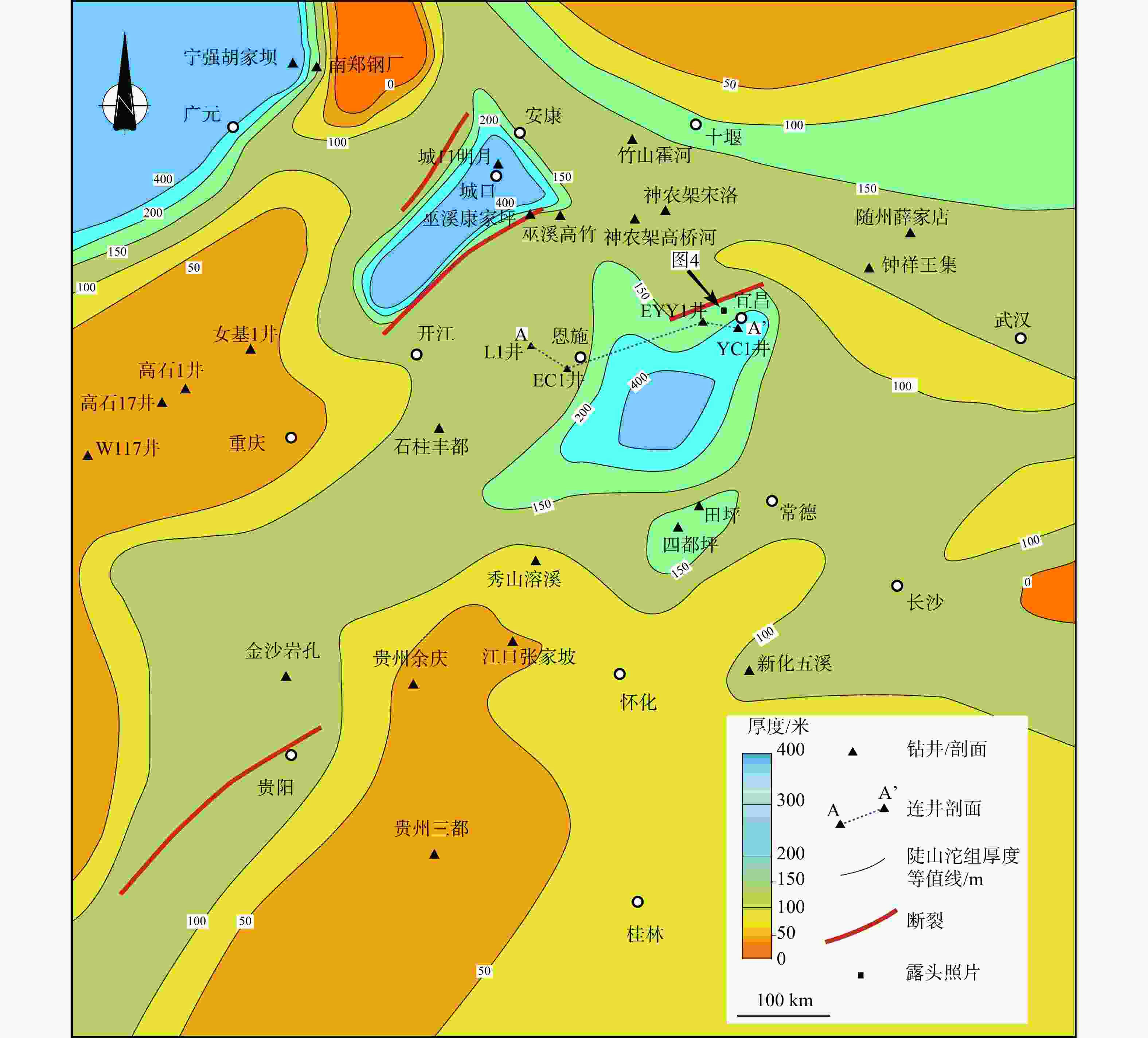
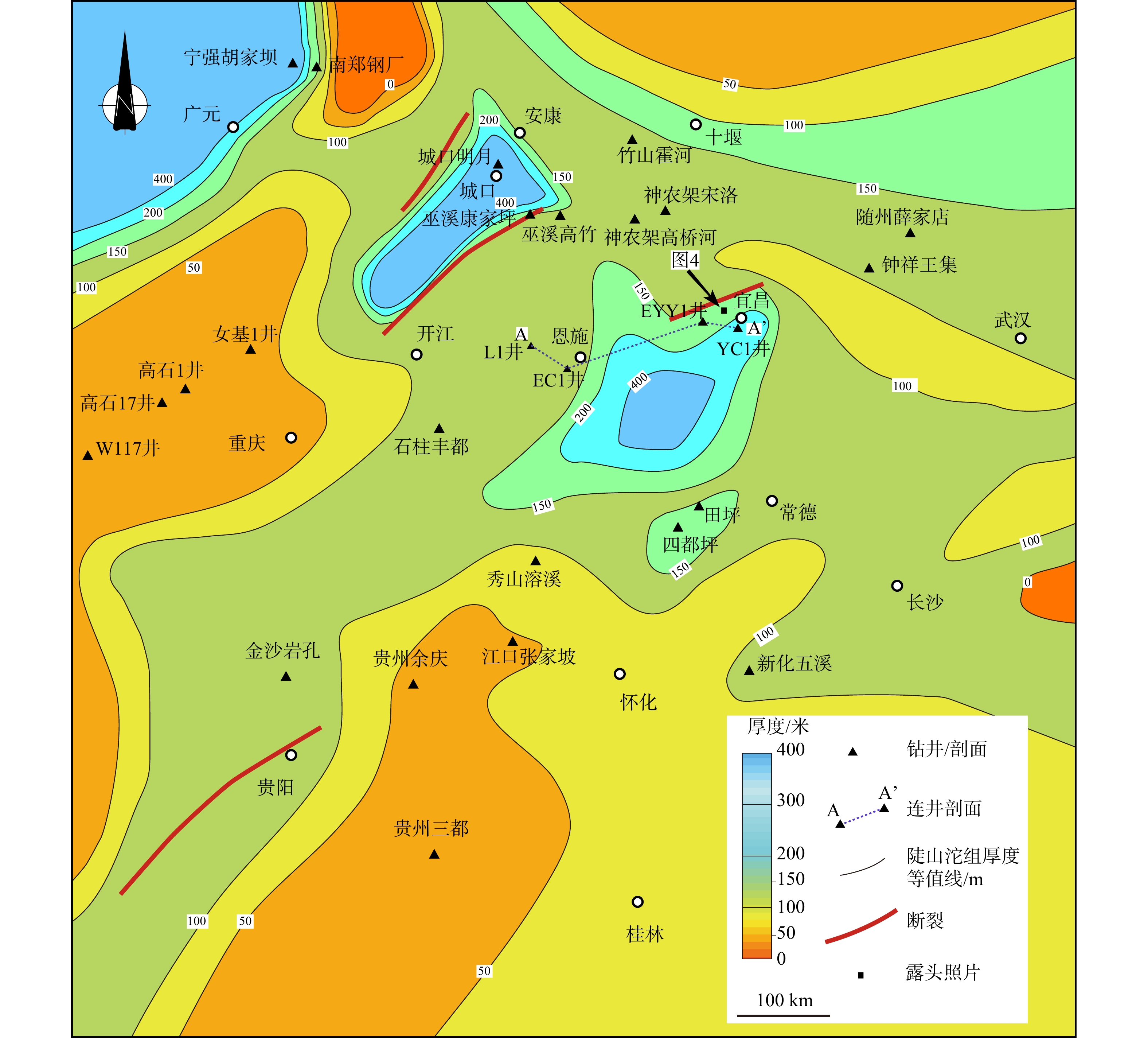
图 5 鄂西地区陡山沱组厚度等值线图(据陈科等,2024修改)
Figure 5. Isopach map of the Doushantuo Formation in western Hubei (modified after Chen et al., 2024)
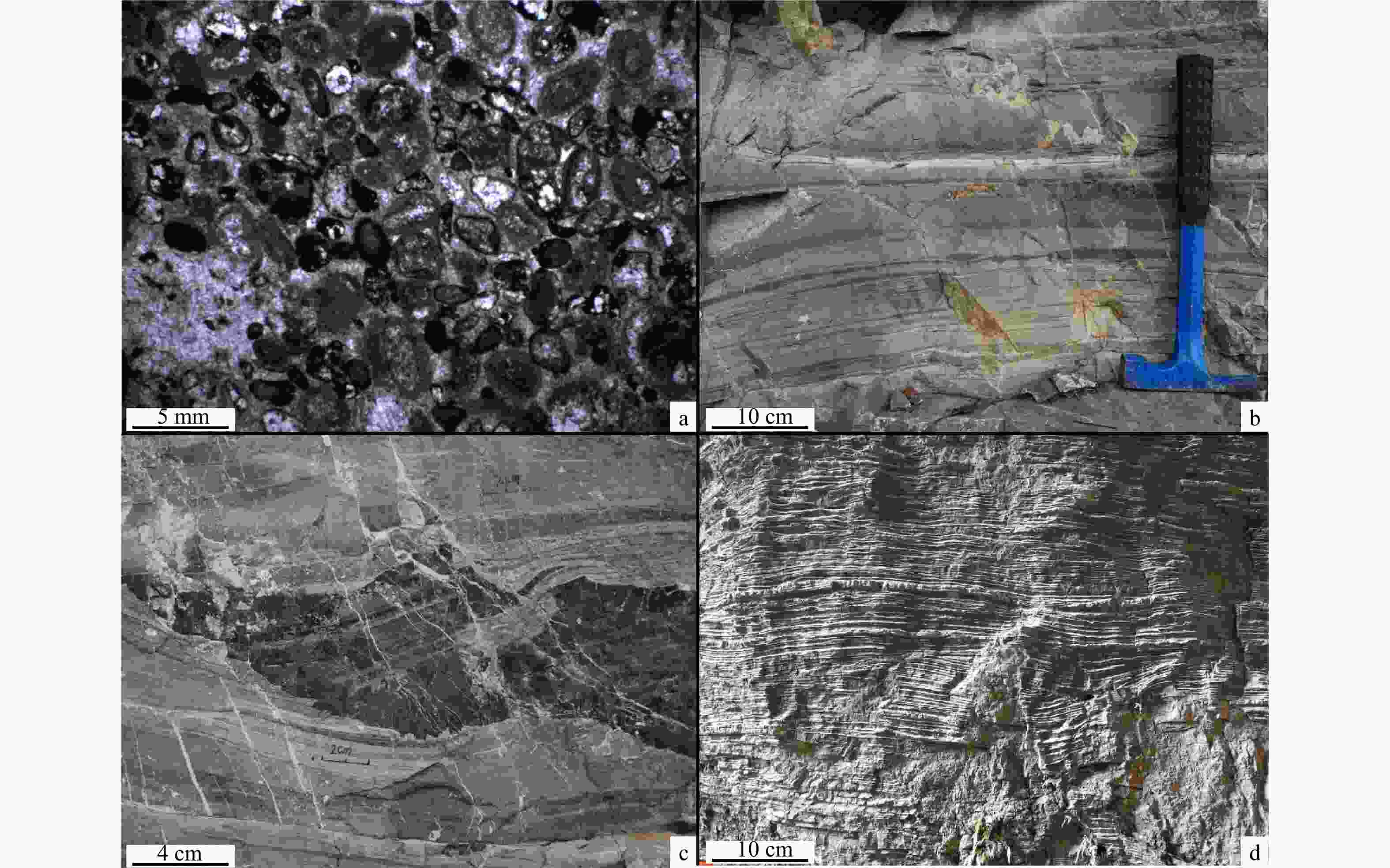
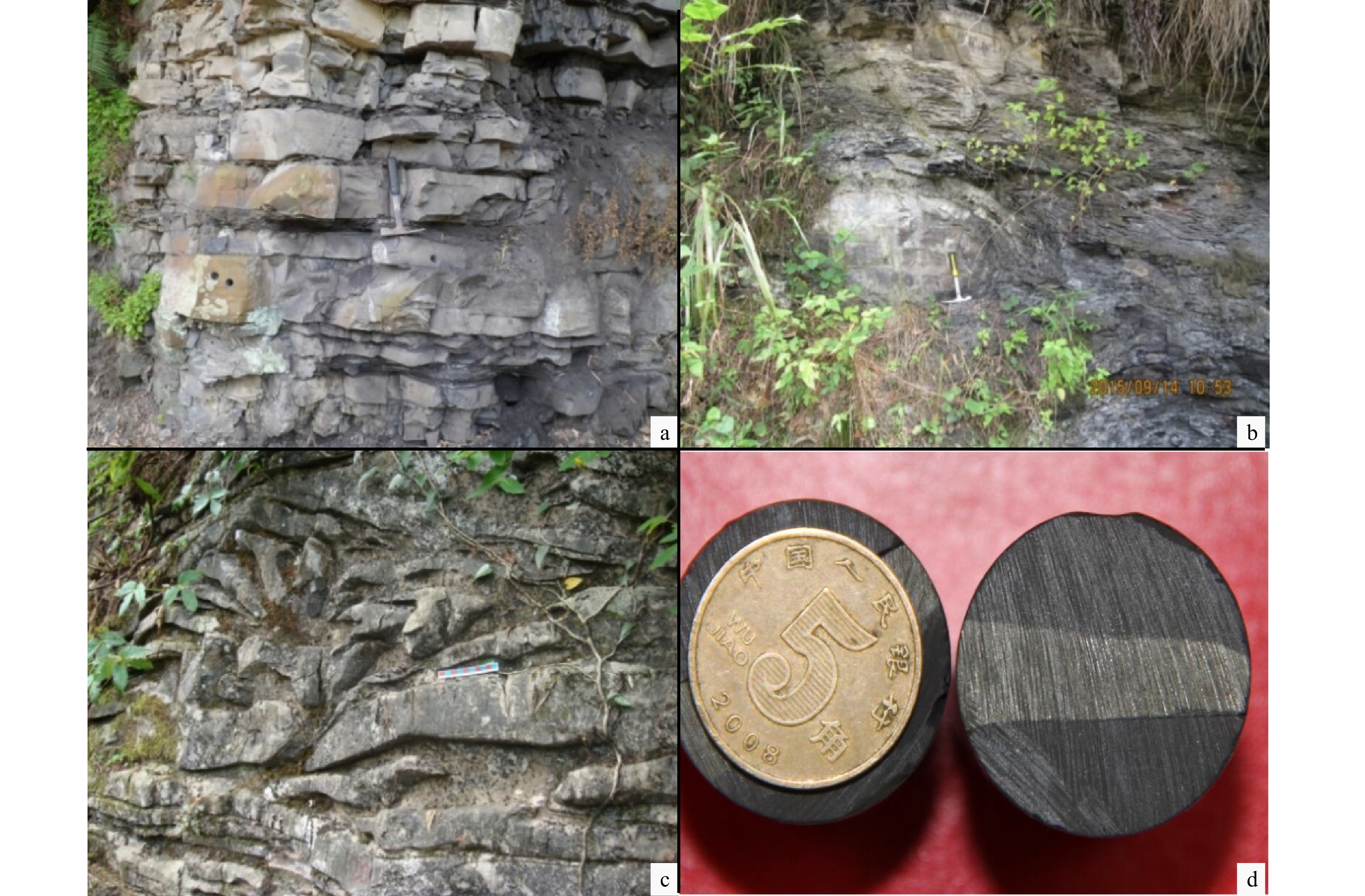
图 6 灯影组沉积特征(具体位置见图1)
a—鹤峰白果坪剖面台地边缘浅滩鲕粒;b—鹤峰白果坪剖面水平层理;c—秭归九龙湾水平层理和滑塌构造;d—秭归头顶石丘状交错层理
Figure 6. Sedimentary characteristics of the Dengying Formation (Locations are shown in Fig. 1)
(a) Shoal ooids from the platform margin of the Baiguoping section, Hefeng; (b) Horizontal bedding in the Baiguoping section, Hefeng; (c) Horizontal bedding and slump structures in the Jiulongwan section, Zigui; (d) Hummocky cross-bedding in the Toudingshi section, Zigui
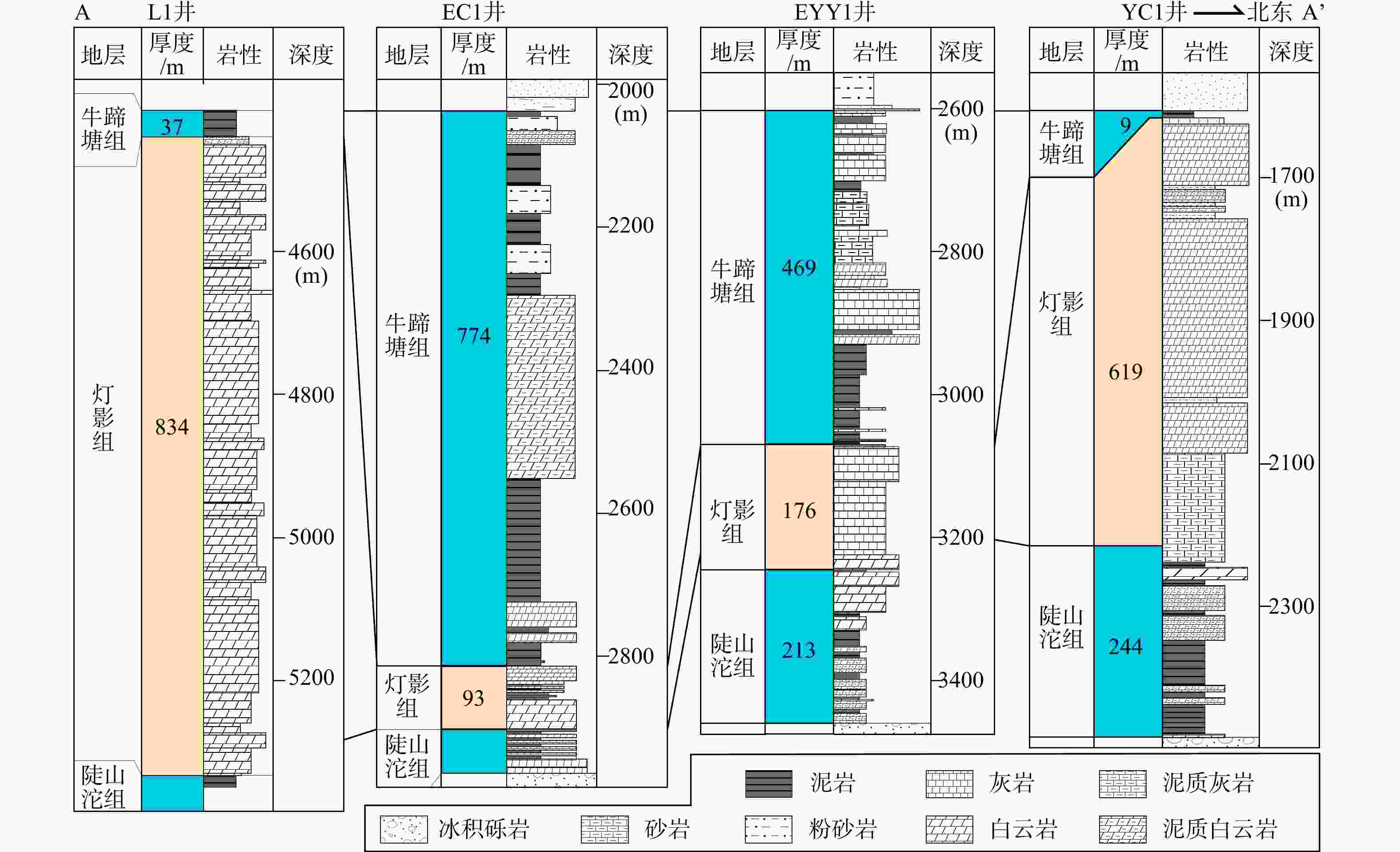
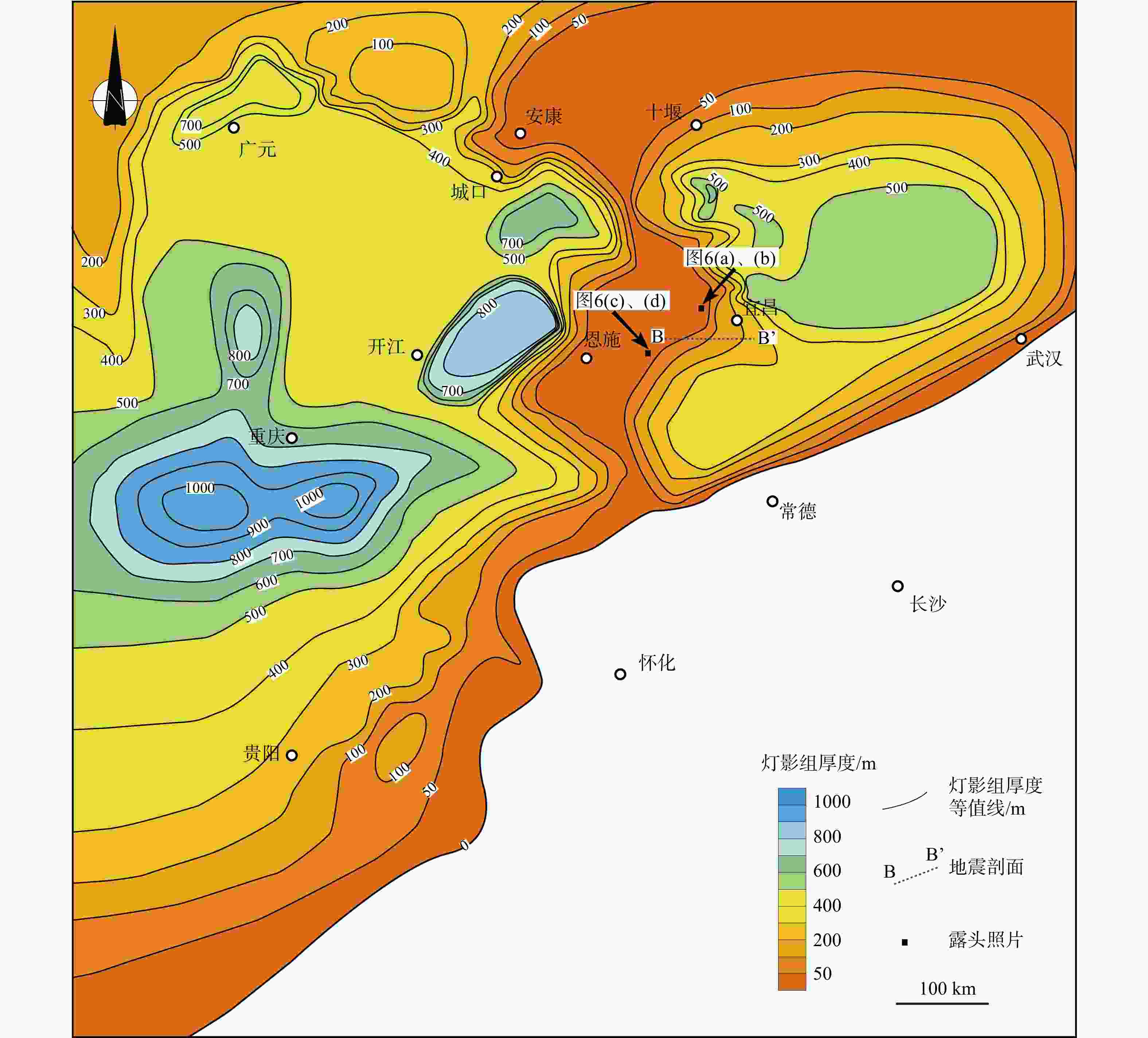
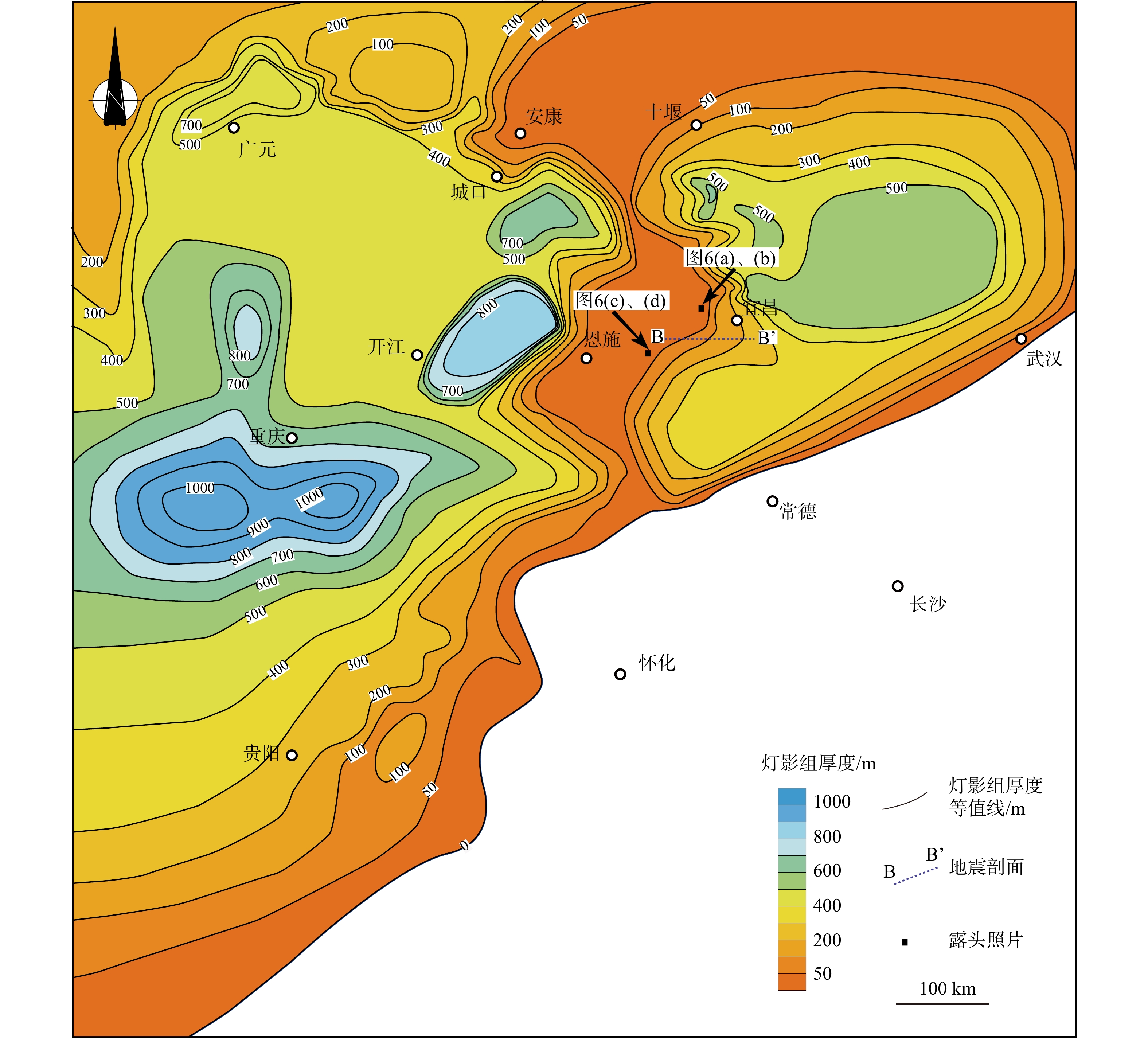
图 8 鄂西地区灯影组厚度等值线图(据汪泽成等,2014修改)
Figure 8. Isopach map of the Dengying Formation in western Hubei (modified after Wang et al., 2014)
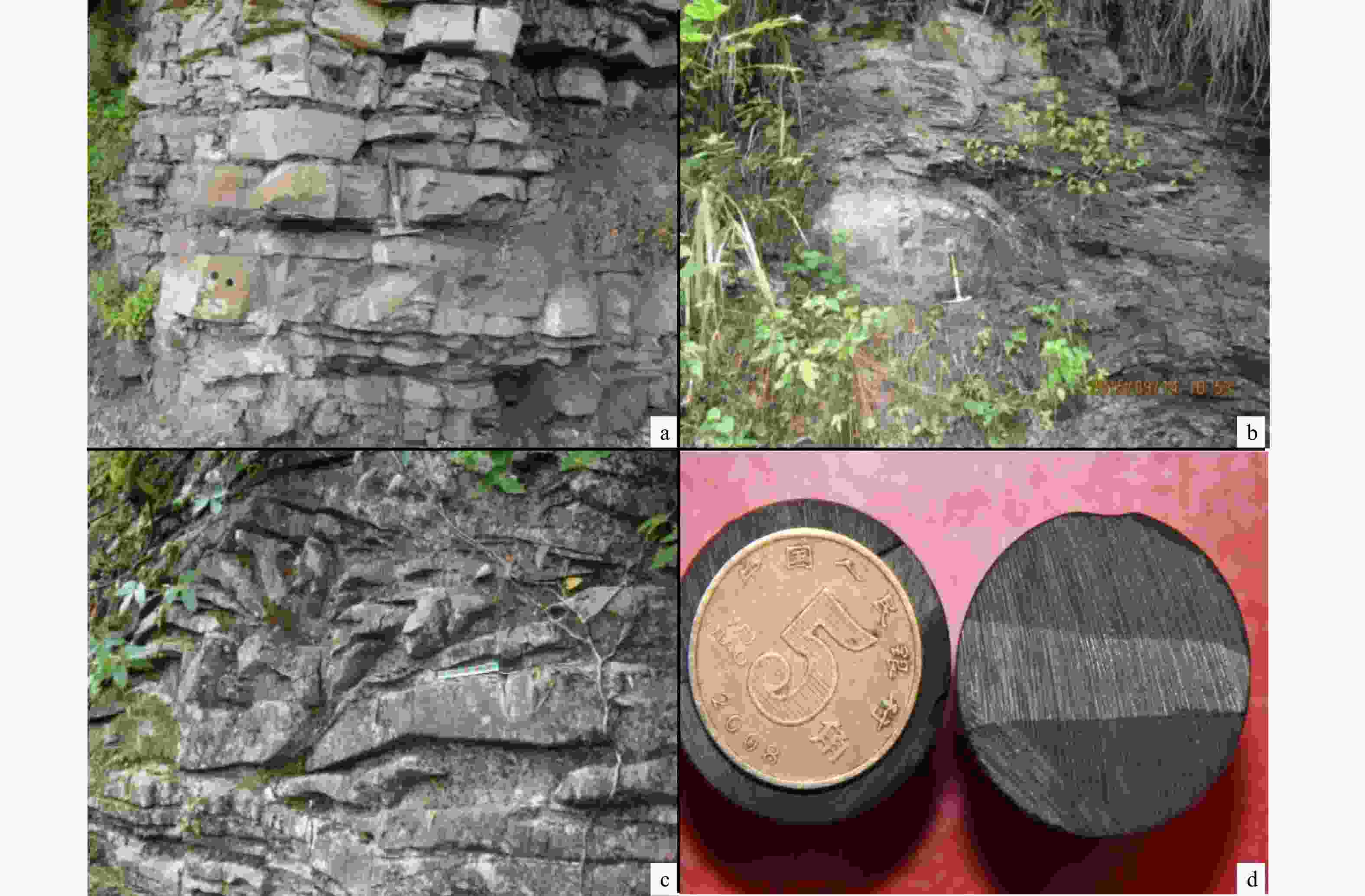
图 9 牛蹄塘组沉积特征(具体位置见图1)
a—深灰色中层含炭粉晶灰岩夹黑色薄层含炭粉砂质泥岩;b—薄层含炭钙质泥岩夹灰岩透镜体;c—含炭钙质泥页岩夹灰岩透镜体;d—鄂阳页1井牛蹄塘组二段层状黄铁矿
Figure 9. Sedimentary characteristics of the Niutitang Formation (Location is shown in Fig. 1)
(a) Dark gray medium-bedded micrite limestone interlayered with thin beds of carbon-bearing silty mudstone; (b) Thin-bedded calcareous mudstone intercalated with lenses of limestone; (c) Calcareous mud shale intercalated with lenses of limestone; (d) Layered pyrite from the second member of the Niutitang Formation in well EYY1
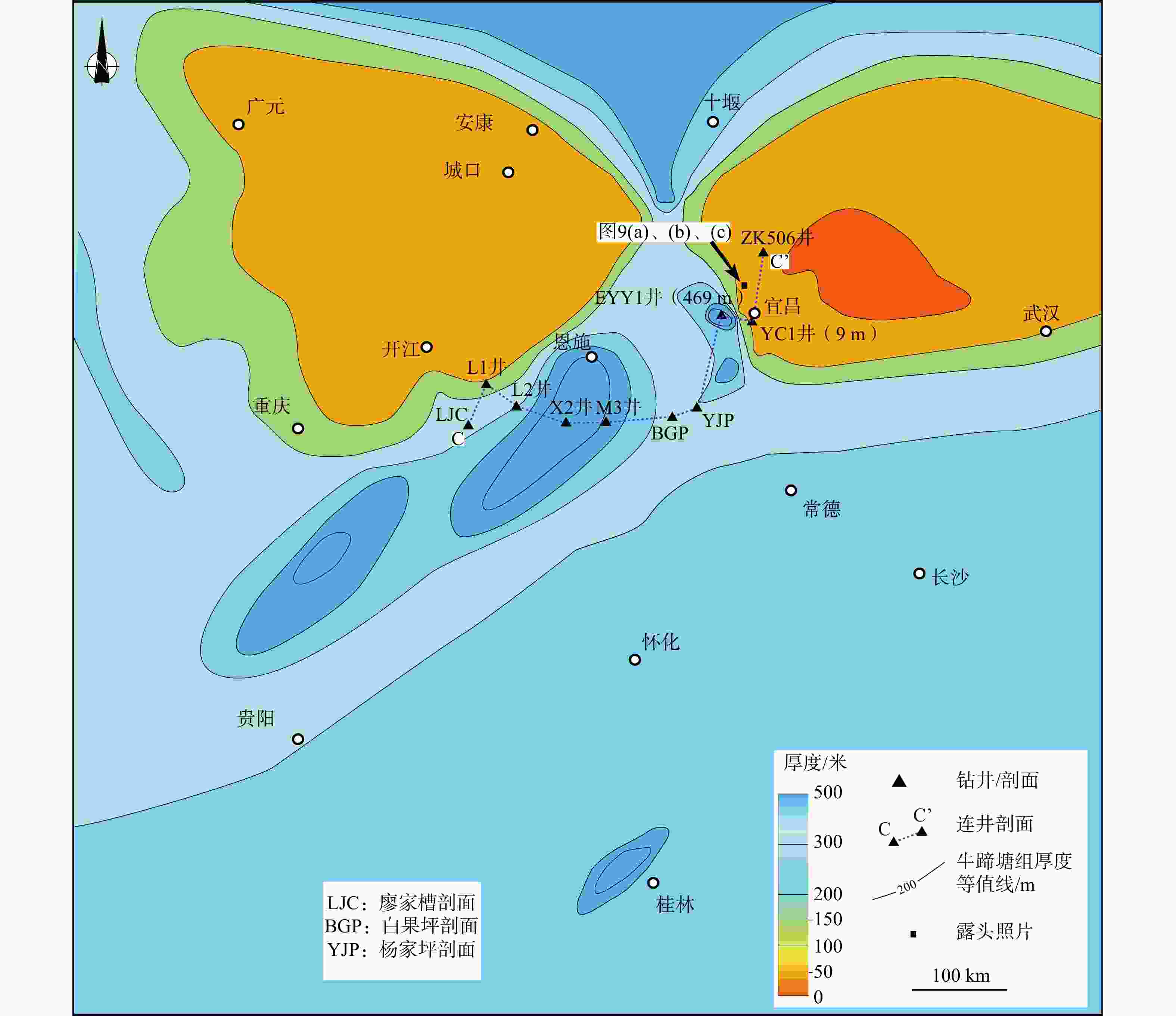
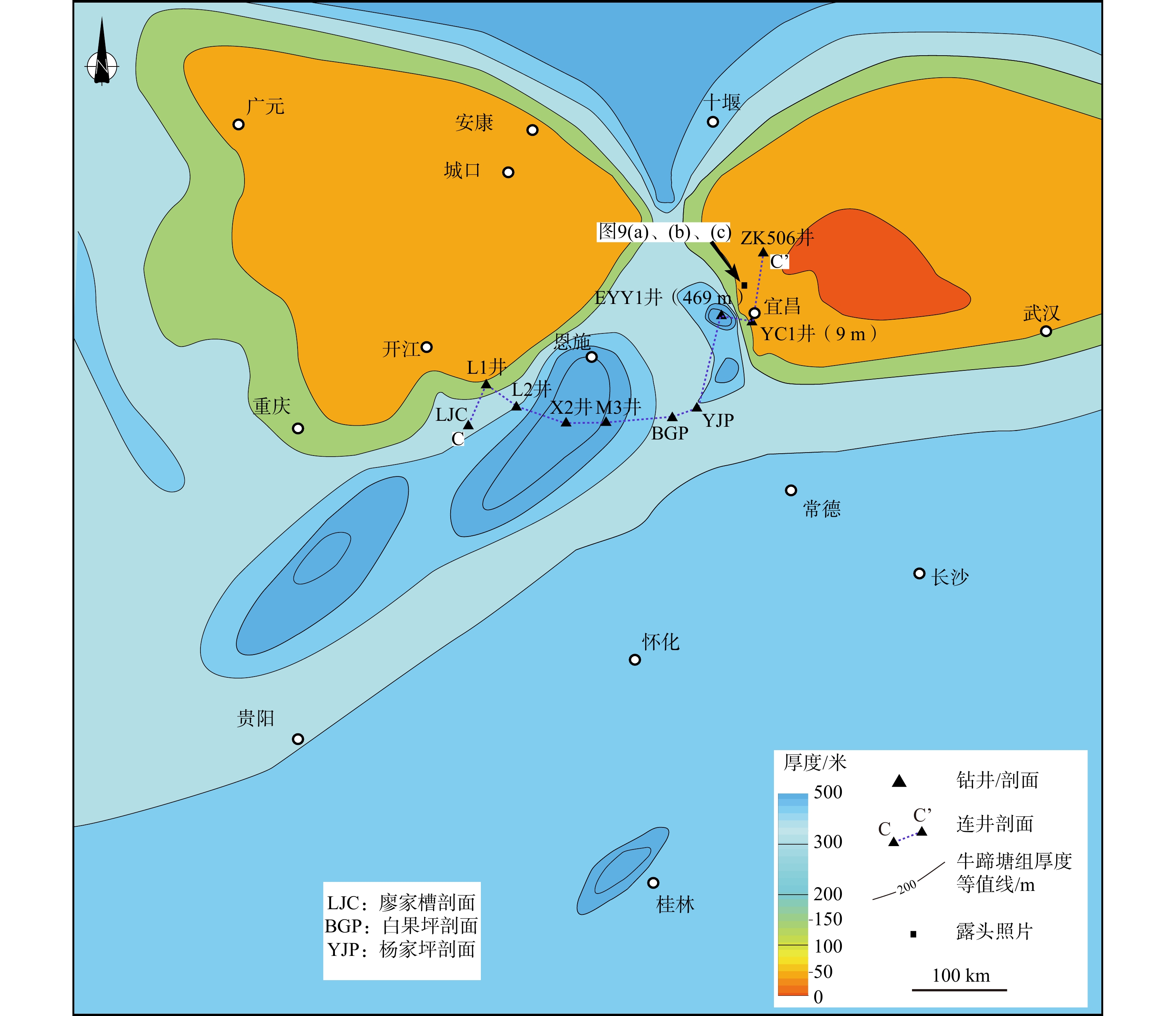
图 10 鄂西地区牛蹄塘组厚度等值线图(据陈科等,2025修改)
Figure 10. Isopach map of the Niutitang Formation in western Hubei (modified after Chen et al., 2025)
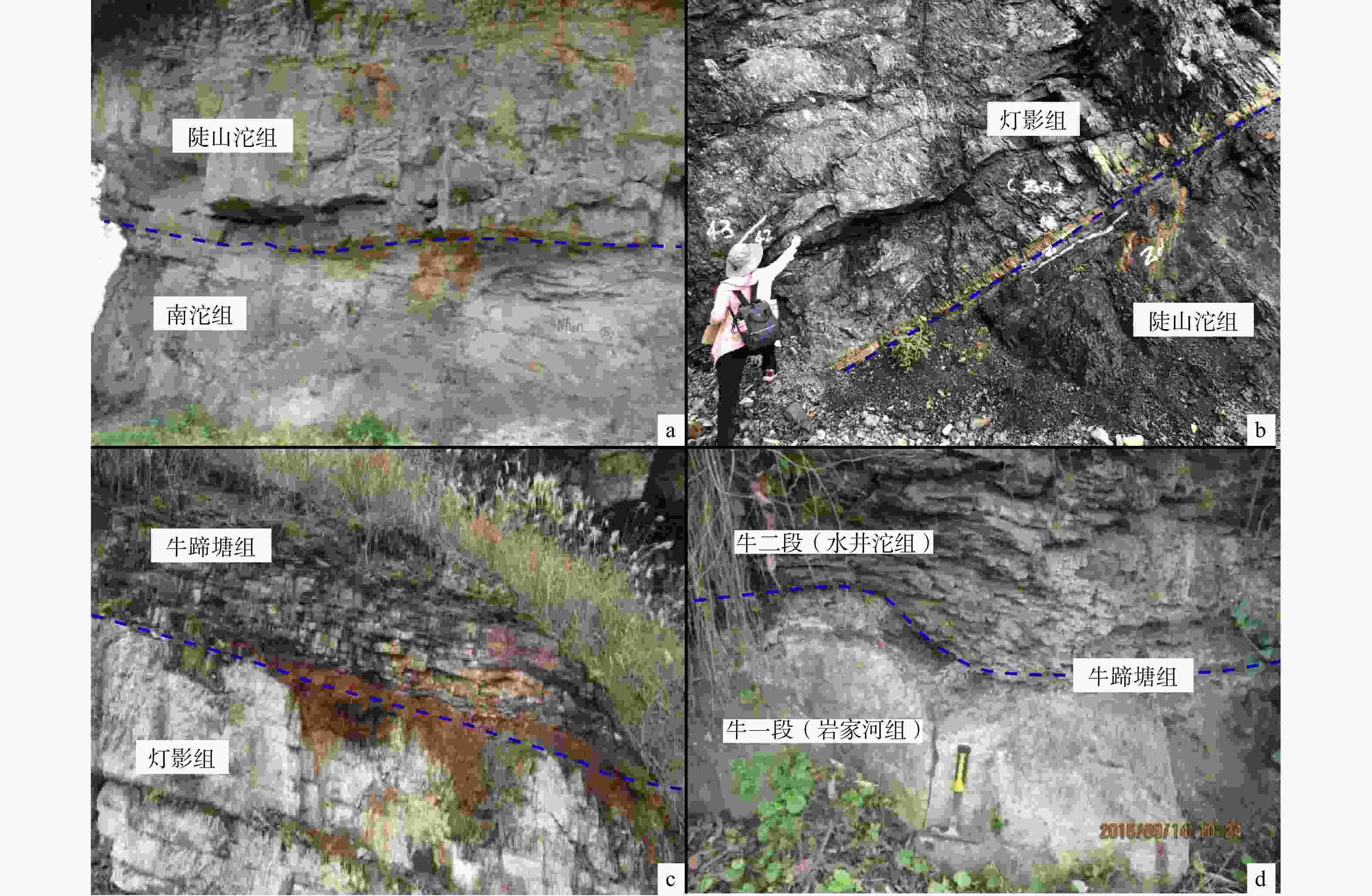
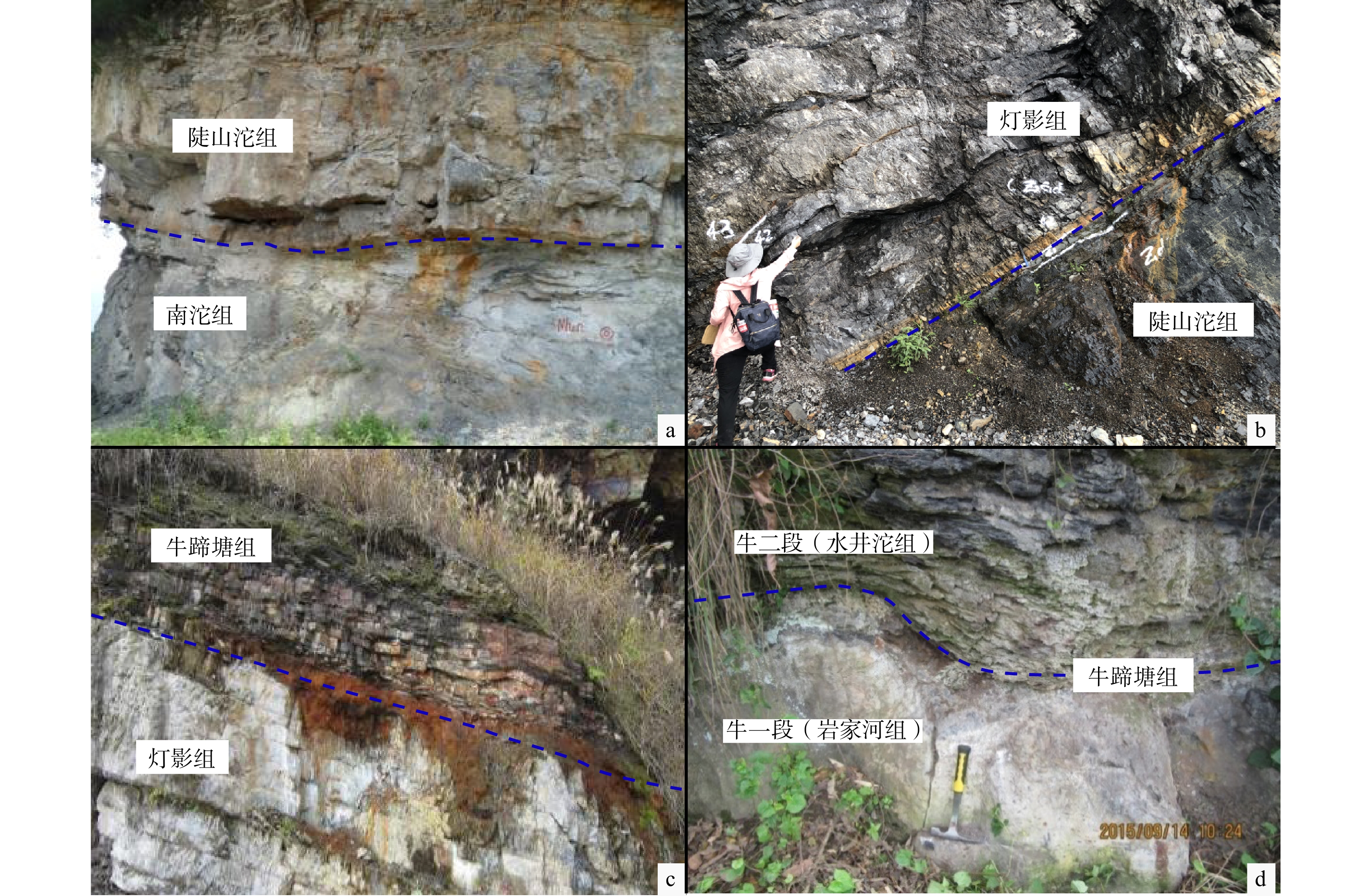
图 11 鄂西震旦系—下寒武统关键地层界面特征
a—陡一段盖帽白云岩,与下伏南沱组呈不整合接触;b—灯影组与陡山沱组整合接触;c—灯影组与牛蹄塘组之间平行不整合接触;d—牛蹄塘组一段(岩家河组)与二段(水井沱组)界面
Figure 11. Photographs of key stratigraphic interfaces in the Sinian–Lower Cambrian in western Hubei
(a) Cap dolomite of the first member of the Doushantuo Formation, in conformable contact with the underlying Nantuo Formation; (b) The Dengying Formation is in conformable contact with the Doushantuo Formation; (c) The Dengying Formation has a parallel unconformity contact with the Niutitang formation; (d) The interface between the first member (Yanjiahe Formation) and the second member (Shuijingtuo Formation) of the Niutitang Formation
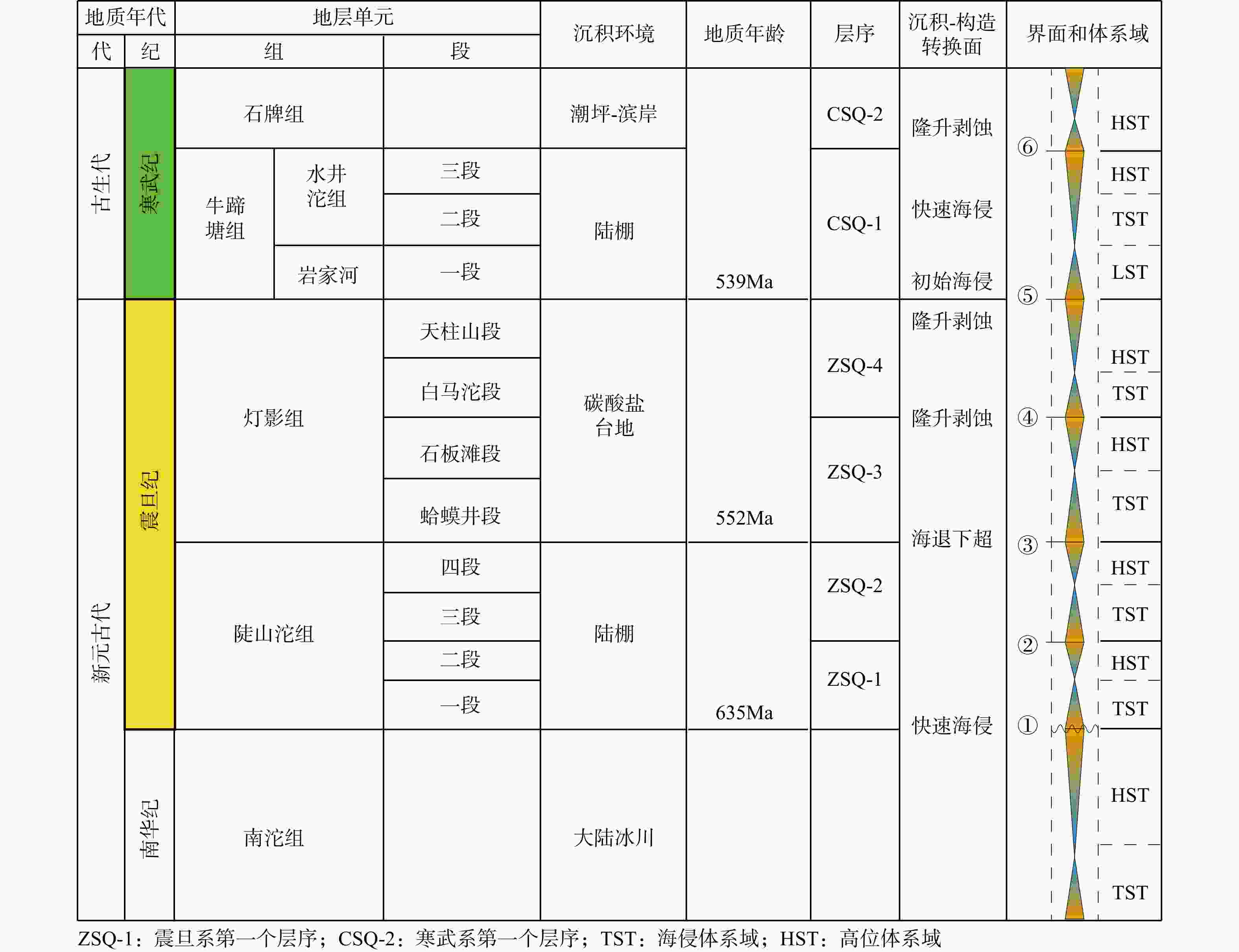
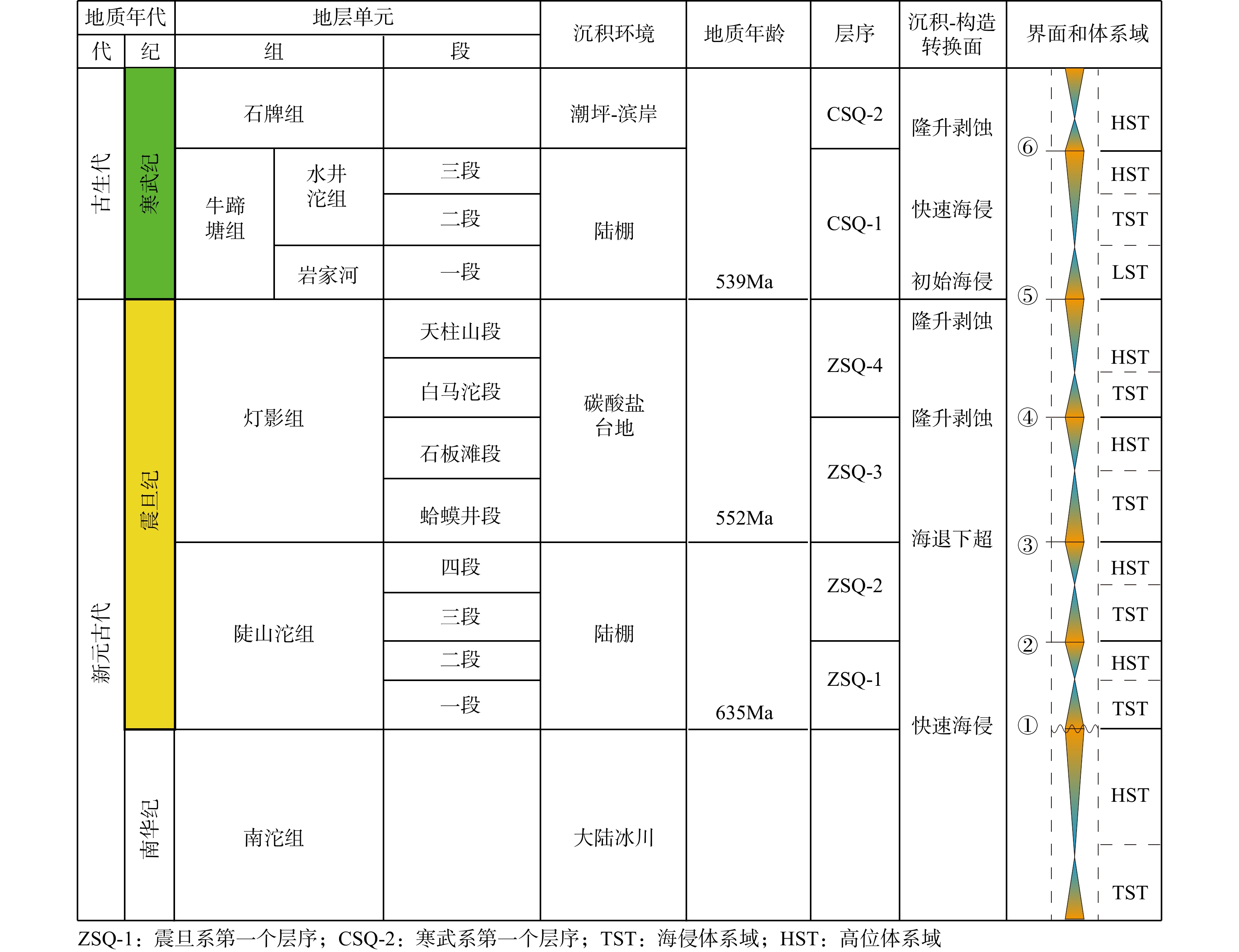
图 12 鄂西地区震旦系—下寒武统层序地层划分(据王剑,2000修改)
ZSQ-1—震旦系第1个层序;ZSQ-2—震旦系第2个层序;ZSQ-3—震旦系第3个层序;ZSQ-4—震旦系第4个层序;CSQ-1—寒武系第1个层序;CSQ-2—寒武系第2个层序;TST—海侵体系域;HST—高位体系域
Figure 12. Sequence stratigraphy of the Sinian–Lower Cambrian in western Hubei (modified after Wang, 2000)
ZSQ-1—the 1st sequence of the Sinian System; ZSQ-2—the 2nd sequence of the Sinian System; ZSQ-3—the 3rd sequence of the Sinian System; ZSQ-4—the 4th sequence of the Sinian System; CSQ-1—the 1st sequence of the Cambrian System; CSQ-2—the 2nd sequence of the Cambrian System; TST—transgressive systems tract; HST—highstand systems tract
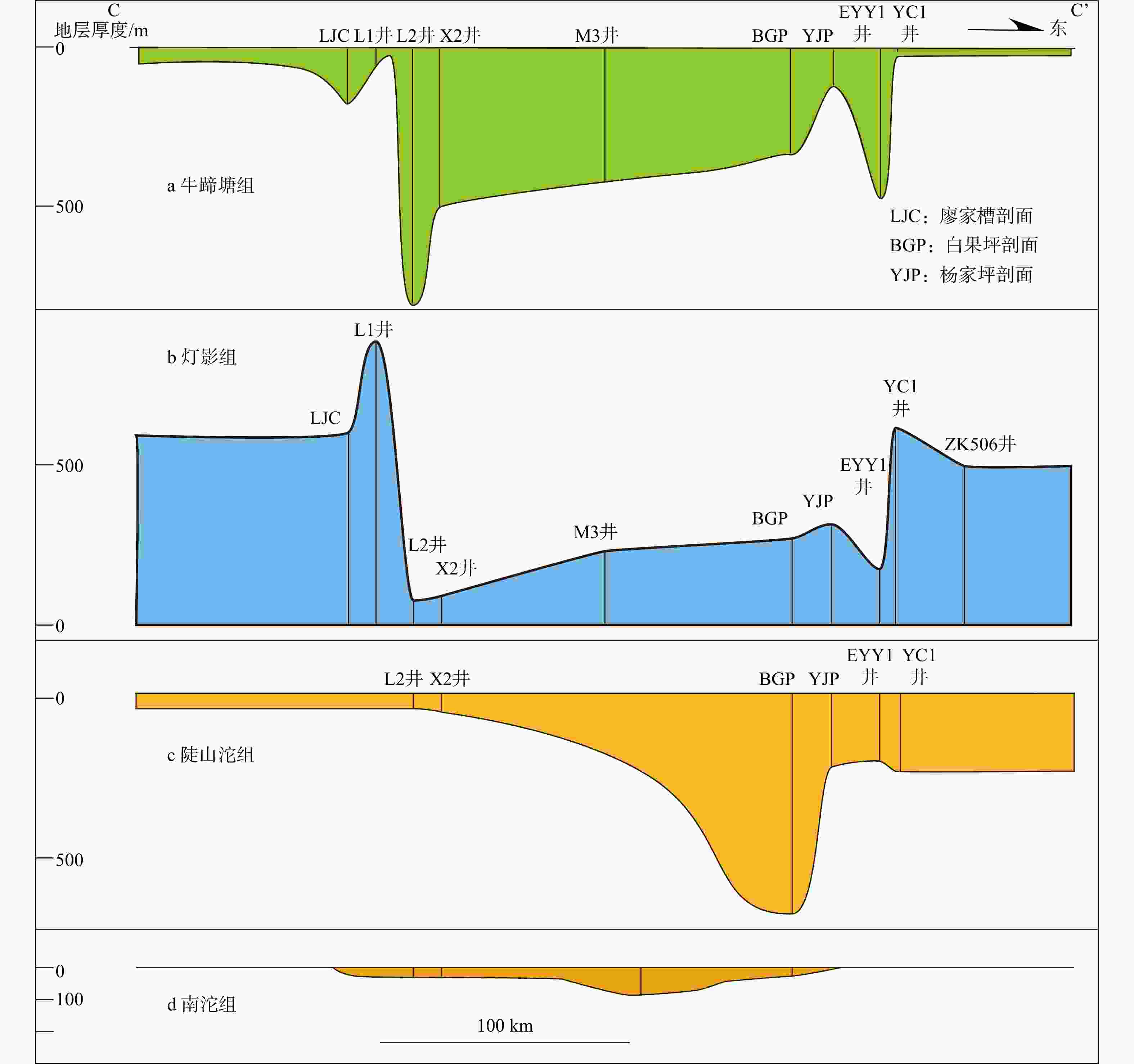
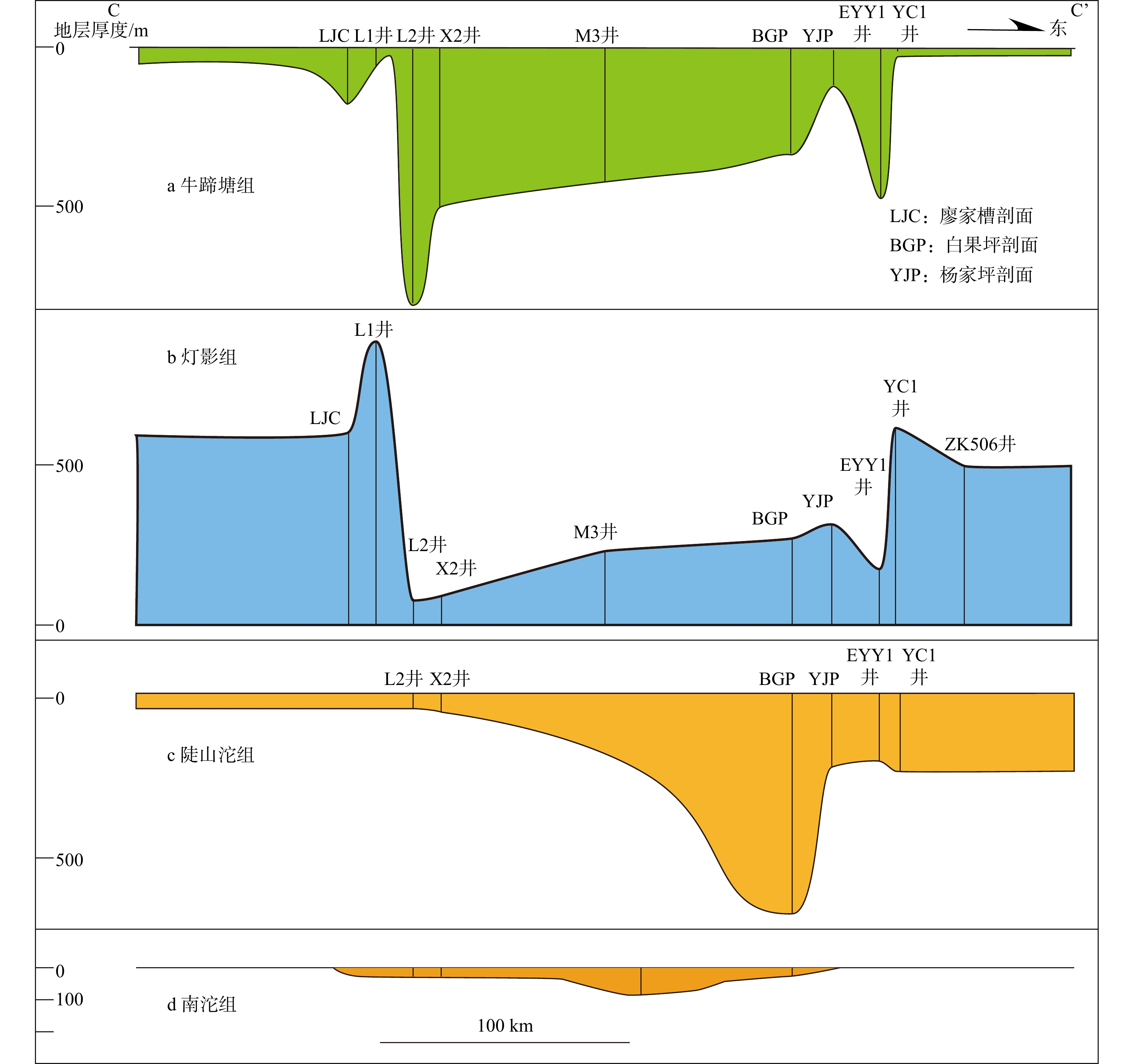
图 14 横穿鄂西海槽地层厚度剖面示意图(剖面位置见图10)
a—牛蹄塘组沉积厚度剖面;b—灯影组沉积厚度剖面;c—陡山沱组沉积厚度剖面;d—南沱组沉积厚度剖面
Figure 14. Cross section of stratigraphic thickness across the E’xi trough (Location is shown in Fig. 10)
(a) Sedimentary thickness section of the Niutitang Formation; (b) Sedimentary thickness section of the Dengying Formation; (c) Sedimentary thickness section of the Doushantuo Formation; (d) Sedimentary thickness section of the Nantuo Formation
-
[1] CHEN D Z, ZHOU X Q, FU Y, et al., 2015. New U–Pb zircon ages of the Ediacaran–Cambrian boundary strata in South China[J]. Terra Nova, 27(1): 62-68. doi: 10.1111/ter.12134 [2] CHEN K, ZHAI G Y, BAO S J, et al., 2020. Tectonic evolution of the Huangling uplift and its control effect on shale gas preservation in South China[J]. Geology in China, 47(1): 161-172. (in Chinese with English abstract) doi: 10.31035/cg2020025 [3] CHEN K, LU Y X, LI F, et al., 2024. Sedimentary characteristics of Doushantuo Formation in middle-upper Yangtze region and its significance for oil and gas geology[J]. Geological Survey of China, 11(5): 92-103. (in Chinese with English abstract) [4] CHEN K, WANG Y L, LU Y X, et al., 2025. Sedimentary characteristics of the Lower Cambrian Shuijingtuo Formation in the E’Xi trough and its petroleum geological significance[J]. Journal of Geomechanics, 31(4): 604-616. (in Chinese with English abstract) [5] CONDON D, ZHU M Y, BOWRING S, et al., 2005. U-Pb ages from the neoproterozoic Doushantuo Formation, China[J]. Science, 308(5718): 95-98. doi: 10.1126/science.1107765 [6] DING Y, LIU S G, WEN L, et al., 2025. Strata missing of the Ediacaran upper Dengying Formation at the northeastern Mianyang-Changning intracratonic sag, and tectonic implications[J]. Acta Geologica Sinica, 99(2): 352-364. (in Chinese with English abstract) [7] DUAN J B, MEI Q H, LI B S, et al., 2019. Sinian-Early Cambrian tectonic-sedimentary evolution in Sichuan Basin[J]. Earth Science, 44(3): 738-755. (in Chinese with English abstract) [8] GUO L, ZHONG Y J, ZHANG S P, et al., 2024. Structural-sedimentary filling processes and resource implications of intracratonic rift: example from Middle-Upper Yangtze transition zone[J]. Acta Sedimentologica Sinica, 42(6): 2119-2134. (in Chinese with English abstract) [9] HU J, 2021. Sedimentary characteristics, paleogeography and paleomarine environment of the Neoproterozoic Nantuo Formation in Shennongjia area (South China)[D]. Wuhan: China University of Geosciences. (in Chinese with English abstract) [10] HU J, SUN S Y, GU H D, et al., 2021. Subglacial sedimentary characteristics of the bottom of Nantuo Formation in three gorges area and its implications[J]. Earth Science, 46(7): 2515-2528. (in Chinese with English abstract) [11] LI W Z, ZHANG J Y, LI H H, et al., 2020. Distribution characteristics of intracratonic rift and its exploration significance in western Hubei and eastern Chongqing area[J]. Natural Gas Geoscience, 31(5): 675-685. (in Chinese with English abstract) [12] LI Z Q, LIU J, LI Y, et al., 2015. Formation and evolution of Weiyuan-Anyue extension-erosion groove in Sinian System, Sichuan Basin[J]. Petroleum Exploration and Development, 42(1): 26-33. (in Chinese with English abstract) doi: 10.1016/s1876-3804(15)60003-9 [13] LUO S Y, MIAO F B, ZHANG B M, et al., 2024. Characteristics of deep marine carbonate reservoirs in platform margin of the Dengying Formation, Yichang area[J]. Geological Review, 70(S1): 293-296. (in Chinese with English abstract) [14] MERDITH A S, WILLIAMS S E, COLLINS A S et al., 2021. Extending full-plate tectonic models into deep time: linking the Neoproterozoic and the Phanerozoic[J]. Earth-Science Reviews, 214: 103477. doi: 10.1016/j.earscirev.2020.103477 [15] OUYANG Q, ZHOU C M, XIAO S H et al., 2021. Distribution of Ediacaran acanthomorphic acritarchs in the lower Doushantuo Formation of the Yangtze Gorges area, South China: evolutionary and stratigraphic implications[J]. Precambrian Research, 353: 106005. doi: 10.1016/j.precamres.2020.106005 [16] QI K N, KUANG H W, LIU Y Q, et al., 2024. Sedimentary characteristics of the Cryogenian Nantuo Formation and stratigraphic attribution of red beds in central Yunnan, southwestern margin of Yangtze Craton[J]. Journal of Palaeogeography (Chinese Edition), 26(6): 1305-1324. (in Chinese with English abstract) [17] SHAN C A, ZHANG Y S, GUO J J, et al. , 2015, Geological characteristics and resource potential of the Upper Sinian Doushantuo Formation shale gas in the north of middle Yangtze region[J]. Geology in China, 42(6): 1944-1958. (in Chinese with English abstract) [18] The Three Gorges Stratigraphic Research Group of Hubei Provincial Bureau of Geology, 1978. Paleontology of Sinian to Permian strata in the eastern Xiadong Region[M]. Beijing: Geological Publishing House. (in Chinese) [19] WANG C S, LI X B, BAI Y S, et al., 2011. The classification and correlation of Sinian sequence stratigraphy on the slope zone in northwestern Hunan Province[J]. Geological Bulletin of China, 30(10): 1538-1546. (in Chinese with English abstract) [20] WANG H Y, SHI Z S, ZHAO Q et al., 2025. Stratigraphic characteristics and shale gas enrichment interval distribution of the Lower Cambrian Qiongzhusi Formation, Upper Yangtze region, China[J]. Coal Geology & Exploration, 53(03): 72-89. (in Chinese with English abstract) [21] WANG J, 2000. Neoproterozoic rifting history of South China: significance to Rodinia breakup[M]. Beijing: Geological Publishing House: 146. (in Chinese) [22] WANG J, CUI X Z, WANG W, et al., 2024. Evolution of the South China paleocontinent and related resource-environmental developments: from Columbia to Gondwana[J]. Acta Sedimentologica Sinica, 42(6): 1849-1875. (in Chinese with English abstract) [23] WANG L J, LIN S F, XIAO W J, 2023. Yangtze and Cathaysia blocks of South China: their separate positions in Gondwana until early Paleozoic juxtaposition[J]. Geology, 51(8): 723-727. [24] WANG Z C, JIANG H, WANG T S, et al., 2014. Paleo-geomorphology formed during Tongwan tectonization in Sichuan Basin and its significance for hydrocarbon accumulation[J]. Petroleum Exploration and Development, 41(3): 305-312. (in Chinese with English abstract) [25] WANG Z C, LIU J J, JIANG H, et al., 2019. Lithofacies paleogeography and exploration significance of Sinian Doushantuo depositional stage in the middle-upper Yangtze region, Sichuan Basin, SW China[J]. Petroleum Exploration and Development, 46(1): 39-51. (in Chinese with English abstract) doi: 10.1016/s1876-3804(19)30004-7 [26] WANG Z C, JIANG H, CHEN Z Y, et al., 2020. Tectonic paleogeography of Late Sinian and its significances for petroleum exploration in the middle-upper Yangtze region, South China[J]. Petroleum Exploration and Development, 47(5): 884-897. (in Chinese with English abstract) [27] WANG Z Q, GAO L Z, YIN C Y, 2001. Ascertainment and stratigraphic division of the Sinian Stratotype section[J]. Geological Review, 47(5): 449-458. (in Chinese with English abstract) [28] YANG R Q, YANG F L, ZHOU X F, et al., 2019. Paleogeographic Evolution of the Dengying Formation in Hannan-Northeastern Sichuan Basin: Sedimentary evidence of the extensional tectonic setting for the northwest margin of the Yangtze Block in the Late Sinian[J]. Acta Sedimentologica Sinica, 37(1): 189-199. (in Chinese with English abstract) [29] ZHAO W Z, WEI G Q, YANG W, et al., 2017. Discovery of Wanyuan-Dazhou intracratonic rift and its exploration significance in the Sichuan Basin, SW China[J]. Petroleum Exploration and Development, 44(5): 659-669. (in Chinese with English abstract) doi: 10.1016/s1876-3804(17)30081-2 [30] ZHOU C M, OUYANG Q, WANG W, et al., 2021. Lithostratigraphic subdivision and correlation of the Ediacaran in China[J]. Journal of Stratigraphy, 45(3): 211-222. (in Chinese with English abstract) [31] ZHOU Y, CHEN H D, WANG C S, et al., 2004. Study on sequence stratigraphy in Upper Sinian Series in mid-Yangtze area[J]. Journal of Chengdu University of Technology (Science & Technology Edition), 31(1): 53-58. (in Chinese with English abstract) [32] 陈科, 翟刚毅, 包书景, 等, 2020. 华南黄陵隆起构造演化及其对页岩气保存的控制作用[J]. 中国地质, 47(1): 161-172. [33] 陈科, 卢妍欣, 李飞, 等, 2024. 中上扬子地区陡山沱组沉积特征及其油气地质意义[J]. 中国地质调查, 11(5): 92-103. [34] 陈科, 王昱荦, 卢妍欣, 等, 2025. 鄂西海槽下寒武统水井沱组沉积特征及其油气地质意义[J]. 地质力学学报, 31(4): 604-616. doi: 10.12090/j.issn.1006-6616.2025036 [35] 丁一, 刘树根, 文龙, 等, 2025. 绵阳—长宁拉张槽东北缘埃迪卡拉系灯影组上部地层缺失及构造意义[J]. 地质学报, 99(2): 352-364. [36] 单长安, 张廷山, 郭军杰, 等, 2015. 中扬子北部上震旦统陡山沱组地质特征及页岩气资源潜力分析[J]. 中国地质, 42(6): 1944-1958. [37] 段金宝, 梅庆华, 李毕松, 等, 2019. 四川盆地震旦纪-早寒武世构造-沉积演化过程[J]. 地球科学, 44(3): 738-755. [38] 郭露, 钟怡江, 张述鹏, 等, 2024. 克拉通内裂陷构造—沉积充填过程及其资源效应: 以中上扬子过渡带震旦系为例[J]. 沉积学报, 42(6): 2119-2134. doi: 10.14027/j.issn.1000-0550.2024.109 [39] 湖北省地质局三峡地层研究组, 1978. 峡东地区震旦纪至二迭纪地层古生物[M]. 北京: 地质出版社. [40] 胡军, 2021. 华南神农架地区新元古代南沱组沉积古地理和古海洋环境研究[D]. 武汉: 中国地质大学. [41] 胡军, 孙思远, 谷昊东, 等, 2021. 峡东南华系南沱组底部冰川底碛沉积特征及其意义[J]. 地球科学, 46(7): 2515-2528. [42] 李文正, 张建勇, 李浩涵, 等, 2020. 鄂西—渝东地区克拉通内裂陷分布特征及油气勘探意义[J]. 天然气地球科学, 31(5): 675-685. [43] 李忠权, 刘记, 李应, 等, 2015. 四川盆地震旦系—威远—安岳拉张侵蚀槽特征及形成演化[J]. 石油勘探与开发, 42(1): 26-33. doi: 10.11698/PED.2015.01.03 [44] 罗胜元, 苗凤彬, 张保民, 等, 2024. 宜昌地区灯影组深层丘滩相碳酸盐岩储层特征[J]. 地质论评, 70(S1): 293-296. [45] 祁柯宁, 旷红伟, 柳永清, 等, 2024. 扬子西南缘滇中成冰系南沱组沉积特征及其上红层归属讨论[J]. 古地理学报, 26(6): 1305-1324. doi: 10.7605/gdlxb.2024.06.092 [46] 王传尚, 李旭兵, 白云山, 等, 2011. 湘西北地区震旦系斜坡相区层序地层划分与对比[J]. 地质通报, 30(10): 1538-1546. doi: 10.3969/j.issn.1671-2552.2011.10.007 [47] 王红岩, 施振生, 赵群, 等, 2025. 上扬子地区下寒武统筇竹寺组地层特征及页岩气富集段分布[J]. 煤田地质与勘探, 53(03): 72-89. doi: 10.12363/issn.1001-1986.24.12.0765 [48] 王剑, 2000. 华南新元古代裂谷盆地演化: 兼论与Rodinia解体的关系[M]. 北京: 地质出版社: 146. [49] 王剑, 崔晓庄, 王伟, 等, 2024. 华南古大陆演化及其资源环境效应: 从哥伦比亚到冈瓦纳[J]. 沉积学报, 42(6): 1849-1875. [50] 汪泽成, 姜华, 王铜山, 等, 2014. 四川盆地桐湾期古地貌特征及成藏意义[J]. 石油勘探与开发, 41(3): 305-312. [51] 汪泽成, 刘静江, 姜华, 等, 2019. 中—上扬子地区震旦纪陡山沱组沉积期岩相古地理及勘探意义[J]. 石油勘探与开发, 46(1): 39-51. [52] 汪泽成, 姜华, 陈志勇, 等, 2020. 中上扬子地区晚震旦世构造古地理及油气地质意义[J]. 石油勘探与开发, 47(5): 884-897. doi: 10.11698/PED.2020.05.04 [53] 王自强, 高林志, 尹崇玉, 2001. 峡东地区震旦系层型剖面的界定与层序划分[J]. 地质论评, 47(5): 449-458. doi: 10.3321/j.issn:0371-5736.2001.05.001 [54] 杨瑞青, 杨风丽, 周晓峰, 等, 2019. 汉南—川东北灯影组古地理演化: 晚震旦世扬子西北缘拉张背景的沉积学证据[J]. 沉积学报, 2019, 37(1): 189-199. [55] 赵文智, 魏国齐, 杨威, 等, 2017. 四川盆地万源—达州克拉通内裂陷的发现及勘探意义[J]. 石油勘探与开发, 44(5): 659-669. doi: 10.11698/PED.2017.05.01 [56] 周传明, 欧阳晴, 王伟, 等, 2021. 中国埃迪卡拉纪岩石地层划分和对比[J]. 地层学杂志, 45(3): 211-222. [57] 周雁, 陈洪德, 王成善, 等, 2004. 中扬子区上震旦统层序地层研究[J]. 成都理工大学学报(自然科学版), 31(1): 53-58. doi: 10.3969/j.issn.1671-9727.2004.01.009 -

 下载:
下载:




计量
- 文章访问数: 613
- HTML全文浏览量: 150
- PDF下载量: 124
- 被引次数: 0
