


A refined evaluation method for in-situ stresses in orthotropic shale formations
-
摘要: 针对正交各向异性地应力评价方法缺乏的问题,研究通过考虑岩石的正交各向异性(ORT)特征,开发了一种完备的页岩地层原位应力评估方法。该方法首先建立了各向异性岩石的动−静态力学参数转换关系;在此基础上,基于有效应力与应变的关系,推导出Biot系数的通解表达式,给出不同情况下的具体解;同时构建基于测井资料的ORT页岩岩石物理模型,获得用于计算ORT弹性参数和Biot系数的刚度矩阵,实现从各向异性的广义胡克定律出发推导出正交各向异性地层地应力的完整解析表达式。该方法在x1井的应用表明,ORT页岩地层水平向和垂向岩石弹性参数的显著差异,通过按方向建立的动−静态转换模型提高了静态岩石弹性参数的转换精度;垂直于层理面内的有效应力系数(Biot系数)$\alpha $11明显小于$\alpha $33,平均相对差异达13.4%;而在平行于层理面内,$\alpha $11和$\alpha $22的差异相对较小,Biot系数的各向异性特征显著。ORT模型不仅提供了详细的应力剖面,清晰反映了因黏土含量变化引起的应力“V”形波动,而且预测的最小和最大水平主应力误差分别低至1.9%和4.0%,优于传统横观各向同性(VTI)模型的5.8%、5.2%和各向同性(ISO)模型的8.2%、10.9%。ORT地应力评估方法提供了更准确、详细的页岩地层原位应力评价方法,这对钻井液密度窗口精细设计、压裂参数工艺制定以及压裂后的闷井时间的确定具有重要意义。Abstract:
Objective To address the scarcity of methods for evaluating in-situ stress in orthotropic media, this study aims to develop a comprehensive in-situ stress evaluation method for shale formations by incorporating the orthotropic (ORT) characteristics of rocks. Methods The method first establishes the conversion relationship between dynamic and static mechanical parameters of anisotropic rocks. Based on the relationship between effective stress and strain, a general analytical expression for the Biot coefficient is derived, and specific solutions for different conditions are presented. An orthorhombic shale rock physics model is constructed using well-log data to obtain the stiffness matrix required for calculating orthorhombic elastic parameters and Biot coefficients. Starting from the generalized Hooke’s law for anisotropic media, a complete analytical expression for in-situ stress in orthorhombic formations is ultimately derived. Results The application of this method to well x1 demonstrates that: (1) the significant differences in elastic parameters between the horizontal and vertical directions of the ORT shale formation are addressed by establishing direction-specific dynamic–static parameter conversion models, enhancing the accuracy of static rock elastic parameter conversion; (2) the Biot coefficient $\alpha $11 (perpendicular to the bedding plane) is significantly smaller than $\alpha $33, with an average relative difference of 13.4%, while the differences between $\alpha $11 and $\alpha $22 (parallel to the bedding plane) are relatively small, indicating remarkable anisotropic characteristics of the Biot coefficients; (3) the ORT model not only provides a detailed stress profile that clearly reflects the V-shaped stress fluctuations caused by changes in clay content but also reduces the prediction errors of the minimum and maximum horizontal principal stresses to 1.9% and 4.0%, respectively. These values are lower than those of the traditional vertical–transverse–isotropy (VTI) model (5.8%, 5.2%) and the isotropy (ISO) model (8.2%, 10.9%). Conclusions The ORT in-situ stress evaluation method offers a more accurate and detailed assessment of in-situ stress in shale formations, which is significant for refining the design of drilling fluid density windows, developing fracturing parameters and processes, and determining well shutdown time after fracturing. [ Significance ]This study enriches the anisotropic geomechanics theory and provides a generalized analytical solution for in-situ stress calculation in ORT shale formations, and filling the methodological gap in anisotropic in-situ stress evaluation. -
Key words:
- shale formation /
- orthotropic /
- biot coefficients /
- in-situ stress evaluation
-
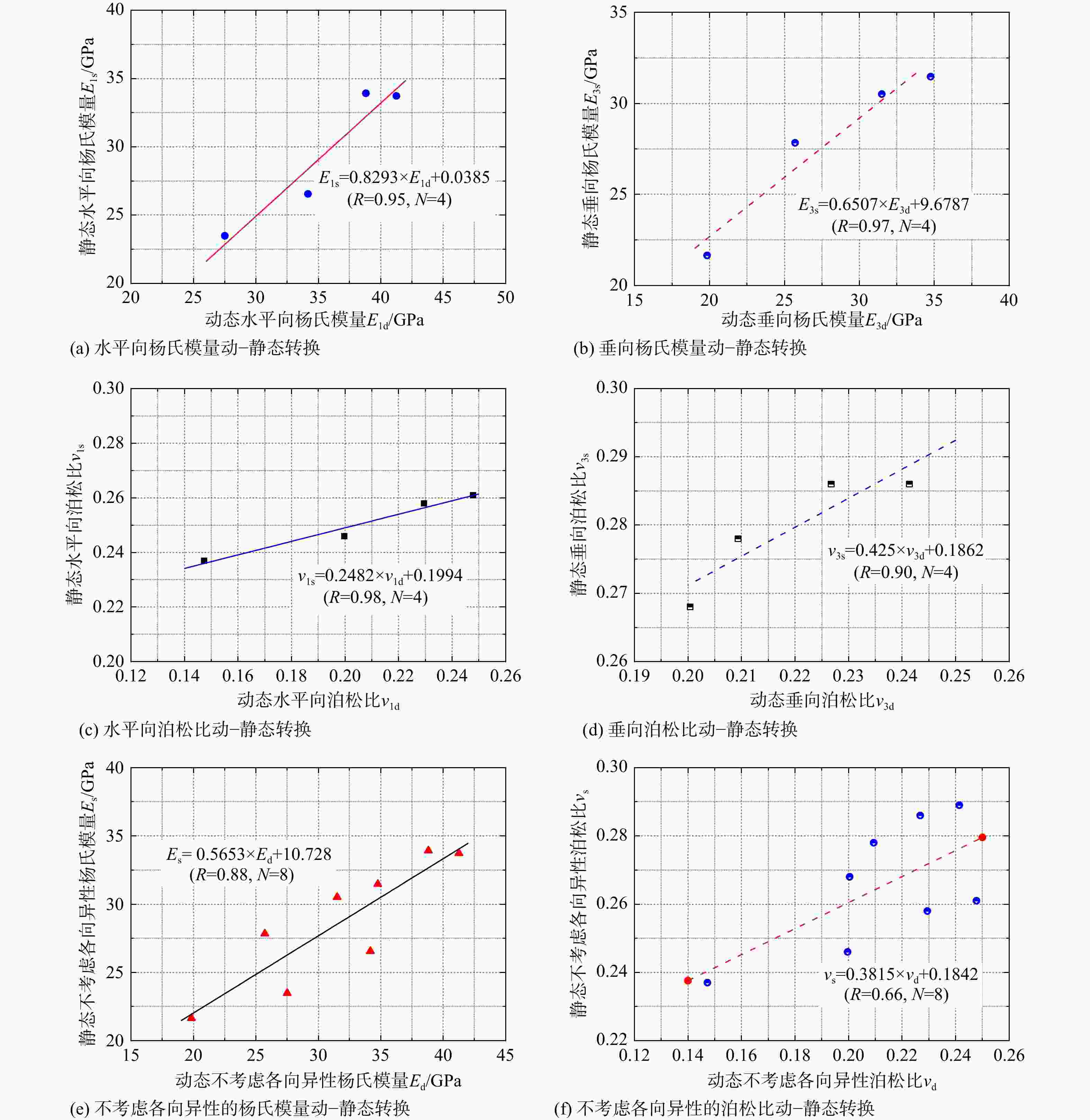
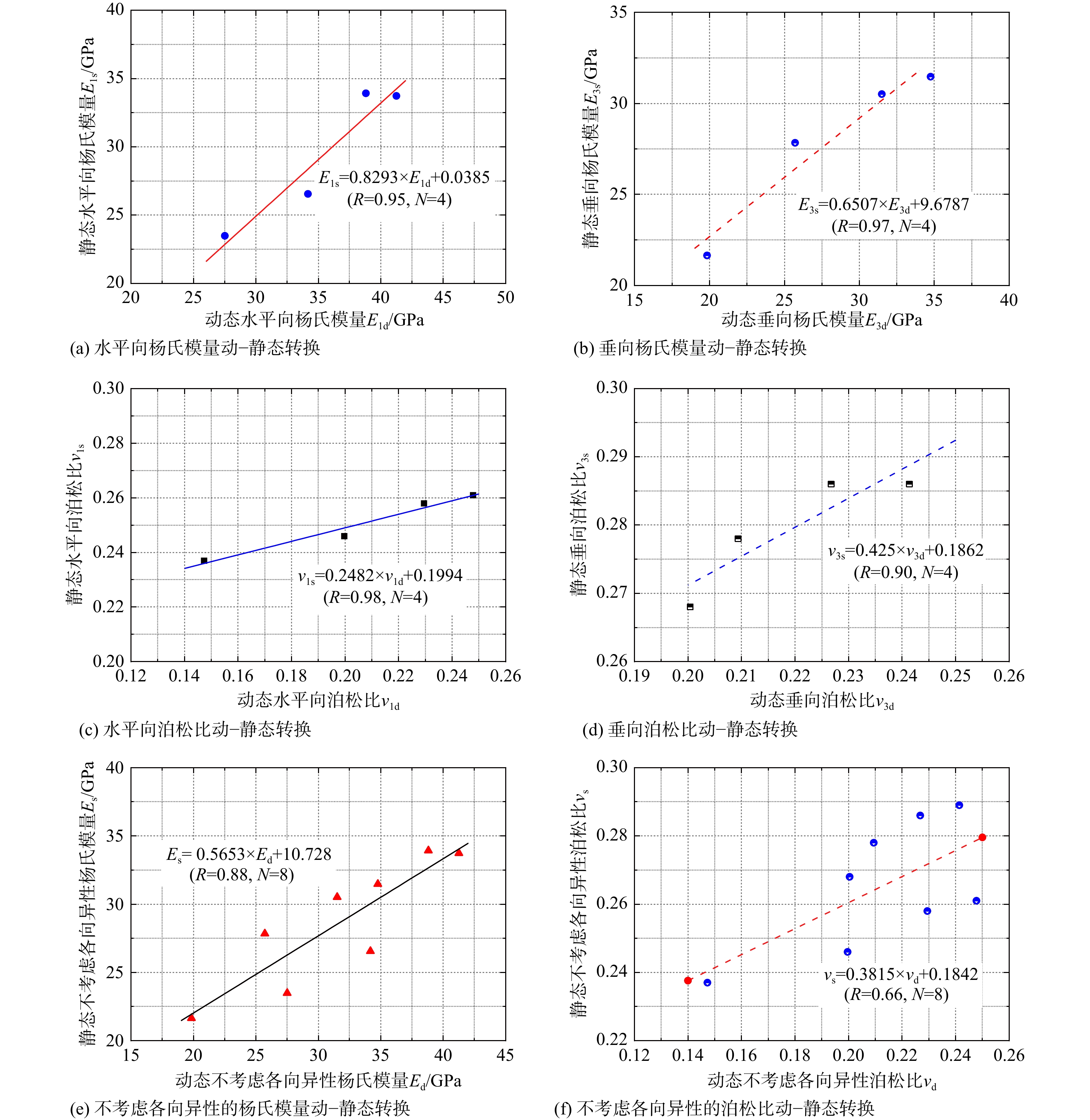
图 1 岩石弹性参数的动−静态转换关系
E1s—静态水平向杨氏模量;E1d—动态水平向杨氏模量;E3s—静态垂向杨氏模量;E3d—动态垂向杨氏模量;Es—静态不考虑各向异性杨氏模量;Ed—动态不考虑各向异性杨氏模量;ν1s—静态水平向泊松比;ν1d—动态水平向泊松比;ν3s—静态垂向泊松比;ν3d—动态垂向泊松比;νs—静态不考虑各向异性泊松比;νd—动态不考虑各向异性泊松比;N—岩芯测试数量;R—相关系数
Figure 1. Relationship between dynamic and static conversion of rock elastic parameters
(a) Dynamic and static conversion of the horizontal Young's modulus; (b) Dynamic and static conversion of the vertical Young's modulus; (c) Dynamic and static conversion of the horizontal Poisson's ratio; (d) Dynamic and static conversion of the vertical Poisson's ratio; (e) Dynamic and static conversion of Young's modulus without considering anisotropy; (f) Dynamic and static conversion of Poisson's ratio without considering anisotropy E1s—static horizontal Young's modulus; E1d—dynamic horizontal Young's modulus; E3s—static vertical Young's modulus; E3d—dynamic vertical Young's modulus; Es—static Young's modulus without considering anisotropy; Ed—dynamic Young's modulus without considering anisotropy; ν1s—static horizontal Poisson's ratio; ν1d—dynamic horizontal Poisson's ratio; ν3s—static vertical Poisson's ratio; ν3d—dynamic vertical Poisson's ratio; νs—static Poisson's ratio without considering anisotropy; νd—dynamic Poisson's ratio without considering anisotropy; N—number of core tests; R—correlation coefficient
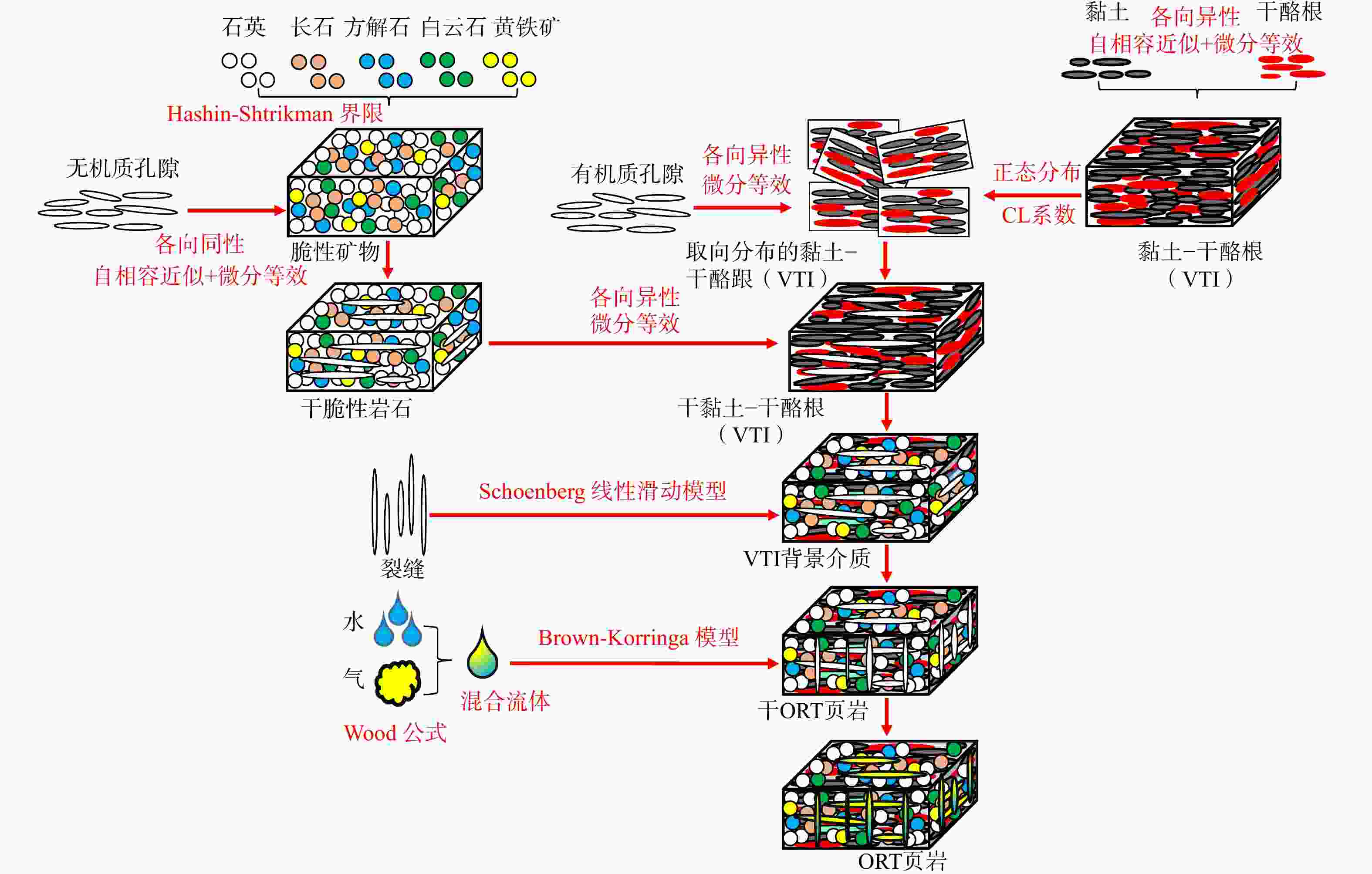
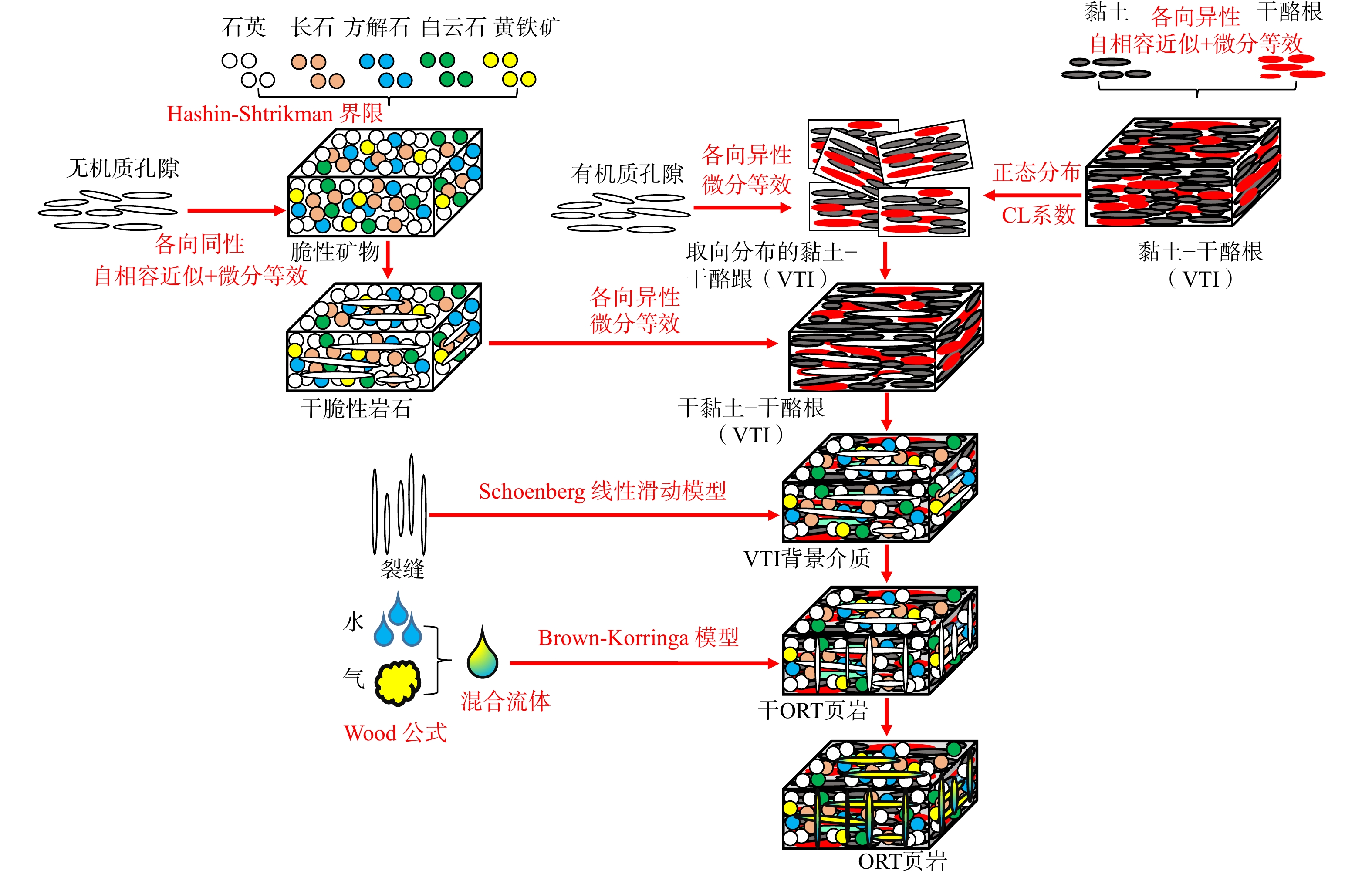
图 2 ORT岩石物理建模流程
VTI—横观各向同性;ORT—正交各向异性;CL系数—黏土成层系数
Figure 2. ORT rock physics modeling workflow
VTI—vertical transverse isotropy; ORT—orthorhombic anisotropic; CL coefficient—clay lamination coefficient
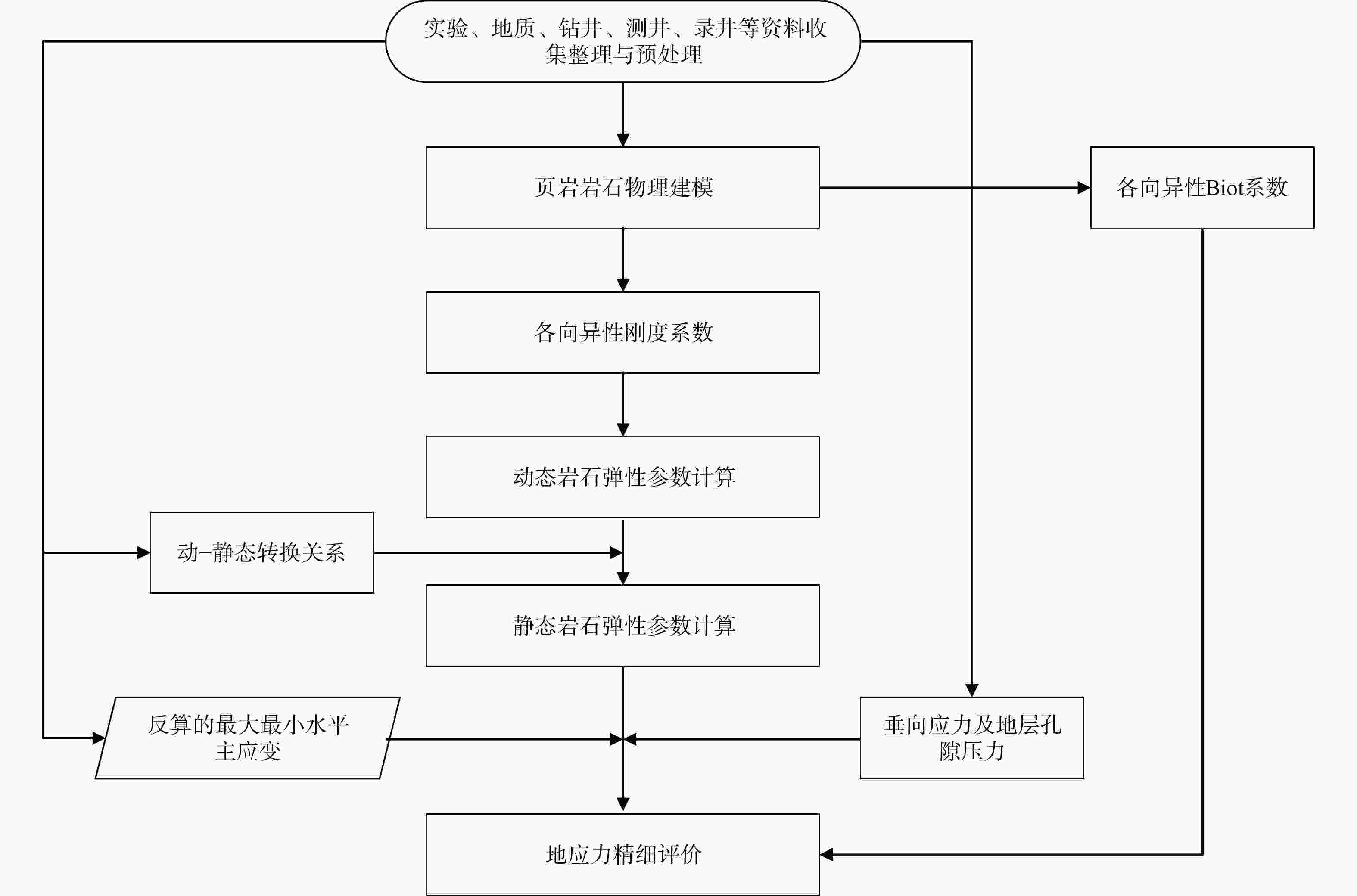
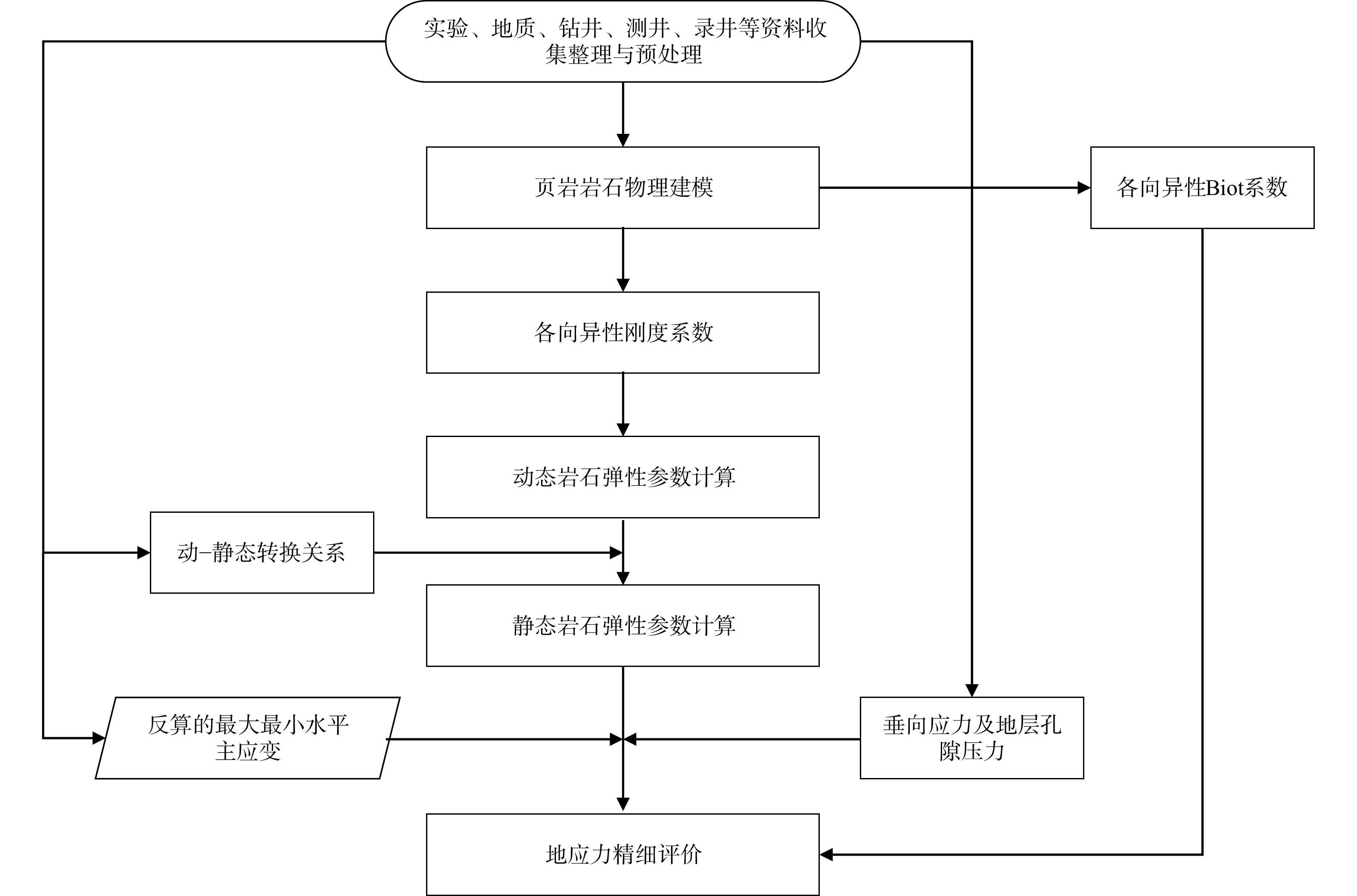
图 3 基于岩石物理建模的地应力评价流程
Figure 3. Stress evaluation workflow based on rock physics modeling
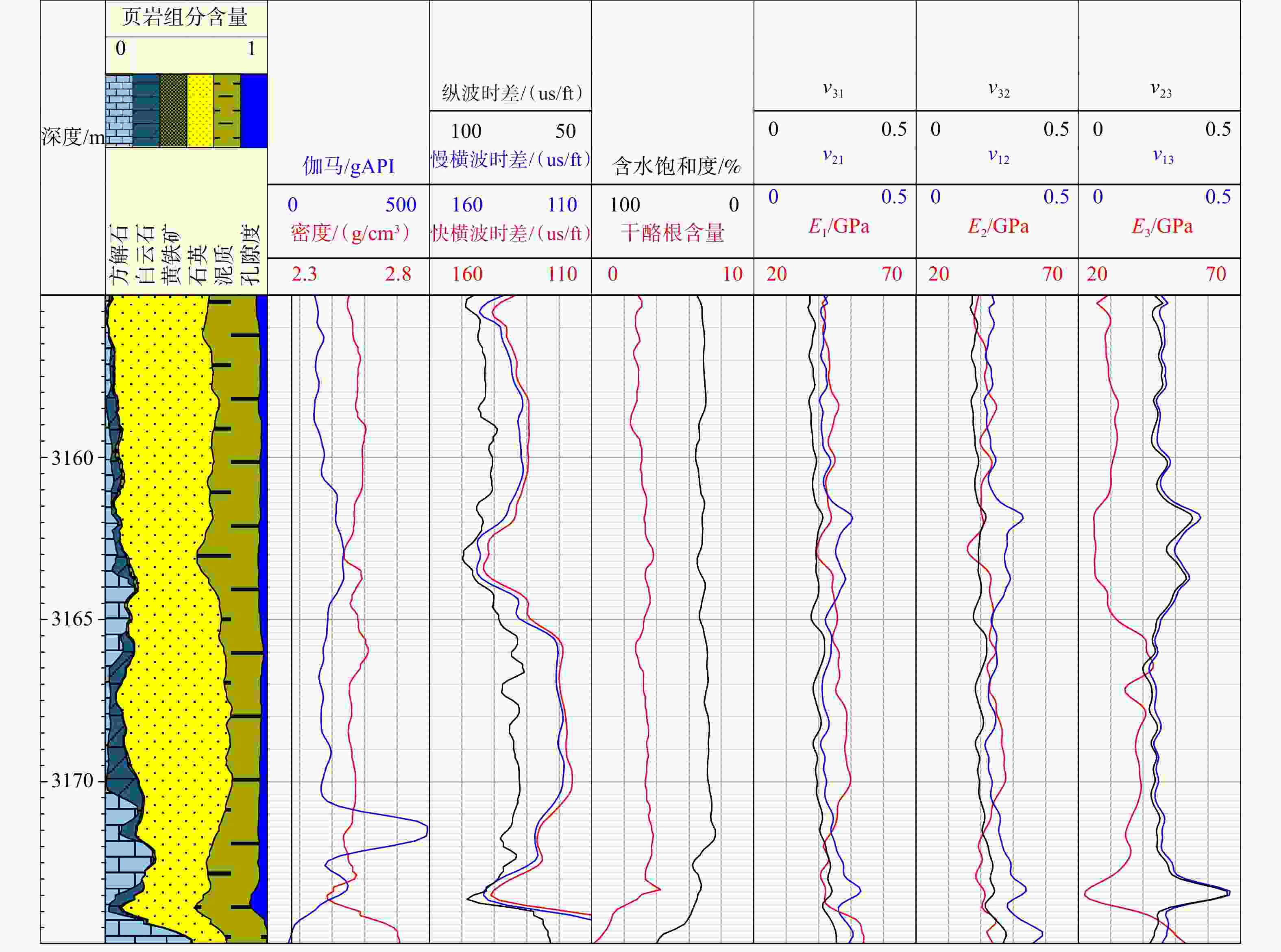
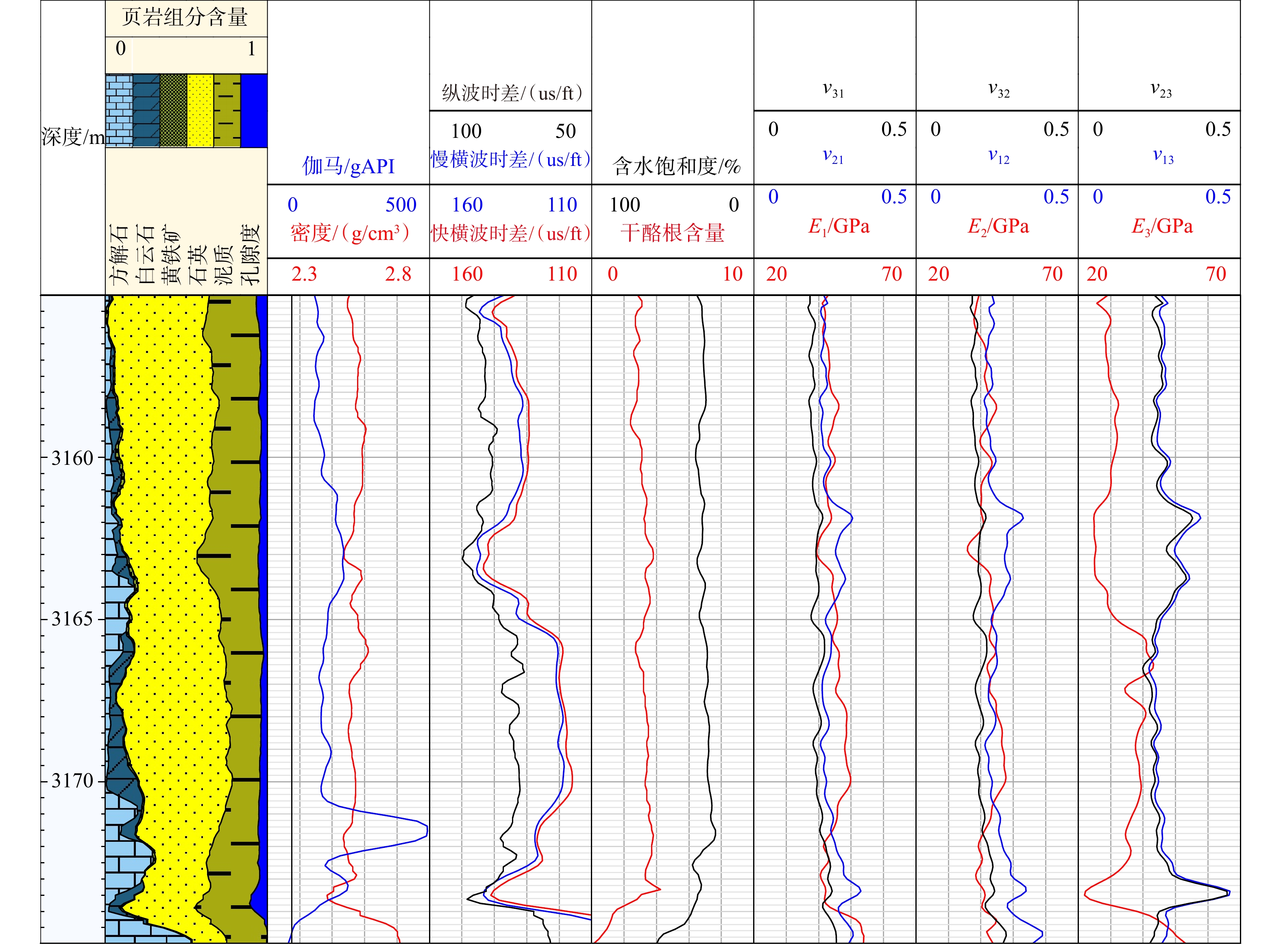
图 4 ORT静态岩石弹性参数
E1—沿x轴方向的杨氏模量;E2—沿y轴方向的杨氏模量,GPa;E3—沿z轴方向的杨氏模量,GPa;ν12—垂直于x轴、沿y轴的泊松比;ν13—垂直于x轴、沿z轴的泊松比;ν21—垂直于y轴、沿x轴的泊松比;ν23—垂直于y轴、沿z轴的泊松比;ν31—垂直于z轴、沿x轴的泊松比;ν32—垂直于z轴、沿y轴的泊松比
Figure 4. ORT static rock elastic parameters
E1—Young's modulus along the x-axis; E2—Young's modulus along the y-axis, GPa; E3—Young's modulus along the z-axis, GPa; ν12—Poisson's ratio perpendicular to the x-axis and along the y-axis; ν13—Poisson's ratio perpendicular to the x-axis and along the z-axis; ν21—Poisson's ratio perpendicular to the y-axis and along the x-axis; ν23—Poisson's ratio perpendicular to the y-axis and along the z-axis; ν31—Poisson's ratio perpendicular to the z-axis and along the x-axis; ν32—Poisson's ratio perpendicular to the z-axis and along the y-axis
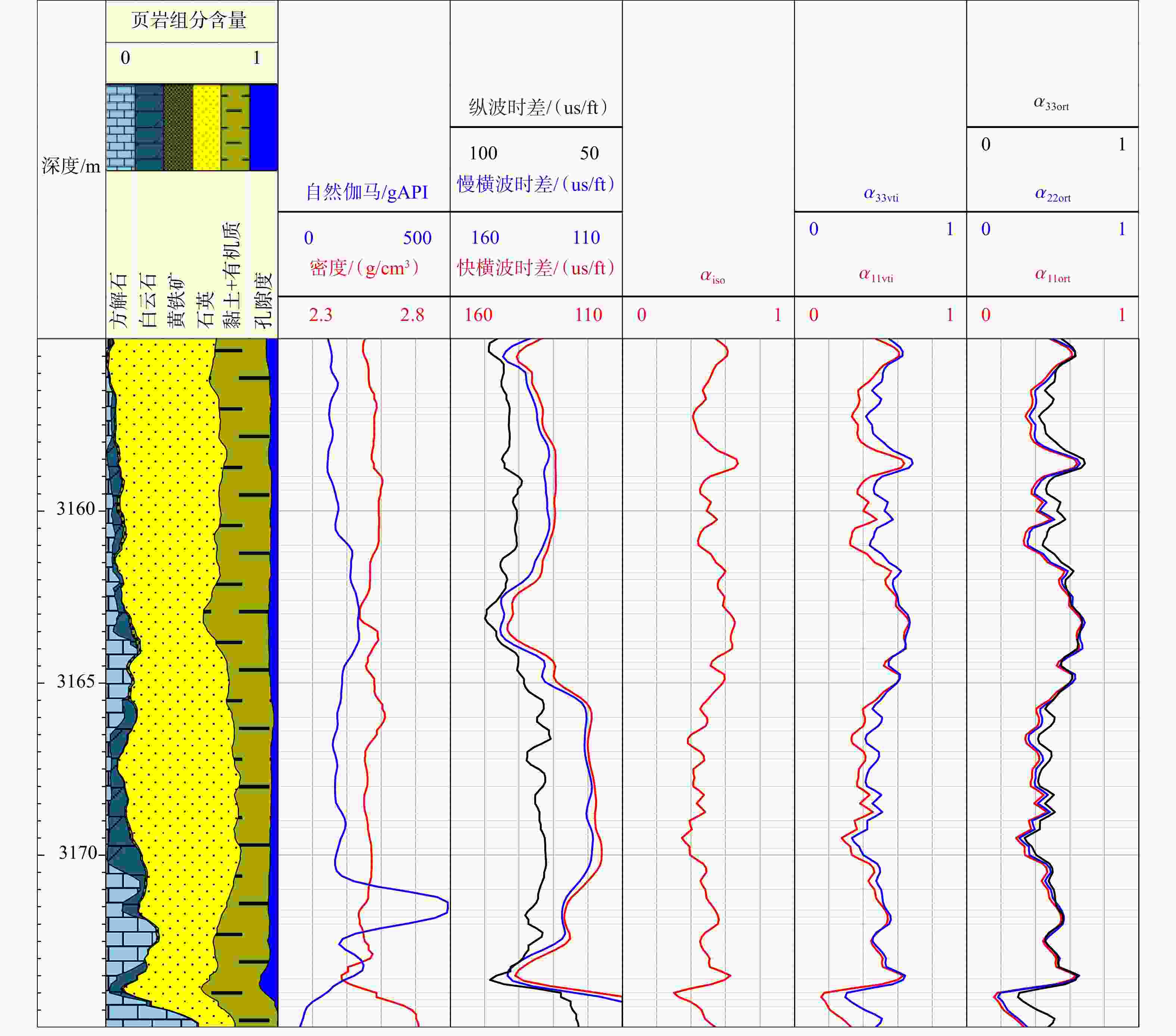
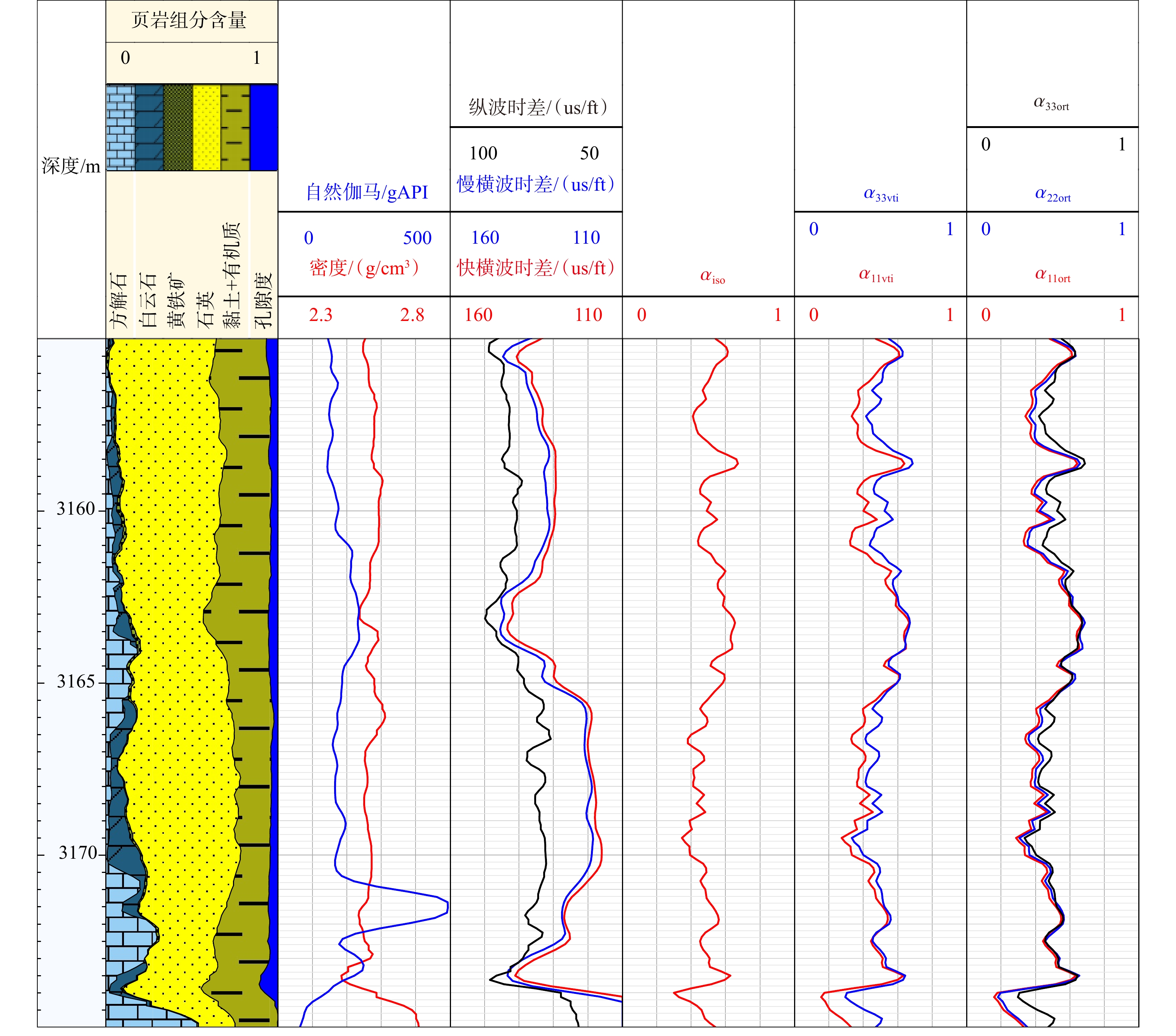
图 5 不同模型计算的Biot系数
$\alpha $iso—各向同性Biot系数;$\alpha $11vti—水平向Biot系数;$\alpha $33vti—垂向Biot系数;$\alpha $11ort—x方向Biot系数;$\alpha $22ort—y方向Biot系数;$\alpha $33ort—z方向Biot系数
Figure 5. Biot coefficients calculated by different models
$\alpha $iso—isotropic Biot coefficient; $\alpha $11vti—horizontal Biot coefficient; $\alpha $33vti—vertical Biot coefficient; $\alpha $11ort—Biot coefficient along the x-axis; $\alpha $22ort—Biot coefficient along the y-axis; $\alpha $33ort—Biot coefficient along the z-axis
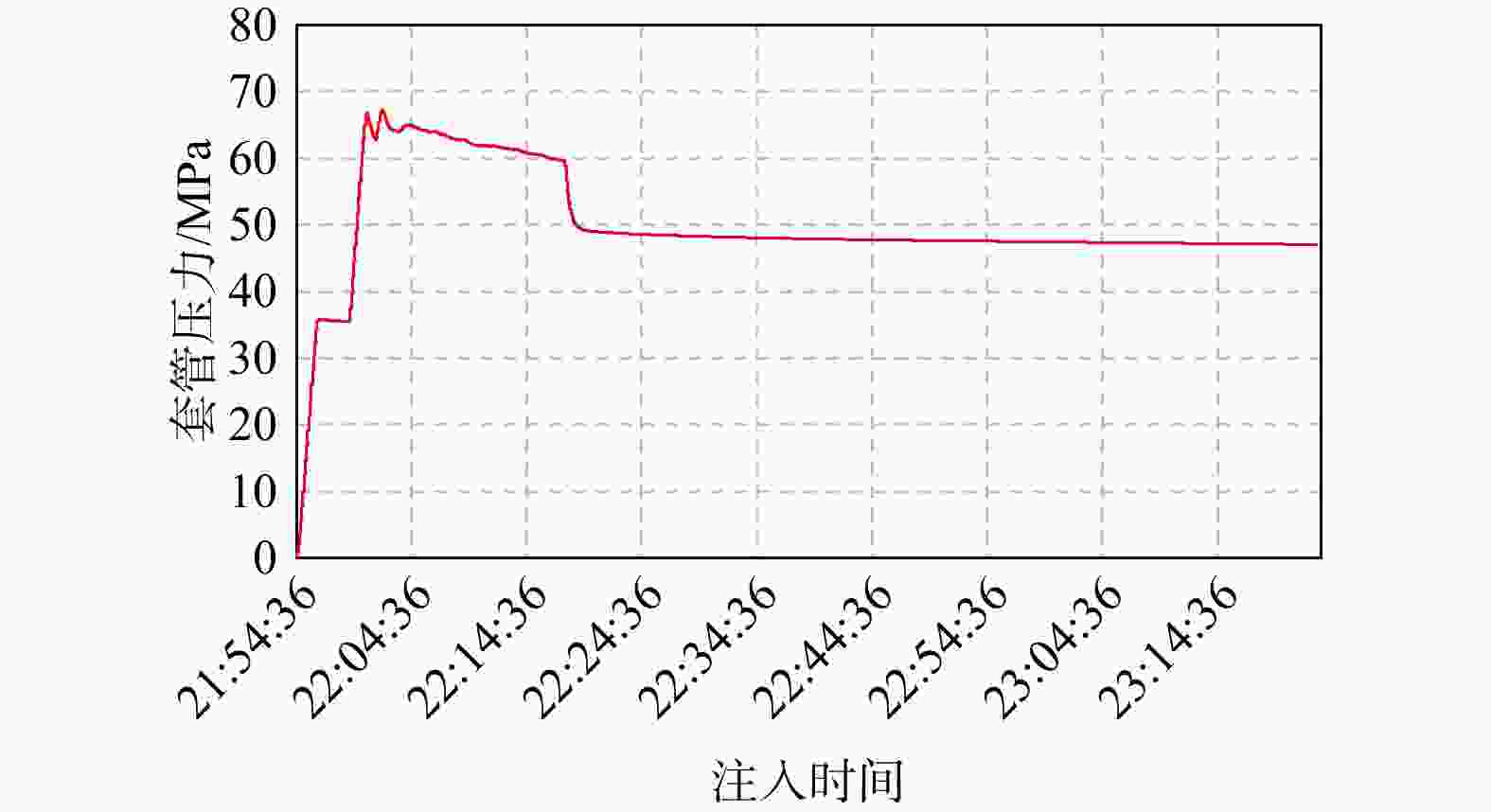
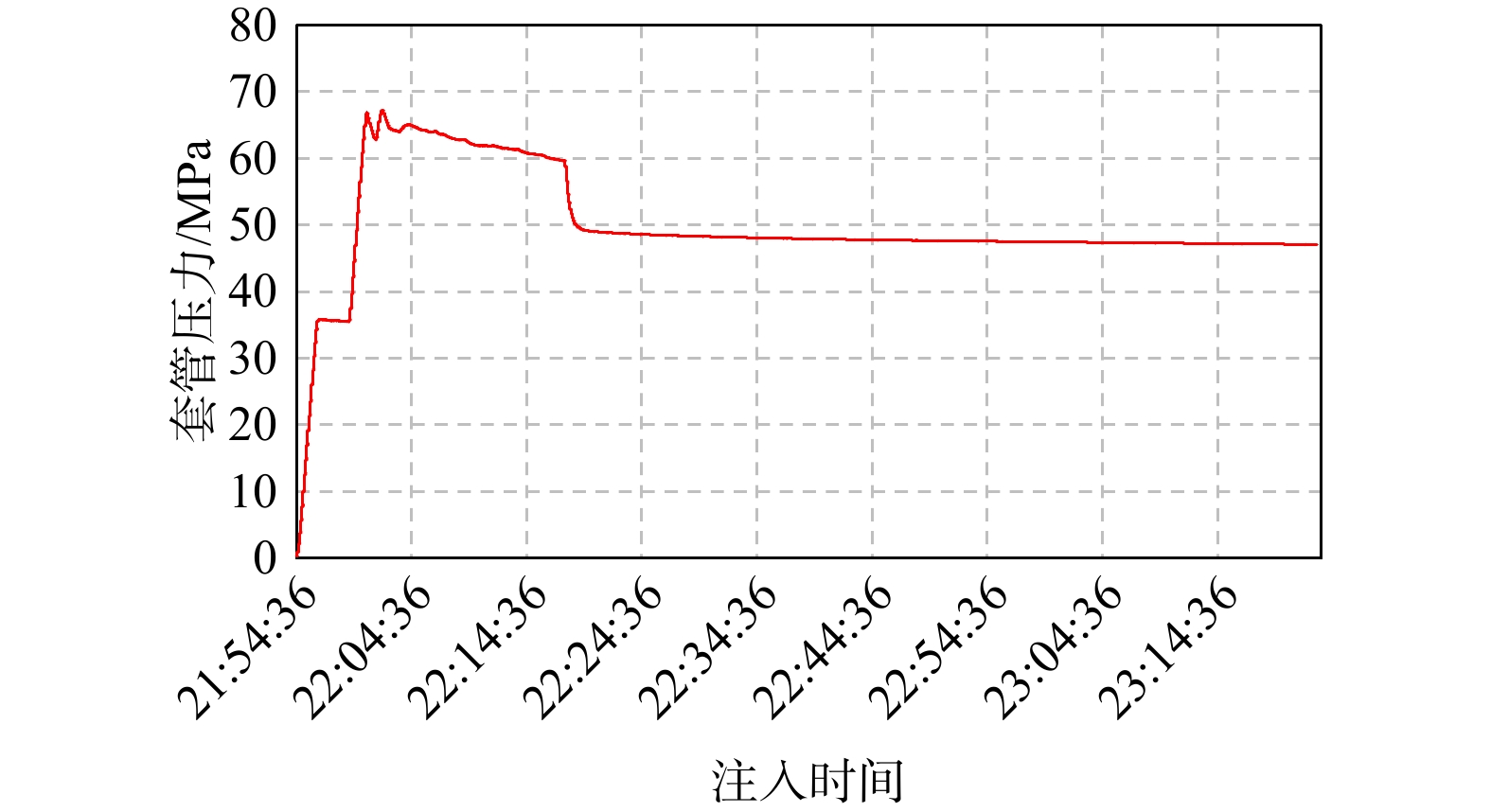
图 6 x1井龙马溪组微注施工曲线
Figure 6. Micro-injection operation curve of the Longmaxi Formation in Well x1
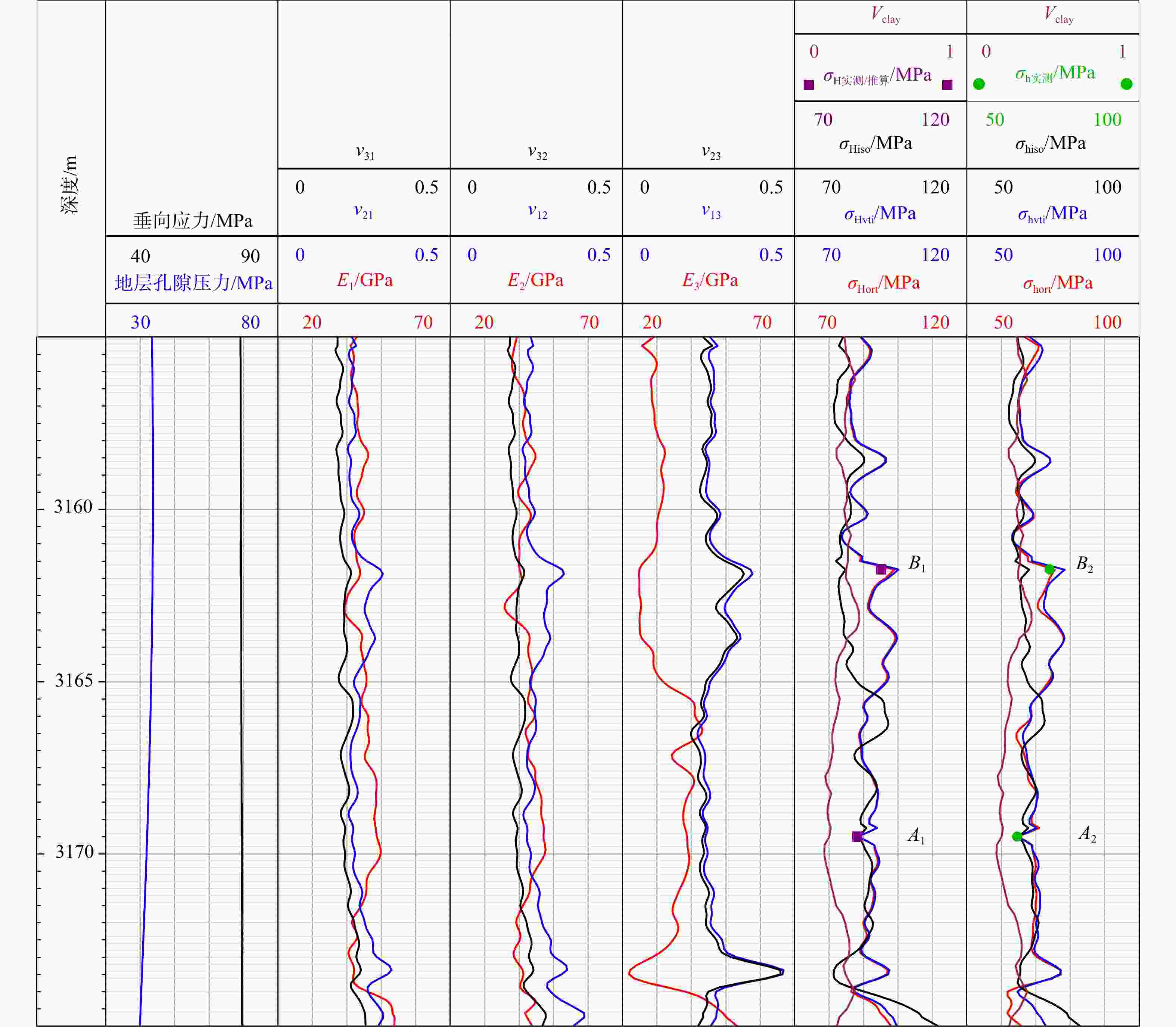
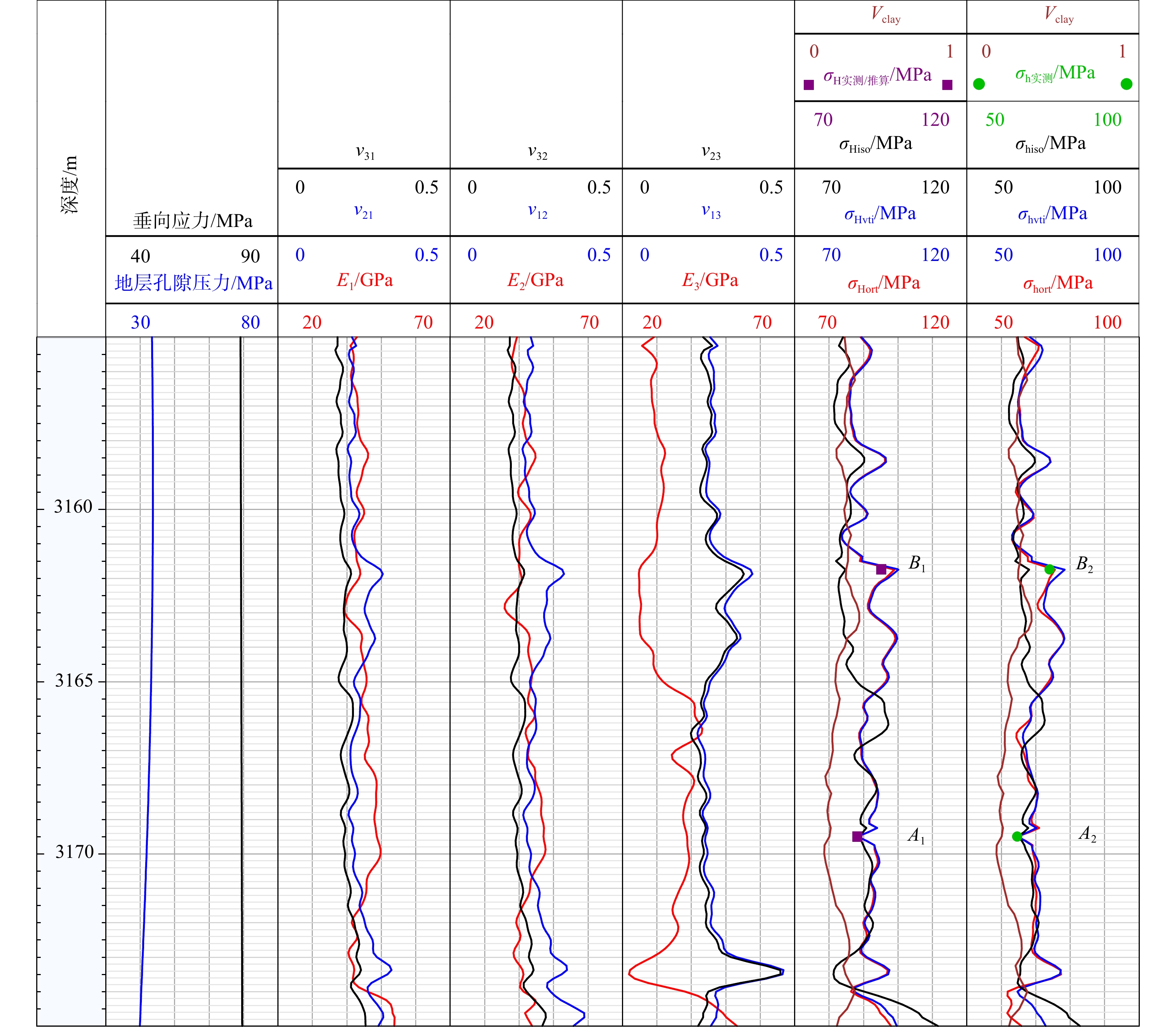
图 7 各类模型地应力计算结果
Vclay—黏土含量;σH实测/推算—微注测试推算或声发射实测最大水平主应力;σHiso—iso模型预测最大水平主应力;σHvti—VTI模型预测最大水平主应力;σHort—ORT模型预测最大水平主应力;σh实测—微注测试或声发射实测最小水平主应力;σhiso—iso模型预测最小水平主应力;σhvti—VTI模型预测最小水平主应力;σhort—ORT模型预测最小水平主应力;A1—微注测试反算最大水平主应力点位;A2—微注测试最小水平主应力点位;B1—声发射测试最大水平主应力点位;B2—声发射测试最小水平主应力点位
Figure 7. In-situ stress calculated by various models
Vclay—clay content; σHmeasured/calculated—maximum horizontal principal stress calculated from micro-injection test or measured from the acoustic emission; σHiso—maximum horizontal principal stress predicted by the iso model; σHvti—maximum horizontal principal stress predicted by the VTI model; σHort—maximum horizontal principal stress predicted by the ORT model; σhmeasured—minimum horizontal principal stress measured from the micro-injection or the acoustic emission test; σHiso—minimum horizontal principal stress predicted by the iso model; σHvti—minimum horizontal principal stress predicted by the VTI model; σHort—minimum horizontal principal stress predicted by the ORT model; A1—position of the maximum horizontal principal stress point calculated from the micro-injection test; A2—position of the minimum horizontal principal stress point calculated from the micro-injection test; B1—maximum horizontal principal stress point measured from the acoustic emission test; B2—minimum horizontal principal stress point measured from the acoustic emission test
-
[1] ALAWADH M, EL SGHER M, AMINIAN K, et al. , 2023. Predicting the stress in marcellus shale horizontal wells from the drilling and well log data[C]//SPE eastern regional meeting. Wheeling, West Virginia, USA: SPE: SPE-215912-MS. [2] BARREE R D, MISKIMINS J L, GILBERT J V, 2015. Diagnostic fracture injection tests: common mistakes, misfires, and misdiagnoses[J]. SPE Production & Operations, 30(2): 84-98. doi: 10.2118/169539-PA [3] BOWERS G L, 1995. Pore pressure estimation from velocity data: accounting for overpressure mechanisms besides undercompaction[J]. SPE Drilling & Completion, 10(2): 89-95. doi: 10.2118/27488-PA [4] CHEN F Y, ZHANG G Z, ZHOU Y, et al., 2023. Prediction method for static modulus based on a rock physical model for dense sandstone[J]. Geophysical Prospecting for Petroleum, 62(5): 952-961. (in Chinese with English abstract) [5] CHENG A H D, 1997. Material coefficients of anisotropic poroelasticity[J]. International Journal of Rock Mechanics and Mining Sciences, 34(2): 199-205. doi: 10.1016/S0148-9062(96)00055-1 [6] CHENG J W, ZHANG F, LI X Y, 2024. Orthorhombic anisotropic rock physics modeling for fractured marine shale reservoir in Sichuan Basin[J]. Earth Science, 49(1): 299-312. (in Chinese with English abstract) [7] CORNET F H, VALETTE B, 1984. In situ stress determination from hydraulic injection test data[J]. Journal of Geophysical Research: Solid Earth, 89(B13): 11527-11537. doi: 10.1029/JB089iB13p11527 [8] EATON B A, 1975. The equation for geopressure prediction from well logs[C]//Fall meeting of the society of petroleum engineers of AIME. Dallas, Texas, USA: SPE: SPE-5544-MS. [9] GAO Q F, ZHANG P X, GUAN L L, et al., 2024. Influence of lower-level reverse faults on shale gas enrichment and high yield: a case study of Pingqiao Dong-1 Fault in Nanchuan area, southeast margin of Sichuan Basin[J]. Petroleum Reservoir Evaluation and Development, 14(3): 458-467. (in Chinese with English abstract) [10] GE H K, LIN Y S, WANG S C, 1998. In-situ stresses determination technique and its applications in petroleum exploration and development[J]. Journal of the University of Petroleum, China, 22(1): 94-99. (in Chinese with English abstract) [11] GUI J C, CHEN P, MA T S, 2019. The spatial distribution of elastic parameters of orthotropic rocks[J]. Journal of Southwest Petroleum University (Science & Technology Edition), 41(3): 13-28. (in Chinese with English abstract) [12] GUO J Y, LI M, ZHUANG M W, et al., 2023. Rock physics model for velocity–pressure relations and its application to shale pore pressure estimation[J]. Petroleum Exploration and Development, 50(2): 360-372. (in Chinese with English abstract) [13] HE Y H, XUE T, LI Z, et al., 2023. Development technologies for Triassic Chang 7 shale oil in Ordos Basin: a case study of Qingcheng Oilfield, NW China[J]. Petroleum Exploration and Development, 50(6): 1245-1258. (in Chinese with English abstract) doi: 10.1016/s1876-3804(24)60477-5 [14] HIGGINS S, GOODWIN S, DONALD A, et al. , 2008. Anisotropic stress models improve completion design in the Baxter Shale[C]//SPE annual technical conference and exhibition. Denver, Colorado, USA: SPE: SPE-115736-MS. [15] HOU B, WANG Y Z, ZHANG Y, et al., 2023. Regional evaluation method of ground stress in shale oil reservoirs-taking the Triassic Yanchang formation in northern Shaanxi area as an example[J]. Geomechanics and Geophysics for Geo-Energy and Geo-Resources, 9(1): 140. doi: 10.1007/s40948-023-00665-6 [16] HUANG R Z, 1984. A model for predicting formation fracture pressure[J]. Journal of East China Petroleum Institute, 8(4): 335-347. (in Chinese with English abstract) [17] HUBBERT M K, RUBEY W W, 1959. Role of fluid pressure in mechanics of overthrust faulting: I. Mechanics of fluid-filled porous solids and its application to overthrust faulting[J]. GSA Bulletin, 70(2): 115-166. doi: 10.1130/0016-7606(1961)72[1445:rofpim]2.0.co;2 [18] JU W, NIU X B, FENG S B, et al., 2020. Predicting the present-day in situ stress distribution within the Yanchang Formation Chang 7 shale oil reservoir of Ordos Basin, central China[J]. Petroleum Science, 17(4): 912-924. doi: 10.1007/s12182-020-00448-8 [19] LAI J, BAI T Y, XIAO L, et al., 2023. Well-logging evaluation of in-situ stress fields and its geological and engineering significances[J]. Oil & Gas Geology, 44(4): 1033-1043. (in Chinese with English abstract) [20] LI Z M, ZHANG J Z, 1997. In-situ stress and petroleum exploration & development[M]. Beijing: Petroleum Industry Press: 5-74. (in Chinese) [21] LIU M, YANG R Q, YANG F L, et al., 2023. Numerical modeling of in-situ stress and prediction of favorable area of shale gas layer in Wufeng to Longmaxi formations, Nanchuan region, southeastern Chongqing[J]. Petroleum Geology & Experiment, 45(6): 1178-1188. (in Chinese with English abstract) [22] MA T S, XIANG G F, SHI Y F, et al., 2022. Horizontal in situ stresses prediction using a CNN-BiLSTM-attention hybrid neural network[J]. Geomechanics and Geophysics for Geo-Energy and Geo-Resources, 8(5): 152. doi: 10.1007/s40948-022-00467-2 [23] MA X D, ZOBACK M D, 2020. Predicting lithology-controlled stress variations in the Woodford shale from well log data via viscoplastic relaxation[J]. SPE Journal, 25(5): 2534-2546. doi: 10.2118/201232-PA [24] NEWBERRY B M, NELSON R F, AHMED U, 1985. Prediction of vertical hydraulic fracture migration using compressional and shear wave slowness[C]//SPE/DOE low permeability gas reservoirs symposium. Denver, Colorado, USA: SPE: SPE-13895-MS. [25] RAFIEEPOUR S, ZHENG D Z, MISKA S, et al. , 2020. Combined experimental and well log evaluation of anisotropic mechanical properties of shales: an application to wellbore stability in bakken formation[C]//SPE annual technical conference & exhibition. Colorado, USA: SPE: SPE-201334-MS. SHE C Y, 2024. New progress and development prospect of key technologies for drilling of deep shale gas wells in the Sichuan Basin[J]. Natural Gas Industry, 44(3): 1-9. (in Chinese with English abstract) [26] SHU H L, QIU K B, LI Q F, et al., 2021. A method for evaluating the geomechanical characteristics of shale gas: the geomechanical characteristics of the mountain shale in the intensively reworked marine area of South China[J]. Natural Gas Industry, 41(S1): 1-13. (in Chinese with English abstract) [27] TAN X, KONIETZKY H, 2014. Numerical study of variation in Biot’s coefficient with respect to microstructure of rocks[J]. Tectonophysics, 610: 159-171. doi: 10.1016/j.tecto.2013.11.014 [28] THIERCELIN M J, PLUMB R A, 1994. A core-based prediction of lithologic stress contrasts in east Texas formations[J]. SPE Formation Evaluation, 9(4): 251-258. doi: 10.2118/21847-PA [29] TONG K L, CAI H Y, LI J X, et al., 2023. Present stress orientations and controlling factors of shale reservoirs in LZ region, Sichuan Basin: example of the first member of Longmaxi Formation[J]. Science Technology and Engineering, 23(8): 3224-3236. (in Chinese with English abstract) [30] WANG G F, LI F X, WANG H B, et al., 2022. Application of an integrated geology-reservoir engineering approach to fracturing in unconventional gas reservoirs, Sichuan Basin and some insights[J]. Oil & Gas Geology, 43(5): 1221-1237. (in Chinese with English abstract) [31] WANG L X, LI H, LIU X M, et al., 2024. Seismic exploration technologies of marine shale gas and their development directions in China[J]. Acta Petrolei Sinica, 45(1): 261-275. (in Chinese with English abstract) [32] WU C Y, YIN X Y, YIN L J, 2023. Rock physical modelling for deep shale reservoirs involving the influence of pressure[J]. Oil Geophysical Prospecting, 58(4): 893-901. (in Chinese with English abstract) [33] WU F, 2023. Study of rockphysics and inversion methods for VTI anistropy shale reservoir[D]. Beijing: China University of Petroleum (Beijing): 25-26. (in Chinese with English abstract) [34] XIAN C G, ZHANG J H, CHEN X, et al., 2017. Application of geomechanics in geology-engineering integration[J]. China Petroleum Exploration, 22(1): 75-88. (in Chinese with English abstract) [35] XU K, ZHANG H, LIU X Y, et al., 2022. Current in-situ stress characteristics of deep fractured reservoirs in Kuqa Depression and its guiding significance to natural gas exploration and development[J]. Petroleum Geology and Recovery Efficiency, 29(2): 34-45. (in Chinese with English abstract) [36] ZHAN G W, YANG J, ZHAO Y, et al., 2023. Development practice and challenges of deep shale gas in southern Sichuan Basin[J]. Petroleum Geology & Experiment, 45(6): 1067-1077. (in Chinese with English abstract) doi: 10.1016/j.ngib.2023.01.007 [37] ZHANG B, WANG X T, XU F Y, et al., 2025. Research on pore pressure prediction method based on XGBoost[J]. Progress in Geophysics, 40(2): 541-555 (in Chinese with English abstract) [38] ZHAO H F, SHI H W, XIE F, et al., 2025. A novel model for calculating in situ stress within deep coal seams considering microstructural characteristics and its application[J]. Coal Geology & Exploration, 53(11): 120-129. (in Chinese with English abstract) [39] ZHOU J Y, LI G R, CHEN Z, et al., 2023. A new calculation method of drilling formation leakage pressure based on logging data[J]. Well Logging Technology, 47(1): 99-107. (in Chinese with English abstract) [40] ZHU H Y, SONG Y J, XU Y, et al., 2021. Four-dimensional in-situ stress evolution of shale gas reservoirs and its impact on infill well complex fractures propagation[J]. Acta Petrolei Sinica, 42(9): 1224-1236. (in Chinese with English abstract) [41] ZHU H Y, WANG Z H, FAN Y, et al., 2025. Research progress and application prospects of prediction methods for pore pressure in carbonate formations[J]. Acta Petrolei Sinica, 46(8): 1628-1646. (in Chinese with English abstract) [42] ZOBACK M, RUTHS T, MCCLURE M, et al. , 2022. Lithologically-controlled variations of the least principal stress with depth and resultant Frac fingerprints during multi-stage hydraulic fracturing[C]//SPE/AAPG/SEG unconventional resources technology conference. Houston, Texas, USA: URTEC: URTEC-3722883-MS. [43] ZOBACK M D, 2007. Reservoir geomechanics[M]. Cambridge: Cambridge University Press: 3-6. [44] 陈飞宇, 张广智, 周游, 等, 2023. 基于致密砂岩岩石物理模型的静态模量预测方法[J]. 石油物探, 62(5): 952-961. doi: 10.12431/issn.1000-1441.2023.62.05.013 [45] 程绩伟, 张峰, 李向阳, 2024. 四川盆地含裂缝海相页岩储层正交各向异性岩石物理建模[J]. 地球科学, 49(1): 299-312. [46] 高全芳, 张培先, 关琳琳, 等, 2024. 低级别逆断层对页岩气富集高产影响研究: 以四川盆地东南缘南川地区平桥东1断层为例[J]. 油气藏评价与开发, 14(3): 458-467. [47] 葛洪魁, 林英松, 王顺昌, 1998. 地应力测试及其在勘探开发中的应用[J]. 石油大学学报(自然科学版), 22(1): 94-99. [48] 桂俊川, 陈平, 马天寿, 2019. 正交各向异性岩石弹性参数的空间展布[J]. 西南石油大学学报(自然科学版), 41(3): 13-28. [49] 郭静怡, 李敏, 庄明伟, 等, 2023. 速度-压力岩石物理模型及其在页岩孔隙压力预测中的应用[J]. 石油勘探与开发, 50(2): 360-372. [50] 何永宏, 薛婷, 李桢, 等, 2023. 鄂尔多斯盆地长7页岩油开发技术实践: 以庆城油田为例[J]. 石油勘探与开发, 50(6): 1245-1258. [51] 黄荣樽, 1984. 地层破裂压力预测模式的探讨[J]. 华东石油学院学报, 8(4): 335-347. [52] 赖锦, 白天宇, 肖露, 等, 2023. 地应力测井评价方法及其地质与工程意义[J]. 石油与天然气地质, 44(4): 1033-1043. doi: 10.11743/ogg20230418 [53] 李志明, 张金珠, 1997. 地应力与油气勘探开发[M]. 北京: 石油工业出版社: 5-74. [54] 刘明, 杨瑞青, 杨风丽, 等, 2023. 渝东南南川地区五峰组—龙马溪组页岩气层地应力数值模拟及有利区预测[J]. 石油实验地质, 45(6): 1178-1188. [55] 佘朝毅, 2024. 四川盆地深层页岩气钻井关键技术新进展及发展展望[J]. 天然气工业, 44(3): 1-9. doi: 10.3787/j.issn.1000-0976.2024.03.001 [56] 舒红林, 仇凯斌, 李庆飞, 等, 2021. 页岩气地质力学特征评价方法: 中国南方海相强改造区山地页岩地质力学特征[J]. 天然气工业, 41(S1): 1-13. [57] 佟恺林, 蔡鸿燕, 李金玺, 等, 2023. 四川LZ页岩储层现今地应力方向及主控因素: 以龙一段为例[J]. 科学技术与工程, 23(8): 3224-3236. doi: 10.3969/j.issn.1671-1815.2023.08.012 [58] 王光付, 李凤霞, 王海波, 等, 2022. 四川盆地非常规气藏地质-工程一体化压裂实践与认识[J]. 石油与天然气地质, 43(5): 1221-1237. doi: 10.11743/ogg20220517 [59] 王立歆, 李弘, 刘小民, 等, 2024. 中国海相页岩气地震勘探技术及其发展方向[J]. 石油学报, 45(1): 261-275. doi: 10.7623/syxb202401015 [60] 武陈月, 印兴耀, 印林杰, 等, 2023. 考虑压力的深部页岩储层地震岩石物理建模方法及应用[J]. 石油地球物理勘探, 58(4): 893-901. doi: 10.13810/j.cnki.issn.1000-7210.2023.04.014 [61] 吴凡, 2023. VTI介质页岩储层岩石物理与反演方法研究[D]. 北京: 中国石油大学(北京): 25-26. [62] 鲜成钢, 张介辉, 陈欣, 等, 2017. 地质力学在地质工程一体化中的应用[J]. 中国石油勘探, 22(1): 75-88. [63] 徐珂, 张辉, 刘新宇, 等, 2022. 库车坳陷深层裂缝性储层现今地应力特征及其对天然气勘探开发的指导意义[J]. 油气地质与采收率, 29(2): 34-45. doi: 10.13673/j.cnki.cn37-1359/te.2022.02.004 [64] 詹国卫, 杨建, 赵勇, 等, 2023. 川南深层页岩气开发实践与面临的挑战[J]. 石油实验地质, 45(6): 1067-1077. doi: 10.11781/sysydz2023061067 [65] 张冰, 王晓婷, 徐福颖, 等, 2025. 基于XGBoost的孔隙压力预测方法研究[J]. 地球物理学进展, 40(2): 541-555. doi: 10.6038/pg2025JJ0121 [66] 赵海峰, 史宏伟, 谢斐, 等, 2025. 考虑微构造特征的深部煤层地应力模型及其应用[J]. 煤田地质与勘探, 53(11): 120-129. [67] 周金昱, 李高仁, 陈阵, 等, 2023. 基于测井资料的钻井地层漏失压力计算新方法[J]. 测井技术, 47(1): 99-107. doi: 10.16489/j.issn.1004-1338.2023.01.016 [68] 朱海燕, 宋宇家, 胥云, 等, 2021. 页岩气储层四维地应力演化及加密井复杂裂缝扩展规律[J]. 石油学报, 42(9): 1224-1236. doi: 10.7623/syxb202109009 [69] 朱海燕, 王智辉, 范宇, 等, 2025. 碳酸盐岩地层孔隙压力预测方法研究进展及展望[J]. 石油学报, 46(8): 1628-1646. doi: 10.7623/syxb202508013 -

 下载:
下载:

计量
- 文章访问数: 528
- HTML全文浏览量: 209
- PDF下载量: 122
- 被引次数: 0
