


Slope engineering in the deeply incised valleys of the Tibetan Plateau: key challenges and strategic considerations
-
摘要: 近年来,随着人类工程活动逐步向青藏高原及其周缘的不断扩展,青藏高原深切峡谷区边坡失稳(如大型滑坡)日益频发,对重大工程规划建设和人民生命财产安全构成了严重威胁。文章在青藏高原构造活动特征概述的基础上,分析了青藏高原构造活动对边坡稳定性的控制作用,进而提出了青藏高原深切峡谷区边坡工程规划建设面临的问题与认识及思考与建议。研究表明:青藏高原活动构造与边坡稳定性分布具有明显的一致性,构造活动与边坡稳定性在时间上具有显著的同步性,构造活动分别为边坡失稳发生提供了地形地貌、物质基础、动力条件和诱发因素;青藏高原面临区域构造应力作用控制深切峡谷边坡稳定性、深切峡谷区反向边坡稳定性需要重新认识、傍山边坡地下工程水平埋深需要转换观念等问题。文章提出了青藏高原深切峡谷区边坡工程优先设计在南向、西向和南西向边坡处,而避免设计在北向、北东向和东向边坡处,顺向坡深部稳定性优于反向坡,把傍山边坡地下工程应设计在应力原始区等认识;建议开展青藏高原深切峡谷形态特征及其失稳机制、青藏高原构造快速隆升背景下深切峡谷地应力场演化规律、青藏高原深切峡谷地应力场空间分布特征等定量研究。研究成果为青藏高原地区边坡工程规划建设和灾害防治提供了参考依据。Abstract:
Objective As human engineering activities expanded into the Tibetan Plateau and its surrounding areas, slope instabilities—particularly large-scale landslides—in deeply incised valleys have occurred with increasing frequency, posing severe threats to major infrastructure projects and public safety. This study evaluates how regional tectonic activity controls slope stability and outlines key challenges, insights, and strategic recommendations for slope engineering planning and construction in these deeply incised valleys. Methods Based on an overview of the tectonic activity characteristics across the Tibetan Plateau, the controlling influence of tectonic activity on slope stability was systematically analyzed. Problems encountered in slope engineering planning were identified, leading to practical engineering recommendations and strategic directions for future research. Results Tectonic activity exhibits strong spatial consistency and temporal synchronicity with slope instability across the plateau. Tectonic processes provide the essential structural and geomorphic boundaries, material sources, dynamic conditions, and triggering factors for slope failures. Key challenges include the dominant control of regional tectonic stress on valley slope stability, the need to re-evaluate reverse slope stability in deeply incised valleys, and the required paradigm shift regarding the horizontal cover depth for mountain-adjacent underground works. Analysis suggests that slope engineering should prioritize south-, west-, and southwest-facing slopes while avoiding north-, northeast-, and east-facing slopes. Furthermore, the deep-seated stability of consequent slopes is superior to that of reverse slopes, and underground structures along mountain slopes should be situated within the unperturbed in-situ stress zone. Conclusions Future research must focus on quantitative investigations into: (1) the morphological characteristics and failure mechanisms of deeply incised valleys; (2) the evolution of in-situ stress fields under rapid tectonic uplift; and (3) the spatial distribution of in-situ stress fields across the plateau. Significance The findings provide critical theoretical guidelines and engineering references for slope design, infrastructure planning, and geohazard mitigation on the Tibetan Plateau. -
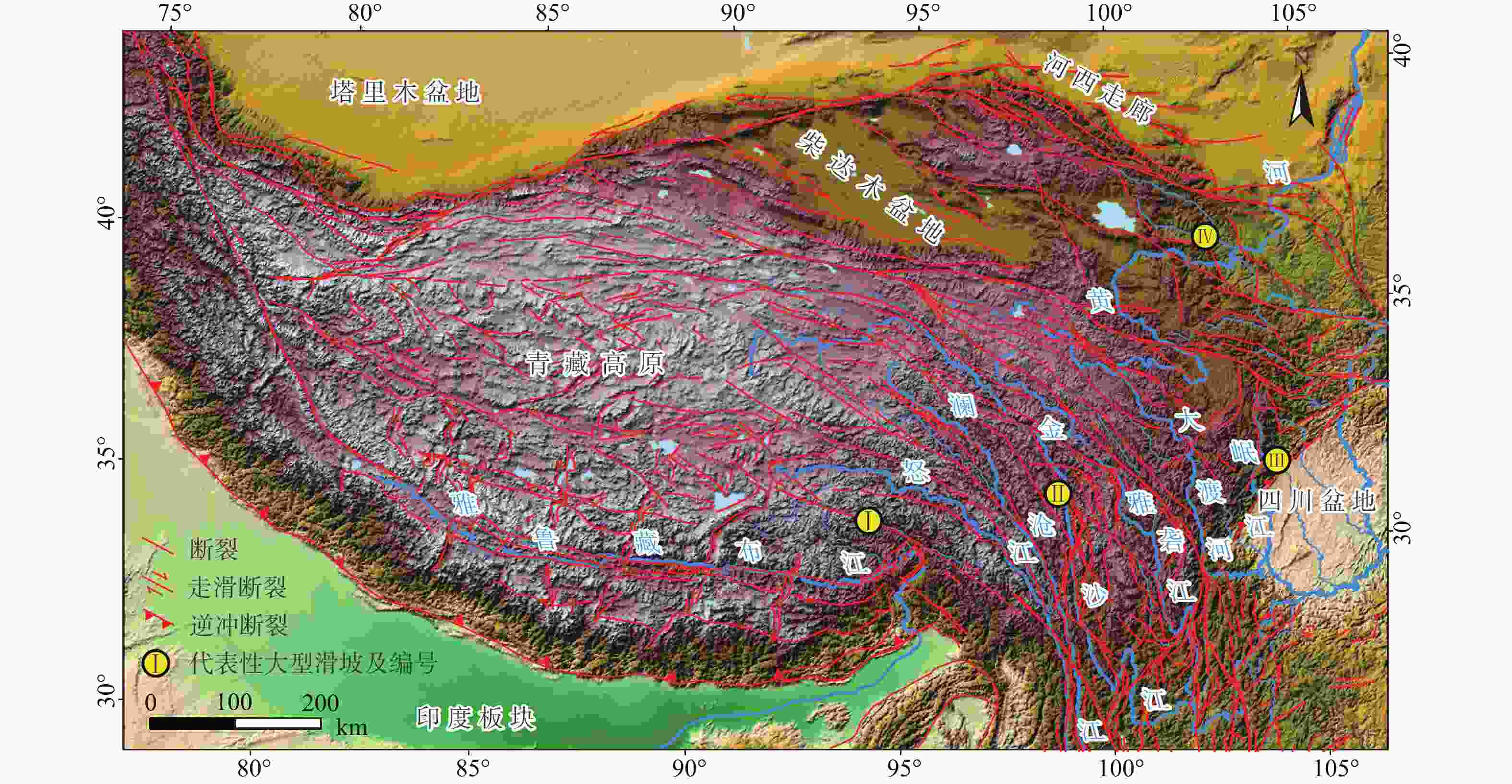
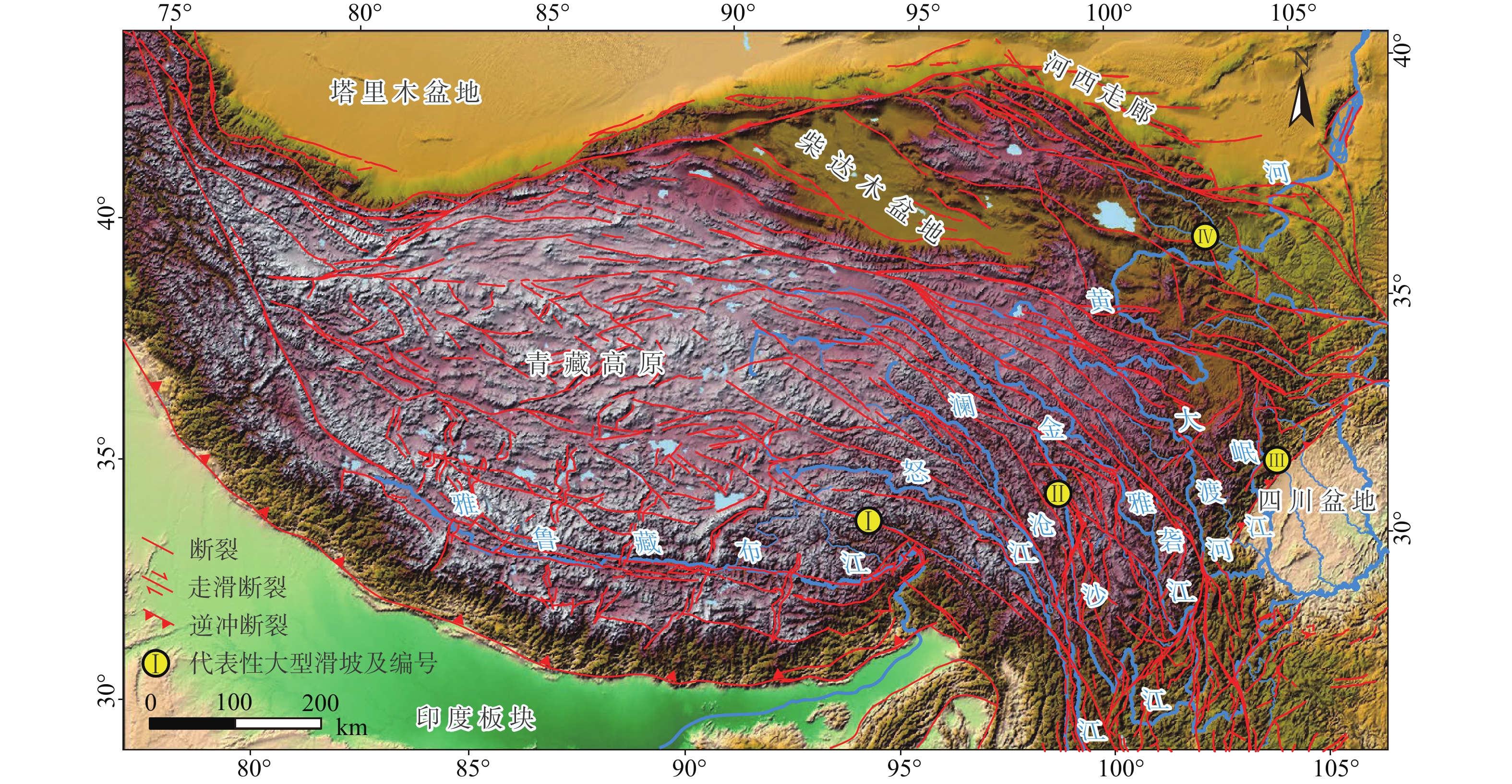
图 1 青藏高原构造活动特征
图中DEM数据来自12.5 m分辨率的ALOS-PALSAR DEM;活动断裂分布据Tapponnier et al.,2001修改Ⅰ—笨多滑坡;Ⅱ—白格滑坡;Ⅲ—大光包滑坡;Ⅳ—张家庄滑坡
Figure 1. Characteristics of tectonic activity on the Tibetan Plateau
The DEM data were derived from the ALOS-PALSAR with a resolution of 12.5 m; active faults are modified from Tapponnier et al. (2001).Ⅰ–Benduo landslide; Ⅱ–Baige landslide; Ⅲ–Daguangbao landslide; Ⅳ–Zhangjiazhuang landslide
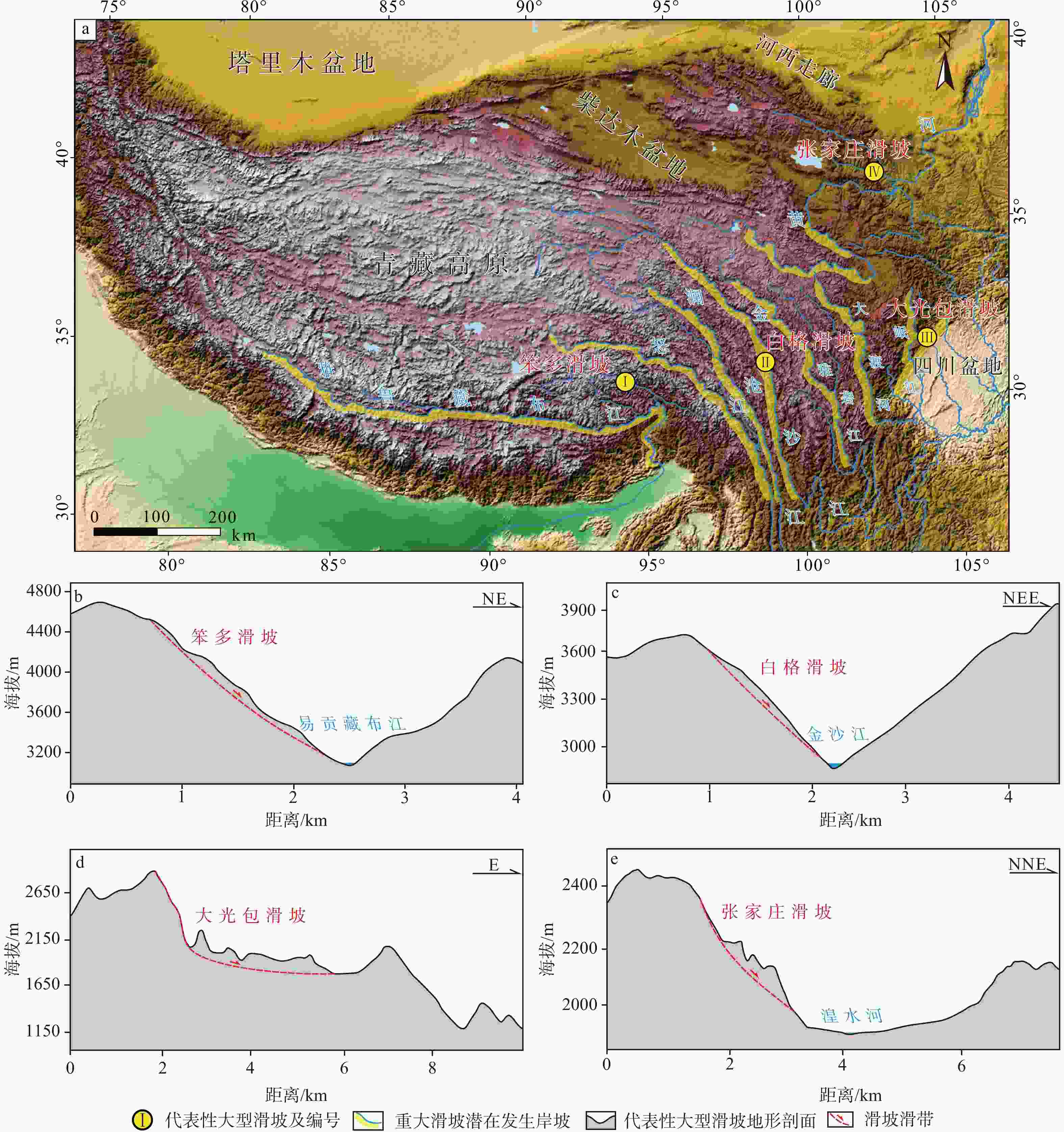
图 2 青藏高原大型滑坡潜在发生岸坡示意图
图中DEM数据来自12.5 m分辨率的ALOS-PALSAR DEMa—青藏高原大型滑坡潜在发生岸坡分布图;b—笨多滑坡剖面图;c—白格滑坡剖面图;d—大光包滑坡剖面图;e—张家庄滑坡剖面图
Figure 2. Schematic diagrams of riverbank slopes prone to large-scale landslides on the Tibetan Plateau
(a) Distribution of riverbank slopes prone to large-scale landslides on the Tibetan Plateau; (b) Cross-section of the Benduo landslide; (c) Cross-section of the Baige landslide; (d) Cross-section of the Daguangbao landslide; (e) Cross-section of the Zhangjiazhuang landslideDEM data were derived from the ALOS-PALSAR with a resolution of 12.5 m.
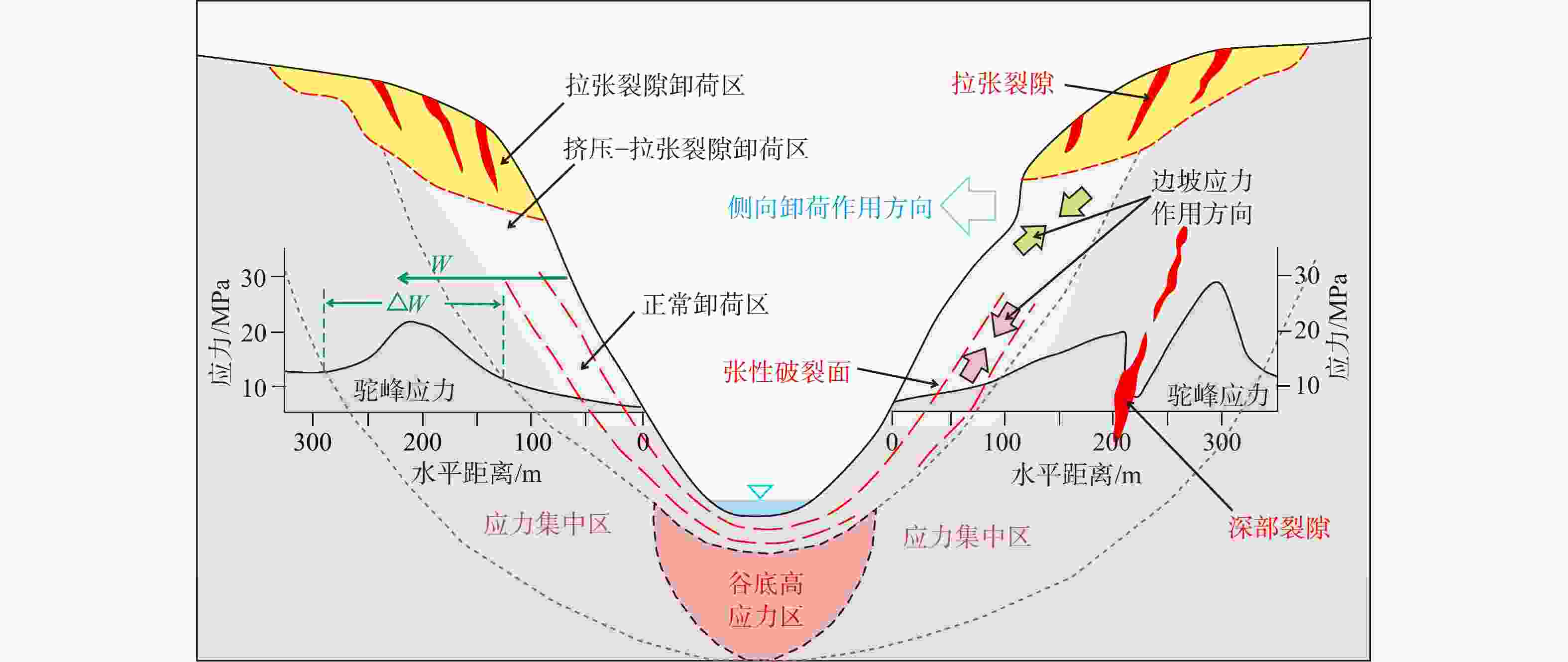
图 3 深切峡谷地应力分布示意图(据黄润秋,2004修改)
W—边坡应力集中区自坡面向山体内部的水平深度;ΔW—边坡应力集中区的范围
Figure 3. Schematic diagram of in-situ stress distribution in a deeply incised valley (modified from Huang, 2004)
W–horizontal depth of the slope stress concentration zone measured from the slope surface into the mountain; ΔW–extent of the slope stress concentration zone
-
[1] BAI S W, LI G Y, 1982. Research on stress field around dam area of Ertan hydropower station[J]. Chinese Journal of Rock Mechanics and Engineering, 1(1): 45-56. (in Chinese with English abstract) [2] CHENG H, ZHANG G X, LIAO J X, et al., 2020. Analysis on characteristics and influencing factors of valley deformation of high arch dam[J]. Water Resources and Hydropower Engineering, 51(5): 65-70. (in Chinese with English abstract) [3] DENG L S, FAN W, 2013. Deformation breakage characteristics and development mechanism of loess landslide triggered by Haiyuan M8.5 earthquake in Ningxia[J]. Journal of Catastrophology, 28(3): 30-37. (in Chinese with English abstract) [4] DENG Q D, CHENG S P, MA J, et al., 2014. Seismic activities and earthquake potential in the Tibetan Plateau[J]. Chinese Journal of Geophysics, 57(7): 2025-2042. (in Chinese with English abstract) doi: 10.1002/cjg2.20133 [5] DONG H W, XU Z Q, ZHOU X, et al., 2016. Active timing and tectonic evolution of the eastern segment of the great counter thrust in the northern margin of the Himalayan orogen belt[J]. Acta Geologica Sinica, 90(11): 3011-3022. (in Chinese with English abstract) [6] GUO C B, WU R A, LI X, et al., 2020. Developmental characteristics and formation mechanism of the Rizha potential giant rock landslide, western Sichuan Province, China[J]. Journal of Engineering Geology, 28(4): 772-783. (in Chinese with English abstract) [7] GUO C B, YAN Y Q, ZHANG Y S, et al., 2022. Research progress and prospect of failure mechanism of large deep-seated creeping landslides in Tibetan Plateau, China[J]. Earth Science, 47(10): 3677-3700. (in Chinese with English abstract) [8] GUO C B, WU R A, ZHONG N, et al., 2024. Large landslides along active tectonic zones of eastern Tibetan Plateau: background and mechanism of landslide formation[J]. Earth Science, 49(12): 4635-4658. (in Chinese with English abstract) [9] GUO C B, QIU Z D, WU R A, et al., 2025. High-altitude deformation and reactivation mechanism of large ancient landslides along the Shadingmai section of the upper Jinsha River, Tibetan Plateau[J]. Environmental Earth Sciences, 84(1): 44. doi: 10.1007/s12665-024-12053-8 [10] HUANG R Q, 2004. Geo-stress distribution and unloading fracturing mechanism of high rock slopes in western part of China[J]. Journal of Engineering Geology, 12(S1): 7-13. (in Chinese with English abstract) [11] HUANG R Q, 2007. Large-scale landslides and their sliding mechanisms in China since the 20th century[J]. Chinese Journal of Rock Mechanics and Engineering, 26(3): 433-454. (in Chinese with English abstract) [12] HUANG R Q, LI W L, 2009. Analysis on the number and density of landslides triggered by the 2008 Wenchuan earthquake, China[J]. Journal of Geological Hazards and Environment Preservation, 20(3): 1-7. (in Chinese with English abstract) [13] LI C H, ZHANG K H. 2025. Cause Analysis and Stability Evaluation of a Landslide in Southeastern Tibet[J]. Railway Investigation and Surveying, 51(1): 13-19. [14] LI H B, PAN J W, SUN Z M, et al., 2021. Continental tectonic deformation and seismic activity: a case study from the Tibetan Plateau[J]. Acta Geologica Sinica, 95(1): 194-213. (in Chinese with English abstract) [15] LI Y X, ZHANG Y, MENG X M, et al., 2021. Analysis the activity characteristics of the giant landslide in active tectonic fault zone: a case study of Daxiaowan landslide in Bailong River Basin[J]. Journal of Lanzhou University (Natural Sciences), 57(3): 360-368. (in Chinese with English abstract) [16] LIU Y G, LI H, ZHENG H, et al., 2022. Research progress and prospect of the relationship among active tectonics, earthquakes and geological disasters in China[J]. Journal of Natural Disasters, 31(1): 1-14. (in Chinese with English abstract) [17] MA J F, LI X Q, ZHANG C C, et al., 2022. Characterization of karst development and groundwater circulation in the middle part of the Jinshajiang fault zone[J]. Journal of Geomechanics, 28(6): 956-968. (in Chinese with English abstract) [18] MA Z J, JIANG M, 1987. Strong earthquake periods and episodes in China[J]. Earthquake Research in China, 3(1): 47-51. (in Chinese with English abstract) [19] PAN J W, LI H B, LIU F C, et al., 2026. Characteristics of surface ruptures produced by recent major earthquakes on the Tibetan Plateau and its surrounding areas, and their tectonic implications[J]. Journal of Geomechanics, 32(3): 509-527. (in Chinese with English abstract) [20] PENG J B, CUI P, ZHUANG J Q, 2020. Challenges to engineering geology of Sichuan-Tibet railway[J]. Chinese Journal of Rock Mechanics and Engineering, 39(12): 2377-2389. (in Chinese with English abstract) [21] QI S W, WU F Q, LAN H X, 2002. Study on the mechanism of the deep fractures of the left abutment slope at the Jinping first stage hydropower station[J]. Chinese Journal of Geotechnical Engineering, 24(5): 596-599. (in Chinese with English abstract) doi: 10.1016/j.enggeo.2003.12.005 [22] SUN D, YIN Z Q, LI D M, et al. , 2019. Development of the large-scale landslides controlled by geological structures in Meigu River Basin[J]. The Chinese Journal of Geological Hazard and Control, 30(6): 49-58, 67. (in Chinese with English abstract) [23] SUN W F, GUO C B, ZHANG G Z, et al., 2021. In-situ stress measurement of Guodashan tunnel horizontal borehole in west Sichuan and the engineering significance[J]. Geoscience, 35(1): 126-136. (in Chinese with English abstract) [24] SUN W F, HUANG H L, SUN D S, et al., 2024. Present in situ stress measurement in the eastern segment of Yarlung Zangbo River fault and fault activity analysis[J]. Rock and Soil Mechanics, 45(4): 1129-1141. (in Chinese with English abstract) doi: 10.26599/RSM.2024.9435545 [25] SUN Y J, GUO C B, WU Z H, et al., 2017. Numerical study of the crustal stress, strain rate and fault activity in the eastern Tibetan Plateau[J]. Acta Geoscientica Sinica, 38(3): 385-392. (in Chinese with English abstract) [26] TAN C X, WANG R J, SUN Y, et al., 2004. Numerical modelling estimation of the ‘tectonic stress plane’ (TSP) beneath topography with quasi-U-shaped valleys[J]. International Journal of Rock Mechanics and Mining Sciences, 41(2): 303-310. doi: 10.1016/S1365-1609(03)00096-0 [27] TAN C X, SUN W F, SUN Y, et al., 2006. A consideration on in-situ crustal stress measuring and its underground engineering application[J]. Acta Geologica Sinica, 80(10): 1627-1632. (in Chinese with English abstract) [28] TAN C X, ZHANG P, ZHENG H H, et al., 2008. An analysis on in-situ crustal stress measurements and major engineering geology issues at the dam site area of Jinping first stage hydropower station[J]. Journal of Engineering Geology, 16(2): 162-168. (in Chinese with English abstract) [29] TAPPONNIER P, XU Z Q, ROGER F, et al., 2001. Oblique stepwise rise and growth of the Tibet Plateau[J]. Science, 294(5547): 1671-1677. doi: 10.1126/science.105978 [30] TIE Y B, GE H, GAO Y C, et al., 2022. The research progress and prospect of geological hazards in Southwest China since the 20th Century[J]. Sedimentary Geology and Tethyan Geology, 42(4): 653-665. (in Chinese with English abstract) [31] WANG Y F, QIAN J Z, CHENG Q G, et al. , 2024. Research on spatial distribution characteristics of major landslides hazards in the Himalayas[J]. China Railway(10): 10-20. (in Chinese with English abstract) [32] WANG Y F, CHEN P H, QIAN J Z, et al., 2025. Geomorphic and geologic controls on large-scale landslides in the Himalayan region of China[J]. Landslides, 22(5): 1725-1741, doi: 10.1007/s10346-024-02447-x [33] WEI T Y, YIN Y P, LI B, et al., 2021. Remote sensing interpretation and risk prediction analysis of Benduo high deformation body in Tibet[J]. The Chinese Journal of Geological Hazard and Control, 32(3): 17-24. (in Chinese with English abstract) [34] WU M X, ZHAO Q S, 2021. Case study and reflections on arch dams affected by valley deformation[J]. Water Power, 47(1): 68-72, 89. (in Chinese with English abstract) [35] XING Y K, LIU J, WANG W, et al., 2023. Longitudinal profile analysis of rivers draining edges of the Tibetan Plateau and its geomorphology implications[J]. Geological Bulletin of China, 42(1): 107-121. (in Chinese with English abstract) [36] XU X W, LI F, CHENG J, et al., 2023. Advances in research on active faults and exploration of relevant frontier scientific problems[J]. Coal Geology & Exploration, 51(12): 1-16. (in Chinese with English abstract) [37] XU Z Q, YANG J S, LI H B, et al., 2006. The Qinghai-Tibet Plateau and continental dynamics: a review on terrain tectonics, collisional orogenesis, and processes and mechanisms for the rise of the plateau[J]. Geology in China, 33(2): 221-238. (in Chinese with English abstract) [38] XU Z Q, YANG J S, LI H B, et al., 2011. On the tectonics of the India-Asia collision[J]. Acta Geologica Sinica, 85(1): 1-33. (in Chinese with English abstract) [39] YAN Y Q, GUO C B, ZHANG Y N, et al., 2024. Development and deformation characteristics of large ancient landslides in the intensely hazardous Xiongba-Sela section of the Jinsha River, Eastern Tibetan Plateau, China[J]. Journal of Earth Science, 35(3): 980-997. doi: 10.1007/s12583-023-1925-y [40] YANG S X, YAO R, CUI X F, et al., 2012. Analysis of the characteristics of measured stress in Chinese mainland and its active blocks and north-south seismic belt[J]. Chinese Journal of Geophysics, 55(12): 4207-4217. (in Chinese with English abstract) [41] YANG X C, GAO K J, ZHAO W G, et al., 2018. Influence of valley deformation on safety of Xiluodu arch dam[J]. Journal of Water Resources and Architectural Engineering, 16(1): 72-78. (in Chinese with English abstract) doi: 10.12783/dtetr/ecame2017/18458 [42] YIN A, HARRISON T M, 2000. Geologic evolution of the Himalayan-Tibetan orogen[J]. Annual Review of Earth and Planetary Sciences, 28: 211-280. doi: 10.1146/annurev.earth.28.1.211 [43] YIN Y P, WANG M, LI B, et al., 2012. Dynamic response characteristics of Daguangbao landslide triggered by Wenchuan earthquake[J]. Chinese Journal of Rock Mechanics and Engineering, 31(10): 1969-1982. (in Chinese with English abstract) [44] ZHANG P Z, SHEN Z K, WANG M, et al., 2004. Continuous deformation of the Tibetan Plateau from global positioning system data[J]. Geology, 32(9): 809-812. doi: 10.1130/G20554.1 [45] ZHANG P Z, WANG W T, GAN W J, et al., 2022. Present-day deformation and geodynamic processes of the Tibetan Plateau[J]. Acta Geologica Sinica, 96(10): 3297-3313. (in Chinese with English abstract) [46] ZHANG Y F, YIN Y P, LI B, et al., 2025. Geostructural characteristics and failure mechanism of the Benduo mountain slope in the Yigong Zangbo River, Qinghai–Tibet Plateau, China[J]. Landslides, 22(6): 2005-2020, doi: 10.1007/s10346-025-02472-4 [47] ZHANG Y S, GUO C B, YAO X, et al., 2016. Research on the geohazard effect of active fault on the eastern margin of the Tibetan Plateau[J]. Acta Geoscientica Sinica, 37(3): 277-286. (in Chinese with English abstract) [48] ZHANG Y S, BA R J, REN S S, et al., 2020. An analysis of geo-mechanism of the Baige landslide in Jinsha River, Tibet[J]. Geology in China, 47(6): 1637-1645. (in Chinese with English abstract) [49] ZHANG Y S, DU G L, GUO C B, et al., 2021. Research on typical geomechanical model of high-position landslides on the Sichuan-Tibet traffic corridor[J]. Acta Geologica Sinica, 95(3): 605-617. (in Chinese with English abstract) [50] ZHANG Y S, WANG D B, LI X, et al., 2024. Research on hazard prone geological genes and major engineering geological problems in tectonic mélange belts of Tibetan Plateau[J]. Acta Geologica Sinica, 98(3): 992-1005. (in Chinese with English abstract) [51] ZHANG Y S, REN S S, GUO C B, et al., 2025. Application of geomechanics in risk prevention and control for the geosafety of major projects on the Tibetan Plateau[J]. Journal of Geomechanics, 31(5): 926-939. (in Chinese with English abstract) [52] ZHAO B, HUANG Y, ZHANG C H, et al., 2015. Crustal deformation on the Chinese mainland during 1998-2014 based on GPS data[J]. Geodesy and Geodynamics, 6(1): 7-15. doi: 10.1016/j.geog.2014.12.006 [53] ZHENG W J, SUN X, YUAN D Y, et al., 2025. Active faults, seismic activity, and seismotectonic environments in the Tibetan Plateau and its adjacent regions[J]. Journal of Geomechanics, 31(5): 1006-1029. (in Chinese with English abstract) [54] 白世伟, 李光煜, 1982. 二滩水电站坝区岩体应力场研究[J]. 岩石力学与工程学报, 1(1): 45-56. [55] 程恒, 张国新, 廖建新, 等, 2020. 高拱坝谷幅变形特征及影响因素分析[J]. 水利水电技术, 51(5): 65-70. doi: 10.13928/j.cnki.wrahe.2020.05.008 [56] 邓龙胜, 范文, 2013. 宁夏海原8.5级地震诱发黄土滑坡的变形破坏特征及发育机理[J]. 灾害学, 28(3): 30-37. doi: 10.3969/j.issn.1000-811X.2013.03.007 [57] 邓起东, 程绍平, 马冀, 等, 2014. 青藏高原地震活动特征及当前地震活动形势[J]. 地球物理学报, 57(7): 2025-2042. [58] 董汉文, 许志琴, 周信, 等, 2016. 喜马拉雅造山带北缘大反转逆冲断层(GCT)东段的活动时限及构造演化[J]. 地质学报, 90(11): 3011-3022. doi: 10.3969/j.issn.0001-5717.2016.11.004 [59] 郭长宝, 吴瑞安, 李雪, 等, 2020. 川西日扎潜在巨型岩质滑坡发育特征与形成机理研究[J]. 工程地质学报, 28(4): 772-783. doi: 10.13544/j.cnki.jeg.2020-110 [60] 郭长宝, 闫怡秋, 张永双, 等, 2022. 青藏高原大型深层蠕滑型滑坡变形机制研究进展与展望[J]. 地球科学, 47(10): 3677-3700. [61] 郭长宝, 吴瑞安, 钟宁, 等, 2024. 青藏高原东部活动构造带大型滑坡成灾背景与灾变机制[J]. 地球科学, 49(12): 4635-4658. doi: 10.3799/dqkx.2024.124 [62] 黄润秋, 2004. 中国西部岩石高边坡应力场特征及其卸荷破裂机理[J]. 工程地质学报, 12(S1): 7-13. doi: 10.3969/j.issn.1004-9665.2004.z1.002 [63] 黄润秋, 2007. 20世纪以来中国的大型滑坡及其发生机制[J]. 岩石力学与工程学报, 26(3): 433-454. doi: 10.3321/j.issn:1000-6915.2007.03.001 [64] 黄润秋, 李为乐, 2009. 汶川地震触发崩塌滑坡数量及其密度特征分析[J]. 地质灾害与环境保护, 20(3): 1-7. doi: 10.3969/j.issn.1006-4362.2009.03.001 [65] 李朝辉, 张柯宏, 2025. 藏东南某滑坡成因分析及稳定性评价[J]. 铁道勘察, 51(1): 13-19. doi: 10.19630/j.cnki.tdkc.202404300001 [66] 李海兵, 潘家伟, 孙知明, 等, 2021. 大陆构造变形与地震活动: 以青藏高原为例[J]. 地质学报, 95(1): 194-213. doi: 10.3969/j.issn.0001-5717.2021.01.014 [67] 李媛茜, 张毅, 孟兴民, 等, 2021. 活动构造断裂带巨型滑坡活动特性研究: 以白龙江流域大小湾滑坡为例[J]. 兰州大学学报(自然科学版), 57(3): 360-368. doi: 10.13885/j.issn.0455-2059.2021.03.011 [68] 刘玉国, 李欢, 郑涵, 等, 2022. 中国活动构造与地震及地质灾害的关系研究进展及展望[J]. 自然灾害学报, 31(1): 1-14. doi: 10.13577/j.jnd.2022.0101 [69] 马剑飞, 李向全, 张春潮, 等, 2022. 金沙江断裂带中段岩溶发育和地下水循环特征[J]. 地质力学学报, 28(6): 956-968. doi: 10.12090/j.issn.1006-6616.20222823 [70] 马宗晋, 蒋铭, 1987. 中国的强震期和强震幕[J]. 中国地震, 3(1): 47-51. [71] 潘家伟, 李海兵, 刘富财, 等, 2026. 青藏高原及周缘近年来典型强震地表破裂特征及其构造指示意义[J]. 地质力学学报, 32(3): 509-527. doi: 10.12090/j.issn.1006-6616.2026053 [72] 彭建兵, 崔鹏, 庄建琦, 2020. 川藏铁路对工程地质提出的挑战[J]. 岩石力学与工程学报, 39(12): 2377-2389. [73] 祁生文, 伍法权, 兰恒星, 2002. 锦屏一级水电站普斯罗沟左岸深部裂缝成因的工程地质分析[J]. 岩土工程学报, 24(5): 596-599. doi: 10.3321/j.issn:1000-4548.2002.05.012 [74] 孙东, 殷志强, 李大猛, 等, 2019. 美姑河流域地质构造对大型滑坡孕育的控制作用[J]. 中国地质灾害与防治学报, 30(6): 49-58, 67. [75] 孙炜锋, 郭长宝, 张广泽, 等, 2021. 川西郭达山隧道水平孔地应力测量与工程意义[J]. 现代地质, 35(1): 126-136. [76] 孙炜锋, 黄火林, 孙东生, 等, 2024. 雅鲁藏布江断裂带东段现今地应力测量与断层活动性分析[J]. 岩土力学, 45(4): 1129-1141. doi: 10.16285/j.rsm.2023.0545 [77] 孙玉军, 郭长宝, 吴中海, 等, 2017. 数值模拟探讨青藏高原东部应力应变场及断裂活动性[J]. 地球学报, 38(3): 385-392. doi: 10.3975/cagsb.2017.03.08 [78] 谭成轩, 孙炜锋, 孙叶, 等, 2006. 地应力测量及其地下工程应用的思考[J]. 地质学报, 80(10): 1627-1632. doi: 10.3321/j.issn:0001-5717.2006.10.018 [79] 谭成轩, 张鹏, 郑汉淮, 等, 2008. 雅砻江锦屏一级水电站坝址区实测地应力与重大工程地质问题分析[J]. 工程地质学报, 16(2): 162-168. doi: 10.3969/j.issn.1004-9665.2008.02.003 [80] 铁永波, 葛华, 高延超, 等, 2022. 二十世纪以来西南地区地质灾害研究历程与展望[J]. 沉积与特提斯地质, 42(4): 653-665. doi: 10.19826/j.cnki.1009-3850.2022.11005 [81] 王玉峰, 钱嘉贞, 程谦恭, 等, 2024. 喜马拉雅山区重大滑坡灾害空间分布特征研究[J]. 中国铁路(10): 10-20. [82] 卫童瑶, 殷跃平, 李滨, 等, 2021. 西藏笨多高位变形体遥感解译与危险性预测分析[J]. 中国地质灾害与防治学报, 32(3): 17-24. doi: 10.16031/j.cnki.issn.1003-8035.2021.03-03 [83] 武明鑫, 赵全胜, 2021. 谷幅变形对拱坝工程安全影响案例分析及有关启示[J]. 水力发电, 47(1): 68-72, 89. doi: 10.3969/j.issn.0559-9342.2021.01.015 [84] 邢宇堃, 刘静, 王伟, 等, 2023. 青藏高原周缘的河流纵剖面特征及其对构造地貌演化的启示[J]. 地质通报, 42(1): 107-121. doi: 10.12097/j.issn.1671-2552.2023.01.010 [85] 徐锡伟, 李峰, 程佳, 等, 2023. 活动断层研究进展及其科学前沿问题讨论[J]. 煤田地质与勘探, 51(12): 1-16. doi: 10.12363/issn.1001-1986.23.12.0805 [86] 许志琴, 杨经绥, 李海兵, 等, 2006. 青藏高原与大陆动力学-地体拼合、碰撞造山及高原隆升的深部驱动力[J]. 中国地质, 33(2): 221-238. doi: 10.3969/j.issn.1000-3657.2006.02.001 [87] 许志琴, 杨经绥, 李海兵, 等, 2011. 印度-亚洲碰撞大地构造[J]. 地质学报, 85(1): 1-33. [88] 杨树新, 姚瑞, 崔效锋, 等, 2012. 中国大陆与各活动地块、南北地震带实测应力特征分析[J]. 地球物理学报, 55(12): 4207-4217. doi: 10.6038/j.issn.0001-5733.2012.12.032 [89] 杨学超, 高克静, 赵文光, 等, 2018. 谷幅收缩变形对溪洛渡拱坝的安全影响分析[J]. 水利与建筑工程学报, 16(1): 72-78. doi: 10.3969/j.issn.1672-1144.2018.01.013 [90] 殷跃平, 王猛, 李滨, 等, 2012. 汶川地震大光包滑坡动力响应特征研究[J]. 岩石力学与工程学报, 31(10): 1969-1982. doi: 10.3969/j.issn.1000-6915.2012.10.003 [91] 张培震, 王伟涛, 甘卫军, 等, 2022. 青藏高原的现今构造变形与地球动力过程[J]. 地质学报, 96(10): 3297-3313. doi: 10.3969/j.issn.0001-5717.2022.10.003 [92] 张永双, 郭长宝, 姚鑫, 等, 2016. 青藏高原东缘活动断裂地质灾害效应研究[J]. 地球学报, 37(3): 277-286. doi: 10.3975/cagsb.2016.03.03 [93] 张永双, 巴仁基, 任三绍, 等, 2020. 中国西藏金沙江白格滑坡的地质成因分析[J]. 中国地质, 47(6): 1637-1645. doi: 10.12029/gc20200603 [94] 张永双, 杜国梁, 郭长宝, 等, 2021. 川藏交通廊道典型高位滑坡地质力学模式[J]. 地质学报, 95(3): 605-617. [95] 张永双, 王冬兵, 李雪, 等, 2024. 青藏高原构造混杂岩带的孕灾地质基因与重大工程地质问题研究[J]. 地质学报, 98(3): 992-1005. doi: 10.19762/j.cnki.dizhixuebao.2023063 [96] 张永双, 任三绍, 郭长宝, 等, 2025. 地质力学在青藏高原重大工程地质安全风险防控中的应用[J]. 地质力学学报, 31(5): 926-939. doi: 10.12090/j.issn.1006-6616.2025130 [97] 郑文俊, 孙鑫, 袁道阳, 等, 2025. 青藏高原及邻区活动断裂、地震活动及地震构造环境[J]. 地质力学学报, 31(5): 1006-1029. doi: 10.12090/j.issn.1006-6616.2025124 -

 下载:
下载:


计量
- 文章访问数: 241
- HTML全文浏览量: 50
- PDF下载量: 76
- 被引次数: 0
