


Characteristics of surface ruptures produced by recent major earthquakes on the Tibetan Plateau and its surrounding areas, and their tectonic implications
-
摘要: 同震地表破裂是确定发震构造、揭示地壳变形机制和评估地震风险的关键依据。为认识青藏高原不同类型断层活动的地表变形与灾害发育特征,并揭示近年来一系列强震所反映的青藏高原现今地壳变形规律,在地表调查的基础上,系统整理和分析了青藏高原及周边地区2021年以来发生的5次M>6.5地震的地表破裂特征。以2021年MW 7.4玛多、2022年MW 6.6门源/MW 6.6泸定、2024年MW 7.0乌什和2025年MW 7.1定日地震为典型震例,综合遥感解译、野外调查和无人机摄影测量结果,并结合地震学与大地测量学数据,精细解析了上述震例的地表破裂及同震位移分布特征。结果显示:走滑型的玛多和门源地震分别形成了长约150~160 km和22~31 km的同震地表破裂带,最大同震地表位移量分别为~3.6 m和~3.7 m,但同为走滑型的泸定地震仅在二台子发现长约450 m的地表破裂;逆冲型的乌什地震主震未产生同震地表破裂,但MW 5.7强余震形成了近5 km长、最大垂直位移约1.7 m的同震地表破裂带;正断型的定日地震形成了长约25~36.5 km、最大垂直位移约2.7 m的同震地表破裂带。综合区域强震的时空分布特征显示,在2022年泸定地震前,青藏高原强震主要围绕巴颜喀拉活动地块周缘发生丛集活动,此后发生的乌什地震和定日地震均远离巴颜喀拉地块,可能指示该活动地块的强震丛集期已经结束。进一步结合震源机制解结果可知,青藏高原及周缘近年来的中—强地震事件中,走滑型地震占主导地位,这可能与青藏高原现今地壳变形主要以活动块体沿大型走滑断裂带发生侧向挤出的方式进行调节与吸收有关。上述研究结果可为青藏高原地区地震监测预警、防震减灾工作及区域重大工程的规划建设与抗震设防等提供基础数据与参考。Abstract:
Objective Coseismic surface ruptures provide key evidence for identifying the seismogenic structures of earthquakes, elucidating crustal deformation mechanisms, and assessing seismic hazards. To understand the surface deformation and disaster development characteristics associated with different types of fault activity on the Tibetan Plateau, and to reveal the current crustal deformation patterns reflected by a series of strong earthquakes in recent years, we systematically compiled and analyzed the surface rupture characteristics of five M>6.5 earthquakes that have occurred on the Tibetan Plateau and surrounding areas since 2021, based on field surveys. Methods We used the 2021 MW 7.4 Maduo, 2022 MW 6.6 Menyuan, 2022 MW 6.6 Luding, 2024 MW 7.0 Wushi, and 2025 MW 7.1 Dingri earthquakes as representative cases. We integrated results from remote sensing interpretation, field surveys, and UAV photogrammetry, as well as seismological and geodetic data, to conduct a detailed analysis of the surface rupture and coseismic displacement distribution characteristics of these events. Results The strike-slip Maduo and Menyuan earthquakes formed coseismic surface rupture zones approximately 150~160 km and 22~31 km long, respectively, with maximum coseismic surface displacements of ~3.6 m and ~3.7 m. Contrastingly, the Luding earthquake, also a strike-slip event, exhibited a surface rupture only ~450 m long at Ertaizi. The strong, MW 5.7 aftershock of the thrust-type Wushi earthquake generated a coseismic surface rupture zone ~5 km long with a maximum vertical displacement of ~1.7 m, while the normal-fault-type Dingri earthquake formed a coseismic surface rupture zone 25~36.5 km long with a maximum vertical displacement of ~2.7 m. Conclusions A comprehensive analysis of the spatiotemporal distribution characteristics of major regional earthquakes indicates that, prior to the 2022 Luding earthquake, major earthquakes on the Tibetan Plateau were primarily clustered around the periphery of the active Bayan Har block. The subsequent Wushi and Dingri earthquakes both occurred far from the Bayan Har block, suggesting that the clustering period of major earthquakes in this active block may have ended. Further analysis of focal mechanism solutions indicates that strike-slip earthquakes have dominated recent moderate-to-strong seismic events on the Tibetan Plateau and its periphery. This may be related to the fact that current crustal deformation on the Tibetan Plateau is primarily regulated and absorbed through the lateral extrusion of active blocks along large strike-slip fault zones. Significance The above research findings provide fundamental data and references for earthquake early warning, disaster prevention and mitigation, as well as the planning, construction, and seismic design of major regional engineering projects in the Tibetan Plateau region. -
Key words:
- Tibetan Plateau /
- strong earthquake /
- coseismic surface rupture /
- coseismic displacement /
- active fault
-
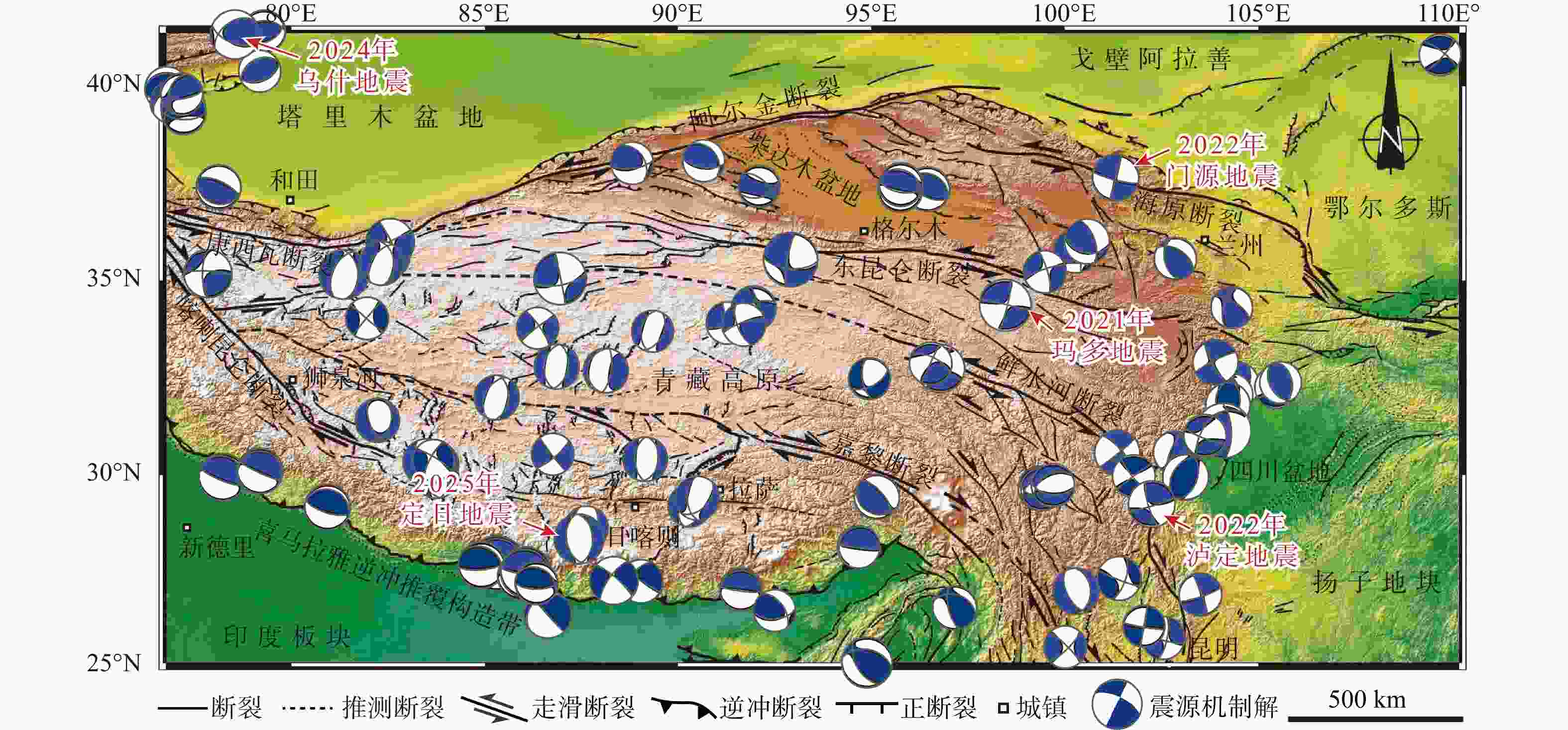
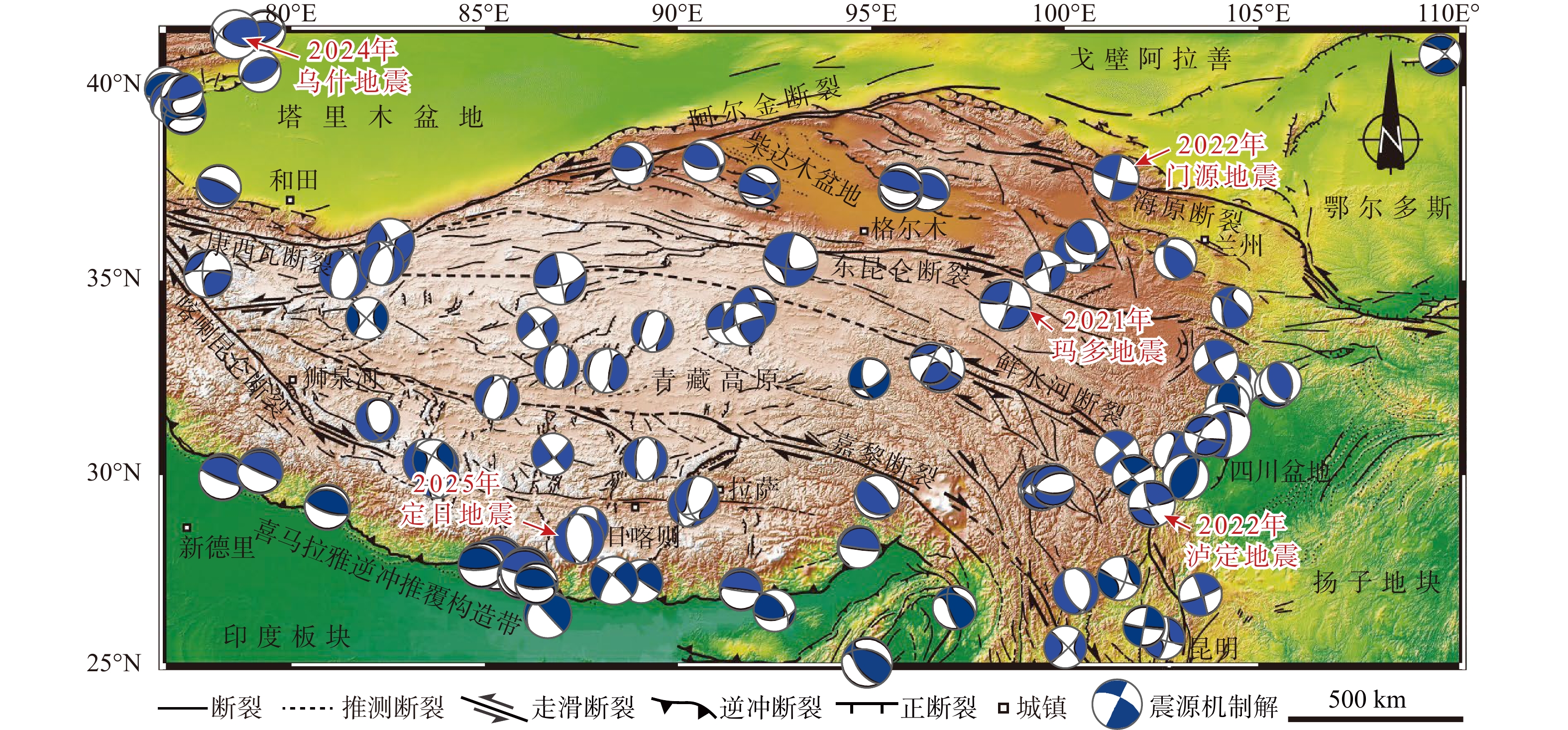
图 1 青藏高原及周缘地区活动断裂和1970年以来6级以上地震分布图
活动断裂分布图据Tapponnier et al.,2001修改;震源机制数据下载自全球矩心矩张量目录(
https://www.globalcmt.org/ )Figure 1. Map of active faults and distribution of M ≥ 6 earthquakes (since 1970) in the Tibetan Plateau and adjacent areas
Active faults are adopted from Tapponnier et al. (2001); Earthquake and focal mechanism data are from Global Centroid-Moment-Tensor (GCMT;
https://www.globalcmt.org/ ).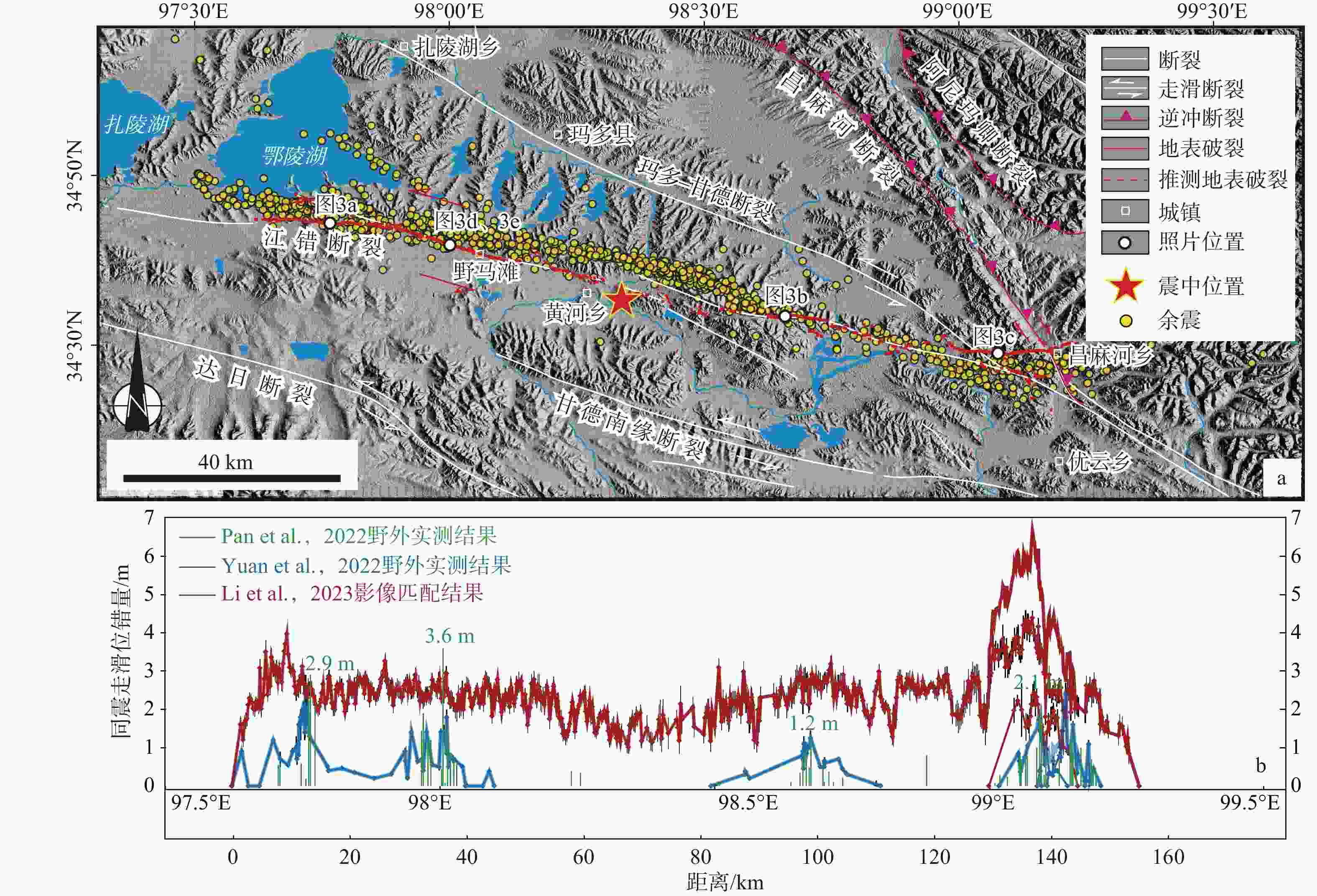
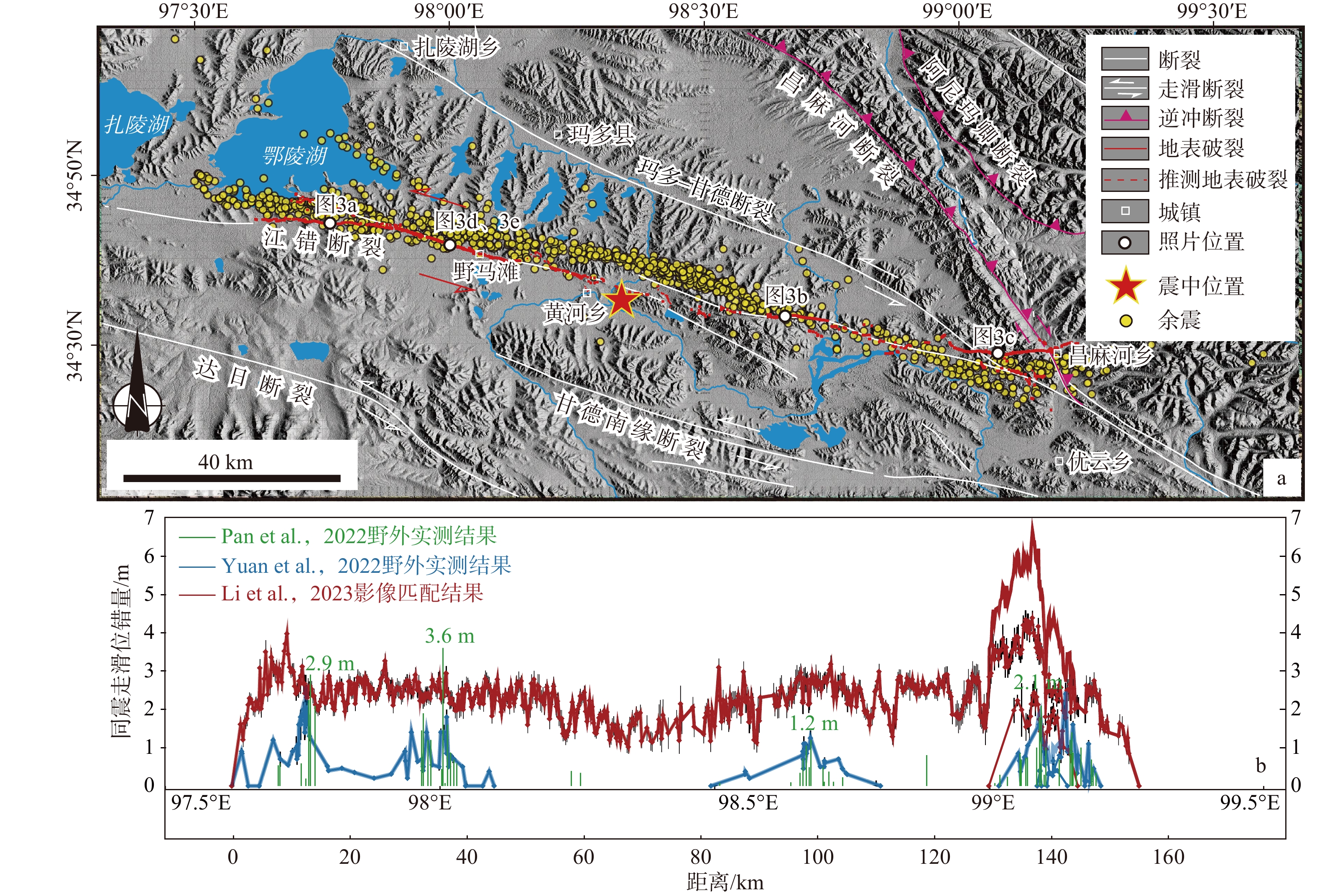
图 2 玛多地震地表破裂与同震位移量分布图
a—玛多地震地表破裂带与区域活动断层分布图;b—玛多地震同震位错量分布及其与光学卫星影像匹配结果的对比
Figure 2. Distribution of coseismic surface ruptures and coseismic displacements for the Maduo earthquake
(a) Distribution of coseismic surface ruptures for the Maduo earthquake and regional active faults; (b) Distribution of coseismic displacements for the Maduo earthquake and a comparison with results from optical satellite image correlation
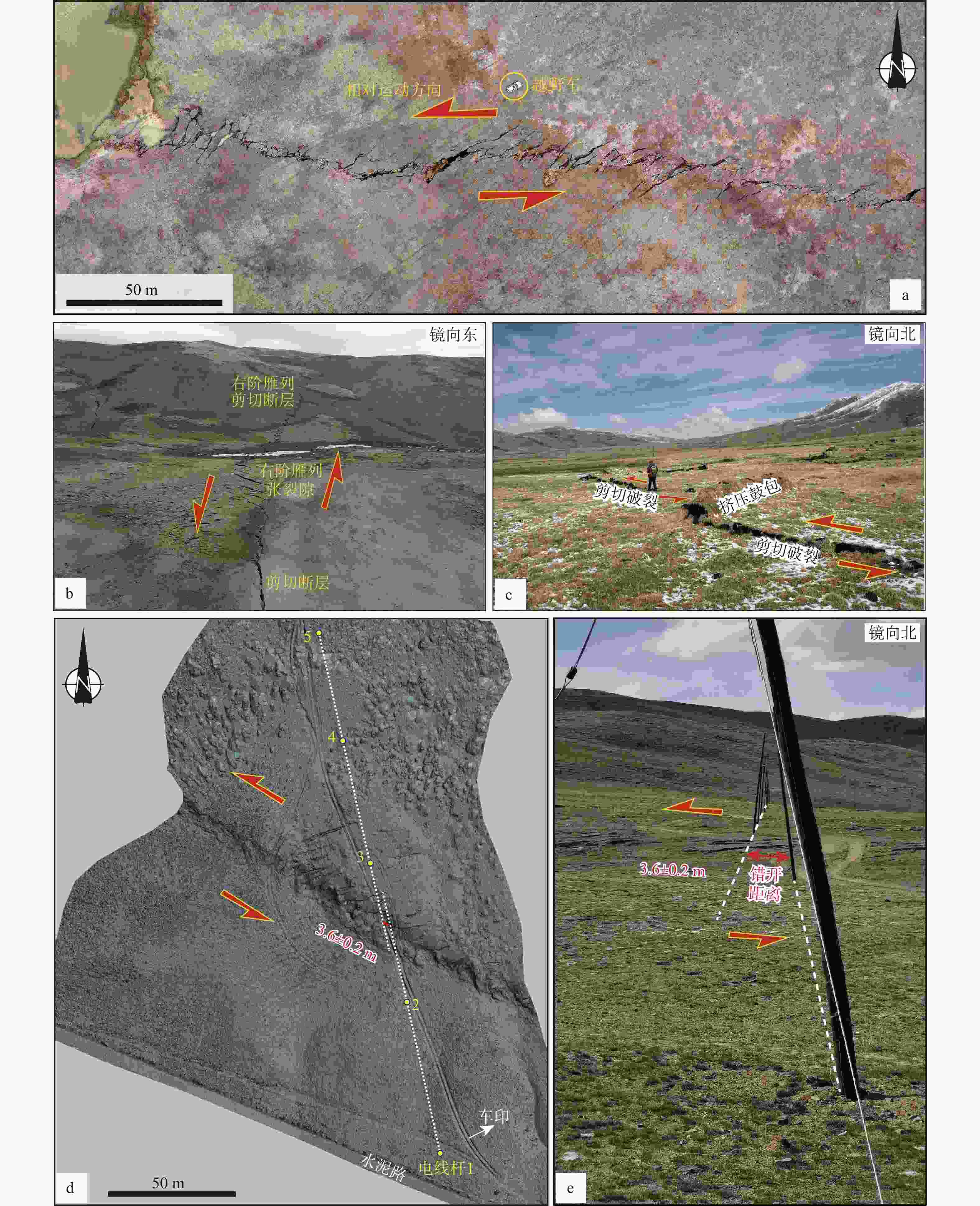
图 3 玛多地震典型地表破裂现象
a—地表破裂带西段无人机正射影像;b—地表破裂带中东段右阶雁列的张裂隙和剪切断层;c—地表破裂带东段相间分布的剪切破裂和挤压鼓包;d—最大同震走滑位移量(3.6±0.2 m)LiDAR测量结果;e—野外照片显示线性排列的电线杆被左行错开3.6±0.2 m
Figure 3. Typical coseismic surface ruptures produced by the 2021 Maduo earthquake
(a) UAV orthophoto showing spectacular surface ruptures along the western segment of the rupture zone; (b) Right-stepping en-echelon extensional cracks and shear faults along the eastern central segment of the rupture zone; (c) Alternating shear faults and push-ups along the eastern segment of the rupture zone; (d) Terrestrial LiDAR measurement showing the maximum coseismic sinistral displacement (3.6 ± 0.2 m) observed in the field; (e) Field photo showing aligned electricity poles sinistrally offset by 3.6 ± 0.2 m
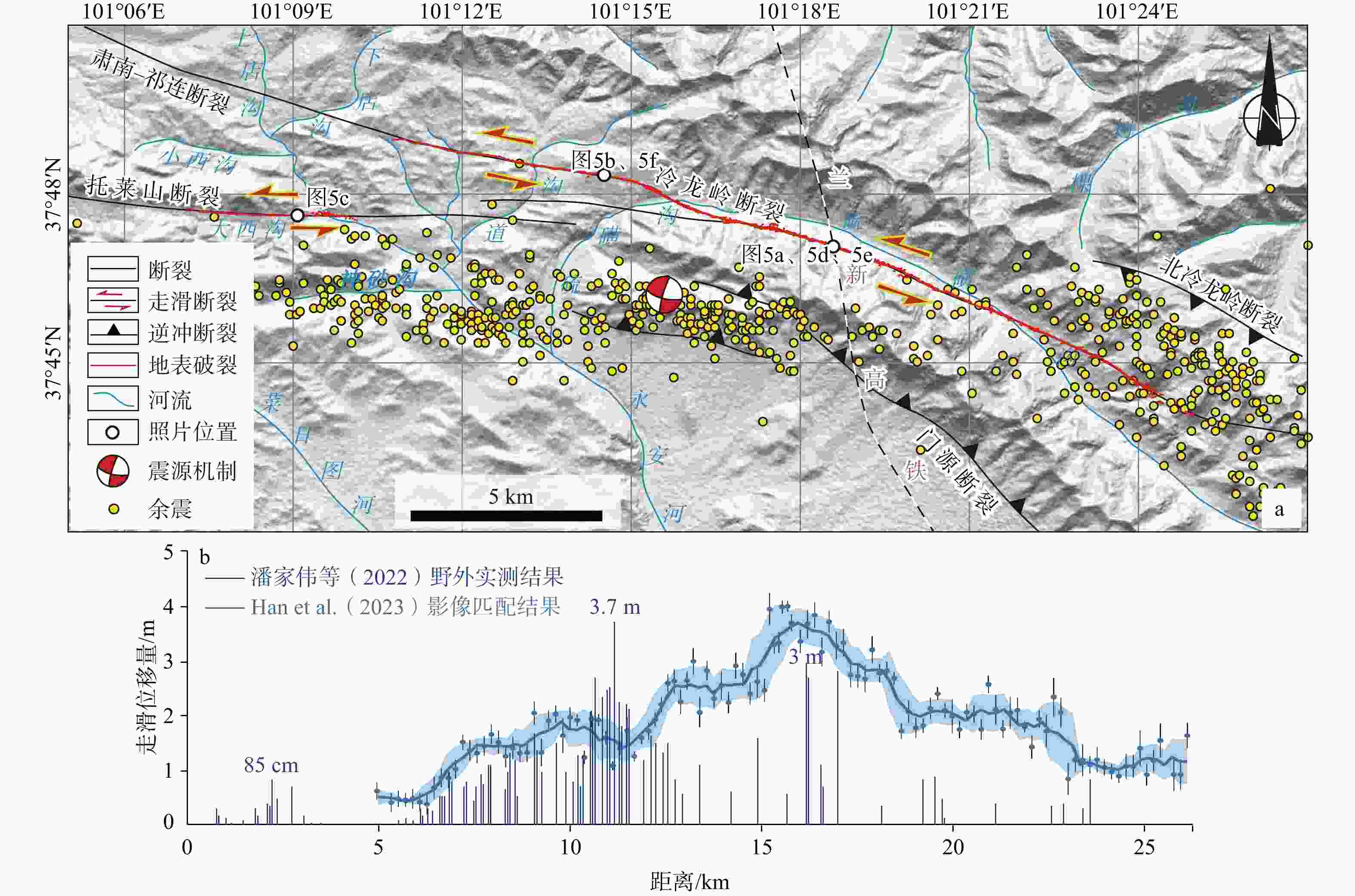
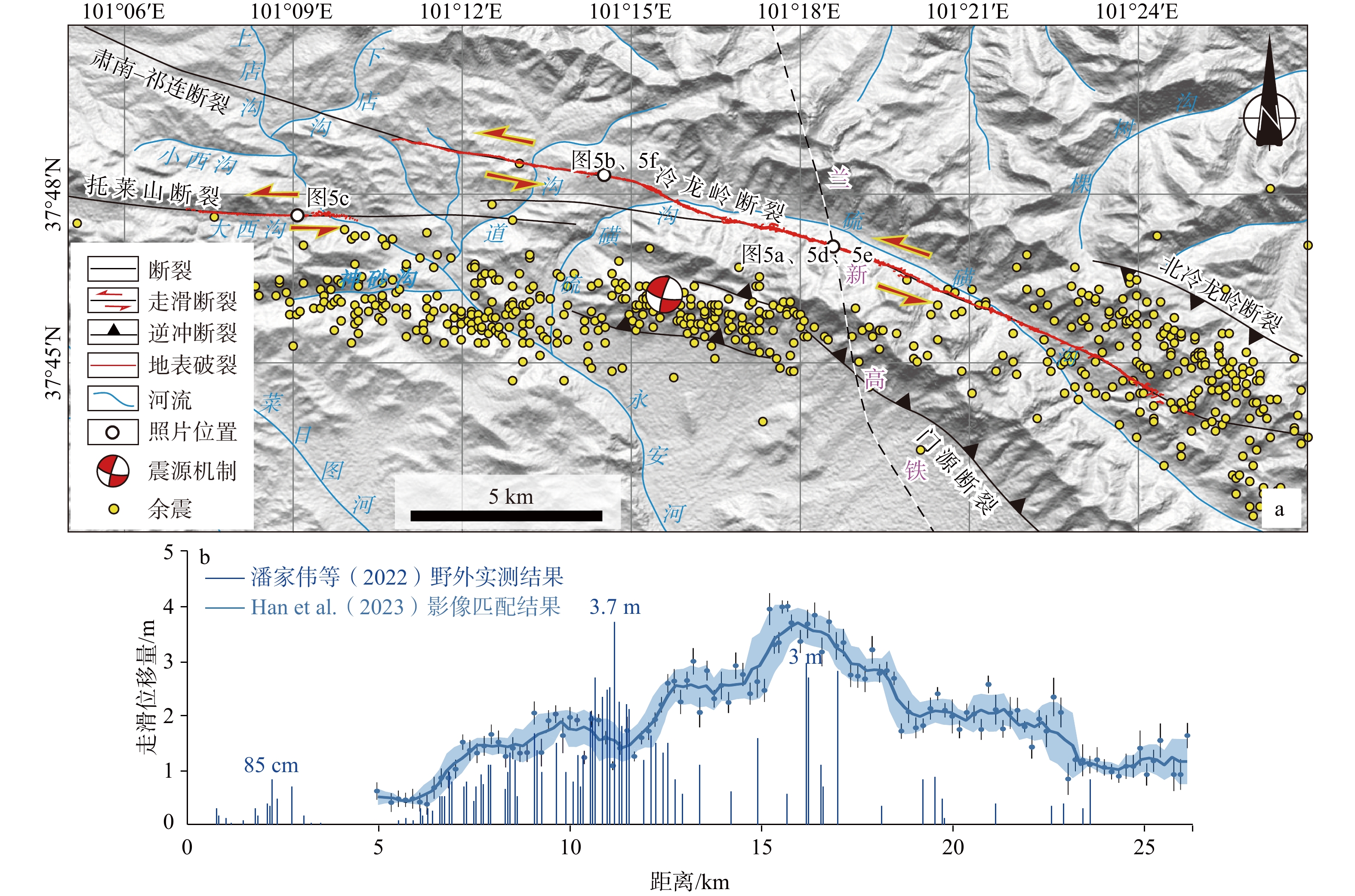
图 4 门源地震地表破裂与同震位移量分布图
a—门源地震地表破裂带与区域活动断层分布图;b—门源地震同震位错量分布及其与光学卫星影像匹配结果的对比
Figure 4. Distribution of coseismic surface ruptures and coseismic displacements for the Menyuan earthquake
(a) Distribution of co-sesmic surface ruptures for the Menyuan earthquake and regional active faults; (b) Distribution of coseismic displacements for the Menyuan earthquake and a comparison with results from optical satellite image correlation
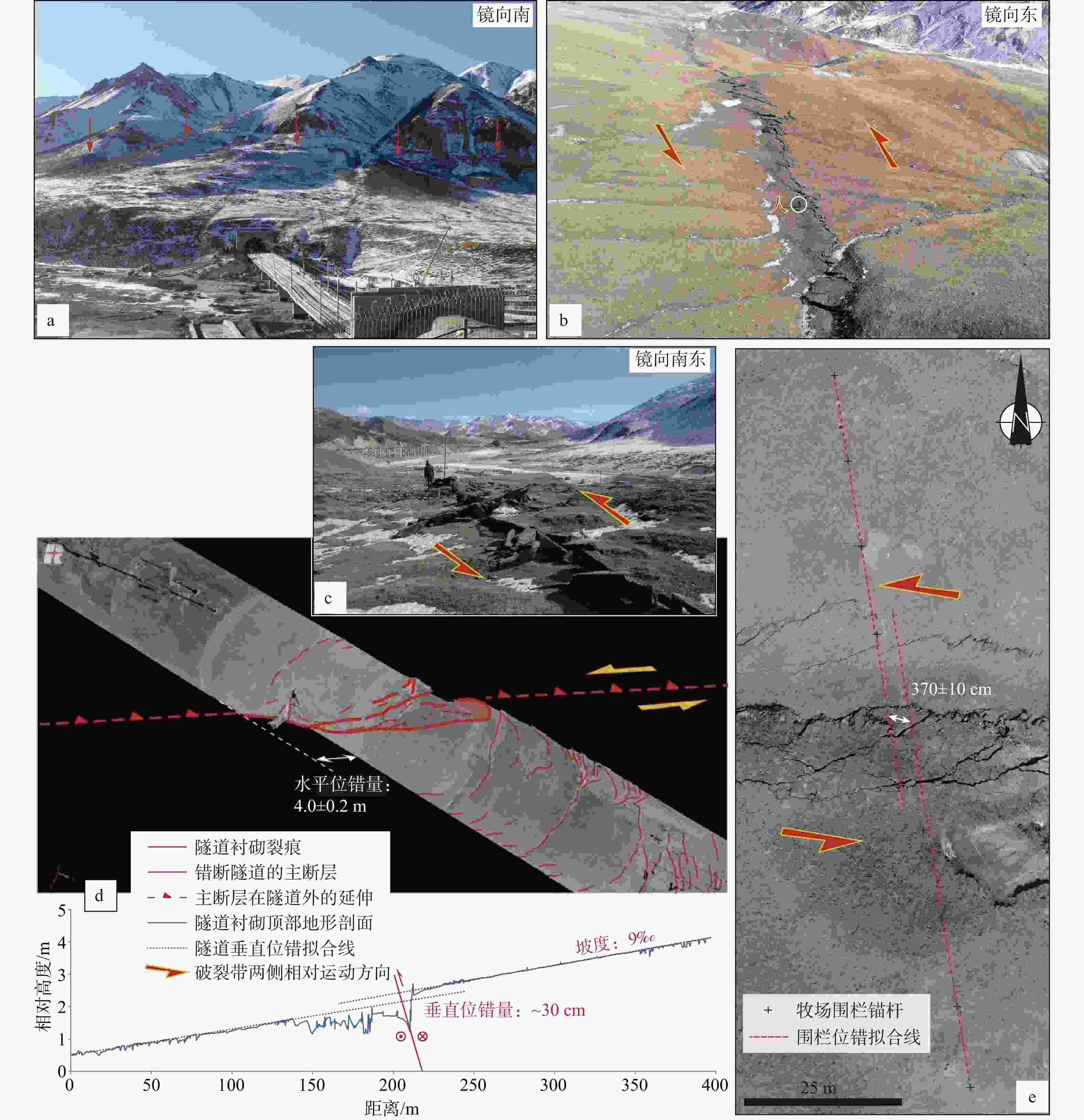
图 5 门源地震典型地表破裂现象
a—地表破裂造成的兰新高铁破坏(红色箭头指示地表破裂带位置);b—硫磺沟西侧山坡上右阶雁列张裂隙与其间左阶雁列挤压鼓包组合成的同震地表破裂指示左行走滑运动性质;c—大西沟北侧托莱山段地表破裂现象;d—地基LiDAR测量结果显示兰新高铁大梁隧道被左行错断4.0±0.2 m,并伴随~30 cm的垂直位错;e—以线性排列的牧场围栏为标志物,在地表测得的3.7±0.1 m最大同震位错量
Figure 5. Typical coseismic surface ruptures produced by the 2022 Menyuan earthquake
(a) Damage to the Lanzhou–Xinjiang Railway caused by surface rupture, with red arrows indicating the location of the surface rupture zone; (b) Coseismic surface ruptures along a mountain slope west of Liuhuanggou valley, consisting of alternating right-stepping en-echelon tension cracks and left-stepping push-ups, indicating left-lateral strike-slip motion; (c) Surface ruptures along the Tuolaishan segment, located north of Daxigou; (d) Terrestrial LiDAR measurements show that the Daliang tunnel of the Lanzhou–Xinjiang Railway was left-lateral displaced by 4.0 ± 0.2 m, accompanied by a vertical displacement of ~30 cm; (e) The maximum coseismic displacement of 3.7 ± 0.1 m measured along the surface rupture zone, using aligned ranch fences as markers
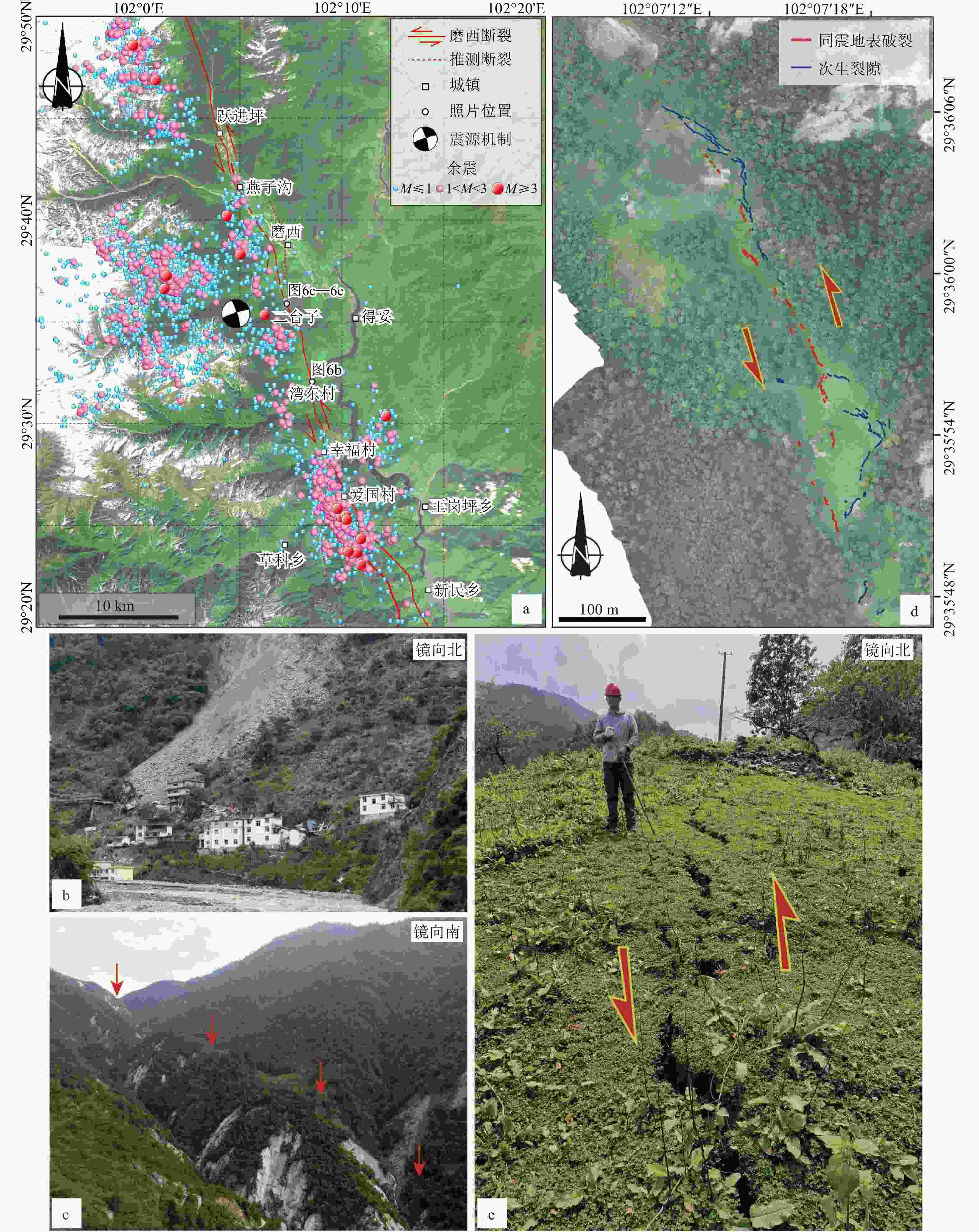
图 6 泸定地震发震断裂、地表破裂与次生地质灾害图
a—泸定地震发震断裂与余震分布图;b—湾东村山体垮塌将楼房掩埋;c—磨西断裂长期活动形成的坡中平台;d—二台子附近长约450 m的地表破裂展布;e—二台子附近右阶雁行状排列张裂隙组成的地表破裂带
Figure 6. Seismogenic fault, surface ruptures, and induced geological hazards of the 2022 Luding earthquake
(a) Distribution of the seismogenic fault and aftershocks; (b) Landslide in Wandong Village, burying a building; (c) A platform in the mountain slope formed by long-term activity of the Moxi Fault; (d) Distribution of the ~450 m long coseismic surface rupture extending at Ertaizi; (e) Field photo showing the surface ruptures at Ertaizi, consisting of right-stepping en-echelon tension cracks
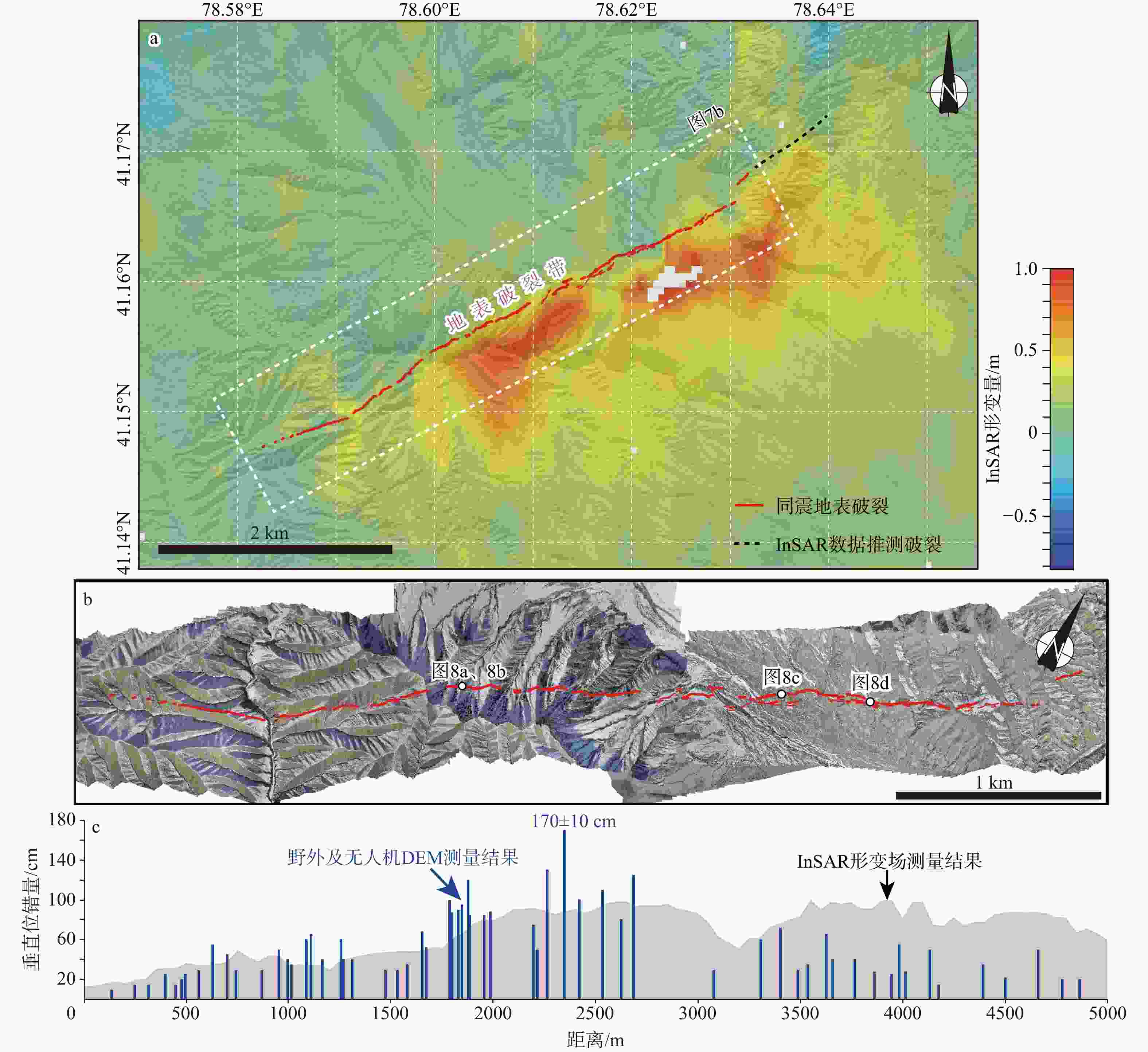
图 7 乌什地震MW 5.7强余震地表破裂与同震位移量分布图
a—乌什地震MW 5.7强余震InSAR形变图像与同震地表破裂分布图;b—同震地表破裂带无人机正射影像; c—同震垂直位移量分布及其与InSAR形变观测结果的对比
Figure 7. Distribution of coseismic surface ruptures and coseismic displacements of the MW 5.7 aftershock in the 2024 Wushi earthquake sequence
(a) InSAR pixel offset deformation map with coseismic surface ruptures marked in red; (b) Orthophoto of the ~4.7 km-long coseismic surface rupture zone captured with an unmanned aerial vehicle (UAV); (c) Distribution of coseismic vertical displacements (blue lines) compared with InSAR deformation results (gray shadow)
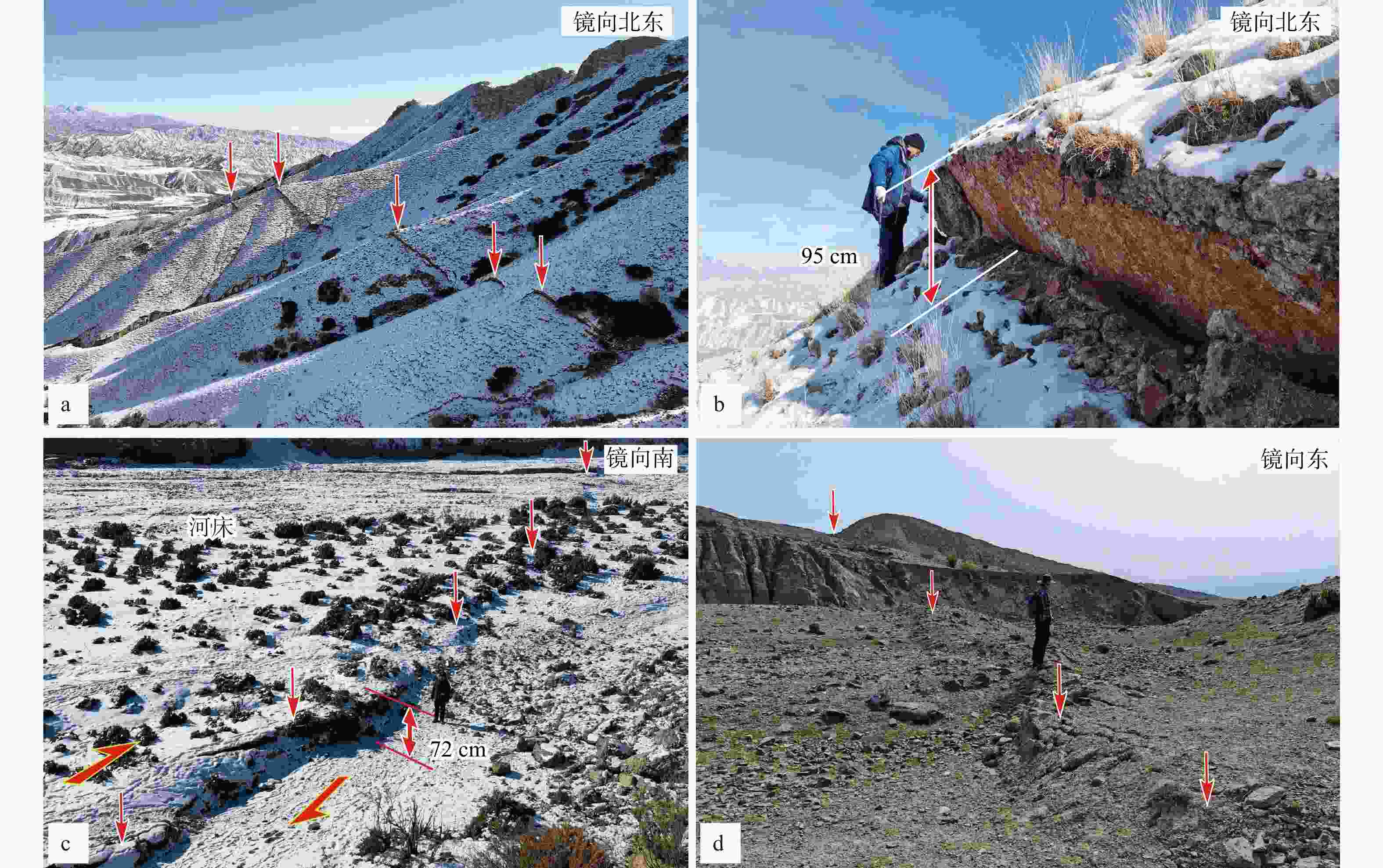
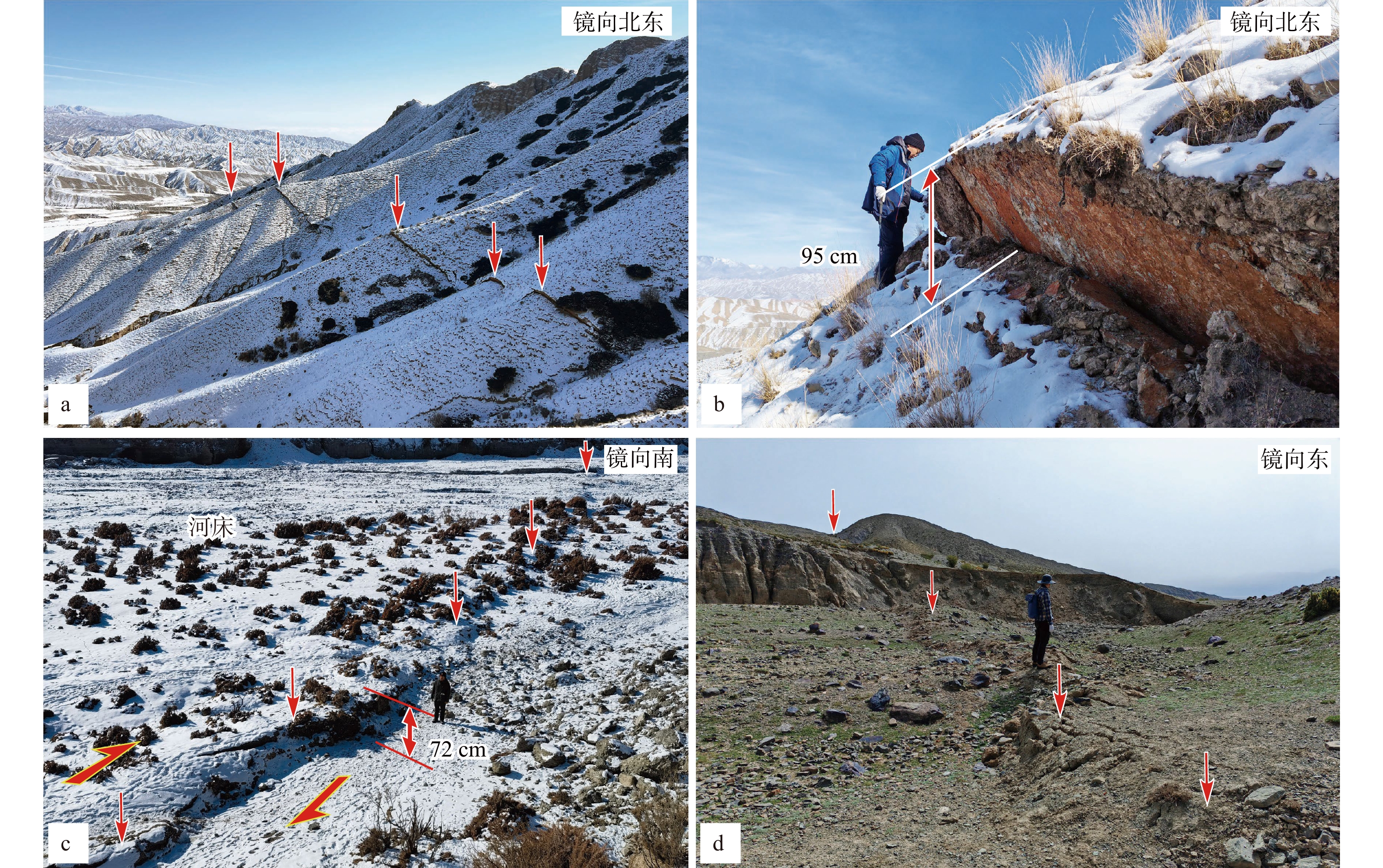
图 8 乌什地震MW 5.7强余震典型地表破裂图像
a—破裂带南西段山坡上由南东向北西逆冲的断层陡坎;b—新鲜的逆断层陡坎显示山脊被垂直错断~95 cm; c—破裂带北东段恰勒马提苏河床中高约72 cm的逆断层陡坎; d—破裂带北东段松散沉积中的挤压鼓包
Figure 8. Typical surface rupture of the MW 5.7 aftershock of the Wushi earthquake sequence
(a) The reverse fault scarp on the hillside along the southwestern segment of the rupture zone, showing clear northwestward thrusting; (b) A fresh reverse fault scarp, showing a vertical displacement of ~95 cm along the ridge crest; (c) A reverse fault scarp ~72 cm high in the riverbed of the Qialemati River along the northeastern segment of the rupture zone; (d) A thrust bulge in loose sediments along the northeastern segment of the rupture zone
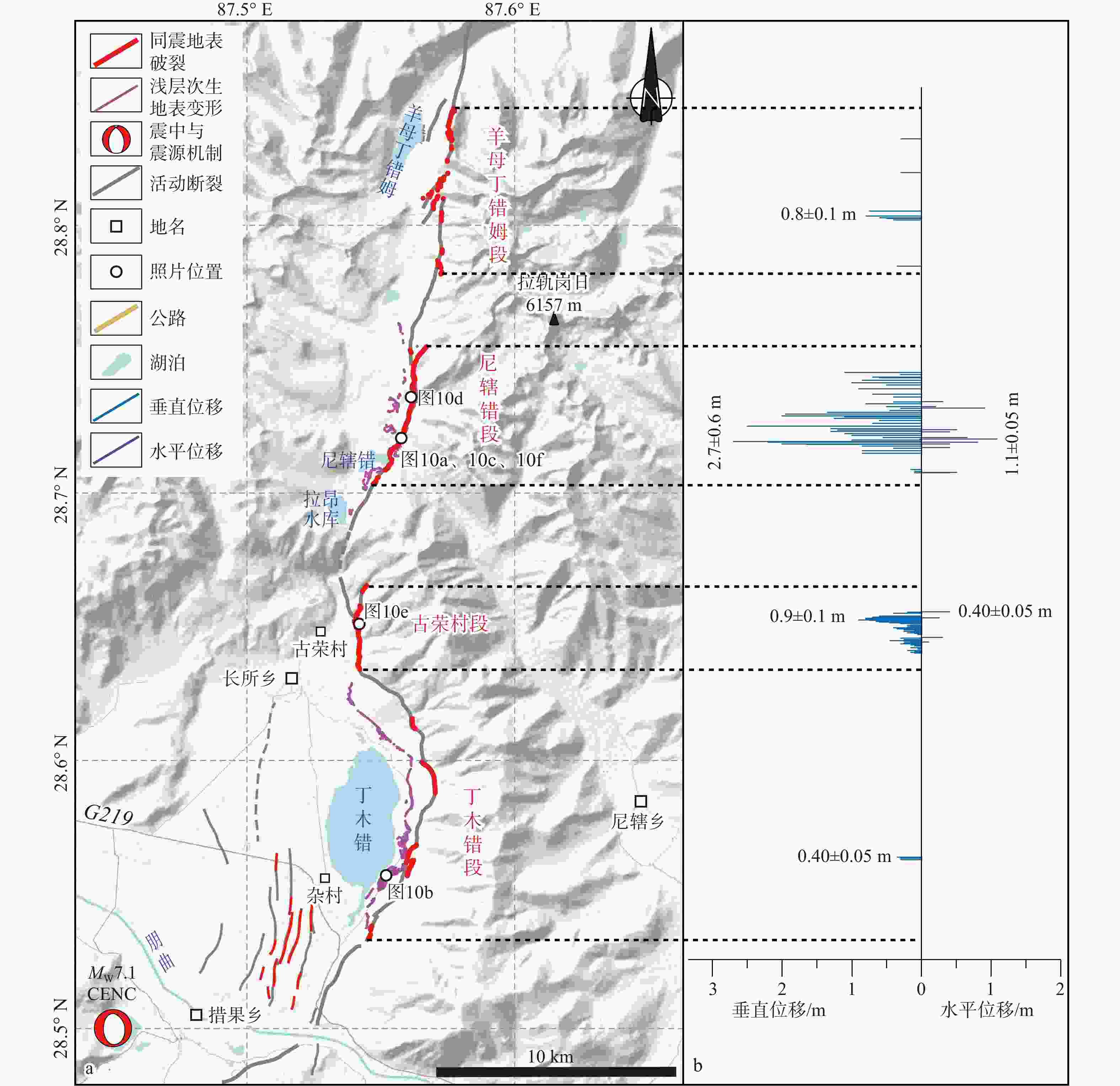
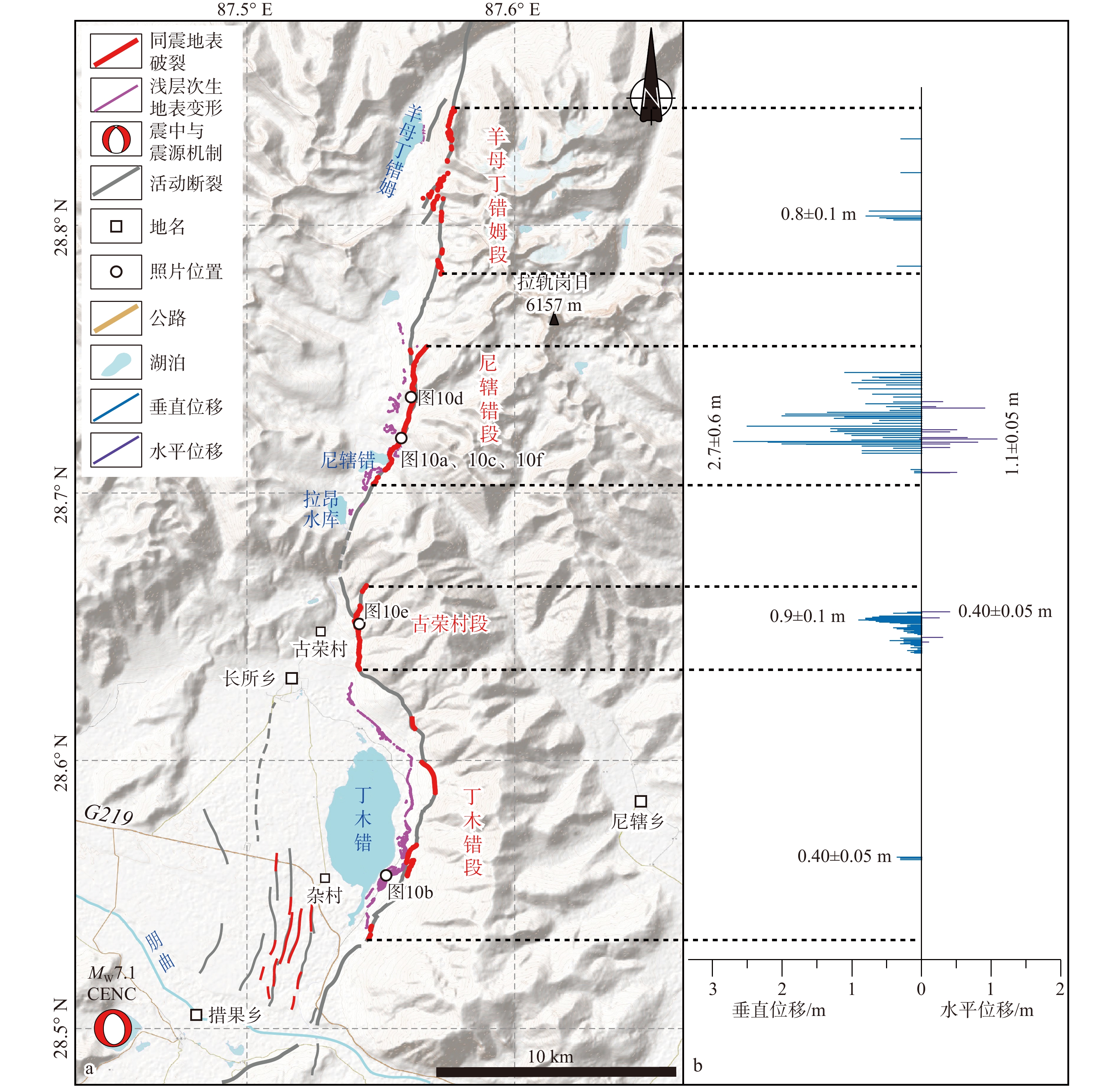
图 9 定日地震同震地表破裂与同震位移分布图
a—定日地震同震地表变形带分布图; b—沿2025年定日地震地表破裂带的同震位移分布
Figure 9. Distribution of coseismic surface ruptures and coseismic displacements for the Dingri earthquake
(a) Distribution of coseismic surface deformation of the Dingri earthquake; (b) Distribution of coseismic displacements of the 2025 Dingri earthquake
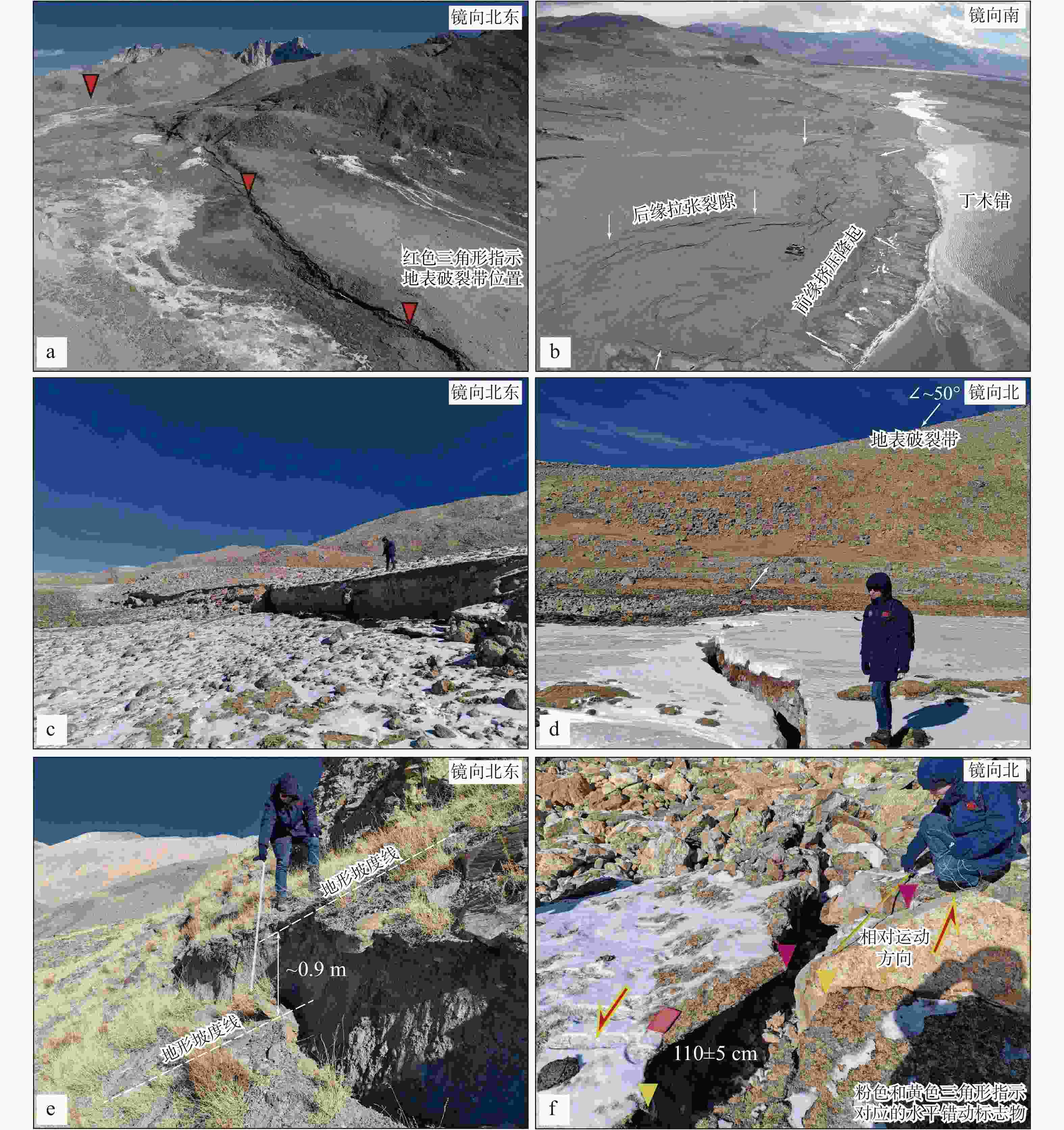
图 10 定日地震典型同震地表变形现象野外照片
a—尼辖错北东侧沿袭先存断裂线性分布的同震地表破裂,主要由西倾的正断层陡坎组成;b—丁木错东侧沿湖岸分布的大规模浅层次生地表变形; c—尼辖错段高度大于2 m的新鲜破裂陡坎; d—尼辖错段地表破裂切割洪积扇和山体,指示断层面倾向西,倾角约50°;e—古荣村段沿先存断层陡坎上发育的90 cm高的新鲜断面; f—尼辖错段砾石印模显示左行走滑位错量约110 cm
Figure 10. Field photographs of typical coseismic surface deformation for the Dingri earthquake
(a) Coseismic surface ruptures along a pre-existing fault scarp northeast of Nixia Co, consisting of fresh west-dipping normal fault scarps; (b) Large-scale superficial secondary surface deformation along the lakeshore on the eastern side of Dingmu Co; (c) Fresh normal fault scarp showing >2-m-high vertical displacement along the Nixia Co surface rupture segment; (d) Surface rupture cuts proluvial fan and hill along the Nixia Co rupture segment, indicating a ~50° west-dipping fault plane; (e) A fresh ~90-cm-high surface rupture developed along a pre-existing fault scarp along the Gurong Village rupture segment; (f) A boulder and its impression along the Nixia Co rupture segment showing a left-lateral displacement of ~110 cm
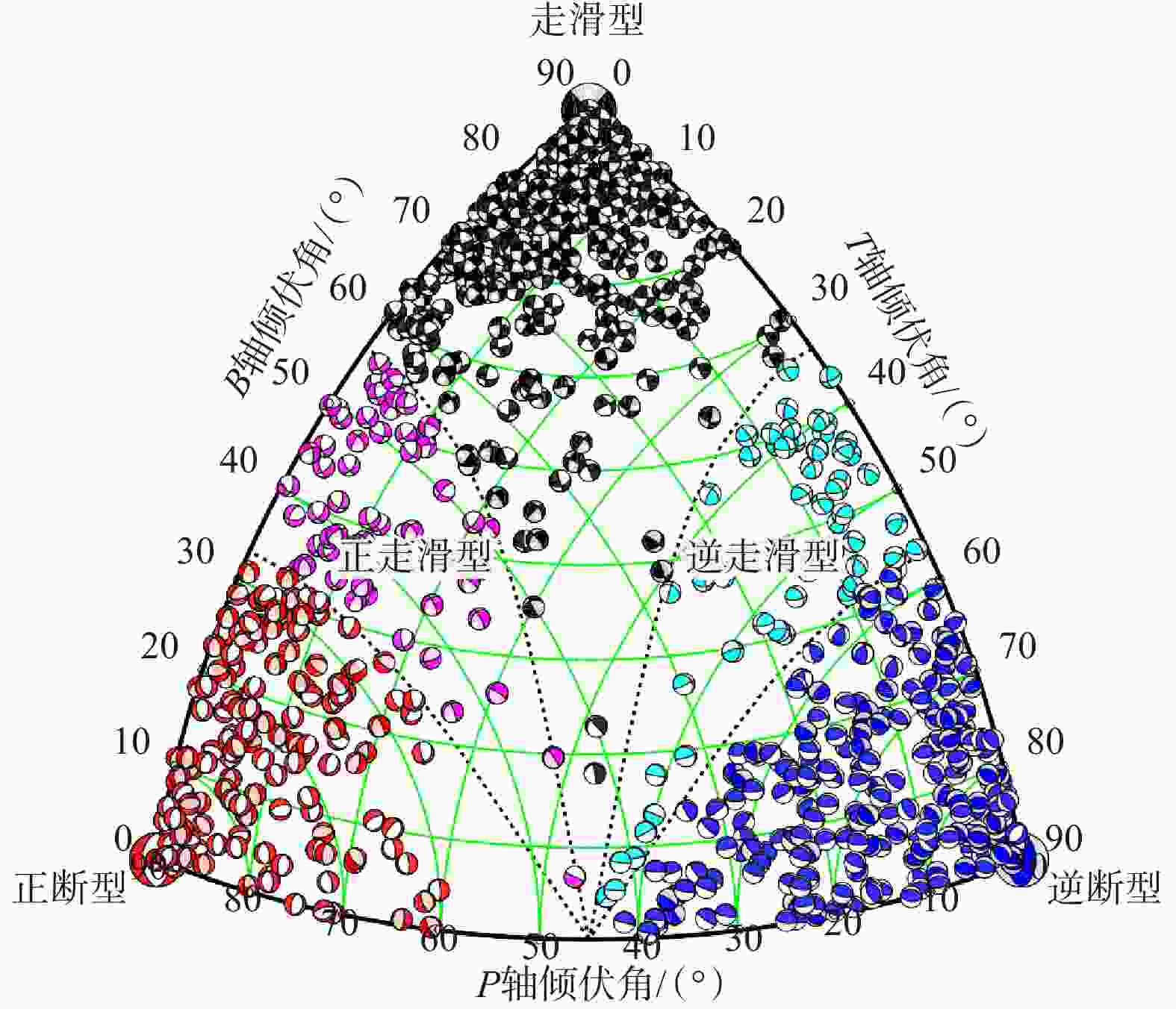
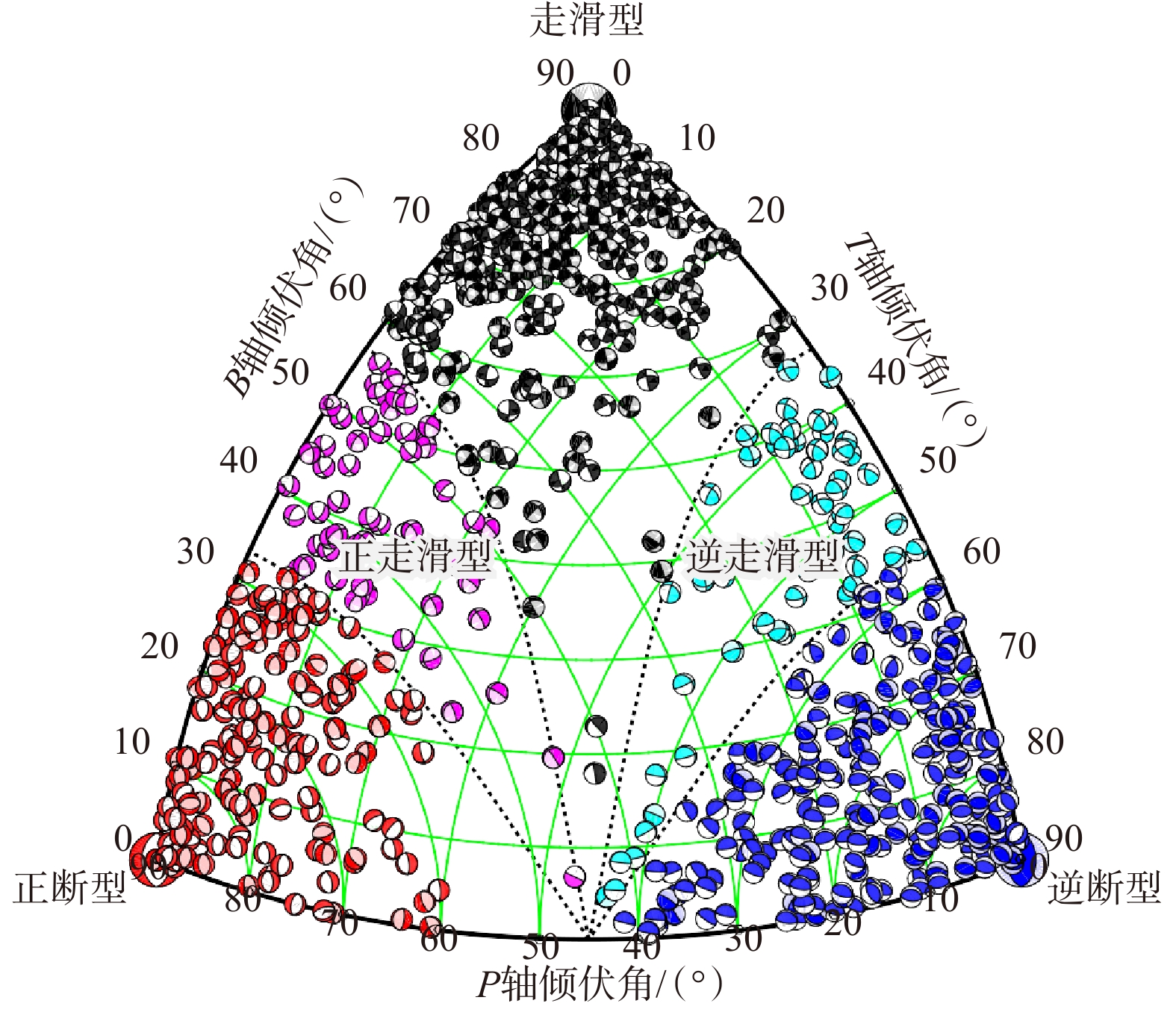
图 11 青藏高原及周缘地区1970年以来MW≥5.0地震震源机制分类统计图
Figure 11. Statistical classification of focal mechanisms for MW≥5.0 earthquakes in the Tibetan Plateau and surrounding regions since 1970
表 1 5次典型震例基本信息
Table 1. Basic information of the five typical strong earthquake events discussed in this study
地震 震级 震源深度/km 发震断裂 断裂性质 地表破裂长度/km 最大水平位移量/m 最大垂直位移量/m 2021年玛多地震 MS 7.4/MW 7.4 17 江错断裂 左行走滑 150~160 3.60 ± 0.20 − 2022年门源地震 MS 6.9/MW 6.6 10 冷龙岭断裂、托莱山断裂 左行走滑 22~31 3.70 ± 0.10 − 2022年泸定地震 MS 6.8/MW 6.6 16 磨西断裂 左行走滑 ~0.45 − − 2024年乌什地震强余震 MW 5.7 ~2 迈丹断裂反冲断层 逆冲 ~5 − 1.7 ± 0.1 2025年定日地震 MS 6.8/MW 7.1 10 丁木错断裂 左行正断 25~36.5 1.10 ± 0.05 2.7 ± 0.6  下载: 导出CSV
-
[1] BAI M K, CHEVALIER M L, PAN J W, et al., 2018. Southeastward increase of the late Quaternary slip-rate of the Xianshuihe fault, eastern Tibet. Geodynamic and seismic hazard implications[J]. Earth and Planetary Science Letters, 485: 19-31. doi: 10.1016/j.epsl.2017.12.045 [2] BAI M K, CHEVALIER M L, LELOUP P H, et al., 2021. Spatial slip rate distribution along the SE Xianshuihe fault, eastern Tibet, and earthquake hazard assessment[J]. Tectonics, 40(11): e2021TC006985. doi: 10.1029/2021TC006985 [3] BAI M K, CHEVALIER M L, LI H B, et al., 2022. Late Quaternary slip rate and earthquake hazard along the Qianning segment, Xianshuihe fault[J]. Acta Geologica Sinica, 96(7): 2312-2332. (in Chinese with English abstract) [4] DENG Q D, ZHANG P Z, RAN Y K, et al., 2003. Basic characteristics of active tectonics of China[J]. Science in China Series D: Earth Sciences, 46(4): 356-372. doi: 10.1360/03yd9032 [5] DING L, KAPP P, CAI F L, et al., 2022. Timing and mechanisms of Tibetan Plateau uplift[J]. Nature Reviews Earth & Environment, 3(10): 652-667. doi: 10.1038/s43017-022-00318-4 [6] FAMIGLIETTI N A, CHELONI D, CAPUTO R, et al., 2025. Geodetic model of the 2024 January 22 MW 7.0 Wushi (northwestern China) earthquake and Mw 5.7 aftershock from inversion of InSAR data[J]. Geophysical Journal International, 241(2): 941-953. doi: 10.1093/gji/ggaf084 [7] GAI H L, YAO S H, YANG L P, et al. , 2021. Characteristics and causes of coseismic surface rupture triggered by the “5. 22” MS7.4 Earthquake in Maduo, Qinghai, and their significance[J]. Journal of Geomechanics, 27(6): 899-912. (in Chinese with English abstract) [8] GAI H L, LI Z M, YAO S H, et al., 2022. Preliminary investigation and research on surface rupture characteristics of the 2022 Qinghai Menyuan MS6.9 Earthquake[J]. Seismology and Geology, 44(1): 238-255. (in Chinese with English abstract) [9] GAO R, HOU H, CAI X, et al., 2013. Fine crustal structure beneath the junction of the southwest Tian Shan and Tarim Basin, NW China[J]. Lithosphere, 5(4): 382-392. doi: 10.1130/L248.1 [10] GUO N N, WU Y Q, ZHU S, et al., 2024. Coseismic deformation and interseismic strain accumulation of the 2024 MS 7.1 Wushi earthquake in Xinjiang, China[J]. Advances in Space Research, 74(4): 1586-1594. doi: 10.1016/j.asr.2024.05.028 [11] HAN N N, ZHANG G H, SHAN X J, et al., 2023. Coseismic surface horizontal deformation of the 2022 MW 6.6 Menyuan, Qinghai, China, earthquake from optical pixel correlation of GF-7 stereo satellite images[J]. Seismological Research Letters, 94(4): 1747-1760. [12] HAN S, WU Z H, GAO Y, et al., 2022. Surface rupture investigation of the 2022 Menyuan MS 6.9 earthquake, Qinghai, China: implications for the fault behavior of the Lenglongling fault and regional intense earthquake risk[J]. Journal of Geomechanics, 28(2): 155-168. (in Chinese with English abstract) [13] HE L J, FENG G C, JIANG H B, et al., 2025. Coseismic kinematics and early afterslip evolution of the 2025 MW 7.1 Dingri earthquake (southern Tibet) from space geodesy[J]. Geophysical Research Letters, 52(22): e2025GL118937. doi: 10.1029/2025GL118937 [14] KLINGER Y, XU X W, TAPPONNIER P, et al., 2005. High-resolution satellite imagery mapping of the surface rupture and slip distribution of the MW ~7.8, 14 November 2001 Kokoxili earthquake, Kunlun fault, Northern Tibet, China[J]. Bulletin of the Seismological Society of America, 95(5): 1970-1987. [15] KLINGER Y, ETCHEBES M, TAPPONNIER P, et al., 2011. Characteristic slip for five great earthquakes along the Fuyun fault in China[J]. Nature Geoscience, 4(6): 389-392. doi: 10.1038/ngeo1158 [16] LI C L, LI T, SHAN X J, et al., 2023a. Extremely large off-fault deformation during the 2021 MW 7.4 Maduo, Tibetan plateau, earthquake[J]. Seismological Research Letters, 94(1): 39-51. doi: 10.1785/0220220139 [17] LI C Y, SUN K, MA J, et al., 2022. The 2022 M 6.8 Luding earthquake: a complicated event by faulting of the Moxi segment of the Xianshuihe fault zone[J]. Seismology and Geology, 44(6): 1648-1666. (in Chinese with English abstract) [18] LI H B, VAN DER WOERD J, SUN Z M, et al., 2012. Co-seismic and cumulative offsets of the recent earthquakes along the Karakax left-lateral strike-slip fault in western Tibet[J]. Gondwana Research, 21(1): 64-87. doi: 10.1016/j.gr.2011.07.025 [19] LI H B, PAN J W, LIN A M, et al., 2016. Coseismic surface ruptures associated with the 2014 MW 6.9 Yutian Earthquake on the Altyn Tagh Fault, Tibetan Plateau[J]. Bulletin of the Seismological Society of America, 106(2): 595-608. doi: 10.1785/0120150136 [20] LI H B, PAN J W, SUN Z M, et al., 2021. Continental tectonic deformation and seismic activity: a case study from the Tibetan Plateau[J]. Acta Geologica Sinica, 95(1): 194-213. (in Chinese with English abstract) [21] LI H B, PAN J W, CHEVALIER M L, et al., 2026. Aftershock-induced surface ruptures overshadow the 2024 MW 7.0 Wushi mainshock, China[J]. Geology, 54(2): 105-110. doi: 10.1130/G54078.1 [22] LI K, TAPPONNIER P, XU X W, et al., 2023b. The 2022, MS 6.9 Menyuan earthquake: Surface rupture, Paleozoic suture re-activation, slip-rate and seismic gap along the Haiyuan fault system, NE Tibet[J]. Earth and Planetary Science Letters, 622: 118412. doi: 10.1016/j.epsl.2023.118412 [23] LI L W, YU Z Y, CHEN B X, et al., 2022. Co-seismic surface deformation characteristics and seismic geological enlightenment of the Luding, Sichuan MS 6.8 Earthquake in 2022[J]. Journal of Institute of Disaster Prevention, 24(4): 75-87. (in Chinese with English abstract) [24] LI Y C, ZHAO D Z, SHAN X J, et al., 2022. Coseismic slip model of the 2022 MW 6.7 Luding (Tibet) earthquake: pre- and post-earthquake interactions with surrounding major faults[J]. Geophysical Research Letters, 49(24): e2022GL102043. doi: 10.1029/2022GL102043 [25] LI Z M, LI W Q, LI T, et al., 2021. Seismogenic fault and coseismic surface deformation of the Maduo MS 7.4 earthquake in Qinghai, China: a quick report[J]. Seismology and Geology, 43(3): 722-737. (in Chinese with English abstract) [26] LI Z M, GAI H L, LI X, et al., 2022. Seismogenic fault and coseismic surface deformation of the Menyuan MS 6.9 earthquake in Qinghai, China[J]. Acta Geologica Sinica, 96(1): 330-335. (in Chinese with English abstract) [27] LIANG K, HE Z T, JIANG W L, et al., 2022. Surface rupture characteristics of the Menyuan MS6.9 earthquake on January 8, 2022, Qinghai Province[J]. Seismology and Geology, 44(1): 256-278. (in Chinese with English abstract) [28] LIU F C, PAN J W, LI H B, et al., 2025. Co-seismic surface rupture of the 2025 MW7.1 Tingri earthquake and potential seismic risk in southern Tibetan Plateau[J]. Acta Geologica Sinica, 99(3): 685-703. (in Chinese with English abstract) [29] LIU-ZENG J, ZHANG Z, WEN L, et al., 2009. Co-seismic ruptures of the 12 May 2008, MS 8.0 Wenchuan earthquake, Sichuan: east-west crustal shortening on oblique, parallel thrusts along the eastern edge of Tibet[J]. Earth and Planetary Science Letters, 286(3-4): 355-370. doi: 10.1016/j.epsl.2009.07.017 [30] LIU-ZENG J, YAO W Q, LIU X L, et al., 2022. High-resolution structure-from-motion models covering 160 km-long surface ruptures of the 2021 MW 7.4 Madoi earthquake in northern Qinghai-Tibetan Plateau[J]. Earthquake Research Advances, 2(2): 100140. doi: 10.1016/j.eqrea.2022.100140 [31] LIU-ZENG J, LIU Z J, LIU X L, et al., 2024. Fault orientation trumps fault maturity in controlling coseismic rupture characteristics of the 2021 Maduo Earthquake[J]. AGU Advances, 5(2): e2023AV001134. doi: 10.1029/2023AV001134 [32] MA Z F, LI C L, ZENG H Y, et al., 2026. Deciphering stress perturbations throughout the 2025 MW 7.1 Dingri, Southern Xizang Earthquake[J]. Nature Communications, 17(1): 1378. doi: 10.1038/s41467-025-68128-y [33] MOLNAR P, TAPPONNIER P, 1975. Cenozoic tectonics of Asia: effects of a continental collision: features of recent continental tectonics in Asia can be interpreted as results of the India-Eurasia collision[J]. Science, 189(4201): 419-426. doi: 10.1126/science.189.4201.419 [34] MOLNAR P, TAPPONNIER P, 1978. Active tectonics of Tibet[J]. Journal of Geophysical Research: Solid Earth, 83(B11): 5361-5375. doi: 10.1029/JB083iB11p05361 [35] PAN J W, LI H B, SI J L, et al. , 2014. Rupture process of the Wenchuan earthquake (MW 7.9) from surface ruptures and fault striations characteristics[J]. Tectonophysics, 619-620: 13-28. [36] PAN J W, BAI M K, LI C, et al., 2021. Coseismic surface rupture and seismogenic structure of the 2021-05-22 Maduo(Qinghai)MS7.4 earthquake[J]. Acta Geologica Sinica, 95(6): 1655-1670. (in Chinese with English abstract) [37] PAN J W, LI H B, CHEVALIER M L, et al., 2022. Coseismic surface rupture and seismogenic structure of the 2022 MS6.9 Menyuan earthquake, Qinghai Province, China[J]. Acta Geologica Sinica, 96(1): 215-231. (in Chinese with English abstract) [38] PAN J W, LI H B, CHEVALIER M L, et al., 2022. Co-seismic rupture of the 2021, MW7.4 Maduo earthquake (northern Tibet): short-cutting of the Kunlun fault big bend[J]. Earth and Planetary Science Letters, 594: 117703. doi: 10.1016/j.epsl.2022.117703 [39] QIAO X, LU Z, YAN S Y, et al., 2025. The 2025 MW7.0 Dingri Earthquake: conjugate normal faulting of a graben structure in the Southern Xainza-Dinggye rift[J]. Geophysical Research Letters, 52(12): e2025GL116154. doi: 10.1029/2025GL116154 [40] QIU J T, SUN J B, JI L Y, 2024. The 2024 MW 7.1 Wushi Earthquake: a thrust and strike-slip event unveiling the seismic mechanisms of the South Tian Shan’s thick-skin tectonics[J]. Remote Sensing, 16(16): 2937. doi: 10.3390/rs16162937 [41] REN J J, XU X W, ZHANG G W, et al., 2022. Coseismic surface ruptures, slip distribution, and 3D seismogenic fault for the 2021 MW 7.3 Maduo earthquake, central Tibetan Plateau, and its tectonic implications[J]. Tectonophysics, 827: 229275. doi: 10.1016/j.tecto.2022.229275 [42] REPLUMAZ A, TAPPONNIER P, 2003. Reconstruction of the deformed collision zone between India and Asia by backward motion of lithospheric blocks[J]. Journal of Geophysical Research: Solid Earth, 108(B6): 2285. doi: 10.1029/2001jb000661 [43] ROCKWELL T K, KLINGER Y, 2013. Surface rupture and slip distribution of the 1940 imperial valley earthquake, imperial fault, Southern California: implications for rupture segmentation and dynamics[J]. Bulletin of the Seismological Society of America, 103(2A): 629-640. doi: 10.1785/0120120192 [44] SHAO Y X, LIU-ZENG J, GAO Y P, et al., 2022. Coseismic displacement measurement and distributed deformation characterization: a case of 2021 MW7.4 Madoi earthquake[J]. Seismology and Geology, 44(2): 506-523. (in Chinese with English abstract) [45] SHAO Y X, WANG A S, LIU-ZENG J, et al., 2025. Preliminary investigation on surface rupture and coseismic displacement of the January 7, 2025 Dingri Earthquake in Xizang[J]. Earth Science, 50(5): 1677-1695. (in Chinese with English abstract) [46] SHI F, LIANG M J, LUO Q X, et al., 2025. Seismogenic fault and coseismic surface deformation of the Dingri MS 6.8 earthquake in Xizang, China[J]. Seismology and Geology, 47(1): 1-15. (in Chinese with English abstract) [47] TAPPONNIER P, PELTZER G, LE DAIN A Y, et al., 1982. Propagating extrusion tectonics in Asia: New insights from simple experiments with plasticine[J]. Geology, 10(12): 611-616. doi: 10.1130/0091-7613(1982)10<611:petian>2.0.co;2 [48] TAPPONNIER P, ZHIQIN X, ROGER F, et al., 2001. Oblique stepwise rise and growth of the Tibet plateau[J]. Science, 294(5547): 1671-1677. doi: 10.1126/science.105978 [49] TAYLOR M, YIN A, 2009. Active structures of the Himalayan-Tibetan orogen and their relationships to earthquake distribution, contemporary strain field, and Cenozoic volcanism[J]. Geosphere, 5(3): 199-214. doi: 10.1130/GES00217.1 [50] THOMPSON JOBE J A, HANAGAN C E, HATEM A E, et al., 2025. Surface rupture from an aftershock: remote observations from the January 2024 Wushi (Aykol), China, Earthquakes[J]. Seismological Research Letters, 96(6): 3490-3510. doi: 10.1785/0220240347 [51] VALENTINI A, VISINI F, BONCIO P, et al., 2025. Twenty-five years of probabilistic fault displacement hazard assessment[J]. Reviews of Geophysics, 63(3): e2024RG000875. doi: 10.1029/2024RG000875 [52] WAN Y G, 2024. Focal mechanism classification based on areal strain of horizontal strain rosette of focal mechanism and characteristic analysis of overall focal mechanism of earthquake sequence[J]. Earth Science, 49(7): 2675-2684. (in Chinese with English abstract) [53] WANG C S, ZHAO X X, LIU Z F, et al., 2008. Constraints on the early uplift history of the Tibetan Plateau[J]. Proceedings of the National Academy of Sciences of the United States of America, 105(13): 4987-4992. doi: 10.1130/focus102011.1 [54] WANG M, SHEN Z K, 2020. Present-day crustal deformation of continental China derived from GPS and its tectonic implications[J]. Journal of Geophysical Research: Solid Earth, 125(2): e2019JB018774. doi: 10.1029/2019JB018774 [55] WANG Q H, YANG W, ZHOU H, et al., 2024. The stratigraphic system and structural characteristics of the western subsag of Wushi Sag, NW Tarim Basin[J]. Chinese Journal of Geology, 59(2): 271-287. (in Chinese with English abstract) [56] WANG S G, FANG L H, CHEVALIER M L, et al., 2026. Seismogenic fault model of the 2024 MW 7.0 Wushi earthquake, western China, from geomorphology and aftershock relocation[J]. Geological Society of America Bulletin, 138(5-6): 1941-1957. doi: 10.1130/B38356.1 [57] WANG W L, FANG L H, WU J P, et al., 2021. Aftershock sequence relocation of the 2021 MS7.4 Maduo Earthquake, Qinghai, China[J]. Science China Earth Sciences, 64(8): 1371-1380. doi: 10.1007/s11430-021-9803-3 [58] WESNOUSKY S G, 2006. Predicting the endpoints of earthquake ruptures[J]. Nature, 444(7117): 358-360. doi: 10.1038/nature05275 [59] WESNOUSKY S G, 2008. Displacement and geometrical characteristics of earthquake surface ruptures: issues and implications for seismic-hazard analysis and the process of earthquake rupture[J]. Bulletin of the Seismological Society of America, 98(4): 1609-1632. doi: 10.1785/0120070111 [60] WRIGHT T J, HOUSEMAN G A, FANG J, et al., 2026. High-resolution geodetic velocities reveal role of weak faults in deformation of Tibetan Plateau[J]. Science, 391(6784): 499-503. doi: 10.1126/science.adi3552 [61] WU C Y, ZHENG W J, ZHANG P Z, et al., 2019. Oblique thrust of the Maidan fault and late Quaternary tectonic deformation in the southwestern Tian Shan, Northwestern China[J]. Tectonics, 38(8): 2625-2645. doi: 10.1029/2018TC005248 [62] WU K G, LI H B, PAN J W, et al. , 2025. Analysis of secondary surface deformation characteristics and formation mechanisms on the eastern shore of Dingmu Co triggered by the 2025 Tingri MW 7.1 earthquake[J/OL]. Acta Geologica Sinica, (2025-11-20). https://doi.org/10.19762/j.cnki.dizhixuebao.2025286. (in Chinese with English abstract) [63] WU Z H, 2024. The earthquake-controlling process of continental collision-extrusion active tectonic system around the Qinghai-Tibet Plateau: a case study of strong earthquakes since 1990[J]. Journal of Geomechanics, 30(2): 189-205. (in Chinese with English abstract) [64] XU R, CHEN C, RAO T G, et al., 2023. Interpretation of the 2022 Luding MW 6.6 earthquake based on GNSS data[J]. Chinese Journal of Geophysics, 66(4): 1409-1418. (in Chinese with English abstract) [65] XU T R, DAI D Q, YANG Z G, et al., 2022. Preliminary study of emergency production and source parameters of the M 6.8 earthquake on September 05, 2022 in Luding, Sichuan Province[J]. Earthquake Research in China, 38(3): 412-424. (in Chinese with English abstract) [66] XU X W, YU G H, KLINGER Y, et al., 2006. Reevaluation of surface rupture parameters and faulting segmentation of the 2001 Kunlunshan earthquake (MW7.8), northern Tibetan Plateau, China[J]. Journal of Geophysical Research: Solid Earth, 111(B5): B05316. doi: 10.1029/2004jb003488 [67] XU X W, WEN X Z, YU G H, et al., 2009. Coseismic reverse- and oblique-slip surface faulting generated by the 2008 MW 7.9 Wenchuan earthquake, China[J]. Geology, 37(6): 515-518. doi: 10.1130/G25462A.1 [68] YAN Y, 2023. The tunnel damage effects and implications of the coseismic rupture of the Menyuan MS 6.9 Earthquake in Qinghai, China[J]. Journal of Geomechanics, 29(6): 869-878. (in Chinese with English abstract) [69] YANG T, WANG S G, FANG L H, et al., 2025. Analysis of earthquake sequence and seismogenic structure of the 2025 MS 6.8 Dingri Earthquake in Tibetan Plateau[J]. Earth Science, 50(5): 1721-1732. (in Chinese with English abstract) [70] YAO W Q, WANG Z J, LIU-ZENG J, et al., 2022. Discussion on coseismic surface rupture length of the 2021 MW7.4 Madoi earthquake, Qinghai, China[J]. Seismology and Geology, 44(2): 541-559. (in Chinese with English abstract) [71] YIN A, HARRISON T M, 2000. Geologic evolution of the Himalayan-Tibetan orogen[J]. Annual Review of Earth and Planetary Sciences, 28(1): 211-280. doi: 10.1146/annurev.earth.28.1.211 [72] YIN X Z, LI T, ZHANG Y F, et al., 2025. Interlacing ruptures of the 2024 Wushi earthquake (Chinese Tian Shan) controlled by structural inheritance[J]. Communications Earth & Environment, 6(1): 908. doi: 10.1038/s43247-025-02855-4 [73] YOUNGS R R, ARABASZ W J, ANDERSON R E, et al., 2003. A methodology for probabilistic fault displacement hazard analysis (PFDHA)[J]. Earthquake Spectra, 19(1): 191-219. [74] YU S Y, LI Z J, ZHAO P, et al., 2025. Source parameters and seismogenic fault model of the 2024 MW 7.0 Wushi (Xinjiang, China) earthquake revealed by InSAR observations[J]. Pure and Applied Geophysics, 182(3): 1149-1162. doi: 10.1007/s00024-024-03531-y [75] YUAN D Y, XIE H, SU R H, et al., 2023. Characteristics of co-seismic surface rupture zone of Menyuan MS 6.9 earthquake in Qinghai Province on January 8, 2022 and seismogenic mechanism[J]. Chinese Journal of Geophysics, 66(1): 229-244. (in Chinese with English abstract) [76] YUAN Z D, LI T, SU P, et al., 2022. Large surface-rupture gaps and low surface fault slip of the 2021 MW 7.4 Maduo Earthquake along a low-activity strike-slip fault, Tibetan Plateau[J]. Geophysical Research Letters, 49(6): e2021GL096874. doi: 10.1029/2021GL096874 [77] ZHANG B X, QIAN L, LI T, et al., 2024. Geological disasters and surface ruptures of January 23, 2024 MS7.1 Wushi earthquake, Xinjiang, China[J]. Seismology and Geology, 46(1): 220-234. (in Chinese with English abstract) [78] ZHANG P Z, DENG Q D, ZHANG G M, et al., 2003. Active tectonic blocks and strong earthquakes in the continent of China[J]. Science in China Series D: Earth Sciences, 46(S2): 13-24. doi: 10.1360/03dz0002 [79] ZHANG P Z, DENG Q D, ZHANG Z Q, et al., 2013. Active faults, earthquake hazards and associated geodynamic processes in continental China[J]. Scientia Sinica Terrae, 43(10): 1607-1620. (in Chinese) [80] ZHANG P Z, WANG W T, GAN W J, et al., 2022. Present-day deformation and geodynamic processes of the Tibetan Plateau[J]. Acta Geologica Sinica, 96(10): 3297-3313. (in Chinese with English abstract) [81] ZHANG W, LI M, JI Y P, et al., 2022. Analysis and enlightenment of typical failure characteristics of tunnels caused by the Menyuan M 6.9 earthquake in Qinghai Province[J]. China Earthquake Engineering Journal, 44(3): 661-669. (in Chinese with English abstract) [82] ZHENG W J, SUN X, YUAN D Y, et al., 2025. Active faults, seismic activity, and seismotectonic environments in the Tibetan Plateau and its adjacent regions[J]. Journal of Geomechanics, 31(5): 1006-1029. (in Chinese with English abstract) [83] 白明坤, CHEVALIER MARIE-LUCE, 李海兵, 等, 2022. 鲜水河断裂带乾宁段晚第四纪走滑速率及区域强震危险性研究[J]. 地质学报, 96(7): 2312-2332. [84] 邓起东, 张培震, 冉勇康, 等, 2002. 中国活动构造基本特征[J]. 中国科学(D辑), 32(12): 1020-1030. [85] 盖海龙, 姚生海, 杨丽萍, 等, 2021. 青海玛多“5·22” MS7.4级地震的同震地表破裂特征、成因及意义[J]. 地质力学学报, 27(6): 899-912. [86] 盖海龙, 李智敏, 姚生海, 等, 2022. 2022年青海门源MS6.9地震地表破裂特征的初步调查研究[J]. 地震地质, 44(1): 238-255. [87] 韩帅, 吴中海, 高扬, 等, 2022. 2022年1月8日青海门源MS6.9地震地表破裂考察的初步结果及对冷龙岭断裂活动行为和区域强震危险性的启示[J]. 地质力学学报, 28(2): 155-168. doi: 10.12090/j.issn.1006-6616.2022013 [88] 李传友, 孙凯, 马骏, 等. 2022. 四川泸定6.8级地震: 鲜水河断裂带磨西段局部发起、全段参与的一次复杂事件[J]. 地震地质, 44(6): 1648—1666. [89] 李海兵, 潘家伟, 孙知明, 等, 2021. 大陆构造变形与地震活动: 以青藏高原为例[J]. 地质学报, 95(1): 194-213. [90] 李路伟, 余中元, 陈柏旭, 等, 2022. 2022年泸定MS 6.8地震的同震地表变形特征及地震地质启示[J]. 防灾科技学院学报, 24(4): 75-87. [91] 李智敏, 李文巧, 李涛, 等, 2021. 2021年5月22日青海玛多MS 7.4地震的发震构造和地表破裂初步调查[J]. 地震地质, 43(3): 722-737. doi: 10.3969/j.issn.0253-4967.2021.03.016 [92] 李智敏, 盖海龙, 李鑫, 等, 2022. 2022年青海门源MS 6.9级地震发震构造和地表破裂初步调查[J]. 地质学报, 96(1): 330-335. [93] 梁宽, 何仲太, 姜文亮, 等, 2022. 2022年1月8日青海门源MS6.9地震的同震地表破裂特征[J]. 地震地质, 44(1): 256-278. doi: 10.3969/j.issn.0253-4967.2022.01.016 [94] 刘富财, 潘家伟, 李海兵, 等, 2025. 2025年MW 7.1西藏定日地震地表破裂与同震位移分布特征[J]. 地质学报, 99(3): 685-703. doi: 10.19762/j.cnki.dizhixuebao.2025069 [95] 潘家伟, 白明坤, 李超, 等, 2021. 2021年5月22日青海玛多MS7.4地震地表破裂带及发震构造[J]. 地质学报, 95(6): 1655-1670. doi: 10.3969/j.issn.0001-5717.2021.06.001 [96] 潘家伟, 李海兵, CHEVALIER M L, 等, 2022. 2022年青海门源MS6.9地震地表破裂带及发震构造研究[J]. 地质学报, 96(1): 215-231. doi: 10.3969/j.issn.0001-5717.2022.01.018 [97] 邵延秀, 刘静, 高云鹏, 等, 2022. 同震地表破裂的位移测量与弥散变形分析: 以2021年青海玛多MW7.4地震为例[J]. 地震地质, 44(2): 506-523. doi: 10.3969/j.issn.0253-4967.2022.02.014 [98] 邵延秀, 王爱生, 刘静, 等, 2025. 2025年1月7日西藏定日地震地表破裂特征和野外同震位移测量初步结果[J]. 地球科学, 50(5): 1677-1695. doi: 10.3799/dqkx.2025.040 [99] 石峰, 梁明剑, 罗全星, 等, 2025. 2025年1月7日西藏定日6.8级地震发震构造与同震地表破裂特征[J]. 地震地质, 47(1): 1-15. [100] 万永革, 2024. 震源机制水平应变花面应变的地震震源机制分类方法及序列震源机制总体特征分析[J]. 地球科学, 49(7): 2675-2684. [101] 王清华, 杨威, 周慧, 等, 2024. 塔里木盆地西北缘乌什西次凹的地层系统和构造特征[J]. 地质科学, 59(2): 271-287. [102] 王未来, 房立华, 吴建平, 等, 2021. 2021年青海玛多MS 7.4地震序列精定位研究[J]. 中国科学: 地球科学, 51(7): 1193-1202. [103] 吴坤罡, 李海兵, 潘家伟, 等, 2025. 2025年定日MW 7.1地震丁木错东岸次生地表变形特征及成因机制分析[J/OL]. 地质学报, (2025-11-20). https://doi.org/10.19762/j.cnki.dizhixuebao.2025286. [104] 吴中海, 2024. 青藏高原陆陆碰撞-挤出活动构造体系控震作用: 以1990年以来强震活动为例[J]. 地质力学学报, 30(2): 189-205. [105] 徐锐, 陈聪, 饶太国, 等, 2023. GNSS资料解译2022年泸定MW 6.6地震[J]. 地球物理学报, 66(4): 1409-1418. [106] 徐泰然, 戴丹青, 杨志高, 等, 2022. 2022年9月5日四川泸定6.8级地震初步研究结果[J]. 中国地震, 38(3): 412-424. doi: 10.3969/j.issn.1001-4683.2022.03.003 [107] 阎渊, 2023. 青海门源MS 6.9地震同震破裂的隧道破坏效应与启示[J]. 地质力学学报, 29(6): 869-878. [108] 杨婷, 王世广, 房立华, 等, 2025. 2025年1月7日西藏定日MS 6.8地震余震序列特征与发震构造[J]. 地球科学, 50(5): 1721-1732. [109] 姚文倩, 王子君, 刘静, 等, 2022. 2021年青海玛多MW 7.4地震同震地表破裂长度的讨论[J]. 地震地质, 44(2): 541-559. [110] 袁道阳, 谢虹, 苏瑞欢, 等, 2023. 2022年1月8日青海门源MS 6.9地震地表破裂带特征与发震机制[J]. 地球物理学报, 66(1): 229-244. doi: 10.6038/cjg2022Q0093 [111] 张博譞, 钱黎, 李涛, 等, 2024. 2024年1月23日新疆乌什MS 7.1地震地质灾害和地表破裂[J]. 地震地质, 46(1): 220-234. doi: 10.3969/j.issn.0253-4967.2024.01.013 [112] 张培震, 邓起东, 张国民, 等, 2003. 中国大陆的强震活动与活动地块[J]. 中国科学(D辑), 33(S1): 12-20. doi: 10.3969/j.issn.1674-7240.2003.z1.002 [113] 张培震, 邓起东, 张竹琪, 等, 2013. 中国大陆的活动断裂、地震灾害及其动力过程[J]. 中国科学: 地球科学, 43(10): 1607-1620. [114] 张培震, 王伟涛, 甘卫军, 等, 2022. 青藏高原的现今构造变形与地球动力过程[J]. 地质学报, 96(10): 3297-3313. doi: 10.19762/j.cnki.dizhixuebao.2022295 [115] 张威, 李明, 姬云平, 等, 2022. 青海门源M 6.9地震典型隧道破坏特征分析与启示[J]. 地震工程学报, 44(3): 661-669. doi: 10.20000/j.1000-0844.20220304001 [116] 郑文俊, 孙鑫, 袁道阳, 等, 2025. 青藏高原及邻区活动断裂、地震活动及地震构造环境[J]. 地质力学学报, 31(5): 1006-1029. -

 下载:
下载:





计量
- 文章访问数: 778
- HTML全文浏览量: 214
- PDF下载量: 264
- 被引次数: 0
