


A calculation method of the reservoir Biot coefficient based on the Griffith criterion and the equivalent inclusion theory
-
摘要: Biot系数的定义为孔隙体积变化率与岩石总体积变化率的比值,反映了岩石在受外部荷载作用下岩石中孔隙压力抵消岩石外部总应力的效率。Biot系数作为孔弹性理论中耦合孔隙压力与储层有效应力的关键参数,在储层地应力计算和井壁稳定性分析中起着至关重要的作用。基于等效夹杂理论,通过引入极化因子和裂缝纵横比等参数表征裂缝形态对储层力学参数的影响,结合格里菲斯断裂准则建立裂缝纵横比期望值的求解方法,最终推导出裂缝型储层和缝洞型储层的Biot系数表达式。研究结果表明,根据此Biot系数计算方法得到的储层地应力计算结果与现场实测井地应力相比,最大水平主应力最大误差为5.75%,最小水平主应力最大误差为6.03%,误差满足工程精度要求。研究成果为非常规储层地应力场精准表征及高效勘探开发提供了理论依据。Abstract:
Objective The Biot coefficient is defined as the ratio of the change in pore volume to the change in total rock volume, reflecting how efficiently pore pressure offsets externally the applied total stress under loading conditions. As a key parameter in poroelastic theory, the Biot coefficient links pore pressure to effective stress in a reservoir and plays a critical role in geostress calculation and wellbore stability analysis. Methods Based on the equivalent inclusion theory, this study introduces parameters such as the polarization factor and fracture aspect ratio to characterize the influence of fracture geometry on mechanical reservoir properties. [ Results ]Combined with the Griffith fracture criterion, a method for determining the expected aspect ratio of fractures is developed, leading to analytical expressions for the Biot coefficient in both fractured reservoirs and dissolution cavity reservoirs. Conclusions Compared with field-measured geostress data, the maximum and minimum horizontal principal stresses calculated using the proposed Biot coefficient method yield maximum errors of 5.75% and 6.03%, respectively, meeting engineering accuracy requirements. Significance These findings provide a theoretical basis for accurate geostress field characterization and efficient exploration and development of unconventional reservoirs. -
Key words:
- Biot coefficient /
- Griffith criterion /
- equivalent inclusion theory /
- fractures /
- dissolution cavities /
- geostress
-
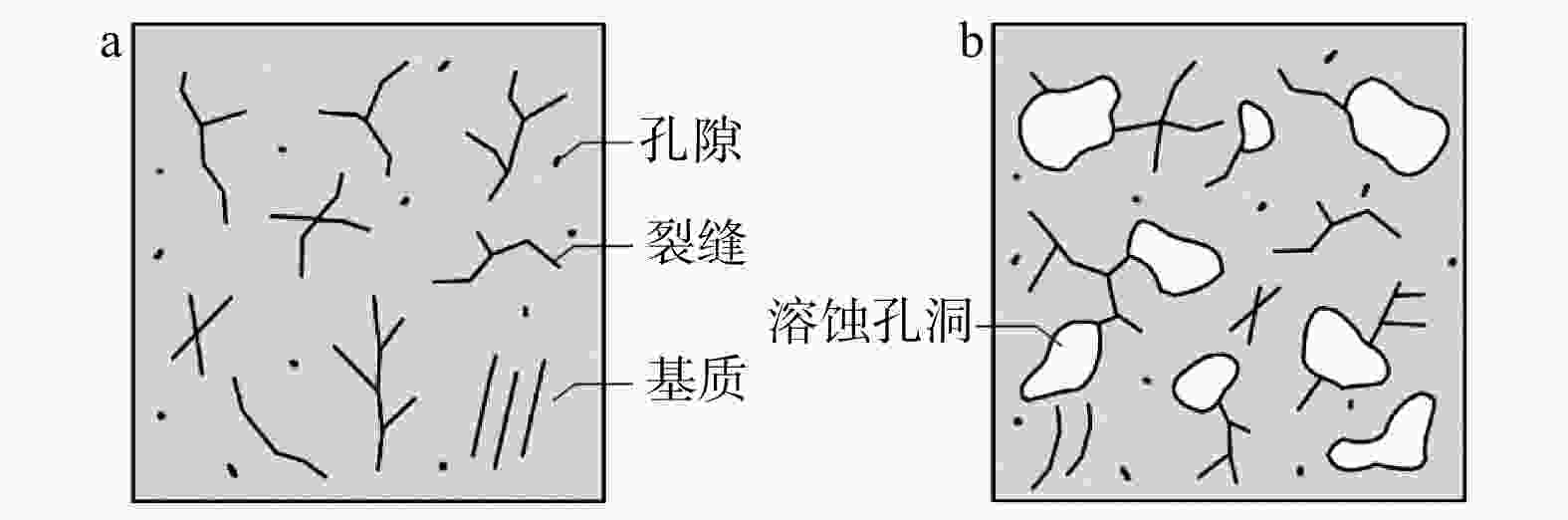
图 1 非常规储层概念图
a—裂缝型储层概念图;b—缝洞型储层概念图
Figure 1. Conceptual diagrams of unconventional reservoirs
(a) Conceptual diagram of a fractured reservoir; (b) Conceptual diagram of a fractured-vuggy reservoir
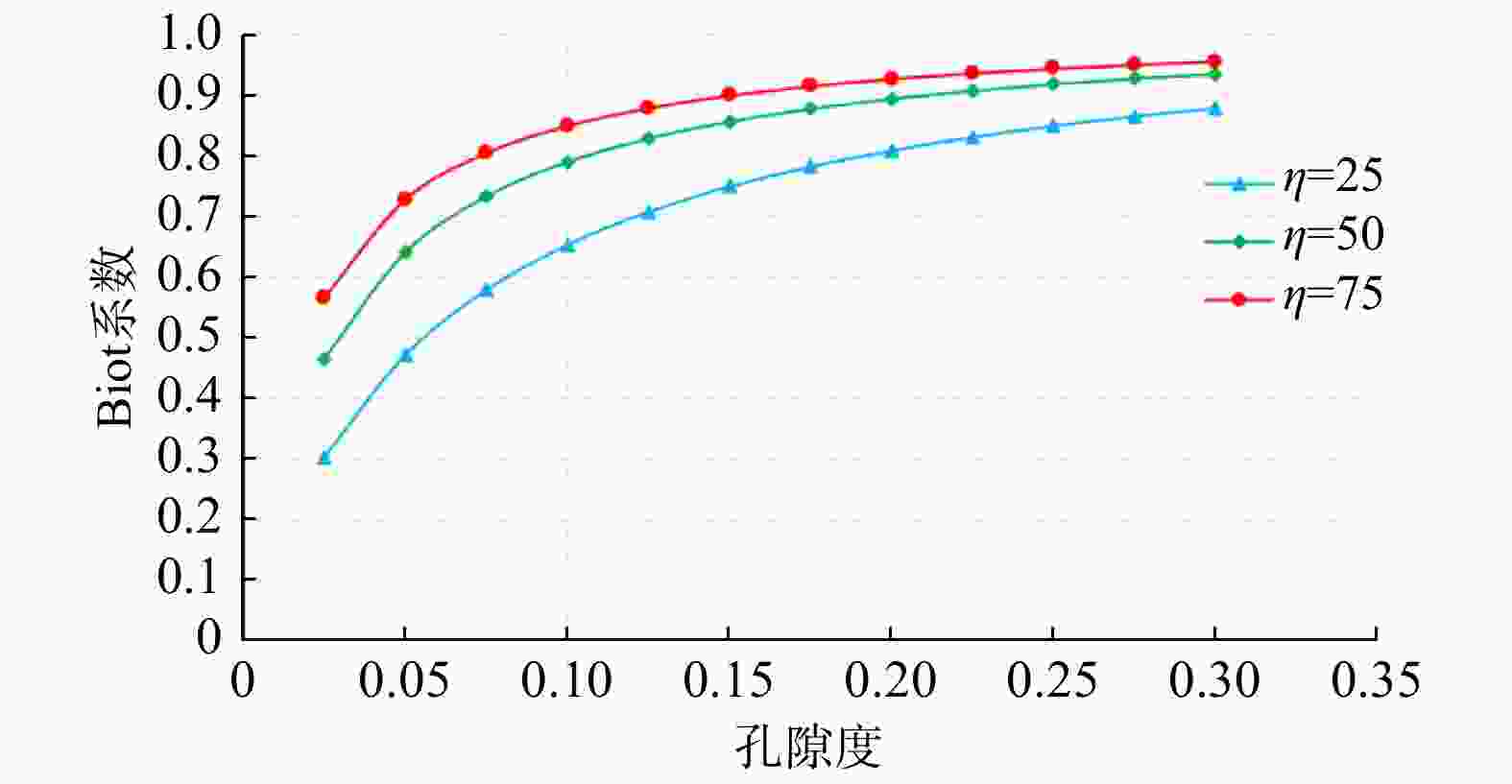
图 2 Biot系数与孔隙度关系曲线图(岩石骨架泊松比$ {\nu }_{{\mathrm{s}}} $=0.2)
$ \eta $—裂缝纵横比
Figure 2. Biot coefficient versus porosity plot (matrix Poisson's ratio $ {\nu }_{{\mathrm{s}}} $ = 0.2)
$ \eta $—fracture aspect ratio
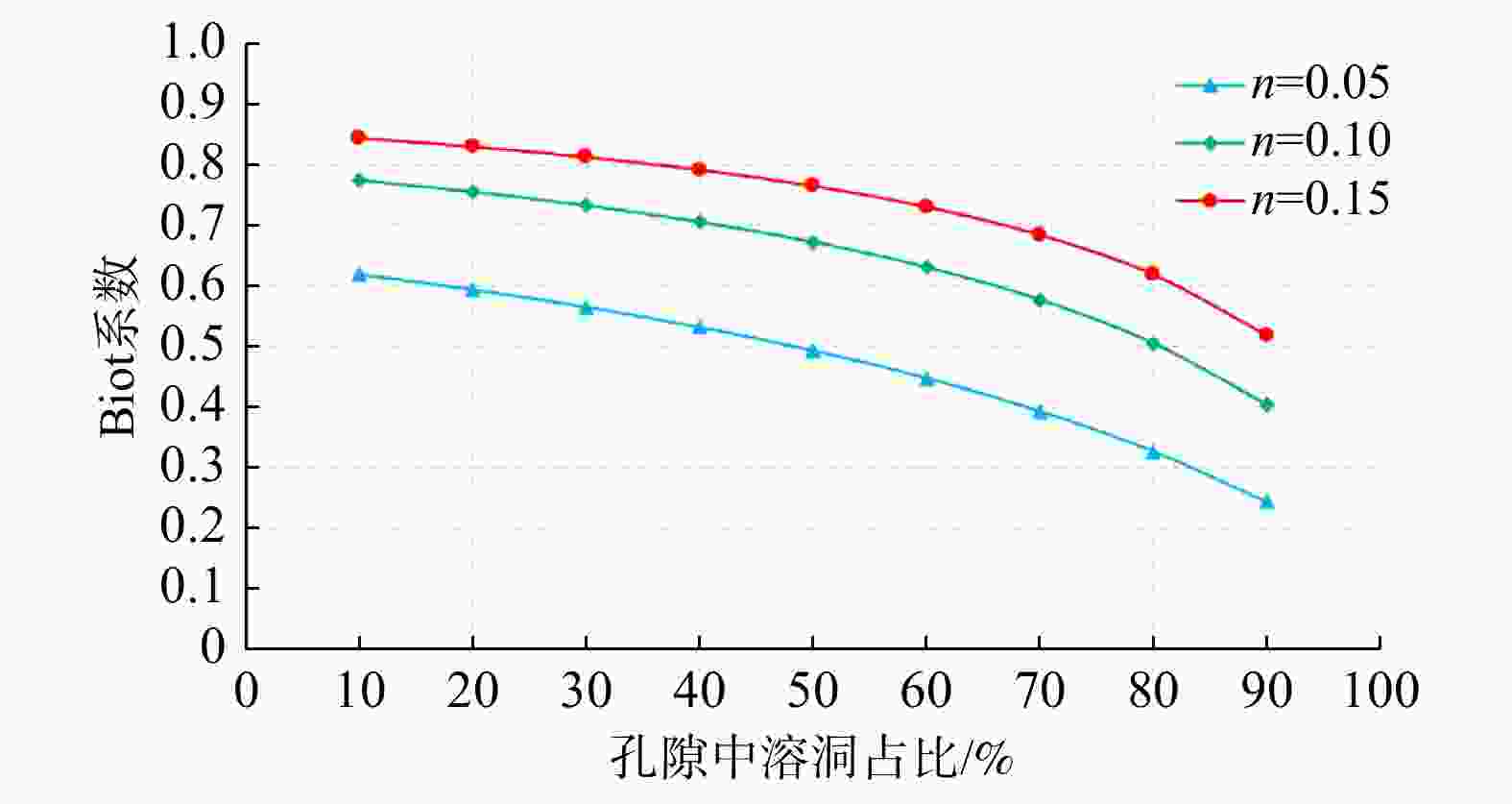
图 3 Biot系数与孔隙中溶洞占比关系曲线图($ {\nu }_{{\mathrm{s}}} $=0.2、$ \eta $=50)
n—孔隙度
Figure 3. Biot coefficient versus percentage of cavities in pores plot ($ {\nu }_{{\mathrm{s}}} $ = 0.2、$ \eta $ = 50)
n—porosity
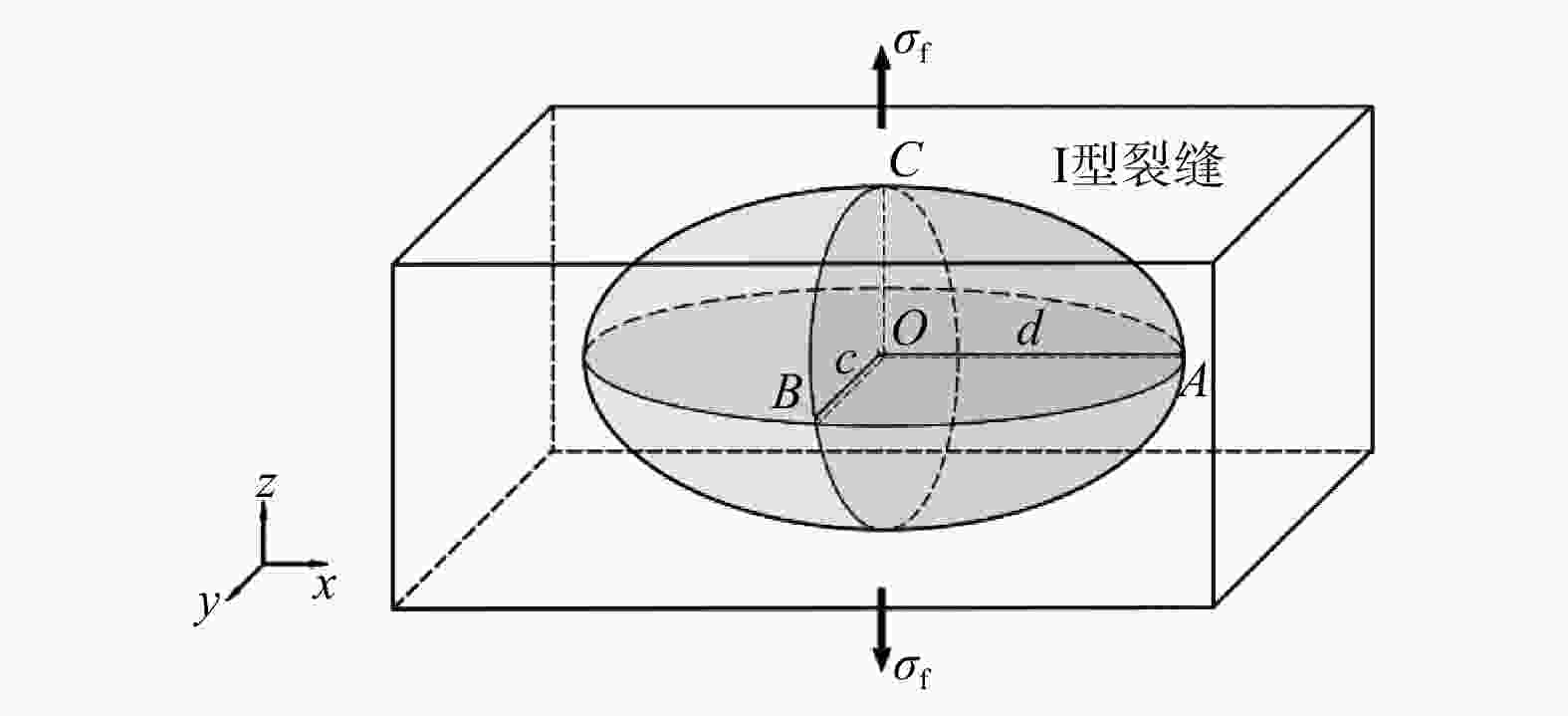
图 4 平面圆形裂缝扩展示意图
$ {\sigma }_{\text{f}} $—均匀拉应力;c—短轴长度;d—长轴长度
Figure 4. Schematic of circular crack propagation in a plane
$ {\sigma }_{\text{f}} $—uniform tensile stress; c—minor axis length; d—major axis length
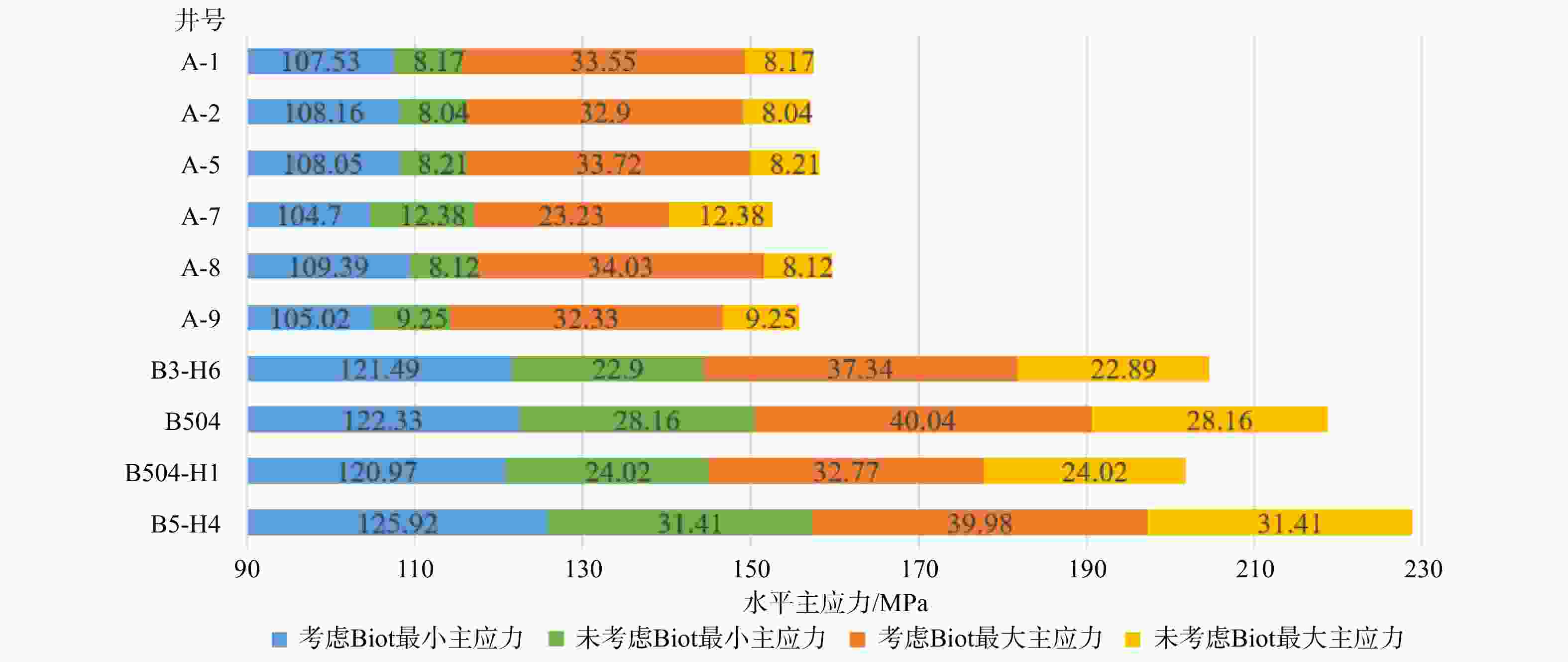
图 5 考虑和未考虑Biot系数水平主应力对比图
Figure 5. Comparison of horizontal principal stresses with and without the Biot coefficient
表 1 研究区地质力学参数
Table 1. Geomechanical parameters in the study area
研究区 井名 深度/m 泊松比 弹性模量/GPa 孔隙度 垂向应力/MPa 地层压力/MPa Biot系数 大北气田A区块 A-1 5342 0.261 43.54 0.07 128.16 85.39 0.852 A-2 5742 0.269 38.77 0.07 138.43 79.98 0.841 A-5 5466 0.259 43.66 0.07 132.03 84.72 0.851 富满油田B区块 B-504 7635 0.253 60.23 0.117 183.32 84.31 0.495 B5-H4 7614 0.260 55.75 0.086 182.82 82.07 0.410  下载: 导出CSV
表 2 现场压裂施工参数
Table 2. On-site fracturing construction parameters
研究区 井名 深度/m 破裂应力/MPa 停泵应力/MPa 压裂液柱压力/MPa 沿程摩阻力/MPa 最大主应力标定值/MPa 最小主应力标定值/MPa 大北气田
A区块A-1 5342 122.48 47.20 53.39 59.13 156.49 114.28 A-2 5742 112.46 33.28 57.40 56.01 141.10 102.01 A-5 5466 123.49 42.96 54.64 57.10 151.05 112.60 富满油田
B区块B-504 7481 149.89 28.10 77.06 18.34 202.16 128.81 B5-H4 7614 158.36 20.39 75.44 10.17 205.39 121.78
下载: 导出CSV
表 3 地应力计算结果
Table 3. Results of geostress calculation
研究区 井名 深度/m 泊松比 弹性模
量/GPa垂向应
力/MPa地层压
力/MPaBiot系数 最大主
应力/MPa最小主
应力/MPa未考虑Biot系数最
大主应力/MPa未考虑Biot系数最
小主应力/MPa大北气田
A区块A-1 5342 0.261 43.54 128.16 85.39 0.852 149.25 107.53 157.42 115.70 A-2 5742 0.269 38.77 138.43 79.98 0.841 149.10 108.16 157.14 116.20 A-5 5466 0.259 43.66 132.03 84.72 0.851 149.98 108.05 158.19 116.26 A-7 5400 0.265 37.27 130.20 89.00 0.782 140.31 104.70 152.69 117.08 A-8 5690 0.259 43.89 137.09 83.73 0.851 151.54 109.39 159.66 117.51 A-9 5490 0.263 43.45 131.81 80.78 0.821 146.60 105.02 155.85 114.27 富满油田
B区块B3-H6 6959 0.266 45.69 170.49 81.83 0.560 181.73 121.49 204.62 144.39 B504 7635 0.253 60.23 183.32 84.31 0.495 190.53 122.33 218.69 150.49 B504-H1 7158 0.261 42.91 176.21 84.58 0.560 177.76 120.97 201.78 144.99 B5-H4 7614 0.260 55.75 182.82 82.07 0.410 197.31 125.92 228.72 157.33
下载: 导出CSV
表 4 现场实测井地应力标定结果
Table 4. Results of in-situ wellbore stress calibration
研究区 井名 最大主应力/MPa 最小主应力/MPa 实测值 计算值 误差/% 实测值 计算值 误差/% 大北气田A区块 A-1 156.49 149.25 4.62% 114.28 107.53 5.90% A-2 140.10 149.10 5.66% 102.01 108.16 6.03% A-5 151.05 149.98 0.71% 112.60 108.05 4.04% 富满油田B区块 B504 202.16 190.53 5.75% 128.81 122.33 5.03% B5-H4 187.65 197.31 5.14% 119.41 125.92 5.81%
下载: 导出CSV
-
[1] AMEH E S, 2020. Consolidated derivation of fracture mechanics parameters and fatigue theoretical evolution models: basic review[J]. SN Applied Sciences, 2(11): 1800. doi: 10.1007/s42452-020-03563-8 [2] BARY B, 2008. Simplified coupled chemo‐mechanical modeling of cement pastes behavior subjected to combined leaching and external sulfate attack[J]. International Journal for Numerical and Analytical Methods in Geomechanics, 32(14): 1791-1816. doi: 10.1002/nag.696 [3] BENVENISTE Y, 1987. A new approach to the application of Mori-Tanaka's theory in composite materials[J]. Mechanics of Materials, 6(2): 147-157. doi: 10.1016/0167-6636(87)90005-6 [4] Biot M A. Theory of propagation of elastic waves in a fluid-saturated porous solid. I. Low frequency range[J]. Acoustical Society of America, 1956, 28(2): 168–179. [5] GAO G, 2013. Method for predicting the porosity based on the pore structure of carbonate[J]. Progress in Geophysics, 28(2): 920-927. (in Chinese with English abstract) [6] GRUESCU C, GIRAUD A, HOMAND F, et al., 2007. Effective thermal conductivity of partially saturated porous rocks[J]. International Journal of Solids and Structures, 44(3-4): 811-833. doi: 10.1016/j.ijsolstr.2006.05.023 [7] HAN Y K, ZHANG Z Y, CHEN W Y, et al., 2021. Geological conditions and evolution for the accumulation of the ultra-deep oil pools in the Yueman area, Tarim Basin[J]. Natural Gas Geoscience, 32(11): 1634-1645. (in Chinese with English abstract) [8] HU S J, 1983. Derivation of the formula for the stress intensity factor K1 for elliptical cracks[J]. Journal of Lanzhou University of Technology, (2): 87-94. (in Chinese) [9] HUANG Y F, GUO F L, 2021. Effect of plastic deformation on the elastic stress field near a crack tip under small-scale yielding conditions: an extended Irwin's model[J]. Engineering Fracture Mechanics, 255: 107888. doi: 10.1016/j.engfracmech.2021.107888 [10] JI X, 2016. A critical review on criteria of fracture mechanics[J]. Chinese Journal of Theoretical and Applied Mechanics, 48(4): 741-753. (in Chinese with English abstract) doi: 10.1007/978-981-97-5822-7_2 [11] KACHANOV M, SHAFIRO B, TSUKROV I, 2003. Handbook of elasticity solutions[M]. Dordrecht: Springer. [12] LI H B, ZHANG J J, 2014. A differential effective medium model of multiple-porosity rock and its analytical approximations for dry rock[J]. Chinese Journal of Geophysics, 57(10): 3422-3430. (in Chinese with English abstract) [13] LI H P, WU Y, LIU R M, 2021. Hydrocarbon accumulation difference and accumulation model in Dabei structural belt of Kuqa depression[J]. Petroleum Geology and Engineering, 35(6): 25-30. (in Chinese with English abstract) [14] LI J, LIU C, LIU H M, et al., 2021. Distribution and influencing factors of in-situ stress in complex fault tectonic region[J]. Journal of China University of Mining & Technology, 50(1): 123-137. (in Chinese with English abstract) [15] LI L Y, JU Y, ZHAO Z W, et al., 2009. Energy analysis of rock structure under static and dynamic loading conditions[J]. Journal of China Coal Society, 34(6): 737-740. (in Chinese with English abstract) [16] LI Z P, ZHOU W, XIE R C, et al., 2012. Preliminary study on non-liner interpretation of Biot coefficient of rock and its application on the analysis of wellbore stability[J]. Oil Drilling & Production Technology, 34(1): 39-42. (in Chinese with English abstract) [17] LIU J, HUANG C, ZHOU L, et al., 2024. Estimation of the rock mechanics and in-situ stress parameters of carbonate reservoirs using array sonic logging: a case study of Shunbei No. 4 block[J]. Journal of Geomechanics, 30(3): 394-407. (in Chinese with English abstract) [18] LIU J G, LI J, SU Y L, et al., 2020. Tectonic stress field research on the Ordovician reservoirs in the Tahe Oilfield[J]. Journal of Geomechanics, 26(1): 48-54. (in Chinese with English abstract) [19] LIU Z J, XIA T D, HUANG R, et al., 2015. Comparison and discussion for Biot theory and modified Biot one[J]. Journal of Vibration and Shock, 34(4): 148-152, 194. (in Chinese with English abstract) [20] SAENGER E H, KRÜGER O S, SHAPIRO S A, 2004. Effective elastic properties of randomly fractured soils: 3D numerical experiments[J]. Geophysical Prospecting, 52(3): 183-195. doi: 10.1111/j.1365-2478.2004.00407.x [21] SEVOSTIANOV I, 2020. Gassmann equation and replacement relations in micromechanics: a review[J]. International Journal of Engineering Science, 154: 103344. doi: 10.1016/j.ijengsci.2020.103344 [22] SHI P, DING H K, WANG G P, et al., 2022. Modification of Biot poroelastic model by considering local seepage[J]. Well Logging Technology, 46(5): 505-510. (in Chinese with English abstract) [23] SHI R G, WEI Z T, GE X M, et al., 2024. Numerical simulation of hydrate reservoir based on three-phase Biot velocity-stress wave equaiton[J]. Journal of China University of Petroleum (Edition of Natural Science), 48(3): 57-64. (in Chinese with English abstract) [24] SUN K X, LI X Q, WEI Q, et al., 2018. Restore the hydrocarbon charge history by using fluid history analysis techniques in Dabei Gas Field, Kuqa Depression, Tarim Basin[J]. Natural Gas Geoscience, 29(9): 1289-1300. (in Chinese with English abstract) [25] TERZAGHI K, 1923. Die Berechnung der Durchlässigkeitsziffer des Tones aus dem Verlauf der hydrodynamischen Spannungs erscheinungen[J]. Sitzungsber. Akad. Wiss. Wien Math. -Naturwiss. Kl. Abt. IIa, 132(3/4): 125-138. [26] TIAN J, SIMA L Q, WANG L, et al. , 2021-04-09. Method for calculating porosity of cracks and corrosion hole by utilizing conventional logging: CN, 110967771B[P]. (in Chinese) [27] XIA H Q, PENG M, SONG E C, 2019. Calculating method and application of rock anisotropic Biot coefficient[J]. Well Logging Technology, 43(5): 478-483. (in Chinese with English abstract) [28] XU X, WANG W, HU M Y, et al., 2018. Comparison and study over the Biot coefficients test methods in medium porosity and medium permeability sandstone reservoirs[J]. Petroleum Drilling Techniques, 46(2): 109-114. (in Chinese with English abstract) [29] YANG C, WANG Y, STOVAS A, et al., 2024. Modified Biot elastic coefficients in poroelastic solid[J]. Journal of Earth Science, 35(4): 1397-1401. doi: 10.1007/s12583-024-1994-8 [30] YU H, 2015. Dynamic effective pressure coefficient calibration[J]. Geophysics, 80(1): D65-D73. doi: 10.1190/geo2013-0437.1 [31] ZAMANI M A M, KNEZ D, 2023. Experimental investigation on the relationship between Biot’s coefficient and hydrostatic stress for enhanced oil recovery projects[J]. Energies, 16(13): 4999. doi: 10.3390/en16134999 [32] ZHANG Z W, HE M, CHEN S H, et al., 2017. Application of new method to predicting carbonate porosity in the Zhujiangkou Basin[J]. Marine Geology Frontiers, 33(10): 49-56. (in Chinese with English abstract) [33] ZHU G Y, CHI L X, ZHANG Z Y, et al., 2019. Composition and origin of molecular compounds in the condensate oils of the Dabei gas field, Tarim Basin, NW China[J]. Petroleum Exploration and Development, 46(3): 482-495. (in Chinese with English abstract) [34] ZHU W, ZHAO L X, WANG Y R, 2025. Digital rock modeling and elastic simulations of fractured-vuggy carbonate reservoirs[J]. Coal Geology & Exploration, 53(8): 181-192. (in Chinese with English abstract) [35] 高刚, 2013. 基于碳酸盐岩孔隙结构预测孔隙度方法研究[J]. 地球物理学进展, 28(2): 920-927. doi: 10.6038/pg20130245 [36] 韩永科, 张志遥, 陈玮岩, 等, 2021. 塔里木盆地跃满地区超深油藏成藏地质条件与演化过程[J]. 天然气地球科学, 32(11): 1634-1645. doi: 10.11764/j.issn.1672-1926.2021.05.003 [37] 胡世骏, 1983. 椭圆裂纹应力强度因子K1公式的推导[J]. 甘肃工业大学学报, (2): 87-94. [38] 嵇醒, 2016. 断裂力学判据的评述[J]. 力学学报, 48(4): 741-753. doi: 10.6052/0459-1879-16-069 [39] 李宏兵, 张佳佳, 2014. 多重孔岩石微分等效介质模型及其干燥情形下的解析近似式[J]. 地球物理学报, 57(10): 3422-3430. doi: 10.6038/cjg20141028 [40] 李换浦, 吴英, 刘汝敏, 2021. 库车坳陷大北构造带油气成藏差异及聚集模式[J]. 石油地质与工程, 35(6): 25-30. doi: 10.3969/j.issn.1673-8217.2021.06.005 [41] 李静, 刘晨, 刘惠民, 等, 2021. 复杂断层构造区地应力分布规律及其影响因素[J]. 中国矿业大学学报, 50(1): 123-137. doi: 10.13247/j.cnki.jcumt.001244 [42] 黎立云, 鞠杨, 赵占文, 等, 2009. 静动态加载下岩石结构破坏时的能量分析[J]. 煤炭学报, 34(6): 737-740. doi: 10.3321/j.issn:0253-9993.2009.06.004 [43] 李忠平, 周文, 谢润成, 等, 2012. Biot系数非线性解释初探及其在井壁稳定性分析中的应用[J]. 石油钻采工艺, 34(1): 39-42. doi: 10.3969/j.issn.1000-7393.2012.01.011 [44] 刘佳庚, 李静, 苏玉亮, 等, 2020. 塔河油田奥陶系储层构造应力场研究[J]. 地质力学学报, 26(1): 48-54. doi: 10.12090/j.issn.1006-6616.2020.26.01.005 [45] 刘军, 黄超, 周磊, 等, 2024. 基于阵列声波测井估算碳酸盐岩储层岩石力学和地应力参数: 以顺北4号带为例[J]. 地质力学学报, 30(3): 394-407. doi: 10.12090/j.issn.1006-6616.2023110 [46] 刘志军, 夏唐代, 黄睿, 等, 2015. Biot理论与修正的Biot理论比较及讨论[J]. 振动与冲击, 34(4): 148-152, 194. doi: 10.13465/j.cnki.jvs.2015.04.025 [47] 时鹏, 丁海琨, 王国平, 等, 2022. 考虑局部渗流的Biot孔隙弹性模型改进[J]. 测井技术, 46(5): 505-510. doi: 10.16489/j.issn.1004-1338.2022.05.001 [48] 石仁刚, 魏周拓, 葛新民, 等, 2024. 基于三相Biot速度应力波动方程的水合物储层波场数值模拟[J]. 中国石油大学学报(自然科学版), 48(3): 57-64. doi: 10.3969/j.issn.1673-5005.2024.03.006 [49] 孙可欣, 李贤庆, 魏强, 等, 2018. 利用流体历史分析技术研究库车坳陷大北气田油气充注史[J]. 天然气地球科学, 29(9): 1289-1300. doi: 10.11764/j.issn.1672-1926.2018.07.012 [50] 田杰, 司马立强, 王亮, 等, 2021-04-09. 一种利用常规测井计算裂缝、溶蚀孔洞孔隙度的方法: 中国, 110967771B[P]. [51] 夏宏泉, 彭梦, 宋二超, 2019. 岩石各向异性Biot系数的获取方法及应用[J]. 测井技术, 43(5): 478-483. doi: 10.16489/j.issn.1004-1338.2019.05.007 [52] 徐欣, 王伟, 胡明毅, 等, 2018. 中孔中渗砂岩储层Biot系数测试方法对比研究[J]. 石油钻探技术, 46(2): 109-114. doi: 10.11911/syztjs.2018054 [53] 张志伟, 何敏, 陈胜红, 等, 2017. 碳酸盐岩孔隙度预测新方法在珠江口盆地的应用[J]. 海洋地质前沿, 33(10): 49-56. doi: 10.16028/j.1009-2722.2017.10006 [54] 朱光有, 池林贤, 张志遥, 等, 2019. 塔里木盆地大北气田凝析油中分子化合物组成与成因[J]. 石油勘探与开发, 46(3): 482-495. doi: 10.11698/PED.2019.03.07 [55] 朱伟, 赵峦啸, 王一戎, 2025. 碳酸盐岩溶蚀缝洞储层数字岩石建模与弹性模拟[J]. 煤田地质与勘探, 53(8): 181-192 -

 下载:
下载:




计量
- 文章访问数: 692
- HTML全文浏览量: 176
- PDF下载量: 228
- 被引次数: 0
