


Magnetostratigraphy of the Late Cenozoic sediments of the West Kunlun foreland and its tectonic implications
-
摘要: 西昆仑造山带位于青藏高原西北缘,是研究高原构造隆升和向外扩展的关键区域。目前,对于西昆仑造山带在新生代的构造隆升时间存在较大的争议。文章聚焦于西昆仑山前普斯卡背斜上出露良好的新生代晚期沉积物,利用高分辨率磁性地层学限定生长地层底界年龄,进而从盆山耦合的角度限定西昆仑造山带的构造隆升时间。研究结果表明,普斯卡剖面沉积物中的主要磁性矿物为赤铁矿和磁铁矿;高分辨率磁性地层结果显示该剖面年代约为6.8~2.4 Ma,生长地层的底界年代约为5.3 Ma,表明该背斜的构造变形开始于约5.3 Ma。结合西昆仑山前已发表的有关沉积、构造、低温热年代学等方面的研究成果,认为西昆仑造山带在约5.3 Ma发生了一期强烈的构造隆升,暗示青藏高原自上新世初期经历强烈的构造变形,且构造应变开始向塔西南盆地传递。这一研究为理解青藏高原隆升与周缘沉积响应间的复杂关系提供了新的视角和依据,有助于进一步揭示青藏高原隆升对区域地质和构造演变的综合影响。Abstract:
Objective The West Kunlun Orogenic Belt, located on the northwestern margin of the Tibetan Plateau, is a key area for studying the tectonic uplift and expansion of the plateau. However, the Cenozoic uplift of the West Kunlun Orogenic Belt is still controversial. Methods This study focuses on the well-exposed Late Cenozoic sediments on the Puska Anticline, West Kunlun foreland. High-resolution magnetostratigraphy was applied to constrain the age of the lower boundary of the growth strata, providing insight into the uplift timing of the West Kunlun Orogenic Belt from the perspective of mountain-basin coupling. Results Magnetic analysis indicates that hematite and magnetite are the dominant remanence carriers. The high-resolution magnetostratigraphy reveals an age range of ~6.8 to 2.4 Ma for the Puska Section, and the base age of the growth strata is ~5.3 Ma, indicating that the deformation of this anticline was initiated at ~5.3 Ma. Conclusions Integrating previously published results of sedimentation, tectonics, and low-temperature thermochronology in the West Kunlun foreland, this study proposes that the West Kunlun Orogenic Belt has undergone an episode of intensive uplift since ~5.3 Ma. This suggests that the Tibetan Plateau has experienced significant uplift since the beginning of the Pliocene, with tectonic strain beginning to propagate toward the Tarim Basin. [Significance] This study provides new perspectives and evidence for understanding the complex relationship between the uplift of the Tibetan Plateau and the sedimentary responses in its periphery, contributing to further unraveling the comprehensive impact of the Tibetan Plateau. -
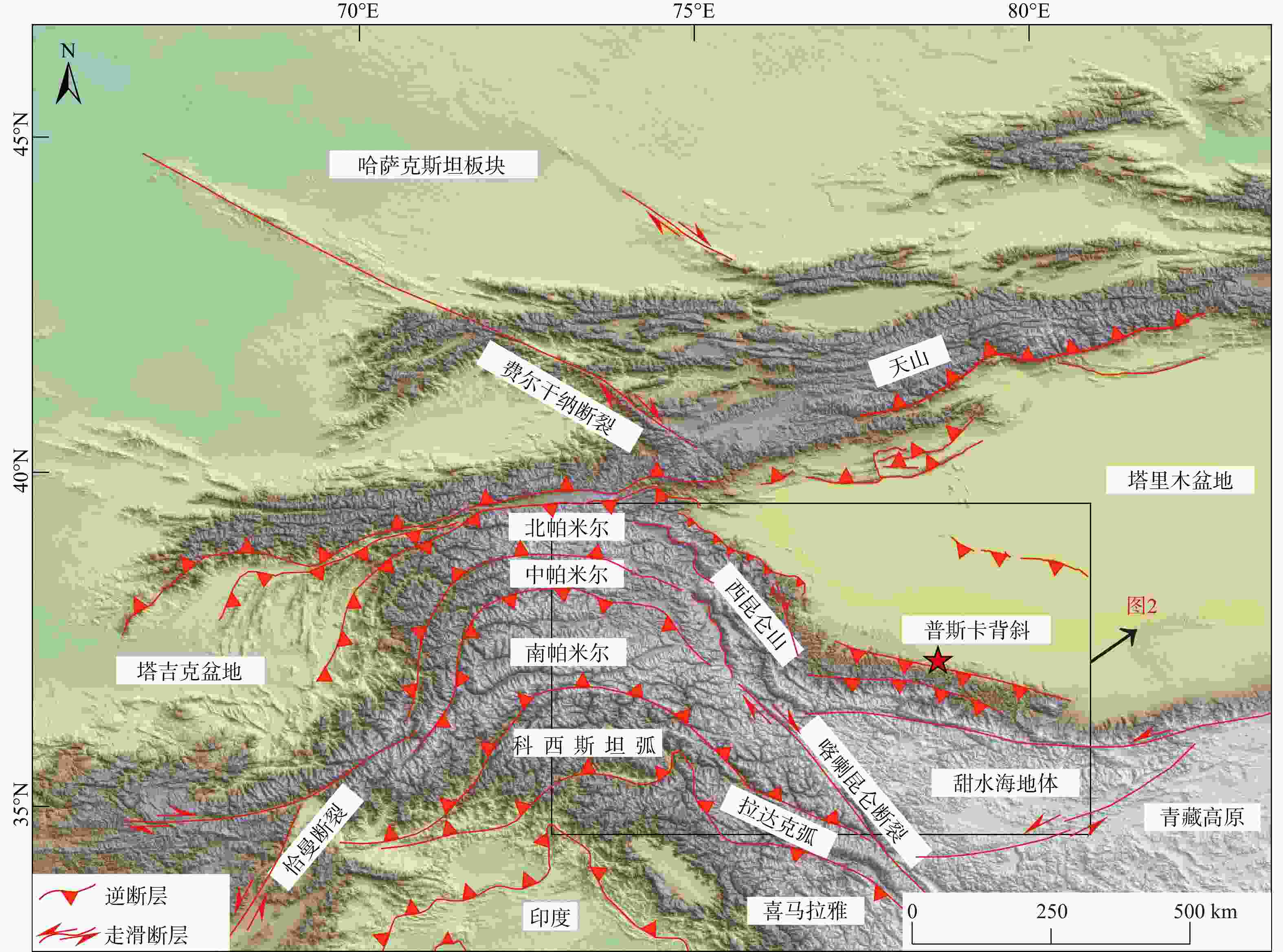
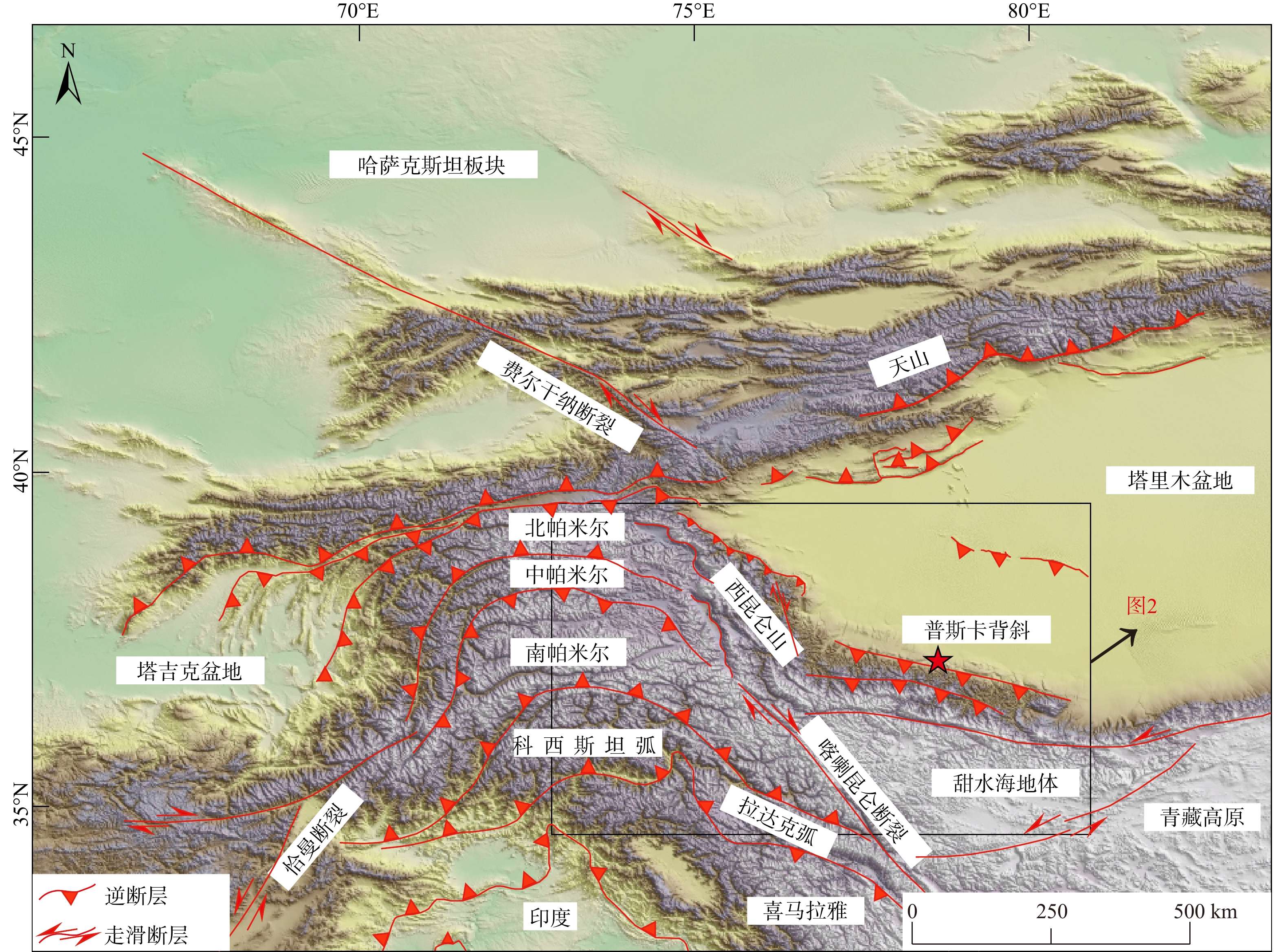
图 1 帕米尔–西昆仑地体数字高程模型(DEM)图(据Zhang et al.,2023修改)
Figure 1. Digital elevation model (DEM) of the Pamir–West Kunlun system (modified after Zhang et al., 2023)
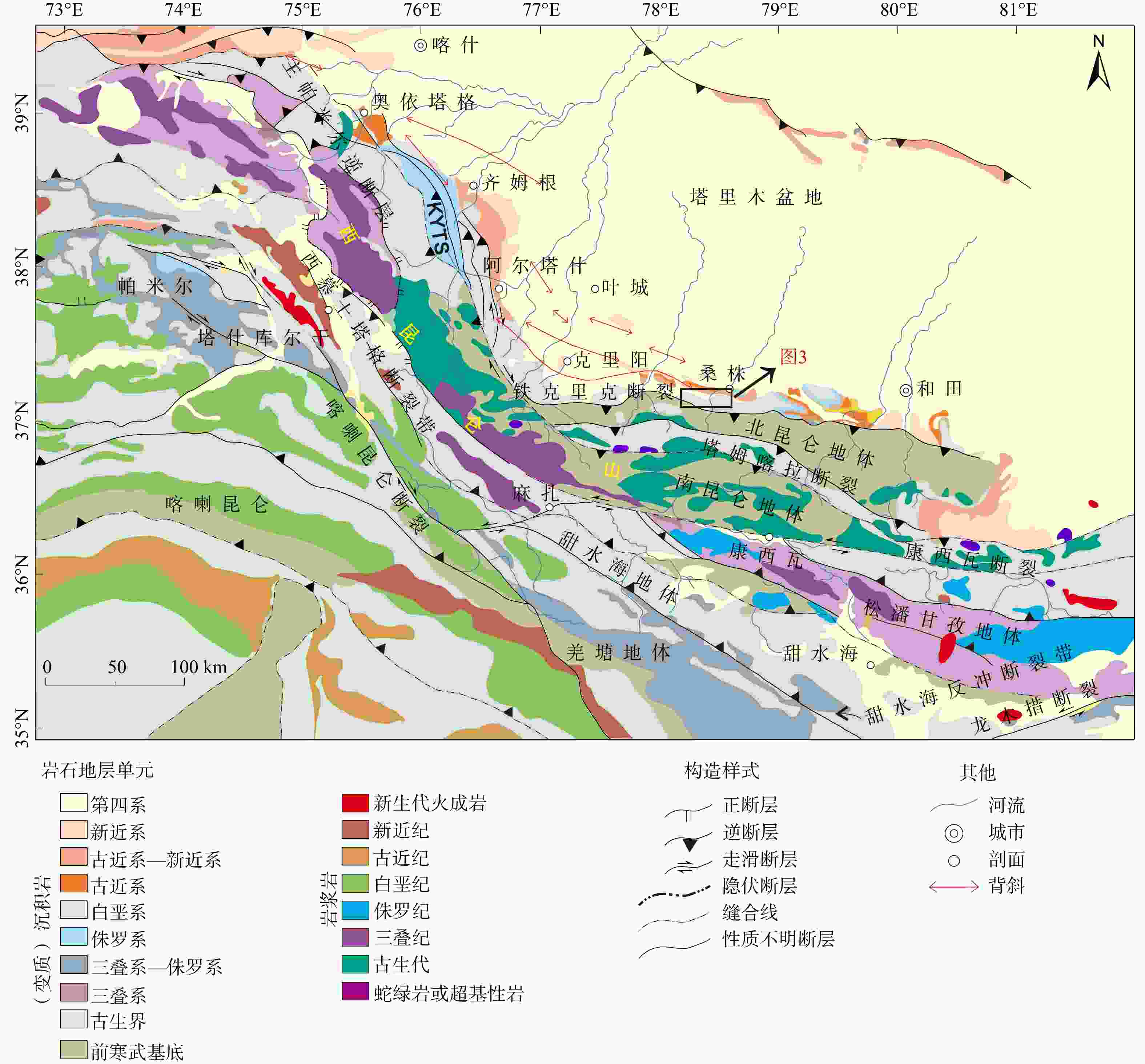
图 2 帕米尔–西昆仑山系统、塔里木盆地及邻区地质图(据Zhang et al.,2023修改)
Figure 2. Geological sketch map of the Pamir–West Kunlun system, SW Tarim Basin, and adjacent areas (modified after Zhang et al., 2023)
KYTS—Kashgar–Yecheng Transfer System
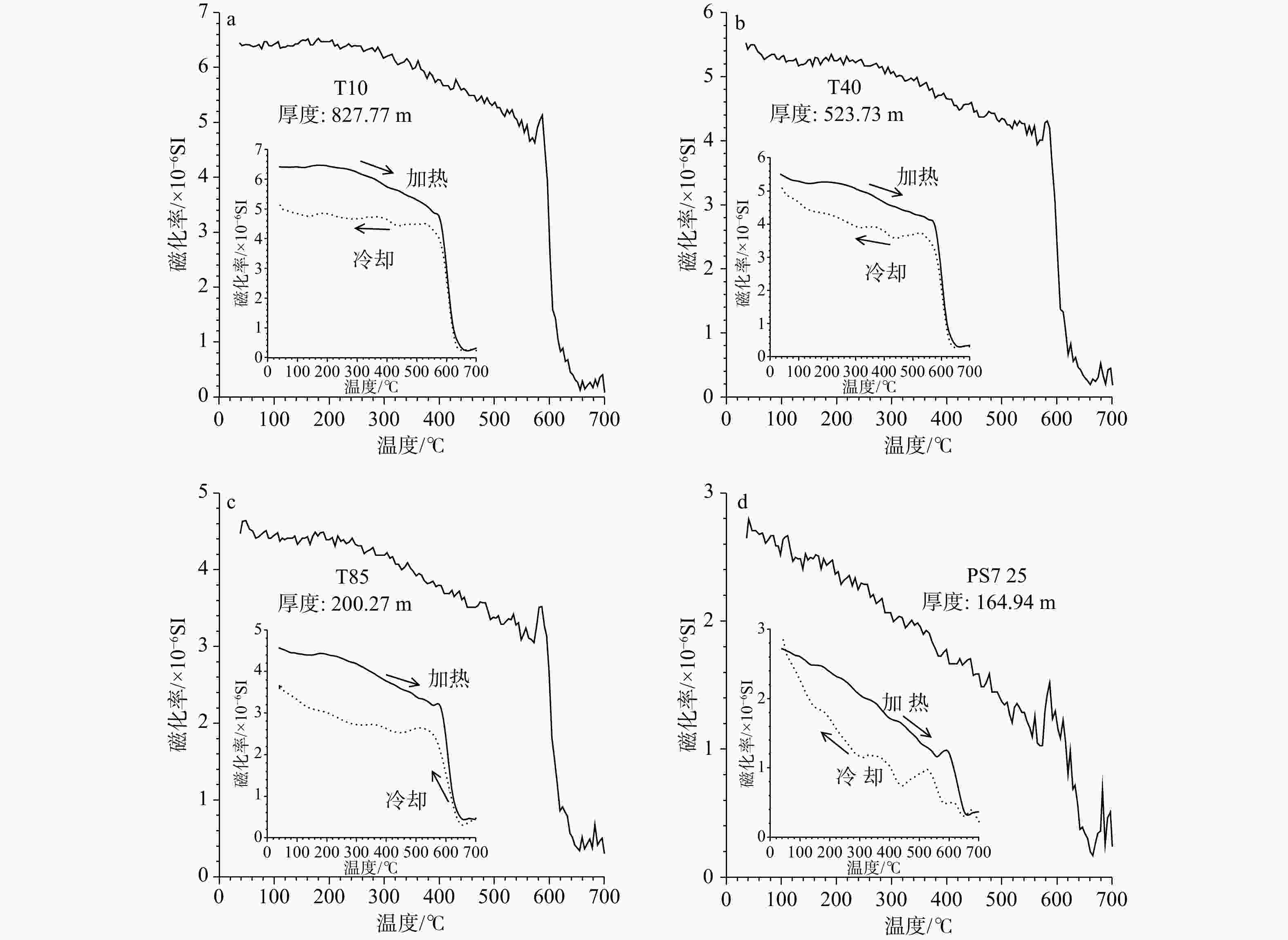
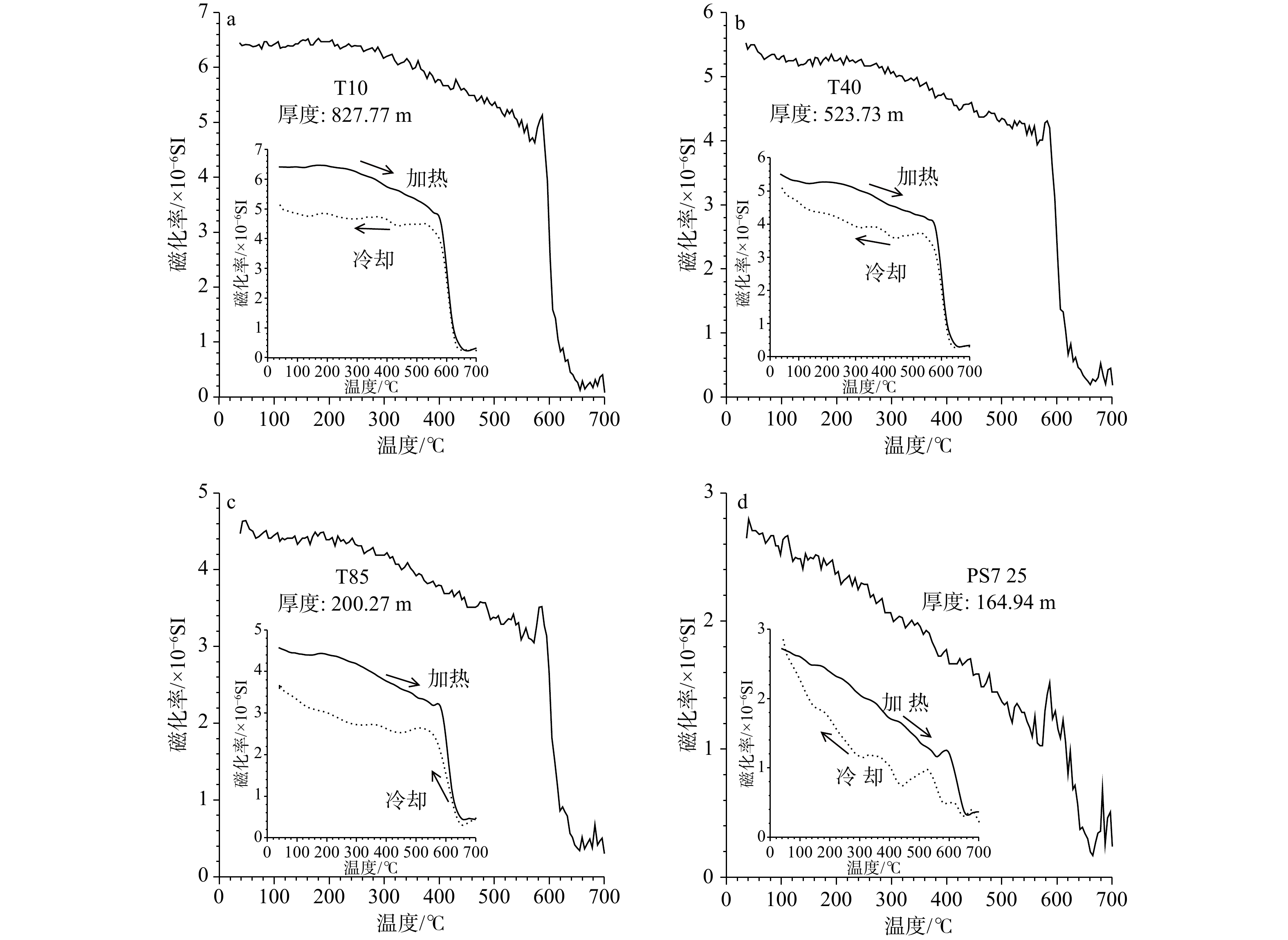
图 6 代表性样品的磁化率随温度变化曲线
a—样品编号T10;b—样品编号T40;c—样品编号T85;d—样品编号PS725
Figure 6. Susceptibility versus temperature (κ–T) curves of the studied representative samples
(a) Sample number T10; (b) Sample number T40; (c) Sample number T85; (d) Sample number PS725
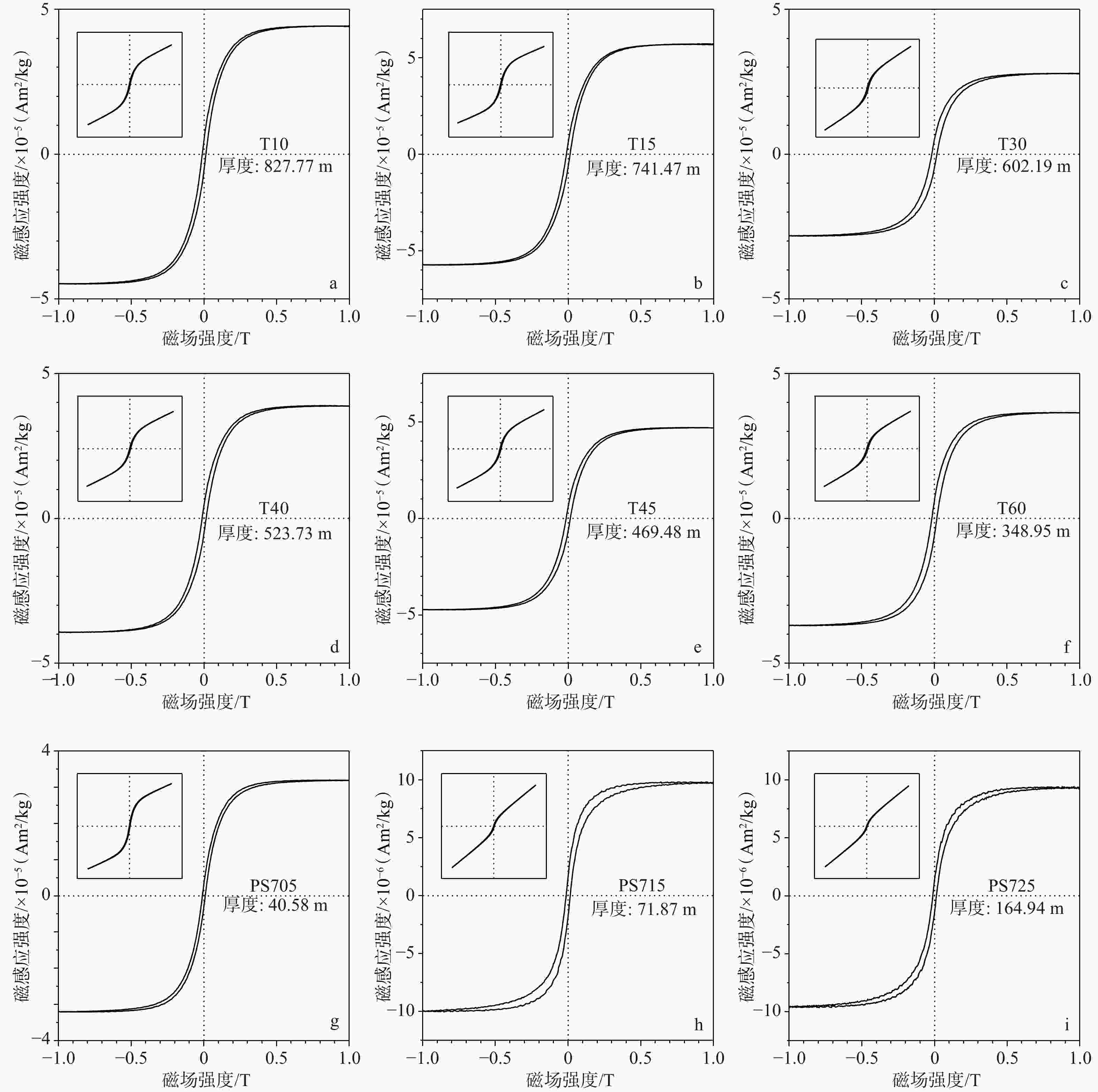
图 7 代表性样品的磁滞回线
a—样品编号T10;b—样品编号T15;c—样品编号T30;d—样品编号T40;e—样品编号T45;f—样品编号T60;g—样品编号PS705;h—样品编号PS715;i—样品编号PS725
Figure 7. Hysteresis loops of representative samples
(a) Sample number T10; (b) Sample number T15; (c) Sample number T30; (d) Sample number T40; (e) Sample number T45; (f) Sample number T60; (g) Sample number PS705; (h) Sample number PS715; (i) Sample number PS725
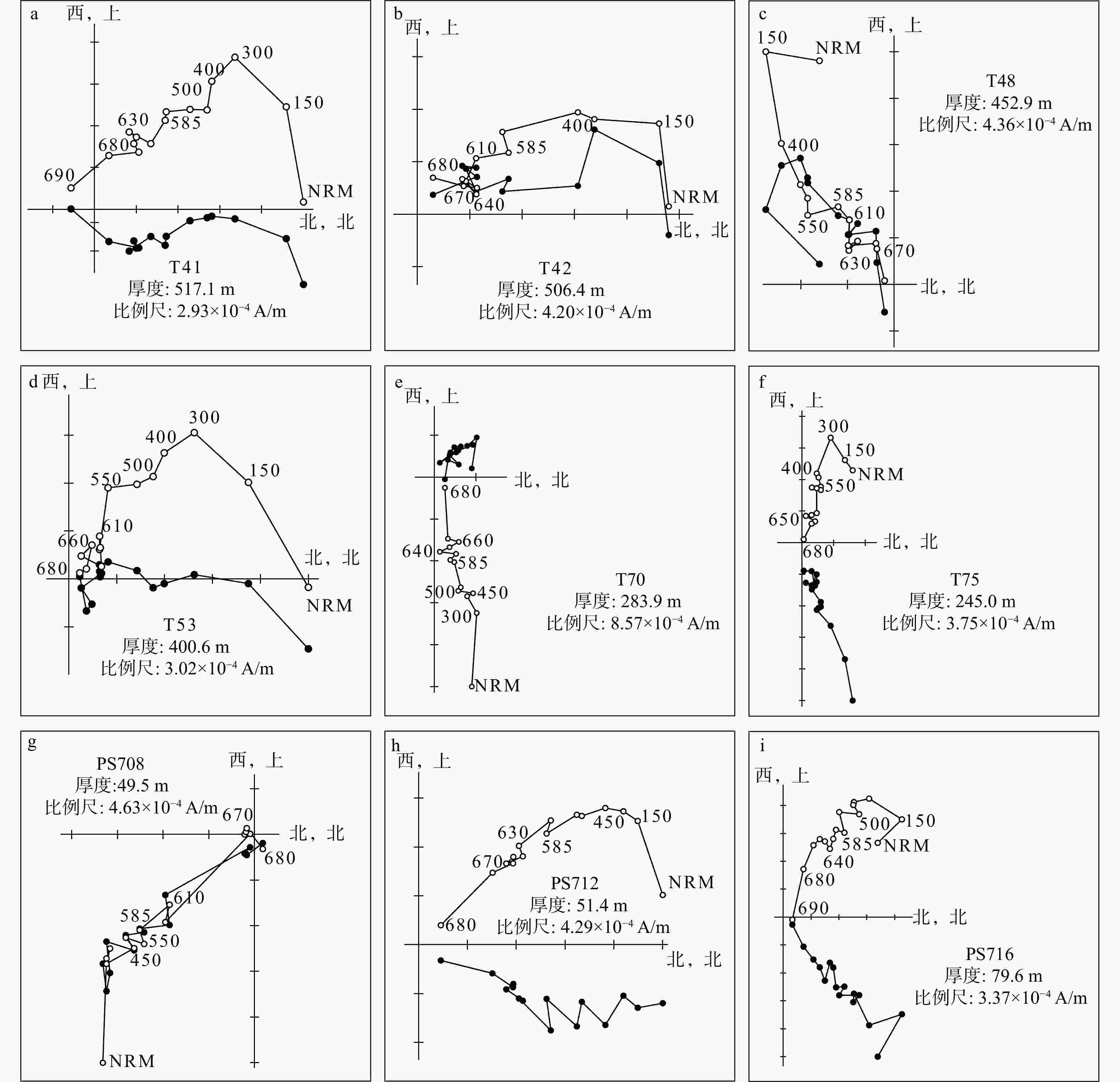
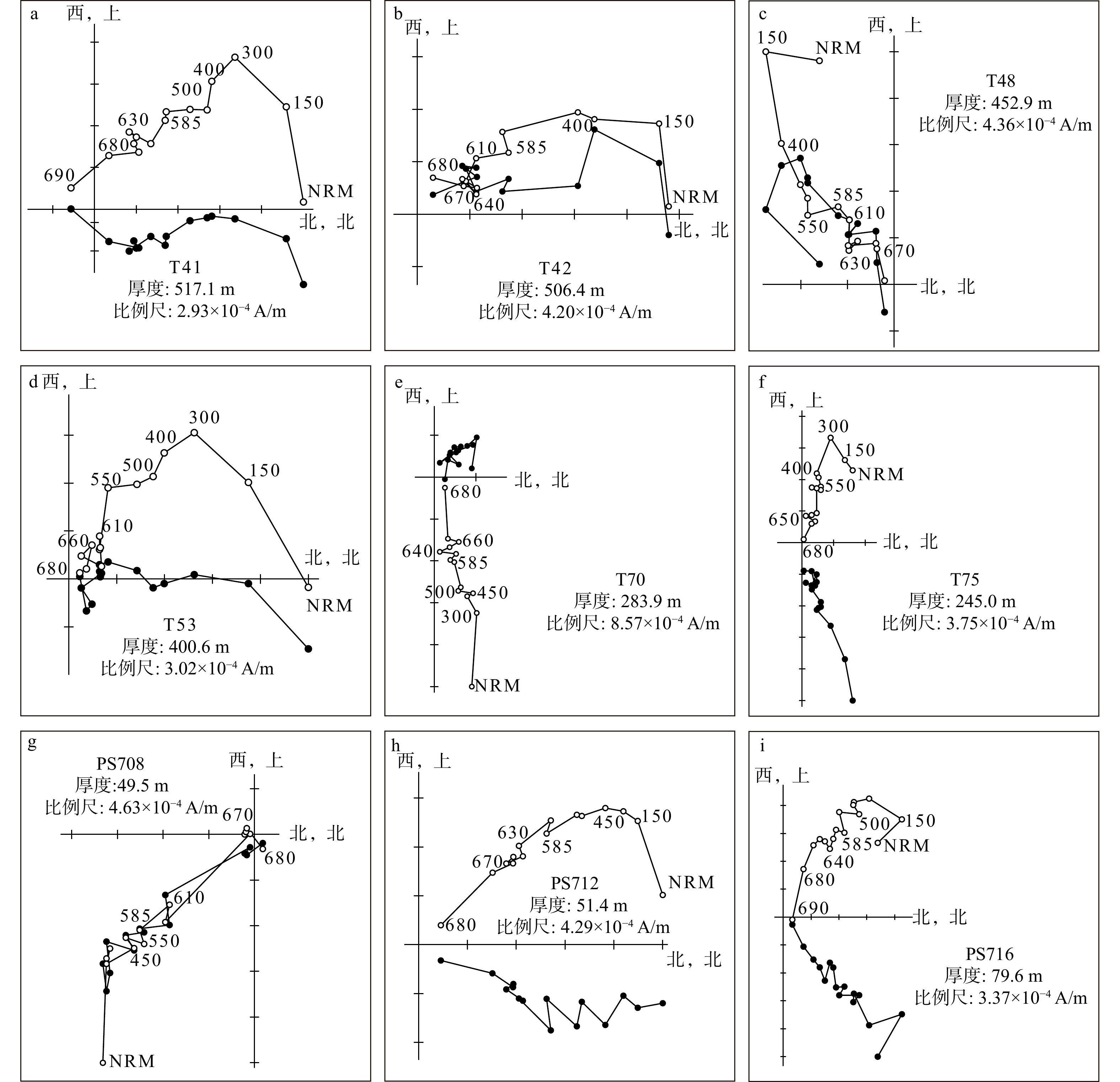
图 10 代表性样品的剩磁矢量正交投影图
实心圆与空心圆分别代表投影在水平面和垂直面上的矢量;比例尺表示的是剩磁强度;NRM为天然剩磁a—样品编号T41;b—样品编号T42;c—样品编号T48;d—样品编号T53;e—样品编号T70;f—样品编号T75;g—样品编号PS708;h—样品编号PS712;i—样品编号PS716
Figure 10. Orthogonal vector diagrams of representative samples
(a) Sample number T41; (b) Sample number T42; (c) Sample number T48; (d) Sample number T53; (e) Sample number T70; (f) Sample number T75; (g) Sample number PS708; (h) Sample number PS712; (i) Sample number PS716Solid and open circles represent vectors projected on horizontal and vertical planes, respectively.
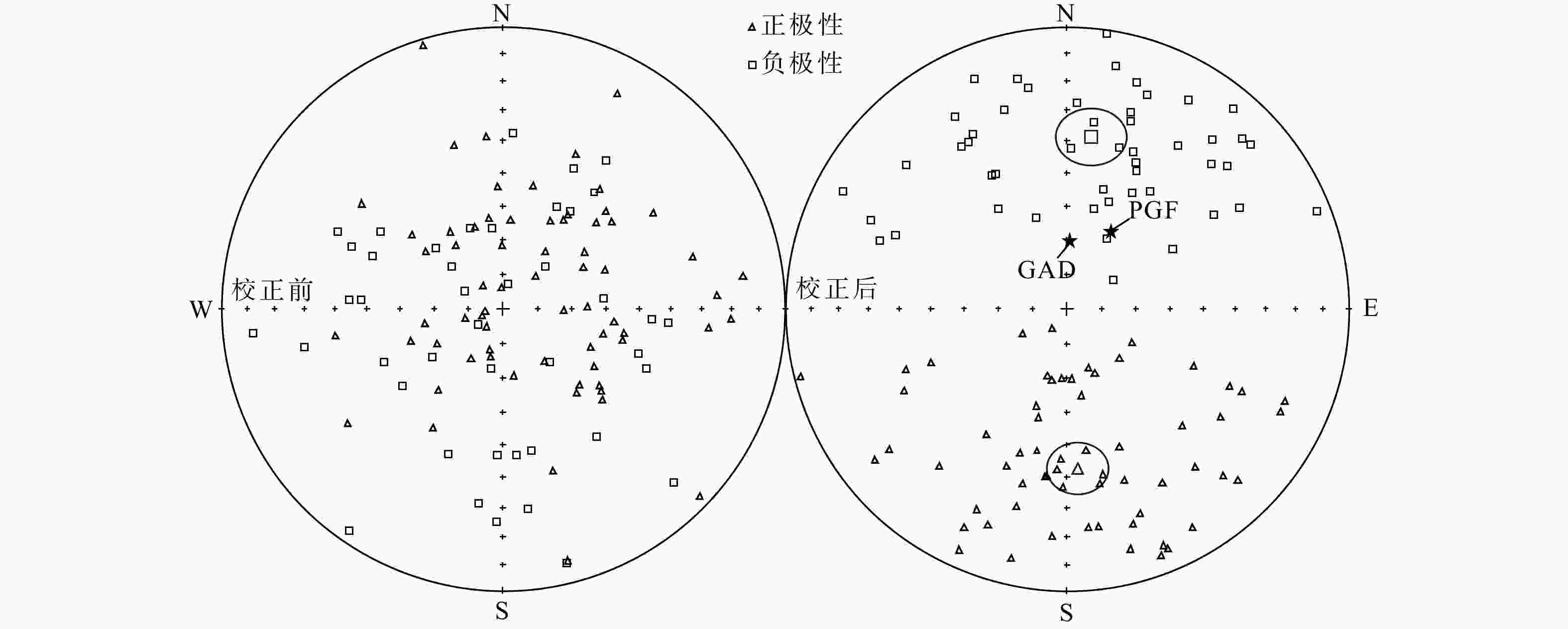
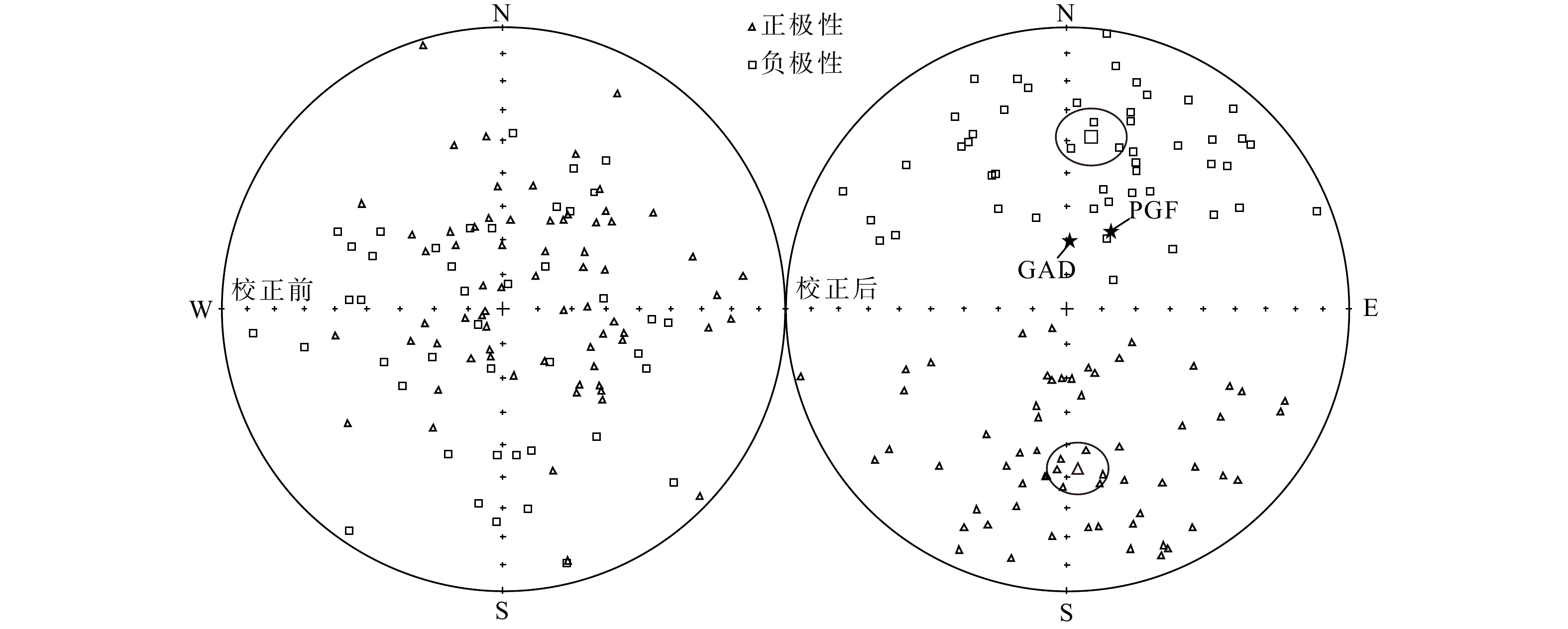
图 11 等面积投影显示下半球倾斜校正前与校正后的特征剩磁方向
空心方块与实心三角分别表示向下与向上的磁化方向。大比例的方块与三角分别代表正向与反向的fisher平均值,椭圆代表95%置信区间。星形分别指示地心轴向偶极子场(GAD)及现代地磁场(PGF)方向
Figure 11. Equal-area projection (lower hemisphere) of the ChRM directions before (left) and after (right) tilt-correction
The open squares and solid triangles indicate downward and upward directions. The larger square and triangle represent the Fisher-mean values of the normal and reversed directions, respectively, with ellipses indicating the 95% confidence interval. The black stars represent the geocentric axial dipole (GAD) and the present geomagnetic field (PGF) directions, respectively.
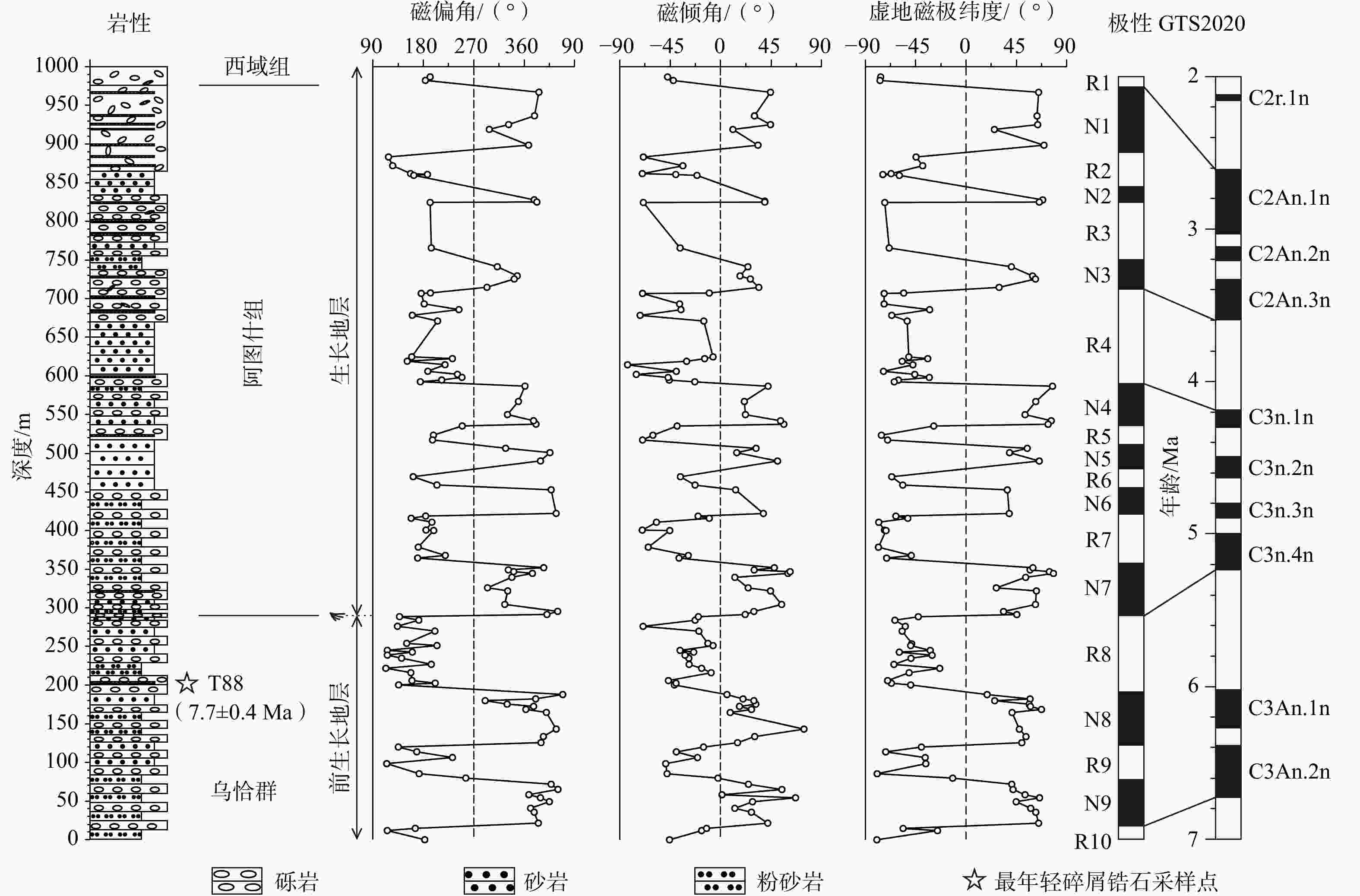
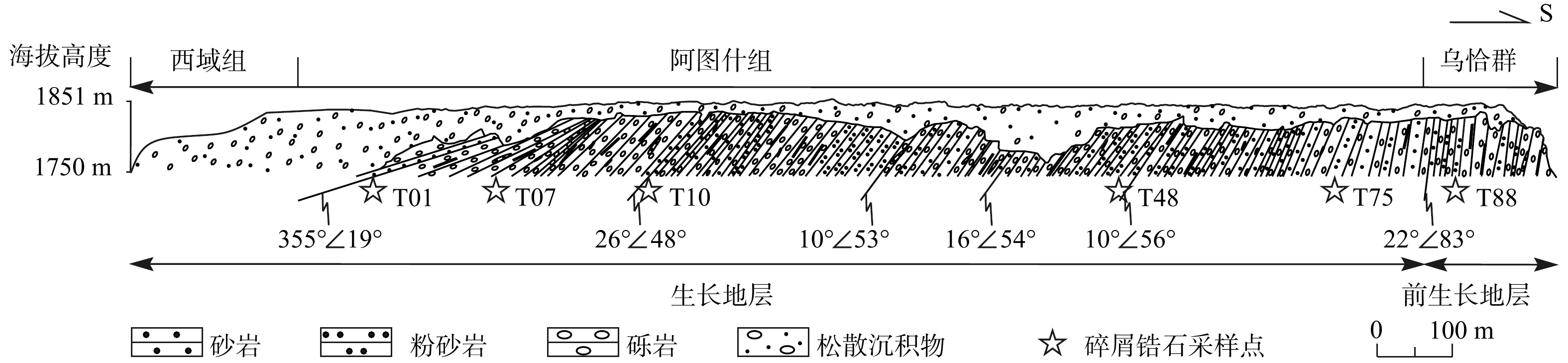
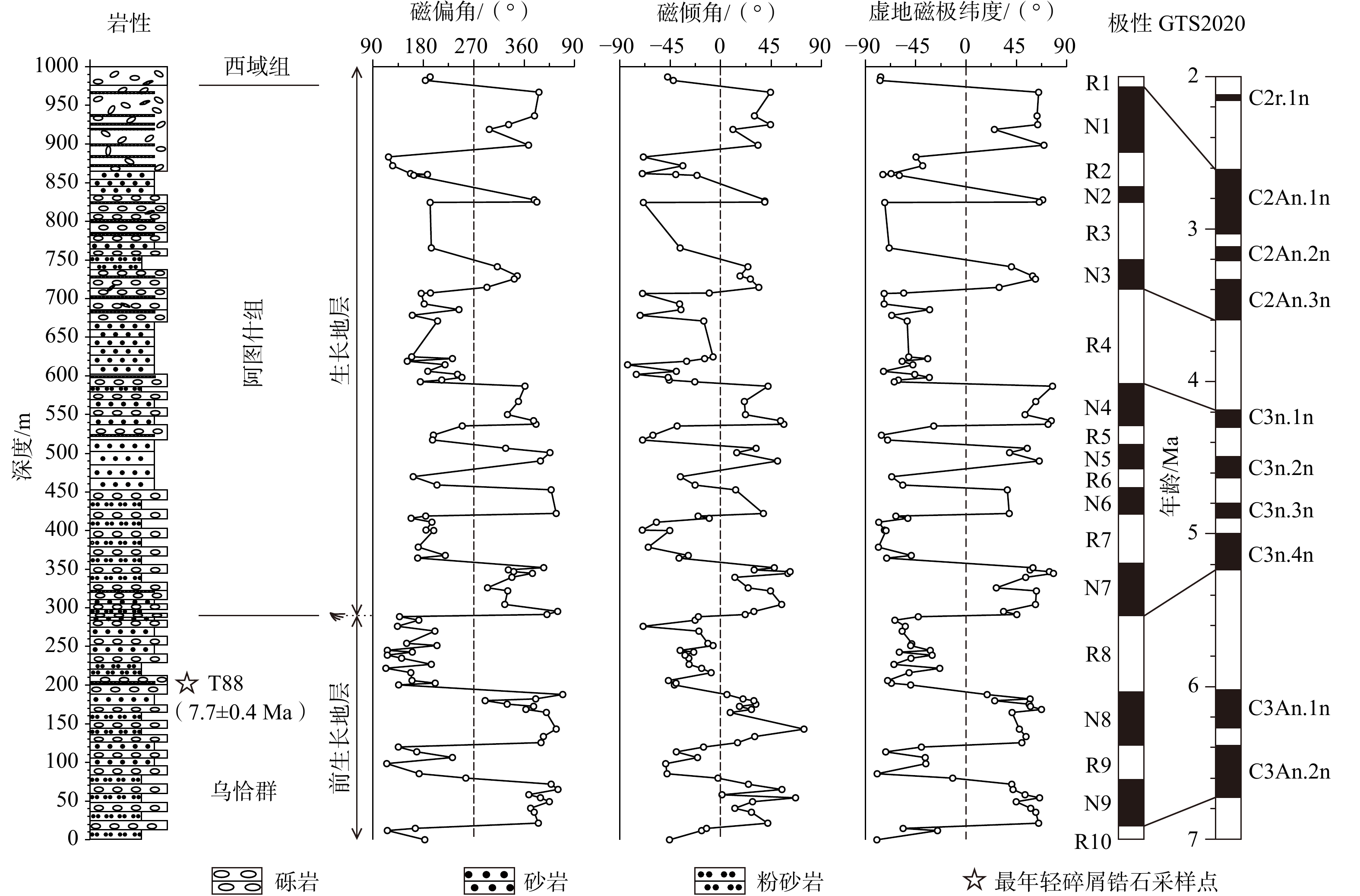
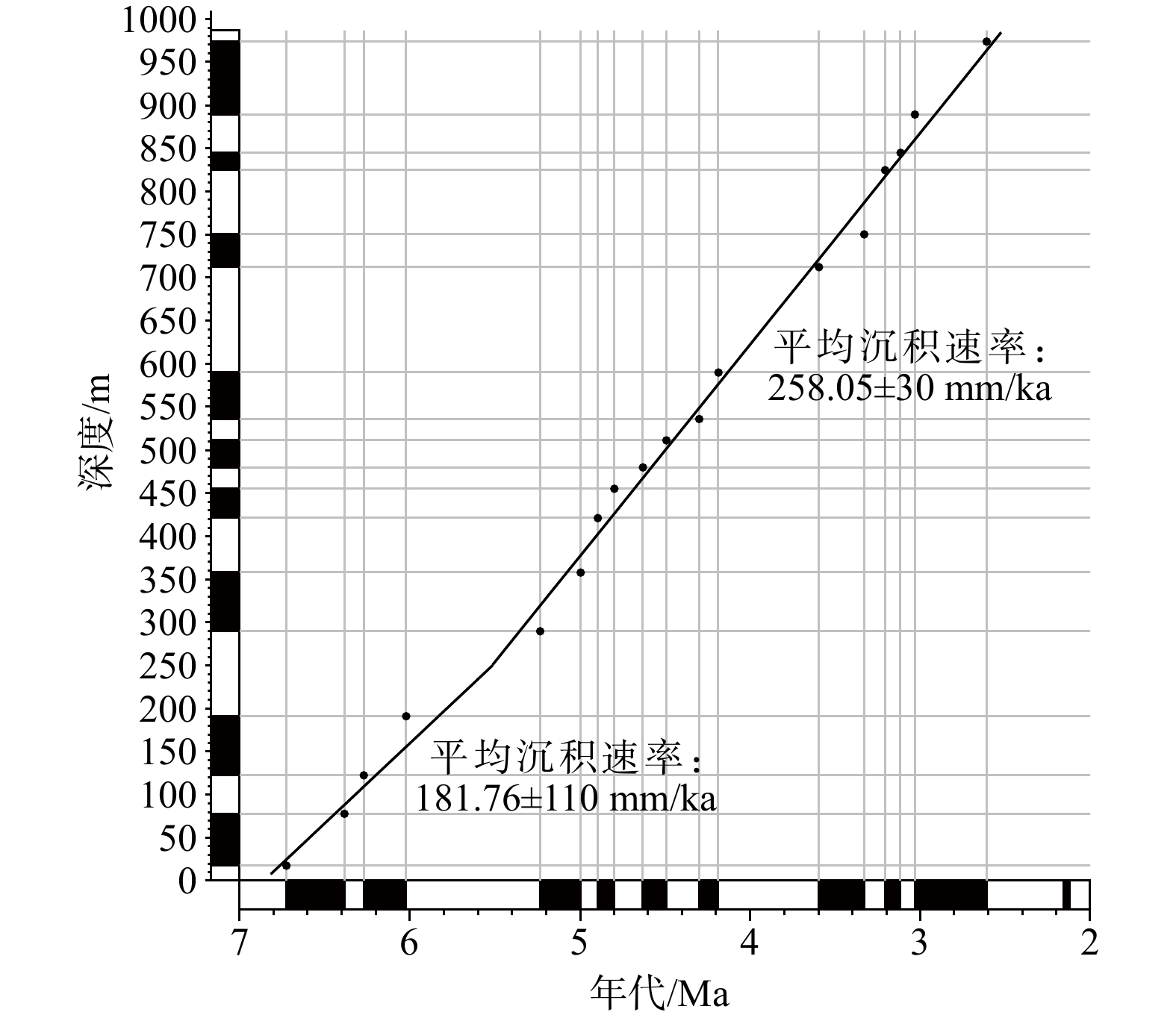
图 12 普斯卡背斜岩性变化、厚度及磁性地层与国际地磁极性年表的对比
Figure 12. Variations of lithology versus the thickness and the magnetostratigraphic results of the northern limb of the Puska Anticline (The polarity sequence is constructed using the declinations, inclinations, and the VGP latitudes.)
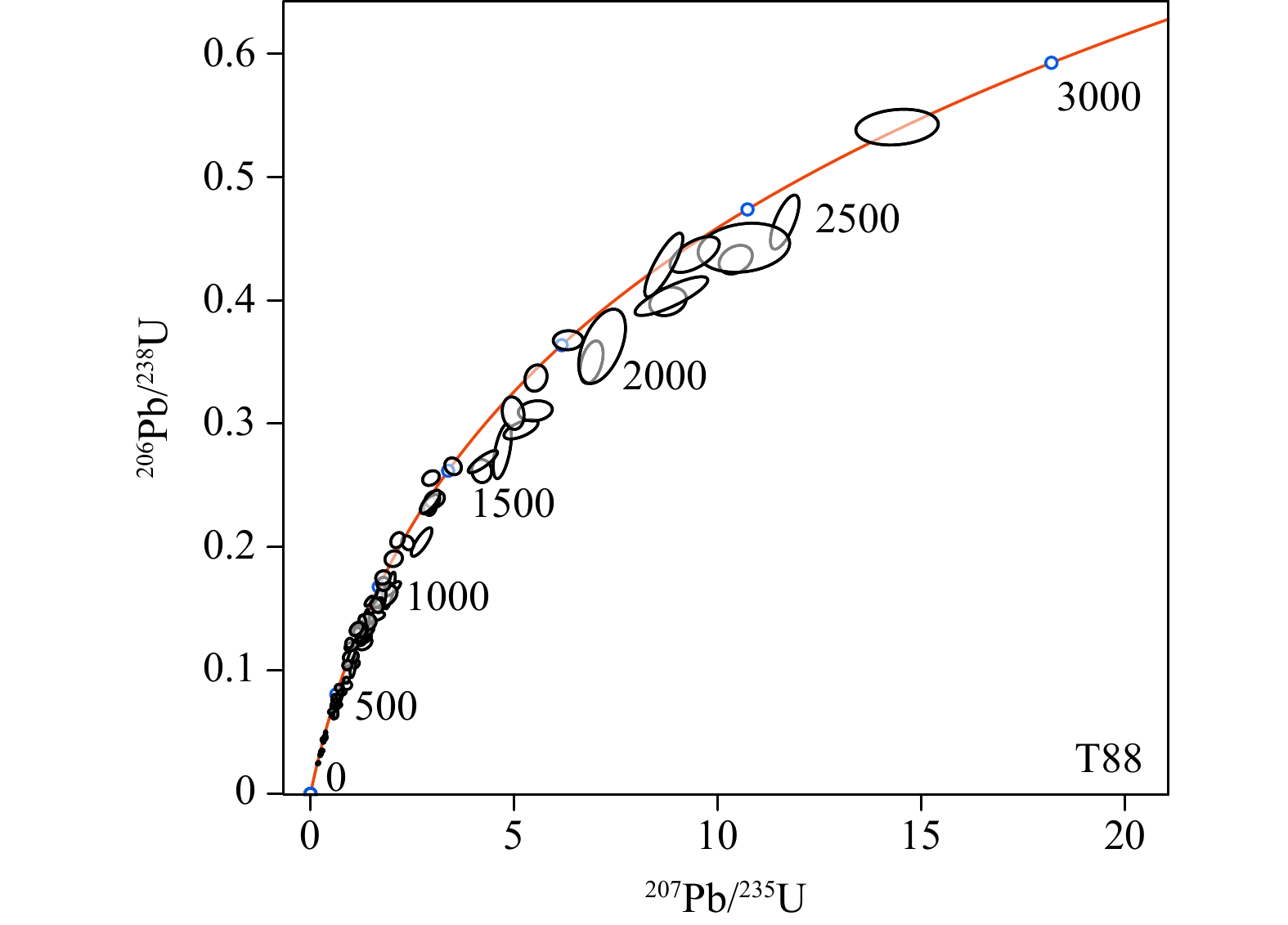
The star represents the sampling site of the youngest detrital zircon.
-
[1] AZMAT M, JIA D, ZHONG C, et al., 2025. Analogue modeling of the formation mechanism of ultra-long distance overthrust: a case study of the Karakash River profile in southwestern Tarim Basin[J]. Geological Journal of China Universities, 31(6): 720-732. (in Chinese with English abstract) [2] BOSBOOM R, DUPONT-NIVET G, GROTHE A, et al., 2014. Timing, cause and impact of the late Eocene stepwise sea retreat from the Tarim Basin (west China)[J]. Palaeogeography, Palaeoclimatology, Palaeoecology, 403: 101-118. doi: 10.1016/j.palaeo.2014.03.035 [3] CAO K, WANG G C, BERNET M, et al., 2015. Exhumation history of the West Kunlun Mountains, northwestern Tibet: evidence for a long-lived, rejuvenated orogen[J]. Earth and Planetary Science Letters, 432: 391-403. doi: 10.1016/j.epsl.2015.10.033 [4] CHEN H L, LI K, LI Y, et al., 2018. The segmentation deformation of the thrust belt in front of Western Kunlun, western China, and its controlling factors[J]. Acta Petrologica Sinica, 34(7): 1933-1942. (in Chinese with English abstract) [5] CHEN J, LU Y C, DING G Y, et al., 2001. Records of late Cenozoic mountain building in Western Tarim basin: molasses, growth strata and growth unconformity[J]. Quaternary Sciences, 21(6): 528-539. (in Chinese with English abstract) [6] CHENG X G, CHEN H L, LIN X B, et al., 2017. Geometry and kinematic evolution of the Hotan-Tiklik segment of the western Kunlun thrust belt: Constrained by structural analyses and apatite fission track thermochronology[J]. The Journal of Geology, 125(1): 65-82. doi: 10.1086/689187 [7] COWGILL E S, 2001. Tectonic evolution of the Altyn Tagh-Western Kunlun fault system, northwestern China[D]. Los Angeles: University of California. [8] DENG Q D, FENG X Y, ZHANG P Z, et al. , 2000. Active tectonics of the Chinese Tianshan mountain[M]. Beijing: Seismological Press: 373-375. (in Chinese) [9] DONG L, SHEN Z S, DENG C L, 2024. Mineral magnetism of the Jingbian loess-paleosol sequence and its paleoclimatic significance[J]. Chinese Journal of Geophysics, 67(8): 3060-3074. (in Chinese with English abstract) [10] DU D D, LI H H, YAN L, et al., 2023. Deformation migration and three major geological events in Tarim Basin and their geological significance[J]. Chinese Journal of Geology, 58(2): 379-397. (in Chinese with English abstract) [11] GUO W X, QI J F, 2008. Relationship of sedimentation and tectonism in growth strata developed by growth folding[J]. Geoscience, 22(4): 520-524. (in Chinese with English abstract) [12] HE P Y, LI T, CHEN Z X, et al., 2025. Growing history and geomorphic response of the eastern termination of Kashi anticline, southwestern Tian Shan: an integrated analysis of geology, geomorphology, seismic reflection profile and magnetostratigraphy[J]. Seismology and Geology, 47(2): 369-383. (in Chinese with English abstract) [13] HONG C, ZHANG L, LIN X B, et al., 2022. Analogue modeling of the deformation in the southwest Tarim Basin: implications for the influence of denudation and syn-tectonic sedimentation on the deformation of fold-and-thrust belts[J]. Quaternary Sciences, 42(3): 692-703. (in Chinese with English abstract) [14] HUANG H, LIN X B, AN K X, et al., 2023. Surface processes driving intracontinental basin subsidence in the context of India-Eurasia collision: evidence from flexural subsidence modeling of the cenozoic southern Tarim Basin along the West Kunlun Foreland, NW Tibetan Plateau[J]. Acta Geologica Sinica (English Edition), 97(6): 1778-1786. doi: 10.1111/1755-6724.15070 [15] JIANG L, DONG H K, LI Y, et al., 2024. Deformation characteristics and exploration potential of the West Kunlun foreland fold-and-thrust belt[J]. Advances in Geo-Energy Research, 11(3): 181-193. doi: 10.46690/ager.2024.03.03 [16] JIN X C, WANG J, CHEN B W, et al., 2003. Cenozoic depositional sequences in the piedmont of the west Kunlun and their paleogeographic and tectonic implications[J]. Journal of Asian Earth Sciences, 21(7): 755-765. doi: 10.1016/S1367-9120(02)00073-1 [17] LABORDE A, BARRIER L, SIMOES M, et al., 2019. Cenozoic deformation of the Tarim Basin and surrounding ranges (Xinjiang, China): a regional overview[J]. Earth-Science Reviews, 197: 102891. doi: 10.1016/j.earscirev.2019.102891 [18] LI B L, JIA C Z, PANG X Q, et al., 2007. The Spatial Distribution of the Foreland Thrust Tectonic Deformation in the Circum-Tibetan Plateau Basin and Range System[J]. Acta Geologica Sinica, 81(9): 1200-1207. (in Chinese with English abstract) [19] LI C, CHEN G H, HE Z Y, et al., 2023. Migration processes of the cenozoic intracontinental foreland basins in Western China and their tectonics implications[J]. Advances in Earth Science, 38(7): 729-744. (in Chinese with English abstract) [20] LI C H, CHEN Z L, HUO H L, et al., 2025. Late Paleozoic tectonic evolution of the Qinling Orogenic Belt: constraints and insights from detrital zircon U-Pb geochronology in the Western Qinling[J]. Journal of Geomechanics, 31(4): 617-637. (in Chinese with English abstract) [21] LI D P, 2008. Tectonic deformation on northwestern margin of Tibetan Plateau during Pliocene-Pleistocene and uplift of the Tibetan Plateau[D]. Beijing: Chinese Academy of Geological Sciences. (in Chinese with English abstract) [22] LI D P, ZHAO Y, LIU J, et al., 2010. Late Cenozoic tectonic deformation on the northwestern margin of the Qinghai-Tibet Plateau[J]. Acta Geologica Sinica, 84(3): 293-310. (in Chinese with English abstract) [23] LI G W, SANDIFORD M, FANG A M, et al., 2019. Multi-stage exhumation history of the West Kunlun orogen and the amalgamation of the Tibetan Plateau[J]. Earth and Planetary Science Letters, 528: 115833. doi: 10.1016/j.epsl.2019.115833 [24] LI Y, ZHAO S Z, LI P Y, et al. , 2025. Research progress and future perspectives of the foreland basin dynamics[J]. Journal of Chengdu University of Technology (Science & Technology Edition), 53(0):1-35. (in Chinese with English abstract) [25] LIAO L, 2010. Cenozoic tectonic events and their sedimentary records in the West Kunlun[D]. Hangzhou: Zhejiang University. (in Chinese with English abstract) [26] LIU H, WANG G C, CAO K, et al., 2010. The detrital zircon fission-track ages constraint to tectonic processes in west Kunlun and adjacent regions[J]. Earth Science Frontiers, 17(3): 64-78. (in Chinese with English abstract) [27] LIU H F, 2000. Types of basin-mountain coupling[J]. Earth Science Frontiers, 7(4): 469. (in Chinese) [28] LIU S, WANG X, WU X F, et al., 2004. Growth strata and the deformation time of the late Cenozoic along front belts of Pamir-western Kunlun-southwest Tianshan in China[J]. Acta Petrolei Sinica, 25(5): 24-28. (in Chinese with English abstract) [29] LIU S F, LIN C F, LIU X B, et al., 2018. Syn-tectonic sedimentation and its linkage to fold-thrusting in the region of Zhangjiakou, North Hebei, China[J]. Science China Earth Sciences, 61(6): 681-710. doi: 10.1007/s11430-017-9175-3 [30] LIU W H, KRZYWIE P, MAZUR S, et al., 2021. The Cenozoic structural evolution of the southwestern Tarim Basin, China[C]//EGU General Assembly Conference Abstracts. New York: EGU: EGU21-3721. [31] LU H, LIU H, HU F, et al., 2023. Record of Mesozoic collision orogeny on the eastern section of the West Kunlun Orogen: evidence from geochronology and geochemistry of the Triassic Wenquan-Shenglidaban granitic intrusions, Xinjiang[J]. Geoscience, 37(3): 573-585. (in Chinese with English abstract) [32] MCFADDEN P L, MCELHINNY M W, 1990. Classification of the reversal test in palaeomagnetism[J]. Geophysical Journal International, 103(3): 725-729. doi: 10.1111/j.1365-246X.1990.tb05683.x [33] O’REILLY W, 1984. Rock and mineral magnetism[M]. Boston, MA: China Springer: 194-212. [34] OGG J G, 2020. Geologic Time Scale 2020 [M]. Elsevier: 159-192. [35] ROBERTS A P, CUI Y L, VEROSUB K L, 1995. Wasp-waisted hysteresis loops: mineral magnetic characteristics and discrimination of components in mixed magnetic systems[J]. Journal of Geophysical Research: Solid Earth, 100(B9): 17909-17924. doi: 10.1029/95JB00672 [36] RUDDIMAN W F, KUTZBACH J E, 1989. Forcing of late Cenozoic northern hemisphere climate by plateau uplift in southern Asia and the American West[J]. Journal of Geophysical Research: Atmospheres, 94(D15): 18409-18427. doi: 10.1029/JD094iD15p18409 [37] SHI X F, LIU S F, LIN C F, 2019. Growth structures and growth strata of the Qianjiadian Basin in the western Yanshan fold and thrust belt, North China[J]. Science China Earth Sciences, 62(7): 1092-1109. doi: 10.1007/s11430-018-9345-6 [38] SOBEL E R, 1995. Basin analysis and apatite fission-track thermochronology of the Jurassic-Paleogene southwest Tarim Basin, NW China[D]. California: Stanford University. [39] SOBEL E R, DUMITRU T A, 1997. Thrusting and exhumation around the margins of the western Tarim basin during the India-Asia collision[J]. Journal of Geophysical Research: Solid Earth, 102(B3): 5043-5063. doi: 10.1029/96JB03267 [40] SUN J M, LIU T, 2006. The age of the Taklimakan desert[J]. Science, 312(5780): 1621-1621. doi: 10.1126/science.1124616 [41] SUN J M, ZHANG L Y, DENG C L, et al., 2008. Evidence for enhanced aridity in the Tarim Basin of China since 5.3 Ma[J]. Quaternary Science Reviews, 27(9-10): 1012-1023. doi: 10.1016/j.quascirev.2008.01.011 [42] SUN J M, WINDLEY B F, ZHANG Z L, et al., 2016. Diachronous seawater retreat from the southwestern margin of the Tarim Basin in the late Eocene[J]. Journal of Asian Earth Sciences, 116: 222-231. doi: 10.1016/j.jseaes.2015.11.020 [43] SUN Z M, LI H B, PEI J L, et al., 2013. Paleomagnetic study of Cenozoic sediments from western Kunlun-Pamir and its tectonic implications[J]. Acta Petrologica Sinica, 29(9): 3183-3191. (in Chinese with English abstract) [44] SUPPE J, WANG X, HE D, et al., 2015. Large-scale thrusting along the northern margin of the Tibetan Plateau and the southwest Tarim basin: 230 km long active Hotian thrust sheet[C]//AGU Fall Meeting Abstracts. New York: AGU: T21A-2790. [45] WANG E, WAN J, LIU J Q, 2003. Late Cenozoic geological evolution of the foreland basin bordering the West Kunlun range in Pulu area: constraints on timing of uplift of northern margin of the Tibetan Plateau[J]. Journal of Geophysical Research: Solid Earth, 108(B8): 2401. [46] WANG Q H, YANG H J, LI Y, et al., 2023. Major breakthrough in the Carboniferous-Permian in Well Qiatan 1 and exploration prospect in the piedmont southwestern Tarim Basin[J]. China Petroleum Exploration, 28(4): 34-45. (in Chinese with English abstract) [47] WANG Y, LI D G, XIAO X C, et al., 2006. Late Cenozoic tectonic movement in the front of the West Kunlun Mountains and uplift of the northwestern margin of the Qinghai-Tibetan Plateau[J]. Geology in China, 33(1): 41-47. (in Chinese with English abstract) [48] XIANG D F, MAO Q G, CHEW D, et al., 2026. Late Miocene rapid exhumation in the West Kunlun range: Insights into Tibetan Plateau growth and India-Asia lithospheric collision[J]. Geology,54(1): 24-29. [49] YANG G, CHEN Z X, 2023. A two-stage evolution model of the wedged-shaped structures superposed with strike-slip faulting for the Qimugen oroclines of the Southwest Tarim Basin, Northwest China[J]. Chinese Journal of Geology, 58(2): 347-378. (in Chinese with English abstract) [50] YIN A, RUMELHART P E, BUTLER R, et al., 2002. Tectonic history of the Altyn Tagh fault system in northern Tibet inferred from Cenozoic sedimentation[J]. Geological Society of America Bulletin, 114(10): 1257-1295. doi: 10.1130/0016-7606(2002)114<1257:thotat>2.0.co;2 [51] ZHANG P Z, 2004. Late Cenozoic tectonic deformation in the Tianshan Mountain and its foreland basins[J]. Chinese Science Bulletin, 49(4): 311-313. doi: 10.1007/BF02900310 [52] ZHANG S J, HU X M, HAN Z, et al., 2018. Climatic and tectonic controls on Cretaceous-Palaeogene sea-level changes recorded in the Tarim epicontinental sea[J]. Palaeogeography, Palaeoclimatology, Palaeoecology, 501: 92-110. doi: 10.1016/j.palaeo.2018.04.008 [53] ZHANG S J, HU X M, GAO Z Q, et al., 2021. Palaeogene uplift and deformation in West Kunlun Mountains: timing, evidence and controversy[J]. Geological Review, 67(4): 1057-1076. (in Chinese with English abstract) [54] ZHANG Z L, SUN J M, ZHANG B, et al., 2023. Cenozoic source-to-sink relations between the West Kunlun Mountains and SW Tarim Basin: evidence from an integrated provenance analysis[J]. Palaeogeography, Palaeoclimatology, Palaeoecology, 632: 111858. doi: 10.1016/j.palaeo.2023.111858 [55] ZHANG Z Y, GUO Z J, SONG Y, et al., 2025. Identification and application of growth strata associated with strike-slip faults: example from the Piqiang fault in the northwestern margin of the Tarim Basin[J]. Northwestern Geology, 58(3): 196-205. (in Chinese with English abstract) [56] ZHENG H B, POWELL C M, AN Z S, et al., 2000. Pliocene uplift of the northern Tibetan Plateau[J]. Geology, 28(8): 715-718. doi: 10.1130/0091-7613(2000)28<715:PUOTNT>2.0.CO;2 [57] 艾孜买提·米尔亥力木, 贾东, 钟城, 等, 2025. 超长距离逆冲推覆体形成机制的物理模拟: 以塔西南喀拉喀什河剖面为例[J]. 高校地质学报, 31(6): 720-732. [58] 陈汉林, 李康, 李勇, 等, 2018. 西昆仑山前冲断带的分段变形特征及控制因素[J]. 岩石学报, 34(7): 1933-1942. [59] 陈杰, 卢演俦, 丁国瑜, 等, 2001. 塔里木西缘晚新生代造山过程的记录: 磨拉石建造及生长地层和生长不整合[J]. 第四纪研究, 21(6): 528-539. [60] 邓起东, 冯先岳, 张培震, 等. 2000. 天山活动构造[M]. 北京: 地震出版社: 373-375. [61] 董良, 沈中山, 邓成龙, 2024. 黄土高原靖边剖面岩石磁学性质及其古环境意义[J]. 地球物理学报, 67(8): 3060-3074. doi: 10.6038/cjg2023R0271 [62] 杜德道, 李洪辉, 闫磊, 等, 2023. 塔里木盆地构造变形迁移与三大地质事件的关系及其地质意义[J]. 地质科学, 58(2): 379-397. doi: 10.12017/dzkx.2023.024 [63] 郭卫星, 漆家福, 2008. 同沉积褶皱生长地层中沉积与构造关系[J]. 现代地质, 22(4): 520-524. doi: 10.3969/j.issn.1000-8527.2008.04.005 [64] 何鹏宇, 李涛, 陈竹新, 等, 2025. 西南天山喀什背斜东倾伏端的生长演化和地貌响应: 基于地质地貌、地震反射剖面和磁性地层数据的综合分析[J]. 地震地质, 47(2): 369-383. doi: 10.3969/j.issn.0253-4967.2025.02.20240157 [65] 洪晨, 张亮, 林秀斌, 等, 2022. 塔里木西南地区变形的构造物理模拟研究: 对剥蚀与同沉积影响褶皱冲断带变形的启示[J]. 第四纪研究, 42(3): 692-703. doi: 10.11928/j.issn.1001-7410.2022.03.06 [66] 李本亮, 贾承造, 庞雄奇, 等, 2007. 环青藏高原盆山体系内前陆冲断构造变形的空间变化规律[J]. 地质学报, 81(9): 1200-1207. [67] 李超, 陈国辉, 何智远, 等, 2023. 中国西部新生代陆内前陆盆地迁移过程及其构造指示意义[J]. 地球科学进展, 38(7): 729-744. [68] 李程昊, 陈正乐, 霍海龙, 等, 2025. 晚古生代秦岭造山带构造演化: 西秦岭碎屑锆石U-Pb年代学的制约与启示[J]. 地质力学学报, 31(4): 617-637. [69] 黎敦朋, 2008. 青藏高原西北缘上新世—早更新世构造变形与高原隆升[D]. 北京: 中国地质科学院. [70] 黎敦朋, 赵越, 刘健, 等, 2010. 青藏高原西北缘晚新生代构造变形研究[J]. 地质学报, 84(3): 293-310. [71] 李勇, 赵少泽, 李芃宇, 等, 2025.前陆盆地动力学的研究进展与未来发展方向[J]. 成都理工大学学报(自然科学版), 53(0): 1-35. [72] 廖林, 2010. 西昆仑新生代构造事件及其沉积响应[D]. 杭州: 浙江大学. [73] 刘函, 王国灿, 曹凯, 等, 2010. 西昆仑及邻区区域构造演化的碎屑锆石裂变径迹年龄记录[J]. 地学前缘, 17(3): 64-78. [74] 刘和甫, 2000. 盆山耦合类型[J]. 地学前缘, 7(4): 469. doi: 10.3969/j.issn.1672-9854.2001.04.012 [75] 刘胜, 汪新, 伍秀芳, 等, 2004. 塔西南山前晚新生代构造生长地层与变形时代[J]. 石油学报, 25(5): 24-28. doi: 10.3321/j.issn:0253-2697.2004.05.005 [76] 鲁浩, 刘欢, 胡峰, 等, 2023. 西昆仑造山带东段中生代碰撞造山事件的记录: 来自新疆温泉—胜利达坂一带三叠纪侵入岩年代学、地球化学的证据[J]. 现代地质, 37(3): 573-585. [77] 史肖飞, 刘少峰, 林成发, 2019. 燕山构造带西段千家店盆地生长构造与生长地层[J]. 中国科学: 地球科学, 49(7): 1116-1133. [78] 孙知明, 李海兵, 裴军令, 等, 2013. 帕米尔-西昆仑地区新生代古地磁结果及其构造意义[J]. 岩石学报, 29(9): 3183-3191. [79] 王清华, 杨海军, 李勇, 等, 2023. 塔西南山前地区恰探1井石炭系: 二叠系重大突破与勘探前景[J]. 中国石油勘探, 28(4): 34-45. doi: 10.3969/j.issn.1672-7703.2023.04.004 [80] 王永, 李德贵, 肖序常, 等, 2006. 西昆仑山前晚新生代构造活动与青藏高原西北缘的隆升[J]. 中国地质, 33(1): 41-47. [81] 杨庚, 陈竹新, 2023. 塔西南齐姆根楔形构造与走滑构造叠加两阶段演化模式[J]. 地质科学, 58(2): 347-378. doi: 10.12017/dzkx.2023.023 [82] 张培震, 2003. 天山及其前陆盆地的晚新生代构造变形[J]. 科学通报, 48(24): 2499-2500. [83] 张世杰, 胡修棉, 郜周全, 等, 2021. 西昆仑山古近纪隆升变形: 时间、证据和争论[J]. 地质论评, 67(4): 1057-1076. doi: 10.16509/j.georeview.2021.04.300 [84] 张子亚, 郭召杰, 宋岩, 等, 2025. 走滑断裂的生长地层识别与应用: 以塔里木盆地西北缘皮羌断裂为例[J]. 西北地质, 58(3): 196-205. doi: 10.12401/j.nwg.2025011 -

 下载:
下载:





计量
- 文章访问数: 509
- HTML全文浏览量: 205
- PDF下载量: 192
- 被引次数: 0
