


Geomechanical implications of joints and veins
doi: 10.12090/j.issn.1006-6616.2025120
-
摘要: 文章综合梳理了近30年来关于岩石节理与岩脉研究的若干重要进展,强调了其在古构造应力重建中的独特意义。研究表明,共轭剪节理不仅可用于确定脆性岩石中有效主应力的方向,还能反映形成时显著的构造差应力。剥蚀节理与柱状节理分别代表不同的应力状态,其中柱状节理甚至可用于推算岩石的抗张强度。互层岩层中的张节理揭示了层间变形在应力传递中的关键作用,而节理间距与层厚之间的非线性关系则为估算岩层力学参数提供了新途径。梯状正交节理不仅反映特定的应力状态,还经风化与侵蚀塑造出独特的地貌景观。另一方面,岩脉作为矿物充填后的节理,不仅是应变量估算的有效载体,其间距−层厚关系更能定量揭示矿物沉淀对岩石抗张强度恢复的程度。岩层中缺乏梯状正交岩脉,正是这种强度恢复的直接证据。综上所述,节理与岩脉并非单纯的脆性破裂产物,而是构造应力场演化的记录者和岩石力学属性的量化载体。通过对其研究,不仅能够更准确地限定古应力场的方向与强度,还能够深化对岩石在自然应变速率下力学性质的理解。Abstract:
Objective Traditional structural geology textbooks often provide outdated treatments of joints and veins, failing to reflect the significant advances made in the past three decades. This review seeks to address part of this gap by highlighting the significance of barren joints and veins in reconstructing both the directions and magnitudes of geological paleostresses. Conclusion Conjugate shear joints not only indicate the orientation of the three effective principal stresses but also imply differential stresses at least four times greater than the tensile strength of the brittle host rock. Exfoliation joints form under stress states of σ1≈σ2>0>σ3, whereas polygonal columnar joints in sedimentary rocks reflect σ1*>$ 0 $>σ2*=σ3*, allowing the tensile strength of rocks to be estimated. Tensile joints in brittle strong beds interlayered with ductile soft layers are primarily driven by tensile stresses transferred from interfacial shear stresses between the hard and soft layers, with joint saturation mainly controlled by tectonic strain. Under natural strain-rate conditions, the Weibull modulus and tensile strength of the strong layers, as well as the shear-flow strength of the ductile layers, can be inferred from the nonlinear relationship between joint spacing and bed thickness. Ladder-like orthogonal joints, which form under a stress state of σ1*>$ 0 $>σ2*>σ3*, divide strata into blocky units and, after weathering and erosion, give rise to characteristic castle- and tower-like landforms. Veins, as mineral-filled joints, provide spacing and thickness data that allow estimates of layer strain. Moreover, the nonlinear relationship between vein spacing and bed thickness permits quantification of the extent to which mineral precipitation restores the tensile strength of rock beds. The absence of ladder-like orthogonal veins is attributed to this strength recovery. [ Significance ]Collectively, these observations demonstrate the critical role of joints and veins in constraining both the magnitudes and orientations of geological paleostress fields. -
Key words:
- joints /
- veins /
- paleostress /
- brittle deformation /
- mechanical properties
-
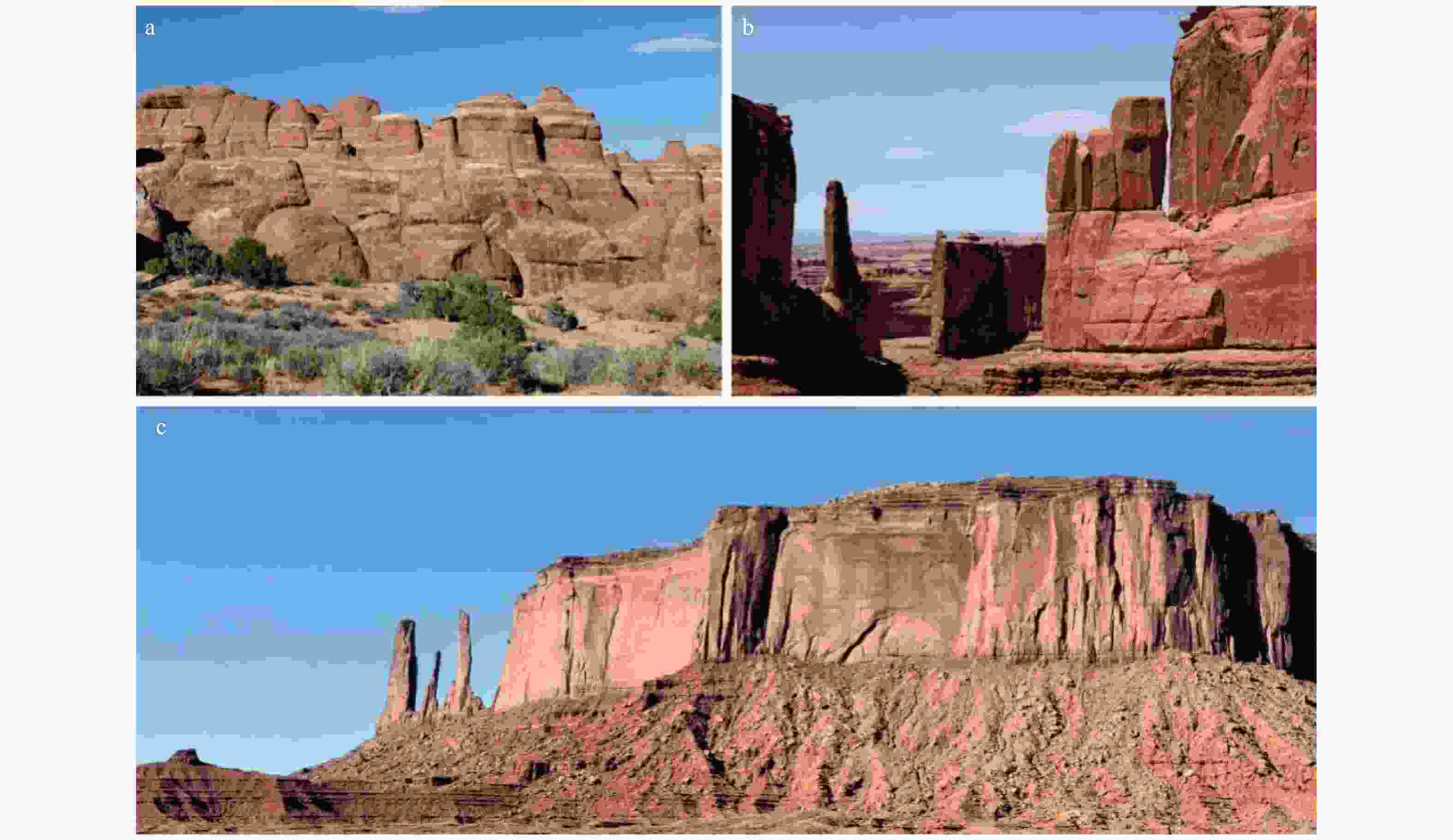
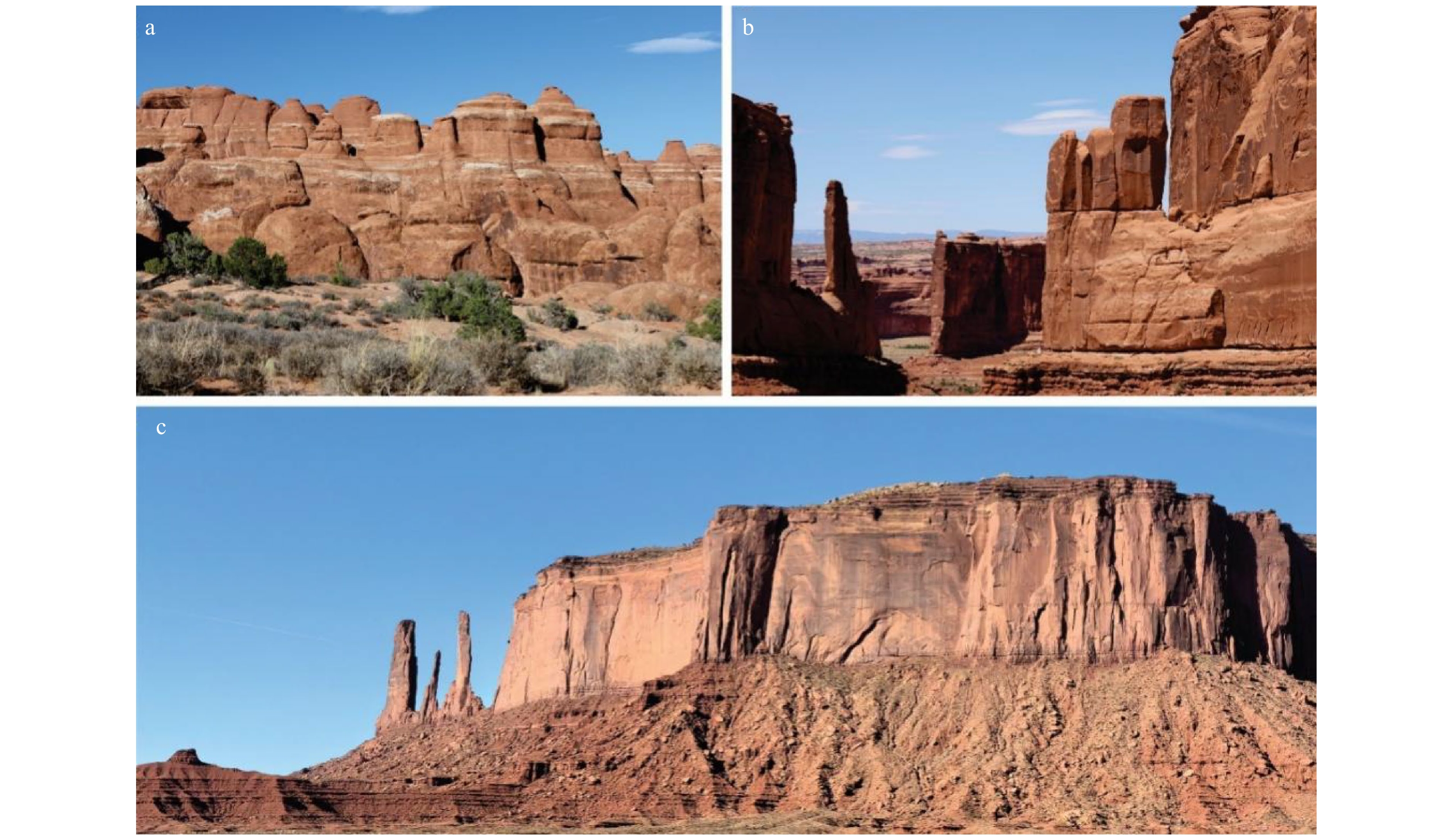
图 1 顺着垂直节理的侵蚀作用雕塑出Navajo 砂岩地区壮观的地貌
a—c—位于美国犹他州的纪念碑谷
Figure 1. Striking landscapes sculpted by erosion along vertical joints in Navajo Sandstone beds
(a–c) Monument Valley, Utah, USA
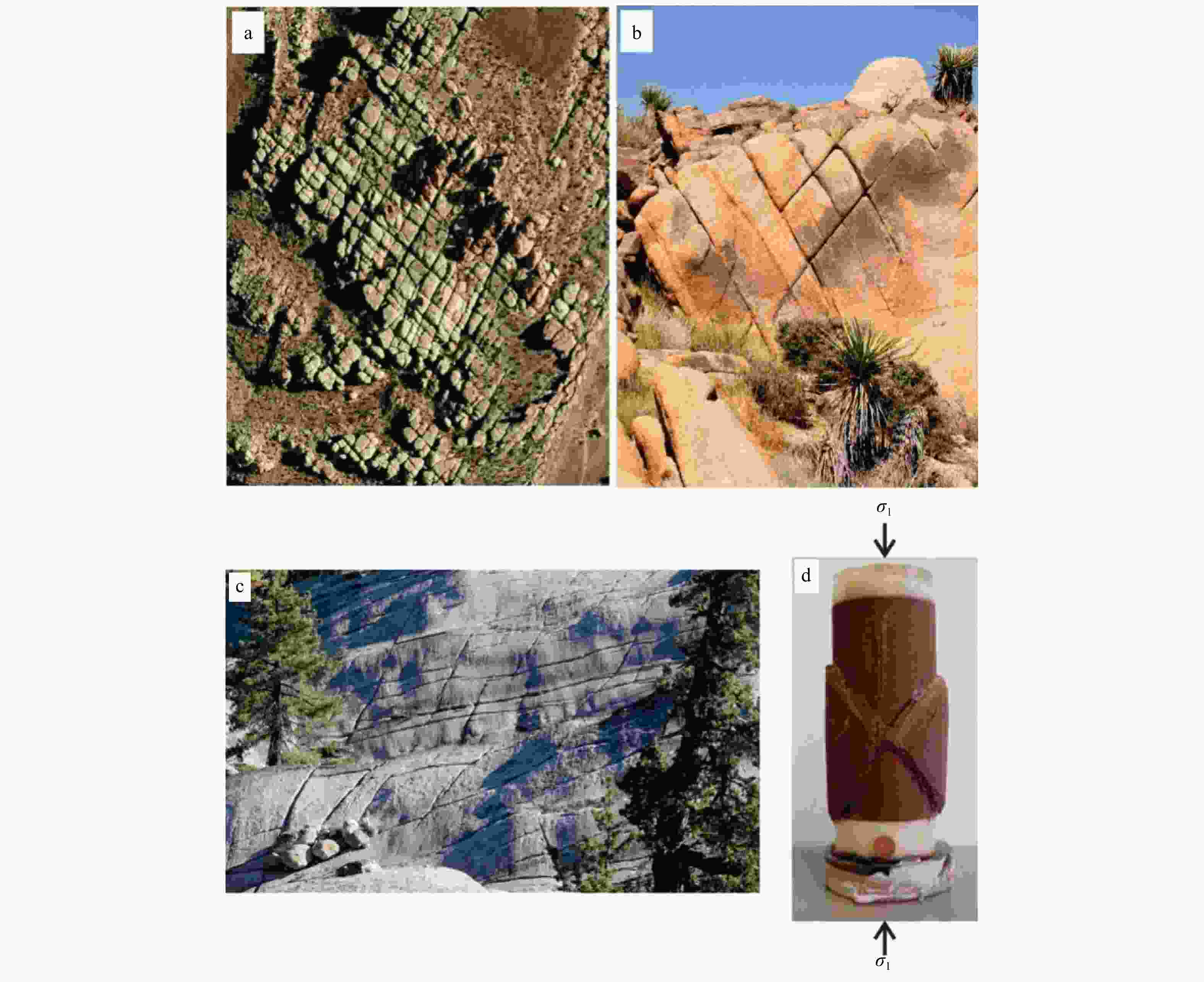
图 2 共轭剪节理
a—美国犹他州峡谷地国家公园砂岩中的共轭剪切节理 (Fossen, 2016);b—美国加利福尼亚州约书亚树国家公园 Split Rock 区砂岩中的共轭剪节理;c—加利福尼亚州优胜美地国家公园花岗岩中的共轭剪节理;d—实验变形岩石样品中形成的共轭剪节理
Figure 2. Conjugate shear joints
(a) Aerial view, Canyonlands National Park, Utah, USA (after Fossen, 2016); (b) In sandstone, Split Rock area, Joshua Tree National Park, California, USA; (c) In granite, Yosemite National Park, California, USA; (d) In an experimental rock specimen
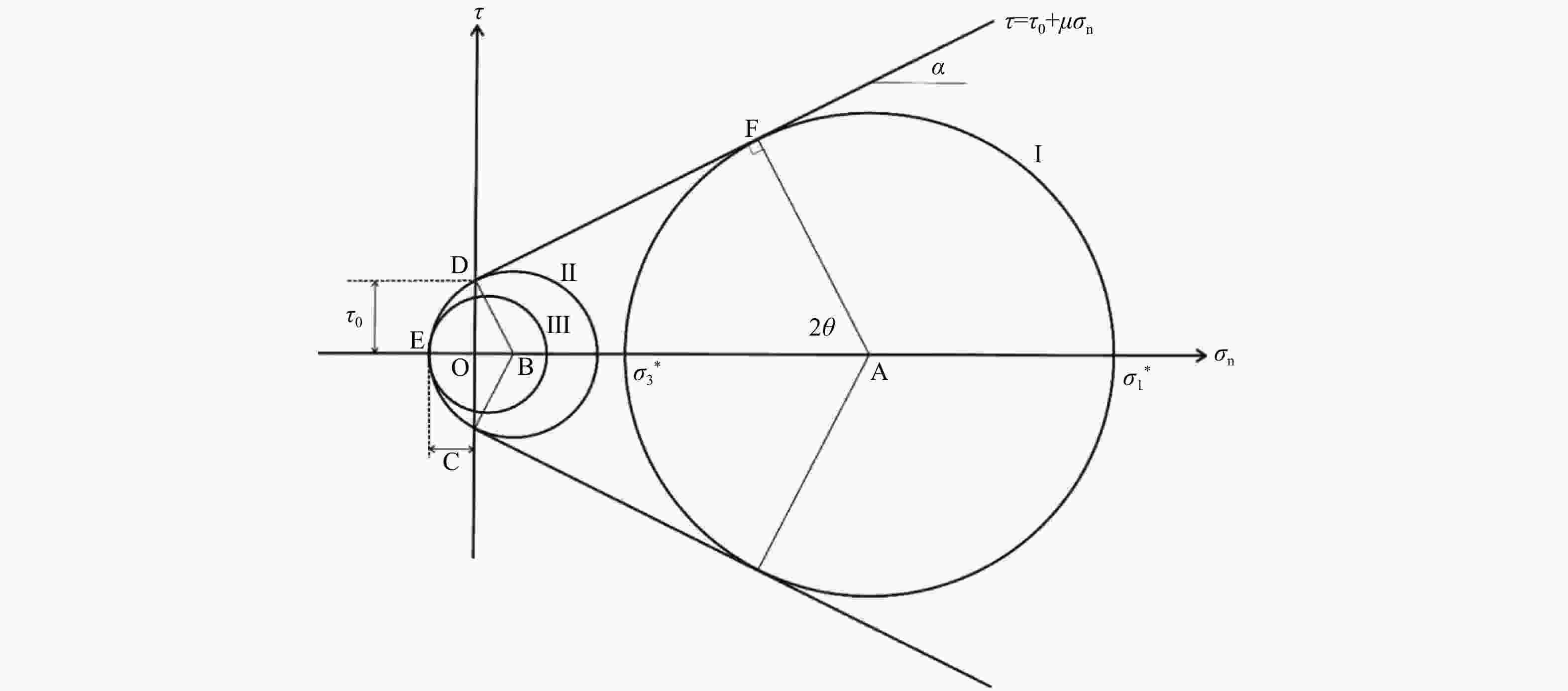
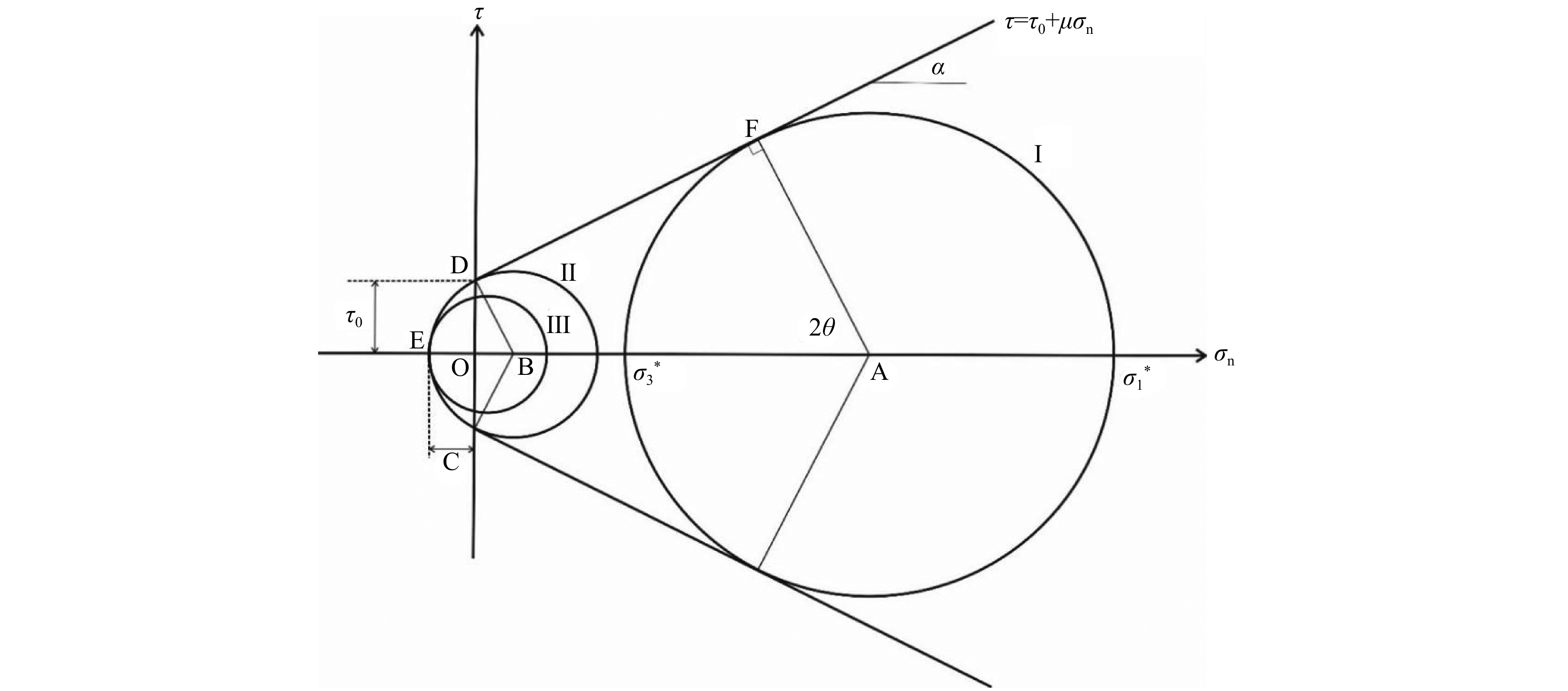
图 3 摩尔圆,表示共轭剪节理(I)与张节理(III)的形成条件
图中摩尔圆 II 表示共轭剪节理形成所需的最小差应力,其推导过程见正文;图中还标出了摩擦定律 τ = τ0 + μσn,其中,σn 和 τ 分别为正应力和剪应力;σ1* 和 σ3* 分别为最大和最小有效主应力。C 表示岩石抗张强度;τ0 为 σn = 0 时岩石的剪切强度(内聚力);α 为内摩擦角;θ 为共轭剪节理锐角二面角的一半
Figure 3. Mohr diagrams illustrating the conditions for the formation of conjugate shear joints (I) and tensile joints (III)
The minimum differential stress required for the formation of conjugate shear joints, represented by Mohr circle II, is derived in the text. The friction law, τ=τ0+μσn, is also shown. Here, σn and τ are the normal and shear stresses, respectively; σ1* and σ3* are the maximum and minimum effective principal stresses. C represents the tensile strength while τ0 is the shear strength (cohesion) at σn = 0. α denotes the internal friction angle, and θ is half of the acute dihedral angle between the conjugate shear joints.
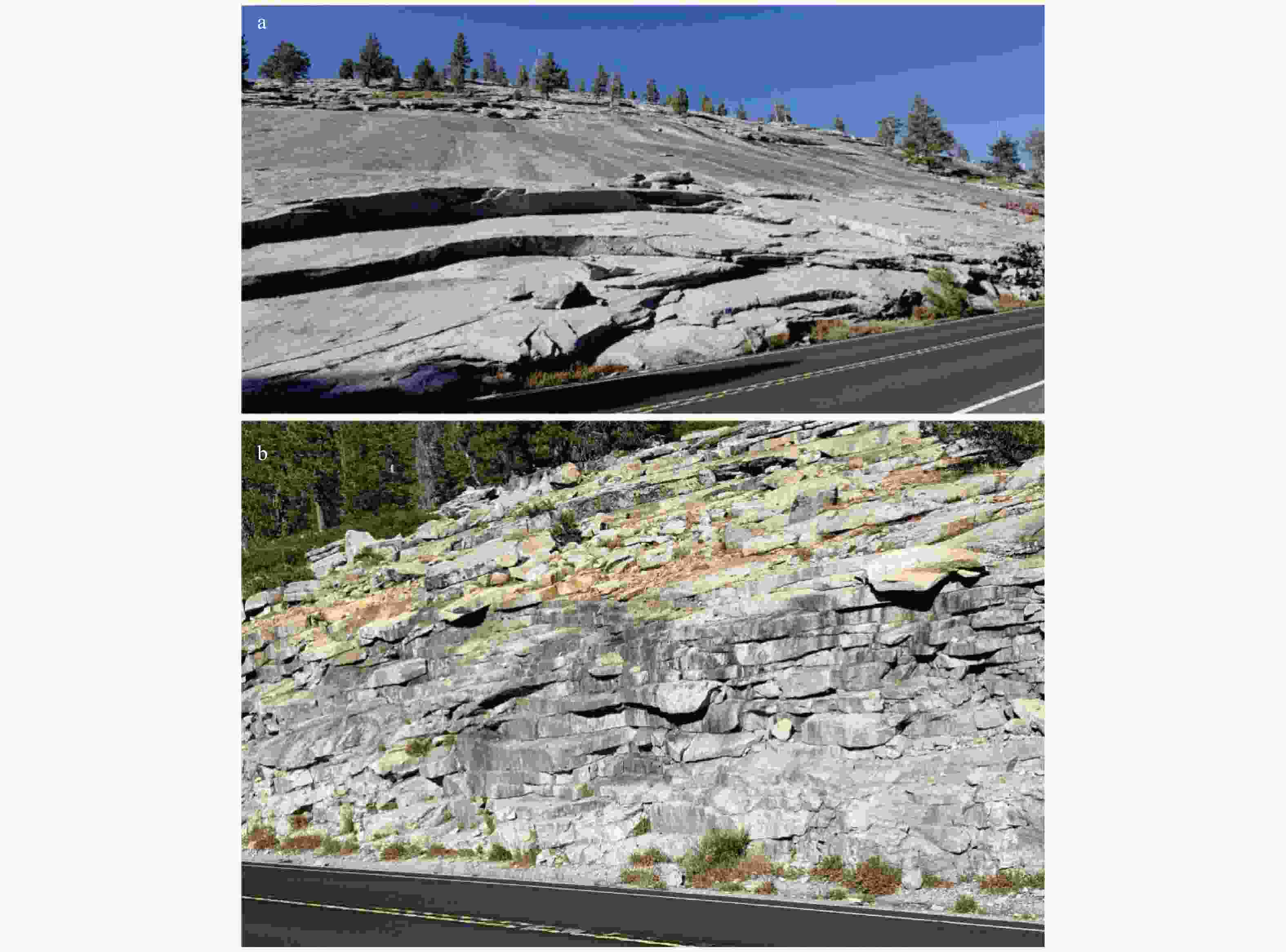
图 4 美国加利福尼亚州优胜美地国家公园内花岗岩中平行地表的剥蚀节理
a—小比例尺的宏观观察;b—大比例尺的详细观察,花岗岩因剥蚀作用呈现出逐层剥离的特征
Figure 4. Exfoliation joints of granitic rocks conformable to the topographic surface, Yosemite National Park, California, USA
(a) Macroscopic view at a smaller scale; (b) Detailed view at a larger scale. The granite exhibits progressive sheet-like separation due to exfoliation
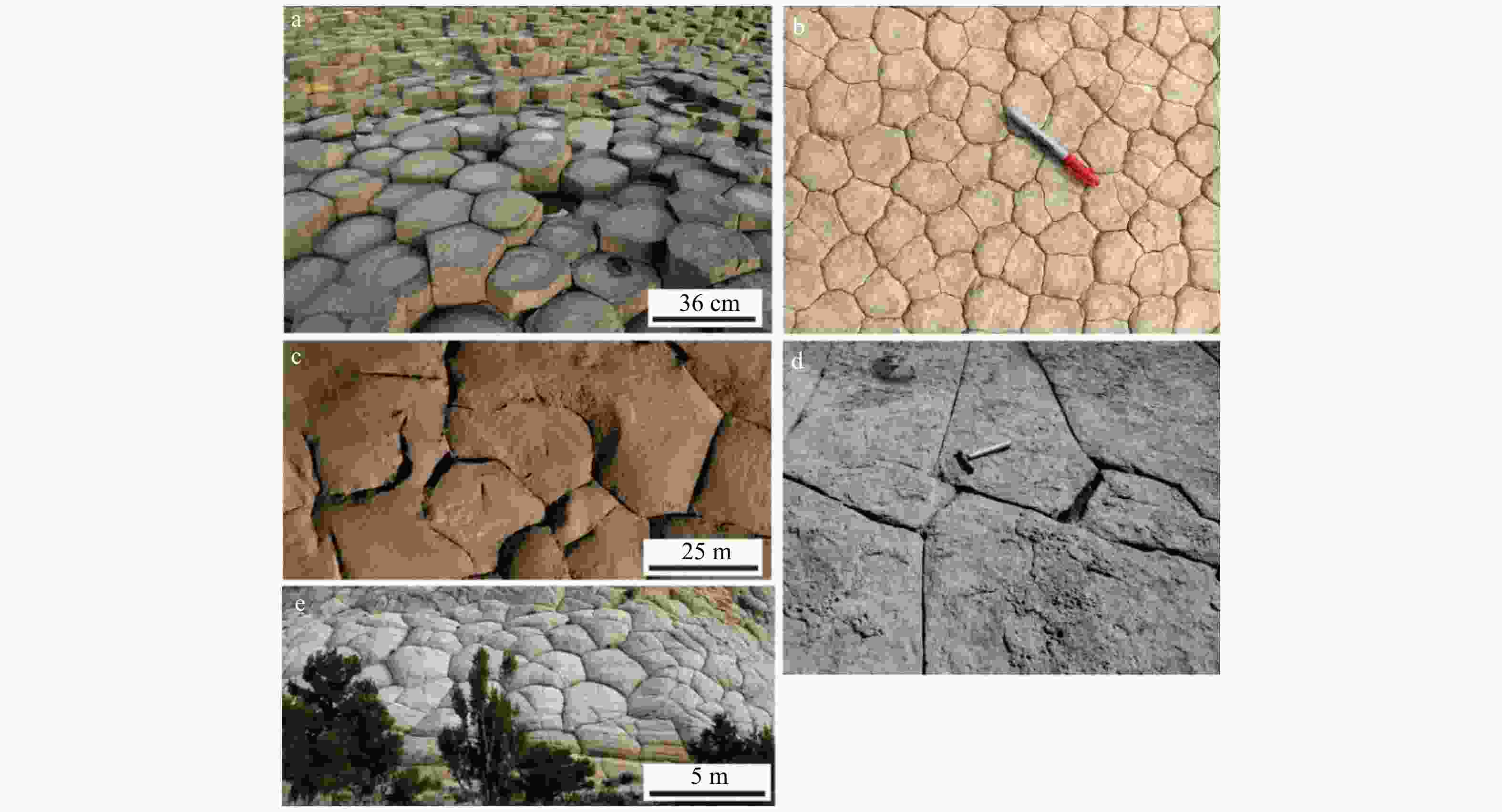
图 5 多边形柱状节理
a—北爱尔兰巨人堤玄武岩中的柱状节理;b—干旱形成的泥裂;c—火星Gordii Dorsum地区Medusae Fossae 永久冻土中的柱状节理(NASA);d—加拿大魁北克 Havre-Saint-Pierre 石灰岩中的柱状节理;e—美国亚利桑那州 Vermilion Cliffs 国家纪念区 White Pocket 砂岩中的柱状节理
Figure 5. Columnar joints (a) In basalt at the Giant’s Causeway, Northern Ireland; (b) In desiccated mud; (c) In the Gordii Dorsum region of the Medusae Fossae Formation on Mars (NASA); (d) In limestone at Havre-Saint-Pierre, Québec, Canada; (e) In sandstone at White Pocket, Vermilion Cliffs National Monument, Arizona, USA
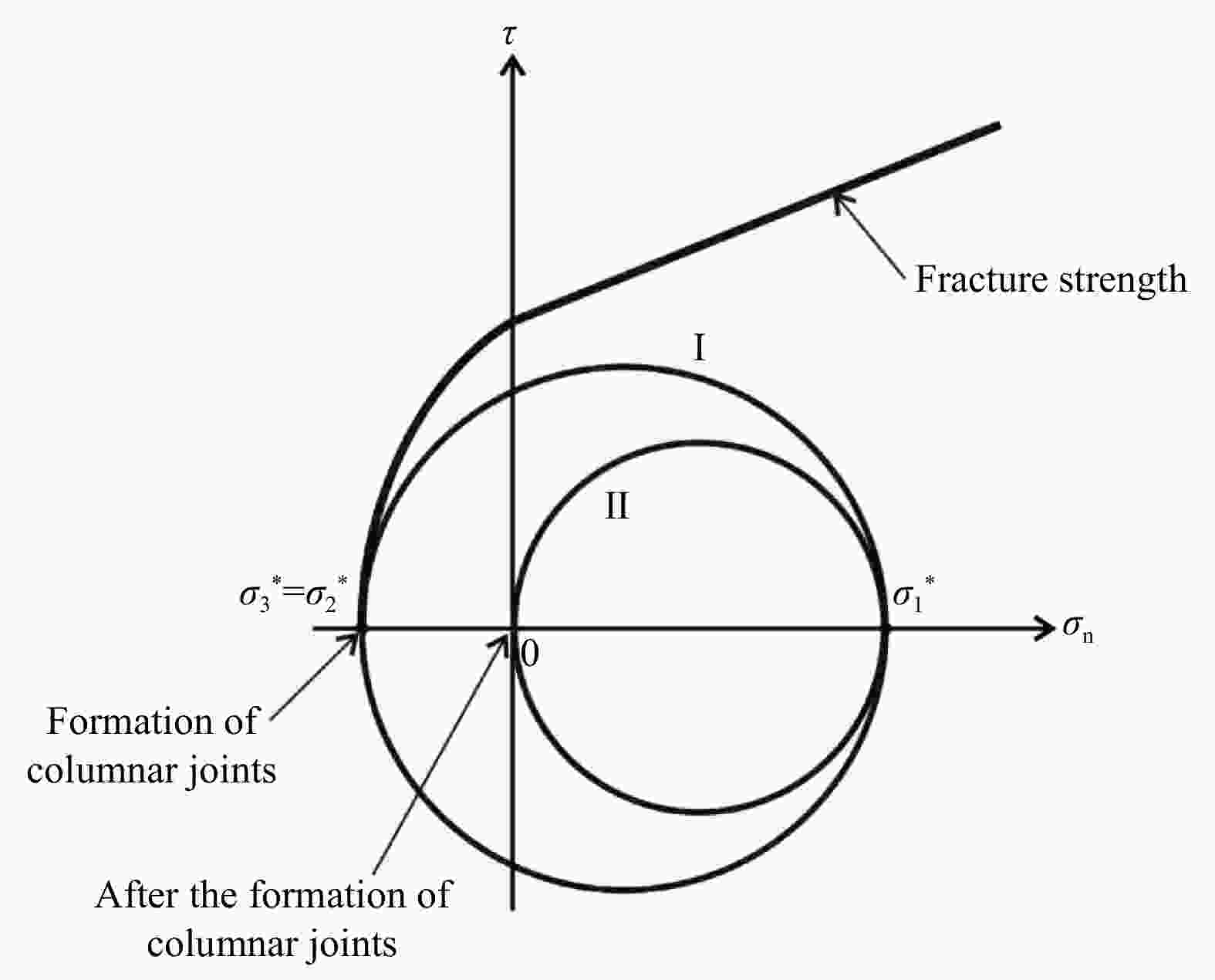
图 6 摩尔圆,表示柱状节理的形成条件(圆 I),以及形成后应力释放(圆 II)。多边形节理网络的发育需要出现双轴应力状态(σ1* > 0 > σ2* = σ3*)
Figure 6. Mohr diagrams illustrating the conditions for columnar joint formation (circle I), and the subsequent stress release represented by circle II. The development of a polygonal joint network requires a biaxial stress state (σ1*>0>σ2*=σ3*)
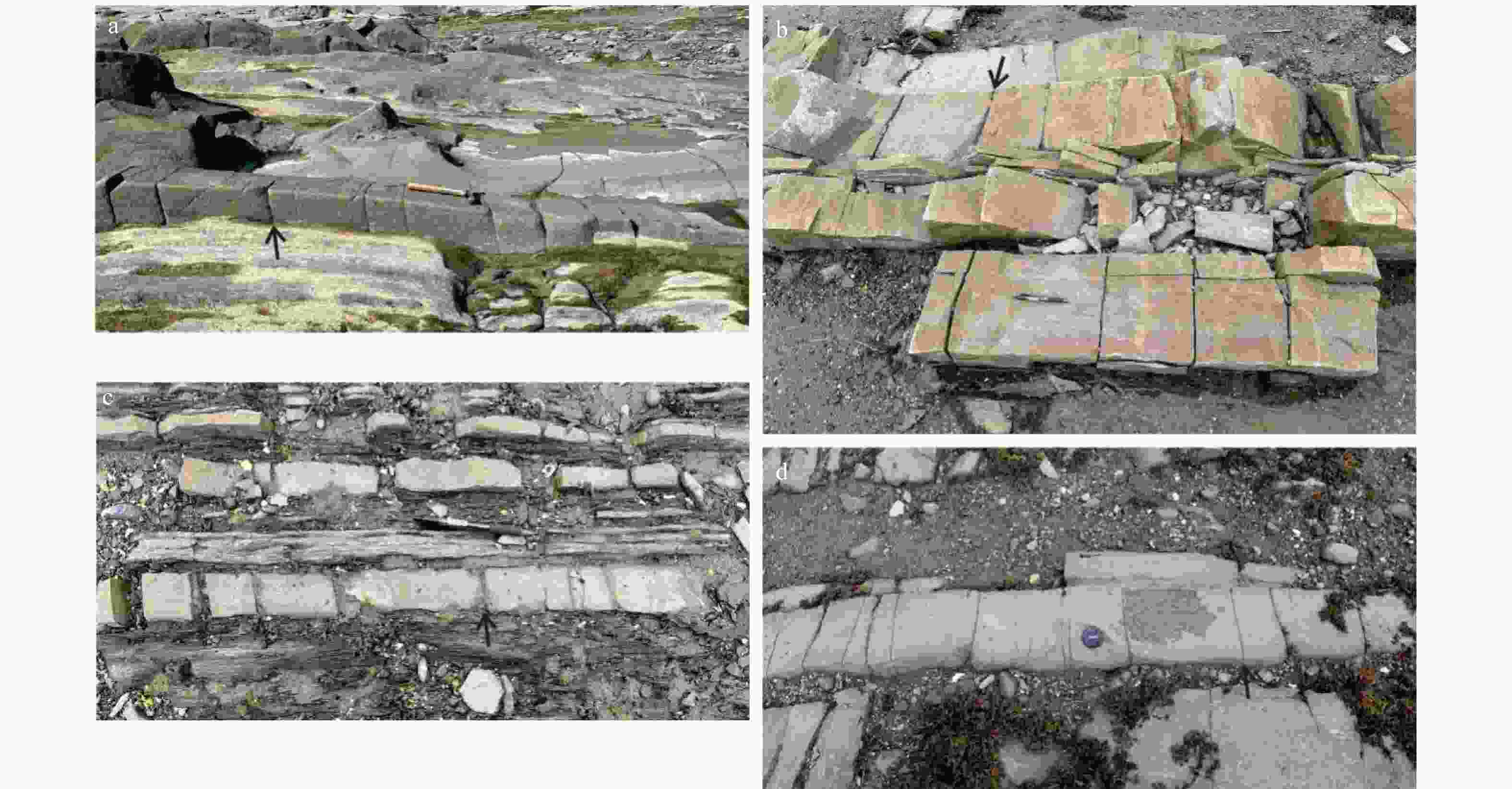
图 7 加拿大魁北克 Humber 构造带杂砂岩中规则分布的空节理(无矿物沉淀与充填)
a—GPS 坐标: 47.23664° N、70.24473° W;b、c—GPS 坐标:48.66334° N、68.07307° W;d—GPS 坐标:49.02436° N、66.92561° W
Figure 7. Typical examples of regularly spaced opening-mode fractures (barren joints) in graywacke beds from the Humber Zone, Quebec, Canada (a) GPS coordinates: 47.23664° N, 70.24473° W; (b) and (c) GPS coordinates: 48.66334° N, 68.07307° W); (d) GPS coordinates: 49.02436° N, 66.92561° W
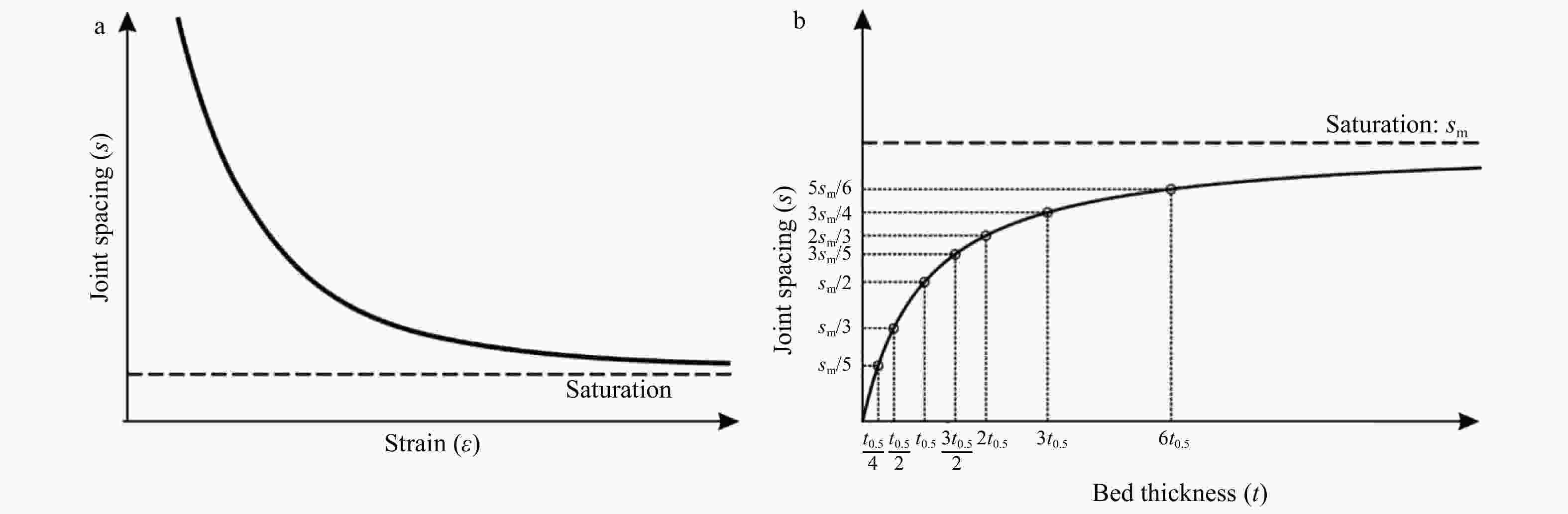
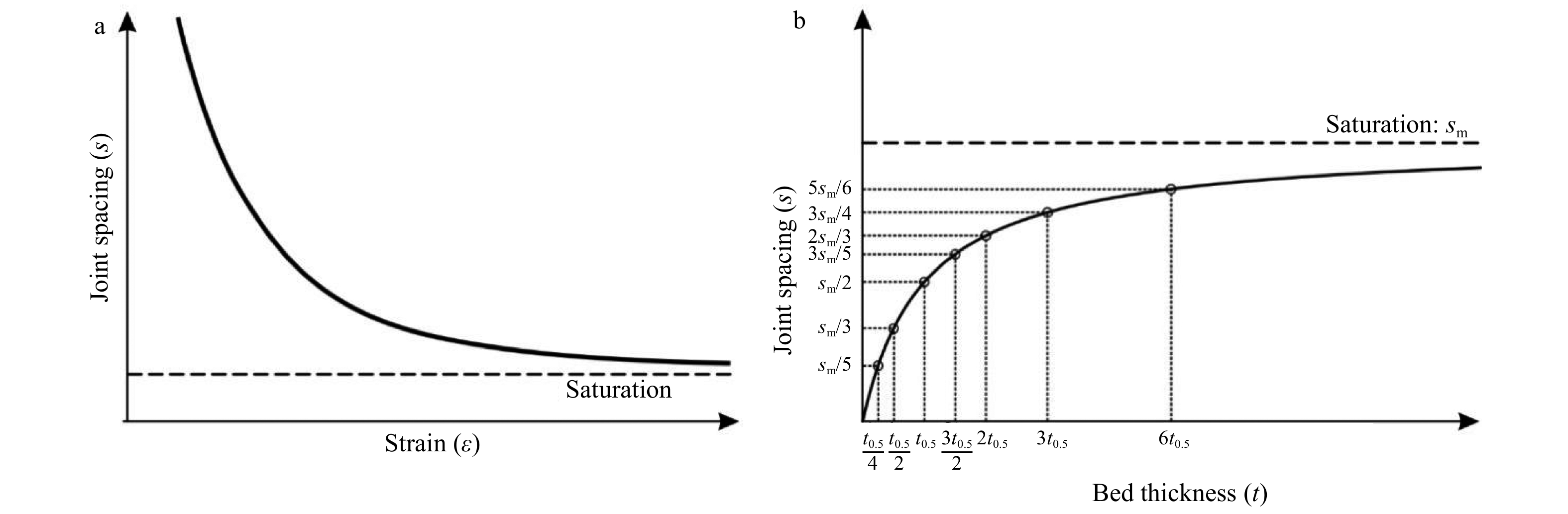
图 8 节理饱和的两类模式
a—第一类,即使延伸应变增加,节理间距不再减小;b—第二类,随着层厚继续增加,节理间距不再增大
Figure 8. Two types of joint saturation
(a) Type 1 — joint spacing no longer decreases despite increasing elongation strain; (b) Type 2 — joint spacing no longer increases with increasing bed thickness
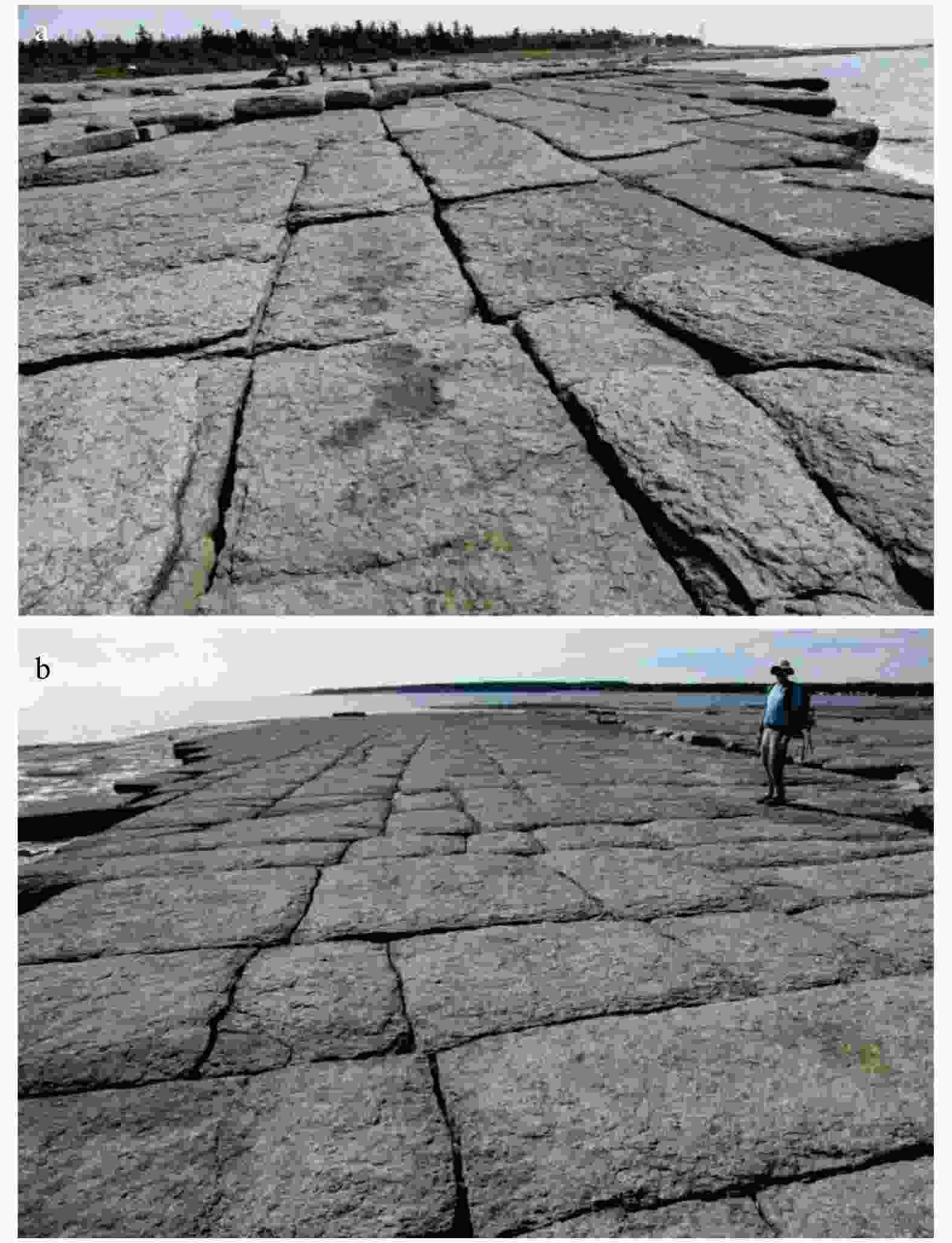
图 9 加拿大魁北克 Havre-Saint-Pierre 附近层理水平的石灰岩层中的正交节理
a—系统节理 (J1) 产状:190° ∠88°;b—交叉节理 (J2) 产状:277° ∠89°
Figure 9. Typical orthogonal joints in flat-lying limestone beds near Havre-Saint-Pierre, Quebec, Canada
(a) Systematic joints (J1) with an attitude of 190° ∠88°; (b) Cross joints (J2) with an attitude of 277° ∠89°
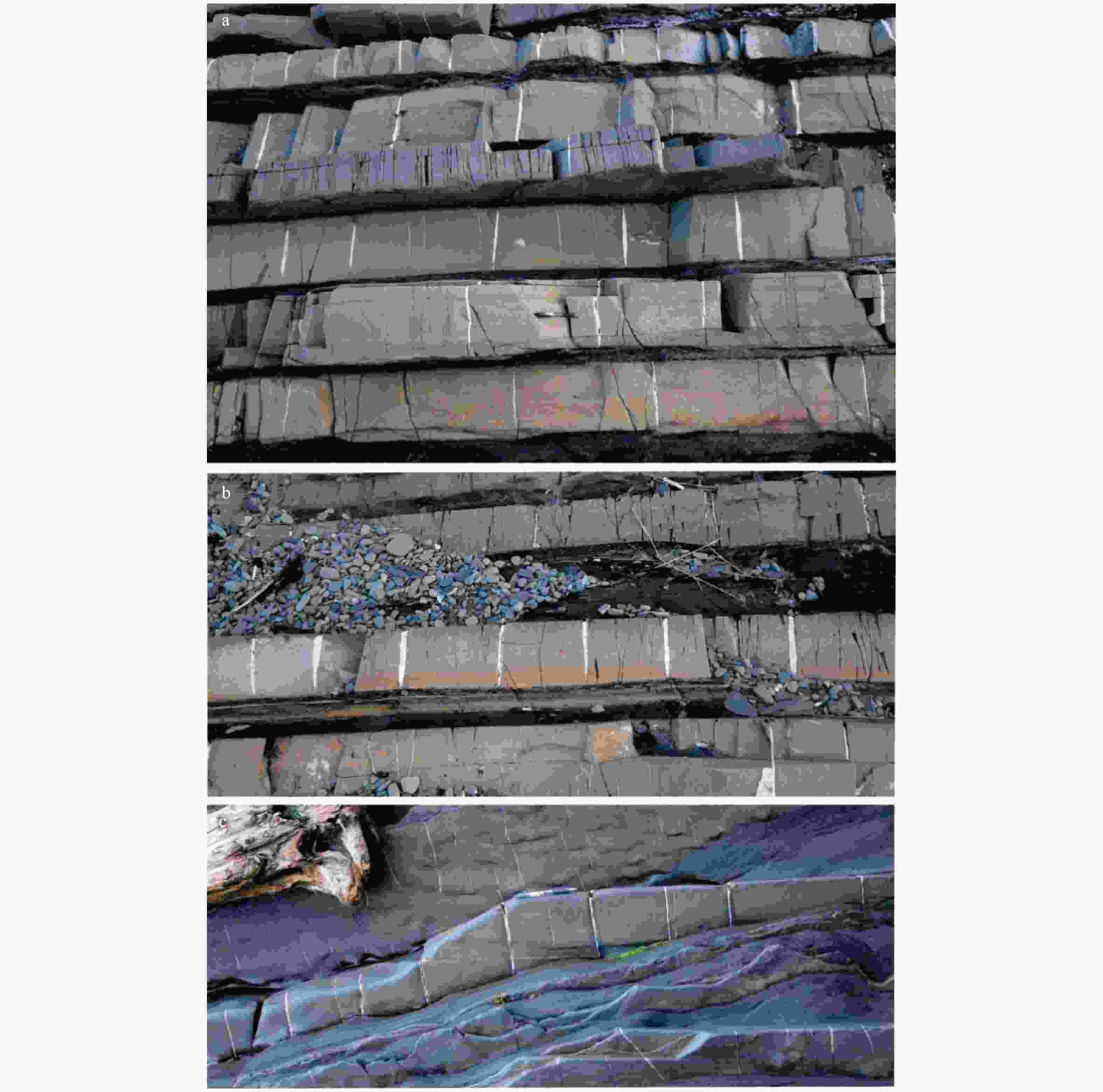
图 12 加拿大魁北克 Humber 构造带内杂砂岩层中的层控碳酸盐岩脉,岩脉既可呈透镜状也可呈半透镜状
a、b—Anse aux Canons (GPS坐标:49.205352° N,64.926919° W);c—Grand-Étang (GPS 坐标:49.13882° N,64.74263° W)
Figure 12. Typical stratabound carbonate veins in graywacke beds from the Humber Zone, Quebec, Canada, showing both lenticular and semi-lens–shaped veins.
(a) and (b) Anse aux Canons (GPS coordinates: 49.205352° N,64.926919° W); (c) Grand-Étang (GPS coordinates: 49.13882° N,64.74263° W)
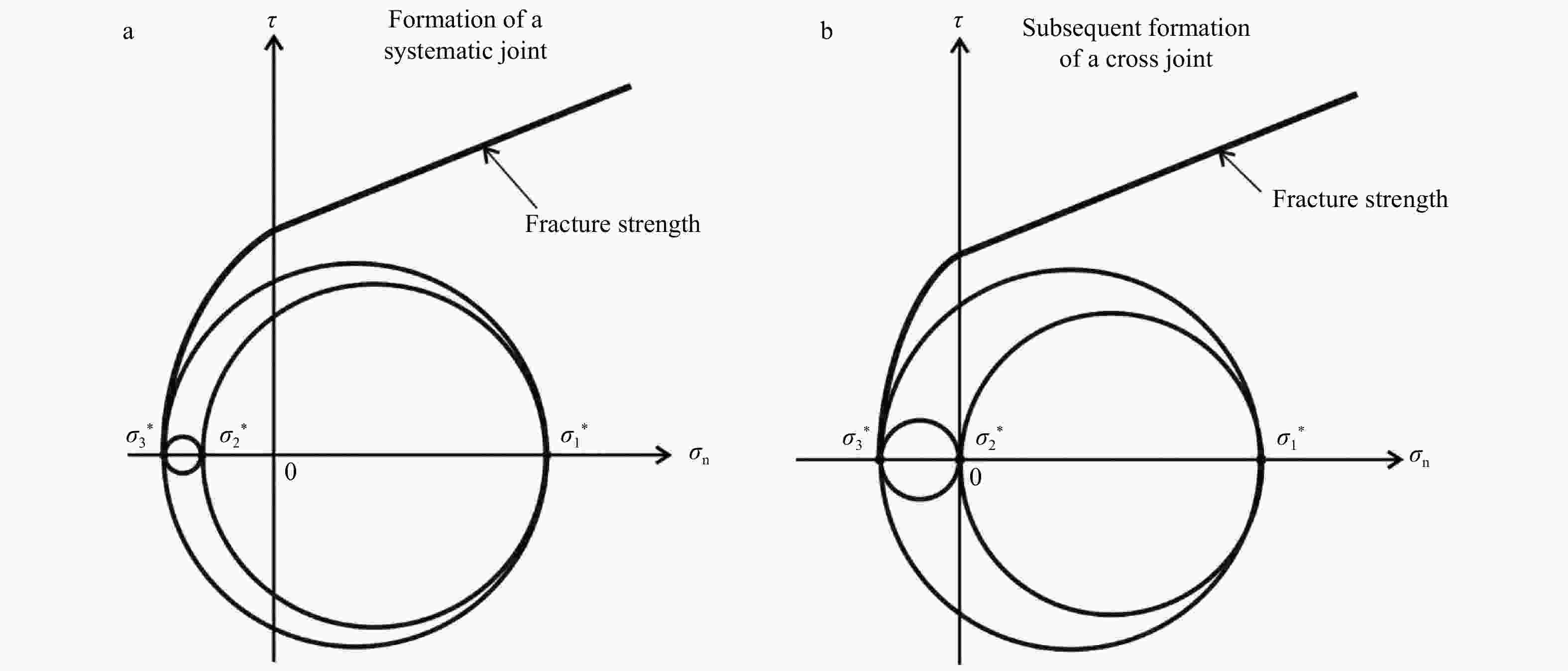
图 10 摩尔圆,表示正交节理形成的概念模型,其中应力释放引起 σ2* 与 σ3* 交换,在新形成的主节理上产生零应力状态
a—主节理开始形成时的应力状态;b—主节理形成后的应力状态,此时横节理开始发育
Figure 10. Mohr diagrams illustrating a conceptual model for the formation of cross joints, in which stress relief induces a swap between σ2* and σ3*, creating a zero-stress state along a newly formed systematic joint
(a) Stress state at the onset of systematic joint formation; (b) Stress state immediately after the joint has formed, during the initiation of cross-joint development
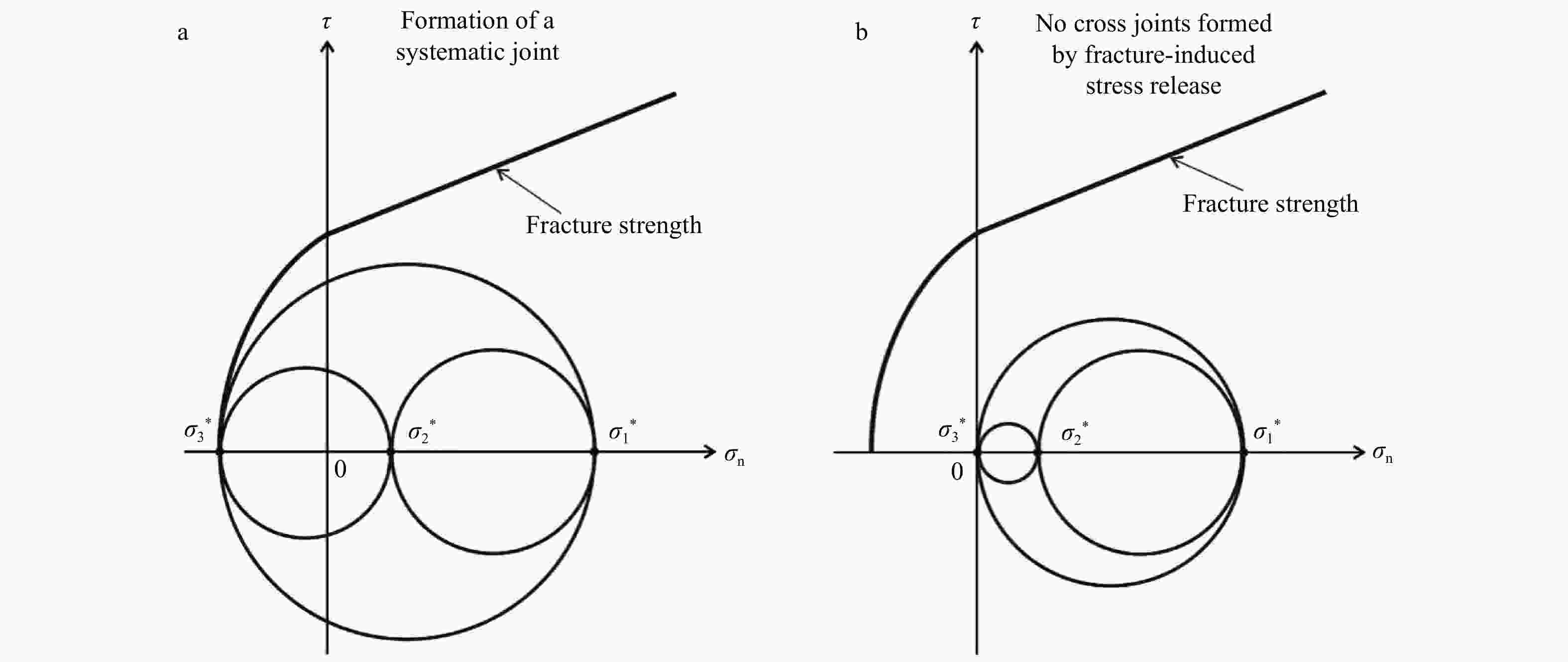
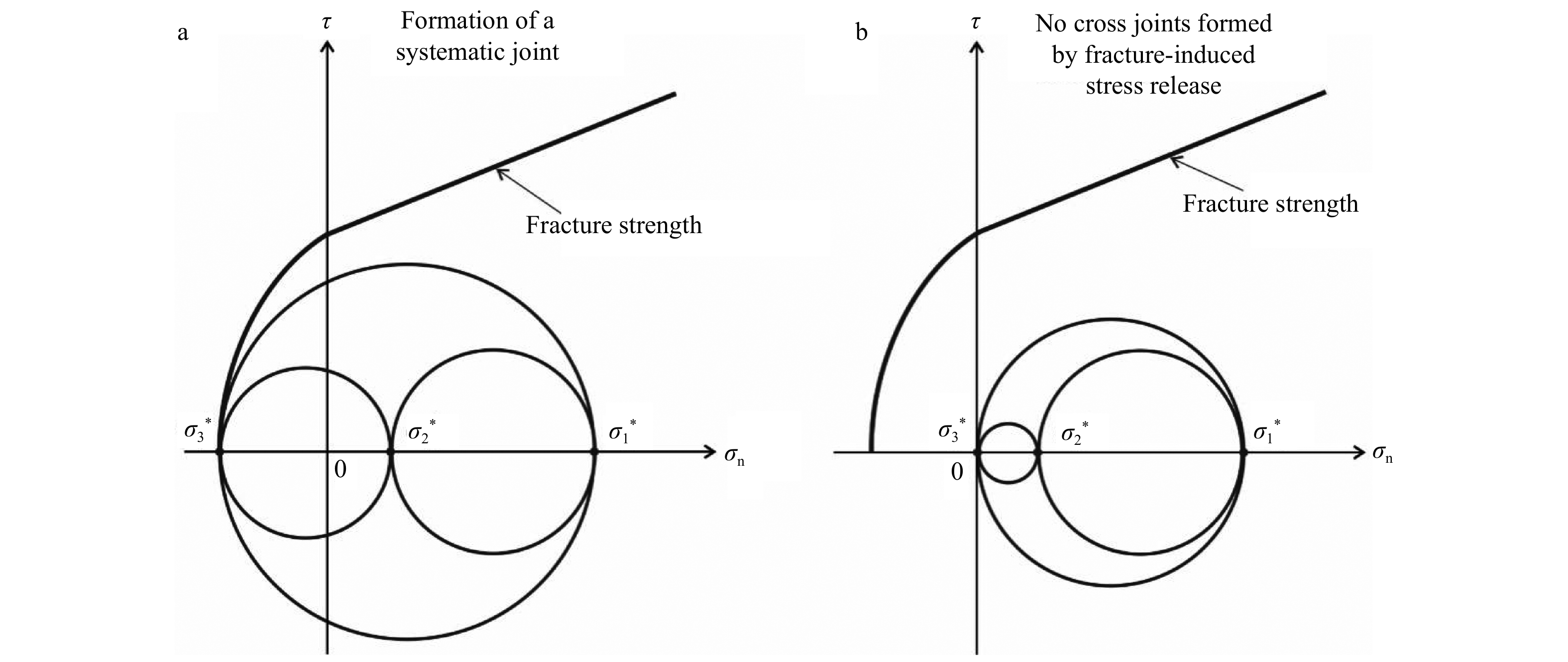
图 11 摩尔圆,表示只有主节理形成却无横节理形成的应力状态
a—主节理形成瞬间的应力状态 σ1* > σ2* > 0 > σ3*;b—主节理形成后的应力状态:σ1* > σ2* > σ3* = 0,从而阻止横节理的发育
Figure 11. Mohr diagrams illustrating the stress states associated with the formation of tensile joints without accompanying cross joint
(a) σ1*>σ2*>0>σ3* at the moment of systematic (J1) joint formation; (b) Stress state immediately after the formation of the systematic joint, in which fracture-induced stress relief produces σ1*>σ2*>σ3*=0, preventing the development of cross joints
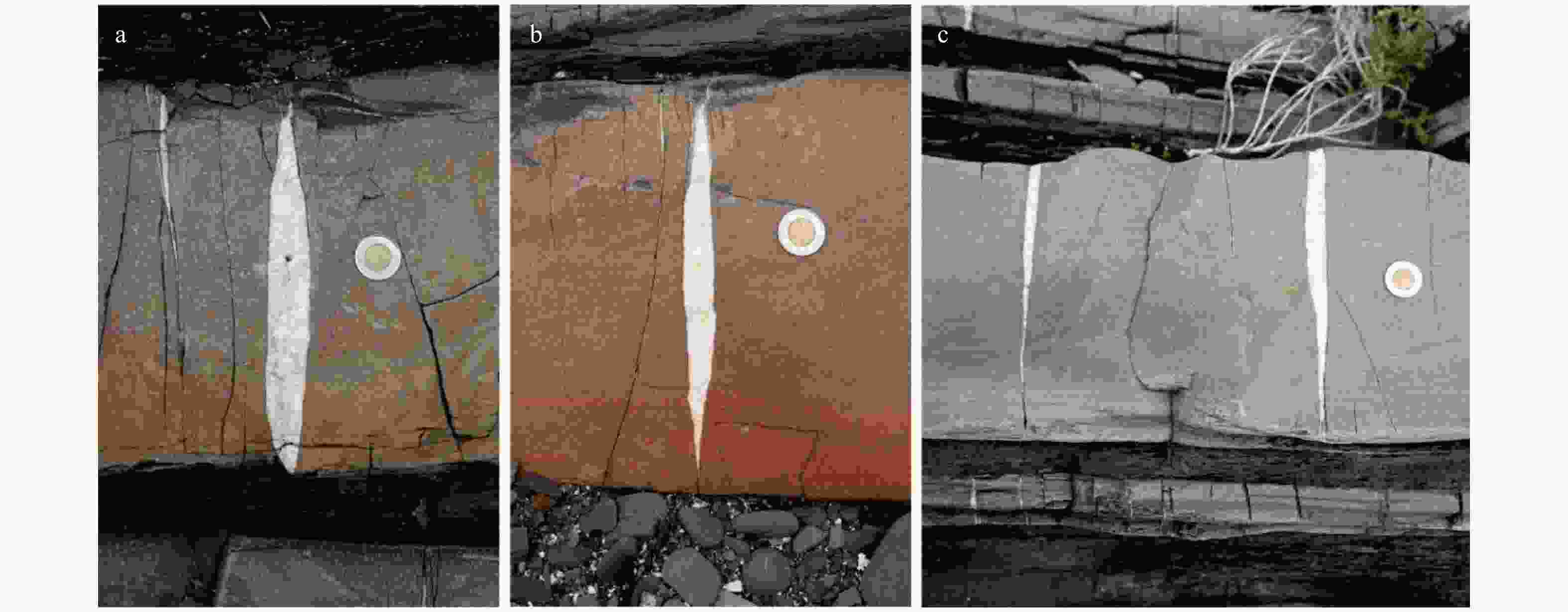
图 13 加拿大魁北克省圣劳伦斯河南岸杂砂岩中透镜状和半透镜状方解石脉
a、b—透镜状方解石脉;c—半透镜状方解石脉
Figure 13. Lens-shaped and semi-lens-shaped calcite veins in the graywacke beds on the south bank of the St. Lawrence River, Quebec, Canada
(a) and (b) Lens-shaped calcite veins; (c) Semi-lens-shaped calcite veins
Table 1. Glossary of symbols used in the paper
Symbol Glossary C tensile strength CV coefficient of variation E Young’s modulus Ef Young’s modulus of competent layer g gravitational acceleration Gm shear modulus of incompetent layer J joint k Weibull modulus Pf pressure of fluid s spacing of joints or veins sm maximum joint spacing t thickness of bed t0.5 the layer thickness at which s=0.5sm V vein w thickness of vein z depth α internal friction angle δ strength recovery coefficient ε strain θ half of the dihedral angle between conjugate joints λ pore-fluid factor μ coefficient of friction ν Poisson’s ratio ρ density σ* effective stress σ1 maximum principal stress σ2 middle principal stress σ3 minimum principal stress σn normal stress τ shear stress τ0 cohesion of rock  下载: 导出CSV
-
ABEN F M, DOAN M L, GRATIER J P, et al., 2017. Experimental postseismic recovery of fractured rocks assisted by calcite sealing[J]. Geophysical Research Letters, 44(14): 7228-7238. doi: 10.1002/2017GL073965 ANGELIER J, SOUFFACHE B, BARRIER E, et al., 1989. Distribution de joints de tension dans un banc rocheux: loi théorique et espacements[J]. Comptes Rendus de l’Académie des Sciences, Series II, 309: 2119-2125. AYDAN Ö, KAWAMOTO T, 1990. Discontinuities and their effect on rock mass[C]//Proceedings of the international symposium on rock joints. Rotterdam: A. A. Balkema: 149-156. BAI T X, POLLARD D D, 2000. Fracture spacing in layered rocks: a new explanation based on the stress transition[J]. Journal of Structural Geology, 22(1): 43-57. doi: 10.1016/S0191-8141(99)00137-6 BAI T X, MAERTEN L, GROSS M R, et al., 2002. Orthogonal cross joints: do they imply a regional stress rotation?[J]. Journal of Structural Geology, 24(1): 77-88. doi: 10.1016/S0191-8141(01)00050-5 BAO H, ZHAI Y, LAN H X, et al., 2019. Distribution characteristics and controlling factors of vertical joint spacing in sand-mud interbedded strata[J]. Journal of Structural Geology, 128: 103886. doi: 10.1016/j.jsg.2019.103886 BARDSLEY W E, MAJOR T J, SELBY M J, 1990. Note on a Weibull property for joint spacing analysis[J]. International Journal of Rock Mechanics and Mining Sciences & Geomechanics Abstracts, 27(2): 133-134. BAŽANT Z P, 2000. Size effect[J]. International Journal of Solids and Structures, 37(1-2): 69-80. doi: 10.1016/S0020-7683(99)00077-3 BILLI A, PORRECA M, FACCENNA C, et al., 2006. Magnetic and structural constraints for the noncylindrical evolution of a continental forebulge (Hyblea, Italy)[J]. Tectonics, 25(3): TC3011. BOERSMA Q, HARDEBOL N, BARNHOORN A, et al., 2018. Mechanical factors controlling the development of orthogonal and nested fracture network geometries[J]. Rock Mechanics and Rock Engineering, 51(11): 3455-3469. doi: 10.1007/s00603-018-1552-8 BOUCHEZ J L, NICOLAS A, 2021. Principles of rock deformation and tectonics[M]. New York: Oxford University Press. BRANAGAN D F, 1983. Tesselated pavements[M]//YOUNG R W, NANSON G C. Aspects of Australian sandstone landscapes. Wales, Australia: University of Wollongong: 11-20. BRIDGES M C, 1975. Presentation of fracture data for rock mechanics[C]//Proceedings of the 2nd Australia–New Zealand conference on geomechanics. Brisbane, Australia: International Society for Soil Mechanics and Geotechnical Engineering: 144-148. BROOKS CLARK M, BRANTLEY S L, FISHER D M, 1995. Power-law vein-thickness distributions and positive feedback in vein growth[J]. Geology, 23(11): 975-978. doi: 10.1130/0091-7613(1995)023<0975:PLVTDA>2.3.CO;2 BYERLEE J, 1978. Friction of rocks[J]. Pure and Applied Geophysics, 116(4-5): 615-626. doi: 10.1007/BF00876528 CAPUTO R, 1995. Evolution of orthogonal sets of coeval extension joints[J]. Terra Nova, 7(5): 479-490. doi: 10.1111/j.1365-3121.1995.tb00549.x CAPUTO R, 2010. Why joints are more abundant than faults: a conceptual model to estimate their ratio in layered carbonate rocks[J]. Journal of Structural Geology, 32(9): 1257-1270. doi: 10.1016/j.jsg.2009.05.011 CHEMENDA A I, 2022. Bed thickness-dependent fracturing and inter-bed coupling define the nonlinear fracture spacing–bed thickness relationship in layered rocks: numerical modeling[J]. Journal of Structural Geology, 165: 104741. doi: 10.1016/j.jsg.2022.104741 CHEN T T, FOULGER G R, TANG C A, et al., 2022. Numerical investigation on origin and evolution of polygonal cracks on rock surfaces[J]. Engineering Geology, 311: 106913, doi: 10.1016/j.enggeo.2022.106913 CHI G, LAVOIE D, BERTRAND R, 2000. Regional-scale variation of characteristics of hydrocarbon fluid inclusions and thermal conditions along the Paleozoic Laurentian continental margin in eastern Quebec, Canada[J]. Bulletin of Canadian Petroleum Geology, 48(3): 193-211. doi: 10.2113/48.3.193 CILONA A, AYDIN A, LIKERMAN J, et al., 2016. Structural and statistical characterization of joints and multi-scale faults in an alternating sandstone and shale turbidite sequence at the Santa Susana Field Laboratory: implications for their effects on groundwater flow and contaminant transport[J]. Journal of Structural Geology, 85: 95-114. doi: 10.1016/j.jsg.2016.02.003 CLYNE T W, WITHERS P J, 1993. An introduction to metal matrix composites[M]. Cambridge, UK: Cambridge University Press. COOKE M L, SIMO J A, UNDERWOOD C A, et al., 2006. Mechanical stratigraphic controls on fracture patterns within carbonates and implications for groundwater flow[J]. Sedimentary Geology, 184(3-4): 225-239. doi: 10.1016/j.sedgeo.2005.11.004 DE MELO M S, COIMBRA A M, 1996. Ruiniform relief in sandstones: the examples of Vila Velha, Carboniferous of the Paraná Basin, southern Brazil[J]. Acta Geologica Hispanica, 31(4): 25-40. DOMOKOS G, JEROLMACK D J, KUN F, et al., 2020. Plato’s cube and the natural geometry of fragmentation[J]. Proceedings of the National Academy of Sciences of the United States of America, 117(31): 18178-18185. DUNNE WM, NORTH C P, 1990. Orthogonal fracture systems at the limits of thrusting: an example from southwestern Wales[J]. Journal of Structural Geology, 12(2): 207-215. doi: 10.1016/0191-8141(90)90005-J ENGELDER T, FISCHER M P, 1996. Loading configurations and driving mechanisms for joints based on the Griffith energy-balance concept[J]. Tectonophysics, 256(1-4): 253-277. doi: 10.1016/0040-1951(95)00169-7 ETHERIDGE M A, 1983. Differential stress magnitudes during regional deformation and metamorphism: upper bound imposed by tensile fracturing[J]. Geology, 11(4): 231-234. doi: 10.1130/0091-7613(1983)11<231:DSMDRD>2.0.CO;2 FAGERENG Å, 2011. Fractal vein distributions within a fault-fracture mesh in an exhumed accretionary mélange, Chrystalls Beach Complex, New Zealand[J]. Journal of Structural Geology, 33(5): 918-927. doi: 10.1016/j.jsg.2011.02.009 FERRILL D A, SMART K J, CAWOOD A J, et al., 2021. The fold-thrust belt stress cycle: superposition of normal, strike-slip, and thrust faulting deformation regimes[J]. Journal of Structural Geology, 148: 104362. doi: 10.1016/j.jsg.2021.104362 FISCHER M P, POLANSKY A, 2006. Influence of flaws on joint spacing and saturation: results of one-dimensional mechanical modeling[J]. Journal of Geophysical Research: Solid Earth, 111(B7): B07403, doi: 10.1029/2005JB004115 FOSSEN H, 2016. Structural geology[M]. 2nd ed. Cambridge: Cambridge University Press. GILLESPIE P A, JOHNSTON J D, LORIGA M A, et al. , 1999. Influence of layering on vein systematics in line samples[M]//MCCAFFREY K, LONERGAN L, WILKINSON J. Fractures, fluid flow and mineralization. London: Geological Society, Special Publications, 155(1): 35-56. GONG F Q, ZHAO G F, 2014. Dynamic indirect tensile strength of sandstone under different loading rates[J]. Rock Mechanics and Rock Engineering, 47(6): 2271-2278. doi: 10.1007/s00603-013-0503-7 GROSS M R, 1993. The origin and spacing of cross joints: examples from the Monterey Formation, Santa Barbara Coastline, California[J]. Journal of Structural Geology, 15(6): 737-751. doi: 10.1016/0191-8141(93)90059-J GROSS M R, ENGELDER T, 1995. Strain accommodated by brittle failure in adjacent units of the Monterey Formation, U. S. A. : scale effects and evidence for uniform displacement boundary conditions[J]. Journal of Structural Geology, 17(9): 1303-1318. doi: 10.1016/0191-8141(95)00011-2 GUDMUNDSSON A, 2022. The propagation paths of fluid-driven fractures in layered and faulted rocks[J]. Geological Magazine, 159(11-12): 1978-2001. doi: 10.1017/S0016756822000826 HANCOCK P L, 1985. Brittle microtectonics: principles and practice[J]. Journal of Structural Geology, 7(3-4): 437-457. doi: 10.1016/0191-8141(85)90048-3 HANCOCK P L, AL-KADHI A, BARKA A A, et al., 1987. Aspects of analyzing brittle structures[J]. Annales Tectonicae, 1: 5-19. HARDEBOL N J, MAIER C, NICK H, et al., 2015. Multiscale fracture network characterization and impact on flow: a case study on the Latemar carbonate platform[J]. Journal of Geophysical Research: Solid Earth, 120(12): 8197-8222. doi: 10.1002/2015JB011879 HOBBS D W, 1967. The formation of tension joints in sedimentary rocks: an explanation[J]. Geological Magazine, 104(6): 550-556. doi: 10.1017/S0016756800050226 HOOKER J N, KATZ R F, 2015. Vein spacing in extending, layered rock: the effect of synkinematic cementation[J]. American Journal of Science, 315(6): 557-588. doi: 10.2475/06.2015.03 HOOKER J N, LAUBACH S E, MARRETT R, 2018. Microfracture spacing distributions and the evolution of fracture patterns in sandstones[J]. Journal of Structural Geology, 108: 66-79. doi: 10.1016/j.jsg.2017.04.001 HUANG Q, ANGELIER J, 1989. Fracture spacing and its relation to bed thickness[J]. Geological Magazine, 126(4): 355-362. doi: 10.1017/S0016756800006555 JAIN A, GUZINA B B, VOLLER V R, 2007. Effects of overburden on joint spacing in layered rocks[J]. Journal of Structural Geology, 29(2): 288-297. doi: 10.1016/j.jsg.2006.08.010 JI S C, SARUWATARI K, 1998. A revised model for the relationship between joint spacing and layer thickness[J]. Journal of Structural Geology, 20(11): 1495-1508. doi: 10.1016/S0191-8141(98)00042-X JI S C, ZHU Z M, WANG Z C, 1998. Relationship between joint spacing and bed thickness in sedimentary rocks: effects of interbed slip[J]. Geological Magazine, 135(5): 637-655. doi: 10.1017/S0016756898001459 JI S C, WIRTH R, RYBACKI E, et al., 2000. High temperature plastic deformation of quartz-plagioclase multilayers by layer-normal compression[J]. Journal of Geophysical Research: Solid Earth, 105(B7): 16651-16664. doi: 10.1029/2000JB900130 JI S C, WANG Q, XIA B, 2002. Handbook of seismic properties of minerals, rocks and ores[M]. Montreal, Canada: Polytechnique International Press. JI S C, XIA B, 2002. Rheology of polyphase earth materials[M]. Montreal: Polytechnic International Press. JI S C, LI L, MOTRA HB, et al., 2018. Poisson’s ratio and auxetic properties of natural rocks[J]. Journal of Geophysical Research: Solid Earth, 123(2): 1161-1185, doi: 10.1002/2017JB014606 JI S C, 2019. Canyons of sculpted rocks: natural wonders created by flowing water [M}. Beijing: Geological Press. JI S C, LI L, MARCOTTE D, 2021. Power-law relationship between joint spacing and bed thickness in sedimentary rocks and implications for layered rock mechanics[J]. Journal of Structural Geology, 150: 104413, doi: 10.1016/j.jsg.2021.104413 JI S C, 2023. Relationship between fracture spacing and bed thickness in sedimentary rocks: approach by means of Michaelis–Menten equation[J]. Journal of Rock Mechanics and Geotechnical Engineering, 15(8): 1924-1930. doi: 10.1016/j.jrmge.2022.11.003 JI S C, CHEN T T, LI L, et al., 2023a. Characterization of carbonate veins in graywacke layers from the Humber zone (Quebec, Canada) and implications for strength recovery of damaged rocks by mineral precipitation[J]. Tectonophysics, 868: 230084. doi: 10.1016/j.tecto.2023.230084 JI S C, ROUSSEAU Y, MARCOTTE D, et al., 2023b. The formation of orthogonal joint systems and cuboidal blocks: new insights gained from flat-lying limestone beds in the region of Havre-Saint-Pierre (Quebec, Canada)[J]. Journal of Rock Mechanics and Geotechnical Engineering, 15(12): 3079-3093. doi: 10.1016/j.jrmge.2023.03.012 JONES T A, DETWILER R L, 2016. Fracture sealing by mineral precipitation: the role of small-scale mineral heterogeneity[J]. Geophysical Research Letters, 43(14): 7564-7571. doi: 10.1002/2016GL069598 KELEŞ Ö, GARCÍA R E, BOWMAN K J, 2013. Deviations from Weibull statistics in brittle porous materials[J]. Acta Materialia, 61(19): 7207-7215. doi: 10.1016/j.actamat.2013.08.025 KITTL P, DIAZ G, 1988. Weibull's fracture statistics, or probabilistic strength of materials: state of the art[J]. Research in Mechanica, 24: 99-207. KUBOTA S, OGATA Y, WADA Y, et al., 2008. Estimation of dynamic tensile strength of sandstone[J]. International Journal of Rock Mechanics and Mining Sciences, 45(3): 397-406. doi: 10.1016/j.ijrmms.2007.07.003 LADEIRA F L, PRICE N J, 1981. Relationship between fracture spacing and bed thickness[J]. Journal of Structural Geology, 3(2): 179-183. doi: 10.1016/0191-8141(81)90013-4 LI L, JI S C, 2020. On microboudin paleopiezometers and their applications to constrain stress variations in tectonites[J]. Journal of Structural Geology, 130: 103928. doi: 10.1016/j.jsg.2019.103928 LI L, JI S C, 2021. A new interpretation for formation of orthogonal joints in quartz sandstone[J]. Journal of Rock Mechanics and Geotechnical Engineering, 13(2): 289-299. doi: 10.1016/j.jrmge.2020.08.003 LI Y P, YANG C H, 2007. On fracture saturation in layered rocks[J]. International Journal of Rock Mechanics and Mining Sciences, 44(6): 936-941. doi: 10.1016/j.ijrmms.2006.11.009 LOBO-GUERRERO S, VALLEJO L E, 2006. Application of Weibull statistics to the tensile strength of rock aggregates[J]. Journal of Geotechnical and Geoenvironmental Engineering, 132(6): 786-790. doi: 10.1061/(ASCE)1090-0241(2006)132:6(786) LOCKNER D A, 1995. Rock failure[M]//AHRENS T J. Rock physics & phase relations: a handbook of physical constants. American Geophysical Union: 127-147. LUNDSTERN J E, 2024. Recent advances in characterizing the crustal stress field and future applications of stress data: perspectives from North America[M]//GOTETI R, FINKBEINER T, ZIEGLER M O, et al. Characterization, prediction and modelling of crustal present-day in-situ stresses. London: Geological Society, Special Publications, 546(1): 9-45. LÜ C, SUN Q, ZHANG W Q, et al., 2017. The effect of high temperature on tensile strength of sandstone[J]. Applied Thermal Engineering, 111: 573-579. doi: 10.1016/j.applthermaleng.2016.09.151 MANDL G, 2005. Rock joints: the mechanical genesis[M]. Berlin, Heidelberg: Springer. MCQUILLAN H, 1973. Small-scale fracture density in Asmari Formation of southwest Iran and its relation to bed thickness and structural setting[J]. AAPG Bulletin, 57(12): 2367-2385. MICHAELIS L, MENTEN M L, 1913. Die Kinetik der Invertinwirkung[J]. Biochemische Zeitschrift, 49: 333-369. MIGOŃ P, DUSZYŃSKI F, GOUDIE A, 2017. Rock cities and ruiniform relief: forms–processes–terminology[J]. Earth-Science Reviews, 171: 78-104. doi: 10.1016/j.earscirev.2017.05.012 NARR W, SUPPE J, 1991. Joint spacing in sedimentary rocks[J]. Journal of Structural Geology, 13(9): 1037-1048. doi: 10.1016/0191-8141(91)90055-N NOVIKOVA A C, 1947. The intensity of cleavage as related to the thickness of the bed (Russian text)[J]. Soviet Geology, 16: 407. OLIVIER G, BRENGUIER F, CAMPILLO M, et al., 2015. Investigation of coseismic and postseismic processes using in situ measurements of seismic velocity variations in an underground mine[J]. Geophysical Research Letters, 42(21): 9261-9269. doi: 10.1002/2015GL065975 OLSON J, POLLARD D D, 1989. Inferring paleostresses from natural fracture patterns: a new method[J]. Geology, 17(4): 345-348. doi: 10.1130/0091-7613(1989)017<0345:IPFNFP>2.3.CO;2 OLSON J E, LAUBACH S E, LANDER R H, 2009. Natural fracture characterization in tight gas sandstones: integrating mechanics and diagenesis[J]. AAPG Bulletin, 93(11): 1535-1549. doi: 10.1306/08110909100 PASCAL C, ANGELIER J, CACAS M C, et al., 1997. Distribution of joints: probabilistic modelling and case study near Cardiff (Wales, U. K. )[J]. Journal of Structural Geology, 19(10): 1273-1284. doi: 10.1016/S0191-8141(97)00047-3 PASSCHIER C W, TROUW R A J, 2005. Microtectonics[M]. Berlin, Heidelberg: Springer. PATERSON M S, WONG T F, 2005. Experimental rock deformation-the brittle field[M]. 2nd ed. Berlin, Germany: Springer Science & Business Media. PATSATZIS D G, GOUSSIS D A, 2023. Algorithmic criteria for the validity of quasi-steady state and partial equilibrium models: the Michaelis–Menten reaction mechanism[J]. Journal of Mathematical Biology, 87(2): 27. doi: 10.1007/s00285-023-01962-0 PEACOCK D C P, 2004. Differences between veins and joints using the example of the Jurassic limestones of Somerset[M]//COSGROVE J W, ENGELDER T. The initiation, propagation, and arrest of joints and other fractures. London: Geological Society, Special Publications, 231(1): 209-221. PHILIPP S L, 2012. Fluid overpressure estimates from the aspect ratios of mineral veins[J]. Tectonophysics, 581: 35-47. doi: 10.1016/j.tecto.2012.01.015 PINET N, BRAKE V I, LAVOIE D L, 2015. Geometry and regional significance of joint sets in the Ordovician-Silurian Anticosti Basin: new insights from fracture mapping[R]. Geological Survey of Canada: 24. POLLARD D D, SEGALL P, 1987. Theoretical displacements and stresses near fractures in rock: with applications to faults, joints, veins, dikes, and solution surfaces[M]//ATKINSON A K. Fracture mechanics of rock. London: Academic Press: 277-347. RAWNSLEY K D, PEACOCK D C P, RIVES T, et al., 1998. Joints in the Mesozoic sediments around the Bristol Channel Basin[J]. Journal of Structural Geology, 20(12): 1641-1661. doi: 10.1016/S0191-8141(98)00070-4 RIVES T, RAZACK M, PETIT J P, et al., 1992. Joint spacing: analogue and numerical simulations[J]. Journal of Structural Geology, 14(8-9): 925-937. doi: 10.1016/0191-8141(92)90024-Q RIVES T, RAWNSLEY K D, PETIT J P, 1994. Analogue simulation of natural orthogonal joint set formation in brittle varnish[J]. Journal of Structural Geology, 16(3): 419-429. doi: 10.1016/0191-8141(94)90045-0 RUF J C, RUST K A, ENGELDER T, 1998. Investigating the effect of mechanical discontinuities on joint spacing[J]. Tectonophysics, 295(1-2): 245-257. doi: 10.1016/S0040-1951(98)00123-1 SAEIN A F, RIAHI Z T, 2019. Controls on fracture distribution in Cretaceous sedimentary rocks from the Isfahan region, Iran[J]. Geological Magazine, 156(6): 1092-1104. doi: 10.1017/S0016756817000346 SCHÖPFER M P J, ARSLAN A, WALSH J J, et al., 2011. Reconciliation of contrasting theories for fracture spacing in layered rocks[J]. Journal of Structural Geology, 33(4): 551-565. doi: 10.1016/j.jsg.2011.01.008 SIMÓN J L, 2019. Forty years of paleostress analysis: has it attained maturity?[J]. Journal of Structural Geology, 125: 124-133. doi: 10.1016/j.jsg.2018.02.011 SOUFFACHÉ B, ANGELIER J, 1989. Distribution de joints de tension dans un banc rocheux: principe d’une modélisation énergétique[J]. Comptes Rendus de l’Académie des Sciences, Série II, 308(15): 1385-1390. STAVROPOULOU M, 2014. Discontinuity frequency and block volume distribution in rock masses[J]. International Journal of Rock Mechanics and Mining Sciences, 65: 62-74. doi: 10.1016/j.ijrmms.2013.11.003 STOWELL J F W, WATSON A P, HUDSON N F C, 1999. Geometry and population systematics of a quartz vein set, Holy Island, Anglesey, North Wales[M]//MCCAFFREY K, LONERGAN T, WILKINSON J. Fractures, fluid flow and mineralization. London: Geological Society, Special Publications, 155(1): 17-33. TANG C A, ZHANG Y B, LIANG Z Z, et al., 2006. Fracture spacing in layered materials and pattern transition from parallel to polygonal fractures[J]. Physical Review E, 73(5): 056120. doi: 10.1103/PhysRevE.73.056120 TINNI A, SONDERGELD C, CHANDRA R, 2019. Hydraulic fracture propagation velocity and implications for hydraulic fracture diagnostics[C]//Paper presented at the 53rd U. S. rock mechanics/geomechanics symposium. New York: American Rock Mechanics Association. VAN DER PLUIJM B A, MARSHAK S, 2004. Earth structure[M]. 2nd ed. New York: W. W. Norton & Company, Inc. VILLAESCUSA E, BROWN E T, 1990. Characterizing joint spatial correlation using geostatistical methods[C]//Proceedings of the international symposium. Rotterdam: A. A. Balkema: 115-122. WANG R, JI S C, LIN J Y, et al., 2020. On the definition of Danxia landform[J]. China Terminology, 22(3): 60-65. (in Chinese with English abstract) WEIBULL W, 1951. A statistical distribution function of wide applicability[J]. Journal of Applied Mechanics, 18(3): 293-297. doi: 10.1115/1.4010337 WEIBULL W, 1952. A survey of ‘statistical effects’ in the field of material failure[J]. Applied Mechanics Reviews, 5(11): 449-451. WONG L N Y, LAI V S K, TAM T P Y, 2018. Joint spacing distribution of granites in Hong Kong[J]. Engineering Geology, 245: 120-129. doi: 10.1016/j.enggeo.2018.08.009 WONG T F, WONG R H C, CHAU K T, et al., 2006. Microcrack statistics, Weibull distribution and micromechanical modeling of compressive failure in rock[J]. Mechanics of Materials, 38(7): 664-681. doi: 10.1016/j.mechmat.2005.12.002 WU H Q, POLLARD D D, 1995. An experimental study of the relationship between joint spacing and layer thickness[J]. Journal of Structural Geology, 17(6): 887-905. doi: 10.1016/0191-8141(94)00099-L XU K L, ZHU Z C, 1987. Structural Geology [M]. Beijing: Geological Press. (in Chinese) ZENG Z X, FAN G M, 2008. Structural geology[M]. Wuhan: China University of Geosciences Press. (in Chinese) ZHAO D S, 2010. Structural geology[M]. Harbin: Harbin Engineering University Press. (in Chinese) ZHAO P L, JI S C, 1997. Refinements of shear-lag model and its applications[J]. Tectonophysics, 279(1-4): 37-53. doi: 10.1016/S0040-1951(97)00129-7 ZHU Z C, 1990. Structural geology[M]. Wuhan: China University of Geosciences Press. (in Chinese) ZOBACK M D, ZOBACK M L, MOUNT V S, et al., 1987. New evidence on the state of stress of the San Andreas fault system[J]. Science, 238(4830): 1105-1111. doi: 10.1126/science.238.4830.1105 -

 下载:
下载:







计量
- 文章访问数: 1787
- HTML全文浏览量: 568
- PDF下载量: 280
- 被引次数: 0
