


Fractal characteristics of karst geology in large-scale thrust-nappe tectonic settings
-
摘要: 大型逆冲推覆构造对区域地质环境具有显著影响,是控制喀斯特体系发育的重要因素。探究在此背景下的喀斯特地质分形特征,能够为分析复杂喀斯特系统非线性问题提供科学依据。以青峰大断裂喀斯特区为研究对象,采用地质分形理论盒维数法量化区内各典型要素,探讨区域要素及流域单元要素分形特征,确定各典型要素分维值及分形特征。研究结果表明:区域和流域单元地层线均具有明显分形特征,喀斯特化进程对地层线具有明显的增维作用,喀斯特越发育,分维值越大;同时逆冲推覆构造及构造运动对水系分形特征影响较大,会改变地表水系与地下水系的一般映射关系,地表水系分维值与地下喀斯特水系统分维值呈现近似正相关规律。青峰断裂带喀斯特区峰体表现为幼年期峰丛地貌,表明其现处于喀斯特旋回发育的早期。区内喀斯特具有分形特征,峰体演化遵循一般喀斯特区的三段式演化规律,地表水系与地下水系表现出正相关的分形规律,地层线分维值对喀斯特发育程度具有明显的指示意义。明确逆冲推覆构造区的喀斯特自相似性,可为研究断裂构造与喀斯特分布、发育程度及演化规律提供定量化分析的参考和理论依据,也为解决同类地区中喀斯特地质问题提供了新思路。Abstract:
Objective Large-scale thrust-nappe structures have a significant impact on the regional geological environment and are important factors controlling the development of karst systems. Quantitative analysis of karst geological fractal characteristics in such settings provides essential scientific insights into the nonlinear behavior of complex karst systems. Methods Focusing on the karst region along the Qingfeng fault zone, the box-counting dimension method of geological fractal theory was used to quantify key geological elements. We evaluated the fractal characteristics across both regional scales and watershed units to determine their fractal dimensions and scaling properties. Results The stratigraphic boundaries at both regional and watershed scales exhibit pronounced fractal characteristics. Karstification significantly enhances boundary complexity, leading to higher fractal dimensions in areas with more advanced karst development. Furthermore, thrust-nappe structures and tectonic movements strongly influence drainage network fractals, modifying the conventional spatial mapping between surface and groundwater systems. The fractal dimensions of surface drainage systems show a positive correlation with those of subsurface karst drainage systems. Peak landforms in the study area exhibit youth-stage peak-cluster characteristics, indicating an early stage in the regional karst geomorphic cycle. Conclusions Karst in the region exhibits fractal characteristics, and the peak evolution follows the three-stage patterns common in karst areas. Surface and groundwater systems have positively correlated fractal patterns, and stratigraphic boundary dimensions serve as a robust indicator of karst development intensity. Significance Clarifying the self-similarity of karst in thrust-nappe tectonic zones provides a quantitative reference and theoretical basis for assessing the relationships between faulting, karst distribution, and evolutionary dynamics, offering a valuable methodological approach for addressing similar karst geological issues. -
Key words:
- thrust-nappe structures /
- karst /
- fractal dimension /
- dimension enhancement /
- fractal characteristics
-
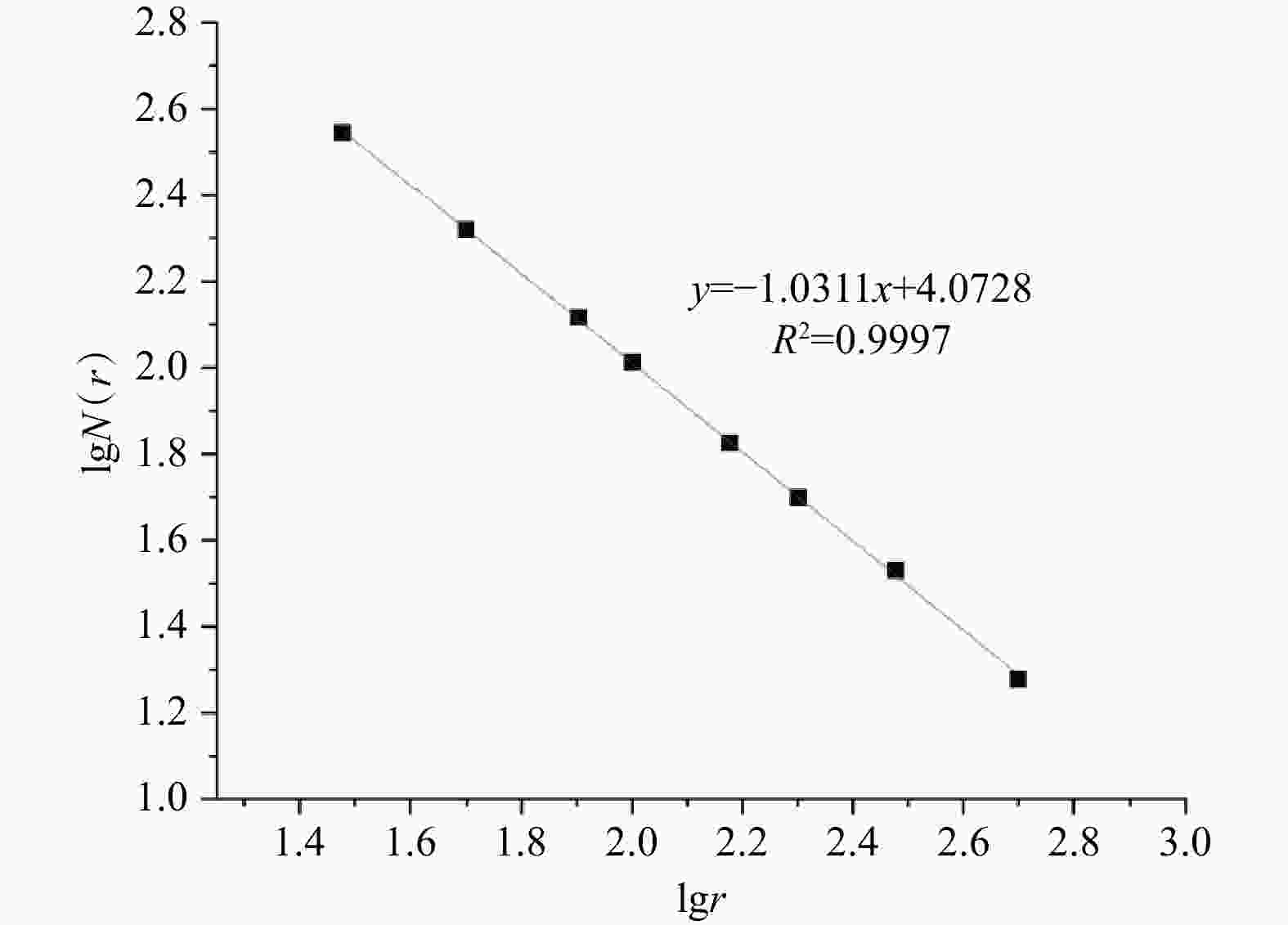
图 3 水系(高祖河)线性回归曲线
r—网格边长;$ N\left(r\right) $—盒子数
Figure 3. Linear regression fit for the Gaozu River drainage system
r—grid size; $ N\left(r\right) $—number of boxes
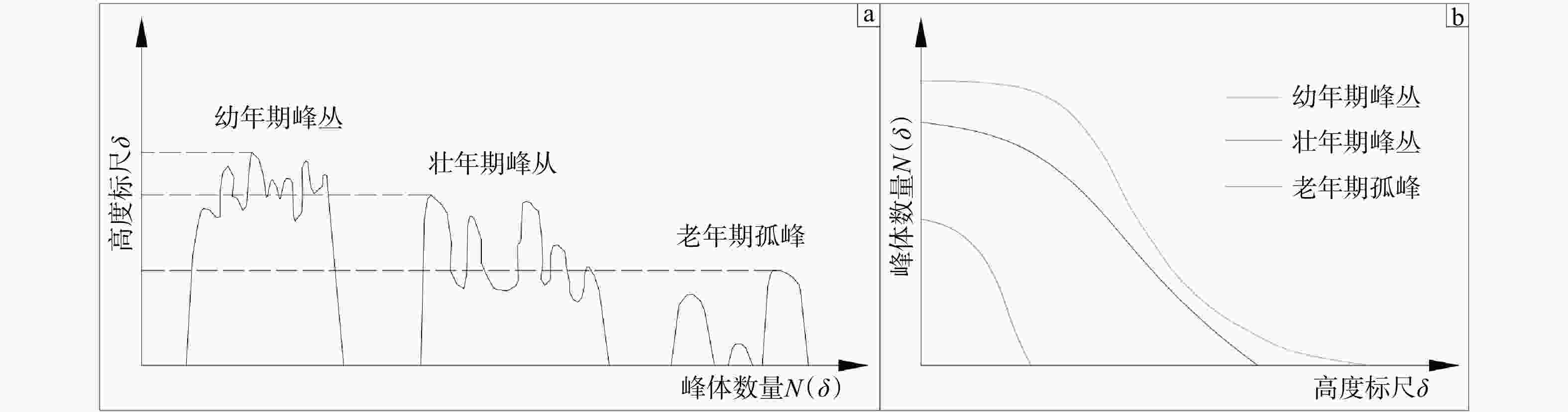
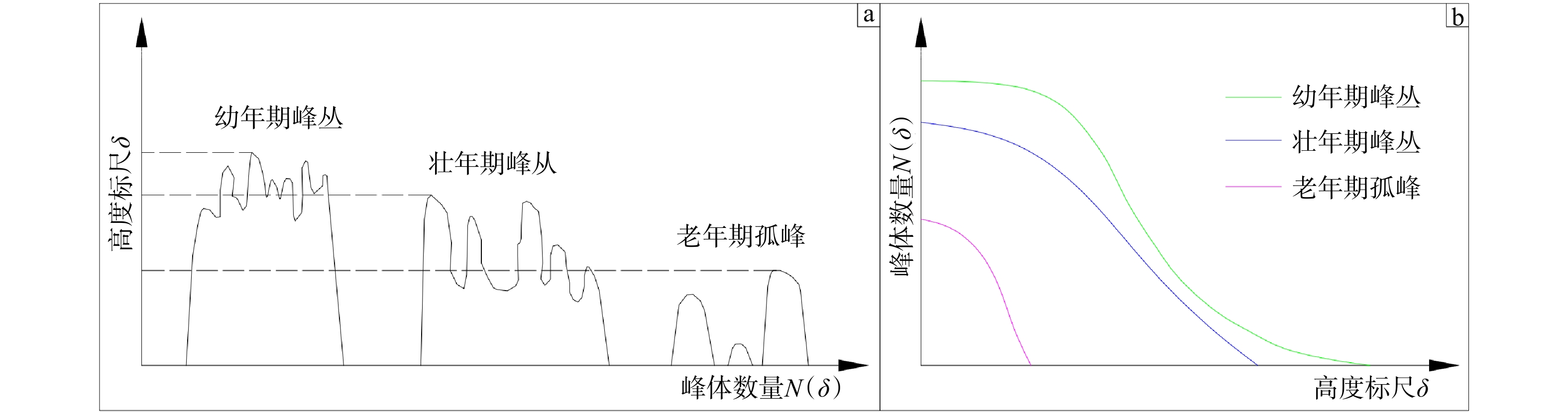
图 5 峰体演化阶段示意图
a—喀斯特化阶段与峰体形态示意图;b—喀斯特化阶段峰体曲线示意图
Figure 5. Schematic diagram of peak evolution stages
(a) Karstification stages and peak morphology; (b) Peak profile curves across karstification stages
表 1 水系(高祖河)分形网格数
Table 1. Fractal grid counts of the Gaozu River drainage system
方形网边长r 网格数$ N\left(r\right) $ $ \lg r $ $ \lg N\left(r\right) $ 500 m 19 2.6990 1.2788 300 m 34 2.4771 1.5315 200 m 50 2.3010 1.6990 150 m 67 2.1761 1.8261 100 m 103 2.0000 2.0128 80 m 131 1.9031 2.1173 50 m 209 1.6990 2.3201 30 m 350 1.4771 2.5441  下载: 导出CSV
表 2 区域水系分形特征
Table 2. Fractal characteristics of regional drainage systems
方形网
边长(r)/m500 300 200 150 100 80 50 30 分维值 水系名称 网格数$ N\left(r\right) $ 高祖河 19 34 50 67 103 131 209 350 1.0311 泉河 38 72 106 143 221 287 446 739 1.0473 石甸河 8 14 22 28 42 50 85 134 0.9956 五石道河 3 4 5 6 9 11 19 30 0.8382
下载: 导出CSV
表 3 区域地层线分形特征
Table 3. Fractal characteristics of regional stratigraphic boundaries
地层代号 喀斯特层组 方形网边长(r)/m 500 300 200 150 100 80 50 30 分维值 喀斯特发育程度 岩性 网格数N(r) Є2qn 夹层状碳酸盐岩 泥质白云岩 10 15 22 29 43 52 83 138 0.9399 弱 Є1t 夹层状碳酸盐岩 灰岩 11 15 20 28 43 55 89 149 0.9589 弱 Є1sl 纯层碳酸盐岩 灰岩 119 222 352 472 706 882 1410 2350 1.0475 强 Є1s 间互状碳酸盐岩 灰岩 90 151 231 316 476 597 953 1591 1.0137 中等 Z2dn 纯层碳酸盐岩 白云岩 43 60 93 123 184 231 366 609 1.0242 强
下载: 导出CSV
表 4 流域单元地层线分形特征
Table 4. Fractal characteristics of stratigraphic boundaries in watershed units
单元编号 分维值 单元
编号分维值 单元
编号分维值 单元
编号分维值 单元
编号分维值 单元
编号分维值 单元
编号分维值 1 0.8523 16 / 31 / 46 1.0115 61 0.7553 76 0.8496 91 0.7503 2 0.8814 17 / 32 0.7664 47 0.8873 62 0.8506 77 92 0.7583 3 0.9111 18 0.8437 33 0.9520 48 0.8379 63 / 78 0.9170 93 / 4 / 19 / 34 0.8613 49 / 64 0.8916 79 0.8753 94 0.8836 5 / 20 / 35 0.9220 50 / 65 / 80 0.8889 95 / 6 0.8834 21 / 36 / 51 0.8726 66 0.9040 81 1.0267 96 / 7 / 22 0.9220 37 0.9329 52 0.8814 67 0.8287 82 0.8922 97 0.9018 8 0.9379 23 / 38 / 53 0.7356 68 0.9450 83 0.7805 98 / 9 / 24 / 39 / 54 0.8344 69 / 84 0.9225 99 0.8691 10 0.9144 25 0.9502 40 0.8646 55 0.9127 70 / 85 0.9992 100 / 11 / 26 / 41 0.9161 56 0.9401 71 / 86 / 101 0.8053 12 / 27 0.9174 42 / 57 0.7369 72 0.9085 87 / 102 0.7801 13 / 28 0.8994 43 0.9149 58 0.8287 73 0.9776 88 0.8860 103 / 14 0.9825 29 0.9613 44 0.8414 59 0.7533 74 0.8836 89 / 15 0.7342 30 / 45 / 60 0.7426 75 0.8048 90 1.0814 “/”表示该单元内无地层线
下载: 导出CSV
表 5 区域−流域单元各地层线分形特征
Table 5. Fractal characteristics of stratigraphic boundaries in regional watershed units
级次 分形特征 地层代号 Є2qn Є1t Є1sl Є1s Z2dn 流域单元 分维值 0.8170 0.8589 0.9008 0.8607 0.8954 区域单元 0.9399 0.9589 1.0475 1.0137 1.0242
下载: 导出CSV
-
[1] CHEN L, 2009. Study of structural characteristics of Xiangfan-Guangji fault in Hubei province[J]. Petroleum Geology & Experiment, 31(2): 186-191. (in Chinese with English abstract) [2] CHENG Y S, 2010. Fractal characteristics of fractures in Jiuwandashan area and their geological significance[J]. Geology in China, 37(1): 127-133. (in Chinese with English abstract) [3] DONG Y P, ZHA X F, FU M Q, et al., 2008. Characteristics of the Dabashan fold-thrust nappe structure at the southern margin of the Qinling, China[J]. Geological Bulletin of China, 27(9): 1493-1508. (in Chinese with English abstract) [4] GAO W, QI J H, XU M, et al., 2016. Influence of fractal characteristics of a surface karst landform on tunnel construction[J]. Modern Tunnelling Technology, 53(2): 35-43. (in Chinese with English abstract) [5] GAO Y, SU F Z, ZHOU C H, et al., 2011. Scale effects of China mainland coastline based on fractal theory[J]. Acta Geographica Sinica, 66(3): 331-339. (in Chinese with English abstract) [6] HAN X R, ZHOU Y Y, 1996. Discussion on harnessing unit drainage basin in karst mountain area[J]. Carsologica Sinica, 15(1-2): 11-17. [7] HOU S S, HE X, MENG X S, et al., 2024. Mesostructure and strength characteristics of granite under freeze-thaw cycles based on CT scanning[J]. Journal of Geomechanics, 30(3): 462-472. (in Chinese with English abstract) [8] HU Z X, SHEN J F, 1994. Study on fractal characteristics of karst morphology system and its mechanism[J]. Earth Science: Journal of China University of Geosciences, 19(1): 102-107. (in Chinese with English abstract) [9] JIANG Y L, SUN W J, KONG X, et al., 2023. Developmental characteristics and geological significance of the fault system in the Junggar-North Tianshan Basin transition zone[J]. Chinese Journal of Geology, 58(2): 398-411. (in Chinese with English abstract) [10] LEI D N, CAI Y J, WU J C, et al., 2012. Quaternary active characteristics of Fangxian segment of Qingfeng fault zone[J]. Journal of Geodesy and Geodynamics, 32(4): 46-50. (in Chinese with English abstract) [11] LI C S, 2006. The applied study on the fractal forecasting method of karst geology[D]. Chengdu: Southwest Jiaotong University. (in Chinese with English abstract). [12] LI C S, GAO B, MEI Z R, 2007. Basic study on method of karst geology forecasting based on fractal theory[J]. Journal of Southwest Jiaotong University, 42(5): 542-547. (in Chinese with English abstract) [13] LI C S, LIAO Y K, DING J F, 2017. Study on karst development in tunnels by hydrochemical kinetics-fractal index evaluation technology[J]. Modern Tunnelling Technology, 54(6): 24-31, 44. (in Chinese with English abstract) [14] LI C S, WU F S, ZHAO Y J, et al., 2018. Fractal and hydro-chemical characteristics of microscopic karst morphology based on dissolution experiments[J]. Modern Tunnelling Technology, 55(2): 110-120. (in Chinese with English abstract) [15] LI J T, ZHANG Y, 2007. Geological—geomorphological background of the drainage system evolution in Hubei province[J]. Journal of University of Jinan (Science & Technology), 21(3): 267-271. (in Chinese with English abstract) [16] LI Q, CHEN R Q, SHANG F, et al., 2025. Pore structure and fractal characteristics of shale reservoirs in Jurassic Lianggaoshan Formation, northeastern Sichuan Basin[J]. Petroleum Geology & Experiment, 47(2): 323-335. (in Chinese with English abstract) [17] LI S Z, LIU C L, LIU W P, et al., 2025. Microporous structure of the Longmaxi Formation shale reservoirs in southern Sichuan Basin and its effect on adsorption capacity[J]. Special Oil & Gas Reservoirs, 32(2): 22-32. (in Chinese with English abstract) [18] LIANG H, LU J, 1997. The fractal, entropy and geomorphological meaning of karst drainage[J]. Scientia Geographica Sinica, 17(4): 310-315. (in Chinese with English abstract) [19] MANDELBROT B B, 1975. Les Objets Fractals: Forme, Hasard et Dimension[M]. Paris, France: Flammarion. [20] MENG H H, WANG L C, 2010. Advance in karst hydrological model[J]. Progress in Geography, 29(11): 1311-1318. (in Chinese with English abstract) [21] QIN Y C, LIU K, 2003. Advancement of applied studies of fractal theory in geography[J]. Progress in Geography, 22(4): 426-436. (in Chinese with English abstract) [22] SHEN W, ZHAO P D, 1998. The theory study of fractal statistical model and its application in geology[J]. Scientia Geologica Sinica, 33(2): 234-243. (in Chinese with English abstract) [23] SHI X D, YAO J X, ZHAO B Y, et al. , 2023. Karst development characteristics and its controlling factors in Fengxi segment of Qingfeng fault zone[J]. Resources Environment & Engineering, 37(5): 537-544, 577. (in Chinese with English abstract) [24] TAN K X, HAO X C, DAI D G, 1998. Fractal features of fractures in China and their implication for geotectonics[J]. Geotectonica et Metallogenia, 22(1): 17-20. (in Chinese with English abstract) [25] TAN Y, QI J H, XU M, et al., 2024. Application of fractal characteristics of drill hole karst geology in analyzing the degree of karst development[J]. Geological Journal of China Universities, 30(5): 603-612. (in Chinese with English abstract). [26] WANG D, XU M, QI J H, et al., 2010. Analysis on morphologic features of the peak-cluster depression in Qiubei, Southeast Yunnan[J]. Carsologica Sinica, 29(3): 239-245. (in Chinese with English abstract) [27] WANG R Z, XING L T, DENG X, et al., 2024. Karst development characteristics of aquifer medium in Jinan spring area[J]. Journal of University of Jinan (Science and Technology), 38(3): 280-287. (in Chinese with English abstract) [28] WANG Z Y, SHEN J F, XU R C, et al., 1995. Karst landscapes and their evolution in reaches of the Qingjiang River, western Hubei[J]. Earth Science: Journal of China University of Geosciences, 20(4): 439-444. (in Chinese with English abstract) [29] WANG Z Y, JIAN Y B, ZHOU S D, 2014. Division of large-scale of deformation structures and main characteristics in Hubei province[J]. Resources Environment & Engineering, 28(1): 94-107. (in Chinese with English abstract) [30] WEN L, WEI P F, LI X M, et al., 2020. Study on the river network, geomorphological features and tectonic activity in the Danjiangkou reservoir and its surrounding areas[J]. Journal of Geomechanics, 26(2): 252-262. (in Chinese with English abstract) [31] WU D Q, XING L T, LAN X X, et al., 2021. Pore structure characteristics of karst water-bearing media in Jinan[J]. Carsologica Sinica, 40(4): 680-688. (in Chinese with English abstract). [32] WU Q F, LIU S G, CAI Y, et al., 2017. Effect of unclosed characteristics of the basin on hydrological modeling in Karst regions[J]. Journal of Hydraulic Engineering, 48(4): 457-466. (in Chinese with English abstract) [33] XU M, WANG D, QI J H, et al., 2011. Study on morphological characteristics of karst landform based on the fractal theory[J]. Journal of Chengdu University of Technology (Science & Technology Edition), 38(3): 328-333. (in Chinese with English abstract) [34] ZHANG F Y, CHEN X S, 2008. Concept of fractal and its application in structural geology field[J]. Coal Geology of China, 20(3): 16-19. (in Chinese with English abstract) [35] ZHANG G W, GUO A L, DONG Y P, et al., 2019. Rethinking of the Qinling orogen[J]. Journal of Geomechanics, 25(5): 746-768. (in Chinese with English abstract) [36] ZHANG J R, WANG J M, ZHU Y C, et al., 2017. Application of fractal theory on pedology: a review[J]. Chinese Journal of Soil Science, 48(1): 221-228. (in Chinese with English abstract) [37] ZHANG M C, LAN T W, JIA W D, et al., 2023. Effect of fractal geometric characteristics of fracture structure on rock burst control[J]. Coal Engineering, 55(5): 103-110. (in Chinese with English abstract) [38] ZHANG Y, WANG H Y, LI Y, et al., 2024. Fractal structural characteristics of fault structures and metallogenic prediction in Xiahe-Hezuo region of West Qinling Mountains[J]. Mineral Deposits, 43(2): 359-372. (in Chinese with English abstract) [39] ZHAO H J, ZHANG J X, PENG H, et al., 2025. Analysis of the motion law of dangerous rock collapse in strong earthquake area considering parameter uncertainty[J]. Journal of Engineering Geology, 33(1): 224-239. (in Chinese with English abstract) [40] ZHOU N, LIU B, 2009. Varying regulation of epikarst developing intensity in southwest Hubei karst area[J]. Carsologica Sinica, 28(1): 1-6. (in Chinese with English abstract) [41] ZHU X H, WANG J, LU J, 2001. Some thinking about the application of fractal theory in geography[J]. Journal of Nanjing Normal University (Natural Science), 24(3): 93-98. (in Chinese with English abstract) [42] ZHU X H, CAI Y L, 2003. On box dimensions of river basins of China[J]. Advances in Water Science, 14(6): 731-735. (in Chinese with English abstract) [43] ZOU M Q, 2007. Fracal theory and its applications to porous media, rough surface and thermal contact conductance[D]. Wuhan: Huazhong University of Science and Technology. (in Chinese with English abstract) [44] 陈璘, 2009. 襄樊−广济断裂湖北段构造特征研究[J]. 石油实验地质, 31(2): 186-191. [45] 成永生, 2010. 九万大山地区断裂构造分形特征及其地质意义[J]. 中国地质, 37(1): 127-133. [46] 董云鹏, 查显峰, 付明庆, 等, 2008. 秦岭南缘大巴山褶皱-冲断推覆构造的特征[J]. 地质通报, 27(9): 1493-1508. [47] 高伟, 漆继红, 许模, 等, 2016. 地表岩溶地貌分形特征对隧道工程建设作用初探[J]. 现代隧道技术, 53(2): 35-43. [48] 高义, 苏奋振, 周成虎, 等, 2011. 基于分形的中国大陆海岸线尺度效应研究[J]. 地理学报, 66(3): 331-339. [49] 侯圣山, 何箫, 孟宪森, 等, 2024. 基于岩石CT扫描的冻融作用对花岗岩细观结构及力学强度影响研究[J]. 地质力学学报, 30(3): 462-472. [50] 胡章喜, 沈继方, 1994. 岩溶形态系统的分形特征及其机理探讨[J]. 地球科学: 中国地质大学学报, 19(1): 102-107. [51] 姜颜良, 孙文洁, 孔雪, 等, 2023. 准噶尔—北天山盆山过渡带断裂系统发育特征及地质意义[J]. 地质科学, 58(2): 398-411. [52] 雷东宁, 蔡永建, 吴建超, 等, 2012. 青峰断裂带房县段第四纪活动特征分析[J]. 大地测量与地球动力学, 32(4): 46-50. [53] 李苍松, 2006. 岩溶地质分形预报方法的应用研究[D]. 成都: 西南交通大学. [54] 李苍松, 高波, 梅志荣, 2007. 岩溶地质预报的分形理论应用基础研究[J]. 西南交通大学学报, 42(5): 542-547. [55] 李苍松, 廖烟开, 丁建芳, 2017. 隧道岩溶发育程度的水化学动力学-分形指数评价技术探讨[J]. 现代隧道技术, 54(6): 24-31, 44. [56] 李苍松, 吴丰收, 赵岩杰, 等, 2018. 基于溶蚀实验的微观岩溶形态分形特征和水化学动力学特征研究[J]. 现代隧道技术, 55(2): 110-120. [57] 李俊涛, 张毅, 2007. 湖北水系演化的地质地貌背景[J]. 济南大学学报(自然科学版), 21(3): 267-271. [58] 李琦, 陈睿倩, 商斐, 等, 2025. 川东北地区侏罗系凉高山组页岩储层孔隙结构及分形特征[J]. 石油实验地质, 47(2): 323-335. [59] 李帅智, 刘成林, 刘文平, 等, 2025. 川南龙马溪组页岩储层微观孔隙结构及其对吸附能力的影响[J]. 特种油气藏, 32(2): 22-32. [60] 梁虹, 卢娟, 1997. 喀斯特流域水系分形、熵及其地貌意义[J]. 地理科学, 17(4): 310-315. [61] 蒙海花, 王腊春, 2010. 岩溶流域水文模型研究进展[J]. 地理科学进展, 29(11): 1311-1318. [62] 秦耀辰, 刘凯, 2003. 分形理论在地理学中的应用研究进展[J]. 地理科学进展, 22(4): 426-436. [63] 申维, 赵鹏大, 1998. 分形统计模型的理论研究及其在地质学中的应用[J]. 地质科学, 33(2): 234-243. [64] 史箫笛, 姚建新, 赵碧义, 等, 2023. 青峰断裂带丰溪段岩溶发育特征及控制因素研究[J]. 资源环境与工程, 37(5): 537-544, 577. [65] 谭凯旋, 郝新才, 戴塔根, 1998. 中国断裂构造的分形特征及其大地构造意义[J]. 大地构造与成矿学, 22(1): 17-20. [66] 谭谣, 漆继红, 许模, 等, 2024. 钻孔岩溶地质分形特征在岩溶发育程度分析中的应用[J]. 高校地质学报, 30(5): 603-612. [67] 王迪, 许模, 漆继红, 等, 2010. 滇东南丘北区峰丛-洼地地貌形态特征分析[J]. 中国岩溶, 29(3): 239-245. [68] 王榕臻, 邢立亭, 邓兴, 等, 2024. 济南泉域岩溶含水介质发育特征研究[J]. 济南大学学报(自然科学版), 38(3): 280-287. [69] 王增银, 沈继方, 徐瑞春, 等, 1995. 鄂西清江流域岩溶地貌特征及演化[J]. 地球科学: 中国地质大学学报, 20(4): 439-444. [70] 王志元, 简玉兵, 周少东, 2014. 湖北省大型变形构造划分及主要特征[J]. 资源环境与工程, 28(1): 94-107. [71] 文力, 魏鹏飞, 李学敏, 等, 2020. 丹江口水库库区及周边地区河网形态、地貌特征及构造活动性意义[J]. 地质力学学报, 26(2): 252-262. [72] 武东强, 邢立亭, 兰晓荀, 等, 2021. 济南岩溶含水介质孔隙结构特征[J]. 中国岩溶, 40(4): 680-688. [73] 吴乔枫, 刘曙光, 蔡奕, 等, 2017. 流域非闭合特性对岩溶地区水文过程模拟的影响[J]. 水利学报, 48(4): 457-466. [74] 许模, 王迪, 漆继红, 等, 2011. 基于分形理论的喀斯特地貌形态分析[J]. 成都理工大学学报(自然科学版), 38(3): 328-333. [75] 张飞燕, 陈晓山, 2008. 分形概念及其在构造地质研究中的应用[J]. 中国煤炭地质, 20(3): 16-19. [76] 张国伟, 郭安林, 董云鹏, 等, 2019. 关于秦岭造山带[J]. 地质力学学报, 25(5): 746-768. [77] 张佳瑞, 王金满, 祝宇成, 等, 2017. 分形理论在土壤学应用中的研究进展[J]. 土壤通报, 48(1): 221-228. [78] 张满仓, 兰天伟, 贾伟东, 等, 2023. 断裂构造分形几何特征对冲击地压的控制作用研究[J]. 煤炭工程, 55(5): 103-110. [79] 张元, 王红岩, 李育, 等, 2024. 西秦岭夏河-合作地区断裂构造分形结构特征及成矿预测[J]. 矿床地质, 43(2): 359-372. [80] 赵海军, 张家祥, 彭昊, 等, 2025. 考虑参数不确定性的强震区危岩崩塌运动规律分析[J]. 工程地质学报, 33(1): 224-239. [81] 周宁, 刘波, 2009. 鄂西南岩溶地区表层岩溶带发育强度变化规律研究[J]. 中国岩溶, 28(1): 1-6. [82] 朱晓华, 王建, 陆娟, 2001. 关于地学中分形理论应用的思考[J]. 南京师大学报(自然科学版), 24(3): 93-98. [83] 朱晓华, 蔡运龙, 2003. 中国水系的盒维数及其关系[J]. 水科学进展, 14(6): 731-735. [84] 邹明清, 2007. 分形理论的若干应用[D]. 武汉: 华中科技大学. -

 下载:
下载:

计量
- 文章访问数: 237
- HTML全文浏览量: 63
- PDF下载量: 83
- 被引次数: 0
