


Distribution, characteristics, ages, and tectonic environments of ductile shear zones in the Beishan orogenic belt
-
摘要: 北山位于中亚造山带东西段的枢纽位置,位置关键。在北山地区发育了很多韧性剪切带,目前对这些剪切带的研究还比较薄弱,对其形成机制、时代、规模、变形体制以及构造环境认识不深或者存在很多争议,同时对其在中亚造山带演化中的作用也认识不清,因此开展北山及其周缘韧性剪切带的构造研究是中亚造山带研究的重要领域之一。文章在归纳近年来在北山与邻区野外工作及其相关认识和结论的基础上,系统整理、收集已有成果,结合区域遥感影像和航磁异常地质解释,共厘定出13条长度在30~300 km之间的韧性剪切带。多数剪切带近东西向延伸并横贯北山地区,有些剪切带与北山已有的蛇绿混杂岩带或者重要构造带重合。总体而言,北山地区的剪切带以南部出露最好,宽度大(大于10 km),数量多(5~6条),而中北部的剪切带延伸度广。目前发现的北山韧性剪切带糜棱面理多数走向近东西,南向或北向陡倾,并多近于直立;相关的矿物拉伸线理近于水平。这些剪切带以右行剪切为主,少数表现为左行剪切。初步研究认为北山多数韧性剪切带形成于古生代,尤其以晚古生代—早中生代最为集中,多分布在北山的中部和南部。北山地区主要的剪切带分别与东天山和阿拉善地区同时代的韧性剪切带相连,构成了中亚造山带中段重要的区域性韧性剪切系统。这些晚古生代末期—早中生代的韧性剪切带是中亚造山带整体变形的结果,可能是Pangea超大陆中部的巨型剪切系统的重要组成部分。但也不能排除北山地区存在与古大洋斜向俯冲所导致韧性剪切变形的可能性。精确的年代学限定以及半定量和定量的构造学研究是北山地区韧性剪切带未来的工作重点。造山带尺度的巨型韧性剪切系统的厘定,对于认识中亚造山带中、下地壳变形样式、环境、体制以及Pangea超大陆的形成与演化具有重要意义。Abstract:
Objective The Beishan occupies a pivotal position between the eastern and western segments of the Central Asian Orogenic Belt (CAOB). Although numerous ductile shear zones have been identified in this area, they have received limited attention, leading to uncertainties and debates regarding their formation mechanisms, ages, deformation regimes, tectonic settings, and role in the evolution of the orogenic belt. Consequently, studying these ductile shear zones is crucial for understanding the evolution of the CAOB. Methods Based on a systematic compilation of previous research data, the geological interpretation of remote sensing images, the regional aeromagnetic anomalies of the East Tianshan–Beishan–Alxa region, and our fieldwork in Beishan and adjacent regions, this study has identified 13 ductile shear zones, ranging in length from 30 km to nearly 300 km. Results These 13 ductile shear zones from north to south are: Hongshishan–Baiheshan–Pengboshan–Qiantiaogou ductile shear zone, Bailiang–Sangejing–Gonglujing–Weiboshan ductile shear zone, Pochengshan–Shibanjing–Xiaohuangshan ductile shear zone, Hongyanjing–Mazongshan–Jianshan ductile shear zone, Lebaquan ductile shear zone, Baiyunshan–North Yueyashan ductile shear zone, Huaniushan–Wufengshan–Erduanjing–North Dingxin ductile shear zone, Zhongqiujing–Jinmiaogou ductile shear zone, Jiujing–Chuanshanxun ductile shear zone, Xiaoxigong–Qianhongquan ductile shear zone, Qijiaojing shear zone, Gubaoquan–Zuanjinggou ductile zone, Baidunzi–Shibandun ductile shear zone, respectively. Most of these 13 shear zones exhibit an east–west strike, traverse the entire Beishan region, and coincide with ophiolitic mélange zones or major tectonic zones. Those in the southern Beishan region are particularly well-exposed, characterized by greater widths (>10 km) and a higher concentration (five to six zones), whereas those in the central and northern regions display greater continuity and length. Currently, most documented shear zones in Beishan are dominated by dextral kinematics, with only a few exhibiting sinistral motion. Mineral stretching lineations in major shear zones are generally sub-horizontal and east–west trending, while mylonitic foliations generally strike east–west with steep to vertical dips. Preliminary findings suggest that most ductile shear zones in Beishan formed during the Paleozoic and Mesozoic, particularly in the late Paleozoic to early Mesozoic, with a predominant distribution in the central and southern regions. Many of these major shear zones can be correlated with coeval structures in the East Tianshan to the west and the Alxa region to the east, collectively forming an extensive ductile shear system in the central CAOB. Conclusion These late Paleozoic to early Mesozoic shear zones likely reflect large-scale deformation within the CAOB and may represent a key component of the central megashear system in the Pangea supercontinent. However, the possibility that the ductile shear deformation in the Beishan region was caused by oblique subduction of the Paleo-Asian Ocean cannot be ruled out. Future research on Beishan’s ductile shear zones should prioritize precise geochronology and semi-quantitative to quantitative structural analyses. [ Significance ] The identification of the orogen-scale giant ductile shear system in Beishan and its vicinity is of great significance for understanding the deformation styles, environments, and regimes of the middle-lower crust in the CAOB, as well as the formation and evolution of the Pangea supercontinent. -
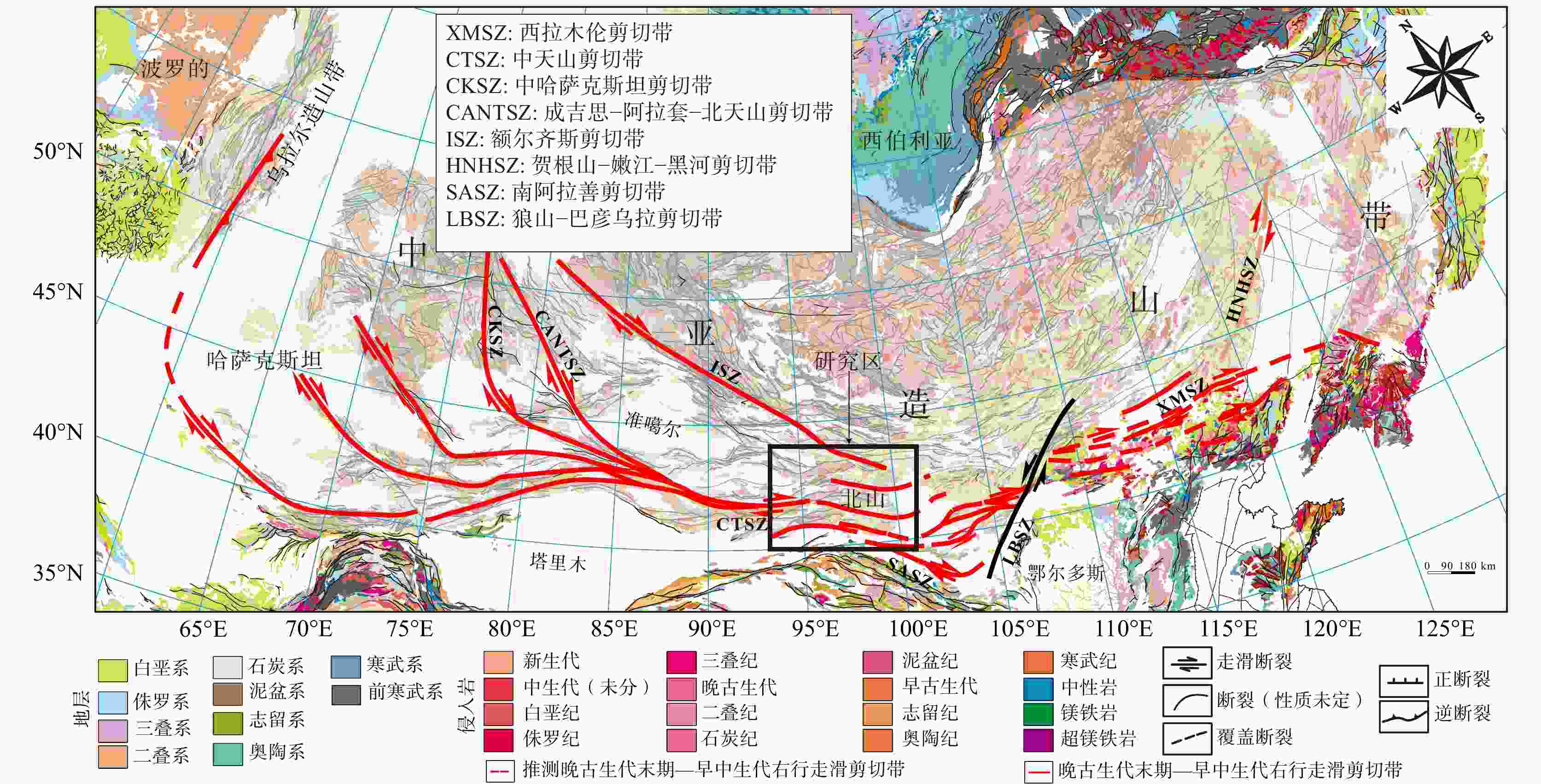
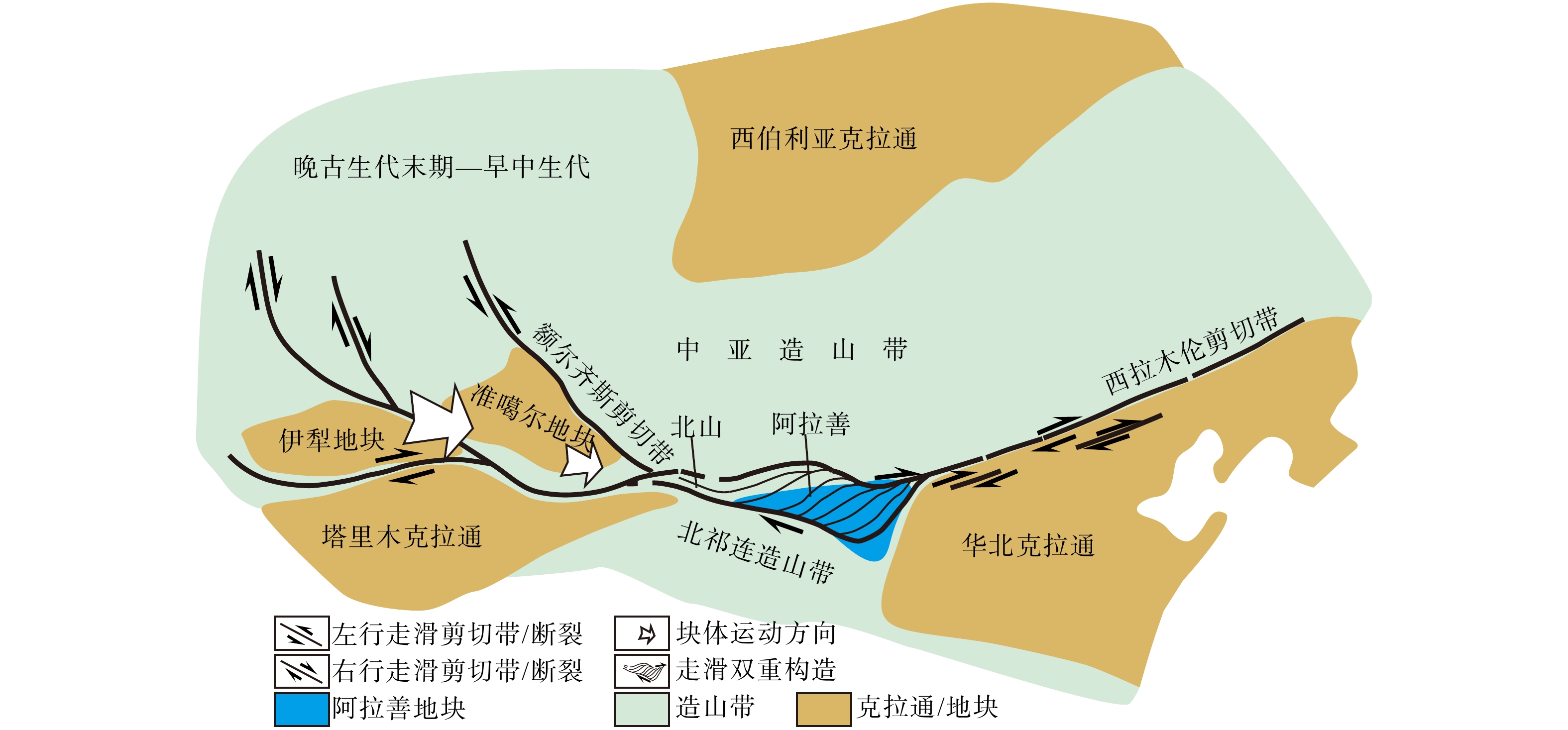
图 1 中亚造山带地质图与晚古生代—早中生代剪切系统
Figure 1. Geological map of the Central Asian Orogenic Belt showing the Late Paleozoic–Early Mesozoic shear systems
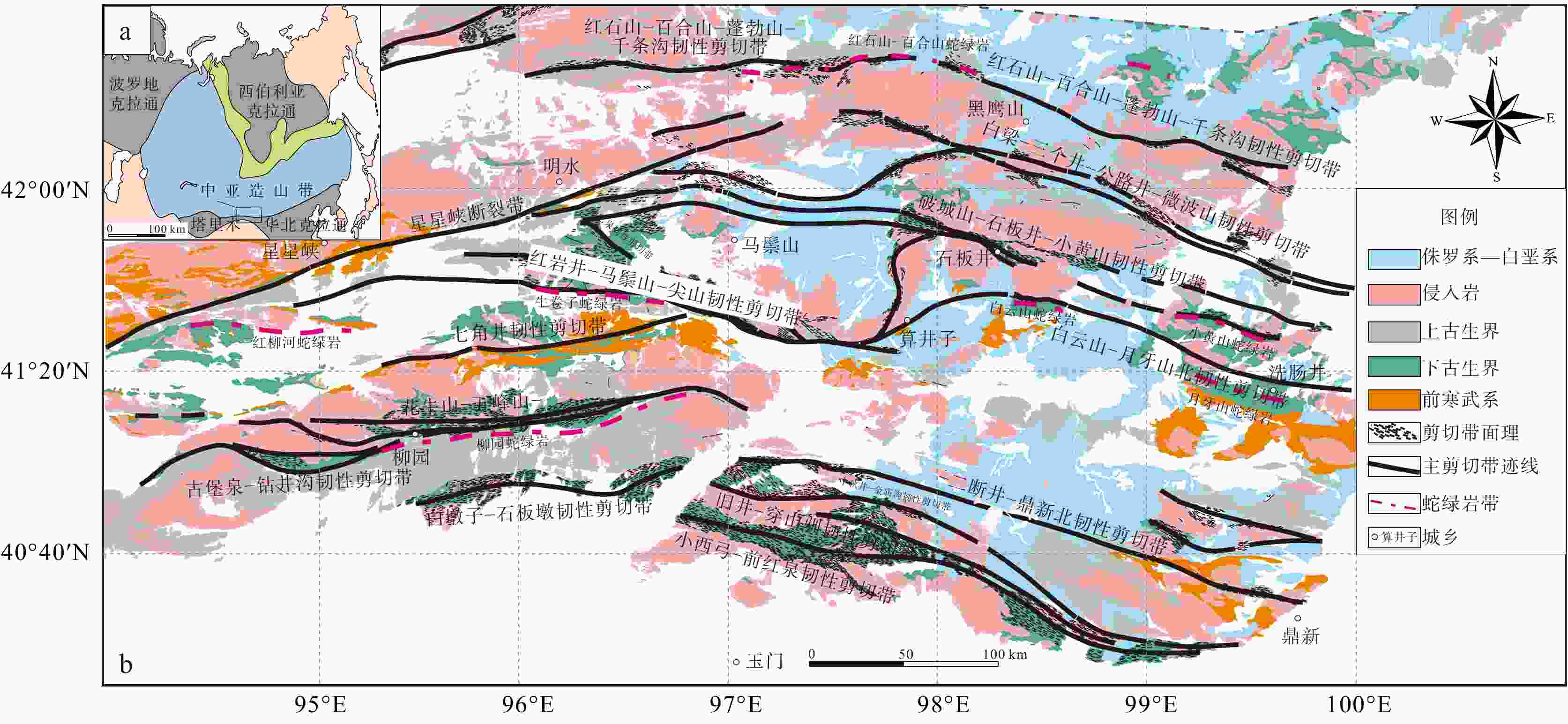
图 2 北山地区地质图与韧性剪切带分布
a—中亚造山带与研究区位置;b—北山主要剪切带与蛇绿(混杂)岩带
Figure 2. Geological map of the Beishan region with the distribution of ductile shear zones
(a) Location of the study area in the Central Asian Orogenic Belt; (b) Major shear zones and ophiolitic mélanges in the Beishan region
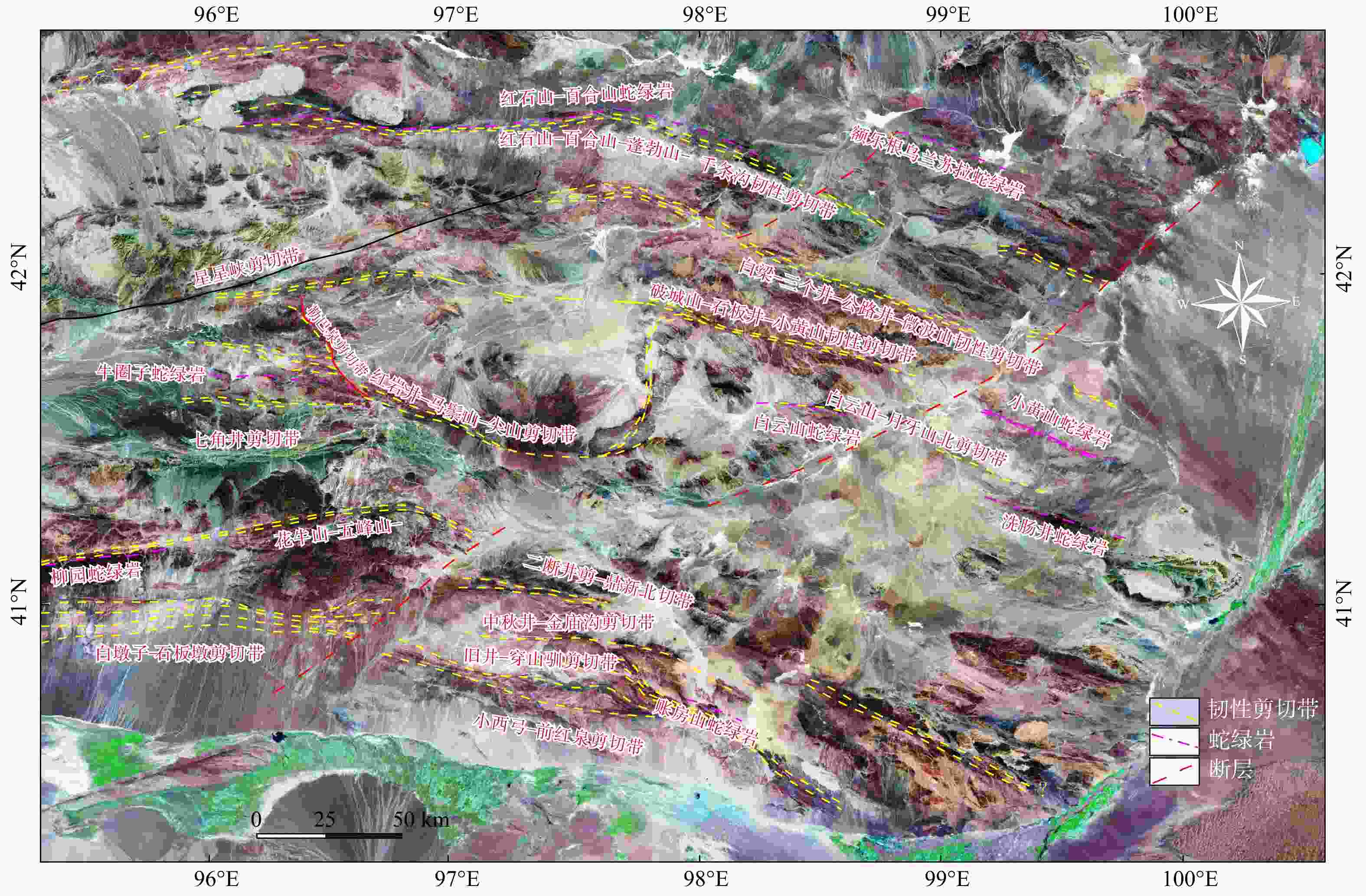
图 3 北山卫星影像图(含蛇绿混杂岩与大型韧性剪切带)
Figure 3. Satellite image map of the Beishan region (the ophiolitic mélanges and major ductile shear zones are labelled)
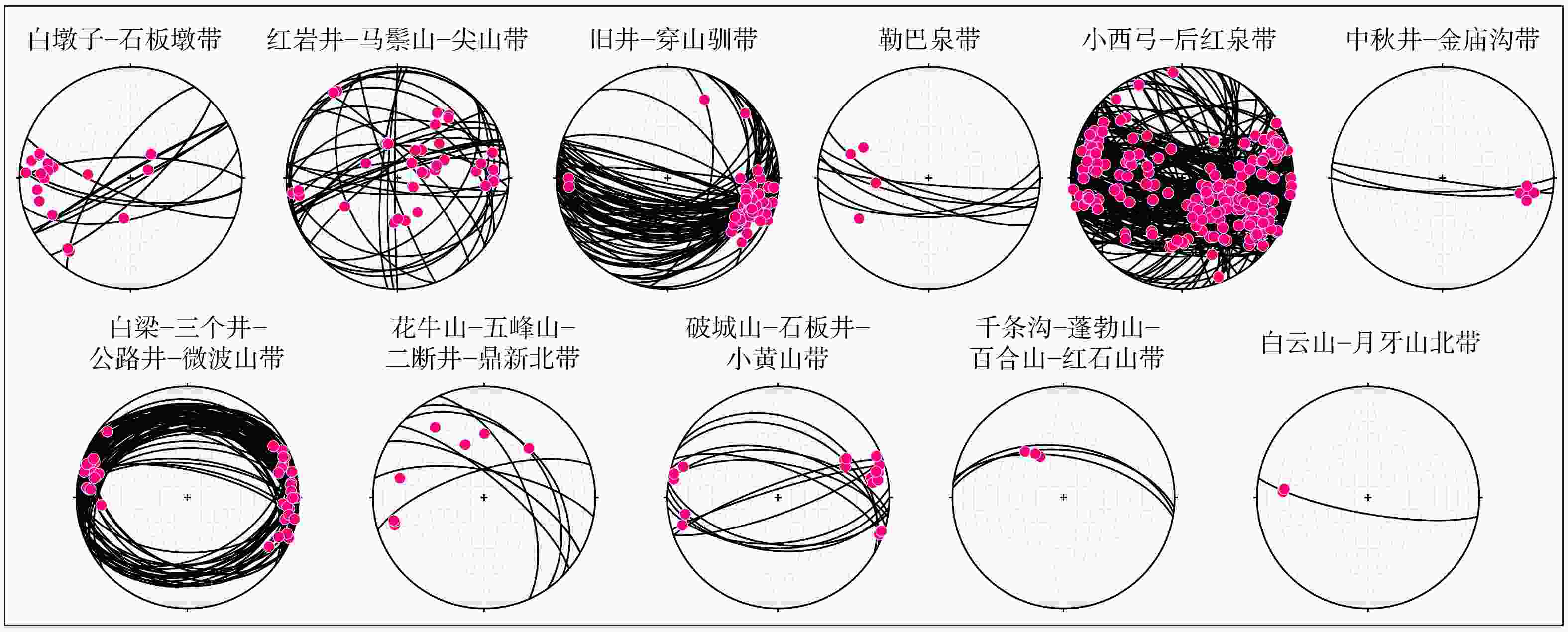
图 4 北山地区主要韧性剪切带糜棱面理(线)与矿物线理(红点)赤平投影图(等面积,下半球)
Figure 4. Stereographic projections of mylonitic foliations (lines) and mineral lineations (red dots) of major shear zones in the Beishan region (lower hemisphere, equal area projections)
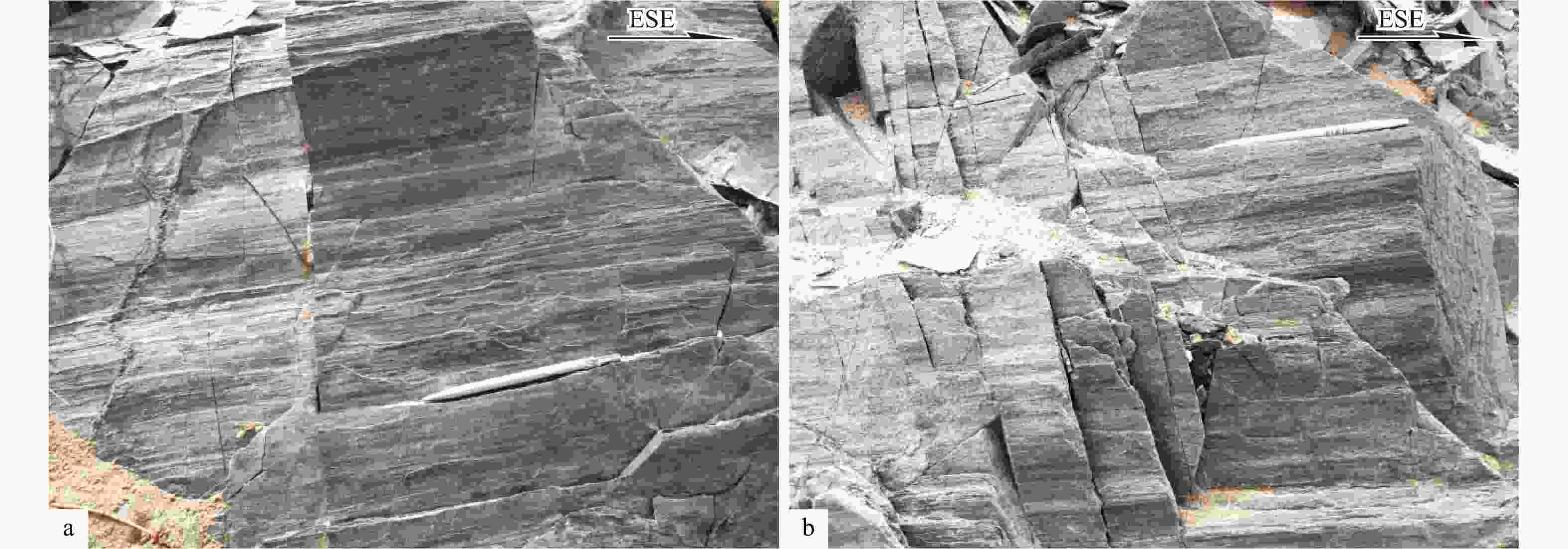
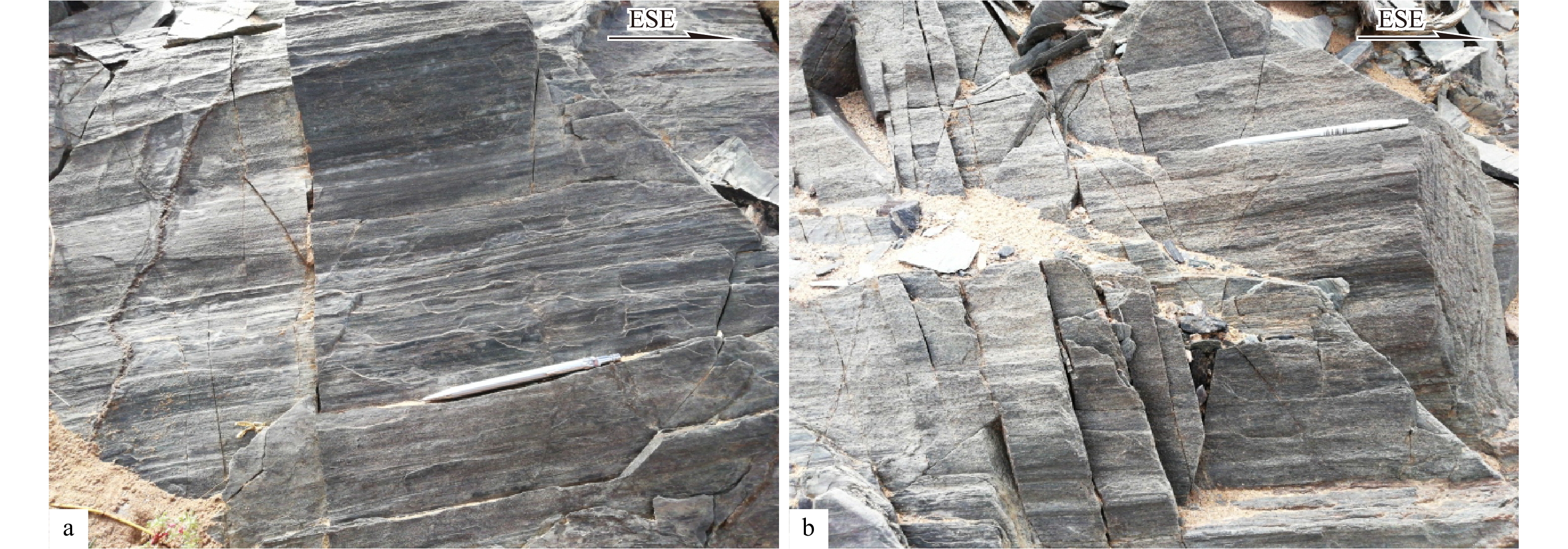
图 5 红石山−百合山−蓬勃山−千条沟韧性剪切带糜棱岩(原岩为绿条山组砂岩)
a—蓬勃山;b—千条沟
Figure 5. Field photographs of mylonites from the Hongshishan–Baiheshan–Pengposhan–Qiantiaogou ductile shear zone revealing the subhorizontal lineation (the protolith is sandstone of the Lytiaoshan Formation)
(a) Pengboshan; (b) Qiantiaogou
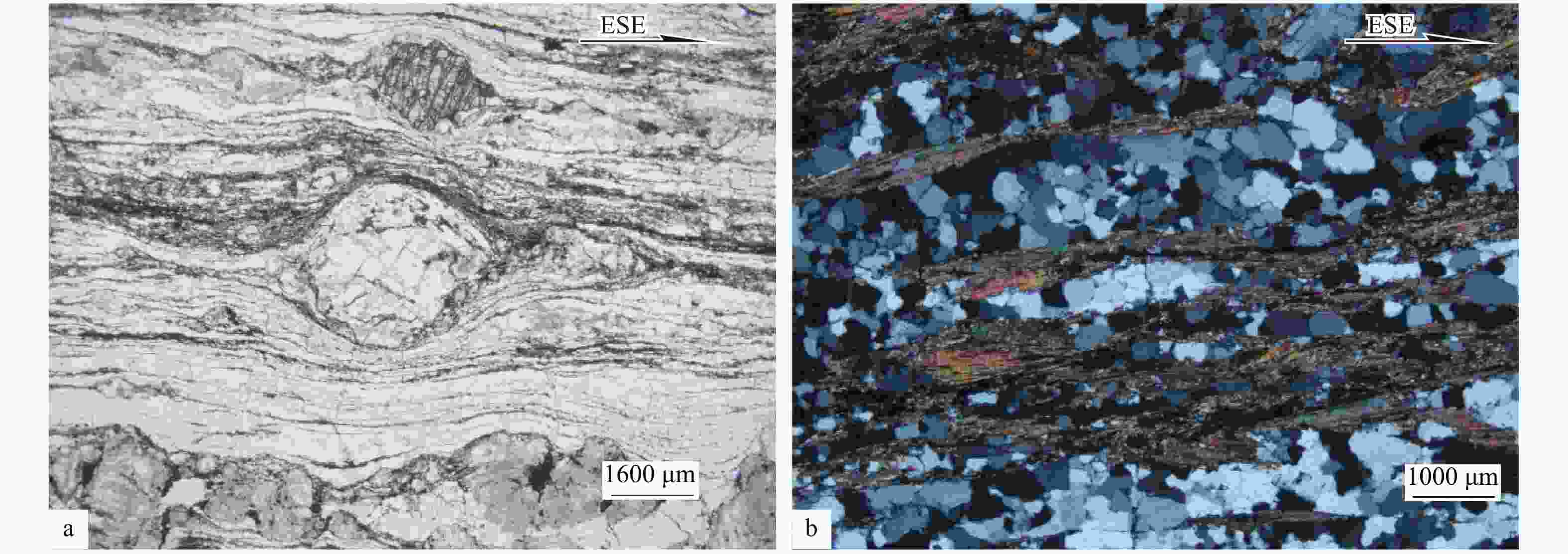
图 6 白梁−三个井−公路井−微波山韧性剪切带糜棱岩
a—斜长石旋转碎斑(示右行);b—糜棱岩面理(黑云母)及其云母鱼(示右行)
Figure 6. Mylonites from the Bailiang–Sangejing–Gonglujing–Weiboshan ductile shear zone
(a) Plagioclase porphyroclast (indicating dextral shearing); (b) Mylonitic foliation (biotite) and mica fish structures (indicating dextral shearing)
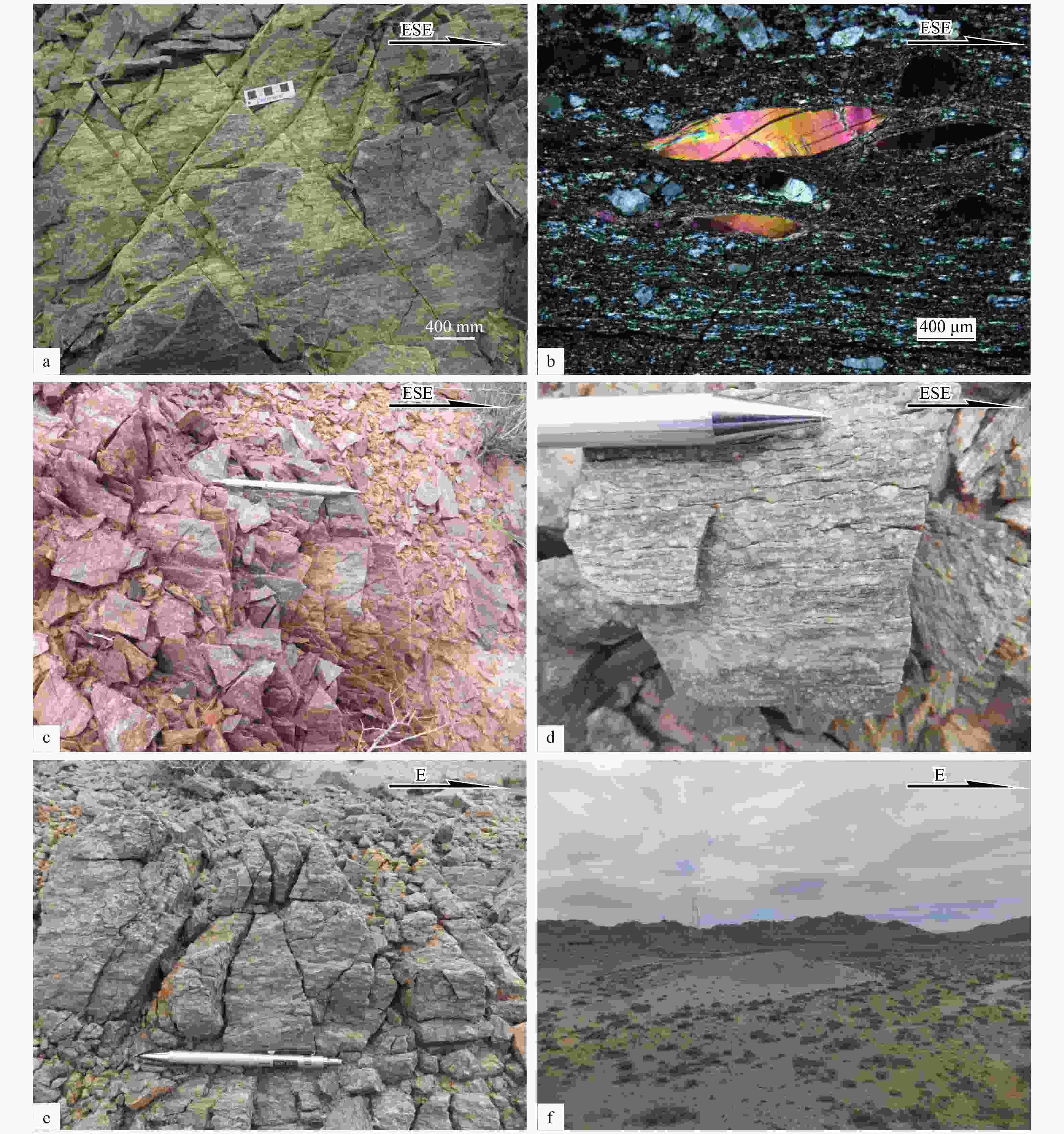
图 7 破城山−石板井−小黄山剪切带糜棱岩
a—石板井韧性剪切带内糜棱岩化的花岗闪长岩; b—石板井剪切带糜棱岩内发育的云母鱼(指示右行剪切);c—花岗糜棱岩XZ面上的长石旋转碎斑(指示右行剪切);d—XZ面石英不对称组构;e—花岗糜棱岩面理上的矿物线理;f—远处新元古代白云质灰岩呈飞来峰推覆在糜棱岩化的石炭系—二叠系碎屑岩以及侵入岩之上
Figure 7. Field photographs (except for Fig.7b, cross-polarized light photomicrograph) of the mylonites from the Pochenshan–Shibanjing–Xiaohuangshan shear zone.
(a) Mylonitized granodiorite within the Shibanjing ductile shear zone; (b) Mica fish structures within mylonites of the Shibanjing shear zone, indicating dextral shearing; (c) Rotated feldspar porphyroclasts on the XZ plane of a granitic mylonite, indicating dextral shearing; (d) Asymmetric quartz fabric on the XZ plane; (e) Mineral lineation on the foliation plane of granitic mylonite; (f) Neoproterozoic dolomitic limestone thrust as a klippe over mylonitized Carboniferous–Permian clastic rocks and intrusive rocks
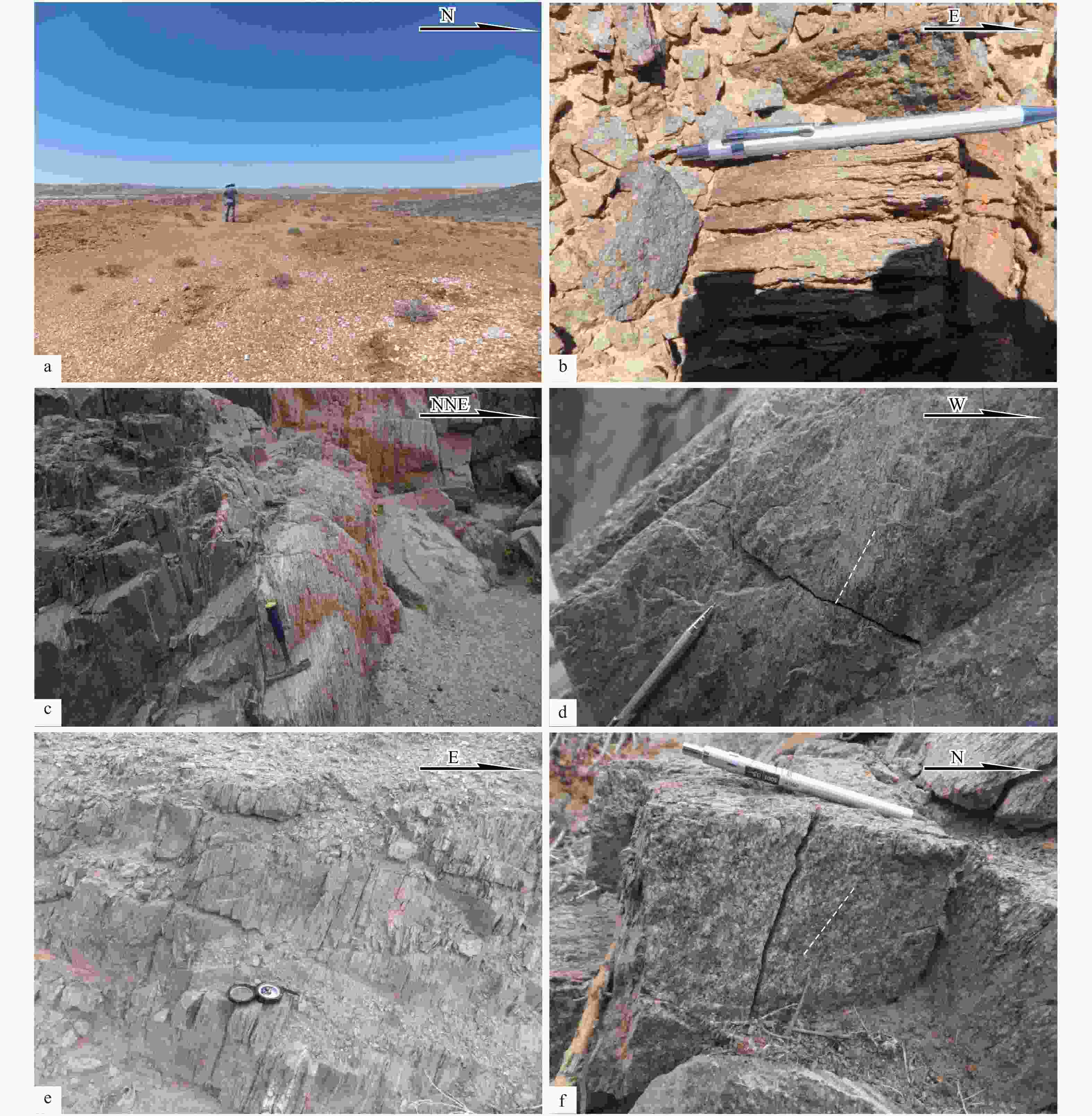
图 8 红岩井−马鬃山−尖山韧性剪切带糜棱岩
a—红岩井段呈东西向延伸并卷入剪切带的花岗岩;b—红岩井段花岗糜棱岩(XZ面);c— 马鬃山段花岗糜棱岩(暗色部分为超糜棱岩,浅色为糜棱岩);d—马鬃山段超糜棱岩(原岩为花岗岩);e— 尖山段花岗糜棱岩;f— 尖山段花岗糜棱面理及矿物拉伸线理
Figure 8. Field photographs of the mylonites from the Hongyanjing-Mazongshan-Jianshan ductile shear zone.
(a) East-west-trending granite involved in the shear zone (Hongyanjing segment; (b) Granitic mylonite (XZ plane, Hongyanjing segment); (c) Granitic mylonite (Mazongshan segment, the dark part is ultramylonite, the light part is mylonite); (d) Ultramylonite (Mazongshan segment, the protolith is granite); (e) Granitic mylonite (Jianshan segment); (f) Mylonitic foliation and mineral stretching lineation (granitic mylonite, Jianshan segment)
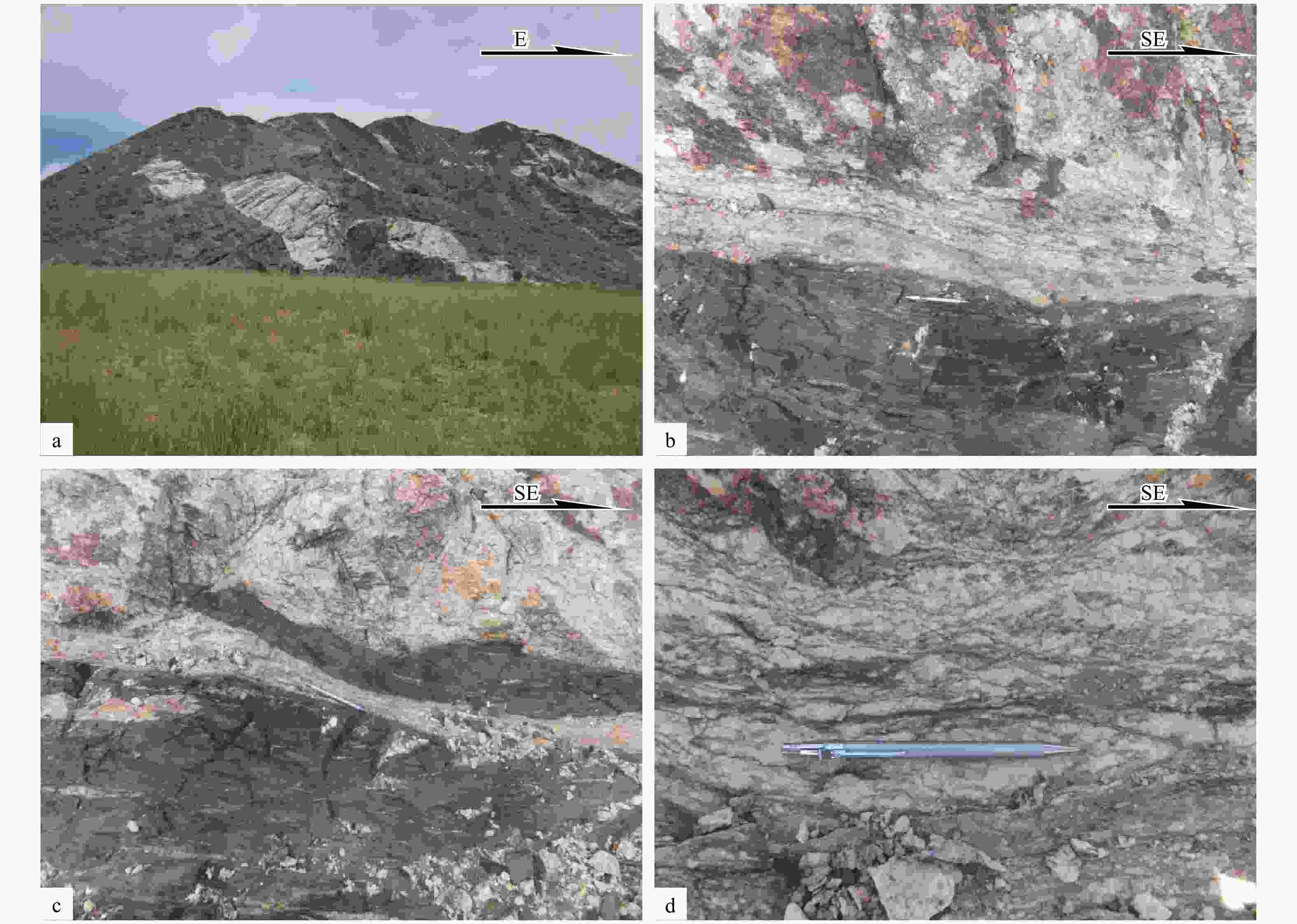
图 9 勒巴泉剪切带糜棱岩
a—勒巴泉杂岩与侵入其中的花岗岩;b— 侵入勒巴泉杂岩花岗岩边部糜棱岩化; c—侵入勒巴泉杂岩花岗岩中(糜棱岩化)的围岩勒巴泉杂岩捕虏体(糜棱岩化);d—侵入勒巴泉杂岩花岗岩(糜棱岩)XZ面上的C’构造(铅笔上方,指示右行剪切)
Figure 9. Field photographs of the mylonites from the Lebaquan shear zone
(a) Lebaquan Complex with granite intrusions; (b) Mylonitized granite intruding the Lebaquan Complex; (c) Mylonitized xenolith of the Lebaquan Complex (wall rock) in the mylonitized granite that has intruded the Lebaquan Complex; (d) C’ shear band (above the pencil) in a granite (mylonite) intruding the Lebaquan Complex (XZ plane), indicating dextral shearing
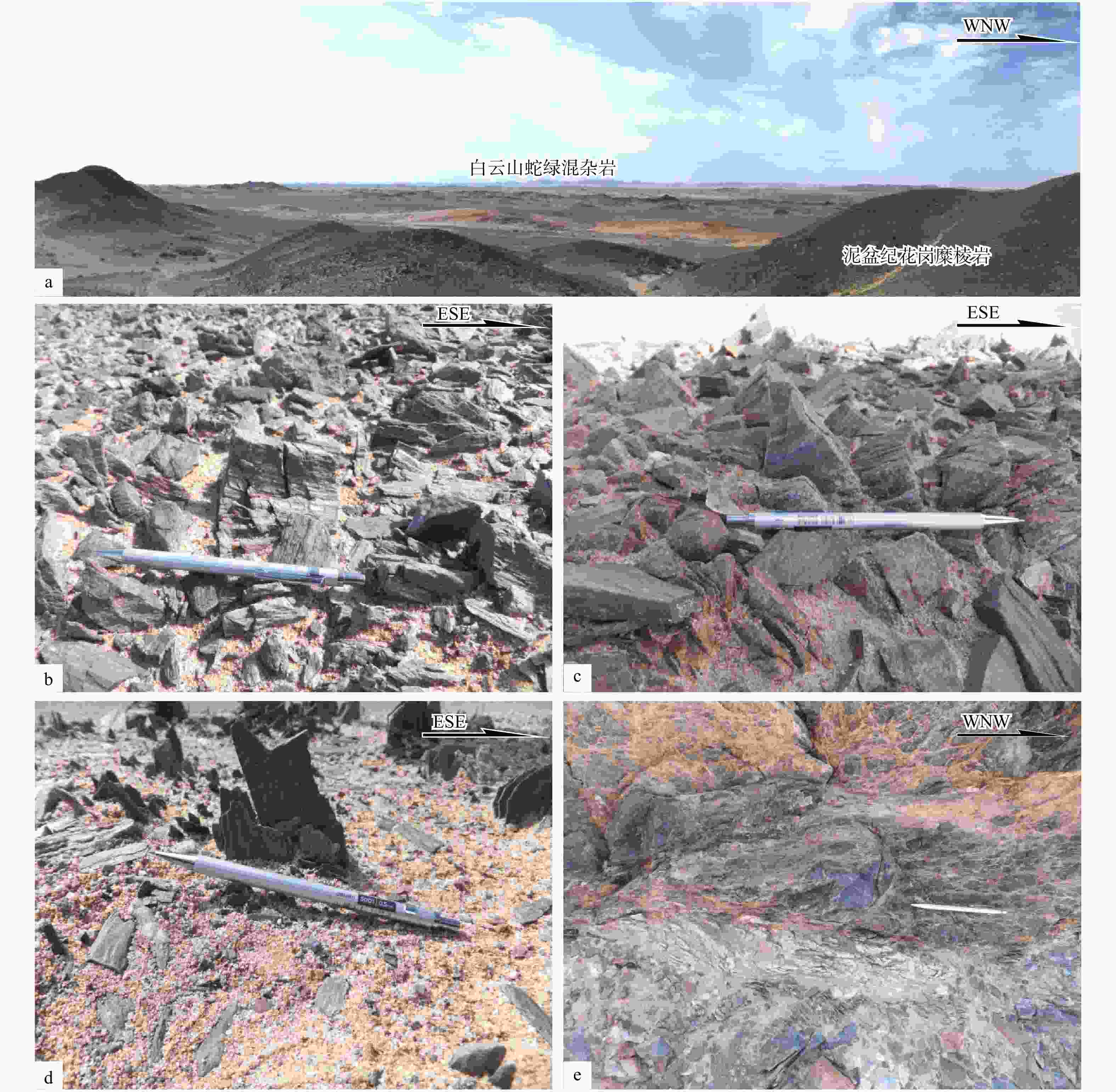
图 10 白云山−月牙山北韧性剪切带糜棱岩
a—糜棱岩与蛇绿混杂岩全景; b—泥盆纪花岗糜棱岩面理与近水平的石英拉伸线理;c— 蛇绿混杂岩边部长英质糜棱岩面理与石英拉伸线理(侧伏角变大);d—蛇绿混杂岩内部长英质糜棱岩面理与石英拉伸线理(拉伸线理陡立);e—未韧性剪切变形的蛇绿混杂岩
Figure 10. Field photographs of the mylonites from the Baiyunshan–Yueyashan North ductile shear zone
(a) Panorama of mylonite and ophiolitic mélange; (b) Mylonitic foliation of Devonian granite with nearly horizontal quartz stretching lineation; (c) Felsic mylonitic foliation and quartz stretching lineation with larger pitch angle in the outer part of the ophiolitic mélange; (d) Felsic mylonitic foliation and steeply plunging quartz stretching lineation in the inner part of the ophiolitic mélange; (e) Unmylonitized section of the ophiolitic mélange
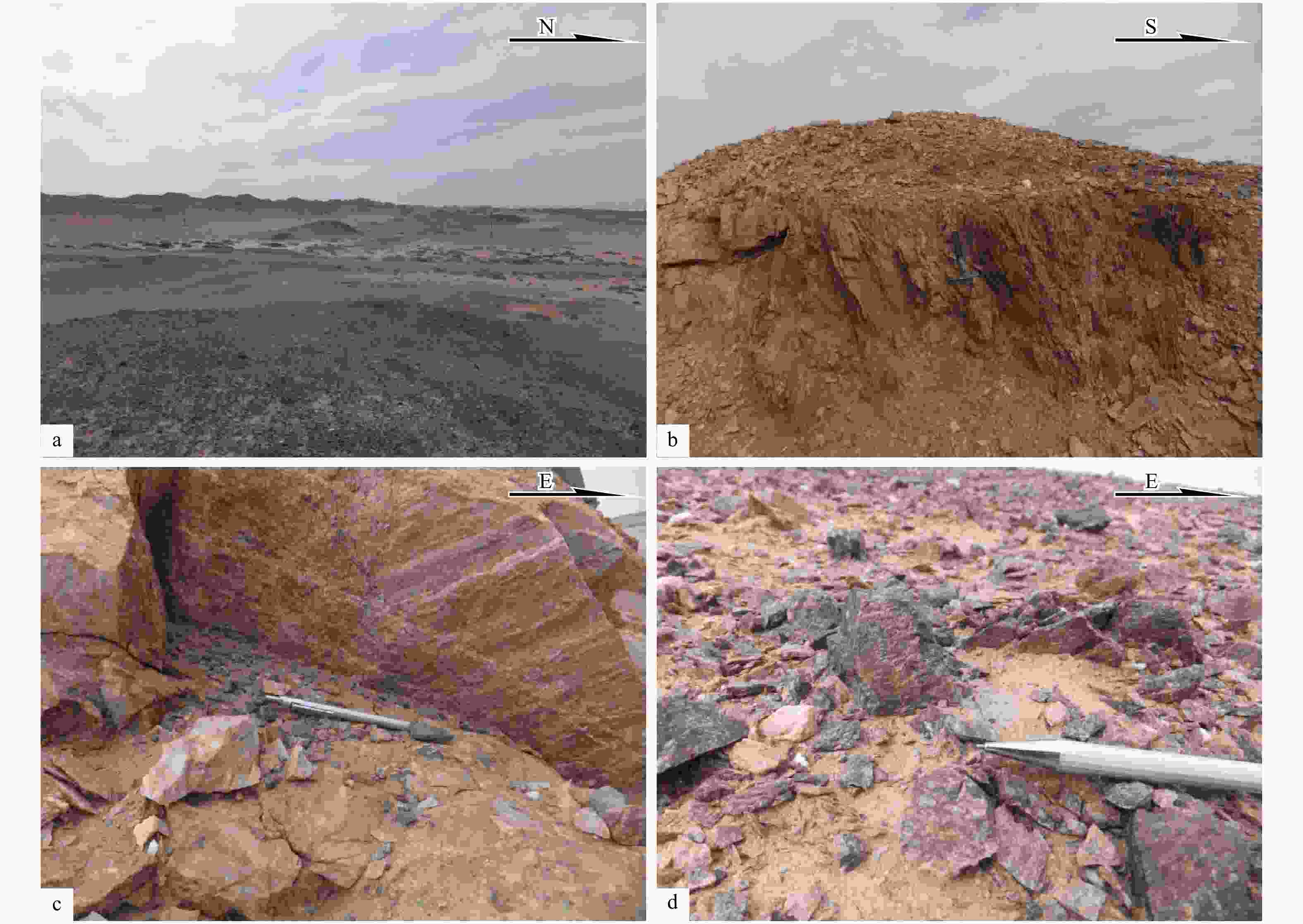
图 11 花牛山−五峰山−二断井−鼎新北韧性剪切带糜棱岩.
a—鼎新北韧性剪切带全景;b—卷入剪切带的石炭纪灰岩; c— 卷入剪切带的石炭纪灰岩的糜棱面理与矿物拉伸线理; d—卷入剪切带的石炭纪火山岩及糜棱面理上的石英拉伸线理
Figure 11. Field photographs of the mylonites from the Huaniushan–Wufengshan–Erduanjing–North Dingxin ductile shear zone
(a) Panorama of the ductile shear zone to the north of Dingxin; (b) Carboniferous limestone in the shear zone; (c) Mylonitic foliations and mineral stretching lineations of Carboniferous limestone in the shear zone; (d) Mylonitic foliations and quartz stretching lineation of Carboniferous volcanic rocks in the shear zone
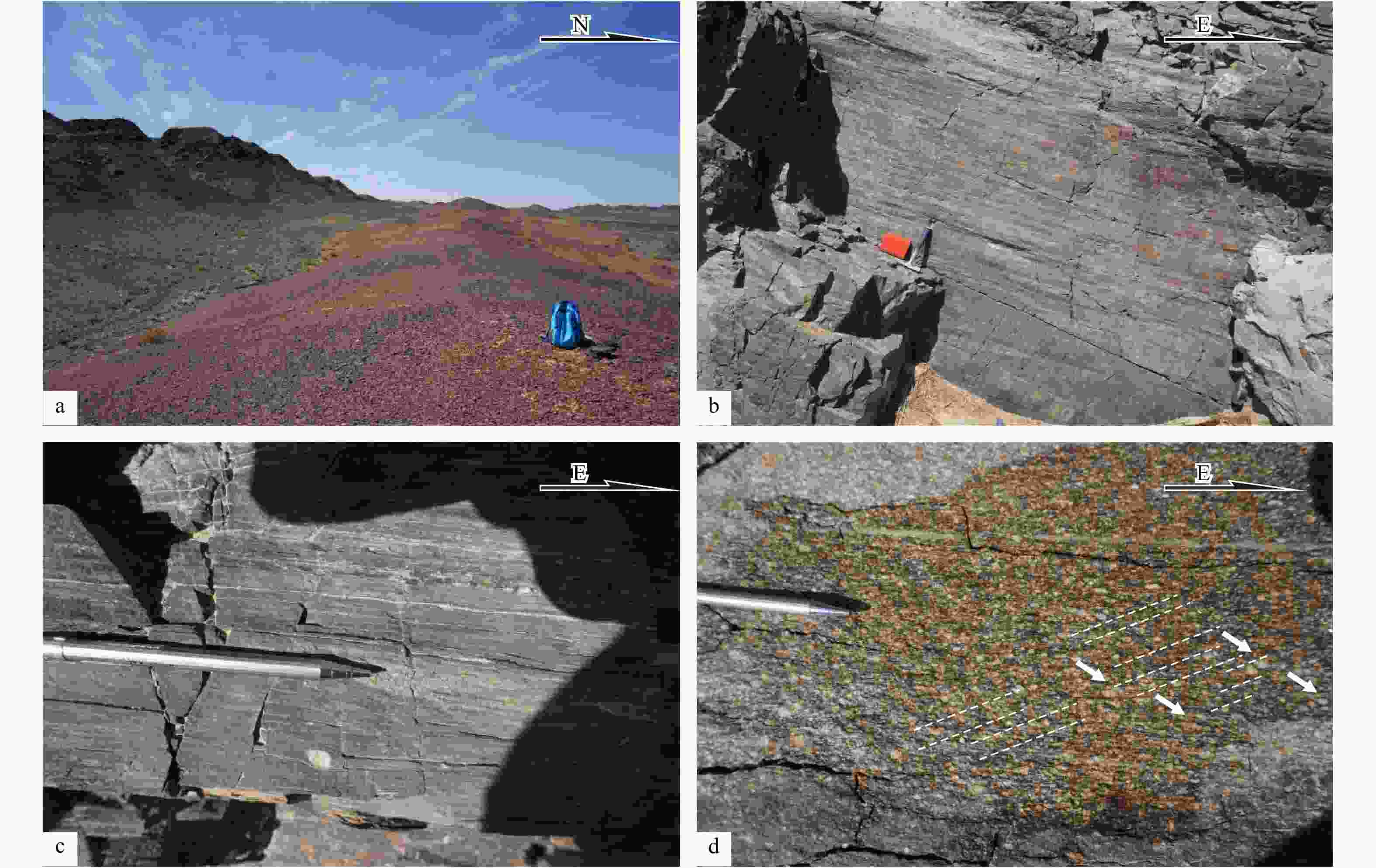
图 12 中秋井−金庙沟韧性剪切带糜棱岩
a—西向延伸的花岗岩全景; b—剪切带中花岗糜棱面理上的近水平的石英拉伸线理;c—剪切带中花岗糜棱岩XZ面上的σ不对称组构(铅笔下方),指示左行剪切; d— 剪切带中花岗糜棱岩XZ面上的σ不对称组构(箭头处)和C’构造(虚线),指示左行剪切
Figure 12. Field photographs of the mylonites from the Zhongqiujing–Jinmiaogou ductile zone
(a) Panorama of an east-west-trending granite involved in the shear zone; (b) Granitic mylonitic foliation with nearly horizontal quartz stretching lineation on it in the shear zone; (c) Asymmetric σ-fabric (below the pencil) in the granitic mylonite in the shear zone (XZ plane), indicating sinistral shearing; (d) Asymmetric σ-fabric (arrow) in the granitic mylonite in the shear zone (XZ plane) and C’ shear band (dashed lines), indicating sinistral shearing
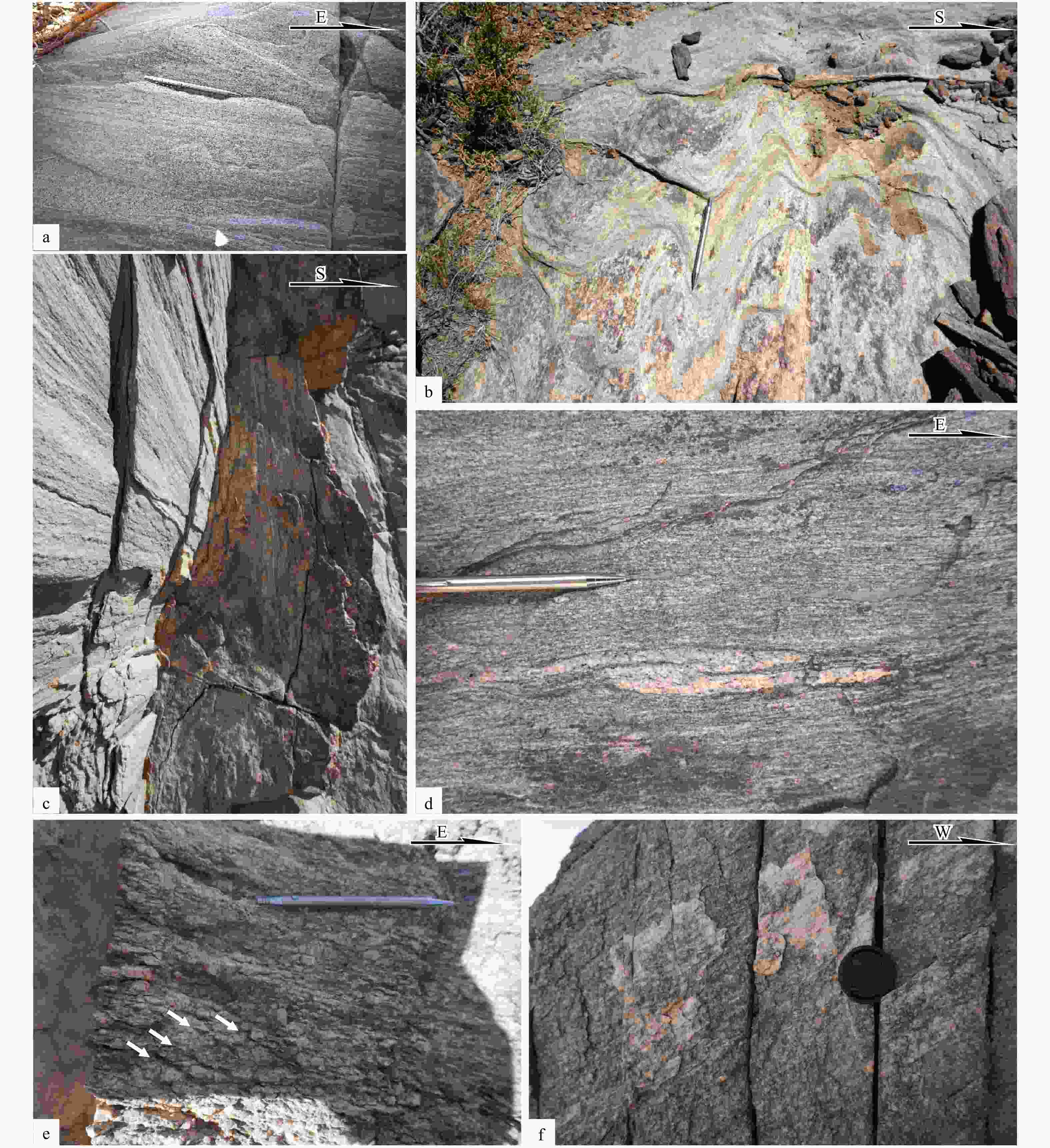
图 13 旧井−穿山驯韧性剪切带糜棱岩
A—糜棱岩面理与石英拉伸线理; B—C—花岗糜棱面理A型褶皱; D— 不对称褶皱(XZ面),示右行剪切; E— C’(箭头处)与不对称组构(铅笔下方;XZ面),指示右行剪切; F— 石英拉伸线理
Figure 13. Field photographs of the mylonites from the Jiujing–Chuanshanxun ductile shear zone
(a) Mylonitic foliation with quartz lineation in deformed granite; (b) and (c) A-type folds in granitic mylonite; (d) Asymmetric fold (XZ plane), indicating dextral shearing; (e) C’ shear band (arrow) and asymmetric fabric (below the pencil; XZ plane), indicating dextral shearing; (f) Quartz stretching lineation

图 14 小西弓−前红泉韧性剪切带糜棱岩
a—沿糜棱岩面理侵入的同构造花岗岩;b— 卷入剪切带的花岗岩;c— σ不对称组构(XZ面),指示左行剪切; d—石英拉伸线理
Figure 14. Field photographs of the mylonites from the Xiaoxigong–Qianhongquan ductile shear zone
(a) Syn-tectonic granite intruded along the mylonitic foliation; (b) Granite involved in the shear zone; (c) Asymmetric σ-fabric (XZ plane), indicating sinistral shearing; (d) Quartz stretching lineation
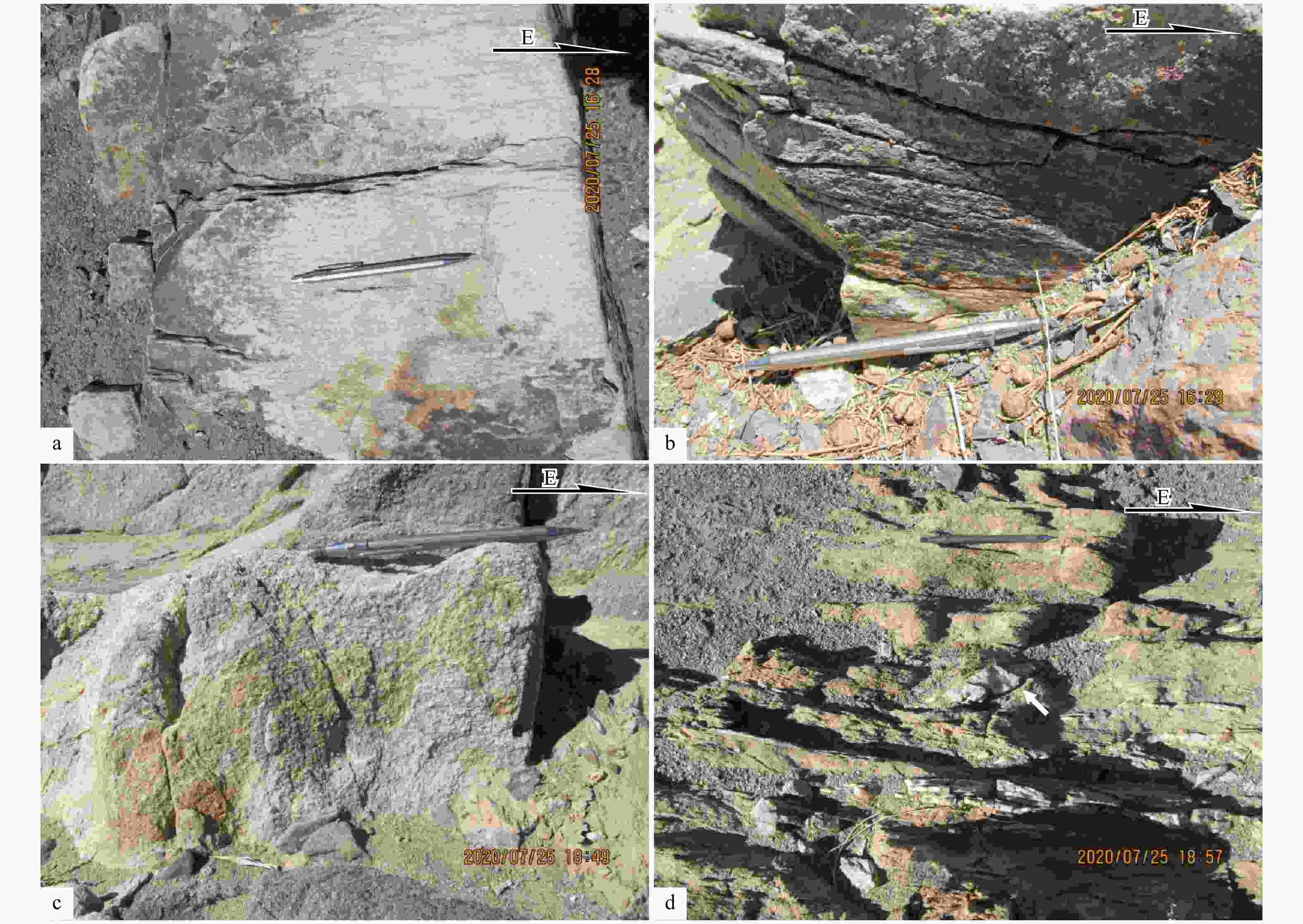
图 15 白墩子−西涧泉韧性剪切带糜棱岩
a—花岗糜棱岩;b—石英拉伸线理; c—糜棱岩面理; d— 不对称组构(箭头处),指示右行剪切
Figure 15. Field photographs of the mylonites from the Baidunzi–Xijianquan ductile shear zone
(a) Granitic mylonite; (b) Quartz stretching lineation; (c) Mylonitic foliation; (d) Asymmetric fabrics (arrow), indicating dextral shearing
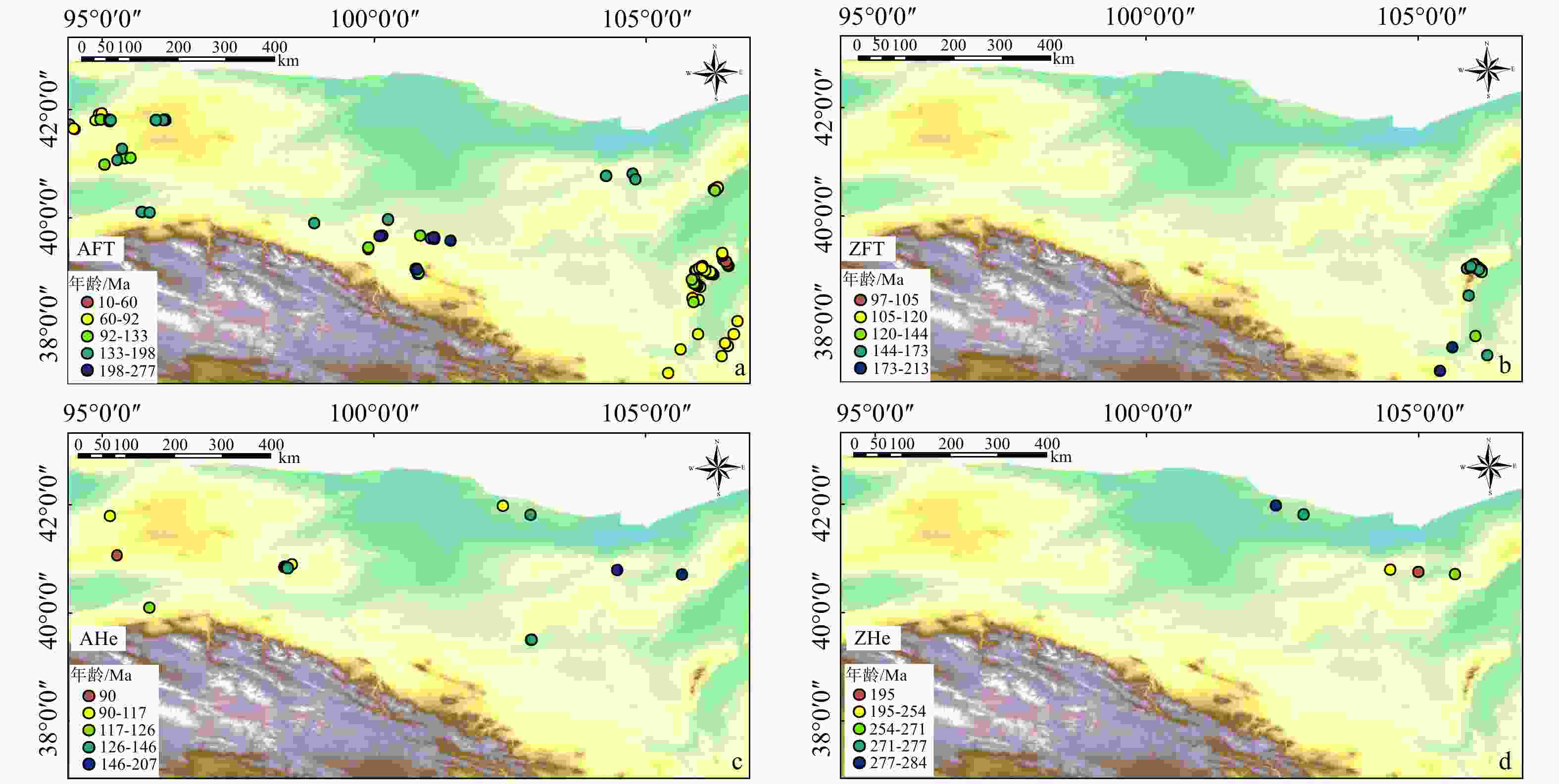
图 16 北山−阿拉善地区低温热年代学数据分布
a—磷灰石裂变径迹年龄(数据来自刘红旭等,2014;Wang et al.,2023;Gillespie et al.,2017;Tian et al.,2016;Liu et al.,2023;Song et al.,2018; Zhang et al.,2017;Du et al.,2021;韩伟等,2015; 马静辉和何登发 ,2019;Nie et al.,2021;刘奎等,2024);b—锆石裂变径迹年龄(Chen et al.,2007); c—磷灰石U/Th-He年龄(Zhang et al.,2021b); d— 锆石U/Th-He年龄(Zhang et al.,2021b)
Figure 16. Distribution of low-temperature thermochronology data in the Beishan-Alxa region
(a) Apatite fission track ages (data from Liu et al., 2014; Gillespie et al., 2017; Tian et al., 2016; Liu et al., 2023; Song et al., 2018; Zhang et al., 2021b; Zhang et al., 2017; Han et al., 2015; Liu et al., 2024); (b) Zircon fission track ages (Chen et al., 2007); (c) Apatite U/Th–He ages (Zhang et al., 2021b); (d) Zircon U/Th–He ages (Zhang et al., 2021b)
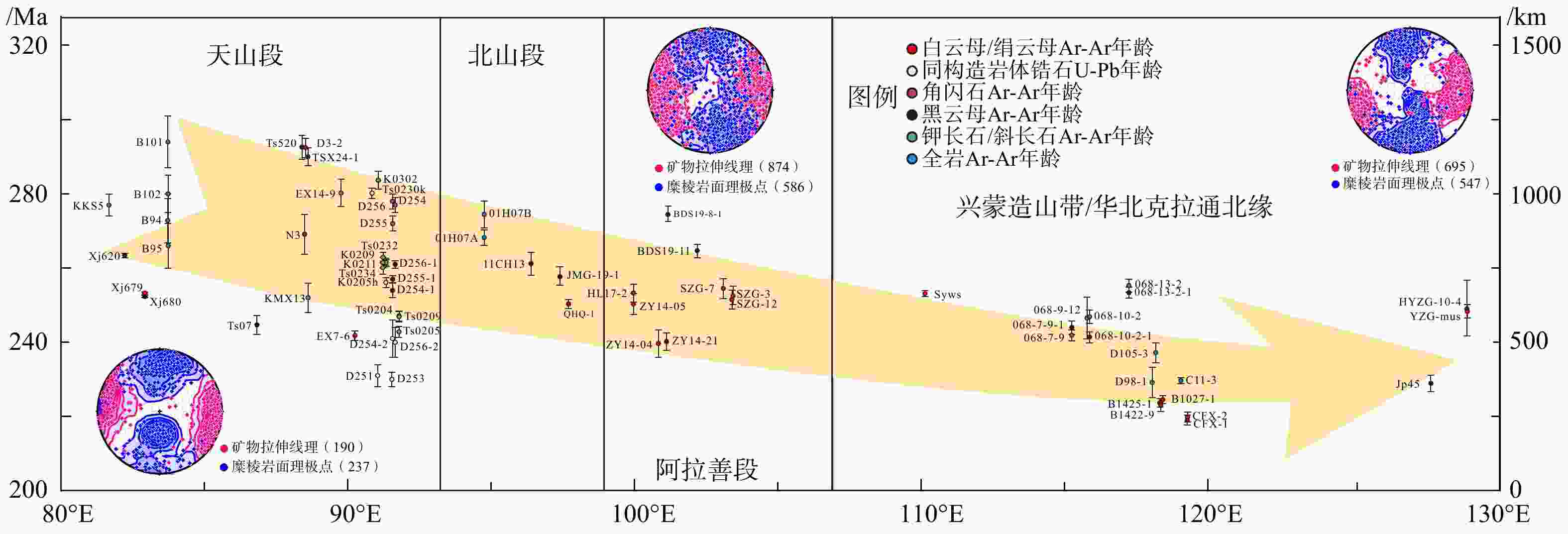
图 17 中亚造山带韧性剪切时代分布(Zhang et al.,2022a)
Figure 17. Temporal distribution of ductile shear zones in the Central Asian Orogenic Belt (data from Zhang et al., 2022, and references therein)
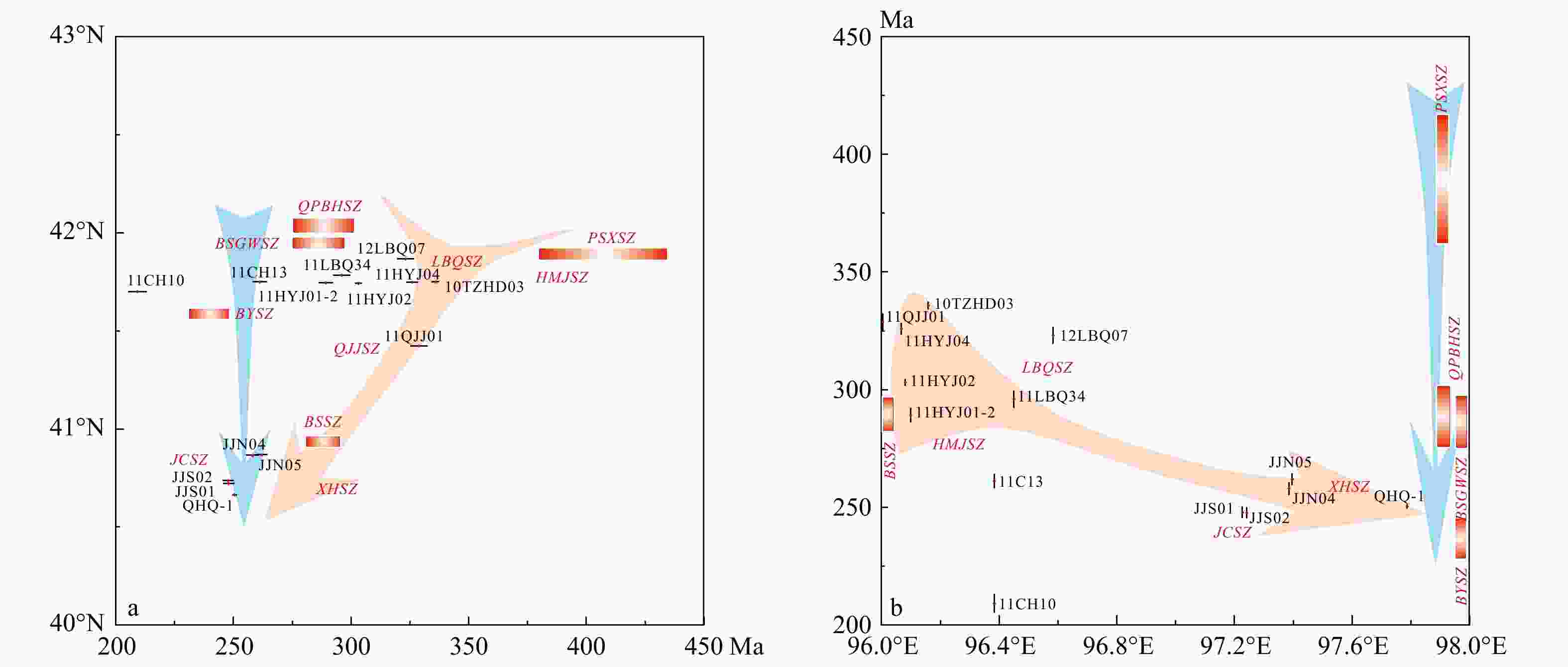
图 18 北山韧性剪切带年龄分布
BYSZ—白云山−月牙山北剪切带;JCSZ—旧井–穿山驯剪切带;XHSZ—小西弓–前红泉剪切带;BSSZ—白墩子–石板墩剪切带;QJJSZ—七角井剪切带;BSGWSZ—白梁−三个井–公路井–微波山剪切带;QPBHSZ—千条沟–蓬勃山–百合山–红石山剪切带;LBQSZ—勒巴泉剪切带;HMJSZ—红岩井–马鬃山–尖山剪切带;PSXSZ—破城山–石板井–小黄山剪切带a—纬度方向分布; b— 经度方向分布(红色区域为根据岩体穿切关系确定的年龄范围,其余的为40Ar/39Ar年龄,浅蓝色和粉红色箭头为不同的年龄变化趋势)
Figure 18. Age distribution of ductile shear zones in the Beishan region
(a) Age–latitude diagram; (b) Age–longitude diagram (The red shaded areas represent age ranges constrained by cross-cutting relationships of rock bodies; other ages are based on 40Ar/39Ar dating. Light blue and pink arrows indicate different age variation trends)BYSZ—Baiyunshan–Yueyashanbei shear zone; JCSZ—Jiujing–Chuanshanxun shear zone; XHSZ—Xiaoxigong–Qianhongquan shear zone; BSSZ—Baidunzi–Shibandun shear zone; QJJSZ—Qijiaojing shear zone; BSGWSZ—Bailiang–Sangejing–Gonglujing–Weiboshan shear zone; QPBHSZ—Qiantiaogou–Pengboshan–Baiheshan–Hongshishan shear zone; LBQSZ—Lebaquan shear zone; HMJSZ—Hongyanjing–Mazongshan–Jianshan shear zone; PSXSZ—Pochengshan–Shibanjing–Xiaohuangshan shear zone
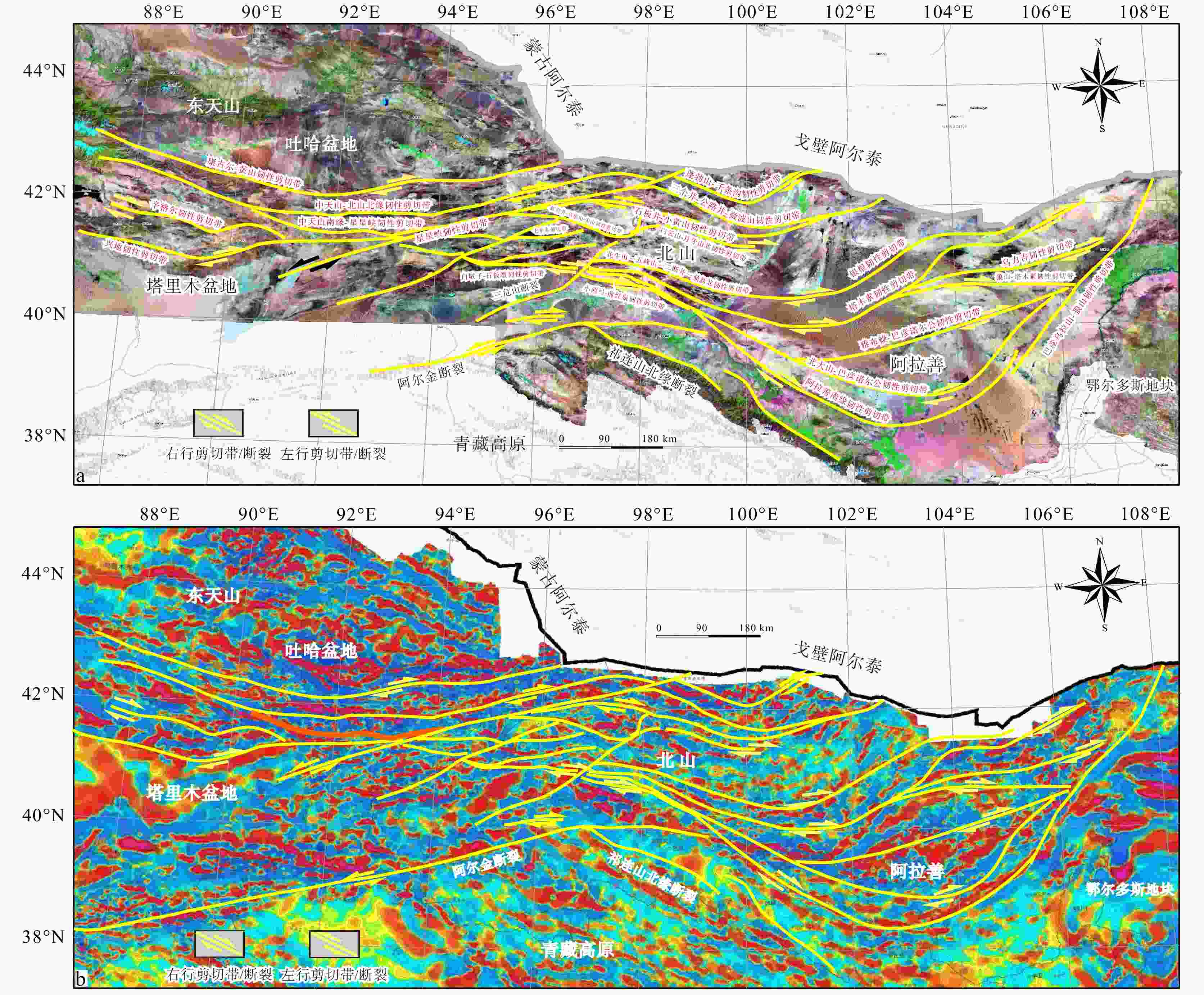
图 19 东天山−北山−阿拉善晚古生代末期—三叠纪韧性剪切带
a—东天山−北山−阿拉善晚古生代末期—三叠纪韧性剪切带连接与分布(底图来自美国地质调查局:https://earthexplorer.usgs.gov/); b— 剪切带分布与研究区航磁异常关系(航磁异常图根据Xiong et al., 2016)
Figure 19. Latest Paleozoic ductile shear zones in the Eastern Tianshan–Beishan–Alxa region
(a) Distribution and connection of ductile shear zones in the Eastern Tianshan–Beishan–Alxa region (The base map is from the United States Geological Survey, https://earthexplorer.usgs.gov/); (b) Relationship between the ductile shear zone distribution and the aeromagnetic anomaly in the study region (aeromagnetic anomaly map adapted from Xiong et al., 2016)
-
[1] AN K X, LIN X B, HUANG J L, et al., 2025. Early Cenozoic reactivation of a pre‐existing crustal boundary along the Kuantan Shan-Hei Shan area North of the Jiuxi Basin, northeastern Tibetan Plateau[J]. Tectonics, 44(5): e2024TC008615. doi: 10.1029/2024TC008615 [2] AO S J, XIAO W J, WINDLEY B F, et al., 2016. Paleozoic accretionary orogenesis in the eastern Beishan orogen: constraints from zircon U–Pb and 40Ar/39Ar geochronology[J]. Gondwana Research, 30: 224-235. doi: 10.1016/j.gr.2015.03.004 [3] CAI Z H, XU Z Q, HE B Z, et al., 2012. Age and tectonic evolution of ductile shear zones in the eastern Tianshan-Beishan orogenic belt[J]. Acta Petrologica Sinica, 28(6): 1875-1895. (in Chinese with English abstract) [4] CHANG W, ZHANG G S, PENG R, et al., 2024. Geometric characteristics and tectonic significance of Late Paleozoic mafic dyke swarms in Beishan and its adjacent areas: based on remote sensing image research[J]. Geological Bulletin of China, 43(4): 536-545. (in Chinese with English abstract) [5] CHEN B L, YANG N, WU G G, et al., 2002. Analysis of ore-controlling structure in ductile shear zone type gold deposits in southern Beishan Area, Gansu Province[J]. Mineral Deposits, 21(2): 149-158. (in Chinese with English abstract) [6] CHEN B L, WU G G, YANG N, et al., 2007. Baidunzi-Xiaoxigong ductile shear zone and its ore-controlling effect in the southern Beishan area, Gansu[J]. Journal of Geomechanics, 13(2): 99-109. (in Chinese with English abstract) [7] CHEN W, ZHANG Y, QIN K Z, et al., 2007. Study on the age of the shear zone-type gold deposit of East Tianshan, Xinjiang, China[J]. Acta Petrologica Sinica, 23(8): 2007-2016. (in Chinese with English abstract) [8] CUI X, WANG G H, WANG Z Y, et al., 2019. Discovery of structural schist belt in Huobuhaer Area of Ejinaqi, Inner Mongolia: implication for its tectonic significance[J]. Mineralogy and Petrology, 39(2): 81-89. (in Chinese with English abstract) [9] DING S H, 2021. 40Ar-39Ar age of sericite and its geological significance in Qianhongquan Gold Deposit, Beishan Area, Gansu Province[J]. Gold Science and Technology, 29(2): 173-183. (in Chinese with English abstract) [10] DONG Z C, XI R G, WANG G Q, et al., 2024. Structural characteristics of the Saozishan Formation in the Hongshishan area of the Gansu Beishan and its dynamic background[J]. Geological Bulletin of China, 43(2-3): 302-316. (in Chinese with English abstract) [11] DU J X, FU B H, SHI P L, et al., 2021. Cenozoic tectono-geomorphic evolution of Yabrai Mountain and the Badain Jaran Desert (NE Tibetan Plateau margin)[J]. Geomorphology, 389: 107857. doi: 10.1016/j.geomorph.2021.107857 [12] FANG W X, ZHENG X M, FANG T H, et al., 2021. Restoration of the Devonian-Carboniferous limited ocean basin and deep structure of ophiolitic melange in the Hongshishan area of Gansu Province[J]. Geological Bulletin of China, 40(5): 649-673. (in Chinese with English abstract) [13] FENG L M, LIN S F, LI L M, et al., 2020. Constraints on the tectonic evolution of the southern central Asian orogenic belt from early Permian–middle Triassic granitoids from the central Dunhuang orogenic belt, NW China[J]. Journal of Asian Earth Sciences, 194: 104283. doi: 10.1016/j.jseaes.2020.104283 [14] GAO Y, DING H L, GUO R J, et al., 2016. Structural deformation of Gonglujing—Sangejing ductile shear zone in the Beishan orogenic belt, and its geological significance[J]. Geological Survey of China, 3(1): 26-34. (in Chinese with English abstract) [15] GILLESPIE J, GLORIE S, XIAO W J, et al., 2017. Mesozoic reactivation of the Beishan, southern Central Asian Orogenic Belt: insights from low-temperature thermochronology[J]. Gondwana Research, 43: 107-122. doi: 10.1016/j.gr.2015.10.004 [16] HAN W, LU J C, WEI J S, et al., 2015. Apatite fission track constraints on the Mesozoic tectonic activities Shandan depression, Yin’e Basin, Inner Mongolia[J]. Acta Geologica Sinica, 89(12): 2277-2285. (in Chinese with English abstract) [17] HE Z Y, SUN L X, MAO L J, et al., 2015. Zircon U-Pb and Hf isotopic study of gneiss and granodiorite from the southern Beishan orogenic collage: Mesoproterozoic magmatism and crustal growth[J]. Chinese Science Bulletin, 60(4): 389-399. (in Chinese with English abstract) doi: 10.1360/N972014-00898 [18] HONG T, SANTOS G S, VAN STAAL C R, et al., 2023. Mapping uncovered a multi-phase arc–back-arc system in the southern Beishan during the Permian[J]. National Science Review, 10(2): nwac204. doi: 10.1093/nsr/nwac204 [19] LAMB M A, HANSON A D, GRAHAM S A, et al., 1999. Left-lateral sense offset of Upper Proterozoic to Paleozoic features across the Gobi Onon, Tost, and Zuunbayan faults in southern Mongolia and implications for other central Asian faults[J]. Earth and Planetary Science Letters, 173(3): 183-194. doi: 10.1016/S0012-821X(99)00227-7 [20] LI C Y, WANG Q, 1983. Paleo plate tectonics and the formation of the Eurasian continent in the northern border and adjacent areas of China[C]//Collection of Northern China plate tectonics, volume I. Beijing: Geological Publishing House: 3-16. (in Chinese) [21] LI Z, ZHU W B, WU H L, 2019. Structural characteristics and chronological constraints on the Yemaquan-Lebaquan ductile shear zone in Mazongshan Area, Beishan[J]. Geological Journal of China Universities, 25(6): 932-942. (in Chinese with English abstract) [22] LIU K, CHEN X H, ZUZA A V, et al., 2023. The late Mesozoic intracontinental contraction–extension transition in the Beishan fold-thrust belt, central Asia: constraints from structural analysis and apatite (U-Th)/He thermochronology[J]. Tectonics, 42(7): e2022TC007532. doi: 10.1029/2022TC007532 [23] LIU K, CHEN X H, WANG D R, et al., 2024. The Early Cretaceous extensional deformation in the southeastern Beishan Range, central Asia: constrains from 2D seismic reflection profile interpretation and apatite fission track thermochronology[J]. Journal of Geomechanics, 30(3): 377-393. (in Chinese with English abstract) [24] LIU H X, YAN D P, HE J G, et al., 2014. Apatite fission track evidence for the Mesozoic-Cenozoic tectonic uplift of Aqishan-Yamansu area, East Tianshan: With discussion of tectonic activity and geological disposal of radioactive waste[J]. Geological Journal of China Universities, 20(1): 81-92. (in Chinese with English abstract) [25] LIU X Y, WANG Q, 1995. Tectonics and evolution of the Beishan orogenic belt in western China[C]//Collection of the geological research institute of China (28). Beijing: The Institute of Geology, Chinese Academy of Geological Sciences: 42-53. (in Chinese) [26] MA J H, HE D F, 2019. Meso-Cenozoic tectonic events in the Helanshan Tectonic Belt and its adjacent areas: Constraints from unconformity and fission track data[J]. Acta Petrologica Sinica, 35(4): 1121-1142. (in Chinese with English abstract) doi: 10.18654/1000-0569/2019.04.10 [27] MAO Q G, XIAO W J, AO S J, et al., 2023. Final amalgamation processes of the southern Altaids: insights from the Triassic Houhongquan ophiolitic mélange in the Beishan orogen (NW China)[J]. Lithosphere, 2023(1): 1988410. doi: 10.2113/2023/1988410 [28] MUHTAR M N, WU C Z, XIAO W J, 2023. Movement and mineralization of the Kanggur-Huangshan shear zone in the East Tianshan: Implications for regional exploration[J]. Acta Petrologica Sinica, 39(11): 3434-3446. (in Chinese with English abstract) doi: 10.18654/1000-0569/2023.11.13 [29] MUHTAR M N, WU C Z, BRZOZOWSKI M J, et al., 2023. Timing and spatial variation of deformation along the Kanggur-Huangshan shear zone in the Chinese Tianshan: implications for regional differential uplift and mineralization[J]. GSA Bulletin, 135(5-6): 1429-1448. [30] NIE F J, YAN Z B, WANG Y N, et al., 2021. Intracontinental deformation of the western Ordos Basin in North China and sandstone-type uranium mineralization: Constraints from AFT chronology of the Helan Mountain[J]. Geological Journal, 56(11): 1-22. [31] NIU W C, XIN H T, DUAN L F, et al., 2019. The identification and subduction polarity of the Baiheshan ophiolite mélanges belt in the Beishan area, Inner Mongolia: new understanding based on the geological map of Qinghegou Sheet (1: 50000)[J]. Geology in China, 46(5): 977-994. (in Chinese with English abstract) [32] NIU W C, XIN H T, DUAN L F, et al., 2020. Geochemical characteristics, zircon U-Pb age of SSZ ophiolite in the Baiheshan area of the Beishan orogenic belt, Inner Mongolia, and its indication for the evolution of the Paleo-Asian Ocean[J]. Geological Bulletin of China, 39(9): 1317-1329. (in Chinese with English abstract) [33] NIU Y Z, LU J C, WEI J S, et al., 2014. Chronology of the Lütiaoshan Formation in the Beishan Area and its tectonic significances[J]. Geological Review, 60(3): 567-576. (in Chinese with English abstract) [34] PASSCHIER C W, PLATT J P, 2017. Shear zone junctions: of zippers and freeways[J]. Journal of Structural Geology, 95: 188-202. doi: 10.1016/j.jsg.2016.10.010 [35] QIAN J P, FU Y J, ZHOU Y N, et al., 2018. Analysis of the metallogenic structure system and the regularities of tectonic ore control of the Laodonggou gold polymetallic mining area, Ejinaqi, Inner Mongolia[J]. Geotectonica et Metallogenia, 42(6): 1046-1063. (in Chinese with English abstract) [36] SONG D F, XIAO W J, HAN C M, et al., 2014. Polyphase deformation of a Paleozoic forearc–arc complex in the Beishan orogen, NW China[J]. Tectonophysics, 632: 224-243. doi: 10.1016/j.tecto.2014.06.030 [37] SONG D F, XIAO W J, HAN C M, et al., 2018. Accretionary processes of the central segment of Beishan: constraints from structural deformation and 40Ar-39Ar geochronology[J]. Acta Petrologica Sinica, 34(7): 2087-2098. (in Chinese with English abstract) [38] SUN L X, ZHANG J H, REN B F, et al., 2017. Geochemical characteristics and U-Pb age of Baiyunshan ophiolite mélange in the Beishan orogenic belt and their geological implications[J]. Acta Petrologica et Mineralogica, 36(2): 131-147. (in Chinese with English abstract) [39] TIAN Z H, XIAO W J, ZHANG Z Y, et al., 2016. Fisson-track constrains on superposed folding in the Beishan orogenic belt, southernmost Altaids[J]. Geoscience Frontiers, 7(2): 181-196. doi: 10.1016/j.gsf.2015.11.007 [40] TIAN Z H, XIAO W J, WINDLEY B F, et al., 2021. Two key switches in regional stress field during multi-stage deformation in the Carboniferous–Triassic southernmost Altaids (Beishan, NW China): response to orocline-related roll-back processes[J]. GSA Bulletin, 133(11-12): 2591-2611. doi: 10.1130/B35898.1 [41] WANG D Y, LI M X, WANG Q, et al., 2024. Magmatic response to lithospheric thinning of the North China Craton: evidence from the Daqingshan granite[J]. East China Geology, 45(2): 173-186. (in Chinese with English abstract) [42] WANG F, WANG J, FAN H H, et al., 2005. Distribution of Late Quaternary active faults and its tectonic significance in the Beishan Region, Gansu Province, China[J]. Geological Review, 51(3): 250-256. (in Chinese with English abstract) [43] WANG F J, LUO M, HE Z Y, et al. , 2023. Mid-cretaceous accelerated cooling of the Beishan orogen, NW China: evidence from apatite fission track thermochronology[J]. Lithosphere, 2023(S14): lithosphere_2023_239, 1-20. [44] WANG G Q, LI X M, XU X Y, et al., 2021. Research status and progress of Paleozoic ophiolites in Beishan orogenic belt[J]. Geological Bulletin of China, 40(1): 71-81. (in Chinese with English abstract) [45] WANG T, SELTMANN R, HUANG H, et al. , 2018. Guidebook for field excursion of first workshop of Project IGCP-662“Orogenic architecture and crustal growth from accretion to collision (IGCP#662): scientific activities 2018-2019[EB/OL]. https://www.researchgate.net/publication/367635259_Field_Guide_Book_to_Project_IGCP-662_Fieldtrip_to_the_Dunhuang_Block_and_Beishan_Orogen_in_the_Dunhuang-Liuyuan_area_Gansu_Province_NW_China [46] WANG W B, LEI C C, LI G, et al., 2023. Structural characteristics of the Wanghushan ductile shear zone in northwestern Inner Mongolia and its geological significance[J]. Acta Geologica Sinica, 97(7): 2141-2156. (in Chinese with English abstract) [47] WANG Y, SUN G, LI J, 2010. U-Pb (SHRIMP) and 40Ar/39Ar geochronological constraints on the evolution of the Xingxingxia shear zone, NW China: a Triassic segment of the Altyn Tagh fault system[J]. GSA Bulletin, 122(3-4): 487-505. doi: 10.1130/B26347.1 [48] WANG Z Q, LI J, WANG L J, et al., 2023. Petrogenesis of the Middle to Late Jurassic diorite and granite from Hada area in the Southern Xing’an Block and its restriction on the evolution of the Mongol-Okhotsk Ocean[J]. East China Geology, 44(4): 386-401. (in Chinese with English abstract) [49] XIAO W J, MAO Q G, WINDLEY B F, et al., 2010. Paleozoic multiple accretionary and collisional processes of the Beishan orogenic collage[J]. American Journal of Science, 310(10): 1553-1594. doi: 10.2475/10.2010.12 [50] XIN H T, NIU W C, TIAN J, et al., 2020. Spatio-temporal structure of Beishan orogenic belt and evolution of Paleo-Asian Ocean, Inner Mongolia[J]. Geological Bulletin of China, 39(9): 1297-1316. (in Chinese with English abstract) [51] XIONG S Q, TONG J, DING Y Y, et al., 2016. Aeromagnetic data and geological structure of continental China: a review[J]. Applied Geophysics, 13(2): 227-237. doi: 10.1007/s11770-016-0552-2 [52] YAN J Y, LÜ Q T, MENG G X, et al., 2009. Regional geophysical field characters, structural zonation and deep structure of the Beishan area, Inner-Mongolia[J]. Progress in Geophysics, 24(2): 439-447. (in Chinese with English abstract) [53] YANG Z X, DING S H, ZHANG J, et al., 2023. The discovery and prospecting significance of the Qianhongquan gold deposit in the south Beishan Orogenic Belt, Gansu Province, China[J]. Northwestern Geology, 56(6): 274-284. (in Chinese with English abstract) [54] YI K X, JOLIVET M, GUO Z J, 2025. Tectonic transition and extension at the eastern and western ends of the Altyn Tagh fault: insights from triple junctions[J]. Journal of Geomechanics, 31(1): 24-38. (in Chinese with English abstract) [55] YUN L, WANG J, ZHANG J, et al., 2025. Late Quaternary tectonics of the Jiujing-Bantan fault along the southern Beishan Block and its implication for the northward growth of the Tibetan Plateau[J]. Journal of Structural Geology, 198: 105458. doi: 10.1016/j.jsg.2025.105458 [56] ZHANG B H, ZHANG J, WANG Y N, et al., 2017. Late Mesozoic-Cenozoic exhumation of the Northern Hexi Corridor: Constrained by apatite fission track ages of the Longshoushan[J]. Acta Geologica Sinca (English Edition), 91(5): 1624-1643. doi: 10.1111/1755-6724.13402 [57] ZHANG B H, ZHANG J, ZHAO H, et al., 2021a. Kinematics and geochronology of Late Paleozoic–Early Mesozoic ductile deformation in the Alxa Block, NW China: new constraints on the evolution of the Central Asian Orogenic Belt[J]. Lithosphere, 2021(1): 3365581. doi: 10.2113/2021/3365581 [58] ZHANG G Z, ZHANG Y, XIN H T, et al., 2021. Geochronology and geochemistry of diorite porphyrite from Laodonggou gold-polymetallic deposit, Beishan, Inner Mongolia, and its metallogenic significance[J]. Mineral Deposits, 40(3): 555-573. (in Chinese with English abstract) [59] ZHANG H, WANG H, PAN Z L, et al., 2021. Geochronological constraints and deformation of the western section of Shibanjing ductile shear zone in Beishan, Inner Mongolia[J]. Geological Bulletin of China, 40(6): 930-941. (in Chinese with English abstract) [60] ZHANG J, CUNNINGHAM D, 2012. Kilometer-scale refolded folds caused by strike-slip reversal and intraplate shortening in the Beishan region, China[J]. Tectonics, 31(3): TC3009. [61] ZHANG J, WANG Y N, QU J F, et al., 2021b. Mesozoic intracontinental deformation of the Alxa Block in the middle part of Central Asian Orogenic Belt: a review[J]. International Geology Review, 63(12): 1490-1520. doi: 10.1080/00206814.2020.1783583 [62] ZHANG J, QU J F, ZHANG B H, et al., 2022a. Determination of an intracontinental transform system along the southern Central Asian Orogenic Belt in the Latest Paleozoic[J]. American Journal of Science, 322(7): 851-897. doi: 10.2475/07.2022.01 [63] ZHANG J, CUNNINGHAM D, QU J F, et al., 2022b. Poly-phase structural evolution of the northeastern Alxa Block, China: Constraining the Paleozoic-Recent history of the southern central Asian Orogenic belt[J]. Gondwana Research, 105: 25-50. doi: 10.1016/j.gr.2021.12.007 [64] ZHANG J, QU J F, ZHAO H, et al., 2023a. Formation, mechanism and tectonic implication of a large ductile strike-slip duplex in the middle segment of Central Asian Orogenic Belt[J]. Mineral Exploration, 14(4): 519-540. (in Chinese with English abstract) [65] ZHANG J, ZHANG B H, ZHAO H, et al., 2023b. Late Cenozoic deformation characteristics and mechanism of the Beis-han-Alxa region[J]. Earth Science Frontiers, 30(5): 334-357. (in Chinese with English abstract) [66] ZHAO H, ZHANG J, ZHANG B H, et al., 2022. Structures and chronology of the Yabrai shear zone in the Alxa, NW China: constraints on the late Paleozoic shear system in central segment of the Central Asian Orogenic Belt[J]. Journal of Structural Geology, 158: 104575. doi: 10.1016/j.jsg.2022.104575 [67] ZHAO H, ZHANG J, ZHANG B H, et al., 2025. Intracontinental deformation and reactivation of the southern Central Asian Orogenic Belt: styles, causes and mechanisms[J]. Tectonics, 44(4): e2022TC007740. doi: 10.1029/2022TC007740 [68] ZHENG Y D, ZHANG Q, WANG Y, et al., 1996. Great Jurassic thrust sheets in Beishan (North Mountains)—Gobi areas of China and southern Mongolia[J]. Journal of Structural Geology, 18(9): 1111-1126. doi: 10.1016/0191-8141(96)00038-7 [69] ZHENG R G, WU T R, ZHANG W, et al., 2012. Geochemical characteristics and tectonic setting and of the Yueyashan-Xichangjing Ophiolite in the Beishan Area[J]. Acta Geologica Sinica, 86(6): 961-971. (in Chinese with English abstract) [70] ZHENG R G, WU T R, ZHANG W, et al., 2013. Late Paleozoic subduction system in the southern Central Asian Orogenic Belt: evidences from geochronology and geochemistry of the Xiaohuangshan ophiolite in the Beishan orogenic belt[J]. Journal of Asian Earth Sciences, 62: 463-475. doi: 10.1016/j.jseaes.2012.10.033 [71] ZHENG R G, LI J Y, ZHANG J, et al., 2021. A prolonged subduction-accretion in the southern Central Asian Orogenic Belt: insights from anatomy and tectonic affinity for the Beishan complex[J]. Gondwana Research, 95: 88-112. doi: 10.1016/j.gr.2021.02.022 [72] ZUO G C, HE G Q, 1990. Plate tectonics and metallogenic regularities in Beishan region[M]. Beijing: Peking University Press: 1-255. (in Chinese) [73] ZUO G C, ZHENG Y D, 1991. A major breakthrough in the field research of the Beishan lithosphere research: the discovery of eight regional ductile shear zones and extra-large Nappe structures[J]. Gansu Geological Science and Technology Information(1): 1-4. (in Chinese) [74] ZUO G C, FENG Y Z, LIU C Y, et al., 1992. A new discovery of early Yanshanian strike-slip compressional nappe zones on middle-southern segment of Beishan Mts, Gansu[J]. Scientia Geologica Sinica, 27(4): 309-316. (in Chinese with English abstract) [75] 蔡志慧, 许志琴, 何碧竹, 等, 2012. 东天山-北山造山带中大型韧性剪切带属性及形成演化时限与过程[J]. 岩石学报, 28(6): 1875-1895. [76] 陈柏林, 杨农, 吴淦国, 等, 2002. 甘肃北山南带韧性剪切带型金矿床构造控矿解析[J]. 矿床地质, 21(2): 149-158. doi: 10.3969/j.issn.0258-7106.2002.02.007 [77] 陈柏林, 吴淦国, 杨农, 等, 2007. 甘肃北山白墩子-小西弓韧性剪切带及其控矿作用[J]. 地质力学学报, 13(2): 99-109. doi: 10.3969/j.issn.1006-6616.2007.02.003 [78] 陈文, 张彦, 秦克章, 等, 2007. 新疆东天山剪切带型金矿床时代研究[J]. 岩石学报, 23(8): 2007-2016. doi: 10.3969/j.issn.1000-0569.2007.08.021 [79] 崔骁, 王根厚, 王振义, 等, 2019. 内蒙额济纳旗霍布哈尔地区构造片岩带的发现及其构造意义[J]. 矿物岩石, 39(2): 81-89. [80] 丁书宏, 2021. 甘肃北山前红泉金矿床绢云母40Ar-39Ar 年龄及其地质意义[J]. 黄金科学技术, 29(2): 173-183. [81] 董增产, 奚仁刚, 王国强, 等, 2024. 甘肃北山红石山地区扫子山组构造变形特征及其动力学背景[J]. 地质通报, 43(2-3): 302-316. [82] 方维萱, 郑小明, 方同辉, 等, 2021. 甘肃红石山地区泥盆纪—石炭纪有限洋盆重建与蛇绿混杂岩深部结构[J]. 地质通报, 40(5): 649-673. [83] 高勇, 丁华磊, 郭瑞军, 等, 2016. 北山造山带公路井—三个井韧性剪切带构造变形特征及其地质意义[J]. 中国地质调查, 3(1): 26-34. [84] 韩伟, 卢进才, 魏建设, 等. 2015. 内蒙古银额盆地尚丹凹陷中生代构造活动的磷灰石裂变径迹约束[J]. 地质学报, 89(12): 2277-2285. [85] 贺振宇, 孙立新, 毛玲娟, 等, 2015. 北山造山带南部片麻岩和花岗闪长岩的锆石U-Pb定年和Hf同位素: 中元古代的岩浆作用与地壳生长[J]. 科学通报, 60(4): 389-399. [86] 李春昱, 王荃, 1983. 我国北部边陲及邻区的古板块构造与欧亚大陆的形成[C]//中国北方板块构造文集, 第一集. 北京: 地质出版社: 3-16. [87] 李治, 朱文斌, 吴海林, 2019. 北山马鬃山地区野马泉和勒巴泉韧性剪切带构造变形特征与年代学约束[J]. 高校地质学报, 25(6): 932-942. [88] 刘奎, 陈宣华, 王德润, 等, 2024. 北山东南部早白垩世伸展构造变形: 二维反射地震剖面解释与磷灰石裂变径迹测年的制约[J]. 地质力学学报, 30(3): 377-393. doi: 10.12090/j.issn.1006-6616.2023151 [89] 刘雪亚, 王荃, 1995. 中国西部北山造山带的大地构造及其演化[C]//中国地质科学院地质研究所文集(28). 北京: 中国地质科学院地质研究所: 42-53. [90] 刘红旭, 颜丹平, 何建国, 等, 2014. 阿齐山—雅满苏地区中-新生代构造隆升裂变径迹证据: 兼论构造活动对核废选址场的意义[J]. 高校地质学报, 20(1): 81-92. doi: 10.3969/j.issn.1006-7493.2014.01.008 [91] 马静辉, 何登发, 2019. 贺兰山构造带及邻区中新生代构造事件: 来自不整合面和裂变径迹的约束[J]. 岩石学报, 35(4): 1121-1142. doi: 10.18654/1000-0569/2019.04.10 [92] 穆合塔尔·麦麦提尼亚孜, 吴昌志, 肖文交, 2023. 东天山康古尔-黄山剪切带的活动与成矿: 对区域找矿勘查的指示[J]. 岩石学报, 39(11): 3434-3446. doi: 10.18654/1000-0569/2023.11.13 [93] 牛文超, 辛后田, 段连峰, 等, 2019. 内蒙古北山地区百合山蛇绿混杂岩带的厘定及其洋盆俯冲极性: 基于1∶5万清河沟幅地质图的新认识[J]. 中国地质, 46(5): 977-994. [94] 牛文超, 辛后田, 段连峰, 等, 2020. 内蒙古北山造山带百合山SSZ型蛇绿岩地球化学特征、锆石U-Pb年龄及其对古亚洲洋演化的指示[J]. 地质通报, 39(9): 1317-1329. doi: 10.12097/gbc.dztb-39-9-1317 [95] 牛亚卓, 卢进才, 魏建设, 等, 2014. 甘蒙北山地区下石炭统绿条山组时代修正及其构造意义[J]. 地质论评, 60(3): 567-576. [96] 钱建平, 符有江, 周永宁, 等, 2018. 内蒙古额济纳旗老硐沟金多金属矿区成矿构造系统解析和构造控矿规律[J]. 大地构造与成矿学, 42(6): 1046-1063. [97] 宋东方, 肖文交, 韩春明, 等, 2018. 北山中部增生造山过程: 构造变形和40Ar-39Ar年代学制约[J]. 岩石学报, 34(7): 2087-2098. [98] 孙立新, 张家辉, 任邦方, 等, 2017. 北山造山带白云山蛇绿混杂岩的地球化学特征、时代及地质意义[J]. 岩石矿物学杂志, 36(2): 131-147. [99] 王丹阳, 李猛兴, 王权, 等, 2024. 华北克拉通减薄的岩浆浅表响应: 来自大青山岩体的证据[J]. 华东地质, 45(2): 173-186. [100] 王峰, 王驹, 范洪海, 等, 2005. 甘肃北山旧井地区晚第四纪活动断裂分布及其构造意义[J]. 地质论评, 51(3): 250-256. doi: 10.3321/j.issn:0371-5736.2005.03.004 [101] 王国强, 李向民, 徐学义, 等, 2021. 北山造山带古生代蛇绿混杂岩研究现状及进展[J]. 地质通报, 40(1): 71-81. [102] 王文宝, 雷聪聪, 李刚, 等, 2023. 内蒙古西北部望湖山韧性剪切带构造特征及其地质意义[J]. 地质学报, 97(7): 2141-2156. doi: 10.3969/j.issn.0001-5717.2023.07.004 [103] 王志强, 李娟, 王丽娟, 等, 2023. 兴安地块南段哈达地区中晚侏罗世侵入岩成因及对蒙古-鄂霍茨克洋演化的制约[J]. 华东地质, 44(4): 386-401. [104] 辛后田, 牛文超, 田健, 等, 2020. 内蒙古北山造山带时空结构与古亚洲洋演化[J]. 地质通报, 39(9): 1297-1316. doi: 10.12097/gbc.dztb-39-9-1297 [105] 严加永, 吕庆田, 孟贵祥, 等, 2009. 内蒙古北山地区地球物理场特征与构造分区及深部结构研究[J]. 地球物理学进展, 24(2): 439-447. doi: 10.3969/j.issn.1004-2903.2009.02.009 [106] 杨镇熙, 丁书宏, 张晶, 等, 2023. 甘肃北山南带前红泉金矿的发现及其找矿意义[J]. 西北地质, 56(6): 274-284. doi: 10.12401/j.nwg.2023148 [107] 衣可心, JOLIVET M, 郭召杰, 2025. 阿尔金断裂带东西两端构造转换与扩展过程: 从三联点谈起[J]. 地质力学学报, 31(1): 24-38. [108] 张国震, 张永, 辛后田, 等, 2021. 内蒙古北山老硐沟金多金属矿床闪长玢岩年代学、地球化学及其成矿意义[J]. 矿床地质, 40(3): 555-573. [109] 张欢, 王慧, 潘志龙, 等, 2021. 内蒙古北山地区石板井韧性剪切带西段变形特征及年龄约束[J]. 地质通报, 40(6): 930-941. doi: 10.12097/j.issn.1671-2552.2021.06.009 [110] 张进, 曲军峰, 赵衡, 等, 2023a. 中亚造山带中部大型韧性走滑双重构造的形成、机制与涵义[J]. 矿产勘查, 14(4): 519-540. [111] 张进, 张北航, 赵衡, 等, 2023b. 北山-阿拉善晚新生代变形的特征与机制[J]. 地学前缘, 30(5): 334-357. [112] 郑荣国, 吴泰然, 张文, 等, 2012. 北山地区月牙山-洗肠井蛇绿岩的地球化学特征及形成环境[J]. 地质学报, 86(6): 961-971. [113] 左国朝, 何国琦, 1990. 北山板块构造及成矿规律[M]. 北京: 北京大学出版社: 1-255. [114] 左国朝, 郑亚东, 1991. 1990年北山岩石圈研究野外调研取得重大突破: 发现八条区域性韧性剪切带及特大型推覆构造[J]. 甘肃地质科技情报(1): 1-4. -

 下载:
下载:






计量
- 文章访问数: 1497
- HTML全文浏览量: 503
- PDF下载量: 210
- 被引次数: 0
