


Genesis of Ordovician Kelimoli Formation dolomites in the complex tectonic zone along the western margin of the Ordos Basin
-
摘要: 鄂尔多斯盆地西缘复杂构造带奥陶系克里摩里组白云岩作为天然气勘探的优质储层,其成因机制与沉积环境、构造多期叠加改造之间的关系,仍存在着争议。以岩石薄片鉴定、阴极发光、碳氧同位素、X射线衍射有序度、地球化学元素及Sr同位素综合测试分析为基础,结合区域构造演化过程,探讨白云岩的成因机制。白云岩阴极发光整体表现出较弱的暗褐色,环带明显,可见热液矿物自生石英和马鞍状白云石,具有多期重结晶埋藏成因的特征。碳氧同位素特征进一步表明白云岩具有埋藏成因。白云岩样品中白云石有序度总体显示出不太高的特点,并且温度越高,有序度越低,说明白云岩是在较高温度、结晶速度较快的环境下形成的。稀土元素配分模式具有Ce正异常、Eu正异常的特点,表明白云岩形成过程受控于相对封闭且具有较高温度、压力的成岩环境,其本质是成岩系统内部流体发生相互调整与物质再分配的产物。此外,白云岩中微量元素Sr含量越低,Fe、Mn含量越高,总体上表现出深埋藏条件下的多期叠加改造特征。中—粗晶白云岩Sr同位素值明显接近于壳源Sr同位素的平均值,这可能是由于受到了同期构造携带的壳源Sr的影响。研究认为奥陶系克里摩里组白云岩以深埋藏成因为主,同时又受到了构造热流体的叠加改造作用。白云岩的形成演化与深部断裂体系紧密相关,同沉积期深部断裂体系控制了高能滩的发育,后期构造活动期深部断裂体系成为流体运移的通道,促进了白云岩体的叠加改造。该研究成果可以为油气资源的高效勘探提供基础支撑。Abstract:
Objective The dolomite in the Ordovician Kelimoli Formation of the complex tectonic zone along the western Ordos Basin margin is a high-quality reservoir for natural gas exploration. However, its genetic mechanism and the relationships among the sedimentary environment, multi-stage tectonic superimposition, and diagenetic alteration remain controversial, limiting effective guidance for oil and gas exploration. Methods To elucidate the genesis of this dolomite, a comprehensive analytical approach was applied, incorporating thin-section petrography, cathodoluminescence (CL), C–O isotopes, X-ray diffraction (XRD) ordering degrees, trace and rare earth element (REE) geochemistry, and Sr isotopes, integrated with regional tectonic evolution. Results Under CL, the dolomites generally exhibit weak dark-brown luminescence with distinct zonation, alongside authigenic quartz and saddle dolomite, indicating hydrothermal involvement and multi-stage recrystallization during deep burial. Carbon and oxygen isotopic signatures further support a burial origin. XRD data reveal a relatively low ordering degree in dolomites, which decreases with increasing temperature, suggesting rapid crystallization under elevated temperatures. REE patterns display positive Ce and Eu anomalies, indicating that dolomitization occurred in a relatively closed, high-temperature, and high-pressure diagenetic system via internal fluid readjustment and material redistribution. Overall, the dolomite shows a relatively low degree of order, and the order decreases with higher temperatures, suggesting that the dolomite formed in an environment with relatively high temperature and rapid crystallization rate. Geochemically, lower Sr contents correlate with higher Fe and Mn concentrations, reflecting multi-stage superimposed alteration under deep burial conditions. Furthermore, strontium isotope values of medium-to coarse-grained dolomite closely approach average crustal values, likely influenced by crustal Sr transported along coeval tectonic conduits. Conclusions This research attributes the dolomite formation primarily to deep burial and the coeval superimposition of tectonic fluid modification. The origin and evolution of the Ordovician Kelimoli Formation dolomite were strongly controlled by deep fault systems. During the co-deposition period, this fault system controlled the development of high-energy terraces. In the subsequent tectonic activity phase, the deep fault system became a fluid migration channel, facilitating the superimposed modification of dolomite bodies. Significance The research results provide fundamental support for the efficient exploration of oil and gas resources. -
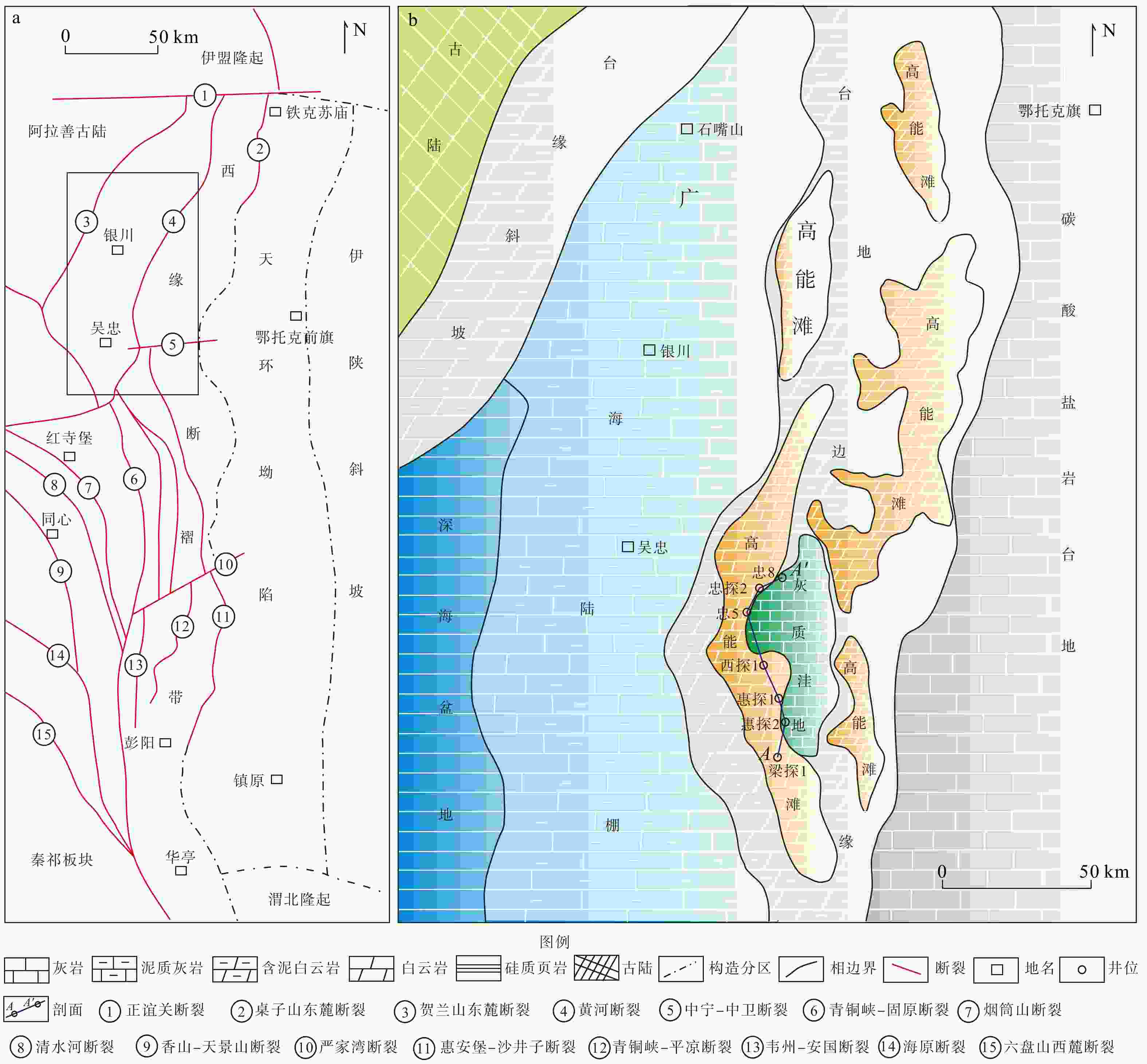
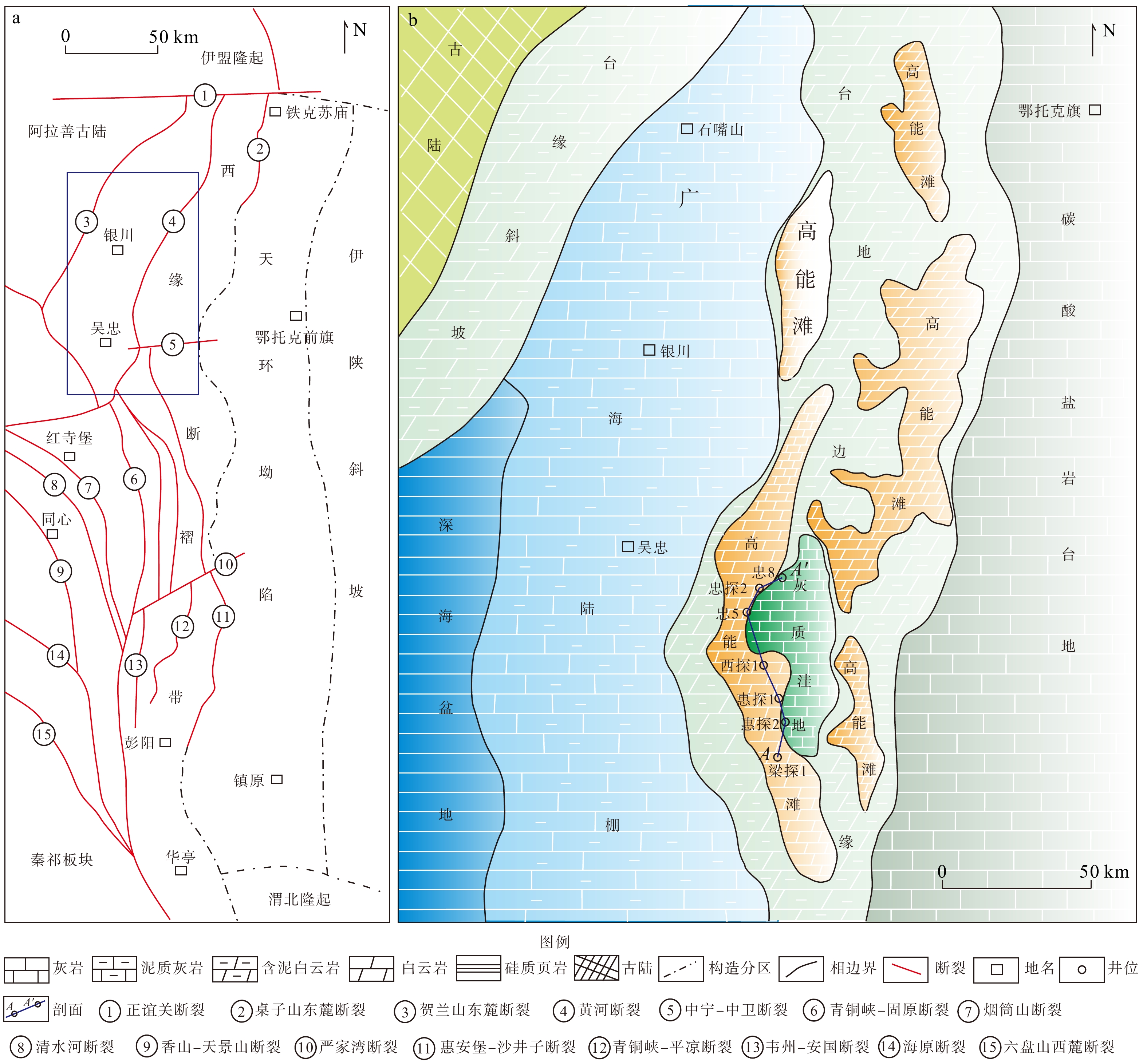
图 1 鄂尔多斯盆地西缘构造纲要和奥陶系克里摩里组沉积相图
a—鄂尔多斯盆地西缘构造纲要图;b—奥陶系克里摩里组沉积相图
Figure 1. Structural outline of the western margin of the Ordos Basin and sedimentary facies of the Ordovician Kelimoli Formation
(a) Tectonic framework map of the western margin of Ordos Basin; (b) Sedimentary facies map of the Ordovician Kelimoli Formation
图 1 鄂尔多斯盆地西缘构造纲要和奥陶系克里摩里组沉积相图
a—鄂尔多斯盆地西缘构造纲要图;b—奥陶系克里摩里组沉积相图
Figure 1. Structural outline of the western margin of the Ordos Basin and sedimentary facies of the Ordovician Kelimoli Formation
(a) Tectonic framework map of the western margin of Ordos Basin; (b) Sedimentary facies map of the Ordovician Kelimoli Formation
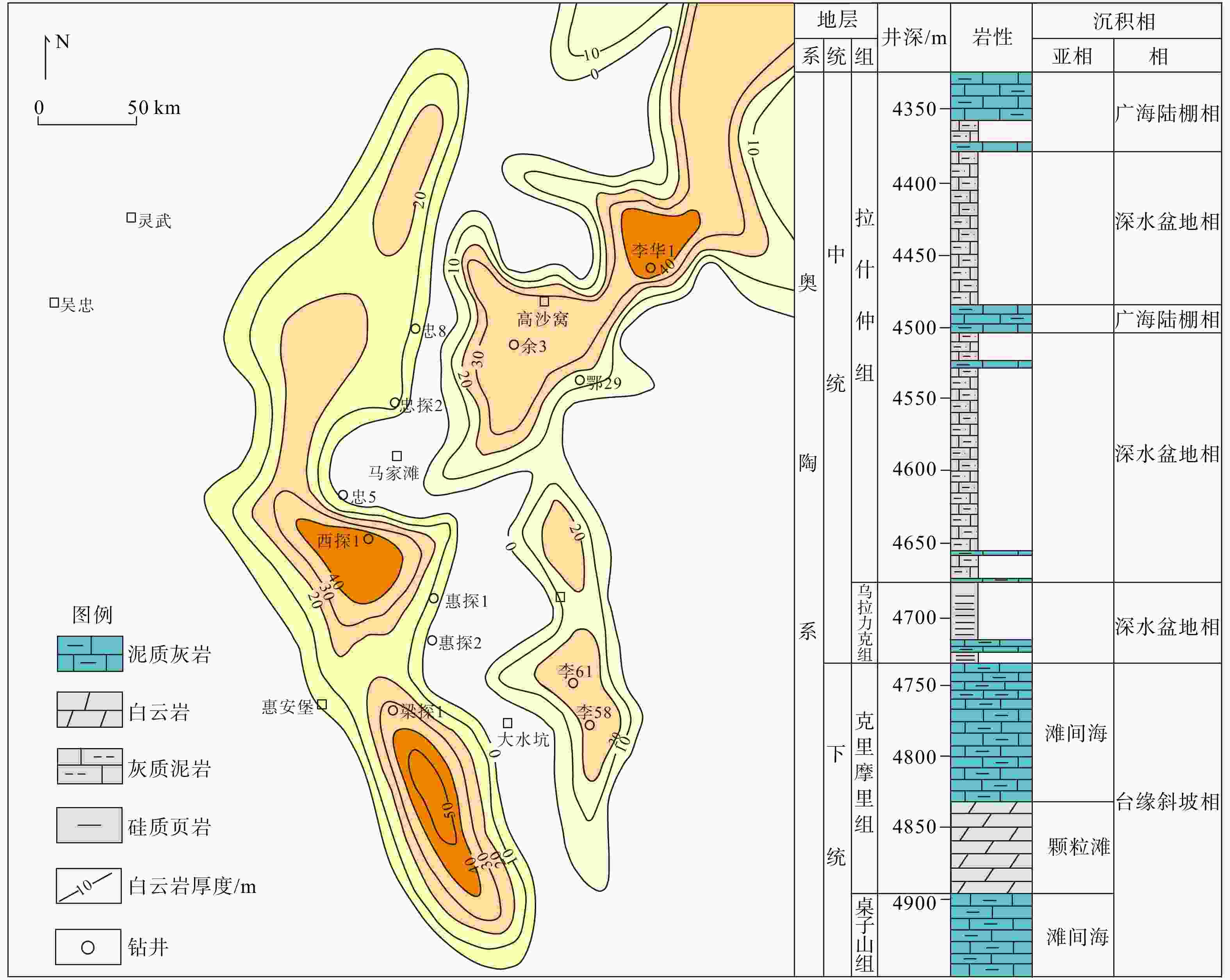
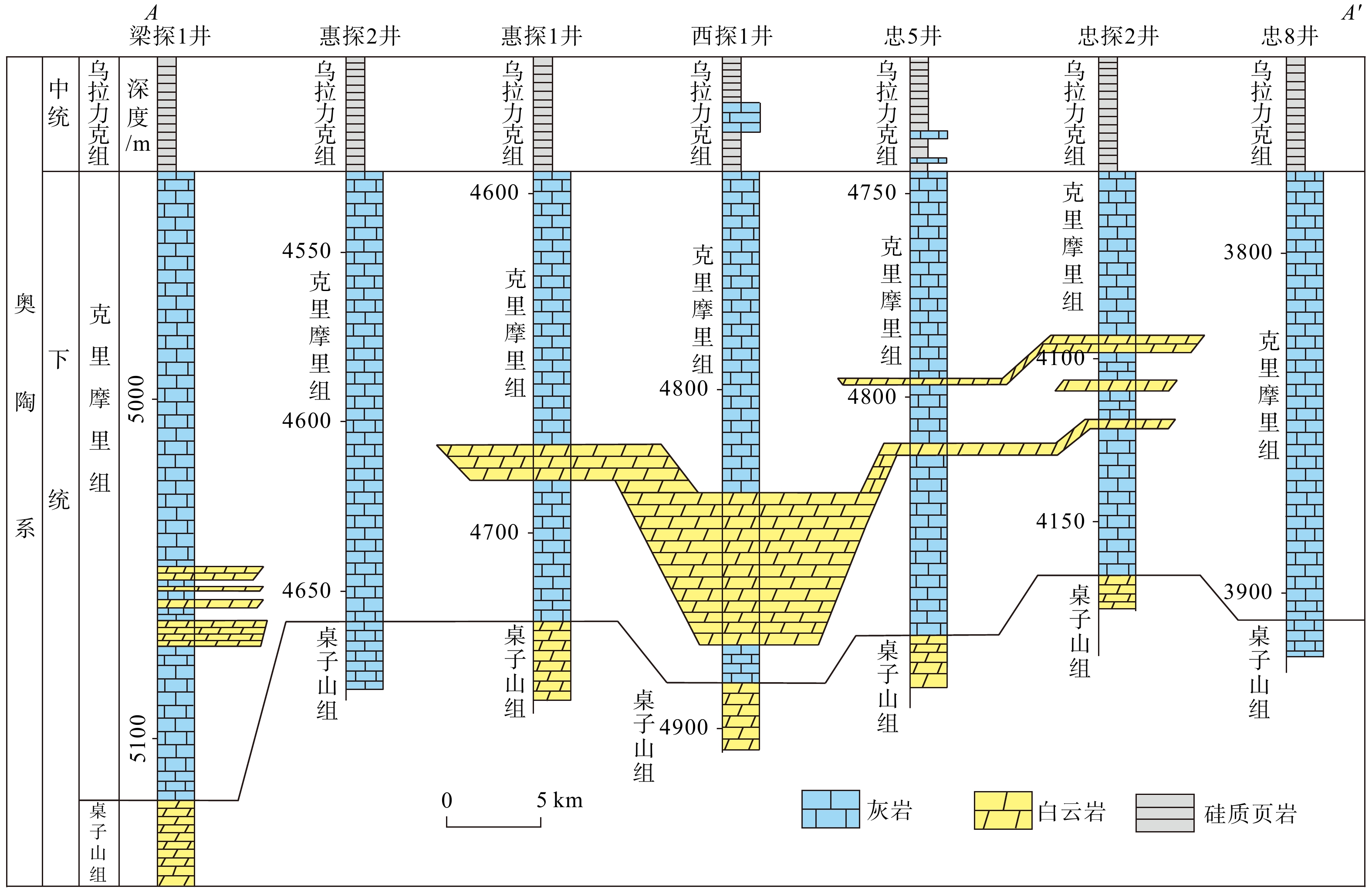
图 2 鄂尔多斯盆地西缘奥陶系克里摩里组白云岩厚度及西探1井综合柱状图
Figure 2. Dolomite thickness map of the Ordovician Kelimoli Formation in the western margin of the Ordos Basin and the composite stratigraphical column of Well Xitan-1
图 2 鄂尔多斯盆地西缘奥陶系克里摩里组白云岩厚度及西探1井综合柱状图
Figure 2. Dolomite thickness map of the Ordovician Kelimoli Formation in the western margin of the Ordos Basin and the composite stratigraphical column of Well Xitan-1
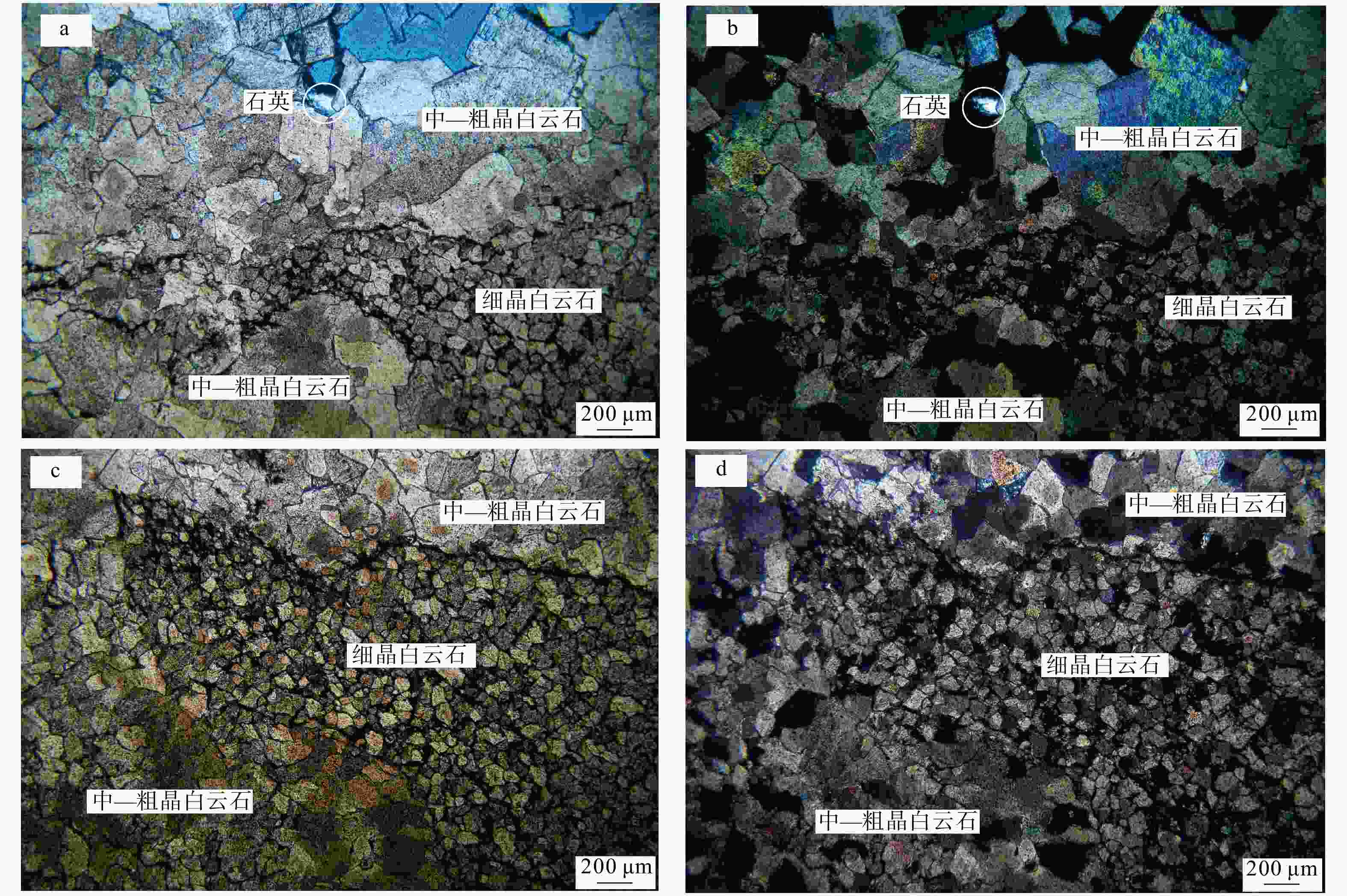
图 3 西探1井奥陶系克里摩里组白云岩显微镜下典型特征
a—西探1井4832.35 m,单偏光;b—西探1井4832.35 m,正交偏光;c—西探1井4833.15 m,单偏光;d—西探1井4833.15 m,正交偏光
Figure 3. Photomicrographs showing typical microstructures of the Ordovician Kelimoli Formation dolomites in Well Xitan-1
(a) Kelimoli Formation, Well Xitan-1, 4832.35 m, plane-polarized light; (b) Kelimoli Formation, Well Xitan-1, 4832.35 m, cross-polarized light; (c) Kelimoli Formation, Well Xitan-1, 4833.15 m, plane-polarized light; (d) Kelimoli Formation, Well Xitan-1, 4833.15 m, cross-polarized light
图 3 西探1井奥陶系克里摩里组白云岩显微镜下典型特征
a—西探1井4832.35 m,单偏光;b—西探1井4832.35 m,正交偏光;c—西探1井4833.15 m,单偏光;d—西探1井4833.15 m,正交偏光
Figure 3. Photomicrographs showing typical microstructures of the Ordovician Kelimoli Formation dolomites in Well Xitan-1
(a) Kelimoli Formation, Well Xitan-1, 4832.35 m, plane-polarized light; (b) Kelimoli Formation, Well Xitan-1, 4832.35 m, cross-polarized light; (c) Kelimoli Formation, Well Xitan-1, 4833.15 m, plane-polarized light; (d) Kelimoli Formation, Well Xitan-1, 4833.15 m, cross-polarized light
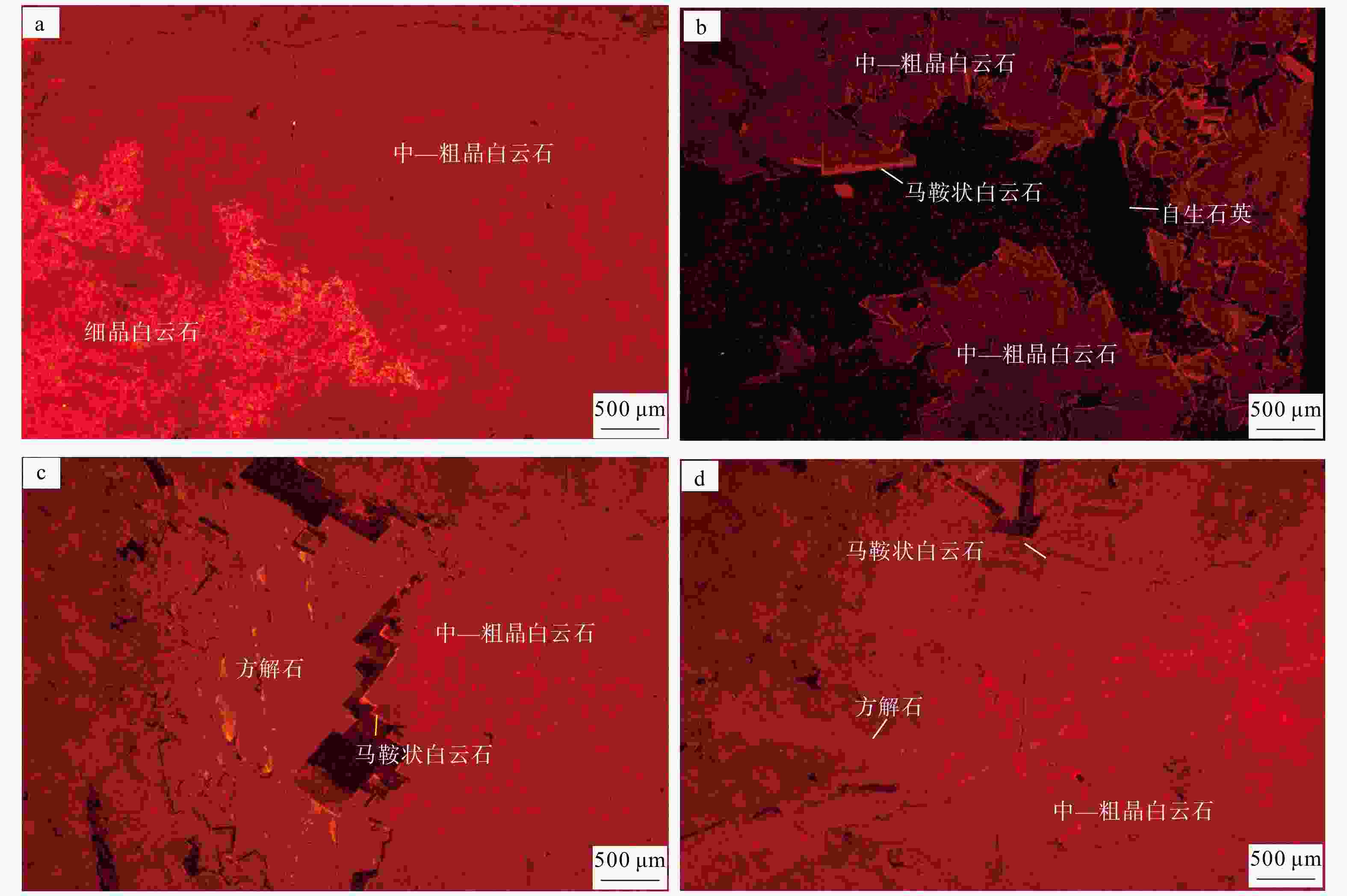
图 4 鄂尔多斯盆地西缘西探1井奥陶系克里摩里组白云岩阴极发光特征
a—细晶白云石明亮发光,中—粗晶白云石较弱的暗褐色发光;b—马鞍状白云石呈雾心亮边结构,自生石英不发光;c—马鞍状白云石呈雾心亮边结构,方解石呈现黄褐色;d—方解石呈现黄褐色
Figure 4. Cathodoluminescence (CL) characteristics of the Ordovician Kelimoli Formation dolomites in Well Xitan-1, western margin of the Ordos Basin
(a) Fine-grained dolomite exhibiting bright fluorescence, contrasted with weak dark-brown luminescence in medium-to coarse-grained dolomite; (b) Saddle-shaped dolomite having a foggy core and bright rim structure, with non-luminescent authigenic quartz; (c) Saddle-shaped dolomite displaying a foggy core and bright rim structure, with yellowish-brown luminescent calcite; (d) Calcite exhibiting yellowish-brown luminescence
图 4 鄂尔多斯盆地西缘西探1井奥陶系克里摩里组白云岩阴极发光特征
a—细晶白云石明亮发光,中—粗晶白云石较弱的暗褐色发光;b—马鞍状白云石呈雾心亮边结构,自生石英不发光;c—马鞍状白云石呈雾心亮边结构,方解石呈现黄褐色;d—方解石呈现黄褐色
Figure 4. Cathodoluminescence (CL) characteristics of the Ordovician Kelimoli Formation dolomites in Well Xitan-1, western margin of the Ordos Basin
(a) Fine-grained dolomite exhibiting bright fluorescence, contrasted with weak dark-brown luminescence in medium-to coarse-grained dolomite; (b) Saddle-shaped dolomite having a foggy core and bright rim structure, with non-luminescent authigenic quartz; (c) Saddle-shaped dolomite displaying a foggy core and bright rim structure, with yellowish-brown luminescent calcite; (d) Calcite exhibiting yellowish-brown luminescence
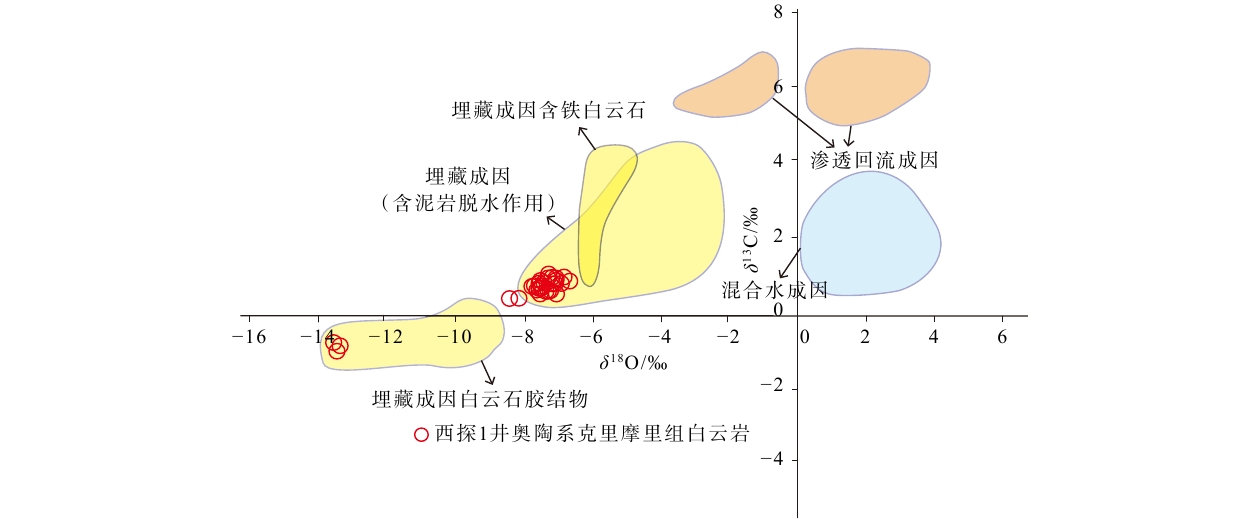
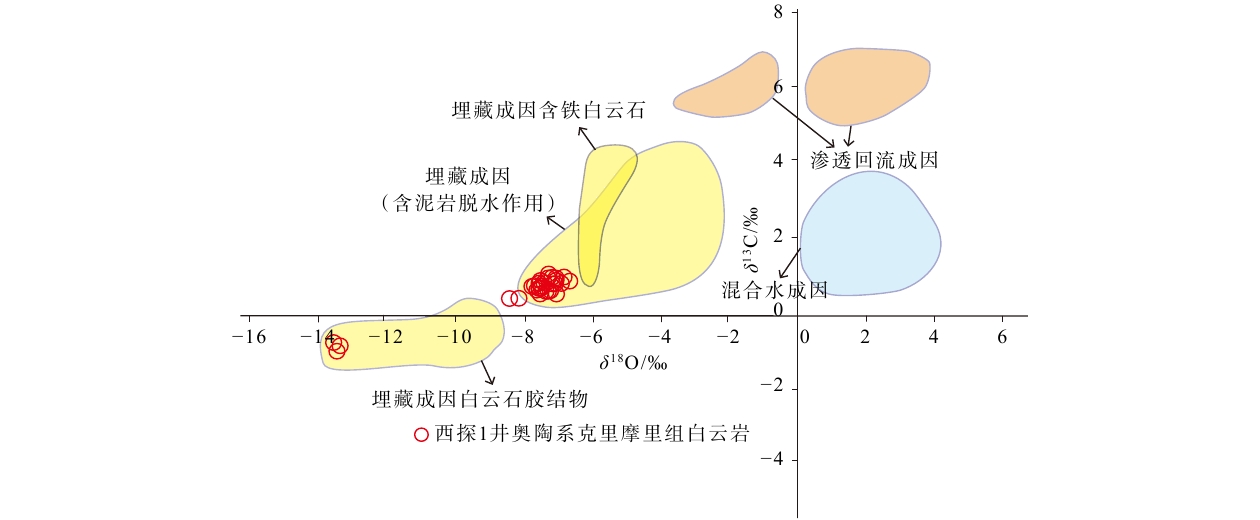
图 5 鄂尔多斯盆地西缘西探1井奥陶系克里摩里组白云岩碳氧同位素关系图解(Hird,1987)
Figure 5. Carbon and oxygen isotope cross-plot of the Ordovician Kelimoli Formation dolomites in Well Xitan-1, western margin of the Ordos Basin (Hird, 1987)
图 5 鄂尔多斯盆地西缘西探1井奥陶系克里摩里组白云岩碳氧同位素关系图解(Hird,1987)
Figure 5. Carbon and oxygen isotope cross-plot of the Ordovician Kelimoli Formation dolomites in Well Xitan-1, western margin of the Ordos Basin (Hird, 1987)
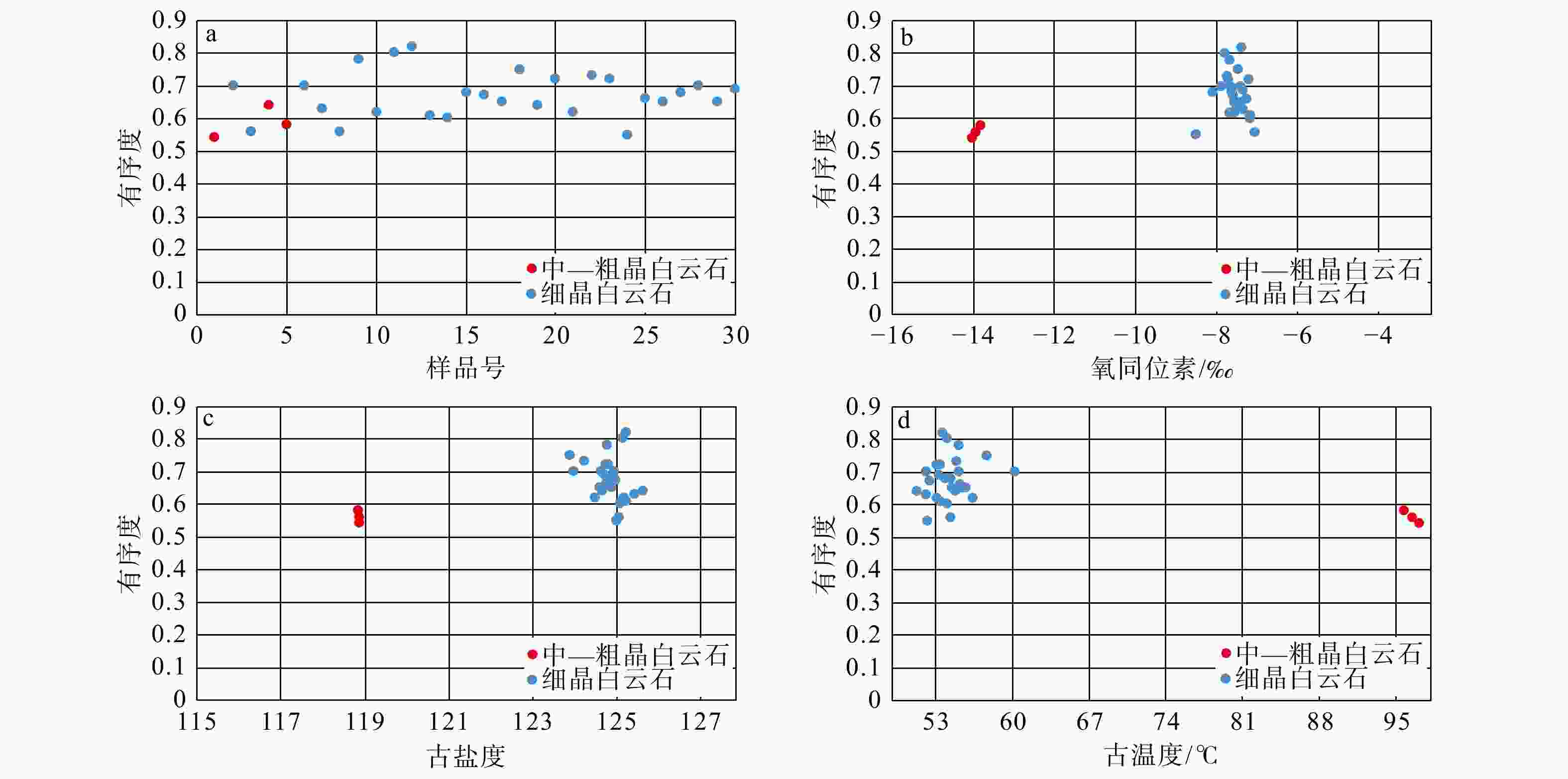
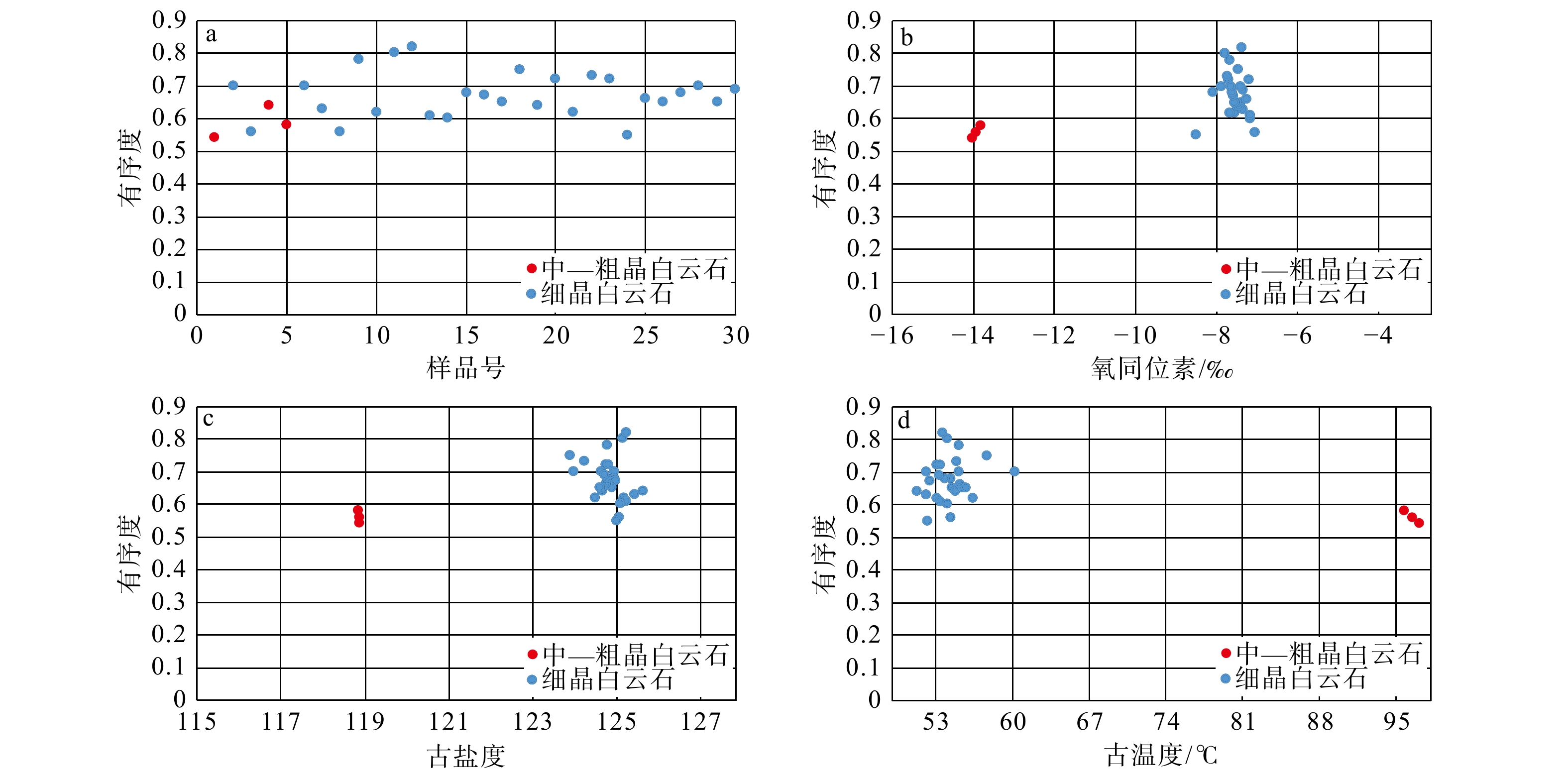
图 6 白云石有序度及相关性分析
a—白云石有序度;b—氧同位素与有序度相关性分析;c—古盐度与有序度相关性分析;d—古温度与有序度相关性分析
Figure 6. Dolomite ordering degrees and their correlation analysis
(a) Dolomite ordering degrees; (b) Correlation between oxygen isotopes and ordering degree; (c) Correlation between palaeosalinity and ordering degree; (d) Correlation between palaeotemperature and ordering degree
图 6 白云石有序度及相关性分析
a—白云石有序度;b—氧同位素与有序度相关性分析;c—古盐度与有序度相关性分析;d—古温度与有序度相关性分析
Figure 6. Dolomite ordering degrees and their correlation analysis
(a) Dolomite ordering degrees; (b) Correlation between oxygen isotopes and ordering degree; (c) Correlation between palaeosalinity and ordering degree; (d) Correlation between palaeotemperature and ordering degree
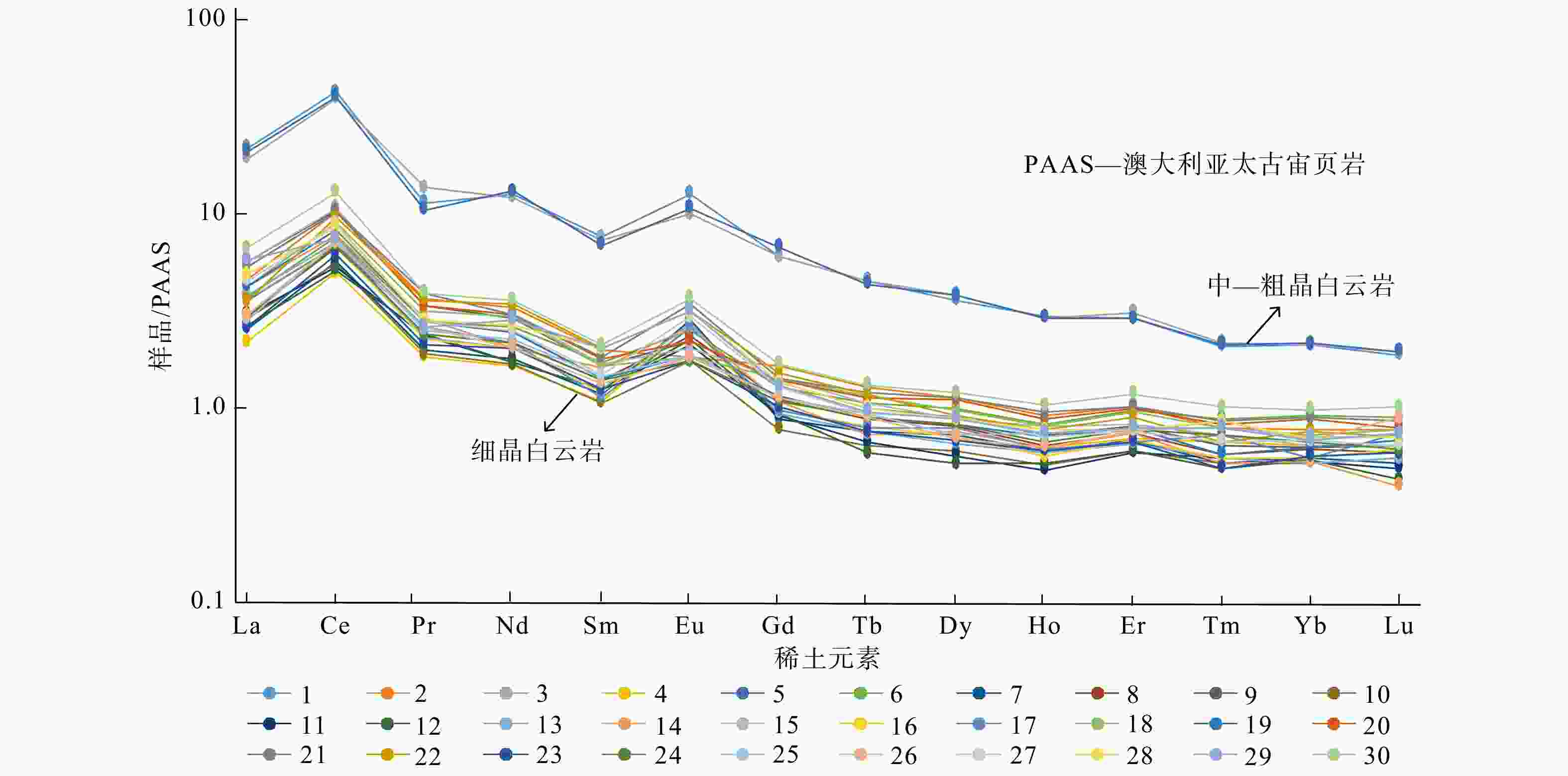
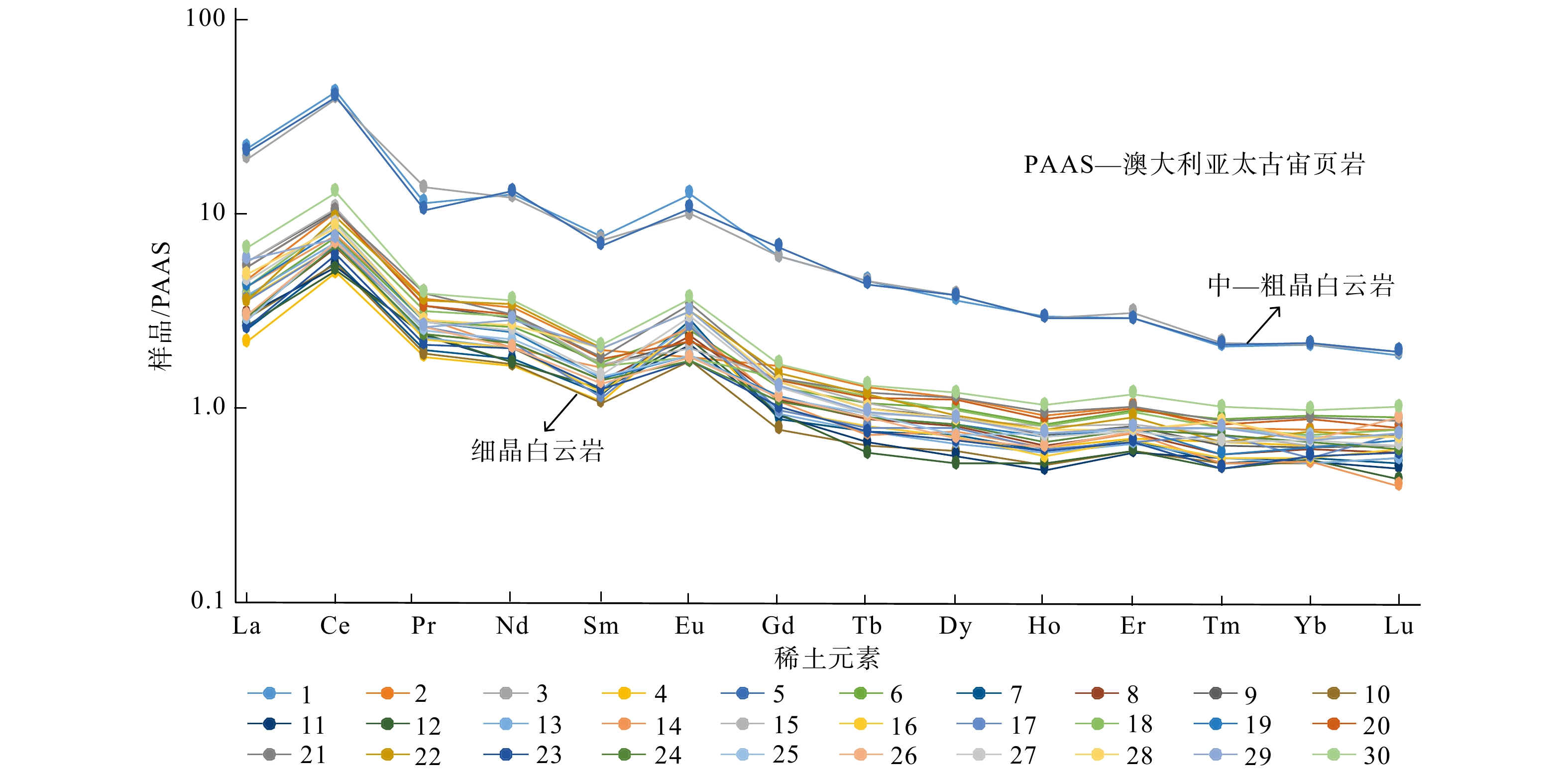
图 7 鄂尔多斯西缘奥陶系克里摩里组白云岩稀土元素标准化曲线
样品编号岩性见表2
Figure 7. PAAS-normalized REE patterns of the Ordovician Kelimoli Formation dolomites, western margin of the Ordos Basin
图 7 鄂尔多斯西缘奥陶系克里摩里组白云岩稀土元素标准化曲线
样品编号岩性见表2
Figure 7. PAAS-normalized REE patterns of the Ordovician Kelimoli Formation dolomites, western margin of the Ordos Basin
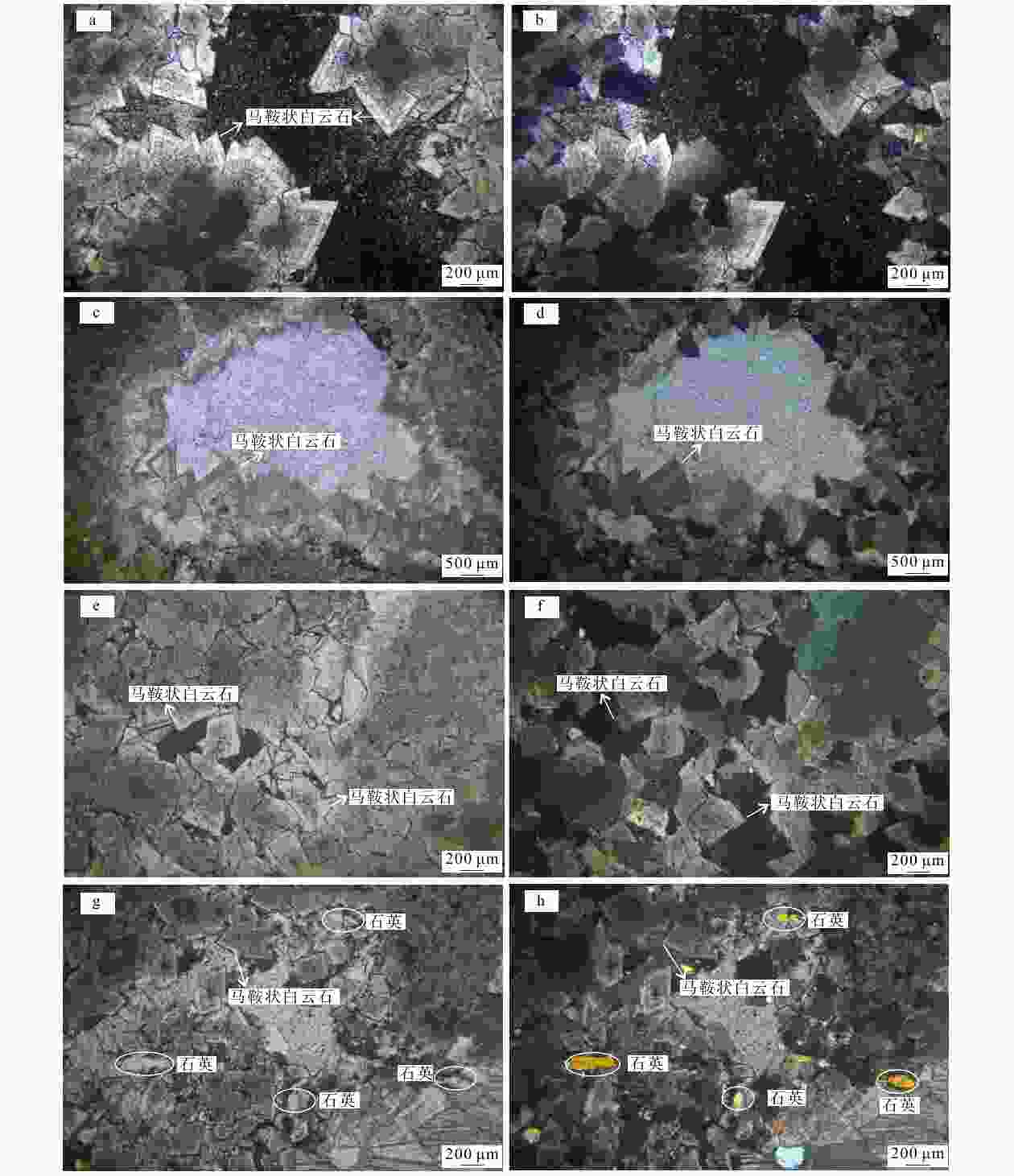
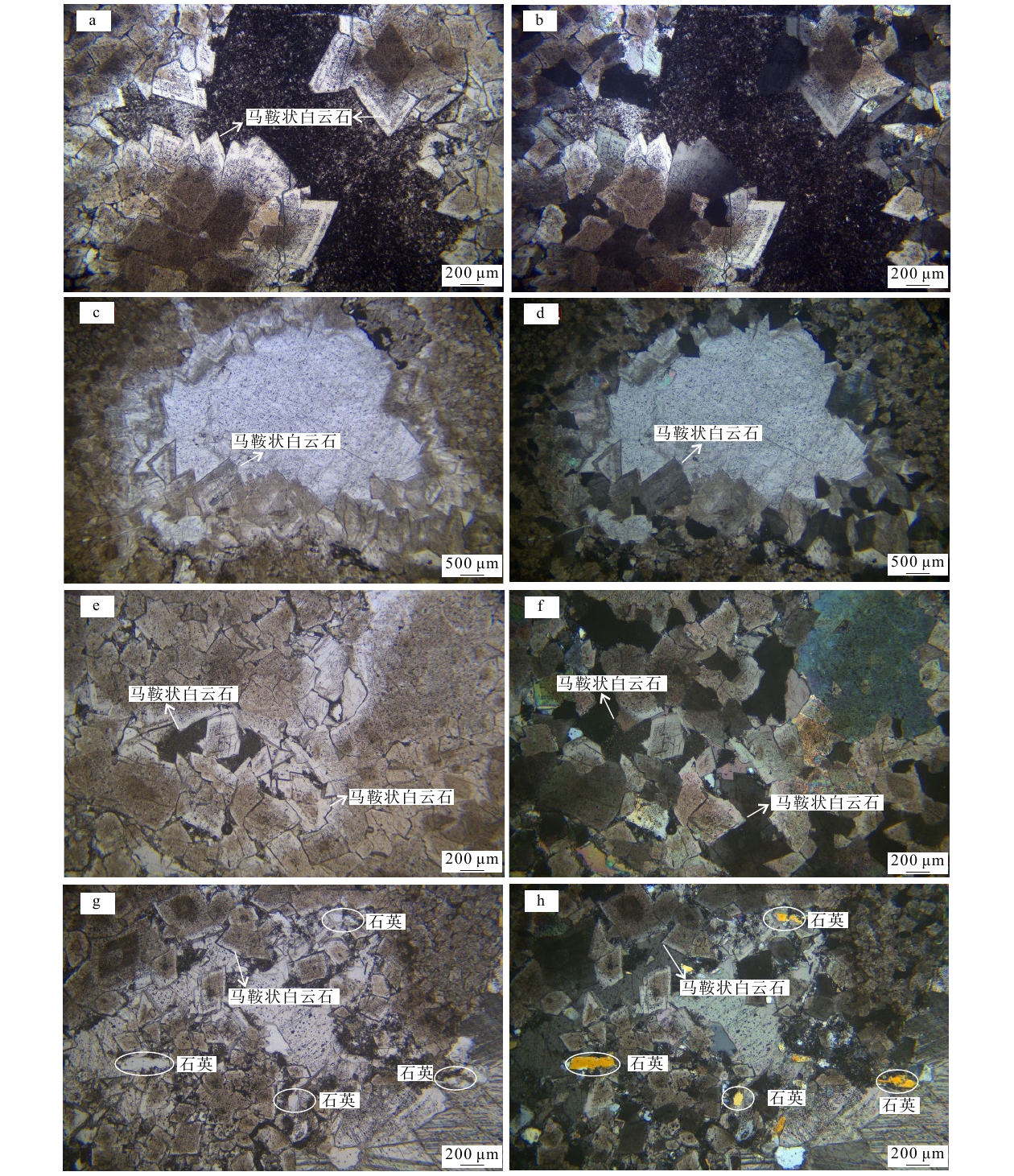
图 8 西探1井奥陶系克里摩里组白云岩典型热液矿物显微镜下特征
a—中—粗晶白云岩,4834.22 m,单偏光;b—中—粗晶白云岩,4834.22 m,正交偏光;c—中—粗晶白云岩,4832.53 m,单偏光;d—中—粗晶白云岩,4832.53 m,正交偏光;e—中—粗晶白云岩,4833.15 m,单偏光;f—中—粗晶白云岩,4833.15 m,正交偏光;g—中—粗晶白云岩,4833.20 m,单偏光;h—中—粗晶白云岩,4833.20 m,正交偏光
Figure 8. Photomicrographs showing typical hydrothermal minerals in the Ordovician Kelimoli Formation dolomites from Well Xitan-1
(a) Medium-to-coarse-grained dolomite, 4834.22 m, plane polarized light; (b) Medium-to coarse-grained dolomite, 4834.22 m, cross-polarized light; (c) Medium-to coarse-grained dolomite, 4832.53 m, plane polarized light; (d) Medium-to coarse-grained dolomite, 4832.53 m, cross-polarized light; (e) Medium-to coarse-grained dolomite, 4833.15 m, plane polarized light; (f) Medium-to coarse-grained dolomite, 4833.15 m, cross-polarized light; (g) Medium-to coarse-grained dolomite, 4833.20 m, plane polarized light; (h) Medium-to coarse-grained dolomite, 4833.20 m, cross-polarized light
图 8 西探1井奥陶系克里摩里组白云岩典型热液矿物显微镜下特征
a—中—粗晶白云岩,4834.22 m,单偏光;b—中—粗晶白云岩,4834.22 m,正交偏光;c—中—粗晶白云岩,4832.53 m,单偏光;d—中—粗晶白云岩,4832.53 m,正交偏光;e—中—粗晶白云岩,4833.15 m,单偏光;f—中—粗晶白云岩,4833.15 m,正交偏光;g—中—粗晶白云岩,4833.20 m,单偏光;h—中—粗晶白云岩,4833.20 m,正交偏光
Figure 8. Photomicrographs showing typical hydrothermal minerals in the Ordovician Kelimoli Formation dolomites from Well Xitan-1
(a) Medium-to-coarse-grained dolomite, 4834.22 m, plane polarized light; (b) Medium-to coarse-grained dolomite, 4834.22 m, cross-polarized light; (c) Medium-to coarse-grained dolomite, 4832.53 m, plane polarized light; (d) Medium-to coarse-grained dolomite, 4832.53 m, cross-polarized light; (e) Medium-to coarse-grained dolomite, 4833.15 m, plane polarized light; (f) Medium-to coarse-grained dolomite, 4833.15 m, cross-polarized light; (g) Medium-to coarse-grained dolomite, 4833.20 m, plane polarized light; (h) Medium-to coarse-grained dolomite, 4833.20 m, cross-polarized light
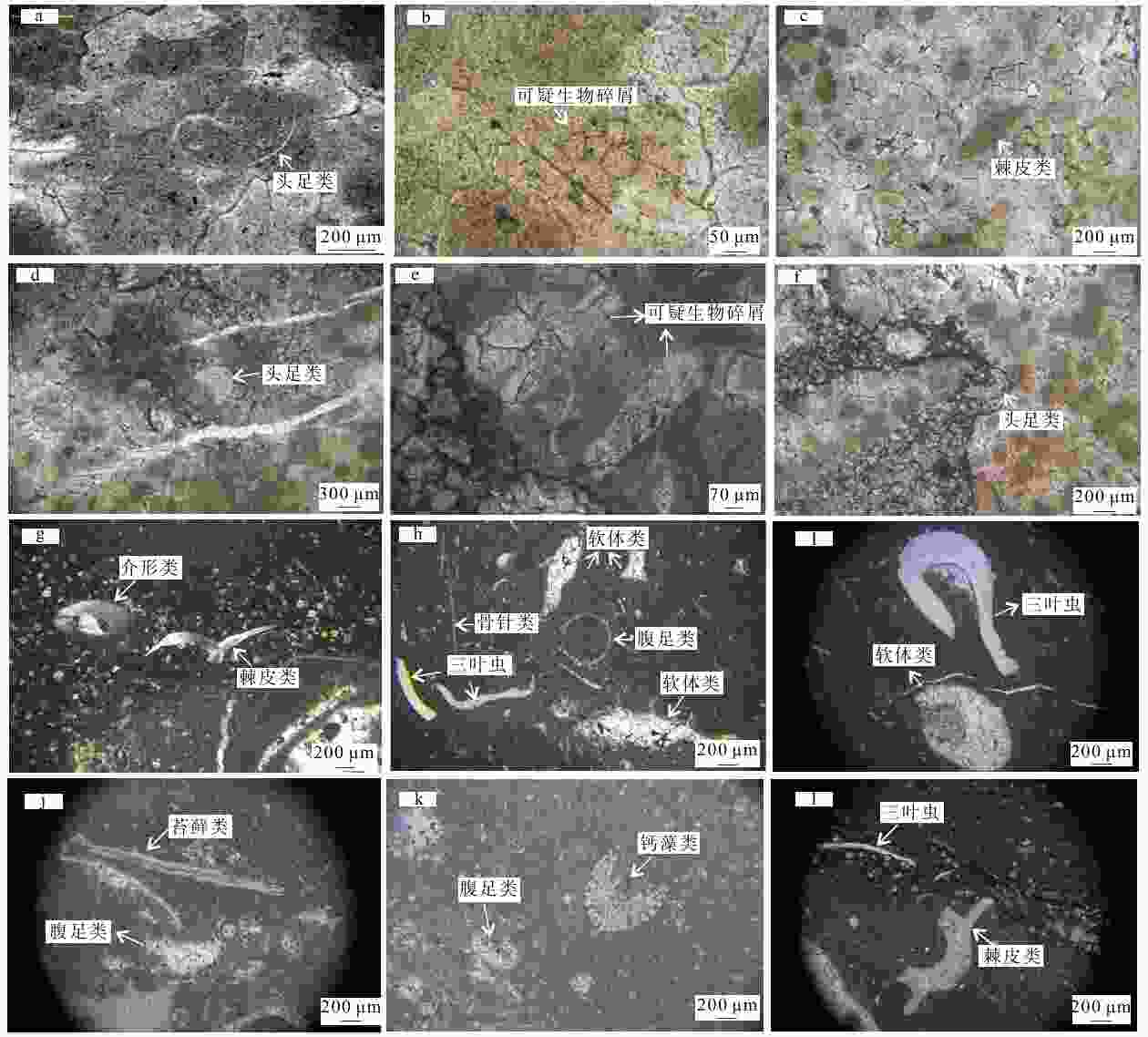
图 9 鄂尔多斯盆地西缘奥陶系克里摩里组生物碎屑灰岩典型特征
a—西探1井4833.50 m,单偏光;b—西探1井4833.65 m,单偏光;c—西探1井4833.68 m,单偏光;d—西探1井4833.70 m,单偏光;e—西探1井4833.75 m,单偏光;f—西探1井4833.78 m,单偏光;g—梁探1井5058.00 m,单偏光;h—梁探1井5058.20 m,单偏光;i—梁探1井5058.35 m,单偏光;j—梁探1井5058.38 m,单偏光;k—梁探1井5058.42 m,单偏光;l—梁探1井5058.45 m,单偏光
Figure 9. Photomicrographs showing typical petrographic characteristics of bioclastic limestones in the Ordovician Kelimoli Formation, western margin of the Ordos Basin
(a) Well Xitan-1, Kelimoli Formation, 4833.50 m, plane-polarized light; (b) Well Xitan-1, Kelimoli Formation, 4833.65 m, plane-polarized light; (c) Well Xitan-1, Kelimoli Formation, 4833.68 m, plane-polarized light; (d) Well Xitan-1, Kelimoli Formation, 4833.70 m, plane-polarized light; (e) Well Xitan-1, Kelimoli Formation, 4833.75 m, plane-polarized light; (f) Well Xitan-1, Kelimoli Formation, 4833.78 m, plane-polarized light; (g) Well Liangtan-1, Kelimoli Formation, 5058.00 m, plane-polarized light; (h) Well Liangtan-1, Kelimoli Formation, 5058.20 m, plane-polarized light; (i) Well Liangtan-1, Kelimoli Formation, 5058.35 m, plane-polarized light; (j) Well Liangtan-1, Kelimoli Formation, 5058.38 m, plane-polarized light; (k) Well Liangtan-1, Kelimoli Formation, 5058.42 m, plane-polarized light; (l) Well Liangtan-1, Kelimoli Formation, 5058.45 m, plane-polarized light
图 9 鄂尔多斯盆地西缘奥陶系克里摩里组生物碎屑灰岩典型特征
a—西探1井4833.50 m,单偏光;b—西探1井4833.65 m,单偏光;c—西探1井4833.68 m,单偏光;d—西探1井4833.70 m,单偏光;e—西探1井4833.75 m,单偏光;f—西探1井4833.78 m,单偏光;g—梁探1井5058.00 m,单偏光;h—梁探1井5058.20 m,单偏光;i—梁探1井5058.35 m,单偏光;j—梁探1井5058.38 m,单偏光;k—梁探1井5058.42 m,单偏光;l—梁探1井5058.45 m,单偏光
Figure 9. Photomicrographs showing typical petrographic characteristics of bioclastic limestones in the Ordovician Kelimoli Formation, western margin of the Ordos Basin
(a) Well Xitan-1, Kelimoli Formation, 4833.50 m, plane-polarized light; (b) Well Xitan-1, Kelimoli Formation, 4833.65 m, plane-polarized light; (c) Well Xitan-1, Kelimoli Formation, 4833.68 m, plane-polarized light; (d) Well Xitan-1, Kelimoli Formation, 4833.70 m, plane-polarized light; (e) Well Xitan-1, Kelimoli Formation, 4833.75 m, plane-polarized light; (f) Well Xitan-1, Kelimoli Formation, 4833.78 m, plane-polarized light; (g) Well Liangtan-1, Kelimoli Formation, 5058.00 m, plane-polarized light; (h) Well Liangtan-1, Kelimoli Formation, 5058.20 m, plane-polarized light; (i) Well Liangtan-1, Kelimoli Formation, 5058.35 m, plane-polarized light; (j) Well Liangtan-1, Kelimoli Formation, 5058.38 m, plane-polarized light; (k) Well Liangtan-1, Kelimoli Formation, 5058.42 m, plane-polarized light; (l) Well Liangtan-1, Kelimoli Formation, 5058.45 m, plane-polarized light
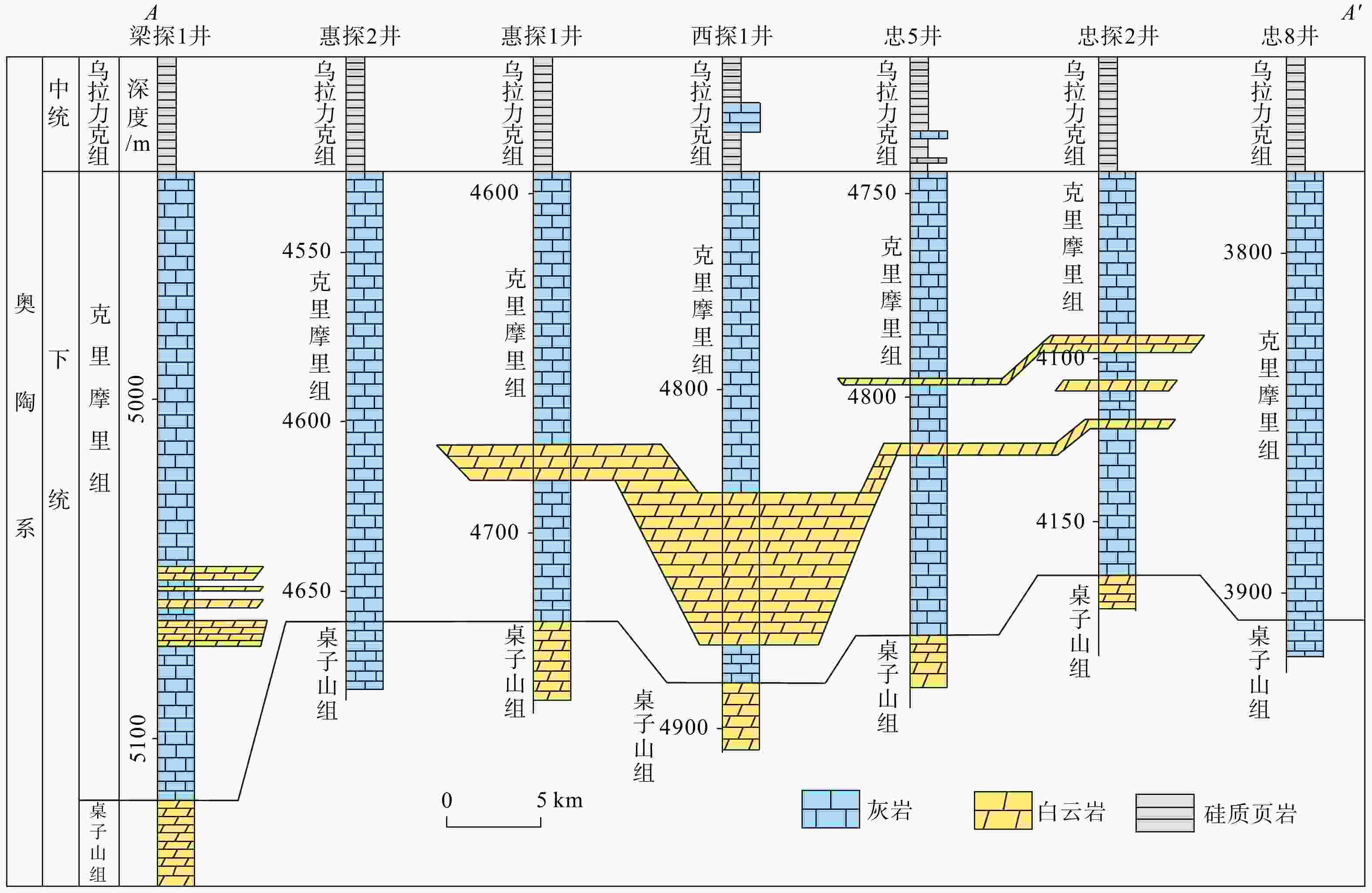
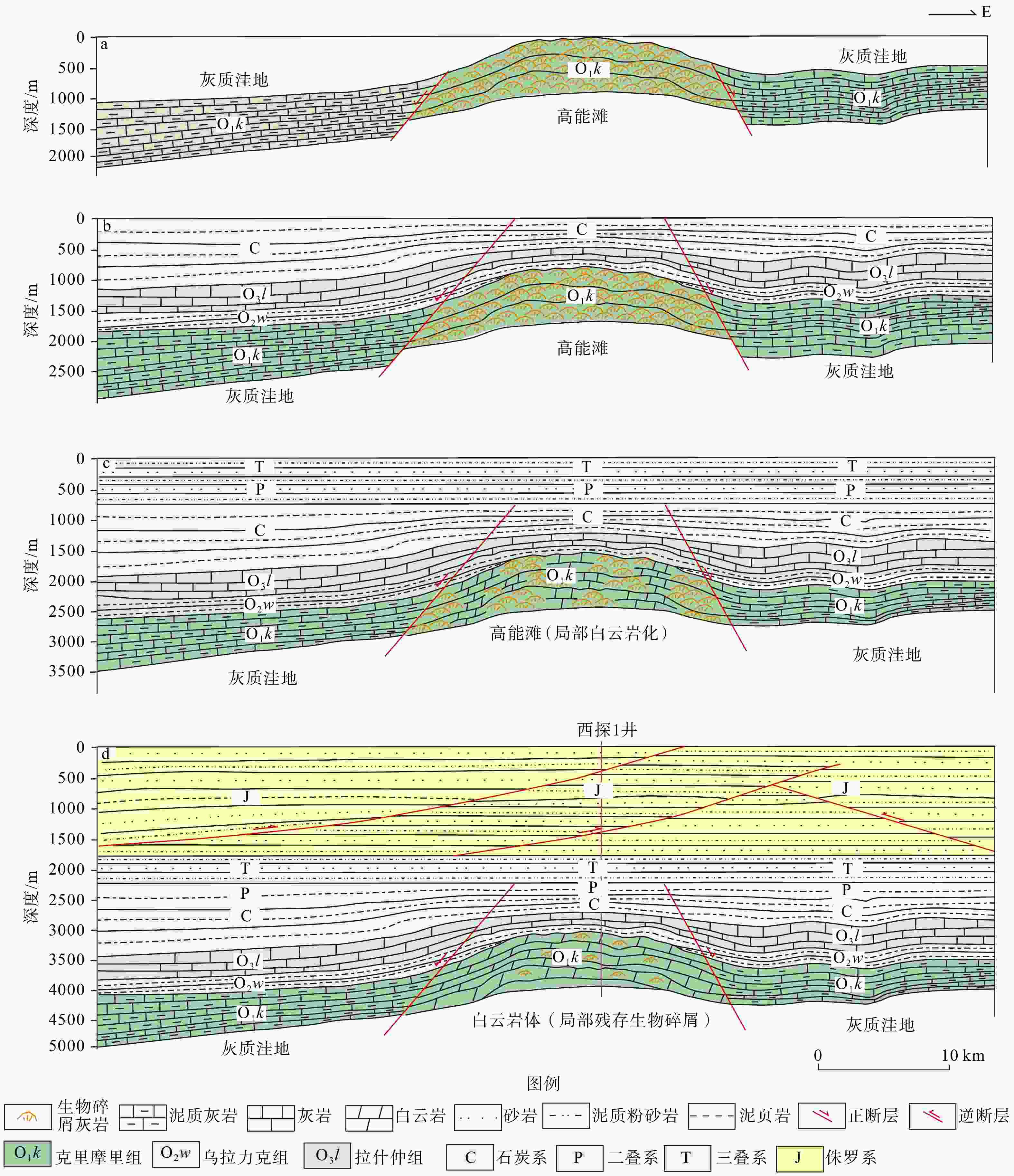
图 11 鄂尔多斯盆地西缘奥陶系克里摩里组白云岩形成演化模式图
a—奥陶系克里摩里组沉积末期;b—石炭系沉积末期;c—三叠系沉积末期;d—侏罗系沉积末期
Figure 11. Genetic and evolutionary model of dolomites in the Ordovician Kelimoli Formation, western margin of the Ordos Basin
(a) End of Ordovician Kelimoli deposition; (b) End of Carboniferous deposition; (c) End of Triassic deposition; (d) End of Jurassic deposition
图 11 鄂尔多斯盆地西缘奥陶系克里摩里组白云岩形成演化模式图
a—奥陶系克里摩里组沉积末期;b—石炭系沉积末期;c—三叠系沉积末期;d—侏罗系沉积末期
Figure 11. Genetic and evolutionary model of dolomites in the Ordovician Kelimoli Formation, western margin of the Ordos Basin
(a) End of Ordovician Kelimoli deposition; (b) End of Carboniferous deposition; (c) End of Triassic deposition; (d) End of Jurassic deposition
表 1 鄂尔多斯盆地西缘西探1井白云岩碳氧同位素与有序度分析结果
Table 1. Carbon and oxygen isotopic compositions and XRD ordering degrees of dolomites from Well Xitan-1, western margin of the Ordos Basin
编号 岩性 井深/m δ13C/‰ δ18O/‰ 古盐度/‰ 古温度/℃ 有序度 1 中—粗晶白云岩 4830.13 −0.75 −13.85 119 98 0.54 2 细晶白云岩 4830.26 0.43 −8.44 124 60 0.70 3 中—粗晶白云岩 4830.39 −0.78 −13.75 119 98 0.56 4 细晶白云岩 4830.54 0.88 −6.99 126 51 0.64 5 中—粗晶白云岩 4830.65 −0.81 −13.65 119 97 0.58 6 细晶白云岩 4830.88 0.57 −7.13 125 52 0.70 7 细晶白云岩 4831.08 0.82 −7.13 125 52 0.63 8 细晶白云岩 4831.25 0.72 −7.50 125 54 0.56 9 细晶白云岩 4831.48 0.62 −7.61 125 55 0.78 10 细晶白云岩 4831.60 0.72 −7.28 125 53 0.62 11 细晶白云岩 4831.75 0.75 −7.45 125 54 0.8 12 细晶白云岩 4831.92 0.78 −7.38 125 54 0.82 13 细晶白云岩 4832.04 0.77 −7.35 125 53 0.61 14 细晶白云岩 4832.25 0.72 −7.45 125 54 0.60 15 细晶白云岩 4832.53 0.67 −7.50 125 54 0.68 16 细晶白云岩 4832.73 0.61 −7.20 125 53 0.67 17 细晶白云岩 4832.85 0.65 −7.52 125 54 0.65 18 细晶白云岩 4833.02 0.28 −8.02 124 58 0.75 19 细晶白云岩 4833.33 0.54 −7.57 125 55 0.64 20 细晶白云岩 4833.50 0.53 −7.30 125 53 0.72 21 细晶白云岩 4833.65 0.52 −7.82 124 56 0.62 22 细晶白云岩 4833.79 0.34 −7.58 124 55 0.73 23 细晶白云岩 4833.92 0.57 −7.34 125 53 0.72 24 细晶白云岩 4834.04 0.61 −7.16 125 52 0.55 25 细晶白云岩 4834.15 0.60 −7.64 125 55 0.66 26 细晶白云岩 4834.24 0.58 −7.68 125 55 0.65 27 细晶白云岩 4834.40 0.57 −7.41 125 54 0.68 28 细晶白云岩 4834.60 0.55 −7.62 125 55 0.70 29 细晶白云岩 4834.75 0.56 −7.72 125 56 0.65 30 细晶白云岩 4835.00 0.52 −7.33 125 53 0.69 古温度(T)计算公式:T =16.9−4.2×(δ18O+0.22)+ 0.13×(δ18O+0.22)2(邵龙义,1994);古盐度(Z)计算公式:Z =2.048×(δ13C+50)+ 0.498×(δ18O +50)(邵龙义,1994)  下载: 导出CSV
表 1 鄂尔多斯盆地西缘西探1井白云岩碳氧同位素与有序度分析结果
Table 1. Carbon and oxygen isotopic compositions and XRD ordering degrees of dolomites from Well Xitan-1, western margin of the Ordos Basin
编号 岩性 井深/m δ13C/‰ δ18O/‰ 古盐度/‰ 古温度/℃ 有序度 1 中—粗晶白云岩 4830.13 −0.75 −13.85 119 98 0.54 2 细晶白云岩 4830.26 0.43 −8.44 124 60 0.70 3 中—粗晶白云岩 4830.39 −0.78 −13.75 119 98 0.56 4 细晶白云岩 4830.54 0.88 −6.99 126 51 0.64 5 中—粗晶白云岩 4830.65 −0.81 −13.65 119 97 0.58 6 细晶白云岩 4830.88 0.57 −7.13 125 52 0.70 7 细晶白云岩 4831.08 0.82 −7.13 125 52 0.63 8 细晶白云岩 4831.25 0.72 −7.50 125 54 0.56 9 细晶白云岩 4831.48 0.62 −7.61 125 55 0.78 10 细晶白云岩 4831.60 0.72 −7.28 125 53 0.62 11 细晶白云岩 4831.75 0.75 −7.45 125 54 0.8 12 细晶白云岩 4831.92 0.78 −7.38 125 54 0.82 13 细晶白云岩 4832.04 0.77 −7.35 125 53 0.61 14 细晶白云岩 4832.25 0.72 −7.45 125 54 0.60 15 细晶白云岩 4832.53 0.67 −7.50 125 54 0.68 16 细晶白云岩 4832.73 0.61 −7.20 125 53 0.67 17 细晶白云岩 4832.85 0.65 −7.52 125 54 0.65 18 细晶白云岩 4833.02 0.28 −8.02 124 58 0.75 19 细晶白云岩 4833.33 0.54 −7.57 125 55 0.64 20 细晶白云岩 4833.50 0.53 −7.30 125 53 0.72 21 细晶白云岩 4833.65 0.52 −7.82 124 56 0.62 22 细晶白云岩 4833.79 0.34 −7.58 124 55 0.73 23 细晶白云岩 4833.92 0.57 −7.34 125 53 0.72 24 细晶白云岩 4834.04 0.61 −7.16 125 52 0.55 25 细晶白云岩 4834.15 0.60 −7.64 125 55 0.66 26 细晶白云岩 4834.24 0.58 −7.68 125 55 0.65 27 细晶白云岩 4834.40 0.57 −7.41 125 54 0.68 28 细晶白云岩 4834.60 0.55 −7.62 125 55 0.70 29 细晶白云岩 4834.75 0.56 −7.72 125 56 0.65 30 细晶白云岩 4835.00 0.52 −7.33 125 53 0.69 古温度(T)计算公式:T =16.9−4.2×(δ18O+0.22)+ 0.13×(δ18O+0.22)2(邵龙义,1994);古盐度(Z)计算公式:Z =2.048×(δ13C+50)+ 0.498×(δ18O +50)(邵龙义,1994)
下载: 导出CSV
表 2 鄂尔多斯盆地西缘奥陶系克里摩里组白云岩稀土元素分析
Table 2. Rare earth element (REE) concentrations of dolomites from the Ordovician Kelimoli Formation, western margin of the Ordos Basin
编号 岩性 La Ce Pr Nd Sm Eu Gd Tb Dy Ho Er Tm Yb Lu Y /(×10−6) 1 中—粗晶白云岩 6.88 13.27 1.42 7.71 1.50 0.38 1.59 0.22 1.18 0.21 0.62 0.07 0.45 0.06 9.69 2 细晶白云岩 1.46 3.19 0.45 1.98 0.39 0.08 0.43 0.06 0.37 0.07 0.22 0.03 0.16 0.03 2.76 3 中—粗晶白云岩 6.04 12.34 1.69 7.40 1.45 0.30 1.58 0.22 1.25 0.21 0.66 0.07 0.45 0.06 9.44 4 细晶白云岩 0.69 1.56 0.23 1.01 0.22 0.05 0.23 0.04 0.22 0.05 0.15 0.02 0.14 0.02 1.81 5 中—粗晶白云岩 6.59 12.65 1.29 7.95 1.36 0.32 1.77 0.21 1.24 0.21 0.61 0.07 0.46 0.06 9.71 6 细晶白云岩 1.18 2.39 0.34 1.60 0.34 0.19 0.34 0.05 0.33 0.06 0.21 0.03 0.19 0.03 2.47 7 细晶白云岩 0.81 1.80 0.25 1.09 0.23 0.21 0.23 0.04 0.24 0.04 0.15 0.02 0.12 0.02 1.56 8 细晶白云岩 0.96 2.12 0.30 1.33 0.28 0.17 0.29 0.04 0.27 0.05 0.16 0.02 0.13 0.02 1.77 9 细晶白云岩 1.78 3.26 0.41 1.77 0.33 0.17 0.35 0.05 0.29 0.05 0.17 0.02 0.13 0.02 2.18 10 细晶白云岩 0.92 1.74 0.24 1.01 0.21 0.13 0.20 0.03 0.19 0.04 0.13 0.02 0.11 0.02 1.43 11 细晶白云岩 0.95 1.69 0.29 1.05 0.25 0.16 0.24 0.03 0.18 0.04 0.13 0.02 0.11 0.02 1.39 12 细晶白云岩 0.85 1.62 0.30 1.04 0.25 0.17 0.25 0.03 0.17 0.04 0.13 0.02 0.11 0.01 1.29 13 细晶白云岩 1.21 2.26 0.29 1.23 0.25 0.20 0.25 0.04 0.21 0.04 0.14 0.02 0.11 0.02 1.69 14 细晶白云岩 1.33 2.45 0.36 1.25 0.32 0.19 0.29 0.04 0.25 0.05 0.16 0.02 0.11 0.01 1.73 15 细晶白云岩 1.79 3.35 0.42 1.85 0.33 0.15 0.37 0.05 0.29 0.06 0.18 0.02 0.14 0.02 2.37 16 细晶白云岩 1.15 2.15 0.28 1.24 0.24 0.19 0.25 0.04 0.23 0.04 0.15 0.02 0.12 0.02 1.65 17 细晶白云岩 1.13 2.14 0.33 1.33 0.23 0.20 0.26 0.04 0.26 0.05 0.14 0.01 0.12 0.02 1.69 18 细晶白云岩 1.33 2.81 0.39 1.81 0.33 0.14 0.37 0.06 0.32 0.06 0.20 0.03 0.15 0.03 2.35 19 细晶白云岩 1.33 2.62 0.34 1.50 0.28 0.14 0.30 0.04 0.27 0.05 0.17 0.02 0.13 0.02 2.03 20 细晶白云岩 1.66 3.23 0.42 1.83 0.36 0.17 0.37 0.05 0.36 0.06 0.21 0.03 0.19 0.03 2.29 21 细晶白云岩 1.69 3.24 0.48 1.84 0.36 0.25 0.37 0.06 0.37 0.07 0.22 0.03 0.19 0.03 2.27 22 细晶白云岩 1.11 3.01 0.44 2.08 0.40 0.23 0.39 0.06 0.30 0.06 0.19 0.02 0.16 0.02 2.08 23 细晶白云岩 0.82 1.93 0.26 1.22 0.25 0.13 0.26 0.04 0.22 0.04 0.14 0.02 0.12 0.02 1.57 24 细晶白云岩 0.92 2.16 0.30 1.33 0.28 0.13 0.28 0.04 0.27 0.05 0.17 0.02 0.14 0.02 1.83 25 细晶白云岩 0.90 2.28 0.31 1.37 0.29 0.14 0.30 0.05 0.24 0.05 0.16 0.03 0.15 0.02 1.89 26 细晶白云岩 0.95 2.23 0.33 1.24 0.27 0.14 0.30 0.04 0.23 0.05 0.16 0.03 0.15 0.03 1.80 27 细晶白云岩 1.43 2.79 0.35 1.53 0.29 0.22 0.33 0.05 0.29 0.05 0.16 0.02 0.14 0.02 2.03 28 细晶白云岩 1.53 2.69 0.35 1.63 0.40 0.23 0.36 0.05 0.28 0.06 0.17 0.03 0.15 0.02 2.04 29 细晶白云岩 1.83 2.35 0.33 1.73 0.40 0.24 0.34 0.05 0.29 0.05 0.17 0.03 0.15 0.02 2.04 30 细晶白云岩 2.10 4.07 0.48 2.18 0.42 0.27 0.45 0.06 0.39 0.08 0.25 0.03 0.21 0.03 2.83
下载: 导出CSV
表 2 鄂尔多斯盆地西缘奥陶系克里摩里组白云岩稀土元素分析
Table 2. Rare earth element (REE) concentrations of dolomites from the Ordovician Kelimoli Formation, western margin of the Ordos Basin
编号 岩性 La Ce Pr Nd Sm Eu Gd Tb Dy Ho Er Tm Yb Lu Y /(×10−6) 1 中—粗晶白云岩 6.88 13.27 1.42 7.71 1.50 0.38 1.59 0.22 1.18 0.21 0.62 0.07 0.45 0.06 9.69 2 细晶白云岩 1.46 3.19 0.45 1.98 0.39 0.08 0.43 0.06 0.37 0.07 0.22 0.03 0.16 0.03 2.76 3 中—粗晶白云岩 6.04 12.34 1.69 7.40 1.45 0.30 1.58 0.22 1.25 0.21 0.66 0.07 0.45 0.06 9.44 4 细晶白云岩 0.69 1.56 0.23 1.01 0.22 0.05 0.23 0.04 0.22 0.05 0.15 0.02 0.14 0.02 1.81 5 中—粗晶白云岩 6.59 12.65 1.29 7.95 1.36 0.32 1.77 0.21 1.24 0.21 0.61 0.07 0.46 0.06 9.71 6 细晶白云岩 1.18 2.39 0.34 1.60 0.34 0.19 0.34 0.05 0.33 0.06 0.21 0.03 0.19 0.03 2.47 7 细晶白云岩 0.81 1.80 0.25 1.09 0.23 0.21 0.23 0.04 0.24 0.04 0.15 0.02 0.12 0.02 1.56 8 细晶白云岩 0.96 2.12 0.30 1.33 0.28 0.17 0.29 0.04 0.27 0.05 0.16 0.02 0.13 0.02 1.77 9 细晶白云岩 1.78 3.26 0.41 1.77 0.33 0.17 0.35 0.05 0.29 0.05 0.17 0.02 0.13 0.02 2.18 10 细晶白云岩 0.92 1.74 0.24 1.01 0.21 0.13 0.20 0.03 0.19 0.04 0.13 0.02 0.11 0.02 1.43 11 细晶白云岩 0.95 1.69 0.29 1.05 0.25 0.16 0.24 0.03 0.18 0.04 0.13 0.02 0.11 0.02 1.39 12 细晶白云岩 0.85 1.62 0.30 1.04 0.25 0.17 0.25 0.03 0.17 0.04 0.13 0.02 0.11 0.01 1.29 13 细晶白云岩 1.21 2.26 0.29 1.23 0.25 0.20 0.25 0.04 0.21 0.04 0.14 0.02 0.11 0.02 1.69 14 细晶白云岩 1.33 2.45 0.36 1.25 0.32 0.19 0.29 0.04 0.25 0.05 0.16 0.02 0.11 0.01 1.73 15 细晶白云岩 1.79 3.35 0.42 1.85 0.33 0.15 0.37 0.05 0.29 0.06 0.18 0.02 0.14 0.02 2.37 16 细晶白云岩 1.15 2.15 0.28 1.24 0.24 0.19 0.25 0.04 0.23 0.04 0.15 0.02 0.12 0.02 1.65 17 细晶白云岩 1.13 2.14 0.33 1.33 0.23 0.20 0.26 0.04 0.26 0.05 0.14 0.01 0.12 0.02 1.69 18 细晶白云岩 1.33 2.81 0.39 1.81 0.33 0.14 0.37 0.06 0.32 0.06 0.20 0.03 0.15 0.03 2.35 19 细晶白云岩 1.33 2.62 0.34 1.50 0.28 0.14 0.30 0.04 0.27 0.05 0.17 0.02 0.13 0.02 2.03 20 细晶白云岩 1.66 3.23 0.42 1.83 0.36 0.17 0.37 0.05 0.36 0.06 0.21 0.03 0.19 0.03 2.29 21 细晶白云岩 1.69 3.24 0.48 1.84 0.36 0.25 0.37 0.06 0.37 0.07 0.22 0.03 0.19 0.03 2.27 22 细晶白云岩 1.11 3.01 0.44 2.08 0.40 0.23 0.39 0.06 0.30 0.06 0.19 0.02 0.16 0.02 2.08 23 细晶白云岩 0.82 1.93 0.26 1.22 0.25 0.13 0.26 0.04 0.22 0.04 0.14 0.02 0.12 0.02 1.57 24 细晶白云岩 0.92 2.16 0.30 1.33 0.28 0.13 0.28 0.04 0.27 0.05 0.17 0.02 0.14 0.02 1.83 25 细晶白云岩 0.90 2.28 0.31 1.37 0.29 0.14 0.30 0.05 0.24 0.05 0.16 0.03 0.15 0.02 1.89 26 细晶白云岩 0.95 2.23 0.33 1.24 0.27 0.14 0.30 0.04 0.23 0.05 0.16 0.03 0.15 0.03 1.80 27 细晶白云岩 1.43 2.79 0.35 1.53 0.29 0.22 0.33 0.05 0.29 0.05 0.16 0.02 0.14 0.02 2.03 28 细晶白云岩 1.53 2.69 0.35 1.63 0.40 0.23 0.36 0.05 0.28 0.06 0.17 0.03 0.15 0.02 2.04 29 细晶白云岩 1.83 2.35 0.33 1.73 0.40 0.24 0.34 0.05 0.29 0.05 0.17 0.03 0.15 0.02 2.04 30 细晶白云岩 2.10 4.07 0.48 2.18 0.42 0.27 0.45 0.06 0.39 0.08 0.25 0.03 0.21 0.03 2.83
下载: 导出CSV
表 3 鄂尔多斯盆地西缘奥陶系白云岩微量元素特征
Table 3. Trace element compositions of Ordovician dolomites, western margin of the Ordos Basin
编号 岩性 深度/m Mn/(×10−6) Fe/(×10−6) Sr/(×10−6) Na/(×10−6) 编号 岩性 深度/m Mn/(×10−6) Fe/(×10−6) Sr/(×10−6) Na/(×10−6) 1 中—粗晶白云岩 4830.13 435.5 4412 28.85 165.5 16 细晶白云岩 4832.73 139.5 1560 60.23 289.9 2 细晶白云岩 4830.26 229.5 2385 50.65 155.5 17 细晶白云岩 4832.85 145.6 1685 58.69 294.1 3 中—粗晶白云岩 4830.39 491.2 4325 26.25 173.6 18 细晶白云岩 4833.02 220.3 2544 52.53 303.8 4 细晶白云岩 4830.54 123.6 1134 60.30 238.9 19 细晶白云岩 4833.33 185.1 2235 53.33 310.2 5 中—粗晶白云岩 4830.65 425.2 4145 22.40 240.4 20 细晶白云岩 4833.5 147.4 1542 61.84 310.8 6 细晶白云岩 4830.88 174.2 1573 60.70 241.6 21 细晶白云岩 4833.65 148.2 1588 62.85 312.2 7 细晶白云岩 4831.08 119.2 1193 70.22 242.7 22 细晶白云岩 4833.79 163.0 1691 60.00 314.6 8 细晶白云岩 4831.25 186.3 2363 55.55 245.8 23 细晶白云岩 4833.92 147.0 1689 61.78 332.2 9 细晶白云岩 4831.48 181.6 1746 56.53 247.8 24 细晶白云岩 4834.04 119.8 1245 70.19 339.7 10 细晶白云岩 4831.6 140.0 1342 60.28 248.5 25 细晶白云岩 4834.15 120.3 1085 74.65 342.5 11 细晶白云岩 4831.75 139.5 1368 62.45 254.5 26 细晶白云岩 4834.24 123.5 1286 65.25 345.2 12 细晶白云岩 4831.92 139.8 1362 62.86 257.6 27 细晶白云岩 4834.4 140.1 1371 61.74 346.5 13 细晶白云岩 4832.04 145.1 1314 58.77 272.5 28 细晶白云岩 4834.6 142.8 1385 62.45 348.6 14 细晶白云岩 4832.25 148.2 1328 59.69 275.8 29 细晶白云岩 4834.75 144.6 1375 60.28 349.4 15 细晶白云岩 4832.53 162.6 2000 55.45 286.0 30 细晶白云岩 4835 119.6 1221 70.68 356.6
下载: 导出CSV
表 3 鄂尔多斯盆地西缘奥陶系白云岩微量元素特征
Table 3. Trace element compositions of Ordovician dolomites, western margin of the Ordos Basin
编号 岩性 深度/m Mn/(×10−6) Fe/(×10−6) Sr/(×10−6) Na/(×10−6) 编号 岩性 深度/m Mn/(×10−6) Fe/(×10−6) Sr/(×10−6) Na/(×10−6) 1 中—粗晶白云岩 4830.13 435.5 4412 28.85 165.5 16 细晶白云岩 4832.73 139.5 1560 60.23 289.9 2 细晶白云岩 4830.26 229.5 2385 50.65 155.5 17 细晶白云岩 4832.85 145.6 1685 58.69 294.1 3 中—粗晶白云岩 4830.39 491.2 4325 26.25 173.6 18 细晶白云岩 4833.02 220.3 2544 52.53 303.8 4 细晶白云岩 4830.54 123.6 1134 60.30 238.9 19 细晶白云岩 4833.33 185.1 2235 53.33 310.2 5 中—粗晶白云岩 4830.65 425.2 4145 22.40 240.4 20 细晶白云岩 4833.5 147.4 1542 61.84 310.8 6 细晶白云岩 4830.88 174.2 1573 60.70 241.6 21 细晶白云岩 4833.65 148.2 1588 62.85 312.2 7 细晶白云岩 4831.08 119.2 1193 70.22 242.7 22 细晶白云岩 4833.79 163.0 1691 60.00 314.6 8 细晶白云岩 4831.25 186.3 2363 55.55 245.8 23 细晶白云岩 4833.92 147.0 1689 61.78 332.2 9 细晶白云岩 4831.48 181.6 1746 56.53 247.8 24 细晶白云岩 4834.04 119.8 1245 70.19 339.7 10 细晶白云岩 4831.6 140.0 1342 60.28 248.5 25 细晶白云岩 4834.15 120.3 1085 74.65 342.5 11 细晶白云岩 4831.75 139.5 1368 62.45 254.5 26 细晶白云岩 4834.24 123.5 1286 65.25 345.2 12 细晶白云岩 4831.92 139.8 1362 62.86 257.6 27 细晶白云岩 4834.4 140.1 1371 61.74 346.5 13 细晶白云岩 4832.04 145.1 1314 58.77 272.5 28 细晶白云岩 4834.6 142.8 1385 62.45 348.6 14 细晶白云岩 4832.25 148.2 1328 59.69 275.8 29 细晶白云岩 4834.75 144.6 1375 60.28 349.4 15 细晶白云岩 4832.53 162.6 2000 55.45 286.0 30 细晶白云岩 4835 119.6 1221 70.68 356.6
下载: 导出CSV
表 4 鄂尔多斯盆地西缘奥陶系克里摩里组灰岩与白云岩Sr同位素测试结果
Table 4. Strontium isotope compositions of limestones and dolomites in the Ordovician Kelimoli Formation, western margin of the Ordos Basin
样品编号 剖面/钻井 层 位 岩 性 87Sr/86Sr 误差 Q-1 青龙山 克里摩里组 灰岩 0.708553 0.000005 Q-2 青龙山 克里摩里组 灰岩 0.708543 0.000005 Q-3 青龙山 克里摩里组 灰岩 0.708428 0.000005 Q-4 青龙山 克里摩里组 灰岩 0.708394 0.000005 Q-5 青龙山 克里摩里组 灰岩 0.708384 0.000005 X-1 西探1 克里摩里组 中—粗晶白云岩 0.710218 0.000005 X-2 西探1 克里摩里组 中—粗晶白云岩 0.710748 0.000005 X-3 西探1 克里摩里组 中—粗晶白云岩 0.710466 0.000005 X-4 西探1 克里摩里组 中—粗晶白云岩 0.710818 0.000005 X-5 西探1 克里摩里组 中—粗晶白云岩 0.710717 0.000005
下载: 导出CSV
表 4 鄂尔多斯盆地西缘奥陶系克里摩里组灰岩与白云岩Sr同位素测试结果
Table 4. Strontium isotope compositions of limestones and dolomites in the Ordovician Kelimoli Formation, western margin of the Ordos Basin
样品编号 剖面/钻井 层 位 岩 性 87Sr/86Sr 误差 Q-1 青龙山 克里摩里组 灰岩 0.708553 0.000005 Q-2 青龙山 克里摩里组 灰岩 0.708543 0.000005 Q-3 青龙山 克里摩里组 灰岩 0.708428 0.000005 Q-4 青龙山 克里摩里组 灰岩 0.708394 0.000005 Q-5 青龙山 克里摩里组 灰岩 0.708384 0.000005 X-1 西探1 克里摩里组 中—粗晶白云岩 0.710218 0.000005 X-2 西探1 克里摩里组 中—粗晶白云岩 0.710748 0.000005 X-3 西探1 克里摩里组 中—粗晶白云岩 0.710466 0.000005 X-4 西探1 克里摩里组 中—粗晶白云岩 0.710818 0.000005 X-5 西探1 克里摩里组 中—粗晶白云岩 0.710717 0.000005
下载: 导出CSV
-
[1] AL-AASM I S, CROWE R, 2018. Fluid compartmentalization and dolomitization in the Cambrian and Ordovician successions of the Huron Domain, Michigan Basin[J]. Marine and Petroleum Geology, 92: 160-178. doi: 10.1016/j.marpetgeo.2018.02.011 [1] AL-AASM I S, CROWE R, 2018. Fluid compartmentalization and dolomitization in the Cambrian and Ordovician successions of the Huron Domain, Michigan Basin[J]. Marine and Petroleum Geology, 92: 160-178. doi: 10.1016/j.marpetgeo.2018.02.011 [2] BAO H P, YANG F, CAI Z H, et al., 2017. Origin and reservoir characteristics of Ordovician dolostones in the Ordos Basin[J]. Natural Gas Industry, 37(1): 32-45. (in Chinese with English abstract) doi: 10.1016/j.ngib.2017.07.015 [2] BAO H P, YANG F, CAI Z H, et al., 2017. Origin and reservoir characteristics of Ordovician dolostones in the Ordos Basin[J]. Natural Gas Industry, 37(1): 32-45. (in Chinese with English abstract) doi: 10.1016/j.ngib.2017.07.015 [3] CAO Z C, YOU D H, QI L X, et al., 2020. New insights of the genesis of ultra-deep dolomite reservoirs in Well TS1, Tarim Basin: evidence from in situ carbon and oxygen isotope analysis[J]. Natural Gas Geoscience, 31(7): 915-922. (in Chinese with English abstract) [3] CAO Z C, YOU D H, QI L X, et al., 2020. New insights of the genesis of ultra-deep dolomite reservoirs in Well TS1, Tarim Basin: evidence from in situ carbon and oxygen isotope analysis[J]. Natural Gas Geoscience, 31(7): 915-922. (in Chinese with English abstract) [4] CHEN G, SUN J B, ZHOU L F, et al., 2007. Fission-track-age records of the Mesozoic tectonic-events in the southwest margin of the Ordos Basin, China[J]. Science in China Series D: Earth Sciences, 50(2): 133-143. doi: 10.1007/s11430-007-6025-y [4] CHEN G, SUN J B, ZHOU L F, et al., 2007. Fission-track-age records of the Mesozoic tectonic-events in the southwest margin of the Ordos Basin, China[J]. Science in China Series D: Earth Sciences, 50(2): 133-143. doi: 10.1007/s11430-007-6025-y [5] CHENG X Z, LI P P, ZOU H Y, et al., 2013. Geochemical characteristics and dolomitization fluid of dolomite in Changxing Formation in Xinglongchang area of East Sichuan Basin[J]. Acta Geologica Sinica, 87(7): 1031-1040. (in Chinese with English abstract) [5] CHENG X Z, LI P P, ZOU H Y, et al., 2013. Geochemical characteristics and dolomitization fluid of dolomite in Changxing Formation in Xinglongchang area of East Sichuan Basin[J]. Acta Geologica Sinica, 87(7): 1031-1040. (in Chinese with English abstract) [6] DAVIES G R, SMITH L B, 2006. Structurally controlled hydrothermal dolomite reservoir facies: an overview[J]. AAPG Bulletin, 90(11): 1641-1690. doi: 10.1306/05220605164 [6] DAVIES G R, SMITH L B, 2006. Structurally controlled hydrothermal dolomite reservoir facies: an overview[J]. AAPG Bulletin, 90(11): 1641-1690. doi: 10.1306/05220605164 [7] DI G D, CHEN Y J, CHEN K, et al., 2024. Distribution and activity of strike-slip faults in Gaoshiti area of Sichuan Basin and their control and significance for the development of dolomite reservoirs in Permian Qixia Formation[J]. Acta Petrolei Sinica, 45(12): 1761-1782. (in Chinese with English abstract) [7] DI G D, CHEN Y J, CHEN K, et al., 2024. Distribution and activity of strike-slip faults in Gaoshiti area of Sichuan Basin and their control and significance for the development of dolomite reservoirs in Permian Qixia Formation[J]. Acta Petrolei Sinica, 45(12): 1761-1782. (in Chinese with English abstract) [8] DONG X P, LI Z H, JING X H, et al., 2023. Stratigraphic sequence characteristics and geochronology research progress of the Cenozoic in the arcuate tectonic belt on the northeastern margin of the Tibet Plateau[J]. Journal of Geomechanics, 29(4): 465-484. (in Chinese with English abstract) [8] DONG X P, LI Z H, JING X H, et al., 2023. Stratigraphic sequence characteristics and geochronology research progress of the Cenozoic in the arcuate tectonic belt on the northeastern margin of the Tibet Plateau[J]. Journal of Geomechanics, 29(4): 465-484. (in Chinese with English abstract) [9] FU J H, ZHENG C B, 2001. Evolution between North China Sea and Qilian Sea of the Ordovician and the characteristics of Lithofacies Palaeogeography in Ordos Basin[J]. Journal of Palaeogeography, 3(4): 25-34. (in Chinese with English abstract) [9] FU J H, ZHENG C B, 2001. Evolution between North China Sea and Qilian Sea of the Ordovician and the characteristics of Lithofacies Palaeogeography in Ordos Basin[J]. Journal of Palaeogeography, 3(4): 25-34. (in Chinese with English abstract) [10] GARAGULY I, VARGA A, RAUCSIK B, et al., 2018. Pervasive early diagenetic dolomitization, subsequent hydrothermal alteration, and Late stage hydrocarbon accumulation in a Middle Triassic carbonate sequence (Szeged Basin, SE Hungary)[J]. Marine and Petroleum Geology, 98: 270-290. doi: 10.1016/j.marpetgeo.2018.07.024 [10] GARAGULY I, VARGA A, RAUCSIK B, et al., 2018. Pervasive early diagenetic dolomitization, subsequent hydrothermal alteration, and Late stage hydrocarbon accumulation in a Middle Triassic carbonate sequence (Szeged Basin, SE Hungary)[J]. Marine and Petroleum Geology, 98: 270-290. doi: 10.1016/j.marpetgeo.2018.07.024 [11] GUO Y R, ZHAO Z Y, XU W L, et al., 2014. Sequence stratigraphy of the Ordovician system in the Ordos Basin[J]. Acta Sedimentologica Sinica, 32(1): 44-60. (in Chinese with English abstract) [11] GUO Y R, ZHAO Z Y, XU W L, et al., 2014. Sequence stratigraphy of the Ordovician system in the Ordos Basin[J]. Acta Sedimentologica Sinica, 32(1): 44-60. (in Chinese with English abstract) [12] HE F Q, WANG F B, GUO L G, et al., 2022. Evolution of prototype basin and change of tectonic-sedimentary pattern in Paleozoic, Ordos Basin[J]. Petroleum Geology & Experiment, 44(3): 373-384. (in Chinese with English abstract) [12] HE F Q, WANG F B, GUO L G, et al., 2022. Evolution of prototype basin and change of tectonic-sedimentary pattern in Paleozoic, Ordos Basin[J]. Petroleum Geology & Experiment, 44(3): 373-384. (in Chinese with English abstract) [13] HE P W, XU W, ZHANG L J, et al., 2021. Characteristics and genetic mechanism of Qixia Formation dolomite in Moxi-Gaoshiti area, central Sichuan Basin[J]. Acta Sedimentologica Sinica, 39(6): 1532-1545. (in Chinese with English abstract) [13] HE P W, XU W, ZHANG L J, et al., 2021. Characteristics and genetic mechanism of Qixia Formation dolomite in Moxi-Gaoshiti area, central Sichuan Basin[J]. Acta Sedimentologica Sinica, 39(6): 1532-1545. (in Chinese with English abstract) [14] HIRD K, 1987. The composition of carbonate and oxygen isotope in the ancient dolomite[J]. AAPG Bulletin, 34(4): 156-232. [14] HIRD K, 1987. The composition of carbonate and oxygen isotope in the ancient dolomite[J]. AAPG Bulletin, 34(4): 156-232. [15] KACZMAREK S E, SIBLEY D F, 2011. On the evolution of dolomite stoichiometry and cation order during high-temperature synthesis experiments: an alternative model for the geochemical evolution of natural dolomites[J]. Sedimentary Geology, 240(1-2): 30-40. doi: 10.1016/j.sedgeo.2011.07.003 [15] KACZMAREK S E, SIBLEY D F, 2011. On the evolution of dolomite stoichiometry and cation order during high-temperature synthesis experiments: an alternative model for the geochemical evolution of natural dolomites[J]. Sedimentary Geology, 240(1-2): 30-40. doi: 10.1016/j.sedgeo.2011.07.003 [16] KOU L L, LI Z H, DONG X P, et al., 2021. The age sequence of the detrital zircons from the Guanyindian section in Longde, the northeastern margin of the Tibetan Plateau, and its geological significance[J]. Journal of Geomechanics, 27(6): 1051-1064. (in Chinese with English abstract) [16] KOU L L, LI Z H, DONG X P, et al., 2021. The age sequence of the detrital zircons from the Guanyindian section in Longde, the northeastern margin of the Tibetan Plateau, and its geological significance[J]. Journal of Geomechanics, 27(6): 1051-1064. (in Chinese with English abstract) [17] KOU L L, LI Z H, XIA C X, 2024. Formation and evolution of the Yuncheng Salt Lake and sources of the saline ions[J]. Journal of Geomechanics, 30(6): 933-951. (in Chinese with English abstract) [17] KOU L L, LI Z H, XIA C X, 2024. Formation and evolution of the Yuncheng Salt Lake and sources of the saline ions[J]. Journal of Geomechanics, 30(6): 933-951. (in Chinese with English abstract) [18] LI D, LING H F, JIANG S Y, et al., 2009. New carbon isotope stratigraphy of the Ediacaran-Cambrian boundary interval from SW China: implications for global correlation[J]. Geological Magazine, 146(4): 465-484. doi: 10.1017/S0016756809006268 [18] LI D, LING H F, JIANG S Y, et al., 2009. New carbon isotope stratigraphy of the Ediacaran-Cambrian boundary interval from SW China: implications for global correlation[J]. Geological Magazine, 146(4): 465-484. doi: 10.1017/S0016756809006268 [19] LI R B, DUAN J B, PAN L, et al., 2021. Genetic mechanism and main controlling factors of the Middle Permian Maokou Formation dolomite reservoirs in the eastern Sichuan Basin[J]. Natural Gas Geoscience, 32(9): 1347-1357. (in Chinese with English abstract) [19] LI R B, DUAN J B, PAN L, et al., 2021. Genetic mechanism and main controlling factors of the Middle Permian Maokou Formation dolomite reservoirs in the eastern Sichuan Basin[J]. Natural Gas Geoscience, 32(9): 1347-1357. (in Chinese with English abstract) [20] LI W H, ZHANG Q, LI K Y, et al., 2021. Sedimentary evolution of the Late Paleozoic in Ordos Basin and its adjacent areas[J]. Journal of Palaeogeography (Chinese Edition), 23(1): 39-52. (in Chinese with English abstract) [20] LI W H, ZHANG Q, LI K Y, et al., 2021. Sedimentary evolution of the Late Paleozoic in Ordos Basin and its adjacent areas[J]. Journal of Palaeogeography (Chinese Edition), 23(1): 39-52. (in Chinese with English abstract) [21] LI W Q, LIU H C, LI P P, et al., 2023. Diverse fluids in dolomitization and petrogenesis of the Dengying Formation dolomite in the Sichuan Basin, SW China[J]. Earth Science, 48(9): 3360-3377. (in Chinese with English abstract) [21] LI W Q, LIU H C, LI P P, et al., 2023. Diverse fluids in dolomitization and petrogenesis of the Dengying Formation dolomite in the Sichuan Basin, SW China[J]. Earth Science, 48(9): 3360-3377. (in Chinese with English abstract) [22] LI Y, SONG Y G, QIAN L B, et al., 2013. Paleomagnetic and fission-track dating of a Late Cenozoic red earth section in the Liupan Shan and associated tectonic implications[J]. Journal of Earth Science, 24(4): 506-518. doi: 10.1007/s12583-013-0353-y [22] LI Y, SONG Y G, QIAN L B, et al., 2013. Paleomagnetic and fission-track dating of a Late Cenozoic red earth section in the Liupan Shan and associated tectonic implications[J]. Journal of Earth Science, 24(4): 506-518. doi: 10.1007/s12583-013-0353-y [23] LI Z H, DONG S W, QU H J, 2014. Timing of the initiation of the Jurassic Yanshan movement on the North China Craton: evidence from sedimentary cycles, heavy minerals, geochemistry, and zircon U–Pb geochronology[J]. International Geology Review, 56(3): 288-312. doi: 10.1080/00206814.2013.855013 [23] LI Z H, DONG S W, QU H J, 2014. Timing of the initiation of the Jurassic Yanshan movement on the North China Craton: evidence from sedimentary cycles, heavy minerals, geochemistry, and zircon U–Pb geochronology[J]. International Geology Review, 56(3): 288-312. doi: 10.1080/00206814.2013.855013 [24] LI Z H, DONG S W, FENG S B, et al., 2015a. Sedimentary response to Middle-Late Jurassic tectonic events in the Ordos Basin[J]. Acta Geoscientica Sinica, 36(1): 22-30. (in Chinese with English abstract) [24] LI Z H, DONG S W, FENG S B, et al., 2015a. Sedimentary response to Middle-Late Jurassic tectonic events in the Ordos Basin[J]. Acta Geoscientica Sinica, 36(1): 22-30. (in Chinese with English abstract) [25] LI Z H, XU L M, LIU X S, et al., 2015b. Critical timing of sedimentary filling records of Ordovician and its tectonic significance on the southern Ordos Basin[J]. Chinese Journal of Geology, 50(2): 428-445. (in Chinese with English abstract) [25] LI Z H, XU L M, LIU X S, et al., 2015b. Critical timing of sedimentary filling records of Ordovician and its tectonic significance on the southern Ordos Basin[J]. Chinese Journal of Geology, 50(2): 428-445. (in Chinese with English abstract) [26] LIAO H H, SU Z T, HUANG W M, et al., 2022. Origin of porphyry dolomite in the 5th sub-member of the 5th member of Ordovician Majiagou Formation (M55sub-member), Ordos Basin[J]. Petroleum Geology & Experiment, 44(5): 835-844. (in Chinese with English abstract) [26] LIAO H H, SU Z T, HUANG W M, et al., 2022. Origin of porphyry dolomite in the 5th sub-member of the 5th member of Ordovician Majiagou Formation (M55sub-member), Ordos Basin[J]. Petroleum Geology & Experiment, 44(5): 835-844. (in Chinese with English abstract) [27] LIU J Q, LIN J S, FENG W M, et al., 2014. The REE geochemical characteristics of middle-upper Cambrian dolomite in southeast Sichuan basin and its significance: a case study of Changshutian profile in Bijie, Guizhou[J]. Journal of Mineralogy and Petrology, 34(1): 87-94. (in Chinese with English abstract) [27] LIU J Q, LIN J S, FENG W M, et al., 2014. The REE geochemical characteristics of middle-upper Cambrian dolomite in southeast Sichuan basin and its significance: a case study of Changshutian profile in Bijie, Guizhou[J]. Journal of Mineralogy and Petrology, 34(1): 87-94. (in Chinese with English abstract) [28] LUKOCZKI G, HAAS J, GREGG J M, et al., 2019. Multi-phase dolomitization and recrystallization of Middle Triassic shallow marine-peritidal carbonates from the Mecsek Mts. (SW Hungary), as inferred from petrography, carbon, oxygen, strontium and clumped isotope data[J]. Marine and Petroleum Geology, 101: 440-458. doi: 10.1016/j.marpetgeo.2018.12.004 [28] LUKOCZKI G, HAAS J, GREGG J M, et al., 2019. Multi-phase dolomitization and recrystallization of Middle Triassic shallow marine-peritidal carbonates from the Mecsek Mts. (SW Hungary), as inferred from petrography, carbon, oxygen, strontium and clumped isotope data[J]. Marine and Petroleum Geology, 101: 440-458. doi: 10.1016/j.marpetgeo.2018.12.004 [29] NGIA N R, HU M Y, GAO D, 2019. Tectonic and geothermal controls on dolomitization and dolomitizing fluid flows in the Cambrian-Lower Ordovician carbonate successions in the western and central Tarim Basin, NW China[J]. Journal of Asian Earth Sciences, 172: 359-382. doi: 10.1016/j.jseaes.2018.09.020 [29] NGIA N R, HU M Y, GAO D, 2019. Tectonic and geothermal controls on dolomitization and dolomitizing fluid flows in the Cambrian-Lower Ordovician carbonate successions in the western and central Tarim Basin, NW China[J]. Journal of Asian Earth Sciences, 172: 359-382. doi: 10.1016/j.jseaes.2018.09.020 [30] NOTHDURFT L D, WEBB G E, KAMBER B S, 2004. Rare earth element geochemistry of Late Devonian reefal carbonates, Canning Basin, western Australia: confirmation of a seawater REE proxy in ancient limestones[J]. Geochimica et Cosmochimica Acta, 68(2): 263-283. doi: 10.1016/S0016-7037(03)00422-8 [30] NOTHDURFT L D, WEBB G E, KAMBER B S, 2004. Rare earth element geochemistry of Late Devonian reefal carbonates, Canning Basin, western Australia: confirmation of a seawater REE proxy in ancient limestones[J]. Geochimica et Cosmochimica Acta, 68(2): 263-283. doi: 10.1016/S0016-7037(03)00422-8 [31] QIANG S T, SHEN P, ZHANG J, et al., 2017. The evolution of carbonate sediment diagenesis and pore fluid in Dengying Formation, central Sichuan Basin[J]. Acta Sedimentologica Sinica, 35(4): 797-811. (in Chinese with English abstract) [31] QIANG S T, SHEN P, ZHANG J, et al., 2017. The evolution of carbonate sediment diagenesis and pore fluid in Dengying Formation, central Sichuan Basin[J]. Acta Sedimentologica Sinica, 35(4): 797-811. (in Chinese with English abstract) [32] REN Y, ZHONG D K, GAO C L, et al., 2016. Geochemical characteristics, genesis and hydrocarbon significance of dolomite in the Cambrian Longwangmiao Formation, eastern Sichuan Basin[J]. Acta Petrolei Sinica, 37(9): 1102-1115. (in Chinese with English abstract) [32] REN Y, ZHONG D K, GAO C L, et al., 2016. Geochemical characteristics, genesis and hydrocarbon significance of dolomite in the Cambrian Longwangmiao Formation, eastern Sichuan Basin[J]. Acta Petrolei Sinica, 37(9): 1102-1115. (in Chinese with English abstract) [33] REN Z L, QI K, LI J B, et al., 2021. Thermodynamic evolution and hydrocarbon accumulation in the Ordos Basin[J]. Oil & Gas Geology, 42(5): 1030-1042. (in Chinese with English abstract) [33] REN Z L, QI K, LI J B, et al., 2021. Thermodynamic evolution and hydrocarbon accumulation in the Ordos Basin[J]. Oil & Gas Geology, 42(5): 1030-1042. (in Chinese with English abstract) [34] SHAO D B, BAO H P, WEI L B, et al., 2019. Tectonic palaeogeography evolution and sedimentary filling characteristics of the Ordovician in the Ordos area[J]. Journal of Palaeogeography, 21(4): 537-556. (in Chinese with English abstract) [34] SHAO D B, BAO H P, WEI L B, et al., 2019. Tectonic palaeogeography evolution and sedimentary filling characteristics of the Ordovician in the Ordos area[J]. Journal of Palaeogeography, 21(4): 537-556. (in Chinese with English abstract) [35] SHAO L Y, 1994. The relation of the Oxygen and Carbon isotope in the carbonate rocks to the Paleotemperature etc[J]. Journal of China University of Mining & Technology, 23(1): 39-45. (in Chinese with English abstract) [35] SHAO L Y, 1994. The relation of the Oxygen and Carbon isotope in the carbonate rocks to the Paleotemperature etc[J]. Journal of China University of Mining & Technology, 23(1): 39-45. (in Chinese with English abstract) [36] SHAO L Y, DOU J W, ZHANG P F, 1996. Paleogeographic significances of carbon and oxygen isotopes in late Permian rocks of southwest China[J]. Geochimica, 25(6): 575-581. (in Chinese with English abstract) [36] SHAO L Y, DOU J W, ZHANG P F, 1996. Paleogeographic significances of carbon and oxygen isotopes in late Permian rocks of southwest China[J]. Geochimica, 25(6): 575-581. (in Chinese with English abstract) [37] SHI W, HU J M, CHEN H, et al., 2015. Cenozoic tectonic evolution of the arcuate structures in the Northeast Tibetan Plateau[J]. Acta Geologica Sinica - English Edition, 89(2): 676-677. doi: 10.1111/1755-6724.12457 [37] SHI W, HU J M, CHEN H, et al., 2015. Cenozoic tectonic evolution of the arcuate structures in the Northeast Tibetan Plateau[J]. Acta Geologica Sinica - English Edition, 89(2): 676-677. doi: 10.1111/1755-6724.12457 [38] SU Z T, ZHANG L W, LI J J, et al., 2017. Characteristics of fluid inclusions in dolomite of the Ordovician Majiagou Formation in the Ordos Basin and their significance[J]. Bulletin of Mineralogy, Petrology and Geochemistry, 36(5): 843-849. (in Chinese with English abstract) doi: 10.1111/1755-6724.12379_19 [38] SU Z T, ZHANG L W, LI J J, et al., 2017. Characteristics of fluid inclusions in dolomite of the Ordovician Majiagou Formation in the Ordos Basin and their significance[J]. Bulletin of Mineralogy, Petrology and Geochemistry, 36(5): 843-849. (in Chinese with English abstract) doi: 10.1111/1755-6724.12379_19 [39] WANG D, 2024. Geochemical characteristics and origins of the Cambrian-Ordovician dolomites in northern and central Tarim Basin[J]. Acta Sedimentologica Sinica, 42(3): 857-876. (in Chinese with English abstract) [39] WANG D, 2024. Geochemical characteristics and origins of the Cambrian-Ordovician dolomites in northern and central Tarim Basin[J]. Acta Sedimentologica Sinica, 42(3): 857-876. (in Chinese with English abstract) [40] WANG L C, HU W X, WANG X L, et al., 2014. Seawater normalized REE patterns of dolomites in Geshan and Panlongdong sections, China: implications for tracing dolomitization and diagenetic fluids[J]. Marine and Petroleum Geology, 56: 63-73. doi: 10.1016/j.marpetgeo.2014.02.018 [40] WANG L C, HU W X, WANG X L, et al., 2014. Seawater normalized REE patterns of dolomites in Geshan and Panlongdong sections, China: implications for tracing dolomitization and diagenetic fluids[J]. Marine and Petroleum Geology, 56: 63-73. doi: 10.1016/j.marpetgeo.2014.02.018 [41] WANG L C, HU W X, WANG X L, et al., 2016. Variation of Sr content and 87 Sr/86 Sr isotope fractionation during dolomitization and their implications[J]. Oil & Gas Geology, 37(4): 464-472. (in Chinese with English abstract) [41] WANG L C, HU W X, WANG X L, et al., 2016. Variation of Sr content and 87 Sr/86 Sr isotope fractionation during dolomitization and their implications[J]. Oil & Gas Geology, 37(4): 464-472. (in Chinese with English abstract) [42] WANG Z T, ZHOU H R, WANG X L, et al., 2016. The Ordovician Basin prototype in the Northwest Ordos Basin: constraint from the Ordovician Sedimentary Respond in the Helan—Zhuozi Mountains[J]. Geological Review, 62(4): 1041-1061. (in Chinese with English abstract) [42] WANG Z T, ZHOU H R, WANG X L, et al., 2016. The Ordovician Basin prototype in the Northwest Ordos Basin: constraint from the Ordovician Sedimentary Respond in the Helan—Zhuozi Mountains[J]. Geological Review, 62(4): 1041-1061. (in Chinese with English abstract) [43] WU D X, ZHOU J G, WU X N, et al., 2018. Lithofacies and Palaeogeography of the Early-Middle Ordovician in the western Ordos Basin[J]. Geological Journal of China Universities, 24(5): 747-760. (in Chinese with English abstract) [43] WU D X, ZHOU J G, WU X N, et al., 2018. Lithofacies and Palaeogeography of the Early-Middle Ordovician in the western Ordos Basin[J]. Geological Journal of China Universities, 24(5): 747-760. (in Chinese with English abstract) [44] WU D X, SUN L Y, ZHOU J G, et al., 2019. Characteristics and genesis of the Ordovician Kelimoli dolomite reservoirs in the western edge of the Ordos Basin[J]. Natural Gas Industry, 39(6): 51-62. (in Chinese with English abstract) [44] WU D X, SUN L Y, ZHOU J G, et al., 2019. Characteristics and genesis of the Ordovician Kelimoli dolomite reservoirs in the western edge of the Ordos Basin[J]. Natural Gas Industry, 39(6): 51-62. (in Chinese with English abstract) [45] WU F, LI Z H, JING X H, et al., 2024. Detrital zircon ages of the Permian coal-bearing rock series in the Zhongtiao Mountain area and their sedimentological constraints on regional tectonic activity[J]. Coal Geology & Exploration, 52(11): 37-54. (in Chinese with English abstract) [45] WU F, LI Z H, JING X H, et al., 2024. Detrital zircon ages of the Permian coal-bearing rock series in the Zhongtiao Mountain area and their sedimentological constraints on regional tectonic activity[J]. Coal Geology & Exploration, 52(11): 37-54. (in Chinese with English abstract) [46] WU X N, WU D X, DING Z C, et al., 2020. Geochemical characteristics and genetic analysis of Ordovician dolomites in the western margin of Ordos Basin[J]. Marine Origin Petroleum Geology, 25(4): 312-318. (in Chinese with English abstract) [46] WU X N, WU D X, DING Z C, et al., 2020. Geochemical characteristics and genetic analysis of Ordovician dolomites in the western margin of Ordos Basin[J]. Marine Origin Petroleum Geology, 25(4): 312-318. (in Chinese with English abstract) [47] WU Y T, NING M, XIA P, et al., 2024. Research on dolomitization process in dolomite-evaporite syngenetic system of the Majiagou Formation in Ordos Basin[J]. Journal of Palaeogeography (Chinese Edition), 26(4): 895-910. (in Chinese with English abstract) [47] WU Y T, NING M, XIA P, et al., 2024. Research on dolomitization process in dolomite-evaporite syngenetic system of the Majiagou Formation in Ordos Basin[J]. Journal of Palaeogeography (Chinese Edition), 26(4): 895-910. (in Chinese with English abstract) [48] XI S L, YAN W, LIU X S, et al. , 2024. New fields, new types and resource potentials of natural gas exploration in Ordos Basin[J]. Acta Petrolei Sinica, 45(1): 33-51, 132. (in Chinese with English abstract) [48] XI S L, YAN W, LIU X S, et al. , 2024. New fields, new types and resource potentials of natural gas exploration in Ordos Basin[J]. Acta Petrolei Sinica, 45(1): 33-51, 132. (in Chinese with English abstract) [49] YAMAMOTO K, OTTINGER G, AL ZINATI O, et al., 2018. Geochemical, petrographical, and petrophysical evaluations of a heterogeneous, stratiform dolomite from a Barremian oil field, offshore Abu Dhabi (United Arab Emirates)[J]. AAPG Bulletin, 102(1): 129-152. [49] YAMAMOTO K, OTTINGER G, AL ZINATI O, et al., 2018. Geochemical, petrographical, and petrophysical evaluations of a heterogeneous, stratiform dolomite from a Barremian oil field, offshore Abu Dhabi (United Arab Emirates)[J]. AAPG Bulletin, 102(1): 129-152. [50] YANG C Y, XIA Q S, YANG P, et al., 2026. Analysis of diagenetic fluid characteristics and reconstruction of composite diagenetic environments in the Middle Permian dolomites of the western-northern Sichuan Basin[J]. Acta Sedimentologica Sinica, 44(1): 235-254. (in Chinese with English abstract) [50] YANG C Y, XIA Q S, YANG P, et al., 2026. Analysis of diagenetic fluid characteristics and reconstruction of composite diagenetic environments in the Middle Permian dolomites of the western-northern Sichuan Basin[J]. Acta Sedimentologica Sinica, 44(1): 235-254. (in Chinese with English abstract) [51] YANG X Y, BAO H P, REN J F, et al., 2015. Types of dolomites and characteristics of stable isotope from the Ma55 sub-member of Ordovician Majiagou Formation in Ordos Basin[J]. Natural Gas Geoscience, 26(4): 650-656. (in Chinese with English abstract) [51] YANG X Y, BAO H P, REN J F, et al., 2015. Types of dolomites and characteristics of stable isotope from the Ma55 sub-member of Ordovician Majiagou Formation in Ordos Basin[J]. Natural Gas Geoscience, 26(4): 650-656. (in Chinese with English abstract) [52] YU C Y, JIA Y M, REN Z L, et al., 2021. Geochemical characteristics and genesis of the Ma55 dolomite of Ordovician Majiagou Formation in Daniudi area, Ordos Basin[J]. Marine Origin Petroleum Geology, 26(4): 375-383. (in Chinese with English abstract) [52] YU C Y, JIA Y M, REN Z L, et al., 2021. Geochemical characteristics and genesis of the Ma55 dolomite of Ordovician Majiagou Formation in Daniudi area, Ordos Basin[J]. Marine Origin Petroleum Geology, 26(4): 375-383. (in Chinese with English abstract) [53] YU X Y, LI P P, ZOU H Y, et al., 2015. Rare earth element geochemistry of dolostones and its indicative significance of the Permian Changxing Formation in Yuanba Gasfield, northern Sichuan Basin[J]. Journal of Palaeography, 17(3): 309-320. (in Chinese with English abstract) [53] YU X Y, LI P P, ZOU H Y, et al., 2015. Rare earth element geochemistry of dolostones and its indicative significance of the Permian Changxing Formation in Yuanba Gasfield, northern Sichuan Basin[J]. Journal of Palaeography, 17(3): 309-320. (in Chinese with English abstract) [54] YU Z, ZHOU J G, LI C S, et al., 2021. Tectonic-lithofacies paleogeographic characteristics of Ordovician Kelimoli and Wulalike stages in the western edge of Ordos Basin[J]. Natural Gas Geoscience, 32(6): 816-825. (in Chinese with English abstract) [54] YU Z, ZHOU J G, LI C S, et al., 2021. Tectonic-lithofacies paleogeographic characteristics of Ordovician Kelimoli and Wulalike stages in the western edge of Ordos Basin[J]. Natural Gas Geoscience, 32(6): 816-825. (in Chinese with English abstract) [55] YU Z, LUO X R, ZHOU J G, et al., 2024. Development characteristics and genetic mechanisms of high-quality dolomite reservoirs in the 4th Member of Ordovician Majiagou Formation in the Ordos Basin[J]. Natural Gas Industry, 44(2): 30-39. (in Chinese with English abstract) [55] YU Z, LUO X R, ZHOU J G, et al., 2024. Development characteristics and genetic mechanisms of high-quality dolomite reservoirs in the 4th Member of Ordovician Majiagou Formation in the Ordos Basin[J]. Natural Gas Industry, 44(2): 30-39. (in Chinese with English abstract) [56] ZHAI M G, 2021. Ordos block (basin) is a key to understand early continental evolution and tectonic regime of the North China craton[J]. Chinese Science Bulletin, 66(26): 3441-3461. (in Chinese with English abstract) [56] ZHAI M G, 2021. Ordos block (basin) is a key to understand early continental evolution and tectonic regime of the North China craton[J]. Chinese Science Bulletin, 66(26): 3441-3461. (in Chinese with English abstract) [57] ZHAI Y H, HE D F, KAI B Z, 2024. Tectonic-depositional environment and prototype basin evolution of Middle-Late Permian in Ordos Basin and adjacent areas[J]. Lithologic Reservoirs, 36(1): 32-44. [57] ZHAI Y H, HE D F, KAI B Z, 2024. Tectonic-depositional environment and prototype basin evolution of Middle-Late Permian in Ordos Basin and adjacent areas[J]. Lithologic Reservoirs, 36(1): 32-44. [58] ZHANG Y Q, SHI W, LIAO C Z, et al., 2006. Fault kinematic analysis and change in late Mesozoic tectonic stress regimes in the peripheral zones of the Ordos basin, North China[J]. Acta Geologica Sinica, 80(5): 639-647. (in Chinese with English abstract) [58] ZHANG Y Q, SHI W, LIAO C Z, et al., 2006. Fault kinematic analysis and change in late Mesozoic tectonic stress regimes in the peripheral zones of the Ordos basin, North China[J]. Acta Geologica Sinica, 80(5): 639-647. (in Chinese with English abstract) [59] ZHAO Z Y, SUN Y S, LI C S, et al., 2015. Stratigraphic division and correlation of Ordovician system in Ordos Basin[J]. Special Oil and Gas Reservoir, 22(5): 9-17. (in Chinese with English abstract) [59] ZHAO Z Y, SUN Y S, LI C S, et al., 2015. Stratigraphic division and correlation of Ordovician system in Ordos Basin[J]. Special Oil and Gas Reservoir, 22(5): 9-17. (in Chinese with English abstract) [60] ZHOU J G, XI S L, DENG H Y, et al., 2020. Tectonic-lithofacies paleogeographic characteristics of Cambrian-Ordovician deep marine carbonate rocks in the Ordos Basin[J]. Natural Gas Industry, 40(2): 41-53. (in Chinese with English abstract) [60] ZHOU J G, XI S L, DENG H Y, et al., 2020. Tectonic-lithofacies paleogeographic characteristics of Cambrian-Ordovician deep marine carbonate rocks in the Ordos Basin[J]. Natural Gas Industry, 40(2): 41-53. (in Chinese with English abstract) [61] ZHOU Y, YANG F L, JI Y L, et al., 2020. Characteristics and controlling factors of dolomite karst reservoirs of the Sinian Dengying Formation, central Sichuan Basin, southwestern China[J]. Precambrian Research, 343: 105708. [61] ZHOU Y, YANG F L, JI Y L, et al., 2020. Characteristics and controlling factors of dolomite karst reservoirs of the Sinian Dengying Formation, central Sichuan Basin, southwestern China[J]. Precambrian Research, 343: 105708. [62] ZHU G Y, LI Q, 2023. Progress in genetic types and research methods of dolomite[J]. Acta Petrolei Sinica, 44(7): 1167-1190. (in Chinese with English abstract) [62] ZHU G Y, LI Q, 2023. Progress in genetic types and research methods of dolomite[J]. Acta Petrolei Sinica, 44(7): 1167-1190. (in Chinese with English abstract) [63] 包洪平, 杨帆, 蔡郑红, 等, 2017. 鄂尔多斯盆地奥陶系白云岩成因及白云岩储层发育特征[J]. 天然气工业, 37(1): 32-45. [63] 包洪平, 杨帆, 蔡郑红, 等, 2017. 鄂尔多斯盆地奥陶系白云岩成因及白云岩储层发育特征[J]. 天然气工业, 37(1): 32-45. [64] 曹自成, 尤东华, 漆立新, 等, 2020. 塔里木盆地塔深1井超深层白云岩储层成因新认识: 来自原位碳氧同位素分析的证据[J]. 天然气地球科学, 31(7): 915-922. [64] 曹自成, 尤东华, 漆立新, 等, 2020. 塔里木盆地塔深1井超深层白云岩储层成因新认识: 来自原位碳氧同位素分析的证据[J]. 天然气地球科学, 31(7): 915-922. [65] 陈刚, 孙建博, 周立发, 等, 2007. 鄂尔多斯盆地西南缘中生代构造事件的裂变径迹年龄记录[J]. 中国科学 D辑: 地球科学, 37(S1): 110-118. [65] 陈刚, 孙建博, 周立发, 等, 2007. 鄂尔多斯盆地西南缘中生代构造事件的裂变径迹年龄记录[J]. 中国科学 D辑: 地球科学, 37(S1): 110-118. [66] 成晓啭, 李平平, 邹华耀, 等, 2013. 川东兴隆场地区长兴组白云岩地球化学特征及流体来源[J]. 地质学报, 87(7): 1031-1040. [66] 成晓啭, 李平平, 邹华耀, 等, 2013. 川东兴隆场地区长兴组白云岩地球化学特征及流体来源[J]. 地质学报, 87(7): 1031-1040. [67] 狄贵东, 陈亚军, 陈康, 等, 2024. 四川盆地高石梯地区走滑断裂的分布及活动对二叠系栖霞组白云岩储层 发育的控制作用与意义[J]. 石油学报, 45(12): 1761-1782. [67] 狄贵东, 陈亚军, 陈康, 等, 2024. 四川盆地高石梯地区走滑断裂的分布及活动对二叠系栖霞组白云岩储层 发育的控制作用与意义[J]. 石油学报, 45(12): 1761-1782. [68] 董晓朋, 李振宏, 井向辉, 等, 2023. 青藏高原东北缘弧形构造带新生代地层沉积序列及年代学研究进展[J]. 地质力学学报, 29(4): 465-484. [68] 董晓朋, 李振宏, 井向辉, 等, 2023. 青藏高原东北缘弧形构造带新生代地层沉积序列及年代学研究进展[J]. 地质力学学报, 29(4): 465-484. [69] 付金华, 郑聪斌, 2001. 鄂尔多斯盆地奥陶纪华北海和祁连海演变及岩相古地理特征[J]. 古地理学报, 3(4): 25-34. [69] 付金华, 郑聪斌, 2001. 鄂尔多斯盆地奥陶纪华北海和祁连海演变及岩相古地理特征[J]. 古地理学报, 3(4): 25-34. [70] 郭彦如, 赵振宇, 徐旺林, 等, 2014. 鄂尔多斯盆地奥陶系层序地层格架[J]. 沉积学报, 32(1): 44-60. [70] 郭彦如, 赵振宇, 徐旺林, 等, 2014. 鄂尔多斯盆地奥陶系层序地层格架[J]. 沉积学报, 32(1): 44-60. [71] 何发岐, 王付斌, 郭利果, 等, 2022. 鄂尔多斯盆地古生代原型盆地演化与构造沉积格局变迁[J]. 石油实验地质, 44(3): 373-384. [71] 何发岐, 王付斌, 郭利果, 等, 2022. 鄂尔多斯盆地古生代原型盆地演化与构造沉积格局变迁[J]. 石油实验地质, 44(3): 373-384. [72] 何溥为, 胥旺, 张连进, 等, 2021. 川中磨溪-高石梯地区栖霞组白云岩特征及成因机制[J]. 沉积学报, 39(6): 1532-1545. [72] 何溥为, 胥旺, 张连进, 等, 2021. 川中磨溪-高石梯地区栖霞组白云岩特征及成因机制[J]. 沉积学报, 39(6): 1532-1545. [73] 寇琳琳, 李振宏, 董晓朋, 等, 2021. 青藏高原东北缘隆德观音店剖面碎屑锆石年龄序列及地质意义[J]. 地质力学学报, 27(6): 1051-1064. [73] 寇琳琳, 李振宏, 董晓朋, 等, 2021. 青藏高原东北缘隆德观音店剖面碎屑锆石年龄序列及地质意义[J]. 地质力学学报, 27(6): 1051-1064. [74] 寇琳琳, 李振宏, 夏彩香, 等, 2024. 运城盐湖形成演化与盐离子来源[J]. 地质力学学报, 30(6): 933-951. [74] 寇琳琳, 李振宏, 夏彩香, 等, 2024. 运城盐湖形成演化与盐离子来源[J]. 地质力学学报, 30(6): 933-951. [75] 李让彬, 段金宝, 潘磊, 等, 2021. 川东地区中二叠统茅口组白云岩储层成因机理及主控因素[J]. 天然气地球科学, 32(9): 1347-1357. [75] 李让彬, 段金宝, 潘磊, 等, 2021. 川东地区中二叠统茅口组白云岩储层成因机理及主控因素[J]. 天然气地球科学, 32(9): 1347-1357. [76] 李文厚, 张倩, 李克永, 等, 2021. 鄂尔多斯盆地及周缘地区晚古生代沉积演化[J]. 古地理学报, 23(1): 39-52. [76] 李文厚, 张倩, 李克永, 等, 2021. 鄂尔多斯盆地及周缘地区晚古生代沉积演化[J]. 古地理学报, 23(1): 39-52. [77] 李文奇, 刘汇川, 李平平, 等, 2023. 四川灯影组白云石化流体多样化特征及白云岩差异性成因[J]. 地球科学, 48(9): 3360-3377. [77] 李文奇, 刘汇川, 李平平, 等, 2023. 四川灯影组白云石化流体多样化特征及白云岩差异性成因[J]. 地球科学, 48(9): 3360-3377. [78] 李振宏, 董树文, 冯胜斌, 等, 2015a. 鄂尔多斯盆地中-晚侏罗世构造事件的沉积响应[J]. 地球学报, 36(1): 22-30. [78] 李振宏, 董树文, 冯胜斌, 等, 2015a. 鄂尔多斯盆地中-晚侏罗世构造事件的沉积响应[J]. 地球学报, 36(1): 22-30. [79] 李振宏, 徐黎明, 刘新社, 等, 2015b. 鄂尔多斯盆地南缘奥陶纪沉积充填记录的关键时限及其构造意义[J]. 地质科学, 50(2): 428-445. [79] 李振宏, 徐黎明, 刘新社, 等, 2015b. 鄂尔多斯盆地南缘奥陶纪沉积充填记录的关键时限及其构造意义[J]. 地质科学, 50(2): 428-445. [80] 廖慧鸿, 苏中堂, 黄文明, 等, 2022. 鄂尔多斯盆地奥陶系马家沟组五段5亚段斑化白云岩成因[J]. 石油实验地质, 44(5): 835-844. [80] 廖慧鸿, 苏中堂, 黄文明, 等, 2022. 鄂尔多斯盆地奥陶系马家沟组五段5亚段斑化白云岩成因[J]. 石油实验地质, 44(5): 835-844. [81] 刘建清, 林家善, 冯伟明, 等, 2014. 四川盆地东南缘中上寒武统白云岩稀土元素特征及成因意义: 以贵州毕节长树田剖面为例[J]. 矿物岩石, 34(1): 87-94. [81] 刘建清, 林家善, 冯伟明, 等, 2014. 四川盆地东南缘中上寒武统白云岩稀土元素特征及成因意义: 以贵州毕节长树田剖面为例[J]. 矿物岩石, 34(1): 87-94. [82] 强深涛, 沈平, 张健, 等, 2017. 四川盆地川中地区震旦系灯影组碳酸盐沉积物成岩作用与孔隙流体演化[J]. 沉积学报, 35(4): 797-811. [82] 强深涛, 沈平, 张健, 等, 2017. 四川盆地川中地区震旦系灯影组碳酸盐沉积物成岩作用与孔隙流体演化[J]. 沉积学报, 35(4): 797-811. [83] 任影, 钟大康, 高崇龙, 等, 2016. 川东寒武系龙王庙组白云岩地球化学特征、成因及油气意义[J]. 石油学报, 37(9): 1102-1115. [83] 任影, 钟大康, 高崇龙, 等, 2016. 川东寒武系龙王庙组白云岩地球化学特征、成因及油气意义[J]. 石油学报, 37(9): 1102-1115. [84] 任战利, 祁凯, 李进步, 等, 2021. 鄂尔多斯盆地热动力演化史及其对油气成藏与富集的控制作用[J]. 石油与天然气地质, 42(5): 1030-1042. [84] 任战利, 祁凯, 李进步, 等, 2021. 鄂尔多斯盆地热动力演化史及其对油气成藏与富集的控制作用[J]. 石油与天然气地质, 42(5): 1030-1042. [85] 邵东波, 包洪平, 魏柳斌, 等, 2019. 鄂尔多斯地区奥陶纪构造古地理演化与沉积充填特征[J]. 古地理学报, 21(4): 537-556. [85] 邵东波, 包洪平, 魏柳斌, 等, 2019. 鄂尔多斯地区奥陶纪构造古地理演化与沉积充填特征[J]. 古地理学报, 21(4): 537-556. [86] 邵龙义, 1994. 碳酸盐岩氧、碳同位素与古温度等的关系[J]. 中国矿业大学学报, 23(1): 39-45. [86] 邵龙义, 1994. 碳酸盐岩氧、碳同位素与古温度等的关系[J]. 中国矿业大学学报, 23(1): 39-45. [87] 邵龙义, 窦建伟, 张鹏飞, 1996. 西南地区晚二叠世氧、碳稳定同位素的古地理意义[J]. 地球化学, 25(6): 575-581. [87] 邵龙义, 窦建伟, 张鹏飞, 1996. 西南地区晚二叠世氧、碳稳定同位素的古地理意义[J]. 地球化学, 25(6): 575-581. [88] 苏中堂, 张丽雯, 李婧娟, 等, 2017. 鄂尔多斯盆地奥陶系马家沟组白云岩包裹体特征及其地质意义[J]. 矿物岩石地球化学通报, 36(5): 843-849. [88] 苏中堂, 张丽雯, 李婧娟, 等, 2017. 鄂尔多斯盆地奥陶系马家沟组白云岩包裹体特征及其地质意义[J]. 矿物岩石地球化学通报, 36(5): 843-849. [89] 王丹, 2024. 塔北、塔中地区寒武系—奥陶系白云岩多成因模式[J]. 沉积学报, 42(3): 857-876. [89] 王丹, 2024. 塔北、塔中地区寒武系—奥陶系白云岩多成因模式[J]. 沉积学报, 42(3): 857-876. [90] 王利超, 胡文瑄, 王小林, 等, 2016. 白云岩化过程中锶含量变化及锶同位素分馏特征与意义[J]. 石油与天然气地质, 37(4): 464-472. [90] 王利超, 胡文瑄, 王小林, 等, 2016. 白云岩化过程中锶含量变化及锶同位素分馏特征与意义[J]. 石油与天然气地质, 37(4): 464-472. [91] 王振涛, 周洪瑞, 王训练, 等, 2016. 鄂尔多斯盆地西缘北部奥陶纪盆地原型: 来自贺兰山和桌子山地区奥陶系的沉积响应[J]. 地质论评, 62(4): 1041-1061. [91] 王振涛, 周洪瑞, 王训练, 等, 2016. 鄂尔多斯盆地西缘北部奥陶纪盆地原型: 来自贺兰山和桌子山地区奥陶系的沉积响应[J]. 地质论评, 62(4): 1041-1061. [92] 吴东旭, 周进高, 吴兴宁, 等, 2018. 鄂尔多斯盆地西缘早中奥陶世岩相古地理研究[J]. 高校地质学报, 24(5): 747-760. [92] 吴东旭, 周进高, 吴兴宁, 等, 2018. 鄂尔多斯盆地西缘早中奥陶世岩相古地理研究[J]. 高校地质学报, 24(5): 747-760. [93] 吴东旭, 孙六一, 周进高, 等, 2019. 鄂尔多斯盆地西缘克里摩里组白云岩储层特征及成因[J]. 天然气工业, 39(6): 51-62. [93] 吴东旭, 孙六一, 周进高, 等, 2019. 鄂尔多斯盆地西缘克里摩里组白云岩储层特征及成因[J]. 天然气工业, 39(6): 51-62. [94] 吴芳, 李振宏, 井向辉, 等, 2024. 中条山地区二叠系含煤岩系碎屑锆石年龄及其对区域构造活动的沉积学制约[J]. 煤田地质与勘探, 52(11): 37-54. [94] 吴芳, 李振宏, 井向辉, 等, 2024. 中条山地区二叠系含煤岩系碎屑锆石年龄及其对区域构造活动的沉积学制约[J]. 煤田地质与勘探, 52(11): 37-54. [95] 吴兴宁, 吴东旭, 丁振纯, 等, 2020. 鄂尔多斯盆地西缘奥陶系白云岩地球化学特征及成因分析[J]. 海相油气地质, 25(4): 312-318. [95] 吴兴宁, 吴东旭, 丁振纯, 等, 2020. 鄂尔多斯盆地西缘奥陶系白云岩地球化学特征及成因分析[J]. 海相油气地质, 25(4): 312-318. [96] 吴宇婷, 甯濛, 夏攀, 等, 2024. 白云岩-蒸发岩共生体系白云石化过程研究: 以鄂尔多斯盆地马家沟组为例[J]. 古地理学报, 26(4): 895-910. [96] 吴宇婷, 甯濛, 夏攀, 等, 2024. 白云岩-蒸发岩共生体系白云石化过程研究: 以鄂尔多斯盆地马家沟组为例[J]. 古地理学报, 26(4): 895-910. [97] 席胜利, 闫伟, 刘新社, 等, 2024. 鄂尔多斯盆地天然气勘探新领域、新类型及资源潜力[J]. 石油学报, 45(1): 33-51, 132. [97] 席胜利, 闫伟, 刘新社, 等, 2024. 鄂尔多斯盆地天然气勘探新领域、新类型及资源潜力[J]. 石油学报, 45(1): 33-51, 132. [98] 杨朝屹, 夏青松, 杨鹏, 等, 2026. 川西—川北地区中二叠统白云岩成岩流体特征分析及复合成岩环境重建[J]. 沉积学报, 44(1): 235-254. [98] 杨朝屹, 夏青松, 杨鹏, 等, 2026. 川西—川北地区中二叠统白云岩成岩流体特征分析及复合成岩环境重建[J]. 沉积学报, 44(1): 235-254. [99] 杨西燕, 包洪平, 任军峰, 等, 2015. 鄂尔多斯盆地马家沟组马五5亚段白云岩类型及稳定同位素特征[J]. 天然气地球科学, 26(4): 650-656. [99] 杨西燕, 包洪平, 任军峰, 等, 2015. 鄂尔多斯盆地马家沟组马五5亚段白云岩类型及稳定同位素特征[J]. 天然气地球科学, 26(4): 650-656. [100] 于春勇, 贾雨萌, 任战利, 等, 2021. 鄂尔多斯盆地大牛地地区奥陶系马家沟组马五5亚段白云岩地球化学特征及成因[J]. 海相油气地质, 26(4): 375-383. [100] 于春勇, 贾雨萌, 任战利, 等, 2021. 鄂尔多斯盆地大牛地地区奥陶系马家沟组马五5亚段白云岩地球化学特征及成因[J]. 海相油气地质, 26(4): 375-383. [101] 余新亚, 李平平, 邹华耀, 等, 2015. 川北元坝气田二叠系长兴组白云岩稀土元素地球化学特征及其指示意义[J]. 古地理学报, 17(3): 309-320. [101] 余新亚, 李平平, 邹华耀, 等, 2015. 川北元坝气田二叠系长兴组白云岩稀土元素地球化学特征及其指示意义[J]. 古地理学报, 17(3): 309-320. [102] 于洲, 周进高, 李程善, 等, 2021. 鄂尔多斯盆地西缘奥陶纪克里摩里期—乌拉力克期构造—岩相古地理特征[J]. 天然气地球科学, 32(6): 816-825. [102] 于洲, 周进高, 李程善, 等, 2021. 鄂尔多斯盆地西缘奥陶纪克里摩里期—乌拉力克期构造—岩相古地理特征[J]. 天然气地球科学, 32(6): 816-825. [103] 于洲, 罗晓容, 周进高, 等, 2024. 鄂尔多斯盆地奥陶系马家沟组四段优质白云岩储层发育特征及成因机制[J]. 天然气工业, 44(2): 30-39. [103] 于洲, 罗晓容, 周进高, 等, 2024. 鄂尔多斯盆地奥陶系马家沟组四段优质白云岩储层发育特征及成因机制[J]. 天然气工业, 44(2): 30-39. [104] 翟明国, 2021. 鄂尔多斯地块是破解华北早期大陆形成演化和构造体制谜团的钥匙[J]. 科学通报, 66(26): 3441-3461. [104] 翟明国, 2021. 鄂尔多斯地块是破解华北早期大陆形成演化和构造体制谜团的钥匙[J]. 科学通报, 66(26): 3441-3461. [105] 翟咏荷, 何登发, 开百泽, 2024. 鄂尔多斯盆地及邻区中—晚二叠世构造-沉积环境与原型盆地演化[J]. 岩性油气藏, 36(1): 32-44. [105] 翟咏荷, 何登发, 开百泽, 2024. 鄂尔多斯盆地及邻区中—晚二叠世构造-沉积环境与原型盆地演化[J]. 岩性油气藏, 36(1): 32-44. [106] 张岳桥, 施炜, 廖昌珍, 等, 2006. 鄂尔多斯盆地周边断裂运动学分析与晚中生代构造应力体制转换[J]. 地质学报, 80(5): 639-647. [106] 张岳桥, 施炜, 廖昌珍, 等, 2006. 鄂尔多斯盆地周边断裂运动学分析与晚中生代构造应力体制转换[J]. 地质学报, 80(5): 639-647. [107] 赵振宇, 孙远实, 李程善, 等, 2015. 鄂尔多斯盆地奥陶系地层划分与对比研究[J]. 特种油气藏, 22(5): 9-17. [107] 赵振宇, 孙远实, 李程善, 等, 2015. 鄂尔多斯盆地奥陶系地层划分与对比研究[J]. 特种油气藏, 22(5): 9-17. [108] 周进高, 席胜利, 邓红婴, 等, 2020. 鄂尔多斯盆地寒武系—奥陶系深层海相碳酸盐岩构造—岩目古地理特征[J]. 天然气工业, 40(2): 41-53. [108] 周进高, 席胜利, 邓红婴, 等, 2020. 鄂尔多斯盆地寒武系—奥陶系深层海相碳酸盐岩构造—岩目古地理特征[J]. 天然气工业, 40(2): 41-53. [109] 朱光有, 李茜, 2023. 白云岩成因类型与研究方法进展[J]. 石油学报, 44(7): 1167-1190. [109] 朱光有, 李茜, 2023. 白云岩成因类型与研究方法进展[J]. 石油学报, 44(7): 1167-1190. -

 下载:
下载:





计量
- 文章访问数: 392
- HTML全文浏览量: 101
- PDF下载量: 387
- 被引次数: 0
