


Remote sensing image characteristics and seismic hazard of the Baiganhu Fault on the south side of the central Altyn Tagh Fault
-
摘要: 准确厘定活动断层的空间分布和发育规模,是开展区域构造变形分析和地震危险性评价的重要基础。文章基于多源高分辨率卫星影像,系统解译了阿尔金断裂中段南侧白干湖左旋走滑断裂的断错地貌特征。结果表明,该断裂全长约247 km,总体呈北东东走向,第四纪晚期以来活动强烈,沿线广泛发育断错洪积扇、张剪性裂隙、挤压脊(鼓包)、错断冲沟及断塞塘等典型断错微地貌。依据几何结构与空间展布特征,可将白干湖断裂划分为西段、中段与东段3个次级段落,其中中段保存长约50 km的地震地表破裂带,平均同震水平位移达4.8 m,指示该段曾发生MW 7.4±0.3强震。对99组左旋位错冲沟的统计分析显示,该断裂最新一次地震的平均水平位错为4.3~4.8 m。若发生全段贯通破裂,白干湖断裂可产生MW 7.8±0.3地震;其与阿尔金断裂之间约5 km宽的阶区无法完全阻挡地震破裂的贯穿扩展,表明2条断裂存在级联破裂的可能。因此,需高度重视白干湖断裂的地震危险性,在区域地震危险性评估中应充分考虑其与阿尔金断裂发生级联破裂的潜在风险。Abstract:
Objective Accurately delineating the spatial distribution and geometric scale of active faults is essential for understanding crustal deformation and assessing regional seismic hazards. While the Altyn Tagh Fault (ATF) has been extensively studied, its adjacent secondary structures—such as the Baiganhu Fault—remain poorly constrained regarding their geometry, slip history, and seismic potential. This study aims to systematically characterize the offset geomorphology of the Baiganhu Fault, establish its segmentation, and evaluate its potential for generating large earthquakes, including multi-fault cascading ruptures with the ATF. Methods Using multi-source high-resolution satellite imagery and digital topographic data, we conducted detailed geomorphic mapping of the Baiganhu Fault. Displaced landforms (e.g., offset gullies, alluvial fans, pressure ridges, and sag ponds) were measured. We constrained displacement variations at individual measurement points using Gaussian cumulative probability density (COPD) distributions to interpret the displacement accumulation pattern and evaluate coseismic slip. Results The Baiganhu Fault extends for approximately 247 km along a general northeast–east (NEE) strike, displaying prominent left-lateral strike-slip geomorphic features. Based on fault geometry and deformation patterns, it is divided into western, central, and eastern segments. The central segment hosts a well-preserved ~50-km-long surface rupture zone with an average coseismic displacement of 4.8 m. Statistical analysis of 99 offset gullies yields an average horizontal offset of 4.3–4.8 m for the most recent event, corresponding to a moment magnitude of MW 7.4±0.3. A full-segment rupture could generate an earthquake of MW 7.8±0.3. Furthermore, the ~5-km-wide stepover separating the Baiganhu Fault from the main strand of the ATF is unlikely to act as a permanent barrier, making a cascading rupture mechanically plausible. Conclusions The Baiganhu Fault is a highly active left-lateral structure capable of generating MW 7.4 events. Regional seismic hazard models must incorporate the scenario of cascading ruptures between the Baiganhu Fault and the Altyn Tagh Fault to avoid underestimating seismic risk to surrounding infrastructure. Significance This study provides critical quantitative constraints on the geometry, slip behavior, and seismic potential of a previously under-studied secondary structure within the ATF system. By highlighting the potential for multi-fault cascading ruptures, our findings underscore the need to update regional seismic hazard models, which is vital for risk mitigation and infrastructure safety in the region. -
Key words:
- active tectonic block /
- strike-slip fault /
- Altyn Tagh Fault /
- Baiganhu Fault /
- seismic surface rupture
-
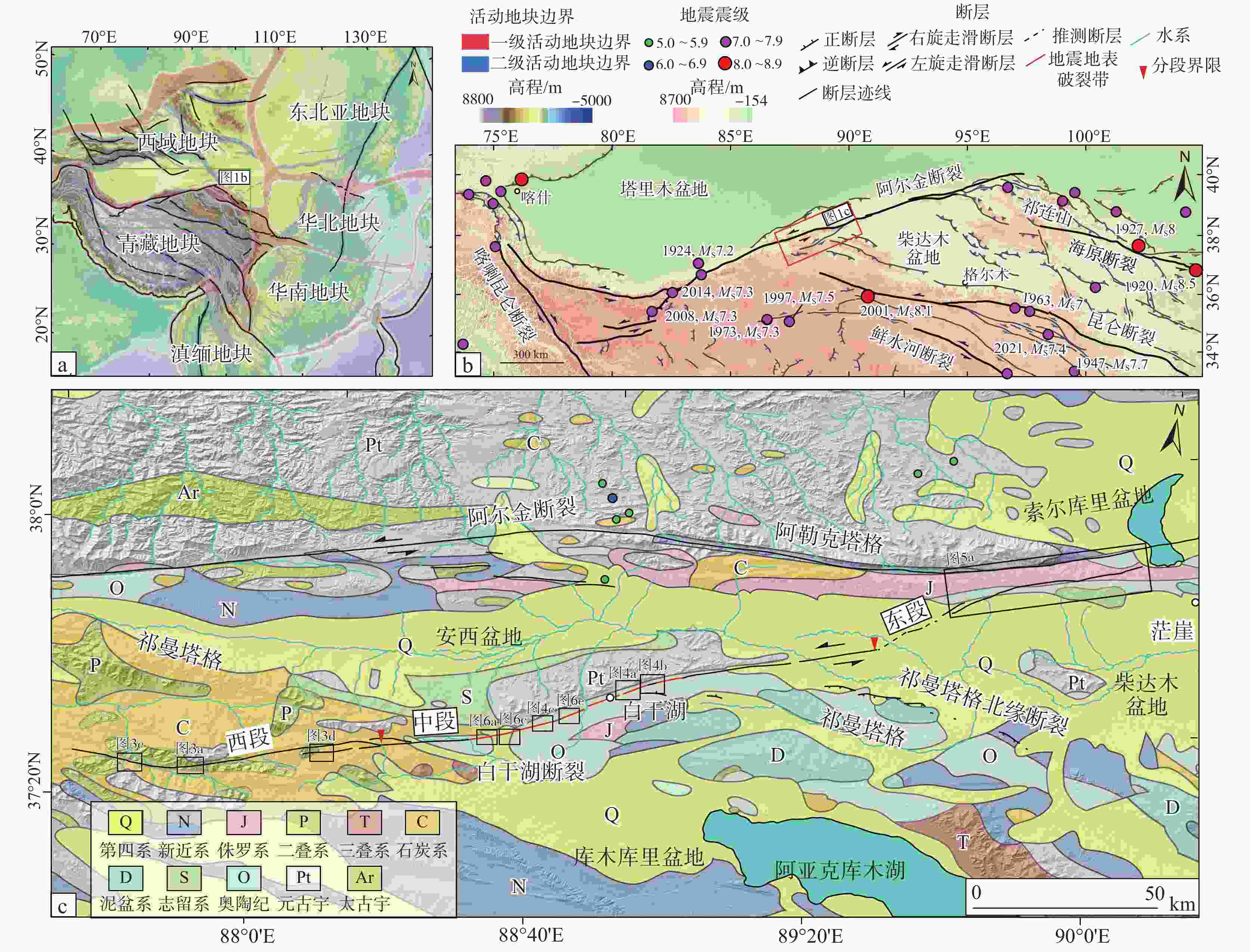
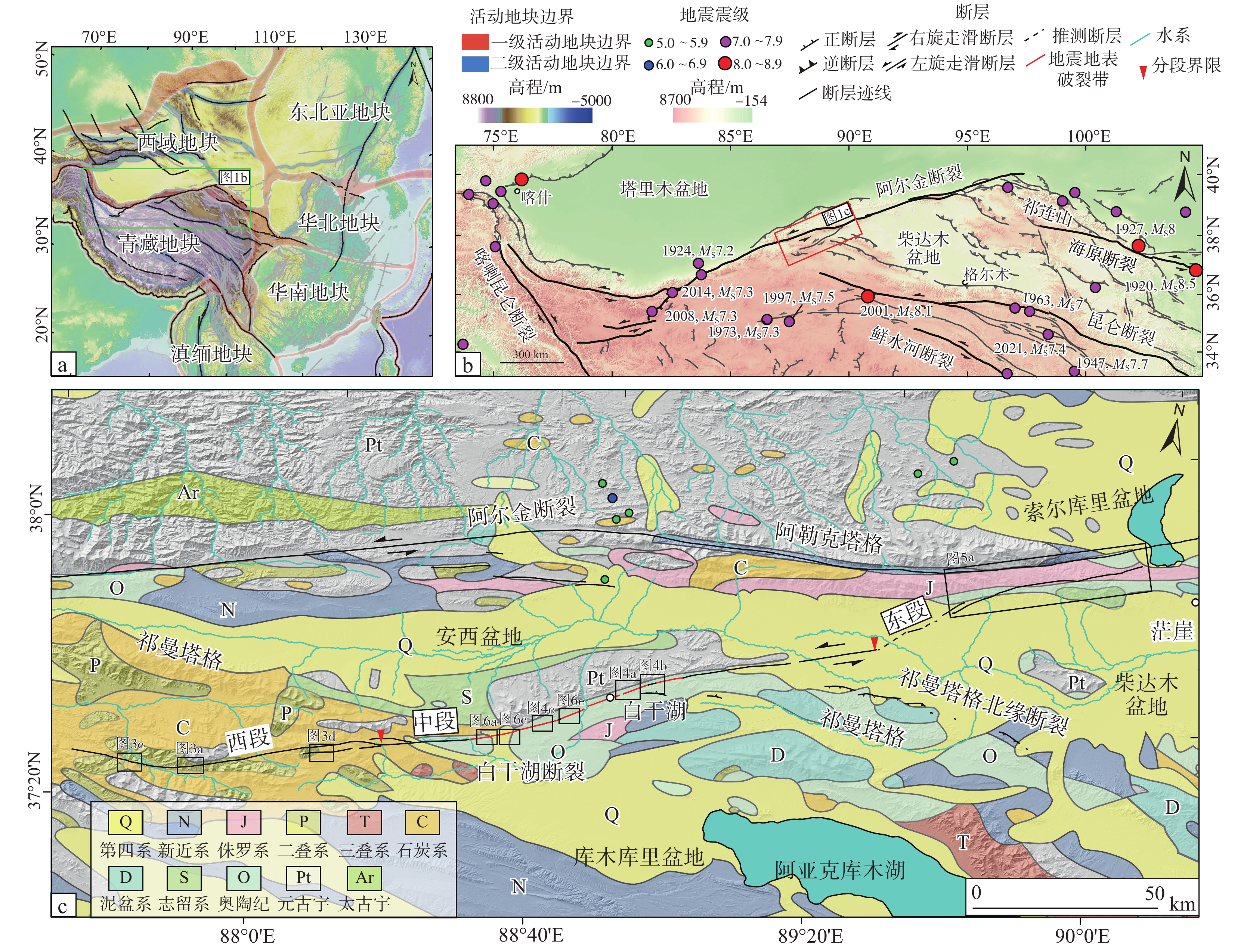
图 1 白干湖断裂地震构造背景图
a—中国及邻区活动地块划分(据Zhang et al.,2025修改);b—青藏高原北部地震构造图(据Yuan et al.,2024修改);c—白干湖断裂展布图
Figure 1. Seismotectonic setting of the Baiganhu Fault
(a) Active tectonic block division of China and adjacent regions (modified from Zhang et al., 2025); (b) Seismotectonic map of the northern Tibetan Plateau (modified from Yuan et al., 2024); (c) Structural map of the Baiganhu Fault
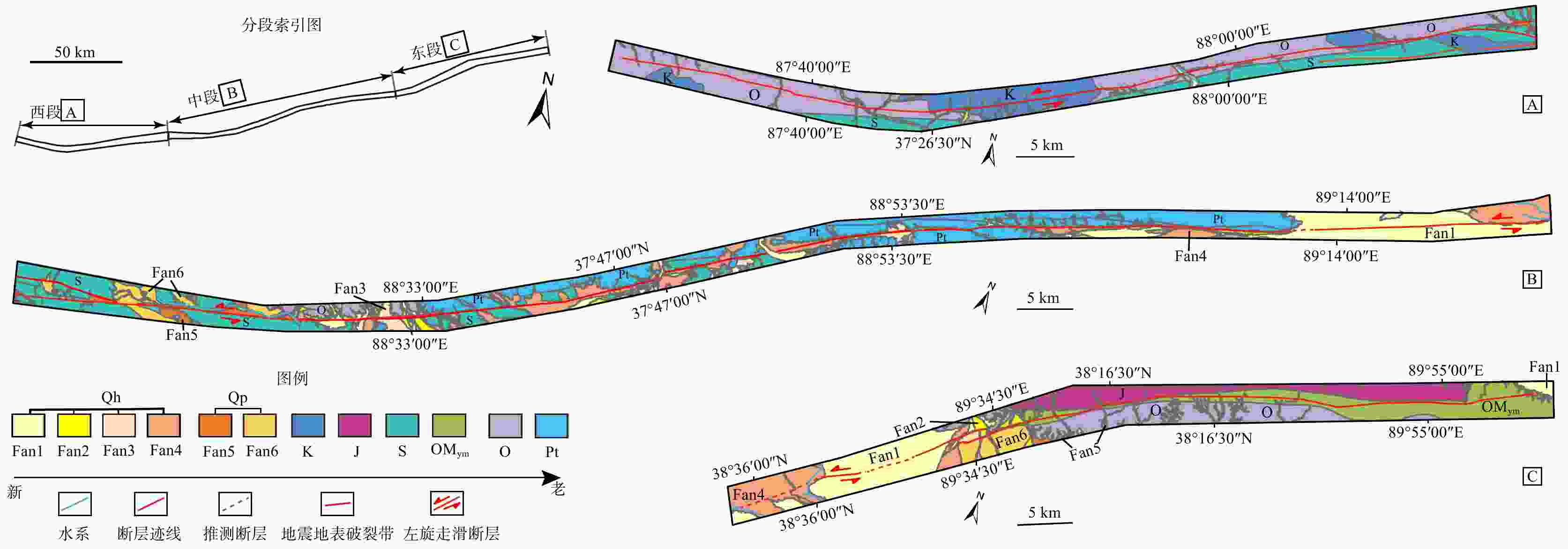
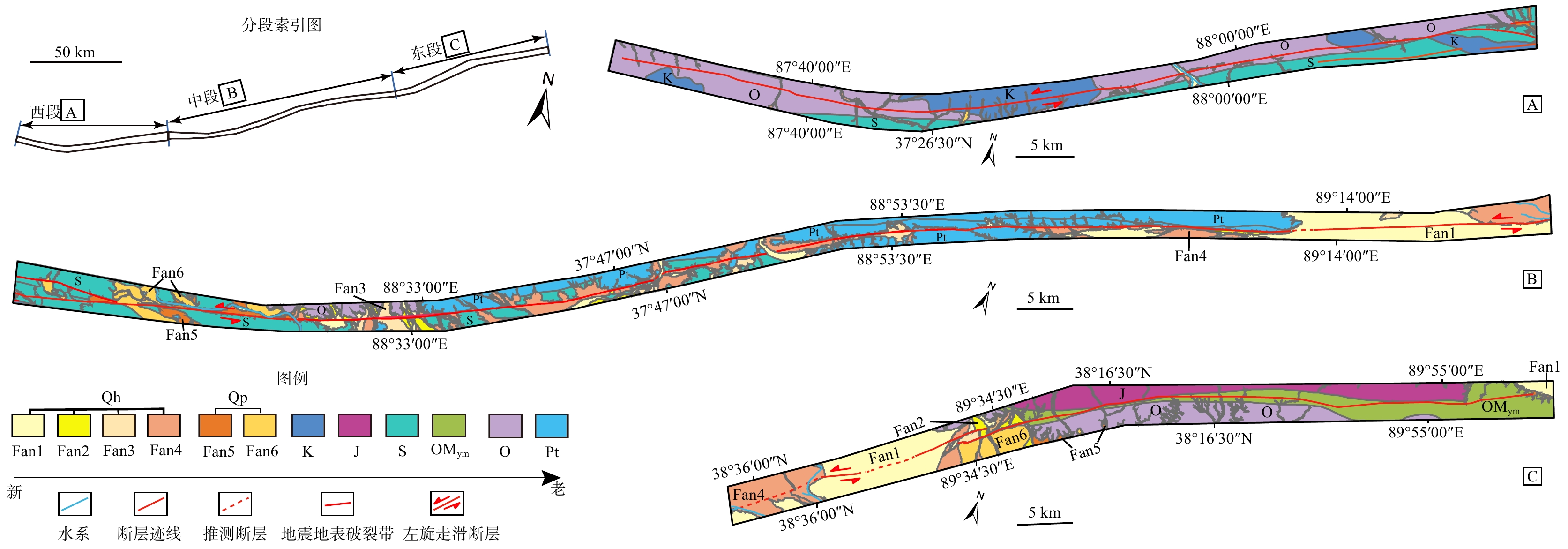
图 2 白干湖断裂分段地质简图
Qh—全新统;Qp—更新统;K—白垩系;J—侏罗系;S—志留系;O—奥陶系;Pt—元古宇;OMym—奥陶纪蛇绿混杂岩;Fan1—Fan6—洪积扇不同期次
Figure 2. Geological sketch map showing the segmentation of the Baiganhu Fault
Qh–Holocene; Qp–Pleistocene; K–Cretaceous; J–Jurassic; S–Silurian; O–Ordovician; Pt–Proterozoic; OMym–Ordovician ophiolitic mélange; Fan1–Fan6–successive alluvial fans
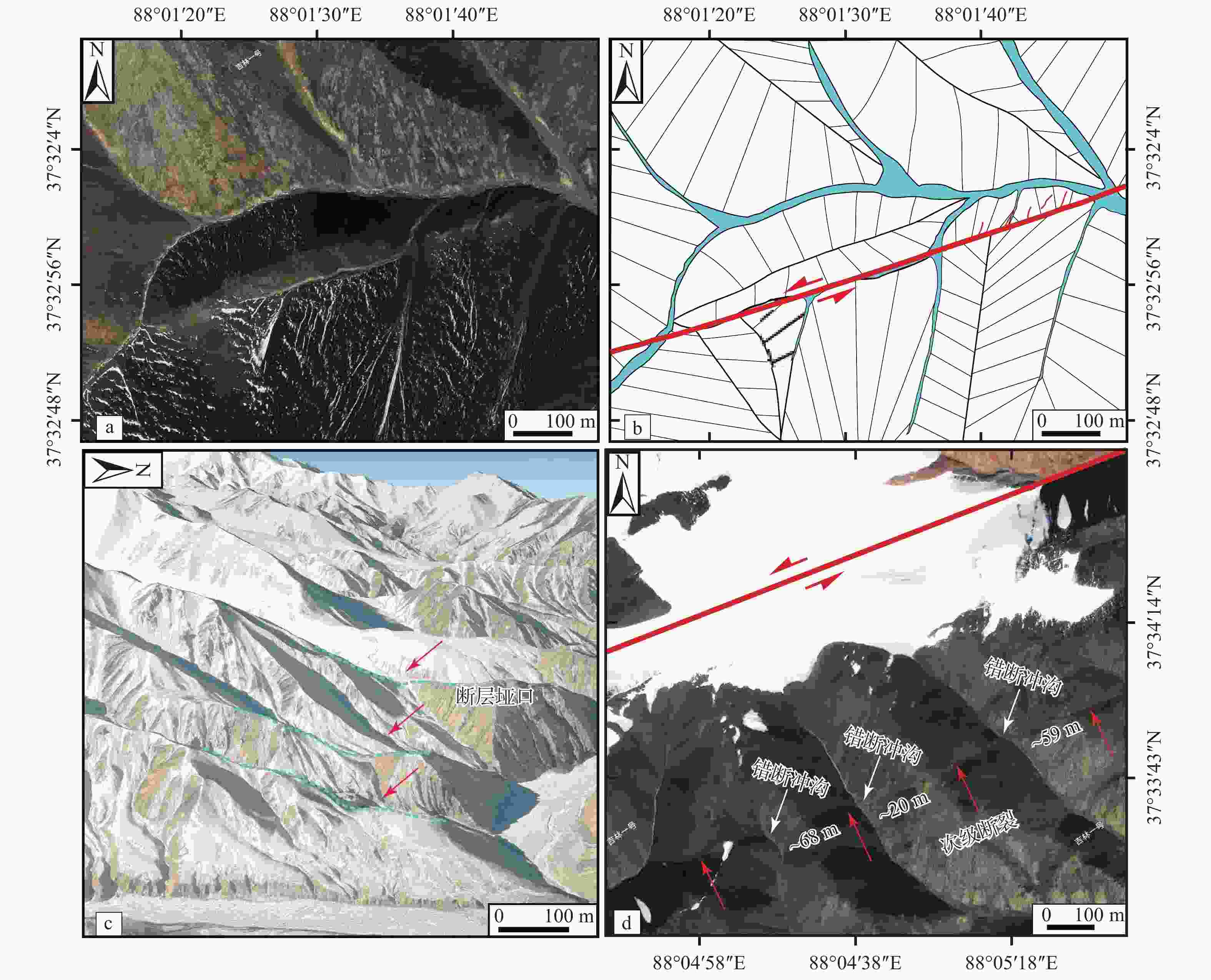
图 3 白干湖断裂西段典型断错地貌
红色实线及相对位移箭头代表断层及断层方向,图c中红色箭头指向断层垭口,蓝色虚线指示该构造地貌的轮廓,图d中白色箭头指向错断冲沟,图d中红色箭头指向次级断层,数字代表冲沟的水平位错值a—断层槽谷遥感影像图;b—断层槽谷遥感影像解译图;c—断层垭口遥感影像图;d—错断冲沟遥感影像图
Figure 3. Typical offset landforms along the western segment of the Baiganhu fault
(a) Remote-sensing image of fault valley; (b) Interpreted image of the fault valley; (c) Remote-sensing image of fault saddle; (d) Remote-sensing image of offset gully The red solid lines and relative displacement arrows denote faults and fault kinematics. In (c), the red arrow points to the fault saddle, the blue dashed line outlines the geomorphic feature. In (d), the white arrows indicate offset gullies, the red arrow marks a secondary fault, and the numbers represent the horizontal offset values of the gullies.
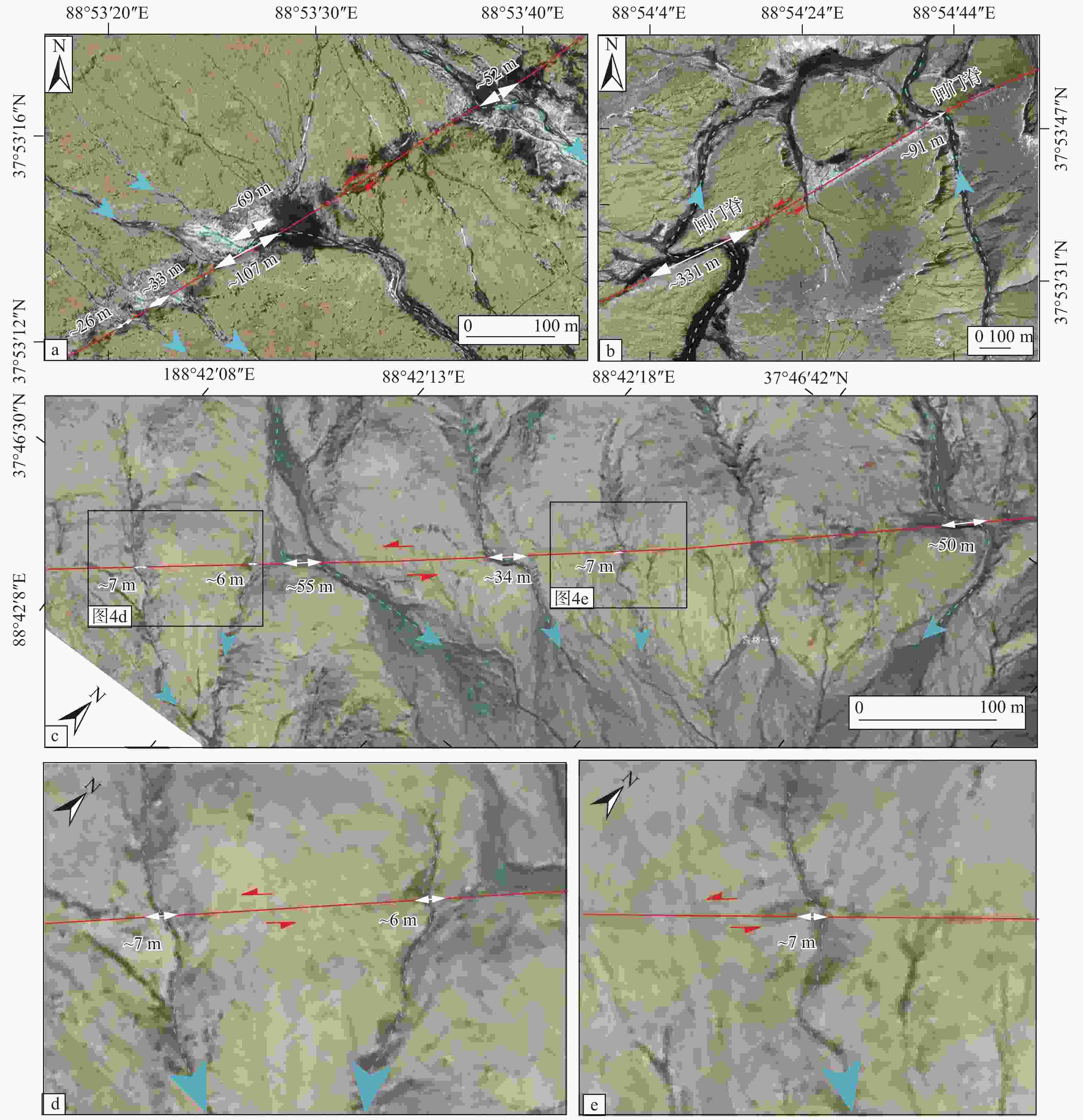
图 4 白干湖断裂中段典型断错地貌
红色实线及相对位移箭头代表断层及断层方向;蓝色虚线表示冲沟,蓝色箭头表示冲沟流向;白色箭头指示冲沟位错距离,数字指示冲沟的位错值a—错断冲沟遥感影像图;b—大型错断冲沟与闸门脊遥感影像图;c—错断冲沟与洪积扇遥感影像图;d—西侧冲沟放大图; e—东侧错断冲沟放大图
Figure 4. Typical offset landforms along the central segment of the Baiganhu fault
(a) Remote-sensing image of offset gullies; (b) Remote-sensing image of large-scale faulted gullies and shutter ridges; (c) Remote-sensing image of offset gullies and alluvial fans; (d) Close-up of the western gullies; (e) Close-up of the the eastern offset gullies Red solid lines and relative‑displacement arrows represent faults and their kinematics; blue dashed lines outline gullies, with blue arrows indicating flow directions; white arrows point to gully offsets, and numbers give offset magnitudes.
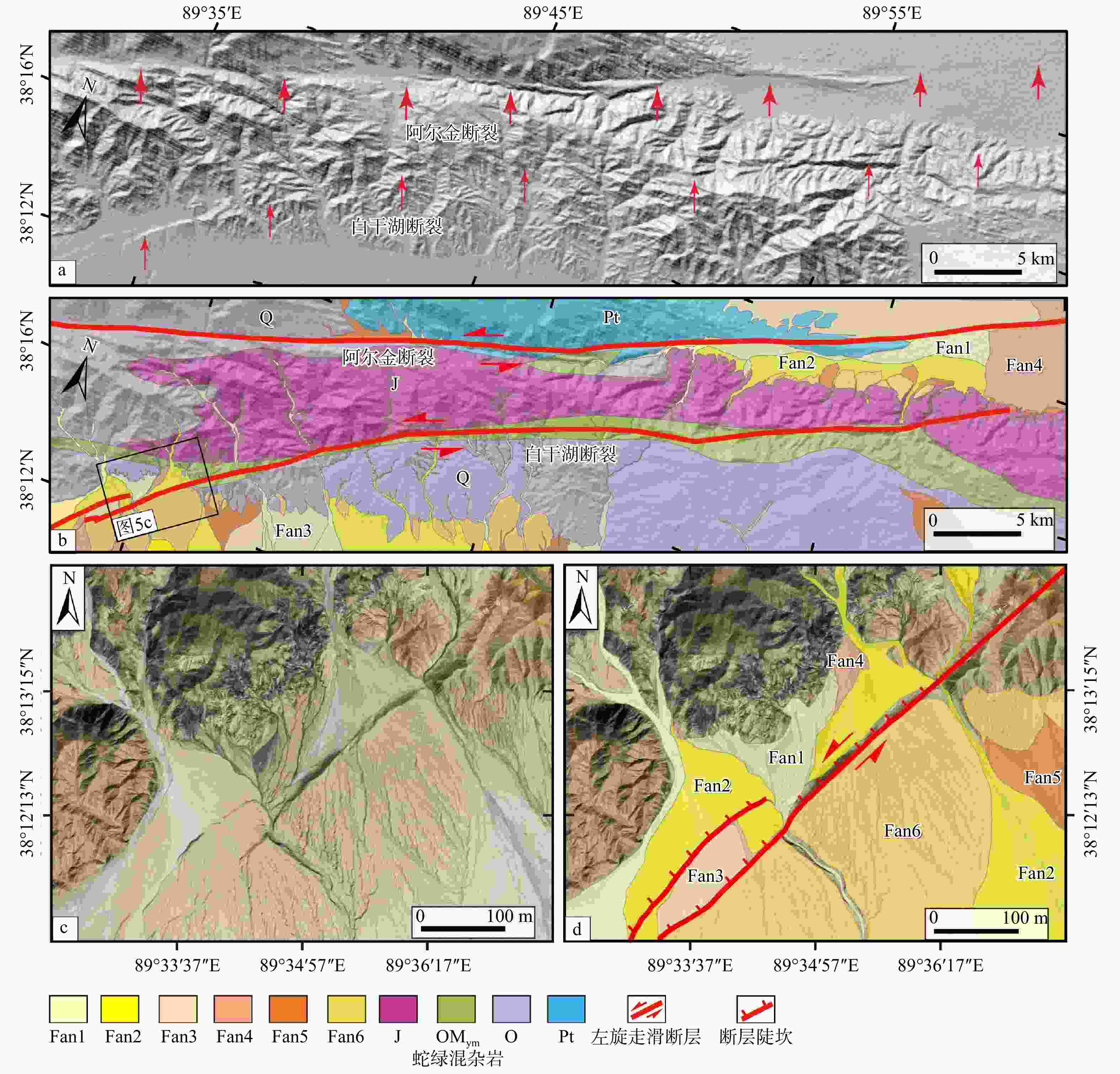
图 5 白干湖断裂东段典型断错地貌特征
O—奥陶系;Pt—元古宇;OMym—奥陶纪蛇绿混杂岩;Fan1—Fan6 代表洪积扇不同期次a—东段局部山影图(箭头指向线性断错地貌);b—东段局部解译图;c—被切割的洪积扇遥感影像图;d—洪积扇解译图
Figure 5. Typical offset landforms along the eastern segment of the Baiganhu fault
(a) Local hillshade map of the eastern segment (arrows indicate linear fault landforms); (b) Local interpreted map of the eastern segment; (c) Remote-sensing image of dissected alluvial fan; (d) Interpreted map of the alluvial fan in panel c O–Ordovician; Pt–Proterozoic; OMym–Ordovician ophiolitic mélange; Fan1 to Fan6 represent successive alluvial fans
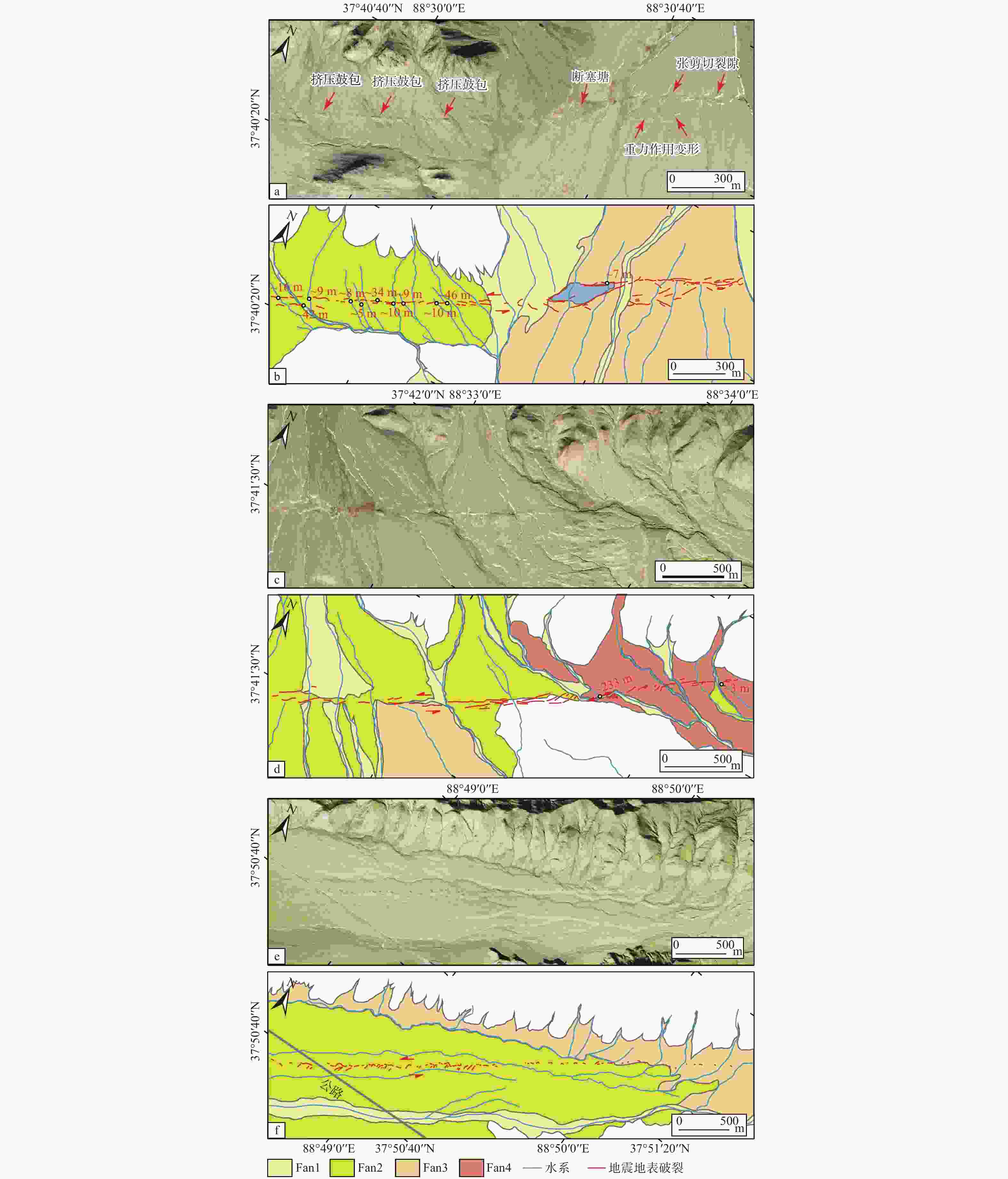
图 6 白干湖断裂典型地震地表破裂特征
Fan1—Fan4代表洪积扇不同期次;红色水平箭头指示破裂方向,黑色圆圈指示错断冲沟,数值指示冲沟位错值a—挤压鼓包与张性裂缝遥感影像图;b—挤压鼓包与张性裂缝解译图;c—大型错断冲沟与线性张裂隙缝遥感影像图;d—大型错断冲沟与线性张裂隙解译图;e—雁列式走滑破裂缝遥感影像图;f—雁列式走滑破裂解译图
Figure 6. Typical seismic surface rupture features along the Baiganhu fault
(a) Remote-sensing image of pressure ridges and extensional fissures; (b) Interpreted map of pressure ridges and extensional fissures; (c) Remote-sensing image of large offset gully and linear extensional fissures; (d) Interpreted map of large offset gully and linear extensional fissures; (e) Remote-sensing image of en échelon strike-slip ruptures; (e) Interpreted map of en échelon strike-slip raptures Fan1 to Fan4 represent successive alluvial fans, red horizontal arrows indicate the direction of rupture, black circles mark offset gullies, with numbers denoting their offset magnitudes.
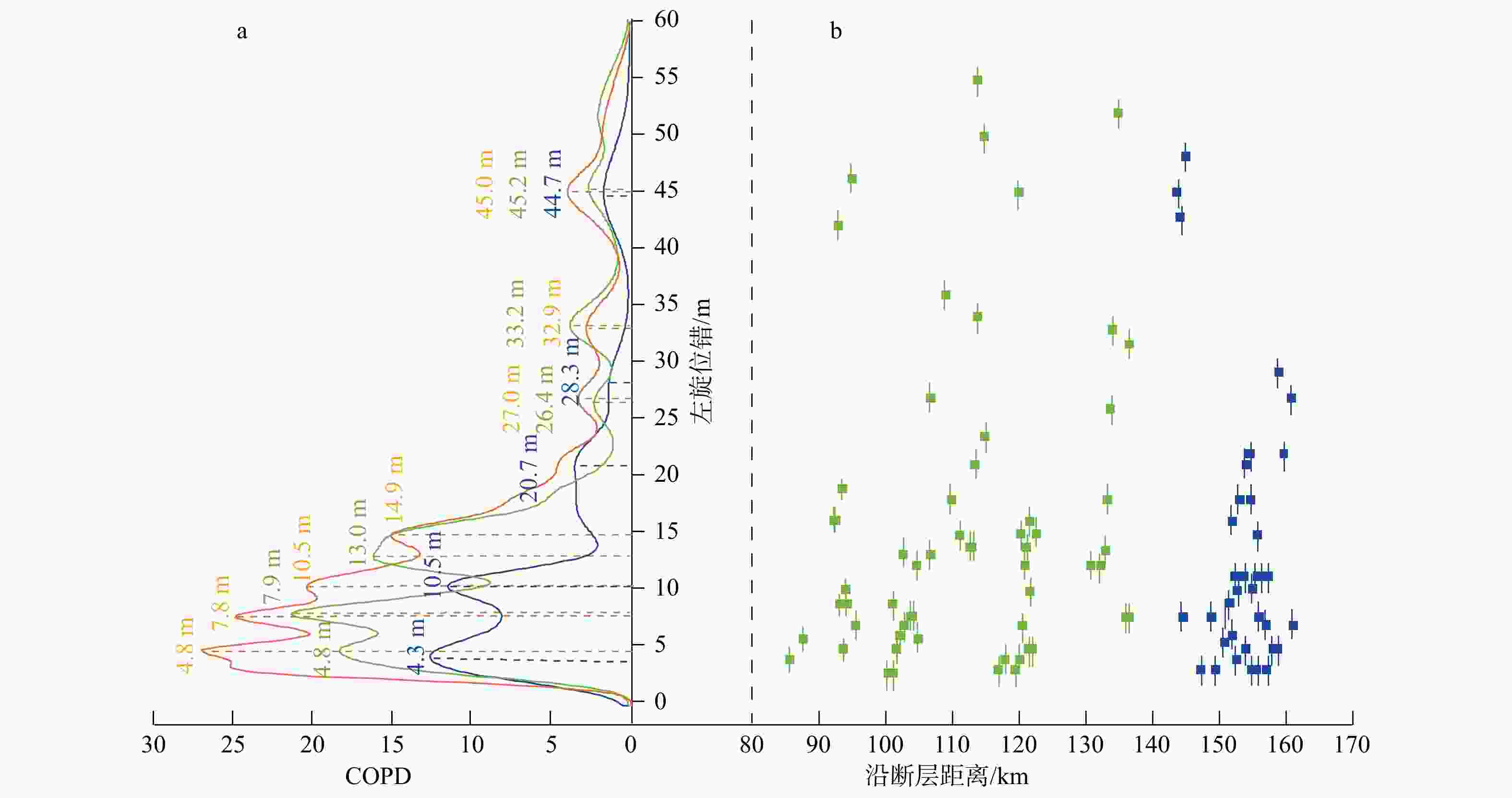
图 7 白干湖断裂80~165 km断层段冲沟位错分布和累积位错概率密度(COPD)图
a—COPD曲线(橙色代表全部冲沟位错点,绿色代表地震地表破裂带位错点,蓝色代表非地震地表破裂带位错点);b—80~165 km断层段冲沟位错分布(绿色方块为地震地表破裂带内冲沟位错点,蓝色方块为非地震地表破裂带冲沟位错点,竖线代表位错测量误差)
Figure 7. Distribution of gully offsets and COPD plots for the 80–165 km segment of the Baiganhu Fault
(a) COPD plots(The yellow curve represents all offset gullies, the green curve represents offsets along the coseismic surface rupture zone, and the blue curve represents the offsets outside the surface rupture zone.);(b) Gully offset distribution along the 80–165 km fault segments(Green squares represent offset gullies within the coseismic surface rupture zone, blue squares represent o those outside the surface rupture zone, and vertical bars denote offset measurement uncertainties.)
-
[1] BAO G D, REN Z K, HA G H, et al., 2024. New evidence of late Quaternary tectonic activity along the eastern margin of the Qaidam Basin[J]. Tectonics, 43(1): e2023TC007906. doi: 10.1029/2023TC007906 [2] BI H Y, ZHENG W J, GE W P, et al., 2018. Constraining the distribution of vertical slip on the South Heli Shan Fault (northeastern Tibet) from high‐resolution topographic data[J]. Journal of Geophysical Research: Solid Earth, 123(3): 2484-2501. doi: 10.1002/2017JB014901 [3] BIASI G P, WESNOUSKY S G, 2017. Bends and ends of surface ruptures[J]. Bulletin of the Seismological Society of America, 107(6): 2543-2560. doi: 10.1785/0120160292 [4] BIRD P, STEIN R S, 2024. Majority of ruptures in large continental strike‐slip earthquakes are unilateral: permissive evidence for hybrid brittle‐to‐dynamic ruptures[J]. Seismological Research Letters, 95(6): 3306-3315. doi: 10.1785/0220240172 [5] Bureau of Geology and Mineral Resources of Xinjiang Uygur Autonomous Region, 1993. Regional geology of Xinjiang Uygur autonomous region[M]. Beijing: Geological Publishing House. (in Chinese) [6] CHEN H, QU C Y, ZHAO D Z, et al., 2021. Rupture kinematics and coseismic slip model of the 2021 Mw 7.3 Maduo (China) earthquake: implications for the seismic hazard of the Kunlun fault[J]. Remote Sensing, 13(16): 3327. doi: 10.3390/rs13163327 [7] COWGILL E, YIN A, ARROWSMITH J, et al., 2004. The Akato Tagh bend along the Altyn Tagh fault, northwest Tibet 1: smoothing by vertical-axis rotation and the effect of topographic stresses on bend-flanking faults[J]. GSA Bulletin, 116(11-12): 1423-1442. doi: 10.1130/B25359.1 [8] DENG Q D, 1980. Main characteristics of Cenozoic block structures in China[M]//International exchange geological academic papers - 26th international geological congress. Beijing: Geological Publishing House: 101-108. (in Chinese) [9] DING G Y, TIAN Q J, KONG F C, et al. , 1993. Active fault segmentation: principles, methods, and applications[M]. Beijing: Seismological Press: 4-5. (in Chinese) [10] DING G Y, 1995. Paleoearthquakes along the Altun active fault and its segmentation[J]. Quaternary Sciences, 15(2): 97-106. (in Chinese with English abstract) [11] DONG R D, YAO Q, SHI H Q, et al., 2022. An unified model of spatiotemporal rupture process for the 2001 west of Kunlun Mountain pass earthquake[J]. Earthquake Research in China, 38(1): 80-90. (in Chinese with English abstract) [12] DUAN B C, OGLESBY D D, 2006. Heterogeneous fault stresses from previous earthquakes and the effect on dynamics of parallel strike‐slip faults[J]. Journal of Geophysical Research: Solid Earth, 111(B5): B05309. doi: 10.1029/2005jb004138 [13] ELLIOTT A J, DOLAN J F, OGLESBY D D, 2009. Evidence from coseismic slip gradients for dynamic control on rupture propagation and arrest through stepovers[J]. Journal of Geophysical Research: Solid Earth, 114(B2): B02312. doi: 10.1029/2008jb005969 [14] GAI H L, YAO S H, YANG L P, et al. , 2021. Characteristics and causes of coseismic surface rupture triggered by the '5.22' MS7. 4 Earthquake in Maduo, Qinghai, and their significance[J]. Journal of Geomechanics, 27(6): 899-912. (in Chinese with English abstract) [15] GENG Y Q, ZHANG Y, SHAO Z G, et al., 2022. Co-seismic rupture and the interaction between sub-faults of the 2016 Kaikoura MW7.8 earthquake in New Zealand[J]. Earthquake, 42(2): 123-139. (in Chinese with English abstract) [16] GU G X, 1983. Catalogue of Chinese earthquakes: 1831 BC - 1969 AD[M]. Beijing: Science Press. (in Chinese) [17] HAMLING I J, HREINSDÓTTIR S, CLARK K, et al., 2017. Complex multifault rupture during the 2016 MW 7.8 Kaikōura earthquake, New Zealand[J]. Science, 356(6334): eaam7194. doi: 10.1126/science.aam7194 [18] HARRIS R A, DAY S M, 1999. Dynamic 3D simulations of earthquakes on en echelon faults[J]. Geophysical Research Letters, 26(14): 2089-2092. doi: 10.1029/1999GL900377 [19] HE K F, WEN Y M, XU C J, 2022. Fault geometry and slip distribution of the 2021 MW7.4 Maduo, China, earthquake inferred from InSAR measurements and relocated aftershocks[J]. Seismological Research Letters, 93(1): 8-20. doi: 10.1785/0220210204 [20] JIN Z Y, FIALKO Y, 2021. Coseismic and early postseismic deformation due to the 2021 M7.4 Maduo (China) earthquake[J]. Geophysical Research Letters, 48(21): e2021GL095213. doi: 10.1029/2021GL095213 [21] LI B, ZUZA A V, CHEN X H, et al. , 2020. Cenozoic multi-phase deformation in the Qilian Shan and out-of-sequence development of the northern Tibetan Plateau[J]. Tectonophysics, 782-783: 228423. [22] LI Z H, HAN B Q, LIU Z J, et al., 2022. Source parameters and slip distributions of the 2016 and 2022 Menyuan, Qinghai earthquakes constrained by InSAR observations[J]. Geomatics and Information Science of Wuhan University, 47(6): 887-897. (in Chinese with English abstract) [23] LIANG M J, YANG Y, DU F, et al., 2020. Late quaternary activity of the central segment of the Dari fault and restudy of the surface rupture zone of the 1947 M7¾ Dari earthquake, Qinghai province[J]. Seismology and Geology, 42(3): 703-714. (in Chinese with English abstract) [24] LIN Z, JING L Z, WELDON II R J, et al. 2020. Modeling repeated coseismic slip to identify and characterize individual earthquakes from geomorphic offsets on strike-slip faults[J]. Earth and Planetary Science Letters, 545: 116313. [25] LITCHFIELD N J, VILLAMOR P, VAN DISSEN R J, et al., 2018. Surface rupture of multiple crustal faults in the 2016 Mw 7.8 Kaikōura, New Zealand, Earthquake[J]. Bulletin of the Seismological Society of America, 108(3B): 1496-1520. doi: 10.1785/0120170300 [26] LIU C L, LAY T, WANG R J, et al., 2023. Complex multi-fault rupture and triggering during the 2023 earthquake doublet in southeastern Türkiye[J]. Nature Communications, 14(1): 5564. doi: 10.1038/s41467-023-41404-5 [27] LIU D L, LI H B, CHEVALIER M L, et al., 2021. Activity of the Baiganhu Fault of the Altyn Tagh Fault System, northern Tibetan Plateau: insights from zircon and apatite fission track analyses[J]. Palaeogeography, Palaeoclimatology, Palaeoecology, 570: 110356. doi: 10.1016/j.palaeo.2021.110356 [28] LIU K, LI Y F, GUO H W, et al., 2021. Determination of surface rupture length and analysis of Riedel shear structure of the Litang M7.3 earthquake[J]. Acta Geologica Sinica, 95(8): 2346-2360. (in Chinese with English abstract) [29] LIU L, LI Y J, JI L Y, 2024. Interaction mechanism of strong earthquakes in the tectonic transition zone: a numerical study of four MS>6.0 Yutian earthquakes from 2008 to 2020[J]. Chinese Journal of Geophysics, 67(1): 156-171. (in Chinese with English abstract) [30] MUKHOPADHYAY B, DASGUPTA S, 2025. A note on seismotectonics of the 2023 turkey earthquakes (Mw 7.8 and 7.7) highlighting the unique damage pattern of building structures[J]. Journal of the Geological Society of India, 101(10): 1530-1536. doi: 10.17491/jgsi/2025/174271 [31] OGLESBY D, 2008. Rupture termination and jump on parallel offset faults[J]. Bulletin of the Seismological Society of America, 98(1): 440-447. doi: 10.1785/0120070163 [32] SHAO Y X, GE W P, ZHANG B, et al. , 2016. Primary study of late quaternary active features of northern margin fault of Qimantag[J]. China Earthquake Engineering Journal, 38(6): 970-976, 984. (in Chinese with English abstract) [33] SHAO Z G, WU Y Q, JI L Y, et al. 2022. Comprehensive determination for the late stage of the interseismic period of major faults in the boundary zone of active tectonic blocks in Chinese mainland[J]. Chinese Journal of Geophysics, 65(12): 4643-4658. (in Chinese with English abstract) [34] SHI F Q, XIONG X, WANG P T, et al., 2023. Stress interaction between the two M>6 earthquake since 2016 and its implication on the seismic hazard along the Qilian-Haiyuan fault zone[J]. Chinese Journal of Geophysics, 66(8): 3230-3241. (in Chinese with English abstract) [35] SONG M D, LIU Z, LI H M, et al., 2010. Geological background and potentiality analysis of Baiganhu Metallogenic Belt in East Kunlun, Xinjiang[J]. Northwestern Geology, 43(4): 44-52. (in Chinese with English abstract) [36] State Seismological Bureau, 1992. The Altyn Tagh active fault zone[M]. Beijing: Seismological Press: 166-187. (in Chinese) [37] STEIN R S, BIRD P, 2024. Why do great continental transform earthquakes nucleate on branch faults?[J]. Seismological Research Letters, 95(6): 3406-3415. doi: 10.1785/0220240175 [38] STIRLING M W, LITCHFIELD N J, VILLAMOR P, et al., 2017. The MW7.8 2016 Kaikōura earthquake: Surface fault rupture and seismic hazard context[J]. Bulletin of the New Zealand Society for Earthquake Engineering, 50(2): 73-84. doi: 10.5459/bnzsee.50.2.73-84 [39] TAPPONNIER P, MOLNAR P, 1977. Active faulting and tectonics in China[J]. Journal of Geophysical Research: Solid Earth, 82(20): 2905-2930. doi: 10.1029/JB082i020p02905 [40] WANG F B, ZHANG Y W, YANG B, et al., 2025. Stochastic finite fault simulation of 2023 MW 7.8 and MW7.5 Turkey earthquakes and its application to regional buildings damage estimation at Kahramanmaras City[J]. Bulletin of Earthquake Engineering, 23(3): 867-892. doi: 10.1007/s10518-024-01990-1 [41] WANG H, LIU M, DUAN B C, et al., 2020. Rupture propagation along stepovers of strike‐slip faults: Effects of initial stress and fault geometry[J]. Bulletin of the Seismological Society of America, 110(3): 1011-1024. doi: 10.1785/0120190233 [42] WELLS D L, COPPERSMITH K J, 1994. New empirical relationships among magnitude, rupture length, rupture width, rupture area, and surface displacement[J]. Bulletin of the Seismological Society of America, 84(4): 974-1002. doi: 10.1785/BSSA0840040974 [43] WESNOUSKY S G, 2006. Predicting the endpoints of earthquake ruptures[J]. Nature, 444(7117): 358-360. doi: 10.1038/nature05275 [44] WU Z H, 2024. The earthquake-controlling process of continental collision-extrusion active tectonic system around the Qinghai-Tibet Plateau: a case study of strong earthquakes since 1990[J]. Journal of Geomechanics, 30(2): 189-205. (in Chinese with English abstract) [45] Xian Institute of Geology and Mineral Resources, 2005. 1: 250, 000 regional geological survey of the Suwushijie sheet (J45C002004)[Z]. (in Chinese) [46] XIAO K Z, TONG H M, XU X K, et al., 2025. Advances in research on the Altyn Tagh fault: its sinistral strike-slip mechanism and developmental patterns[J]. Geotectonica et Metallogenia, 49(6): 1324-1348. (in Chinese with English abstract) [47] XU L, CHEN Q, ZHAO J J, et al., 2021. An integrated approach for mapping three-dimensional CoSeismic displacement fields from sentinel-1 TOPS data based on DInSAR, POT, MAI and BOI techniques: application to the 2021 MW 7.4 maduo earthquake[J]. Remote Sensing, 13(23): 4847. doi: 10.3390/rs13234847 [48] YAN Y, 2023. The tunnel damage effects and implications of the coseismic rupture of the Menyuan MS 6.9 earthquake in Qinghai, China[J]. Journal of Geomechanics, 29(6): 869-878. (in Chinese with English abstract) [49] YANG Z, ZHONG N, ZHANG X B, et al., 2025. Avoidance distance and influence range of active faults: a case study of Litang fault[J]. Journal of Geomechanics, 31(1): 124-138. (in Chinese with English abstract) [50] YI K X, JOLIVET M, GUO Z J, 2025. Tectonic transition and extension at the eastern and western ends of the Altyn Tagh fault: insights from triple junctions[J]. Journal of Geomechanics, 31(1): 24-38. (in Chinese with English abstract) [51] YUAN D Y, ZHANG P Z, LIU B C, et al., 2004. Geometrical imagery and tectonic transformation of Late Quaternary active tectonics in northeastern margin of Qinghai-Xizang Plateau[J]. Acta Geologica Sinica, 78(2): 270-278. (in Chinese with English abstract) [52] YUAN Z D, LIU J, ZHOU Y, et al., 2020. Paleoseismologic record of earthquakes along the Wuzunxiaoer section of the Altyn Tagh fault and its implication for cascade rupture behavior[J]. Science China Earth Sciences, 63(1): 93-107. doi: 10.1007/s11430-019-9376-8 [53] YUAN Z D, JING L Z, LI X, et al., 2021. Detailed mapping of the surface rupture of the 12 February 2014 Yutian MS7.3 earthquake, Altyn Tagh fault, Xinjiang, China[J]. Science China Earth Sciences, 64(1): 127-147. doi: 10.1007/s11430-020-9673-6 [54] YUAN Z D, HUANG J GAN J F, et al., 2024. New constraints for slip rates along the Altyn Tagh fault, northwestern Tibet Plateau[J]. Journal of Structural Geology, 186: 105221. doi: 10.1016/j.jsg.2024.105221 [55] ZHANG P Z, DENG Q D, ZHANG G M, et al., 2003. Active tectonic blocks and strong earthquakes in the continent of China[J]. Science in China Series D: Earth Sciences, 46(2): 13-24. doi: 10.1360/03dz0002 [56] ZHANG P Z, DENG Q D, ZHANG Z Q, et al., 2013. Active faults, earthquake hazards and associated geodynamic processes in continental China[J]. Scientia Sinica Terrae, 43(10): 1607-1620. (in Chinese) [57] ZHANG X B, YANG Z, ZHONG N, et al., 2024. Late Quaternary activity and paleoearthquake recurrence characteristics of the Litang fault in western Sichuan[J]. Acta Geologica Sinica, 98(7): 2084-2100. (in Chinese with English abstract) [58] ZHANG Y P, WANG Y WANG W T, et al., 2025. Active block tectonics and intracontinental deformation within the India-Eurasia oblique convergence zone[J]. Tectonics, 44(10): e2025TC009029. doi: 10.1029/2025TC009029 [59] ZHENG W J, ZHANG P Z, YUAN D Y, et al., 2019. Basic characteristics of active tectonics and associated geodynamic processes in continental China[J]. Journal of Geomechanics, 25(5): 699-721. (in Chinese with English abstract) [60] ZHENG W J, ZHANG Z Q, HAO M, et al., 2022. Physical basis for prediction of continental strong earthquakes: development and prospect of active tectonic block theory[J]. Chinese Science Bulletin, 67(13): 1352-1361. (in Chinese with English abstract) doi: 10.1360/tb-2021-1025 [61] ZHENG W J, SUN X, YUAN D Y, et al., 2025. Active faults, seismic activity, and seismotectonic environments in the Tibetan Plateau and its adjacent regions[J]. Journal of Geomechanics, 31(5): 1006-1029. (in Chinese with English abstract) [62] 邓起东, 1980. 中国新生代断块构造的主要特征[M]//国际交流地质学术论文集-第26届国际地质大会. 北京: 地质出版社: 101-108. [63] 丁国瑜, 田勤俭, 孔凡臣, 等, 1993. 活断层分段: 原则、方法及应用[M]. 北京: 地震出版社: 4-5. [64] 丁国瑜, 1995. 阿尔金活断层的古地震与分段[J]. 第四纪研究, 15(2): 97-106. [65] 董仁东, 姚强, 施贺青, 等, 2022. 2001年昆仑山口西MS8.1地震破裂时空过程的统一模型[J]. 中国地震, 38(1): 80-90. doi: 10.3969/j.issn.1001-4683.2022.01.008 [66] 盖海龙, 姚生海, 杨丽萍, 等, 2021. 青海玛多“5·22”MS7.4级地震的同震地表破裂特征、成因及意义[J]. 地质力学学报, 27(6): 899-912. doi: 10.12090/j.issn.1006-6616.2021.27.06.073 [67] 耿亚清, 张勇, 邵志刚, 等, 2022. 2016年新西兰凯库拉MW7.8地震同震破裂及子断层间相互影响[J]. 地震, 42(2): 123-139. doi: 10.12196/j.issn.1000-3274.2022.02.010 [68] 顾功叙, 1983. 中国地震目录: 公元前1831——公元1969年[M]. 北京: 科学出版社. [69] 国家地震局《阿尔金活动断裂带》课题组, 1992. 阿尔金活动断裂带[M]. 北京: 地震出版社: 166-187. [70] 李振洪, 韩炳权, 刘振江, 等, 2022. Insar数据约束下2016年和2022年青海门源地震震源参数及其滑动分布[J]. 武汉大学学报(信息科学版), 47(6): 887-897. doi: 10.13203/j.whugis20220037 [71] 梁明剑, 杨耀, 杜方, 等, 2020. 青海达日断裂中段晚第四纪活动性与1947年M7¾地震地表破裂带再研究[J]. 地震地质, 42(3): 703-714. [72] 刘亢, 李岩峰, 郭辉文, 等, 2021. 1948年川西理塘M7.3地震地表破裂特征及Riedel剪切构造分析[J]. 地质学报, 95(8): 2346-2360. [73] 刘雷, 李玉江, 季灵运, 2024. 构造转换区强震间相互作用机制的数值模拟研究: 以2008—2020年4次MS>6.0于田地震为例[J]. 地球物理学报, 67(1): 156-171. doi: 10.6038/cjg2023Q0481 [74] 邵延秀, 葛伟鹏, 张波, 等, 2016. 祁漫塔格北缘断裂晚第四纪以来活动特征初步研究[J]. 地震工程学报, 38(6): 970-976, 984. doi: 10.3969/j.issn.1000-0844.2016.06.0970 [75] 邵志刚, 武艳强, 季灵运, 等, 2022. 中国大陆活动地块边界带主要断层的强震震间晚期综合判定[J]. 地球物理学报, 65(12): 4643-4658. doi: 10.6038/cjg2022P0489 [76] 石富强, 熊熊, 王朋涛, 等, 2023. 2016年以来门源2次6级地震的应力触发及其对祁连—海原断裂带地震危险性的指示[J]. 地球物理学报, 66(8): 3230-3241. doi: 10.6038/cjg2022Q0068 [77] 宋茂德, 刘忠, 李洪茂, 等, 2010. 新疆东昆仑白干湖成矿带成矿地质背景及找矿方向[J]. 西北地质, 43(4): 44-52. doi: 10.3969/j.issn.1009-6248.2010.04.006 [78] 吴中海, 2024. 青藏高原陆陆碰撞-挤出活动构造体系控震作用: 以1990年以来强震活动为例[J]. 地质力学学报, 30(2): 189-205. doi: 10.12090/j.issn.1006-6616.2023186 [79] 西安地质矿产研究所, 2005. 苏吾什杰幅(J45C002004)1∶25万区域地质调查[Z]. [80] 肖坤泽, 童亨茂, 许晓科, 等, 2025. 阿尔金断裂研究进展及其左旋走滑成因机制和发育模式探讨[J]. 大地构造与成矿学, 49(6): 1324-1348. doi: 10.16539/j.ddgzyckx.2025.00.040 [81] 新疆维吾尔自治区地质矿产局, 1993. 新疆维吾尔自治区区域地质志[M]. 北京: 地质出版社. [82] 阎渊, 2023. 青海门源MS6.9地震同震破裂的隧道破坏效应与启示[J]. 地质力学学报, 29(6): 869-878. doi: 10.12090/j.issn.1006-6616.2023027 [83] 杨镇, 钟宁, 张献兵, 等, 2025. 活动断层的避让距离与影响范围: 以理塘断裂为例[J]. 地质力学学报, 31(1): 124-138. doi: 10.12090/j.issn.1006-6616.2023085 [84] 衣可心, JOLIVET M, 郭召杰, 2025. 阿尔金断裂带东西两端构造转换与扩展过程: 从三联点谈起[J]. 地质力学学报, 31(1): 24-38. doi: 10.12090/j.issn.1006-6616.2024068 [85] 袁道阳, 张培震, 刘百篪, 等, 2004. 青藏高原东北缘晚第四纪活动构造的几何图像与构造转换[J]. 地质学报, 78(2): 270-278. doi: 10.3321/j.issn:0001-5717.2004.02.017 [86] 袁兆德, 刘静, 周游, 等, 2020. 阿尔金断裂中段乌尊硝尔段古地震记录与级联破裂行为[J]. 中国科学: 地球科学, 50(1): 50-65. [87] 张培震, 邓起东, 张国民, 等, 2003. 中国大陆的强震活动与活动地块[J]. 中国科学(D辑), 33(S): 12-20. doi: 10.3969/j.issn.1674-7240.2003.z1.002 [88] 张培震, 邓起东, 张竹琪, 等, 2013. 中国大陆的活动断裂、地震灾害及其动力过程[J]. 中国科学: 地球科学, 43(10): 1607-1620. [89] 张献兵, 杨镇, 钟宁, 等, 2024. 川西理塘断裂晚第四纪活动性及古地震复发特征[J]. 地质学报, 98(7): 2084-2100. doi: 10.19762/j.cnki.dizhixuebao.2023173 [90] 郑文俊, 张培震, 袁道阳, 等, 2019. 中国大陆活动构造基本特征及其对区域动力过程的控制[J]. 地质力学学报, 25(5): 699-721. doi: 10.12090/j.issn.1006-6616.2019.25.05.062 [91] 郑文俊, 张竹琪, 郝明, 等, 2022. 强震孕育发生的大陆活动地块理论未来发展与强震预测探索[J]. 科学通报, 67(13): 1352-1361. doi: 10.1360/TB-2021-1025 [92] 郑文俊, 孙鑫, 袁道阳, 等, 2025. 青藏高原及邻区活动断裂、地震活动及地震构造环境[J]. 地质力学学报, 31(5): 1006-1029. doi: 10.12090/j.issn.1006-6616.2025124 -

 下载:
下载:


计量
- 文章访问数: 354
- HTML全文浏览量: 77
- PDF下载量: 134
- 被引次数: 0
