


-
摘要: 对于苏门答腊的构造单元划分,当前地质学界的主流观点认为由东、西苏门答腊2个地块组成。这一模型中,东部因发育晚古生代“冷水型动物群”(阿拉斯灰岩)和含砾泥岩(博霍洛克组冰碛岩)被归为冈瓦纳亲缘的 Sibumasu (滇缅泰马)地块;西部则因发育晚古生代“暖水型动物群”(关丹灰岩)和亲华夏植物群(门卡兰组占碑植物群)被划为亲华夏地块,二者以中央构造带为界。文章在最新的野外考察基础上,结合详细的资料调研,系统回顾了苏门答腊二分模型提出与完善的过程,并通过构造、地层和古生物地理区系对比认为东、西苏门答腊地块具有相似的变质程度、构造变形特征,且地层序列接近。二者之间可能并没有明显的构造(板块)的分区,不同地质时期的沉积环境和古生物地理区系的差异可能仅代表了古纬度差异或气候变迁。同时,岩浆岩测年结果也支持这一看法。目前的证据表明,东、西苏门答腊地块可能为统一的整体。Abstract:
Objective The tectonic units in Sumatra were considered as the two parts: Eastern and Western blocks. Generally, the East Sumatra block affiliated with Gondwana, due to its late Paleozoic “cold-water fauna” (Alas limestone) and pebbly mudstone (Bohorok Formation glacial till); While the West Sumatra block is classified as the Cathaysian-affiliated block due to its late Paleozoic “warm-water fauna” (Kuantan Limestone) and Cathaysian flora (Mengkarang Formation Jambi Flora). These two are separated by the Medial Sumatra Tectonic Zone. Methods Through the field observation, structural analysis, stratigraphic comparisons, and systematically paleobiogeographic reviewing; even the key outcrops were examined to document the structures and lithological variations. Results The Eastern and Western Sumatra blocks, as the “basement” of weakly metamorphosed Carboniferous and Permian stratigraphic sequences, these rocks exhibit similar metamorphic facies, structural characteristics, such as geometry and related deformations. The differences in sedimentary environments and paleobiogeographic faunas across various geological periods are likely indicative of variations in ancient latitude or climatic changes rather than distinct tectonic boundaries instead of belonging to the different blocks. Geochronological work of the magmatic rock indicated the interpretation that the two blocks may have once formed a unified whole. And the Medial Sumatra Tectonic Zone does not act as a significant tectonic (plate) boundary. Conclusion The East and West Sumatra blocks may have originated as a single tectonic unit or plate. Similarities in metamorphic facies, deformation patterns, stratigraphic sequences, and magmatic histories suggest a common geological evolution. Differences in sedimentary environments and paleobiogeographic faunas across different geological periods likely reflect variations in ancient latitude or climatic changes. Geochronological work related to the magmatic rock results support this interpretation, indicating that the two blocks may have once formed a unified whole. [Significance] This study challenges the traditional two-block model and suggests that the East and West Sumatra blocks should be considered as a unified block or plate. The findings highlight the importance of considering the unified tectonic framework of Sumatra in future geological studies and resource assessment in Southeast Asia. -
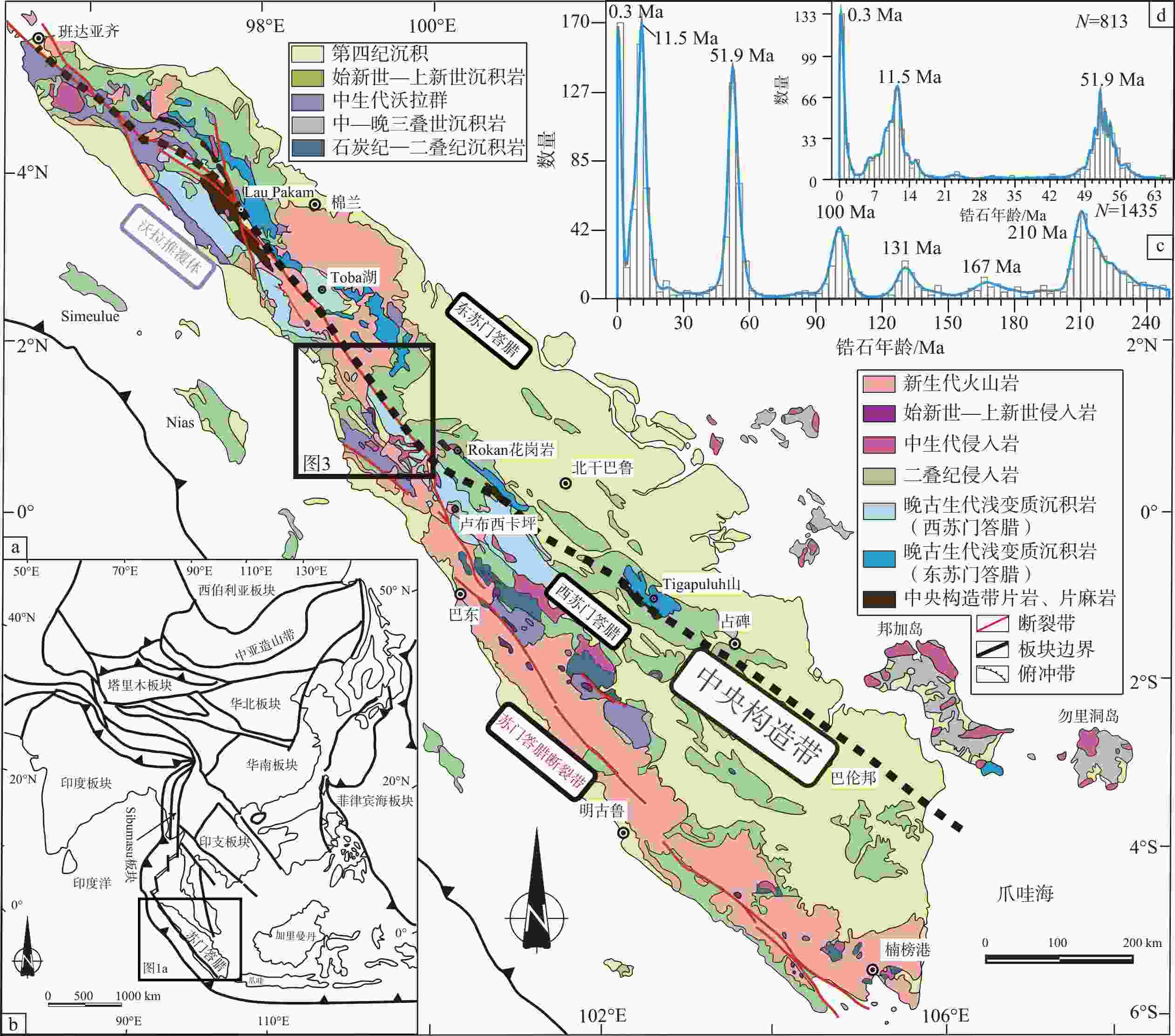
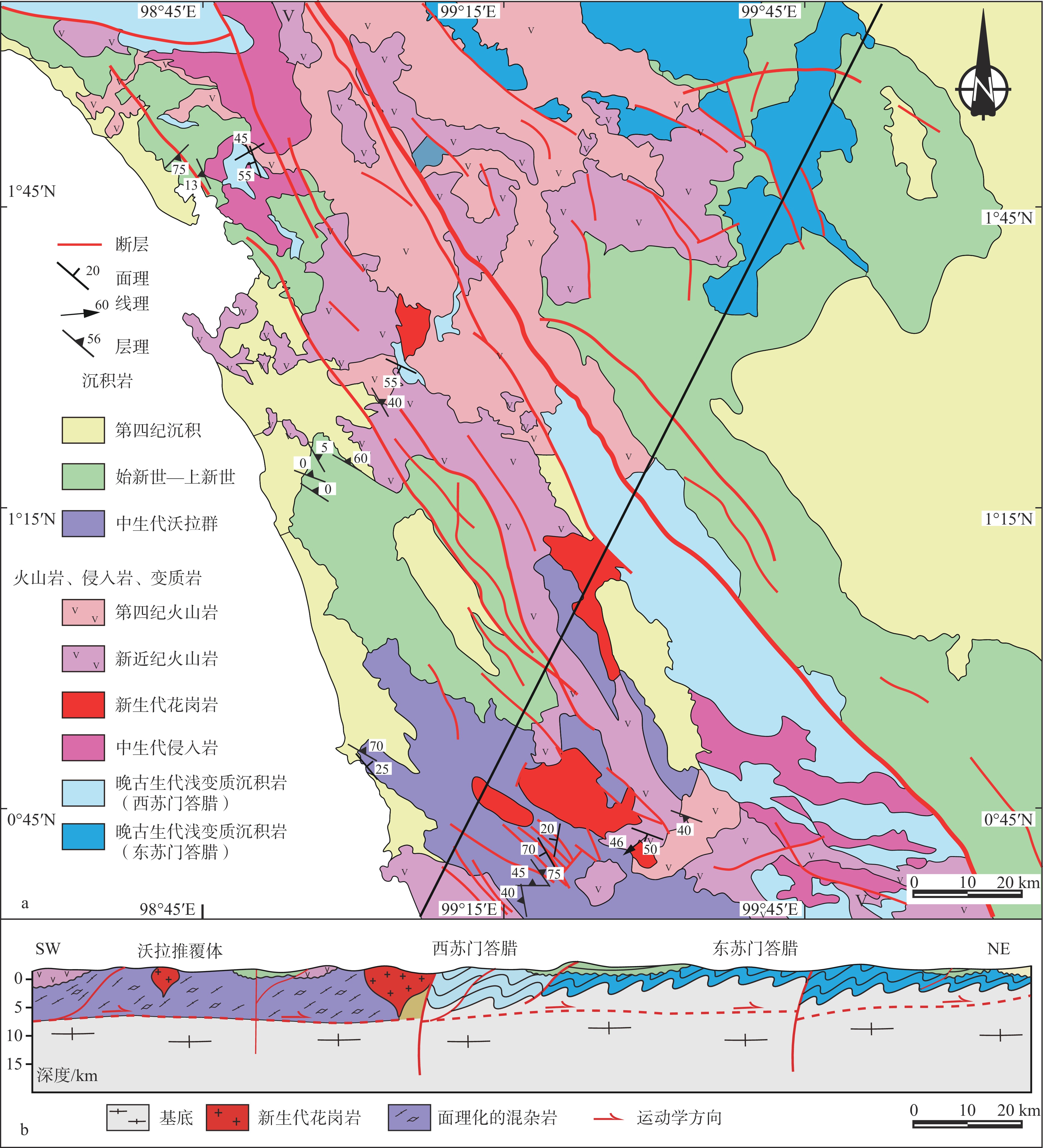
图 1 苏门答腊区域地质图及碎屑锆石谱峰图
a—苏门答腊构造地质简图(据 Barber et al.,2005修改);b—东亚地区大地构造格架简图;c—古特提斯闭合后碎屑锆石所记录的构造(热)事件谱峰分布图;d—新生代碎屑锆石所记录的构造(热)事件谱峰分布图(数据来源于Hsu,2016;Zhang et al.,2018,2019,2021;Lai et al.,2024)
Figure 1. Regional geological map of Sumatra and detrital zircon U-Pb zircon age distribution diagram
(a)Schematic tectono-geological map of Sumatra (modified from Barber et al.,2005);(b)Simplified tectonic framework of Eastern Asia;(c)Spectrum distribution maps of tectonic (thermal) events recorded in detrital zircons after the closure of the Paleo Tethys;(d)Spectrum distribution maps of tectonic (thermal) events recorded in detrital zircons in Cenozoic (data from Hsu,2016;Zhang et al.,2018,2019,2021;Lai et al.,2024)
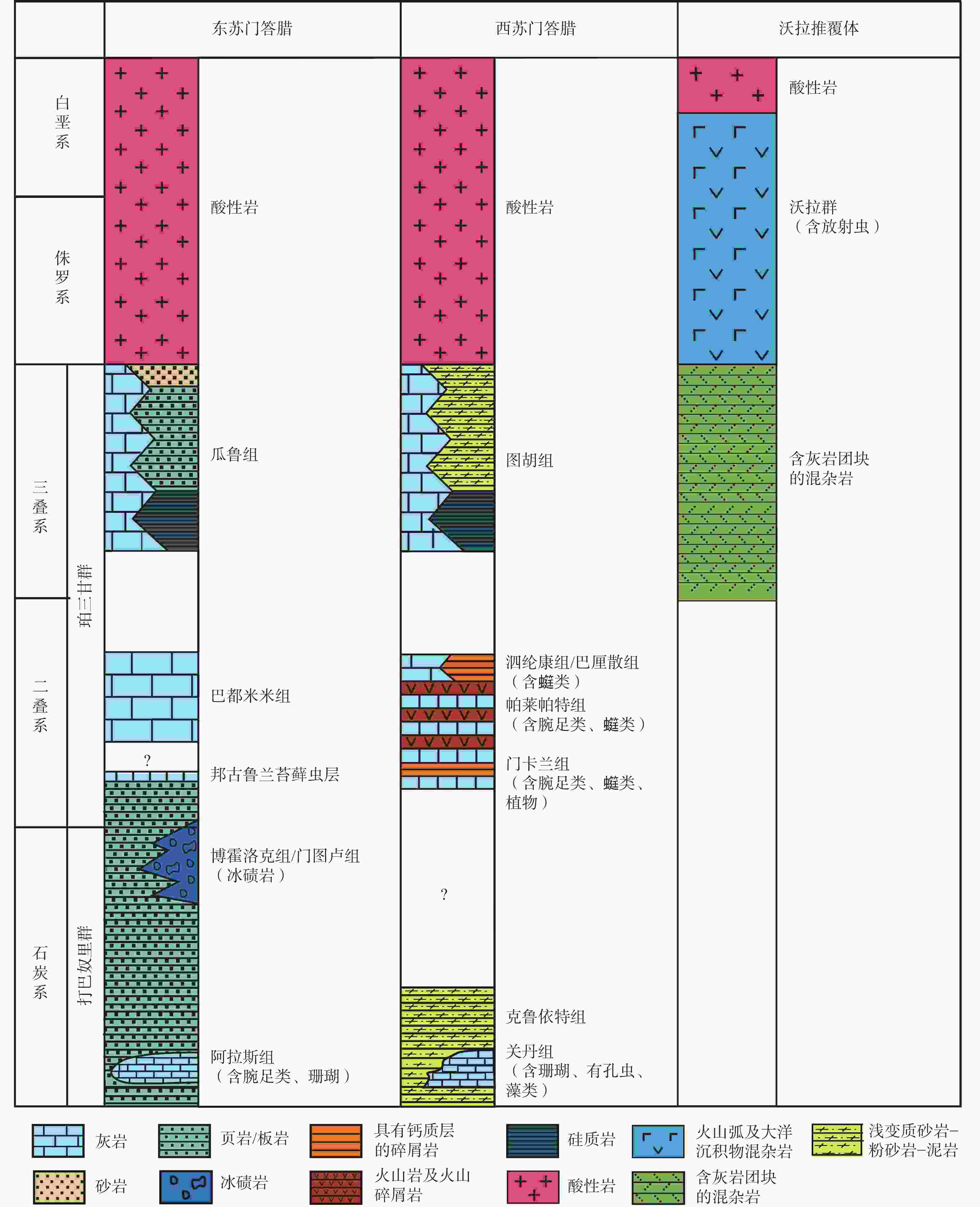
图 2 东、西苏门答腊地块及沃拉推覆体的地层柱状图(据 Qian et al.,2025修改)
Figure 2. Stratigraphic columns of East Sumatra block, West Sumatra block, and Woyla nappe (modified from Qian et al.,2025)

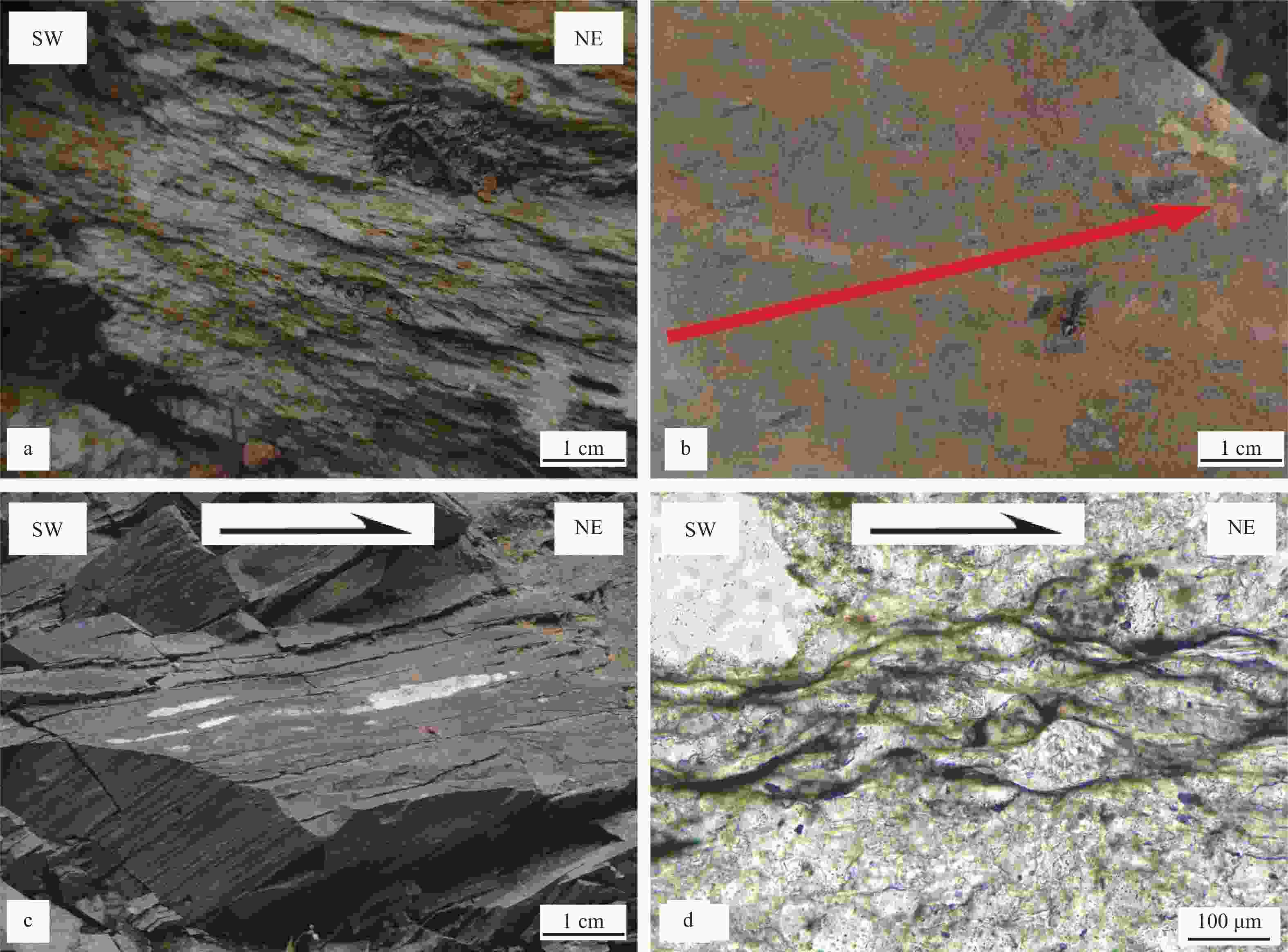
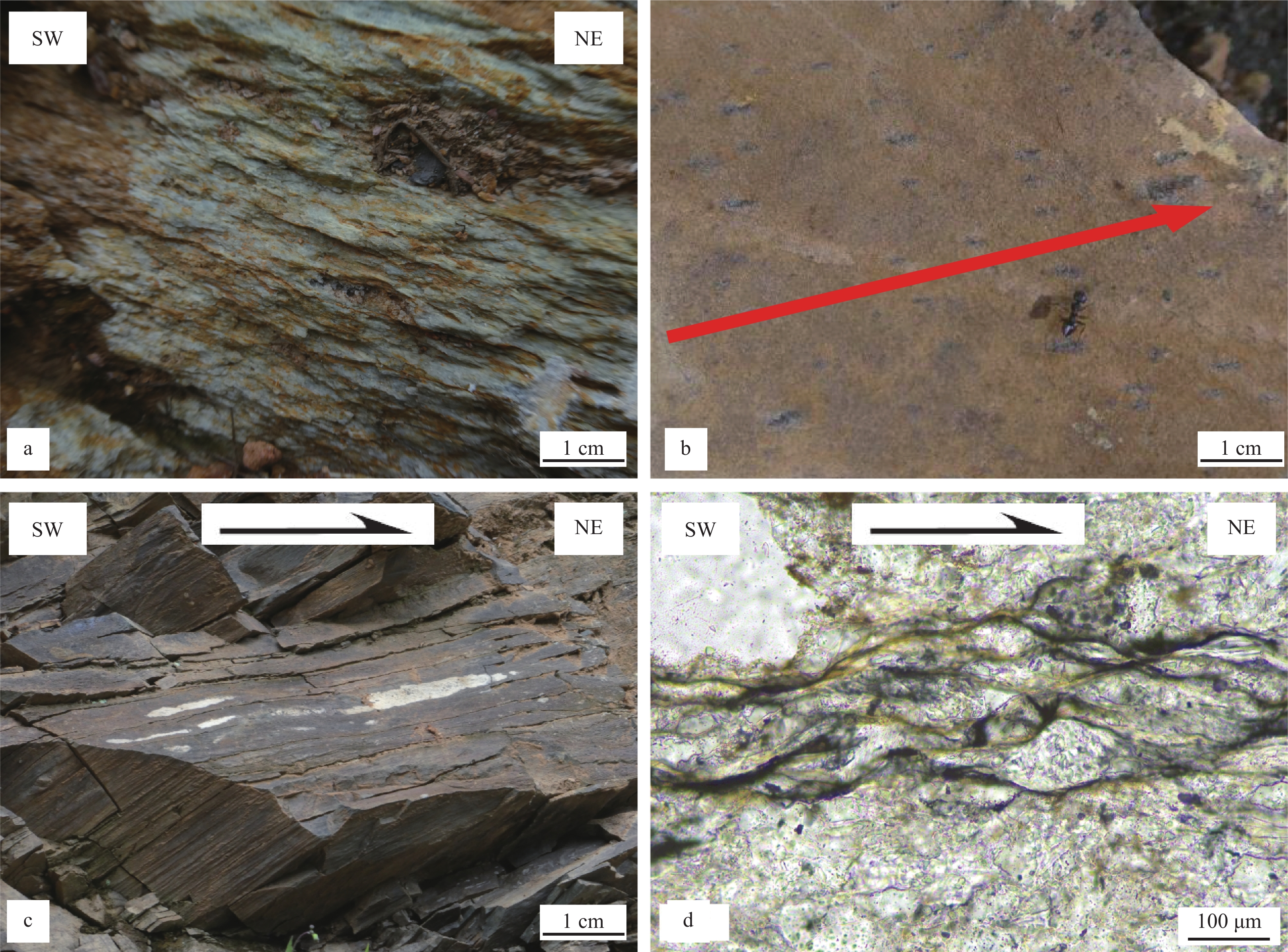
图 4 西苏门答腊地块野外及镜下岩石变形及相关的运动学特征
a—强烈面理化的沉积岩,原始沉积层理被后期构造面理取代;b—粉砂岩中定向发育的黄铁矿指示了北东—南西向的矿物拉伸线理(红色箭头为矿物拉伸线理的方向);c—泥质片岩中的石英脉体被剪切成布丁形态,指示了上部北东向的运动学特点(黑色箭头表示剪切变形的运动学方向);d—显微照片:变质粉砂岩中发育的韧性剪切带:σ型不对称的石英剪切碎斑,指示了上部北东向的剪切变形(黑色箭头表示剪切变形的运动学方向)
Figure 4. Field and microscopic photos of West Sumatra block to show the ductile deformation and related kinematics
(a) Well foliated metasedimentary rocks, where the bedding has been replaced by foliation; (b) Oriented pyrite in siltstone showing NE−SW mineral and stretching lineation (The red arrow indicates the direction of mineral stretching lineation); (c) Boudinaged felsic veins in the pelitic-schist indicating a top-to-the-NE ductile shearing (The black arrow indicates the kinematic direction); (d) Asymmetric sheared quartz grain in the siltstone exhibiting a top-to-the-NE ductile shearing (The black arrow indicates the kinematic direction)
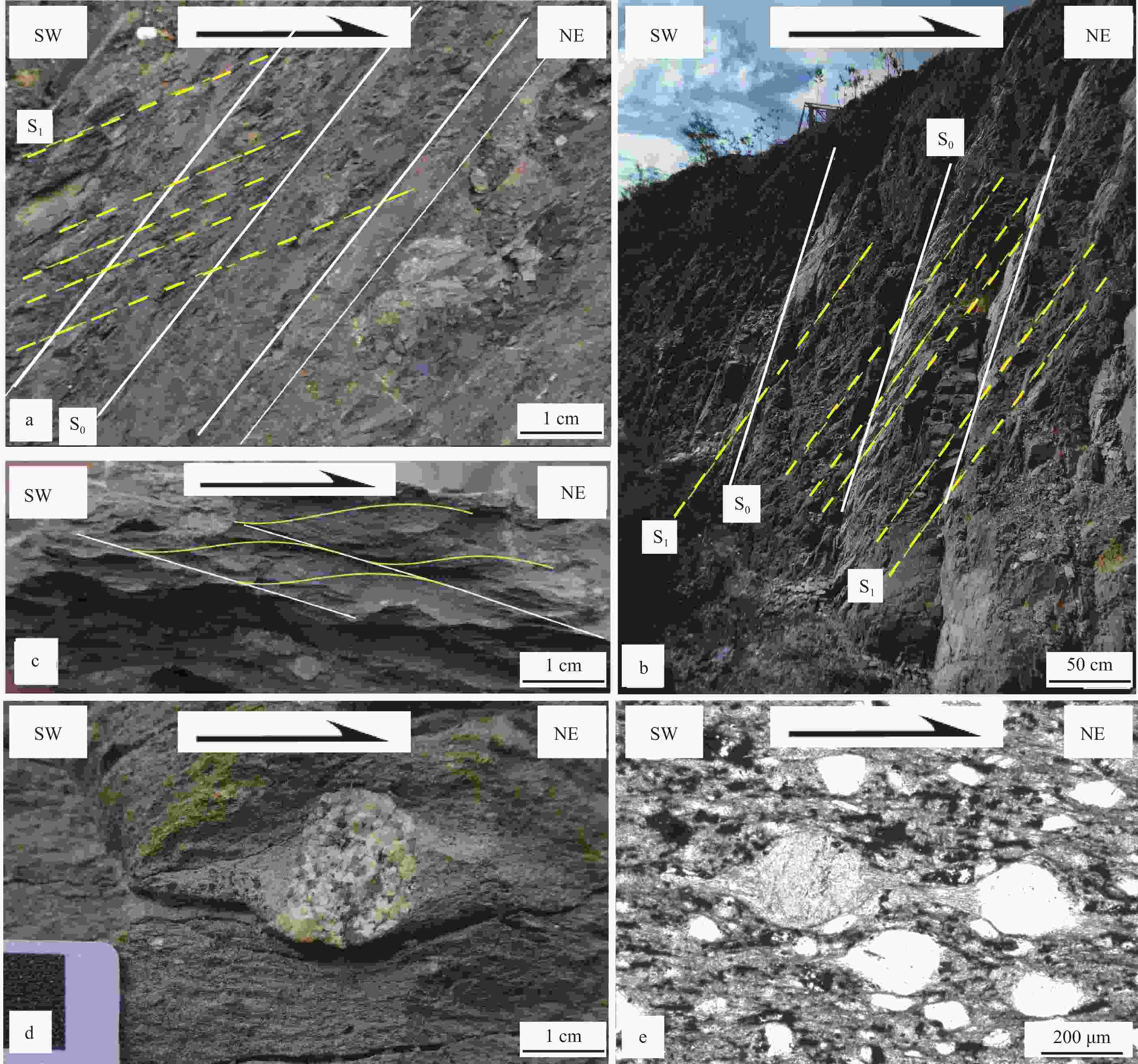
图 5 东苏门答腊地块野外及镜下岩石变形特征及相关的运动学
实线—原始层理面(S0);虚线—劈理面(S1)a—劈理化粉砂岩中的“层陡劈缓”现象,指示了极性指向北东的不对称褶皱的倒转翼;b—劈理化粉砂岩中的“层陡劈缓”现象,指示了极性指向北东的不对称褶皱的倒转翼;c—泥岩中发育的剪切条带所表现的σ形态指示了上部指向北东的剪切变形特点;d—含砾泥岩(坠石岩)中,砾石周围形成上部指向北东不对称的压力影;e—剪切变形的粉砂岩中发育旋转碎斑及剪切压力影(显微照片),指示上部指向北东的剪切变形
Figure 5. Field and microscopic photos of East Sumatra to show the deformation and related kinematics
(a) Relationship between the layer and cleavage indicating overturned strata in the asymmetric fold; (b) Relationship between the layer and cleavage indicating overturned strata in the asymmetric fold; (c) Shear band in the mudstone indicating a top-to-the-NE sense of shear; (d) Top-to-the-NE asymmetric pressure shadow around pebbles in the pebbly mudstone (drop stone); (e) Microscope photo of the pressure shadow and asymmetric porphyroclast of quartz in siltstone indicating a top-to-the-NE shearing S0—Original Bedding Plane (Solid Line); S1—Cleavage (Dashed Line)
-
[1] ADVOKAAT E L, BONGERS M L M, RUDYAWAN A, et al., 2018. Early Cretaceous origin of the Woyla arc (Sumatra, Indonesia) on the Australian plate[J]. Earth and Planetary Science Letters, 498: 348-361. doi: 10.1016/j.jpgl.2018.07.001 [2] ALTAMIMI Z, SILLARD P, BOUCHER C, 2002. ITRF2000: a new release of the international terrestrial reference frame for Earth science applications[J]. Journal of Geophysical Research: Solid Earth, 107(B10): 2214. [3] AMMON C J, JI C, THIO H K, et al., 2005. Rupture process of the 2004 Sumatra-Andaman earthquake[J]. Science, 308(5725): 1133-1139. doi: 10.1126/science.1112260 [4] ANDI MANGGA S, BURHAN G, SUKARDI & SURYANILA E, 1994. Geological map of the Siberut sheet, Sumatra. Scale 1: 250 000[R]. Bandung: Geological Research and Development Centre. [5] ASAMA K, HONGNUSONTHI A, IWAI J, et al., 1975. Summary of the Carboniferous and Permian plants from Thailand, Malaysia and adjacent areas[J]. Geology and Palaeontology of Southeast Asia, 15: 77-101. [6] BARBER A J, CROW M J, 2003. An evaluation of plate tectonic models for the development of Sumatra[J]. Gondwana Research, 6(1): 1-28. doi: 10.1016/S1342-937X(05)70642-0 [7] BARBER A J, CROW M J, 2005. Chapter 4. Pre-Tertiary stratigraphy[M]//BARBER A J, CROW M J, MILSOM J S. Sumatra: geology, resources and tectonic evolution. London: The Geological Society: 24-53. [8] BARBER A J, CROW M J, MILSOM J S, 2005. Sumatra: geology, resources and tectonic evolution[M]. London: The Geological Society: 1-290. [9] BARBER A J, CROW M J, 2009. Structure of Sumatra and its implications for the tectonic assembly of southeast Asia and the destruction of Paleotethys[J]. Island Arc, 18(1): 3-20. doi: 10.1111/j.1440-1738.2008.00631.x [10] BARBER A J, 2013. The origin of mélanges: cautionary tales from Indonesia[J]. Journal of Asian Earth Sciences, 76: 428-438. doi: 10.1016/j.jseaes.2012.12.021 [11] BOOI M, VAN WAVEREN I M, VAN KONIJNENBURG-VAN CITTERT J H A, et al., 2008. New material of Macralethopteris from the Early Permian Jambi flora (Middle Sumatra, Indonesia) and its palaeoecological implications[J]. Review of Palaeobotany and Palynology, 152(3-4): 101-112. doi: 10.1016/j.revpalbo.2008.04.009 [12] CAMERON N R, CLARKE M C G, ALDISS D T, et al. , 1980. The geological evolution of northern Sumatra[C]//Proceedings of the 9th annual convention. Jakarta: Indonesian Petroleum Association: 149-187. [13] CAMERON N R. , ASPDEN J A, BRIDGE D M, et al. , 1982. The geology of the Medan quadrangle, Sumatra (0619) Scale 1: 250, 000[R]. Bandung: Geological Survey of Indonesia, Directorate of Mineral Resources, Geological Research and Development Centre. [14] CHESNER C A, 2012. The Toba caldera complex[J]. Quaternary International, 258: 5-18. doi: 10.1016/j.quaint.2011.09.025 [15] CLARKE M C G, GHAZALI S A, HARAHAP H, et al. , 1982. Geology of the Pematangsiantar quadrangle (0718), Sumatra. Scale 1: 250000[R]. Bandung: Department of Mines and Energy, Directorate General of Geology and Mineral Resources, Geological Research and Development Centre. [16] DE COSTER G L, 1974. The geology of the central and South Sumatra basins[C]//Proceedings of the 3rd annual convention. Jakarta: Indonesian Petroleum Association: 77-110. [17] DIAMENT M, HARJONO H, KARTA K, et al., 1992. Mentawai fault zone off Sumatra: a new key to the geodynamics of western Indonesia[J]. Geology, 20(3): 259-262. doi: 10.1130/0091-7613(1992)020<0259:MFZOSA>2.3.CO;2 [18] DING W W, ZHU R X, WAN B, et al., 2023. Geodynamic processes of the southeastern Neo-Tethys Ocean and the formation mechanism of the curved subduction system in Southeast Asia[J]. Science China Earth Sciences, 66(4): 703-717. doi: 10.1007/s11430-022-1071-4 [19] DONG M L, DONG G C, MO X X, et al., 2013. Geochemistry, zircon U-Pb geochronology and Hf isotopes of granites in the Baoshan Block, Western Yunnan: implications for Early Paleozoic evolution along the Gondwana margin[J]. Lithos, 179: 36-47. doi: 10.1016/j.lithos.2013.05.011 [20] EUBANK R T, MAKKI A C, 1981. Structural geology of the Central Sumatra back-arc basin[C]//Proceedings of the 10th annual convention. Jakarta: Indonesian Petroleum Association: 153-196. [21] FIELDING C R, FRANK T D, ISBELL J L. 2008. The late Paleozoic ice age— A review of current understanding and synthesis of global climate patterns[M]//FIELDING C R, FRANK T D, ISBELL J L. Geological Society of America Special Papers, 441: 343-354. [22] FONTAINE H, GAFOER S, 1989. The pre-tertiary fossils of Sumatra and their environments[M]. Bangkok: CCOP Technical Publication: 1-356. [23] GAO X W, WU X R, YANG Z Q, 2015. Two types of terrain and regional mineralization in Sumatra, Indonesia[J]. Geological Bulletin of China, 34(4): 792-801. (in Chinese with English abstract) [24] HALL R, 2012. Late Jurassic–Cenozoic reconstructions of the Indonesian region and the Indian Ocean[J]. Tectonophysics, 570-571: 1-41. [25] HALL R, 2019. Indonesia, geology[M]//GILLESPIE R, CLAGUE D. Encyclopedia of islands. Berkeley: University of California Press: 454-460. [26] HILL V J, GROVES R H, 1973. Variation in Chondrilla juncea L. in south-eastern Australia[J]. Australian Journal of Botany, 21(1): 113-135. doi: 10.1071/BT9730113 [27] HSU C C, 2016. Detrital zircon U-Pb and Hf isotopic study in northwestern Sumatra, Indonesia[D]. Taipei, China: National Taiwan University: 1-158. [28] HUTCHISON C S, 1994. Gondwana and Cathaysian blocks, Palaeotethys sutures and Cenozoic tectonics in South-East Asia[J]. Geologische Rundschau, 83(2): 388-405. doi: 10.1007/BF00210553 [29] JONGMANS W J, GOTHAN W, 1935. Die Ergebnisse der paläobotanischen Djambi-Expedition 1925, 2. Die paläobotanische Ergebnisse[J]. Jaarboek van het Mijnwezen in Nederlandsch Indië, 59: 71-121. [30] KARIG D E, LAWRENCE M B, MOORE G F, et al., 1980. Structural framework of the fore-arc basin, NW Sumatra[J]. Journal of the Geological Society, London, 137(1): 77-91. doi: 10.1144/gsjgs.137.1.0077 [31] LAI Y M, LIU P P, CHUNG S L, et al. , 2024. Zircon U–Pb geochronology and Hf isotopic compositions of igneous rocks from Sumatra: implications for the Cenozoic magmatic evolution of the western Sunda Arc[M]//VAN SCHIJNDEL V, CUTTS K, PEREIRA I, et al. Minor minerals, major implications: using key mineral phases to unravel the formation and evolution of Earth's crust. London: The Geological Society: 455-478. [32] LI S, CHUNG S L, LAI Y M, et al., 2020. Mesozoic juvenile crustal formation in the easternmost Tethys: zircon Hf isotopic evidence from Sumatran granitoids, Indonesia[J]. Geology, 48(10): 1002-1005. doi: 10.1130/G47304.1 [33] LICHT A, WIN Z, WESTERWEEL J, et al., 2020. Magmatic history of central Myanmar and implications for the evolution of the Burma Terrane[J]. Gondwana Research, 87: 303-319. doi: 10.1016/j.gr.2020.06.016 [34] LIN T H, CHUNG S L, KUMAR A, et al., 2013. Linking a prolonged Neo–Tethyan magmatic arc in South Asia: zircon U–Pb and Hf isotopic constraints from the Lohit batholith, NE India[J]. Terra Nova, 25(6): 453-458. doi: 10.1111/ter.12056 [35] LIN T H, CHUNG S L, TANG J T, et al., 2017. The delimitation between the mature and juvenile crustal provinces in SE Asia: insights from detrital zircon U-Pb and Hf isotopic data for the Salween drainage, Myanmar[J]. Journal of Asian Earth Sciences, 145: 641-651. doi: 10.1016/j.jseaes.2017.06.018 [36] LIN T H, MITCHELL A H G, CHUNG S L, et al., 2019. Two parallel magmatic belts with contrasting isotopic characteristics from southern Tibet to Myanmar: zircon U–Pb and Hf isotopic constraints[J]. Journal of the Geological Society, 176(3): 574-587. doi: 10.1144/jgs2018-072 [37] MARTIN C R, JAGOUTZ O, UPADHYAY R, et al., 2020. Paleocene latitude of the Kohistan–Ladakh arc indicates multistage India–Eurasia collision[J]. Proceedings of the National Academy of Sciences of the United States of America, 117(47): 29487-29494. [38] MCCAFFREY R, 2009. The tectonic framework of the Sumatran subduction zone[J]. Annual Review of Earth and Planetary Sciences, 37: 345-366. doi: 10.1146/annurev.earth.031208.100212 [39] MCCARTHY A J, JASIN B, HAILE N S, 2001. Middle Jurassic radiolarian chert, Indarung, Padang District, and its implications for the tectonic evolution of western Sumatra, Indonesia. Journal of Asian Earth Sciences, 19, 31-44. [40] MCCOURT W J, CROW M J, COBBING E J, et al. , 1996. Mesozoic and Cenozoic plutonic evolution of SE Asia: evidence from Sumatra, Indonesia[M]//HALL R, BLUNDELL D J. Tectonic evolution of Southeast Asia. London: The Geological Society: 321-335. [41] METCALFE I, 1983. Conodont faunas, age and correlation of the Alas Formation (Carboniferous), Sumatra[J]. Geological Magazine, 120(6): 579-586. doi: 10.1017/S0016756800027734 [42] METCALFE I, 1996. Gondwanaland dispersion, Asian accretion and evolution of eastern Tethys[J]. Australian Journal of Earth Sciences, 43(6): 605-623. doi: 10.1080/08120099608728282 [43] METCALFE I, 2006. Palaeozoic and Mesozoic tectonic evolution and palaeogeography of East Asian crustal fragments: the Korean Peninsula in context[J]. Gondwana Research, 9(1-2): 24-46. doi: 10.1016/j.gr.2005.04.002 [44] METCALFE I, 2011. Tectonic framework and Phanerozoic evolution of Sundaland[J]. Gondwana Research, 19(1): 3-21. doi: 10.1016/j.gr.2010.02.016 [45] METCALFE I, NICOLL R S, WILLINK R, et al., 2013. Early Triassic (Induan–Olenekian) conodont biostratigraphy, global anoxia, carbon isotope excursions and environmental perturbations: new data from western Australian Gondwana[J]. Gondwana Research, 23(3): 1136-1150. doi: 10.1016/j.gr.2012.07.002 [46] METCALFE I, 2017. Tectonic evolution of Sundaland[J]. Bulletin of the Geological Society of Malaysia, 63: 27-60. doi: 10.7186/bgsm63201702 [47] MITCHELL A, CHUNG S L, OO T, et al., 2012. Zircon U–Pb ages in Myanmar: magmatic–metamorphic events and the closure of a neo-Tethys ocean?[J]. Journal of Asian Earth Sciences, 56: 1-23. doi: 10.1016/j.jseaes.2012.04.019 [48] MORLEY C K, NAING T T, SEARLE M, et al., 2020. Structural and tectonic development of the Indo-Burma ranges[J]. Earth-Science Reviews, 200: 102992. doi: 10.1016/j.earscirev.2019.102992 [49] OHAR V, 2022. Tournaisian and early Viséan tabulate corals from the Donets Basin, Ukraine and some aspects of their taxonomy[J]. PalZ, 96(3): 471-493. doi: 10.1007/s12542-021-00587-2 [50] QIAN X, JIN S J, BAI T X, et al., 2025. Triassic tectonic affinity to Indochina-East Malaya Block for West Sumatra and Paleo-Tethys implications: constraints from Late Triassic igneous rocks[J]. Geochemistry, Geophysics, Geosystems, 26(3): e2024GC012030. doi: 10.1029/2024GC012030 [51] RIDD M F, 2011. Lower Palaeozoic[M]//RIDD M F, BARBER A J, CROW M J. The geology of Thailand. London: The Geological Society: 33-51. [52] RIDD M F, 2016. Should Sibumasu be renamed Sibuma? The case for a discrete Gondwana-derived block embracing western Myanmar, Upper Peninsular Thailand and NE Sumatra[J]. Journal of the Geological Society, 173(2): 249-264. doi: 10.1144/jgs2015-065 [53] ROCK N M S, ALDISS D T, ASPDEN J A, et al. , 1983. The geology of the Lubuksikaping quadrangle (0716), Sumatra Scale 1: 250, 000[R]. Bandung: Geological Survey of Indonesia, Directorate of Mineral Resources, Geological Research and Development Centre. [54] SAMUEL M A, 1994. The structural and stratigraphic evolution of islands of the active margin of the Sumatra Forearc, Indonesia[D]. London: University of London. [55] SAMUEL M A, HARBURY N A, BAKRI A, et al., 1997. A new stratigraphy for the islands of the Sumatran Forearc, Indonesia[J]. Journal of Asian Earth Sciences, 15(4-5): 339-380. [56] SHEN S Z, ZHANG Y C, YUAN D X, et al., 2024. Permian integrative stratigraphy, biotas, paleogeographical and paleoclimatic evolution of the Qinghai-Tibetan Plateau and its surrounding areas[J]. Science China Earth Sciences, 67(4): 1107-1151. doi: 10.1007/s11430-023-1126-3 [57] SIMANDJUNTAK T O, SURONO, GAFOER S, et al. , 1991. Geology of the Muarabungo quadrangle (0914) Scale 1: 250 000[R]. Bandung: Department of Mines and Energy, Directorate General of Geology and Mineral Resources, Geological Research and Development Centre. [58] SIMONS W J F, SOCQUET A, VIGNY C, et al., 2007. A decade of GPS in Southeast Asia: resolving Sundaland motion and boundaries[J]. Journal of Geophysical Research: Solid Earth, 112(B6): 2005JB003868. doi: 10.1029/2005JB003868 [59] STAUFFER P H, PENG L C, 1987. The Upper Paleozoic pebbly mudstone facies of peninsular Thailand and western Malaysia: continental margin deposits of Palaeoeurasia: discussion[J]. Geologische Rundschau, 76(3): 945-948. doi: 10.1007/BF01821074 [60] STEPHENSON B, ASPDEN J A, 1982. Simplified geological map of northern Sumatra (1: 1 500 000)[R]. Keyworth: Directorate of Overseas Surveys. [61] SUWARNA N, BUDHITRISNA T, SANTOSA S, et al. , 1991. Geologic map of the Rengat quadrangle, Sumatera (Quadrangles 0915 & 1015) Scale 1: 250 000[R]. Bandung: Geological Research and Development Centre. [62] UENO K, NISHIKAWA S, VAN WAVEREN I M, et al. , 2006. Early Permian fusuline faunas of the Mengkarang and Palepat Formations in the West Sumatra Block, Indonesia: their faunal characteristics, age and geotectonic implications[C]//Proceedings of 2nd International Symposium, Geological anatomy of East and South Asia, paleogeography and paleoenvironment in Eastern Tethys (IGCP 516), Quezon City: 98-102. (Extended Abstract) [63] UENO K, NISHIKAWA S, VAN WAVEREN I M, et al. , 2007. Early Permian Fusuline faunas from Jambi, Sumatra, Indonesia: faunal characteristics and palaeobiogeographic implications[C]//16th International Congress on Carboniferous and Permian. Nanjing: Journal of Stratigraphy, 31, Suppl. 1: 138-139. (Abstract only) [64] VACHARD D, 1989a. Microfossils and microfacies of the Lower Carboniferous limestones[M]//FONTAINE H, GAFOER S. The pre-tertiary fossils of Sumatra and their environments. Bangkok: United Nations: 31-40. [65] VACHARD D, 1989b. A rich algal microflora from the Lower Permian of Jambi Province[M]//FONTAINE H, GAFOER S. The pre-tertiary fossils of Sumatra and their environments. Bangkok: United Nations: 59-69. [66] VAN GORSEL J T, 2014. An introduction to Paleozoic faunas and floras of Indonesia[J]. Berita Sedimentologi, 31(1): 6-26. [67] VAN WAVEREN I M, HASIBUAN F, SUYOKO, et al. , 2005. Taphonomy, palaeobotany and sedimentology of the Mengkarang formation (Early Permian, Jambi, Sumatra, Indonesia)M]//LUCAS S G, ZEIGLER K E. The nonmarine Permian. Albuquerque: New Mexico Museum of Natural History: 333-341. [68] VAN WAVEREN I M, ISKANDAR E A P, BOOI M, et al., 2007. Composition and palaeogeographic position of the Early Permian Jambi flora from Sumatra[J]. Scripta Geologica, 135: 1-28. [69] VOZENIN-SERRA C, 1989. Lower Permian continental flora of Sumatra[M]//FONTAINE H, GAFOER S. The pre-tertiary fossils of Sumatra and their environments. Bangkok: United Nations: 53-57. [70] WAJZER M R, BARBER A J, HIDAYAT S, et al., 1991. Accretion, collision and strike-slip faulting: the Woyla group as a key to the tectonic evolution of North Sumatra[J]. Journal of Southeast Asian Earth Sciences, 6(3-4): 447-461. doi: 10.1016/0743-9547(91)90087-E [71] WANG X D, HU K Y, SHI Y K, et al., 2021a. The missing Upper Carboniferous in the Cimmerian continent: a critical review[J]. Earth-Science Reviews, 217: 103627. doi: 10.1016/j.earscirev.2021.103627 [72] WANG Y, LIN W, FAURE M, et al., 2021b. Detrital zircon U–Pb age distribution and Hf isotopic constraints from the terrigenous sediments of the Song Chay Suture Zone (NE Vietnam) and their paleogeographic implications on the Eastern Paleo-Tethys evolution[J]. Tectonics, 40(8): e2020TC006611. doi: 10.1029/2020TC006611 [73] WANG Y J, XING X W, CAWOOD P A, et al. , 2013. Petrogenesis of early Paleozoic peraluminous granite in the Sibumasu Block of SW Yunnan and diachronous accretionary orogenesis along the northern margin of Gondwana[J]. Lithos, 182-183: 67-85. [74] WANG Y J, QIAN X, CAWOOD P A, et al., 2018. Closure of the East Paleotethyan Ocean and amalgamation of the Eastern Cimmerian and Southeast Asia continental fragments[J]. Earth-Science Reviews, 186: 195-230. doi: 10.1016/j.earscirev.2017.09.013 [75] WOPFNER H, 1996. Gondwana origin of the Baoshan and Tengchong terranes of west Yunnan[M]//HALL R, BLUNDELL D J. Tectonic evolution of southeast Asia. London: The Geological Society: 539-547. [76] XU C, WANG Y J, QIAN X, et al., 2020. Geochronological and geochemical characteristics of Early Silurian S‐type granitic gneiss in Takengon area of northern Sumatra and its tectonic implications[J]. Earth Science, 45(6): 2077-2090. (in Chinese with English abstract) [77] XU C, WANG Y J, QIAN X, et al., 2024. Late Jurassic Tethyan igneous records in north Sumatra: geochronological and geochemical constraints[J]. Geological Society of America Bulletin, 136(7-8): 3188-3206. doi: 10.1130/B37097.1 [78] ZHANG X R, CHUNG S L, LAI Y M, et al., 2018. Detrital zircons dismember Sibumasu in East Gondwana[J]. Journal of Geophysical Research: Solid Earth, 123(7): 6098-6110. doi: 10.1029/2018JB015780 [79] ZHANG X R, CHUNG S L, LAI Y M, et al., 2019. A 6000-km-long Neo-Tethyan arc system with coherent magmatic flare-ups and lulls in South Asia[J]. Geology, 47(6): 573-576. doi: 10.1130/G46172.1 [80] ZHANG X R, CHUNG S L, TANG J T, et al., 2021. Tracing Argoland in eastern Tethys and implications for India-Asia convergence[J]. GSA Bulletin, 133(7-8): 1712-1722. doi: 10.1130/B35772.1 [81] ZHU R X, ZHAO P, ZHAO L, 2022. Tectonic evolution and geodynamics of the Neo-Tethys Ocean[J]. Science China Earth Sciences, 65(1): 1-24. doi: 10.1007/s11430-021-9845-7 [82] 丁巍伟, 朱日祥, 万博, 等, 2023. 新特提斯洋东南段动力过程及东南亚环形俯冲体系形成机制[J]. 中国科学: 地球科学, 53(4): 687-701. [83] 高小卫, 吴秀荣, 杨振强, 2015. 印尼苏门答腊岛地体划分及其区域成矿背景[J]. 地质通报, 34(4): 792-801. [84] 沈树忠, 张以春, 袁东勋, 等, 2024. 青藏高原及其周边二叠纪综合地层、生物群以及古地理和古气候演化[J]. 中国科学: 地球科学, 54(4): 1125-1170. [85] 徐畅, 王岳军, 钱鑫, 等, 2020. 苏门答腊岛北部Takengon早志留世S型花岗片麻岩年代学、地球化学特征及构造意义[J]. 地球科学, 45(6): 2077-2090. [86] 朱日祥, 赵盼, 赵亮, 2022. 新特提斯洋演化与动力过程[J]. 中国科学: 地球科学, 52(1): 1-25. -

 下载:
下载:



计量
- 文章访问数: 1399
- HTML全文浏览量: 527
- PDF下载量: 114
- 被引次数: 0
