


Tectonic uplift and geomorphic evolution of the East Tianshan from the Late Cretaceous to the Cenozoic
-
摘要: 天山是新生代以来受印度–欧亚板块碰撞远程效应影响而复活的陆内造山带,对天山新生代构造演化的研究,有助于揭示陆内变形的过程与动力学机制。文章基于东天山(博格达山)–吐鲁番盆地北缘的塔尔郎河东侧剖面,通过沉积特征分析和碎屑锆石物源示踪分析,限定了博格达山及其邻区晚白垩世—新生代的构造地貌演化过程。研究结果显示,晚白垩世—渐新世期间博格达山整体构造相对稳定,仅发生小幅度隆升,地形起伏相对较低,吐鲁番盆地北缘接受来自西天山的侵蚀物质。晚渐新世以来,博格达山发生强烈变形并快速隆升,成为吐鲁番盆地的北部边界,为吐鲁番盆地北缘上渐新统—第四系地层提供了单一物质来源,代表了印度–欧亚板块碰撞的远程响应。Abstract:
Objective The Tianshan is an intracontinental orogenic belt reactivated in the Cenozoic by far-field effects of the India-Asia collision. Its Cenozoic tectonic evolution is thus key to understanding intracontinental deformation mechanisms. Methods Based on stratigraphic sedimentary characteristics and provenance tracing of a section on the northern margin of the Turpan Basin (south of the Bogda Shan), the Late Cretaceous to Cenozoic tectonic and geomorphic evolution of the East Tianshan and its adjacent region has been constrained. Results Field investigations reveal that the Paleocene and lower Oligocene strata in this area consist predominantly of red mudstones, indicating a lacustrine environment and stable tectonic conditions. The uppermost Cretaceous and Eocene strata contain relatively thin conglomerate deposits with small clast diameters, suggesting slight tectonic uplift of the Bogda Shan. In contrast, the upper Oligocene to Pliocene strata are composed of extremely thick, coarse conglomerates, reflecting long-term and intense tectonic activity. Detrital zircon U-Pb ages show that, from the Late Cretaceous to the Oligocene, the northern Turpan Basin continuously received detrital material from the West Tianshan, implying low topographic relief of the Bogda Shan during this period. Since the Miocene, however, the Bogda Shan has become the primary sediment source, indicating its rapid tectonic uplift. Conclusions In summary, the Bogda Shan remained tectonically stable with low relief during the Late Cretaceous to Oligocene. Since the late Oligocene, it has undergone intense deformation and rapid uplift, becoming the sole provenance area for the northern Turpan Basin. [Significance] This study refines the Cenozoic tectono-geomorphic evolution of the East Tianshan, thereby contributing to a better understanding of the intracontinental deformation processes resulting from the India–Asia collision. -
Key words:
- East Tianshan /
- Turpan Basin /
- Cenozoic /
- zircon U-Pb /
- tectonic geomorphology
-
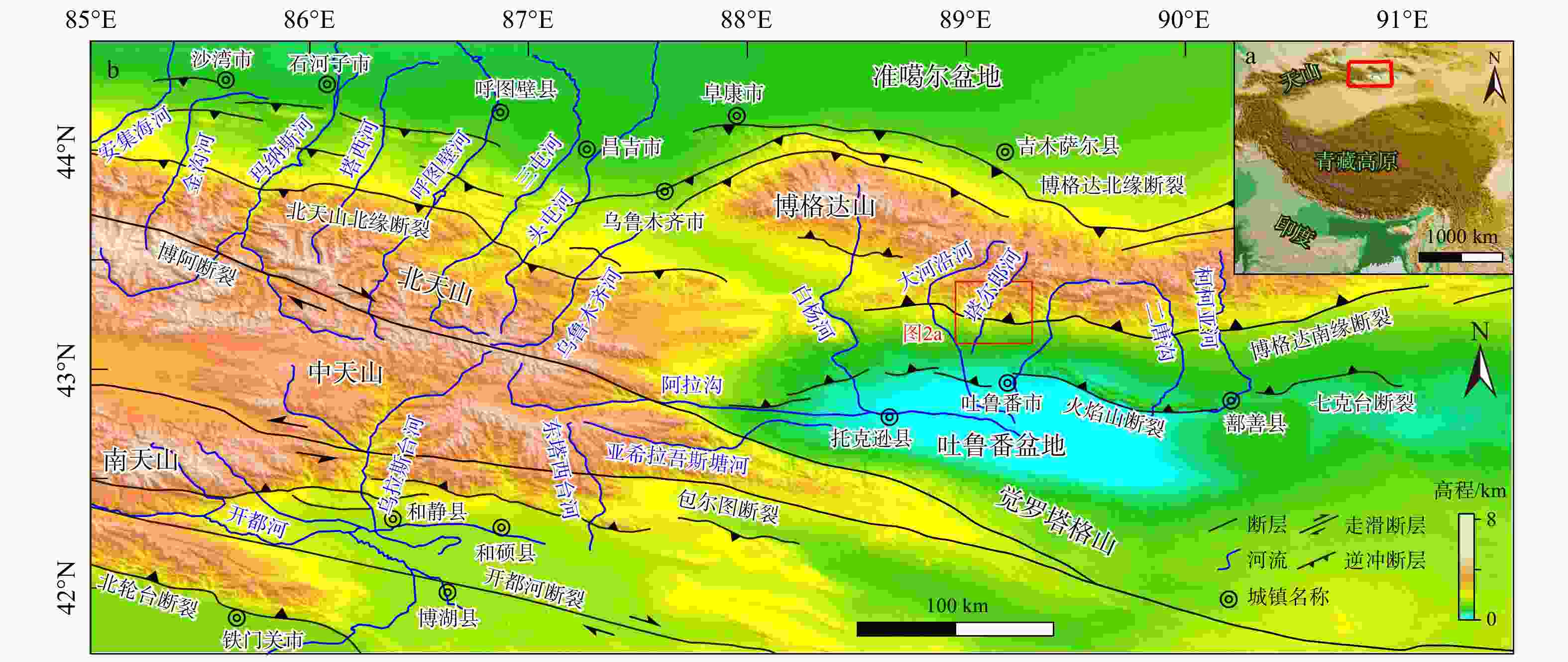
图 1 区域地形地貌与构造分布图
a—青藏高原及其周缘地形地貌图(红色矩形显示了图1b的位置);b—东、西天山地形地貌与构造–水系分布图(红色矩形内为研究区域)
Figure 1. Regional topographic and geomorphic map with tectonic distribution.
(a) Topographic and geomorphic map of the Tibetan Plateau and its surrounding region (the red box shows the location of panel b); (b) Topographic and tectonic-drainage distribution map of the East and West Tianshan (the red rectangle delineates the study area)
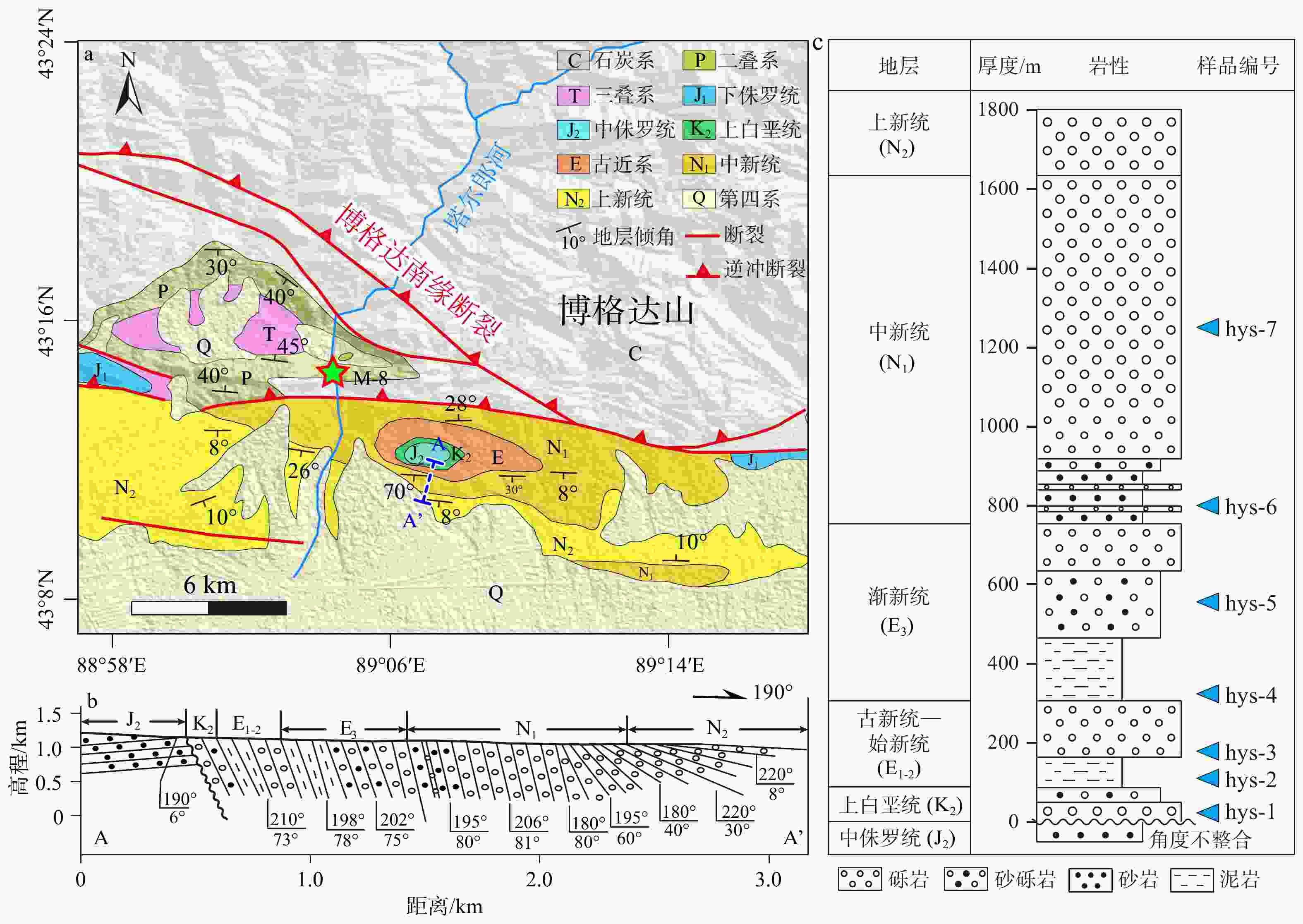
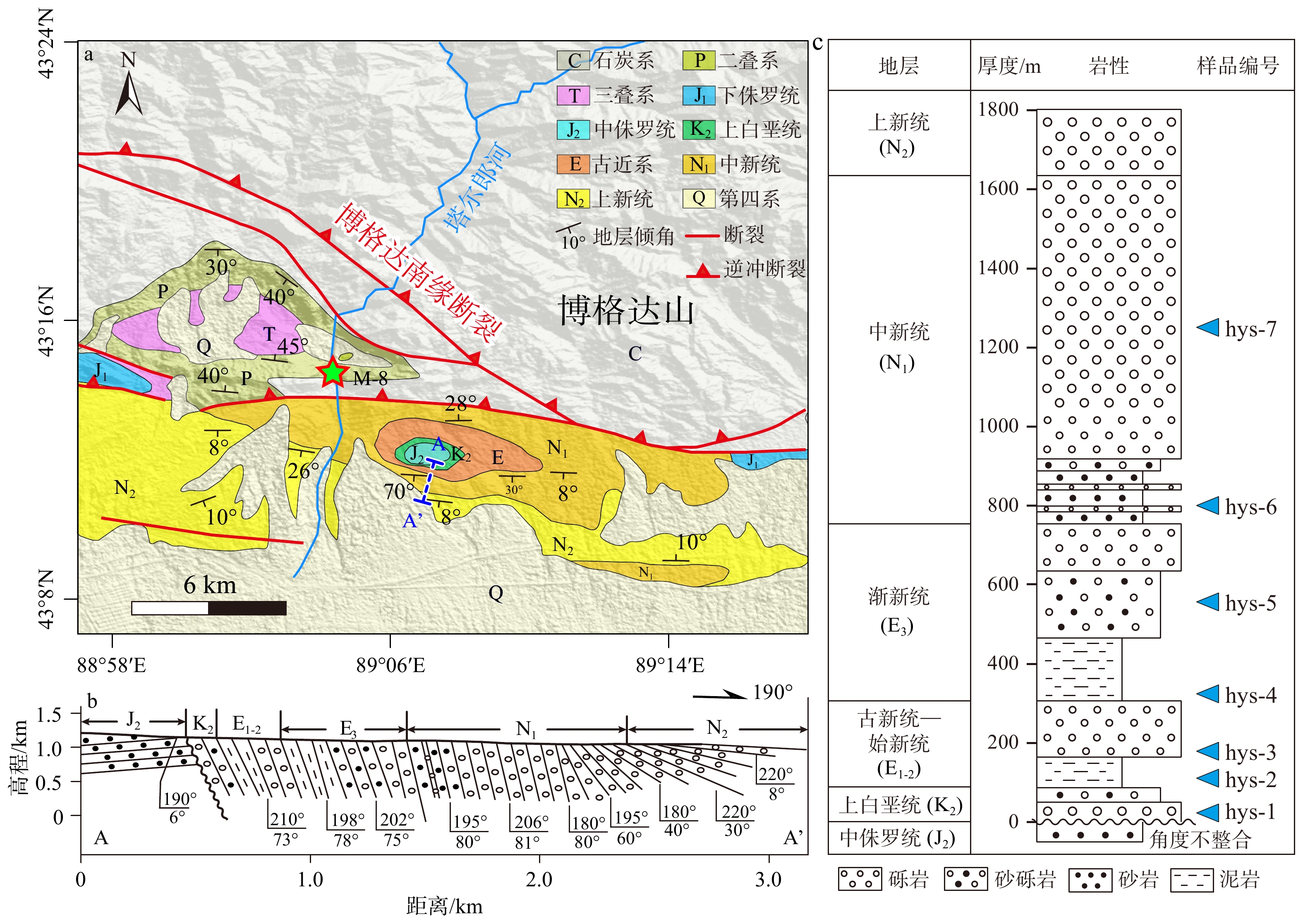
图 2 塔东剖面晚白垩世—新生代沉积特征及采样层位
a—博格达山南侧山前地质图(五角星和蓝色线段分别显示了塔尔郎河现代河砂M-8和塔东剖面AA’的位置);b—塔东剖面地层剖面图;c—塔东剖面地层柱状图及样品采集位置
Figure 2. Sedimentary characteristics of the Late Cretaceous to Cenozoic strata in the Tadong Section and sampled horizons
(a) Geological map of the southern piedmont of the Bogda Shan (The five-pointed star and blue dashed line show the specific locations of the modern river sands M-8 from the Taerlang River and the Tadong Section A–A’); (b) Stratigraphic profile of the Tadong Section; (c) Stratigraphic column of the Tadong Section and sampled locations
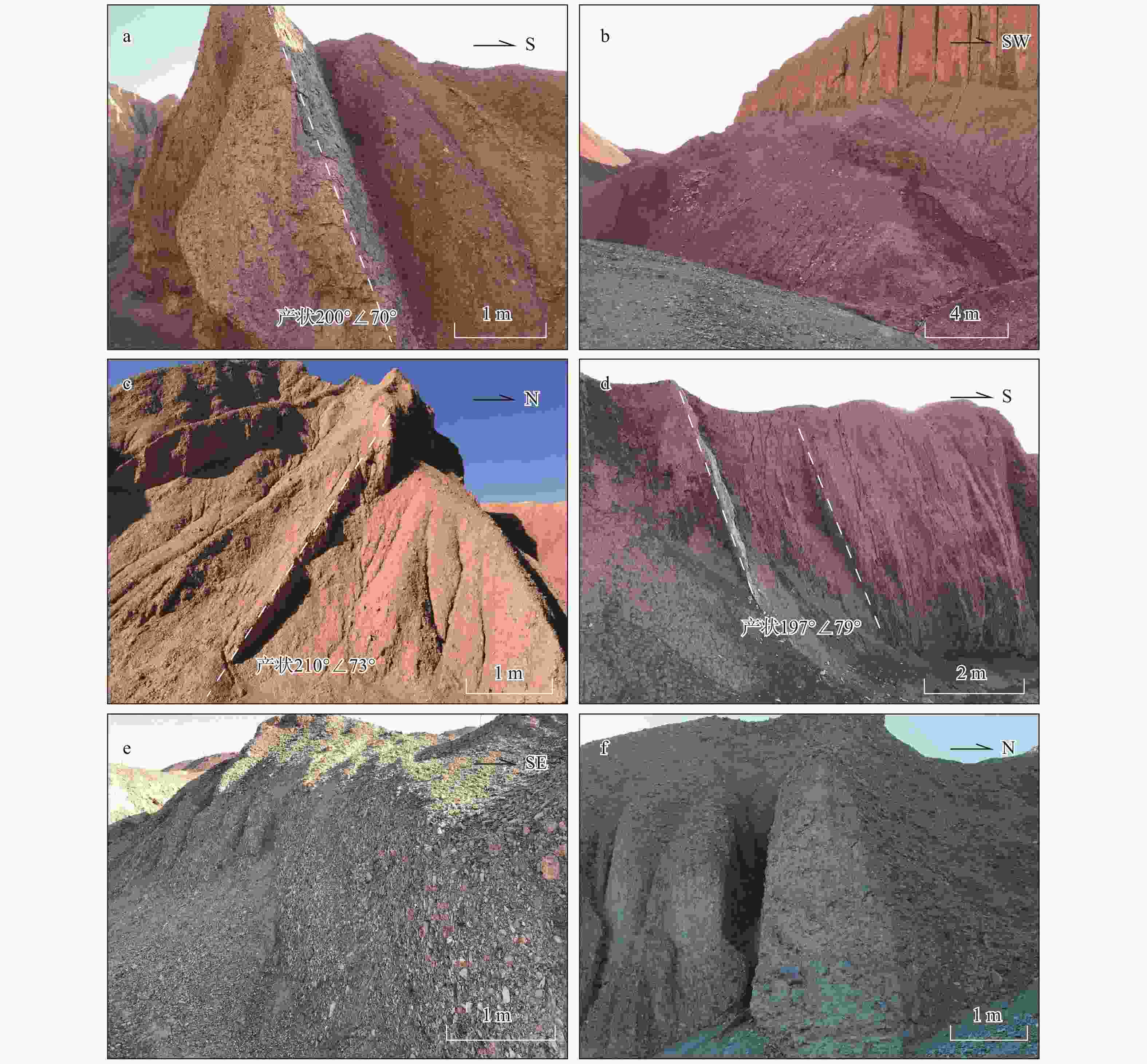
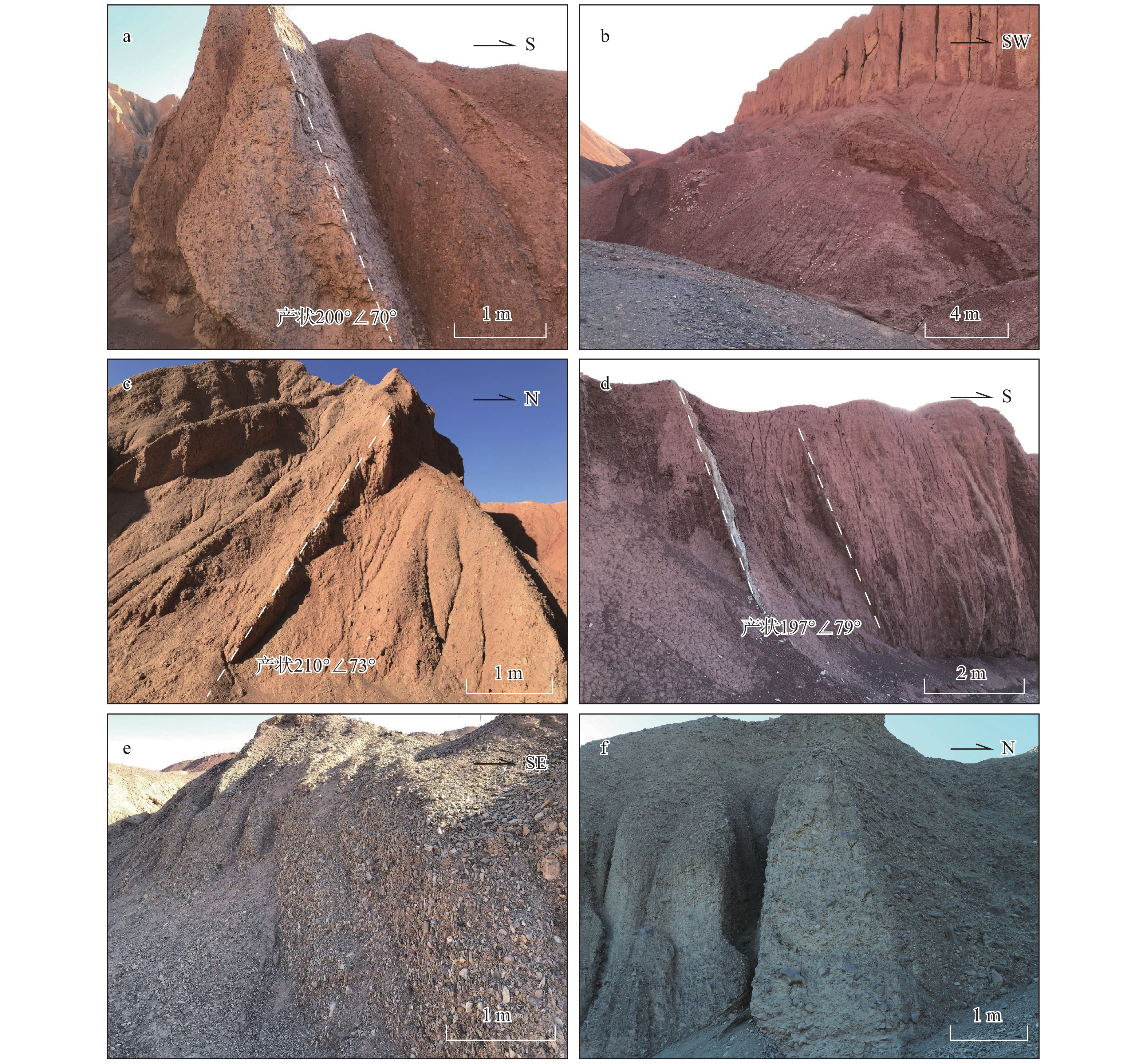
图 3 塔东剖面不同时期地层主要沉积特征的野外照片
a—上白垩统砾岩;b—古新统泥岩;c—始新统砾岩;d—渐新统泥岩;e—渐新统砾岩;f—中新统砾岩
Figure 3. Field photos of the main sedimentary characteristics of strata from different periods in the Tadong Section
(a) Upper Cretaceous conglomerate; (b) Paleocene mudstone; (c) Eocene conglomerate; (d) Oligocene mudstone; (e) Oligocene conglomerate; (f) Miocene conglomerate
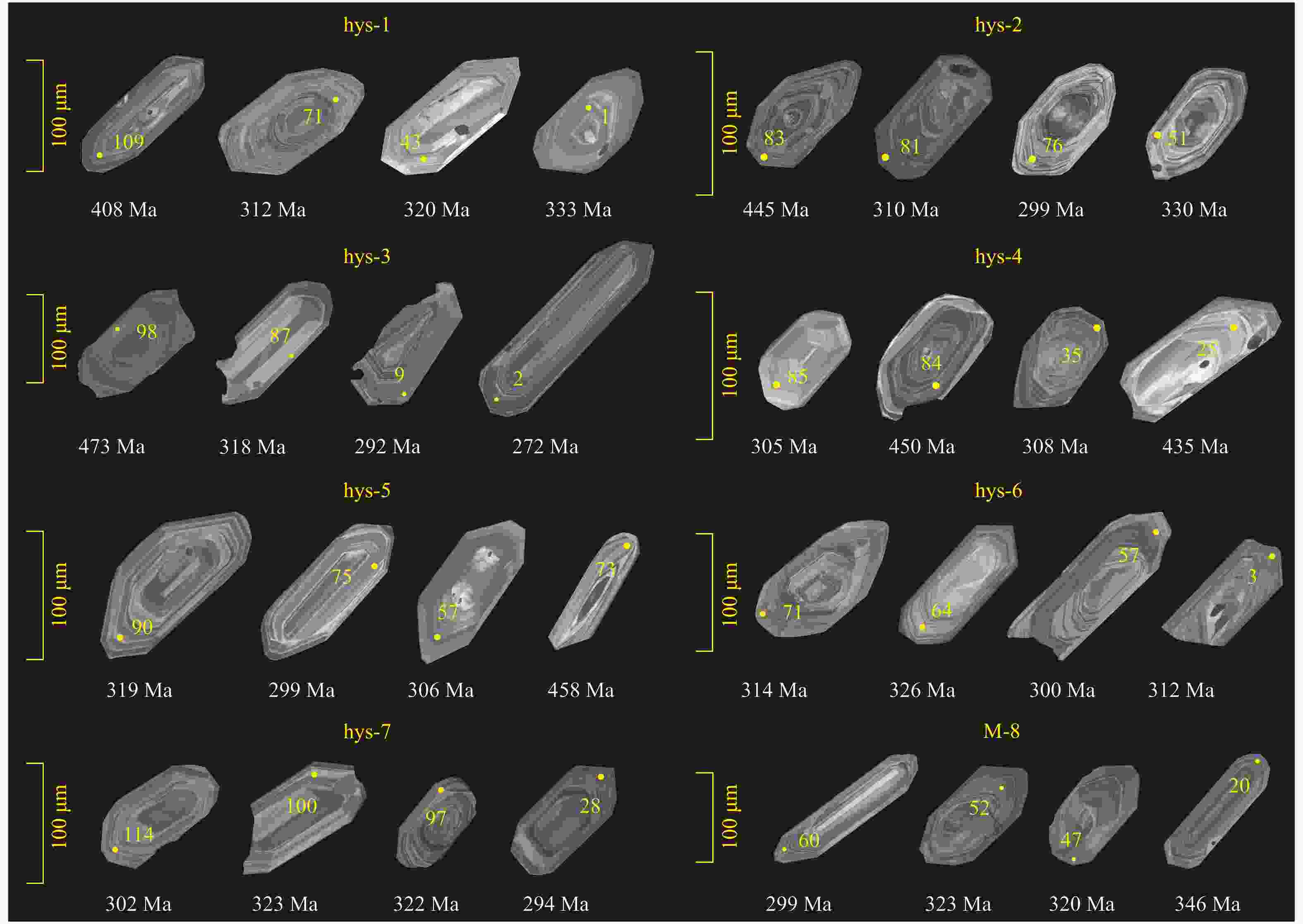
图 4 样品的代表性锆石阴极发光(CL)图像
黄色点及旁边的数字分别代表激光剥蚀位置和编号,白色数字表示锆石U-Pb年龄
Figure 4. Representative cathodoluminescence (CL) images of zircon for each sample
The yellow dots and the adjacent numbers respectively represent the laser ablation positions and their identification numbers, while the white numbers indicate the U-Pb ages of the zircons.
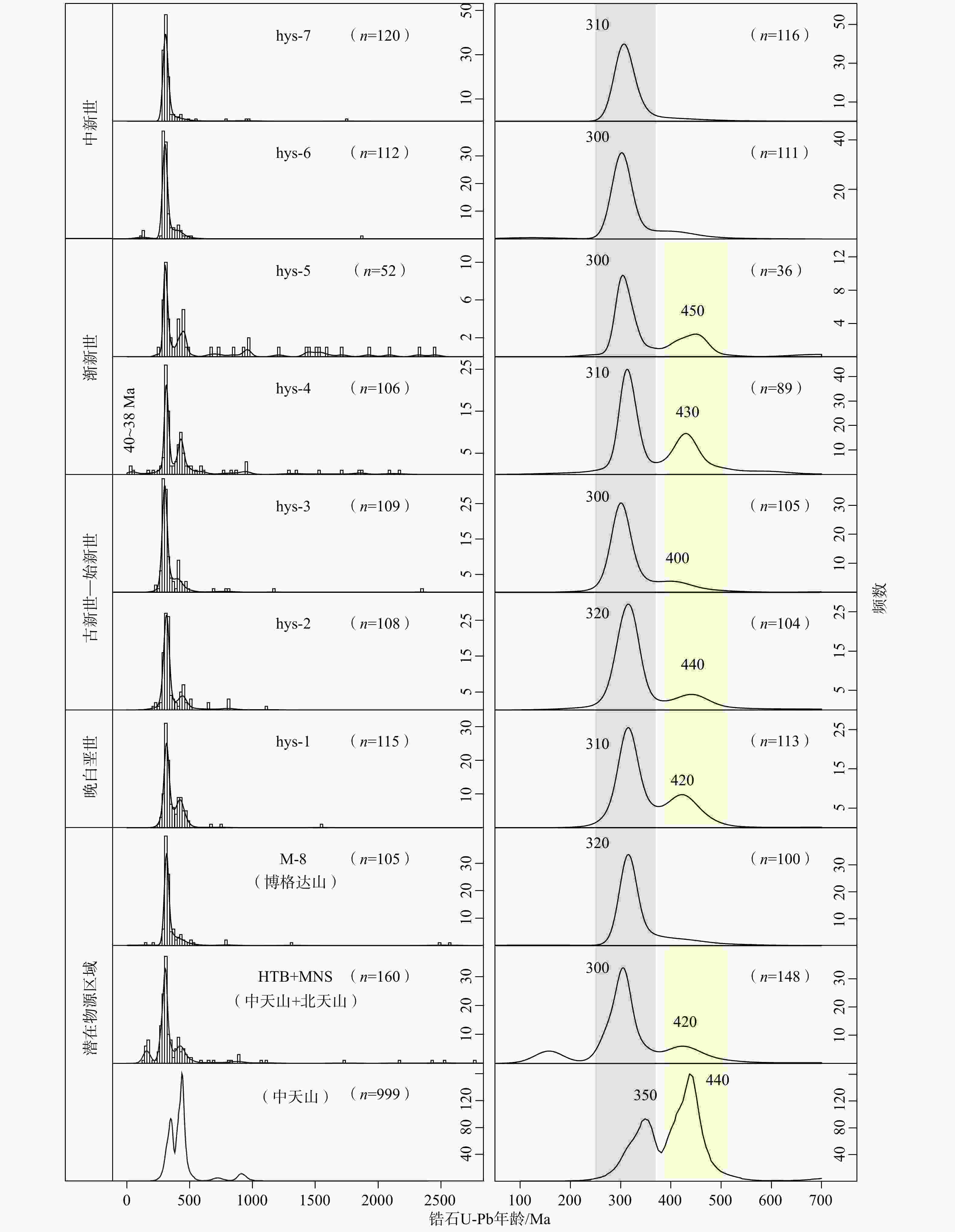
图 5 塔东剖面及其潜在物源区域的碎屑锆石U-Pb年龄频谱图(中天山和北天山的数据引自Ren et al.,2017;Xiang et al.,2019)
HTB—呼图壁河;MNS—玛纳斯河;n—锆石颗粒总数量
Figure 5. Probability density plots of detrital zircon U-Pb ages for the Tadong Section and its potential provenance regions (Primary sources of data for the Central Tianshan and North Tianshan are Ren et al., 2017 and Xiang et al., 2019)
HTB—Hutubi River; MNS—Manas River; n—total number of zircon grains
-
[1] AVOUAC J P, TAPPONNIER P, BAI M, et al., 1993. Active thrusting and folding along the northern Tien Shan and Late Cenozoic rotation of the Tarim relative to Dzungaria and Kazakhstan[J]. Journal of Geophysical Research: Solid Earth, 98(B4): 6755-6804. doi: 10.1029/92JB01963 [2] CHEN H Y, XIAO B, MA H D, et al., 2025. The Paleozoic episodic mineralization model in the eastern Tianshan Region, Central Asian Orogenic Belt[J]. Science China Earth Sciences, 68(8): 2511-2526. doi: 10.1007/s11430-024-1631-7 [3] CHEN Y, WANG G C, KAPP P, et al., 2020. Episodic exhumation and related tectonic controlling during Mesozoic in the eastern Tian Shan, Xinjiang, northwestern China[J]. Tectonophysics, 796: 228647. doi: 10.1016/j.tecto.2020.228647 [4] CUNNINGHAM D, OWEN L A, SNEE L W, et al., 2003. Structural framework of a major intracontinental orogenic termination zone: the easternmost Tien Shan, China[J]. Journal of the Geological Society, 160(4): 575-590. doi: 10.1144/0016-764902-122 [5] DENG Q D, FENG X Y, ZHANG P Z, et al. , 2000. Active tectonics of the Tianshan[M]. Beijing: Seismological Press. (in Chinese) [6] DING Y, SHEN T Y, WANG G C, et al., 2024. Sedimentary and heavy mineral records for the Oligocene-Miocene exhumation of the easternmost Tianshan[J]. Journal of Earth Science, 35(2): 449-461. doi: 10.1007/s12583-022-1757-3 [7] FANG S H, SONG Y, JIA C Z, et al., 2007. The Mesozoic-Cenozoic clastic composition of Bogda area, Xinjiang: implications on the evolution of Basin-range pattern[J]. Acta Geologica Sinica, 81(9): 1229-1237. (in Chinese with English abstract) [8] FANG Y N, WU C D, WANG Y Z, et al., 2019. Topographic evolution of the Tianshan Mountains and their relation to the Junggar and Turpan Basins, Central Asia, from the Permian to the Neogene[J]. Gondwana Research, 75: 47-67. doi: 10.1016/j.gr.2019.03.020 [9] GILLESPIE J, GLORIE S, JEPSON G, et al., 2017. Differential exhumation and crustal tilting in the easternmost Tianshan (Xinjiang, China), revealed by low-temperature Thermochronology[J]. Tectonics, 36(10): 2142-2158. doi: 10.1002/2017TC004574 [10] GUO Y H, YANG H, TAN Z, et al., 2026. The collage process of the western end of the Carboniferous-Permian Bogda intra-oceanic arc in North Tianshan and the Yili-Central Tianshan island Arc[J]. Xinjiang Geology, 44(1): 24-37. (in Chinese with English abstract) [11] HAN B F, HE G Q, WANG X C, et al., 2011. Late Carboniferous collision between the Tarim and Kazakhstan–Yili terranes in the western segment of the South Tian Shan Orogen, Central Asia, and implications for the northern Xinjiang, western China[J]. Earth-Science Reviews, 109(3-4): 74-93. doi: 10.1016/j.earscirev.2011.09.001 [12] HAN Y G, ZHAO G C, 2018. Final amalgamation of the Tianshan and Junggar orogenic collage in the southwestern Central Asian Orogenic Belt: constraints on the closure of the Paleo-Asian Ocean[J]. Earth-Science Reviews, 186: 129-152. doi: 10.1016/j.earscirev.2017.09.012 [13] HE Z Y, WANG B, GLORIE S, et al., 2022. Mesozoic building of the eastern Tianshan and East Junggar (NW China) revealed by low-temperature thermochronology[J]. Gondwana Research, 103: 37-53. doi: 10.1016/j.gr.2021.11.013 [14] HE Z Y, GLORIE S, WANG F J, et al., 2023. A re-evaluation of the Meso-Cenozoic thermo-tectonic evolution of Bogda Shan (Tian Shan, NW China) based on new basement and detrital apatite fission track thermochronology[J]. International Geology Review, 65(12): 2093-2112. doi: 10.1080/00206814.2022.2121946 [15] HENDRIX M S, DUMITRU T A, GRAHAM S A, 1994. Late Oligocene-Early Miocene unroofing in the Chinese Tian Shan: an Early effect of the India-Asia collision[J]. Geology, 22(6): 487-490. doi: 10.1130/0091-7613(1994)022<0487:LOEMUI>2.3.CO;2 [16] JI H J, TAO H F, WANG Q, et al., 2018. Early to Middle Jurassic tectonic evolution of the Bogda Mountains, northwest China: evidence from sedimentology and detrital zircon geochronology[J]. Journal of Asian Earth Sciences, 153: 57-74. doi: 10.1016/j.jseaes.2017.03.018 [17] JIA Y Y, SUN J M, LÜ L X, 2020. Late Cenozoic tectono-geomorphologic evolution of the northern Tian Shan mountain range: Insight from U-Pb ages of detrital zircon grains from the Upper Oligocene-Quaternary sediments of the southern Junggar Basin[J]. Journal of Asian Earth Sciences, 194: 104286. doi: 10.1016/j.jseaes.2020.104286 [18] JIANG Y T, LU H H, YANG R, et al., 2024. Two-stage exhumation, uplift, and basinward propagation of the Tian Shan during the Late Cenozoic[J]. Earth-Science Reviews, 256: 104868. doi: 10.1016/j.earscirev.2024.104868 [19] JIAO R H, YUAN X P, BRAUN J, et al., 2021. Thermo-kinematic modeling of the Cenozoic uplift of the Bogda Shan, northwest China[J]. Tectonophysics, 816: 229031. doi: 10.1016/j.tecto.2021.229031 [20] JING H L, WANG W T, ZHANG P Z, et al., 2025. Multi-stage uplift and propagation of the Chinese East Tianshan during the Cenozoic[J]. Tectonics, 44(2): e2024TC008666. doi: 10.1029/2024TC008666 [21] JOLIVET M, DOMINGUEZ S, CHARREAU J, et al., 2010. Mesozoic and Cenozoic tectonic history of the central Chinese Tian Shan: reactivated tectonic structures and active deformation[J]. Tectonics, 29(6): TC6019. [22] JOLIVET M, BARRIER L, DAUTEUIL O, et al., 2018. Late Cretaceous-Palaeogene topography of the Chinese Tian Shan: new insights from geomorphology and sedimentology[J]. Earth and Planetary Science Letters, 499: 95-106. [23] LI W H, ZHOU L F, LIU Y Q, et al., 1997. Evolution of sedimentary framework and environment of Turpan-Hami Basin[J]. Xinjiang Petroleum Geology, 18(2): 135-141. (in Chinese with English abstract) [24] LIU Y Q, YUAN M S, ZHOU D W, et al., 2001. New progresses on geothermal history of Turpan-Hami Basin, Xinjiang, China[J]. Science in China Series D: Earth Sciences, 44(2): 166-176. [25] LU H H, LI B J, WU D Y, et al., 2019. Spatiotemporal patterns of the Late Quaternary deformation across the northern Chinese Tian Shan foreland[J]. Earth-Science Reviews, 194: 19-37. [26] MORIN J, JOLIVET M, BARRIER L, et al., 2019. Planation surfaces of the Tian Shan Range (Central Asia): Insight on several 100 million years of topographic evolution[J]. Journal of Asian Earth Sciences, 177: 52-65. [27] QIN Y, LIU C, YANG L, et al., 2022. Detrital-Zircon Geochronology of Jurassic-Cretaceous strata in the Turpan-Hami Basin: implication for the Late Mesozoic Tectonic evolution of eastern Tien Shan[J]. Minerals, 12(8): 926. [28] REN R, GUAN S W, HAN B F, et al., 2017. Chronological constraints on the tectonic evolution of the Chinese Tianshan Orogen through detrital zircons from modern and palaeo-river sands[J]. International Geology Review, 59(13): 1657-1676. [29] SHEN C B, MEI L F, LIU L, et al., 2006. Evidence from apatite and zircon fission track analysis for Mesozoic-Cenozoic uplift thermal history of Bogeda Mountain of Xinjiang, northwest China[J]. Marine Geology & Quaternary Geology, 26(3): 87-92. (in Chinese with English abstract) [30] SHEN T Y, CHEN Y, WANG G C, et al., 2020. Detrital zircon geochronology analysis of the Late Mesozoic deposition in the Turpan-Hami Basin: implications for the uplift history of the eastern Tian Shan, north-western China[J]. Terra Nova, 32(2): 166-178. [31] SONG S D, LI J G, LIU X Y, et al., 2023. Mesozoic-Cenozoic exhumation history of the Bogda Range, eastern Tianshan: insights from apatite fission track Thermochronology[J]. Minerals, 13(1): 71. [32] SONG S D, HE Z Y, LIANG Y, et al. , 2025. Revaluation of the Meso-Cenozoic tectono-thermal evolution of the eastern Tianshan: a Low-temperature Thermochronology Perspective[J/OL]. Geotectonica et Metallogenia,1-25[2026-06-07]. https://link.cnki.net/urlid/44.1595.P.20250801.1658.004. (in Chinese with English abstract) [33] SUN J B, CHEN W, QIN K Z, et al., 2021. Mesozoic exhumation of the Jueluotage area, eastern Tianshan, NW China: constraints from (U–Th)/He and fission-track thermochronology[J]. Geological Magazine, 158(11): 1960-1976. [34] VERMEESCH P, 2018. IsoplotR: A free and open toolbox for geochronology[J]. Geoscience Frontiers, 9(5): 1479-1493. [35] WANG J, CAO Y C, WANG X T, et al., 2018. Sedimentological constraints on the initial uplift of the West Bogda Mountains in Mid-Permian[J]. Scientific Reports, 8(1): 1453. [36] WANG Y N, ZHANG J, HUANG X, et al., 2023. Cenozoic exhumation of the Tianshan as constrained by regional low-temperature thermochronology[J]. Earth-Science Reviews, 237: 104325. [37] WANG Z X, LI T, ZHANG J, et al., 2008. The uplifting process of the Bogda Mountain during the Cenozoic and its tectonic implication[J]. Science in China Series D: Earth Sciences, 51(4): 579-593. [38] WU S T, YANG M, YANG Y H, et al., 2020. Improved in situ zircon U-Pb dating at high spatial resolution (5-16 μm) by laser ablation-single collector-sector field-ICP-MS using Jet sample and X skimmer cones[J]. International Journal of Mass Spectrometry, 456: 116394. [39] XIANG D F, ZHANG Z Y, XIAO W J, et al., 2019. Episodic Meso-Cenozoic denudation of Chinese Tianshan: evidence from detrital apatite fission track and zircon U–Pb data, southern Junggar Basin margin, NW China[J]. Journal of Asian Earth Sciences, 175: 199-212. [40] XIANG D F, ZHANG Z Y, CHEW D, et al., 2024. Cenozoic pulsed rise and growth of the Chinese South Tianshan revealed by zircon and apatite provenance analyses: implications for stepwise Aridification in the Tarim Basin[J]. Tectonics, 43(8): e2023TC008211. [41] XIAO W J, WINDLEY B F, ALLEN M B, et al., 2013. Paleozoic multiple accretionary and collisional tectonics of the Chinese Tianshan orogenic collage[J]. Gondwana Research, 23(4): 1316-1341. [42] YANG W, JOLIVET M, DUPONT-NIVET G, et al., 2013. Source to sink relations between the Tian Shan and Junggar Basin (northwest China) from Late Palaeozoic to Quaternary: evidence from detrital U-Pb zircon geochronology[J]. Basin Research, 25(2): 219-240. [43] YANG X, WU C Y, LI Z G, et al., 2021. Late Quaternary kinematics and deformation rate of the Huoyanshan structure derived from deformed river terraces in the South piedmont of the eastern Chinese Tian Shan[J]. Frontiers in Earth Science, 9: 649011. [44] YANG X, LI Z G, WANG W T, et al., 2023. Quaternary crustal shortening of the Houyanshan structure in the eastern Chinese Tian Shan: constrained from geological and geomorphological analyses[J]. Remote Sensing, 15(6): 1603. [45] YIN J Y, WANG Y N, HODGES K V, et al., 2023. Episodic long-term exhumation of the Tianshan orogenic belt: new insights from multiple low-temperature Thermochronometers[J]. Tectonics, 42(4): e2022TC007469. [46] YU J X, ZHENG D W, ZHANG H P, et al., 2022. Initial Cenozoic exhumation of the northern Chinese Tian Shan deduced from apatite (U-Th)/He Thermochronological data[J]. Lithosphere, 2022(1): 8099539. [47] YU S, TONG Y, DANIŠÍK M, et al., 2025. Coupled evolution between the South Tianshan and Kuqa Basin: insights from multisystem Thermochronometers[J]. Basin Research, 37(4): e70054. [48] ZHANG C H, LIU D B, ZHANG C L, et al., 2005. Stratigraphic constraints on the initial uplift age of Bogda Shan, Xinjiang, north-west China[J]. Earth Science Frontiers, 12(1): 294-302. (in Chinese with English abstract) [49] ZHANG L F, DU G H, GONG X P, et al., 2026. The subduction-collision transition of the Early Devonian southern Tianshan Ocean: evidences from intrusive rocks in the Burandaban-Baluntai area[J]. Bulletin of Mineralogy, Petrology and Geochemistry, 45(1): 215-231. (in Chinese with English abstract) [50] ZHANG X R, ZHAO G C, SUN M, et al., 2016. Tectonic evolution from subduction to arc-continent collision of the Junggar ocean: Constraints from U-Pb dating and Hf isotopes of detrital zircons from the North Tianshan belt, NW China[J]. GSA Bulletin, 128(3-4): 644-660. [51] ZHAO X D, ZHANG H P, LV H H, et al., 2020. Signatures of tectonic-climatic interaction during the Late Cenozoic orogenesis along the northern Chinese Tian Shan[J]. Basin Research, 33(1): 291-311. [52] ZHAO Z H, SHEN T Y, WANG G C, et al., 2025. Relict landscape evolution and fault reactivation in the eastern Tian Shan: insights from the Harlik Mountains[J]. Solid Earth, 16(6): 503-530. [53] ZHEN Y, CHEN X, JIAO L X, et al., 2024. Carboniferous-Permian tectonopalaeogeography and prototype Basin evolution in eastern Xinjiang, NW China[J]. Journal of Palaeogeography, 26(1): 78-99. (in Chinese with English abstract) [54] ZHEN Y, HE D F, CHEN X, et al., 2024a. Unraveling deformation mechanism of the Fukang fold-and-thrust belt: Insight into intracontinental orogenesis of the Bogda Mountain, NW China[J]. Marine and Petroleum Geology, 167: 107005. [55] ZHEN Y, HE D F, LI D, et al., 2024b. Episodic evolution of intracontinental orogenic deformation: Insight from the southern Bogda fold-and-thrust belt of the Tianshan Mountains, NW China[J]. Tectonophysics, 876: 230266. [56] ZHOU Y X, WU C D, YUAN B, et al., 2020. Cenozoic tectonic patterns and their controls on growth strata in the northern Tianshan fold and thrust belt, northwest China[J]. Journal of Asian Earth Sciences, 198: 104237. [57] 陈华勇, 肖兵, 马华东, 等, 2025. 中亚造山带东天山古生代幕式成矿过程与机理[J]. 中国科学: 地球科学, 55(8): 2621-2637. [58] 邓起东, 冯先岳, 张培震, 等, 2000. 天山活动构造[M]. 北京: 地震出版社. [59] 方世虎, 宋岩, 贾承造, 等, 2007. 新疆博格达地区中-新生代碎屑成分特征与盆山分异过程[J]. 地质学报, 81(9): 1229-1237. [60] 郭玉红, 杨贺, 谭舟, 等, 2026. 北天山博格达石炭—二叠纪洋内弧西端与伊犁-中天山岛弧的拼贴过程[J]. 新疆地质, 44(1): 24-37. [61] 李文厚, 周立发, 柳益群, 等, 1997. 吐哈盆地沉积格局与沉积环境的演变[J]. 新疆石油地质, 18(2): 135-141. [62] 柳益群, 袁明生, 周鼎武, 等, 2001. 新疆吐鲁番-哈密盆地地质热历史研究新进展[J]. 中国科学(D辑), 31(3): 257-264. [63] 沈传波, 梅廉夫, 刘麟, 等, 2006. 新疆博格达山中新生代隆升—热历史的裂变径迹记录[J]. 海洋地质与第四纪地质, 26(3): 87-92. [64] 宋世达, 何智远, 梁勇, 等, 2025. 天山东段中–新生代构造–热演化再评估: 基于低温热年代学的视角[J/OL]. 大地构造与成矿学, 1-25[2026-06-07]. https://link.cnki.net/urlid/44.1595.P.20250801.1658.004. [65] 张传恒, 刘典波, 张传林, 等, 2005. 新疆博格达山初始隆升时间的地层学标定[J]. 地学前缘, 12(1): 294-302. [66] 张岚峰, 杜光辉, 弓小平, 等, 2026. 早泥盆世南天山洋俯冲-碰撞转换: 来自布然达坂–巴伦台侵入岩的证据[J]. 矿物岩石地球化学通报, 45(1): 215-231. [67] 甄宇, 陈旋, 焦立新, 等, 2024. 东疆地区石炭纪-二叠纪构造古地理与原型盆地演化[J]. 古地理学报, 26(1): 78-99. -

 下载:
下载:




计量
- 文章访问数: 573
- HTML全文浏览量: 121
- PDF下载量: 187
- 被引次数: 0
