


Geochemical fingerprinting of typical giant deposits in the Central Asian metallogenic domain: case studies of the Muruntau gold deposit and the Almalyk porphyry copper deposit
-
摘要: 中亚成矿域矿产资源极为丰富。苏联时期通过地球化学金属量测量先后发现世界第二大金矿穆龙套金矿、中亚成矿域最大的阿尔马雷克斑岩型铜矿。因此,建立相应找矿标志对中国寻找类似巨型矿床具有迫切的现实意义。通过区域尺度与矿区尺度地球化学特征研究,系统揭示了2种矿床的多尺度异常结构特征。研究得出:穆龙套金矿区,残坡积物地区土壤岩屑测量和准平原化风积物覆盖区穿透性地球化学测量均可有效圈定异常;区域尺度上巨量元素Au、As、Sb、Hg、Pt、Pd高度叠合,并沿控矿背斜和炭质围岩发生超常富集;矿区尺度上Au、As高值异常位于主矿体上方。阿尔马雷克斑岩铜矿呈现典型的地球化学特征;区域尺度上Cu-Mo-Au-Pb-Zn多元素异常相互叠合,矿区尺度上则表现为明显分带特征,以Mo异常为核心内环、Cu-Au为中环、Pb-Zn为外环的经典环带状分带模式。上述2类矿床分别代表了中亚成矿域2种典型矿床地球化学特征与找矿标志,可为中亚成矿域中国新疆境内寻找同类型矿床从区域选区到矿区勘查提供参照。
-
关键词:
- 中亚成矿域 /
- 地球化学特征 /
- 穆龙套造山型金矿 /
- 阿尔马雷克斑岩型铜矿 /
- 穿透性地球化学测量
Abstract:Objective The Central Asian Metallogenic Domain is rich in mineral resources. Geochemical metal-content surveys conducted during the Soviet era led to the discovery of the Muruntau gold deposit, the world’s second-largest gold deposit, and the Almalyk porphyry copper deposit, the largest porphyry copper deposit in the Central Asian Metallogenic Domain. Research on their geochemical characteristics is of significance for finding similar deposits in China. Methods Geochemical characteristics were investigated at both regional and deposit scales to characterize the distribution and spatial relationships of geochemical anomalies in the two deposits. Results In the Muruntau gold deposit, soil and rock-fragment geochemical surveys in areas covered by residual and colluvial materials, as well as penetrating geochemical surveys in peneplained areas covered by aeolian sand, effectively delineated geochemical anomalies. At the regional scale, Au, As, Sb, Hg, Pt, and Pd anomalies showed strong spatial overlap, with exceptionally high concentrations along the ore-controlling anticline and in carbonaceous wall rocks. At the deposit scale, pronounced Au and As anomalies occurred above the main orebodies. The Almalyk porphyry copper deposit exhibited a distinct geochemical anomaly pattern. At the regional scale, Cu–Mo–Au–Pb–Zn multielement anomalies showed substantial spatial overlap. At the deposit scale, the anomalies displayed a distinct concentric zoning pattern, with Mo forming the inner zone, Cu–Au the intermediate zone, and Pb–Zn the outer zone. Conclusions The two deposits represent distinct types of giant deposits in the Central Asian Metallogenic Domain, each characterized by specific geochemical signatures and prospecting indicators. Significance These findings provide a reference for exploring similar deposits in the Xinjiang region of China, from regional target selection to deposit-scale exploration. -
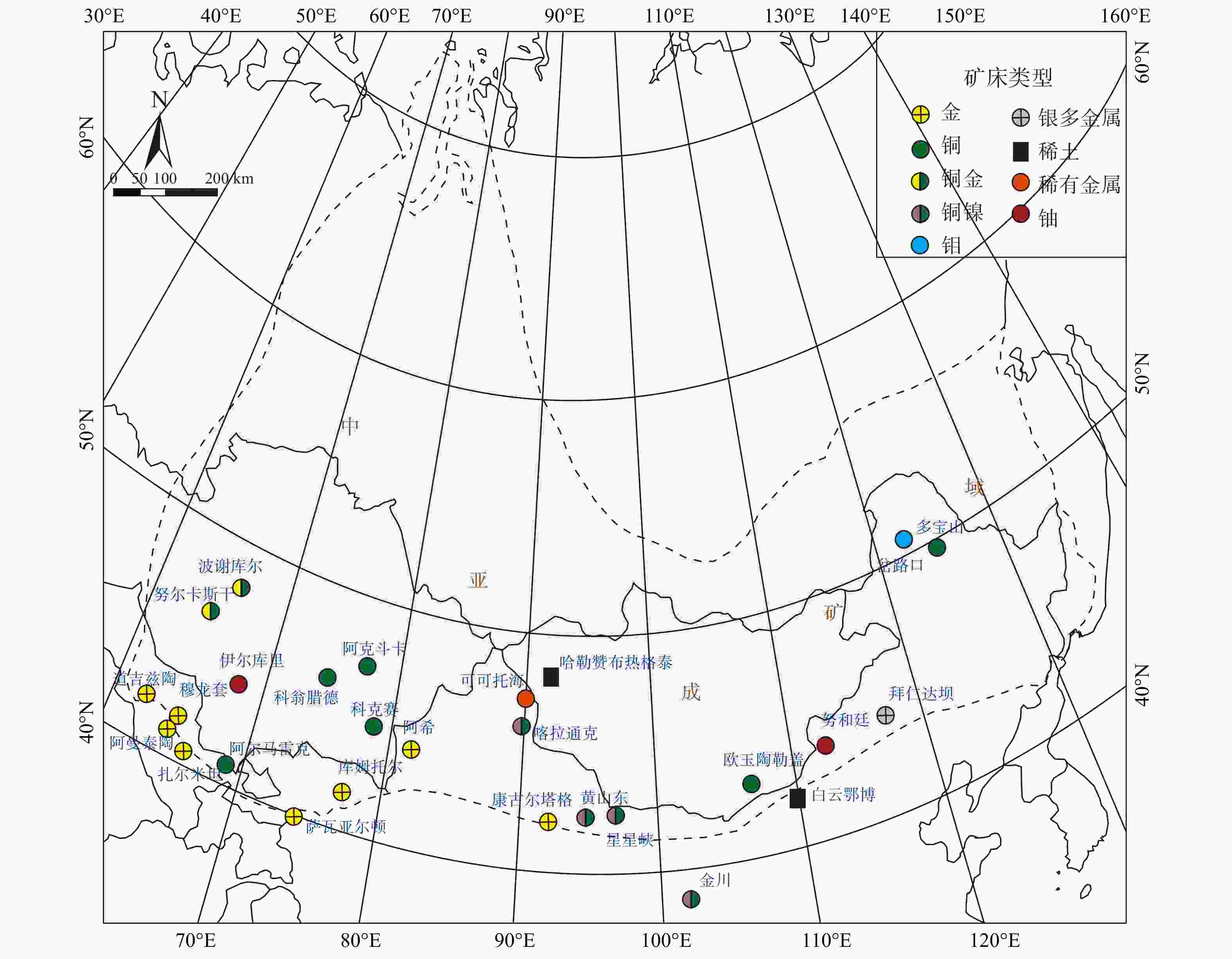
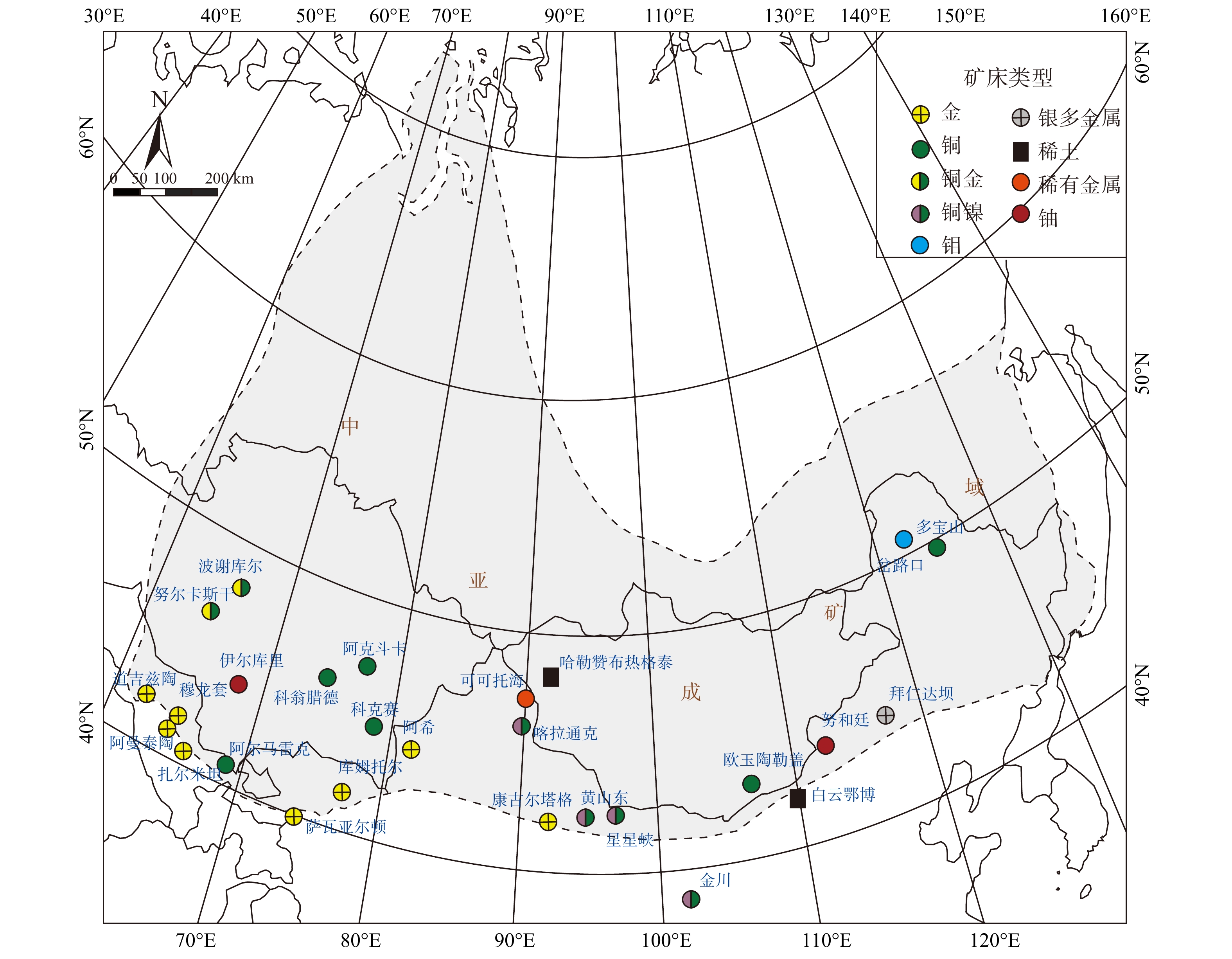
图 1 中亚成矿域及典型大型以上矿床分布
黑虚线—中亚成矿域边界
Figure 1. Central Asian Metallogenic Domain with typical large to giant deposits
Dashed line–boundary of the Central Asian Metallogenic Domain
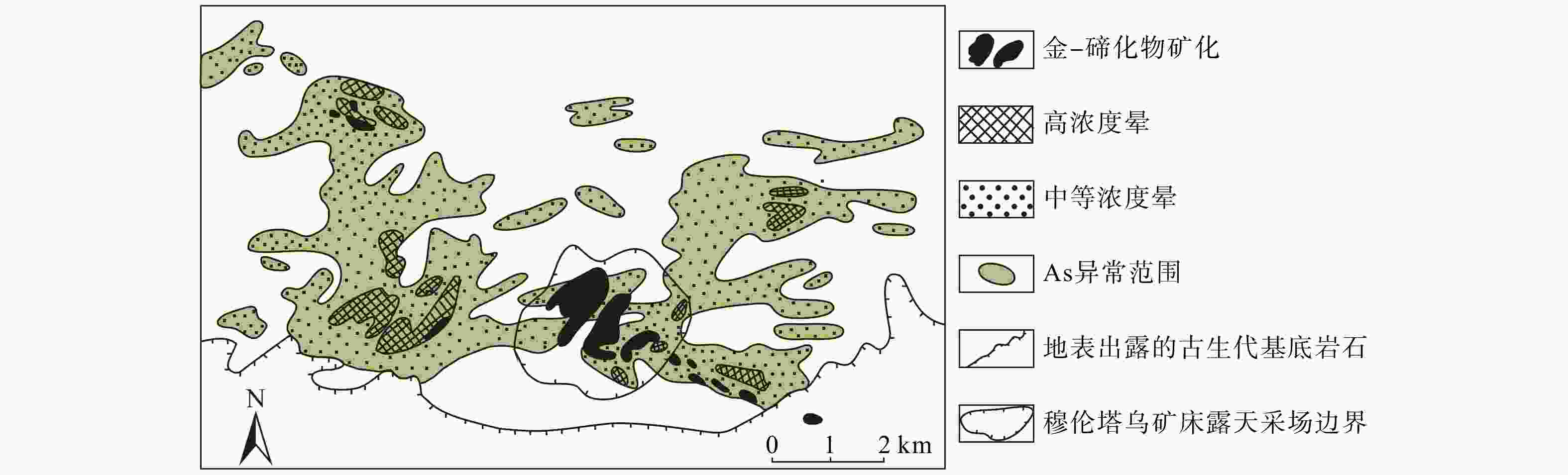
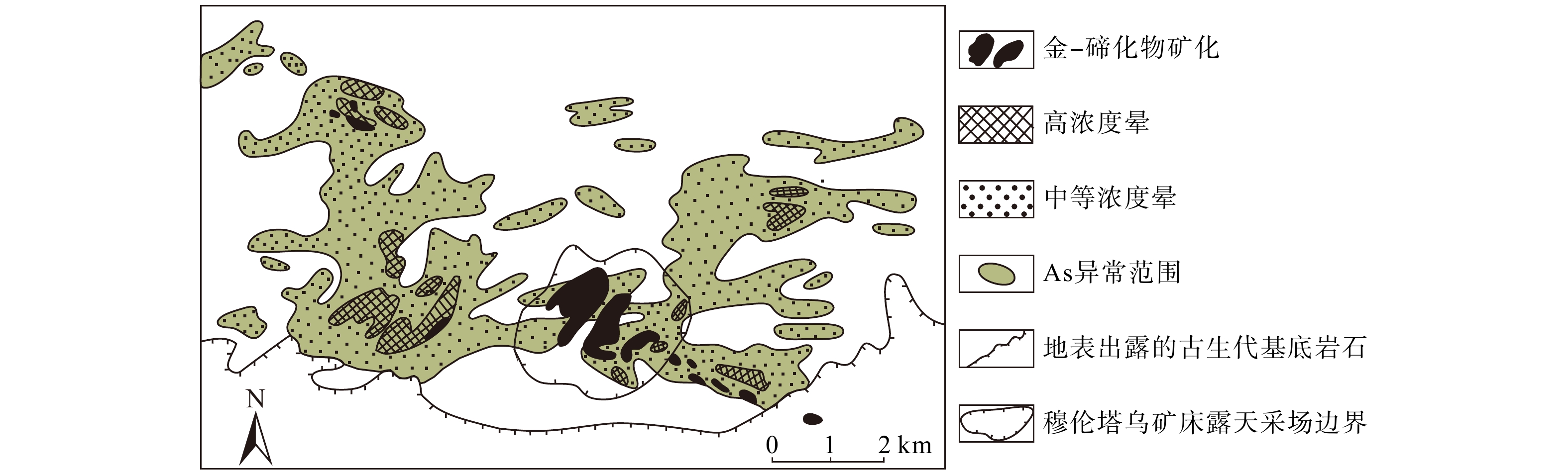
图 2 穆龙套金矿及砷异常分布(Поцелуев,2004)
Figure 2. Muruntau gold deposit and distribution of arsenic anomalies (Поцелуев, 2004)
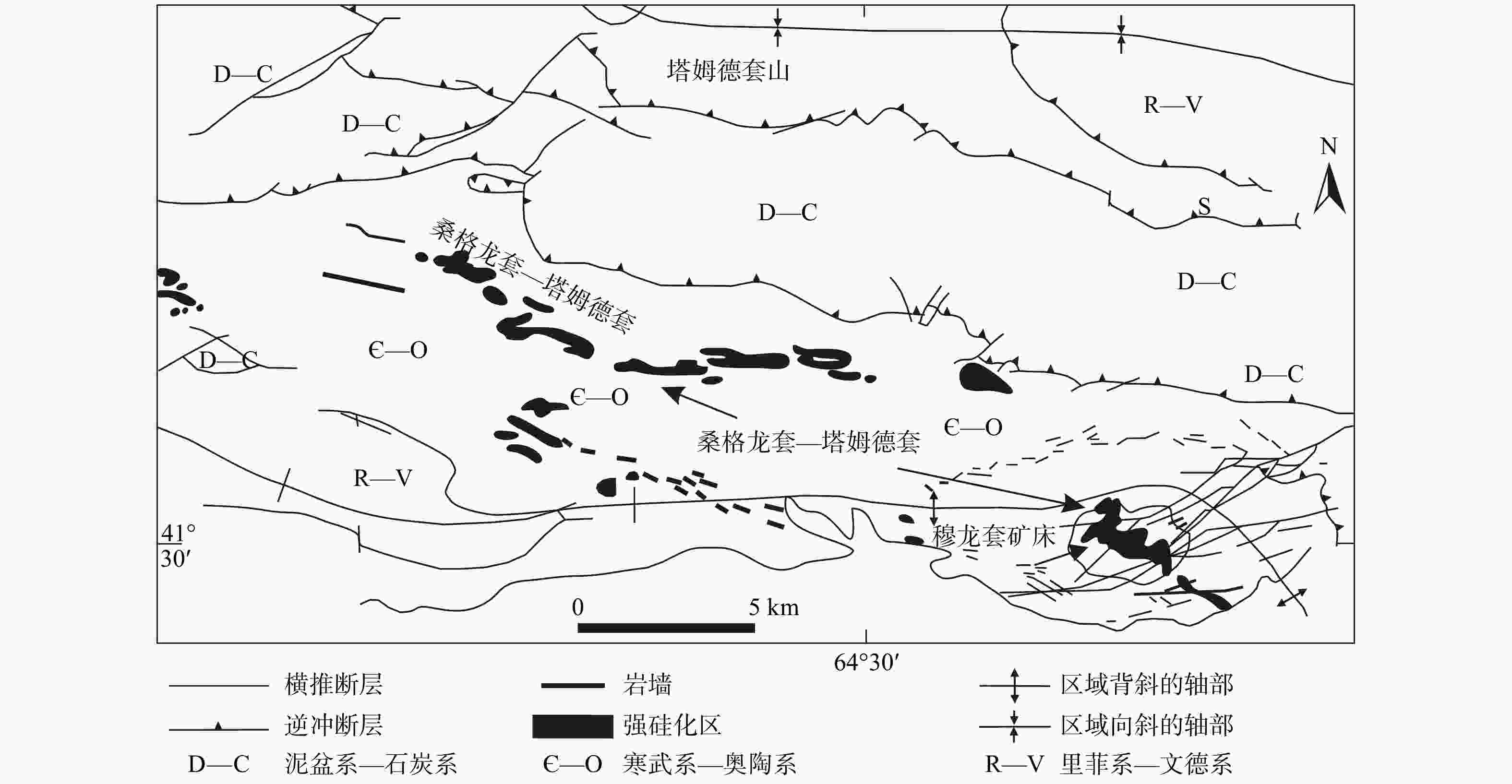
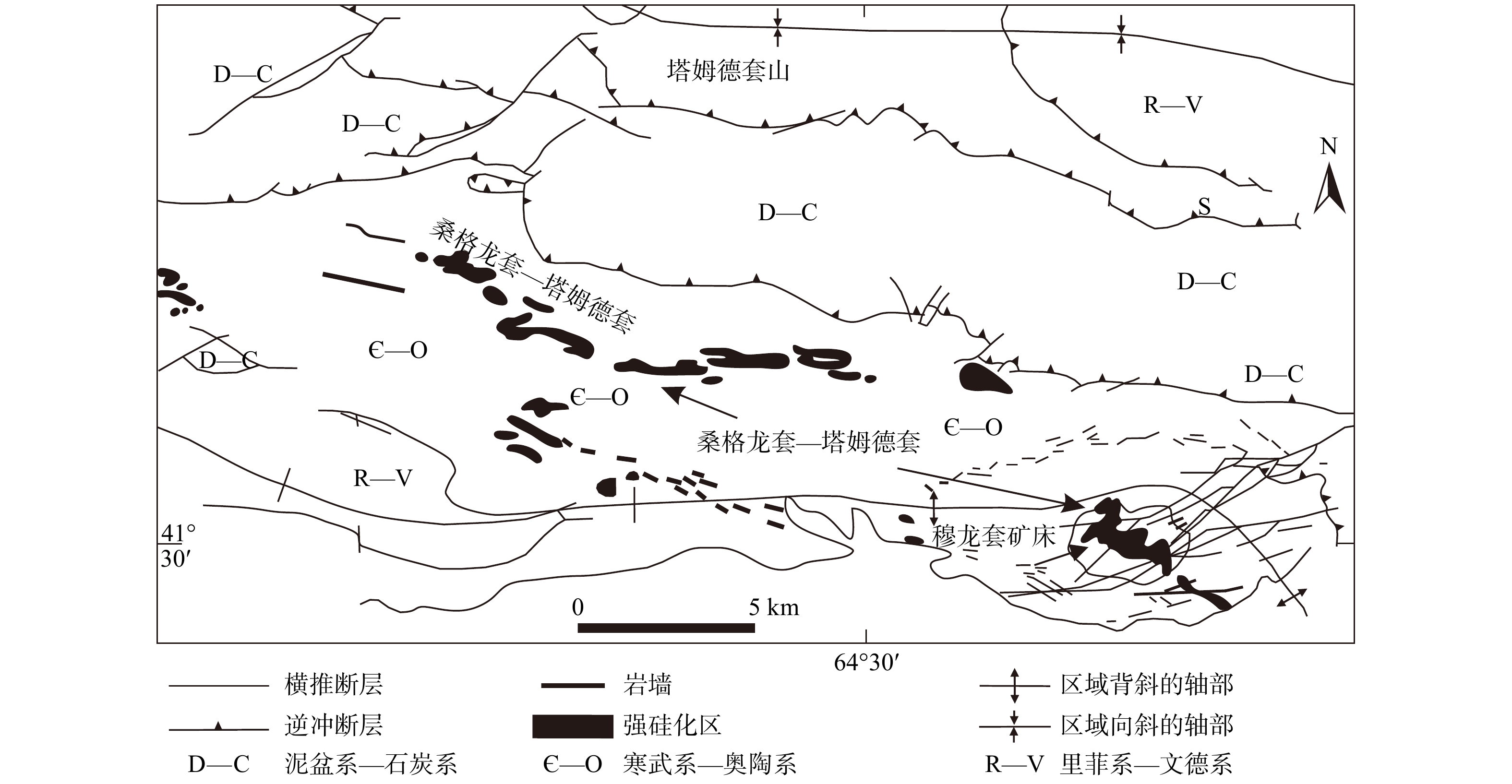
图 3 穆龙套金矿受背斜控制简化地质图(Drew et al.,1996)
Figure 3. Simplified geological map showing the structural control of the Muruntau gold deposit by an anticline (Drew et al., 1996)
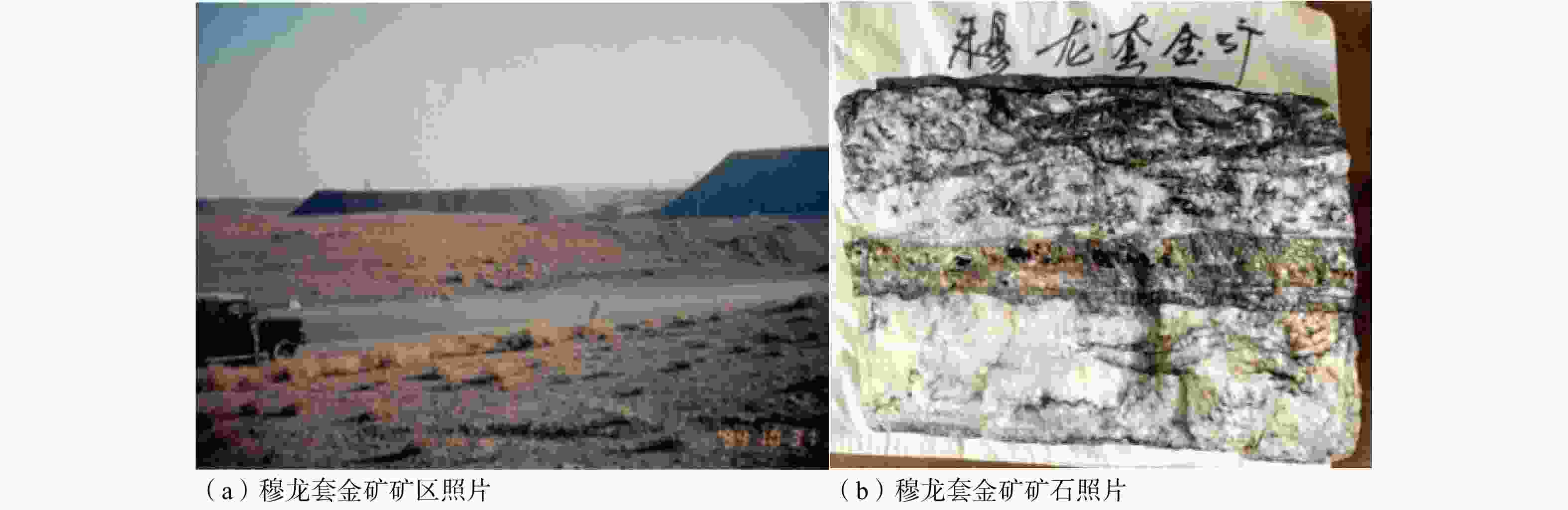
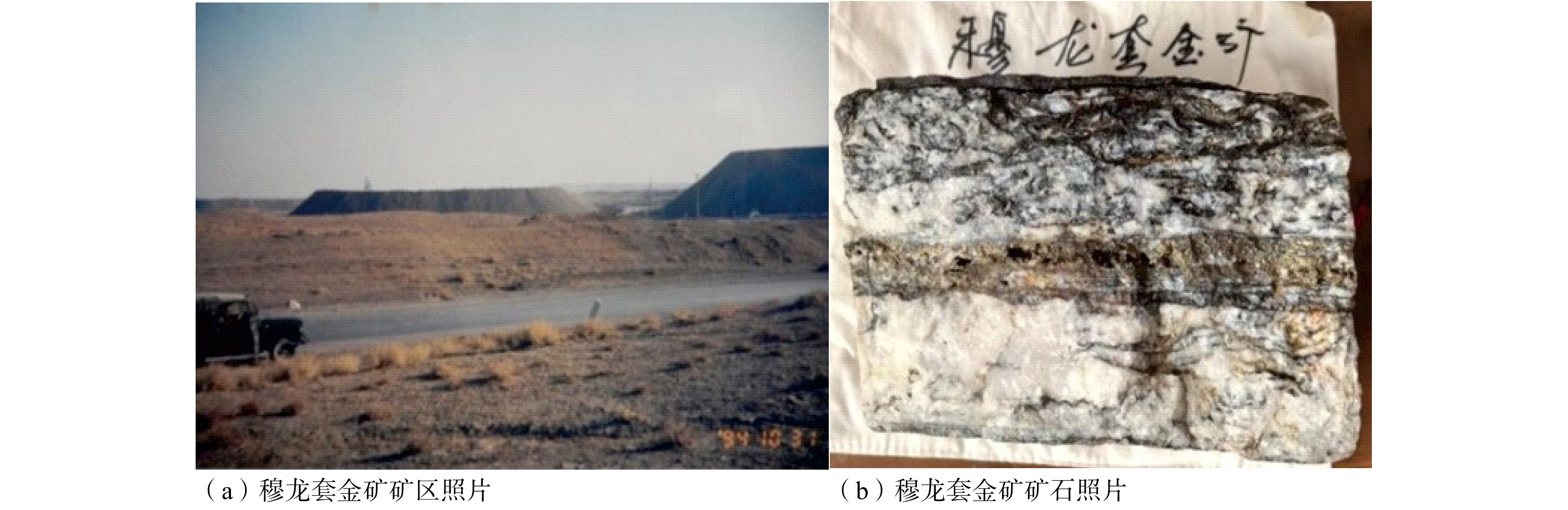
图 4 穆龙套金矿矿区照片及矿石照片
Figure 4. Photographs of the Muruntau gold mining area and gold ore
(a) Muruntau gold mining area; (b) Gold ore from the Muruntau deposit
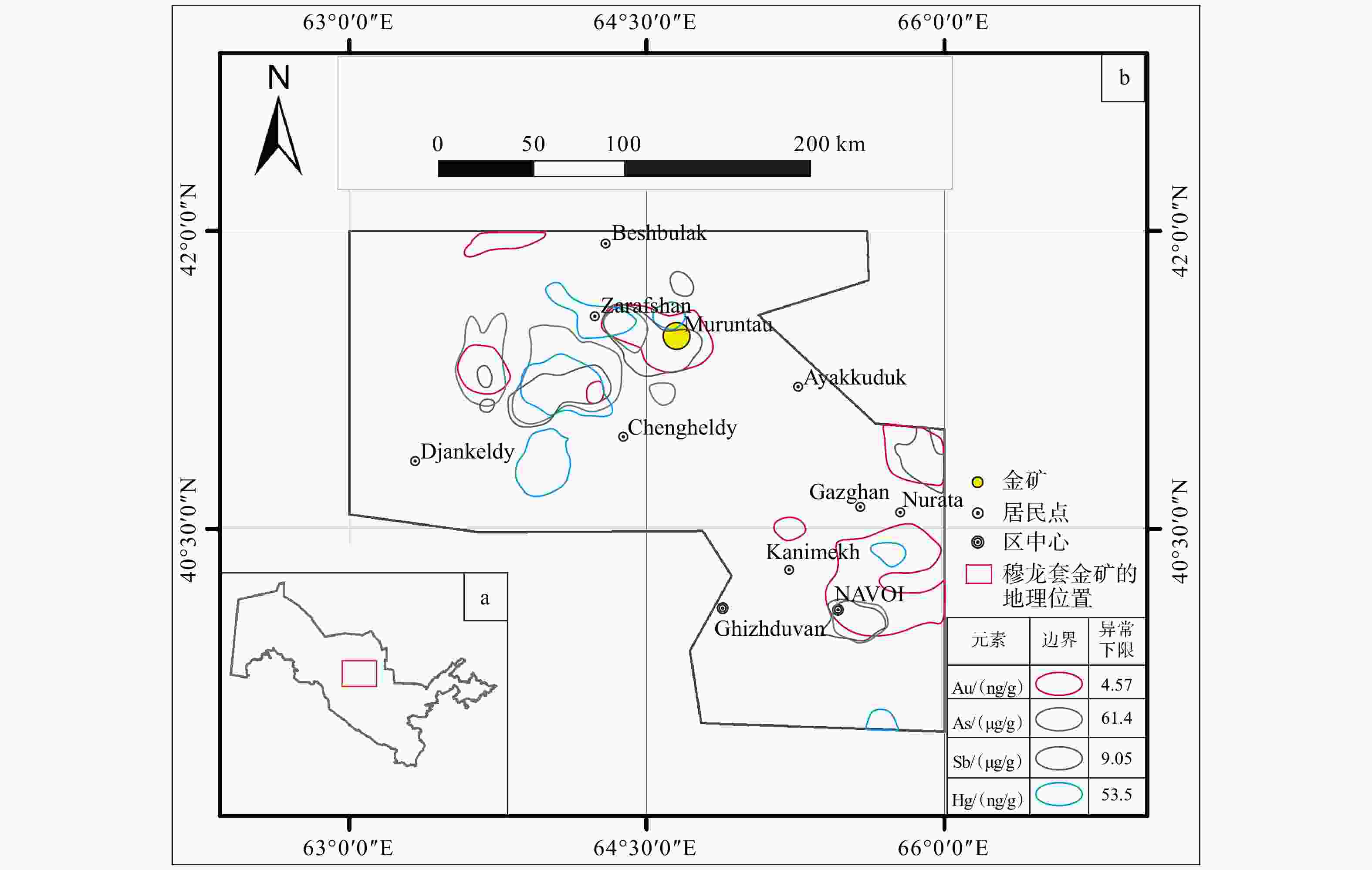
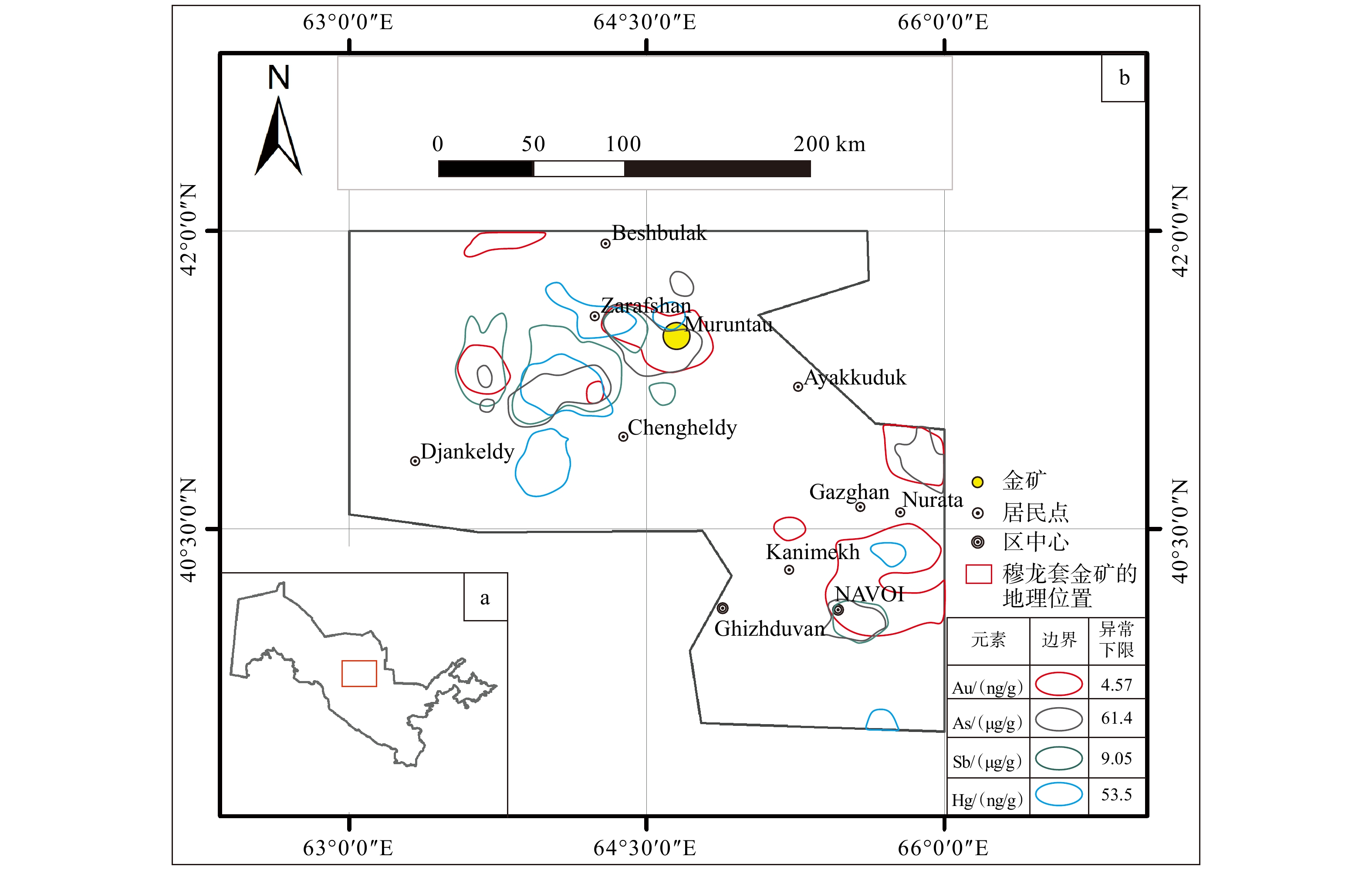
图 5 穆龙套金矿区位及外围地球化学组合异常图
a—乌兹别克斯坦示意图;b—穆龙套金矿外围地球化学组合异常图
Figure 5. Location of the Muruntau gold deposit and geochemical composite anomaly map of the surrounding area
(a) Simplified map of Uzbekistan; (b) Geochemical composite anomaly map of the area surrounding the Muruntau gold deposit
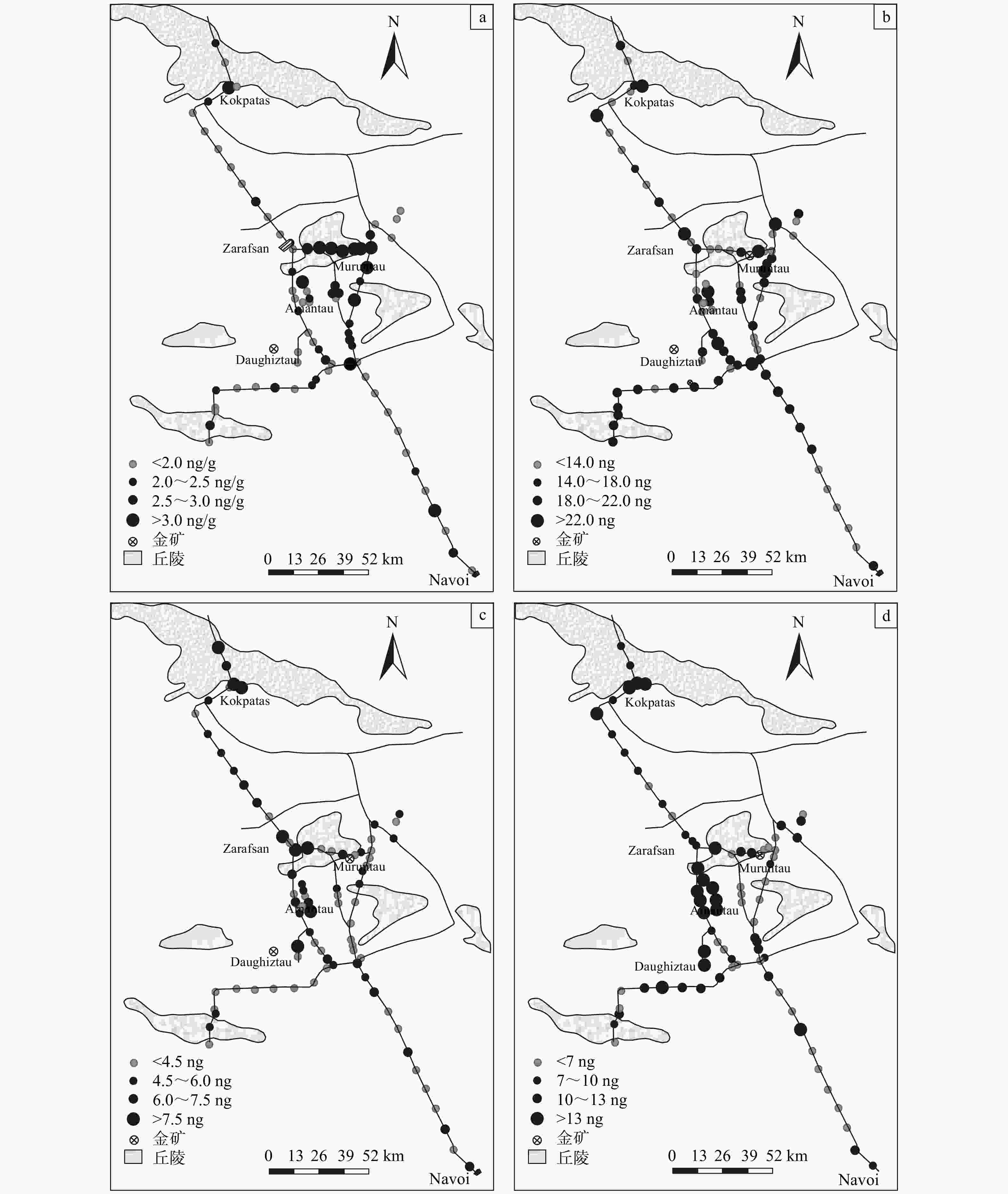
图 6 穆龙套金矿带剖面地球化学特征
a—水提取Au;b—地气As;c—地气Sb;d—地气Hg(Xie et al.,1999)
Figure 6. Geochemical characteristics along profiles across the Muruntau gold belt (a) Water-extracted Au; (b) Geogas As; (c) Geogas Sb; (d) Geogas Hg (Xie et al., 1999)
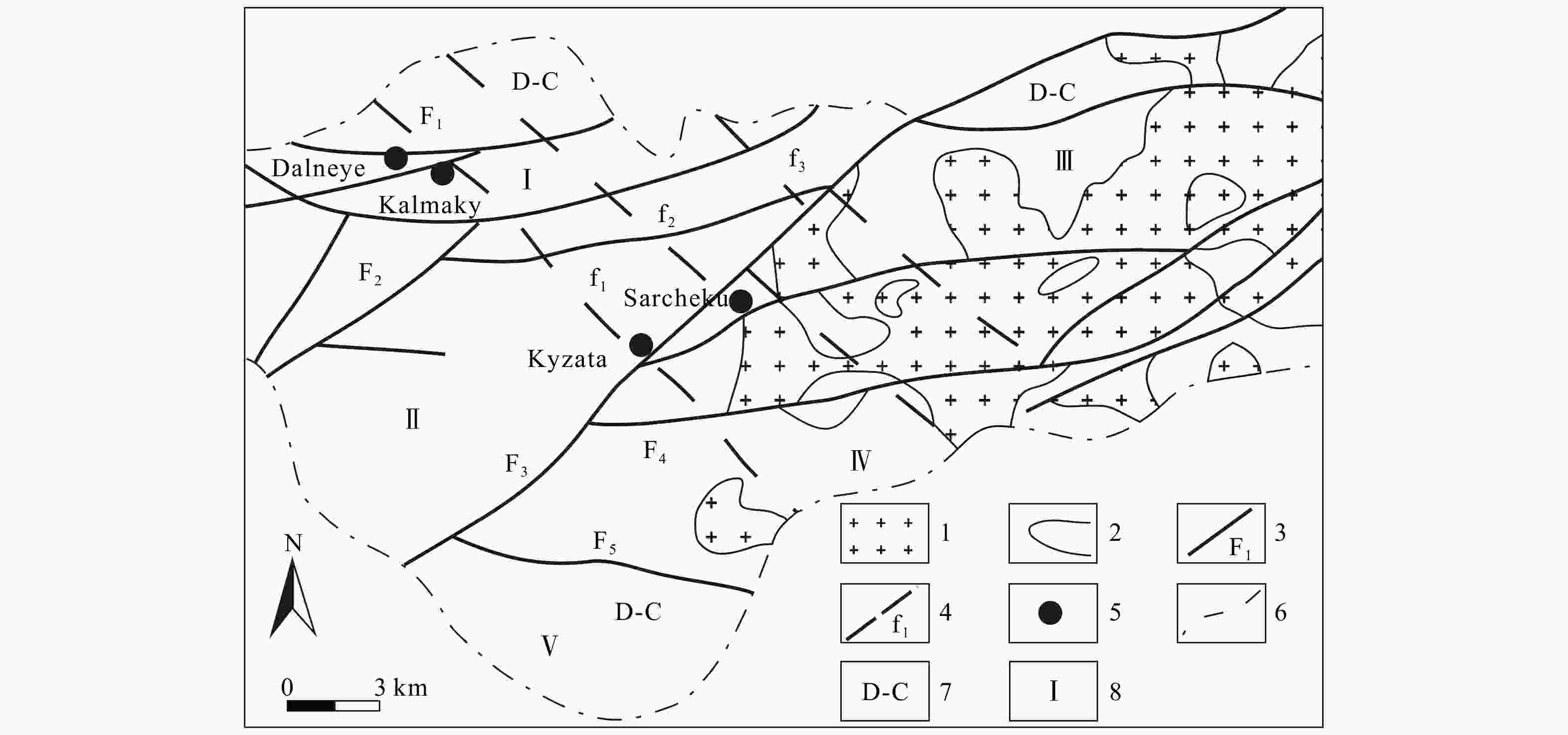
图 7 阿尔马雷克铜矿矿田地质构造简图(薛春纪等,2013)
1—花岗闪长斑岩;2—地质界限;3—断裂及编号;4—隐伏断裂及编号;5—铜矿床;6—矿田边界;7—泥盆系—石炭系;8—构造单元
Figure 7. Simplified geological and structural map of the Almalyk copper ore field (Xue et al., 2013)
1–granodiorite porphyry; 2–geological boundary; 3–fault and its number; 4– concealed fault and its number; 5–copper deposit; 6–boundary of the ore field; 7–Devonian–Carboniferous strata; 8–tectonic unit
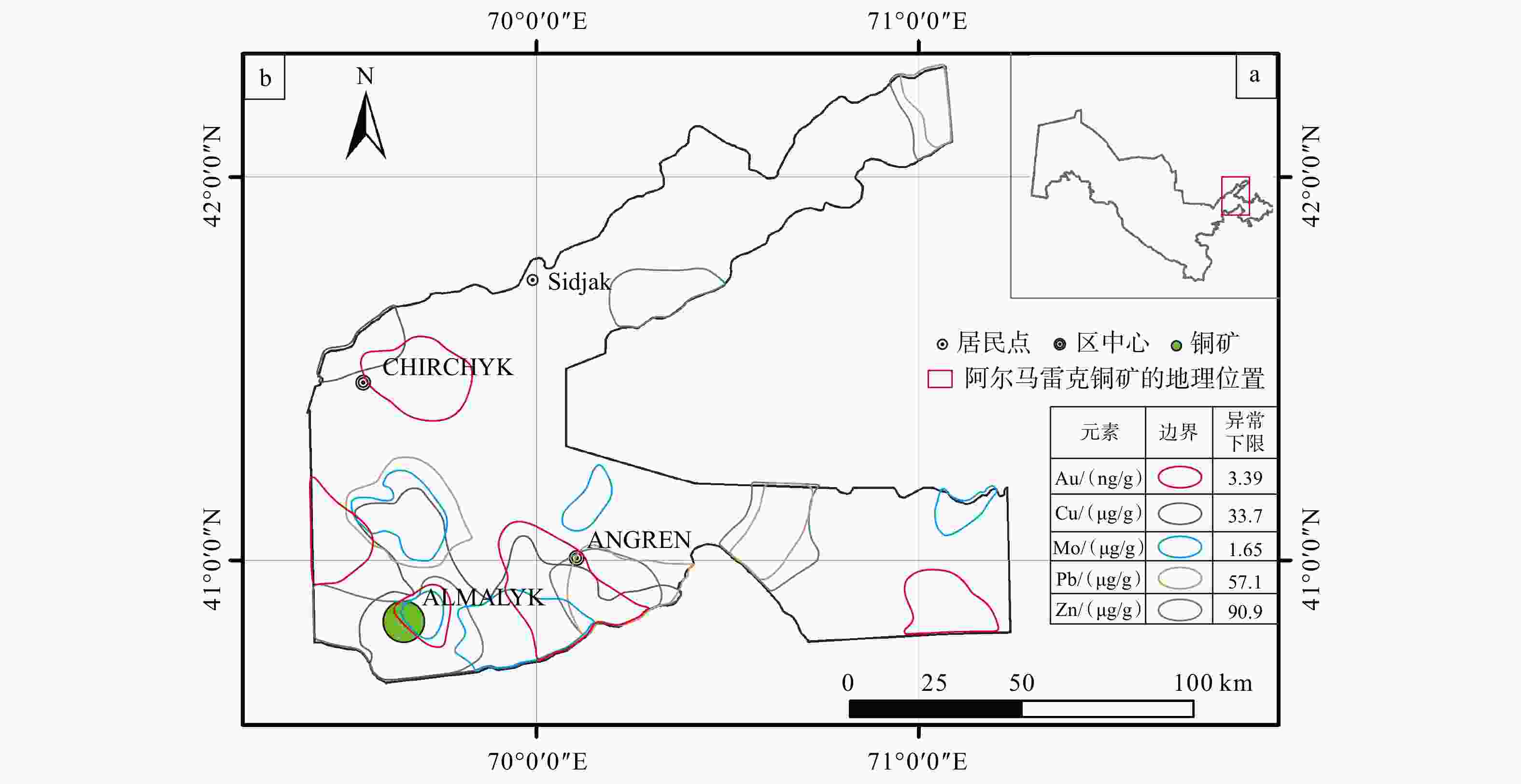
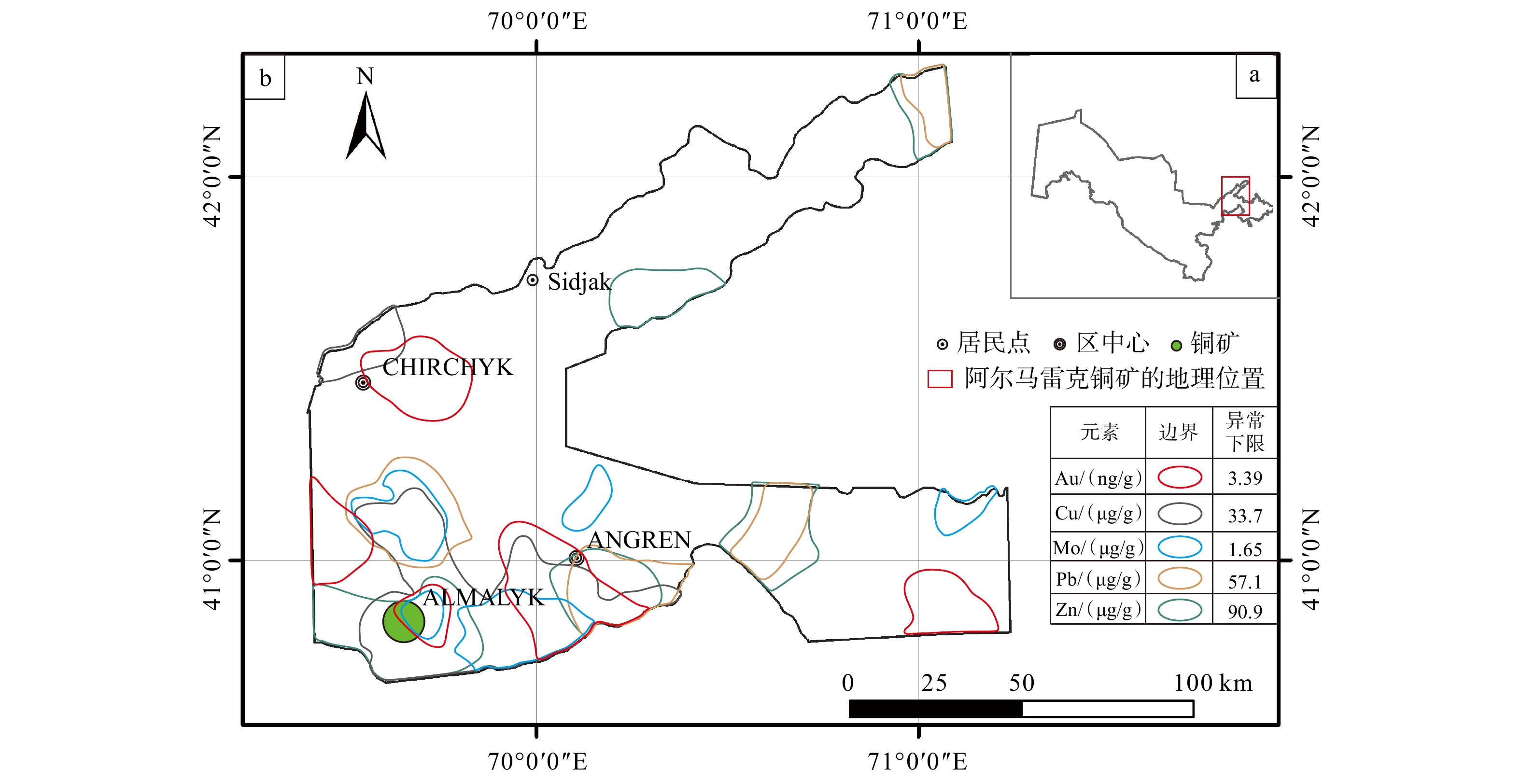
图 8 阿尔马雷克铜矿区位及外围地球化学组合异常图
a—乌兹别克斯坦示意图;b—阿尔马雷克外围地球化学组合异常图
Figure 8. Location of the Almalyk copper deposit and geochemical composite anomaly map of the surrounding area
(a) Simplified map of Uzbekistan; (b) Geochemical composite anomaly map of the periphery of the Almalyk copper deposit
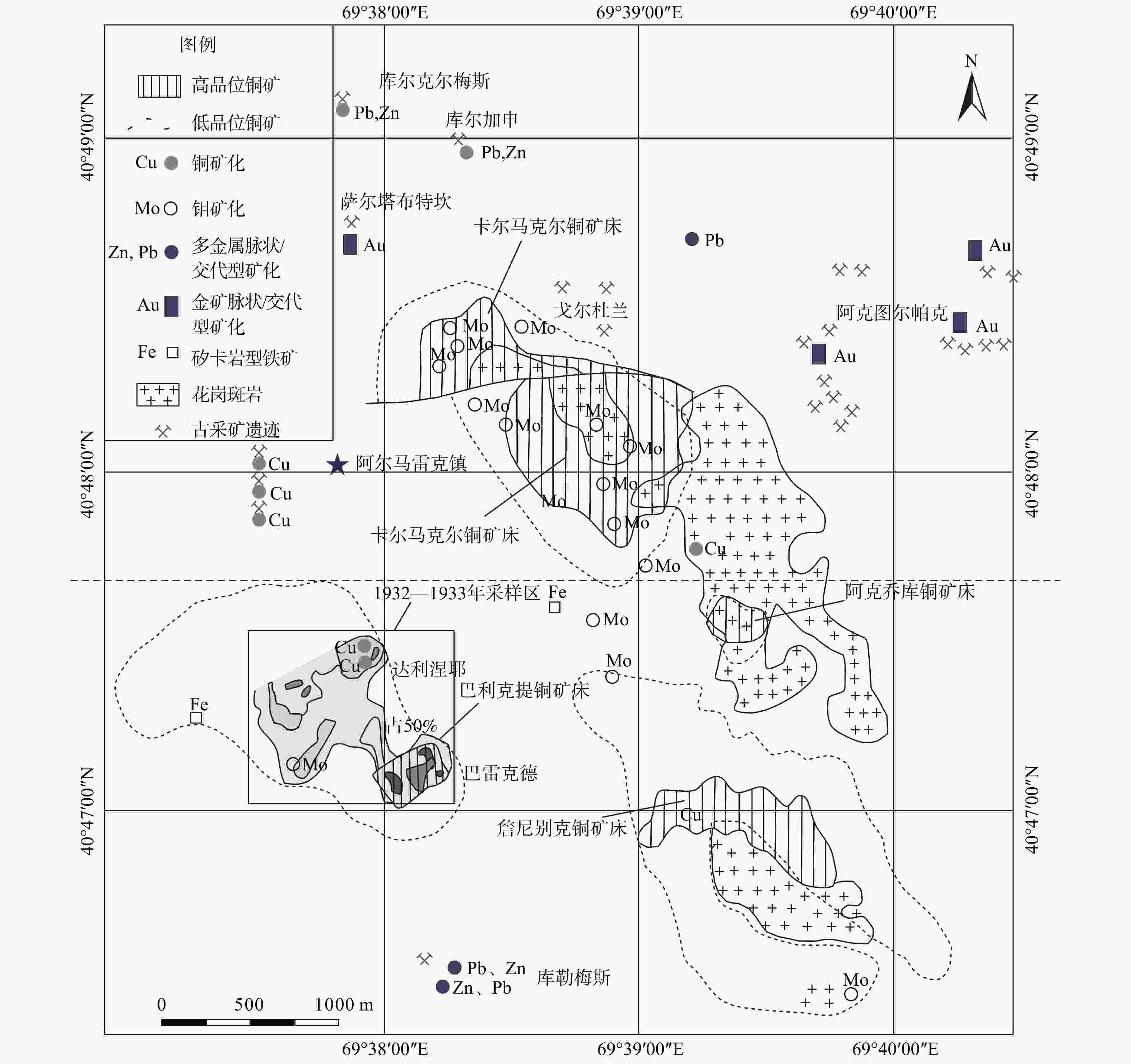
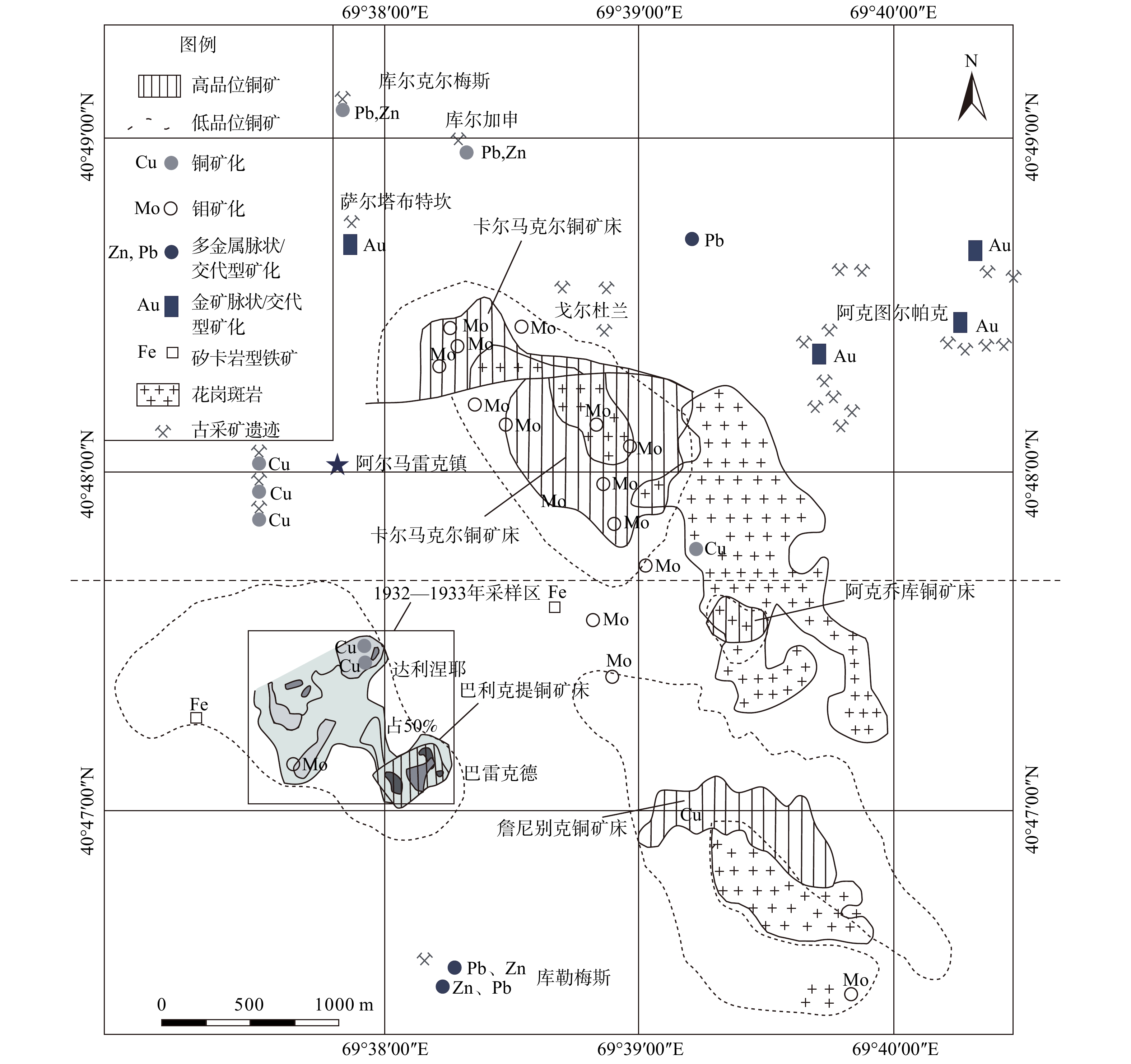
图 9 阿尔马雷克铜矿田矿床与伴生元素空间分布分布图
Figure 9. Distribution map of deposits and associated elements in the Almalyk copper ore field
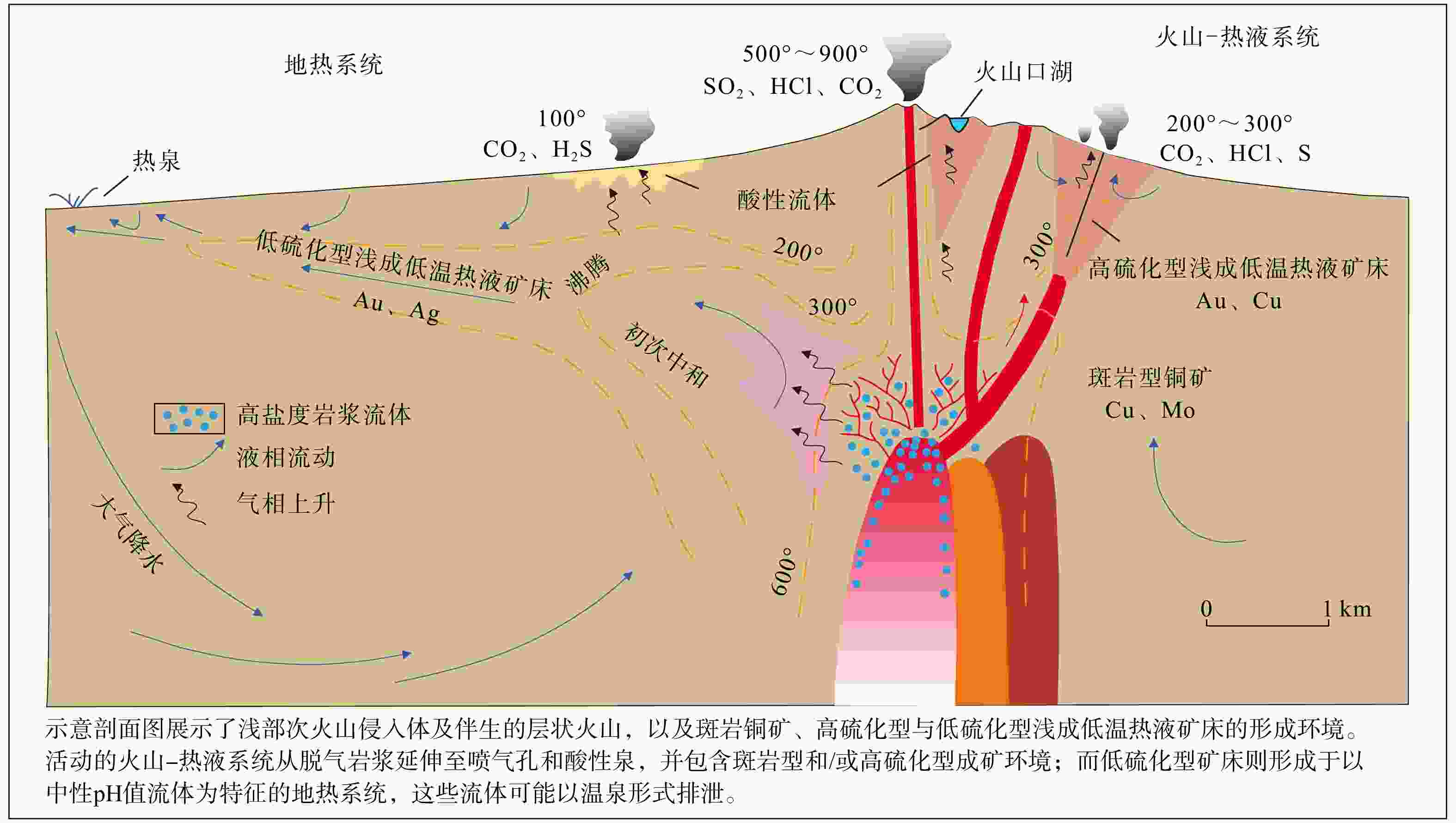
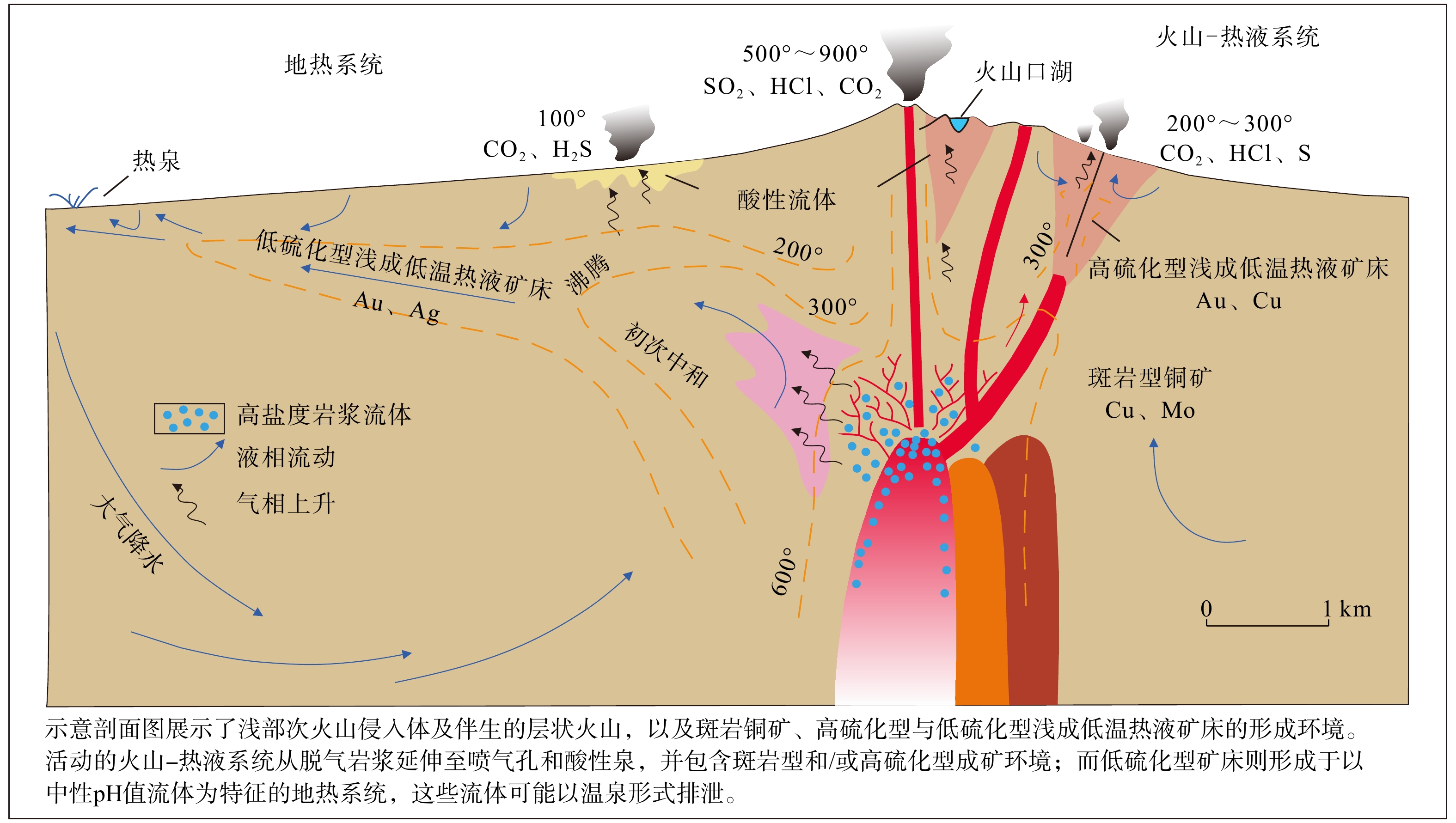
图 10 斑岩型铜矿成矿模式图(据Hedenquist and Lowenstern,1994修改)
Figure 10. Metallogenic model of porphyry copper deposits (modified after Hedenquist and Lowenstern, 1994)
表 1 穆龙套金矿地球化学找矿标志表
Table 1. Geochemical exploration indicators for the Muruntau gold deposit
矿床 尺度 方法/介质 元素组合 异常特征 对应地质特征 穆龙套 区域 1∶100万区域化探,
水系沉积物Au、As、Sb、Hg、Pt、Pd 多元素套合性较好 别萨潘组碳质浊积复理石建造 穆龙套 矿田 地气、土壤微细粒
活动态测量Au、As、Sb、Hg 穆龙套Au、As 高值异常与已知矿点位置
高度吻合,Amantau的Sb、Hg 异常更高黄铁矿化、毒砂、石墨化等围岩
蚀变和矿体 下载: 导出CSV
表 2 阿尔马雷克斑岩型铜矿地球化学找矿标志表
Table 2. Geochemical exploration indicators for the Almalyk porphyry copper deposit
矿床 尺度 方法/介质 元素组合 异常特征 对应地质特征 阿尔马雷克 区域 1∶100 万区域化探,
水系沉积物Au、Cu、Mo、Pb、Zn 多元素套合 泥盆系安山岩、英安岩及火山碎屑岩 阿尔马雷克 矿田 土壤金属量测量 Au、Cu、Mo、Pb、Zn 以中心Mo异常、中环Cu-Au
异常、外环Pb-Zn异常石英钾化蚀变带、石英–绢云母蚀变带、
青磐岩化蚀变带和矿体
下载: 导出CSV
表 3 阿尔马雷克铜金矿关键金属富集系数(部分数据引自Singer et al.,2008;申萍等,2015)
Table 3. Enrichment factors of key metals in the Almalyk Cu–Au deposit (some data from Singer et al., 2008; Shen et al., 2015)
元素 地壳丰度 异常富集系数 矿床边界品位 成矿富集系数 矿床金属资源量 矿床吨位指数 Au 1.0×10⁻⁹ 7.89 0.37 g/t 370 2.25×10³t 2.25×10¹² Ag 70×10−9 6.73 Cu 25×10−6 3.65 0.38% 152 2.4×10⁷t 9.6×10¹¹ Mo 1.1×10⁻⁶ 2.63 0.0023% 20 1.4×10⁵t 1.27×10¹¹ Pb 14.8×10⁻⁶ 5.265 Zn 65×10−6 2.046
下载: 导出CSV
-
[1] CAI H Y, LI F C, 1995a. Geological characteristics of the Almalyk porphyry copper deposit: deposit geology[J]. Mineral Resources and Geology, 9(2): 87-94. (in Chinese) [2] CAI H Y, LI F C, 1995b. Geological characteristics of the Almalyk porphyry copper deposit: conditions for mineralization enrichment and metallogenic model[J]. Mineral Resources and Geology, 9(3): 180-184. (in Chinese) [3] CAO J F, WENG K, JURABEKOVICH M J, et al., 2023. Gold-copper metallogenic characteristics and prospecting potentiality in the Central Tianshan region, Uzbekistan[J]. Geology in China, 50(6): 1731-1744. (in Chinese with English abstract) [4] CHEN X H, YANG N, YE B Y, et al., 2011. Tectonic system and its control on metallogenesis in western Junggar as part of the Central Asia multi-core metallogenic system[J]. Geotectonica et Metallogenia, 35(3): 325-338. (in Chinese with English abstract) [5] CUI M L, YE J H, HE X Z, 2017. Geological setting and mineralization of large-superlarge gold deposits in “One Belt, One Road” region[J]. Geological Bulletin of China, 36(1): 154-167. (in Chinese with English abstract) [6] DOLGOPOLOVA A, SELTMANN R, KONOPELKO D, et al., 2017. Geodynamic evolution of the western Tien Shan, Uzbekistan: insights from U-Pb SHRIMP geochronology and Sr-Nd-Pb-Hf isotope mapping of granitoids[J]. Gondwana Research, 47: 76-109. doi: 10.1016/j.gr.2016.10.022 [7] DREW L J, BERGER B R, KURBANOV N K, 1996. Geology and structural evolution of the Muruntau gold deposit, Kyzylkum desert, Uzbekistan[J]. Ore Geology Reviews, 11(4): 175-196. doi: 10.1016/0169-1368(95)00033-X [8] GAO J, KLEMD R, ZHU M T, et al., 2018. Large-scale porphyry-type mineralization in the Central Asian metallogenic domain: a review[J]. Journal of Asian Earth Sciences, 165: 7-36. doi: 10.1016/j.jseaes.2017.10.002 [9] GAO J, ZHU M T, WANG X S, et al., 2019. Large-scale porphyry-type mineralization in the Central Asian metallogenic domain: tectonic background, fluid feature and metallogenic deep dynamic mechanism[J]. Acta Geologica Sinica, 93(1): 24-71. (in Chinese with English abstract) [10] GOLDFARB R J, TAYLOR R D, COLLINS G S, et al., 2014. Phanerozoic continental growth and gold metallogeny of Asia[J]. Gondwana Research, 25(1): 48-102. doi: 10.1016/j.gr.2013.03.002 [11] GRAUPNER T, NIEDERMANN S, KEMPE U, et al., 2006. Origin of ore fluids in the Muruntau gold system: constraints from noble gas, carbon isotope and halogen data[J]. Geochimica et Cosmochimica Acta, 70(21): 5356-5370. doi: 10.1016/j.gca.2006.08.013 [12] HEDENQUIST J W, LOWENSTERN J B, 1994. The role of magmas in the formation of hydrothermal ore deposits[J]. Nature, 370(6490): 519-527. doi: 10.1038/370519a0 [13] KOSTITSYN Y A, 1996. Rb-Sr isotopic study of the Muruntau deposit: magmatism, metamorphism, and mineralization[J]. Geochemistry International, 34(12): 1009-1023. [14] KOTLYAR B B, 1996. Geochemical exploration in the former Soviet Union[J]. Explore, 91: 1-10. [15] LIU C Y, 2005. The Almalyk super-large porphyry copper deposit in Uzbekistan[J]. Central Asian Information(7): 31-35. (in Chinese) [16] LIU C Y, WANG Y J, 2007. Primary discussion on the characteristics of the gold deposit in black shale series in Central Asian: and the prospecting target of black shale series in Xinjiang[J]. Xinjiang Geology, 25(1): 34-39. (in Chinese with English abstract) [17] MARAKUSHEV A A, KHOKHLOV V A, 1992. A petrological model for the genesis of the Muruntau gold deposit[J]. International Geology Review, 34(1): 59-76. doi: 10.1080/00206819209465584 [18] SELTMANN R, PORTER T M, 2005. The porphyry Cu-Au/Mo deposits of Central Eurasia: 1. Tectonic, geologic and metallogenic setting and significant deposits[M]//PORTER T M. Super porphyry copper & gold deposits: a global perspective. Adelaide: PGC Publishing: 467-512. [19] SHEN P, PAN H D, ELEONORA S, 2015. Characteristics of the porphyry Cu deposits in the Central Asia Metallogenic Domain[J]. Acta Petrologica Sinica, 31(2): 315-332. (in Chinese with English abstract) [20] SINGER D A, BERGER V I, MORING B C, 2008. Porphyry copper deposits of the world: database and grade and tonnage models, 2008[R]. Reston: U. S. Geological Survey: 45. [21] SMIRNOFF V I, 1977. The Muruntau deposit[M]//SMIRNOV V I. Ore deposits of the USSR. Vol. 3. London: Pitman Publishing: 35-40. [22] TU G Z, 1999. On the certral Asia metallogenic province[J]. Chinese Journal of Geology, 34(4): 397-404. (in Chinese with English abstract) [23] WANG X Q, 1997. Leach of mobile forms of metals in overburden: development and application[J]. Journal of Geochemical Exploration, 55: 93-102 [24] WANG X Q, XIE X J, 2000. Exploration geochemistry of Gold Principles and methodology·Tactics and Strategy[M]. Jinan: Shandong Science and Technology Press. (in Chinese) [25] WANG X Q, LI L X, WU H, et al., 2025. Super enrichment of critical elements: implications for stratgic mineral resources[J]. Earth Science Frontiers, 32(1): 11-22. (in Chinese with English abstract) [26] XIAO W J, KUSKY T, 2009. Geodynamic processes and metallogenesis of the Central Asian and related orogenic belts: introduction[J]. Gondwana Research, 16(2): 167-169. doi: 10.1016/j.gr.2009.05.001 [27] XIAO W J, SONG D F, WINDLEY B F, et al., 2020. Accretionary processes and metallogenesis of the Central Asian Orogenic Belt: advances and perspectives[J]. Science China Earth Sciences, 63(3): 329-361. doi: 10.1007/s11430-019-9524-6 [28] XIE X J, WANG X Q, XU L, et al., 1999. Orientation study of strategic deep penetration geochemical methods in the central Kyzylkum desert terrain, Uzbekistan[J]. Journal of Geochemical Exploration, 66(1-2): 135-143. doi: 10.1016/S0375-6742(99)00024-2 [29] XUE C J, DUAN S G, CHAI F M, et al., 2013. Metallogenetic epoch of the Almalyk porphyry copper ore field, Uzbekistan, and its geological significance[J]. Earth Science Frontiers, 20(2): 197-204. (in Chinese with English abstract) [30] ZENG Q D, QIN K Z, LIU J M, et al., 2015. Porphyry molybdenum deposits in the Tianshan-Xingmeng orogenic belt, northern China[J]. International Journal of Earth Sciences, 104(4): 991-1023. doi: 10.1007/s00531-014-1122-6 [31] ZENIN M F, 1937. The Balikti porphyry-copper deposit in Almalyk[J]. Middle Asia Geological Materials, 5: 39-61. (in Russian) [32] ГАРЬКОВЕЦ В Г, МУШКИН И В, ТИТОВА А П, et al. , 1979. Основные черты металлогении Узбекистана[M]. Ташкент: Фан: 271. (in Russian) [33] ПОЦЕЛУЕВ А А, 2004. Геохимический спектр — генетическая информативность, поисково-оценочная значимость[C]//Поисковая геохимия: теоретические основы, технологии, результаты. Алматы: Print-S: 104-114. (in Russian) [34] ТУРЕСЕБЕКОВ А Х, ВАСИЛЕВСКИЙ Б Б, 2006. Геолого-генетическая модель формирования руд медно-порфировых месторождений Алмалыкского рудного района, Узбекистан[J]. Руды и Металлы(5): 67-76. (in Russian) [35] 蔡宏渊, 李福春, 1995a. 阿尔玛雷克斑岩铜矿地质特征: 矿床地质特征[J]. 矿产与地质, 9(2): 87-94. [36] 蔡宏渊, 李福春, 1995b. 阿尔玛雷克斑岩铜矿地质特征: 矿化富集条件及成矿模式[J]. 矿产与地质, 9(3): 180-184. [37] 曹积飞, 翁凯, JURABEKOVICH M J, 等, 2023. 乌兹别克斯坦中天山金铜成矿特征与找矿潜力评价[J]. 中国地质, 50(6): 1731-1744. doi: 10.12029/gc20210226001 [38] 陈宣华, 杨农, 叶宝莹, 等, 2011. 中亚成矿域多核成矿系统西准噶尔成矿带构造体系特征及其对成矿作用的控制[J]. 大地构造与成矿学, 35(3): 325-338. doi: 10.3969/j.issn.1001-1552.2011.03.001 [39] 崔敏利, 叶锦华, 何学洲, 2017. “一带一路”地区大型超大型金矿床地质背景与成矿作用[J]. 地质通报, 36(1): 154-167. [40] 高俊, 朱明田, 王信水, 等, 2019. 中亚成矿域斑岩大规模成矿特征: 大地构造背景、流体作用与成矿深部动力学机制[J]. 地质学报, 93(1): 24-71. doi: 10.3969/j.issn.0001-5717.2019.01.004 [41] 刘春涌, 2005. 乌兹别克斯坦阿尔马雷克特大型斑岩铜矿床[J]. 中亚信息(7): 31-35. [42] 刘春涌, 王永江, 2007. 初论中亚黑色岩系型金矿床的基本特征: 兼论新疆黑色岩系型金矿找矿方向[J]. 新疆地质, 25(1): 34-39. doi: 10.3969/j.issn.1000-8845.2007.01.006 [43] 申萍, 潘鸿迪, ELEONORA S, 2015. 中亚成矿域斑岩铜矿床基本特征[J]. 岩石学报, 31(2): 315-332. [44] 涂光炽, 1999. 初议中亚成矿域[J]. 地质科学, 34(4): 397-404. [45] 王学求, 谢学锦, 2000. 金的勘查地球化学理论与方法·战略与战术[M]. 济南: 山东科学技术出版社. [46] 王学求, 李龙雪, 吴慧, 等, 2025. 关键元素超常富集与战略资源效应[J]. 地学前缘, 32(1): 11-22. doi: 10.13745/j.esf.sf.2024.10.40 [47] 肖文交, 宋东方, WINDLEY B F, 等, 2019. 中亚增生造山过程与成矿作用研究进展[J]. 中国科学: 地球科学, 49(10): 1512-1545. [48] 薛春纪, 段士刚, 柴凤梅, 等, 2013. 乌兹别克斯坦Almalyk斑岩铜矿田成矿时代及其地质意义[J]. 地学前缘, 20(2): 197-204. -

 下载:



计量
- 文章访问数: 57
- HTML全文浏览量: 10
- PDF下载量: 6
- 被引次数: 0
