


An intracontinental extensional full-temperature metallogenic model: its application to prospecting breakthroughs in the Shuikoushan ore field
-
摘要: 南岭成矿带中段是华南陆内岩浆热液复合成矿作用的典型区域,以水口山矿田为代表的大型铅锌铁铜金银多金属矿床集中发育,但经过百余年开发后浅部资源日渐枯竭,深部资源接续困难。文章从物质域、构造域、温度域和成矿域4个维度出发,系统分析了区域有色稀有金属成矿系统的物质来源、控矿构造、温度分带、矿种组合及其时空变化关系,建立了陆内伸展全温度域成矿理论模式。该模式强调不同地壳层位来源、不同分异程度的岩浆在深大断裂与复式褶皱交汇空间集中侵位,递次发育高温伟晶岩−云英岩锂铍铌钽矿化(400~600 ℃)、中—高温矽卡岩−斑岩型钨锡铁铜矿化(250~550 ℃)、中温矽卡岩型铅锌矿化(200~450 ℃)、中—低温热液脉型铅锌金银矿化(150~350 ℃)和浅成低温热液型金银矿化(100~300 ℃)的完整成矿序列。以该理论为指导开展水口山矿田深边部找矿,提出“背斜+N刀”找矿模型在康家湾矿区F22断裂以东新揭露IV-3矿体群;基于隐伏岩体独立发育全温度域矿化的认识揭露康家湾倒转翼深部高温铜金矿化;基于不同成矿温度域互为找矿标志理念在老鸦巢−鸭公塘深部揭露了矽卡岩型铜铁矿体和斑岩型铜金矿化线索。上述找矿实践表明,华南地区仍有广阔的有色稀有金属找矿空间,陆内伸展全温度域成矿模式可为勘查程度较高的老矿山深边部找矿提供新的找矿思路与方向。Abstract:
Objective The central Nanling metallogenic belt is a representative region of intracontinental magmatic-hydrothermal mineralization in South China. Large Pb–Zn–Fe–Cu–Au–Ag deposits are concentrated in this belt, with the Shuikoushan ore field as a prominent example. However, after more than a century of mining, shallow resources are becoming increasingly depleted, and the identification of replacement resources at depth has become increasingly challenging. Methods This study systematically analyzes metal sources, ore-controlling factors, temperature-dependent hydrothermal zonation, mineralization styles, and metal associations as well as their spatiotemporal relationships across the material, structural, thermal, and metallogenic domains. Results The material domain reveals that magmas derived from different crustal levels and having undergone different degrees of differentiation carry distinct metal inventories. Highly differentiated S- and A-type granites are enriched in W, Sn, Li, Be, Nb, and Ta, whereas weakly differentiated and oxidized I-type granodiorites are enriched in Fe, Cu, Au, Pb, and Zn. The structural domain shows that the intersections of deep faults and reversed folds, together with the calcareous–siliceous interfaces, serve as the principal conduits and traps for ore-forming fluids. The thermal domain indicates that ore-forming metals are unloaded sequentially with decreasing temperature away from the intrusion. W, Sn, Mo, and Bi precipitate in the high-temperature proximal zone, together with Fe and Cu in the medium-to-high-temperature zone, Pb, Zn, and Au in the medium-temperature zone, and Au and Ag in the low-temperature distal zone. The metallogenic domain integrates these three domains into a coherent framework, which can be summarized as one center, two structures, three systems, and multiple metals. This framework explains why distinct mineralization styles are superimposed within a single ore field. Conclusions On this basis,an intracontinental extensional full-temperature metallogenic model is established. This model emphasizes that magmas from different crustal levels and with variable differentiation were collectively emplaced at the intersections of deep faults and reversed folds. They successively formed high-temperature Li-Be-Nb-Ta pegmatite-greisen (400~600 °C), medium-to-high temperature W–Sn–Fe–Cu skarn-porphyry (250~550 °C), medium-temperature Pb–Zn skarn (200~450 °C), medium-to-low-temperature hydrothermal Pb–Zn–Au–Ag veins (150~350 °C), and epithermal Au–Ag (100~300 °C) mineralization. Distinct metallogenic systems can overlap at the same period. The application of this model to the Shuikoushan ore field achieved three prospecting breakthroughs. First, an IV-3 orebody cluster was newly identified east of the F22 fault in the Kangjiawan mining area, guided by the "anticline + N faults" model. Second, high-temperature Cu–Au mineralization was identified at depth in the overturned limb of the Kangjiawan structure, based on the understanding that concealed intrusions can independently develop mineralization across the full temperature range. Third, skarn-type Cu–Fe orebodies and indications of porphyry-type Cu–Au mineralization were identified at depth in the Laoyachao–Yagongtang area, guided by the concept that mineralization in different temperature domains can serve as mutual prospecting indicators. Significance These results suggest that South China still holds extensive exploration potential for nonferrous and rare metals. The intracontinental extensional full-temperature metallogenic model can provide new exploration strategies and target directions within mature mining districts. -
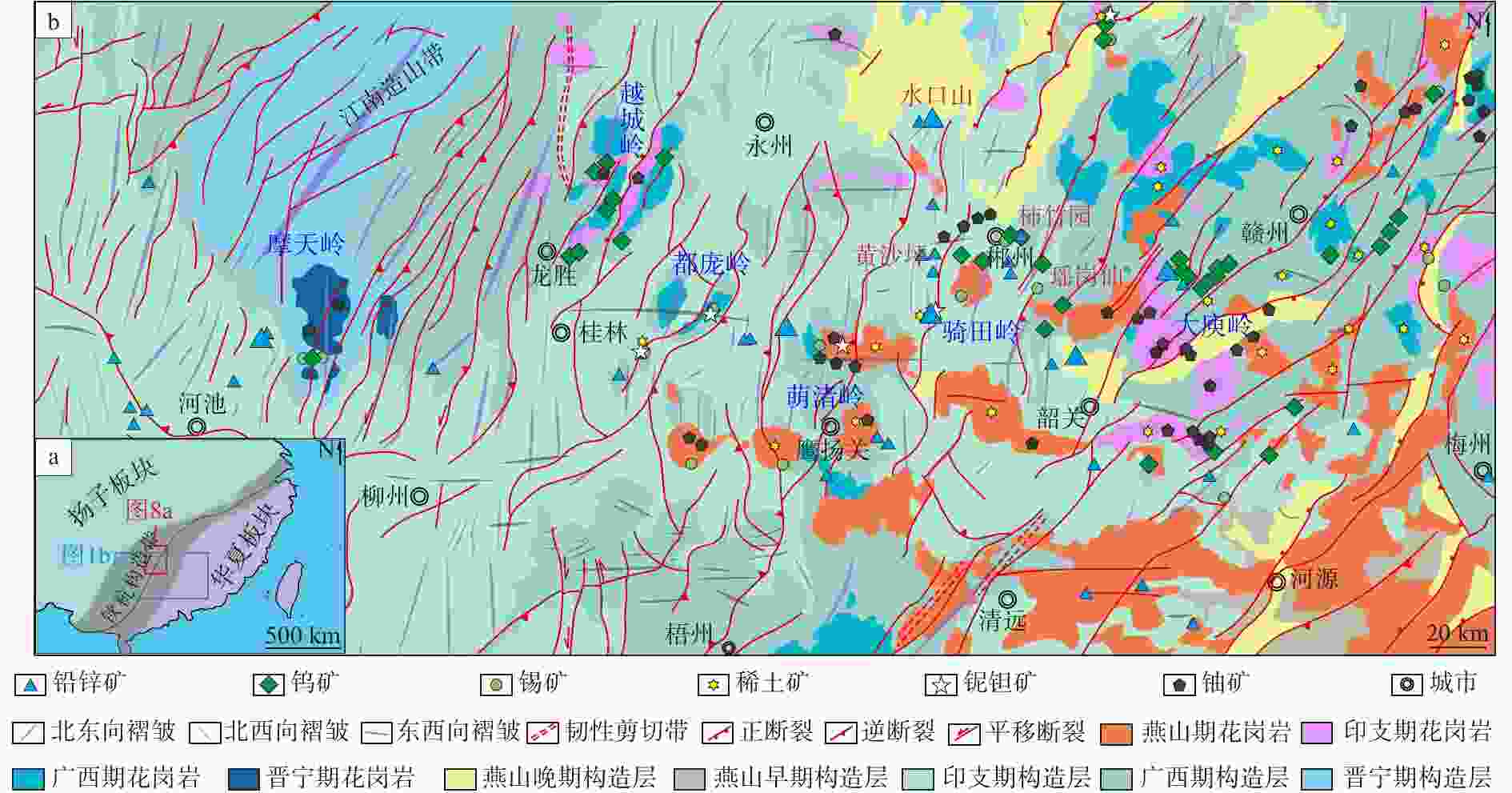
图 1 南岭成矿带构造位置与地质矿产简图
a—南岭成矿带构造位置简图;b—南岭成矿带地质构造与典型矿产分布简图(据徐先兵等,2021修改)
Figure 1. Simplified tectonic and geological maps showing the location and mineral distribution of the Nanling metallogenic belt
(a) Simplified tectonic map of South China showing the location of the Nanling metallogenic belt; (b) Simplified geological map of the Nanling metallogenic belt showing the distribution of typical mineral deposits (modified after Xu et al. 2021).
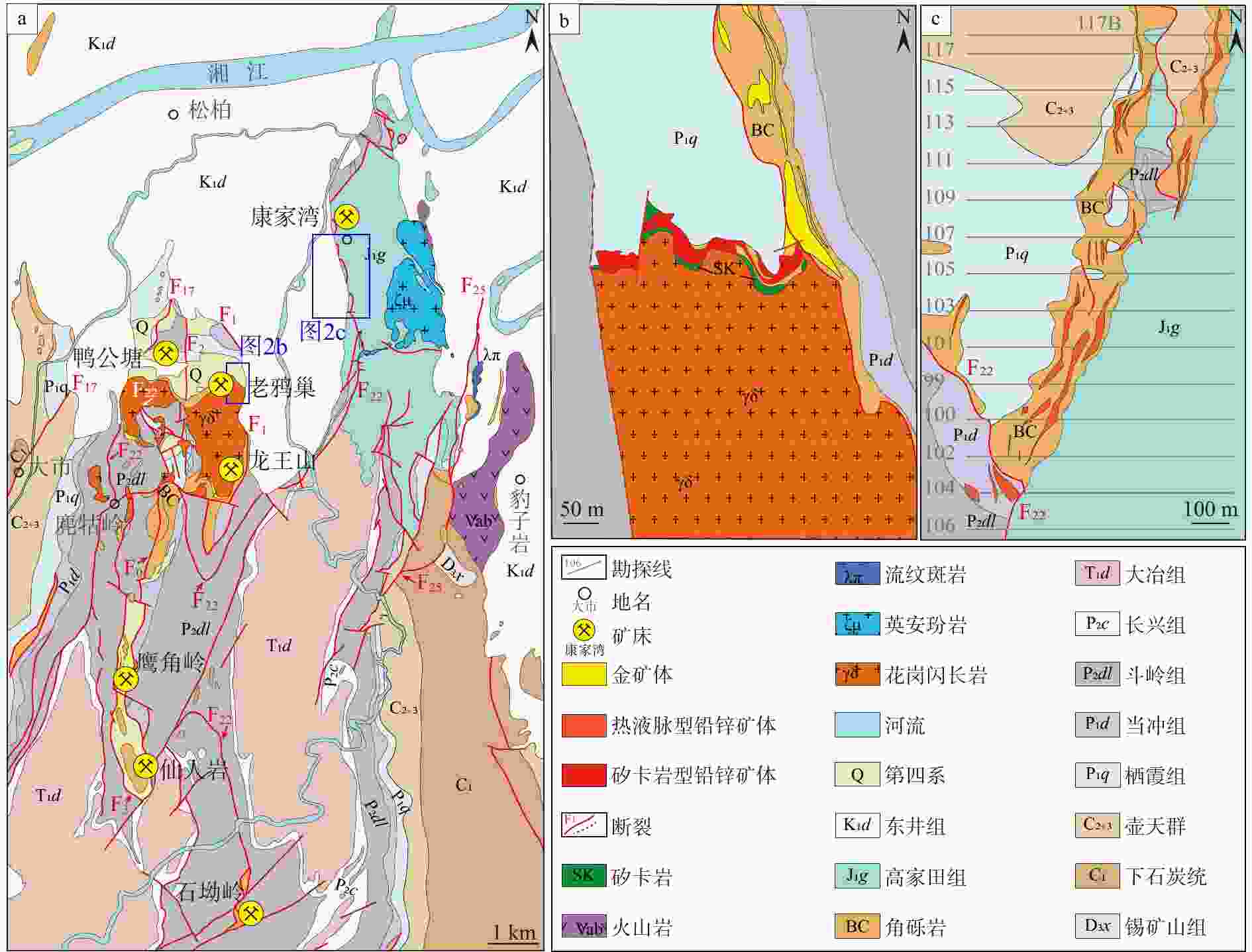
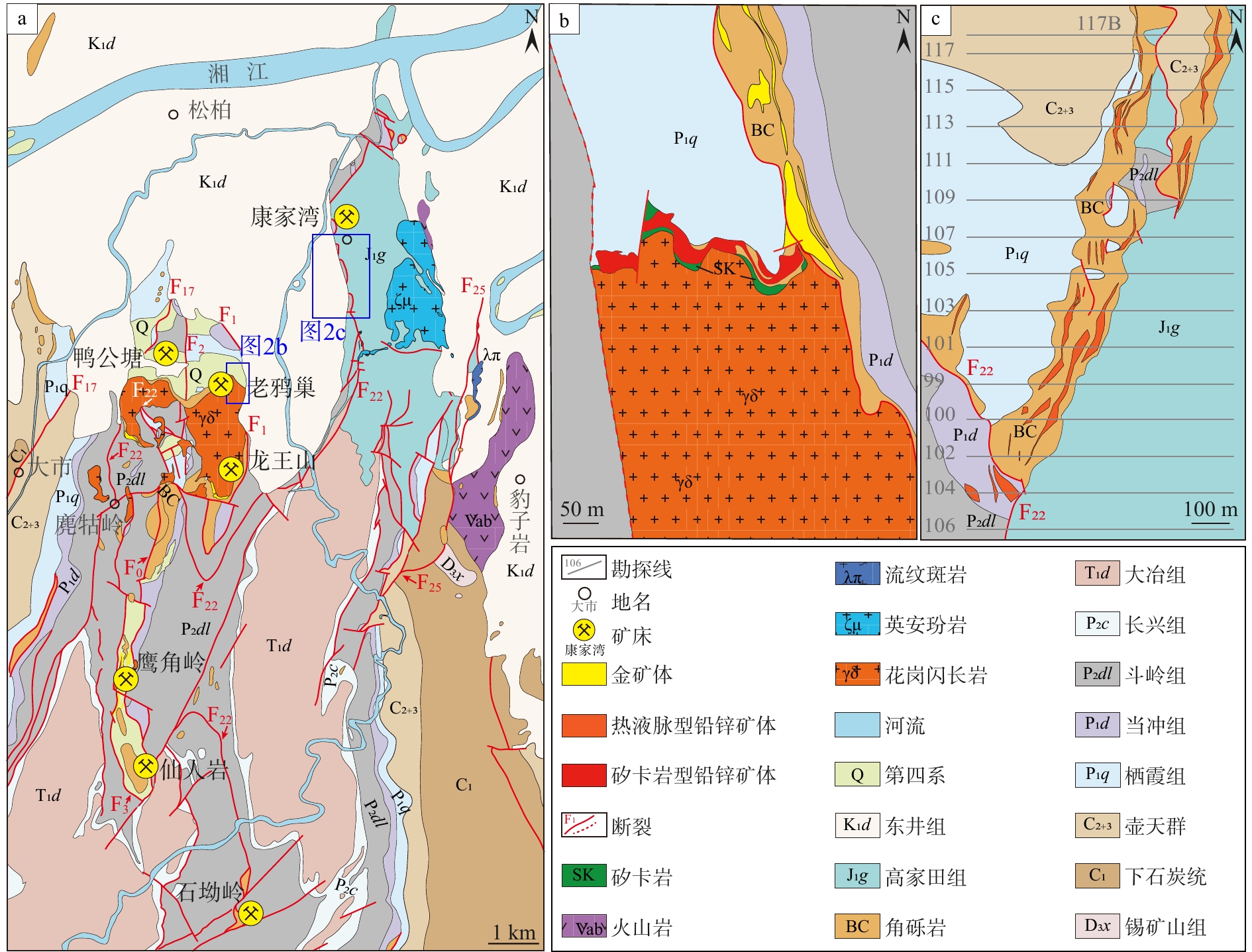
图 2 水口山矿田地质简图与老鸦巢、康家湾矿床地质平面图
a—水口山矿田地质简图(据李能强和彭超,1996修改);b—老鸦巢11中段地质平面图;c—康家湾12中段地质平面图
Figure 2. Simplified geological map of the Shuikoushan ore field and geological plan maps of the Laoyachao and Kangjiawan deposits
(a) Simplified geological map of the Shuikoushan ore field (modified after Li and Peng, 1996); (b) Geological plan map of the Laoyachao deposit at mining level 11; (c) Geological plan map of the Kangjiawan deposit at mining level 12
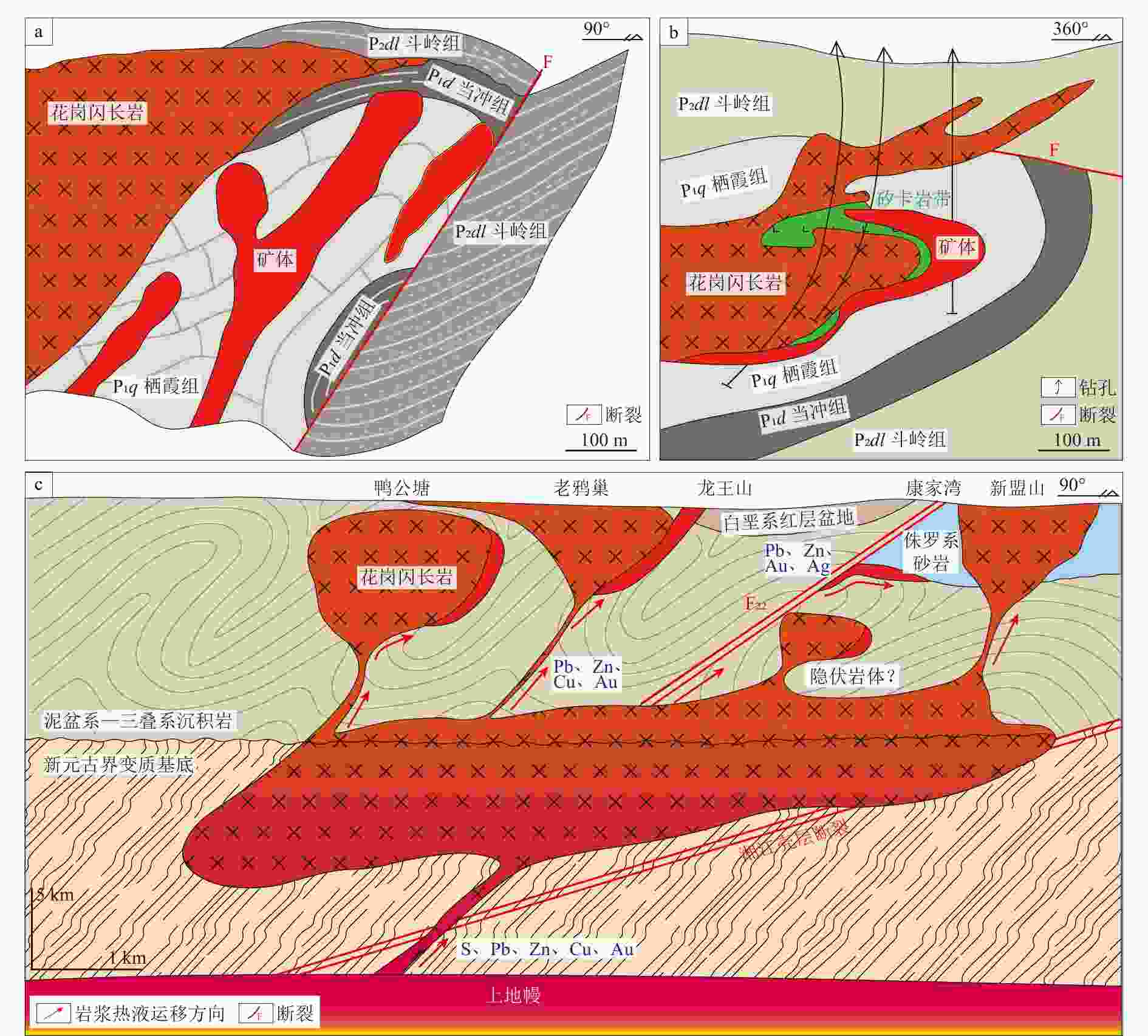
图 3 不同时期的水口山矿田找矿模型
a—接触带控矿模型(张有正,1957);b—“三角带”找矿模型(李能强和彭超,1996);c—多因复成成矿模式(杨传益,1985)
Figure 3. Prospecting models for the Shuikoushan ore field developed at different times
(a) Contact-zone ore-control model (Zhang, 1957); (b) "Triangular belt" prospecting model (Li and Peng, 1996); (c) Metallogenic model of polygenetic superposition (Yang, 1985)
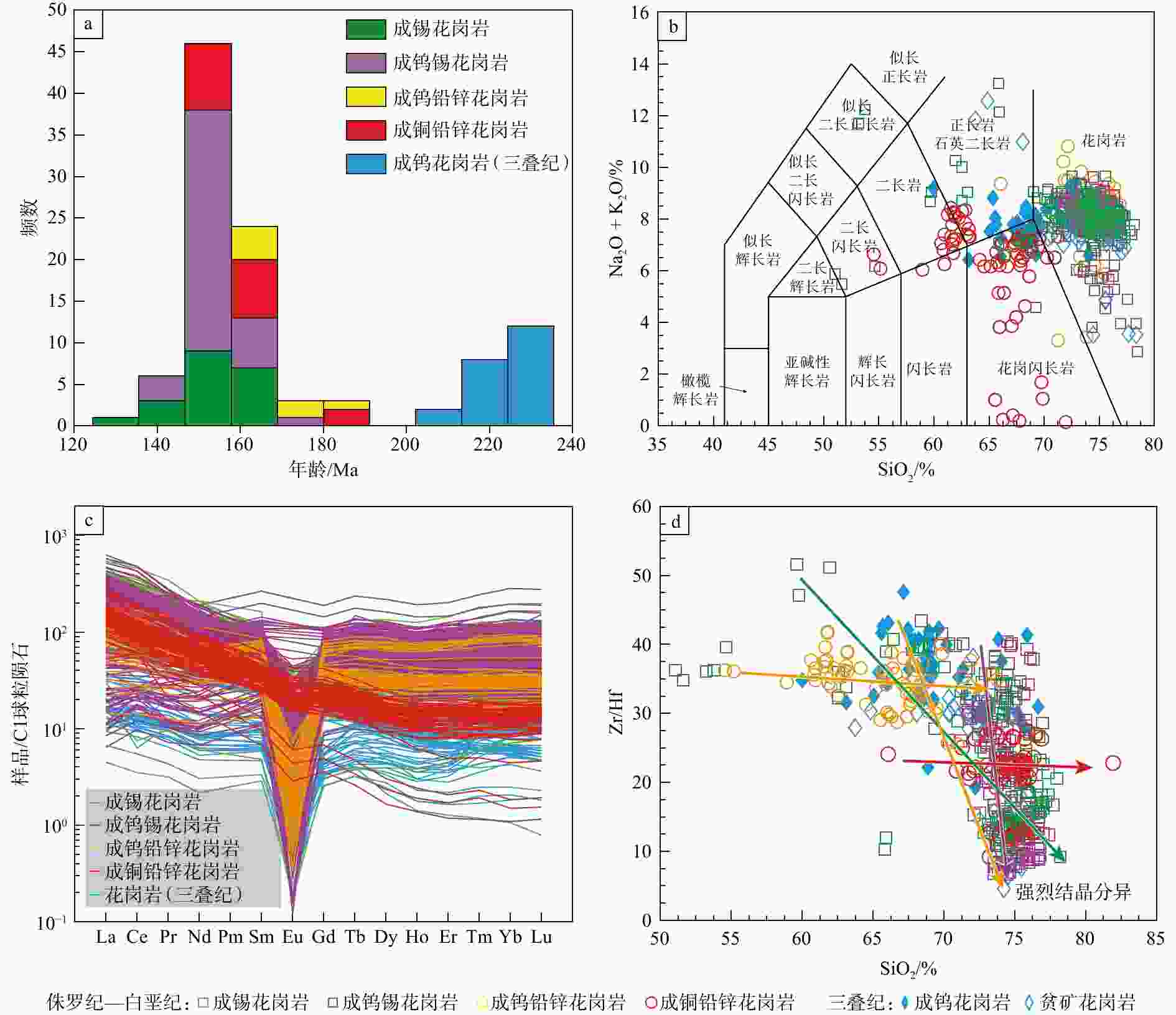
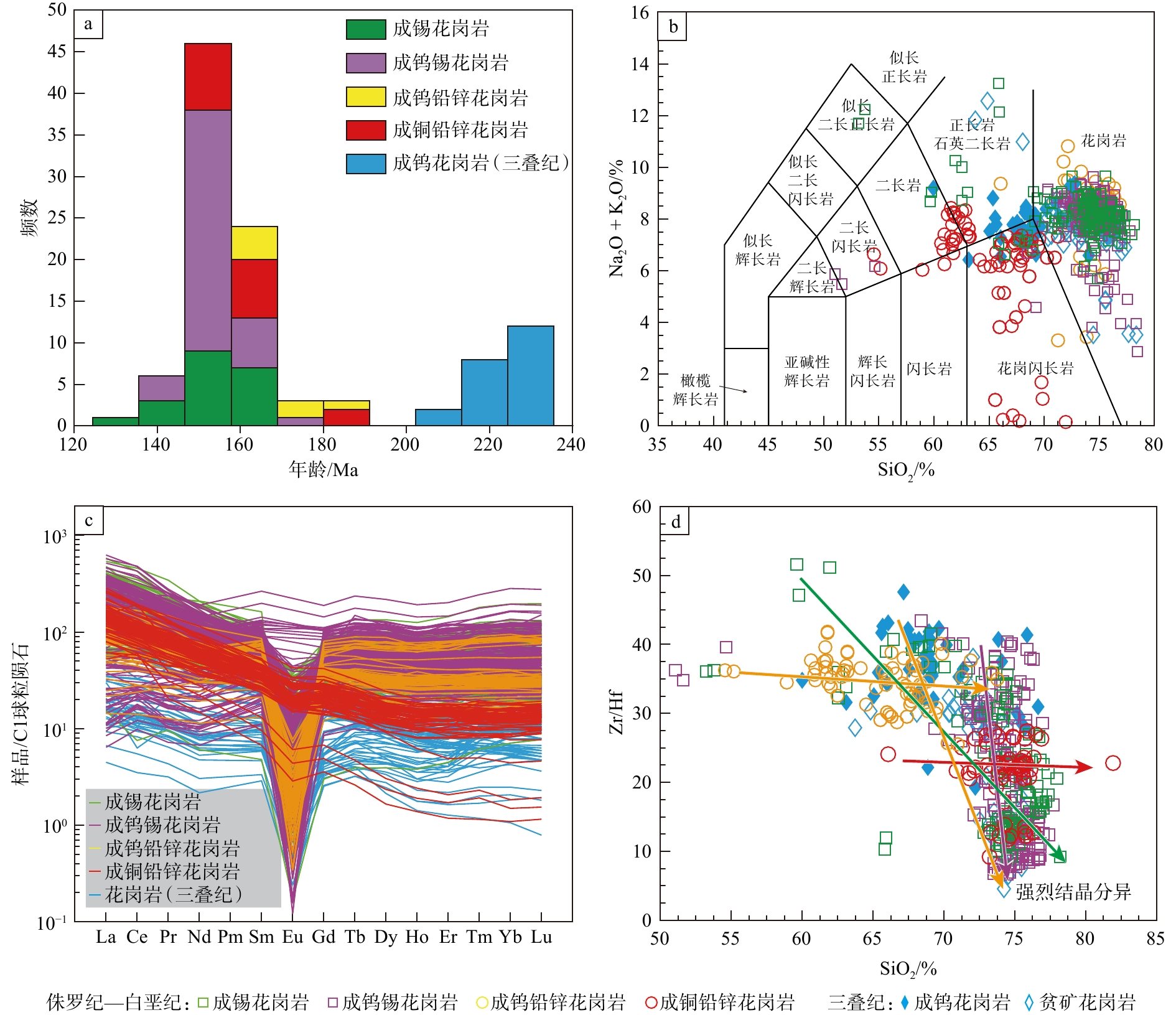
图 4 南岭中段岩浆活动期次与岩浆成分图解(数据来源参见附加材料表1)
a—成矿有关花岗岩锆石U-Pb年龄频率图;b—SiO2−(Na2O+K2O)图解;c—稀土元素蛛网图;d—SiO2−Zr/Hf图解
Figure 4. Magmatic episodes and intrusion compositions in the middle Nanling belt (data sources are listed in Appendix Table 1)
(a) Summary of zircon U–Pb ages of mineralized granites; (b) SiO2 vesus (Na2O+K2O) diagram; (c) Rare earth element patterns; (d) SiO2 vesus Zr/Hf diagram
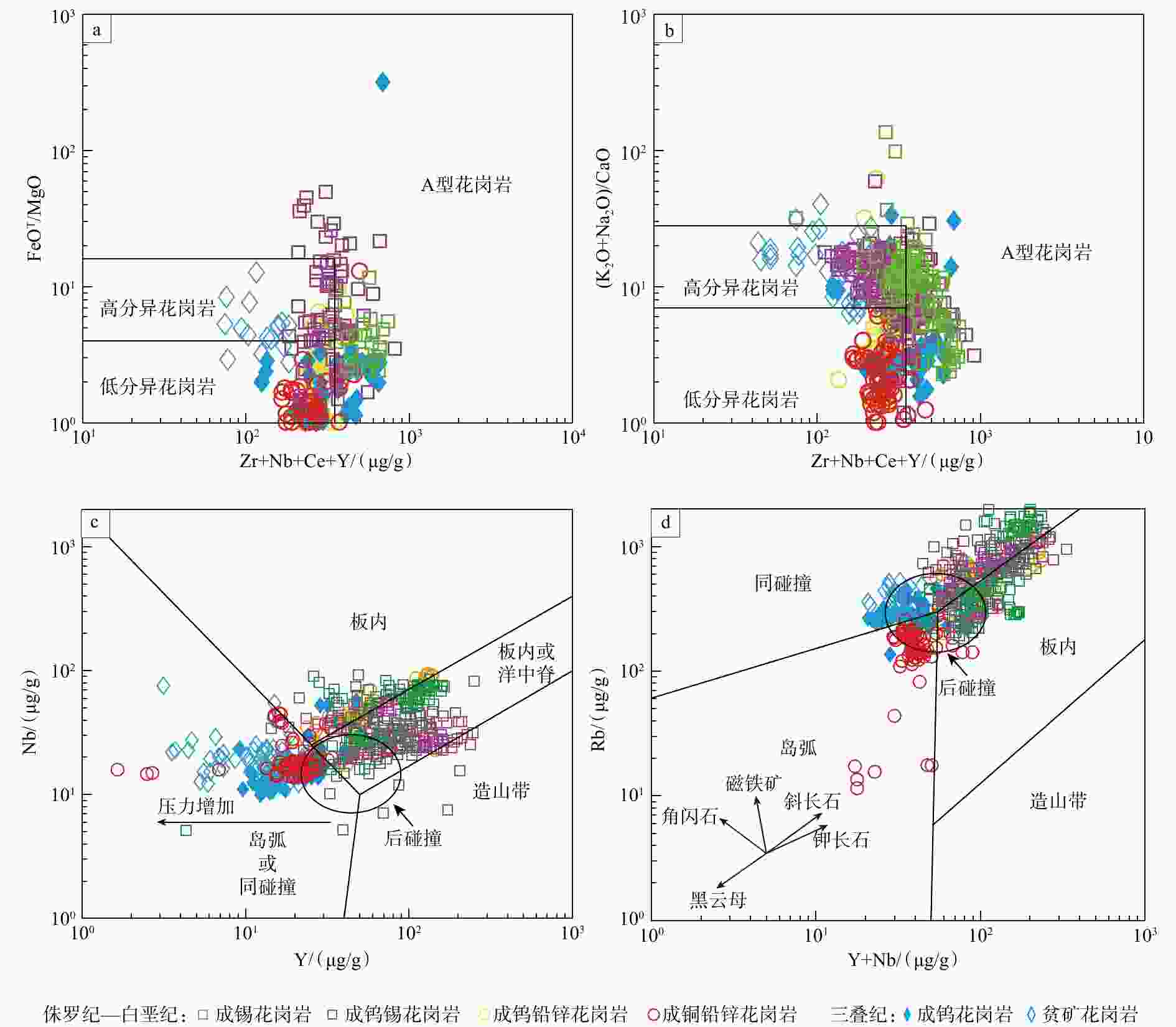
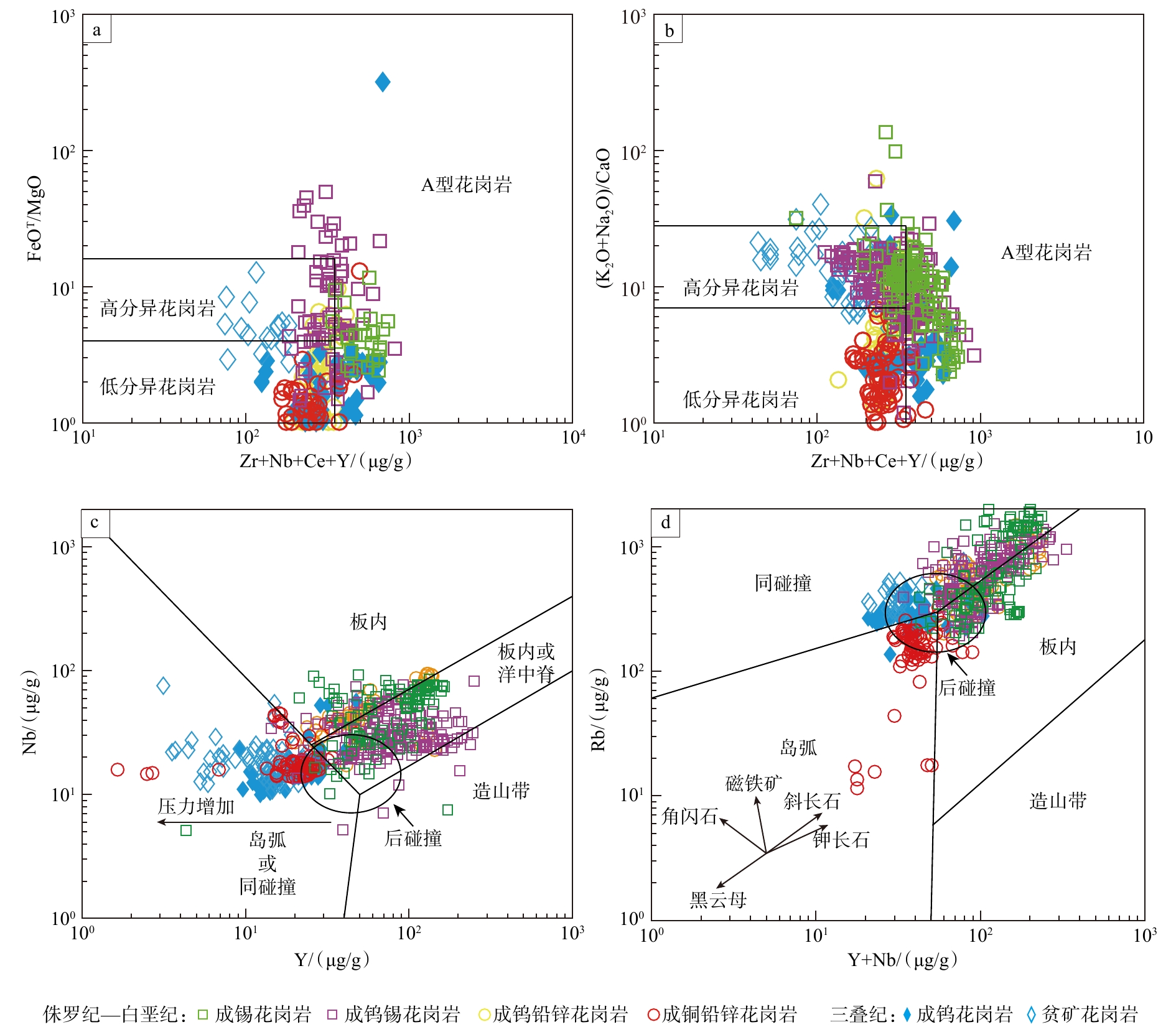
图 5 南岭中段岩浆分异程度与构造环境判别图(数据来源同图4)
a—(Zr+Nb+Ce+Y)−FeOT/MgO图解;b—(Zr+Nb+Ce+Y)−(K2O+Na2O)/CaO图解;c—Y−Nb图解;d—(Y+Nb)−Rb图解
Figure 5. Magma differentiation and tectonic setting discrimination diagrams for the middle Nanling belt (data sources are the same as those for Fig. 4)
(a) (Zr+Nb+Ce+Y) versus FeOT/MgO diagram; (b) (Zr+Nb+Ce+Y) versus (K2O+Na2O)/CaO diagram; (c) Y versus Nb diagram; (d) (Y+Nb) versus Rb diagram
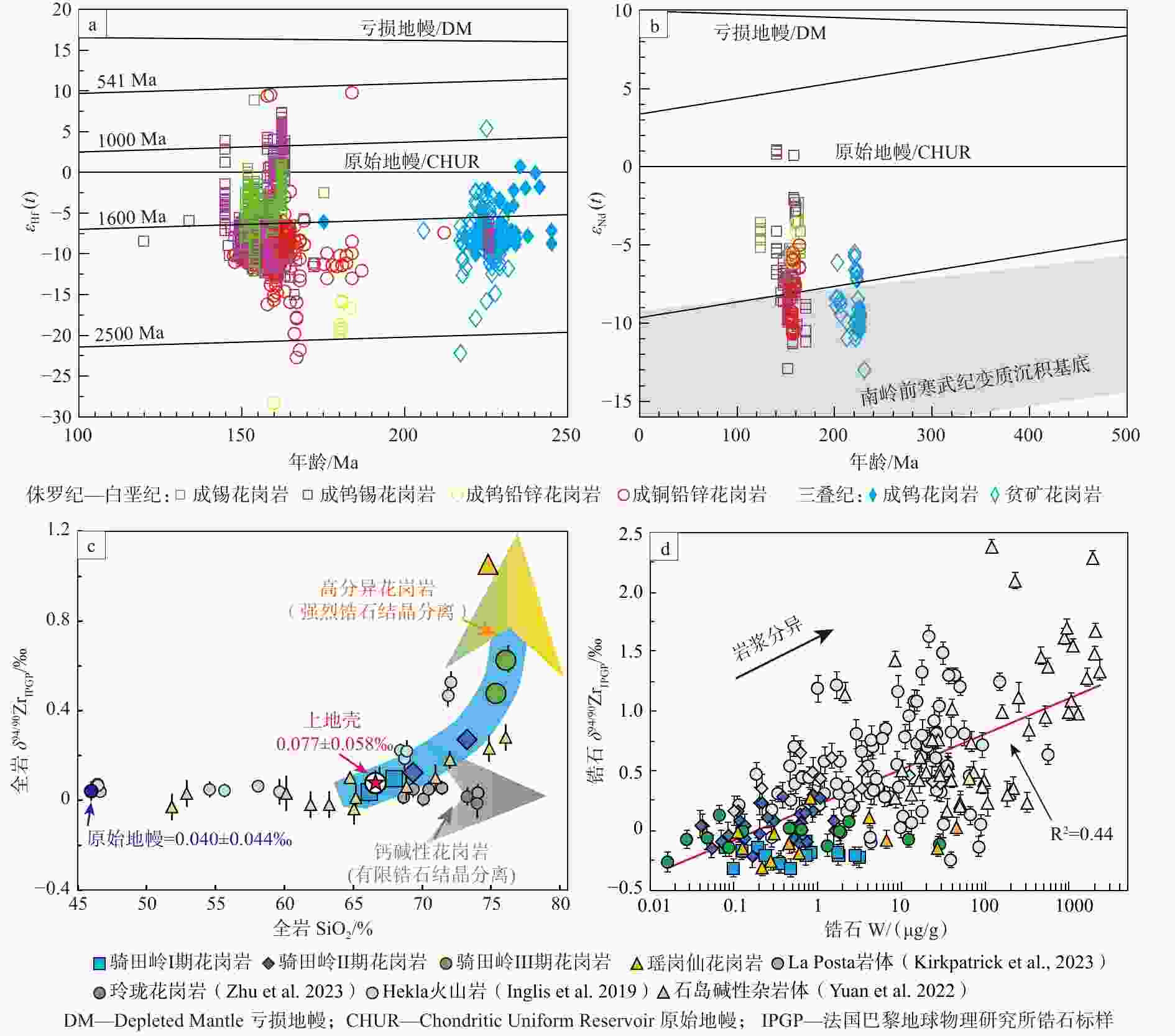
图 6 南岭中段岩浆岩Hf-Nd同位素解耦与锆同位素分异成矿指示图(王炯辉,2024;Wang et al.,2025)
a—锆石年龄−εHf(t)图解;b—岩体年龄−εNd(t)图解;c—全岩SiO2−全岩δ94/90ZrIPGP图解;d—锆石W−锆石δ94/90ZrIPGP图解
Figure 6. Diagrams showing the decoupling of Hf-Nd isotopes and zircon isotope indicators for the mineralization potential in the middle Nanling belt (Wang, 2024; Wang et al., 2025)
(a) Zircon age vesus εHf(t) diagram; (b) Intrusion age vesus εNd(t) diagram; (c) Whole-rock SiO2 vesus δ94/90ZrIPGP diagram; (d) Zircon W vesus δ94/90ZrIPGP diagram
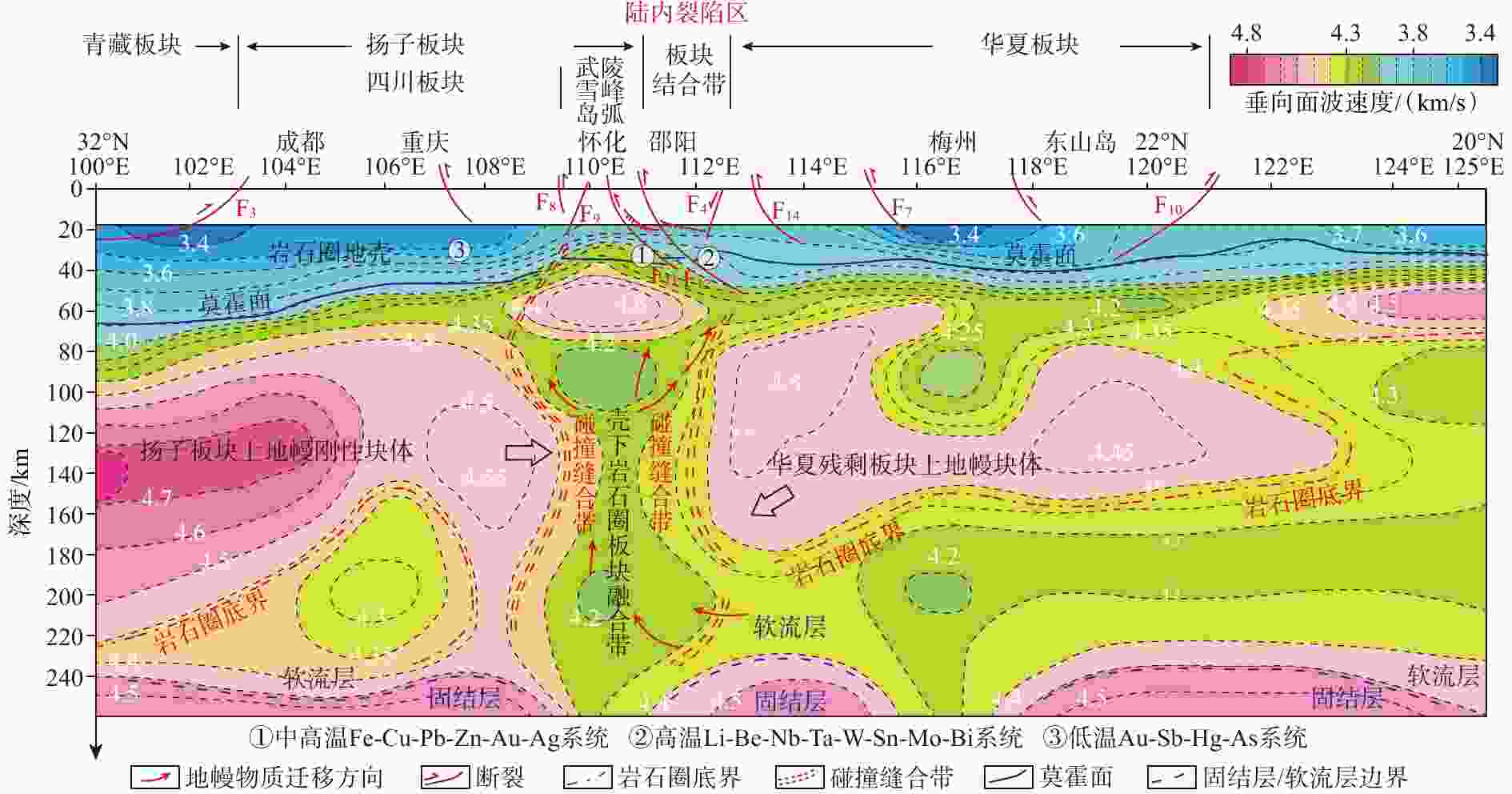
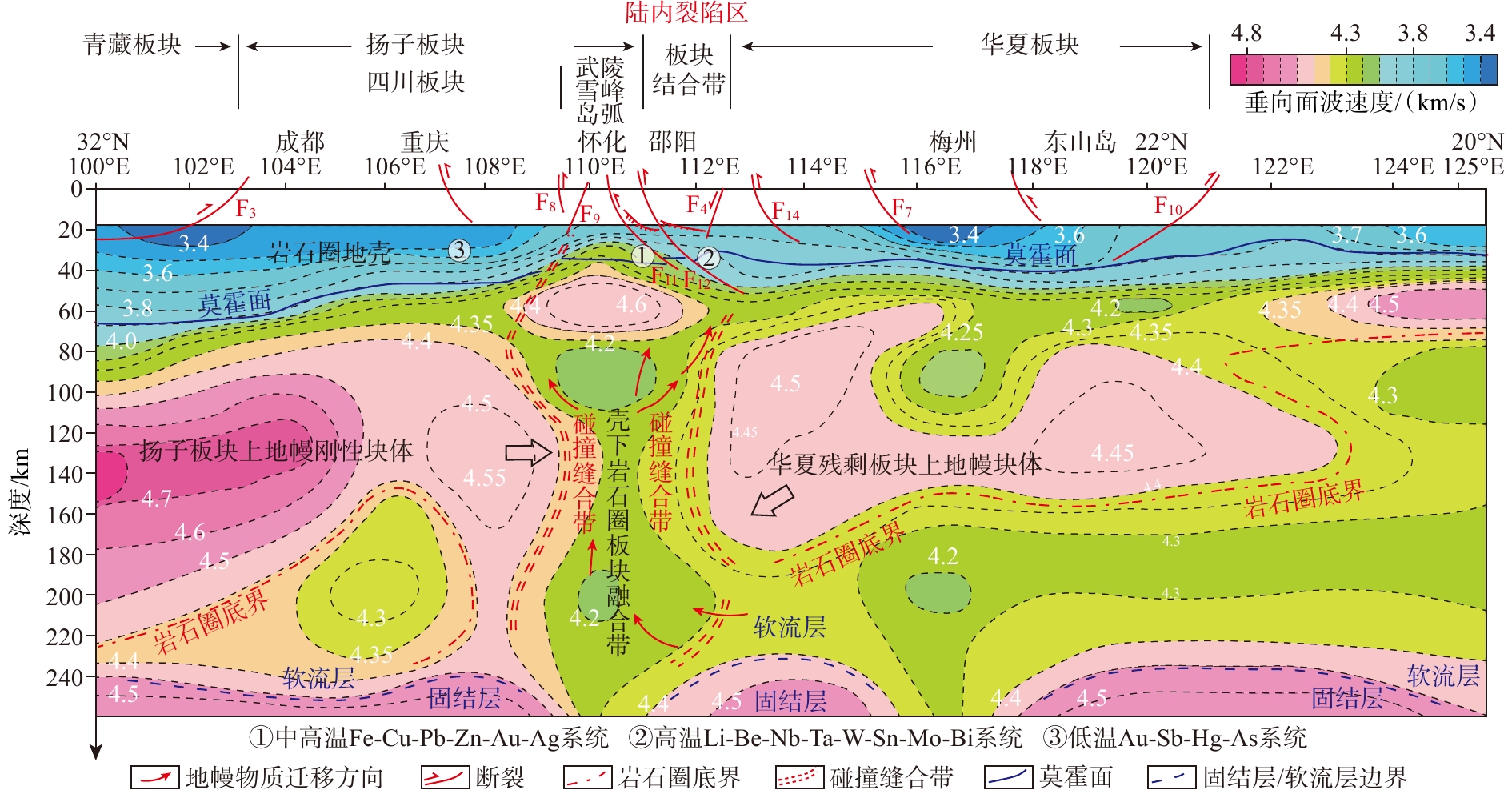
图 7 邛崃山—东山岛垂向面波速度断面和古板块推断断面图(据饶家荣等,2012修改)
Figure 7. Cross-section showing the surface-wave velocity and inferred paleo-plate section between the Qionglai Mountains and Dongshan Island (modified after Rao et al., 2012)
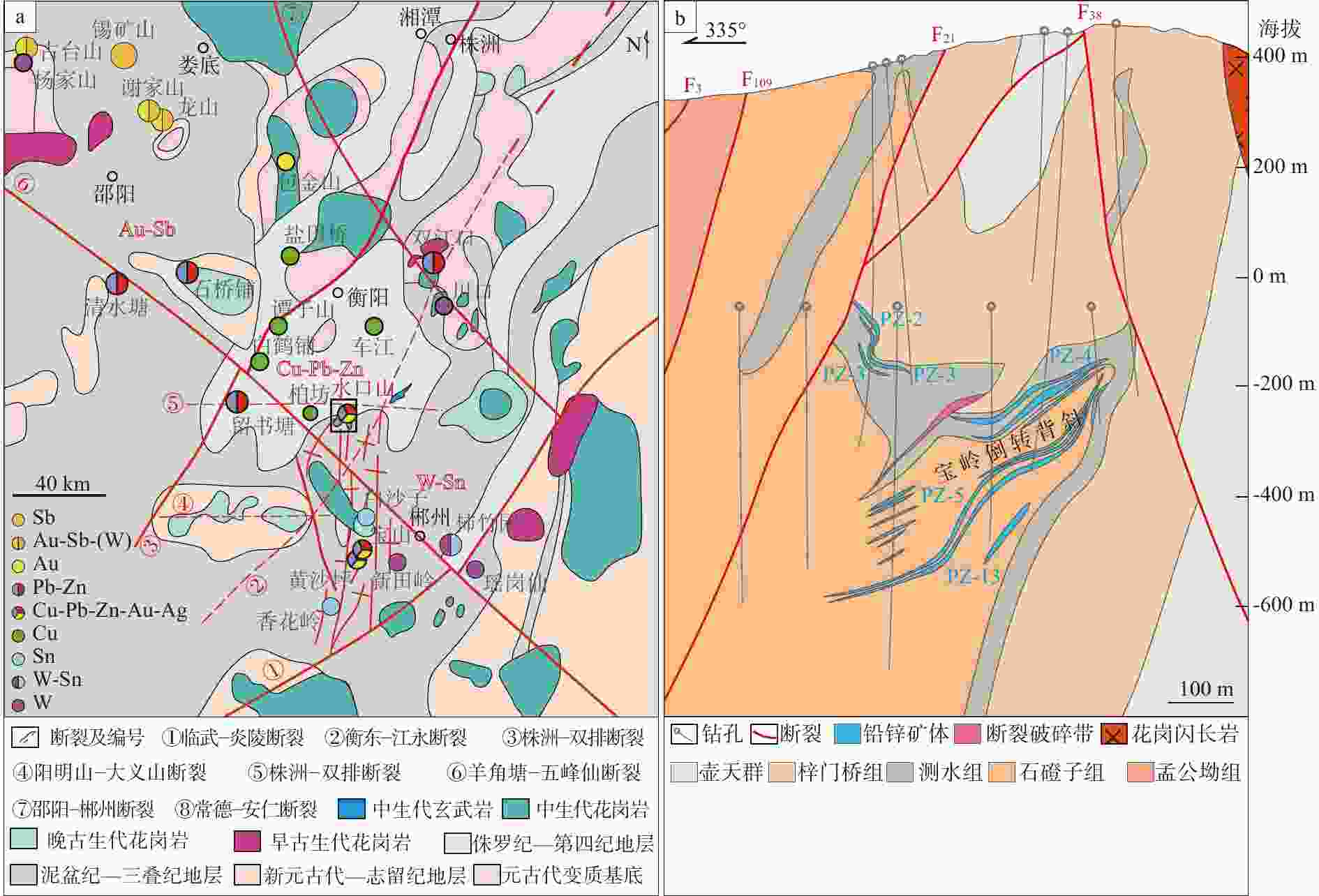
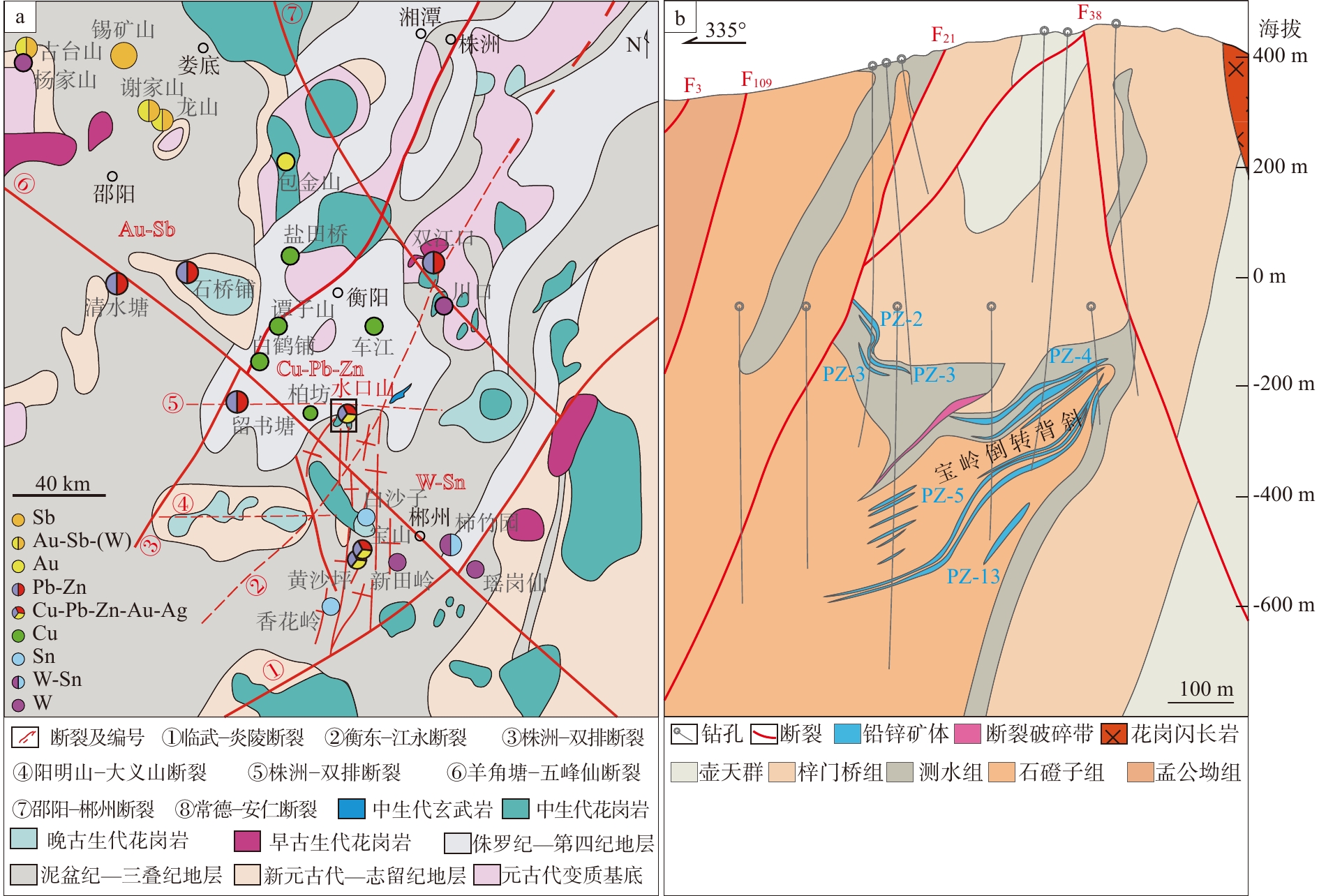
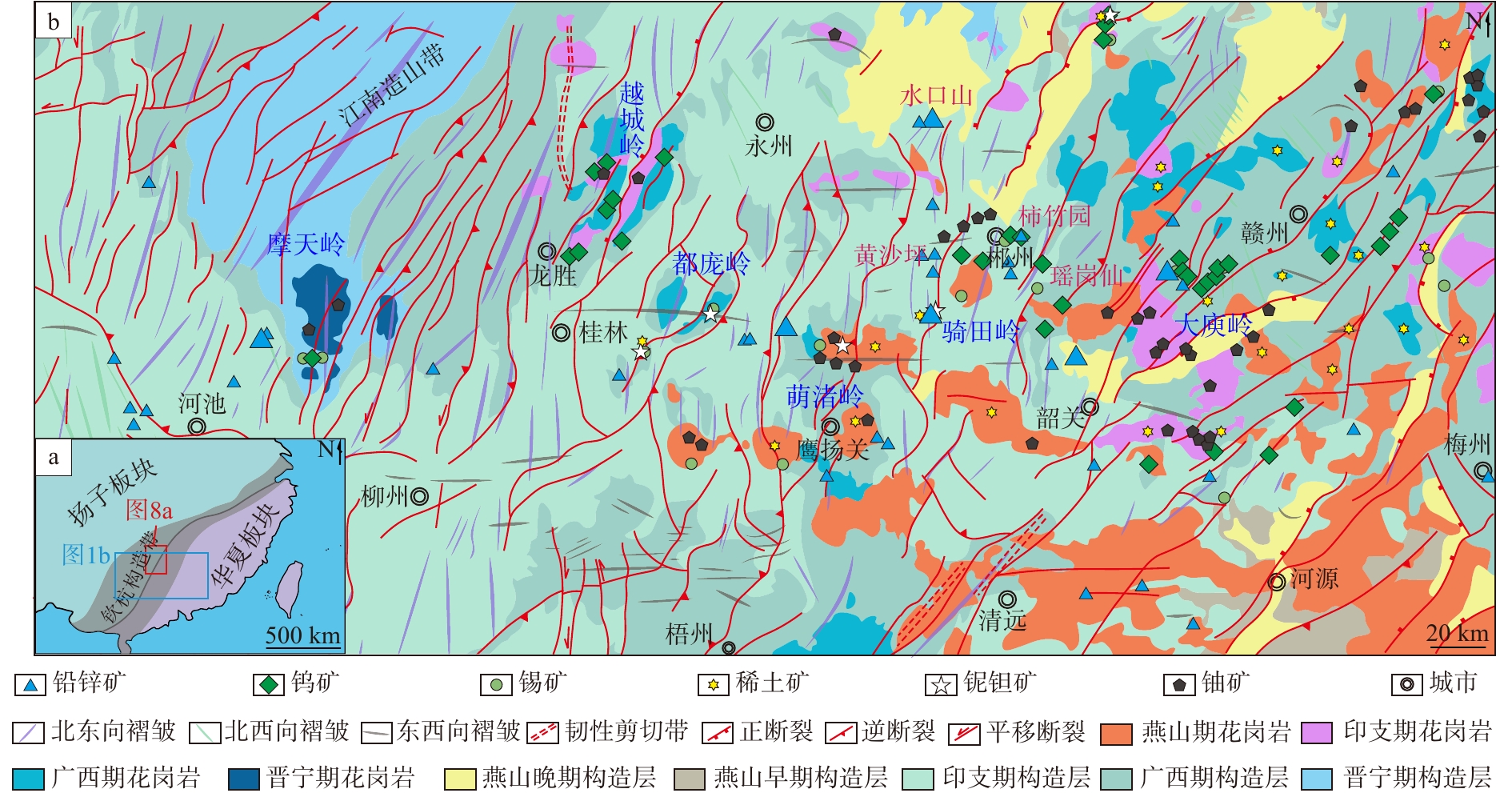
图 8 南岭中段构造地质格架简图与宝山铅锌矿典型剖面地质图(李能强和彭超,1996;谭仕敏等,2016)
a—南岭中段地质矿产简图;b—湖南宝山铅锌矿典型剖面地质图
Figure 8. Simplified tectonic framework of the middle Nanling belt and representative geological cross-section of the Baoshan Pb-Zn deposit (Li and Peng, 1996; Tan et al., 2016)
(a) Simplified geological map of the middle Nanling belt showing the location of typical mineral deposits; (b) Representative geological cross-section of the Baoshan Pb-Zn deposit in Hunan
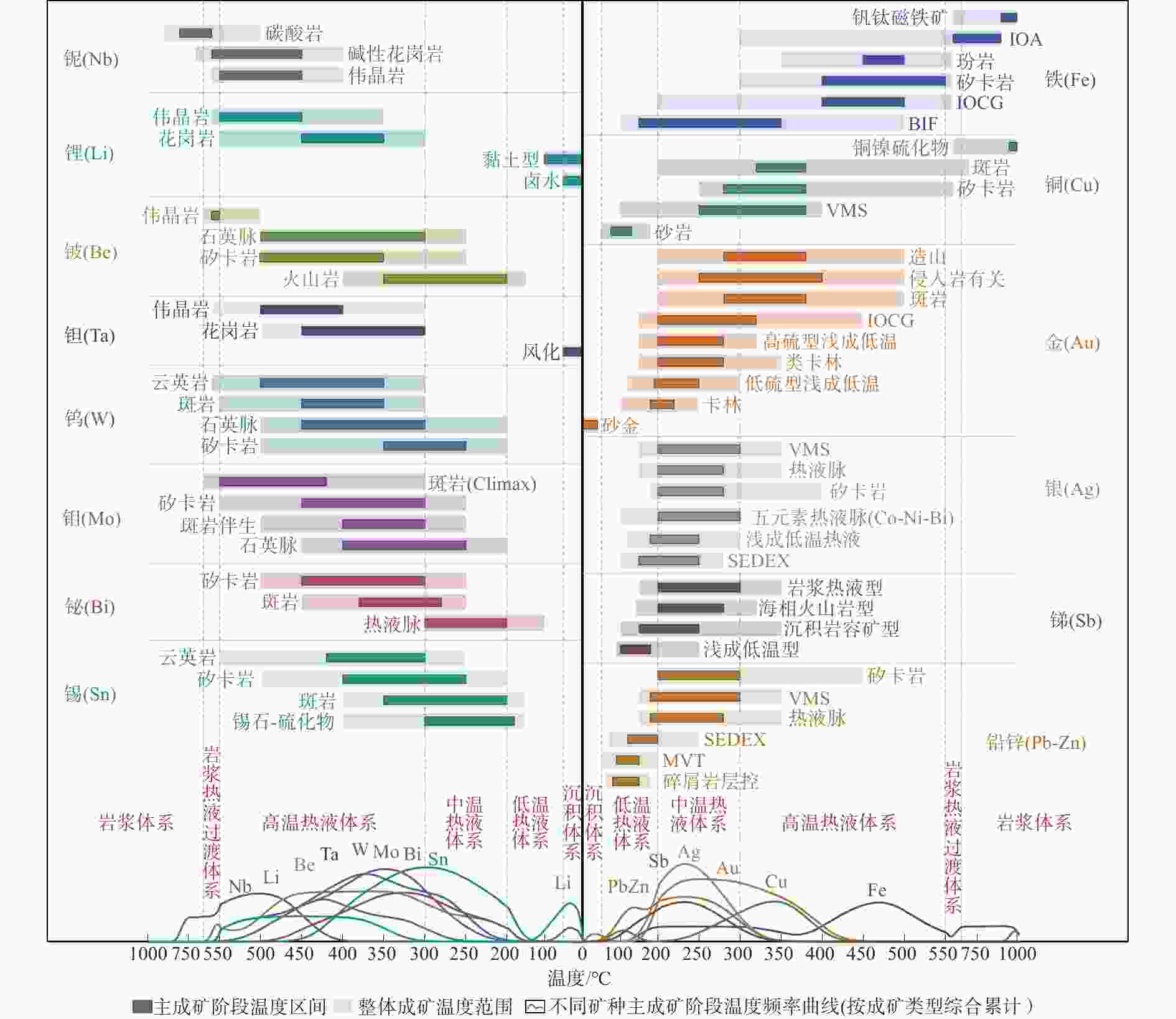
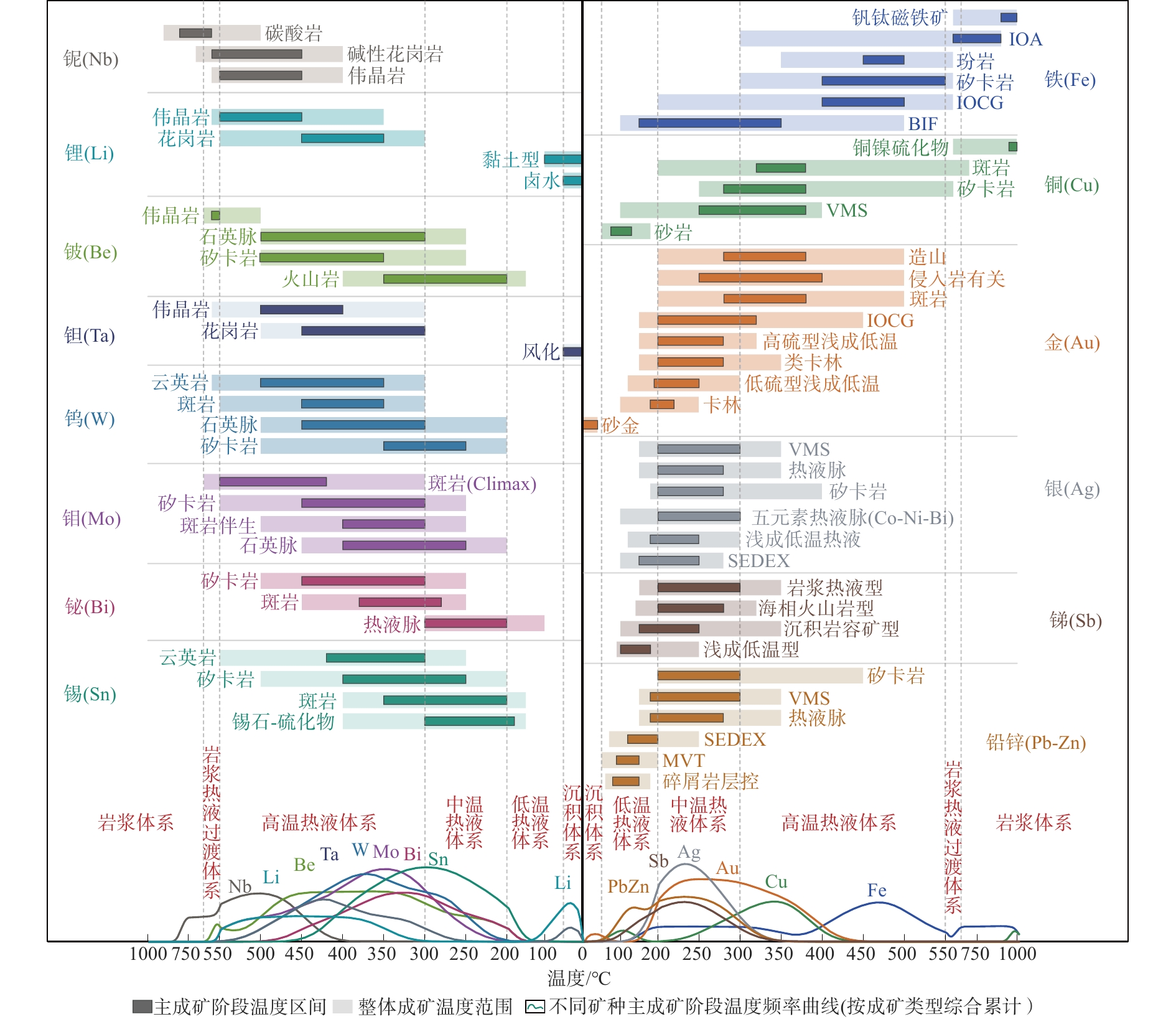
图 9 不同金属矿种典型矿床成矿温度区间统计图(数据来源见附加材料表2)
Figure 9. Summary of the mineralization temperature ranges for typical deposits of different metal commodities (data sources are listed in Appendix Table 2)
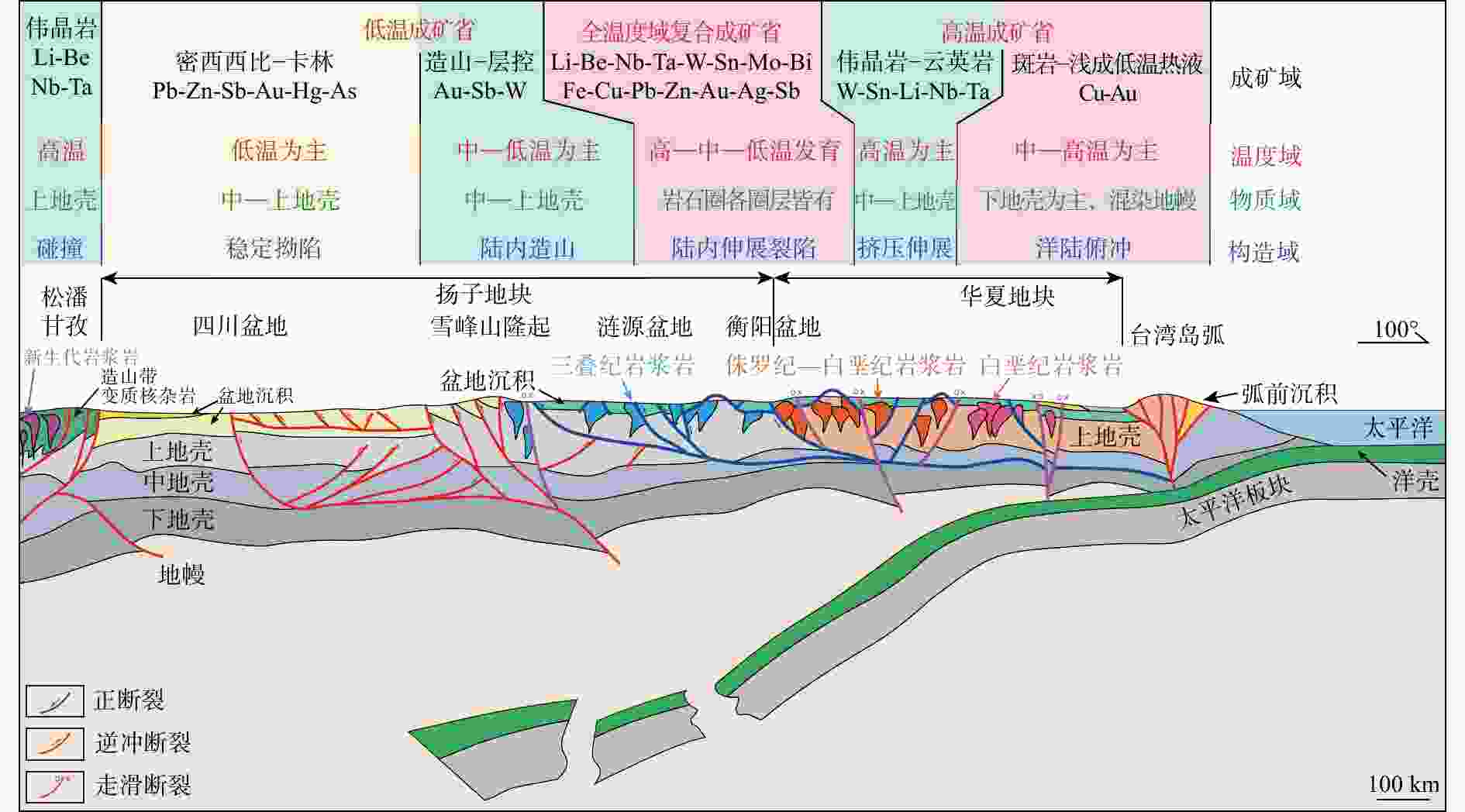
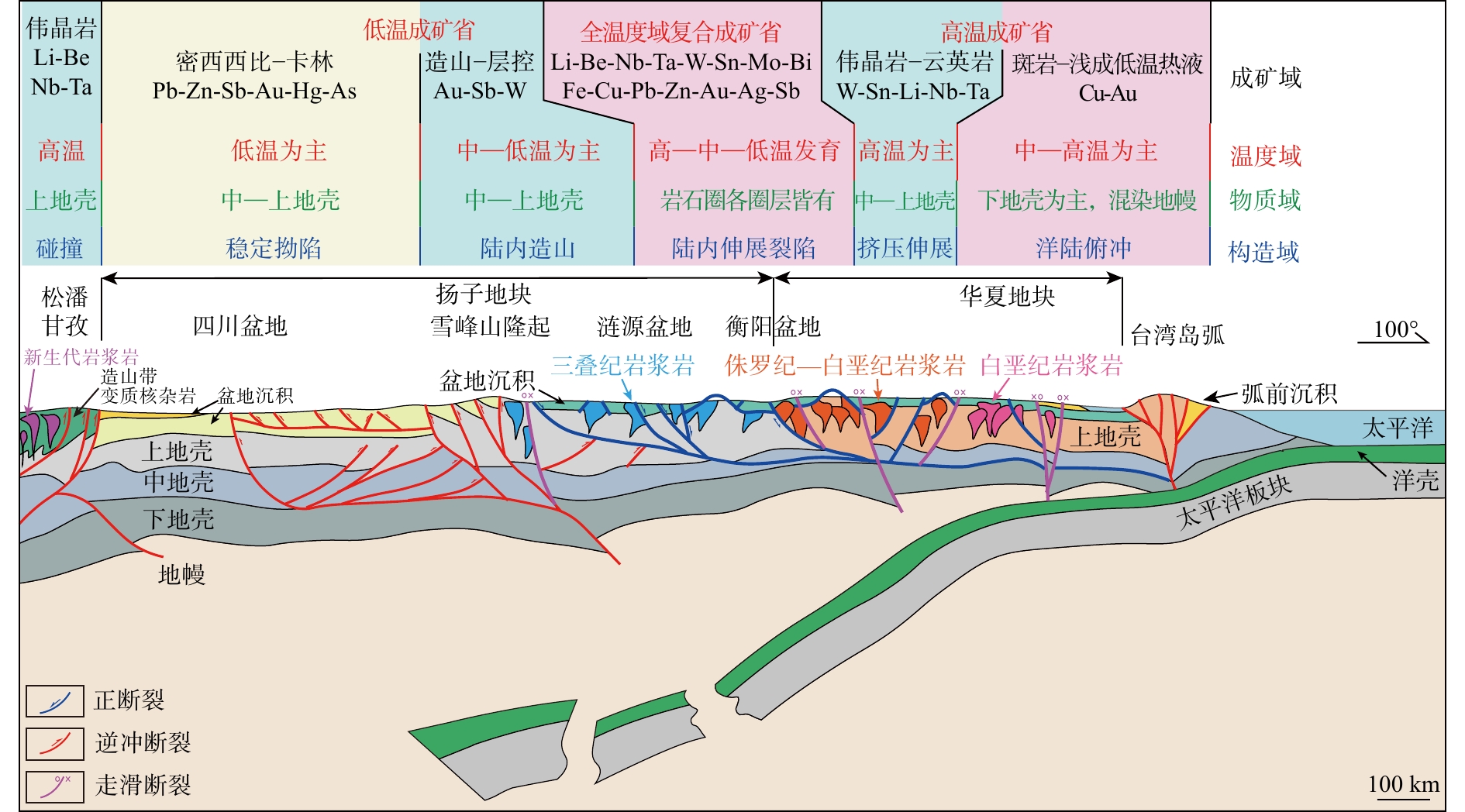
图 10 华南地区中生代成矿系统对比图(据王炯辉,2024修改)
Figure 10. Comparison of Mesozoic metallogenic systems in South China (modified after Wang, 2024)
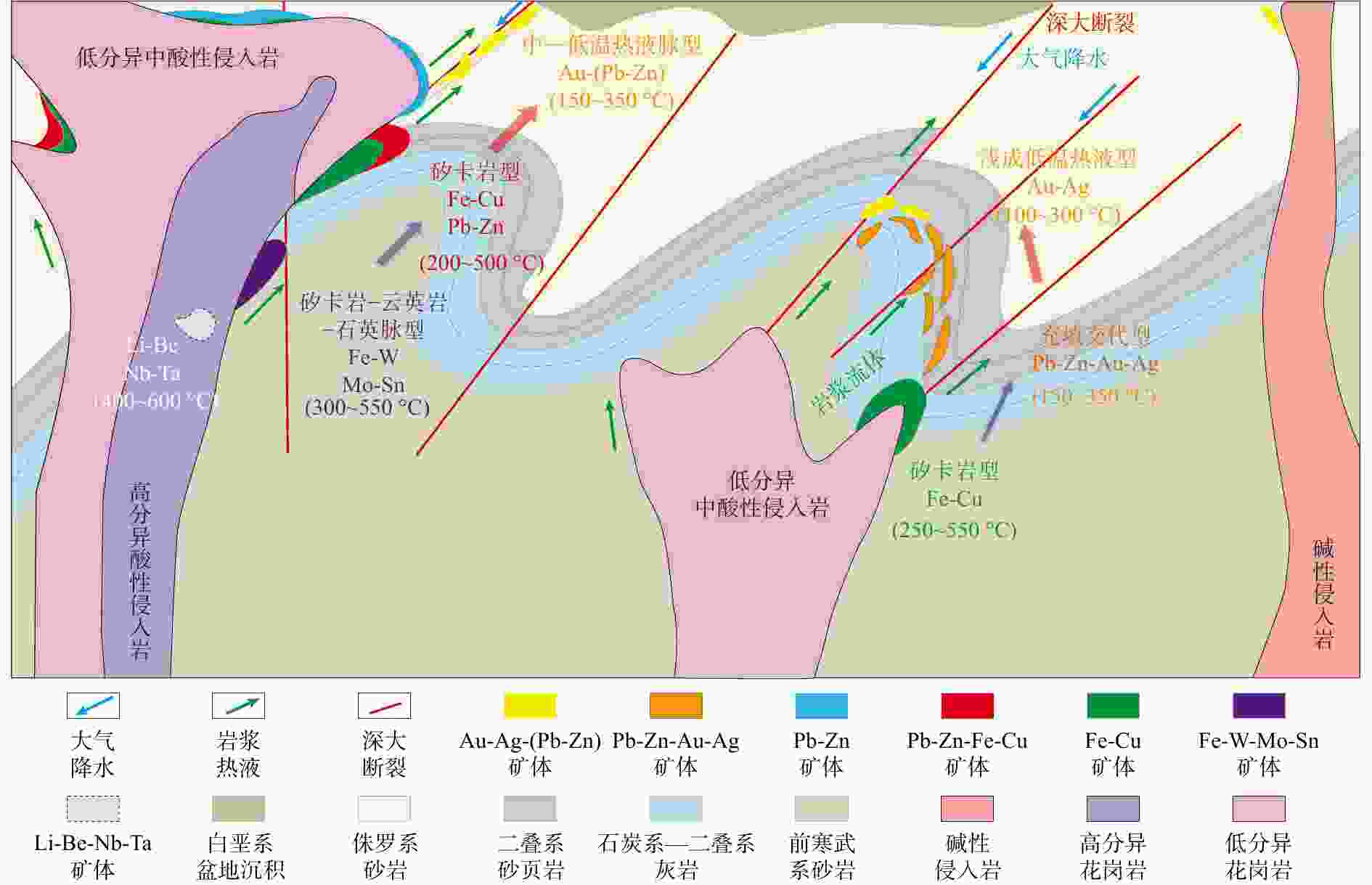
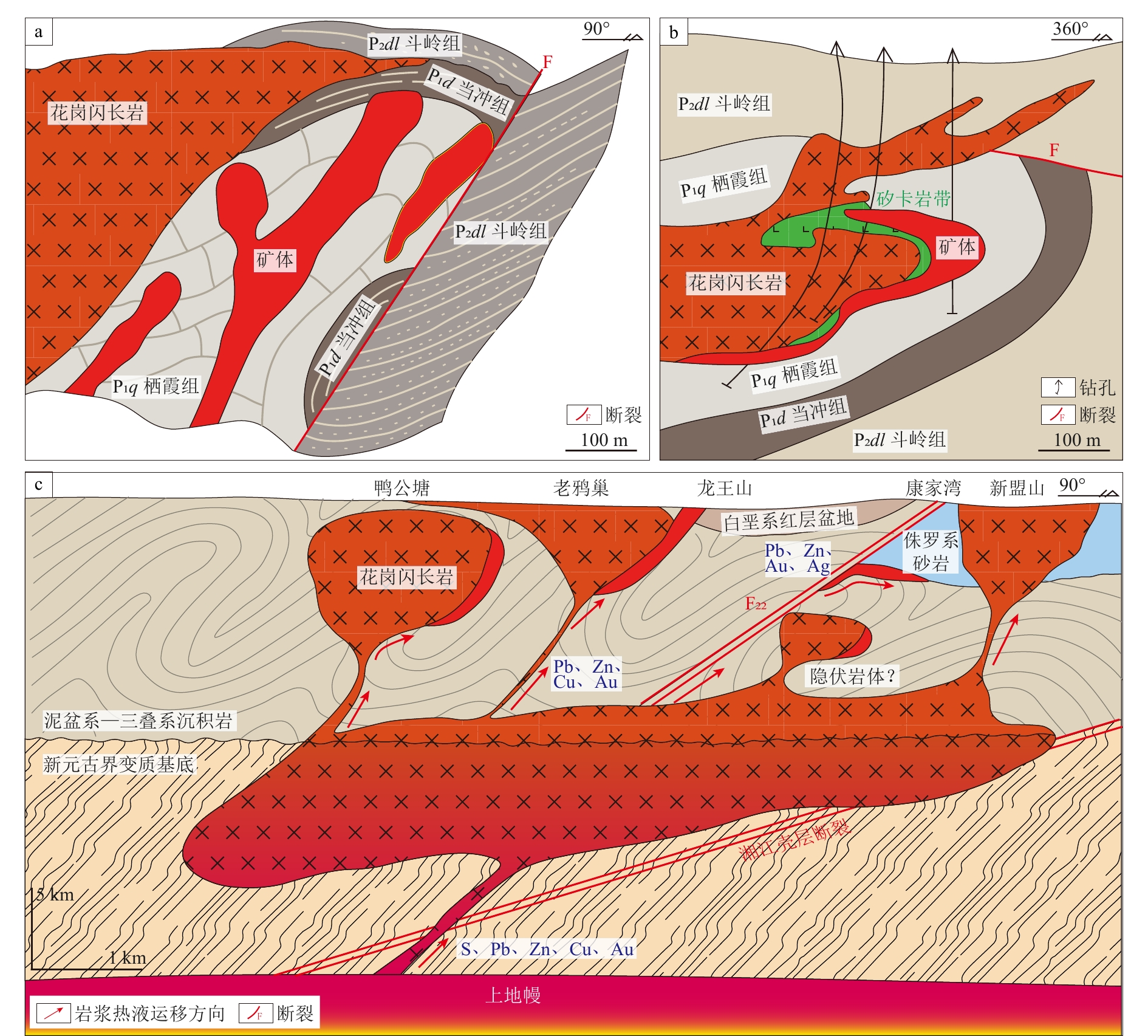
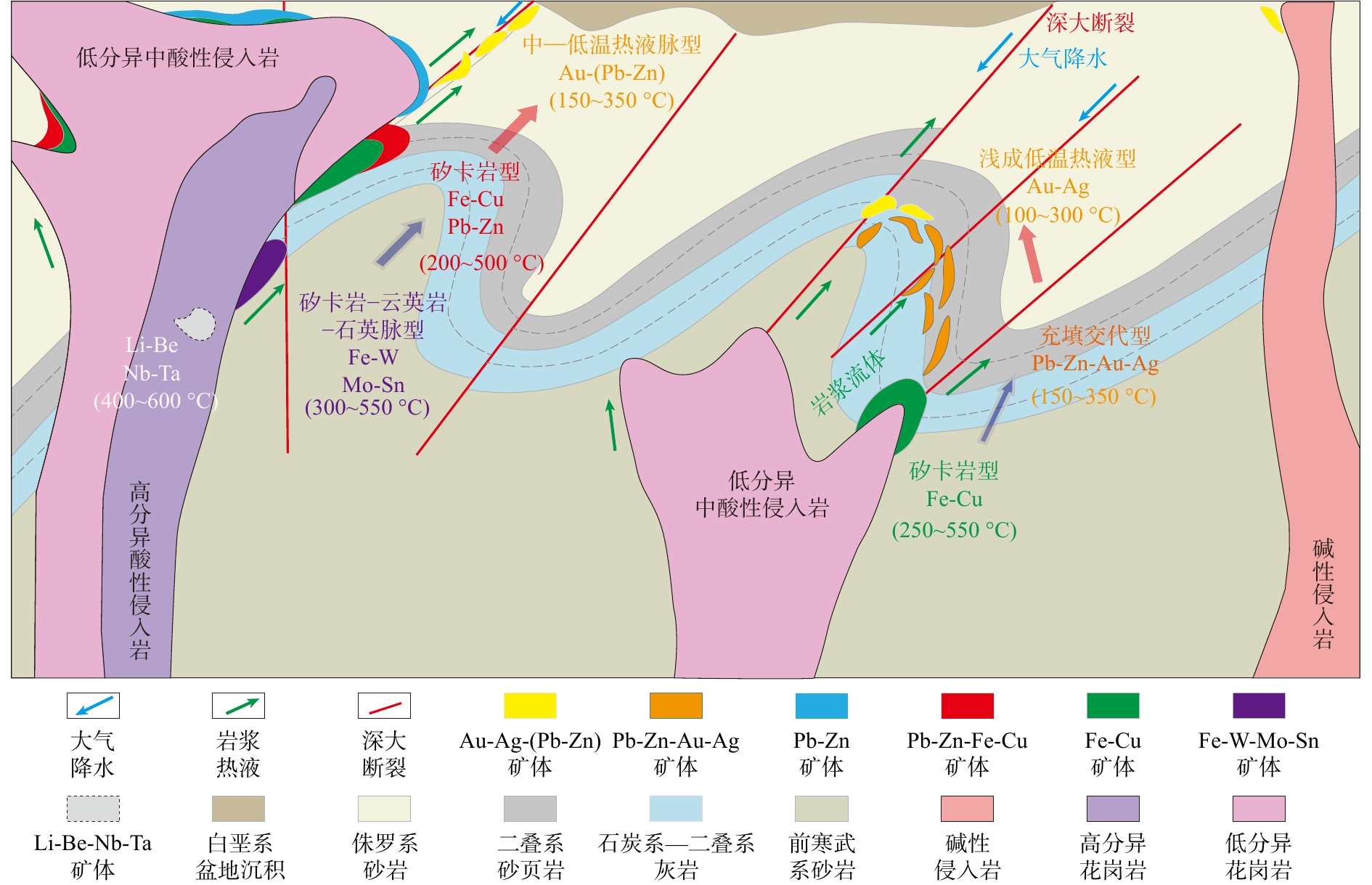
图 11 陆内伸展全温度域成矿构造模型简图与成矿要素分布图(据王炯辉,2024修改)
Figure 11. Conceptual model of the intracontinental extensional full-temperature metallogenic system (modified after Wang, 2024)
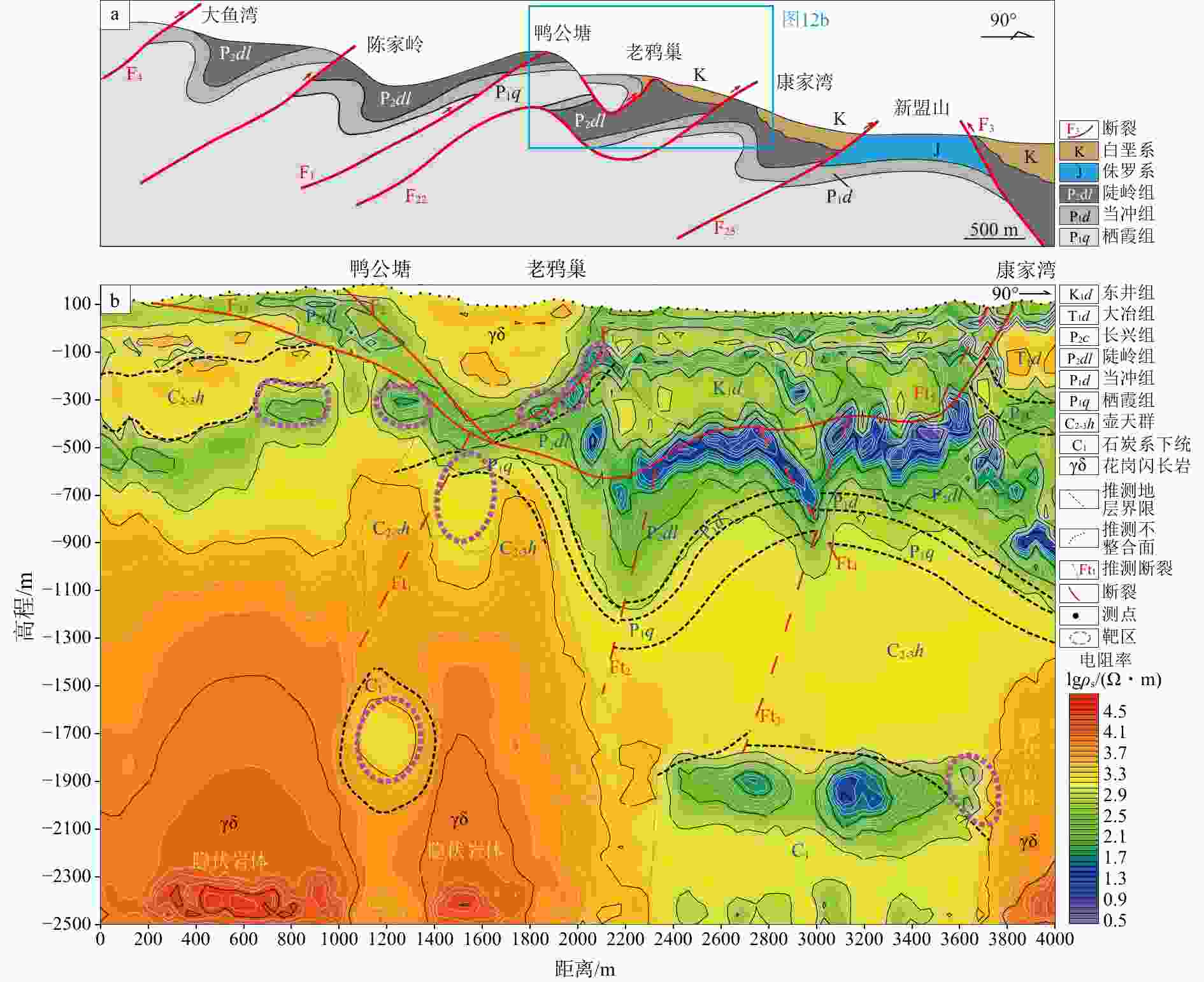
图 12 水口山矿田褶皱构造格架与典型剖面广域电磁解译图(李能强和彭超,1996;王炯辉,2024)
a—典型剖面褶皱−断裂格架图;b—老鸦巢−康家湾广域电磁测试典型剖面解译图
Figure 12. Fold-and-fault framework of the Shuikoushan ore field and wide-field electromagnetic interpretation of a typical cross-section (Li and Peng, 1996; Wang, 2024)
(a) Representative geological cross-section showing the fold-and-fault framework; (b) Interpretation of a typical wide-field electromagnetic survey section from Laoyachao to Kangjiawan
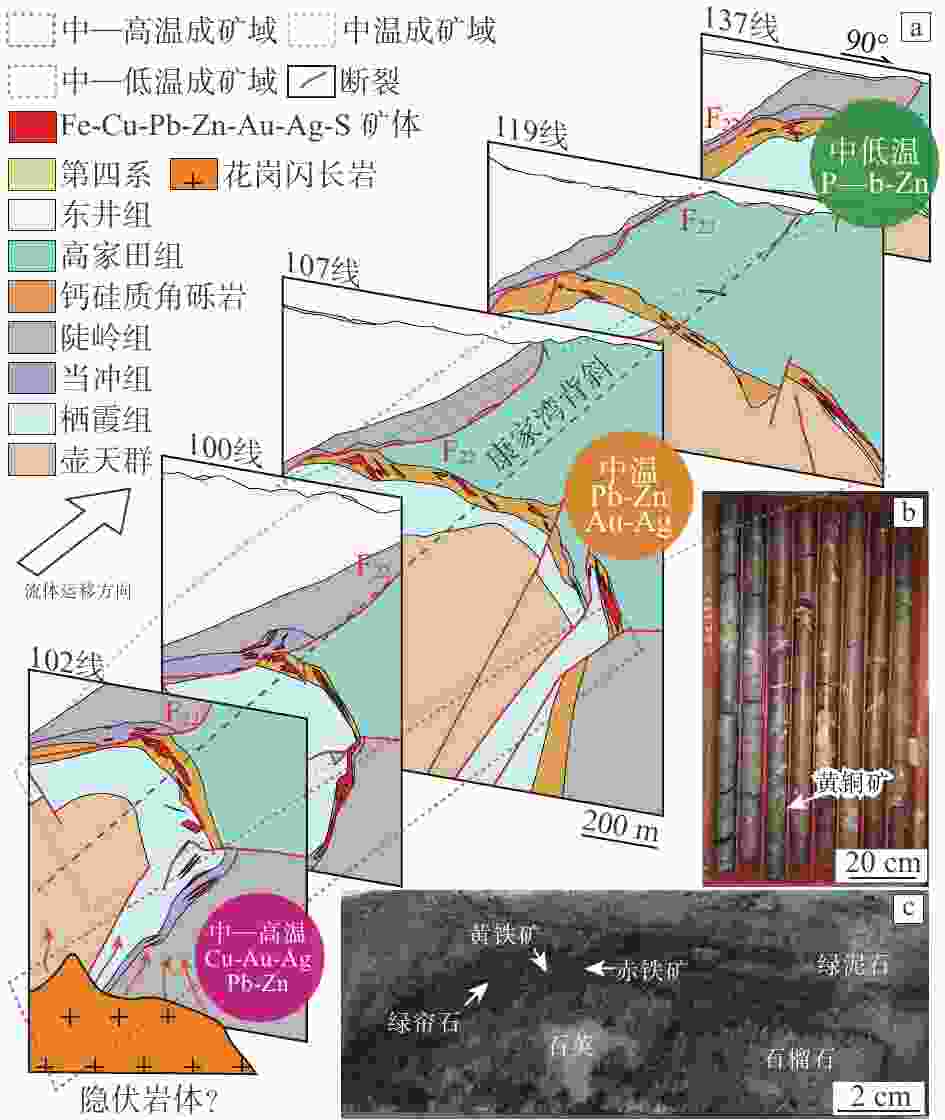
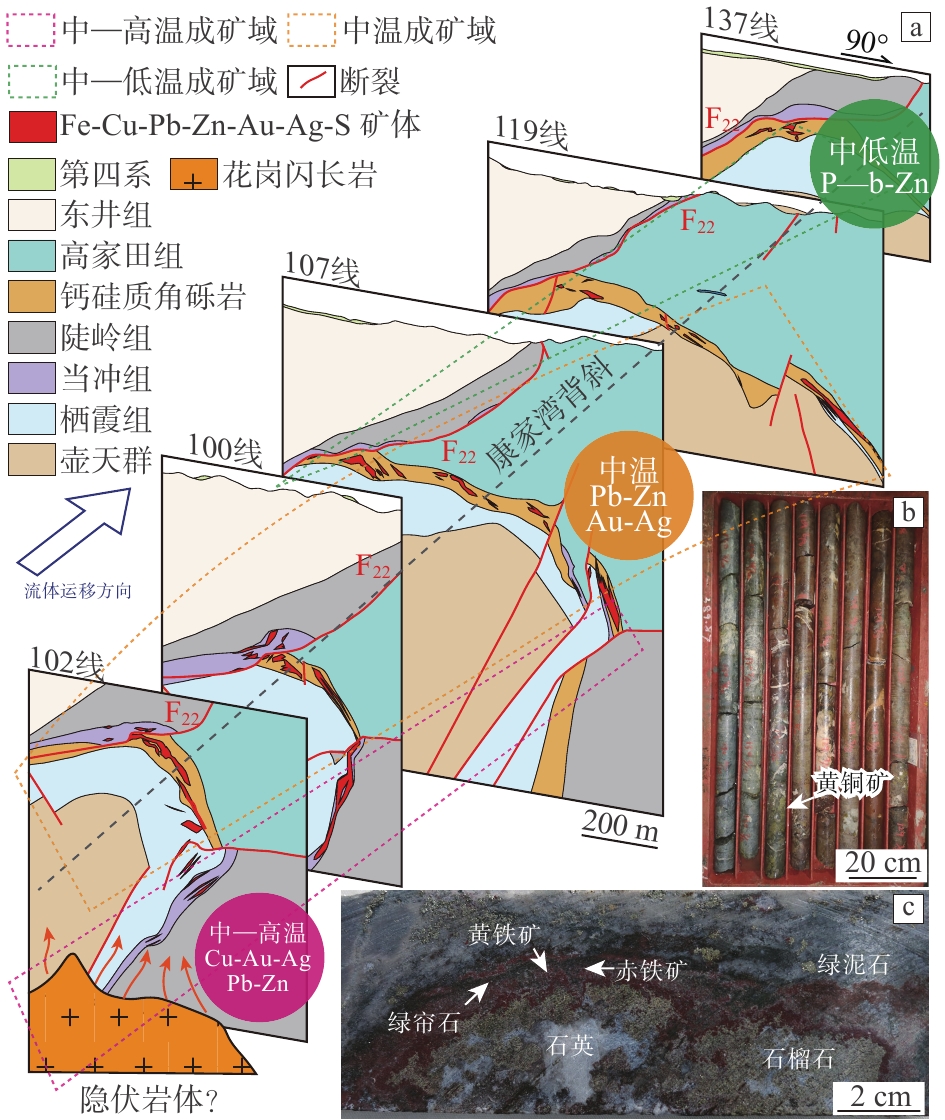
图 13 康家湾矿床倒转翼找矿空间钻探验证成果
a—典型地质剖面与不同温度域矿种分布范围;b—典型铜锌矿石岩心;c—典型矽卡岩样品
Figure 13. Drilling results from the exploration target in the overturned limb of the Kangjiawan deposit
(a) Representative geological cross-section showing the distribution of different mineral assemblages of various temperature ranges; (b) Drilling cores of typical Cu–Zn ores; (c) Typical skarn sample
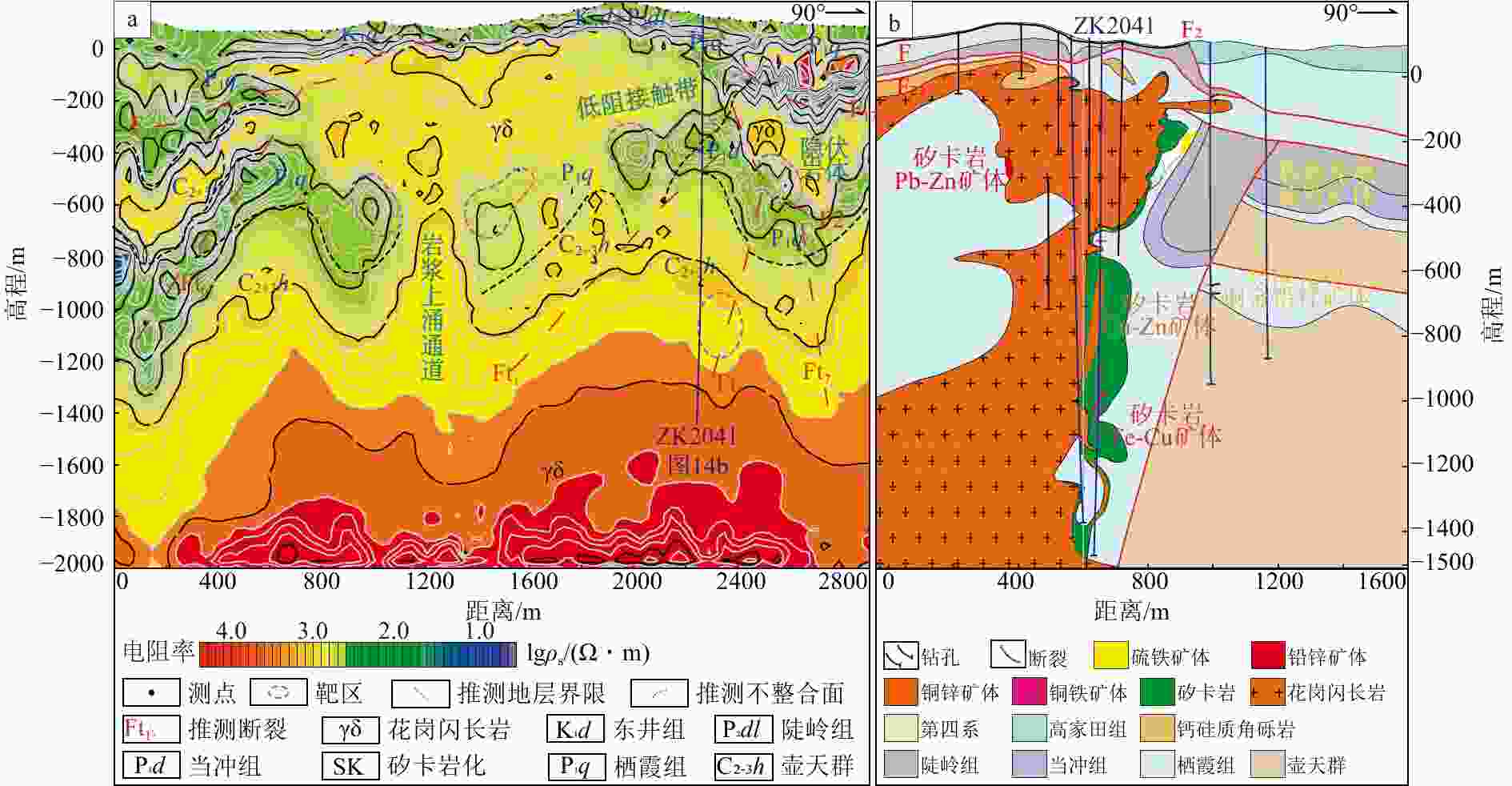
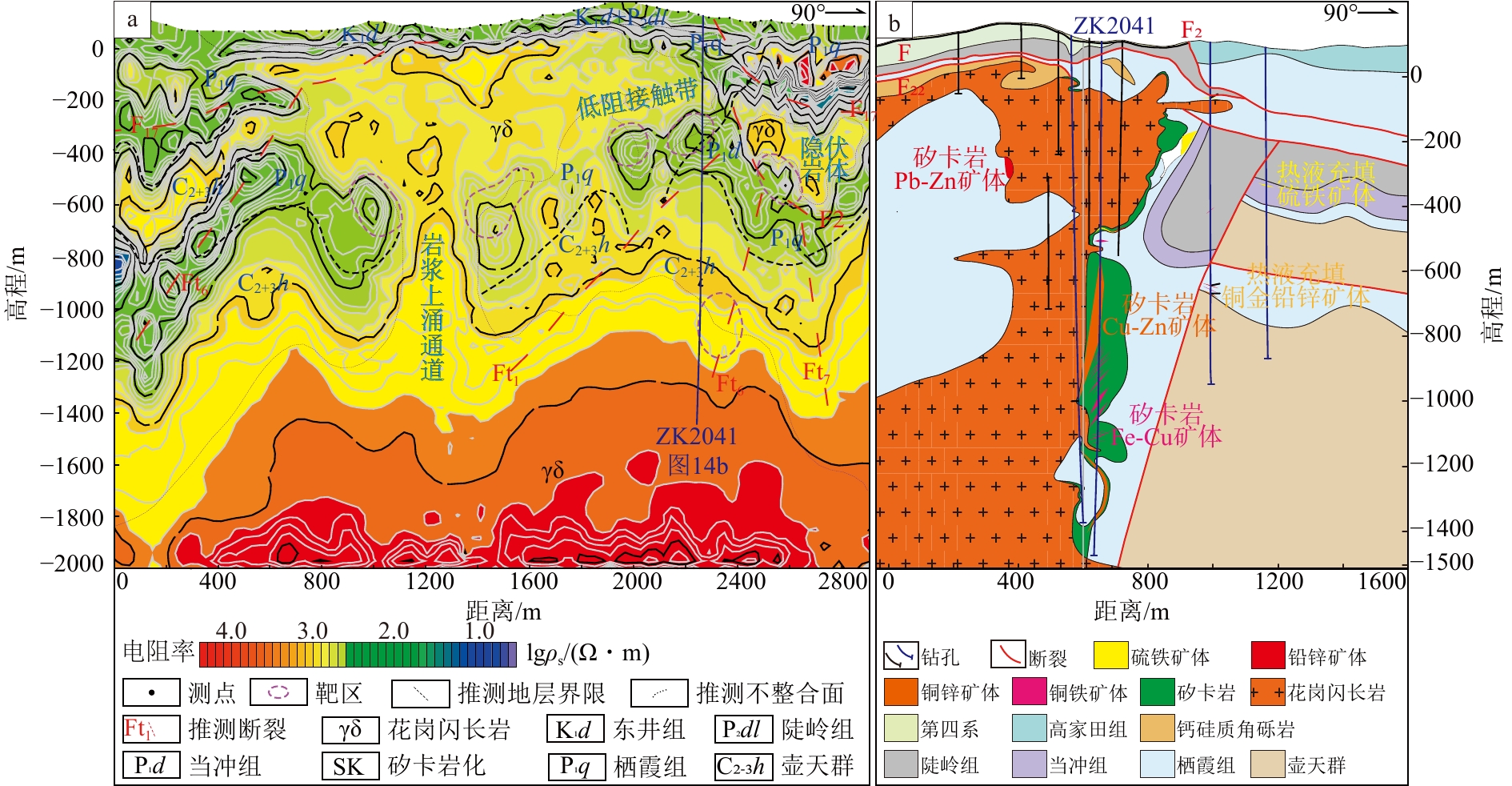
图 14 老鸦巢−鸭公塘矿区广域电磁解译与钻探验证剖面图
a—老鸦巢−鸭公塘广域电磁测试典型剖面解译图;b—老鸦巢−鸭公塘204线剖面图
Figure 14. Wide-field electromagnetic interpretation and geological map for a typical cross-section in the Laoyachao–Yagongtang area
(a) Interpretation of a typical wide-field electromagnetic survey section from Yagongtang to Laoyachao; (b) Geological cross-section of line 204
-
[1] AKINFIEV N N, ZOTOV A V, 2010. Thermodynamic description of aqueous species in the system Cu-Ag-Au-S-O-H at temperatures of 0-600°C and pressures of 1-3000 bar[J]. Geochemistry International, 48(7): 714-720. doi: 10.1134/S0016702910070074 [2] AKINFIEV N N, TAGIROV B R, 2014. Zn in hydrothermal systems: thermodynamic description of hydroxide, chloride, and hydrosulfide complexes[J]. Geochemistry International, 52(3): 197-214. doi: 10.1134/S0016702914030021 [3] BAI D Y, HUANG J Z, LI J D, et al., 2007. Multiple geological elements constraint on the Mesozoic tectonic evolution of South China: apocalypse of the Mesozoic geological evolution in southeastern Hunan and the Hunan-Guangdong-Jiangxi border area[J]. Geotectonica et Metallogenia, 31(1): 1-13. (in Chinese with English abstract) [4] BAI D Y, TANG F P, LI B, et al., 2022. Summary of main mineralization events in Hunan Province[J]. Geology in China, 49(1): 151-180. (in Chinese with English abstract) [5] CHEN D Q, WU J S, 1990. The mineralization mechanism of ion-adsorption rare earth deposits[J]. Journal of the Chinese Rare Earth Society, 8(2): 175-179. (in Chinese) [6] CHEN H Y, WU C, 2020. Metallogenesis and major challenges of porphyry copper systems above subduction zones[J]. Science China Earth Sciences, 63(7): 899-918. doi: 10.1007/s11430-019-9595-8 [7] CHEN J, WANG R C, ZHU J C, et al., 2013. Multiple-aged granitoids and related tungsten-tin mineralization in the Nanling Range, South China[J]. Science China Earth Sciences, 56(12): 2045-2055. doi: 10.1007/s11430-013-4736-9 [8] CHEN Y C, PEI R F, ZHANG H L, et al. , 1989. The geology of non-ferrous and rare metal deposits related to Mesozoic granitoids in Nanling region[M]. Beijing: Geological Publishing House: 508. (in Chinese) [9] CHEN Y J, 2013. The development of continental collision metallogeny and its application[J]. Acta Petrologica Sinica, 29(1): 1-17. (in Chinese with English abstract) [10] CHEN Y X, LI H, SUN W D, et al. , 2016. Generation of Late Mesozoic Qianlishan A2-type granite in Nanling Range, South China: implications for Shizhuyuan W-Sn mineralization and tectonic evolution[J]. Lithos, 266-267: 435-452. [11] CHENG Y Q, CHEN Y C, ZHAO Y M, 1979. Preliminary discussion on the problems of minerogenetic series of mineral deposits[J]. Bulletin of Chinese Academy of Geological Sciences, 1(1): 32-58. (in Chinese with English abstract) [12] CHU Y, LIN W, FAURE M, et al., 2011. Tectonic evolution of the Early Mesozoic Xuefengshan belt: insights from structural analysis and geochronological constraints[J]. Chinese Journal of Geology, 46(1): 146-160. (in Chinese with English abstract) [13] FU S L, HU R Z, PENG J T, et al., 2023. A comprehensive genetic model for the world’s largest Sb deposit (Xikuangshan, China)[J]. GSA Bulletin, 135(3-4): 1074-1088. doi: 10.1130/B36424.1 [14] GAO X D, 1995. Main types of gold deposit in Shuikoushan ore field and the prospective areas for Au-searching[J]. Hunan Geology, 14(4): 220-225. (in Chinese with English abstract) [15] GONG X D, LI Y S, GONG F Y, et al., 2011. Geological characteristics of the Laoyachao lead-zinc-gold deposit in the Shuikoushan area, Hunan Province[J]. Acta Mineralogica Sinica, 31(S1): 20-21. (in Chinese) [16] GUO C, LU Y J, OUYANG Z Q, et al., 2023. Geological characteristics and genetic analysis of Laoyachao gold deposit in Shuikoushan, Hunan Province[J]. Northwestern Geology, 56(5): 294-307. (in Chinese with English abstract) [17] HOU Z Q, 2010. Metallogensis of continental collision[J]. Acta Geologica Sinica, 84(1): 30-58. (in Chinese with English abstract) [18] HU R Z, 1990. A possible metallogenic model for granite-type uranium deposits[J]. Chinese Science Bulletin, 35(7): 526-528. (in Chinese) [19] HU R Z, MAO J W, FAN W M, et al., 2010. Some scientific questions on the intra-continental metallogeny in the South China continent[J]. Earth Science Frontiers, 17(2): 13-26. (in Chinese with English abstract) [20] HU R Z, ZHOU M F, 2012. Multiple Mesozoic mineralization events in South China: an introduction to the thematic issue[J]. Mineralium Deposita, 47(6): 579-588. doi: 10.1007/s00126-012-0431-6 [21] HU R Z, FU S L, XIAO J F, 2016. Major scientific problems on low-temperature metallogenesis in South China[J]. Acta Petrologica Sinica, 32(11): 3239-3251. (in Chinese with English abstract) [22] HUA R M, CHEN P R, ZHANG W L, et al., 2005. Metallogeneses and their geodynamic settings related to Mesozoic granitoids in the Nanling Range[J]. Geological Journal of China Universities, 11(3): 291-304. (in Chinese with English abstract) [23] HUANG G L, WU L Q, DENG P, et al. , 2006. Prospecting potential and direction for granite uranium deposit in north Guangdong, China[J]. Uranium Geology, 22(5): 267-275, 280. (in Chinese with English abstract) [24] HUANG J Z, SUN J, ZHOU C, et al., 2020. Metallogenic regularity and resource potential of gold deposits of Hunan area in the Jiangnan orogenic belt, South China[J]. Acta Geoscientica Sinica, 41(2): 230-252. (in Chinese with English abstract) [25] HUANG X D, LU J J, SIZARET S, et al., 2017. Petrogenetic differences between the Middle-Late Jurassic Cu-Pb-Zn-bearing and W-bearing granites in the Nanling Range, South China: a case study of the Tongshanling and Weijia deposits in southern Hunan Province[J]. Science China Earth Sciences, 60(7): 1220-1236. doi: 10.1007/s11430-016-9044-5 [26] INGLIS E C, MOYNIER F, CREECH J, et al. 2019. Isotopic fractionation of zirconium during magmatic differentiation and the stable isotope composition of the silicate Earth. Geochimica et Cosmochimica Acta[J], 250: 311-323. [27] KIRKPATRICK H M, HARRISON T M, IBAÑEZ-MEJIA M, et al. 2023. Temperature and co-crystallization effects on Zr isotopes. Geochimica et Cosmochimica Acta[J], 352: 69-85. [28] Jiangxi bureau of geology and mineral resources, 1984. Regional geology of Jiangxi Province[M]. Beijing: Geological Publishing House: 921. (in Chinese) [29] LI N Q, PENG C, 1996. Shuikoushan lead-zinc-gold-silver Orefield, Hunan, China[M]. Beijing: Seismological Press: 107. (in Chinese) [30] LI S H, 2015. Ore-forming mechanisms and prospecting models of typical granite type rare metal deposits in South China[D]. Beijing: China University of Geosciences (Beijing). (in Chinese with English abstract) [31] LI Y S, ZHEN S M, GONG F Y, et al., 2011. Identification of the ore-forming geological body of the Kangjiawan lead-zinc-gold-silver deposit in Hunan Province and its significance[J]. Acta Mineralogica Sinica, 31(S1): 964-965. (in Chinese) [32] LI Y S, ZHEN S M, GONG F Y, et al., 2012. A discussion on the source of ore-forming materials in the Shuikoushan lead-zinc-gold-silver ore field, Hunan Province[J]. Mineral Deposits, 31(S1): 571-572. (in Chinese) [33] LI Y S, ZHANG B L, GONG F Y, et al., 2021. Genesis of the giant Kangjiawan lead-zinc ore deposit in Hunan Province: evidences from fluid inclusion, H-O and S isotope[J]. Acta Petrologica Sinica, 37(6): 1847-1866. (in Chinese with English abstract) doi: 10.18654/1000-0569/2021.06.13 [34] LIAO Y Z, ZHAO B, ZHANG D H, et al., 2021. Evidence for temporal relationship between the Late Mesozoic multistage Qianlishan granite complex and the Shizhuyuan W-Sn-Mo-Bi deposit, SE China[J]. Scientific Reports, 11(1): 5828. doi: 10.1038/s41598-021-84902-6 [35] LIU G C, 1946. A geological discussion on the Shuikoushan area, Hunan Province[J]. Geological Review, 11(S1): 29-38. (in Chinese) [36] LIU X C, YU P P, XIAO C H, 2023. Tin transport and cassiterite precipitation from hydrothermal fluids[J]. Geoscience Frontiers, 14(6): 101624. doi: 10.1016/j.gsf.2023.101624 [37] MAO J W, XIE G Q, GUO C L, et al., 2007. Large-scale tungsten-tin mineralization in the Nanling region, South China: metallogenic ages and corresponding geodynamic processes[J]. Acta Petrologica Sinica, 23(10): 2329-2338. (in Chinese with English abstract) [38] London D. 1987. Internal differentiation of rare-element pegmatites: Effects of boron, phosphorus, and fluorine. Geochimica et Cosmochimica Acta[J], 51(3): 403-420. [39] PAL'YANOVA G, 2008. Physicochemical modeling of the coupled behavior of gold and silver in hydrothermal processes: gold fineness, Au/Ag ratios and their possible implications[J]. Chemical Geology, 255(3-4): 399-413. doi: 10.1016/j.chemgeo.2008.07.010 [40] PETERSEN U, 1999. Magmatic and metallogenic evolution of the central Andes[M]//SKINNER B J. Geology and ore deposits of the central Andes. Littleton: Society of Economic Geologists: 109-154. [41] QIN Z W, FU J M, XING G F, et al., 2022. The petrogenetic differences of the Middle-Late Jurassic W-, Sn-, Pb-Zn-Cu-bearing granites in the Nanling Range, South China[J]. Geology in China, 49(2): 518-541. (in Chinese with English abstract) [42] RAO J R, XIAO H Y, LIU Y R, et al., 2012. Location of the Yangtze-Cathaysia plate convergence zone in Hunan[J]. Chinese Journal of Geophysics, 55(2): 484-502. (in Chinese with English abstract) [43] REED M H, PALANDRI J, 2006. Sulfide mineral precipitation from hydrothermal fluids[J]. Reviews in Mineralogy and Geochemistry, 61(1): 609-631. [44] SHANG L B, WILLIAMS-JONES A E, WANG X S, et al., 2020. An experimental study of the solubility and speciation of MoO3(s) in hydrothermal fluids at temperatures up to 350°C: a reply[J]. Economic Geology, 115(8): 1872-1873. doi: 10.5382/econgeo.115.8.dis02 [45] SHI J K, WANG Q H, 1988. Discovery of a Diwa-type Paleokarst uranium-gold deposit in the Shuikoushan mining district, Hunan Province and its prospecting significance[J]. Carsologica Sinica, 7(S1): 115-125. (in Chinese) [46] SHU L S, ZHOU X M, DENG P, et al., 2006. Principal geological features of Nanling tectonic belt, South China[J]. Geological Review, 52(2): 251-265. (in Chinese with English abstract) [47] STEFÁNSSON A, SEWARD T M, 2003. Experimental determination of the stability and stoichiometry of sulphide complexes of silver(I) in hydrothermal solutions to 400°C[J]. Geochimica et Cosmochimica Acta, 67(7): 1395-1413. doi: 10.1016/S0016-7037(02)01093-1 [48] SUN W D, HUANG R F, LI H, et al., 2015. Porphyry deposits and oxidized magmas[J]. Ore Geology Reviews, 65: 97-131. doi: 10.1016/j.oregeorev.2014.09.004 [49] TAN S M, LIU B D, ZHOU L T, 2016. The geological survey report on the mineral deposits in Baoshan area, Hunan[R]. (in Chinese) [50] WANG D H, TANG J X, YING L J, et al., 2010. Application of "five levels + basement" model for prospecting deposits into depth[J]. Journal of Jilin University (Earth Science Edition), 40(4): 733-738. (in Chinese with English abstract) [51] WANG D H, WANG Y, QIN J H, 2022. Geology of mineral resources in China: volume of Nanling[M]. Beijing: Geological Publishing House: 1060. (in Chinese) [52] WANG J H, LI Y, HUANG D M, et al., 2013. Reserves estimation of the Nihe iron deposits in Anhui based on ordinary kriging[J]. Geology and Exploration, 49(6): 1108-1113. (in Chinese with English abstract) [53] WANG J H, MA X H, LI Y, et al., 2014. Petrogenesis of granitic complexes and implications for the W-Mo mineralization: a case study from the Youmapo pluton, Guangxi Province[J]. Acta Geologica Sinica, 88(7): 1219-1235. (in Chinese with English abstract) [54] WANG J H, ZHANG X, CHEN D G, et al., 2015. Influence of during south ion-absorbed-type rare earth deposit mining on groundwater and it’s monitoring[J]. Science & Technology Review, 33(18): 23-27. (in Chinese with English abstract) [55] WANG J H, ZHANG Y, ZHANG C X, et al., 2019. Exploration progress and prospecting orientation at depth of Huangshaping lead-zinc polymetallic ore deposit, Hunan[J]. Mineral Exploration, 10(4): 835-844. (in Chinese with English abstract) [56] WANG J H, DU Y L, ZHANG F H, et al., 2023. Deeply derived magma controlling the polymetallic mineralization at Shuikoushan, South China: constraints from mineral U-Pb dating and whole-rock geochemistry[J]. Minerals, 13(12): 1508. doi: 10.3390/min13121508 [57] WANG J H, 2024. The metallogenic process of magmatic-hydrothermal Pb-Zn polymetallic deposits in Nanling Range[M]. Beijing: Geological Publishing House: 232. (in Chinese) [58] WANG J H, ZHANG X, ZHU Z X, et al., 2025. Zirconium isotope evidence for crystal-melt segregation during high-silica granitic magma differentiation[J]. Earth and Planetary Science Letters, 655: 119251. doi: 10.1016/j.epsl.2025.119251 [59] WANG J H, 2026. Finding beryllium in tungsten: discovery of quartz-vein-type W-Be mineralization in Nanling and its exploration implications[J]. Earth Science, 1-21, doi: 10.3799/dqkx.2026.136. (in Chinese with English abstract) [60] WANG X S, WILLIAMS-JONES A E, HU R Z, et al., 2021. The role of fluorine in granite-related hydrothermal tungsten ore genesis: results of experiments and modeling[J]. Geochimica et Cosmochimica Acta, 292: 170-187. doi: 10.1016/j.gca.2020.09.032 [61] WILLIAMS-JONES A E, HEINRICH C A, 2005. 100th anniversary special paper: vapor transport of metals and the formation of magmatic-hydrothermal ore deposits[J]. Economic Geology, 100(7): 1287-1312. doi: 10.2113/gsecongeo.100.7.1287 [62] WILLIAMS-JONES A E, BOWELL R J, MIGDISOV A A, 2009. Gold in solution[J]. Elements, 5(5): 281-287. [63] XU J X, ZENG Z L, WANG D H, et al., 2008. A new type of tungsten deposit in southern Jiangxi and the new model of "five floors + basement" for prospecting[J]. Acta Geologica Sinica, 82(7): 880-887. (in Chinese with English abstract) [64] XU X B, LIANG C H, CHEN J J, et al., 2021. Fundamental geological features and metallogenic geological backgrounds of Nanling tectonic belt[J]. Earth Science, 46(4): 1133-1150. (in Chinese with English abstract) [65] YANG C Y, 1985. Discovery and genesis of the Kangjiawan lead-zinc deposit, Hunan Province[J]. Geology and Exploration, 21(5): 1-7. (in Chinese) [66] YANG J H, KANG L F, PENG J T, et al., 2018. In-situ elemental and isotopic compositions of apatite and zircon from the Shuikoushan and Xihuashan granitic plutons: implication for Jurassic granitoid-related Cu-Pb-Zn and W mineralization in the Nanling Range, South China[J]. Ore Geology Reviews, 93: 382-403. doi: 10.1016/j.oregeorev.2017.12.023 [67] YIN J Z, WANG M C, 1993. Geological characteristics and genesis of the Longwangshan gold deposit in the Shuikoushan ore field, Hunan Province[J]. Gold Geology(3): 46-50. (in Chinese) [68] YU H C, QIU K F, SIMON A C, et al., 2023. Telescoped boiling and cooling mechanisms triggered hydrothermal stibnite precipitation: insights from the world’s largest antimony deposit in Xikuangshan China[J]. American Mineralogist, 108(7): 1213-1223. doi: 10.2138/am-2022-8490 [69] YU H X, LIU J Y, 1997a. The characteristic and petrogenesis of the granitic subvolcanic complex in the Shuikoushan Orefield[J]. Geotectonica et Metallogenia, 21(1): 32-40. (in Chinese with English abstract) [70] YU H X, LIU J Y, 1997b. The granitic subvolcanic complex and polymetallic mineralization in Shuikoushan Orefield[J]. Contributions to Geology and Mineral Resources Research, 12(4): 35-44. (in Chinese with English abstract) [71] YUAN S D, PENG J T, SHEN N P, et al., 2007. 40Ar-39Ar isotopic dating of the Xianghualing Sn-polymetallic Orefield in southern Hunan, China and its geological implications[J]. Acta Geologica Sinica-English Edition, 81(2): 278-286. doi: 10.1111/j.1755-6724.2007.tb00951.x [72] YUAN Y, GUO J-L, ZONG K, et al. 2022. Stable zirconium isotopic fractionation during alkaline magma differentiation: Implications for the differentiation of continental crust. Geochimica et Cosmochimica Acta[J], 326: 41-55. [73] ZENG L P, ZHAO X F, SPANDLER C, et al., 2024. The role of iron-rich hydrosaline liquids in the formation of Kiruna-type iron oxide-apatite deposits[J]. Science Advances, 10(17): eadk2174. doi: 10.1126/sciadv.adk2174 [74] ZHAI Y S, WANG J P, PENG R M, et al., 2009. Research on superimposed metallogenic systems and polygenetic mineral deposits[J]. Earth Science Frontiers, 16(6): 282-290. (in Chinese with English abstract) [75] ZHANG W, ZHANG F Q, DILEK Y, et al., 2022. Basin response to the Jurassic geodynamic turnover from flat subduction to normal subduction in South China[J]. GSA Bulletin, 134(7-8): 1681-1700. doi: 10.1130/B36059.1 [76] ZHANG Y Z, 1957. The Shuikoushan Pb-Zn deposit in Hunan[J]. Geological Review, 17(3): 310-323. (in Chinese) [77] ZHAO P D, ZHANG S T, CHEN J P, 2004. Discussion on prediction and appraisement of replaceable resources of crisis mine[J]. Journal of Chengdu University of Technology (Science & Technology Edition), 31(2): 111-117. (in Chinese with English abstract) [78] ZHAO S T, MAO S D, ZHANG W G, et al., 2025. Stibnite solubility and precipitation in hydrothermal fluids: constraints from thermodynamic modeling[J]. Geochimica, 54(3): 379-389. (in Chinese with English abstract) [79] ZHAO Z, WANG D H, CHEN Z H, et al., 2017. Progress of research on metallogenic regularity of ion-adsorption type REE deposit in the Nanling Range[J]. Acta Geologica Sinica, 91(12): 2814-2827. (in Chinese with English abstract) [80] ZHAO Z, CHEN Y C, WANG D H, et al., 2022. Transformation of Mesozoic dynamic systems and superposition of metallogenic series of W-Sn-Li-Be-Nb-Ta-REE mineral deposits in South China[J]. Acta Petrologica Sinica, 38(2): 301-322. (in Chinese with English abstract) doi: 10.18654/1000-0569/2022.02.01 [81] ZHENG Y F, 1986. An investigation of genetic model for a certain granite-type uranium deposit in southern China[J]. Bulletin of Nanjing Institute of Geology and Mineral Resources, Chinese Academy of Geological Sciences, 7(1): 51-59. (in Chinese with English abstract) [82] ZHOU T F, FAN Y, YUAN F, 2008. Advances on petrogenesis and metallogeny study of the mineralization belt of the Middle and Lower Reaches of the Yangtze River area[J]. Acta Petrologica Sinica, 24(8): 1665-1678. (in Chinese with English abstract) [83] ZHU Z, ZHANG W, WANG J, et al. 2023. Magmatic crystallization drives zircon Zr isotopic variations in a large granite batholith. Geochimica et Cosmochimica Acta[J], 342: 15-30. [84] ZUO C H, 2015. Study of the Kangjiawan lead-zinc deposit genesis and relationship with surrounding magmatism in Changning City, Hunan Province[D]. Nanjing: Nanjing University. (in Chinese with English abstract) [85] ZUO Z, 2021. Metallogenic study and prospecting direction of Shuikoushan ore field[J]. World Nonferrous Metals(3): 83-85. (in Chinese with English abstract) [86] 柏道远, 黄建中, 李金冬, 等, 2007. 华南中生代构造演化过程的多地质要素约束: 湘东南及湘粤赣边区中生代地质研究的启示[J]. 大地构造与成矿学, 31(1): 1-13. doi: 10.3969/j.issn.1001-1552.2007.01.001 [87] 柏道远, 唐分配, 李彬, 等, 2022. 湖南省成矿地质事件纲要[J]. 中国地质, 49(1): 151-180. doi: 10.12029/gc20220110 [88] 陈德潜, 吴静淑, 1990. 离子吸附型稀土矿床的成矿机制[J]. 中国稀土学报, 8(2): 175-179. doi: 10.3321/j.issn:1000-4343.1990.02.019 [89] 陈华勇, 吴超, 2020. 俯冲带斑岩铜矿系统成矿机理与主要挑战[J]. 中国科学: 地球科学, 50(7): 865-886. [90] 陈骏, 王汝成, 朱金初, 等, 2014. 南岭多时代花岗岩的钨锡成矿作用[J]. 中国科学: 地球科学, 44(1): 111-121. [91] 陈衍景, 2013. 大陆碰撞成矿理论的创建及应用[J]. 岩石学报, 29(1): 1-17. [92] 陈毓川, 裴荣富, 张宏良, 等, 1989. 南岭地区与中生代花岗岩类有关的有色及稀有金属矿床地质[M]. 北京: 地质出版社: 508. [93] 程裕淇, 陈毓川, 赵一鸣, 1979. 初论矿床的成矿系列问题[J]. 中国地质科学院院报, 1(1): 32-58. [94] 褚杨, 林伟, FAURE M, et al, 2011. 雪峰山早中生代构造演化: 构造学和年代学分析[J]. 地质科学, 46(1): 146-160. doi: 10.3969/j.issn.0563-5020.2011.01.012 [95] 高学兑, 1995. 水口山矿田主要金矿床类型及其找矿方向[J]. 湖南地质, 14(4): 220-225. [96] 巩小栋, 李永胜, 公凡影, 等, 2011. 湖南水口山老鸭巢铅锌金矿床地质特征[J]. 矿物学报, 31(S1): 20-21. doi: 10.16461/j.cnki.1000-4734.2011.s1.268 [97] 郭闯, 卢玉杰, 欧阳志强, 等, 2023. 湖南水口山老鸦巢金矿床地质特征及成因分析[J]. 西北地质, 56(5): 294-307. doi: 10.12401/j.nwg.2023105 [98] 侯增谦, 2010. 大陆碰撞成矿论[J]. 地质学报, 84(1): 30-58. doi: 10.19762/j.cnki.dizhixuebao.2010.01.002 [99] 胡瑞忠, 1990. 花岗岩型铀矿床一种可能的成矿模式[J]. 科学通报, 35(7): 526-528. [100] 胡瑞忠, 毛景文, 范蔚茗, 等, 2010. 华南陆块陆内成矿作用的一些科学问题[J]. 地学前缘, 17(2): 13-26. [101] 胡瑞忠, 付山岭, 肖加飞, 2016. 华南大规模低温成矿的主要科学问题[J]. 岩石学报, 32(11): 3239-3251. [102] 华仁民, 陈培荣, 张文兰, 等, 2005. 南岭与中生代花岗岩类有关的成矿作用及其大地构造背景[J]. 高校地质学报, 11(3): 291-304. doi: 10.3969/j.issn.1006-7493.2005.03.002 [103] 黄国龙, 吴烈勤, 邓平, 等, 2006. 粤北花岗岩型铀矿找矿潜力及找矿方向[J]. 铀矿地质, 22(5): 267-275, 280. doi: 10.3969/j.issn.1000-0658.2006.05.002 [104] 黄建中, 孙骥, 周超, 等, 2020. 江南造山带(湖南段)金矿成矿规律与资源潜力[J]. 地球学报, 41(2): 230-252. doi: 10.3975/cagsb.2020.020801 [105] 江西省地质矿产局, 1984. 江西省区域地质志[M]. 北京: 地质出版社: 921. [106] 李能强, 彭超, 1996. 湖南水口山铅锌金银矿床[M]. 北京: 地震出版社: 107. [107] 李胜虎, 2015. 华南典型花岗岩型稀有金属矿床的成矿机制与找矿模式研究[D]. 北京: 中国地质大学(北京). [108] 李永胜, 甄世民, 公凡影, 等, 2011. 湖南省康家湾铅锌金银矿床成矿地质体的判定及其意义[J]. 矿物学报, 31(S1): 964-965. doi: 10.16461/j.cnki.1000-4734.2011.s1.432 [109] 李永胜, 甄世民, 公凡影, 等, 2012. 湖南水口山铅锌金银矿田成矿物质来源探讨[J]. 矿床地质, 31(S1): 571-572. doi: 10.16111/j.0258-7106.2012.s1.289 [110] 李永胜, 张帮禄, 公凡影, 等, 2021. 湖南康家湾大型隐伏铅锌矿床成因探讨: 流体包裹体、氢氧同位素及硫同位素证据[J]. 岩石学报, 37(6): 1847-1866. doi: 10.18654/1000-0569/2021.06.13 [111] 刘国昌, 1946. 湖南水口山地质论述[J]. 地质论评, 11(S1): 29-38. [112] 毛景文, 谢桂青, 郭春丽, 等, 2007. 南岭地区大规模钨锡多金属成矿作用: 成矿时限及地球动力学背景[J]. 岩石学报, 23(10): 2329-2338. doi: 10.3969/j.issn.1000-0569.2007.10.002 [113] 秦拯纬, 付建明, 邢光福, 等, 2022. 南岭成矿带中—晚侏罗世成钨、成锡、成铅锌(铜)花岗岩的差异性研究[J]. 中国地质, 49(2): 518-541. doi: 10.12029/gc20220212 [114] 饶家荣, 肖海云, 刘耀荣, 等, 2012. 扬子、华夏古板块会聚带在湖南的位置[J]. 地球物理学报, 55(2): 484-502. doi: 10.6038/j.issn.0001-5733.2012.02.012 [115] 石静坤, 王清河, 1988. 湖南水口山矿区地洼型古岩溶U-Au矿的发现及找矿意义[J]. 中国岩溶, 7(S1): 115-125. [116] 舒良树, 周新民, 邓平, 等, 2006. 南岭构造带的基本地质特征[J]. 地质论评, 52(2): 251-265. doi: 10.3321/j.issn:0371-5736.2006.02.016 [117] 谭仕敏, 刘邦定, 周立同, 2016. 湖南宝山地区矿产地质调查成果报告[R]. 长沙: 湖南省地质调查院 [118] 王登红, 唐菊兴, 应立娟, 等, 2010. “五层楼+地下室”找矿模型的适用性及其对深部找矿的意义[J]. 吉林大学学报(地球科学版), 40(4): 733-738. doi: 10.13278/j.cnki.jjuese.2010.04.016 [119] 王登红, 王岩, 秦锦华, 2022. 中国矿产地质志•南岭卷[M]. 北京: 地质出版社: 1060. [120] 王炯辉, 李毅, 黄冬梅, 等, 2013. 基于普通克里格法的泥河铁矿床资源储量估算研究[J]. 地质与勘探, 49(6): 1108-1113. [121] 王炯辉, 马星华, 李毅, 等, 2014. 花岗质复式岩体成因及其与W-Mo成矿的关系: 以广西油麻坡岩体为例[J]. 地质学报, 88(7): 1219-1235. [122] 王炯辉, 张喜, 陈道贵, 等, 2015. 南方离子型稀土矿开采对地下水的影响及其监控[J]. 科技导报, 33(18): 23-27. doi: 10.3981/j.issn.1000-7857.2015.18.003 [123] 王炯辉, 张义, 张成学, 等, 2019. 湖南黄沙坪铅锌多金属矿深部找矿进展和找矿方向[J]. 矿产勘查, 10(4): 835-844. doi: 10.3969/j.issn.1674-7801.2019.04.014 [124] 王炯辉, 2024. 南岭成矿带典型岩浆热液铅锌多金属成矿作用[M]. 北京: 地质出版社: 232. [125] 王炯辉, 2026. 钨中找铍—南岭石英脉型钨铍矿化的发现及其找矿意义[J]. 地球科学, 1-21, doi: 10.3799/dqkx.2026.136. [126] 许建祥, 曾载淋, 王登红, 等, 2008. 赣南钨矿新类型及“五层楼+地下室”找矿模型[J]. 地质学报, 82(7): 880-887. [127] 徐先兵, 梁承华, 陈家驹, 等, 2021. 南岭构造带基础地质特征与成矿地质背景[J]. 地球科学, 46(4): 1133-1150. [128] 杨传益, 1985. 康家湾铅锌矿床的发现及成因[J]. 地质与勘探, 21(5): 1-7. [129] 银剑钊, 王敏初, 1993. 湖南省水口山矿田龙王山金矿床地质特征及成因[J]. 黄金地质科技(3): 46-50. [130] 喻亨祥, 刘家远. 1997a. 水口山矿田花岗质潜火山杂岩的成因特征[J]. 大地构造与成矿学, 21(1): 32-40. [131] 喻亨祥, 刘家远. 1997b. 水口山矿田花岗质潜火山杂岩与多金属成矿[J]. 地质找矿论丛, 12(4): 35-44. [132] 翟裕生, 王建平, 彭润民, 等, 2009. 叠加成矿系统与多成因矿床研究[J]. 地学前缘, 16(6): 282-290. [133] 张有正, 1957. 湖南水口山铅锌矿矿床[J]. 地质论评, 17(3): 310-323. [134] 赵鹏大, 张寿庭, 陈建平, 2004. 危机矿山可接替资源预测评价若干问题探讨[J]. 成都理工大学学报(自然科学版), 31(2): 111-117. doi: 10.3969/j.issn.1671-9727.2004.02.001 [135] 赵圣涛, 毛世德, 张文高, 等, 2025. 辉锑矿在热液中的溶解度与沉淀机制: 来自热力学计算的约束[J]. 地球化学, 54(3): 379-389. doi: 10.19700/j.0379-1726.2024.01.147 [136] 赵正, 陈毓川, 王登红, 等, 2022. 华南中生代动力体制转换与钨锡锂铍铌钽稀土矿床成矿系列的叠加演化[J]. 岩石学报, 38(2): 301-322. doi: 10.18654/1000-0569/2022.02.01 [137] 赵芝, 王登红, 陈郑辉, 等, 2017. 南岭离子吸附型稀土矿床成矿规律研究新进展[J]. 地质学报, 91(12): 2814-2827. doi: 10.3969/j.issn.0001-5717.2017.12.016 [138] 郑永飞, 1986. 华南某花岗岩型铀矿床成矿模式研究[J]. 中国地质科学院南京地质矿产研究所所刊, 7(1): 51-59. [139] 周涛发, 范裕, 袁峰, 2008. 长江中下游成矿带成岩成矿作用研究进展[J]. 岩石学报, 24(8): 1665-1678. [140] 左昌虎, 2015. 湖南常宁康家湾铅锌矿床成因及与周边岩浆作用关系研究[D]. 南京: 南京大学. [141] 左宗, 2021. 水口山矿田成矿研究与找矿方向探讨[J]. 世界有色金属(3): 83-85. -

 下载:



计量
- 文章访问数: 112
- HTML全文浏览量: 11
- PDF下载量: 14
- 被引次数: 0
