


Ecological restoration in Zoige: technical framework and application under the Shan–Shui Initiative in China
-
摘要: 若尔盖高寒草原湿地面临湿地萎缩、草地沙化等严峻生态问题,威胁水源涵养、碳汇储存及生物多样性保育功能。文章聚焦若尔盖山水林田湖草沙一体化保护和修复工程,研究高寒生态功能区水源涵养地表–地下水循环演化特征与规律,通过系统调查、综合评价与科学分析,精准识别并诊断若尔盖地区核心地质环境与生态问题及其成因。据此构建了基于地质–生态系统演化的山水林田湖草沙一体化生态修复理论技术支持体系,建立了高海拔草原湿地生态问题识别诊断与全生命周期监测技术,形成了以若尔盖独特地质生态资源利用和价值提升为核心的“两山”理论转化实践应用模式。这项研究成果全面支撑服务高海拔草原湿地生态系统修复,为高寒湿地“山水林田湖草沙”系统治理提供了可复制的技术范式。Abstract:
Objective The alpine grassland wetlands of Zoige face serious ecological problems, including wetland shrinkage and grassland desertification, which threaten their functions in water conservation, carbon storage, and biodiversity conservation. Focusing on the integrated protection and restoration of mountains, rivers, forests, farmlands, lakes, grasslands, and deserts in Zoige, this study reveals the evolutionary characteristics and laws of surface water–groundwater cycles in alpine ecological functional zones. Methods Through systematic field investigations, comprehensive evaluation, and scientific analysis, this study accurately identifies and diagnoses key geological–environmental and ecological problems in Zoige and elucidates their underlying causes. Results A theoretical and technical support system for integrated ecological restoration based on geo-ecosystem evolution is established. Technologies for identifying and diagnosing ecological problems and conducting life-cycle monitoring in high-altitude grassland wetlands are developed. In addition, a practical model for translating the Two Mountains Theory into practice is established, with an emphasis on leveraging the unique geo-ecological resources of Zoige and enhancing their value. Conclusions The research results fully support the ecological restoration of high-altitude grassland wetland ecosystems, and provide replicable technical paradigms for the systematic governance of alpine wetlands. Significance This study provides a basis for developing the theoretical and technical framework for ecological restoration in high-altitude, cold grassland wetlands. -
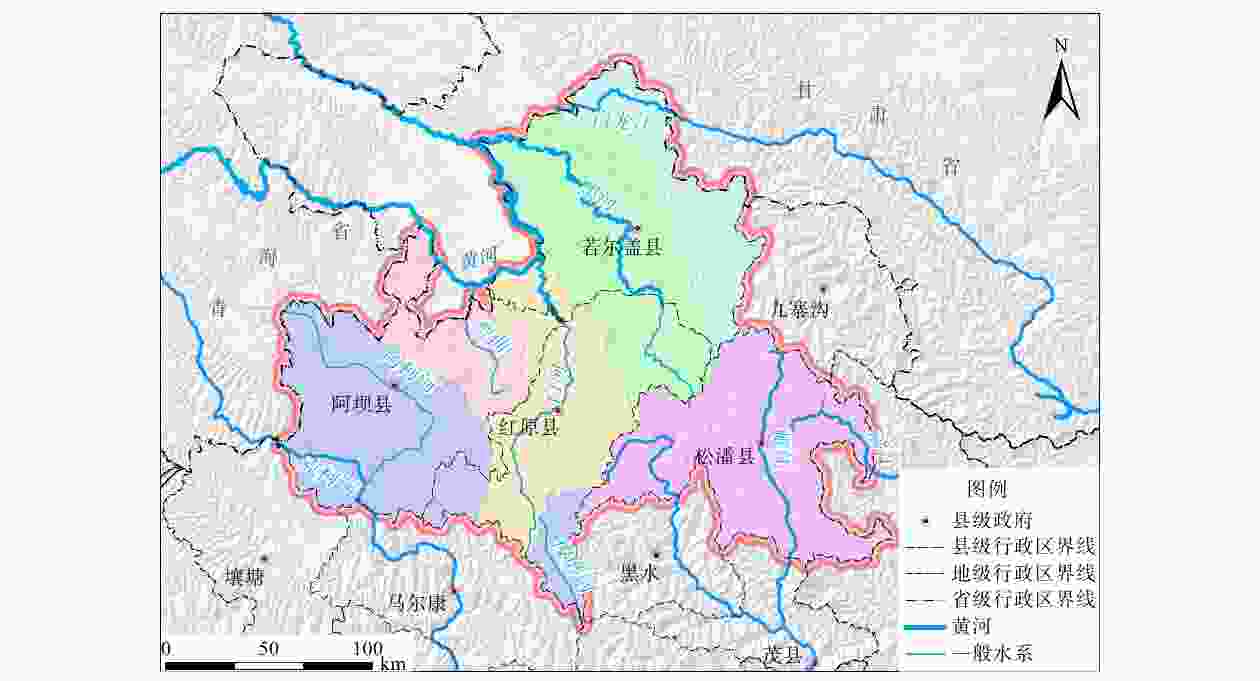
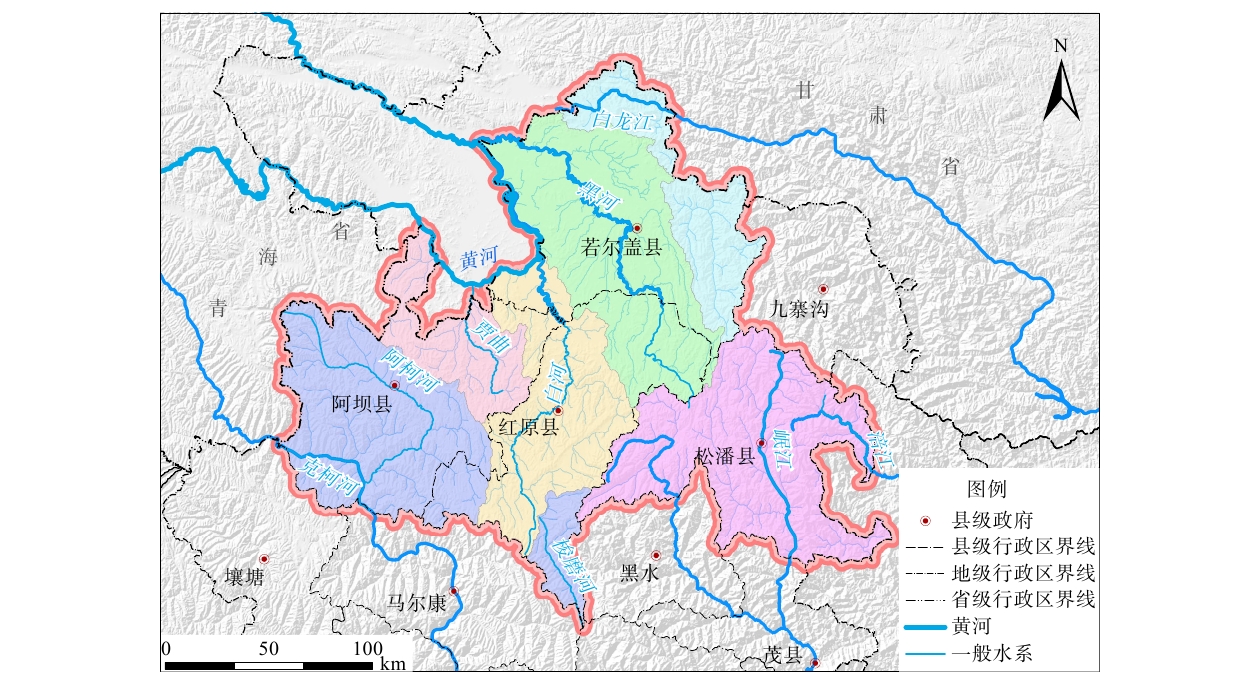
图 1 研究区范围图(底图由ALOS PALSAR 12.5 m DEM数据生成;边界来源于自然资源部标准地图服务系统,图审号:GS(2019)1822号)
Figure 1. Location of the study area (The shaded-relief base map was generated from ALOS PALSAR 12.5 m DEM data; administrative boundaries were obtained from the Standard Map Service System of the Ministry of Natural Resources of the People's Republic of China [Map Approval No.: GS(2019)1822])
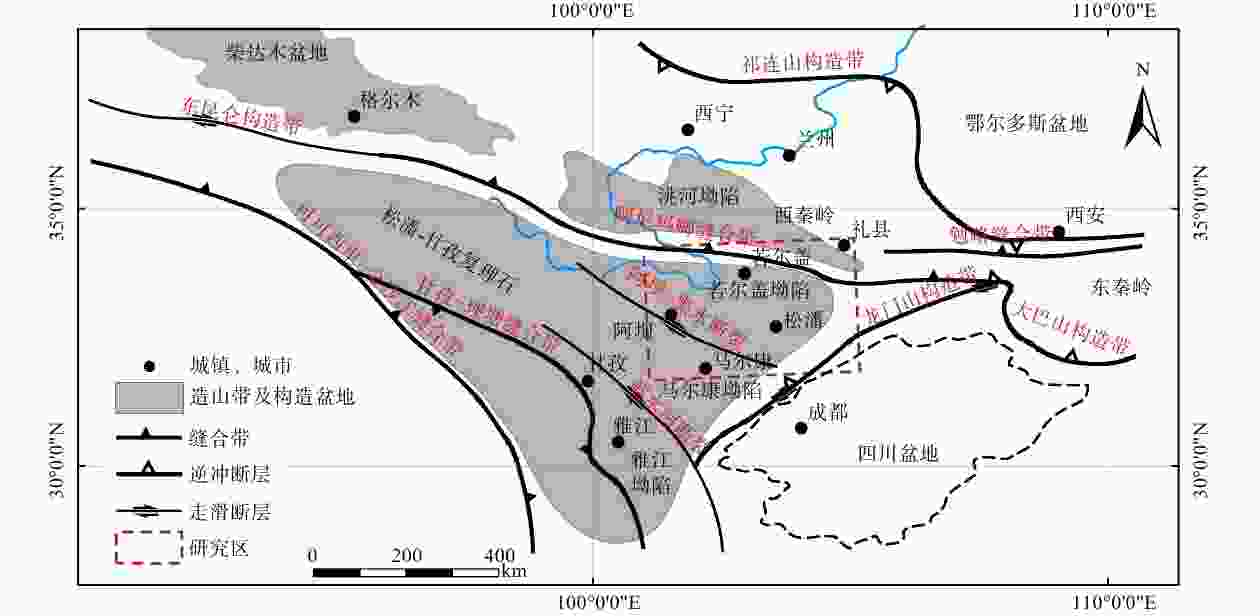
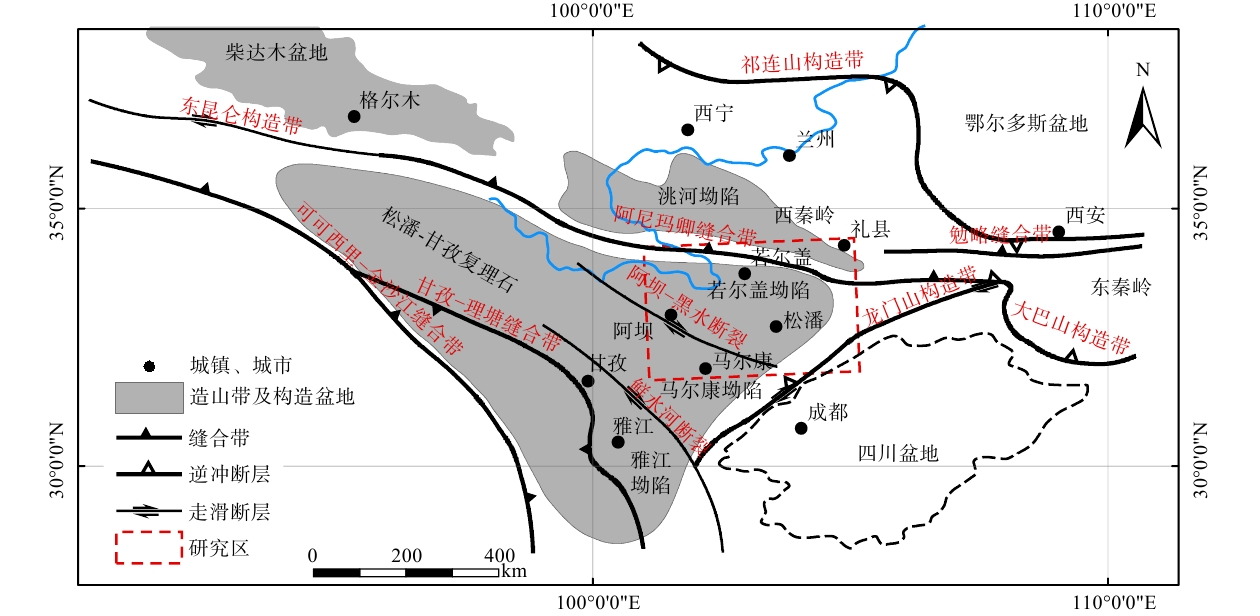
图 2 若尔盖地区区域构造格架(邓宾等,2013)
Figure 2. Regional tectonic framework of Zoige and sorrounding areas (Deng et al., 2013)
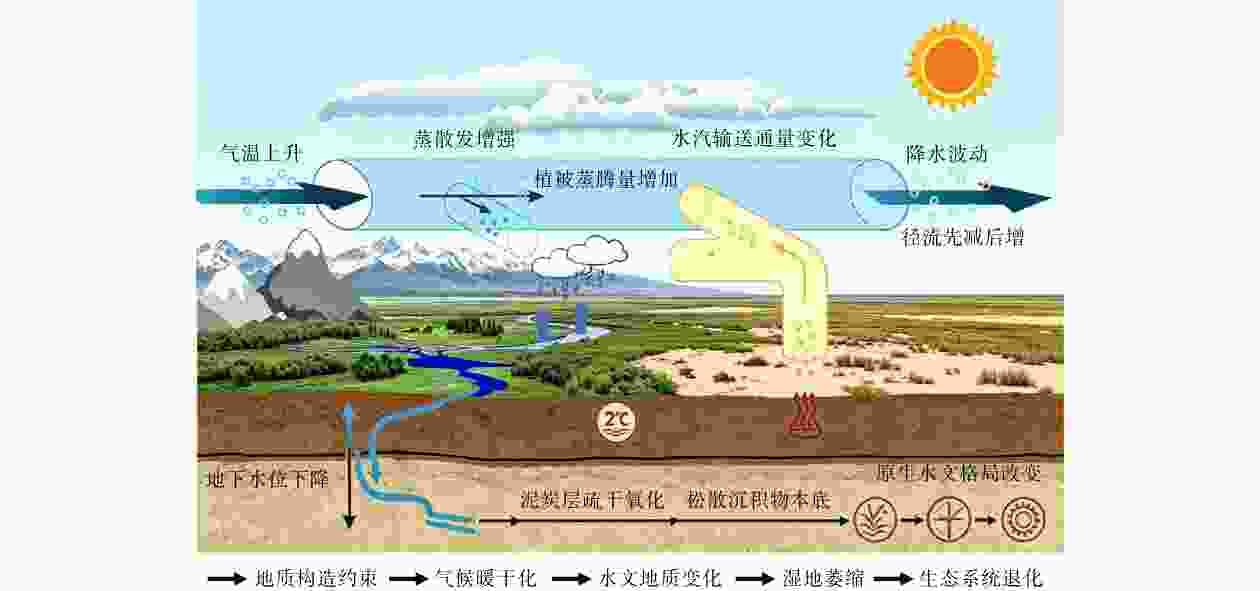
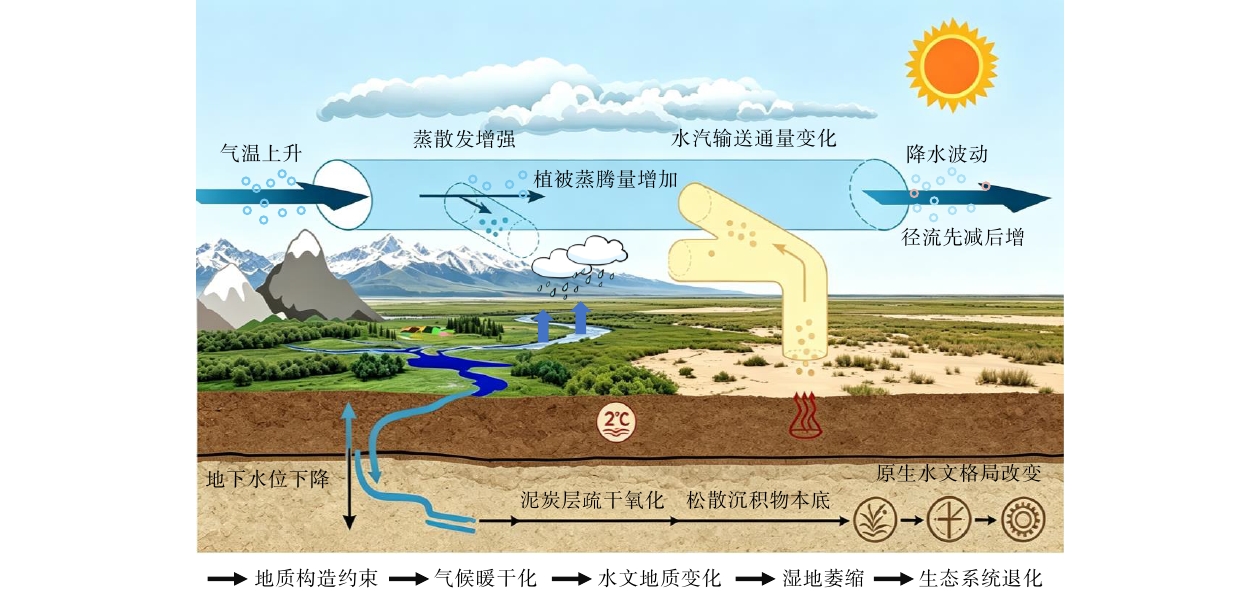
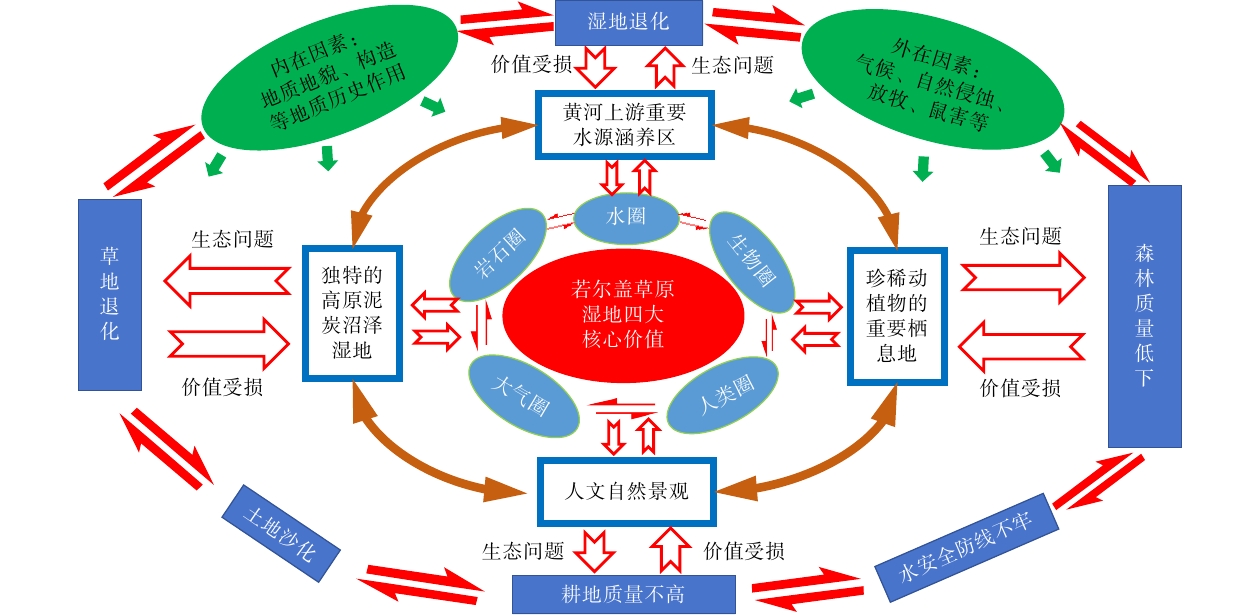
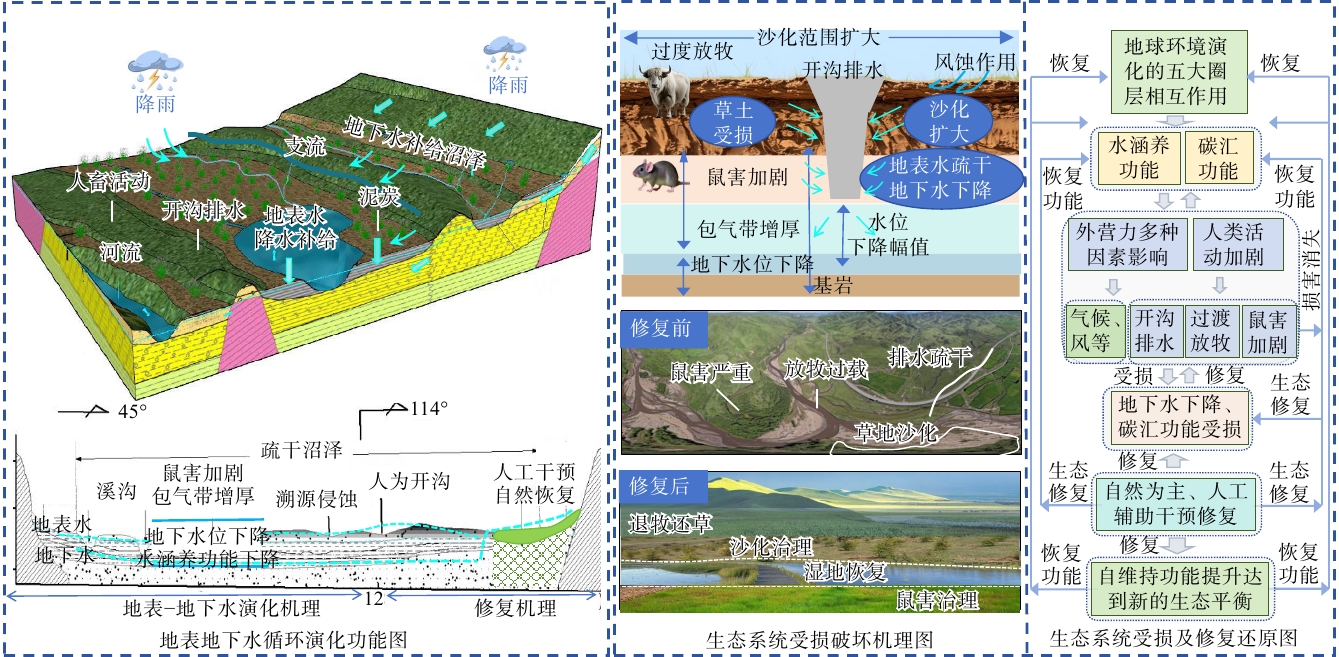
图 3 自然营力驱动下的生态退化过程
Figure 3. Ecological degradation driven by natural and hydrogeological evolution
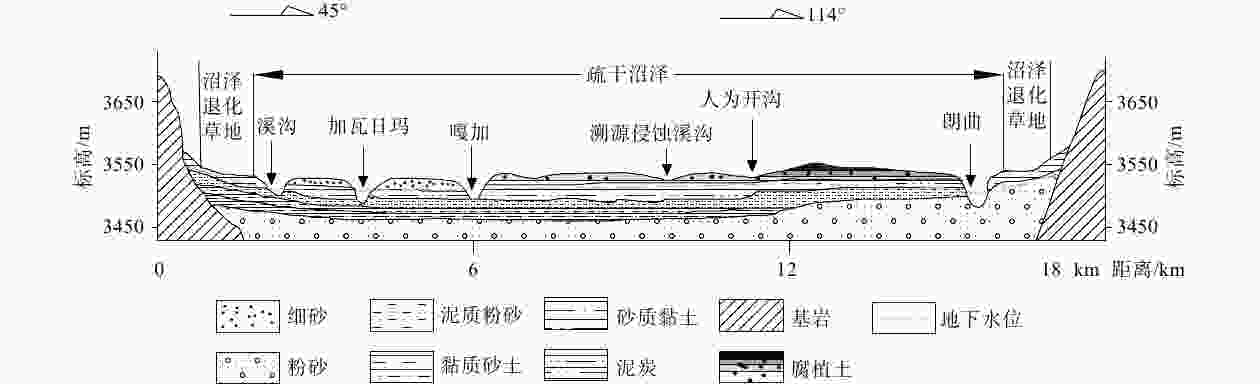
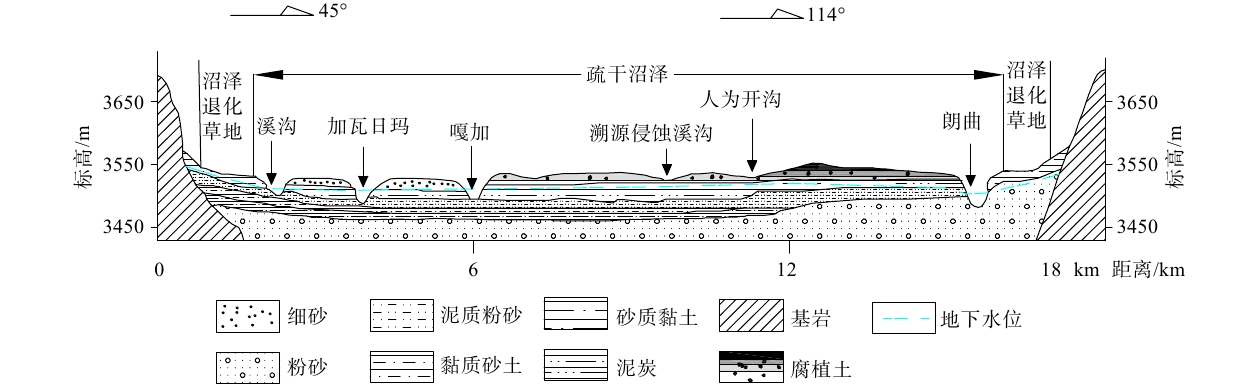
图 4 地表–地下水疏干与沼泽退化演化关系图
Figure 4. Relationship between surface-water and groundwater drainage and marsh degradation
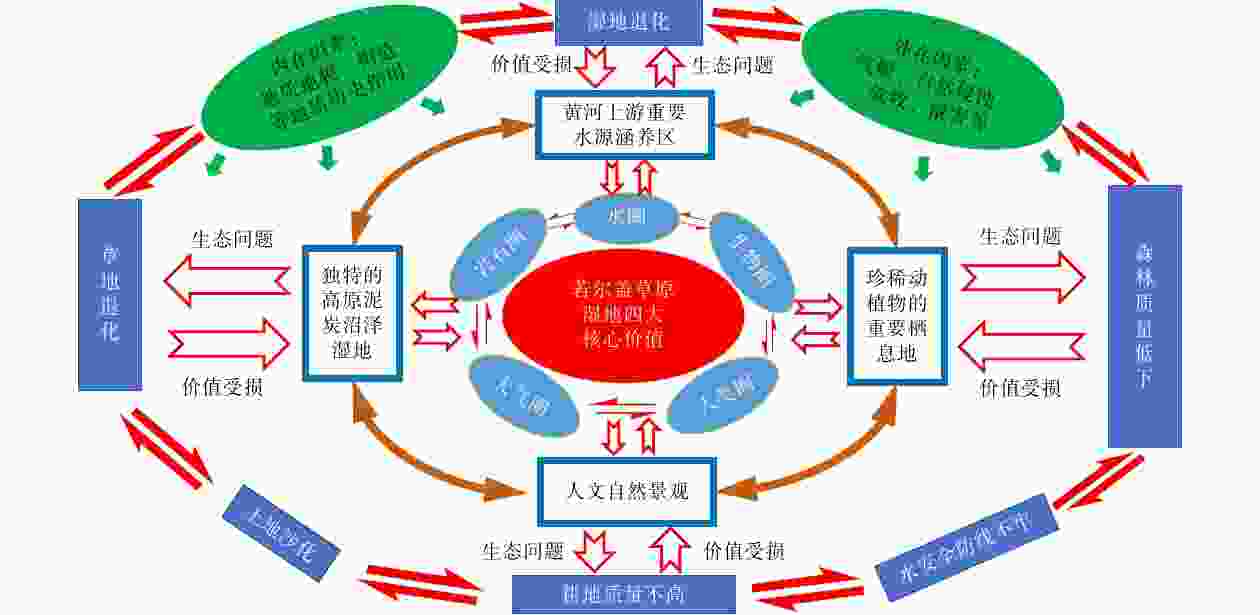
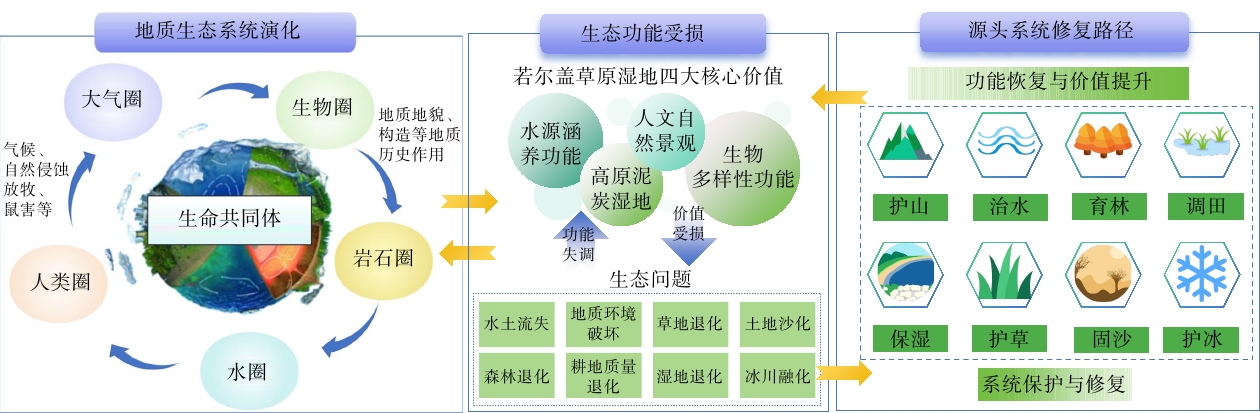
图 5 若尔盖区域主要生态问题–功能受损–地质生态演化关系图
Figure 5. Relationships among major ecological problems, functional impairment, and geological–ecological evolution in Zoige
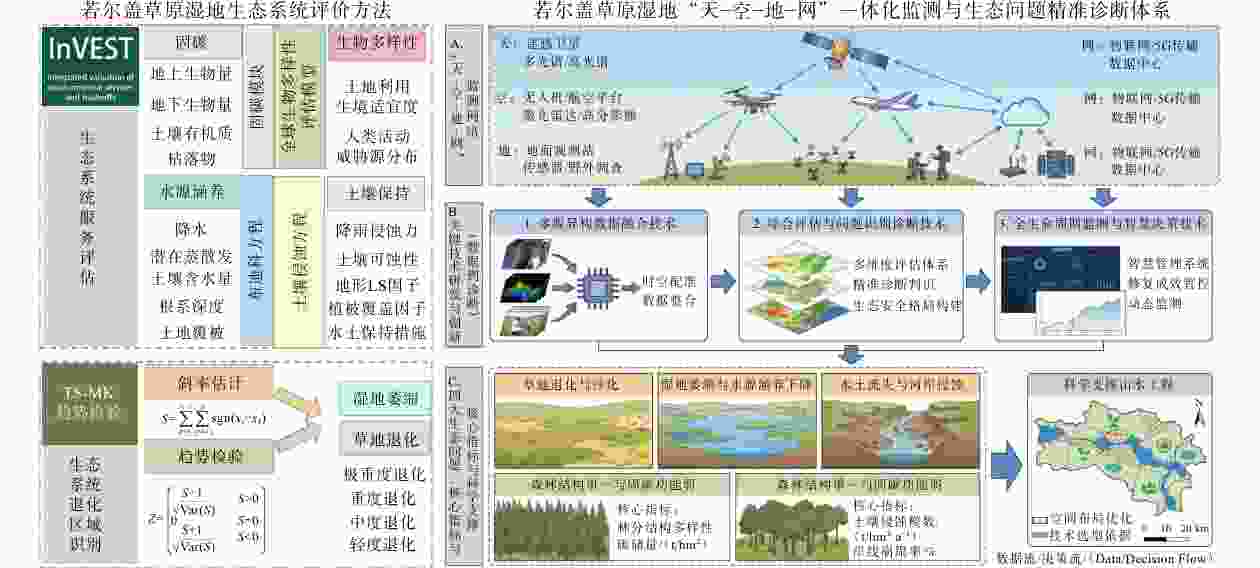
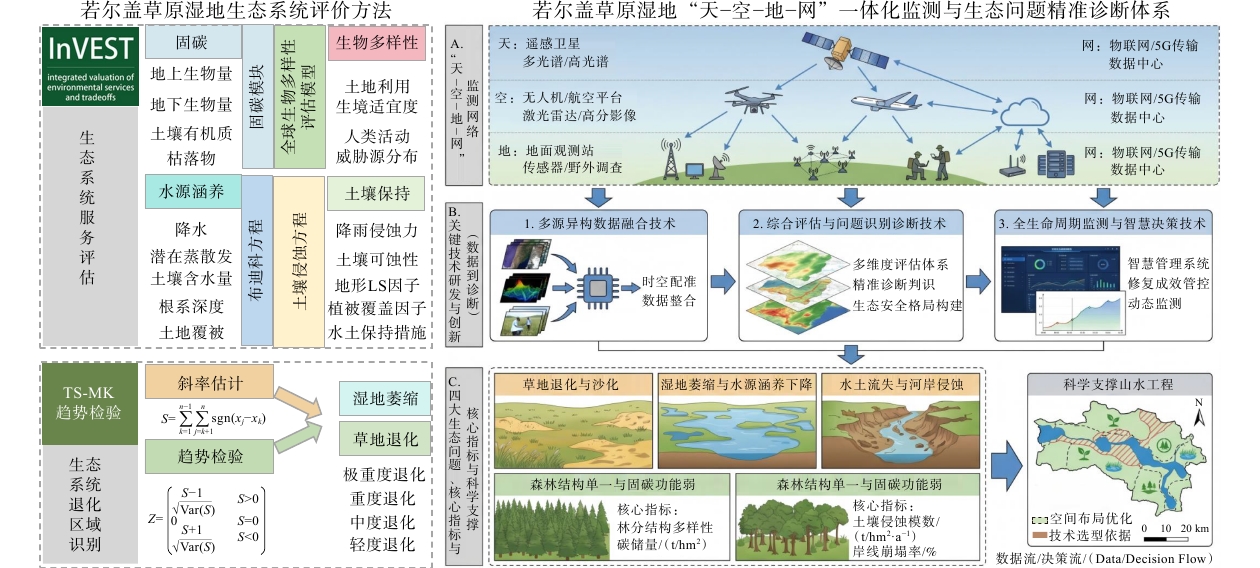
图 6 生态环境问题识别评价与诊断技术体系
其中:S—斜率;n—时间序列的长度(年);xj—第j年的生态系统指标观测值;xk—第k年的生态系统指标观测值;Z—趋势检验的标准化统计量;Var(S)为统计量S的方差
Figure 6. Technical framework for identifying, evaluating, and diagnosing ecological and environmental problems
S–slope statistic; n–length of the time series (years); xj–observed value of the ecosystem indicator in year j; xk–observed value of the ecosystem indicator in year k; Z–standardized test statistic; Var(S)–variance of S
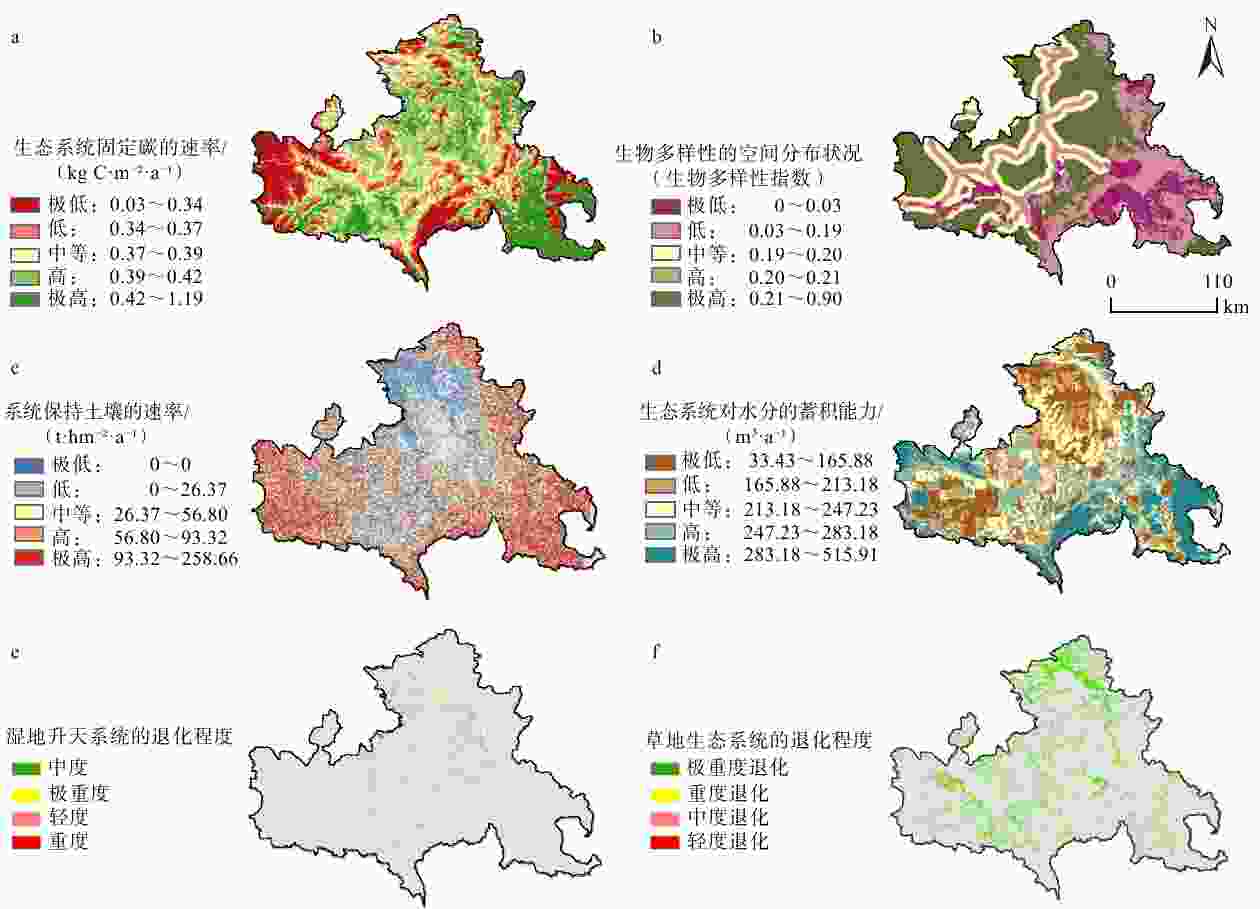
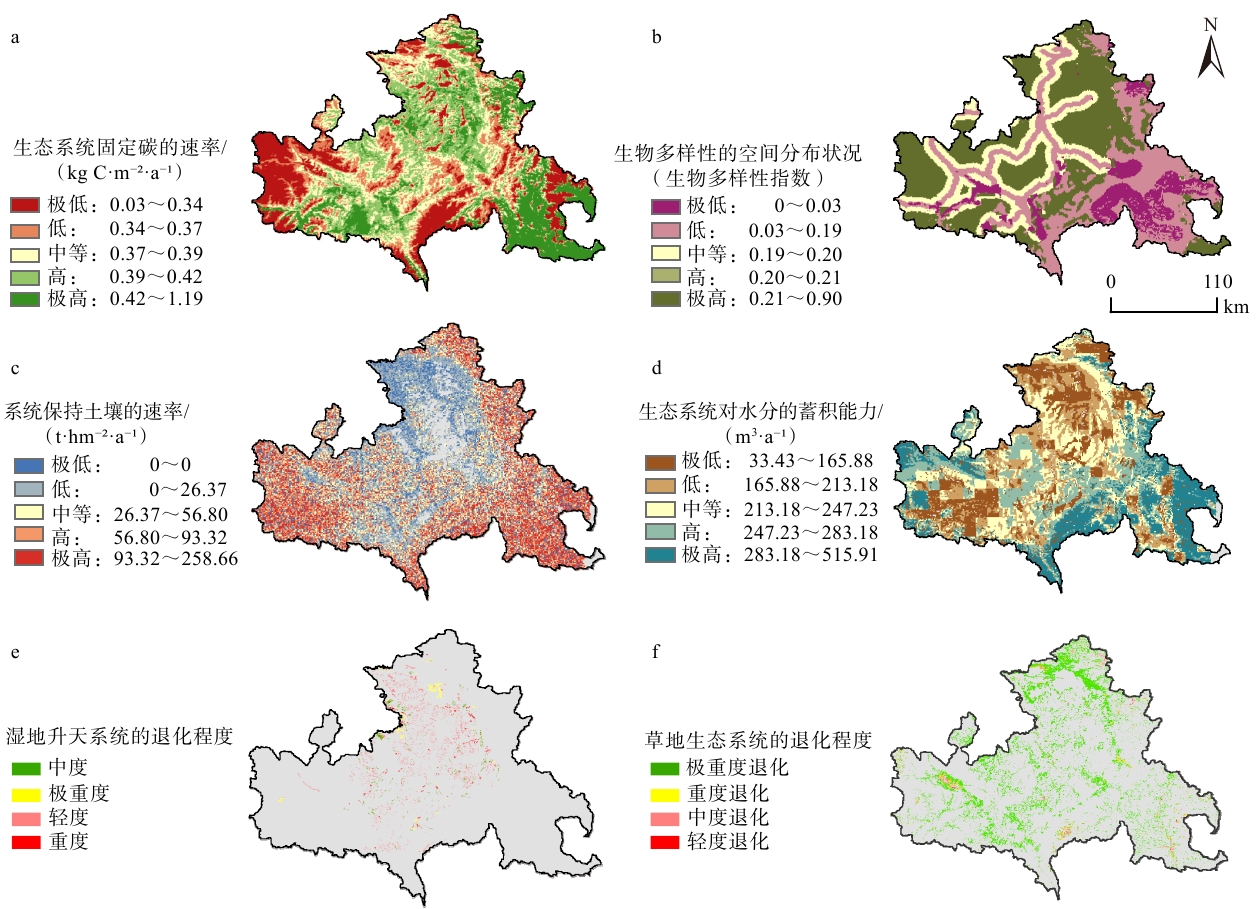
图 7 2001—2020多年平均生态系统退化问题综合评价结果图
a—碳固定;b—生物多样性;c—土壤保持;d—水源涵养;e—湿地萎缩;f—草地退化
Figure 7. Comprehensive assessment of ecosystem degradation and ecosystem services based on mean annual values from 2001 to 2020
(a) Carbon fixation; (b) Biodiversity; (c) Soil conservation; (d) Water conservation; (e) Wetland shrinkage; (f) Grassland degradation
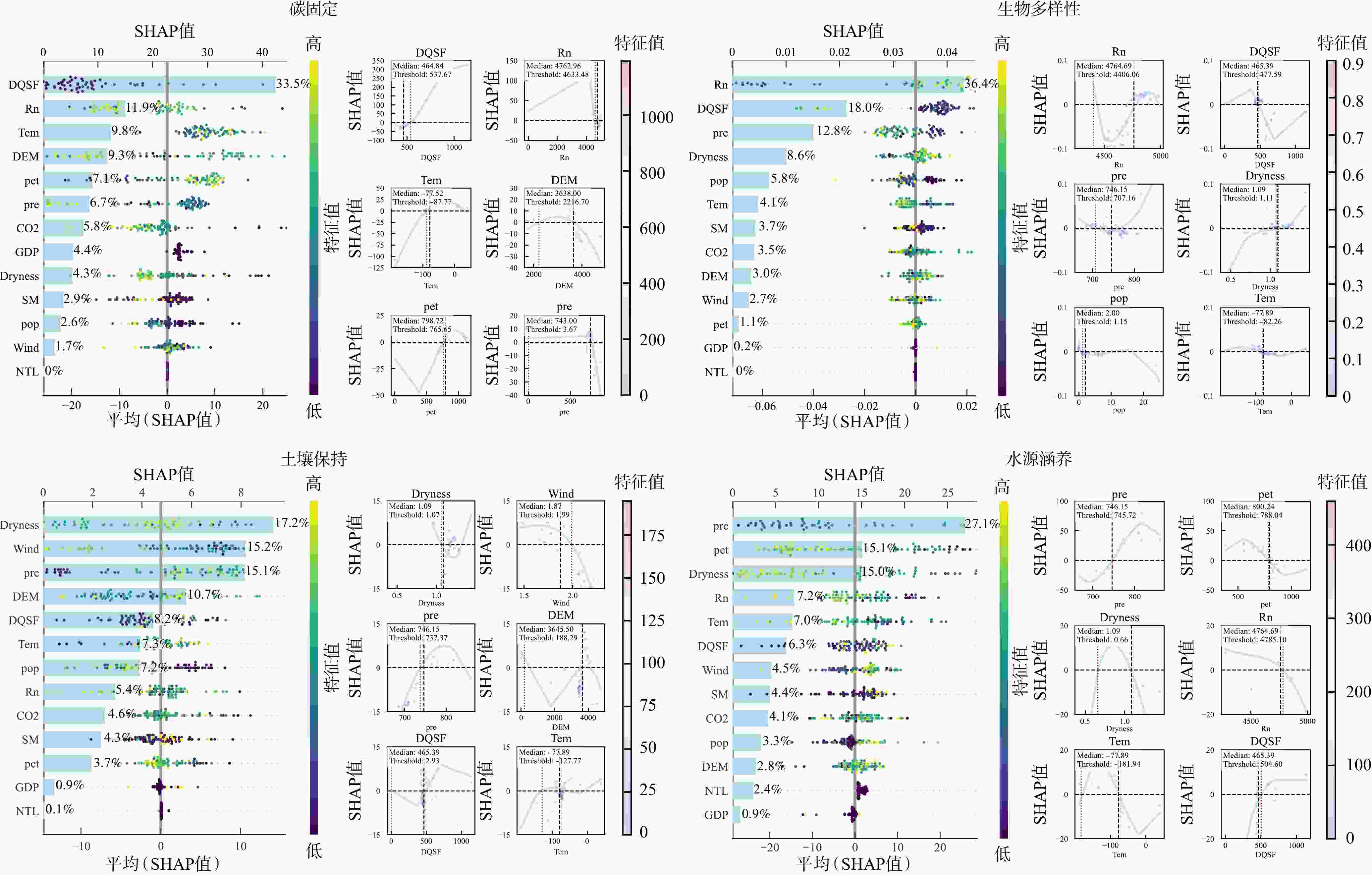
图 8 生态退化归因分析
DQSF—地表粗糙度;Rn—净辐射;Tem—温度;DEM—高程;pet—潜在蒸散发;pre—降雨;CO2—二氧化碳浓度;GDP—地区生产总值;Dryness—干燥度;SM—土壤湿度;pop—人口;Wind—风速;NTL—夜间灯光;Median—中位数;Threshold—阈值
Figure 8. Attribution analysis of ecological degradation
DQSF–surface roughness; Rn–net radiation; Tem–temperature; DEM–elevation; pet–potential evapotranspiration; pre–precipitation; CO2–carbon dioxide concentration; GDP–gross domestic product; Dryness–dryness; SM–soil moisture; pop–soil moisture; Wind–wind speed; NTL–nighttime light
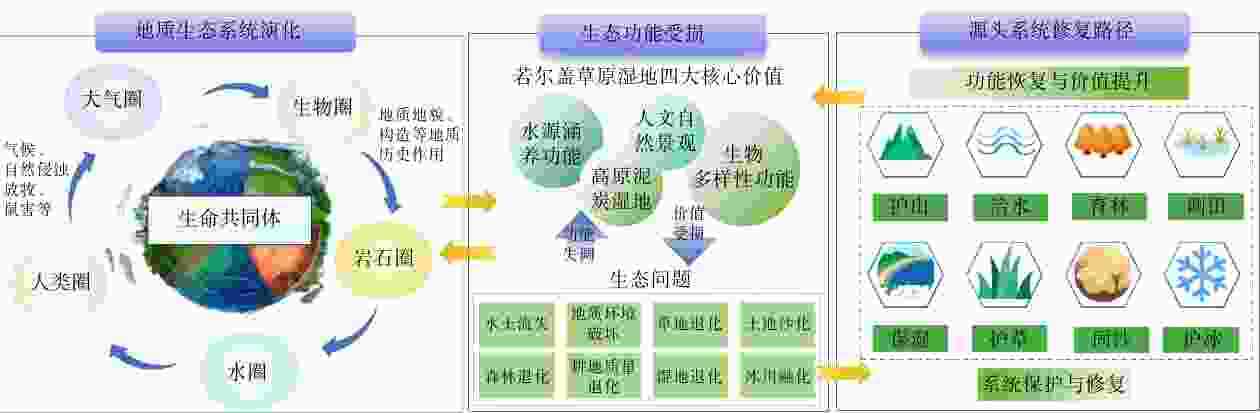
图 9 生命共同体地质生态演化与保护修复机理图
Figure 9. Schematic diagram of the geological–ecological evolution and the protection/restoration mechanisms in the biotic community
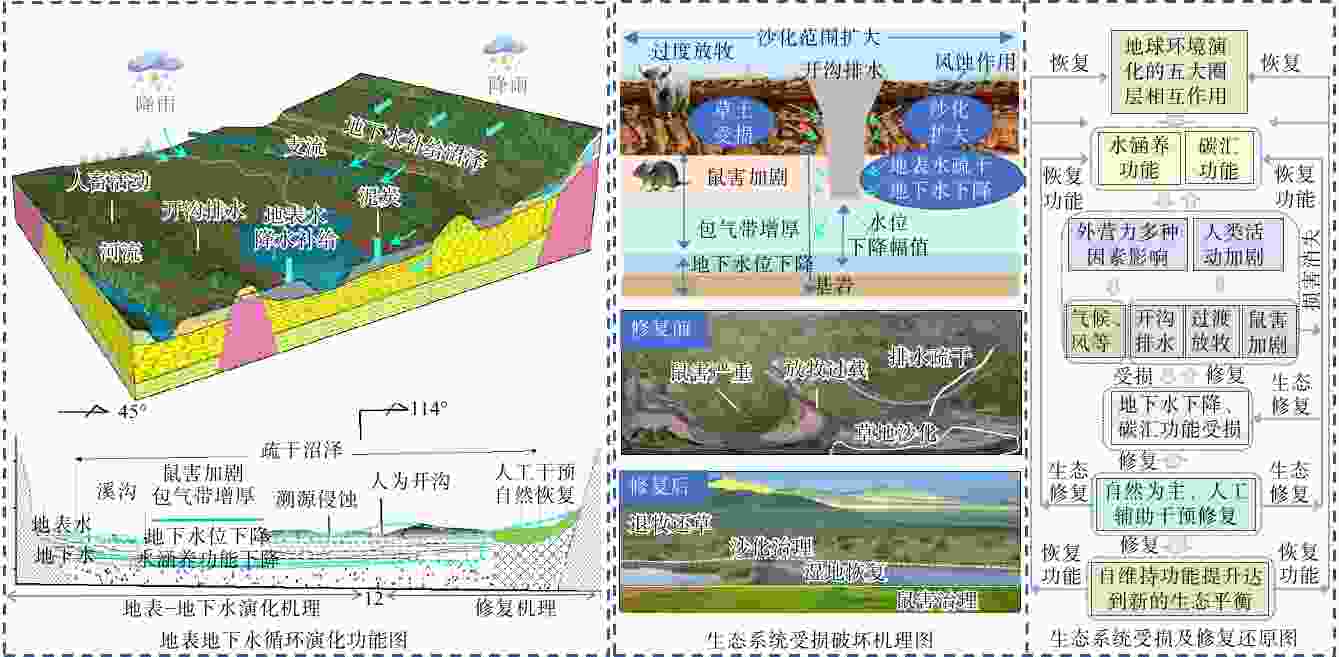
图 10 功能–受损破坏–修复还原演化图
Figure 10. Evolution of ecosystem functions, degradation, and restoration
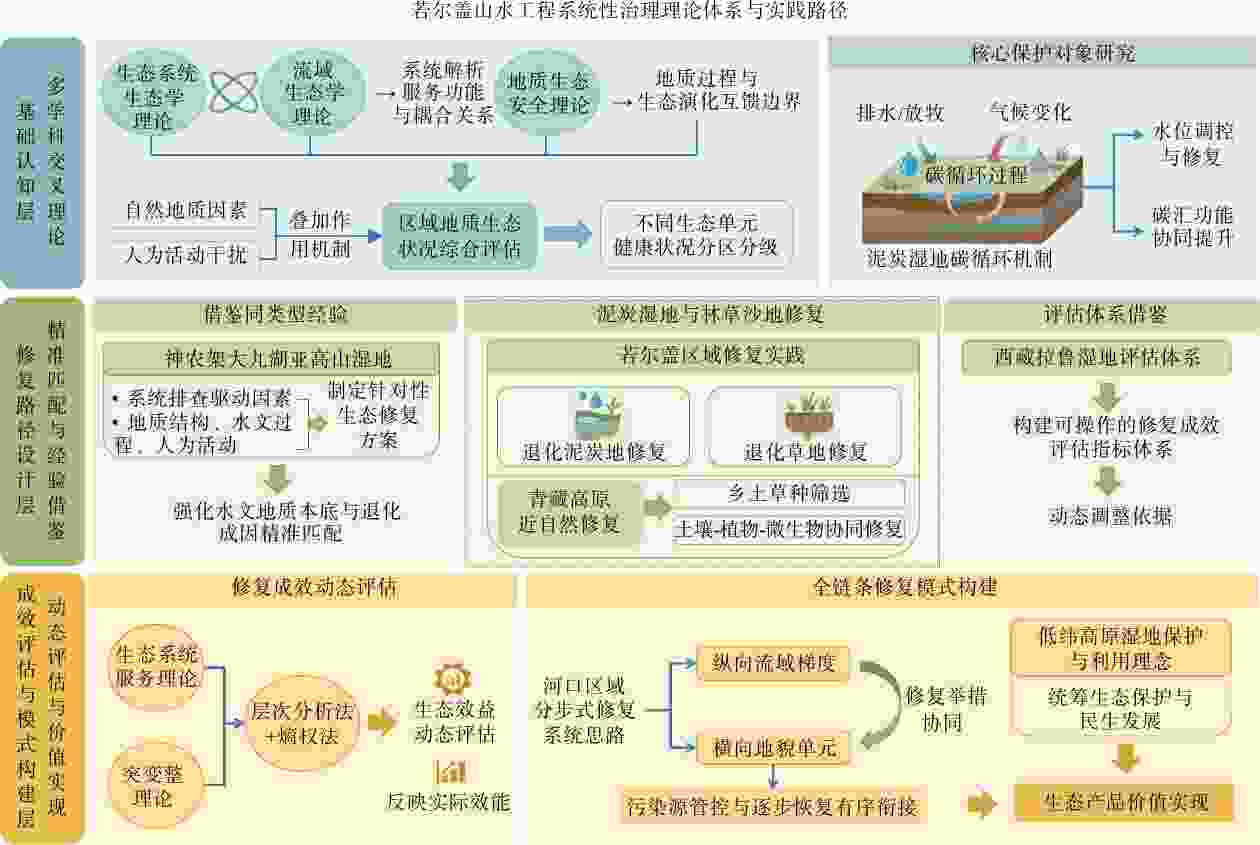
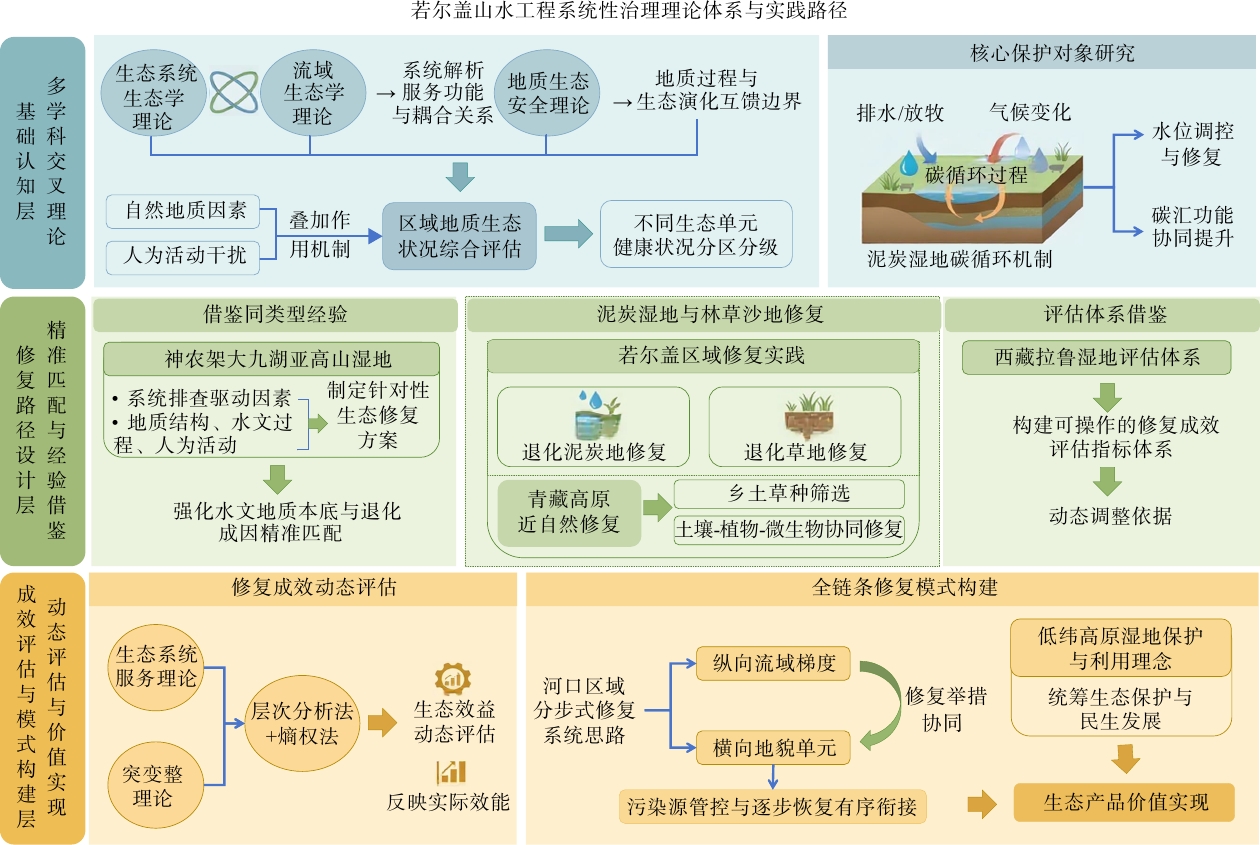
图 11 若尔盖山水工程修复理论支撑与实施路径技术体系框架
Figure 11. Theoretical and technical framework for ecological restoration and implementation pathways of the Zoige Shan–Shui Project
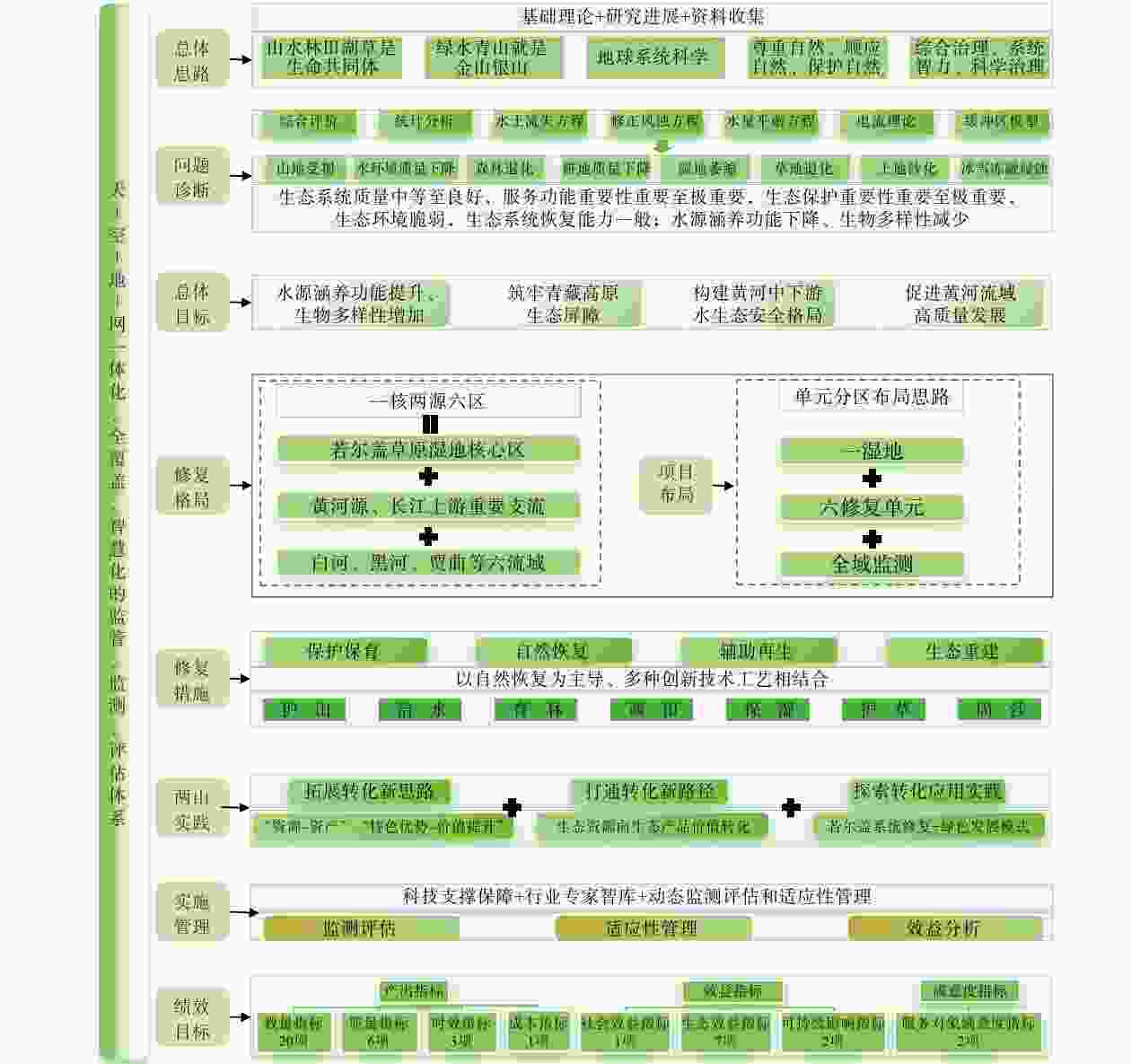
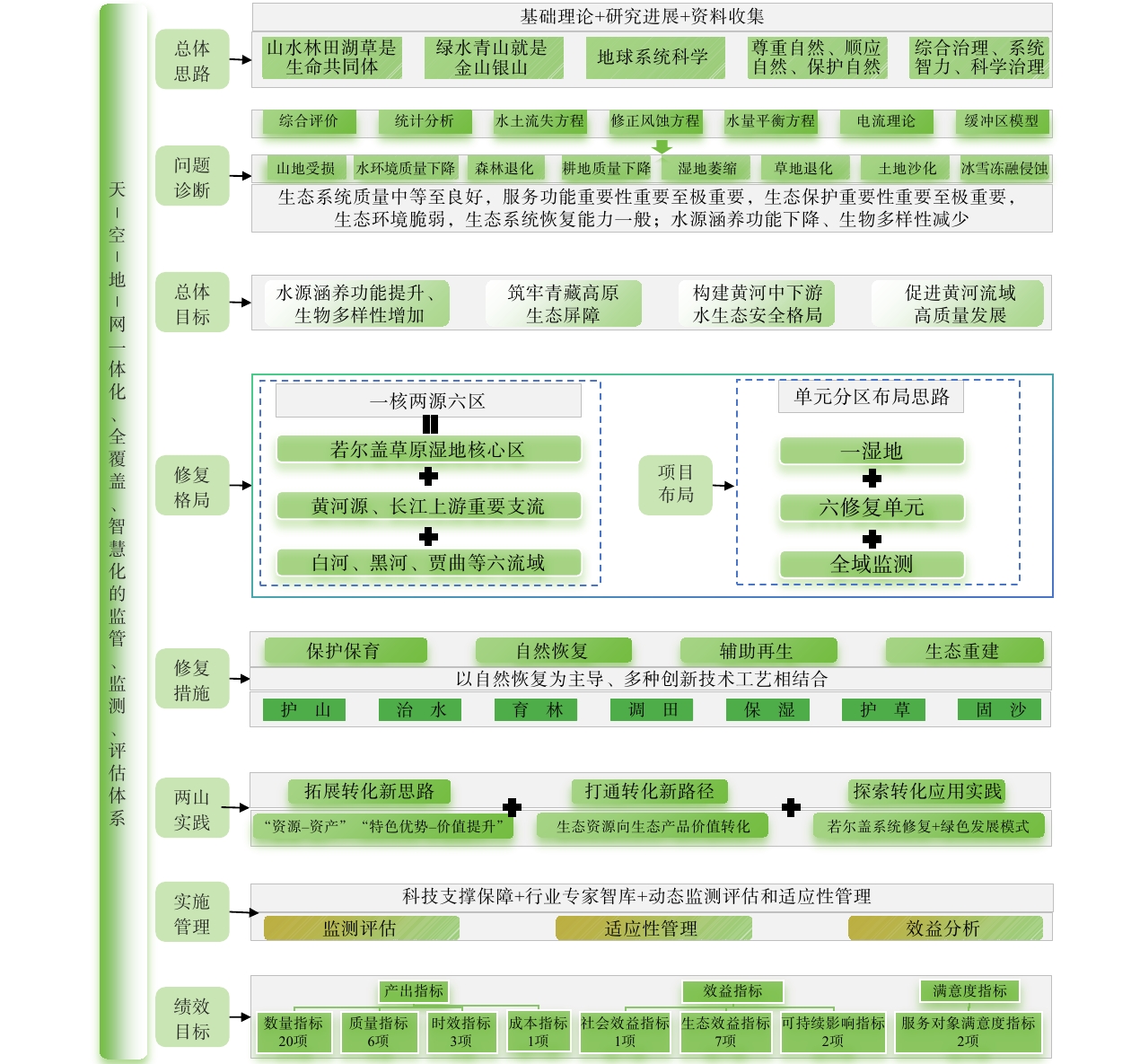
图 12 若尔盖山水工程修复实施技术体系构建图
Figure 12. Schematic diagram of the technical framework for the implementation of the Zoige Shan–Shui Project
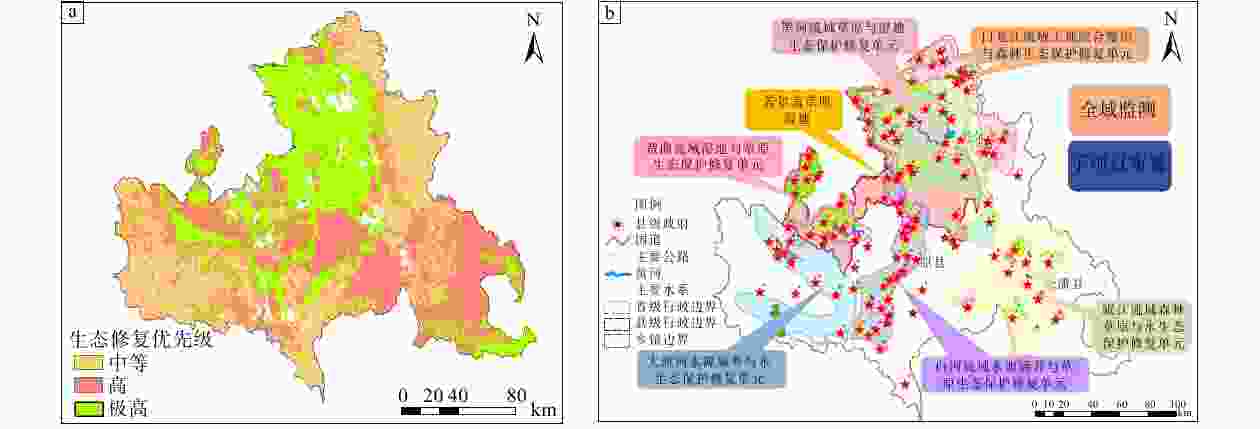
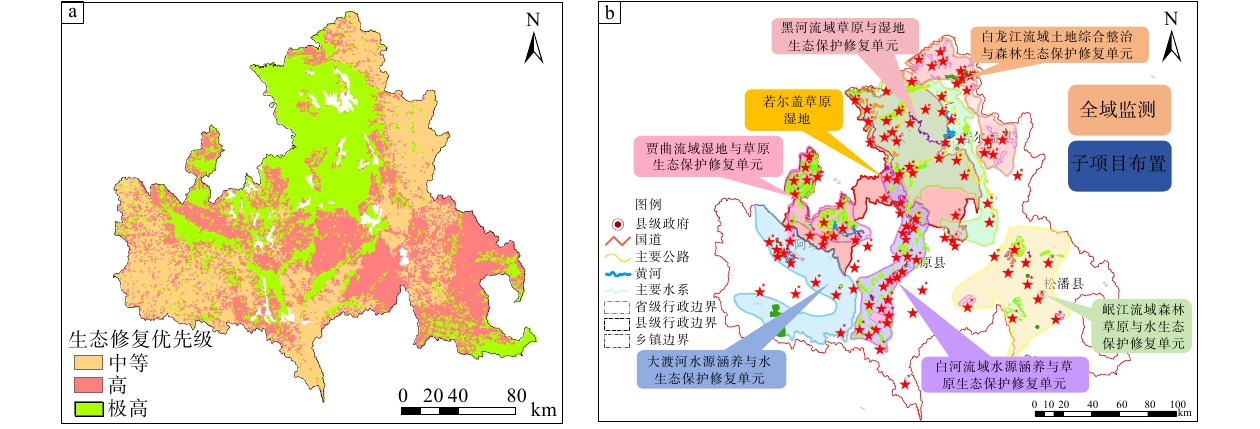
图 13 若尔盖山水工程生态修复分区评价图及工程布局图
a—分区评价图;b—保护和修复工程部署图
Figure 13. Ecological restoration zoning assessment and project layout for the Zoige Shan–Shui Project
(a) Zoning assessment map; (b) Layout of protection and restoration projects
-
[1] CAI Q Q, 2012. Soil carbon storage in Alpine Kobresia Meadows Wetland in Ruoergai, Qinghai-Tibet Plateau[D]. Beijing: Chinese Academy of Forestry. (in Chinese with English abstract) [2] DENG B, LIU S G, LIU S, et al., 2013. Tectono-thermal events and chronological framework in Zoige and its periphery[J]. Earth Science-Journal of China University of Geosciences, 38(2): 317-328. (in Chinese with English abstract) [3] DING L, DU P F, ZHANG F, et al. , 2026. Ecological restoration of degraded grasslands and innovative application of stress-tolerant grass species in the Qinghai-Tibetan Plateau[J/OL]. Scientia Sinica Vitae, 1-12 [2026-08-08]. https://link.cnki.net/urlid/11.5840.Q.20260410.1109.00. (in Chinese with English abstract) [4] DU Y, CAI S M, WANG X L, et al., 2008. Environmental background and ecological restoration of the Dajiuhu sub-alpine wetland in Mt. Shennongjia[J]. Resources and Environment in the Yangtze Basin, 17(6): 915-919. (in Chinese with English abstract) [5] FEI Y, WANG J Y, WANG Z G, 2019. Dynamic changes of land desertification in Zoige Plateau[J]. Journal of Arid Land Resources and Environment, 33(8): 146-152. (in Chinese with English abstract) [6] FU W T, LIU Z Y, QIN S, 2014. A stepwise strategy for ecological restoration of degraded estuary areas[J]. Guangxi Sciences, 21(6): 569-572, 586. (in Chinese with English abstract) [7] GAFFNEY P P J, TANG Q H, LI Q W, et al., 2024. The impacts of land-use and climate change on the Zoige peatland carbon cycle: A review[J]. WIREs Climate Change, 15(1): e862. doi: 10.1002/wcc.862 [8] GUO Y J, LIU S L, DONG Y H, et al., 2023. An indicator system for effectiveness evaluation of ecological corridor restoration based on landscape patterns and ecosystem services[J]. Chinese Journal of Eco-Agriculture, 31(10): 1525-1538. (in Chinese with English abstract) [9] HOU P, ZHAI J, JIN D D, et al., 2022. Assessment of changes in key ecosystem factors and water conservation with remote sensing in the Zoige[J]. Diversity, 14(7): 552. doi: 10.3390/d14070552 [10] HU G Y, DONG Z B, LU J F, et al., 2012. Driving forces of land use and land cover change (LUCC) in the Zoige Wetland, Qinghai-Tibetan Plateau[J]. Sciences in Cold and Arid Regions, 4(5): 422-430. doi: 10.3724/sp.j.1226.2012.00422 [11] HUA G C, LI Y L, HUANG C Y, et al. , 2005. Study on the assess index system of the ecological restoration to the Lalu Wetland in Tibet[J]. Journal of Sichuan University (Engineering Science Edition), 37(6): 20-25. [12] IDOWU O A.(2007). Hydrological processes of interaction between surface water and groundwater - A review[J]. Journal of Environmental Sciences, 6(1): 172-190. [13] Копылов И. С. Принципы и критерии интегральной оценки геоэкологического состояния природных и урбанизированных территорий // Современные проблемы науки и образования. 2011. № 6. URL: https://science-education.ru/ru/article/view?id=5214 [14] LI B, 2008. Driving factors of Zoige Wetland desertification and countermeasures[J]. Chinese Population, Resources and Environment, 18(2): 145-149. (in Chinese with English abstract) [15] LI J H, YANG Q W, PEI X J, et al., 2022. Effects of caves digging by Marmota himalayana on grassland desertification in the Zoige Basin, China[J]. Journal of Desert Research, 42(3): 196-204. (in Chinese with English abstract) [16] LI J X, 2023. Response of the biological components to climate change in the wetland ecosystem of the Qinghai-Tibet Plateau[J]. Highlights in Science, Engineering and Technology, 69: 199-204. doi: 10.54097/hset.v69i.11904 [17] LI S Y, 2022. Plant community stoichiometry response to degradation of different grassland types on Qingzang plateau[D]. Hohhot: Inner Mongolia Agricultural University. (in Chinese with English abstract) [18] LI X, WU K N, LIU Y N, et al., 2019. Ecological protection and restoration of mountains-rivers-forests-farmlands-lakes-grasslands based on ecosystem services-utilizing Heshan section of the south Taihang area as an example[J]. Acta Ecologica Sinica, 39(23): 8806-8816. (in Chinese with English abstract) doi: 10.5846/stxb201905281102 [19] LIU M Y, 2023. Assessment of carbon storage and habitat quality in Hexi region based on InVES[D]. Lanzhou: Lanzhou University. (in Chinese with English abstract) [20] LIU S L, DONG Y H, WANG F F, et al., 2023. Application of ecosystem service valuation in ecological restoration[J]. Chinese Journal of Eco-Agriculture, 31(8): 1343-1354. (in Chinese with English abstract) [21] LU X Z, SHAO H Y, KAN Y X, et al., 2025. Estimation of land surface evapotranspiration and identification of key influencing factors in the Zoige forest–grass transition zone[J]. Land, 14(4): 805. doi: 10.3390/land14040805 [22] QI D M, LI Y Q, ZHOU C Y, et al., 2025. Variation characteristics of runoff and its influencing factors in Zoige Wetland[J]. Journal of Glaciology and Geocryology, 47(1): 14-29. (in Chinese with English abstract) [23] RAN Q W, XUE K, HU R H, et al., 2026. Spatiotemporal patterns of alpine wetlands and the regulatory role of connectivity on the Qinghai-Tibet Plateau[J]. Scientia Sinica Terrae, 56(6): 2225-2237. (in Chinese) doi: 10.1360/SSTe-2025-0173 [24] SHANG M, JIA Y J C, LIU H T, et al., 2024. Quantitative study on the evolution characteristics and driving factors of grassland desertification in Ruoergai County[J]. Environmental Engineering, 42(12): 43-51. (in Chinese with English abstract) [25] SHENGPING L, LAVRUSEVICH A, SLESAREV M, et al., 2020. Research on the concept and evaluation method of geo-ecological security[J]. IOP Conference Series: Materials Science and Engineering, 1001: 012106. doi: 10.1088/1757-899x/1001/1/012106 [26] SUN P A R, REN H, JIA X, et al., 2026. Research trends on mountain-rivers-forests-farmlands-lakes-grassland-desert system[J]. Journal of Desert Research, 46(1): 318-330. (in Chinese with English abstract) [27] TAN S L, LIU T, XIONG X, et al., 2025a. Research on ecological restoration technology of Ruoergai alpine grassland wetland[J]. Environmental Science and Management, 50(10): 161-166. (in Chinese with English abstract) [28] TAN S L, XIANG G P, LIU T, et al., 2025b. Characteristics of mountains-rivers-forests-farmlands-lakes-grasslands-deserts and existing problems in the Ruoergai grassland wetland[J]. Environmental Protection Science, 51(4): 69-78. (in Chinese with English abstract) [29] TAN S L, XIANG G P, XIONG X, et al., 2025c. Study on ecological restoration zoning and restoration unit delineation of Ruoergai grassland wetland[J]. Journal of Guangxi Academy of Sciences, 41(2): 222-231. (in Chinese with English abstract) [30] TU M G, LU H, SHANG M, 2021. Monitoring grassland desertification in Zoige County using Landsat and UAV image[J]. Polish Journal of Environmental Studies, 30(6): 5789-5799. doi: 10.15244/pjoes/136184 [31] WANG Y, LIU G D, HU H L, 2011. Simulation on the water transporting process in Zoige Wetland SPAC system and its eco-hydrological effect[J]. Advanced Materials Research, 356-360: 2556-2561. [32] WANG Z, SUN F H, YANG T, et al., 2025. Wind erosion control of bare surface soil in arid mining area by cyanobacterial inoculation and biochar amendment[J]. CATENA, 250: 108765. doi: 10.1016/j.catena.2025.108765 [33] WANG Z B, LI J X, GUO Y Q, et al., 2019. Ecological protection and restoration model of multi-ecological elements in Qinghai-Tibet Plateau: a case study of Lhasa River Basin[J]. Acta Ecologica Sinica, 39(23): 8966-8974. (in Chinese with English abstract) [34] WU S X, 2022. Landscape renewal design of urban wetland park in low latitude plateau: A case study of Changqiaohai national wetland Parkin Mengzi[D]. Liaocheng: Liaocheng University. (in Chinese with English abstract) [35] XIAN W, XIANG Z Y, LIU L Y, et al., 2015. Monitoring spatial-temporal change of land desertification in a fragile sub-alpine rangeland eco-environment: A case study from China[J]. Environmental & Engineering Geoscience, 21(3): 223-234. doi: 10.2113/gseegeosci.21.3.223 [36] XU G, ZHAO Z Z, WANG Y, et al., 2007. Remote-sensing dynamic monitoring of sand-and rock-desertification of the Zoigê Plateau basin, northern Sichuan, China[J]. Geological Bulletin of China, 26(8): 1048-1055. (in Chinese with English abstract) [37] XU X N, HUANG R Q, QIN J L, 2003. Eco-environmental geological survey and applications of the 3S system-A case study of the eco-environmental geological survey of the Anning River valley, southern Sichuan[J]. Geological Bulletin of China, 22(11-12): 999-1005. (in Chinese with English abstract) [38] XU X N, LI S W, 2003. Develop an ecologic environmental geological Survey in the Anning River Basin by New Ideas[J]. Acta Geologica Sichuan, 23(4): 216-219. (in Chinese with English abstract) [39] XU X N, 2003. The eco-geological environment comprehensive exploitation and protection Anning Rivern[J]. Journal of Geological Hazards and Environment Preservation, 14(3): 5-9. (in Chinese with English abstract) [40] XU X N, 2004. Eco-environmental geological issues and effects in Anning River, Upper Yangtze[J]. Journal of Mountain Science, 22(5): 572-577. (in Chinese with English abstract) [41] XU X N, HUANG R Q, 2004. An analysis of dynamic evolution of the eco-geological environment in the Anninghe River watershed in western Sichuan Province[J]. Hydrogeology and Engineering Geology(5): 31-34. (in Chinese with English abstract) [42] XU X N, WANG W J, HUANG R Q, 2004. Evaluation of eco-environmental geological quality in Anning River area based on GIS technology[J]. Journal of Chengdu University of Technology (Science & Technology Edition), 31(3): 243-248. (in Chinese with English abstract) [43] XU X N, ZHANG D D, XIANG G P, et al., 2023. Comprehensive ecological restoration of mountains, rivers, forests, fields, lakes and grasslands[J]. Journal of Geological Hazards and Environment Preservation, 34(2): 109-113. (in Chinese with English abstract) [44] XU X N, WU Y, WANG K K, et al., 2026. Electron-flow-driven redox cycling in CN-supported CoFe2O4 enables intensified peroxymonosulfate activation for tetracycline degradation[J]. Environmental Research, 306: 125322. doi: 10.1016/j.envres.2026.125322 [45] XU X N, XIANG G P, SONG C Q, 2026. Ecological restoration in the upper reaches of the yellow river and demonstration of territorial spatial pattern optimization[M]. Beijing: Science Press. (in Chinese) [46] YAN C X, WANG D, YANG X, et al., 2026. Research progress in ecology of Ochotona curzoniae[J]. Sichuan Journal of Zoology, 45(3): 336-347. (in Chinese with English abstract) [47] YONG G W, SHI C C, QIU P F, 2003. Monitoring on desertification trends of the grassland and shrinking of the wetland in Ruoergai Plateau in North-west Sichuan by means of remote-sensing[J]. Journal of Mountain Science, 21(6): 758-762. (in Chinese with English abstract) [48] ZANG Z, ZHENG D F, SUN C Z, et al., 2014. Evaluation of wetland ecological benefit and restoration in the natural reserves of western Jilin Province, China[J]. Chinese Journal of Applied Ecology, 25(5): 1447-1454. (in Chinese with English abstract) [49] ZHANG Y F, MA A Z, ZHUANG G, et al., 2019. The acetotrophic pathway dominates methane production in Zoige alpine wetland coexisting with hydrogenotrophic pathway[J]. Scientific Reports, 9(1): 9141. doi: 10.1038/s41598-019-45590-5 [50] ZHAO Y Z, XUE C X, YANG Y H, 2013. Research on ecological restoration of alpine steppe along Qinghai-Tibet railway[J]. Journal of Railway Engineering Society, 30(7): 90-94. (in Chinese with English abstract) [51] ZHENG X M, FU H S, LI J P, et al. , 2026. Climate change enhances the evolution of meadering rivers in the Yellow River Source Region[J/OL]. Advanced Engineering Sciences, 1-15 [2026-08-08]. https://link.cnki.net/urlid/51.1773.tb.20260421.1243.00. (in Chinese with English abstract) [52] ZHOU R, 2025. Effects of restoration duration on soil aggregates and organic carbon components in alpine desertified grasslands[D]. Nanchong: China West Normal University. (in Chinese with English abstract) [53] ZHOU Y, CHEN Y, YING L X, et al., 2021. A technical framework for ecosystem conservation and restoration[J]. Earth Science Frontiers, 28(4): 14-24. (in Chinese with English abstract) [54] 蔡倩倩, 2012. 若尔盖高寒嵩草草甸湿地土壤碳储量研究[D]. 北京: 中国林业科学研究院. [55] 邓宾, 刘树根, 刘顺, 等, 2013. 川西若尔盖地区中—新生代构造—热事件及其年代学框架[J]. 地球科学——中国地质大学学报, 38(2): 317-328. [56] 丁励, 杜鹏飞, 张菲, 等, 2026. 青藏高原退化草地生态修复与耐逆草种创新应用[J/OL]. 中国科学: 生命科学, 1-12 [2026-08-08]. https://link.cnki.net/urlid/11.5840.Q.20260410.1109.00. [57] 杜耘, 蔡述明, 王学雷, 等, 2008. 神农架大九湖亚高山湿地环境背景与生态恢复[J]. 长江流域资源与环境, 17(6): 915-919. doi: 10.3969/j.issn.1004-8227.2008.06.016 [58] 费怡, 王继燕, 王泽根, 2019. 若尔盖高原土地沙化及其成因定量分析[J]. 干旱区资源与环境, 33(8): 146-152. doi: 10.13448/j.cnki.jalre.2019.240 [59] 付晚涛, 刘正一, 秦松, 2014. 入海河口退化生境阶梯式生态修复策略构想[J]. 广西科学, 21(6): 569-572, 586. doi: 10.3969/j.issn.1005-9164.2014.06.002 [60] 郭玉佳, 刘世梁, 董玉红, 等, 2023. 基于景观格局和生态系统服务的生态廊道修复成效评估指标体系[J]. 中国生态农业学报(中英文), 31(10): 1525-1538. doi: 10.12357/cjea.20230079 [61] 李斌, 2008. 若尔盖湿地沙漠化成因分析及对策探讨[J]. 中国人口·资源与环境, 18(2): 145-149 [62] 黎俊豪, 杨晴雯, 裴向军, 等, 2022. 旱獭(Marmota himalayana)掘洞对若尔盖盆地草地沙化的影响[J]. 中国沙漠, 42(3): 196-204. doi: 10.7522/j.issn.1000-694X.2021.00151 [63] 李邵宇, 2022. 青藏高原不同草地类型植物群落化学计量特征对退化的响应[D]. 呼和浩特: 内蒙古农业大学. [64] 李潇, 吴克宁, 刘亚男, 等, 2019. 基于生态系统服务的山水林田湖草生态保护修复研究: 以南太行地区鹤山区为例[J]. 生态学报, 39(23): 8806-8816. doi: 10.5846/stxb201905281102 [65] 刘梦园, 2023. 基于InVEST模型的河西地区碳储量与生境质量评价[D]. 兰州: 兰州大学. [66] 刘世梁, 董玉红, 王方方, 等, 2023. 生态系统服务价值评估在生态修复中的应用[J]. 中国生态农业学报(中英文), 31(8): 1343-1354. doi: 10.12357/cjea.20230094 [67] 齐冬梅, 李跃清, 周长艳, 等, 2025. 若尔盖湿地区域径流变化特征及其影响因素分析[J]. 冰川冻土, 47(1): 14-29. doi: 10.7522/j.issn.1000-0240.2025.0002 [68] 冉沁蔚, 薛凯, 胡容海, 等, 2026. 青藏高原高寒湿地时空格局及连通性的调节作用[J]. 中国科学: 地球科学, 56(6): 2225-2237. [69] 尚闽, 加羊甲措, 刘洪涛, 等, 2024. 若尔盖县草原沙化演变特征与驱动因素定量研究[J]. 环境工程, 42(12): 43-51. doi: 10.13205/j.hjgc.202412006 [70] 孙平安然, 任珩, 贾信, 等, 2026. 山水林田湖草沙研究态势[J]. 中国沙漠, 46(1): 318-330. doi: 10.7522/j.issn.1000-694X.2025.00195 [71] 谭世林, 刘涛, 熊西, 等, 2025a. 若尔盖高寒草原湿地生态修复技术研究[J]. 环境科学与管理, 50(10): 161-166. doi: 10.3969/j.issn.1674-6139.2025.10.035 [72] 谭世林, 向国萍, 刘涛, 等, 2025b. 若尔盖草原湿地山水林田湖草沙各要素特征及存在问题[J]. 环境保护科学, 51(4): 69-78. doi: 10.16803/j.cnki.issn.1004-6216.202407014 [73] 谭世林, 向国萍, 熊西, 等, 2025c. 若尔盖草原湿地生态修复分区及修复单元划分研究[J]. 广西科学院学报, 41(2): 222-231. doi: 10.13657/j.cnki.gxkxyxb.20250722.008 [74] 王振波, 李嘉欣, 郭义强, 等, 2019. 青藏高原山水林田湖草生态保护修复模式: 以拉萨河流域为例[J]. 生态学报, 39(23): 8966-8974. doi: 10.5846/stxb201906041191 [75] 徐刚, 赵志中, 王燕, 等, 2007. 川北若尔盖高原盆地沙漠化、岩漠化遥感动态监测研究[J]. 地质通报, 26(8): 1048-1055. doi: 10.3969/j.issn.1671-2552.2007.08.019 [76] 许向宁, 黄润秋, 秦举礼, 2003. 生态环境地质调查与3S技术应用: 以川南安宁河流域生态环境地质调查为例[J]. 地质通报, 22(11-22): 999-1005. doi: 10.3969/j.issn.1671-2552.2003.11.028 [77] 许向宁, 李胜伟, 2003. 以创新的思路开展长江上游安宁河流域生态环境地质调查[J]. 四川地质学报, 23(4): 216-219. doi: 10.3969/j.issn.1006-0995.2003.04.006 [78] 许向宁, 2003. 安宁河流域生态地质环境综合开发与保护[J]. 地质灾害与环境保护, 14(3): 5-9. doi: 10.3969/j.issn.1006-4362.2003.03.002 [79] 许向宁, 2004. 长江上游安宁河流域主要生态环境地质问题及其效应[J]. 山地学报, 22(5): 572-577. doi: 10.3969/j.issn.1008-2786.2004.05.010 [80] 许向宁, 黄润秋, 2004. 川西安宁河流域生态地质环境动态演化分析[J]. 水文地质工程地质(5): 31-34. [81] 许向宁, 王文俊, 黄润秋, 2004. 基于GIS的安宁河流域生态环境地质质量评价[J]. 成都理工大学学报(自然科学版), 31(3): 243-248. doi: 10.3969/j.issn.1671-9727.2004.03.005 [82] 许向宁, 张丹丹, 向国萍, 等, 2023. 山水林田湖草综合生态修复研究综述[J]. 地质灾害与环境保护, 34(2): 109-113. doi: 10.3969/j.issn.1006-4362.2023.02.020 [83] 许向宁, 向国萍, 宋长青, 等, 2026. 黄河上游生态修复与国土空间格局优化示范[M]. 北京: 科学出版社. [84] 闫趁心, 汪典, 杨雪, 等, 2026. 高原鼠兔生态学研究进展[J]. 四川动物, 45(3): 336-347. doi: 10.11984/j.issn.1000-7083.20250214 [85] 雍国玮, 石承苍, 邱鹏飞, 2003. 川西北高原若尔盖草地沙化及湿地萎缩动态遥感监测[J]. 山地学报, 21(6): 758-762. doi: 10.3969/j.issn.1008-2786.2003.06.021 [86] 臧正, 郑德凤, 孙才志, 等, 2014. 吉林西部自然保护区湿地生态效益及生态恢复评价[J]. 应用生态学报, 25(5): 1447-1454. doi: 10.13287/j.1001-9332.2014.0007 [87] 赵燕洲, 薛春晓, 杨印海, 2013. 青藏铁路路域高寒草原生态修复技术研究[J]. 铁道工程学报, 30(7): 90-94. doi: 10.3969/j.issn.1006-2106.2013.07.017 [88] 郑鑫梦, 付鸿声, 李金钋, 等, 2026. 暖湿气候加剧黄河源区弯曲河道演变[J/OL]. 工程科学与技术, 1-15 [2026-08-08]. https://link.cnki.net/urlid/51.1773.tb.20260421.1243.00. [89] 周锐, 2025. 高寒沙化草地恢复年限对土壤团聚体及其有机碳组分的影响[D]. 南充: 西华师范大学. [90] 周妍, 陈妍, 应凌霄, 等, 2021. 山水林田湖草生态保护修复技术框架研究[J]. 地学前缘, 28(4): 14-24. doi: 10.13745/j.esf.sf.2020.10.23 -

 下载:


计量
- 文章访问数: 45
- HTML全文浏览量: 6
- PDF下载量: 3
- 被引次数: 0
