


Tungsten and tin mineralization in the northern Jiangxi–southern Anhui metallogenic belt, eastern Jiangnan Orogen, China
-
摘要: 江南造山带东段赣北—皖南成矿带是近些年新厘定的世界级钨(W)富集区。为突破传统S型花岗岩单一控矿的认识,厘清区内S型、I型、A型花岗岩对应的钨−锡(W-Sn)成矿差异,揭示成矿动力学机制,建立区域成矿模式并服务深部勘查,文章综合运用野外地质调查、岩矿相学观察、锆石/热液矿物U-Pb测年、辉钼矿Re-Os年代学、Sr-Nd-Hf同位素分析、矿物原位微区微量元素测定以及流体包裹体分析等,系统对比朱溪、大湖塘、香炉山、阳储岭、东源、西坞口等典型矿床的地质−岩浆−热液特征,按照S型、I型、A型花岗岩分类剖析成矿作用,归纳成矿物质迁移富集过程。研究结果表明:该成矿带W资源总量已超南岭成矿带,主成矿时代集中于燕山期150~130 Ma;S型花岗岩控制朱溪和大湖塘超大型钨−铜(W-Cu)多金属矿床,为强过铝、还原岩浆体系,以矽卡岩及复合叠加矿化为特征;I型花岗岩产出香炉山、阳储岭、东源等大—中型钨−钼(W-Mo)多金属矿床,属于中—高温弱过铝质岩浆,发育斑岩−矽卡岩矿化,白钨矿钙质既可来自碳酸盐围岩,也可来自岩体中斜长石等硅酸盐矿物蚀变;A型花岗岩以西坞口锡−钨−铷(Sn-W-Rb)矿床为代表,高分异富氟,富集锡、铷等稀有金属;该成矿带遵循“基底预富集—中生代壳幔作用—岩浆流体卸载”成矿三阶段富集模式,深部动力源自古太平洋板块俯冲后撤与岩石圈伸展;该成矿带可划定出断裂交汇、隐伏岩体穹窿等4类深部找矿靶区。江南造山带钨−锡成矿并不局限于S型花岗岩,S-I-A型花岗岩可形成差异化成矿体系;双桥山群富钨、锡变质基底提供物质基础,壳幔相互作用提供热源与部分物质贡献,岩浆分异−流体演化控制金属沉淀。此研究成果完善了区域钨−锡成矿理论,可为赣北—皖南地区及其他相似地区关键矿产深部勘查提供理论依据。Abstract:
Objective Tungsten and tin are strategic critical metals in China. The Northern Jiangxi–Southern Anhui metallogenic belt in the eastern Jiangnan Orogen is a newly recognized world-class tungsten-rich province. This study aims to supplement the traditional understanding that tungsten mineralization is solely controlled by S-type granites, clarify the differences in W-Sn mineralization related to S-, I-, and A-type granites, reveal geodynamic metallogenic mechanisms, establish regional metallogenic models, and support deep mineral exploration. Methods Based on field geological investigations, petrographic observations, U–Pb dating of zircon and other hydrothermal minerals, molybdenite Re–Os geochronology, Sr–Nd–Hf isotopes, in-situ trace-element analysis of minerals, and fluid-inclusion data, typical deposits including Zhuxi, Dahutang, Xianglushan, Yangchuling, Dongyuan and Xiwukou were systematically compared. Metallogenic processes were analyzed under the classification of S-, I- and A-type granites, and the migration-enrichment of ore-forming materials was summarized. Results (1) The total W resources in this belt exceed those in the Nanling metallogenic belt, with major Yanshanian metallogenic ages of 150–130 Ma. (2) S-type granites host the giant Zhuxi and Dahutang W-Cu polymetal deposits, characterized by strongly peraluminous, reduced magmas and skarn-superimposed mineralization. (3) I-type granites host medium-to-large W-Mo polymetal deposits, such as Xianglushan, Yangchuling, and Dongyuan, which formed under medium-to-high temperature conditions in weakly-peraluminous systems with porphyry-skarn mineralization; calcium for scheelite formation derives either from carbonate wall rocks or silicate-mineral (e.g, plagioclase) alteration within plutons. (4) The A-type-granite-related Xiwukou Sn-W-Rb deposit records highly fractionated, F-rich magmatism with the enrichment of Sn, Rb, and other rare metals. (5) A three-stage enrichment model is established: basement pre-enrichment, Mesozoic crust-mantle interaction, and magmatic fluid exsolution and unloading. Regional mineralization is likely driven by Paleo-Pacific slab rollback and lithospheric extension. (6) Four categories of deep prospecting targets, e.g. fault intersections and concealed pluton domes, are proposed. Conclusions The W-Sn mineralization in the Jiangnan Orogen is not restricted to S-type granites; S-, I- and A-type granites constitute differentiated metallogenic systems. The W-Sn-enriched meta-sedimentary rock basement of the Shuangqiaoshan Group provides primary ore-forming materials, while crust-mantle interaction supplies heat and partial components; magma differentiation and fluid evolution dominate metal precipitation. Significance This work improves the regional understanding of W-Sn metallogenesis and provides theoretical support for the deep exploration of strategic critical minerals, not only in Northern Jiangxi-Southern Anhui provinces but also in other areas with similar geological conditions. -
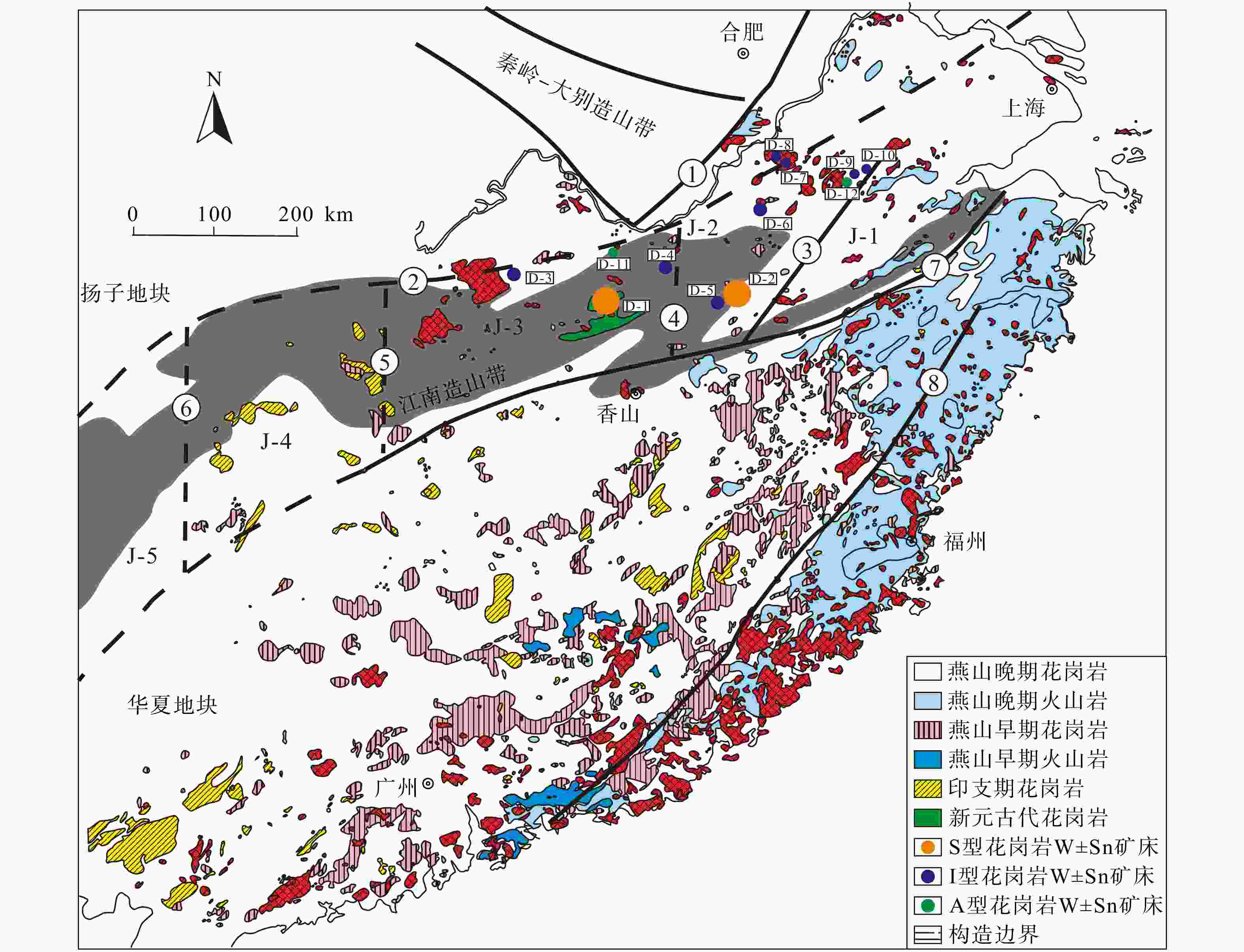
图 1 江南造山带岩浆岩及钨−锡矿床分布图(据Su and Jiang, 2017;Shu et al., 2019修改)
D-1—大湖塘钨矿床;D-2—朱溪钨矿床;D-3—香炉山钨矿床;D-4—阳储岭钨矿床;D-5—塔前钨矿床;D-6—东源钨矿床;D-7—百丈岩钨矿床;D-8,高家塝钨矿床;D-9—大邬尖钨矿床;D-10—竹溪岭钨矿床;D-11—彭山锡矿床;D-12—西坞口W-Sn-Rb矿床;J-1—怀玉地体;J-2—鄣公地体;J-3—九岭地体;J-4—湘北地体;J-5—桂北地体;①—郯城−庐江断裂带;②—石台−九江−吉首断裂带;③—樟树墩−德兴−歙县断裂带;④—赣江隐伏断裂;⑤—汨罗–湘潭隐伏断裂;⑥—城步–永福断裂;⑦—绍兴–萍乡–祁东–全州–龙胜–永福缝合带;⑧—政和–大埔断裂带
Figure 1. Distribution of magmatic rocks and related tungsten and tin deposits in the Jiangnan Orogen (modified after Su and Jiang, 2017; Shu et al., 2019)
D-1–Dahutang W deposit; D-2–Zhuxi W deposit; D-3–Xianglushan W deposit; D-4–Yangchuling W deposit; D-5–Taqian W deposit; D-6–Dongyuan W deposit; D-7–Baizhangyan W deposit; D-8–Gaojiabang W deposit; D-9–Dawujian W deposit; D-10–Zhuxiling W deposit; D-11–Pengshan Sn deposit; D-12–Xiwukou W-Sn-Rb deposit; J-1–Huaiyu terrane; J-2–Zhanggong terrane; J-3–Jiuling terrane; J-4–Northern Hunan terrane; J-5–Northern Guangxi terrane; ①–Tancheng–Lujiang fault zone; ②–Shitai–Jiujiang–Jishou fault zone; ③–Zhangshudun–Dexing–Shexian fault zone; ④–Ganjiang buried fault; ⑤–Miluo–Xiangtan buried fault; ⑥–Chengbu–Yongfu fault; ⑦–Shaoxing–Pingxiang–Qidong–Quanzhou–Longsheng–Yongfu suture zone; ⑧–Zhenghe–Dapu fault zone
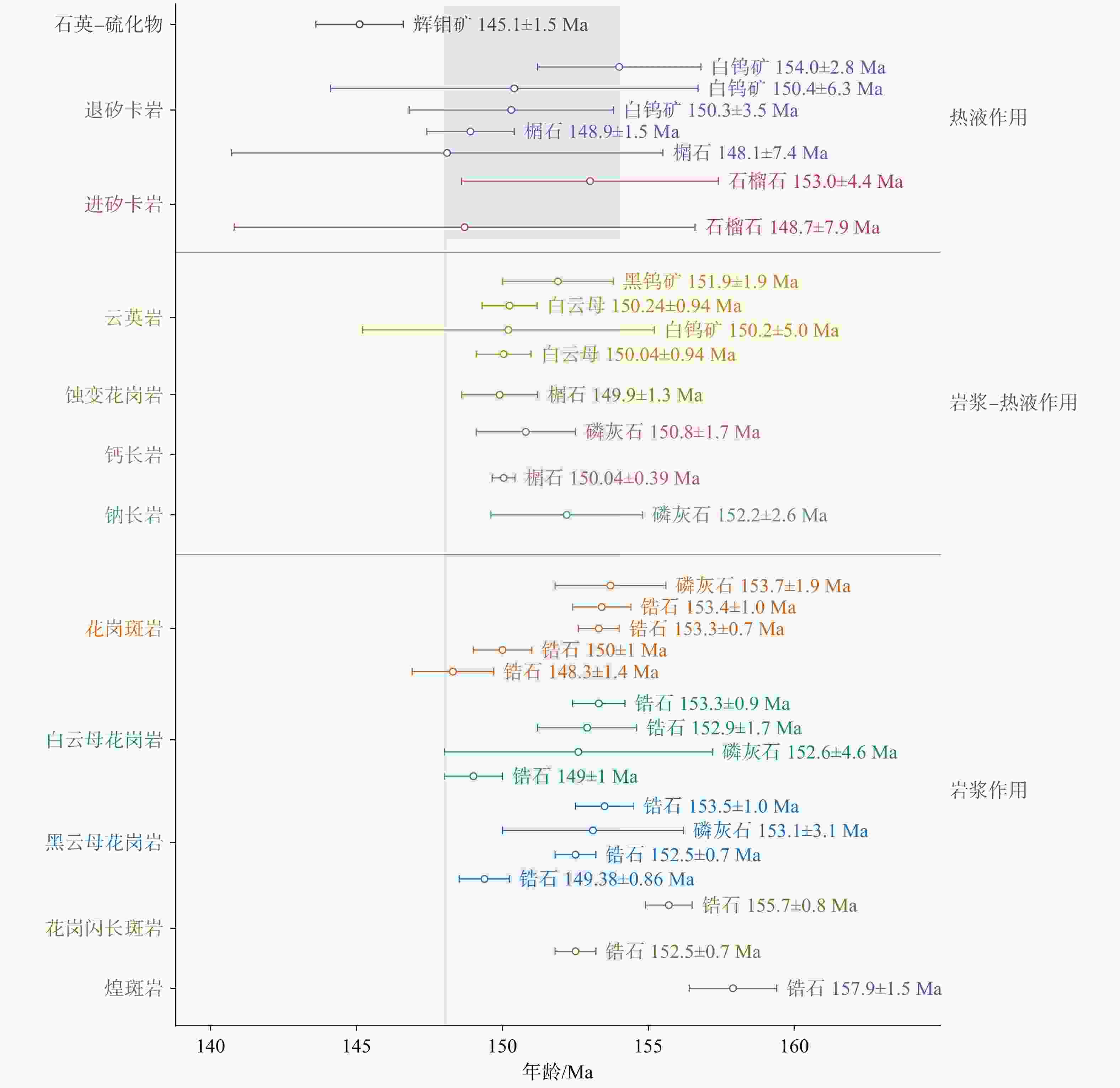
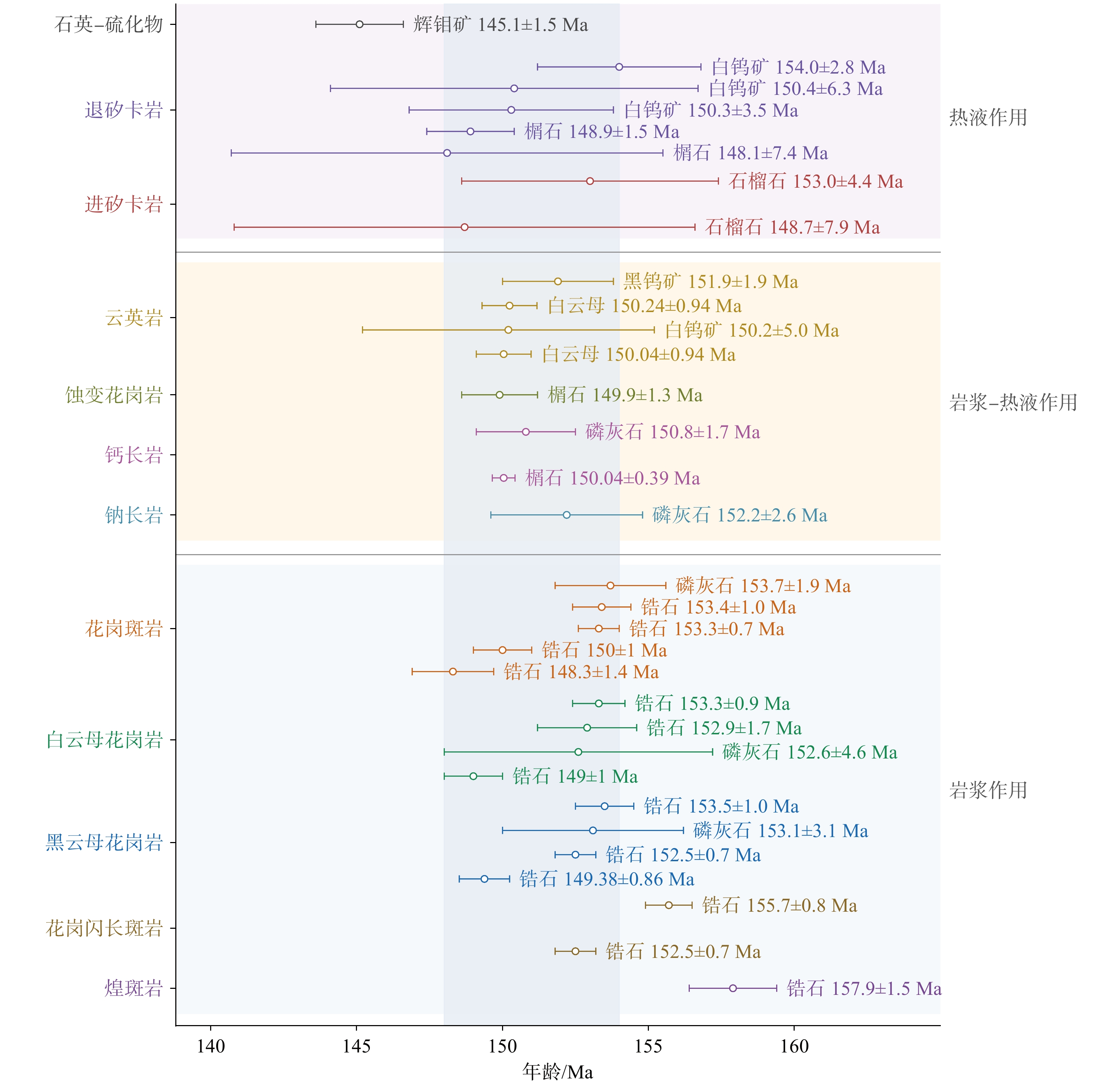
图 2 朱溪矿区岩浆岩中锆石和磷灰石及与成矿有关热液矿物年龄总汇
年龄数据为各文献报道的加权平均年龄、等时线年龄或谐和年龄结果;年龄数据来源于Pan et al.(2017,2018)、Song et al.(2018b,2019,2021,2023b)、Zhang et al.(2020a,2020b,2021b)、Hong et al.(2022)、Qiu et al.(2024)、Ouyang et al.(2025)、Yang et al.(2025b)和Zhao et al.(2023,2026);图中蓝灰色垂直背景区域代表该区成岩成矿年龄主要区间
Figure 2. Compilation of published ages for zircon and apatite from magmatic rocks and ore-related hydrothermal minerals from the Zhuxi ore district
Ages are weighted mean, isochron, or concordia ages reported by Pan et al. (2017, 2018), Song et al. (2018b, 2019, 2021, 2023b), Zhang et al. (2020a, 2020b, 2021b), Hong et al. (2022), Qiu et al. (2024), Ouyang et al. (2025), Yang et al. (2025b), and Zhao et al. (2023, 2026); The grayish-blue shaded vertical bands indicate the main age intervals of diagenesis and mineralization in the study area.
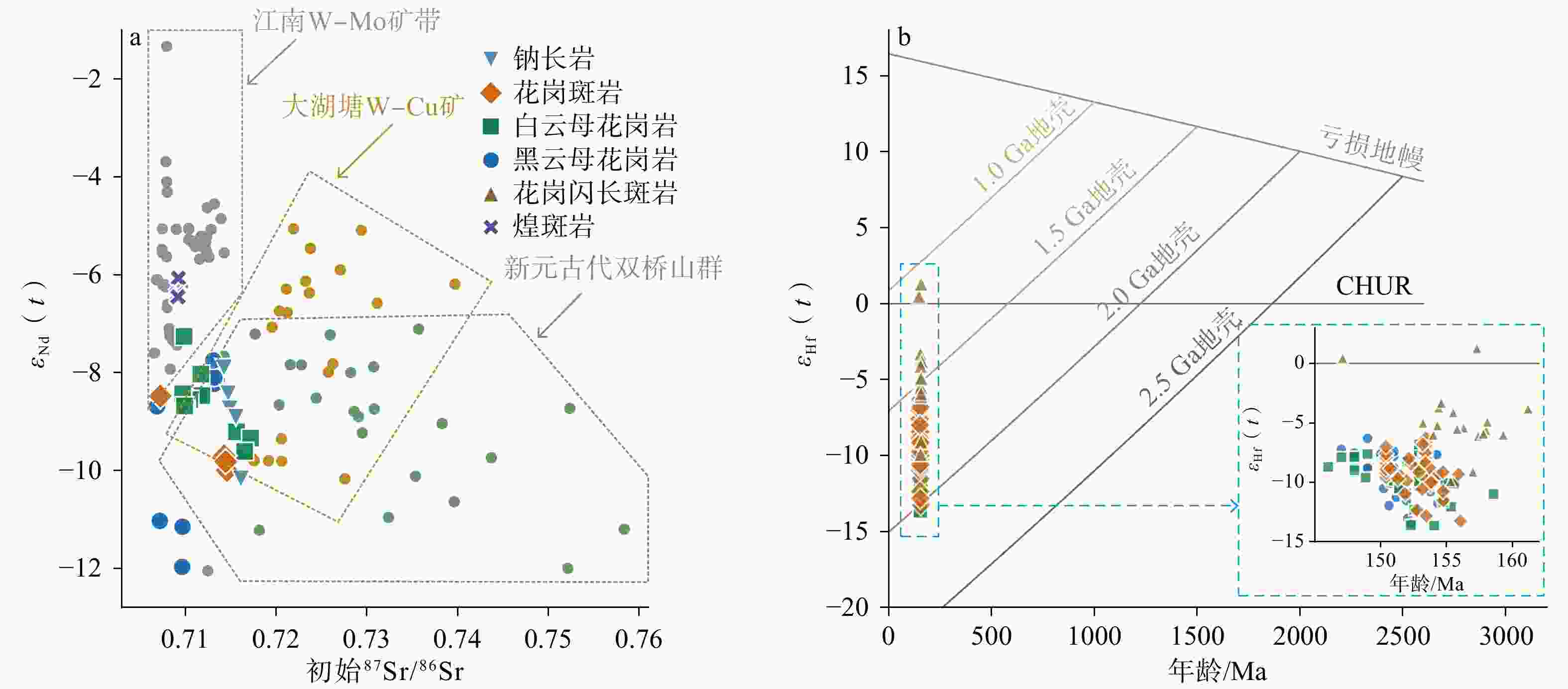
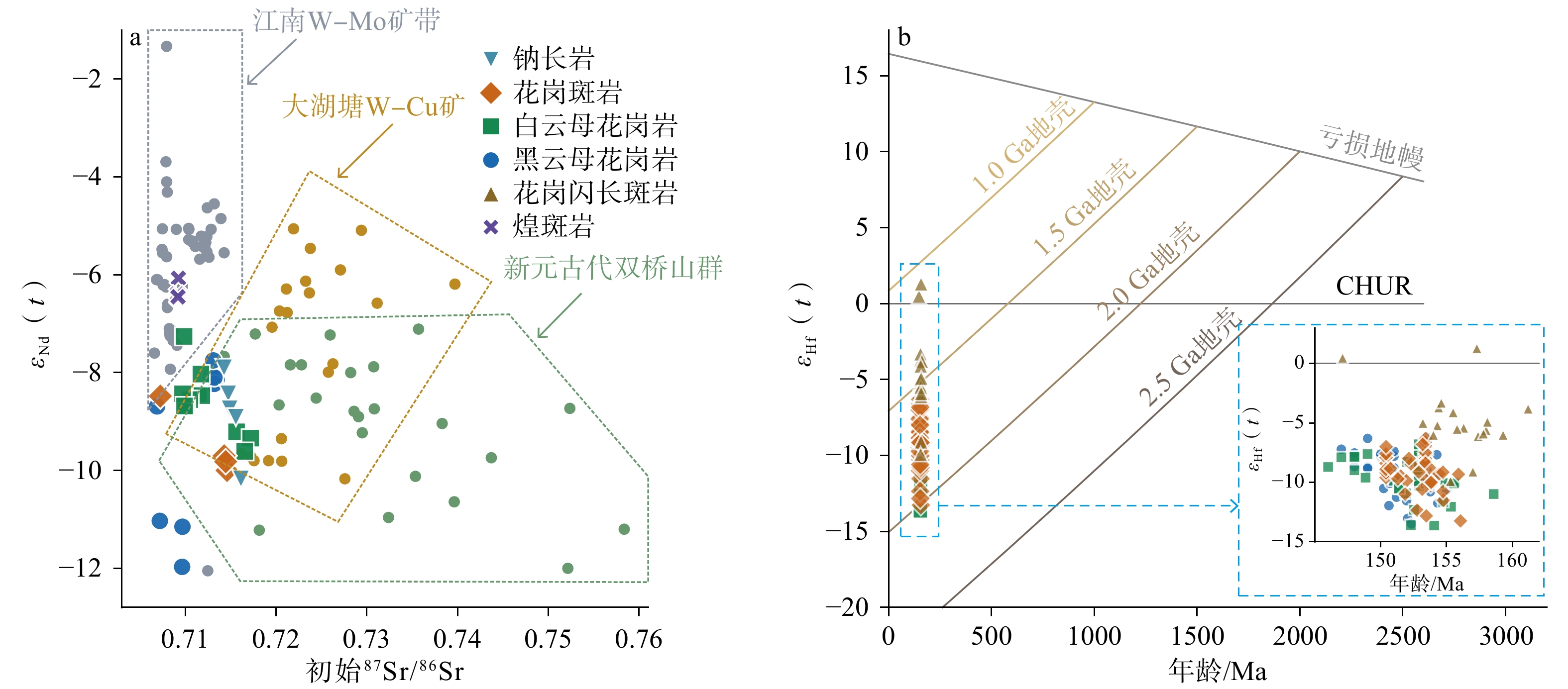
图 3 朱溪矿区岩浆岩Sr-Nd-Hf同位素组成
图a中的虚线区域分别为江南W-Mo矿带、大湖塘W-Cu矿带和新元古代双桥山群岩石的数据(Song et al. 2018b);图b中Hf地壳演化线(1.0 Ga、1.5 Ga、2.0 Ga、2.5 Ga)据Vervoort et al.(1999)计算;CHUR— 球粒陨石均一储库(Chondritic Uniform Reservoir);朱溪矿区Sr-Nd-Hf同位素数据来源于Pan et al.(2018)、Song et al.(2018b,2021,2023b)、Zhang et al.(2020b)和Ouyang et al.(2025)a—朱溪矿区岩浆岩Sr-Nd同位素图解;b—朱溪矿区岩浆岩锆石Hf同位素图解
Figure 3. Sr–Nd–Hf isotopic compositions of magmatic rocks from the Zhuxi ore district
(a) Sr–Nd isotope diagram of magmatic rocks in the Zhuxi ore district; (b) Hf isotope diagram of zircon from magmatic rocks in the Zhuxi ore districtThe three regions with dashed outlines in panel a are data for Jiangnan W–Mo and Dahutang W–Cu magmatic rocks and Neoproterozoic strata (after Song et al. 2018b and references therein); The Hf crustal evolution lines (e.g., 1.0 Ga, 1.5 Ga, 2.0 Ga, and 2.5 Ga) in panel b are calculated after Vervoort et al. (1999), the Zhuxi Sr–Nd–Hf isotopic composition data are sourced from Pan et al. (2018), Song et al. (2018b, 2021, 2023b), Zhang et al. (2020b), and Ouyang et al. (2025).
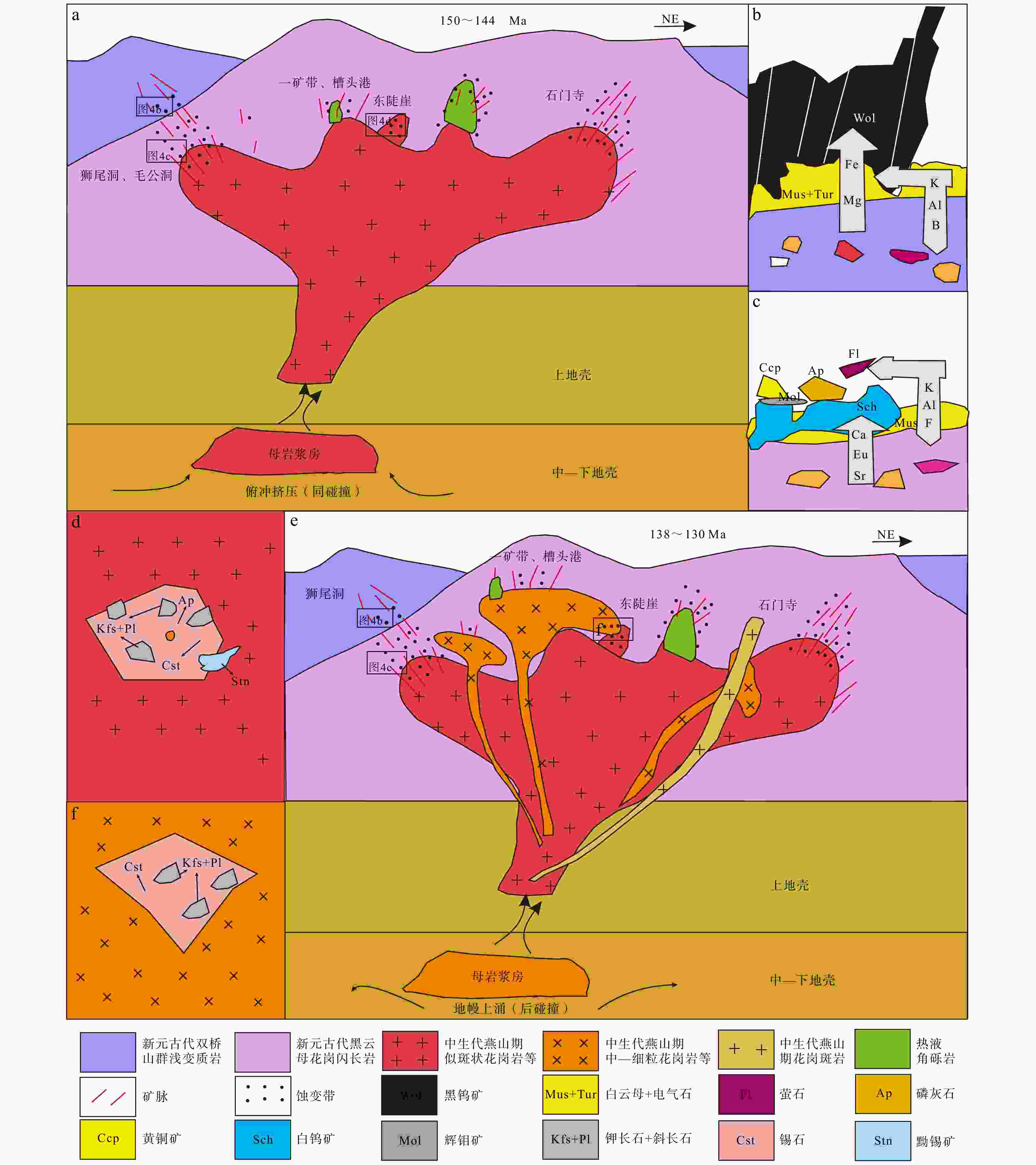
图 4 大湖塘矿床两阶段成矿模式图(据蒋少涌等,2015;胡大龙,2023修改)
Wol—黑钨矿;Sch—白钨矿;Ccp—黄铜矿;Mol—辉钼矿;Cst—锡石;Stn—黝锡矿;Mus—白云母;Tur—电气石;Pl—斜长石;Kfs—钾长石;Ap—磷灰石a—大湖塘矿床第1阶段(150~144 Ma)成矿模式图;b、c—第1阶段不同矿段的矿化特征及矿物组合;d—大湖塘矿床第2阶段(138~130 Ma)成矿模式图;e、f—第2阶段不同矿段的矿化特征及矿物组合
Figure 4. Two-stage metallogenic model for the Dahutang ore deposit (modified after Jiang et al., 2015; Hu, 2023)
(a) The ore-forming model of the first stage (150–144 Ma) of the Dahutang deposit; (b and c) The mineralization characteristics and mineral assemblages of various ore sections in the first stage; (d) The ore-forming model of the second stage (138–130 Ma) of the Dahutang deposit; (e and f) The mineralization characteristics and mineral assemblages of different ore sections in the second stage Wol–wolframite; Sch–scheelite; Ccp–chalcopyrite; Mol–molybdenite; Cst–cassiterite; Stn–stannite; Mus–muscovite; Tur–tourmaline; Pl–plagioclase; Kfs–K-feldspar; Ap–apatite
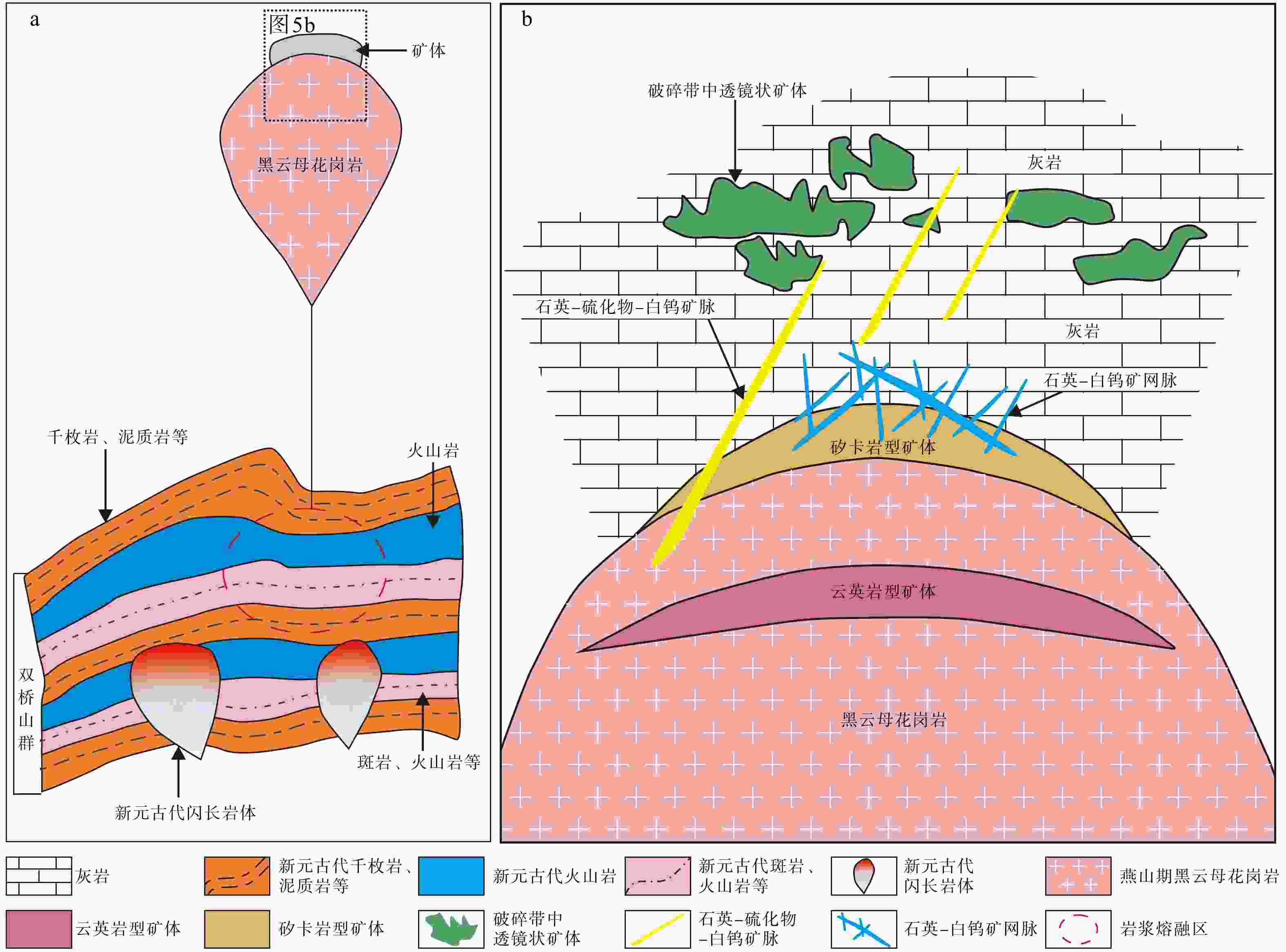
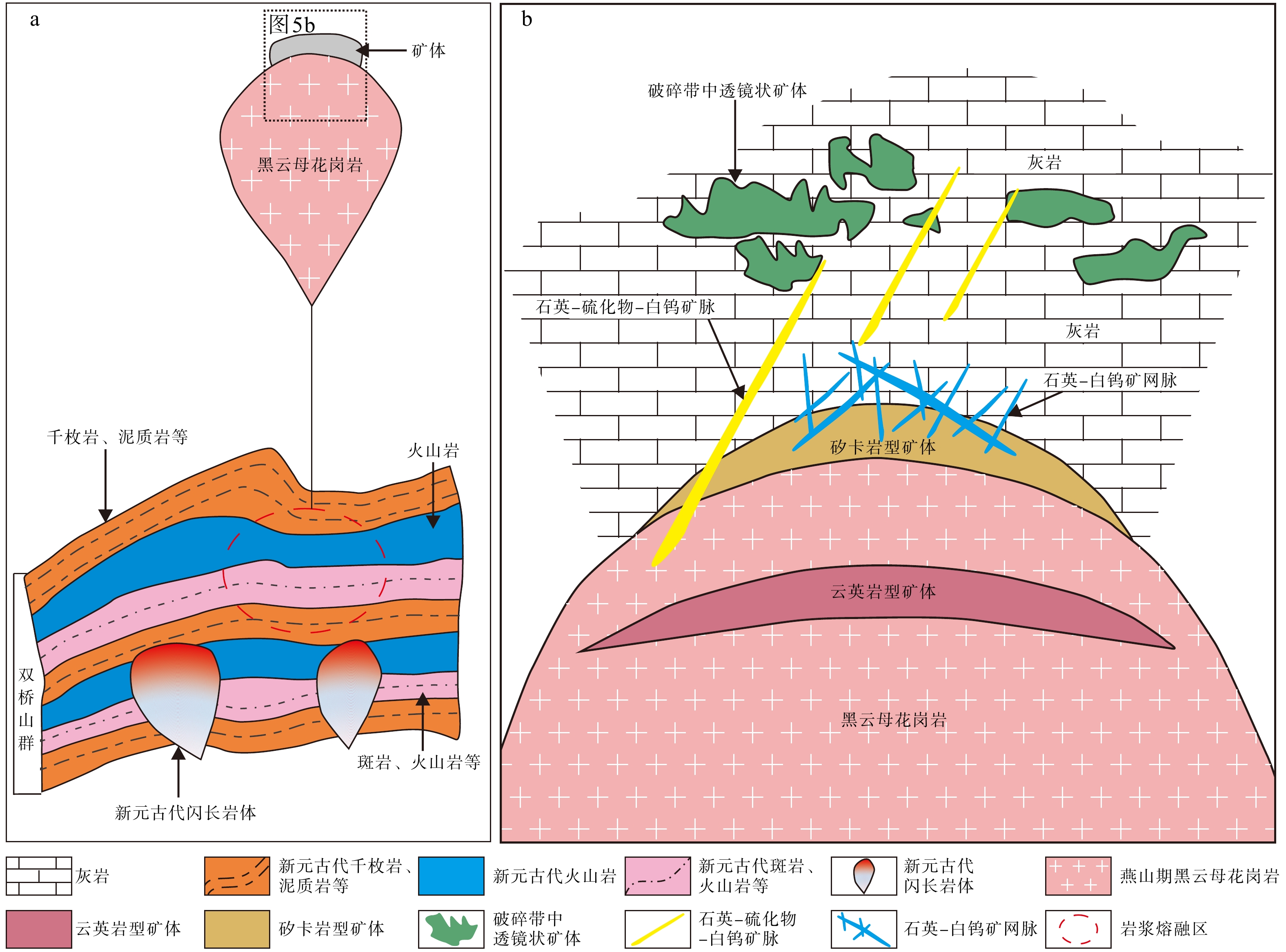
图 5 香炉山钨矿成矿模式简图
a—香炉山钨矿床岩浆作用与成矿示意图(据戴盼,2018修改);b—香炉山钨矿床矿化空间展布模式图(据吴胜华等,2014修改)
Figure 5. Schematic metallogenic model for the Xianglushan W deposit
(a) Schematic model illustrating magmatism and mineralization of the Xianglushan tungsten deposit (modified after Dai, 2018); (b) Spatial distribution model of mineralization types of the Xianglushan tungsten deposit (modified after Wu et al., 2014)
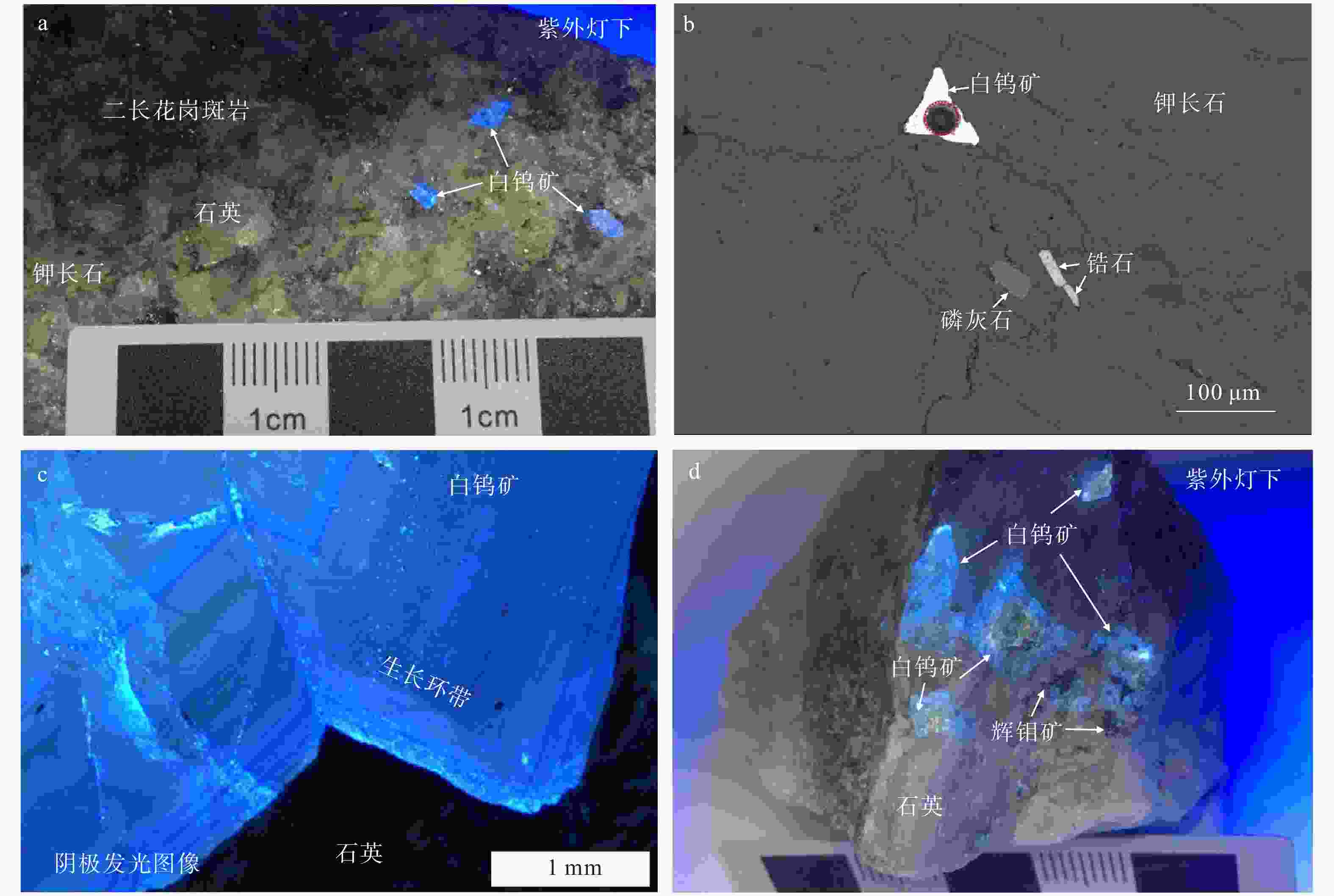
图 6 江西阳储岭W-Mo矿床中不同类型白钨矿的典型照片(Xiong et al.,2025)
a—二长花岗斑岩内发蓝色荧光的白钨矿(紫外灯下);b—背散射图像显示花岗斑岩内星点状白钨矿颗粒(红色虚线圈为白钨矿原位微区微量元素分析所留下);c—矿脉内荧光特征的大颗粒白钨矿(直径>1 cm)显示出复杂的黄色—蓝色荧光特征(阴极发光条件下);d—白钨矿显示出生长环带特征(紫外灯下)
Figure 6. Representative images of different types of scheelite from the Yangchuling W–Mo deposit, Jiangxi Province (Xiong et al., 2025)
(a) Scheelite disseminated in monzogranite porphyry, showing blue fluorescence under ultraviolet (UV) light; (b) Backscattered electron image of disseminated, fine-grained scheelite coexisting with zircon, apatite, and K-feldspar in granite porphyry; the red circle represents the micro-area of in situ trace element analysis of scheelite; (c) A large scheelite grain (>1 cm in diameter) from an ore vein, showing complex yellow-to-blue cathodoluminescence; (d) Scheelite showing growth zoning under UV light
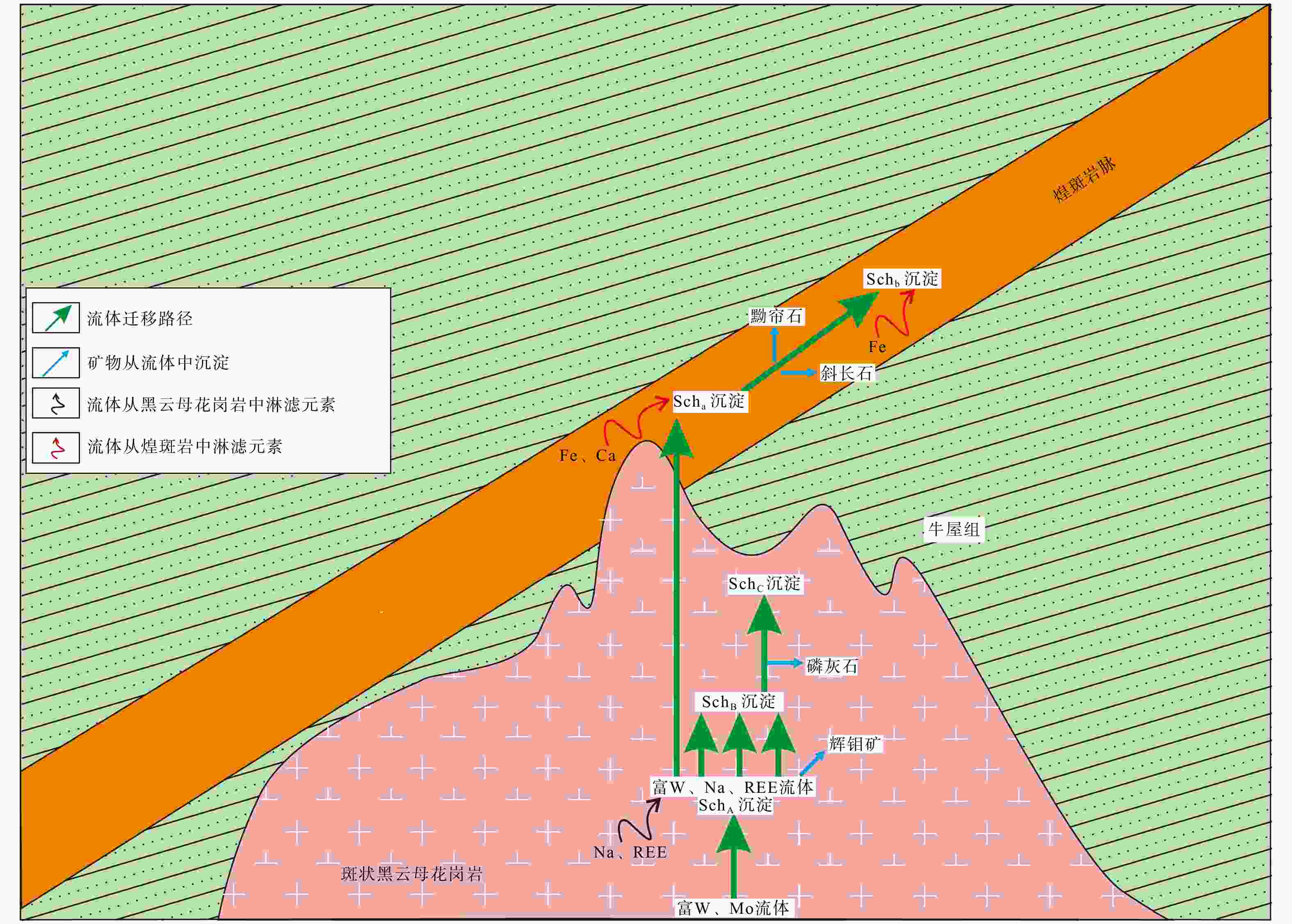
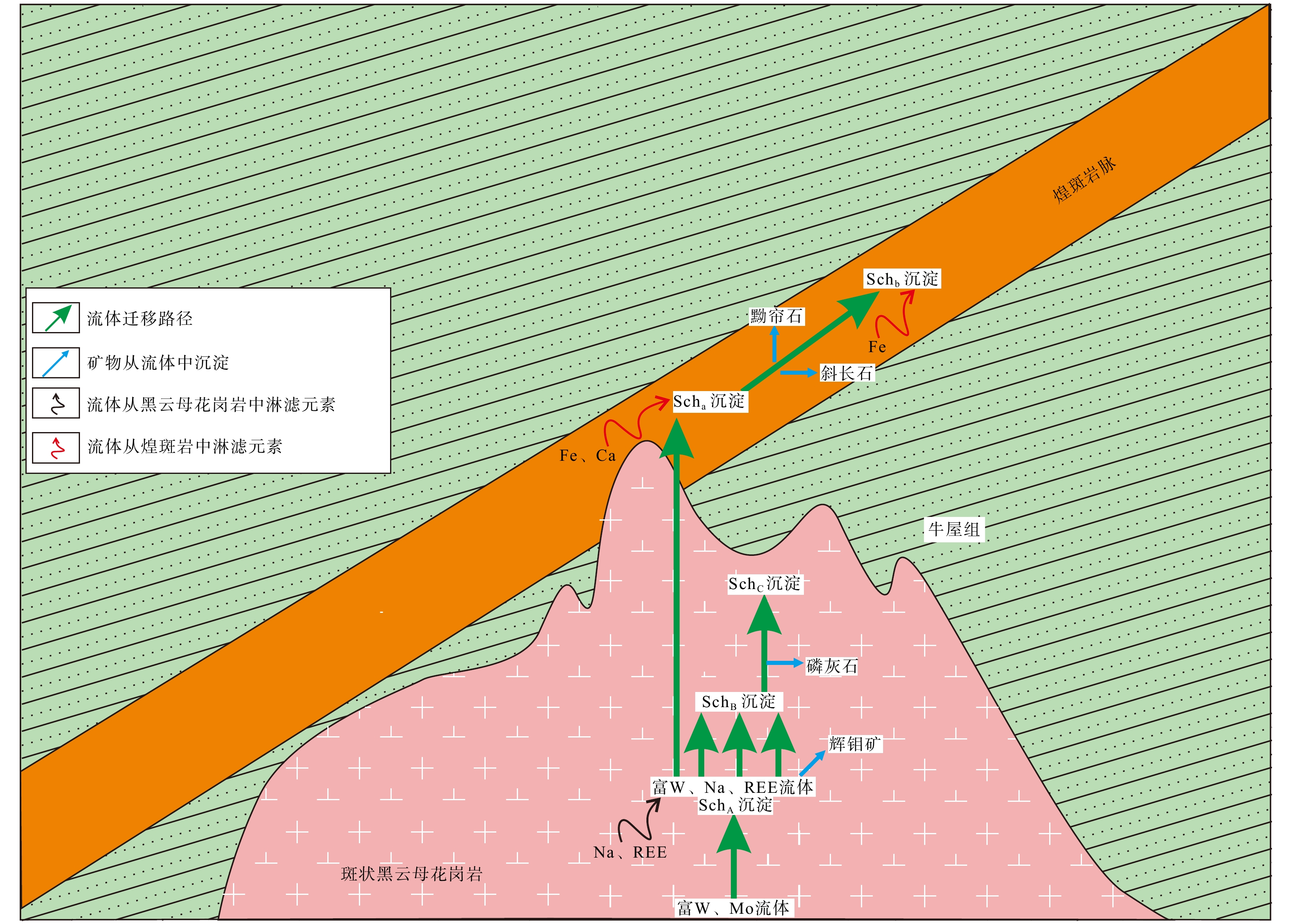
图 7 东源斑岩型W-Mo矿床成因模式图(据Dong et al., 2025a修改)
SchA—产于石英–钾长石脉中的白钨矿;SchB—产于石英–绢云母–钾长石脉中的白钨矿;SchC—最晚期白钨矿,穿切早期SchA和SchB;SchA、SchB和SchC及其相关脉体和矿化均产于斑状黑云母花岗岩中。Scha—产于石英–黑云母–白云母–黄铁矿–黄铜矿脉中的白钨矿;Schb—产于石英–白云母–斜长石–黝帘石–黄铁矿脉中的白钨矿;Scha和Schb及其相关脉体和矿化均产于煌斑岩中
Figure 7. Genetic model of the Dongyuan porphyry W–Mo deposit (modified after Dong et al., 2025a)
SchA denotes scheelite in quartz–K-feldspar veins, SchB denotes scheelite in quartz–sericite–K-feldspar veins, and SchC represents the latest-stage scheelite that crosscuts the earlier SchA and SchB; these scheelites and their associated veins and mineralization occur in porphyritic biotite granite. Scha denotes scheelite in quartz–biotite–muscovite–pyrite–chalcopyrite veins, whereas Schb denotes scheelite in quartz–muscovite–plagioclase–epidote–pyrite veins; these scheelites and their associated veins and mineralization occur in lamprophyre.
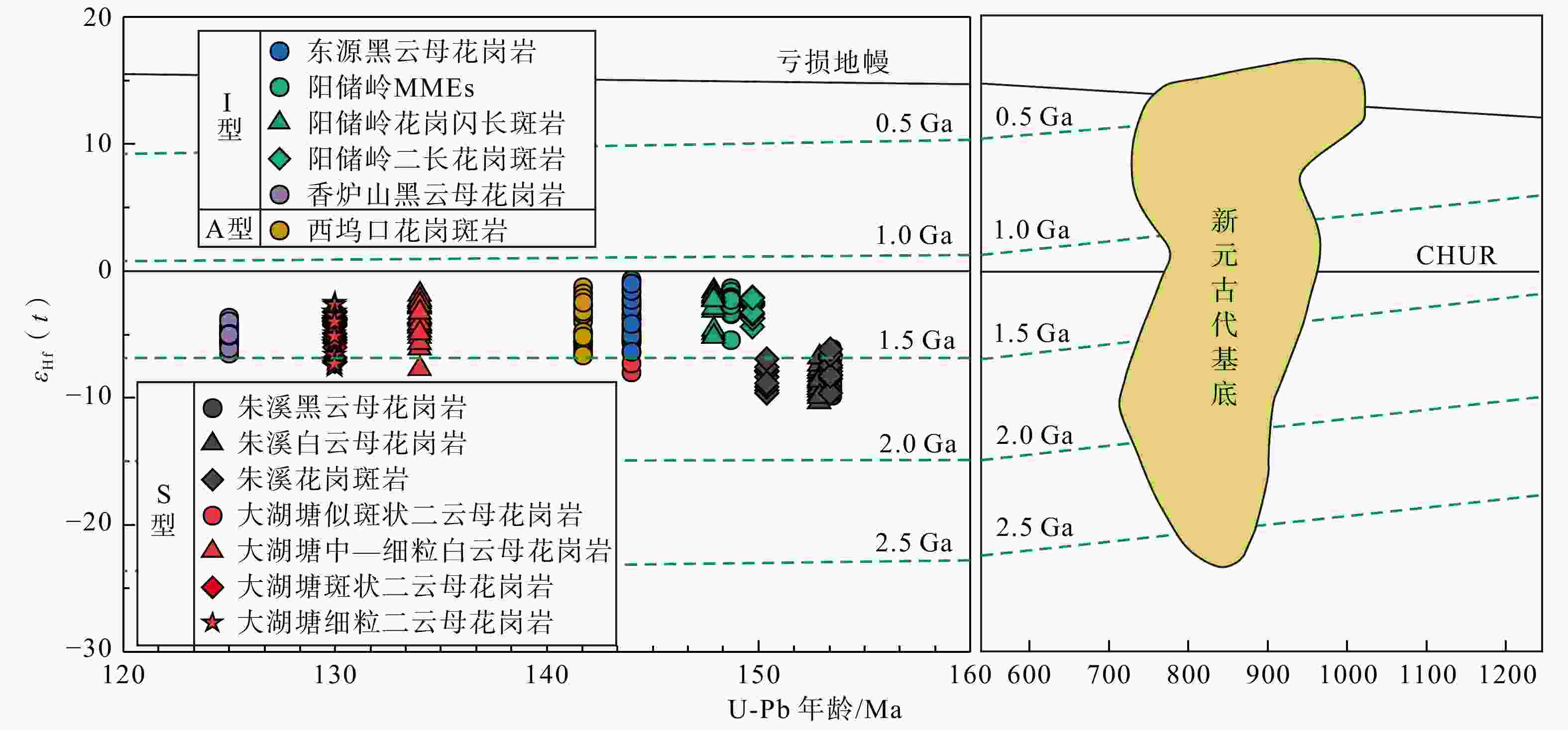
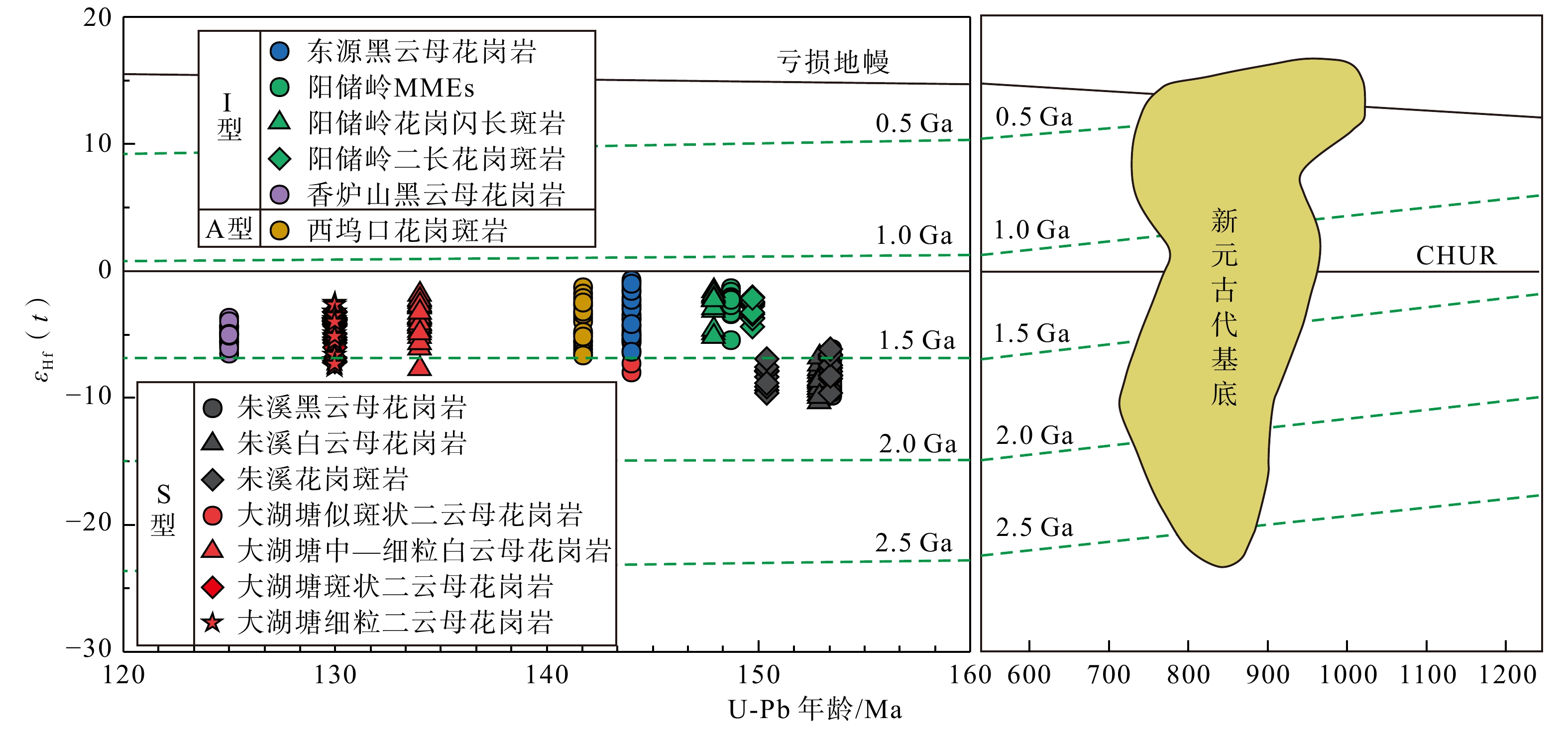
图 8 江南造山带W-Sn矿床花岗岩锆石U-Pb年龄−εHf(t)图
MMEs—暗色微粒包体;CHUR—球粒陨石均一储库朱溪矿床数据收集自Pan et al. (2018);大湖塘矿床数据收集自Huang and Jiang (2014);东源矿床数据收集自Zhang et al. (2021a);阳储岭矿床数据收集自Song et al. (2023a);香炉山矿床数据收集自Li et al. (2020);西坞口矿床数据收集自陈雪峰等 (2019)
Figure 8. Zircon U-Pb age-εHf(t) diagram of W–Sn deposits in the Jiangnan Orogen
MMEs–mafic microgranular enclaves; CHUR–chondritic uniform reservoir Data for the following deposits are from the respective sources: Zhuxi deposit–Pan et al. (2018); Dahutang deposit–Huang and Jiang (2014); Dongyuan deposit–Zhang et al. (2021a); Yangchuling deposit–Song et al. (2023a); Xianglushan deposit–Li et al. (2020); Xiwukou deposit–Chen et al. (2019).
表 1 大湖塘W-Cu-Mo-Sn矿床中各类岩体定年结果
Table 1. Summary of geochronological data for various igneous rocks in the Dahutang W–Cu–Mo–Sn deposit
矿区 矿段 岩石/矿物类型 测试方法 成岩时代/Ma 数据来源 北部 石门寺 似斑状黑云母花岗岩 锆石U-Pb定年 147.4±0.6 Mao et al., 2015 北部 石门寺 似斑状黑云母花岗岩 锆石U-Pb定年 148.3±1.9 Mao et al., 2015 北部 石门寺 似斑状黑云母花岗岩 独居石U-Pb定年 150.0±0.7 叶海敏等, 2016 北部 石门寺 似斑状黑云母花岗岩 锆石U-Pb定年 147.7±7.9 李宏伟等, 2021 北部 石门寺 似斑状黑云母花岗岩 锆石U-Pb定年 138 项新葵等, 2012 北部 石门寺 细粒黑云母花岗岩 锆石U-Pb定年 146.1±0.6 Mao et al., 2015 北部 石门寺 细粒黑云母花岗岩 锆石U-Pb定年 144.7±0.5 Mao et al., 2015 北部 石门寺 细粒黑云母花岗岩 独居石U-Pb定年 149.0±1.0 叶海敏等, 2016 北部 石门寺 细粒二云母花岗岩 锆石U-Pb定年 146.6±1.4 张志辉, 2014 北部 石门寺 斑状黑云母花岗岩 锆石U-Pb定年 146.3±0.61 张志辉, 2014 北部 石门寺 白云母花岗岩 锆石U-Pb定年 146.42±0.49 张志辉, 2014 北部 石门寺 花岗斑岩 锆石U-Pb定年 146.0±0.78 项新葵等, 2015 北部 石门寺 花岗斑岩 锆石U-Pb定年 143.0±0.8 Mao et al., 2015 北部 石门寺 花岗斑岩 锆石U-Pb定年 143.1±1.2 Mao et al., 2015 北部 石门寺 花岗斑岩 锆石U-Pb定年 151.0±l.1 张志辉, 2014 北部 石门寺 花岗斑岩 独居石U-Pb定年 148.2±1.2 叶海敏等, 2016 北部 石门寺 花岗斑岩 锆石U-Pb定年 154.36±0.83 张志辉等,2020 北部 石门寺 花岗斑岩 锆石U-Pb定年 135 项新葵等, 2012 北部 大岭上 花岗斑岩 锆石U-Pb定年 130.4±1.6 彭花明等, 2015 北部 大岭上 中—细粒白云母花岗岩 锆石U-Pb定年 133.7±0.5 Huang and Jiang, 2014 北部 大岭上 细粒二云母花岗岩 锆石U-Pb定年 130.7±1.1 Huang and Jiang, 2014 中部 平苗 中—粗粒白云母花岗岩 锆石U-Pb定年 145.7±0.6 余振东等, 2020 中部 平苗 斑状二云母花岗岩 锆石U-Pb定年 146.4 Yang et al., 2022 中部 平苗 黑云母花岗斑岩 锆石U-Pb定年 143.4 Yang et al., 2022 中部 平苗 花岗斑岩 锆石U-Pb定年 149.1±1.1 孟亚飞和蒋少涌, 2015 中部 一矿带 花岗斑岩 锆石U-Pb定年 139.0±1.2 陈茂松等,2020 中部 一矿带 似斑状白云母花岗岩 白云母40Ar-39Ar定年 142.09±0.88 Song et al., 2018a 中部 一矿带 细粒白云母花岗岩 白云母40Ar-39Ar定年 138.79±1.75 Song et al., 2018a 中部 一矿带 细粒白云母花岗岩 白云母40Ar-39Ar定年 140.4±0.61 Song et al., 2018a 中部 一矿带 热液角砾岩型矿体中黑云母 黑云母40Ar-39Ar定年 149.2±1.1 Song et al., 2018a 中部 东陡崖 似斑状白云母花岗岩 锆石U-Pb定年 144.2±1.4 胡大龙,2023 中部 东陡崖 中—细粒白云母花岗岩 锆石U-Pb定年 133.6±1.6 胡大龙,2023 中部 槽头港 中—粗粒白云母花岗岩 锆石U-Pb定年 142.2±1.8 胡大龙,2023 中部 槽头港 斑状二云母花岗岩 锆石U-Pb定年 133.5±0.8 胡大龙,2023 中部 槽头港 似斑状黑云母花岗岩 锆石U-Pb定年 145.7±1.8 胡大龙,2023 南部 狮尾洞 似斑状白云母花岗岩 锆石U-Pb定年 144.2±1.3 黄兰椿和蒋少涌, 2012 南部 狮尾洞 似斑状二云母花岗岩 锆石U-Pb定年 144.0±0.6 Huang and Jiang, 2014 南部 狮尾洞 斑状二云母花岗岩 锆石U-Pb定年 130.3±1.1 Huang and Jiang, 2014 南部 狮尾洞 花岗斑岩 锆石U-Pb定年 134.6±1.2 黄兰椿和蒋少涌, 2013 南部 狮尾洞 黑云母花岗斑岩 锆石U-Pb定年 143.7±2.4 褚平利等,2019 南部 狮尾洞 细粒白云母花岗岩 白云母40Ar-39Ar定年 137.60±2.68 Song et al., 2018a 南部 昆山 似斑状花岗岩 锆石U-Pb定年 151.7±1.3 张明玉等,2016 南部 毛公洞 白云母花岗岩 锆石U-Pb定年 144.5±2.2 胡大龙,2023  下载: 导出CSV
表 2 大湖塘W-Cu-Mo-Sn矿床成矿年龄汇总
Table 2. Summary of mineralization ages of the Dahutang W–Cu–Mo–Sn deposit
序号 矿区 矿段 测试方法 成矿时代/ Ma 数据来源 1 北部 石门寺 辉钼矿Re-Os定年 143.7±1.2 丰成友等, 2012 2 北部 石门寺 辉钼矿Re-Os定年 149.6±1.4 项新葵等, 2013 3 北部 石门寺 辉钼矿Re-Os定年 139.2±1.0 Mao et al., 2013 4 北部 石门寺 辉钼矿Re-Os定年 143.9±1.0 张志辉, 2014 5 北部 石门寺 辉钼矿Re-Os定年 145.1±1.0 叶泽宇等, 2016 6 北部 石门寺 辉钼矿Re-Os定年 146.81±0.59 Song et al., 2018a 7 北部 石门寺 辉钼矿Re-Os定年 141.50±1.43 Song et al., 2018a 8 北部 石门寺 辉钼矿Re-Os定年 138.91±0.87 Song et al., 2018a 9 北部 石门寺 辉钼矿Re-Os定年 140.96±1.15 Song et al., 2018a 10 北部 石门寺 辉钼矿Re-Os定年 144.02±0.96 Song et al., 2018a 11 北部 石门寺 辉钼矿Re-Os定年 149.6±1.2 刘更更等,2024 12 北部 石门寺 辉钼矿Re-Os定年 139.18±0.97 刘更更等,2024 13 北部 石门寺 辉钼矿Re-Os定年 145.1±1.0 刘更更等,2024 14 北部 石门寺 辉钼矿Re-Os定年 140.6±1.2 刘更更等,2024 15 北部 石门寺 辉钼矿Re-Os定年 141.79±0.97 刘更更等,2024 16 北部 石门寺 辉钼矿Re-Os定年 140.6±1.2 叶泽宇等,2016 17 北部 石门寺 黑钨矿U-Pb定年 147.8±2.8 胡大龙,2023 18 北部 大岭上 黑钨矿U-Pb定年 131.7±3.5 胡大龙,2023 19 中部 一矿带 辉钼矿Re-Os定年 137.9±2.0 张勇等, 2017 20 中部 一矿带 黑钨矿U-Pb定年 149.8±3.0 胡大龙,2023 21 中部 一矿带 黑钨矿U-Pb定年 135.4±3.7 胡大龙,2023 22 中部 槽头港 黑钨矿U-Pb定年 135.3±4.8 胡大龙,2023 23 中部 东陡崖 锡石U-Pb定年 136.3±3.8 胡大龙,2023 24 中部 东陡崖 锡石U-Pb定年 145.7±7.6 胡大龙,2023 25 中部 东陡崖 锡石U-Pb定年 146.4±5.7 胡大龙,2023 26 中部 东陡崖 锡石U-Pb定年 144.5±5.9 胡大龙,2023 27 南部 狮尾洞 黑钨矿U-Pb定年 134.6±4.4 胡大龙,2023 28 南部 狮尾洞 白钨矿Sm-Nd定年 142.4±8.9 蒋少涌等,2015 29 南部 狮尾洞 白云母40Ar-39Ar定年 138.63±0.85 Song et al., 2018a 30 南部 狮尾洞 辉钼矿Re-Os定年 140.9±3.6 丰成友等, 2012 31 南部 狮尾洞 辉钼矿Re-Os定年 131.96±1.34 Song et al., 2018a 32 南部 狮尾洞 辉钼矿Re-Os定年 130.42±1.92 Song et al., 2018a 33 南部 狮尾洞 辉钼矿Re-Os定年 134.80±1.58 Song et al., 2018a 34 南部 狮尾洞 辉钼矿Re-Os定年 134.75±1.22 Song et al., 2018a 35 南部 狮尾洞 辉钼矿Re-Os定年 135.16±1.22 Song et al., 2018a 36 南部 狮尾洞 辉钼矿Re-Os定年 141.07±2.37 Song et al., 2018a 37 南部 狮尾洞 辉钼矿Re-Os定年 146.97±1.13 Song et al., 2018a 38 南部 昆山 辉钼矿Re-Os定年 151.0±1.3 张明玉等,2016 39 南部 昆山 辉钼矿Re-Os定年 150.0±1.0 张明玉等,2016 40 南部 昆山 辉钼矿Re-Os定年 148.7±0.7 林锐华等,2023
下载: 导出CSV
-
[1] CHAPPELL B W, WHITE A J R, 1974. Two contrasting granite types[J]. Pacific Geology, 8: 173-174. [2] CHEN G H, SHU L S, SHU L M, et al., 2016. Geological characteristics and mineralization setting of the Zhuxi tungsten (copper) polymetallic deposit in the Eastern Jiangnan Orogen[J]. Science China Earth Sciences, 59(4): 803-823. doi: 10.1007/s11430-015-5200-9 [3] CHEN M S, XIANG X K, ZHAN G L, et al., 2020. Geochronology, geochemical characteristics of the post-mineralization Late Yanshanian granite porphyry and its constraints for the terminal of the metallogeny in the No. 1 ore belt of the Dahutang district[J]. Journal of East China University of Technology (Natural Science), 43(5): 401-416. (in Chinese with English abstract) [4] CHEN X F, FAN Y, YU J H, et al., 2018. First discovery of the rubidium deposit in the Jiangnan uplift (Anhui segment) and its significance[J]. Mineral Deposits, 37(6): 1349-1354. (in Chinese) [5] CHEN X F, FAN Y, YU J H, et al., 2019. Zircon U-Pb dating and Lu-Hf isotopes of the ore-associated porphyry in the Xiwukou Rb deposit, Jiangnan Uplift Belt (Anhui Province), SE China[J]. Acta Petrologica Sinica, 35(12): 3797-3810. (in Chinese with English abstract) doi: 10.18654/1000-0569/2019.12.14 [6] CHEN X F, FAN Y, ZHOU T F, et al., 2022. The Xiwukou Rb deposit in the Jiangnan uplift belt, Ningguo City, Anhui Province: Rb occurrence and ore-forming mechanisms[J]. Earth Science Frontiers, 29(1): 65-80. (in Chinese with English abstract) [7] CHEN Z H, WANG D H, SHENG J F, et al., 2015. The metallogenic regularity of tin deposits in China[J]. Acta Geologica Sinica, 89(6): 1026-1037. (in Chinese with English abstract) [8] CHU P L, DUAN Z, LIAO S B, et al., 2019. Petrogenesis and tectonic significances of Late Mesozoic granitoids in the Dahutang area, Jiangxi Province: constraints from zircon U-Pb dating, mineral-chemistry, geochemistry and Hf isotope[J]. Acta Geologica Sinica, 93(7): 1687-1707. (in Chinese with English abstract) [9] DAI P, 2018. The mineralization of the Xianglushan skarn W deposit, Jiangxi Province[D]. Beijing: Chinese Academy of Geological Sciences. (in Chinese with English abstract) [10] DAI P, MAO J W, WU S H, et al., 2018. Multiple dating and tectonic setting of the Early Cretaceous Xianglushan W deposit, Jiangxi Province, South China[J]. Ore Geology Reviews, 95: 1161-1178. doi: 10.1016/j.oregeorev.2017.11.017 [11] DONG J X, PAN X F, JIANG S Y, et al., 2025a. Texture and geochemistry of multi-stage hydrothermal scheelite in the Dongyuan porphyry-type W-Mo deposit, South China: implications for the ore-forming process and fluid metasomatism[J]. American Mineralogist, 110(12): 1977-1995. doi: 10.2138/am-2024-9716 [12] DONG J X, XIONG S F, JIANG S Y, et al., 2025b. Origin of Ligongling ore-bearing breccia pipe in the Yangchuling porphyry W-Mo deposit, South China: constraints from apatite chemistry and U-Pb dating[J]. Ore Geology Reviews, 183: 106697. doi: 10.1016/j.oregeorev.2025.106697 [13] DONG J X, XIONG S F, JIANG S Y, et al., 2026. Multi-stage scheelite geochemistry constrains the genesis of tungsten mineralization at the Ligongling breccia pipe in the Yangchuling porphyry system, South China[J]. Journal of Geochemical Exploration, 287: 108091. doi: 10.1016/j.gexplo.2026.108091 [14] DU Y D, YU X Q, LIU J J, et al., 2011a. Characteristics of ore-forming fluids and sources of ore-forming materials in the Dongyuan W-Mo deposit, southern Anhui Province[J]. Geology in China, 38(5): 1334-1346. (in Chinese with English abstract) [15] DU Y D, YU X Q, ZHOU X, et al., 2011b. The composition of sulfur and lead isotope and the source of metallogenic material from Xiyuan and Jiangjia ore blocks in the Dongyuan W-Mo deposit in Southern Anhui Province[J]. Geoscience, 25(5): 861-868. (in Chinese with English abstract) [16] FAN X K, 2019. Study on metallogenic mechanism of the giant Dahutang tungsten polymetallic orefield in Jiangxi Province, China[D]. Beijing: Chinese Academy of Geological Sciences. (in Chinese with English abstract) [17] FENG C Y, ZHANG D Q, XIANG X K, et al., 2012. Re-Os isotopic dating of molybdenite from the Dahutang tungsten deposit in northwestern Jiangxi Province and its geological implication[J]. Acta Petrologica Sinica, 28(12): 3858-3868. (in Chinese with English abstract) [18] FENG C Y, WANG H, XIANG X K, et al., 2018. Late Mesozoic granite-related W-Sn mineralization in the northern Jiangxi region, SE China: a review[J]. Journal of Geochemical Exploration, 195: 31-48. doi: 10.1016/j.gexplo.2018.06.008 [19] FU J Z, XU S F, WANG M H, et al., 2011. Geologic features and ore-controlling factors of Dongyuan tungsten and molybdenum deposit, Anhui Province[J]. Mineral Exploration, 2(5): 501-511. (in Chinese with English abstract) [20] GAO R, ZHANG M H, WANG G H, et al., 2023. Stable isotopic geochemistry of the Xianglushan tungsten deposit in the Jiangnan tungsten metallogenic belt[J]. Acta Mineralogica Sinica, 43(4): 501-511. (in Chinese with English abstract) [21] HE X L, ZHANG D, DI Y J, et al., 2022. Evolution of the magmatic-hydrothermal system and formation of the giant Zhuxi W-Cu deposit in South China[J]. Geoscience Frontiers, 13(1): 101278. doi: 10.1016/j.gsf.2021.101278 [22] HOLWELL D A, FIORENTINI M, MCDONALD I, et al., 2019. A metasomatized lithospheric mantle control on the metallogenic signature of post-subduction magmatism[J]. Nature Communications, 10(1): 3511. doi: 10.1038/s41467-019-11065-4 [23] HONG J X, ZHANG H Y, LI D F, et al., 2022. In situ LA-ICP-MS U-Pb geochronology and geochemical characteristics of garnet from the Zhuxi skarn W-Cu deposit, South China[J]. Ore Geology Reviews, 140: 104577. doi: 10.1016/j.oregeorev.2021.104577 [24] HU D L, 2023. Petrogenesis and ore genetic mechanism of Dahutang W-Cu polymetallic deposit in Northern Jiangxi Province, China[D]. Wuhan: China University of Geosciences. (in Chinese with English abstract) [25] HU Z H, LOU F S, LI Y M, et al., 2018. Geochrology, geochemistry and petrogenesis of ore-related granite in the Dongping tungsten deposit in Wuning County, Jiangxi Province[J]. Earth Science, 43(S1): 243-263. (in Chinese with English abstract) [26] HU Z H, WANG X G, CHEN Y C, et al., 2020. Metallogenic regularity in Jiangnan metallogenic of tungsten belt (Jiangxi Section)[J]. China Tungsten Industry, 35(5): 10-19. (in Chinese with English abstract) [27] HUA R M, LI G L, ZHANG W L, et al., 2010. A tentative discussion on differences between large-scale tungsten and tin mineralizations in South China[J]. Mineral Deposits, 29(1): 9-23. (in Chinese with English abstract) [28] HUANG L C, JIANG S Y, 2012. Zircon U-Pb geochronology, geochemistry and petrogenesis of the porphyric-like muscovite granite in the Dahutang tungsten deposit, Jiangxi Province[J]. Acta Petrologica Sinica, 28(12): 3887-3900. (in Chinese with English abstract) [29] HUANG L C, JIANG S Y, 2013. Geochronology, geochemistry and petrogenesis of the tungsten-bearing porphyritic granite in the Dahutang tungsten deposit, Jiangxi Province[J]. Acta Petrologica Sinica, 29(12): 4323-4335. (in Chinese with English abstract) [30] HUANG L C, JIANG S Y, 2014. Highly fractionated S-type granites from the giant Dahutang tungsten deposit in Jiangnan Orogen, Southeast China: geochronology, petrogenesis and their relationship with W-mineralization[J]. Lithos, 202-203: 207-226. [31] JIANG S Y, PENG N J, HUANG L C, et al., 2015. Geological characteristic and ore genesis of the giant tungsten deposits from the Dahutang ore-concentrated district in northern Jiangxi Province[J]. Acta Petrologica Sinica, 31(3): 639-655. (in Chinese with English abstract) [32] JIANG S Y, ZHAO K D, JIANG H, et al., 2020. Spatiotemporal distribution, geological characteristics and metallogenic mechanism of tungsten and tin deposits in China: an overview[J]. Chinese Science Bulletin, 65(33): 3730-3745. (in Chinese with English abstract) [33] KONG F B, WEN R T, QU Y C, et al., 2021. Metallogenic geological characteristics and ore-controlling factors of hornstone scheelite in the periphery of Xianglushan, Jiangxi Province[J]. China Tungsten Industry, 36(3): 11-18. (in Chinese with English abstract) [34] LI H W, ZHAO Z, CHEN Z Y, et al., 2021. Genetic relationship between the two-period magmatism and W mineralization in the Dahutang ore-field, Jiangxi Province: evidence from zircon geochemistry[J]. Acta Petrologica Sinica, 37(5): 1508-1530. (in Chinese with English abstract) [35] LI X Y, ZHANG J R, LAI C K, 2020. Comparison of magma oxygen fugacity and zircon Hf isotopes between Xianglushan tungsten-bearing granite and late Yanshanian granites in Jiangxi Province, South China[J]. Minerals, 10(2): 106. doi: 10.3390/min10020106 [36] LIN L, ZHAN G L, YU X P, 2006. Geological characteristics and ore-search prospect of Dahutang tungsten (tin) orefield in Jiangxi[J]. Resources Survey & Environment, 27(1): 25-32. (in Chinese with English abstract) [37] LIN R H, YIN Q Q, XIANG X K, et al., 2023. Molybdenite Re-Os isotopic age of the Kunshan Mo-W-Cu polymetallic deposit in the Jiangxi Province and its evolution of metallogenic geodynamics[J]. Geology in China, 50(4): 1176-1187. (in Chinese with English abstract) [38] LIU B Q, Yu J H, Jiang W, et al., 2023. Geochemistry of the meta-sedimentary rocks of the Shuangqiaoshan Group and their genetic link to tungsten mineralization in northern Jiangxi, South China[J]. Acta Geologica Sinica, 97(2): 433-447. (in Chinese with English abstract) [39] LIU G G, WU Y C, WEI W F, et al., 2024. The Re-Os isotopic dating of molybdenite from the Shimensi tungsten-copper polymetallic deposit in the northern Jiangxi and its geological significance[J]. Bulletin of Mineralogy, Petrology and Geochemistry, 43(1): 192-210. (in Chinese with English abstract) [40] LIU J Y, WU G Q, 1988. Porphyry tungsten deposits and their ore-forming granites[J]. Journal of Hebei College of Geology, 11(2): 47-58. (in Chinese with English abstract) [41] LU S D, WANG S L, GAO W L, et al., 2004. Study on metallogenic characteristics and genesis of Sn, Pb and Zn polymetallic deposits in Penshan region, Jiangxi Province[J]. Journal of East China Institute of Technology, 27(3): 201-208. (in Chinese with English abstract) [42] MAO J W, XIONG B K, LIU J, et al. , 2017. Molybdenite Re/Os dating, zircon U-Pb age and geochemistry of granitoids in the Yangchuling porphyry W-Mo deposit (Jiangnan tungsten ore belt), China: implications for petrogenesis, mineralization and geodynamic setting[J]. Lithos, 286-287: 35-52. [43] MAO J W, WU S H, SONG S W, et al., 2020. The world-class Jiangnan tungsten belt: geological characteristics, metallogeny, and ore deposit model[J]. Chinese Science Bulletin, 65(33): 3746-3762. (in Chinese with English abstract) doi: 10.1360/tb-2020-0370 [44] MAO Z H, CHENG Y B, LIU J J, et al., 2013. Geology and molybdenite Re-Os age of the Dahutang granite-related veinlets-disseminated tungsten ore field in the Jiangxin Province, China[J]. Ore Geology Reviews, 53: 422-433. doi: 10.1016/j.oregeorev.2013.02.005 [45] MAO Z H, LIU J J, MAO J W, et al., 2015. Geochronology and geochemistry of granitoids related to the giant Dahutang tungsten deposit, middle Yangtze River region, China: implications for petrogenesis, geodynamic setting, and mineralization[J]. Gondwana Research, 28(2): 816-836. doi: 10.1016/j.gr.2014.07.005 [46] MENG X, ZHANG D Y, ZHANG R Q, et al., 2022. Geochronology and geochemical characteristics of ore-forming granite in Maopengdian Sn deposit, northern Jiangxi Province[J]. Ore Geology Reviews, 149: 105098. doi: 10.1016/j.oregeorev.2022.105098 [47] MENG Y F, JIANG S Y, 2015. Chronology, geochemistry and ore-forming significance of the granite porphyry in the Pingmiao section of the Dahutang W Deposit, Jiangxi[J]. Acta Mineralogica Sinica, 35(S1): 715-716. (in Chinese) [48] NI P, PAN J Y, HAN L, et al., 2023. Tungsten and tin deposits in South China: temporal and spatial distribution, metallogenic models and prospecting directions[J]. Ore Geology Reviews, 157: 105453. doi: 10.1016/j.oregeorev.2023.105453 [49] NIE L Q, ZHOU T F, WAGN F Y, et al., 2018. Scheelite trace element compositions from Anhui Dongyuan porphyry deposit: implications for tungsten mineralization[J]. Mineral Deposits, 37(6): 1237-1246. (in Chinese with English abstract) [50] OUYANG Y P, HOU Z Q, HE X L, et al., 2025. Geochronological, geochemical and isotopic constraints on the genesis of Cu mineralization in the giant Zhuxi W-Cu deposit, South China[J]. Ore Geology Reviews, 184: 106767. doi: 10.1016/j.oregeorev.2025.106767 [51] PAN X F, HOU Z Q, LI Y, et al., 2017. Dating the giant Zhuxi W-Cu deposit (Taqian-Fuchun Ore Belt) in South China using molybdenite Re-Os and muscovite Ar-Ar system[J]. Ore Geology Reviews, 86: 719-733. doi: 10.1016/j.oregeorev.2017.02.024 [52] PAN X F, HOU Z Q, ZHAO M, et al. , 2018. Geochronology and geochemistry of the granites from the Zhuxi W-Cu ore deposit in South China: implication for petrogenesis, geodynamical setting and mineralization[J]. Lithos, 304-307: 155-179. [53] PAN X F, HOU Z Q, ZHAO M, et al., 2020. Fluid inclusion and stable isotope constraints on the genesis of the world-class Zhuxi W(Cu) skarn deposit in South China[J]. Journal of Asian Earth Sciences, 190: 104192. doi: 10.1016/j.jseaes.2019.104192 [54] PENG H M, YUAN Q, LI Q Y, et al., 2015. U-Pb ages, Hf isotope of zircons from biotite granite porphyry in Dalingshang tungsten deposite, Northwestern Jiangxi, and relations to the W-Cu mineralization[J]. Geological Review, 61(5): 1089-1098. (in Chinese with English abstract) [55] PENG N J, JIANG S Y, XIONG S F, et al., 2018. Fluid evolution and ore genesis of the Dalingshang deposit, Dahutang W-Cu ore field, northern Jiangxi Province, South China[J]. Mineralium Deposita, 53(8): 1079-1094. doi: 10.1007/s00126-018-0796-2 [56] PITCHER W S, 1997. The nature and origin of granite[M]. 2nd ed. London: Chapman & Hall: 1-387. [57] QIN Y, WANG D H, WU L B, et al., 2010. Zircon SHRIMP U-Pb dating of the mineralized porphyry in the Dongyuan W deposit in Anhui Province and its geological significance[J]. Acta Geologica Sinica, 84(4): 479-484. (in Chinese with English abstract) [58] QIU Z H, SONG S W, MAO J W, et al., 2024. Multiple stages of skarnization in the world-class Zhuxi scheelite skarn deposit, South China[J]. Journal of Asian Earth Sciences, 261: 105980. doi: 10.1016/j.jseaes.2023.105980 [59] ROMER R L, KRONER U, 2016. Phanerozoic tin and tungsten mineralization-tectonic controls on the distribution of enriched protoliths and heat sources for crustal melting[J]. Gondwana Research, 31: 60-95. doi: 10.1016/j.gr.2015.11.002 [60] SHENG J F, CHEN Z H, LIU L J, et al., 2015. Outline of metallogeny of tungsten deposits in China[J]. Acta Geologica Sinica, 89(6): 1038-1050. (in Chinese with English abstract) [61] SHU L S, WANG J Q, YAO J L, 2019. Tectonic evolution of the eastern Jiangnan region, South China: new findings and implications on the assembly of the Rodinia supercontinent[J]. Precambrian Research, 322: 42-65. doi: 10.1016/j.precamres.2018.12.007 [62] SONG S W, MAO J W, XIE G Q, et al. , 2018a. The formation of the world-class Zhuxi scheelite skarn deposit: implications from the petrogenesis of scheelite-bearing anorthosite[J]. Lithos, 312-313: 153-170. [63] SONG S W, MAO J W, ZHU Y F, et al. , 2018b. Partial-melting of fertile metasedimentary rocks controlling the ore formation in the Jiangnan porphyry-skarn tungsten belt, South China: a case study at the giant Zhuxi W-Cu skarn deposit[J]. Lithos, 304-307: 180-199. [64] SONG S W, MAO J W, XIE G Q, et al., 2019. In situ LA-ICP-MS U-Pb geochronology and trace element analysis of hydrothermal titanite from the giant Zhuxi W (Cu) skarn deposit, South China[J]. Mineralium Deposita, 54(4): 569-590. doi: 10.1007/s00126-018-0831-3 [65] SONG S W, MAO J W, XIE G Q, et al., 2021. Petrogenesis of scheelite-bearing albitite as an indicator for the formation of a world-class scheelite skarn deposit: a case study of the Zhuxi tungsten deposit[J]. Economic Geology, 116(1): 91-121. doi: 10.5382/econgeo.4771 [66] SONG S W, MAO J W, XIE G Q, et al., 2022. Deciphering deep-seated, highly fractionated, and reduced granitic magma systems associated with world-class scheelite skarn ores: a case study of the Zhuxi deposit, South China[J]. Ore Geology Reviews, 149: 105084. doi: 10.1016/j.oregeorev.2022.105084 [67] SONG S W, MAO J W, ROMER R L, et al., 2023a. The petrogenesis of the Yangchuling porphyry W-Mo deposit, South China, an oxidized tungsten systems[J]. Contributions to Mineralogy and Petrology, 178(7): 39. doi: 10.1007/s00410-023-02023-x [68] SONG S W, MAO J W, ZHANG Z C, et al. , 2023b. Lamprophyre magmatism triggering the formation of the Zhuxi granites related to the world-largest scheelite skarn deposit in South China[J]. Lithos, 444-445: 107106. [69] SONG S W, MAO J W, ROMER R L, et al., 2024. Hosts of Sn in reduced deep-seated W skarn systems: a case study on the world-class scheelite skarn deposit, Zhuxi, South China[J]. Mineralium Deposita, 59(7): 1433-1454. doi: 10.1007/s00126-024-01271-6 [70] SONG W L, YAO J M, CHEN H Y, et al., 2018c. A 20 m. y. long-lived successive mineralization in the giant Dahutang W-Cu-Mo deposit, South China[J]. Ore Geology Reviews, 95: 401-407. doi: 10.1016/j.oregeorev.2018.02.033 [71] SONG W L, YAO J M, CHEN H Y, et al., 2018d. Mineral paragenesis, fluid inclusions, H-O isotopes and ore-forming processes of the giant Dahutang W–Cu–Mo deposit, South China[J]. Ore Geology Reviews, 99: 116-150. doi: 10.1016/j.oregeorev.2018.06.002 [72] SU H M, JIANG S Y, 2017. A comparison study of tungsten-bearing granite and related mineralization in the northern Jiangxi-southern Anhui provinces and southern Jiangxi Province in South China[J]. Science China Earth Sciences, 60(11): 1942-1958. doi: 10.1007/s11430-016-9071-6 [73] SU Q W, MAO J W, WU S H, et al. , 2018. Geochronology and geochemistry of the granitoids and ore-forming age in the Xiaoyao tungsten polymetallic skarn deposit in the Jiangnan Massif tungsten belt, China: implications for their petrogenesis, geodynamic setting, and mineralization[J]. Lithos, 296-299: 365-381. [74] SUN K K, CHEN B, DENG J, 2019. Ore genesis of the Zhuxi supergiant W-Cu skarn polymetallic deposit, South China: evidence from scheelite geochemistry[J]. Ore Geology Reviews, 107: 14-29. doi: 10.1016/j.oregeorev.2019.02.017 [75] SUN K K, CHEN W, 2025. Biotite in highly evolved granite from the Zengjialong Sn ore deposit, China: insights into magma source and evolution[J]. Acta Geologica Sinica, 99(3): 760-777. (in Chinese with English abstract) [76] TIAN B S, YUAN B Y, 2008. Geological characteristics and prospecting criteria of Xianglushan tungsten deposit, Northwestern Jiangxi Province[J]. Geological Journal of China Universities, 14(1): 114-119. (in Chinese with English abstract) [77] VERVOORT J D, PATCHETT P J, BLICHERT-TOFT J, et al., 1999. Relationships between Lu-Hf and Sm-Nd isotopic systems in the global sedimentary system[J]. Earth and Planetary Science Letters, 168(1-2): 79-99. doi: 10.1016/S0012-821X(99)00047-3 [78] WANG D E, ZHOU X, YU X Q, et al., 2011. SHRIMP zircon U-Pb dating and characteristics of Hf isotopes of the granodiorite porphyries in the Dongyuan W-Mo ore district, Qimen area, southern Anhui[J]. Geological Bulletin of China, 30(10): 1514-1529. (in Chinese with English abstract) [79] WANG G H, ZHOU T, GAO J F, et al., 2025. Geochronology and geochemical characteristics of the concealed biotite granite in the giant Xianglushan tungsten deposit, Northwestern Jiangxi Province, China, and their geological significance[J]. Geotectonica et Metallogenia, 49(4): 989-1002. (in Chinese with English abstract) [80] WANG K, LI F, FAN D B, 2016. Analysis the structure-fluid-ore forming system of the Xianglushan skarn tungsten deposit in Xiushui, Jiangxi Province[J]. China Tungsten Industry, 31(2): 1-5. (in Chinese with English abstract) [81] WANG X G, CAO S H, GONG L X, et al., 2023. Tungsten-tin polymetallic metallogenic series and prospecting in Jiangxi Province[J]. Acta Geoscientica Sinica, 44(5): 916-932. (in Chinese with English abstract) [82] WANG X L, ZHOU J C, CHEN X, et al., 2017. Formation and evolution of the Jiangnan orogen[J]. Bulletin of Mineralogy, Petrology and Geochemistry, 36(5): 714-735. (in Chinese with English abstract) [83] WANG Y Y, VAN DEN KERKHOF A, XIAO Y L, et al., 2017. Geochemistry and fluid inclusions of scheelite-mineralized granodiorite porphyries from southern Anhui Province, China[J]. Ore Geology Reviews, 89: 988-1005. doi: 10.1016/j.oregeorev.2017.08.004 [84] WU K Y, GAO X Y, HOU Q, et al., 2026. Magmatic–hydrothermal mineralization processes in the Xiwukou Sn–W–Rb deposit, Jiangnan orogenic belt: constraints from multi-mineral U–Pb geochronology[J]. Mineralium Deposita, 61: 1467-1487 doi: 10.1007/s00126-026-01444-5 [85] WU S H, WANG X D, XIONG B K, 2014. Fluid inclusion studies of the Xianglushan skarn tungsten deposit, Jiangxi Province, China[J]. Acta Petrologica Sinica, 30(1): 178-188. (in Chinese with English abstract) [86] WU S H, SUN W D, WANG X D, 2019. A new model for porphyry W mineralization in a world-class tungsten metallogenic belt[J]. Ore Geology Reviews, 107: 501-512. doi: 10.1016/j.oregeorev.2019.02.035 [87] WU S H, MAO J W, HETHERINGTON C J, 2024. The production of parallel world-class W and Cu metallogenic belts linked to an asymmetric slab window[J]. GSA Bulletin, 136(9-10): 3850-3860. doi: 10.1130/B37303.1 [88] XIANG X K, LIU X M, ZHAN G N, 2012. Discovery of Shimensi super-large tungsten deposit and its prospecting significance in Dahutang area, Jiangxi Province[J]. Resources Survey & Environment, 33(3): 141-151. (in Chinese with English abstract) [89] XIANG X K, WANG P, SUN D M, et al., 2013. Re-Os isotopic age of molybdeinte from the Shimensi tungsten polymetallic deposit in northern Jiangxi Province and its geological implications[J]. Geological Bulletin of China, 32(11): 1824-1831. (in Chinese with English abstract) [90] XIANG X K, YIN Q Q, SUN K K, et al., 2015. Origin of the Dahutang syn-collisional granite-porphyry in the middle segment of the Jiangnan orogen: zircon U-Pb geochronologic, geochemical and Nd-Hf isotopic constraints[J]. Acta Petrologica et Mineralogica, 34(5): 581-600. (in Chinese with English abstract) [91] XIONG S F, JIANG S Y, PI D H, et al., 2025. Magmatic-hydrothermal ore-forming processes and metal enrichment mechanisms of the large Yangchuling porphyry W-Mo mineralizing system in South China[J]. GSA Bulletin, 137(7-8): 3409-3428. doi: 10.1130/B37825.1 [92] XU B, JIANG S Y, LUO L, et al., 2017. Origin of the granites and related Sn and Pb–Zn polymetallic ore deposits in the Pengshan district, Jiangxi Province, South China: constraints from geochronology, geochemistry, mineral chemistry, and Sr–Nd–Hf–Pb–S isotopes[J]. Mineralium Deposita, 52(3): 337-360. doi: 10.1007/s00126-016-0659-7 [93] XU K Q, ZHU J C, 1986. Tin/tungsten-bearing granites in South China and their metallogenetic relations[J]. Bulletin of the Geological Society of Malaysia, 20: 579-599. doi: 10.7186/bgsm20198627 [94] XU Y M, 2019. Intrusive characteristics of the tungsten molybdenum ore body in yangzhuling, Duchang County, Jiangxi Province[J]. World Nonferrous Metals, 44(21): 66-67. (in Chinese with English abstract) [95] XU Y M, WANG T C, WANG W F, et al., 2023. Genesis of Yanshanian magmatic rocks in Yangchuling tungsten polymetallic deposits in the eastern Jiangnan Orogenic Belt[J]. China Tungsten Industry, 38(2): 8-21. (in Chinese with English abstract) [96] YANG J H, WU J H, ZHOU M F, et al., 2025a. Mantle contributions to global tungsten recycling and mineralization[J]. Communications Earth & Environment, 6(1): 510. doi: 10.1038/s43247-025-02471-2 [97] YANG S W, LOU F S, DING P X, et al., 2020. Mesozoic magmatism and tungsten mineralization in Northern Jiangxi[J]. China Tungsten Industry, 35(5): 53-60. (in Chinese with English abstract) [98] YANG S W, LOU F S, XU C, et al., 2022. Two significant quartz-wolframite-veining mineralization events in the Jiangnan Orogen, South China: constraints from in-situ U–Pb dating of wolframite in the Dongping and Dahutang W-(Cu-Mo) deposits[J]. Ore Geology Reviews, 141: 104598. doi: 10.1016/j.oregeorev.2021.104598 [99] YANG Y S, PAN X F, HOU Z Q, et al., 2021. Redox states and protoliths of Late Mesozoic granitoids in the eastern Jiangnan Orogen: implications for W, Mo, Cu, Sn, and (Au) mineralization[J]. Ore Geology Reviews, 134: 104038. doi: 10.1016/j.oregeorev.2021.104038 [100] YANG Y S, PAN X F, LIU B S, et al., 2025b. Newly discovered veinlet-disseminated type scheelite mineralization in the deep-seated biotite monzogranite from the giant Zhuxi deposit: implications for source and evolution of ore-forming fluid[J]. Ore Geology Reviews, 177: 106451. doi: 10.1016/j.oregeorev.2025.106451 [101] YE H M, ZHANG X, ZHU Y H, 2016. In-situ monazite U-Pb geochronology of granites in Shimensi tungsten polymetallic deposit, Jiangxi Province and its geological significance[J]. Geotectonica et Metallogenia, 40(1): 58-70. (in Chinese with English abstract) [102] YE Z Y, ZHANG Z Y, PAN X F, et al., 2016. A study of the relationship of W-Cu-Mo mineralization features of the Shimensi ore district in northern Dahutang, Jiangxi Province[J]. Acta Petrologica et Mineralogica, 35(3): 457-468. (in Chinese with English abstract) [103] YIN Q Q, TANG J X, DAI J J, et al. , 2025. Zircon records water-fluxed melting in origin of W-rich magma: insights from the Yangchuling porphyry W-Mo deposit, South China[J]. Lithos, 514-515: 108197. [104] YU Z D, XIANG X K, TAN R, et al., 2020. Zircon U-Pb chronology, geochemistry and geological significance of coarse muscovite granite in Pingmiao mining area of Dahutang, North Jiangxi[J]. Journal of Jilin University (Earth Science Edition), 50(5): 1505-1517. (in Chinese with English abstract) [105] YUAN L L, CHI G X, WANG M Q, et al., 2019. Characteristics of REEs and trace elements in scheelite from the Zhuxi W deposit, South China: implications for the ore-forming conditions and processes[J]. Ore Geology Reviews, 109: 585-597. doi: 10.1016/j.oregeorev.2019.05.003 [106] ZENG Q Q, HU Z H, WANG X G, et al., 2019. Geochronology of the Yangchuling tungsten-molybdenum depoist in Duchang County, Jiangxi Province[J]. Geology in China, 46(4): 841-849. (in Chinese with English abstract) [107] ZHAI M G, WU F Y, HU R Z, et al., 2019. Critical metal mineral resources: current research status and scientific issues[J]. Bulletin of National Natural Science Foundation of China, 33(2): 106-111. (in Chinese with English abstract) [108] ZHANG A P, SUN T, TAN S C, et al., 2021a. Geochronology, geochemistry and oxidation state of the Dongyuan biotite granite in the Jiangnan tungsten ore belt: implications for the I-type granite-related W mineralization[J]. Ore Geology Reviews, 133: 104080. doi: 10.1016/j.oregeorev.2021.104080 [109] ZHANG J J, MEI Y P, WANG D H, et al., 2008. Isochronology study on the Xianglushan scheelite deposit in North Jiangxi Province and its geological significance[J]. Acta Geologica Sinica, 82(7): 927-931. (in Chinese with English abstract) [110] ZHANG M Y, FENG C Y, LI D X, et al., 2016. Geochronological study of the Kunshan W-Mo-Cu deposit in the Dahutang area, Northern Jiangxi Province and its geological significance[J]. Geotectonica et Metallogenia, 40(3): 503-516. (in Chinese with English abstract) [111] ZHANG W, JIANG S Y, GAO T S, et al., 2020a. Constraints on the petrogenesis and metallogenic setting of lamprophyres in the world-class Zhuxi W-Cu skarn deposit, South China[J]. Minerals, 10(7): 642. doi: 10.3390/min10070642 [112] ZHANG W, JIANG S Y, GAO T S, et al., 2020b. The effect of magma differentiation and degassing on ore metal enrichment during the formation of the world-class Zhuxi W-Cu skarn deposit: evidence from U-Pb ages, Hf isotopes and trace elements of zircon, and whole-rock geochemistry[J]. Ore Geology Reviews, 127: 103801. doi: 10.1016/j.oregeorev.2020.103801 [113] ZHANG W, JIANG S Y, OUYANG Y P, et al., 2021b. Geochronology and textural and compositional complexity of apatite from the mineralization-related granites in the world-class Zhuxi W-Cu skarn deposit: a record of magma evolution and W enrichment in the magmatic system[J]. Ore Geology Reviews, 128: 103885. doi: 10.1016/j.oregeorev.2020.103885 [114] ZHANG X N, PAN J Y, LEHMANN B, et al., 2023. Diagnostic REE patterns of magmatic and hydrothermal apatite in the Zhuxi tungsten skarn deposit, China[J]. Journal of Geochemical Exploration, 252: 107271. doi: 10.1016/j.gexplo.2023.107271 [115] ZHANG Y, PAN J Y, MA D S, et al., 2017. Re–Os molybdenite age of Dawutang tungsten ore district of northwest Jiangxi and its geological significance[J]. Mineral Deposits, 36(3): 749-769. (in Chinese with English abstract) [116] ZHANG Y X, 1982. Geological characteristics and origin of Yangchuling porphyry W-Mo-deposit[J]. Geochimica, 11(2): 122-132. (in Chinese with English abstract) [117] ZHANG Z H, 2014. Research on metallization of the Dahutang tungsten multimetal field, Jiangxi Province, China[D]. Beijing: China University of Geosciences (Beijing). (in Chinese with English abstract) [118] ZHANG Z H, HU B J, ZHANG D, et al., 2020. Zircon U-Pb age, geochemistry and Hf isotope characteristics of Shimensi granite porphyry in northern Jiangxi Province and its constraint on mineralization[J]. Geological Bulletin of China, 39(8): 1267-1284. (in Chinese with English abstract) [119] ZHAO M, HOU Z Q, ZENG R L, et al., 2026. Geochemistry and geochronology of wolframite and scheelite from the Zhuxi W(Cu) polymetallic deposit, South China[J]. Ore Geology Reviews, 193: 107304. doi: 10.1016/j.oregeorev.2026.107304 [120] ZHAO Q Q, ZHAI D G, HONG J X, et al., 2023. Scheelite U-Pb geochronology and trace element geochemistry fingerprint W mineralization in the giant Zhuxi W deposit, South China[J]. American Mineralogist, 108(9): 1781-1793. doi: 10.2138/am-2022-8495 [121] ZHAO W, ZHANG H J, 2022. Geochemical characteristics of skarn minerals and causative granites of the Xianglushan tungsten skarn deposit, Jiangxi, South China[J]. Acta Petrologica Sinica, 38(2): 483-494. (in Chinese with English abstract) doi: 10.18654/1000-0569/2022.02.12 [122] ZHENG Y L, ZHAO Z, ZHANG C Q, et al., 2022. Genetic relationship between the two-period magmatism and tungsten mineralization in the Yangchuling deposit, Jiangxi Province: evidence from biotite geochemistry[J]. Acta Petrologica Sinica, 38(2): 495-512. (in Chinese with English abstract) doi: 10.18654/1000-0569/2022.02.13 [123] ZHOU J, GE W Y, JIANG Y H, et al., 2015. Petrochemistry and mineralogy of Dongyuan tungsten-bearing pluton in eastern Jiangnan orogen[J]. Geochimica, 44(2): 117-130. (in Chinese with English abstract) [124] ZHOU X, YU X Q, WANG D E, et al., 2011. Characteristics and geochronology of the W, Mo-bearing granodiorite porphyry in Dongyuan, southern Anhui[J]. Geoscience, 25(2): 201-210. (in Chinese with English abstract) [125] ZUO Q S, ZHANG P, ZHOU C J, 2014. Basic characteristics of Yanshanian magmatic rocks and its implication for mineralization in Dahutang ore-concentrated area of Jiangxi[J]. Mineral Resources and Geology, 28(5): 519-526. (in Chinese with English abstract) [126] 陈国华, 舒良树, 舒立旻, 等, 2015. 江南东段朱溪钨(铜)多金属矿床的地质特征与成矿背景[J]. 中国科学: 地球科学, 45(12): 1799-1818. [127] 陈茂松, 项新葵, 占岗乐, 等, 2020. 大湖塘矿集区一矿带燕山晚期成矿后花岗斑岩年代学、地球化学特征及对成矿结束时间的约束[J]. 东华理工大学学报(自然科学版), 43(5): 401-416. doi: 10.3969/j.issn.1674-3504.2020.05.001 [128] 陈雪锋, 范裕, 庾江华, 等, 2018. 江南隆起带(安徽段)首次发现铷矿床及其意义[J]. 矿床地质, 37(6): 1349-1354. [129] 陈雪锋, 范裕, 庾江华, 等, 2019. 江南隆起带(安徽段)西坞口铷矿床岩浆岩锆石U-Pb年龄及Hf同位素特征研究[J]. 岩石学报, 35(12): 3797-3810. doi: 10.18654/1000-0569/2019.12.14 [130] 陈雪锋, 范裕, 周涛发, 等, 2022. 江南隆起带安徽宁国西坞口矿床铷的赋存状态及其成矿机制研究[J]. 地学前缘, 29(1): 65-80. doi: 10.13745/j.esf.sf.2021.8.4 [131] 陈郑辉, 王登红, 盛继福, 等, 2015. 中国锡矿成矿规律概要[J]. 地质学报, 89(6): 1026-1037. doi: 10.3969/j.issn.0001-5717.2015.06.003 [132] 褚平利, 段政, 廖圣兵, 等, 2019. 江西大湖塘中生代花岗岩的成因与构造指示意义: 年代学、矿物化学、地球化学与Lu-Hf同位素制约[J]. 地质学报, 93(7): 1687-1707. doi: 10.3969/j.issn.0001-5717.2019.07.010 [133] 戴盼, 2018. 江西香炉山矽卡岩型钨矿成矿作用[D]. 北京: 中国地质科学院. [134] 杜玉雕, 余心起, 刘家军, 等, 2011a. 皖南东源钨钼矿成矿流体特征和成矿物质来源[J]. 中国地质, 38(5): 1334-1346. doi: 10.3969/j.issn.1000-3657.2011.05.020 [135] 杜玉雕, 余心起, 周翔, 等, 2011b. 皖南东源钨钼矿床西源和江家矿段硫、铅同位素组成及成矿物质来源研究[J]. 现代地质, 25(5): 861-868. doi: 10.3969/j.issn.1000-8527.2011.05.005 [136] 樊献科, 2019. 江西大湖塘超大型钨多金属矿田成矿机制研究[D]. 北京: 中国地质科学院. [137] 丰成友, 张德全, 项新葵, 等, 2012. 赣西北大湖塘钨矿床辉钼矿Re-Os同位素定年及其意义[J]. 岩石学报, 28(12): 3858-3868. [138] 傅建真, 徐生发, 汪明辉, 等, 2011. 安徽东源钨钼矿床地质特征及控矿因素[J]. 矿产勘查, 2(5): 501-511. doi: 10.3969/j.issn.1674-7801.2011.05.006 [139] 高任, 张明华, 汪国华, 等, 2023. 江南钨矿带香炉山钨矿床稳定同位素地球化学示踪[J]. 矿物学报, 43(4): 501-511. [140] 胡大龙, 2023. 赣北大湖塘钨铜多金属矿床成岩成矿作用及成因机制研究[D]. 武汉: 中国地质大学. [141] 胡正华, 楼法生, 李永明, 等, 2018. 江西武宁县东坪钨矿床中与成矿有关的岩浆岩年代学、地球化学及岩石成因[J]. 地球科学, 43(S1): 243-263. [142] 胡正华, 王先广, 陈毓川, 等, 2020. 江南钨矿带(江西段)成矿规律[J]. 中国钨业, 35(5): 10-19. doi: 10.3969/j.issn.1009-0622.2020.05.002 [143] 华仁民, 李光来, 张文兰, 等, 2010. 华南钨和锡大规模成矿作用的差异及其原因初探[J]. 矿床地质, 29(1): 9-23. [144] 黄兰椿, 蒋少涌, 2012. 江西大湖塘钨矿床似斑状白云母花岗岩锆石U-Pb年代学、地球化学及成因研究[J]. 岩石学报, 28(12): 3887-3900. [145] 黄兰椿, 蒋少涌, 2013. 江西大湖塘富钨花岗斑岩年代学、地球化学特征及成因研究[J]. 岩石学报, 29(12): 4323-4335. [146] 蒋少涌, 彭宁俊, 黄兰椿, 等, 2015. 赣北大湖塘矿集区超大型钨矿地质特征及成因探讨[J]. 岩石学报, 31(3): 639-655. [147] 蒋少涌, 赵葵东, 姜海, 等, 2020. 中国钨锡矿床时空分布规律、地质特征与成矿机制研究进展[J]. 科学通报, 65(33): 3730-3745. doi: 10.1360/TB-2020-0221 [148] 孔凡斌, 温润涛, 屈亚灿, 等, 2021. 江西香炉山外围角岩型白钨矿成矿地质特征及控矿因素分析[J]. 中国钨业, 36(3): 11-18. doi: 10.3969/j.issn.1009-0622.2021.03.002 [149] 李宏伟, 赵正, 陈振宇, 等, 2021. 江西大湖塘矿田两期岩浆作用与钨成矿的关系: 来自锆石矿物地球化学的证据[J]. 岩石学报, 37(5): 1508-1530. doi: 10.18654/1000-0569/2021.05.11 [150] 林黎, 占岗乐, 喻晓平, 2006. 江西大湖塘钨(锡)矿田地质特征及远景分析[J]. 资源调查与环境, 27(1): 25-32. [151] 林锐华, 尹青青, 项新葵, 等, 2023. 江西昆山钼钨铜多金属矿床辉钼矿Re-Os年代及其对成矿地球动力学演化的启示[J]. 中国地质, 50(4): 1176-1187. [152] 刘冰琪, 于津海, 蒋威, 等, 2023. 赣北双桥山群变沉积岩的地球化学特征及与钨多金属成矿的关系[J]. 地质学报, 97(2): 433-447. [153] 刘更更, 吴颖宸, 魏文凤, 等, 2024. 赣北石门寺钨铜多金属矿床辉钼矿Re-Os同位素年龄及其地质意义[J]. 矿物岩石地球化学通报, 43(1): 192-210. [154] 刘家远, 吴郭泉, 1988. 斑岩钨矿床及其成矿花岗岩[J]. 河北地质学院学报, 11(2): 47-58. [155] 卢树东, 汪石林, 高文亮, 等, 2004. 江西彭山锡铅锌多金属矿床成矿特征与成因浅析[J]. 东华理工学院学报, 27(3): 201-208. [156] 毛景文, 吴胜华, 宋世伟, 等, 2020. 江南世界级钨矿带: 地质特征、成矿规律和矿床模型[J]. 科学通报, 65(33): 3746-3762. [157] 孟亚飞, 蒋少涌, 2015. 江西大湖塘超大型钨矿床平苗矿段花岗斑岩的年代学和地球化学及成矿意义[J]. 矿物学报, 35(S1): 715-716. [158] 聂利青, 周涛发, 汪方跃, 等, 2018. 安徽省东源斑岩型钨矿床白钨矿原位微量元素特征及其指示意义[J]. 矿床地质, 37(6): 1237-1246. [159] 彭花明, 袁琪, 李秋耘, 等, 2015. 赣西北大岭上钨矿黑云母花岗斑岩锆石U-Pb年龄、Hf同位素及其与W、Cu矿化的关系[J]. 地质论评, 61(5): 1089-1098. [160] 秦燕, 王登红, 吴礼彬, 等, 2010. 安徽东源钨矿含矿斑岩中的锆石SHRIMP U-Pb年龄及其地质意义[J]. 地质学报, 84(4): 479-484. [161] 盛继福, 陈郑辉, 刘丽君, 等, 2015. 中国钨矿成矿规律概要[J]. 地质学报, 89(6): 1038-1050. [162] 孙克克, 陈伟, 2025. 江西曾家垄锡矿高分异花岗岩黑云母地球化学组成: 对岩浆源区和演化过程的记录[J]. 地质学报, 99(3): 760-777. [163] 田邦生, 袁步云, 2008. 赣西北香炉山钨矿床地质特征与找矿标志[J]. 高校地质学报, 14(1): 114-119. [164] 王德恩, 周翔, 余心起, 等, 2011. 皖南祁门地区东源钨钼矿区花岗闪长斑岩SHRIMP锆石U-Pb年龄和Hf同位素特征[J]. 地质通报, 30(10): 1514-1529. [165] 汪国华, 周腾, 高剑峰, 等, 2025. 赣西北香炉山超大型钨矿床黑云母花岗岩年代学、地球化学特征及其成矿意义[J]. 大地构造与成矿学, 49(4): 989-1002. [166] 王凯, 李峰, 范敦宾, 2016. 江西香炉山钨矿床构造-流体-成矿系统浅析[J]. 中国钨业, 31(2): 1-5. [167] 王先广, 曹圣华, 龚良信, 等, 2023. 江西钨锡多金属矿床成矿系列与找矿[J]. 地球学报, 44(5): 916-932. [168] 王孝磊, 周金城, 陈昕, 等, 2017. 江南造山带的形成与演化[J]. 矿物岩石地球化学通报, 36(5): 714-735. [169] 吴胜华, 王旭东, 熊必康, 2014. 江西香炉山矽卡岩型钨矿床流体包裹体研究[J]. 岩石学报, 30(1): 178-188. [170] 项新葵, 刘显沐, 詹国年, 2012. 江西省大湖塘石门寺矿区超大型钨矿的发现及找矿意义[J]. 资源调查与环境, 33(3): 141-151. [171] 项新葵, 王朋, 孙德明, 等, 2013. 赣北石门寺钨多金属矿床辉钼矿Re-Os同位素年龄及其地质意义[J]. 地质通报, 32(11): 1824-1831. [172] 项新葵, 尹青青, 孙克克, 等, 2015. 江南造山带中段大湖塘同构造花岗斑岩的成因: 锆石U-Pb年代学、地球化学和Nd-Hf同位素制约[J]. 岩石矿物学杂志, 34(5): 581-600. [173] 徐裕敏, 2019. 江西省都昌县阳储岭钨钼矿岩体侵入特征及找矿指导意义浅析[J]. 世界有色金属, 44(21): 66-67. [174] 徐裕敏, 王天晨, 王文锋, 等, 2023. 江南造山带东段阳储岭钨多金属矿床燕山期岩浆岩成因[J]. 中国钨业, 38(2): 8-21. [175] 杨世文, 楼法生, 丁沛勋, 等, 2020. 赣北中生代岩浆作用与钨成矿特征[J]. 中国钨业, 35(5): 53-60. [176] 叶海敏, 张翔, 朱云鹤, 2016. 江西石门寺钨多金属矿床花岗岩独居石U-Pb精确定年及地质意义[J]. 大地构造与成矿学, 40(1): 58-70. [177] 叶泽宇, 张智宇, 潘小菲, 等, 2016. 江西大湖塘北段石门寺钨铜钼矿化关系研究[J]. 岩石矿物学杂志, 35(3): 457-468. [178] 余振东, 项新葵, 谭荣, 等, 2020. 赣北大湖塘平苗矿段白云母花岗岩锆石U-Pb年代学、地球化学及地质意义[J]. 吉林大学学报(地球科学版), 50(5): 1505-1517. [179] 曾庆权, 胡正华, 王先广, 等, 2019. 江西省都昌县阳储岭钨钼矿年代学研究[J]. 中国地质, 46(4): 841-849. [180] 翟明国, 吴福元, 胡瑞忠, 等, 2019. 战略性关键金属矿产资源: 现状与问题[J]. 中国科学基金, 33(2): 106-111. [181] 张家菁, 梅玉萍, 王登红, 等, 2008. 赣北香炉山白钨矿床的同位素年代学研究及其地质意义[J]. 地质学报, 82(7): 927-931. [182] 张明玉, 丰成友, 李大新, 等, 2016. 赣北大湖塘地区昆山W-Mo-Cu矿床侵入岩锆石U-Pb、辉钼矿Re-Os年代学及地质意义[J]. 大地构造与成矿学, 40(3): 503-516. [183] 张勇, 潘家永, 马东升, 等, 2017. 赣西北大雾塘钨矿区地质特征及Re-Os同位素年代学研究[J]. 矿床地质, 36(3): 749-769. [184] 张玉学, 1982. 阳储岭斑岩钨钼矿床地质地球化学特征及其成因探讨[J]. 地球化学, 11(2): 122-132. [185] 张志辉, 2014. 江西武宁县大湖塘钨多金属矿田成矿作用研究[D]. 北京: 中国地质大学(北京). [186] 张志辉, 胡擘捷, 张达, 等, 2020. 赣北石门寺花岗斑岩锆石U-Pb年龄、岩石地球化学、Hf同位素特征及其对成矿的制约[J]. 地质通报, 39(8): 1267-1284. [187] 赵文, 张怀瑾, 2022. 江西香炉山钨矿床矽卡岩矿物和成矿花岗岩地球化学特征及其指示意义[J]. 岩石学报, 38(2): 483-494. [188] 郑瑜林, 赵正, 张长青, 等, 2022. 江西阳储岭两期岩浆活动与钨成矿作用的关系: 来自黑云母地球化学的证据[J]. 岩石学报, 38(2): 495-512. [189] 周洁, 葛伟亚, 姜耀辉, 等, 2015. 江南造山带东段东源含钨岩体的岩石化学、矿物学特征研究[J]. 地球化学, 44(2): 117-130. [190] 周翔, 余心起, 王德恩, 等, 2011. 皖南东源含W、Mo花岗闪长斑岩及成矿年代学研究[J]. 现代地质, 25(2): 201-210. [191] 左全狮, 章平, 周才坚, 2014. 江西大湖塘矿集区燕山期岩浆岩基本特征及其与成矿的关系[J]. 矿产与地质, 28(5): 519-526. -

 下载:




计量
- 文章访问数: 105
- HTML全文浏览量: 14
- PDF下载量: 29
- 被引次数: 0
