


Advances in intelligent extraction and identification of metallogenic information for mineral prospectivity mapping
-
摘要: 深部、隐伏和覆盖区多源地学观测存在尺度差异、背景干扰与响应多解性,需要明确成矿认识向可计算、可验证预测信息转化的层级关系与技术路径。围绕地质−构造、地球化学、地球物理−遥感及三维空间信息,系统梳理空间量化、统计分析、传统机器学习、深度学习、地质知识约束及空间验证等方法,构建“原始数据—地质对象与异常响应—成矿信息—空间表达—预测变量—定量预测—验证”的层级框架,并比较不同方法的数据组织形式、适用尺度、样本设计、解释能力及验证方式。归纳物质来源、运移通道、成矿空间、沉淀富集、保存条件和已知矿化6类成矿系统信息,总结二维专题图/证据层与三维属性体2类主要空间表达,以及信息空间化、异常与组合提取、传统机器学习识别、深度空间表征、知识约束、空间与工程验证6个技术环节。卷积神经网络(convolutional neural network,CNN)与图神经网络/图卷积网络(graph neural network/graph convolutional network,GNN/GCN)同属深度学习,分别适用于规则栅格/体素与非规则关系网络。随机样本划分可能产生空间泄漏,空间分块、留区、跨矿集区及工程资料验证更适于评价模型迁移能力。成矿信息是成矿认识量化后形成的可计算证据,其质量首先取决于地质语义、尺度相容性、数据质量、样本代表性和独立验证,而非算法复杂度。智能成矿信息识别应受成矿系统、矿床模型和找矿模型约束,并加强多源协同、二维—三维融合、不确定性表达和可解释学习。Abstract:
Objective The exploration of deep, concealed, and covered mineral resources is increasingly affected by scale mismatches, background interference, and ambiguous geoscientific responses. This study aims to clarify the hierarchical relationships and methodological pathways through which metallogenic knowledge can be transformed into computable and verifiable predictive information. Methods Structural geological, geochemical, geophysical remote-sensing, and three-dimensional spatial information were systematically reviewed. The review covered spatial quantification, statistical analysis, conventional machine learning, deep learning, geological-knowledge constraints, and spatial validation. A hierarchical framework of "raw data–geological objects and anomalous responses–metallogenic information–spatial representation–predictive variables–quantitative prediction–validation" was established, and different methods were compared in terms of data organization, applicable scale, sample design, interpretability, and validation strategy. Results Six classes of mineral system information were synthesized, including material sources, migration pathways, favorable sites for mineralization, precipitation and enrichment, preservation conditions, and known mineralization. Two principal spatial representations were summarized, namely two-dimensional thematic maps/evidence layers and three-dimensional attribute volumes. Six technical components were identified: information spatialization, anomaly and multivariate-association extraction, conventional machine-learning recognition, deep spatial representation, geological knowledge constraints, and spatial or engineering validation. Both convolutional neural networks (CNNs) and graph neural networks/graph convolutional networks (GNNs/GCNs) belong to the field of deep learning, but are suited to different data structures: CNNs are generally better suited to regular grids, including two-dimensional rasters and three-dimensional voxels, whereas GNNs/GCNs are more suitable for irregular graph-structured data. Random sample splitting may cause spatial leakage, while spatial-block, leave-area-out, cross-district, and engineering validation are more appropriate for evaluating model transferability. Conclusions Metallogenic information is computable evidence produced by quantifying metallogenic knowledge. Its reliability depends primarily on geological semantics, scale compatibility, data quality, sample representativeness, and independent validation rather than algorithmic complexity. Intelligent extraction and identification of metallogenic information should therefore remain constrained by mineral-system concepts, deposit models, and prospecting models, with future emphasis on multisource integration, coordinated two- and three-dimensional representation, uncertainty characterization, and interpretable learning. -
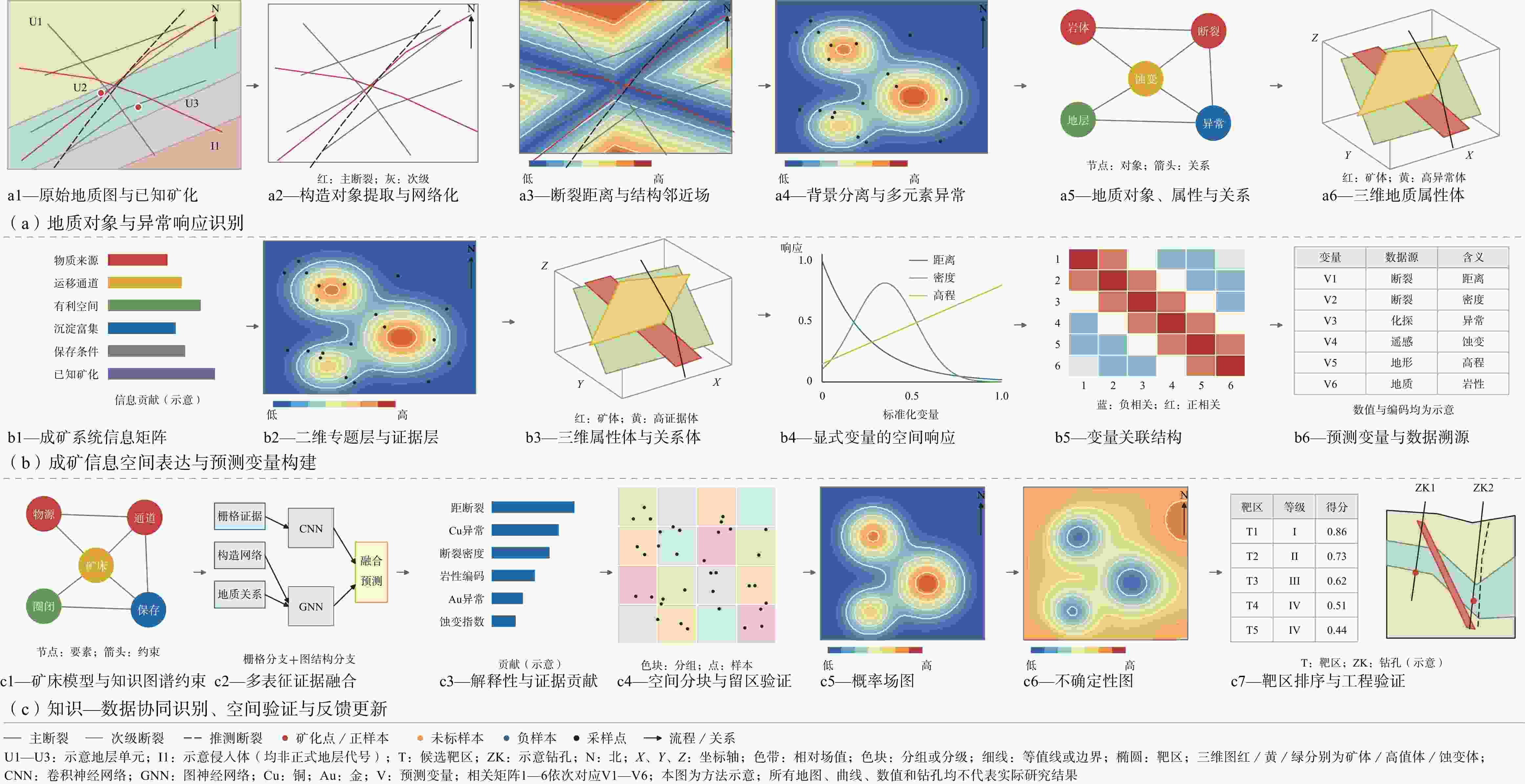
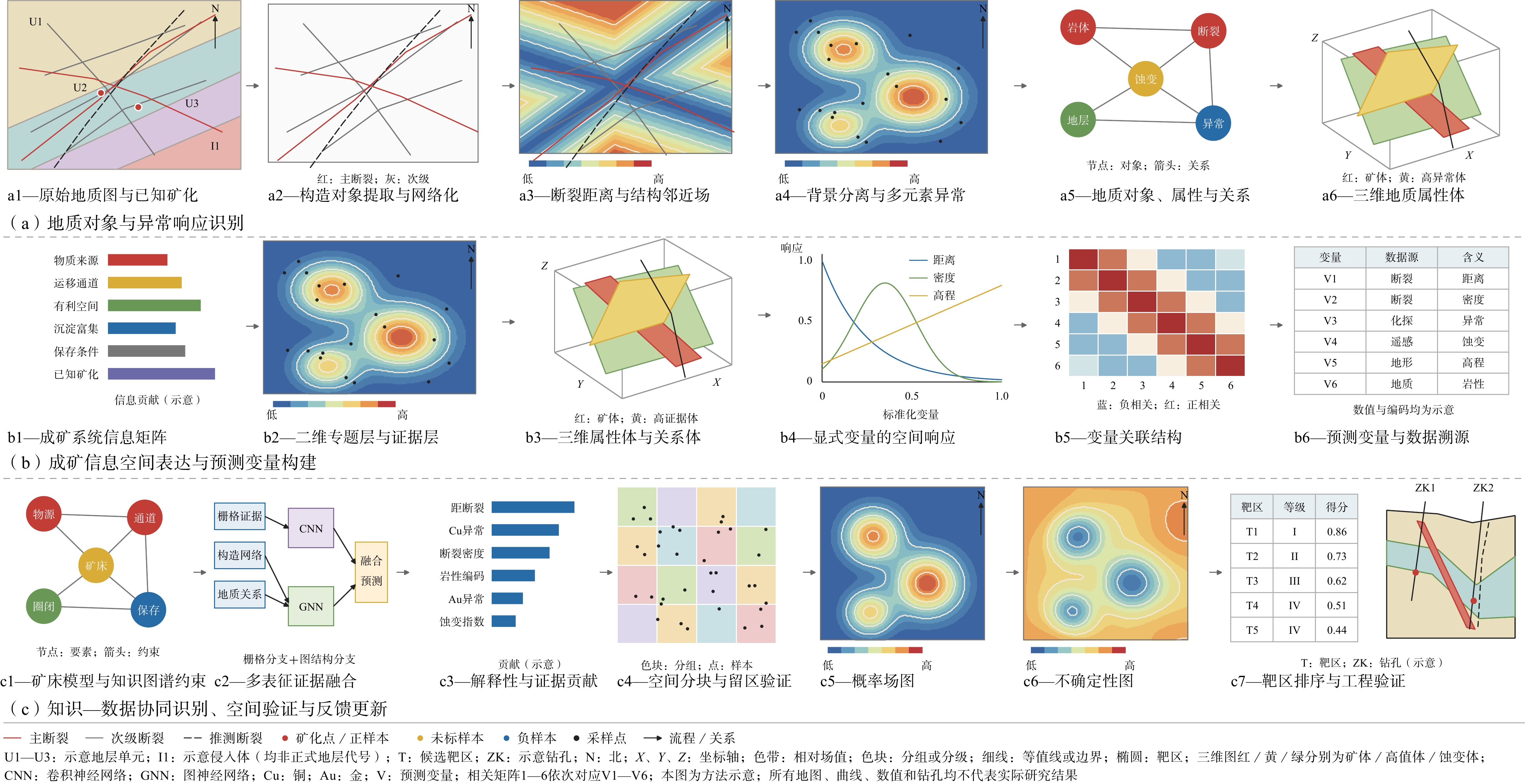
图 1 矿产预测中理论约束、信息构建、智能模型与预测评价的关系
Figure 1. Relationships among theoretical constraints, information construction, intelligent models, and prospectivity assessment in mineral prospectivity mapping
(a) Identification of geological objects and anomalous responses: (a1) Original geological map showing known mineralization; (a2) extraction of structural objects and construction of structural networks; (a3) Fault-distance and structural-proximity fields; (a4) Background separation and multi-element anomalies; (a5) Geological objects, attributes, and spatial relationships; (a6) Three-dimensional geological attribute volumes; (b) Spatial representation of metallogenic information and construction of predictive variables: (b1) Information matrix for the mineral system; (b2) Two-dimensional thematic maps and evidence layers; (b3) Three-dimensional attribute and relationship volumes; (b4) Spatial patterns of explicitly defined variables; (b5) Associations among predictive variables; (b6) Predictive variables and data provenance; (c) Knowledge–data collaborative identification, spatial validation, and feedback updating: (c1) Constraints imposed by the ore deposit model and knowledge graph; (c2) Evidence fusion across multiple representations; (c3) Model interpretability and evidence contributions; (c4) Spatial-block and leave-area-out validation; (c5) Predicted probability map; (c6) Uncertainty map; (c7) Target ranking and validation by drilling
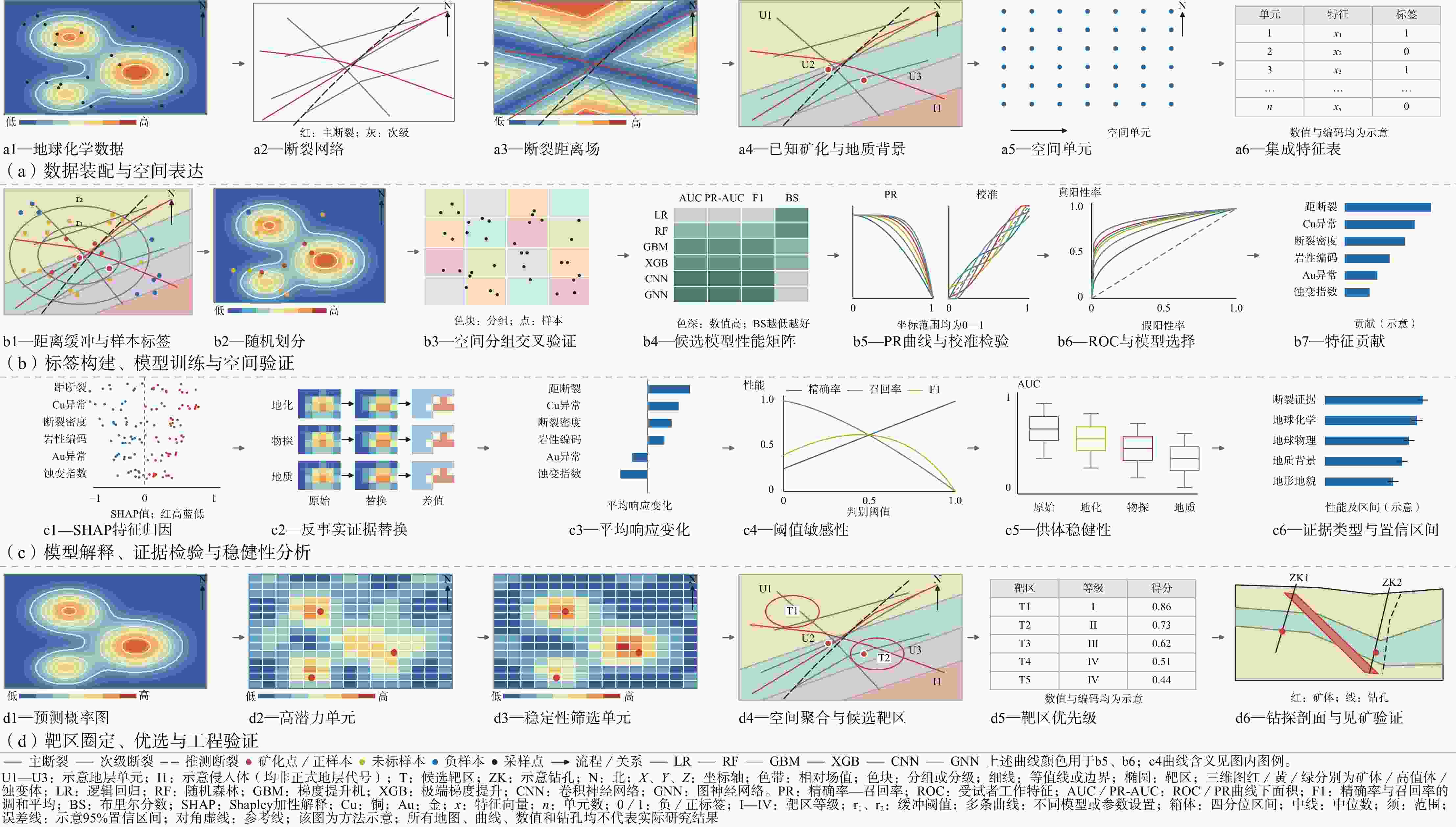
图 2 成矿信息形成及其向预测变量转换的基本框架
Figure 2. Framework for the formation of metallogenic information and its transformation into predictive variables
(a) Data assembly and spatial representation: (a1) Geochemical data; (a2) Fault network; (a3) Fault-distance field; (a4) Known mineralization and geological background; (a5) Spatial units; (a6) Integrated feature table; (b) Label construction, model training, and spatial validation: (b1) Distance buffers and sample labeling; (b2) Random train-test split; (b3) Spatial group cross-validation; (b4) Performance matrix for candidate model; (b5) Precision-recall (PR) curves and calibration assessment; (b6) Receiver operating characteristic (ROC) curves and model selection; (b7) Feature contributions; (c) Model interpretation, evidence testing, and robustness analysis: (c1) SHAP-based feature attribution; (c2) Counterfactual evidence replacement; (c3) Changes in mean model response; (c4) Threshold sensitivity; (c5) Robustness to Donor selection; (c6) Evidence types and confidence intervals; (d) Target delineation, prioritization, and engineering validation: (d1) Predicted probability map; (d2) High-potential units; (d3) Stability-screened units; (d4) Spatial aggregation and candidate targets; (d5) Target prioritization; (d6) Drilling profile and mineralization validation
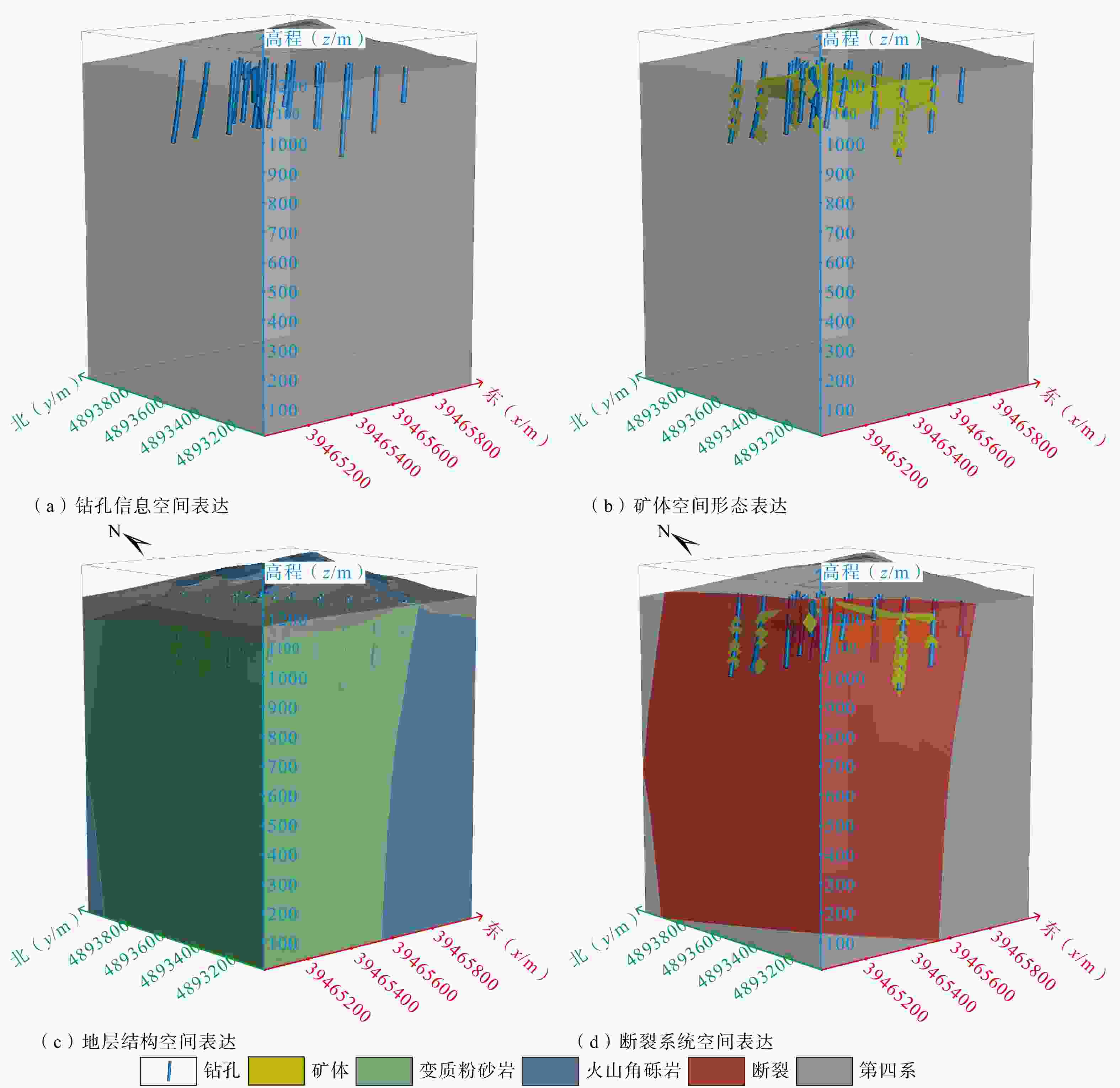
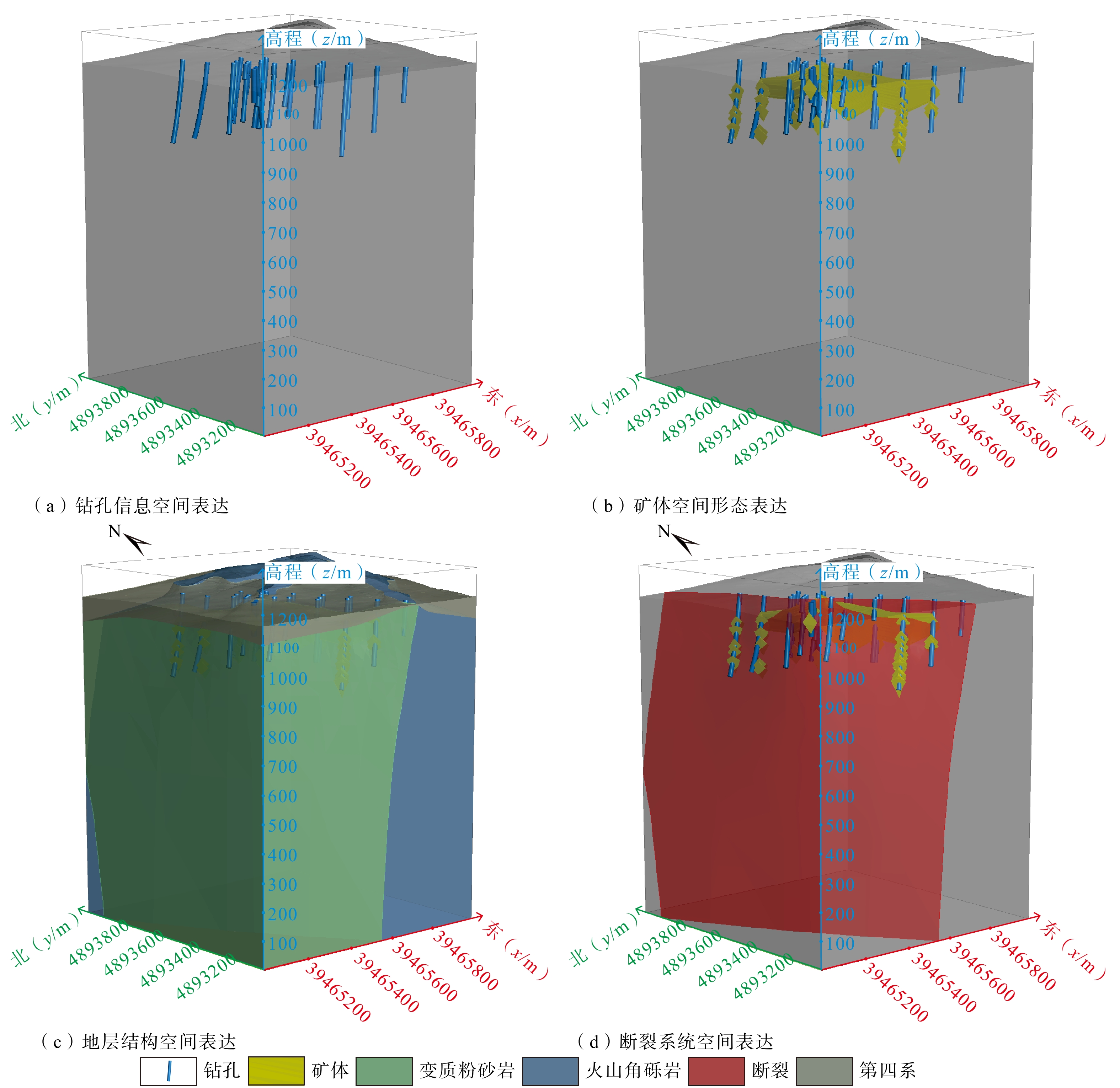
图 3 矿区三维地质模型及其空间结构表达(据孙会玲等,2026修改)
Figure 3. Three-dimensional geological model and its spatial structural representation of the Maodeng mining area (modified from Sun et al., 2026)
(a) Spatial representation of borehole information; (b) Spatial representation of orebody geometry; (c) Spatial representation of stratigraphic structure; (d) Spatial representation of fault system
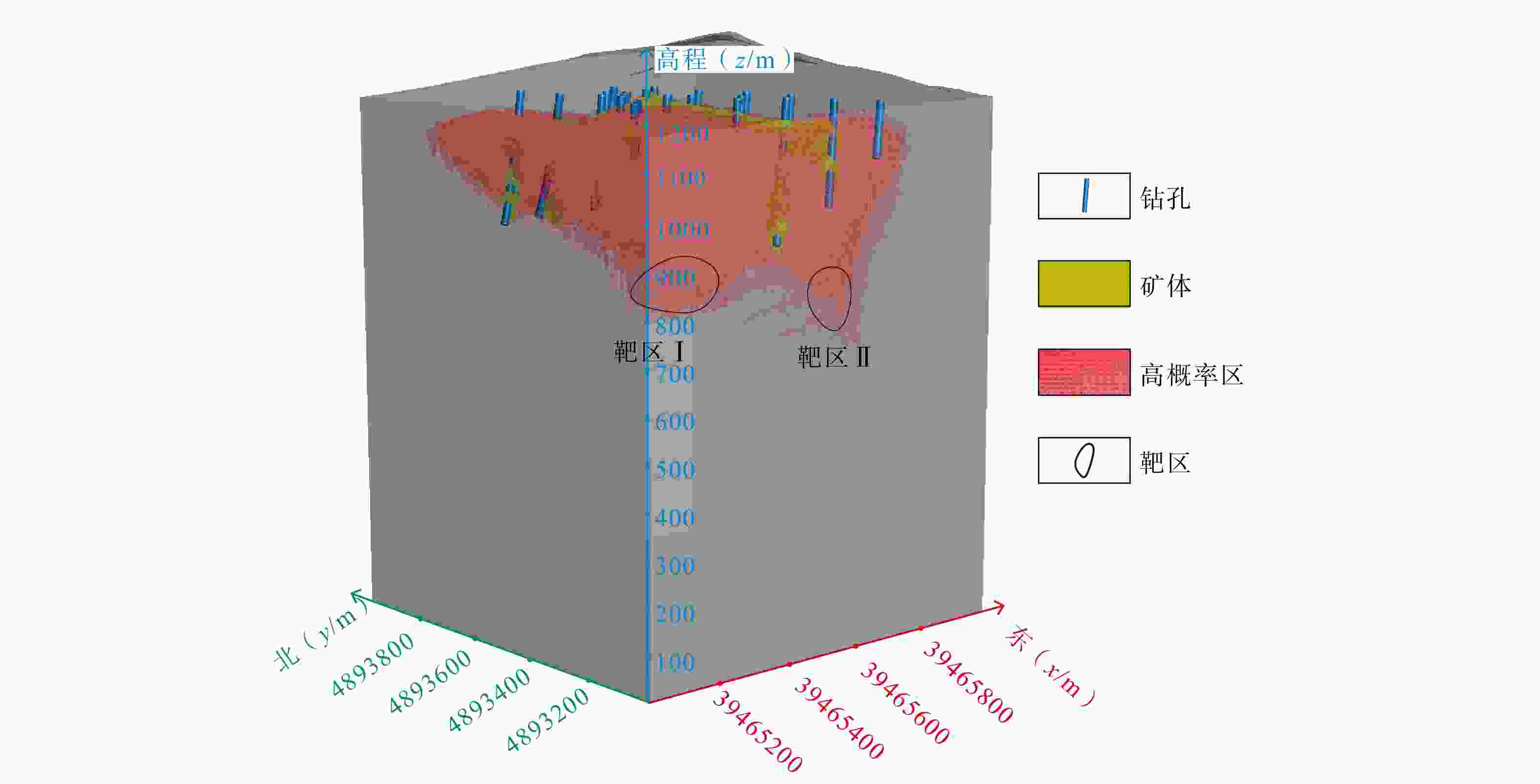
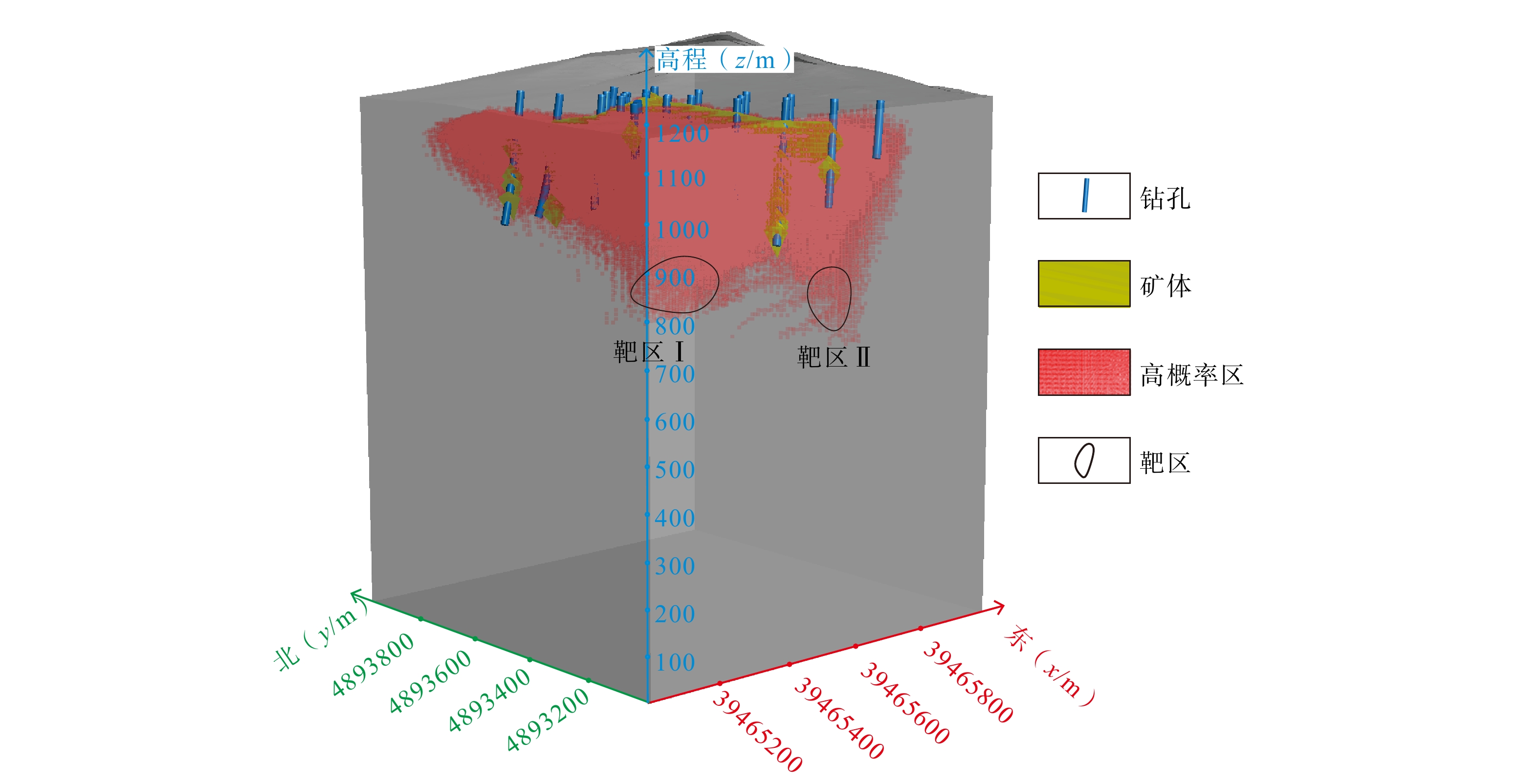
图 4 三维矿体、高概率成矿区与预测靶区的空间关系(据孙会玲等,2026修改)
Figure 4. Spatial relationships among three-dimensional orebodies, high-probability mineralization zones, and predicted targets (modified from Sun et al., 2026)
表 1 成矿系统要素及其预测信息表达
Table 1. Mineral system elements and their representation as predictive information
成矿系统
要素典型地质响应 主要数据来源 成矿信息表达 预测变量示例 主要验证依据 物质来源 成矿岩体、源岩、含矿层位 地质、地球化学、同位素 源区、岩体专题图或三维体 距岩体、岩性编码、元素丰度 已知矿化与源区关系 运移通道 断裂、剪切带、裂隙系统 地质、物探、三维模型 构造专题图、结构面属性 距断裂、密度、交汇、连通性 矿体沿构造展布关系 成矿空间 接触带、褶皱虚脱、岩性
界面地质、钻孔、三维模型 接触关系、有利空间体 距接触带、界面曲率、邻接编码 矿体赋存位置 沉淀富集 蚀变分带、元素组合、物性响应 地球化学、遥感、物探 异常组合、蚀变专题信息 对数比、异常强度、纹理特征 蚀变−矿化对应关系 保存条件 覆盖层、剥蚀面、后期断裂 地质、遥感、第四纪与构造资料 保存或破坏条件专题信息 覆盖厚度、剥蚀距离、断裂切割 矿体保存状态 已知矿化 矿点、矿体、工程见矿 矿产地、钻孔、槽探、坑探 标签或约束区 正样本、距离标签、品位属性 空间独立与工程验证  下载: 导出CSV
表 2 成矿信息提取、智能识别与验证的技术层级
Table 2. Technical hierarchy for metallogenic information extraction, intelligent identification, and validation
技术环节 技术类别 代表方法 主要作用 主要局限 信息空间化 GIS与三维空间分析 距离、密度、缓冲、拓扑、曲率、体素化 将地质对象和空间关系转化为可计算
表达参数与尺度敏感,依赖地质
解释质量异常与组合提取 统计与地球化学分析 稳健统计、CoDA、分形、多元分析 分离背景与异常并识别元素组合 统计异常不必然具有成矿
意义模式识别 传统机器学习 RF、SVM、梯度提升、贝叶斯网络 识别显式预测变量的非线性组合 受标签偏差、空间自相关和类别不平衡影响 深度空间表征 深度学习 CNN、3D CNN、自编码器、GNN/GCN 学习规则栅格、体素或关系网络中的
复杂特征解释性、样本需求与跨区迁移能力受限 知识约束 知识—数据协同 矿床模型、规则约束、知识图谱、关系嵌入 约束变量、关系与结果的地质语义 知识结构化成本高,规则可
能带入主观性结果检验 空间与工程验证 空间分块、留区、跨区、钻探与野外验证 检验模型推广性和找矿有效性 独立资料不足,验证成本高 注:CoDA—成分数据分析(compositional data analysis);RF—随机森林(random forest);SVM—支持向量机(support vector machine);3D CNN—三维卷积神经网络(three-dimensional convolutional neural network)
下载: 导出CSV
-
[1] AGTERBERG F P, BONHAM-CARTER G F, CHENG Q, et al. , 1993. Weights of evidence modeling and weighted logistic regression for mineral potential mapping[M]//DAVIS J C, HERZFELD U C. Computers in geology: 25 years of progress. New York: Oxford University Press: 13-32. [2] AITCHISON J, 1986. The statistical analysis of compositional data[M]. London: Chapman and Hall. [3] BONHAM-CARTER G F, 1994. Geographic information systems for geoscientists: modelling with GIS[M]. Oxford: Pergamon. [4] CHENG Q M, AGTERBERG F P, BALLANTYNE S B, 1994. The separation of geochemical anomalies from background by fractal methods[J]. Journal of Geochemical Exploration, 51(2): 109-130. doi: 10.1016/0375-6742(94)90013-2 [5] DENG H, ZHENG Y, CHEN J, et al., 2022. Learning 3D mineral prospectivity from 3D geological models using convolutional neural networks: application to a structure-controlled hydrothermal gold deposit[J]. Computers & Geosciences, 161: 105074. doi: 10.1016/j.cageo.2022.105074 [6] LI N, BAGAS L, LI X H, et al., 2016. An improved buffer analysis technique for model-based 3D mineral potential mapping and its application[J]. Ore Geology Reviews, 76: 94-107. doi: 10.1016/j.oregeorev.2015.12.002 [7] LUNDBERG S M, LEE S I, 2017. A unified approach to interpreting model predictions[C]//Proceedings of the 31st international conference on neural information processing systems. Long Beach: Curran Associates Inc. : 4768-4777. [8] LUO Z J, FARAHBAKHSH E, HORE S, et al., 2026. DEEP-SEAM: an explainable semi-supervised deep learning framework for mineral prospectivity mapping[J]. Geoscientific Model Development, 19(7): 2593-2625. doi: 10.5194/gmd-19-2593-2026 [9] MAO X C, DUAN X M, DENG H, et al., 2026. Intelligent 3D prediction of deep mineral resources: theory, methods, and challenges[J]. Earth Science, 51(3): 793-815. doi: 10.3799/dqkx.2025.227 [10] MCCUAIG T C, HRONSKY J M A, 2014. The mineral system concept: the key to exploration targeting[M]//KELLEY K D, GOLDEN H C. Building exploration capability for the 21st century. Littleton: Society of Economic Geologists: 153-175, doi: 10.5382/SP.18.08. [11] MOU N N, CARRANZA E J M, XUE J L, et al., 2025. Interpretable machine learning for mineral prospectivity mapping in the Qulong-Jiama district, Tibet, China[J]. Ore Geology Reviews, 182: 106659. doi: 10.1016/j.oregeorev.2025.106659 [12] NWAILA G T, ZHANG S E, BOURDEAU J E, et al., 2024. Mineral reconnaissance through scientific consensus: first national prospectivity maps for PGE-Ni-Cu-Cr and Witwatersrand-type Au deposits in South Africa[J]. Natural Resources Research, 33(6): 2357-2384. doi: 10.1007/s11053-024-10390-w [13] PARSA M, CUMANI R, 2025. Class label representativeness in machine learning-based mineral prospectivity mapping[J]. Natural Resources Research, 34(4): 1901-1925. doi: 10.1007/s11053-025-10468-z [14] PARSA M, LAWLEY C J M, CAWOOD T, et al., 2025. Pan-Canadian predictive modeling of lithium-cesium-tantalum pegmatites with deep learning and natural language processing[J]. Natural Resources Research, 34(2): 639-668. doi: 10.1007/s11053-024-10438-x [15] SABBAGHI H, TABATABAEI S H, FATHIANPOUR N, 2024. Geologically-constrained GANomaly network for mineral prospectivity mapping through frequency domain training data[J]. Scientific Reports, 14(1): 6236. doi: 10.1038/s41598-024-56644-8 [16] SHI L Y, ZUO R G, 2026. Foundation model for mineral prospectivity mapping[J]. Earth Science, 51(3): 832-848. doi: 10.3799/dqkx.2025.190 [17] SHIRMARD H, FARAHBAKHSH E, MÜLLER R D, et al., 2022. A review of machine learning in processing remote sensing data for mineral exploration[J]. Remote Sensing of Environment, 268: 112750. doi: 10.1016/j.rse.2021.112750 [18] SIHOMBING F M H, PALIN R M, HUGHES H S R, et al., 2024. Improved mineral prospectivity mapping using graph neural networks[J]. Ore Geology Reviews, 172: 106215. doi: 10.1016/j.oregeorev.2024.106215 [19] SUN H L, TANG R, LI Y, et al., 2026. Three-dimensional mineral prospectivity prediction based on numerical simulation of metallogenic processes and machine learning: a case study of the Maodeng deposit, Inner Mongolia[J]. Earth Science, 51(3): 921-939. (in Chinese with English abstract) [20] SUN K, CHEN Y S, GENG G S, et al., 2024. A review of mineral prospectivity mapping using deep learning[J]. Minerals, 14(10): 1021. doi: 10.3390/min14101021 [21] WYBORN L A I, HEINRICH C A, JAQUES A L, 1994. Australian Proterozoic mineral systems: essential ingredients and mappable criteria[C]//Proceedings of the AusIMM annual conference. Darwin: Australasian Institute of Mining and Metallurgy: 109-115. [22] XIANG J, CHEN J P, HU B, et al., 2016. 3D metallogenic prediction based on 3D geological-geophysical model: a case study in Tongling mineral district of Anhui[J]. Advances in Earth Science, 31(6): 603-614. (in Chinese with English abstract) [23] XIANG J, XIAO K Y, CARRANZA E J M, et al., 2020. 3D mineral prospectivity mapping with random forests: a case study of Tongling, Anhui, China[J]. Natural Resources Research, 29(1): 395-414. doi: 10.1007/s11053-019-09578-2 [24] XIAO K Y, LI N, PORWAL A, et al., 2015. GIS-based 3D prospectivity mapping: a case study of Jiama copper-polymetallic deposit in Tibet, China[J]. Ore Geology Reviews, 71: 611-632. doi: 10.1016/j.oregeorev.2015.03.001 [25] XIAO K Y, XIANG J, FAN M J, et al., 2021. 3D mineral prospectivity mapping based on deep metallogenic prediction theory: a case study of the Lala copper mine, Sichuan, China[J]. Journal of Earth Science, 32(2): 348-357. doi: 10.1007/s12583-021-1437-8 [26] XIONG Y H, ZUO R G, CARRANZA E J M, 2018. Mapping mineral prospectivity through big data analytics and a deep learning algorithm[J]. Ore Geology Reviews, 102: 811-817. doi: 10.1016/j.oregeorev.2018.10.006 [27] YAN Q, ZHAO J, XUE L F, et al., 2024. Mineral prospectivity mapping based on spatial feature classification with geological map knowledge graph embedding: case study of gold ore prediction at Wulonggou, Qinghai Province (western China)[J]. Natural Resources Research, 33(6): 2385-2406. doi: 10.1007/s11053-024-10386-6 [28] YAN Q, PEI Y, XUE L F, et al., 2025. Mineral prospectivity mapping: an interpretable classifier combining catchment basin and knowledge graph embedding[J]. Ore Geology Reviews, 184: 106758. doi: 10.1016/j.oregeorev.2025.106758 [29] YANG N, ZHANG Z K, YANG J H, et al., 2022. Mineral prospectivity prediction by integration of convolutional autoencoder network and random forest[J]. Natural Resources Research, 31(3): 1103-1119. doi: 10.1007/s11053-022-10038-7 [30] YE T Z, XIAO K Y, YAN G S, 2007. Methodology of deposit modeling and mineral resource potential assessment using integrated geological information[J]. Earth Science Frontiers, 14(5): 11-19. (in Chinese with English abstract) [31] YOUSEFI M, CARRANZA E J M, KREUZER O P, et al., 2021. Data analysis methods for prospectivity modelling as applied to mineral exploration targeting: state-of-the-art and outlook[J]. Journal of Geochemical Exploration, 229: 106839. doi: 10.1016/j.gexplo.2021.106839 [32] ZHANG S E, LAWLEY C J M, BOURDEAU J E, et al., 2024. Workflow-induced uncertainty in data-driven mineral prospectivity mapping[J]. Natural Resources Research, 33(3): 995-1023. doi: 10.1007/s11053-024-10322-8 [33] ZHANG S E, COUTTS D, PARSA M, et al., 2025. Recursive annotation for negative labeling in data-driven mineral prospectivity mapping[J]. Natural Resources Research, 34(5): 2373-2402. doi: 10.1007/s11053-025-10510-0 [34] ZHANG Z J, 2026. Construction of multilayered mineralization prediction data based on geological big data and artificial intelligence[J]. Earth Science, 51(3): 849-861. doi: 10.3799/dqkx.2026.010 [35] ZHAO P D, 2002. “Three-component” quantitative resource prediction and assessments: theory and practice of digital mineral prospecting[J]. Earth Science: Journal of China University of Geosciences, 27(5): 482-489. (in Chinese with English abstract) [36] ZHAO P D, 2007. Quantitative mineral prediction and deep mineral exploration[J]. Earth Science Frontiers, 14(5): 1-10. (in Chinese with English abstract) [37] ZHENG Y, DENG H, WU J J, et al., 2024. Deep multimodal fusion for 3D mineral prospectivity modeling: integration of geological models and simulation data via canonical-correlated joint fusion networks[J]. Computers & Geosciences, 188: 105618. doi: 10.1016/j.cageo.2024.105618 [38] ZUO R G, LUO Z J, XIONG Y H, et al., 2022. A geologically constrained variational autoencoder for mineral prospectivity mapping[J]. Natural Resources Research, 31(3): 1121-1133. doi: 10.1007/s11053-022-10050-x [39] ZUO R G, XU Y, 2023. Graph deep learning model for mapping mineral prospectivity[J]. Mathematical Geosciences, 55(1): 1-21. doi: 10.1007/s11004-022-10015-z [40] ZUO R G, CHENG Q M, XU Y, et al., 2024. Explainable artificial intelligence models for mineral prospectivity mapping[J]. Science China Earth Sciences, 67(9): 2864-2875. doi: 10.1007/s11430-024-1309-9 [41] ZUO R G, YANG F F, CHENG Q M, et al., 2025. A novel data-knowledge dual-driven model coupling artificial intelligence with a mineral systems approach for mineral prospectivity mapping[J]. Geology, 53(3): 284-288. doi: 10.1130/G52970.1 [42] ZUO R G, ZHANG Z J, YANG F F, et al., 2026. Big data and artificial intelligence-driven mineral prospectivity mapping[J]. Earth Science, 51(3): 779-792. doi: 10.3799/dqkx.2026.006 [43] 毛先成, 段新明, 邓浩, 等, 2026. 深部矿产三维智能预测理论、方法与挑战[J]. 地球科学, 51(3): 793-815. doi: 10.3799/dqkx.2025.227 [44] 师路易, 左仁广, 2026. 矿产预测大模型[J]. 地球科学, 51(3): 832-848. doi: 10.3799/dqkx.2025.190 [45] 孙会玲, 唐瑞, 李杨, 等, 2026. 基于成矿过程数值模拟与机器学习的三维找矿预测: 以内蒙古毛登矿床为例[J]. 地球科学, 51(3): 921-939. [46] 向杰, 陈建平, 胡彬, 等, 2016. 基于三维地质—地球物理模型的三维成矿预测: 以安徽铜陵矿集区为例[J]. 地球科学进展, 31(6): 603-614. doi: 10.11867/j.issn.1001-8166.2016.06.0603 [47] 叶天竺, 肖克炎, 严光生, 2007. 矿床模型综合地质信息预测技术研究[J]. 地学前缘, 14(5): 11-19. doi: 10.3321/j.issn:1005-2321.2007.05.002 [48] 张振杰, 2026. 基于地学大数据和人工智能的多层次矿产预测数据构建[J]. 地球科学, 51(3): 849-861. doi: 10.3799/dqkx.2026.010 [49] 赵鹏大, 2002. “三联式”资源定量预测与评价: 数字找矿理论与实践探讨[J]. 地球科学: 中国地质大学学报, 27(5): 482-489. [50] 赵鹏大, 2007. 成矿定量预测与深部找矿[J]. 地学前缘, 14(5): 1-10. doi: 10.3321/j.issn:1005-2321.2007.05.001 [51] 左仁广, 张振杰, 杨帆帆, 等, 2026. 大数据人工智能驱动的矿产预测[J]. 地球科学, 51(3): 779-792. doi: 10.3799/dqkx.2026.006 -

 下载:


计量
- 文章访问数: 90
- HTML全文浏览量: 11
- PDF下载量: 11
- 被引次数: 0
