


A preliminary exploration of Extremal-Entropy Mineralization Theory for Jiaodong gold deposits: proposal of two metallogenic end members and thermodynamic constraints on their formation mechanisms
-
摘要: 传统上,胶东金矿主体被划分为石英脉型和破碎带蚀变岩型,二者受控于统一的地球动力学机制。多同位素研究结果显示,成矿流体呈现大范围的均一性,成矿物质与成矿热液均表现出显著的深源特征。然而,统一的深部热液来源如何演化并形成两类地质特征截然不同的矿床尚未有令人信服的解释。文章尝试采用热力学软件模拟方法,探讨两类金矿的成矿流体演化过程与金沉淀机制。基于石英脉型与蚀变岩型金矿在成矿物质空间配置上的系统差异,提出“低熵−高熵”端元认识。石英脉型金矿对应低熵端元,以优势通道卸载和成矿物质局部集中为特征;蚀变岩型金矿对应高熵端元,以复杂裂隙渗流、水−岩反应及成矿物质分散分配为特征。该端元认识为热力学模拟提供了地质依据,据此设置优势通道卸载与广泛渗流条件下水−岩反应两类典型成矿情景,以对比不同成矿过程对矿物组合及Au沉淀的影响。模拟表明,大部分黄铁矿结晶早于自然金,这也解释了自然金多出现在黄铁矿晶间或晶内裂隙,并与细粒黄铁矿关系密切。黄铁矿大量结晶可持续消耗流体中的HS−并改变Au络合物的稳定性,同时伴随还原作用,促进Au由络合态向自然金转化并沉淀。因此,黄铁矿形成及其对流体化学条件的持续调节,是控制胶东金矿Au卸载与富集的重要机制。矿体最终定位则受控于断层几何形态对流体运移过程的调控。缓倾转折段和断裂分支复合部位因流体流速降低,淤积、停留时间长,水−岩反应增强,成为Au沉淀的优势部位;而陡倾断裂段主要承担流体输运功能,二者共同构成“流体输导−矿质沉淀”的空间分异机制。在端元成矿理论认识指导下,可通过提取成矿端元成矿表征信息(地质、地球物理、地球化学等),建立整个成矿系统找矿模型,从而实现成矿预测由定性化向定量化转变。Abstract:
Objective Traditionally, the Jiaodong gold deposits are mainly classified into altered-rock type and quartz-vein type. Both types are controlled by a unified geodynamic mechanism, and extensive multi-isotope studies have revealed a broadly homogeneous nature of the ore-forming fluids, with both the ore-forming materials and hydrothermal fluids showing predominantly deep-seated characteristics. However, how a common deep-sourced hydrothermal system evolved to produce two deposits with markedly different geological characteristics remains inadequately understood. Methods We employ thermodynamic modeling to investigate the evolution of ore-forming fluids and the mechanisms of gold precipitation in the two types of gold deposits. Based on the systematic differences in the spatial configuration of ore-forming materials between quartz vein-type and altered-rock-type gold deposits, we propose a “low-entropy–high-entropy” end-member framework: the former is characterized by unloading along preferential fluid pathways and localized concentration of ore-forming materials, whereas the latter is characterized by fluid infiltration through complex fracture networks, extensive fluid–rock interaction, and dispersed distribution of ore-forming materials. This end-member framework provides a geological basis for the thermodynamic modeling, on which two representative metallogenic scenarios—unloading along preferential pathways and widespread fluid infiltration coupled with fluid–rock interaction—are established to compare their effects on mineral assemblages and gold precipitation. Results The simulations show that most pyrite crystallized prior to native gold, consistent with the common occurrence of native gold along intergranular or intragranular fractures in pyrite and its close association with fine-grained pyrite. Extensive pyrite crystallization continuously consumes HS− in the fluid and modifies the stability of Au complexes, while inducing reducing conditions that promote the conversion and precipitation of Au from complexed forms to native gold. Conclusions Pyrite formation and its sustained regulation of fluid chemistry may represent an important mechanism controlling gold unloading and enrichment in the Jiaodong gold deposits. The final localization of ore bodies is controlled by the regulation of fluid flow by fault geometry. Gently dipping segments and composite sites of fault branching become favorable sites for gold precipitation because reduced fluid flow velocity promotes fluid accumulation, while prolonged fluid residence enhances fluid–rock interaction. In contrast, steeply dipping fault segments mainly serve as fluid conduits. Together, these features constitute a spatial differentiation mechanism of “fluid transport–ore-forming material precipitation.” Significance Guided by the end-member metallogenic framework, diagnostic information of the metallogenic end members, including geological, geophysical, and geochemical characteristics, can be extracted to establish an integrated prospecting model for the metallogenic system, thereby potentially advancing metallogenic prediction from qualitative to quantitative approaches. -
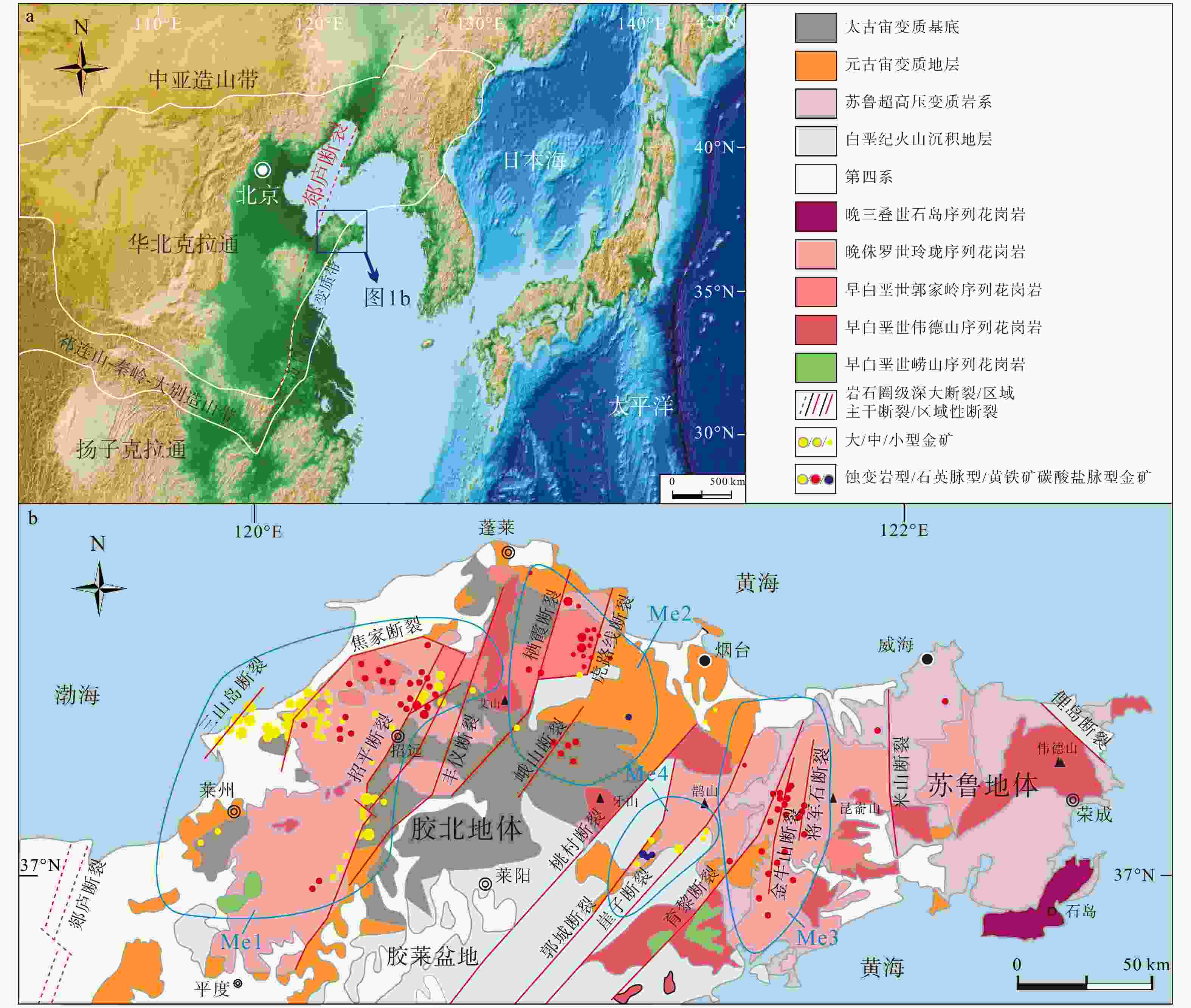
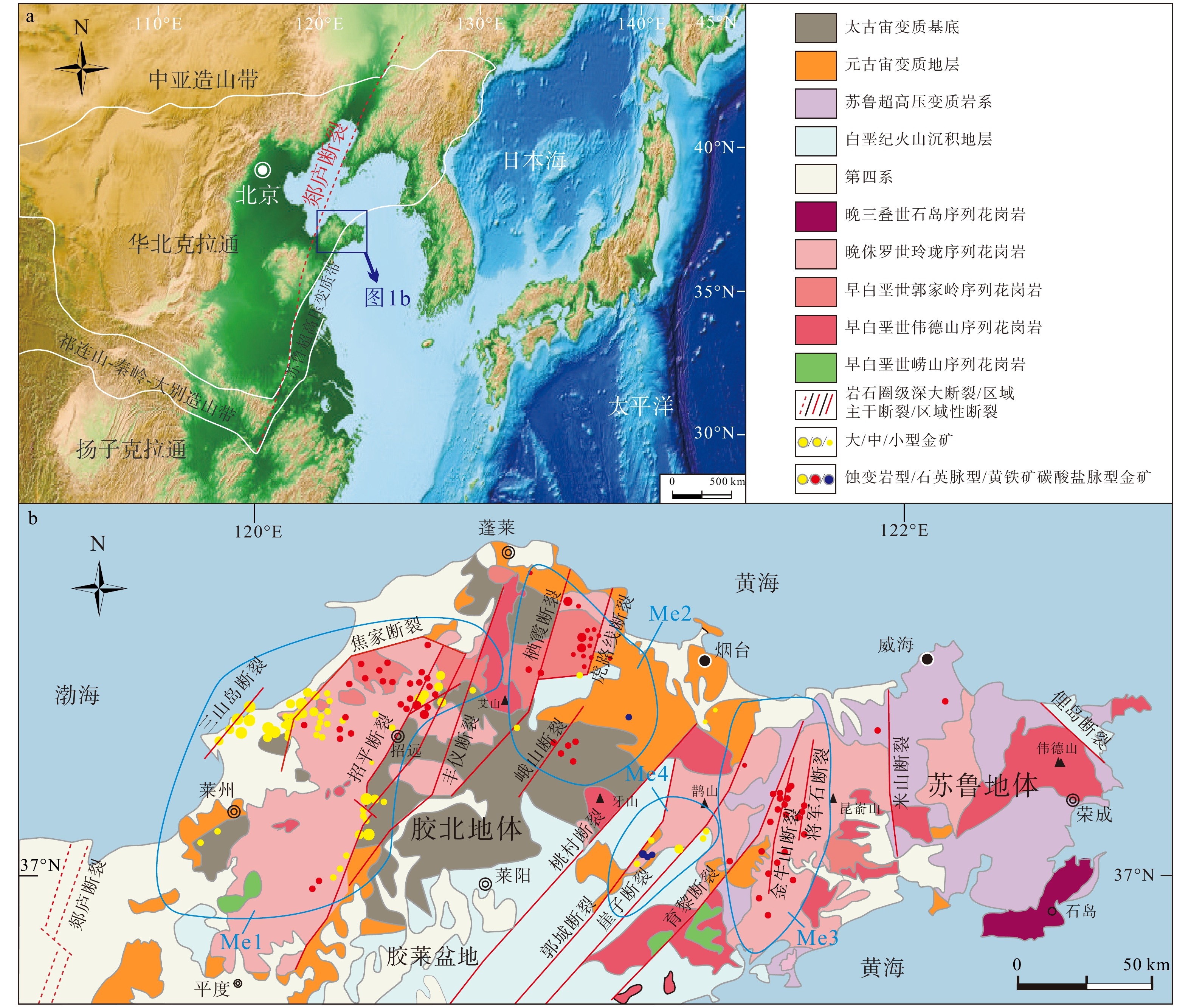
图 1 胶东半岛大地构造位置及地质简图(底图据Bo et al.,2025;Wang et al.,2025a修改)
Me1—胶西北金成矿区;Me2—栖霞−蓬莱−福山金成矿区;Me3—牟平−乳山金成矿区;Me4—胶莱盆地东北缘金成矿区a—中国东部大地构造简图;b—胶东半岛地质简图
Figure 1. Tectonic setting and simplified geological map of the Jiaodong Peninsula (base map modified after Bo et al., 2025; Wang et al., 2025a), showing the distribution of gold deposits in the Jiaodong Peninsula
(a) Simplified tectonic map of eastern China; (b) Simplified geological map of the Jiaodong Peninsula Me1–Northwestern Jiaodong gold metallogenic district; Me2–Qixia–Penglai–Fushan gold metallogenic district; Me3–Muping–Rushan gold metallogenic district; Me4–gold metallogenic district along the northeastern margin of the Jiaolai Basin
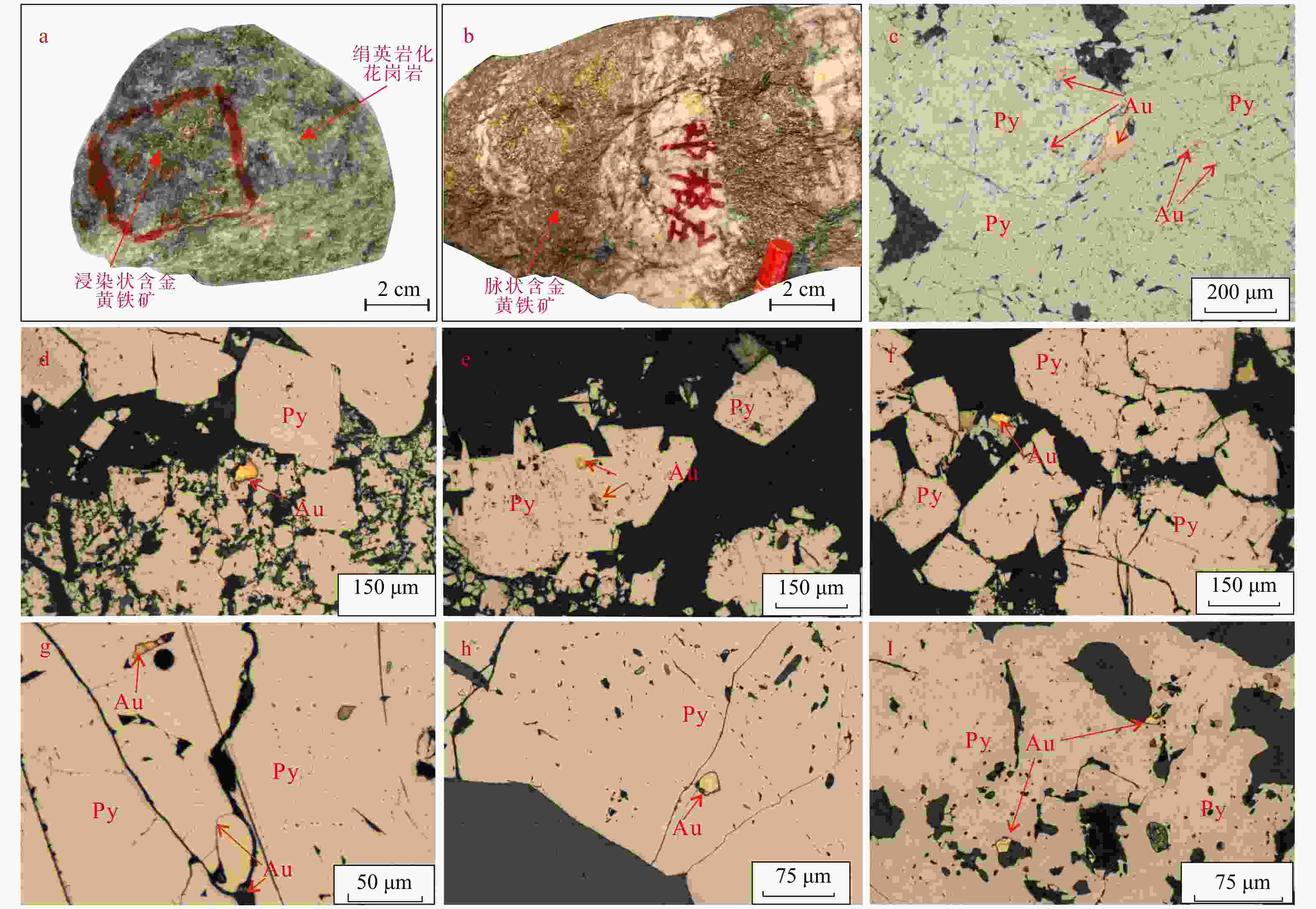
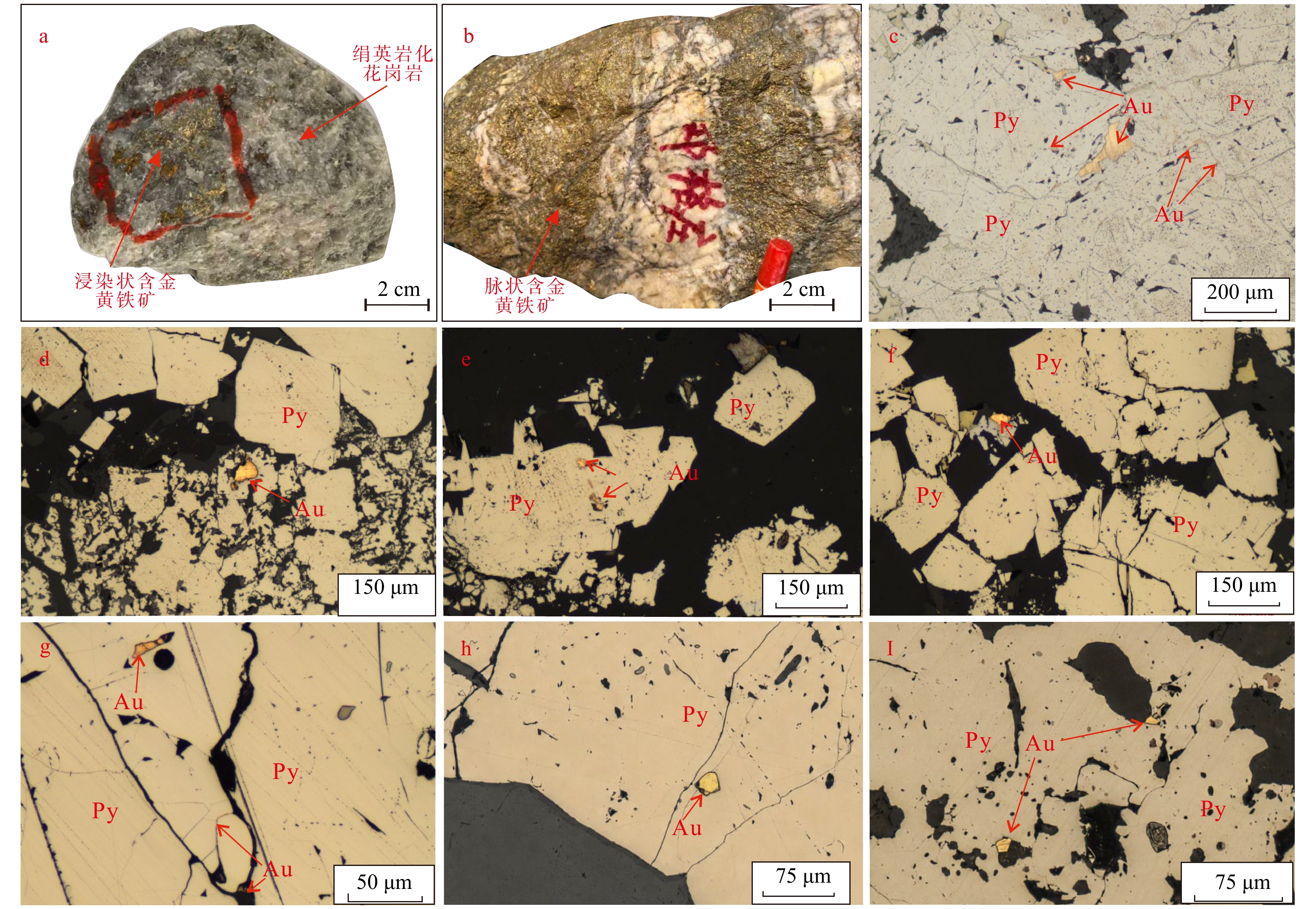
图 2 胶东金矿代表性手标本和显微镜下明金赋存状态特征图
Py—黄铁矿;Au—自然金a—三山岛蚀变岩型金矿石;b—邓格庄石英脉型金矿石;c—自然金颗粒沿黄铁矿晶内裂隙分布(三山岛金矿,蚀变岩型);d—自然金颗粒与细粒黄铁矿相关(邓格庄金矿,石英脉型);e—自然金颗粒沿晶内和晶间裂隙分布(邓格庄金矿,石英脉型);f—自然金颗粒沿晶内裂隙分布(邓格庄金矿,石英脉型);g—自然金颗粒分布在细粒黄铁矿粒间(金青顶金矿,石英脉型);h—自然金颗粒沿晶内裂隙分布(双山屯金矿,蚀变岩型);i—自然金颗粒沿黄铁矿晶内裂隙分布(西王丛金矿,蚀变岩型)
Figure 2. Representative hand specimens and microscopic characteristics of visible gold occurrence in the Jiaodong gold deposits
(a) Sanshandao altered-rock-type gold ore; (b) Denggezhuang quartz-vein-type gold ore; (c) Native gold grains distributed along intragranular fractures (Sanshandao gold deposit, altered-rock type); (d) Native gold grains associated with fine-grained pyrite (Denggezhuang gold deposit, quartz-vein type); (e) Native gold grains hosted by intragranular fractures in pyrite (Denggezhuang gold deposit, quartz-vein type); (f) Native gold grains filling intragranular fractures in pyrite (Denggezhuang gold deposit, quartz-vein type); (g) Native gold grains occurring between fine-grained pyrite grains (Jinqingding gold deposit, quartz-vein type); (h) Native gold grains hosted by intragranular fractures in pyrite (Shuangshantun gold deposit, altered-rock type); (i) Native gold grains hosted by intragranular fractures in pyrite (Xiwangcong gold deposit, altered-rock type)Py–pyrite; Au–native gold
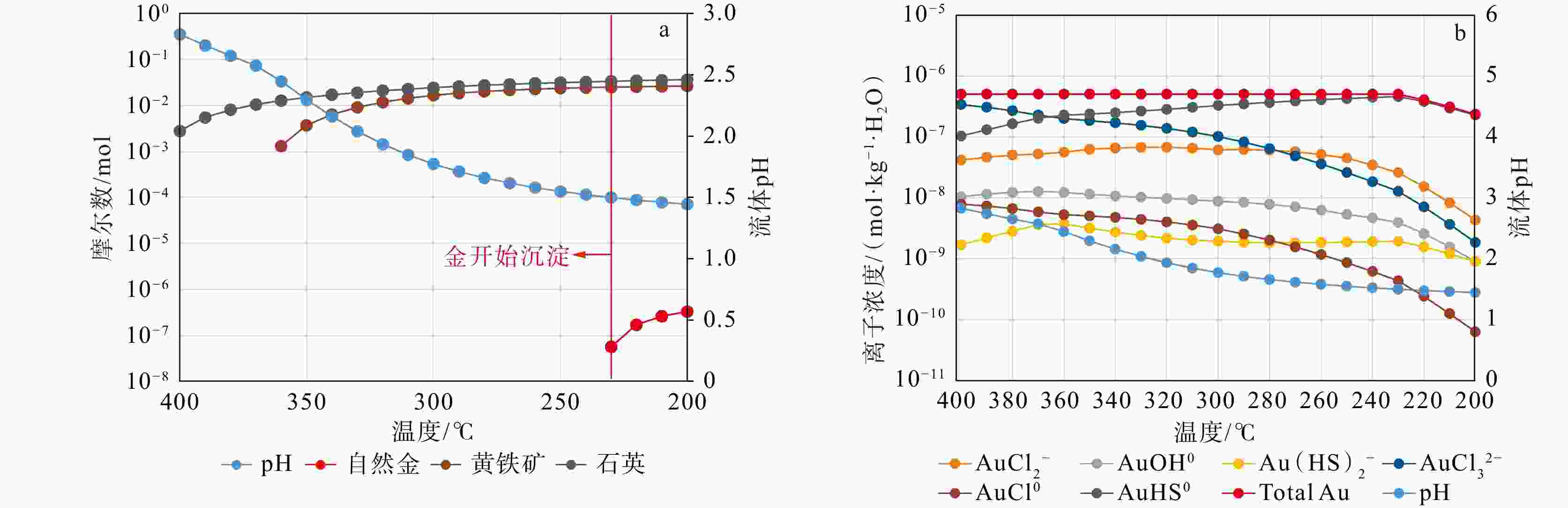
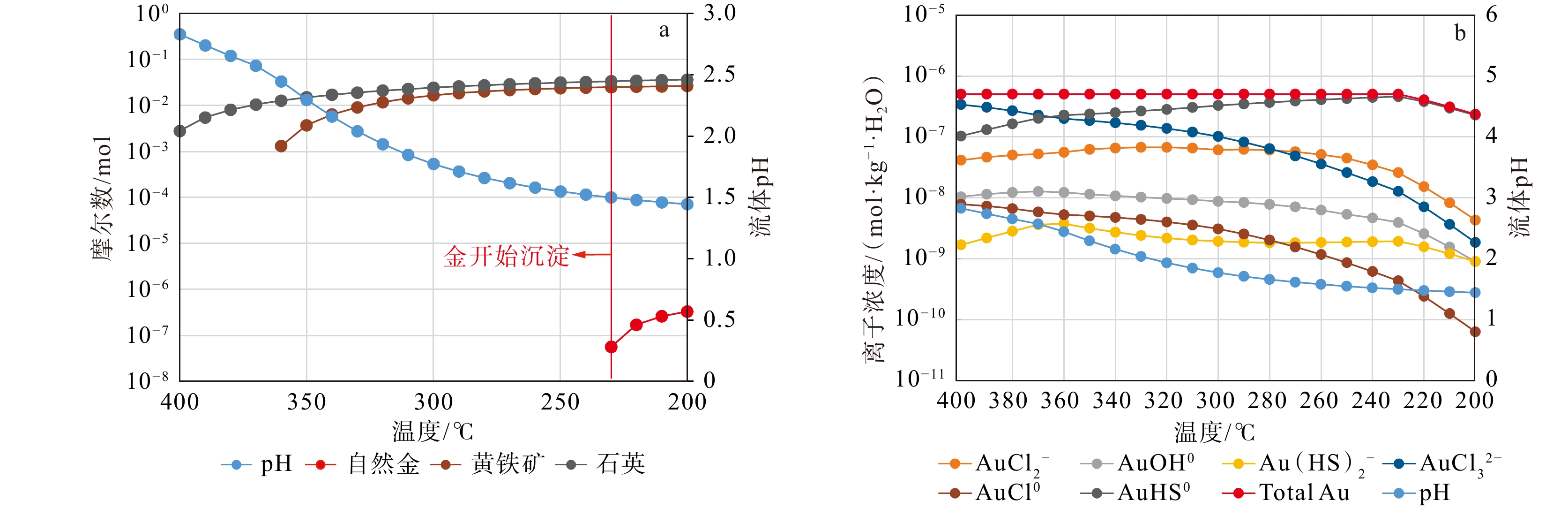
图 3 成矿流体B降温过程中矿物析出和热液中Au络合离子浓度变化图
a—热液冷却过程中矿物析出摩尔数变化趋势图;b—热液中Au的络合离子浓度随温度变化趋势图
Figure 3. Modeled mineral precipitation and variations in Au complex concentrations during cooling of the initial ore-forming fluid B
(a) Trend in the molar amounts of minerals precipitated during hydrothermal cooling; (b) Variation in the concentrations of Au complexes in hydrothermal fluids with temperature
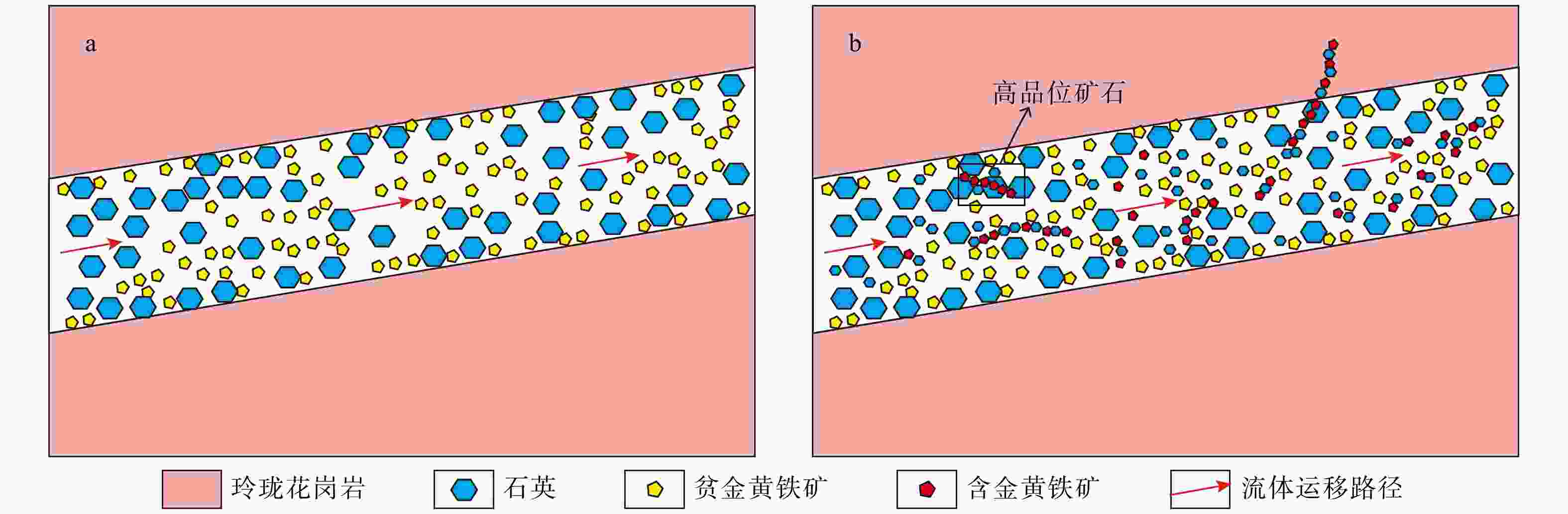
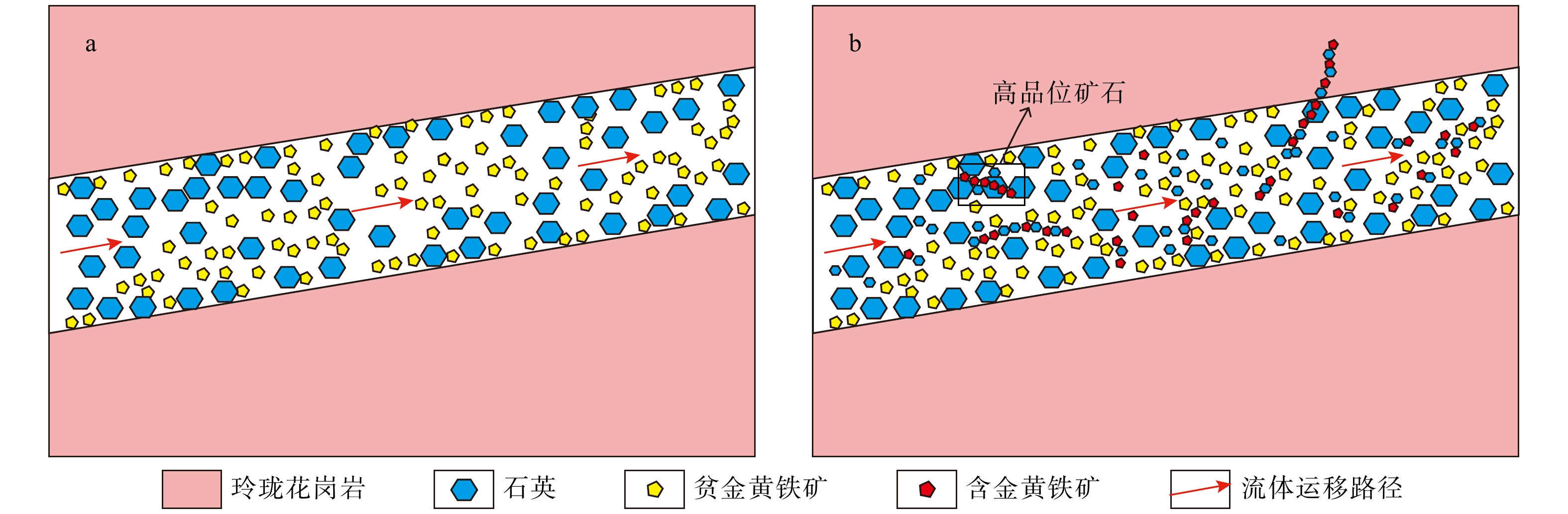
图 4 石英脉型金矿成矿热力学进程示意图
a—温度>250°C时,沉淀贫Au粗粒黄铁矿和石英;b—温度<250°C时,含Au黄铁矿与自然金开始析出,自然金在黄铁矿晶隙或裂隙大量形成,局部流体集中部位形成高品位矿石
Figure 4. Schematic diagram of the thermodynamic mechanism of quartz-vein-type gold mineralization
(a) At temperatures above 250 °C, Au-poor coarse-grained pyrite and quartz precipitate; (b) At temperatures below 250 °C, Au-bearing pyrite and native gold begin to precipitate; native gold is commonly hosted in intergranular spaces or intragranular fractures of pyrite, and high-grade ores form in localized fluid-concentrated zones.
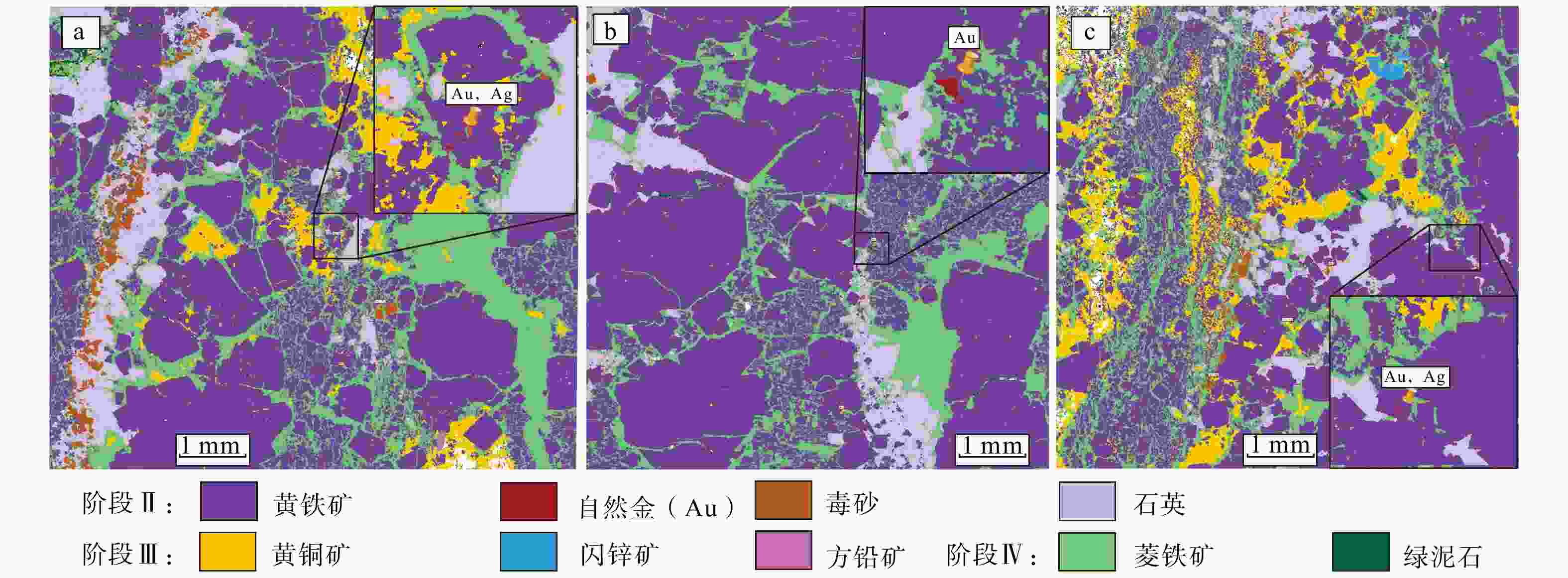
图 5 邓格庄石英脉型金矿矿石TIMA综合矿物相图
a—阶段Ⅳ菱铁矿和黄铜矿明显沿阶段Ⅱ黄铁矿晶内和晶间裂隙穿插;b—阶段Ⅳ菱铁矿沿着阶段Ⅱ黄铁矿晶间和晶内裂隙穿插交代;c—阶段Ⅲ黄铜矿沿阶段Ⅱ黄铁矿晶间裂隙分布,局部呈现微弱的交代
Figure 5. TIMA integrated mineral phase map of an ore thin section from the Denggezhuang quartz-vein-type gold deposit, showing the spatial relationships among minerals formed during different mineralization stages
(a) Stage Ⅳ sideriteand chalcopyrite clearly crosscuts pyrite along intragranular and intragranular fractures; (b) Stage Ⅳ siderite crosscuts and replaces Stage II pyrite along both intergranular and intragranular fractures; (c) Stage Ⅲ chalcopyrite occurs along intergranular fractures in Stage II pyrite, showing weak local replacement
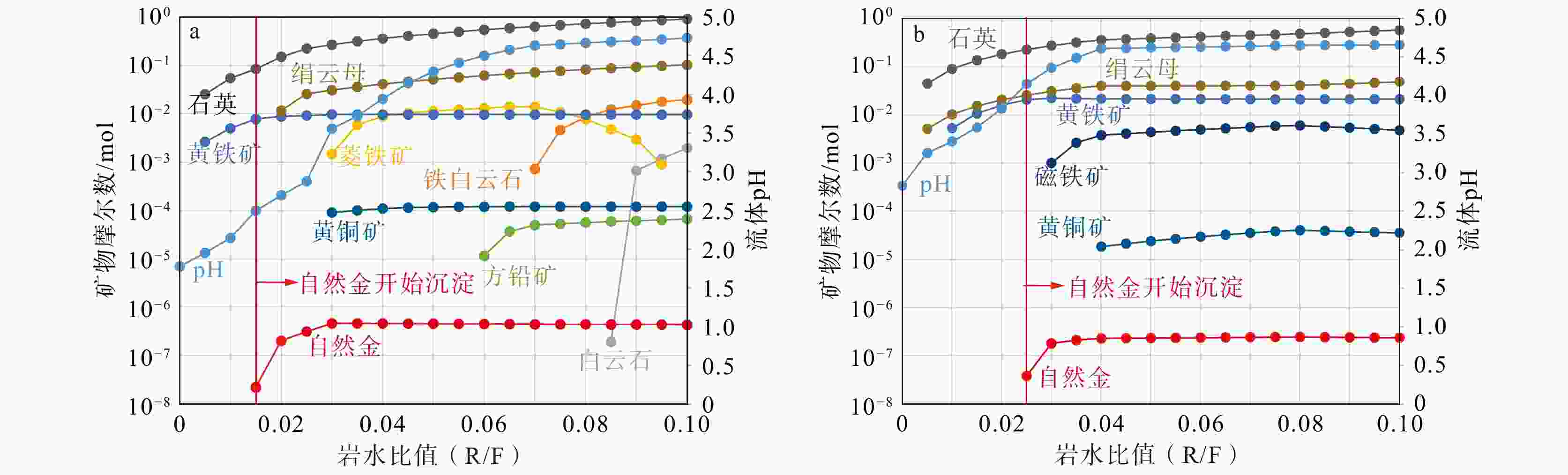
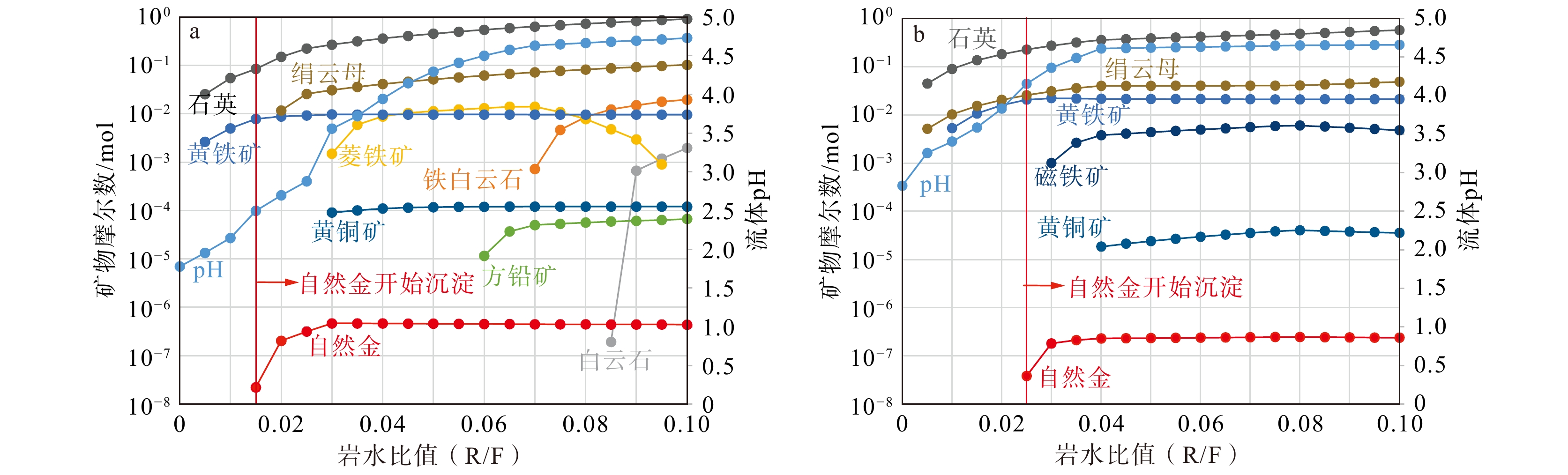
图 6 深源富Au流体与花岗岩水−岩反应进程图
a—300°C条件下,主要矿物组合为黄铁矿、自然金、石英和绢云母,Au在大部分黄铁矿形成后沉淀;b—400°C条件下,主要矿物组合为黄铁矿、自然金、石英、绢云母和磁铁矿,不出现碳酸盐矿物
Figure 6. Schematic diagram of water–rock interaction between deep Au-rich fluids and granites
(a) At 300 °C, the dominant mineral assemblage consists of pyrite, native gold, quartz, and sericite; Native gold precipitates after most of the pyrite has formed; (b) At 400 °C, the dominant mineral assemblage consists of pyrite, native gold, quartz, sericite and magnetite, with no carbonate minerals precipitating
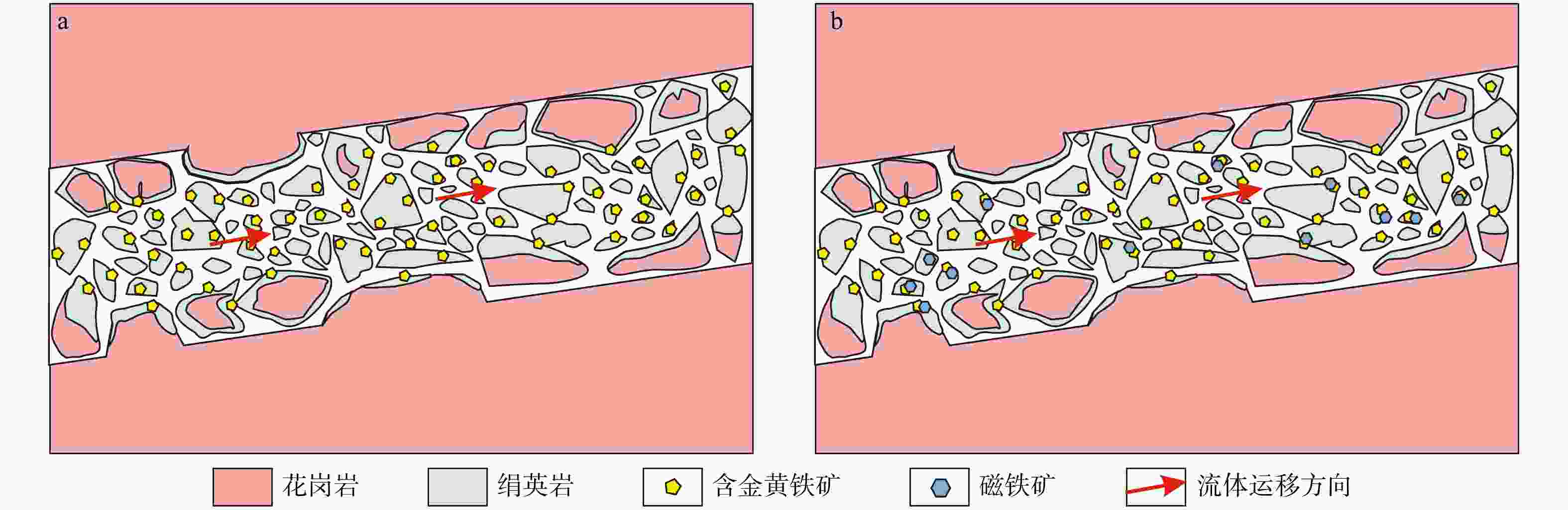
图 7 蚀变岩型金矿成矿热力学机制示意图
a—300°C条件下,流体C与热液反应,形成典型的黄铁绢英岩化,自然金在大部分黄铁矿形成后沉淀于黄铁矿的晶间与晶内裂隙;b—400°C条件下,流体B与热液反应,随着岩水比值升高,少量黄铁矿逐渐转化为磁铁矿
Figure 7. Schematic diagram of the thermodynamic mechanism of altered-rock-type gold mineralization
(a) Fluid–rock interaction at 300 °C leads to typical pyrite–sericite alteration. Native gold precipitates mainly after most pyrite has formed, occurring along intergranular and intragranular fractures within pyrite; (b) Fluid–rock interaction at 400 °C. With decreasing water–rock ratio, minor pyrite is progressively transformed into magnetite.
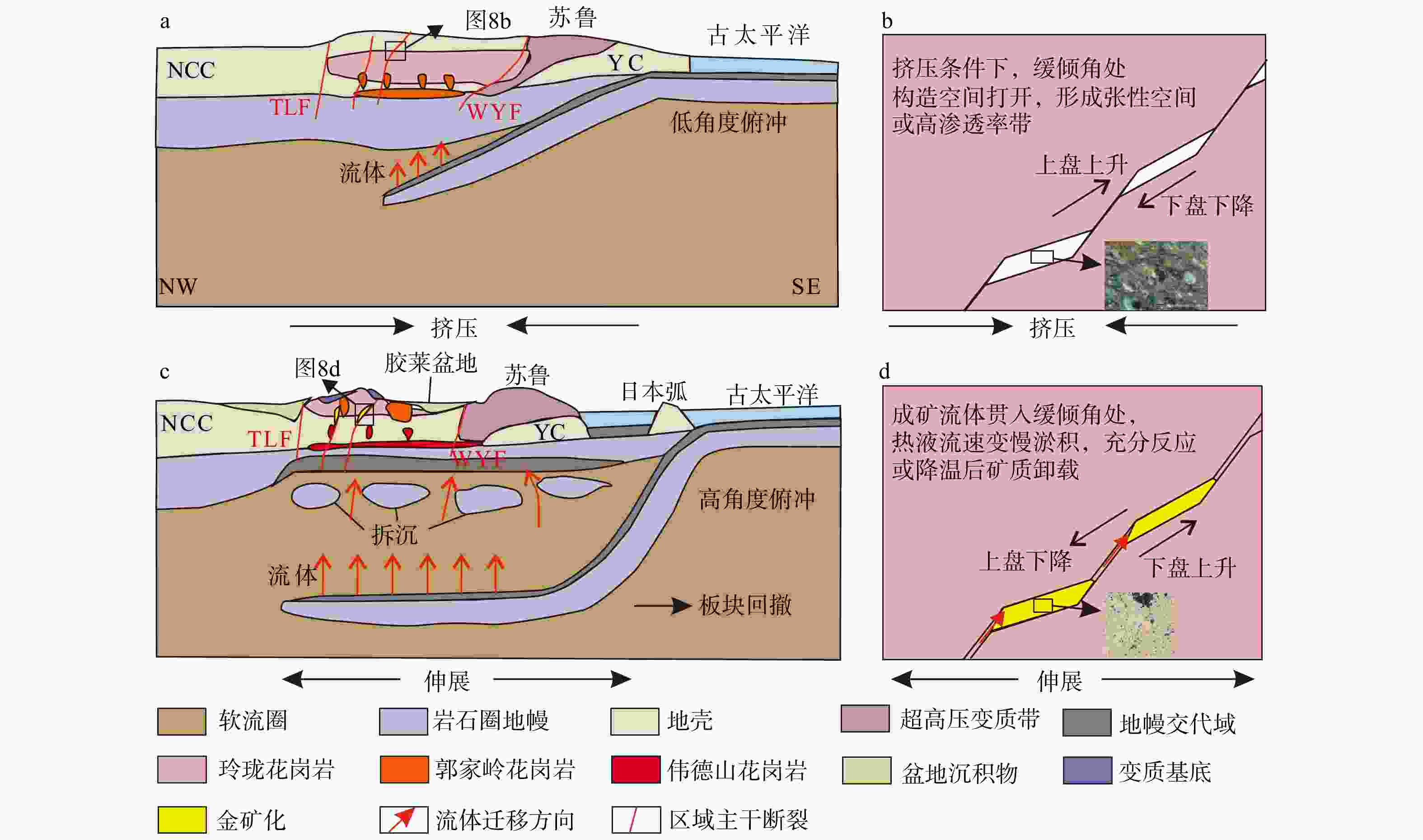
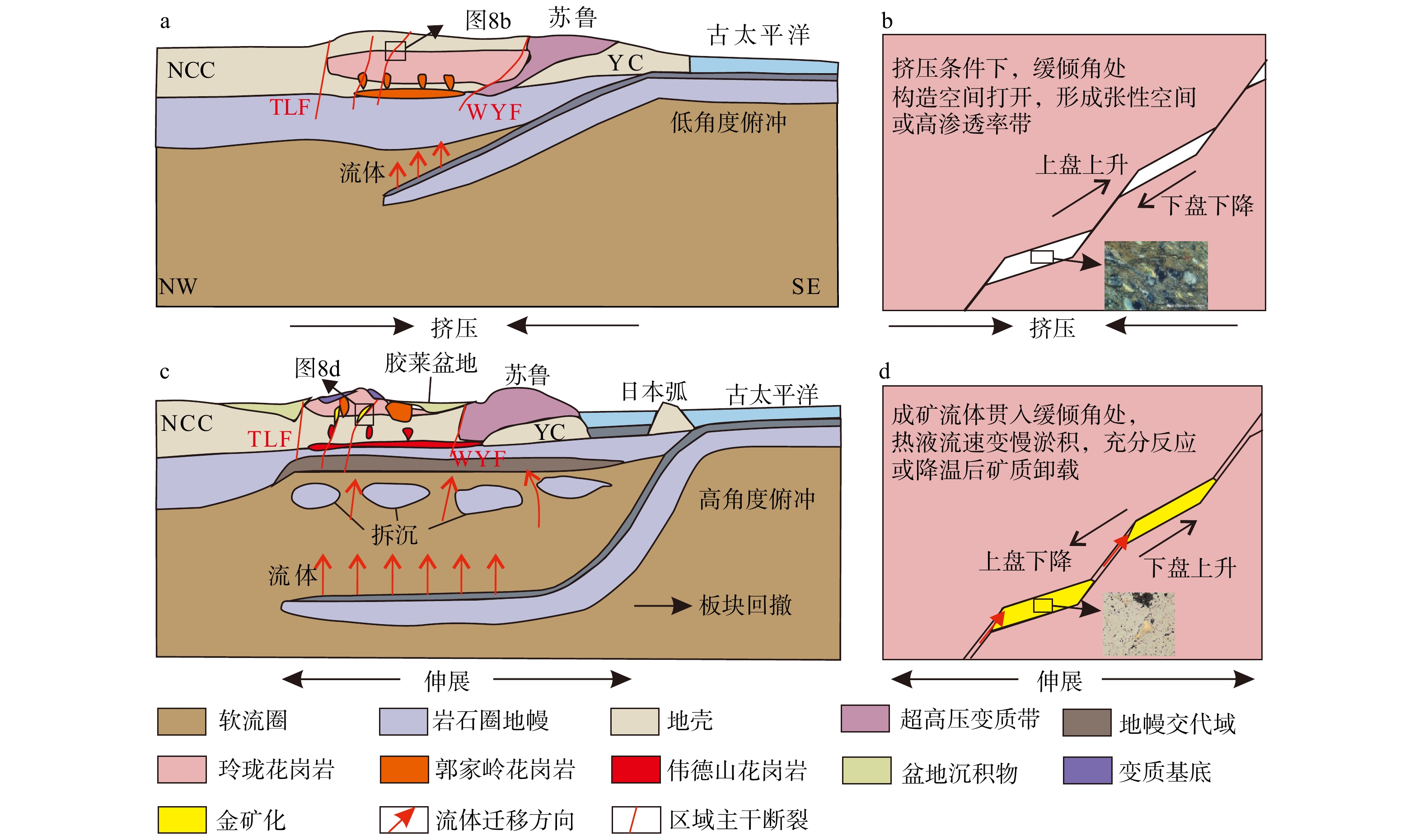
图 8 胶东地区地球动力学背景与局部控矿构造活动与演化图解(底图据Wang et al.,2025a修改)
TLF—郯庐断裂;WYF—五莲−烟台断裂;NCC—华北克拉通;YC—扬子克拉通a—160~125 Ma,胶东地区整体处于挤压构造背景;b—160~125 Ma期间,挤压背景下具有逆断裂性质的控矿构造开始形成;c—125~115 Ma,胶东地区整体处于伸展构造背景;d—125~115 Ma,伸展构造背景下断裂性质反生反转,裂隙张开,成矿热液贯入成矿
Figure 8. Schematic illustration of the regional geodynamics of the Jiaodong area and the evolution of local ore-controlling structural activities (base map modified from Wang et al., 2025a).
(a) 160–126 Ma: the Jiaodong area was dominated by a regional compressional tectonic regime; (b) 160–125 Ma: ore-controlling structures with reverse-fault kinematics began to develop under a compressional regime; (c) 125–115 Ma: the Jiaodong area shifted to an overall extensional tectonic regime; (d) 125–115 Ma: under the extensional regime, fault kinematics were reactivated and inverted, fractures opened, and mineralizing hydrothermal fluids infiltrated the system to form ore depositsTLF–Tan-Lu Fault; WYF–Wulian–Yantai Fault; NCC–North China Craton; YC–Yangtze Craton
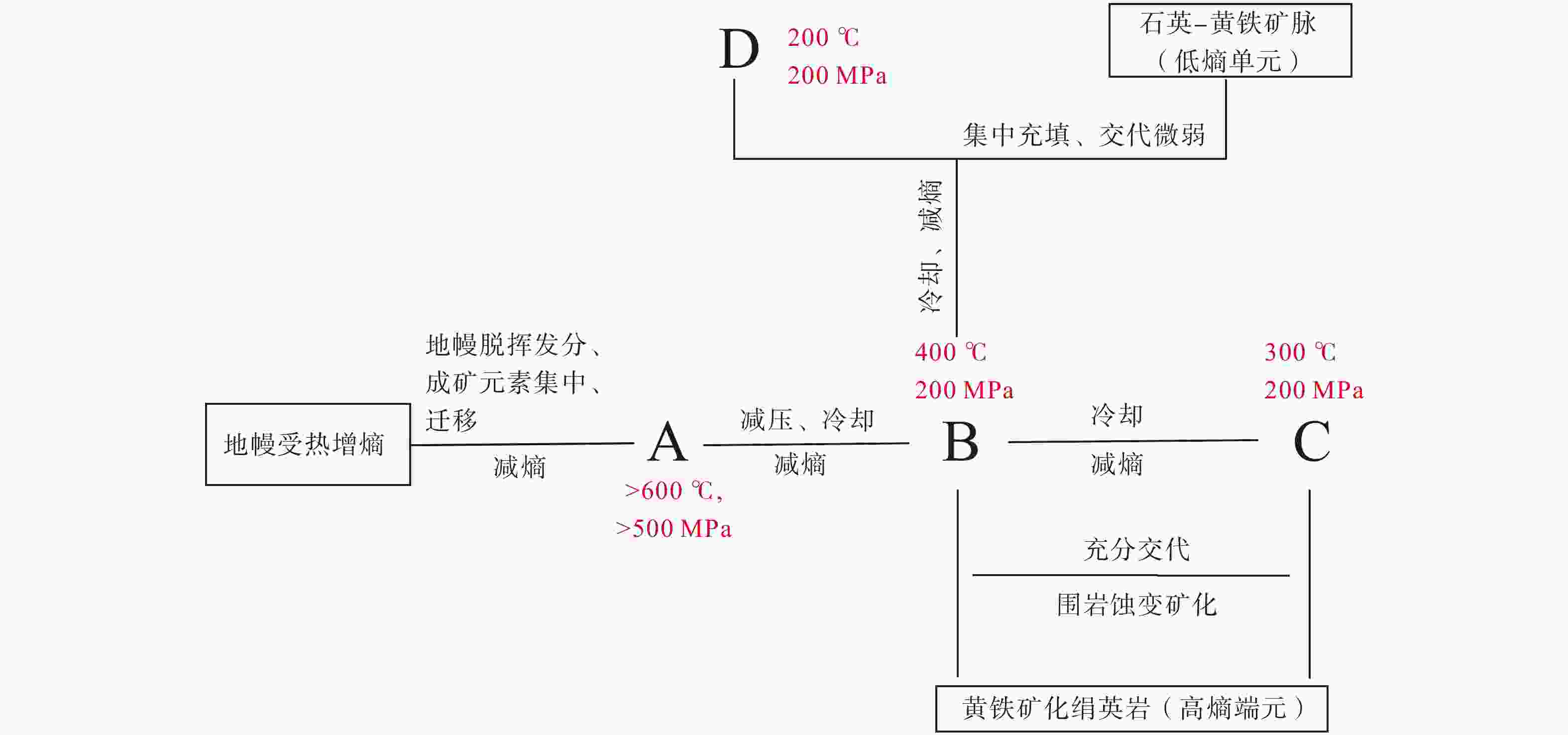
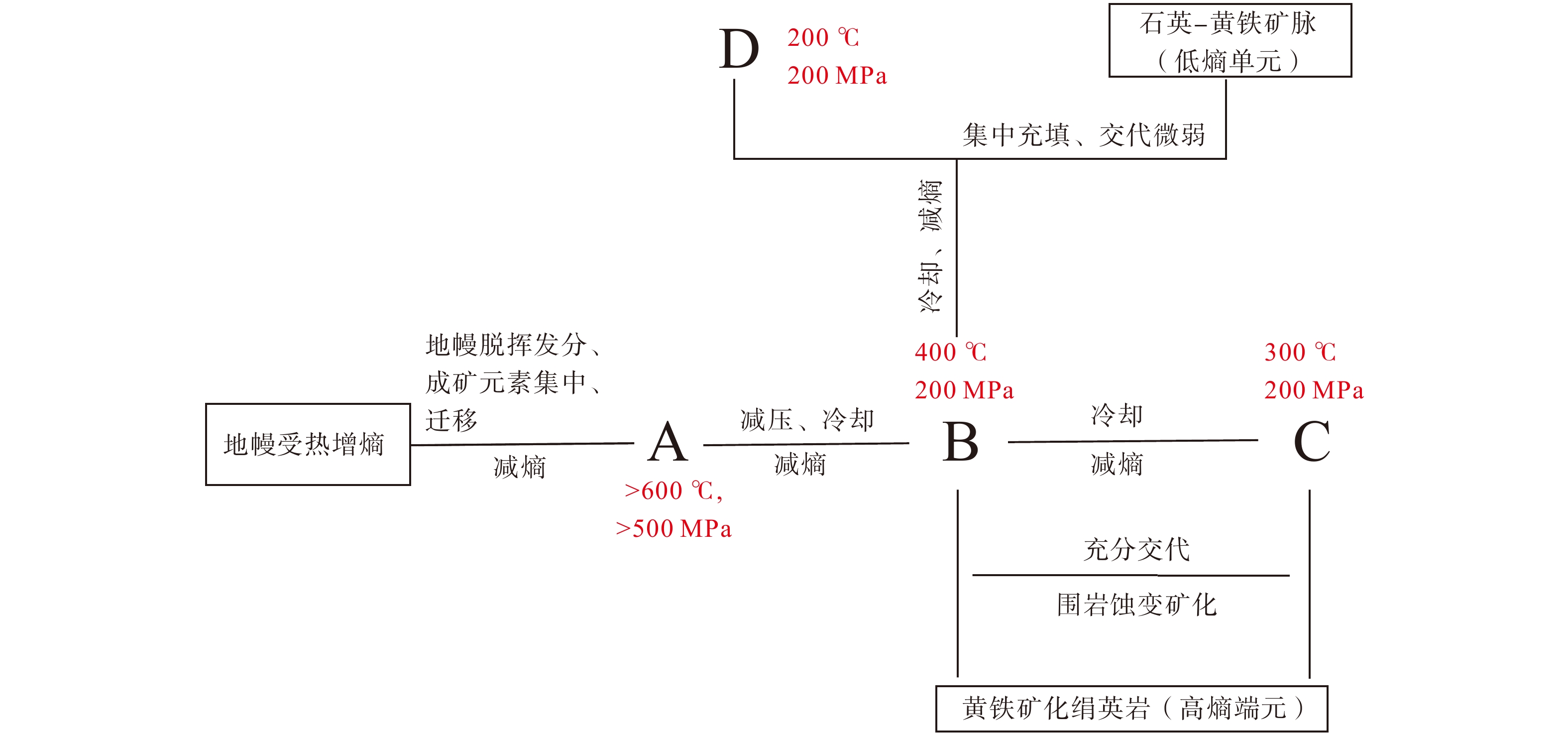
图 9 胶东金成矿省成矿热力学模型
A、B、C和D分别为流体A、流体B、流体C和流体D,具体成分见附表1
Figure 9. Thermodynamic model of ore formation in the Jiaodong gold metallogenic province
A, B, C, and D represent Fluids A, B, C, and D, respectively as described in Section 4.5. Their detailed compositions are provided in Appendix Table 1.
表 1 胶东地区两种金矿类型矿床地质特征对比
Table 1. Comparison of the geological characteristics of the two types of gold deposits in the Jiaodong Peninsula
矿床类型 矿体形态 成矿方式 矿石矿物组成 围岩 主要围岩蚀变 品位变化 矿石矿物 脉石矿物 含金矿物 破碎带蚀
变岩型似层状、网脉状、
透镜状以交代为主 黄铁矿、自然金、
多金属硫化物石英、绢云母、
碳酸盐矿物黄铁矿、石英 胶东群变质基底、中生
代中酸性侵入岩等绢英岩化、硅化、绢云
母化、钾化、碳酸盐化小 石英脉型 透镜状、 脉状 以充填为主 黄铁矿、自然金、
多金属硫化物石英、碳酸盐
矿物黄铁矿、石英 胶东群变质基底、中生
代中酸性侵入岩等硅化、绢云母化、钾化、
碳酸盐化大  下载: 导出CSV
表 2 玲珑花岗岩代表性成分(Hu et al.,2024)
Table 2. Representative composition of the Linglong granite (Hu et al., 2024)
氧化物 SiO2 Al2O3 TFeO MgO CaO Na2O K2O Total 含量 72.60 15.53 1.12 0.20 2.11 4.91 2.98 99.45 注:氧化物含量为质量分数,%
下载: 导出CSV
-
[1] AIBAI A, CHEN X, WU Y S, et al., 2023. Nature, origin, and evolution of carbon-rich fluids in orogenic gold deposits: insights from fluid inclusion and C-H-O isotope studies of the Tokuzbay gold deposit, Chinese Altai[J]. Ore Geology Reviews, 163: 105766. doi: 10.1016/j.oregeorev.2023.105766 [2] BO J W, DING Z J, SONG M C, et al., 2021. C, O, S and Pb isotopic compositions and genesis of the Liaoshang gold deposit in Jiaodong Peninsula[J]. Acta Petrologica et Mineralogica, 40(2): 321-336. (in Chinese with English abstract) [3] BO J W, DING Z J, DENG J, et al., 2025. Metallogenic characteristics and mineralization of supergiant gold deposits (223 t) in the northeastern margin of the Jiaolai Basin, Shandong province: a review[J]. China Geology, 8(4): 806-842. doi: 10.31035/cg2023122 [4] CHANG J, AUDÉTAT A, PETTKE T, 2024. The gold content of mafic to felsic potassic magmas[J]. Nature Communications, 15(1): 6988. doi: 10.1038/s41467-024-51405-7 [5] CHEN H, LI B, 2025. Lithospheric thinning of the North China Craton: constraints from Mesozoic mafic dikes in the Jiaodong Peninsula[J]. Geochemistry, 85(1): 126254. doi: 10.1016/j.chemer.2025.126254 [6] CHEN Y L, LI H, GU S Y, et al., 2025. Geochemistry, geochronology and Fe-Mg-S isotopic composition of the Liaoshang gold deposit, Jiaodong Peninsula, China: implications for ore-forming processes and mineral exploration[J]. Journal of Geochemical Exploration, 273: 107738. doi: 10.1016/j.gexplo.2025.107738 [7] CHI N J, WANG Z P, WANG S J, et al., 2025. Zircon U–Pb dating and Sr–Nd–Pb–Hf isotopic constraints on the petrogenesis of adakitic granite in the Nansu complex, Jiaodong Peninsula[J]. Ore Geology Reviews, 185: 106765. doi: 10.1016/j.oregeorev.2025.106765 [8] CHU H, LU S N, WANG H C, et al., 2011. U-Pb age spectrum of detrital zircons from the Fuzikuang Formation, Penglai Group in Changdao, Shandong province[J]. Acta Petrologica Sinica, 27(4): 1017-1028. (in Chinese with English abstract) [9] COX S F, 2005. Coupling between deformation, fluid pressures, and fluid flow in ore-producing hydrothermal systems at depth in the crust[J]. Economic Geology, 100(5): 39-75. [10] CUI T, YU H C, JOWITT S M, et al. , 2026. Genesis of the gold deposits in the northeastern Jiaolai Basin, Jiaodong, China: constraints from geochronology, geochemistry, and thermodynamic modeling[J]. GSA Bulletin, doi: 10.1130/B38945.1. [11] DENG J, LIU X F, WANG Q F, et al. , 2015. Origin of the Jiaodong-type Xinli gold deposit, Jiaodong Peninsula, China: constraints from fluid inclusion and C-D-O-S-Sr isotope compositions[J]. Ore Geology Reviews, 65(Pt 3): 674-686. [12] DENG J, YANG L Q, GROVES D I, et al., 2020a. An integrated mineral system model for the gold deposits of the giant Jiaodong province, eastern China[J]. Earth-Science Reviews, 208: 103274. doi: 10.1016/j.earscirev.2020.103274 [13] DENG J, WANG Q F, SANTOSH M, et al., 2020b. Remobilization of metasomatized mantle lithosphere: a new model for the Jiaodong gold province, eastern China[J]. Mineralium Deposita, 55(2): 257-274. doi: 10.1007/s00126-019-00925-0 [14] DENG J, WANG Q F, LIU X F, et al., 2022. The formation of the Jiaodong gold province[J]. Acta Geologica Sinica (English Edition), 96(6): 1801-1820. doi: 10.1111/1755-6724.15026 [15] DENG J, WANG Q F, ZHANG L, et al., 2023. Metallogenetic model of Jiaodong-type gold deposits, eastern China[J]. Science China Earth Sciences, 66(10): 2287-2310. doi: 10.1007/s11430-022-1136-4 [16] DING Z J, SUN F Y, LIU F L, et al., 2013. U-Pb dating of zircons from the Weideshan molybdenum copper polymetallic deposits in Jiaodong Peninsula, China, and its geological significance[J]. Acta Petrologica Sinica, 29(2): 607-618. (in Chinese with English abstract) [17] DING Z J, SUN F Y, LIU F L, et al., 2015. Mesozoic geodynamic evolution and metallogenic series of major metal deposits in Jiaodong Peninsula, China[J]. Acta Petrologica Sinica, 31(10): 3045-3080. (in Chinese with English abstract) [18] DONG L L, BAI X, SONG M C, et al., 2023. Crustal thickness of the Jiaodong Peninsula in the Mesozoic: implications for the destruction of the North China Craton[J]. Frontiers in Earth Science, 11: 1171456. doi: 10.3389/feart.2023.1171456 [19] DONG L L, SONG M C, LI J, et al., 2026. The geology and genesis of the Jiaojia-Xincheng gold district (~1200 t) in the Jiaodong Peninsula, China: a review[J]. Ore Geology Reviews, 188: 107068. doi: 10.1016/j.oregeorev.2025.107068 [20] DU F G, JIANG Y H, QING L, et al., 2019. H-O, He-Ar and Sr-Nd-Pb isotopic constraints on the sources of ore-forming fluids and ore-forming materials in the Xiadian Gold Deposit, Jiaodong[J]. Geological Journal of China Universities, 25(5): 686-696. (in Chinese with English abstract) [21] FAN H R, LAN T G, LI X H, et al., 2021. Conditions and processes leading to large-scale gold deposition in the Jiaodong province, eastern China[J]. Science China Earth Sciences, 64(9): 1504-1523. doi: 10.1007/s11430-020-9789-2 [22] FARSANG S, ZAJACZ Z, 2025. Sulfur species and gold transport in arc magmatic fluids[J]. Nature Geoscience, 18(1): 98-104. doi: 10.1038/s41561-024-01601-3 [23] GYSI A P, HURTIG N C, PAN R, et al. , 2023. MINES thermodynamic database, version 23[R]. New Mexico Bureau of Geology and Mineral Resources, doi: 10.58799/mines-tdb. [24] HU H L, FAN H R, SANTOSH M, et al., 2020. Ore-forming processes in the Wang’ershan gold deposit (Jiaodong, China): insight from microtexture, mineral chemistry and sulfur isotope compositions[J]. Ore Geology Reviews, 123: 103600. doi: 10.1016/j.oregeorev.2020.103600 [25] HU H L, JIANG X H, LIANG G Z, et al., 2021. The vertical variation characteristics of ore-forming fluids of the Jiaojia deposit: implications for mineralizing processes of gold deposits in the Jiaodong Peninsula[J]. Bulletin of Mineralogy, Petrology and Geochemistry, 40(6): 1345-1356. (in Chinese with English abstract) [26] HU H L, FAN H R, LAN T G, et al., 2024. Fluid-rock interaction modeling to constrain Au enrichment: implication for the giant Jiaodong Au mineralization, eastern North China Craton[J]. Gondwana Research, 125: 91-109. doi: 10.1016/j.gr.2023.07.015 [27] HU R Z, HUANG M L, 2026. Research trends in magmatic-hydrothermal deposits[J]. Science China Earth Sciences, 69(3): 1156-1160. doi: 10.1007/s11430-025-1850-3 [28] HUANG J X, DENG H, MAO X C, et al., 2023. 3D modeling of detachment faults in the Jiaodong gold province, eastern China: a Bayesian inference perspective and its exploration implications[J]. Ore Geology Reviews, 154: 105307. doi: 10.1016/j.oregeorev.2023.105307 [29] JI P, 2016. On Geological characteristics and metallogenesis of Liaoshang gold deposit in Jiaodong peninsula, Shandong province[D]. Changchun: Jilin University. (in Chinese with English abstract) [30] JIANG Y H, DU F G, QING L, et al., 2020. Elemental and multiple isotopic evidences of enriched lithospheric mantle origin of the Xiadian gold deposit in the Jiaodong Peninsula, East China[J]. Ore Geology Reviews, 127: 103824. doi: 10.1016/j.oregeorev.2020.103824 [31] KOKH M A, POKROVSKI G S, KLEMME S, et al., 2026. The role of hydrogen sulfide and trisulfur radical ion in molybdenum transport by hydrothermal fluids: implications for porphyry-epithermal Cu-Au-Mo deposits[J]. Geochimica et Cosmochimica Acta, 412: 90-109, doi: 10.1016/j.gca.2025.10.007 [32] LAN T, FAN Y C, LU J L, et al., 2022. Origin of the Dayingezhuang gold deposit in the Jiaodong district, eastern China: insights from trace element character of pyrite and C-O-S isotope compositions[J]. Journal of Geochemical Exploration, 236: 106986. doi: 10.1016/j.gexplo.2022.106986 [33] LI J, ZHANG L P, SONG M C, et al., 2021. Formation mechanism of Shuiwangzhuang gold deposit in Jiaodong Peninsula: constraints from S-H-O isotopes and fluid inclusions[J]. Earth Science, 46(5): 1569-1584. (in Chinese with English abstract) [34] LI J, BAI T H, SONG M C, et al., 2026a. Geology and mineralization of quartz vein-type and altered rock-type gold deposits in the Linglong gold orefield (916 t), Jiaodong Peninsula, China: a review[J]. China Geology, 9(2): 400-429, doi: 10.31035/cg2024062 [35] LI J Y, JIANG S Y, YUAN F, et al., 2026b. In situ monazite isotopes reveal mantle fluids for giant Jiaodong gold mineralization[J]. Communications Earth & Environment, 7: 374, doi: 10.1038/s43247-026-03851-y [36] LI M Z, MAO G Z, DING Z J, et al., 2024. Genesis of the Panzijian gold deposit in Jiaodong Peninsula, Eastern China: insights from fluid inclusion and isotopes[J]. Solid Earth Sciences, 9(2): 100177. doi: 10.1016/j.sesci.2024.100177 [37] LI Y F, LI H K, HAN X L, et al., 2021. Genesis of Xiadian gold deposit in Jiaodong: evidence from fluid inclusions and isotopes[J]. Gold Science and Technology, 29(2): 184-199. (in Chinese with English abstract) [38] LIU J A, CAI R H, PEARSON D G, et al., 2019. Thinning and destruction of the lithospheric mantle root beneath the North China Craton: a review[J]. Earth-Science Reviews, 196: 102873. doi: 10.1016/j.earscirev.2019.05.017 [39] LIU X D, DING Z J, BAO Z Y, et al., 2025. Geology, geochemistry and mineralization of the Taishang-Shuiwangzhuang supergiant gold deposit (>700 t Au), northwestern Jiaodong Peninsula, China: a review[J]. China Geology, 8(4): 843-861. doi: 10.31035/cg2023152 [40] LIU X F, YIN R S, WANG Q F, et al. , 2026. Hg isotope compositions of syn-gold mafic dikes confirm an anomalous metasomatized mantle lithosphere source for the giant Jiaodong orogenic gold province, China[J]. GSA Bulletin, doi: 10.1130/B38645.1. [41] MAO J W, WANG Y T, LI H M, et al., 2008. The relationship of mantle-derived fluids to gold metallogenesis in the Jiaodong Peninsula: evidence from D-O-C-S isotope systematics[J]. Ore Geology Reviews, 33(3-4): 361-381. doi: 10.1016/j.oregeorev.2007.01.003 [42] MAO X C, CHEN Y D, LIU Z K, et al., 2024. Hydrothermal alteration and its geochemistry of the Xiadian gold deposit, Jiaodong Peninsula, China: implications for fluid-rock interaction processes and mineral exploration[J]. Ore Geology Reviews, 170: 106134. doi: 10.1016/j.oregeorev.2024.106134 [43] MAO X Q, WANG E D, YANG Q, et al., 2022. Genesis of Xinli Gold Deposit in Jiaodong Peninsula, Shandong province[J]. Geological Bulletin of China, 41(10): 1855-1868. (in Chinese with English abstract) [44] OELKERS E H, BÉNÉZETH P, POKROVSKI G S, 2009. Thermodynamic databases for water-rock interaction[J]. Reviews in Mineralogy and Geochemistry, 70(1): 1-46. [45] POKROVSKI G S, 2025. Thermodynamic modeling of hydrothermal ore deposit formation[J]. Ore Geology Reviews, 178: 106436. doi: 10.1016/j.oregeorev.2024.106436 [46] QIU K F, GOLDFARB R J, DENG J, et al. , 2020. Gold deposits of the Jiaodong Peninsula, eastern China[M]//SILLITOE R H, GOLDFARB R J, ROBERT F, et al. Geology of the world’s major gold deposits and provinces. Littleton: Society of Economic Geologists: 753-774. [47] QIU K F, DENG J, LAFLAMME C, et al., 2023a. Giant Mesozoic gold ores derived from subducted oceanic slab and overlying sediments[J]. Geochimica et Cosmochimica Acta, 343: 133-141. doi: 10.1016/j.gca.2023.01.002 [48] QIU K F, DENG J, SAI S X, et al., 2023b. Low-temperature thermochronology for defining the tectonic controls on heterogeneous gold endowment across the Jiaodong Peninsula, eastern China[J]. Tectonics, 42(1): e2022TC007669. doi: 10.1029/2022TC007669 [49] QIU K F, ROMER R L, LONG Z Y, et al., 2024. Potassium isotopes as a tracer of hydrothermal alteration in ore systems[J]. Geochimica et Cosmochimica Acta, 368: 185-196. doi: 10.1016/j.gca.2024.01.005 [50] QU J H, GAO S S, WANG C Z, et al., 2021. Crustal P-wave velocity structure and earthquake distribution in the Jiaodong Peninsula, China[J]. Tectonophysics, 814: 228973. doi: 10.1016/j.tecto.2021.228973 [51] RAUCHENSTEIN-MARTINEK K, WAGNER T, WÄLLE M, et al., 2014. Gold concentrations in metamorphic fluids: a LA-ICPMS study of fluid inclusions from the Alpine orogenic belt[J]. Chemical Geology, 385: 70-83. doi: 10.1016/j.chemgeo.2014.07.018 [52] SHARMA S, SRIVASTAVA D, GROVER S, et al., 2014. Biomaterials in tooth tissue engineering: a review[J]. Journal of Clinical and Diagnostic Research, 8(1): 309-315. [53] SHENG P, 2019. Geneticmineralogy and sources of metallogenic materials of Liaoshang gold deposit in Shandong province[D]. Beijing: China University of Geosciences (Beijing). (in Chinese with English abstract) [54] SIBSON R H, 2004. Controls on maximum fluid overpressure defining conditions for mesozonal mineralisation[J]. Journal of Structural Geology, 26(6-7): 1127-1136. doi: 10.1016/j.jsg.2003.11.003 [55] SIBSON R H, 2007. An episode of fault-valve behaviour during compressional inversion?: The 2004 MJ6.8 Mid-Niigata Prefecture, Japan, earthquake sequence[J]. Earth and Planetary Science Letters, 257(1-2): 188-199. doi: 10.1016/j.epsl.2007.02.031 [56] SONG M C, DING Z J, ZHANG J J, et al., 2021. Geology and mineralization of the Sanshandao supergiant gold deposit (1200 t) in the Jiaodong Peninsula, China: a review[J]. China Geology, 4(4): 686-719. [57] SONG M C, YANG L Q, FAN H R, et al., 2022. Current progress of metallogenic research and deep prospecting of gold deposits in the Jiaodong Peninsula during 10 years for Exploration Breakthrough Strategic Action[J]. Geological Bulletin of China, 41(6): 903-935. (in Chinese with English abstract) [58] SUN F Y, SHI Z L, FENG B Z, 1995. Gold ore geology, lithogenesis and metallogenesis related to the differentiation of mantle-derived C-H-O fluids in Jiaodong Peninsula, Eastern China[M]. Changchun: Jilin People's Press: 1-170. (in Chinese). [59] SUN W P, FENG Y Z, LAI C, et al., 2022. A high-efficiency gold precipitation model associated with Fe carbonates: example from the Jiudian deposit of the world-class Jiaodong gold province[J]. Ore Geology Reviews, 145: 104894. doi: 10.1016/j.oregeorev.2022.104894 [60] TANG J, GUO P, WANG F, et al., 2025. Spatial–temporal variations in Mesozoic crustal thickness along the northeast Asian continental margin: response to the subduction history of the Paleo-Pacific Plate[J]. GSA Bulletin, 137(1-2): 374-390. doi: 10.1130/B37237.1 [61] WANG B, ZHOU J B, DING Z J, et al., 2024. Late Mesozoic magmatism and gold metallogeny of the Jiaodong Peninsula, China: a response to the destruction of the North China Craton[J]. GSA Bulletin, 136(3-4): 1395-1412. doi: 10.1130/gsab.s.23460875.v1 [62] WANG B, DING Z J, ZHOU J B, et al. , 2025a. Rapid tectonic transition, crust-mantle interaction, and gold metallogenesis in the Jiaodong Peninsula, eastern China: revealed by Early Cretaceous granitoids and microgranular mafic enclaves[J]. Lithos, 508-509: 108101. [63] WANG H, LAN T G, FAN H R, et al., 2022a. Fluid origin and critical ore-forming processes for the giant gold mineralization in the Jiaodong Peninsula, China: constraints from in situ elemental and oxygen isotopic compositions of quartz and LA-ICP-MS analysis of fluid inclusions[J]. Chemical Geology, 608: 121027. doi: 10.1016/j.chemgeo.2022.121027 [64] WANG H, LAN T G, XU Y, et al., 2026. The role of continental and oceanic subduction in generating the giant Jiaodong gold province, China: constraints from mercury isotopes[J]. Gondwana Research, 159: 296-307, doi: 10.1016/j.gr.2026.07.004 [65] WANG H C, XIANG Z Q, REN Y W, et al., 2022b. The northern margin of the Yangtze Craton or the southeastern margin of the North China Craton: new insights on the tectonic attribution of Neoproterozoic granitic gneisses in Jiaodong Peninsula[J]. Acta Geologica Sinica, 96(9): 3012-3033. (in Chinese with English abstract) [66] WANG L G, YANG L Q, YANG W, et al., 2025b. Genesis and exploration potential of gold deposits in Archean high-amphibolite facies metamorphic rocks of the Jiaodong Peninsula: geological and geochemical constraints from the Majiayao gold deposit[J]. Ore Geology Reviews, 181: 106596. doi: 10.1016/j.oregeorev.2025.106596 [67] WEI Y J, YANG L Q, QIU K F, et al., 2022. Geology, mineralogy and pyrite trace elements constraints on gold mineralization mechanism at the giant Dayingezhuang gold deposit, Jiaodong Peninsula, China[J]. Ore Geology Reviews, 148: 104992. doi: 10.1016/j.oregeorev.2022.104992 [68] WU J H, CHEN Y L, ZHENG C Y, et al., 2021. Genesis of the Longkou-Tudui gold deposit, Jiaodong Peninsula, eastern China: constraints from zircon U-Pb dating, fluid inclusion studies and C-H-O-S stable isotopes[J]. Ore Geology Reviews, 139: 104449. doi: 10.1016/j.oregeorev.2021.104449 [69] WU J J, ZENG Q D, SANTOSH M, et al., 2022. Deep ore-forming fluid characteristics of the Jiaodong gold province: evidence from the Qianchen gold deposit in the Jiaojia gold belt[J]. Ore Geology Reviews, 145: 104911. doi: 10.1016/j.oregeorev.2022.104911 [70] XIAO J D, XIE Z J, XIA Y, et al., 2024. Predominant fracture gold in the Jiaodong gold province, China: constraints on gold mineralization processes[J]. Ore Geology Reviews, 165: 105915. doi: 10.1016/j.oregeorev.2024.105915 [71] XU W G, FAN H R, YANG K F, et al., 2016. Exhaustive gold mineralizing processes of the Sanshandao gold deposit, Jiaodong Peninsula, eastern China: displayed by hydrothermal alteration modeling[J]. Journal of Asian Earth Sciences, 129: 152-169. doi: 10.1016/j.jseaes.2016.08.008 [72] XU Y W, MAO G Z, LIU X T, et al., 2022. Genesis of the Zhaoxian gold deposit, Jiaodong Peninsula, China: insights from in-situ pyrite geochemistry and S-He-Ar isotopes, and zircon U-Pb geochronology[J]. Frontiers in Earth Science, 10: 886975. doi: 10.3389/feart.2022.886975 [73] YANG C X, SANTOSH M, 2020. Ancient deep roots for Mesozoic world-class gold deposits in the North China Craton: an integrated genetic perspective[J]. Geoscience Frontiers, 11(1): 203-214. doi: 10.1016/j.gsf.2019.03.002 [74] YANG K F, FAN H R, SANTOSH M, et al. , 2012. Reactivation of the Archean lower crust: implications for zircon geochronology, elemental and Sr-Nd-Hf isotopic geochemistry of Late Mesozoic granitoids from northwestern Jiaodong Terrane, the North China Craton[J]. Lithos, 146-147: 112-127. [75] YANG K F, LIU N X, LI X H, et al., 2026. Structural control on gold mineralization in the northwestern Jiaodong terrane, China[J]. Ore Geology Reviews, 196: 107486. doi: 10.1016/j.oregeorev.2026.107486 [76] YANG L Q, DENG J, GUO C Y, et al., 2009. Ore-forming fluid characteristics of the Dayingezhuang gold deposit, Jiaodong gold province, China[J]. Resource Geology, 59(2): 181-193. doi: 10.1111/j.1751-3928.2009.00089.x [77] YANG L Q, DENG J, GUO L N, et al. , 2016. Origin and evolution of ore fluid, and gold-deposition processes at the giant Taishang gold deposit, Jiaodong Peninsula, eastern China[J]. Ore Geology Reviews, 72(Pt 1): 585-602. [78] YANG L Q, DENG J, ZHANG L, et al., 2024. Mantle-rooted fluid pathways and world-class gold mineralization in the giant Jiaodong gold province: insights from integrated deep seismic reflection and tectonics[J]. Earth-Science Reviews, 255: 104862. doi: 10.1016/j.earscirev.2024.104862 [79] YU B, ZENG Q D, FRIMMEL H E, et al., 2024. Spatio-temporal fluid evolution of gold deposit in the Jiaodong Peninsula, China: a case study of the giant Xiling deposit[J]. Journal of Geochemical Exploration, 260: 107455. doi: 10.1016/j.gexplo.2024.107455 [80] ZHANG J Y, QIU K F, YIN R S, et al., 2024. Lithospheric mantle as a metal storage reservoir for orogenic gold deposits in active continental margins: evidence from Hg isotopes[J]. Geology, 52(6): 423-428. doi: 10.1130/G51871.1 [81] ZHANG Z Q, WANG G W, CARRANZA E J M, et al., 2026. Three-dimensional geological modeling and mineral potential mapping in the world-class Jiaojia-Sanshandao gold district, China[J]. Journal of Applied Geophysics, 250: 106261, doi: 10.1016/j.jappgeo.2026.106261 [82] ZHU G, LIU C, GU C C, et al., 2018. Oceanic plate subduction history in the western Pacific Ocean: constraint from late Mesozoic evolution of the Tan-Lu Fault Zone[J]. Science China Earth Sciences, 61(4): 386-405. doi: 10.1007/s11430-017-9136-4 [83] ZHU R X, SUN W D, 2021. The big mantle wedge and decratonic gold deposits[J]. Science China Earth Sciences, 64(9): 1451-1462. doi: 10.1007/s11430-020-9733-1 [84] 薄军委, 丁正江, 宋明春, 等, 2021. 胶东辽上金矿床C、O、S、Pb同位素组成及矿床成因[J]. 岩石矿物学杂志, 40(2): 321-336. doi: 10.3969/j.issn.1000-6524.2021.02.010 [85] 初航, 陆松年, 王惠初, 等, 2011. 山东长岛地区蓬莱群辅子夼组碎屑锆石年龄谱研究[J]. 岩石学报, 27(4): 1017-1028. [86] 丁正江, 孙丰月, 刘福来, 等, 2013. 胶东伟德山地区铜钼多金属矿锆石U-Pb法测年及其地质意义[J]. 岩石学报, 29(2): 607-618. [87] 丁正江, 孙丰月, 刘福来, 等, 2015. 胶东中生代动力学演化及主要金属矿床成矿系列[J]. 岩石学报, 31(10): 3045-3080. [88] 杜佛光, 姜耀辉, 青龙, 等, 2019. 胶东夏甸金矿成矿流体及成矿物质来源: H-O、He-Ar、Sr-Nd-Pb同位素证据[J]. 高校地质学报, 25(5): 686-696. doi: 10.16108/j.issn1006-7493.2019022 [89] 纪攀, 2016. 胶东辽上金矿床地质特征及成因研究[D]. 长春: 吉林大学. [90] 李杰, 张丽鹏, 宋明春, 等, 2021. 胶东水旺庄金矿床成矿机制: 来自S-H-O同位素和流体包裹体的制约[J]. 地球科学, 46(5): 1569-1584. [91] 李逸凡, 李洪奎, 韩学林, 等, 2021. 胶东夏甸金矿床成因: 流体包裹体及同位素证据[J]. 黄金科学技术, 29(2): 184-199. doi: 10.11872/j.issn.1005-2518.2021.02.157 [92] 毛兴强, 王恩德, 杨群, 等, 2022. 山东省胶东半岛新立金矿床成因[J]. 地质通报, 41(10): 1855-1868. doi: 10.12097/j.issn.1671-2552.2022.10.013 [93] 盛鹏, 2019. 山东省辽上金矿成因矿物学与成矿物质来源研究[D]. 北京: 中国地质大学(北京). [94] 孙丰月, 石准立, 冯本智, 1995. 胶东金矿地质及幔源C-H-O流体分异成岩成矿[M]. 长春: 吉林人民出版社: 1-170. -

 下载:



计量
- 文章访问数: 31
- HTML全文浏览量: 9
- PDF下载量: 4
- 被引次数: 0
