


Seismic technology and its application to ultra-deep oil and gas in the platform area of the Tarim Basin
-
摘要: 塔里木盆地台盆区超深层(>6000 m)碳酸盐岩油气资源潜力巨大,高效勘探开发面临主力烃源岩厚度预测、走滑断裂分布刻画、超深优质储层预测和超深油气检测4项核心需求,但因储层埋藏深、非均质性强,地表大沙漠激发接收条件差、吸收衰减严重,地下侵入岩分布复杂等问题,导致超深层地震资料信噪比和分辨率低、成像精度差、储层预测困难。文章旨在系统构建台盆区碳酸盐岩超深油气地震技术体系,突破上述技术瓶颈。针对上述挑战,系统构建了4项核心地震技术:增能降噪技术,由虚反射聚能激发、小面积方阵组合接收、曲波域弱信号增强和逆散射级数法层间多次波压制构成;保真拓频技术,由高速层激发、低频检波器接收和基于记录子波的一致性校正构成;聚集归位技术,由三维宽方位高密度小面元长排列地震采集、含火山岩等侵入体的精细偏移速度建模、品质因子Q场精细建模和Q补偿逆时偏移构成;地震解耦映射技术,由走滑断裂体系地震解耦映射、烃源岩厚度地震解耦映射、超深储层特征地震解耦映射和超深流体性质地震解耦映射构成。该技术体系在塔北坳陷的实际应用中成效显著:超深走滑断裂由“弱反射”变为“清晰可辨”,断裂识别率大幅提升;主力烃源岩(下寒武统玉尔吐斯组)厚度预测精度误差控制在±10 m以内;超深碳酸盐岩优质储层预测吻合率达到85%以上;超深层油气检测准确率超过80%。由此,在塔北坳陷发现并高效探明了富满超深大油气田,建成年产上百万吨的超深油气生产基地。Abstract:
Objective The platform area of the Tarim Basin has enormous potential for ultra-deep (>6,000 m) carbonate hydrocarbon resources. Efficient exploration and development of these resources require breakthroughs in four key areas: prediction of the thickness of major source rocks, characterization of the distribution of strike-slip faults, prediction of high-quality ultra-deep reservoirs, and detection of ultra-deep hydrocarbon accumulations. However, the great burial depths and strong heterogeneity of the reservoirs, poor seismic source and receiver conditions in extensive desert terrain, severe seismic attenuation, and complex distributions of subsurface igneous intrusions result in low signal-to-noise ratios, poor resolution, and limited imaging accuracy of ultra-deep seismic data, hindering reliable reservoir prediction. This study aims to establish a systematic seismic technology framework for exploring ultra-deep carbonate hydrocarbons in the platform area and overcoming these key technical challenges. Methods Four core seismic technologies were developed to address these challenges. (1) Energy enhancement and noise attenuation technology, comprising source excitation using ghost-reflection focusing, combined reception using small-aperture square arrays, weak-signal enhancement in the curvelet domain, and interbed-multiple suppression using the inverse scattering series method. (2) Fidelity-preserving bandwidth extension technology, comprising high-velocity layer excitation, low-frequency geophone acquisition, and wavelet-based consistency correction using the recorded wavelet; (3) Energy focusing and accurate positioning technology, comprising 3D wide-azimuth, high-density, small-bin, long-offset seismic acquisition, refined migration-velocity modeling incorporating igneous intrusions such as volcanic rocks, detailed Q-field modeling, and Q-compensated reverse-time migration. (4) Seismic decoupling mapping technology, comprising seismic decoupling mapping of strike-slip fault systems, source-rock thickness, ultra-deep reservoir properties, and ultra-deep fluid properties. Results Application of this technology framework in the Tabei Depression yielded significant results. The ultra-deep strike-slip faults transformed from weak and indistinct reflections into clearly identifiable seismic features, substantially improving fault interpretation. The prediction error for the thickness of the major source rock, the Lower Cambrian Yu'ertusi Formation, has been constrained to within ±10 m. The coincidence rate of predicted high-quality ultra-deep carbonate reservoirs exceeds 85%; and the accuracy of ultra-deep hydrocarbon detection exceeds 80%. Conclusions These advances led to the discovery and efficient delineation of the Fuman ultra-deep giant oil and gas field in the Tabei Depression. Proven reserves reach the billion-ton level, and an ultra-deep oil and gas production base with an annual production capacity of approximately five million tons has been established. -
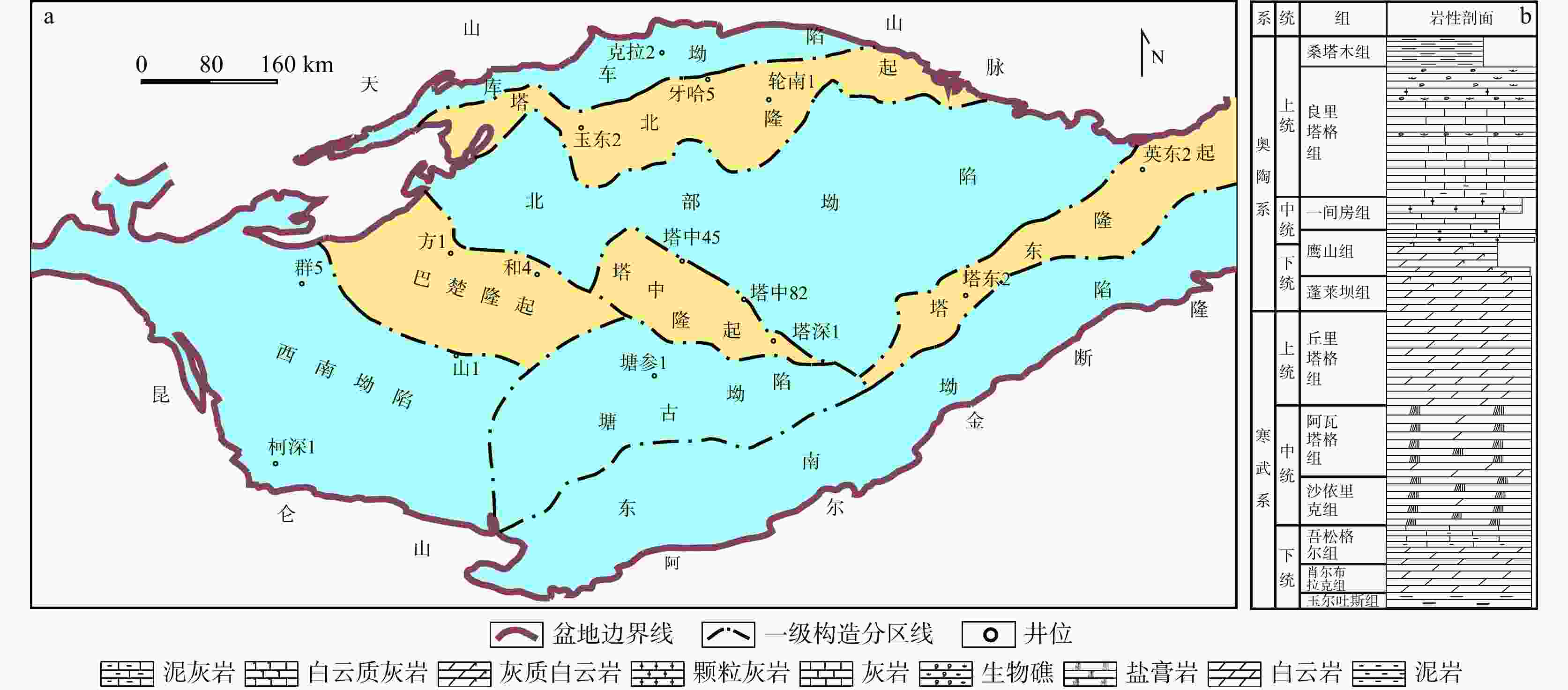
图 1 塔里木盆地构造单元与地层划分
a—构造单元图;b—综合地层柱状图
Figure 1. Tectonic units and stratigraphic division of the Tarim Basin
(a) Map of structural units; (b) Comprehensive stratigraphic column
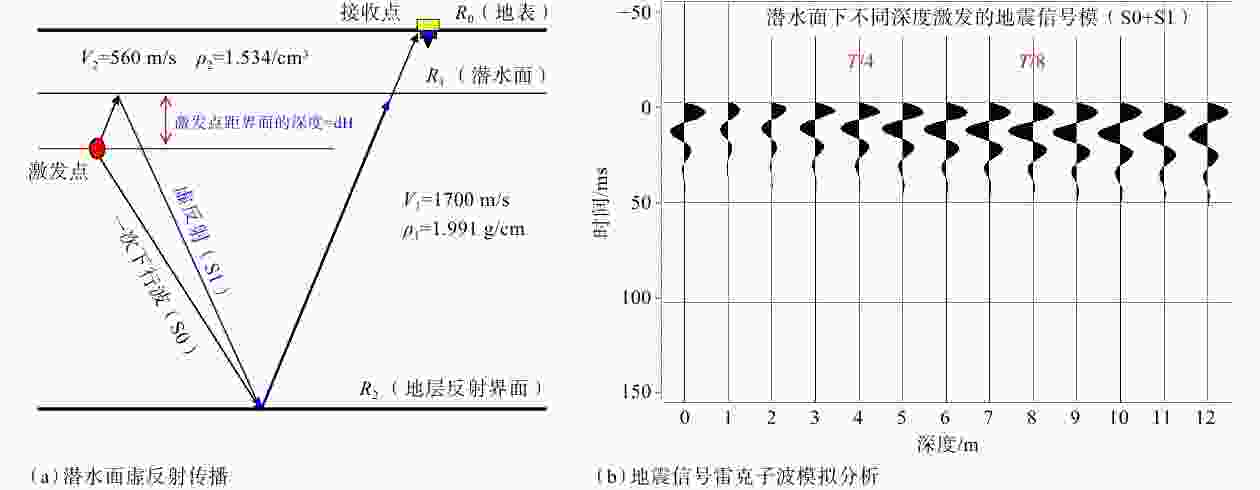
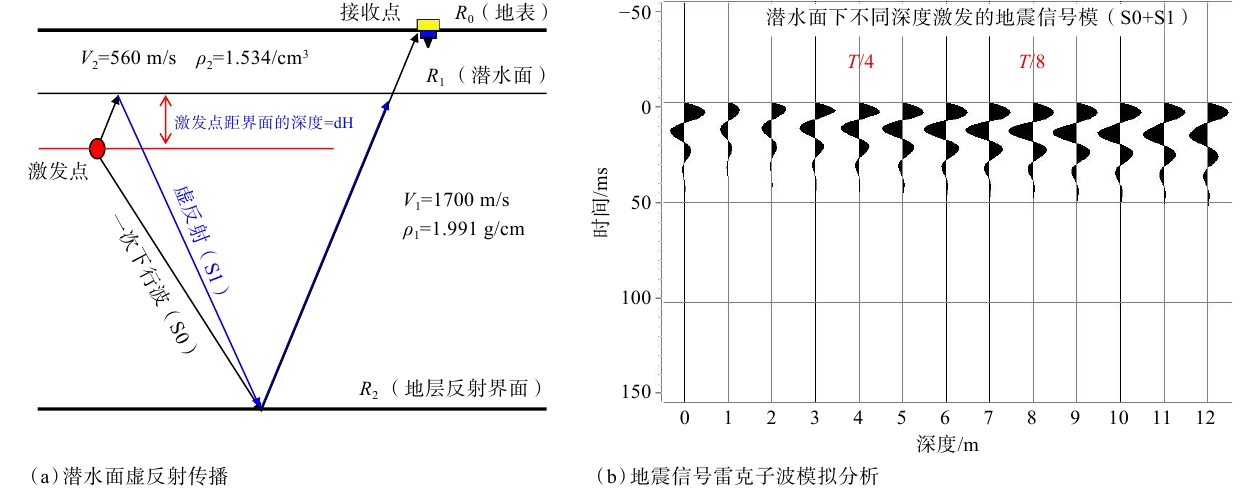
图 2 潜水面虚反射传播示意图和潜水面下不同深度激发的地震信号雷克子波模拟分析
V1—第一层的地震波速度;V2—第二层的地震波速度;ρ1—第一层介质的密度;ρ2—第二层介质的密度;R0、R1和R2—地表、潜水面和地层反射界面;T—激发子波周期
Figure 2. Schematic diagram of seismic ghost reflection propagation at the water table and simulation analysis of Ricker wavelets for seismic signals excited at different depths below the water table
(a) Seismic ghost reflection propagation at water table; (b) Simulation analysis of Ricker wavelets for seismic signalsV1–seismic-wave velocity of the first layer; V2 – seismic-wave velocity of the second layer; ρ1 – density of the first layer; ρ2 – density of the second layer; R0, R1, and R2 –the ground surface, water table, and subsurface reflection interface, respectively; T–the period of the source wavelet
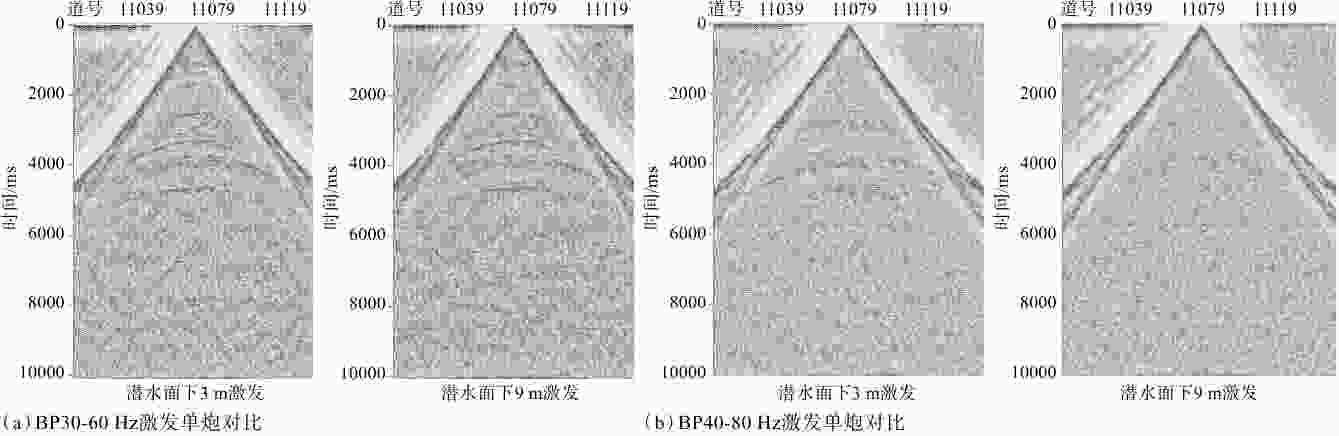
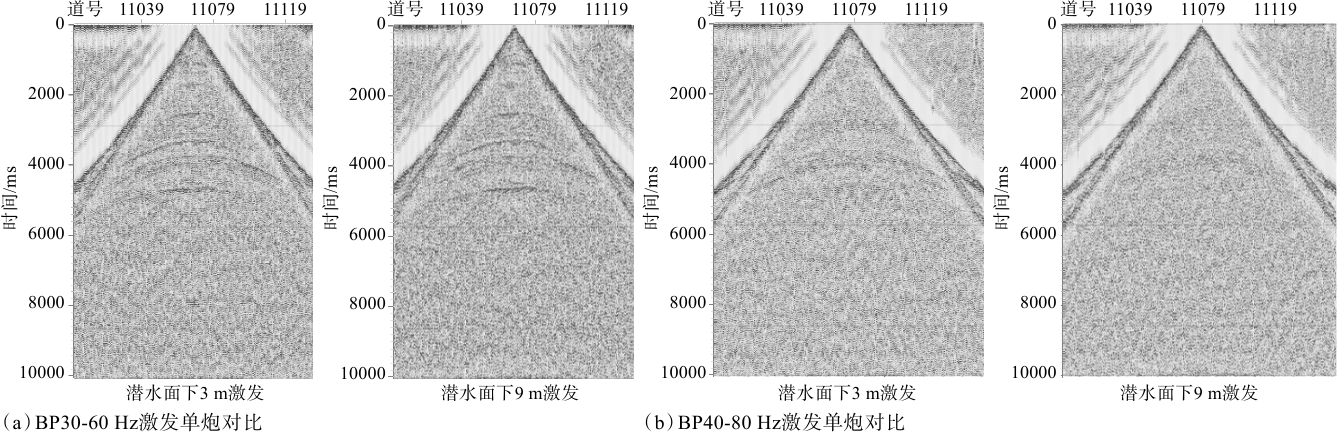
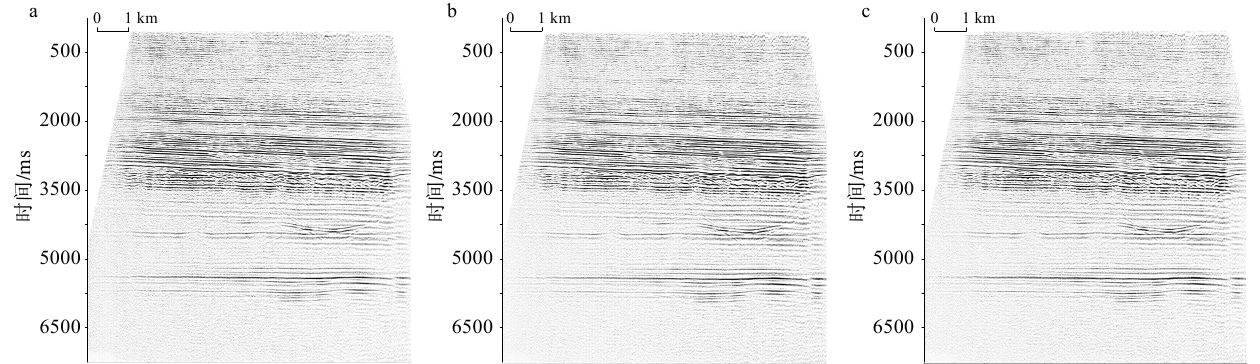
图 3 沙漠区井炮潜水面下3 m和9 m的虚反射聚能激发单炮和虚反射未聚能激发单炮地震记录对比
Figure 3. Comparison of single-shot seismic records generated by ghost-reflection-focusing and non-focusing excitation at 3 m and 9 m below the water table in the desert area
(a) Single-shot seismic record generated by ghost-reflection-focusing excitation using a downhole source in the desert area; (b) Single-shot seismic record generated by non-focusing excitation using a downhole source in the desert area
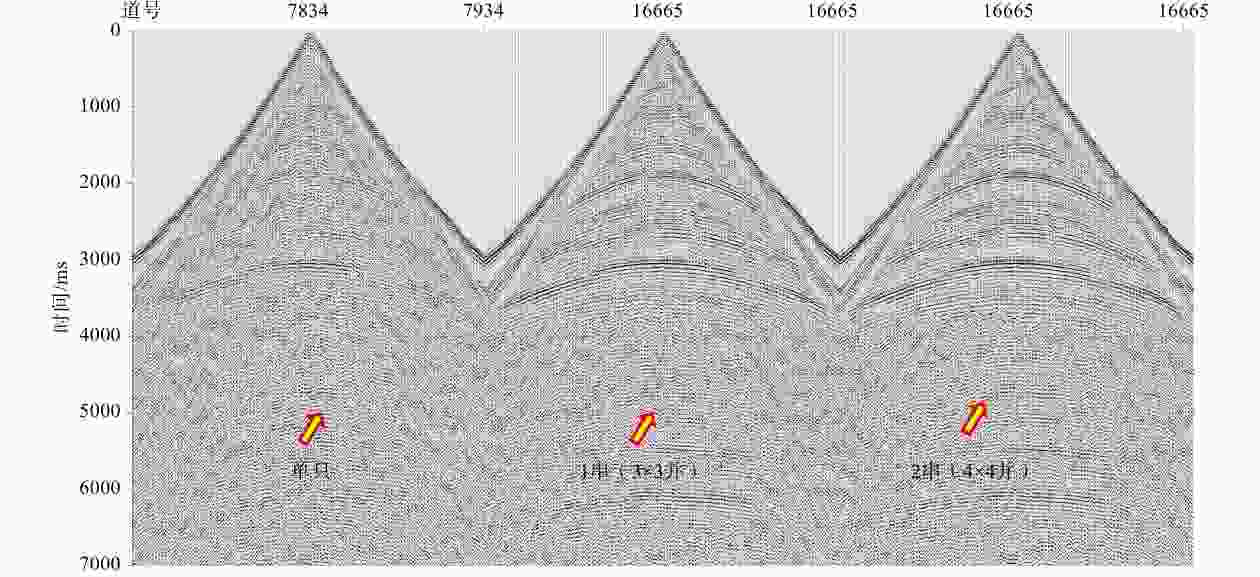
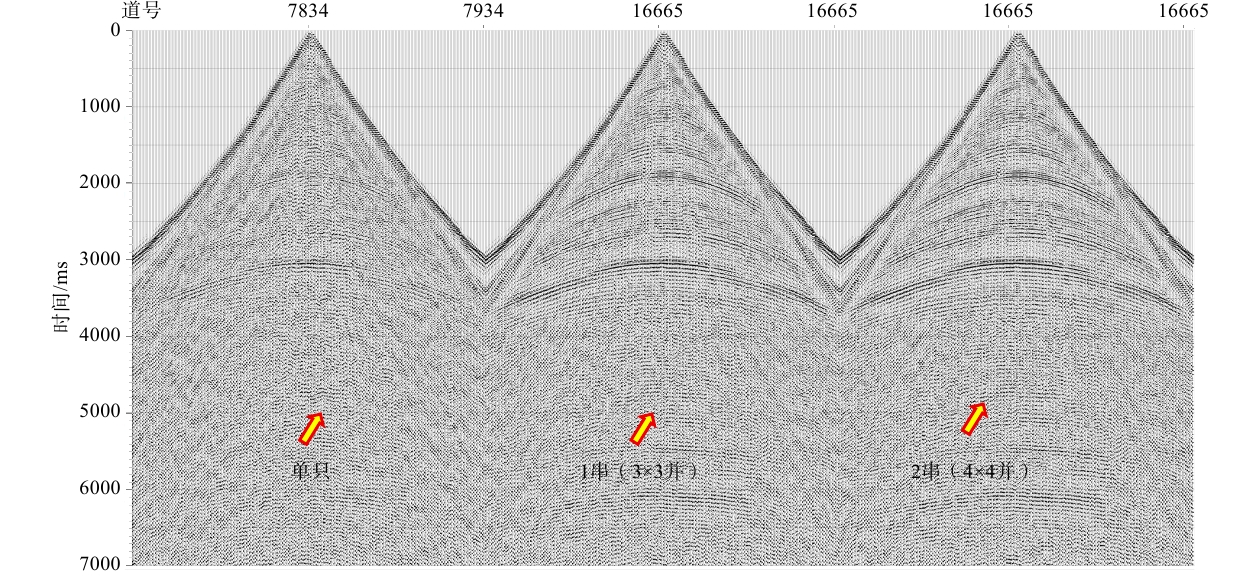
图 4 沙漠区单只检波器和小面积方阵组合检波器接收单炮分频20~40 Hz对比
单只为单只检波器;1串和2串均为小面积方阵组合检波器
Figure 4. Comparison of single-trace frequency division (20–40 Hz) records acquired by a single geophone and a small-area array of geophones in desert areas
Left: single geophone; middle (1 string) and right (2 strings): small-aperture square-array geophones.
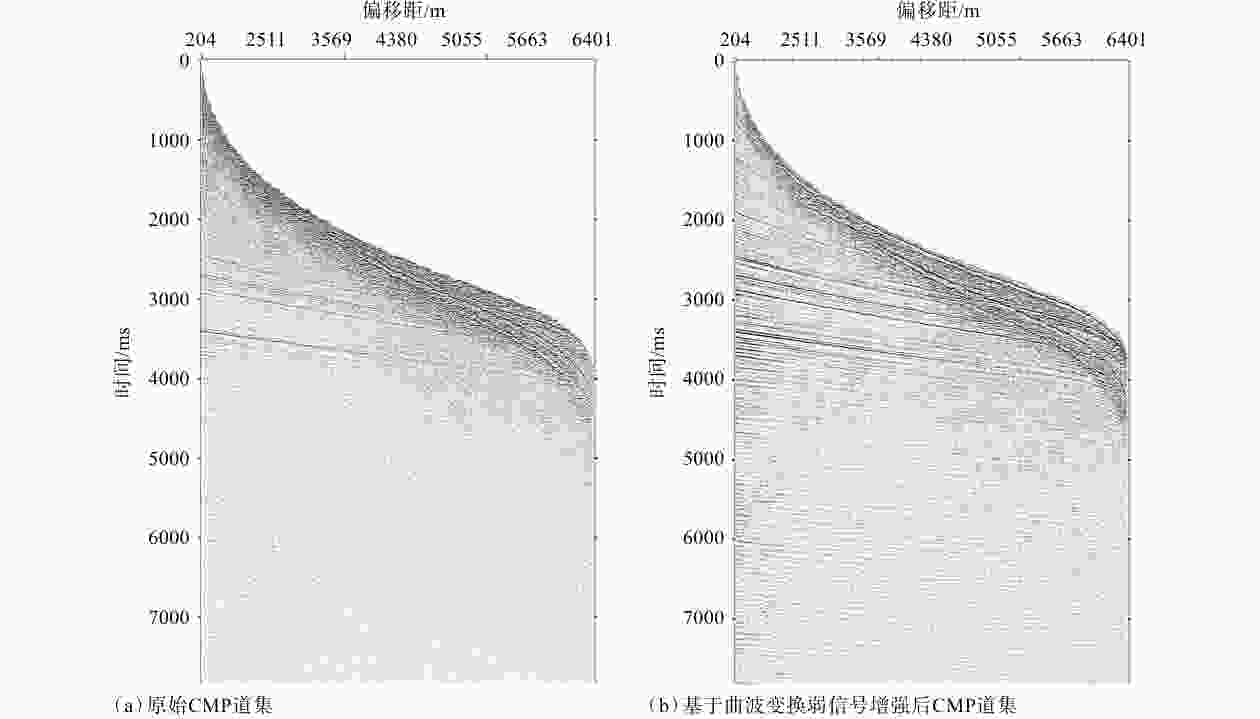
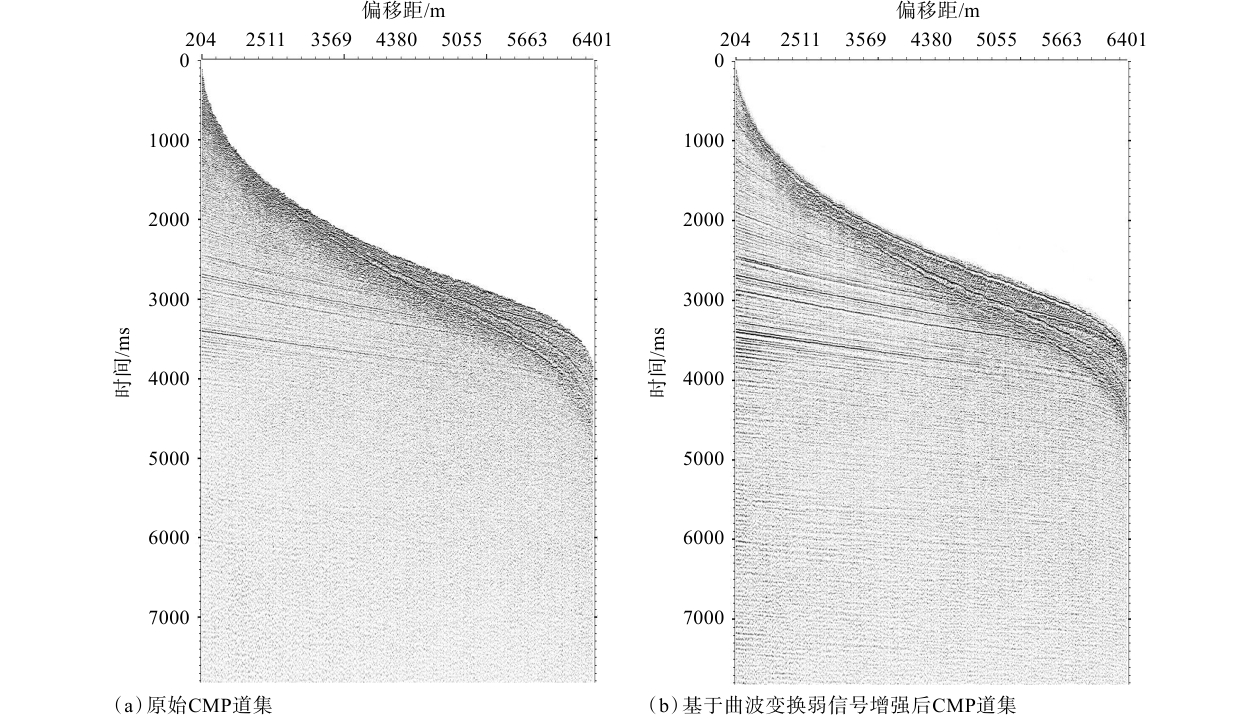
图 5 弱信号增强前后CMP道集对比
Figure 5. Comparison of CMP gathers before and after weak-signal enhancement
(a) Original CMP gather; (b) CMP gather after weak-signal enhancement
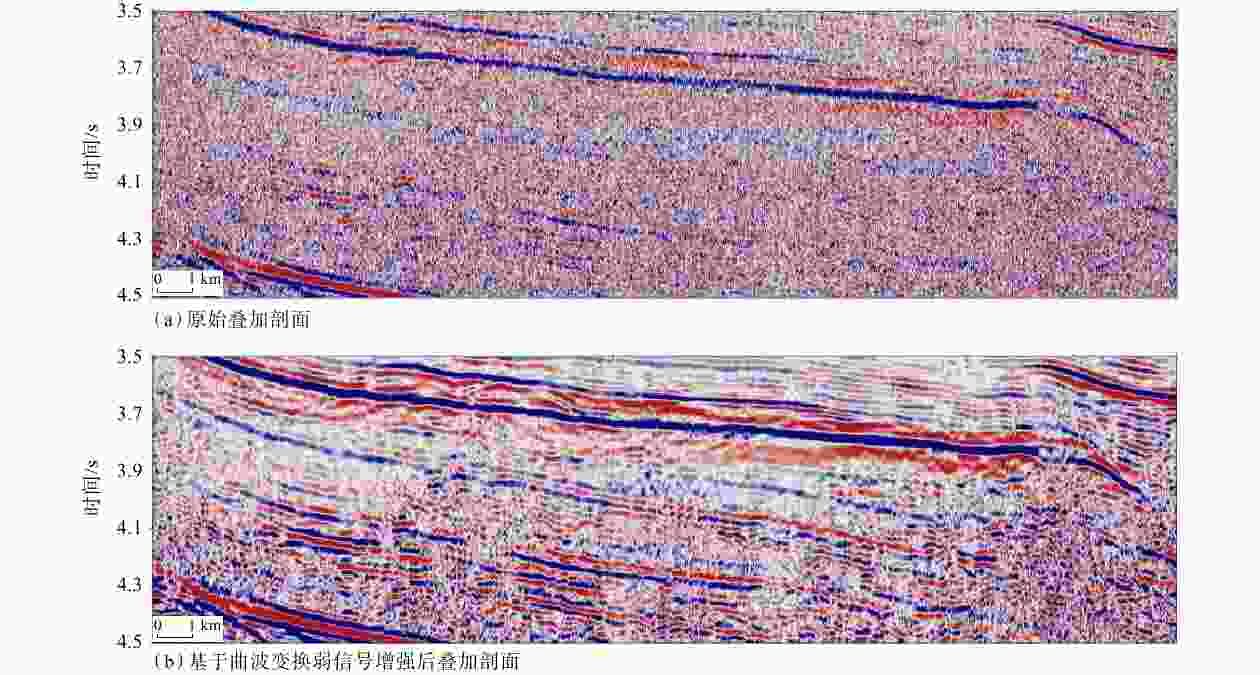
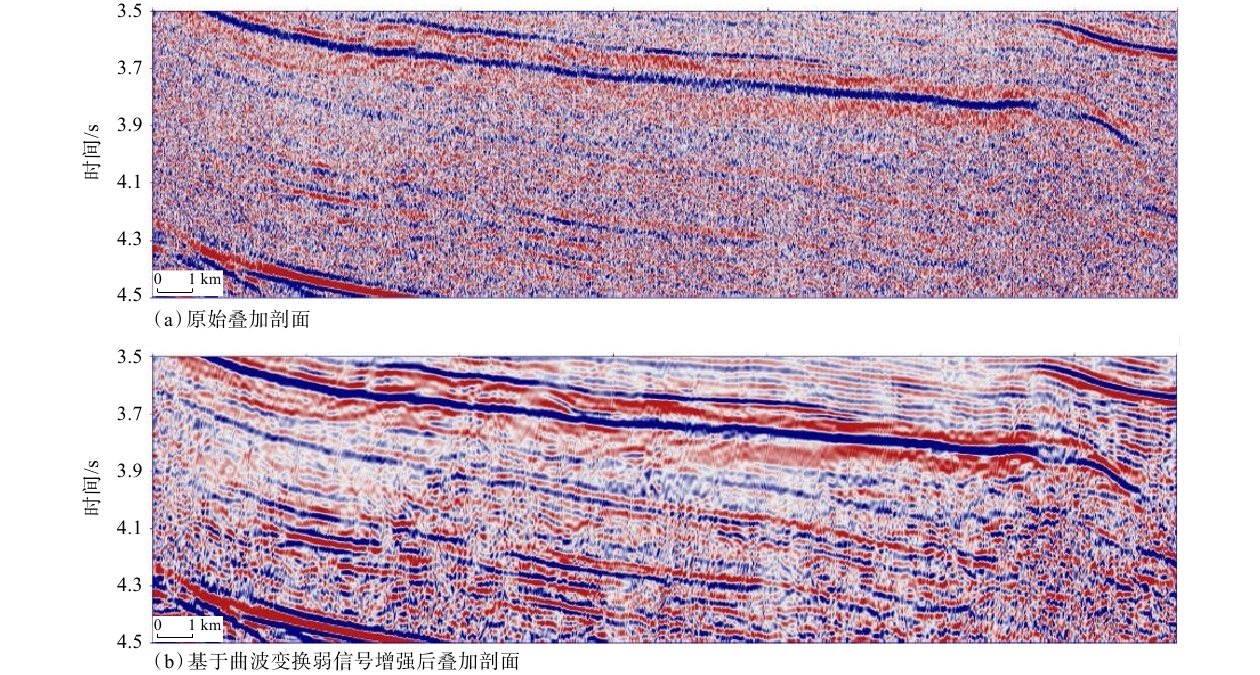
图 6 弱信号增强前后叠加剖面对比
Figure 6. Comparison of stacked seismic sections before and after weak-signal enhancement
(a) Original stacked seismic section; (b) Stacked seismic section after weak-signal enhancement based on the Curvelet transform
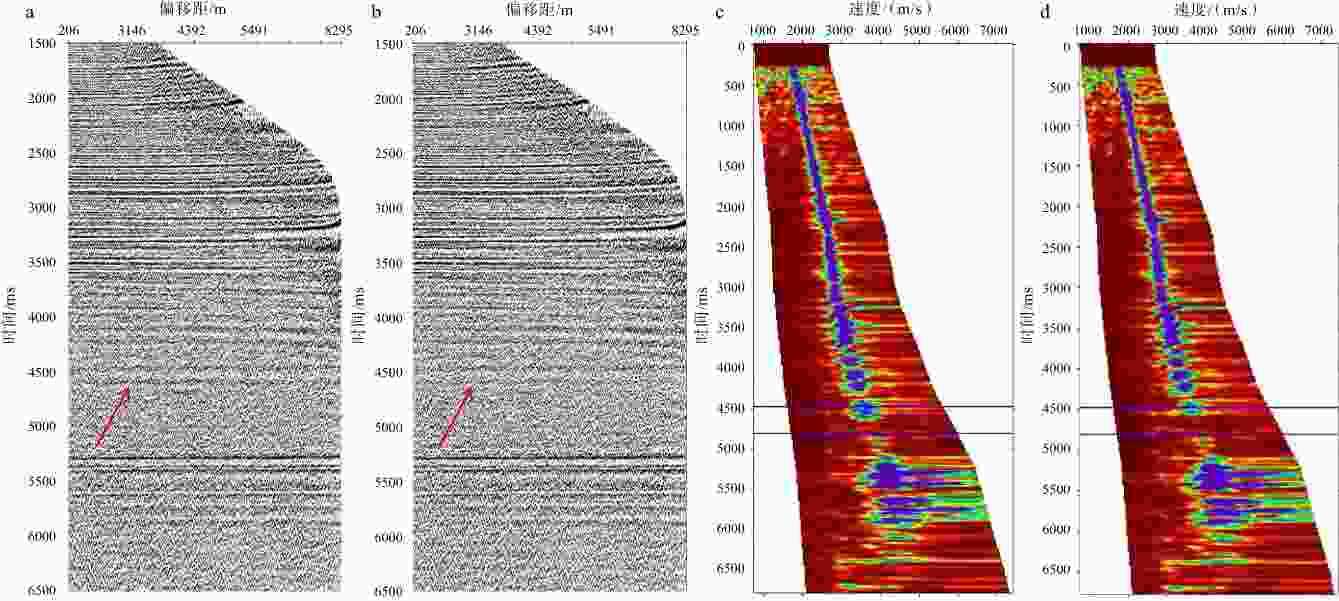
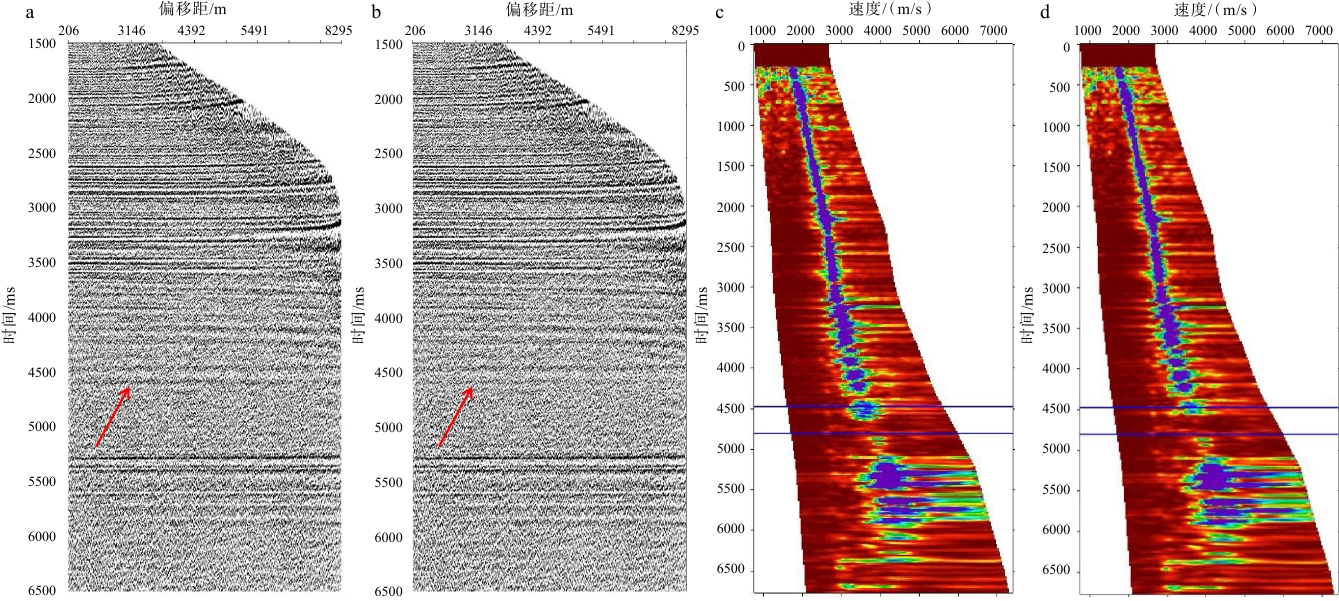
图 7 果勒1井区1.5维叠前逆散射级数法层间多次波压制效果
a—压制前CMP道集;b—压制后CMP道集;c—压制前速度谱;d—压制后速度谱
Figure 7. Effectiveness of internal multiple suppression using the 1.5D prestack inverse scattering series method in the Guole 1 well area
(a) CMP gather before suppression; (b) CMP gather after suppression; (c) Velocity spectrum before suppression; (d) Velocity spectrum after suppression
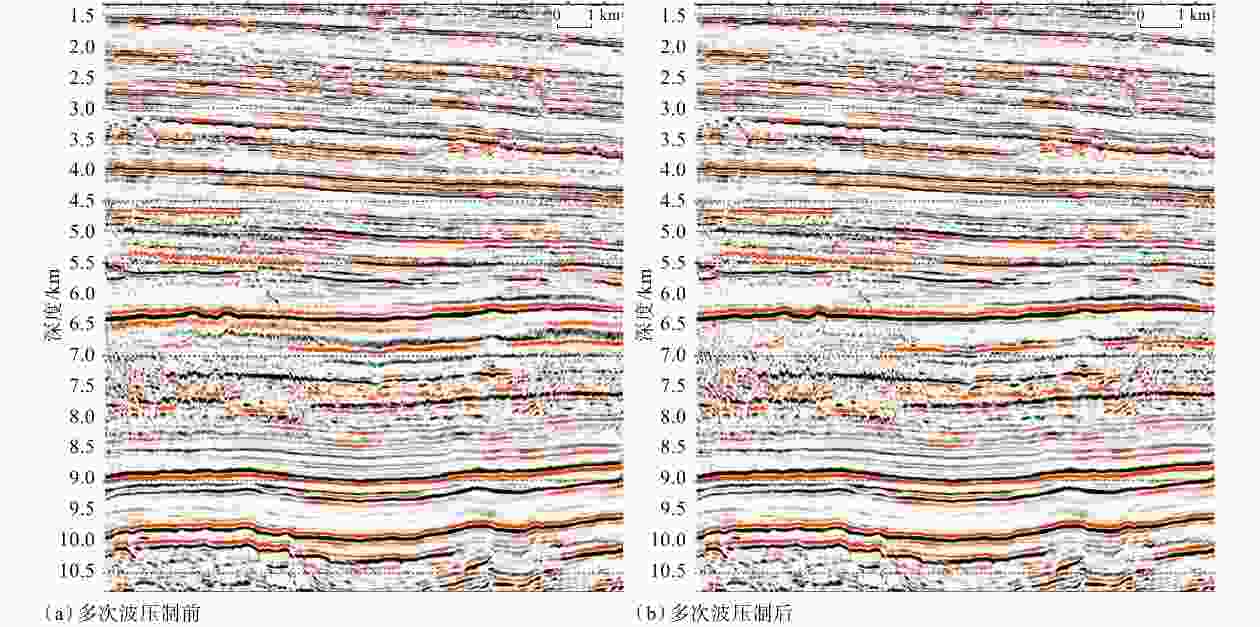
图 8 果勒1井区叠前叠后逆散射级数法串联层间多次波压制深度偏移效果
Figure 8. Depth migration effect of cascaded internal multiple suppression using the prestack and poststack inverse scattering series method in the Guole 1 well area
(a) Before multiple suppression; (b) After multiple suppression
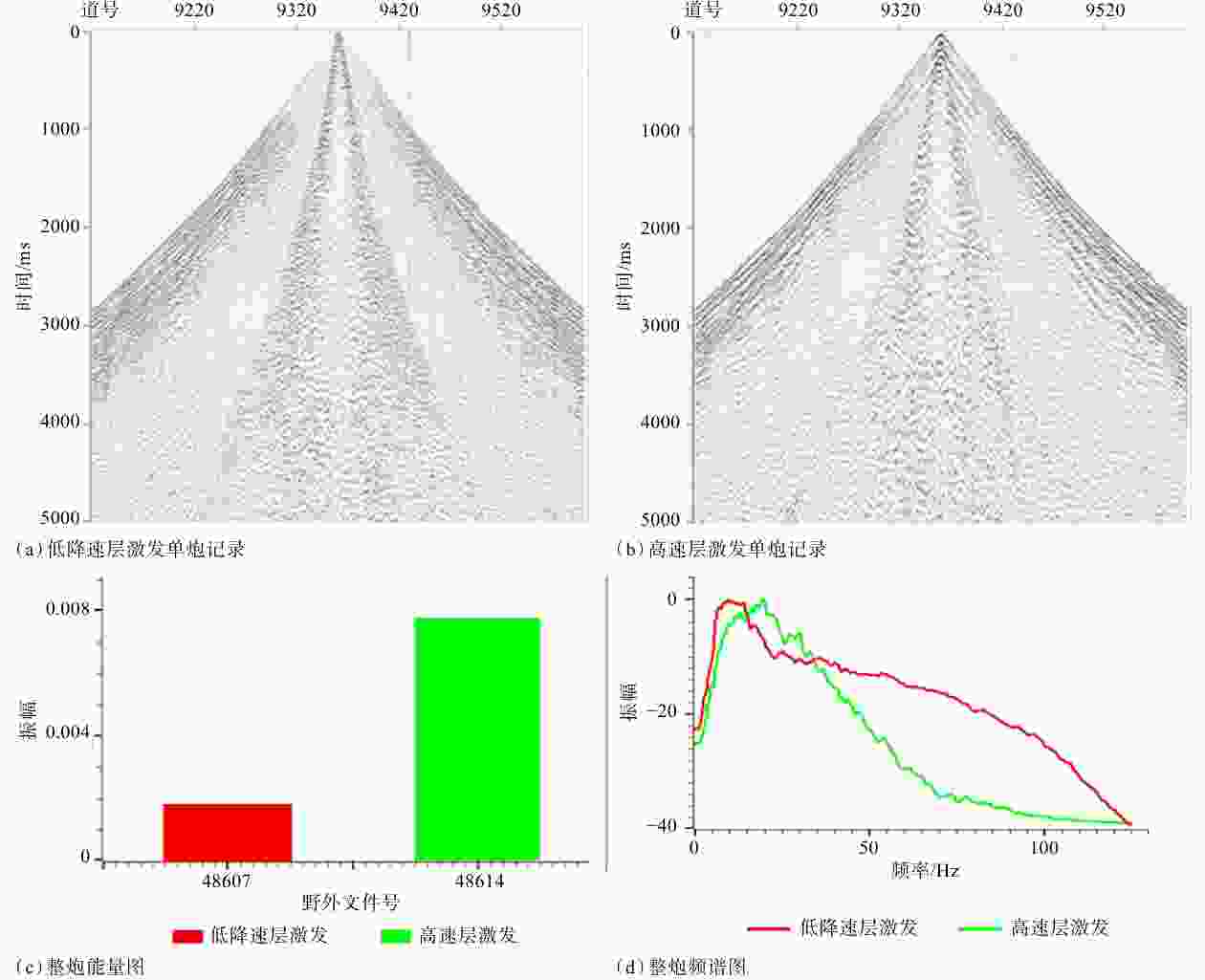
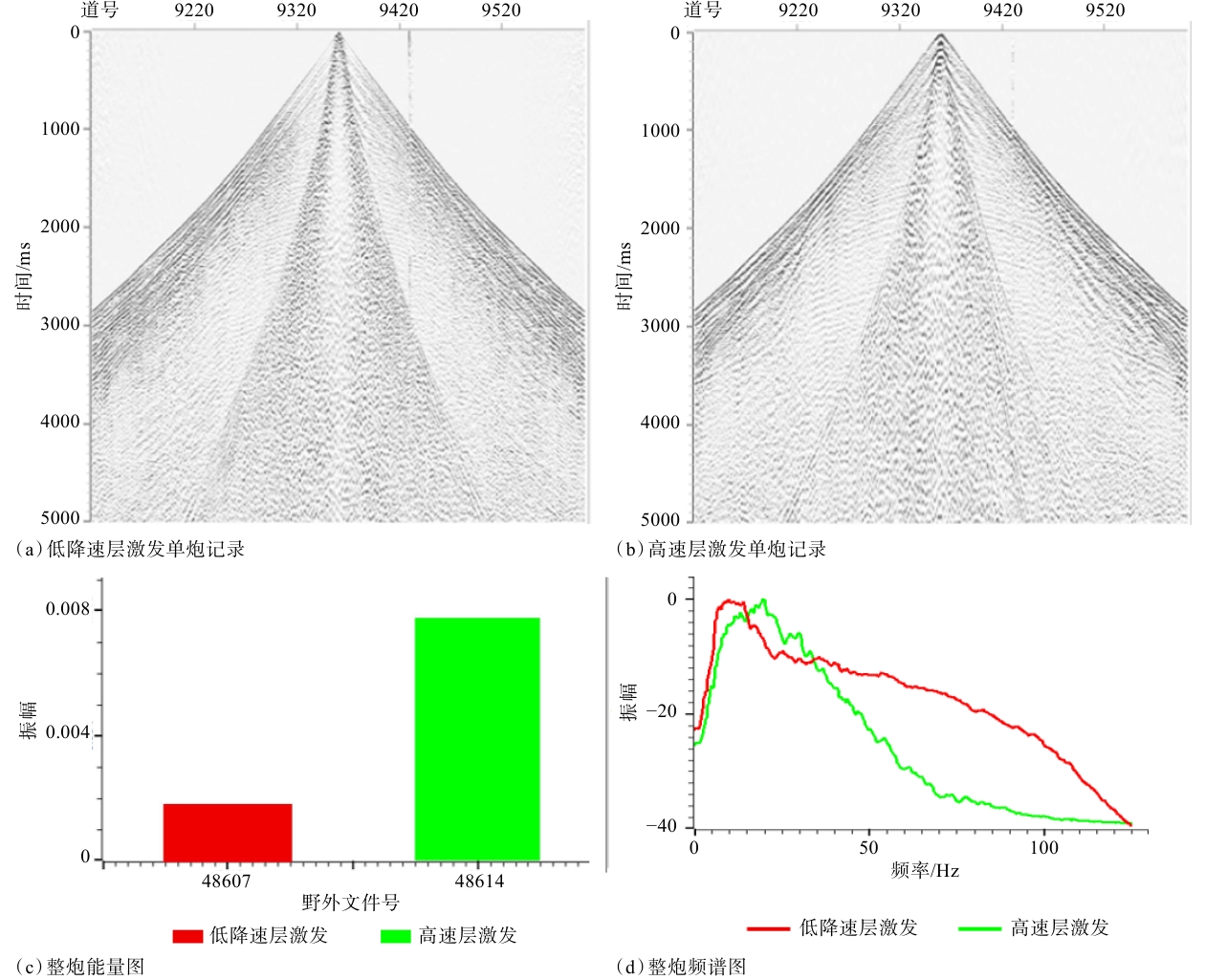
图 9 低降速层与高速层激发得到的单炮资料对比
Figure 9. Comparison of single-shot seismic records acquired by excitation in the low-velocity layer and the high-velocity layer (a) Single-shot seismic record excited in the low-velocity layer; (b) Single-shot record excited in the high-velocity layer; (c) Whole-shot energy plot; (d) Whole-shot frequency spectrum
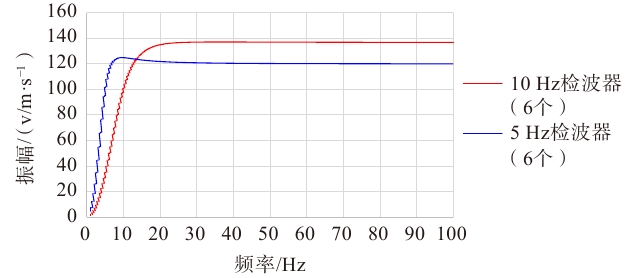
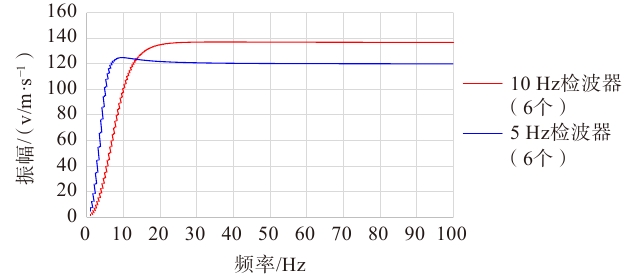
图 10 10 Hz与5 Hz检波器幅频曲线对比
Figure 10. Comparison of amplitude–frequency curves between 10-Hz and 5-Hz geophones
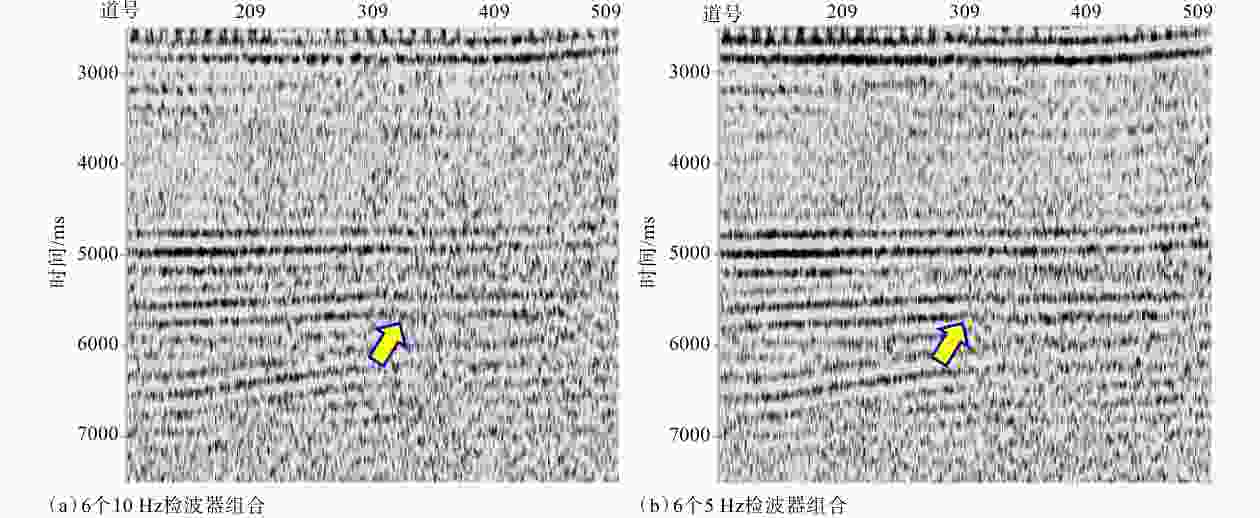
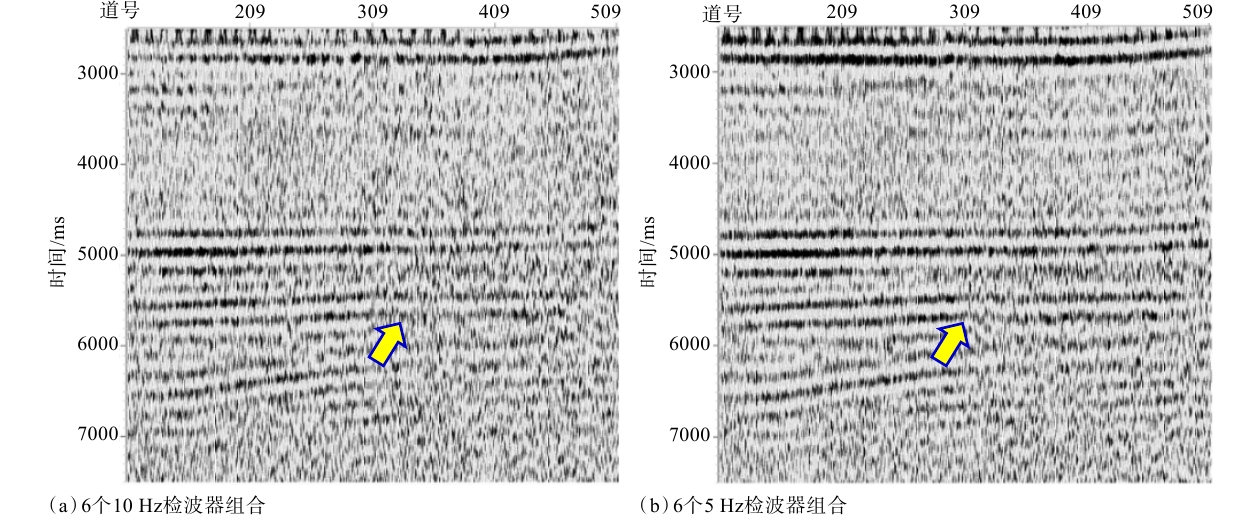
图 11 10 Hz与5 Hz检波器组合接收的叠加剖面(4~6 Hz频带)对比
Figure 11. Comparison of stacked seismic sections (4–6 Hz frequency band) acquired using 10-Hz and 5-Hz geophone arrays
(a) Combination of six 10-Hz geophones; (b) Combination of six 5-Hz geophones
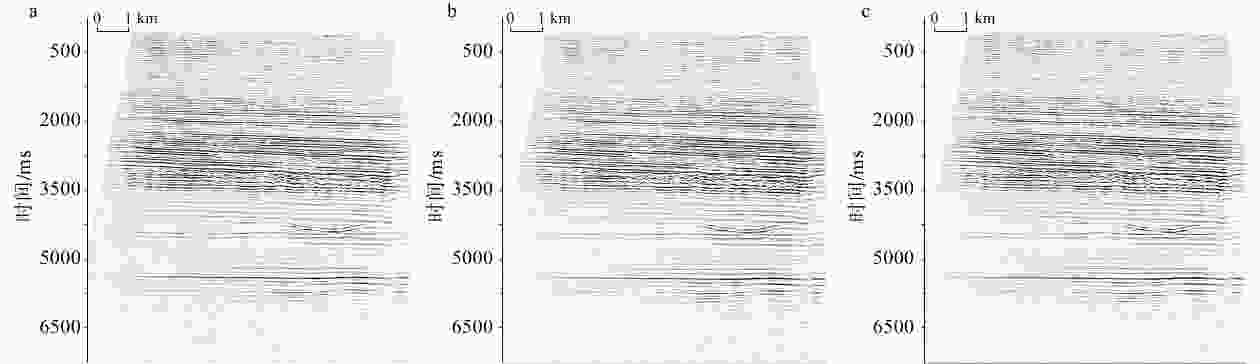
图 12 基于记录子波地表一致性补偿校正与常规方法的对比
a—地表一致性振幅补偿前;b—常规地表一致性振幅补偿后;c—基于记录子波地表一致性振幅补偿后
Figure 12. Comparison of the recorded-wavelet-based surface-consistent amplitude compensation correction with the conventional method
(a) Before surface-consistent amplitude compensation; (b) After conventional surface-consistent amplitude compensation; (c) After surface-consistent amplitude compensation based on the recorded wavelet
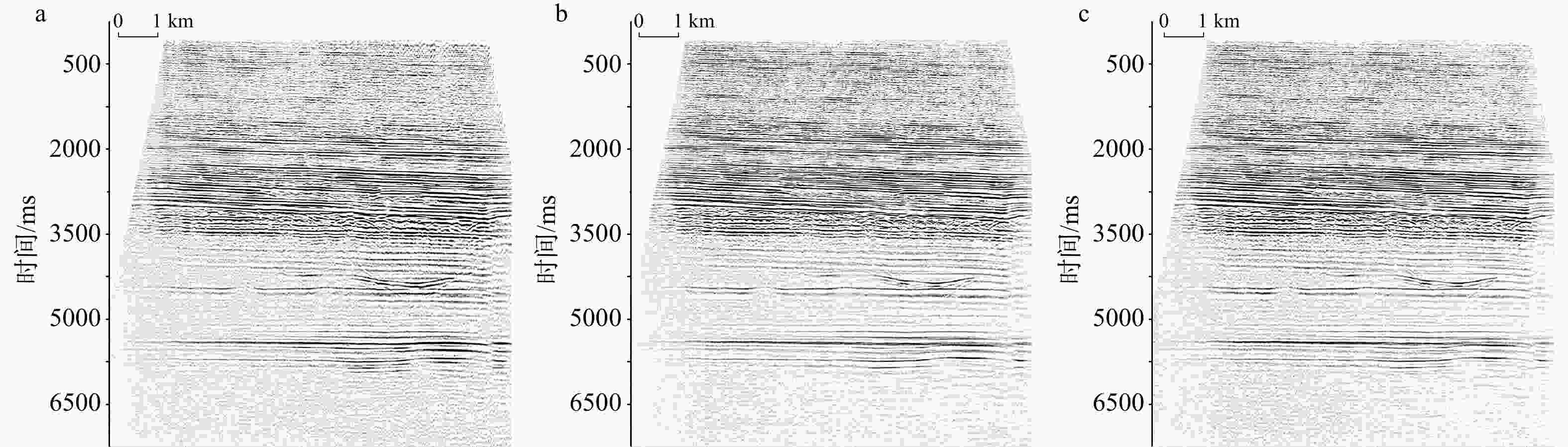
图 13 基于记录子波地表一致性反褶积与常规方法的对比
a—地表一致性反褶积前;b—常规地表一致性反褶积后;c—基于记录子波地表一致性反褶积后
Figure 13. Comparison of recorded-wavelet surface-consistent deconvolution with conventional method
(a) Before surface-consistent deconvolution; (b) After conventional surface-consistent deconvolution; (c) After surface-consistent deconvolution based on the recorded wavelet
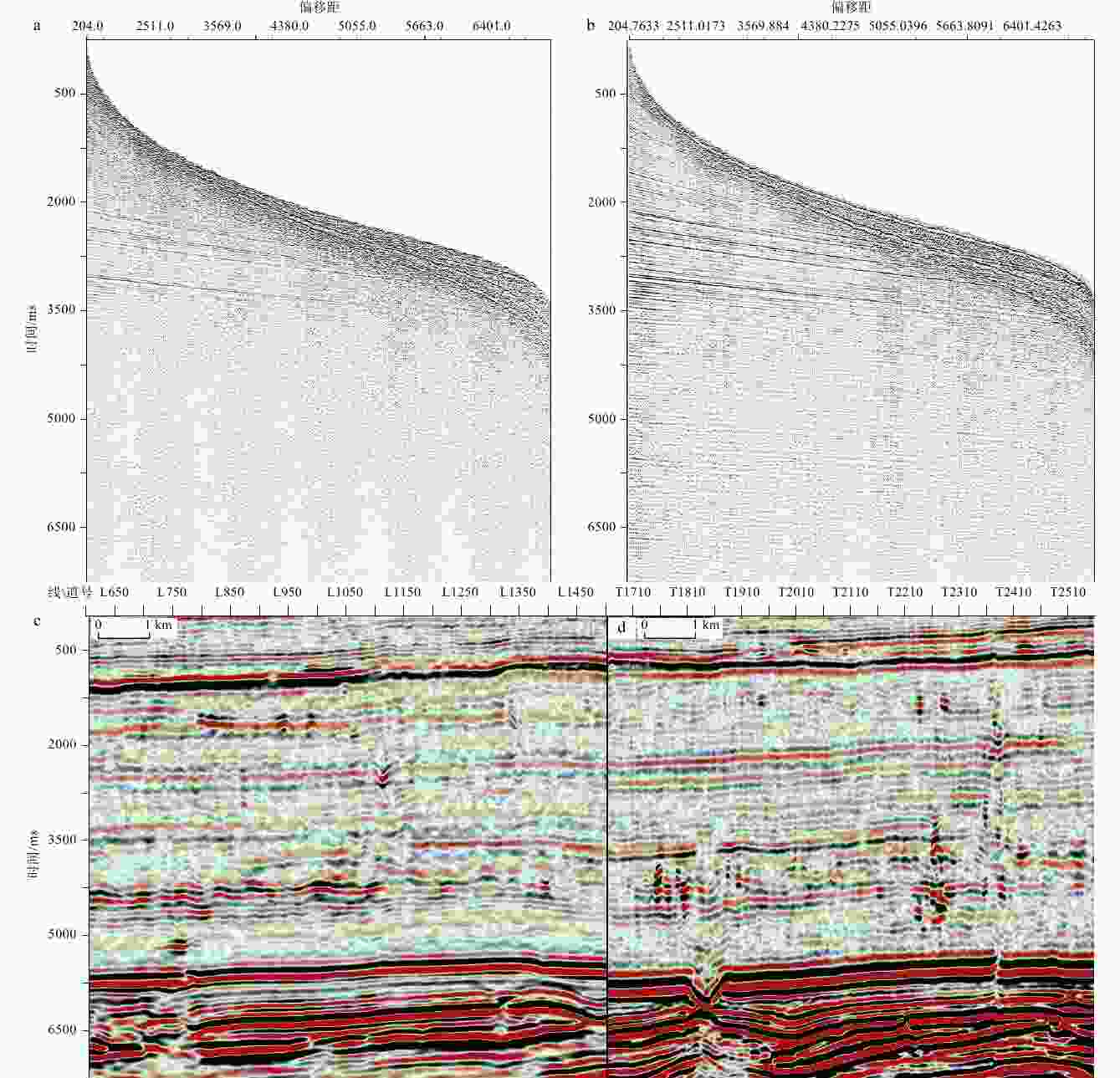
图 14 常规窄方位低密度三维与长面元宽方位高密度三维采集效果对比
常规窄方位低密度三维炮道密度28.8万道/km2,覆盖次数180次,接收线距/炮线距400/500 m,面元尺寸25 m×25 m,接收参数20个面积组合;长面元宽方位高密度三维炮道密度176万道/km2,覆盖次数550次,接收线距/炮线距250/250 m,面元尺寸12.5 m×25 m,接收参数16个面积组合a—常规窄方位低密度三维CMP道集;b—长面元宽方位高密度三维CMP道集;c—常规窄方位低密度三维叠前深度偏移剖面;d—长面元宽方位高密度三维叠前深度偏移剖面
Figure 14. Comparison of acquisition effects between conventional narrow-azimuth low-density 3D and long-offset wide-azimuth high-density 3D acquisitions
(a) CMP gather from the conventional narrow-azimuth, low-density 3D seismic survey; (b) CMP gather from the long-bin, wide-azimuth, high-density 3D seismic survey; (c) Prestack depth-migrated section from the conventional narrow-azimuth, low-density 3D seismic survey; (d) Prestack depth-migrated section from the long-bin, wide-azimuth, high-density 3D seismic surveyConventional narrow-azimuth, low-density 3D seismic survey: trace density, 288,000 traces/km; fold, 180; receiver-line interval / source-line interval, 400/500 m; bin size, 25 m × 25 m; receiver parameters, 20 area arrays. Long-bin, wide-azimuth, high-density 3D seismic survey: trace density, 1,760,000 traces/km2; fold, 550; receiver-line interval / source-line interval, 250/250 m; bin size, 12.5 m × 25 m; receiver parameters, 16 area arrays.
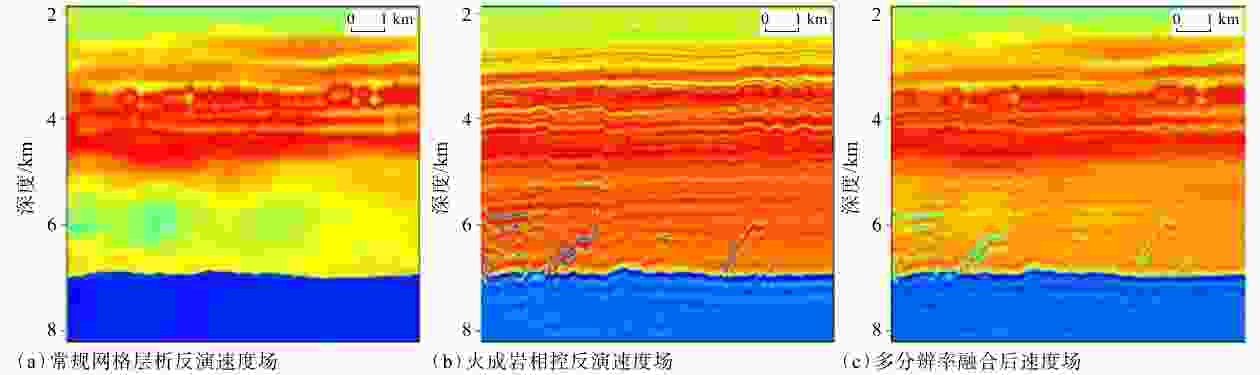
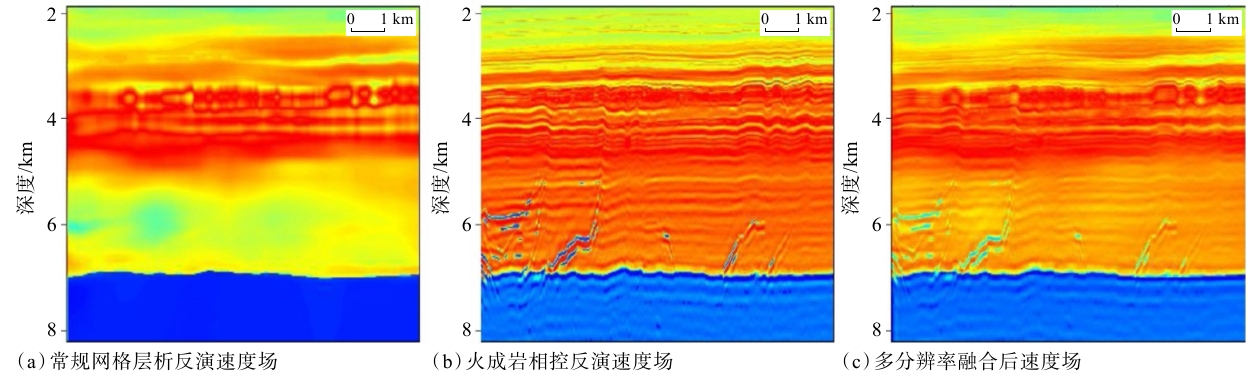
图 15 阿满Ⅰ期多分辨率侵入岩速度模型融合
Figure 15. Fusion of multi-resolution velocity models for intrusive rocks in the Aman Phase I area
(a) Before application of facies-controlled modeling and multiresolution fusion technology; (b) After application of facies-controlled modeling and multiresolution fusion technology
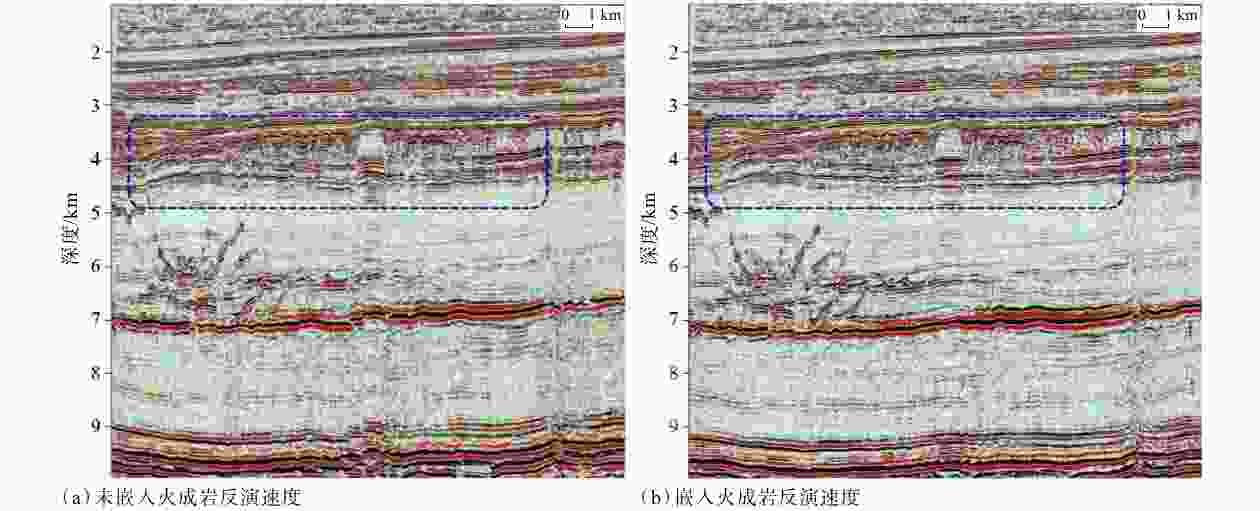
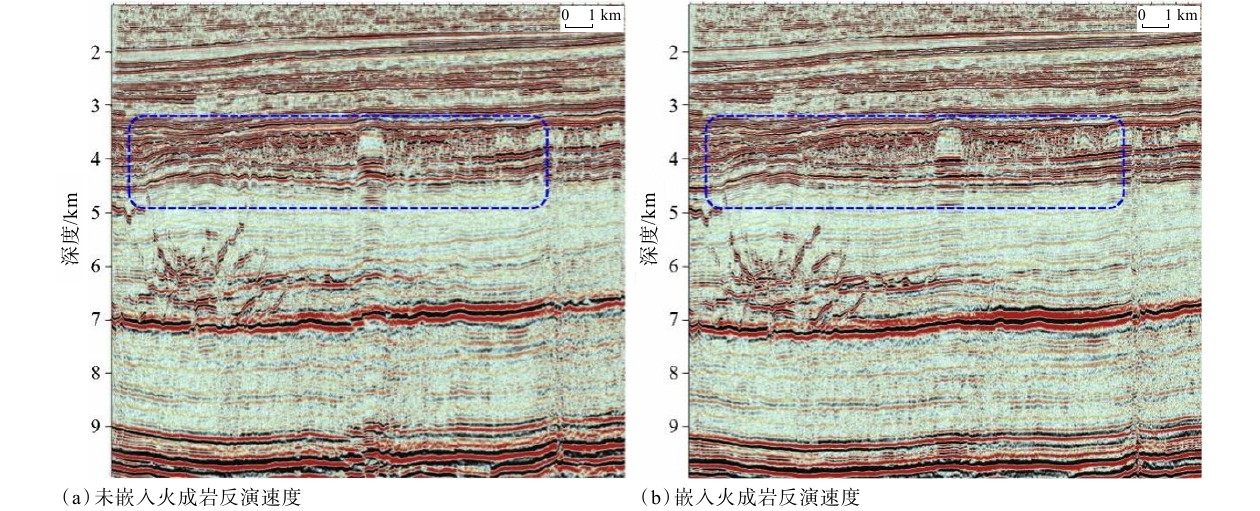
图 16 阿满Ⅰ期二叠系火成岩精细建模偏移效果
蓝色标记范围内为二叠系火成岩
Figure 16. Migration effect of fine modeling for Permian igneous rocks in the Aman Phase I area
(a) Seismic profile without applying an integrated velocity field; (b) Seismic profile after applying an integrated velocity field The blue markers indicate Permian igneous rocks.
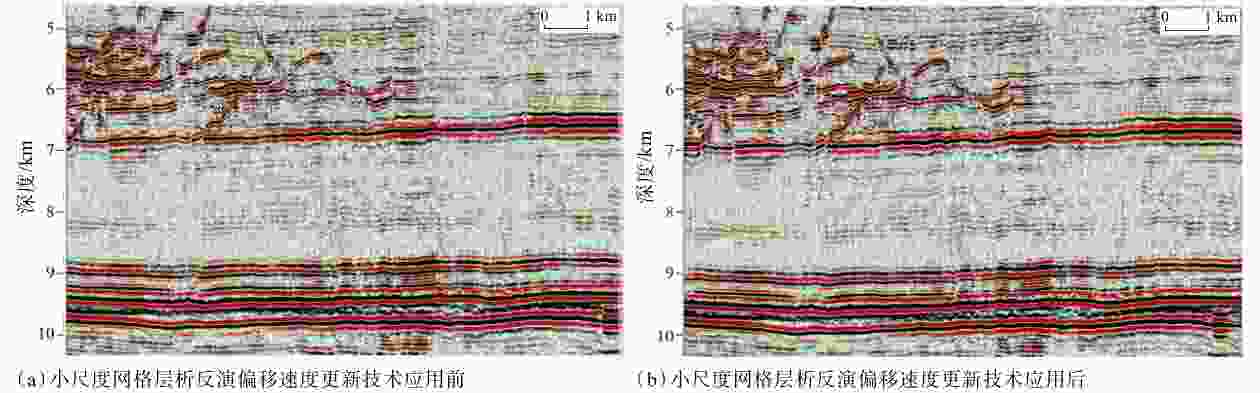
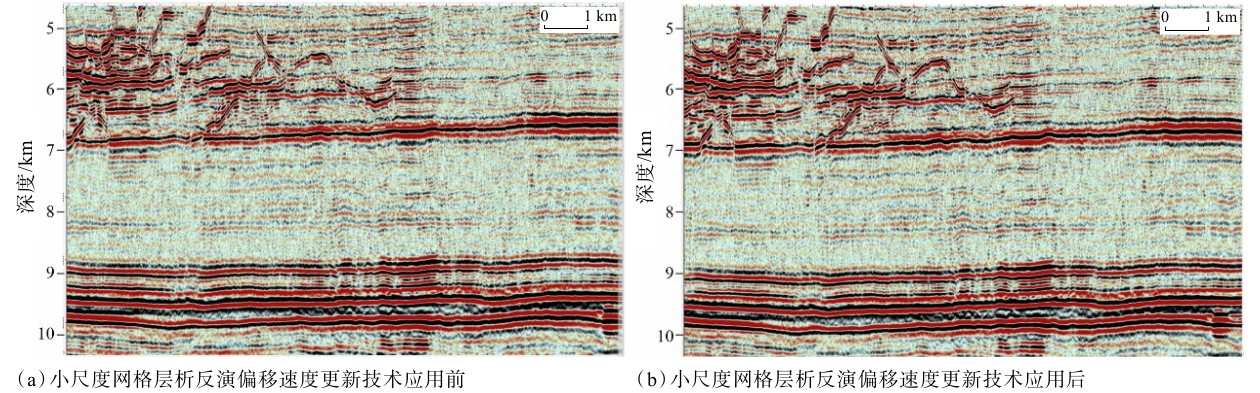
图 17 阿满I期VSP约束建模偏移效果
Figure 17. Migration effect of VSP-constrained modeling in the Aman Phase I area
(a) Seismic profile without applying small-scale grid tomographic inversion for migration velocity updating; (b) Seismic profile after applying small-scale grid tomographic inversion for migration velocity updating
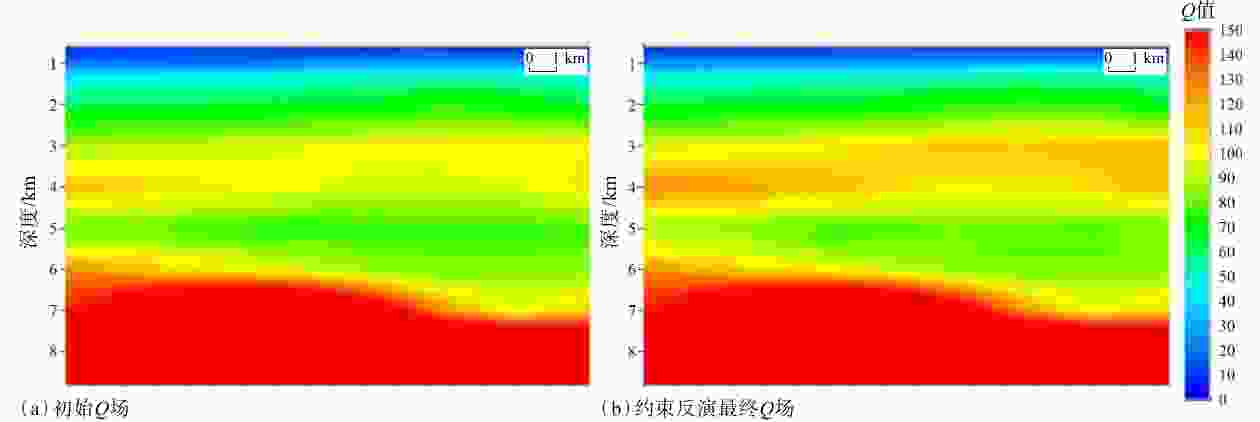
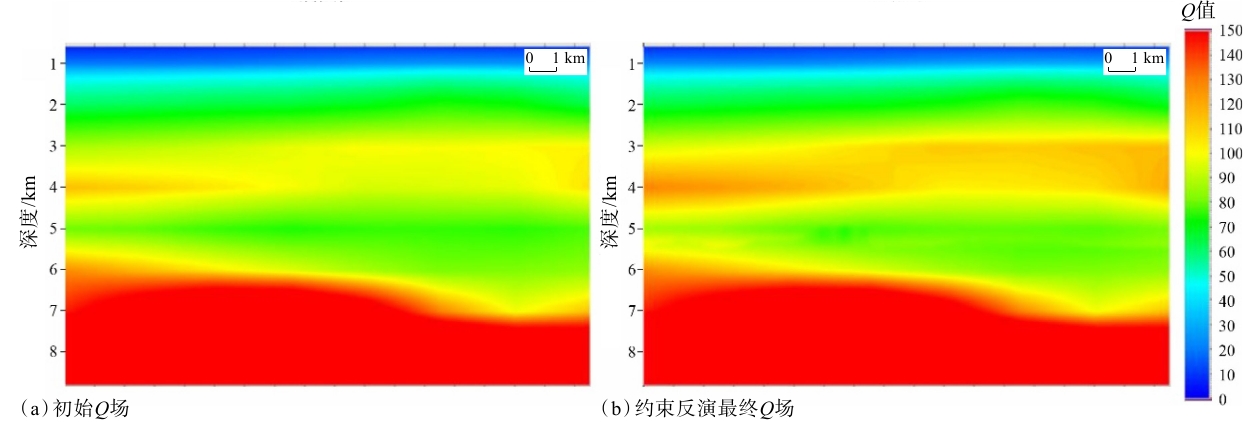
图 19 跃满地区多井VSP硬约束反演效果
Figure 19. Multi-well VSP hard-constrained inversion results in the Yueman area
(a) Initial Q model; (b) Final Q model obtained using constrained inversion
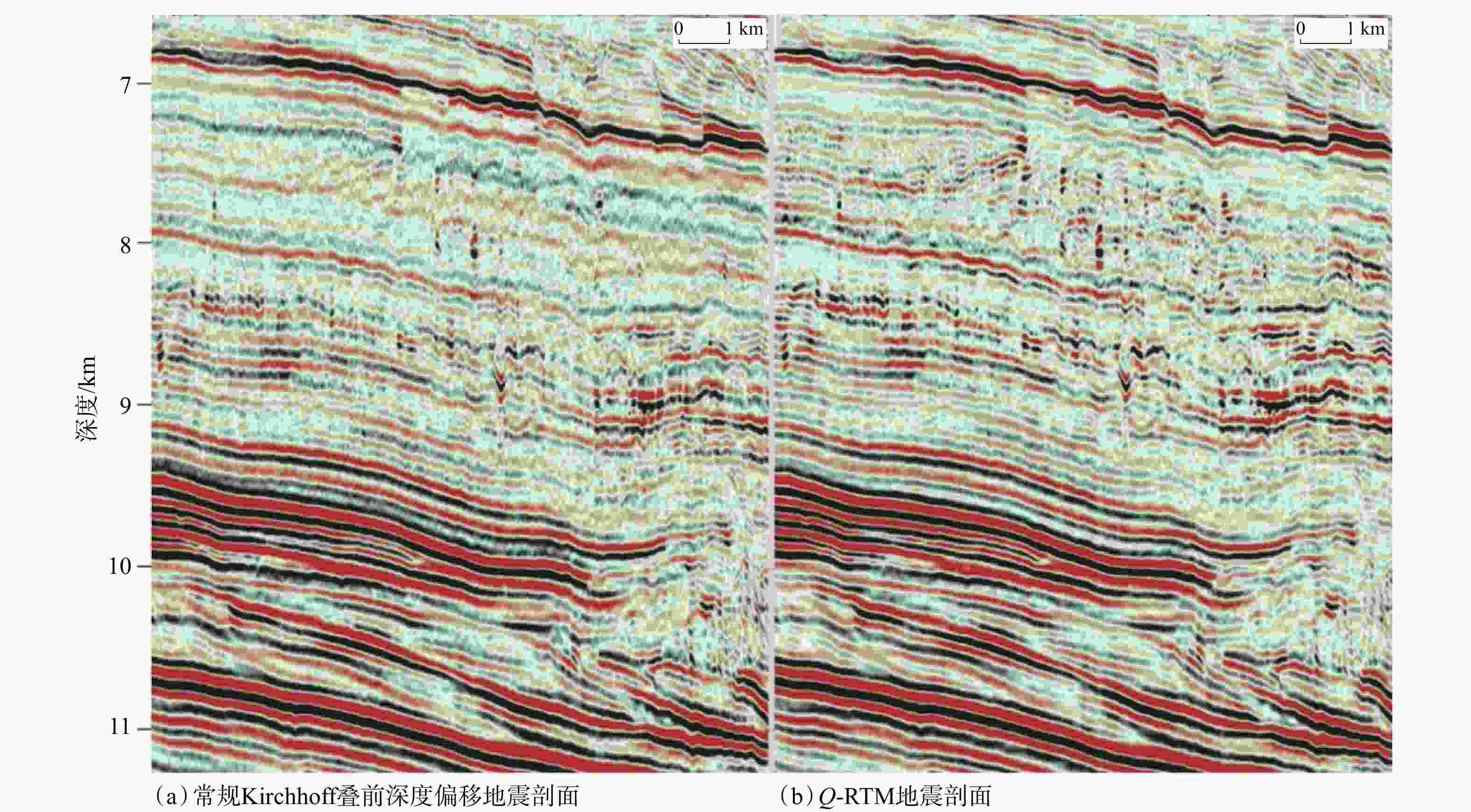
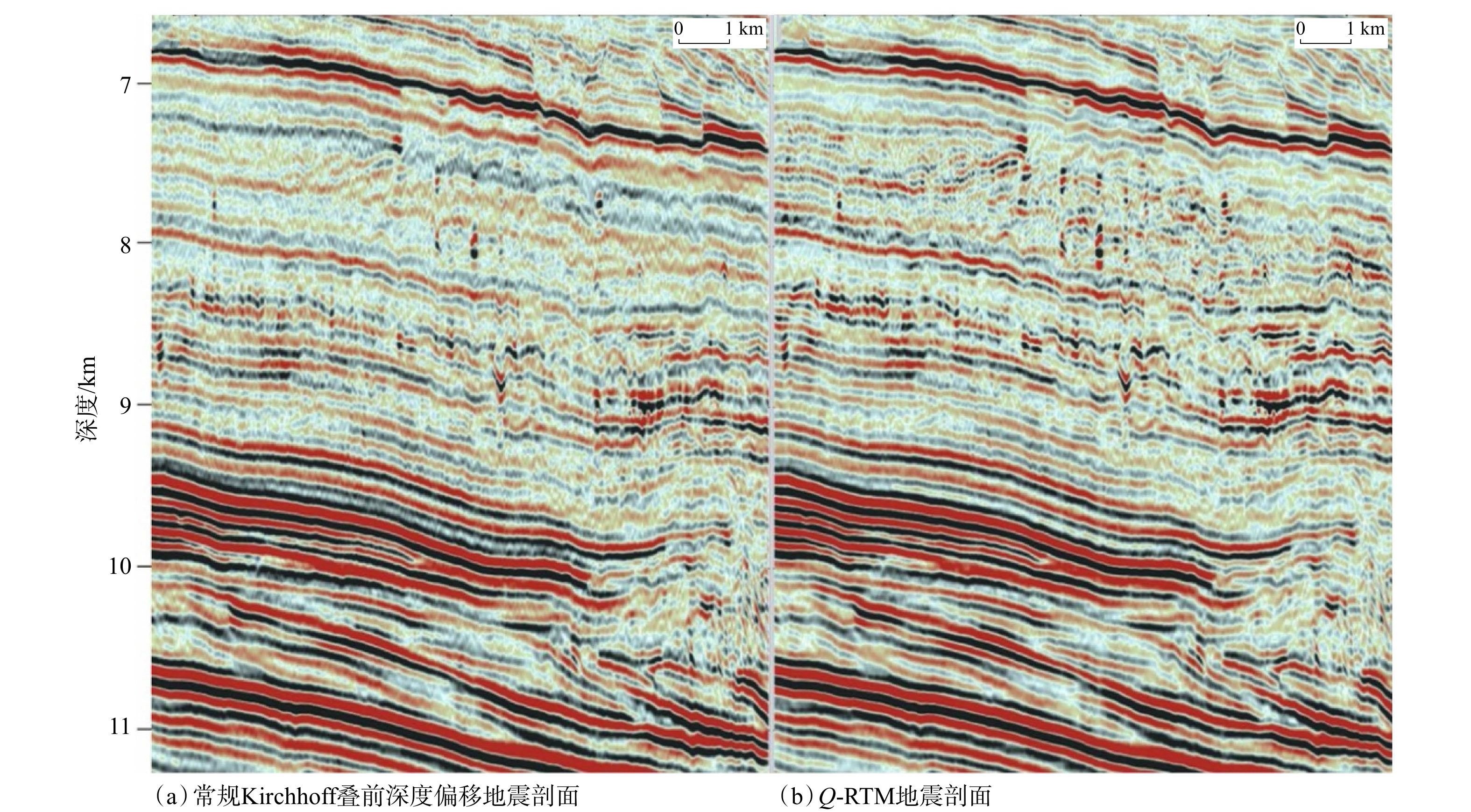
图 20 常规Kirchhoff 叠前深度偏移与Q-RTM 成像结果对比
Figure 20. Comparison of conventional Kirchhoff prestack depth migration and Q-RTM imaging results
(a) Seismic profile obtained using conventional Kirchhoff prestack depth migration; (b) Seismic profile obtained using Q-RTM
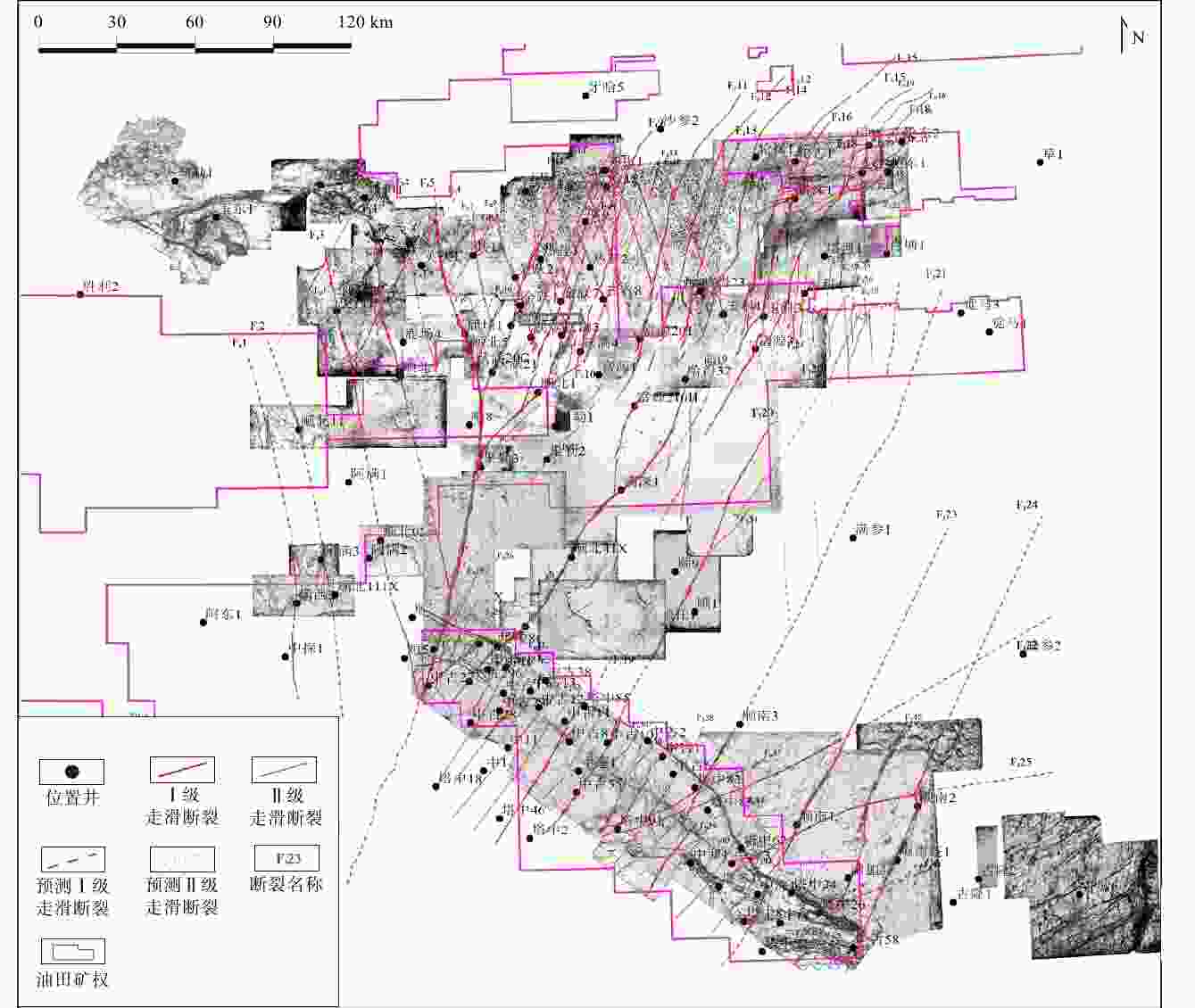
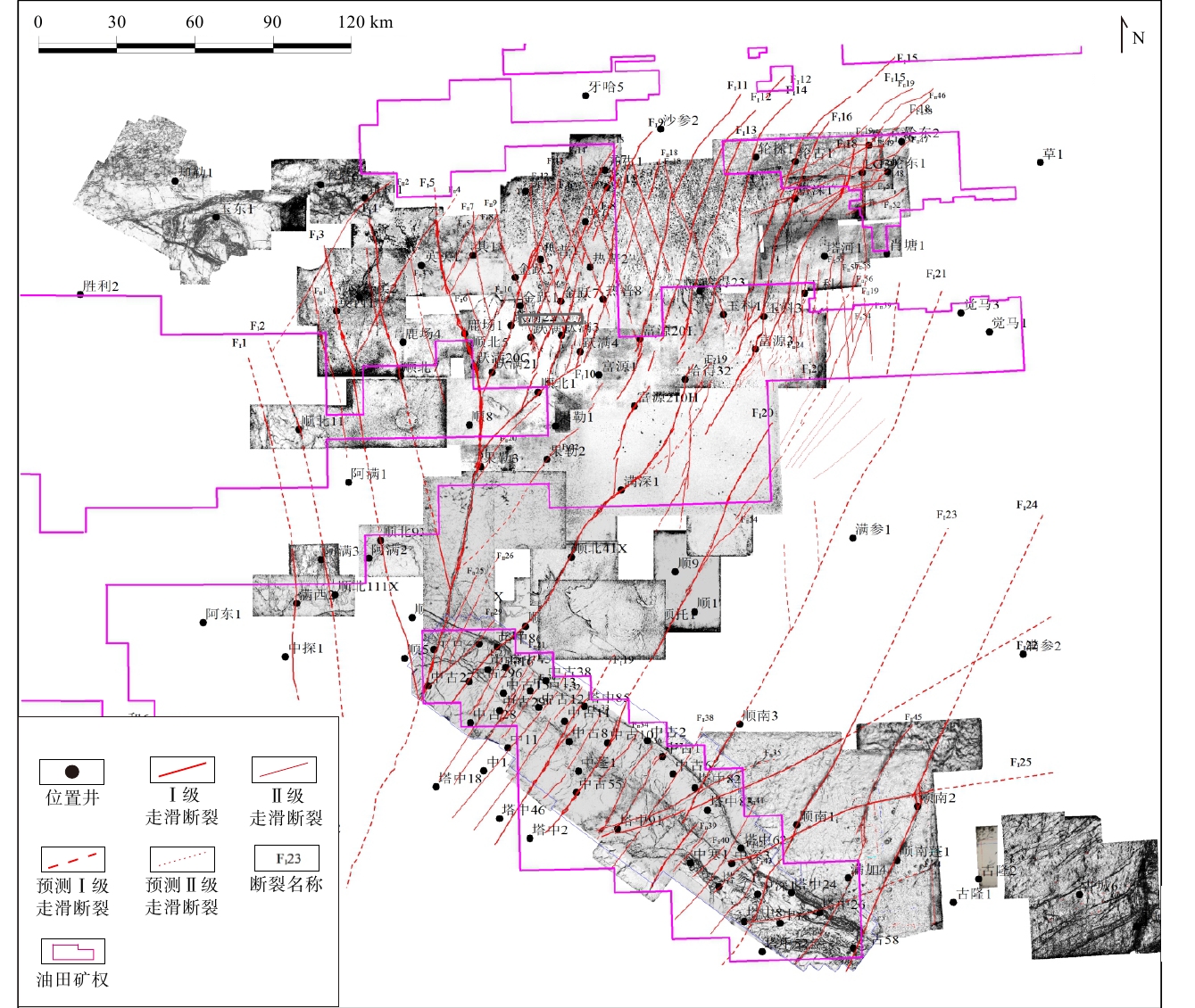
图 21 塔北—塔中奥陶系灰岩顶面相干属性+主干走滑断裂叠合平面图
Figure 21. Plan view of the coherence attribute on the top of Ordovician limestone in the Tabei–Tazhong area, superimposed with major strike-slip faults
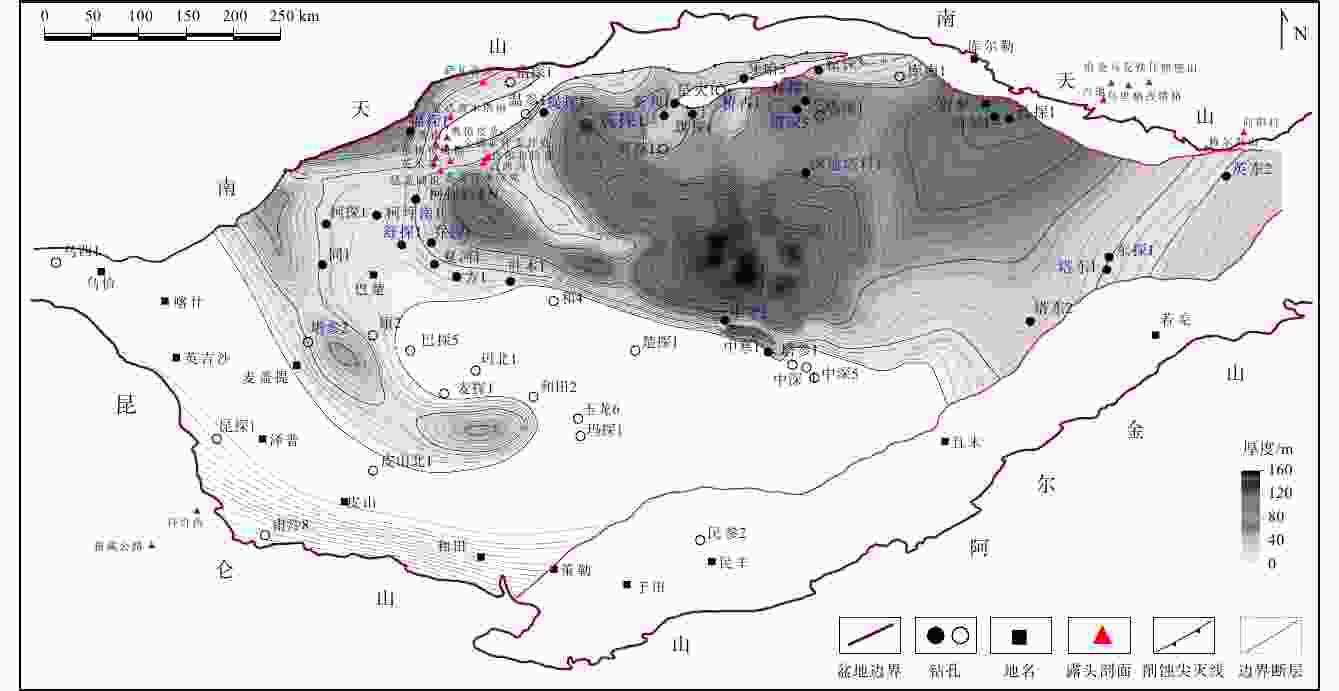
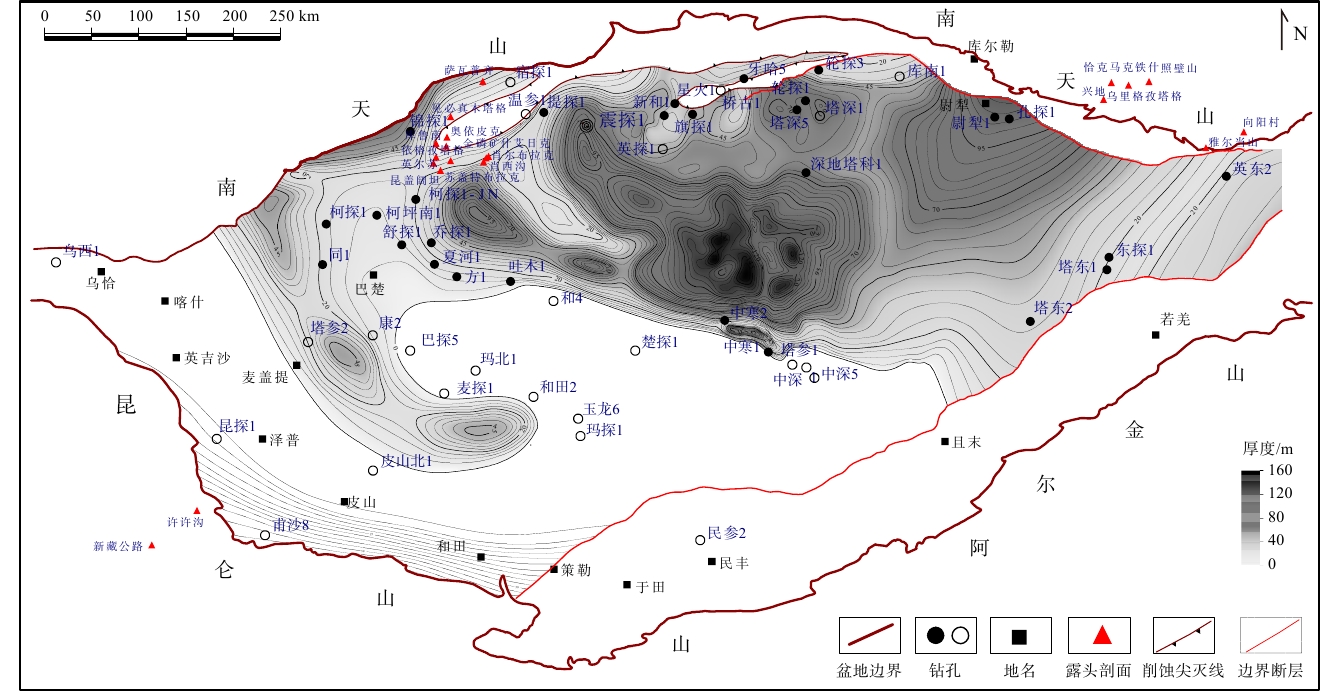
图 22 塔里木盆地下寒武统玉尔吐斯组烃源岩厚度预测图
Figure 22. Predicted thickness of source rocks in the Lower Cambrian Yurtus Formation in the Tarim Basin
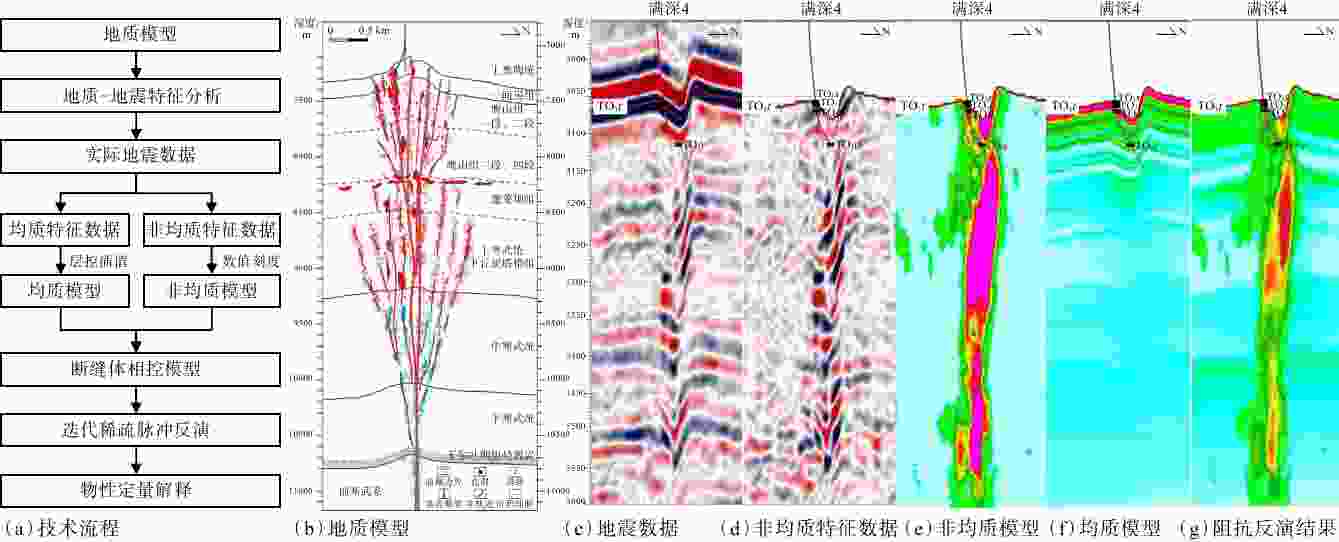
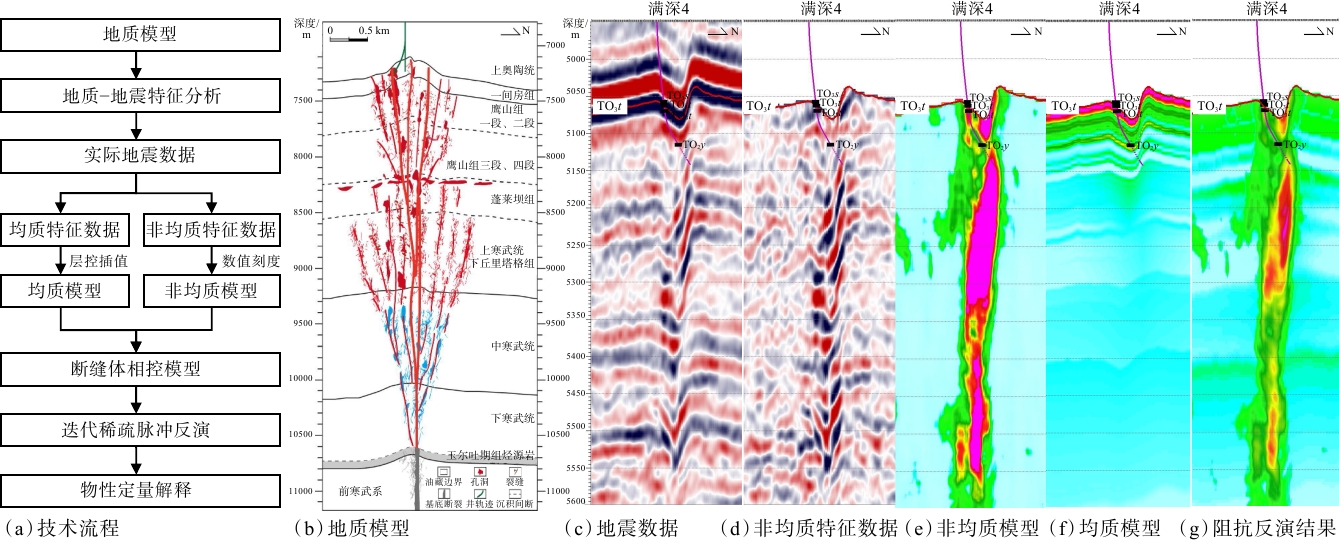
图 23 塔里木盆地断缝体储层地震解耦映射技术流程
TO3t—奥陶系吐木休克组底部;TO3l—良里塔格组底;TO3s—桑塔木组底;TO2y—一间房组底
Figure 23. Technical framework for characterizing and predicting faulted-fractured reservoirs in the Tarim Basin
(a) Technical workflow; (b) Geological model; (c) Seismic data; (d) Heterogeneity characterization data; (e) Heterogeneous model; (f) Homogeneous model; (g) Impedance inversion resultTO3t represents the base of the Ordovician Tumuxiuke Formation; TO3l–base of the Lianglitag Formation; TO3s–base of the Sangtamu Formation; TO2y–base of the Yijianfang Formation
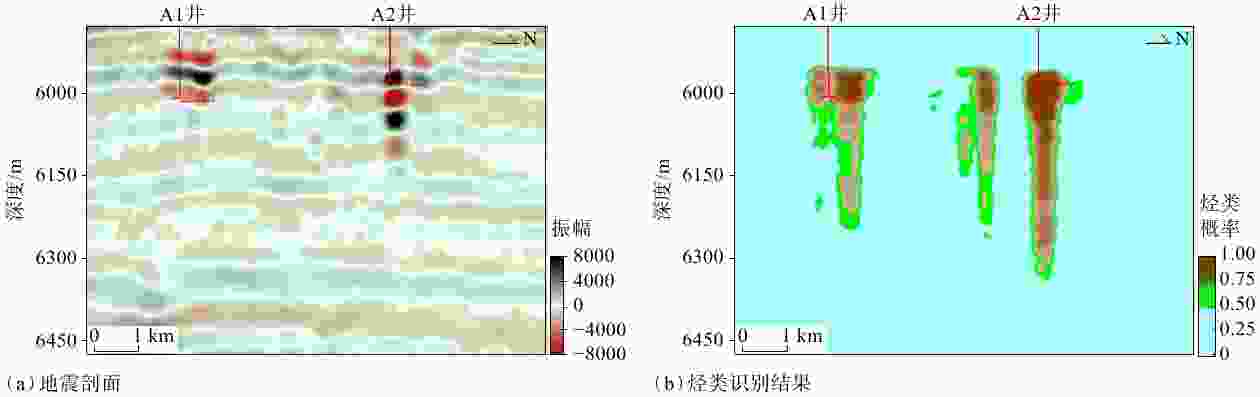
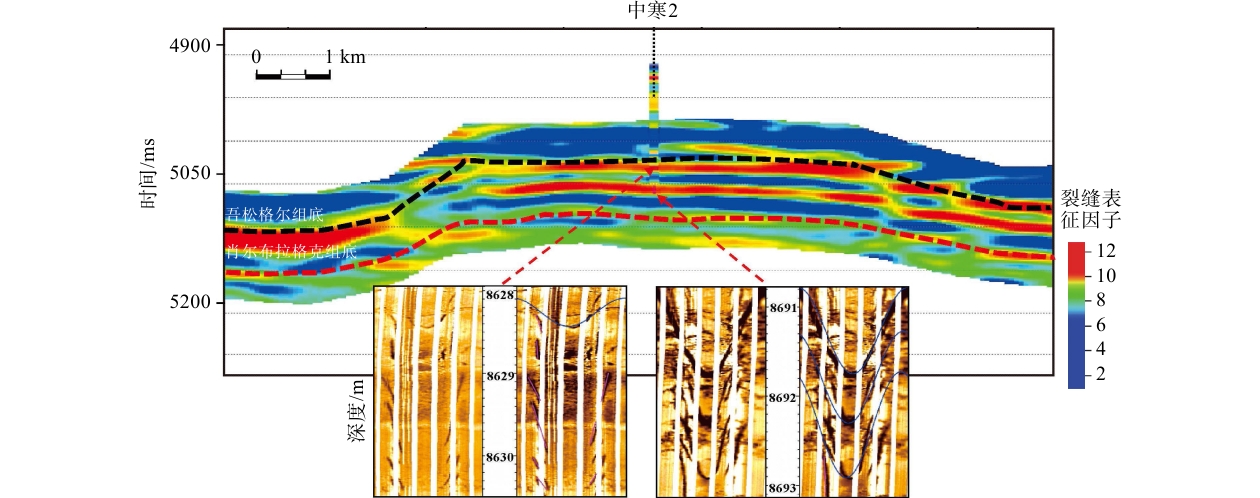
图 24 塔里木盆地中寒2井区超深白云岩储层预测图
Figure 24. Predicted distribution of ultra-deep dolomite reservoirs in the Zhonghan 2 well area, Tarim Basin
(a) Seismic profile of the dolomite reservoir; (b) Fracture characterization factor volume
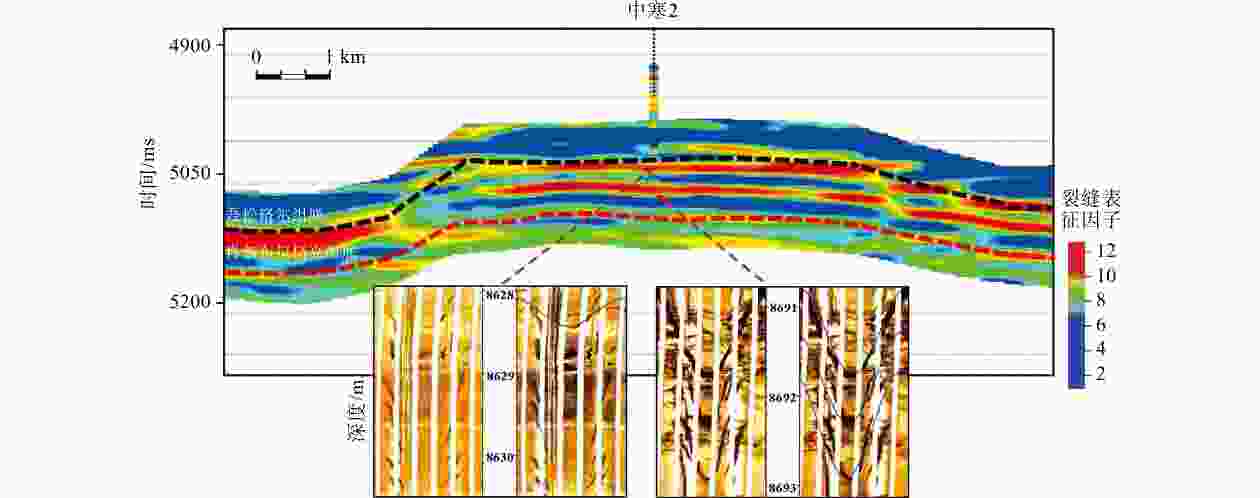
图 25 塔里木盆地新垦9断裂破碎带频率衰减梯度流体识别结果
Figure 25. Results of fluid identification using the frequency attenuation gradient in the Xinken 9 fault fracture zone in the Tarim Basin
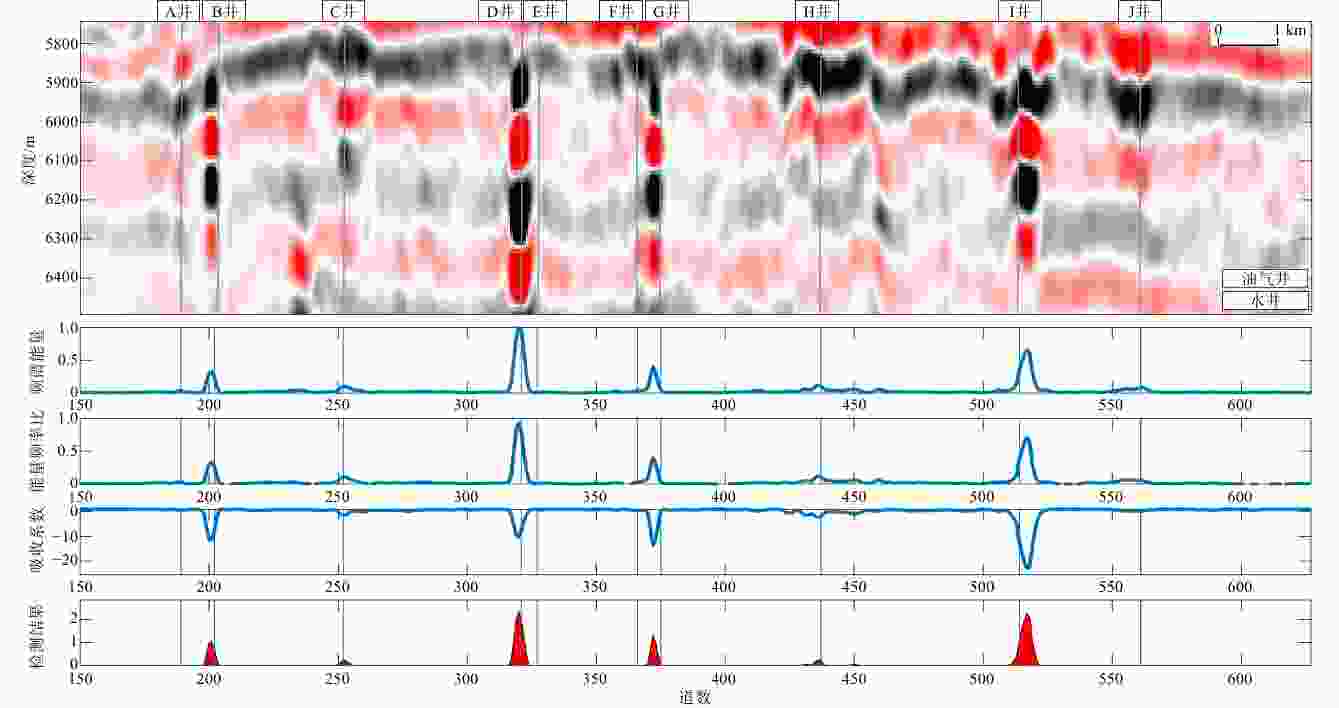
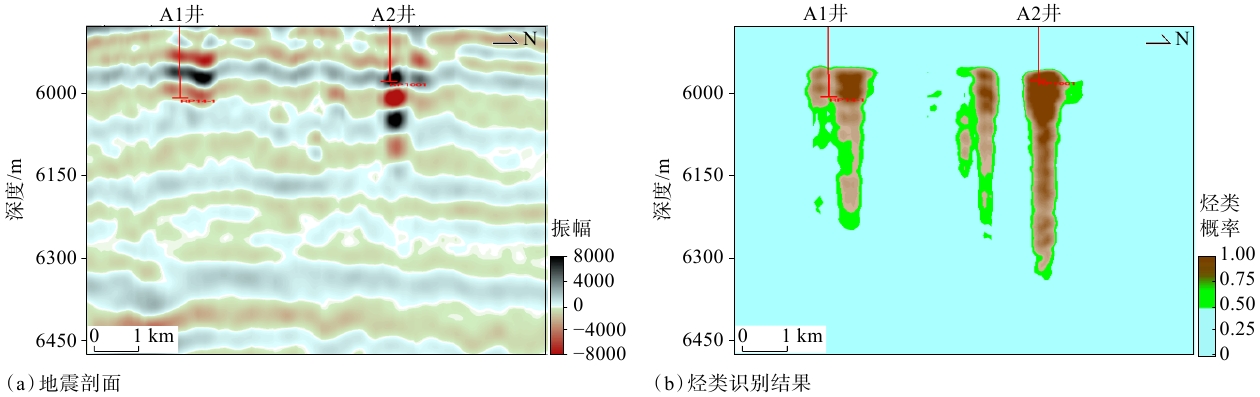
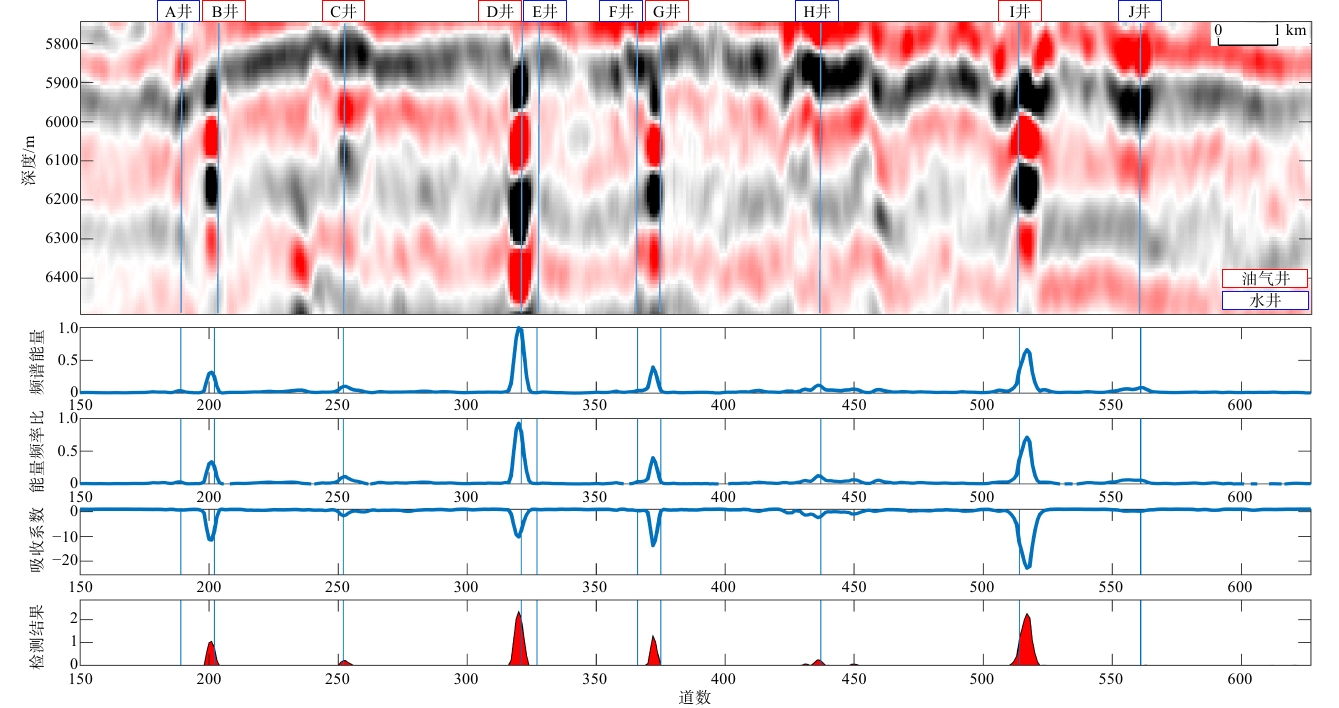
图 26 哈拉哈塘油田热普区块自适应MDI流体检测结果
Figure 26. Results of adaptive MDI fluid detection in the Repu Block of the Halahatang Oilfield
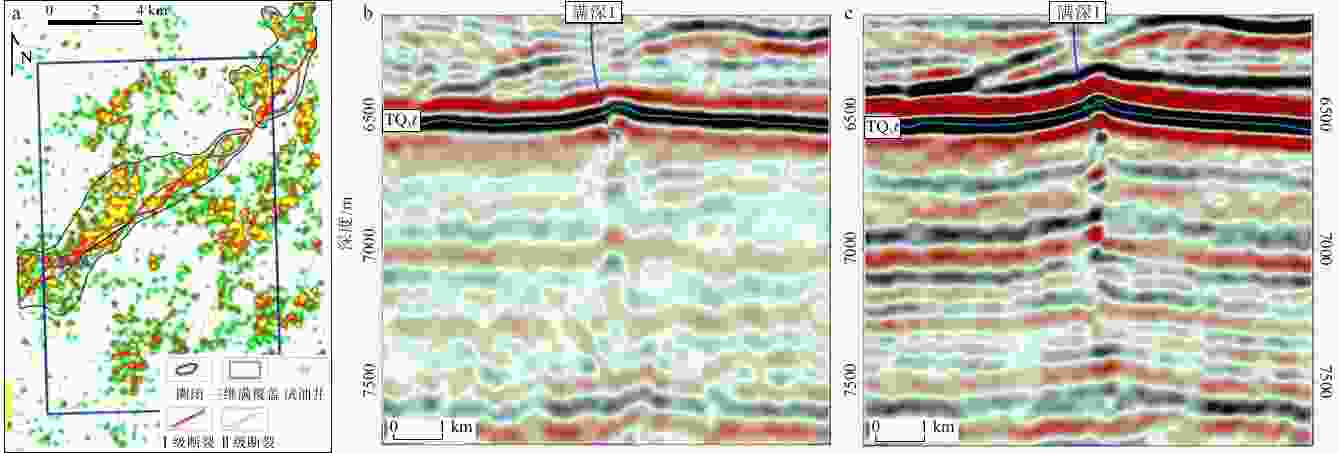
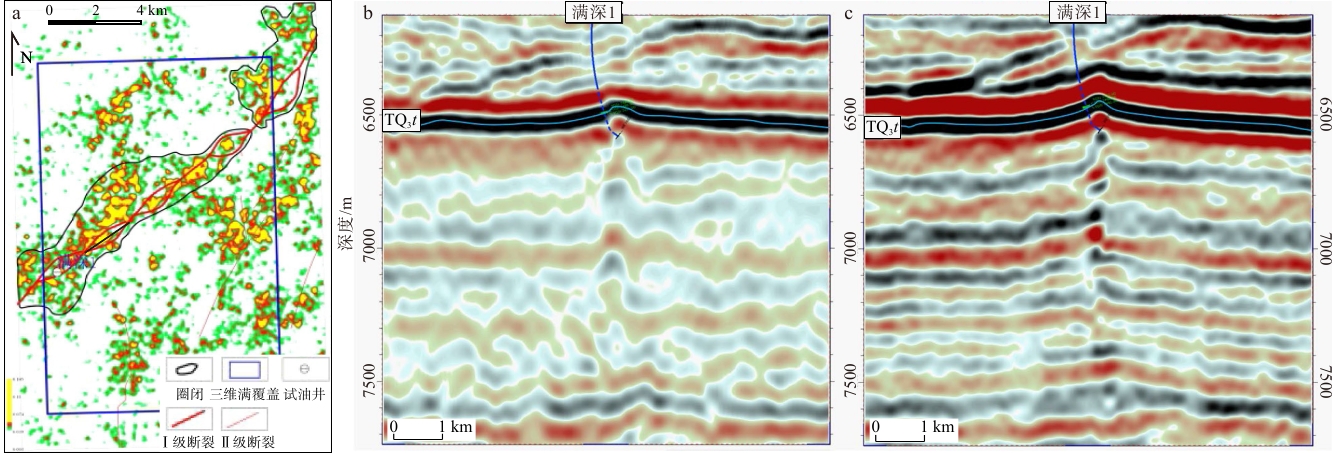
图 27 满深1三维区圈闭平面分布图与过井地震剖面
TO3t—奥陶系吐木休克组底部a—一间房组振幅变化率储层预测图;b—老地震资料过设计井地震剖面图;c—新地震资料过设计井地震剖面图
Figure 27. Plan view of the trap distribution in the Manshen 1 3D area
(a) Reservoir prediction map based on amplitude variation rate of the Yijianfang Formation; (b) Seismic profile through the well based on legacy seismic data; (c) Seismic profile through the well based on the newly acquired seismic dataTO3t represents the base of the Ordovician Tumuxiuke Formation.
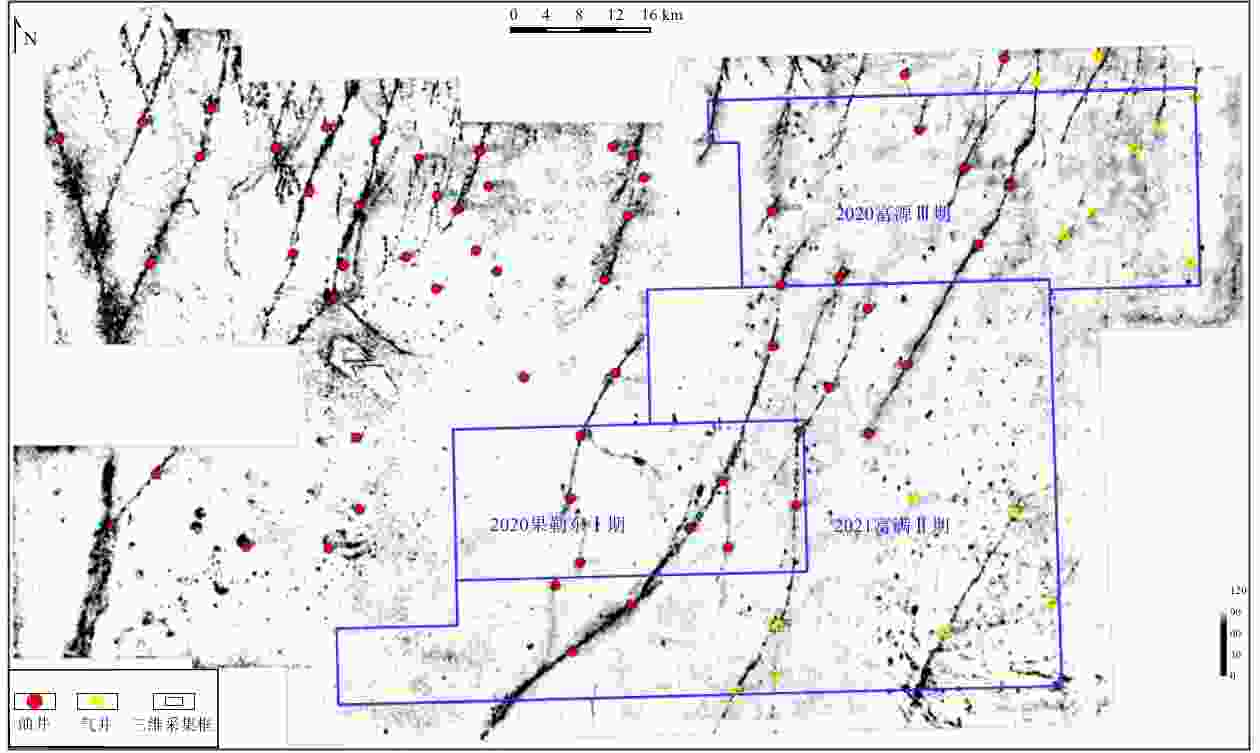
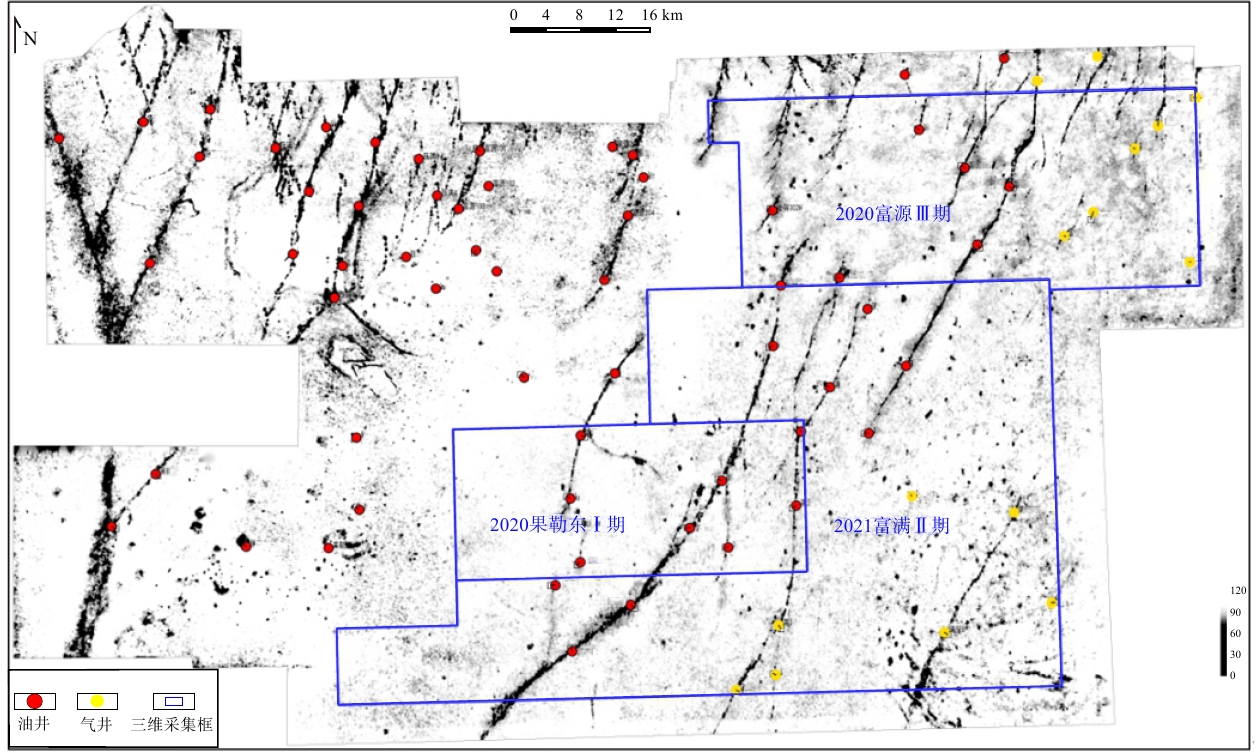
图 28 富满油田奥陶系一间房组顶面相干属性平面图
Figure 28. Map of the coherence attribute on the top of the Ordovician Yijianfang Formation in the Fuman Oilfield
-
[1] Arau´jo F V, Weglein A B, Carvalho P M, et al., 1994. Inverse scattering series for multiple attenuation: An example with surface and internal multiples[C]//SEG International Exposition and Annual Meeting. SEG, SEG-1994-1039. [2] BAO H G, 2025. A multiparameter fusion methodology of well depth design for seismic excitation in weakly elastic media[J]. Geophysical and Geochemical Exploration, 49(2): 330-339. (in Chinese with English abstract) [3] CHANG S Y, LI S Y, QIAO Z F, et al., 2019. Application of weak amplitude reservoir identification technology in karst reservoir of carbonate weathered crust: an example study of TZ62 well area in Tarim Basin[J]. Marine Origin Petroleum Geology, 24(3): 91-96. (in Chinese with English abstract) [4] CHEN J J, HE D F, HUANG H Y, 2023. Tectonic relief evolution and large-scale karstification of an Ordovician supergiant reservoir, North Tarim Uplift, northwestern China[J]. AAPG Bulletin, 107(3): 445-475. doi: 10.1306/11142219147 [5] CHEN S, LIANG X X, ZHANG Y T, et al., 2025. Development characteristics of Paleozoic strike-slip fault and its control on traps in Fuman Oilfiled, Tarim Basin[J]. Petroleum Science Bulletin, 10(1): 1-15. (in Chinese with English abstract) [6] CHEN S H, 2023. Integrated application of low-frequency geophones in deep formations of western China[J]. China Petroleum and Chemical Standard and Quality, 43(12): 84-86. (in Chinese) [7] DE MELO F X, WU Z J, 2024. Multi-dimensional inverse scattering series internal multiple model construction via orthogonal contribution summation[C]//4th international meeting for applied geoscience & energy. Houston: IMAGE: 1968-1972, doi: 10.1190/image2024-4094958.1. [8] DUAN W S, LI F, WANG Y C, et al., 2013. Offset vector tile for wide-azimuth seismic processing[J]. Oil Geophysical Prospecting, 48(2): 206-213. doi: 10.13810/j.cnki.issn.1000-7210.2013.02.016 [9] Fan Q, Fan T L, Li Y F, et al., 2020. Paleo-environments and development pattern of high-quality marine source rocks of the Early Cambrian, northern Tarim Platform[J]. Earth Science, 45(1): 285-302. (in Chinese with English abstract) [10] GONG F, SONG Y C, ZENG L B, et al., 2023. The heterogeneity of petrophysical and elastic properties in carbonate rocks controlled by strike-slip fault: a case study from Yangjikan outcrop in the Tarim Basin[J]. Journal of Petroleum Science and Engineering, 220: 111170. doi: 10.1016/j.petrol.2022.111170 [11] HAN J F, SU Z, CHEN L X, et al., 2019. Reservoir-controlling and accumulation-controlling of strike-slip faults and exploration potential in the platform of Tarim Basin[J]. Acta Petrolei Sinica, 40(11): 1296-1310. (in Chinese with English abstract) [12] HAN J F, WU G H, XIAO Z Y, et al., 2020. Recognition of the distribution of Cambrian source rocks and its significance for exploration in Tarim Basin[J]. Chinese Journal of Geology, 55(1): 17-29. (in Chinese with English abstract) [13] HAN J F, SUN C, ZHU G Y, et al., 2024. Spatial structure characterization technology and engineering practice of ultra-deep fault-controlled carbonate reservoir[J]. Strategic Study of CAE, 26(2): 255-268. (in Chinese with English abstract) [14] HOU S Y, DUAN P Z, HE Q Q, et al., 2023. Study on the favorable reservoir area of strike-slip fault zone of ultra-deep carbonate reservoir in Fuman oilfield[J]. Offshore Oil, 43(1): 10-15. (in Chinese with English abstract) [15] HU J, XU S Y, 2025. Intelligent characterization of ultra-deep carbonate strike-slip fault zones based on 3DResNeSt-UNet: a case study of the YueMan block in the Tarim Basin[J]. Journal of Petroleum Exploration and Production Technology, 15(1): 13. doi: 10.1007/s13202-025-01942-8 [16] JIA C Z, 1997. Structural characteristics and petroleum resources of the Tarim Basin, China[M]. Beijing: Petroleum Industry Press. (in Chinese) [17] KER S, LE GONIDEC Y, GIBERT D, 2013. Multiresolution seismic data fusion with a generalized wavelet-based method to derive subseabed acoustic properties[J]. Geophysical Journal International, 195(2): 1370-1383. doi: 10.1093/gji/ggt317 [18] LEI G L, DANG Q N, DUAN W S, et al., 2025. Progress in key seismic exploration technologies for ultra-deep complex reservoirs in the desert area of the Tarim Basin[J]. Natural Gas Industry, 45(7): 40-49. (in Chinese with English abstract) [19] LI X W, LI J Y, LI L, et al., 2021. Seismic wave field anomaly identification of ultra-deep heterogeneous fractured-vuggy reservoirs: a case study in Tarim Basin, China[J]. Applied Sciences, 11(24): 11802. doi: 10.3390/app112411802 [20] LI X W, LI J Y, LIU Y L, et al., 2022. Seismic identification method of ultra-deep strike-slip fault zones in Tarim Basin[J]. Oil Geophysical Prospecting, 57(6): 1418-1426, 1261, doi: 10.13810/j.cnki.issn.1000-7210.2022.06.017. (in Chinese with English abstract) [21] LI Y L, 2024. Ultra-deep oil and gas reservoir seismic prospecting technologies progress[J]. Oil Geophysical Prospecting, 59(4): 915-924. doi: 10.13810/j.cnki.issn.1000-7210.2024.04.028 [22] LI Y L, DUAN W S, LEI G L, et al., 2025. Novel strategies for complex foothills seismic imaging—Part 2: mega processing and imaging[J]. Interpretation, 13(4): T671-T684. doi: 10.1190/INT-2024-0094.1 [23] LI Y L, DUAN W S, LI D J, 2025. Beam seismic technique and its application[J]. Oil Geophysical Prospecting, 60(1): 253-272. (in Chinese with English abstract) doi: 10.13810/j.cnki.issn.1000-7210.20240153 [24] LIU B L, ZHAO Y G, ZHANG Y T, et al., 2025. Structural analysis and reservoir-controlling significance of No. 19 strike-slip fault in the eastern Aman transition zone, Tarim Basin[J]. Earth Science Frontiers, 32(4): 453-470. (in Chinese with English abstract) doi: 10.13745/j.esf.sf.2025.2.1 [25] LIU J W, WU G H, CHEN L X, et al., 2025. Deep transfer learning for seismic characterization of strike-slip faults in karstified carbonates from the northern Tarim Basin[J]. Scientific Reports, 15(1): 9242. doi: 10.1038/s41598-025-94134-7 [26] LIU Q, ZHANG Y T, CHEN S, et al., 2023. Development and evolution characteristics of strike-slip faults in Tarim basin and its geological significance: a case study of FI17 fault in Fuman oilfield[J]. Geoscience, 37(5): 1123-1135. doi: 10.19657/j.geoscience.1000-8527.2023.058 [27] LIU Y F, ZHANG C Z, YUAN X M, et al., 2025. Experimental study on rock mechanical properties of deep carbonate reservoirs in the Fuman area of Tarim Basin[J]. Journal of Experimental Mechanics, 40(4): 493-505. (in Chinese with English abstract) [28] MA X J, CAI P P, YANG W, 2022. Application of Q-compensation technology in ultra-deep carbonate oil and gas reservoirs[C]//Proceedings of the 2022 annual conference of china petroleum geophysical exploration (Vol. 1). Haikou: Society of Petroleum Geophysicists, Exploration Geophysics Committee of the Chinese Geophysical Society, doi: 10.26914/c.cnkihy.2022.040043. (in Chinese) [29] NENG Y, ZHANG Y T, XIE Z, et al., 2025. Deformation characteristics and physical simulation of multi-stage activities of FⅠ19 strike-slip fault zone in Fuman oilfield, Tarim basin[J]. Geoscience, 39(6): 1555-1570. doi: 10.19657/j.geoscience.1000-8527.2025.049 [30] SANDOVAL R, PAREDES J L, VIVAS F A, 2019. Quality factor estimation based on the peak frequency shift method using a robust Fourier transform to VSP data[J]. Journal of Geophysics and Engineering, 16(6): 1061-1070. doi: 10.1093/jge/gxz066 [31] SONG J G, LI Z, WANG G Y, et al., 2023. Weak seismic signal enhancement using curvelet transform and compressive sampling[J]. IEEE Transactions on Geoscience and Remote Sensing, 61: 5907011. doi: 10.1109/tgrs.2023.3253930 [32] SU J, WANG X M, YANG H J, et al., 2021. Hydrothermal alteration and hydrocarbon accumulations in ultra-deep carbonate reservoirs along a strike-slip fault system, Tarim Basin, NW China[J]. Journal of Petroleum Science and Engineering, 203: 108605. doi: 10.1016/j.petrol.2021.108605 [33] SU Y F, SONG J G, LI Z, et al., 2025. Weak signal enhancement in 3-D seismic data via sparse perturbation-guided curvelet accumulation[J]. IEEE Geoscience and Remote Sensing Letters, 22: 7510205. doi: 10.1109/lgrs.2025.3627902 [34] SUN C, SHEN F X, WEN Z, et al., 2023. Seismic analysis of fault damage zones in the northern Tarim Basin (NW China): implications for growth of ultra-deep fractured reservoirs[J]. Journal of Asian Earth Sciences, 255: 105778. doi: 10.1016/j.jseaes.2023.105778 [35] SUN C, LEI G L, ZHANG Y T, et al., 2024. Intelligent identification of strike-slip faults based on deep residual network: a case study in Fuman Oilfield, Tarim Basin[J]. Geophysical Prospecting for Petroleum, 63(1): 129-137. (in Chinese with English abstract) [36] TANG H Q, HUANG J P, MAO Q, et al., 2025. Stable Q-compensated viscoelastic reverse-time migration based on the modified fractional Laplacian wave equations[J]. Geophysical Prospecting, 73(5): 1431-1455. doi: 10.1111/1365-2478.70012 [37] TIAN F, ZHENG W H, ZHAO A S, et al., 2024. Seismic identification and characterization of deep strike-slip faults in the Tarim Craton Basin[J]. Applied Sciences, 14(18): 8235. doi: 10.3390/app14188235 [38] TIAN J, WANG Q H, YANG H J, et al., 2021a. Petroleum exploration history and enlightenment in Tarim basin[J]. Xinjiang Petroleum Geology, 42(3): 272-282. (in Chinese with English abstract) [39] TIAN J, YANG H J, ZHU Y F, et al., 2021b. Geological conditions for hydrocarbon accumulation and key technologies for exploration and development in Fuman oilfield, Tarim Basin[J]. Acta Petrolei Sinica, 42(8): 971-985. (in Chinese with English abstract) [40] WANG Q H, ZHANG Y T, XIE Z, et al., 2022. The advancement and challenges of seismic techniques for ultra-deep carbonate reservoir exploitation in the Tarim Basin of northwestern China[J]. Energies, 15(20): 7653. doi: 10.3390/en15207653 [41] WANG Q H, 2023a. Differential deformation and evolution characteristics of the No. 17 strike-slip fault zone in the Tarim basin[J]. Geoscience, 37(5): 1136-1145. doi: 10.19657/j.geoscience.1000-8527.2022.090 [42] WANG Q H, 2023b. Origin of gas condensate reservoir in Fuman Oilfield, Tarim Basin, NW China[J]. Petroleum Exploration and Development, 50(6): 1128-1139. (in Chinese with English abstract) doi: 10.1016/s1876-3804(24)60467-2 [43] WANG Q H, CAI Z Z, ZHANG Y T, et al., 2024. Research progress and trend of ultra-deep strike-slip fault-controlled hydrocarbon reservoirs in Tarim Basin[J]. Xinjiang Petroleum Geology, 45(4): 379-386. (in Chinese with English abstract) [44] WEI L, DI B R, WEI J X, 2024. Analysis of seismic response characteristics of fractured carbonate reservoirs based on physical model (Tarim Basin)[J]. Applied Sciences, 14(9): 3775. doi: 10.3390/app14093775 [45] WU J Z, HAN S B, SHI Y, et al., 2024. A method for velocity modeling in a volcanic rock zone that integrates the amplitude envelope attribute and grid tomography: application to data from the north Jiangsu basin[J]. Journal of Geophysics and Engineering, 21(6): 1585-1593. doi: 10.1093/jge/gxae095 [46] YAN T, SUN C, ZHANG Y T, et al., 2024. Classification prediction and description of weak strike slip fault controlled reservoirs[J]. Computing Techniques for Geophysical and Geochemical Exploration, 46(5): 517-526. (in Chinese with English abstract) [47] YANG H J, ZHANG Y T, GUAN B Z, et al., 2023. Exploration and development of the Ordovician carbonate oil field in Halahatang, Tarim Basin[J]. Marine Origin Petroleum Geology, 28(2): 113-122. (in Chinese with English abstract) [48] YAO Y T, ZENG L B, DONG S Q, et al., 2024. Using seismic methods to detect connectivity of fracture networks controlled by strike-slip faults in ultra-deep carbonate reservoirs: a case study in northern Tarim Basin, China[J]. Journal of Structural Geology, 180: 105060. doi: 10.1016/j.jsg.2024.105060 [49] YAO Y T, ZENG L B, MAO Z, et al., 2025. Strike-slip fault architecture and its control on fractured carbonate reservoirs: insight from outcrops in the north-western Tarim Basin, NW China[J]. Acta Geologica Sinica-English Edition, 99(2): 568-581. doi: 10.1111/1755-6724.15285 [50] YUE H, SUN S Z, HAN J, et al., 2014. A 3D amplitude-preserved Q migration on resolution enhancement and true-amplitude recovery for deep carbonate reservoir[C]//76th EAGE conference and exhibition 2014. Houten: European Association of Geoscientists & Engineers: 1-5, doi: 10.3997/2214-4609.20141606. [51] ZENG S, QIU N S, LI H, et al., 2023. Generation and distribution of overpressure in ultra-deep carbonate reservoirs controlled by intra-cratonic strike-slip faults: the Ordovician of the Shuntuoguole area in Tarim Basin[J]. Marine and Petroleum Geology, 158: 106515. doi: 10.1016/j.marpetgeo.2023.106515 [52] ZHANG Y T, SUN C, WANG X, et al., 2020. Reservoir formation patterns in the strike-slip fault zone of the Halahatang oilfield[J]. Journal of Southwest Petroleum University (Science & Technology Edition), 42(1): 10-18. (in Chinese with English abstract) [53] ZHANG Y T, YU Y X, XIE Z, et al., 2024. Identification of strike-slip faults and exploration breakthroughs in the Fuman area, Tarim basin[J]. Geoscience, 38(6): 1417-1430. doi: 10.19657/j.geoscience.1000-8527.2024.065 [54] ZHANG Z, LI Z C, LI Z N, et al., 2025. Inverse scattering series method for interbed multiple suppression in curvelet domain[J]. Oil Geophysical Prospecting, 60(5): 1124-1133. doi: 10.13810/j.cnki.issn.1000-7210.20240292 [55] ZHAO R R, ZHOU Q, PENG G X, et al., 2023. Application of high-precision seismic processing technology for ultra-deep carbonate reservoir in the great desert area, Tarim basin, NW China[J]. Computing Techniques for Geophysical and Geochemical Exploration, 45(6): 717-725. (in Chinese with English abstract) [56] 包洪刚, 2025. 基于多参数融合的弱弹性介质激发井深设计方法[J]. 物探与化探, 49(2): 330-339. [57] 常少英, 李世银, 乔占峰, 等, 2019. 碳酸盐岩风化壳岩溶地震弱振幅储层识别技术的应用: 以塔里木盆地TZ62井区为例[J]. 海相油气地质, 24(3): 91-96. [58] 陈胜红, 2023. 低频检波器在西部深层的组合应用[J]. 中国石油和化工标准与质量, 43(12): 84-86. [59] 陈石, 梁鑫鑫, 张银涛, 等, 2025. 塔里木盆地富满油田古生界走滑断裂发育特征及控圈模式[J]. 石油科学通报, 10(1): 1-15. [60] 段文胜, 李飞, 王彦春, 等, 2013. 面向宽方位地震处理的炮检距向量片技术[J]. 石油地球物理勘探, 48(2): 206-213. doi: 10.13810/j.cnki.issn.1000-7210.2013.02.016 [61] 樊奇, 樊太亮, 李一凡, 等, 2020. 塔里木地台北缘早寒武世古海洋氧化-还原环境与优质海相烃源岩发育模式[J]. 地球科学, 45(1): 285-302. [62] 韩剑发, 苏洲, 陈利新, 等, 2019. 塔里木盆地台盆区走滑断裂控储控藏作用及勘探潜力[J]. 石油学报, 40(11): 1296-1310. [63] 韩剑发, 邬光辉, 肖中尧, 等, 2020. 塔里木盆地寒武系烃源岩分布的重新认识及其意义[J]. 地质科学, 55(1): 17-29. doi: 10.12017/dzkx.2020.002 [64] 韩剑发, 孙冲, 朱光有, 等, 2024. 超深断控碳酸盐岩油藏空间结构表征技术与工程实践[J]. 中国工程科学, 26(2): 255-268. doi: 10.15302/J-SSCAE-2024.07.006 [65] 侯少勇, 段霈泽, 赫庆庆, 等, 2023. 富满油田超深碳酸盐岩油气藏走滑断裂带有利储层发育区研究[J]. 海洋石油, 43(1): 10-15. doi: 10.3969/j.issn.1008-2336.2023.01.010 [66] 贾承造, 1997. 中国塔里木盆地构造特征与油气[M]. 北京: 石油工业出版社. [67] 雷刚林, 党青宁, 段文胜, 等, 2025. 塔里木盆地沙漠区域超深层复杂油气藏地震勘探关键技术进展[J]. 天然气工业, 45(7): 40-49. doi: 10.3787/j.issn.1000-0976.2025.07.004 [68] 李相文, 李景叶, 刘永雷, 等, 2022. 塔里木盆地超深层走滑断裂带的地震识别方法[J]. 石油地球物理勘探, 57(6): 1418-1426, 1261. doi: 10.13810/j.cnki.issn.1000-7210.2022.06.017 [69] 李亚林, 2024. 超深层油气地震勘探技术进展[J]. 石油地球物理勘探, 59(4): 915-924. doi: 10.13810/j.cnki.issn.1000-7210.2024.04.028 [70] 李亚林, 段文胜, 李大军, 2025. 线束地震技术与应用[J]. 石油地球物理勘探, 60(1): 253-272. doi: 10.13810/j.cnki.issn.1000-7210.20240153 [71] 刘冰雷, 赵永刚, 张银涛, 等, 2025. 塔里木盆地阿满过渡带东部19号走滑断裂构造解析及控储意义[J]. 地学前缘, 32(4): 453-470. doi: 10.13745/j.esf.sf.2025.2.1 [72] 刘强, 张银涛, 陈石, 等, 2023. 塔里木盆地走滑断裂发育演化特征精细解析及其地质意义: 以富满油田FⅠ17断裂为例[J]. 现代地质, 37(5): 1123-1135. doi: 10.19657/j.geoscience.1000-8527.2023.058 [73] 刘永福, 张承泽, 袁晓满, 等, 2025. 塔里木盆地富满地区深层碳酸盐岩储层岩石力学特性实验研究[J]. 实验力学, 40(4): 493-505. doi: 10.7520/1001-4888-24-122 [74] 马学军, 蔡盼盼, 杨威, 2022. Q补偿技术在超深层碳酸盐岩油气藏的应用[C]//2022年中国石油物探学术年会论文集(上册). 海口: 中国石油学会石油物探专业委员会, 中国地球物理学会勘探地球物理委员会, doi: 10.26914/c.cnkihy.2022.040043. [75] 能源, 张银涛, 谢舟, 等, 2025. 塔里木盆地富满油田FⅠ19走滑断裂带变形特征及多期活动物理模拟研究[J]. 现代地质, 39(6): 1555-1570. doi: 10.19657/j.geoscience.1000-8527.2025.049 [76] 孙冲, 雷刚林, 张银涛, 等, 2024. 基于深度残差网络的走滑断层智能识别方法: 以塔里木盆地富满油田为例[J]. 石油物探, 63(1): 129-137. doi: 10.12431/issn.1000-1441.2024.63.01.011 [77] 田军, 王清华, 杨海军, 等, 2021a. 塔里木盆地油气勘探历程与启示[J]. 新疆石油地质, 42(3): 272-282. doi: 10.7657/XJPG20210303 [78] 田军, 杨海军, 朱永峰, 等, 2021b. 塔里木盆地富满油田成藏地质条件及勘探开发关键技术[J]. 石油学报, 42(8): 971-985. doi: 10.7623/syxb202108001 [79] 王清华, 2023a. 塔里木盆地17号走滑断裂带北段差异变形与演化特征[J]. 现代地质, 37(5): 1136-1145. doi: 10.19657/j.geoscience.1000-8527.2022.090 [80] 王清华, 2023b. 塔里木盆地富满油田凝析气藏成因[J]. 石油勘探与开发, 50(6): 1128-1139. doi: 10.11698/PED.20230301 [81] 王清华, 蔡振忠, 张银涛, 等, 2024. 塔里木盆地超深层走滑断控油气藏研究进展与趋势[J]. 新疆石油地质, 45(4): 379-386. doi: 10.7657/XJPG20240401 [82] 闫婷, 孙冲, 张银涛, 等, 2024. 弱走滑断控储集体分类预测与描述[J]. 物探化探计算技术, 46(5): 517-526. doi: 10.3969/j.issn.1001-1749.2024.05.03 [83] 杨海军, 张银涛, 关宝珠, 等, 2023. 塔里木盆地哈拉哈塘奥陶系缝洞型碳酸盐岩油田的勘探发现与评价探明[J]. 海相油气地质, 28(2): 113-122. doi: 10.3969/j.issn.1672-9854.2023.02.001 [84] 张银涛, 孙冲, 王轩, 等, 2020. 哈拉哈塘油田走滑断裂带控储成藏规律初探[J]. 西南石油大学学报(自然科学版), 42(1): 10-18. doi: 10.11885/j.issn.1674-5086.2018.08.20.02 [85] 张银涛, 余一欣, 谢舟, 等, 2024. 塔里木盆地富满地区走滑断裂带精细刻画及勘探应用成效[J]. 现代地质, 38(6): 1417-1430. doi: 10.19657/j.geoscience.1000-8527.2024.065 [86] 张政, 李振春, 李志娜, 等, 2025. 曲波域逆散射级数层间多次波压制方法[J]. 石油地球物理勘探, 60(5): 1124-1133. doi: 10.13810/j.cnki.issn.1000-7210.20240292 [87] 赵锐锐, 周强, 彭更新, 等, 2023. 塔里木盆地沙漠区超深层碳酸盐岩地震资料精细处理技术[J]. 物探化探计算技术, 45(6): 717-725. doi: 10.3969/j.issn.1001-1749.2023.06.04 -

 下载:





计量
- 文章访问数: 58
- HTML全文浏览量: 6
- PDF下载量: 2
- 被引次数: 0
