


Research and application of a prospecting model for sedimentary manganese deposits in the Xialei–Longbang area, southwestern Guangxi
-
摘要: 桂西南下雷−龙邦地区是中国重要的锰矿矿集区,目前面临沉积型锰矿赋存规律重构不清、有效勘查技术方法缺乏等难题。文章在分析成矿地质背景的基础上,对比研究了该矿集区典型矿床的地质特征、含锰岩系地球化学特征及多极化大地电磁测深法(MPMT)勘探试验结果。结果表明,研究区可划分为下雷−上映、龙邦−地州2个次级成锰盆地,其中下雷−上映成锰盆地发育钙质硅质岩、钙质硅质岩−硅质灰岩、硅质灰岩−泥质条带灰岩3种沉积微相,龙邦−地州成锰盆地仅发育硅质灰岩−泥质条带灰岩1种沉积微相;就成矿有利性而言,钙质硅质岩型最佳,钙质硅质岩−硅质灰岩型次之,硅质灰岩−泥质条带灰岩型最差。锰质富集中心分布于下雷−灵马同沉积断层西北侧约500~1000 m范围内;不同矿区(段)碳酸锰矿层厚度及Mn品位变化较大,以下雷矿区为中心向外,锰矿层呈现厚度减薄、Mn品位降低的趋势,且Ⅱ+Ⅲ矿层与Ⅰ矿层的厚度、品位总体具有正相关性。成矿流体主要为海底热液,成矿沉积环境为弱氧化—氧化环境。含锰岩系相对上、下围岩表现为低电阻率−高磁化率组合特征。通过上述研究,建立了桂西南下雷−龙邦地区泥盆系碳酸锰矿综合找矿模型,指出MPMT法和钻探工程组合方法在桂西南地区具有良好适用性,对沉积型锰矿的攻深找盲具有重要指导意义。Abstract:
Objective The Xialei–Longbang area in southwestern Guangxi hosts a critical manganese ore concentration district in China. Current exploration is hindered by an incomplete understanding of the occurrence patterns of sedimentary manganese deposits and a lack of a sound basis for selecting effective exploration methods. Methods Based on an analysis of the metallogenic geological settings, this study compares the geological characteristics of typical deposits and the geochemical characteristics of manganese-bearing rock series, and evaluates the results of exploration tests using the multi-polarization magnetotelluric (MPMT) method in the ore concentration district. Results The study area can be divided into two secondary manganese-forming basins, namely the Xialei–Shangying Basin and the Longbang–Dizhou Basin. Three sedimentary microfacies types are identified in the Xialei–Shangying manganese-forming basin: calcareous siliceous rock, calcareous siliceous rock–siliceous limestone, and siliceous limestone–argillaceous banded limestone. Only the siliceous limestone–argillaceous banded limestone microfacies occurs in the Longbang–Dizhou manganese-forming basin. Among these microfacies, the calcareous siliceous rock microfacies is the most favorable for mineralization, followed by the calcareous siliceous rock–siliceous limestone microfacies, whereas the siliceous limestone–argillaceous banded limestone microfacies is the least favorable. Centers of manganese enrichment are distributed within a zone approximately 500–1000 m northwest of the Xialei–Lingma synsedimentary fault. The thickness and Mn grades of rhodochrosite ore beds vary considerably among different mining areas (segments). Outward from the Xialei Mining Area, the manganese ore beds gradually thin and their Mn grades decrease. Moreover, the thickness and Mn grade of ore beds II+III generally show positive correlations with those of ore bed I. The ore-forming fluids were dominated by submarine hydrothermal fluids, and the sedimentary metallogenic environment was weakly oxidizing to oxidizing. Compared with the overlying and underlying wall rocks, the manganese-bearing rock series are characterized by a combination of low resistivity and high magnetic susceptibility. Conclusions Based on these results, a comprehensive prospecting model for Devonian rhodochrosite deposits was established and validated through exploration tests in the Xialei–Longbang area. The model captures the key ore-controlling factors and prospecting criteria of sedimentary manganese deposits in the region. Significance The combination of MPMT and drilling is applicable to sedimentary manganese exploration in southwestern Guangxi and provides important guidance for deep and concealed ore prospecting. -
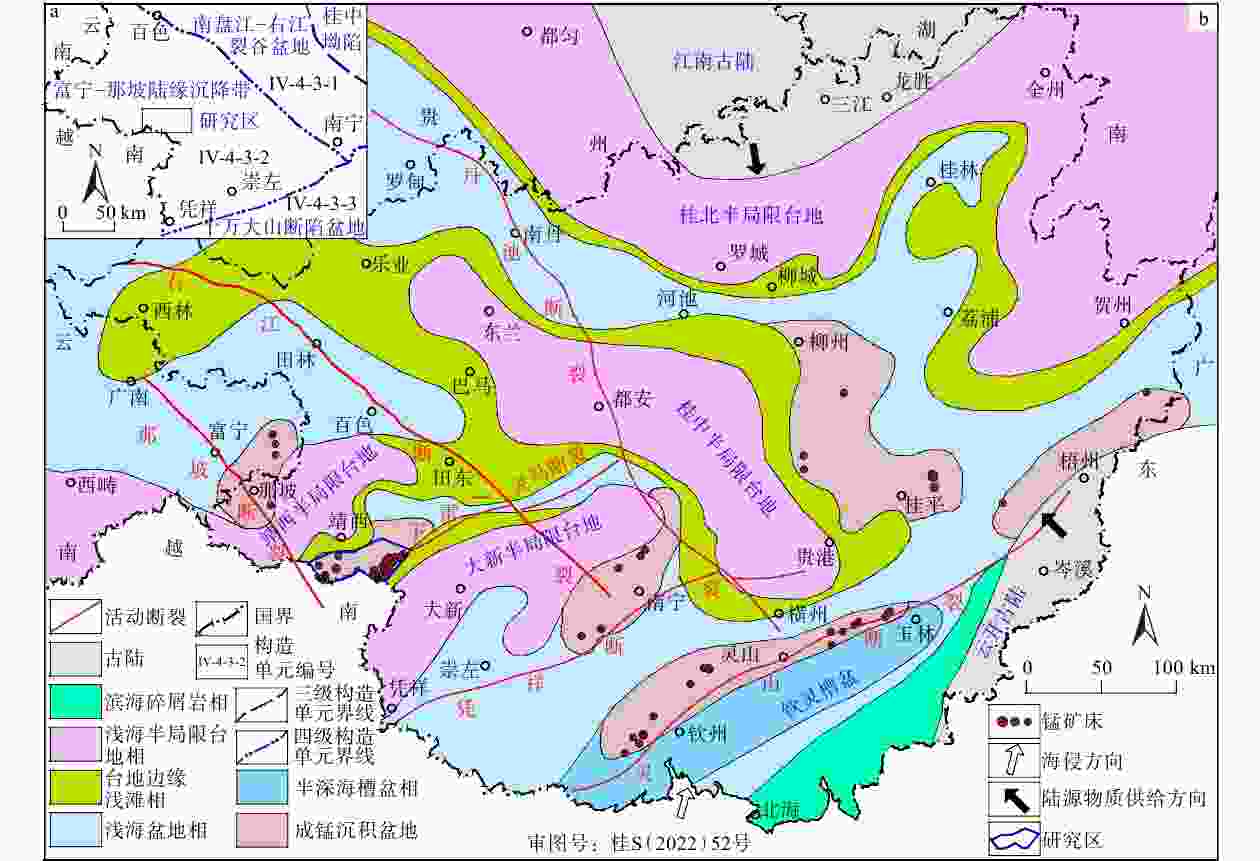
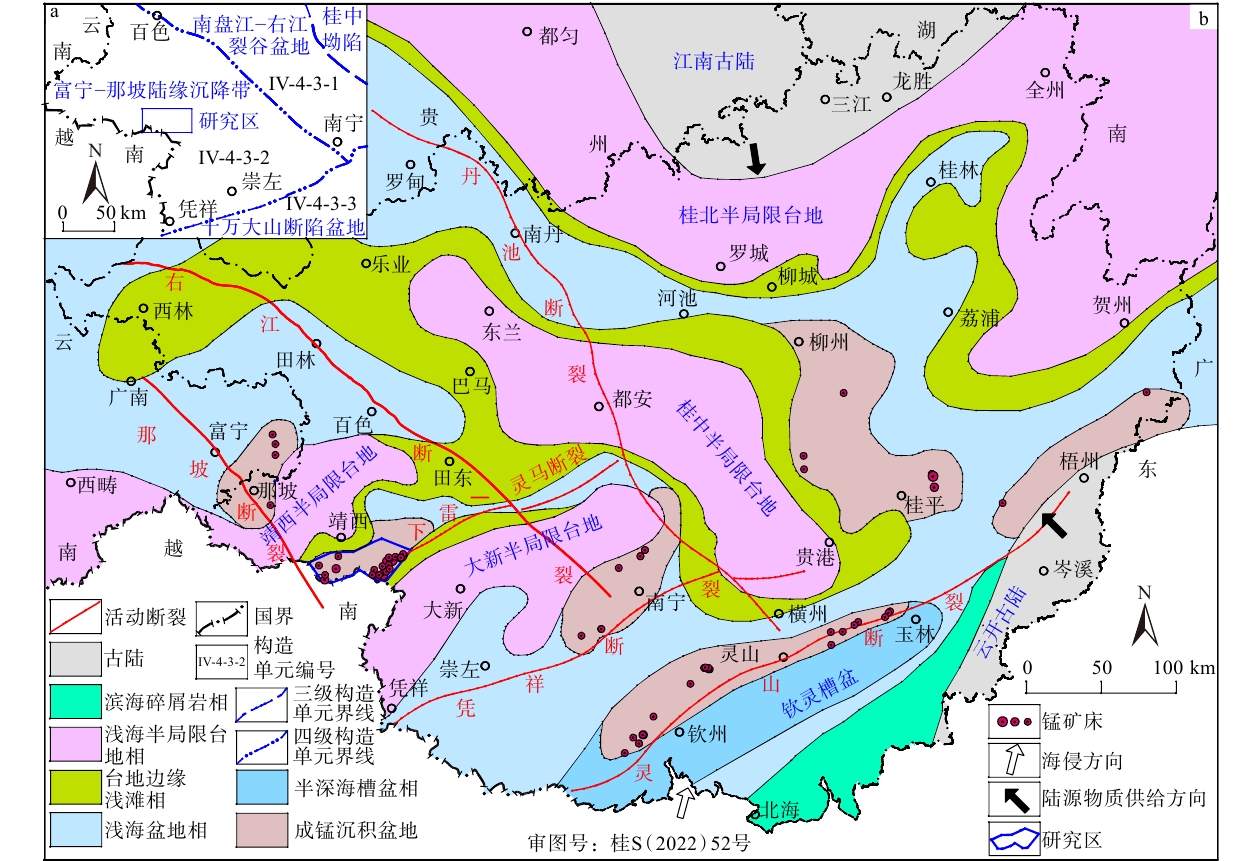
图 1 桂西南晚泥盆世成锰沉积盆地构造−岩相古地理图(据茹廷锵等,1992;侯宗林等,1997修改)
a—研究区大地构造位置图;b—研究区晚泥盆世构造−岩相古地理图
Figure 1. Tectonic–lithofacies paleogeographic map of the Late Devonian manganese-forming sedimentary basin in southwestern Guangxi (modified from Ru et al., 1992; Hou et al., 1997)
(a) Tectonic location map of the study area; (b) Tectonic–lithofacies paleogeographic map of the study area
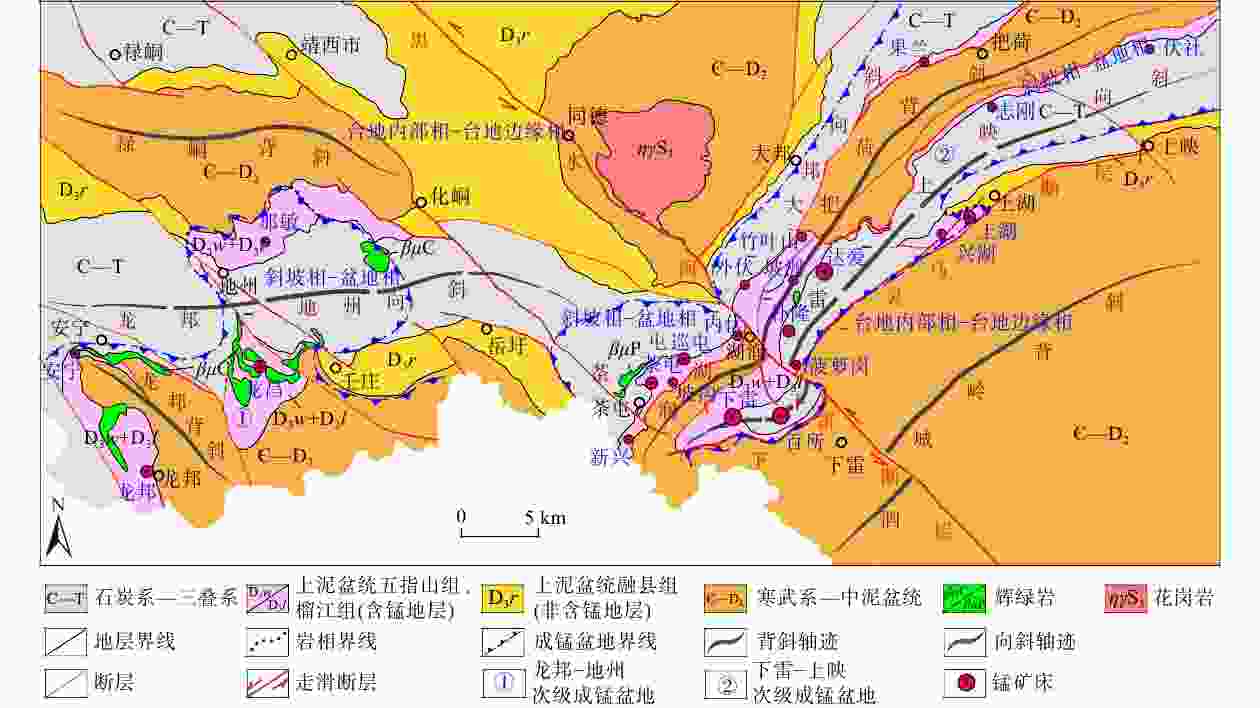
图 2 桂西南下雷−龙邦地区地质矿产图
Figure 2. Geological and mineral resources map of the Xialei–Longbang area, southwestern Guangxi
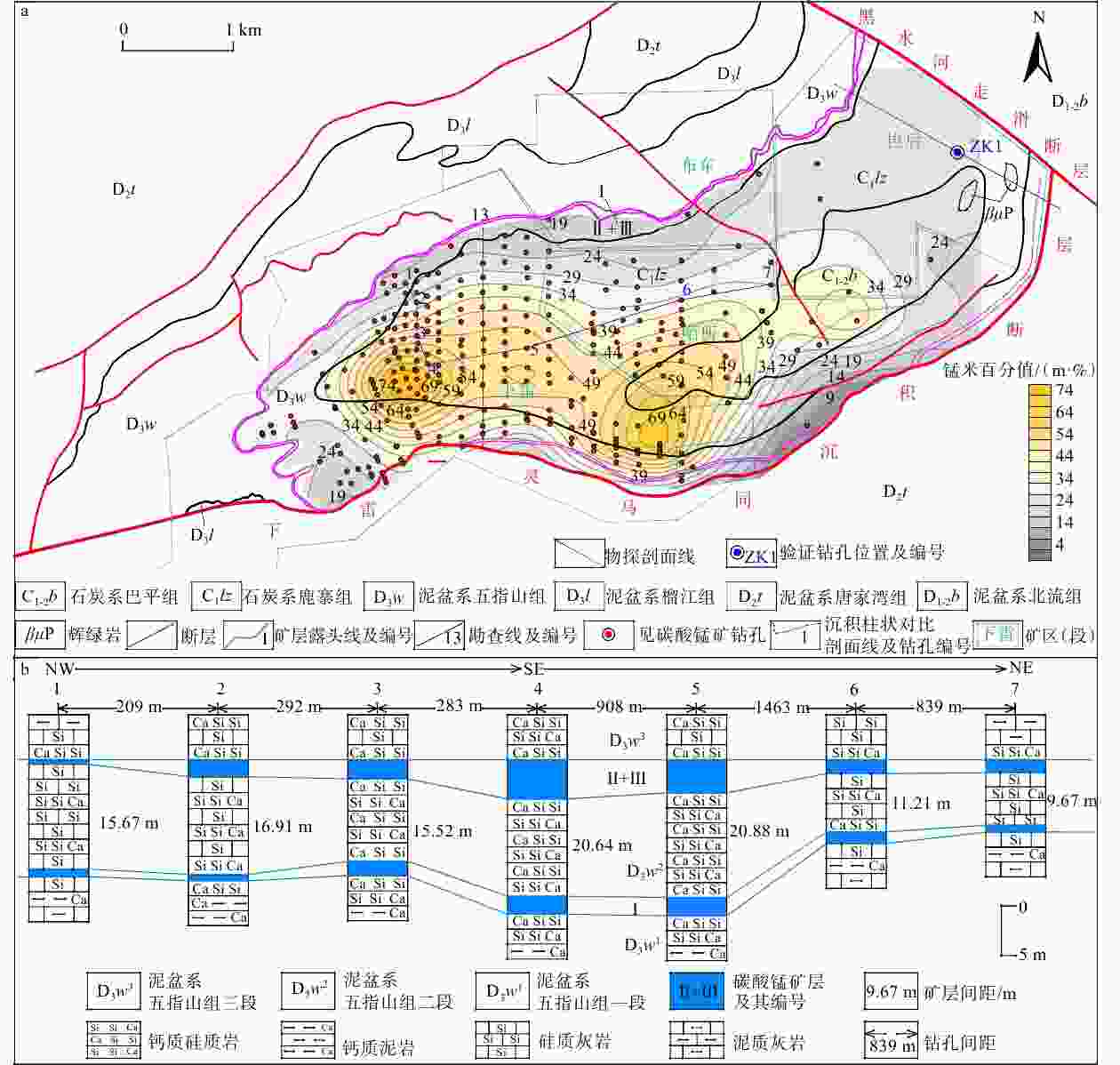
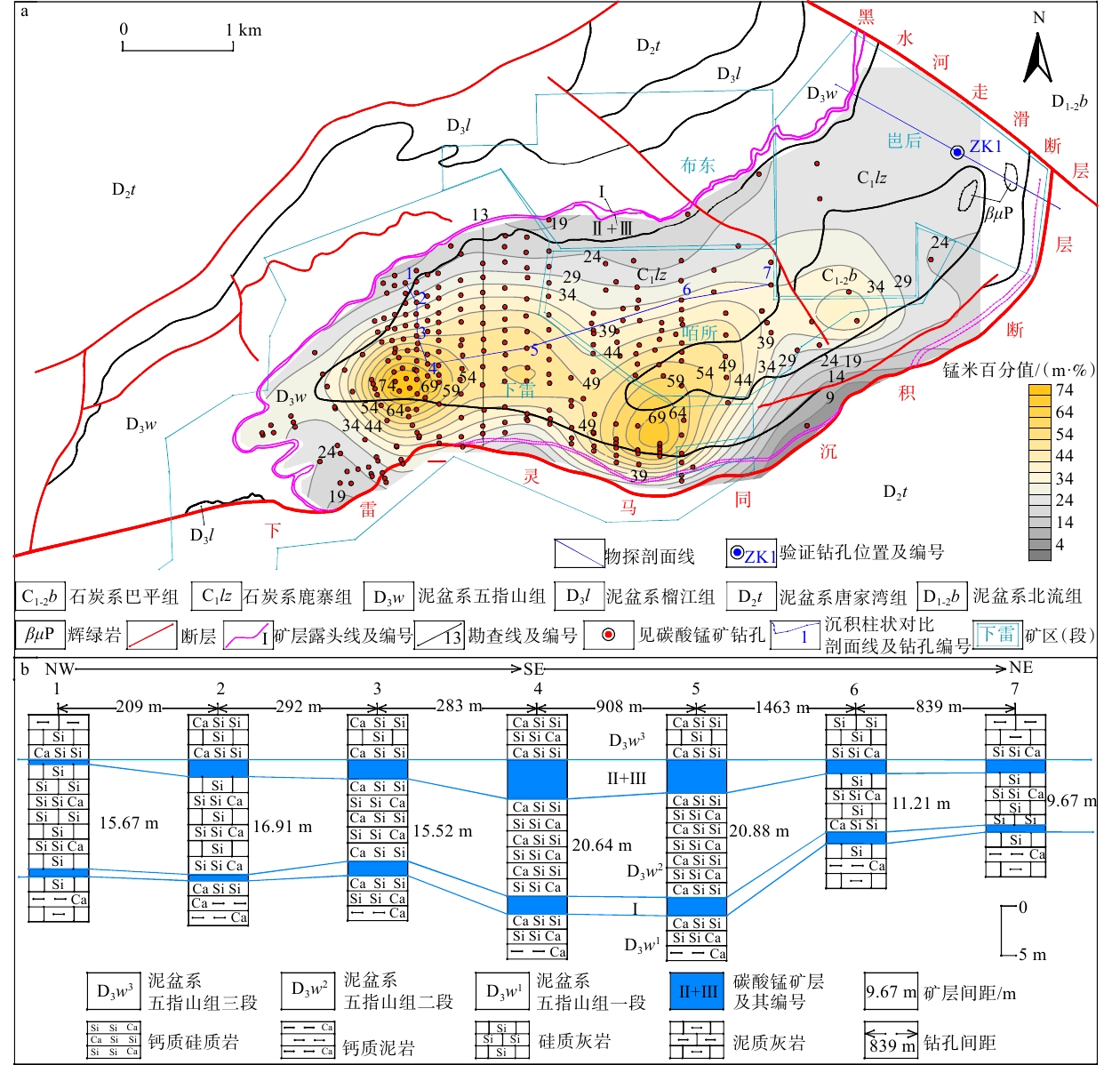
图 3 下雷矿区地质简图
a—下雷矿区Ⅱ+Ⅲ碳酸锰矿层锰米百分值等值线图;b—下雷矿区含锰岩系沉积柱状对比图
Figure 3. Geological sketch map of the Xialei mining area
(a) Contour map of manganese percentage-meter value of the Ⅱ+Ⅲ manganese carbonate ore beds in the Xialei mining area; (b) Stratigraphic correlation diagram of the manganese-bearing sequence in the Xialei mining area
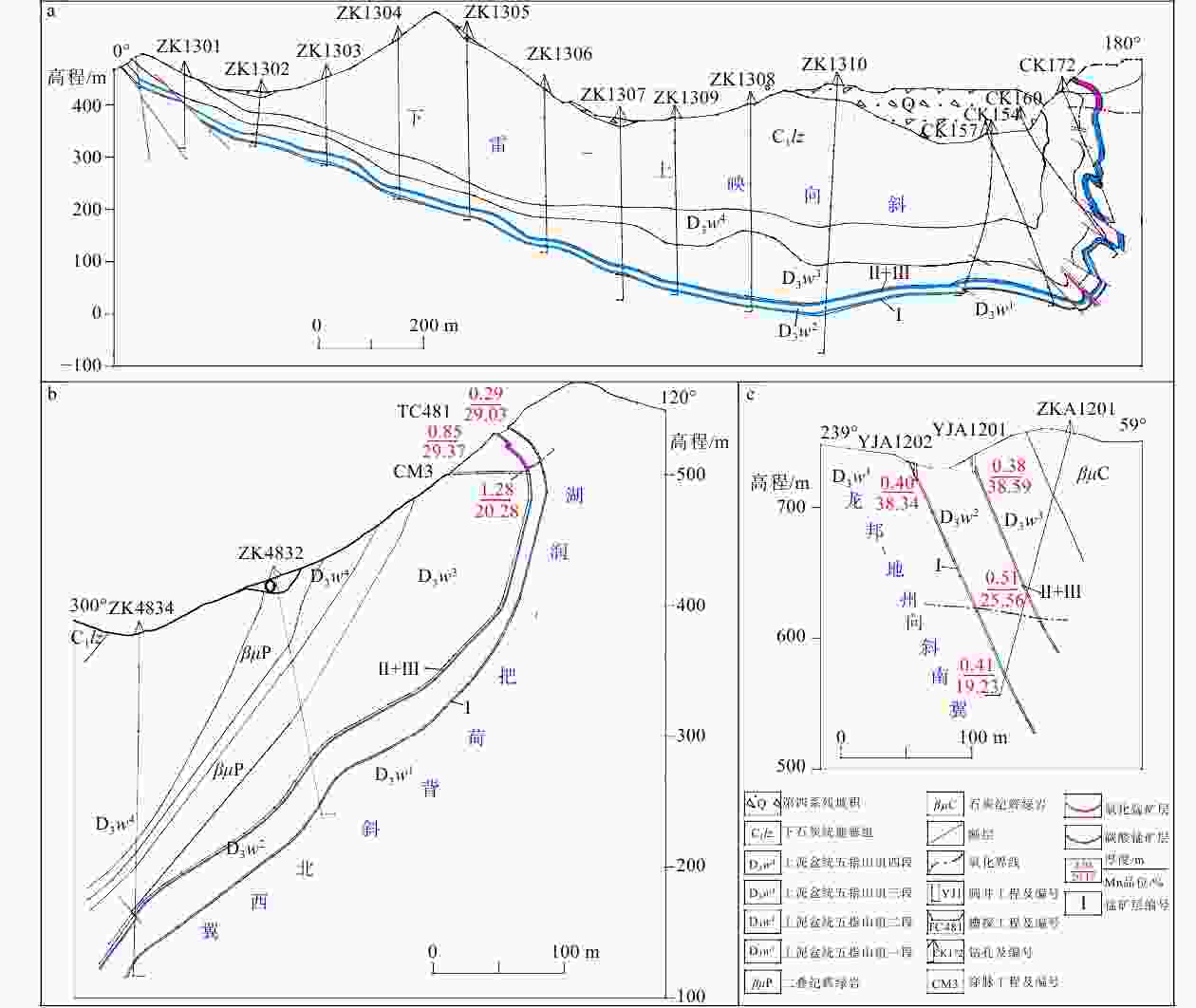
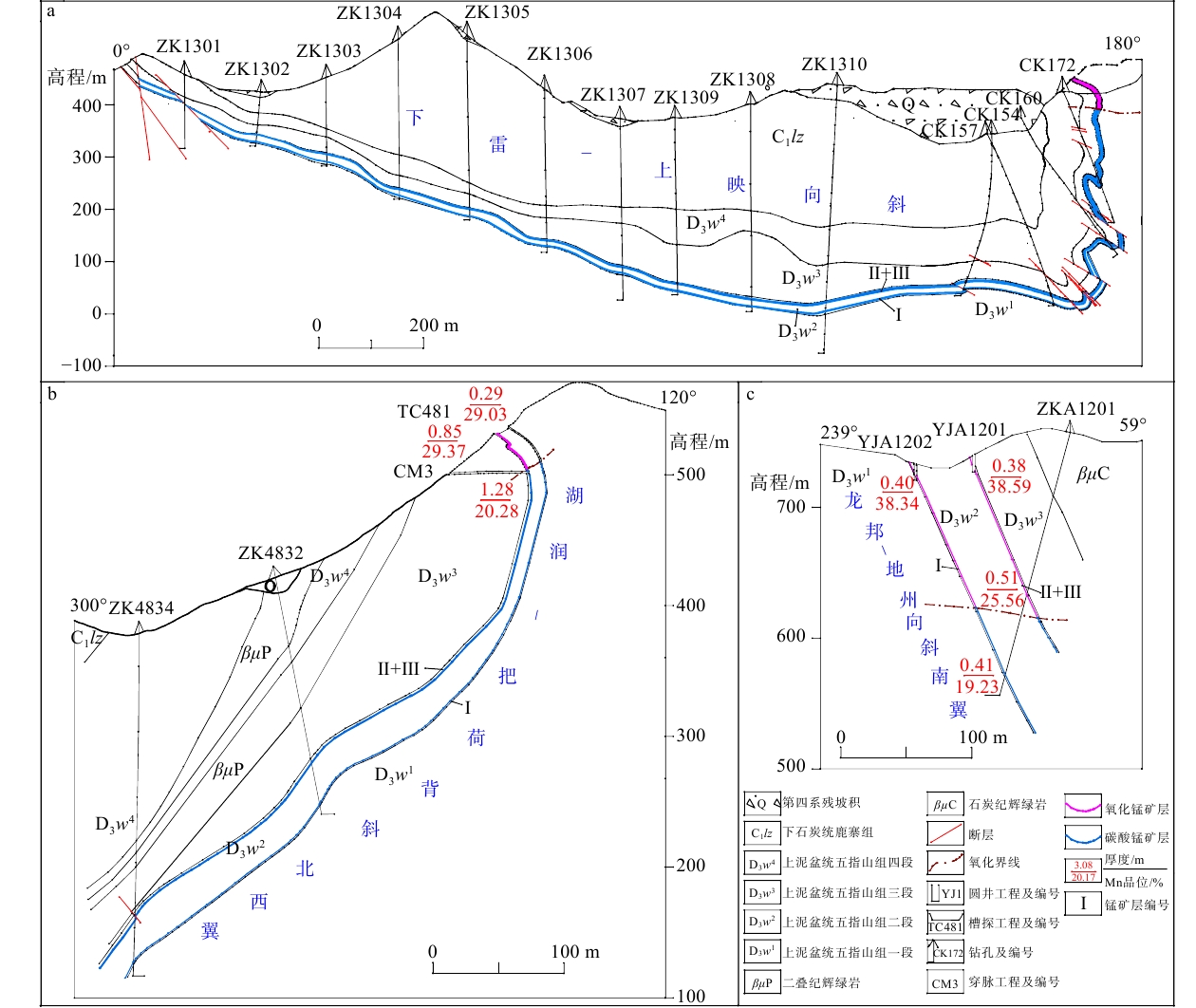
图 4 研究区锰矿层剖面形态对比图
a—下雷矿区13号勘查线地质剖面图;b—湖润矿区内伏矿段48号勘查线地质剖面图;c—龙昌矿区12号勘查线地质剖面图
Figure 4. Comparison of manganese ore-bed geometries in the study area
(a) Geological cross-section along exploration line No.13, Xialei mining area; (b) Geological cross-section along exploration line No.48, Neifu ore block, Hurun mining area; (c) Geological cross-section along exploration line No.12, Longchang mining area
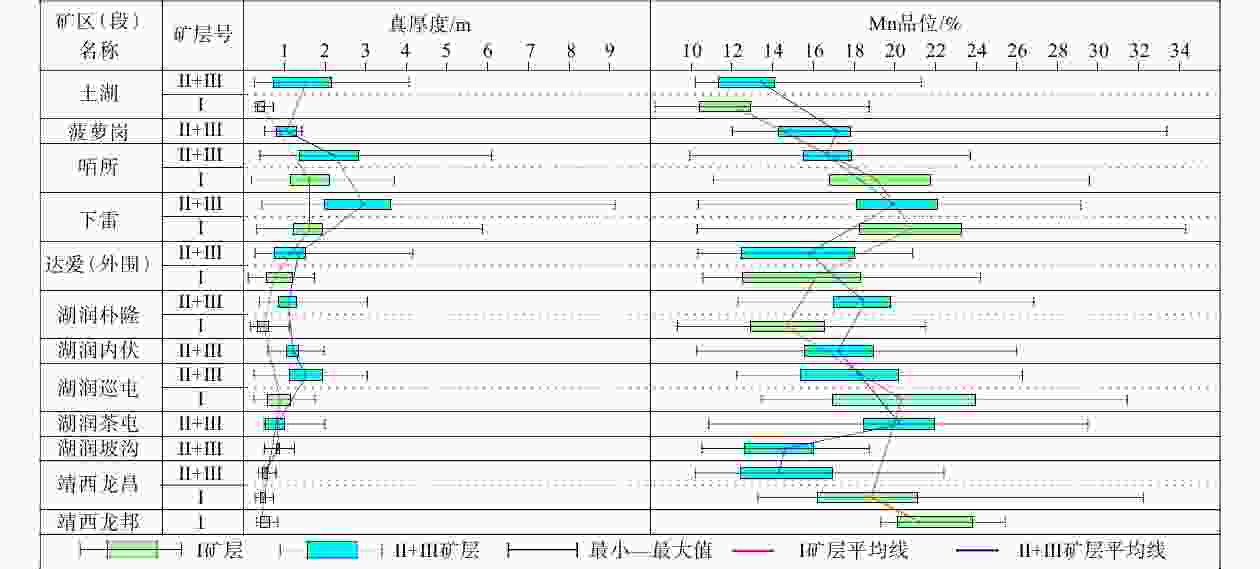
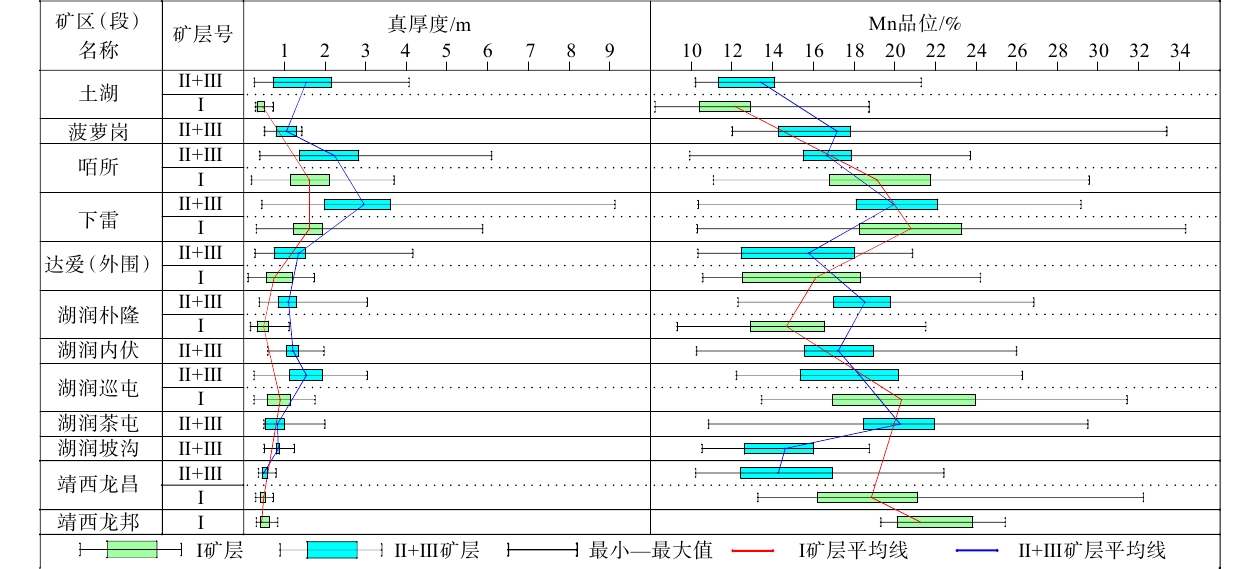
图 5 研究区碳酸锰矿层厚度和品位分布统计图
Figure 5. Thickness and grade distributions of manganese carbonate ore beds in the study area
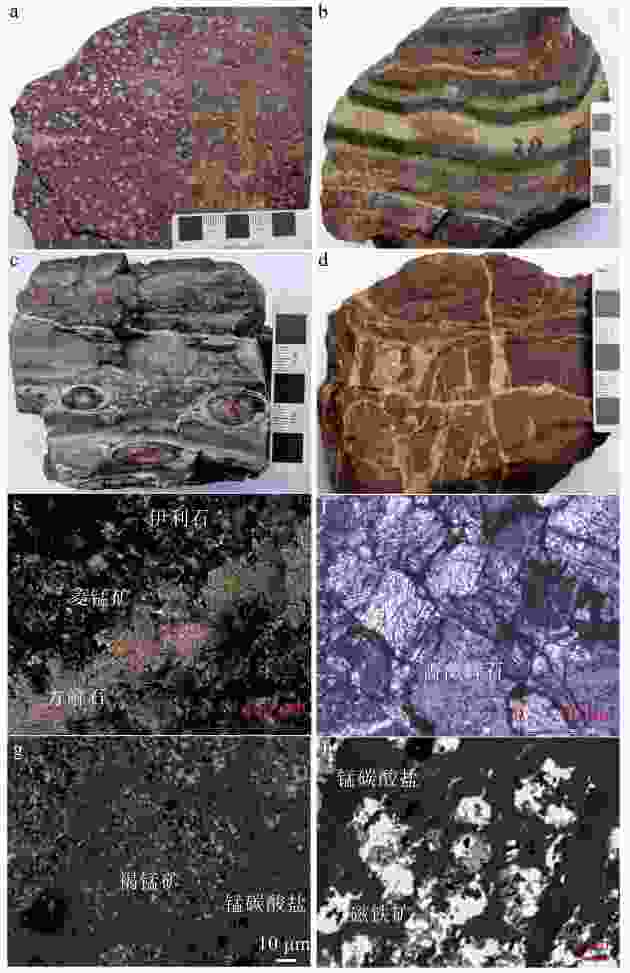
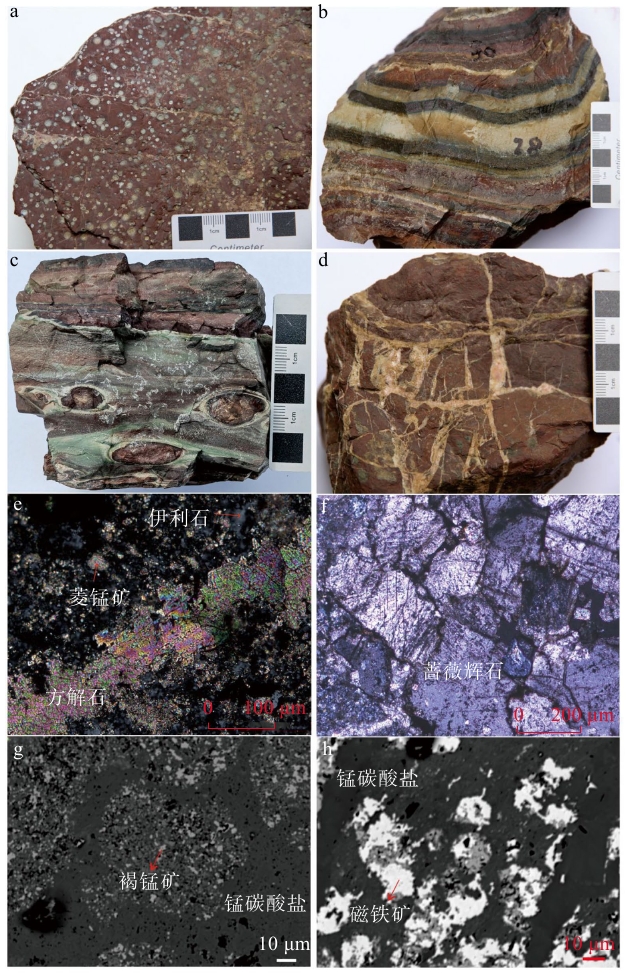
图 6 下雷矿区锰矿石宏观特征及显微特征照片
a—豆(鲕)状碳酸锰矿石;b—条带状碳酸锰矿石;c—结核状碳酸锰矿石;d—发育蔷薇辉石网脉的块状碳酸锰矿石;e—菱锰矿呈不规则粒状与微细粒伊利石混杂交生(正交偏光);f—蔷薇辉石呈不规则粒状(正交偏光);g—褐锰矿(背散射BSE图像);h—磁铁矿(背散射BSE图像)
Figure 6. Macroscopic and microscopic characteristics of manganese ores from the Xialei mining area
(a) Oolitic (pisolitic) manganese carbonate ore; (b) Banded manganese carbonate ore; (c) Tuberculous manganese carbonate ore; (d) Massive manganese carbonate ore with a rhodonite stockwork; (e) Rhodochrosite occurs in irregular granular form, intermingled with fine-grained illite (crossed micol); (f) Rhodonite occurs in irregular granular form (crossed nicol); (g) Braunite (backscattered electron, BSE image); (h) Magnetite (backscattered electron, BSE image)
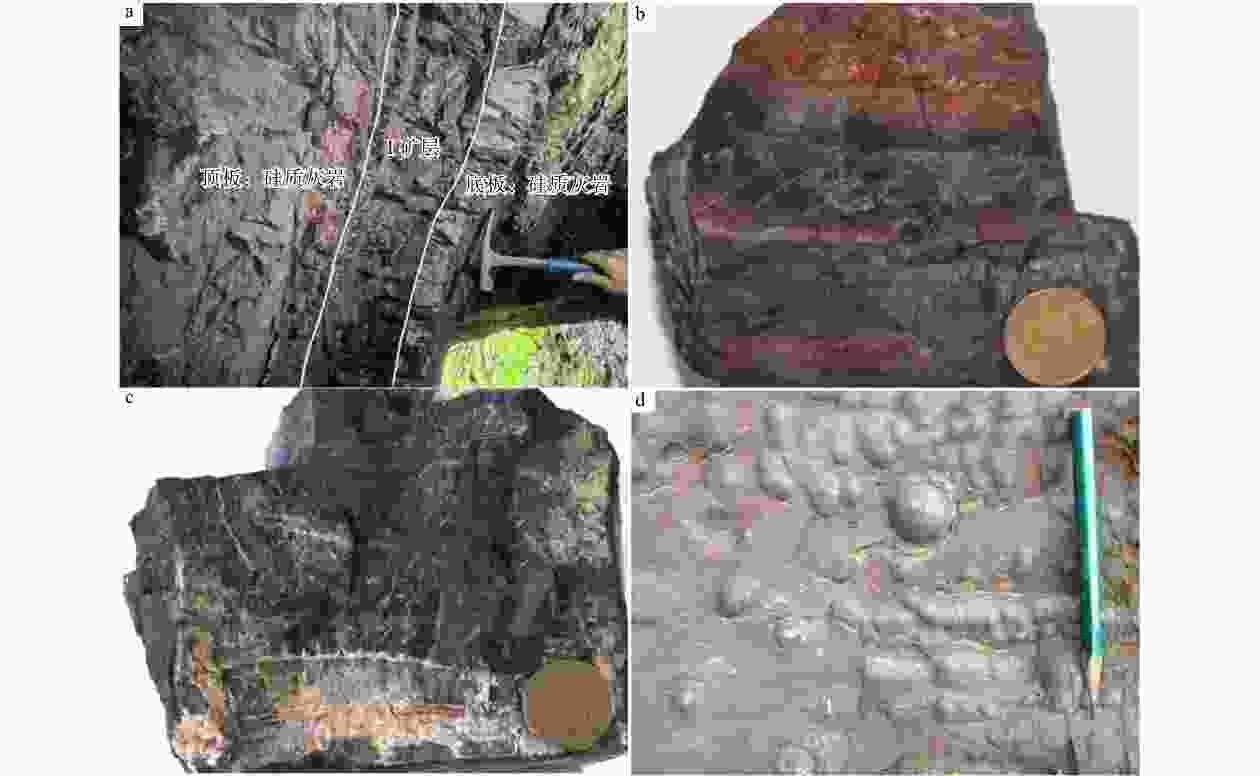
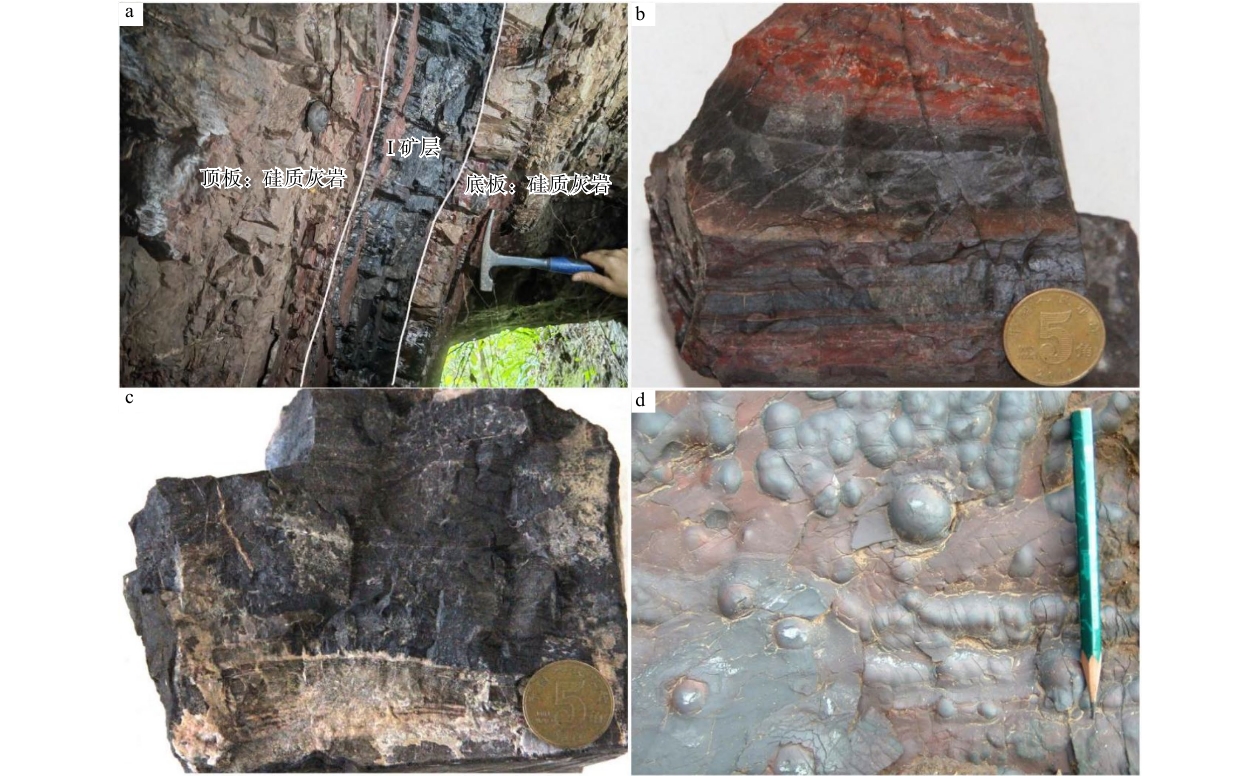
图 7 龙邦矿区含锰岩系野外及锰矿石照片
a—钢灰色锰矿层与条带状硅质灰岩呈整合接触;b—条带状锰矿石;c—块状氧化锰矿石;d—豆(结核)状氧化锰矿石
Figure 7. Field photographs of the manganese-bearing rock series and manganese ores from the Longbang mining area
(a) Steel-gray manganese ore bed in conformable contact with banded siliceous limestone; (b) Banded manganese ore; (c) Massive oxidized manganese ore; (d) Nodular (tuberculous) oxidized manganese ore
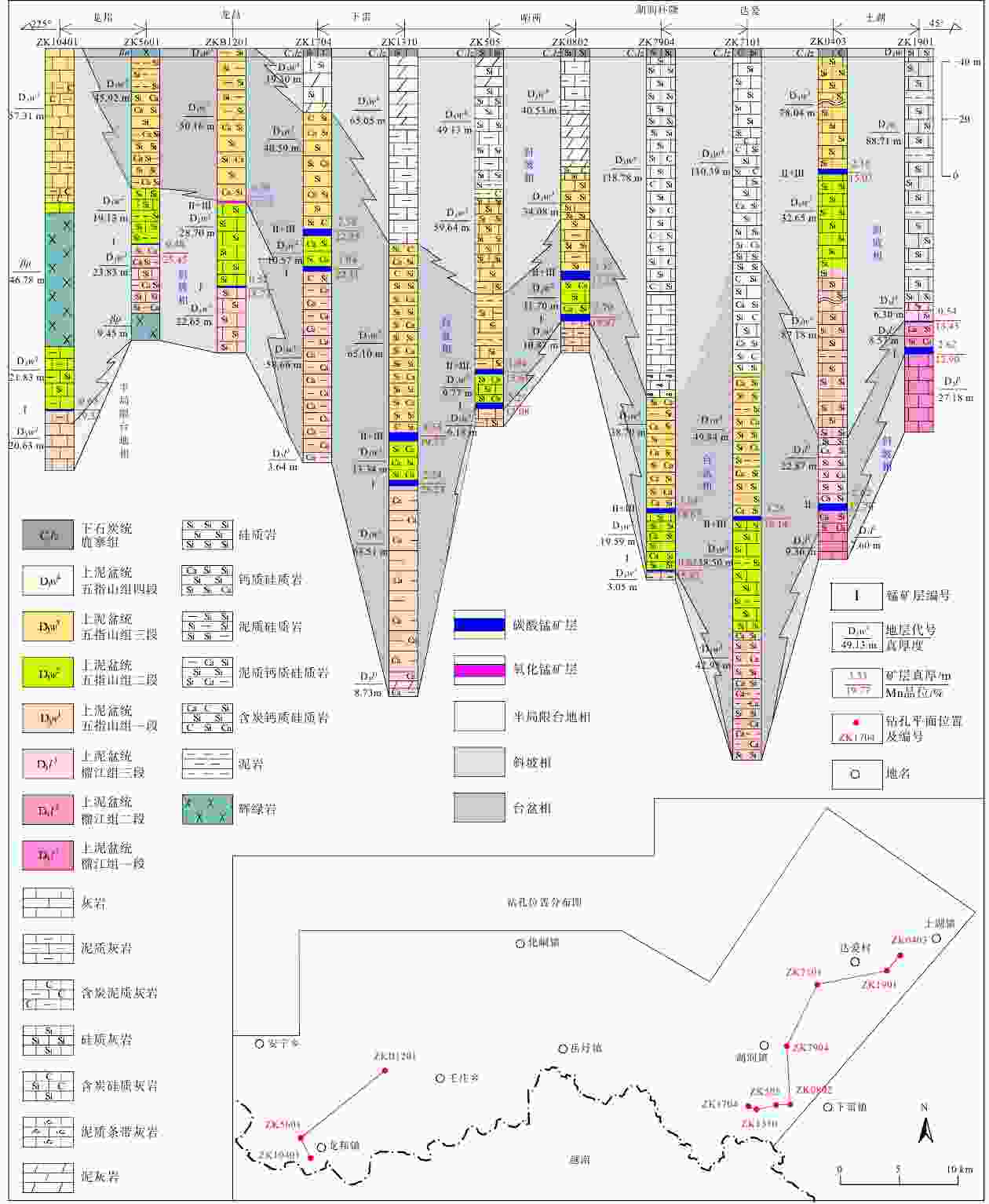
图 8 研究区含锰岩系沉积柱状对比图
Figure 8. Stratigraphic correlation diagram of the manganese-bearing sequence in the study area
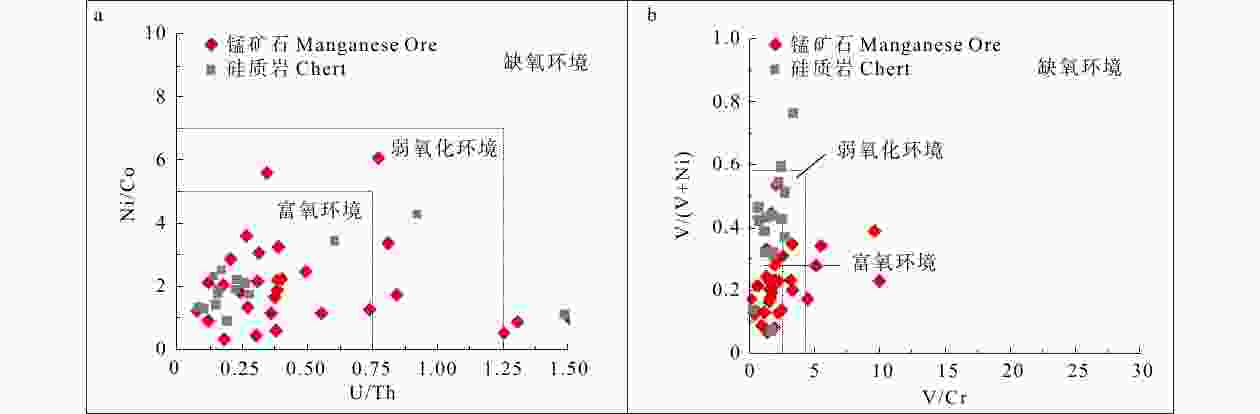
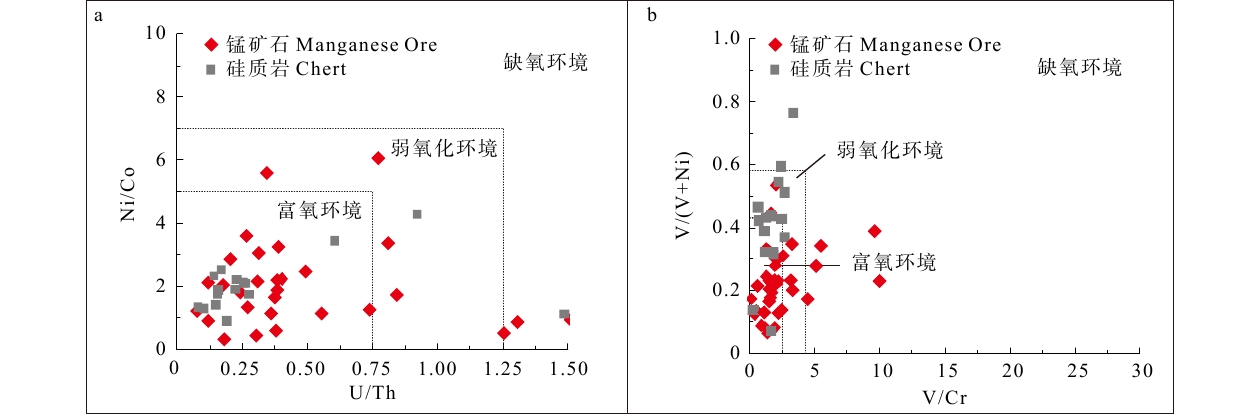
图 9 研究区碳酸锰矿石及围岩地球化学判别图
a—Ni/Co−U/Th判别图;b—V/(V+Ni)−V/Cr判别图
Figure 9. Geochemical discrimination diagrams of manganese carbonate ores and wall rocks in the study area
(a) Ni/Co versus U/Th discrimination diagram; (b) V/(V+Ni) versus V/Cr discrimination diagram
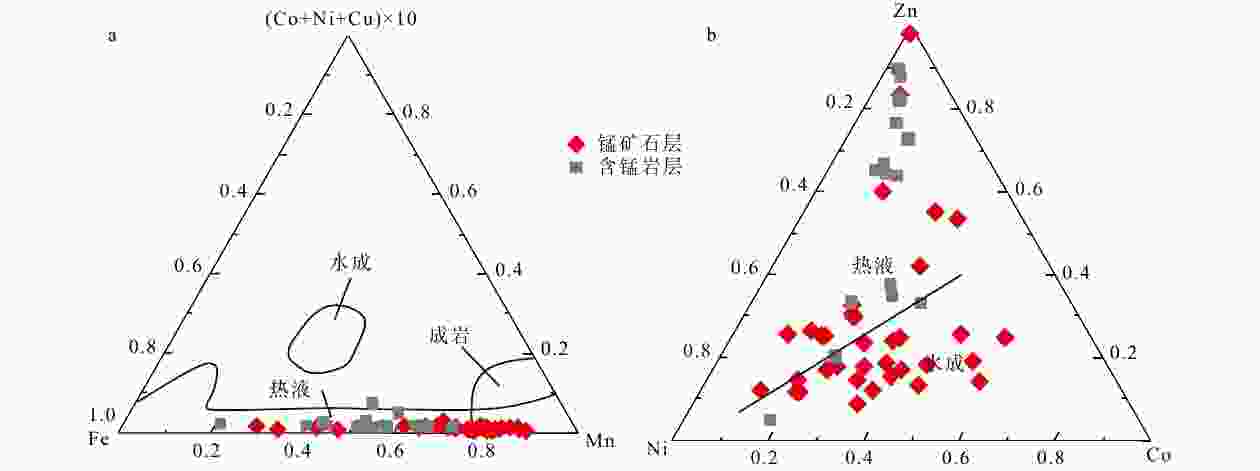
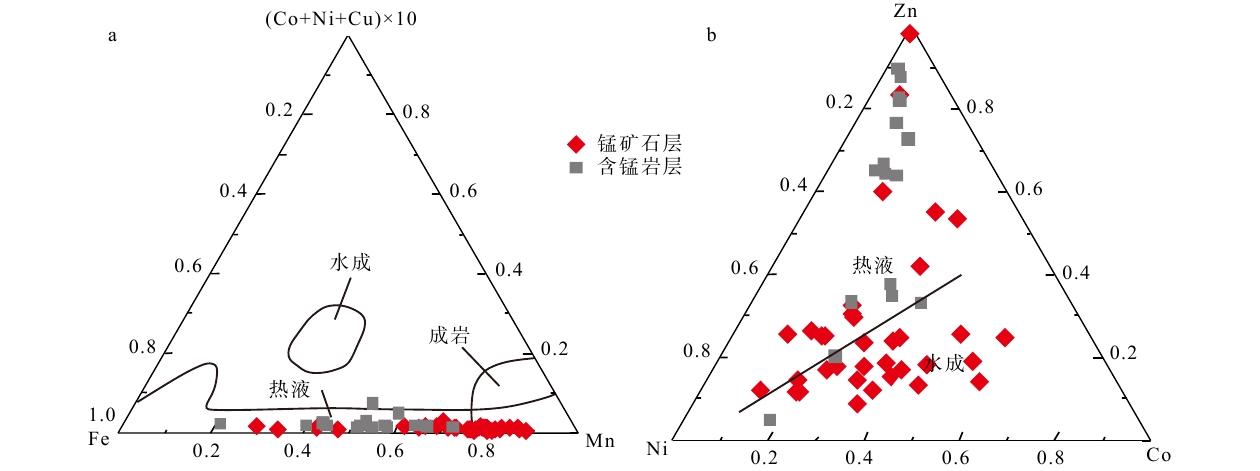
图 10 研究区锰矿石及围岩地球化学判别图
a—Mn–Fe–(Co+Ni+Cu)×10图解(底图引自Rona,1978);b—Co–Ni–Zn图解
Figure 10. Geochemical discrimination diagrams for manganese ores and host rocks in the study area
(a) Mn–Fe–(Co+Ni+Cu)×10 diagram (base map from Rona, 1978); (b) Co–Ni–Zn diagram
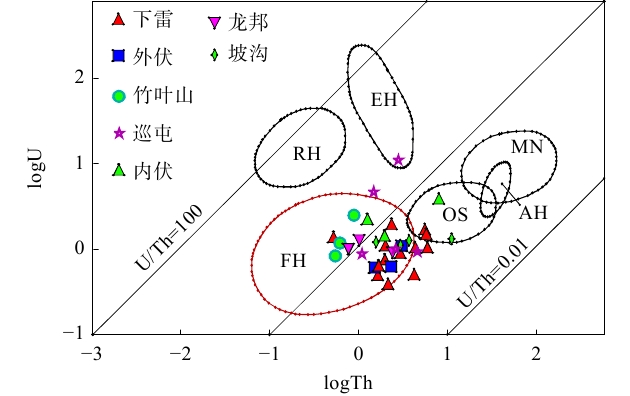
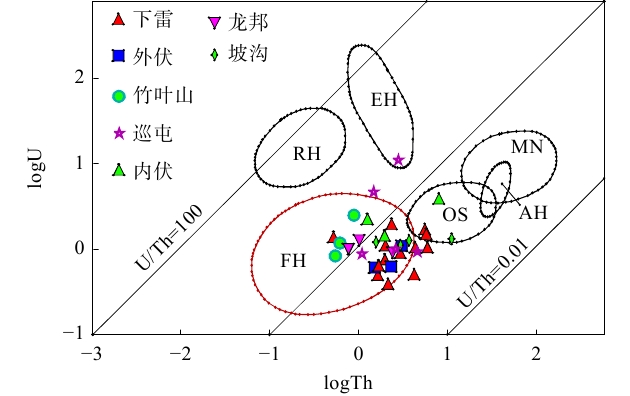
图 11 研究区锰矿石logU−logTh直角图(底图引自Bostrom,1983)
RH—现代红海热卤水沉积区;EH—现代东太平洋热水沉积区;FH—古代热水铁锰沉积区;OS—远洋沉积区;MN—锰结核沉积区;AH—铝土矿区
Figure 11. logU−logTh plot of manganese ores in the study area (base map from Bostrom, 1983)
RH–modern Red Sea hot-brine sedimentary area; EH–modern East Pacific hydrothermal sedimentary area; FH–ancient hydrothermal Fe–Mn sedimentary area; OS–pelagic sedimentary area; MN–manganese nodule sedimentary area; AH–bauxite sedimentary area
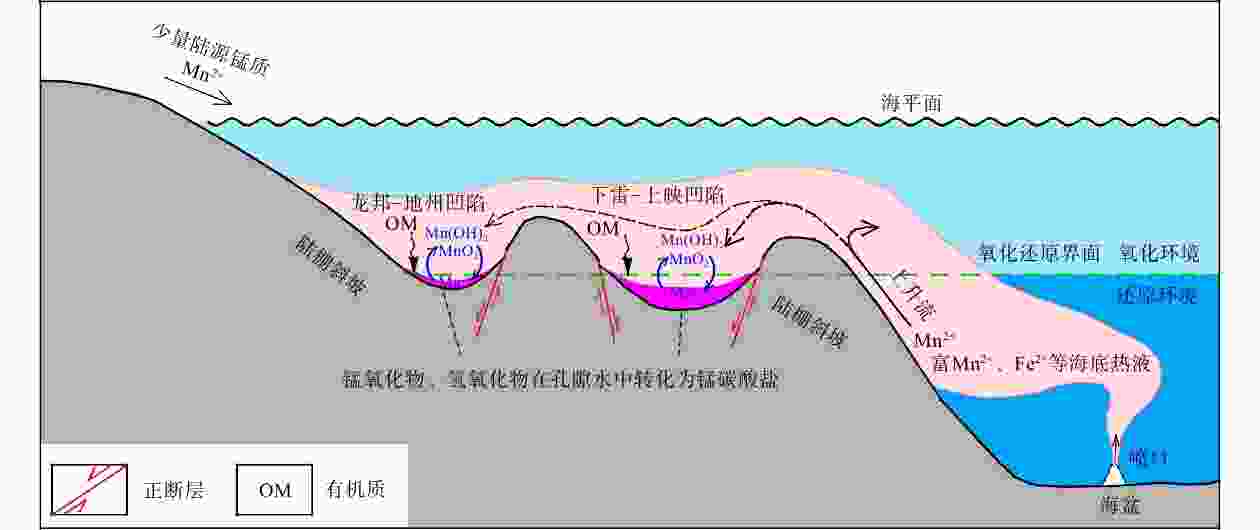
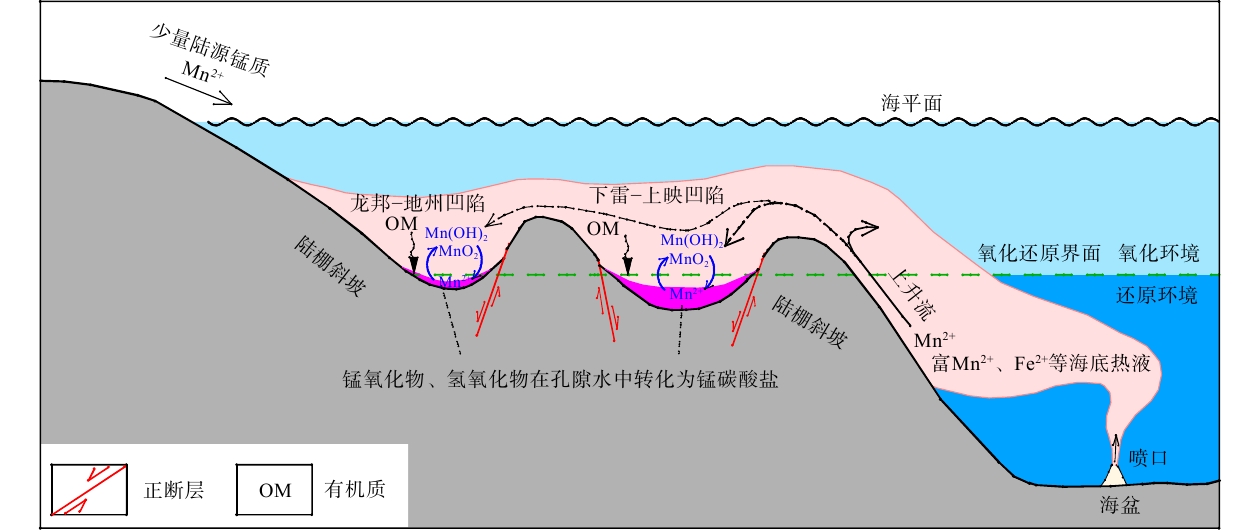
图 12 桂西南地区泥盆系锰矿成矿模式图(据赵银强等,2026修改)
Figure 12. Metallogenic model of Devonian manganese deposits in southwestern Guangxi (modified from Zhao et al., 2026)
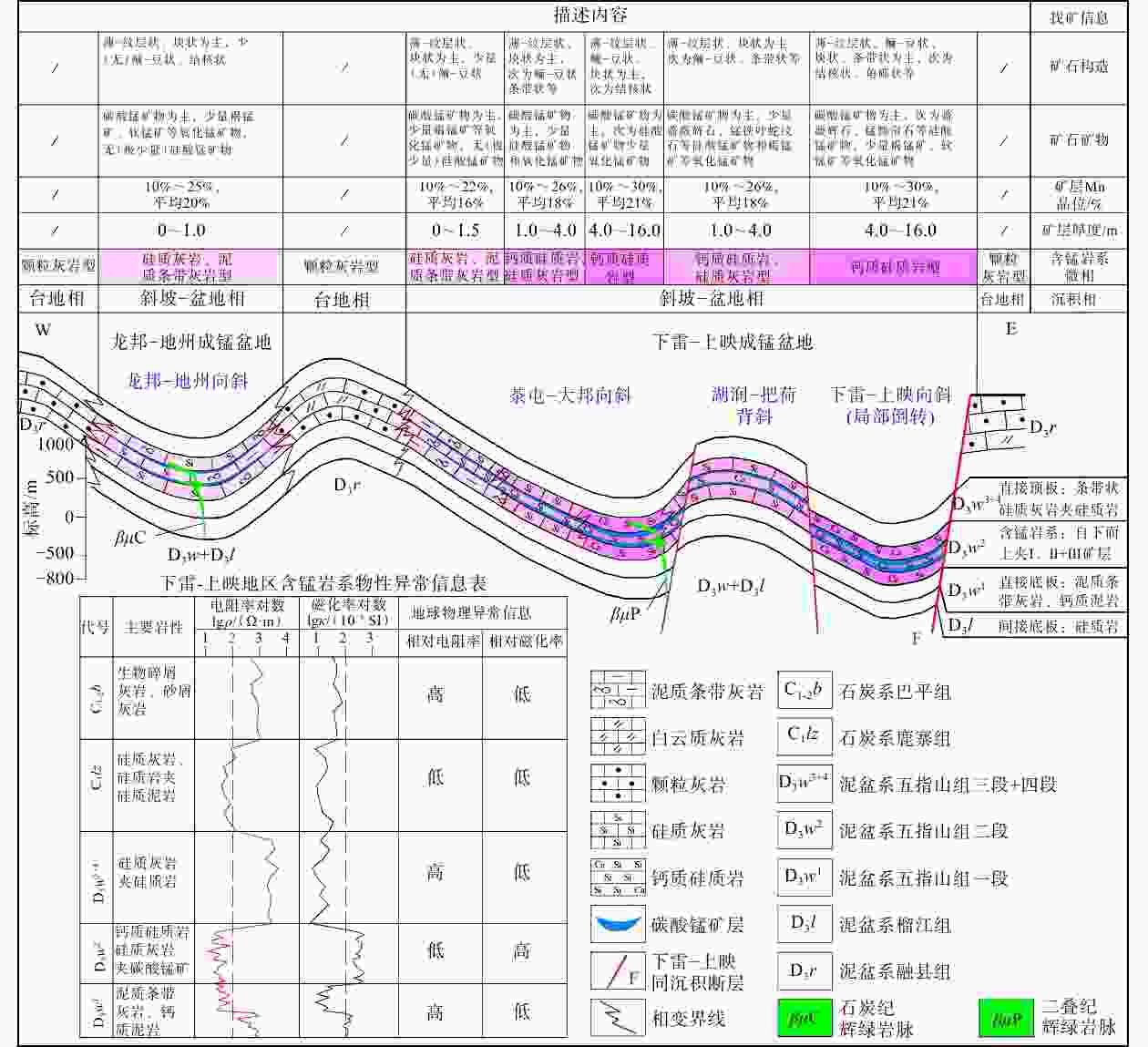
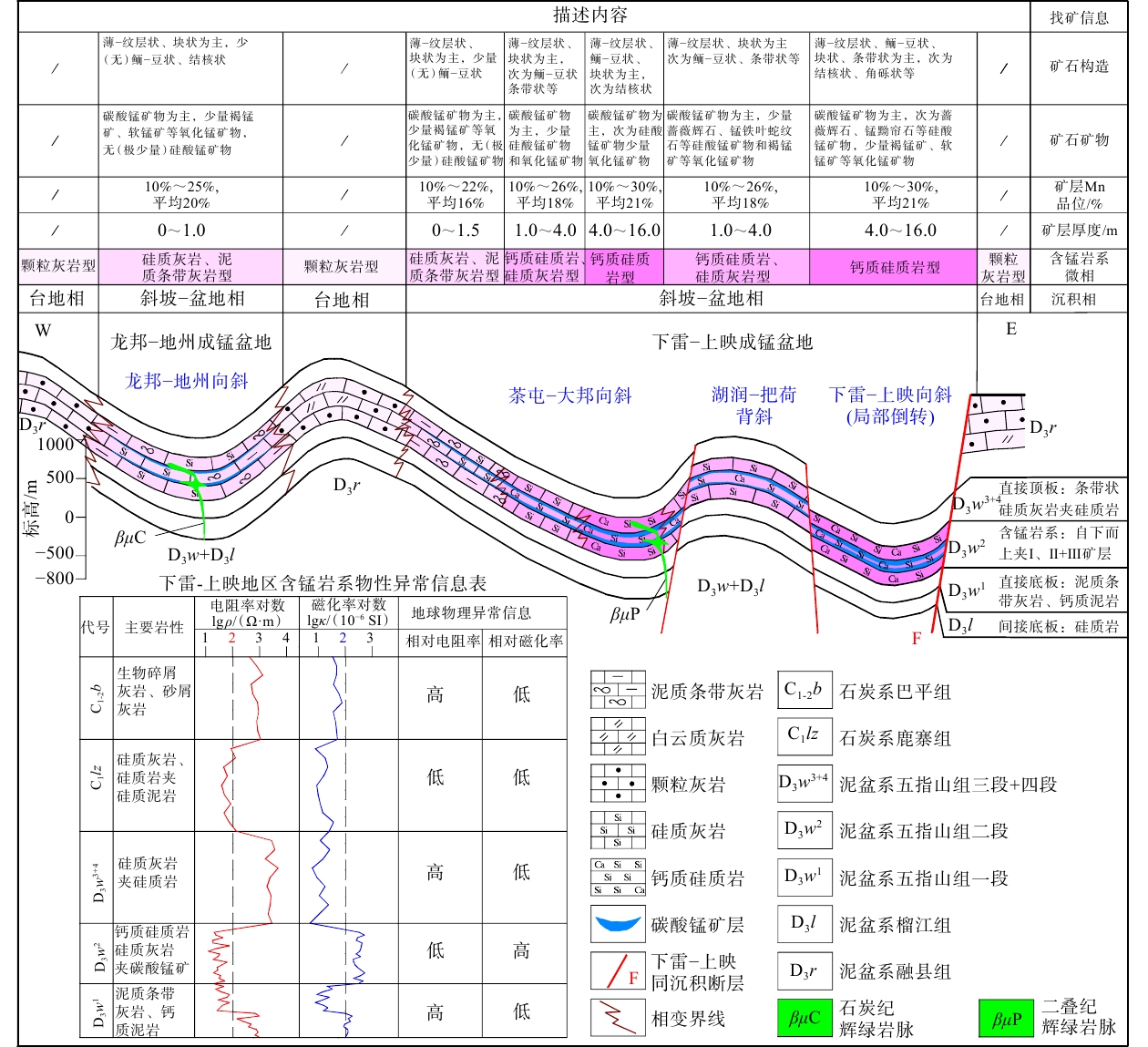
图 13 桂西南地区泥盆系碳酸锰矿综合找矿模型
Figure 13. Comprehensive prospecting model for Devonian manganese carbonate deposits in southwestern Guangxi
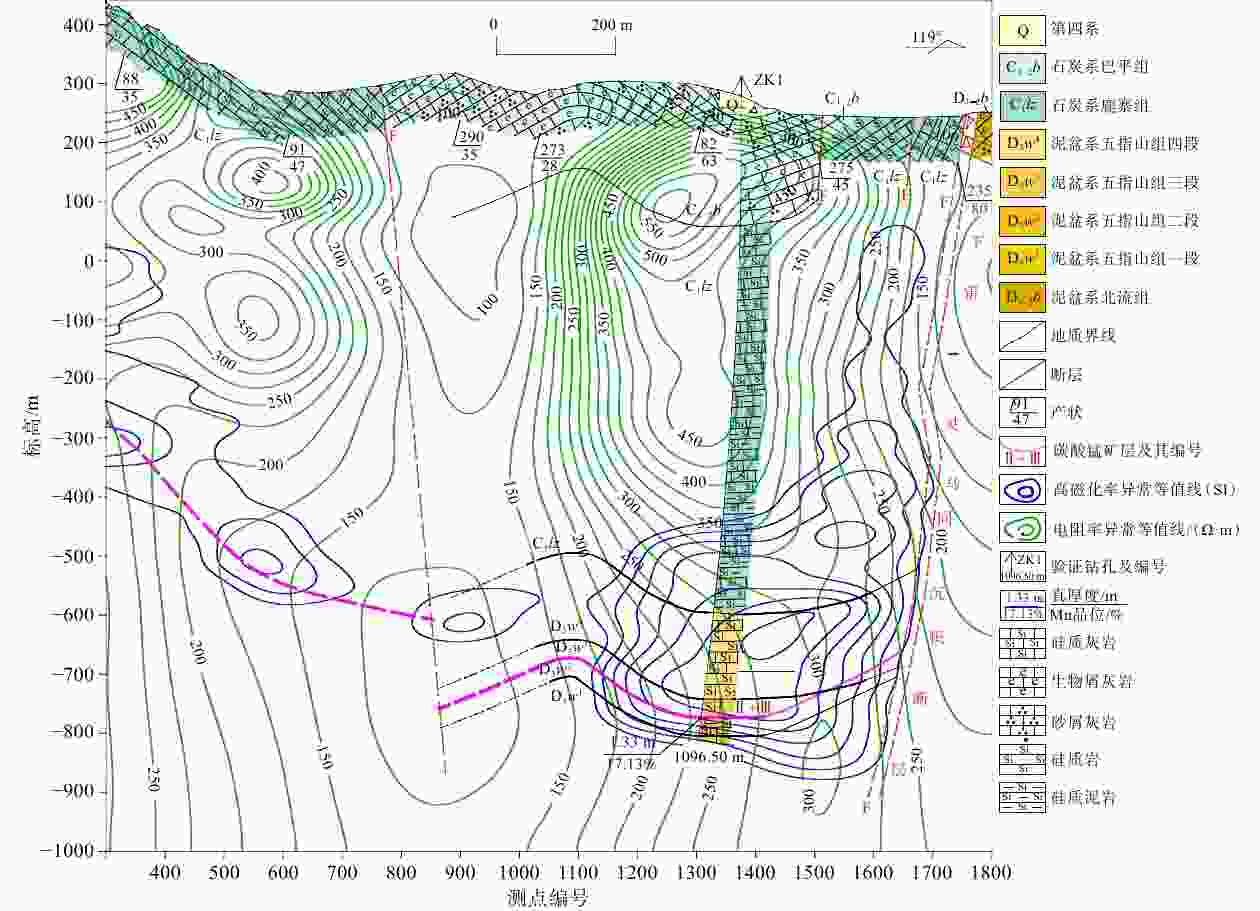
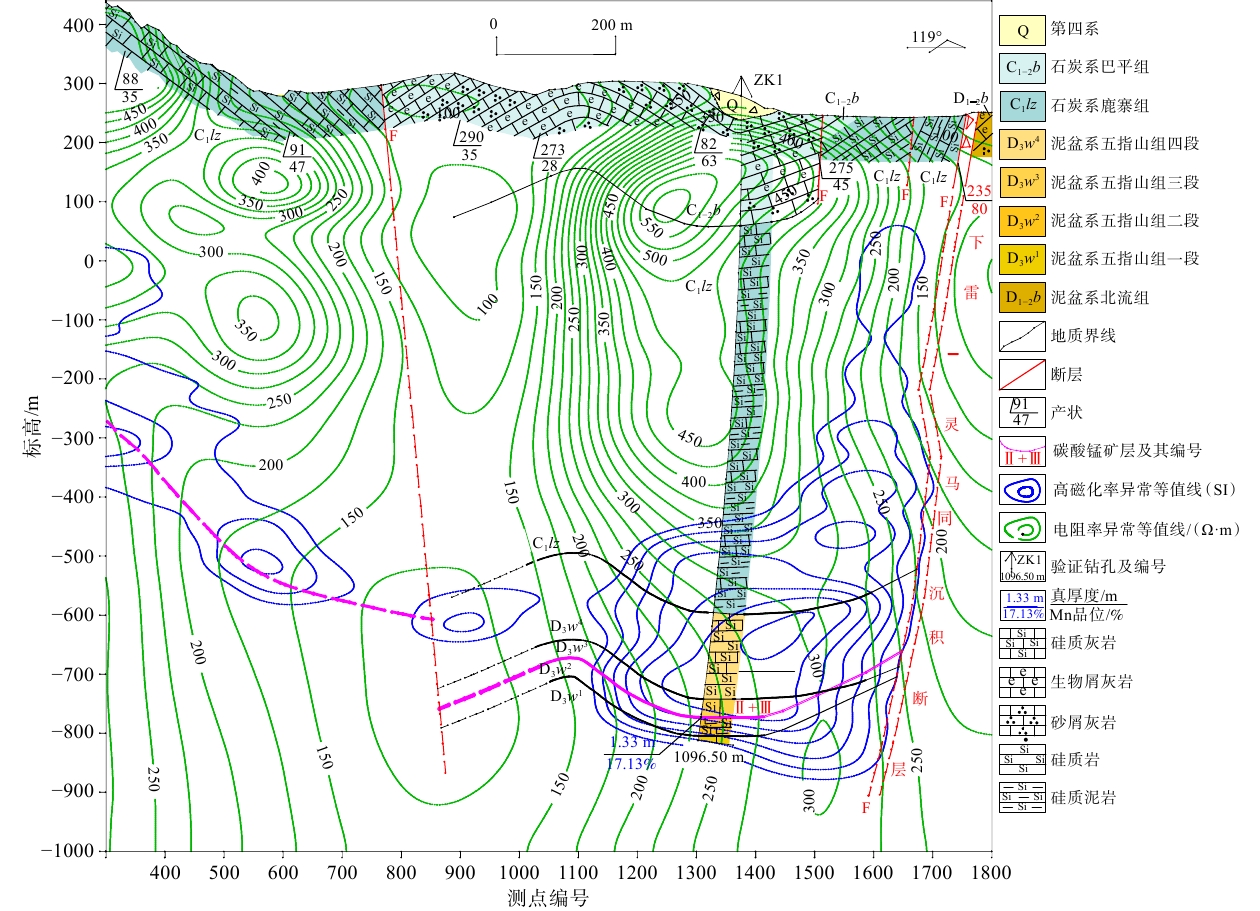
图 14 岜后锰矿区钻孔验证效果图
Figure 14. Borehole verification results in the Bahou manganese mining area
表 1 研究区锰矿物统计表
Table 1. Manganese mineral statistics for the study area
分类 矿物名称 龙邦−地州成锰盆地 湖润−把荷背斜西北翼 下雷−上映向斜 安宁 龙邦 龙昌 那敏 茶屯 巡屯 坡沟 内伏 下雷 咟所 菠萝岗 朴隆 达爱 兴湖 土湖 氧化物−氢氧化物类 拉锰矿 − − − − − − − − − − − − − + + 六方锰矿 + + + + ++ + − + ++ − + ++ − − − 水锰矿 − − − − − − − − + + + + − + + 锰钾矿 − − − − ++ + + + ++ − − + − − − 锰铁矿 − − − − + − − − + − − − − − − 黑锰矿 − + + − − − − − + − − − − − − 褐锰矿 ++ +++ ++ ++ ++ + + ++ ++ + + + − − + 水羟锰矿 + + + + ++ − − − ++ − ++ ++ + + + 硬锰矿 +++ +++ +++ +++ +++ +++ +++ +++ +++ − +++ +++ ++ ++ +++ 软锰矿 +++ ++ +++ +++ +++ +++ +++ +++ +++ + +++ − +++ +++ +++ 碳酸盐类 锰方解石 +++ +++ +++ +++ ++ ++ +++ + ++ ++ ++ + +++ ++ +++ 钙菱锰矿 ++ ++ ++ ++ +++ +++ +++ + +++ − +++ + +++ − ++ 菱锰矿 ++ ++ ++ ++ +++ +++ +++ ++ +++ ++ +++ +++ ++ − ++ 硅酸盐类 蜡硅锰矿 − − − − + − − − − − − − − − − 锰铝榴石 − − − − + − − − + − − − − − − 锰铁叶蛇纹石 − − − − − + + − + − − − − − − 蔷薇辉石 − − − − ++ ++ ++ − +++ + − + + − + 注: “+++”代表主要,“++”代表次要,“+”代表少量,“−”代表未见  下载: 导出CSV
表 2 湖润锰矿区主要地质体电阻率、磁化率参数统计表
Table 2. Resistivity and magnetic susceptibility for major geological bodies in the Hurun manganese mining area
层位 岩性 标本块数 电阻率ρ/(Ω·m) 磁化率k/(×10−6SI) 范围 平均值 范围 平均值 上覆地层 石炭系巴平组(C1-2b) 生物碎屑灰岩、砂屑灰岩 10 428.6~1314.4 811.64 35~78 48.50 石炭系鹿寨组(C1lz) 硅质灰岩、硅质岩夹硅质泥岩 10 39.7~140.6 77.17 8~37 17.40 泥盆系五指山组三段+四段(D3w3+4) 硅质灰岩夹硅质岩 10 1659.4~4905.3 2763.95 5~27 13.80 平均 30 39.7~4905.3 1217.59 5~78 26.57 含锰岩系 泥盆系五指山组二段(D3w2) 钙质硅质岩夹碳酸锰矿 20 12.8~77.3 32.35 198~531 340.25 下伏地层 泥盆系五指山组一段(D3w1) 泥质条带灰岩、钙质泥岩 20 24.2~1068.6 343.02 8~180 70.60
下载: 导出CSV
-
[1] BAU M, DULSKI P, 1999. Comparing yttrium and rare earths in hydrothermal fluids from the Mid-Atlantic Ridge: implications for Y and REE behaviour during near-vent mixing and for the Y/Ho ratio of Proterozoic seawater[J]. Chemical Geology, 155(1-2): 77-90. doi: 10.1016/S0009-2541(98)00142-9 [2] BECKER R T, KÖNIGSHOF P, BRETT C E, 2016. Devonian climate, sea level and evolutionary events: an introduction[J]. Geological Society, London, Special Publications, 423(1): 1-10. doi: 10.1144/sp423.15 [3] BOSTROM K, 1983. Hydrothermal processes at seafloor spreading centers: application of basalt-seawater experimental results[M]. New York: Plenum Press. [4] CALVERT S E, PEDERSEN T F, 1996. Sedimentary geochemistry of manganese; implications for the environment of formation of manganiferous black shales[J]. Economic Geology, 91(1): 36-47. doi: 10.2113/gsecongeo.91.1.36 [5] CHANG H J, CHU X L, FENG L J, et al., 2009. Redox sensitive trace elements as paleoenvironments proxies[J]. Geological Review, 55(1): 91-99. (in Chinese with English abstract) [6] CHEN F G, PUFAHL P K, WANG Q F, et al, 2022. A new model for the genesis of Carboniferous Mn ores, Longtou deposit, South China block[J]. Economic Geology, 117(1): 107-125. doi: 10.5382/econgeo.4855 [7] CHEN F G, WANG Q F, PUFAHL P K, et al., 2023. Carbonate-hosted manganese deposits and ocean anoxia[J]. Earth and Planetary Science Letters, 622: 118385. doi: 10.1016/j.epsl.2023.118385 [8] CHEN H D, ZENG Y F, 1990. Nature and evolution of the Youjiang Basin[J]. Sedimentary Geology and Tethyan Geology(1): 28-37. (in Chinese) [9] CHEN J H, TIAN Y M, JIANG S, et al., 2026. Application of manganese metallogenic model and effective exploration methods in the prospecting process: a case study of the Xialei manganese deposit[J]. Acta Geologica Sinica, 100(2): 679-692. (in Chinese with English abstract) [10] CHEN X, TIAN Y M, GAO B L, et al., 2026. Biochemical mineralization of manganese in the Nanhua System[J]. Acta Geologica Sinica, 100(2): 484-509. (in Chinese with English abstract) [11] CONG Y, DONG Q J, XIAO K Y, et al., 2018. Characteristics and predicted potential of Mn resources in China[J]. Earth Science Frontiers, 25(3): 118-137. (in Chinese with English abstract) [12] DONG J H, LIU H, JIANG S, et al., 2025. Two-dimensional mineral exploration prediction based on random forest: a case study of sedimentary manganese deposit in Xialei-Tuhu area[J]. Mineral Deposits, 44(1): 143-158. (in Chinese with English abstract) [13] DONG Z G, ZHANG L C, WANG C L, et al., 2020. Progress and problems in understanding sedimentary manganese carbonate metallogenesis[J]. Mineral Deposits, 39(2): 237-255. (in Chinese with English abstract) [14] DONG Z G, PENG Z D, ROBBINS L J, et al., 2023. Episodic ventilation of euxinic bottom waters triggers the formation of black shale-hosted Mn carbonate deposits[J]. Geochimica et Cosmochimica Acta, 341: 132-149. doi: 10.1016/j.gca.2022.11.027 [15] DONG Z G, ZHANG B L, ZHANG L C, et al., 2025. Unravelling the mechanisms underlying marine redox shifts during sedimentary manganese metallogenesis: insights from the Carboniferous Muhu deposit, China[J]. Mineralium Deposita, 60(7): 1367-1396. doi: 10.1007/s00126-024-01343-7 [16] DU Y S, YU W C, ZHOU Q, et al., 2023. Discussion about the coupling relationship between the breakup of supercontinent and the large-scale manganese accumulation in China[J]. Journal of Palaeogeography (Chinese Edition), 25(6): 1211-1234. (in Chinese with English abstract) [17] FU Y, XU Z G, PEI H X, et al., 2014. Study on metallogenic regularity of manganese ore deposits in China[J]. Acta Geologica Sinica, 88(12): 2192-2207. (in Chinese with English abstract) [18] GAN L, YANG C C, WANG L, et al., 2026. Tectonic controls and redox dynamics: a comprehensive review of sedimentary manganese mineralization in the Devonian-Triassic Youjiang Basin, South China[J]. Earth-Science Reviews, 281: 105638. doi: 10.1016/j.earscirev.2026.105638 [19] GUO N N, GAO Z F, JIA J L, et al., 2026. Geological and geochemical characteristics of the Xialei manganese deposit in Guangxi and their constraints on different manganese mineralization mechanisms[J]. Acta Geologica Sinica, 100(2): 537-552. (in Chinese with English abstract) [20] GUO X L, CAI W M, LU Y G, et al., 2026. Resource attributes, geological characteristics, and utilization of manganese metal[J]. Acta Geologica Sinica, 100(2): 633-656. (in Chinese with English abstract) [21] HE H X, XIAO J F, YANG H Y, et al., 2024. Redox conditions of Datangpo-type manganese ores constrained by statistical analysis of pyrite framboids and iron isotopes[J]. Sedimentary Geology, 463: 106606. doi: 10.1016/j.sedgeo.2024.106606 [22] HEIN J R, SCHULZ M S, DUNHAM R E, et al., 2008. Diffuse flow hydrothermal manganese mineralization along the active Mariana and southern Izu-Bonin arc system, Western Pacific[J]. Journal of Geophysical Research: Solid Earth, 113(B8): B08S14. doi: 10.1029/2007jb005432 [23] HOU Z L, XUE Y Z, HUANG J S, et al. , 1997. Manganese deposits around the Yangtze platform[M]. Beijing: Metallurgical Industry Press. (in Chinese) [24] HOUSE M R, 2002. Strength, timing, setting and cause of mid-Palaeozoic extinctions[J]. Palaeogeography, Palaeoclimatology, Palaeoecology, 181(1-3): 5-25. doi: 10.1016/S0031-0182(01)00471-0 [25] HUANG Q, PI D H, JIANG S Y, et al, 2022. The dual role of microbes in the formation of the Malkantu manganese carbonate deposit, NW China: petrographic, geochemical, and experimental evidence[J]. Chemical Geology, 606: 120992. doi: 10.1016/j.chemgeo.2022.120992 [26] JEWELL P W, STALLARD R F, 1991. Geochemistry and paleoceanographic setting of central Nevada bedded barites[J]. The Journal of Geology, 99(2): 151-170. doi: 10.1086/629482 [27] JOACHIMSKI M M, OSTERTAG-HENNING C, PANCOST R D, et al., 2001. Water column anoxia, enhanced productivity and concomitant changes in δ13C and δ34S across the Frasnian–Famennian boundary (Kowala — Holy Cross Mountains/Poland)[J]. Chemical Geology, 2001, 175(1-2): 109-131. [28] LI X P, CHEN Z B, WEI J W, et al., 2019. Petrogenesis and geological significance of mafic rock in De′e area of the western Guangxi[J]. Journal of Guilin University of Technology, 39(2): 270-281. (in Chinese with English abstract) [29] LI Z L, LIU X J, XU J F, et al., 2015. Geochemical evolution characteristics and regional tectonic significance of mafic rocks from Youjiang Basin[J]. Journal of Guilin University of Technology, 35(4): 727-735. (in Chinese with English abstract) [30] MA Z X, LIU X T, YU W C, et al., 2019. Redox conditions and manganese metallogenesis in the Cryogenian Nanhua Basin: Insight from the basal Datangpo Formation of South China[J]. Palaeogeography, Palaeoclimatology, Palaeoecology, 529: 39-52. doi: 10.1016/j.palaeo.2019.05.031 [31] MAYNARD J B, 2010. The chemistry of manganese ores through time: a signal of increasing diversity of earth-surface environments[J]. Economic Geology, 105(3): 535-552. doi: 10.2113/gsecongeo.105.3.535 [32] OU L H, 2013. Research on depositional feature and mineralization mechanism of the Upper Devonian manganese deposit in Southwestern Guangxi area[D]. Chengdu: Chengdu University of Technology. (in Chinese with English abstract) [33] QIN Y K, ZHANG H C, YAO J Q, 2010a. Geochemical Characteristics and Geological Implication of the Xialei Manganese Depost, Daxin County, Guangxi[J]. Geological Review, 56(5): 664-672. (in Chinese with English abstract) [34] QIN Y K, XU B A, YAO J Q, 2010b. Depth of ancient sea related with formation of the Upper Devonian Mn-bearing rock series in Southwestern Guangxi Province[J]. Geology and Exploration, 46(2): 277-284. (in Chinese with English abstract) [35] RACKA M, MARYNOWSKI L, FILIPIAK P, et al., 2010. Anoxic annulata events in the Late Famennian of the Holy Cross Mountains (Southern Poland): Geochemical and palaeontological record[J]. Palaeogeography, Palaeoclimatology, Palaeoecology, 297(3-4): 549-575. doi: 10.1016/j.palaeo.2010.08.028 [36] RONA P A, 1978. Criteria for recognition of hydrothermal mineral deposits in oceanic crust[J]. Economic Geology, 73(2): 135-160. doi: 10.2113/gsecongeo.73.2.135 [37] ROY S, 2006. Sedimentary manganese metallogenesis in response to the evolution of the earth system[J]. Earth-Science Reviews, 77(4): 273-305. doi: 10.1016/j.earscirev.2006.03.004 [38] RU T Q, WEI L D, SHU G, 1992. Manganese ore geology of Guangxi[M]. Beijing: Geological Publishing House. (in Chinese) [39] ŞAŞMAZ A, TÜRKYILMAZ B, ÖZTÜRK N, et al., 2014. Geology and geochemistry of Middle Eocene maden complex ferromanganese deposits from the Elazığ–Malatya region, Eastern Turkey[J]. Ore Geology Reviews, 56: 352-372. doi: 10.1016/j.oregeorev.2013.06.012 [40] TAYLOR S R, MCLENNAN S M, 1985. The continental crust: Its composition and evolution[M]. Oxford: Blackwell Scientific Publications. [41] TOTH J R, 1980. Deposition of submarine crusts rich in manganese and iron[J]. GSA Bulletin, 91(1): 44-54. [42] TRIBOVILLARD N, ALGEO T J, BAUDIN F, et al. , 2012. Analysis of marine environmental conditions based onmolybdenum–uranium covariation—Applications to Mesozoic paleoceanography[J]. Chemical Geology, 324-325: 46-58. [43] WANG C S, HU X M, LI X H, 1999. Dissolved oxygen in palaeo-ocean: anoxic events and high-oxic problems[J]. Marine Geology & Quaternary Geology, 19(3): 39-48. (in Chinese with English abstract) [44] WANG H Q, JIANG S, CHEN J H, et al., 2026. Advances in manganese ore exploration in China[J]. Acta Geologica Sinica, 100(2): 598-613. (in Chinese with English abstract) [45] WANG Y L, WANG D H, ZHANG C Q, et al., 2011. LA-ICP-MS zircon U-Pb dating of the Qinjia granite in Guangxi Province and its geologic significance[J]. Acta Geologica Sinica, 85(4): 475-481. (in Chinese with English abstract) [46] WU X K, LIANG G K, LI Y K, et al., 2023. Zircon U-Pb age and Hf isotopic composition of Bama basic rocks in western Guangxi: genetic relationship with Emeishan large igneous province[J]. Journal of Guilin University of Technology, 43(1): 14-29. (in Chinese with English abstract) [47] XUE Y Z, YAO J Q, HUANG J S, et al., 2019. A review of the metallogenic theory of endogenous origin and exogenous mineralization of manganese ores[J]. Geology and Exploration, 55(4): 891-898. (in Chinese with English abstract) [48] YAN H, PI D H, JIANG S Y, et al., 2022. Mineral paragenesis in Paleozoic manganese ore deposits: Depositional versus post-depositional formation processes[J]. Geochimica et Cosmochimica Acta, 325: 65-86. doi: 10.1016/j.gca.2022.03.030 [49] YAN Z, HE P X, FU C L, et al., 2026. Study on the manganese ore-forming environment in western Guangxi[J]. Acta Geologica Sinica, 100(2): 363-386. (in Chinese with English abstract) [50] YANG R D, GAO J B, XU H, et al., 2022. Ore-forming source analysis of huge manganese deposits in the Neoproterozoic Datangpo stage, Guizhou Province, China[J]. Acta Geologica Sinica, 96(5): 1815-1826. (in Chinese with English abstract) [51] YIN J N, XIAO K Y, 2014. Resources potential analysis and metallogenic prospect of Mn resources in China[J]. Geology in China, 41(5): 1424-1437. (in Chinese with English abstract) [52] YU W C, ALGEO T J, DU Y S, et al, 2016. Genesis of Cryogenian Datangpo manganese deposit: hydrothermal influence and episodic post-glacial ventilation of Nanhua Basin, South China[J]. Palaeogeography, Palaeoclimatology, Palaeoecology, 459: 321-337. doi: 10.1016/j.palaeo.2016.05.023 [53] YU W C, POLGÁRI M, ZHOU Q, et al., 2025. Geobiological perspective for the formation of manganiferous deposit: principle, evidence, and model[J]. Earth Science, 50(3): 1142-1161. (in Chinese with English abstract) [54] ZHANG T G, TRELA W, JIANG S Y, et al., 2011. Major oceanic redox condition change correlated with the rebound of marine animal diversity during the Late Ordovician[J]. Geology, 39(7): 675-678. doi: 10.1130/G32020.1 [55] ZHANG X S, OVER D J, MA K Y, et al., 2019. Upper Devonian conodont zonation, sea-level changes and bio-events in offshore carbonate facies Lali section, South China[J]. Palaeogeography, Palaeoclimatology, Palaeoecology, 531: 109219. doi: 10.1016/j.palaeo.2019.05.041 [56] ZHAO L Q, ZHOU S G, YI H S, et al., 2016. Geochemical characteristics and sedimentary environment of the Xialei manganese deposit in Southwest Guangxi[J]. Geology and Exploration, 52(1): 25-39. (in Chinese with English abstract) [57] ZHAO Y Q, YANG C C, XU H, et al., 2026. Late Devonian Mn mineralization as a result of volcanism-and orbital-forced palaeoceanographic changes[J]. Scientia Sinica Terrae, 56(5): 1912-1923. (in Chinese) doi: 10.1360/N072025-0463 [58] ZHOU C M, JIANG S Y, 2009. Palaeoceanographic redox environments for the Lower Cambrian Hetang Formation in South China: Evidence from pyrite framboids, redox sensitive trace elements, and sponge biota occurrence[J]. Palaeogeography, Palaeoclimatology, Palaeoecology, 271(3-4): 279-286. doi: 10.1016/j.palaeo.2008.10.024 [59] ZHOU H Y, PI D H, HUANG Q, et al., 2024. Geology, geochemistry and genesis of the Dongping manganese deposit, Guangxi Province, China[J]. Earth Science, 49(2): 656-668. (in Chinese with English abstract) [60] ZHOU Q, 2008. Geological and geochemical characteristics of cold seep carbonates of Neoproterozoic Nanhua Period and their significance for manganese ore deposits in East Guizhou[D]. Wuhan: China University of Geosciences. (in Chinese with English abstract) [61] ZHU Q K, ZHOU H Y, 2021. Reviews and prospects of submarine metalliferous sediments of hydrothermal origin[J]. Marine Sciences, 45(8): 69-80. (in Chinese with English abstract) [62] 常华进, 储雪蕾, 冯连君, 等, 2009. 氧化还原敏感微量元素对古海洋沉积环境的指示意义[J]. 地质论评, 55(1): 91-99. doi: 10.16509/j.georeview.2009.01.014 [63] 陈洪德, 曾允孚, 1990. 右江沉积盆地的性质及演化讨论[J]. 岩相古地理(1): 28-37. [64] 陈家浩, 田郁溟, 江沙, 等, 2026. 锰矿成矿模型与有效勘查方法在找矿过程中的应用: 以下雷锰矿床为例[J]. 地质学报, 100(2): 679-692. doi: 10.19762/j.cnki.dizhixuebao.2025475 [65] 陈旭, 田郁溟, 高宝龙, 等, 2026. 南华系锰的生物化学成矿作用[J]. 地质学报, 100(2): 484-509. doi: 10.19762/j.cnki.dizhixuebao.2025474 [66] 丛源, 董庆吉, 肖克炎, 等, 2018. 中国锰矿资源特征及潜力预测[J]. 地学前缘, 25(3): 118-137. doi: 10.13745/j.esf.2018.03.010 [67] 董建辉, 刘欢, 江沙, 等, 2025. 基于随机森林的二维找矿预测: 以下雷-土湖地区沉积型锰矿为例[J]. 矿床地质, 44(1): 143-158. doi: 10.16111/j.0258-7106.2025.01.009 [68] 董志国, 张连昌, 王长乐, 等, 2020. 沉积碳酸锰矿床研究进展及有待深入探讨的若干问题[J]. 矿床地质, 39(2): 237-255. doi: 10.16111/j.0258-7106.2020.02.003 [69] 杜远生, 余文超, 周琦, 等, 2023. 超大陆裂解与中国大规模成锰作用的耦合关系探讨[J]. 古地理学报, 25(6): 1211-1234. doi: 10.7605/gdlxb.2023.06.093 [70] 付勇, 徐志刚, 裴浩翔, 等, 2014. 中国锰矿成矿规律初探[J]. 地质学报, 88(12): 2192-2207. doi: 10.19762/j.cnki.dizhixuebao.2014.12.004 [71] 郭宁宁, 高兆富, 贾建亮, 等, 2026. 广西下雷锰矿的地质、地球化学特征及其对不同锰矿化机制的约束[J]. 地质学报, 100(2): 537-552. doi: 10.19762/j.cnki.dizhixuebao.2025249 [72] 郭馨莲, 蔡为民, 卢宜冠, 等, 2026. 锰金属的资源属性、地质特征及其利用[J]. 地质学报, 100(2): 633-656. doi: 10.19762/j.cnki.dizhixuebao.2025232 [73] 侯宗林, 薛友智, 黄金水, 等, 1997. 扬子地台周边锰矿[M]. 北京: 冶金工业出版社. [74] 李兴鹏, 陈忠斌, 韦剑玮, 等, 2019. 桂西德峨地区基性岩的岩石成因及地质意义[J]. 桂林理工大学学报, 39(2): 270-281. doi: 10.3969/j.issn.1674-9057.2019.02.003 [75] 李政林, 刘希军, 许继峰, 等, 2015. 右江盆地基性岩的地球化学演化特征及其区域构造意义[J]. 桂林理工大学学报, 35(4): 727-735. doi: 10.3969/j.issn.1674-9057.2015.04.010 [76] 欧莉华, 2013. 桂西南地区上泥盆统锰矿沉积特征与成矿机理研究[D]. 成都: 成都理工大学. [77] 秦元奎, 张华成, 姚敬劬, 2010a. 广西大新县下雷锰矿床的地球化学特征及其意义[J]. 地质论评, 56(5): 664-672. doi: 10.16509/j.georeview.2010.05.014 [78] 秦元奎, 徐柏安, 姚敬劬, 2010b. 桂西南上泥盆统含锰岩系形成古海水深度条件分析[J]. 地质与勘探, 46(2): 277-284. [79] 茹廷锵, 韦灵敦, 树皋, 1992. 广西锰矿地质[M]. 北京: 地质出版社. [80] 王成善, 胡修棉, 李祥辉, 1999. 古海洋溶解氧与缺氧和富氧问题研究[J]. 海洋地质与第四纪地质, 19(3): 39-48. doi: 10.16562/j.cnki.0256-1492.1999.03.006 [81] 王华青, 江沙, 陈家浩, 等, 2026. 中国锰矿勘查进展[J]. 地质学报, 100(2): 598-613. doi: 10.19762/j.cnki.dizhixuebao.2025491 [82] 王永磊, 王登红, 张长青, 等, 2011. 广西钦甲花岗岩体单颗粒锆石LA-ICP-MS U-Pb定年及其地质意义[J]. 地质学报, 85(4): 475-481. [83] 吴祥珂, 梁国科, 李玉坤, 等, 2023. 桂西巴马基性岩锆石U-Pb年龄和Hf同位素特征: 与峨眉山大火成岩省的成因联系[J]. 桂林理工大学学报, 43(1): 14-29. doi: 10.3969/j.issn.1674-9057.2023.01.002 [84] 薛友智, 姚敬劬, 黄金水, 等, 2019. 再论锰的“内源外生”成矿说[J]. 地质与勘探, 55(4): 891-898. doi: 10.12134/j.dzykt.2019.04.001 [85] 闫臻, 和平贤, 付长垒, 等, 2026. 桂西锰矿成矿环境研究[J]. 地质学报, 100(2): 363-386. [86] 杨瑞东, 高军波, 徐海, 等, 2022. 贵州新元古代大塘坡期巨量锰矿成矿物质来源分析[J]. 地质学报, 96(5): 1815-1826. [87] 阴江宁, 肖克炎, 2014. 中国锰矿资源潜力分析及成矿预测[J]. 中国地质, 41(5): 1424-1437. doi: 10.3969/j.issn.1000-3657.2014.05.002 [88] 余文超, POLGÁRI M, 周琦, 等, 2025. 地球生物学视角下的富锰沉积形成过程: 原理、证据与模式[J]. 地球科学, 50(3): 1142-1161. doi: 10.3799/dqkx.2025.002 [89] 赵立群, 周尚国, 伊海生, 等, 2016. 桂西南下雷锰矿床地球化学特征及沉积环境分析[J]. 地质与勘探, 52(1): 25-39. [90] 赵银强, 杨晨晨, 徐海, 等, 2026. 火山活动与轨道周期协同驱动下的晚泥盆世锰成矿响应[J]. 中国科学: 地球科学, 56(5): 1912-1923. [91] 周皓宇, 皮道会, 黄钦, 等, 2024. 广西东平锰矿床地质地球化学特征及矿床成因[J]. 地球科学, 49(2): 656-668. doi: 10.3799/dqkx.2022.159 [92] 周琦, 2008. 黔东新元古代南华纪早期冷泉碳酸盐岩地质地球化学特征及其对锰矿的控矿意义[D]. 武汉: 中国地质大学. [93] 朱启宽, 周怀阳, 2021. 海底热液成因含金属沉积物的研究现状及展望[J]. 海洋科学, 45(8): 69-80. doi: 10.11759/hykx20191221001 -

 下载:



计量
- 文章访问数: 98
- HTML全文浏览量: 6
- PDF下载量: 12
- 被引次数: 0
