


Genesis and resource potential of high-temperature geothermal systems along the three major fault zones of the western Sichuan Plateau
-
摘要: 为揭示川西高原康定−炉霍、甘孜−理塘和巴塘三大地热带的现今地温场、地热流体演化及差异控热机制,基于55处温泉和地热井的调查与水化学资料、10口钻井的测温数据、2口井的地温梯度和大地热流数据及43组岩石热物性测试数据,结合区域断裂和深部速度结构资料开展综合分析。结果表明,川西高原温泉主要沿鲜水河、甘孜−理塘和金沙江等深大断裂呈带状展布;地温梯度为17.5~59.7 ℃/km,大地热流为50.8~116.2 mW/m2,平均值为77.2 mW/m2,整体呈西南高、东北低的分布格局。地热流体以HCO3-Na型为主,主要接受高海拔大气降水补给,并经历不同程度的水−岩作用和阳离子交换;SiO2温标估算的热储温度主要集中于100~180 ℃,局部接近或超过200 ℃。川西高温地热系统总体属于区域热背景、深部热输入、深大断裂输导和大气降水深循环共同控制的断裂型水热系统。区域对比表明,甘孜−理塘地热带大地热流和地壳热贡献较高,断裂输导较稳定;巴塘地热带深部热异常显著,受较强深部热输入及金沙江断裂−河谷耦合作用控制;康定−炉霍地热带区域热背景相对较低,但鲜水河断裂活动及局部摩擦生热促进了高温热流体局部汇聚。热显示与断裂分布特征表明,甘孜−理塘和巴塘地热带具有较好的区域高温地热资源勘查潜力,康定−炉霍地热带则以鲜水河主断裂与次级断裂交汇部位及高温热显示集中区的局部勘查潜力更为突出。研究结果可为川西高温地热资源有利区评价与勘探靶区优选提供依据。Abstract:
Objective This study aims to elucidate the present-day geothermal field, geothermal-fluid evolution, and differential heat-control mechanisms of the Kangding–Luhuo, Ganzi–Litang, and Batang geothermal belts in the western Sichuan Plateau. Methods Field investigations and hydrochemical analyses were conducted on 55 hot springs and geothermal wells. Temperature-logging data from 10 boreholes, geothermal-gradient and terrestrial heat-flow data from two wells, and thermophysical measurements of 43 rock samples were integrated with regional fault-distribution and deep seismic-velocity data. Results The results show that hot springs in the western Sichuan Plateau are mainly distributed in belts along major deep faults, including the Xianshuihe, Ganzi–Litang, and Jinsha River faults. Geothermal gradients range from 17.5 to 59.7 ℃/km, while terrestrial heat flow ranges from 50.8 to 116.2 mW/m2, with an average of 77.2 mW/m2, showing an overall pattern of higher values in the southwest and lower values in the northeast. The geothermal fluids are predominantly of the HCO3-Na type and are mainly recharged by high-altitude meteoric water, with varying degrees of water–rock interaction and cation exchange during deep circulation. SiO2 geothermometry indicates that reservoir temperatures are mainly concentrated between 100 and 180 ℃, with local values approaching or exceeding 200 ℃. Overall, the high-temperature geothermal systems in western Sichuan are fault-controlled hydrothermal systems jointly governed by the regional thermal background, deep heat input, heat and fluid transport along major deep faults, and deep circulation of meteoric water. Regional comparison indicates that the Ganzi–Litang geothermal belt is characterized by relatively high terrestrial heat flow and a substantial crustal heat-flow contribution, together with relatively stable fault-controlled fluid transport. The Batang geothermal belt exhibits pronounced deep thermal anomalies and is mainly controlled by strong deep heat input and the coupled effects of the Jinsha River Fault and deeply incised valleys. In contrast, the Kangding–Luhuo geothermal belt has a comparatively lower regional thermal background, although activity of the Xianshuihe Fault and local frictional heating promote the localized accumulation of high-temperature geothermal fluids. Conclusions Integration of geothermal manifestations and fault distribution suggests that the Ganzi–Litang and Batang geothermal belts have relatively favorable regional exploration potential for high-temperature geothermal resources, whereas the Kangding–Luhuo geothermal belt shows stronger localized potential, particularly at intersections of the main Xianshuihe Fault with subsidiary faults and in areas with concentrated high-temperature geothermal manifestations. Significance These results provide a basis for evaluating favorable areas and selecting exploration targets for high-temperature geothermal resources in western Sichuan Plateau. -
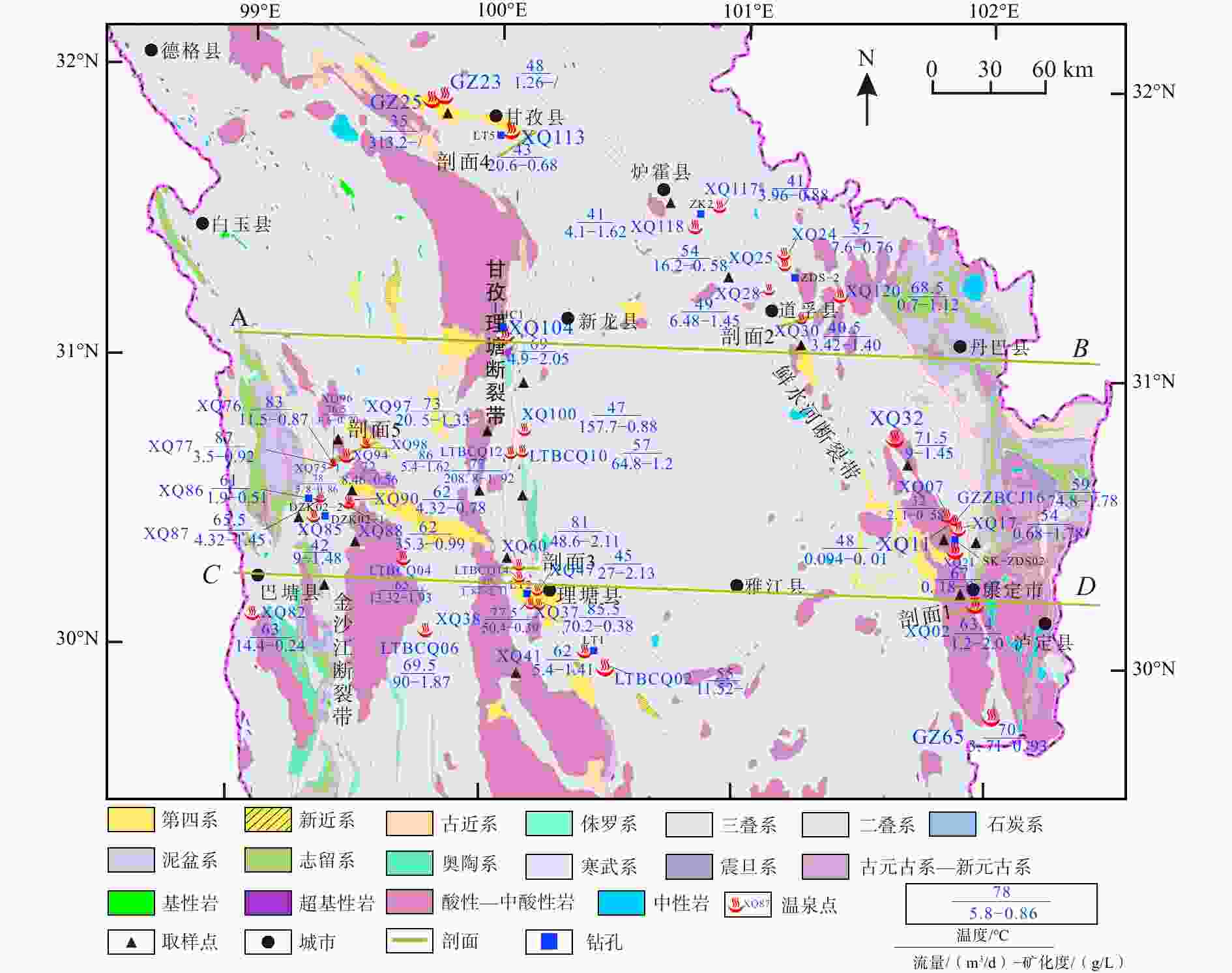
图 1 川西高原区域地质背景、主要断裂、典型剖面位置及调查温泉点分布图
“/”表示矿化度数据缺失
Figure 1. Regional geological setting, major faults, locations of representative profiles and distribution of surveyed hot spring sites in the Western Sichuan Plateau
"/" indicates missing TDS (total dissolved solids) data.
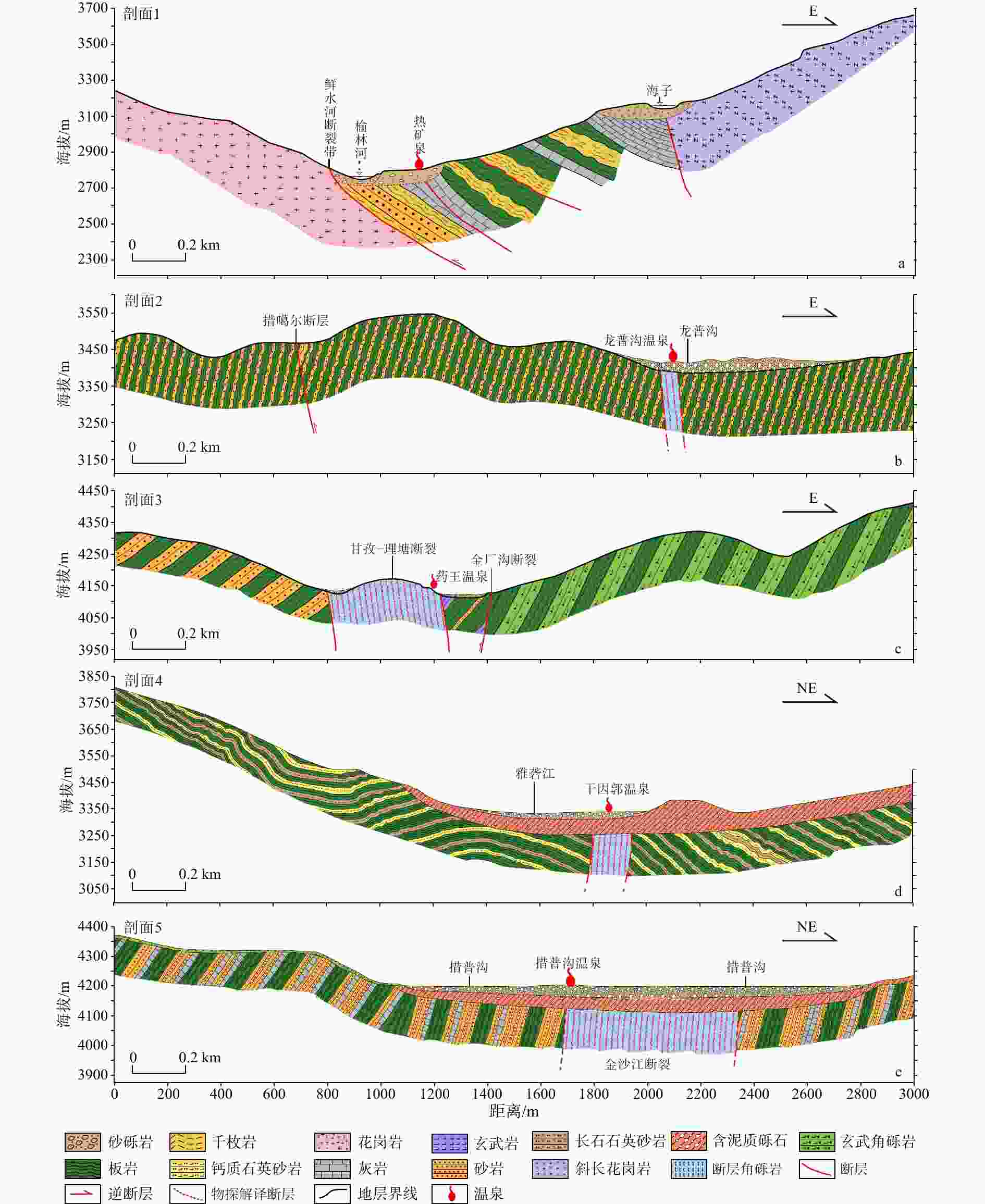
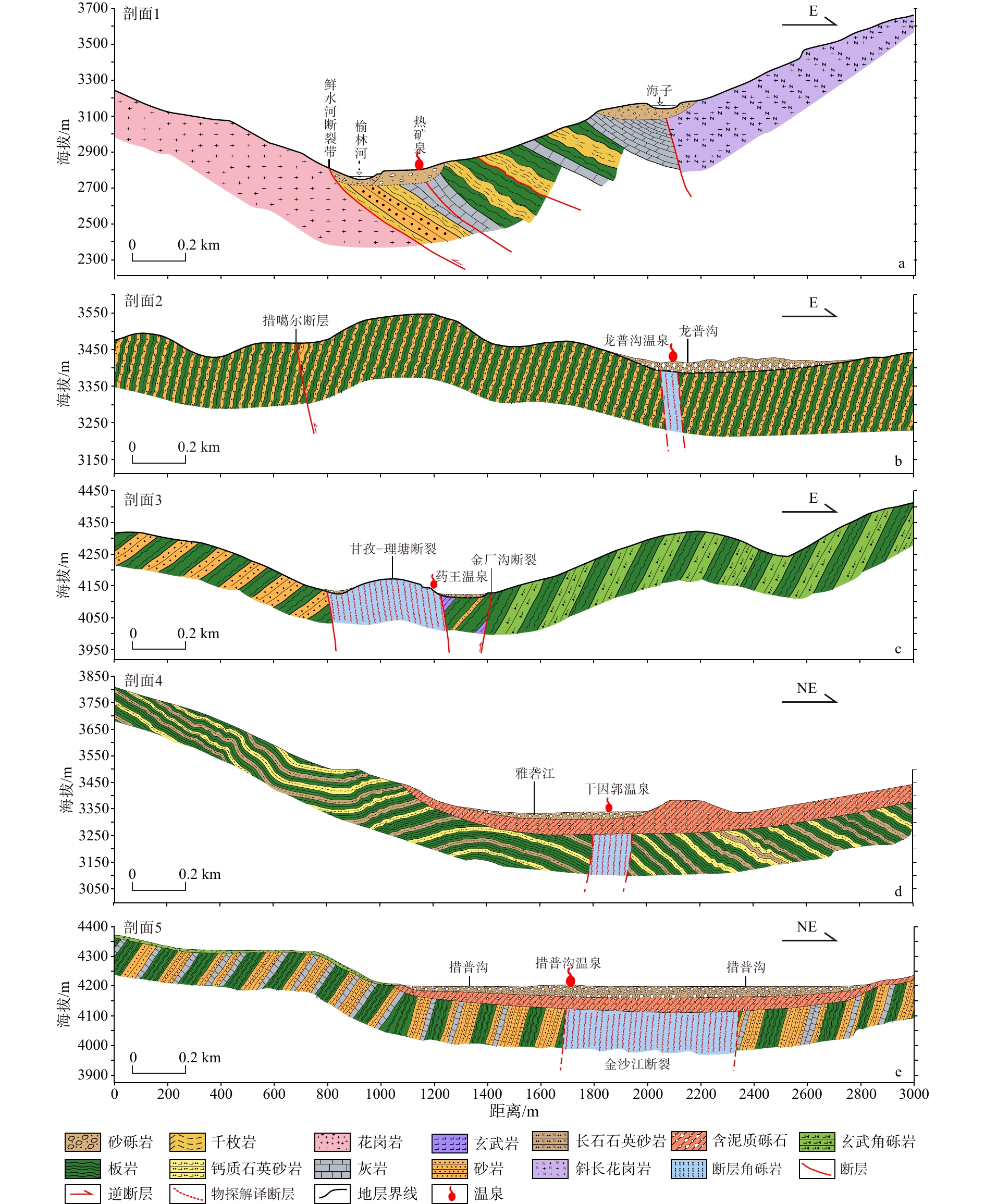
图 2 川西高原典型剖面地层岩性与断裂分布图(剖面位置见图1)
a—鲜水河断裂带榆林河热矿泉剖面;b—措噶尔断层龙普沟温泉剖面;c—甘孜−理塘断裂带药王温泉剖面;d—雅砻江谷地干因郭温泉剖面;e—金沙江断裂带措普沟温泉剖面
Figure 2. Stratigraphic lithology and fault distribution along representative profiles in the western Sichuan Plateau (profile locations are shown in Fig. 1)
(a) Yulinhe Thermal Mineral Spring along the Xianshuihe Fault Zone; (b) Longpugou Hot Spring along the Cuoga’er Fault; (c) Yaowang Hot Spring along the Ganzi–Litang Fault Zone; (d) Ganyinguo Hot Spring in the Yalong River Valley; (e) Cuopugou Hot Spring along the Jinsha River Fault Zone
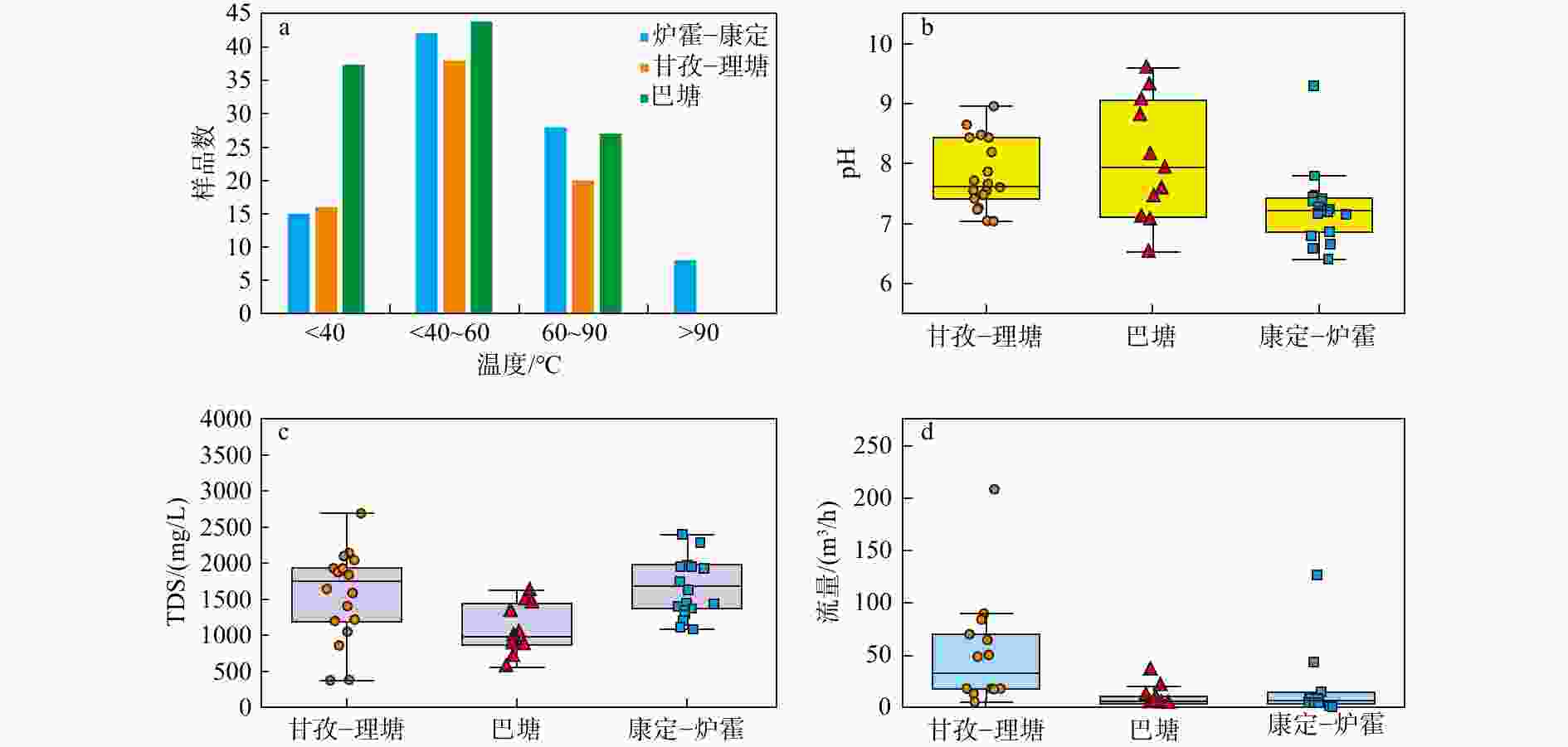
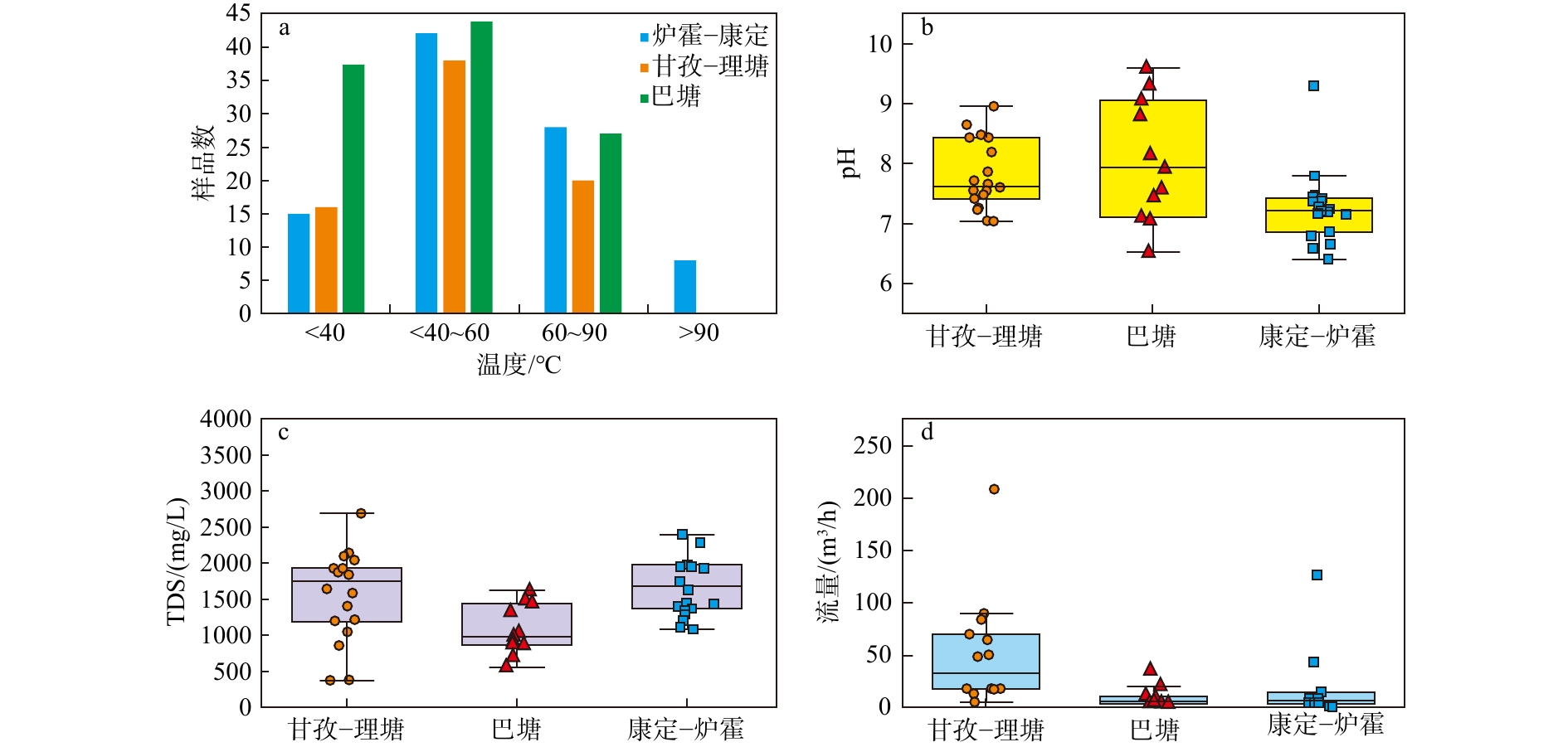
图 3 川西高原三大地热带温泉基本特征对比
a—温泉温度区间分布;b—温泉pH分布;c—温泉水TDS分布;d—温泉流量分布
Figure 3. Comparison of basic characteristics of hot springs in the three major geothermal belts of the western Sichuan Plateau
(a) Temperature distribution; (b) pH distribution; (c) Total dissolved solids (TDS) distribution; (d) Discharge distribution
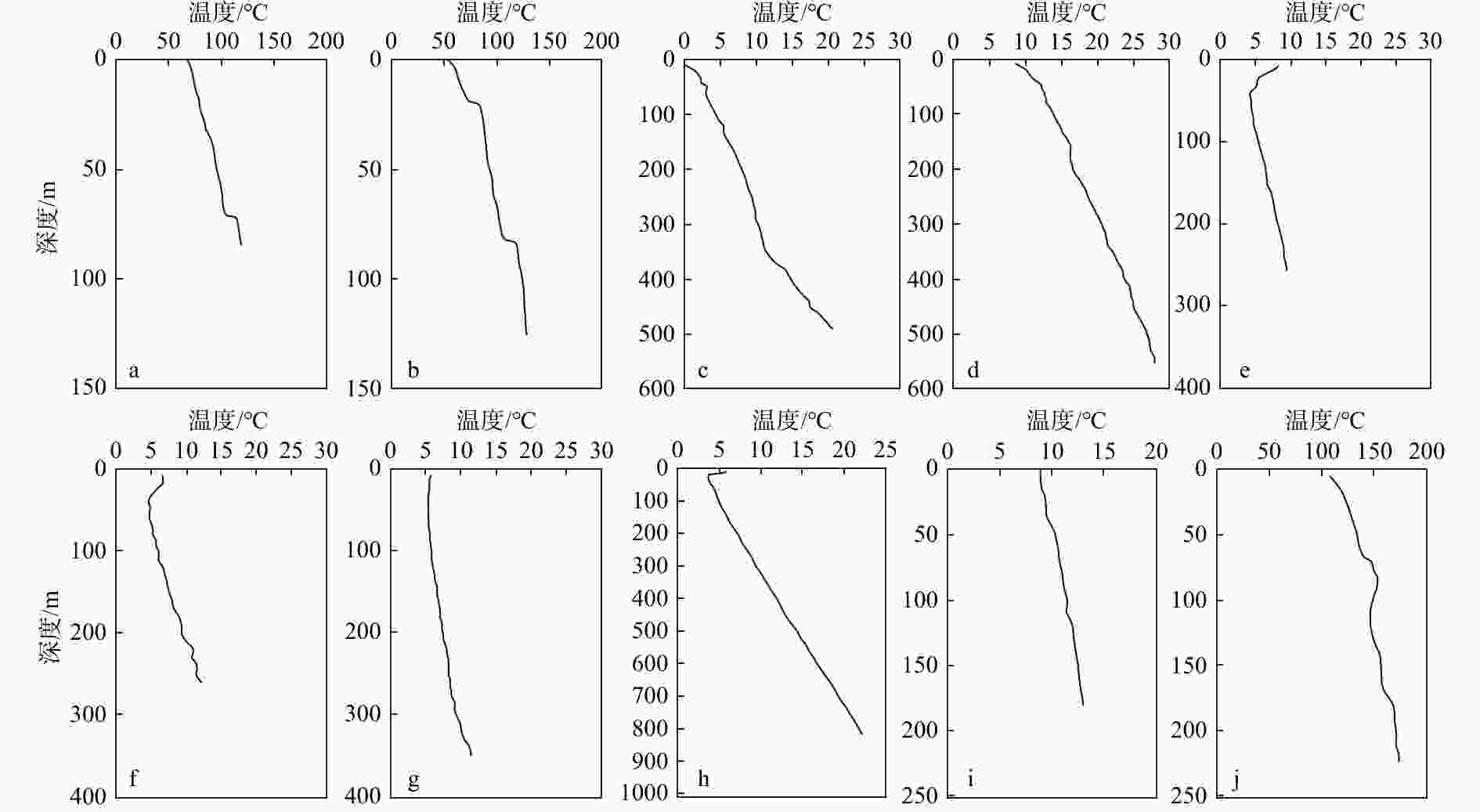
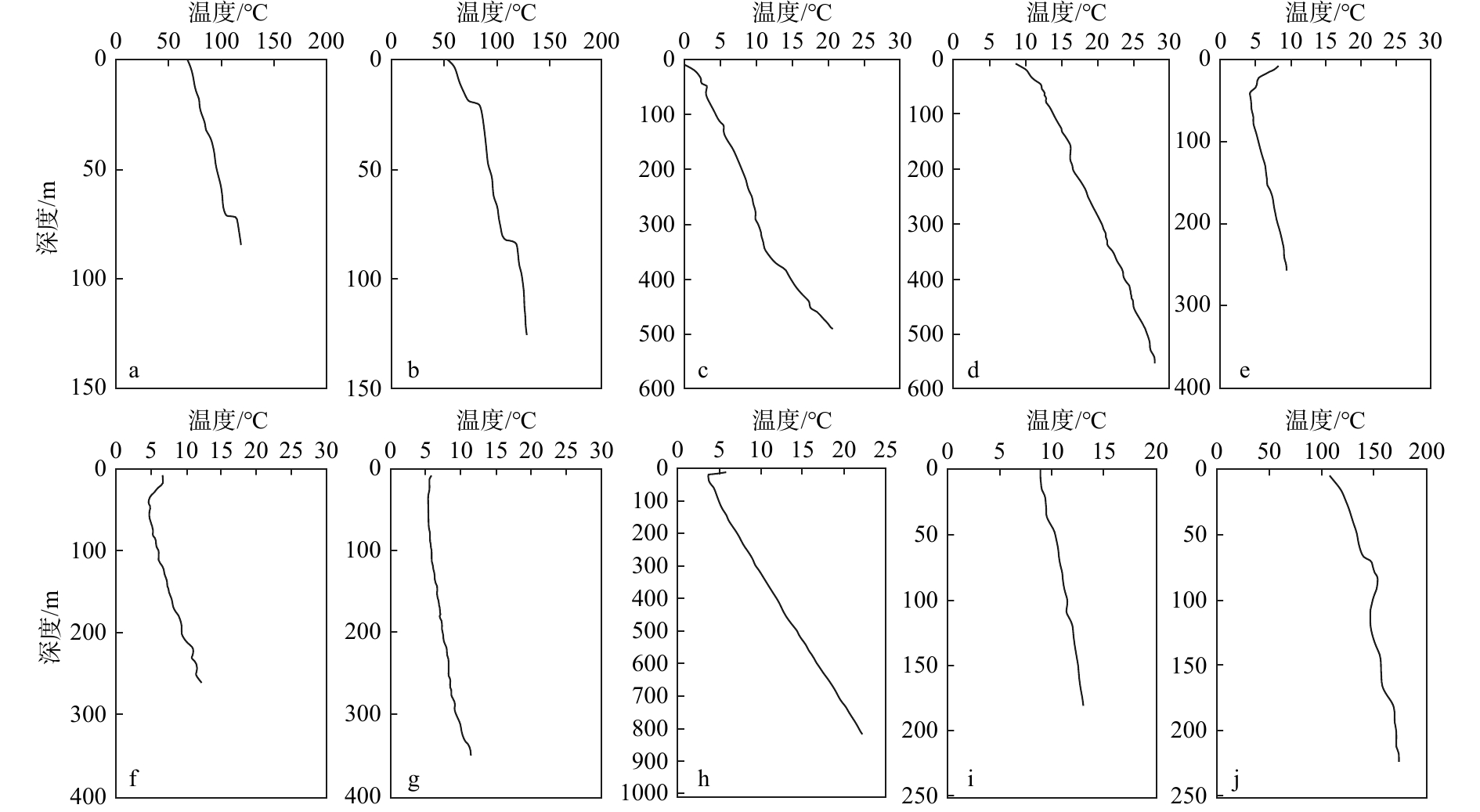
图 4 川西高原10口钻井温度−深度关系
a—巴塘地热带DZK02-1井;b—巴塘地热带DZK02-2井;c—甘孜−理塘地热带LT5井;d—甘孜−理塘地热带HCI井;e—甘孜−理塘地热带LT3井;f—甘孜−理塘地热带LT2井;g甘孜−理塘地热带LT1井;h—康定−炉霍地热带SK-ZDS02井;i—康定−炉霍地热带ZDS-2井;j—康定−炉霍地热带ZK2井
Figure 4. Temperature–depth relationships of 10 boreholes in the weatern Sichuan Plateau
(a) DZK02-1 well in the Batang geothermal belt; (b) DZK02-2 well in the Batang geothermal belt; (c) LT5 well in the Ganzi–Litang geothermal belt; (d) HCI well in the Ganzi–Litang geothermal belt; (e) LT3 well in the Ganzi–Litang geothermal belt; (f) LT2 well in the Ganzi–Litang geothermal belt; (g) LT1 well in the Ganzi–Litang geothermal belt; (h) SK-ZDS02 well in the Kangding–Luhuo geothermal belt; (i) ZDS-2 well in the Kangding–Luhuo geothermal belt; (j) ZK2 well in the Kangding–Luhuo geothermal belt
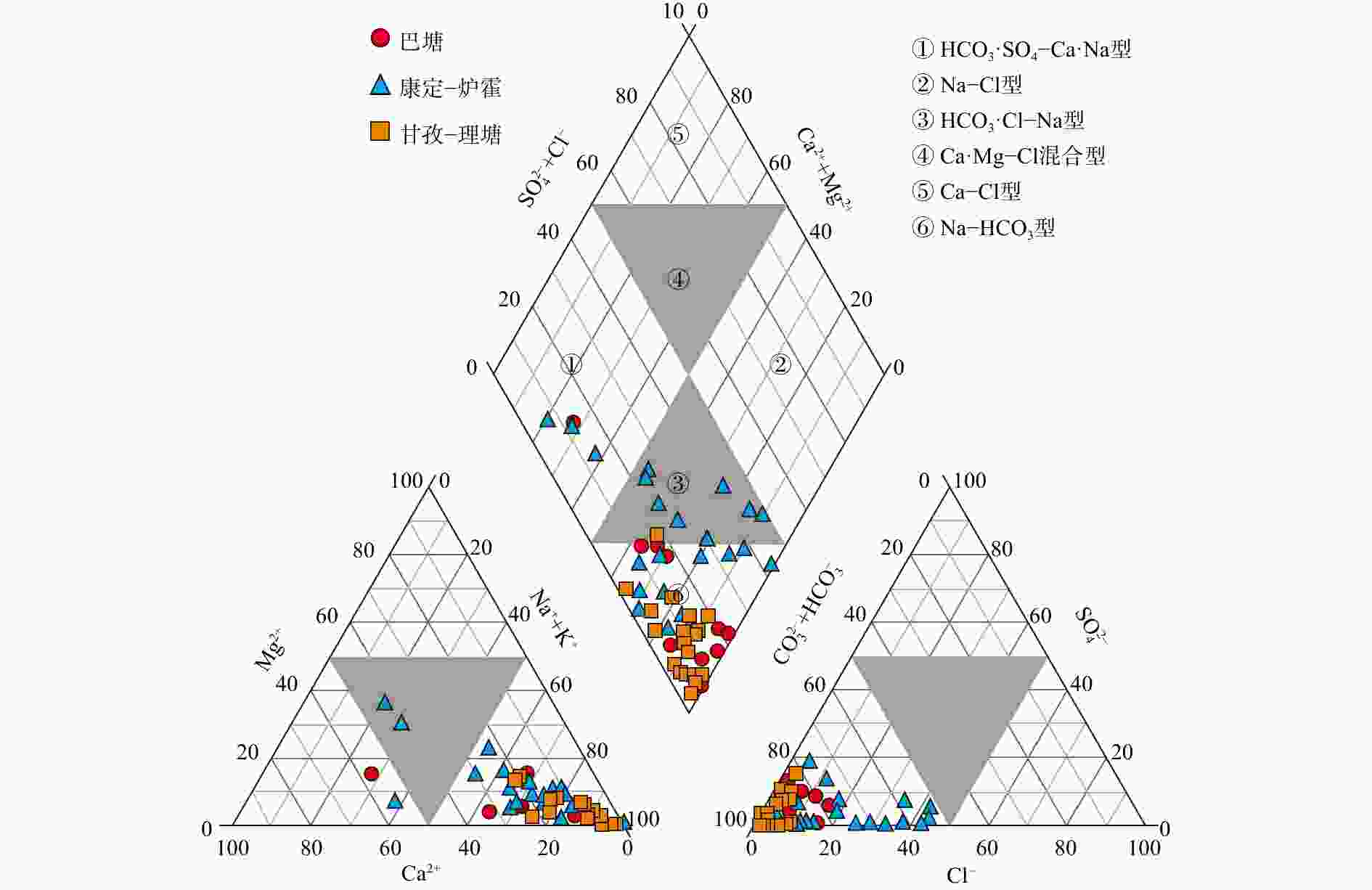
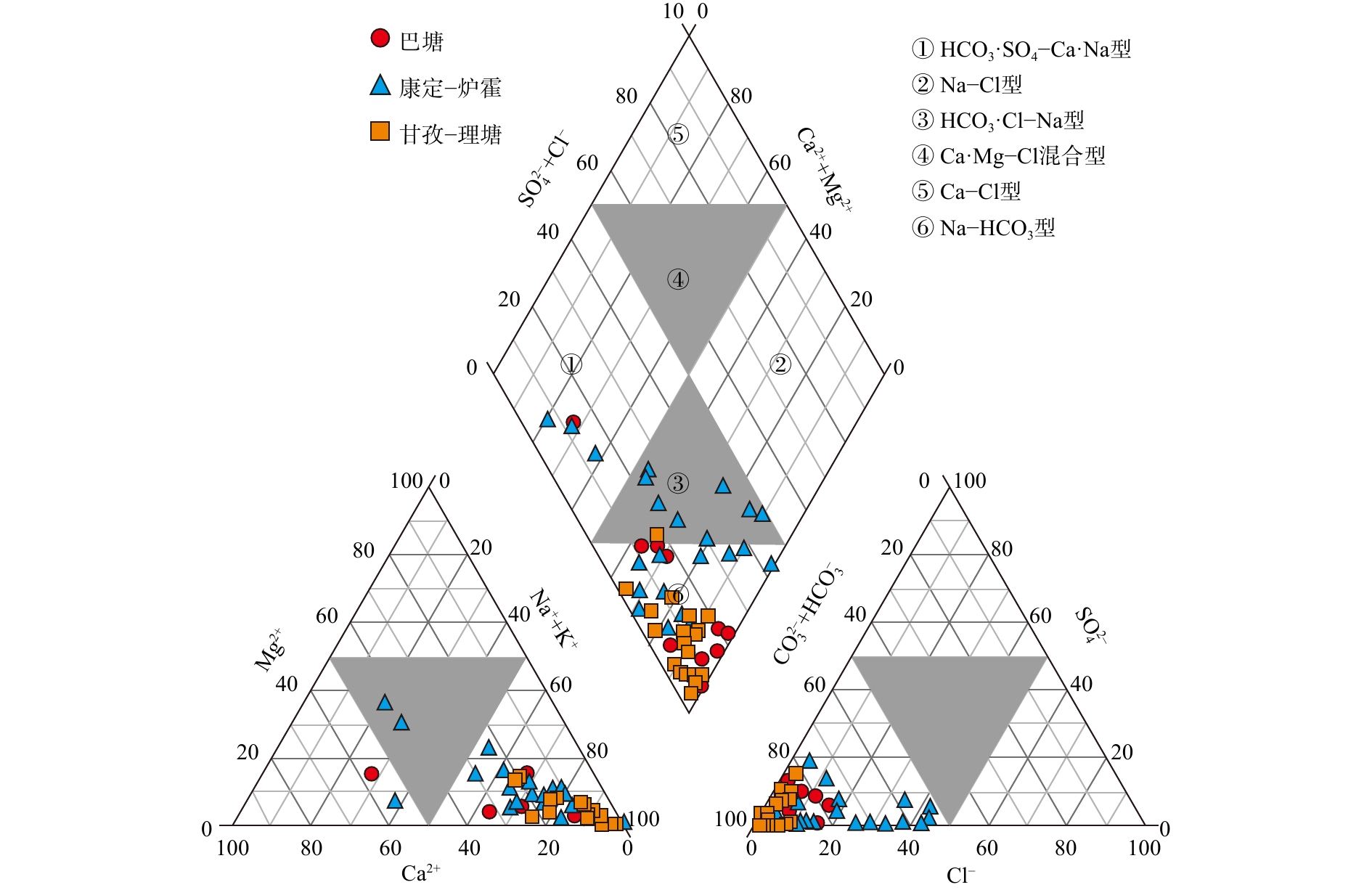
图 5 川西高原三大地热带地热流体水化学类型Piper图
Figure 5. Piper diagram showing the hydrochemical types of geothermal fluids in the three major geothermal belts of the western Sichuan Plateau
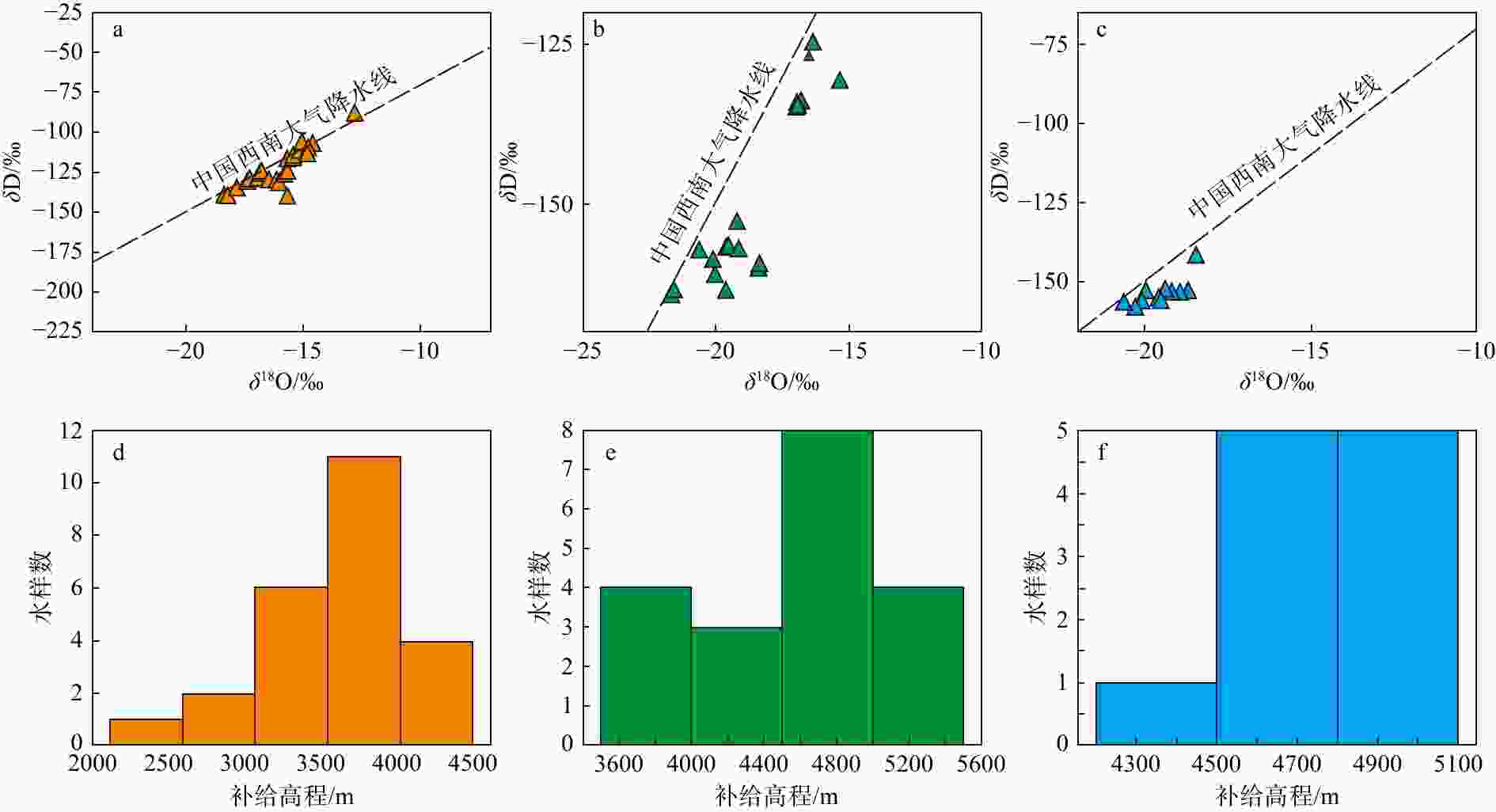
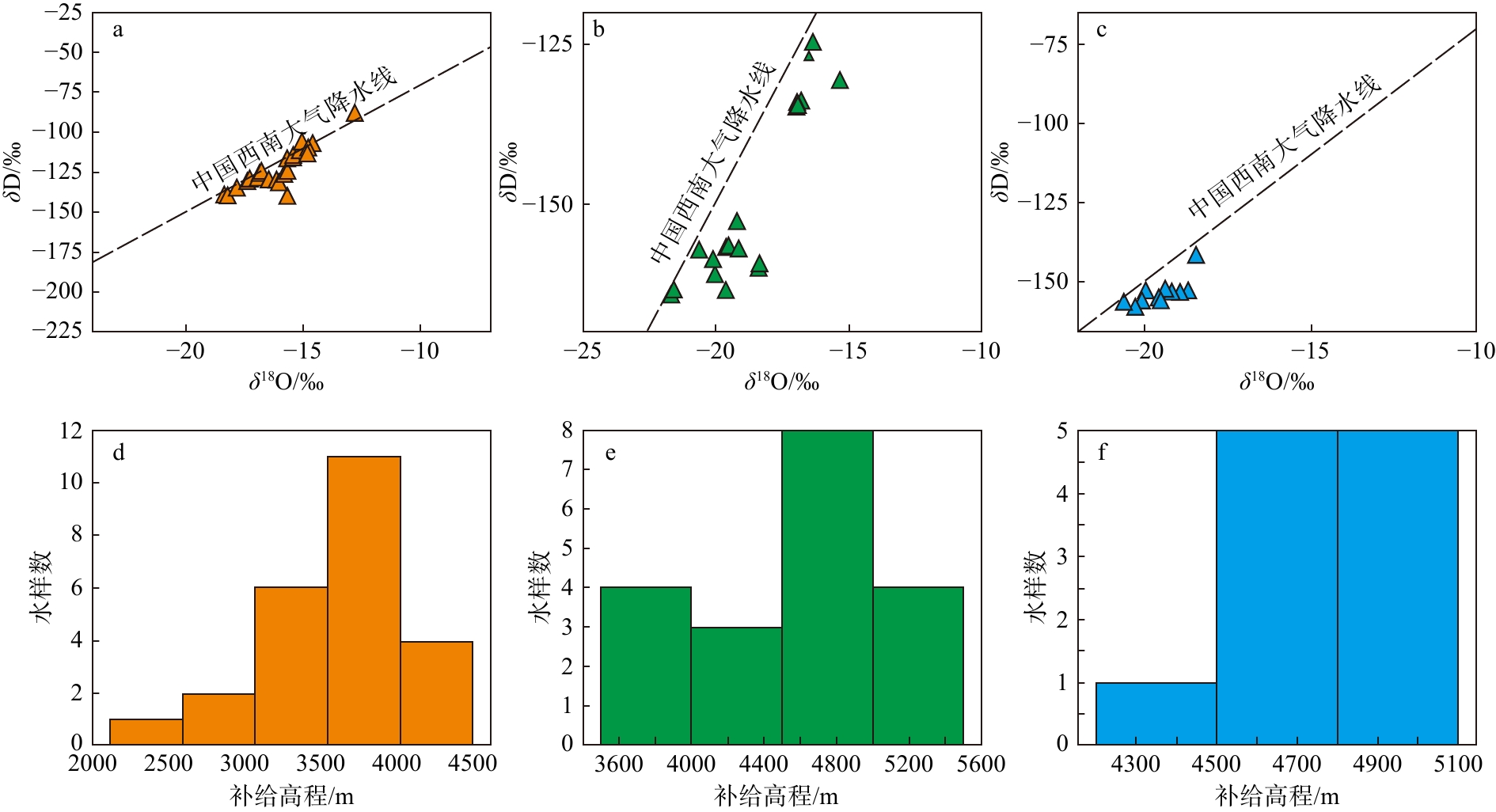
图 6 川西高原康定−炉霍、甘孜−理塘和巴塘地区地热流体δD–δ18O关系及补给高程分布
a—康定−炉霍地区δD–δ18O关系;b—甘孜−理塘地区δD–δ18O关系;c—巴塘地区δD–δ18O关系;d—康定−炉霍地区补给高程分布;e—甘孜−理塘地区补给高程分布;f—巴塘地区补给高程分布
Figure 6. δD–δ18O relationships and recharge elevation distributions of geothermal fluids in the Kangding–Luhuo, Ganzi–Litang, and Batang regions of the western Sichuan Plateau
(a) δD–δ18O relationship in the Kangding–Luhuo region; (b) δD–δ18O relationship in the Ganzi–Litang region; (c) δD–δ18O relationship in the Batang region; (d) Recharge elevation distribution in the Kangding–Luhuo region; (e) Recharge elevation distribution in the Ganzi–Litang region; (f) Recharge elevation distribution in the Batang region
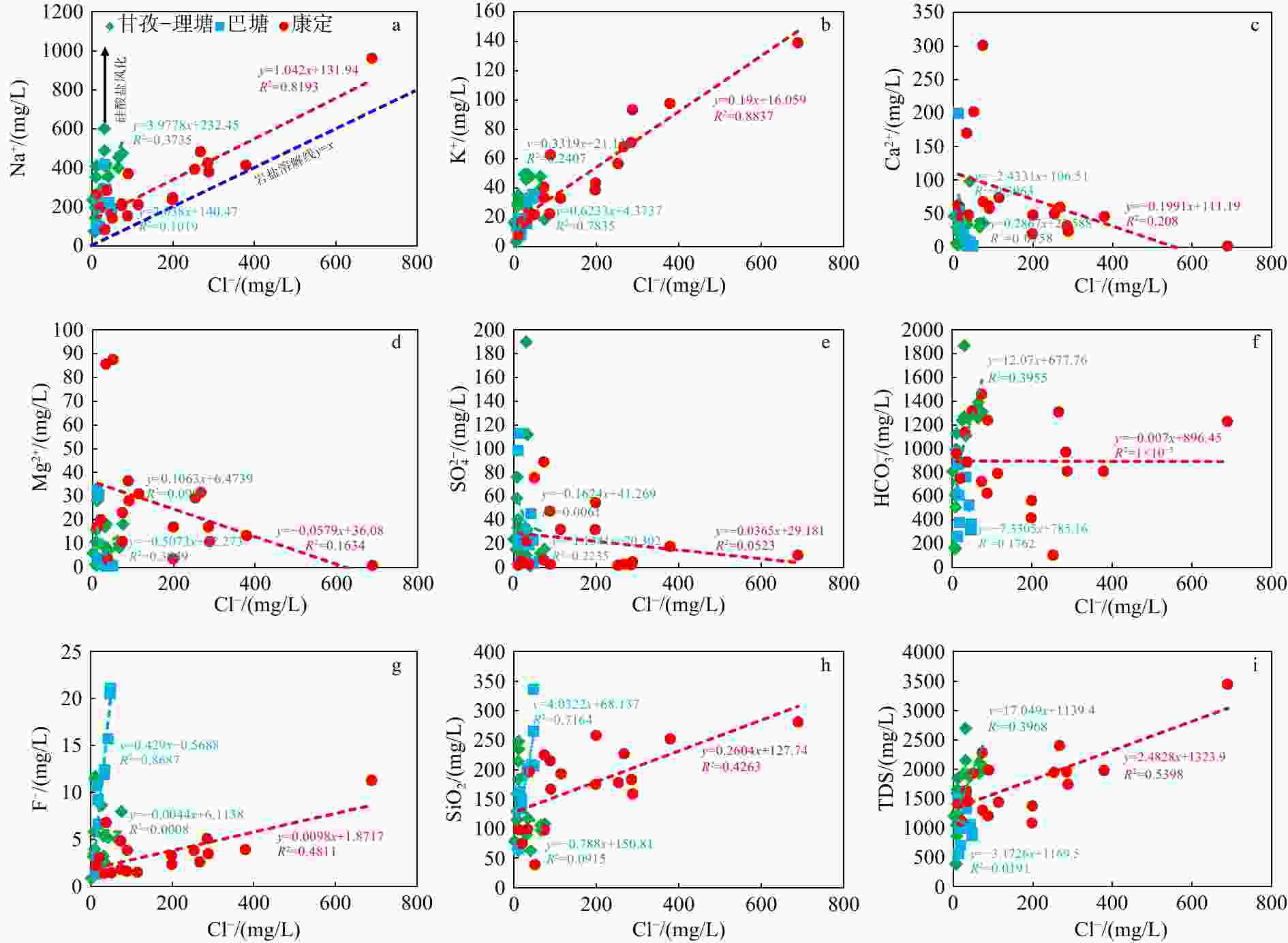
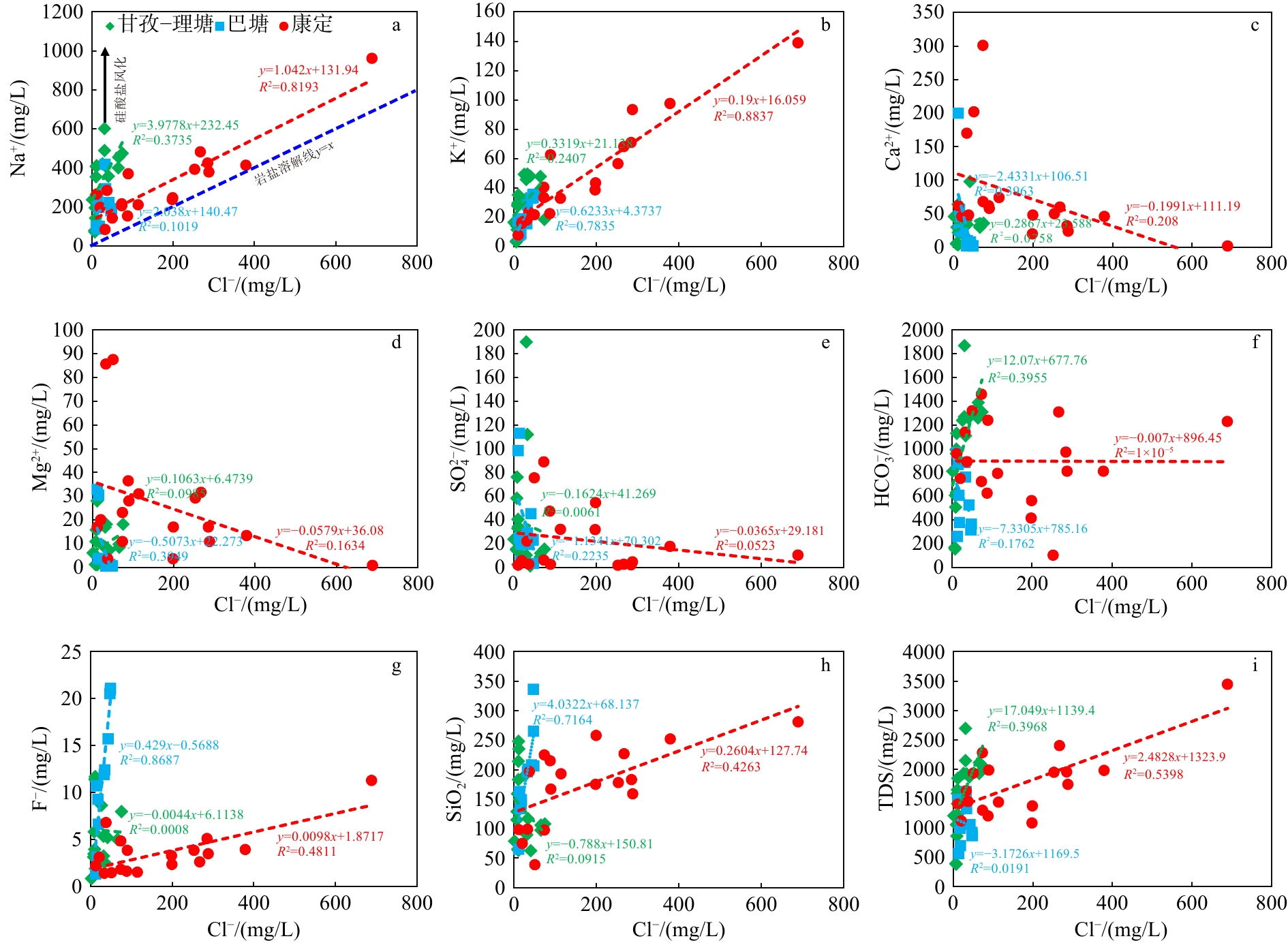
图 7 川西高原三大地热带地热流体Cl−与主要水化学组分关系图
a—Na+与Cl−的关系;b—K+与Cl−的关系;c—Ca2+与Cl−的关系;d—Mg2+与Cl−的关系;e—SO42−与Cl−的关系;f—HCO3−与Cl−的关系;g—F−与Cl−的关系;h—SiO2与Cl−的关系;i—TDS与Cl−的关系
Figure 7. Relationships between Cl− and major hydrochemical components of geothermal fluids in the three major geothermal belts of the western Sichuan Plateau
(a) Na+ vesus Cl−; (b) K+ vesus Cl−; (c) Ca2+ vesus Cl−; (d) Mg2+ vesus Cl−; (e) SO42− vesus Cl−; (f) HCO3− vesus Cl−; (g) F− vesus Cl−; (h) SiO2 vesus Cl−; (i) TDS vesus Cl−
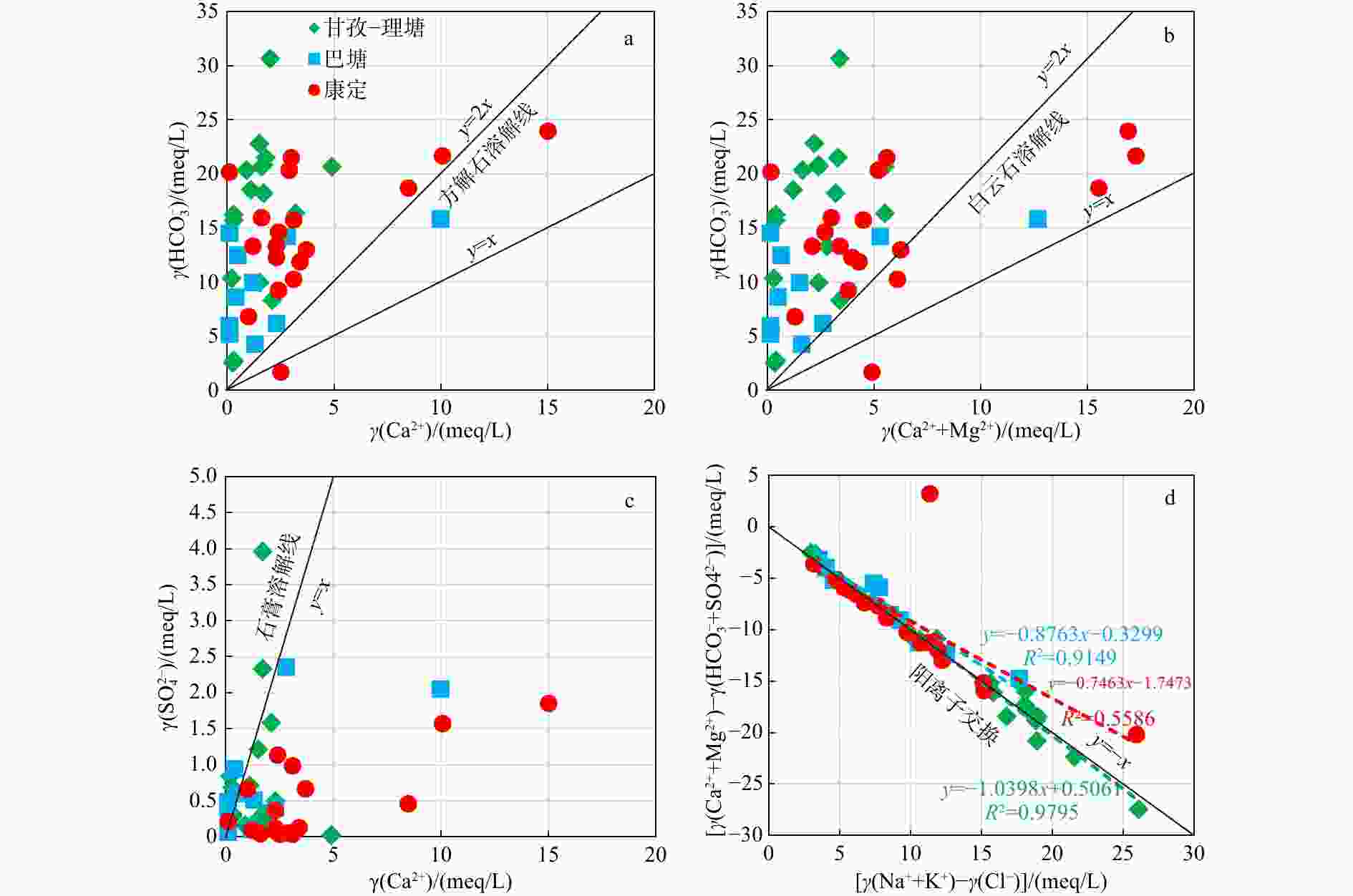
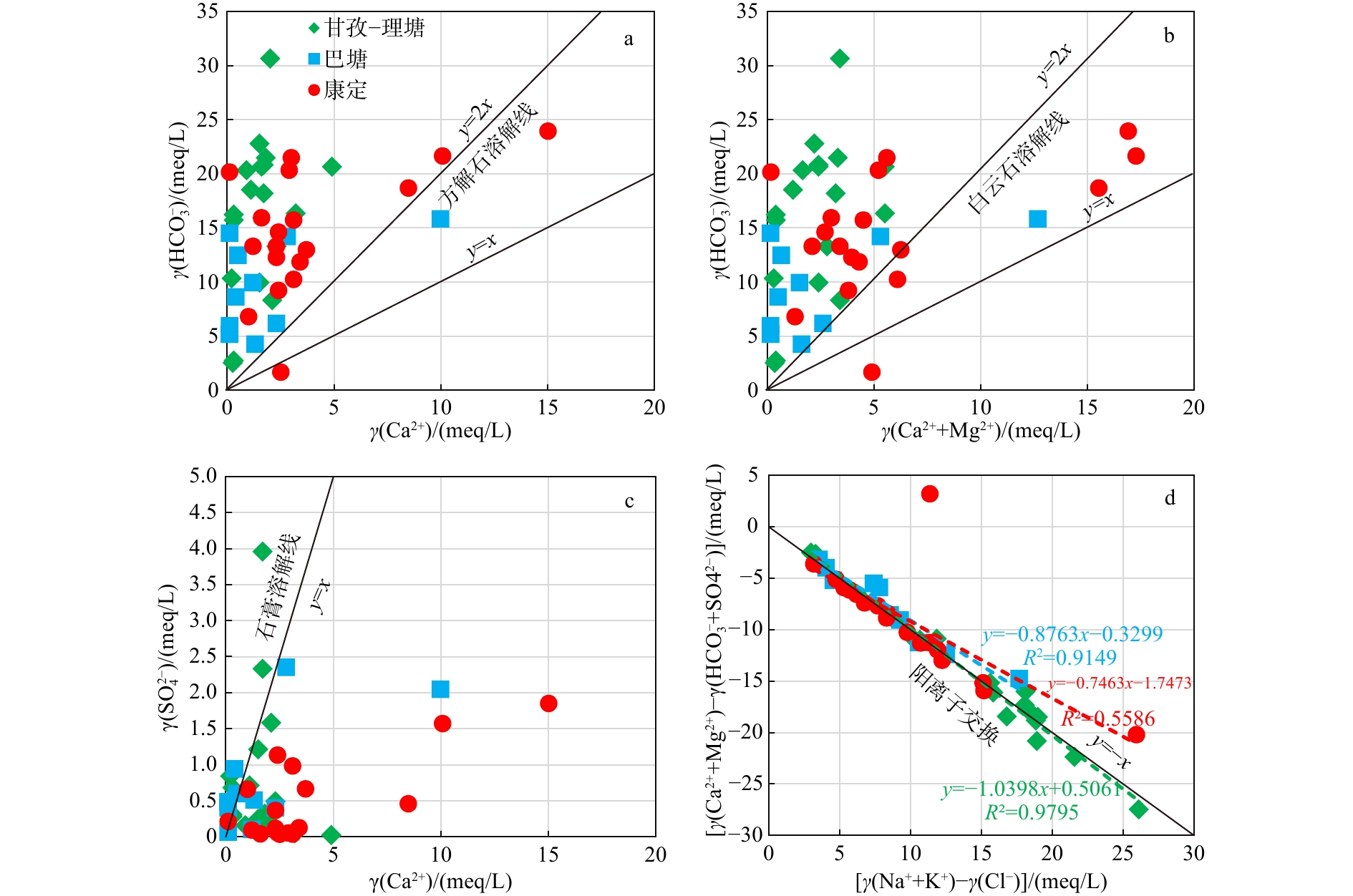
图 8 川西高原温泉水主要阴阳离子关系
a—Ca2+–HCO3−当量关系图;b—(Ca2++Mg2+)–HCO3−当量关系图;c—Ca2+–SO42−当量关系图;d—[γ(Na++K+)−γ(Cl−)]与[γ(Ca2++Mg2+)−γ(HCO3−+SO42−)]关系图
Figure 8. Relationships among major cations and anions in hot spring water in the western Sichuan Plateau
(a) Ca2+–HCO3−equivalent relationship; (b) (Ca2++Mg2+)–HCO3− equivalent relationship; (c) Ca2+–SO42−equivalent relationship; (d) Relationship between [γ(Na++K+)−γ(Cl−)]and[γ(Ca2++Mg2+)−γ(HCO3−+SO42−)]
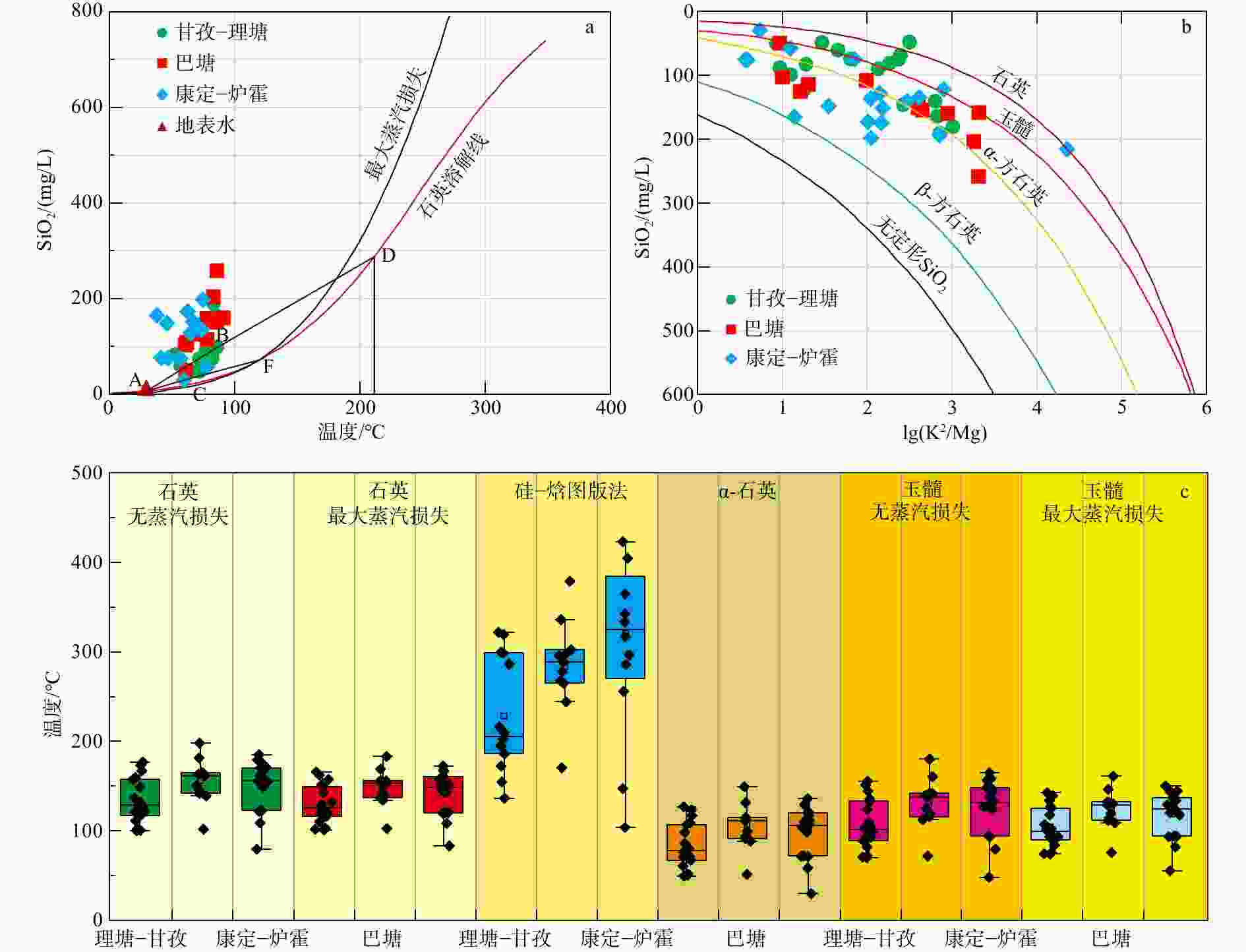
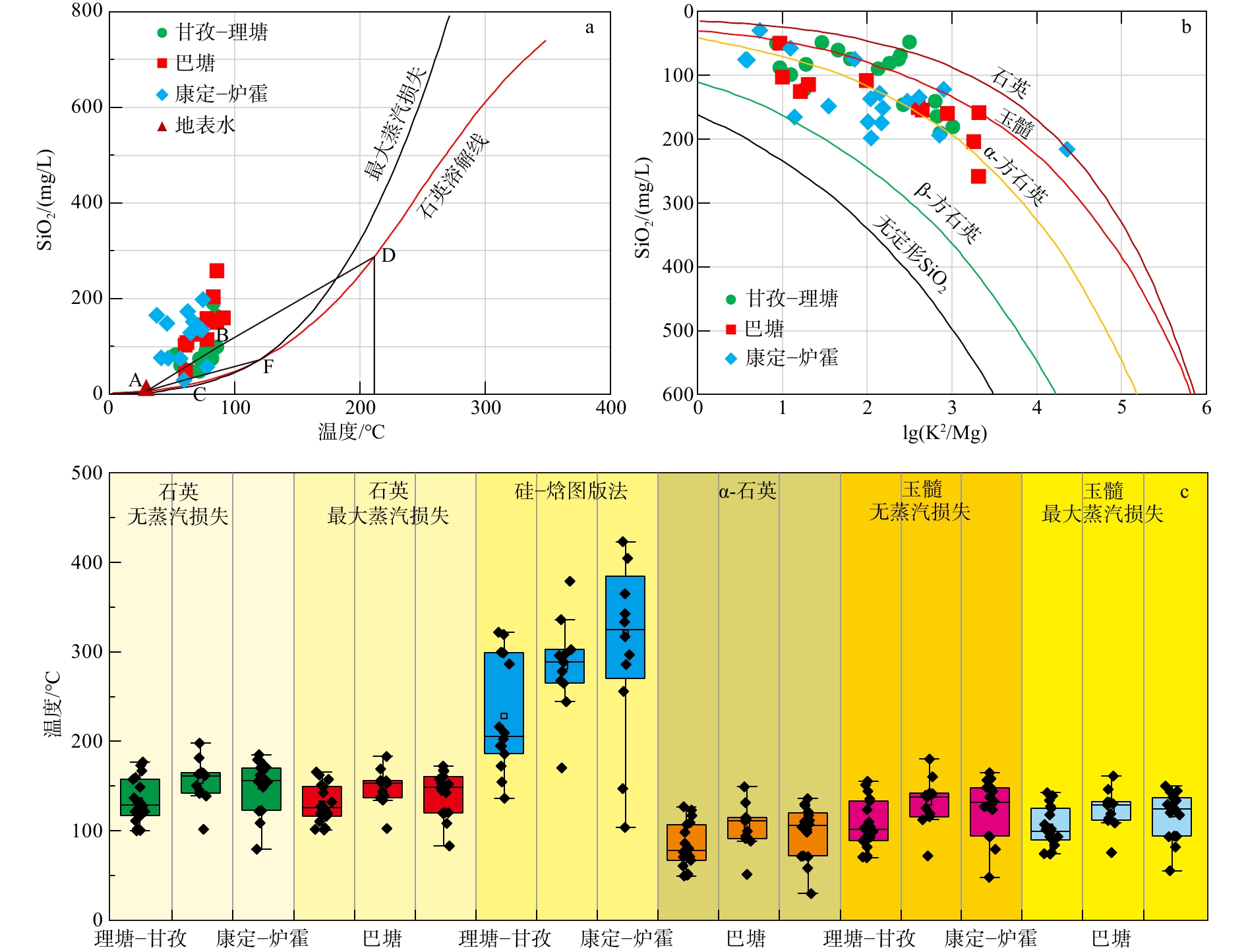
图 9 川西高原地热流体地球化学温标及热储温度评价
a—川西高原三大地热带硅−焓图解;b—SiO2矿物溶解平衡判别;c—热储温度估算结果
Figure 9. Geochemical geothermometry and reservoir temperature estimation of geothermal fluids in the western Sichuan Plateau
(a) Silica–enthalpy graphical method; (b) Silica-mineral dissolution equilibrium in the SiO2−lg(K2/Mg) diagram; (c) Statistical comparison of reservoir temperatures estimated using different methods
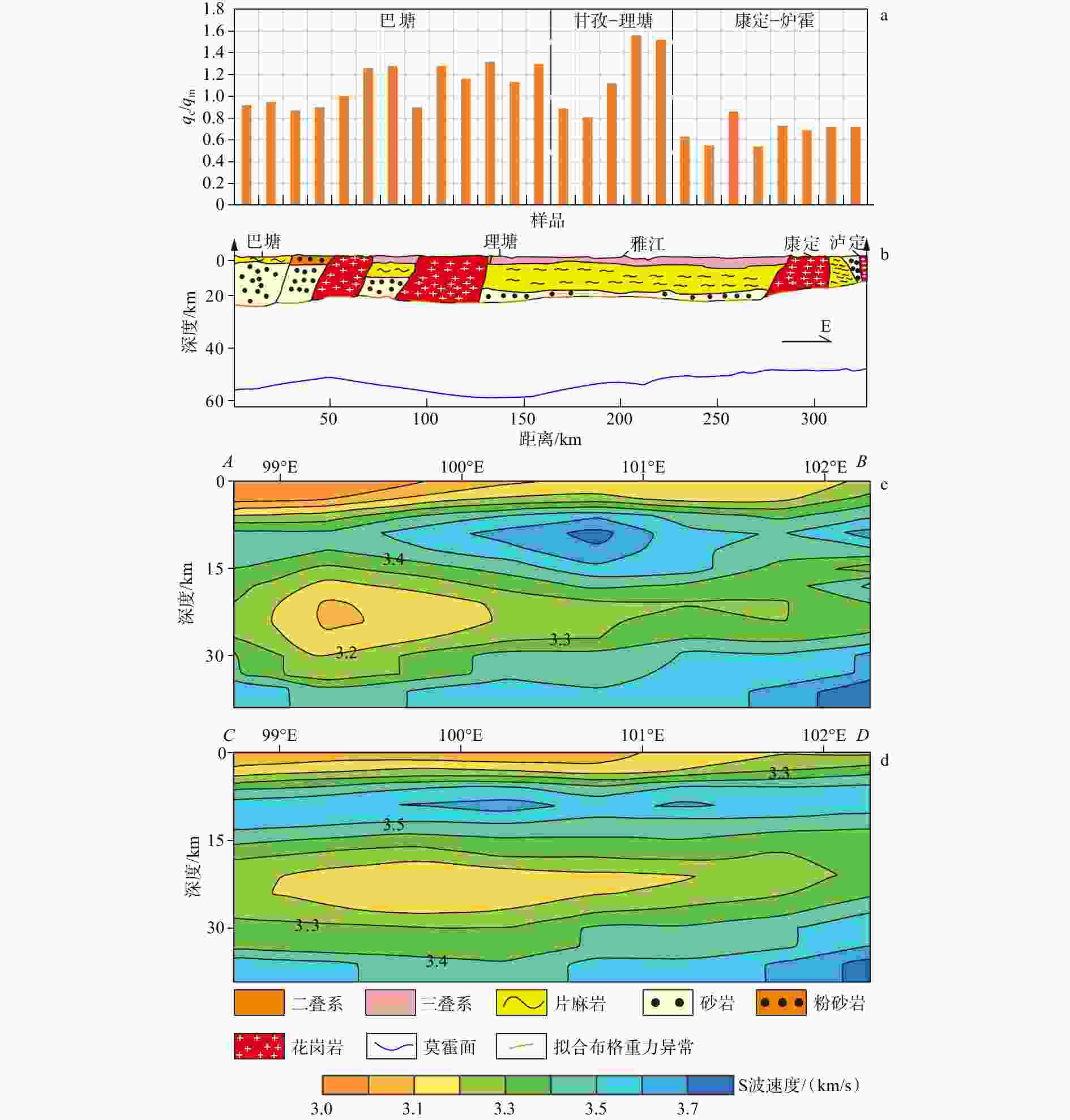
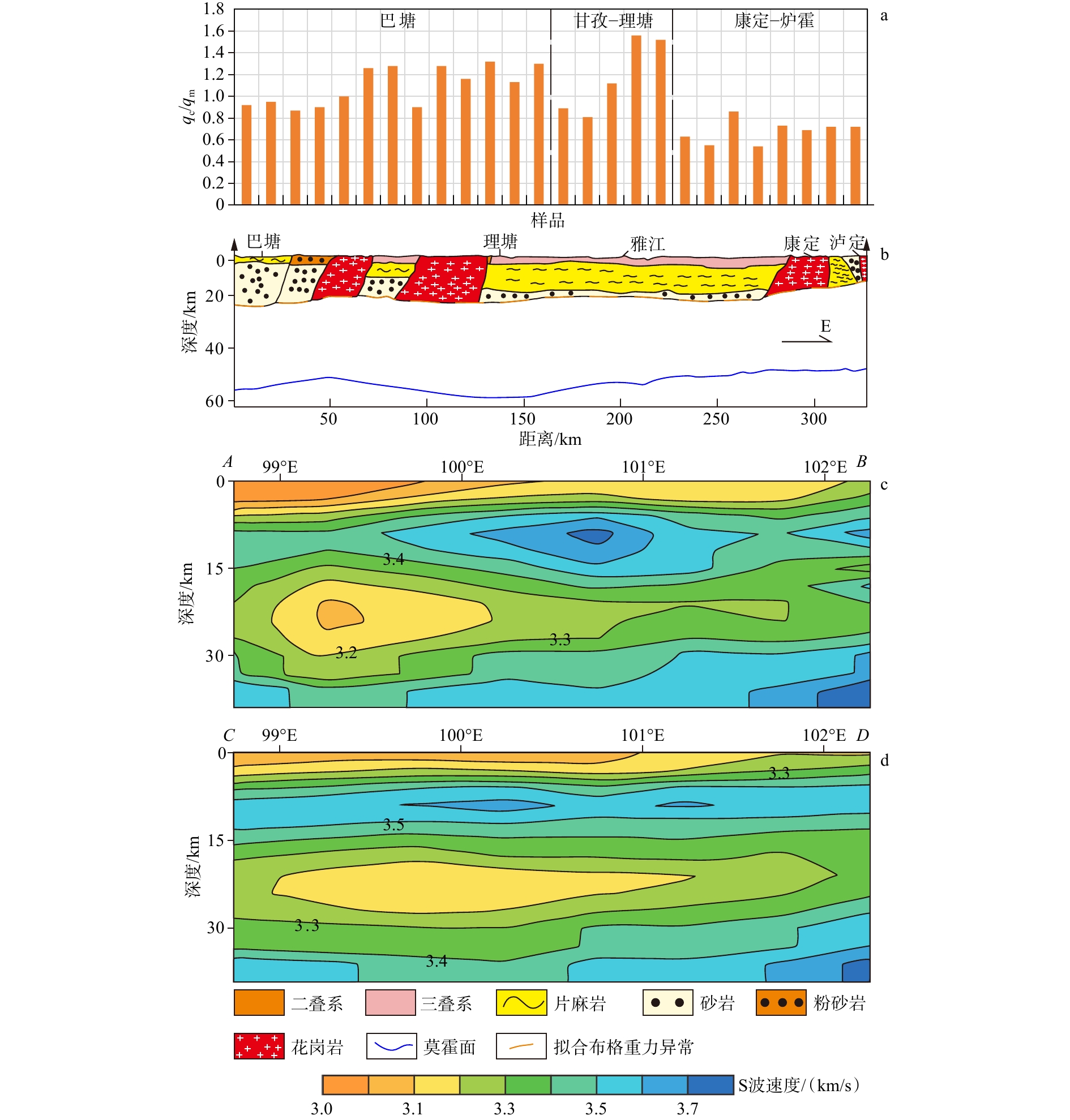
图 10 川西高原巴塘−理塘−康定剖面热流、地层岩性与深部S波速度结构特征(据高玲举等,2015;张健等,2017;李午阳等,2018修改)
a—三大地热带地壳热流与幔源热流比值;b—巴塘−理塘−雅江−康定−泸定剖面地质结构、莫霍面及布格重力异常特征;c—AB剖面深部S波速度结构;d—CD剖面深部S波速度结构
Figure 10. Heat flow, lithology and deep S-wave velocity structure along the Batang–Litang–Kangding profile in the western Sichuan Plateau (modified from Gao et al., 2015; Zhang et al., 2017; Li et al., 2018)
(a) Ratio of crustal heat flow to mantle heat flow in the three major geothermal belts; (b) Geological structure, Moho geometry, and Bouguer gravity anomaly along the Batang–Litang-–Yajiang–Kangding–Luding profile; (c) Deep S-wave velocity structure along profile AB; (d) Deep S-wave velocity structure along profile CD
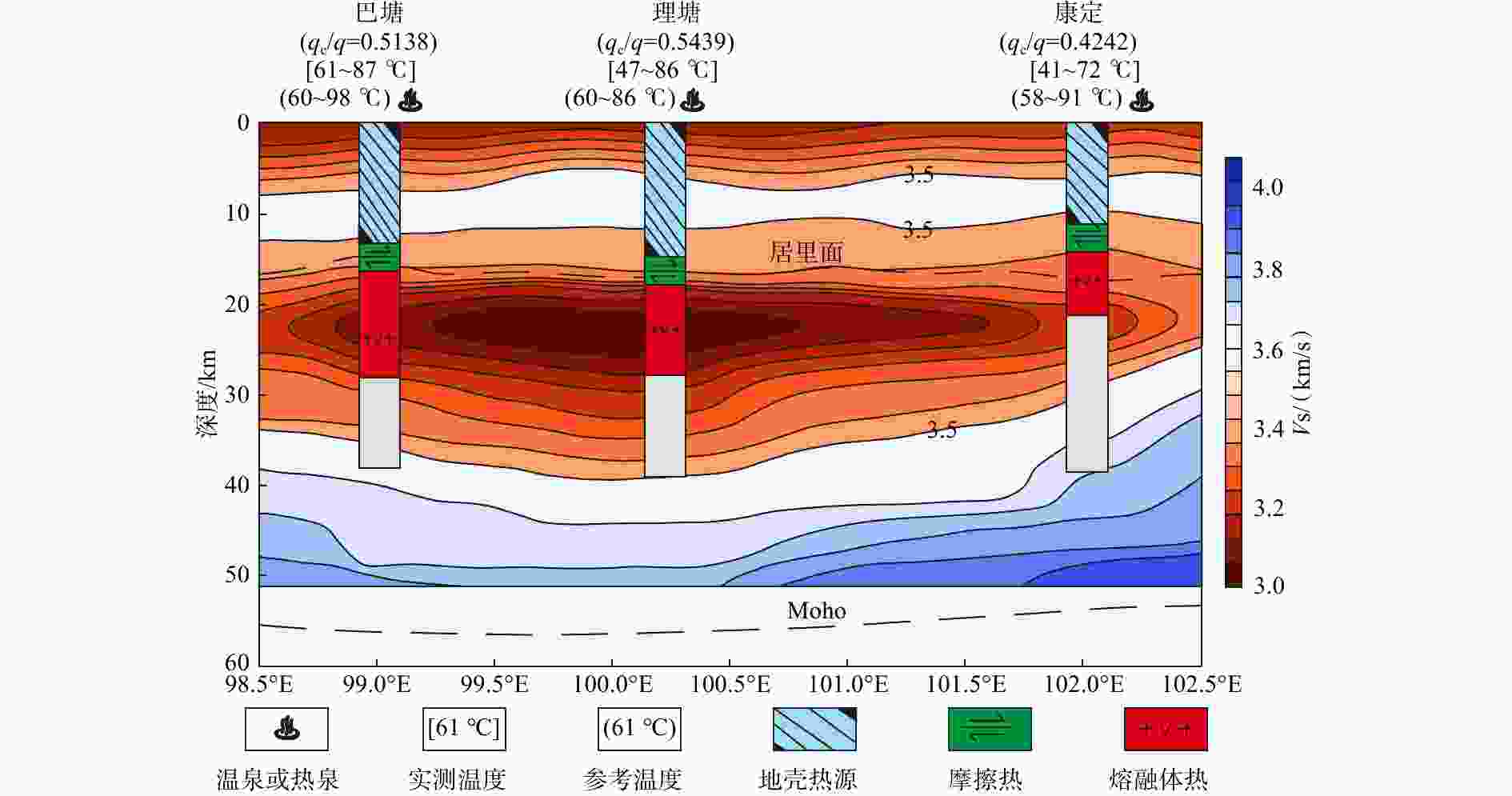
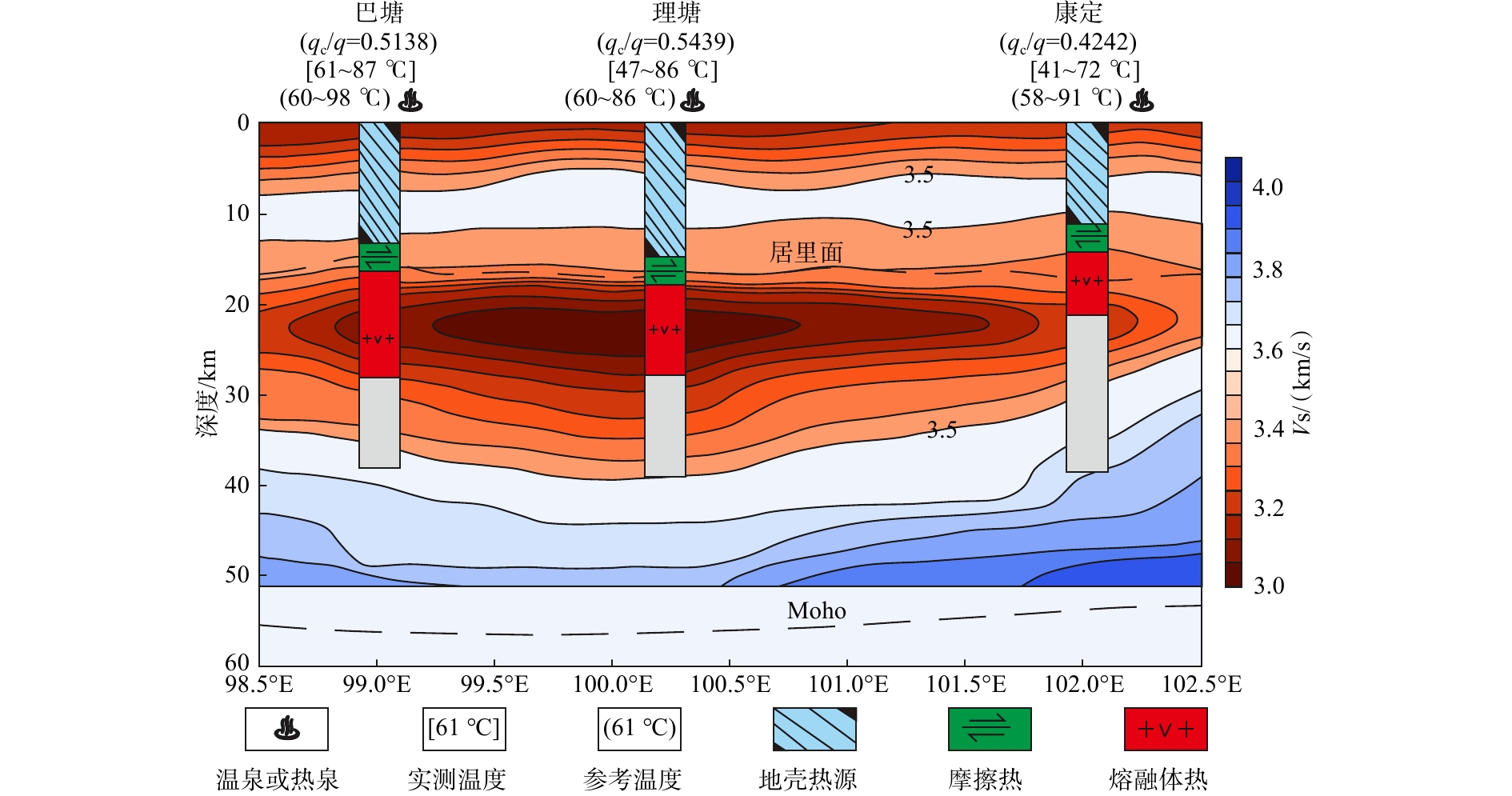
图 11 30°N剖面深部剪切波速度结构与壳幔热结构示意图(据李午阳等,2018修改)
Figure 11. Schematic diagram of deep S-wave velocity structure and crust–mantle thermal structure along the 30°N profile in the western Sichuan Plateau (modified from Li et al., 2018)
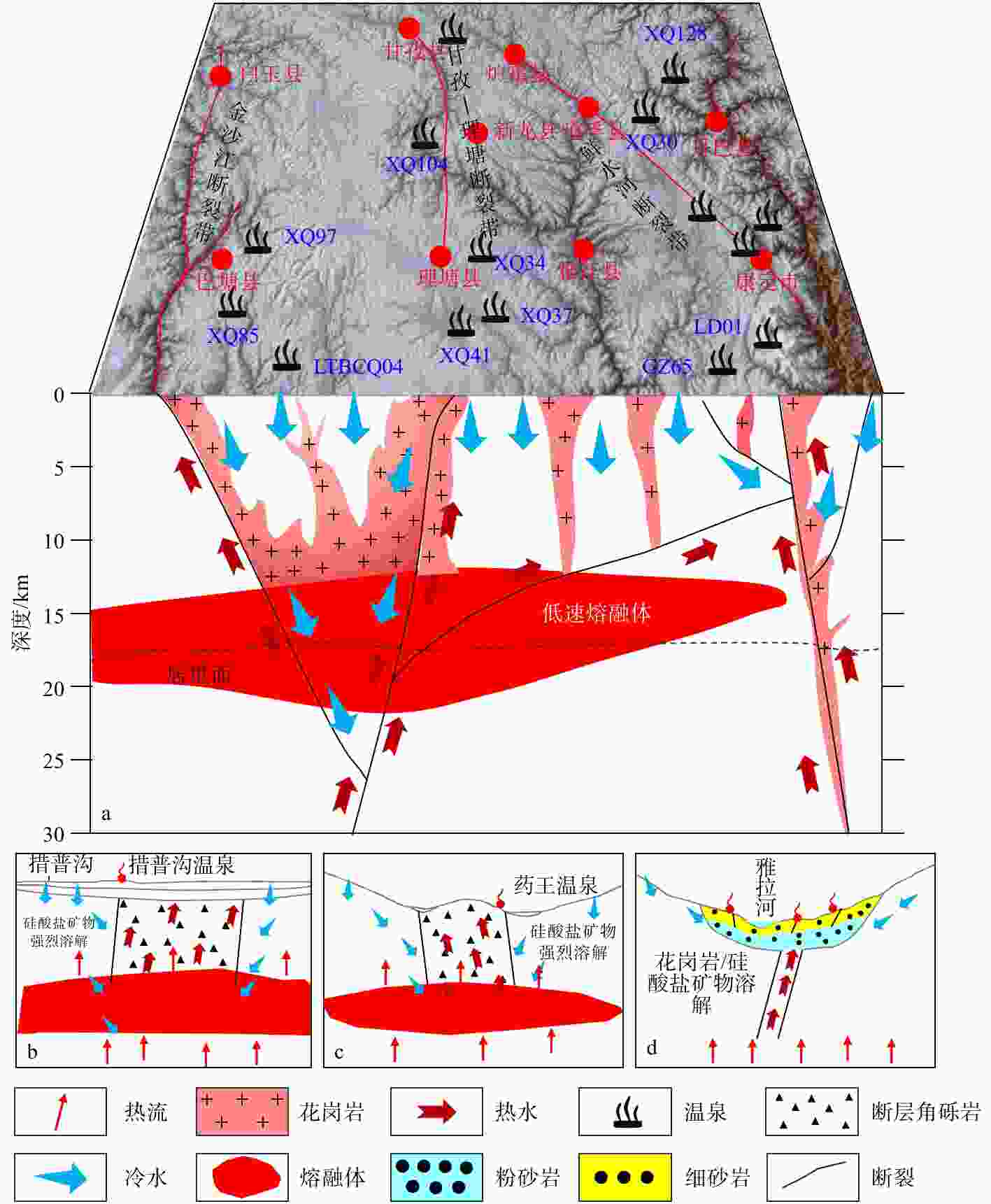
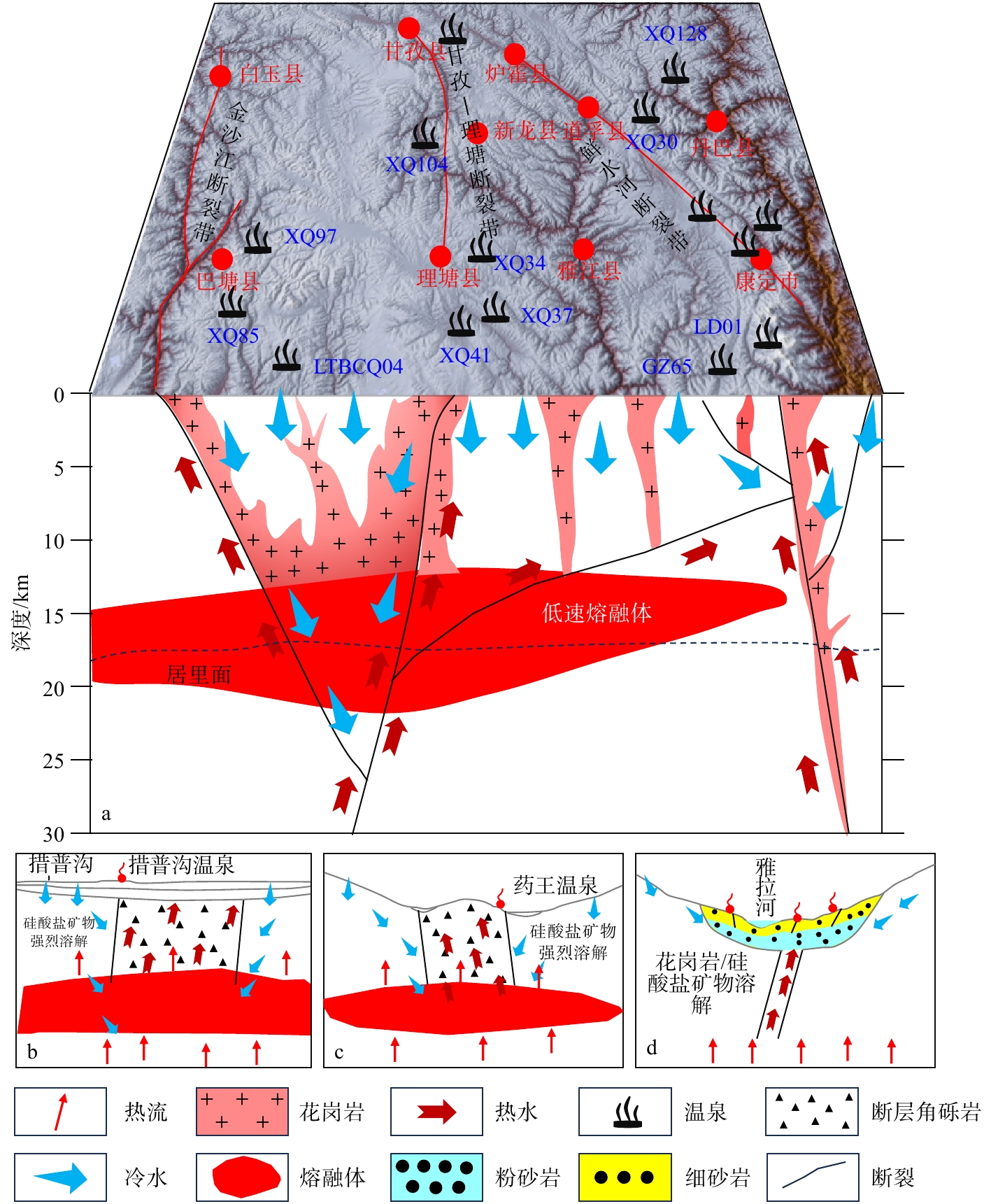
图 12 川西高原断裂导控型地热系统成因模式图
a—川西主要断裂带成因模式对比图;b—巴塘成因模式;c—理塘地热成因模式;d—康定地热成因模式
Figure 12. Genetic model of the fault-controlled geothermal systems in the western Sichuan Plateau
(a) Comparison of conceptual models for the major fault zones in western Sichuan; (b) Conceptual model of the Batang geothermal system; (c) Conceptual model of the Litang geothermal system; (d) Conceptual model of the Kangding geothermal system
表 1 川西高原地质单元岩石热导率表
Table 1. Thermal conductivity of rocks from different geological units in the western Sichuan Plateau
地质年代 岩性 个数 岩石热导率范围/(W·m−1·K−1) 平均值/ (W·m−1·K−1) 岩性含量/ % 地质单元岩石热导率/ (W·m−1·K−1) 三叠纪 灰岩 23 2.12~3.44 3.11±0.67 25 2.93 砂岩 3 1.30~4.29 3.14±1.61 35 岩浆岩 5 1.49~3.18 2.25±0.69 10 变质岩 7 1.94~4.17 2.78±0.95 30 二叠纪 灰岩 1 2.62 2.62 50 2.76 变质岩 3 2.50~2.32 2.93±0.38 40 岩浆岩 5 1.91~3.34 2.79±0.55 10 泥盆纪 岩浆岩 2 2.91~3.54 3.22±0.44 / 3.22 志留纪 灰岩 2 2.64~3.43 3.03±0.56 70 3.07 变质岩 1 3.15 3.15 30 寒武纪 片岩 8 2.01~2.88 2.42±0.31 / 2.42  下载: 导出CSV
表 2 川西高原三大地热带12个测点的地温梯度与大地热流
Table 2. Geothermal gradients and terrestrial heat flow at 12 measurement sites in the three major geothermal belts of the western Sichuan Plateau
区域 井号 深度范围/ m 地层 地热梯度(G) 岩石热导率(K) 地层大地热流(q地层) 平均大地热流(q平均) ℃/km W·m−1·K−1 mW/m2 mW/m2 康定−炉霍 SK-ZDS-02 100~810 三叠系 24.00 3.33 79.90 79.90 ZDS-2 50~180 中三叠统杂谷脑组 21.30 2.99 63.70 63.70 ZK2 110~221.4 三叠系 23.30 2.87 66.89 66.89 XJ04 691.8~1162.5 上三叠统 20.60 2.87 59.12 61.70 1195~1818.6 上三叠统 22.20 2.87 63.71 ZK1 160~230 三叠系 22.70 2.87 65.16 65.16 甘孜−理塘 LT1 60~350 三叠系 17.50 2.90 50.80 50.80 LT2 60~200 三叠系 32.50 2.84 93.28 93.28 LT3 60~260 三叠系 26.50 2.72 72.10 72.10 LT5 60~550 三叠系 37.30 3.12 116.20 116.20 HC1 0~600 三叠系 32.20 2.95 94.70 94.70 巴塘 DZK02-1 0~82.80 全新统 59.66 1.70 101.43 101.43 DZK02-2 20.0~83.8 全新统 37.02 1.70 62.93 60.81 83.8~124.7 上三叠统图姆沟组 20.04 2.87 57.51
下载: 导出CSV
-
[1] AI Y F, ZHANG J, DONG M, et al., 2021. Heat generation effects from shear friction along Xianshui river strike-slip fault in western Sichuan, China[J]. Geothermics, 89: 101936. doi: 10.1016/j.geothermics.2020.101936 [2] ALASINO P H, CAMPODONICO V A, ROCHER S, et al., 2026. The Incapillo Caldera geothermal system: implications for geothermal resources in the Southern Central Andes, Argentina[J]. Journal of Volcanology and Geothermal Research, 475: 108623. [3] AVIÑA-JIMÉNEZ H M, PROL-LEDESMA R M, GARCÍA-ÁVILA M A, et al., 2026. Opportunities for geothermal direct use in Mesillas geothermal prospect, Mexico[J]. Geothermics, 139: 103687. doi: 10.1016/j.geothermics.2026.103687 [4] BLASCH K W, BRYSON J R, 2007. Distinguishing sources of ground water recharge by using δ2H and δ18O[J]. Ground Water, 45(3): 294-308. [5] CAO R, CAI Y Q, DOR J, et al., 2025. Distribution and genesis of geothermal waters in the Xianshuihe fault zone, Western Sichuan plateau, China: constraints on fracture system and regional seismic activities[J]. Geothermics, 125: 103150. [6] DAI W, JIANG X W, LUO Y F, et al. , 2021. Identification and quantification of factors controlling hydrogen and oxygen isotopes of geothermal water: an example from the Guide Basin, Qinghai Province[J]. Earth Science Frontiers, 28(1): 420-427. (in Chinese with English abstract) [7] FOURNIER R O, 1977. Chemical geothermometers and mixing models for geothermal systems[J]. Geothermics, 5(1-4): 41-50. [8] GAO L J, ZHANG J, DONG M, 2015. The study of gravity-magnetic anomaly and tectonic background in Sichuan west region[J]. Chinese Journal of Geophysics, 58(8): 2996-3008. (in Chinese with English abstract) [9] General Administration of Quality Supervision, Inspection and Quarantine of the People's Republic of China, Standardization Administration of the People's Republic of China, 2011. Specification of geothermal resources geological exploration: GB/T 11615—2010[S]. Beijing: Standards Press of China. [10] HOU J, PAN J T, LI Y H, et al. , 2023. Crustal S-wave velocity structure in the western and central North China Craton and its geological significance[J]. Chinese Journal of Geophysics, 66(5): 1960-1975. (in Chinese with English abstract) [11] HU F Y, WU F Y, DUCEA M N, et al., 2022. Does large-scale crustal flow shape the eastern margin of the Tibetan Plateau? Insights from episodic magmatism of Gongga-Zheduo Granitic Massif[J]. Geophysical Research Letters, 49(12): e2022GL098756. [12] HUANG X, ZHANG Y H, LI X, et al. , 2024. Hydrochemical characteristics and genetic mechanism of geothermal water in the Wandong geothermal area along the Moxi fault in western Sichuan[J]. Coal Geology & Exploration, 52(6): 91-101. (in Chinese with English abstract) [13] LEUNG C F, WANG J G, XIE H P, et al., 2024. Geothermal energy for sustainable and green energy supply in the future[J]. Deep Underground Science and Engineering, 3(3): 255. [14] LI J X, YANG G, SAGOE G, et al. , 2018. Major hydrogeochemical processes controlling the composition of geothermal waters in the Kangding geothermal field, western Sichuan Province[J]. Geothermics, 75: 154-163. [15] LI P W, GAO R, GUAN Y, et al. , 2009. Paleomagnetic constraints on the closure time of paleo-tethys: implications for the tectonic setting of formation of Triassic Songpan-Ganzi Flysch complex[J]. Acta Geoscientica Sinica, 30(1): 39-50. (in Chinese with English abstract) [16] LI W J, WANG J L, WANG J L, 2018. Characteristics of the stable isotopes in precipitation and the source of water vapor in different terrain in the southwest region[J]. Resources and Environment in the Yangtze Basin, 27(5): 1132-1142. (in Chinese with English abstract) [17] LI W Y, ZHANG J, TANG X C, et al. , 2018. The deep geothermal structure of high-temperature hydrothermal activity region in western Sichuan Plateau: a geophysical study[J]. Chinese Journal of Geophysics, 61(7): 2926-2936. (in Chinese with English abstract) [18] LI X, WANG J J, HUANG X, et al. , 2018. Chemical and isotopic characteristics of hot water in the Kangding-Daofu section of Xianshuihe fault zone, Sichuan, China[J]. Journal of Chengdu University of Technology (Science & Technology Edition), 45(6): 733-745. (in Chinese with English abstract) [19] LIANG S, LU Y Q, LIANG J L, et al. , 2025. Geochemical characteristics and cyclic evolution process of hot springs in Batang, western Sichuan[J]. Geoscience, 39(6): 1716-1729. (in Chinese with English abstract) [20] LIN W J, LIU Z M, WANG W L, et al. , 2013. The assessment of geothermal resources potential of China[J]. Geology in China, 40(1): 312-321. (in Chinese with English abstract) [21] LIU J, ZHOU X C, LI Y, et al., 2023. Relationship between hydrogeochemical characteristics of hot springs and seismic activity in the Jinshajiang fault zone, Southeast Tibetan Plateau[J]. Frontiers in Earth Science, 10: 1015134. [22] LIU X, JIA Z Q, LUO Z H, 2025. Genesis of geothermal water in the overnight area of the central Ganzi-Litang County fault: a geochemistry approach[J]. Multipurpose Utilization of Mineral Resources, 46(1): 61-69. (in Chinese with English abstract) [23] PatSnap Insights Team, 2026. Enhanced geothermal systems technology landscape 2026[R]. Singapore: PatSnap Insights Team. [24] QIU N S, ZHU C Q, SONG J L, et al. , 2026. Distribution, development and utilization of geothermal resources in China[J]. Acta Petrolei Sinica, 47(1): 294-310. (in Chinese with English abstract) [25] REN X F, LI P Y, HE X D, et al. , 2021. Hydrogeochemical processes affecting groundwater chemistry in the central part of the Guanzhong Basin, China[J]. Archives of Environmental Contamination and Toxicology, 80(1): 74-91. [26] SHEN H L, YANG Y, ZHOU Z H, et al. , 2023. Genesis and deep geothermal process of Maoya hot springs in Litang, western Sichuan[J]. Seismology and Geology, 45(3): 689-709. (in Chinese with English abstract) [27] SOLTANI M, KASHKOOLI F M, DEHGHANI-SANIJ A R, et al., 2019. A comprehensive review of geothermal energy evolution and development[J]. International Journal of Green Energy, 16(13): 971-1009. [28] SUN D, CAO N, LIU X Z, et al. , 2019. Geothermal resources and development in Garzê prefecture, Sichuan[J]. Acta Geologica Sichuan, 39(1): 133-138. (in Chinese with English abstract) [29] TANG B N, QIU N S, ZHU C Q, et al. , 2024. Thermal conductivity column of rocks and distribution characteristics of paleo-geothermal field in the Songliao Basin[J]. Coal Geology & Exploration, 52(1): 26-35. (in Chinese with English abstract) [30] TANG X, WANG Y C, JIA H X, et al., 2025. Thermal budget of hydrothermal systems for the Xianshuihe fault belt in the SE Tibetan Plateau: insights to the geothermal accumulation processes[J]. Geothermics, 125: 103189. [31] TANG X C, ZHANG J, PANG Z H, et al. , 2017. The eastern Tibetan Plateau geothermal belt, western China: geology, geophysics, genesis, and hydrothermal system[J]. Tectonophysics, 717: 433-448. [32] TANG Y, YIN A, XU X, et al. , 2023. Tectonic evolution of the Triassic Songpan-Ganzi basin as constrained by a synthesis of multi-proxy provenance data[J]. Basin Research, 35(1): 28-60. [33] TIAN J, STEFÁNSSON A, LI Y M, et al., 2023. Geochemistry of thermal fluids and the genesis of granite-hosted Huangshadong geothermal system, Southeast China[J]. Geothermics, 109: 102647. [34] WALLIS I C, ROWLAND J V, DEMPSEY D, 2018. The relationship between geothermal fluid flow and geologic context: a global review[C]//Proceedings of the Geothermal Resources Council Transactions. Reno: Geothermal Resources Council: 1-19. [35] WANG J Y, PANG Z H, CHENG Y Z, et al. , 2023. Current state, utilization and prospective of global geothermal energy[J]. Science & Technology Review, 41(12): 5-11. (in Chinese with English abstract) [36] WANG X, LUO Z J, XU C H, et al., 2022. Formation mechanism of a carbonate geothermal system and calculation of the reservoir temperature under complex conditions[J]. Geothermics, 99: 102295. [37] YU J S, ZHANG H B, YU F J, et al. , 1980. Oxygen isotopic composition of meteoric water in the eastern part of Xizang[J]. Geochimica, 9(2): 113-121. (in Chinese with English abstract) [38] YU J S, ZHANG H B, YU F J, et al. , 1984. Oxygen and hydrogen isotopic compositions of meteoric waters in the eastern part of Xizang[J]. Geochemistry, 3(2): 93-101. [39] YUAN X C, ZHANG Y H, WANG Y, et al. , 2023. Geothermal water chemical characteristics and scaling analysis of Xianshuihe fault zone[J]. Sedimentary Geology and Tethyan Geology, 43(2): 357-372. (in Chinese with English abstract) [40] ZHANG G, TANG Y J, WANG X B, et al., 2026. Deep electrical structure and thermodynamic mechanism of the high-temperature geothermal field in Kangding, Western Sichuan, China[J]. Tectonophysics, 921: 231055. [41] ZHANG J, LI W Y, TANG X C, et al. , 2017. Geothermal data analysis at the high-temperature hydrothermal area in western Sichuan[J]. Science China Earth Sciences, 60(8): 1507-1521. [42] ZHANG P Z, 2013. A review on active tectonics and deep crustal processes of the western Sichuan region, eastern margin of the Tibetan Plateau[J]. Tectonophysics, 584: 7-22. [43] 戴蔓, 蒋小伟, 罗银飞, 等, 2021. 地热水氢氧同位素控制因素识别与定量计算: 以青海贵德盆地为例[J]. 地学前缘, 28(1): 420-427. [44] 高玲举, 张健, 董淼, 2015. 川西高原重磁异常特征与构造背景分析[J]. 地球物理学报, 58(8): 2996-3008. [45] 侯爵, 潘佳铁, 李永华, 等, 2023. 华北克拉通中西部地壳S波速度结构及其地质意义[J]. 地球物理学报, 66(5): 1960-1975. [46] 黄珣, 张云辉, 李晓, 等, 2024. 川西磨西断裂湾东地热水化学特征及成因机制[J]. 煤田地质与勘探, 52(6): 91-101. [47] 李朋武, 高锐, 管烨, 等, 2009. 古特提斯洋的闭合时代的古地磁分析: 松潘复理石杂岩形成的构造背景[J]. 地球学报, 30(1): 39-50. [48] 李维杰, 王建力, 王家录, 2018. 西南地区不同地形降水稳定同位素特征及其水汽来源[J]. 长江流域资源与环境, 27(5): 1132-1142. [49] 李午阳, 张健, 唐显春, 等, 2018. 川西高温水热活动区深部热结构的地球物理分析[J]. 地球物理学报, 61(7): 2926-2936. [50] 李晓, 王金金, 黄珣, 等, 2018. 鲜水河断裂带康定至道孚段热水化学与同位素特征[J]. 成都理工大学学报(自然科学版), 45(6): 733-745. [51] 梁颂, 路玉沁, 梁金龙, 等, 2025. 川西巴塘温泉地球化学特征及其循环演化过程[J]. 现代地质, 39(6): 1716-1729. [52] 蔺文静, 刘志明, 王婉丽, 等, 2013. 中国地热资源及其潜力评估[J]. 中国地质, 40(1): 312-321. [53] 刘祥, 贾志泉, 骆志红, 2025. 甘孜—理塘断裂中段通宵地区地热水的成因分析: 基于水文地球化学的方法[J]. 矿产综合利用, 46(1): 61-69. [54] 邱楠生, 朱传庆, 宋佳霖, 等, 2026. 中国地热资源分布及开发利用[J]. 石油学报, 47(1): 294-310. [55] 申华梁, 杨耀, 周志华, 等, 2023. 川西理塘毛垭温泉群的成因及深部地热过程[J]. 地震地质, 45(3): 689-709. [56] 孙东, 曹楠, 刘馨泽, 等, 2019. 川西甘孜州地热资源特征及开发利用前景[J]. 四川地质学报, 39(1): 133-138. [57] 唐博宁, 邱楠生, 朱传庆, 等, 2024. 松辽盆地岩石热导率柱及古地温场分布特征[J]. 煤田地质与勘探, 52(1): 26-35. [58] 汪集暘, 庞忠和, 程远志, 等, 2023. 全球地热能的开发利用现状与展望[J]. 科技导报, 41(12): 5-11. [59] 于津生, 张鸿斌, 虞福基, 等, 1980. 西藏东部大气降水氧同位素组成特征[J]. 地球化学, 9(2): 113-121. [60] 袁兴成, 张云辉, 王鹰, 等, 2023. 鲜水河断裂带地热水化学特征及结垢趋势分析[J]. 沉积与特提斯地质, 43(2): 357-372. [61] 张健, 李午阳, 唐显春, 等, 2017. 川西高温水热活动区的地热学分析[J]. 中国科学: 地球科学, 47(8): 899-915. [62] 中华人民共和国国家质量监督检验检疫总局, 中国国家标准化管理委员会, 2011. 地热资源地质勘查规范: GB/T 11615—2010[S]. 北京: 中国标准出版社. -

 下载:


计量
- 文章访问数: 118
- HTML全文浏览量: 28
- PDF下载量: 0
- 被引次数: 0
