


Permian–Triassic reservoir characteristics and controls on their differences in the Pen-1 West Sag, Junggar Basin
-
摘要: 盆1井西凹陷是准噶尔盆地腹部重要的油气勘探接替区,然而针对其深层—超深层二叠系—三叠系储层特征及发育机理的系统研究仍相对薄弱。综合利用岩芯、测井、分析测试及地震资料,系统研究该凹陷二叠系—三叠系储层的岩石学、物性、孔隙结构及成岩演化特征,揭示其储层品质差异的主控因素。研究结果表明,该区储层以岩屑砂岩为主,火山岩岩屑含量平均达80%以上,其中中基性喷出岩岩屑占主导。储层物性纵向上差异显著,克拉玛依组和百口泉组物性最佳,孔隙度主要分布在5%~13%,渗透率多集中于0.1×10⁻³~10.0×10⁻³ μm2,属于相对优质储层;而上乌尔禾组和下乌尔禾组物性较差。储层孔隙以次生孔隙为主,其中沸石胶结物溶蚀孔和火山岩岩屑粒内溶孔最为发育。统计显示,百口泉组和上乌尔禾组次生孔隙占总孔隙的比例普遍超过70%;而克拉玛依组次生孔隙占比为40%~60%,残余原生粒间孔仍占重要地位。储层物性的差异性主要受源区性质、岩性(粒度)差异、成岩改造(包壳发育、沸石胶结与溶蚀、黏土矿物充填)、火山岩岩屑组分以及温压场条件等多因素联合控制。基于成岩演化序列分析以及储层孔隙类型占比差异,提出了原生孔隙保存型(以克拉玛依组为代表)和次生孔隙主导型(以百口泉组和上乌尔禾组为代表)2类储层物性演化模式。该认识为盆1井西凹陷及类似地质条件下深层碎屑岩储层的预测与评价提供了重要依据。Abstract:
Objective The Pen-1 West Sag is an important area for future hydrocarbon exploration in the hinterland of the Junggar Basin. However, systematic studies on the characteristics and development mechanisms of its deep to ultra-deep Permian–Triassic reservoirs remain limited. Methods Core, well-log, analytical, and seismic data were integrated to systematically investigate the petrological characteristics, reservoir properties, pore structures, and diagenetic evolution of the Permian–Triassic reservoirs in the Pen-1 West Sag and to identify the main factors controlling differences in reservoir quality. Results The reservoirs are predominantly lithic sandstones, with volcanic lithic fragments accounting for more than 80% on average; intermediate to mafic volcanic rock fragments dominate. Reservoir properties show significant vertical variations. The Karamay and Baikouquan Formations exhibit the best reservoir properties, with porosities mainly ranging from 5% to 13% and permeabilities mostly in the range of 0.1×10⁻³–10.0×10⁻³ mD, indicating relatively high-quality reservoirs. In contrast, the Upper and Lower Urho Formations have poorer reservoir properties. Secondary pores dominate the reservoir pore system, with dissolution pores within zeolite cements and intragranular dissolution pores within volcanic lithic fragments being the most abundant secondary pore types. Secondary pores account for more than 70% of the total pore space in the Baikouquan and Upper Urho Formations, whereas they account for 40%–60% in the Karamay Formation, where residual primary intergranular pores remain important. Conclusions Reservoir property differences are jointly controlled by multiple factors, including provenance characteristics, lithology and grain size, diagenetic alteration (grain-coating development, zeolite cementation and dissolution, and clay-mineral filling), the composition of volcanic lithic fragments, and temperature and pressure conditions. Based on the diagenetic evolution sequence and variations in the proportions of pore types, two reservoir property evolution models are proposed: a primary-pore-preservation type, represented by the Karamay Formation, and a secondary-pore-dominated type, represented by the Baikouquan and Upper Urho Formations. Significance These findings provide an important basis for predicting and evaluating deep clastic reservoirs in the Pen-1 West Sag and in other areas with similar geological conditions. -
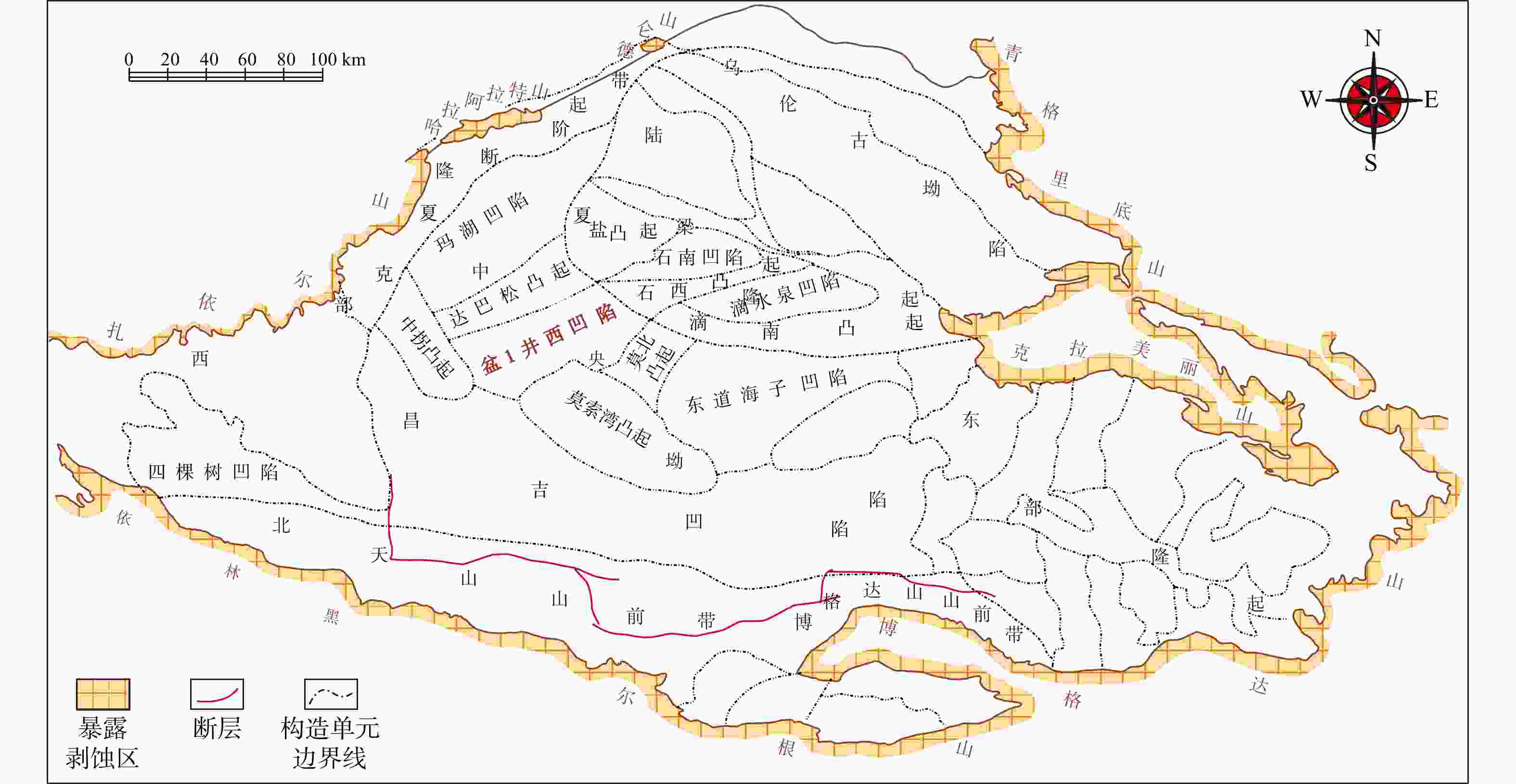
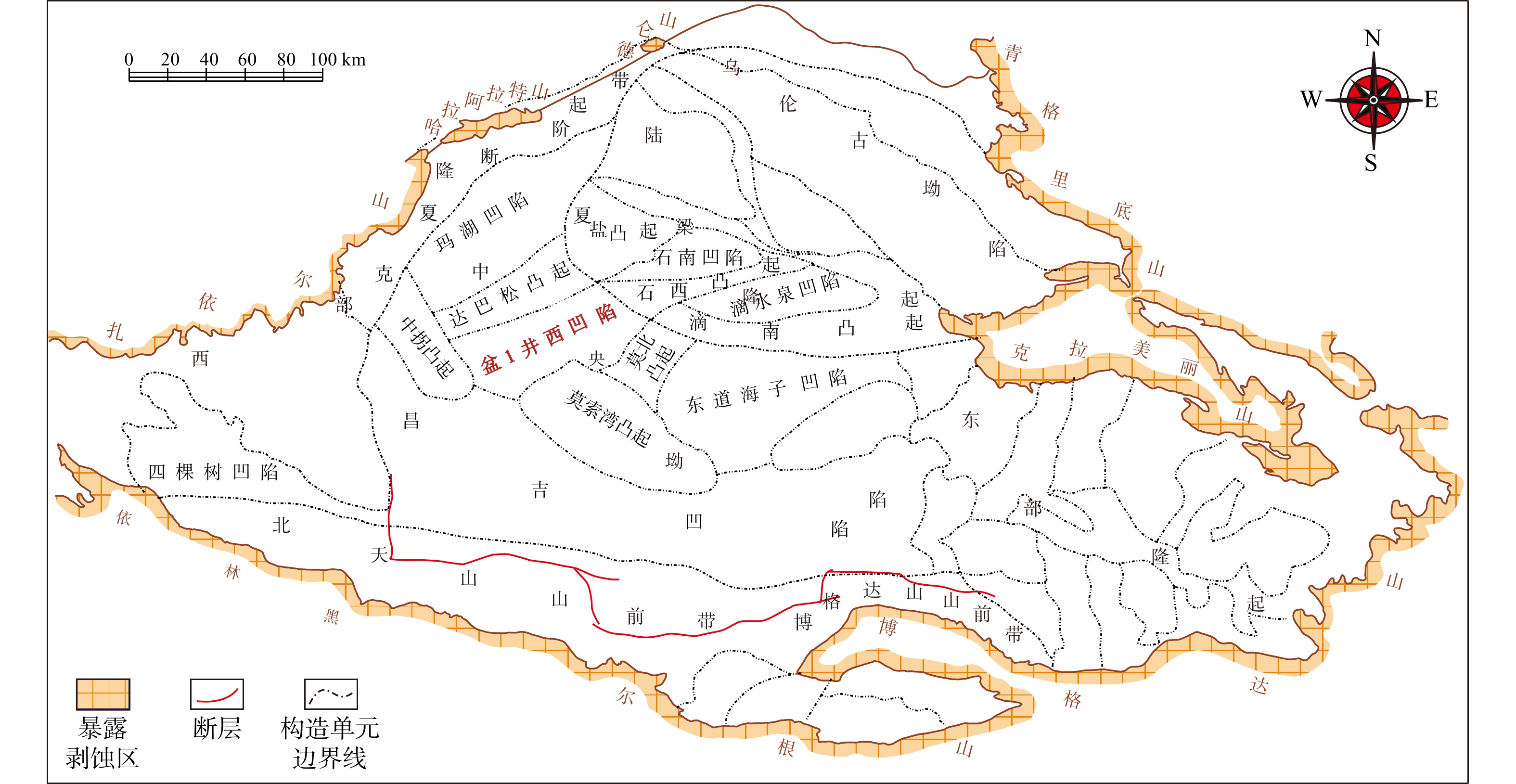
图 1 准噶尔盆地构造单元分布图(据王小军等,2021)
Figure 1. Distribution of tectonic units in the Junggar Basin (Wang et al., 2021)

图 2 准噶尔盆地二叠纪—三叠纪沉积与地层柱状图(据王家林等,2016修改)
Figure 2. Sedimentary and stratigraphic column of the Permian–Triassic in the Junggar Basin (modified after Wang et al., 2016)
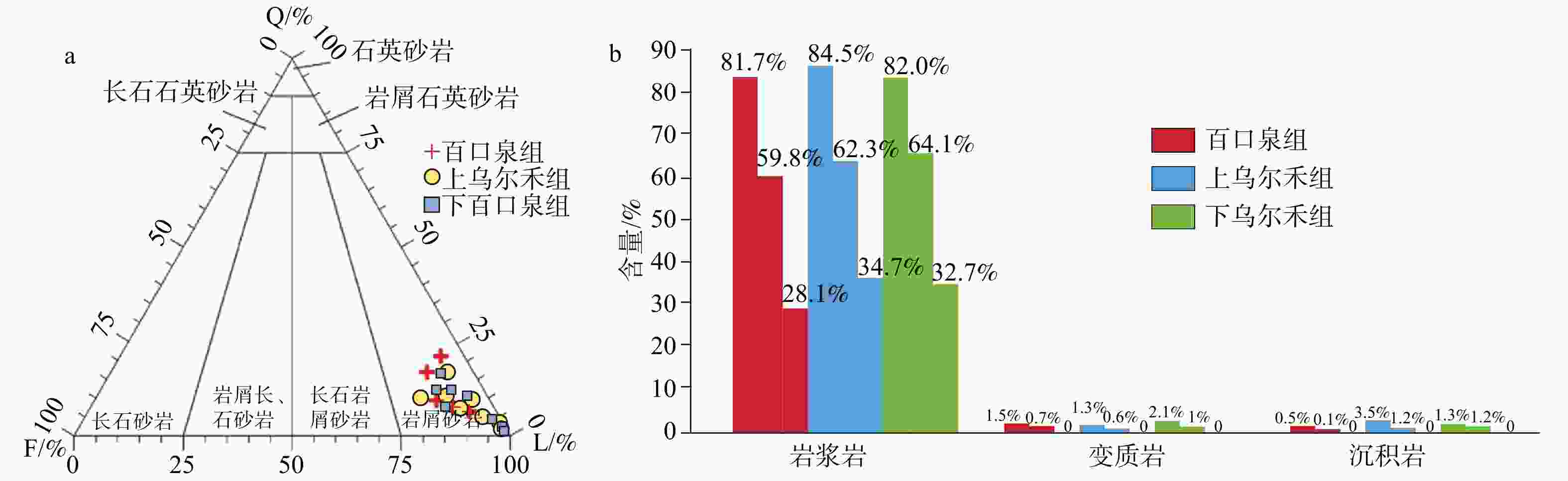
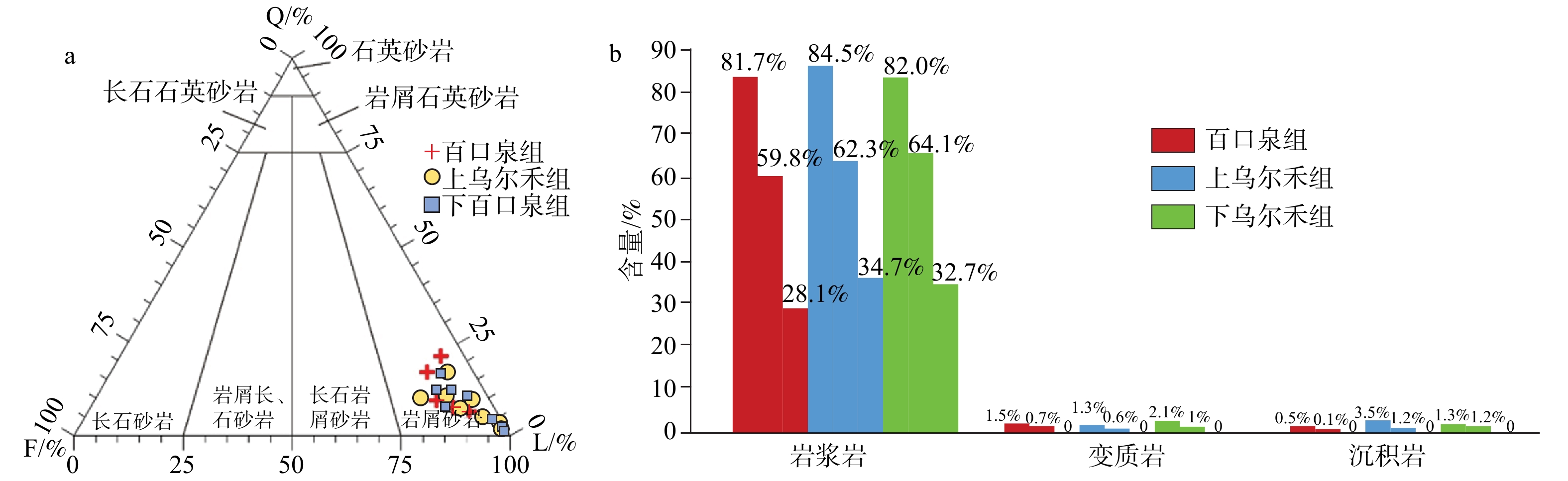
图 3 盆1井西凹陷沙15井二叠—三叠系储层砂岩含量统计
Q—石英;F—长石;L—岩屑a—颗粒组分含量三角图;b—岩屑组分含量直方统计
Figure 3. Composition of Permian–Triassic reservoir sandstones in Well Sha-15, Pen-1 West Sag (a) Ternary diagram of grain components; (b) Histogram showing the proportions of different lithic fragments Q–quartz; F–feldspar; L–lithic fragments
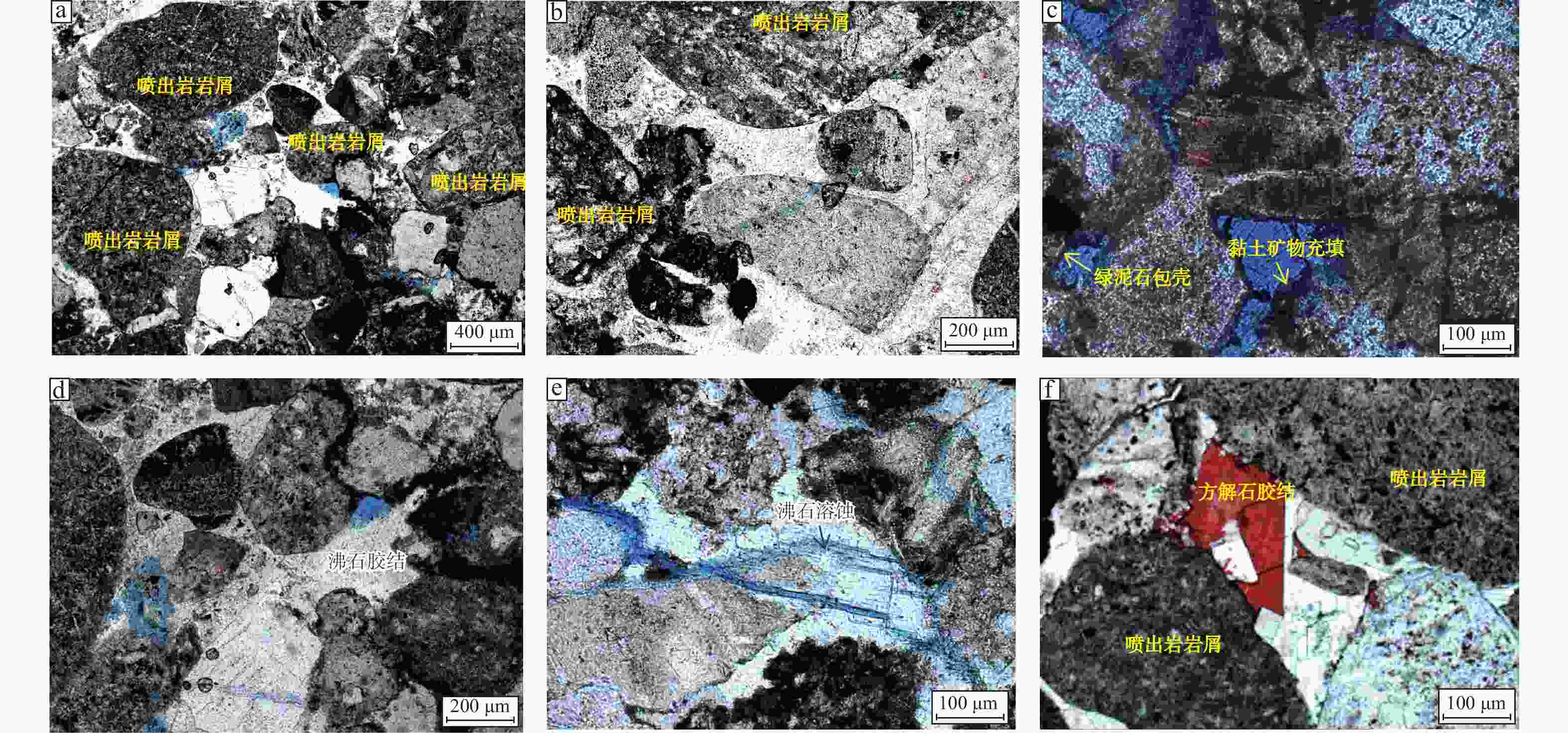
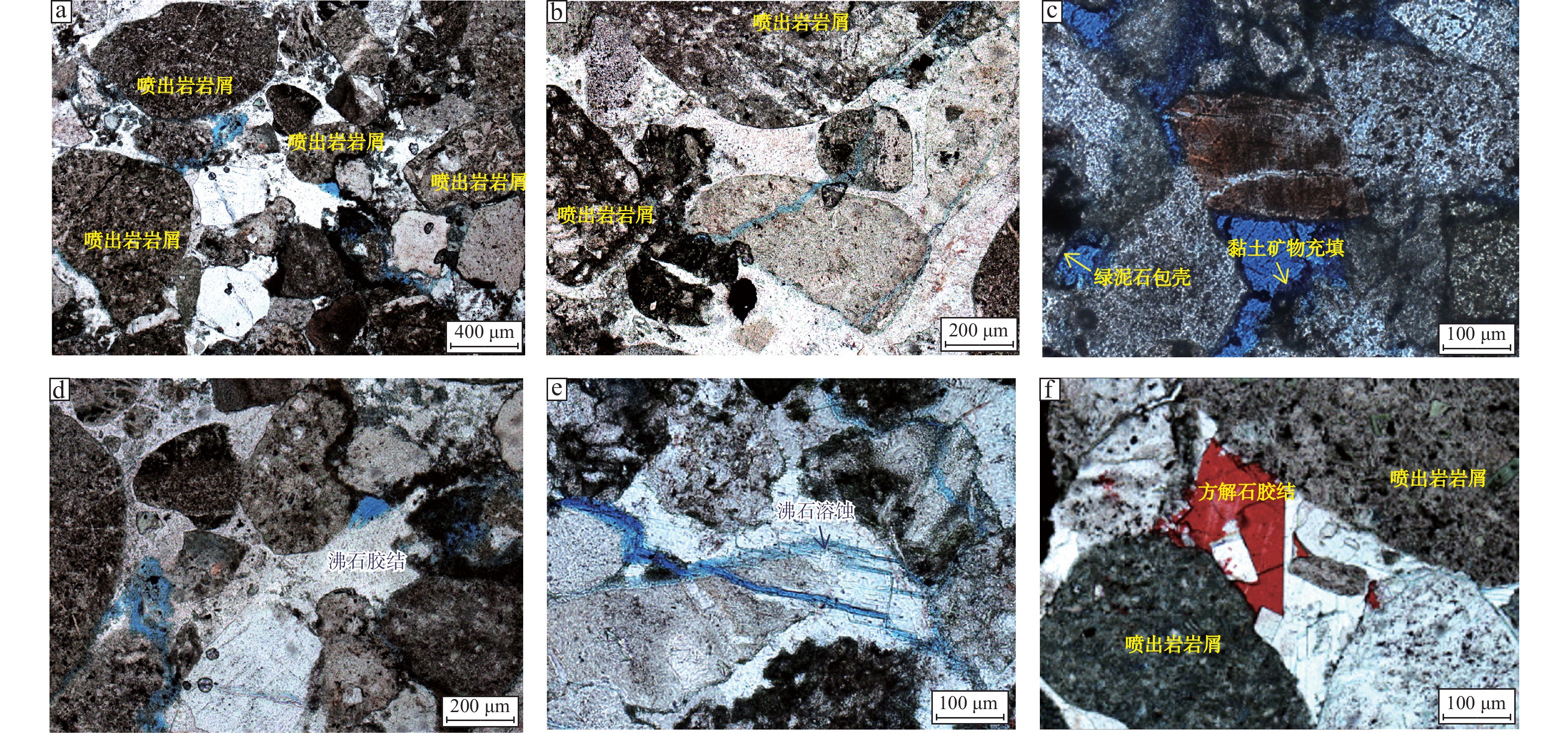
图 4 盆1井西凹陷沙15井二叠—三叠系火山岩岩屑砂岩储层微观特征
a—喷出岩岩屑整体镜下照片;b—喷出岩岩屑内部放大照片; c—绿泥石包壳以及黏土矿物充填特征; d—沸石胶结于颗粒之间;e—微裂缝发育在沸石胶结之中; f—方解石胶结镜下特征
Figure 4. Microscopic characteristics of the Permian–Triassic volcanic lithic sandstone reservoirs in Well Sha-15, Pen-1 West Sag (a)Overview photomicrograph of an extrusive volcanic rock fragment; (b)Enlarged view of the interior of the volcanic rock fragment; (c)Chlorite coatings and clay-mineral infilling; (d)Zeolite cement between grains; (e)Microfractures developed within the zeolite cement; (f)Photomicrograph of calcite cement
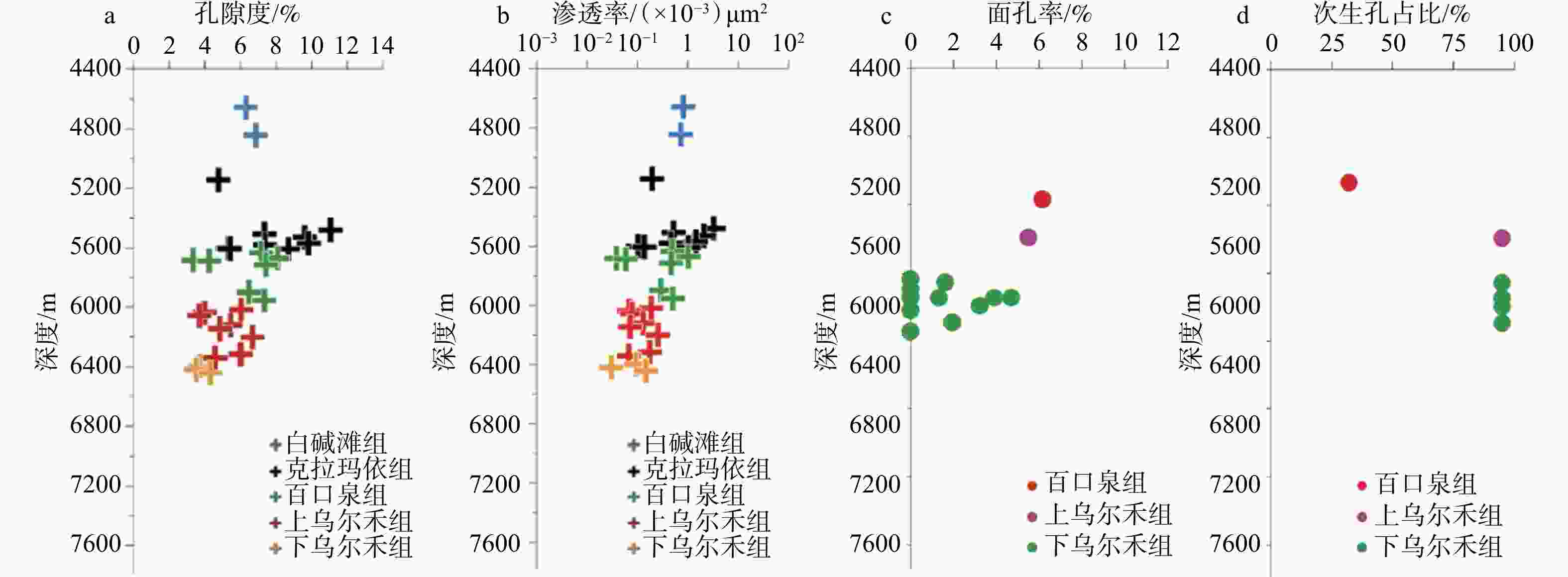
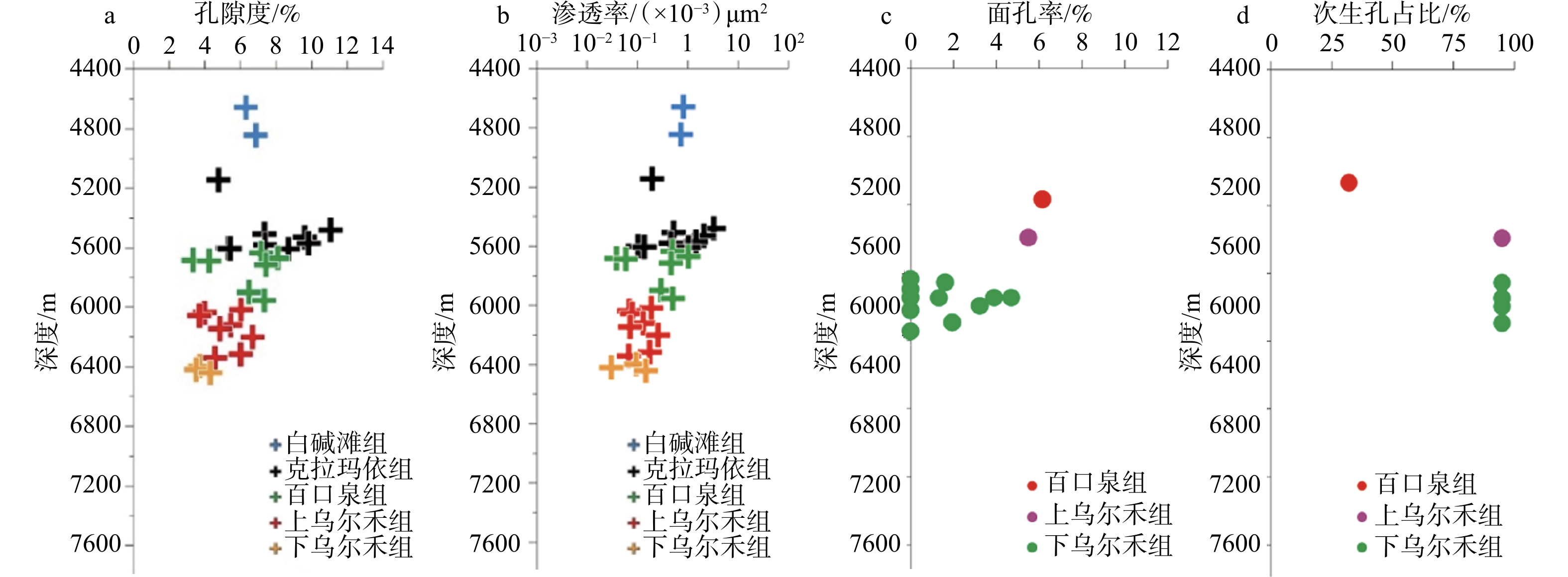
图 5 盆1井西凹陷沙15井二叠系—三叠系火山岩岩屑砂岩储层物性及孔隙特征随深度的纵向变化
a—孔隙度;b—渗透率;c—面孔率;d—次生孔占比
Figure 5. Vertical variations in reservoir properties and pore characteristics with depth in the Permian–Triassic volcanic lithic sandstone reservoirs of Well Sha-15, Pen-1 West Sag (a) Porosity; (b) Permeability; (c) Areal porosity; (d) Proportion of secondary pores
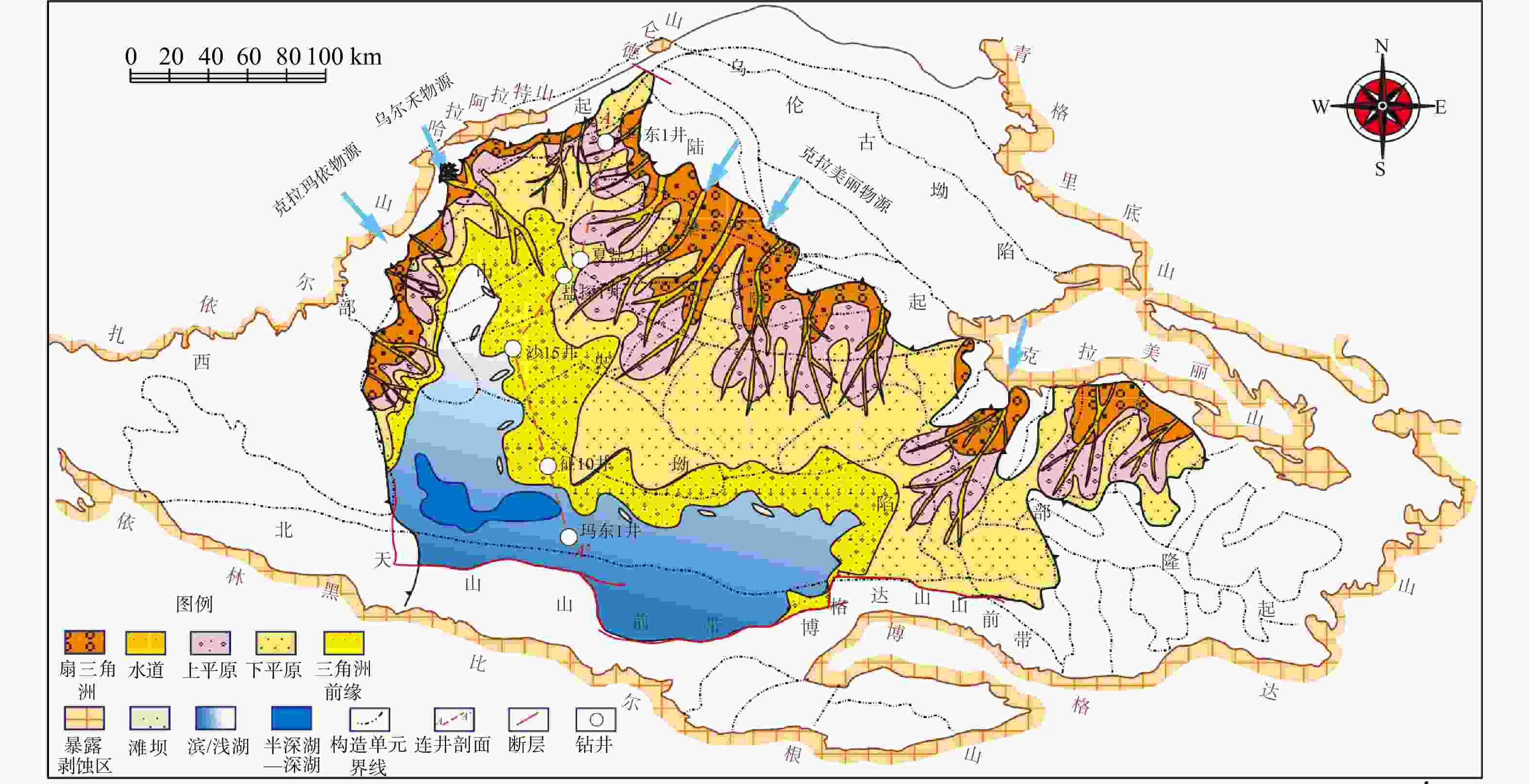
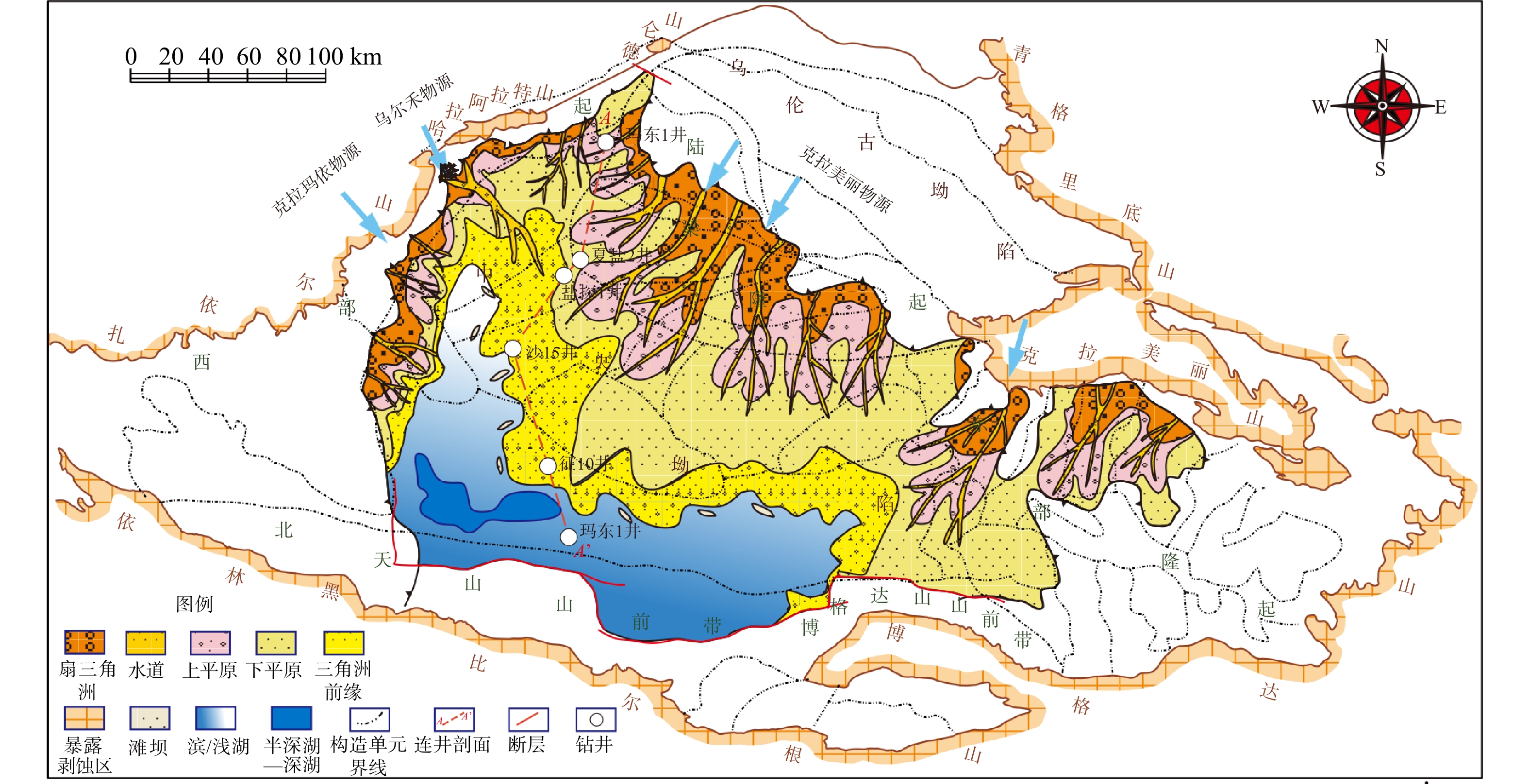
图 6 准噶尔盆地二叠—三叠系物源分布及平面沉积相展布特征
Figure 6. Provenance distribution and spatial distribution of Permian–Triassic sedimentary facies in the Junggar Basin
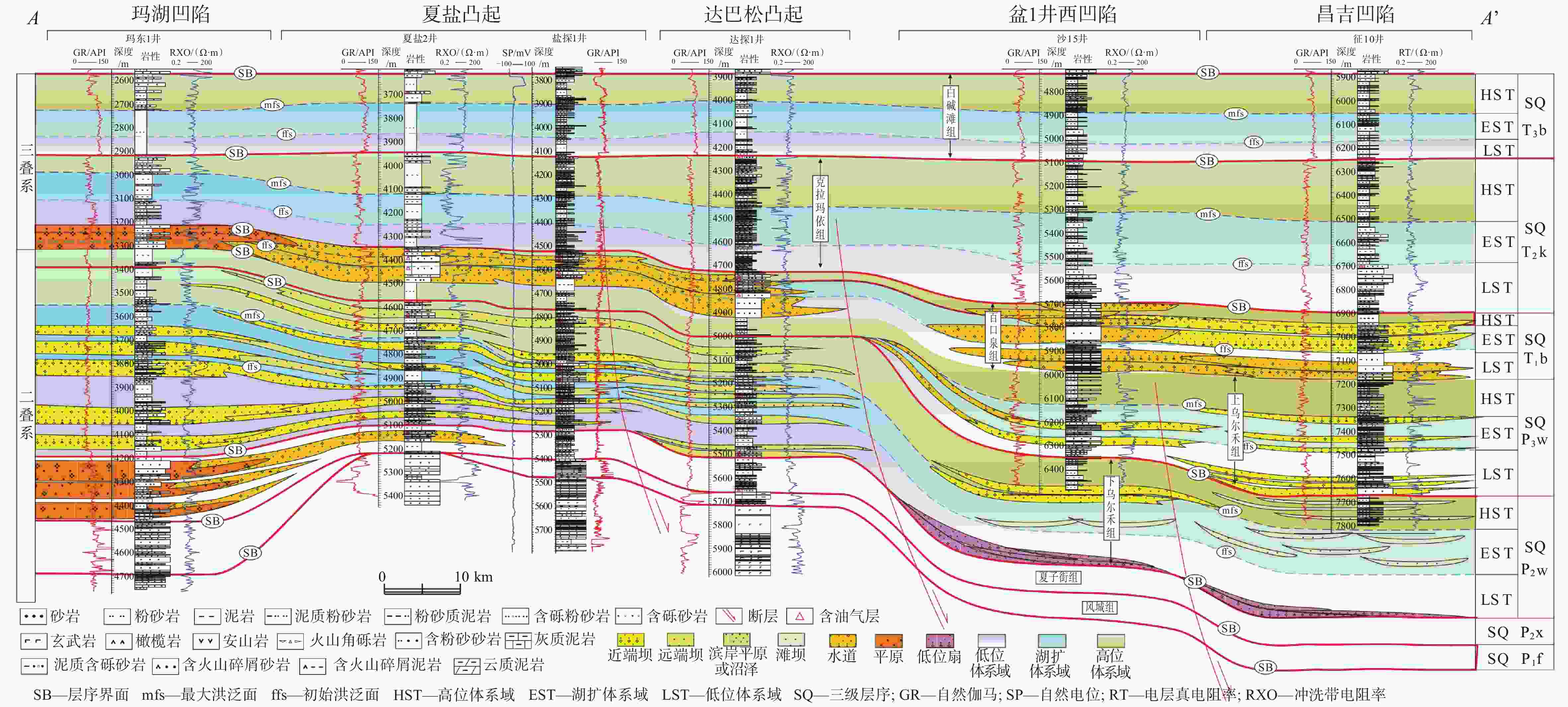
图 7 玛东1井—征10井联井辫状河三角洲综合展布(剖面位置见图6)
Figure 7. Integrated cross-well profile of the braided river delta between Wells Madong-1 and Zheng-10 (profile location shown in Fig. 6)
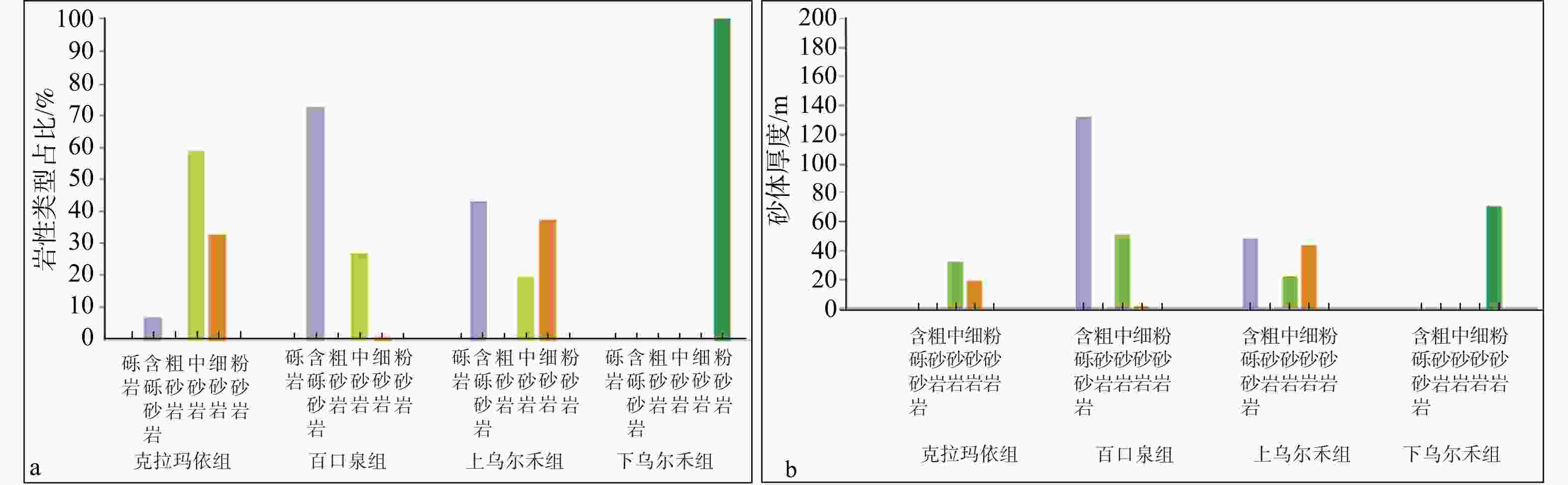
图 8 碎屑颗粒粒度分布及砂体厚度直方图
a—碎屑颗粒粒度分布;b—砂体厚度直方图
Figure 8. Grain-size distribution of detrital particles and sand-body thickness (a) Grain-size distribution of detrital particles; (b) Histogram of sand-body thickness
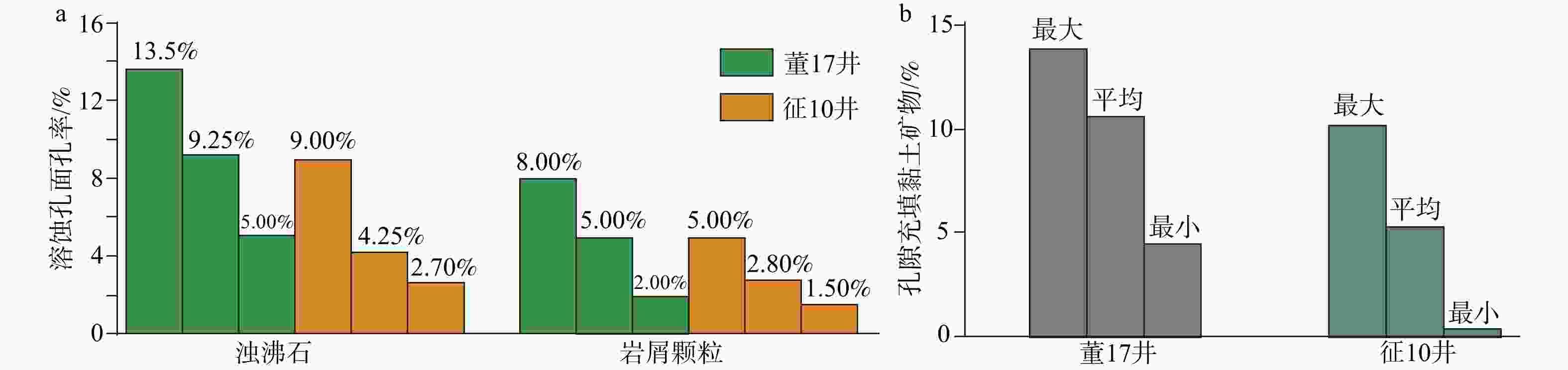
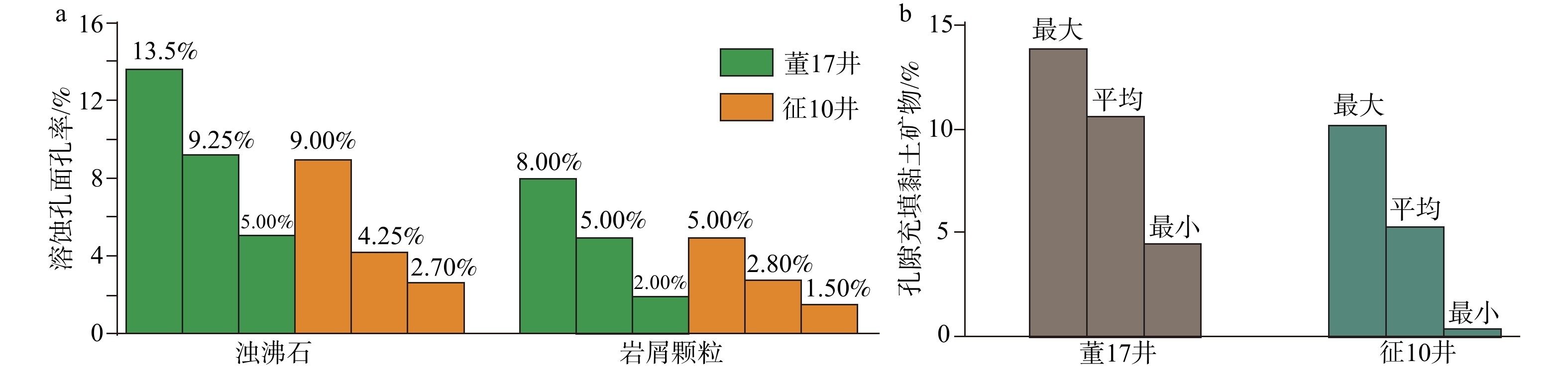
图 9 沙湾凹陷征10井与阜康凹陷董17井二叠—三叠系浊沸石和岩屑颗粒溶蚀孔面孔率与孔隙充填黏土矿物直方统计
a—浊沸石与岩屑颗粒溶蚀面孔率;b—孔隙充填黏土占比
Figure 9. Histograms of areal porosity associated with the dissolution of zeolite and lithic particles and the proportion of clay-mineral filling in pores in the Permian–Triassic strata of Well Zheng-10 in the Shawan Sag and Well Dong-17 in the Fukang Sag
(a) Areal porosity associated with the dissolution of zeolite and lithic particles; (b) Proportion of clay-mineral filling in pores
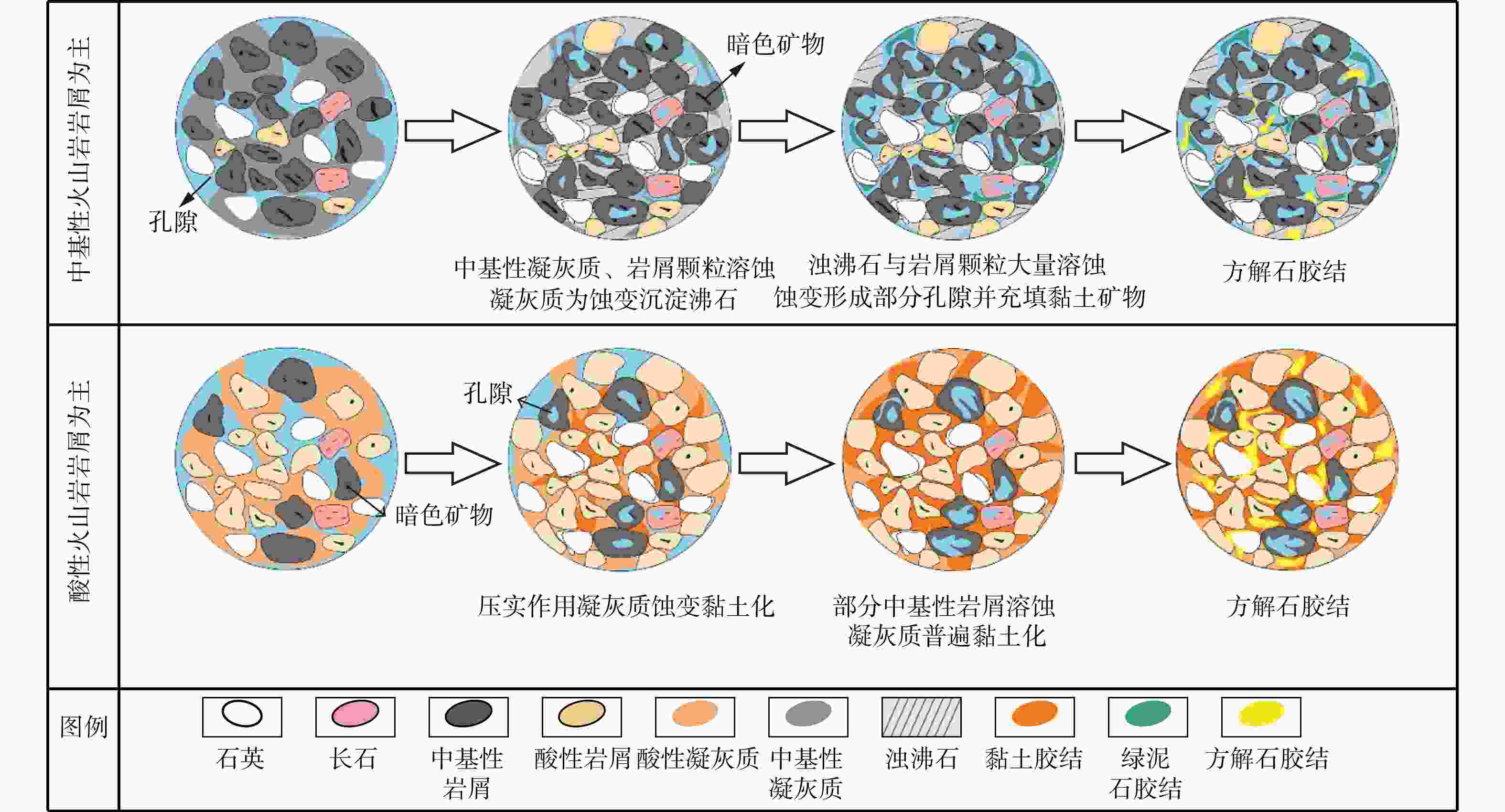
图 10 准噶尔盆地腹部不同火山岩岩屑颗粒蚀变成岩改造模式
Figure 10. Diagenetic alteration patterns of different volcanic rock fragments in the central Junggar Basin
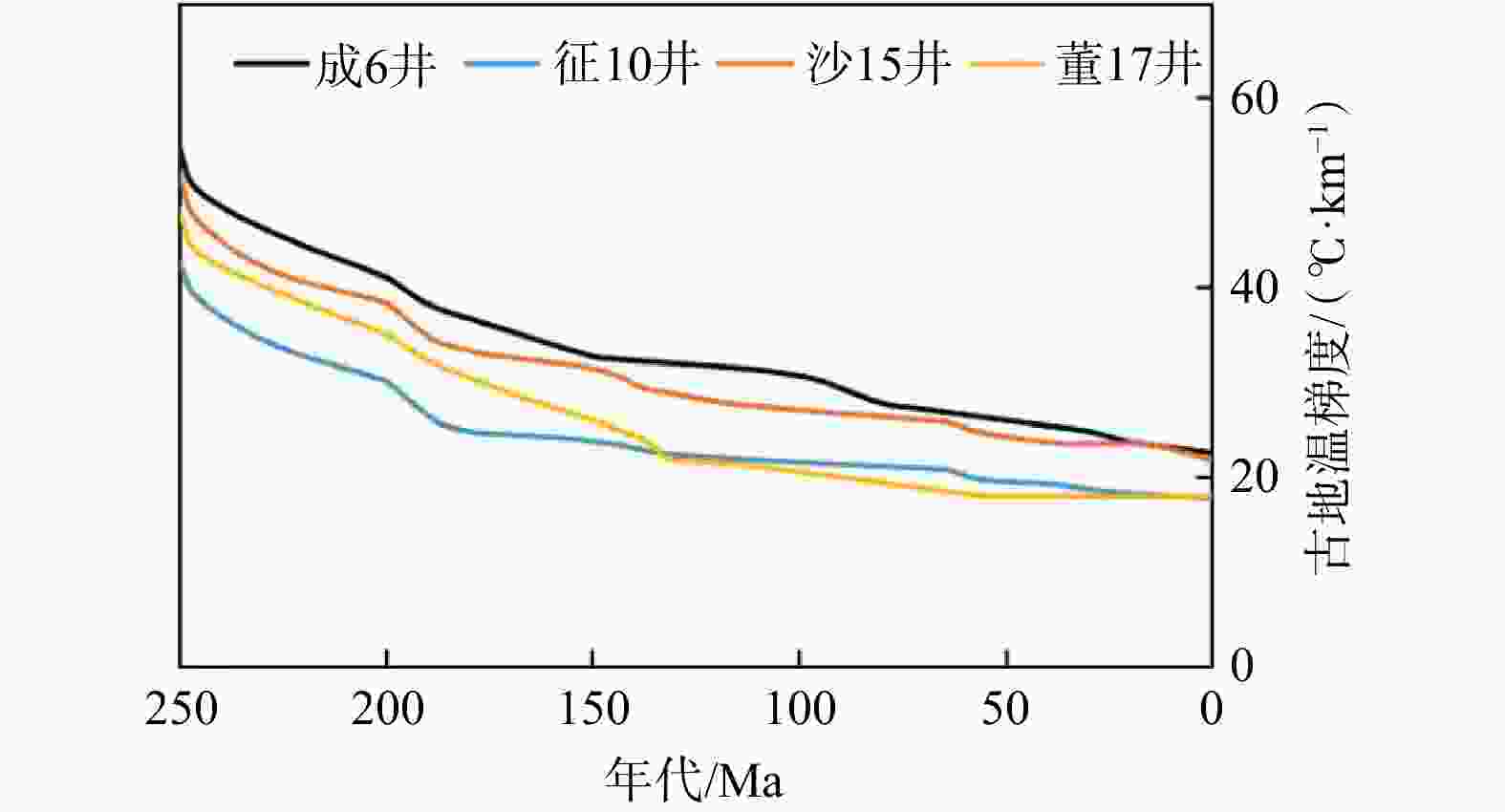
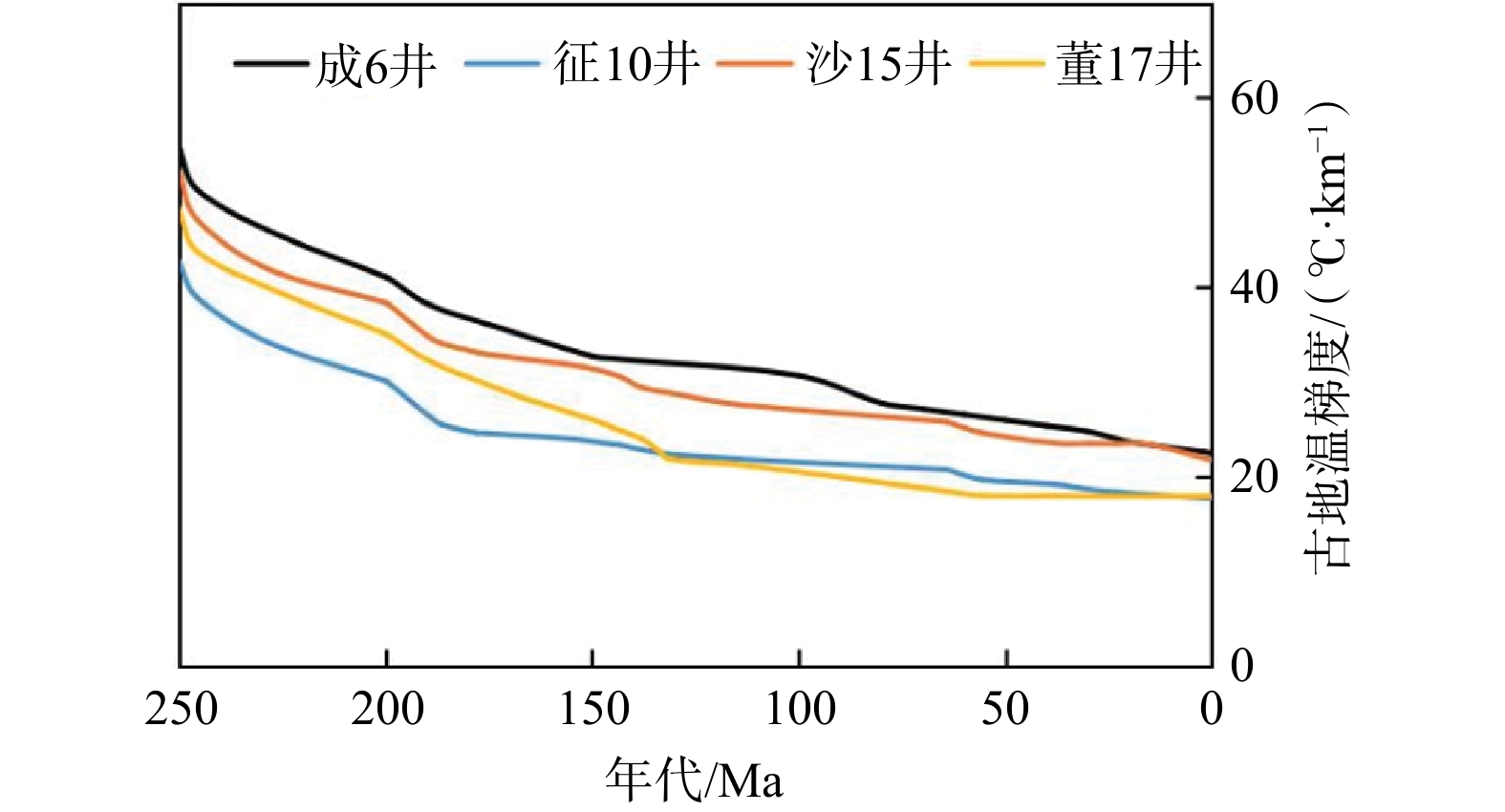
图 11 准噶尔盆地腹部古地温梯度变化
Figure 11. Variation in paleogeothermal gradients in the central Junggar Basin
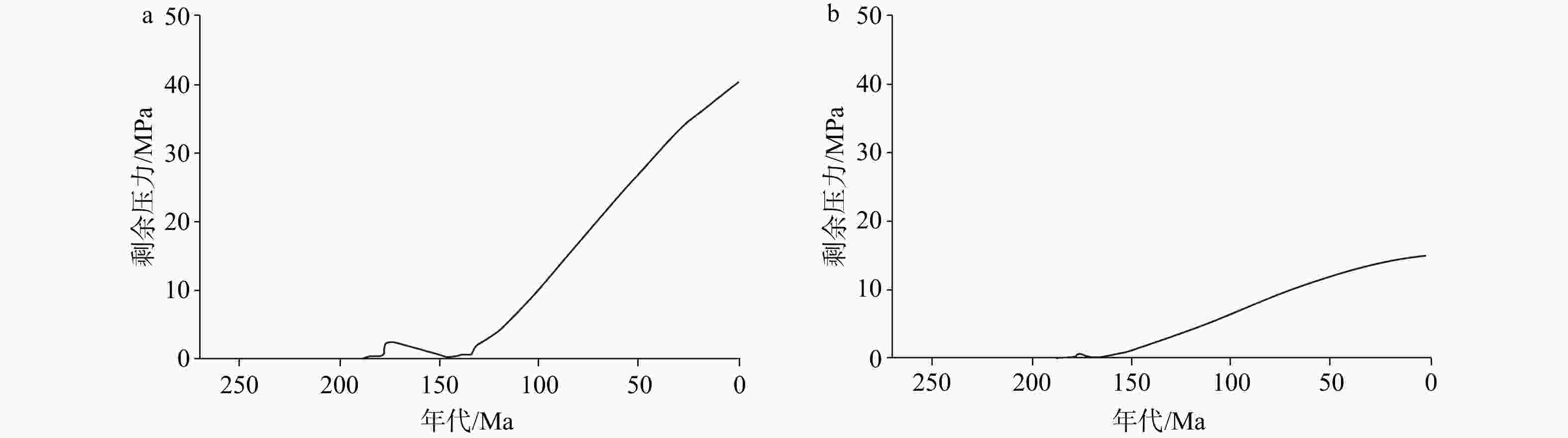
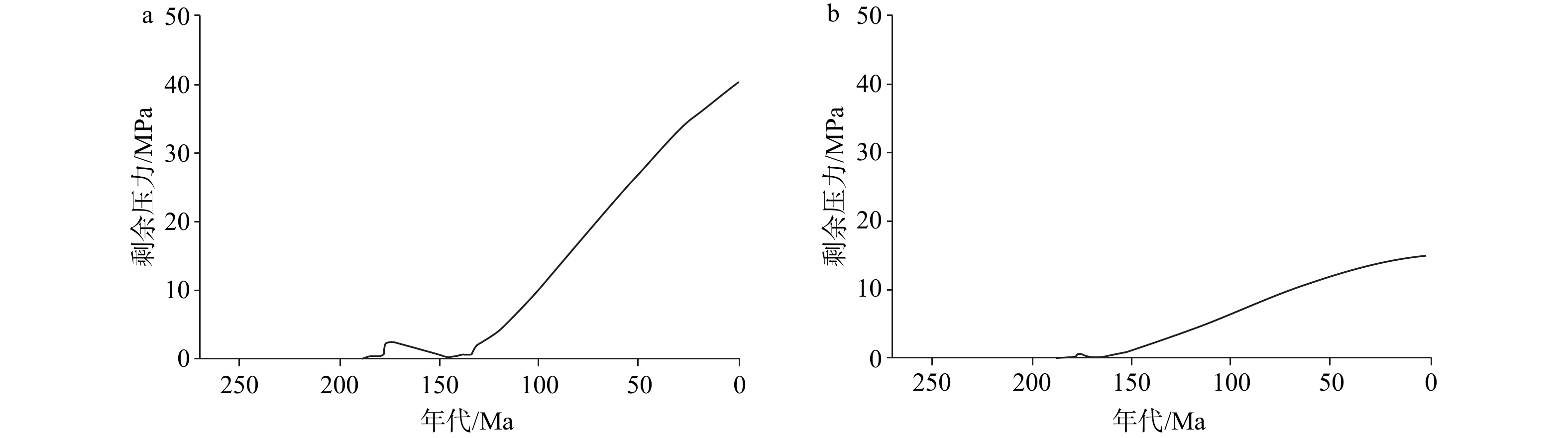
图 12 准噶尔盆地腹部上乌尔禾组不同凹陷剩余压力变化
a—沙湾凹陷征10井;b—盆1井西凹陷沙15井
Figure 12. Variation in residual pressure in the Upper Urho Formation (P3w) across different sags in the central Junggar Basin
(a) Well Zheng-10 in the Shawan Sag; (b) Well Sha-15 in the Pen-1 West Sag
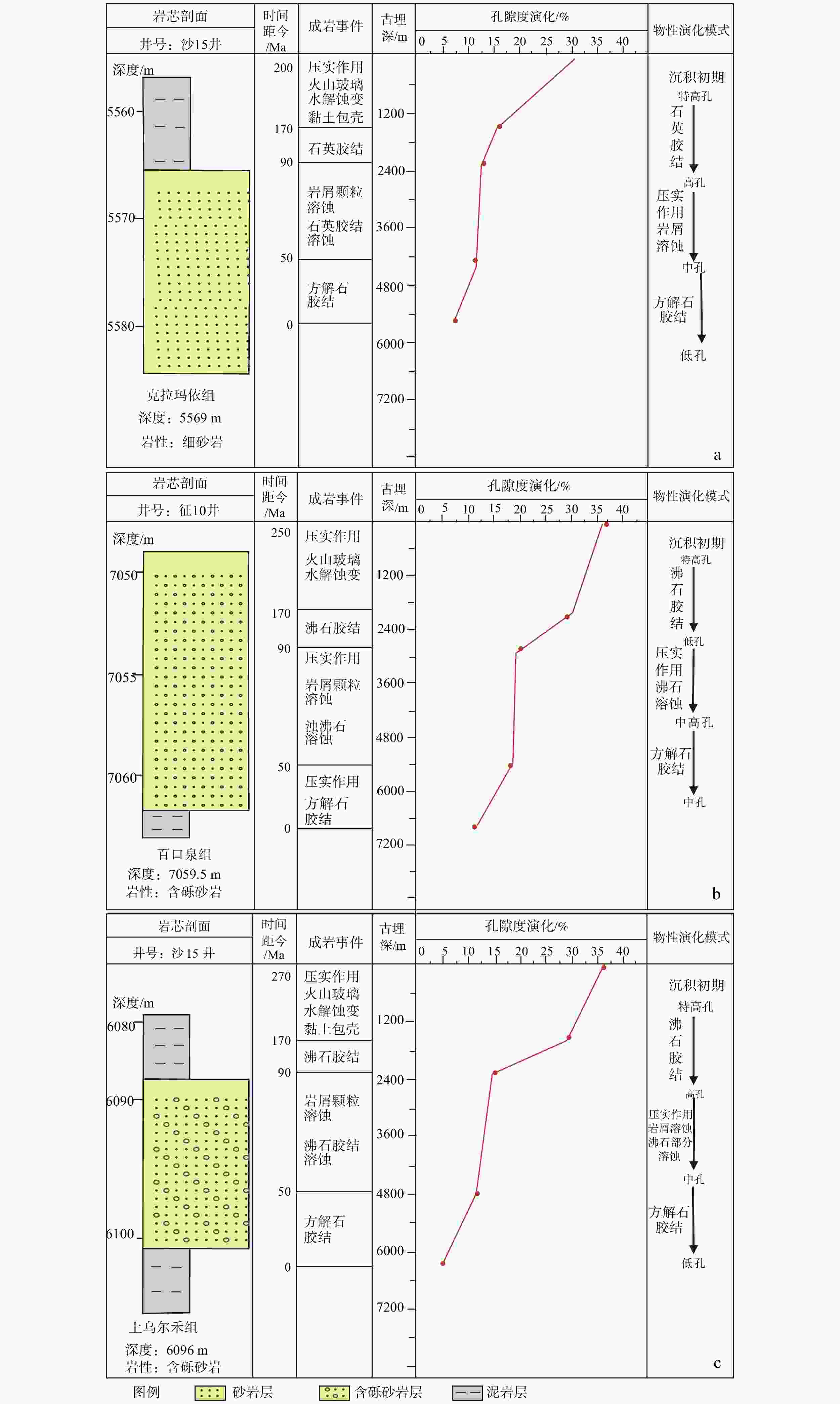
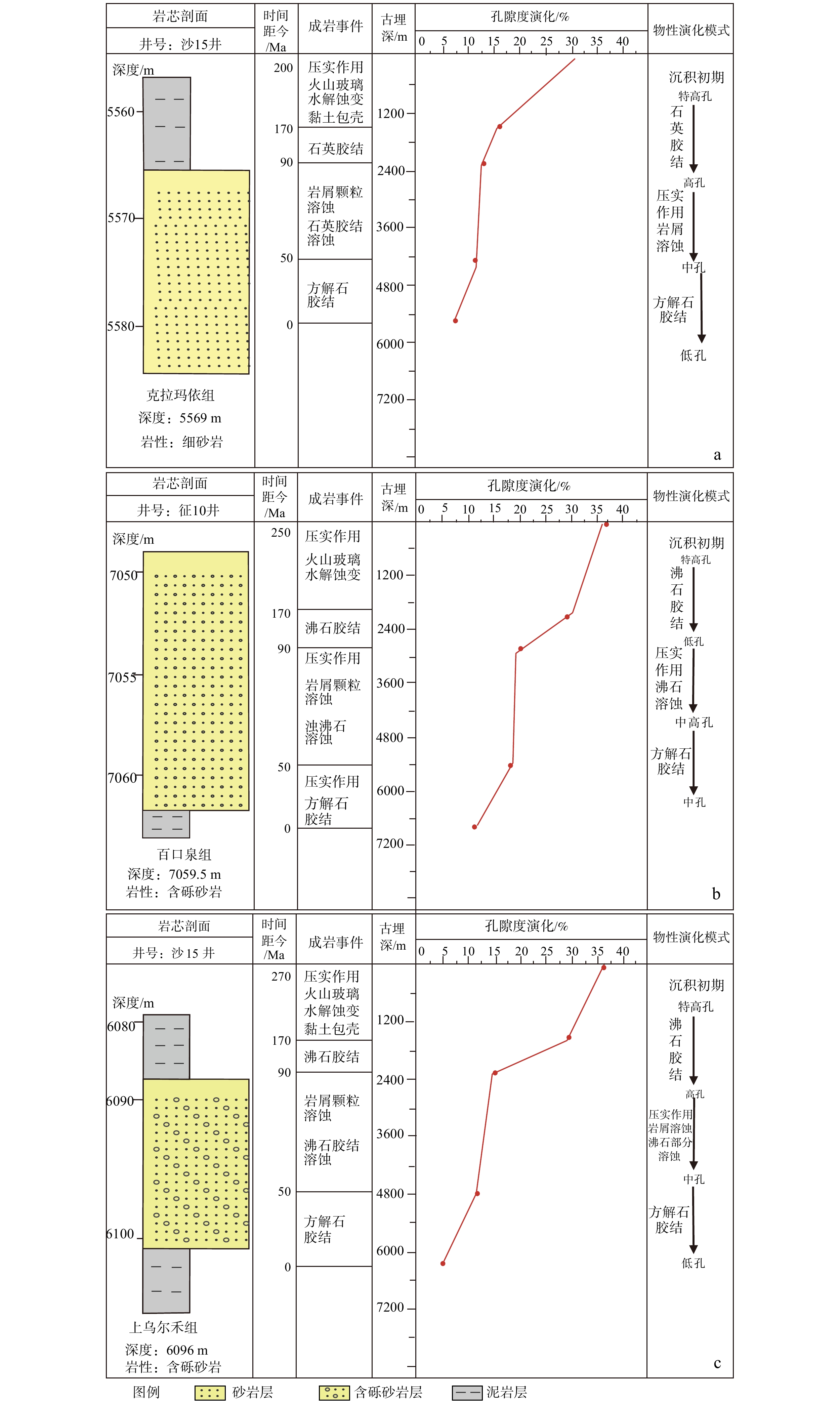
图 13 准噶尔盆地二叠系—三叠系盆1井西凹陷物性演化模式
a—沙15井克拉玛依组;b—征10井百口泉组;c—沙15井上乌尔禾组
Figure 13. Reservoir property evolution patterns of the Permian–Triassic reservoirs in the Junggar Basin
(a) Karamay Formation in Well Sha-15, Pen-1 West Sag; (b) Baikouquan Formation in Well Zheng-10, Shawan Sag; (c) Upper Urho Formation in Well Sha-15, Pen-1 West Sag
-
[1] BIAN B L, LIU H L, JIANG W L, et al., 2024. Discovery and exploration enlightenment of Carboniferous volcanic condensate gas reservoirs in western well Pen-1 Sag, Junggar Basin[J]. Lithologic Reservoirs, 36(3): 96-105. (in Chinese with English abstract) [2] DU S T, TIAN J J, LI Z T, et al. , 2018. Permian shale gas reservoir characterization and favorable area identification in Junggar Basin[J]. Special Oil & Gas Reservoirs, 25(2): 49-55, 69. (in Chinese with English abstract) [3] FEI L Y, WANG S L, WU T, et al., 2020. Control of slope break zone on sandy debris flow deposition: a case study of Jurassic Sangonghe Formation in west sag of Well Pen-1 and its periphery in Junggar Basin[J]. Petroleum Geology and Recovery Efficiency, 27(2): 26-34. (in Chinese with English abstract) [4] GOU Y J, ZHANG F Q, JIANG Q C, et al., 2024. Formation mechanism and evolution characteristics of deep Permian overpressure in western Well Pen-1 Sag and its periphery, Junggar Basin[J]. Petroleum Geology and Recovery Efficiency, 31(3): 16-30. (in Chinese with English abstract) [5] HAN Y, YANG H B, GUO W J, et al., 2023. Hydrocarbon generation evolution history and hydrocarbon accumulation model of Permian source rocks in western well Pen-1 Sag, Junggar Basin[J]. Journal of Northeast Petroleum University, 47(1): 30-43. (in Chinese with English abstract) [6] HE W J, FEI L Y, YIMING A, et al., 2019. Accumulation conditions of deep hydrocarbon and exploration potential analysis in Junggar Basin, NW China[J]. Earth Science Frontiers, 26(1): 189-201. (in Chinese with English abstract) [7] HOU G F, XU Y, SUN J, et al., 2019. Sedimentary model from delta front to deep water area and its significance: a case study of the first sand group of Member 2 of Sangonghe Formation in the Well Pen-1 West Sag, Junggar Basin[J]. Acta Petrolei Sinica, 40(10): 1223-1232. (in Chinese with English abstract) [8] OU G F, LI X, SONG B, et al., 2022. Sedimentary model and significance for oil and gas exploration of the LST sand body of Badaowan Formation in Western Well Pen-1 Sag, Junggar Basin[J]. Marine Origin Petroleum Geology, 27(3): 300-313. (in Chinese with English abstract) [9] JIANG M Y, WANG J T, LIU L S, et al., 2023. Characteristics and main controlling factors of natural gas of Carboniferous-Permian in western Well Pen-1 Sag, Junggar Basin[J]. Lithologic Reservoirs, 35(3): 138-151. (in Chinese with English abstract) [10] JIANG W L, GUO W J, CUI Z Y, et al. , 2026. Genesis and accumulation characteristics of deep-ultra-deep natural gas in Penyijingxi sag, Junggar Basin[J/OL]. Geological Review, 1-13[2026-04-04]. https://doi.org/10.16509/j.georeview.2026.01.021. (in Chinese with English abstract) [11] JIN Z J, 2011. Methods in studying petroleum accumulation systems in a superimposed basin: a case study of petroleum reserviors in the central Junggar Basin[J]. Geological Journal of China Universities, 17(2): 161-169. (in Chinese with English abstract) [12] LEI H Y, WANG J, CHEN R B, et al., 2022. Favorable geological factors for hydrocarbon accumulation in the second member of Sangonghe Formation of lower jurassic in the east slope of western well Pen-1 Sag in Junggar basin[J]. Journal of Jilin University (Earth Science Edition), 52(4): 1052-1064. (in Chinese with English abstract) [13] LI J Z, WANG X J, YANG F, et al., 2022. Hydrocarbon accumulation pattern and exploration prospect of the structural traps in lower play of the western Central Depression in the Junggar Basin[J]. Oil & Gas Geology, 43(5): 1059-1072. (in Chinese with English abstract) [14] LI M, JIN A M, LOU Z H, et al., 2012. Formation fluid characteristics and hydrocarbon migration and accumulation in Junggar Basin[J]. Oil & Gas Geology, 33(4): 607-615. (in Chinese with English abstract) [15] LIAN L X, LIU H Q, WANG J, et al., 2025. Characteristics and main controlling factors of weathering crust volcanic reservoir: a case study of Carboniferous around west depression of Well Pen 1 in Junggar Basin as an example[J]. Fault-Block Oil & Gas Field, 32(4): 605-613. (in Chinese with English abstract) [16] LIN H X, ZHANG K H, YANG X, et al., 2025. Key exploration fields and breakthrough directions of lower assemblages in central Junggar Basin[J]. Petroleum Geology and Recovery Efficiency, 32(5): 1-18. (in Chinese with English abstract) [17] LIU H, MENG X Y, REN X C, et al., 2023. Origin and source of Jurassic crude oil in Well Pen-1 western Depression, Junggar Basin[J]. Journal of China University of Petroleum (Edition of Natural Science), 47(1): 25-37. (in Chinese with English abstract) [18] LIU H Q, LIN C Y, DONG C M, et al., 2026. Characteristics and genesis of the high-quality Carboniferous volcanic reservoirs in the periphery of the Western Well Pen-1 Sag, Junggar Basin[J]. Oil & Gas Geology, 47(1): 143-161. (in Chinese with English abstract) [19] MA C, ZHOU J J, HU L, et al., 2023. Reservoir characteristics and formation mechanism of sangonghe formation in the sag West of well Pen-1[J]. Journal of Southwest Petroleum University (Science & Technology Edition), 45(5): 1-13. (in Chinese with English abstract) [20] PAN J G, HUANG L J, WANG G D, et al., 2019. The connotation and characteristics of reservoir far away from hydrocarbon source: Case study of Well Pen-1 west hydrocarbon-enriched sag, Junggar Basin[J]. Natural Gas Geoscience, 30(3): 312-321. (in Chinese with English abstract) [21] AN S P, HU G M, TANG Y J, et al., 2023. Influences of restricted flow by fault assemblage on fan delta morphology: evidence from a depositional physical simulation experiment of the Baikouquan Formation in the Well Pen-1 West Sag, Junggar Basin[J]. Acta Sedimentologica Sinica, 41(3): 867-878. (in Chinese with English abstract) [22] QIAN H T, SU D X, ABLIMIT I, et al., 2021. Petroleum geological characteristics and exploration potential in slope area of Well Pen-1 Western Depression in Junggar Basin[J]. Natural Gas Geoscience, 32(4): 551-561. (in Chinese with English abstract) [23] QIAO T, LIU C L, YANG H B, et al., 2024. Characteristics and genetic mechanism of condensate oil and gas of the Jurassic Sangonghe Formation in western Well Pen-1 Sag, Junggar Basin[J]. Lithologic Reservoirs, 36(6): 169-180. (in Chinese with English abstract) [24] SONG J Y, CHEN T, ZHANG J L, 2022. Permian and Triassic hydrocarbon migration and accumulation in the Cainan area, Junggar Basin, China[J]. Journal of Petroleum Science and Engineering, 210: 109965. doi: 10.1016/j.petrol.2021.109965 [25] SU D X, ZHU Y C, LIU L S, et al., 2024. Gas accumulation conditions and exploration orientation of the Carboniferous-Permian in West Well Pen 1 Sag and its periphery in Junggar Basin[J]. China Petroleum Exploration, 29(4): 82-96. (in Chinese with English abstract) [26] SUN J, XUE J J, HOU G F, et al., 2019. Sedimentary characteristics and model of sandy debris flow in depression area of lacustrine basin: a case study of the Jurassic Sangonghe formation in the western well Pen-1 sag, Junggar basin[J]. Journal of China University of Mining & Technology, 48(4): 858-869. (in Chinese with English abstract) [27] WANG J L, WU C D, ZHU W, et al., 2016. Tectonic-depositional environment and prototype basin evolution of the Permian-Triassic in southern Junggar Basin[J]. Journal of Palaeogeography, 18(4): 643-660. (in Chinese with English abstract) [28] WANG J T, LIU L S, JIANG M Y, et al., 2023. Oil and gas geological characteristics and exploration potential of Permian Fengcheng Formation in Western Well Pen-1 Sag and its surrounding areas in Junggar Basin[J]. Natural Gas Geoscience, 34(5): 794-806. (in Chinese with English abstract) [29] WANG X J, SONG Y, ZHENG M L, et al., 2021. Composite petroleum system and multi-stage hydrocarbon accumulation in Junggar Basin[J]. China Petroleum Exploration, 26(4): 29-43. (in Chinese with English abstract) [30] WANG Z W, GAO Z Y, HE W J, et al., 2023. Using spontaneous imbibition to evaluate the hydrocarbon migration and accumulation potential of shale reservoirs: a case study of the Permian Fengcheng Formation in the Mahu Sag, Junggar Basin[J]. Energy & Fuels, 37(1): 360-372. doi: 10.1021/acs.energyfuels.2c03897 [31] WU S T, LIANG Y S, ZHANG L, et al., 2018. Tectonic transition relationship between shawan sag and western Well Pen-1 Sag and its geological significance[J]. Xinjiang Petroleum Geology, 39(3): 277-284. (in Chinese with English abstract) [32] XU G H, 2015. Basin 1 well west sunken Sangonghe FM construction sedimentary characteristics and petroleum entrapment cognition[J]. Chemical Intermediates, 11(4): 19, 24. (in Chinese with English abstract) [33] XU G H, SHI H G, REN X C, et al. , 2015. A research on the condition of the reservoir formation and the rule of oil and gas accumulation of Sangonghe Formation in slope belt of Pen 1 Well West Sag[J]. Science Technology and Engineering, 15(17): 23-28, 60. (in Chinese with English abstract) [34] YANG Z, HE S, LI Q Y, et al., 2008. Overpressure in the well Pen-l West subbasin in the interior of the Junggar basin[J]. Geology in China, 35(2): 239-245. (in Chinese with English abstract) [35] YOU X C, ZHANG T H, ZHU Y C, et al., 2025. Hydrocarbon exploration breakthrough of Fengcheng Formation of Well WT1 in the Well Pen-1 West Sag of Junggar Basin and its significance[J]. Acta Petrolei Sinica, 46(7): 1294-1307. (in Chinese with English abstract) [36] ZHANG F S, ZHENG Q M, HU H W, et al., 2024. Evaluation and optimal selection of Carboniferous Kalashayi Formation source rocks in southwestern Tarim Basin[J]. Petroleum Reservoir Evaluation and Development, 14(4): 647-656. (in Chinese with English abstract) [37] ZHANG F S, 2025. Research on secondary pore evolution of the ultra-deep clastic reservoirs in the interior of Junggar Basin[J]. Scientific and Technological Innovation(16): 175-178. (in Chinese with English abstract) [38] ZHANG Y, 2024. Diagenetic alterations and formation mechanisms for high-quality reservoirs in the deep- to ultra-deep-buried clastic rocks in the central Junggar Basin, northwestern China[D]. Wuhan: China University of Geosciences. (in Chinese with English abstract) [39] ZHI D M, XIE A, YANG F, et al., 2024. Exploration prospects of the whole oil and gas system in the Permian hydrocarbon depressions in the Eastern Junggar Basin[J]. Journal of Geomechanics, 30(5): 781-794. (in Chinese with English abstract) [40] ZHOU W Q, LUO X L, LIU H W, 2005. Analysis of hydrocarbon reservoir forming in the east belt around depression to the West of Well Pen-1[J]. Xinjiang Oil & Gas, 1(3): 16-20. (in Chinese with English abstract) [41] 卞保力, 刘海磊, 蒋文龙, 等, 2024. 准噶尔盆地盆1井西凹陷石炭系火山岩凝析气藏的发现与勘探启示[J]. 岩性油气藏, 36(3): 96-105. doi: 10.12108/yxyqc.20240309 [42] 杜世涛, 田继军, 李沼鹈, 等, 2018. 准噶尔盆地二叠系页岩气储层特征及潜力区优选[J]. 特种油气藏, 25(2): 49-55, 69. doi: 10.3969/j.issn.1006-6535.2018.02.009 [43] 费李莹, 王仕莉, 吴涛, 等, 2020. 坡折带对砂质碎屑流沉积的控制作用: 以准噶尔盆地盆1井西凹陷及周缘侏罗系三工河组为例[J]. 油气地质与采收率, 27(2): 26-34. doi: 10.13673/j.cnki.cn37-1359/te.2020.02.004 [44] 苟宇杰, 张凤奇, 江青春, 等, 2024. 准噶尔盆地盆1井西凹陷及周缘深层二叠系超压形成机制及演化特征[J]. 油气地质与采收率, 31(3): 16-30. doi: 10.13673/j.pgre.202308032 [45] 韩杨, 杨海波, 郭文建, 等, 2023. 准噶尔盆地盆1井西凹陷二叠系烃源岩生烃演化史及成藏模式[J]. 东北石油大学学报, 47(1): 30-43. doi: 10.3969/j.issn.2095-4107.2023.01.003 [46] 何文军, 费李莹, 阿布力米提·依明, 等, 2019. 准噶尔盆地深层油气成藏条件与勘探潜力分析[J]. 地学前缘, 26(1): 189-201. doi: 10.13745/j.esf.sf.2019.1.12 [47] 厚刚福, 徐洋, 孙靖, 等, 2019. 三角洲前缘—湖盆深水区沉积模式及意义: 以准噶尔盆地盆1井西凹陷三工河组二段一砂组为例[J]. 石油学报, 40(10): 1223-1232. [48] 厚刚福, 李啸, 宋兵, 等, 2022. 准噶尔盆地盆1井西凹陷八道湾组低位体系域砂体沉积模式及油气勘探意义[J]. 海相油气地质, 27(3): 300-312. doi: 10.3969/j.issn.1672-9854.2022.03.008 [49] 江梦雅, 王江涛, 刘龙松, 等, 2023. 准噶尔盆地盆1井西凹陷石炭系—二叠系天然气特征及成藏主控因素[J]. 岩性油气藏, 35(3): 138-151. doi: 10.12108/yxyqc.20230312 [50] 蒋文龙, 郭文建, 崔振雨, 等, 2026. 准噶尔盆地盆1井西凹陷深层—超深层天然气成因及成藏特征[J/OL]. 地质论评, 1-13[2026-04-04]. https://doi.org/10.16509/j.georeview.2026.01.021. [51] 金之钧, 2011. 叠合盆地油气成藏体系研究思路与方法: 以准噶尔盆地中部地区油气藏为例[J]. 高校地质学报, 17(2): 161-169. doi: 10.3969/j.issn.1006-7493.2011.02.002 [52] 雷海艳, 王剑, 陈锐兵, 等, 2022. 准噶尔盆地盆1井西凹陷东斜坡下侏罗统三工河组二段油气成藏有利地质因素[J]. 吉林大学学报(地球科学版), 52(4): 1052-1064. doi: 10.13278/j.cnki.jjuese.20210206 [53] 李建忠, 王小军, 杨帆, 等, 2022. 准噶尔盆地中央坳陷西部下组合油气成藏模式及勘探前景[J]. 石油与天然气地质, 43(5): 1059-1072. doi: 10.11743/ogg20220505 [54] 李梅, 金爱民, 楼章华, 等, 2012. 准噶尔盆地地层流体特征与油气运聚成藏[J]. 石油与天然气地质, 33(4): 607-615. [55] 连丽霞, 刘汉青, 王剑, 等, 2025. 风化壳型火山岩储层特征及其主控因素: 以准噶尔盆地盆1井西凹陷周缘石炭系为例[J]. 断块油气田, 32(4): 605-613. doi: 10.6056/dkyqt202504010 [56] 林会喜, 张奎华, 杨鑫, 等, 2025. 准噶尔盆地腹部地区下组合重点勘探领域及突破方向[J]. 油气地质与采收率, 32(5): 1-18. doi: 10.13673/j.pgre.202410010 [57] 刘汉青, 林承焰, 董春梅, 等, 2026. 准噶尔盆地盆1井西凹陷周缘石炭系火山岩优质储层特征及成因[J]. 石油与天然气地质, 47(1): 143-161. doi: 10.11743/ogg20260110 [58] 刘华, 孟祥雨, 任新成, 等, 2023. 准噶尔盆地盆1井西凹陷侏罗系原油成因与来源[J]. 中国石油大学学报(自然科学版), 47(1): 25-37. doi: 10.3969/j.issn.1673-5005.2023.01.003 [59] 马聪, 周军军, 胡亮, 等, 2023. 盆1井西凹陷三工河组储层特征与形成机理[J]. 西南石油大学学报(自然科学版), 45(5): 1-13. doi: 10.11885/j.issn.1674-5086.2021.04.21.01 [60] 潘建国, 黄林军, 王国栋, 等, 2019. 源外远源油气藏的内涵和特征: 以准噶尔盆地盆1井西富烃凹陷为例[J]. 天然气地球科学, 30(3): 312-321. doi: 10.11764/j.issn.1672-1926.2018.11.008 [61] 潘双苹, 胡光明, 唐友军, 等, 2023. 断裂组合导流作用对扇三角洲形态的影响: 基于盆1井西凹陷百口泉组的沉积物理模拟实验[J]. 沉积学报, 41(3): 867-878. doi: 10.14027/j.issn.1000-0550.2021.170 [62] 钱海涛, 苏东旭, 阿布力米提·依明, 等, 2021. 准噶尔盆地盆1井西凹陷斜坡区油气地质特征及勘探潜力[J]. 天然气地球科学, 32(4): 551-561. doi: 10.11764/j.issn.1672-1926.2020.11.012 [63] 乔桐, 刘成林, 杨海波, 等, 2024. 准噶尔盆地盆1井西凹陷侏罗系三工河组凝析气藏特征及成因机制[J]. 岩性油气藏, 36(6): 169-180. doi: 10.12108/yxyqc.20240616 [64] 苏东旭, 朱永才, 刘龙松, 等, 2024. 准噶尔盆地盆1井西凹陷及周缘石炭系: 二叠系天然气成藏条件及勘探方向[J]. 中国石油勘探, 29(4): 82-96. doi: 10.3969/j.issn.1672-7703.2024.04.007 [65] 孙靖, 薛晶晶, 厚刚福, 等, 2019. 湖盆凹陷区砂质碎屑流沉积特征与模式: 以准噶尔盆地盆1井西凹陷侏罗系三工河组为例[J]. 中国矿业大学学报, 48(4): 858-869. [66] 王家林, 吴朝东, 朱文, 等, 2016. 准噶尔盆地南缘二叠纪—三叠纪构造-沉积环境与原型盆地演化[J]. 古地理学报, 18(4): 643-660. doi: 10.7605/gdlxb.2016.04.048 [67] 王江涛, 刘龙松, 江梦雅, 等, 2023. 准噶尔盆地盆1井西凹陷及周缘二叠系风城组油气地质特征与勘探潜力[J]. 天然气地球科学, 34(5): 794-806. doi: 10.11764/j.issn.1672-1926.2023.01.002 [68] 王小军, 宋永, 郑孟林, 等, 2021. 准噶尔盆地复合含油气系统与复式聚集成藏[J]. 中国石油勘探, 26(4): 29-43 [69] 吴松涛, 梁宇生, 张磊, 等, 2018. 沙湾凹陷与盆1井西凹陷构造过渡关系及地质意义[J]. 新疆石油地质, 39(3): 277-284. doi: 10.7657/XJPG20180304 [70] 徐冠华, 2015. 盆1井西凹陷三工河组构造沉积特征及油气成藏认识[J]. 化工中间体, 11(4): 19, 24. [71] 徐冠华, 石好果, 任新成, 等, 2015. 盆1井西凹陷斜坡带三工河组成藏条件及油气富集规律[J]. 科学技术与工程, 15(17): 23-28, 60. doi: 10.3969/j.issn.1671-1815.2015.17.005 [72] 杨智, 何生, 李奇艳, 等, 2008. 准噶尔盆地腹部盆1井西凹陷超压研究[J]. 中国地质, 35(2): 239-245. doi: 10.3969/j.issn.1000-3657.2008.02.006 [73] 尤新才, 张天环, 朱永才, 等, 2025. 准噶尔盆地盆1井西凹陷湾探1井风城组油气勘探突破及意义[J]. 石油学报, 46(7): 1294-1307. doi: 10.7623/syxb202507005 [74] 张福顺, 郑启明, 胡瀚文, 等, 2024. 塔西南石炭系卡拉沙依组烃源岩评价与优选[J]. 油气藏评价与开发, 14(4): 647-656. doi: 10.13809/j.cnki.cn32-1825/te.2024.04.015 [75] 张福顺, 2025. 准噶尔盆地腹部超深层储层次生孔隙成因演化[J]. 科学技术创新(16): 175-178. [76] 张扬, 2024. 准噶尔盆地腹部深层-超深层碎屑岩成岩演化与优质储层成因[D]. 武汉: 中国地质大学. [77] 支东明, 谢安, 杨帆, 等, 2024. 准噶尔盆地东部二叠系富烃凹陷全油气系统勘探前景[J]. 地质力学学报, 30(5): 781-794 [78] 周文泉, 罗新利, 刘宏伟, 2005. 盆1井西凹陷东环带油气成藏分析[J]. 新疆石油天然气, 1(3): 16-20. doi: 10.3969/j.issn.1673-2677.2005.03.004 -

 下载:
下载:





计量
- 文章访问数: 299
- HTML全文浏览量: 81
- PDF下载量: 118
- 被引次数: 0
