


Symmetric and asymmetric deformation from plate-margin orogeny to intracontinental tectonics: formation mechanisms of lithospheric tectonic vergence
-
摘要: 构造极性是造山带缩短与增厚过程中几何对称性与运动方向性的集中体现,也是连接构造几何学、运动学与岩石圈动力学的关键纽带。已有研究多从局部收缩构造变形或前陆褶皱冲断带演化的角度讨论构造极性,而对造山带岩石圈尺度构造极性的形成条件、演化过程及其在板缘与陆内环境中的差异认识仍不够系统。文章旨在基于板缘造山到陆内变形的空间序列,探讨岩石圈尺度构造极性的形成机制及其动力学控制因素。选取安第斯造山带(洋–陆俯冲)、台湾造山带(弧–陆碰撞)、阿尔卑斯造山带(板缘向陆内过渡)、祁连山造山带和天山造山带(陆内造山)为代表实例,综合地表构造样式、前陆褶皱冲断带演化过程和现今造山带岩石圈结构特征,对比不同构造环境下造山带构造极性的形成与演化。研究表明,板缘汇聚体系通常发育稳定的单向构造极性。在安第斯和台湾造山带中,稳定的单侧俯冲板片可长期维持主控剪切界面,使缩短应变沿界面局限化并以单向方式向前陆传递,形成以简单剪切主导的非对称增厚体系。阿尔卑斯造山带则显示构造极性具有阶段性:早期俯冲–碰撞阶段表现为单向极性,而陆–陆碰撞完成后,板片断离、山根榴辉岩化及热–力学重组促使应变由界面型集中转向区域性再分配,造山带逐步形成双向缩短与近对称增厚格局。陆内造山中,构造极性是否能够建立与维持,主要取决于两侧岩石圈强度–浮力结构差异及主控下插界面的可维持性。祁连山造山带与天山造山带均缺乏稳定的单侧岩石圈俯冲界面,缩短主要通过分布式增厚、基底卷入以及两侧高角度逆冲体系实现,整体表现为弱极性或近对称的纯剪切式变形。构造极性是造山带记录边界条件与物性结构耦合过程的地质表达,为连接地表变形样式与岩石圈尺度动力学机制提供可检验的几何学约束。Abstract:
Objective Tectonic vergence records the geometric asymmetry and kinematic directionality of shortening during orogenic thickening and provides a key link between surface deformation and lithospheric-scale geodynamics. Although vergence is widely used in structural geology, its expression at the scale of entire orogenic belts remains insufficiently clarified, especially in intracontinental settings where stable plate-boundary subduction is absent. This study aims to compare vergence patterns from plate-margin orogens to intracontinental mountain belts and to identify the mechanisms controlling their formation, maintenance, weakening, and transformation. Methods We synthesize five representative orogenic systems: the Central Andes, Taiwan, the Alps, the Qilian Shan, and the Tian Shan. Surface structural styles, fold–thrust belt geometry, orogen–foreland basin coupling, geomorphic evolution, modern crustal deformation, seismicity, and lithospheric architecture — constrained by Moho/LAB geometry and geophysical imaging — are integrated to evaluate vergence at multiple scales. Results Plate-margin convergent systems commonly develop stable one-sided tectonic vergence. In the Central Andes, long-lived subduction of the Nazca slab provides persistent asymmetric forcing, causing shortening to be localized above the subduction interface and transmitted eastward toward the retroarc and foreland. The Altiplano Plateau, with crustal thickness locally reaching 60–75 km, records progressive Cenozoic crustal thickening, uplift, and eastward propagation of deformation. Taiwan, as a young arc–continent collision system, locally records early-stage bidirectional deformation around the Central Range and arc-side backthrusting near the Longitudinal Valley–Coastal Range system. However, foreland basin evolution, westward migration of the frontal fold–thrust belt, and modern shortening concentrated along the western Taiwan thrust system indicate that its long-term, orogen-scale, dominant vergence remains west-directed. The Alps demonstrate that tectonic vergence is time-dependent. During early subduction and continental collision, deformation was localized along a single subduction interface, producing a north-vergent simple-shear-dominated architecture. After collision, slab break-off, eclogitization of the orogenic root, and thermomechanical reorganization weakened the earlier interface-controlled deformation and promoted strain redistribution across both flanks of the orogen, leading to paired north- and south-vergent thrust systems and a more symmetric collisional structure. In intracontinental orogens, stable one-sided vergence is not guaranteed. The Qilian Shan and Tian Shan lack compelling evidence for a continuous, long-lived, single-sided lithospheric subduction interface. Their deformation is mainly expressed by distributed crustal thickening, high-angle reverse faulting on opposing flanks, and near-symmetric shortening. Recent studies from the Qilian Shan further show that lithospheric-scale tectonic wedges may develop along basin–mountain transition zones, where relatively rigid basin lithosphere wedges into the weakened lower crust of a thickened orogen. Such wedge structures are best interpreted as local expressions within a pure-shear, vertically coherent deformation framework rather than as large-scale simple-shear intracontinental subduction. Conclusions Lithospheric-scale tectonic vergence is controlled by the coupling among boundary conditions, negative-buoyancy forcing, and lithospheric strength–buoyancy structure. Persistent single-sided slabs or effective negative-buoyancy sources favor stable simple-shear vergence, whereas slab break-off, loss of one-sided forcing, and mechanically strong opposing blocks favor distributed pure-shear thickening and weak or near-symmetric vergence. [Significance] This study provides a unified framework for interpreting tectonic vergence from plate margins to continental interiors. It highlights vergence as a geometrically testable indicator for linking surface deformation, basin–orogen coupling, and lithospheric-scale geodynamic processes. -
Key words:
- intracontinental deformation /
- tectonic vergence /
- Tibetan Plateau /
- simple shear /
- pure shear
-
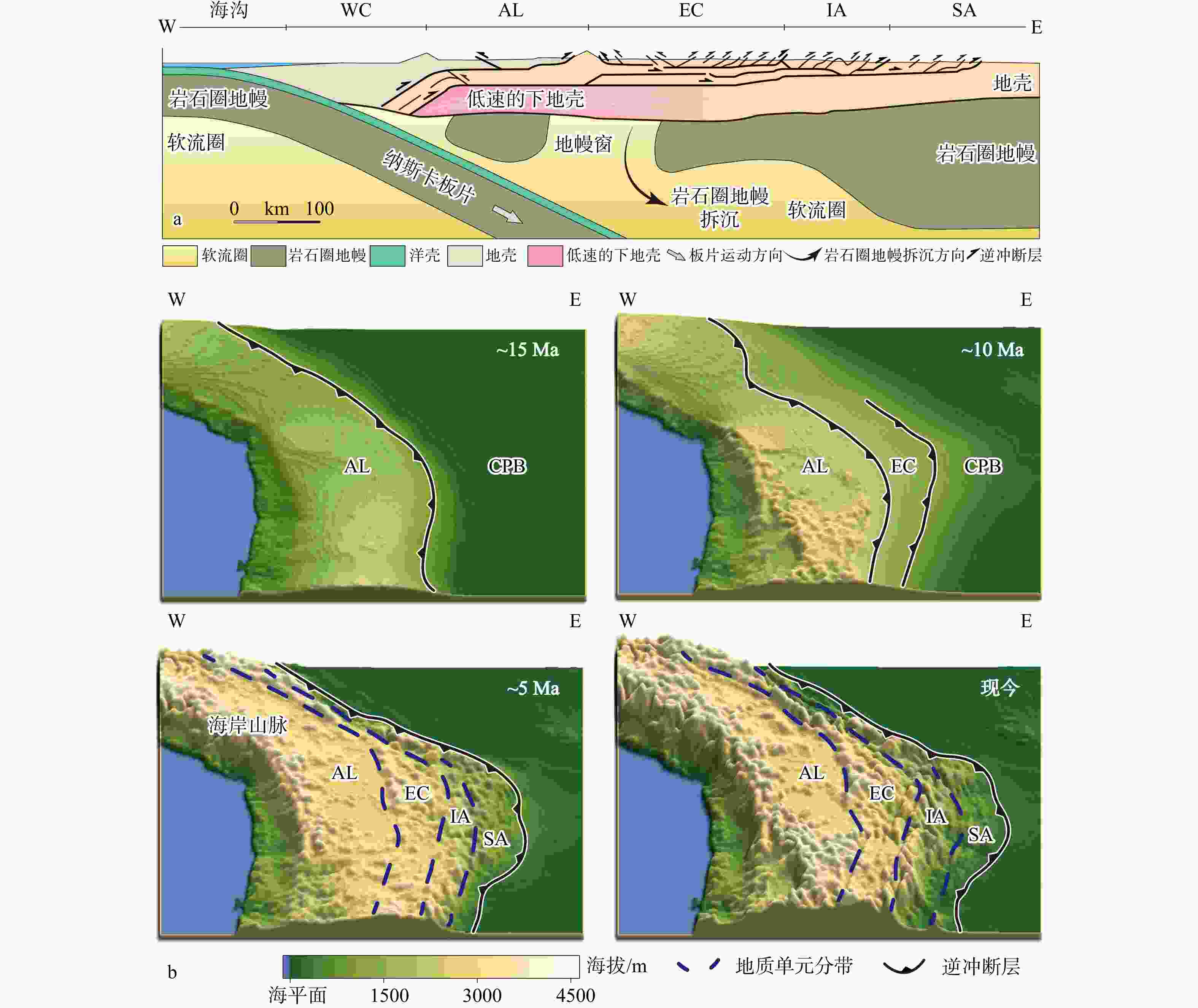
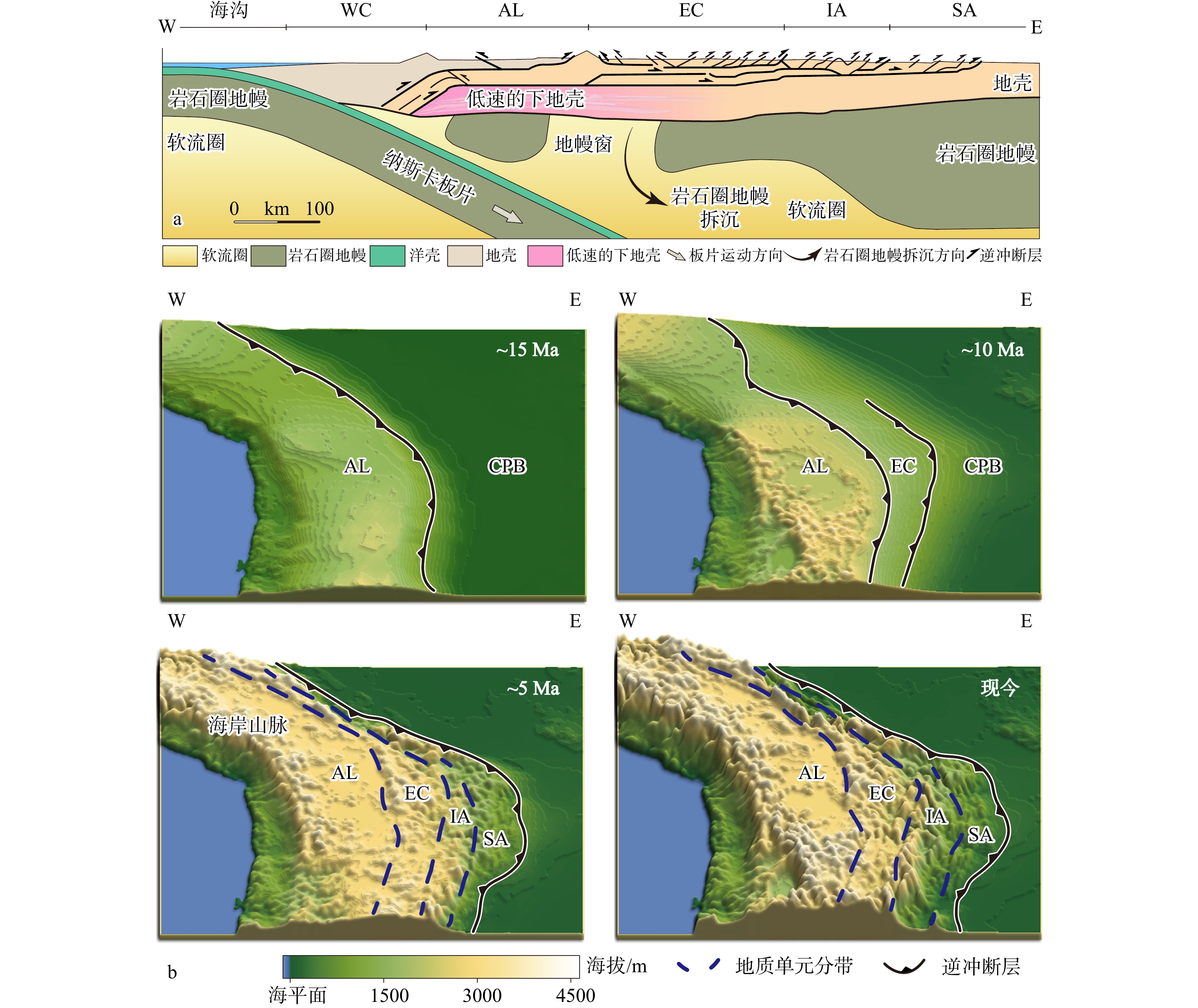
图 1 安第斯造山带岩石圈结构及其构造−地貌演化过程
WC—西科迪勒拉造山带;AL—阿尔蒂普拉诺高原;EC—东科迪勒拉造山带;IA—内安第斯前陆褶皱冲断带;SA—次安第斯前陆褶皱冲断带;CPB—查科−巴拉那前陆盆地a—安第斯造山带中部阿尔蒂普拉诺高原岩石圈剖面(据McQuarrie et al.,2005修改);b—阿尔蒂普拉诺高原中新世至今构造−地貌演化过程模式图(区域剥露历史引自Lease et al.,2016;Giambiagi et al.,2022)
Figure 1. Lithospheric structure and tectono-geomorphic evolution of the Andean orogen
(a) Lithospheric cross section of the Central Andes across the Altiplano Plateau (modified after McQuarrie et al., 2005); (b) Schematic model illustrating the Miocene to present tectonic–geomorphic evolution of the Altiplano Plateau (Regional exhumation history after Lease et al., 2016; Giambiagi et al., 2022) WC—Western Cordillera; AL—Altiplano Plateau; EC—Eastern Cordillera; IA—Interandes; SA—Subandes; CPB—Chaco–Parana Foreland Basin
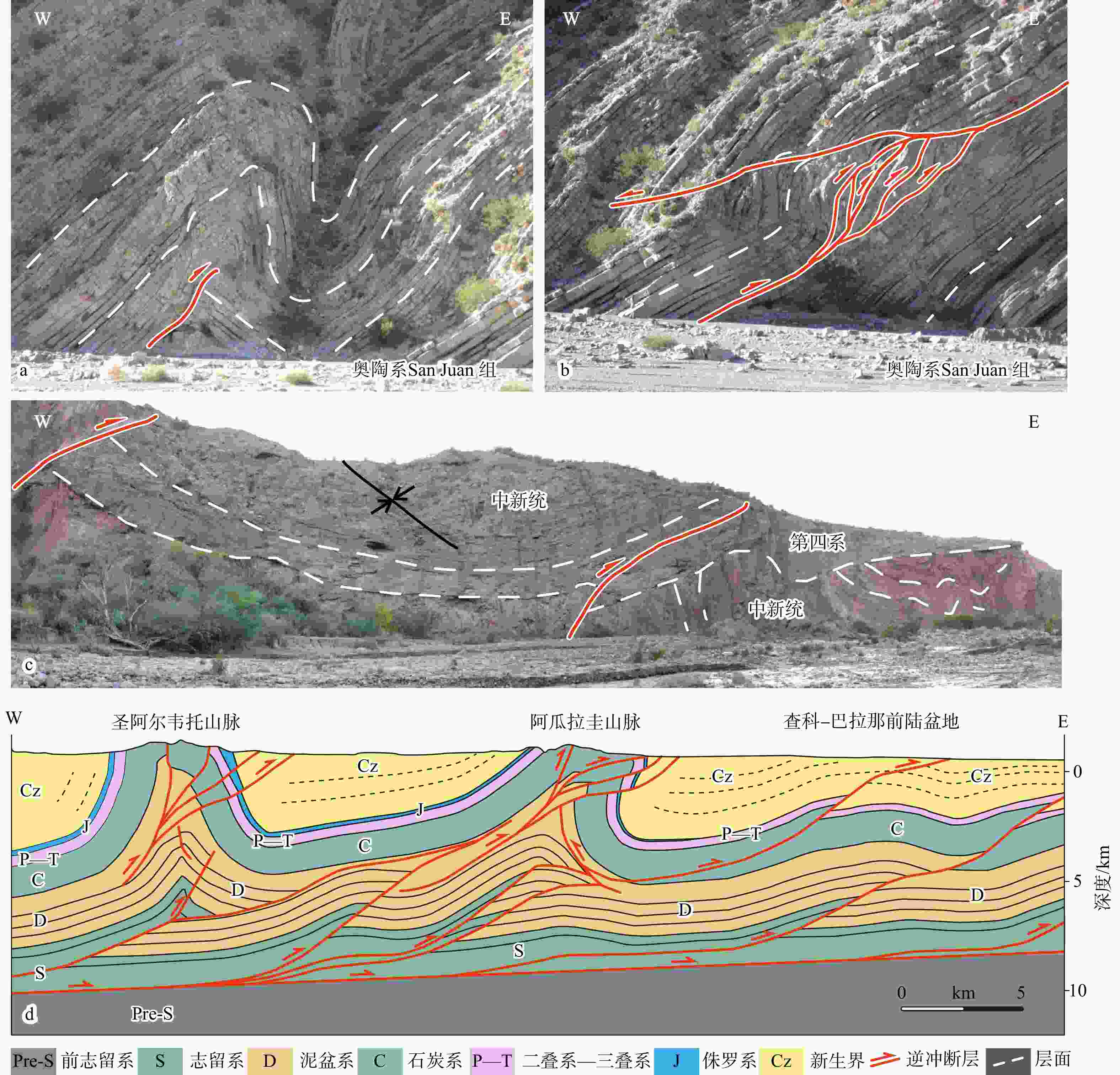
图 2 安第斯造山带中部野外露头及地震反射剖面变形特征(野外露头照片和地震反射剖面引自Zamora and Mora,2022)
a—Precordillera地区奥陶系San Juan组中的褶皱构造;b—Precordillera地区奥陶系San Juan组褶皱翼部发育的冲断双重构造;c—Precordillera地区中新统Auquilco组陆相沉积岩野外露头;d—次安第斯(Subandes)前陆褶皱冲断带地震反射剖面
Figure 2. Field outrops and seismic reflection evidence for deformation in the Central Andes (Field photos and seismic data after Zamora and Mora, 2022)
(a) Fold structures within the Ordovician San Juan Formation in the Precordillera region; (b) Thrust-duplex structures developed on the fold limb of the Ordovician San Juan Formation in the Precordillera region; (c) Miocene terrestrial deposits of the Auquilco Formation; (d) Seismic reflection profile across the Subandean foreland fold-and-thrust belt
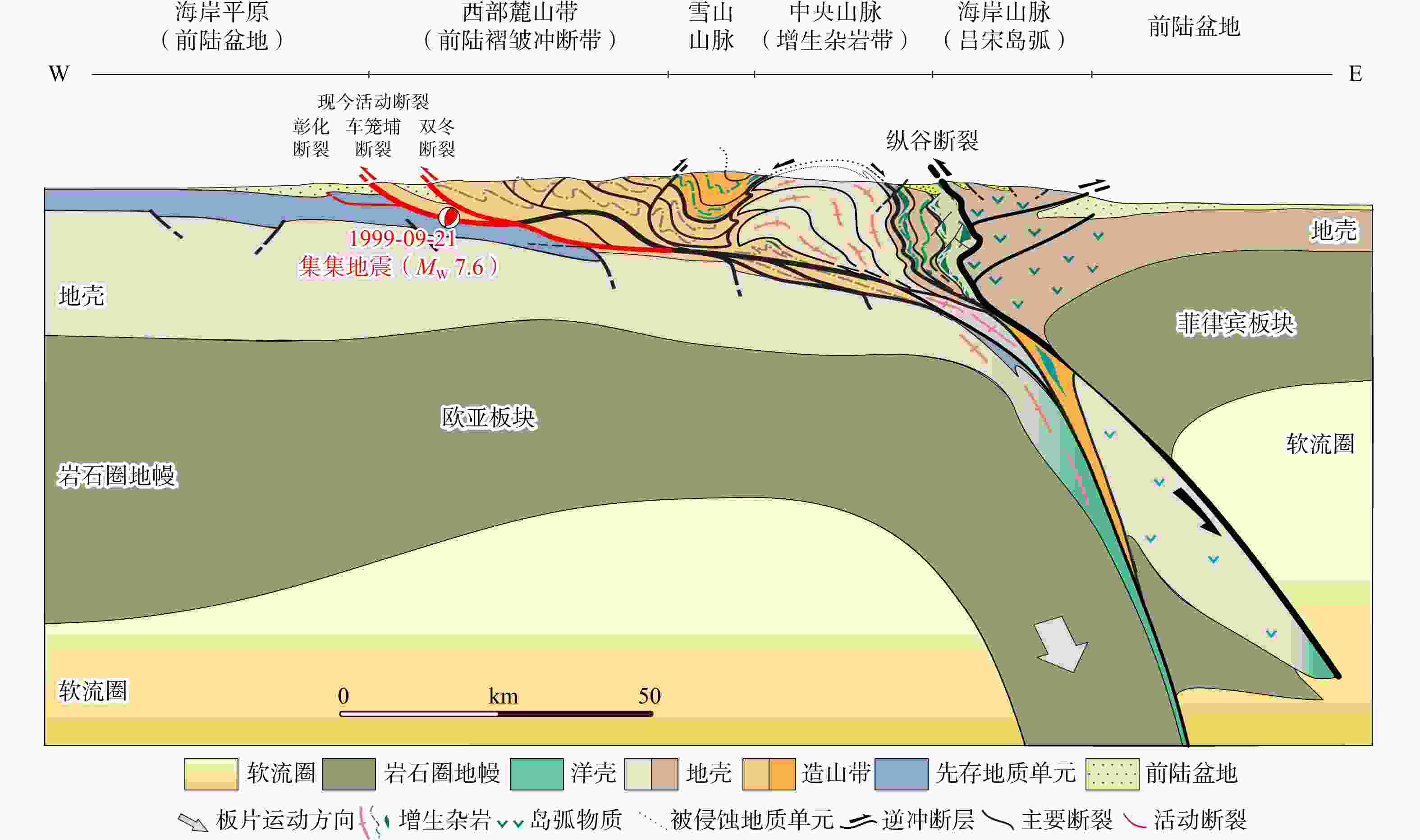
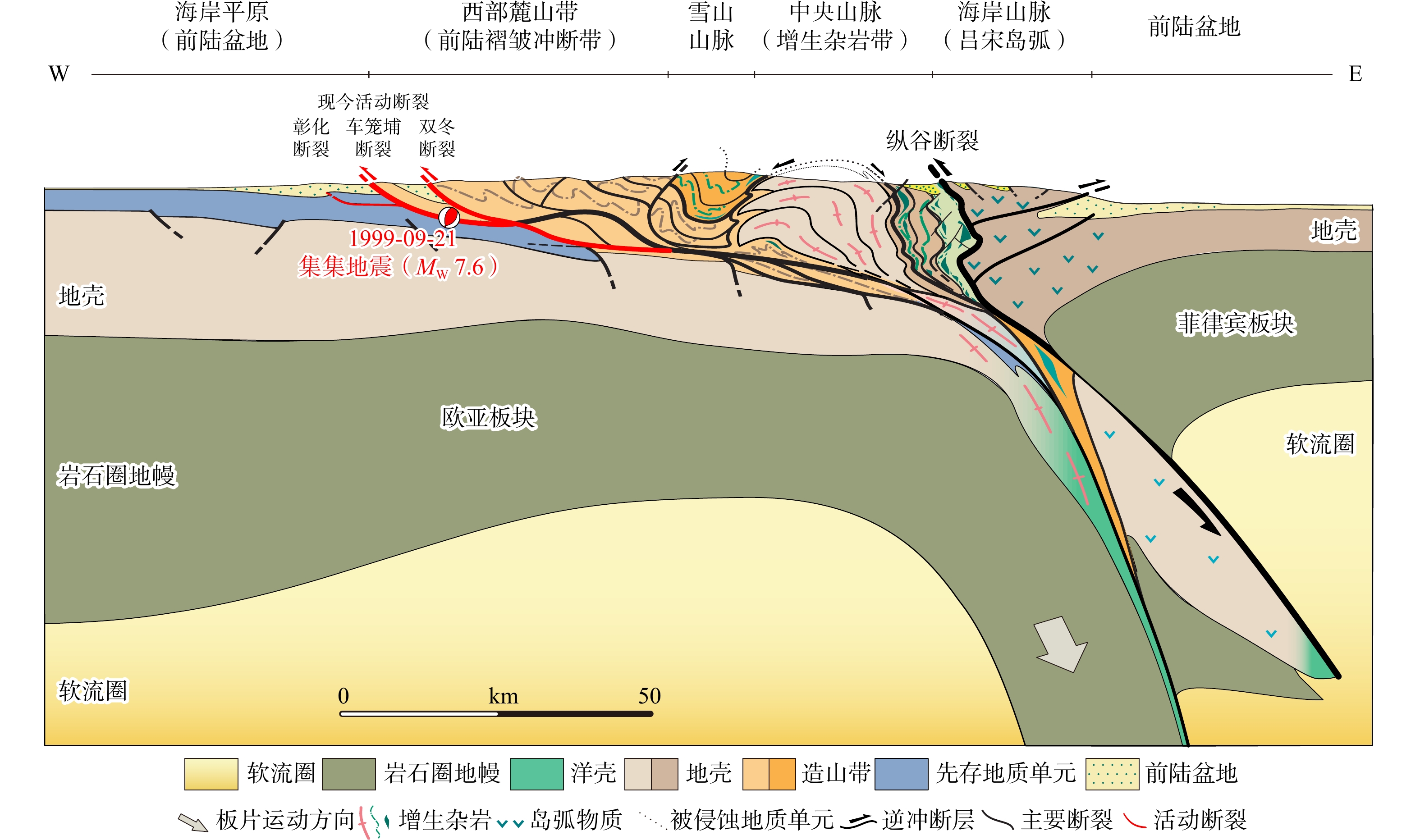
图 3 台湾造山带中部岩石圈剖面(据Malavieille et al.,2021修改)
Figure 3. Lithospheric cross section of the central Taiwan orogen (modified after Malavieille et al., 2021)
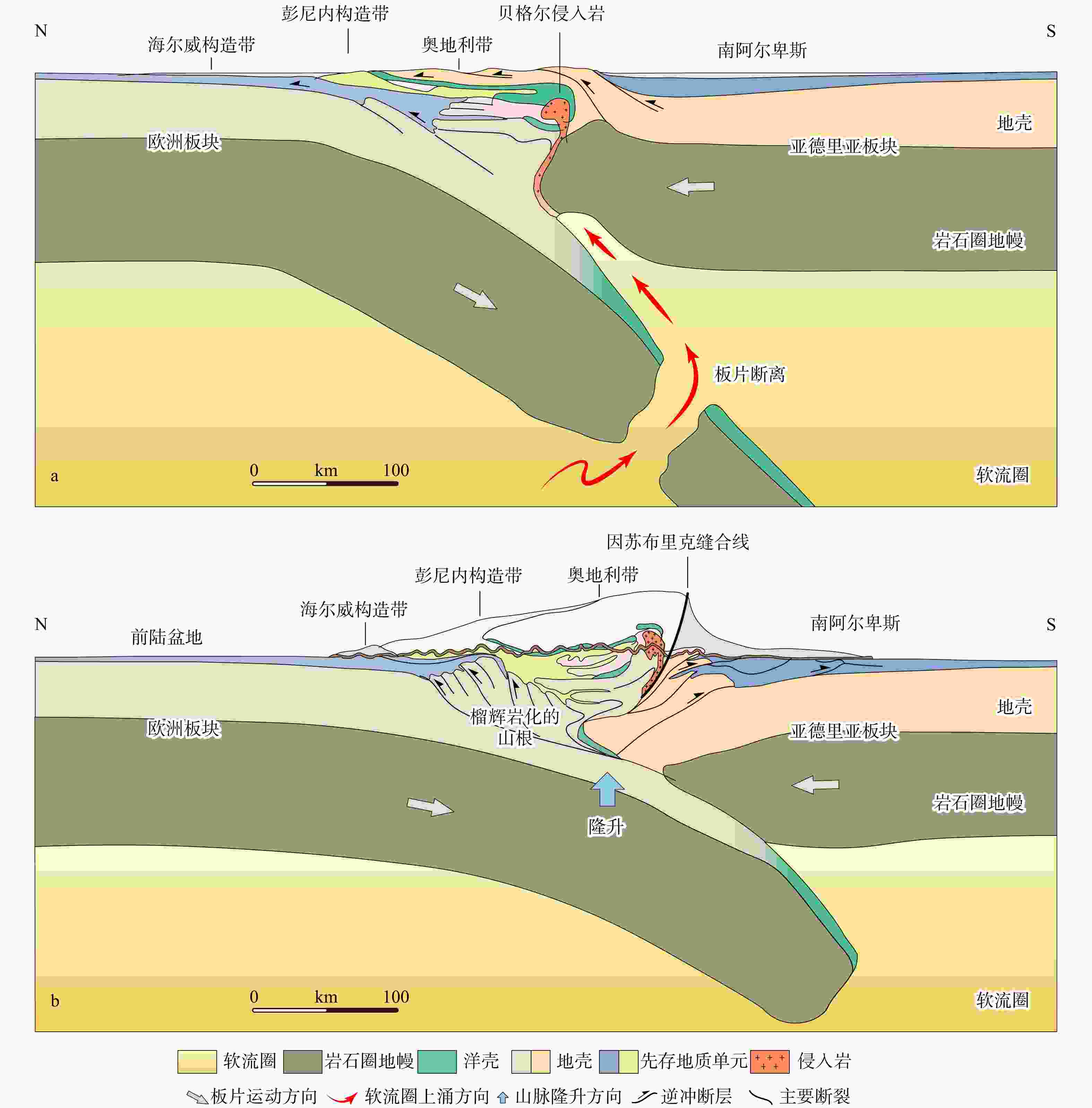
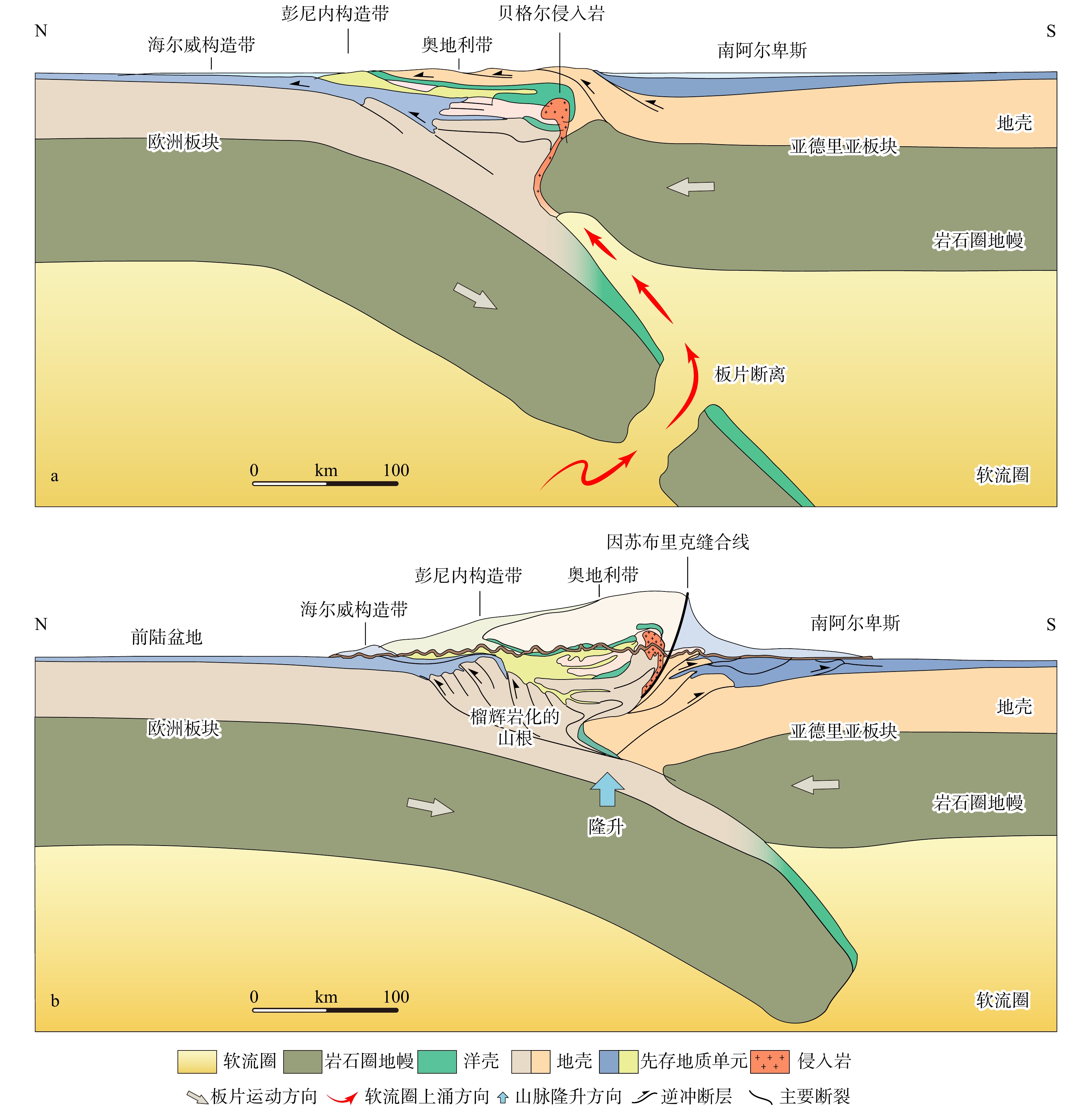
图 4 阿尔卑斯山造山带中部岩石圈剖面(据Schmid et al.,1996修改)
a—古近纪;b—新近纪
Figure 4. Lithospheric cross section of the central Alps orogen (modified after Schmid et al., 1996)
(a) Paleogene; (b) Neogene
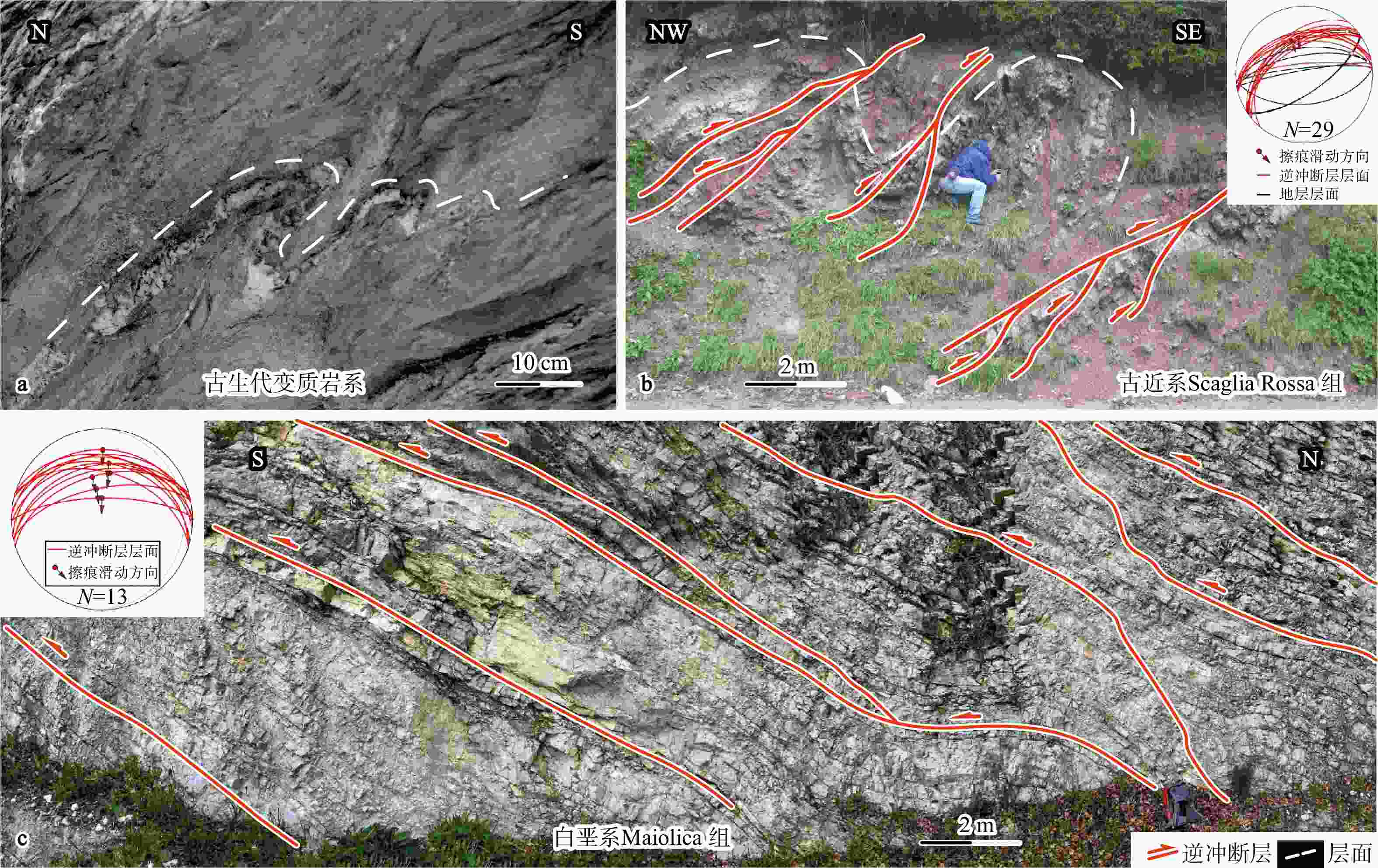
图 5 阿尔卑斯造山带南部(意大利北部)野外露头
a—向东南方向倾伏的千枚岩化的古生代变质结晶基底(内部断裂带黏土矿物伊利石记录的最后一次变形事件的年龄为29.9±11.2 Ma;Curzi et al.,2024);b—古新统Scaglia Rossa组灰岩;c—白垩系Maiolica组灰岩(断裂带内部碳酸盐岩U-Pb年龄为方解石23±14 Ma;Curzi et al.,2024)
Figure 5. Field outcrops from the central Alps (northern Italy)
(a) Phyllonitized Paleozoic metamorphic crystalline basement dipping toward the southeast; illite from fault-related clay minerals records the latest deformation event at 29.9 ± 11.2 Ma (Curzi et al., 2024); (b) Paleocene limestone of the Scaglia Rossa Formation; (c) Cretaceous limestone of the Maiolica Formation; carbonate U–Pb dating of calcite within the fault zone yields an age of 23 ± 14 Ma (Curzi et al., 2024)
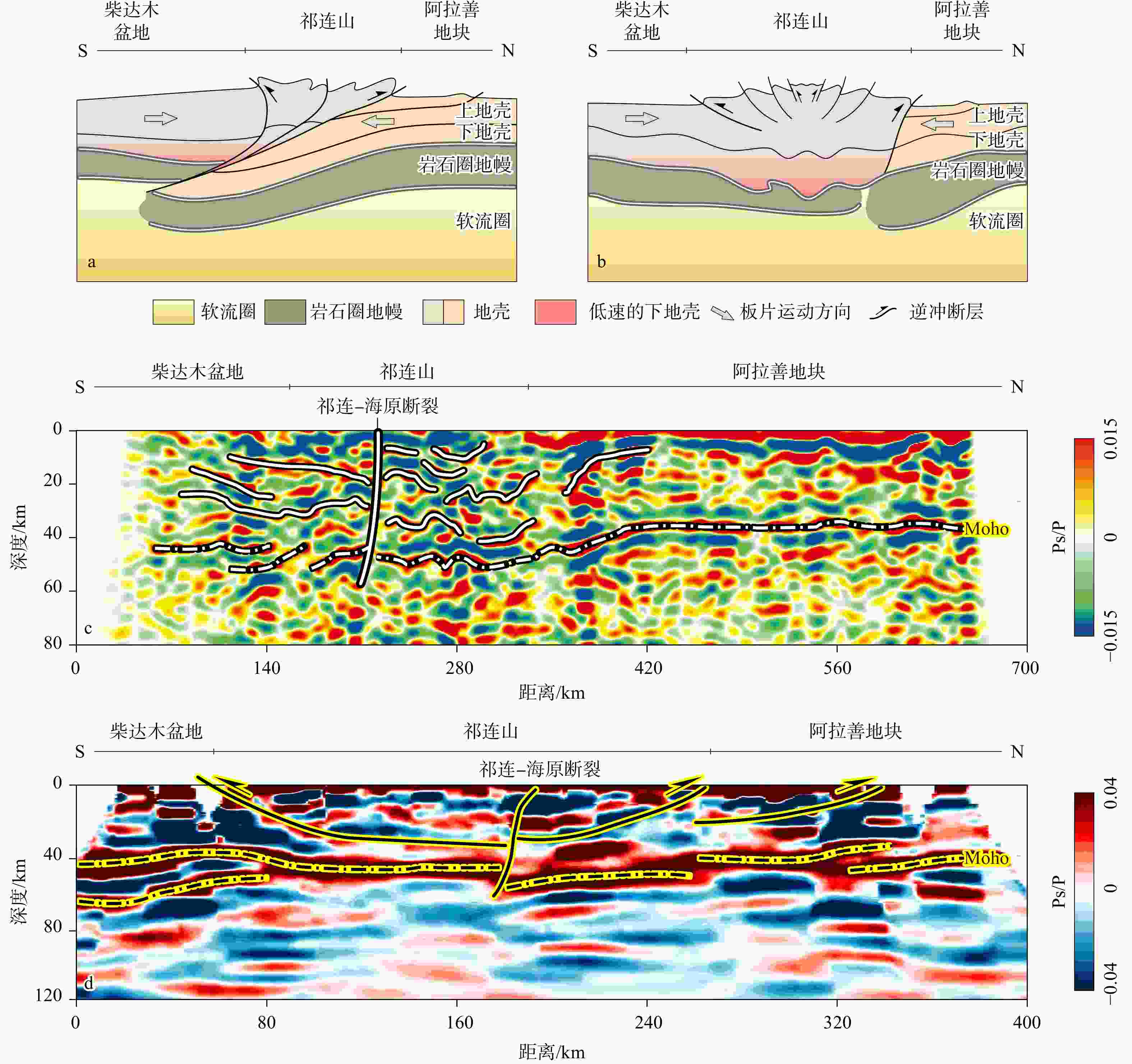
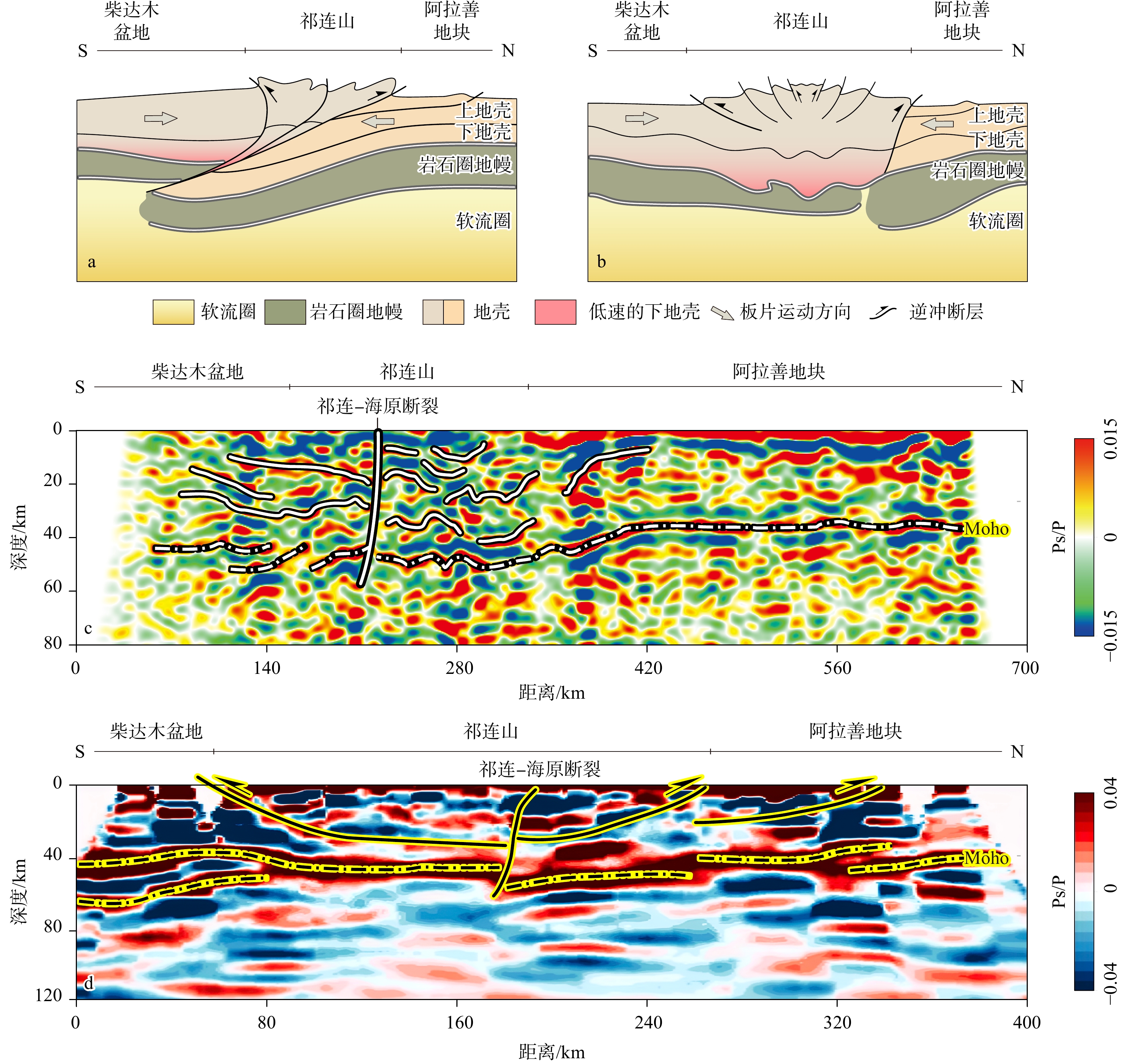
图 6 祁连山造山带端元模型及其岩石圈结构
Ps/P—转换波与直达纵波的振幅比a—祁连山简单剪切模型(据Shen et al.,2020修改);b—祁连山纯剪切模型(据Shen et al.,2020修改);c—祁连山−河西走廊−阿拉善岩石圈结构剖面(据Shen et al.,2020修改);d—祁连山岩石圈结构剖面(据Ye et al.,2021修改)
Figure 6. End-member models and lithospheric structure of the Qilian Shan orogenic belt
(a) Simple shear model for the Qilian Shan (modified after Shen et al., 2020); (b) Pure shear model for the Qilian Shan (modified after Shen et al., 2020); (c) Lithospheric cross section across the Qilian Shan–Hexi Corridor–Alxa block (modified after Shen et al., 2020); (d) Lithospheric structure profile of the Qilian Shan (modified after Ye et al., 2021) Ps/P—amplitude ratio of the converted wave to the direct P-wave
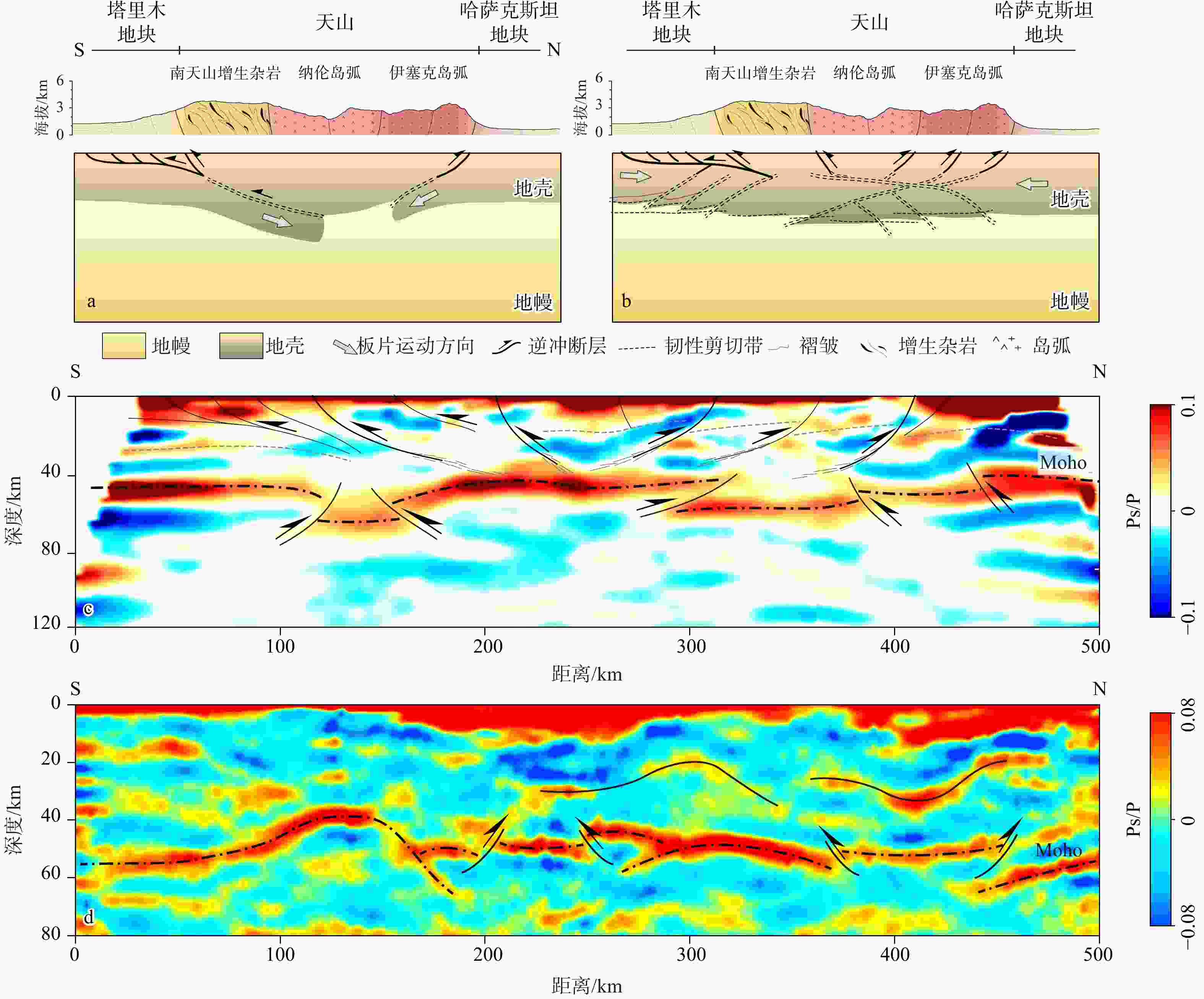
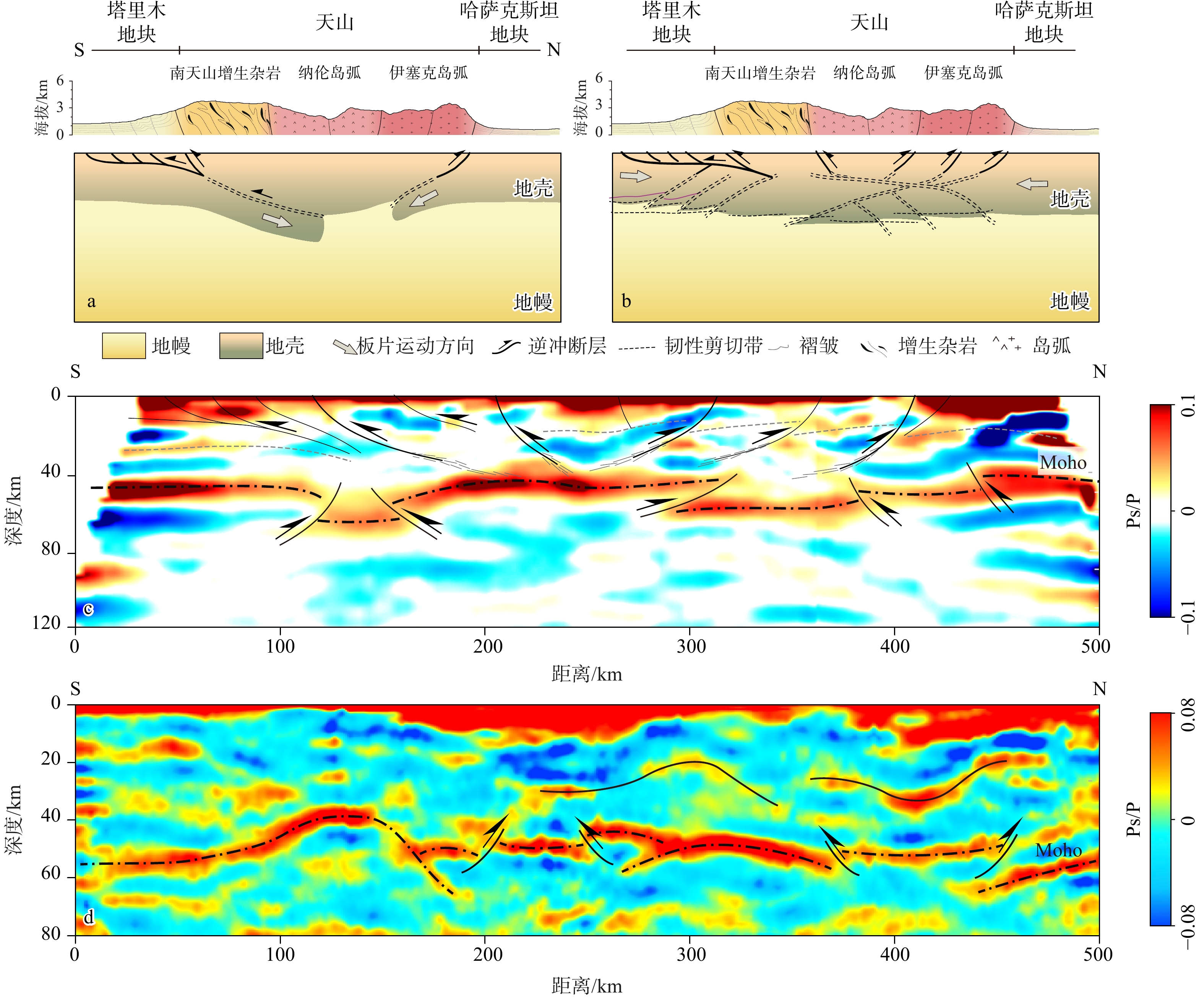
图 7 天山造山带端元模型及其岩石圈结构
Ps/P—转换波与直达纵波的振幅比a—天山简单剪切模型(据Xu et al.,2025;Li et al.,2022b修改);b—天山纯剪切模型(据Xu et al.,2025;Li et al.,2022b修改);c—天山西段岩石圈结构(据Li et al.,2022b修改);d—天山东段岩石圈结构(据Yang et al.,2022修改)
Figure 7. End-member models and lithospheric structure of the Tianshan orogenic belt
(a) Simple-shear model of the Tianshan (modified after Xu et al., 2025; Li et al., 2022b); (b) Pure-shear model of the Tianshan (modified after Xu et al., 2025; Li et al., 2022b); (c) Lithospheric structure of the western Tianshan (modified after Li et al., 2022b); (d) Lithospheric structure of the eastern Tianshan (modified after Yang et al., 2022) Ps/P—amplitude ratio of the converted wave to the direct P-wave
-
[1] ALLMENDINGER R W, GUBBELS T, 1996. Pure and simple shear plateau uplift, Altiplano-Puna, Argentina and Bolivia[J]. Tectonophysics, 259(1-3): 1-13. doi: 10.1016/0040-1951(96)00024-8 [2] ALSOP G I, HOLDSWORTH R E, 1999. Vergence and facing patterns in large-scale sheath folds[J]. Journal of Structural Geology, 21(10): 1335-1349. doi: 10.1016/S0191-8141(99)00099-1 [3] AVIGAD D, CHOPIN C, GOFFÉ B, et al., 1993. Tectonic model for the evolution of the western Alps[J]. Geology, 21(7): 659-662. [4] BAO X W, SONG X D, LI J T, 2015. High-resolution lithospheric structure beneath Mainland China from ambient noise and earthquake surface-wave tomography[J]. Earth and Planetary Science Letters, 417: 132-141. doi: 10.1016/j.epsl.2015.02.024 [5] BASLER L C, CARRAPA B, KAPP P, et al., 2026. Crustal thickness and elevation of the North American cordillera from the late cretaceous to the Early Miocene[J]. Tectonics, 45(1): e2025TC009110. doi: 10.1029/2025TC009110 [6] BELLAHSEN N, MOUTHEREAU F, BOUTOUX A, et al., 2014. Collision kinematics in the western external Alps[J]. Tectonics, 33(6): 1055-1088. doi: 10.1002/2013TC003453 [7] BOSCH G V, VAN DEN DRIESSCHE J, BABAULT J, et al., 2016. Peneplanation and lithosphere dynamics in the Pyrenees[J]. Comptes Rendus Geoscience, 348(3-4): 194-202. doi: 10.1016/j.crte.2015.08.005 [8] BROWN D, ALVAREZ-MARRON J, CAMANNI G, et al., 2022. Structure of the south-central Taiwan fold-and-thrust belt: testing the viability of the model[J]. Earth-Science Reviews, 231: 104094. doi: 10.1016/j.earscirev.2022.104094 [9] BURG J P, FORD M, 1997. Orogeny through time: an overview[J]. Geological Society, London, Special Publications, 121(1): 1-17. [10] BYRNE T, CHAN Y C, RAU R J, et al. , 2011. The arc–continent collision in Taiwan[M]//BROWN D, RYAN P D. Arc-continent collision. Berlin, Heidelberg: Springer: 213-245. [11] CHEN H L, ZHANG Y Q, CHENG X G, et al., 2022. Using migrating growth strata to confirm a ~230-km-long detachment thrust in the southern Tarim Basin[J]. Journal of Structural Geology, 154: 104488. doi: 10.1016/j.jsg.2021.104488 [12] CHENG F, JOLIVET M, GUO Z J, et al., 2021. Cenozoic evolution of the Qaidam basin and implications for the growth of the northern Tibetan plateau: a review[J]. Earth-Science Reviews, 220: 103730. [13] CHEVROT S, SYLVANDER M, VILLASEÑOR A, et al., 2022. Passive imaging of collisional orogens: a review of a decade of geophysical studies in the Pyrénées[J]. Bulletin de la Société Géologique de France, 193(1): 1-18. [14] COWARD M, DIETRICH D, 1989. Alpine tectonics: an overview[J]. Geological Society, London, Special Publications, 45(1): 1-29. [15] CURZI M, VIOLA G, ZUCCARI C, et al., 2024. Tectonic evolution of the eastern southern alps (Italy): a reappraisal from new structural data and geochronological constraints[J]. Tectonics, 43(3): e2023TC008013. [16] DE GRACIANSKY P C, ROBERTS D G, TRICART P, 2011. The birth of the western and central alps: subduction, obduction, collision[J]. Developments in Earth Surface Processes, 14: 289-315. [17] DEWEY J F, BIRD J M, 1970. Mountain belts and the new global tectonics[J]. Journal of Geophysical Research, 75(14): 2625-2647. [18] DONG S W, GAO R, YIN A, et al., 2013. What drove continued continent-continent convergence after ocean closure? Insights from high-resolution seismic-reflection profiling across the Daba Shan in central China[J]. Geology, 41(6): 671-674. [19] DONG Y P, ZHANG G W, SUN S S, et al., 2019. The “cross–tectonics” in China continent: formation, evolution, and its significance for continental dynamics[J]. Journal of Geomechanics, 25(5): 769-797. (in Chinese with English abstract) [20] FAURE A, LOGET N, JOLIVET L, et al., 2024. 3D geometrical modelling of the non-cylindrical Vélodrome Miocene fold in the southwestern Alps[J]. Tectonophysics, 879: 230296. [21] FENG W P, HE X H, ZHANG Y P, et al., 2023. Seismic faults of the 2022 Mw 6.6 Menyuan, Qinghai earthquake and their implication for the regional seismogenic structures[J]. Chinese Science Bulletin, 68(3): 254-270. (in Chinese with English abstract) [22] FU C L, YAN Z, WANG Z Q, et al., 2018. Lajishankou ophiolite complex: implications for Paleozoic multiple accretionary and collisional events in the South Qilian Belt[J]. Tectonics, 37(5): 1321-1346. [23] GAO R, HOU H, CAI X, et al., 2013. Fine crustal structure beneath the junction of the southwest Tian Shan and Tarim Basin, NW China[J]. Lithosphere, 5(4): 382-392. [24] GAO S B, WU L, LIN X B, et al., 2025. Cenozoic pure-shear thickening of the northern Tibetan Plateau margin: implications for diverse plateau uplift mechanisms controlled by convergent obliquity[J]. GSA Bulletin, 137(5-6): 2506-2522. [25] GAO Y J, TILMANN F, VAN HERWAARDEN D P, et al., 2021. Full waveform inversion beneath the central Andes: insight into the dehydration of the Nazca slab and delamination of the back-arc lithosphere[J]. Journal of Geophysical Research: Solid Earth, 126(7): e2021JB021984. [26] GARZANTI E, NAYAK K, PADOAN M, et al., 2023. Fast-eroding Taiwan and transfer of orogenic sediment to forearc basins and trenches in the Philippine and South China seas[J]. Earth-Science Reviews, 244: 104523. [27] GARZIONE C N, HOKE G D, LIBARKIN J C, et al., 2008. Rise of the Andes[J]. Science, 320(5881): 1304-1307. [28] GARZIONE C N, MCQUARRIE N, PEREZ N D, et al., 2017. Tectonic evolution of the Central Andean Plateau and implications for the growth of plateaus[J]. Annual Review of Earth and Planetary Sciences, 45: 529-559. [29] GIAMBIAGI L, TASSARA A, ECHAURREN A, et al., 2022. Crustal anatomy and evolution of a subduction-related orogenic system: insights from the Southern Central Andes (22-35°S)[J]. Earth-Science Reviews, 232: 104138. [30] HE P J, SONG C H, WANG Y D, et al., 2017. Cenozoic exhumation in the Qilian Shan, northeastern Tibetan Plateau: evidence from detrital fission track thermochronology in the Jiuquan Basin[J]. Journal of Geophysical Research: Solid Earth, 122(8): 6910-6927. [31] HE X H, ZHANG Y P, SHEN X Z, et al., 2020. Examination of the repeatability of two Ms6.4 Menyuan earthquakes in Qilian-Haiyuan fault zone (NE Tibetan Plateau) based on source parameters[J]. Physics of the Earth and Planetary Interiors, 299: 106408. [32] HENRIQUEZ S, DECELLES P G, CARRAPA B, et al., 2023. Kinematic evolution of the central Andean retroarc thrust belt in northwestern Argentina and implications for coupling between shortening and crustal thickening[J]. GSA Bulletin, 135(1-2): 81-103. [33] HORTON B K, 2018. Sedimentary record of Andean mountain building[J]. Earth-Science Reviews, 178: 279-309. [34] HORTON B K, FOLGUERA A, 2019. Andean tectonics[M]. Amsterdam: Elsevier. [35] HUANG C Y, CHEN W H, WANG M H, et al., 2018. Juxtaposed sequence stratigraphy, temporal-spatial variations of sedimentation and development of modern-forming forearc Lichi Mélange in North Luzon Trough forearc basin onshore and offshore eastern Taiwan: an overview[J]. Earth-Science Reviews, 182: 102-140. [36] HUANG H, SHEN X Z, LV J Y, et al., 2022. Dynamic model of the upper mantle beneath the northeastern Tibetan Plateau - constraints from the 410 km and 660 km discontinuities[J]. Gondwana Research, 106: 224-236. [37] HUANGFU P P, LI Z H, ZHANG K J, et al., 2021. India-Tarim lithospheric mantle collision beneath western Tibet controls the Cenozoic building of Tian Shan[J]. Geophysical Research Letters, 48(14): e2021GL094561. [38] JAQUET Y, DURETZ T, GRUJIC D, et al., 2018. Formation of orogenic wedges and crustal shear zones by thermal softening, associated topographic evolution and application to natural orogens[J]. Tectonophysics, 746: 512-529. [39] JIANG X D, LI Z X, 2014. Seismic reflection data support episodic and simultaneous growth of the Tibetan Plateau since 25 Myr[J]. Nature Communications, 5(1): 5453. [40] JIN R Z, SHEN X Z, ZHANG Y P, et al., 2026. Crustal differential thickening and incomplete mechanical decoupling in the eastern Qilian Shan, NE Tibetan Plateau: insights from a dense seismic profile[J]. Earth and Planetary Science Letters, 684: 120032. [41] JING H L, WANG W T, ZHANG P Z, et al., 2025. Multi-stage uplift and propagation of the Chinese East Tianshan during the Cenozoic[J]. Tectonics, 44(2): e2024TC008666. [42] KLEMPERER S L, 2006. Crustal flow in Tibet: geophysical evidence for the physical state of Tibetan lithosphere, and inferred patterns of active flow[M]//LAW R D, SEARLE M P, GODIN L. Channel flow, ductile extrusion and exhumation in continental collision zones. London: Geological Society: 39-70. [43] KNIGHT B S, CAPITANIO F A, WEINBERG R F, 2021. Convergence velocity controls on the structural evolution of orogens[J]. Tectonics, 40(9): e2020TC006570. [44] KONDO Y, OBAYASHI M, SUGIOKA H, et al., 2024. Seismic image of the central to southern Andean subduction zone through finite-frequency tomography[J]. Journal of Geophysical Research: Solid Earth, 129(11): e2024JB028844. [45] LABORDE A, BARRIER L, SIMOES M, et al., 2019. Cenozoic deformation of the Tarim Basin and surrounding ranges (Xinjiang, China): a regional overview[J]. Earth-Science Reviews, 197: 102891. [46] LEASE R O, EHLERS T A, ENKELMANN E, 2016. Large along-strike variations in the onset of Subandean exhumation: implications for Central Andean orogenic growth[J]. Earth and Planetary Science Letters, 451: 62-76. [47] LEI J S, ZHAO D P, 2007. Teleseismic P-wave tomography and the upper mantle structure of the central Tien Shan orogenic belt[J]. Physics of the Earth and Planetary Interiors, 162(3-4): 165-185. [48] LI B, ZHANG Y L, WANG C Q, et al., 2016. Geochemical characteristics of the Youhulugou basalts in the suture zone of the North Qilian Mountain[J]. Journal of Geomechanics, 22(1): 48-55. (in Chinese with English abstract) [49] LI B, QI B S, CHEN X H, et al., 2024. Two-phase kinematic evolution of the Qilian Shan, northern Tibetan Plateau: initial Eocene−Oligocene deformation that accelerated in the mid-Miocene[J]. GSA Bulletin, 136(5-6): 2389-2406. [50] LI C P, ZHENG D W, SUN J M, et al., 2020. Reconstruction on regional paleo-drainage evolution in the northern Junggar Basin, China during the last ~27 myr from provenance analyses and its implications for uplift of the Altai Mountains[J]. Palaeogeography, Palaeoclimatology, Palaeoecology, 537: 109373. [51] LI F, CHENG X G, CHEN H L, et al., 2023. Cenozoic shortening and propagation in the Eastern Kuqa fold-and-thrust belt, South Tian Shan, NW China[J]. Tectonics, 42(5): e2022TC007447. [52] LI F, SHI X H, CHARREAU J, et al., 2026. Differential mountain-building in the South Tian Shan revealed by multi-spatiotemporal foreland deformation[J]. Tectonics, 45(2): e2025TC009078. [53] LI J, YAO Y, LI R, et al., 2022a. Present-day strike-slip faulting and thrusting of the Kepingtage fold-and-thrust belt in Southern Tianshan: constraints from GPS observations[J]. Geophysical Research Letters, 49(11): e2022GL099105. [54] LI J Y, WANG K Z, LI Y P, et al., 2006. Geomorphological features, crustal composition and geological evolution of the Tianshan Mountains[J]. Geological Bulletin of China, 25(8): 895-909. (in Chinese with English abstract) [55] LI J Y, ZHANG J, ZHAO X X, et al., 2016. Mantle subduction and uplift of intracontinental mountains: a case study from the Chinese Tianshan Mountains within Eurasia[J]. Scientific Reports, 6(1): 28831. [56] LI K, WU L, GUO B, et al., 2025. Limited intracontinental convergence accommodated by lithospheric-scale wedge tectonics along the northeastern margin of the Tibetan Plateau[J]. Science China Earth Sciences, 68(11): 3506-3522. [57] LI T, CHEN J, THOMPSON J A, et al., 2012. Equivalency of geologic and geodetic rates in contractional orogens: new insights from the Pamir Frontal Thrust[J]. Geophysical Research Letters, 39(15): L15305. [58] LI W, CHEN Y, YUAN X H, et al., 2022b. Intracontinental deformation of the Tianshan Orogen in response to India-Asia collision[J]. Nature Communications, 13(1): 3738. [59] LIN A T, WATTS A B, HESSELBO S P, 2003. Cenozoic stratigraphy and subsidence history of the South China Sea margin in the Taiwan region[J]. Basin Research, 15(4): 453-478. [60] LU H H, JIANG Y T, LI B J, et al., 2022. Origin of late quaternary gravel and drainage basin expansion in the northern Chinese Tian Shan: insights from sediment provenance analyses[J]. Journal of Geophysical Research: Earth Surface, 127(5): e2021JF006472. [61] LU H J, LI C, MALUSÀ M G, et al., 2025. Simultaneous basinward expansion of mountain building in northern Tibet since Ca. 8 Ma[J]. Tectonics, 44(3): e2024TC008571. [62] MA J C, BUNGE H P, FICHTNER A, et al., 2023. Structure and dynamics of lithosphere and asthenosphere in Asia: a seismological perspective[J]. Geophysical Research Letters, 50(7): e2022GL101704. [63] MALAVIEILLE J, DOMINGUEZ S, LU C Y, et al., 2021. Deformation partitioning in mountain belts: insights from analogue modelling experiments and the Taiwan collisional orogen[J]. Geological Magazine, 158(1): 84-103. [64] MALUSÀ M G, FITZGERALD P G, 2020. The geologic interpretation of the detrital thermochronology record within a stratigraphic framework, with examples from the European Alps, Taiwan and the Himalayas[J]. Earth-Science Reviews, 201: 103074. [65] MCQUARRIE N, HORTON B K, ZANDT G, et al., 2005. Lithospheric evolution of the Andean fold–thrust belt, Bolivia, and the origin of the central Andean plateau[J]. Tectonophysics, 399(1-4): 15-37. [66] MOODY J D, 1966. Crustal shear patterns and orogenesis[J]. Tectonophysics, 3(6): 479-522. [67] PANG J Z, YU J X, ZHENG D W, et al., 2019. Neogene expansion of the Qilian Shan, North Tibet: implications for the dynamic evolution of the Tibetan Plateau[J]. Tectonics, 38(3): 1018-1032. [68] PUSOK A E, KAUS B J P, 2015. Development of topography in 3-D continental-collision models[J]. Geochemistry, Geophysics, Geosystems, 16(5): 1378-1400. [69] QUIROGA R, GIAMBIAGI L, ECHAURREN A, et al., 2024. Boundary effects of orogenic plateaus in the evolution of the stress field: the Southern Puna Study Case (26°30′–27°30′S)[J]. Tectonics, 43(7): e2023TC008185. [70] ROYDEN L H, BURCHFIEL B C, KING R W, et al., 1997. Surface deformation and lower crustal flow in eastern Tibet[J]. Science, 276(5313): 788-790. [71] SCHMID S M, PFIFFNER O A, FROITZHEIM N, et al., 1996. Geophysical-geological transect and tectonic evolution of the Swiss-Italian Alps[J]. Tectonics, 15(5): 1036-1064. [72] SCHMID S M, FÜGENSCHUH B, KISSLING E, et al., 2004. Tectonic map and overall architecture of the Alpine orogen[J]. Eclogae Geologicae Helvetiae, 97(1): 93-117. [73] SHEN X Z, YUAN X H, LIU M, 2015. Is the Asian lithosphere underthrusting beneath northeastern Tibetan Plateau? Insights from seismic receiver functions[J]. Earth and Planetary Science Letters, 428: 172-180. [74] SHEN X Z, LI Y K, GAO R, et al., 2020. Lateral growth of NE Tibetan Plateau restricted by the Asian lithosphere: results from a dense seismic profile[J]. Gondwana Research, 87: 238-247. [75] SHI D N, SHEN Y, ZHAO W J, et al., 2009. Seismic evidence for a Moho offset and south-directed thrust at the easternmost Qaidam–Kunlun boundary in the Northeast Tibetan plateau[J]. Earth and Planetary Science Letters, 288(1-2): 329-334. [76] SHIN T C, TENG T L, 2001. An overview of the 1999 Chi-Chi, Taiwan, earthquake[J]. Bulletin of the Seismological Society of America, 91(5): 895-913. [77] SILVER P G, 1996. Seismic anisotropy beneath the continents: probing the depths of geology[J]. Annual Review of Earth and Planetary Sciences, 24(1): 385-432. [78] SIMOES M, AVOUAC J P, BEYSSAC O, et al., 2007. Mountain building in Taiwan: a thermokinematic model[J]. Journal of Geophysical Research: Solid Earth, 112(B11): B11405. [79] SUN C, LI Z G, ZUZA A V, et al., 2022a. Controls of mantle subduction on crustal-level architecture of intraplate orogens, insights from sandbox modeling[J]. Earth and Planetary Science Letters, 584: 117476. [80] SUN J M, LI Y, ZHANG Z Q, et al., 2009. Magnetostratigraphic data on Neogene growth folding in the foreland basin of the southern Tianshan Mountains[J]. Geology, 37(11): 1051-1054. [81] SUN J M, SHA J G, WINDLEY B F, et al., 2023. Late Eocene stepwise seawater retreat from the Pamir-Tian Shan convergence zone (Alay Valley) in the western Tarim Basin, China[J]. Palaeogeography, Palaeoclimatology, Palaeoecology, 622: 111603. [82] SUN W J, AO S J, TANG Q Y, et al., 2022b. Forced Cenozoic continental subduction of Tarim craton-like lithosphere below the Tianshan revealed by ambient noise tomography[J]. Geology, 50(12): 1393-1397. [83] TANG C H, HSU Y J, BARBOT S, et al., 2019. Lower-crustal rheology and thermal gradient in the Taiwan orogenic belt illuminated by the 1999 Chi-Chi earthquake[J]. Science Advances, 5(2): eaav3287. [84] TANG Q Y, SUN W J, AO S J, et al., 2022. Strong lateral heterogeneities of upper mantle shear-wave structures beneath the central and eastern Tien Shan[J]. International Journal of Earth Sciences, 111(8): 2555-2569. [85] TAPPONNIER P, XU Z Q, ROGER F, et al., 2001. Oblique stepwise rise and growth of the Tibet plateau[J]. Science, 294(5547): 1671-1677. [86] TIGROUDJA L, ESPURT N, SCALABRINO B, 2025. Quantifying Miocene thin- and thick-skinned shortening in the Baous thrust system, SW French Alpine Front[J]. Tectonophysics, 916: 230930. [87] WANG C S, GAO R, YIN A, et al., 2011. A mid-crustal strain-transfer model for continental deformation: a new perspective from high-resolution deep seismic-reflection profiling across NE Tibet[J]. Earth and Planetary Science Letters, 306(3-4): 279-288. [88] WANG G C, ZHAO Z H, SHEN T Y, et al., 2025. A brief analysis on the dynamic sources of the uplift and exhumation of the Tianshan Mountains during the Meso-Cenozoic based on the spatio-temporal differences of rock cooling in the Central Asia[J]. Earth Science Frontiers, 32(1): 322-342. (in Chinese with English abstract) [89] WANG G H, LI D, LIANG X, et al., 2022. Determination of the double-layer structure in orogenic belts and its geological significance[J]. Journal of Geomechanics, 28(5): 705-727. (in Chinese with English abstract) [90] WANG W T, ZHANG P Z, DUAN L, et al., 2022. Cenozoic stratigraphic chronology and sedimentary-tectonic evolution of the Qaidam Basin[J]. Chinese Science Bulletin, 67(28-29): 3452-3475. (in Chinese with English abstract) [91] WANG X X, ZATTIN M, YANG Y, et al., 2024. Multiple exhumation stages during the Cenozoic evolution of the northeast Tibetan Plateau[J]. Tectonics, 43(3): e2023TC007850. [92] WANG Y, ZHENG Y F, 2025. Origin and genesis of intracontinental orogens[J]. Science China Earth Sciences, 68(12): 4005-4032. [93] WANG Y N, ZHANG J, HUANG X, et al., 2023. Cenozoic exhumation of the Tianshan as constrained by regional low-temperature thermochronology[J]. Earth-Science Reviews, 237: 104325. [94] WIMPENNY S, 2022. Weak, seismogenic faults inherited from Mesozoic rifts control mountain building in the Andean foreland[J]. Geochemistry, Geophysics, Geosystems, 23(3): e2021GC010270. [95] WU C, LI J, ZUZA A V, et al., 2022. Proterozoic–Phanerozoic tectonic evolution of the Qilian Shan and Eastern Kunlun Range, northern Tibet[J]. GSA Bulletin, 134(9-10): 2179-2205. [96] WU C L, XU T, TIAN X B, et al., 2024. Underthrusting of Tarim lower crust beneath the Tibetan Plateau revealed by receiver function imaging[J]. Geophysical Research Letters, 51(2): e2024GL108220. [97] WU C Y, ZHANG P Z, ZHANG Z Q, et al., 2023. Slip partitioning and crustal deformation patterns in the Tianshan orogenic belt derived from GPS measurements and their tectonic implications[J]. Earth-Science Reviews, 238: 104362. [98] WU L, YANG H T, ZHANG Y S, et al., 2023. Structural coupling between the Qaidam basin and bordering orogenic belts in the Cenozoic[J]. Acta Geologica Sinica, 97(9): 2939-2955. (in Chinese with English abstract) [99] WU X C, WANG W T, LI Z G, et al., 2025. Syn-tectonic deposits uncover uplift and expansion of the Qilian Shan along the northeastern Tibetan Plateau since the middle Miocene[J]. Tectonics, 44(8): e2025TC008881. [100] XIAO W J, WINDLEY B F, ALLEN M B, et al., 2013. Paleozoic multiple accretionary and collisional tectonics of the Chinese Tianshan orogenic collage[J]. Gondwana Research, 23(4): 1316-1341. [101] XIE H, LIU C C, ZHANG Z Q, et al., 2026. Tectonic transition in the northern Tibetan Plateau during the Neogene[J]. Earth and Planetary Science Letters, 683: 119997. [102] XU X, ZUZA A V, GERYA T, et al., 2025. Mode of intracontinental mountain building controlled by lower crustal composition and mantle lithosphere depletion[J]. Nature Communications, 16(1): 9404. [103] XU X W, YEATS R S, YU G H, 2010. Five short historical earthquake surface ruptures near the silk road, Gansu Province, China[J]. Bulletin of the Seismological Society of America, 100(2): 541-561. [104] YAN Z, FU C L, AITCHISON J C, et al., 2022. Arc-continent collision during culmination of Proto-Tethyan Ocean closure in the Central Qilian belt, NE Tibetan Plateau[J]. GSA Bulletin, 134(11-12): 3079-3098. [105] YANG J S, XU Z Q, MA C Q, et al., 2010. Compound orogeny and scientific problems concerning the Central Orogenic Belt of China[J]. Geology in China, 37(1): 1-11. (in Chinese with English abstract) [106] YANG X S, TIAN X B, WINDLEY B F, et al., 2022. The role of multiple trapped oceanic basins in continental growth: seismic evidence from the southern Altaids[J]. Geophysical Research Letters, 49(11): e2022GL098548. [107] YE Z, GAO R, LI Q S, et al., 2015. Seismic evidence for the North China plate underthrusting beneath northeastern Tibet and its implications for plateau growth[J]. Earth and Planetary Science Letters, 426: 109-117. [108] YE Z, GAO R, LU Z W, et al., 2021. A lithospheric-scale thrust-wedge model for the formation of the northern Tibetan plateau margin: evidence from high-resolution seismic imaging[J]. Earth and Planetary Science Letters, 574: 117170. [109] YIN A, HARRISON T M, 2000. Geologic evolution of the Himalayan-Tibetan Orogen[J]. Annual Review of Earth and Planetary Sciences, 28: 211-280. [110] YU J X, ZHENG D W, ZHANG H P, et al., 2022. Initial Cenozoic exhumation of the northern Chinese Tian Shan deduced from apatite (U-Th)/He thermochronological data[J]. Lithosphere, 2022(1): 8099539. [111] YU J X, ZHENG D W, WANG W T, et al., 2023. Cenozoic tectonic development in the northeastern Tibetan Plateau: evidence from thermochronological and sedimentological records[J]. Global and Planetary Change, 224: 104098. [112] YUE L F, SUPPE J, HUNG J H, 2005. Structural geology of a classic thrust belt earthquake: the 1999 Chi-Chi earthquake Taiwan (Mw=7.6)[J]. Journal of Structural Geology, 27(11): 2058-2083. [113] ZAMORA G, MORA A, 2022. Andean structural styles: a seismic atlas[M]. Amsterdam: Elsevier. [114] ZHANG C H, 2008. A review on the continental intraplate deformation and its dynamics[J]. Earth Science Frontiers, 15(3): 140-149. (in Chinese with English abstract) [115] ZHANG G W, LIU X M, 1998. Some remarks on China central orogenic system[J]. Earth Science-Journal of China University of Geosciences, 23(5): 443-448. (in Chinese with English abstract) [116] ZHANG G W, GUO A L, DONG Y P, et al., 2019. Rethinking of the Qinling orogen[J]. Journal of Geomechanics, 25(5): 746-768. (in Chinese with English abstract) [117] ZHANG J, QU J F, ZHANG B H, et al., 2022. Determination of an intracontinental transform system along the southern Central Asian orogenic belt in the latest Paleozoic[J]. American Journal of Science, 322(7): 851-897. [118] ZHANG J J, 2024. Scientific report on geological expedition of the Altyn Tagh-Qilian Mountains at the northern margin of the Tibetan Plateau[M]. Beijing: Science Press. (in Chinese) [119] ZHANG Y P, ZHENG W J, ZHANG D L, et al., 2019. Late Pleistocene left-lateral slip rates of the Gulang Fault and its tectonic implications in eastern Qilian Shan (NE Tibetan Plateau), China[J]. Tectonophysics, 756: 97-111. [120] ZHANG Y P, ZHENG W J, YUAN D Y, et al., 2021. Geometrical imagery and kinematic dissipation of the late Cenozoic active faults in the West Qinling Belt: implications for the growth of the Tibetan Plateau[J]. Journal of Geomechanics, 27(2): 159-177. (in Chinese with English abstract) [121] ZHANG Y P, ZHANG P Z, LEASE R O, et al., 2024b. Geophysical constraints on continental rejuvenation in central China: implications for outward growth of the Tibetan Plateau[J]. GSA Bulletin, 136(9-10): 3690-3704. [122] ZHANG Y P, ZHANG P Z, WANG Y J, et al., 2024. The Late Mesozoic-Cenozoic intracontinental evolution of the West Qinling Belt, Central China[J]. Chinese Science Bulletin, 69(18): 2568-2586. (in Chinese with English abstract) [123] ZHANG Y Q, DONG S W, 2019. East Asia multi-plate convergence in late Mesozoic and the development of continental tectonic systems[J]. Journal of Geomechanics, 25(5): 613-641. (in Chinese with English abstract) [124] ZHANG Y Q, CHEN H L, SHI X H, et al., 2023. Reconciling patterns of long-term topographic growth with coseismic uplift by synchronous duplex thrusting[J]. Nature Communications, 14(1): 8073. [125] ZHANG Y Q, CHEN H L, LIN X B, et al., 2024a. Tracing the “missing shortening” in fold-and-thrust belts: insights from structural analyses of the Hotan-Mazatagh transect in the West Kunlun foreland, NW China[J]. GSA Bulletin, 136(1-2): 793-809. [126] ZHU L D, WANG C S, ZHENG H B, et al., 2006. Tectonic and sedimentary evolution of basins in the northeast of Qinghai-Tibet Plateau and their implication for the northward growth of the Plateau[J]. Palaeogeography, Palaeoclimatology, Palaeoecology, 241(1): 49-60. [127] ZHU R X, ZHAO P, ZHAO L, 2022. Tectonic evolution and geodynamics of the Neo-Tethys Ocean[J]. Science China Earth Sciences, 65(1): 1-24. [128] ZIEGLER P A, VAN WEES J D, CLOETINGH S, 1998. Mechanical controls on collision-related compressional intraplate deformation[J]. Tectonophysics, 300(1-4): 103-129. [129] ZUZA A V, CHENG X G, YIN A, 2016. Testing models of Tibetan Plateau formation with Cenozoic shortening estimates across the Qilian Shan–Nan Shan thrust belt[J]. Geosphere, 12(2): 501-532. [130] 董云鹏, 张国伟, 孙圣思, 等, 2019. 中国大陆“十字构造”形成演化及其大陆动力学意义[J]. 地质力学学报, 25(5): 769-797. [131] 冯万鹏, 何骁慧, 张逸鹏, 等, 2023. 2022年青海门源Mw 6.6地震的发震断层及孕震构造模式[J]. 科学通报, 68(2-3): 254-270. [132] 李冰, 张耀玲, 王超群, 等, 2016. 北祁连缝合带油葫芦沟玄武岩地球化学特征[J]. 地质力学学报, 22(1): 48-55. [133] 李锦轶, 王克卓, 李亚萍, 等, 2006. 天山山脉地貌特征、地壳组成与地质演化[J]. 地质通报, 25(8): 895-909. [134] 王根厚, 李典, 梁晓, 等, 2022. 造山带双层结构的厘定及意义[J]. 地质力学学报, 28(5): 705-727. [135] 王国灿, 赵子豪, 申添毅, 等, 2025. 从中亚岩石冷却的时空差异性浅析天山中新生代隆升剥露的动力来源[J]. 地学前缘, 32(1): 322-342. [136] 王伟涛, 张培震, 段磊, 等, 2022. 柴达木盆地新生代地层年代框架与沉积-构造演化[J]. 科学通报, 67(28-29): 3452-3475. [137] 吴磊, 杨惠童, 张永庶, 等, 2023. 新生代柴达木盆地与周缘造山带的构造耦合[J]. 地质学报, 97(9): 2939-2955. [138] 杨经绥, 许志琴, 马昌前, 等, 2010. 复合造山作用和中国中央造山带的科学问题[J]. 中国地质, 37(1): 1-11. [139] 张长厚, 2008. 大陆板内构造变形及其动力学机制[J]. 地学前缘, 15(3): 140-149. [140] 张国伟, 柳小明, 1998. 关于“中央造山带”几个问题的思考[J]. 地球科学-中国地质大学学报, 23(5): 443-448. [141] 张国伟, 郭安林, 董云鹏, 等, 2019. 关于秦岭造山带[J]. 地质力学学报, 25(5): 746-768. [142] 张进江, 2024. 青藏高原北缘阿尔金-祁连山地质科学考察报告[M]. 北京: 科学出版社. [143] 张逸鹏, 郑文俊, 袁道阳, 等, 2021. 西秦岭晚新生代构造变形的几何图像、运动学特征及其动力机制[J]. 地质力学学报, 27(2): 159-177. [144] 张逸鹏, 张培震, 王岳军, 等, 2024. 西秦岭造山带晚中生代-新生代陆内构造演化[J]. 科学通报, 69(18): 2568-2586. [145] 张岳桥, 董树文, 2019. 晚中生代东亚多板块汇聚与大陆构造体系的发展[J]. 地质力学学报, 25(5): 613-641. [146] 朱日祥, 赵盼, 赵亮, 2022. 新特提斯洋演化与动力过程[J]. 中国科学: 地球科学, 52(1): 1-25. -

 下载:
下载:



计量
- 文章访问数: 587
- HTML全文浏览量: 129
- PDF下载量: 167
- 被引次数: 0
