


Advances in tectonic physical analog modeling under hypergravity
-
摘要: 构造物理模拟是实验室重现地质构造演化的有效手段,但常重力实验存在应力水平与自然原型偏差较大的局限。超重力技术为解决这一问题提供了新路径,已成为探究深部及大时空尺度地球变形的前沿方向。文章系统梳理了超重力构造物理模拟的研究进展,总结了国内外小型实验室离心机与大型悬臂式离心机等实验装置的特点及应用,分析了无动力与动力驱动装置的适配场景,阐述了韧性、脆性及完整地壳剖面模拟材料体系的应用逻辑,并介绍了表面变形观测与内部结构探测的关键技术。通过挤压构造、伸展构造、底辟及俯冲等多类构造的模拟实验分析,揭示了超重力在放大密度差驱动效应、加速构造变形、提升模拟相似性等方面的独特优势,明确了超重力对构造变形样式、传递过程的影响规律。同时利用适配浙江大学 ZJU400 大型悬臂式离心机的超重力构造物理模拟实验箱,进行了相关实验研究。该研究为超重力构造物理模拟的方法创新和理论发展提供了系统参考,并对推动构造地质学向定量化、多学科交叉方向演进具有积极意义。Abstract:
Objective Physical analog modeling is an effective laboratory method for reconstructing geological structure evolution, yet conventional normal-gravity experiments face limitations due to significant deviations in stress levels compared to natural prototypes. Hypergravity technology offers a novel pathway to address this issue and has emerged as a frontier approach for investigating deep and large-scale spatio-temporal scale Earth deformation. Methods This paper systematically reviews the research progress of hypergravity tectonic physical analog modeling, summarizes the characteristics and applications of experimental devices including small laboratory centrifuges and cantilever centrifuges used worldwide, analyzes the suitability of non-powered and powered driving systems, elaborates on the application principles of analog material systems for ductile, brittle, and complete crustal profiles, and introduces key techniques for surface deformation observation and internal structure detection. Conclusions Through the analysis of analog experiments simulating compressional structures, extensional structures, diapirs, and subduction, the unique advantages of hypergravity in amplifying density-driven effects, accelerating tectonic deformation, and improving simulation similarity are revealed, with specific patterns of its influence on structural styles and propagation processes clarified. During the research, the authors also developed a hypergravity physical analog modeling experimental chamber compatible with the Zhejiang University ZJU400 centrifuge and conducted related experimental studies. Significance This research provides a systematic reference for methodological innovation and theoretical development in hypergravity physical analog modeling, and holds positive significance for advancing structural geology toward quantification and interdisciplinary integration. -
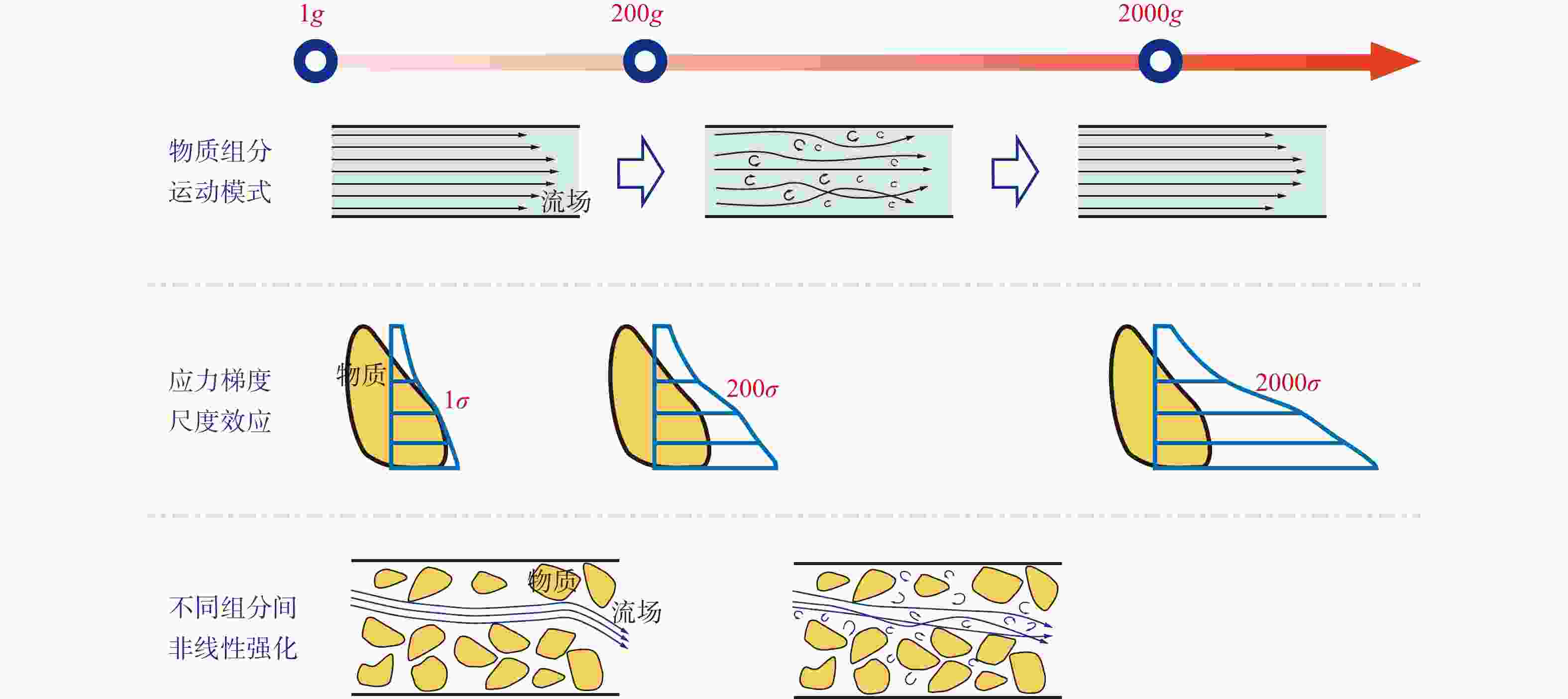
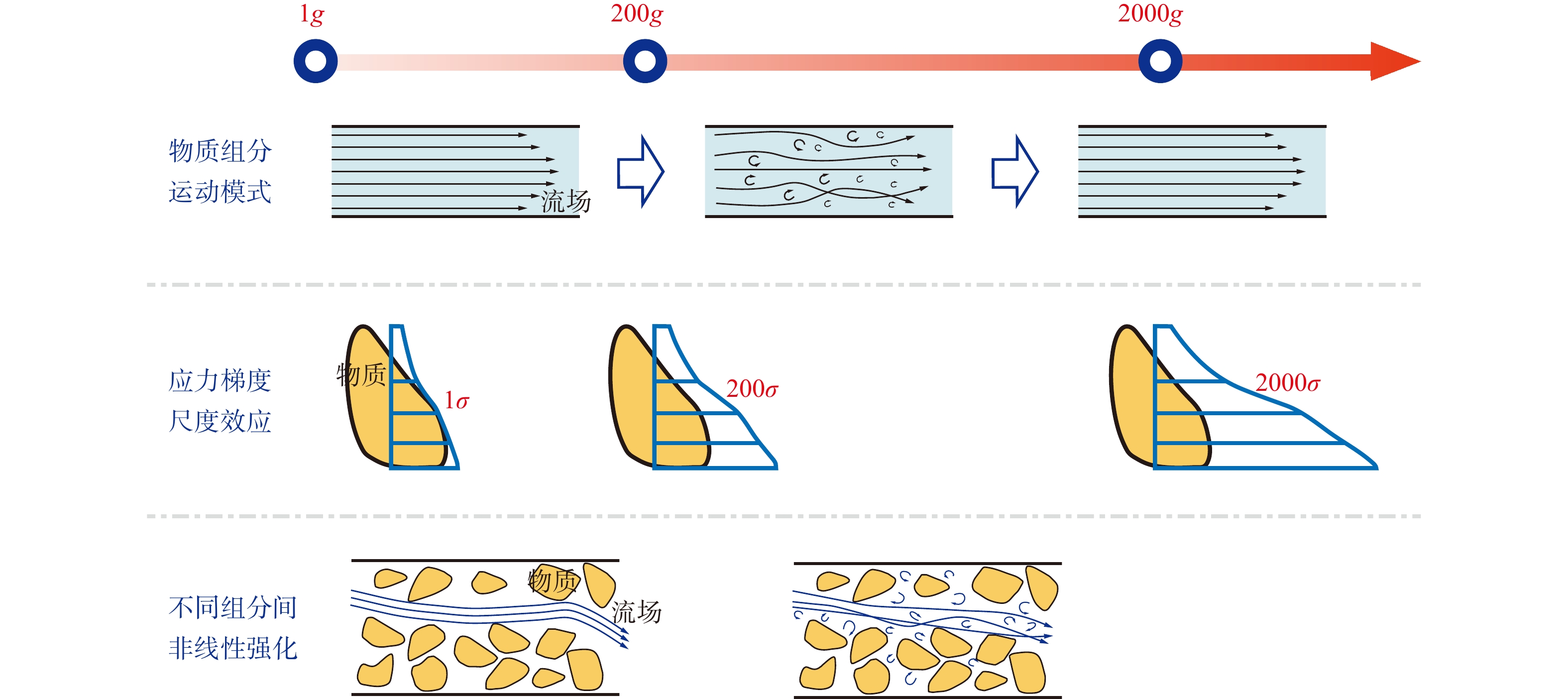
图 1 超重力效应概念图(据Chen et al.,2022修改)
g—等效重力加速度;σ—应力
Figure 1. Conceptual diagram of hypergravity effects (modified from Chen et al., 2022)
g—equivalent gravitational acceleration; σ—stress
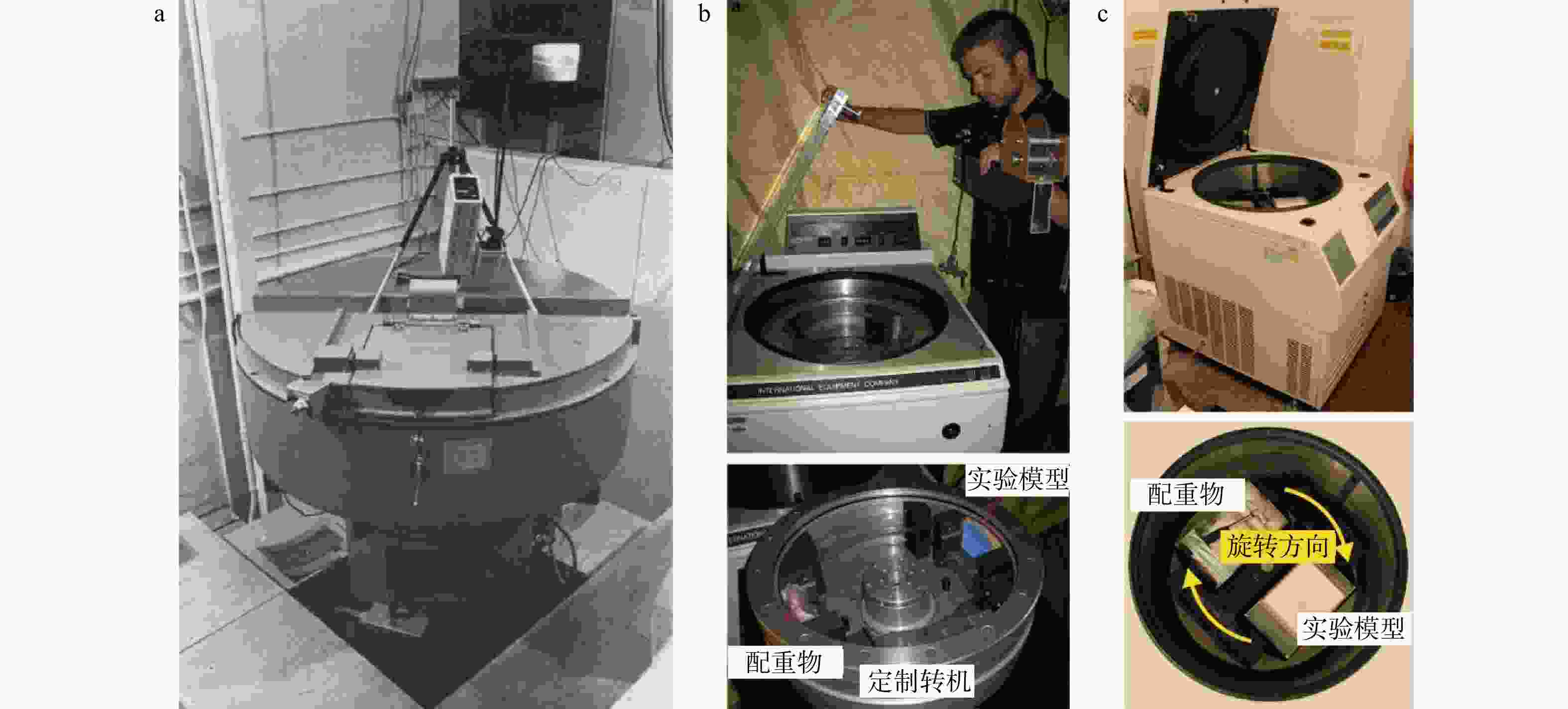
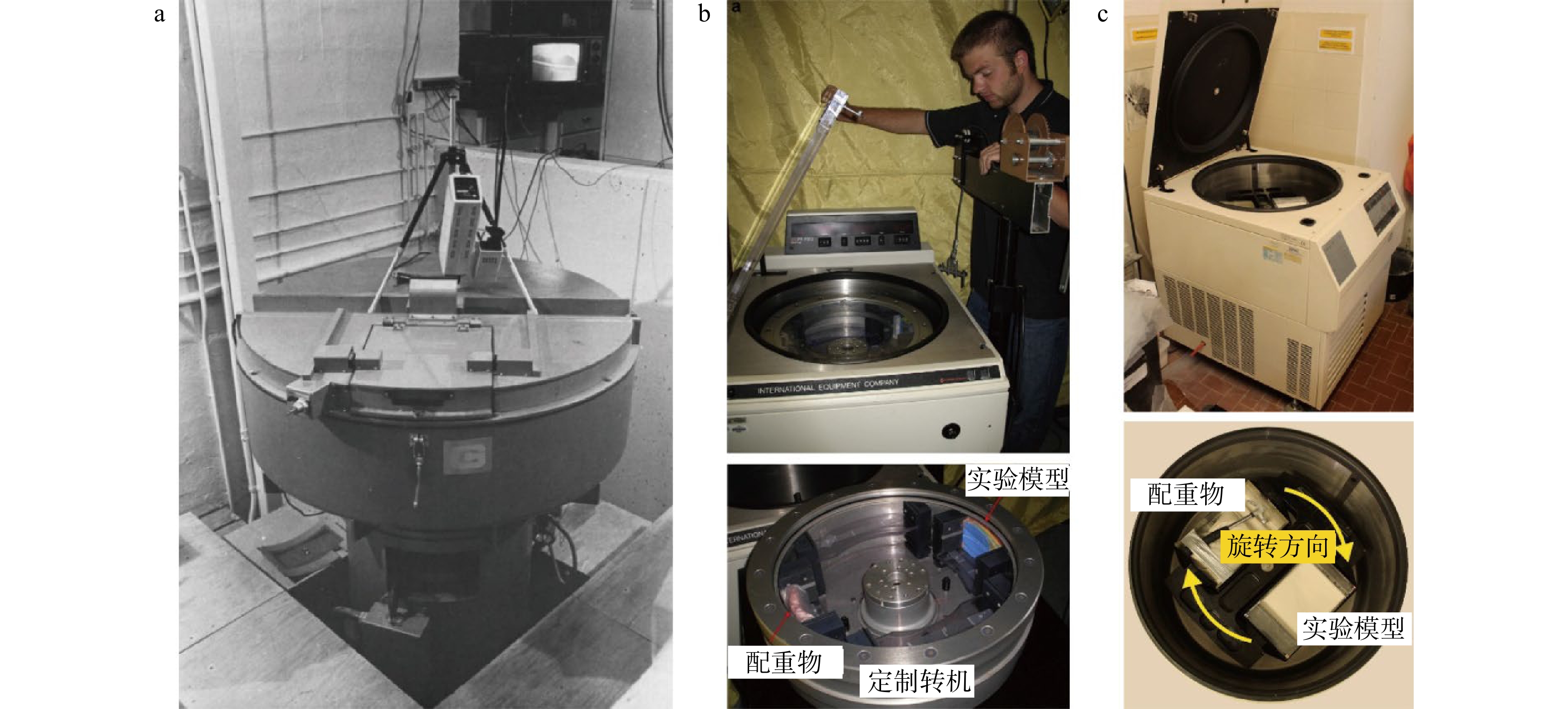
图 2 用于超重力构造物理模拟的小型实验室离心机设备
a—加拿大女王大学使用的离心机(据Dixon and Summers,1985修改);b—加拿大国家科学研究院水、地质、环境研究中心(INRS-ETE)使用的离心机(据Harris et al.,2012修改);c—意大利佛罗伦萨大学地球科学系(UNIFI-DST)和意大利国家研究委员会地球科学与地球资源研究所(CNR-IGG)的构造建模实验室(TOOLab)使用的离心机(据Zwaan et al.,2020a修改)
Figure 2. Small laboratory centrifuges for hypergravity tectonic analog modeling
(a) Centrifuge at Queen's University, Canada (modified from Dixon and Summers, 1985); (b) Centrifuge at the l’Institut national de la recherche scientifique—Eau Terre Environnement (INRS-ETE), Canada (modified from Harris et al., 2012); (c) Centrifuge at the Tectonic Modeling Laboratory (TOOLab), Department of Earth Sciences, University of Florence, Italy (UNIFI-DST) and the Institute of Geosciences and Earth Resources, National Research Council of Italy (CNR-IGG; modified from Zwaan et al., 2020)
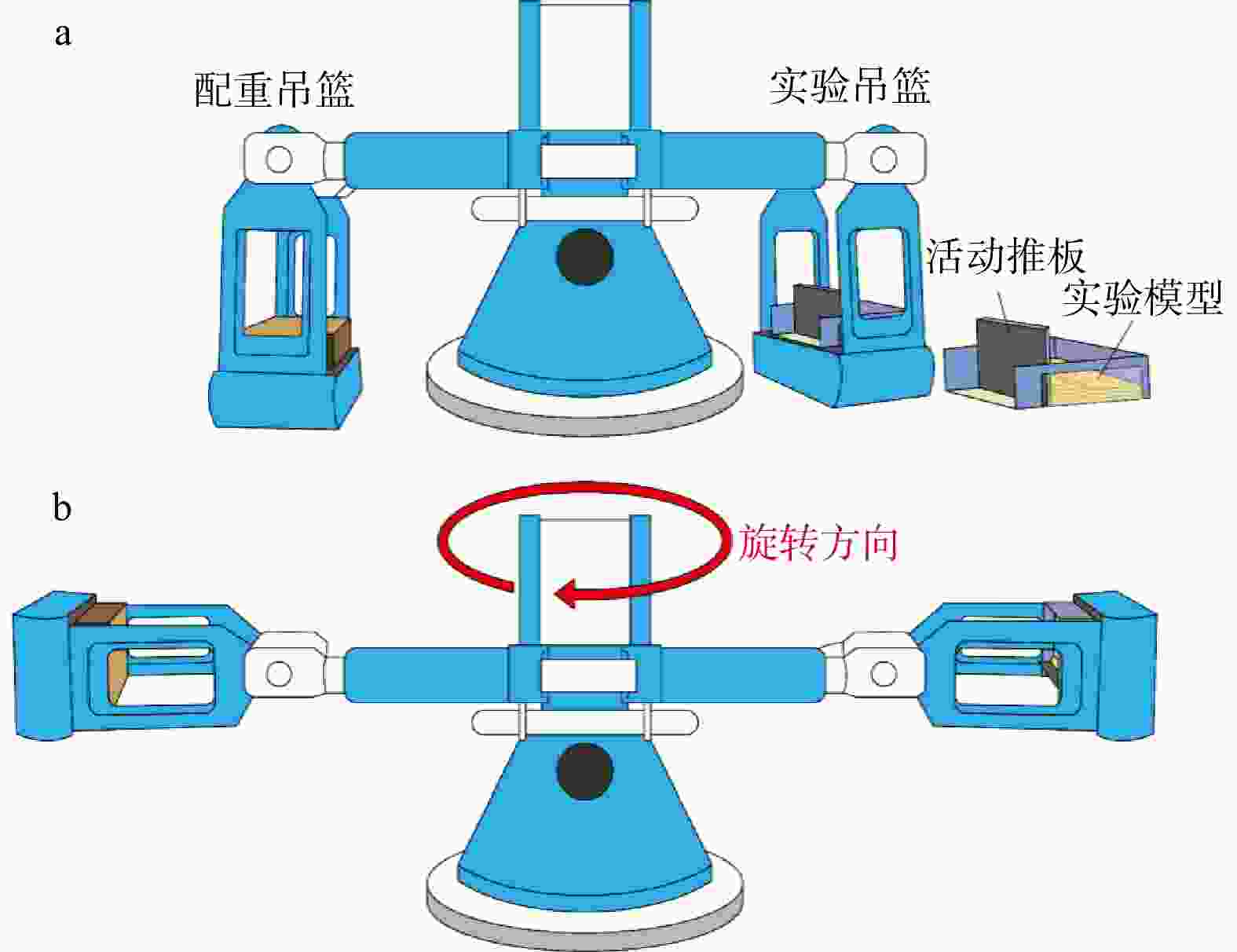
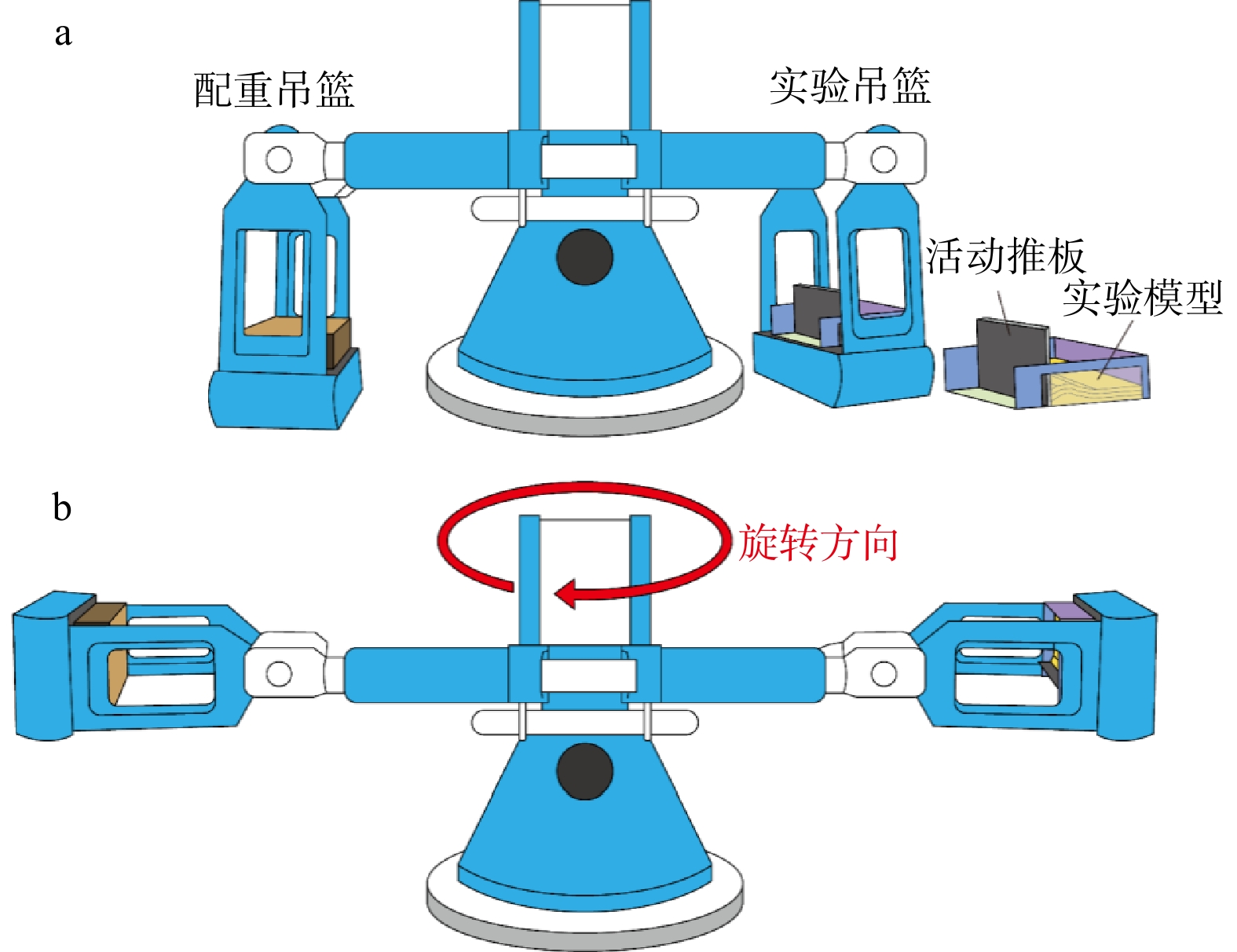
图 3 悬臂式土工离心机实验原理(以浙江大学ZJU400离心机为例)
a—静止状态;b—高速旋转状态
Figure 3. Principle of cantilever geotechnical centrifuge experiment (taking the ZJU400 centrifuge at Zhejiang University as an example)
(a) Stationary state; (b) High-speed rotation state
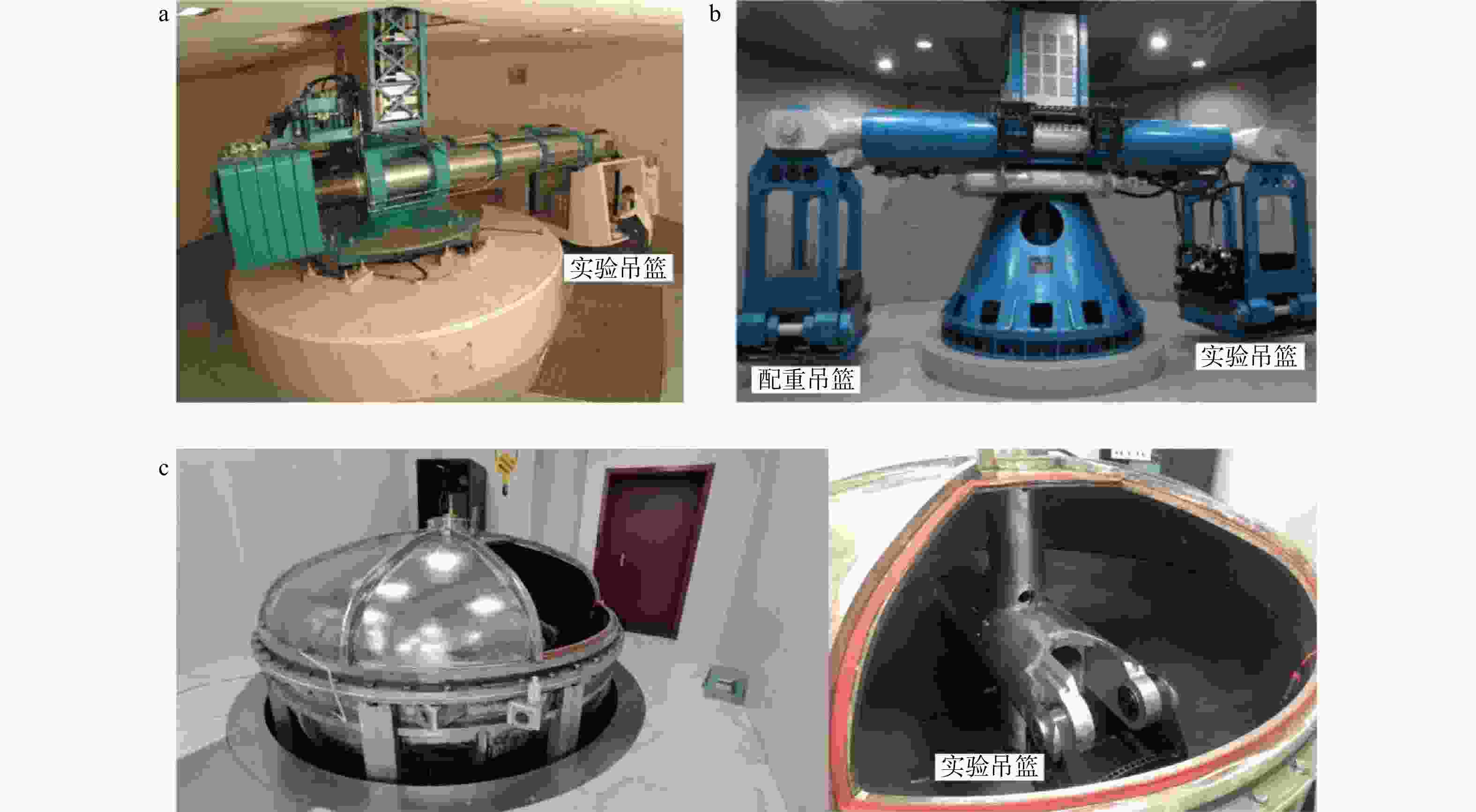
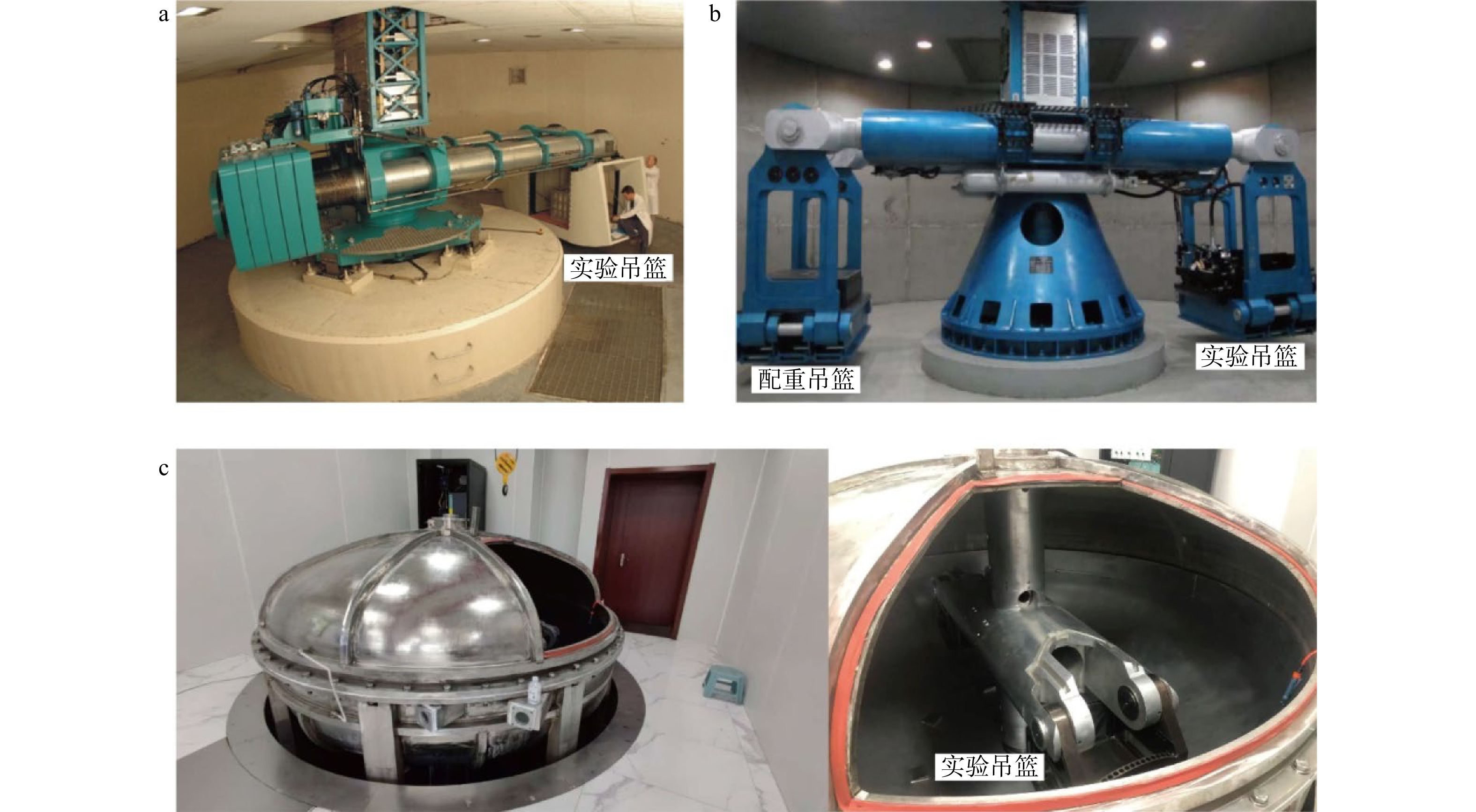
图 4 用于超重力构造物理模拟的悬臂式离心机实验设备
a—加拿大C-CORE机构Accutronic 680-2离心机(据Noble and Dixon,2011修改);b—浙江大学ZJU400离心机;c—南京大学构造物理模拟专用离心机
Figure 4. Cantilever centrifuges for hypergravity tectonic analog modeling
(a) Accutronic 680-2 centrifuge at C-CORE, Canada (modified from Noble and Dixon, 2011); (b) ZJU400 centrifuge at Zhejiang University; (c) Dedicated centrifuge for tectonic analog modeling at Nanjing University
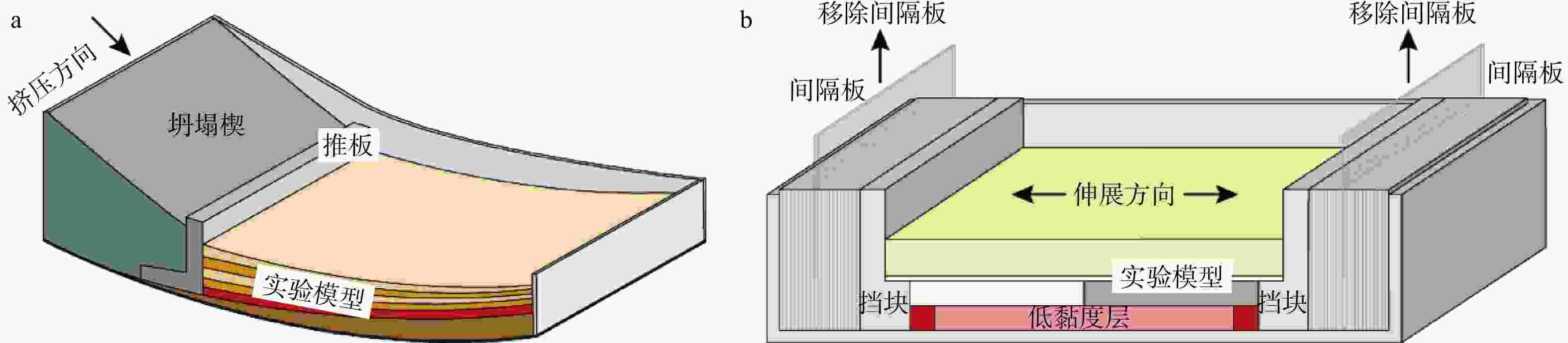
图 5 无动力驱动的超重力实验装置
a—通过坍塌楔垮塌推动挡板活动的挤压缩短装置(据Santolaria et al.,2022修改);b—通过移除两侧间隔板实现拉张的伸展实验装置(据Zwaan et al.,2020a修改)
Figure 5. Non-powered hypergravity experimental devices
(a) Experimental device for compressional deformation by collapsing wedge (modified from Santolaria et al., 2022); (b) Experimental device for extensional deformation by removing two sets of spacers (modified from Zwaan et al., 2020)
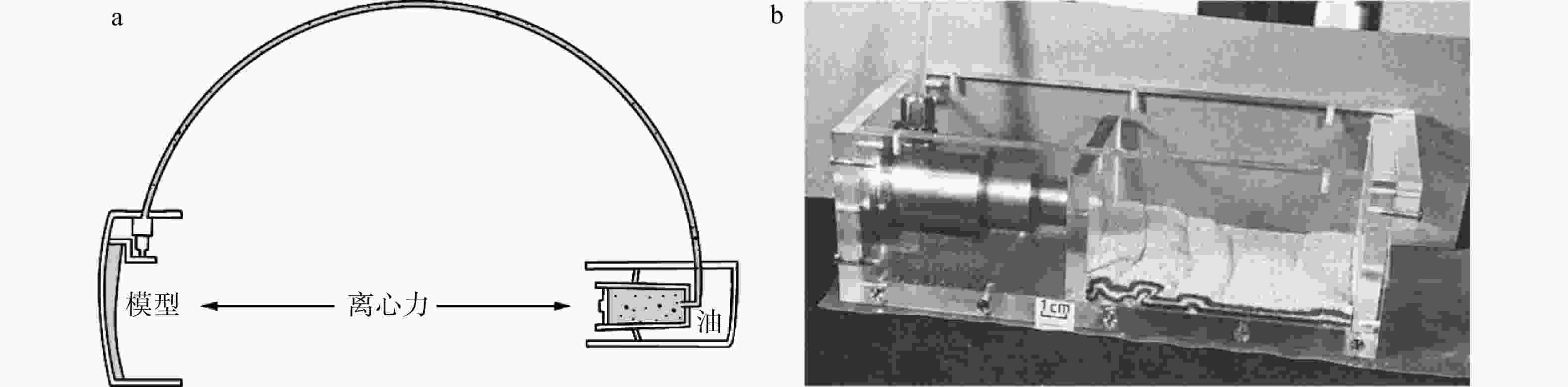
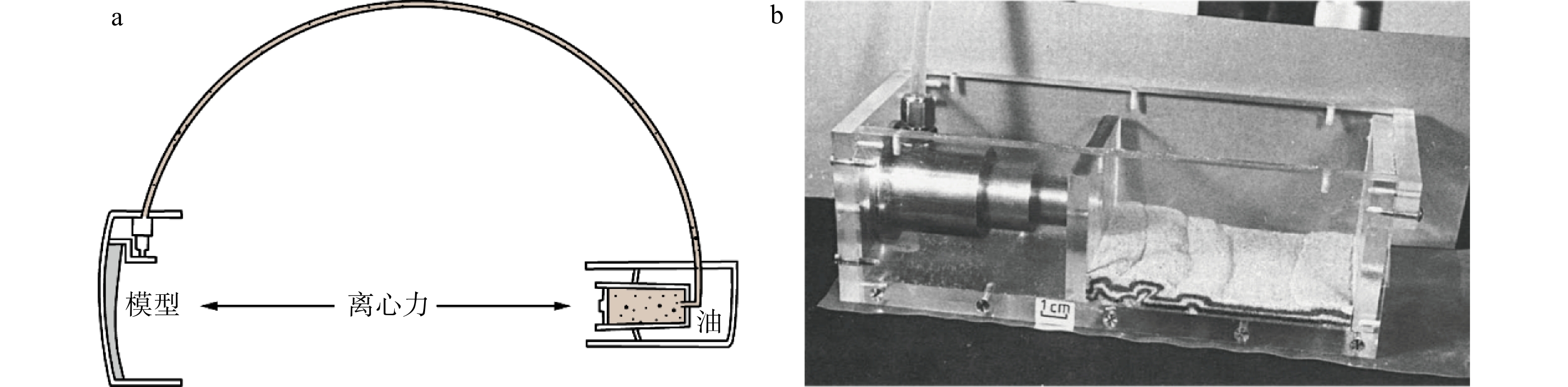
图 6 Mulugeta(1988)研制的离心力驱动液压装置
a——实验装置原理示意;b——实验箱照片
Figure 6. Centrifugal force-driven hydraulic device developed by Mulugeta (1988)
(a) Schematic diagram of the experimental setup; (b) Photograph of the experimental box
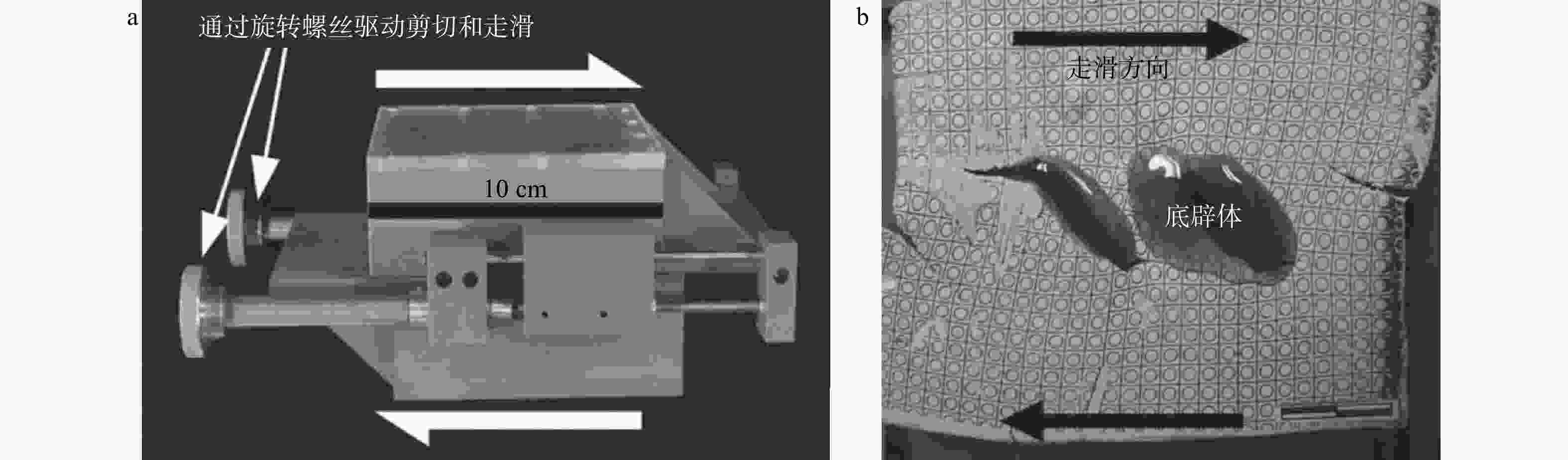
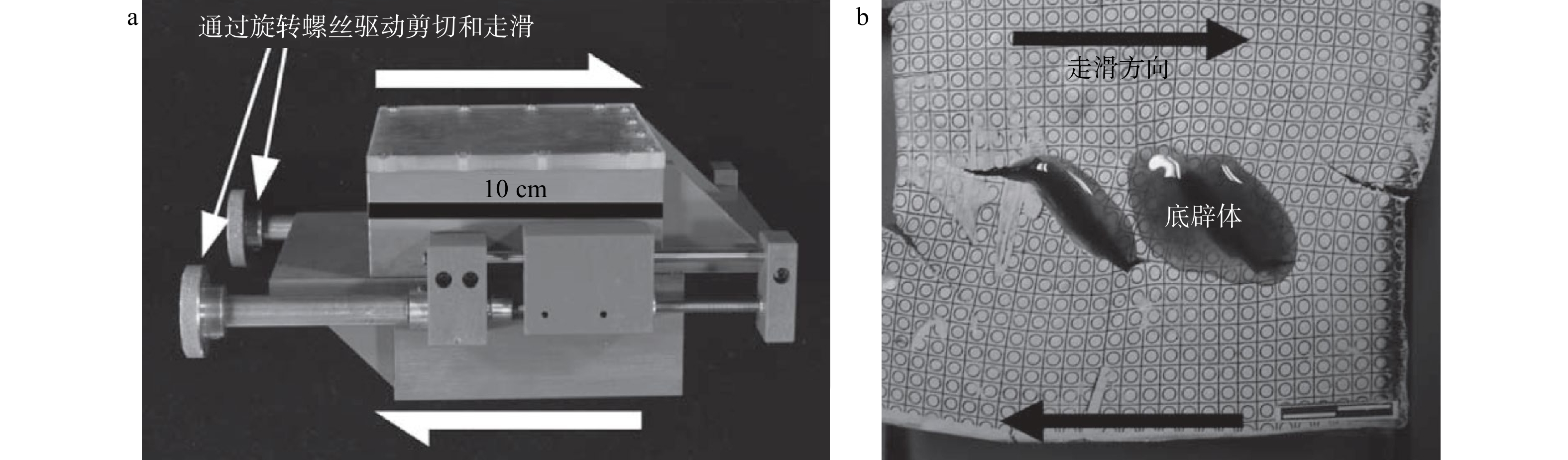
图 7 Dietl et al.(2006)研制的剪切与底辟协同作用的超重力实验装置
a—剪切实验装置;b—结合剪切和底辟变形的超重力实验结果
Figure 7. Hypergravity experimental device for the synergistic effects of shear and diapirism developed by Dietl et al. (2006)
(a) Shear experimental device; (b) Experimental results of hypergravity modeling combining shear and diapiric deformation
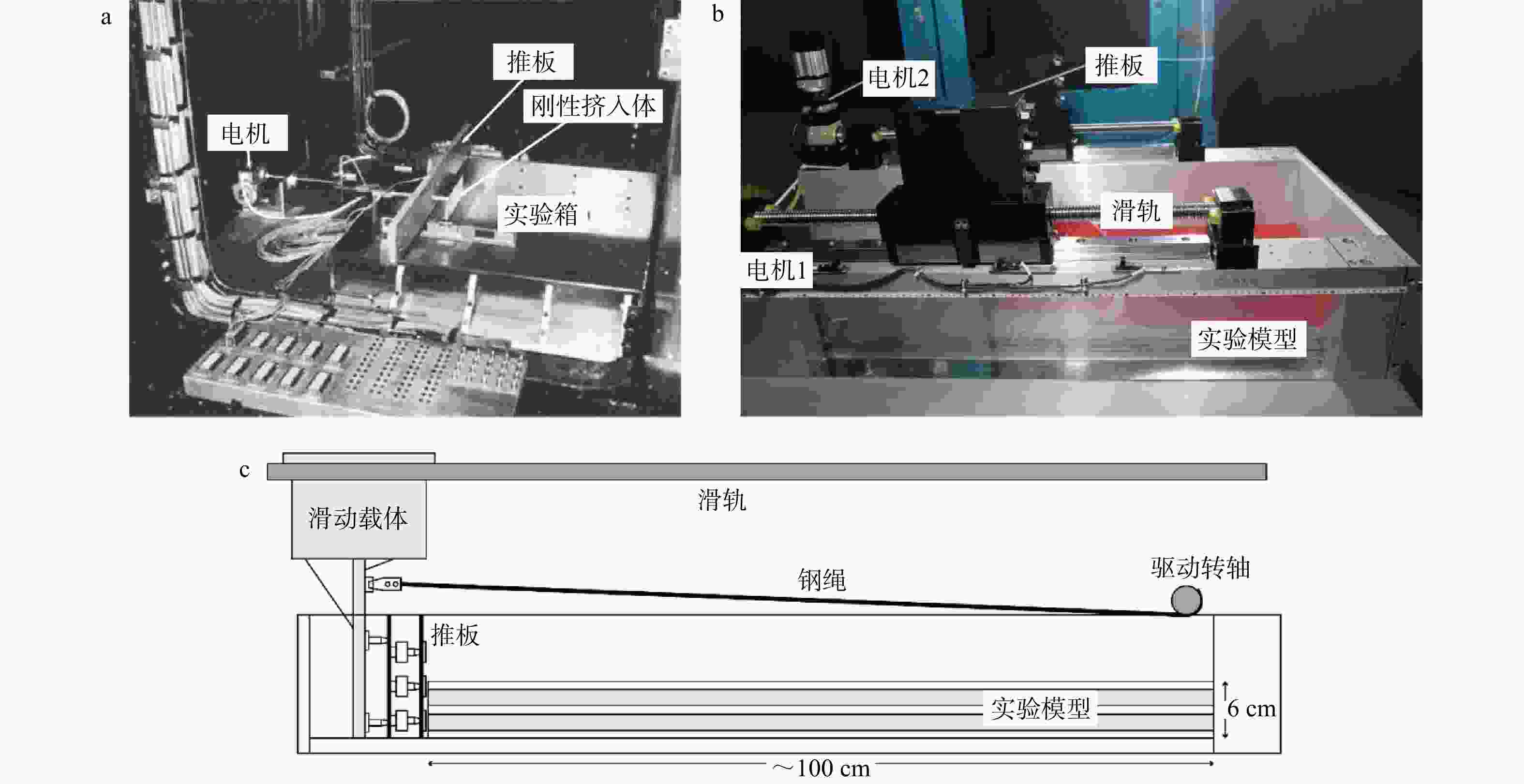
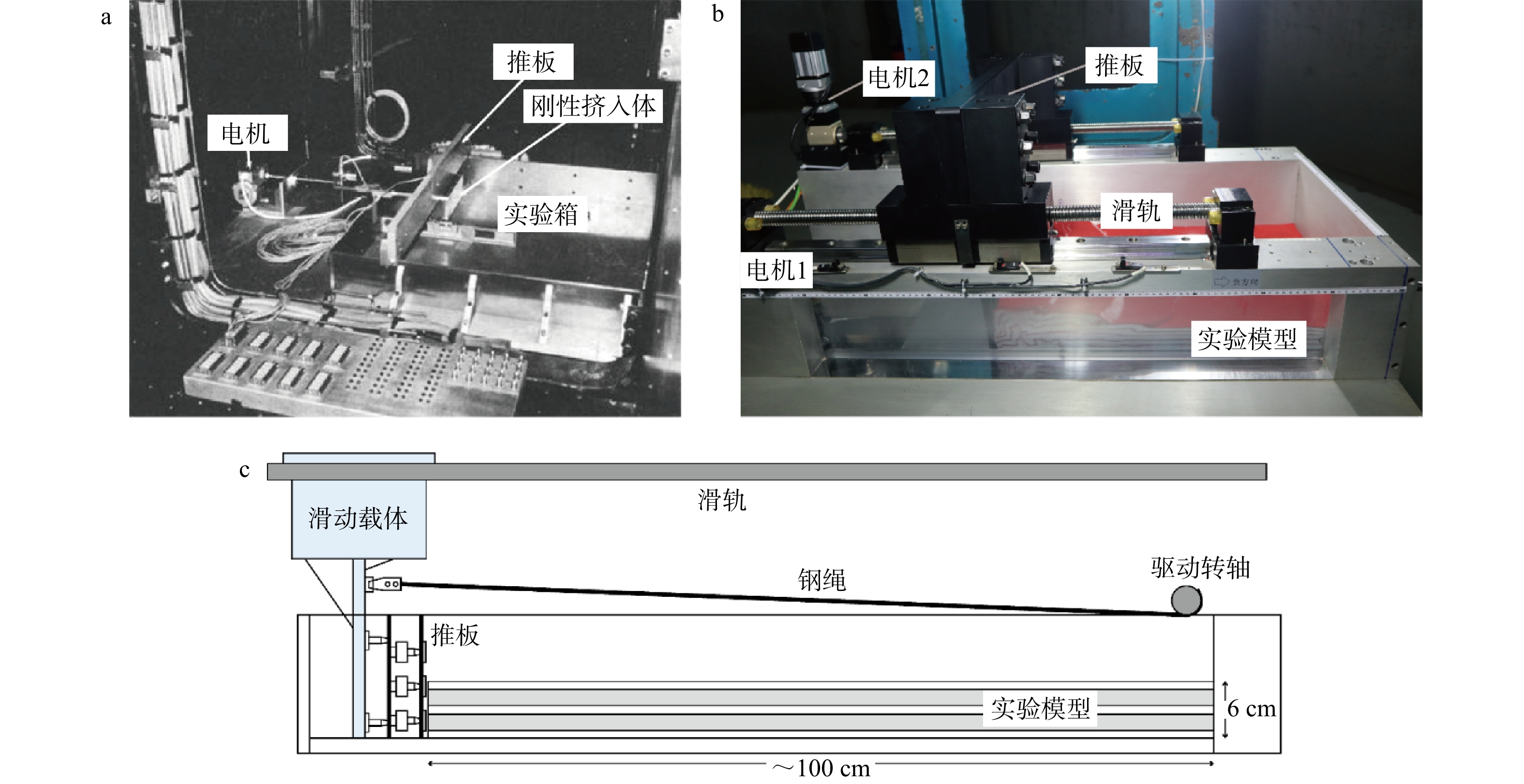
图 8 动力驱动的超重力实验装置
a—Peltzer(1988)研制的实验箱照片;b—由浙江大学与南京大学合作研制的实验箱照片;c—Noble and Dixon(2011)研制的实验箱驱动原理示意
Figure 8. Power-driven hypergravity experimental devices
(a) Photograph of the experimental box developed by Peltzer (1988); (b) Photograph of the experimental box co-developed by Zhejiang University and Nanjing University; (c) Schematic diagram of the driving principle of the experimental box developed by Noble and Dixon (2011)
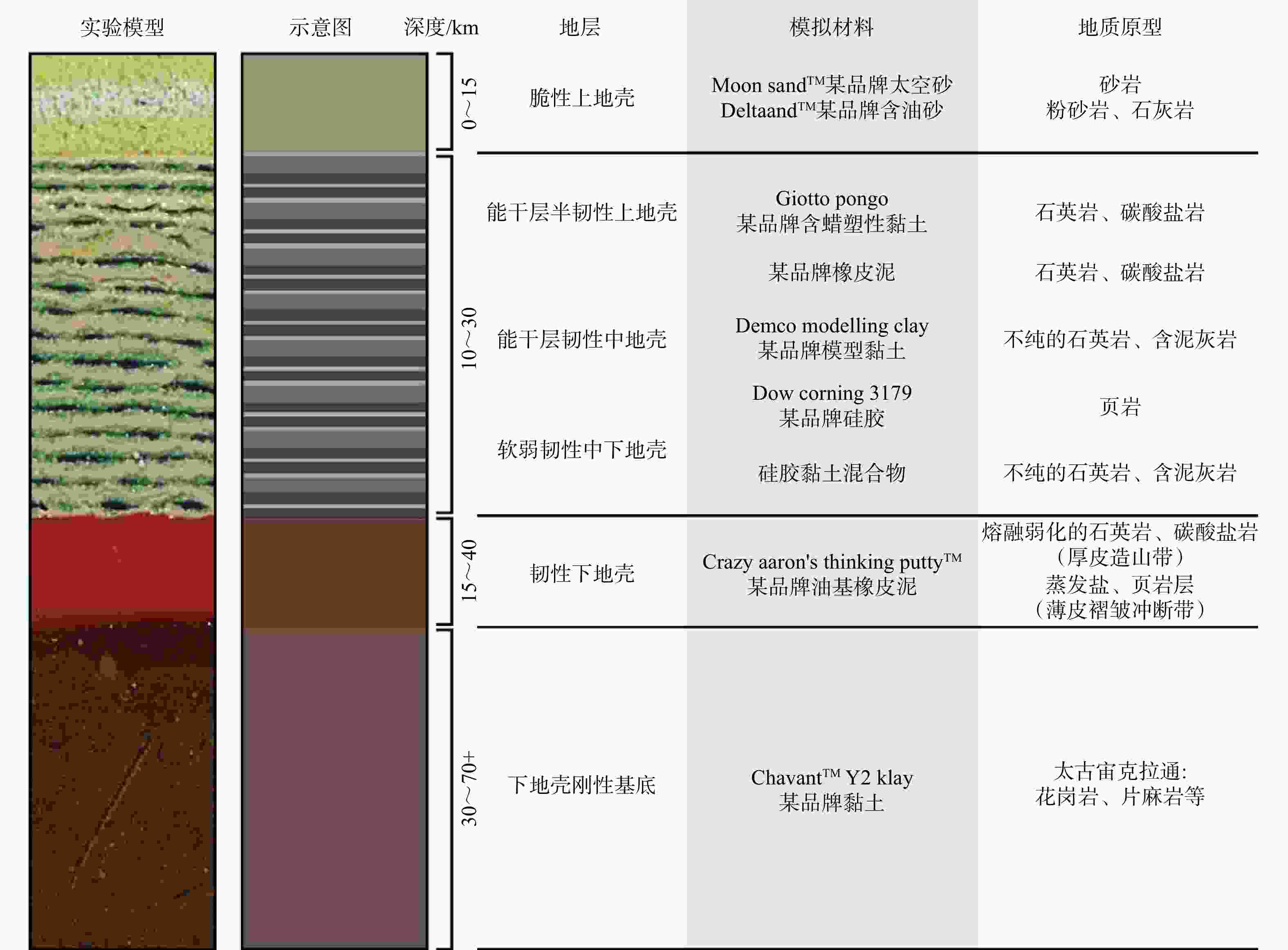
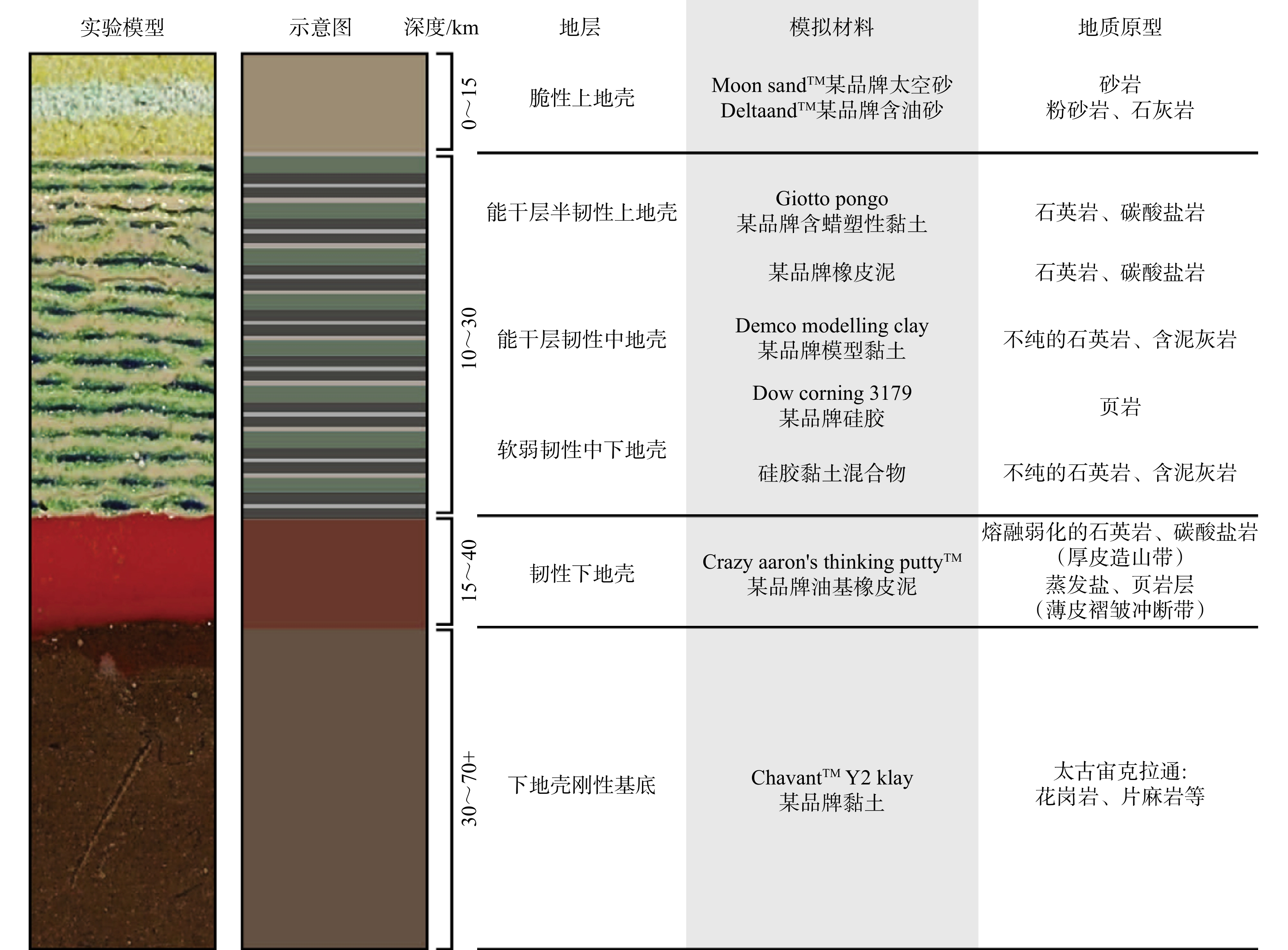
图 9 超重力模型的地壳剖面模拟材料体系(据Waffle et al.,2016修改)
Figure 9. Analog material system for a crustal cross section in hypergravity models (modified from Waffle et al., 2016; The Columns show, form left to right: a photograph of a generic multilayer experimental model, a schematic section of the actual model, the approximate depth, crustal layer, and relative competence of each section, the analog materials, and the corresponding prototype rock types.)
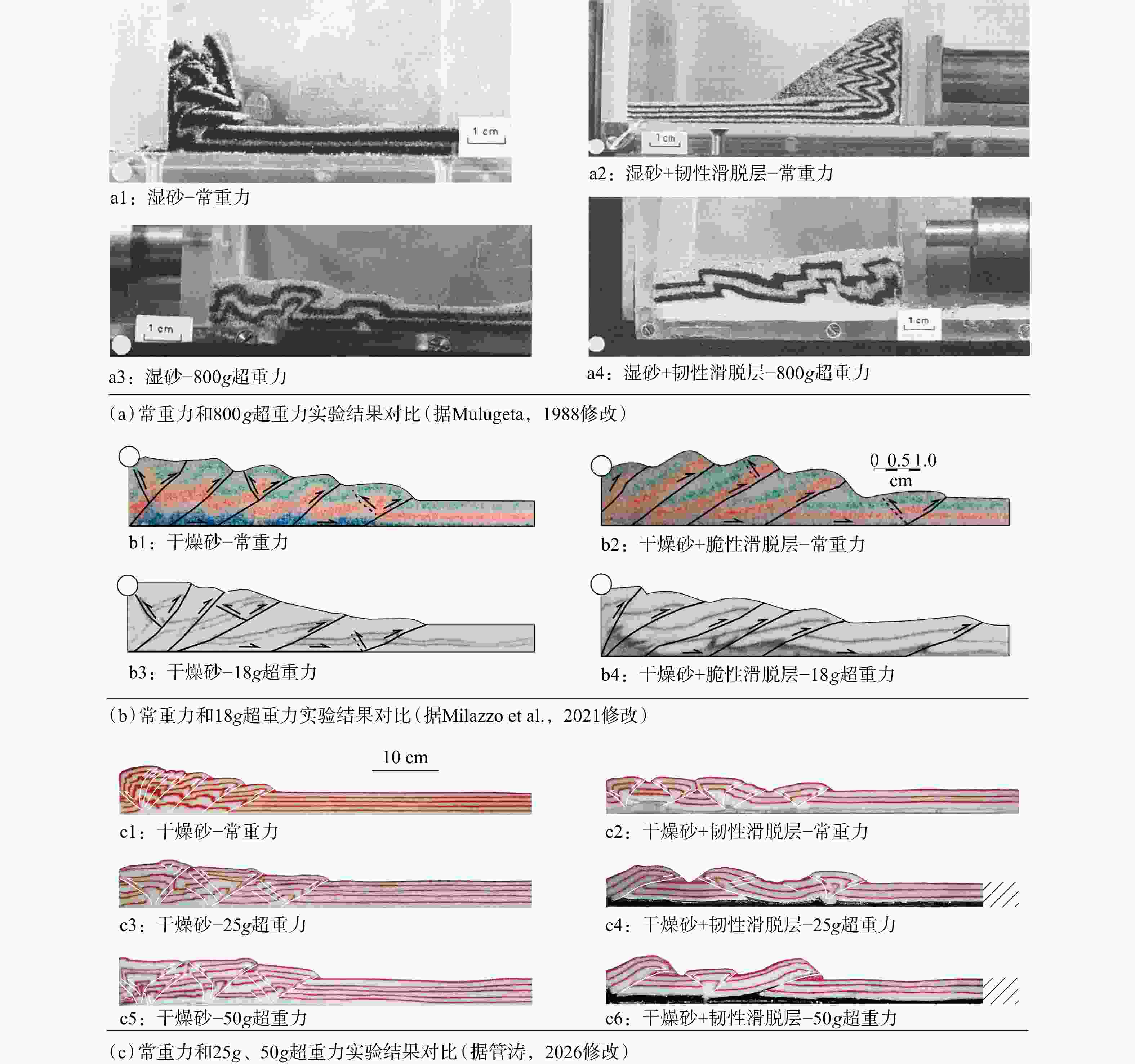
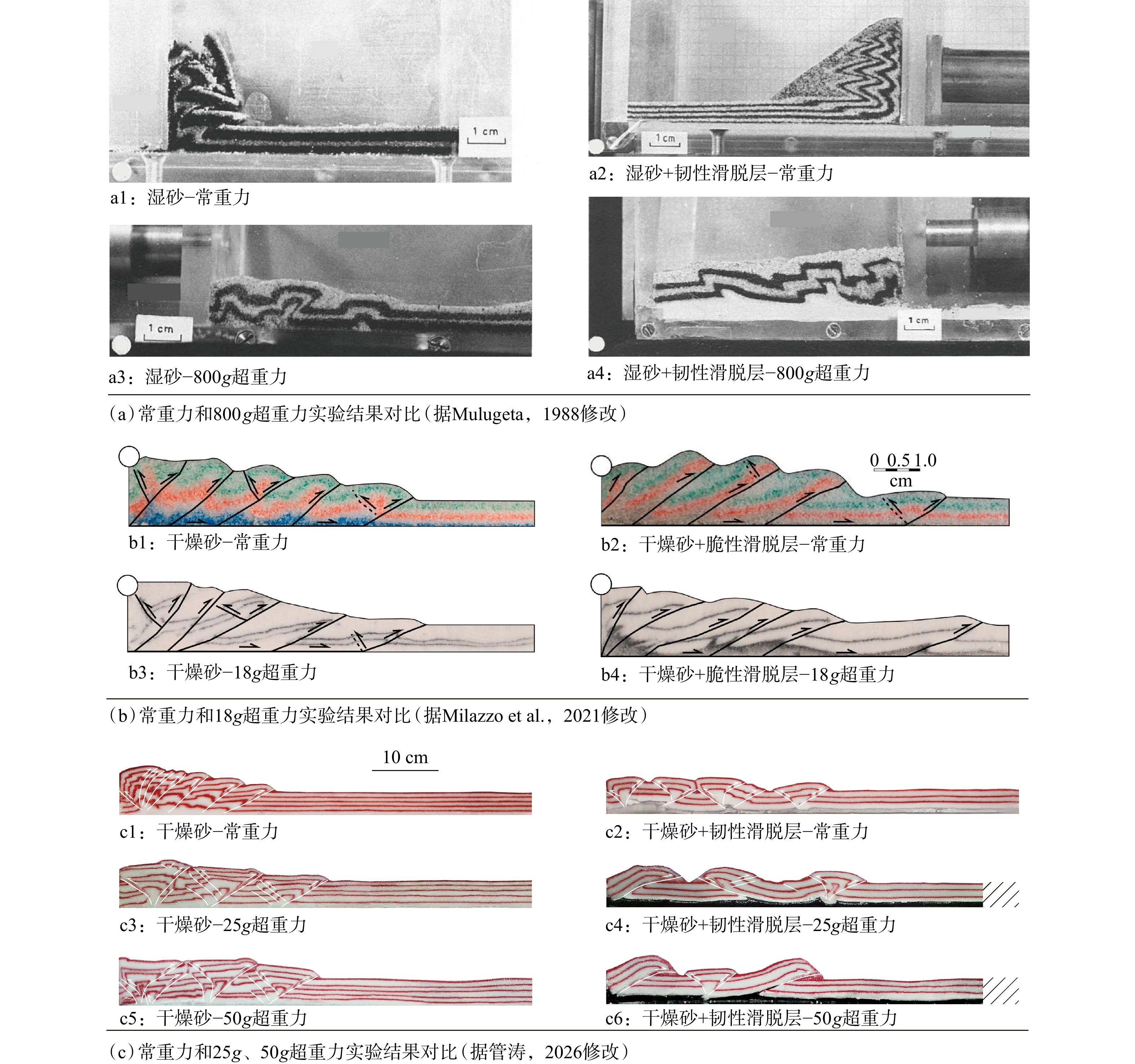
图 10 均匀脆性模型与含滑脱层模型的常重力−超重力实验结果对比
Figure 10. Comparison of experimental results under normal gravity and hypergravity conditions for homogeneous brittle models and models containing a detachment layer
(a) Comparison of results under normal gravity and 800-g hypergravity (modified from Mulugeta, 1988); (b) Comparison of results under normal gravity and 18-g hypergravity (modified from Milazzo et al., 2021); (c) Comparison of results under normal gravity and 25-g and 50-g hypergravity (modified from Guan, 2026)
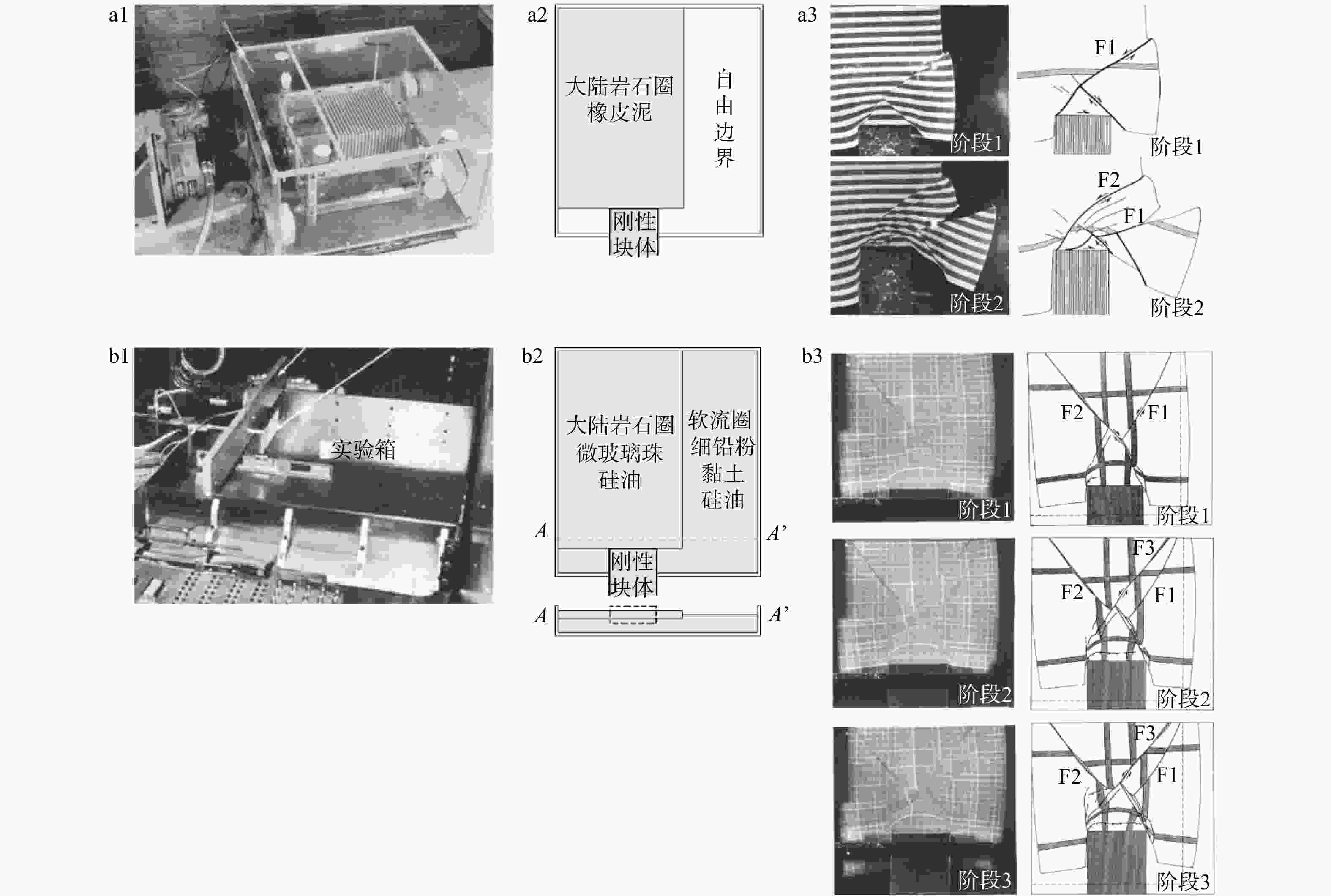
图 11 常重力与超重力条件下印度−亚洲板块碰撞引发青藏高原侧向挤出模型实验对比(据Peltzer,1988;Peltzer and Tapponnier,1988修改)
a—常重力实验设置及结果(a1—常重力实验箱;a2—常重力实验设置;a3—常重力实验结果,最终形成F1和F2这2条主要的走滑断层);b—超重力实验设置及结果(b1—超重力实验箱;b2—超重力实验设置;b3—超重力实验结果,最终形成F1、F2和F3这3条主要的走滑断层)
Figure 11. Comparison of normal-gravity and hypergravity experiments modeling the lateral extrusion of the Tibetan Plateau induced by the Indo-Asia collision (modified from Peltzer, 1988; Peltzer and Tapponnier, 1988)
(a) Experimental settings and results under normal gravity: (a1) Normal-gravity experimental box; (a2) Normal-gravity experimental setup; (a3) Normal-gravity experimental results, with two major strike-slip faults formed; (b) Experimental settings and results under hypergravity: (b1) Hypergravity experimental box; (b2) Hypergravity experimental setup; (b3) Hypergravity experimental results, with three major strike-slip faults formed (F1, F2, and F3)
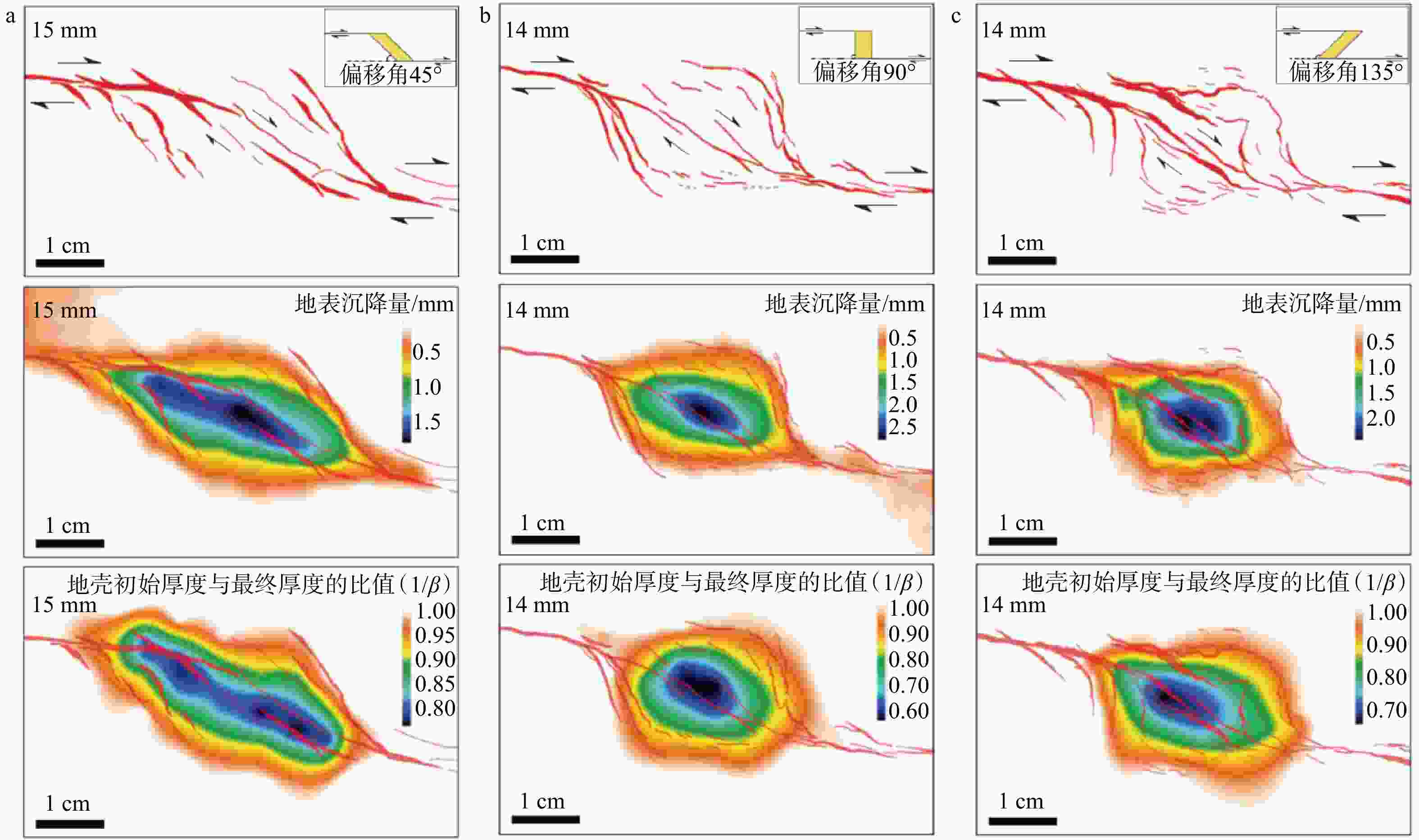
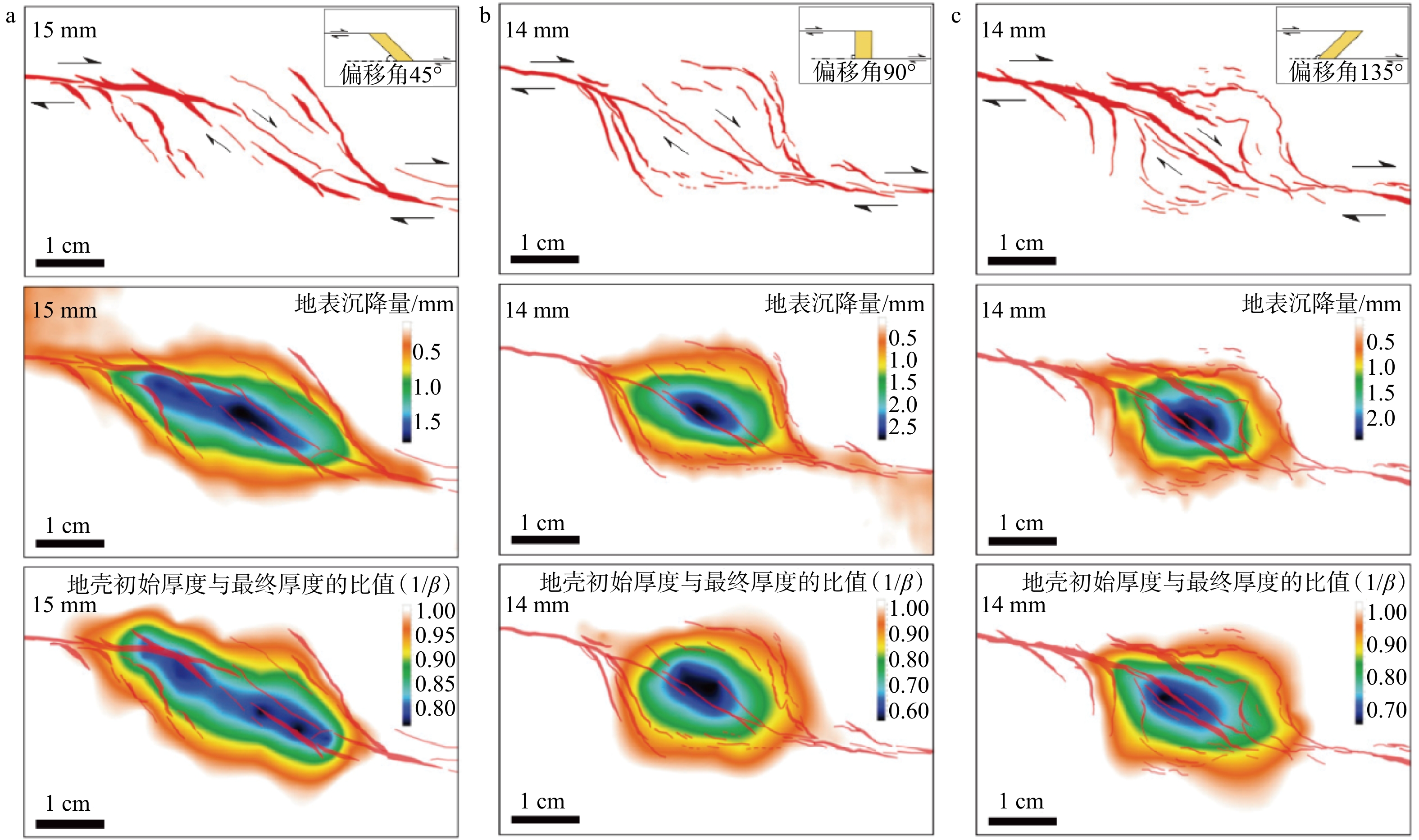
图 12 不同偏移角度下拉分盆地的地表断层模式、地表沉降量以及岩石圈减薄模式(据Corti and Dooley,2015修改)
红色线条代表断层,黑色箭头指示主要断层活动方向a—偏移角为45°;b—偏移角为90°;c—偏移角为135°
Figure 12. Surface fault patterns, amount of subsidence, and lithospheric thinning patterns in pull-apart basins at different offset angles (modified from Corti and Dooley, 2015)
(a) Offset angle = 45°; (b) Offset angle = 90°; (c) Offset angle = 135°Red lines denote faults; black arrows indicate the main movement directions of the faults.

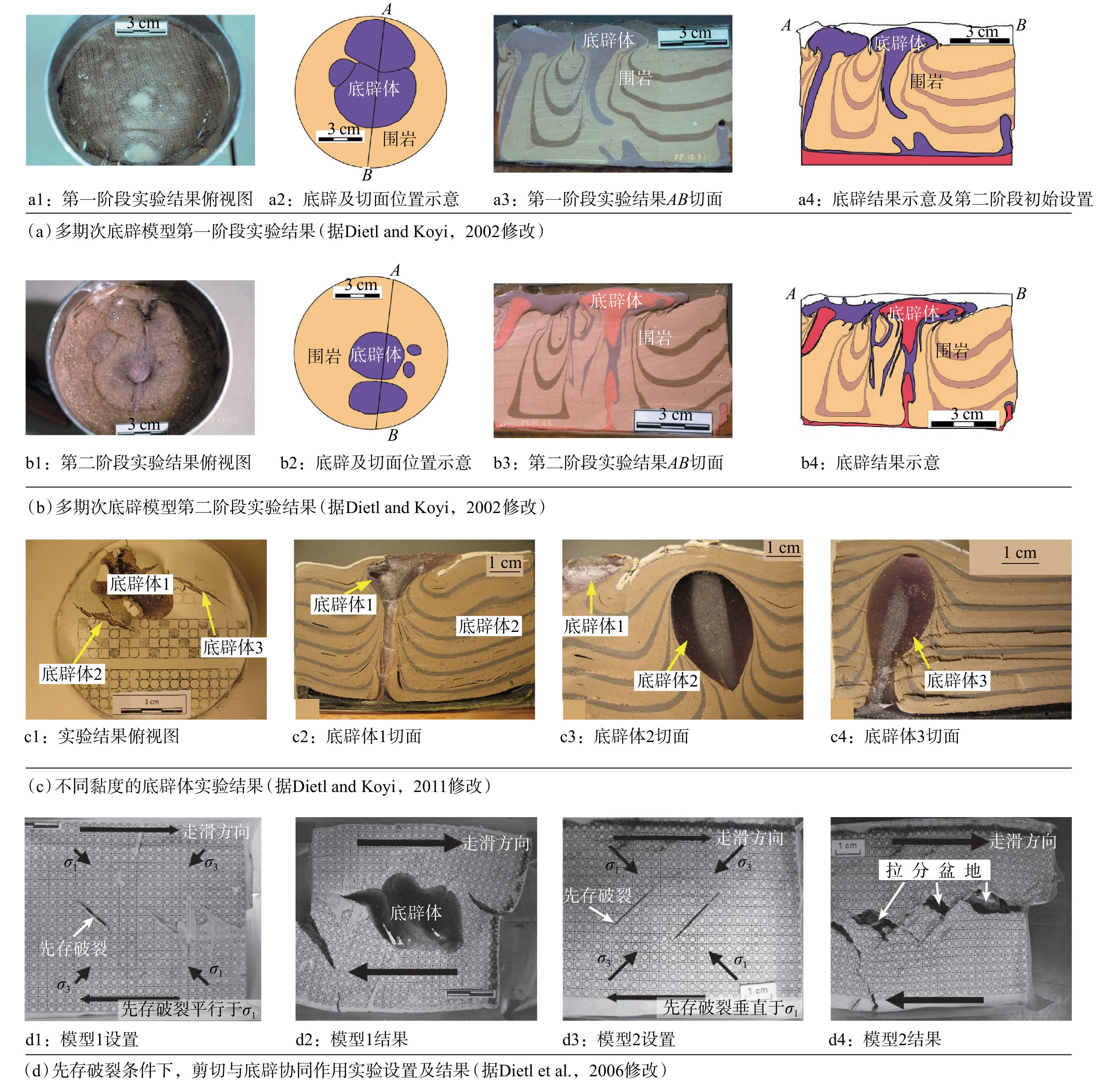
图 13 离心机超重力底辟实验
σ1—最大主应力;σ3—最小主应力
Figure 13. Centrifuge hypergravity diapir experiments
(a) Experimental results of the first stage of a multi-stage diapir model (modified from Dietl and Koyi, 2002); (b) Experimental results of the second stage of a multi-stage diapir model (modified from Dietl and Koyi, 2002); (c) Experimental results of diapirs with different viscosities (modified from Dietl and Koyi, 2011); (d) Setups and results of experiments on the synergistic effects of shearing and diapirism with pre-existing fractures (modified from Dietl et al., 2006) σ1 and σ3 denote the maximum and minimum principal stresses, respectively.
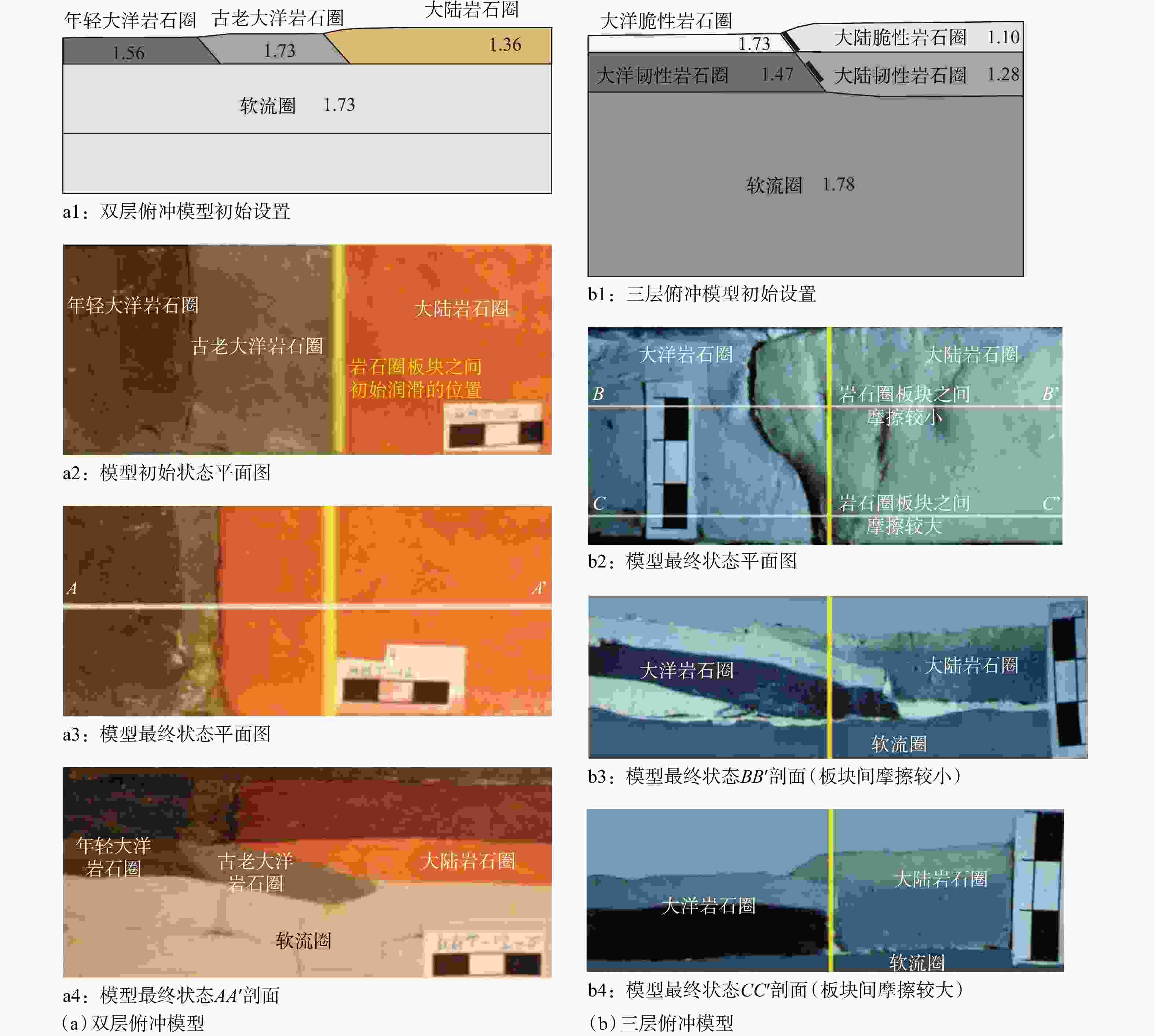
图 14 离心力驱动的岩石圈俯冲实验(据Mart et al.,2005修改)
图a1、图b1中的数字为材料的密度,单位为103 kg m−3
Figure 14. Centrifuge-driven lithospheric subduction experiments (modified from Mart et al., 2005)
(a) Subduction experiments with a two-layer model; (b) Subduction experiments with a three-layer model The numbers in panels a1 and b1 represent the densities of the layers, in units of 103 kg m−3.
表 1 用于构造物理模拟的悬臂式离心机
Table 1. Cantilever geotechnical centrifuges used for physical analog modeling
序号 离心机 所属单位 旋转半径 吊篮有效容积 最大实验g值 实际实验g值 实验模型尺寸 1 Acutronic 法国南特中央理工大学 5.5 m 1.4 m×1.15 m×1.5 m 200g 80g(Peltzer,1988) 90 cm×80 cm×11 cm 2 Accutronic 680-2 加拿大C-CORE机构 5.5 m 1.1 m×1.4 m×1.1 m 200g 160g(Noble and Dixon,2011) 100 cm×10 cm×10 cm 3 ZJU400 浙江大学 4.5 m 1.5 m×1.2 m×1.5 m 150g 50g(Guan et al.,2025) 60 cm×40 cm×2.5 cm 80g(管涛,2026) 60 cm×40 cm×3.5 cm 4 构造模拟专用离心机 南京大学 1.25 m 0.4 m×0.4 m×0.35 m 1050g 100g~300g 30 cm×19 cm×12 cm 300g~1000g 28 cm×19 cm×10 cm  下载: 导出CSV
表 2 不同类型离心机开展的超重力实验
Table 2. Hypergravity tectonic analog modeling using different types of centrifuges
离心机 实验单位 模型尺寸/长×宽×高 实验g值 实验类型 驱动装置 参考文献 小型离心机 加拿大女王大学 12.7 cm×7.6 cm×5.1 cm 2000g、3000g、4000g 挤压 坍塌楔 Dixon and Summers,1985 小型离心机 Ramberg实验室 18 cm×20 cm×10 cm 800g 挤压 离心力液压 Mulugeta,1988 小型离心机 Ramberg实验室 9 cm×7.5 cm×1.9 cm 200g 伸展 橡皮泥控制两侧间隔 Bonini et al.,2001 小型离心机 Ramberg实验室 厘米级 700g 底辟 Dietl and Koyi,2002 小型离心机 Ramberg实验室 7 cm×7 cm×1.9 cm 200g 伸展 橡皮泥控制两侧间隔 Corti et al.,2002 小型离心机 Ramberg实验室 厘米级 900g~1000g 伸展 移除间隔板 Harris and Koyi,2003 小型离心机 Ramberg实验室 厘米级 500g 俯冲 Mart et al.,2005 小型离心机 Ramberg实验室 10 cm×8 cm×10 cm 700g 底辟 剪切底辟协同 Dietl et al.,2006 小型离心机 INRS-ETE 17 cm×8 cm×(2~3) cm 900g、1100g 挤压 坍塌楔 Godin et al.,2011 小型离心机 Ramberg实验室 厘米级 700g 底辟 Dietl and Koyi,2011 小型离心机 INRS-ETE (17~20) cm×8 cm×(1.5~2.0) cm 1000g 挤压 坍塌楔 Harris et al.,2012 小型离心机 CNR-IGG 25 cm×16 cm×7 cm 18g 伸展 移除间隔板 Corti and Dooley,2015 小型离心机 加拿大女王大学 8.6 cm×7.6 cm×0.4 cm 4000g 挤压 坍塌楔 Faisal and Dixon,2015 小型离心机 INRS-ETE 20 cm×8 cm×5 cm 1000g 挤压 坍塌楔 Waffle et al.,2016 小型离心机 加拿大女王大学 12.7 cm×7.6 cm×5.1 cm 4000g 小型离心机 CNR-IGG 25 cm×15.8 cm×(2.8~4.2) cm 18g 伸展 移除间隔板 Zwaan et al.,2020a 小型离心机 CNR-IGG 15 cm×16 cm×(5~ 6) cm 18g 挤压 坍塌楔 Milazzo et al.,2021 小型离心机 INRS-ETE 16 cm×9 cm×(0.3~1.5) cm 898g 挤压 坍塌楔 Santolaria et al.,2022 小型离心机 CNR-IGG 25 cm×16 cm×3.5 cm 18g 拉张 移除间隔板 Zou et al.,2024 土工离心机 法国巴黎地球物理
研究所构造实验室90 cm×80 cm×11 cm 80g 挤压 电机驱动 Peltzer,1988 土工离心机 加拿大女王大学 100 cm×10 cm×10 cm 160g 挤压 电机驱动 Noble and Dixon,2011 土工离心机 浙江大学 60 cm×40 cm×2.5 cm 50g 挤压 电机驱动 Guan et al.,2025 INRS-ETE—加拿大国家科学研究院水、地质、环境研究中心;CNR-IGG—意大利国家研究委员会地球科学与地球资源研究所
下载: 导出CSV
-
[1] ADAM J, GE Z Y, SANCHEZ M, 2012. Post-rift salt tectonic evolution and key control factors of the Jequitinhonha deepwater fold belt, central Brazil passive margin: insights from scaled physical experiments[J]. Marine and Petroleum Geology, 37(1): 70-100. doi: 10.1016/j.marpetgeo.2012.06.008 [2] ADAM J, KLINKMÜLLER M, SCHREURS G, et al., 2013. Quantitative 3D strain analysis in analogue experiments simulating tectonic deformation: integration of X-ray computed tomography and digital volume correlation techniques[J]. Journal of Structural Geology, 55: 127-149. doi: 10.1016/j.jsg.2013.07.011 [3] AGOSTINI A, BONINI M, CORTI G, et al., 2011. Fault architecture in the Main Ethiopian Rift and comparison with experimental models: implications for rift evolution and Nubia–Somalia kinematics[J]. Earth and Planetary Science Letters, 301(3-4): 479-492. doi: 10.1016/j.epsl.2010.11.024 [4] BAJOLET F, CHARDON D, MARTINOD J, et al., 2015. Synconvergence flow inside and at the margin of orogenic plateaus: lithospheric-scale experimental approach[J]. Journal of Geophysical Research: Solid Earth, 120(9): 6634-6657. doi: 10.1002/2015JB012110 [5] BELLAHSEN N, FACCENNA C, FUNICIELLO F, 2005. Dynamics of subduction and plate motion in laboratory experiments: insights into the "plate tectonics'' behavior of the Earth[J]. Journal of Geophysical Research: Solid Earth, 110(B1): B01401. [6] BONINI M, SOKOUTIS D, MULUGETA G, et al., 2001. Dynamics of magma emplacement in centrifuge models of continental extension with implications for flank volcanism[J]. Tectonics, 20(6): 1053-1065. doi: 10.1029/2001TC900017 [7] BROWN E T, HOEK E, 1978. Trends in relationships between measured in-situ stresses and depth[J]. International Journal of Rock Mechanics and Mining Sciences & Geomechanics Abstracts, 15(4): 211-215. doi: 10.1016/0148-9062(78)91227-5 [8] BYERLEE J, 1978. Friction of rocks[J]. Pure and Applied Geophysics, 116(4-5): 615-626. doi: 10.1007/BF00876528 [9] CADELL H M, 1889. VII. —Experimental researches in mountain building[J]. Earth and Environmental Science Transactions of the Royal Society of Edinburgh, 35(1): 337-357. [10] CHEN Y M, TANG Y, LING D S, et al., 2022. Hypergravity experiments on multiphase media evolution[J]. Science China Technological Sciences, 65(12): 2791-2808. doi: 10.1007/s11431-022-2125-x [11] CHEN, Y M, 2020. Constitutive models and hypergravity physical simulation of soils[J]. Chinese Journal of Theoretical and Applied Mechanics, 54(04): 631-632. (in Chinese with English abstract) [12] CHEN Z H, SCHELLART W P, STRAK V, et al., 2016. Does subduction-induced mantle flow drive backarc extension?[J]. Earth and Planetary Science Letters, 441: 200-210. doi: 10.1016/j.epsl.2016.02.027 [13] CORTI G, BONINI M, MAZZARINI F, et al., 2002. Magma-induced strain localization in centrifuge models of transfer zones[J]. Tectonophysics, 348(4): 205-218. doi: 10.1016/S0040-1951(02)00063-X [14] CORTI G, BONINI M, CONTICELLI S, et al., 2003. Analogue modelling of continental extension: a review focused on the relations between the patterns of deformation and the presence of magma[J]. Earth-Science Reviews, 63(3-4): 169-247. doi: 10.1016/S0012-8252(03)00035-7 [15] CORTI G, BONINI M, SOKOUTIS D, et al., 2004. Continental rift architecture and patterns of magma migration: a dynamic analysis based on centrifuge models[J]. Tectonics, 23(2): TC2012. doi: 10.1029/2003tc001561 [16] CORTI G, DOOLEY T P, 2015. Lithospheric-scale centrifuge models of pull-apart basins[J]. Tectonophysics, 664: 154-163. doi: 10.1016/j.tecto.2015.09.004 [17] DAVIS D, SUPPE J, DAHLEN F A, 1983. Mechanics of fold-and-thrust belts and accretionary wedges[J]. Journal of Geophysical Research: Solid Earth, 88(B2): 1153-1172. doi: 10.1029/JB088iB02p01153 [18] DAVY P, COBBOLD P R, 1991. Experiments on shortening of a 4-layer model of the continental lithosphere[J]. Tectonophysics, 188(1-2): 1-25. doi: 10.1016/0040-1951(91)90311-f [19] DIETL C, KOYI H A, 2002. Emplacement of nested diapirs: results of centrifuge modelling[J]. Journal of the Virtual Explorer, 7: 81-88. [20] DIETL C, KOYI H A, De WALL H, et al., 2006. Centrifuge modelling of plutons intruding shear zones: application to the Furstenstein Intrusive Complex (Bavarian Forest, Germany)[J]. Geodinamica Acta, 19(3-4): 165-184. doi: 10.3166/ga.19.165-184 [21] DIETL C, KOYI H, 2011. Sheets within diapirs – Results of a centrifuge experiment[J]. Journal of Structural Geology, 33(1): 32-37. doi: 10.1016/j.jsg.2010.10.010 [22] DIXON J M, 1975. Finite strain and progressive deformation in models of diapiric structures[J]. Tectonophysics, 28(1-2): 89-124. doi: 10.1016/0040-1951(75)90060-8 [23] DIXON J M, SUMMERS J M, 1985. Recent developments in centrifuge modelling of tectonic processes: equipment, model construction techniques and rheology of model materials[J]. Journal of Structural Geology, 7(1): 83-102. doi: 10.1016/0191-8141(85)90117-8 [24] ENGLAND P, MCKENZIE D, 1982. A thin viscous sheet model for continental deformation[J]. Geophysical Journal International, 70(2): 295-321. doi: 10.1111/j.1365-246X.1982.tb04969.x [25] FAISAL S, DIXON J M, 2015. Physical analog (centrifuge) model investigation of contrasting structural styles in the Salt Range and Potwar Plateau, northern Pakistan[J]. Journal of Structural Geology, 77: 277-292. doi: 10.1016/j.jsg.2014.10.009 [26] GE Z Y, ROSENAU M, WARSITZKA M, et al., 2019a. Overprinting translational domains in passive margin salt basins: insights from analogue modelling[J]. Solid Earth, 10(4): 1283-1300. doi: 10.5194/se-10-1283-2019 [27] GE Z Y, WARSITZKA M, ROSENAU M, et al., 2019b. Progressive tilting of salt-bearing continental margins controls thin-skinned deformation[J]. Geology, 47(12): 1122-1126. doi: 10.1130/G46485.1 [28] GHOSH S K, RAMBERG H, 1968. Buckling experiments on intersecting fold patterns[J]. Tectonophysics, 5(2): 89-105. doi: 10.1016/0040-1951(68)90083-8 [29] GODIN L, YAKYMCHUK C, HARRIS L B, 2011. Himalayan hinterland-verging superstructure folds related to foreland-directed infrastructure ductile flow: insights from centrifuge analogue modelling[J]. Journal of Structural Geology, 33(3): 329-342. doi: 10.1016/j.jsg.2010.09.005 [30] GRAVELEAU F, MALAVIEILLE J, DOMINGUEZ S, 2012. Experimental modelling of orogenic wedges: a review[J]. Tectonophysics, 538-540: 1-66. [31] GRAVELEAU F, STRAK V, DOMINGUEZ S, et al., 2015. Experimental modelling of tectonics-erosion-sedimentation interactions in compressional, extensional, and strike–slip settings[J]. Geomorphology, 244: 146-168. doi: 10.1016/j.geomorph.2015.02.011 [32] GUAN T, WU L, YANG B, et al., 2025. Influence of pre-existing strength discontinuities on Cenozoic evolution of the Altyn Tagh fault system, Northern Tibetan Plateau: insights from physical analog modeling[J]. Tectonics, 44(8): e2024TC008715. doi: 10.1029/2024TC008715 [33] GUAN T, 2026. The influence of inherited lithospheric weaknesses on the tectonic evolution of the Tibetan Plateau: Insights from physical analog modeling[D]. Zhejiang University. (in Chinese with English abstract) [34] HALL J, 1815. II. On the vertical position and convolutions of certain strata, and their relation with granite[J]. Earth and Environmental Science Transactions of the Royal Society of Edinburgh, 7(1): 79-108. doi: 10.1017/s0080456800019268 [35] HARRIS L B, KOYI H A, 2003. Centrifuge modelling of folding in high-grade rocks during rifting[J]. Journal of Structural Geology, 25(2): 291-305. doi: 10.1016/S0191-8141(02)00018-4 [36] HARRIS L B, YAKYMCHUK C, GODIN L, 2012. Implications of centrifuge simulations of channel flow for opening out or destruction of folds[J]. Tectonophysics, 526-529: 67-87. [37] HE, W. G., SHEN, C. B., WU, L., LI, S. H., ZHAO, Y. W., 2023. Diapiric Initiation and Formation Mechanism-Insights from Analogue Modelling[J]. Geotectonica et Metallogenia, 47(5): 1069-1084. (in Chinese with English abstract) [38] HUBBERT M K, 1937. Theory of scale models as applied to the study of geologic structures[J]. GSA Bulletin, 48(10): 1459-1519. doi: 10.1130/gsab-48-1459 [39] HUBBERT M K, 1951. Mechanical basis for certain familiar geologic structures[J]. GSA Bulletin, 62(4): 355-372. [40] KOYI H, 1997. Analogue modelling: from a qualitative to a quantitative technique—A historical outline[J]. Journal of Petroleum Geology, 20(2): 223-238. doi: 10.1111/j.1747-5457.1997.tb00774.x [41] KRANTZ R W, 1991. Measurements of friction coefficients and cohesion for faulting and fault reactivation in laboratory models using sand and sand mixtures[J]. Tectonophysics, 188(1-2): 203-207. doi: 10.1016/0040-1951(91)90323-K [42] LONG Y, CHEN H L, CHENG X G, et al., 2021. Influence of paleo-uplift on structural deformation of salt-bearing fold-and-thrust belt: insights from physical modeling[J]. Journal of Structural Geology, 153: 104445. doi: 10.1016/j.jsg.2021.104445 [43] MART Y, AHARONOV E, MULUGETA G, et al., 2005. Analogue modelling of the initiation of subduction[J]. Geophysical Journal International, 160(3): 1081-1091. doi: 10.1111/j.1365-246X.2005.02544.x [44] MILAZZO F, CAVOZZI C, CORTI G, et al., 2021. Centrifuge modelling of thrust systems in the brittle crust: role of frictional décollement geometry[J]. Journal of Structural Geology, 153: 104450. doi: 10.1016/j.jsg.2021.104450 [45] MOLNAR N, CRUDEN A, BETTS P, 2020. The role of inherited crustal and lithospheric architecture during the evolution of the Red Sea: insights from three dimensional analogue experiments[J]. Earth and Planetary Science Letters, 544: 116377. doi: 10.1016/j.epsl.2020.116377 [46] MOLNAR N E, CRUDEN A R, BETTS P G, 2017. Interactions between propagating rotational rifts and linear rheological heterogeneities: insights from three-dimensional laboratory experiments[J]. Tectonics, 36(3): 420-443. doi: 10.1002/2016TC004447 [47] MULUGETA G, 1985. Dynamic models of continental rift valley systems[J]. Tectonophysics, 113(1-2): 49-73. doi: 10.1016/0040-1951(85)90110-6 [48] MULUGETA G, 1988. Squeeze box in a centrifuge[J]. Tectonophysics, 148(1-4): 323-335. doi: 10.1016/0040-1951(88)90139-4 [49] MULUGETA G, GHEBREAB W, 2001. Modeling heterogeneous stretching during episodic or steady rifting of the continental lithosphere[J]. Geology, 29(10): 895-898. doi: 10.1130/0091-7613(2001)029<0895:MHSDEO>2.0.CO;2 [50] NABAVI S T, FOSSEN H, 2025. Thrust and nappe tectonics in orogenic settings – A historical review[J]. Earth-Science Reviews, 266: 105139. doi: 10.1016/j.earscirev.2025.105139 [51] NOBLE T E, DIXON J M, 2011. Structural evolution of fold-thrust structures in analog models deformed in a large geotechnical centrifuge[J]. Journal of Structural Geology, 33(2): 62-77. doi: 10.1016/j.jsg.2010.12.007 [52] PELTZER G, 1988. Centrifuged expermiments of continental scale tectonics in Asia[J]. Bulletin of the Geological Institution of the University of Uppsala, 14: 115-128. [53] PELTZER G, TAPPONNIER P, 1988. Formation and evolution of strike-slip faults, rifts, and basins during the India-Asia Collision: an experimental approach[J]. Journal of Geophysical Research: Solid Earth, 93(B12): 15085-15117. doi: 10.1029/JB093iB12p15085 [54] PERSSON K S, SOKOUTIS D, 2002. Analogue models of orogenic wedges controlled by erosion[J]. Tectonophysics, 356(4): 323-336. doi: 10.1016/S0040-1951(02)00443-2 [55] RAMBERG H, 1967. Model experimentation of the effect of gravity on tectonic processes[J]. Geophysical Journal International, 14(1-4): 307-329. doi: 10.1111/j.1365-246x.1967.tb06247.x [56] RAMBERG H, 1971. Dynamic models simulating rift valleys and continental drift[J]. Lithos, 4(3): 259-276. doi: 10.1016/0024-4937(71)90006-5 [57] RAMBERG H, 1981. Gravity deformation and the Earth's crust[M]. 2nd ed. London: Academic Press. [58] REBER J E, COOKE M L, DOOLEY T P, 2020. What model material to use? A review on rock analogs for structural geology and tectonics[J]. Earth-Science Reviews, 202: 103107. doi: 10.1016/j.earscirev.2020.103107 [59] SANTOLARIA P, HARRIS L B, CASAS A M, et al., 2022. Influence of décollement-cover thickness variations in fold-and-thrust belts: insights from centrifuge analog modeling[J]. Journal of Structural Geology, 163: 104704. doi: 10.1016/j.jsg.2022.104704 [60] SCHELLART W P, 2002. Analogue modelling of large-scale tectonic processes: an introduction[J]. Journal of the Virtual Explorer, 7: 1-6. [61] SCHELLART W P, STRAK V, 2016. A review of analogue modelling of geodynamic processes: approaches, scaling, materials and quantification, with an application to subduction experiments[J]. Journal of Geodynamics, 100: 7-32. doi: 10.1016/j.jog.2016.03.009 [62] SCHMID T C, SCHREURS G, ADAM J, 2022. Rotational extension promotes coeval upper crustal brittle faulting and deep-seated rift-axis parallel flow: dynamic coupling processes inferred from analog model experiments[J]. Journal of Geophysical Research: Solid Earth, 127(8): e2022JB024434. doi: 10.1029/2022JB024434 [63] SCHREURS G, HÄNNI R, PANIEN M, et al., 2003. Analysis of analogue models by helical X-ray computed tomography[J]. Geological Society, London, Special Publications, 215(1): 213-223. doi: 10.1144/GSL.SP.2003.215.01.20 [64] STRAK V, SCHELLART W P, 2014. Evolution of 3-D subduction-induced mantle flow around lateral slab edges in analogue models of free subduction analysed by stereoscopic particle image velocimetry technique[J]. Earth and Planetary Science Letters, 403: 368-379. doi: 10.1016/j.epsl.2014.07.007 [65] TAPPONNIER R, PELTZER G, LE DAIN A Y, et al., 1982. Propagating extrusion tectonics in Asia: new insights from simple experiments with plasticine[J]. Geology, 10(12): 611-616. doi: 10.1130/0091-7613(1982)10<611:petian>2.0.co;2 [66] TAPPONNIER P, PELTZER G, ARMIJO R, 1986. On the mechanics of the collision between India and Asia[J]. Geological Society, London, Special Publications, 19(1): 113-157. doi: 10.1144/GSL.SP.1986.019.01.07 [67] THIELICKE W, STAMHUIS E J, 2014. PIVlab – towards user-friendly, affordable and accurate digital particle image velocimetry in MATLAB[J]. Journal of Open Research Software, 2(1): e30. [68] THIELICKE W, SONNTAG R, 2021. Particle image velocimetry for MATLAB: accuracy and enhanced algorithms in PIVlab[J]. Journal of Open Research Software, 9(1): 12. doi: 10.5334/jors.334 [69] WAFFLE L, GODIN L, HARRIS L B, et al., 2016. Rheological and physical characteristics of crustal-scaled materials for centrifuge analogue modelling[J]. Journal of Structural Geology, 86: 181-199. doi: 10.1016/j.jsg.2016.02.014 [70] WEIJERMARS R, SCHMELING H, 1986. Scaling of Newtonian and non-Newtonian fluid dynamics without inertia for quantitative modelling of rock flow due to gravity (including the concept of rheological similarity[J]. Physics of the Earth and Planetary Interiors, 43(4): 316-330. doi: 10.1016/0031-9201(86)90021-X [71] WHITE D J, TAKE W A, BOLTON M D, 2003. Soil deformation measurement using particle image velocimetry (PIV) and photogrammetry[J]. Geotechnique, 53(7): 619-631. doi: 10.1680/geot.2003.53.7.619 [72] WILLINGSHOFER E, SOKOUTIS D, LUTH S W, et al., 2013. Subduction and deformation of the continental lithosphere in response to plate and crust-mantle coupling[J]. Geology, 41(12): 1239-1242. doi: 10.1130/G34815.1 [73] WU J E, MCCLAY K, WHITEHOUSE P, et al., 2009. 4D analogue modelling of transtensional pull-apart basins[J]. Marine and Petroleum Geology, 26(8): 1608-1623. doi: 10.1016/j.marpetgeo.2008.06.007 [74] YAN B, CHEN P, GAO Y, 2024. Stepwise decrease in strike-slip rate along the eastern Altyn Tagh Fault and its relation to the Qilian Shan thrust system, northeastern Tibetan Plateau[J]. Journal of Structural Geology, 179: 105037. (in Chinese with English abstract) doi: 10.1016/j.jsg.2023.105037 [75] YANG, B., WU, L., GUAN, T., et al., 2025. Advances in experimental methods for physical simulation of tectonic—geomorphic processes[J]. Geological Review, 71(4). (in Chinese with English abstract) [76] ZOU Y Y, MAESTRELLI D, CORTI G, et al., 2024. Influence of inherited brittle fabrics on continental rifting: insights from centrifuge experimental modeling and application to the east African rift system[J]. Tectonics, 43(1): e2023TC007947. doi: 10.1029/2023TC007947 [77] ZWAAN F, CORTI G, KEIR D, et al., 2020a. Analogue modelling of marginal flexure in Afar, East Africa: implications for passive margin formation[J]. Tectonophysics, 796: 228595. doi: 10.1016/j.tecto.2020.228595 [78] ZWAAN F, SCHREURS G, ROSENAU M, 2020b. Rift propagation in rotational versus orthogonal extension: insights from 4D analogue models[J]. Journal of Structural Geology, 135: 103946. doi: 10.1016/j.jsg.2019.103946 [79] 陈云敏, 2020. 离心超重力实验: 探索多相介质演变的革命性手段[J]. 浙江大学学报(工学版), 54(4): 631-632. [80] 管涛, 2026. 先存强度不连续带对青藏高原构造演化影响的物理模拟研究[D]. 浙江大学. [81] 何文刚, 沈传波, 吴磊, 等, 2023. 底辟构造启动及其沉积建造形成机制探讨: 来自物理模拟的启示[J]. 大地构造与成矿学, 47(5): 1069-1084. [82] 杨波, 吴磊, 管涛, 等, 2025. 构造地貌物理模拟实验方法研究进展[J]. 地质论评, 71(2): 614-632. doi: 10.16509/j.georeview.2025.08.032 -

 下载:
下载:




计量
- 文章访问数: 682
- HTML全文浏览量: 191
- PDF下载量: 196
- 被引次数: 0
