


Reactivation mechanism and stability trend prediction of the Huangci No.2 landslide, Heifangtai, Gansu Province, China
-
摘要: 为探究2025年12月10日甘肃黑方台黄茨2号滑坡复活滑动的致灾机制、动力演化过程及灾后稳定性发展趋势,综合采用野外地质调查与瞬变电磁法解析滑坡深部结构,基于Massflow数值模拟进行三维动力学全过程反演,并运用三维极限平衡法对灾后堆积体与高陡后壁开展定量稳定性评价与运动学预测。得到以下结果:滑坡复活是坡脚开挖、长期灌溉与气象条件耦合的结果,冬季“冻结滞水促滑效应”为直接诱因,表层冻结封堵渗流通道致使深部孔隙水压力积聚,诱发黄土−泥岩顺层滑动;滑坡整体历时22时10分,累计滑移310 m,Massflow反演重现了“蠕滑–加速滑动–减速堆积–停滞压密”4个阶段演化过程,堆积形态交并比达85.85%;定量计算表明,当前堆积体安全系数大于1.15,处于沉降压密的基本稳定状态;但在极端饱和工况下,高陡后壁潜在滑塌方量可达40.9×10⁴ m3,最大滑移距离约640 m。分析表明,滑坡的深层复活受控于冻结滞水及多重扰动机制,当前主体虽已趋于稳定,但极易发生高陡后壁次生失稳,必须建立长期动态监测体系以严防高位灾害。文章定量揭示了“冻结滞水促滑”这一冬季黄土滑坡的特殊诱发机制,突破了黄土滑坡仅依赖降雨、灌溉等单一水动力成因的传统认识;为黑方台及类似灌区黄土滑坡的冬季防灾减灾、应急监测部署和地质灾害早期识别提供了直接的技术参考与理论支撑,对保障当地人民群众生命财产安全具有重要的现实价值。Abstract:
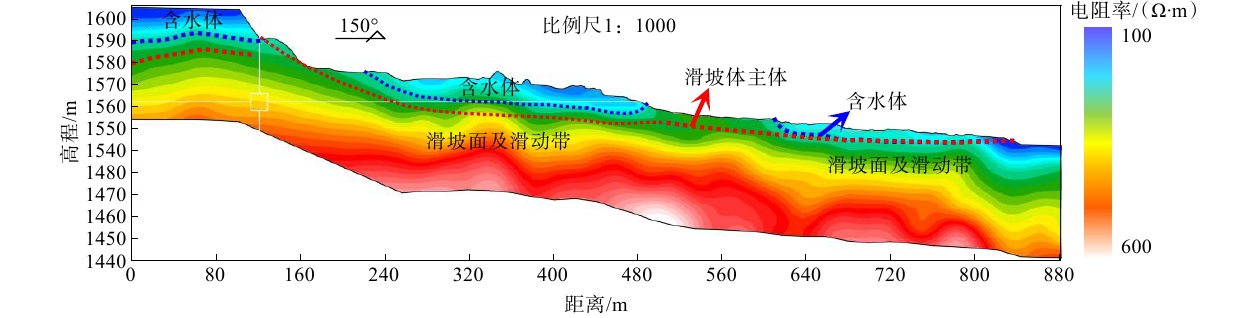
Objective To investigate the disaster-causing mechanisms, dynamic evolution, and post-disaster stability trends associated with the reactivation of the Huangci No. 2 landslide in Heifangtai, Gansu Province, on December 10, 2025, field geological investigations and the transient electromagnetic (TEM) surveys were conducted to characterize the deep structure of the landslide. Methods The entire three-dimensional dynamic sliding process was back-analyzed using the Massflow numerical model, and the three-dimensional limit equilibrium method was employed to quantitatively evaluate the post-event deposit and the stability of the high and steep rear slope and to predict their potential kinematic responses. Results (1) The reactivation of the landslide resulted from the coupled effects of slope-toe excavation, long-term irrigation, and winter freezing conditions. The freezing-induced water-retention and pore-pressure buildup effect acted as the direct trigger: surface freezing blocked seepage pathways, causing pore-water pressure to accumulate at depth and triggering a bedding-parallel slide along the loess–mudstone contact. (2) The entire sliding process lasted 22 h 10 min, with a cumulative displacement of 310 m. The Massflow simulation reproduced four stages of the dynamic evolution: creep, accelerated sliding, deceleration and deposition, and stagnation and compaction. The intersection over union (IoU) of the simulated and observed deposition morphologies reached 85.85%. (3) Quantitative calculations indicate that the current deposit has a factor of safety greater than 1.15, suggesting a relatively stable state characterized by settlement and consolidation. However, under extreme saturation conditions, the potential failure volume of the high and steep rear slope could reach 40.9×10⁴ m3, with a maximum sliding distance of approximately 640 m. Conclusions The reactivation of the landslide was controlled by freezing-induced water retention and pore-water pressure buildup, together with multiple external disturbances. Although the main landslide body has generally stabilized, the high and steep rear slope remains highly susceptible to secondary failure. A long-term dynamic monitoring system should therefore be established to mitigate the risk of high-elevation secondary hazards. Significance This study quantitatively demonstrates freezing-induced water retention and pore-water pressure buildup as a distinctive triggering mechanism for winter loess landslides, extending the conventional understanding of loess landslide initiation beyond single hydrodynamic factors such as rainfall and irrigation. The findings provide direct technical references and theoretical support for winter landslide prevention and mitigation, emergency monitoring deployment, and early identification of geological hazards in Heifangtai and other irrigated loess tablelands, thereby contributing to the protection of local communities and their property. -
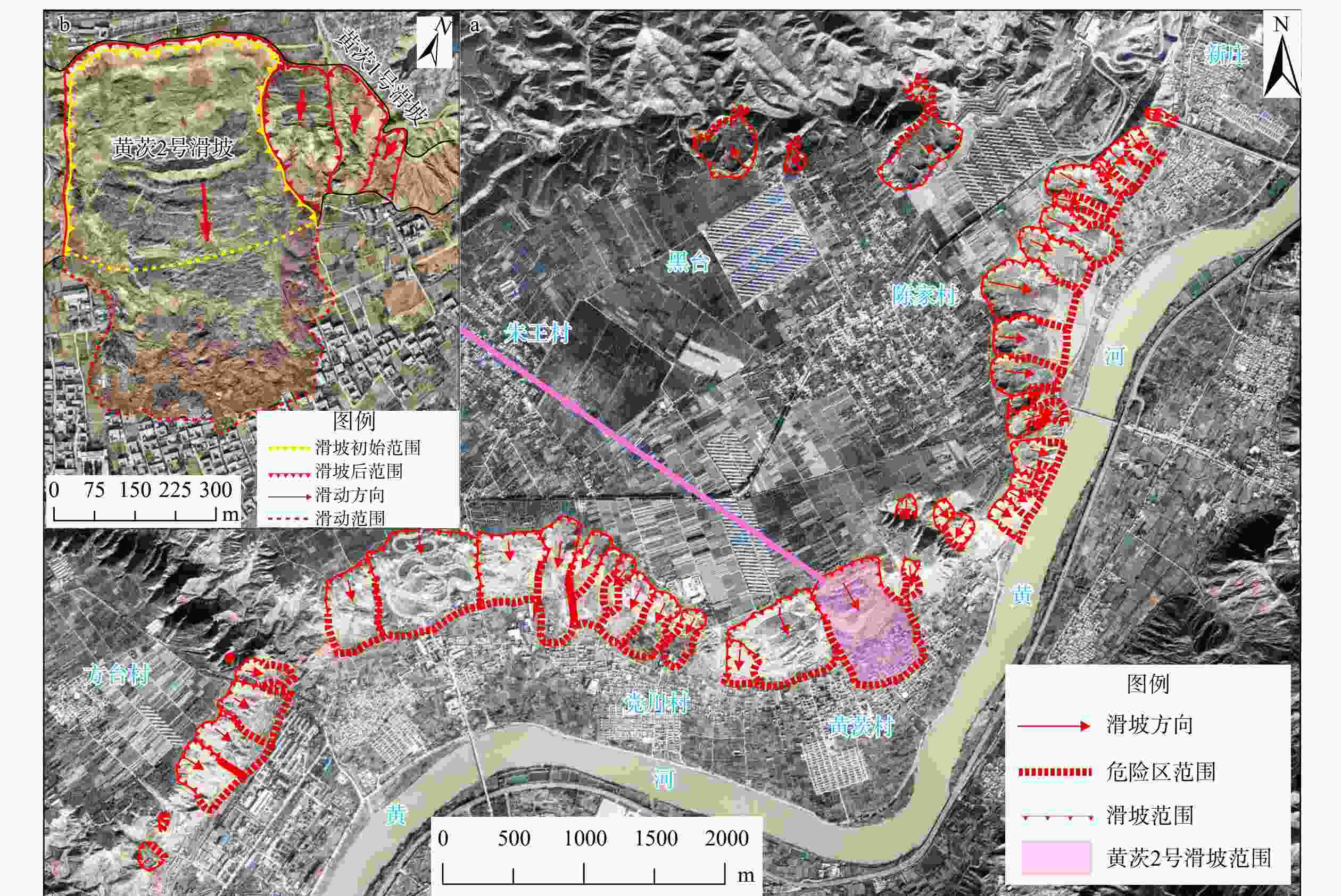
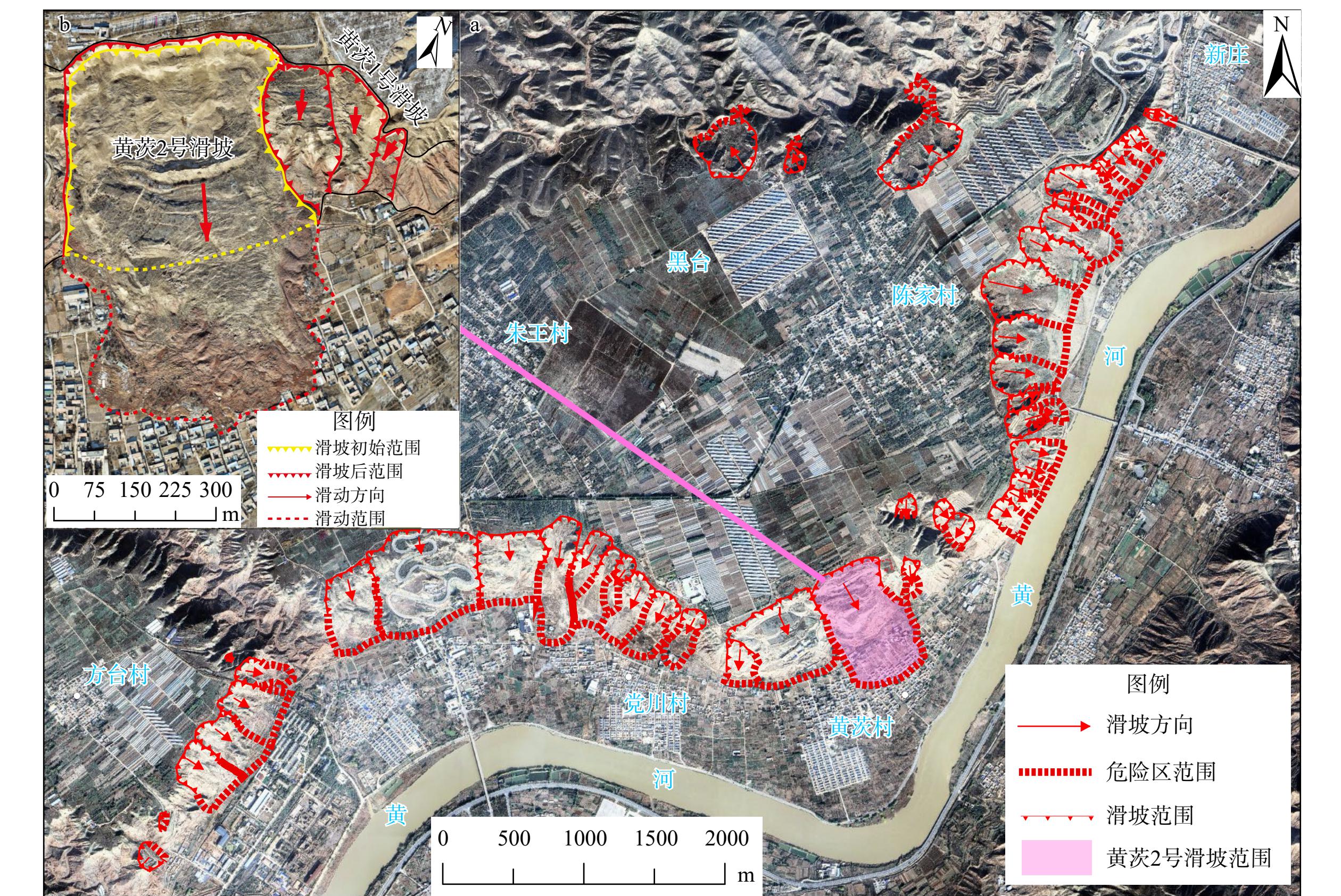
图 1 黄茨滑坡地理位置图
a—滑坡群分布图;b—黄茨滑坡位置示意图
Figure 1. Geographic location of the Huangci landslide
(a) Distribution of landslide groups; (b) Location of the Huangci landslide
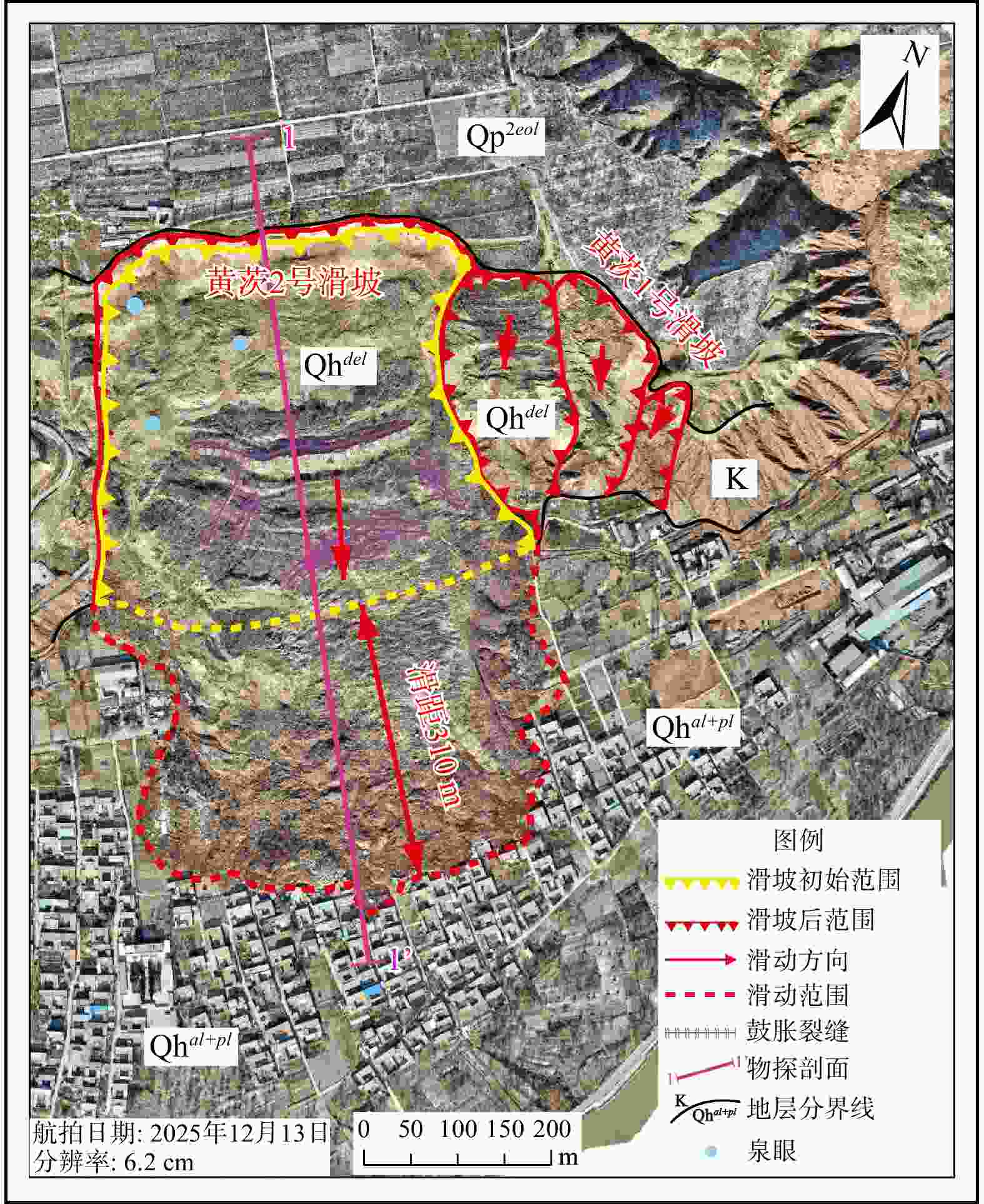
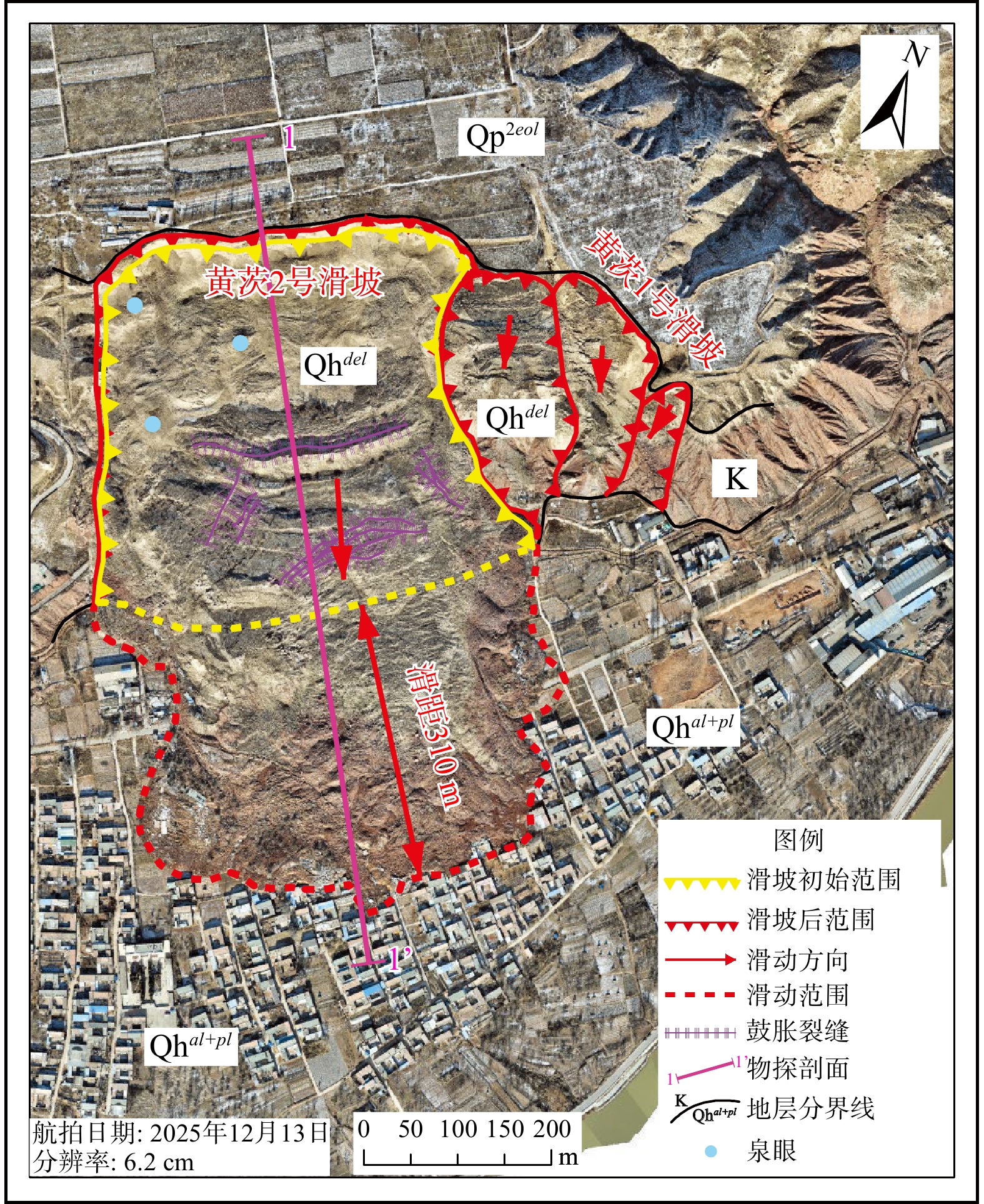
图 2 黄茨2号滑坡正射影像图
Qhal+pl—第四系全新统冲洪积层;Qhdel—第四系全新统残坡积层;Qp2eol—第四系中更新统风积层;K—白垩系
Figure 2. Orthophoto of the Huangci No. 2 landslide
Qhal+pl represents alluvial and diluvial deposits of the Quaternary Holocene; Qhdel represents residual and colluvial deposits of the Quaternary Holocene; Qp2eol represents aeolian deposits of the Quaternary Middle Pleistocene; and K represents Cretaceous strata.
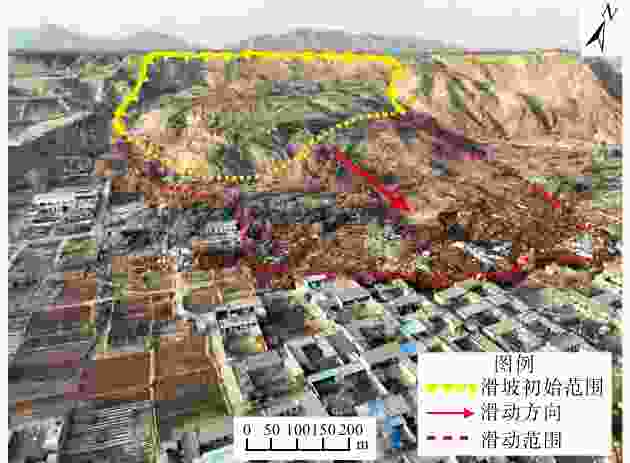
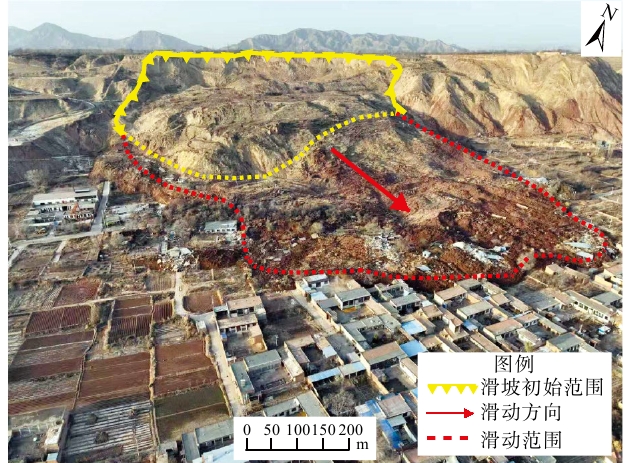
图 5 滑坡体2025年12月10日16时航拍图
Figure 5. UAV aerial photograph of the landslide mass at 16:00 on December 10
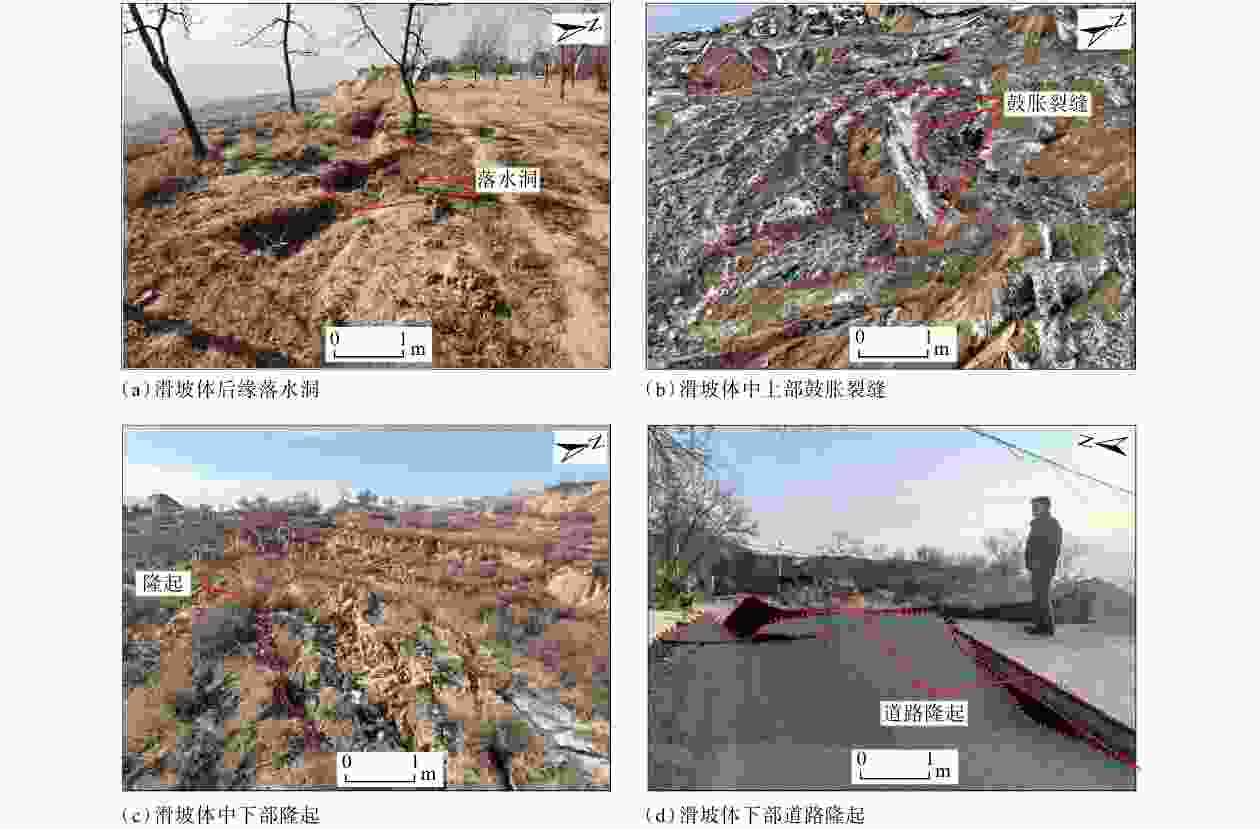
图 6 黄茨2号滑坡变形破坏特征
Figure 6. Deformation and failure characteristics of the Huangci No. 2 landslide
(a) Sinkhole at the rear of the landslide; (b) Bulging cracks in the middle-to-upper part of the landslide mass; (c) Uplift in the middle-to-lower part of the landslide mass; (d) Road heave in the lower part of the landslide mass
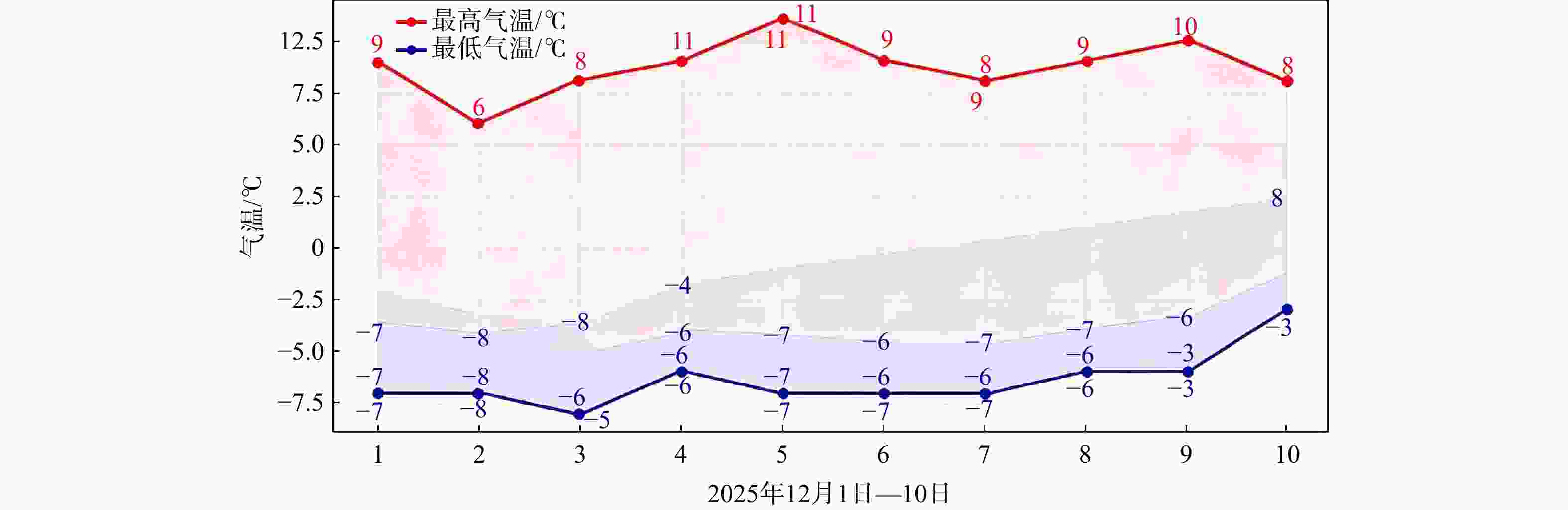
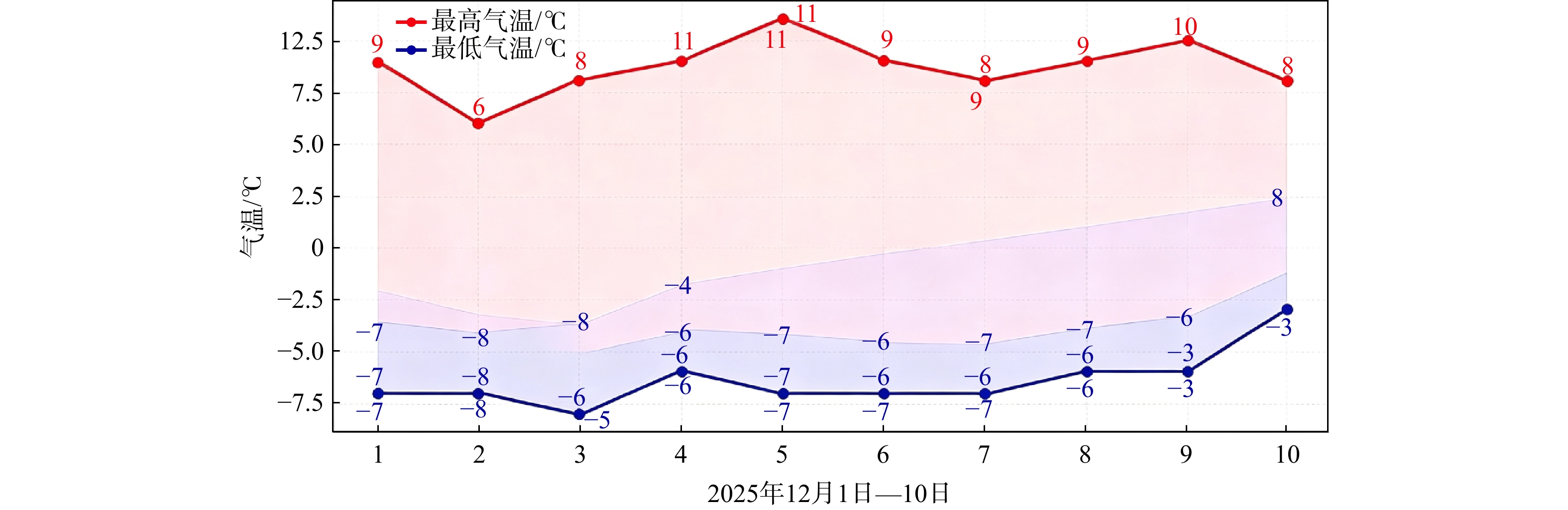
图 7 黑方台黄茨2号滑坡前气温变化曲线图
Figure 7. Variation in air temperature before the reactivation of the Huangci No. 2 landslide in Heifangtai
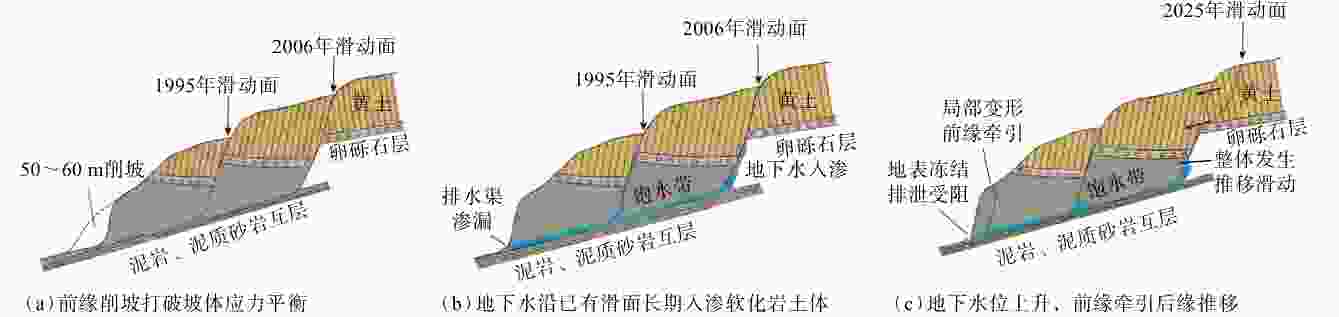
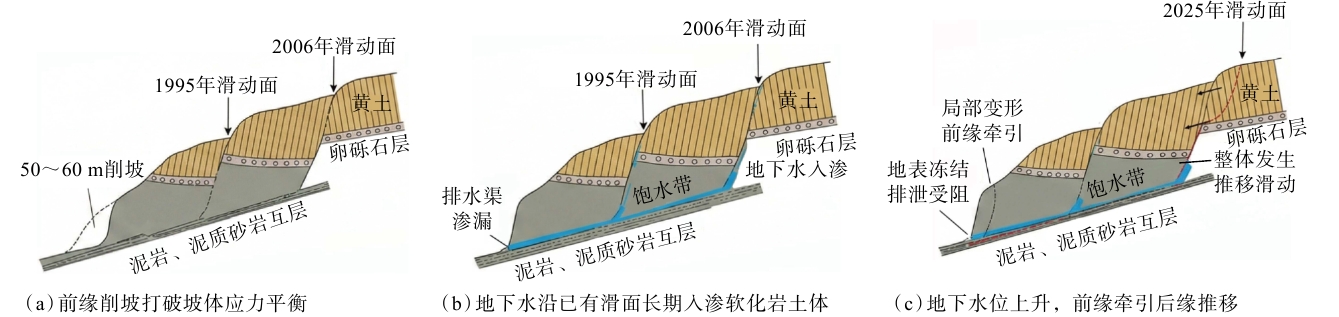
图 8 黄茨2号滑坡复活机制示意图
Figure 8. Schematic illustration of the reactivation mechanism of the Huangci No. 2 landslide
(a) Disruption of stress equilibrium in the slope caused by toe excavation; (b) Long-term groundwater infiltration along pre-existing slip surfaces and consequent softening of the rock and soil mass; (c) Rise in the groundwater level, with traction at the toe and pushing from the rear
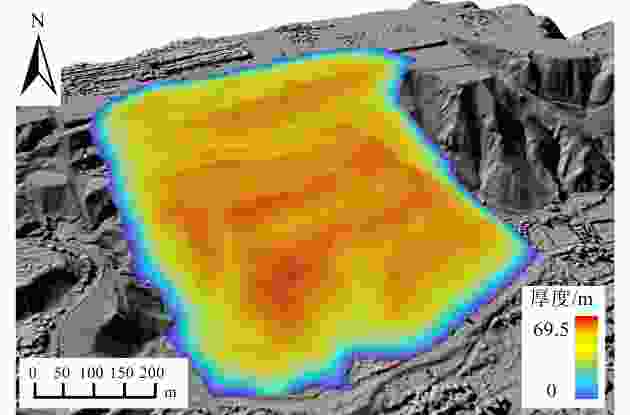
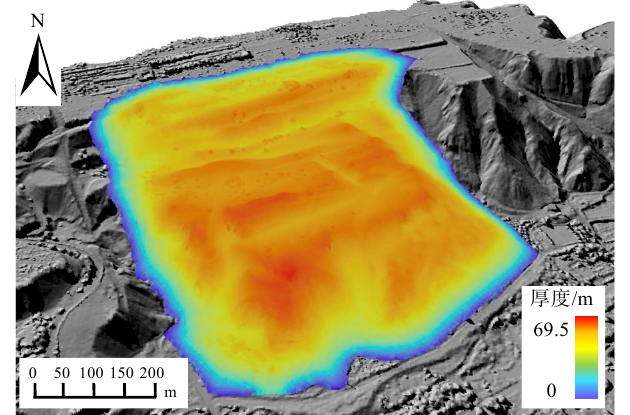
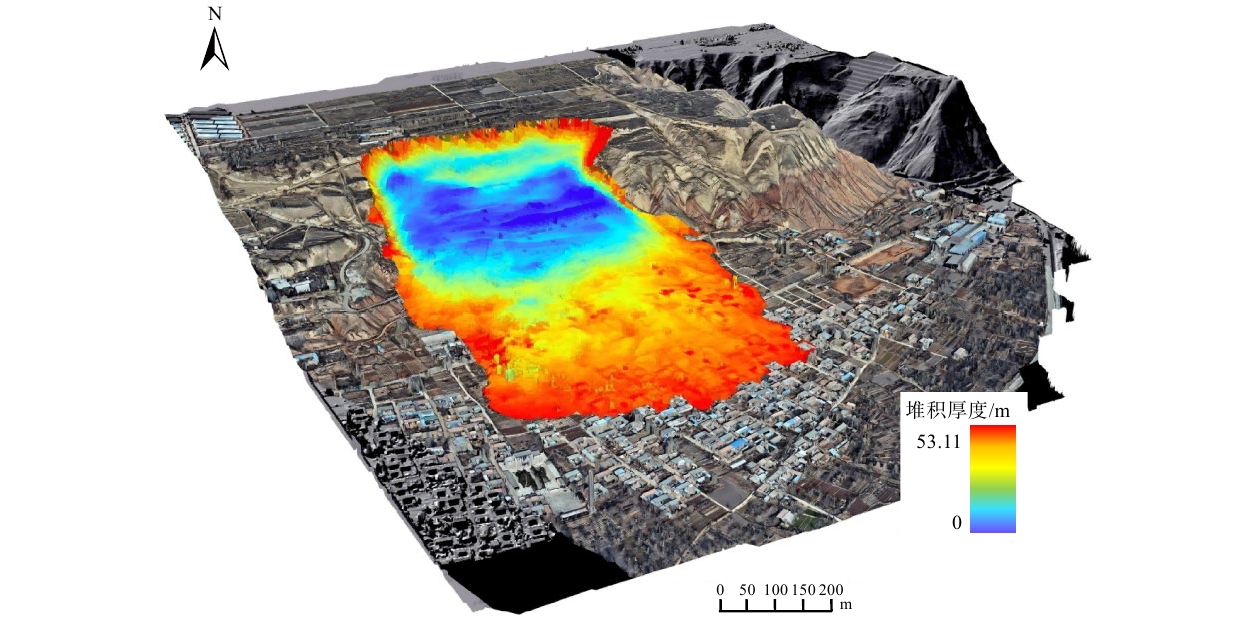
图 10 黄茨2号滑坡滑体厚度分布图
Figure 10. Thickness distribution of the sliding mass of the Huangci No. 2 landslide
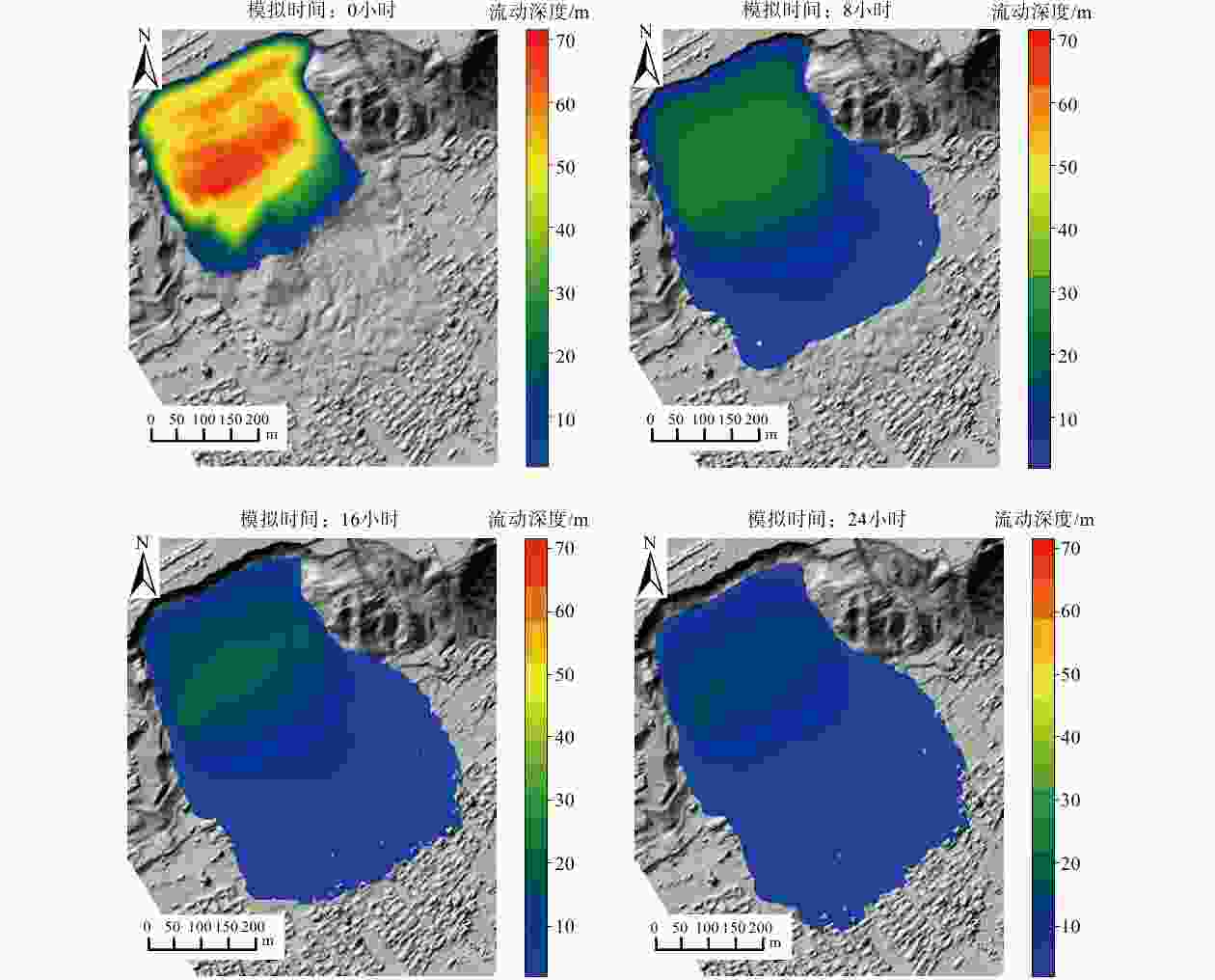
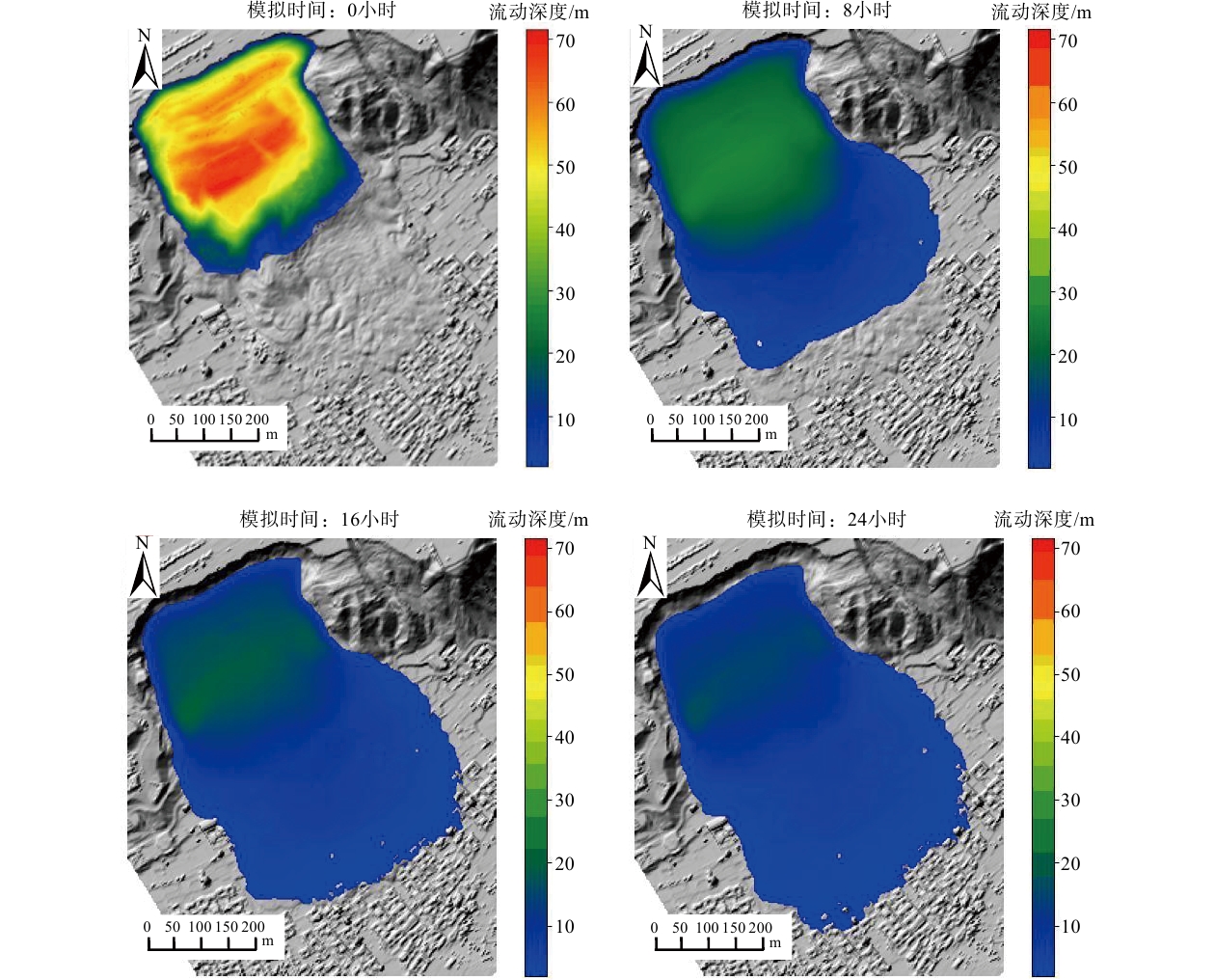
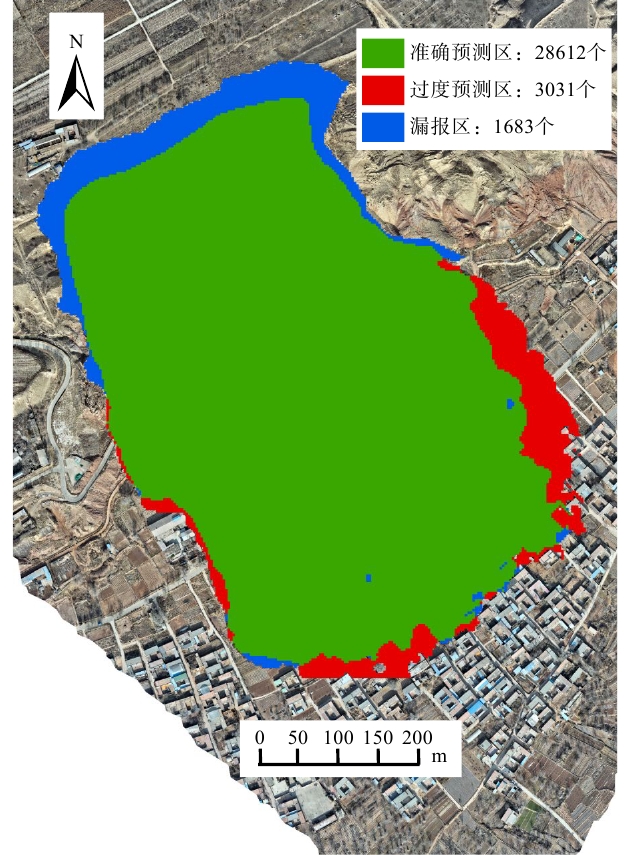
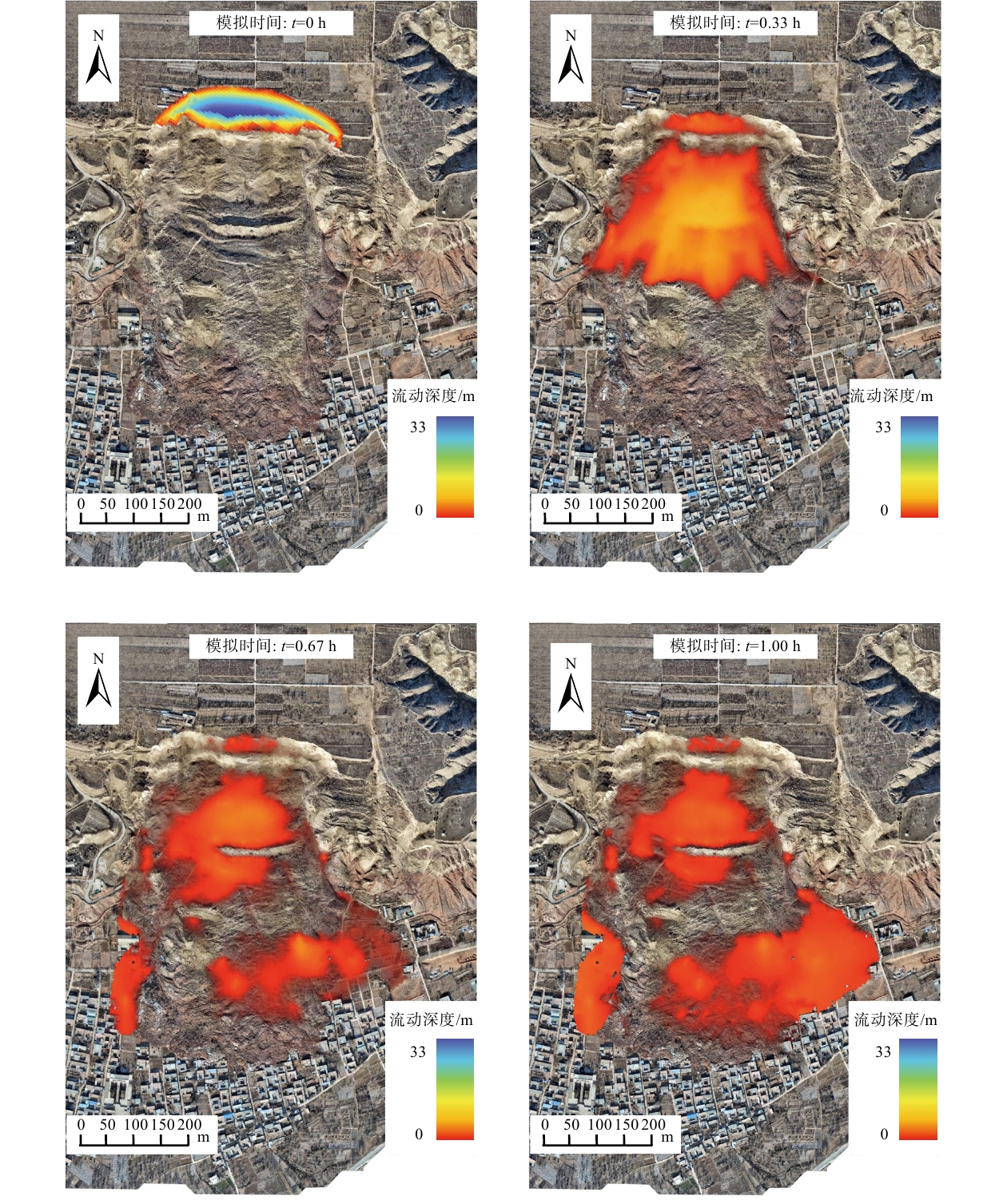
图 11 黄茨2号滑坡动力过程复演
Figure 11. Numerical reconstruction of the dynamic process of the Huangci No. 2 landslide
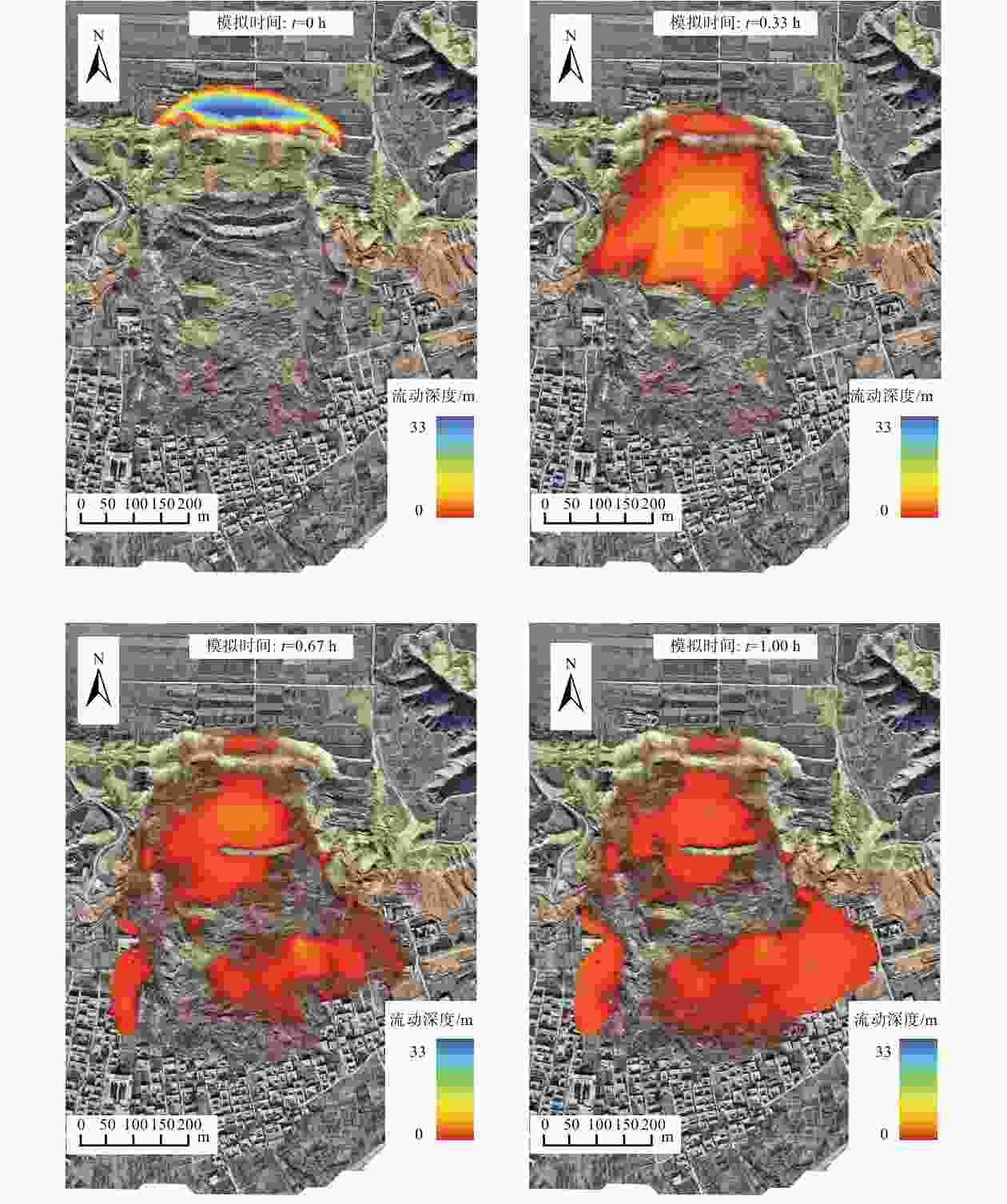
图 13 滑坡后壁失稳动力过程模拟
Figure 13. Simulation of the dynamic failure process of the landslide rear wall
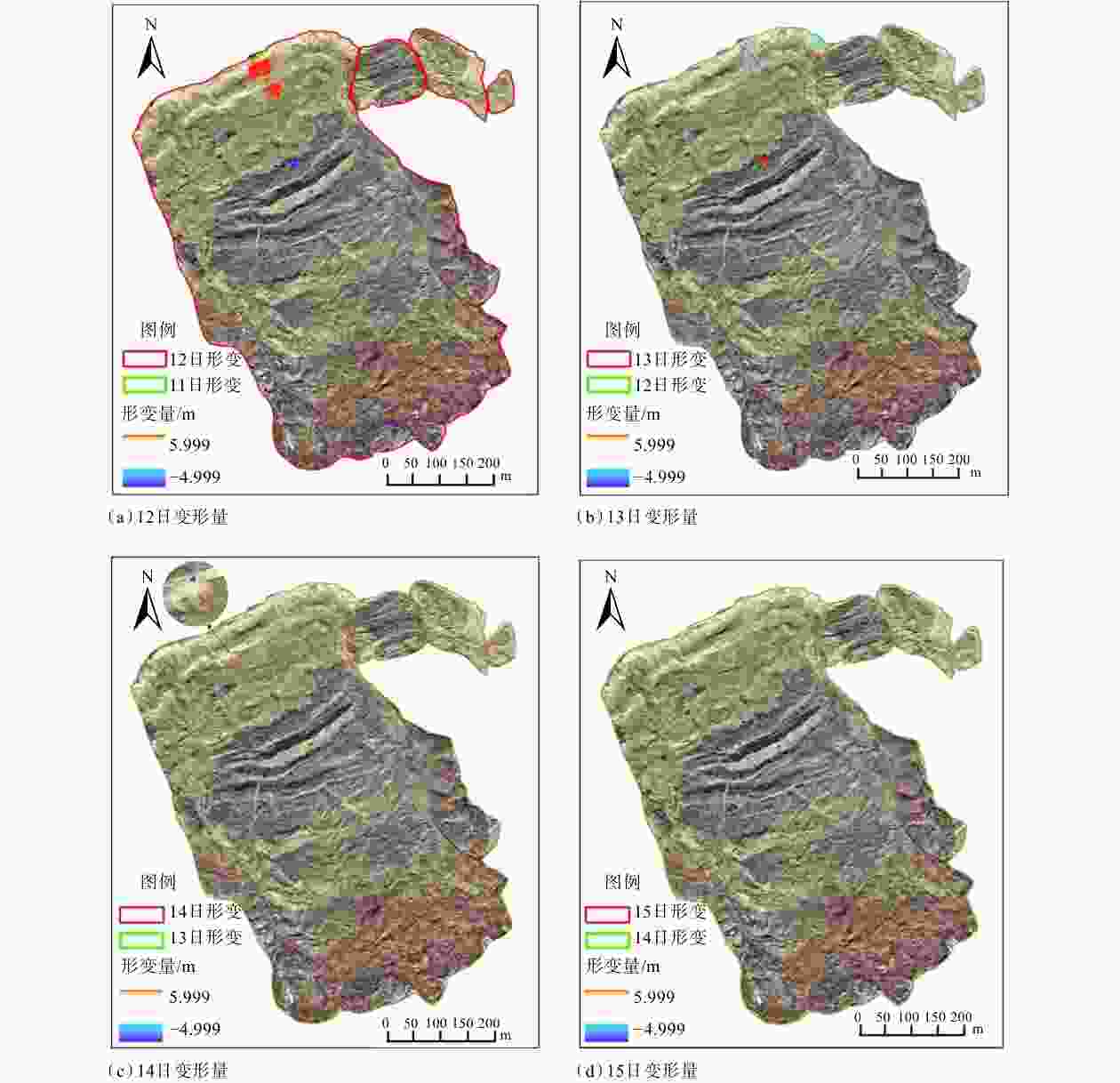
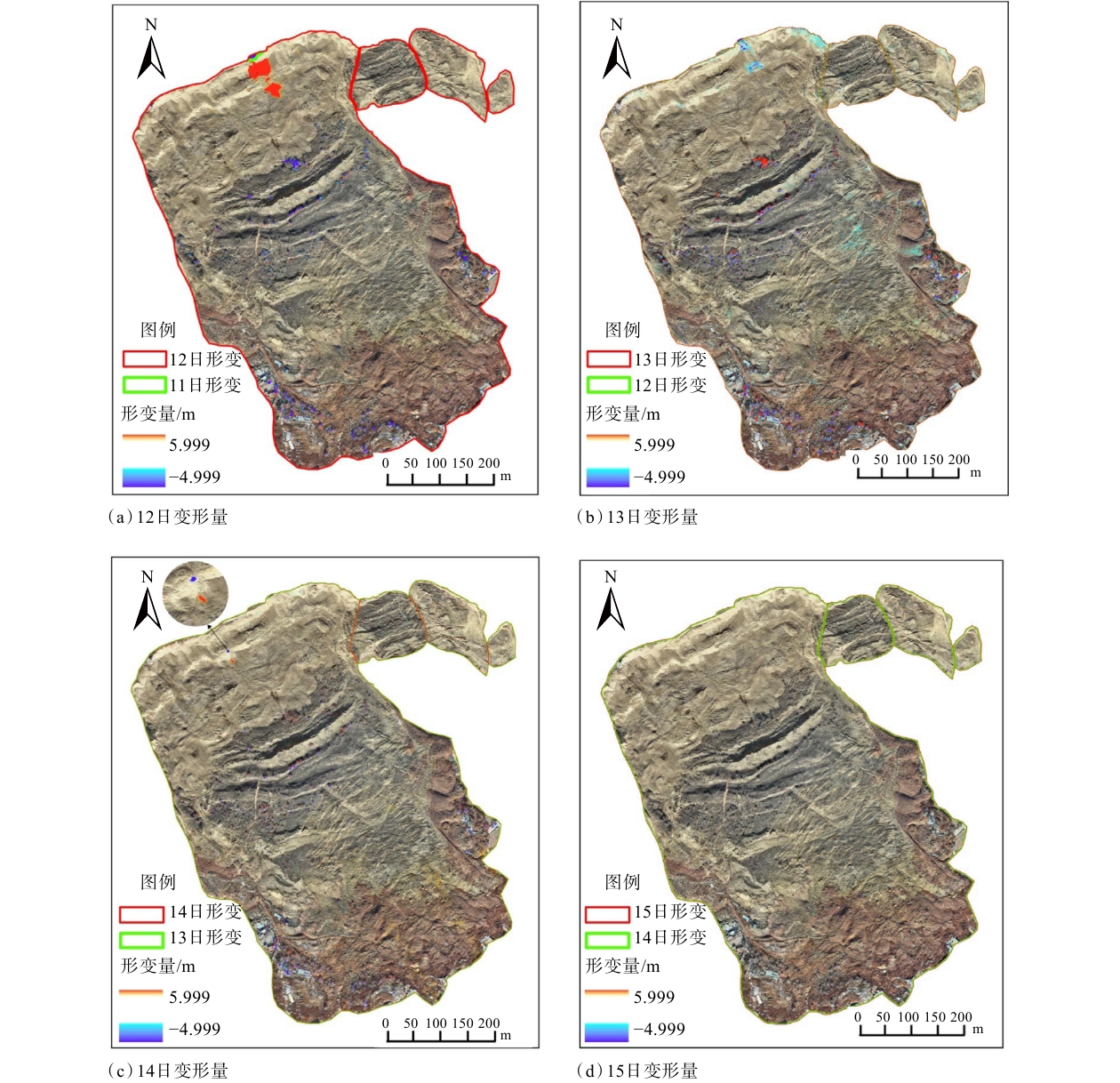
图 14 灾后四日形变量分析图
Figure 14. Deformation analysis over the four days following the landslide reactivation
(a) Deformation on December 12, 2025; (b) Deformation on December 13, 2025; (c) Deformation on December 14, 2025; (d) Deformation on December 15, 2025
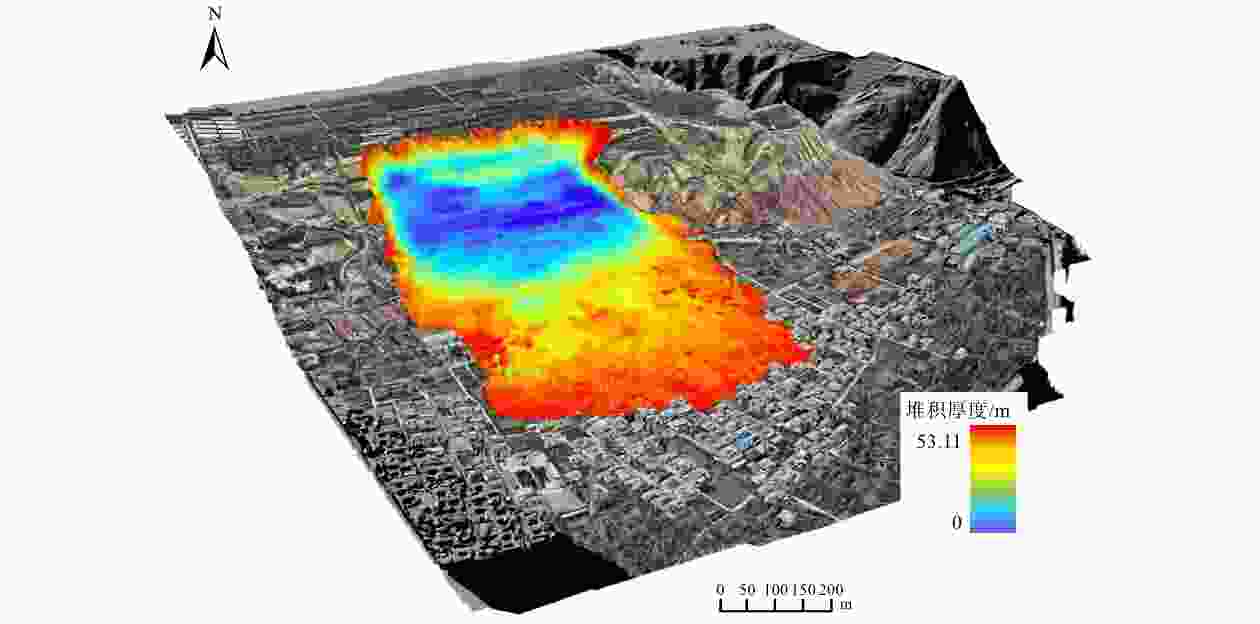
图 16 滑坡堆积体安全系数计算模型
Figure 16. Computational model for calculating the factor of safety of the landslide deposit
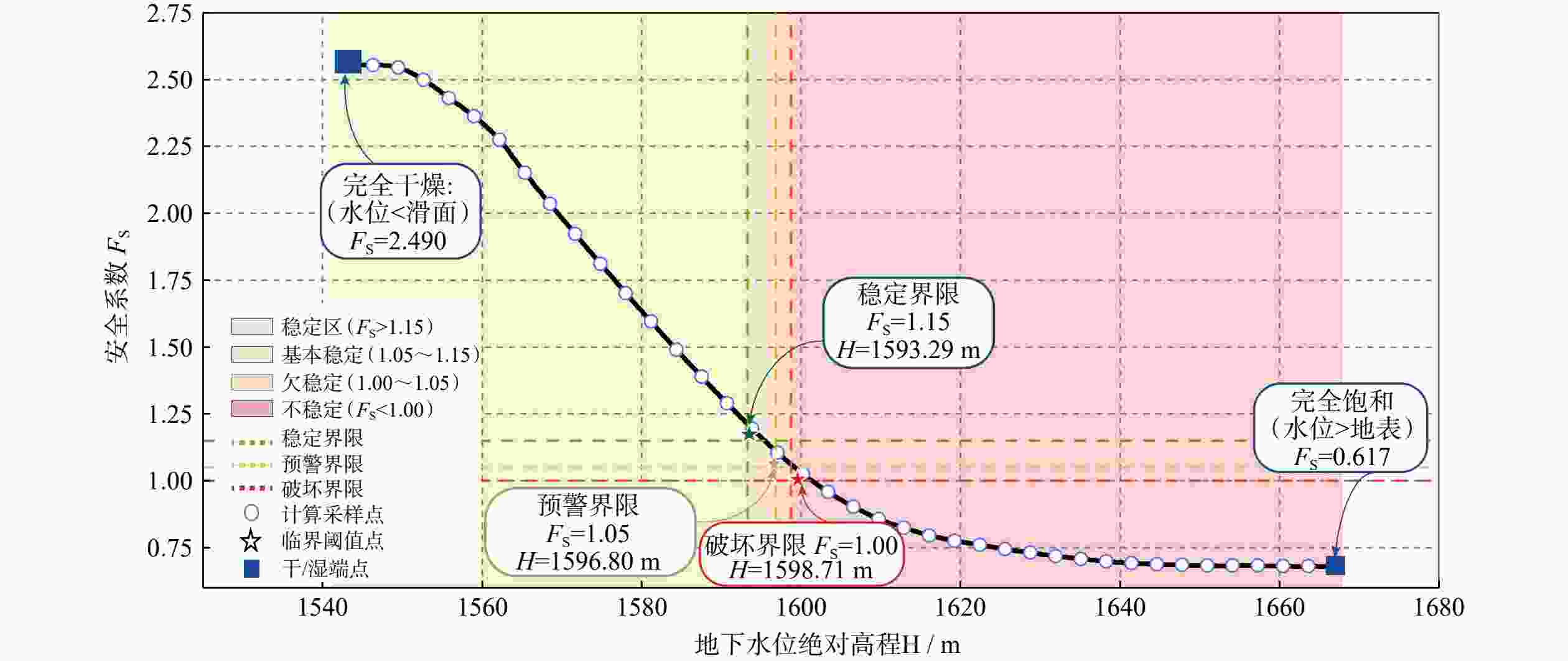
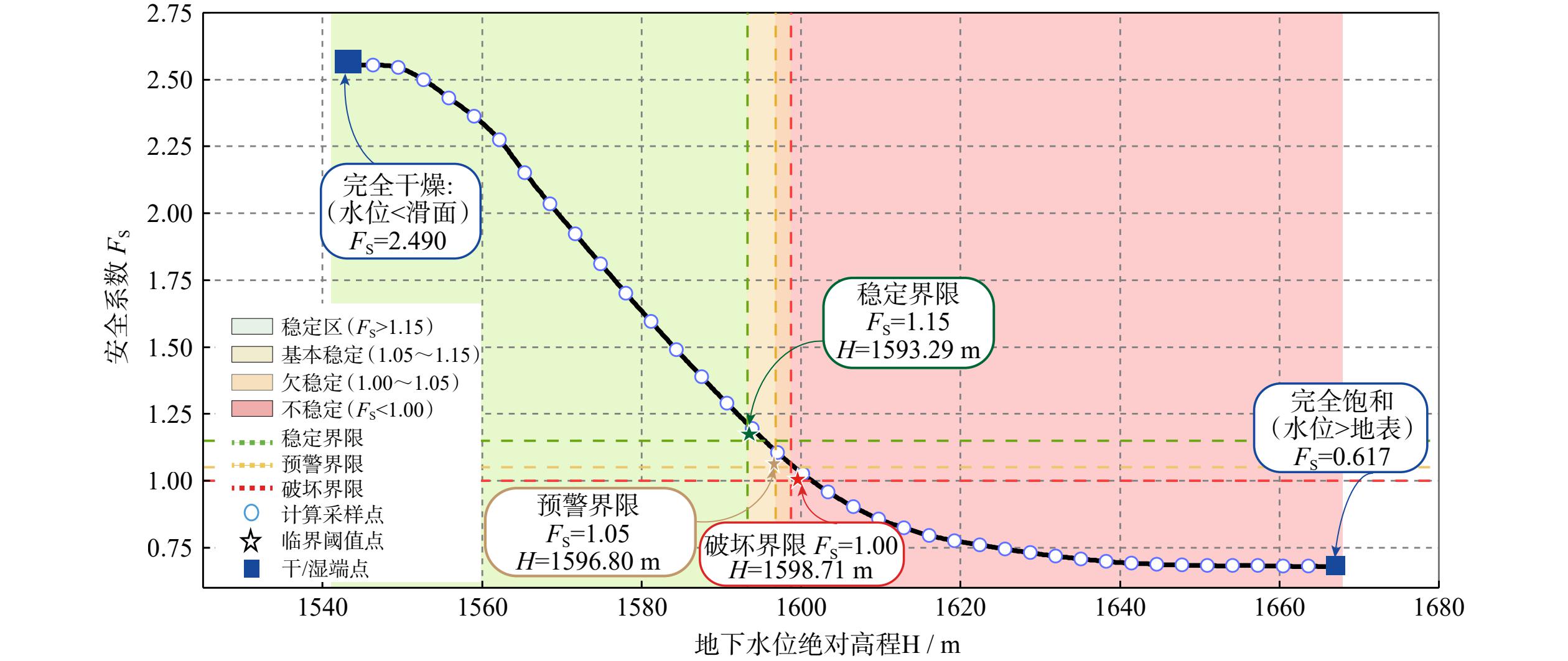
图 17 地下水高程变化−安全系数分析图
Figure 17. Variation in the factor of safety with groundwater elevation
表 1 核心物理力学性质参数
Table 1. Key physicomechanical parameters
平均密度$ \overline{\rho } $/(kg/m3) 黏聚力c/Pa 内摩擦角$ \varphi $/ (°) 孔隙水压力系数$ \lambda $ 1400 5000 25 0.3  下载: 导出CSV
-
[1] CAO Y Z, CAO Y J, 2021. Analysis of instability and destruction of rainfall type landslide based on failure probability[J]. Research of Soil and Water Conservation, 28(5): 387-393. (in Chinese with English abstract) [2] CHEN J Q, SHEN H, FENG W K, 2024. Characteristics and movement process of Zhonghaicun landslide in Hanyuan County, Sichuan Province[J]. Science Technology and Engineering, 24(17): 7448-7454. (in Chinese with English abstract) [3] CHEN X, ZHAO Z, WEI J B, et al., 2021. Numerical study of Mabian landslide kinematics and impact intensity[J]. Coal Geology & Exploration, 49(4): 234-241. (in Chinese with English abstract) [4] CHEN Z, SONG D Q, 2021. Numerical investigation of the recent Chenhecun landslide (Gansu, China) using the discrete element method[J]. Natural Hazards, 105(1): 717-733. doi: 10.1007/s11069-020-04333-w [5] CUI Y H, GU D M, YU H B, et al., 2024. Stability and accumulation characteristics of bedding rock landslides induced by rainfall-excavation[J]. Yangtze River, 55(9): 156-164. (in Chinese with English abstract) [6] DI Y, WEI Y J, TAN W J, et al., 2025. Risk assessment of landslide-induced river blockage based on RAMMS[J]. Earth Science Frontiers, 32(5): 546-556. (in Chinese with English abstract) [7] DING H, LI H J, ZHAO J J, et al., 2021. Analysis on the reactivation deformation characteristics and genesis of Jianshanying ancient landslide[J]. Science Technology and Engineering, 21(7): 2626-2631. (in Chinese with English abstract) [8] DONG J L, LU Y F, 2025. Study on landslide mechanism based on dynamic evolution law and numerical simulation method[J]. Water Resources and Hydropower Engineering, 56(12): 174-188. (in Chinese with English abstract) [9] FAN X M, YANG F, SUBRAMANIAN S S, et al., 2020. Prediction of a multi-hazard chain by an integrated numerical simulation approach: the Baige landslide, Jinsha River, China[J]. Landslides, 17(1): 147-164. doi: 10.1007/s10346-019-01313-5 [10] FUSCO F, BORDONI M, TUFANO R, et al., 2022. Hydrological regimes in different slope environments and implications on rainfall thresholds triggering shallow landslides[J]. Natural Hazards, 114(1): 907-939. doi: 10.1007/s11069-022-05417-5 [11] GAO H Y, GAO Y, YIN Y P, et al., 2022. New scientific issues in the study of high-elevation and long-runout landslide dynamics in the Qinghai-Tibet Plateau[J]. Journal of Geomechanics, 28(6): 1090-1103. (in Chinese with English abstract) [12] GAO M B, HE B B, LI W H, et al., 2025. Study on mechanical properties of rock and soil mass in the slip zone of Shibanping landslide[J]. Frontiers in Earth Science, 13: 1675192. doi: 10.3389/feart.2025.1675192 [13] General Administration of Quality Supervision, Inspection and Quarantine of the People’s Republic of China, China National Standardization Administration, 2017. Code for geological investigation of landslide prevention: GB/T 32864-2016[S]. Beijing: Standards Press of China. (in Chinese with English abstract) [14] GENG H S, LÜ W B, LI S, et al., 2021. Mechanism analysis and early warning prediction of landslide instability[J]. Journal of Northwest Normal University (Natural Science), 57(6): 103-109. (in Chinese with English abstract) [15] GONG T, QIAN J P, ZHANG J, et al., 2025. Mechanism analysis of winter landslides triggered by the “butterfly swarm effect” in the Wumeng Mountainous Region from the landslide in Jinping Village, Junlian County, Sichuan Province[J]. Chinese Journal of Rock Mechanics and Engineering, 44(11): 2943-2958. (in Chinese with English abstract) doi: 10.3724/1000-6915.jrme.2025.0326 [16] HUANG R Q, 2007. Large-scale landslides and their sliding mechanisms in China since the 20th century[J]. Chinese Journal of Rock Mechanics and Engineering, 26(3): 433-454. (in Chinese with English abstract) [17] KOHLER M, PUZRIN A M, 2023. Mechanics of coseismic and postseismic acceleration of active landslides[J]. Communications Earth & Environment, 4(1): 122. doi: 10.1038/s43247-023-00797-3 [18] LESHCHINSKY B, LEHMANN P, OR D, 2021. Enhanced rainfall-induced shallow landslide activity following seismic disturbance: from triggering to healing[J]. Journal of Geophysical Research: Earth Surface, 126(1): e2020JF005669. doi: 10.1029/2020JF005669 [19] LI G, ZHANG M L, YE W L, et al., 2021. Analysis on freezing-thawing characteristics and frozen stagnant water effect of Heifangtai slope in Gansu Province[J]. Journal of Arid Land Resources and Environment, 35(6): 117-122. (in Chinese with English abstract) [20] LI G, 2022. Study on frozen stagnant water effect of loess landslide group in Heifangtai, Gansu Province[D]. Lanzhou: Lanzhou University of Technology. (in Chinese with English abstract) [21] LI X F, WEI Y X, YANG H M, 2013. Time forecast for Huangci landslide by back analysis[J]. Journal of Wuhan Institute of Technology, 35(4): 52-54. (in Chinese with English abstract) [22] MA J Q, 2012. Stability analysis of loess landslides in loess tableland edge of Heifangtai irrigation area[D]. Changchun: Jilin University. (in Chinese with English abstract) [23] MENG H Y, ZHAN J W, LU Q Z, et al., 2023. Kinematic characteristics and numerical simulation analysis of "8·12" giant landslide in Shanyang County, Shaanxi Province[J]. Journal of Engineering Geology, 31(6): 1910-1928. (in Chinese with English abstract) [24] MING C T, ZHANG J X, GUO F, 2024. Research on the dynamic characteristics of colluvium landslides based on Massflow software[J]. Water Resources and Hydropower Engineering, 55(S2): 678-684. (in Chinese with English abstract) [25] OUYANG C J, HE S M, TANG C, 2015. Numerical analysis of dynamics of debris flow over erodible beds in Wenchuan earthquake-induced area[J]. Engineering Geology, 194: 62-72. doi: 10.1016/j.enggeo.2014.07.012 [26] OUYANG C J, ZHOU K Q, XU Q, et al., 2017. Dynamic analysis and numerical modeling of the 2015 catastrophic landslide of the construction waste landfill at Guangming, Shenzhen, China[J]. Landslides, 14(2): 705-718. doi: 10.1007/s10346-016-0764-9 [27] OUYANG C J, AN H C, ZHOU S, et al., 2019. Insights from the failure and dynamic characteristics of two sequential landslides at Baige village along the Jinsha River, China[J]. Landslides, 16(7): 1397-1414. doi: 10.1007/s10346-019-01177-9 [28] PEI X J, CUI S H, ZHU L, et al., 2021. Sanxicun landslide: an investigation of progressive failure of a gentle bedding slope[J]. Natural Hazards, 109: 1391-1419. doi: 10.21203/rs.3.rs-524675/v1 [29] PENG D L, 2018. Study on early recognition for potentially loess landslides: a case study at Heifangtai terrace, Gansu Province, China[D]. Chengdu: Chengdu University of Technology. (in Chinese with English abstract) [30] PENG D L, XU Q, ZHANG X L, et al., 2019. Hydrological response of loess slopes with reference to widespread landslide events in the Heifangtai terrace, NW China[J]. Journal of Asian Earth Sciences, 171: 259-276. doi: 10.1016/j.jseaes.2018.12.003 [31] PENG J B, LIN H Z, WANG Q Y, et al., 2014. The critical issues and creative concepts in mitigation research of loess geological hazards[J]. Journal of Engineering Geology, 22(4): 684-691. (in Chinese with English abstract) [32] PU X W, WAN L M, WANG P, 2021. Initiation mechanism of mudflow-like loess landslide induced by the combined effect of earthquakes and rainfall[J]. Natural Hazards, 105(3): 3079-3097. doi: 10.1007/s11069-020-04442-6 [33] QI X, XU Q, PENG D L, et al., 2017. Mechanism of gradual retreat loess landslide caused by groundwater: a case study of the irrigation loess landslide in Heifangtai, Gansu Province[J]. Journal of Engineering Geology, 25(1): 147-153. (in Chinese with English abstract) [34] RAN L N, ZHANG Y S, REN S S, et al., 2025. Formation mechanism and stability analysis of a landslide in altered ophiolite in the upper reaches of Jinsha River: a case study of the Duirongtong landslide[J]. Journal of Geomechanics, 31(2): 267-277. (in Chinese with English abstract) [35] SUN W Y, JI L, 2024. Remote sensing object detection based on fusion of spatial and channel attention[C]//Proceedings of the 14th international conference on information science and technology (ICIST). Chengdu: IEEE: 474-483. [36] TANG Y M, FENG F, GUO Z Z, et al., 2020. Integrating principal component analysis with statistically-based models for analysis of causal factors and landslide susceptibility mapping: a comparative study from the loess plateau area in Shanxi (China)[J]. Journal of Cleaner Production, 277: 124159. doi: 10.1016/j.jclepro.2020.124159 [37] TAO Z G, LUO S L, ZHU C, et al., 2022. Dynamic mechanical monitoring of landslide and case analysis of failure process[J]. Journal of Engineering Geology, 30(1): 177-186. (in Chinese with English abstract) [38] TIAN J W, JIANG X Y, LI Y C, et al., 2025. Analysis of disaster mechanism and instability process of bedding landslide with weak interlayer in Triassic strata of Guizhou[J]. Science Technology and Engineering, 25(9): 3593-3603. (in Chinese with English abstract) [39] WANG G X, 1997. Sliding mechanism and prediction of critical sliding of Huangci landslide in Yongjing County, Gansu Province[J]. Journal of Catastrophology, 12(3): 23-27. (in Chinese with English abstract) [40] WANG H J, SUN P, HAN S, et al., 2021. Failure mechanism of the Changhe landslide on September 14, 2019 in Tongwei, Gansu[J]. Geoscience, 35(3): 732-743. (in Chinese with English abstract) [41] WANG J J, LIANG Y, ZHANG H P, et al., 2014. A loess landslide induced by excavation and rainfall[J]. Landslides, 11(1): 141-152. doi: 10.1007/s10346-013-0418-0 [42] WANG Q Y, TANG H M, AN P J, et al., 2025. Shear strength and permeability in the sliding zone soil of reservoir landslides: insights into the seepage-shear coupling effect[J]. Journal of Rock Mechanics and Geotechnical Engineering, 17(4): 2031-2040. doi: 10.1016/j.jrmge.2024.04.033 [43] WANG R, WANG X L, YUAN H H, et al., 2021. Influence factors and characteristics of apparent friction coefficient of landslide based on statistical analysis and numerical simulation[J]. Journal of Engineering Geology, 29(3): 825-833. (in Chinese with English abstract) [44] WANG Z R, WU W J, ZHOU Z Q, 2004. Landslide induced by over-irrigation in loess platform areas in Gansu Province[J]. The Chinese Journal of Geological Hazard and Control, 15(3): 43-46, 54. (in Chinese with English abstract) [45] WEI L J, 2012. Analysis of causes and sliding distance on loess landslides in Heifangtai area[D]. Lanzhou: Lanzhou University. (in Chinese with English abstract) [46] WU W J, WANG N Q, 2002. Basic types and active features of loess landslide[J]. The Chinese Journal of Geological Hazard and Control, 13(2): 36-40. (in Chinese with English abstract) doi: 10.1201/9780203885284-64 [47] XU Q, PENG D L, QI X, et al., 2016. Dangchuan 2# landslide of April 29, 2015 in Heifangtai area of Gansu Province: characteristices and failure mechanism[J]. Journal of Engineering Geology, 24(2): 167-180. (in Chinese with English abstract) [48] XU Q, 2020. Understanding the landslide monitoring and early warning: consideration to practical issues[J]. Journal of Engineering Geology, 28(2): 360-374. (in Chinese with English abstract) [49] XU Q, PENG D L, ZHANG S, et al., 2020. Successful implementations of a real-time and intelligent early warning system for loess landslides on the Heifangtai terrace, China[J]. Engineering Geology, 278: 105817. doi: 10.1016/j.enggeo.2020.105817 [50] XU Q, PENG D L, HE C Y, et al., 2020. Theory and method of monitoring and early warning for sudden loess landslides: a case study at Heifangtai terrace[J]. Journal of Engineering Geology, 28(1): 111-121. (in Chinese with English abstract) [51] XU Z J, LIN Z G, ZHANG M S, 2007. Loess in China and loess landslides[J]. Chinese Journal of Rock Mechanics and Engineering, 26(7): 1297-1312. (in Chinese with English abstract) doi: 10.1201/9780203885284-11 [52] ZHANG H, GAO Y, LI B, et al., 2022. Numerical simulation analysis of the solid-liquid coupling process in a hybrid landslide: a case study of the Wushanping landslide[J]. Journal of Geomechanics, 28(6): 1104-1114. (in Chinese with English abstract) [53] ZHANG X L, 2019. Application research of ERT in the exploration of groundwater system in Heifangtai[D]. Chengdu: Chengdu University of Technology. (in Chinese with English abstract) [54] ZHANG Y Q, 2007. Systematic analysis on loess landslides in Hei Fangtai, Gansu Province, China[D]. Xi’an: Northwest University. (in Chinese with English abstract) [55] ZHANG Y Y, ZHOU J W, 2024. Analysis of influencing factors and causes of landslide based on statistical simulation method[J]. China Mining Magazine, 33(S2): 88-91. (in Chinese with English abstract) [56] ZHAO K Y, 2021. Study on the groundwater system and its effects on landslides in Heifangtai loess terrace, northwest China[D]. Chengdu: Chengdu University of Technology. (in Chinese with English abstract) [57] ZHOU Q, XU Q, ZHOU S, et al., 2019. Movement process of abrupt Loess Flowslide based on numerical simulation: a case study of Chenjia 8# on the Heifangtai Terrace[J]. Mountain Research, 37(4): 528-537. (in Chinese with English abstract) [58] ZHOU S, OUYANG C J, AN H C, et al., 2020. Comprehensive study of the Beijing Daanshan rockslide based on real-time videos, field investigations, and numerical modeling[J]. Landslides, 17(5): 1217-1231. doi: 10.1007/s10346-020-01345-2 [59] ZHU Z M, OUYANG J S, ZHANG Z L, et al., 2025. Mechanism of gently dipping bedding rock landslide: a case study of Zhongliang Village landslide in Cangxi County, Guangyuan City[J]. Safety and Environmental Engineering, 32(1): 233-243. (in Chinese with English abstract) [60] ZOU Z X, TANG H M, XIONG C R, et al., 2012. Geomechanical model of progressive failure for large consequent bedding rockslide and its stability analysis[J]. Chinese Journal of Rock Mechanics and Engineering, 31(11): 2222-2231. (in Chinese with English abstract) [61] 曹羽哲, 曹运江, 2021. 基于破坏概率法的降雨型滑坡失稳破坏分析[J]. 水土保持研究, 28(5): 387-393. [62] 陈建强, 沈贺, 冯文凯, 2024. 四川省汉源县中海村滑坡特征与运动过程分析[J]. 科学技术与工程, 24(17): 7448-7454. doi: 10.12404/j.issn.1671-1815.2302815 [63] 陈兴, 赵洲, 魏江波, 等, 2021. 马边滑坡运动特征及冲击强度的数值研究[J]. 煤田地质与勘探, 49(4): 234-241. doi: 10.3969/j.issn.1001-1986.2021.04.028 [64] 崔宇寒, 顾东明, 余海兵, 等, 2024. 降雨开挖诱发顺层岩质滑坡稳定性与堆积特征[J]. 人民长江, 55(9): 156-164. doi: 10.16232/j.cnki.1001-4179.2024.09.021 [65] 邸勇, 魏云杰, 谭维佳, 等, 2025. 基于RAMMS的滑坡堵江危险性评价[J]. 地学前缘, 32(5): 546-556. [66] 丁恒, 李海军, 赵建军, 等, 2021. 尖山营古滑坡复活变形特征及成因分析[J]. 科学技术与工程, 21(7): 2626-2631. doi: 10.3969/j.issn.1671-1815.2021.07.009 [67] 董健麟, 卢应发, 2025. 基于动态演化规律及数值模拟方法的滑坡机理研究[J]. 水利水电技术(中英文), 56(12): 174-188. doi: 10.13928/j.cnki.wrahe.2025.12.014 [68] 高浩源, 高杨, 殷跃平, 等, 2022. 青藏高原高位远程滑坡动力学研究的新问题[J]. 地质力学学报, 28(6): 1090-1103. doi: 10.12090/j.issn.1006-6616.20222831 [69] 耿海深, 吕文斌, 栗燊, 等, 2021. 滑坡失稳机理分析及预警预测研究[J]. 西北师范大学学报(自然科学版), 57(6): 103-109. doi: 10.16783/j.cnki.nwnuz.2021.06.017 [70] 龚涛, 钱江澎, 张继, 等, 2025. 从四川筠连县金坪村滑坡论乌蒙山区“群蝶效应”致冬季滑坡机制[J]. 岩石力学与工程学报, 44(11): 2943-2958. doi: 10.3724/1000-6915.jrme.2025.0326 [71] 黄润秋, 2007. 20世纪以来中国的大型滑坡及其发生机制[J]. 岩石力学与工程学报, 26(3): 433-454. doi: 10.3321/j.issn:1000-6915.2007.03.001 [72] 李广, 张明礼, 叶伟林, 等, 2021. 甘肃黑方台坡面冻融特征及冻结滞水效应分析[J]. 干旱区资源与环境, 35(6): 117-122. doi: 10.13448/j.cnki.jalre.2021.166 [73] 李广, 2022. 甘肃黑方台黄土滑坡群冻结滞水效应研究[D]. 兰州: 兰州理工大学. [74] 李先福, 魏雨溪, 杨红梅, 2013. 黄茨滑坡时间预报反分析[J]. 武汉工程大学学报, 35(4): 52-54. doi: 10.3969/j.issn.1674-2869.2013.04.012 [75] 马建全, 2012. 黑方台灌区台缘黄土滑坡稳定性研究[D]. 长春: 吉林大学. [76] 孟桓羽, 占洁伟, 卢全中, 等, 2023. 陕西山阳“8·12”大型山体滑坡运动特征及数值模拟分析[J]. 工程地质学报, 31(6): 1910-1928. doi: 10.13544/j.cnki.jeg.2021-0645 [77] 明成涛, 张晶鑫, 郭飞, 2024. 基于Massflow的三峡库区堆积层滑坡运动特性研究[J]. 水利水电技术(中英文), 55(S2): 678-684. [78] 彭大雷, 2018. 黄土滑坡潜在隐患早期识别研究: 以甘肃黑方台为例[D]. 成都: 成都理工大学. [79] 彭建兵, 林鸿州, 王启耀, 等, 2014. 黄土地质灾害研究中的关键问题与创新思路[J]. 工程地质学报, 22(4): 684-691. doi: 10.13544/j.cnki.jeg.2014.04.014 [80] 亓星, 许强, 彭大雷, 等, 2017. 地下水诱发渐进后退式黄土滑坡成因机理研究: 以甘肃黑方台灌溉型黄土滑坡为例[J]. 工程地质学报, 25(1): 147-153. doi: 10.13544/j.cnki.jeg.2017.01.020 [81] 冉丽娜, 张永双, 任三绍, 等, 2025. 金沙江上游蚀变蛇绿岩型滑坡形成机制与稳定性分析: 以堆绒通滑坡为例[J]. 地质力学学报, 31(2): 267-277. [82] 陶志刚, 罗森林, 朱淳, 等, 2022. 滑坡动态力学监测及破坏过程案例分析[J]. 工程地质学报, 30(1): 177-186. doi: 10.13544/j.cnki.jeg.2021-0027 [83] 田俊伟, 江兴元, 李阳春, 等, 2025. 贵州三叠系含软弱夹层顺层滑坡成灾机理与失稳过程分析[J]. 科学技术与工程, 25(9): 3593-3603. doi: 10.12404/j.issn.1671-1815.2404173 [84] 王恭先, 1997. 甘肃省永靖县黄茨滑坡的滑动机理与临滑预报[J]. 灾害学, 12(3): 23-27. [85] 王浩杰, 孙萍, 韩帅, 等, 2021. 甘肃通渭“9·14”常河滑坡成因机理[J]. 现代地质, 35(3): 732-743. [86] 王冉, 王学良, 袁鸿鹄, 等, 2021. 基于统计分析和数值模拟方法的滑坡视摩擦系数影响因素及特征研究[J]. 工程地质学报, 29(3): 825-833. doi: 10.13544/j.cnki.jeg.2020-449 [87] 王志荣, 吴玮江, 周自强, 2004. 甘肃黄土台塬区农业过量灌溉引起的滑坡灾害[J]. 中国地质灾害与防治学报, 15(3): 43-46, 54. [88] 魏丽娟, 2012. 黑方台黄土滑坡成因与滑距分析[D]. 兰州: 兰州大学. [89] 吴玮江, 王念秦, 2002. 黄土滑坡的基本类型与活动特征[J]. 中国地质灾害与防治学报, 13(2): 36-40. [90] 许强, 彭大雷, 亓星, 等, 2016. 2015年4.29甘肃黑方台党川2#滑坡基本特征与成因机理研究[J]. 工程地质学报, 24(2): 167-180. [91] 许强, 2020. 对滑坡监测预警相关问题的认识与思考[J]. 工程地质学报, 28(2): 360-374. [92] 许强, 彭大雷, 何朝阳, 等, 2020. 突发型黄土滑坡监测预警理论方法研究: 以甘肃黑方台为例[J]. 工程地质学报, 28(1): 111-121. [93] 徐张建, 林在贯, 张茂省, 2007. 中国黄土与黄土滑坡[J]. 岩石力学与工程学报, 26(7): 1297-1312. [94] 张晗, 高杨, 李滨, 等, 2022. 复合型滑坡固液耦合过程数值模拟分析: 以无山坪滑坡为例[J]. 地质力学学报, 28(6): 1104-1114. [95] 张先林, 2019. 高密度电法在黑方台地下水系统探究中的应用研究[D]. 成都: 成都理工大学. [96] 张燕云, 周金文, 2024. 统计模拟法在滑坡影响因素分析与成因研究中的应用[J]. 中国矿业, 33(S2): 88-91. [97] 张雨晴, 2007. 甘肃黑方台黄土滑坡系统分析[D]. 西安: 西北大学. [98] 赵宽耀, 2021. 甘肃黑方台地下水系统及其对滑坡的影响研究[D]. 成都: 成都理工大学. [99] 张皓翔, 朱赛楠, 姚磊华, 等, 2026. 西南山区典型采空区滑坡易灾地质结构与失稳模式研究[J]. 地质力学学报, 32(2): 491-506. [100] 中华人民共和国国家质量监督检验检疫总局, 中国国家标准化管理委员会, 2017. 滑坡防治工程勘查规范: GB/T 32864-2016[S]. 北京: 中国标准出版社. [101] 周琪, 许强, 周书, 等, 2019. 基于数值模拟的突发型黄土滑坡运动过程研究: 以黑方台陈家8#滑坡为例[J]. 山地学报, 37(4): 528-537. [102] 朱志明, 欧阳继胜, 张子龙, 等, 2025. 缓倾顺层岩质滑坡机理研究: 以广元市苍溪县中梁村滑坡为例[J]. 安全与环境工程, 32(1): 233-243. [103] 邹宗兴, 唐辉明, 熊承仁, 等, 2012. 大型顺层岩质滑坡渐进破坏地质力学模型与稳定性分析[J]. 岩石力学与工程学报, 31(11): 2222-2231. [104] 张世殊, 胡新丽, 章广成, 等, 2024. 西部高山峡谷区重大滑坡成生规律及灾变演化机理研究进展[J]. 地质力学学报, 30(5): 795-810. -

 下载:
下载:



计量
- 文章访问数: 634
- HTML全文浏览量: 118
- PDF下载量: 301
- 被引次数: 0
