


Study on the cooling history of Pliocene basalt columns in Kanchanaburi, Thailand
-
摘要: 玄武岩柱状节理是岩浆冷凝收缩过程中形成的典型构造, 其成因机制、内部结构特征及冷却历史存在较大争议。针对这一问题, 对泰国北碧府直径达1.5 m的上新世柱状玄武岩开展了详细的岩石磁学与古地磁学研究。岩石磁学结果指示玄武岩柱的主要载磁矿物为假单畴(PSD)钛磁铁矿颗粒。磁化率各向异性 (AMS) 分析显示样品的磁化率最小轴 (K3 )趋向直立方向, 磁化率最大轴 (K1 )和中间轴 (K2) 趋向水平, 反映出岩浆在就位过程中的原生近水平流动。玄武岩柱体中部样品的磁性矿物颗粒粒径相对较大, 磁化率各向异性张量椭球以拉长型椭球为主, 其磁各向异性度 (Pj) 与磁线理度 (L)均高于柱体边部样品, 表明柱体中部冷却速率较慢, 使得磁性矿物有更充分的时间结晶、生长, 并在热应力作用下发生更显著的定向排列。古地磁研究结果表明, 在柱状节理形成后, 柱体的冷却过程并非从柱体边缘同步、均匀地向中心推进, 剩磁方向和VGPs的系统变化指示其可能受局部热源的影响而经历了非对称性的、单一方向性的区域冷却过程。上述结果有助于深入理解玄武岩熔岩冷却过程, 并为探究古地磁场长期变化提供了新的研究思路。Abstract:
Objective Columnar joints in basalt are typical structures formed during magmatic cooling and contraction. However, their formation mechanisms, internal structural characteristics, and cooling histories remain debated. This study aims to constrain the internal structures and cooling histories of large-diameter basalt columns through integrated rock magnetic and paleomagnetic analyses. Methods Detailed rock magnetic and paleomagnetic analyses were conducted on 49 oriented samples collected from two Pliocene basalt columns, each reaching up to 1.5 m in diameter, in the Bo Phloi section, Kanchanaburi, Thailand. Rock magnetic experiments included hysteresis-loop measurements, isothermal remanent magnetization (IRM) acquisition, first-order reversal curve (FORC) analysis, anisotropy of magnetic susceptibility (AMS) measurements, and temperature-dependent magnetic susceptibility measurements. Stepwise thermal demagnetization was performed to isolate stable components of remanent magnetization. Results Hysteresis loops and IRM acquisition curves indicate that the magnetic assemblage is dominated by pseudo-single-domain (PSD) titanomagnetite grains, with magnetic saturation reached at fields below approximately 300 mT. The two-stage increase in IRM acquisition with increasing field suggests contributions from magnetic components with different coercivities. FORC diagrams further support the predominance of PSD magnetic grains and reveal systematic differences between the margins and interiors of the basalt columns. For both basalt columns, AMS results show sub-vertical minimum susceptibility axes (K3) and sub-horizontal maximum (K1) and intermediate (K2) axes, with generally low degrees of magnetic anisotropy (Pj < 1.05). These AMS fabrics indicate a primary near-horizontal magma-flow fabric during emplacement, but provide no evidence for vertical melt migration or internal convection. AMS parameters also reveal systematic spatial variations. Samples from the column margins exhibit lower magnetic susceptibilities (χ), lineation (L), and anisotropy degree (Pj) values and are predominantly characterized by oblate fabrics (T > 0), whereas interior samples show higher χ, L, and Pj values and predominantly prolate fabrics (T < 0). These differences reflect contrasting cooling conditions between the margins and interiors of the basalt columns. The margins cooled more rapidly, leaving less time for magnetic minerals to crystallize, grow, and develop preferred orientations. In contrast, the interiors cooled more slowly and likely remained at elevated temperatures in a plastic or partially molten state for longer periods, allowing magnetic minerals to crystallize, become concentrated, and develop preferred orientations under thermal contraction stresses. Paleomagnetic results indicate that stepwise thermal demagnetization isolates a stable, single-component remanent magnetization carried by PSD titanomagnetite. Six marginal samples from basalt column A exhibit relatively scattered virtual geomagnetic pole (VGP) distributions and anomalous directions, whereas the remaining 43 samples show relatively clustered VGPs after tilt correction. Systematic variations in remanent magnetization directions and VGPs indicate that cooling did not proceed symmetrically or uniformly from the column margins toward the cores. Instead, the columns appear to have undergone an asymmetric, unidirectional regional cooling process, possibly influenced by a localized heat source. Conclusions Integrated rock magnetic and paleomagnetic analyses lead to the following conclusions: (1) The basalt columns in Kanchanaburi are dominated by PSD titanomagnetite. Their AMS fabrics, characterized by subvertical K3 axes and subhorizontal K1 and K2 axes, record a primary near-horizontal magma flow during emplacement. (2) The column margins cooled more rapidly, resulting in finer magnetic grains, lower magnetic anisotropy, and predominantly oblate fabrics, whereas the interiors cooled more slowly, allowing magnetic minerals to crystallize, grow, and develop stronger preferred orientations, resulting in higher anisotropy and predominantly prolate fabrics. (3) Systematic variations in paleomagnetic directions and VGPs among the 49 samples indicate that post-jointing cooling was neither uniform nor symmetric but instead proceeded asymmetrically and unidirectionally across the basalt columns. Significance These findings contribute to a better understanding of the cooling processes of basaltic lava and provide new insights into long-term variations in the geomagnetic field. -
Key words:
- columnar joints in basalt /
- paleomagnetism /
- rock magnetism /
- cooling history
-
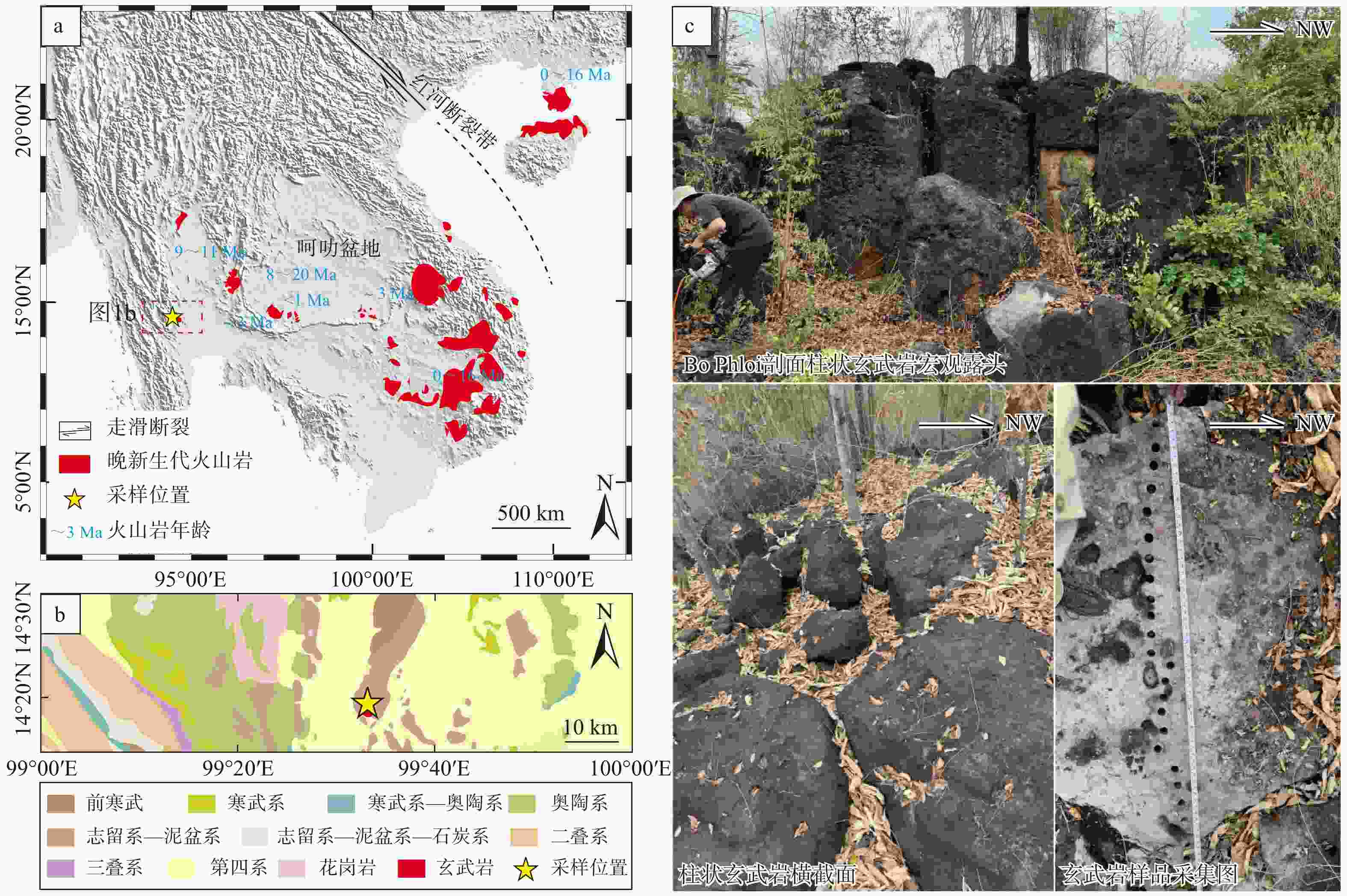
图 1 印支地块新近纪—第四纪火山岩分布与泰国北碧府Bo Phloi剖面柱状玄武岩
a—印支地块新近纪—第四纪火山岩分布;b—采样区域地质简图;c—泰国北碧府Bo Phloi剖面柱状玄武岩
Figure 1. Distribution of Neogene–Quaternary volcanic rocks in the Indochina Block and columnar basalts at the Bo Phloi section, Kanchanaburi Province, Thailand
(a) Distribution of Neogene–Quaternary volcanic rocks in the Indochina Block; (b) Geological map of the sampling area; (c) Columnar basalts exposed at the Bo Phloi section, Kanchanaburi, Thailand
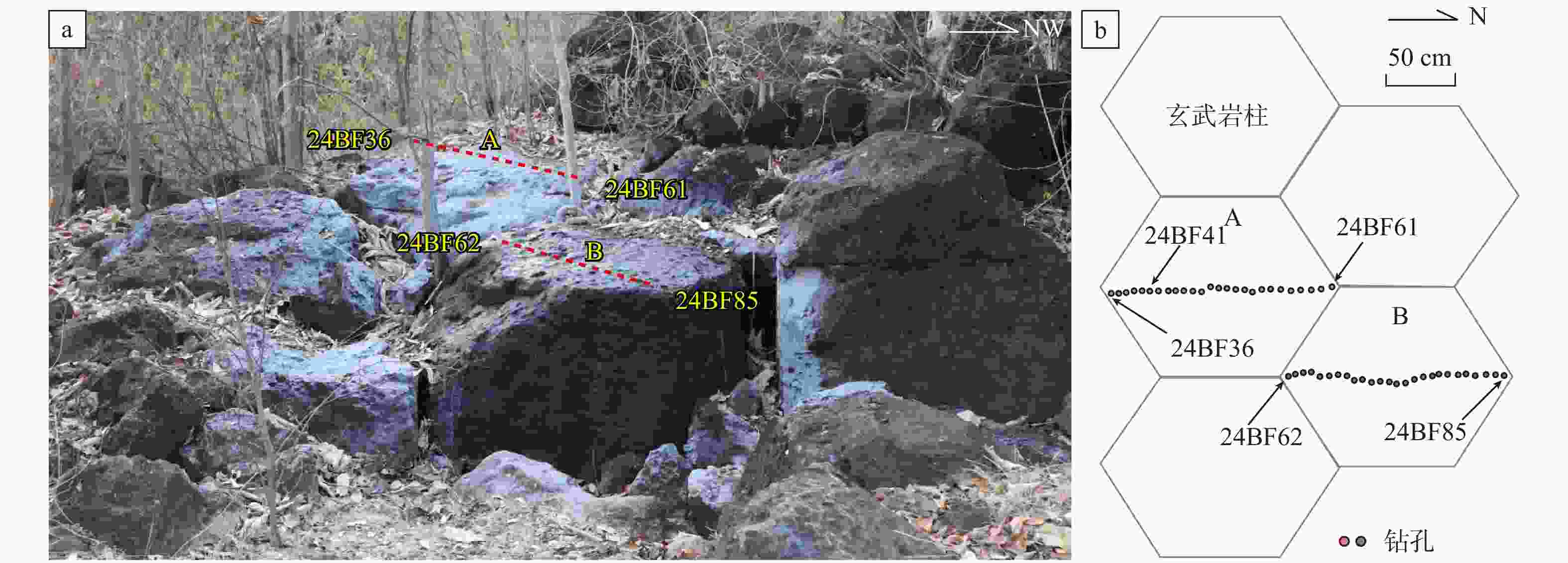
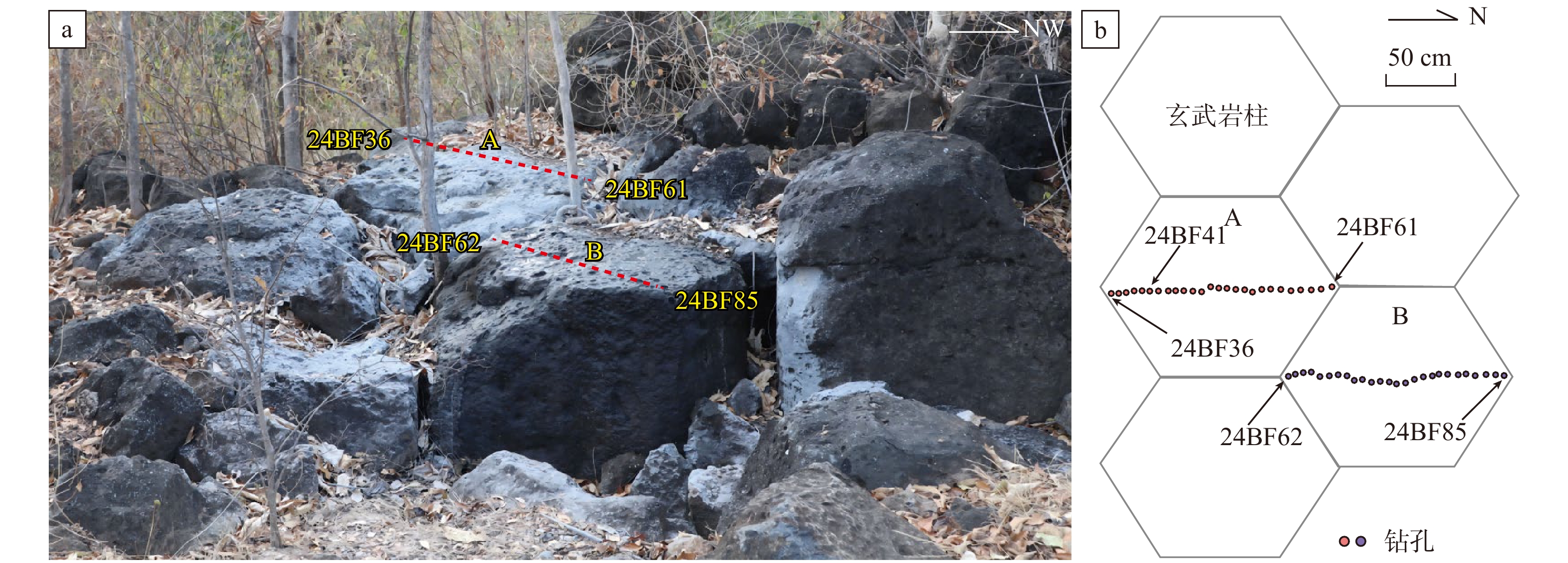
图 2 北碧府Bo Phloi剖面玄武岩柱样品采集示意图
a—Bo Phloi剖面玄武岩柱A和玄武岩柱B;b—古地磁样品采集示意图
Figure 2. Schematic diagram of sampling sites on basalt columns in the Bo Phloi section, Kanchanaburi
(a) Basalt columns A and B in the Bo Phloi section; (b) Schematic illustration of sample collection
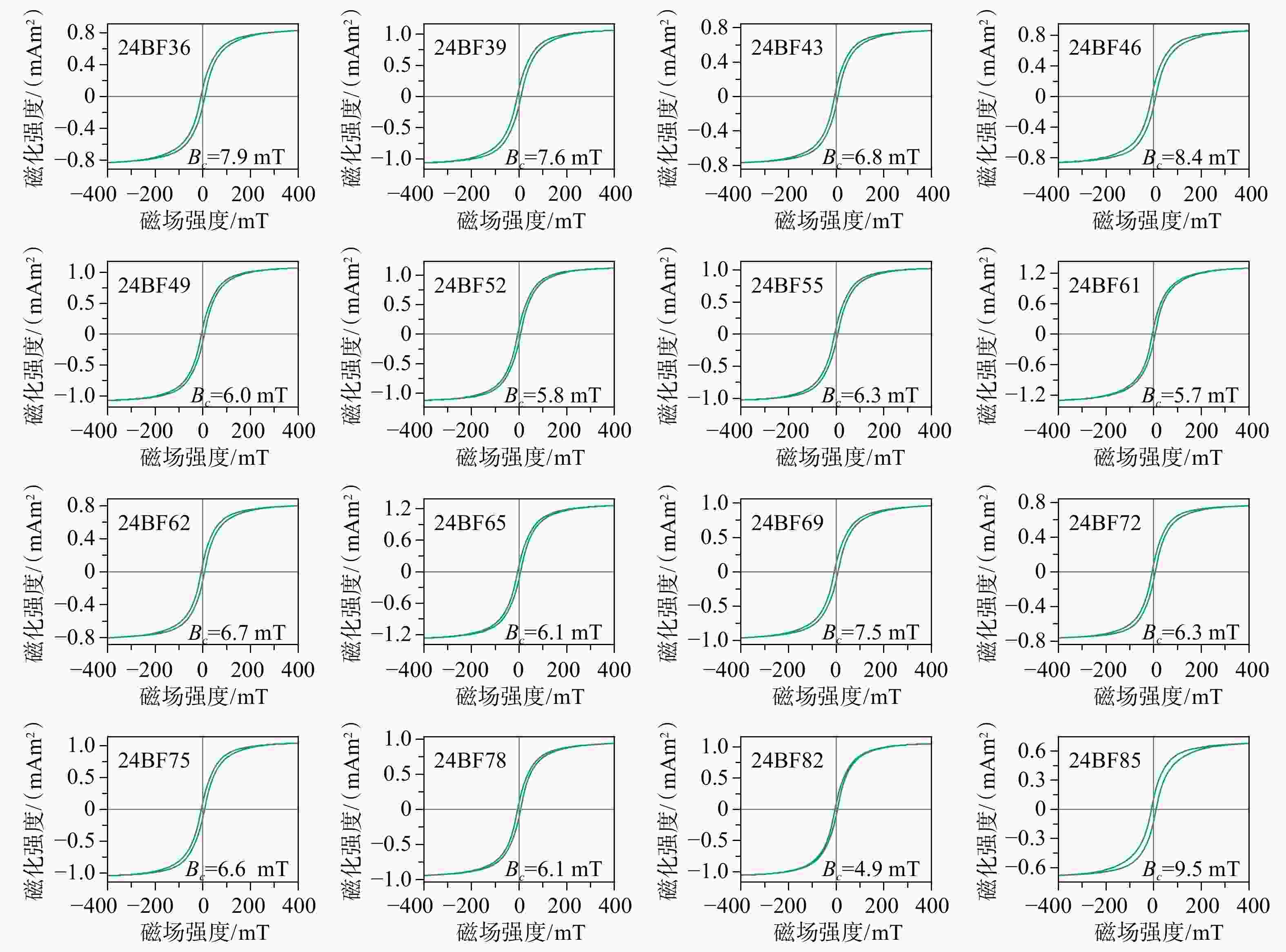
图 3 玄武岩柱代表性样品的磁滞回线
Bc—矫顽力
Figure 3. Hysteresis loops of representative samples from basalt columns
Bc–coercivity
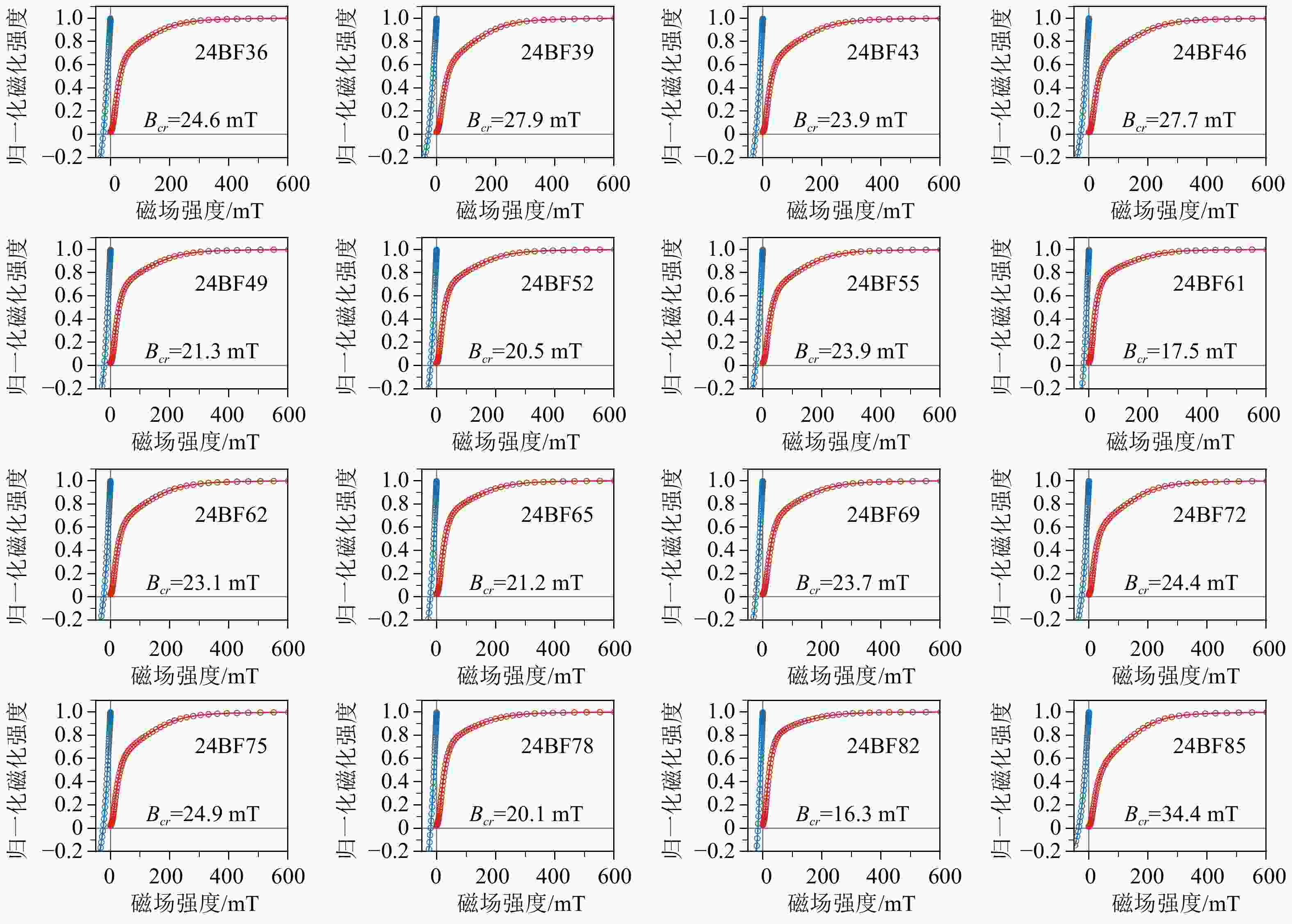
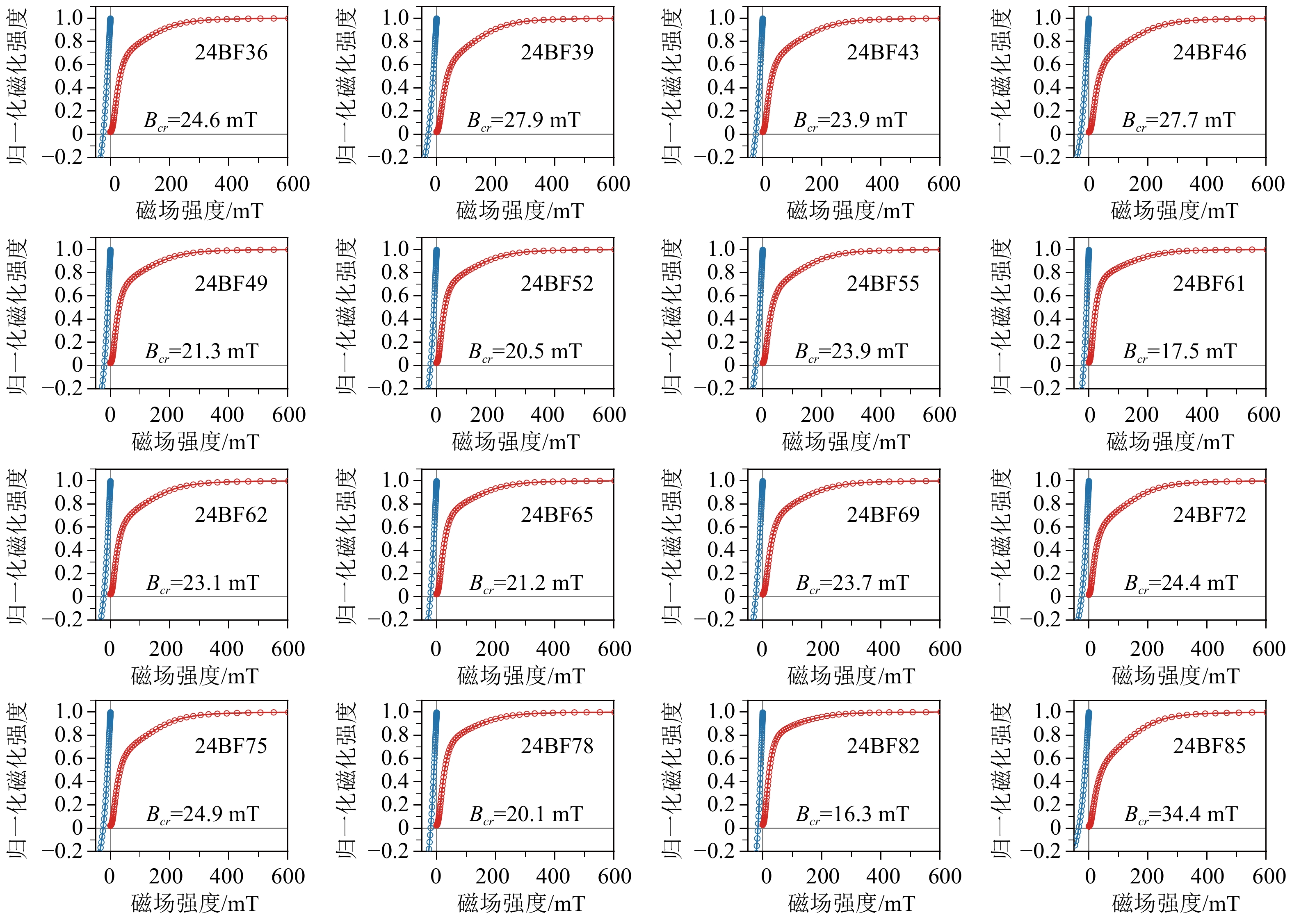
图 4 玄武岩柱代表性样品的等温剩磁获得曲线及反向退磁曲线
Bcr—剩磁矫顽力
Figure 4. Isothermal remanent magnetization (IRM) acquisition and back-field demagnetization curves of representative samples from basalt columns
Bcr–remanent coercivity
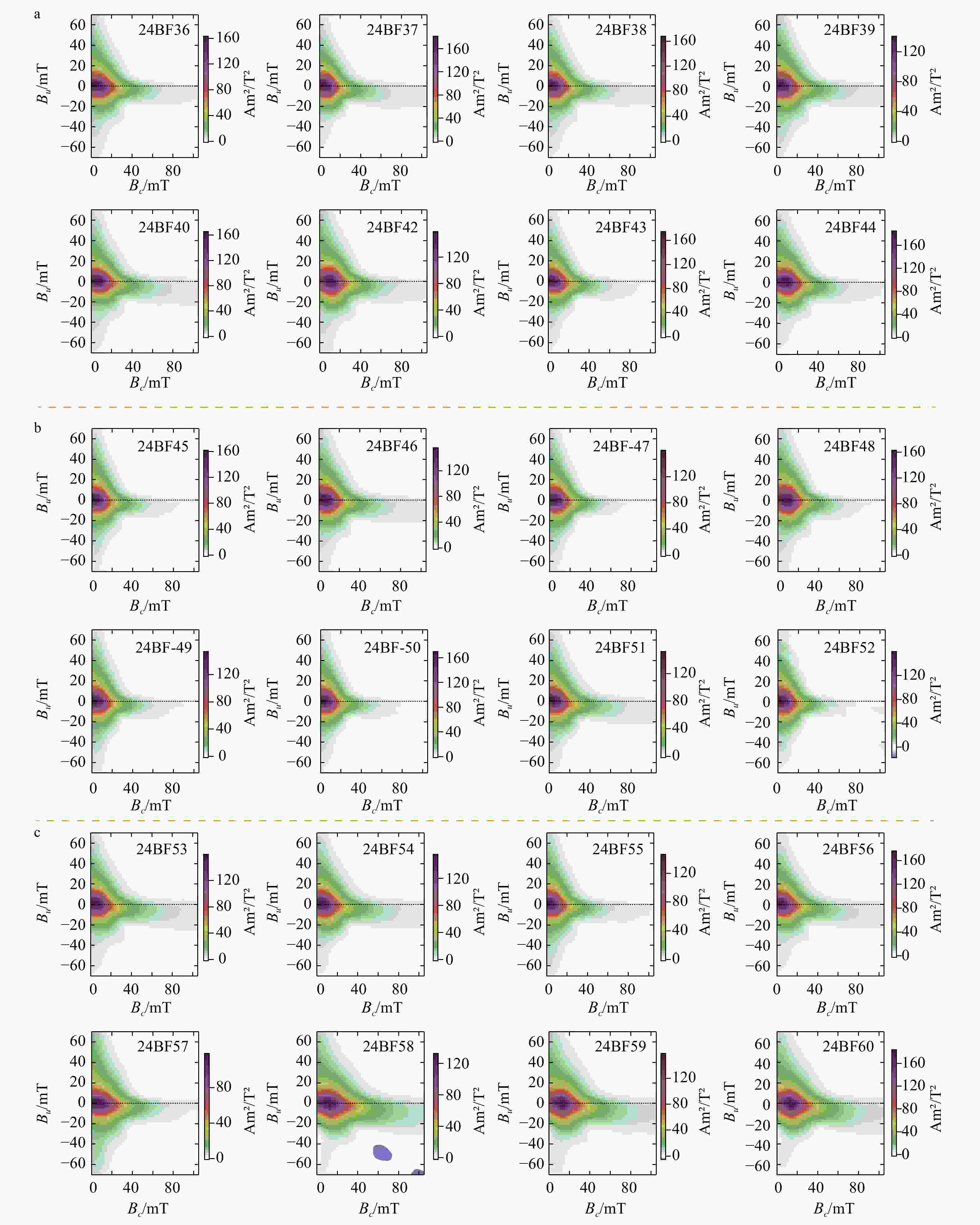
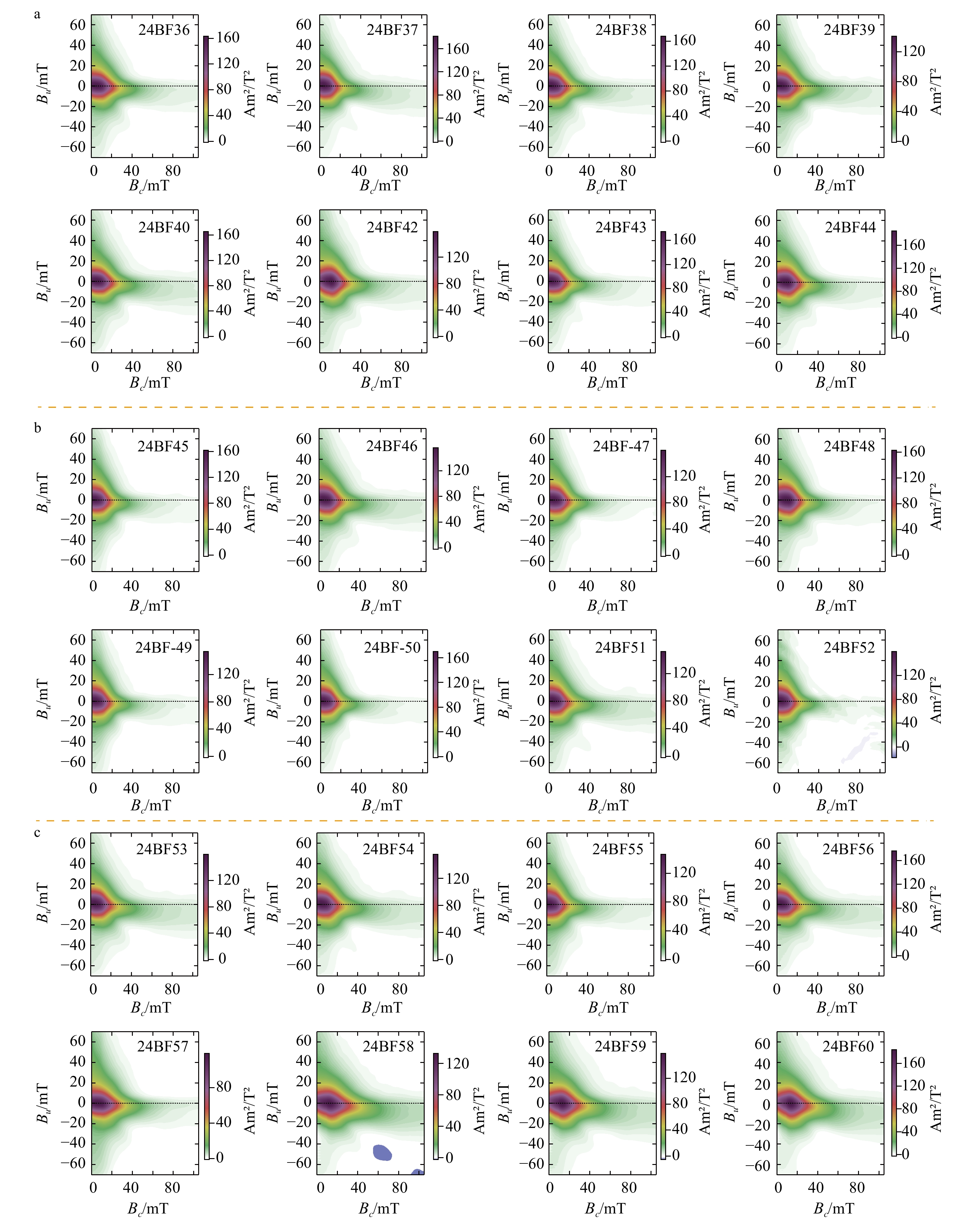
图 5 玄武岩柱A样品的一阶反转曲线(FORC)图
颜色柱代表FORC分布密度函数的数值大小;Bc—矫顽力;Bu—磁相互作用场a—玄武岩柱A西侧8个样品的FORC图;b—玄武岩柱A中部8个样品的FORC图;c—玄武岩柱A东侧8个样品的FORC图
Figure 5. First-order reversal curve (FORC) diagrams of samples from basalt column A
(a) FORC diagrams for eight samples from the western side of basalt column A; (b) FORC diagrams for eight samples from the central part of basalt column A; (c) FORC diagrams for eight samples from the eastern side of basalt column AThe color scale represents the numerical magnitude of the FORC distribution function; Bc–coercivity; Bu–magnetic interaction field
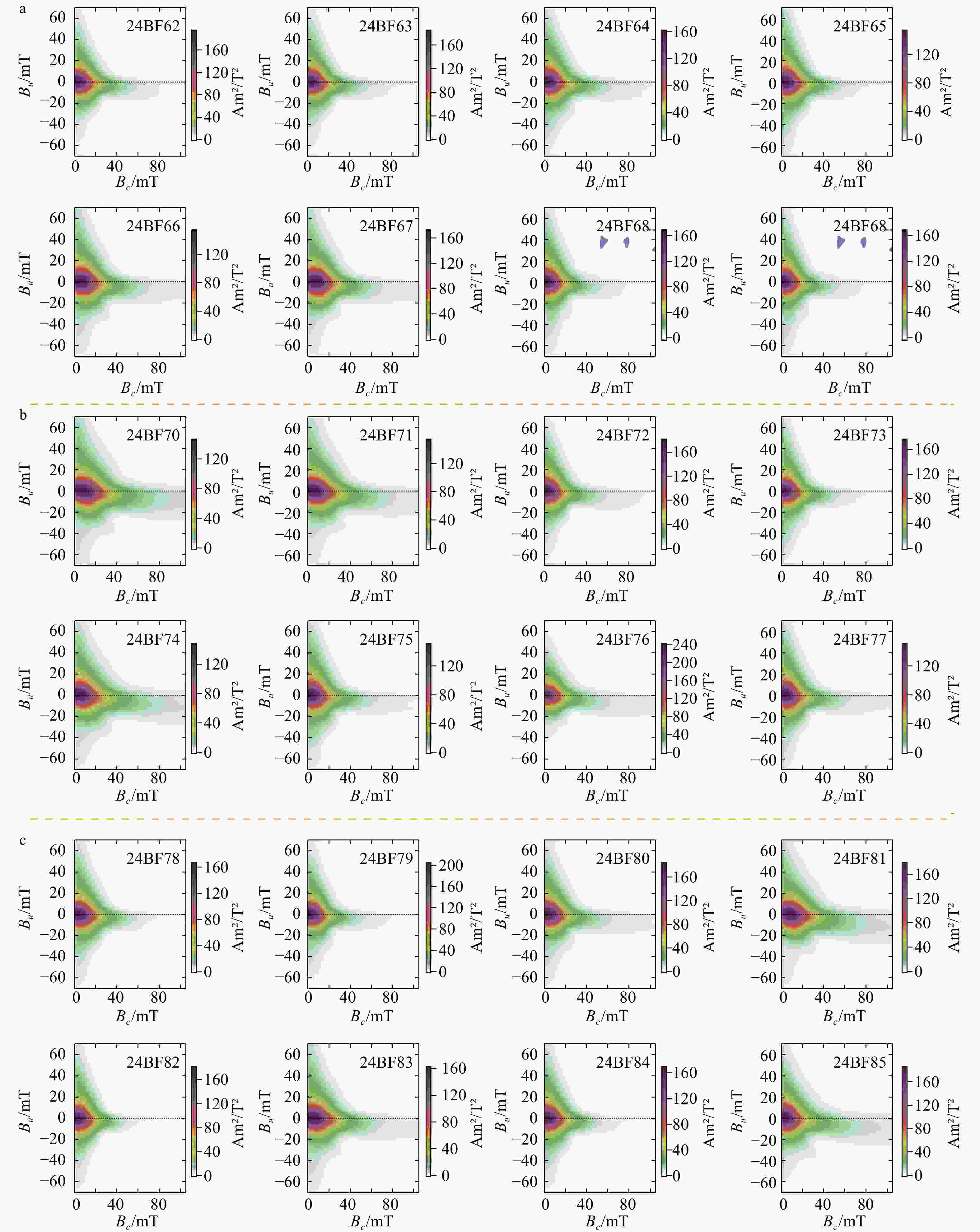
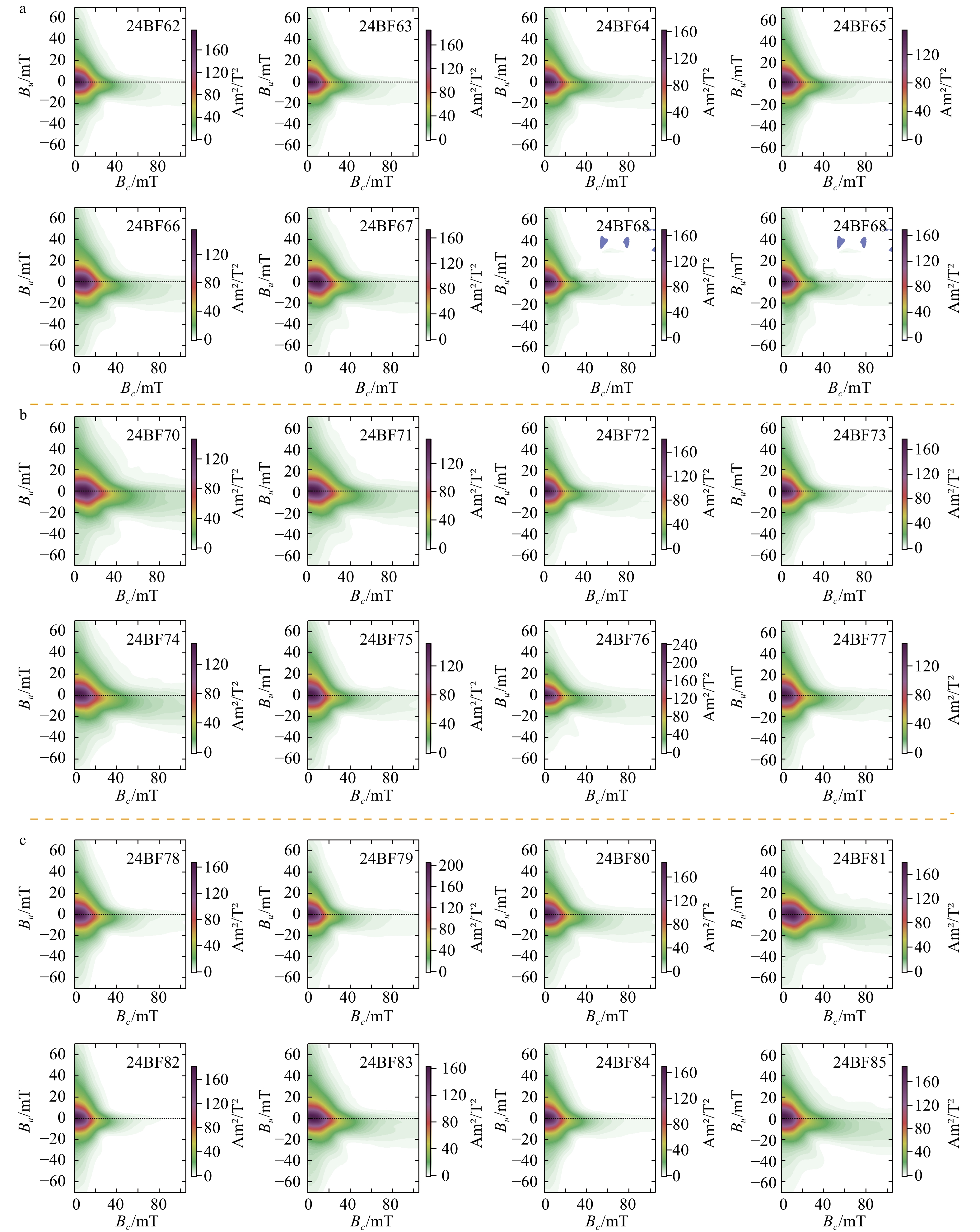
图 6 玄武岩柱B样品的一阶反转曲线(FORC)图
颜色柱代表FORC分布密度函数的数值大小;Bc—矫顽力;Bu—磁相互作用场a—玄武岩柱B西侧8个样品的FORC 图;b—玄武岩柱B中部8个样品的FORC图;c—玄武岩柱B东侧8个样品的FORC 图
Figure 6. First-order reversal curve (FORC) diagrams of samples from basalt column B
(a) FORC diagrams for eight samples from the western side of basalt column B; (b) FORC diagrams for eight samples from the central part of basalt column B; (c) FORC diagrams for eight samples from the eastern side of basalt column BThe color scale represents the numerical magnitude of the FORC distribution function; Bc–coercivity; Bu–magnetic interaction field
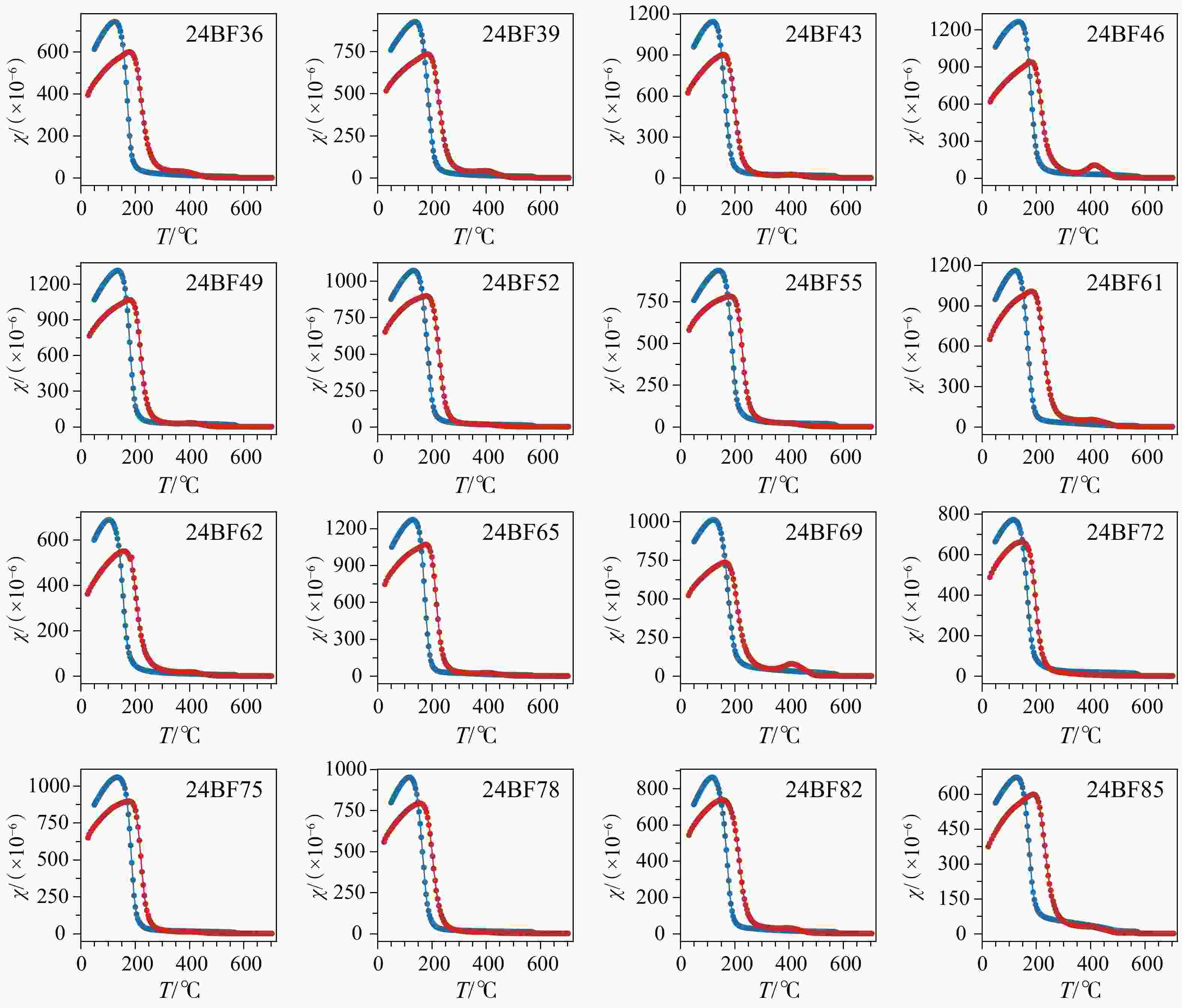
图 7 玄武岩柱代表性样品的体磁化率−温度(χ-T)变化曲线
χ—体磁化率;T—温度
Figure 7. Temperature dependence of magnetic susceptibility (χ–T) for representative samples from basalt columns
χ–magnetic susceptibility; T–temperature
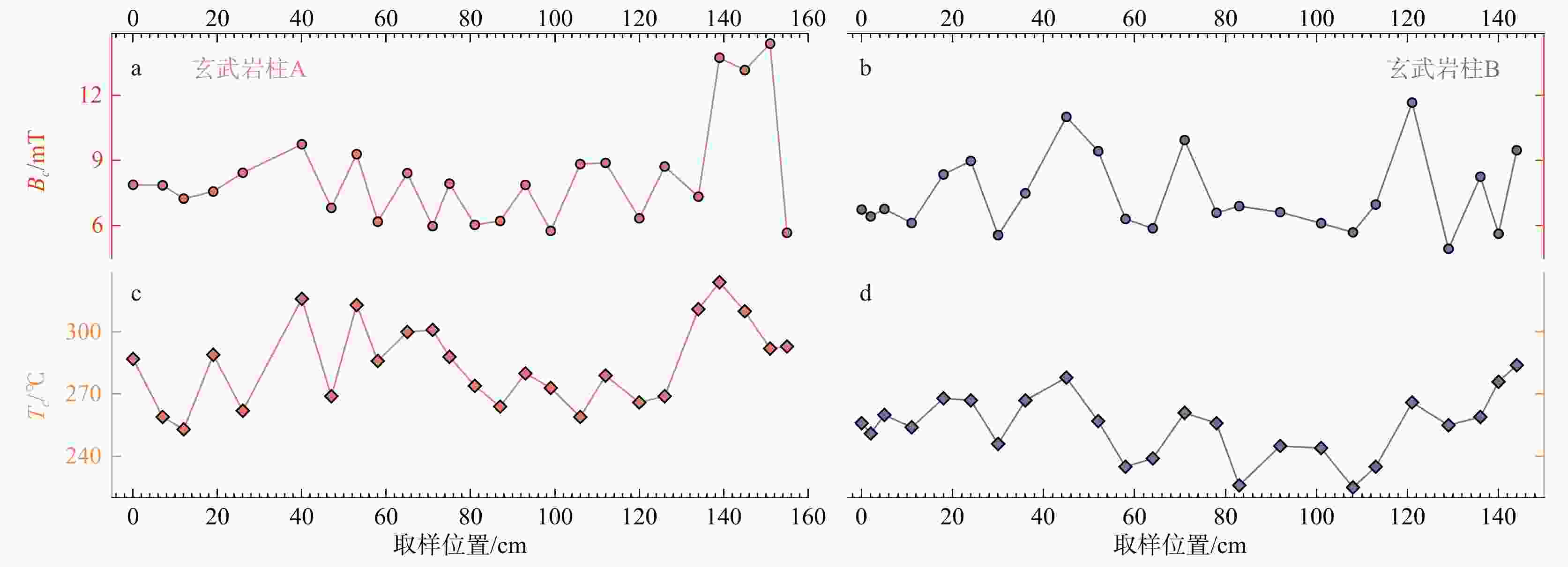
图 8 玄武岩柱A和玄武岩柱B样品的矫顽力和居里温度变化
Bc—矫顽力;Tc—居里温度a—玄武岩柱A样品的Bc变化;b—玄武岩柱B样品的Bc变化;c—玄武岩柱A样品的Tc变化;d—玄武岩柱B样品的Tc变化
Figure 8. Variations in coercivity (Bc) and Curie temperature (Tc) of samples from basalt columns A and B
(a) Variations in Bc of samples from basalt column A; (b) Variations in Bc of samples from basalt column B; (c) Variations in Tc of samples from basalt column A; (d) Variations in Tc of samples from basalt column BBc–coercivity; Tc–Curie temperature
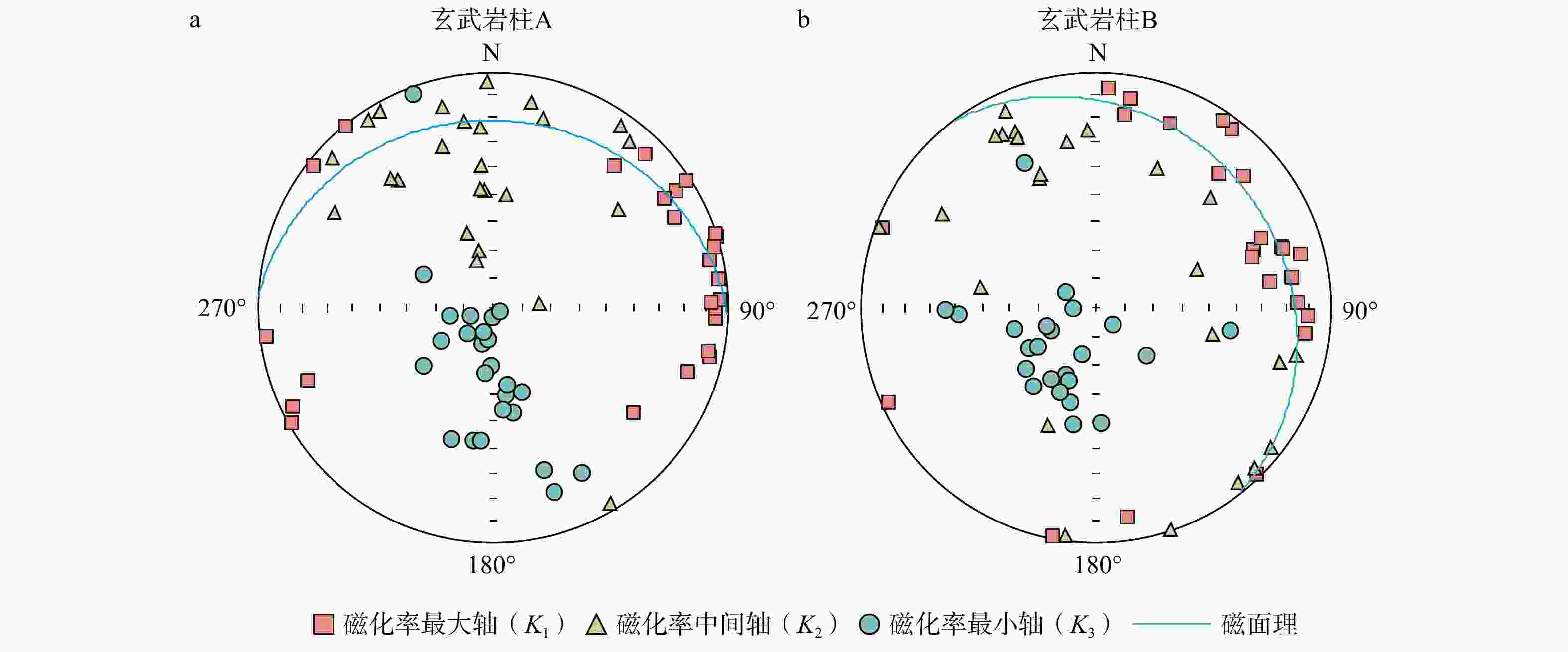
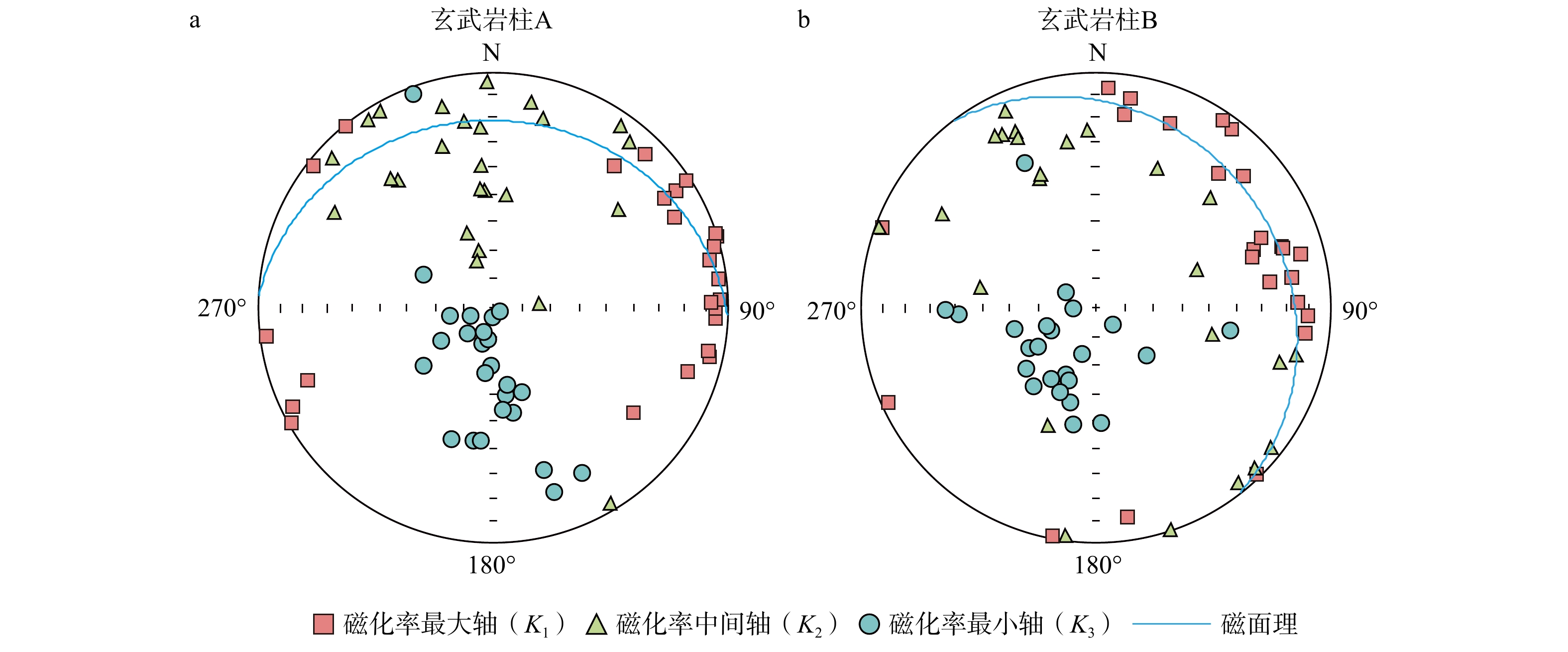
图 9 玄武岩柱A和玄武岩柱B 的磁化率各向异性(AMS)结果
a—玄武岩柱A的AMS结果;b—玄武岩柱B的AMS结果;
Figure 9. Anisotropy of magnetic susceptibility (AMS) of basalt columns A and B
(a) AMS results for basalt column A; (b) AMS results for basalt column B
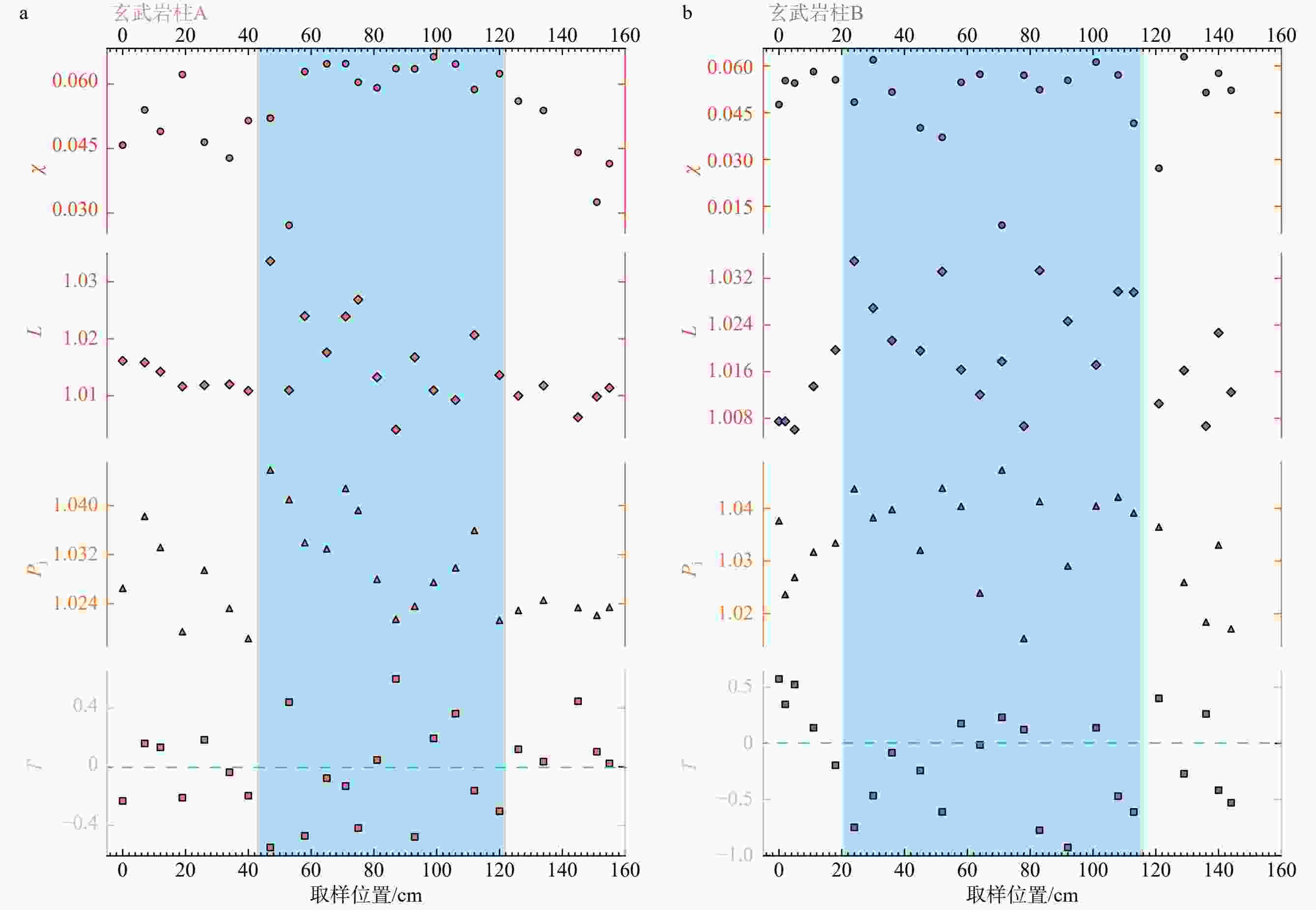
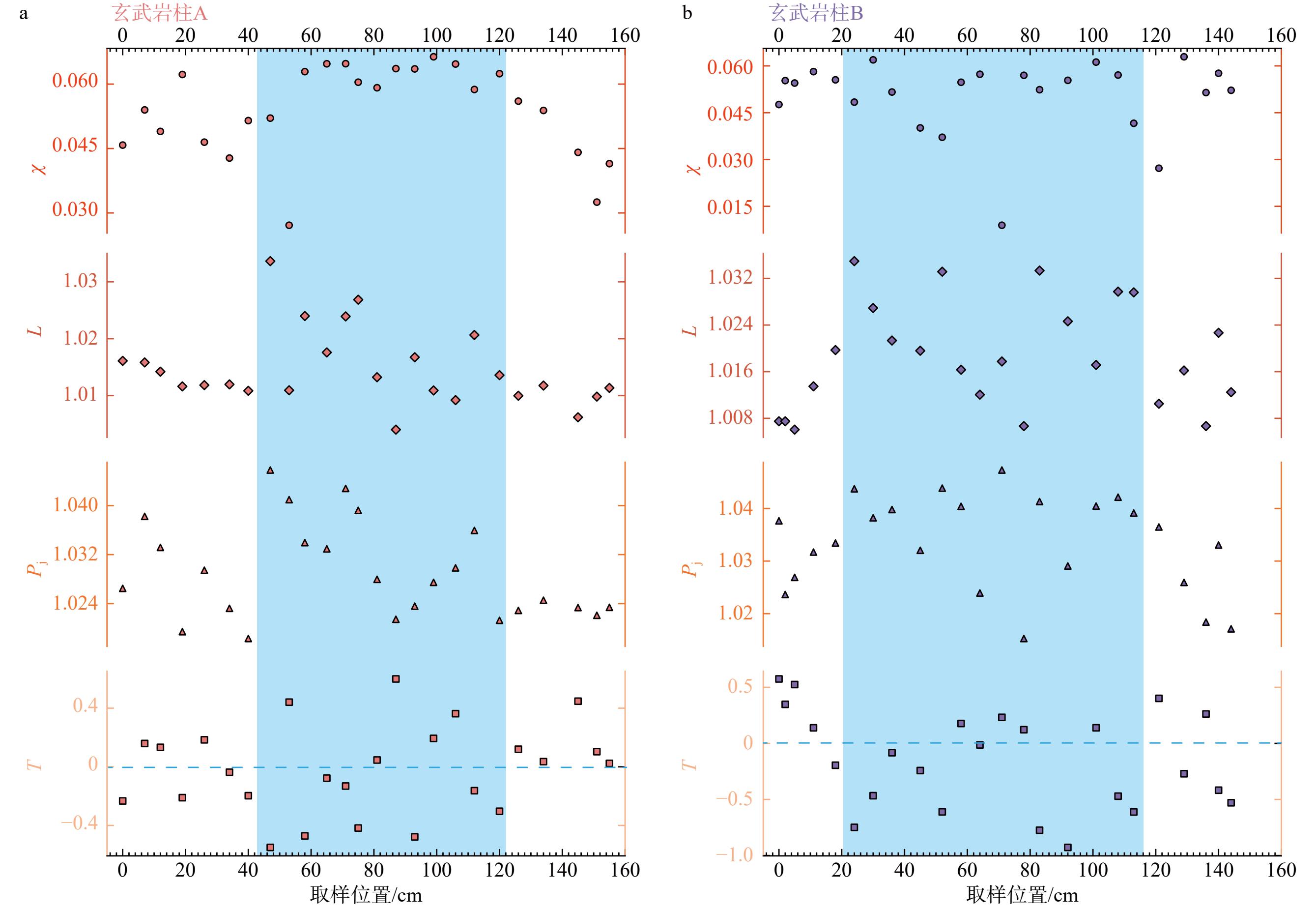
图 10 玄武岩柱A和玄武岩柱B 样品的磁化率椭球参数
χ—体磁化率;L—线理度;Pj—各向异性度;T—形状因子a—玄武岩柱A样品的磁化率椭球参数;b—玄武岩柱B样品的磁化率椭球参数
Figure 10. Magnetic susceptibility ellipsoid parameters of samples from basalt columns A and B
(a) Magnetic susceptibility ellipsoid parameters for samples of basalt column A; (b) Magnetic susceptibility ellipsoid parameters for samples of basalt column Bχ–bulk magnetic susceptibility; L–magnetic lineation; Pj–corrected anisotropy degree; T–shape parameter
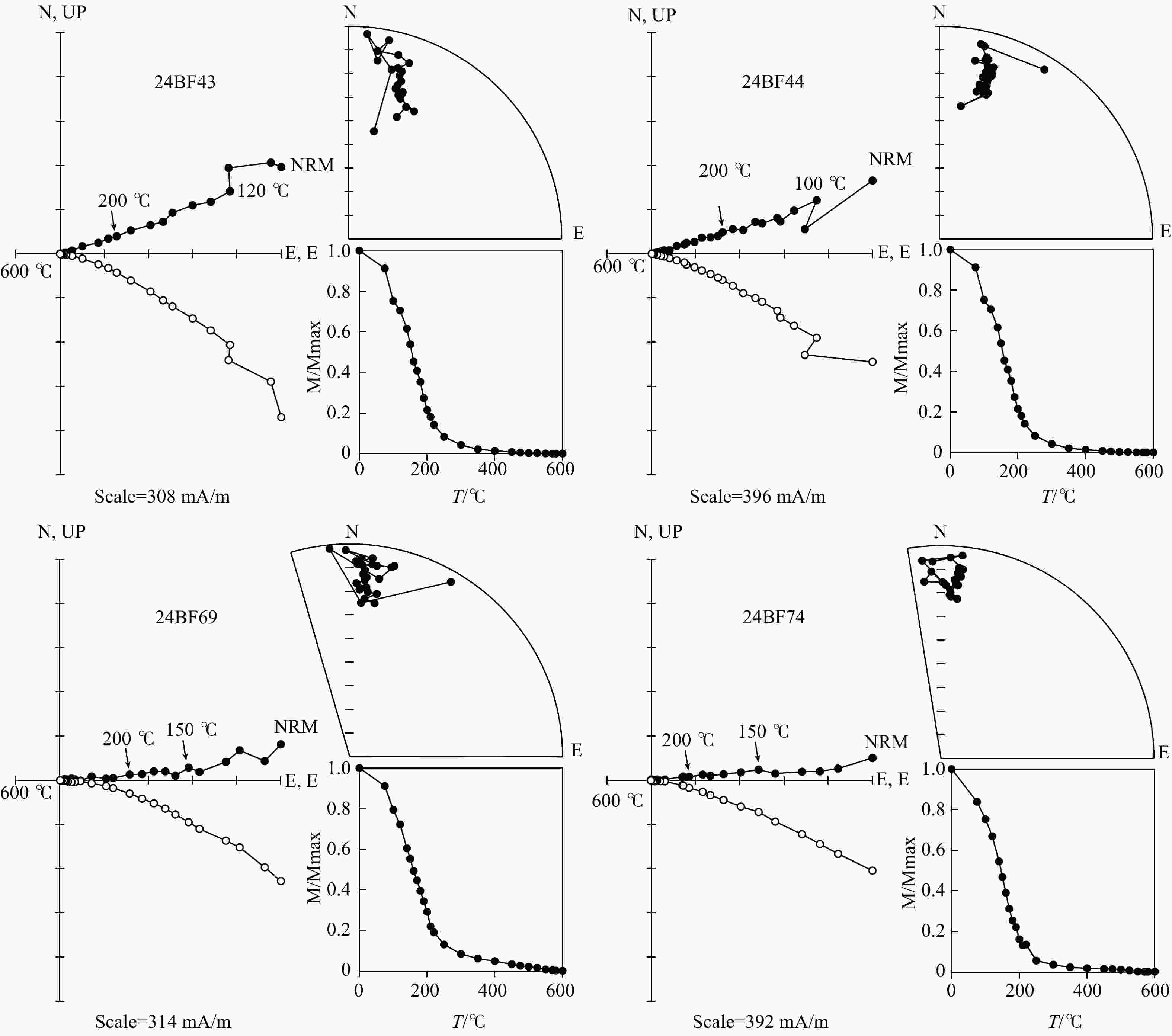
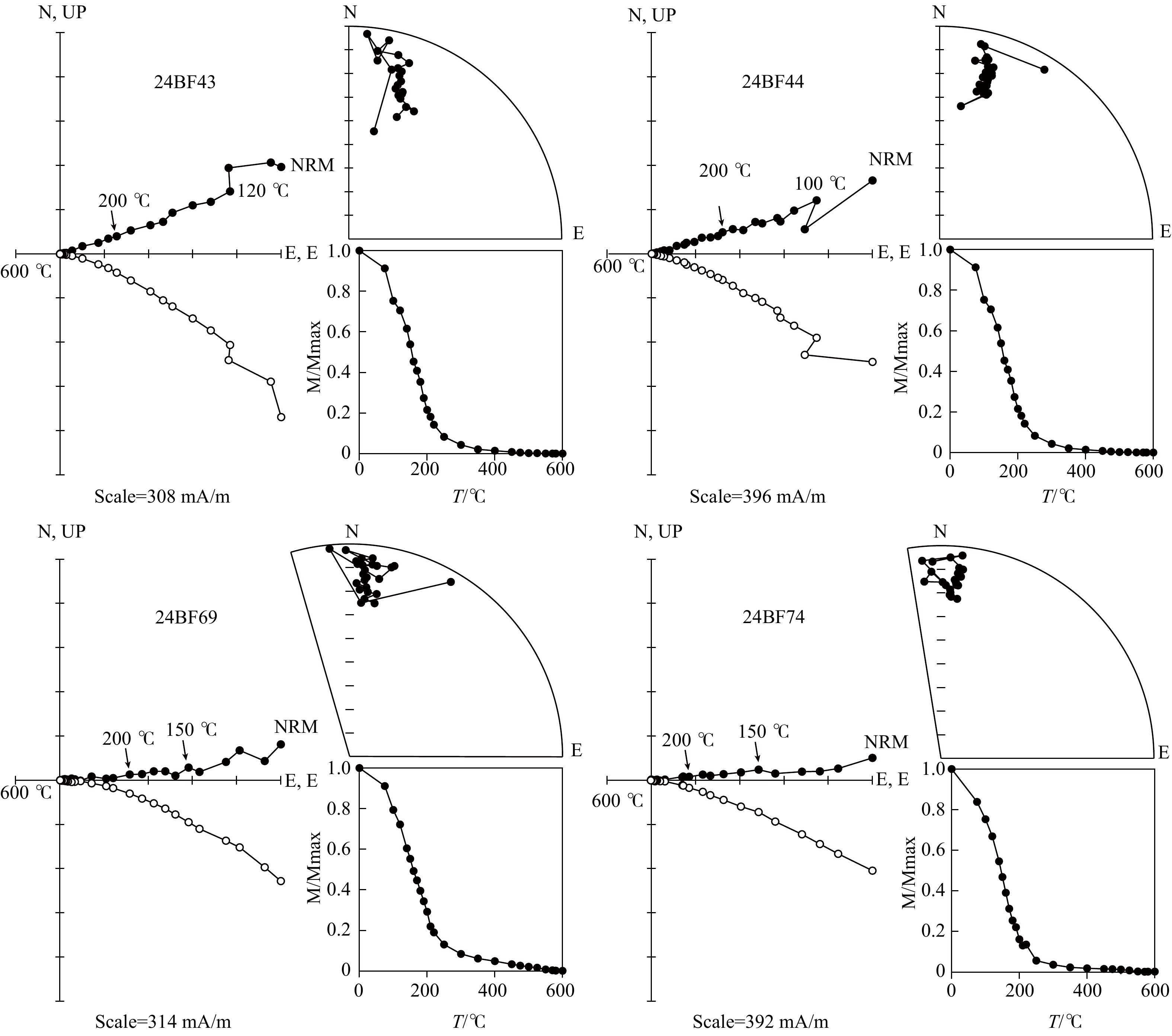
图 11 玄武岩柱代表性样品在地理坐标系下的退磁正交矢量投影图
空心和实心圆分别代表矢量在直立面和水平面上的投影;Scale代表坐标轴上每一个小格所代表的数值;T为温度;M/Max代表磁化强度/最大磁化强度
Figure 11. Orthogonal vector projection (Zijderveld diagrams) of representative basalt column samples during demagnetization in geographic coordinates
Open and solid circles represent vector endpoints projected onto the vertical and horizontal planes, respectively; T–temperature; Scale–value per division; M/Max–Magnetization/Maximum magnetization
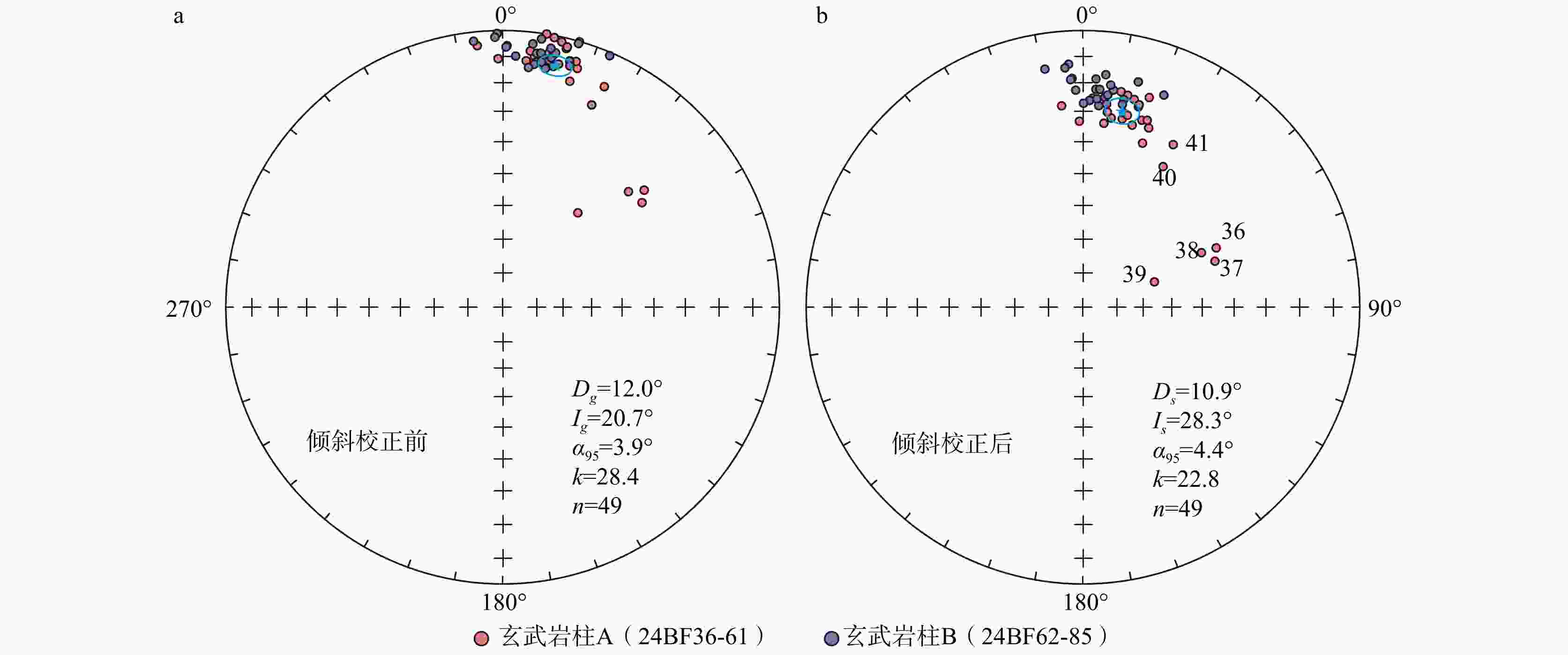
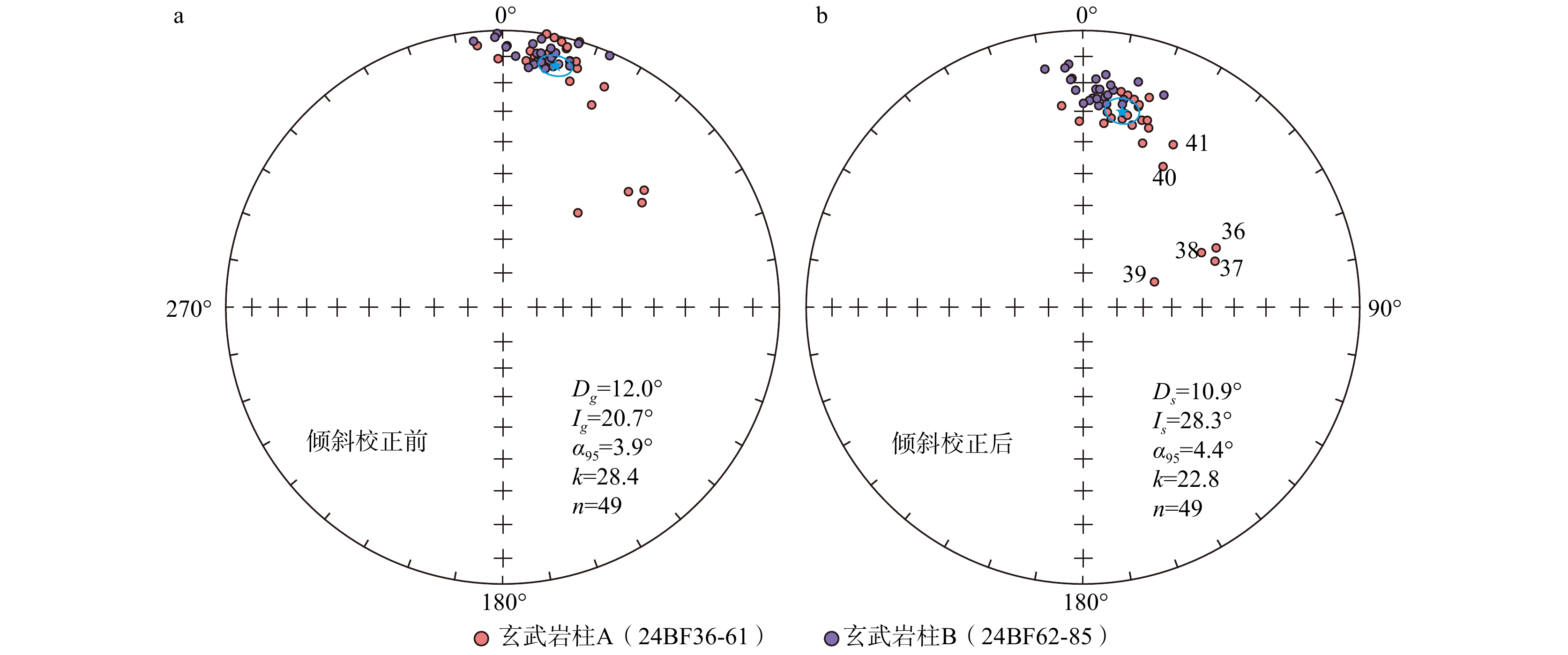
图 12 玄武岩柱样品特征剩磁方向的等面积投影图
数字代表样品24BF36、24BF37、24BF38、24BF39、24BF40、24BF41;Dg/Ig (Ds/Is)—地理(地层)坐标系下的倾向/倾角;α95— 95%置信区间;k—精读参数;n—样品数量a—倾斜校正前的特征剩磁方向;b—倾斜校正后的特征剩磁方向
Figure 12. Equal-area projections of ChRM directions for basalt column samples
(a) ChRM directions before tilt correction; (b) ChRM directions after tilt correctionNumbers in Fig. 12b correspond to samples 24BF36, 24BF37, 24BF38, 24BF39, 24BF40, and 24BF41; Dg/Ig (Ds/Is)–declination/ inclination in geographic (stratigraphic) coordinates; α95–radius of 95% confidence circle; k–fisher precision parameter; n–number of samples
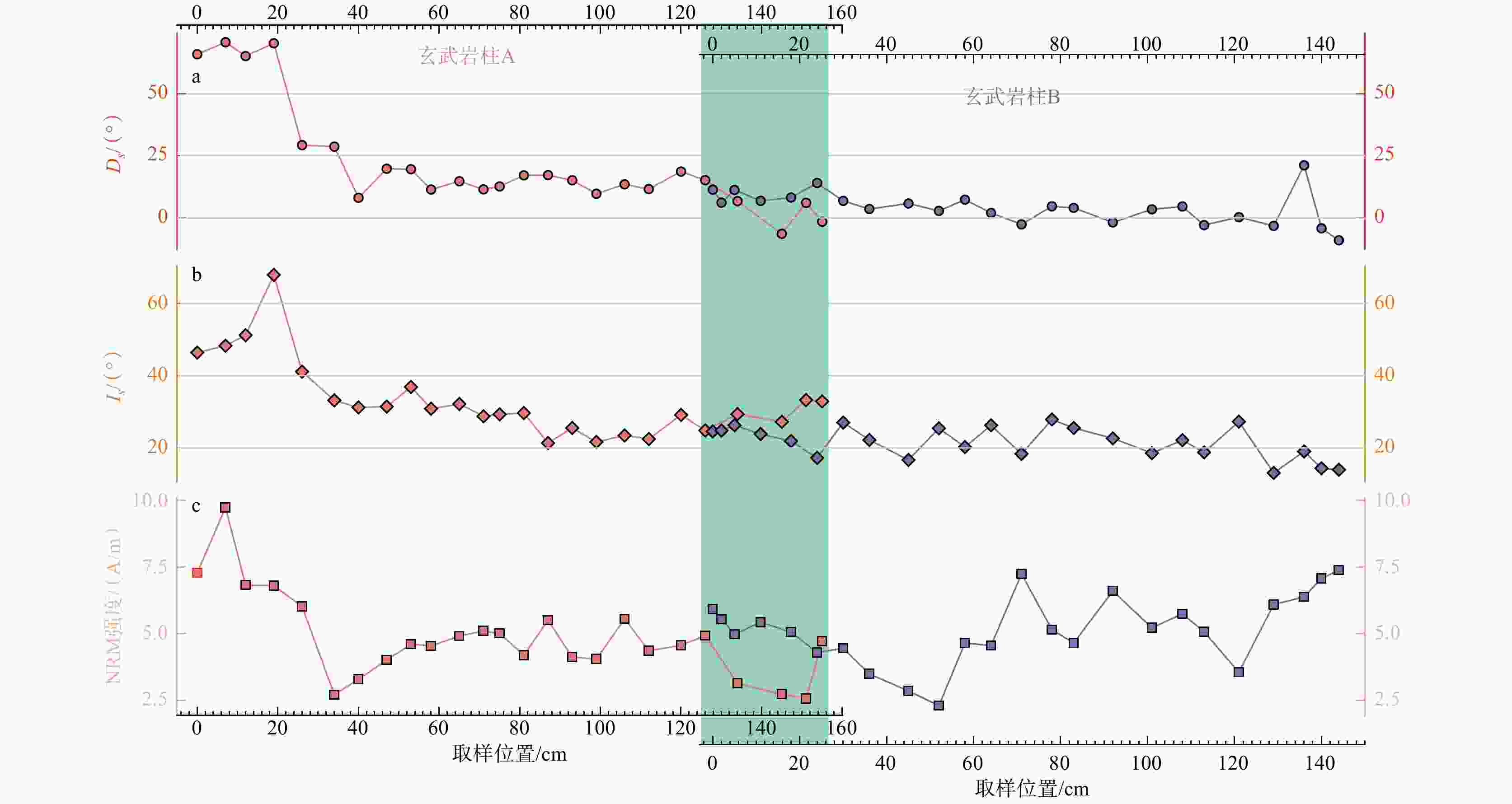
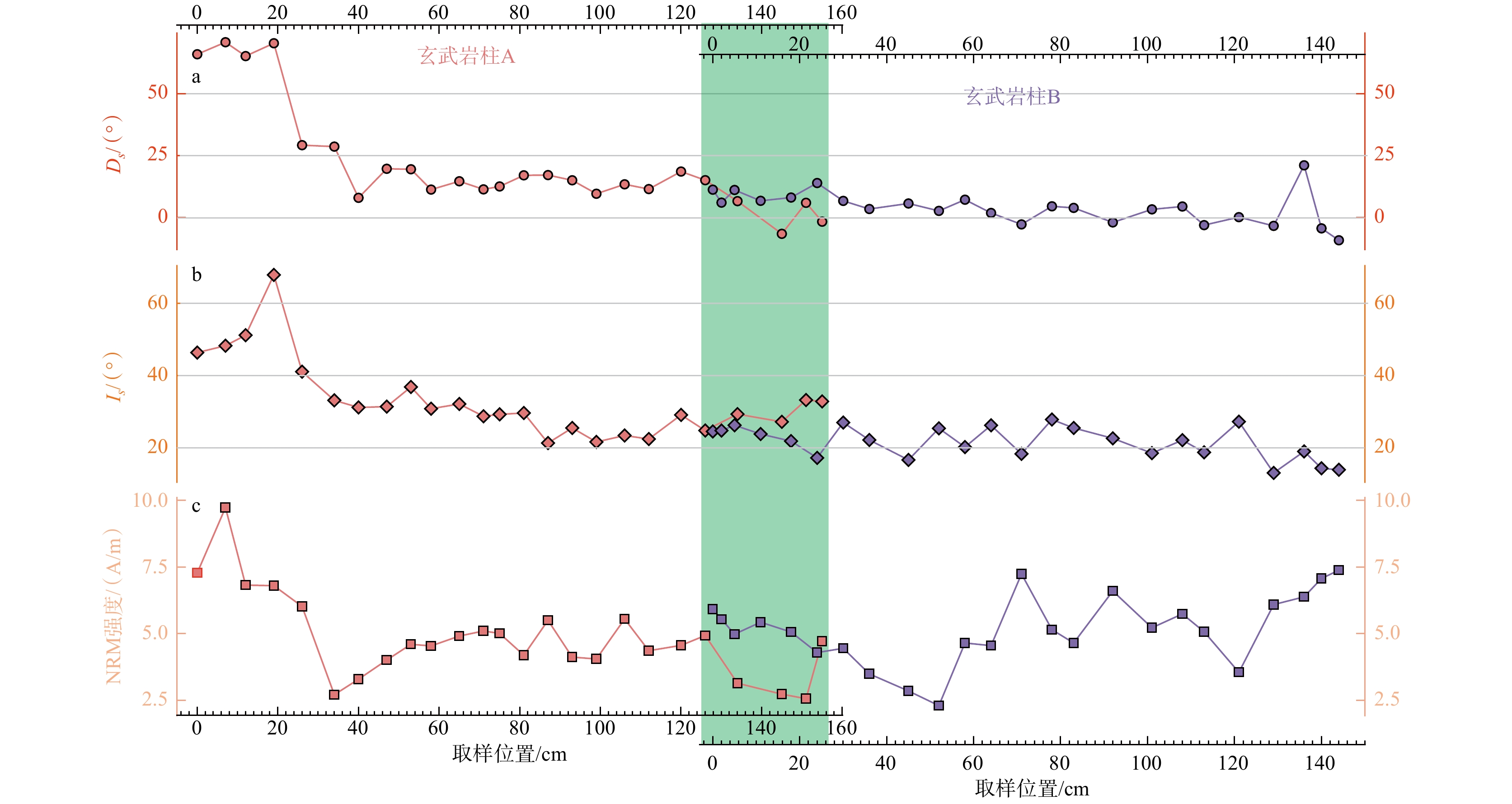
图 13 玄武岩柱A和玄武岩柱B样品的磁偏角 (Ds)、磁倾角 (Is) 和天然剩磁(NRM)强度
绿色阴影代表2个柱体的空间位置相互交错的部分a—Ds变化;b—Is变化;c—NRM强度变化
Figure 13. Declination (Ds), inclination (Is), and natural remanent magnetization (NRM) of samples from basalt columns A and B
(a) Variations in declination (Ds); (b) Variations in inclination (Is); (c) Variations in natural remanent (NRM) magnetizationGreen shading indicates the spatially overlapping portions of the two columns
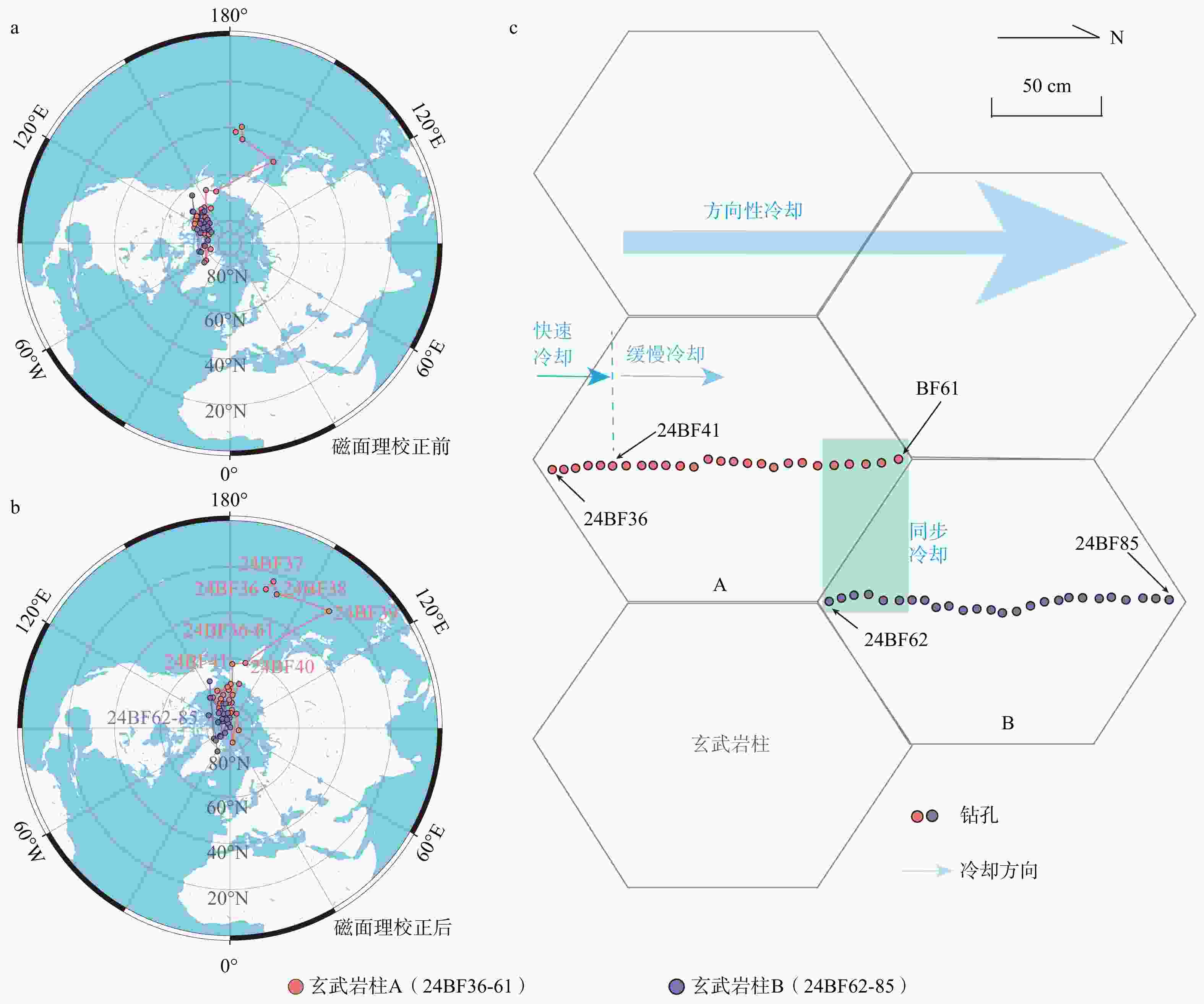
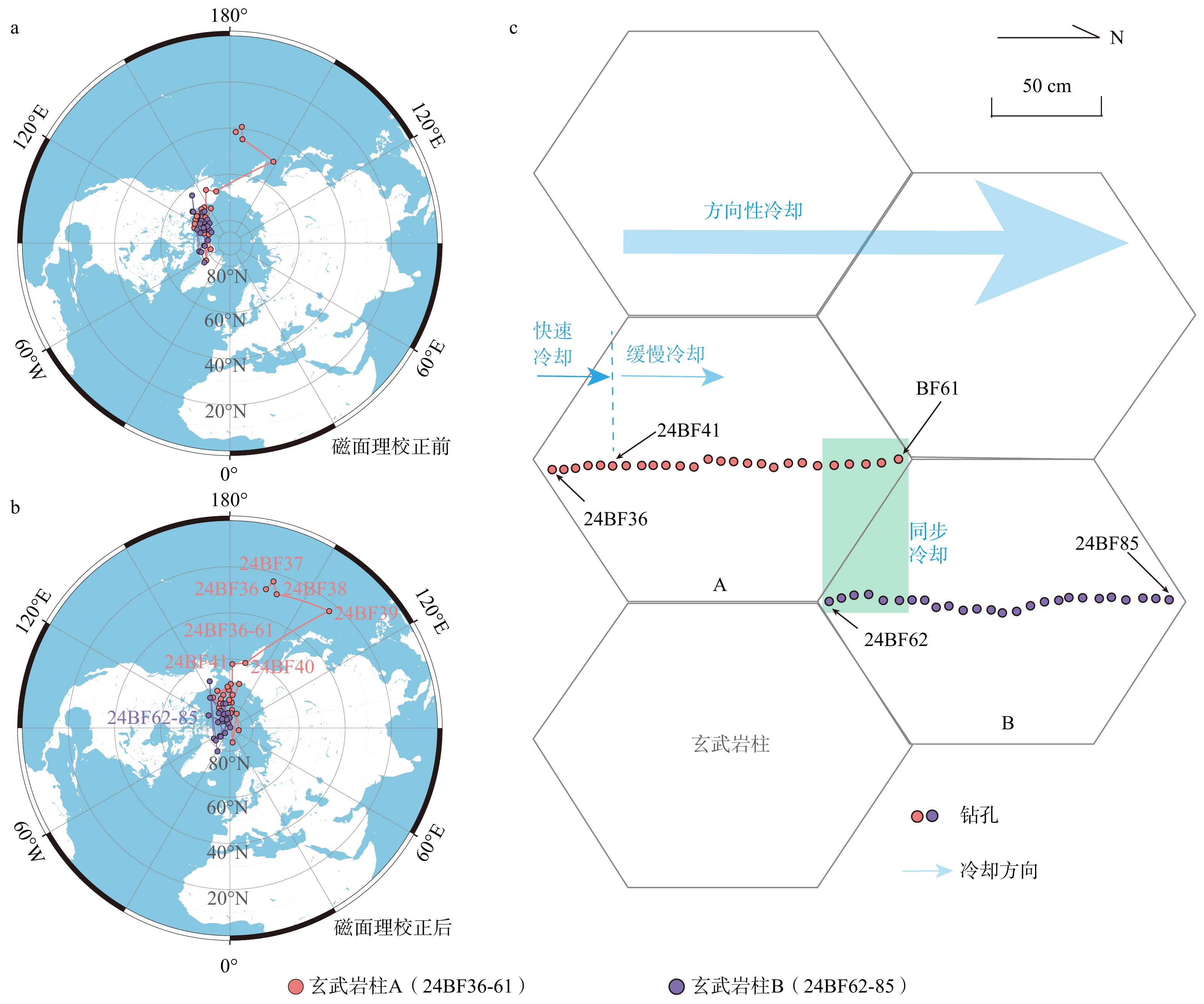
图 14 玄武岩柱样品的虚地磁极(VGPs)变化及柱状玄武岩的冷却模式图
蓝色虚线代表冷却速率发生变化的位置;绿色阴影代表2个柱体的空间位置相互交错的部分a—玄武岩柱样品磁面理校正前的VGPs;b—玄武岩柱样品磁面理校正后的VGPs;c—柱状玄武岩的冷却模式图
Figure 14. Variations in virtual geomagnetic poles (VGPs) of samples from two basalt columns A and B and a schematic cooling model for columnar basalt
(a) VGPs of samples from basalt columns A and B before bedding tilt correction;(b) VGPs of samples from basalt columns A and B after tilt correction;(c) Schematic cooling process of the columnar basaltBlue dashed lines indicate positions where cooling rate changes; green shading indicates the spatially overlapping portions of the two columns.
表 1 玄武岩柱A和玄武岩柱B样品的特征剩磁方向
Table 1. Characteristic remanent magnetization (ChRM) directions of samples from basalt columns A and B
样品号 采样点纬度/(°) 采样点经度/(°) 磁面理产状/(°)
(倾向/倾角)退磁步骤 Steps Dg/(°) Ig/(°) Ds/(°) Is/(°) MAD/(°) 玄武岩柱A 24BF36 14.33 99.52 181.9/21.6 T250-T600 12 50.4 34.2 65.9 46.4 3.3 24BF37 14.33 99.52 181.9/21.6 T220-T600 14 53.1 37.3 70.7 48.3 1.4 24BF38 14.33 99.52 181.9/21.6 T180-T600 17 47.4 38.4 65.1 51.2 1.5 24BF39 14.33 99.52 181.9/21.6 T190-T600 15 38.5 54.2 70.3 68.0 1.6 24BF40 14.33 99.52 181.9/21.6 T350-T600 10 23.7 21.4 29.2 41.1 4.9 24BF41 14.33 99.52 181.9/21.6 T250-T600 12 24.7 13.5 28.7 33.2 3.3 24BF42 14.33 99.52 181.9/21.6 T300-T600 11 7.2 9.7 8.0 30.5 3.1 24BF43 14.33 99.52 181.9/21.6 T250-T600 12 17.3 10.7 19.7 31.4 3.5 24BF44 14.33 99.52 181.9/21.6 T250-T600 12 16.5 16.1 19.5 36.9 2.2 24BF45 14.33 99.52 181.9/21.6 T210-T600 14 10.1 9.5 11.3 30.9 3.2 24BF46 14.33 99.52 181.9/21.6 T190-T600 16 12.9 11.0 14.7 32.1 1.9 24BF47 14.33 99.52 181.9/21.6 T250-T600 12 10.3 7.4 11.4 28.7 2.0 24BF48 14.33 99.52 181.9/21.6 T200-T600 15 11.3 8.0 12.6 29.3 2.0 24BF49 14.33 99.52 181.9/21.6 T210-T600 14 15.2 8.7 17.1 29.7 1.8 24BF50 14.33 99.52 181.9/21.6 T250-T600 12 16.1 0.4 17.2 21.3 2.4 24BF51 14.33 99.52 181.9/21.6 T250-T600 12 13.8 4.4 15.1 25.5 3.5 24BF52 14.33 99.52 181.9/21.6 T250-T600 12 9.1 0.2 9.6 21.2 2.2 24BF53 14.33 99.52 181.9/21.6 T250-T600 12 12.5 2.2 13.5 23.4 3.0 24BF54 14.33 99.52 181.9/21.6 T300-T600 11 10.8 1.1 11.5 22.4 4.3 24BF55 14.33 99.52 181.9/21.6 T220-T600 13 16.6 8.3 18.6 29.1 1.7 24BF56 14.33 99.52 181.9/21.6 T350-T600 10 13.9 3.7 14.5 17.4 6.4 24BF57 14.33 99.52 181.9/21.6 T250-T600 12 6.1 7.8 6.7 29.3 1.6 24BF59 14.33 99.52 181.9/21.6 T170-T600 18 354.4 5.8 353.5 27.2 2.4 24BF60 14.33 99.52 181.9/21.6 T220-T600 13 5.4 11.7 6.0 33.3 2.5 24BF61 14.33 99.52 181.9/21.6 T200-T600 15 358.9 11.3 358.4 32.9 2.7 玄武岩柱A(24BF 42-61)剩磁平均方向 25 16.1 13.7 18.7 34.1 7.0 玄武岩柱B 24BF62 14.33 99.52 232.9/20.2 T250-T600 12 15.2 8.9 11.3 24.8 2.0 24BF63 14.33 99.52 232.9/20.2 T180-T600 17 10.6 10.3 6.1 25.0 1.5 24BF64 14.33 99.52 232.9/20.2 T210-T600 14 15.5 10.6 11.2 26.5 1.9 24BF65 14.33 99.52 232.9/20.2 T200-T600 15 11.0 9.2 6.8 24.1 2.3 24BF66 14.33 99.52 232.9/20.2 T300-T600 11 11.7 7.0 8.2 22.1 4.0 24BF67 14.33 99.52 232.9/20.2 T350-T600 10 16.0 1.2 14.5 15.1 3.0 24BF68 14.33 99.52 232.9/20.2 T190-T600 16 11.8 12.3 6.8 27.3 3.0 24BF69 14.33 99.52 232.9/20.2 T400-T600 9 7.6 8.4 3.5 22.4 3.0 24BF70 14.33 99.52 232.9/20.2 T350-T600 10 8.2 2.5 7.0 12.0 4.2 24BF71 14.33 99.52 232.9/20.2 T250-T600 12 7.8 11.7 2.8 25.7 2.8 24BF72 14.33 99.52 232.9/20.2 T250-T600 12 10.5 5.6 7.3 20.4 3.0 24BF73 14.33 99.52 232.9/20.2 T200-T600 15 7.3 12.7 2.0 26.5 2.1 24BF74 14.33 99.52 232.9/20.2 T250-T600 12 0.9 6.3 357.3 18.6 5.5 24BF75 14.33 99.52 232.9/20.2 T200-T600 15 10.1 13.6 4.6 28.1 1.7 24BF76 14.33 99.52 232.9/20.2 T220-T600 13 8.9 11.5 4.0 25.8 2.2 24BF77 14.33 99.52 232.9/20.2 T200-T600 15 2.9 10.2 358.2 22.9 2.1 24BF78 14.33 99.52 232.9/20.2 T250-T600 12 6.5 4.9 3.4 18.8 1.8 24BF79 14.33 99.52 232.9/20.2 T220-T600 13 8.5 8.1 4.5 22.4 1.9 24BF80 14.33 99.52 232.9/20.2 T250-T600 12 0.7 6.8 357.0 19.0 2.1 24BF81 14.33 99.52 232.9/20.2 T250-T600 12 6.1 14.1 0.3 27.5 2.7 24BF82 14.33 99.52 232.9/20.2 T300-T600 11 358.8 1.4 356.7 13.3 2.7 24BF83 14.33 99.52 232.9/20.2 T350-T600 10 23.0 1.6 21.7 16.0 7.1 24BF84 14.33 99.52 232.9/20.2 T300-T600 11 358.3 2.9 355.7 14.6 2.8 24BF85 14.33 99.52 232.9/20.2 T300-T525 7 353.7 3.9 350.9 14.2 3.4 玄武岩柱B(24BF 62-85)剩磁平均方向 24 8.0 7.8 4.2 21.5 3.0 注:Steps—用于统计特征剩磁方向的点数;Dg/Ig(Ds/Is)—地理(地层)坐标系下的倾向/倾角;MAD—最大角度偏差  下载: 导出CSV
-
[1] ALMQVIST B S G, BOSSHARD S A, HIRT A M, et al., 2012. Internal flow structures in columnar jointed basalt from Hrepphólar, Iceland: II. Magnetic anisotropy and rock magnetic properties[J]. Bulletin of Volcanology, 74(7): 1667-1681. doi: 10.1007/s00445-012-0622-0 [2] AN A R, CHOI S H, YU Y, et al. , 2017. Petrogenesis of Late Cenozoic basaltic rocks from southern Vietnam[J]. Lithos, 272-273: 192-204. [3] AO H, DENG C L, 2007. Review in the identification of magnetic minerals[J]. Progress in Geophysics, 22(2): 432-442. (in Chinese with English abstract) doi: 10.1007/978-94-009-5955-2_3 [4] BARR S M, MACDONALD A S, 1981. Geochemistry and geochronology of Late Cenozoic Basalts of Southeast Asia[J]. Geological Society of America Bulletin, 92(8_Part_II): 1069-1142. doi: 10.1130/gsab-p2-92-1069 [5] BROWN H C, KHAN M A, STACEY F D, 1964. A search for flow structure in columnar basalt using magnetic anisotropy measurements[J]. Pure and Applied Geophysics, 57(1): 61-65. doi: 10.1007/bf00879709 [6] DEFANT M J, MAURY R, JORON J L, et al., 1990. The geochemistry and tectonic setting of the northern section of the Luzon arc (The Philippines and Taiwan)[J]. Tectonophysics, 183(1-4): 187-205. doi: 10.1016/0040-1951(90)90416-6 [7] DUNLOP D J, 1995. Magnetism in rocks[J]. Journal of Geophysical Research: Solid Earth, 100(B2): 2161-2174. doi: 10.1029/94JB02624 [8] ELLWOOD B B, FISK M R, 1977. Anisotropy of magnetic susceptibility variations in a single icelandic columnar basalt[J]. Earth and Planetary Science Letters, 35(1): 116-122. doi: 10.1016/0012-821x(77)90034-6 [9] ELLWOOD B B, 1979. Anisotropy of magnetic susceptibility variations in Icelandic columnar basalts[J]. Earth and Planetary Science Letters, 42(2): 209-212. doi: 10.1016/0012-821X(79)90026-8 [10] FOLEY S, MOLYNEUX T, 1694. An account of the Giants Causway in the north of Ireland: by the reverend Dr. Sam. Foley[J]. Philosophical Transactions, 18(212): 170-182. [11] GILMAN J J, 2009. Basalt columns: large scale constitutional supercooling?[J]. Journal of Volcanology and Geothermal Research, 184(3-4): 347-350. doi: 10.1016/j.jvolgeores.2009.04.017 [12] GOEHRING L, MORRIS S W, 2008. Scaling of columnar joints in basalt[J]. Journal of Geophysical Research: Solid Earth, 113(B10): B10203. doi: 10.1029/2007jb005018 [13] GUO L, CHU Y, LIN W, et al., 2026. Tectonic evolution of the Sumatran Fault: synthesis and perspective[J]. Journal of Geomechanics, 32(2): 312-332. (in Chinese with English abstract) [14] GURIOLI L, PARESCHI M T, ZANELLA E, et al., 2005. Interaction of pyroclastic density currents with human settlements: evidence from ancient Pompeii[J]. Geology, 33(6): 441-444. doi: 10.1130/G21294.1 [15] GUY B, COZE J, 1990. Reflections on columnar jointing of basalts: the instability of the planar solidification front[J]. Comptes Rendus de l'Académie des Sciences Paris, 311: 943-949. [16] GUY B, 2010. Comments on “Basalt columns: large scale constitutional supercooling? by John Gilman (JVGR, 2009) and presentation of some new data [J. Volcanol. Geotherm. Res. 184 (2009), 347–350][J]. Journal of Volcanology and Geothermal Research, 194(1-3): 69-73. doi: 10.1016/j.jvolgeores.2009.09.021 [17] HETÉNYI G, TAISNE B, GAREL F, et al., 2012. Scales of columnar jointing in igneous rocks: field measurements and controlling factors[J]. Bulletin of Volcanology, 74(2): 457-482. doi: 10.1007/s00445-011-0534-4 [18] HROUDA F, 1982. Magnetic anisotropy of rocks and its application in geology and geophysics[J]. Geophysical Surveys, 5(1): 37-82. doi: 10.1007/BF01450244 [19] HSUI A T, 1989. Possible consequences of a fluid dynamic origin for columnar joints in basalts[J]. Archives des Sciences, 42(2): 425-435. [20] HSUI A T, RIAHI D N, 2001. Onset of thermal chemical convection with crystallization and its geological implications[J]. Geochemistry, Geophysics, Geosystems, 2(4): 2000GC000075. doi: 10.1029/2000GC000075 [21] KANTHA L H, 1980. A note on the effect of viscosity on double-diffusive processes[J]. Journal of Geophysical Research: Solid Earth, 85(B8): 4398-4404. doi: 10.1029/JB085iB08p04398 [22] KANTHA L H, 1981. ‘Basalt fingers’ – origin of columnar joints?[J]. Geological Magazine, 118(3): 251-264. doi: 10.1017/S0016756800035731 [23] LAMUR A, LAVALLÉE Y, IDDON F E, et al., 2018. Disclosing the temperature of columnar jointing in lavas[J]. Nature Communications, 9(1): 1432. doi: 10.1038/s41467-018-03842-4 [24] LI C F, XU X, LIN J, et al., 2014. Ages and magnetic structures of the South China Sea constrained by deep tow magnetic surveys and IODP Expedition 349[J]. Geochemistry, Geophysics, Geosystems, 15(12): 4958-4983. doi: 10.1002/2014GC005567 [25] LORE J, GAO H J, AYDIN A, 2000. Viscoelastic thermal stress in cooling basalt flows[J]. Journal of Geophysical Research: Solid Earth, 105(B10): 23695-23709. doi: 10.1029/2000JB900226 [26] MATTSSON H B, CARICCHI L, ALMQVIST B S G, et al., 2011. Melt migration in basalt columns driven by crystallization-induced pressure gradients[J]. Nature Communications, 2: 299. doi: 10.1038/ncomms1298 [27] MOLYNEUX T, 1698. A letter from Dr. Thomas Molyneux, to Dr. Martin Lister, Fellow of the Colledge of Physicians, and of the Royal Society, in, London: containing some additional observations on the Giants Causway in Ireland[J]. Philosophical Transactions, 20(241): 209-223. doi: 10.1098/rstl.1698.0041 [28] MONDAL T K, CHOWDHURY A, SAIN A, et al., 2022. Understanding the maturity of columnar joints and its spatial relationship with eruptive centre: a critical appraisal from the Rajmahal basalt, India[J]. Physics of the Earth and Planetary Interiors, 326: 106867. doi: 10.1016/j.pepi.2022.106867 [29] PAN X Q, SHEN Z Y, CHEN N H, et al., 2011. Emplacement mechanism of diabase dyke swarms in Shengsi Island: evidence from magnetic anisotropies[J]. Chinese Journal of Geophysics, 54(12): 3269-3279. (in Chinese with English abstract) [30] PHILLIPS J C, HUMPHREYS M C S, DANIELS K A, et al., 2013. The formation of columnar joints produced by cooling in basalt at Staffa, Scotland[J]. Bulletin of Volcanology, 75(6): 715. doi: 10.1007/s00445-013-0715-4 [31] RADHAKRISHNAMURTY C, LIKHITE S D, RAJA P K S, et al., 1971. Magnetic grains in bombay columnar basalts[J]. Nature Physical Science, 234(45): 33-35. doi: 10.1038/physci234033a0 [32] SYMONS D T A, 1967. The magnetic and petrologic properties of a basalt column[J]. Geophysical Journal International, 12(5): 473-490. doi: 10.1111/j.1365-246X.1967.tb03128.x [33] TARLING D H, HROUDA F, 1993. The magnetic anisotropy of rocks[M]. London: Chapman and Hall. [34] URRUTIA-FUCUGAUCHI J, 1982. Magnetic anisotropy study of a columnar basalt from San Anton, Morelos, Mexico[J]. Bulletin of Volcanology, 45(1): 1-8. doi: 10.1007/bf02600385 [35] URRUTIA-FUCUGAUCHI J, BÖHNEL H, NEGENDANK J F W, 1991. Magnetic properties and domain state of titanomagnetites in a columnar basalt from Mexico[J]. Journal of Geomagnetism and Geoelectricity, 43(3): 189-205. doi: 10.5636/jgg.43.189 [36] YAN Q S, SHI X F, METCALFE I, et al., 2018. Hainan mantle plume produced Late Cenozoic basaltic rocks in Thailand, Southeast Asia[J]. Scientific Reports, 8(1): 2640. doi: 10.1038/s41598-018-20712-7 [37] YUAN L, 2019. Mineralogy, geochemistry and petrogenesis of the Late Cenozoic basalt from the Thailand and its geodynamical significance[D]. Qingdao: The First Institute of Oceanography, Ministry of Natural Resources. (in Chinese with English abstract) [38] ZHOU S Y, WU C, 2021. Discussion on the formation mechanism of basalt columnar joint hexagonal structure[J]. Geological Review, 67(6): 1629-1635. (in Chinese with English abstract) [39] 敖红, 邓成龙, 2007. 磁性矿物的磁学鉴别方法回顾[J]. 地球物理学进展, 22(2): 432-442. doi: 10.3969/j.issn.1004-2903.2007.02.015 [40] 郭琳, 褚杨, 林伟, 等, 2026. 苏门答腊断层的构造演化: 综述与展望[J]. 地质力学学报, 32(2): 312-332. [41] 潘小青, 沈忠悦, 陈宁华, 等, 2011. 嵊泗岛辉绿岩墙群的侵位方式: 来自磁组构的证据[J]. 地球物理学报, 54(12): 3269-3279. doi: 10.3969/j.issn.0001-5733.2011.12.025 [42] 袁龙, 2019. 泰国晚新生代玄武岩矿物学、岩石化学特征、岩石成因及其地质意义[D]. 青岛: 自然资源部第一海洋研究所. [43] 周思耘, 吴晨, 2021. 玄武岩柱状节理六边形结构形成机制探讨[J]. 地质论评, 67(6): 1629-1635. doi: 10.16509/j.georeview.2021.10.075 -

 下载:
下载:





计量
- 文章访问数: 355
- HTML全文浏览量: 123
- PDF下载量: 175
- 被引次数: 0
