


-
摘要: 冰川侵蚀形貌是恢复地质历史时期冰川运动规律及搬运–沉积过程的重要依据,是反映冰川热体制的最明确识别标志,也是重建古冰盖的规模、形态、动力学及演化历史的重要工具。经过数百年的发展,国际上已经形成较完善的冰川侵蚀机理和侵蚀形貌分类体系,进而为深时冰川研究提供了重要参考。目前新元古代晚期冰期事件已成为国际地学热点,但相关的冰川侵蚀作用和冰蚀形貌尚未有系统介绍。通过总结目前研究现状和已报道的研究成果,并结合研究经历,文章梳理了冰川通过磨蚀、拔蚀和融水侵蚀作用,在华北克拉通南缘埃迪卡拉纪罗圈组和塔里木克拉通西北成冰纪尤尔美那克组之下基岩上主要形成了:擦痕、钉头刻痕、新月形凿痕和裂隙、塑性塑造形态(小型);羊背石、沟槽(中型);巨型冰溜面(大型)等多尺度冰蚀形貌,分析并探讨了其特征对冰川运动规律的指示意义。研究表明,钉头刻痕的头部指示冰流方向,新月形凿痕的新月形凸面朝向冰流方向,而颤刻痕和新月形裂隙的凸面背向冰流方向。以贝壳状断口为代表的塑性塑造形态,其截然的界面指示着冰流方向,而和围岩过渡的界面指示着冰去方向。羊背石的向流面与底床形成一定角度锐角,去流面体现为近乎垂直于底床的截然断面。冰蚀形貌是冰川热体制和运动学规律的最直接反映,罗圈组比尤尔美那克组的冰蚀形貌发育面积更广泛且类型更丰富,可能由于新元古代晚期逐渐加强的暖温冰川热体制所致,响应着罗迪尼亚超大陆最后裂解并逐渐向冈瓦纳大陆聚汇时期特殊的大地构造背景。因此,通过对新元古代冰蚀形貌的空间分析、定性与定量研究,以及与古生代冰蚀形貌的对比研究,期望能够为冰川古地理重建等重要科学问题提供关键证据。Abstract:
Objective Glacial erosion forms serve as crucial bases for reconstructing the laws of glacial movement and transport-deposition processes in geological history. They are the most explicit diagnostic indicators of glacial thermal regimes and important tools for reconstructing the scale, morphology, dynamics, and evolutionary history of ancient ice sheets. After centuries of development, an internationally recognized classification system of glacial erosion mechanisms and forms has emerged, providing significant references for research on deep-time glaciation. Late Neoproterozoic glacial events have become a heated topic in international geoscience in recent years; however, there has been little systematic introduction to glacial erosion processes and the subglacial erosional forms associated with these events. Methods This study summarizes the current research status and previous achievements and combines them with our personal research experience. It categorizes the multi-scale glacial erosional forms created by glaciers (via abrasion, quarrying, and meltwater erosion) on the bedrock beneath the Ediacaran Luoquan Formation (southern North China Craton) and the Cryogenian Yuermeinak Formation (northwestern Tarim Craton). Results These forms are categorized into three scales: (1) striations, nailhead striae, crescentic gouges and fractures, and plastically moulded forms (microscale); (2) roche moutonnées, grooves, and ridges (mesoscale); and (3) giant glacial pavements (macroscale). Additionally, the study analyzes and discusses the significance of these forms in understanding the laws of glacial movement. Studies have shown that the heads of nailhead striae and the convex surfaces of the crescentic gouges indicate the ice flow direction, while the convex surfaces of chatter marks and crescentic fractures face away from the ice flow direction. For plastically moulded forms (p-forms) represented by Muschelbruch, the ice mass flows from the sharp convex edge to the transitional edge. The stoss side of roche moutonnée forms an acute angle with the bedrock, and the lee side is characterized by an abrupt fracture surface nearly perpendicular to the bedrock. Conclusion Glacial erosional forms are the most direct reflection of glacial thermal regimes and kinematic characteristics. Compared with the Yuermeinak Formation, the glacial erosion forms of the Luoquan Formation are more extensively developed and more diverse. This may be attributed to the gradually intensifying temperate glacial thermal regime from the Cryogenian to the Ediacaran, responding to the special tectonic setting during the final breakup of Rodinia and the gradual assembly of Gondwana. [ Significance ] Spatial analysis and qualitative and quantitative research on late Neoproterozoic glacial erosion forms, as well as comparison with Paleozoic glacial erosional forms, can provide key evidence for addressing critical scientific issues, such as the reconstruction of glacial paleogeography. -
Key words:
- Neoproterozoic /
- glacial event /
- glacial erosion forms /
- glacial erosion
-
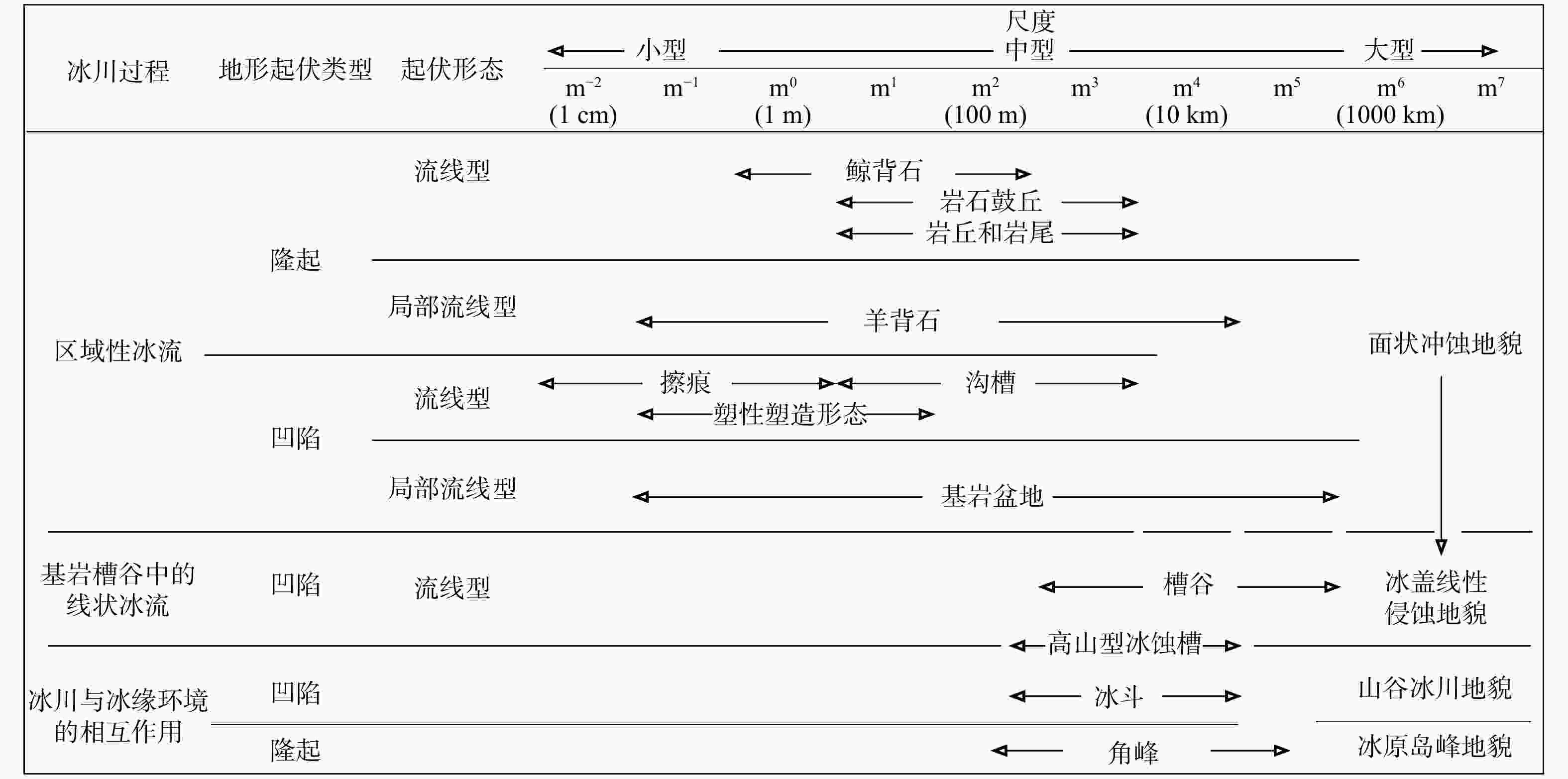
图 1 不同尺度冰蚀形貌的分类(Benn and Evans,2010)
Figure 1. Size classification of multi-scale glacial erosion forms (Benn and Evans, 2010)

图 2 主要中—小型冰蚀形貌特征和对冰川运动方向的指示(据吴瑞棠和关保德,1988修改)
1—钉头刻痕;2—擦痕;3—小型羊背石;4—新月形凿坑;5—新月形裂缝6—磨蚀沟槽;7—冰蚀坎阶;8—冰川运动方向
Figure 2. Main characteristics of meso- to micro-scale glacial erosional forms and their indications for glacial movement directions (modified after Wu and Guan, 1988)
1—nail head striae; 2—striae; 3—small roches moutonnée; 4—crescentic cracks; 5—crescentic fractures; 6—grooves; 7— glacial steps; 8—movement direction of glacier

图 3 奥地利蒂罗尔州阿尔卑斯山东段Kaunertal现代冰川冰蚀形貌
a—冰溜面之上密集排列擦痕;b—新月形凿坑;c—塑性塑造形态,贝壳状断口;d—羊背石;e—远处的冰斗和冰缘环境中的羊背石群;f—岩丘与岩尾,岩丘高6 m
Figure 3. Glacial erosional forms of modern glaciers in Kaunertal, eastern section of the Alps, Tyrol, Austria
(a) Densely arranged striations on the pavement; (b) Crescentic cracks; (c) P-form, Muschelbruch; (d) Roche moutonnée; (e) Distant cirque and a group of roches moutonnées in the periglacial environment; (f) Crag and tails (the crag is 6 meters high)
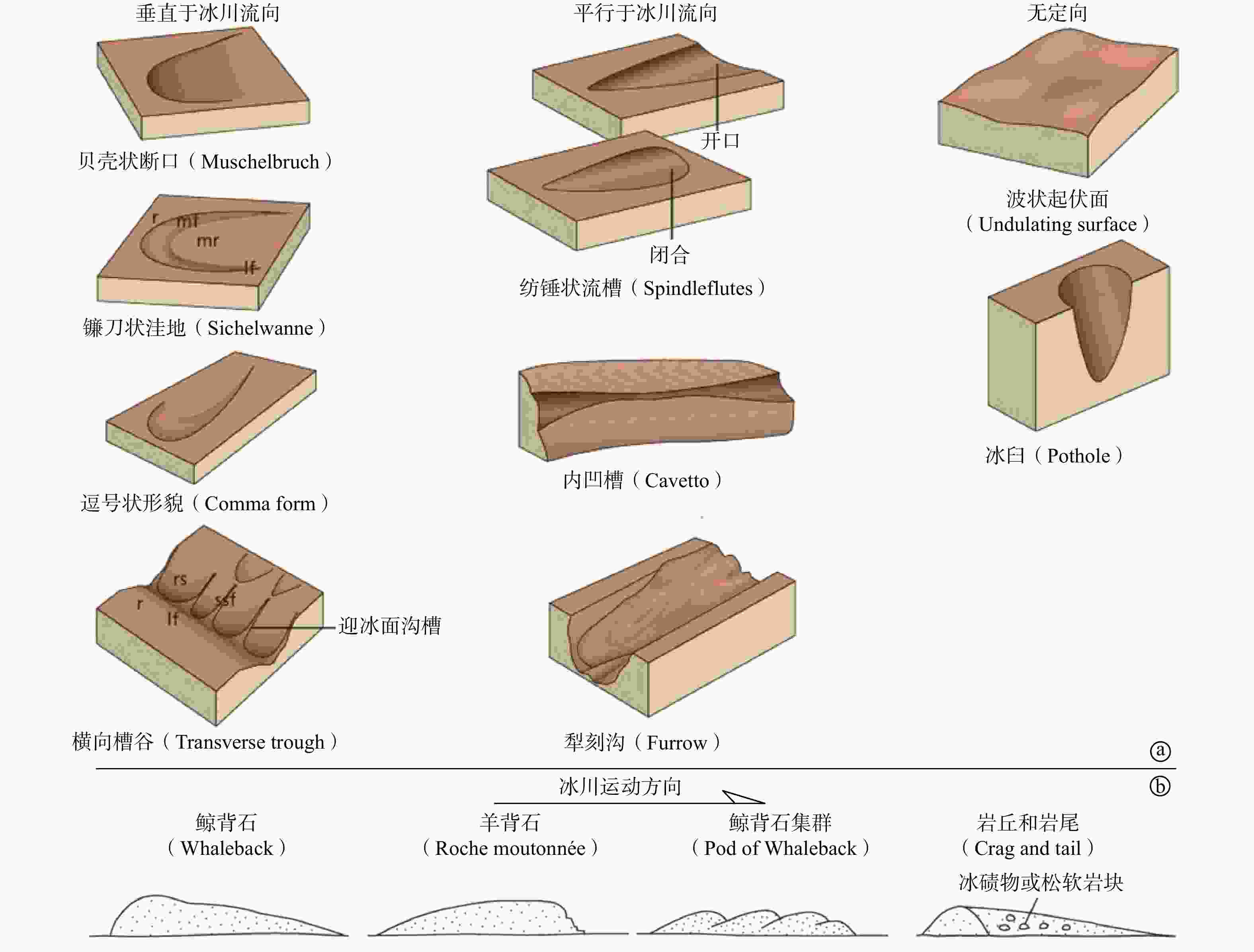
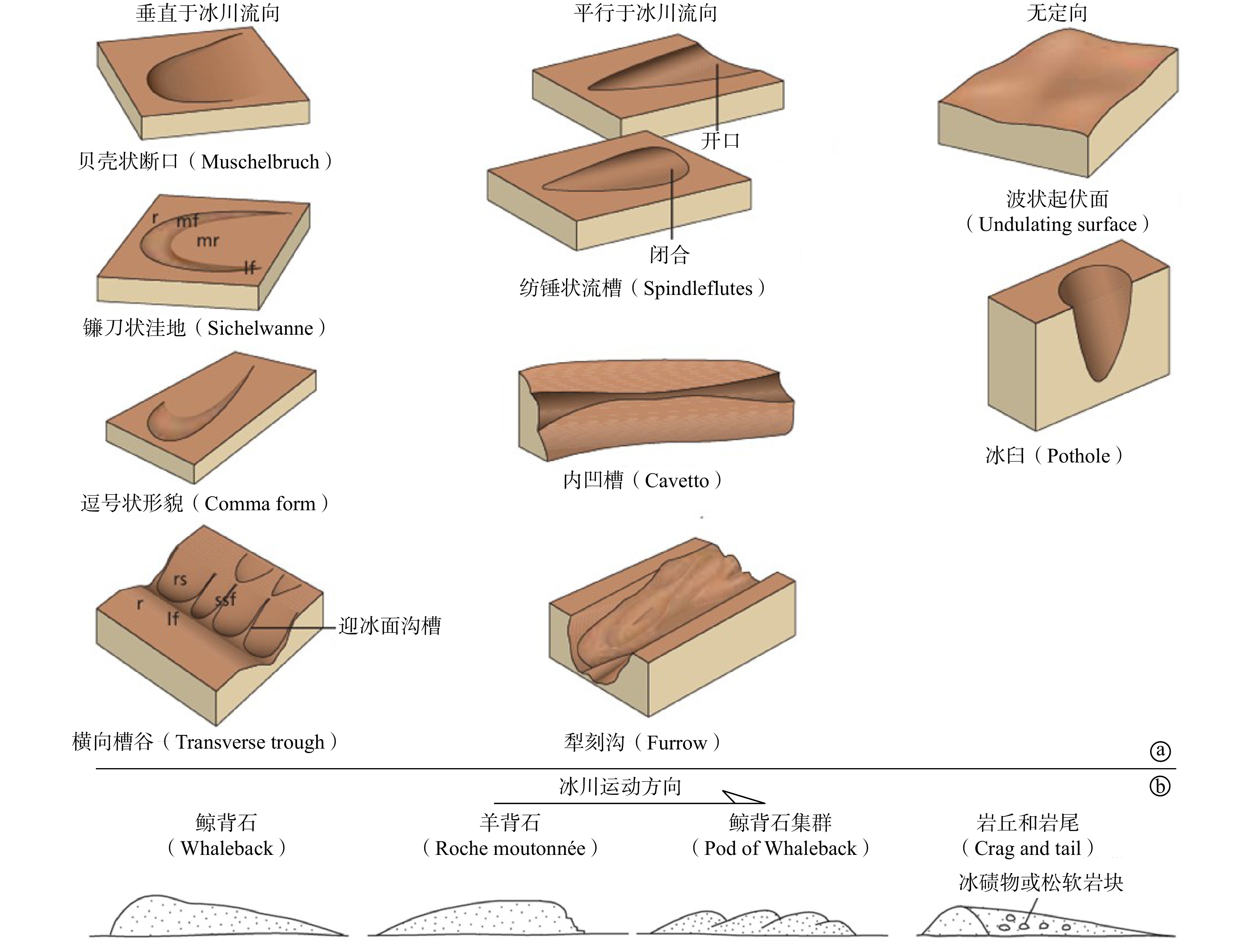
图 4 塑性塑造形态(p-forms)和流线型/局部流线型冰蚀形貌的分类(据Kor et al.,1991;Bennett and Glasser,2009修改)
a—塑性塑造形态的分类与特点;b—鲸背石、羊背石、岩丘和岩尾示意图
Figure 4. Classification scheme for p-forms and streamlined or partially streamlined glacial erosion forms (modified after Kor et al.,1991; Bennett and Glasser, 2009)
(a) The classification and characteristics of p-forms; (b) Schematic sketches of whaleback, roche moutonnée, pod of whaleback, and crag and tail forms
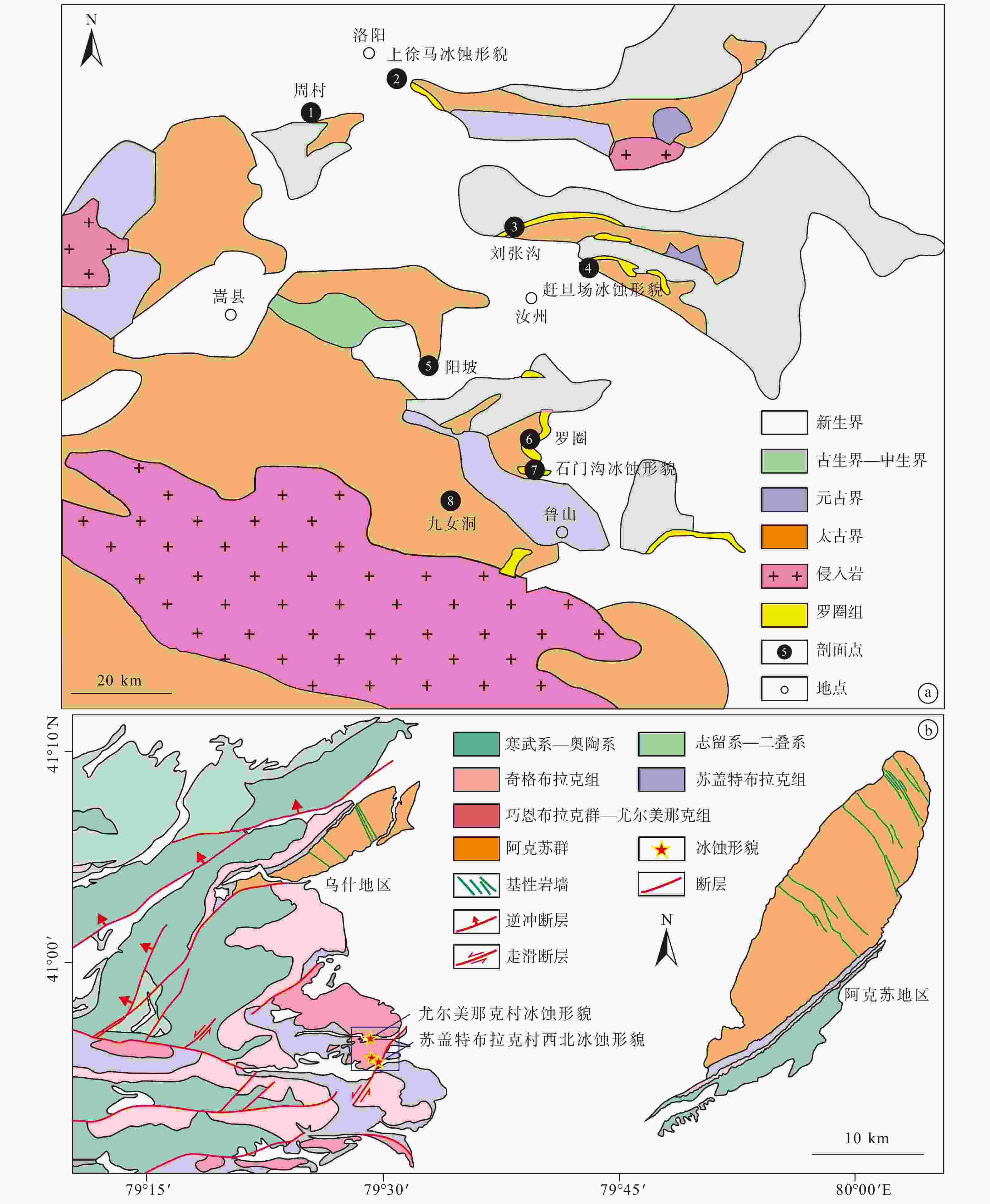
图 5 研究区区域地质图
a—华北克拉通南缘豫西区域地质图(Guan et al.,1986);b—塔里木西北缘阿克苏—乌什区域地质图(高振家等,1982)
Figure 5. Regional geological maps of the research areas
(a) Regional geological map of western Henan, southern margin of the North China Craton (Guan et al., 1986); (b) Regional geological map of Aksu–Wushi, northwestern margin of the Tarim Craton (Gao et al., 1982)

图 6 华北克拉通南缘豫西鲁山石门沟罗圈组古冰溜面群航拍图(Chen et al.,2020)
从南至北依次发育1号到4号冰溜面;玫瑰花图代表擦痕走向;n代表统计擦痕数量(下图同)
Figure 6. Composite aerial photographs of the pavements in Shimengou, west Henan province, southern North China Craton (Chen et al., 2020)
From approximately south to north, four pavements are alongside the road. The rose diagram shows the strike of striae measured on striated surfaces on the four pavements, n denotes the number of striations.
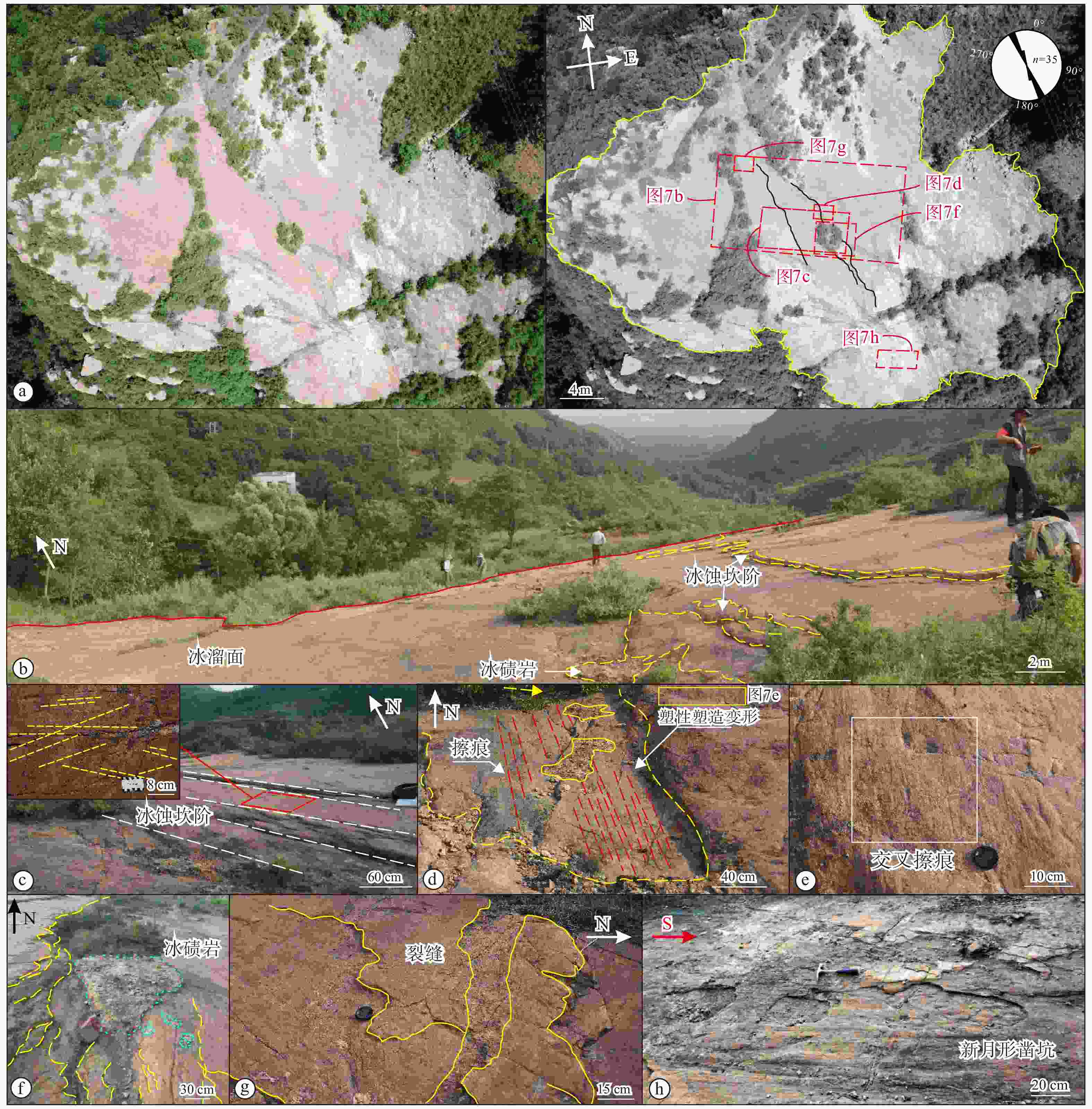
图 7 豫西石门沟罗圈组1号冰溜面冰蚀形貌及冰川运动方向指向性(据Chen et al.,2020修改)
a—石门沟剖面1号冰溜面;b—冰蚀坎阶;c—冰蚀坎阶和交错擦痕;d—塑性塑造形态和擦痕;e—交错擦痕;f—滞碛和擦痕;g—冰蚀裂隙;h—新月形凿坑
Figure 7. A bird’s eye view of Pavement 1 in the Shimengou, west Henan province, with indications of glacier movement (modified after Chen et al., 2020)
(a) Pavement 1 at the Shimengou section; (b) Glacial steps; (c) Glacial steps and cross striae; (d) P-forms and striae; (e) Cross striae; (f) Lodgement deposit and striae; (g) Fractures; (h) Crescentic cracks

图 8 豫西石门沟罗圈组4号冰溜面冰蚀形貌及冰川运动方向指向性(据Chen et al.,2020修改)
a—石门沟剖面4号冰溜面;b—纺锤状流槽;c—贝壳状断口;d—内凹槽;e—交错擦痕;f—4号冰溜面上发育的典型冰蚀形貌模式图;g—密集排列的交错擦痕;h—密集排列的擦痕
Figure 8. A bird’s eye view of Pavement 4 in the Shimengou area, west Henan province, with indications of glacier movement (modified after Chen et al., 2020)
(a) Pavement 4 at the Shimengou section; (b) Spindle flute; (c) Muschelbruch; (d) Cavetto; (e) Cross striae; (f) Model of typical erosional forms of pavement 4; (g) Densely packed cross-striations; (h) Densely packed striations

图 9 豫西上徐马罗圈组冰溜面冰蚀形貌及冰川运动方向指向性(据Le Heron et al.,2018;Chen et al.,2020修改)
a—上徐马剖面冰溜面素描图;b—冰溜面及之上冰碛岩的接触关系;c—交错擦痕;d—露头尺度下部分擦痕的曲线形态;e—弯曲形态的擦痕;f—被冰碛岩覆盖的发育擦痕冰溜面,冰碛岩最底部中发育少量擦痕;g—冰溜面的数字高程模型,可见发夹状擦痕
Figure 9. Pavement in Shangxuma, west Henan Province, and indications of glacier movement (modified after Le Heron et al., 2018; Chen et al., 2020)
(a) Sketch drawing of a striated pavement at the Shangxuma section; (b) Contact between a striated pavement and diamictites directly overlying it; (c) Cross-cutting striations; (d) The curvilinear nature of striations at the outcrop scale; (e) Striations in curvilinear shape; (f) Striated pavement draped by diamictite; some striations also developed in the basal part; (g) A digital elevation model (DEM) of the pavement at Shangxuma, showing the hairpin striae

图 10 塔西北阿克苏—乌什地区尤尔美那克组冰蚀形貌空间分布(据Chen et al.,2025修改)
a—尤尔美那克村东沟和苏盖特布拉克村北部的冰蚀形貌分布;b—尤尔美那克村东沟4处冰蚀形貌空间分布;c—Yuer_1冰蚀形貌;d—Yuer_2冰蚀形貌;e—Yuer_3冰蚀形貌;f—Yuer_4冰蚀形貌;g—Suget_1冰蚀形貌;h—Suget_2冰蚀形貌;i—Suget_3冰蚀形貌
Figure 10. The spatial distribution of glacial erosion forms of the Yuermeinak Formation in the Aksu–Wushi area, northwestern Tarim (modified after Chen et al., 2025)
(a) Glacial erosion forms around the Yuermeinak and northern Sugetbrak villages; (b) The spatial distribution of four glacial erosion forms in the east gully of Yuermeinak village; (c) Yuer_1 erosional form; (d) Yuer_2 erosional form; (e) Yuer_3 erosional form; (f) Yuer_4 erosional form; (g) Suget_1 erosional form; (h) Suget_2 erosional form; (i) Suget_3 erosional form
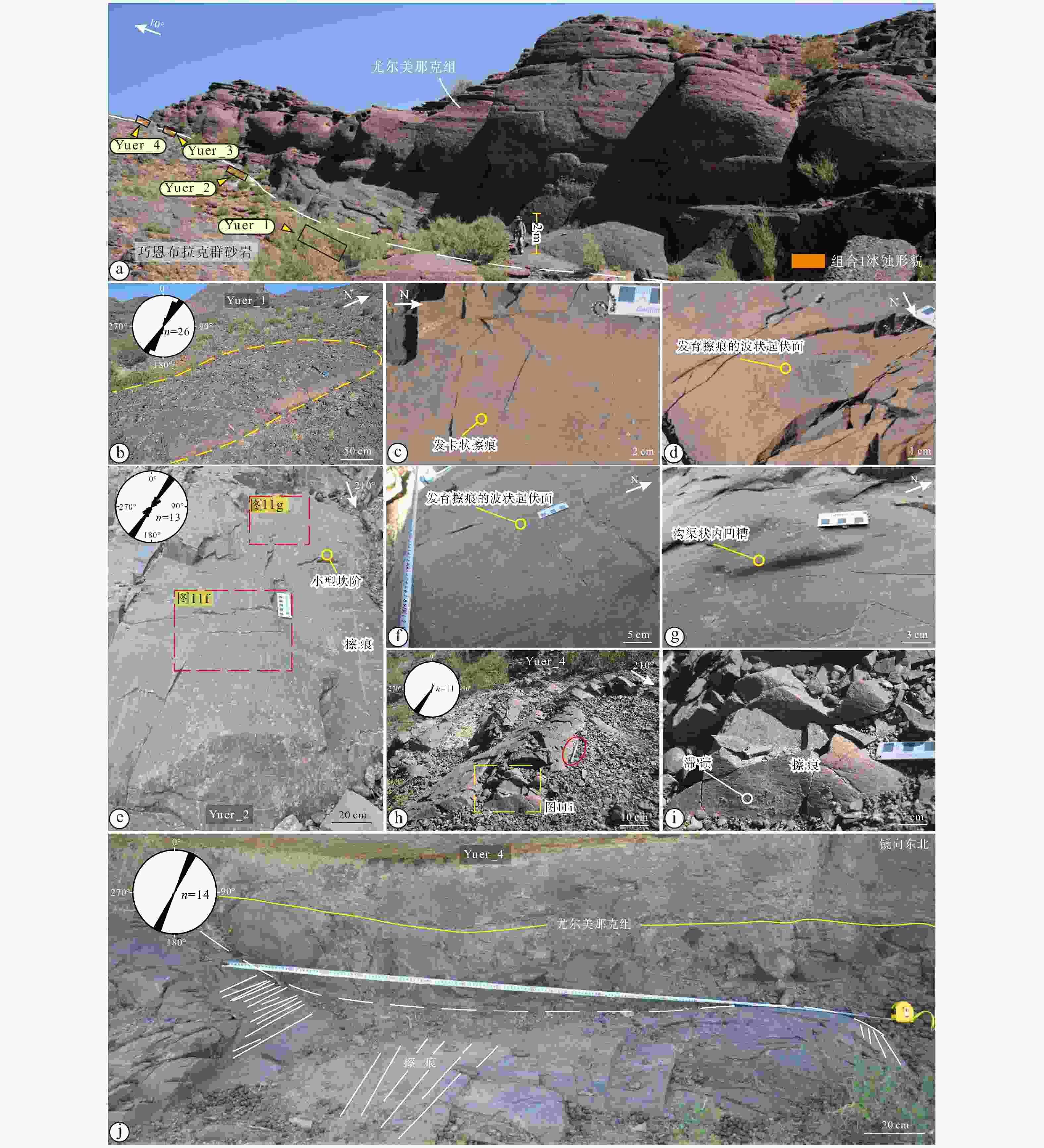
图 11 塔西北阿克苏—乌什地区尤尔美那克村东沟剖面Yuer_1、Yuer_2和Yuer_4冰蚀形貌(据Chen et al.,2025修改)
a—Yuer_1,Yuer_2,Yuer_3和Yuer_4冰蚀形貌全景图;b—Yuer_1冰蚀形貌;c—Yuer_1冰蚀形貌中的发夹状擦痕;d—Yuer_1冰蚀形貌中的发育擦痕的波状起伏面;e—Yuer_2冰蚀形貌;f—Yuer_2冰蚀形貌中的发育擦痕的波状起伏面;g—Yuer_2冰蚀形貌中的沟渠状内凹槽;h—Yuer_4冰蚀形貌;i—冰溜面表面的滞碛;j—Yuer_4冰蚀形貌,冰溜面和之上冰碛岩
Figure 11. Glacial erosional forms of Yuer_1, Yuer_2 and Yuer_4 in the east gully section of Yuermeinak village in the Aksu–Wushi area, northwestern Tarim (modified after Chen et al., 2025)
(a) Panorama of erosional forms of Yuer_1, Yuer_2, Yuer_3, and Yuer_4; (b) Erosional form of Yuer_1; (c) Erosional form of Yuer_1, hairpin striae; (d) Erosional forms of Yuer_1, undulating surface with striae; (e) Erosional forms of Yuer_2; (f) Erosional forms of Yuer_2, undulating surface with striae; (g) Erosional forms of Yuer_2, steep-sided cavetto; (h) Erosional forms of Yuer_4; (i) Lodgement deposit on the pavement surface; (j) Glacial pavement of Yuer_4 and the diamictite above it
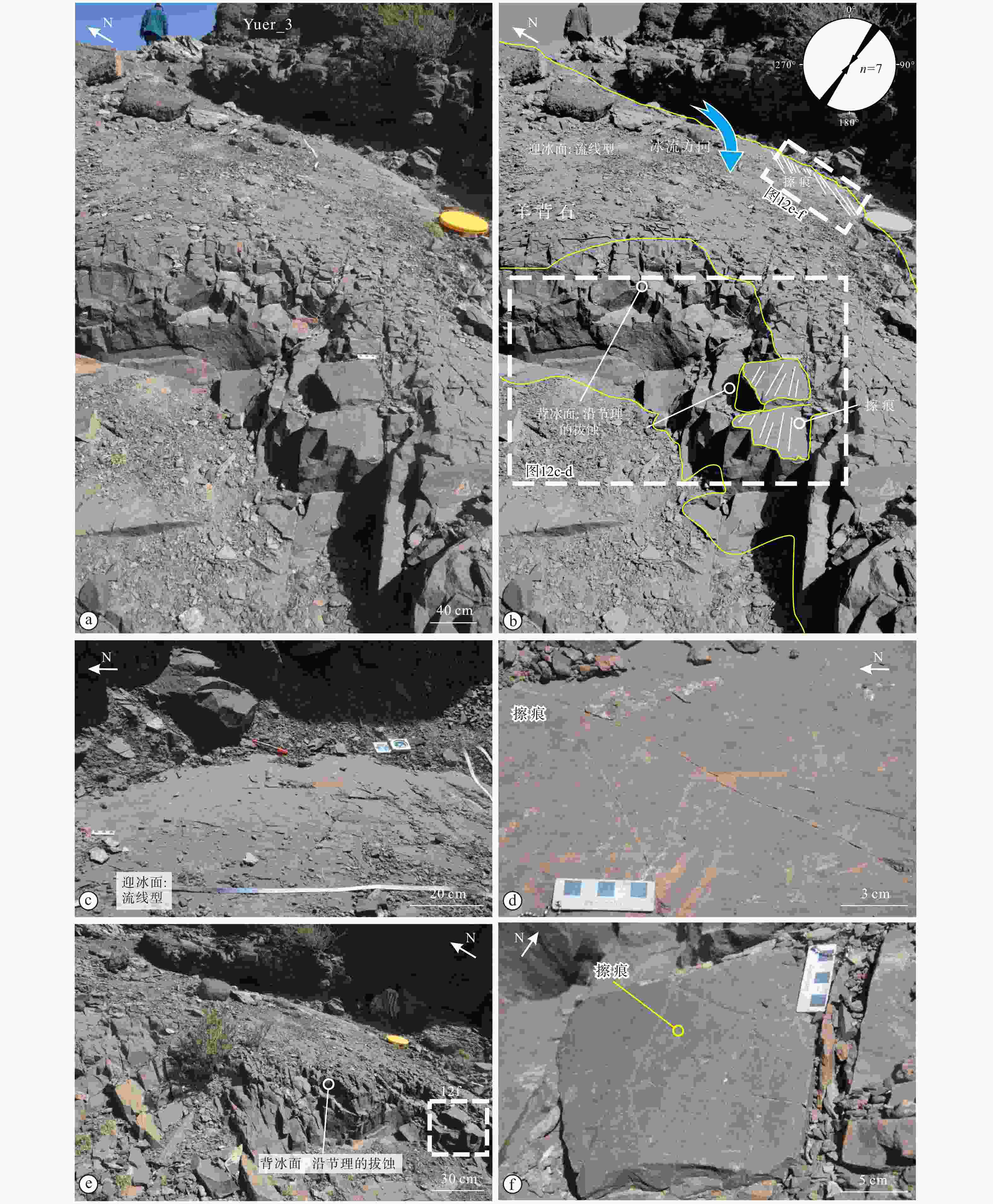
图 12 塔西北阿克苏—乌什地区尤尔美那克村东沟剖面Yuer_3冰蚀形貌(据Chen et al.,2025修改)
a—羊背石全景图;b—全景图显示了羊背石迎冰面(朝向东北的一侧)与背冰面(朝向西南的一侧),二者可指示冰流方向;c—羊背石流线型的迎冰面;d—迎冰面的擦痕面;e—羊背石的背冰面可见沿节理发育的冰川拔蚀作用;f—背冰面的擦痕面
Figure 12. Glacial erosional form of Yuer_3 in the east gully section of Yuermeinak village in the Aksu–Wushi area, northwestern Tarim (modified after Chen et al., 2025)
(a) Panorama of the roche moutonnée; (b) Panorama of the roche moutonnée shows the stoss side (northeast-facing side) and the lee side (southwest-facing side) that indicate the direction of ice flow; (c) The streamlined stoss side of the roche moutonnée; (d) The striated surface of the stoss side; (e) The lee side of the roche moutonnée shows glacial plucking along joints; (f) The striated surface of the lee side
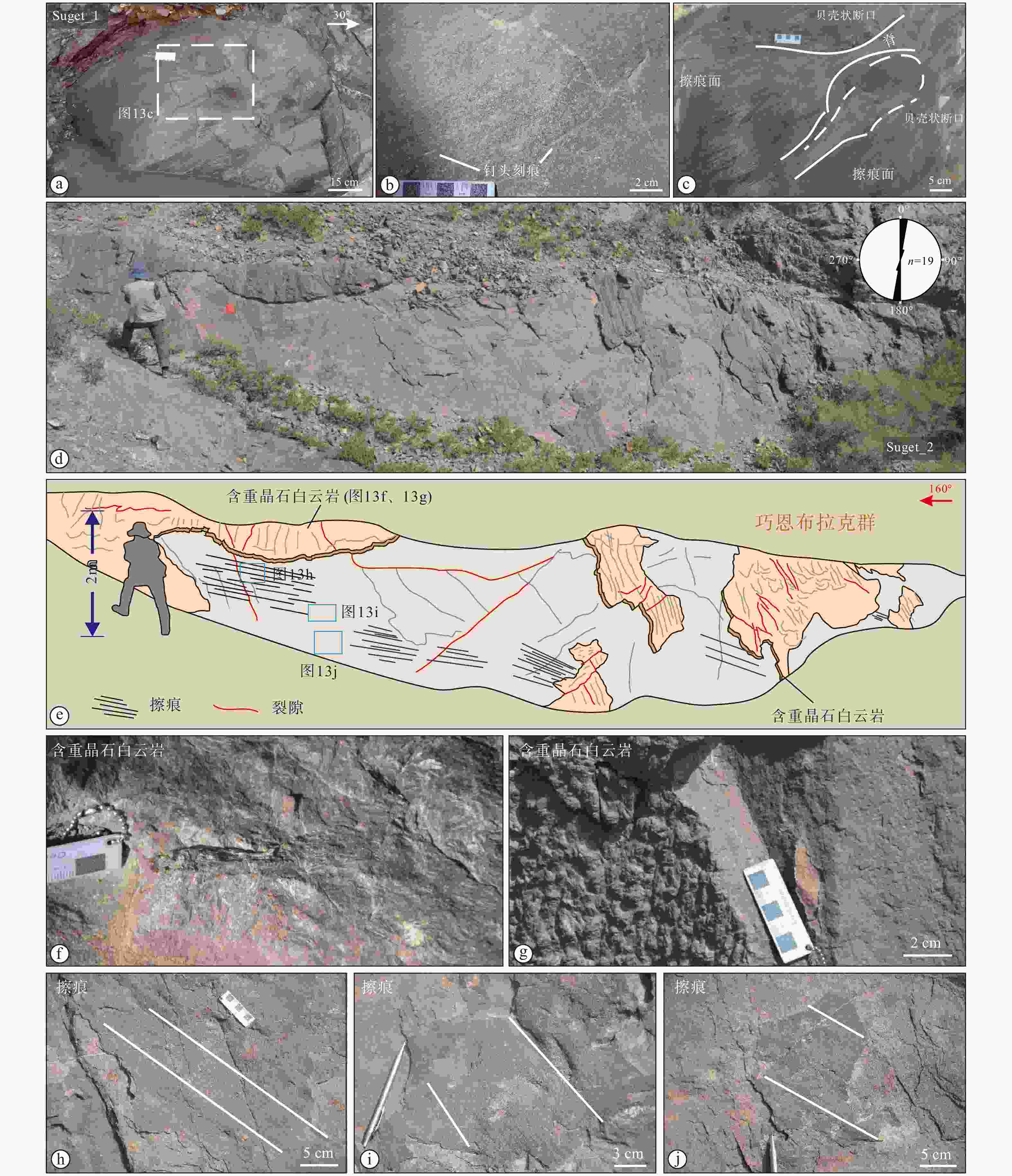
图 13 塔西北阿克苏—乌什地区苏盖特布拉克村西北Suget_1和Suget_2冰蚀形貌(据Chen et al.,2025修改)
a—Suget_1小型冰蚀形貌;b—钉头刻痕;c—贝壳状断口和中间隆起的脊;d—Suget_2中型冰蚀形貌;e—Suget_2中型冰蚀形貌的抽象素描图;f—直接覆盖于Suget_2冰蚀形貌之上的含重晶石白云岩;g—含重晶石白云岩,可见针状晶体形态的重晶石;h—Suget_1小型冰蚀形貌(擦痕1);i—Suget_1小型冰蚀形貌(擦痕2);j—Suget_1小型冰蚀形貌(擦痕3)
Figure 13. Glacial erosion forms of Suget_1 and Suget_2 in the northwest of Sugetbrak village in the Aksu–Wushi area, northwestern Tarim (modified after Chen et al., 2025)
(a) Microscale erosional forms of Suget_1; (b) Nailhead striae; (c) Two erosional forms of muschelbrüche and the ridge in the middle; (d) Mesoscale erosional forms of Suget_2; (e) Abstract sketch of Suget_2; (f) Barite-bearing dolomite draped directly on the erosional form of Suget_2; (f) Barite-bearing dolomite with needle-like shape barites; (h) Microscale erosional form (striae1) in Suget_1; (i) Microscale erosional form (striae2) in Suget_1; (j) Microscale erosional form (striae3) in Suget_1
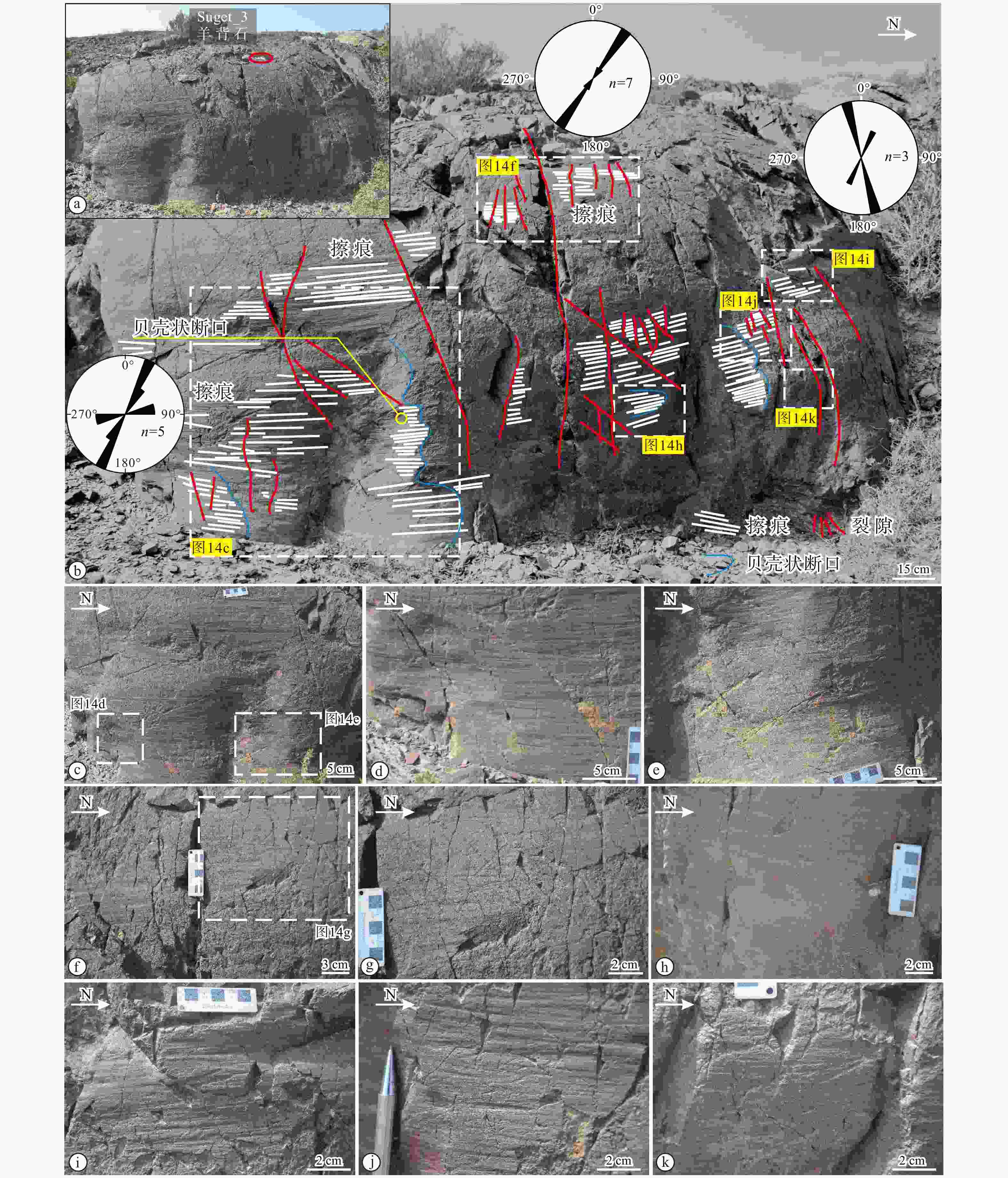
图 14 塔西北阿克苏—乌什地区苏盖特布拉克村西北Suget_3中—小型冰蚀形貌(据Chen et al.,2025修改)
a—Suget_3中型羊背石;b—羊背石上发育的冰蚀形貌;c—2处贝壳状断口;d—贝壳状断口放大图1;e—贝壳状断口放大图2;f—擦痕面;g—图14f的放大;h—发育有擦痕的贝壳状断口;i—平行擦痕,可见钉头刻痕;j—平行和斜交擦痕;k—平行和斜交擦痕
Figure 14. The micro- and mesoscale glacial erosion forms of Suget_3 in the northwest of Sugetbrak village in the Aksu-Wushi area, northwestern Tarim (modified after Chen et al., 2025)
(a) Mesoscale roche moutonneé of Suget_3; (b) Glacial erosion forms developed on the roche moutonneé; (c) Two erosional forms of muschelbrüche; (d) Enlarged view of muschelbrüche(No.1); (e) Enlarged view of muschelbrüche(No.2); (f) striated surface; (g) Enlarged view of Fig. 14f; (h) Muschelbrüche with striations; (i) Parallel striations and nail-head striations; (j) Parallel and cross striations; (k) Parallel and cross striations
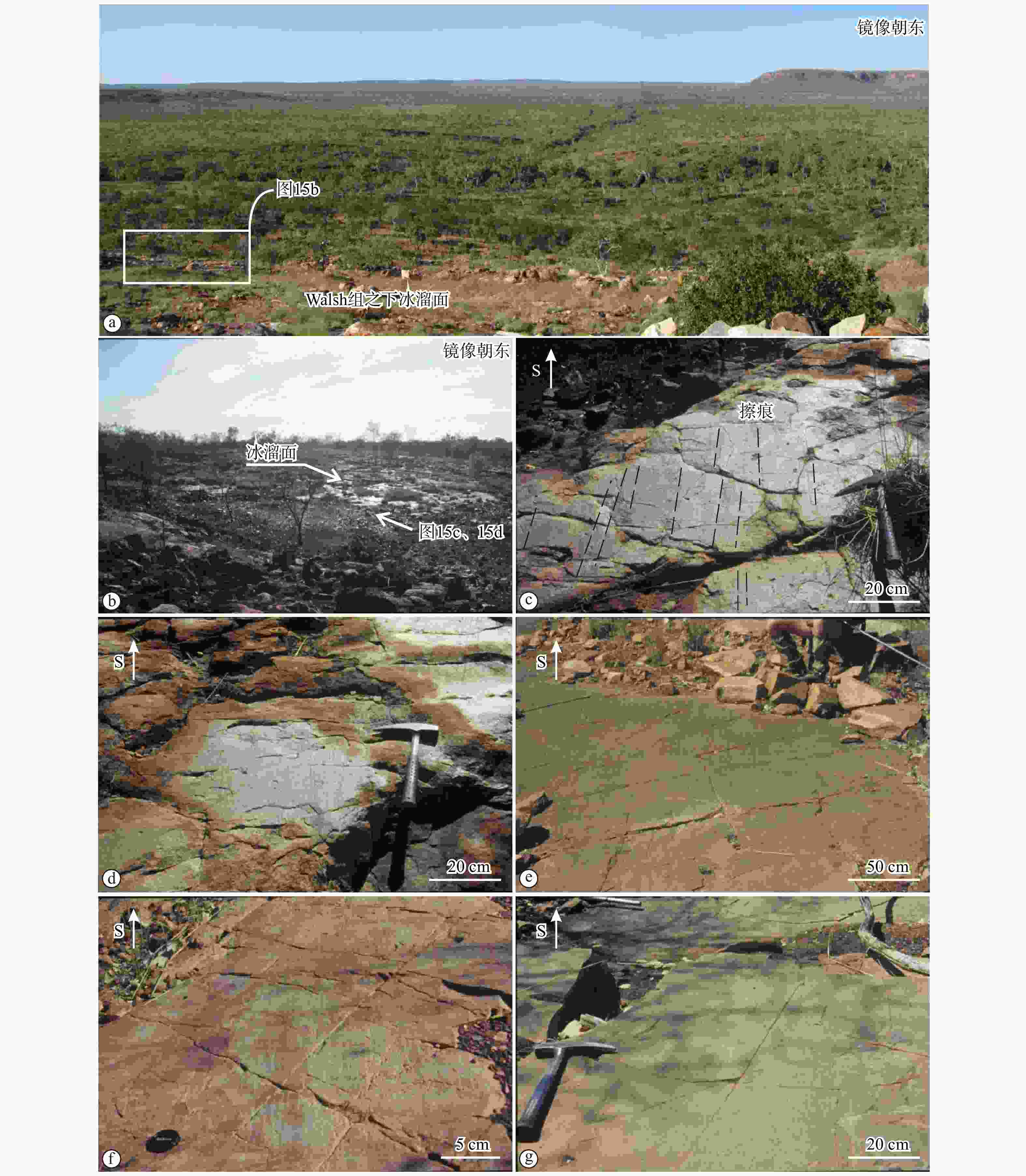
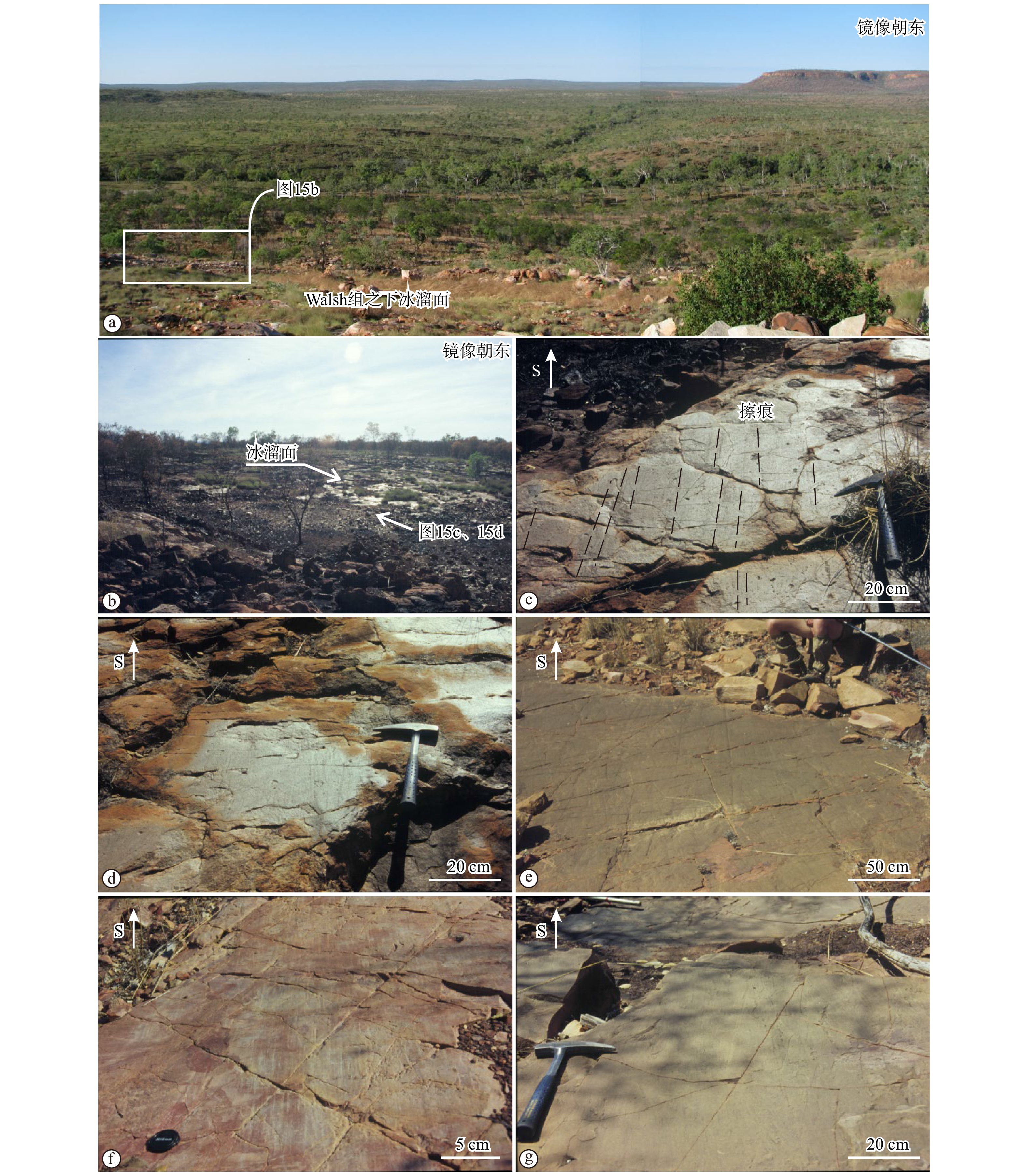
图 15 澳大利亚西北Kimberley地区Walsh组之下以擦痕为主的冰蚀形貌(照片由Maree Corkeron提供)
a—Walsh组之下冰溜面全景;b—图15a中冰溜面放大;c—发育擦痕的冰溜面1;d—发育擦痕的冰溜面2;e—冰溜面上部分擦痕延伸较短;f—擦痕密集排列;g—斜交擦痕发育
Figure 15. Striation-dominated glacial erosion forms underlying the Walsh Formation in the Kimberley region, northwestern Australia (photos courtesy of Maree Corkeron)
(a) Panorama of the pavements beneath the Walsh Formation; (b) Enlarged view of the pavement in Fig. 15a; (c) Striated pavement(No.1); (d) Striated pavement(No.2); (e) Some striations of the pavement extend relatively short ; (f) Densely packed striations; (g) Cross striations
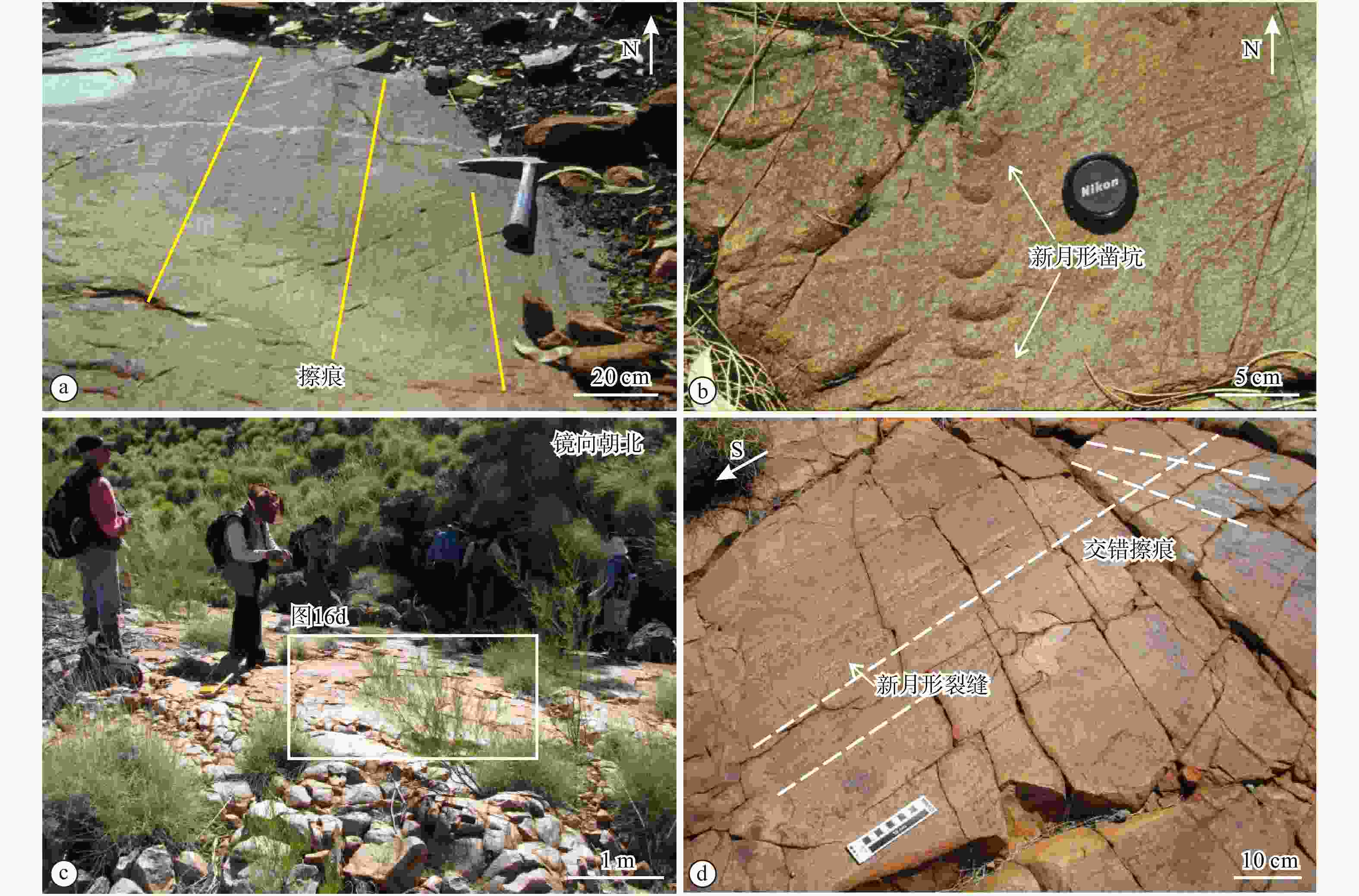
图 16 澳大利亚西北Kimberley地区Egan组之下以擦痕和新月形凿坑、裂缝为主的冰蚀形貌(照片由Maree Corkeron提供)
a—擦痕发育的冰溜面;b—新月形凿坑;c—Egan组之下冰溜面宏观照;d—发育擦痕的冰溜面之上的新月形裂缝
Figure 16. Striation and crescentic cracks or fractures dominated glacial erosion forms beneath the Egan Formation in the Kimberley region, northwestern Australia (photos courtesy of Maree Corkeron)
(a) Striated pavements; (b) Crescentic gouges; (c) Macroscopic photograph of the pavement underlying the Egan Formation; (d) Crescentic fractures developed on the striated pavement
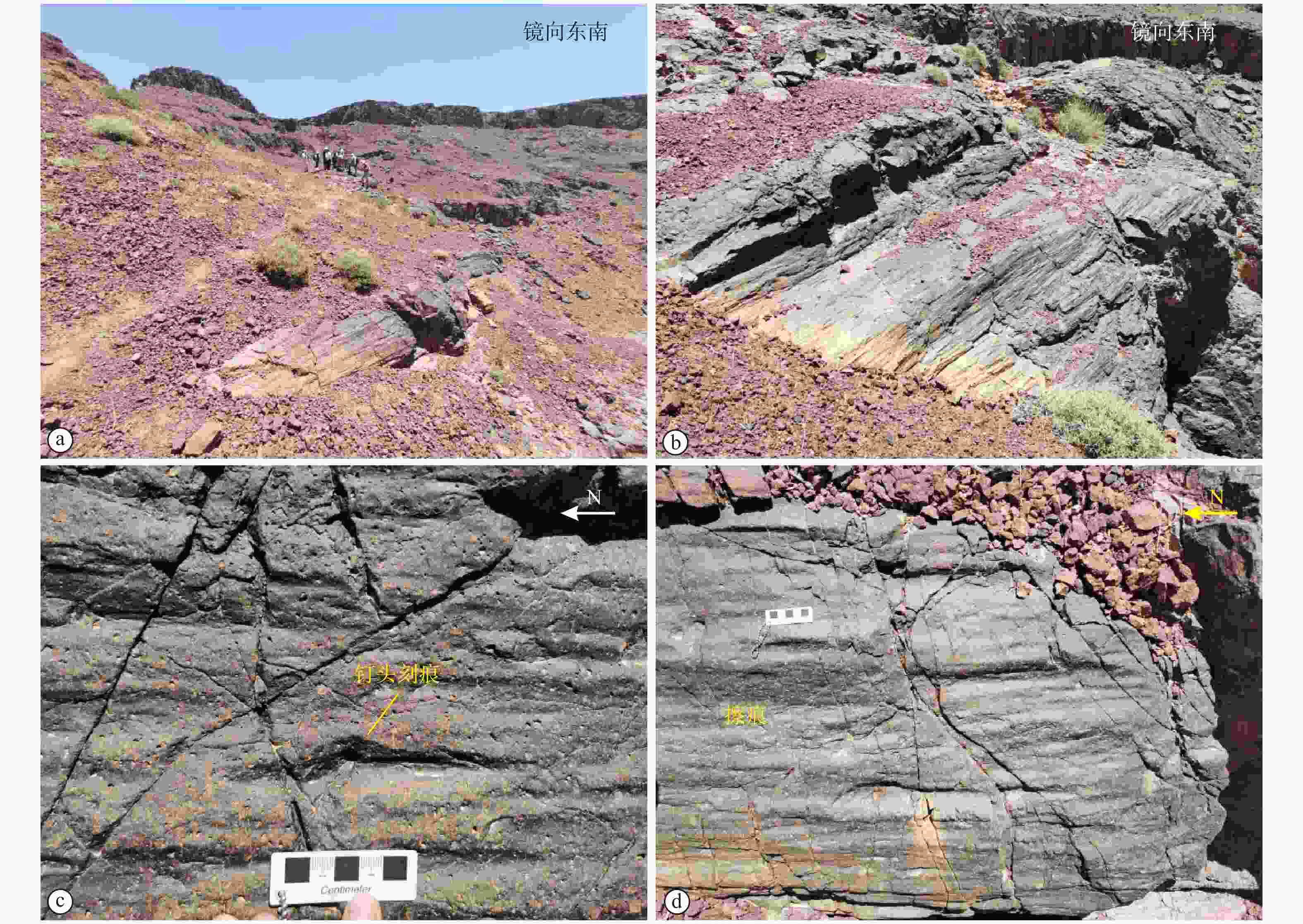
图 17 摩洛哥Anti-Atlas地区Bou Azzer组之下擦痕发育的小型羊背石
a—Bou Azzer组之下羊背石宏观照;b—羊背石放大照片;c—钉头刻痕;d—擦痕面
Figure 17. Small-scale roche moutonnée beneath the Bou Azzer Formation in the Anti-Atlas region, Morocco
(a) Macroscopic photograph of the roche moutonnée underlying the Bou Azzer Formation; (b) Enlarged view of the roche moutonnée; (c) Nailhead striae; (d) Striated surface
-
[1] ALLEY R B, CUFFEY K M, ZOET L K, 2019. Glacial erosion: status and outlook[J]. Annals of Glaciology, 60(80): 1-13. doi: 10.1017/aog.2019.38 [2] ANDREWS E, 1883. Glacial markings of unusual forms in the Laurentian Hills[J]. American Journal of Science, S3-26(152): 99-105. [3] ATKINSON B K, 1984. Subcritical crack growth in geological materials[J]. Journal of Geophysical Research: Solid Earth, 89(B6): 4077-4114. doi: 10.1029/JB089iB06p04077 [4] BENN D I, EVANS D J A, 2010. Glaciers and glaciation[M]. 2nd ed. London: Routledge: 1-802. [5] BENNETT M R, 2003. Ice streams as the arteries of an ice sheet: their mechanics, stability and significance[J]. Earth-Science Reviews, 61(3-4): 309-339. doi: 10.1016/S0012-8252(02)00130-7 [6] BENNETT M R, GLASSER N F, 2009. Glacial geology: ice sheets and landforms[M]. 2nd ed. Oxford: Wiley-Blackwell: 1-385. [7] BOULTON G S, 1974. Processes and patterns of glacial erosion[C]//COATES D R. Glacial geomorphology. Dordrecht: Springer: 41-87. [8] BOULTON G S, 1979. Processes of glacier erosion on different substrata[J]. Journal of Glaciology, 23(89): 15-38. doi: 10.3189/S0022143000029713 [9] BOULTON G S, 1996. Theory of glacial erosion, transport and deposition as a consequence of subglacial sediment deformation[J]. Journal of Glaciology, 42(140): 43-62. doi: 10.3189/S0022143000030525 [10] BOULTON G S, CABAN P E, VAN GIJSSEL K, 1995. Groundwater flow beneath ice sheets: part I: large scale patterns[J]. Quaternary Science Reviews, 14(6): 545-562. doi: 10.1016/0277-3791(95)00039-R [11] BOULTON G S, DONGELMANS P, PUNKARI M, et al., 2001. Palaeoglaciology of an ice sheet through a glacial cycle: the European ice sheet through the Weichselian[J]. Quaternary Science Reviews, 20(4): 591-625. doi: 10.1016/S0277-3791(00)00160-8 [12] BRAAKMAN J H, LEVELL B K, MARTIN J H, et al., 1982. Late Palaeozoic Gondwana glaciation in Oman[J]. Nature, 299(5878): 48-50. doi: 10.1038/299048a0 [13] CHAMBERLIN T C, 1888. The rock scourings of the great ice invasions[M]//POWELL J W. Seventh Annual report of the United States Geological Survey to the Secretary of the Interior. Washington: U. S. Geological Survey: 155-248. [14] CHANDLER B M P, LOVELL H, BOSTON C M, et al., 2018. Glacial geomorphological mapping: a review of approaches and frameworks for best practice[J]. Earth-Science Reviews, 185: 806-846. doi: 10.1016/j.earscirev.2018.07.015 [15] CHEN X S, KUANG H W, LIU Y Q, et al., 2020. Subglacial bedforms and landscapes formed by an ice sheet of Ediacaran-Cambrian age in West Henan, North China[J]. Precambrian Research, 344: 105727. doi: 10.1016/j.precamres.2020.105727 [16] CHEN X S, KUANG H W, LIU Y Q, et al., 2023. Sedimentary characteristics and evolution of Ediacaran glaciation in western Henan Province, southern North China Craton[J]. Palaeogeography, Palaeoclimatology, Palaeoecology, 632: 111866. doi: 10.1016/j.palaeo.2023.111866 [17] CHEN X S, KUANG H W, LIU Y Q, et al., 2025. Dynamics of Marinoan-age glaciers in NW Tarim, China[J]. Precambrian Research, 430: 107933. doi: 10.1016/j.precamres.2025.107933 [18] CHRISTIE-BLICK N, 1983. Glacial-marine and subglacial sedimentation Upper Proterozoic Mineral Fork Formation, Utah[M]//MOLNIA B F. Glacial-marine sedimentation. Boston: Springer: 703-776. [19] CORKERON M, 2008. Deposition and palaeogeography of a glacigenic Neoproterozoic succession in the east Kimberley, Australia[J]. Sedimentary Geology, 204(3-4): 61-82. doi: 10.1016/j.sedgeo.2007.12.010 [20] CORKERON M, 2011. Neoproterozoic glacial deposits of the Kimberly region and northwestern northern Territory, Australia[M]//ARNAUD E, HALVERSON G P, SHIELDS-ZHOU G. The geological record of Neoproterozoic glaciations. London: Geological Society of London: 659-672. [21] CORKERON M L, GEORGE A D, 2001. Glacial incursion on a Neoproterozoic carbonate platform in the Kimberley region, Australia[J]. GSA Bulletin, 113(9): 1121-1132. doi: 10.1130/0016-7606(2001)113<1121:GIOANC>2.0.CO;2 [22] CORKERON M L, 2002. Neoproterozoic glacial events in the Kimberley Region, western Australia: sedimentology and regional correlation in the context of continental-and global-scale Neoproterozoic glaciation[D]. Crawley: the University of Western Australia: 1-380. [23] DAHL R, 1965. Plastically sculptured detail forms on rock surfaces in northern Nordland, Norway[J]. Geografiska Annaler: Series A, Physical Geography, 47(2): 83-140. doi: 10.1080/04353676.1965.11879716 [24] DE ALVARENGA C J S, FIGUEIREDO M F, BABINSKI M, et al., 2007. Glacial diamictites of Serra Azul Formation (Ediacaran, Paraguay belt): evidence of the Gaskiers glacial event in Brazil[J]. Journal of South American Earth Sciences, 23(2-3): 236-241. doi: 10.1016/j.jsames.2006.09.015 [25] DEMOREST M, 1938. Ice flowage as revealed by glacial striae[J]. The Journal of Geology, 46(5): 700-725. doi: 10.1086/624679 [26] DÜHNFORTH M, ANDERSON R S, WARD D, et al., 2010. Bedrock fracture control of glacial erosion processes and rates[J]. Geology, 38(5): 423-426. doi: 10.1130/G30576.1 [27] ETEMAD-SAEED N, HOSSEINI-BARZI M, ADABI M H, et al., 2016. Evidence for ca. 560 Ma Ediacaran glaciation in the Kahar Formation, central Alborz Mountains, northern Iran[J]. Gondwana Research, 31: 164-183. doi: 10.1016/j.gr.2015.01.005 [28] ETIENNE J L, ALLEN P A, LE GUERROUÉ E, et al. , 2011. The Blaini formation of the Lesser Himalaya, NW India[M]//ARNAUD E, HALVERSON G P, SHIELDS-ZHOU G. The geological record of Neoproterozoic glaciations. London: Geological Society of London: 347-355. [29] EYLES N, 2006. The role of meltwater in glacial processes[J]. Sedimentary Geology, 190(1-4): 257-268. doi: 10.1016/j.sedgeo.2006.05.018 [30] EYLES N, PUTKINEN N, SOOKHAN S, et al., 2016. Erosional origin of drumlins and megaridges[J]. Sedimentary Geology, 338: 2-23. doi: 10.1016/j.sedgeo.2016.01.006 [31] FORBES E, 1843. Travels through the Alps of Savoy and Other Parts of the Pennine Chain: With Observations on the Phenomena of Glaciers[M]. Edinburgh: Adam and Charles Black: 1-424. [32] GAO Z J, LI Y A, QIAN J X, et al., 1982. New data of the Sinian glacial deposits in Aksu-Kalpin region, Xinjiang Uygur Zizhiqu[J]. Bulletin Tianjin institute Geol. Min. Res, 5: 43-56. (in Chinese with English abstract) [33] GERMS G J B, GAUCHER C, 2012. Nature and extent of a late Ediacaran (ca. 547 Ma) glacigenic erosion surface in southern Africa[J]. South African Journal of Geology, 115(1): 91-102. doi: 10.2113/gssajg.115.91 [34] GLASSER N F, BENNETT M R, 2004. Glacial erosional landforms: origins and significance for palaeoglaciology[J]. Progress in Physical Geography: Earth and Environment, 28(1): 43-75. doi: 10.1191/0309133304pp401ra [35] GRAY J M, 1981. P-forms from the isle of mull[J]. Scottish Journal of Geology, 17(1): 39-47. doi: 10.1144/sjg17010039 [36] GUAN B D, WU R T, HAMBREY M J, et al., 1986. Glacial sediments and erosional pavements near the Cambrian-Precambrian boundary in western Henan Province, China[J]. Journal of the Geological Society, 143(2): 311-323. doi: 10.1144/gsjgs.143.2.0311 [37] GUAN B D, GENG W C, RONG Z Q, et al. , 1988. The Middle and Upper Proterozoic in the northern slope of Eastern Qinling ranges, Henan, China[M]. Zhengzhou: Henan Science and Technology Press: 1-210. (in Chinese with English abstract) [38] HALLET B, 1979. A theoretical model of glacial abrasion[J]. Journal of Glaciology, 23(89): 39-50. doi: 10.3189/S0022143000029725 [39] HALLET B, 1996. Glacial quarrying: a simple theoretical model[J]. Annals of Glaciology, 22: 1-8. doi: 10.3189/1996AoG22-1-1-8 [40] HAMBREY M J, GLASSER N F, 2012. Discriminating glacier thermal and dynamic regimes in the sedimentary record[J]. Sedimentary Geology, 251-252: 1-33. [41] HILDES D H D, CLARKE G K C, FLOWERS G E, et al., 2004. Subglacial erosion and englacial sediment transport modelled for North American ice sheets[J]. Quaternary Science Reviews, 23(3-4): 409-430. doi: 10.1016/j.quascirev.2003.06.005 [42] HINDMARSH R C A, 1996. Sliding of till over bedrock: scratching, polishing, comminution and kinematic-wave theory[J]. Annals of Glaciology, 22: 41-47. doi: 10.3189/1996AoG22-1-41-47 [43] HUGHES A L C, CLARK C D, JORDAN C J, 2010. Subglacial bedforms of the last British Ice Sheet[J]. Journal of Maps, 6(1): 543-563. doi: 10.4113/jom.2010.1111 [44] IVERSON N R, 1991. Morphology of glacial striae: implications for abrasion of glacier beds and fault surfaces[J]. GSA Bulletin, 103(10): 1308-1316. doi: 10.1130/0016-7606(1991)103<1308:MOGSIF>2.3.CO;2 [45] IVERSON N R, 1995. Processes of erosion[M]//MENZIES J. Modern glacial environments: processes, dynamics and sediments. Oxford: Butterworth-Heinemann: 241-259. [46] JANSSON K N, KLEMAN J, MARCHANT D R, 2002. The succession of ice-flow patterns in north-central Québec-Labrador, Canada[J]. Quaternary Science Reviews, 21(4-6): 503-523. doi: 10.1016/S0277-3791(01)00013-0 [47] KARAOUI B, BREITKREUZ C, MAHMOUDI A, et al., 2015. U–Pb zircon ages from volcanic and sedimentary rocks of the Ediacaran Bas Draâ inlier (Anti-Atlas Morocco): chronostratigraphic and provenance implications[J]. Precambrian Research, 263: 43-58. doi: 10.1016/j.precamres.2015.03.003 [48] KEHEW A E, PIOTROWSKI J A, JØRGENSEN F, 2012. Tunnel valleys: concepts and controversies: a review[J]. Earth-Science Reviews, 113(1-2): 33-58. doi: 10.1016/j.earscirev.2012.02.002 [49] KLEMAN J, 1990. On the use of glacial striae for reconstruction of paleo-ice sheet flow patterns: with application to the Scandinavian ice sheet[J]. Geografiska Annaler: Series A, Physical Geography, 72(3-4): 217-236. doi: 10.1080/04353676.1990.11880318 [50] KLEMAN J, BORGSTRÖM I, 1996. Reconstruction of palaeo-ice sheets: the use of geomorphological data[J]. Earth surface Processes and Landforms, 21(10): 893-909. doi: 10.1002/(SICI)1096-9837(199610)21:10<893::AID-ESP620>3.0.CO;2-U [51] KNIGHT J, 2009. Subglacial erosion forms in northwest Ireland[J]. Boreas, 38(3): 545-554. doi: 10.1111/j.1502-3885.2009.00084.x [52] KOR P S G, SHAW J, SHARPE D R, 1991. Erosion of bedrock by subglacial meltwater, Georgian Bay, Ontario: a regional view[J]. Canadian Journal of Earth Sciences, 28(4): 623-642. doi: 10.1139/e91-054 [53] KRABBENDAM M, EYLES N, PUTKINEN N, et al., 2016. Streamlined hard beds formed by palaeo-ice streams: a review[J]. Sedimentary Geology, 338: 24-50. doi: 10.1016/j.sedgeo.2015.12.007 [54] KUANG H, CHEN X, LIU Y, et al. , 2024. Discover the glacial world on the eve of the Cambrian life explosion: the Ediacaran-Early Cambrian glaciation in the west of Henan Province, North China[M]//HU X M. Field trip guidebook on Chinese sedimentary geology. Singapore: Springer: 425-514. [55] LAAJOKI K, 2002. New evidence of glacial abrasion of the Late Proterozoic unconformity around Varangerfjorden, northern Norway[M]//ALTERMANN W, CORCORAN P L. Precambrian sedimentary environments: a modern approach to ancient depositional systems. Oxford: Blackwell Science: 405-436. [56] LAWSON T J, 1996. Glacial striae and former ice movement: the evidence from Assynt, Sutherland[J]. Scottish Journal of Geology, 32(1): 59-65. doi: 10.1144/sjg32010059 [57] LE HERON D P, VANDYK T M, WU G H, et al., 2018. New perspectives on the Luoquan glaciation (Ediacaran-Cambrian) of North China[J]. The Depositional Record, 4(2): 274-292. doi: 10.1002/dep2.46 [58] LE HERON D P, DIETRICH P, BUSFIELD M E, et al., 2019a. Scratching the surface: footprint of a late Carboniferous ice sheet[J]. Geology, 47(11): 1034-1038. doi: 10.1130/G46590.1 [59] LE HERON D P, VANDYK T M, KUANG H W, et al., 2019b. Bird’s-eye view of an Ediacaran subglacial landscape[J]. Geology, 47(8): 705-709. doi: 10.1130/G46285.1 [60] LE HERON D P, BUSFIELD M E, CHEN X, et al., 2022. New perspectives on glacial geomorphology in Earth’s deep time record[J]. Frontiers in Earth Science, 10: 870359. doi: 10.3389/feart.2022.870359 [61] LEE J S, 1940. A summary of Quaternary glacial phenomena in western Hubei, eastern Sichuan, western Hunan and northern Guangxi[J]. Geological Review, 5(3): 171-184 (in Chinese). [62] LETSCH D, LARGE S J E, BUECHI M W, et al., 2018. Ediacaran glaciations of the west African Craton: evidence from Morocco[J]. Precambrian Research, 310: 17-38. doi: 10.1016/j.precamres.2018.02.015 [63] LETSCH D, LARGE S J E, BERNASCONI S M, et al., 2019. Northwest Africa’s Ediacaran to early Cambrian fossil record, its oldest metazoans and age constraints for the basal Taroudant Group (Morocco)[J]. Precambrian Research, 320: 438-453. doi: 10.1016/j.precamres.2018.11.016 [64] LI Z X, EVANS D A D, HALVERSON G P, 2013. Neoproterozoic glaciations in a revised global palaeogeography from the breakup of Rodinia to the assembly of Gondwanaland[J]. Sedimentary Geology, 294: 219-232. doi: 10.1016/j.sedgeo.2013.05.016 [65] LIU Y Q, KUANG H W, CHEN X S, et al., 2023. Ediacaran diamictites and glaciation in northern China[J]. Acta Geologica Sinica, 97(12): 3984-4005. (in Chinese with English abstract) [66] LU L H, HAN Y G, ZHAO G C, et al., 2024. Depositional processes of Marinoan-age diamictites and cap carbonates in northwestern Tarim, China: implications for chemical weathering following the Marinoan deglaciation[J]. GSA Bulletin, 136(5-6): 2443-2459. [67] LU S N, GAO Z J, 1990. A comparative study on the characteristics of debris flow and glacial deposits of late Proterozoic in the akso area of Xinjiang[J]. Bulletin of the 562 comprehensive geological brigade, Chinese Academy of Geological Sciences, 9: 1-16. (in Chinese) [68] LU S N, GAO Z J, 1994. Neoproterozoic tillite and tilloid in the Aksu area, Tarim Basin, Uygur Xinjiang autonomous region, Northwest China[M]//DEYNOUX M, MILLER J M G, DOMACK E W, et al. Earth's glacial record. Cambridge: Cambridge University Press: 95-100. [69] LUNDQVIST J, 2020. Glacial morphology as an indicator of the direction of glacial transport[M]//KUJANSUU R, SAARNISTO S M. Glacial indicator tracing. London: CRC Press: 61-70. [70] MATTHES F E, 1930. Geologic history of the Yosemite Valley[R]. Washington: United States Government Printing Office: 1-137. [71] MATTSSON Å, 1997. Glacial striae, glacigenous sediments and Weichselian ice movements in southernmost Sweden[J]. Sedimentary Geology, 111(1-4): 285-311. doi: 10.1016/S0037-0738(97)00022-5 [72] MC CABE A M, 1998. Striae at St. Mullin’s Cave, County Kilkenny, southern Ireland: their origin and chronological significance[J]. Geomorphology, 23(1): 91-96. doi: 10.1016/S0169-555X(97)00093-7 [73] MCGEE B, COLLINS A S, TRINDADE R I F, 2013. A glacially incised canyon in Brazil: further evidence for mid-Ediacaran glaciation?[J]. The Journal of Geology, 121(3): 275-287. doi: 10.1086/669979 [74] MENZIES J, VAN DER MEER J J M, SHILTS W W, 2018. Subglacial processes and sediments[M]//MENZIES J, VAN DER MEER J J M. Past glacial environments. Amsterdam: Elsevier: 1-835. [75] MONCRIEFF A C M, HAMBREY M J, 1988. Late Precambrian glacially-related grooved and striated surfaces in the Tillite Group of central East Greenland[J]. Palaeogeography, Palaeoclimatology, Palaeoecology, 65(3-4): 183-200. doi: 10.1016/0031-0182(88)90023-5 [76] MONTES A S L, GRAVENOR C P, MONTES M L, 1985. Glacial sedimentation in the late Precambrian Bebedouro formation, Bahia, Brazil[J]. Sedimentary Geology, 44(3-4): 349-358. doi: 10.1016/0037-0738(85)90019-3 [77] MU Y J, 1981. Luoquan Tillite of the Sinian System in China[M]//HAMBREY M J, HARLAND W B. Earth’s Pre-Pleistocene Glacial Record. Cambridge: Cambridge University Press: 402-441. [78] MU Y J, 1983. Origin and age of the glacial moraines in the Luoquan Formation[J]. Henan Geology, 1(2): 35-46. (in Chinese) [79] NEWTON M, EVANS D J A, ROBERTS D H, et al., 2018. Bedrock mega-grooves in glaciated terrain: a review[J]. Earth-Science Reviews, 185: 57-79. doi: 10.1016/j.earscirev.2018.03.007 [80] OJAKANGAS R W, MATSCH C L, 1980. Upper Precambrian (Eocambrian) Mineral Fork Tillite of Utah: a continental glacial and glaciomarine sequence[J]. GSA Bulletin, 91(8): 495-501. doi: 10.1130/0016-7606(1980)91<495:UPEMFT>2.0.CO;2 [81] OSTOJIC P, MCPHERSON R, 1987. A review of indentation fracture theory: its development, principles and limitations[J]. International Journal of Fracture, 33(4): 297-312. doi: 10.1007/BF00044418 [82] PERRY W J, ROBERTS H G, 1968. Late Precambrian glaciated pavements in the Kimberley region, western Australia[J]. Journal of the Geological Society of Australia, 15(1): 51-56. doi: 10.1080/00167616808728679 [83] REA B R, EVANS D J A, DIXON T S, et al., 2000. Contemporaneous, localized, basal ice-flow variations: implications for bedrock erosion and the origin of p-forms[J]. Journal of Glaciology, 46(154): 470-476. doi: 10.3189/172756500781833197 [84] SHARPE D R, SHAW J, 1989. Erosion of bedrock by subglacial meltwater, Cantley, Quebec[J]. GSA Bulletin, 101(8): 1011-1020. doi: 10.1130/0016-7606(1989)101<1011:EOBBSM>2.3.CO;2 [85] SHAW J, KVILL D, 1984. A glaciofluvial origin for drumlins of the Livingstone Lake area, Saskatchewan[J]. Canadian Journal of Earth Sciences, 21(12): 1442-1459. doi: 10.1139/e84-150 [86] SHAW J, 1994. Hairpin erosional marks, horseshoe vortices and subglacial erosion[J]. Sedimentary Geology, 91(1-4): 269-283. doi: 10.1016/0037-0738(94)90134-1 [87] SHAW J, GILBERT R G, SHARPE D R, et al., 2020. The origins of s-forms: form similarity, process analogy, and links to high-energy, subglacial meltwater flows[J]. Earth-Science Reviews, 200: 102994. doi: 10.1016/j.earscirev.2019.102994 [88] SHI Y F, REN B H, XIE Z C, 1979. Progress of China's glaciological research over the past thirty years[J]. Journal of Glaciology and Geocryology, 1(2): 1-6. (in Chinese) [89] SHI Y F, REN B H, 1983. A short history on glaciological research in China[J]. Journal of Glaciology and Geocryology, 5(1): 21-31. (in Chinese with English abstract) [90] SHIELDS-ZHOU G A, DEYNOUX M, OCH L, 2011. The record of Neoproterozoic glaciation in the Taoudéni Basin, NW Africa[M]//ARNAUD E, HALVERSON G P, SHIELDS-ZHOU G. The geological record of Neoproterozoic glaciations. London: Geological Society of London: 163-171. [91] SUGDEN D E, JOHN B S, 1976. Glaciers and landscape[M]. London: Edward Arnold: 1-376. [92] UHLEIN A, ALVARENGA C J S, DARDENNE M A, et al. , 2011. The glaciogenic Jequitaí Formation, southeastern Brazil[M]//ARNAUD E, HALVERSON G P, SHIELDS-ZHOU G. The geological record of Neoproterozoic glaciations. London: Geological Society of London: 541-546. [93] VANDYK T M, WU G, DAVIES B J, et al., 2019. Temperate glaciation on a Snowball Earth: glaciological and palaeogeographic insights from the Cryogenian Yuermeinak Formation of NW China[J]. Precambrian Research, 331: 105362. doi: 10.1016/j.precamres.2019.105362 [94] VANDYK T M, KETTLER C, DAVIES B J, et al., 2021. Reassessing classic evidence for warm-based Cryogenian ice on the western Laurentian margin: the “striated pavement” of the Mineral Fork Formation, USA[J]. Precambrian Research, 363: 106345. doi: 10.1016/j.precamres.2021.106345 [95] VERNHET E, YOUBI N, CHELLAI E H, et al. , 2012. The Bou-Azzer glaciation: evidence for an Ediacaran glaciation on the west African craton (anti-atlas, Morocco)[J]. Precambrian Research, 196-197: 106-112. [96] WANG M, WANG M, ZHAO Z Z, et al., 2022. Investigation method of Quaternary glacial geoheritage in China[J]. Geological Review, 68(2): 1530-1540. (in Chinese with English abstract) [97] WANG N A, LIU X, CHENG H Y, et al., 2022. On glacial chatter mark[J]. Journal of Glaciology and Geocryology, 44(4): 1319-1336. (in Chinese with English abstract) [98] WANG R M, YIN Z J, SHEN B, 2023. A late Ediacaran ice age: the key node in the Earth system evolution[J]. Earth-Science Reviews, 247: 104610. doi: 10.1016/j.earscirev.2023.104610 [99] WARREN H A, 1928. Survey of the Life of Louis Agassiz the Centenary of the Glacial Theory[J]. The Scientific Monthly, 27(4): 355-366. [100] WU R T, GUAN B D, 1988. Glacigenic characteristics of the Luoquan formation and sediment gravity flow reworking on it[J]. Acta Geologica Sinica (English Edition), 1(3): 325-339. doi: 10.1111/j.1755-6724.1988.mp1003007.x [101] WU R T, GUAN B D, 1988. On the glacigene characteristics of the Luoquanformation and its reworking by gravity flows[J]. Acta GeologicaSinica, 62(1): 78-89. (in Chinese with English abstract) [102] YANG Y Q, WU R T, 1992. Underlying paleo ice erosion surface and ice erosion structure of Luoquan Formation in western Henan[J]. Hennan Geology, 10(4): 282-285. (in Chinese) [103] YE G, 1984. Geological investigation of Luoquan Formation[J]. Geological Science and Technology Information(1): 69-71. (in Chinese) [104] YONKEE W A, DEHLER C D, LINK P K, et al., 2014. Tectono-stratigraphic framework of Neoproterozoic to Cambrian strata, west-central U. S. : protracted rifting, glaciation, and evolution of the North American Cordilleran margin[J]. Earth-Science Reviews, 136: 59-95. doi: 10.1016/j.earscirev.2014.05.004 [105] ZHANG B Y, ZHENG D S, 2022. Sedimentological, geochemical, and geochronological constraints on the origin of the Neoproterozoic Luoquan Formation at the southern margin of the North China Craton[J]. International Geology Review, 64(7): 911-932. doi: 10.1080/00206814.2021.1894609 [106] ZHENG Y F, XIAO W J, ZHAO G C, 2013. Introduction to tectonics of China[J]. Gondwana Research, 23(4): 1189-1206. doi: 10.1016/j.gr.2012.10.001 [107] 高振家, 李永安, 钱建新, 等, 1982. 新疆阿克苏—柯坪地区震旦系冰川沉积的新资料[J]. 中国地质科学院天津地质矿产研究所所刊, 5: 43-56. [108] 关保德, 耿午辰, 戎治权, 等, 1988. 河南东秦岭北坡中—上元古界[M]. 郑州: 河南科学技术出版社: 1-210. [109] 李四光, 1940. 鄂西川東湘西桂北第四紀冰川現象述要[J]. 地质论评, 5(3): 171-184. [110] 柳永清, 旷红伟, 陈骁帅, 等, 2023. 中国北方埃迪卡拉纪冰碛岩及冰川作用[J]. 地质学报, 97(12): 3984-4005. [111] 陆松年, 高振家, 1990. 新疆阿克苏地区晚元古代碎屑流和冰川沉积特征的对比[J]. 中国地质科学院562综合大队集刊, 9: 1-16. [112] 牟用吉, 1983. 罗圈组的冰碛成因和时代[J]. 河南地质, 1(2): 35-46. [113] 施雅风, 任炳辉, 谢自楚, 1979. 三十年来我国冰川学研究的进展[J]. 冰川冻土, 1(2): 1-6. [114] 施雅风, 任炳辉, 1983. 中国冰川研究发展简史[J]. 冰川冻土, 5(1): 21-31. [115] 王敏, 王猛, 赵志中, 等, 2022. 中国第四纪冰川地质遗迹调查方法综述[J]. 地质论评, 68(2): 1530-1540. [116] 王乃昂, 刘啸, 程弘毅, 等, 2022. 论冰川颤痕[J]. 冰川冻土, 44(4): 1319-1336. [117] 吴瑞棠, 关保德, 1988. 论罗圈组的冰成特征及重力流改造[J]. 地质学报, 62(1): 78-89. [118] 杨玉卿, 吴瑞棠, 1992. 豫西罗圈组下伏古冰蚀面及冰蚀构造[J]. 河南地质, 10(4): 282-285. [119] 叶干, 1984. 罗圈组的地质考察[J]. 地质科技情报(1): 69-71. -

 下载:
下载:






计量
- 文章访问数: 1041
- HTML全文浏览量: 396
- PDF下载量: 71
- 被引次数: 0
