


Active faults, seismic activity, and seismotectonic environments in the Tibetan Plateau and its adjacent regions
-
摘要: 新生代初期印度板块和欧亚板块的碰撞导致了青藏高原多阶段的快速隆升,不仅造就了美丽的高原地貌景观,形成了丰富的矿产资源,同时也影响着亚洲大陆乃至全球的气候、环境及灾害演变。青藏高原及周边地区构造活动强烈、地震灾害频发,遍布于高原不同位置的地震,更是伴随着高原构造地貌格局的形成、演化和发展的全过程。已有强震记录表明,发生在青藏高原及周缘的强震占据了中国大陆及邻区强震的一半以上,而控制这些强震孕育和发生的是遍布高原不同位置、不同性质、不同规模的活动断裂(带)。通过总结多年来青藏高原活动断裂与地震研究成果,基于第二次青藏高原综合科学考察研究任务(九)之“活动断裂与地震灾害”专题获得的主要活动断裂带的空间分布、活动习性、地震灾害特征等最新资料,结合现今变形场特征、地震活动、应力场特征等,对高原不同区域的强震构造环境与变形特征进行总结,进而评估了青藏高原未来强震的危险趋势。结果显示,青藏高原不同区域强震构造环境的形成和演化均经历了长时间、多阶段的构造变形和演化过程,逐渐形成了现今复杂的活动构造图像及强震构造环境,并控制着不同区域强震的孕育和发生。青藏高原形变场特征显示,高原整体表现出向北东方向水平速率逐渐降低运动的同时,向东表现为块体的有限挤出,而应力场特征以高原内部的剪切拉张和周缘的挤压为主要特征。进一步分析活动构造和地壳形变特征给出的强震发生率揭示了青藏高原强震长期危险性趋势,高原强震活动表现为典型的分区、分块特点,高原周缘和内部的活动断裂密集区是未来强震发生的主要区域,而且高原周缘的构造地貌边界带未来强震活动有增强的趋势。Abstract:
Objective The early Cenozoic collision between the Indian and Eurasian plates triggered multi-stage uplift of the Tibetan Plateau, resulting in its remarkable landscapes and abundant mineral resources, while profoundly influencing climate, environment, and hazard evolution across Asia and beyond. The Tibetan Plateau and its surroundings have undergone intense tectonic activity and recurrent natural disasters, particularly earthquakes, which have significantly shaped its tectonic and geomorphic evolution. Seismic records indicate that more than half of the major earthquakes on the Chinese mainland and the surrounding regions occur within the plateau and its margins, controlled by the diverse types, scales, and distributions of active faults. Methods This study synthesizes decades of research on active faults and earthquake hazards across the Tibetan Plateau. It builds on the results of the Active Faults and Earthquake Hazards theme of the Second Tibetan Plateau Scientific Expedition and Research Program (STEP), which provided detailed documentation of major active fault zones. This study integrated current deformation fields, seismicity, and stress regimes to examine the seismotectonic settings associated with strong earthquakes across different regions of the plateau. Based on this analysis, the future seismic hazard potential of the plateau was further evaluated. Conclusion The image of active faults on the Tibetan Plateau indicates that different regions comprise fault systems with diverse scales, kinematics, and activity patterns. The tectonic settings associated with strong earthquakes have evolved through prolonged, multi-stage deformation, progressively establishing the present seismotectonic framework governing the nucleation and occurrence of large earthquakes. Current patterns of crustal deformation reveal northeastward deceleration with limited eastward extrusion of crustal blocks. Stress regimes, in contrast, are characterized by shear–extension in the interior and compression along the margins. Seismic hazard trends inferred from active tectonics and crustal deformation suggest a distinct segmented zonal pattern of strong earthquake activity, with plateau margins and fault-dense interiors representing the primary loci of future large earthquakes. Additionally, tectonic and geomorphic boundary zones demonstrate an increased likelihood for strong seismic events. -
Key words:
- active tectonics /
- seismic activity /
- seismotectonic environment /
- seismic hazard /
- Tibetan Plateau
-
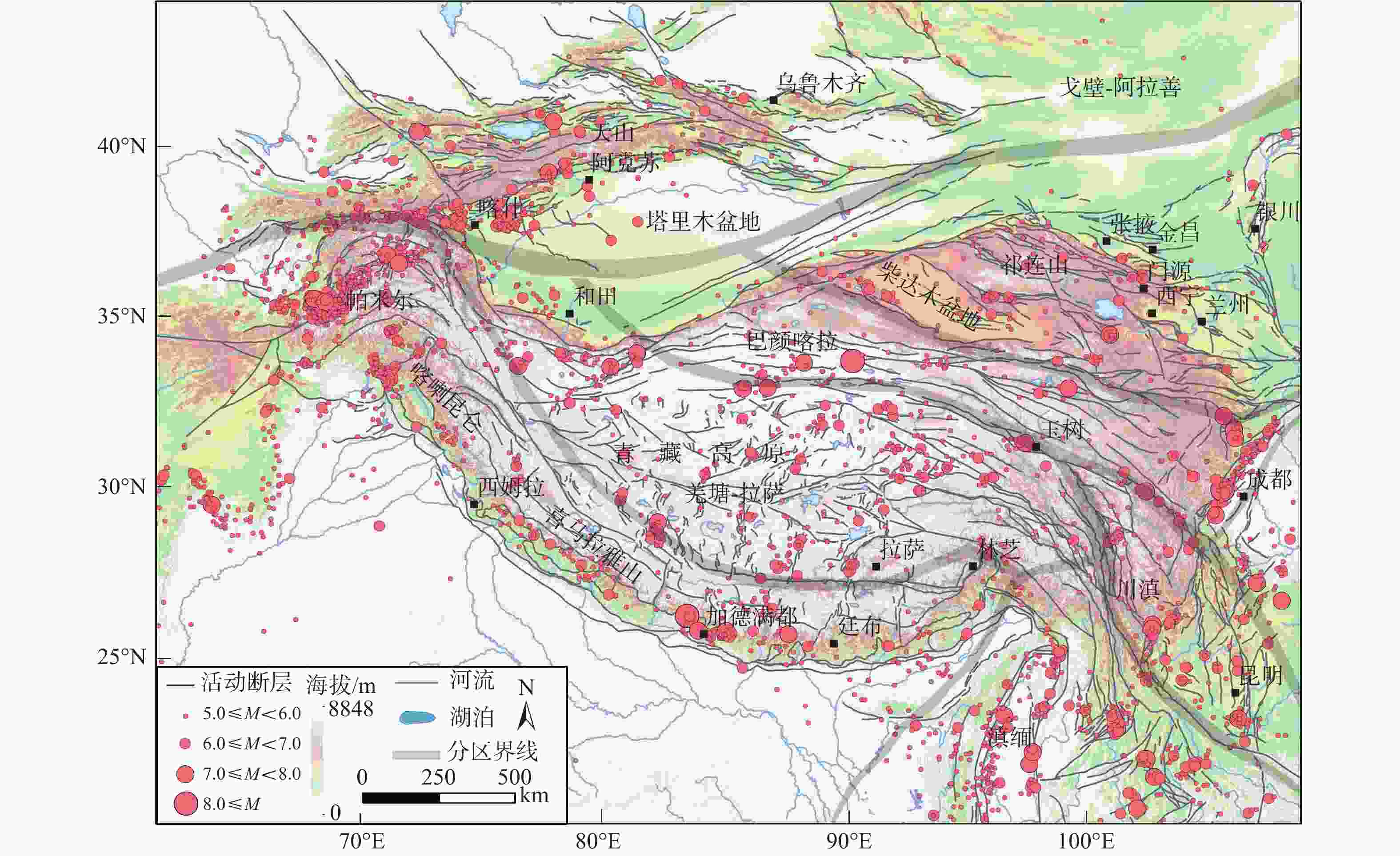
图 1 青藏高原及邻区活动断裂与强震分布图
图中活动断裂基于邓起东等(2002)和吴中海(2019)等基础上修改完善,并增加了第二次青藏高原综合科学考察研究项目的最新成果;地震数据在中国地震台网中心(http://data.earthquake.cn)基础上,部分进行了重新定位
Figure 1. Map of active faults and strong earthquakes in the Tibetan Plateau and its adjacent regions The active faults in the figure have been modified and improved based on Deng et al., 2002 and Wu, 2019, and the latest results of the Second Tibetan Plateau Scientific Expedition and Research Program have been added. Seismic data comes from the China Earthquake Networks Center (http://data.earthquake.cn); some earthquakes have been repositioned.

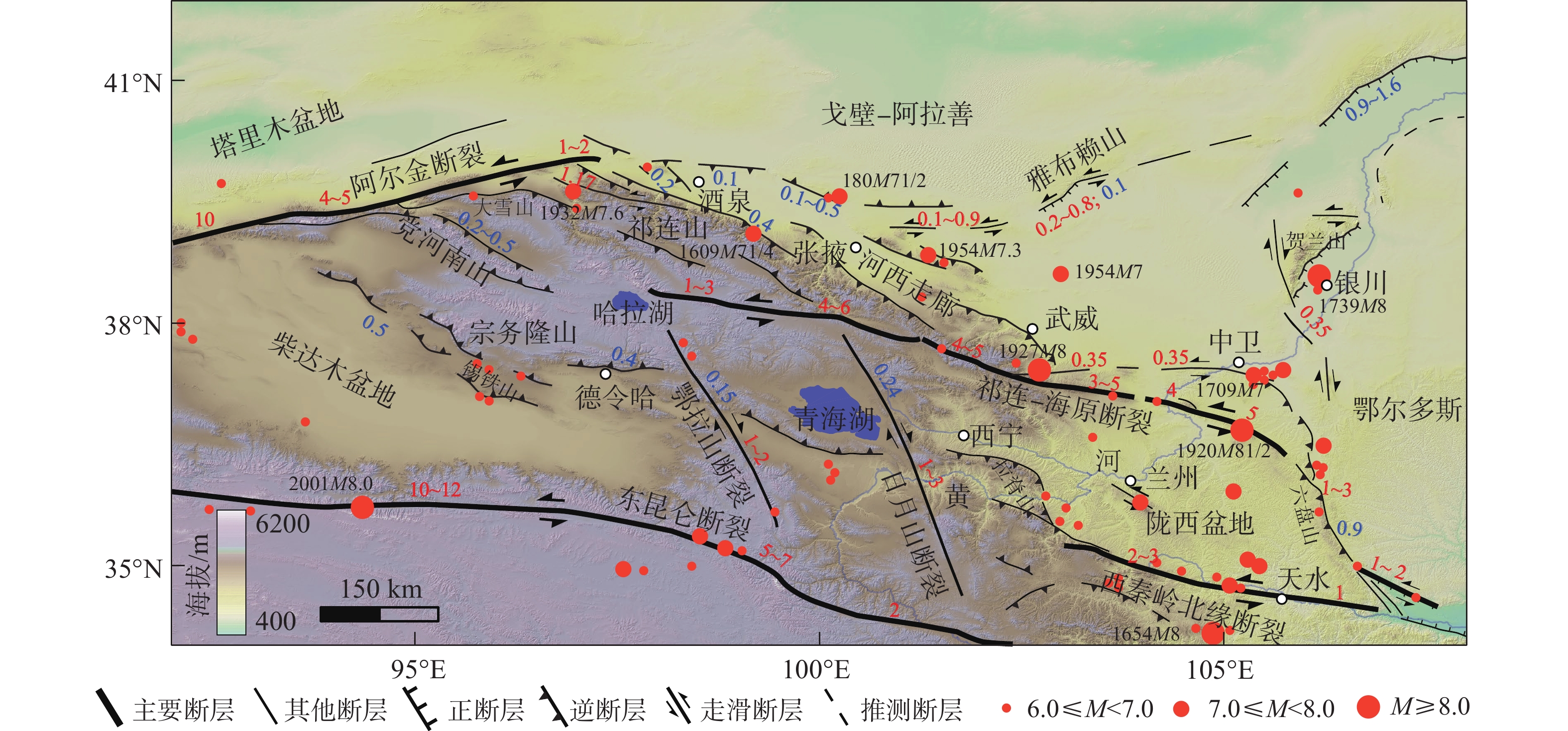
图 2 祁连山—柴达木区域主要活动断裂及运动特征
图中红色数字代表断层走滑速率(单位mm/yr),蓝色数字代表断层逆冲(垂直)速率(单位mm/yr);图中断层滑动速率及断层分布来源于Zheng et al.(2013)和郑文俊等(2016,2019)对已有成果的总结,并增加了部分第二次青藏高原综合科学考察研究项目的最新成果
Figure 2. Main active faults and movement characteristics in the Qilianshan–Qaidam basin The red numbers represent the strike-slip rate (unit: mm/yr) of the fault, and the blue numbers represent the thrust (vertical) rate (unit: mm/yr) of the fault. The slip rates and fault distributions shown are derived from a summary of previous results by Zheng et al.,2013, 2016, 2019, and include some of the latest results from the Second Tibetan Plateau Scientific Expedition and Research Program.
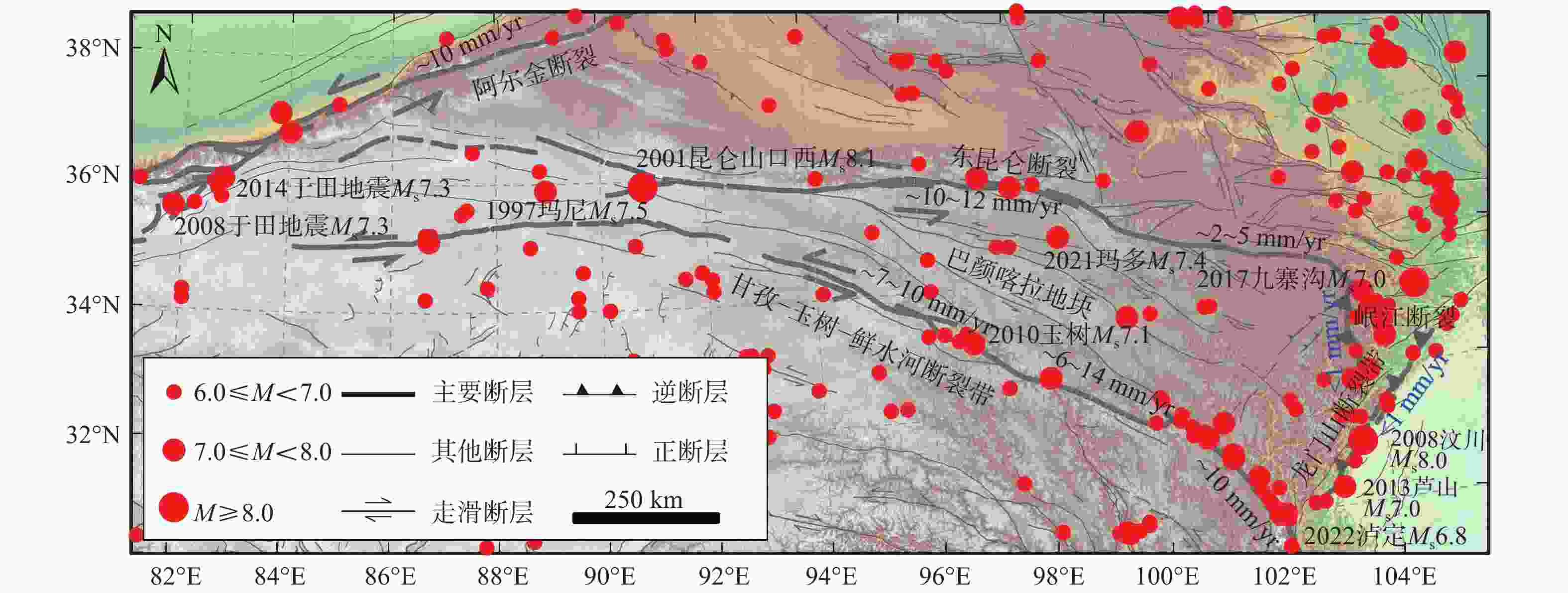
图 3 巴颜喀拉地块周缘主要断裂及运动特征
图中黑色数字代表断层走滑速率,蓝色数字代表断层逆冲(垂直)速率;图中断层滑动速率及断层分布来源于已有研究成果(周荣军等,2000;Kirby et al.,2007;王虎等,2011;Li et al.,2016;李峰等,2018;Liu et al.,2020),并增加了部分第二次青藏高原综合科学考察研究项目最新成果
Figure 3. Main faults and movement characteristics around the Bayan Har Block The black numbers represent the strike-slip rate of the fault, and the blue numbers represent the thrust (vertical) rate of the fault. The slip rates of the main faults are sourced fromZhou et al., 2000; Kirby et al., 2007; Wang et al, 2011; Li et al., 2016; Li et al., 2018; Liu et al., 2020,and include some of the latest results from the Second Tibetan Plateau Scientific Expedition and Research Program.

图 4 川滇活动地块主要断裂及运动特征
图中黑色数字代表断层走滑速率;图中断层滑动速率及断层分布来源于已有文献(冉勇康等,2008;王虎等,2011;魏占玉等,2012;李西等,2016;Shi et al.,2018;程理等,2020),并增加了部分第二次青藏高原综合科学考察研究项目的最新成果
Figure 4. Main faults and movement characteristics around the Sichuan–Yunnan Block The black numbers represent the strike-slip rates of the faults. The slip rates of the main faults are sourced from Ran et al., 2008; Wang et al., 2011; Wei et al., 2012; Li et al., 2016; Shi et al., 2018; Cheng et al., 2020, and include some of the latest results from the Second Tibetan Plateau Scientific Expedition and Research Program.

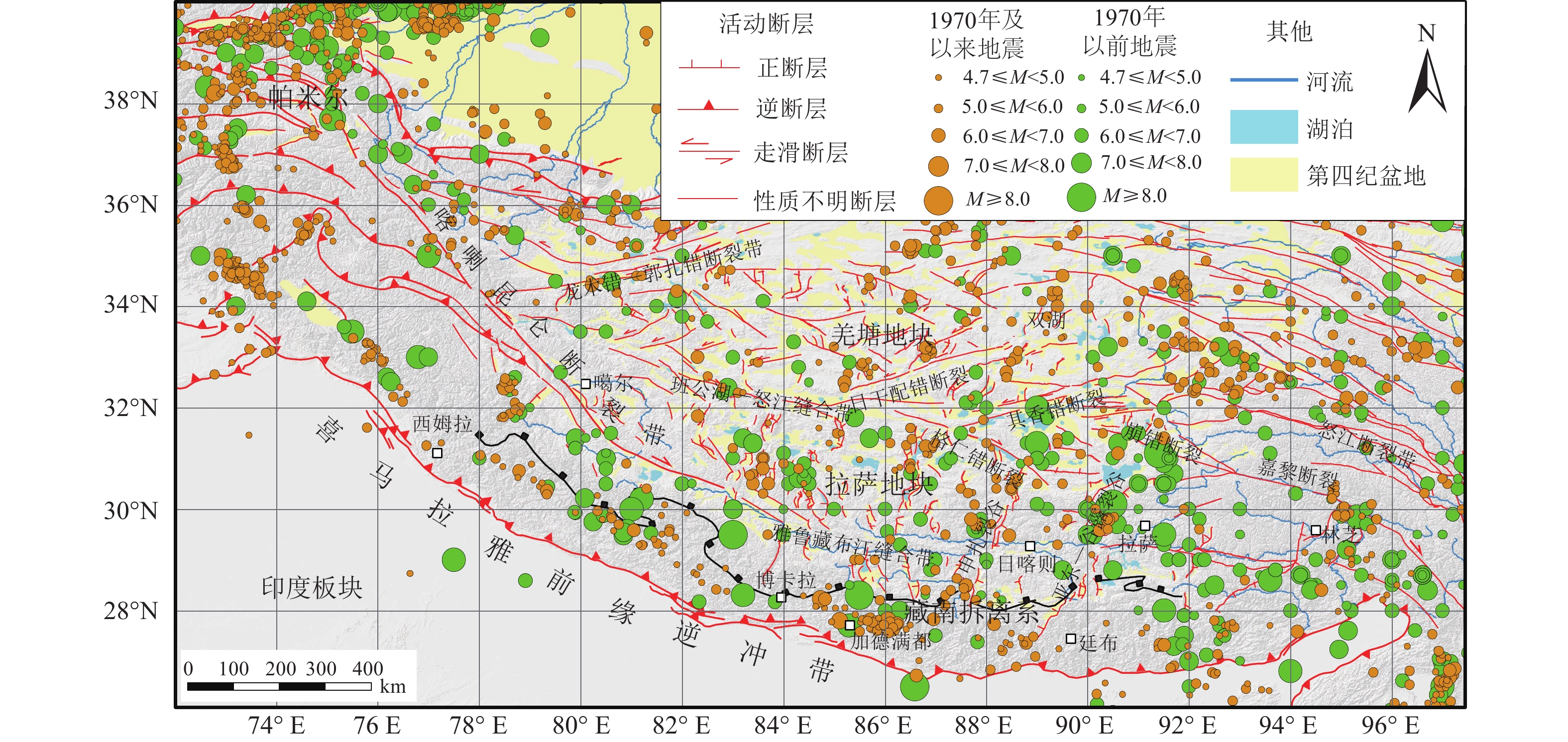
图 5 羌塘、拉萨及帕米尔−藏南主要活动断裂与强震分布
图中断层资料据已有文献(Taylor et al.,2003;吴中海等,2009;Shi et al.,2014;Chevalier et al.,2020)修改,并增加了部分第二次青藏高原综合科学考察研究项目的最新成果;图中地震数据来源于中国地震台网中心(http://data.earthquake.cn)
Figure 5. Main active faults and strong earthquakes in the Qiangtang block, Lhasa block, and the Pamir-southern Tibetan Plateau Data of active faults are modified fromTaylor et al.,2003;Wu et al.,2009;Shi et al.,2014;Chevalier et al.,2020), and include some of the latest results from the Second Tibetan Plateau Scientific Expedition and Research Program. The seismic data in the figure are from the China Earthquake Networks Center (http://data.earthquake.cn).

图 6 滇缅地块区主要活动断裂与强震分布
图中断层根据Shi et al.(2018)和郑文俊等(2019)修改,并增加了部分第二次青藏高原综合科学考察研究项目的最新成果;图中地震数据来源于中国地震台网中心(http://data.earthquake.cn)
Figure 6. Main active faults and strong earthquakes in the Yunnan–Myanmar block Data of active faults are modified from Shi et al., 2018; Zheng et al., 2019, and include some of the latest results from the Second Tibetan Plateau Scientific Expedition and Research Program. The seismic data in the figure are from the China Earthquake Networks Center (http://data.earthquake.cn).
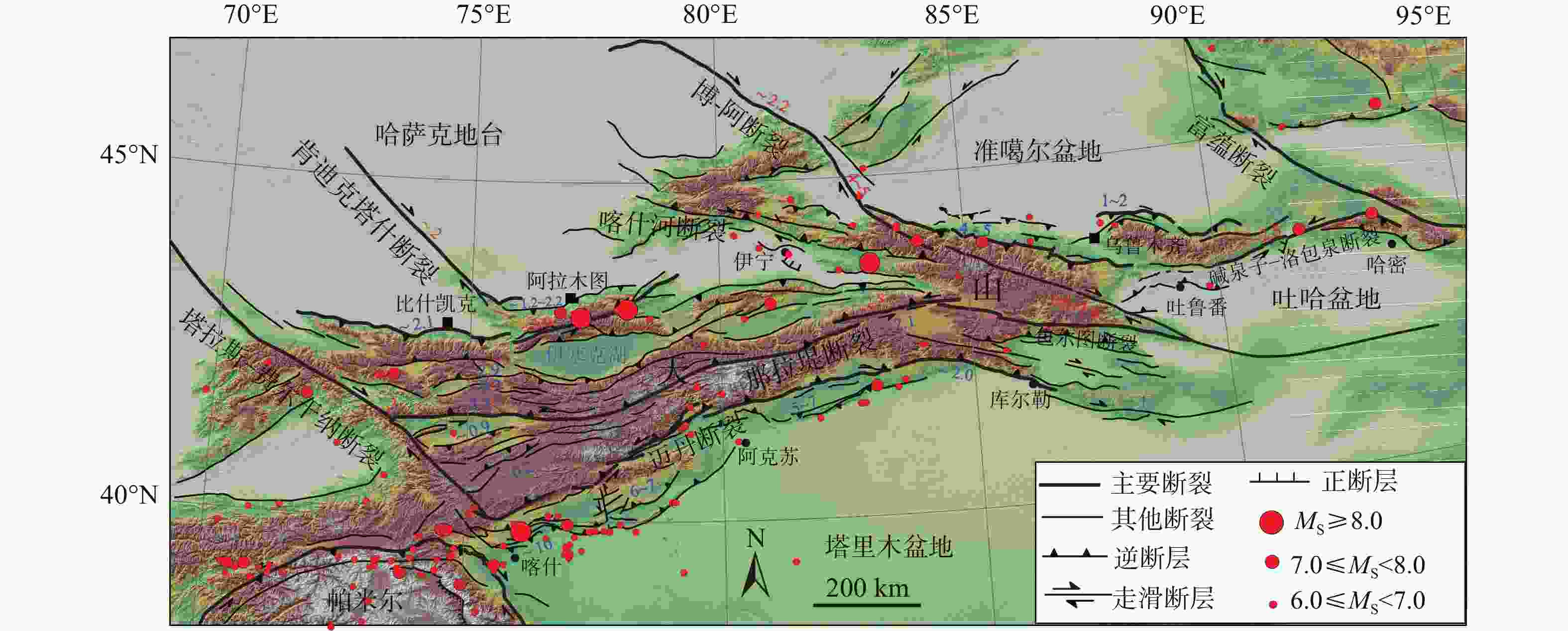
图 7 天山地块区主要活动断裂及运动特征(据Wu et al.,2021,2023修改)
图中红色数字代表断层走滑速率(单位mm/yr),蓝色数字代表断层逆冲(垂直)速率(单位mm/yr)
Figure 7. Main active faults and movement characteristics in the Tianshan (modified from Wu et al., 2021, 2023) The red numbers represent the strike-slip rates (unit: mm/yr) of the faults, and the blue numbers represent the thrust (vertical) rates (unit: mm/yr) of the faults.

图 8 青藏高原及邻区现今变形场
图中的黑色细线为断裂a—GNSS水平速度场(相对欧亚板块);b—最大剪应变率场;c—面应变率场(正值为面膨胀、负值为面压缩);d—水准垂直速度场(相对ITRF2014)
Figure 8. Current deformation field of the Tibetan Plateau and adjacent regions (a) GNSS horizontal velocity field (relative to the Eurasian Plate); (b) Maximum shear strain rate field; (c) Surface strain rate field, with positive values indicating surface expansion and negative values indicating surface compression; (d) Leveling vertical velocity field (relative to ITRF2014). The gray lines indicate the faults.

图 9 青藏高原地区地震活动、震源机制与应力场特征
图中灰黑色线为断层a—1900年以来M≥6.0地震分布;b—1970年以来M 3.0—M 6.0地震分布;c—震源机制解分布;d—应力场分布特征(R为应力比值)
Figure 9. Seismic activity, focal mechanisms, and stress field characteristics in the Tibetan Plateau and the adjacent region (a) Distribution of earthquakes with M ≥ 6.0 since 1900; (b) Distribution of M 3.0 to M 6.0 earthquakes since 1970; (c) Distribution of focal mechanism solutions; (d) Stress field characteristics (R is the stress ratio) The black lines indicate the faults.
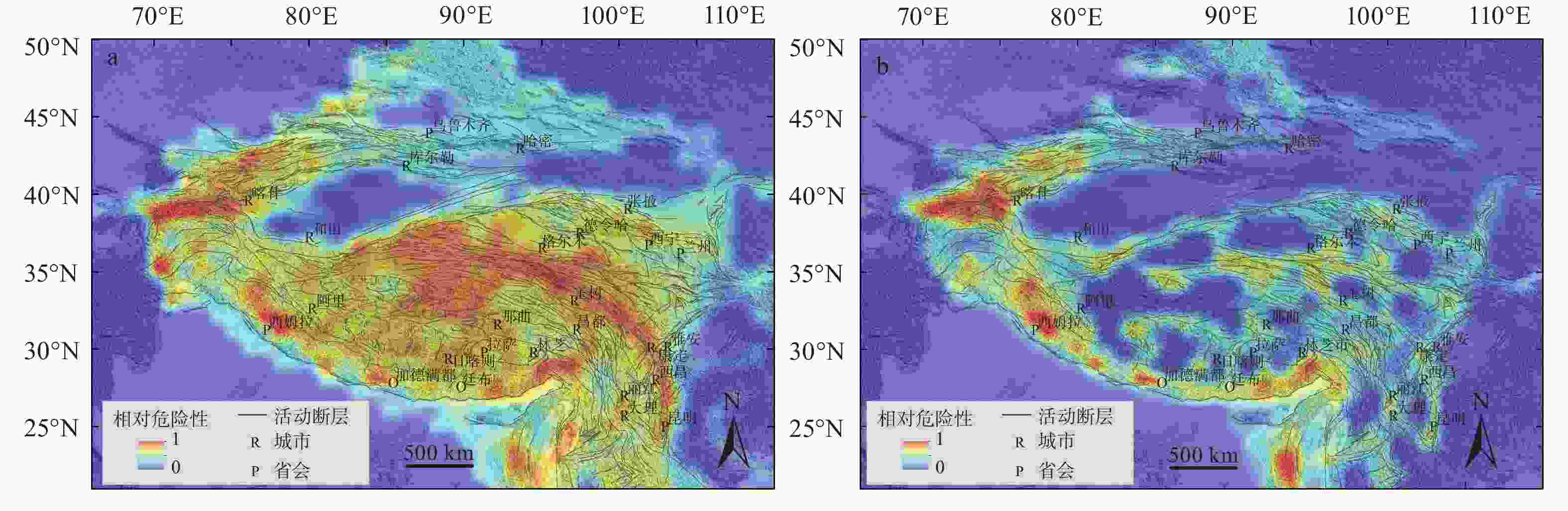
图 10 青藏高原及周缘强震相对危险性
图中灰色细线为断层a—6.5级及以上地震相对危险性;b—7.5级及以上地震相对危险性
Figure 10. Relative risk of large earthquakes in the Qinghai–Tibetan Plateau and its surrounding areas (a) Relative risk of earthquakes with a magnitude of 6.5 or greater; (b) Relative risk of earthquakes with a magnitude of 7.5 or greater The black lines indicate the faults.
-
[1] ARMIJO R, TAPPONNIER P, MERCIER J L, et al., 1986. Quaternary extension in southern Tibet: field observations and tectonic implications[J]. Journal of Geophysical Research: Solid Earth, 91(B14): 13803-13872. doi: 10.1029/JB091iB14p13803 [2] AVOUAC J P, TAPPONNIER P, BAI M, et al., 1993. Active thrusting and folding along the northern Tien Shan and Late Cenozoic rotation of the Tarim relative to Dzungaria and Kazakhstan[J]. Journal of Geophysical Research: Solid Earth, 98(B4): 6755-6804. doi: 10.1029/92JB01963 [3] BAI M K, CHEVALIER M L, LELOUP P H, et al., 2021. Spatial slip rate distribution along the SE Xianshuihe Fault, eastern Tibet, and earthquake hazard assessment[J]. Tectonics, 40(11): e2021TC006985. doi: 10.1029/2021TC006985 [4] BLISNIUK P M, SHARP W D, 2003. Rates of late Quaternary normal faulting in central Tibet from U-series dating of pedogenic carbonate in displaced fluvial gravel deposits[J]. Earth and Planetary Science Letters, 215(1-2): 169-186. doi: 10.1016/S0012-821X(03)00374-1 [5] CAMPBELL G E, WALKER R T, ABDRAKHMATOV K, et al., 2013. The Dzhungarian fault: Late Quaternary tectonics and slip rate of a major right‐lateral strike‐slip fault in the northern Tien Shan region[J]. Journal of Geophysical Research: Solid Earth, 118(10): 5681-5698. doi: 10.1002/jgrb.50367 [6] CHEN F H, DING L, PIAO S L, et al., 2021a. The Tibetan Plateau as the engine for Asian environmental change: the Tibetan Plateau Earth system research into a new era[J]. Science Bulletin, 66(13): 1263-1266. doi: 10.1016/j.scib.2021.04.017 [7] CHEN G, AI M, ZHENG W J, et al., 2021b. Nonrigid Bookshelf Kinematics of Northeastern Tibet: constrains from Fault Slip Rates around the Qinghai Lake and Chaka-Gonghe Basins[J]. Lithosphere, 2021(S2): 4115729. [8] CHEN P S, BAI T X, LI B K, 2003. b-value and earthquake occurrence period[J]. Chinese Journal of Geophysics, 46(4): 510-519. (in Chinese with English abstract) [9] CHENG L, LI G T, WU H, et al., 2020. A preliminary study of paleo-earthquake in the Majiacun-Daju section of Zhongdian-Daju fault, Yunnan Province[J]. Earthquake Research in China, 36(2): 211-220. (in Chinese with English abstract) [10] CHENG S H, XIAO X, WU J P, et al., 2021. Crustal thickness and Vp/Vs variation beneath continental China revealed by receiver function analysis[J]. Geophysical Journal International, 228(3): 1731-1749. doi: 10.1093/gji/ggab433 [11] CHEVALIER M L, RYERSON F J, TAPPONNIER P, et al., 2005. Slip-rate measurements on the Karakorum Fault may imply secular variations in fault motion[J]. Science, 307(5708): 411-414. doi: 10.1126/science.1105466 [12] CHEVALIER M L, TAPPONNIER P, VAN DER WOERD J, et al. , 2012. Spatially constant slip rate along the southern segment of the Karakorum fault since 200ka[J]. Tectonophysics, 530-531: 152-179. [13] CHEVALIER M L, VAN DER WOERD J, TAPPONNIER P, et al., 2016. Late Quaternary slip-rate along the central Bangong-Chaxikang segment of the Karakorum fault, western Tibet[J]. GSA Bulletin, 128(1-2): 284-314. [14] CHEVALIER M L, TAPPONNIER P, VAN DER WOERD J, et al., 2020. Late Quaternary extension rates across the northern half of the Yadong‐Gulu Rift: implication for East‐West extension in southern Tibet[J]. Journal of Geophysical Research: Solid Earth, 125(7): e2019JB019106. doi: 10.1029/2019JB019106 [15] CHEVALIER M L, TAPPONNIER P, TRINH P T, et al., 2022. Large-scale intersion of Plio-Quaternary slip along the boundary faults between the South China, Sunda, and Shan blocks[J]. Acta Geologica Sinica, 96(8): 2833-2852. [16] CUI P, WEI F Q, CHEN X Q, et al., 2008. Geo-hazards in Wenchuan earthquake area and countermeasures for disaster reduction[J]. Bulletin of Chinese Academy of Sciences, 23(4): 317-323. (in Chinese with English abstract) [17] CUI P, HU K H, CHEN H Y, et al., 2018. Risks along the Silk Road Economic Belt owing to natural hazards and construction of major projects[J]. Chinese Science Bulletin, 63(11): 989-997. (in Chinese with English abstract) doi: 10.1360/N972017-00867 [18] CUI Z J, CHEN Z L, WANG Q C, et al., 2019. Inversion for regional tectonic stress field in the North-South Seismic Belt of China[J]. Acta Seismologica Sinica, 41(2): 219-229. (in Chinese with English abstract) [19] DECELLES P G, ROBINSON D M, QUADE J, et al., 2001. Stratigraphy, structure, and tectonic evolution of the Himalayan fold‐thrust belt in western Nepal[J]. Tectonics, 20(4): 487-509. doi: 10.1029/2000TC001226 [20] DENG Q D, ZHANG P Z, RAN Y K, et al., 2003. Active tectonics and earthquake activities in China[J]. Earth Science Frontiers, 10(S1): 66-73. (in Chinese with English abstract) [21] DENG Q D, ZHANG P Z, RAN Y K, et al., 2003. Basic characteristics of active tectonics of China[J]. Science in China Series D: Earth Sciences, 46(4): 356-372. doi: 10.1360/03yd9032 [22] DENG Q D, GAO X, YANG H, 2009. Fault-block tectonics, active fault-block tectonics and earthquake activity[J]. Chinese Journal of Geology, 44(4): 1083-1093. (in Chinese with English abstract) [23] DENG Q D, CHENG S P, MA J, et al., 2014. Seismic activities and earthquake potential in the Tibetan plateau[J]. Chinese Journal of Geophysics, 57(7): 2025-2042. (in Chinese with English abstract) [24] DEWEY J F, SHACKLETON R M, CHENGFA C, et al., 1988. The tectonic evolution of the Tibetan Plateau[J]. Philosophical Transactions of the Royal Society of London. Series A, Mathematical and Physical Sciences, 327(1594): 379-413. doi: 10.1098/rsta.1988.0135 [25] DING L, LI Z Y, SONG P P, 2017. Core fragments of Tibetan Plateau from Gondwanaland united in northern hemisphere[J]. Bulletin of Chinese Academy of Sciences, 32(9): 945-950. (in Chinese with English abstract) [26] DZIEWONSKI A M, ANDERSON D L, 1981. Preliminary reference Earth model[J]. Physics of the Earth and Planetary Interiors, 25(4): 297-356. doi: 10.1016/0031-9201(81)90046-7 [27] ENGLAND P, HOUSEMAN G, 1986. Finite strain calculations of continental deformation: 2. Comparison with the India‐Asia Collision Zone[J]. Journal of Geophysical Research: Solid Earth, 91(B3): 3664-3676. doi: 10.1029/JB091iB03p03664 [28] GAO M T, 2015. Textbook on Seismic ground motion parameters zonation map of China[M]. Beijing: China Standard Press: 1-264. (in Chinese) [29] GUO X Y, JIANG C S, HAN L B, et al. , 2022. Focal mechanism data set in Chinese mainland and its adjacent area (2009-2021)[EB/OL]. https://data.earthquake.cn,2022. DOI: 10.12080/nedc.11.ds.2022.0004 or CSTR:12166.11.ds.2022.0004. (in Chinese with English abstract) [30] HAO M, WANG Q L, ZHANG P Z, et al., 2021. “Frame Wobbling” causing crustal deformation around the ordos block[J]. Geophysical Research Letters, 48(1): e2020GL091008. doi: 10.1029/2020GL091008 [31] HARDEBECK J L, MICHAEL A J, 2006. Damped regional‐scale stress inversions: methodology and examples for southern California and the Coalinga aftershock sequence[J]. Journal of Geophysical Research: Solid Earth, 111(B11): 2005JB004144. doi: 10.1029/2005JB004144 [32] HARRISON T M, COPELAND P, KIDD W S F, et al., 1992. Raising tibet[J]. Science, 255(5052): 1663-1670. doi: 10.1126/science.255.5052.1663 [33] HE F M, CHANG Z F, 2022. Late Quaternary activity characteristics of the Taoyuan section of Longpan-Qiaohou fault zone in northwest Yunnan[J]. China Earthquake Engineering Journal, 44(3): 579-591. (in Chinese with English abstract) [34] HE W G, LIU X W, YUAN D Y, et al., 2015. Preliminary study on the Late Quaternary activity characteristics of the Menglian Fault in Southwest Yunnan[J]. China Earthquake Engineering Journal, 37(4): 986-995. (in Chinese with English abstract) [35] HOU Z Q, LIU L J, ZHANG H J, et al., 2024. Cenozoic eastward growth of the Tibetan Plateau controlled by tearing of the Indian slab[J]. Nature Geoscience, 17(3): 255-263. doi: 10.1038/s41561-024-01382-9 [36] HUANG J Q, CHEN B W, 1987. The evolution of the Tethys in China and adjacent regions[M]. Beijing: Geological Publishing House. (in Chinese) [37] HUANG X J, WU Z H, HUANG X L, et al., 2018. Tectonic geomorphology constrains on quaternary activity and segmentation along Chenghai-Binchuan Fault zone in Northwest Yunnan, China[J]. Earth Science, 43(12): 4651-4670. (in Chinese with English abstract) [38] IBARRA D E, DAI J G, GAO Y, et al., 2023. High-elevation Tibetan Plateau before India–Eurasia collision recorded by triple oxygen isotopes[J]. Nature Geoscience, 16(9): 810-815. doi: 10.1038/s41561-023-01243-x [39] KE X P, WANG Y, XU H Z, 2009. The forward simulation of gravity for 3D crustal structures in the Tibetan plateau[J]. Progress in Geophysics, 24(4): 1225-1234. (in Chinese with English abstract) [40] KIRBY E, HARKINS N, WANG E Q, et al., 2007. Slip rate gradients along the eastern Kunlun fault[J]. Tectonics, 26(2): 2006TC002033. doi: 10.1029/2006TC002033 [41] KREEMER C, HAMMOND W C, BLEWITT G, 2018. A robust estimation of the 3‐D intraplate deformation of the North American Plate from GPS[J]. Journal of Geophysical Research: Solid Earth, 123(5): 4388-4412. doi: 10.1029/2017JB015257 [42] LACASSIN R, VALLI F, ARNAUD N, et al., 2004. Large-scale geometry, offset and kinematic evolution of the Karakorum fault, Tibet[J]. Earth and Planetary Science Letters, 219(3-4): 255-269. doi: 10.1016/S0012-821X(04)00006-8 [43] LASKE G, MASTERS G, MA Z T, et al. , 2013. Update on CRUST1.0—A 1-degree global model of Earth’s crust[C]//Proceedings of EGU General Assembly 2013. Vienna: EGU: 2658. [44] LAVÉ J, AVOUAC J P, 2000. Active folding of fluvial terraces across the Siwaliks Hills, Himalayas of central Nepal[J]. Journal of Geophysical Research: Solid Earth, 105(B3): 5735-5770. doi: 10.1029/1999JB900292 [45] LEI J S, ZHAO D P, XU X W, et al., 2019. Is there a big mantle wedge under eastern Tibet?[J]. Physics of the Earth and Planetary Interiors, 292: 100-113. doi: 10.1016/j.pepi.2019.04.005 [46] LI F, LIU H G, JIA Q C, et al., 2018. Holocene active characteristics of the northern segment of the Minjiang fault in the eastern margin of the Tibetan Plateau[J]. Seismology and Geology, 40(1): 97-106. (in Chinese with English abstract) [47] LI H B, PAN J W, SUN Z M, et al., 2021. Continental tectonic deformation and seismic activity: a case study from the Tibetan Plateau[J]. Acta Geologica Sinica, 95(1): 194-213. (in Chinese with English abstract) [48] LI J, YAO Y, LI R, et al., 2022a. Present‐day strike‐slip faulting and thrusting of the Kepingtage fold‐and‐thrust belt in southern Tianshan: constraints from GPS observations[J]. Geophysical Research Letters, 49(11): e2022GL099105. doi: 10.1029/2022GL099105 [49] LI K, KIRBY E, XU X W, et al., 2019a. Rates of Holocene normal faulting along the Dong Co fault in central Tibet, based on 14C dating of displaced fluvial terraces[J]. Journal of Asian Earth Sciences, 183: 103962. doi: 10.1016/j.jseaes.2019.103962 [50] LI K, TAPPONNIER P, XU X W, et al., 2022b. Holocene slip rate along the Beng Co Fault and dextral strike‐slip extrusion of central eastern Tibet[J]. Tectonics, 41(8): e2022TC007230. doi: 10.1029/2022TC007230 [51] LI K, CHEVALIER M L, TAPPONNIER P, et al., 2024a. Previously unrecognized, 1000 km-long Qixiang Co fault governs eastward escape of central Tibet[J]. Earth and Planetary Science Letters, 644: 118928. doi: 10.1016/j.jpgl.2024.118928 [52] LI T, CHEN Z X, CHEN J, et al., 2019b. Along‐strike and downdip segmentation of the Pamir frontal thrust and its association with the 1985 MW 6.9 Wuqia earthquake[J]. Journal of Geophysical Research: Solid Earth, 124(9): 9890-9919. doi: 10.1029/2019JB017319 [53] LI X, RAN Y K, CHEN L C, et al., 2016. The Holocene seismic evidence on southern segment of the Red River Fault zone[J]. Seismology and Geology, 38(3): 596-604. (in Chinese with English abstract) [54] LI Y J, SHAO Z G, SHI F Q, et al., 2020a. Stress evolution on active faults in the southwestern Yunnan region, southeastern Tibetan Plateau, and implications for seismic hazard[J]. Journal of Asian Earth Sciences, 200: 104470. doi: 10.1016/j.jseaes.2020.104470 [55] LI Y H, SONG S W, HAO M, et al., 2023. Present-day crustal deformation across the Daliang Shan, southeastern Tibetan Plateau constrained by a dense GPS network[J]. Geophysical Journal International, 232(3): 1619-1638. [56] LI Z F, XU X W, TAPPONNIER P, et al., 2021. Post-20 ka earthquake scarps along NE-Tibet’s Qilian Shan frontal thrust: multi-millennial return, ~characteristic co-seismic slip, and geological rupture control[J]. Journal of Geophysical Research: Solid Earth, 126(12): e2021JB021889. doi: 10.1029/2021JB021889 [57] LI Z G, LIU-ZENG J, JIA D, et al., 2016. Quaternary activity of the range front thrust system in the Longmen Shan piedmont, China, revealed by seismic imaging and growth strata[J]. Tectonics, 35(12): 2807-2827. doi: 10.1002/2015TC004093 [58] LI Z J, HAO M, HAMMOND W C, et al., 2024b. Geodetic constraints on three-component motion of the Ordos block (China) and their implications for lithospheric dynamics[J]. GSA Bulletin, 136(11-12): 5217-5230. doi: 10.1130/B37423.1 [59] LI Z J, WANG Y, GAN W J, et al. , 2020b. Diffuse deformation in the SE Tibetan Plateau: New insights from geodetic observations[J]. Journal of Geophysical Research: Solid Earth, 125(10). https://doi.org/10.1029/2020JB019383 [60] LIU F C, PAN J W, LI H B, et al., 2022. Characteristics of quaternary activities along the Riganpei co fault and seismogenic structure of the July 23, 2020 MW6.4 Nima Earthquake, Central Tibet[J]. Acta Geoscientica Sinica, 43(2): 173-188. (in Chinese with English abstract) [61] LIU F C, PAN J W, LI H B, et al., 2024. Tenfold lower Late Quaternary throw rates in central Tibet compared to southern Tibet reflect different extensional deformation mechanisms[J]. Journal of Structural Geology, 182: 105116. doi: 10.1016/j.jsg.2024.105116 [62] LIU J, ZENG L S, DING L, et al., 2009. Tectonic geomorphology, active tectonics and lower crustal channel flow hypothesis of the southeastern Tibetan Plateau[J]. Chinese Journal of Geology, 44(4): 1227-1255. (in Chinese with English abstract) [63] LIU J R, REN Z K, ZHENG W J, et al., 2020. Late Quaternary slip rate of the Aksay segment and its rapidly decreasing gradient along the Altyn Tagh fault[J]. Geosphere, 16(6): 1538-1557. doi: 10.1130/GES02250.1 [64] LIU J R, REN Z K, ZHANG H P, et al., 2022. Slip rates along the Laohushan Fault and spatial variation in slip rate along the Haiyuan Fault zone[J]. Tectonics, 41(2): e2021TC006992. doi: 10.1029/2021TC006992 [65] LIU J R, REN Z K, MIN W, et al., 2025. A quintessential strike‐slip contractional duplex: deciphering the geometric kinematics of the Elashan Fault, NE margin of Tibetan Plateau, China[J]. Tectonics, 44(2): e2024TC008783. doi: 10.1029/2024TC008783 [66] LU H H, WU D Y, ZHANG H P, et al., 2020. Spatial patterns of Late Quaternary river incision along the northern Tian Shan foreland[J]. Geomorphology, 357: 107100. doi: 10.1016/j.geomorph.2020.107100 [67] LU H H, JIANG Y T, LI B J, et al., 2022. Origin of Late Quaternary gravel and drainage basin expansion in the northern Chinese Tian Shan: insights from sediment provenance analyses[J]. Journal of Geophysical Research: Earth Surface, 127(5): e2021JF006472. doi: 10.1029/2021JF006472 [68] LUO J, 2013. Characteristics of focal mechanisms and stress field of the Sichuan-Yunnan rhombic block and its adjacent regions[D]. Beijing: Institute of Earthquake Forecasting, China Earthquake Administration. (in Chinese with English abstract) [69] MARTÍNEZ-GARZÓN P, KWIATEK G, ICKRATH M, et al., 2014. MSATSI: a MATLAB package for stress inversion combining solid classic methodology, a new simplified user-handling, and a visualization tool[J]. Seismological Research Letters, 85(4): 896-904. doi: 10.1785/0220130189 [70] MENG J, GILDER S A, TAN X D, et al., 2023. Strengthening the argument for a large Greater India[J]. Proceedings of the National Academy of Sciences of the United States of America, 120(33): e2305928120. [71] MOLNAR P, TAPPONNIER P, 1975. Cenozoic tectonics of Asia: effects of a continental collision: features of recent continental tectonics in Asia can be interpreted as results of the India-Eurasia collision[J]. Science, 189(4201): 419-426. doi: 10.1126/science.189.4201.419 [72] MOLNAR P, 2005. Mio-Pliocene growth of the Tibetan Plateau and evolution of East Asian climate[J]. Palaeontologia Electronica, 8(1): 1-23. 2A: 23p, 625KB [73] OHSUMI T, MUKAI Y, FUJITANI H, 2016. Investigation of damage in and around kathmandu valley related to the 2015 Gorkha, Nepal earthquake and beyond[J]. Geotechnical and Geological Engineering, 34(4): 1223-1245. doi: 10.1007/s10706-016-0023-9 [74] PAN J W, LI H B, CHEVALIER M L, et al., 2022. Co-seismic rupture of the 2021, MW7.4 Maduo earthquake (northern Tibet): short-cutting of the Kunlun fault big bend[J]. Earth and Planetary Science Letters, 594: 117703. doi: 10.1016/j.jpgl.2022.117703 [75] PENG J B, CUI P, ZHUANG J Q, 2020. Challenges to engineering geology of Sichuan-Tibet railway[J]. Chinese Journal of Rock Mechanics and Engineering, 39(12): 2377-2389. (in Chinese with English abstract) [76] RAN Y K, CHENG J W, GONG H L, et al., 2008. Late Quaternary geomorphic deformation and displacement rates of the Anninghe fault around Zimakua[J]. Seismology and Geology, 30(1): 86-98. (in Chinese with English abstract) [77] REID A J, WILSON C J L, LIU S, 2005. Structural evidence for the Permo-Triassic tectonic evolution of the Yidun Arc, eastern Tibetan Plateau[J]. Journal of Structural Geology, 27(1): 119-137. doi: 10.1016/j.jsg.2004.06.011 [78] ROBINSON A C, YIN A, MANNING C E, et al., 2007. Cenozoic evolution of the eastern Pamir: implications for strain-accommodation mechanisms at the western end of the Himalayan-Tibetan orogen[J]. GSA Bulletin, 119(7-8): 882-896. doi: 10.1130/B25981.1 [79] ROGER F, JOLIVET M, MALAVIEILLE J, 2010. The tectonic evolution of the Songpan-Garzê (North Tibet) and adjacent areas from Proterozoic to Present: a synthesis[J]. Journal of Asian Earth Sciences, 39(4): 254-269. doi: 10.1016/j.jseaes.2010.03.008 [80] SCHURR B, RATSCHBACHER L, SIPPL C, et al., 2014. Seismotectonics of the Pamir[J]. Tectonics, 33(8): 1501-1518. doi: 10.1002/2014TC003576 [81] SHAO Z G, FENG W, WANG P, et al., 2020. A study review on characteristics of seismic activity of active-tectonic block boundaries in mainland China[J]. Seismology and Geology, 42(2): 271-282. (in Chinese with English abstract) [82] SHI X H, KIRBY E, LU H J, et al., 2014. Holocene slip rate along the Gyaring Co Fault, central Tibet[J]. Geophysical Research Letters, 41(16): 5829-5837. doi: 10.1002/2014GL060782 [83] SHI X H, SIEH K, WELDON R, et al., 2018. Slip rate and rare large prehistoric earthquakes of the Red River Fault, Southwestern China[J]. Geochemistry, Geophysics, Geosystems, 19(7): 2014-2031. doi: 10.1029/2017GC007420 [84] SIPPL C, SCHURR B, YUAN X, et al., 2013. Geometry of the Pamir‐Hindu Kush intermediate‐depth earthquake zone from local seismic data[J]. Journal of Geophysical Research: Solid Earth, 118(4): 1438-1457. doi: 10.1002/jgrb.50128 [85] TAN X, LIANG K, MA B Q, 2023. A review of research progress on the Late Quaternary activities of the Xiaojiang Fault Zone[J]. Technology for Earthquake Disaster Prevention, 18(4): 757-772. (in Chinese with English abstract) [86] TANG Q, ZHENG W J, BI H Y, et al., 2024. Fault slip behavior and segmentation revealed by geomorphic offset clusters: an example from the middle Riganpei co fault, central Tibet[J]. Journal of Asian Earth Sciences, 260: 105976. doi: 10.1016/j.jseaes.2023.105976 [87] TAPPONNIER P, XU Z Q, ROGER F, et al., 2001. Oblique stepwise rise and growth of the Tibet Plateau[J]. Science, 294(5547): 1671-1677. doi: 10.1126/science.105978 [88] TAYLOR M, YIN A, RYERSON F J, et al., 2003. Conjugate strike‐slip faulting along the Bangong‐Nujiang suture zone accommodates coeval east‐west extension and north‐south shortening in the interior of the Tibetan Plateau[J]. Tectonics, 22(4): 2002TC001361. doi: 10.1029/2002TC001361 [89] TENG J W, YANG D H, TIAN X B, et al., 2019. Geophysical investigation progresses of the Qinghai-Tibetan Plateau in the past 70 years[J]. Scientia Sinica Terrae, 49(10): 1546-1564. (in Chinese with English abstract) doi: 10.1360/SSTe-2019-0132 [90] THOMPSON J A, BURBANK D W, LI T, et al., 2015. Late Miocene northward propagation of the northeast Pamir thrust system, northwest China[J]. Tectonics, 34(3): 510-534. doi: 10.1002/2014TC003690 [91] WANG C S, ZHU L D, LIU Z F, 2004. Tectonic and sedimentary evolution of basins in the north of Qinghai-Tibet plateau and northward growing process of Qinghai-Tibet plateau[J]. Advance in Earth Sciences, 19(3): 373-381. (in Chinese with English abstract) [92] WANG D, CHANG H, YIN G M, et al., 2021. Spatial changes in Late Quaternary slip rates along the Gyaring Co Fault: implications for strain partitioning and deformation modes in central Tibet[J]. Tectonics, 40(5): e2020TC006110. doi: 10.1029/2020TC006110 [93] WANG H, RAN Y K, LI Y B, 2011. Growth of a small pull-apart sasin and slip rate of strike-slip fault: with the example of Zemuhe fault on the southeastern margin of the Tibetan Plateau[J]. Seismology and Geology, 33(4): 818-827. (in Chinese with English abstract) [94] WANG H, CHEN L C, RAN Y K, et al., 2015. Paleoseismic investigation of the seismic gap between the seismogenic structures of the 2008 Wenchuan and 2013 Lushan earthquakes along the Longmen Shan fault zone at the eastern margin of the Tibetan Plateau[J]. Lithosphere, 7(1): 14-20. doi: 10.1130/L373.1 [95] WANG H, WRIGHT T J, LIU-ZENG J, et al., 2019. Strain rate distribution in South‐Central Tibet from two decades of InSAR and GPS[J]. Geophysical Research Letters, 46(10): 5170-5179. doi: 10.1029/2019GL081916 [96] WANG M, SHEN Z K, 2020. Present‐day crustal deformation of continental China derived from GPS and its tectonic implications[J]. Journal of Geophysical Research: Solid Earth, 125(2): e2019JB018774. doi: 10.1029/2019JB018774 [97] WANG W T, ZHANG P Z, GARZIONE C N, et al., 2022. Pulsed rise and growth of the Tibetan Plateau to its northern margin since ca. 30 Ma[J]. Proceedings of the National Academy of Sciences of the United States of America, 119(8): e2120364119. [98] WANG X G, LI C Y, LV L X, et al., 2017. Analysis of the Late Quaternary activity along the Wenchuan-Maoxian fault—Middle of the back-range fault at the Longmenshan fault zone[J]. Seismology and Geology, 39(3): 572-586. (in Chinese with English abstract) [99] WANG X Y, VANDENBERGHE J, LU H Y, et al., 2017b. Climatic and tectonic controls on the fluvial morphology of the Northeastern Tibetan Plateau (China)[J]. Journal of Geographical Sciences, 27(11): 1325-1340. doi: 10.1007/s11442-017-1438-9 [100] WARD S N, 1998. On the consistency of earthquake moment rates, geological fault data, and space geodetic strain: the United States[J]. Geophysical Journal International, 134(1): 172-186. doi: 10.1046/j.1365-246x.1998.00556.x [101] WEI Y M, WEI X H, LI D W, et al., 2017. Remote sensing imagery features and activity analyses of Heqing-Eryuan Fault Zone in the northwestern area of Yunnan Province[J]. Quaternary Sciences, 37(2): 234-249. (in Chinese with English abstract) [102] WEI Z Y, HE H L, SHI F, et al., 2012. Slip rate on the south segment of Daliangshan fault zone[J]. Seismology and Geology, 34(2): 282-293. (in Chinese with English abstract) [103] WELLS D L, COPPERSMITH K J, 1994. New empirical relationships among magnitude, rupture length, rupture width, rupture area, and surface displacement[J]. Bulletin of the Seismological Society of America, 84(4): 974-1002. doi: 10.1785/BSSA0840040974 [104] WU C Y, ZHENG W J, ZHANG Z Q, et al., 2018. Terrace sequence along the Yushanguxi River in the southern piedmont of Tian Shan and its relationship to climate and tectonics in northwestern China[J]. Geomorphology, 313: 48-57. doi: 10.1016/j.geomorph.2018.04.009 [105] WU C Y, ZHENG W J, ZHANG P Z, et al., 2019. Oblique thrust of the Maidan Fault and Late Quaternary tectonic deformation in the southwestern Tian Shan, northwestern China[J]. Tectonics, 38(8): 2625-2645. doi: 10.1029/2018TC005248 [106] WU C Y, ZHENG W J, ZHANG Z Q, et al., 2020. Large-earthquake rupturing and slipping behavior along the range-front Maidan fault in the southern Tian Shan, northwestern China[J]. Journal of Asian Earth Sciences, 190: 104193. doi: 10.1016/j.jseaes.2019.104193 [107] WU C Y, WANG W T, ZHENG W J, et al., 2021. Opposite sense of strike‐slip faulting and crustal rotation accommodating left‐lateral shear between the Tianshan Mountains and Kazakh platform[J]. Geophysical Research Letters, 48(24): e2021GL096442. doi: 10.1029/2021GL096442 [108] WU C Y, ZHANG P Z, ZHANG Z Q, et al., 2023. Slip partitioning and crustal deformation patterns in the Tianshan orogenic belt derived from GPS measurements and their tectonic implications[J]. Earth-Science Reviews, 238: 104362. doi: 10.1016/j.earscirev.2023.104362 [109] WU F Y, WAN B, ZHAO L, et al., 2020. Tethyan geodynamics[J]. Acta Petrologica Sinica, 36(6): 1627-1674. (in Chinese with English abstract) doi: 10.18654/1000-0569/2020.06.01 [110] WU Z H, YE P S, WU Z H, 2009. The seismic intensity, seismogenic tectonics and mechanism of the MS6.6 Damxung earthquake happened on October 6, 2008 in southern Tibet, China[J]. Geological Bulletin of China, 28(6): 713-725. (in Chinese with English abstract) [111] WU Z H, 2019. The active fault map of China and its adjacent sea areas[J]. Journal of Geomechanics, 25(1): 151. (in Chinese) [112] WU Z H, 2024. The earthquake-controlling process of continental collision-extrusion active tectonic system around the Qinghai-Tibet Plateau: a case study of strong earthquakes since 1990[J]. Journal of Geomechanics, 30(2): 189-205. (in Chinese with English abstract) [113] XIAO W J, SONG D F, WINDLEY B F, et al., 2020. Accretionary processes and metallogenesis of the Central Asian Orogenic Belt: advances and perspectives[J]. Science China Earth Sciences, 63(3): 329-361. doi: 10.1007/s11430-019-9524-6 [114] XIAO X C, LI T D, LI G C, et al. , 1988. Tectonic evolution of Himalayan lithosphere[M]. Beijing: Geological Publishing House. (in Chinese) [115] XU X W, WU X Y, YU G H, et al., 2017. Seismo-geological signatures for identifying M≥7.0 earthquake risk areas and their premilimary application in China's mainland[J]. Seismology and Geology, 39(2): 219-275. (in Chinese with English abstract) [116] XU Z Q, YANG J S, LI W C, et al., 2013. Paleo-Tethys system and accretionary orogen in the Tibet Plateau[J]. Acta Petrologica Sinica, 29(6): 1847-1860. (in Chinese with English abstract) [117] YAO S H, GAI H L, YIN X, et al., 2020. Tectonic Geomorphology and Quaternary slip rate of the Xitieshan section of the northern margin fault of Qaidam Basin[J]. Seismology and Geology, 42(6): 1385-1400. (in Chinese with English abstract) [118] YAO T D, WU F Y, DING L, et al., 2015. Multispherical interactions and their effects on the Tibetan Plateau’s earth system: a review of the recent researches[J]. National Science Review, 2(4): 468-488. doi: 10.1093/nsr/nwv070 [119] YAO T D, WANG W C, AN B S, et al., 2022. The scientific expedition and research activities on the Tibetan Plateau in 1949-2017[J]. Acta Geographica Sinica, 77(7): 1586-1602. (in Chinese with English abstract) [120] YAO T D, WANG W C, YANG W, et al., 2024. Imbalance of the Asian Water Tower characterized by glacier and snow melt[J]. Climate Change Research, 20(6): 689-698. (in Chinese with English abstract) [121] YIN A, NIE S, CRAIG P, et al., 1998. Late Cenozoic tectonic evolution of the southern Chinese Tian Shan[J]. Tectonics, 17(1): 1-27. doi: 10.1029/97TC03140 [122] YIN A, HARRISON T M, 2000. Geologic evolution of the Himalayan-Tibetan orogen[J]. Annual Review of Earth and Planetary Sciences, 28(1): 211-280. doi: 10.1146/annurev.earth.28.1.211 [123] YIN A, 2006. Cenozoic tectonic evolution of the Himalayan orogen as constrained by along-strike variation of structural geometry, exhumation history, and foreland sedimentation[J]. Earth-Science Reviews, 76(1-2): 1-131. doi: 10.1016/j.earscirev.2005.05.004 [124] YUAN D Y, ZHANG P Z, LIU B C, et al., 2004. Geometrical imagery and tectonic transformation of Late Quaternary active tectonics in northeastern margin of Qinghai-Xizang Plateau[J]. Acta Geologica Sinica, 78(2): 270-278. (in Chinese with English abstract) [125] YUAN D Y, CHAMPAGNAC J D, GE W P, et al., 2011. Late Quaternary right-lateral slip rates of faults adjacent to the lake Qinghai, northeastern margin of the Tibetan Plateau[J]. GSA Bulletin, 123(9-10): 2016-2030. doi: 10.1130/B30315.1 [126] YUAN D Y, GE W P, CHEN Z W, et al., 2013. The growth of northeastern Tibet and its relevance to large‐scale continental geodynamics: a review of recent studies[J]. Tectonics, 32(5): 1358-1370. doi: 10.1002/tect.20081 [127] YUAN D Y, FENG J G, ZHENG W J, et al., 2020. Migration of large earthquakes in Tibetan block area and disscussion on major active region in the future[J]. Seismology and Geology, 42(2): 297-315. (in Chinese with English abstract) [128] YUAN D Y, XIE H, SU R H, et al., 2023. Characteristics of co-seismic surface rupture zone of Menyuan MS6.9 earthquake in Qinghai province on January 8, 2022 and seismogenic mechanism[J]. Chinese Journal of Geophysics, 66(1): 229-244. (in Chinese with English abstract) [129] ZHANG B X, ZHENG W J, LI T, et al., 2022. Late Cenozoic fold deformation in the northern margin of Qaidam Basin and southward propagation of Qilian Shan[J]. Tectonophysics, 822: 229153. doi: 10.1016/j.tecto.2021.229153 [130] ZHANG H P, KIRBY E, PITLICK J, et al., 2017. Characterizing the transient geomorphic response to base‐level fall in the northeastern Tibetan Plateau[J]. Journal of Geophysical Research: Earth Surface, 122(2): 546-572. doi: 10.1002/2015JF003715 [131] ZHANG H P, LIU C C, XIONG J G, et al., 2022. Late Cenozoic tectonic deformation and geomorphological evolution in the Gonghe-Chaka Basin on the northeastern margin of the Tibetan Plateau[J]. Quaternary Sciences, 42(3): 662-672. (in Chinese with English abstract) [132] ZHANG P Z, MOLNAR P, DOWNS W R, 2001. Increased sedimentation rates and grain sizes 2±4 Myr ago due to the influence of climate change on erosion rates[J]. Nature, 410(6831): 891-897. doi: 10.1038/35073504 [133] ZHANG P Z, DENG Q D, ZHANG G M, et al., 2003. Active tectonic blocks and strong earthquakes in the continent of China[J]. Science in China Series D: Earth Sciences, 46(S2): 13-24. doi: 10.1360/03dz0002 [134] ZHANG P Z, DENG Q D, ZHANG Z Q, et al., 2013. Active faults, earthquake hazards and associated geodynamic processes in continental China[J]. Scientia Sinica Terrae, 43(10): 1607-1620. (in Chinese with English abstract) doi: 10.1360/zd-2013-43-10-1607 [135] ZHANG P Z, WANG W T, GAN W J, et al., 2022. Present-day deformation and geodynamic processes of the Tibetan Plateau[J]. Acta Geologica Sinica, 96(10): 3297-3313. (in Chinese with English abstract) [136] ZHANG X M, TENG J W, SUN R M, et al., 2014. Structural model of the lithosphere–asthenosphere system beneath the Qinghai–Tibet Plateau and its adjacent areas[J]. Tectonophysics, 634: 208-226. doi: 10.1016/j.tecto.2014.08.017 [137] ZHAO L S, HELMBERGER D V, 1994. Source estimation from broadband regional seismograms[J]. Bulletin of the Seismological Society of America, 84(1): 91-104. [138] ZHENG W J, ZHANG P Z, HE W G, et al., 2013. Transformation of displacement between strike-slip and crustal shortening in the northern margin of the Tibetan Plateau: evidence from decadal GPS measurements and late Quaternary slip rates on faults[J]. Tectonophysics, 584: 267-280. doi: 10.1016/j.tecto.2012.01.006 [139] ZHENG W J, LIU X W, YU J X, et al., 2016. Geometry and late Pleistocene slip rates of the Liangdang-Jiangluo fault in the western Qinling mountains, NW China[J]. Tectonophysics, 687: 1-13. doi: 10.1016/j.tecto.2016.08.021 [140] ZHENG W J, YUAN D Y, ZHANG P Z, et al., 2016. Tectonic geometry and kinematic dissipation of the active faults in the northeastern Tibetan plateau and their implications for understanding northeastward growth of the plateau[J]. Quaternary Sciences, 36(4): 775-788. (in Chinese with English abstract) [141] ZHENG W J, ZHANG P Z, YUAN D Y, et al., 2019. Basic characteristics of active tectonics and associated geodynamic processes in continental China[J]. Journal of Geomechanics, 25(5): 699-721. (in Chinese with English abstract) [142] ZHENG W J, WANG Q L, YUAN D Y, et al., 2020. The concept, review and new insights of the active-tectonic block hypothesis[J]. Seismology and Geology, 42(2): 245-270. (in Chinese with English abstract) [143] ZHENG W J, ZHANG B X, YUAN D Y, et al., 2021. Tectonic Activity in the Southern Alashan Block and the Latest Boundary of Outward Expansion on the North eastern Tibetan Plateau, China[J]. Journal of Earth Sciences and Environment, 43(2): 224-236. (in Chinese with English abstract) [144] ZHENG W J, ZHANG Z Q, HAO M, et al., 2022. Physical basis for prediction of continental strong earthquakes: development and prospect of active tectonic block theory[J]. Chinese Science Bulletin, 67(13): 1352-1361. (in Chinese with English abstract) [145] ZHOU R J, PU X H, HE Y L, et al., 2000. Recent activity of Minjiang Fault zone, uplift of Minshan block and their relationship with seismicity of Sichuan[J]. Seismology and Geology, 22(3): 285-294. (in Chinese with English abstract) [146] ZHU L P, HELMBERGER D V, 1996. Advancement in source estimation techniques using broadband regional seismograms[J]. Bulletin of the Seismological Society of America, 86(5): 1634-1641. doi: 10.1785/BSSA0860051634 [147] ZUBOVICH A V, WANG X Q, SCHERBA Y G, et al., 2010. GPS velocity field for the Tien Shan and surrounding regions[J]. Tectonics, 29(6): TC6014. [148] 陈培善, 白彤霞, 李保昆, 2003. b值和地震复发周期[J]. 地球物理学报, 46(4): 510-519. [149] 程理, 李光涛, 吴昊, 等, 2020. 云南中甸-大具断裂马家村-大具段古地震初步研究[J]. 中国地震, 36(2): 211-220. [150] 崔鹏, 韦方强, 陈晓清, 等, 2008. 汶川地震次生山地灾害及其减灾对策[J]. 中国科学院院刊, 23(4): 317-323. [151] 崔鹏, 胡凯衡, 陈华勇, 等, 2018. 丝绸之路经济带自然灾害与重大工程风险[J]. 科学通报, 63(11): 989-997. [152] 崔子健, 陈章立, 王勤彩, 等, 2019. 南北地震带区域构造应力场反演[J]. 地震学报, 41(2): 219-229. [153] 邓起东, 张培震, 冉勇康, 等, 2002. 中国活动构造基本特征[J]. 中国科学(D辑), 32(12): 1020-1030. [154] 邓起东, 张培震, 冉勇康, 等, 2003. 中国活动构造与地震活动[J]. 地学前缘, 10(S1): 66-73. [155] 邓起东, 高翔, 杨虎, 2009. 断块构造、活动断块构造与地震活动[J]. 地质科学, 44(4): 1083-1093. [156] 邓起东, 程绍平, 马冀, 等, 2014. 青藏高原地震活动特征及当前地震活动形势[J]. 地球物理学报, 57(7): 2025-2042. [157] 丁林, 李震宇, 宋培平, 2017. 青藏高原的核心来自南半球冈瓦纳大陆[J]. 中国科学院院刊, 32(9): 945-950. [158] 高孟潭, 2015. 《中国地震动参数区划图》宣贯教材[M]. 北京: 中国标准出版社: 1-264. [159] 郭祥云, 蒋长胜, 韩立波, 等, 2022. 中国大陆及邻区震源机制数据集(2009-2021年)[EB/OL]. https: //data.earthquake.cn, 2022. DOI: 10.12080/nedc.11.ds.2022.0004 or CSTR: 12166.11.ds.2022.0004. [160] 何付明, 常祖峰, 2022. 滇西北龙蟠—乔后断裂带桃源段晚第四纪活动特征研究[J]. 地震工程学报, 44(3): 579-591. [161] 何文贵, 刘兴旺, 袁道阳, 等, 2015. 滇西南地区孟连断裂晚第四纪新活动特征初步研究[J]. 地震工程学报, 37(4): 986-995. [162] 黄汲清, 陈炳蔚, 1987. 中国及邻区特提斯海的演化[M]. 北京: 地质出版社. [163] 黄小巾, 吴中海, 黄小龙, 等, 2018. 滇西北程海-宾川断裂带第四纪分段活动性的构造地貌表现与限定[J]. 地球科学, 43(12): 4651-4670. [164] 柯小平, 王勇, 许厚泽, 2009. 青藏高原三维地壳结构的重力正演模拟[J]. 地球物理学进展, 24(4): 1225-1234. [165] 李峰, 刘华国, 贾启超, 等, 2018. 青藏高原东缘岷江断裂北段全新世活动特征[J]. 地震地质, 40(1): 97-106. [166] 李海兵, 潘家伟, 孙知明, 等, 2021. 大陆构造变形与地震活动: 以青藏高原为例[J]. 地质学报, 95(1): 194-213. [167] 李西, 冉勇康, 陈立春, 等, 2016. 红河断裂带南段全新世地震活动证据[J]. 地震地质, 38(3): 596-604. [168] 刘富财, 潘家伟, 李海兵, 等, 2022. 青藏高原中部日干配错断裂第四纪活动特征及2020年7月23日西藏尼玛MW6.4地震发震构造分析[J]. 地球学报, 43(2): 173-188. [169] 刘静, 曾令森, 丁林, 等, 2009. 青藏高原东南缘构造地貌、活动构造和下地壳流动假说[J]. 地质科学, 44(4): 1227-1255. [170] 罗钧, 2013. 川滇块体及周边现今震源机制和应力场特征研究[D]. 北京: 中国地震局地震预测研究所. [171] 彭建兵, 崔鹏, 庄建琦, 2020. 川藏铁路对工程地质提出的挑战[J]. 岩石力学与工程学报, 39(12): 2377-2389. [172] 冉勇康, 程建武, 宫会玲, 等, 2008. 安宁河断裂紫马跨一带晚第四纪地貌变形与断层位移速率[J]. 地震地质, 30(1): 86-98. [173] 邵志刚, 冯蔚, 王芃, 等, 2020. 中国大陆活动地块边界带的地震活动特征研究综述[J]. 地震地质, 42(2): 271-282. [174] 谭鑫, 梁宽, 马保起, 2023. 小江断裂带晚第四纪活动研究综述[J]. 震灾防御技术, 18(4): 757-772. [175] 滕吉文, 杨顶辉, 田小波, 等, 2019. 青藏高原深部地球物理探测70年[J]. 中国科学: 地球科学, 49(10): 1546-1564. [176] 王成善, 朱利东, 刘志飞, 2004. 青藏高原北部盆地构造沉积演化与高原向北生长过程[J]. 地球科学进展, 19(3): 373-381. [177] 王虎, 冉勇康, 李彦宝, 2011. 小型拉分盆地的生长与走滑断层的位移速率: 以青藏高原东南缘则木河断裂带为例[J]. 地震地质, 33(4): 818-827. [178] 王旭光, 李传友, 吕丽星, 等, 2017. 龙门山后山断裂中段汶川-茂县断裂的晚第四纪活动性分析[J]. 地震地质, 39(3): 572-586. [179] 魏永明, 魏显虎, 李德文, 等, 2017. 滇西北地区鹤庆-洱源断裂带遥感影像特征及活动性分析[J]. 第四纪研究, 37(2): 234-249. [180] 魏占玉, 何宏林, 石峰, 等, 2012. 大凉山断裂带南段滑动速率估计[J]. 地震地质, 34(2): 282-293. [181] 吴福元, 万博, 赵亮, 等, 2020. 特提斯地球动力学[J]. 岩石学报, 36(6): 1627-1674. [182] 吴中海, 叶培盛, 吴珍汉, 2009. 2008年10月6日西藏当雄MS6.6级强震的地震烈度控震构造和发震机理[J]. 地质通报, 28(6): 713-725. [183] 吴中海, 2019. 中国毗邻海区活动断裂分布图(中英文)正式出版[J]. 地质力学学报, 25(1): 151. [184] 吴中海, 2024. 青藏高原陆陆碰撞-挤出活动构造体系控震作用: 以1990年以来强震活动为例[J]. 地质力学学报, 30(2): 189-205. [185] 肖文交, 宋东方, WINDLEY B F, 等, 2019. 中亚增生造山过程与成矿作用研究进展[J]. 中国科学: 地球科学, 49(10): 1512-1545. [186] 肖序常, 李廷栋, 李光岑, 等, 1988. 喜马拉雅岩石圈构造演化总论[M]. 北京: 地质出版社. [187] 徐锡伟, 吴熙彦, 于贵华, 等, 2017. 中国大陆高震级地震危险区判定的地震地质学标志及其应用[J]. 地震地质, 39(2): 219-275. [188] 许志琴, 杨经绥, 李文昌, 等, 2013. 青藏高原中的古特提斯体制与增生造山作用[J]. 岩石学报, 29(6): 1847-1860. [189] 姚生海, 盖海龙, 殷翔, 等, 2020. 柴达木盆地北缘断裂(锡铁山段)的构造地貌特征与晚第四纪活动速率[J]. 地震地质, 42(6): 1385-1400. [190] 姚檀栋, 王伟财, 安宝晟, 等, 2022. 1949-2017年青藏高原科学考察研究历程[J]. 地理学报, 77(7): 1586-1602. [191] 姚檀栋, 王伟财, 杨威, 等, 2024. 亚洲水塔失衡与冰雪变化[J]. 气候变化研究进展, 20(6): 689-698. [192] 袁道阳, 张培震, 刘百篪, 等, 2004. 青藏高原东北缘晚第四纪活动构造的几何图像与构造转换[J]. 地质学报, 78(2): 270-278. [193] 袁道阳, 冯建刚, 郑文俊, 等, 2020. 青藏地块区大地震迁移规律与未来主体活动区探讨[J]. 地震地质, 42(2): 297-315. [194] 袁道阳, 谢虹, 苏瑞欢, 等, 2023. 2022年1月8日青海门源MS6.9地震地表破裂带特征与发震机制[J]. 地球物理学报, 66(1): 229-244. [195] 张会平, 刘彩彩, 熊建国, 等, 2022. 青藏高原东北缘共和-茶卡盆地晚新生代构造变形与地貌演化[J]. 第四纪研究, 42(3): 662-672. [196] 张培震, 邓起东, 张国民, 等, 2003. 中国大陆的强震活动与活动地块[J]. 中国科学(D辑: 地球科学), 33(S1): 12-20. [197] 张培震, 邓起东, 张竹琪, 等, 2013. 中国大陆的活动断裂、地震灾害及其动力过程[J]. 中国科学: 地球科学, 43(10): 1607-1620. [198] 张培震, 王伟涛, 甘卫军, 等, 2022. 青藏高原的现今构造变形与地球动力过程[J]. 地质学报, 96(10): 3297-3313. [199] 郑文俊, 袁道阳, 张培震, 等, 2016. 青藏高原东北缘活动构造几何图像、运动转换与高原扩展[J]. 第四纪研究, 36(4): 775-788. [200] 郑文俊, 张培震, 袁道阳, 等, 2019. 中国大陆活动构造基本特征及其对区域动力过程的控制[J]. 地质力学学报, 25(5): 699-721. [201] 郑文俊, 王庆良, 袁道阳, 等, 2020. 活动地块假说理论框架的提出、发展及未来需关注的科学问题[J]. 地震地质, 42(2): 245-270. [202] 郑文俊, 张博譞, 袁道阳, 等, 2021. 阿拉善地块南缘构造活动特征与青藏高原东北缘向外扩展的最新边界[J]. 地球科学与环境学报, 43(2): 224-236. 郑文俊, 张竹琪, 郝明, 等, 2022. 强震孕育发生的大陆活动地块理论未来发展与强震预测探索[J]. 科学通报, 67(13): 1352-1361. [203] 周荣军, 蒲晓虹, 何玉林, 等, 2000. 四川岷江断裂带北段的新活动、岷山断块的隆起及其与地震活动的关系[J]. 地震地质, 22(3): 285-294. -

 下载:
下载:




计量
- 文章访问数: 3260
- HTML全文浏览量: 538
- PDF下载量: 314
- 被引次数: 0
