


Mechanism and geological mechanics pattern of typical ice and rock avalanches on the Tibetan Plateau
-
摘要: 青藏高原日益频发的冰岩崩灾害对人类生命、重大工程等构成严重威胁。为深入揭示冰岩崩成因机理、填补地质力学模式分类空白,采用工程地质和地质力学方法分析得出,青藏高原冰岩崩是特殊地理、地质和气候环境下斜坡变形破坏的产物。高陡地形和多元结构为冰岩崩的形成提供了临空和边界条件;地震促使冰岩体进一步开裂破碎;气候变暖导致冰雪融水沿裂隙与边界渗流,显著降低滑动面(带)强度,甚至形成短时高压水头,进而触发冰岩崩。“解约束”是决定冰岩崩的临界点,主要表现为冰岩失稳区与侧壁、底部基床及母冰川黏结的瞬时或渐进失效。青藏高原冰岩崩分为4类:蠕滑−拉裂型(细分为加载压融−水致蠕滑−拉裂、气象生水−水致蠕滑−拉裂)、蠕滑−倾倒型、楔块滑移型和坍塌型(细分为空穴坍塌、侵蚀坍塌)。这些模式在同一冰川流域内可以共同发育、相互耦合、链生成灾。该研究对于科学认识冰冻圈灾害,指导青藏高原防灾减灾具有理论和现实意义。Abstract:
Objective The increasingly frequent ice and rock avalanche hazards on the Tibetan Plateau pose a serious threat to human life and major projects. Methods To further reveal the mechanisms of ice and rock avalanches and fill the gap in the classification of geological mechanics patterns,engineering geological and geomechanical methods were applied to derive the following. Results The ice and rock avalanches on the Tibetan Plateau result from slope deformation and failure under special geographical, geological, and climatic conditions. The steep terrain and diverse structure provide the spatial and boundary conditions for the formation of ice and rock avalanches. Earthquakes promote further cracking and fragmentation of the ice and rock masses. Climate warming leads to the infiltration of meltwater along the crevasses and boundaries, which significantly reduces the strength of the sliding surface (band), and can even form a short-term high-pressure water head, triggering the ice and rock avalanches. The "discontinuity" serves as a critical threshold for ice and rock avalanches, primarily manifested through instantaneous or progressive failure in the bonding between instability zones, lateral walls, base beds, and parent glaciers. Conclusion Ice and rock avalanches on the Tibetan Plateau can be categorized into four geological mechanics patterns: the creep-fracture type (subdivided into "loading-induced pressure melting-water-induced creep-fracture" and "weathering-induced water-induced creep-fracture"), the creep-toppling type, the wedge slip type, and the collapse type (subdivided into "cave collapse" and "erosion collapse"). These patterns may coexist, interact, and chain-react within the same glacial basin. [ Significance ] This study holds both theoretical and practical significance for advancing the scientific understanding of cryospheric hazards and supporting disaster prevention and mitigation efforts on the Tibetan Plateau. -
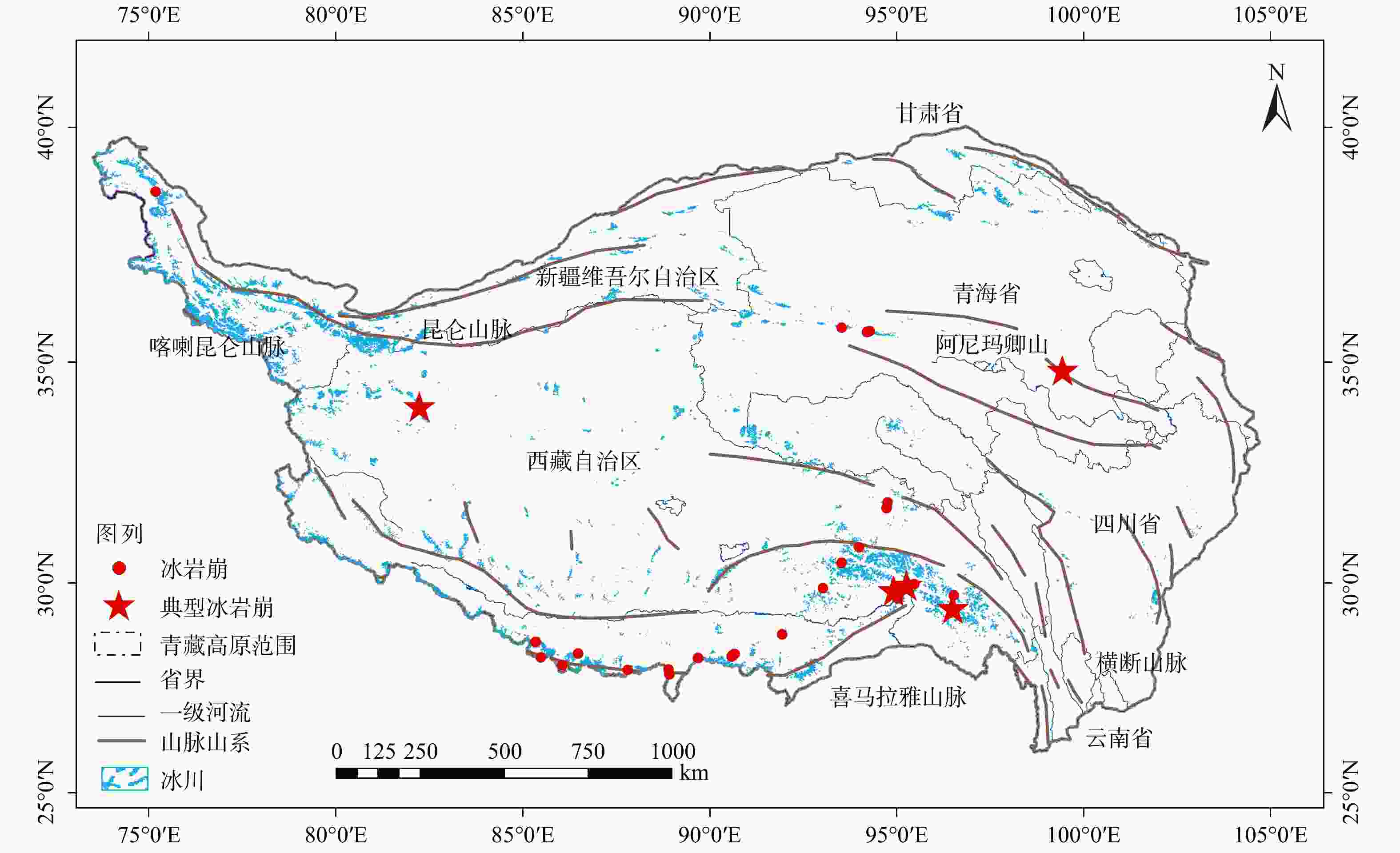
图 1 青藏高原及历史冰岩崩分布
底图据自然资源部网站,审图号:GS(2019)1823号
Figure 1. Distribution of historical ice and rock avalanches on the Tibetan Plateau (base map from the website of the Ministry of Natural Resources, Approval No: GS(2019)1823)
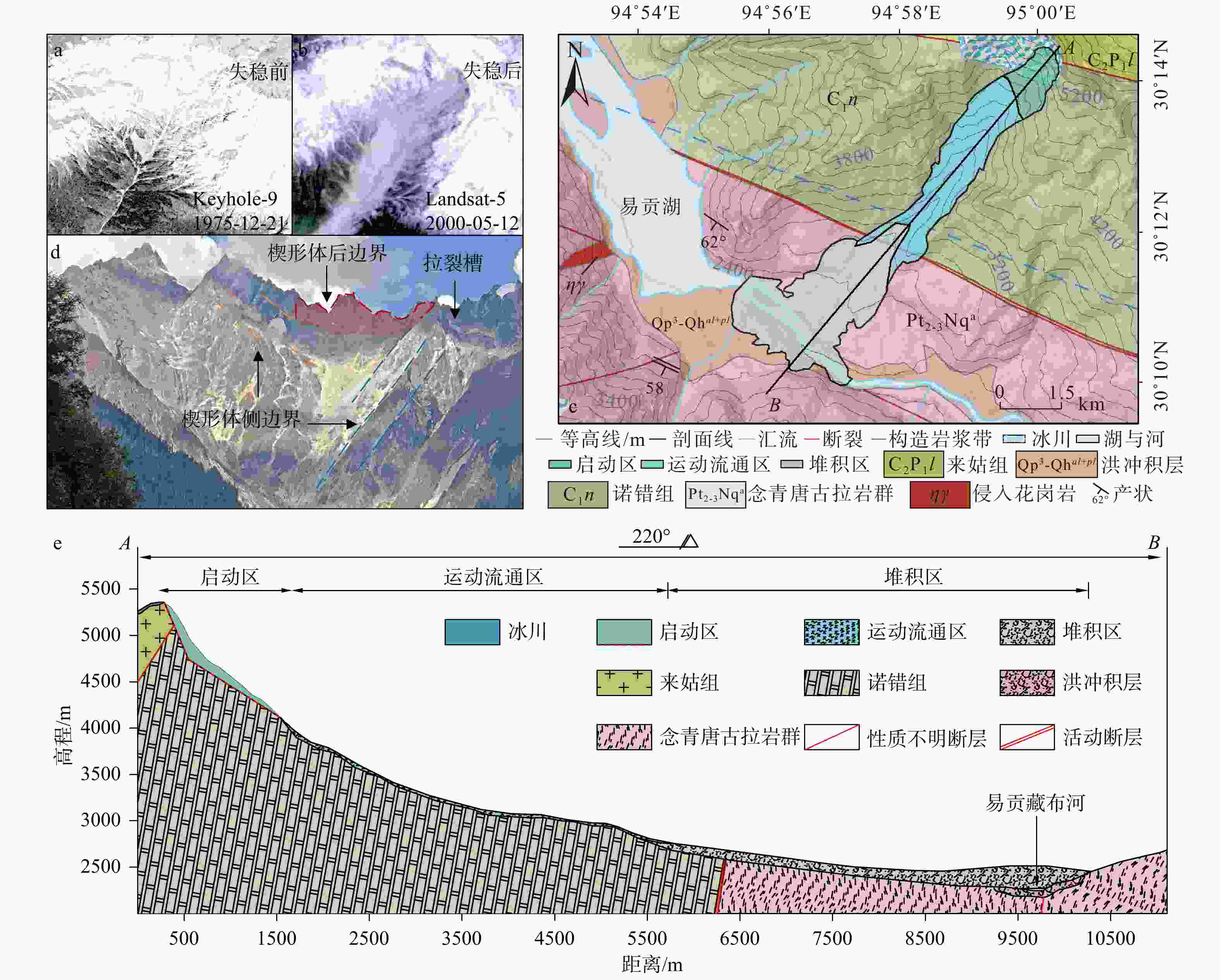
图 2 易贡冰岩崩特征
a—冰雪覆盖下的源区(失稳前影像);b—失稳后影像;c—易贡冰岩崩工程地质平面图(据1∶20 万地质图修改,https://geocloud.cgs.gov.cn);d—楔形体源区边界(镜向NE);e—易贡冰岩崩工程地质剖面图
Figure 2. Characteristics of the Yigong ice and rock avalanche
(a) Source area under snow and ice cover (pre-failure imagery); (b) Post-failure imagery; (c) Engineering geological plan of the Yigong ice and rock avalanche (modified from the 1: 200,000-scale geological map); (d) Boundary of the wedge-shaped source area (NE facing); (e) Engineering geological profile of the Yigong ice and rock avalanche
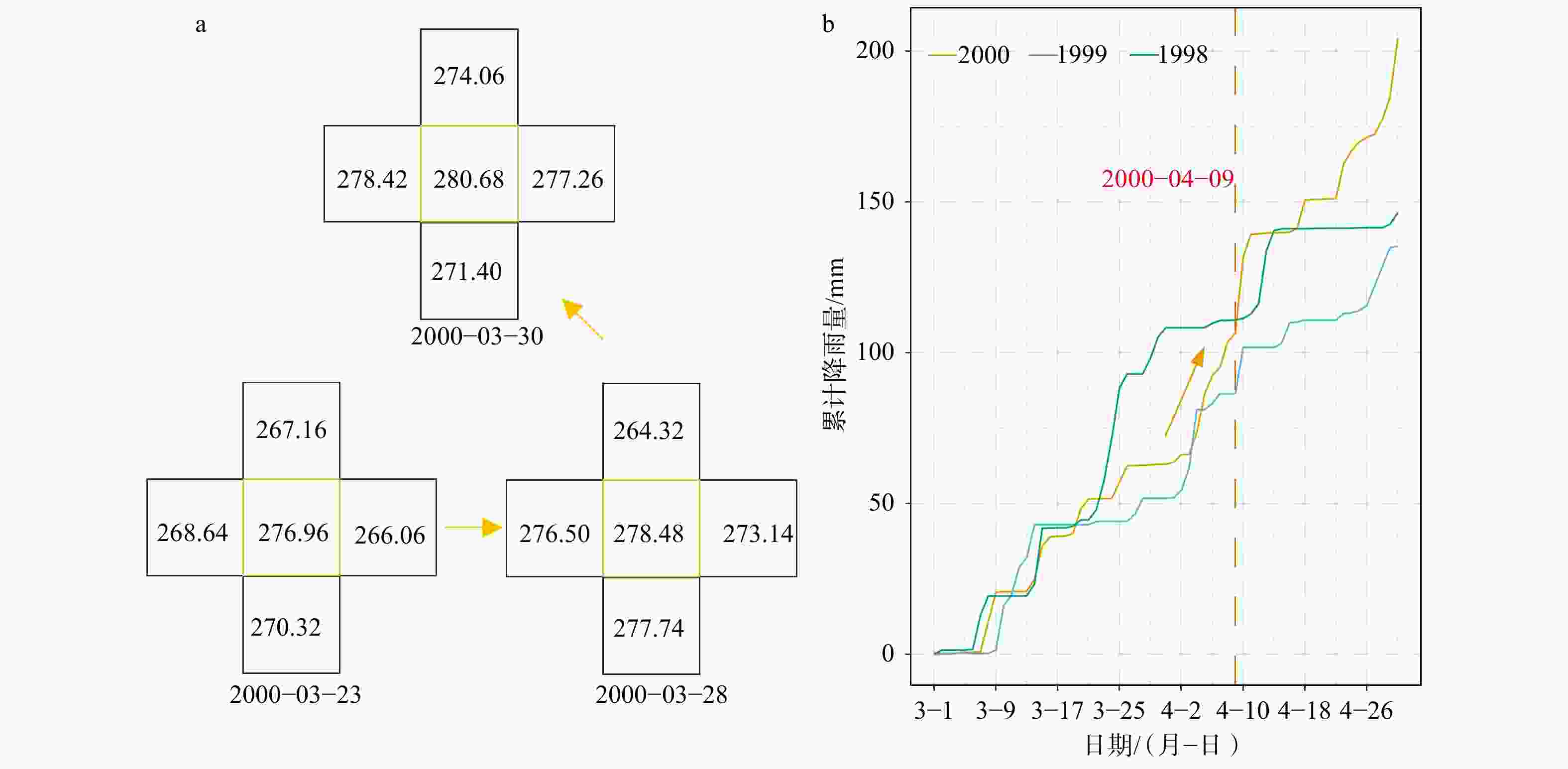
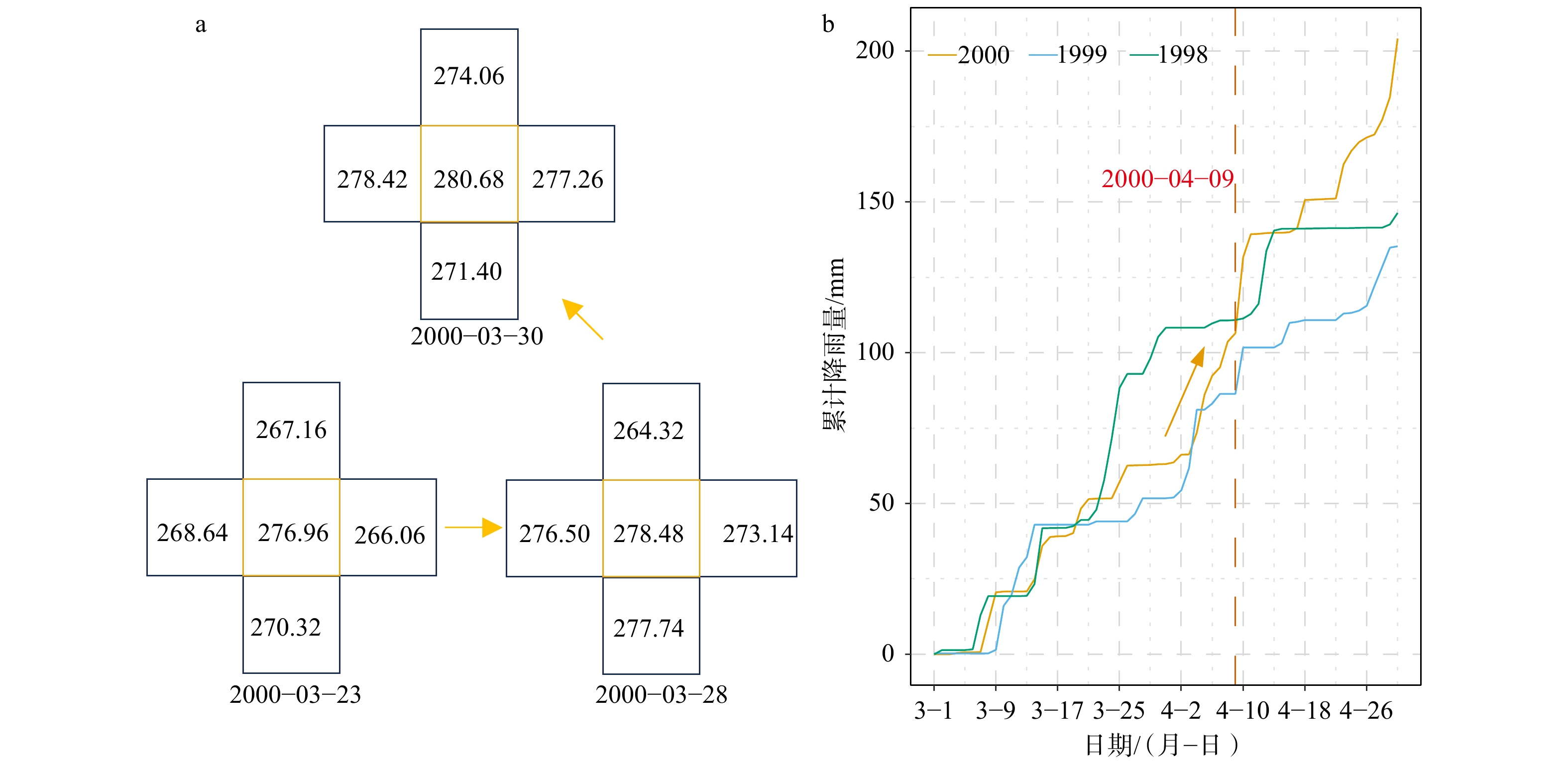
图 3 易贡冰岩崩与气象的关联
a—冰岩崩处与周围像素的地表温度(单位:K;据郭广猛,2005修改);b—易贡冰岩崩区2000年3月1日—5月4日的累积降雨量与1998年、1999年同时期降雨量对比(据Zhou et al.,2016修改)
Figure 3. Correlation between the Yigong ice and rock avalanche and meteorological conditions
(a) Land surface temperature of the ice and rock avalanche area and surrounding pixels (Unit: K; modified from Guo, 2005); (b) Accumulated rainfall in the study area from March 1 to May 4, 2000, in comparison with that from the same period in 1998 and 1999 (modified from Zhou et al., 2016)
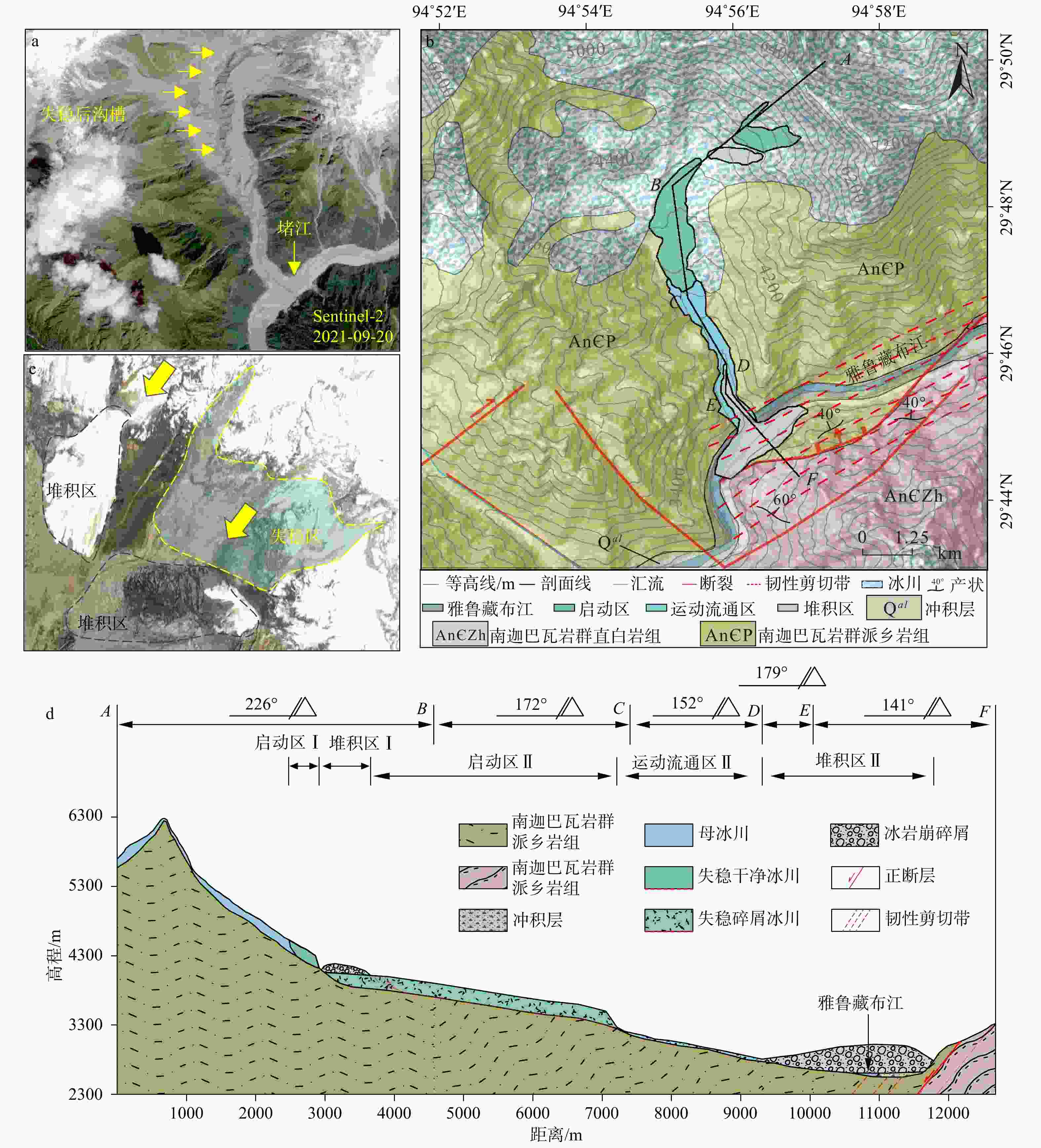
图 4 色东普冰岩崩特征
a—整条低角度碎屑覆盖冰川滑动破坏;b—色东普冰岩崩工程地质平面图(据1∶20万地质图修改,https://geocloud.cgs.gov.cn);c—冰岩崩碎屑物加载;d—色东普冰岩崩工程地质剖面图
Figure 4. Characteristics of the Sedongpu ice and rock avalanche
(a) Sliding failure of the entire low-angle debris-covered glacier; (b) Engineering geological plan of the Sedongpu ice and rock avalanche (modified from the 1:200,000-scale geological map, https://geocloud.cgs.gov.cn); (c) Debris loading of the ice and rock avalanche; (d) Engineering geological profile of the Sedongpu ice and rock avalanche
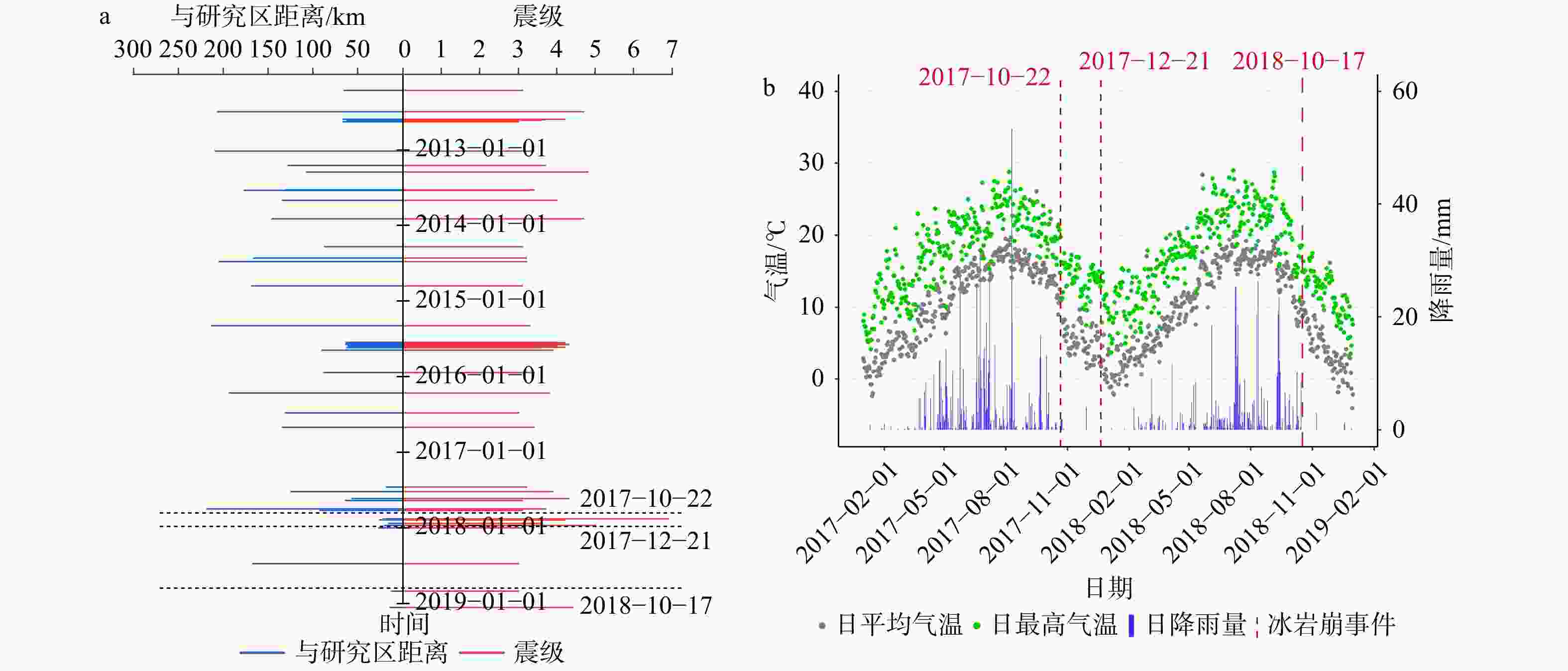
图 5 色东普冰岩崩与地震、气象的关联(据刘昕昕,2021修改)
a—冰岩崩事件与历史地震关系;b—冰岩崩事件与气象关系
Figure 5. Correlation between the Sedongpu ice and rock avalanche and seismic activity and meteorological conditions (modified from Liu, 2021)
(a) Correlation between ice and rock avalanches and historical earthquakes; (b) Correlation between ice and rock avalanches and meteorological conditions
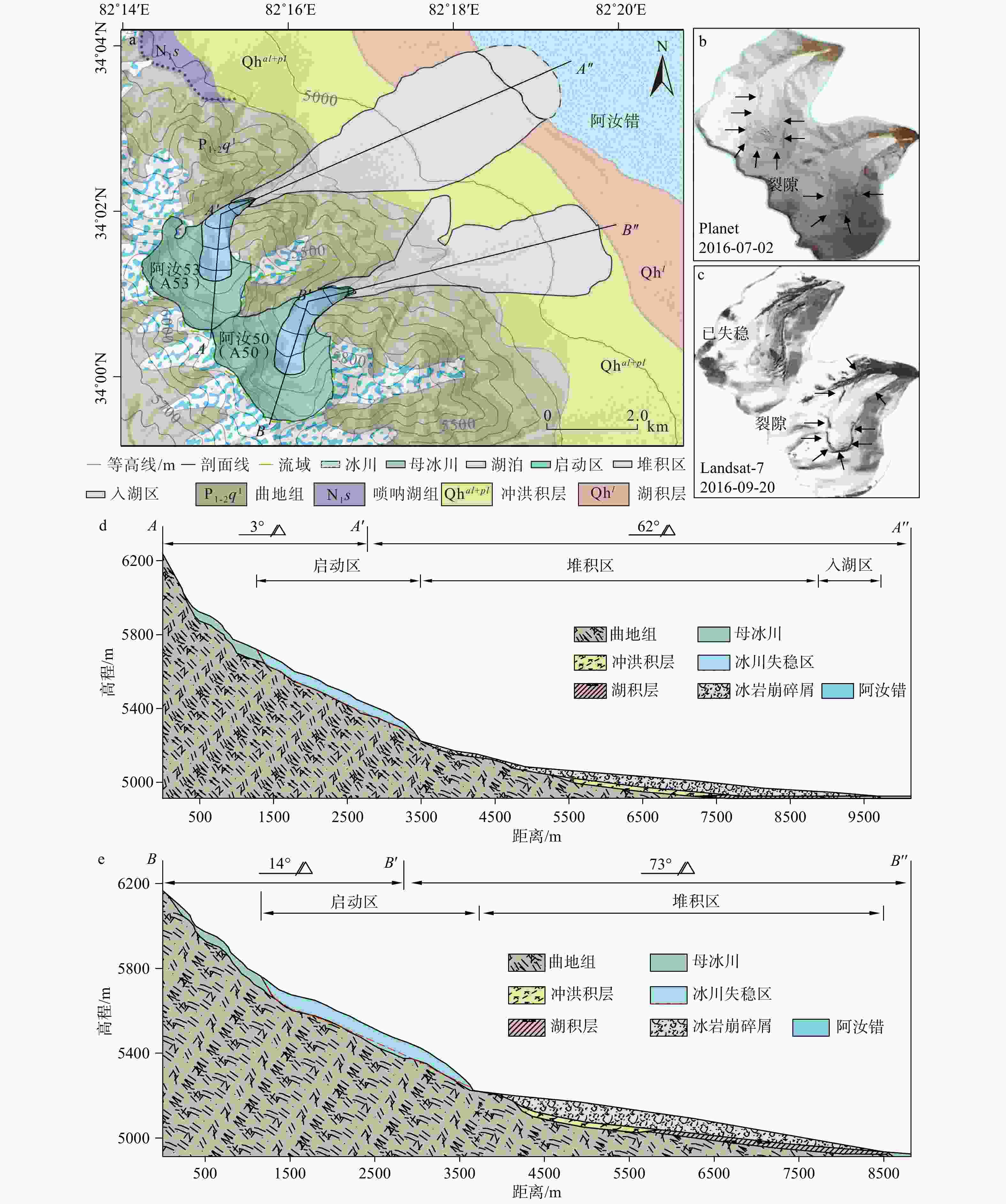
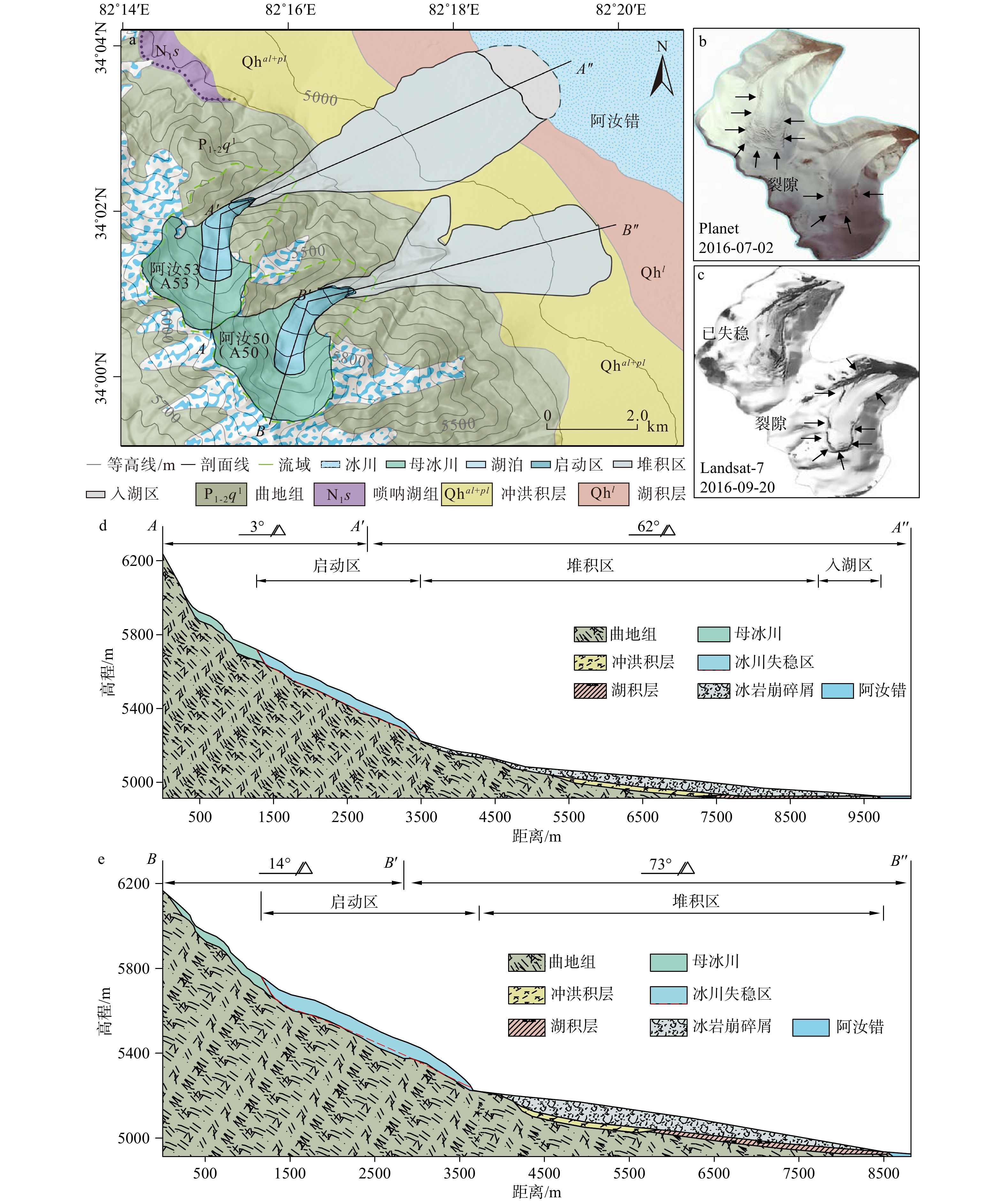
图 6 阿汝冰岩崩特征
a—阿汝冰岩崩工程地质平面图(据1∶20 万地质图修改,https://geocloud.cgs.gov.cn);b—冰川后缘出现密集背隙和侧缘出现羽状裂隙;c—阿汝53号冰川冰岩崩与50号冰川失稳区裂隙圈闭;d—阿汝53号冰川冰岩崩工程地质剖面图;e—阿汝50号冰川冰岩崩工程地质剖面图
Figure 6. Characteristics of the Aru ice and rock avalanche
(a) Engineering geological plan of the Aru ice and rock avalanche (modified from the 1:200,000-scale geological map, https://geocloud.cgs.gov.cn); (b) Development of dense bergschrunds at the trailing edge of the glacier and "feather-shaped" crevasses along the glacier margins; (c) Ice and rock avalanche of Aru Glacier No. 53; crevasses encircled the failure zone of Aru Glacier No. 50; (d) Engineering geological profile of Aru Glacier No. 53 ice and rock avalanche; (e) Engineering geological profile of Aru Glacier No. 50 ice and rock avalanche
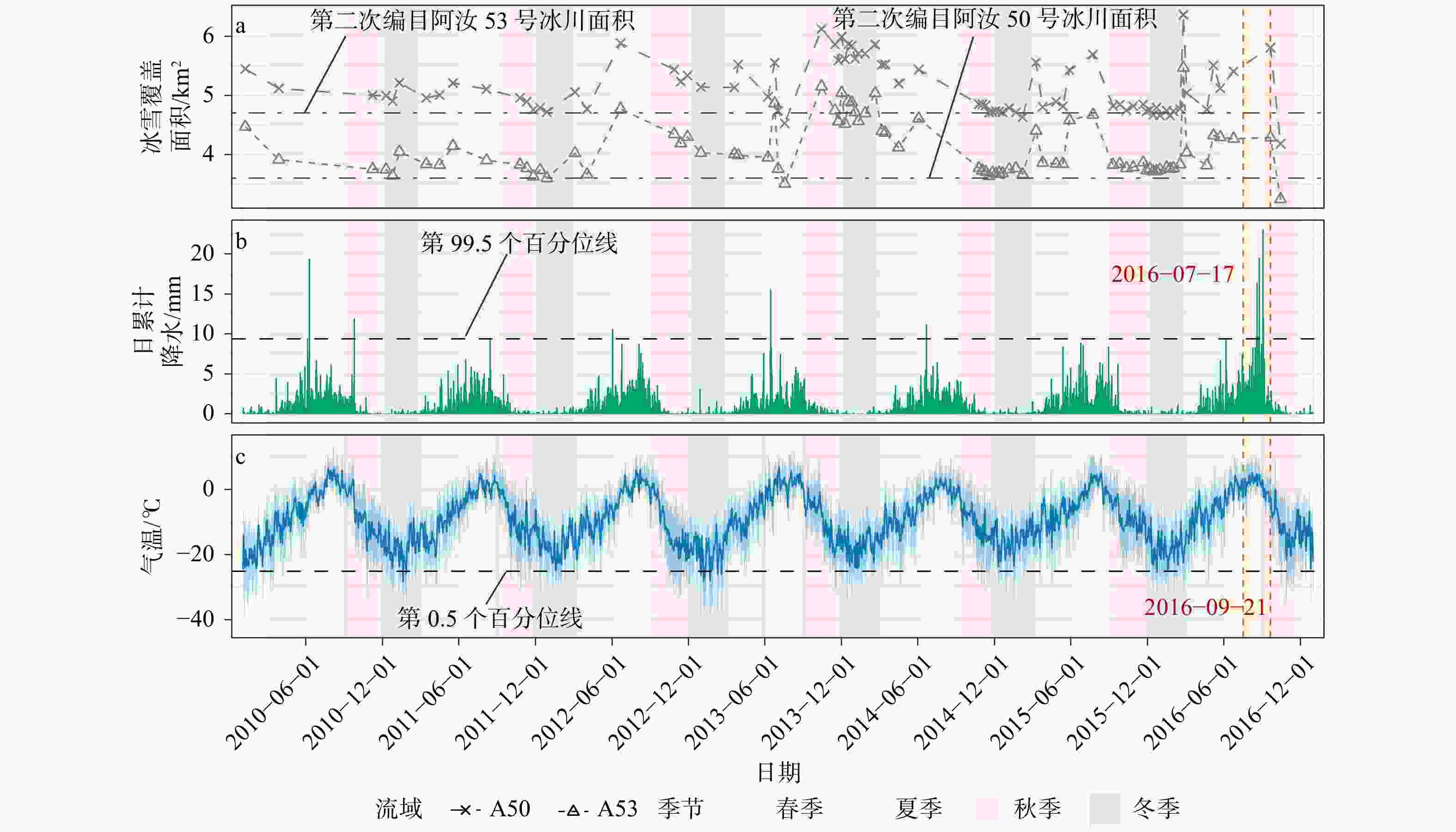
图 7 阿汝冰岩崩与气象的关联
第99.5个百分位线是一个数值,表示在所有数据中(2010—2016年),有99.5%的数据都小于或等于这个值,只有0.5%的数据大于这个值;第0.5个百分位线同理a—遥感解译的流域内冰雪覆盖面积;b—冰岩崩事件与CMFD2.0(中国区域地面气象要素驱动数据集 v2.0)(1951—2024)降水的关系;c—冰岩崩事件与CMFD2.0气温的关系
Figure 7. Correlation between the Aru ice and rock avalanche and meteorological conditions (note: 99.5% of the data points (2010–2016) fall at or below the 99.5th percentile line, while only 0.5% exceed it. The 0.5th percentile line is analogous)
(a) Remote-sensing-derived snow and ice cover area within the watershed; (b) Relationship between ice and rock avalanches and CMFD2.0 (China Meteorological Forcing Dataset v2.0 (1951–2024)) precipitation; (c) Relationship between ice and rock avalanches and CMFD2.0 air temperature
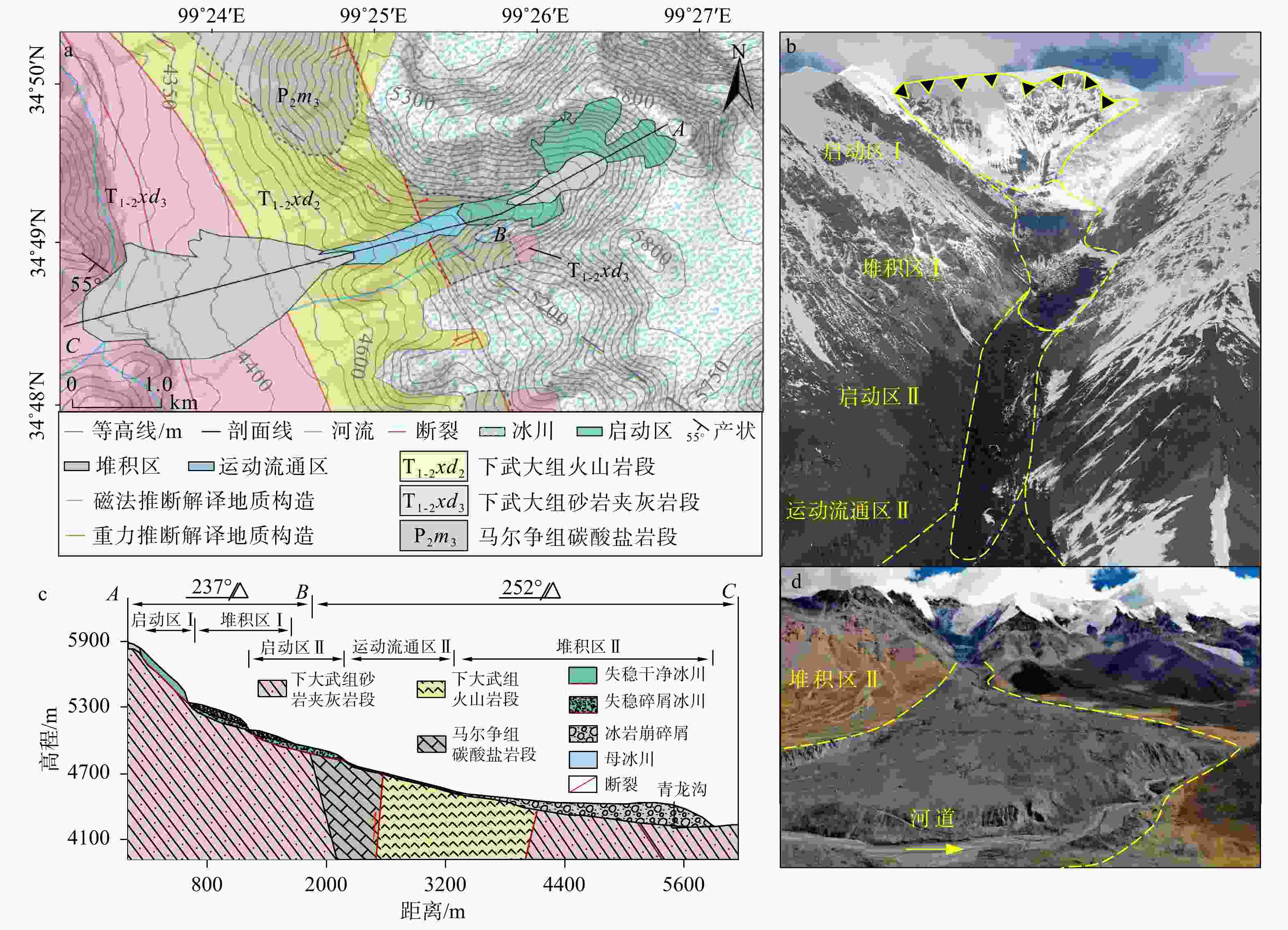
图 8 阿尼玛卿山冰岩崩特征
a—阿尼玛卿山冰岩崩工程地质平面图(据1∶20 万地质图修改,https://geocloud.cgs.gov.cn);b—阿尼玛卿山冰岩崩源区(镜向NE);c—阿尼玛卿山冰岩崩工程地质剖面图;d—阿尼玛卿山冰岩崩全景图(镜向NE)
Figure 8. Characteristics of the Amney Machen Mountains ice and rock avalanche
(a) Engineering geological plan of the Amney Machen Mountains ice and rock avalanche (modified from the 1:200,000-scale geological map, https://geocloud.cgs.gov.cn); (b) Source area of the Amney Machen Mountains ice and rock avalanche (NE facing); (c) Engineering geological profile of the Amney Machen Mountains ice and rock avalanche; (d) Panoramic view of the Amney Machen Mountains ice and rock avalanche (NE facing)
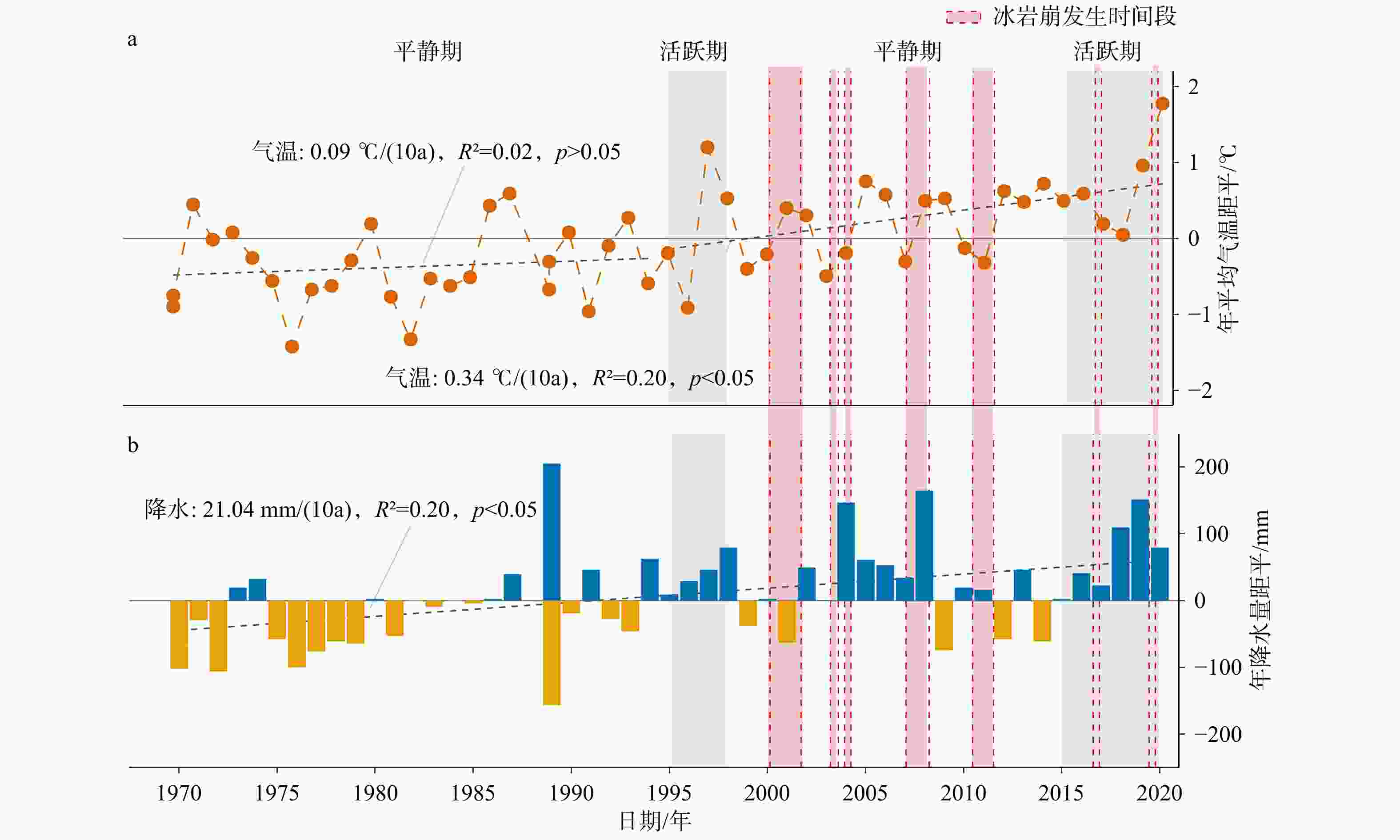
图 9 阿尼玛卿山冰岩崩与气象的关联(据Pan et al.,2022;王忠彦等,2022修改)
a—阿尼玛卿山冰岩崩与气温的关系(R2—决定系数,衡量回归模型拟合优度的指标;p—p值,判定假设检验结果的一个参数);b—阿尼玛卿山冰岩崩与降水的关系
Figure 9. Correlation between the Amney Machen Mountains ice and rock avalanche and meteorological conditions (modified from Pan et al., 2022; Wang et al., 2022)
(a) Correlation between the Amney Machen Mountains ice and rock avalanche and air temperature (R2 (R-squared): coefficient of determination, a metric that quantifies the goodness-of-fit of a regression model; p (p-value): statistical measure used to determine the significance of the results in a hypothesis test); (b) Correlation between the Amney Machen Mountains ice and rock avalanche and precipitation
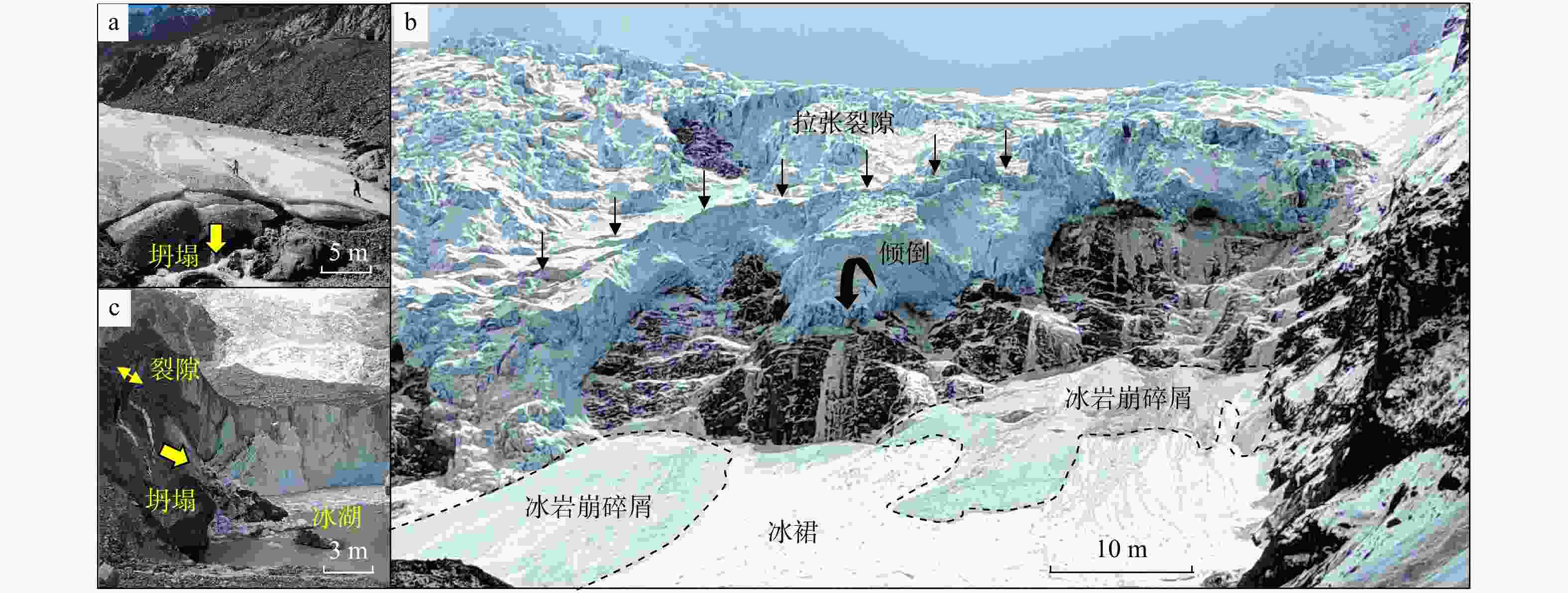
图 10 东嘎冰岩崩与米堆冰岩崩
a—东嘎冰川冰岩崩;b—米堆冰川冰岩崩;c—米堆冰川高位冰岩崩
Figure 10. Dongga and Midui ice and rock avalanches
(a) Ice and rock avalanche of the Dongga Glacier; (b) Ice and rock avalanche of the Midui Glacier; (c) High-elevation ice and rock avalanches at Midui Glacier
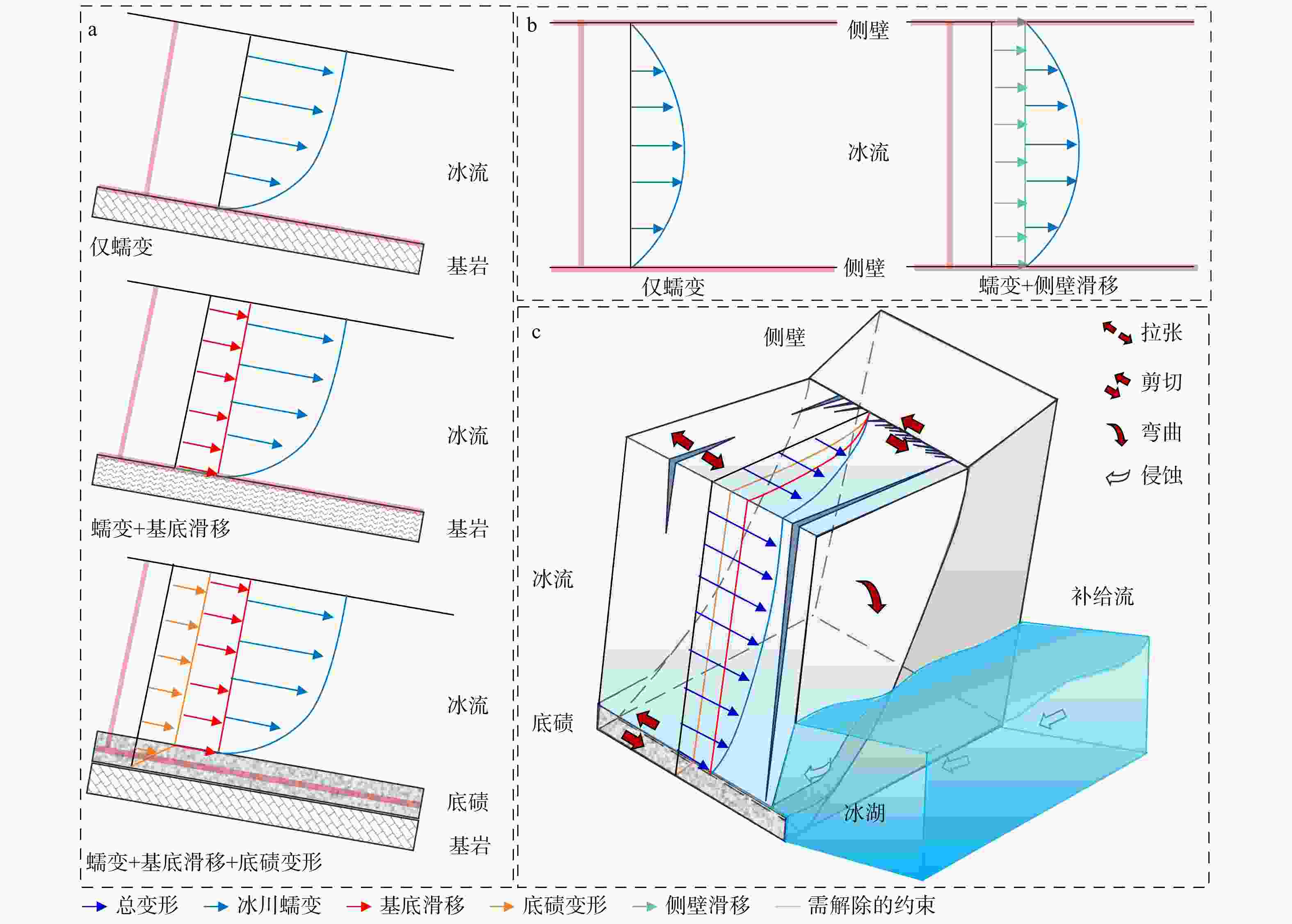
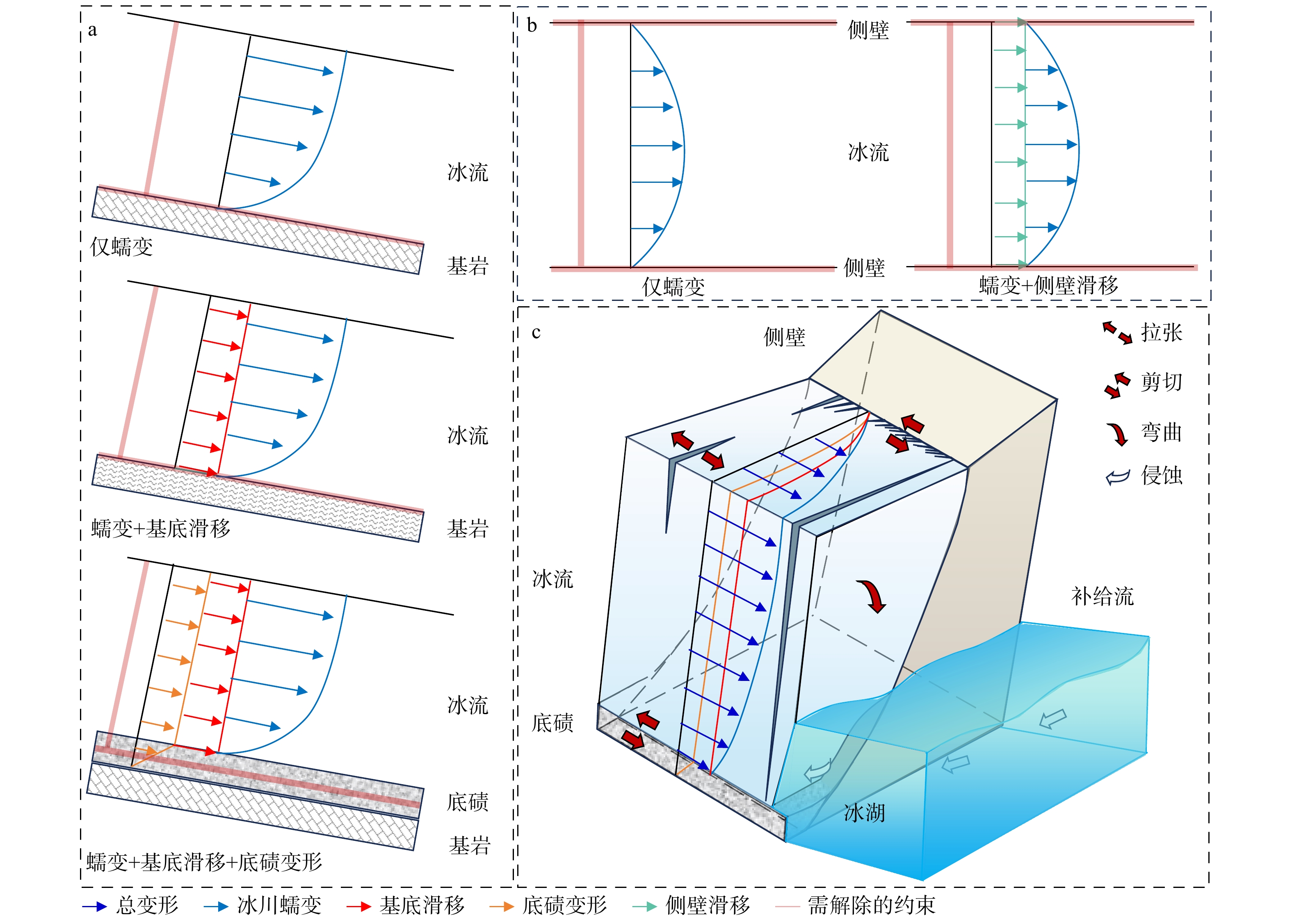
图 11 冰川变形破坏示意图
a—边界约束下的冰川蠕滑剖面图;b—边界约束下的冰川蠕滑平面图;c—边界约束下的冰川变形破坏示意图
Figure 11. Schematic diagram of glacier deformation and failure
(a) Profile view of boundary-constrained glacier creep and sliding; (b) Plan view of boundary-constrained glacier creep and sliding; (c) Schematic sketch of boundary-constrained glacier deformation and failure
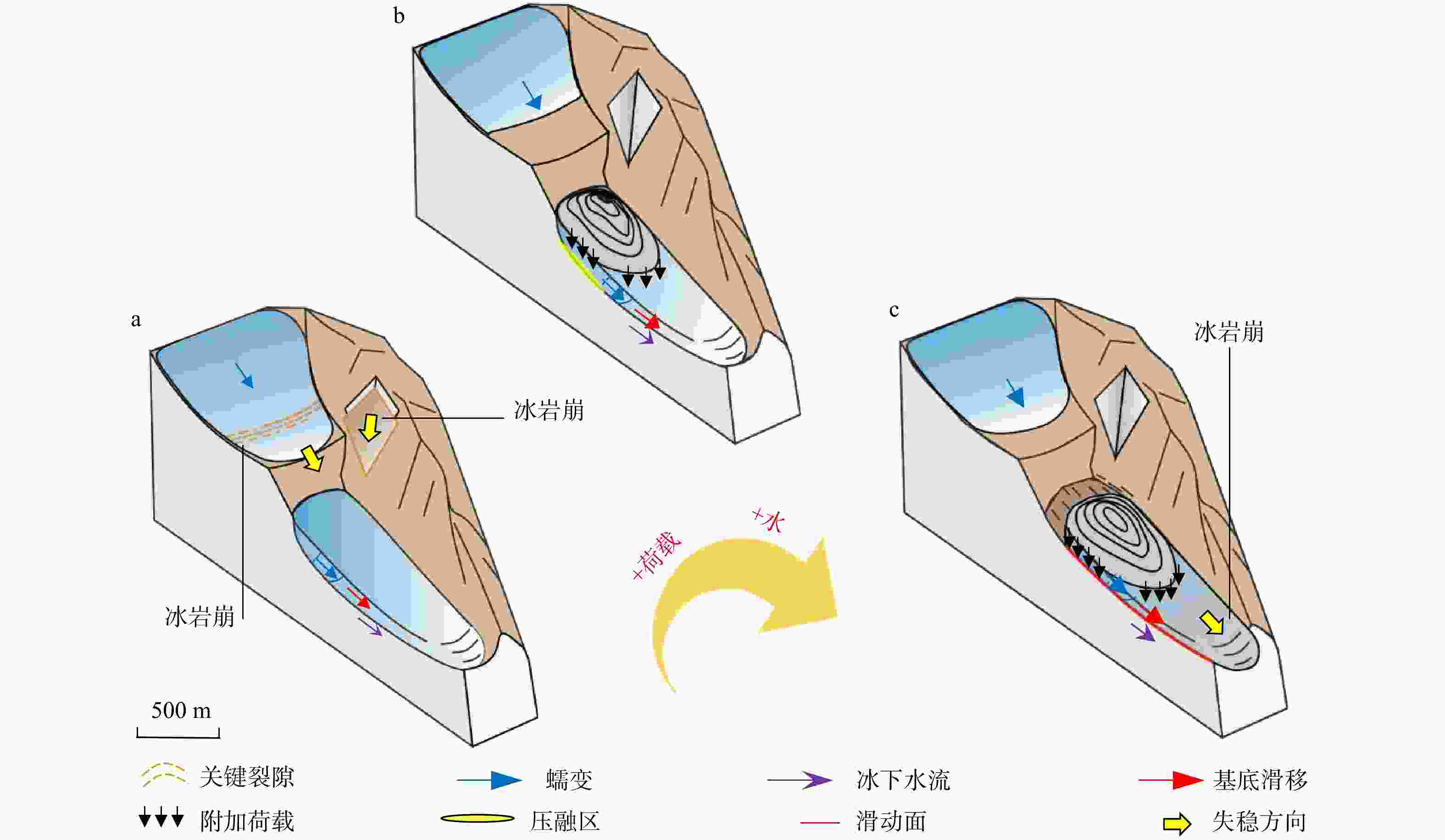
图 12 加载压融−水致蠕滑−拉裂型冰岩崩
蠕变、冰下水流、基底滑移的箭头大小表示其作用的强弱a—冰缘物质临界失稳状态;b—失稳碎屑物加载−压融阶段;c—水致蠕滑−拉裂阶段
Figure 12. Loading-induced pressure melting and water-induced creep-fracture (arrow sizes denote the intensity of creep, subglacial water flow, and basal slip)
(a) Critical failure state of periglacial material; (b) Loading and pressure melting of failed debris; (c) Water-induced creep–fracture
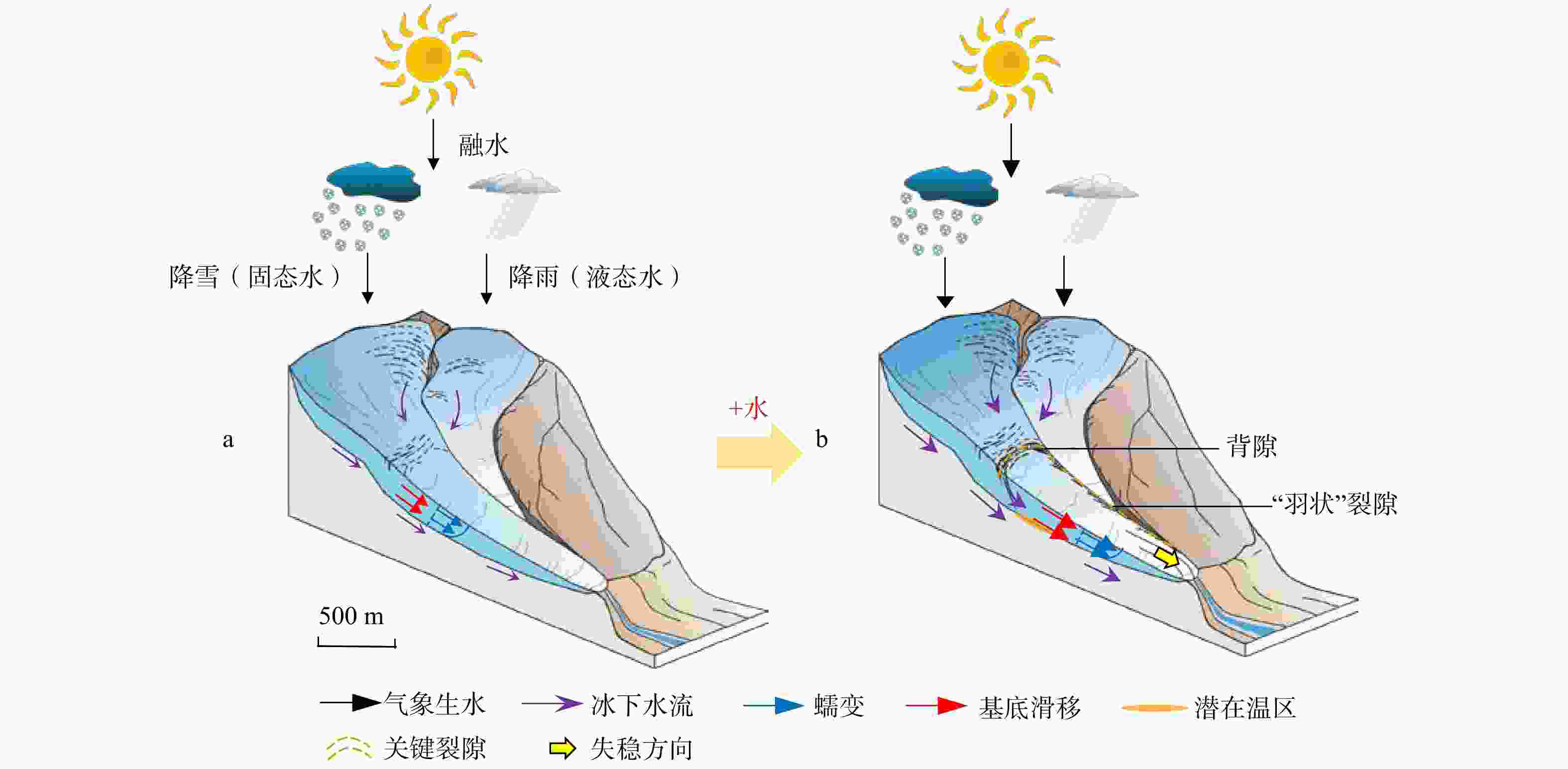
图 13 气象生水−水致蠕滑−拉裂型冰岩崩
气象生水、蠕变、冰下水流、基底滑移的箭头大小表示其作用的强弱a—冰岩崩孕育阶段;b—气候变暖的长期影响(产生冰雪融水)叠加短期极端天气事件(高温或降水)影响(产生大量冰雪融水或雨水)而产生水致蠕滑−拉裂
Figure 13. Meteorological water-induced creep fracture (arrow sizes denote the intensity of meteorological water, creep, subglacial water flow, and basal slip)
(a) Initiation of an ice and rock avalanche; (b) Combined effects of long-term climate warming (generating ice-snow meltwater) and short-term extreme weather events (high temperature or precipitation) produce substantial meltwater or rainfall, leading to water-induced creep fracture
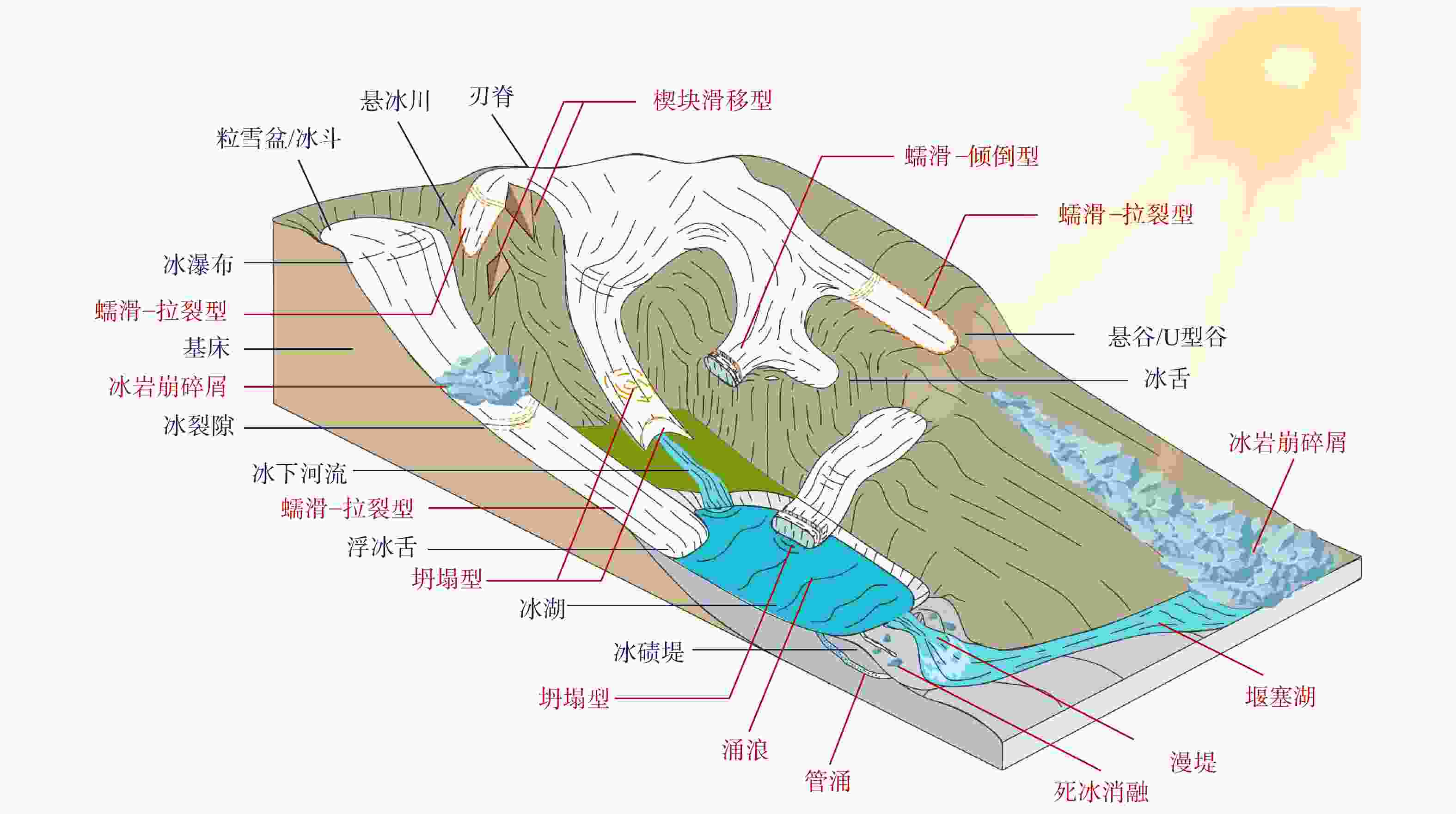
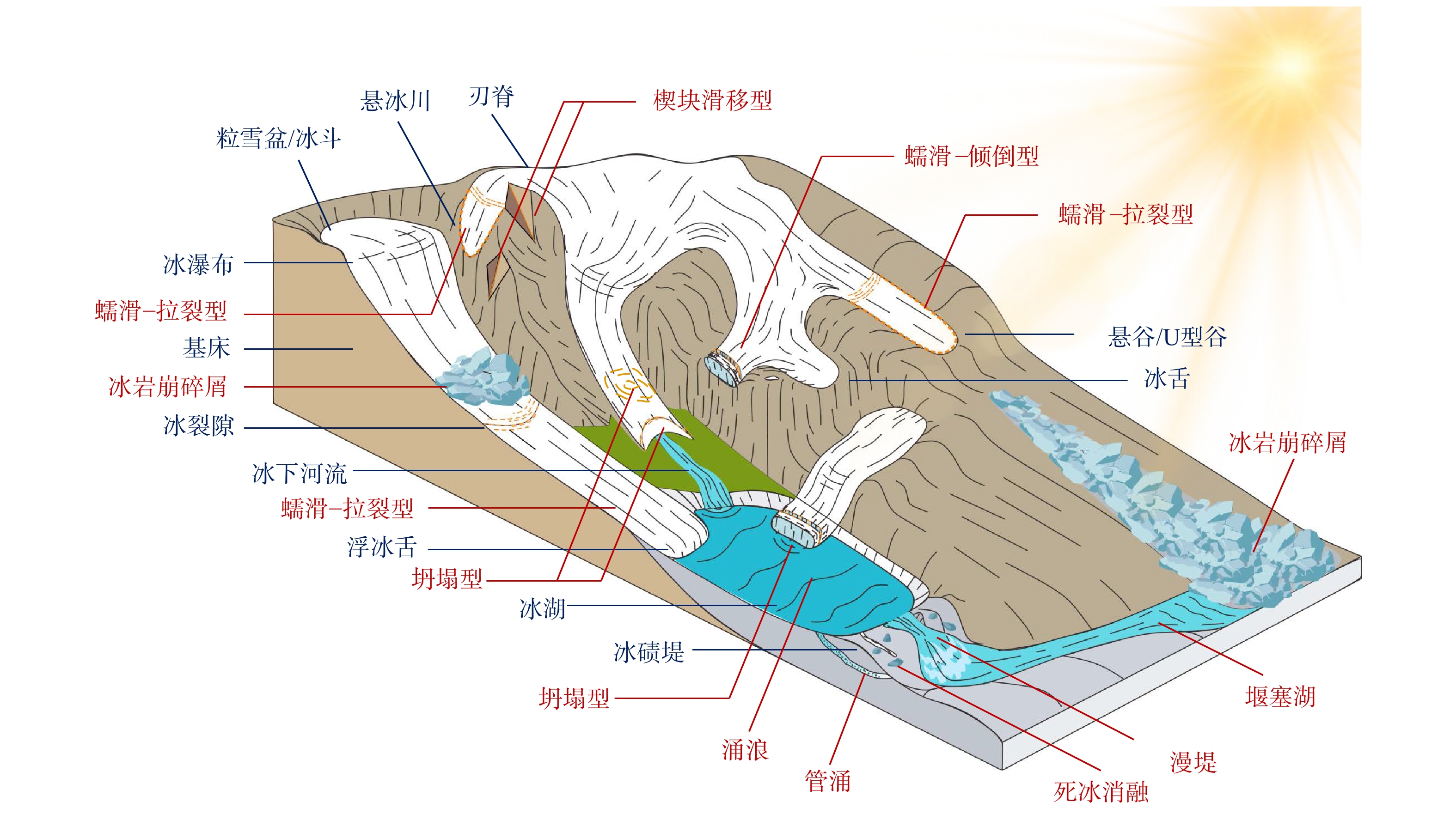
图 14 不同模式冰岩崩共生演化关系
Figure 14. Co-evolution among different patterns of ice and rock avalanches
表 1 青藏高原冰岩崩地质力学模式
Table 1. Geological mechanics patterns of ice and rock avalanches on the Tibetan Plateau
类型 亚型 发育 变形破坏 运动堆积/浸没/漂浮 成灾 蠕滑−
拉裂型*


直接灾害、堵溃灾害、涌浪、冰湖溃决灾害 槽谷冰川,具有临空面 蠕滑−背隙拉张、侧缘羽状剪
切裂隙−失稳高速远程碎屑流−堆积 蠕滑−
倾倒型


直接灾害、堵溃灾害、涌浪、冰湖溃决灾害 悬冰川,具有临空面 蠕滑−上宽下窄型拉张裂隙−倾倒 坠落−滚动−堆积 楔块滑移型 


直接灾害、堵溃灾害、涌浪、冰湖溃决灾害 角峰、刃脊坡面,岩体结构面发育,具有临空面 蠕滑−卸荷、背隙拉张裂隙和冰面剪切裂隙−失稳 高速远程碎屑流−堆积 坍塌型 侵蚀坍塌 


浮冰灾害、涌浪 浮冰舌,具有临空面 侵蚀−上宽下窄型拉张裂隙−坍塌 坠落−浸没/漂浮 空穴坍塌 


直接灾害、堵溃(堵塞冰下河道)灾害 冰洞顶部,冰下河、湖顶部 融化空穴−环状裂隙−坍塌 坠落−堆积 注:*蠕滑−拉裂型可分为2个亚类,加载压融−水致蠕滑−拉裂型和气象生水−水致蠕滑−拉裂型;图中尺寸为示意性标注(据案例数据),旨在说明各种模式冰岩崩规模  下载: 导出CSV
-
[1] ALEAN J, 1985. Ice avalanches: some empirical information about their formation and reach[J]. Journal of Glaciology, 31(109): 324-333. doi: 10.3189/S0022143000006663 [2] BONDESAN A, FRANCESE R G, 2023. The climate-driven disaster of the Marmolada Glacier (Italy)[J]. Geomorphology, 431: 108687. doi: 10.1016/j.geomorph.2023.108687 [3] BRONDEX J, GAGLIARDINI O, GILBERT A, et al. , 2025. How to model crevasse initiation? Lessons from the artificial drainage of a water-filled cavity on the Tête Rousse Glacier (Mont Blanc range, France)[J]. EGUsphere, 2025: 1-34. In press [4] CHANG W B, XING A G, 2025. Warming-driven weakening of basal ice layer as a critical cause of ice avalanche activation[J]. Cold Regions Science and Technology, 236: 104513. doi: 10.1016/j.coldregions.2025.104513 [5] CHEN H J, YANG J P, TAN C P, 2017. Responsivity of glacier to climate change in China[J]. Journal of Glaciology and Geocryology, 39(1): 16-23. (in Chinese with English abstract) [6] CUFFEY K M, PATERSON W S B, 2010. The physics of glaciers[M]. Burlington: Butterworth-Heinemann. [7] CUI P, GUO X J, JIANG T H, et al., 2019. Disaster effect induced by Asian Water Tower change and mitigation strategies[J]. Bulletin of Chinese Academy of Sciences, 34(11): 1313-1321. (in Chinese with English abstract) [8] FAILLETTAZ J, FUNK M, VINCENT C, 2015. Avalanching glacier instabilities: review on processes and early warning perspectives[J]. Reviews of Geophysics, 53(2): 203-224. doi: 10.1002/2014RG000466 [9] FAN X M, YUNUS A P, YANG Y H, et al., 2022. Imminent threat of rock-ice avalanches in High Mountain Asia[J]. Science of the Total Environment, 836: 155380. doi: 10.1016/j.scitotenv.2022.155380 [10] FRANCESE R G, VALENTINO R, HAEBERLI W, et al. , 2025. Failure of Marmolada Glacier (Dolomites, Italy) in 2022: data-based back analysis of possible collapse mechanisms[J]. Natural Hazards and Earth System Sciences Discussions, 25, 3027-3053. [11] GAO S H, GAO Y, YIN Y P, et al., 2025. Characteristics of massive glacier-related watershed geohazard chains in the eastern Himalayan Syntaxis, China[J]. Journal of Earth Science, 36(3): 1181-1197 [12] GILBERT A, LEINSS S, KARGEL J, et al., 2018. Mechanisms leading to the 2016 giant twin glacier collapses, Aru Range, Tibet[J]. The Cryosphere, 12(9): 2883-2900. doi: 10.5194/tc-12-2883-2018 [13] GRÄFF D, LIPOVSKY B P, VIELI A, et al., 2025. Calving-driven fjord dynamics resolved by seafloor fibre sensing[J]. Nature, 644(8076): 404-412. doi: 10.1038/s41586-025-09347-7 [14] GUO G M, 2005. A new understanding of the Yigong landslide in Tibet[J]. Earth Science Frontiers, 12(2): 276-276. (in Chinese) [15] GUO W Q, SHANGGUAN D H, JIANG Z L, et al., 2023. Study on basic characteristics of glacier surges on the Anyemaqen Mountain[J]. Journal of Glaciology and Geocryology, 45(2): 480-496. (in Chinese with English abstract) [16] HU M J, CHENG Q G, WANG F W, 2009. Experimental study on formation of Yigong long-distance high-speed landslide[J]. Chinese Journal of Rock Mechanics and Engineering, 28(1): 138-143. (in Chinese with English abstract) [17] HU W T, YAO T D, YU W S, et al., 2018. Advances in the study of glacier avalanches in high Asia[J]. Journal of Glaciology and Geocryology, 40(6): 1141-1152. (in Chinese with English abstract) [18] HUGGEL C, HAEBERLI W, KÄÄB A, et al., 2004. An assessment procedure for glacial hazards in the Swiss alps[J]. Canadian Geotechnical Journal, 41(6): 1068-1083. doi: 10.1139/t04-053 [19] JIANG R C, ZHANG L M, LU W J, et al., 2025. A thermal-hydro-mechanical coupled analysis model for climate-driven movements of valley glaciers (THM-GA 1.0)[J]. Engineering Geology, 355: 108264. doi: 10.1016/j.enggeo.2025.108264 [20] KÄÄB A, LEINSS S, GILBERT A, et al., 2018. Massive collapse of two glaciers in western Tibet in 2016 after surge-like instability[J]. Nature Geoscience, 11(2): 114-120. doi: 10.1038/s41561-017-0039-7 [21] KÄÄB A, JACQUEMART M, GILBERT A, et al., 2021. Sudden large-volume detachments of low-angle mountain glaciers–more frequent than thought?[J]. The Cryosphere, 15(4): 1751-1785. doi: 10.5194/tc-15-1751-2021 [22] KAUSHIK S, 2023. Ice aprons and hanging glaciers: new insights from optical and SAR remote sensing of the Mont-Blanc massif (western European Alps)[D]. Chambéry: Université Savoie Mont Blanc. [23] LEI Y B, YAO T D, TIAN L D, et al., 2021. Response of downstream lakes to Aru glacier collapses on the western Tibetan Plateau[J]. The Cryosphere, 15(1): 199-214. doi: 10.5194/tc-15-199-2021 [24] LI Y, CUI Y F, HU X, et al., 2024. Glacier retreat in eastern Himalaya drives catastrophic glacier hazard chain[J]. Geophysical Research Letters, 51(8): e2024GL108202. doi: 10.1029/2024GL108202 [25] LIU X X. 2021. Disaster mechanism and simulation of cataclysmic process of the ice avalanche in Sedongpu basin, Milin County, Tibet[D]. Chengdu: Chengdu University of Technology. (in Chinese with English abstract) [26] LIU Z, LI B, HE K, et al., 2020. An analysis of dynamic response characteristics of the Yigong Landslide in Tibet under strong earthquake[J]. Journal of Geomechanics, 26(4): 471-480. (in Chinese with English abstract) [27] MARGRETH S, FUNK M, 1999. Hazard mapping for ice and combined snow/ice avalanches — two case studies from the Swiss and Italian Alps[J]. Cold Regions Science and Technology, 30(1-3): 159-173. doi: 10.1016/S0165-232X(99)00027-0 [28] MENG Q J, SONG Y X, HUANG D, et al., 2024. Mechanism of shear strength degradation of subglacial debris under thawing[J]. Rock and Soil Mechanics, 45(1): 197-212. (in Chinese with English abstract) [29] OGIER C, FISCHER M, WERDER M A, et al., 2025. Definition, formation and rupture mechanisms of water pockets in alpine glaciers: Insights from an updated inventory for the Swiss Alps[J]. Journal of Glaciology, 71: e82. doi: 10.1017/jog.2025.43 [30] PAN B T, GUAN W J, SHI M H, et al., 2022. Different characteristics of two surges in Weigeledangxiong Glacier, northeastern Tibetan Plateau[J]. Environmental Research Letters, 17(11): 114009. doi: 10.1088/1748-9326/ac9962 [31] PAUL F, 2019. Repeat glacier collapses and surges in the Amney Machen mountain range, Tibet, possibly triggered by a developing rock-slope instability[J]. Remote Sensing, 11(6): 708. doi: 10.3390/rs11060708 [32] PEI L X, 2019. The preliminary study of characteristics and types of ice avalanche disaster in the Tibetan Plateau[D]. Beijing: China University of Geosciences (Beijing). (in Chinese with English abstract) [33] PENG J B, ZHANG Y S, HUANG D, et al., 2023. Interaction disaster effects of the tectonic deformation sphere, rock mass loosening sphere, surface freeze-thaw sphere and engineering disturbance sphere on the Tibetan Plateau[J]. Earth Science, 48(8): 3099-3114. (in Chinese with English abstract) [34] PERLA R I, 1980. Avalanche release, motion, and impact[M]//COLBECK S C. Dynamics of snow and ice masses. Amsterdam: Elsevier. [35] PRALONG A, 2006. Oscillations in critical shearing, application to fractures in glaciers[J]. Nonlinear Processes in Geophysics, 13(6): 681-693. doi: 10.5194/npg-13-681-2006 [36] RÖTHLISBERGER H, 1977. Ice avalanches[J]. Journal of Glaciology, 19(81): 669-671. doi: 10.3189/S0022143000029580 [37] RUOLS B, KLAHOLD J, FARINOTTI D, et al. , 2024. 4D imaging of a near-terminus glacier collapse feature through high-density GPR acquisitions[J]. EGUsphere, 2024: 1-26. In press [38] SALZMANN N, KÄÄB A, HUGGEL C, et al., 2004. Assessment of the hazard potential of ice avalanches using remote sensing and GIS-modelling[J]. Norsk Geografisk Tidsskrift-Norwegian Journal of Geography, 58(2): 74-84. doi: 10.1080/00291950410006805 [39] SHEN Y J, CHEN S W, ZHANG L, et al., 2022. High-altitude initiation, dynamic collapse and phase transformation of mountain snow-ice melt geological disaster chain[J]. Journal of Glaciology and Geocryology, 44(2): 643-656. (in Chinese with English abstract) [40] SHORDER J F, HAEBERLI W, WHITEMAN C, 2015. Snow and ice-related hazards, risks, and disasters[M]. Amsterdam: Elsevier. [41] SHUGAR D H, JACQUEMART M, SHEAN D, et al., 2021. A massive rock and ice avalanche caused the 2021 disaster at Chamoli, Indian Himalaya[J]. Science, 373(6552): 300-306. doi: 10.1126/science.abh4455 [42] TANG M G, LIU X X, LI G, et al., 2023. Mechanism of ice avalanche in the Sedongpu sag, Yarlung Zangbo River basin—an experimental study[J]. Earth Science Frontiers, 30(4): 405-417. (in Chinese with English abstract) [43] TANG M G, LI G, ZHAO H L, et al., 2024. Advances in ice avalanches on the Tibetan Plateau[J]. Journal of Mountain Science, 21(6): 1814-1829. doi: 10.1007/s11629-023-8530-7 [44] TONG L Q, TU J N, PEI L X, et al., 2018. Preliminary discussion of the frequently debris flow events in Sedongpu Basin at Gyalaperi peak, Yarlung Zangbo River[J]. Journal of Engineering Geology, 26(6): 1552-1561. (in Chinese with English abstract) [45] VAN DER WOERD J, OWEN L A, TAPPONNIER P, et al., 2004. Giant, ~M8 earthquake-triggered ice avalanches in the eastern Kunlun Shan, northern Tibet: Characteristics, nature and dynamics[J]. Geological Society of America Bulletin, 116(3-4): 394-406. [46] WANG C, FAN J H, WANG Q, et al. , 2021. Use of L-band SAR data for Monitoring Glacier Surging next to Aru Lake[J]. Procedia Computer Science, 181, 1131-1137. [47] WANG H, WANG B B, CUI P, et al., 2024. Disaster effects of climate change in High Mountain Asia: State of art and scientific challenges[J]. Advances in Climate Change Research, 15(3): 367-389. doi: 10.1016/j.accre.2024.06.003 [48] WANG N L, XU B Q, PU J C, et al., 2013. Discovery of the water-rich ice layers in glaciers on the Tibetan Plateau and its environmental significances[J]. Journal of Glaciology and Geocryology, 35(6): 1371-1381. (in Chinese with English abstract) [49] WANG N L, YAO T D, XU B Q, et al., 2019. Spatiotemporal pattern, trend, and influence of glacier change in Tibetan Plateau and surroundings under global warming[J]. Bulletin of Chinese Academy of Sciences, 34(11): 1220-1232. (in Chinese with English abstract). [50] WANG Q K, LI B, XING A G, et al., 2025. A 15-year history of repeated ice-rock avalanches from a single source area in the Qinghai-Tibet Plateau[J]. Landslides, 22(1): 235-253. doi: 10.1007/s10346-024-02355-0 [51] WANG W C, WANG J, 2022. Influencing factors and values of the basal shear stress in glaciers in western China[J]. Journal of Lanzhou University (Natural Sciences), 58(1): 39-46, 56. (in Chinese with English abstract) [52] WANG X, LIU Q, LIU S Y, et al., 2020. Manifestations and mechanisms of mountain glacier-related hazards[J]. Sciences in Cold and Arid Regions, 12(6): 436-446. [53] WANG Z Y, ZHANG T G, WANG W C, 2022. Glacier detachment chain process in the Amney Machen Mountain[J]. Journal of Beijing Normal University (Natural Science), 58(6): 950-962. (in Chinese with English abstract) [54] WEI M D, ZHANG L M, JIANG R C, 2024. A conceptual model for evaluating the stability of high-altitude ice-rich slopes through coupled thermo-hydro-mechanical simulation[J]. Engineering Geology, 334: 107514. doi: 10.1016/j.enggeo.2024.107514 [55] WEN J H, WANG S J, MA L J, et al. , 2020. Cryosphere disaster science[M]. Beijing: Science Press. (in Chinese) [56] WU G J, YAO T D, WANG W C, et al., 2019. Glacial hazards on Tibetan Plateau and surrounding alpines[J]. Bulletin of Chinese Academy of Sciences, 34(11): 1285-1292. (in Chinese with English abstract) [57] WU J H, LI J, GUO L, et al., 2025. Remote sensing monitoring and surge mechanisms analysis of the Amney Machen mountain Glaciers[J]. Chinese Journal of Geophysics, 68(5): 1695-1710. (in Chinese with English abstract) [58] XIN P, WANG T, LIU J M, et al., 2022. The geological structure and sliding mode of the slopes in the Yigong landslide source area, Tibet[J]. Journal of Geomechanics, 28(6): 1012-1023. (in Chinese with English abstract) [59] XU Q, WANG S T, CHAI H J, et al. , 2007. The rock avalanche-flow landslide event in Yigong of Tibet[C]//Proceedings of the first academic conference on rock mechanics and engineering examplesin China. Sanya: Chinese Society for Rock Mechanics & Engineering: 53-58. (in Chinese ) [60] XU X D, DONG L L, ZHAO Y, et al., 2019. Effect of the Asian Water Tower over the Qinghai-Tibet Plateau and the characteristics of atmospheric water circulation[J]. Chinese Science Bulletin, 64(27): 2830-2841. [61] YANG Q Q, ZHENG X Y, SU Z M, et al., 2022. Review on rock-ice avalanches[J]. Earth Science, 47(3): 935-949. (in Chinese with English abstract) [62] YANG W, WANG Z Y, AN B S, et al., 2023. Early warning system for ice collapses and river blockages in the Sedongpu Valley, southeastern Tibetan Plateau[J]. Natural Hazards and Earth System Sciences, 23(9): 3015-3029. doi: 10.5194/nhess-23-3015-2023 [63] YIN Y P. 2000. Rapid huge landslide and hazard reduction of Yigong river in the Bomi, Yibet[J]. Hydrogeology and Engineering Geology, 27(4): 8-11. (in Chinese with English abstract) [64] YIN Y P, ZHANG S L, HUO Z H, et al., 2025. Study on the May 28 Birch high-altitude and long-runout ice-rock avalanche in the Swiss Alps[J]. The Chinese Journal of Geological Hazard and Control, 36(4): 1-14. (in Chinese with English abstract) [65] YOU Q L, KANG S C, LI J D, et al., 2021. Several research frontiers of climate change over the Tibetan Plateau[J]. Journal of Glaciology and Geocryology, 43(3): 885-901. (in Chinese with English abstract) [66] YUAN H, GUO C B, WU R A, et al., 2023. Research progress and prospects of the giant Yigong long run-out landslide, Tibetan Plateau, China[J]. Geological Bulletin of China, 42(10): 1757-1773. (in Chinese with English abstract) [67] ZHANG J C, ZHOU B, CAO X Y., et al., 2019. Analysis of basic characteristics of glacial collapse chain hazards in Animaqing mountain[J]. Yellow River, 41(11): 17-21. (in Chinese with English abstract) [68] ZHANG L Y, LI S M, YU S J, et al., 2024. Research on pre-disaster deformation of Sedongpu Basin based on SBAS-InSAR and offset-tracking[J]. Journal of Geodesy and Geodynamics, 44(6): 630-635. (in Chinese with English abstract) [69] ZHANG T G, WANG W C, SHEN Z H, et al., 2023. Understanding the 2004 glacier detachment in the Amney Machen mountains, northeastern Tibetan Plateau, via multi-phase modeling[J]. Landslides, 20(2): 315-330. doi: 10.1007/s10346-022-01989-2 [70] ZHANG Y F, LIU Y, SU P C, et al., 2023. Advances in the study of glacier avalanches in Tibet[J]. The Chinese Journal of Geological Hazard and Control, 34(2): 132-145. (in Chinese with English abstract) [71] ZHAO C X, YANG W, WESTOBY M, et al., 2022. Brief communication: an approximately 50 Mm3 ice-rock avalanche on 22 March 2021 in the Sedongpu valley, southeastern Tibetan Plateau[J]. The Cryosphere, 16(4): 1333-1340. doi: 10.5194/tc-16-1333-2022 [72] ZHOU J W, CUI P, HAO M H, 2016. Comprehensive analyses of the initiation and entrainment processes of the 2000 Yigong catastrophic landslide in Tibet, China[J]. Landslides, 13(1): 39-54. doi: 10.1007/s10346-014-0553-2 [73] ZOU C B, JANSEN J D, CARLING P A, et al., 2023. Triggers for multiple glacier detachments from a low-angle valley glacier in the Amney Machen Range, eastern Tibetan Plateau[J]. Geomorphology, 440: 108867. doi: 10.1016/j.geomorph.2023.108867 [74] 陈虹举, 杨建平, 谭春萍, 2017. 中国冰川变化对气候变化的响应程度研究[J]. 冰川冻土, 39(1): 16-23. [75] 崔鹏, 郭晓军, 姜天海, 等, 2019. “亚洲水塔”变化的灾害效应与减灾对策[J]. 中国科学院院刊, 34(11): 1313-1321. [76] 郭广猛, 2005. 对西藏易贡特大滑坡的新认识[J]. 地学前缘, 12(2): 276. [77] 郭万钦, 上官冬辉, 蒋宗立, 等, 2023. 阿尼玛卿山冰川跃动基本特征研究[J]. 冰川冻土, 45(2): 480-496. [78] 胡明鉴, 程谦恭, 汪发武, 2009. 易贡远程高速滑坡形成原因试验探索[J]. 岩石力学与工程学报, 28(1): 138-143. [79] 胡文涛, 姚檀栋, 余武生, 等, 2018. 高亚洲地区冰崩灾害的研究进展[J]. 冰川冻土, 40(6): 1141-1152. [80] 刘昕昕. 2021. 西藏米林县色东普沟冰崩灾变机理及灾变过程模拟[D]. 成都: 成都理工大学. [81] 刘铮, 李滨, 贺凯, 等, 2020. 地震作用下西藏易贡滑坡动力响应特征分析[J]. 地质力学学报, 26(4): 471-480. [82] 孟秋杰, 宋宜祥, 黄达, 等, 2024. 正融冰川碎屑冰冻体剪切强度劣化机制研究[J]. 岩土力学, 45(1): 197-212. [83] 裴丽鑫, 2019. 青藏高原地区冰崩灾害特征与类型的初步研究[D]. 北京: 中国地质大学(北京). [84] 彭建兵, 张永双, 黄达, 等, 2023. 青藏高原构造变形圈-岩体松动圈-地表冻融圈-工程扰动圈互馈灾害效应[J]. 地球科学, 48(8): 3099-3114. [85] 申艳军, 陈思维, 张蕾, 等, 2022. 冰雪型地质灾害链高位萌生、动力溃散及物相转化过程剖析[J]. 冰川冻土, 44(2): 643-656. [86] 汤明高, 刘昕昕, 李广, 等, 2023. 雅鲁藏布江色东普沟冰崩机理试验研究[J]. 地学前缘, 30(4): 405-417. [87] 童立强, 涂杰楠, 裴丽鑫, 等, 2018. 雅鲁藏布江加拉白垒峰色东普流域频繁发生碎屑流事件初步探讨[J]. 工程地质学报, 26(6): 1552-1561. [88] 王宁练, 徐柏青, 蒲健辰, 等, 2013. 青藏高原冰川内部富含水冰层的发现及其环境意义[J]. 冰川冻土, 35(6): 1371-1381. [89] 王宁练, 姚檀栋, 徐柏青, 等, 2019. 全球变暖背景下青藏高原及周边地区冰川变化的时空格局与趋势及影响[J]. 中国科学院院刊, 34(11): 1220-1232. [90] 王潍诚, 王杰, 2022. 底部剪切应力影响因素及其在中国西部冰川研究中的取值[J]. 兰州大学学报(自然科学版), 58(1): 39-46, 56. [91] 王忠彦, 张太刚, 王伟财, 2022. 阿尼玛卿山多次冰川滑塌链式灾害过程梳理与展望[J]. 北京师范大学学报(自然科学版), 58(6): 950-962. [92] 温家洪, 王世金, 马丽娟, 等, 2020. 冰冻圈灾害学[M]. 北京: 科学出版社. [93] 邬光剑, 姚檀栋, 王伟财, 等, 2019. 青藏高原及周边地区的冰川灾害[J]. 中国科学院院刊, 34(11): 1285-1292. [94] 吴俊辉, 李佳, 郭磊, 等, 2025. 阿尼玛卿山冰川遥感监测及跃动机理分析[J]. 地球物理学报, 68(5): 1695-1710. [95] 辛鹏, 王涛, 刘甲美, 等, 2022. 西藏易贡滑坡源区坡体赋存的地质结构及其滑动模式[J]. 地质力学学报, 28(6): 1012-1023. [96] 许强, 王士天, 柴贺军, 等, 2007. 西藏易贡特大山体崩塌滑坡事件[C]//中国岩石力学与工程实例第一届学术会议论文集. 三亚: 中国岩石力学与工程学会工程实例专业委员会: 53-58. [97] 杨情情, 郑欣玉, 苏志满, 等, 2022. 高速远程冰-岩碎屑流研究进展[J]. 地球科学, 47(3): 935-949. [98] 殷跃平, 2000. 西藏波密易贡高速巨型滑坡特征及减灾研究[J]. 水文地质工程地质, 27(4): 8-11. [99] 殷跃平, 张仕林, 霍子豪, 等, 2025. 瑞士阿尔卑斯桦树“5·28”高位远程冰岩崩-碎屑流研究[J]. 中国地质灾害与防治学报, 36(4): 1-14. [100] 袁浩, 郭长宝, 吴瑞安, 等, 2023. 西藏易贡高位远程滑坡研究进展与展望[J]. 地质通报, 42(10): 1757-1773. [101] 游庆龙, 康世昌, 李剑东, 等, 2021. 青藏高原气候变化若干前沿科学问题[J]. 冰川冻土, 43(03): 885-901. [102] 张俊才, 周保, 曹小岩, 等, 2019. 阿尼玛卿山冰崩链生灾害基本特征分析[J]. 人民黄河, 41(11): 17-21. [103] 张龙宇, 李素敏, 禹孙菊, 等, 2024. 基于SBAS-InSAR与Offset-Tracking的色东普流域灾前形变探究[J]. 大地测量与地球动力学, 44(6): 630-635. [104] 张议芳, 刘阳, 苏鹏程, 等, 2023. 西藏地区冰崩灾害研究进展[J]. 中国地质灾害与防治学报, 34(2): 132-145. -

 下载:
下载:









计量
- 文章访问数: 2212
- HTML全文浏览量: 529
- PDF下载量: 398
- 被引次数: 0
