


Mechanical properties of Carboniferous volcanic rock reservoirs and correction of dynamic and static parameters
-
摘要: 针对准噶尔盆地石炭系C2油藏火山岩储层非均质性强、基于测井数据反演岩石力学参数精度低的问题,研究旨在精准确定其典型岩性的动、静态力学参数关系,以提升利用测井资料预测静态力学参数的可靠性。以克拉玛依油田一区安山岩、玄武岩、凝灰岩及火山角砾岩4种典型岩性为研究对象,开展了系统的室内岩石动、静态力学参数测试实验。基于实验数据,建立分岩性的动、静态转换关系模型,并引入围压敏感性参数对模型进行校正。同时,结合岩芯薄片与扫描电镜(SEM)观测,开展微观结构分析。研究明确了4种岩性动、静态力学参数之间的定量关系,建立了经围压校正的高精度动、静态转换模型。微观结构分析表明,不同岩性宏观力学特性及动、静态参数响应差异与其特定的矿物组成、颗粒结构及孔隙裂隙发育特征等微观结构密切相关。岩石的微观结构是决定其宏观力学特性及动、静态参数关系的根本原因。研究建立的经围压校正的、分岩性的动、静态转换模型,能够有效提高岩石静态力学参数预测精度,可为利用常规测井资料准确获取火山岩储层静态力学参数提供关键技术与理论依据,对该类油气藏的高效勘探开发具有重要的实践参考价值。Abstract:
Objective To address the challenges posed by the strong heterogeneity of the volcanic reservoirs of the Carboniferous C2 Formation in the Junggar Basin and the low accuracy of rock mechanical parameters derived from logging data, this study aims to precisely determine the relationship between dynamic and static mechanical parameters for typical lithologies to enhance the reliability of static parameter predictions. Methods Based on systematic laboratory testing of four representative lithologies (andesite, basalt, tuff, and volcanic breccia), lithology-specific dynamic-to-static conversion models were established and calibrated by introducing a confining pressure sensitivity parameter. An integrated microstructural analysis via thin-section and scanning electron microscope (SEM) observations was conducted. Results The research yielded clear quantitative relationships between the dynamic and static parameters for all four lithologies and confirmed the high accuracy of the newly established, confining-pressure-corrected conversion model. Conclusion The analysis further reveals an intrinsic link between the differences in macroscopic mechanical properties and dynamic-static parameter responses on the one hand and specific microstructural characteristics(including mineral composition, grain structure, and pore-fracture development) on the other. This link confirms the fundamental control that the rock microstructure has. The model developed and calibrated in this study effectively improves the accuracy of predicting static mechanical parameters, thereby providing critical technical and theoretical support for accurately obtaining these essential parameters from conventional logging data. Significance This model is of significant practical value for the efficient exploration and development of similar volcanic hydrocarbon reservoirs. -
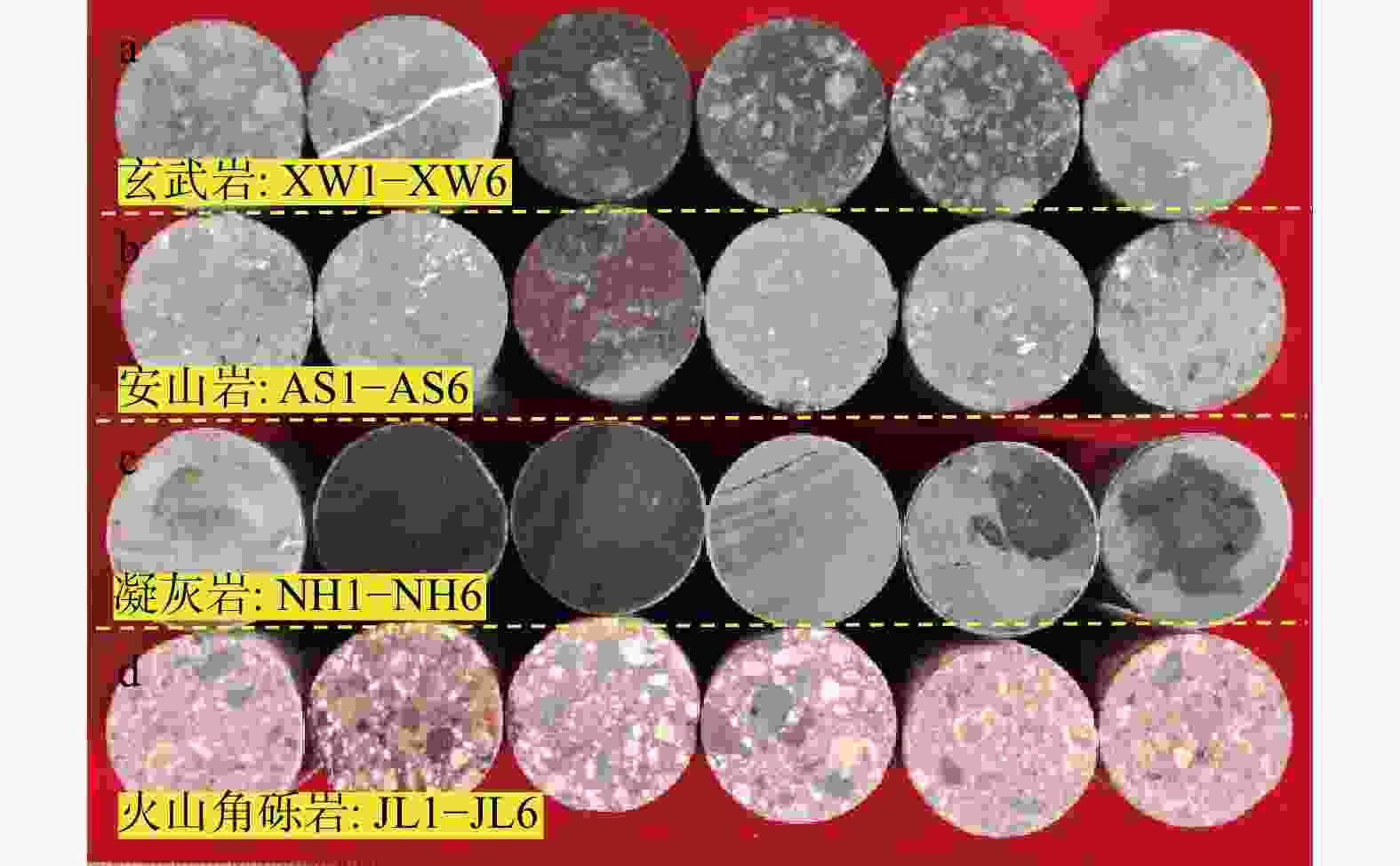
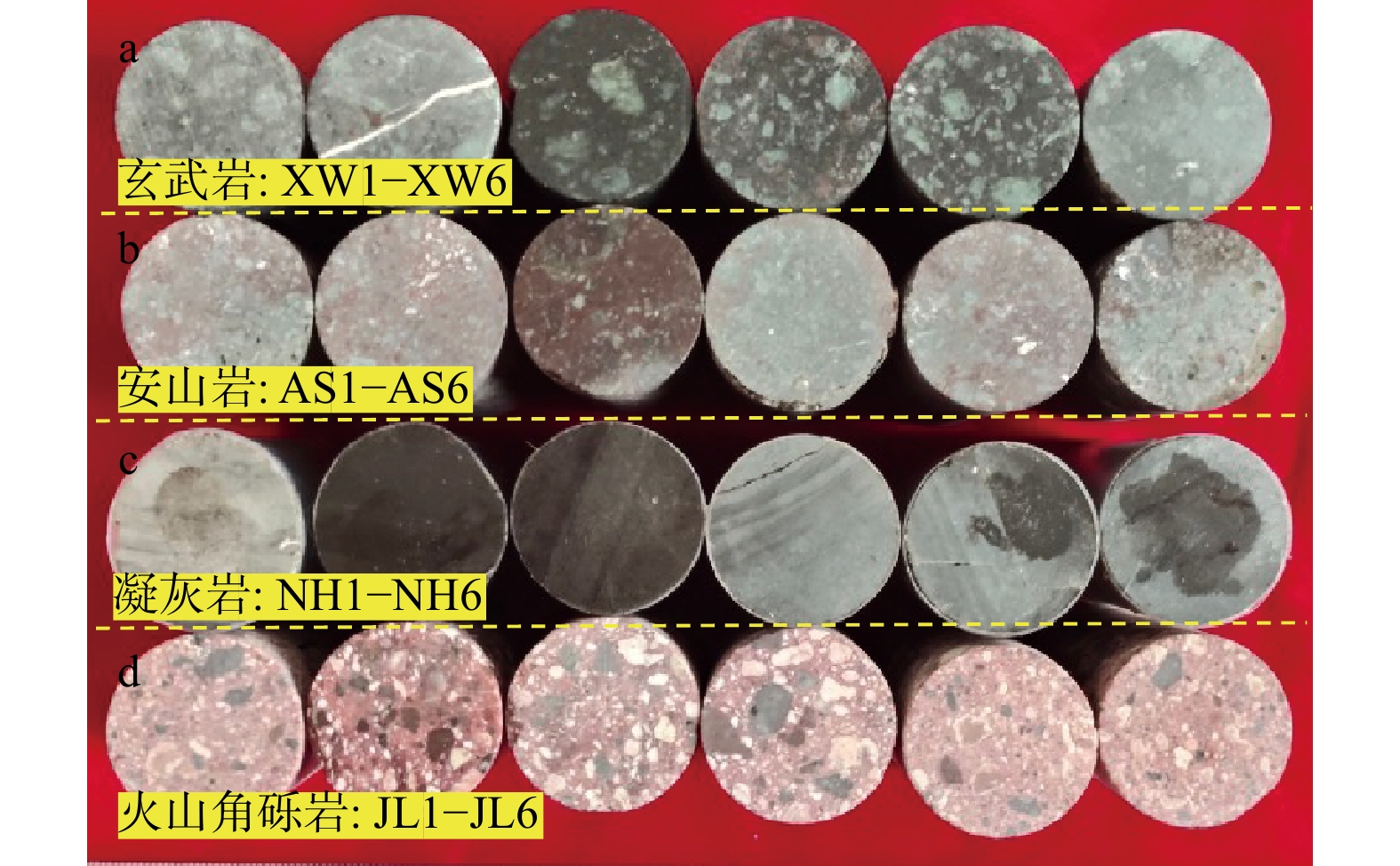
图 1 4类不同岩性的火山岩岩芯样品
a—玄武岩岩心样品;b—安山岩岩心样品;c—凝灰岩岩心样品;d—火山角砾岩岩心样品
Figure 1. Core samples of volcanic rocks of four different lithologies (a) Basalt core sample; (b) Andesite core sample; (c) Tuff core sample; (d) Volcanic breccia core sample
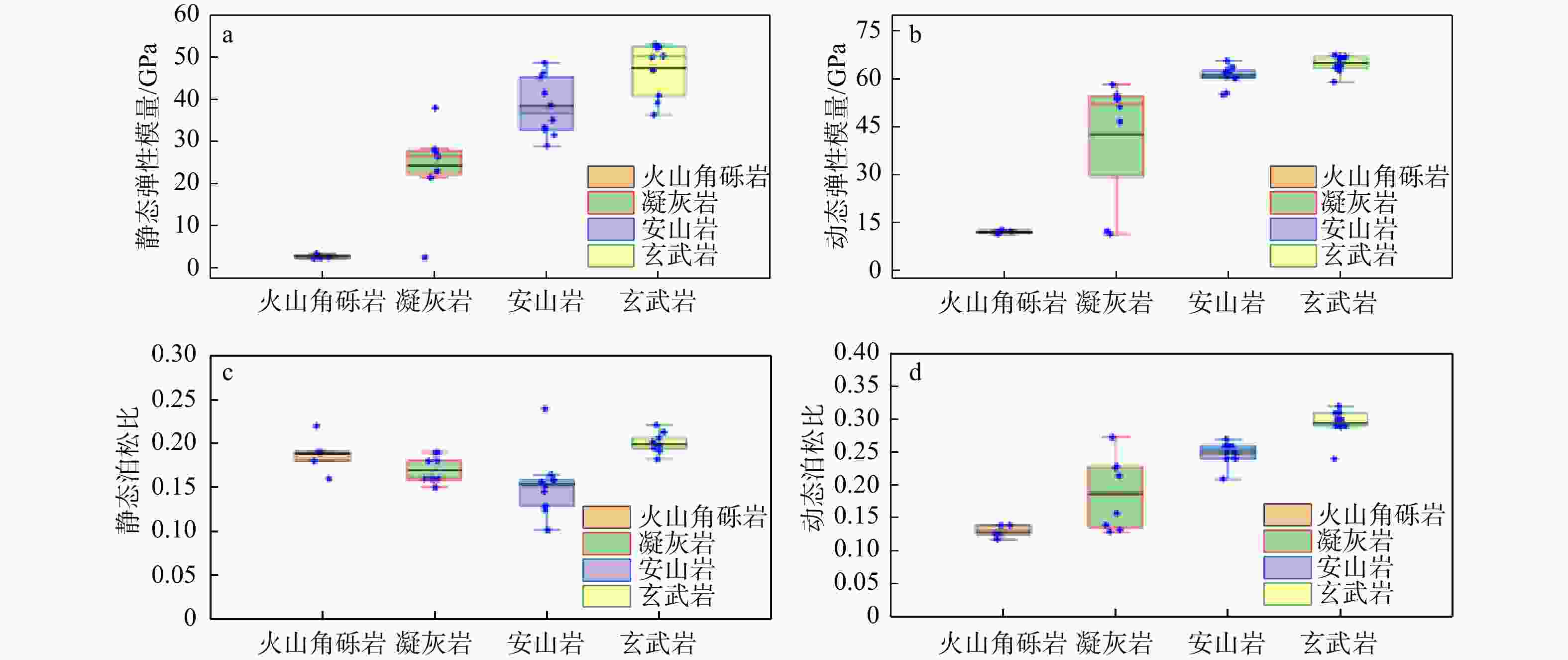
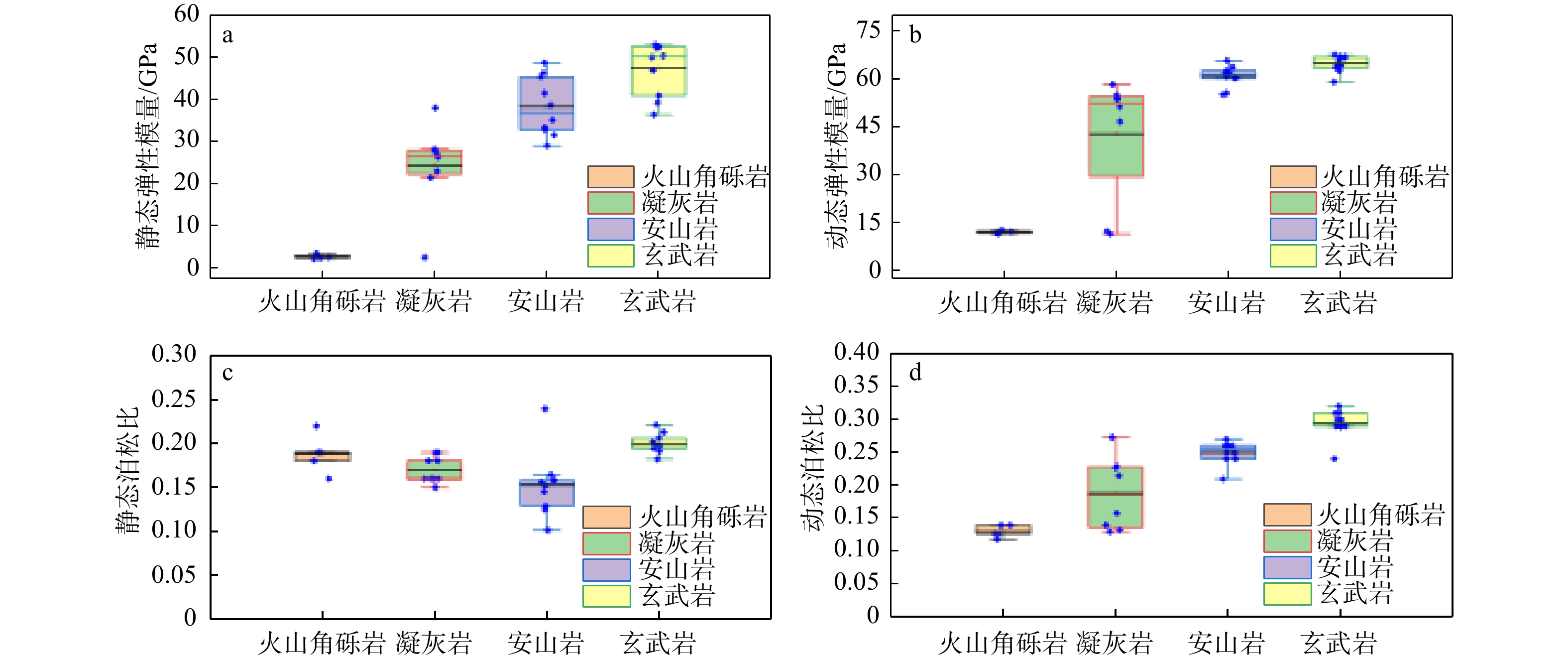
图 2 4种岩性火山岩静、动态力学参数对比
图中蓝色菱形代表各岩性数据点,柱状图代表弹性模量、泊松比数据范围a—岩性间静态弹性模量范围对比;b—岩性间动态弹性模量范围对比;c—岩性间静态泊松比范围对比;d—岩性间动态泊松比范围对比
Figure 2. Comparison of static and dynamic mechanical parameters of four types of volcanic rock (a) Inter-lithology static elastic modulus range comparison; (b) Inter-lithology dynamic elastic modulus range comparison; (c) Inter-lithology static Poisson's ratio range comparison; (d) Inter-lithology dynamic Poisson's ratio range comparison
The blue diamonds represent the data points for each lithology, and the bar charts show the data ranges for elastic modulus and Poisson's ratio.
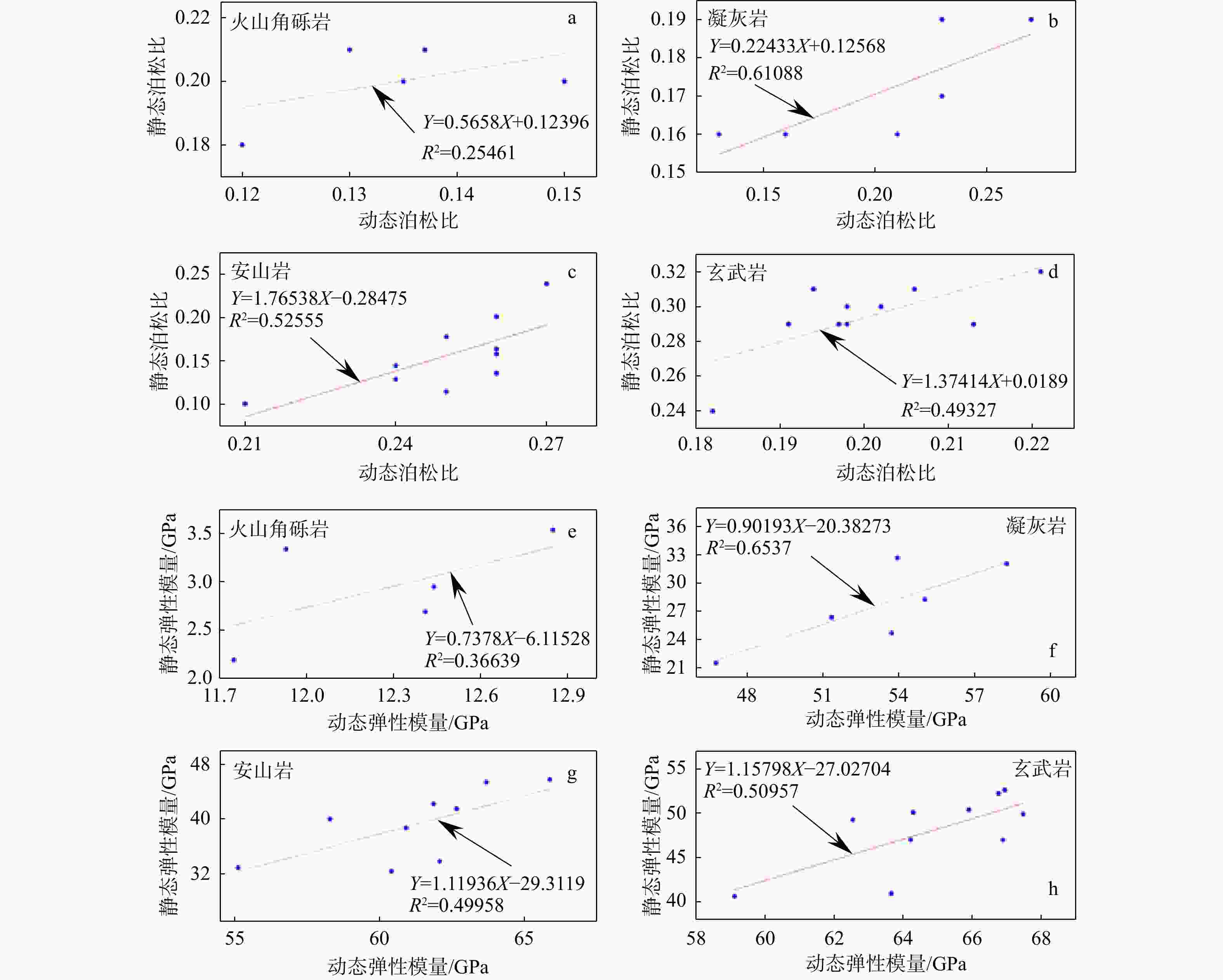
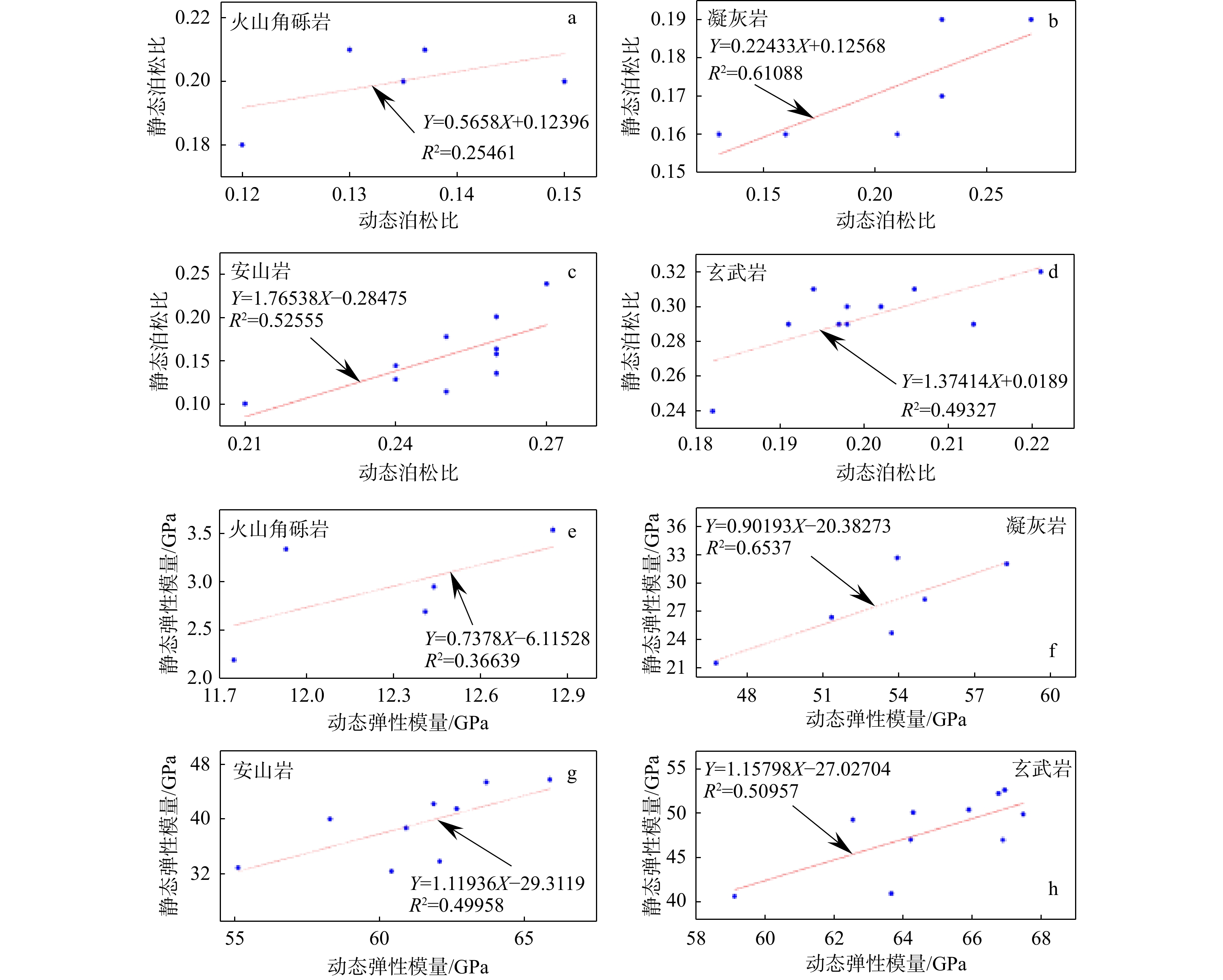
图 3 各岩性动、静态弹性模量及动、静态泊松比线性拟合结果
a—火山角砾岩动、静态泊松比拟合曲线;b—凝灰岩动、静态泊松比拟合曲线;c—安山岩岩动、静态泊松比拟合曲线;d—玄武岩动、静态泊松比拟合曲线;e—火山角砾岩动、静态弹性模量拟合曲线; f—凝灰岩动、静态弹性模量拟合曲线;g—安山岩动、静态弹性模量拟合曲线;h—玄武岩动、静态弹性模量拟合曲线
Figure 3. Linear fitting of dynamic and static elastic moduli and dynamic and static Poisson's ratios of each lithology (a) Dynamic–static Poisson's ratio fitting curve for volcanic breccia; (b) Dynamic–static Poisson's ratio fitting curve for tuff; (c) Dynamic–static Poisson's ratio fitting curve for andesite; (d) Dynamic–static Poisson's ratio fitting curve for basalt; (e) Dynamic–static elastic modulus fitting curve for volcanic breccia; (f) Dynamic–static elastic modulus fitting curve for tuff; (g) Dynamic–static elastic modulus fitting curve for andesite; (h) Dynamic–static elastic modulus fitting curve for basalt
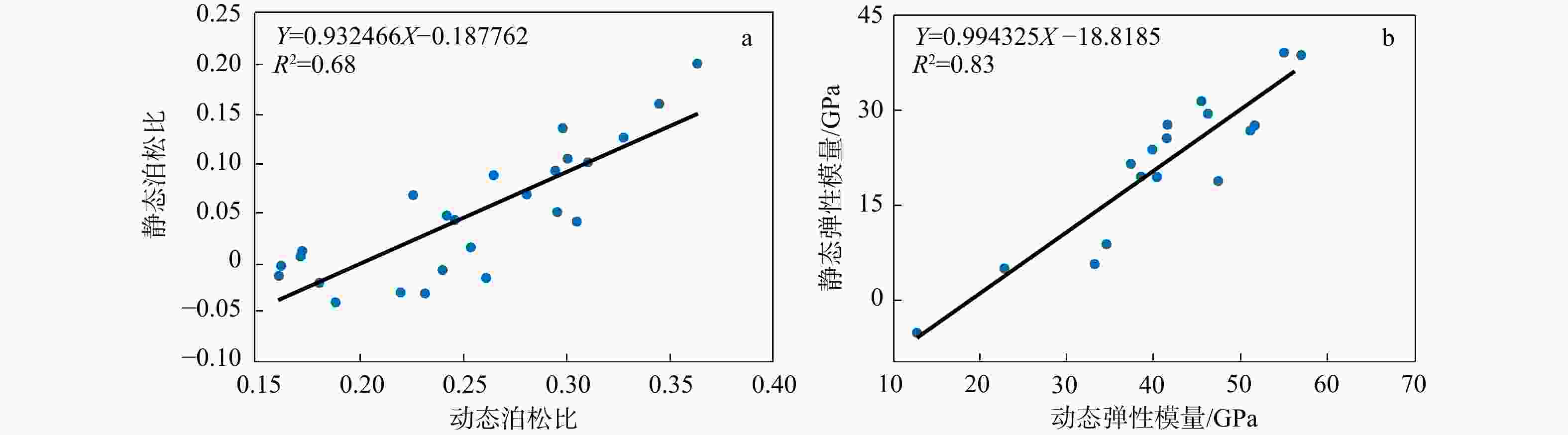
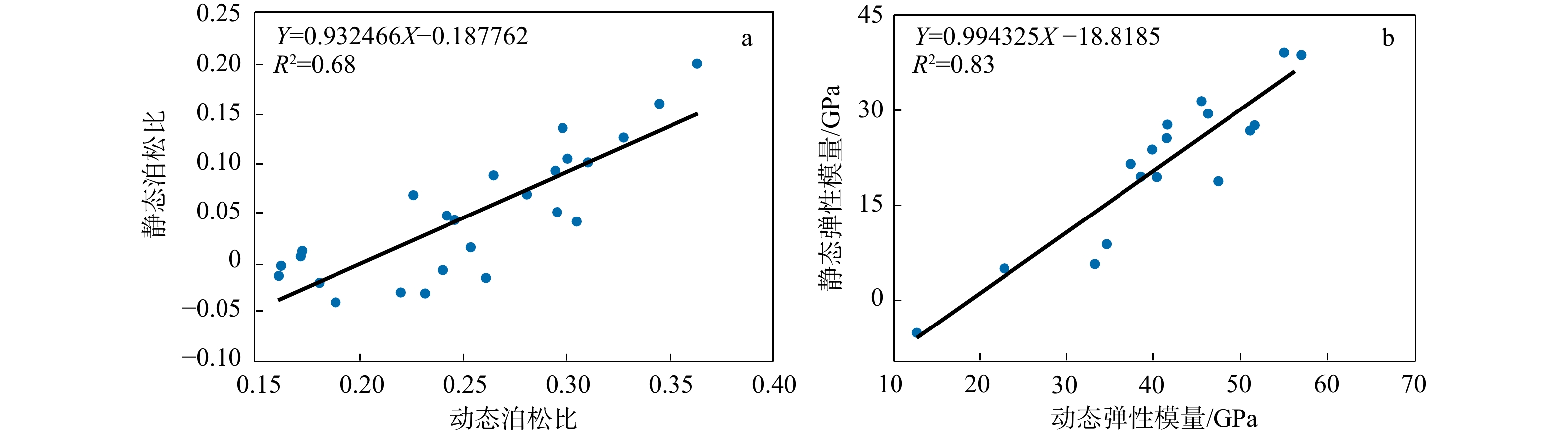
图 4 临近区块沉积岩(云化砂岩)静态弹性模量及动、静态泊松比线性拟合结果
a—临近区块沉积岩动、静态泊松比拟合曲线;b—临近区块沉积岩动、静态弹性拟合曲线
Figure 4. Linear fitting of static elastic moduli and dynamic and static Poisson's ratios of sedimentary rocks (cloudified sandstone) from an adjacent block (a) Dynamic–static Poisson's ratio fitting curve for sedimentary rocks from an adjacent block; (b) Dynamic–static elastic modulus fitting curve for sedimentary rocks from an adjacent block
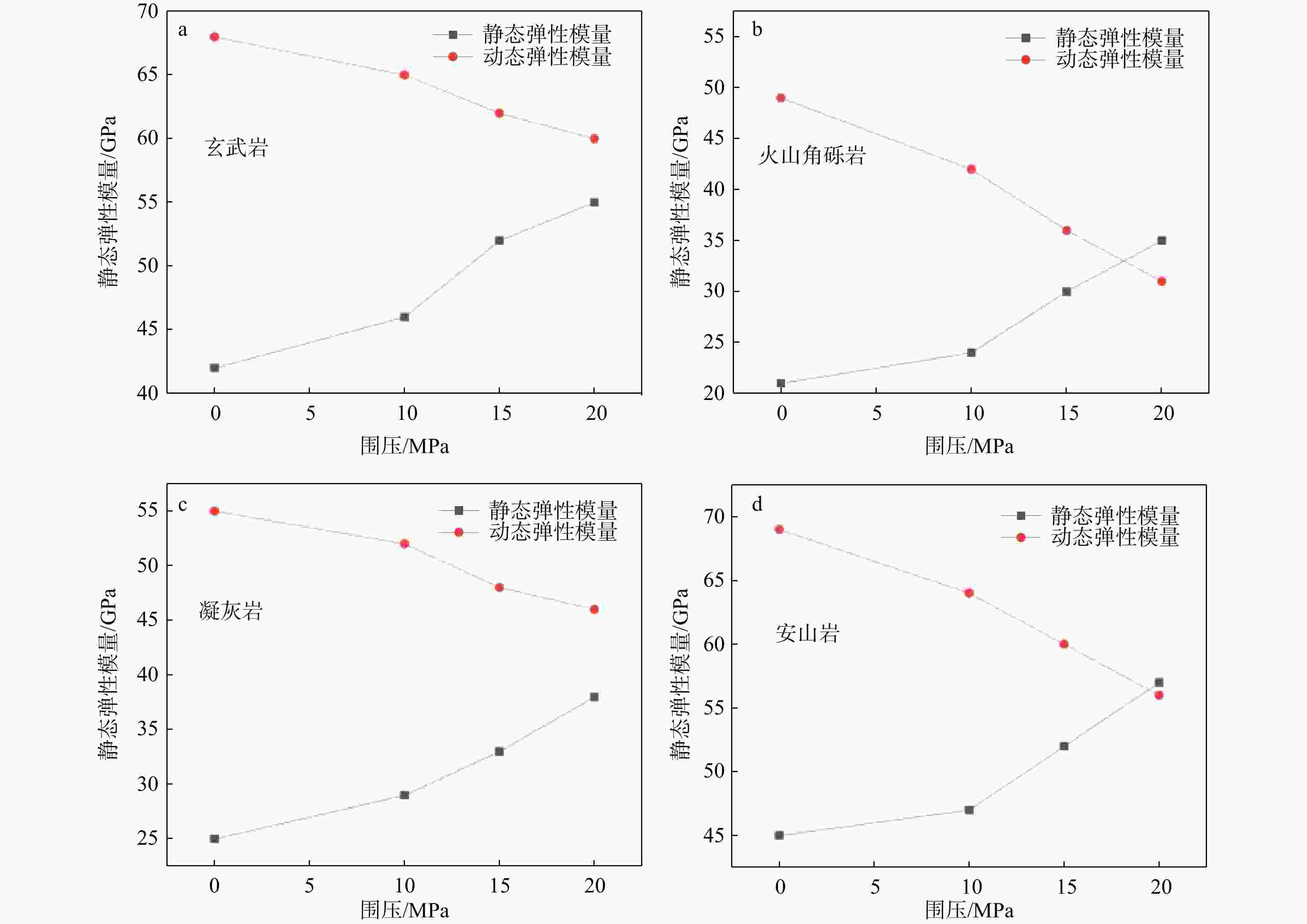
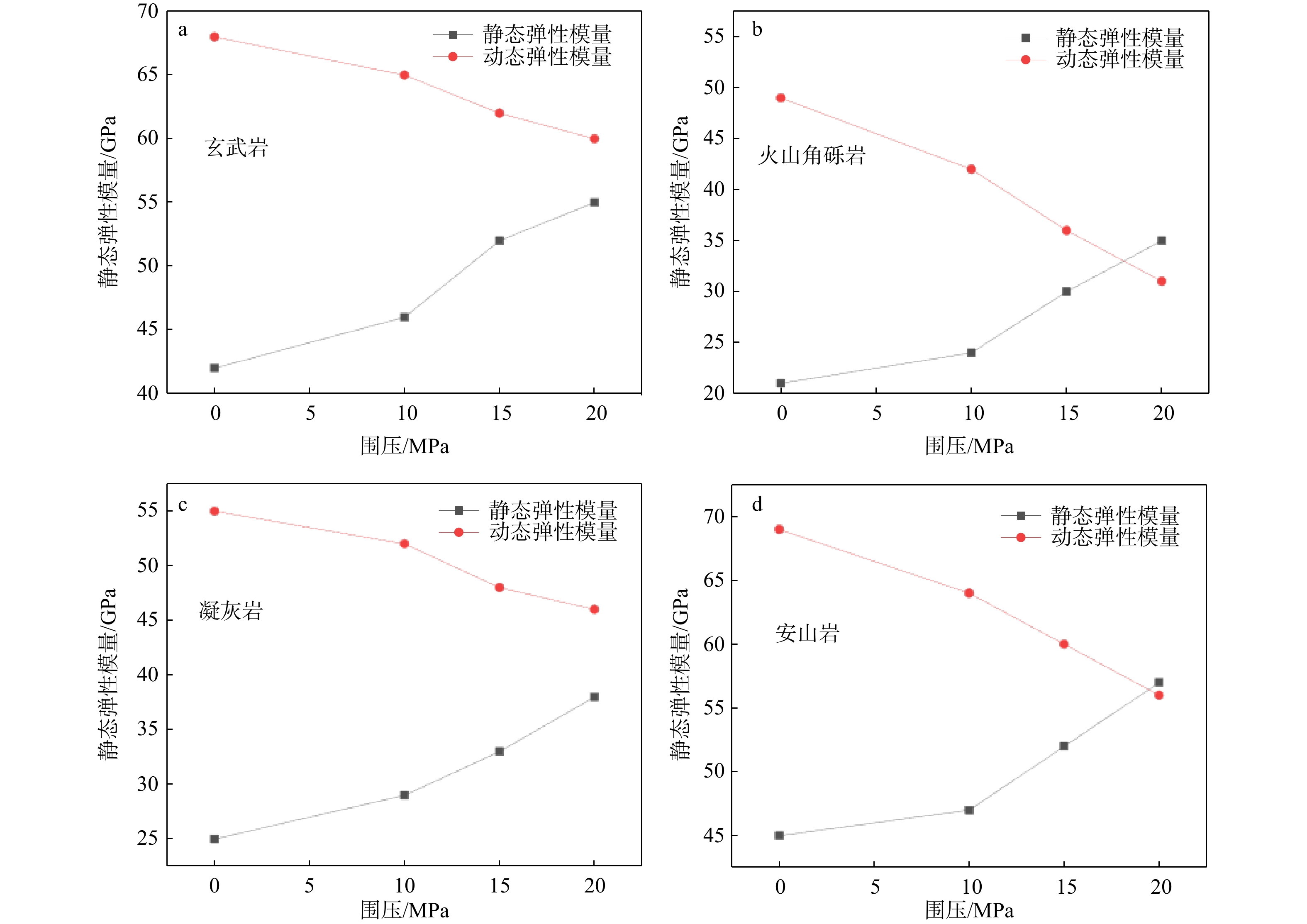
图 5 各岩性平均动、静态力学参数随围压变化趋势示意(弹性模量)
a一玄武岩平均动、静态力学参数随围压变化趋势;b一安山岩平均动、静态力学参数随围压变化趋势;c一凝灰岩平均动、静态力学参数随围压变化趋势;d一火山角砾岩平均动、静态力学参数随围压变化趋势
Figure 5. Trends in average dynamic and static mechanical parameters for each lithology with confining pressure (elastic modulus) (a) Variation of average dynamic–static mechanical parameters with confining pressure for basalt; (b) Variation of average dynamic–static mechanical parameters with confining pressure for andesite; (c) Variation of average dynamic–static mechanical parameters with confining pressure for tuff; (d) Variation of average dynamic–static mechanical parameters with confining pressure for volcanic breccia
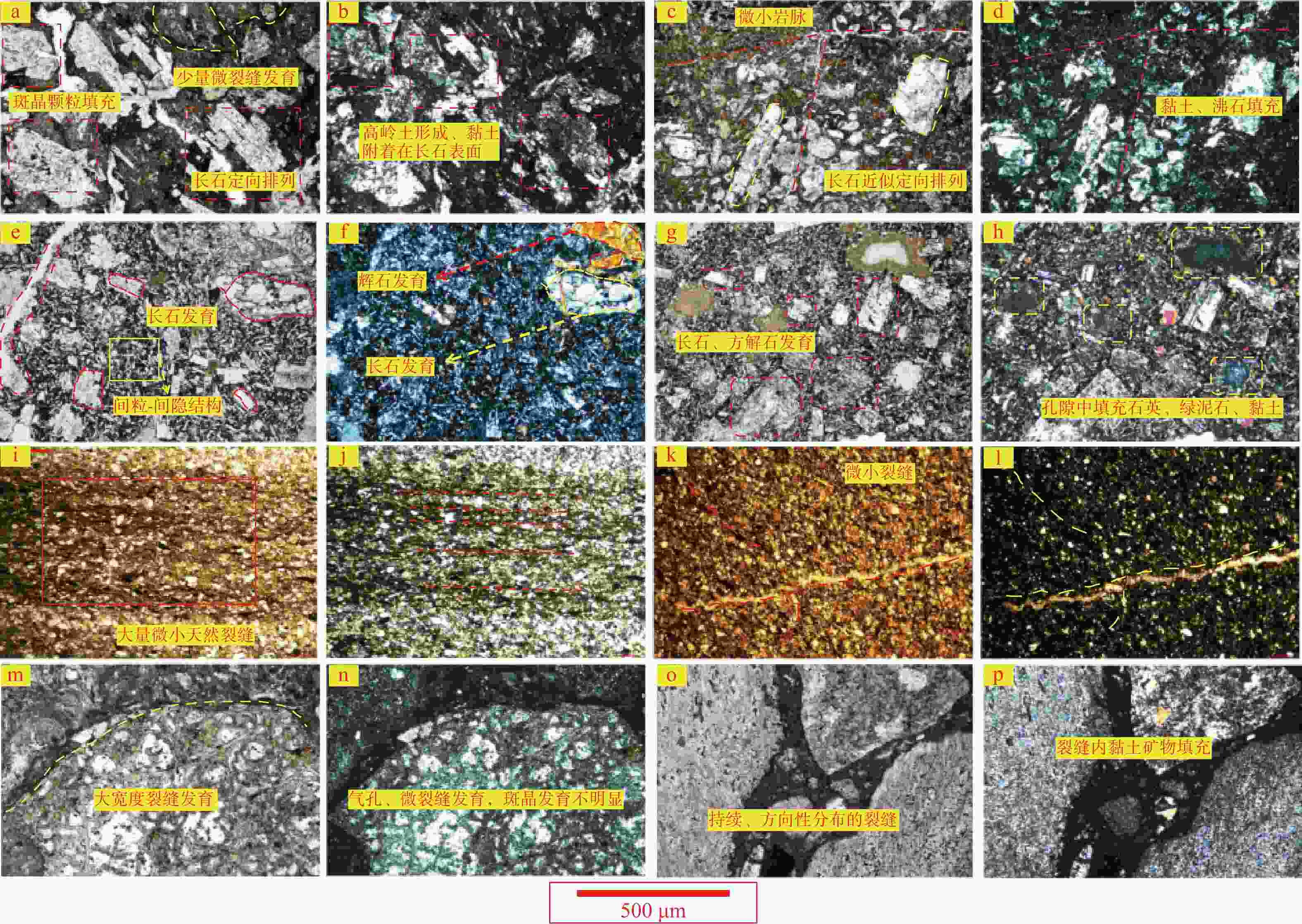
图 6 火山岩典型岩性正交/偏光显微镜下观测结果
a—正交光下安山岩典型结构及裂缝发育情况;b—偏光镜下安山岩典型结构及裂缝发育情况;c—正交光下安山岩矿物排列及矿物填充;d—偏光镜下安山岩矿物排列及矿物填充;e—正交光下玄武岩典型间粒−间隐结构及矿物排列;f—偏光镜下玄武岩典型间粒−间隐结构及矿物排列;g—正交光下玄武岩矿物颗粒胶结及矿物填充;h—偏光镜下矿物颗粒胶结及矿物填充;i、j、k、l—正交/偏光镜下凝灰岩天然裂缝发育形态、密度;m、n、o、p—火山角砾岩天然裂缝发育状态及黏土矿物、斑晶、孔隙等发育形态
Figure 6. Typical micro-textures of volcanic rocks under cross- and plane-polarized light (a) Typical texture and fracture development of andesite under cross-polarized light; (b) Typical texture and fracture development of andesite under plane-polarized light; (c) Mineral arrangement and mineral filling of andesite under cross-polarized light; (d) Mineral arrangement and mineral filling of andesite under plane-polarized light; (e) Typical intergranular–intersertal texture and mineral arrangement of basalt under cross-polarized light; (f) Typical intergranular–intersertal texture and mineral arrangement of basalt under plane-polarized light; (g) Cementation and mineral filling of basalt mineral grains under cross-polarized light; (h) Cementation and mineral filling of mineral grains under plane-polarized light; (i–l) Morphology and density of natural fractures in tuff under cross-polarized / plane-polarized light; (m–p) Development of natural fractures and morphologies of clay minerals, phenocrysts, pores, etc., in volcanic breccia under cross-polarized / plane-polarized light
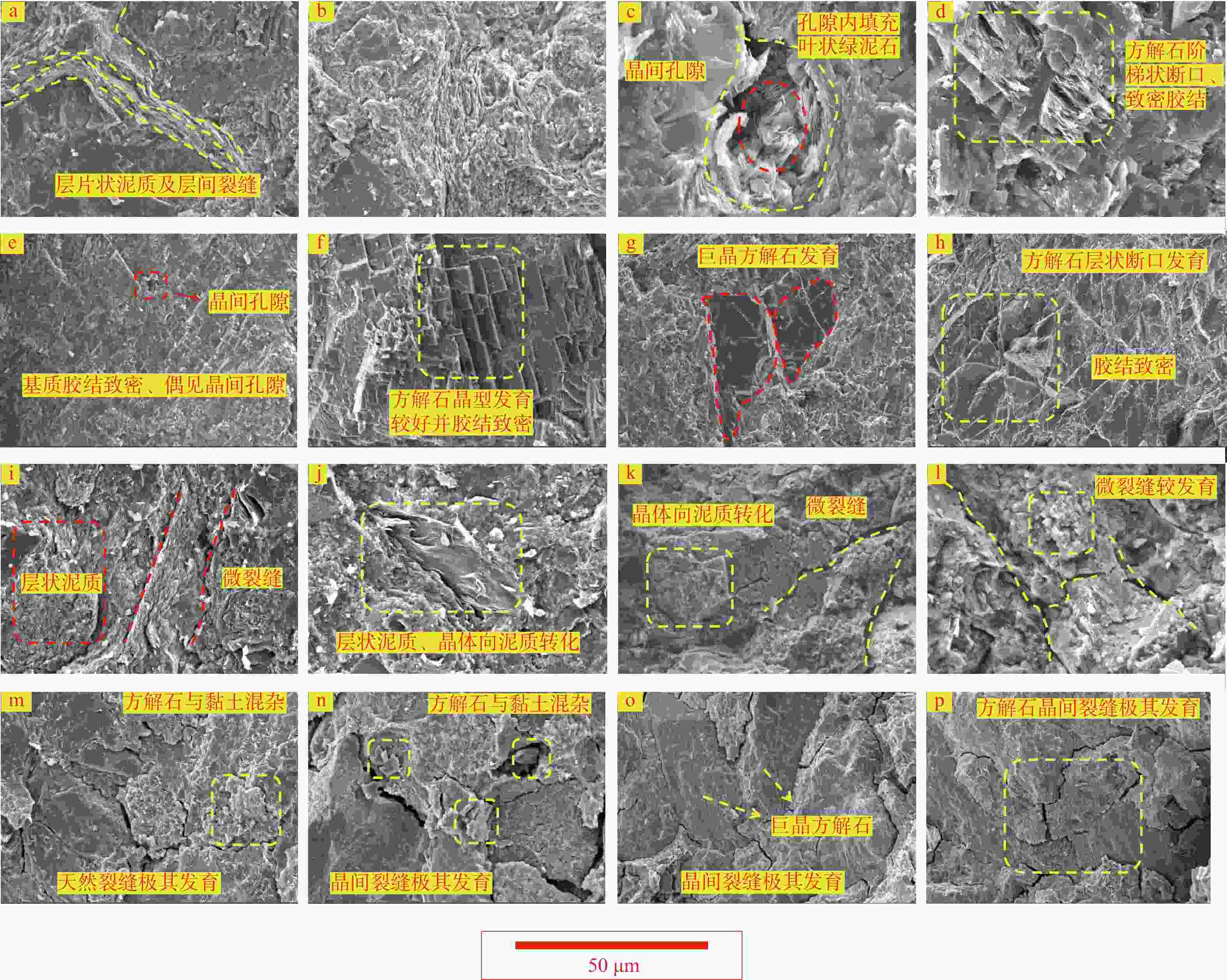
图 7 火山岩典型岩性扫描电子显微镜下(SEM)观测结果
a、b、c、d—安山岩裂缝发育及矿物填充特征;e、f、g、h—玄武岩矿物类型及基质胶结;i、j、k、l—凝灰岩天然裂缝及黏土矿物发育分布特征;m、n、o、p—火山角砾岩基质、黏土矿物胶结及天然裂缝发育程度
Figure 7. SEM observations of representative microstructures in volcanic rocks
(a–d) Fracture development and mineral filling in andesite; (e–h) Mineral types and matrix cementation in basalt; (i–l) Distribution of natural fractures and clay minerals in tuff; (m–p) Matrix, clay mineral cementation, and natural fracture development in volcanic breccia
表 1 原位测试实验条件及实验结果
Table 1. Conditions and results of in-situ tests
编号 围压/MPa 孔隙压力/MPa 温度/℃ 密度/(g·cm−3) 动态弹性模量/GPa 动态泊松比 静态弹性模量/GPa 静态泊松比 抗压强度/MPa AS1 0 0 25 2.56 62.08 0.26 48.74 0.239 232.49 AS2 10 10.99 35 2.66 63.69 0.26 41.48 0.152 214.8 AS3 10 9.85 35 2.63 60.42 0.24 28.99 0.101 230.84 AS4 10 9.63 35 2.72 65.88 0.25 38.69 0.164 290.95 AS5 15 12.36 40 2.69 55.13 0.21 31.64 0.158 266.26 AS6 15 14.32 40 2.75 62.67 0.26 32.88 0.129 224.85 AS7 15 12.69 40 2.63 61.88 0.26 45.36 0.156 215.69 AS8 20 15.78 45 2.55 60.30 0.25 33.37 0.125 265.14 AS9 20 15.63 45 2.71 55.66 0.24 46.32 0.145 218.44 AS10 20 16.01 45 2.65 59.07 0.26 35.21 0.158 248.08 XW1 0 0 25 2.86 65.90 0.32 52.58 0.191 214.8 XW2 10 9.56 35 2.93 64.22 0.30 52.2 0.182 280.9 XW3 10 8.99 35 2.84 66.94 0.29 40.96 0.197 184.85 XW4 10 9.23 35 2.77 67.48 0.31 50.37 0.213 229.37 XW5 15 11.32 40 2.81 62.54 0.31 46.99 0.194 264.75 XW6 15 11.69 40 2.95 59.12 0.24 39.29 0.198 246.76 XW7 15 12.03 40 2.86 64.29 0.30 50.06 0.202 307.21 XW8 20 15.32 45 2.88 66.76 0.29 52.91 0.221 327.88 XW9 20 14.98 45 2.95 63.66 0.29 52.47 0.206 266.02 XW10 20 15.33 45 5.96 66.89 0.29 36.45 0.198 226.86 NH1 0 0 25 1.98 46.78 0.13 26.69 0.16 85.12 NH2 10 10.21 35 1.96 58.27 0.27 21.5 0.16 87.12 NH3 10 10.36 35 2.03 55.03 0.23 28.25 0.16 97.21 NH4 15 16.55 40 2.34 53.94 0.16 38.01 0.15 134.48 NH5 15 16.52 40 2.14 53.72 0.23 27.67 0.19 129.86 NH6 20 16.69 45 2.45 51.34 0.21 26.37 0.19 201.95 NH7 20 17.34 45 1.99 46.78 0.13 26.69 0.16 179.14 JL1 0 0 25 2.36 12.42 0.14 2.63 0.19 28.61 JL2 10 7.65 35 2.74 11.66 0.13 2.81 0.19 69.54 JL3 10 8.69 35 2.61 12.85 0.14 2.44 0.22 57.48 JL4 15 10.66 40 2.45 12.44 0.13 2.95 0.18 56.56 JL5 15 11.45 40 2.31 11.75 0.12 3.54 0.16 66.19 JL6 20 12.36 45 2.03 11.93 0.13 2.19 0.16 71.67 JL7 20 10.74 45 2.38 12.41 0.14 2.69 0.18 79.52  下载: 导出CSV
表 2 动、静态参数拟合修正及前后精度对比
Table 2. Comparison of accuracy before and after fitting dynamic and static parameters
岩性
数值/精度安山岩 玄武岩 火山角砾岩 凝灰岩 平均数值 拟合精度 平均数值 拟合精度 平均数值 拟合精度 平均数值 拟合精度 弹性模量 19.5 40.1% 20.2 39.6% 6.4 23.1% 20.4 65.4% 修正后 43.9 90.1% 45.3 87.2% 23.5 85.3% 27.9 89.3% 泊松比 0.06 37.4% 0.07 36.3% 0.05 29.8% 0.05 40.7% 修正后 0.14 92.1% 0.17 86.2% 0.15 84.9% 0.15 91.3%
下载: 导出CSV
-
[1] BAHRAMI B , FEREIDOONI D, KHANLARI G, et al. , 2025. Micro and macrostructural investigations on the fracture mechanism of the brittle rocks under compressive loading[J]. Multiscale and Multidisciplinary Modeling, Experiments and Design, 8(3): 329-351. [2] CHEN M, 2004. Review of study on rock mechanics at great depth and its applications to petroleum engineering of China[J]. Chinese Journal of Rock Mechanics and Engineering, 23(14): 2455-2462. (in Chinese with English abstract) [3] CHEN Z H, WANG X L, ZHA M, et al., 2016. Characteristics and formation mechanisms of large volcanic rock oil reservoirs: a case study of the Carboniferous rocks in the Kebai fault zone of Junggar Basin, China[J]. AAPG Bulletin, 100(10): 1585-1617. doi: 10.1306/04151614066 [4] CHEN Z R, LIU W, SHI X, et al. Prediction of in-situ stress field of deep coalbed methane considering the coalbed structure differences[J/OL]. Coal Science and Technology, 2025: 1-11. https://link.cnki.net/urlid/11.2402.td.20250708.1135.006. (in Chinese with English abstract) [5] CUI Y, QU Z, ZHANG Y H, et al., 2018. Experimental research on dynamic and static elastic mechanics parameters of mud shale[J]. Journal of Guangxi University (Natural Science Edition), 43(6): 2284-2291. (in Chinese with English abstract) [6] ERLING F, HOLT R M, HORSRUD P, et al. , 2008. Petroleum related rock mechanics[J]. Amsterdam: Elsevier: 445-473. [7] GAO S, GONG L, LIU X B, et al., 2020. Distribution and controlling factors of natural fractures in deep tight volcanic gas reservoirs in Xujiaweizi area, Northern Songliao Basin[J]. Oil & Gas Geology, 41(3): 503-512. (in Chinese with English abstract) [8] GUO X S, 2022. Discussion and research direction of future onshore oil and gas exploration in China[J]. Earth Science, 47(10): 3511-3523. (in Chinese with English abstract) [9] LI J C, TIAN G, WANG J C, et al., 2024. Prediction of bedding fractures in shale reservoirs based on two-step matching core-logging-seismic information[J]. Xinjiang Oil & Gas, 20(1): 21-30. (in Chinese with English abstract) [10] LI Q, HE J J, CHEN J, 2017. Simultaneous ultrasonic experiment of dynamic and static elastic parameters of coal under formation pressure conditions in Qinshui Basin[J]. Chinese Journal of Geophysics, 60(7): 2897-2903. (in Chinese with English abstract) [11] LI Y G, 2017. Classification of tight volcanic reservoirs and evaluation of favorable target potential in the Songnan Gas Field[J]. Journal of Jilin University (Earth Science Edition), 47(2): 344-354. (in Chinese with English abstract) [12] LIU J, HUANG C, ZHOU L, et al., 2024. Estimation of the rock mechanics and in-situ stress parameters of carbonate reservoirs using array sonic logging: a case study of Shunbei No. 4 block[J]. Journal of Geomechanics, 30(3): 394-407. (in Chinese with English abstract) [13] LIU R, HUANG H D, SUN C Z, et al., 2015. Study on the formation permeability evaluation of volcanic reservoir[J]. Science Technology and Engineering, 15(8): 60-65. (in Chinese with English abstract) [14] LIU T J, JIA H B, JI H C, et al., 2022. Volcanic reservoirs lacking a paleoweathering crust in Carboniferous deposits of the Junggar Basin, western China: characteristics, controlling factors and hydrocarbon potential[J]. Journal of Petroleum Science and Engineering, 219: 111119. doi: 10.1016/j.petrol.2022.111119 [15] LIU S J, ZHANG Y J, WU Y, et al., 2025. Reverse Size Effect of the Unconfined Compressive Strength of Crystalline Rock: A Grain-Scale Perspective[J]. Rock Mechanics and Rock Engineering, 58(2): 1651-1669. doi: 10.1007/s00603-024-04216-7 [16] LU B, ZHAO P, 2004. Distribution volcanic rocks and their effect on oil and gas reservoirs[J]. Special Oil & Gas Reservoirs, 11(2): 17-19. (in Chinese with English abstract) [17] LUO W, 2024. Regression analysis of dynamic and static elastic parameters of sandstone reservoir rocks in Bonan Subsag[J]. Sichuan Cement(7): 19-24. (in Chinese) [18] MA X P, ZHUANG X G, HE Y L, et al., 2025. Reservoir forming conditions and models of oil sands in northwestern margin of Junggar Basin, China[J]. Journal of Earth Science, 36(2): 611-626. doi: 10.1007/s12583-022-1751-9 [19] MENG Z P, PENG S P, LING B C, 2000. Characters of the deformation and strength under different confining pressures on sedimentary rock[J]. Journal of China Coal Society, 25(1): 15-18. (in Chinese with English abstract) [20] PENG L, LUO J W, ZHAO H B, et al., 2023. The lost circulation mechanism in formations prone to lost circulation at Misui block in Changqing oilfield[J]. Xinjiang Oil & Gas, 19(4): 10-19. (in Chinese with English abstract) [21] SHENG Y S, ZHANG Y G, GU M Y, et al., 2016. Static and dynamic mechanical parameter calibration of tight reservoir rock mass under in-situ condition[J]. Oil & Gas Geology, 37(1): 109-116. (in Chinese with English abstract) [22] SONG J, 2014. The correlations between geological stress and casing damage and between rock mechanics parameters and casing damage in sandstone reservoir[J]. Journal of Geomechanics, 20(3): 324-330. (in Chinese with English abstract) [23] VALENCIA-GÓMEZ J C, CARDONA A, ZAPATA S, et al., 2024. Fracture analysis and low-temperature thermochronology of faulted Jurassic igneous rocks in the Southern Colombian Andes: reservoir and tectonic implications[J]. Marine and Petroleum Geology, 165: 106850. doi: 10.1016/j.marpetgeo.2024.106850 [24] WANG J, LIU J, CHEN J, et al., 2023. Characteristics and controlling factors of carboniferous high quality volcanic reservoirs in eastern Junggar Basin[J]. Science Technology and Engineering, 23(22): 9388-9403. (in Chinese with English abstract) [25] WANG W G, WANG M, LU S F, et al., 2016. Basin modelling of gas migration and accumulation in volcanic reservoirs in the Xujiaweizi Fault-depression, Songliao Basin[J]. Arabian Journal of Geosciences, 9(2): 166. doi: 10.1007/s12517-015-2072-4 [26] WU H H, 2023. Study of triaxial compression test on mechanical parameters of coal rock[J]. Academic Journal of Architecture and Geotechnical Engineering, 5(6): 16-20. [27] WU S J, WU J , FAN T L, et al. , 2025. Characteristics of correlation between lithofacies and mechanical properties of deep carbonate rocks and its genetic mechanism[J]. Petroleum Geology & Experiment, 47(6): 1224-1240. (in Chinese with English abstract) [28] XIE E, XIONG J, PAN Y Y, et al., 2014. The establishment of rock mechanical parameter model in Tazhong area of Tarim basin and its application[J]. Science Technology and Engineering, 14(3): 130-133. (in Chinese with English abstract) [29] YOU M Q, 2003. Effect of confining pressure on the Young’s Modulus of rock specimen[J]. Chinese Journal of Rock Mechanics and Engineering, 22(1): 53-60. (in Chinese with English abstract) [30] ZHANG J F, LIU Y H, WAN W S, et al., 2020. Lithology identification and reservoir prediction of volcanic reservoir in Xiquan area[J]. Xinjiang Oil & Gas, 16(3): 6-10. (in Chinese with English abstract) [31] ZHANG L, LI J, SONG Y, et al., 2021. Gas accumulation characteristics and exploration potential of the Carboniferous volcanic rocks in Junggar Basin[J]. China Petroleum Exploration, 26(6): 141-151. (in Chinese with English abstract) [32] ZHAO Y, PAN H, LUO F F, et al., 2023. Characteristics and quality determinants of Carboniferous volcanic reservoirs in the Hongche Fault Zone, Junggar Basin[J]. Oil & Gas Geology, 44(5): 1129-1140. (in Chinese with English abstract) [33] ZHI D M, XIE A, YANG F, et al., 2024. Exploration prospects of the whole oil and gas system in the Permian hydrocarbon depressions in the Eastern Junggar Basin[J]. Journal of Geomechanics, 30(5): 781-794. (in Chinese with English abstract) [34] ZHOU J, LIN C Y, LIU H M, et al., 2024. Mechanism of reservoir development in the Carboniferous-Permian volcanic rock reservoirs in Hala'alate Mountain area, Junggar Basin[J]. Earth Science Frontiers, 31(2): 327-342. (in Chinese with English abstract) [35] ZHOU Z J, ZHANG H W, WANG X Y, et al. , 2023. Calculation method of in-situ stress in tight sandstone reservoir without density logging curve[J]. China Science and Technology Information(2): 105-107. (in Chinese) [36] 陈勉, 2004. 我国深层岩石力学研究及在石油工程中的应用[J]. 岩石力学与工程学报, 23(14): 2455-2462. [37] 陈峥嵘, 刘伟, 时贤, 等, 2025. 考虑煤体结构差异的深层煤层气地应力场预测方法[J/OL]. 煤炭科学技术, 1-11. https: //link.cnki.net/urlid/11.2402.td.20250708.1135.006. [38] 崔莹, 屈展, 张永浩, 等, 2018. 泥页岩动静态弹性力学参数实验研究[J]. 广西大学学报(自然科学版), 43(6): 2284-2291. doi: 10.13624/j.cnki.issn.1001-7445.2018.2284 [39] 高帅, 巩磊, 刘小波, 等, 2020. 松辽盆地北部深层致密火山岩气藏天然裂缝分布特征及控制因素[J]. 石油与天然气地质, 41(3): 503-512. [40] 郭旭升, 2022. 我国陆上未来油气勘探领域探讨与攻关方向[J]. 地球科学, 47(10): 3511-3523. [41] 李嘉成, 田刚, 王俊超, 等, 2024. 岩心-测井-地震信息二步匹配预测页岩储层层理缝[J]. 新疆石油天然气, 20(1): 21-30. doi: 10.12388/j.issn.1673-2677.2024.01.003 [42] 李琼, 何建军, 陈杰, 2017. 地层压力条件下沁水盆地煤岩动静态弹性参数同步超声实验研究[J]. 地球物理学报, 60(7): 2897-2903. doi: 10.6038/cjg20170733 [43] 李永刚, 2017. 松南气田火山岩致密储层分类及有利目标潜力评价[J]. 吉林大学学报(地球科学版), 47(2): 344-354. doi: 10.13278/j.cnki.jjuese.201702102 [44] 刘睿, 黄捍东, 孙传宗, 等, 2015. 火山岩油藏地层渗透率评价研究[J]. 科学技术与工程, 15(8): 60-65. doi: 10.3969/j.issn.1671-1815.2015.08.011 [45] 路波, 赵萍, 2004. 火山岩的分布及其对油气藏的作用[J]. 特种油气藏, 11(2): 17-19. doi: 10.3969/j.issn.1006-6535.2004.02.006 [46] 罗伟, 2024. 渤南洼陷砂岩储层岩石的动静态弹性参数回归分析[J]. 四川水泥(7): 19-24. [47] 孟召平, 彭苏萍, 凌标灿, 2000. 不同侧压下沉积岩石变形与强度特征[J]. 煤炭学报, 25(1): 15-18. doi: 10.3321/j.issn:0253-9993.2000.01.004 [48] 彭磊, 罗江伟, 赵宏波, 等, 2023. 长庆油田米绥新区易漏地层漏失机理[J]. 新疆石油天然气, 19(4): 10-19. doi: 10.12388/j.issn.1673-2677.2023.04.002 [49] 盛英帅, 张玉广, 顾明勇, 等, 2016. 原位条件下致密储层岩体力学动静态参数校正[J]. 石油与天然气地质, 37(1): 109-116. [50] 宋杰, 2014. 砂岩油藏地应力及岩石力学参数与套管损坏相关性[J]. 地质力学学报, 20(3): 324-330. doi: 10.3969/j.issn.1006-6616.2014.03.012 [51] 王剑, 刘金, 陈俊, 等, 2023. 准噶尔盆地东部石炭系优质火山岩储层特征及分布规律[J]. 科学技术与工程, 23(22): 9388-9403. doi: 10.3969/j.issn.1671-1815.2023.22.007 [52] 谢恩, 熊健, 潘杨勇, 等, 2014. 塔里木盆地塔中地区岩石力学参数模型建立及其应用[J]. 科学技术与工程, 14(3): 130-133. [53] 伍尚嘉, 吴俊, 樊太亮, 等, 2025. 深层碳酸盐岩岩相与力学性质相关性特征及成因机制[J]. 石油实验地质, 47(6): 1224-1240. doi: 10.11781/sysydz2025061224 [54] 尤明庆, 2003. 岩石试样的杨氏模量与围压的关系[J]. 岩石力学与工程学报, 22(1): 53-60. doi: 10.3321/j.issn:1000-6915.2003.01.010 [55] 张金风, 刘艳红, 万文胜, 等, 2020. 西泉地区火山岩储集层岩性识别及储层预测[J]. 新疆石油天然气, 16(3): 6-10. doi: 10.3969/j.issn.1673-2677.2020.03.003 [56] 张璐, 李剑, 宋永, 等, 2021. 准噶尔盆地石炭系火山岩天然气成藏特征及勘探潜力[J]. 中国石油勘探, 26(6): 141-151. doi: 10.3969/j.issn.1672-7703.2021.06.010 [57] 赵耀, 潘虹, 骆飞飞, 等, 2023. 准噶尔盆地红车断裂带石炭系火山岩储层特征及质量控制因素[J]. 石油与天然气地质, 44(5): 1129-1140. [58] 支东明, 谢安, 杨帆, 等, 2024. 准噶尔盆地东部二叠系富烃凹陷全油气系统勘探前景[J]. 地质力学学报, 30(5): 781-794. doi: 10.12090/j.issn.1006-6616.2024029 [59] 周健, 林承焰, 刘惠民, 等, 2024. 准噶尔盆地哈山地区石炭系-二叠系火山岩储层发育机制研究[J]. 地学前缘, 31(2): 327-342. doi: 10.13745/j.esf.sf.2023.9.39 [60] 周振江, 张翰文, 王星宇, 等, 2023. 缺乏密度测井曲线情况下致密砂岩储层地应力计算方法[J]. 中国科技信息(2): 105-107. -

 下载:
下载:


计量
- 文章访问数: 705
- HTML全文浏览量: 339
- PDF下载量: 118
- 被引次数: 0
