


In-situ stress characteristics in the project area of a large hydropower station on the northern margin of the eastern Himalayan syntaxis
-
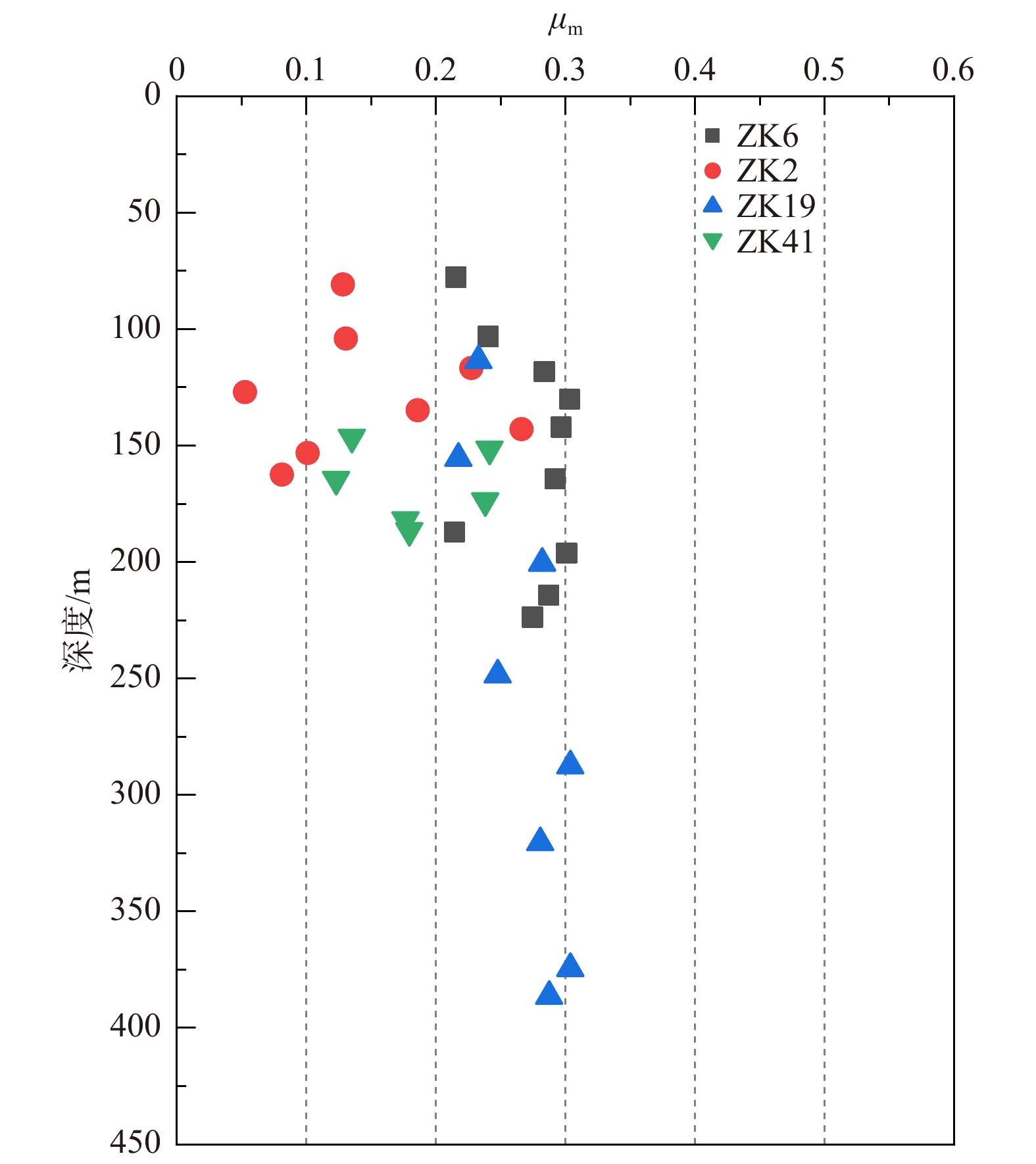
摘要: 为分析和评价喜马拉雅东构造结北缘某大型水电站工程区的地应力分布特征及断层稳定性,采用水压致裂法进行地应力实测,并结合三维应力场反演分析,获取了地下厂房、引水隧洞等关键部位应力场信息。研究结果表明:工程区主应力关系整体呈最大水平主应力(SH)>垂向应力(Sv)>最小水平主应力(Sh),水平应力主导,属走滑型应力状态,最大水平主应力优势方位为北东东向,与震源机制解主压应力方位一致,推断其形成主要受控于印度板块向欧亚板块的北东向挤压作用以及绕喜马拉雅东构造结的顺时针旋转运动;主应力随深度线性增加,在77.8~386.4 m深度范围内SH和Sh分别为3.0~11.0 MPa和2.0~6.7 MPa,梯度分别为1.82 MPa/hm和0.72 MPa/hm;相较于青藏地块,工程区应力水平偏低,以走滑运动为主的嘉黎断裂调节并释放了部分的构造应力;基于Mohr-Coulomb准则及Byerlee定律的活动断裂危险性分析表明,工程区嘉黎断裂的应力状态未达到地壳浅部断层滑动失稳的临界条件,处于相对稳定状态;应力场反演结果表明,引水线路及地下厂房(埋深介于160~400 m)的最大水平主应力为3.9~11.0 MPa,垂向应力为5.8~10.7 MPa,最小水平主应力为4.5~7.8 MPa,最大水平主应力方位角48°~66°,隧洞围岩最大水平主应力的方位角与隧洞轴线多呈大角度相交(一般在62°~70°之间),不利于隧洞围岩的稳定,结合地应力和围岩强度分析有发生轻微岩爆的可能,开挖时需根据现场实际情况采取必要的防护措施。研究成果为工程区的断裂稳定性和工程安全评价提供了关键依据。Abstract:
Objective We analyzed and evaluated the in-situ stress distribution characteristics and fault stability in the project area of a large hydropower station on the northern margin of the eastern Himalayan syntaxis. Methods We combined hydraulic fracturing measurements with three-dimensional stress field inversion analysis to obtain stress field information for key structures, such as the underground powerhouse and water diversion tunnels. Results The study revealed the following: (1) The principal stress relationship generally follows SH>Sv>Sh, dominated by horizontal stress, indicating a strike-slip stress regime. The predominant orientation of the maximum horizontal principal stress is ENE, consistent with the principal compressive stress direction derived from focal mechanism solutions. This is inferred to be primarily controlled by the NE-directed compression of the Indian Plate against the Eurasian Plate and the clockwise rotation around the eastern Himalayan syntaxis. (2) The principal stresses increase linearly with depth. Within the depth range of 77.8 m to 386.4 m, SH and Sh range from 3.0 MPa to 11.0 MPa and 2.0 MPa to 6.7 MPa, with gradients of 1.82 MPa/100 m and 0.72 MPa/100 m, respectively. Compared to the Tibetan Plateau block, the stress magnitude in the study area is relatively low. This is due to the Jiali Fault, which is predominantly characterized by strike-slip motion, accommodating and partially releasing tectonic stress. (3) Risk analysis of active faults based on the Mohr-Coulomb criterion and Byerlee’s law shows that the stress state of the Jiali Fault in the project area has not reached the critical condition for shallow crustal fault slip instability, indicating relative stability. (4) Stress field inversion results reveal that along the water diversion tunnels and the underground powerhouse (burial depth 160 m to 400 m), the maximum horizontal principal stress ranges from 3.9 MPa to 11.0 MPa, the vertical stress from 5.8 MPa to 10.7 MPa, and the minimum horizontal principal stress from 4.5 MPa to 7.8 MPa. The azimuth of the maximum horizontal principal stress is between 48° and 66°. The orientation of the maximum horizontal principal stress in the rock surrounding the tunnel often intersects the tunnel axis at large angles (generally 62° to 70°), which is unfavorable for the stability of the rock surrounding the tunnel. Conclusion A combined analysis of in-situ stress and surrounding rock strength indicates the possibility of slight rockbursts. Necessary protective measures should be implemented during excavation based on actual site conditions. Significance This study provides key evidence for evaluating fault stability and engineering safety in the project area. -
Key words:
- eastern Himalayan syntaxis /
- active fault /
- in-situ stress /
- fault stability /
- inverse analysis
-
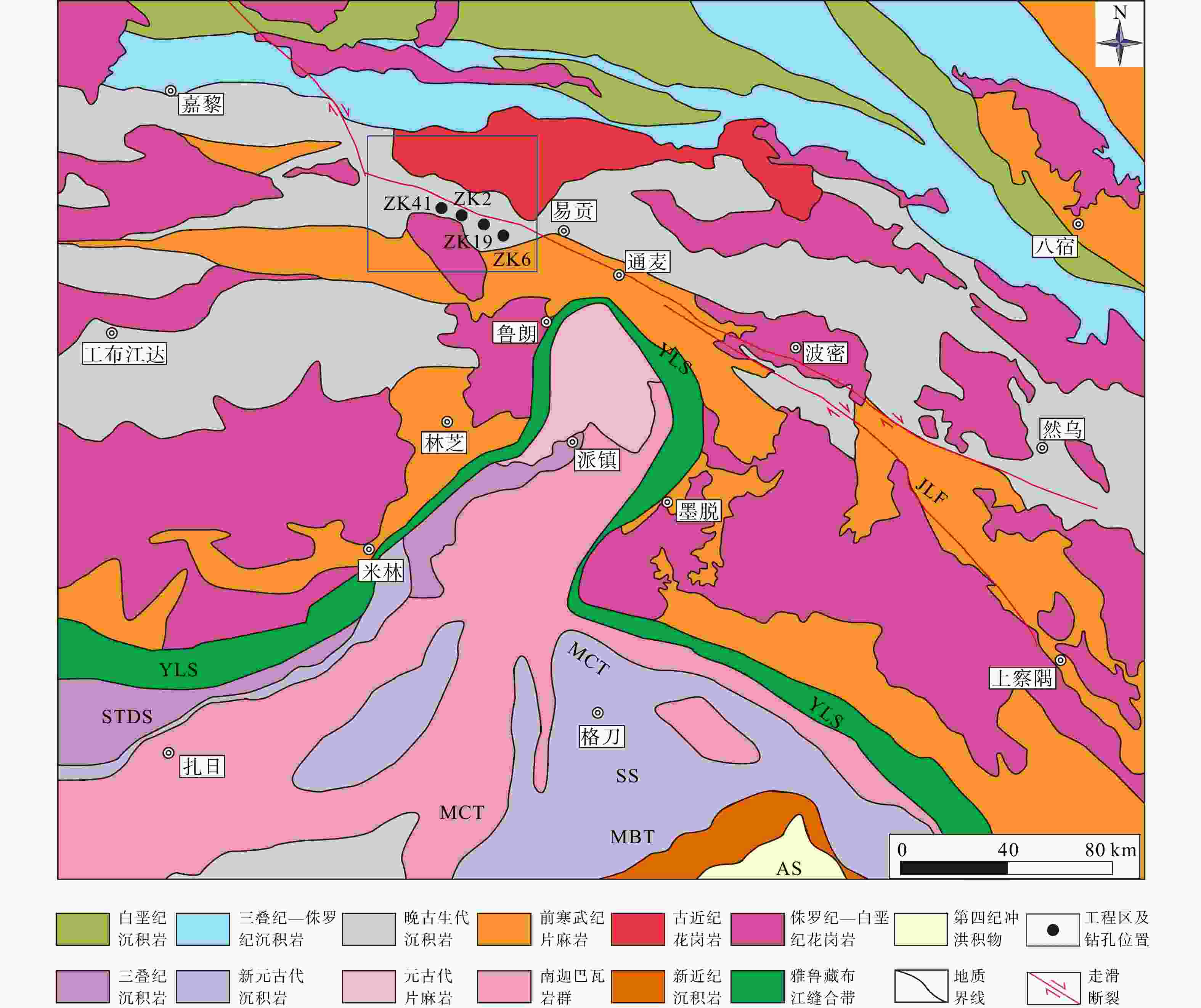
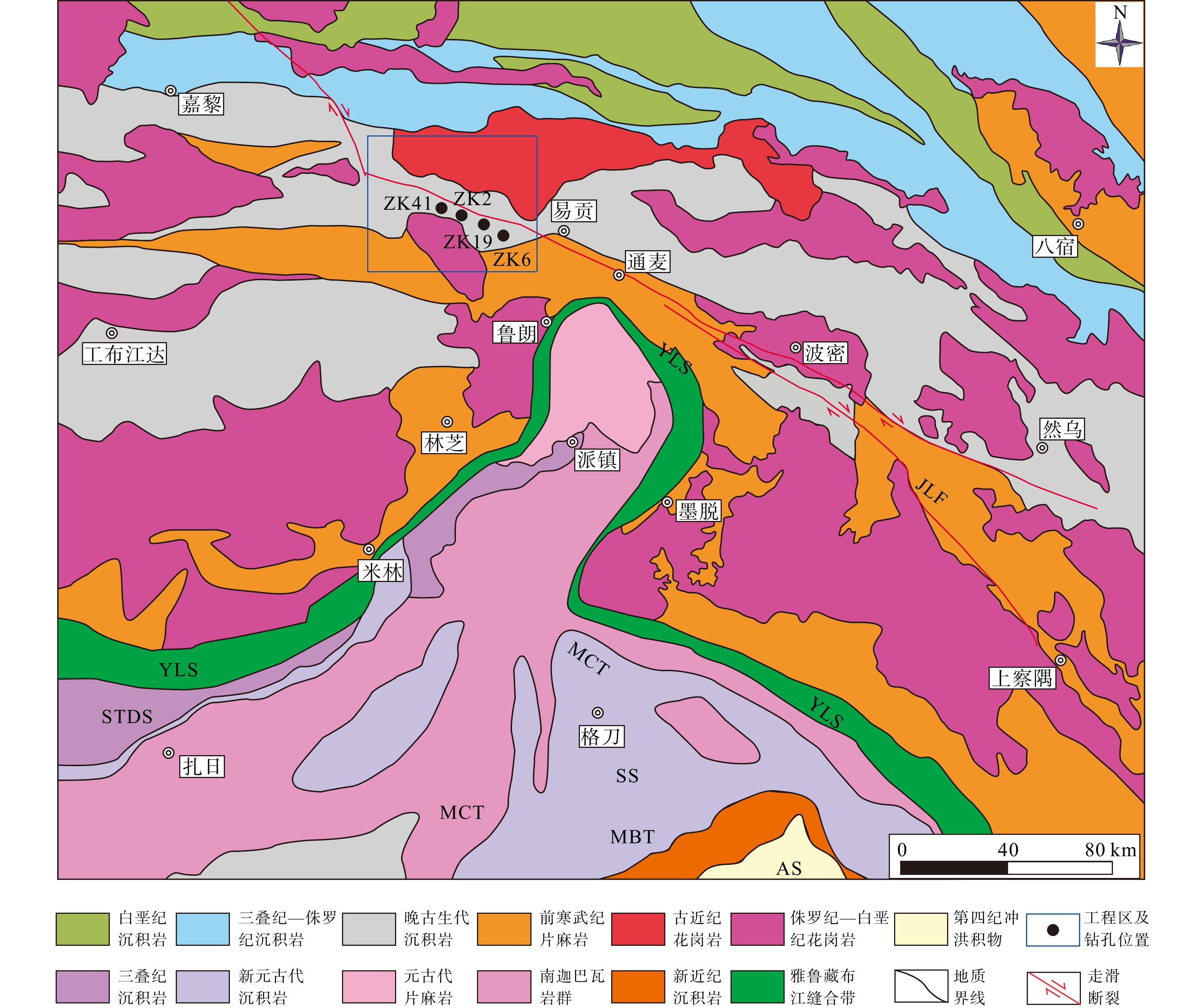
图 1 喜马拉雅东构造结构造地质简图(据李滨等,2022修改)
SS—桑构造结;AS—阿萨姆构造结;YLS—雅鲁藏布江缝合带;STDS—藏南拆离系;MCT—主中央断裂;MBT—主边界断裂;JLF—嘉黎断裂带
Figure 1. Geological sketch map of the eastern Himalayan syntaxis (modified from Li et al., 2022)
SS–Siang syntaxis; AS–Assam syntaxis; YLS–Yarlung Zangbo suture zone; STDS–Southern Tibetan detachment system; MCT–Main Central Thrust; MBT–Main Boundary Thrust; JLF–Jiali fault
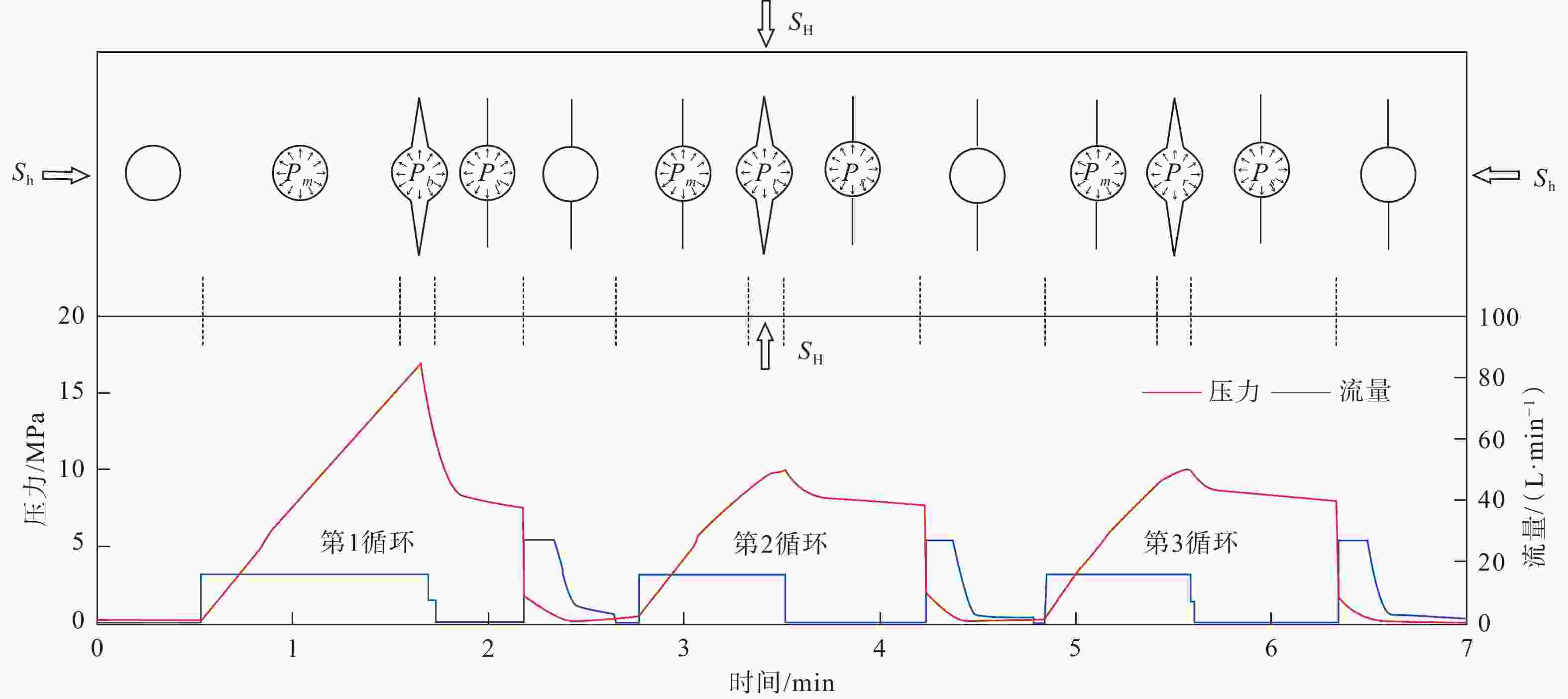
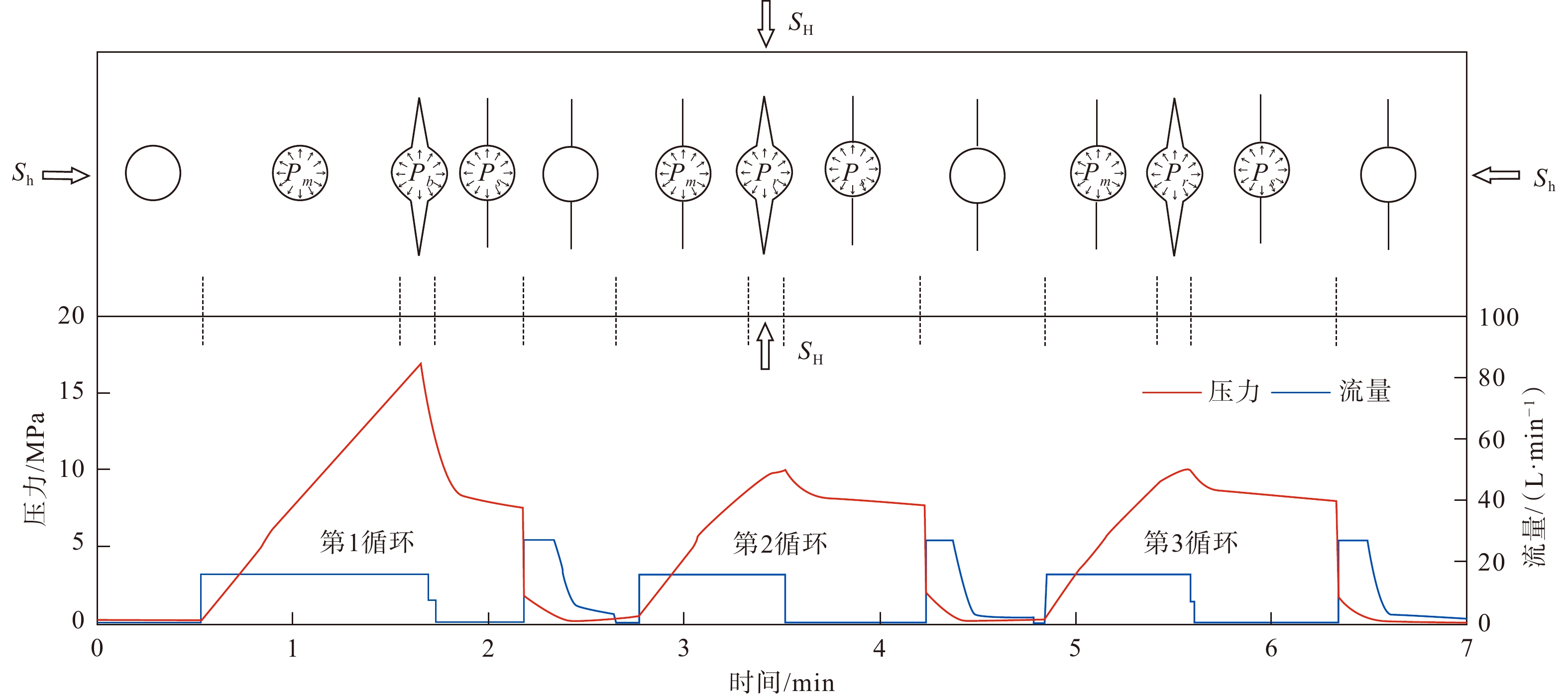
图 2 水压致裂测量过程及典型测量曲线(Hayashi and Haimson,1991;孙炜锋等,2024)
SH— 最大水平主应力;Sh— 最小水平主应力;Pm— 孔内流体压力;Pb— 岩体破裂压力;Pr— 裂缝重张压力;Ps—瞬时闭合压力
Figure 2. Hydraulic fracturing measurement process and typical measurement curves (Hayashi and Haimson, 1991; Sun et al., 2024)
SH–maximum horizontal principal stress;Sh–minimum horizontal principal stress;Pm–borehole fluid pressure;Pb–formation breakdown pressure; Pr–fracture reopening pressure; Ps–shut-in pressure
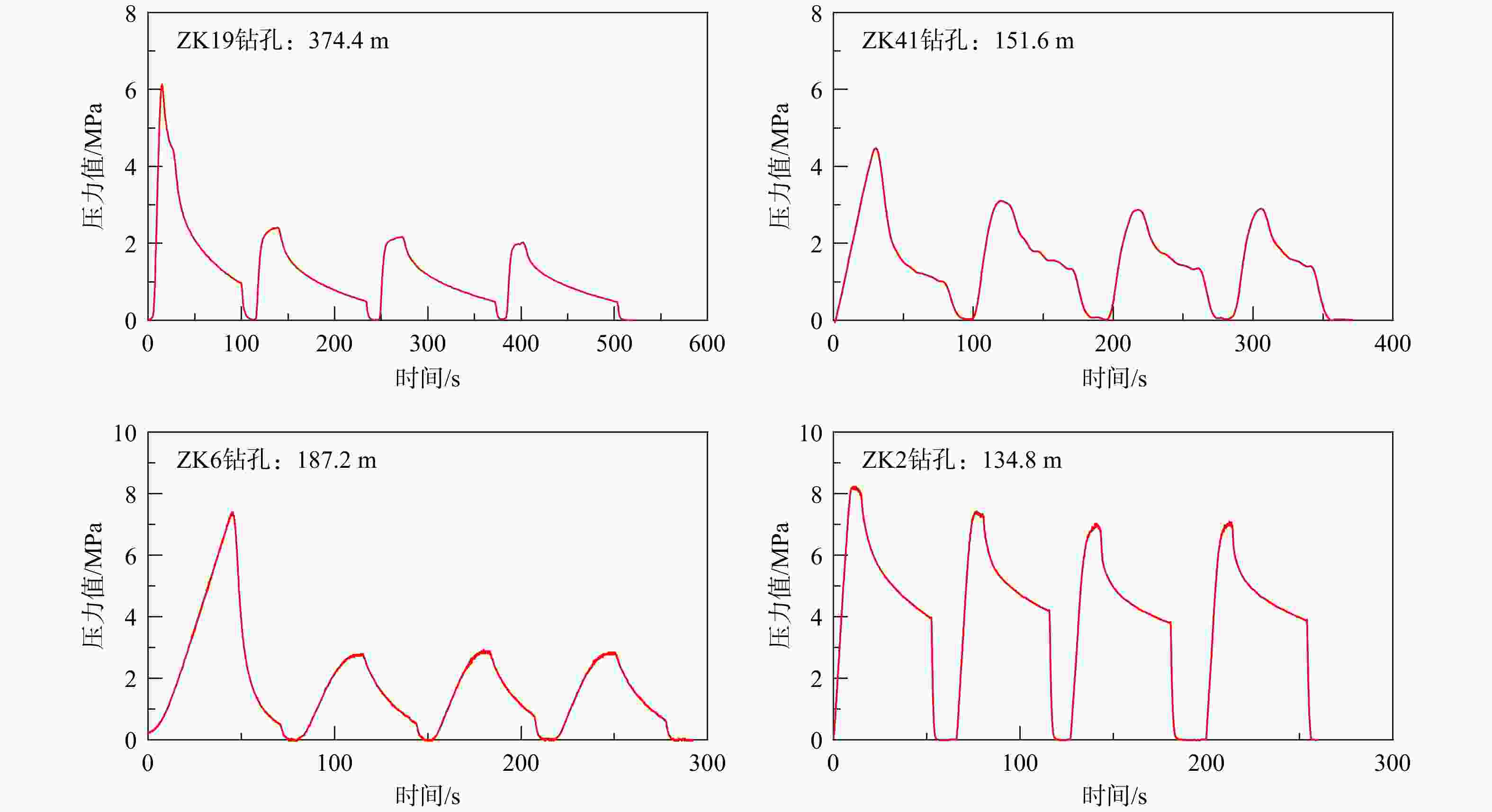
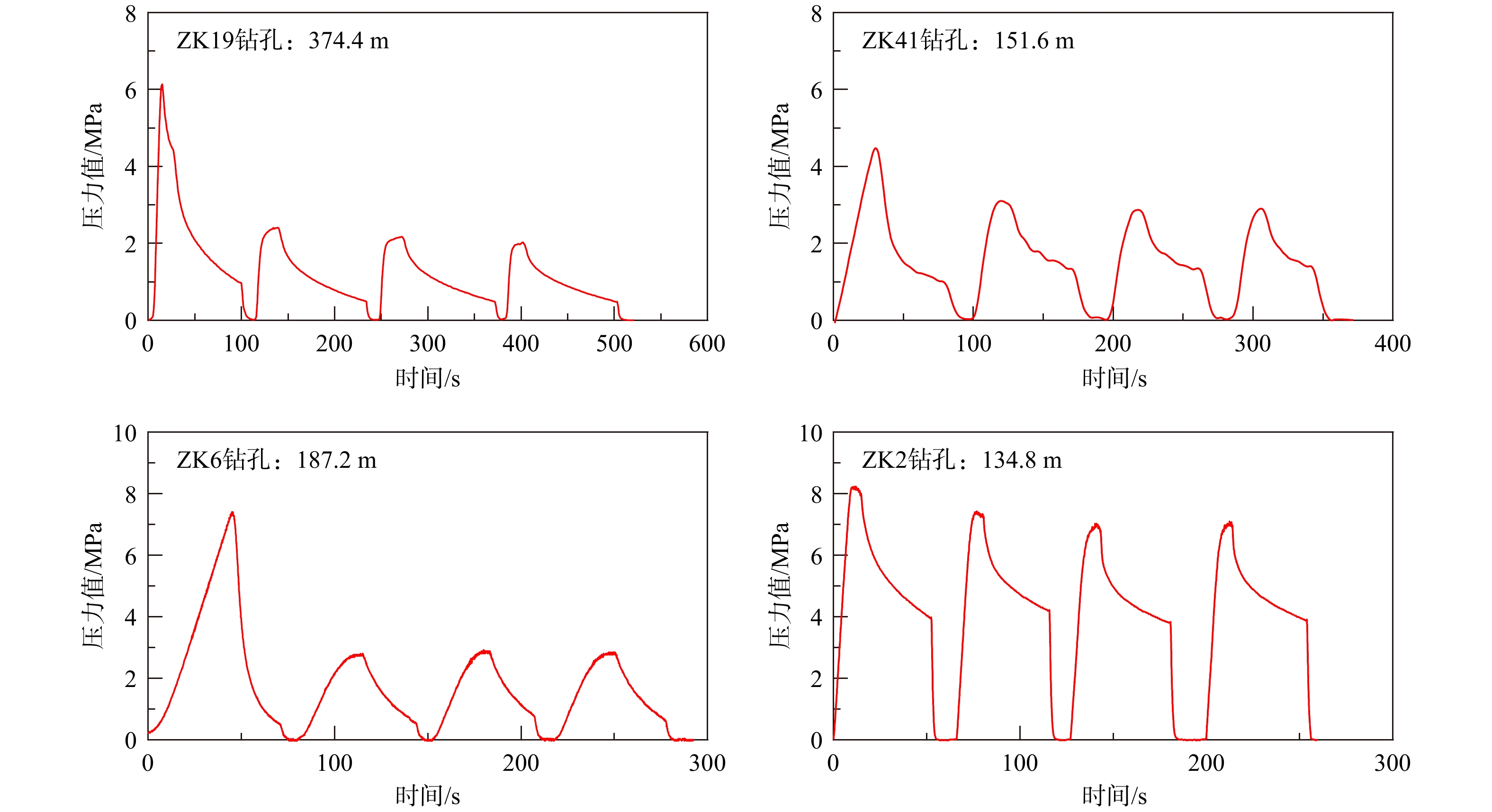
图 3 工程区地应力测量典型压裂曲线
Figure 3. Typical fracturing curves for in-situ stress measurements in the engineering area
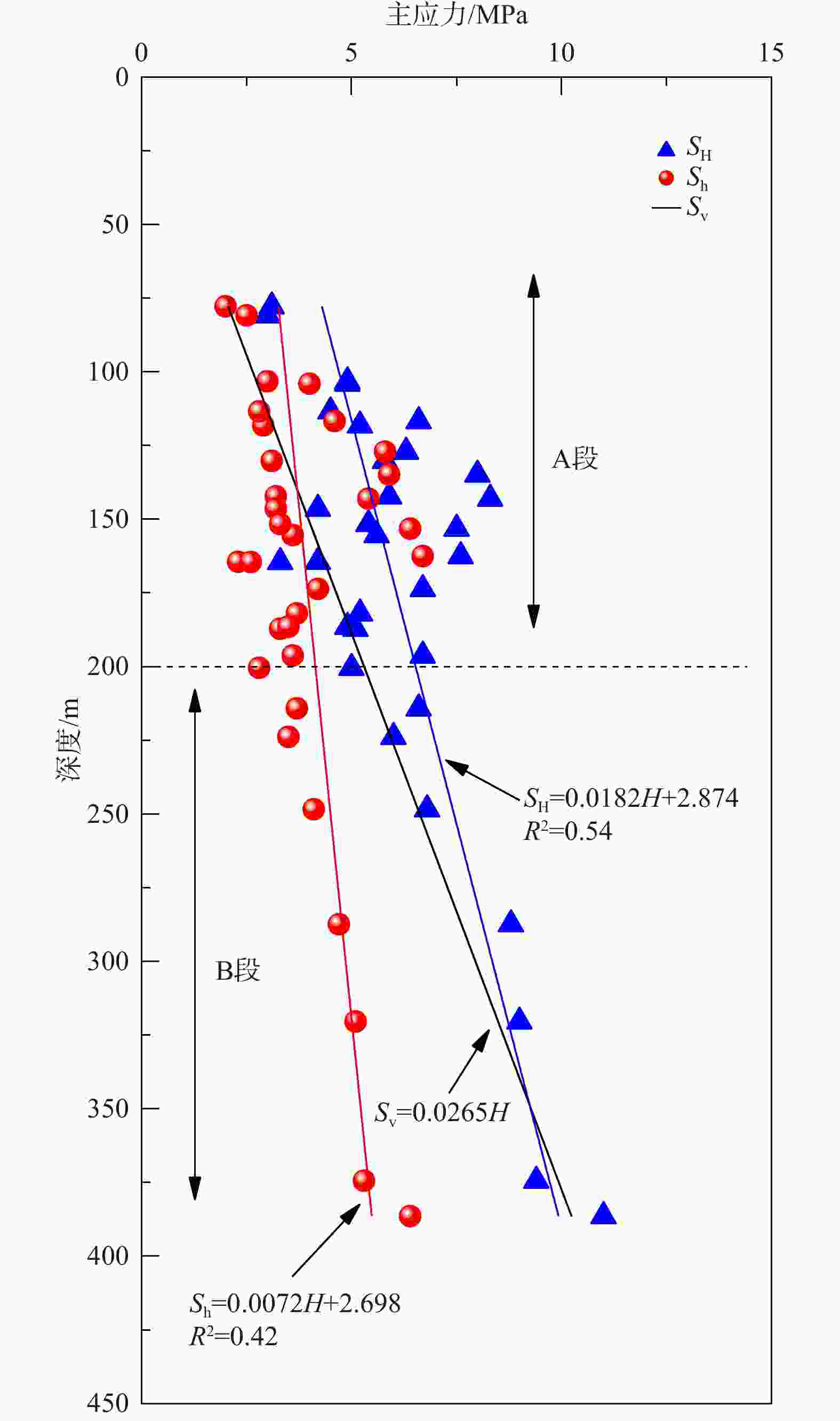
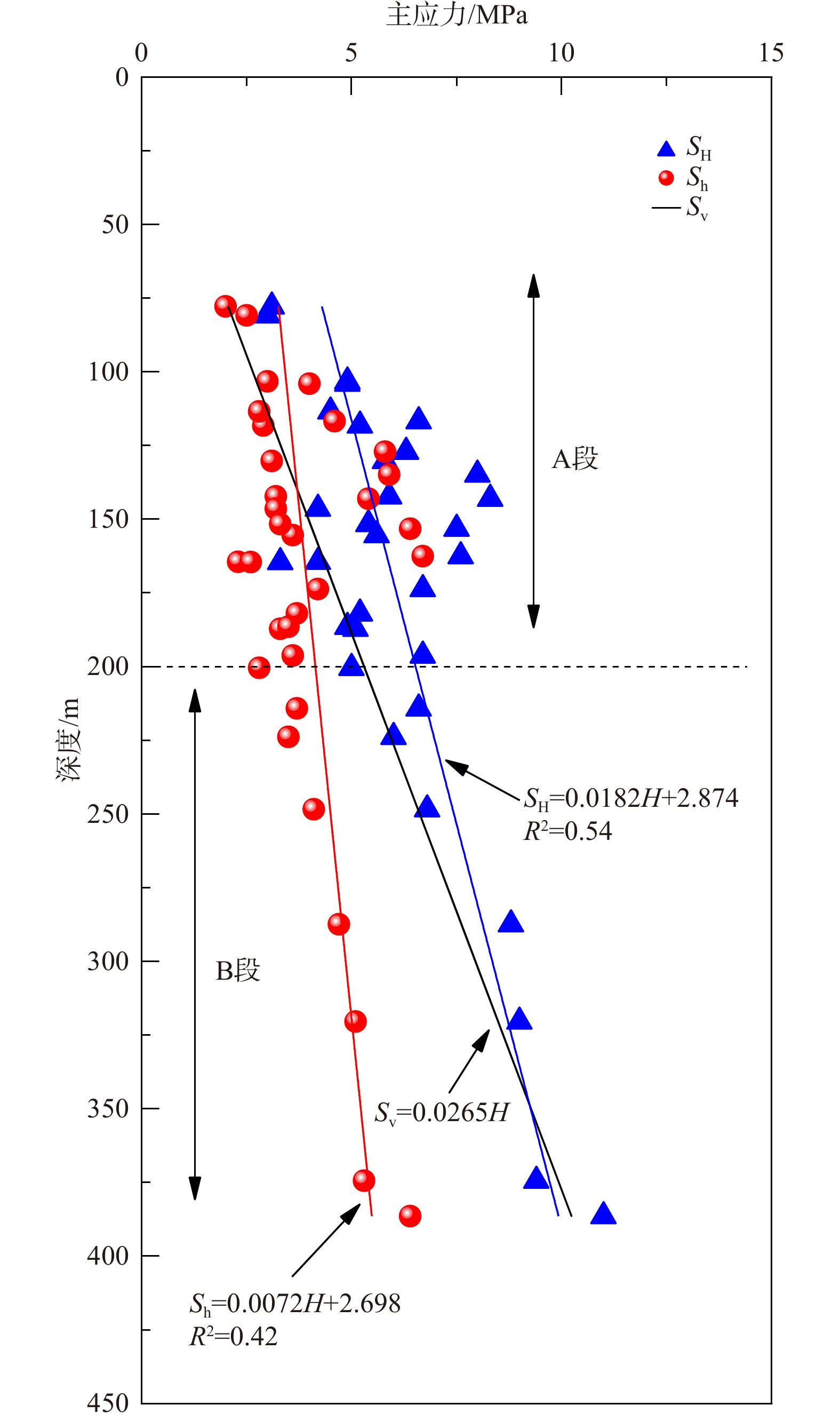
图 4 主应力量值随深度分布特征
SH—最大水平主应力; Sh—最小水平主应力;Sv—垂向应力;H—深度
Figure 4. Variation of principal stresses with depths
SH–maximum horizontal principal stress; Sh–minimum horizontal principal stress; Sv–vertical stress; H–depth
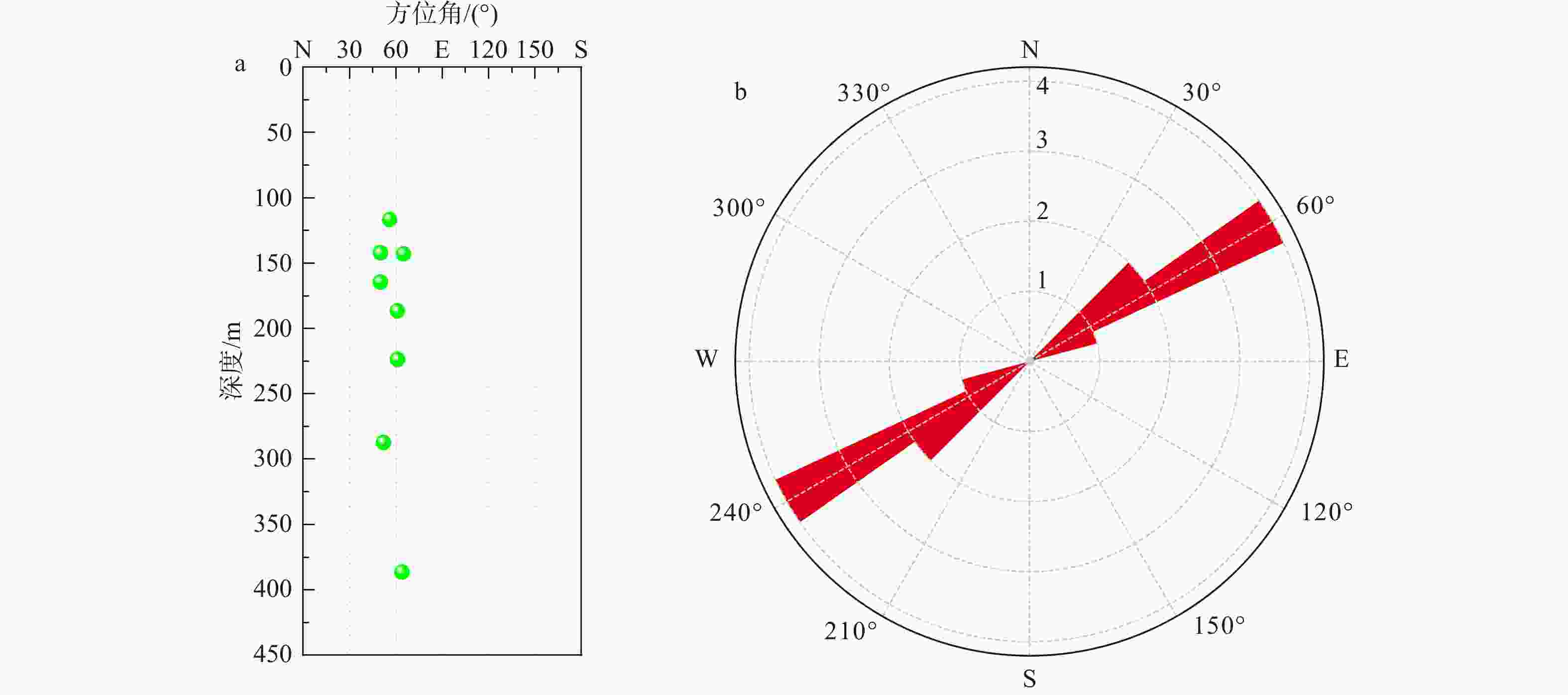
图 5 工程区最大水平主应力方向分布特征
a—主应力方向随深度变化特征;b—主应力方向分布玫瑰花图
Figure 5. Distribution of the SH orientation in the engineering area
(a) Variation of the SH orientation with depth; (b) Rose diagrams of the SH orientation
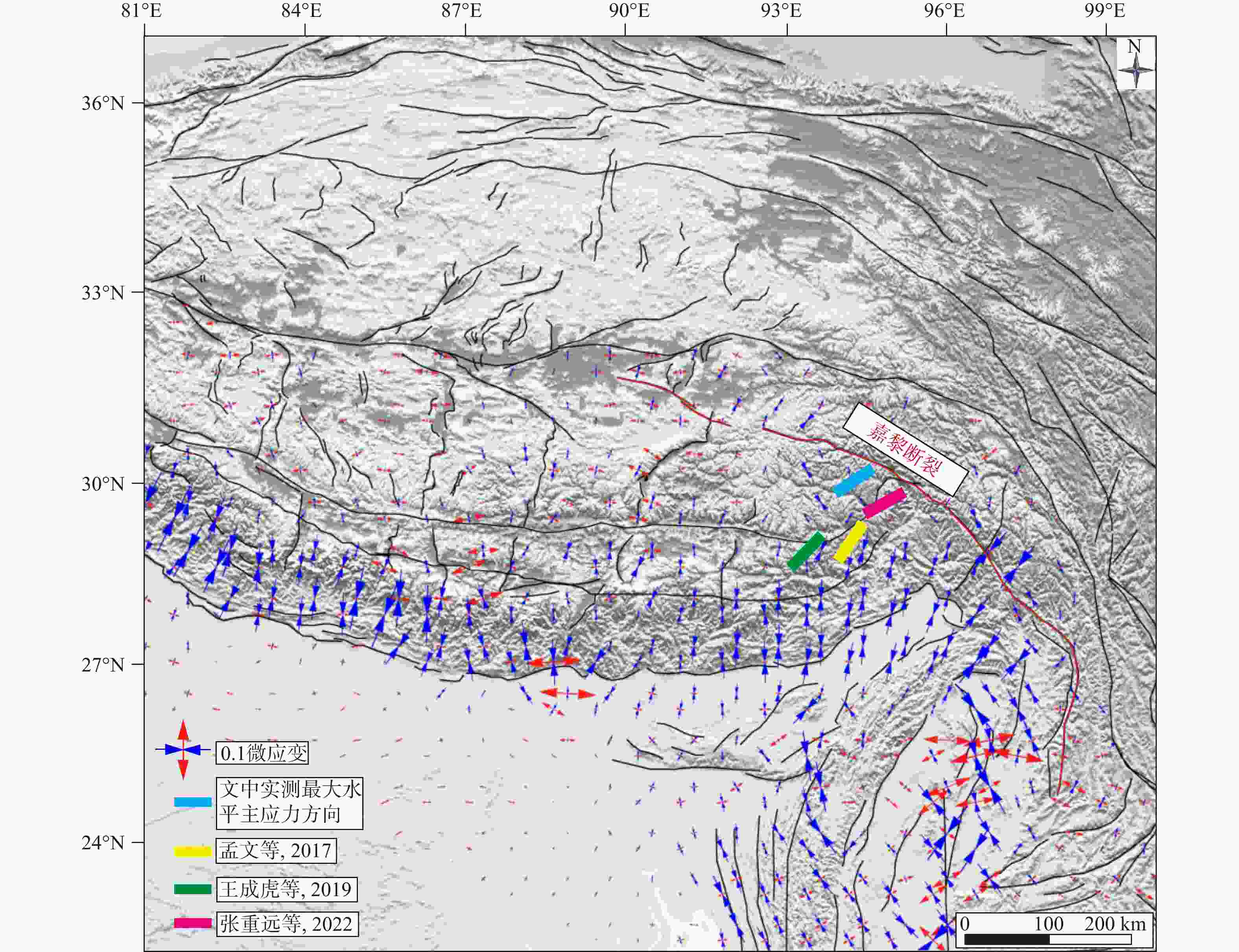
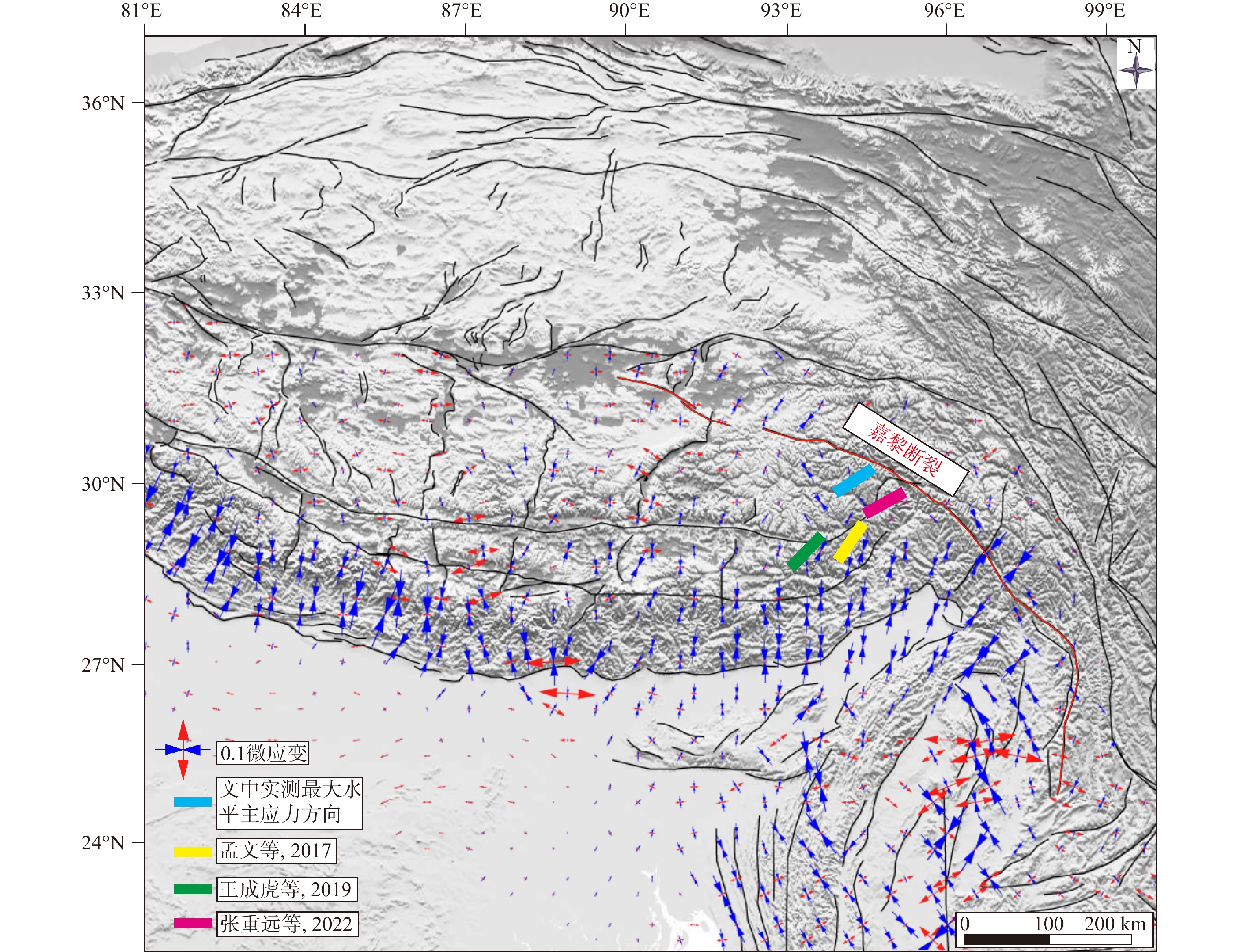
图 6 喜马拉雅东构造结地区最大、最小主应变率分布(据吴啸龙等,2020修改)
Figure 6. Distribution of maximum and minimum principal strain rates in the eastern Himalayan Syntaxis region (modified after Wu et al., 2020)
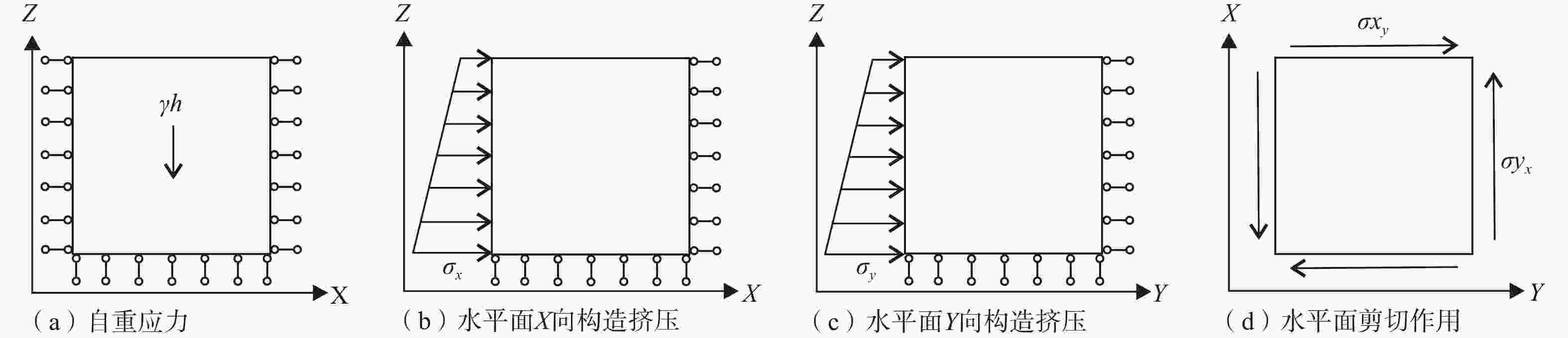
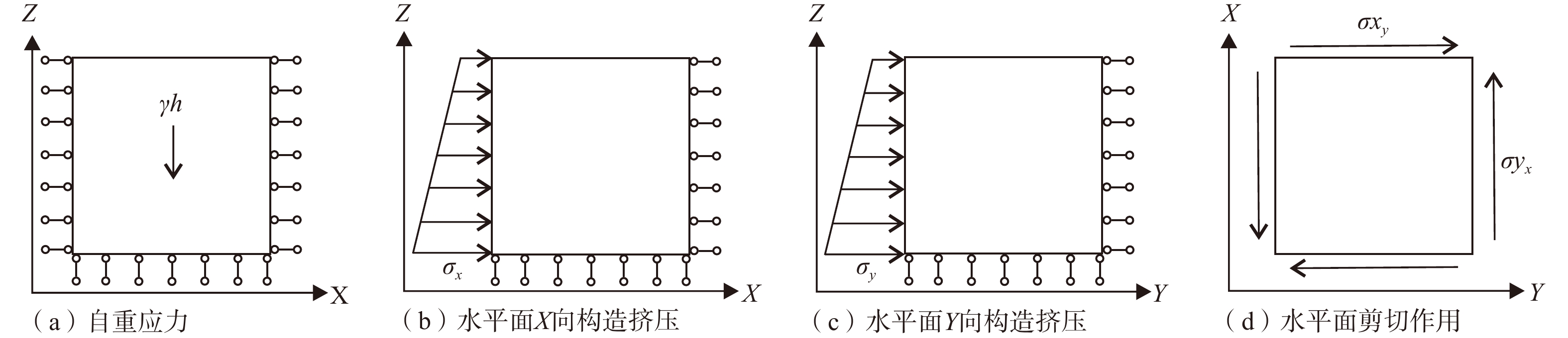
图 7 边界约束及边界荷载示意图
γh—自重应力;σx—X向构造应力;σy—Y向构造应力;σxy、σxy—剪切应力
Figure 7. Schematic diagram of boundary constraints and boundary loads
(a) Self-weight stress; (b) Tectonic compression in the X-direction of the horizontal plane; (c) Tectonic compression in the Y-direction of the horizontal plane; (d) Shearing action in the horizontal planeγh—self-weight stress; σx—X-direction tectonic stress; σy—Y-direction tectonic stress; σxy, σxy—shear stress
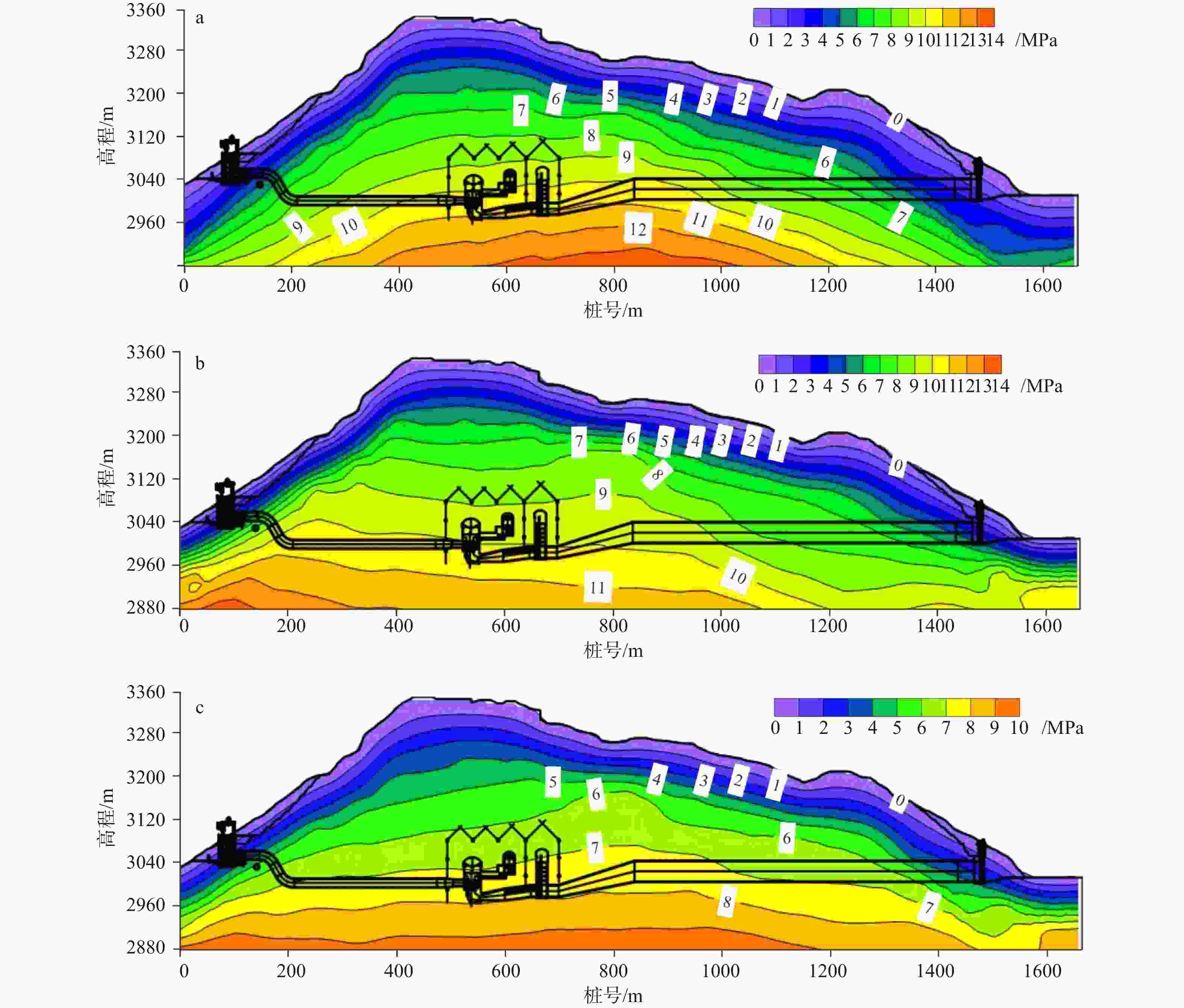
图 9 坝址区输水系统应力分布云图
图中数字代表应力量值,单位为MPaa—最大水平主应力;b—垂向应力;c—最小水平主应力
Figure 9. Contour plot of the stress distribution in the bank water conveyance system at the dam site area
(a) Maximum horizontal principal stress; (b) Vertical stress; (c) Minimum horizontal principal stress The numbers represent stress values in MPa
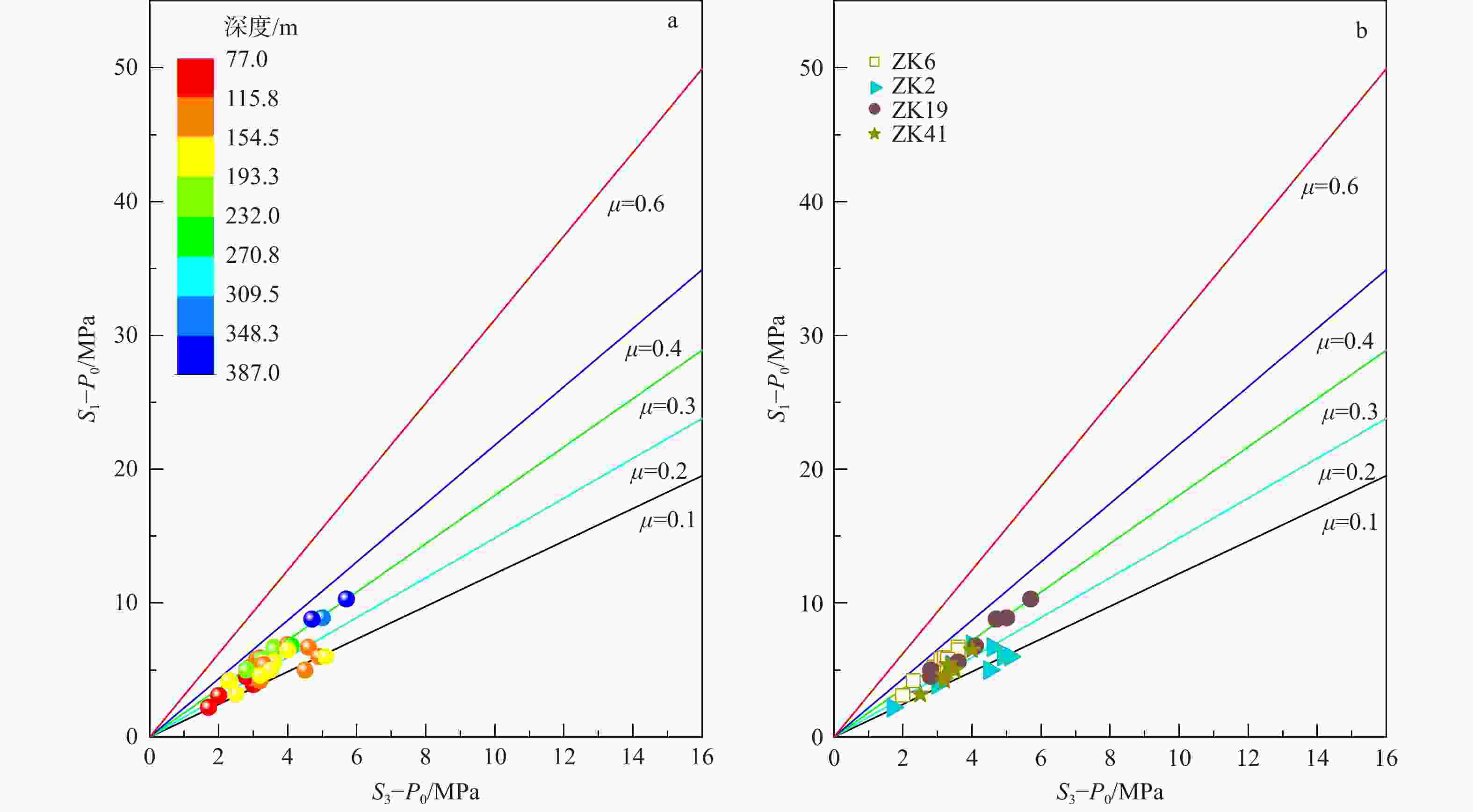
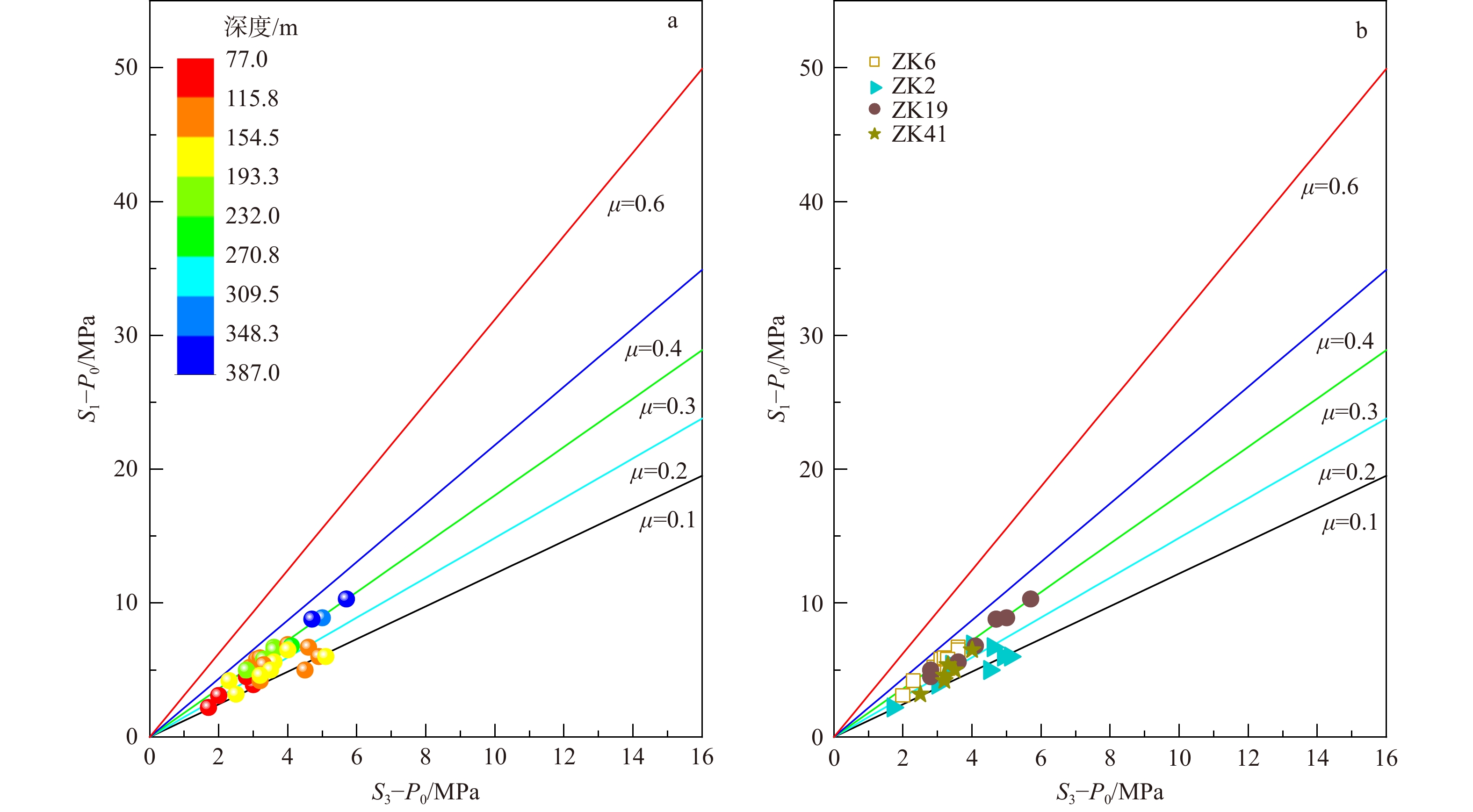
图 10 基于库伦摩擦失稳准则的地应力分析结果
a—有效最大与最小主应力比值随深度分布;b—有效最大与最小主应力比值随钻孔分布
Figure 10. Estimates of in-situ stress according to the Coulomb frictional–failure criterion incorporating Byerlee's law
(a) Distribution of the ratio of the effective maximum to minimum principal stress with depth; (b) Distribution of the ratio of effective maximum to minimum principal stress with borehole
表 1 水压致裂地应力测量结果
Table 1. Results of in-situ stress measurements
钻孔 深度/m 压裂参数/MPa 应力值/MPa 最大水平主
应力方向Pb Pr Ps P0 SH Sh Sv ZK19 113.4 4.8 2.9 1.7 0.0 4.5 2.8 3.0 155.4 4.4 3.5 2.0 0.0 5.6 3.6 4.1 200.4 2.0 1.4 0.8 0.0 5.0 2.8 5.3 248.4 5.3 3.0 1.6 0.0 6.8 4.1 6.6 287.4 4.7 2.3 1.8 0.0 8.8 4.7 7.6 NE52° 320.4 4.5 3.1 1.9 0.1 9.0 5.1 8.5 374.4 6.1 2.3 1.6 0.6 9.4 5.3 9.9 386.4 6.4 3.5 2.5 0.7 11.0 6.4 10.2 NE64° ZK41 146.4 5.0 3.8 1.7 0.0 4.2 3.2 3.9 151.6 4.5 3.0 1.8 0.0 5.4 3.3 4.0 164.5 4.9 2.9 1.0 0.1 3.3 2.6 4.4 NE50° 173.7 4.8 4.1 2.5 0.2 6.7 4.2 4.6 181.9 4.8 3.9 1.9 0.2 5.2 3.7 4.8 186.5 3.6 3.3 1.6 0.3 4.9 3.5 4.9 NE61° ZK6 77.8 5.3 2.1 1.2 0.0 3.1 2.0 2.1 103.2 4.9 3.2 2.0 0.0 4.9 3.0 2.7 118.2 3.9 2.3 1.7 0.0 5.2 2.9 3.1 130.2 6.4 2.2 1.8 0.0 5.8 3.1 3.5 142.2 4.7 2.3 1.8 0.0 5.9 3.2 3.8 NE51° 164.4 1.8 1.2 0.7 0.0 4.2 2.3 4.4 187.2 7.3 2.8 1.4 0.0 5.1 3.3 5.0 196.2 5.6 2.1 1.6 0.0 6.7 3.6 5.2 214.2 6.3 2.3 1.6 0.1 6.6 3.7 5.7 223.8 6.2 2.1 1.3 0.2 6.0 3.5 5.9 NE60° ZK2 80.8 3.6 2.9 1.7 0.8 3.0 2.5 2.1 104.0 6.6 5.1 3.0 1.0 4.9 4.0 2.8 116.7 6.8 4.8 3.4 1.2 6.6 4.6 3.1 NE56° 127.1 9.6 8.5 4.5 1.3 6.3 5.8 3.4 134.8 8.2 7.1 4.6 1.3 8.0 5.9 3.6 143.0 7.1 5.1 4.0 1.4 8.3 5.4 3.8 NE65° 153.2 9.0 8.7 4.9 1.5 7.5 6.4 4.1 162.5 10.6 9.3 5.1 1.6 7.6 6.7 4.3 注:SH—最大水平主应力;Sh—最小水平主应力;Sv—垂向应力;Pb— 岩体破裂压力;Pr— 裂缝重张压力;Ps—瞬时闭合压力;P0—孔隙压力  下载: 导出CSV
表 2 不同区域地应力量值随深度变化统计
Table 2. Variation of SH and Sh with the depth in different regions
地区 SH Sh 资料来源 喜马拉雅东构造结北缘 0.0182H+2.874 0.0072H+2.698 文中 中国大陆青藏地块
关键构造单元0.0292H+5.185 0.0172H+3.681 杨树新等,2012 中国大陆 0.0227H+6.590 0.0164H+3.590 王艳华等,2012 中国大陆 0.0216H+6.781 0.0182H+2.233 景锋等,2007 中国大陆 0.0229H+4.738 0.0171H+1.829 杨树新等,2012 注:SH—最大水平主应力;Sh—最小水平主应力;H—深度
下载: 导出CSV
表 3 岩体力学特性参数表
Table 3. Table of physical and mechanical parameters of rock mass
地层 变形模量/GPa 泊松比 密度/(g·cm−3) 风化层 0.80 0.37 2.10 断层 0.90 0.36 2.30 石英砂岩 14.90 0.26 2.74 花岗岩 17.40 0.23 2.65
下载: 导出CSV
表 4 钻孔水压致裂法实测值与回归计算值对比
Table 4. Comparison between measured values and regression-calculated values for the borehole hydraulic fracturing method
测孔号 测深/m 对比项 SH/MPa Sh/MPa Sv/MPa αH/(º) ZK19 287.4 实测值 8.8 4.7 7.6 52 计算值 7.4 4.2 10.1 60 相对差 1.4 0.5 −2.5 −8 误差百分比 16% 11% 33% 15% 320.4 实测值 9.0 5.1 8.5 计算值 8.0 5.1 10.3 相对差 1.0 0.0 −1.8 误差百分比 11% 0.0 21% 374.4 实测值 9.4 5.3 9.9 计算值 8.8 4.4 11.9 相对差 0.6 0.9 −2.0 误差百分比 6% 17% 20% 386.4 实测值 11.0 6.4 10.2 64 计算值 9.0 5.8 9.6 55 相对差 2.0 0.6 0.6 9 误差百分比 18% 9% 6% 14% ZK41 164.5 实测值 3.3 2.6 4.4 50 计算值 2.5 1.8 5.5 56 相对差 0.8 0.8 −1.1 −6 误差百分比 24% 31% 25% 12% 181.9 实测值 5.2 3.7 4.8 计算值 4.0 0.8 4.9 相对差 1.2 2.9 −0.1 误差百分比 23% 78% 2% 186.5 实测值 4.9 3.5 4.9 61 计算值 2.6 2.0 5.0 48 相对差 2.3 1.5 −0.1 13 误差百分比 47% 43% 2% 21% ZK6 142.2 实测值 5.9 3.2 3.8 51 计算值 6.0 2.8 5.6 58 相对差 −0.1 0.5 −1.8 −7 误差百分比 2% 16% 47% 14% 196.2 实测值 6.7 3.6 5.2 计算值 5.2 3.0 6.8 相对差 1.5 0.6 −1.6 误差百分比 22% 17% 31% 214.2 实测值 6.6 3.7 5.7 计算值 6.5 3.1 7.3 相对差 0.1 0.6 −1.6 误差百分比 2% 16% 28% 223.8 实测值 6.0 3.5 5.9 60 计算值 6.4 3.3 7.4 66 相对差 −0.4 0.2 −1.5 −6 误差百分比 7% 6% 25% 10% ZK2 116.7 实测值 6.6 4.6 3.1 56 计算值 4.8 4.7 3.5 51 相对差 1.8 −0.1 −0.4 5 误差百分比 27% 2% 13% 9% 143.0 实测值 8.3 5.4 3.8 65 计算值 6.0 3.9 3.5 58 相对差 2.3 1.5 0.3 7 误差百分比 28% 28% 8% 11% 153.2 实测值 7.5 6.4 4.1 计算值 5.2 4.7 2.5 相对差 2.3 1.7 1.6 误差百分比 31% 27% 39% 注:SH—最大水平主应力;Sh—最小水平主应力;Sv—垂向应力;αH—最大水平主应力方向
下载: 导出CSV
表 5 岩爆风险判别和分级
Table 5. Rockburst risk criteria and classification
判别方法 判别公式 参数 判据阈值 岩爆分级 判据特点 岩石强度
应力比法Rb/σm Rb为岩石单轴饱和抗压强度; σm为最大主应力 4~7 轻微岩爆 主要考虑隧洞岩体初始应力的影响作用 2~4 中等岩爆 1~2 强烈岩爆 <1 极强岩爆 岩石应力
强度比法σθmax/Rb Rb为岩石单轴饱和抗压强度;σθmax为隧道
开挖面最大切向应力[0.3,0.5) 轻微岩爆 主要考虑隧洞开挖过程和初始应力场
重分布的影响[0.5,0.7) 中等岩爆 [0.7,0.9) 强烈岩爆 ≥0.9 极强岩爆
下载: 导出CSV
-
[1] ANDERSON E M, 1951. The dynamics of faulting and dyke formation with applications to Britain[M]. 2nd ed. Edinburgh: Oliver and Boyd. [2] BYERLEE J, 1978. Friction of rocks[J]. Pure and Applied Geophysics, 116(4-5): 615-626. doi: 10.1007/BF00876528 [3] CHEN P G, HE X H, XU S F, et al., 2023. Earthquake relocation and regional stress field around the eastern Himalayan syntaxis[J]. Reviews of Geophysics and Planetary Physics, 54(6): 667-683. (in Chinese with English abstract) [4] CHEN Q C, SUN D S, CUI J J, et al., 2019. Hydraulic fracturing stress measurements in Xuefengshan deep borehole and its significance[J]. Journal of Geomechanics, 25(5): 853-865. (in Chinese with English abstract) [5] CHEN Z, ZHOU J B, LI G Y, et al., 2023. The nature and spatial-temporal evolution of suture zones in Northeast China[J]. Earth-Science Reviews, 241: 104437. doi: 10.1016/j.earscirev.2023.104437 [6] FENG C J, CHEN Q C, WU M L, et al., 2012. Analysis of hydraulic fracturing stress measurement data: discussion of methods frequently used to determine instantaneous shut-in pressure[J]. Rock and Soil Mechanics, 33(7): 2149-2159. (in Chinese with English abstract) [7] FENG C J, LI B, LI H, et al., 2022. Estimation of in-situ stress field surrounding the Namcha Barwa region and discussion on the tectonic stability[J]. Journal of Geomechanics, 28(6): 919-937. (in Chinese with English abstract) [8] HAIMSON B C, CORNET F H, 2003. ISRM suggested methods for rock stress estimation-part 3: hydraulic fracturing (HF) and/or hydraulic testing of pre-existing fractures (HTPF)[J]. International Journal of Rock Mechanics and Mining Sciences, 40(7-8): 1011-1020. doi: 10.1016/j.ijrmms.2003.08.002 [9] HAYASHI K, HAIMSON B C, 1991. Characteristics of shut-in curves in hydraulic fracturing stress measurements and determination of in situ minimum compressive stress[J]. Journal of Geophysical Research: Solid Earth, 96(B11): 18311-18321. doi: 10.1029/91JB01867 [10] HE W C, REN Y, YANG C B, et al., 2025. Influence of deeply incised valley evolution and slope morphology on stress field in southwestern region of China[J]. Yangtze River, 56(6): 107-114. (in Chinese with English abstract) [11] HUANG S L, DING X L, LIAO C G, et al., 2014. Initial 3D geostress field recognition of high geostress field at deep valley region and considerations on underground powerhouse layout[J]. Chinese Journal of Rock Mechanics and Engineering, 33(11): 2210-2224. (in Chinese with English abstract) [12] JING F, SHENG Q, ZHANG Y H, et al., 2007. Research on distribution rule of shallow crustal geostress in China mainland[J]. Chinese Journal of Rock Mechanics and Engineering, 26(10): 2056-2062. (in Chinese with English abstract) [13] LI B, YIN Y P, TAN C X, et al., 2022. Geo-safety challenges against the site selection of engineering projects in the eastern Himalayan syntaxis area[J]. Journal of Geomechanics, 28(6): 907-918. (in Chinese with English abstract) [14] LI H R, BAI L, ZHAN H L, 2021. Research progress of Jiali fault activity[J]. Reviews of Geophysics and Planetary Physics, 52(2): 182-193. (in Chinese with English abstract) [15] LIAO C T, ZHANG C S, WU M L, et al., 2003. Stress change near the Kunlun fault before and after the Ms 8.1 Kunlun earthquake[J]. Geophysical Research Letters, 30(20): 2027. [16] LIU S J, LAN H X, ZHANG N, 2022. Geomechanical analysis of major engineering region in middle segment of Jiali fault[J]. Journal of Engineering Geology, 30(6): 1947-1961. (in Chinese with English abstract) [17] MENG W, GUO C B, ZHANG C Y, et al., 2017. In situ stress measurements and implications in the Lhasa Terrane, Tibetan Plateau[J]. Chinese Journal of Geophysics, 60(6): 2159-2171. (in Chinese with English abstract) [18] Ministry of Housing and Urban-Rural Development of the People’s Republic of China, 2017. Code for hydropower engineering geological investigation: GB 50287-2016[S]. Beijing: China Planning Press: 23-27. (in Chinese) [19] PAN E, AMADEI B, SAVAGE W Z, 1995. Gravitational and tectonic stresses in anisotropic rock with irregular topography[J]. International Journal of Rock Mechanics and Mining Sciences & Geomechanics Abstracts, 32(3): 201-214. [20] QIN X H, CHEN Q C, MENG W, et al., 2018. Evaluating measured in-situ stress state changes associated with earthquakes and its implications: a case study in the Longmenshan fault zone[J]. Journal of Geomechanics, 24(3): 309-320. (in Chinese with English abstract) [21] QIN X H, CHEN Q C, MENG W, et al., 2023. Determination of the current in-situ stress field of the Tongmai-Bomi section in the northern margin of the eastern Himalayan syntaxis[J]. Acta Geologica Sinica, 97(7): 2126-2140. (in Chinese with English abstract) [22] SUN W F, HUANG H L, SUN D S, et al., 2024. Present in situ stress measurement in the eastern segment of Yarlung Zangbo River fault and fault activity analysis[J]. Rock and Soil Mechanics, 45(4): 1129-1141. (in Chinese with English abstract) doi: 10.26599/RSM.2024.9435545 [23] TAN C X, SUN W F, SUN Y, et al., 2006. A consideration on in-situ crustal stress measuring and its underground engineering application[J]. Acta Geologica Sinica, 80(10): 1627-1632. (in Chinese with English abstract) [24] TANG F T, YOU H C, LIANG X H, et al., 2019. A discussion on seismogenic fault of the Milin MS6.9 Earthquake, Tibet, and its tectonic attributes[J]. Acta Geoscientica Sinica, 40(1): 213-218. (in Chinese with English abstract) [25] TOWNEND J, ZOBACK M D, 2000. How faulting keeps the crust strong[J]. Geology, 28(5): 399-402. doi: 10.1130/0091-7613(2000)28<399:HFKTCS>2.0.CO;2 [26] WANG C H, GAO G Y, YANG S X, et al., 2019. Analysis and prediction of stress fields of Sichuan-Tibet railway area based on contemporary tectonic stress field zoning in western China[J]. Chinese Journal of Rock Mechanics and Engineering, 38(11): 2242-2253. (in Chinese with English abstract) [27] WANG Y H, CUI X F, HU X P, et al., 2012. Study on the stress state in upper crust of China mainland based on in-situ stress measurements[J]. Chinese Journal of Geophysics, 55(9): 3016-3027. (in Chinese with English abstract) [28] WU X L, XIANG Y, TANG F Q, 2020. Study on current crustal deformation of the Himalayan tectonic zone by GPS strain-rate estimation and focal mechanism stress inversion[J]. Chinese Journal of Geophysics, 63(8): 2924-2939. (in Chinese with English abstract) [29] XIE F R, CHEN Q C, CUI X F, et al., 2007. Fundamental database of crustal stress environment in continental China[J]. Progress in Geophysics, 22(1): 131-136. (in Chinese with English abstract) [30] XU L S, WANG L S, 1999. Study on the laws of rockburst and its forecasting in the tunnel of Erlang Mountain road[J]. Chinese Journal of Geotechnical Engineering, 21(5): 569-572. (in Chinese with English abstract) [31] YANG F, SHENG S Z, WAN Y G, et al., 2019. Impact of the stress field in the grid not satisfies the assumption of uniformity on stress field inversion results: the study of stress field in the eastern Himalayan Syntaxis and its surrounding area is an example[J]. Progress in Geophysics, 34(2): 479-488. (in Chinese with English abstract). [32] YANG S X, YAO R, CUI X F, et al., 2012. Analysis of the characteristics of measured stress in Chinese mainland and its active blocks and North-South seismic belt[J]. Chinese Journal of Geophysics, 55(12): 4207-4217. (in Chinese with English abstract) [33] YANG Y H, SUN D S, QIN X H, et al., 2024. Error analysis and discussion of determining the maximum horizontal principal stress by hydraulic fracturing based on the compliance analysis of testing system[J]. Chinese Journal of Rock Mechanics and Engineering, 43(S1): 3385-3396. (in Chinese with English abstract) [34] ZHANG B, ZHANG J J, ZHONG D L, et al., 2011. Structural feature and its significance of the northernmost segment of the Tertiary Biluoxueshan-Chongshan shear zone, east of the eastern Himalayan Syntaxis[J]. Science China Earth Sciences, 54(7): 959-974. doi: 10.1007/s11430-011-4197-y [35] ZHANG B, SUN Y, MA X M, et al., 2023. Analysis of in-situ stress field characteristics and tectonic stability in the Motuo key area of the eastern Himalayan syntaxis[J]. Journal of Geomechanics, 29(3): 388-401. (in Chinese with English abstract) [36] ZHANG C Y, DU S H, HE M C, et al., 2022. Characteristics of in-situ stresses on the western margin of the eastern Himalayan syntaxis and its influence on stability of tunnel surrounding rock[J]. Chinese Journal of Rock Mechanics and Engineering, 41(5): 954-968. (in Chinese with English abstract) [37] ZHANG Y, XIAO P X, DING X L, et al., 2012. Study of deformation and failure characteristics for surrounding rocks of underground powerhouse caverns under high geostress condition and countermeasures[J]. Chinese Journal of Rock Mechanics and Engineering, 31(2): 228-244. (in Chinese with English abstract) [38] ZHAO X G, WANG J, QIN X H, et al., 2015. In-situ stress measurements and regional stress field assessment in the Xinjiang candidate area for China's HLW disposal[J]. Engineering Geology, 197: 42-56. doi: 10.1016/j.enggeo.2015.08.015 [39] ZHONG N, GUO C B, HUANG X L, et al., 2021. Late Quaternary activity and paleoseismic records of the middle south section of the Jiali-Chayu fault[J]. Acta Geologica Sinica, 95(12): 3642-3659. (in Chinese with English abstract) [40] ZHOU C, YIN J M, DONG Z H, et al., 2022. The partitioned inversion method of initial stress field of extra-long tunnel considering the direction of boundary load[J]. Chinese Journal of Rock Mechanics and Engineering, 41(S1): 2725-2734. (in Chinese with English abstract) [41] ZOBACK M D, HEALY J H, 1984. Friction, faulting and in-situ stress[J]. Annals of Geophysics, 2: 689-698. [42] ZOBACK M D, HEALY J H, 1992. In situ stress measurements to 3.5 km depth in the Cajon Pass Scientific Research Borehole: implications for the mechanics of crustal faulting[J]. Journal of Geophysical Research: Solid Earth, 97(B4): 5039-5057. doi: 10.1029/91JB02175 [43] ZOU R Z, 2018. Study on the of landslides by active tectonics in the north west of the eastern Himalayan syntaxis region of Tibetan plateau[D]. Chengdu: Chengdu University of Technology. (in Chinese with English abstract) [44] 陈平光, 何骁慧, 徐树峰, 等, 2023. 喜马拉雅东构造结地震精定位及其区域应力场研究[J]. 地球与行星物理论评(中英文), 54(6): 667-683. doi: 10.19975/j.dqyxx.2022-067 [45] 陈群策, 孙东生, 崔建军, 等, 2019. 雪峰山深孔水压致裂地应力测量及其意义[J]. 地质力学学报, 25(5): 853-865. doi: 10.12090/j.issn.1006-6616.2019.25.05.070 [46] 丰成君, 陈群策, 吴满路, 等, 2012. 水压致裂应力测量数据分析: 对瞬时关闭压力ps的常用判读方法讨论[J]. 岩土力学, 33(7): 2149-2159. [47] 丰成君, 李滨, 李惠, 等, 2022. 南迦巴瓦地区地应力场估算与构造稳定性探讨[J]. 地质力学学报, 28(6): 919-937. doi: 10.12090/j.issn.1006-6616.20222820 [48] 何万超, 任洋, 杨存斌, 等, 2025. 西南地区深切河谷演化及谷坡形态对应力场的影响[J]. 人民长江, 56(6): 107-114. doi: 10.16232/j.cnki.1001-4179.2025.06.014 [49] 黄书岭, 丁秀丽, 廖成刚, 等, 2014. 深切河谷区水电站厂址初始应力场规律研究及对地下厂房布置的思考[J]. 岩石力学与工程学报, 33(11): 2210-2224. doi: 10.13722/j.cnki.jrme.2014.11.006 [50] 景锋, 盛谦, 张勇慧, 等, 2007. 中国大陆浅层地壳实测地应力分布规律研究[J]. 岩石力学与工程学报, 26(10): 2056-2062. [51] 李滨, 殷跃平, 谭成轩, 等, 2022. 喜马拉雅东构造结工程选址面临的地质安全挑战[J]. 地质力学学报, 28(6): 907-918. doi: 10.12090/j.issn.1006-6616.20222819 [52] 李鸿儒, 白玲, 詹慧丽, 2021. 嘉黎断裂带活动性研究进展[J]. 地球与行星物理论评, 52(2): 182-193. doi: 10.19975/j.dqyxx.2020-019 [53] 刘世杰, 兰恒星, 张宁, 2022. 嘉黎断裂中段重大工程区地质力学分析[J]. 工程地质学报, 30(6): 1947-1961. doi: 10.13544/j.cnki.jeg.2022-0623 [54] 孟文, 郭长宝, 张重远, 等, 2017. 青藏高原拉萨块体地应力测量及其意义[J]. 地球物理学报, 60(6): 2159-2171. doi: 10.6038/cjg20170611 [55] 秦向辉, 陈群策, 孟文, 等, 2018. 大地震前后实测地应力状态变化及其意义: 以龙门山断裂带为例[J]. 地质力学学报, 24(3): 309-320. doi: 10.12090/j.issn.1006-6616.2018.24.03.033 [56] 秦向辉, 陈群策, 孟文, 等, 2023. 喜马拉雅东构造结北缘通麦—波密段现今地应力场特征研究[J]. 地质学报, 97(7): 2126-2140. doi: 10.19762/j.cnki.dizhixuebao.2023014 [57] 孙炜锋, 黄火林, 孙东生, 等, 2024. 雅鲁藏布江断裂带东段现今地应力测量与断层活动性分析[J]. 岩土力学, 45(4): 1129-1141. doi: 10.16285/j.rsm.2023.0545 [58] 谭成轩, 孙炜锋, 孙叶, 等, 2006. 地应力测量及其地下工程应用的思考[J]. 地质学报, 80(10): 1627-1632. doi: 10.3321/j.issn:0001-5717.2006.10.018 [59] 唐方头, 尤惠川, 梁小华, 等, 2019. 西藏米林6.9级地震发震断层判定及其构造属性讨论[J]. 地球学报, 40(1): 213-218. doi: 10.3975/cagsb.2018.111302 [60] 王成虎, 高桂云, 杨树新, 等, 2019. 基于中国西部构造应力分区的川藏铁路沿线地应力的状态分析与预估[J]. 岩石力学与工程学报, 38(11): 2242-2253. doi: 10.13722/j.cnki.jrme.2019.0624 [61] 王艳华, 崔效锋, 胡幸平, 等, 2012. 基于原地应力测量数据的中国大陆地壳上部应力状态研究[J]. 地球物理学报, 55(9): 3016-3027. [62] 吴啸龙, 向洋, 汤伏全, 2020. 基于GPS应变与震源机制解应力反演喜马拉雅构造带现今地壳形变特征[J]. 地球物理学报, 63(8): 2924-2939. doi: 10.6038/cjg2020N0362 [63] 谢富仁, 陈群策, 崔效锋, 等, 2007. 中国大陆地壳应力环境基础数据库[J]. 地球物理学进展, 22(1): 131-136. doi: 10.3321/j.issn:1000-6915.2004.23.031 [64] 徐林生, 王兰生, 1999. 二郎山公路隧道岩爆发生规律与岩爆预测研究[J]. 岩土工程学报, 21(5): 569-572. doi: 10.3321/j.issn:1000-4548.1999.05.009 [65] 杨帆, 盛书中, 万永革, 等, 2019. 网格内不满足均匀性假设对应力场反演结果的影响: 以喜马拉雅东构造结及其周边地区应力场研究为例[J]. 地球物理学进展, 34(2): 479-488. [66] 杨树新, 姚瑞, 崔效锋, 等, 2012. 中国大陆与各活动地块、南北地震带实测应力特征分析[J]. 地球物理学报, 55(12): 4207-4217. doi: 10.6038/j.issn.0001-5733.2012.12.032 [67] 杨跃辉, 孙东生, 秦向辉, 等, 2024. 基于测试系统柔度分析的水压致裂法确定最大水平主应力误差分析与讨论[J]. 岩石力学与工程学报, 43(S1): 3385-3396. doi: 10.13722/j.cnki.jrme.2022.1273 [68] 张斌, 孙尧, 马秀敏, 等, 2023. 东构造结墨脱关键区域地应力场特征及其构造稳定性分析[J]. 地质力学学报, 29(3): 388-401. doi: 10.12090/j.issn.1006-6616.20232908 [69] 张波, 张进江, 钟大赉, 等, 2011. 喜马拉雅东构造结东缘碧罗雪山—崇山剪切带北段构造变形特征及构造意义[J]. 中国科学: 地球科学, 41(7): 945-959. [70] 张重远, 杜世回, 何满朝, 等, 2022. 喜马拉雅东构造结西缘地应力特征及其对隧道围岩稳定性的影响[J]. 岩石力学与工程学报, 41(5): 954-968. [71] 张勇, 肖平西, 丁秀丽, 等, 2012. 高地应力条件下地下厂房洞室群围岩的变形破坏特征及对策研究[J]. 岩石力学与工程学报, 31(2): 228-244. doi: 10.3969/j.issn.1000-6915.2012.02.002 [72] 中华人民共和国住房和城乡建设部, 2017. 水力发电工程地质勘察规范: GB 50287-2016[S]. 北京: 中国计划出版社: 23-27. [73] 钟宁, 郭长宝, 黄小龙, 等, 2021. 嘉黎-察隅断裂带中南段晚第四纪活动性及其古地震记录[J]. 地质学报, 95(12): 3642-3659. doi: 10.3969/j.issn.0001-5717.2021.12.005 [74] 周朝, 尹健民, 董志宏, 等, 2022. 考虑边界荷载作用方向的特长隧道初始应力场分区反演方法[J]. 岩石力学与工程学报, 41(S1): 2725-2734. [75] 邹任洲, 2018. 喜马拉雅东构造结北西侧活动断裂对滑坡的控制作用研究[D]. 成都: 成都理工大学. -

 下载:
下载:



计量
- 文章访问数: 714
- HTML全文浏览量: 347
- PDF下载量: 169
- 被引次数: 0
