


Seismic anisotropy and rheological decoupling of crust and mantle in the Eastern Himalayan Syntaxis and its southeastern margin: Insights from deformation mechanisms of eclogite and peridotite
-
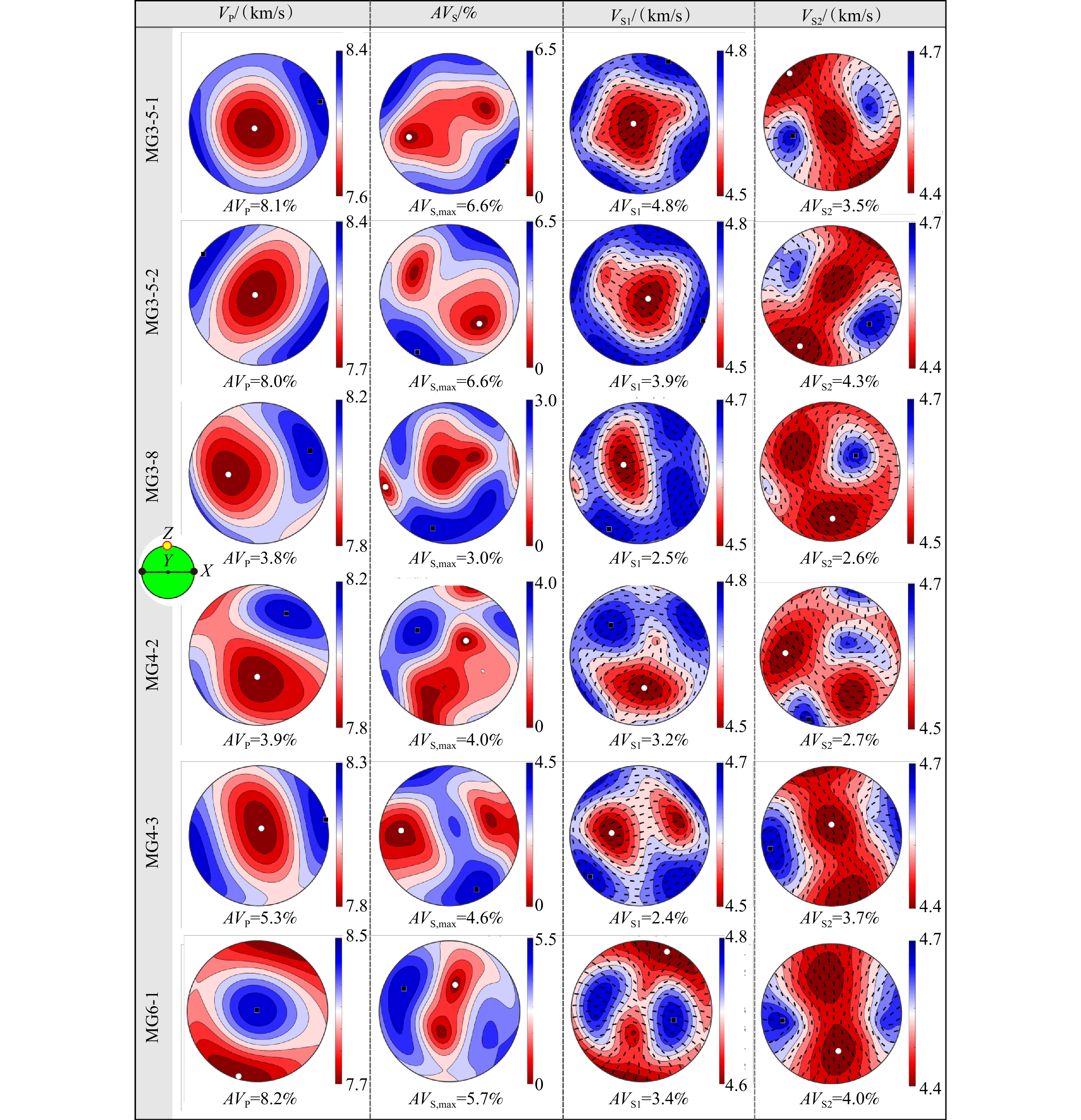
摘要: 中—下地壳作为壳−幔相互作用的关键界面,其物质组成存在显著争议。研究选择喜马拉雅东构造结及东南缘这一青藏高原物质东向扩展的关键区域,以哀牢山−红河剪切带及邻区下地壳石榴辉石岩(27~44 km)和岩石圈地幔尖晶石二辉橄榄岩(50~78 km)为对象,综合利用岩相学、显微构造分析、晶格优选取向(CPOs)测量、变质−变形温压计算及全岩地震波速模拟等手段,系统构建了该区岩石圈地震波速与各向异性模型,旨在揭示高原东南缘壳幔地震波速各向异性及壳幔流变学特征。研究结果揭示:下地壳石榴辉石岩中石榴石呈现刚性旋转变形,透辉石以位错蠕变为主导;岩石圈地幔橄榄石发育A型(高温低压简单剪切型)和AG型(熔体参与型)CPOs模式,顽火辉石与透辉石亦以位错蠕变为主;反映下地壳和岩石圈地幔经历多期塑性变形与静态重结晶过程。地震波速分层特征显著,其中石榴辉石岩的P波速度(VP)为8.01~8.07 km/s,S波速度(VS)为4.54~4.57 km/s,各向异性较弱(AVP=0.6%~1.4%、AVS=0.7%~1.1%);尖晶石二辉橄榄岩VP为8.03~8.08 km/s,VS为4.60~4.61 km/s,各向异性显著增强(AVP=3.8%~8.0%、AVS=3.0%~6.6%)。波速主控因素分析表明,石榴辉石岩波速主要受石榴石含量控制,各向异性与透辉石含量相关;二辉橄榄岩波速由镁橄榄石含量主导,顽火辉石/透辉石起到“稀释/消减”作用,且矿物组构强度显著影响各向异性。垂向波速模型呈阶梯式增长:自中地壳至岩石圈地幔,依次为云母片岩(VP=6.12~6.46 km/s)、花岗闪长岩(VP =6.69~6.78 km/s)、斜长角闪岩(VP =6.30~6.69 km/s)、石榴辉石岩(VP =8.01~8.07 km/s)和尖晶石二辉橄榄岩(Vp=8.03~8.08 km/s),其中角闪岩层(VS=3.59~4.01km/s)是壳幔波速跃变的关键界面。结合地球物理数据,推测中—下地壳角闪岩层与部分熔融体是地壳各向异性的主要来源,岩石圈地幔各向异性指示软流圈上涌驱动的物质“流变”,并呈现出显著的壳幔解耦特征。Abstract:
Objective The Eastern Himalayan Syntaxis and its southeastern region serve as a critical channel for the eastward extrusion or/and expansion of Tibetan Plateau material. The deformation/rheology mechanisms and seismic anisotropy of the lithosphere provide key insights into plateau uplift and lateral growth. Methods This study investigates lower-crustal garnet pyroxenites (27–44 km depth) and lithospheric mantle spinel lherzolites (50–78 km depth) from the Ailao Shan–Red River shear zone and adjacent regions. This study integrates petrographic analysis, microstructural observations, measurements of crystallographic preferred orientations (CPOs), metamorphic-deformation thermobarometry, and whole-rock seismic velocity modeling to constrain the lithospheric seismic anisotropy and its tectonic implications. Results Our key findings include: (1) Microstructural analysis reveals that garnet in lower-crustal pyroxenites behaves as a rigid phase with rotational deformation, while clinopyroxene accommodates strain via dislocation creep. In the lithospheric mantle, olivine exhibits both A-type (high-temperature, low-pressure simple shear) and AG-type (melt-present) CPOs; orthopyroxene and clinopyroxene also deform predominantly by dislocation creep, indicating polyphase plastic deformation and static recrystallization. (2) Seismic velocities show distinct layering: garnet pyroxenites exhibit VP = 8.01–8.07 km/s and VS = 4.54–4.57 km/s with weak anisotropy (AVP = 0.6%–1.4%, AVS= 0.7%–1.1%), whereas spinel lherzolites display higher velocities (VP = 8.03–8.08 km/s, VS= 4.60–4.61 km/s) and stronger anisotropy (AVP = 3.8%–8.0%, AVS = 3.0%–6.6%). (3) The velocity controls differ between lithologies: in pyroxenites, the garnet content dominates the bulk seismic velocity, while the anisotropy correlates with the clinopyroxene content; in lherzolites, the seismic properties are primarily controlled by olivine, while orthopyroxene and clinopyroxene exert a diluting effect, and the deformation intensity significantly influences the anisotropy. (4) From the middle crust to the lithospheric mantle, a vertical velocity model reveals stepwise increases: mica schist (VP = 6.12–6.46 km/s) → granodiorite (VP = 6.69–6.78 km/s) → amphibolite (VP = 6.30–6.69 km/s) → garnet pyroxenite (VP = 8.01–8.07 km/s) → spinel lherzolite (VP = 8.03–8.08 km/s), with the amphibolite layer (VS = 3.59–4.01 km/s) acting as a key interface for crust-mantle velocity transitions. Conclusion Integrated with published geophysical data, we propose a tectonic model wherein: (1) mid-lower crustal amphibolites and partial melts are the primary sources of crustal anisotropy; (2) mantle anisotropy reflects southeastward lithospheric extrusion driven by asthenospheric upwelling, with clear crust-mantle decoupling. [ Significance ] Our new data provide critical constraints on the lithospheric deformation and crust-mantle decoupling beneath the Eastern Himalayan Syntaxis and its southeastern region by linking mineral-scale deformation mechanisms with large-scale seismic anisotropy. This enhances our understanding of the uplift and lateral growth of the Tibetan Plateau in the Cenozoic. -
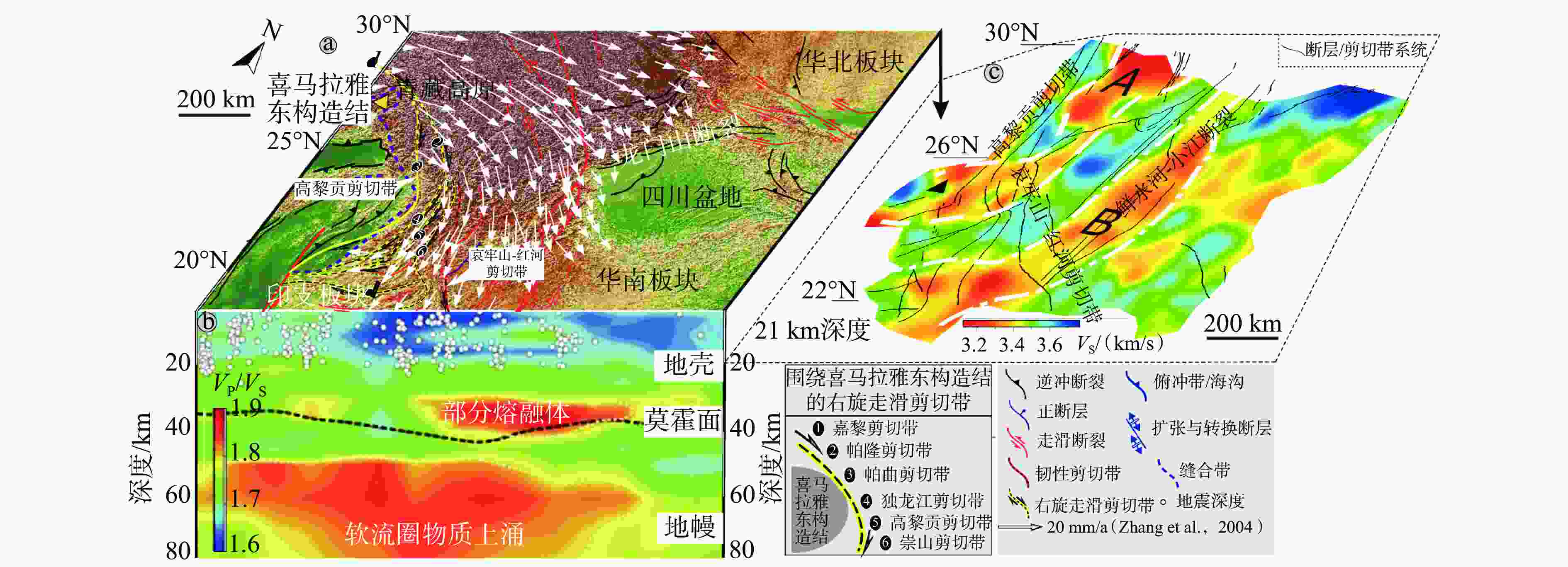
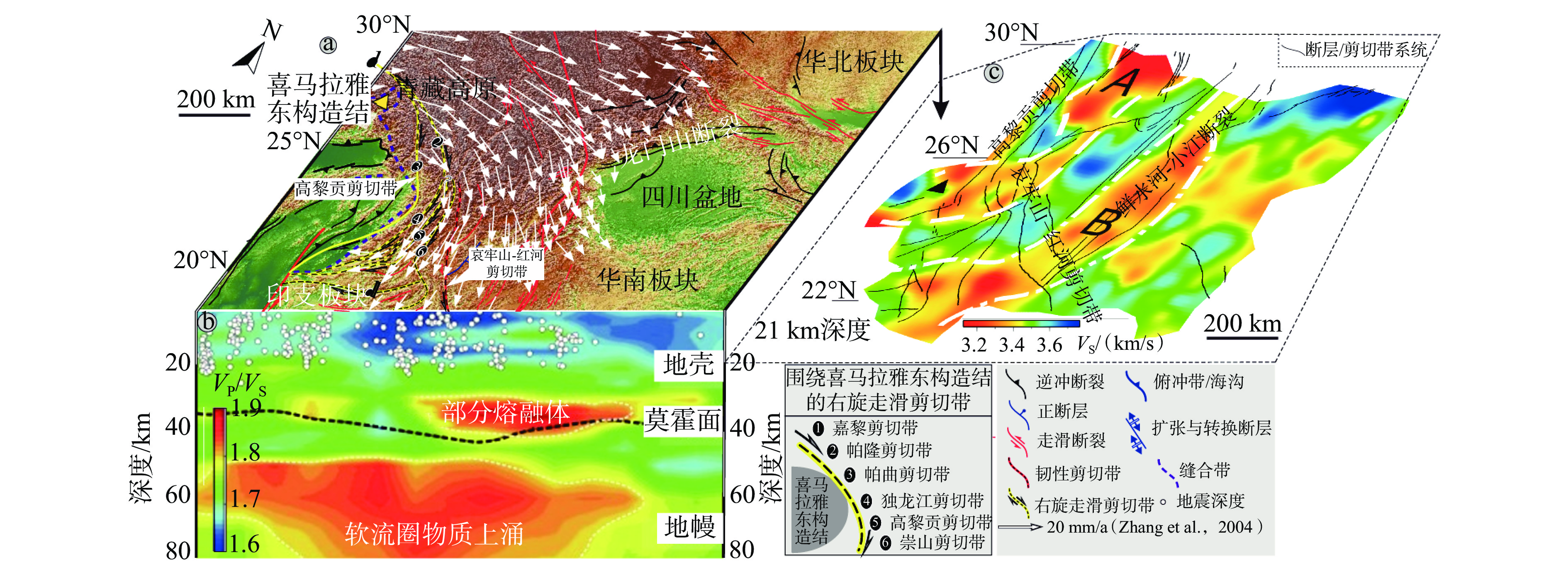
图 1 喜马拉雅东构造结及东南缘构造地貌及岩石圈结构
a—高原东南缘构造地貌(Tapponnier et al.,1990)及GPS速度场(Zhang et al.,2004);b—高原东南缘岩石圈速度结构(VP/VS;Hou et al.,2023);c—青藏高原东南缘地壳21 km深处S波速度结构(存在A带和B带2条S波低速带;Bao et al.,2015)
Figure 1. Tectonic geomorphology and lithospheric structure of the Eastern Himalayan Syntaxis and the SE Tibetan Plateau
(a) Tectonic geomorphology (Tapponnier et al., 1990) and GPS velocity field (Zhang et al., 2004); (b) Lithospheric VP/VS velocity structure (Hou et al., 2023); (c) S-wave velocity at a crustal depth of 21 km, showing two low-velocity zones A and B (Bao et al., 2015)
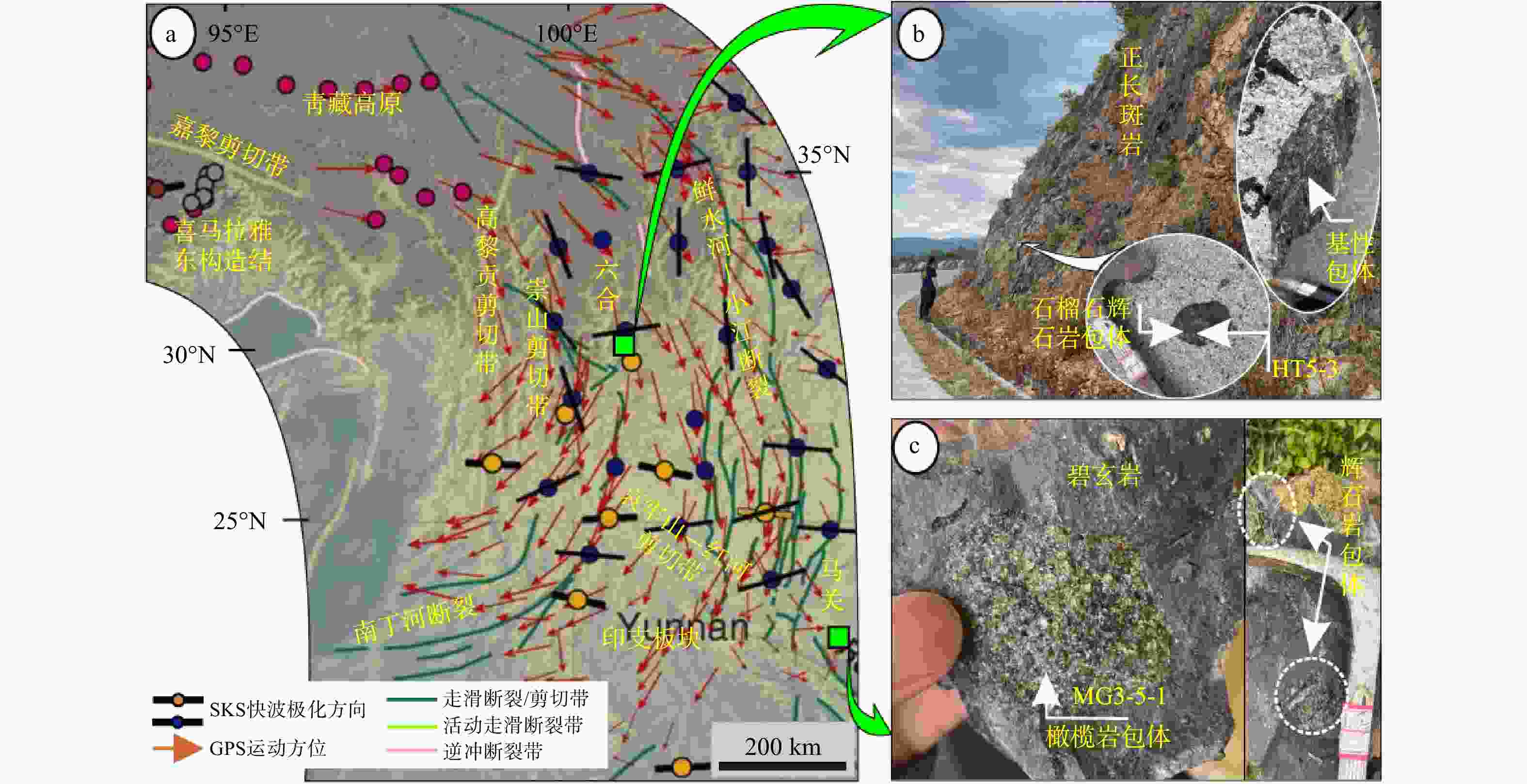
图 2 青藏高原东南缘构造地貌特征、GPS运动方位、快波极化方位以及研究采样点位置
a—喜马拉雅东构造结及东南缘构造地貌、GPS(Zhang et al.,2004)及SKS快波极化方位信息(Lev et al.,2006);b—六合地区正长斑岩中的石榴石辉石岩和基性包体;c—马关地区碧玄岩中的辉石岩包体和橄榄岩包体
Figure 2. Tectonic geomorphology, GPS velocity field, SKS fast wave polarization directions, and sampling locations in the SE Tibetan Plateau
(a) Tectonic geomorphology of the Eastern Himalayan Syntaxis and its southeastern margin, with the GPS velocity field (Zhang et al., 2004) and SKS fast wave polarization information (Lev et al., 2006); (b) Garnet pyroxenite and mafic enclaves in syenite porphyry from the Liuhe area; (c) Pyroxenite and peridotite xenoliths in basanite from the Maguan area
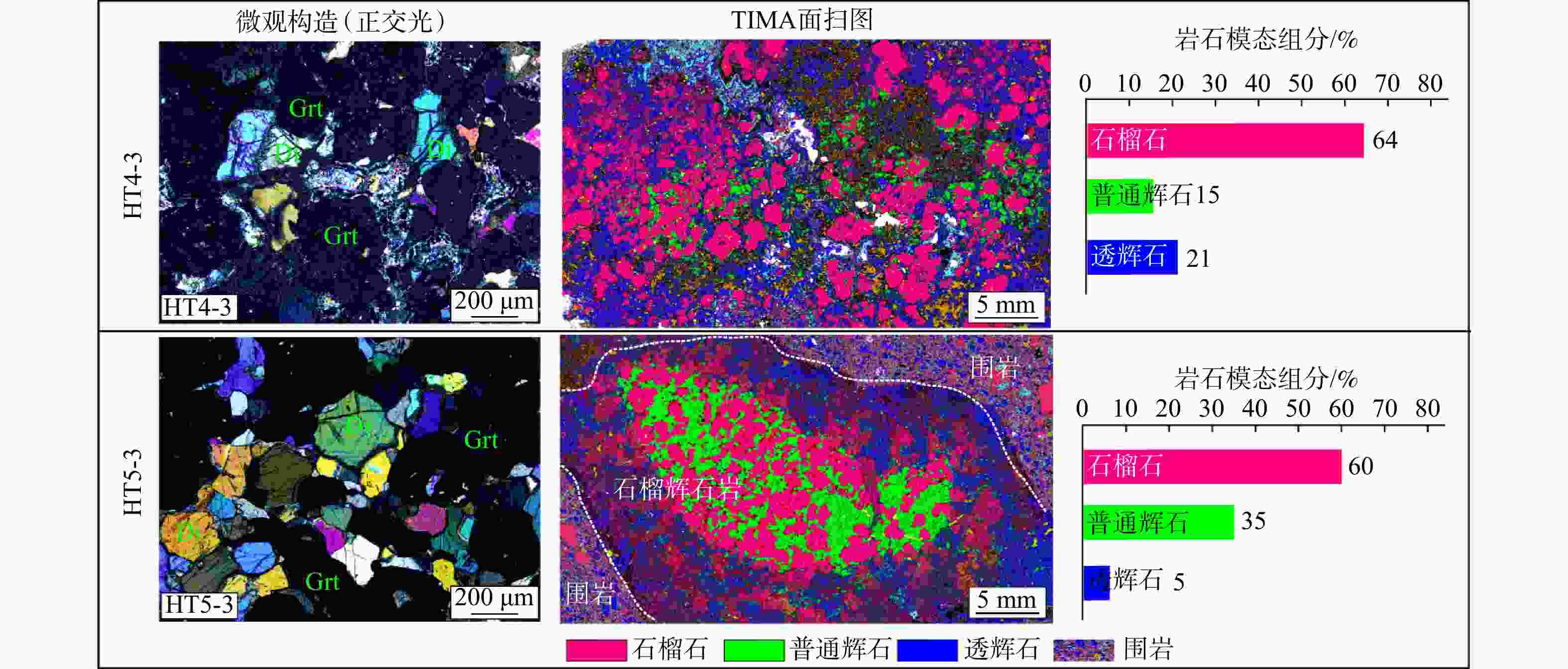
图 3 高原东南缘六合地区石榴辉石岩包体样品(HT4-3和HT5-3)微观构造、矿物相组合及岩石模态组分(采样位置见图2a和表1)
Grt—石榴石;Di—透辉石;样品HT4-3中石榴石和透辉石呈镶嵌结构,发育三联点结构,部分透辉石后期遭受交代退变质作用而呈筛网状;样品HT5-3中石榴石和透辉石呈镶嵌结构,发育三联点结构,石榴石表面发育明显裂纹
Figure 3. Microstructures, mineral assemblages, and modal compositions of garnet pyroxenite xenoliths (samples HT4-3 and HT5-3) from the Liuhe area on the southeastern margin of the Tibetan Plateau (sampling locations are shown in Fig. 2a and Table 1)
In sample HT4-3, garnet and diopside show a mosaic texture with well-developed triple junction structures; some diopside later underwent metasomatic retrogression, resulting in sieve texture. In sample HT5-3, garnet and diopside display mosaic texture with well-developed triple junction structures, and the garnet surfaces show distinct cracks.

图 4 高原东南缘滇西马关地区尖晶石二辉橄榄岩样品的微观结构和矿物相组合(采样位置见图2a和表1)
Di—透辉石; Fo—镁橄榄石; En—顽火辉石;基于光学显微图形和TIMA面扫描分析结果;二辉橄榄岩显微结构显示橄榄石颗粒边界平直,发育三联点结构,斜方辉石内橄榄石包体,橄榄石内部发育双晶边界
Figure 4. Microstructures and mineral assemblages of spinel lherzolite samples from the Maguan area, western Yunnan, on the southeastern margin of the Tibetan Plateau (sampling locations are shown in Fig. 2a and Table 1)
Based on optical micrographs and TIMA surface scans, the microstructures of the spinel lherzolites include straight olivine grain boundaries with well-developed triple junctions, olivine inclusions within orthopyroxene, and twin boundaries within the olivine.
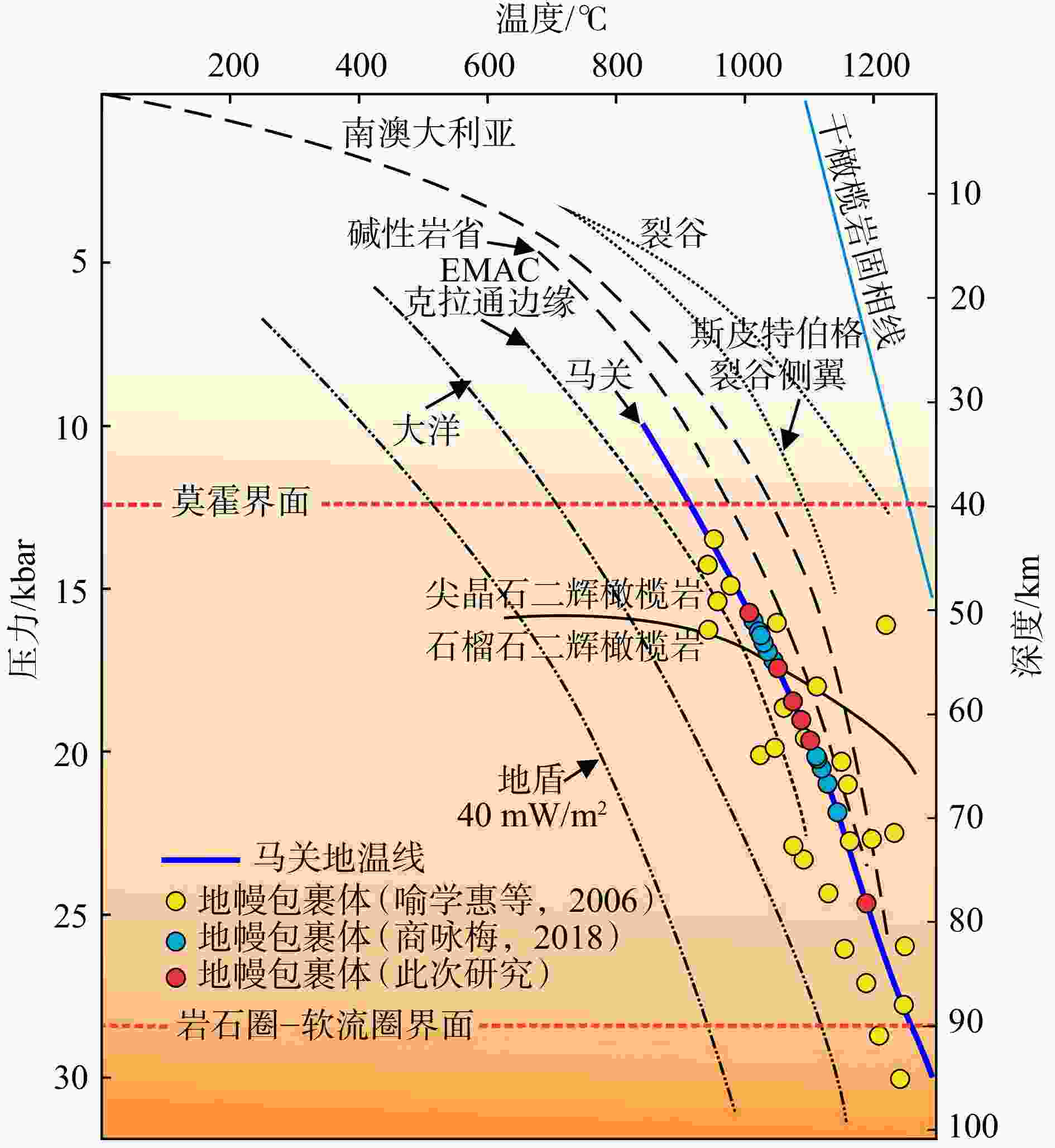
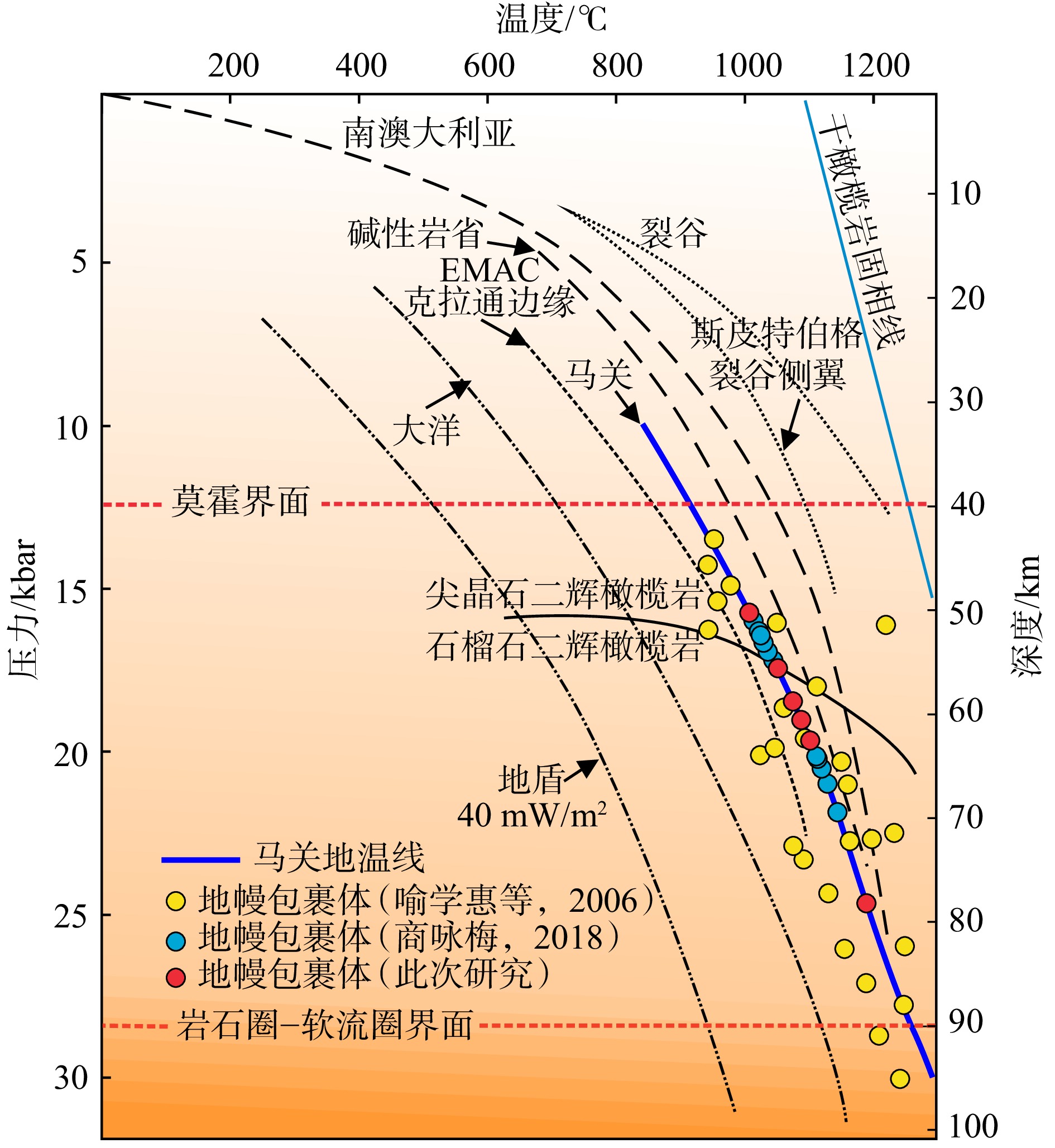
图 5 高原东南缘滇西马关地区及典型地区构造单元地温梯度
莫霍界面和岩石圈−软流圈(LAB)界面深度来自Yang et al.,2017;Hu et al.,2018
Figure 5. Geothermal gradients of tectonic units in the Maguan area, western Yunnan, and typical regions on the southeastern margin of the Tibetan Plateau
Moho discontinuity and lithosphere–asthenosphere boundary (LAB) depths are from Yang et al., 2017 and Hu et al., 2018.
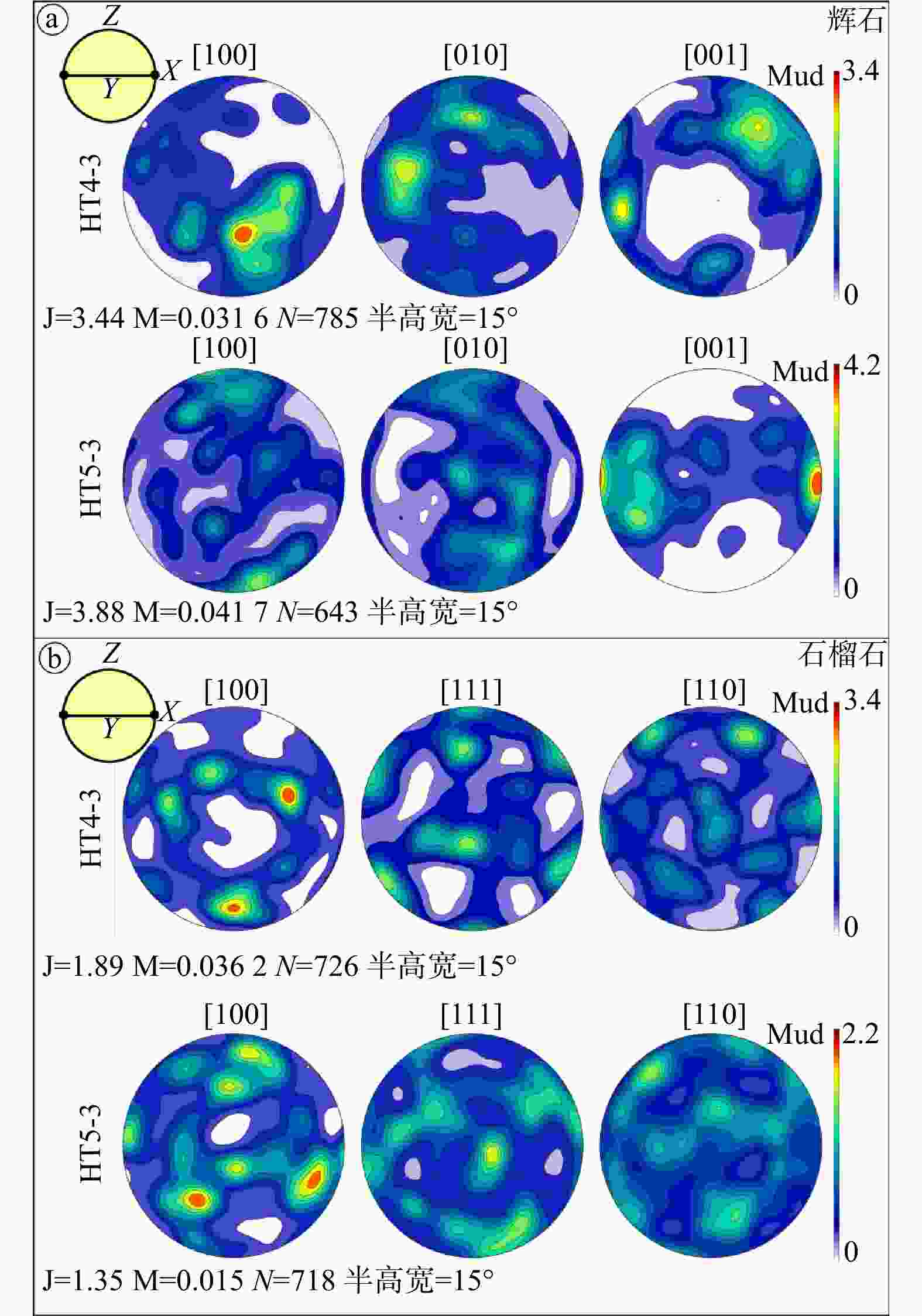
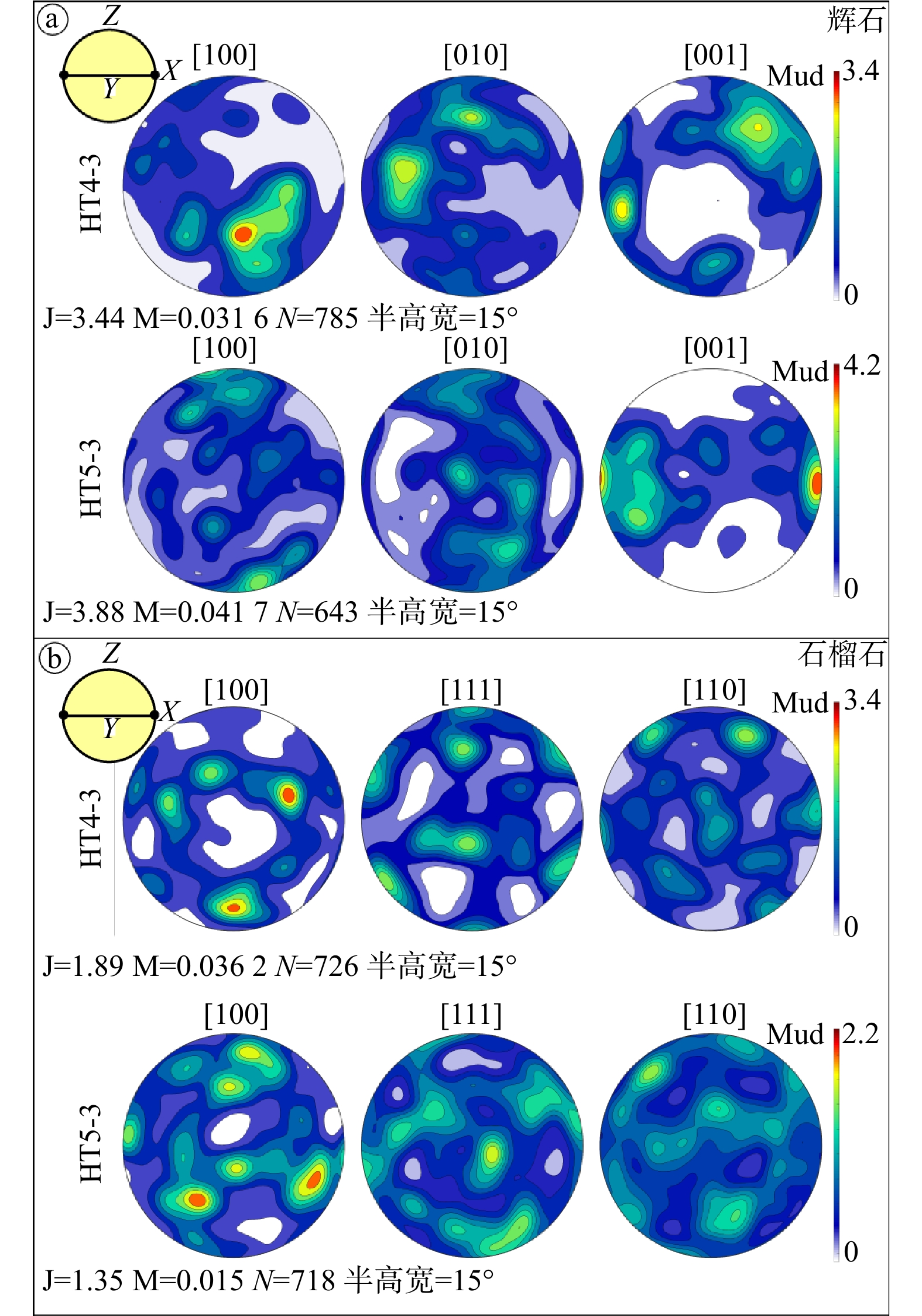
图 6 青藏高原东南缘滇西六合地区石榴辉石岩主要矿物辉石和石榴石的组构模式
组构模式显示方式为等面积下半球投影,坐标框架见左上方,N为测量点数,J和M为组构强度指数a—样品HT4-3和HT5-3中辉石的组构模式;b—样品HT4-3和HT5-3中石榴石的组构模式
Figure 6. Fabric patterns of the major minerals, pyroxene and garnet, in garnet pyroxenite from the Liuhe area, western Yunnan, southeastern margin of the Tibetan Plateau
(a) Fabric patterns of pyroxene in samples HT4-3 and HT5-3; (b) Fabric patterns of garnet in samples HT4-3 and HT5-3The fabric patterns are displayed as equal-area lower-hemisphere projections, with the coordinate framework shown in the upper left corner. N represents the number of measurement points, and J and M denote the fabric strength indices.

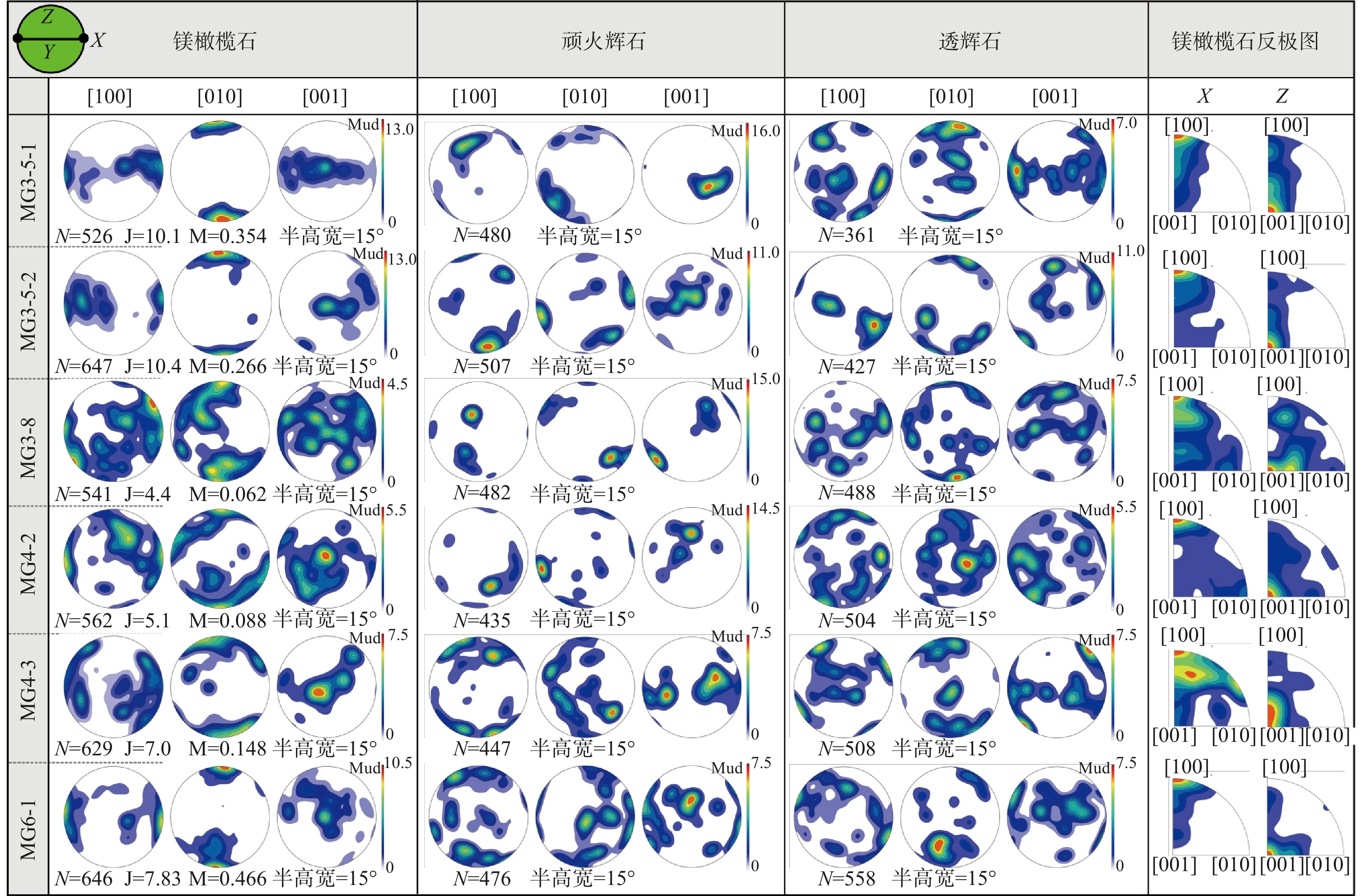
图 7 青藏高原东南缘滇西马关地区6件尖晶石二辉橄榄岩样品的主要矿物(橄榄石、斜方辉石和单斜辉石)的组构模式
CPOs显示方式为等面积下半球投影,所有矿物CPOs极图均以橄榄石[100]轴和[010]轴平行于线理和面理法线为参考进行旋转,最右侧是橄榄石反极图,坐标框架在左上方显示;N是测量点数,J和M是组构强度指数
Figure 7. Fabric patterns of major minerals (including olivine, orthopyroxene, and clinopyroxene) in six spinel lherzolite samples from the Maguan area, western Yunnan, southeastern margin of the Tibetan Plateau
The CPOs are displayed as equal-area lower-hemisphere projections. All mineral CPOs are rotated with reference to olivine and axes parallel to mineral lineation and foliation normal, respectively. The far right shows the olivine inverse pole figure, with the coordinate framework displayed in the upper left. N represents the number of measurement points, and J and M are the fabric strength indices.
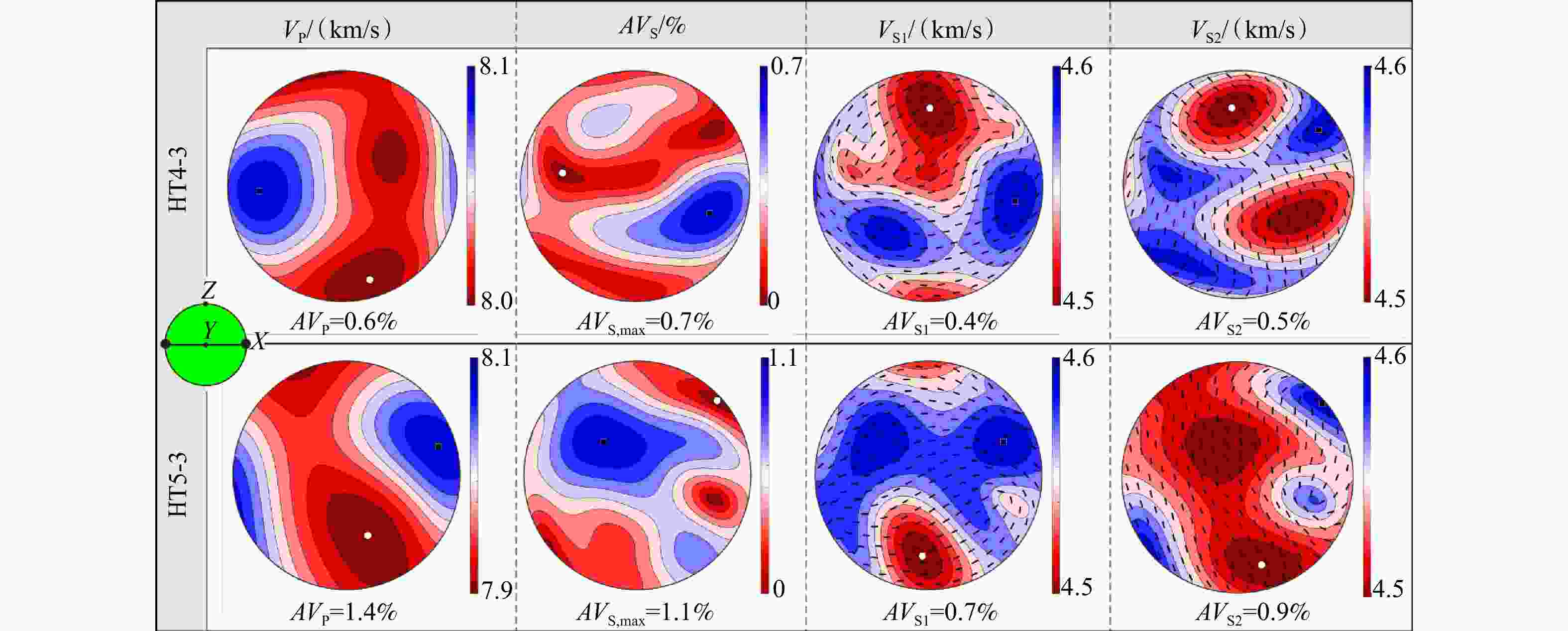
图 8 高原东南缘六合地区石榴辉石岩(样品HT4-3和HT5-3)的地震属性
黑色方块标记最高值,白色圆圈标记最低值,应变参考坐标系显示在左侧(绿色)(XY面—面理面;X方向—矿物线理方向;Z方向—面理法线方向)
Figure 8. Seismic properties of garnet-pyroxenites (samples HT4-3 and HT5-3) from the Liuhe area, southeastern margin of the Tibetan Plateau
The black squares mark the maximum values, and the white circles mark the minimum values. The strain reference coordinate system is shown on the left (green) (XY plane—foliation plane; X direction—mineral lineation direction; Z direction—foliation normal direction).
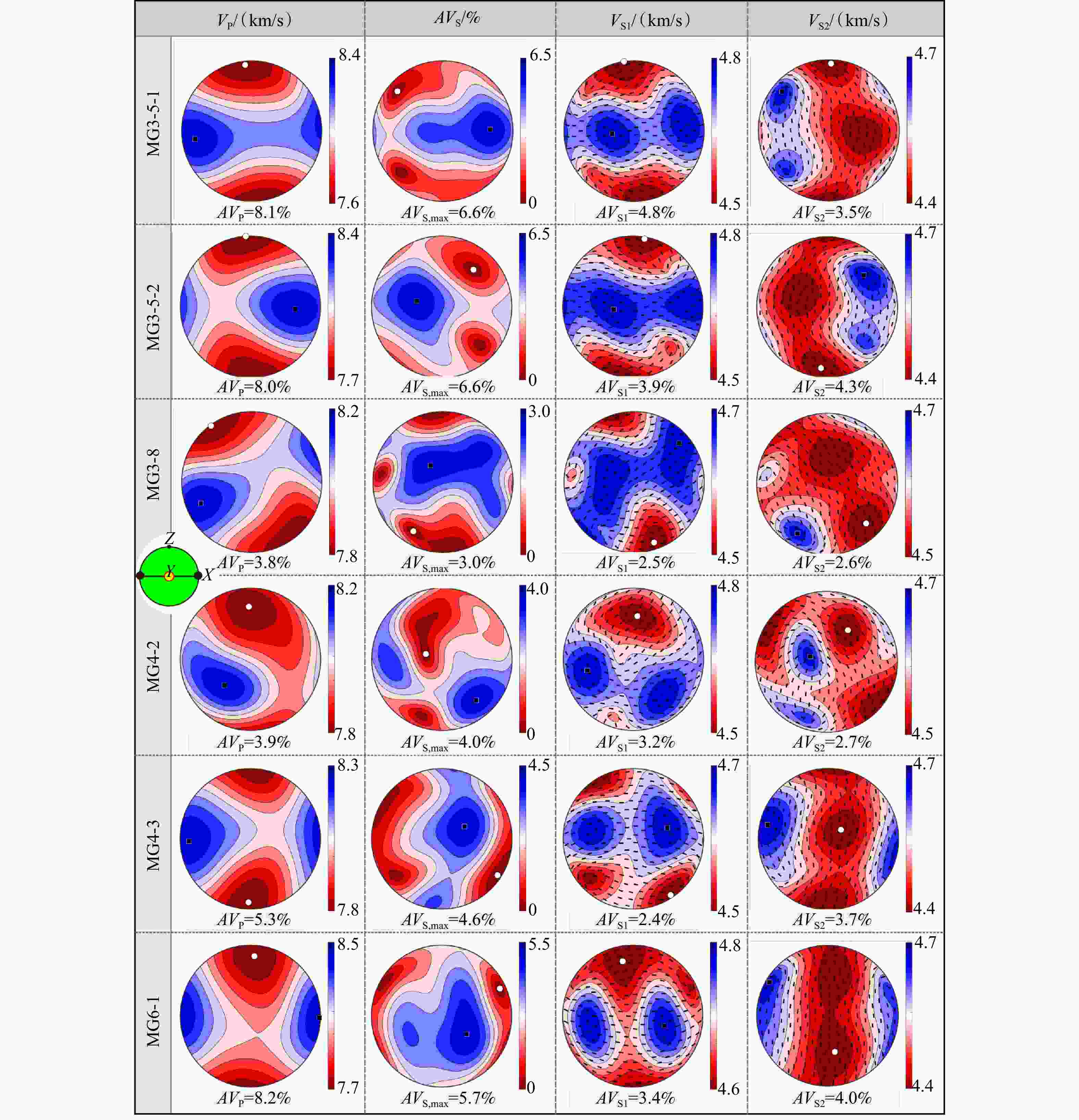
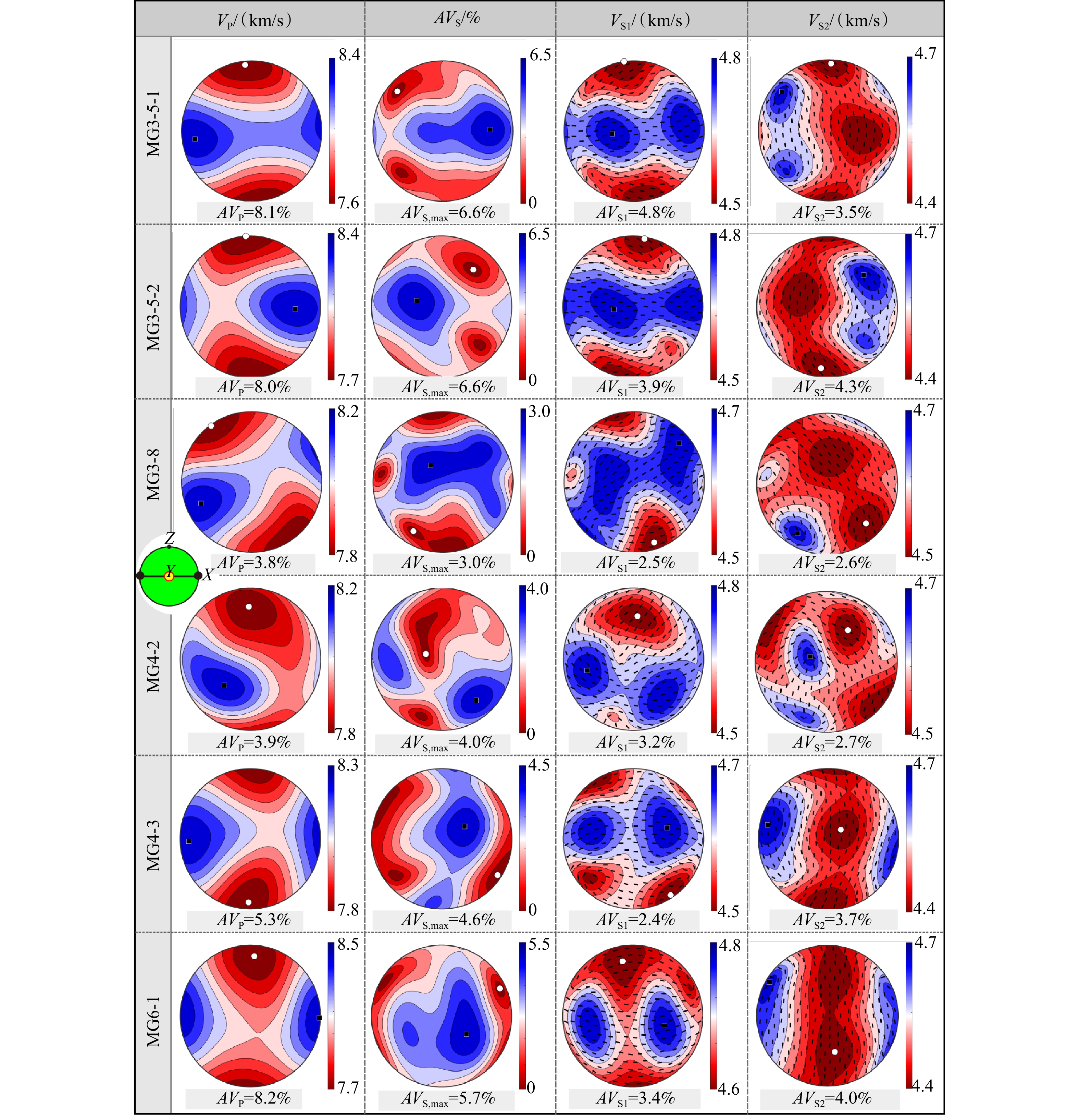
图 9 高原东南缘马关地区尖晶石二辉橄榄岩地震波速性质(地震波从Y轴入射)
黑色方块标记最高值;白色圆圈标记最低值;应变参考坐标系显示为左侧(绿色)(XY面—面理面;X方向—线理方向;Z方向—面理法线方向)
Figure 9. Seismic wave velocity properties of spinel lherzolite from the Maguan area, southeastern margin of the Tibetan Plateau (seismic waves incident from the Y-axis)
The black squares mark the maximum values, and the white circles mark the minimum values. The strain reference coordinate system is shown on the left (green) (XY plane—foliation plane; X direction—lineation direction; Z direction—foliation normal direction).
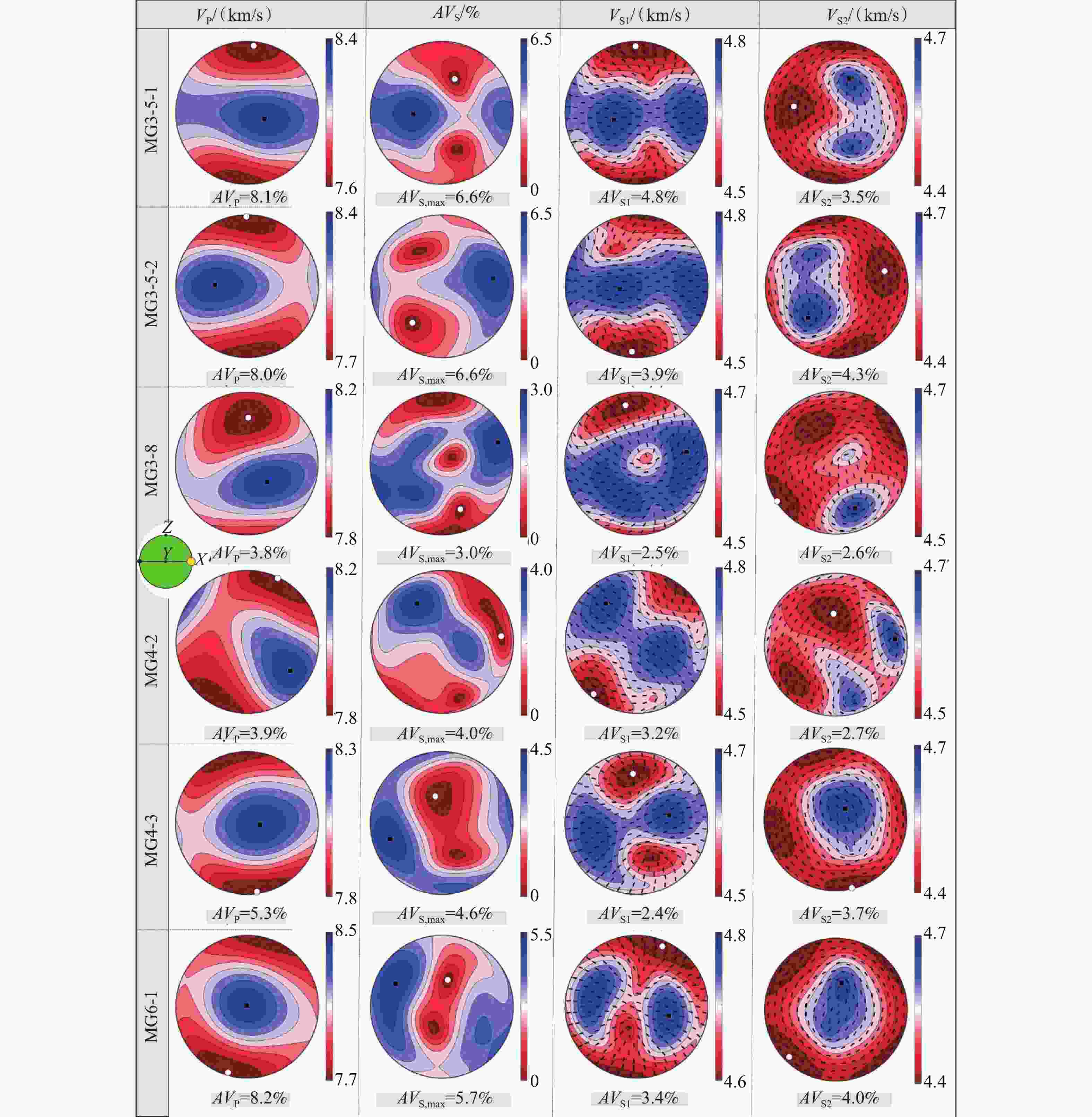
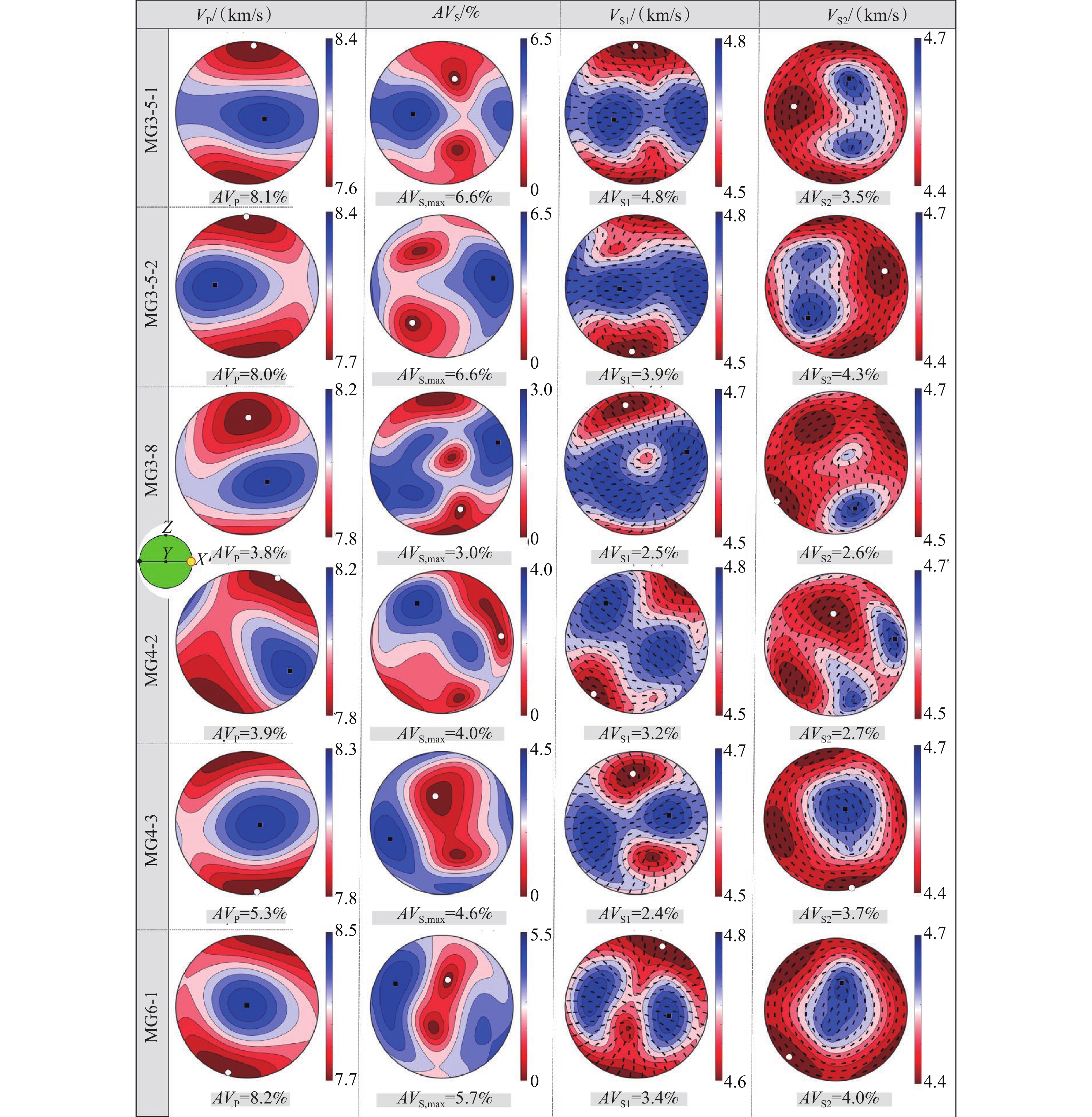
图 10 高原东南缘马关地区尖晶石二辉橄榄岩地震波速性质(地震波从X轴入射)
黑色方块标记最高值;白色圆圈标记最低值;应变参考坐标系显示为左侧(绿色)(XY面—面理面;X方向—线理方向;Z方向—面理法线方向)
Figure 10. Seismic wave velocity properties of spinel lherzolite from the Maguan area, southeastern margin of the Tibetan Plateau (seismic waves incident from the X-axis)
The black squares represent the maximum values, and the white circles represent the minimum values. The strain reference coordinate system is shown on the left (green) (XY plane—foliation plane; X direction—lineation direction; Z direction—foliation normal direction).
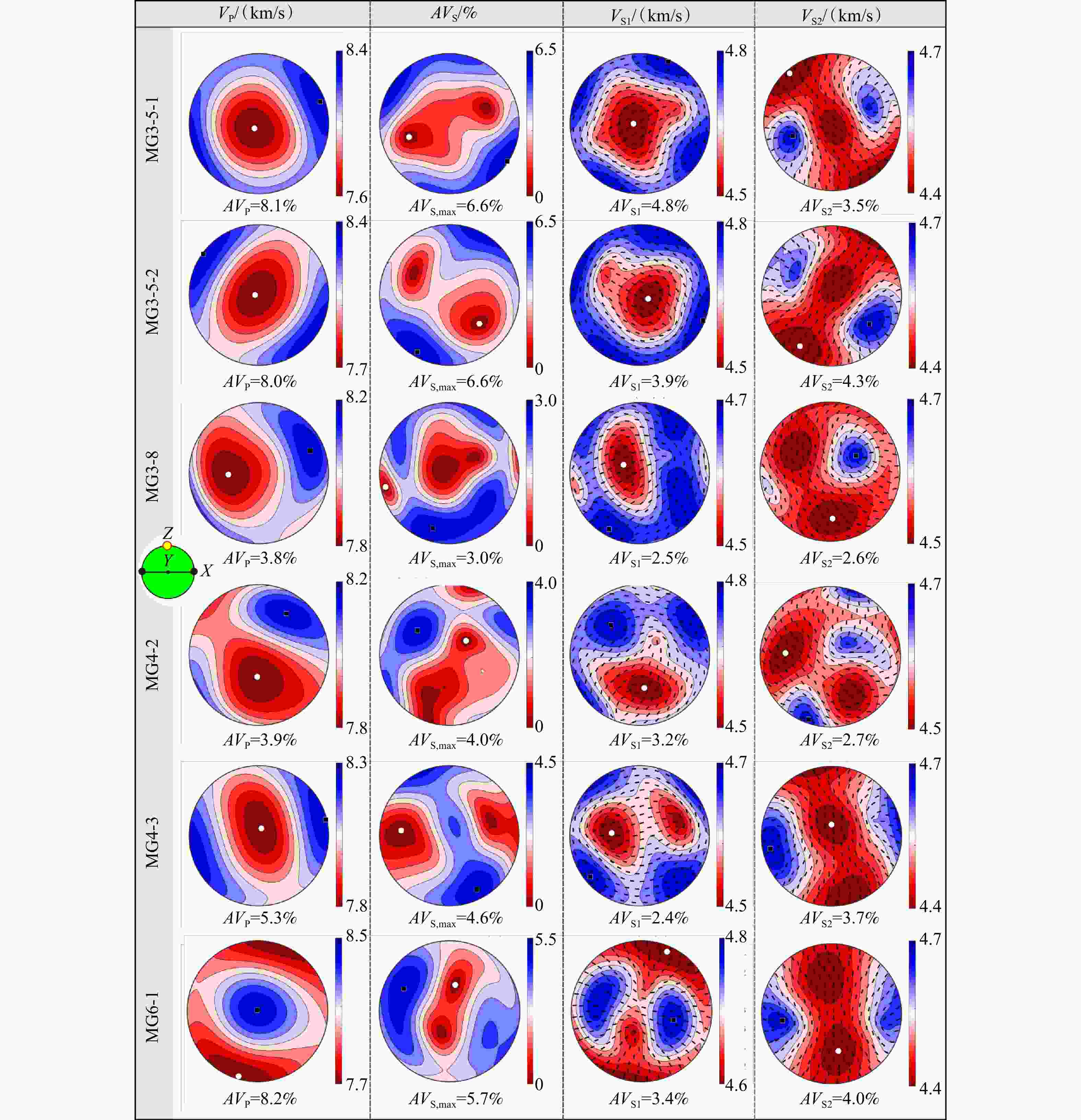
图 11 高原东南缘马关地区尖晶石二辉橄榄岩地震波速性质(地震波从Z轴入射)
黑色方块标记最高值;白色圆圈标记最低值;应变参考坐标系显示为左侧(绿色)(XY面—面理面;X方向—线理方向;Z方向—面理法线方向)
Figure 11. Seismic wave velocity properties of spinel lherzolite from the Maguan area, southeastern margin of the Tibetan Plateau (seismic waves incident from the Z-axis)
The black squares mark the maximum values, and the white circles mark the minimum values. The strain reference coordinate system is shown on the left (green) (XY plane—foliation plane; X direction—lineation direction; Z direction—foliation normal direction).
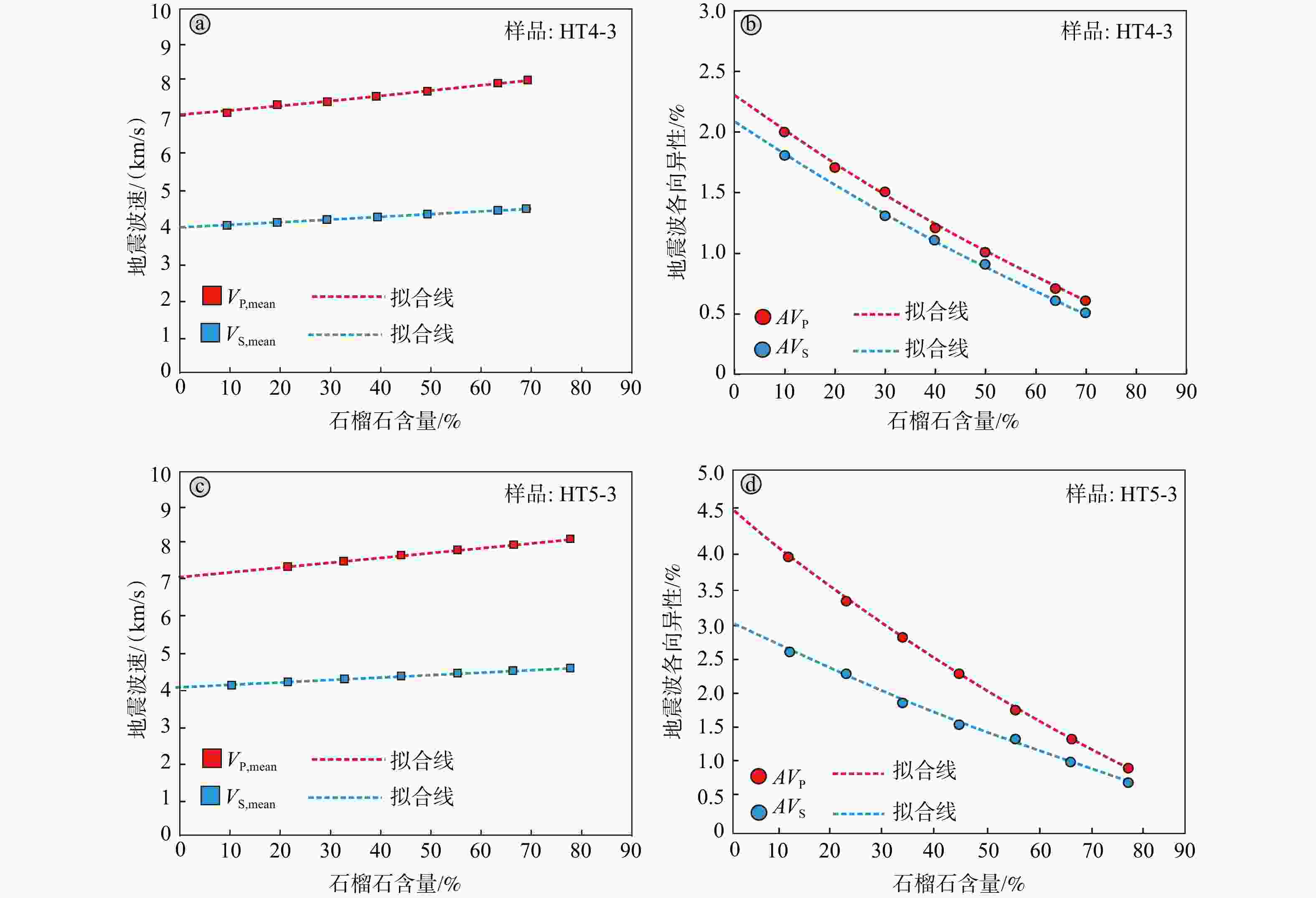
图 12 高原东南缘滇西六合地区石榴辉石岩中石榴石和透辉石岩石图谱模拟结果
a、b—石榴辉石岩(样品HT4-3)地震波速性质和石榴石含量关系图谱;c、d—石榴辉石岩(样品HT5-3)地震波速性质和石榴石含量关系图谱
Figure 12. Garnet and diopside rock modeling of garnet pyroxenite in the Liuhe area, western Yunnan, southeastern Qinghai–Tibet Plateau
(a) and (b) Relationships between seismic wave velocity properties and garnet content for garnet pyroxenite (sample HT4-3); (c) and (d) Relationships between seismic wave velocity properties and garnet content for garnet pyroxenite (sample HT5-3)
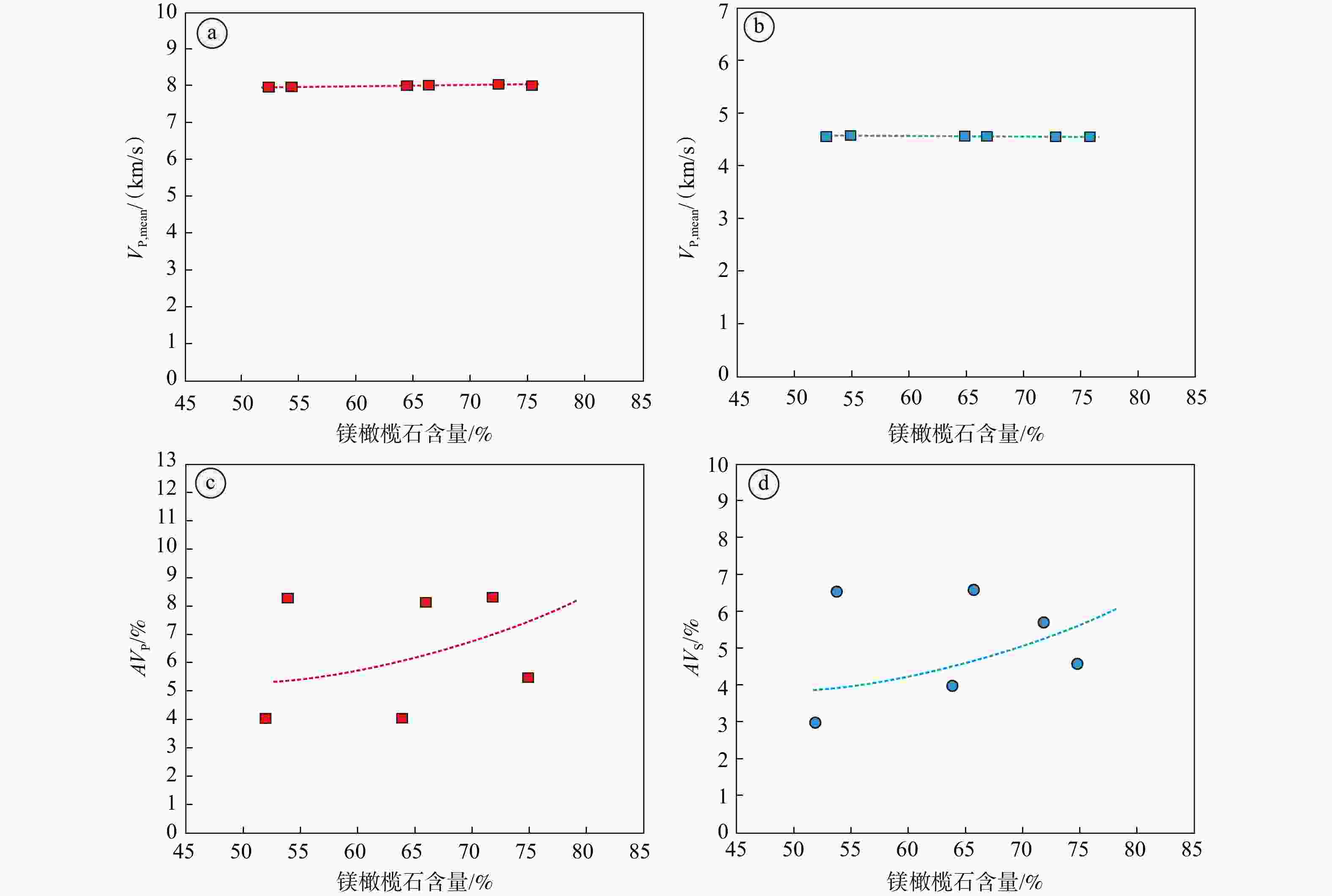
图 13 青藏高原东南缘马关地区尖晶石二辉橄榄岩地震波速性质与橄榄石含量关系
a、b—尖晶石二辉橄榄岩全岩地震波波速与橄榄石含量关系;c、d—尖晶石二辉橄榄岩全岩地震波各向异性与橄榄石含量关系
Figure 13. Relationships between seismic wave properties and olivine content in spinel lherzolite from the Maguan area, southeastern margin of the Tibetan Plateau.
(a) and (b) Relationships between seismic wave velocity and olivine content in spinel lherzolite; (c) and (d) Relationships between seismic wave anisotropy and olivine content in spinel lherzolite

图 14 青藏高原东南缘岩石圈各层岩石地震波速性质剖面
红蓝方块和圆点为岩石样品计算获取的地震波速性质;黑色箭头线指示不同岩性间地震波速性质变化趋势(糜棱岩化云母片岩、糜棱岩化花岗闪长岩和糜棱岩化斜长角闪岩的地震波速性质来自Huang et al.,2022;石榴石辉石岩和尖晶石二辉橄榄岩的地震波速性质为此次研究)
Figure 14. Profiles of seismic wave velocity properties in various lithospheric layers under the southeastern Tibetan Plateau
The seismic wave velocity properties of the red and blue squares and dots are calculated and obtained from rock samples; the black arrowed lines indicate the trends of changes in seismic wave velocity properties between different lithologies (the seismic wave velocity properties of mylonitized mica schist, mylonitized granodiorite, and mylonitized plagioclase amphibolite are from Huang et al., 2022; the seismic wave velocity properties of garnet pyroxenite and spinel lherzolite are from this study).

图 15 喜马拉雅东构造结及东南缘岩石圈物质−波速结构模式
地球物理观测获得的S波速度结构(S波速度结构数据来自 Peng et al.,2017;GPS数据来自Zhang et al.,2004)及基于岩石学约束和解释方案
Figure 15. Lithospheric material and seismic velocity structure model of the Eastern Himalayan Syntaxis and its southeastern margin
S-wave velocity structure based on geophysical observations (S-wave velocity structure data from Peng et al., 2017; GPS data from Zhang et al., 2004) and its interpretation scheme constrained by petrology.
表 1 青藏高原东南缘六合和马关地区深源岩石包体采样点及主要矿物组合
Table 1. Sampling localities and major mineral assemblages of deep-seated rock xenoliths from the Liuhe and Maguan areas in the southeastern margin of the Tibetan Plateau
采样地点 经度 纬度 样品编号 岩性 矿物组合 六合地区 26°25′29.922″N 100°19′26.058″E HT4-3 石榴辉石岩 Grt+Aug+Di 26°25′29.922″N 100°19′26.058″E HT5-3 石榴辉石岩 Grt+Aug+Di 马关地区 23°0′38.226″N 104°7′43.782″E MG3-5-1 二辉橄榄岩 Fo+En+Di+Spl 22°57′57.048″N 104°6′34.566″E MG3-5-2 二辉橄榄岩 Fo+En+Di+Spl 23°0′48.162″N 104°7′10.020″E MG3-8 二辉橄榄岩 Fo+En+Di+Spl 23°0′47.046″N 104°7′11.094″E MG4-2 二辉橄榄岩 Fo+En+Di+Spl 23°0′49.362″N 104°7′8.682″E MG4-3 二辉橄榄岩 Fo+En+Di+Spl 23°0′46.674″N 104°7′10.794″E MG6-1 二辉橄榄岩 Fo+En+Di+Spl 注:Grt—石榴石;Aug—普通辉石;Di—透辉石;Fo—镁橄榄石;En—顽火辉石;Spl—尖晶石  下载: 导出CSV
表 2 高原东南缘滇西马关地区尖晶石二辉橄榄岩显微结构、矿物相组合、Mg#和Cr#及平衡温压计算结果
Table 2. Microstructures, mineral assemblages, Mg# and Cr# values, and geothermobarometric results of spinel lherzolites from the Maguan area, western Yunnan, on the southeastern margin of the Tibetan Plateau
样品 岩石类型 结构 岩石模态组分/% 镁橄榄石
(Mg#)尖晶石
(Cr#)温度/
℃压力/
GPaFo En Di Spl St MG3-5-1 二辉橄榄岩 粗粒结构 40.2 32.6 12.3 0.7 14.2 90.5 14.8 1193 2.3 MG3-5-2 二辉橄榄岩 粗粒结构 50.9 25.4 8.9 0.4 14.4 91.3 39.2 1103 3.0 MG3-8 二辉橄榄岩 粗粒结构 45.6 30.1 16.8 1.4 6.1 89.9 11.4 1079 2.2 MG4-2 二辉橄榄岩 粗粒结构 60.6 27.3 8.2 0.7 3.2 89.9 11.5 1053 2.2 MG4-3 二辉橄榄岩 粗粒结构 70.1 19.5 5.1 0.8 4.5 91.0 30.9 1009 2.8 MG6-1 二辉橄榄岩 粗粒结构 59.3 19.6 8.1 0 13.0 90.2 − 1091 − 注:Fo—镁橄榄石;En—顽火辉石;Di—透辉石;Spl—尖晶石;St—蛇纹石;温度计算采用二辉石温度计;压力计算采用尖晶石Cr#压力计
下载: 导出CSV
表 3 马关地区尖晶石二辉橄榄岩EBSD面扫获得的镁橄榄石组构和显微结构参数
Table 3. Olivine fabric and microstructure parameters obtained by SEM-based EBSD mapping of spinel lherzolites from the Maguan area
样品
编号镁橄榄石 CPOs J指数 M指数 BA值 形态
因子轴比 颗粒大小/
μmMG3-5-1 AG-type 10.1 0.354 0.187 1.32 2.09 771.1 MG3-5-2 A-type 10.4 0.266 0.389 1.34 1.99 599.6 MG3-8 AG-type 4.44 0.062 0.514 1.27 1.75 497.6 MG4-2 A-type 5.1 0.088 0.405 1.28 1.74 630.6 MG4-3 A-type 7.01 0.148 0.492 1.28 1.72 593.6 MG6-1 A-type 7.83 0.185 0.466 1.35 1.89 812.1
下载: 导出CSV
表 4 高原东南缘滇西六合地区石榴辉石岩的地震波速度和各向异性
Table 4. Seismic wave velocity and anisotropy of pyrope granulites in the Liuhe region of western Yunnan at the southeastern margin of the Tibetan Plateau
样品 VP,max/
(km/s)VP,min/
(km/s)VP,mean/
(km/s)AVP/
%VS1,max/
(km/s)VS1,min/
(km/s)VS2,max/
(km/s)VS2,min/
(km/s)VS,mean/
(km/s)AVS1,max/
%AVS2,max/
%AVS,max/
%VS1极化方向 HT4-3 8.09 8.04 8.07 0.60 4.58 4.57 4.57 4.55 4.57 0.40 0.50 0.70 平行线理 HT5-3 8.07 7.96 8.01 1.40 4.57 4.53 4.55 4.51 4.54 0.70 0.90 1.10 平行线理 注: VP,max—P波最大速度;VP,min—P波最小速度;VP,mean—P波平均速度;AVP—P波各向异性;VS1,max—S快波最大速度;VS1,min—S快波最小速度;VS2,max—S慢波最大速度;VS2,min—S慢波最小速度;VS,mean—S波平均速度;AVS1,max—S快波各向异性最大值;AVS2,max—S慢波各向异性最大值;AVS,max—S波各向异性最大值;下同
下载: 导出CSV
表 5 高原东南缘滇西马关地区尖晶石二辉橄榄岩的地震波速性质
Table 5. Seismic wave velocity characteristics of spinel lherzolite from the Maguan area, western Yunnan, southeastern margin of the Tibetan Plateau
样品 VP,max/
(km/s)VP,min/
(km/s)VP,mean/
(km/s)AVP/
%VS1,max/
(km/s)VS1,min/
(km/s)VS2,max/
(km/s)VS1,min/
(km/s)VS,mean/
(km/s)AVS1,max/
%AVS2,max/
%AVS,max/
%MG3-5-1 8.37 7.68 8.03 8.10 4.77 4.55 4.64 4.46 4.61 4.80 3.50 6.60 MG3-5-2 8.37 7.73 8.05 8.00 4.75 4.57 4.63 4.46 4.60 3.90 4.30 6.60 MG3-8 8.15 7.85 8.00 3.80 4.67 4.56 4.63 4.52 4.60 2.50 2.60 3.00 MG4-2 8.20 7.89 8.05 3.90 4.71 4.56 4.62 4.51 4.60 3.20 2.70 4.00 MG4-3 8.27 7.84 8.06 5.30 4.70 4.59 4.65 4.48 4.60 2.40 3.70 4.60 MG6-1 8.40 7.75 8.08 8.20 4.76 4.60 4.63 4.46 4.61 3.40 4.00 5.70
下载: 导出CSV
表 6 石榴辉石岩(样品HT4-3)岩石图谱模拟(石榴石−透辉石)计算的地震波速性质
Table 6. Seismic wave velocity properties calculated by rock type modeling (garnet–diopside) for garnet pyroxenite (sample HT4-3)
岩石组分 VP,max/(km/s) VP,min/(km/s) VP,mean/(km/s) AVP/% VS1,max/(km/s) VS1,min/(km/s) VS2,max/(km/s) VS2,min/(km/s) VS,mean/(km/s) AVS,max/% 石榴石 透辉石 0.00 1.00 8.09 8.04 8.07 0.60 4.58 4.57 4.57 4.55 4.57 0.70 0.10 0.90 7.15 7.00 7.08 2.10 4.13 4.07 4.09 4.03 4.08 2.30 0.20 0.80 7.31 7.20 7.25 1.80 4.20 4.15 4.16 4.11 4.16 2.00 0.30 0.70 7.60 7.35 7.48 1.50 4.27 4.23 4.24 4.20 4.24 1.70 0.40 0.60 7.61 7.51 7.56 1.30 4.34 4.31 4.32 4.28 4.31 1.50 0.50 0.50 7.75 7.67 7.71 1.10 4.42 4.39 4.40 4.36 4.39 1.20 0.64 0.36 7.89 7.80 7.85 0.90 4.49 4.47 4.47 4.44 4.47 1.00 0.70 0.30 8.09 8.04 8.07 0.60 4.58 4.57 4.57 4.55 4.57 0.70
下载: 导出CSV
表 7 石榴辉石岩(样品HT5-3)岩石图谱模拟(石榴石−透辉石)计算的地震波速性质
Table 7. Seismic wave velocity properties calculated by rock type modeling (garnet–diopside) for garnet pyroxenite (sample HT5-3)
岩石组分 VP,max/(km/s) VP,min/(km/s) VP,mean/(km/s) AVp/% VS1,max/(km/s) VS1,min/(km/s) VS2,max/(km/s) VS2,min/(km/s) VS,mean/(km/s) AVS,max/% 石榴石 透辉石 0.00 1.00 7.25 6.93 7.09 4.50 4.15 4.06 4.11 4.01 4.08 3.00 0.10 0.90 7.39 7.11 7.25 3.90 4.22 4.16 4.19 4.01 4.15 2.60 0.20 0.80 7.53 7.29 7.41 3.30 4.29 4.23 4.27 4.19 4.24 2.30 0.30 0.70 7.67 7.47 7.57 2.80 4.36 4.31 4.34 4.27 4.32 1.90 0.40 0.60 7.81 7.64 7.73 2.30 4.43 4.38 4.41 4.35 4.40 1.60 0.50 0.50 7.94 7.80 7.87 1.80 4.50 4.46 4.48 4.44 4.47 1.40 0.64 0.36 8.07 7.96 8.01 1.40 4.57 4.53 4.55 4.51 4.54 1.10 0.70 0.30 8.20 8.12 8.16 1.00 4.63 4.61 4.62 4.59 4.61 0.80
下载: 导出CSV
表 8 青藏高原东南缘岩石圈各层岩石类型、岩石−温压条件及地震波速性质
Table 8. Rock types, pressure–temperature conditions, and seismic wave velocity properties of lithospheric layers in the southeastern Tibetan Plateau
岩性 样品号 温度/℃ 压力/GPa 深度 VP,mean/(km/s) VS,mean/(km/s) AVP/(%) AVS/(%) 糜棱岩化云母片岩 ALS8-1 500~600
(Huang et al.,2022)
300~500
(Cao et al.,2010)0.1~0.5
(Cao et al.,2010)上地壳15~19 km 6.46 3.89 4.4 4.70 ALS7-2 6.28 3.82 10.1 10.70 ALS8-5 6.23 3.76 8.9 8.60 DCS2-2 6.14 3.86 7.3 6.00 DCS2-2-2 6.12 3.84 8.3 8.30 DCS2-4 6.13 3.86 6.3 5.60 糜棱岩化花岗闪长岩 DCS007 550~650
(Huang et al.,2022)
647~710
(Huang et al.,2022)0.52~0.59
(Huang et al.,2022)中地壳
20~25 km6.78 4.01 2.4 2.10 DCS008 6.69 4.05 2.4 2.20 糜棱岩化斜长角闪岩 ALS012 614~672
(Huang et al.,2022)
604~710
(Cao et al.,2010)0.61~0.88
(Huang et al.,2022)
0.59~0.71
(Cao et al.,2010)中地壳
25~30 km6.52 3.7 5.8 5.38 ALS013 6.30 3.59 8.6 7.14 DCS009 6.96 4.01 4.6 3.22 ALS009 6.69 3.84 9.3 7.87 ALS017 6.29 3.59 7.9 8.97 石榴辉石岩 HT4-3 720~950
(魏启荣和王江海,2004)0.74~1.5
(魏启荣和王江海,2004)下地壳
27~44 km8.07 4.57 0.6 0.70 HT5-3 8.01 4.54 1.4 1.10 尖晶石二辉橄榄岩 MG4-3 1009~1193
(此次研究)
900~1150
(喻学惠等,2006;
商咏梅,2018)2.2~2.8
(此次研究)
1.29~2.74
(喻学惠等,2006;
商咏梅,2018)岩石圈
地幔
50~78 km8.06 4.60 5.3 4.60 MG4-2 8.05 4.60 3.9 4.00 MG3-8 8.03 4.60 3.8 3.00 MG6-1 8.08 4.61 8.2 5.70 MG3-5-2 8.05 4.60 8.0 6.60 MG3-5-1 8.03 4.61 8.1 6.60 注:糜棱岩化云母片岩、糜棱岩化花岗闪长岩和糜棱岩化斜长角闪岩的地震波速性质来自Huang et al.,2022;石榴石辉石岩和尖晶石二辉橄榄岩的地震波速性质为此次研究
下载: 导出CSV
-
[1] ABERS G A, HACKER B R, 2016. A MATLAB toolbox and Excel workbook for calculating the densities, seismic wave speeds, and major element composition of minerals and rocks at pressure and temperature[J]. Geochemistry, Geophysics, Geosystems, 17(2): 616-624. doi: 10.1002/2015GC006171 [2] ALMQVIST B S G, MAINPRICE D, 2017. Seismic properties and anisotropy of the continental crust: predictions based on mineral texture and rock microstructure[J]. Reviews of Geophysics, 55(2): 367-433. doi: 10.1002/2016RG000552 [3] BACHMANN F, HIELSCHER R, SCHAEBEN H, 2010. Texture analysis with MTEX–free and open source software toolbox[J]. Solid State Phenomena, 160: 63-68. doi: 10.4028/www.scientific.net/SSP.160.63 [4] BAI D H, UNSWORTH M J, MEJU M A, et al., 2010. Crustal deformation of the eastern Tibetan Plateau revealed by magnetotelluric imaging[J]. Nature Geoscience, 3(5): 358-362. doi: 10.1038/ngeo830 [5] BAKER D W, CARTER N L, 1972. Seismic velocity anisotropy calculated for ultramafic minerals and aggregates[M]//HEARD H C, BORG I Y, CARTER N L, et al. Flow and fracture of rocks. Washington: American Geophysical Union: 157-166. [6] BAO X W, SUN X X, XU M J, et al., 2015. Two crustal low-velocity channels beneath SE Tibet revealed by joint inversion of Rayleigh wave dispersion and receiver functions[J]. Earth and Planetary Science Letters, 415: 16-24. doi: 10.1016/j.jpgl.2015.01.020 [7] BAO X W, SONG X D, EATON D W, et al., 2020. Episodic lithospheric deformation in eastern Tibet inferred from seismic anisotropy[J]. Geophysical Research Letters, 47(3): e2019GL085721. doi: 10.1029/2019GL085721 [8] BAPTISTE V, TOMMASI A, DEMOUCHY S, 2012. Deformation and hydration of the lithospheric mantle beneath the Kaapvaal craton, South Africa[J]. Lithos, 149: 31-50. doi: 10.1016/j.lithos.2012.05.001 [9] BARRUOL G, MAINPRICE D, 1993. A quantitative evaluation of the contribution of crustal rocks to the shear-wave splitting of teleseismic SKS waves[J]. Physics of the Earth and Planetary Interiors, 78(3-4): 281-300. doi: 10.1016/0031-9201(93)90161-2 [10] BESTMANN M, PRIOR D J, 2003. Intragranular dynamic recrystallization in naturally deformed calcite marble: diffusion accommodated grain boundary sliding as a result of subgrain rotation recrystallization[J]. Journal of Structural Geology, 25(10): 1597-1613. doi: 10.1016/S0191-8141(03)00006-3 [11] BINA C R, HELFFRICH G R, 1992. Calculation of elastic properties from thermodynamic equation of state principles[J]. Annual Review of Earth and Planetary Sciences, 20: 527-552. doi: 10.1146/annurev.ea.20.050192.002523 [12] BIRCH F, 1960. The velocity of compressional waves in rocks to 10 kilobars: 1[J]. Journal of Geophysical Research, 65(4): 1083-1102. doi: 10.1029/JZ065i004p01083 [13] BUROV E B, WATTS A B, 2006. The long-term strength of continental lithosphere: "jelly sandwich" or "crème brûlée"?[J]. GSA Today, 16(1): 4-10. doi: 10.1130/1052-5173(2006)016<4:TLTSOC>2.0.CO;2 [14] CAO S Y, LIU J L, LEISS B, 2010. Orientation-related deformation mechanisms of naturally deformed amphibole in amphibolite mylonites from the Diancang Shan, SW Yunnan, China[J]. Journal of Structural Geology, 32(5): 606-622. doi: 10.1016/j.jsg.2010.03.012 [15] CHANG L J, WANG C Y, DING Z F, et al., 2015. Upper mantle anisotropy of the eastern Himalayan syntaxis and surrounding regions from shear wave splitting analysis[J]. Science China Earth Sciences, 58(10): 1872-1882. doi: 10.1007/s11430-015-5098-2 [16] CHEN Y, LI W, YUAN X H, et al., 2015. Tearing of the Indian lithospheric slab beneath southern Tibet revealed by SKS-wave splitting measurements[J]. Earth and Planetary Science Letters, 413: 13-24. doi: 10.1016/j.jpgl.2014.12.041 [17] CHRISTENSEN N I, MOONEY W D, 1995. Seismic velocity structure and composition of the continental crust: a global view[J]. Journal of Geophysical Research: Solid Earth, 100(B6): 9761-9788. doi: 10.1029/95JB00259 [18] CHRISTENSEN N I, 1996. Poisson's ratio and crustal seismology[J]. Journal of Geophysical Research: Solid Earth, 101(B2): 3139-3156. doi: 10.1029/95JB03446 [19] CHUNG S L, LEE T Y, LO C H, et al., 1997. Intraplate extension prior to continental extrusion along the Ailao Shan-Red River shear zone[J]. Geology, 25(4): 311-314. doi: 10.1130/0091-7613(1997)025<0311:IEPTCE>2.3.CO;2 [20] CLARK M K, ROYDEN L H, 2000. Topographic ooze: building the eastern margin of Tibet by lower crustal flow[J]. Geology, 28(8): 703-706. doi: 10.1130/0091-7613(2000)28<703:TOBTEM>2.0.CO;2 [21] COLLINS M D, BROWN J M, 1998. Elasticity of an upper mantle clinopyroxene[J]. Physics and Chemistry of Minerals, 26(1): 7-13. doi: 10.1007/s002690050156 [22] COPLEY A, AVOUAC J P, WERNICKE B P, 2011. Evidence for mechanical coupling and strong Indian lower crust beneath southern Tibet[J]. Nature, 472(7341): 79-81. doi: 10.1038/nature09926 [23] CROSSON R S, LIN J W, 1971. Voigt and Reuss prediction of anisotropic elasticity of dunite[J]. Journal of Geophysical Research, 76(2): 570-578. doi: 10.1029/JB076i002p00570 [24] DENG J, WANG Q F, LI G J, et al., 2014. Cenozoic tectono-magmatic and metallogenic processes in the Sanjiang region, southwestern China[J]. Earth-Science Reviews, 138: 268-299. doi: 10.1016/j.earscirev.2014.05.015 [25] DENG W M, HUANG X, ZHONG D L, 1998. Petrological characteristics and genesis of cenozoic alkali rich porphyry in west Yunnan, China[J]. Scientia Geologica Sinica, 33(4): 412-425. (in Chinese with English abstract) [26] DEWEY J F, CANDE S, PITMAN W C, 1989. Tectonic evolution of the India/Eurasia collision zone[J]. Eclogae Geologicae Helvetiae, 82(3): 717-734. [27] DIAO F Q, WANG R J, WANG Y B, et al., 2018. Fault behavior and lower crustal rheology inferred from the first seven years of postseismic GPS data after the 2008 Wenchuan earthquake[J]. Earth and Planetary Science Letters, 495: 202-212. doi: 10.1016/j.jpgl.2018.05.020 [28] DING L, KAPP P, CAI F L, et al., 2022. Timing and mechanisms of Tibetan Plateau uplift[J]. Nature Reviews Earth & Environment, 3(10): 652-667. [29] FALUS G, TOMMASI A, INGRIN J, et al., 2008. Deformation and seismic anisotropy of the lithospheric mantle in the southeastern Carpathians inferred from the study of mantle xenoliths[J]. Earth and Planetary Science Letters, 272(1-2): 50-64. doi: 10.1016/j.jpgl.2008.04.035 [30] FOUNTAIN D M, SALISBURY M H, 1981. Exposed cross-sections through the continental crust: implications for crustal structure, petrology, and evolution[J]. Earth and Planetary Science Letters, 56: 263-277. doi: 10.1016/0012-821X(81)90133-3 [31] FOUNTAIN D M, SALISBURY M H, PERCIVAL J, 1990. Seismic structure of the continental crust based on rock velocity measurements from the Kapuskasing uplift[J]. Journal of Geophysical Research: Solid Earth, 95(B2): 1167-1186. doi: 10.1029/JB095iB02p01167 [32] GAO S, ZHANG B R, JIN Z M, et al., 1998. How mafic is the lower continental crust?[J]. Earth and Planetary Science Letters, 161(1-4): 101-117. doi: 10.1016/S0012-821X(98)00140-X [33] GRIFFIN W L, O’REILLY S Y, ABE N, et al., 2003. The origin and evolution of Archean lithospheric mantle[J]. Precambrian Research, 127(1-3): 19-41. doi: 10.1016/S0301-9268(03)00180-3 [34] HACKER B R, ABERS G A, 2004. Subduction Factory 3: an Excel worksheet and macro for calculating the densities, seismic wave speeds, and H2O contents of minerals and rocks at pressure and temperature[J]. Geochemistry, Geophysics, Geosystems, 5(1): Q01005. [35] HACKER B R, KELEMEN P B, BEHN M D, 2011. Differentiation of the continental crust by relamination[J]. Earth and Planetary Science Letters, 307(3-4): 501-516. doi: 10.1016/j.jpgl.2011.05.024 [36] HACKER B R, KELEMEN P B, BEHN M D, 2015. Continental lower crust[J]. Annual Review of Earth and Planetary Sciences, 43: 167-205. doi: 10.1146/annurev-earth-050212-124117 [37] HAN C R, XU M J, HUANG Z C, et al., 2020. Layered crustal anisotropy and deformation in the SE Tibetan Plateau revealed by Markov-Chain-Monte-Carlo inversion of receiver functions[J]. Physics of the Earth and Planetary Interiors, 306: 106522. doi: 10.1016/j.pepi.2020.106522 [38] HANSEN L N, ZHAO Y H, ZIMMERMAN M E, et al., 2014. Protracted fabric evolution in olivine: implications for the relationship among strain, crystallographic fabric, and seismic anisotropy[J]. Earth and Planetary Science Letters, 387: 157-168. doi: 10.1016/j.jpgl.2013.11.009 [39] HARLEY S L, 1989. The origins of granulites: a metamorphic perspective[J]. Geological Magazine, 126(3): 215-247. doi: 10.1017/S0016756800022330 [40] HEARMON R, 1979. The elastic constants[M]. Landolt-Boernstein-New Series, Group III. Springer. [41] HEARMON R, 1984. Landolt-bornstein numerical data and functional relationships in science and technology[M]. The Elastic Constant of Crystals and Other Anisotropic Materials. [42] HEIER K S, 1973. A Discussion on the evolution of the Precambrian crust-Geochemistry of granulite facies rocks and problems of their origin[J]. Philosophical Transactions of the Royal Society A: Mathematical, Physical and Engineering Sciences, 273(1235): 429-442. [43] HESS H H, 1962. History of ocean basins[M]//ENGEL A E J, JAMES H L, LEONARD B F. Petrologic studies. New York: Geological Society of America: 599-620. [44] HETÉNYI G, VERGNE J, BOLLINGER L, et al., 2011. Discontinuous low-velocity zones in southern Tibet question the viability of the channel flow model[J]. Geological Society, London, Special Publications, 353(1): 99-108. doi: 10.1144/SP353.6 [45] HIGGIE K, TOMMASI A, 2012. Feedbacks between deformation and melt distribution in the crust–mantle transition zone of the Oman ophiolite[J]. Earth and Planetary Science Letters, 359-360: 61-72. [46] HIGGIE K, TOMMASI A, 2014. Deformation in a partially molten mantle: Constraints from plagioclase lherzolites from Lanzo, western Alps[J]. Tectonophysics, 615-616: 167-181. [47] HILL R, 1952. The elastic behaviour of a crystalline aggregate[J]. Proceedings of the Physical Society. Section A, 65(5): 349-354. doi: 10.1088/0370-1298/65/5/307 [48] HOBBS B E, 1985. The geological significance of microfabric analysis[M]//WENK H R. Preferred orientation in deformed metal and rocks. Orlando: Academic Press: 463-484. [49] HOLTZMAN B K, KOHLSTEDT D L, ZIMMERMAN M E, et al., 2003. Melt segregation and strain partitioning: Implications for seismic anisotropy and mantle flow[J]. Science, 301(5637): 1227-1230. doi: 10.1126/science.1087132 [50] HOU Z Q, ZHENG Y C, YANG Z M, et al., 2013. Contribution of mantle components within juvenile lower-crust to collisional zone porphyry Cu systems in Tibet[J]. Mineralium Deposita, 48(2): 173-192. doi: 10.1007/s00126-012-0415-6 [51] HOU Z Q, ZHOU Y, WANG R, et al., 2017. Recycling of metal-fertilized lower continental crust: origin of non-arc Au-rich porphyry deposits at cratonic edges[J]. Geology, 45(6): 563-566. doi: 10.1130/G38619.1 [52] HOU Z Q, XU B, ZHANG H J, et al., 2023. Refertilized continental root controls the formation of the Mianning–Dechang carbonatite-associated rare-earth-element ore system[J]. Communications Earth & Environment, 4(1): 293. [53] HU J F, YANG H Y, XU X Q, et al., 2012. Lithospheric structure and crust–mantle decoupling in the southeast edge of the Tibetan Plateau[J]. Gondwana Research, 22(3-4): 1060-1067. doi: 10.1016/j.gr.2012.01.003 [54] HU J F, BADAL J, YANG H Y, et al., 2018. Comprehensive crustal structure and seismological evidence for lower crustal flow in the southeastern margin of Tibet revealed by receiver functions[J]. Gondwana Research, 55: 42-59. doi: 10.1016/j.gr.2017.11.007 [55] HU S B, HE L J, WANG J Y, 2000. Heat flow in the continental area of China: a new data set[J]. Earth and Planetary Science Letters, 179(2): 407-419. doi: 10.1016/S0012-821X(00)00126-6 [56] HUANG B Y, ZHANG B, ZHANG J J, et al., 2022. Crustal anisotropy and deformation of the southeastern Tibetan Plateau revealed by seismic anisotropy of mylonitic amphibolites[J]. Journal of Structural Geology, 159: 104605. doi: 10.1016/j.jsg.2022.104605 [57] HUANG X K, MO X X, YU X H, et al., 2013. Geochemical characteristics and geodynamic significance of cenozoic basalts from maguan and Pingbian, southeastern Yunnan province[J]. Acta Petrologica Sinica, 29(4): 1325-1337. (in Chinese with English abstract) [58] HUANG Z C, WANG L S, ZHAO D P, et al., 2011. Seismic anisotropy and mantle dynamics beneath China[J]. Earth and Planetary Science Letters, 306(1-2): 105-117. doi: 10.1016/j.jpgl.2011.03.038 [59] HUANG Z C, WANG L S, XU M J, et al., 2015a. Teleseismic shear-wave splitting in SE Tibet: insight into complex crust and upper-mantle deformation[J]. Earth and Planetary Science Letters, 432: 354-362. doi: 10.1016/j.jpgl.2015.10.027 [60] HUANG Z C, WANG P, XU M J, et al., 2015b. Mantle structure and dynamics beneath SE Tibet revealed by new seismic images[J]. Earth and Planetary Science Letters, 411: 100-111. doi: 10.1016/j.jpgl.2014.11.040 [61] HUANG Z C, ZHAO D P, WANG L S, 2015c. P wave tomography and anisotropy beneath Southeast Asia: insight into mantle dynamics[J]. Journal of Geophysical Research: Solid Earth, 120(7): 5154-5174. doi: 10.1002/2015JB012098 [62] HUANG Z C, WANG L S, XU M J, et al., 2018. P wave anisotropic tomography of the SE Tibetan Plateau: evidence for the crustal and upper‐mantle deformations[J]. Journal of Geophysical Research: Solid Earth, 123(10): 8957-8978. doi: 10.1029/2018JB016048 [63] JACKSON J, 2002. Strength of the continental lithosphere: time to abandon the jelly sandwich?[J]. GSA Today, 12(9): 4-9. doi: 10.1130/1052-5173(2002)012<0004:SOTCLT>2.0.CO;2 [64] JI S C, SHAO T B, MICHIBAYASHI K, et al., 2013. A new calibration of seismic velocities, anisotropy, fabrics, and elastic moduli of amphibole‐rich rocks[J]. Journal of Geophysical Research: Solid Earth, 118(9): 4699-4728. doi: 10.1002/jgrb.50352 [65] JI S C, SHAO T B, MICHIBAYASHI K, et al., 2015. Magnitude and symmetry of seismic anisotropy in mica‐and amphibole‐bearing metamorphic rocks and implications for tectonic interpretation of seismic data from the southeast Tibetan Plateau[J]. Journal of Geophysical Research: Solid Earth, 120(9): 6404-6430. doi: 10.1002/2015JB012209 [66] JUNG H, 2009. Deformation fabrics of olivine in Val Malenco peridotite found in Italy and implications for the seismic anisotropy in the upper mantle[J]. Lithos, 109(3-4): 341-349. doi: 10.1016/j.lithos.2008.06.007 [67] JUNG S, JUNG H, AUSTRHEIM H, 2014. Characterization of olivine fabrics and mylonite in the presence of fluid and implications for seismic anisotropy and shear localization[J]. Earth, Planets and Space, 66(1): 46. doi: 10.1186/1880-5981-66-46 [68] KARATO S I, JUNG H, KATAYAMA I, et al., 2008. Geodynamic significance of seismic anisotropy of the upper mantle: new insights from laboratory studies[J]. Annual Review of Earth and Planetary Sciences, 36: 59-95. doi: 10.1146/annurev.earth.36.031207.124120 [69] KAY R W, KAY S M, 1981. The nature of the lower continental crust: inferences from geophysics, surface geology, and crustal xenoliths[J]. Reviews of Geophysics, 19(2): 271-297. doi: 10.1029/RG019i002p00271 [70] KERN H, IVANKINA T I, NIKITIN A N, et al., 2008. The effect of oriented microcracks and crystallographic and shape preferred orientation on bulk elastic anisotropy of a foliated biotite gneiss from Outokumpu[J]. Tectonophysics, 457(3-4): 143-149. doi: 10.1016/j.tecto.2008.06.015 [71] KONG F S, WU J, LIU K H, et al., 2016. Crustal anisotropy and ductile flow beneath the eastern Tibetan Plateau and adjacent areas[J]. Earth and Planetary Science Letters, 442: 72-79. doi: 10.1016/j.jpgl.2016.03.003 [72] LE PICHON X, HENRY P, GOFFÉ B, 1997. Uplift of Tibet: from eclogites to granulites—implications for the Andean Plateau and the Variscan belt[J]. Tectonophysics, 273(1-2): 57-76. doi: 10.1016/S0040-1951(96)00288-0 [73] LE ROUX V, TOMMASI A, VAUCHEZ A, 2008. Feedback between melt percolation and deformation in an exhumed lithosphere–asthenosphere boundary[J]. Earth and Planetary Science Letters, 274(3-4): 401-413. doi: 10.1016/j.jpgl.2008.07.053 [74] LEECH M L, 2001. Arrested orogenic development: eclogitization, delamination, and tectonic collapse[J]. Earth and Planetary Science Letters, 185(1-2): 149-159. doi: 10.1016/S0012-821X(00)00374-5 [75] LEI J S, ZHAO D P, SU Y J, 2009. Insight into the origin of the Tengchong intraplate volcano and seismotectonics in southwest China from local and teleseismic data[J]. Journal of Geophysical Research: Solid Earth, 114(B5): B05302. [76] LELOUP P H, LACASSIN R, TAPPONNIER P, et al., 1995. The Ailao Shan-Red river shear zone (Yunnan, China), tertiary transform boundary of Indochina[J]. Tectonophysics, 251(1-4): 3-84. doi: 10.1016/0040-1951(95)00070-4 [77] LEV E, LONG M D, VAN DER HILST R D, 2006. Seismic anisotropy in Eastern Tibet from shear wave splitting reveals changes in lithospheric deformation[J]. Earth and Planetary Science Letters, 251(3-4): 293-304. doi: 10.1016/j.jpgl.2006.09.018 [78] LI J T, SONG X D, 2018. Tearing of Indian mantle lithosphere from high-resolution seismic images and its implications for lithosphere coupling in southern Tibet[J]. Proceedings of the National Academy of Sciences of the United States of America, 115(33): 8296-8300. [79] LI M K, ZHANG S X, WANG F, et al., 2016. Crustal and upper-mantle structure of the southeastern Tibetan Plateau from joint analysis of surface wave dispersion and receiver functions[J]. Journal of Asian Earth Sciences, 117: 52-63. doi: 10.1016/j.jseaes.2015.12.002 [80] LI S H, SU T, SPICER R A, et al., 2020. Oligocene deformation of the Chuandian terrane in the SE margin of the Tibetan Plateau related to the extrusion of Indochina[J]. Tectonics, 39(7): e2019TC005974. doi: 10.1029/2019TC005974 [81] LING Y, ZHENG T Y, HE Y M, et al., 2020. Response of Yunnan crustal structure to eastward growth of the Tibet Plateau and subduction of the India plate in Cenozoic[J]. Tectonophysics, 797: 228661. doi: 10.1016/j.tecto.2020.228661 [82] LIU F L, WANG F, LIU P H, et al., 2013. Multiple metamorphic events revealed by zircons from the Diancang Shan− Ailao Shan metamorphic complex, southeastern Tibetan Plateau[J]. Gondwana Research, 24(1): 429-450. doi: 10.1016/j.gr.2012.10.016 [83] LIU J L, TANG Y, TRAN M D, et al., 2012. The nature of the Ailao Shan–Red River (ASRR) shear zone: constraints from structural, microstructural and fabric analyses of metamorphic rocks from the Diancang Shan, Ailao Shan and Day Nui Con Voi massifs[J]. Journal of Asian Earth Sciences, 47: 231-251. doi: 10.1016/j.jseaes.2011.10.020 [84] LLOYD G E, BUTLER R W H, CASEY M, et al., 2011. Constraints on the seismic properties of the middle and lower continental crust[J]. Geological Society, London, Special Publications, 360(1): 7-32. doi: 10.1144/SP360.2 [85] LOMBARDO B, ROLFO F, 2000. Two contrasting eclogite types in the Himalayas: implications for the Himalayan orogeny[J]. Journal of Geodynamics, 30(1-2): 37-60. doi: 10.1016/S0264-3707(99)00026-5 [86] LONG M D, BECKER T W, 2010. Mantle dynamics and seismic anisotropy[J]. Earth and Planetary Science Letters, 297(3-4): 341-354. doi: 10.1016/j.jpgl.2010.06.036 [87] MAHAN K, 2006. Retrograde mica in deep crustal granulites: implications for crustal seismic anisotropy[J]. Geophysical Research Letters, 33(24): L24301. [88] MAINPRICE D, 1990. A FORTRAN program to calculate seismic anisotropy from the lattice preferred orientation of minerals[J]. Computers & Geosciences, 16(3): 385-393. [89] MAINPRICE D, SILVER P G, 1993. Interpretation of SKS-waves using samples from the subcontinental lithosphere[J]. Physics of the Earth and Planetary Interiors, 78(3-4): 257-280. doi: 10.1016/0031-9201(93)90160-B [90] MAINPRICE D, BARRUOL G, BEN ISMAÏL W, 2000. The seismic anisotropy of the Earth's mantle: from single crystal to polycrystal[M]//KARATO S I, FORTE A, LIEBERMANN R, et al. Earth's deep interior: mineral physics and tomography from the atomic to the global scale, volume 117. Washington: American Geophysical Union: 237-264. [91] MAINPRICE D, TOMMASI A, COUVY H, et al., 2005. Pressure sensitivity of olivine slip systems and seismic anisotropy of Earth's upper mantle[J]. Nature, 433(7027): 731-733. doi: 10.1038/nature03266 [92] MAINPRICE D, HIELSCHER R, SCHAEBEN H, 2011. Calculating anisotropic physical properties from texture data using the MTEX open-source package[J]. Geological Society, London, Special Publications, 360(1): 175-192. doi: 10.1144/SP360.10 [93] MCSKIMIN H J, 1950. Ultrasonic measurement techniques applicable to small solid specimens[J]. The Journal of the Acoustical Society of America, 22(4): 413-418. doi: 10.1121/1.1906618 [94] MENGEL K, SACHS P M, STOSCH H G, et al., 1991. Crustal xenoliths from Cenozoic volcanic fields of West Germany: implications for structure and composition of the continental crust[J]. Tectonophysics, 195(2-4): 271-289. doi: 10.1016/0040-1951(91)90215-E [95] MO X X, ZHAO Z D, DENG J F, et al., 2007. Migration of the tibetan cenozoic potassic volcanism and its transition to eastern basaltic province: implications for crustal and mantle flow[J]. Geoscience, 21(2): 255-264. (in Chinese with English abstract) [96] MOLNAR P, TAPPONNIER P, 1975. Cenozoic Tectonics of Asia: effects of a Continental Collision: features of recent continental tectonics in Asia can be interpreted as results of the India-Eurasia collision[J]. Science, 189(4201): 419-426. doi: 10.1126/science.189.4201.419 [97] MOLNAR P, 1988. Continental tectonics in the aftermath of plate tectonics[J]. Nature, 335(6186): 131-137. doi: 10.1038/335131a0 [98] MOSCHETTI M P, RITZWOLLER M H, LIN F, et al., 2010. Seismic evidence for widespread western-US deep-crustal deformation caused by extension[J]. Nature, 464(7290): 885-889. doi: 10.1038/nature08951 [99] NAUS-THIJSSEN F M J, GOUPEE A J, VEL S S, et al., 2011. The influence of microstructure on seismic wave speed anisotropy in the crust: computational analysis of quartz-muscovite rocks[J]. Geophysical Journal International, 185(2): 609-621. doi: 10.1111/j.1365-246X.2011.04978.x [100] NELSON K D, ZHAO W J, BROWN L D, et al., 1996. Partially molten middle crust beneath southern Tibet: synthesis of project INDEPTH results[J]. Science, 274(5293): 1684-1688. doi: 10.1126/science.274.5293.1684 [101] NEUMANN B, 2000. Texture development of recrystallised quartz polycrystals unravelled by orientation and misorientation characteristics[J]. Journal of Structural Geology, 22(11-12): 1695-1711. doi: 10.1016/S0191-8141(00)00060-2 [102] PENG H C, YANG H Y, HU J F, et al., 2017. Three-dimensional S-velocity structure of the crust in the southeast margin of the Tibetan Plateau and geodynamic implications[J]. Journal of Asian Earth Sciences, 148: 210-222. doi: 10.1016/j.jseaes.2017.09.004 [103] PERCIVAL J, 1992. Exposed crustal cross sections as windows on the lower crust[M]. Continental Lower Crust, Developments in Geotectonics: 317-362. [104] PESELNICK L, NICOLAS A, STEVENSON P R, 1974. Velocity anisotropy in a mantle peridotite from the Ivrea Zone: application to upper mantle anisotropy[J]. Journal of Geophysical Research, 79(8): 1175-1182. doi: 10.1029/JB079i008p01175 [105] POLDERVAART A, 1955. Chemistry of the earth's crust[M]//POLDERVAART A. Crust of the earth: a symposium. New York: Geological Society of America: 119-144. [106] QI C, HANSEN L N, WALLIS D, et al., 2018. Crystallographic preferred orientation of olivine in sheared partially molten rocks: the source of the “a-c switch”[J]. Geochemistry, Geophysics, Geosystems, 19(2): 316-336. doi: 10.1002/2017GC007309 [107] RIPPE D, UNSWORTH M, 2010. Quantifying crustal flow in Tibet with magnetotelluric data[J]. Physics of the Earth and Planetary Interiors, 179(3-4): 107-121. doi: 10.1016/j.pepi.2010.01.009 [108] ROYDEN L H, BURCHFIEL B C, KING R W, et al., 1997. Surface deformation and lower crustal flow in eastern Tibet[J]. Science, 276(5313): 788-790. doi: 10.1126/science.276.5313.788 [109] ROYDEN L H, BURCHFIEL B C, VAN DER HILST R D, 2008. The geological evolution of the Tibetan Plateau[J]. Science, 321(5892): 1054-1058. doi: 10.1126/science.1155371 [110] RUDNICK R L, FOUNTAIN D M, 1995. Nature and composition of the continental crust: a lower crustal perspective[J]. Reviews of Geophysics, 33(3): 267-309. doi: 10.1029/95RG01302 [111] RUDNICK R L, GAO S, 2014. Composition of the continental crust[J]. Treatise on Geochemistry (Second Edition), 4: 1-51. [112] SCHELLART W P, CHEN Z, STRAK V, et al., 2019. Pacific subduction control on Asian continental deformation including Tibetan extension and eastward extrusion tectonics[J]. Nature Communications, 10(1): 4480. doi: 10.1038/s41467-019-12337-9 [113] SCHULTE-PELKUM V, MAHAN K H, SHEN W S, et al., 2017. The distribution and composition of high‐velocity lower crust across the continental U. S. : comparison of seismic and xenolith data and implications for lithospheric dynamics and history[J]. Tectonics, 36(8): 1455-1496. doi: 10.1002/2017TC004480 [114] SHANG Y M, 2018. Analysis of deformation and anisotrpy of the lithosphere in SE Tibetan Plateau[D]. Beijing: Institute of Geology, China Earthquake Administration. (in Chinese with English abstract) [115] SHAO T, 2015. Fabric and elastic properties of antigorite, mica and amphibole-rich rocks and implications for the tectonic interpretation of seismic anisotropy[D]. Trier: École Polytechnique de Montréal. [116] SONDER L J, ENGLAND P, 1986. Vertical averages of rheology of the continental lithosphere: relation to thin sheet parameters[J]. Earth and Planetary Science Letters, 77(1): 81-90. doi: 10.1016/0012-821X(86)90134-2 [117] SONG S G, NIU Y L, WEI C J, et al., 2010. Metamorphism, anatexis, zircon ages and tectonic evolution of the Gongshan block in the northern Indochina continent—an eastern extension of the Lhasa Block[J]. Lithos, 120(3-4): 327-346. doi: 10.1016/j.lithos.2010.08.021 [118] SOUSTELLE V, TOMMASI A, BODINIER J L, et al., 2009. Deformation and reactive melt transport in the mantle lithosphere above a large-scale partial melting domain: the Ronda Peridotite Massif, Southern Spain[J]. Journal of Petrology, 50(7): 1235-1266. doi: 10.1093/petrology/egp032 [119] SUMINO Y and ANDERSON O L, 1984. Elastic constants of minerals[S]. Handbook of Physical Properties of Rocks: 39-138. [120] SUN H G, CHANG L J, SONG X D, et al., 2025. Crustal deformation across the southeastern flank of the eastern Himalayan syntaxis from 3D velocity and anisotropic structures[J]. Earth and Planetary Science Letters, 654: 119230. doi: 10.1016/j.jpgl.2025.119230 [121] SUN Y, NIU F L, LIU H F, et al. , 2012. Crustal structure and deformation of the SE Tibetan Plateau revealed by receiver function data[J]. Earth and Planetary Science Letters, 349-350: 186-197. [122] SUN Y J, WU Z H, YE P S, et al., 2016. Dynamics of the Tengchong volcanic region in the southeastern Tibetan Plateau: a numerical study[J]. Tectonophysics, 683: 272-285. doi: 10.1016/j.tecto.2016.05.028 [123] TAPPONNIER P, LACASSIN R, LELOUP P H, et al., 1990. The Ailao Shan/Red River metamorphic belt: tertiary left-lateral shear between Indochina and South China[J]. Nature, 343(6257): 431-437. doi: 10.1038/343431a0 [124] TAPPONNIER P, ZHIQIN X, ROGER F, et al., 2001. Oblique stepwise rise and growth of the Tibet Plateau[J]. Science, 294(5547): 1671-1677. doi: 10.1126/science.105978 [125] TATHAM D J, LLOYD G E, BUTLER R W H, et al., 2008. Amphibole and lower crustal seismic properties[J]. Earth and Planetary Science Letters, 267(1-2): 118-128. doi: 10.1016/j.jpgl.2007.11.042 [126] TIAN S H, YANG Z S, HOU Z Q, et al., 2017. Subduction of the Indian lower crust beneath southern Tibet revealed by the post-collisional potassic and ultrapotassic rocks in SW Tibet[J]. Gondwana Research, 41: 29-50. doi: 10.1016/j.gr.2015.09.005 [127] TOMMASI A, TIKOFF B, VAUCHEZ A, 1999. Upper mantle tectonics: three-dimensional deformation, olivine crystallographic fabrics and seismic properties[J]. Earth and Planetary Science Letters, 168(1-2): 173-186. doi: 10.1016/S0012-821X(99)00046-1 [128] TOMMASI A, MAINPRICE D, CANOVA G, et al., 2000. Viscoplastic self‐consistent and equilibrium‐based modeling of olivine lattice preferred orientations: implications for the upper mantle seismic anisotropy[J]. Journal of Geophysical Research: Solid Earth, 105(B4): 7893-7908. doi: 10.1029/1999JB900411 [129] TOMMASI A, VAUCHEZ A, IONOV D A, 2008. Deformation, static recrystallization, and reactive melt transport in shallow subcontinental mantle xenoliths (Tok Cenozoic volcanic field, SE Siberia)[J]. Earth and Planetary Science Letters, 272(1-2): 65-77. doi: 10.1016/j.jpgl.2008.04.020 [130] TULLIS, YUND, 1989. The brittle-ductile transition in experimentally deformed feldspar rocks[J]. Journal of Geophysical Research, 94(B6): 7039-7056. [131] VAUCHEZ A, TOMMASI A, BARRUOL G, 1998. Rheological heterogeneity, mechanical anisotropy and deformation of the continental lithosphere[J]. Tectonophysics, 296(1-2): 61-86. doi: 10.1016/S0040-1951(98)00137-1 [132] VAUCHEZ A, TOMMASI A, BARRUOL G, et al., 2000. Upper mantle deformation and seismic anisotropy in continental rifts[J]. Physics and Chemistry of the Earth, Part A: Solid Earth and Geodesy, 25(2): 111-117. doi: 10.1016/S1464-1895(00)00019-3 [133] VERMA R K, 1960. Elasticity of some high‐density crystals[J]. Journal of Geophysical Research, 65(2): 757-766. doi: 10.1029/JZ065i002p00757 [134] WANG C Y, CHEN W P, WANG L P, 2013a. Temperature beneath Tibet[J]. Earth and Planetary Science Letters, 375: 326-337. doi: 10.1016/j.jpgl.2013.05.052 [135] WANG C Y, FLESCH L M, CHANG L J, et al., 2013b. Evidence of active mantle flow beneath South China[J]. Geophysical Research Letters, 40(19): 5137-5141. doi: 10.1002/grl.50987 [136] WANG F, PENG Z C, ZHU R X, et al., 2006. Petrogenesis and magma residence time of lavas from Tengchong volcanic field (China): evidence from U series disequilibria and 40Ar/39Ar dating[J]. Geochemistry, Geophysics, Geosystems, 7(1): Q01002. [137] WANG F, ZHANG S X, LI M K, 2018a. Crustal structure of Yunnan province of China from teleseismic receiver functions: implications for regional crust evolution[J]. Journal of Earth Science, 29(6): 1419-1430. doi: 10.1007/s12583-017-0822-9 [138] WANG J H, YIN A, HARRISON T M, et al., 2001. Thermochronological constraints on the timing of cenozoic high-potassic magmatism in eastern Tibet[J]. Bulletin of Mineralogy, Petrology and Geochemistry, 20(4): 231-233. (in Chinese with English abstract) [139] WANG Q, JI S C, XU Z Q, 2007. Lattice-preferred orientation, water content and seismic anisotropy of olivine: implications for deformation environment of continental subduction zones[J]. Acta Petrologica Sinica, 23(12): 3065-3077. (in Chinese with English abstract) [140] WANG Q, HAWKESWORTH C J, WYMAN D, et al., 2016a. Pliocene-Quaternary crustal melting in central and northern Tibet and insights into crustal flow[J]. Nature Communications, 7(1): 11888. doi: 10.1038/ncomms11888 [141] WANG R, COLLINS W J, WEINBERG R F, et al., 2016b. Xenoliths in ultrapotassic volcanic rocks in the Lhasa block: direct evidence for crust–mantle mixing and metamorphism in the deep crust[J]. Contributions to Mineralogy and Petrology, 171(7): 62. doi: 10.1007/s00410-016-1272-6 [142] WANG W Y, BECKER T W, 2019. Upper mantle seismic anisotropy as a constraint for mantle flow and continental dynamics of the North American plate[J]. Earth and Planetary Science Letters, 514: 143-155. doi: 10.1016/j.jpgl.2019.03.019 [143] WANG Y, LI Q L, RAN H, et al., 2018. Geothermal and seismic activities in the southeastern Tibetan Plateau: Constraints from helium isotopes[J]. Bulletin of Mineralogy, Petrology and Geochemistry, 37(4): 652-662. (in Chinese with English abstract) [144] WARD D, MAHAN K, SCHULTE-PELKUM V, 2012. Roles of quartz and mica in seismic anisotropy of mylonites[J]. Geophysical Journal International, 190(2): 1123-1134. doi: 10.1111/j.1365-246X.2012.05528.x [145] WEAVER B L, TARNEY J, 1980. Rare earth geochemistry of Lewisian granulite-facies gneisses, northwest Scotland: implications for the petrogenesis of the Archaean lower continental crust[J]. Earth and Planetary Science Letters, 51(2): 279-296. doi: 10.1016/0012-821X(80)90211-3 [146] WEDEPOHL K H, 1995. The composition of the continental crust[J]. Geochimica et Cosmochimica Acta, 59(7): 1217-1232. doi: 10.1016/0016-7037(95)00038-2 [147] WEI Q R, SHEN S Y, MO X X, et al., 2003. Charactdristics of Nd-Sr-Pb isotope systematics of the source in paleo-Tethyan volcanic rocks in the Sanjiang area[J]. Mineralogy and Petrology, 23(1): 55-60. (in Chinese with English abstract) [148] WEI Q R, WANG J H, 2004. Study on petrology and mineralogy of mafic deep-derived enclaves in Liuhe-Xiangduoarea, eastern Tibet[J]. Mineralogy and Petrology, 24(1): 17-28. (in Chinese with English abstract) [149] WHITTINGTON A G, HOFMEISTER A M, NABELEK P I, 2009. Temperature-dependent thermal diffusivity of the Earth’s crust and implications for magmatism[J]. Nature, 458(7236): 319-321. doi: 10.1038/nature07818 [150] WU C L, TIAN X B, XU T, et al., 2019. Deformation of crust and upper mantle in central Tibet caused by the northward subduction and slab tearing of the Indian lithosphere: new evidence based on shear wave splitting measurements[J]. Earth and Planetary Science Letters, 514: 75-83. doi: 10.1016/j.jpgl.2019.02.037 [151] XIA P, XU Y G, 2006. Mantle-derived xenoliths in Maguan Cenozoic potassic basalt, Southeast Yunnan and its bearing on lithospheric composition and dynamics[J]. Geochimica, 35(1): 27-40. (in Chinese with English abstract) [152] XIE Y W, ZHANG Y Q, 1998. Amphiboles and pyroxenes in alkali-rich intrusions in eastern Qinghai-Xizang Plateau and its adjacent areas[J]. Acta Mineralogica Sinica, 18(1): 90-96. (in Chinese with English abstract) [153] XU L L, RONDENAY S, VAN DER HILST R D, 2007. Structure of the crust beneath the southeastern Tibetan Plateau from teleseismic receiver functions[J]. Physics of the Earth and Planetary Interiors, 165(3-4): 176-193. doi: 10.1016/j.pepi.2007.09.002 [154] XU Z Q, YANG J S, HOU Z Q, et al., 2016. The progress in the study of continental dynamics of the Tibetan Plateau[J]. Geology in China, 43(1): 1-42. (in Chinese with English abstract) [155] YANG H Y, PENG H C, HU J F, 2017. The lithospheric structure beneath southeast Tibet revealed by P and S receiver functions[J]. Journal of Asian Earth Sciences, 138: 62-71. doi: 10.1016/j.jseaes.2017.02.001 [156] YIN A, HARRISON T M, 2000. Geologic evolution of the Himalayan-Tibetan orogen[J]. Annual Review of Earth and Planetary Sciences, 28: 211-280. doi: 10.1146/annurev.earth.28.1.211 [157] YIN A, DUBEY C S, KELTY T K, et al., 2010. Geologic correlation of the Himalayan orogen and Indian craton: Part 2. Structural geology, geochronology, and tectonic evolution of the Eastern Himalaya[J]. GSA Bulletin, 122(3-4): 360-395. doi: 10.1130/B26461.1 [158] YU X H, MO X X, ZENG P S, et al., 2006. A Study on the mantle xenoliths in the Cenozoic volcanic rocks from Maguan area, Yunnan Province[J]. Acta Petrologica Sinica, 22(3): 621-630. (in Chinese with English abstract) [159] ZAFFARANA C, TOMMASI A, VAUCHEZ A, et al., 2014. Microstructures and seismic properties of south Patagonian mantle xenoliths (Gobernador Gregores and Pali Aike)[J]. Tectonophysics, 621: 175-197. doi: 10.1016/j.tecto.2014.02.017 [160] ZHA X H, LEI J S, 2013. Crustal thickness and Poisson’s ratio beneath the Yunnan region[J]. Science China Earth Sciences, 56(4): 693-702. doi: 10.1007/s11430-013-4583-8 [161] ZHANG B, ZHANG J J, ZHONG D L, 2010. Structure, kinematics and ages of transpression during strain-partitioning in the Chongshan shear zone, western Yunnan, China[J]. Journal of Structural Geology, 32(4): 445-463. doi: 10.1016/j.jsg.2010.02.001 [162] ZHANG B, ZHANG J J, LIU J, et al., 2014. The Xuelongshan high strain zone: cenozoic structural evolution and implications for fault linkages and deformation along the Ailao Shan–Red River shear zone[J]. Journal of Structural Geology, 69: 209-233. doi: 10.1016/j.jsg.2014.10.008 [163] ZHANG B, YIN C Y, ZHANG J J, et al., 2017a. Midcrustal shearing and doming in a Cenozoic compressive setting along the Ailao Shan‐Red River shear zone[J]. Geochemistry, Geophysics, Geosystems, 18(1): 400-433. doi: 10.1002/2016GC006520 [164] ZHANG B, CHAI Z, YIN C Y, et al., 2017b. Intra-continental transpression and gneiss doming in an obliquely convergent regime in SE Asia[J]. Journal of Structural Geology, 97: 48-70. doi: 10.1016/j.jsg.2017.02.010 [165] ZHANG B, CHEN S Y, WANG Y, et al., 2022. Crustal deformation and exhumation within the India-Eurasia oblique convergence zone: new insights from the Ailao Shan-Red River shear zone[J]. GSA Bulletin, 134(5-6): 1443-1467. doi: 10.1130/B35975.1 [166] ZHANG J F, GREEN II H W, BOZHILOV K N, 2006. Rheology of omphacite at high temperature and pressure and significance of its lattice preferred orientations[J]. Earth and Planetary Science Letters, 246(3-4): 432-443. doi: 10.1016/j.jpgl.2006.04.006 [167] ZHANG J F, WANG Y F, JIN Z M, 2008. CPO-induced seismic anisotropy in UHP eclogites[J]. Science in China Series D: Earth Sciences, 51(1): 11-21. (in Chinese with English abstract) doi: 10.1007/s11430-007-0143-4 [168] ZHANG J J, SANTOSH M, WANG X X, et al., 2012. Tectonics of the northern Himalaya since the India–Asia collision[J]. Gondwana Research, 21(4): 939-960. doi: 10.1016/j.gr.2011.11.004 [169] ZHANG P Z, SHEN Z K, WANG M, et al., 2004. Continuous deformation of the Tibetan Plateau from global positioning system data[J]. Geology, 32(9): 809-812. doi: 10.1130/G20554.1 [170] ZHANG Z J, CHEN Y, YUAN X H, et al., 2013. Normal faulting from simple shear rifting in South Tibet, using evidence from passive seismic profiling across the Yadong-Gulu Rift[J]. Tectonophysics, 606: 178-186. doi: 10.1016/j.tecto.2013.03.019 [171] ZHANG Z Q, YAO H J, YANG Y, 2020. Shear wave velocity structure of the crust and upper mantle in Southeastern Tibet and its geodynamic implications[J]. Scientia Sinica (Terrae), 50(9): 1242-1258. (in Chinese) doi: 10.1360/SSTe-2020-0016 [172] ZHAO X, MO X X, YU X H, et al., 2003. Mineralogical characteristics and petrogenesis of deep-derived xenoliths in cenozoic syenite-porphyry in Liuhe, western Yunnan province[J]. Earth Science Frontiers, 10(3): 93-104. (in Chinese with English abstract) [173] ZHAO X, YU X H, MO X X, et al., 2004. Petrological and geochemical characteristics of cenozoic alkali-rich porphyries and xenoliths hosted in western Yunnan Province[J]. Geoscience, 18(2): 217-228. (in Chinese with English abstract) [174] ZHENG J P, GRIFFIN W L, O'REILLY S Y, et al., 2006. Widespread Archean basement beneath the Yangtze craton[J]. Geology, 34(6): 417-420. doi: 10.1130/G22282.1 [175] 邓万明, 黄萱, 钟大赉, 1998. 滇西新生代富碱斑岩的岩石特征与成因[J]. 地质科学, 33(4): 412-425. [176] 黄行凯, 莫宣学, 喻学惠, 等, 2013. 滇东南马关和屏边地区新生代玄武岩地球化学特征及深部动力学意义[J]. 岩石学报, 29(4): 1325-1337. [177] 莫宣学, 赵志丹, 邓晋福, 等, 2007. 青藏新生代钾质火山活动的时空迁移及向东部玄武岩省的过渡: 壳幔深部物质流的暗示[J]. 现代地质, 21(2): 255-264. [178] 商咏梅, 2018. 青藏高原东南缘岩石圈变形特征及各向异性成因分析[D]. 北京: 中国地震局地质研究所. [179] 王江海, 尹安, HARRISON T M, 等, 2001. 青藏东缘新生代高钾岩浆活动的热年代学制约[J]. 矿物岩石地球化学通报, 20(4): 231-233. [180] 王勤, 嵇少丞, 许志琴, 2007. 橄榄石的晶格优选定向、含水量与地震波各向异性: 对大陆俯冲带变形环境的约束[J]. 岩石学报, 23(12): 3065-3077. [181] 王云, 李其林, 冉华, 等, 2018. 青藏高原东南缘地热与地震活动: 来自氦同位素的约束[J]. 矿物岩石地球化学通报, 37(04): 652-662. [182] 魏启荣, 沈上越, 莫宣学, 等, 2003. 三江地区古特提斯火山岩源区物质的Nd-Sr-Pb同位素体系特征[J]. 矿物岩石, 23(1): 55-60. [183] 魏启荣, 王江海, 2004. 青藏东缘六合-香多镁铁质深源包体的岩石学和矿物学研究[J]. 矿物岩石, 24(1): 17-28. [184] 夏萍, 徐义刚, 2006. 滇东南马关地区新生代钾质玄武岩中幔源包体研究: 深部物质组成与动力学过程探讨[J]. 地球化学, 35(1): 27-40. [185] 谢应雯, 张玉泉, 1998. 青藏高原东部及邻区富碱侵入岩中的角闪石和辉石[J]. 矿物学报, 18(1): 90-96. [186] 许志琴, 杨经绥, 侯增谦, 等, 2016. 青藏高原大陆动力学研究若干进展[J]. 中国地质, 43(1): 1-42. [187] 喻学惠, 莫宣学, 曾普胜, 等, 2006. 云南马关地区新生代碧玄岩中地幔包体研究[J]. 岩石学报, 22(3): 621-630. [188] 章军锋, 王永锋, 金振民, 2007. 变形组构引起的超高压榴辉岩地震波速各向异性[J]. 中国科学 D辑: 地球科学, 37(11): 1433-1443. [189] 张智奇, 姚华建, 杨妍, 2020. 青藏高原东南缘地壳上地幔三维S波速度结构及动力学意义[J]. 中国科学: 地球科学, 50(9): 1242-1258. [190] 赵欣, 莫宣学, 喻学惠, 等, 2003. 滇西六合地区新生代正长斑岩中深源包体的矿物学特征与成因意义[J]. 地学前缘, 10(3): 93-104. [191] 赵欣, 喻学惠, 莫宣学, 等, 2004. 滇西新生代富碱斑岩及其深源包体的岩石学和地球化学特征[J]. 现代地质, 18(2): 217-228. -

 下载:
下载:





计量
- 文章访问数: 1369
- HTML全文浏览量: 483
- PDF下载量: 162
- 被引次数: 0
