


Tectonic stress field characteristics in Wushi, Xinjiang, and the stress impact of the M 7.1 Wushi earthquake
-
摘要: 天山造山带与塔里木板块北部边界构造活动频繁,导致新疆乌什地区发育复杂构造变形。2024年1月23日乌什7.1级地震(震中41.26°N,78.63°E,震源深度22 km)是该区域近十年来最大震级事件,为研究区域构造应力场及该地震对其影响提供了有利契机。基于1976年1月至2025年3月来自国内外多家机构发布的148个震源机制解,采用阻尼应力张量反演方法,获取了乌什地区构造应力场状态,并分析了乌什7.1级地震对区域构造应力场的可能影响。结果表明:乌什地区主要受到南北向挤压作用,主压应力轴走向168.77°、倾伏角6.85°,主张应力轴几近垂直,揭示印度板块向北俯冲背景下,塔里木盆地与天山之间的地壳发生缩短和逆冲推覆,整体处于南北向挤压应力环境;乌什7.1级地震使主压应力轴方向由震前的178.91°(倾伏角6.24°)转变为震后的167.61°(倾伏角7.98°),空间旋转角15.06°,但对应力场整体影响较小,区域应力体系仍受深部构造活动的控制;乌什地区应力场虽具整体一致性,但位于塔里木板块北缘与天山交界带的伽师北部震群呈现走滑型应力机制,指示该区域为塔里木盆地与天山造山带的板块构造转换边界。Abstract:
Objective The Wushi region in Xinjiang is located at the intersection of multiple tectonic units, characterized by frequent tectonic activity, making it a critical region for stress concentration and release. On January 23, 2024, an M 7.1 earthquake struck Wushi (epicenter: 41.26°N, 78.63°E; depth: 22 km), representing the largest event in this area over the past decade. To better understand the regional seismogenic environment and assess future seismic hazards, this study utilizes comprehensive focal mechanism data to investigate the regional tectonic stress field and quantitatively evaluate the impact of the M 7.1 Wushi earthquake on the stress regime. Methods Based on 148 focal mechanism solutions (January 1976 to March 2025) compiled from multiple domestic and international institutions, we applied the damped stress tensor inversion method to determine the stress field characteristics across subregions and systematically evaluate changes in the stress field before and after the earthquake. Results Stress tensor inversion reveals that the Wushi region is dominated by a compressional stress regime under N–S compression. Except for the area near the Jiashi earthquake cluster where R > 0.5, the azimuth of the maximum principal compressive stress (σ1) gradually rotates from NNW in the south to approximately N–S in the north (azimuth range: 168.75°–183.45°; plunge range: 6.85°–19.58°). The Jiashi seismic cluster exhibits a strike-slip stress regime characterized by NNE–SSW compression and NWW–SEE extension, with thrust faulting dominating to its north and strike-slip faulting to its south. Comparative analysis shows that the optimal σ1 direction adjusted from an azimuth/plunge of 178.91°/6.24° before the earthquake to 167.61°/7.98° after the earthquake, corresponding to an azimuth deviation of 12.53° and a total spatial rotation of 15.06°. This indicates that the mainshock exerted a relatively minor impact on the regional stress field, which remains under the dominant compressional regime. Conclusions The tectonic stress field in the Wushi region is driven by the northward collision of the Indian plate against Eurasia, which transmits near-N–S horizontal compression northeastward into the Tianshan orogenic belt, causing crustal shortening and thrusting between the Tarim Basin and the Tianshan Mountains. The M 7.1 earthquake caused only localized adjustments, leaving the overall regional stress regime controlled by deep-seated tectonic processes. Furthermore, the northern Jiashi earthquake cluster, located at the boundary between the northern Tarim plate and the Tianshan Mountains, exhibits a strike-slip stress mechanism, marking a major tectonic transition zone between the Tarim Basin and the Tianshan orogenic belt. Significance This study provides a refined characterization of the tectonic stress field in the Wushi region and clarifies the limited impact of the M 7.1 mainshock on regional stress states. These findings deepen our understanding of the tectonic interactions between the Tianshan orogenic belt and the Tarim Basin, providing critical scientific constraints for regional tectonic segmentation and seismic hazard assessment. -
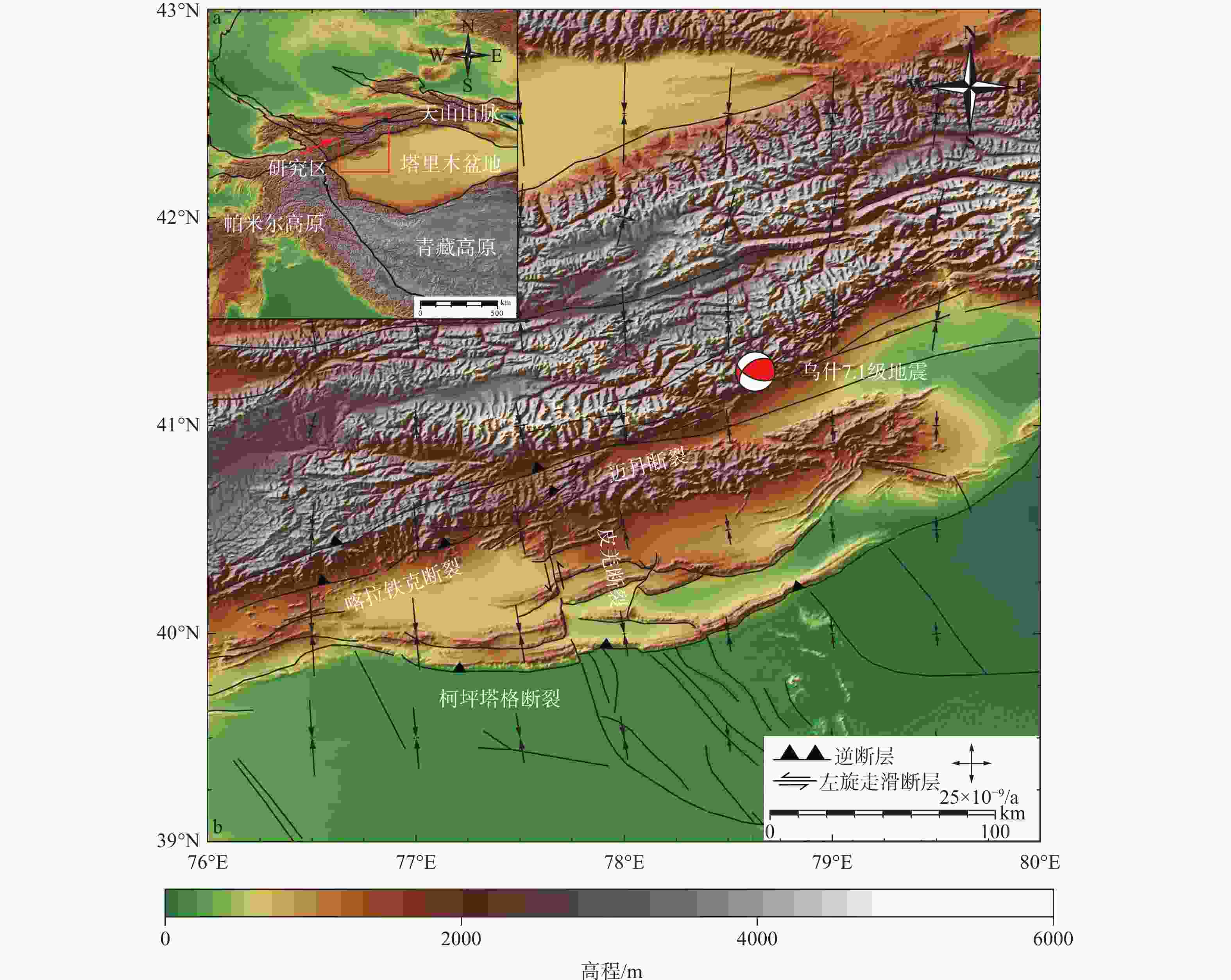
图 1 乌什7.1级地震的构造背景与区域应变率(断裂数据引自Wu et al.,2024,应变率数据引自Wang and Shen,2020)
沙滩球为震中位置;十字箭头表示水平主应变率矢量对,比例尺为 25 × 10−9/a a—研究区构造位置;b—乌什地震区域应变率与活动断裂
Figure 1. Tectonic setting and regional strain rate of the M 7.1 Wushi earthquake (Fault data from Wu et al., 2024; strain rate data from Wang and Shen, 2020)
(a) Regional tectonic setting of the study area; (b) Strain rate and active faults in the Wushi earthquake region Focal mechanism (beach ball) denotes epicenter locations; The cross-shaped arrows represent pairs of horizontal principal strain-rate vectors, with a scale of 25 × 10−9/a.
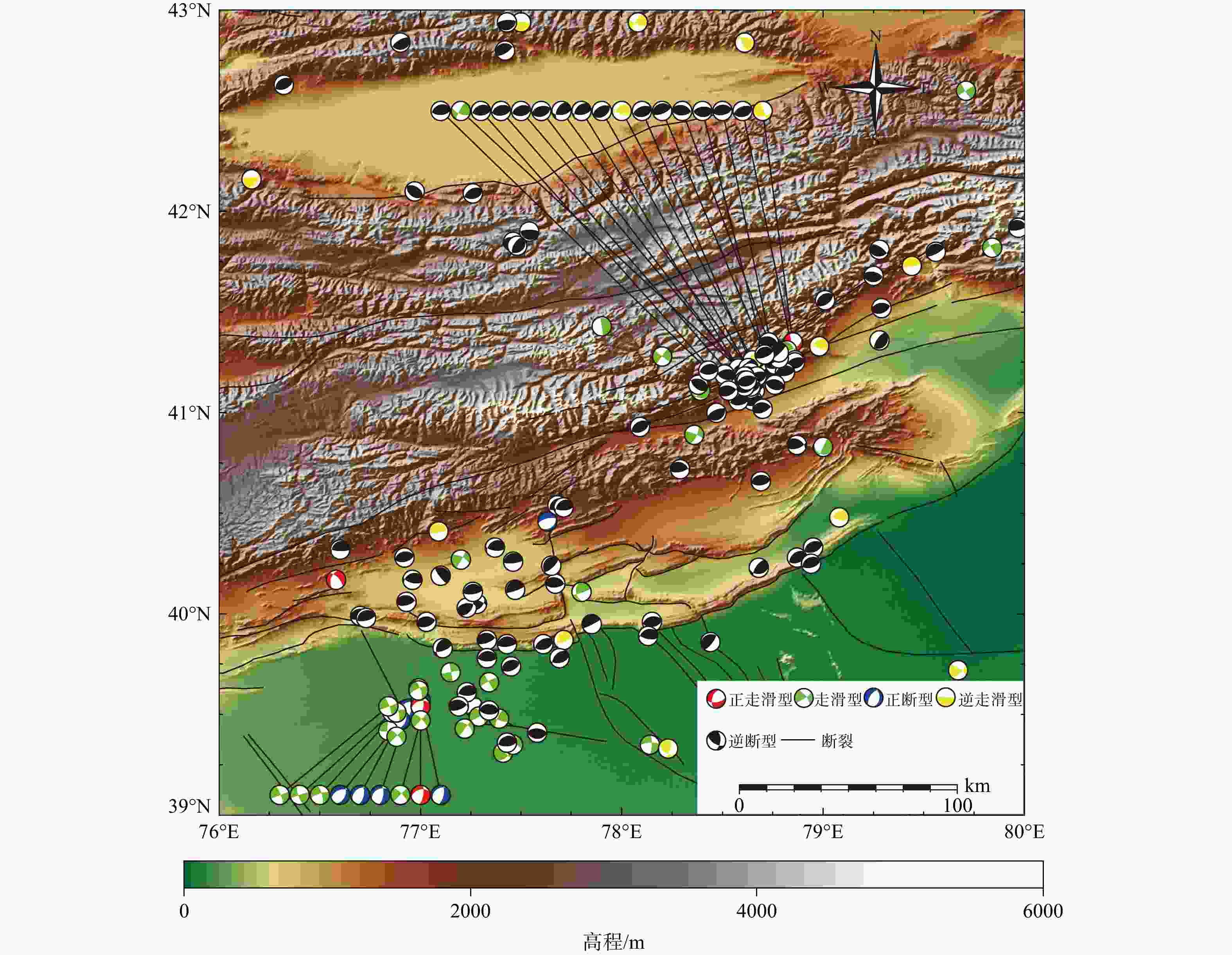
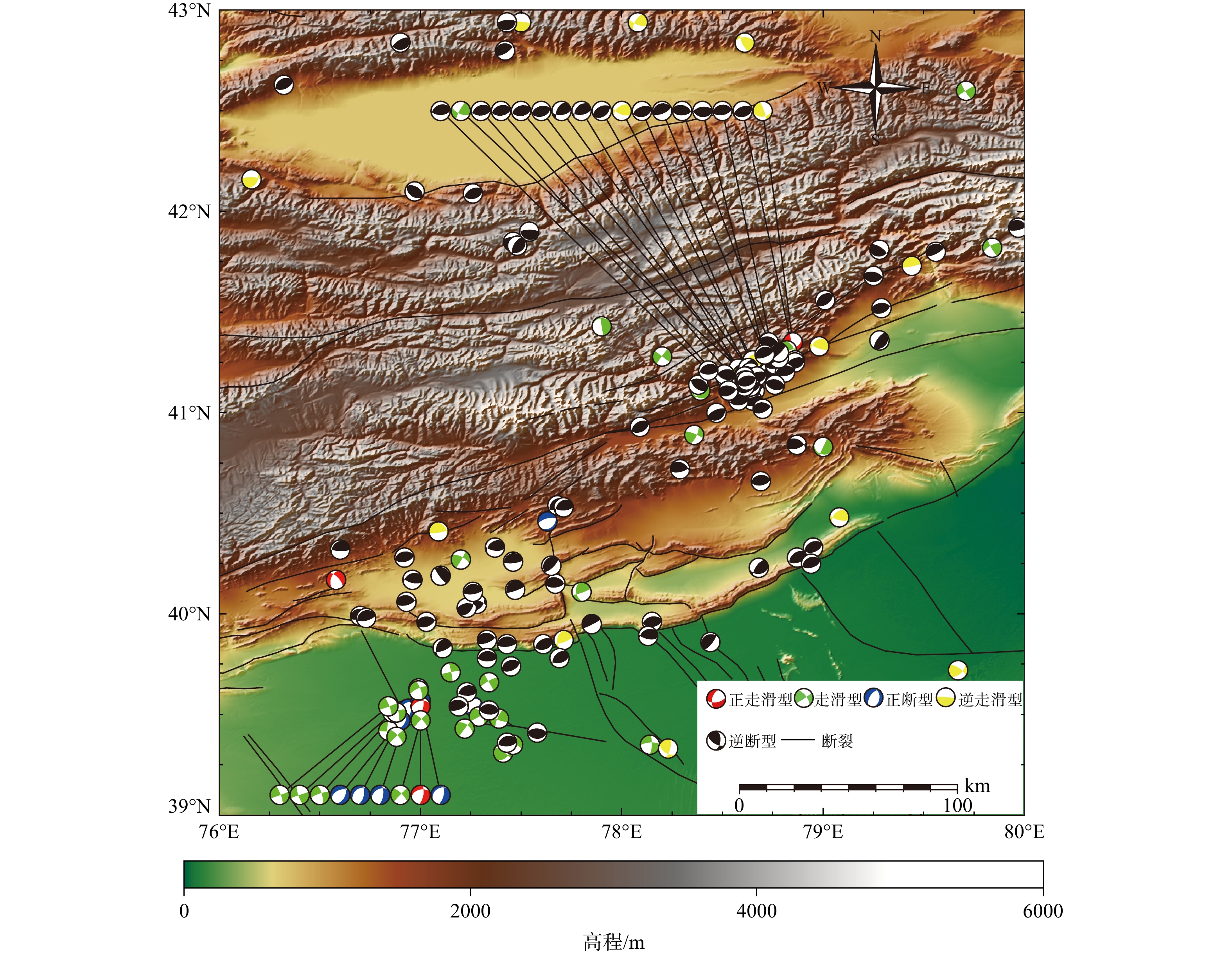
图 2 乌什地区震源机制解分布
不同颜色震源机制解代表不同破裂类型;部分震源机制解因震中密集采用细线引出,细线端点为地震实际震中位置;震源机制解数据来自中国地震台网中心、全球矩心矩张量(GCMT)、德国波茨坦地球科学研究中心(GFZ)、美国国家地震信息中心(NEIC)、巴黎地球物理研究所(IPGP)、蔚蓝海岸天文台(OCA)、SC4矩张量系统(SC4)、地震与海啸预测中心(CPPT)数据库
Figure 2. Distribution of focal mechanism solutions for the Wushi region
Different colors of focal mechanisms represent distinct faulting types. Due to high epicentral density, some focal mechanisms are connected by thin leader lines, where the endpoints indicate actual earthquake epicenters. Focal mechanism data are compiled from CENC, GCMT, GFZ, NEIC, IPGP, OCA, SC4, and CPPT databases.
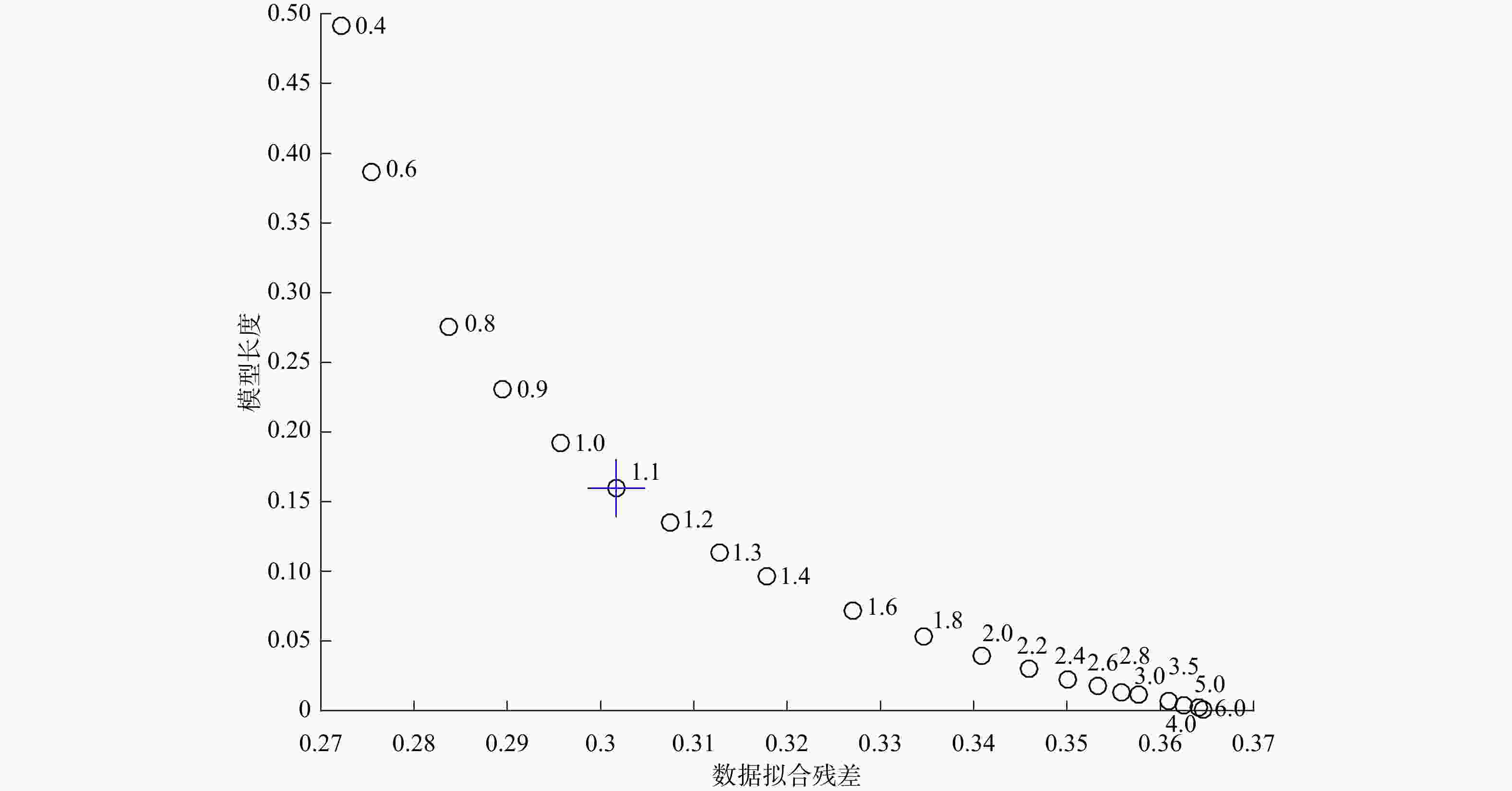
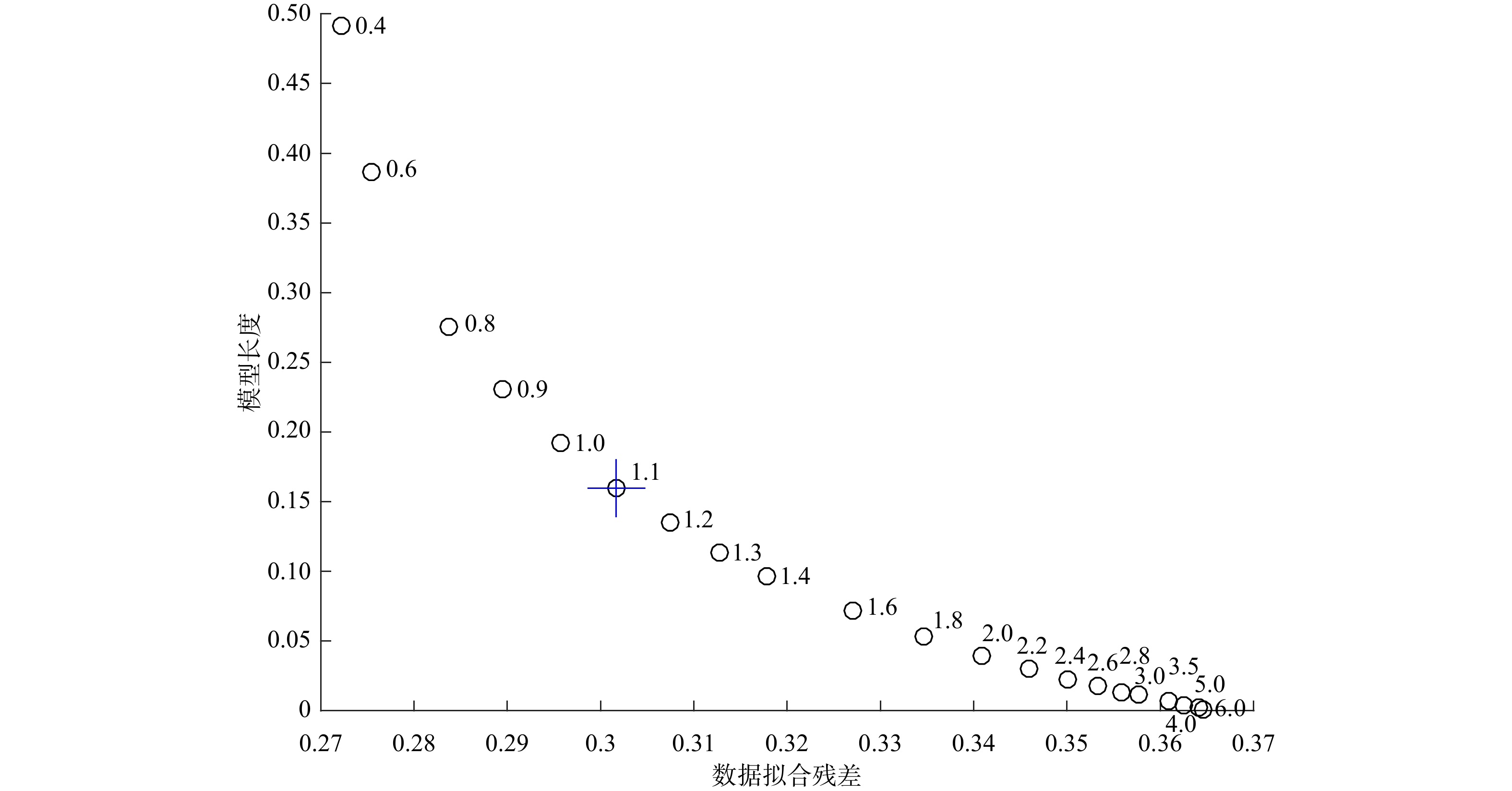
图 3 数据拟合残差和模型长度的折中曲线
蓝色十字为最佳阻尼系数
Figure 3. Trade-off curve between data misfit and model length
The blue cross indicates the optimal damping coefficient.
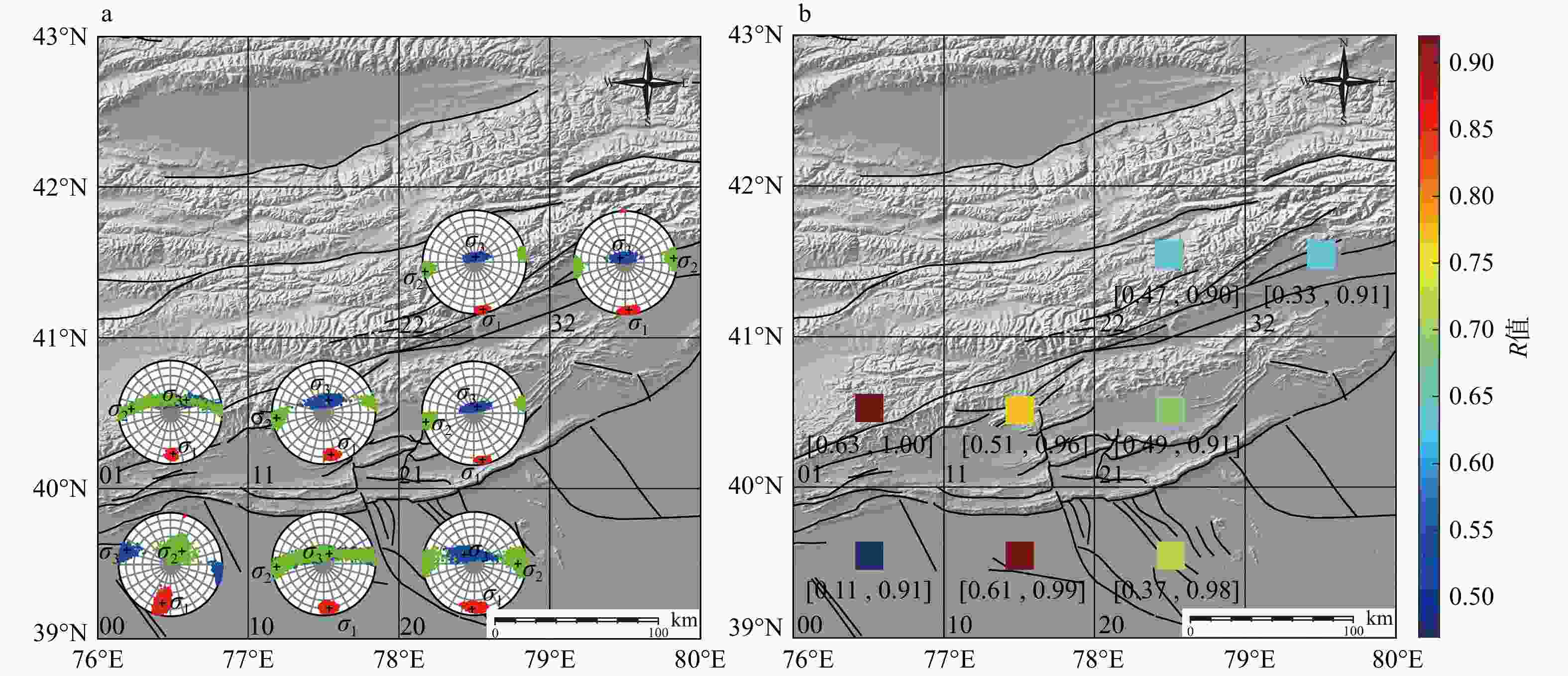
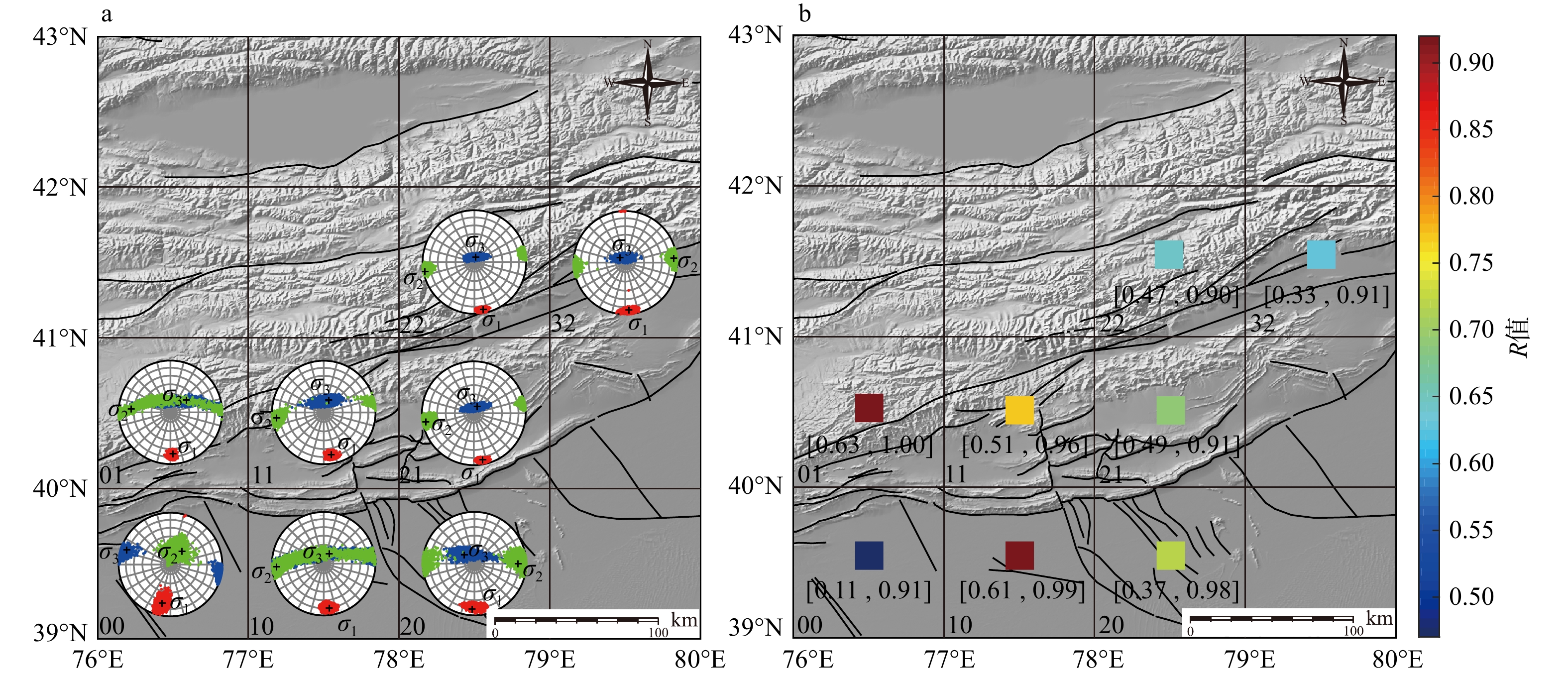
图 4 乌什地区构造应力场反演结果
σ1、σ2和σ3分别代表主压应力轴、中间应力轴和主张应力轴;红点、绿点、蓝点分别代表95%置信度下σ1、σ2、σ3应力轴的不确定范围;黑色加号代表各子区域应力张量最优解;各子区域中间矩形的颜色代表对应单元的应力形因子(R值);黑色实线代表断裂a—应力轴空间分布结果;b—R值空间分布结果
Figure 4. Inversion results of stress field in the Wushi region
(a) Results of each axis of the inverted stress field; (b) Results of the inverted R valueσ1, σ2, and σ3 represent the maximum compressive, intermediate, and maximum tensile principal stress axes, respectively. Red, green, and blue dots indicate the 95% confidence intervals for σ1, σ2, and σ3, respectively. Black plus signs mark the optimal stress tensor solutions for each subregion. Colored central rectangles depict the stress ratio (R-value) for the corresponding units. Black solid lines denote faults.
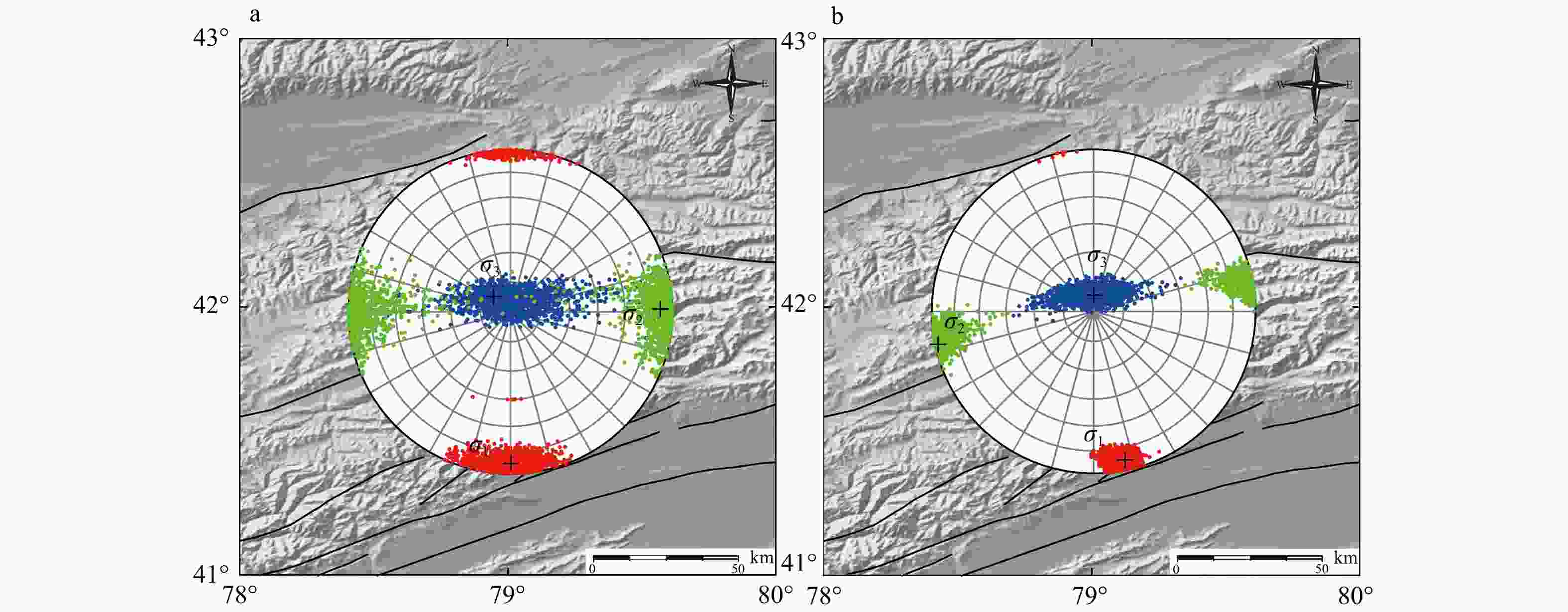
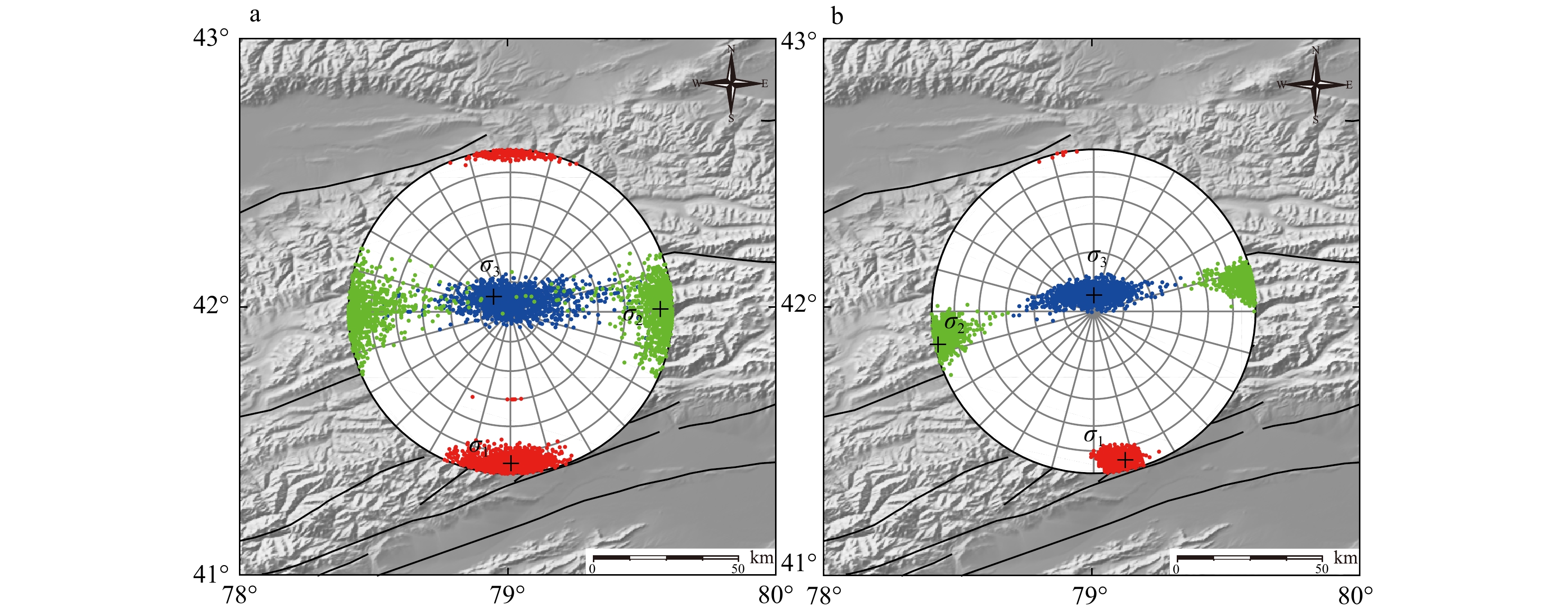
图 5 乌什7.1级地震前后构造应力场反演结果
σ1、σ2和σ3分别代表主压应力轴、中间应力轴和主张应力轴;红点、绿点、蓝点分别代表95%置信度下σ1、σ2、σ3应力轴的不确定范围;黑色加号代表各子区域应力张量最优解;黑色实线代表断裂a—震前反演结果;b—震后反演结果;
Figure 5. Tectonic stress fields before and after the Wushi M 7.1 earthquake obtained from inversion
(a) Pre-earthquake inversion results; (b) Post-earthquake inversion resultsσ1, σ2, and σ3 represent the maximum compressive, intermediate, and maximum tensile principal stress axes, respectively. Red, green, and blue dots indicate the 95% confidence intervals for σ1, σ2, and σ3, respectively. Black plus signs mark the optimal stress tensor solutions for each subregion. Black solid lines denote faults.
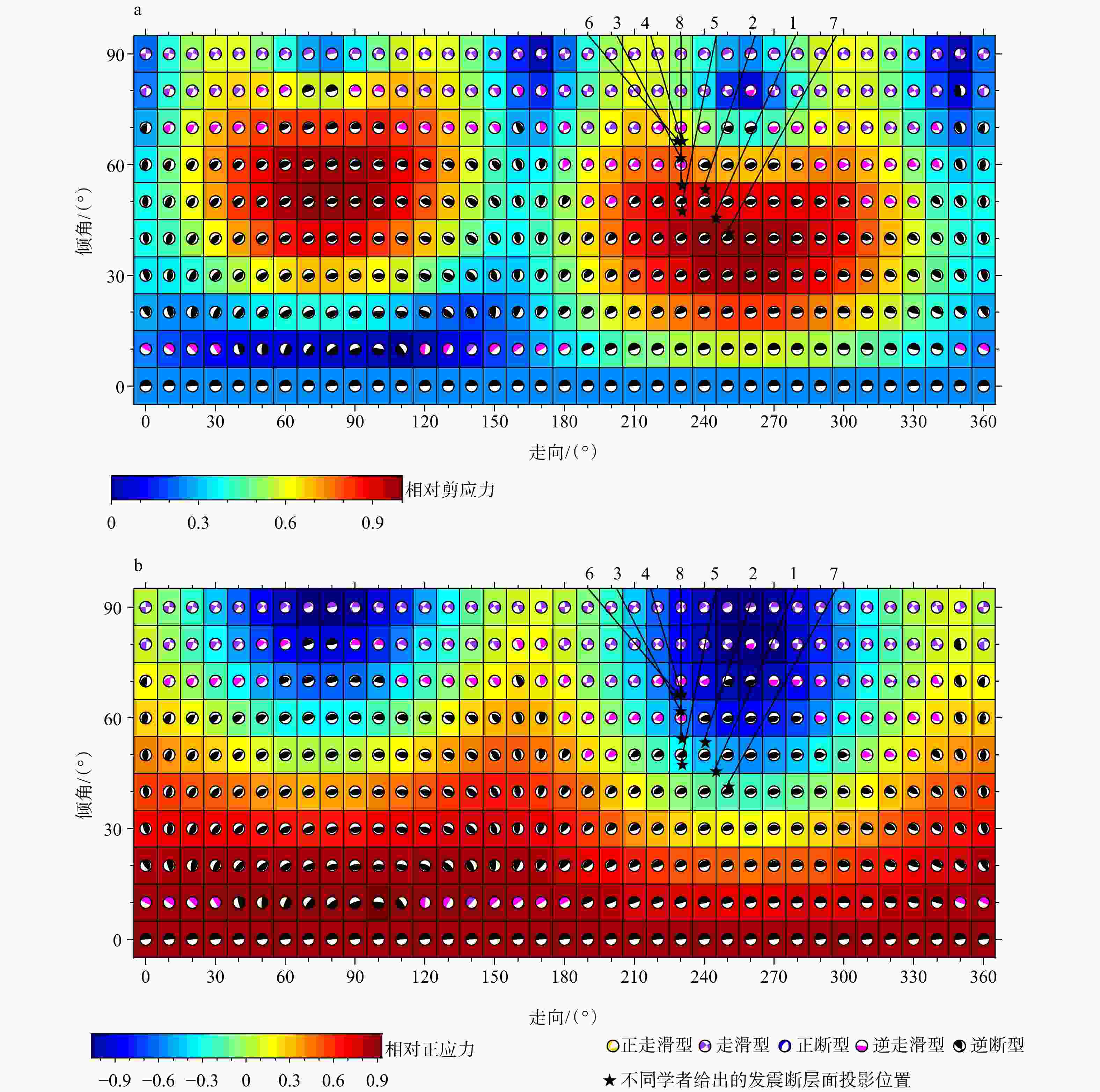
图 6 乌什地区应力体系下相对剪应力与相对正应力模拟结果
数字编号对应文献:1—关兆萱等(2024);2—王雪竹等(2025);3—李雨森等(2024);4—柳姣姣等(2025);5—黄旺等(2024);6—赵磊等(2024);7—张喆等(2024);8—能懿菡等(2025)a—相对剪应力分布;b—相对正应力分布
Figure 6. Simulation results of relative shear stress and relative normal stress under the stress regime of the Wushi region
(a) Relative shear stress distribution; (b) Relative normal stress distributionThe numbers 1–8 represent stress projection results onto the seismogenic fault planes compiled from different studies: 1–Guan et al.(2024); 2–Wang et al.(2025); 3–Li et al.(2024); 4–Liu et al.(2025); 5–Huang et al.(2024); 6–Zhao et al.(2024); 7–Zhang et al.(2024); 8–Nai et al.(2025).
表 1 乌什地区1°×1°网格应力场反演参数
Table 1. Stress field inversion parameters on a 1°×1° grid for the Wushi region
分区 σ1轴 σ2轴 σ3轴 R值 方位
角/(°)倾伏
角/(°)方位
角/(°)倾伏
角/(°)方位
角/(°)倾伏
角/(°)00 192.25 25.24 40.96 61.74 287.93 11.87 0.47 01 175.64 19.58 275.06 24.72 51.56 57.60 0.92 10 173.47 15.19 29.22 71.50 266.30 10.31 0.92 11 169.94 17.60 263.28 10.40 22.48 69.38 0.77 20 183.45 13.01 89.61 16.13 310.56 69.05 0.72 21 168.75 9.23 259.94 7.30 27.74 78.19 0.69 22 168.77 6.85 259.19 3.47 15.90 82.31 0.64 32 176.35 7.60 85.35 7.47 311.37 79.31 0.63  下载: 导出CSV
表 2 乌什7.1级地震前后构造应力场反演参数
Table 2. Inverted stress field parameters before and after the Wushi M 7.1 earthquake
阶段 σ1轴 σ2轴 σ3轴 R值 方位
角/(°)倾伏
角/(°)方位
角/(°)倾伏
角/(°)方位
角/(°)倾伏
角/(°)震前 180.49 7.36 89.42 8.20 −48.13 78.95 0.79 震后 167.96 7.33 −101.80 1.84 2.22 82.44 0.58
下载: 导出CSV
表 3 不同学者发震断层面参数及应力投影结果
Table 3. Seismogenic fault plane parameters and stress projections from different studies
序号 来源 走向/(°) 倾角/(°) 相对剪应力 相对正应力 1 关兆萱等(2024) 244.62 46.19 0.954 −0.337 2 王雪竹等(2025) 240 54 0.856 −0.535 3 李雨森等(2024) 229.36 62.42 0.748 −0.599 4 柳姣姣等(2025) 230 67 0.669 −0.690 5 黄旺等(2024) 230 48 0.931 −0.258 6 赵磊等(2024) 228 67 0.681 −0.657 7 张喆等(2024) 250 42 0.986 −0.224 8 能懿菡等(2025) 230 55 0.857 −0.444
下载: 导出CSV
-
[1] CHEN Q Y, 2022. Tectonic deformation and seismogenic mechanism of the 1902 MW7.7 Atushi earthquake[D]. Beijing: University of Chinese Academy of Scienc. (in Chinese with English abstract) [2] CHEN Q Y, FU B H, SHI P L, et al. 2022. Surface deformation associated with the 22 August 1902 MW 7.7 Atushi earthquake in the southwestern Tian Shan, revealed from multiple remote sensing data[J]. Remote Sensing, 14(7): 1663. [3] CUI H W, 2017. Application of the method of damped stress tensor inversion in New Britain and Pamir-Hindu kush areas based on the focal mechanisms[D]. Langfang: Institute of Disaster Prevention. (in Chinese with English abstract) [4] CUI H W, WAN Y G, HUANG J C, et al., 2019. Inversion for the tectonic stress field and the characteristic of the stress shape factor of the detachment slab in the Pamir-Hindu Kush area[J]. Chinese Journal of Geophysics, 62(5): 1633-1649. (in Chinese with English abstract) [5] CUI X F, 2006. Characteristics of recent tectonic stress field in Jiashi, Xinjiang and adjacent regions[J]. Acta Seismologica Sinica, 28(4): 347-356. (in Chinese with English abstract) doi: 10.1007/s11589-004-0370-3 [6] DZIEWONSKI A M, CHOU T A, WOODHOUSE J H, 1981. Determination of earthquake source parameters from waveform data for studies of global and regional seismicity[J]. Journal of Geophysical Research: Solid Earth, 86(B4): 2825-2852. doi: 10.1029/JB086iB04p02825 [7] EKSTRÖM G, NETTLES M, DZIEWOŃSKI A M, 2012. The global CMT project 2004–2010: centroid moment tensors for 13, 017 earthquakes[J]. Physics of the Earth and Planetary Interiors, 200-201: 1-9. [8] GEPHART J W, FORSYTH D W, 1984. An improved method for determining the regional stress tensor using earthquake focal mechanism data: application to the san fernando earthquake sequence[J]. Journal of Geophysical Research: Solid Earth, 89(B11): 9305-9320. doi: 10.1029/JB089iB11p09305 [9] GUAN P H, LEI J S, ZHAO D P, 2025. Relocation of the 2024 MS 7.1 Wushi, Xinjiang, China earthquake sequence and implications for seismogenic structure[J]. Journal of Asian Earth Sciences, 279: 106456. doi: 10.1016/j.jseaes.2024.106456 [10] GUAN Z X, WAN Y G, ZHOU M Y, et al., 2024. Seismogenic fault plane and geodynamic discussion of the 2024 Wushi MS7.1 Earthquake, Xinjiang, China[J]. Earthquake, 44(2): 1-11. (in Chinese with English abstract) [11] GUO N N, WU Y Q, ZHU S, et al., 2024. Coseismic deformation and interseismic strain accumulation of the 2024 MS 7.1 Wushi earthquake in Xinjiang, China[J]. Advances in Space Research, 74(4): 1586-1594. doi: 10.1016/j.asr.2024.05.028 [12] HARDEBECK J L, MICHAEL A J, 2006. Damped regional-scale stress inversions: methodology and examples for southern California and the Coalinga aftershock sequence[J]. Journal of Geophysical Research: Solid Earth, 111(B11): B11310. doi: 10.1029/2005jb004144 [13] HUANG W, LI J, CHEN R L, 2024. InSAR coseismic deformation and sliding distribution characteristics of Wushi MW7.0 earthquake on January 23, 2024[J]. Inland Earthquake, 38(2): 166-172, doi: 10.16256/j.issn.1001-8956.2024.02.009 [14] LEI X Y, LIU Z C, ZHAO P B, et al., 2023. Characteristics of source and its neighborhood post-earthquake tectonic stress field of Jiashi MS6.4 earthquake in Xinjiang on January 19, 2020[J]. Inland Earthquake, 37(1): 99-105, doi: 10.16256/j.issn.1001-8956.2023.01.011 [15] LI A, RAN Y K, LIU H G, et al., 2016. Active characteristics and paleoearthquakes in the west Kalpin nappe since the Holocene, SW Tianshan Mountain[J]. Advances in Earth Science, 31(4): 377-390, doi: 10.11867/j.issn.1001-8166.2016.04.0377 [16] LI J, ZHOU L Q, LONG H Y, et al., 2015. Spatial-temporal characteristics of the focal mechanism consistency parameter in Tianshan (Within Chinese Territory) seismic zone[J]. Seismology and Geology, 37(3): 792-803. (in Chinese with English abstract) [17] LI J, YAO Y, LI R, et al., 2022. Present-day strike-slip faulting and thrusting of the Kepingtage fold-and-thrust belt in Southern Tianshan: constraints from GPS observations[J]. Geophysical Research Letters, 49(11): e2022GL099105. doi: 10.1029/2022GL099105 [18] LI J, JIANG H K, WANG Q, 2023. Crustal attenuation structure of the Tianshan tectonic belt and its spatiotemporal variations[J]. Frontiers in Earth Science, 11: 1094151, doi: 10.3389/feart.2023.1094151 [19] LI T C, WAN Y G, LI J L, 2026. Seismogenic structure and crustal stress field in Jiashi earthquake zone[J]. Chinese Journal of Geophysics, 69(2): 681-701. (in Chinese with English abstract), [20] LI Y S, LI W L, XU Q, et al., 2024. Coseismic deformation and slip distribution of the 2024 MS 7.1 Wushi earthquake based on InSAR observations[J]. Journal of Chengdu University of Technology (Science & Technology Edition), 51(4): 641-653. (in Chinese with English abstract) [21] LIU J J, ZHANG Y Z, HAO X Y, 2025. Inversion of surface deformation and fault slip distribution of Xinjiang Wushi MW7.0 earthquake in 2024 based on Sentinel-1A[J]. Journal of Geodesy and Geodynamics, 45(2): 170-176, doi: 10.14075/j.jgg.2024.03.114 [22] LIU Q Y, CHEN J H, LI S C, et al., 2000. Passive seismic experiment in Xinjiang-Jiashi strong earthquake region and discussion on its seismic genesis[J]. Chinese Journal of Geophysics, 43(3): 356-365. (in Chinese with English abstract) doi: 10.1002/cjg2.48 [23] MARTINEZ-GARZON P, KWIATEK G, ICKRATH M, et al., 2014. MSATSI: a MATLAB package for stress inversion combining solid classic methodology, a new simplified user-handling, and a visualization tool[J]. Seismological Research Letters, 85(4): 896-904. doi: 10.1785/0220130189 [24] MOLNAR P, STOCK J M, 2009. Slowing of India's convergence with Eurasia since 20 Ma and its implications for Tibetan mantle dynamics[J]. Tectonics, 28(3): TC3001, doi: 10.1029/2008TC002271 [25] NAI Y H, HAN B Q, LIU Z J, et al., 2025. Coseismic surface displacement and source model of the 2024 MW 7.0 Wushi(Xinjiang, China) earthquake revealed by InSAR observations[J]. Geomatics and Information Science of Wuhan University, 50(2): 368-376, doi: 10.13203/j.whugis20240037 [26] PAN Z Y, SHAO Z G, ZHOU Y, et al., 2020. Present-day crustal deformation of the Pamir constrained by the GPS strain rate, seismic strain rate and earthquake focal stress[J]. Chinese Journal of Geophysics, 63(3): 1143-1154. (in Chinese with English abstract) [27] PEI S P, XU Z H, WANG S Y, et al., 2002. Pn velocity tomography of Xinjiang, China and adjacent region[J]. Chinese Journal of Geophysics, 45(2): 218-225. (in Chinese with English abstract) doi: 10.1002/cjg2.234 [28] QIU J T, SUN J B, JI L Y, 2024. The 2024 MW 7.1 Wushi Earthquake: a thrust and strike-slip event unveiling the seismic mechanisms of the South Tian Shan’s thick-skin tectonics[J]. Remote Sensing, 16(16): 2937. doi: 10.3390/rs16162937 [29] SONG Z Y, WAN Y G, GUAN Z X, et al., 2024. Stress changes on surrounding faults and triggering of aftershocks induced by the MS7.1 earthquake in Wushi County, Aksu Prefecture, Xinjiang, on January 23, 2024[J]. China Earthquake Engineering Journal, 46(4): 982-991. (in Chinese with English abstract) [30] WAN Y G, SHEN Z K, WANG M, et al. 2008. Coseismic slip distribution of the 2001 Kunlun mountain Pass west earthquake constrained using GPS and InSAR data[J]. Chinese Journal of Geophysics, 51(4): 1074-1084. (in Chinese with English abstract) [31] WAN Y G, SHENG S Z, HUANG J C, et al., 2016. The grid search algorithm of tectonic stress tensor based on focal mechanism data and its application in the boundary zone of China, Vietnam and Laos[J]. Journal of Earth Science, 27(5): 777-785. doi: 10.1007/s12583-015-0649-1 [32] WAN Y G, 2019. Determination of center of several focal mechanisms of the same earthquake[J]. Chinese Journal of Geophysics, 62(12): 4718-4728. (in Chinese with English abstract) [33] WAN Y G, 2020. Simulation on relationship between stress regimes and focal mechanisms of earthquakes[J]. Chinese Journal of Geophysics, 63(6): 2281-2296. (in Chinese with English abstract) [34] WAN Y G, 2024. Focal mechanism classification based on areal strain of horizontal strain rosette of focal mechanism and characteristic analysis of overall focal mechanism of earthquake sequence[J]. Earth Science, 49(7): 2675-2684. (in Chinese with English abstract) [35] WANG M, SHEN Z K, 2020. Present-day crustal deformation of continental China derived from GPS and its tectonic implications[J]. Journal of Geophysical Research: Solid Earth, 125(2): e2019JB018774. doi: 10.1029/2019JB018774 [36] WANG X Z, WU C Y, LIU J M, et al., 2025. Earthquake sequence relocation and seismogenic structure of the 2024 MS7.1 Wushi earthquake on January 23, 2024, Xinjiang[J]. Seismology and Geology, 47(2): 488-506. (in Chinese with English abstract) [37] WANG Z T, CHENG H H, DONG P Y, et al., 2020. Numerical analysis of seismogenic stress field and fault activity characteristics of Tianshan orogen and its adjacent areas[J]. Chinese Journal of Geophysics, 63(11): 4037-4049. (in Chinese with English abstract) [38] WU C Y, 2016. Late Quaternary activity of the East-northeastern trending faults in the southwestern Tianshan and their role in the tectonic deformation of the Tianshan Mountains[D]. Beijing: Institute of Geology, China Earthquake Administration. (in Chinese with English abstract) [39] WU C Y, ZHENG W J, ZHANG P Z, et al., 2019. Oblique thrust of the maidan fault and late quaternary tectonic deformation in the Southwestern Tian Shan, Northwestern China[J]. Tectonics, 38(8): 2625-2645. doi: 10.1029/2018TC005248 [40] WU C Y, ZHANG P Z, ZHANG Z Q, et al., 2023. Slip partitioning and crustal deformation patterns in the Tianshan orogenic belt derived from GPS measurements and their tectonic implications[J]. Earth-Science Reviews, 238: 104362. doi: 10.1016/j.earscirev.2023.104362 [41] WU X Y, XU X W, YU G H, et al., 2024. The China active faults database (CAFD) and its web system[J]. Earth System Science Data, 16(7): 3391-3417. doi: 10.5194/essd-16-3391-2024 [42] XU X W, ZHANG X K, RAN Y K, et al., 2006. The preliminary study on seismotectonics of the 2003 AD Bachu-jiashi earthquake (MS6.8), southern Tian Shan[J]. Seismology and Geology, 28(2): 161-178. (in Chinese with English abstract) [43] ZHANG B X, QIAN L, LI T, et al., 2024. Geological disasters and surface ruptures of January 23, 2024 MS7.1 Wushi earthquake, Xinjiang, China[J]. Seismology and Geology, 46(1): 220-234. (in Chinese with English abstract) [44] ZHANG Z, FANG L H, CHEN K, et al., 2024. Quick output parameters related to the 23 January 2024 MS7.1 Wushi earthquake in the Aksu region of Xinjiang[J]. Progress in Earthquake Sciences, 54(3): 221-228, doi: 10.19987/j.dzkxjz.2024-037 [45] ZHAO L, CHEN Z D, XIE L, et al., 2024. Coseismic deformation and slip model of the 2024 MW7.0 Wushi earthquake obtained from InSAR observation[J]. Reviews of Geophysics and Planetary Physics, 55(4): 453-460, doi: 10.19975/j.dqyxx.2024-010 [46] ZHAO R B, SHEN J, LI J, 2001. Preliminary study on the deformation features and seismogenic model of the 1902 Artux, Xinjiang earthquake of MS 8(1/4)[J]. Seismology and Geology, 23(4): 493-500. (in Chinese with English abstract) [47] 陈庆宇, 2022. 1902年MW 7.7级阿图什地震的构造变形和发震机制研究[D]. 北京: 中国科学院大学(中国科学院空天信息创新研究院), doi: 10.44231/d.cnki.gktxc.2022.000063. [48] 崔华伟, 2017. 基于震源机制的阻尼应力张量反演方法在新不列颠和帕米尔—兴都库什地区的应用[D]. 廊坊: 防灾科技学院. [49] 崔华伟, 万永革, 黄骥超, 等, 2019. 帕米尔—兴都库什地区构造应力场反演及拆离板片应力形因子特征研究[J]. 地球物理学报, 62(5): 1633-1649. doi: 10.6038/cjg2019M0202 [50] 崔效锋, 2006. 伽师及周围地区现代构造应力场特征研究[J]. 地震学报, 28(4): 347-356. doi: 10.3321/j.issn:0253-3782.2006.04.002 [51] 关兆萱, 万永革, 周明月, 等, 2024. 2024年新疆乌什MS7.1地震发震断层产状及其动力学探讨[J]. 地震, 44(2): 1-11. doi: 10.12196/j.issn.1000-3274.2024.02.001 [52] 黄旺, 李杰, 陈荣柳, 等, 2024. 2024年1月23日乌什MW7.0地震InSAR同震形变与滑动分布特征[J]. 内陆地震, 38(2): 166-172, doi: 10.16256/j.issn.1001-8956.2024.02.009 [53] 雷啸宇, 刘兆才, 赵鹏毕, 等, 2023. 2020年1月19日新疆伽师MS6.4地震震源及邻区震后构造应力场特征[J]. 内陆地震, 37(1): 99-105, doi: 10.16256/j.issn.1001-8956.2023.01.011 [54] 李安, 冉勇康, 刘华国, 等, 2016. 西南天山柯坪推覆系西段全新世构造活动特征和古地震[J]. 地球科学进展, 31(4): 377-390, doi: 10.11867/j.issn.1001-8166.2016.04.0377 [55] 李金, 周龙泉, 龙海英, 等, 2015. 天山地震带(中国境内)震源机制一致性参数的时空特征[J]. 地震地质, 37(3): 792-803. doi: 10.3969/j.issn.0253-4967.2015.03.010 [56] 李天成, 万永革, 李金磊, 2026. 伽师地震区的发震构造及地壳应力场研究[J]. 地球物理学报, 69(2): 681-701 [57] 李雨森, 李为乐, 许强, 等, 2024. 2024年新疆乌什MS 7.1地震InSAR同震形变探测与断层滑动分布反演[J]. 成都理工大学学报(自然科学版), 51(4): 641-653 [58] 柳姣姣, 张永志, 郝小叶, 等, 2025. 基于Sentinel-1A的2024年新疆乌什MW7.0地震地表形变与断层滑动分布反演[J]. 大地测量与地球动力学, 45(2): 170-176, doi: 10.14075/j.jgg.2024.03.114 [59] 刘启元, 陈九辉, 李顺成, 等, 2000. 新疆伽师强震群区三维地壳上地幔S波速度结构及其地震成因的探讨[J]. 地球物理学报, 43(3): 356-365. doi: 10.3321/j.issn:0001-5733.2000.03.009 [60] 能懿菡, 韩炳权, 刘振江, 等, 2025. InSAR观测揭示的2024年新疆乌什MW 7.0地震地表形变及发震断层模型[J]. 武汉大学学报(信息科学版), 50(2): 368-376, doi: 10.13203/j.whugis20240037 [61] 潘正洋, 邵志刚, 周云, 等, 2020. 基于GPS应变、地震应变率与震源应力场对帕米尔高原现今构造变形特征的分析[J]. 地球物理学报, 63(3): 1143-1154. doi: 10.6038/cjg2020N0161 [62] 裴顺平, 许忠淮, 汪素云, 等, 2002. 新疆及邻区Pn速度层析成像[J]. 地球物理学报, 45(2): 218-225. [63] 宋泽尧, 万永革, 关兆萱, 等, 2024. 2024年1月23日新疆阿克苏地区乌什县MS7.1地震对周围断层的应力影响及对余震的触发作用[J]. 地震工程学报, 46(4): 982-991. doi: 10.20000/j.1000-0844.20240504001 [64] 万永革, 沈正康, 王敏, 等, 2008. 根据GPS和InSAR数据反演2001年昆仑山口西地震同震破裂分布[J]. 地球物理学报, 51(4): 1074-1084. doi: 10.3321/j.issn:0001-5733.2008.04.016 [65] 万永革, 2019. 同一地震多个震源机制中心解的确定[J]. 地球物理学报, 62(12): 4718-4728. doi: 10.6038/cjg2019M0553 [66] 万永革, 2020. 震源机制与应力体系关系模拟研究[J]. 地球物理学报, 63(6): 2281-2296. doi: 10.6038/cjg2020M0472 [67] 万永革, 2024. 震源机制水平应变花面应变的地震震源机制分类方法及序列震源机制总体特征分析[J]. 地球科学, 49(7): 2675-2684. doi: 10.3799/dqkx.2022.245 [68] 王雪竹, 吴传勇, 刘建明, 等, 2025. 2024年1月23日新疆乌什MS7.1地震序列重定位与发震构造[J]. 地震地质, 47(2): 488-506. doi: 10.3969/j.issn.0253-4967.2025.02.20240153 [69] 王子韬, 程惠红, 董培育, 等, 2020. 天山造山带及邻区孕震应力场及断裂带活动性特征的数值实验分析[J]. 地球物理学报, 63(11): 4037-4049. doi: 10.6038/cjg2020O0052 [70] 吴传勇, 2016. 西南天山北东东走向断裂的晚第四纪活动特征及在天山构造变形中的作用[D]. 北京: 中国地震局地质研究所. [71] 徐锡伟, 张先康, 冉勇康, 等, 2006. 南天山地区巴楚-伽师地震(MS6.8)发震构造初步研究[J]. 地震地质, 28(2): 161-178. doi: 10.3969/j.issn.0253-4967.2006.02.001 [72] 张博譞, 钱黎, 李涛, 等, 2024. 2024年1月23日新疆乌什MS7.1地震地质灾害和地表破裂[J]. 地震地质, 46(1): 220-234. doi: 10.3969/j.issn.0253-4967.2024.01.013 [73] 张喆, 房立华, 陈鲲, 等, 2024. 2024年1月23日新疆阿克苏地区乌什7.1级地震的快速产出参数[J]. 地震科学进展, 54(3): 221-228, doi: 10.19987/j.dzkxjz.2024-037 [74] 赵磊, 陈志丹, 谢磊, 等, 2024. 2024年1月23日MW7.0乌什地震InSAR同震形变场和断层滑动分布[J]. 地球与行星物理论评(中英文), 55(4): 453-460, doi: 10.19975/j.dqyxx.2024-010 [75] 赵瑞斌, 沈军, 李军, 2001. 1902年新疆阿图什8(1/4)级地震形变特征与发震模式初探[J]. 地震地质, 23(4): 493-500. doi: 10.3969/j.issn.0253-4967.2001.04.002 -

 下载:
下载:


计量
- 文章访问数: 696
- HTML全文浏览量: 136
- PDF下载量: 602
- 被引次数: 0
